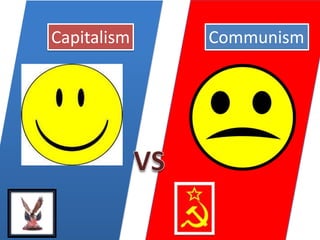
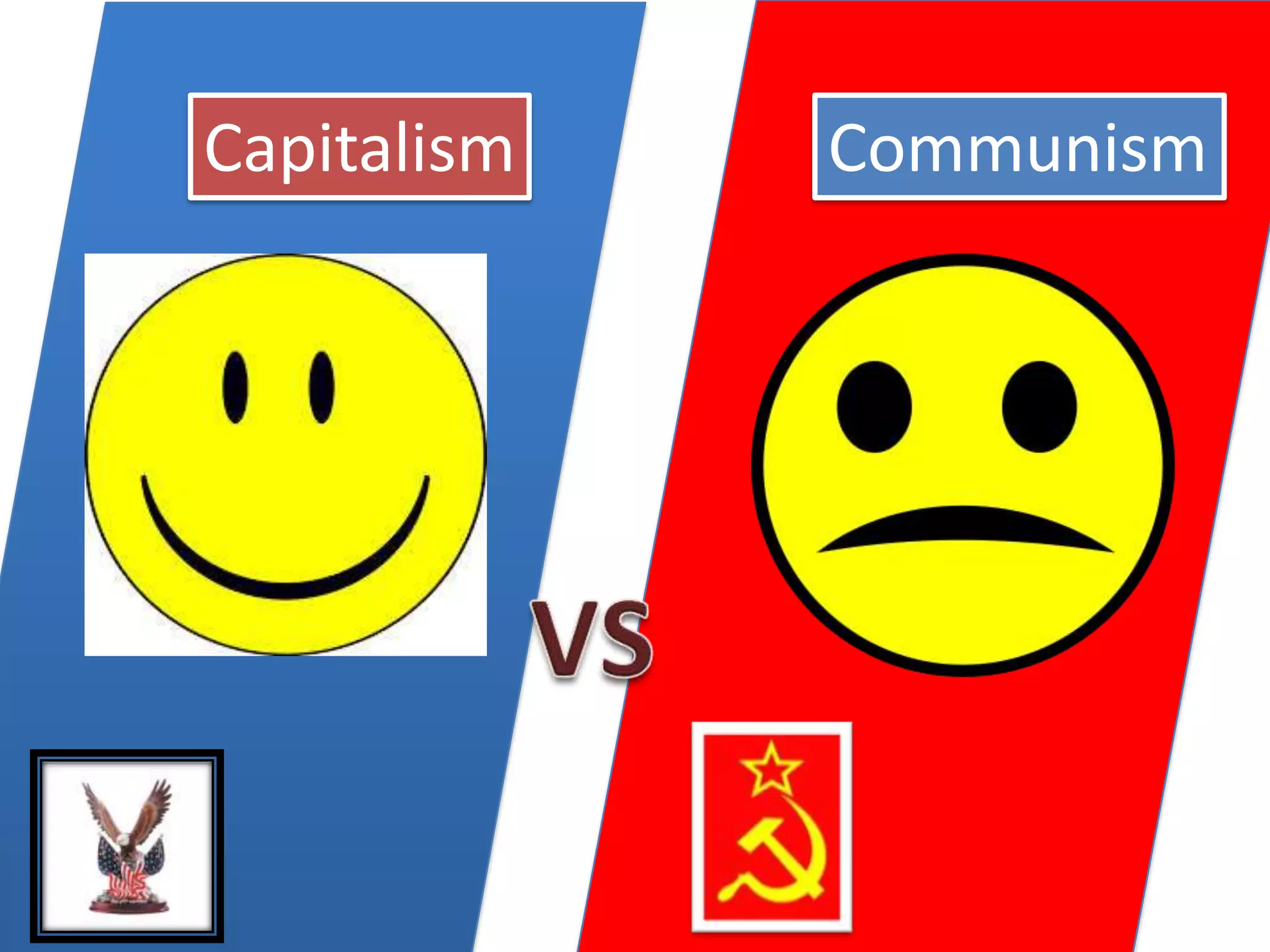

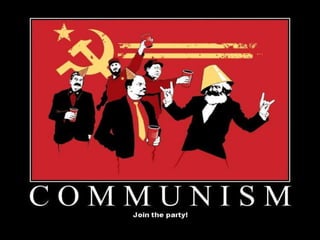
Capitalism   Communism


               VS
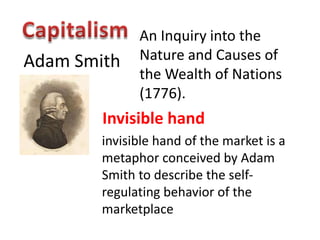
An Inquiry into the
Adam Smith    Nature and Causes of
              the Wealth of Nations
              (1776).
        Invisible hand
        invisible hand of the market is a
        metaphor conceived by Adam
        Smith to describe the self-
        regulating behavior of the
        marketplace
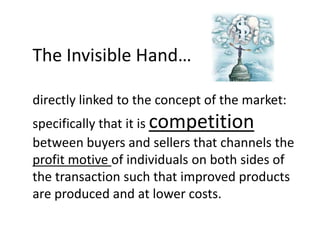
The Invisible Hand…

directly linked to the concept of the market:
specifically that it is competition
between buyers and sellers that channels the
profit motive of individuals on both sides of
the transaction such that improved products
are produced and at lower costs.
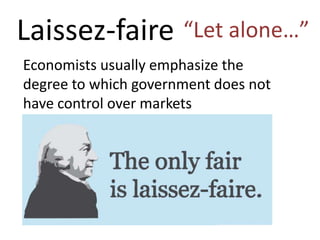
Laissez-faire “Let alone…”
Economists usually emphasize the
degree to which government does not
have control over markets
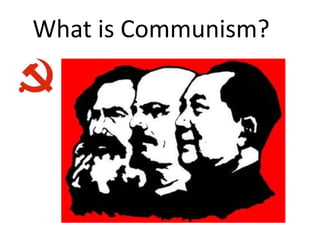
What is Communism?
1. Communism is a type of
government where only one political
party had power over the nation.
2. This party gains its supreme
executive power from military and
police force.
3. A communist government makes
decisions for its public and treats all
citizens equally.
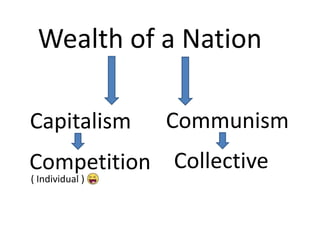
Wealth of a Nation

Capitalism       Communism
Competition Collective
( Individual )
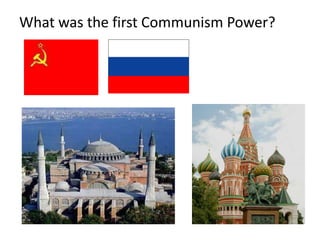
What was the first Communism Power?


         Cathedral of
         St. Basil-
         Moscow
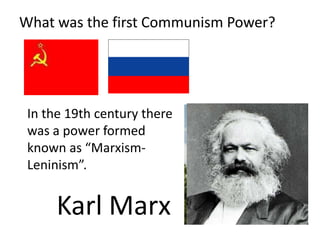
What was the first Communism Power?


 In the 19th century there
 was a power formed
 known as “Marxism-
 Leninism”.


      Karl Marx
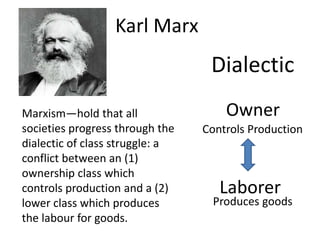
Karl Marx
                                  Dialectic
Marxism—hold that all                Owner
societies progress through the   Controls Production
dialectic of class struggle: a
conflict between an (1)
ownership class which
controls production and a (2)       Laborer
lower class which produces         Produces goods
the labour for goods.
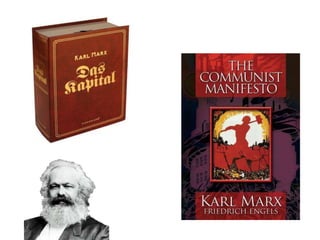
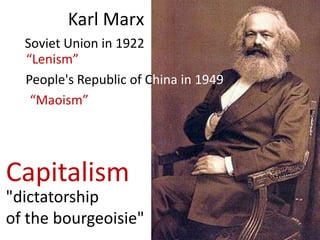
Karl Marx
  Soviet Union in 1922
  “Lenism”
  People's Republic of China in 1949
   “Maoism”


Capitalism
"dictatorship
of the bourgeoisie"
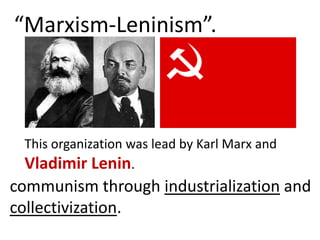
“Marxism-Leninism”.


 This organization was lead by Karl Marx and
 Vladimir Lenin.
communism through industrialization and
collectivization.
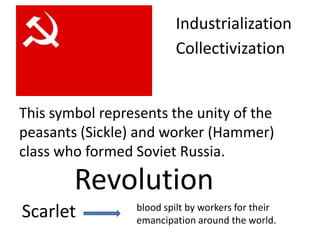
Industrialization
                         Collectivization


This symbol represents the unity of the
peasants (Sickle) and worker (Hammer)
class who formed Soviet Russia.

        Revolution
Scarlet          blood spilt by workers for their
                 emancipation around the world.
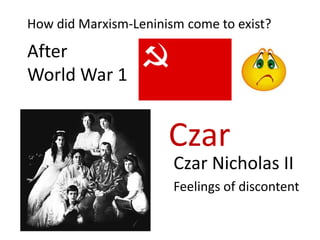
How did Marxism-Leninism come to exist?

After
World War 1


                      Czar
                       Czar Nicholas II
                       Feelings of discontent
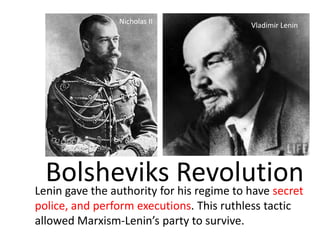
Nicholas II               Vladimir Lenin


  Bolsheviks Revolution
Lenin gave the authority for his regime to have secret
police, and perform executions. This ruthless tactic
allowed Marxism-Lenin’s party to survive.
Bolsheviks
Russian Party
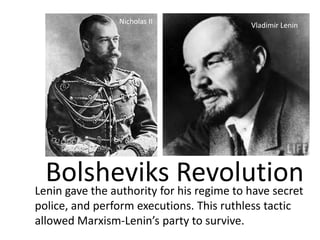
Nicholas II               Vladimir Lenin


  Bolsheviks Revolution
Lenin gave the authority for his regime to have secret
police, and perform executions. This ruthless tactic
allowed Marxism-Lenin’s party to survive.
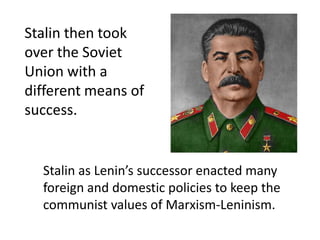
Stalin then took
over the Soviet
Union with a
different means of
success.


  Stalin as Lenin’s successor enacted many
  foreign and domestic policies to keep the
  communist values of Marxism-Leninism.
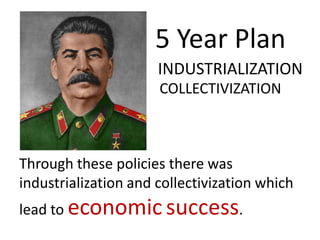
5 Year Plan
                      INDUSTRIALIZATION
                      COLLECTIVIZATION


Through these policies there was
industrialization and collectivization which
lead to economic success.
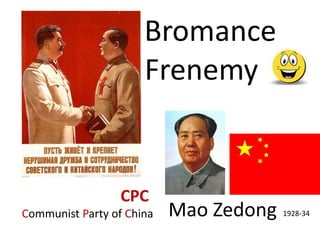
Bromance
                      Frenemy


                  CPC
Communist Party of China   Mao Zedong   1928-34
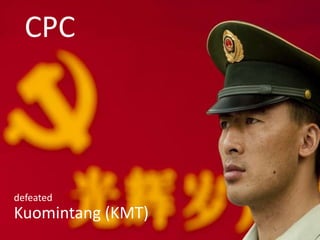
CPC


defeated
Kuomintang (KMT)
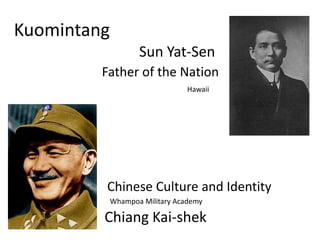
Kuomintang
                    Sun Yat-Sen
         Father of the Nation
                                 Hawaii


         Chinese Culture and Identity
             Whampoa Military Academy

         Chiang Kai-shek
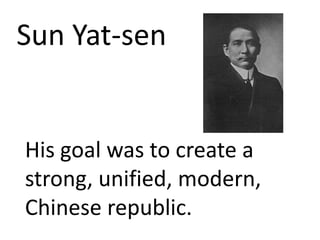
Sun Yat-sen


His goal was to create a
strong, unified, modern,
Chinese republic.
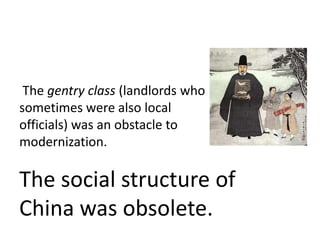
The gentry class (landlords who
sometimes were also local
officials) was an obstacle to
modernization.

The social structure of
China was obsolete.
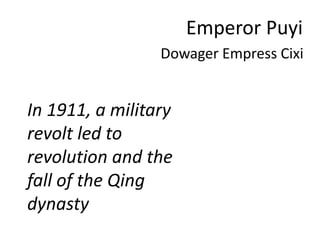
Emperor Puyi
                 Dowager Empress Cixi


In 1911, a military
revolt led to
revolution and the
fall of the Qing
dynasty
Lenin was convinced that the
Russian Revolution could not
survive unless successful
revolutions took place in
other countries
which would then become socialist allies of Soviet
Russia.
Russia was a backward country in 1917

 the revolutionary leaders were
not workers or peasants, but
bourgeois, i.e., middle class
intellectuals.
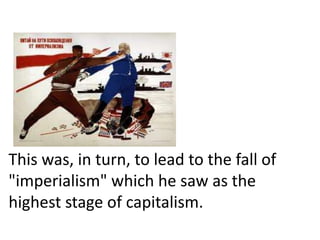
This was, in turn, to lead to the fall of
"imperialism" which he saw as the
highest stage of capitalism.
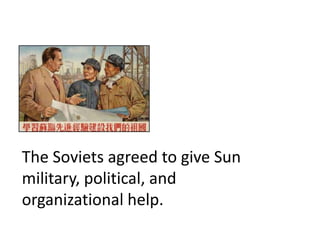
The Soviets agreed to give Sun
military, political, and
organizational help.
His primary goal was the
reunification of the
country.

                              USSR
       2 Factors:
        (a) defeat the Chinese
       warlords and (b) force out
       the foreign powers.
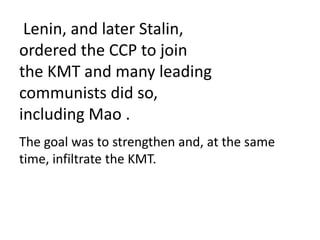
Lenin, and later Stalin,
ordered the CCP to join
the KMT and many leading
communists did so,
including Mao .
The goal was to strengthen and, at the same
time, infiltrate the KMT.
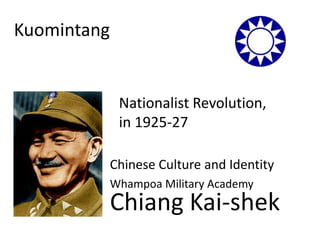
Kuomintang


              Nationalist Revolution,
              in 1925-27

             Chinese Culture and Identity
             Whampoa Military Academy
             Chiang Kai-shek
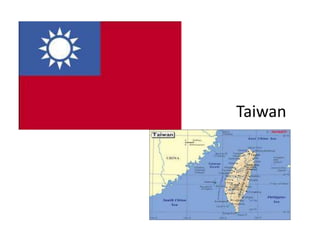
Taiwan
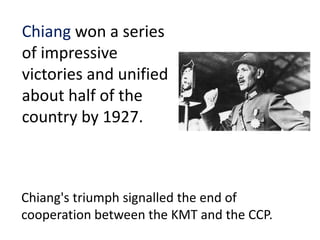
Chiang won a series
of impressive
victories and unified
about half of the
country by 1927.


Chiang's triumph signalled the end of
cooperation between the KMT and the CCP.
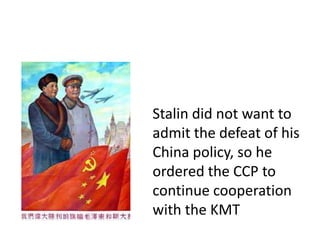
Stalin did not want to
admit the defeat of his
China policy, so he
ordered the CCP to
continue cooperation
with the KMT
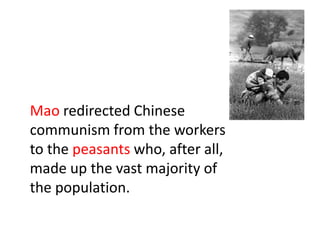
Mao redirected Chinese
communism from the workers
to the peasants who, after all,
made up the vast majority of
the population.
Mao changed the communist goal
in China from a workers'
revolution to a peasant
revolution, which he saw as the
first step toward a socialist
revolution.
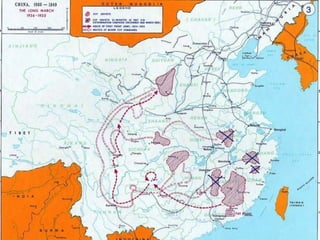
Chinese Soviet Republic
1931-34              The Jiangxi Soviet

Disaster !
LONG MARCH                   1934
             was a military retreat
             undertaken by the Red
             Army of the Communist
             Party of China
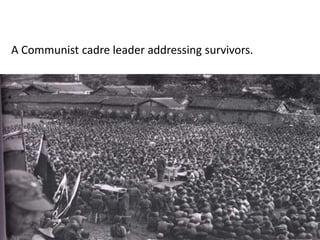
A Communist cadre leader addressing survivors.
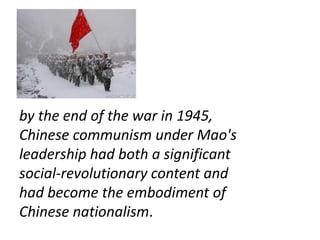
by the end of the war in 1945,
Chinese communism under Mao's
leadership had both a significant
social-revolutionary content and
had become the embodiment of
Chinese nationalism.
Achievements:
(a) effective national unity
(b) real independence
CCP led the way to the third goal:

(C) social-economic reform, especially
the abolition of the feudal system in the
countryside.
The Civil War
What is communism

What is communism

  • 1.
    Capitalism Communism VS
  • 2.
    An Inquiry intothe Adam Smith Nature and Causes of the Wealth of Nations (1776). Invisible hand invisible hand of the market is a metaphor conceived by Adam Smith to describe the self- regulating behavior of the marketplace
  • 3.
    The Invisible Hand… directlylinked to the concept of the market: specifically that it is competition between buyers and sellers that channels the profit motive of individuals on both sides of the transaction such that improved products are produced and at lower costs.
  • 4.
    Laissez-faire “Let alone…” Economistsusually emphasize the degree to which government does not have control over markets
  • 5.
  • 6.
    1. Communism isa type of government where only one political party had power over the nation. 2. This party gains its supreme executive power from military and police force. 3. A communist government makes decisions for its public and treats all citizens equally.
  • 7.
    Wealth of aNation Capitalism Communism Competition Collective ( Individual )
  • 8.
    What was thefirst Communism Power? Cathedral of St. Basil- Moscow
  • 9.
    What was thefirst Communism Power? In the 19th century there was a power formed known as “Marxism- Leninism”. Karl Marx
  • 11.
    Karl Marx Dialectic Marxism—hold that all Owner societies progress through the Controls Production dialectic of class struggle: a conflict between an (1) ownership class which controls production and a (2) Laborer lower class which produces Produces goods the labour for goods.
  • 12.
    Karl Marx Soviet Union in 1922 “Lenism” People's Republic of China in 1949 “Maoism” Capitalism "dictatorship of the bourgeoisie"
  • 13.
    “Marxism-Leninism”. This organizationwas lead by Karl Marx and Vladimir Lenin. communism through industrialization and collectivization.
  • 14.
    Industrialization Collectivization This symbol represents the unity of the peasants (Sickle) and worker (Hammer) class who formed Soviet Russia. Revolution Scarlet blood spilt by workers for their emancipation around the world.
  • 15.
    How did Marxism-Leninismcome to exist? After World War 1 Czar Czar Nicholas II Feelings of discontent
  • 16.
    Nicholas II Vladimir Lenin Bolsheviks Revolution Lenin gave the authority for his regime to have secret police, and perform executions. This ruthless tactic allowed Marxism-Lenin’s party to survive.
  • 17.
  • 18.
    Nicholas II Vladimir Lenin Bolsheviks Revolution Lenin gave the authority for his regime to have secret police, and perform executions. This ruthless tactic allowed Marxism-Lenin’s party to survive.
  • 19.
    Stalin then took overthe Soviet Union with a different means of success. Stalin as Lenin’s successor enacted many foreign and domestic policies to keep the communist values of Marxism-Leninism.
  • 20.
    5 Year Plan INDUSTRIALIZATION COLLECTIVIZATION Through these policies there was industrialization and collectivization which lead to economic success.
  • 21.
    Bromance Frenemy CPC Communist Party of China Mao Zedong 1928-34
  • 22.
  • 23.
    Kuomintang Sun Yat-Sen Father of the Nation Hawaii Chinese Culture and Identity Whampoa Military Academy Chiang Kai-shek
  • 24.
    Sun Yat-sen His goalwas to create a strong, unified, modern, Chinese republic.
  • 25.
    The gentry class(landlords who sometimes were also local officials) was an obstacle to modernization. The social structure of China was obsolete.
  • 26.
    Emperor Puyi Dowager Empress Cixi In 1911, a military revolt led to revolution and the fall of the Qing dynasty
  • 27.
    Lenin was convincedthat the Russian Revolution could not survive unless successful revolutions took place in other countries which would then become socialist allies of Soviet Russia.
  • 28.
    Russia was abackward country in 1917 the revolutionary leaders were not workers or peasants, but bourgeois, i.e., middle class intellectuals.
  • 29.
    This was, inturn, to lead to the fall of "imperialism" which he saw as the highest stage of capitalism.
  • 30.
    The Soviets agreedto give Sun military, political, and organizational help.
  • 31.
    His primary goalwas the reunification of the country. USSR 2 Factors: (a) defeat the Chinese warlords and (b) force out the foreign powers.
  • 32.
    Lenin, and laterStalin, ordered the CCP to join the KMT and many leading communists did so, including Mao . The goal was to strengthen and, at the same time, infiltrate the KMT.
  • 33.
    Kuomintang Nationalist Revolution, in 1925-27 Chinese Culture and Identity Whampoa Military Academy Chiang Kai-shek
  • 34.
  • 35.
    Chiang won aseries of impressive victories and unified about half of the country by 1927. Chiang's triumph signalled the end of cooperation between the KMT and the CCP.
  • 36.
    Stalin did notwant to admit the defeat of his China policy, so he ordered the CCP to continue cooperation with the KMT
  • 37.
    Mao redirected Chinese communismfrom the workers to the peasants who, after all, made up the vast majority of the population.
  • 38.
    Mao changed thecommunist goal in China from a workers' revolution to a peasant revolution, which he saw as the first step toward a socialist revolution.
  • 40.
    Chinese Soviet Republic 1931-34 The Jiangxi Soviet Disaster ! LONG MARCH 1934 was a military retreat undertaken by the Red Army of the Communist Party of China
  • 42.
    A Communist cadreleader addressing survivors.
  • 43.
    by the endof the war in 1945, Chinese communism under Mao's leadership had both a significant social-revolutionary content and had become the embodiment of Chinese nationalism.
  • 44.
    Achievements: (a) effective nationalunity (b) real independence CCP led the way to the third goal: (C) social-economic reform, especially the abolition of the feudal system in the countryside.
  • 45.