
Presenters:
Mark Allen, Sales Engineer
SIMPLIFY PCI DSS COMPLIANCE WITH
ALIENVAULT USM
What We’ll Discuss
• An overview of PCI DSS
• Common challenges in PCI DSS
compliance
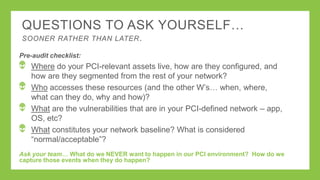
• Questions to ask as you plan and prepare
• Core capabilities needed to demonstrate
compliance
• How to use AlienVault USM to simplify
compliance
PCI DSS Version 3.x
• All businesses that store, process or transmit payment
cardholder data must be PCI Compliant
• 3 steps for compliance
1. Assess
2. Remediate
3. Report
• Goal: Make payment security ‘business-as-usual’
PCI Compliance and Security
“In 10 years, of all companies
investigated by Verizon forensics
team following a breach, 0 were
found to have been fully PCI
compliant at the time of the breach”
Data from 2015 Verizon PCI Report
PCI DSS Version 3.x
Poor Compliance When Breached
#10 - Track &
monitor all access to
network resources &
cardholder data
#7 - Restrict access
to cardholder data
by business need to
know
Source: Verizon 2014 PCI Compliance Report
Common Challenges
• Collecting relevant data on the state of your compliance
• Critical events
• Configuration status
• Documenting the state of your compliance
• Keep the auditor happy
• Maintaining compliance and making it part of “business as
usual”
Questions to Ask
• Where are your in-scope assets, how are they configured,
and how are they segmented from the rest of your network?
• Who accesses these resources (and When, Where, What
can they do, and How)?
• What are the vulnerabilities that are in your in-scope devices
– Apps, OS, etc?
• What constitutes your network baseline? What is considered
“normal” or “acceptable”?
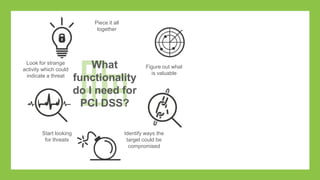
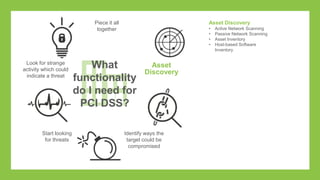
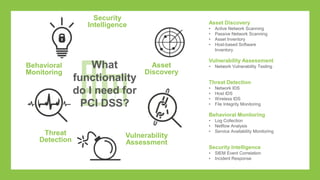
What
functionality
do I need for
PCI DSS?
Identify
systems &
applications
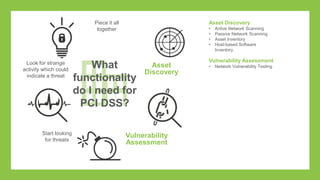
What
functionality
do I need for
PCI DSS?
Identify
systems &
applications
Document
vulnerable
assets
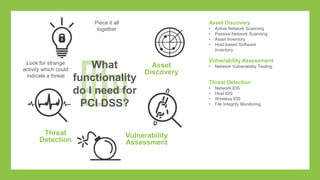
What
functionality
do I need for
PCI DSS?
Identify
systems &
applications
Document
vulnerable
assets
Find threats on
your network
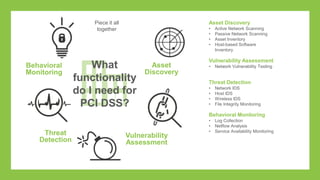
What
functionality
do I need for
PCI DSS?
Identify
systems &
applications
Document
vulnerable
assets
Find threats on
your network
Look for
unusual
behavior
What
functionality
do I need for
PCI DSS?
Correlate
the data &
respond
Identify
systems &
applications
Document
vulnerable
assets
Find threats on
your network
Look for
unusual
behavior
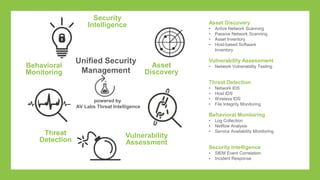
What
functionality
do I need for
PCI DSS?
SIEM
• Log Collection
• Event Correlation
• Incident Response
BEHAVIORAL
MONITORING
• Netflow Analysis
• Service Availability
Monitoring
ASSET DISCOVERY
• Active Network Scanning
• Passive Network Scanning
• Asset Inventory
VULNERABILITY
ASSESSMENT
• Continuous
Vulnerability Monitoring
• Authenticated /
Unauthenticated Active
Scanning
INTRUSION DETECTION
• Network IDS
• Host IDS
• File Integrity Monitoring
OTX + AlienVault Labs
Threat Intelligence powered by
Open Collaboration
PCI Compliance Reports in USM
Report Name PCI DSS Requirements
Admin Access to Systems 10.1-10.2 which focus on creating an audit trail of user
access to critical systems
Firewall Configuration Changes 1.1-1.3 which focus on firewalls and network device
configuration
Authentication with Default Credentials 2.x which focuses on the use of vendor-supplied default
credentials
All Antivirus Security Risk Events 5.1-5.2 which require anti-virus scanning with an up-to-
date anti-virus solution
Database Failed Logins 7.1-7.2 which focus on limiting access to PCI data to only
those who “need to know”
….plus 25 more!
Grouping In-Scope Assets
Built-in asset discovery provides
a dynamic inventory allowing
cardholder-related resources to
be identified and monitored for
unusual activity.
Custom dashboards focusing on
key assets highlights pertinent
data
Generating Tickets For Vulnerabilities
USM’s built-in software ticketing system
creates trouble tickets from vulnerability
scans and alarms.
These tickets specify who owns the
remediation, the status and descriptive
information.
The tickets also provide a historical record of
issues handled, as well as the capability to
transfer tickets, assign them to others and
push work to other groups
USM can also send email to an individual,
external ticketing system, or execute a script
as a result of a discovered vulnerability.
Identifying Assets with Vendor Supplied Passwords
As stated earlier, neglecting to change the
default password on ANY network device,
especially anything allowing access to
cardholder data is a terrible idea and
leaves a huge hole in your defenses.
USM is able to scan your assets for
vulnerabilities such as allowing access via
default passwords and generate reports on
the findings.
This data can be crucial when verifying
adherence to this practice to an auditor
888.613.6023
ALIENVAULT.COM
CONTACT US
HELLO@ALIENVAULT.COM
Now for some Q&A
Test Drive AlienVault USM
Download a Free 30-Day Trial
http://www.alienvault.com/free-trial
Try our Product Sandbox
http://www.alienvault.com/live-demo-site
Watch our Product Demo
https://www.alienvault.com/marketing/alienvault-usm-live-demo

How to Simplify PCI DSS Compliance with AlienVault USM

  • 1.
    Presenters: Mark Allen, SalesEngineer SIMPLIFY PCI DSS COMPLIANCE WITH ALIENVAULT USM
  • 2.
    What We’ll Discuss •An overview of PCI DSS • Common challenges in PCI DSS compliance • Questions to ask as you plan and prepare • Core capabilities needed to demonstrate compliance • How to use AlienVault USM to simplify compliance
  • 3.
    PCI DSS Version3.x • All businesses that store, process or transmit payment cardholder data must be PCI Compliant • 3 steps for compliance 1. Assess 2. Remediate 3. Report • Goal: Make payment security ‘business-as-usual’
  • 4.
    PCI Compliance andSecurity “In 10 years, of all companies investigated by Verizon forensics team following a breach, 0 were found to have been fully PCI compliant at the time of the breach” Data from 2015 Verizon PCI Report
  • 5.
  • 6.
    Poor Compliance WhenBreached #10 - Track & monitor all access to network resources & cardholder data #7 - Restrict access to cardholder data by business need to know Source: Verizon 2014 PCI Compliance Report
  • 7.
    Common Challenges • Collectingrelevant data on the state of your compliance • Critical events • Configuration status • Documenting the state of your compliance • Keep the auditor happy • Maintaining compliance and making it part of “business as usual”
  • 8.
    Questions to Ask •Where are your in-scope assets, how are they configured, and how are they segmented from the rest of your network? • Who accesses these resources (and When, Where, What can they do, and How)? • What are the vulnerabilities that are in your in-scope devices – Apps, OS, etc? • What constitutes your network baseline? What is considered “normal” or “acceptable”?
  • 9.
  • 10.
  • 11.
  • 12.
    Identify systems & applications Document vulnerable assets Find threatson your network What functionality do I need for PCI DSS?
  • 13.
    Identify systems & applications Document vulnerable assets Find threatson your network Look for unusual behavior What functionality do I need for PCI DSS?
  • 14.
    Correlate the data & respond Identify systems& applications Document vulnerable assets Find threats on your network Look for unusual behavior What functionality do I need for PCI DSS?
  • 15.
    SIEM • Log Collection •Event Correlation • Incident Response BEHAVIORAL MONITORING • Netflow Analysis • Service Availability Monitoring ASSET DISCOVERY • Active Network Scanning • Passive Network Scanning • Asset Inventory VULNERABILITY ASSESSMENT • Continuous Vulnerability Monitoring • Authenticated / Unauthenticated Active Scanning INTRUSION DETECTION • Network IDS • Host IDS • File Integrity Monitoring
  • 16.
    OTX + AlienVaultLabs Threat Intelligence powered by Open Collaboration
  • 17.
    PCI Compliance Reportsin USM Report Name PCI DSS Requirements Admin Access to Systems 10.1-10.2 which focus on creating an audit trail of user access to critical systems Firewall Configuration Changes 1.1-1.3 which focus on firewalls and network device configuration Authentication with Default Credentials 2.x which focuses on the use of vendor-supplied default credentials All Antivirus Security Risk Events 5.1-5.2 which require anti-virus scanning with an up-to- date anti-virus solution Database Failed Logins 7.1-7.2 which focus on limiting access to PCI data to only those who “need to know” ….plus 25 more!
  • 18.
    Grouping In-Scope Assets Built-inasset discovery provides a dynamic inventory allowing cardholder-related resources to be identified and monitored for unusual activity. Custom dashboards focusing on key assets highlights pertinent data
  • 19.
    Generating Tickets ForVulnerabilities USM’s built-in software ticketing system creates trouble tickets from vulnerability scans and alarms. These tickets specify who owns the remediation, the status and descriptive information. The tickets also provide a historical record of issues handled, as well as the capability to transfer tickets, assign them to others and push work to other groups USM can also send email to an individual, external ticketing system, or execute a script as a result of a discovered vulnerability.
  • 20.
    Identifying Assets withVendor Supplied Passwords As stated earlier, neglecting to change the default password on ANY network device, especially anything allowing access to cardholder data is a terrible idea and leaves a huge hole in your defenses. USM is able to scan your assets for vulnerabilities such as allowing access via default passwords and generate reports on the findings. This data can be crucial when verifying adherence to this practice to an auditor
  • 21.
    888.613.6023 ALIENVAULT.COM CONTACT US HELLO@ALIENVAULT.COM Now forsome Q&A Test Drive AlienVault USM Download a Free 30-Day Trial http://www.alienvault.com/free-trial Try our Product Sandbox http://www.alienvault.com/live-demo-site Watch our Product Demo https://www.alienvault.com/marketing/alienvault-usm-live-demo

Editor's Notes

  • #17 Integrated approach to threat intel Comprised of OTX (data from 140+ countries) and the independent research from our AlienVault Labs’ team we’re analyzing over 500.000 malware samples per day Users submitting an average of ~11 million per month (365,000 a day) Updated every 30 minutes the ability to quickly convert data into actionable information So you can call out those truly significant events to help you prioritize your efforts reduce the need for in-house expertise. ------ OTX derives its data from three primary sources: USM and OSSIM that systems that enable OTX sharing, external feeds from public researchers and partners, and the research from our alienvault labs team. - This data is automatically analyzed through a powerful discovery engine that is able to granularly analyze the nature of the threat, and a similarly powerful validation engine that continually curates the database and certifies the validity of those threats. Crowd-sourced information remains the core focus of OTX. OTX derives information from normalized an anonymous event logs: firewalls, content filters, ips/ids logs, etc. We receive approximately 17,000 contributions daily from over 140+ countries. -I want to make something clear: OTX's information is anonymous and normalized. OTX does not analyze your data or do anything that would identify you, we are solely focused on analyzing the nature of the threat jeopardizing your system. OTX derives a significant amount of data from the security community. We work with public research institutions, government organizations, and private companies and partners to share and analyze threat data. With over 50+ partners working with us on OTX, if you look around Blackhat you're likely to see some of our partners. - AlienVault labs research is also a critical part of our analysis. Our labs team generates novel research on high profile threats, as well as instrumenting the automatic analysis for discovering and certifying all threats coming from OTX partners and OSSIM and USM customers who opt in to share data.
  • #22 Seed questions: What are some of the areas you see a lot of customers failing at when the PCI report is run? How do PCI requirements correlate with actual events that you are detecting? How does your product keep up with changing PCI requirements?