Let’s Talk About
SOC2s Baby!
BSidesLV 2021
Wendy Knox Everette
@wendyck
What am I even
talking about?
Who am I?
@wendyck
SOC2 Wrangler & Security Program Builder
Who are you?
What’s a security
program audit?
But why?
Third Party Risk
Assessments
Audit vs
Assessment
SOC 2 101
Trust Services
Criteria
SOC 2 audits are generally
performed using the five
Trust Services Criteria
Security
Availability
Processing Integrity
Confidentiality
Privacy
Security
Does the company have an information
security program?
Has it has implemented some common
security controls, such as user security
awareness, access control reviews, &
encryption of sensitive information?
Availability
Have business continuity and
disaster prep controls been put
in place? Do they operate?
Is there monitoring in place to
detect outages?
Confidentiality
● Is there a data classification policy
and attendant procedures? Are they
followed?
● Is sensitive information stored on
disks destroyed when the disks are
decommissioned?
The most
common set:
Security,
Availability, and
Confidentiality
Processing
Integrity
Have controls been put in place
to check the accuracy of
system inputs & outputs? Will
these controls ensure that any
errors introduced in processing
data will be corrected?
Privacy
Are there privacy commitments
to protect Personally
Identifiable Information (“PII”)
within a system? Has the
system implemented controls
to protect PII from accidental
disclosure?
Confidentiality
vs. Privacy
“Confidentiality is distinguished from privacy in that privacy applies only to
personal information, whereas confidentiality applies to various types of
sensitive information.
In addition, the privacy objective addresses requirements regarding
collection, use, retention, disclosure, and disposal of personal
information.
Confidential information may include personal information as well as other
information, such as trade secrets and intellectual property.”
Building Controls
Choose your own
adventure
Unlike with other control
frameworks, with a SOC 2
you have some flexibility to
word your controls to
match your processes and
structure, within certain
parameters.
“2017 Trust Services Criteria for Security,
Availability, Processing Integrity, Confidentiality,
and Privacy”
https://bit.ly/3Br9Amn
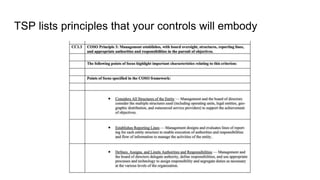
TSP lists principles that your controls will embody
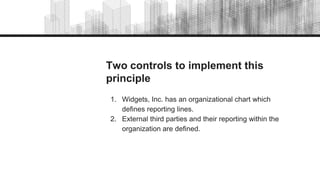
Two controls to implement this
principle
1. Widgets, Inc. has an organizational chart which
defines reporting lines.
2. External third parties and their reporting within the
organization are defined.
Policy language to authorize the
information security program
"[COMPANY] Security Organization receives its
mandate from [COMPANY] management. All Information
Security policies are reviewed and approved by
management"
"[COMPANY] will create, review, and update necessary
policies and procedures to maintain security risks
to [COMPANY] at a reasonable and appropriate level."
SOC 2s focus a lot on processes and
records, and so you’ll want to focus
processes to implement these controls,
and think about sort of records you’ll
need to ensure you’re generating and
retaining.
Main types of
controls you’ll
need
Access Control
The Principle:
CC6.1 The entity implements logical
access security software, infrastructure,
and architectures over protected
information assets to protect them from
security events to meet the entity's
objectives.
Some of the relevant points
of focus
● Identifies and Manages the Inventory of Information Assets
● Restricts Logical Access
● Identifies and Authenticates Users
● Manages Points of Access
● Manages Credentials for Infrastructure and Software
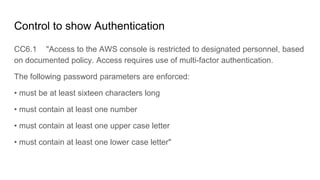
Control to show Authentication
CC6.1 "Access to the AWS console is restricted to designated personnel, based
on documented policy. Access requires use of multi-factor authentication.
The following password parameters are enforced:
• must be at least sixteen characters long
• must contain at least one number
• must contain at least one upper case letter
• must contain at least one lower case letter"
Control to show Role Based Access & Least Privilege
CC6.1 AWS security groups are configured to only allow specific services to
specific destinations and all other services are not permitted.
Change Management
The Principle:
CC8.1 The entity authorizes, designs,
develops or acquires, configures,
documents, tests, approves, and
implements changes to infrastructure,
data, software, and procedures to meet
its objectives.
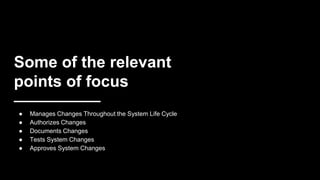
Some of the relevant
points of focus
● Manages Changes Throughout the System Life Cycle
● Authorizes Changes
● Documents Changes
● Tests System Changes
● Approves System Changes
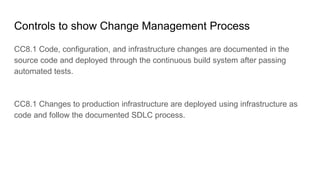
Controls to show Change Management Process
CC8.1 Code, configuration, and infrastructure changes are documented in the
source code and deployed through the continuous build system after passing
automated tests.
CC8.1 Changes to production infrastructure are deployed using infrastructure as
code and follow the documented SDLC process.
Vulnerability
Management
Risk Management
Logging & Monitoring
Internal Audit
Let’s talk about evidence
Remember these two controls for
CC1.3?
1. Widgets, Inc. has an organizational chart which
defines reporting lines.
2. External third parties and their reporting within the
organization are defined.
“Widgets, Inc. has an organizational chart which defines
reporting lines.”
Evidence we may be asked to provide:
1. A print out or screen captures from an HR tool like Gusto that shows the org
chart
2. Screenshots from a management tool showing the managers of selected
employees
“External third parties and their reporting within the
organization are defined.”
Evidence we may be asked to provide:
1. A screenshot from a HR tool showing that any contractors have a defined
supervisor.
2. PDFs of contracts with third parties showing the designated responsible party
within an organization.
What about these controls?
1. Changes to production infrastructure are deployed
using infrastructure as code and follow the SDLC
process.
2. AWS security groups are configured to only allow
specific services to specific destinations and all
other services are not permitted.
What was that Type 1 or Type 2 distinction again?
Type I vs Type II
Point in Time/Proof of
Concept vs Lookback
Populations
Sampling
Your goal:
Create a timestamped record of an
event happening & who did it. The
“who” should be a person logged into a
system, captured within the system (like
a code reviewer logging a GitHub
review or a Jira commentator).
Good:
● Jira ticket
Decent:
● Entry in a Google Workspace Spreadsheet
OK:
● Email
Not So Great::
● Entry in a plain text file
A word about scope
What systems will be
audited?
As you prepare for your SOC 2 audit, you should think carefully about what your
audit scope will be.
● Just your cloud?
● All systems, including user laptops, that touch customer data?
● If you run multiple SAAS tools, which ones are you including?
Finding an audit firm and what to expect
Control Set: can
you use the
controls you built?
Evidence
Collection
What tools does the audit firm
use? How many samples do
they request?
The Audit
Your Report
Doing it again
Thank you
● BSidesLV
● My awesome
coworkers
Join our Q&A or ask
questions in discord
Tweet me:
@wendyck

Lets talk about soc2s, baby! BSidesLV 2021

  • 1.
    Let’s Talk About SOC2sBaby! BSidesLV 2021 Wendy Knox Everette @wendyck
  • 2.
    What am Ieven talking about?
  • 3.
    Who am I? @wendyck SOC2Wrangler & Security Program Builder
  • 4.
  • 5.
  • 6.
  • 7.
  • 8.
  • 9.
  • 10.
    Trust Services Criteria SOC 2audits are generally performed using the five Trust Services Criteria Security Availability Processing Integrity Confidentiality Privacy
  • 11.
    Security Does the companyhave an information security program? Has it has implemented some common security controls, such as user security awareness, access control reviews, & encryption of sensitive information?
  • 12.
    Availability Have business continuityand disaster prep controls been put in place? Do they operate? Is there monitoring in place to detect outages?
  • 13.
    Confidentiality ● Is therea data classification policy and attendant procedures? Are they followed? ● Is sensitive information stored on disks destroyed when the disks are decommissioned?
  • 14.
  • 15.
    Processing Integrity Have controls beenput in place to check the accuracy of system inputs & outputs? Will these controls ensure that any errors introduced in processing data will be corrected?
  • 16.
    Privacy Are there privacycommitments to protect Personally Identifiable Information (“PII”) within a system? Has the system implemented controls to protect PII from accidental disclosure?
  • 17.
    Confidentiality vs. Privacy “Confidentiality isdistinguished from privacy in that privacy applies only to personal information, whereas confidentiality applies to various types of sensitive information. In addition, the privacy objective addresses requirements regarding collection, use, retention, disclosure, and disposal of personal information. Confidential information may include personal information as well as other information, such as trade secrets and intellectual property.”
  • 18.
  • 19.
    Choose your own adventure Unlikewith other control frameworks, with a SOC 2 you have some flexibility to word your controls to match your processes and structure, within certain parameters.
  • 20.
    “2017 Trust ServicesCriteria for Security, Availability, Processing Integrity, Confidentiality, and Privacy” https://bit.ly/3Br9Amn
  • 21.
    TSP lists principlesthat your controls will embody
  • 22.
    Two controls toimplement this principle 1. Widgets, Inc. has an organizational chart which defines reporting lines. 2. External third parties and their reporting within the organization are defined.
  • 23.
    Policy language toauthorize the information security program "[COMPANY] Security Organization receives its mandate from [COMPANY] management. All Information Security policies are reviewed and approved by management" "[COMPANY] will create, review, and update necessary policies and procedures to maintain security risks to [COMPANY] at a reasonable and appropriate level."
  • 24.
    SOC 2s focusa lot on processes and records, and so you’ll want to focus processes to implement these controls, and think about sort of records you’ll need to ensure you’re generating and retaining.
  • 25.
  • 26.
  • 27.
    The Principle: CC6.1 Theentity implements logical access security software, infrastructure, and architectures over protected information assets to protect them from security events to meet the entity's objectives.
  • 28.
    Some of therelevant points of focus ● Identifies and Manages the Inventory of Information Assets ● Restricts Logical Access ● Identifies and Authenticates Users ● Manages Points of Access ● Manages Credentials for Infrastructure and Software
  • 29.
    Control to showAuthentication CC6.1 "Access to the AWS console is restricted to designated personnel, based on documented policy. Access requires use of multi-factor authentication. The following password parameters are enforced: • must be at least sixteen characters long • must contain at least one number • must contain at least one upper case letter • must contain at least one lower case letter"
  • 30.
    Control to showRole Based Access & Least Privilege CC6.1 AWS security groups are configured to only allow specific services to specific destinations and all other services are not permitted.
  • 31.
  • 32.
    The Principle: CC8.1 Theentity authorizes, designs, develops or acquires, configures, documents, tests, approves, and implements changes to infrastructure, data, software, and procedures to meet its objectives.
  • 33.
    Some of therelevant points of focus ● Manages Changes Throughout the System Life Cycle ● Authorizes Changes ● Documents Changes ● Tests System Changes ● Approves System Changes
  • 34.
    Controls to showChange Management Process CC8.1 Code, configuration, and infrastructure changes are documented in the source code and deployed through the continuous build system after passing automated tests. CC8.1 Changes to production infrastructure are deployed using infrastructure as code and follow the documented SDLC process.
  • 35.
  • 36.
  • 37.
  • 38.
  • 40.
  • 41.
    Remember these twocontrols for CC1.3? 1. Widgets, Inc. has an organizational chart which defines reporting lines. 2. External third parties and their reporting within the organization are defined.
  • 42.
    “Widgets, Inc. hasan organizational chart which defines reporting lines.” Evidence we may be asked to provide: 1. A print out or screen captures from an HR tool like Gusto that shows the org chart 2. Screenshots from a management tool showing the managers of selected employees
  • 43.
    “External third partiesand their reporting within the organization are defined.” Evidence we may be asked to provide: 1. A screenshot from a HR tool showing that any contractors have a defined supervisor. 2. PDFs of contracts with third parties showing the designated responsible party within an organization.
  • 44.
    What about thesecontrols? 1. Changes to production infrastructure are deployed using infrastructure as code and follow the SDLC process. 2. AWS security groups are configured to only allow specific services to specific destinations and all other services are not permitted.
  • 45.
    What was thatType 1 or Type 2 distinction again?
  • 46.
    Type I vsType II
  • 47.
    Point in Time/Proofof Concept vs Lookback
  • 48.
  • 49.
  • 50.
    Your goal: Create atimestamped record of an event happening & who did it. The “who” should be a person logged into a system, captured within the system (like a code reviewer logging a GitHub review or a Jira commentator).
  • 51.
    Good: ● Jira ticket Decent: ●Entry in a Google Workspace Spreadsheet OK: ● Email Not So Great:: ● Entry in a plain text file
  • 52.
  • 53.
    What systems willbe audited? As you prepare for your SOC 2 audit, you should think carefully about what your audit scope will be. ● Just your cloud? ● All systems, including user laptops, that touch customer data? ● If you run multiple SAAS tools, which ones are you including?
  • 54.
    Finding an auditfirm and what to expect
  • 55.
    Control Set: can youuse the controls you built?
  • 56.
    Evidence Collection What tools doesthe audit firm use? How many samples do they request?
  • 57.
  • 58.
  • 59.
  • 60.
    Thank you ● BSidesLV ●My awesome coworkers Join our Q&A or ask questions in discord Tweet me: @wendyck