





TC-007, Rev 00, Dated 1st March 2019
Miodrag Kostić, CMC
Handling difficult conversations
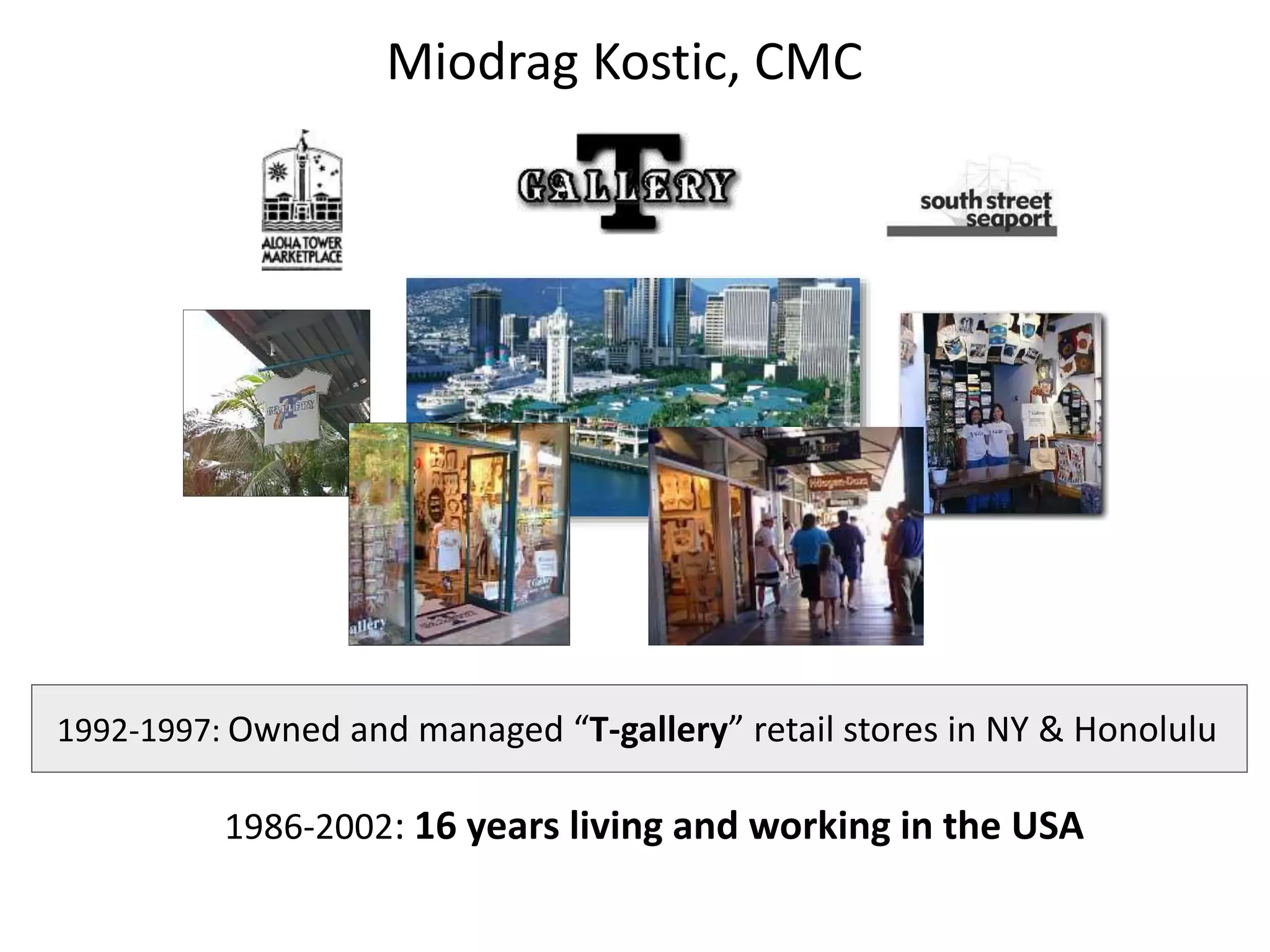
1986-2002: 16 years living and working in the USA
1992-1997: Owned and managed “T-gallery” retail stores in NY & Honolulu
Miodrag Kostic, CMC
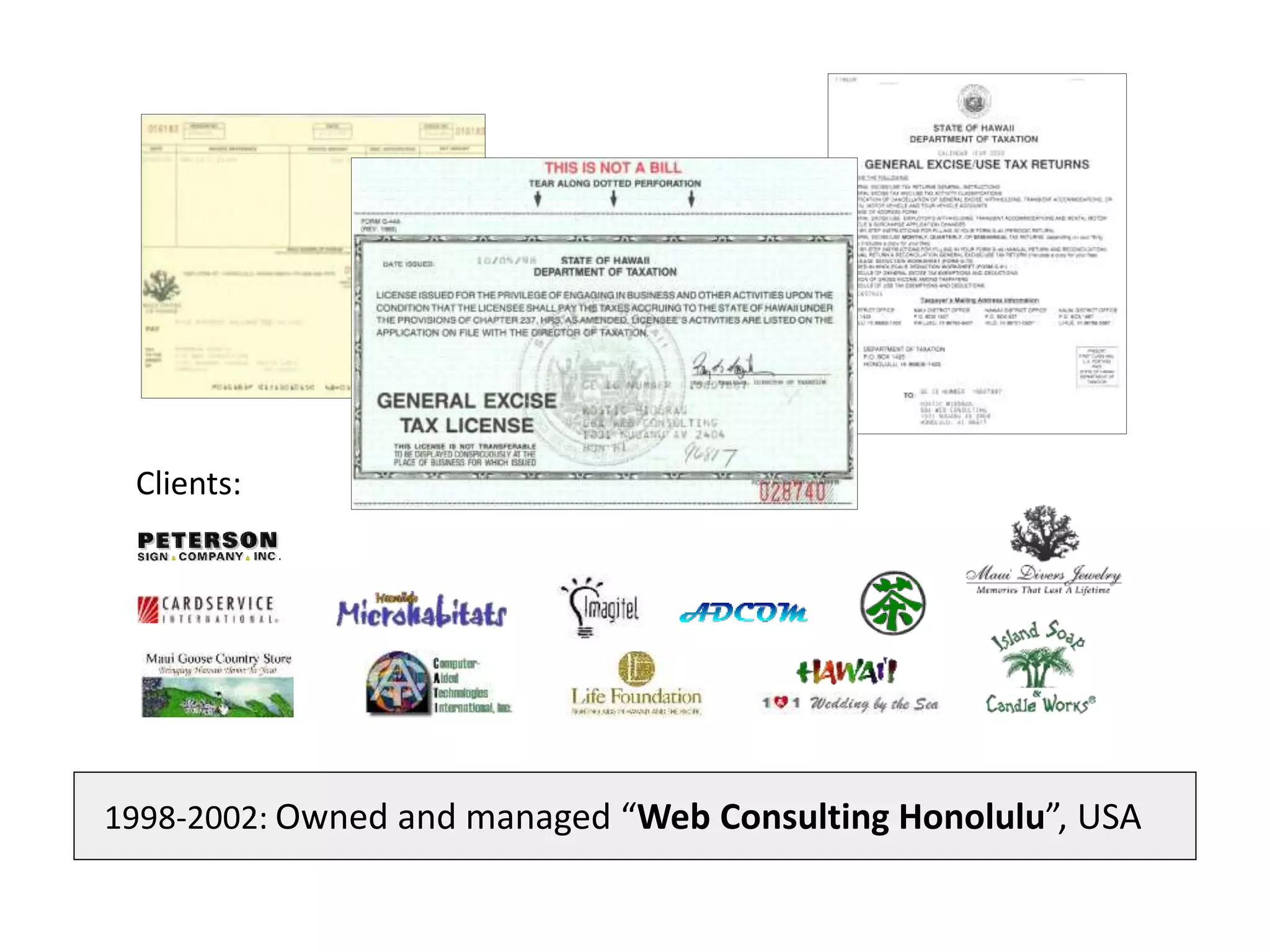
1998-2002: Owned and managed “Web Consulting Honolulu”, USA
Clients:
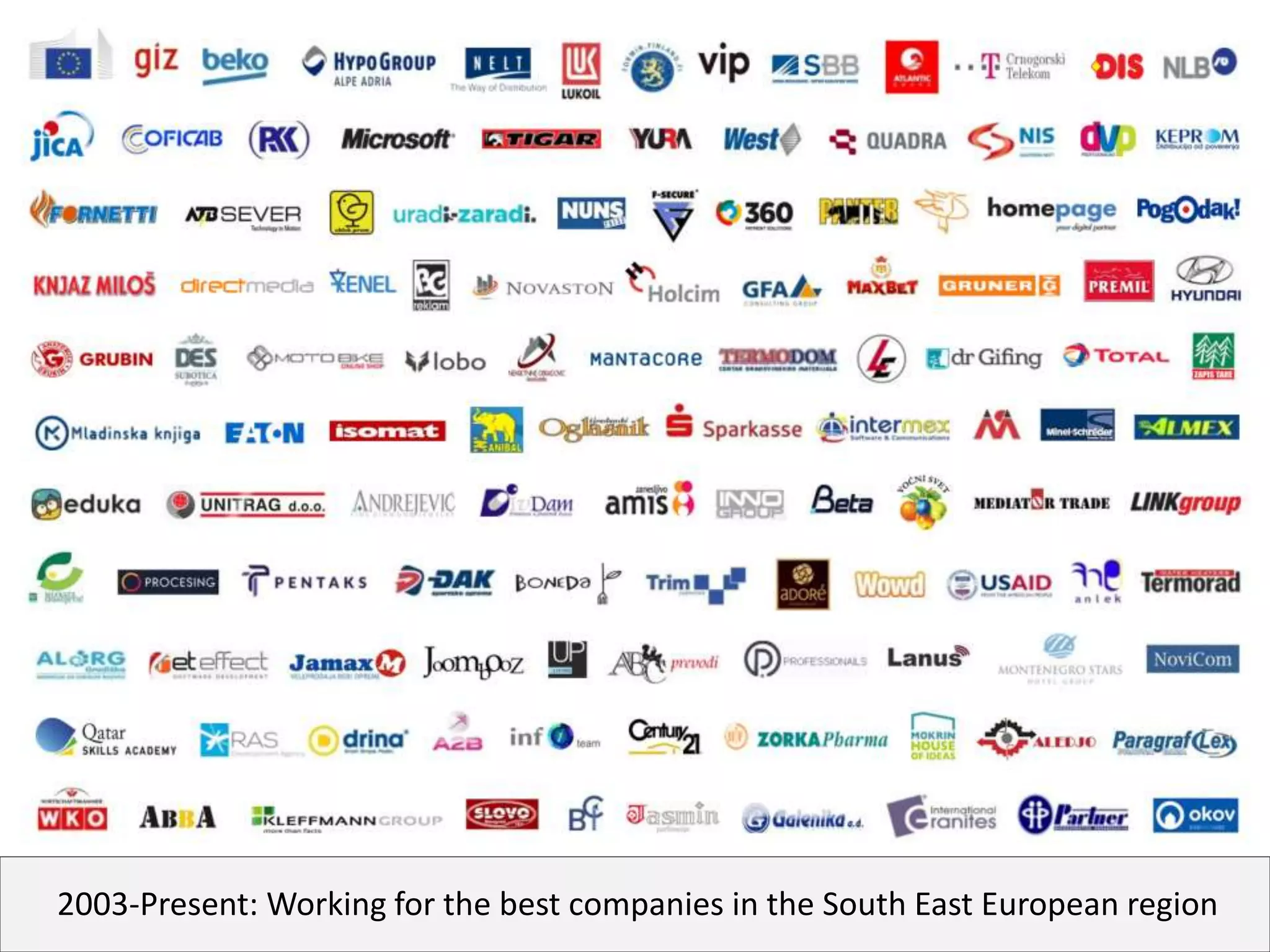
2003-Present: Working for the best companies in the South East European region
2005-Present: Working for International Development Organizations
Since 2019 freelance trainer at “Qatar Skills Academy” in Doha
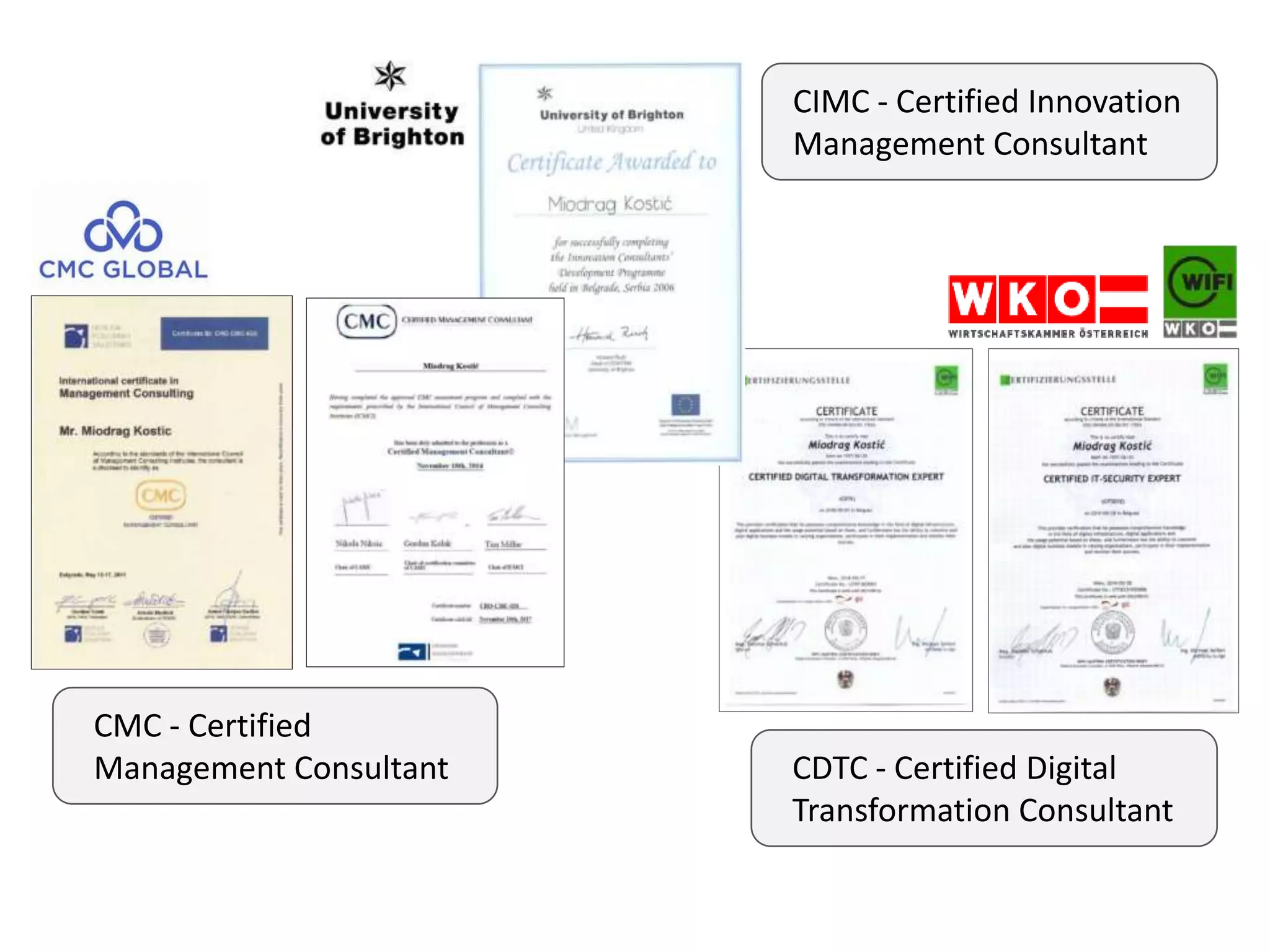
CIMC - Certified Innovation
Management Consultant
CMC - Certified
Management Consultant CDTC - Certified Digital
Transformation Consultant
Handling difficult
conversations at work
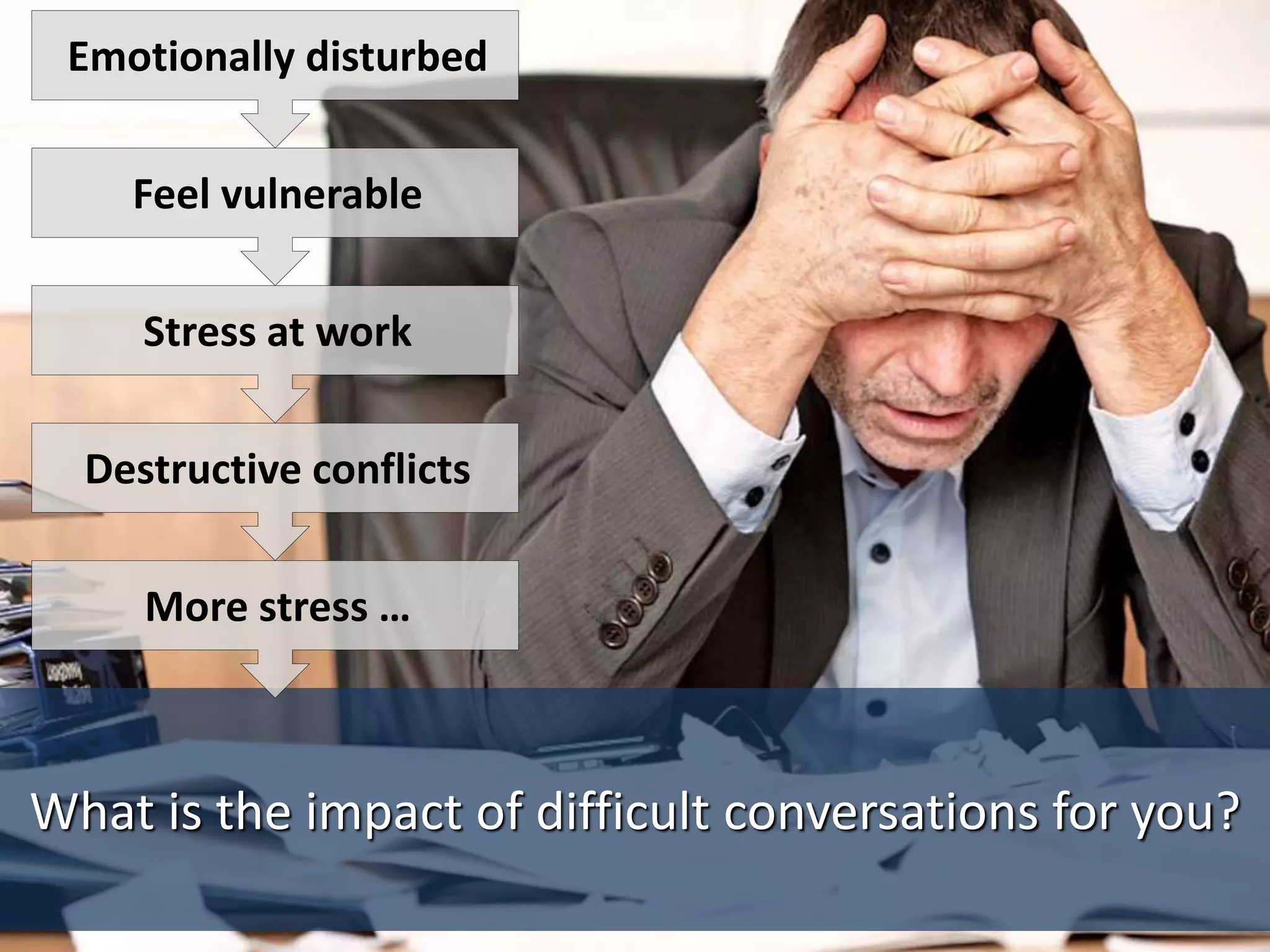
What is the impact of difficult conversations for you?
More stress …
Destructive conflicts
Stress at work
Feel vulnerable
Emotionally disturbed
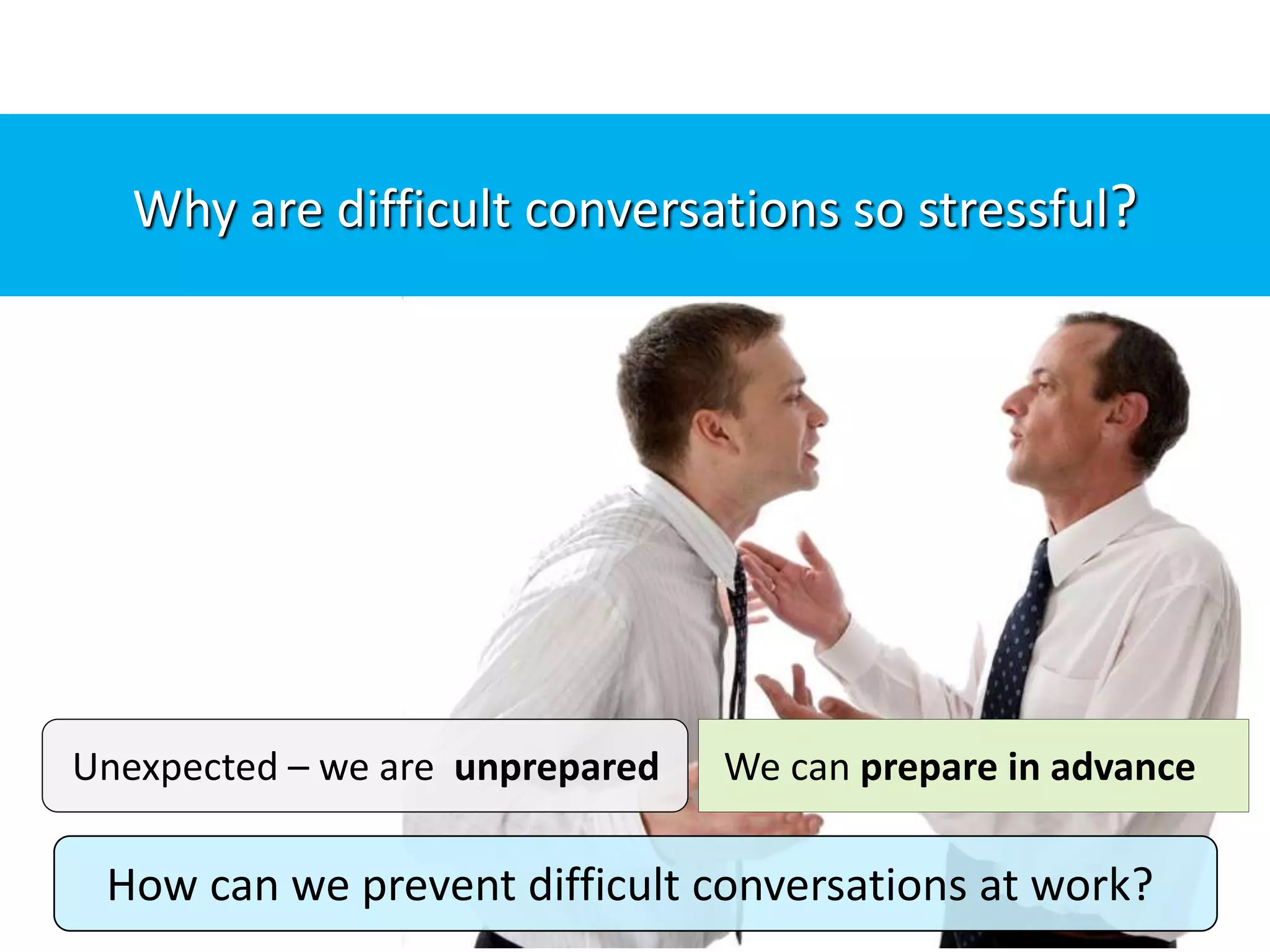
How can we prevent difficult conversations at work?
We can prepare in advanceUnexpected – we are unprepared
Why are difficult conversations so stressful?
How can we improve communication skills?
1. Learning communication skills
Our goal
2. Using practical business tools
Influencing communication
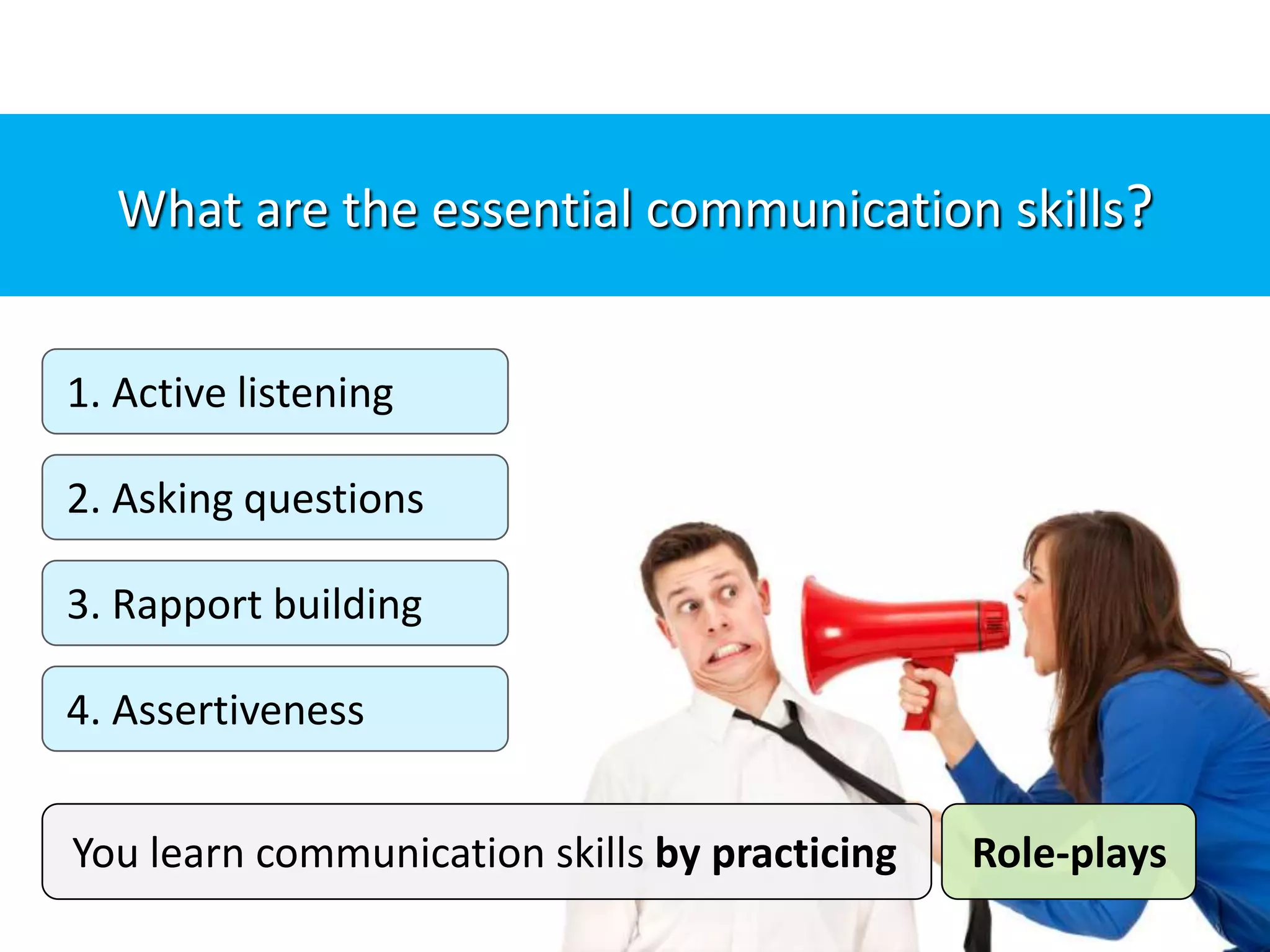
1. Active listening
2. Asking questions
3. Rapport building
4. Assertiveness
What are the essential communication skills?
You learn communication skills by practicing Role-plays
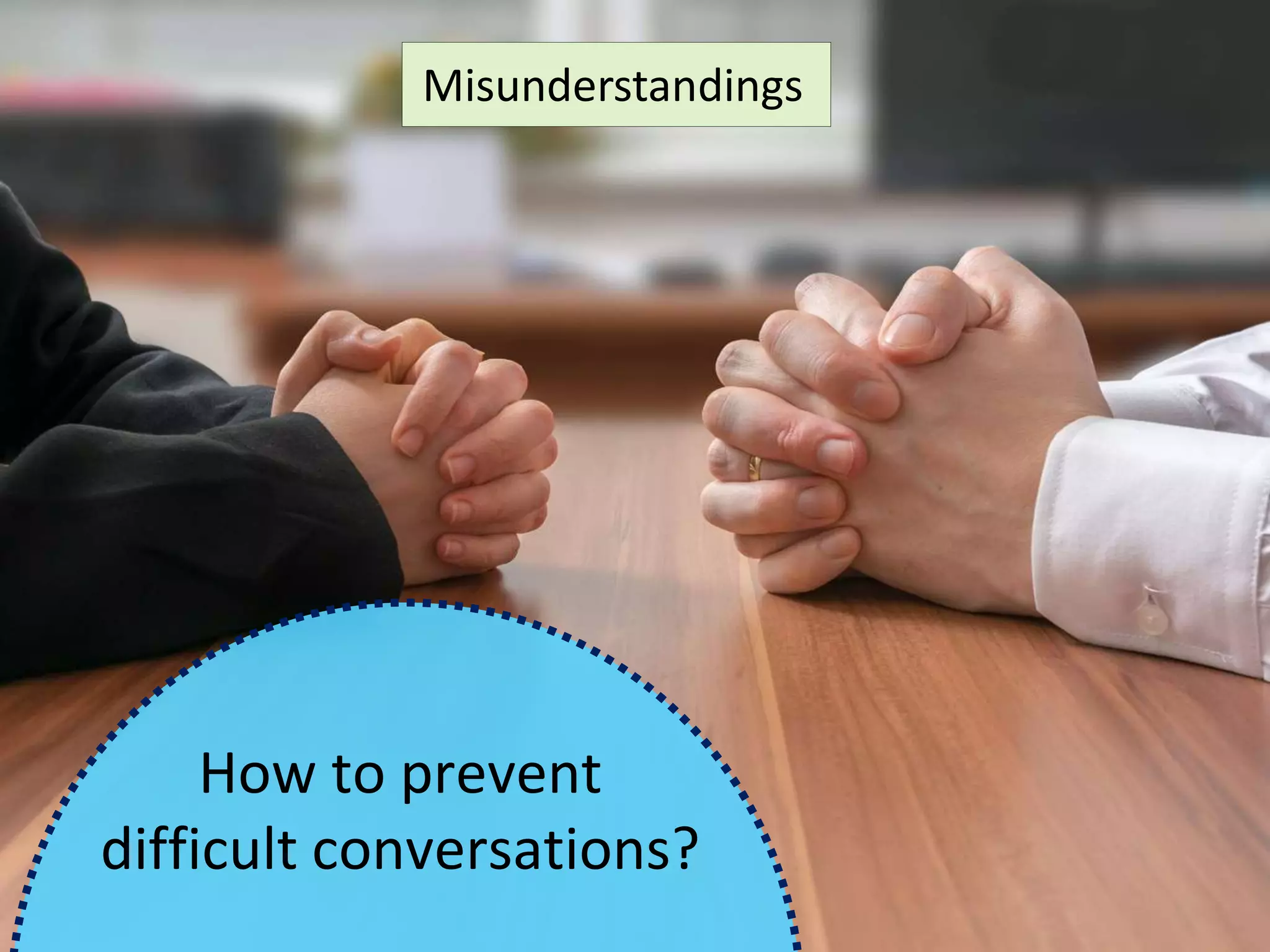
How to prevent
difficult conversations?
Misunderstandings
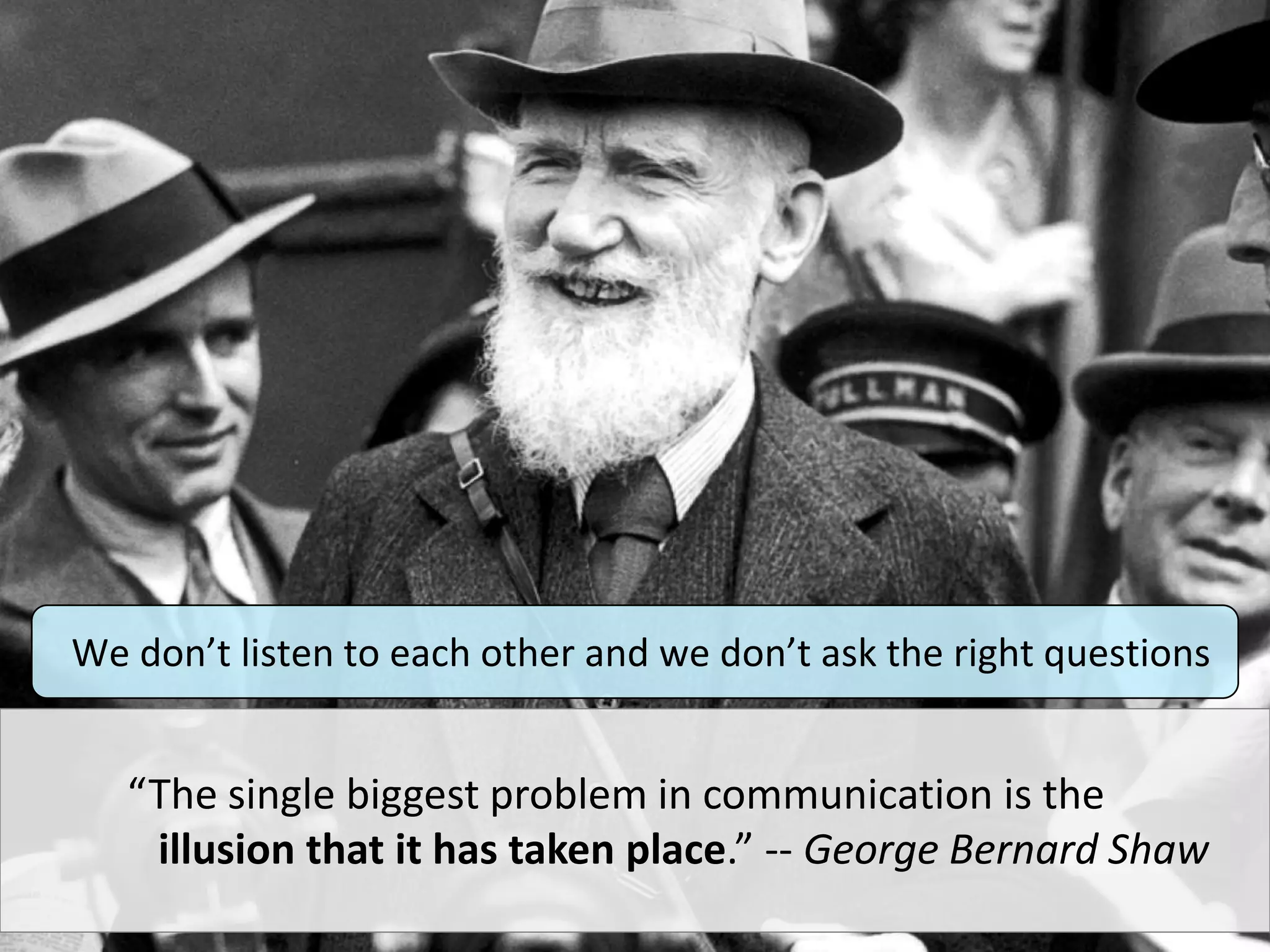
“The single biggest problem in communication is the
illusion that it has taken place.” -- George Bernard Shaw
We don’t listen to each other and we don’t ask the right questions
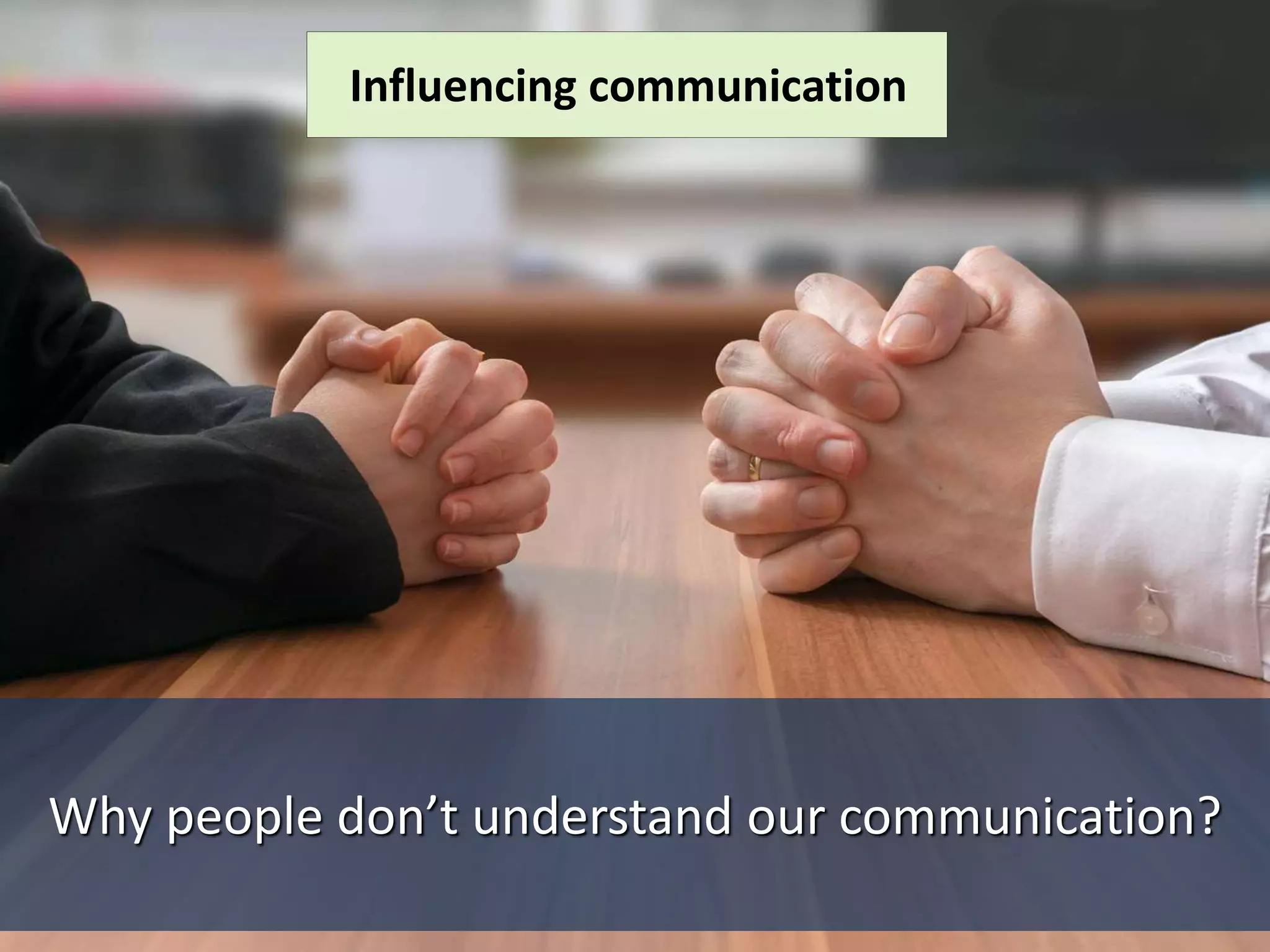
Why people don’t understand our communication?
Influencing communication
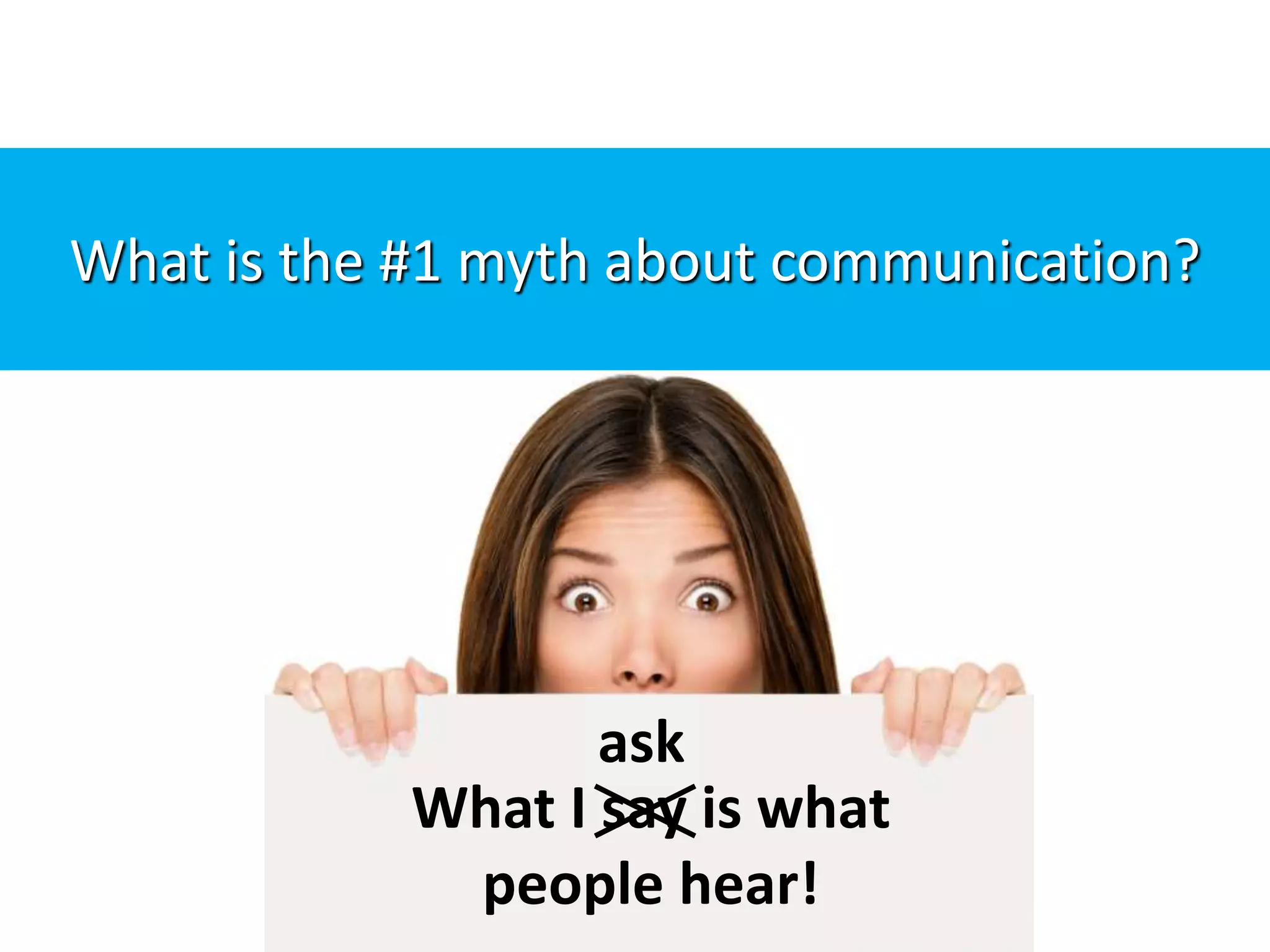
What I say is what
people hear!
ask
Important: “What you ask is what people hear!”What is the #1 myth about communication?
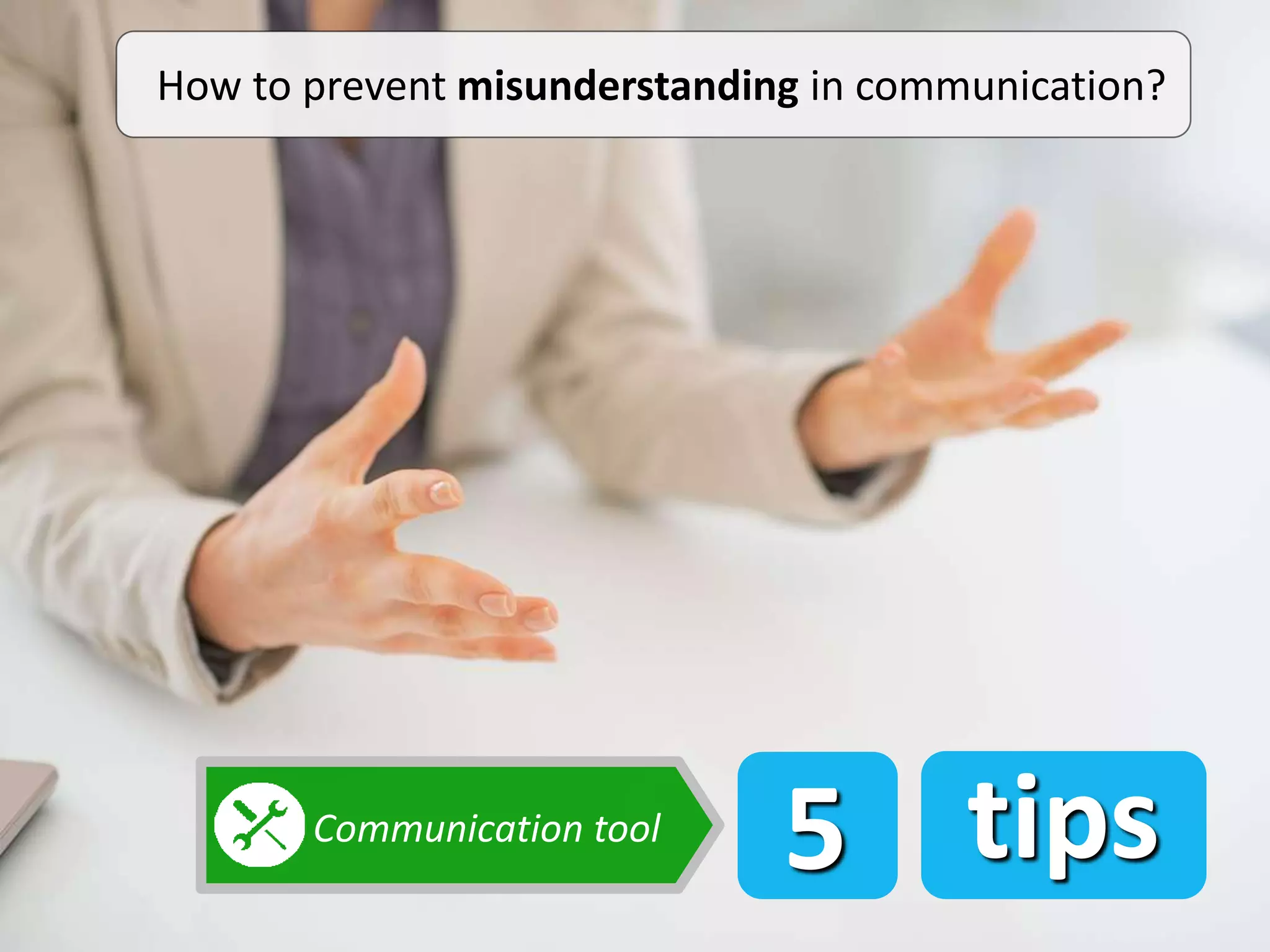
5 tipsCommunication tool
How to prevent misunderstanding in communication?
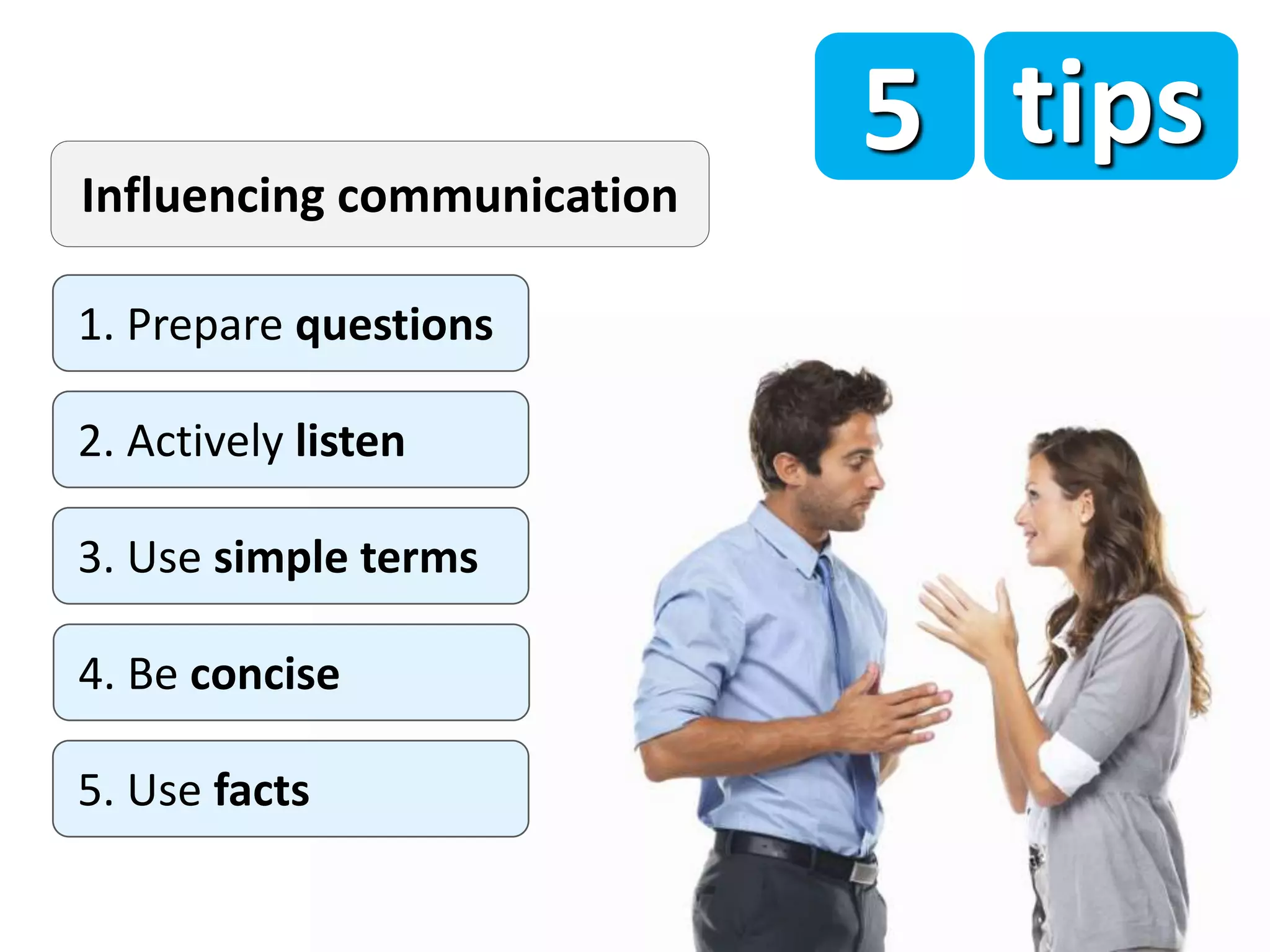
3. Use simple terms
5 tips
Influencing communication
4. Be concise
5. Use facts
1. Prepare questions
2. Actively listen
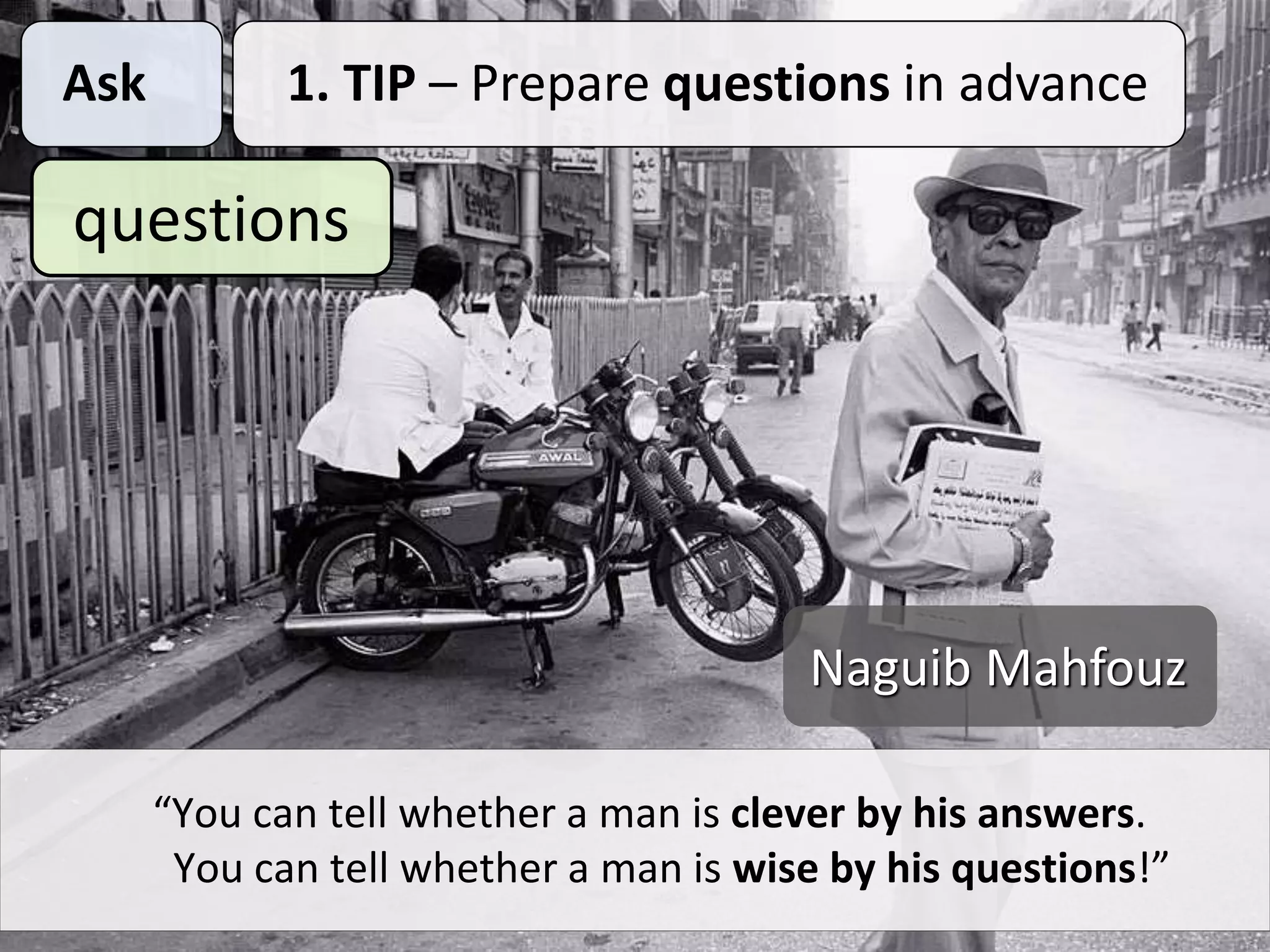
Ask 1. TIP – Prepare questions in advance
questions
“You can tell whether a man is clever by his answers.
You can tell whether a man is wise by his questions!”
Naguib Mahfouz
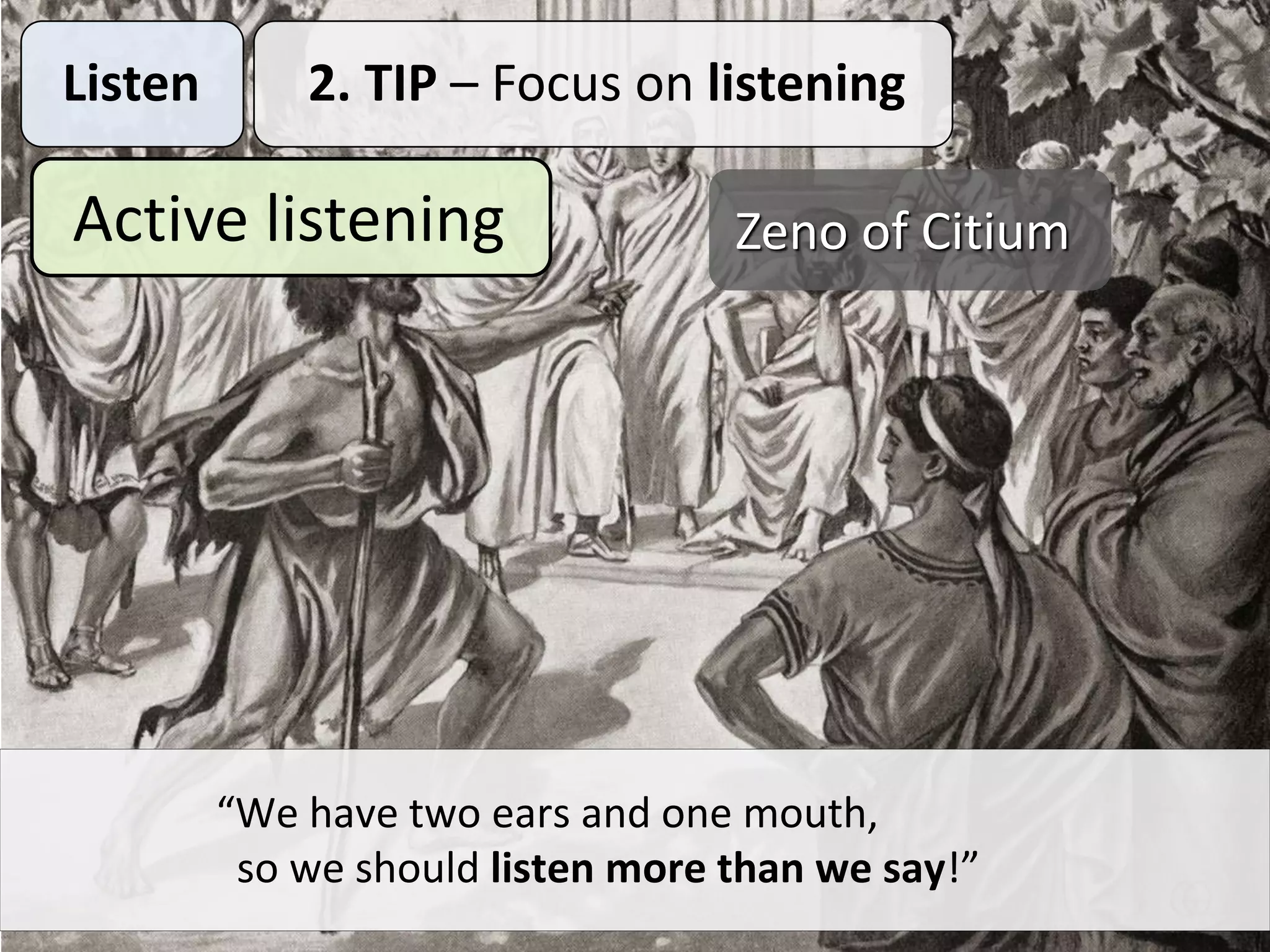
Listen 2. TIP – Focus on listening
Active listening
“We have two ears and one mouth,
so we should listen more than we say!”
Zeno of Citium
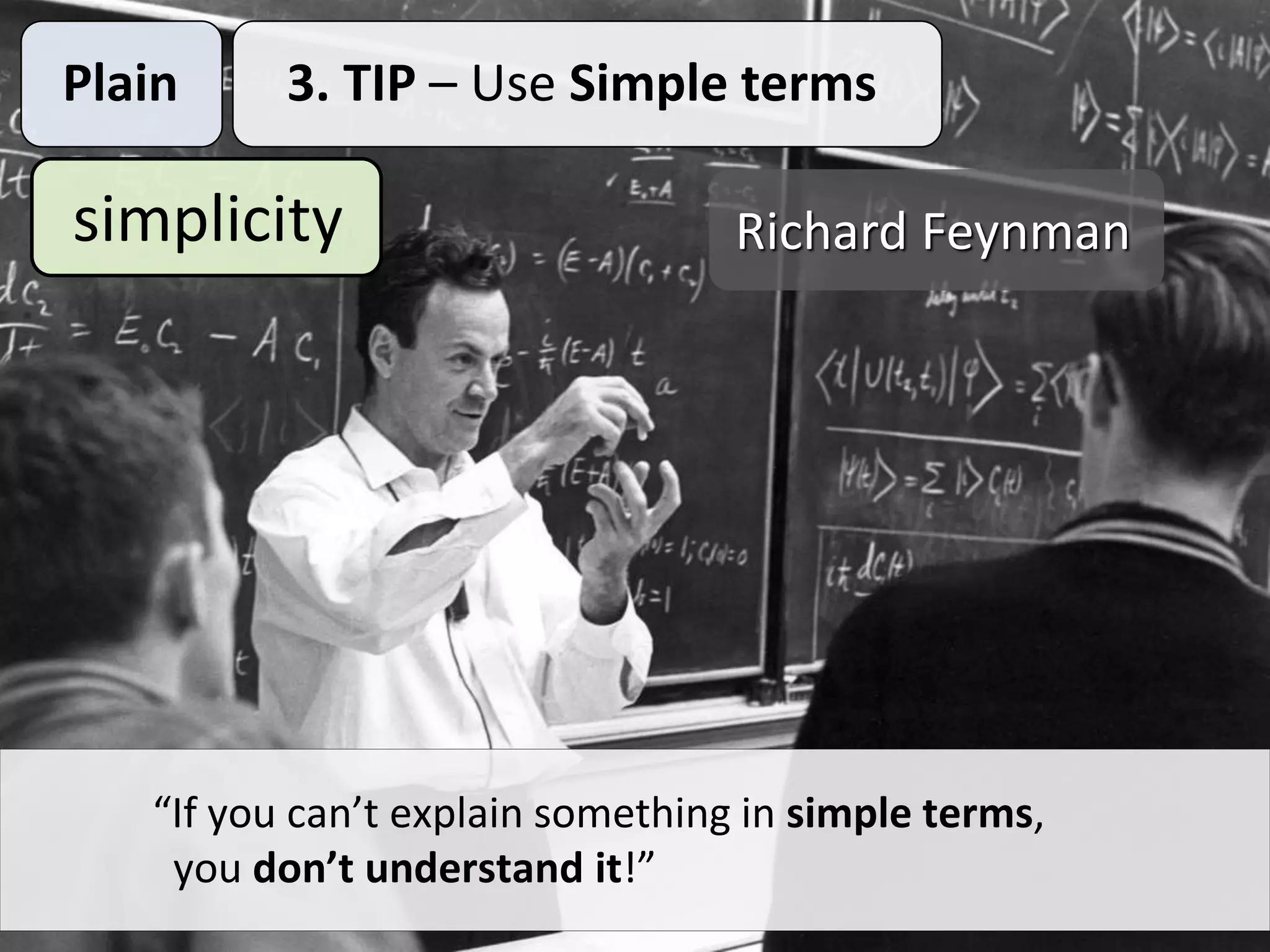
Plain 3. TIP – Use Simple terms
simplicity
“If you can’t explain something in simple terms,
you don’t understand it!”
Richard Feynman
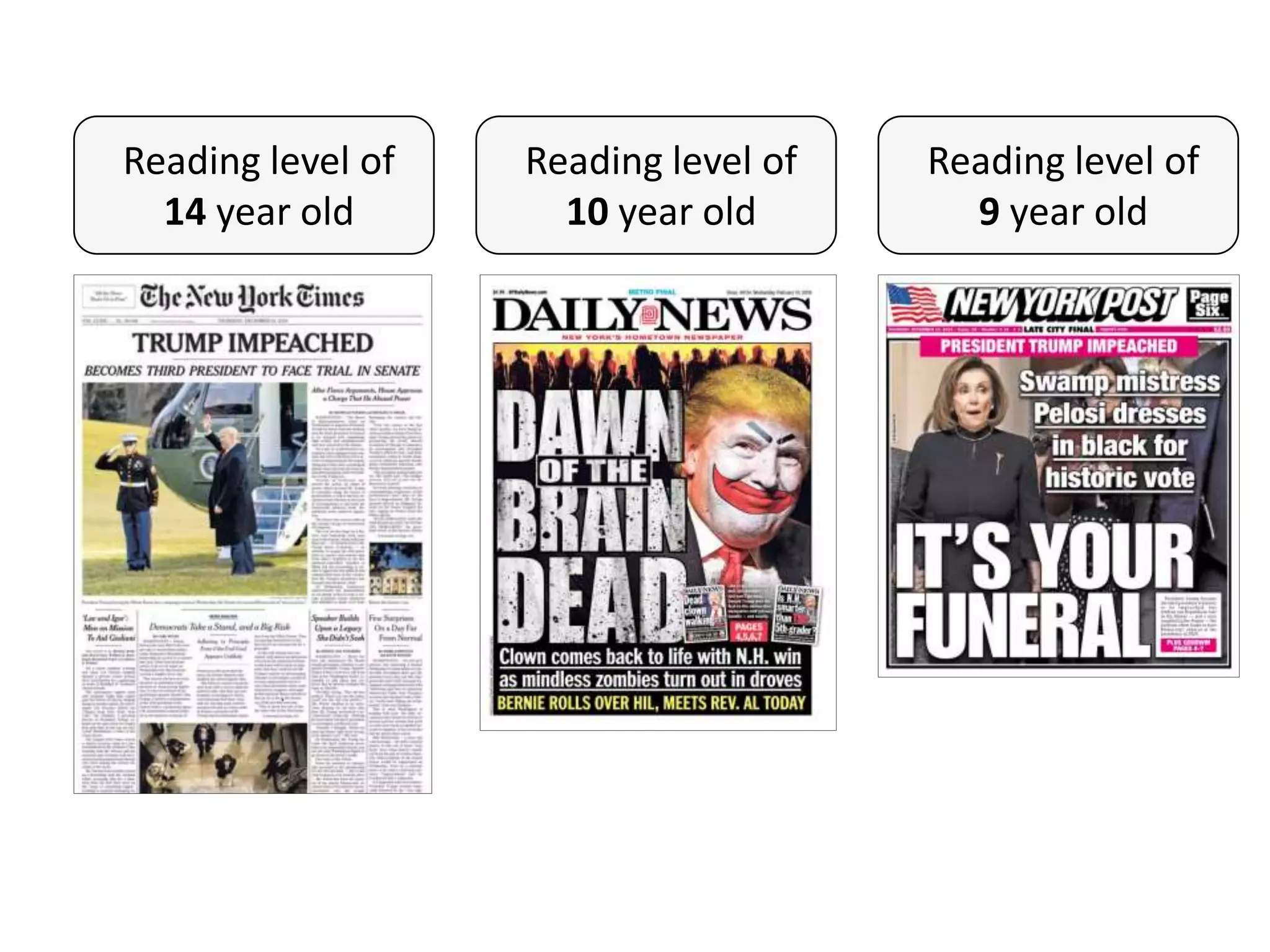
Reading level of
14 year old
Reading level of
10 year old
Reading level of
9 year old
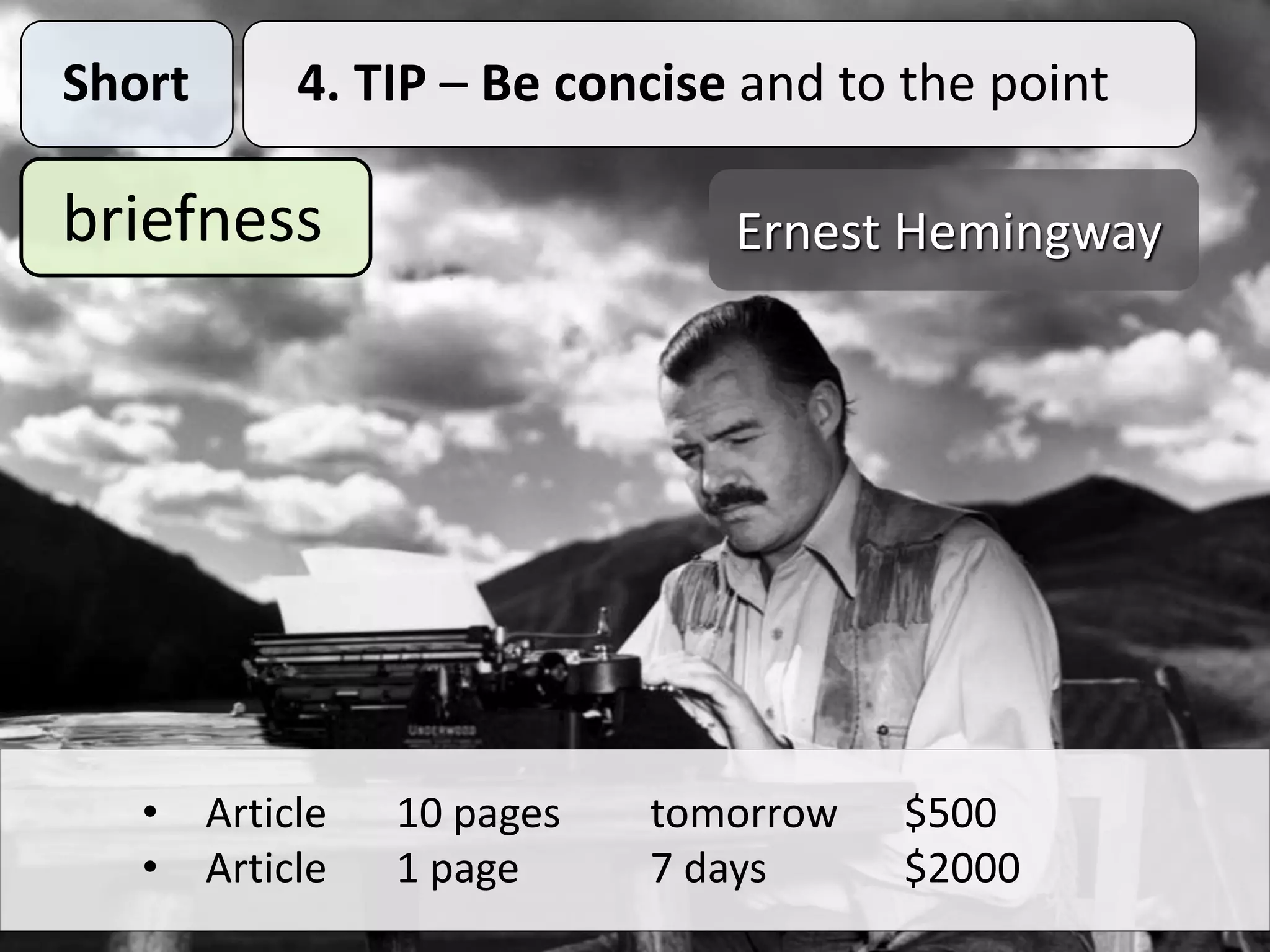
Ernest Hemingway
Short 4. TIP – Be concise and to the point
briefness
• Article 10 pages tomorrow $500
• Article 1 page 7 days $2000
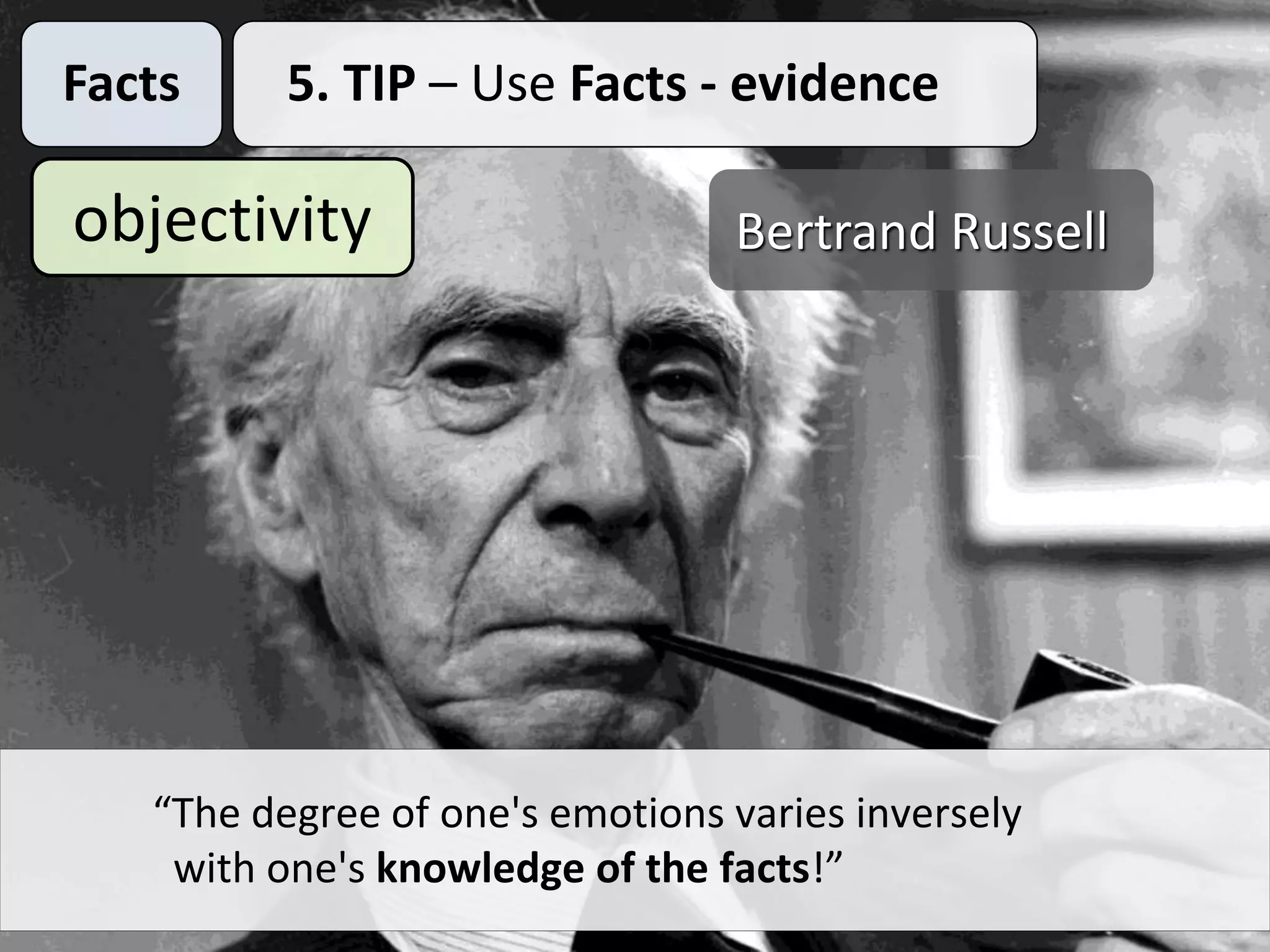
Facts 5. TIP – Use Facts - evidence
objectivity
“The degree of one's emotions varies inversely
with one's knowledge of the facts!”
Bertrand Russell
How to prepare for
difficult conversations?
What to do if we anticipate difficult conversation?
How to discover and develop a need to resolve the issues
In their mind
For anticipated difficult conversations
P SICommunication tool
Discovering and developing needs tool
Positive implications = BENEFITS
Negative implications = DAMAGES
If issues are not resolved can they see implications?
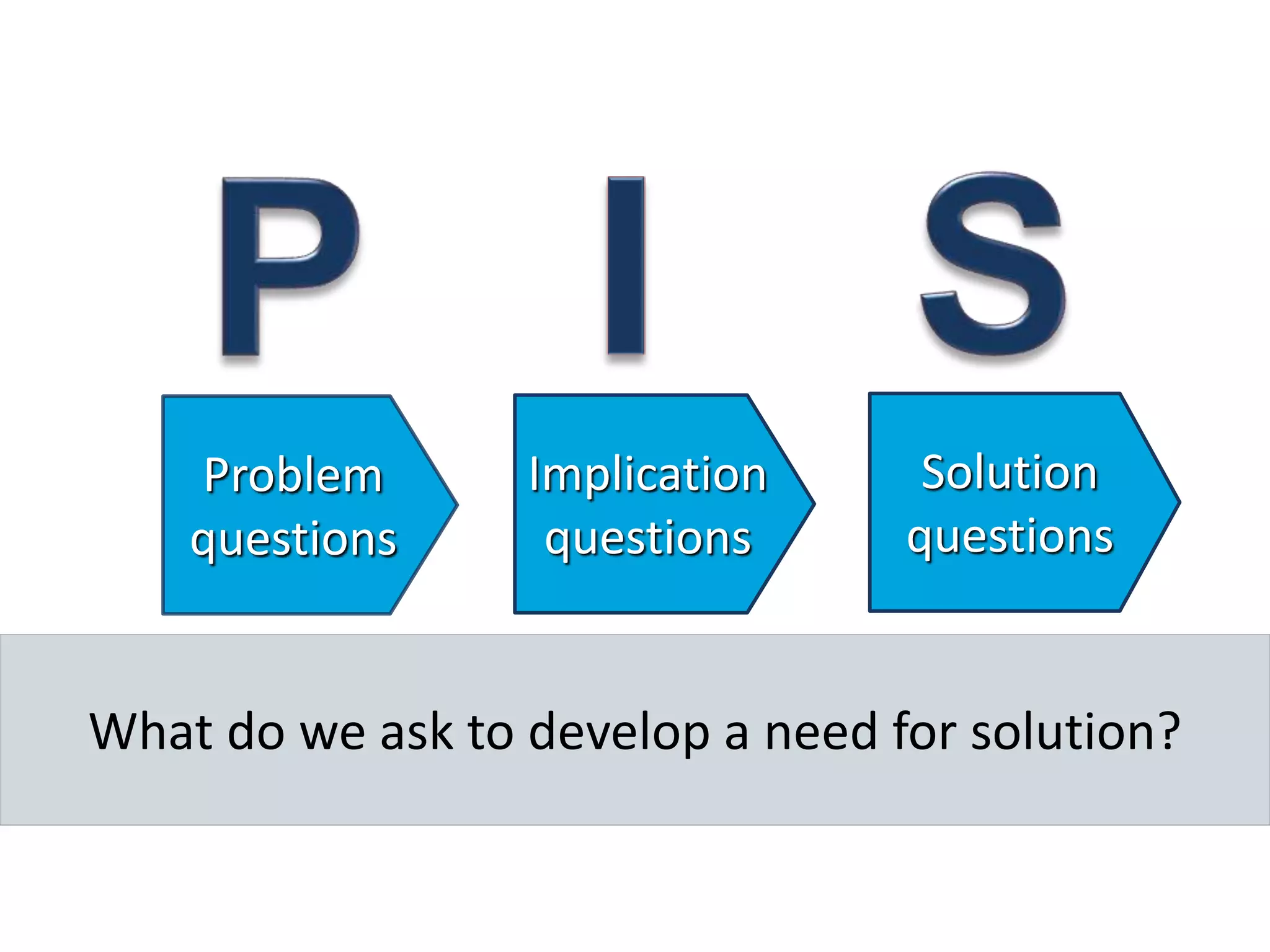
What do we ask to develop a need for solution?
Problem
questions
Solution
questions
Implication
questions
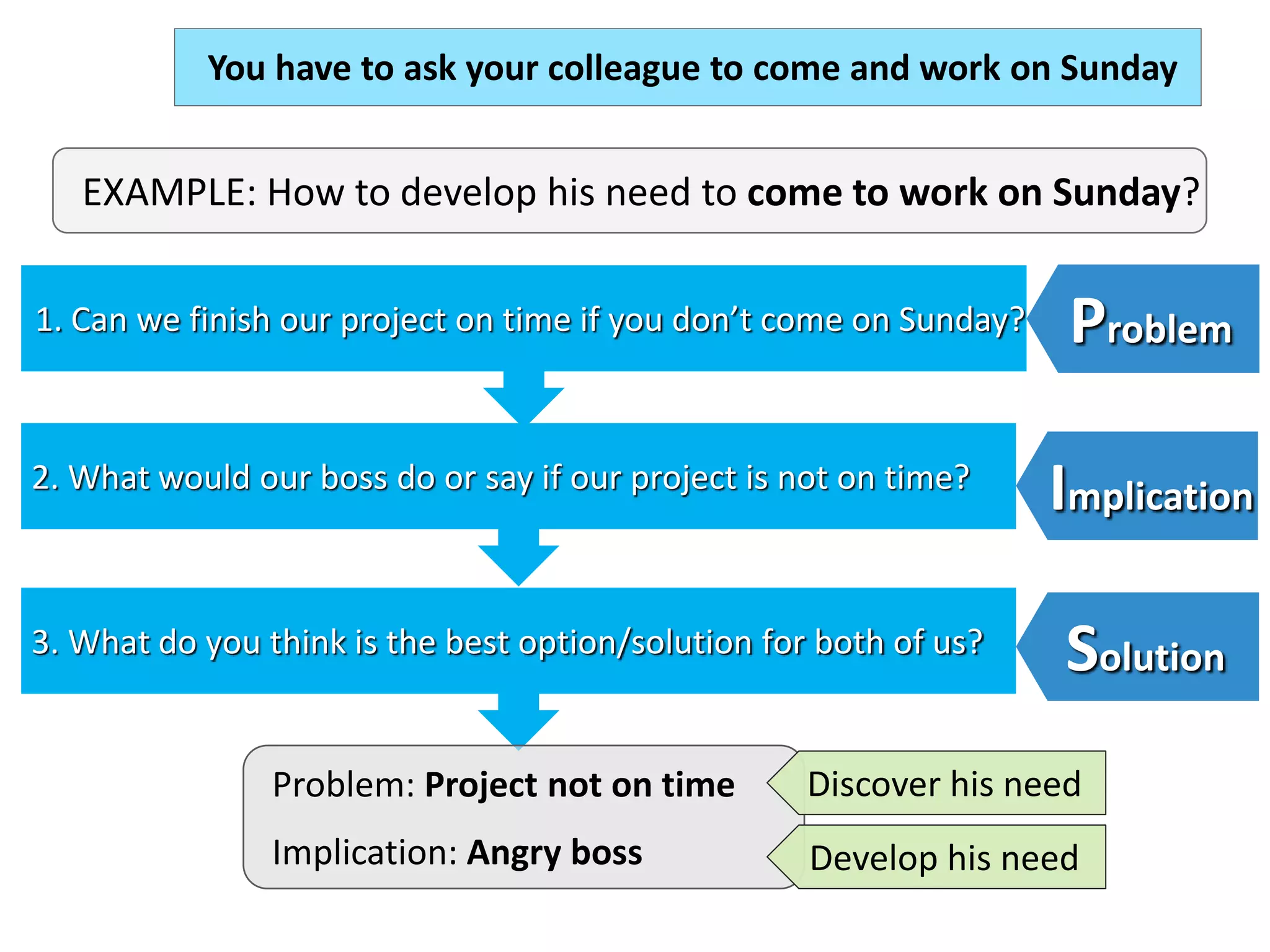
1. Can we finish our project on time if you don’t come on Sunday?
2. What would our boss do or say if our project is not on time?
3. What do you think is the best option/solution for both of us?
Problem
Implication
Solution
EXAMPLE: How to develop his need to come to work on Sunday?
You have to ask your colleague to come and work on Sunday
Problem: Project not on time
Implication: Angry boss
Discover his need
Develop his need
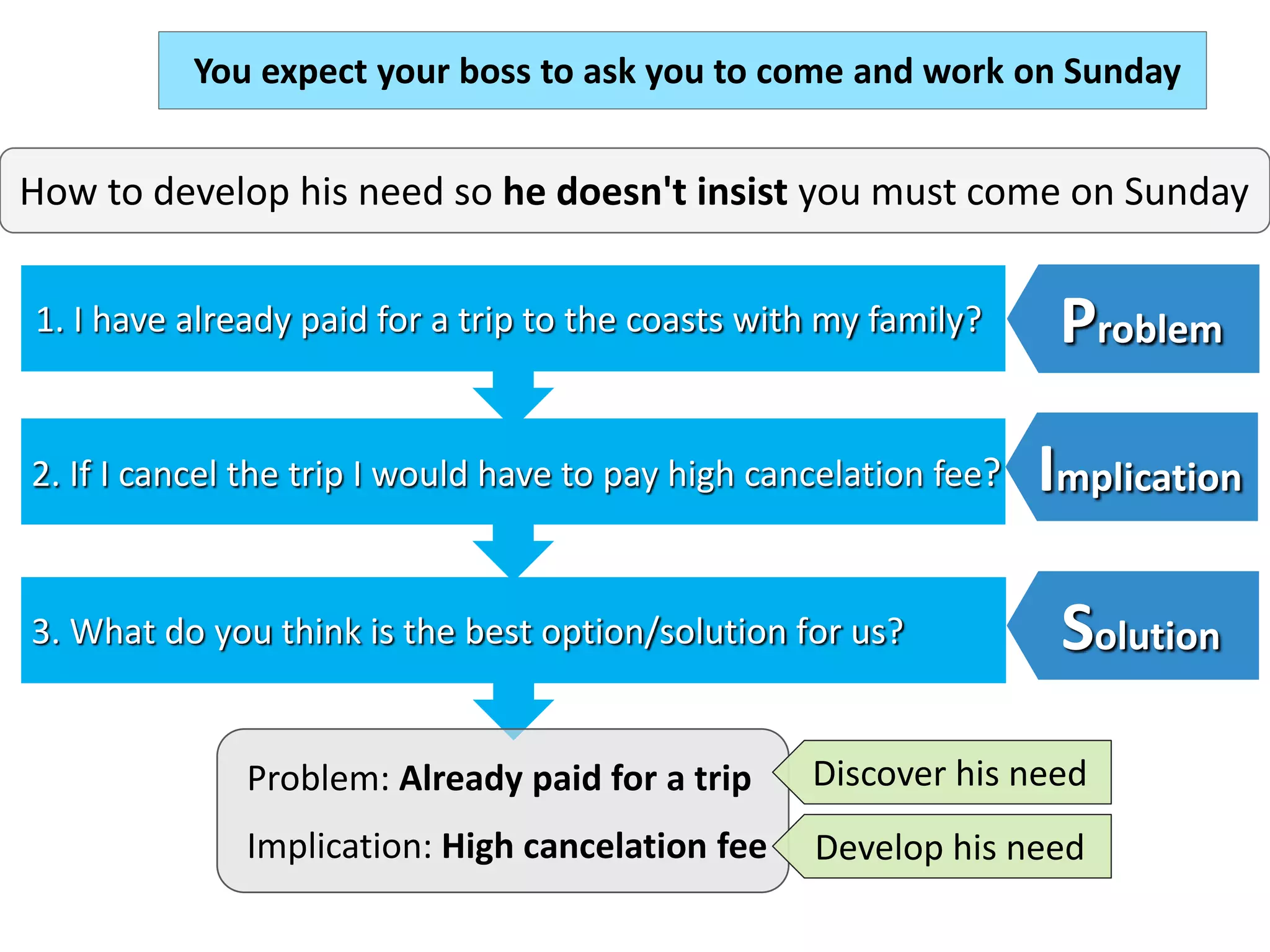
1. I have already paid for a trip to the coasts with my family?
2. If I cancel the trip I would have to pay high cancelation fee?
3. What do you think is the best option/solution for us?
Problem
Implication
Solution
How to develop his need so he doesn't insist you must come on Sunday
You expect your boss to ask you to come and work on Sunday
Problem: Already paid for a trip
Implication: High cancelation fee
Discover his need
Develop his need
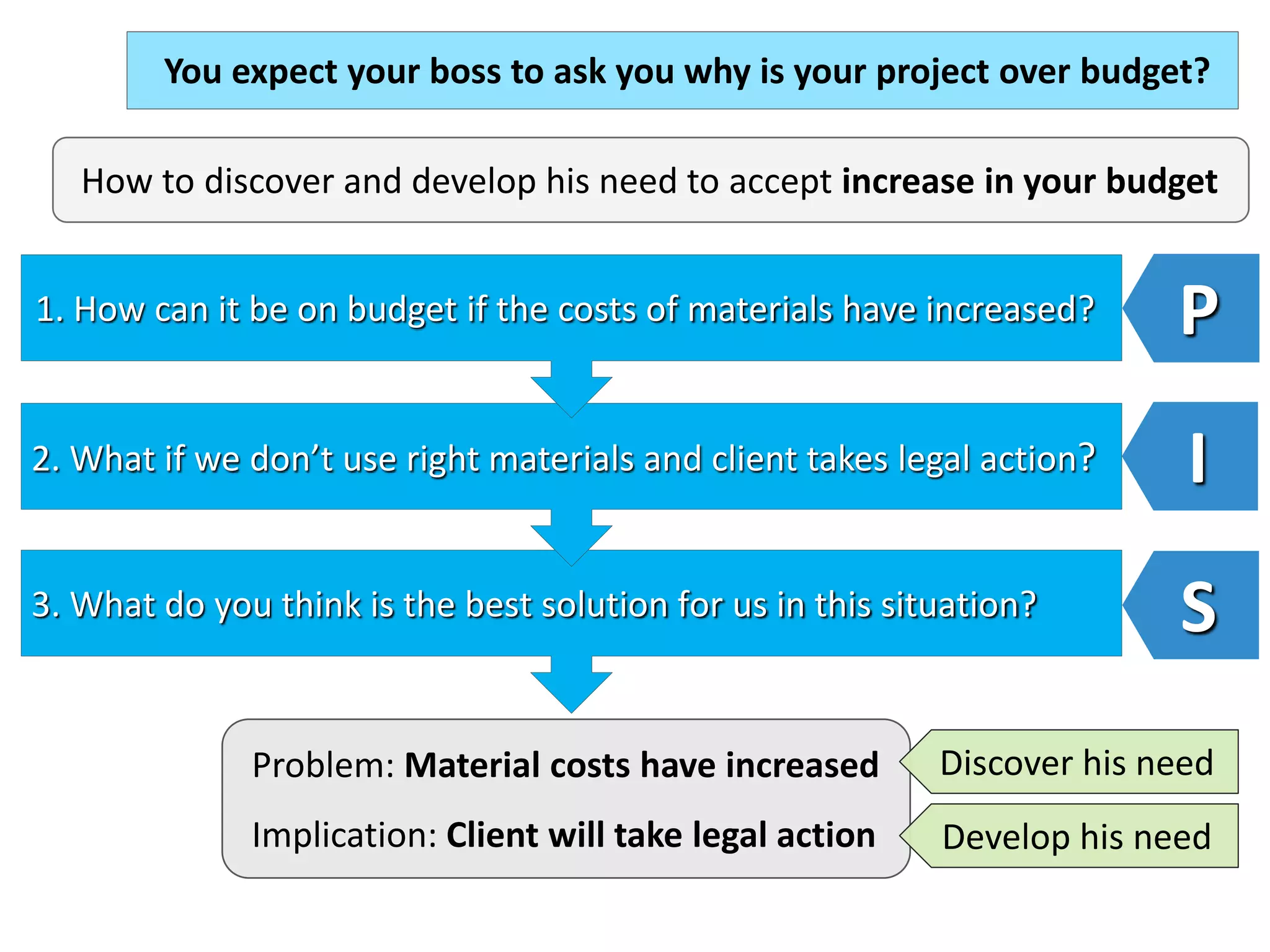
3. What do you think is the best solution for us in this situation?
P
I
S
How to discover and develop his need to accept increase in your budget
You expect your boss to ask you why is your project over budget?
Problem: Material costs have increased
Implication: Client will take legal action
2. What if we don’t use right materials and client takes legal action?
1. How can it be on budget if the costs of materials have increased?
Discover his need
Develop his need
Implication
QUESTIONS
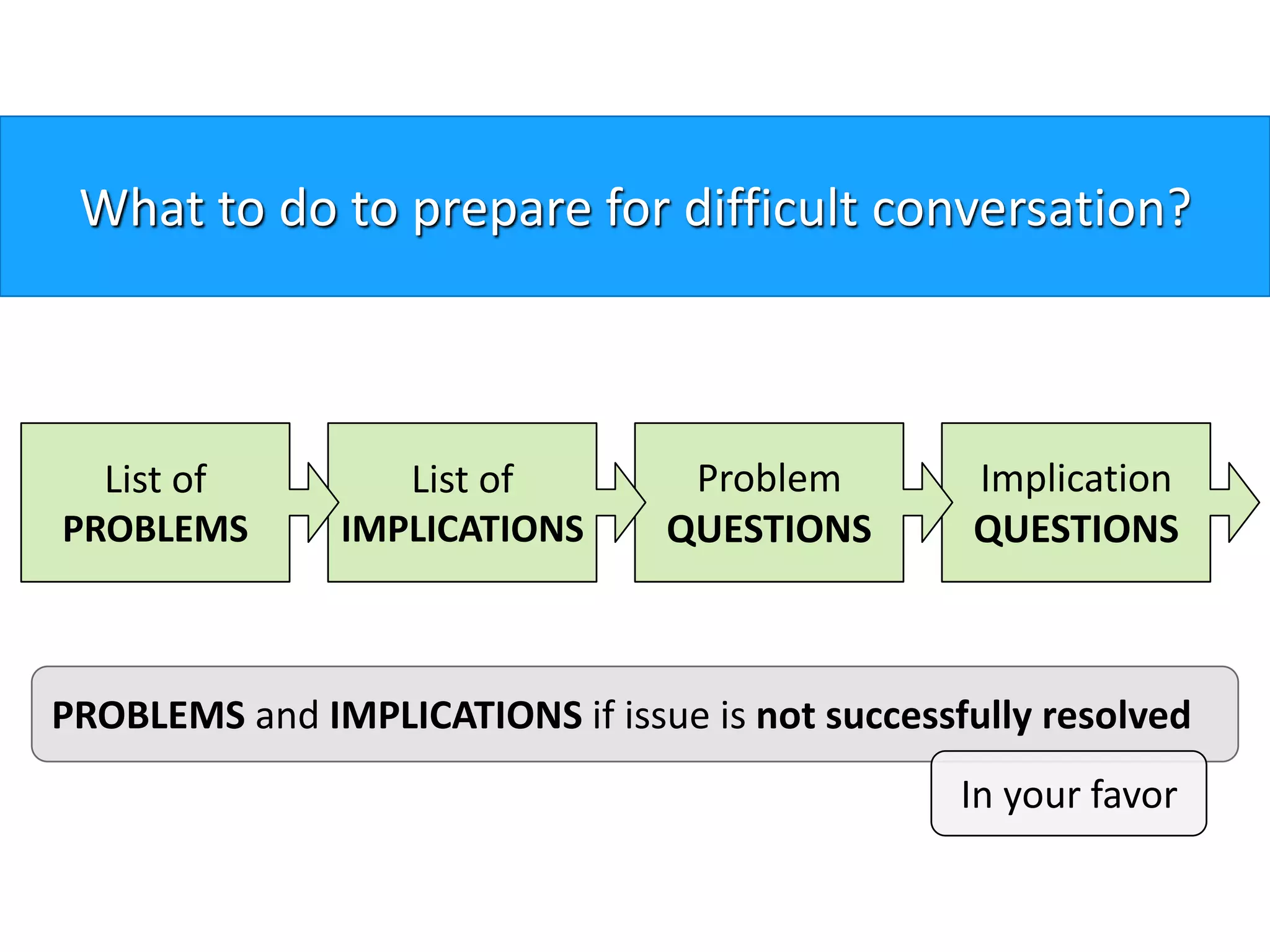
PROBLEMS and IMPLICATIONS if issue is not successfully resolved
What to do to prepare for difficult conversation?
Problem
QUESTIONS
List of
IMPLICATIONS
List of
PROBLEMS
In your favor
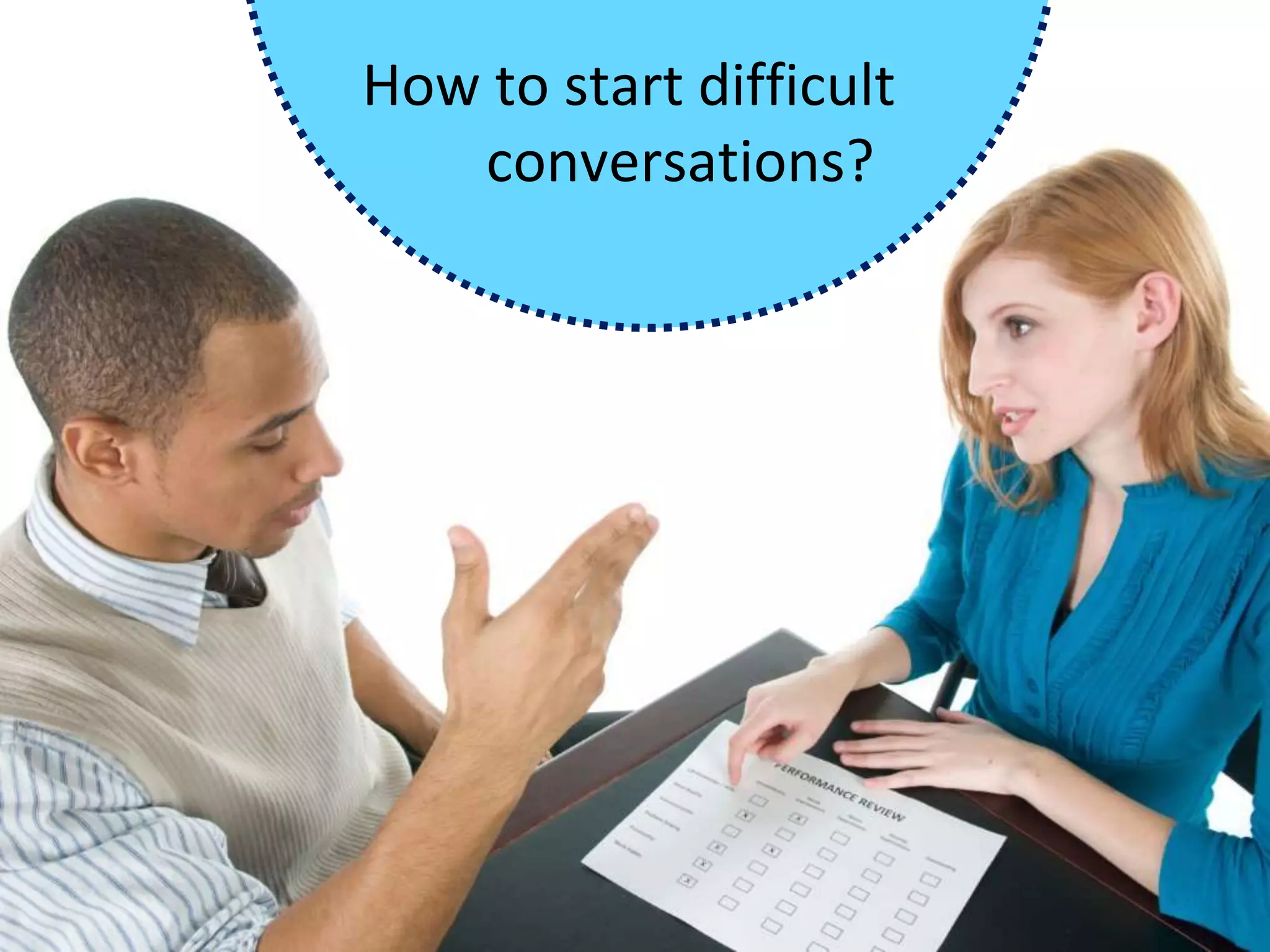
How to start difficult
conversations?
What to do before you start the conversation?
Use communication absorbers
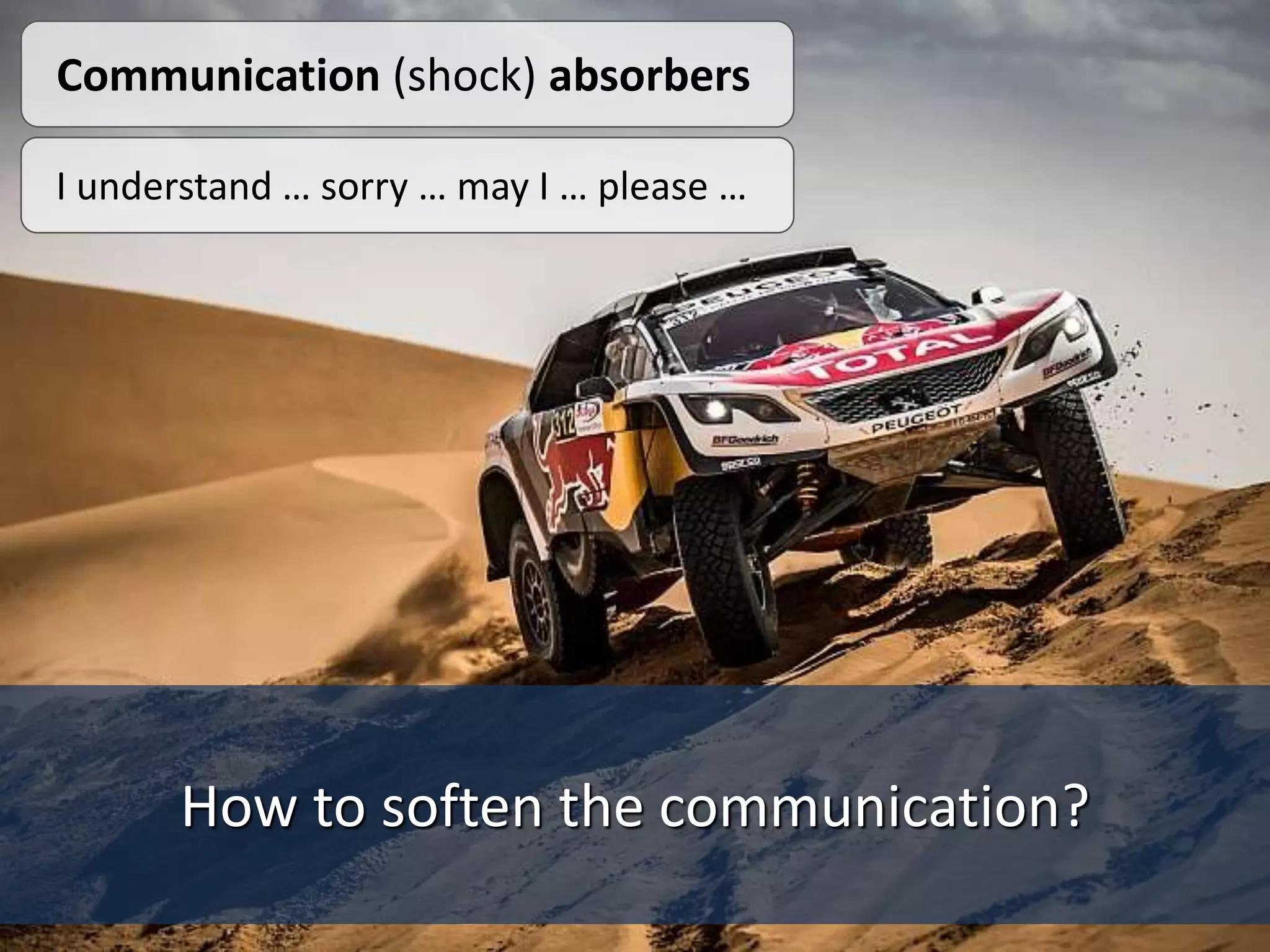
Communication (shock) absorbers
How to soften the communication?
I understand … sorry … may I … please …
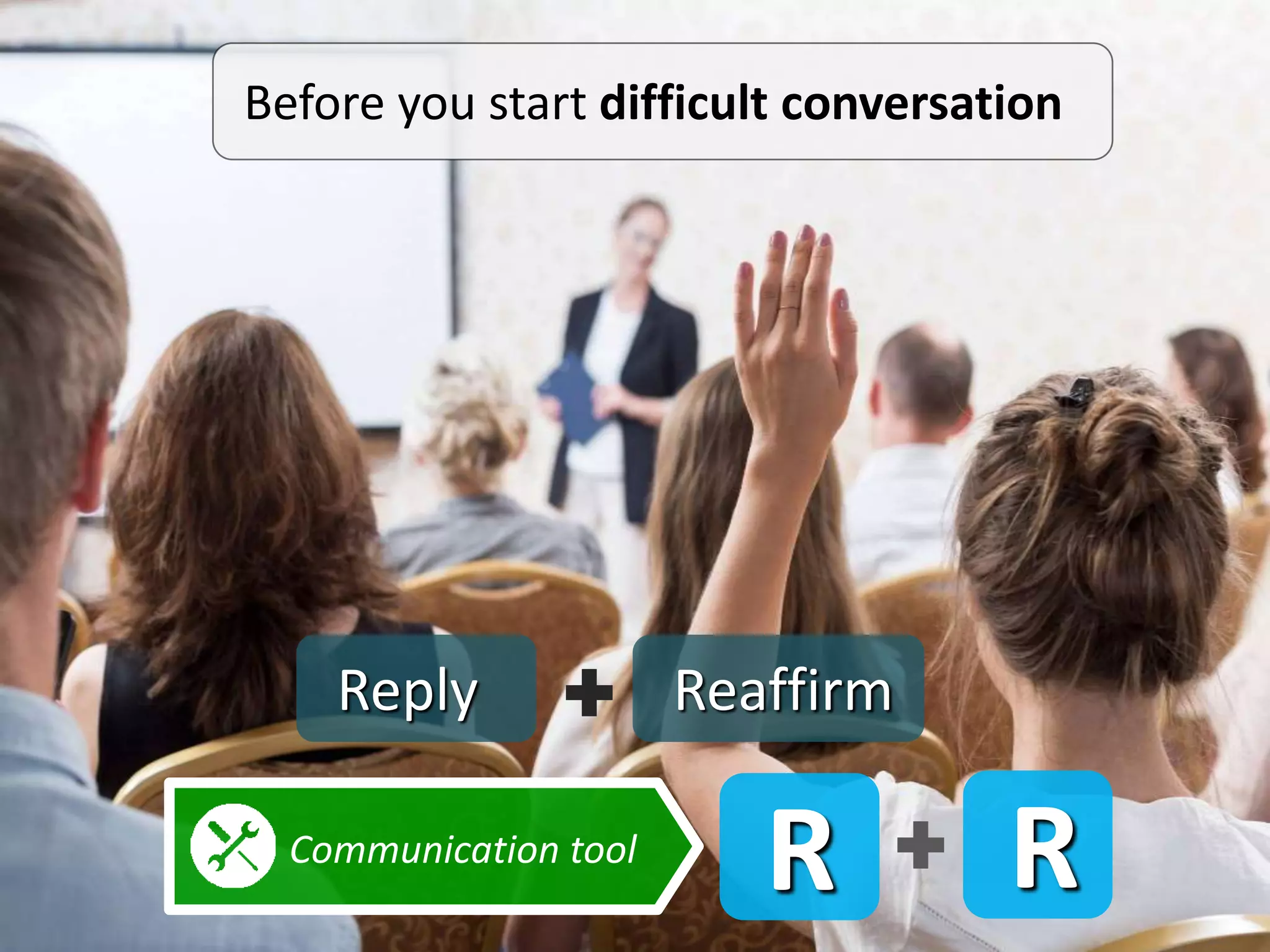
R RCommunication tool
Before you start difficult conversation
Reply Reaffirm
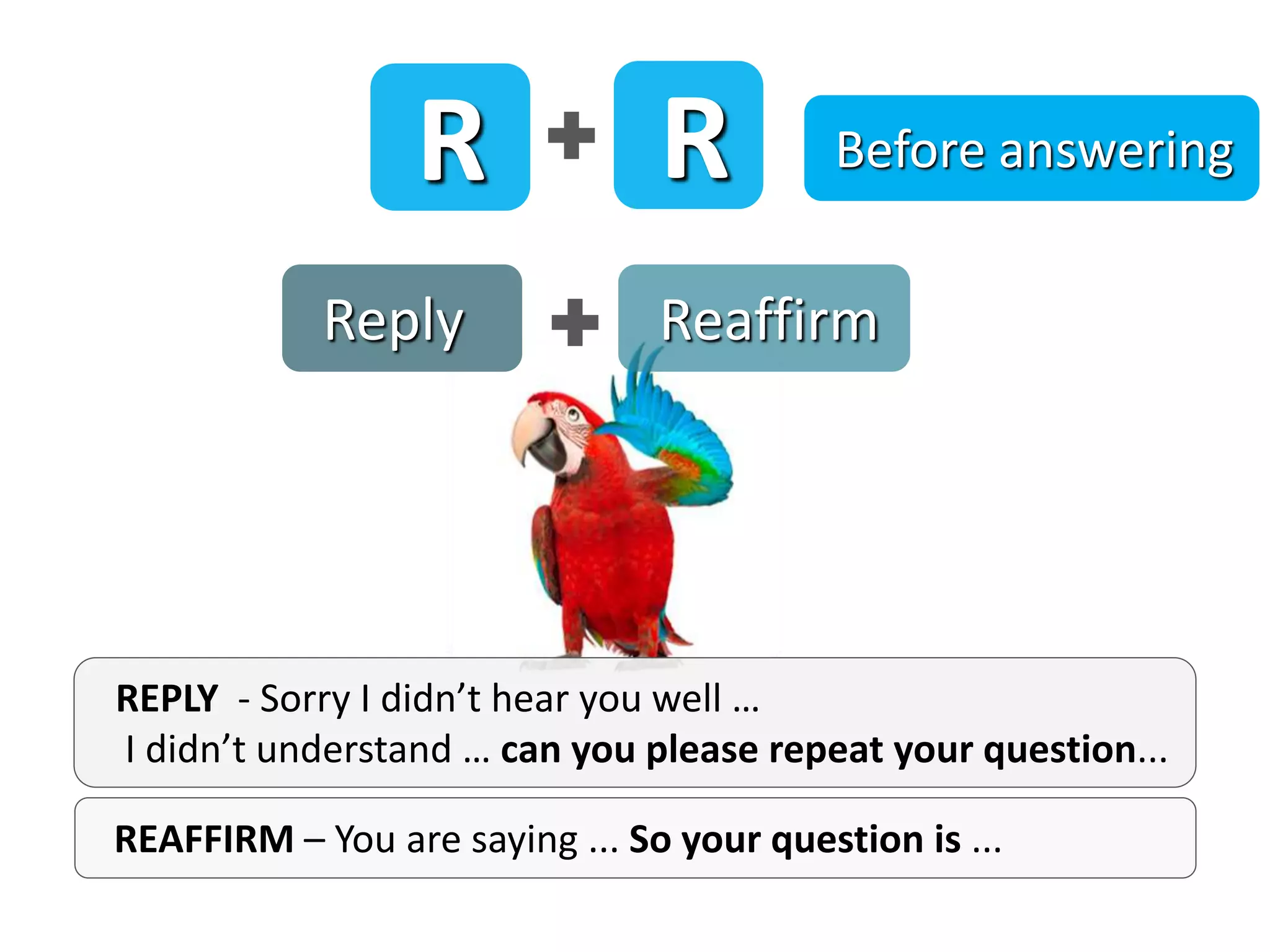
Reply Reaffirm
REAFFIRM – You are saying ... So your question is ...
REPLY - Sorry I didn’t hear you well …
I didn’t understand … can you please repeat your question...
R R Before answering
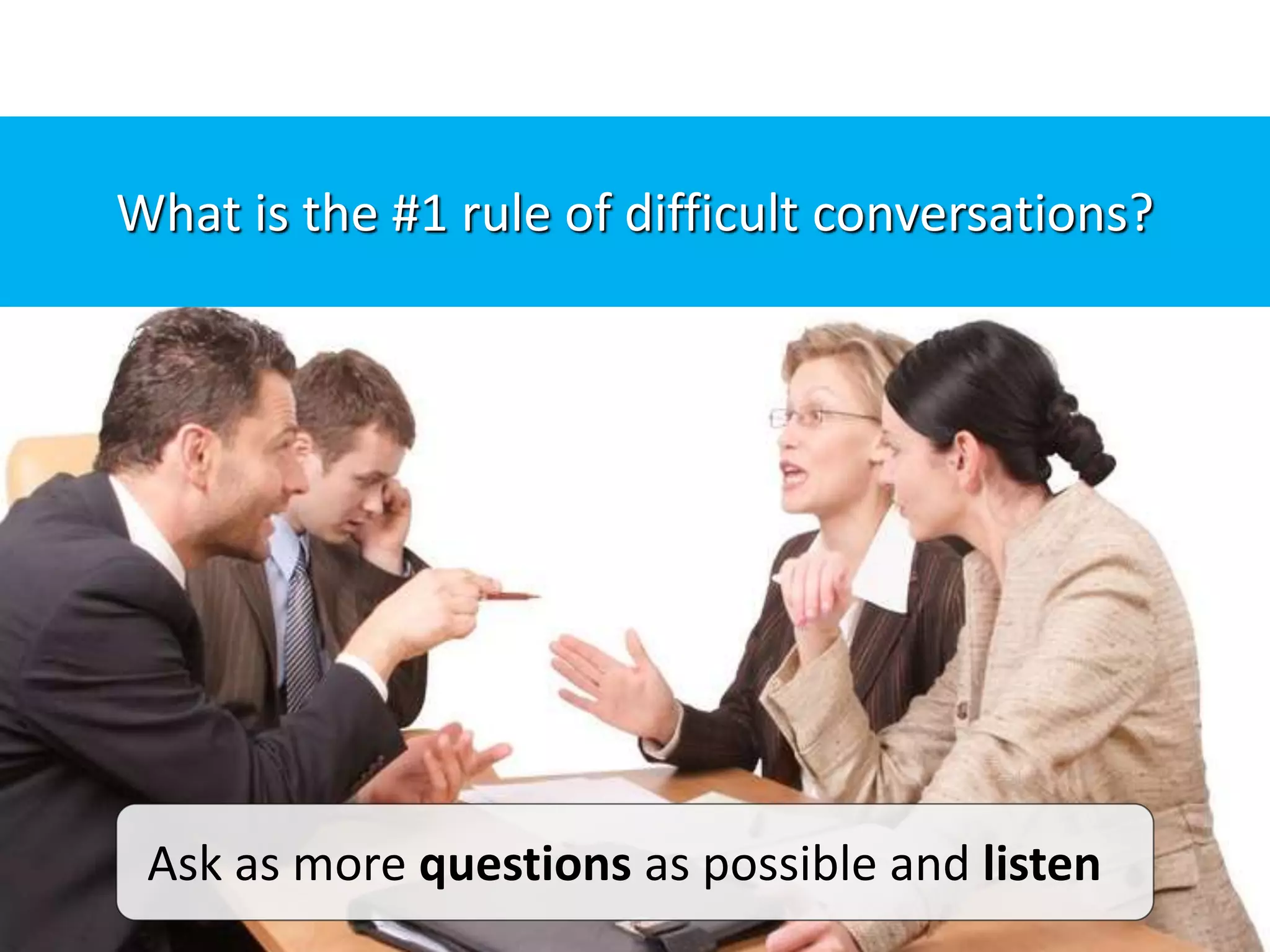
Ask as more questions as possible and listen
What is the #1 rule of difficult conversations?
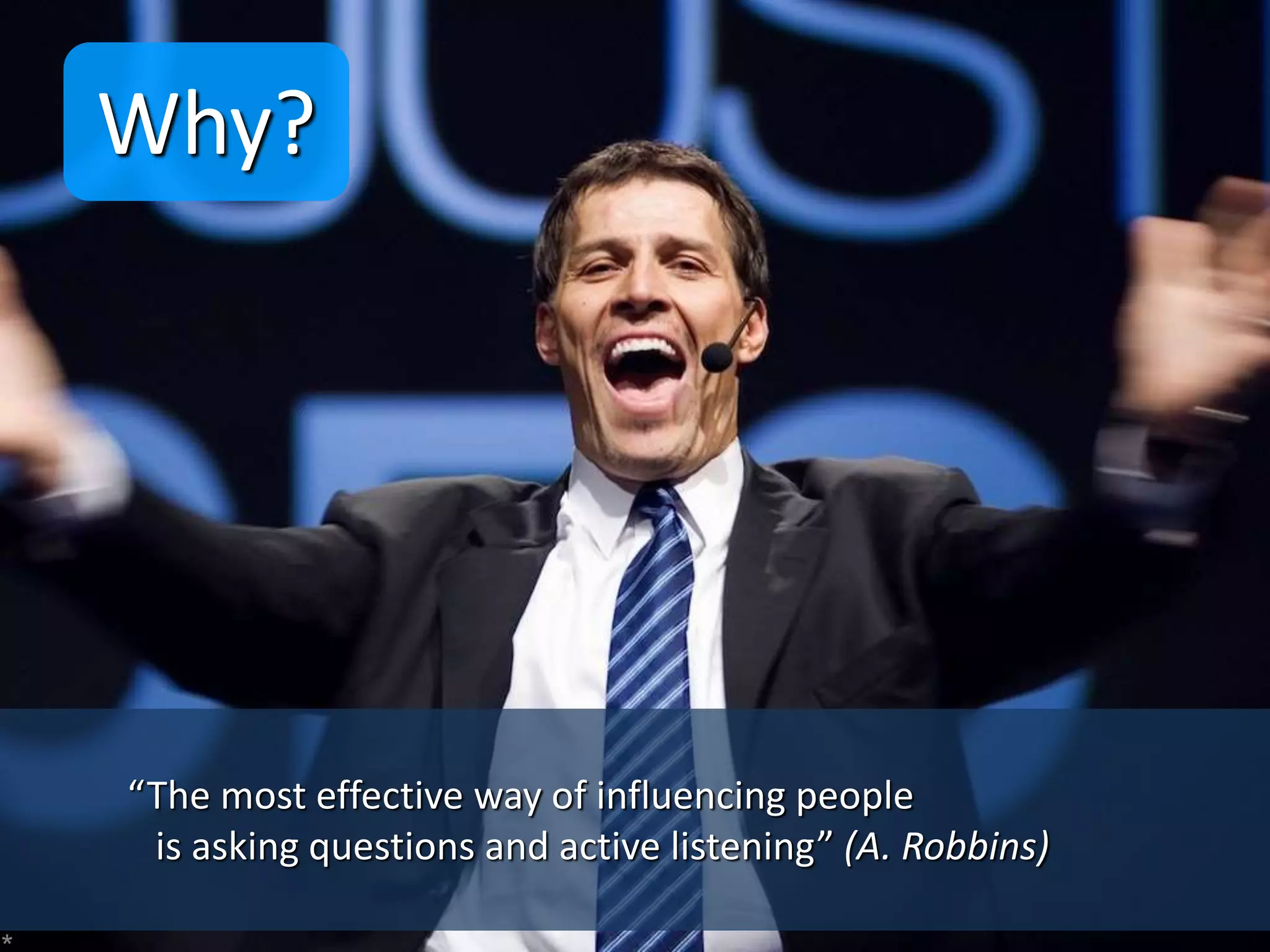
“The most effective way of influencing people
is asking questions and active listening” (A. Robbins)
Why?
7 stepsCommunication tool
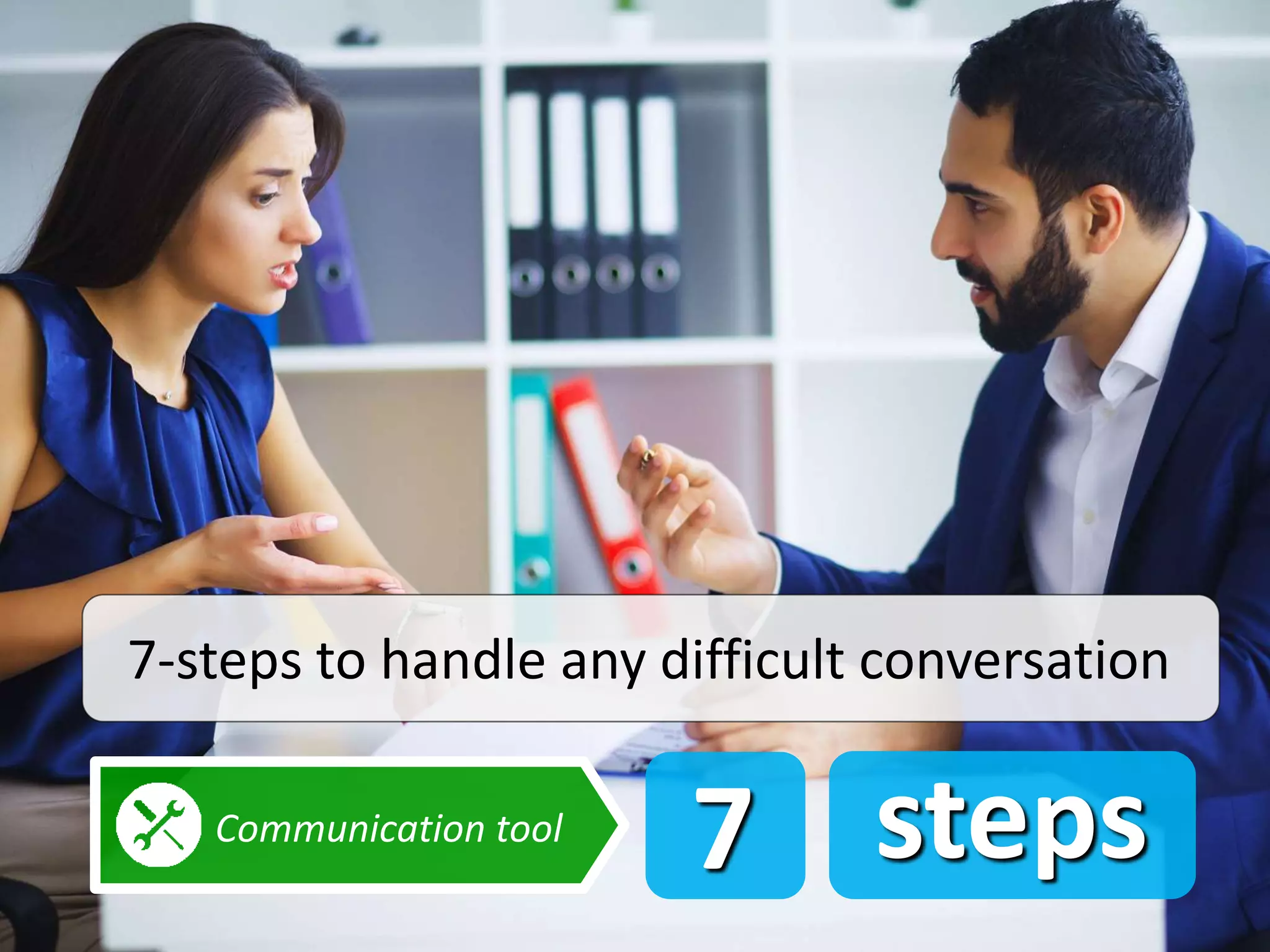
7-steps to handle any difficult conversation
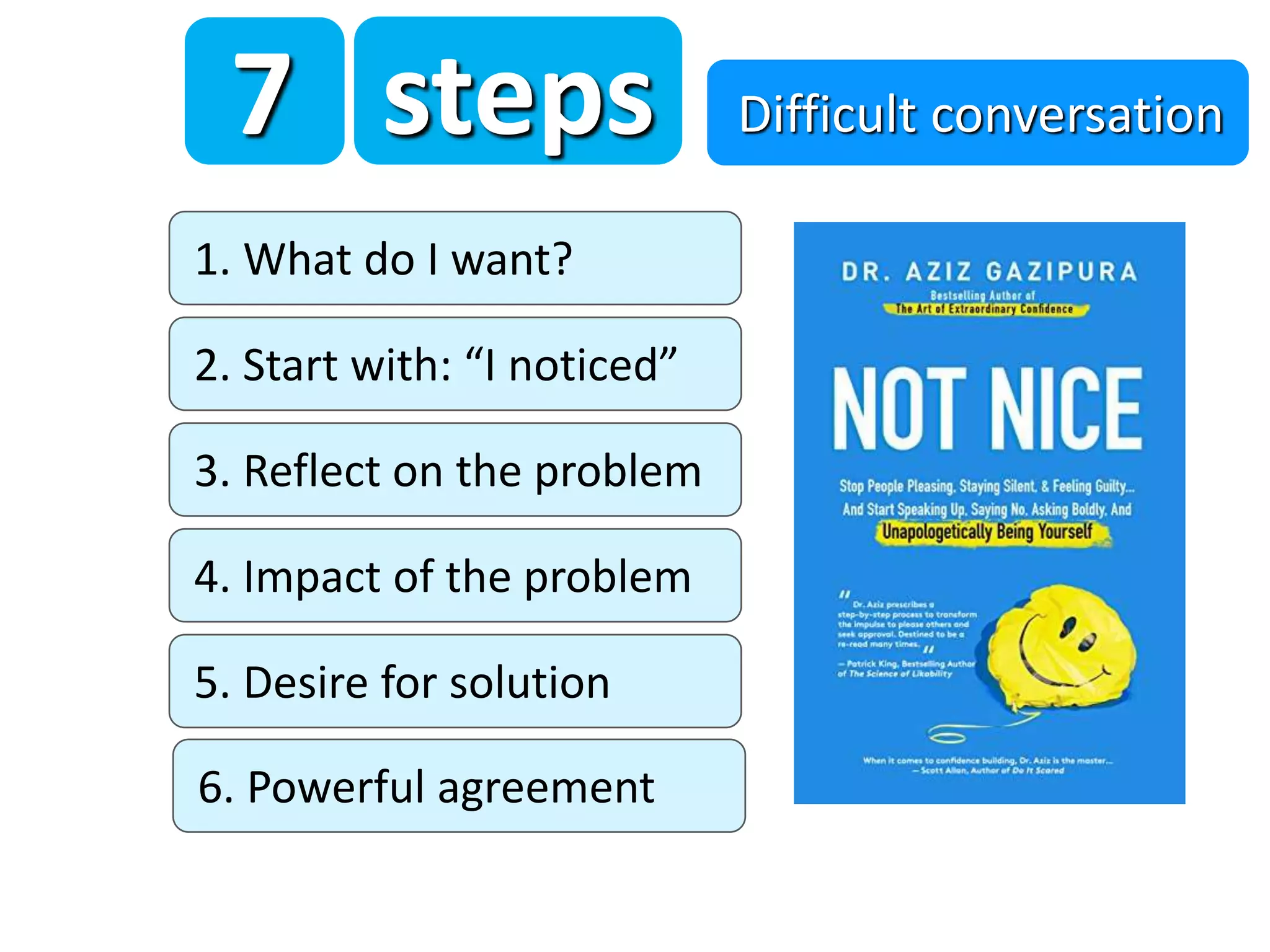
1. What do I want?
2. Start with: “I noticed”
3. Reflect on the problem
4. Impact of the problem
5. Desire for solution
7 steps Difficult conversation
6. Powerful agreement
7 steps
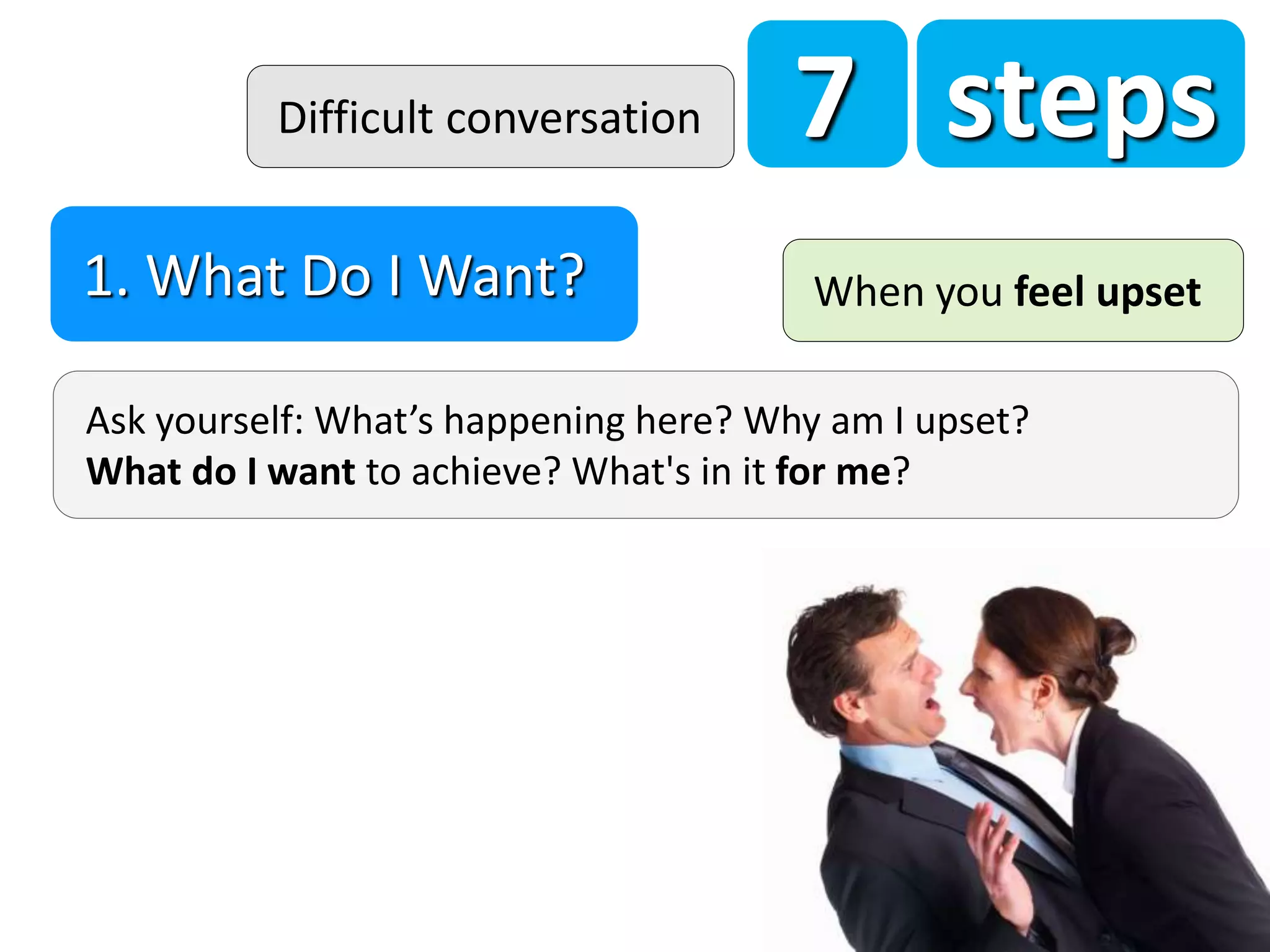
Ask yourself: What’s happening here? Why am I upset?
What do I want to achieve? What's in it for me?
1. What Do I Want?
Difficult conversation
When you feel upset
7 steps
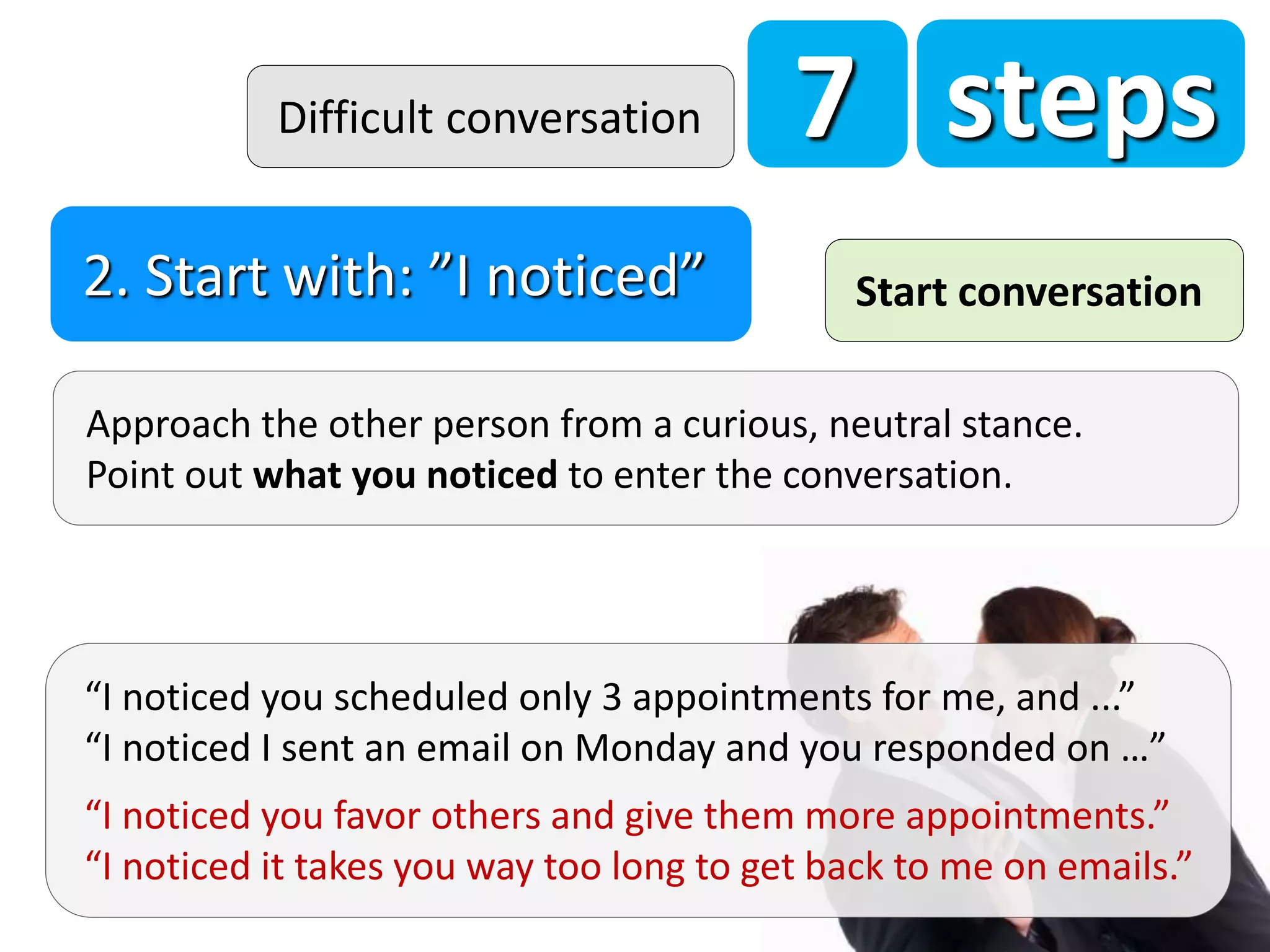
Approach the other person from a curious, neutral stance.
Point out what you noticed to enter the conversation.
2. Start with: ”I noticed”
“I noticed you scheduled only 3 appointments for me, and ...”
“I noticed I sent an email on Monday and you responded on …”
“I noticed you favor others and give them more appointments.”
“I noticed it takes you way too long to get back to me on emails.”
Difficult conversation
Start conversation
7 steps
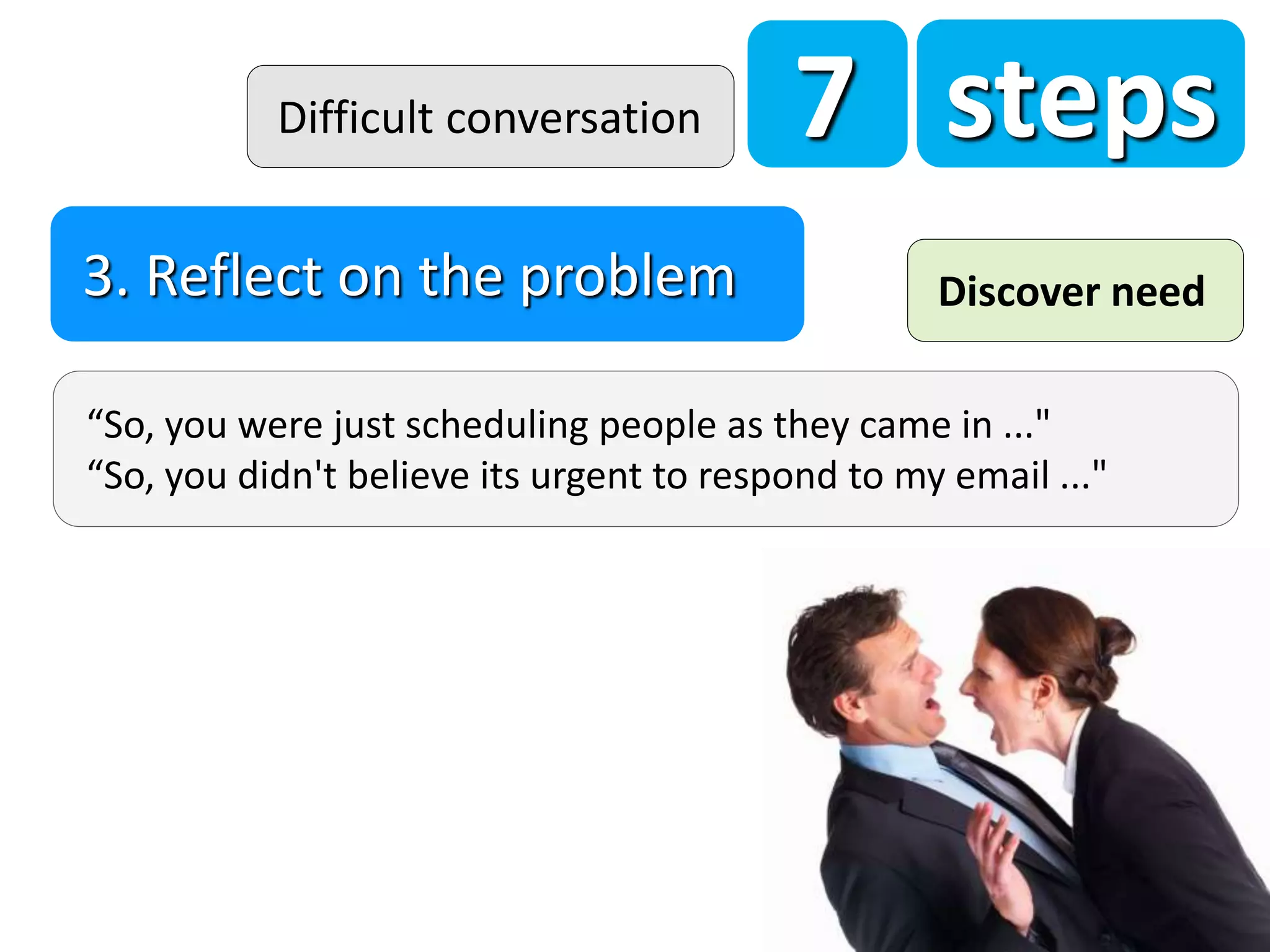
“So, you were just scheduling people as they came in ..."
“So, you didn't believe its urgent to respond to my email ..."
3. Reflect on the problem
Difficult conversation
Discover need
7 steps
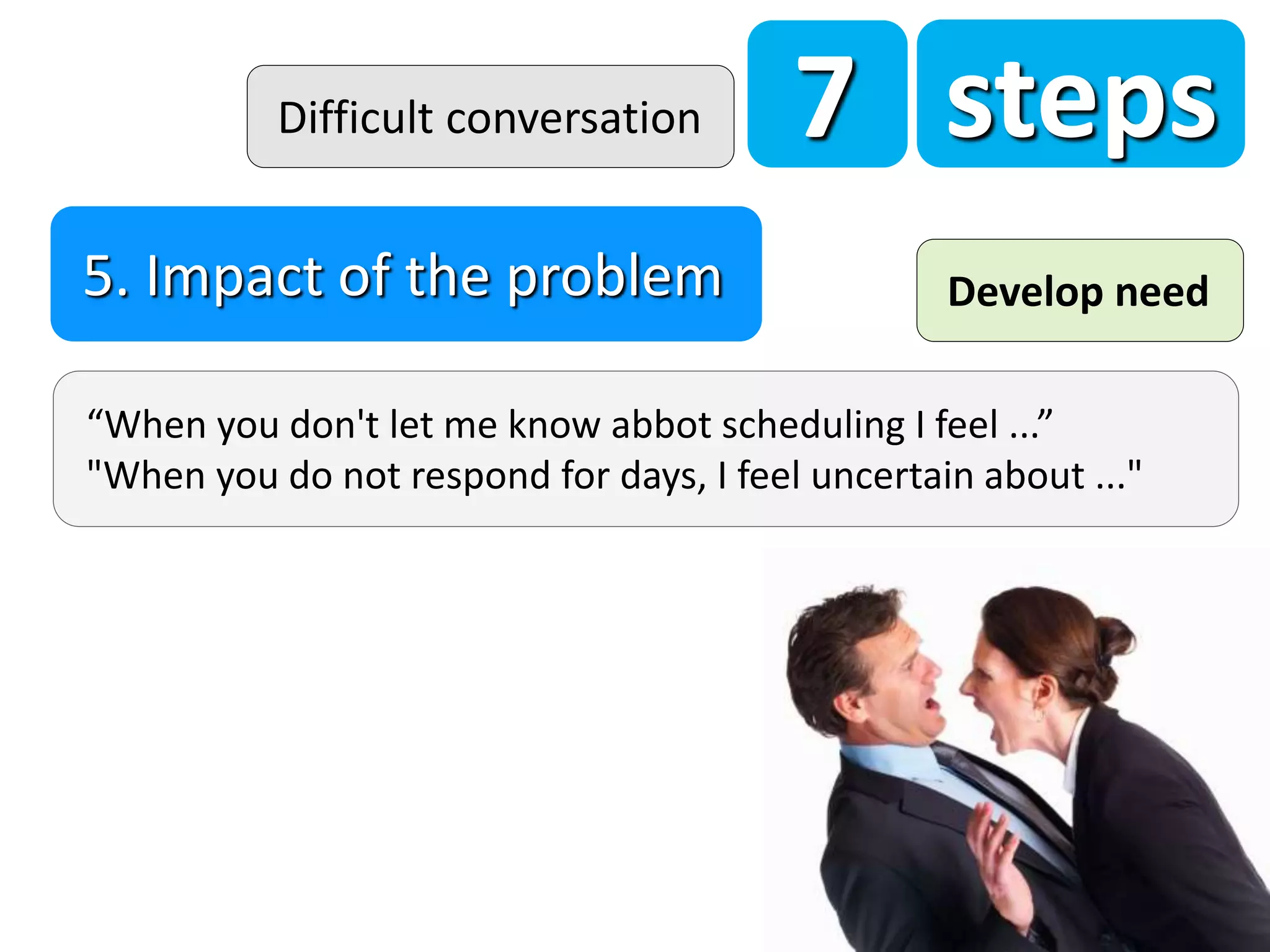
“When you don't let me know abbot scheduling I feel ...”
"When you do not respond for days, I feel uncertain about ..."
5. Impact of the problem
Difficult conversation
Develop need
7 steps
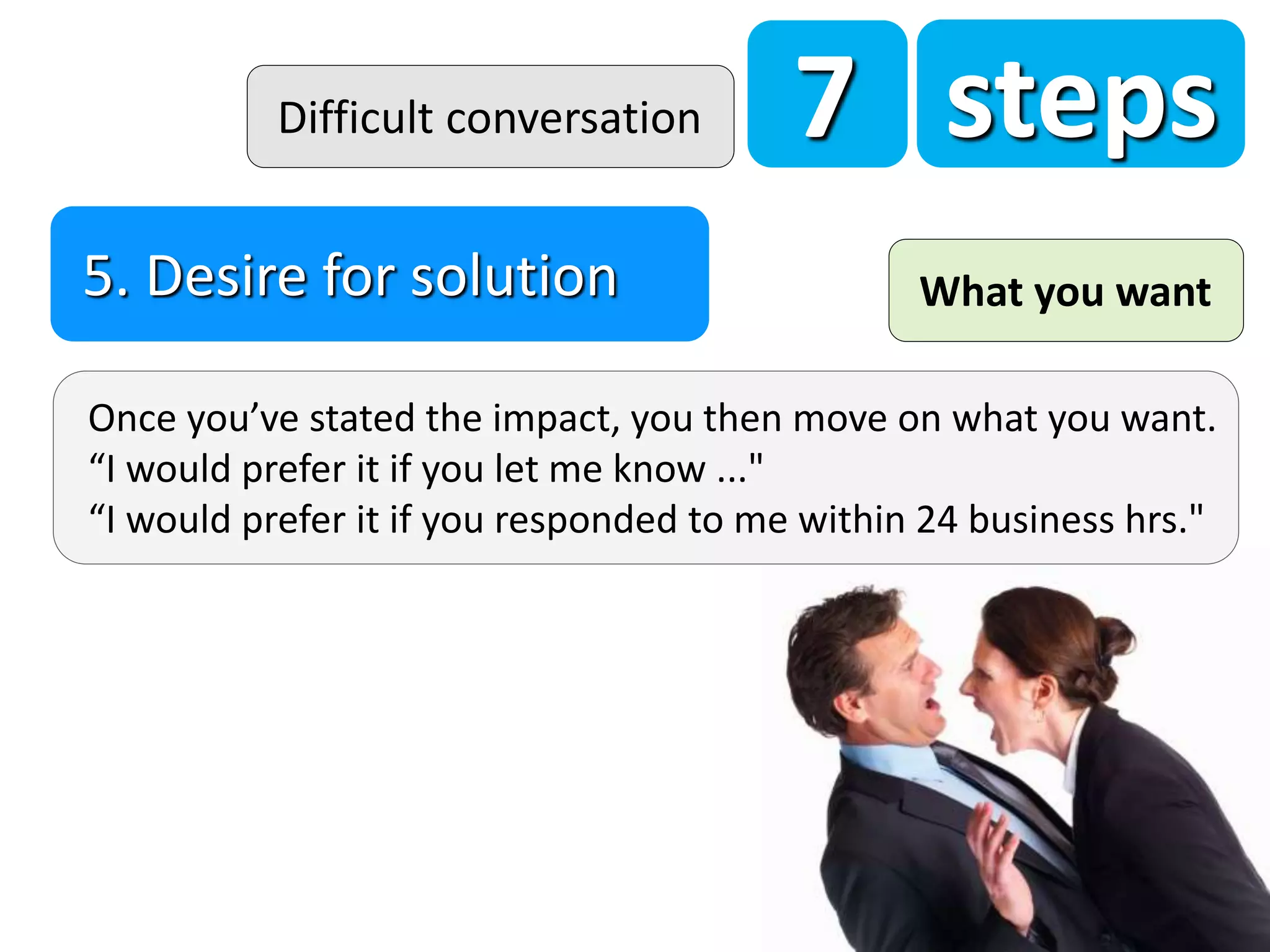
Once you’ve stated the impact, you then move on what you want.
“I would prefer it if you let me know ..."
“I would prefer it if you responded to me within 24 business hrs."
5. Desire for solution
Difficult conversation
What you want
7 steps
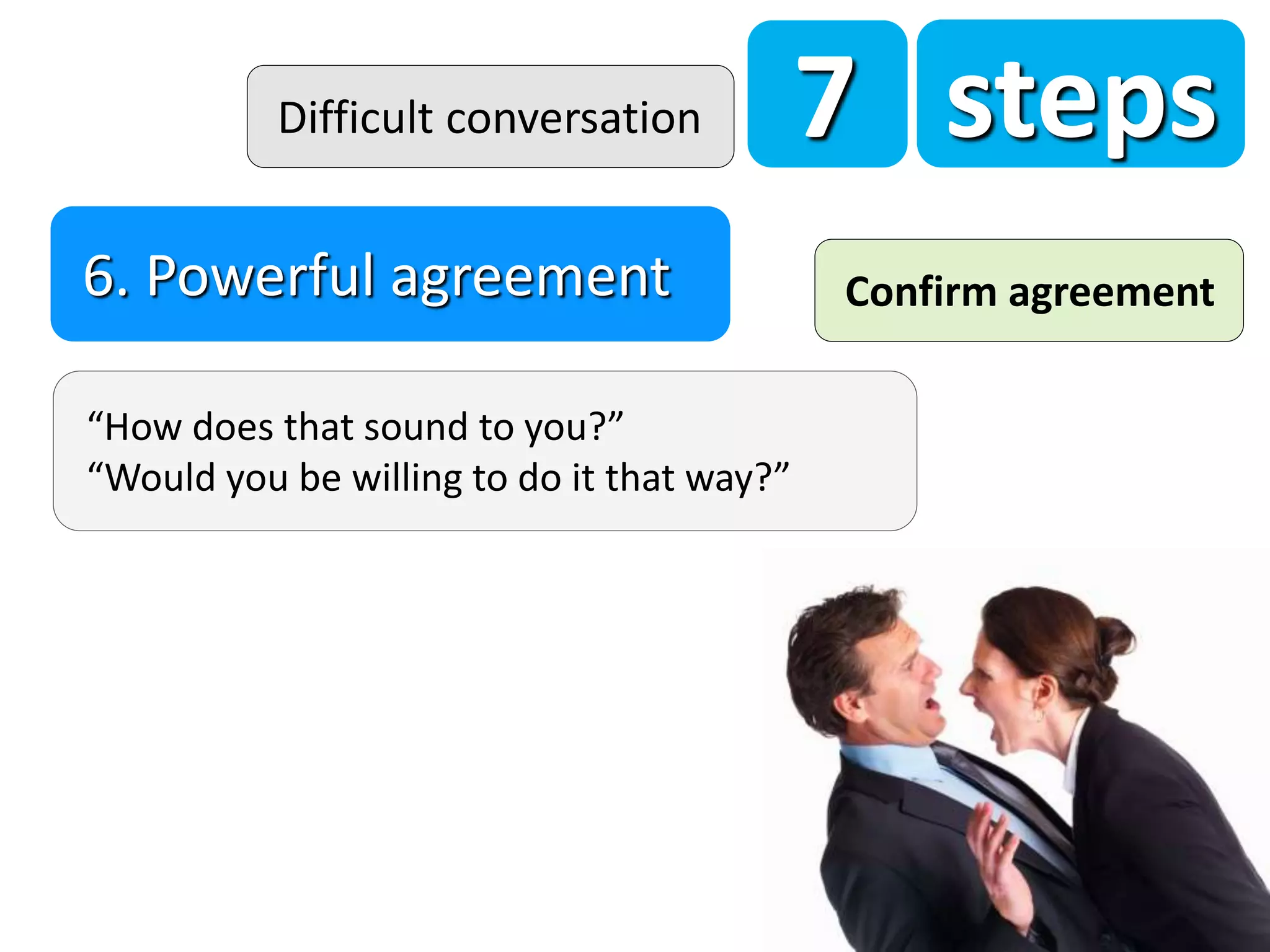
“How does that sound to you?”
“Would you be willing to do it that way?”
6. Powerful agreement
Difficult conversation
Confirm agreement
5 stepsCommunication tool
5 tips for saying NO like a NO-master
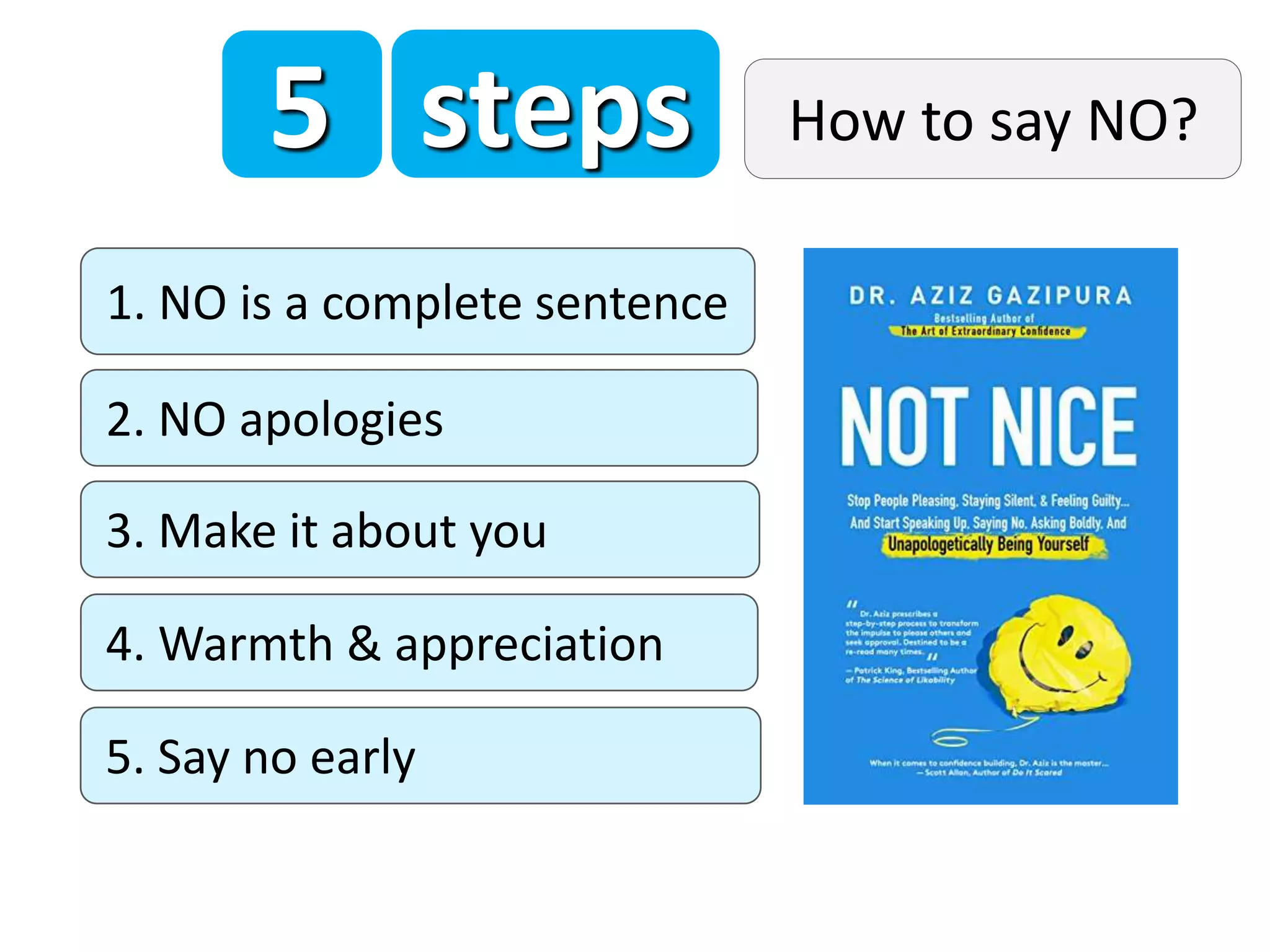
1. NO is a complete sentence
2. NO apologies
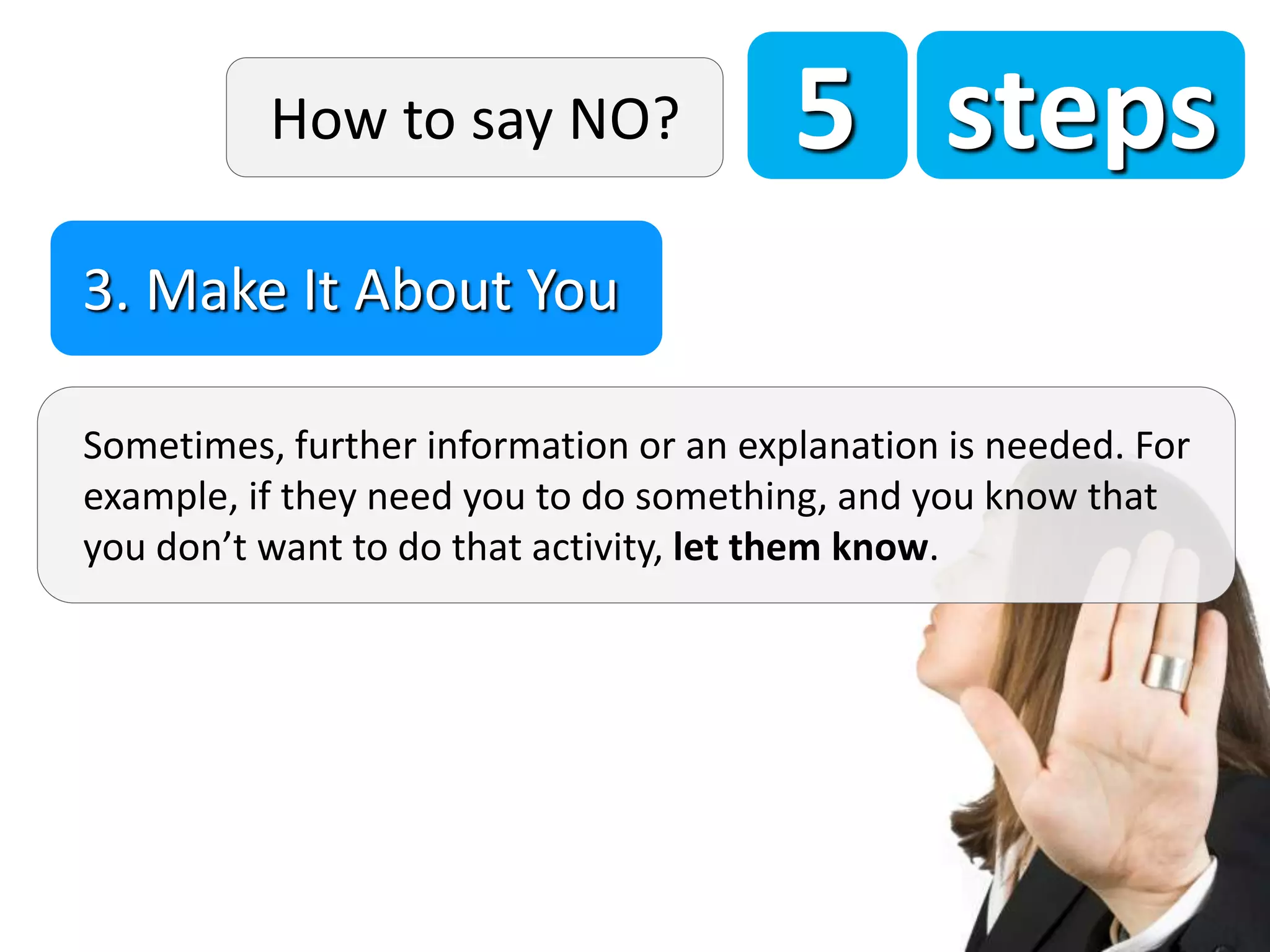
3. Make it about you
4. Warmth & appreciation
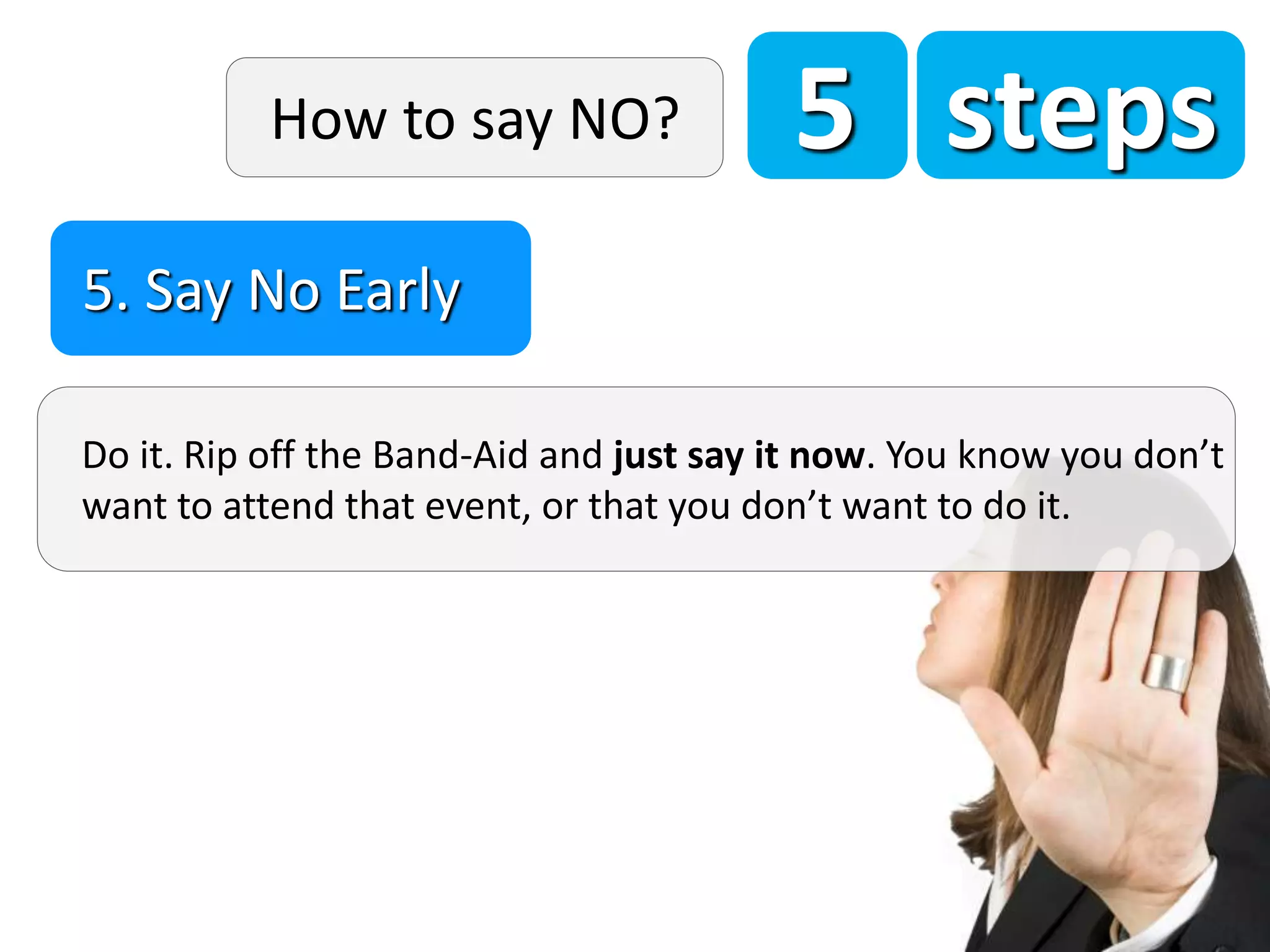
5. Say no early
5 steps How to say NO?
5 steps
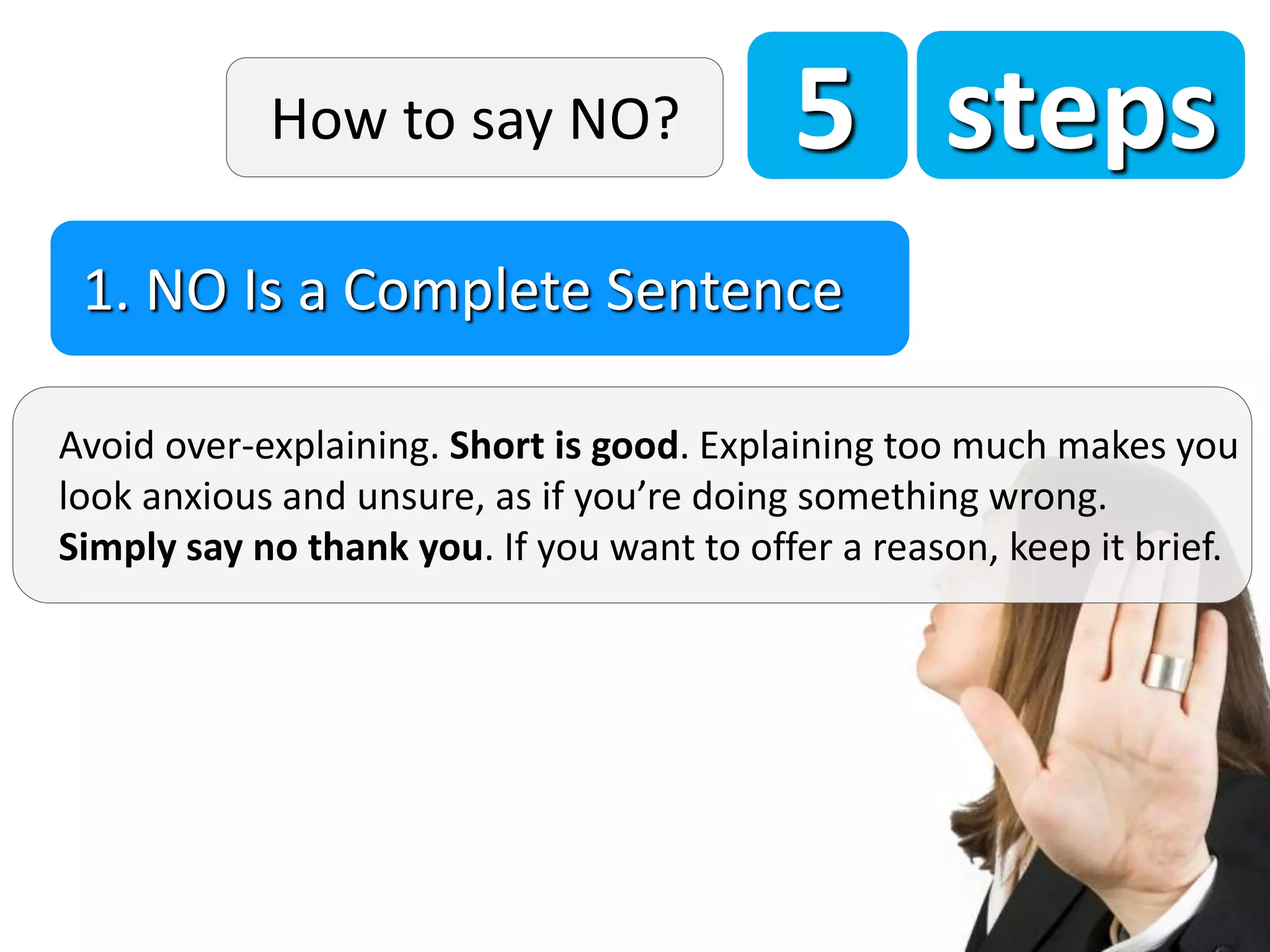
Avoid over-explaining. Short is good. Explaining too much makes you
look anxious and unsure, as if you’re doing something wrong.
Simply say no thank you. If you want to offer a reason, keep it brief.
1. NO Is a Complete Sentence
How to say NO?
5 steps
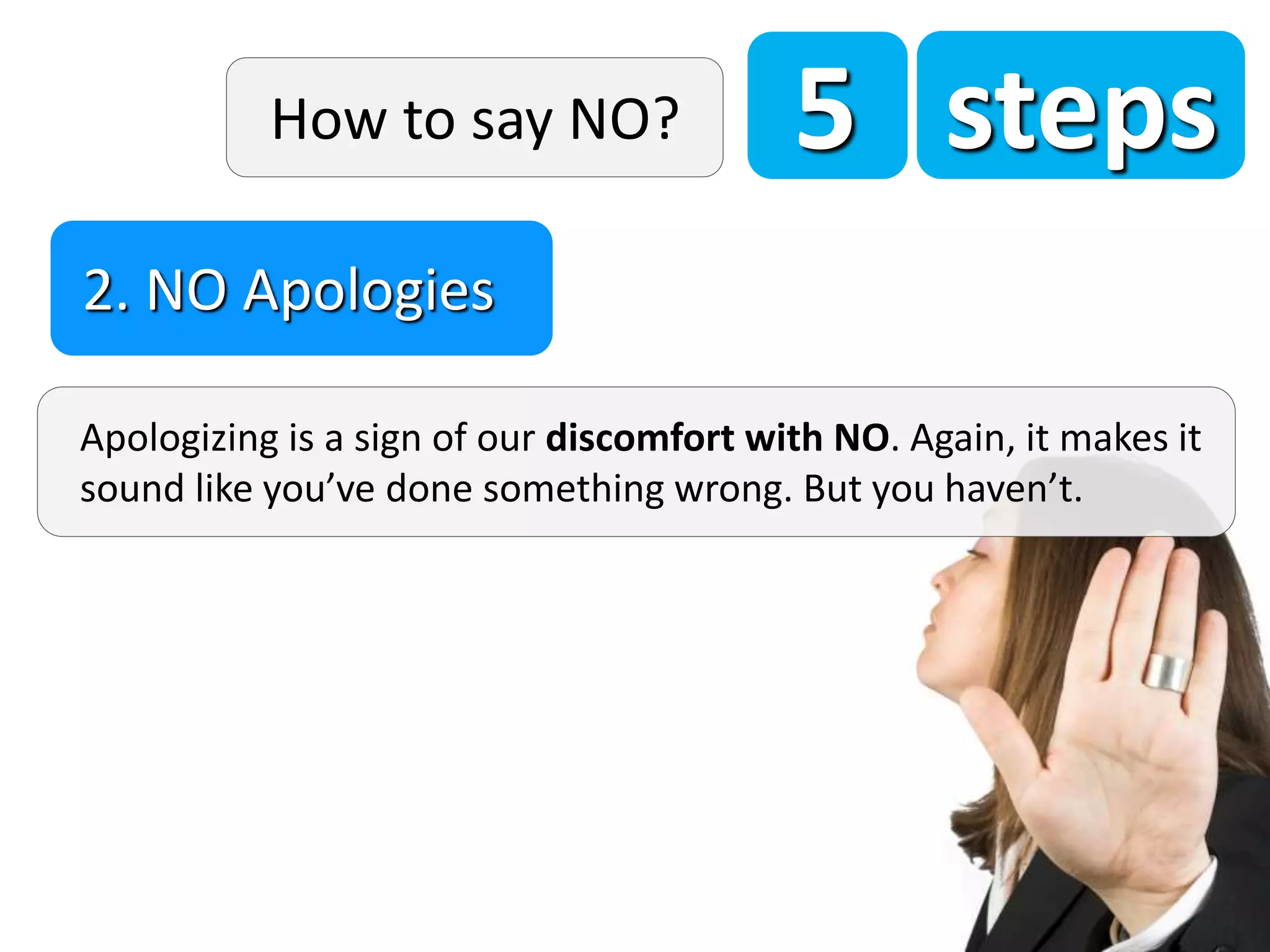
Apologizing is a sign of our discomfort with NO. Again, it makes it
sound like you’ve done something wrong. But you haven’t.
2. NO Apologies
How to say NO?
5 steps
Sometimes, further information or an explanation is needed. For
example, if they need you to do something, and you know that
you don’t want to do that activity, let them know.
3. Make It About You
How to say NO?
5 steps
Warmth is communicated in your voice tone, facial expressions,
and body language. Appreciation is communicated verbally by
thanking them for the offer.
4. Warmth & Appreciation
How to say NO?
5 steps
Do it. Rip off the Band-Aid and just say it now. You know you don’t
want to attend that event, or that you don’t want to do it.
5. Say No Early
How to say NO?
How to handle
complaints & objections?
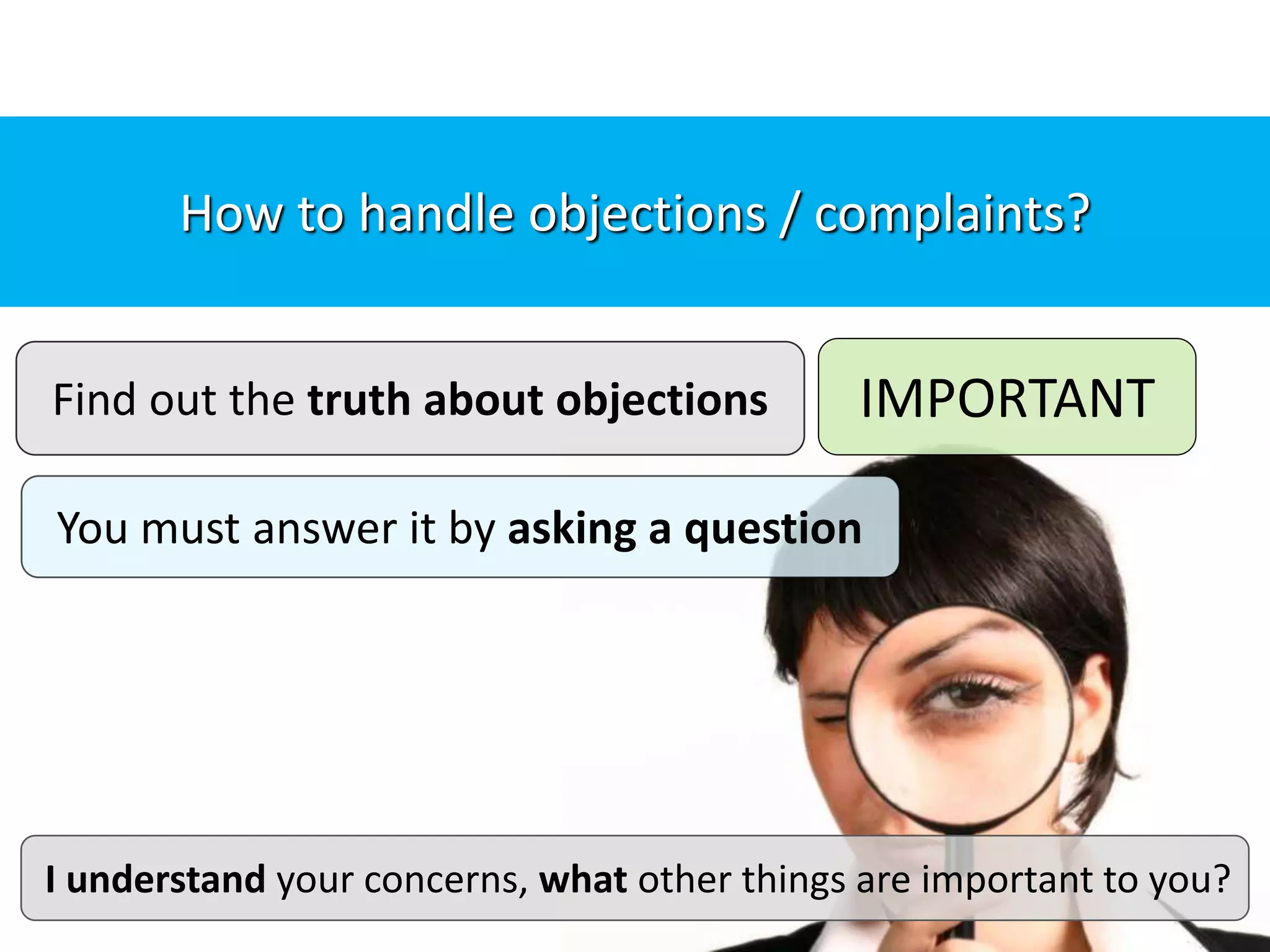
Find out the truth about objections
You must answer it by asking a question
IMPORTANT
I understand your concerns, what other things are important to you?
Important tip: “Find out the truth about objections”How to handle objections / complaints?
Your project cost is too expensive – You are asking for too much …
• I understand that budget is an important issue for you …
what other criteria will be used in taking this decision?
You are always late – You are making me angry …
• I understand you feel frustrated ...
what are the reasons to get angry?
You are not meeting deadline on your project – Your work is sloppy
• I understand you feel let down ...
what can we do to make it better?
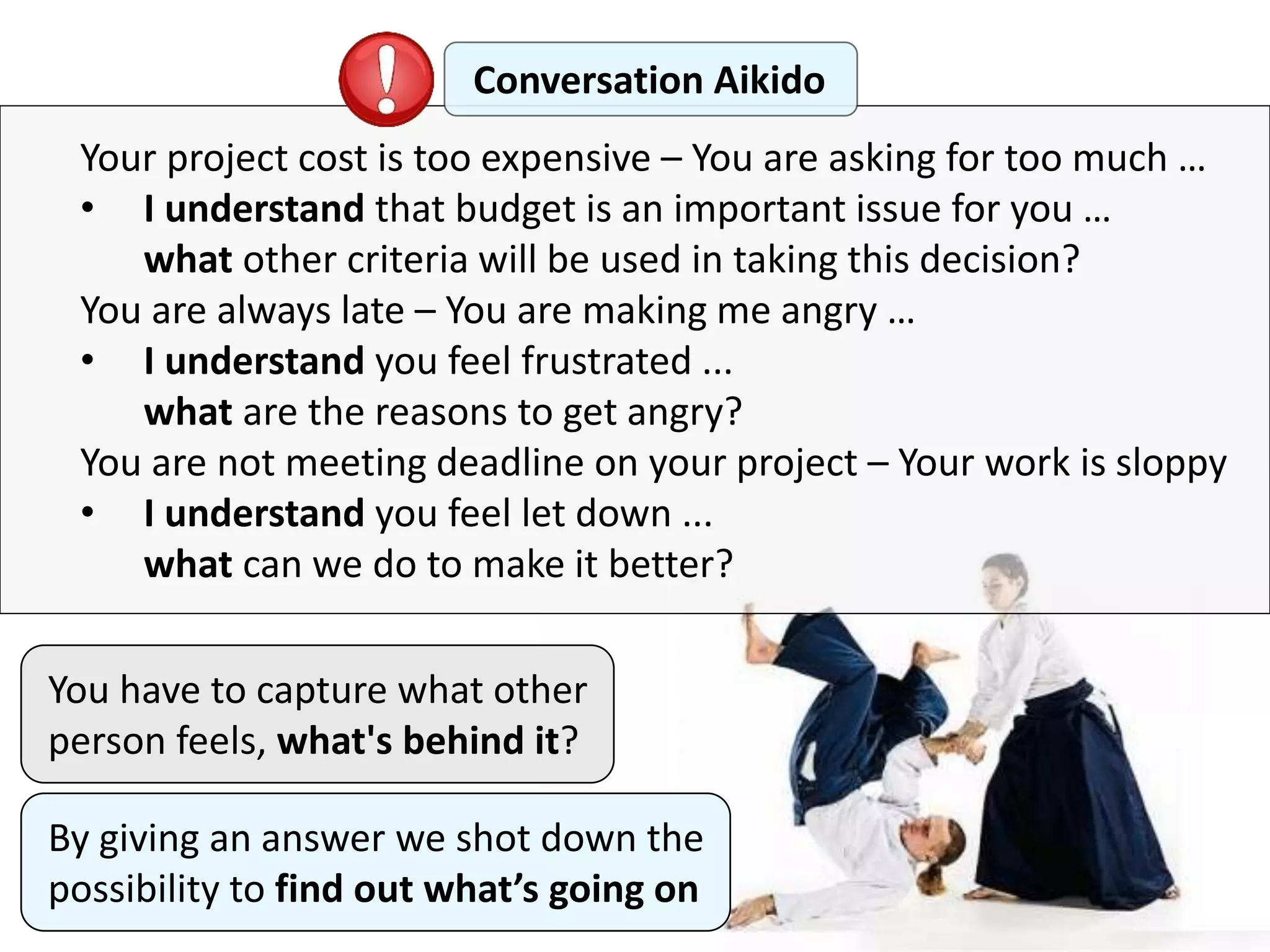
Conversation Aikido
You have to capture what other
person feels, what's behind it?
By giving an answer we shot down the
possibility to find out what’s going on
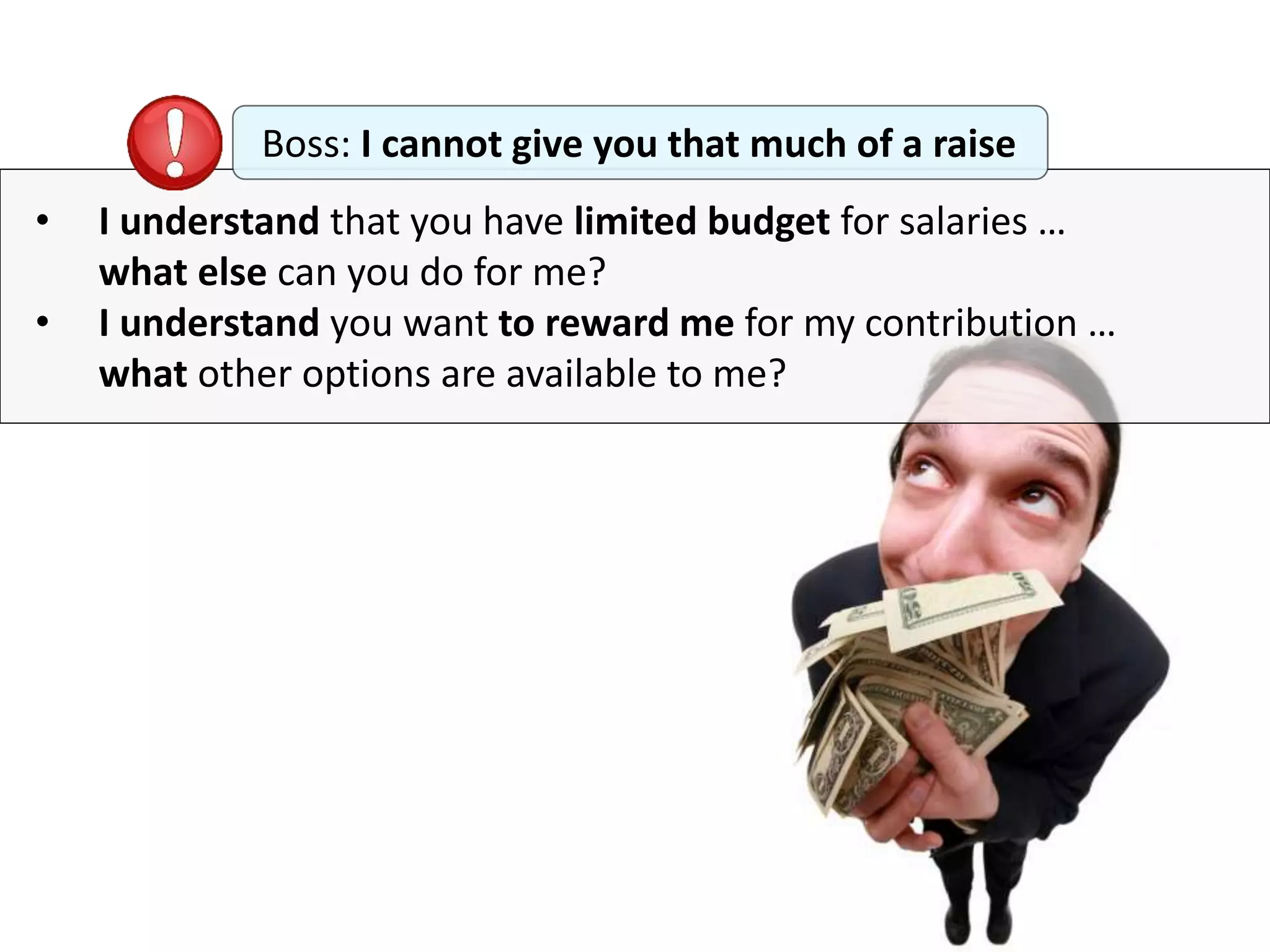
• I understand that you have limited budget for salaries …
what else can you do for me?
• I understand you want to reward me for my contribution …
what other options are available to me?
Boss: I cannot give you that much of a raise
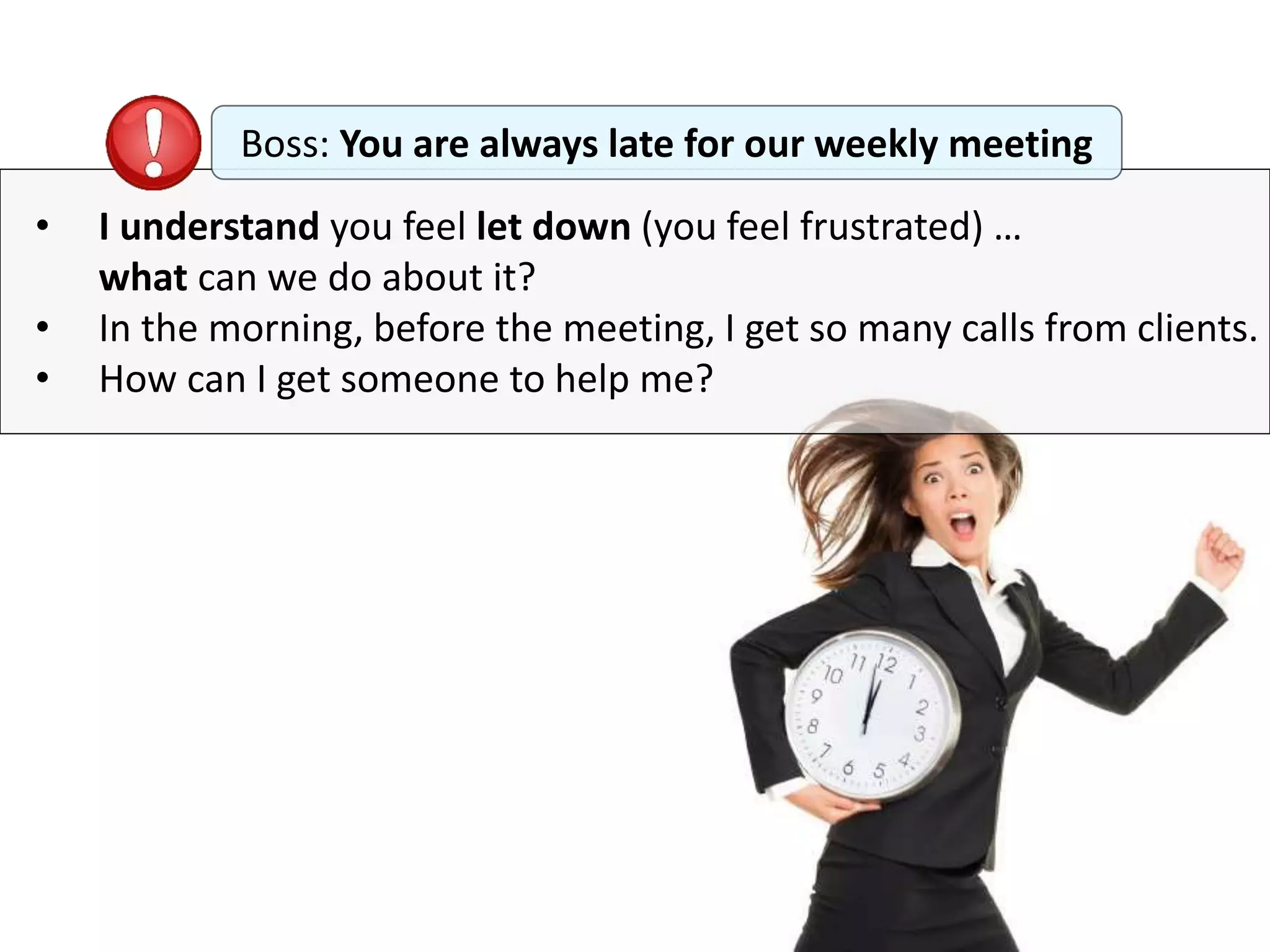
• I understand you feel let down (you feel frustrated) …
what can we do about it?
• In the morning, before the meeting, I get so many calls from clients.
• How can I get someone to help me?
Boss: You are always late for our weekly meeting
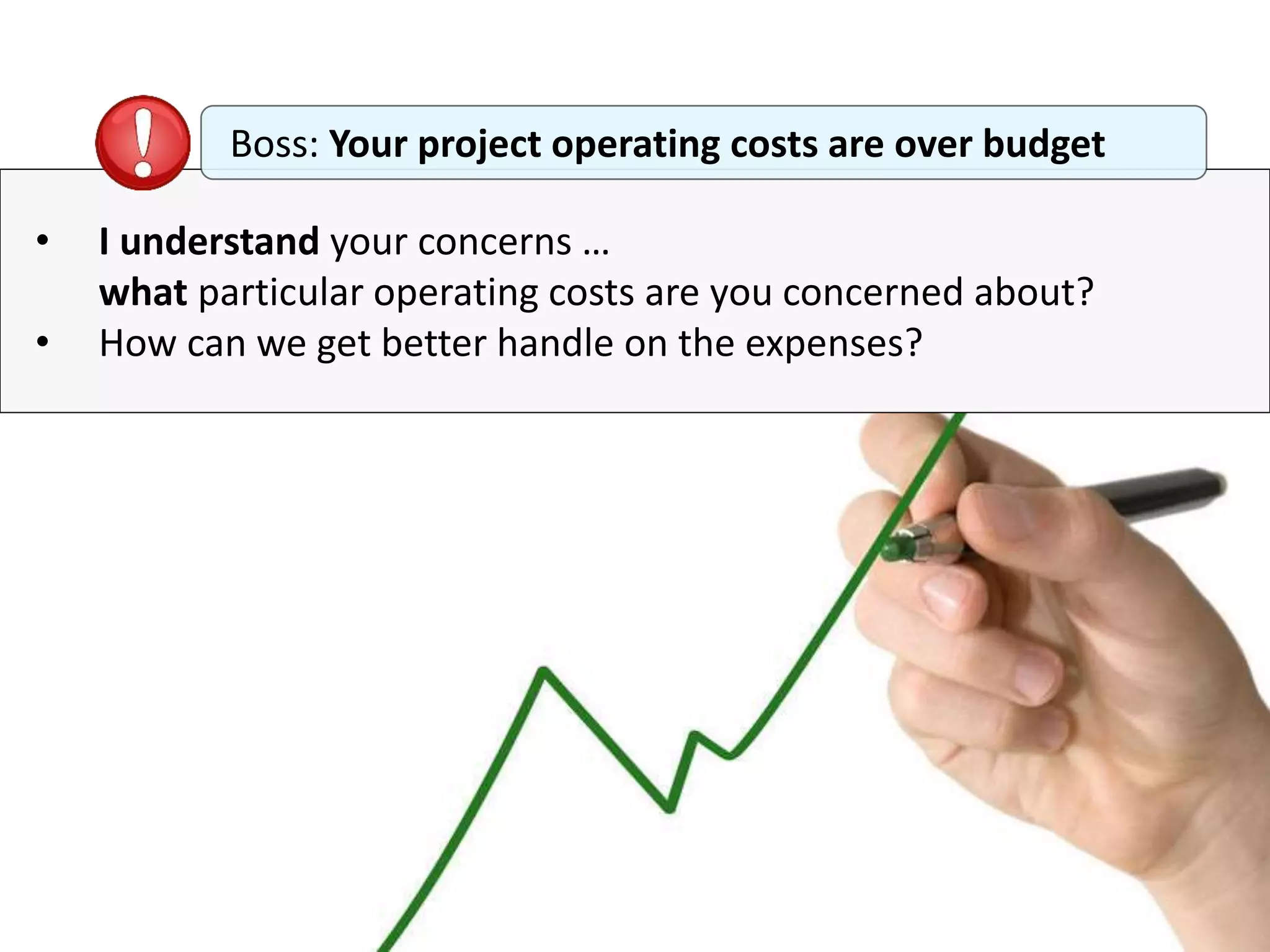
• I understand your concerns …
what particular operating costs are you concerned about?
• How can we get better handle on the expenses?
Boss: Your project operating costs are over budget
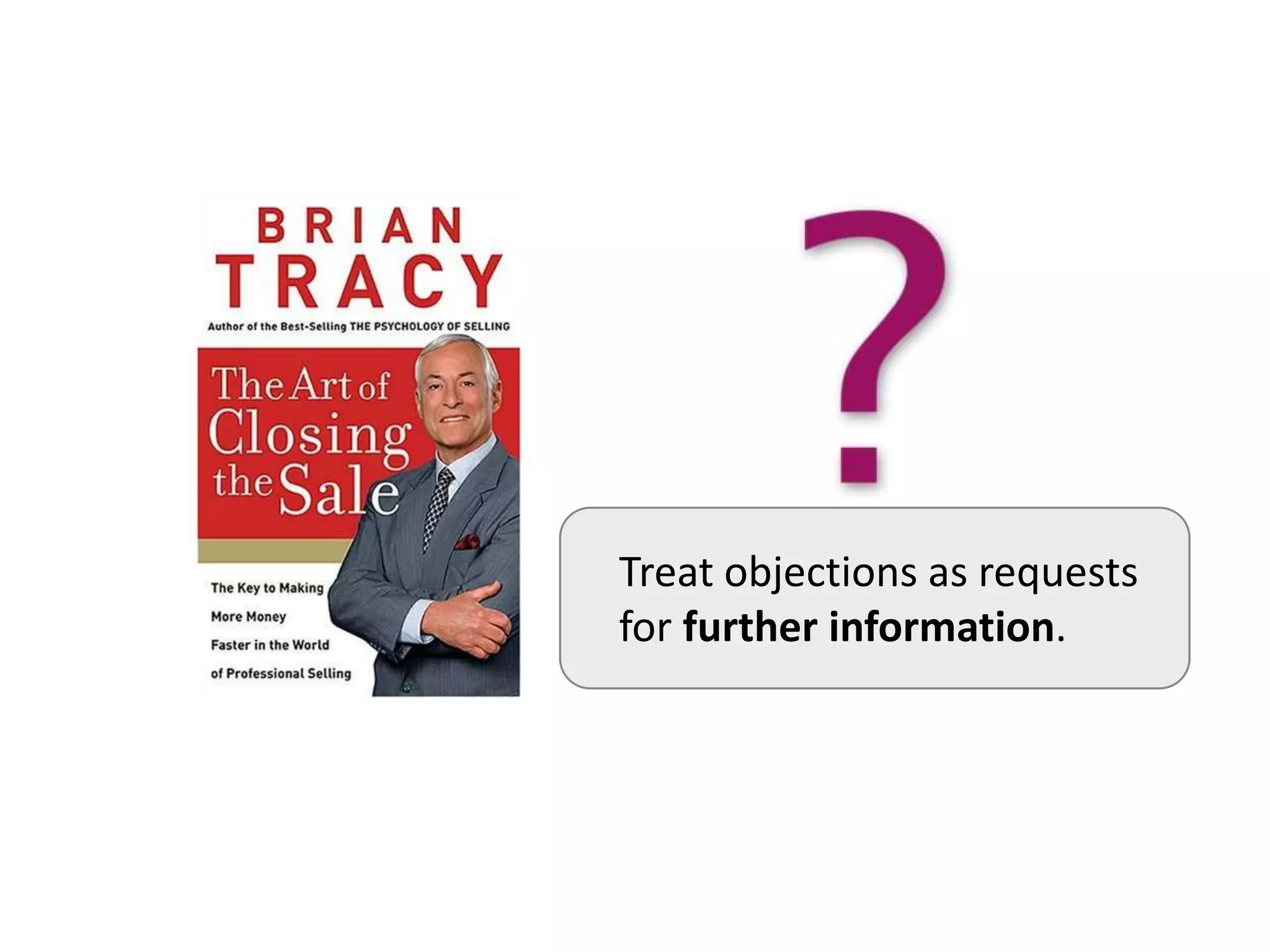
Treat objections as requests
for further information.
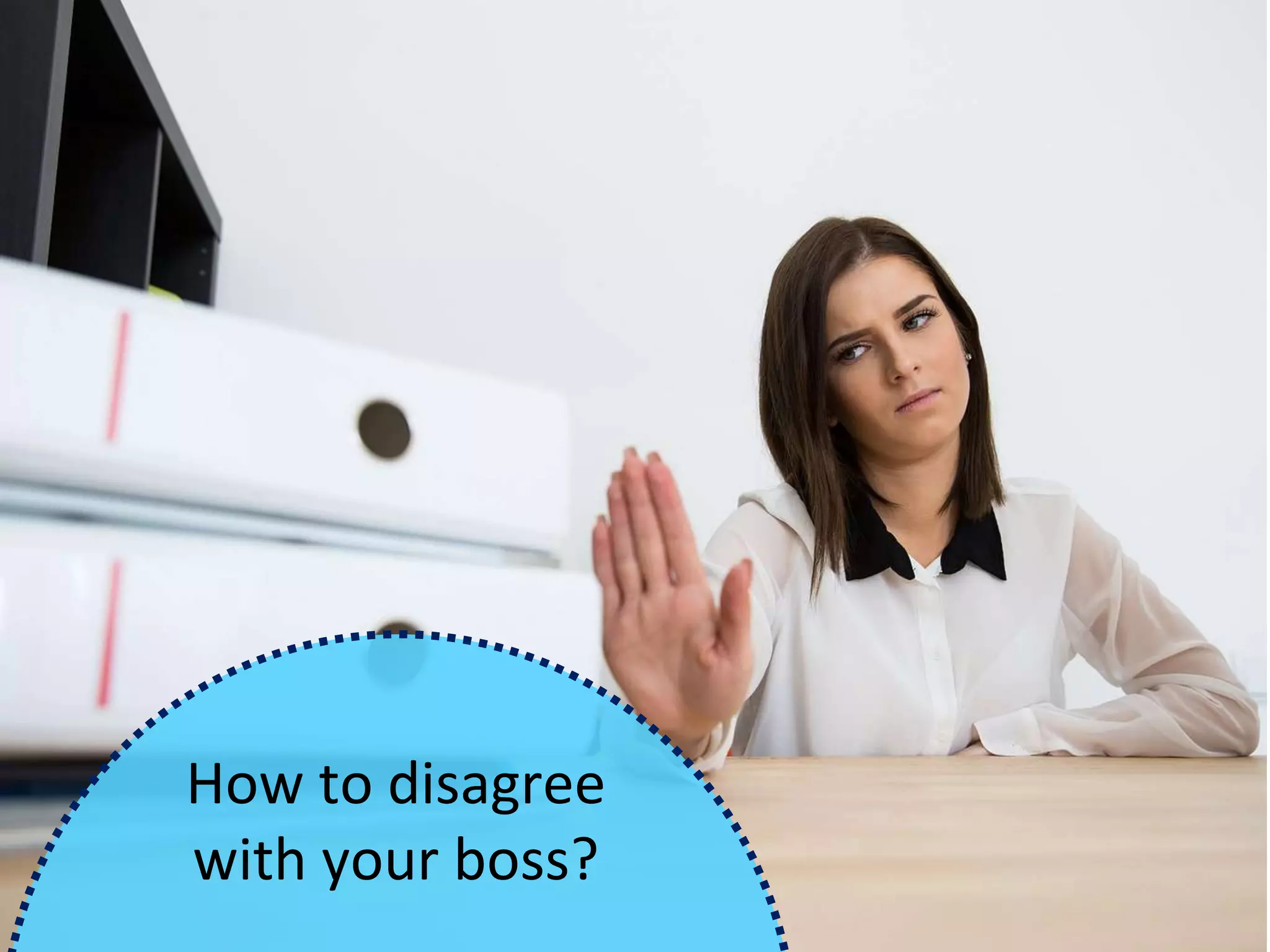
How to disagree
with your boss?
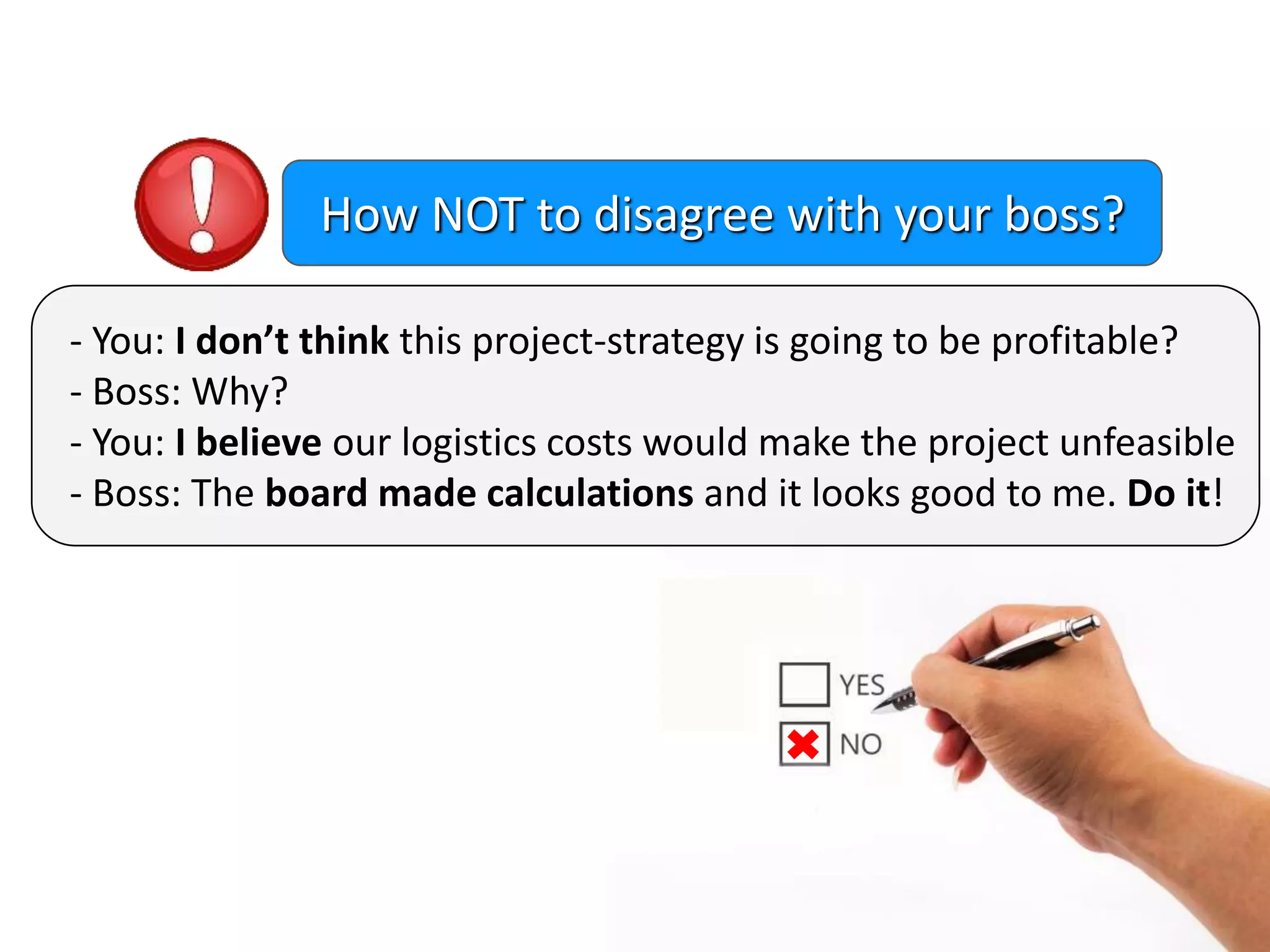
- You: I don’t think this project-strategy is going to be profitable?
- Boss: Why?
- You: I believe our logistics costs would make the project unfeasible
- Boss: The board made calculations and it looks good to me. Do it!
How NOT to disagree with your boss?
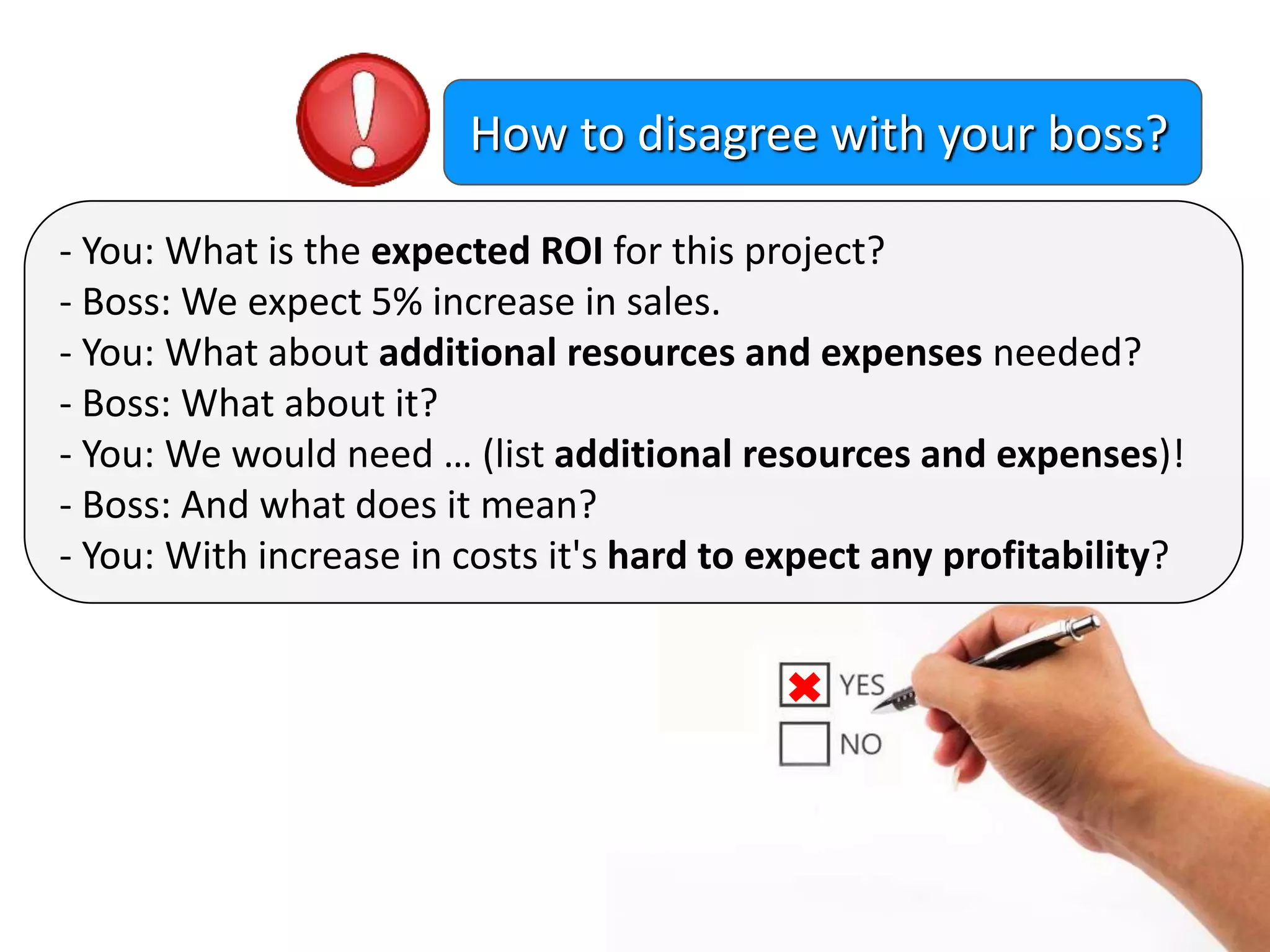
- You: What is the expected ROI for this project?
- Boss: We expect 5% increase in sales.
- You: What about additional resources and expenses needed?
- Boss: What about it?
- You: We would need … (list additional resources and expenses)!
- Boss: And what does it mean?
- You: With increase in costs it's hard to expect any profitability?
How to disagree with your boss?
THANKS :)
www.miodragkostic.com
kostic.miodrag@gmail.com

Webinar - How to handle difficult conversations at work

  • 1.
    TC-007, Rev 00,Dated 1st March 2019 Miodrag Kostić, CMC Handling difficult conversations
  • 2.
    1986-2002: 16 yearsliving and working in the USA 1992-1997: Owned and managed “T-gallery” retail stores in NY & Honolulu Miodrag Kostic, CMC
  • 3.
    1998-2002: Owned andmanaged “Web Consulting Honolulu”, USA Clients:
  • 4.
    2003-Present: Working forthe best companies in the South East European region
  • 5.
    2005-Present: Working forInternational Development Organizations
  • 6.
    Since 2019 freelancetrainer at “Qatar Skills Academy” in Doha
  • 7.
    CIMC - CertifiedInnovation Management Consultant CMC - Certified Management Consultant CDTC - Certified Digital Transformation Consultant
  • 8.
  • 9.
    What is theimpact of difficult conversations for you? More stress … Destructive conflicts Stress at work Feel vulnerable Emotionally disturbed
  • 10.
    How can weprevent difficult conversations at work? We can prepare in advanceUnexpected – we are unprepared Why are difficult conversations so stressful?
  • 11.
    How can weimprove communication skills? 1. Learning communication skills Our goal 2. Using practical business tools Influencing communication
  • 12.
    1. Active listening 2.Asking questions 3. Rapport building 4. Assertiveness What are the essential communication skills? You learn communication skills by practicing Role-plays
  • 13.
    How to prevent difficultconversations? Misunderstandings
  • 14.
    “The single biggestproblem in communication is the illusion that it has taken place.” -- George Bernard Shaw We don’t listen to each other and we don’t ask the right questions
  • 15.
    Why people don’tunderstand our communication? Influencing communication
  • 16.
    What I sayis what people hear! ask Important: “What you ask is what people hear!”What is the #1 myth about communication?
  • 17.
    5 tipsCommunication tool Howto prevent misunderstanding in communication?
  • 18.
    3. Use simpleterms 5 tips Influencing communication 4. Be concise 5. Use facts 1. Prepare questions 2. Actively listen
  • 19.
    Ask 1. TIP– Prepare questions in advance questions “You can tell whether a man is clever by his answers. You can tell whether a man is wise by his questions!” Naguib Mahfouz
  • 20.
    Listen 2. TIP– Focus on listening Active listening “We have two ears and one mouth, so we should listen more than we say!” Zeno of Citium
  • 21.
    Plain 3. TIP– Use Simple terms simplicity “If you can’t explain something in simple terms, you don’t understand it!” Richard Feynman
  • 22.
    Reading level of 14year old Reading level of 10 year old Reading level of 9 year old
  • 23.
    Ernest Hemingway Short 4.TIP – Be concise and to the point briefness • Article 10 pages tomorrow $500 • Article 1 page 7 days $2000
  • 24.
    Facts 5. TIP– Use Facts - evidence objectivity “The degree of one's emotions varies inversely with one's knowledge of the facts!” Bertrand Russell
  • 25.
    How to preparefor difficult conversations?
  • 26.
    What to doif we anticipate difficult conversation? How to discover and develop a need to resolve the issues In their mind
  • 27.
    For anticipated difficultconversations P SICommunication tool Discovering and developing needs tool
  • 28.
    Positive implications =BENEFITS Negative implications = DAMAGES If issues are not resolved can they see implications?
  • 29.
    What do weask to develop a need for solution? Problem questions Solution questions Implication questions
  • 30.
    1. Can wefinish our project on time if you don’t come on Sunday? 2. What would our boss do or say if our project is not on time? 3. What do you think is the best option/solution for both of us? Problem Implication Solution EXAMPLE: How to develop his need to come to work on Sunday? You have to ask your colleague to come and work on Sunday Problem: Project not on time Implication: Angry boss Discover his need Develop his need
  • 31.
    1. I havealready paid for a trip to the coasts with my family? 2. If I cancel the trip I would have to pay high cancelation fee? 3. What do you think is the best option/solution for us? Problem Implication Solution How to develop his need so he doesn't insist you must come on Sunday You expect your boss to ask you to come and work on Sunday Problem: Already paid for a trip Implication: High cancelation fee Discover his need Develop his need
  • 32.
    3. What doyou think is the best solution for us in this situation? P I S How to discover and develop his need to accept increase in your budget You expect your boss to ask you why is your project over budget? Problem: Material costs have increased Implication: Client will take legal action 2. What if we don’t use right materials and client takes legal action? 1. How can it be on budget if the costs of materials have increased? Discover his need Develop his need
  • 33.
    Implication QUESTIONS PROBLEMS and IMPLICATIONSif issue is not successfully resolved What to do to prepare for difficult conversation? Problem QUESTIONS List of IMPLICATIONS List of PROBLEMS In your favor
  • 34.
    How to startdifficult conversations?
  • 35.
    What to dobefore you start the conversation? Use communication absorbers
  • 36.
    Communication (shock) absorbers Howto soften the communication? I understand … sorry … may I … please …
  • 37.
    R RCommunication tool Beforeyou start difficult conversation Reply Reaffirm
  • 38.
    Reply Reaffirm REAFFIRM –You are saying ... So your question is ... REPLY - Sorry I didn’t hear you well … I didn’t understand … can you please repeat your question... R R Before answering
  • 39.
    Ask as morequestions as possible and listen What is the #1 rule of difficult conversations?
  • 40.
    “The most effectiveway of influencing people is asking questions and active listening” (A. Robbins) Why?
  • 41.
    7 stepsCommunication tool 7-stepsto handle any difficult conversation
  • 42.
    1. What doI want? 2. Start with: “I noticed” 3. Reflect on the problem 4. Impact of the problem 5. Desire for solution 7 steps Difficult conversation 6. Powerful agreement
  • 43.
    7 steps Ask yourself:What’s happening here? Why am I upset? What do I want to achieve? What's in it for me? 1. What Do I Want? Difficult conversation When you feel upset
  • 44.
    7 steps Approach theother person from a curious, neutral stance. Point out what you noticed to enter the conversation. 2. Start with: ”I noticed” “I noticed you scheduled only 3 appointments for me, and ...” “I noticed I sent an email on Monday and you responded on …” “I noticed you favor others and give them more appointments.” “I noticed it takes you way too long to get back to me on emails.” Difficult conversation Start conversation
  • 45.
    7 steps “So, youwere just scheduling people as they came in ..." “So, you didn't believe its urgent to respond to my email ..." 3. Reflect on the problem Difficult conversation Discover need
  • 46.
    7 steps “When youdon't let me know abbot scheduling I feel ...” "When you do not respond for days, I feel uncertain about ..." 5. Impact of the problem Difficult conversation Develop need
  • 47.
    7 steps Once you’vestated the impact, you then move on what you want. “I would prefer it if you let me know ..." “I would prefer it if you responded to me within 24 business hrs." 5. Desire for solution Difficult conversation What you want
  • 48.
    7 steps “How doesthat sound to you?” “Would you be willing to do it that way?” 6. Powerful agreement Difficult conversation Confirm agreement
  • 49.
    5 stepsCommunication tool 5tips for saying NO like a NO-master
  • 50.
    1. NO isa complete sentence 2. NO apologies 3. Make it about you 4. Warmth & appreciation 5. Say no early 5 steps How to say NO?
  • 51.
    5 steps Avoid over-explaining.Short is good. Explaining too much makes you look anxious and unsure, as if you’re doing something wrong. Simply say no thank you. If you want to offer a reason, keep it brief. 1. NO Is a Complete Sentence How to say NO?
  • 52.
    5 steps Apologizing isa sign of our discomfort with NO. Again, it makes it sound like you’ve done something wrong. But you haven’t. 2. NO Apologies How to say NO?
  • 53.
    5 steps Sometimes, furtherinformation or an explanation is needed. For example, if they need you to do something, and you know that you don’t want to do that activity, let them know. 3. Make It About You How to say NO?
  • 54.
    5 steps Warmth iscommunicated in your voice tone, facial expressions, and body language. Appreciation is communicated verbally by thanking them for the offer. 4. Warmth & Appreciation How to say NO?
  • 55.
    5 steps Do it.Rip off the Band-Aid and just say it now. You know you don’t want to attend that event, or that you don’t want to do it. 5. Say No Early How to say NO?
  • 56.
  • 57.
    Find out thetruth about objections You must answer it by asking a question IMPORTANT I understand your concerns, what other things are important to you? Important tip: “Find out the truth about objections”How to handle objections / complaints?
  • 58.
    Your project costis too expensive – You are asking for too much … • I understand that budget is an important issue for you … what other criteria will be used in taking this decision? You are always late – You are making me angry … • I understand you feel frustrated ... what are the reasons to get angry? You are not meeting deadline on your project – Your work is sloppy • I understand you feel let down ... what can we do to make it better? Conversation Aikido You have to capture what other person feels, what's behind it? By giving an answer we shot down the possibility to find out what’s going on
  • 59.
    • I understandthat you have limited budget for salaries … what else can you do for me? • I understand you want to reward me for my contribution … what other options are available to me? Boss: I cannot give you that much of a raise
  • 60.
    • I understandyou feel let down (you feel frustrated) … what can we do about it? • In the morning, before the meeting, I get so many calls from clients. • How can I get someone to help me? Boss: You are always late for our weekly meeting
  • 61.
    • I understandyour concerns … what particular operating costs are you concerned about? • How can we get better handle on the expenses? Boss: Your project operating costs are over budget
  • 62.
    Treat objections asrequests for further information.
  • 63.
  • 64.
    - You: Idon’t think this project-strategy is going to be profitable? - Boss: Why? - You: I believe our logistics costs would make the project unfeasible - Boss: The board made calculations and it looks good to me. Do it! How NOT to disagree with your boss?
  • 65.
    - You: Whatis the expected ROI for this project? - Boss: We expect 5% increase in sales. - You: What about additional resources and expenses needed? - Boss: What about it? - You: We would need … (list additional resources and expenses)! - Boss: And what does it mean? - You: With increase in costs it's hard to expect any profitability? How to disagree with your boss?
  • 66.