
Web 2.0  Implications for Education
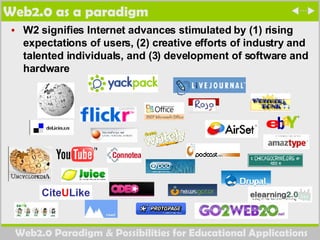
Web2.0 as a paradigm W2 signifies Internet advances stimulated by (1) rising expectations of users, (2) creative efforts of industry and talented individuals, and (3) development of software and hardware
What is new in Web2.0? User control of information, subscribing and relationships, new forms of expression Web as a point of presence, internet-mediated social environments, collective activities and community plumbing Web as a platform (e.g., Microsoft and Google)  Science of user engagement and rich user experiences Some  speak of media revolution –  “we the media” (Dan Gillmor), “voice of crowds”, increased democratization and new citizenship
In this Presentation… Blogs  Digital Storytelling  Sharing, Diggs, Recommendations, and Folksonomy  Wikis and Social Software RSS Feeds  Podcasting  API for Mashups Implications for Education
Blog, blogging, blogger, blogsphere  Blog is web-based publication  No technical skills to create your own blog Blog can contain text, media, links There are blogs, moblogs, vlogs, audilog Blogsphere is a community of bloggers
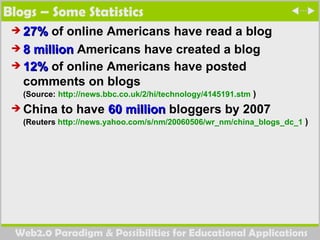
Blogs – Some Statistics 27%  of online Americans have read a blog  8 million  Americans have created a blog  12%  of online Americans have posted comments on blogs  (Source:   http://news.bbc.co.uk/2/hi/technology/4145191.stm  ) China to have  60 million  bloggers by 2007 (Reuters  http://news.yahoo.com/s/nm/20060506/wr_nm/china_blogs_dc_1  )
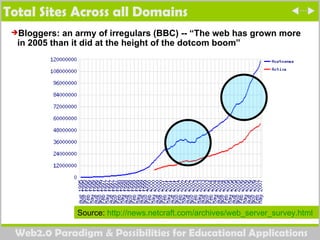
Total Sites Across all Domains Source:  http://news.netcraft.com/archives/web_server_survey.html   Bloggers: an army of irregulars (BBC) -- “The web has grown more in 2005 than it did at the height of the dotcom boom”
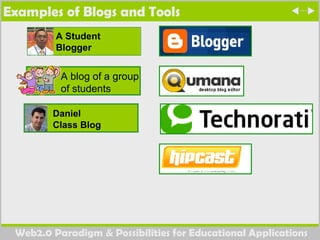
Examples of Blogs and Tools Daniel Class Blog A blog of a group of students
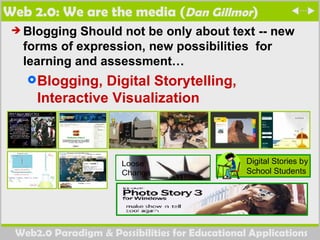
Web 2.0: We are the media ( Dan Gillmor ) Blogging Should not be only about text -- new forms of expression, new possibilities  for learning and assessment… Blogging, Digital Storytelling, Interactive Visualization
Wiki Wiki is social software that allows collaborative development on an article of common interest to its authors
Wikipedia 13,000  active contributors  5,300,000  articles in more than  100  languages  1,914,827  articles in English  Hundreds of thousands of visitors daily, tens of thousands of edits and new articles Source:  http:// en.wikipedia.org/wiki/Wikipedia:About ) Wikipedia has become the  37th  most visited website, according to Alexa Wikipedia comes close to Britannica –  Expert led investigation by  Nature  identifies that in average science entry in Wikipedia contained around four inaccuracies; Britannica, about three (Source:  http://www.nature.com/news/2005/051212/full/438900a.html )
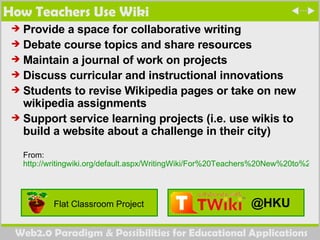
How Teachers Use Wiki Provide a space for collaborative writing  Debate course topics and share resources  Maintain a journal of work on projects  Discuss curricular and instructional innovations  Students to revise Wikipedia pages or take on new wikipedia assignments  Support service learning projects (i.e. use wikis to build a website about a challenge in their city)  From:  http://writingwiki.org/default.aspx/WritingWiki/For%20Teachers%20New%20to%20Wikis.html   @HKU Flat Classroom Project
Sharing, Diggs, Recommending, Folksonomy The  Wisdom of Crowds : Why the Many Are Smarter Than the Few and How Collective Wisdom Shapes Business, Economies, Societies and Nations  by James Surowiecki
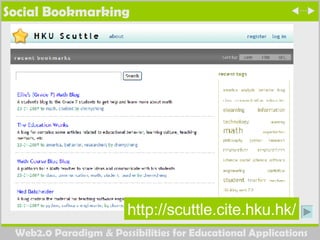
Social Bookmarking http://scuttle.cite.hku.hk/
Internet-mediated Social Activities
MySpace MySpace.com, it is the  fastest growing site  on the Internet right now  Over  80 million  registered subscribers, and are registering  260,000 new users   each day   More page views than all of the MSN and Google sites combined  MySpace.com is now processing  1.5 Billion  page views per day   78% of site members are  over 18 and under 40   From more statistics check:  http://www.trendcatching.com/2006/05/myspace_usage_s.html  or  http://weblogs.asp.net/scottgu/archive/2006/03/25/Handling-1.5-Billion-Page-Views-Per-Day-Using-ASP.NET-2.0.aspx
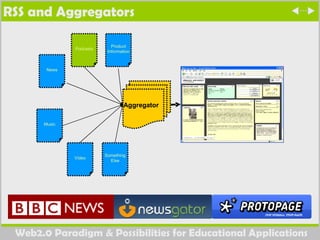
RSS Feeds and Aggregators Really Simple Syndication  is a form of syndication in which a section of a website is made available for other sites to use  RSS Feeds --  provide an updated list of content from a site This originated with news and blog sites but is increasingly used to syndicate any information. Aggregator can subscribe to a feed, check for new content at user-determined intervals, and retrieve the content
RSS and Aggregators
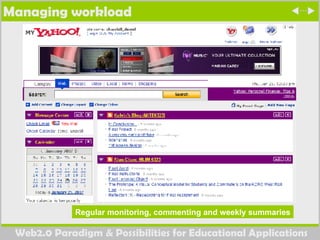
Managing workload Regular monitoring, commenting and weekly summaries
Podcasting Method of distributing audio programs or video over the Internet for playback on mobile devices and personal computers Podcasts are distributed using either the RSS or Atom syndication formats.
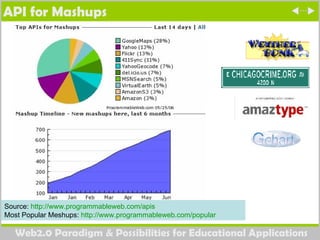
API for Mashups Source:  http://www.programmableweb.com/apis Most Popular Meshups:  http://www.programmableweb.com/popular
Open Source Open source Syndications, design for hackability and remixability Systems that gets better when more people are using it (and improving it)
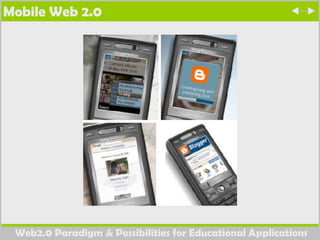
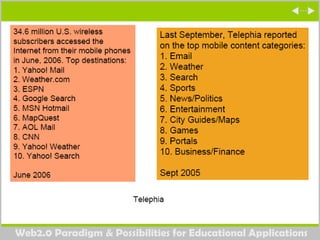
Mobile Web 2.0
 
Implications for Education A large number of our students will be coming to our classes with expectations of technology aligned with Web 2.0  Unless we give attention to Web 2.0 development, we will encounter students who have expectations that are incompatible with our own thinking and the ways we integrate technology It is also a danger that unless we accommodate Web 2.0 developments in our teaching, we might find ourselves producing students unable to function in the Web 2.0-literate world outside.
Implications for Education Re-conceptualizing technology integration New forms of Assessment Internet-mediated social environments and what does it mean to collaborate Resources Sharing and Community Plumbing of teachers/trainers and student New generations of LMS, no LMS or Modules – blog, wiki, P2P, content management, personal space for RSS Emerging content design models based on data remixing, interactive visualization,…
Thank you for  your attention! I am happy to answer you questions…

Web2 Jakarta By Daniel

  • 1.
    Web 2.0 Implications for Education
  • 2.
    Web2.0 as aparadigm W2 signifies Internet advances stimulated by (1) rising expectations of users, (2) creative efforts of industry and talented individuals, and (3) development of software and hardware
  • 3.
    What is newin Web2.0? User control of information, subscribing and relationships, new forms of expression Web as a point of presence, internet-mediated social environments, collective activities and community plumbing Web as a platform (e.g., Microsoft and Google) Science of user engagement and rich user experiences Some speak of media revolution – “we the media” (Dan Gillmor), “voice of crowds”, increased democratization and new citizenship
  • 4.
    In this Presentation…Blogs Digital Storytelling Sharing, Diggs, Recommendations, and Folksonomy Wikis and Social Software RSS Feeds Podcasting API for Mashups Implications for Education
  • 5.
    Blog, blogging, blogger,blogsphere Blog is web-based publication No technical skills to create your own blog Blog can contain text, media, links There are blogs, moblogs, vlogs, audilog Blogsphere is a community of bloggers
  • 6.
    Blogs – SomeStatistics 27% of online Americans have read a blog 8 million Americans have created a blog 12% of online Americans have posted comments on blogs (Source: http://news.bbc.co.uk/2/hi/technology/4145191.stm ) China to have 60 million bloggers by 2007 (Reuters http://news.yahoo.com/s/nm/20060506/wr_nm/china_blogs_dc_1 )
  • 7.
    Total Sites Acrossall Domains Source: http://news.netcraft.com/archives/web_server_survey.html Bloggers: an army of irregulars (BBC) -- “The web has grown more in 2005 than it did at the height of the dotcom boom”
  • 8.
    Examples of Blogsand Tools Daniel Class Blog A blog of a group of students
  • 9.
    Web 2.0: Weare the media ( Dan Gillmor ) Blogging Should not be only about text -- new forms of expression, new possibilities for learning and assessment… Blogging, Digital Storytelling, Interactive Visualization
  • 10.
    Wiki Wiki issocial software that allows collaborative development on an article of common interest to its authors
  • 11.
    Wikipedia 13,000 active contributors 5,300,000 articles in more than 100 languages 1,914,827 articles in English Hundreds of thousands of visitors daily, tens of thousands of edits and new articles Source: http:// en.wikipedia.org/wiki/Wikipedia:About ) Wikipedia has become the 37th most visited website, according to Alexa Wikipedia comes close to Britannica – Expert led investigation by Nature identifies that in average science entry in Wikipedia contained around four inaccuracies; Britannica, about three (Source: http://www.nature.com/news/2005/051212/full/438900a.html )
  • 12.
    How Teachers UseWiki Provide a space for collaborative writing Debate course topics and share resources Maintain a journal of work on projects Discuss curricular and instructional innovations Students to revise Wikipedia pages or take on new wikipedia assignments Support service learning projects (i.e. use wikis to build a website about a challenge in their city) From: http://writingwiki.org/default.aspx/WritingWiki/For%20Teachers%20New%20to%20Wikis.html @HKU Flat Classroom Project
  • 13.
    Sharing, Diggs, Recommending,Folksonomy The Wisdom of Crowds : Why the Many Are Smarter Than the Few and How Collective Wisdom Shapes Business, Economies, Societies and Nations by James Surowiecki
  • 14.
  • 15.
  • 16.
    MySpace MySpace.com, itis the fastest growing site on the Internet right now Over 80 million registered subscribers, and are registering 260,000 new users each day More page views than all of the MSN and Google sites combined MySpace.com is now processing 1.5 Billion page views per day 78% of site members are over 18 and under 40 From more statistics check: http://www.trendcatching.com/2006/05/myspace_usage_s.html or http://weblogs.asp.net/scottgu/archive/2006/03/25/Handling-1.5-Billion-Page-Views-Per-Day-Using-ASP.NET-2.0.aspx
  • 17.
    RSS Feeds andAggregators Really Simple Syndication is a form of syndication in which a section of a website is made available for other sites to use RSS Feeds -- provide an updated list of content from a site This originated with news and blog sites but is increasingly used to syndicate any information. Aggregator can subscribe to a feed, check for new content at user-determined intervals, and retrieve the content
  • 18.
  • 19.
    Managing workload Regularmonitoring, commenting and weekly summaries
  • 20.
    Podcasting Method ofdistributing audio programs or video over the Internet for playback on mobile devices and personal computers Podcasts are distributed using either the RSS or Atom syndication formats.
  • 21.
    API for MashupsSource: http://www.programmableweb.com/apis Most Popular Meshups: http://www.programmableweb.com/popular
  • 22.
    Open Source Opensource Syndications, design for hackability and remixability Systems that gets better when more people are using it (and improving it)
  • 23.
  • 24.
  • 25.
    Implications for EducationA large number of our students will be coming to our classes with expectations of technology aligned with Web 2.0 Unless we give attention to Web 2.0 development, we will encounter students who have expectations that are incompatible with our own thinking and the ways we integrate technology It is also a danger that unless we accommodate Web 2.0 developments in our teaching, we might find ourselves producing students unable to function in the Web 2.0-literate world outside.
  • 26.
    Implications for EducationRe-conceptualizing technology integration New forms of Assessment Internet-mediated social environments and what does it mean to collaborate Resources Sharing and Community Plumbing of teachers/trainers and student New generations of LMS, no LMS or Modules – blog, wiki, P2P, content management, personal space for RSS Emerging content design models based on data remixing, interactive visualization,…
  • 27.
    Thank you for your attention! I am happy to answer you questions…