THE UNIVERSITY OF HONG KONG
WEB
BY DANIEL CHURCHILL
2.0
Web2.0 Paradigm & Possibilities for Educational Applications
What is Web 2.0?
Web2.0 as Metaphor a Paradigm Shift
 Web as a platform
 User control of information
 Web as a point of presence
 Internet-mediated social environments
 Rich user experiences
 New forms of expressions
Some speak of media revolution – “we the media”
(Dan Gillmor), “voice of crowds”, increased
democratization and new citizenship, etc.
Web2.0 Paradigm & Possibilities for Educational Applications
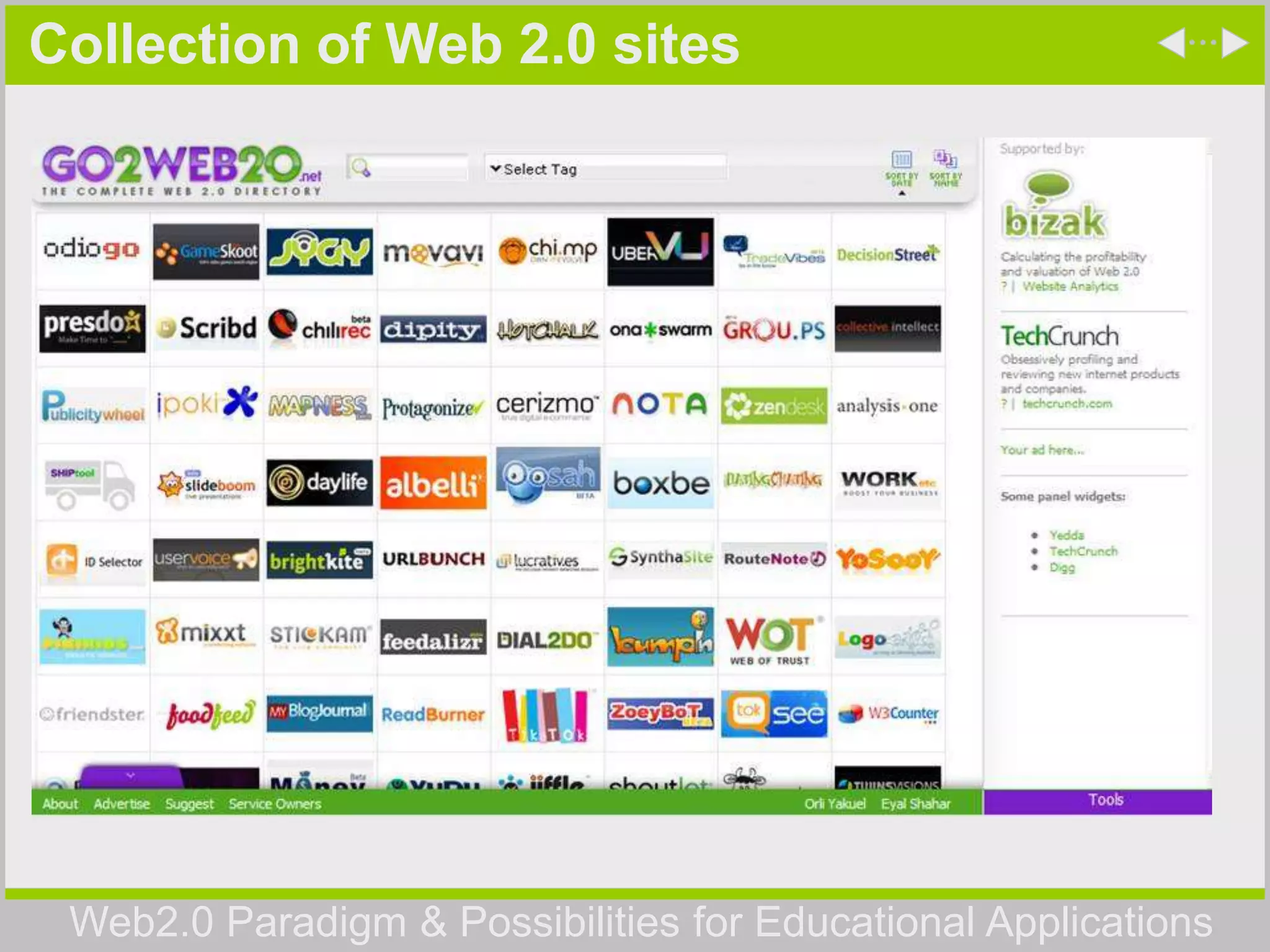
Collection of Web 2.0 sites
Web2.0 Paradigm & Possibilities for Educational Applications
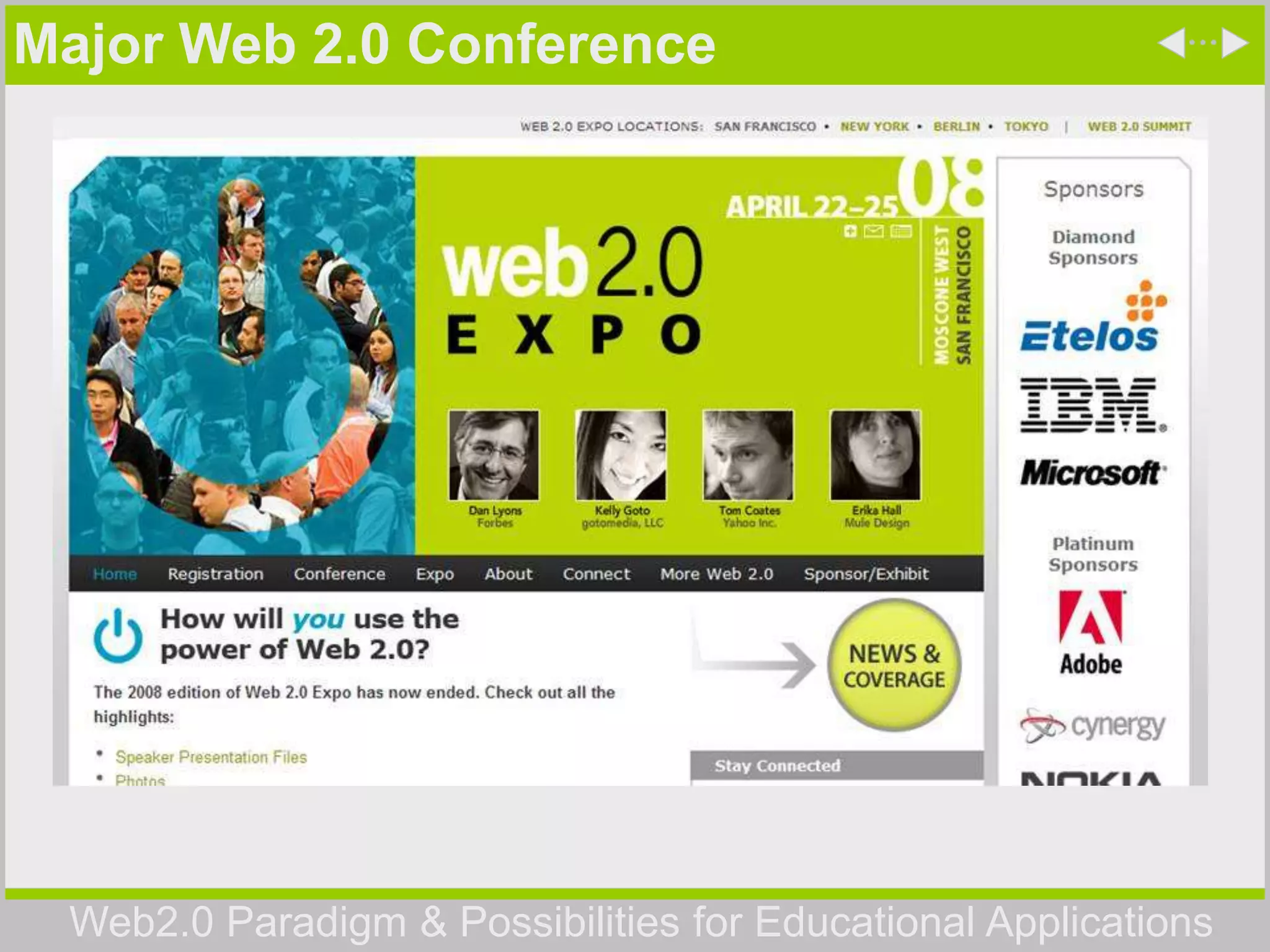
Major Web 2.0 Conference
Web2.0 Paradigm & Possibilities for Educational Applications
Blog, blogging, blogger, blogsphere
Blog is web-based publication
No technical skills to create your own
blog
Blog can contain text, media, links
There are blogs, moblogs, vlogs, audilog
Blogsphere is a community of bloggers
"A blog is a personal diary. A daily pulpit. A collaborative
space. A political soapbox. A breaking-news outlet. A
collection of links. Your own private thoughts. Memos to the
world.“
 www.blogger.com
Web2.0 Paradigm & Possibilities for Educational Applications
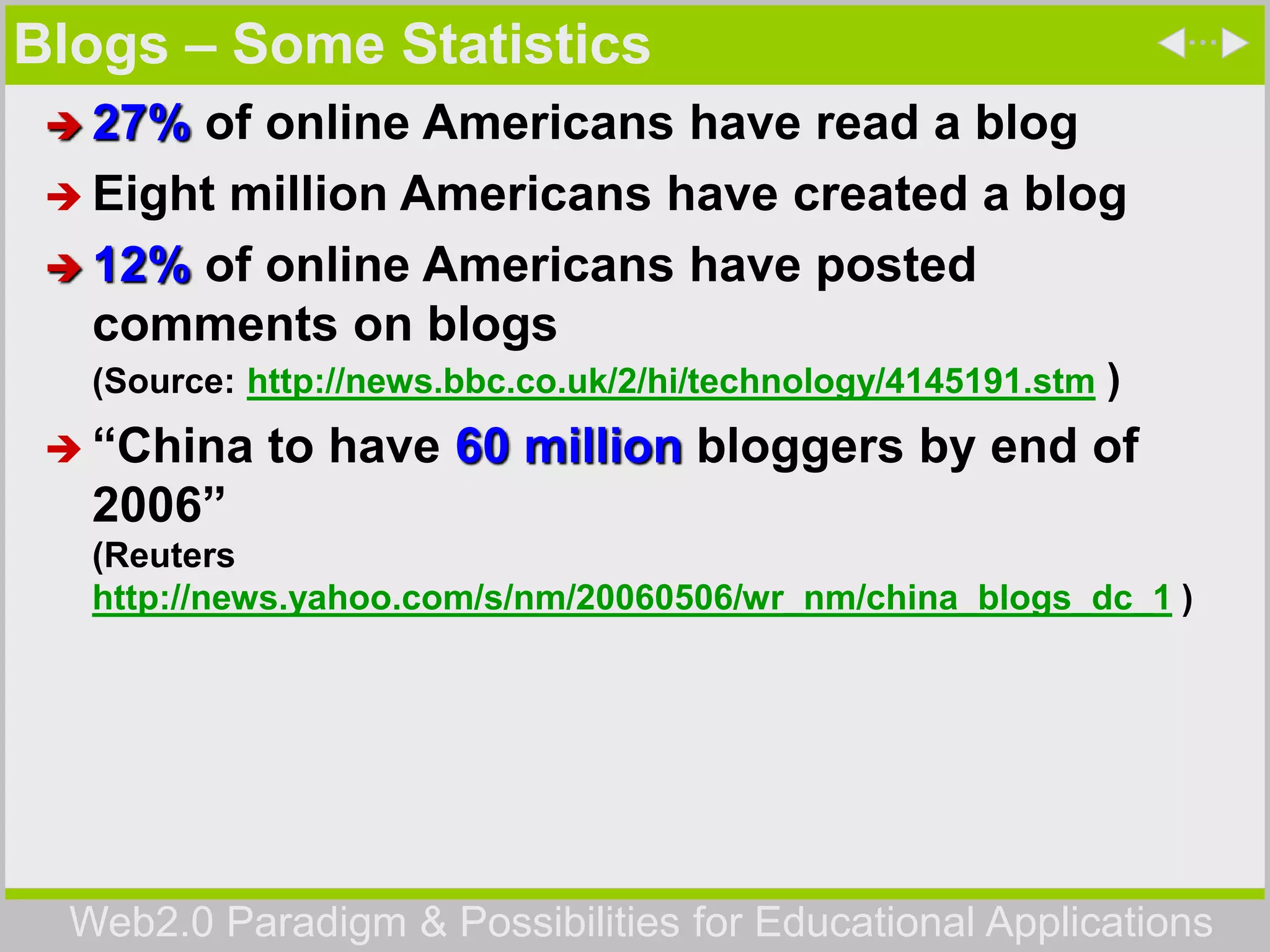
Blogs – Some Statistics
 27% of online Americans have read a blog
 Eight million Americans have created a blog
 12% of online Americans have posted
comments on blogs
(Source: http://news.bbc.co.uk/2/hi/technology/4145191.stm )
 “China to have 60 million bloggers by end of
2006”
(Reuters
http://news.yahoo.com/s/nm/20060506/wr_nm/china_blogs_dc_1 )
Web2.0 Paradigm & Possibilities for Educational Applications
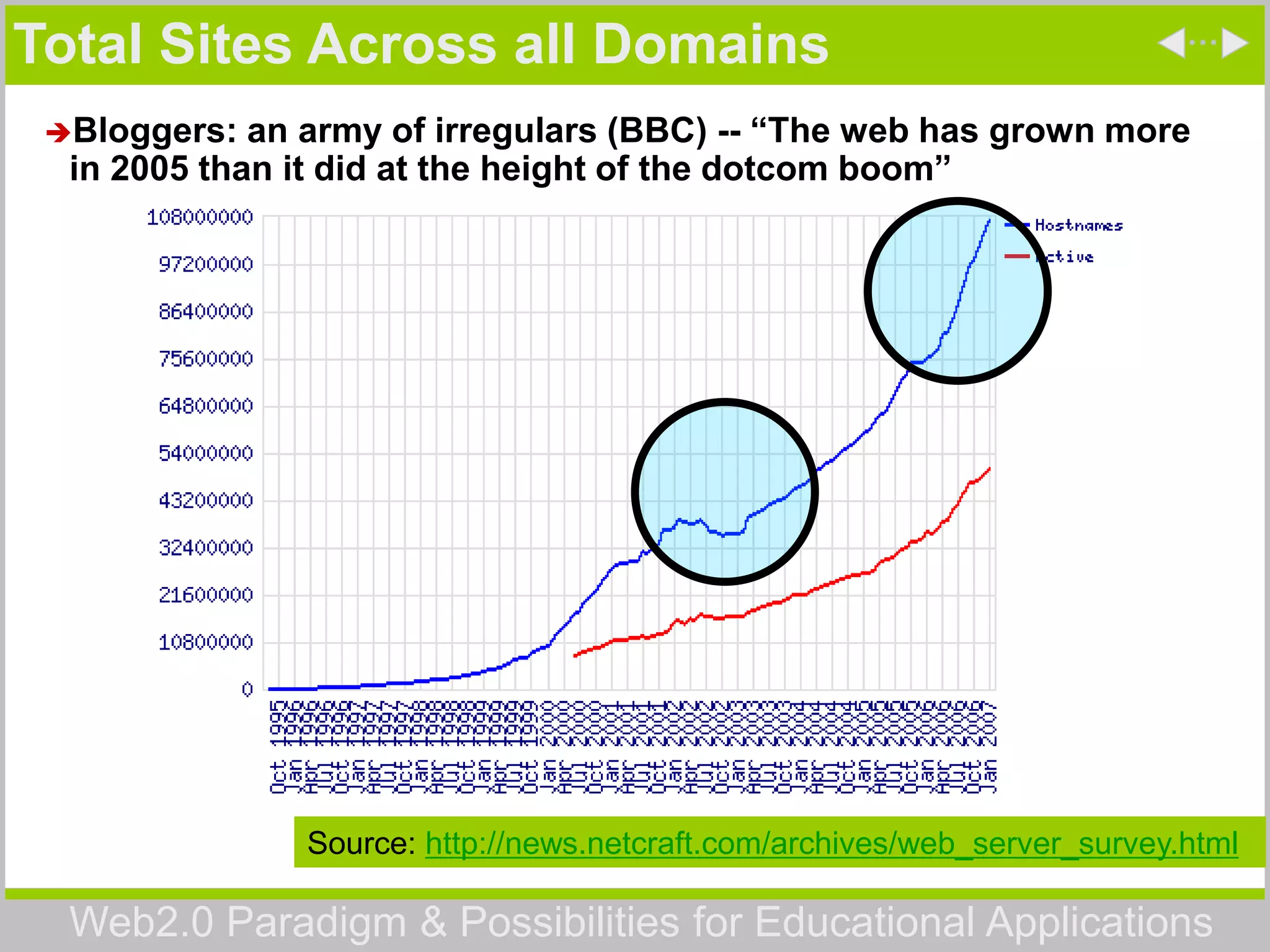
Total Sites Across all Domains
Source: http://news.netcraft.com/archives/web_server_survey.html
Bloggers: an army of irregulars (BBC) -- “The web has grown more
in 2005 than it did at the height of the dotcom boom”
Web2.0 Paradigm & Possibilities for Educational Applications
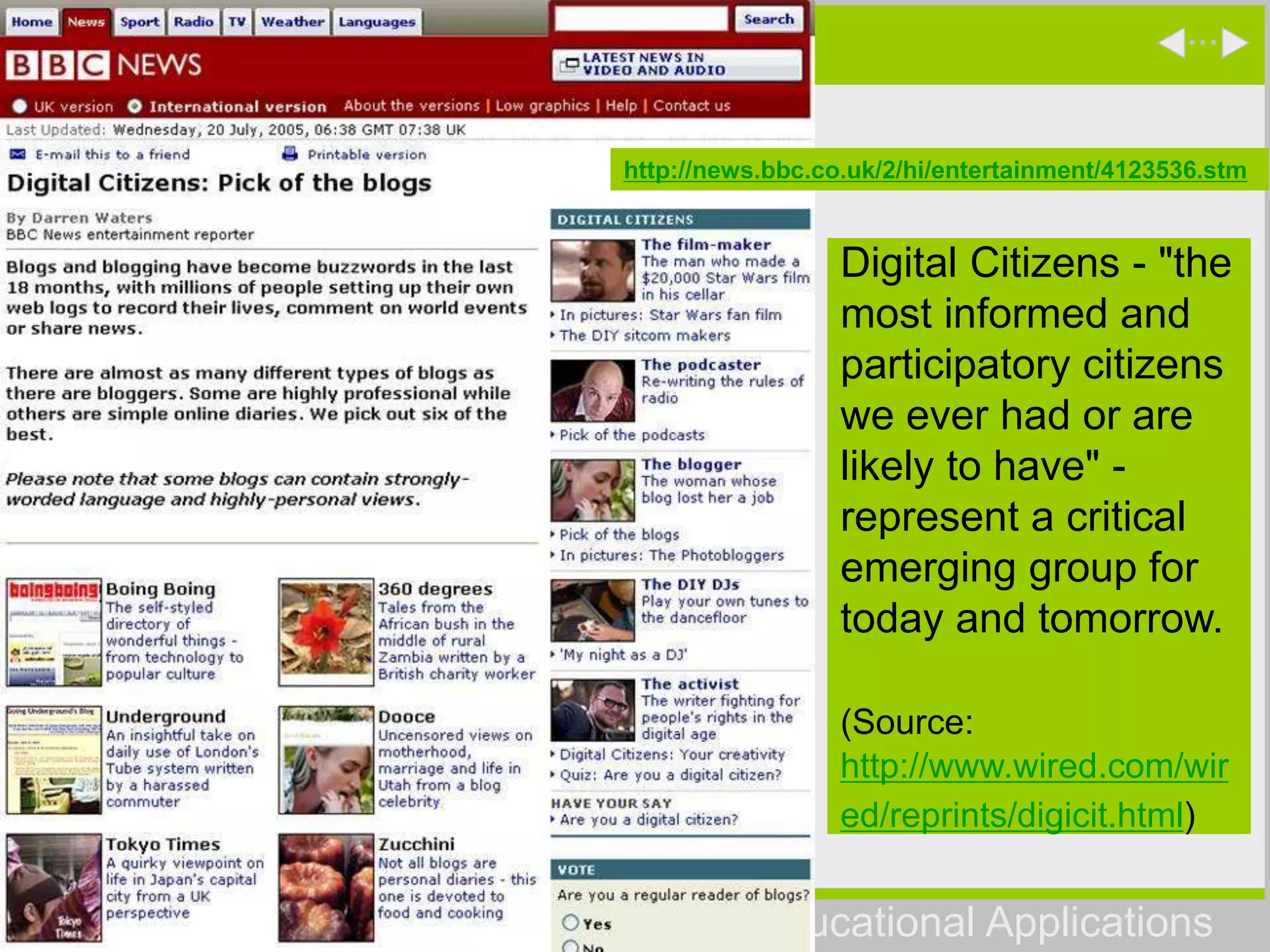
http://news.bbc.co.uk/2/hi/entertainment/4123536.stm
Digital Citizens - "the
most informed and
participatory citizens
we ever had or are
likely to have" -
represent a critical
emerging group for
today and tomorrow.
(Source:
http://www.wired.com/wir
ed/reprints/digicit.html)
Web2.0 Paradigm & Possibilities for Educational Applications
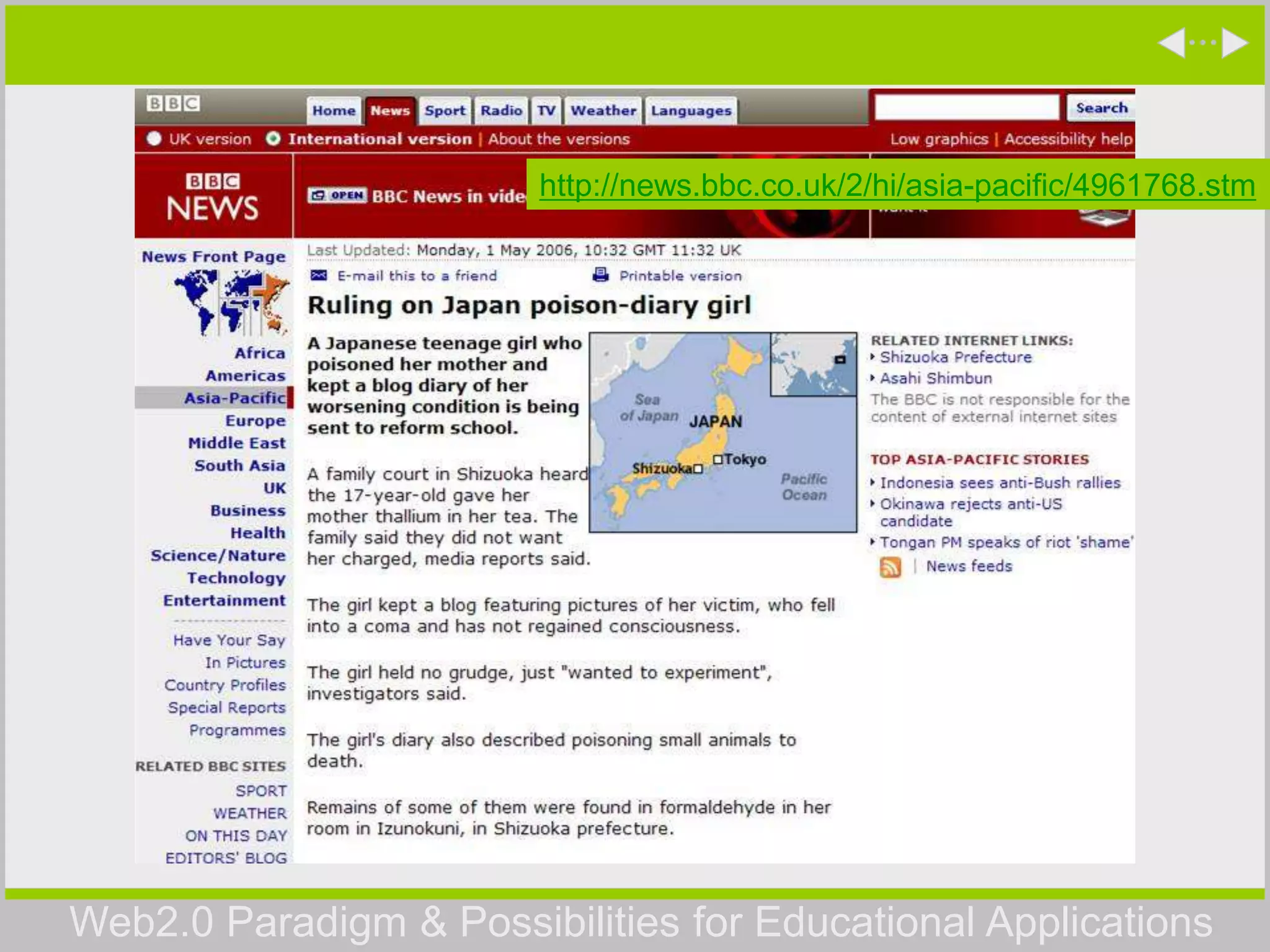
http://news.bbc.co.uk/2/hi/asia-pacific/4961768.stm
Web2.0 Paradigm & Possibilities for Educational Applications
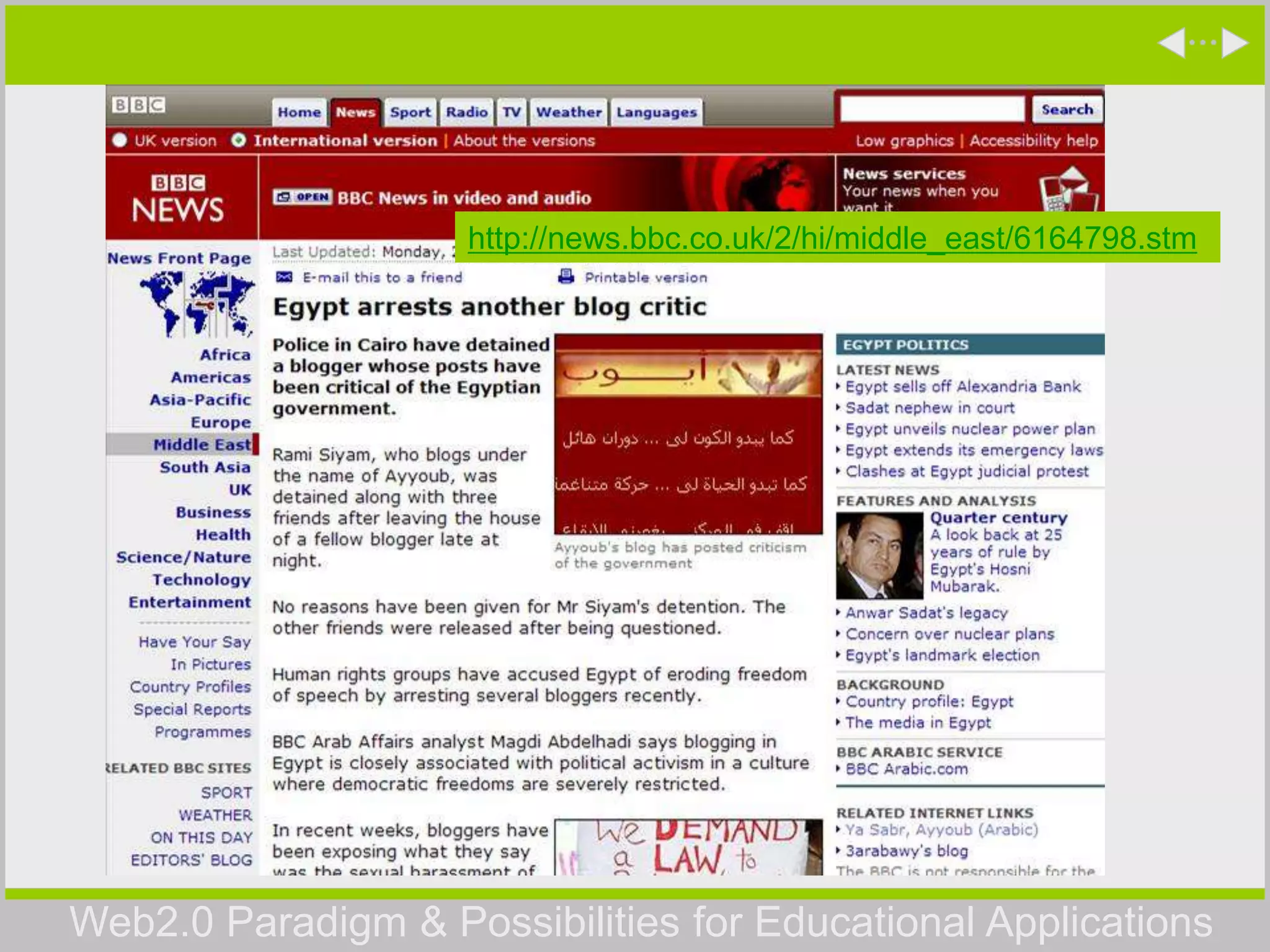
http://news.bbc.co.uk/2/hi/middle_east/6164798.stm
Web2.0 Paradigm & Possibilities for Educational Applications
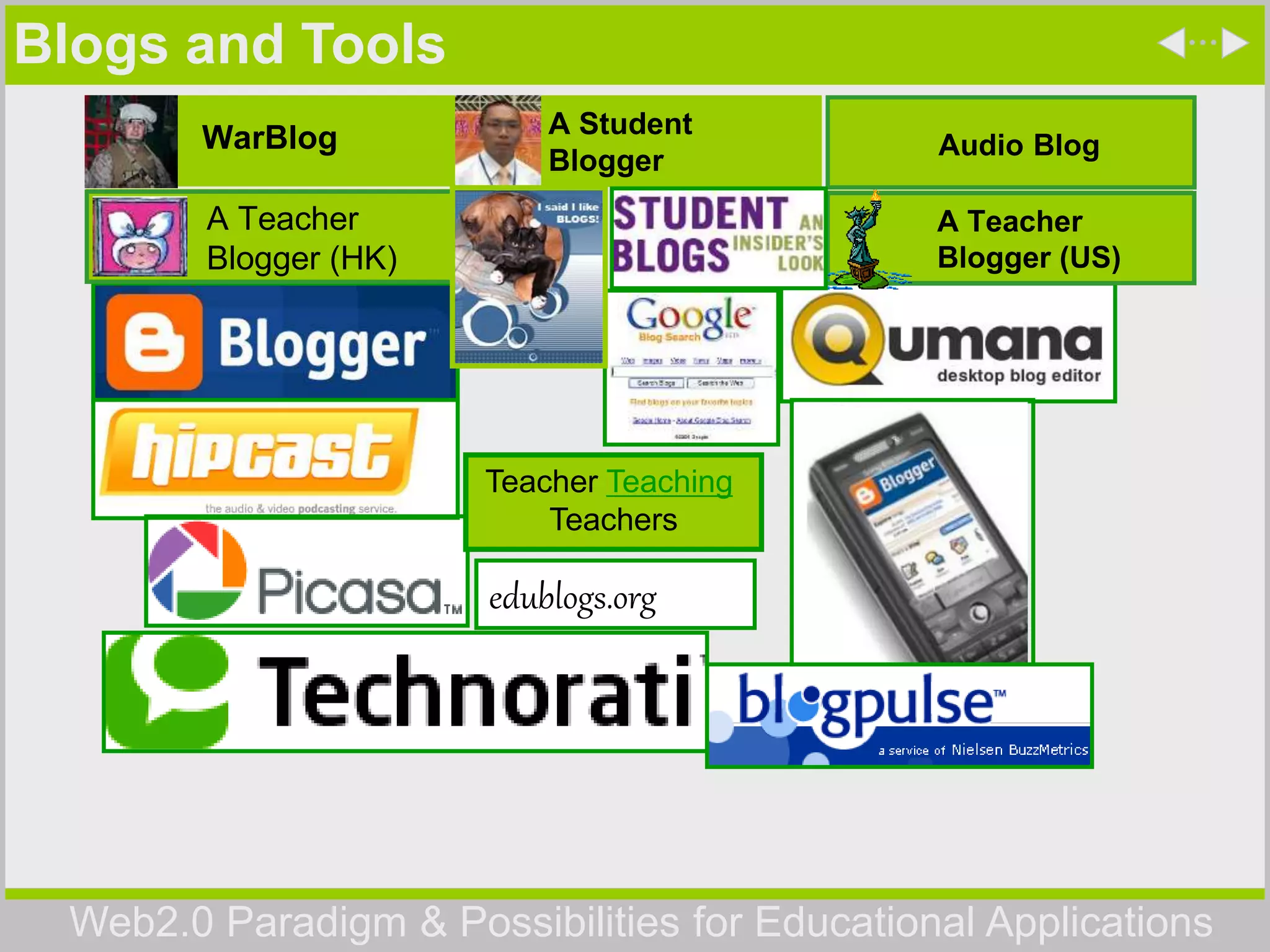
Blogs and Tools
A Student
Blogger
WarBlog
A Teacher
Blogger (US)
A Teacher
Blogger (US)
A Teacher
Blogger (HK)
Audio Blog
edublogs.org
Teacher Teaching
Teachers
Web2.0 Paradigm & Possibilities for Educational Applications
Blogs in Education
 Literature on blogs in education is emerging
Some names to look for: Dyrud, Flatley, Johnson,
Huffaker, Quible, Peschbach, Ramsay, Kinnie, Richardson,
Selingo, Smith, and Worley.
 In general, there lack of empirical evidences
and formal studies investigating use of blogs in
education.
 Mostly of current literature is conceptual an
published in non-SSCI ranked journals
Web2.0 Paradigm & Possibilities for Educational Applications
Recommendations from literature
 Students and blog:
 Publish own writings (e.g., reflections,
journal, a story, comments)
 Discuss group assignments, share work
schedule and results of experiments
 Peer review each others work
 Collaborate on projects with each other,
teachers, subject-specific experts in the field
and pen-pals from distant places
 Manage their digital portfolio or just use blog
as digital filing cabinet
Web2.0 Paradigm & Possibilities for Educational Applications
Recommendations from literature
 Teachers and blog:
 Share resources with students (e.g., readings
before class, handouts, and post homework
and assignments)
 Publish student work and otherwise archive
learning
 Communicate with students and parents
 Monitor activates of individual students and
groups
Web2.0 Paradigm & Possibilities for Educational Applications
Recommendations from literature
 Schools and blog:
 Communicate school news
 Present success stories of its students and teachers
 Various committees, school activity centers, clubs,
sport teams and parent groups can post information
 Achieve minutes of meetings and resources, and
continue dialogues beyond the scheduled times
 Use student blogs on schools home page to offer
dynamic information about their campus life
 Manage knowledge that members of school community
creates
 Education authorities can use blogs to share best
practices, lesson plans and other resources
Web2.0 Paradigm & Possibilities for Educational Applications
Recommendations from literature
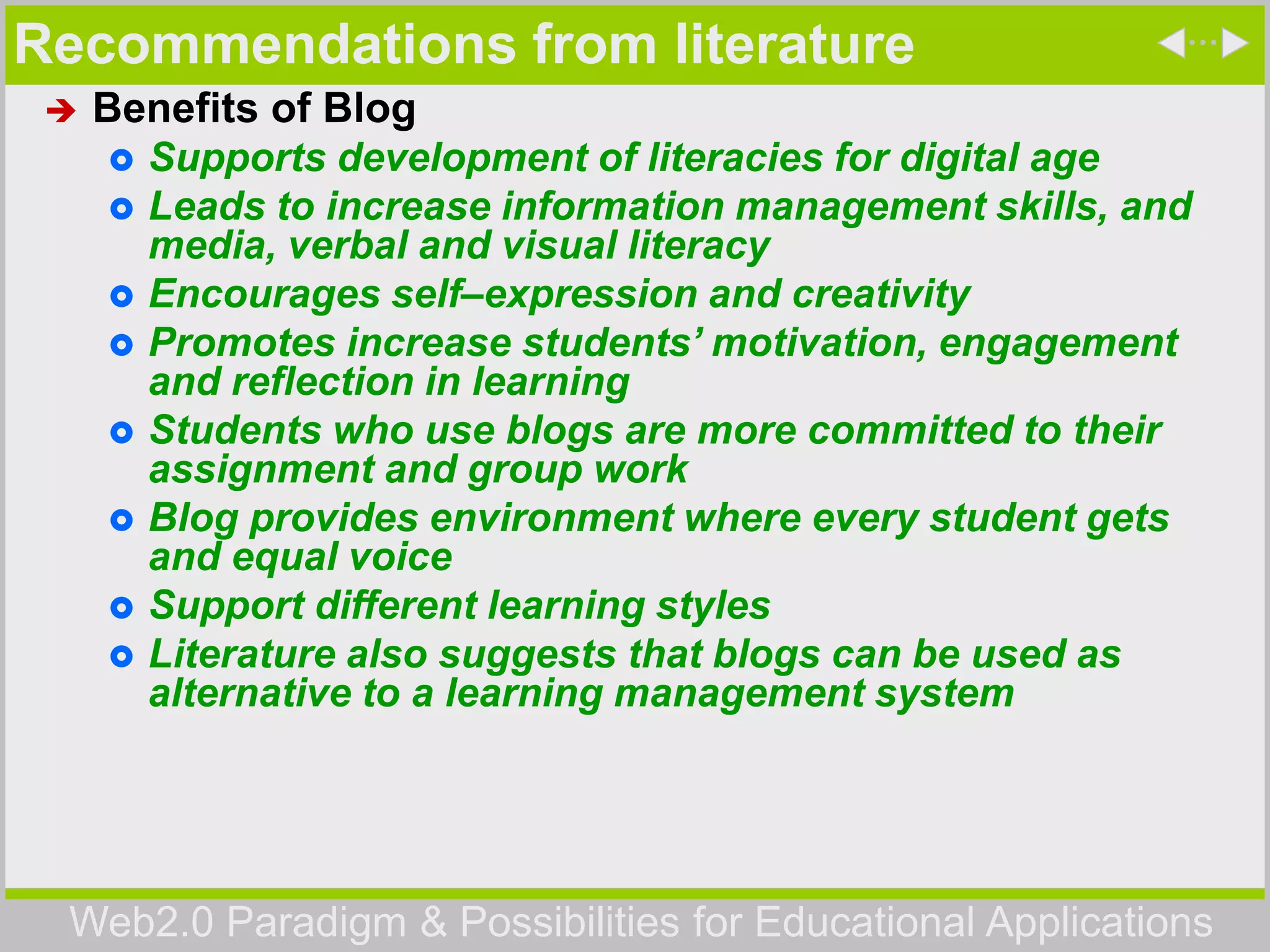
 Benefits of Blog
 Supports development of literacies for digital age
 Leads to increase information management skills, and
media, verbal and visual literacy
 Encourages self–expression and creativity
 Promotes increase students’ motivation, engagement
and reflection in learning
 Students who use blogs are more committed to their
assignment and group work
 Blog provides environment where every student gets
and equal voice
 Support different learning styles
 Literature also suggests that blogs can be used as
alternative to a learning management system
Web2.0 Paradigm & Possibilities for Educational Applications
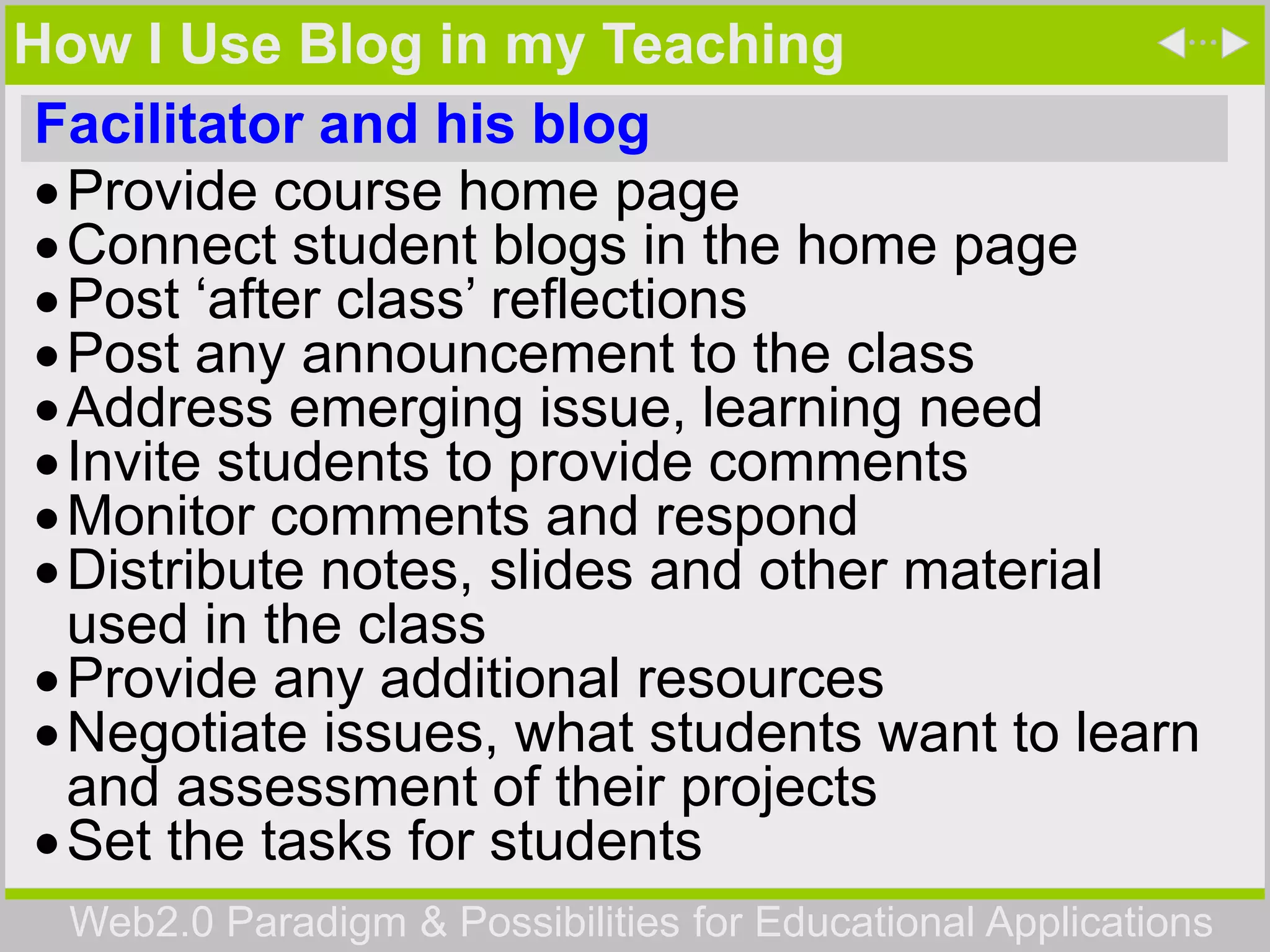
How I Use Blog in my Teaching
Facilitator and his blog
Provide course home page
Connect student blogs in the home page
Post ‘after class’ reflections
Post any announcement to the class
Address emerging issue, learning need
Invite students to provide comments
Monitor comments and respond
Distribute notes, slides and other material
used in the class
Provide any additional resources
Negotiate issues, what students want to learn
and assessment of their projects
Set the tasks for students
Web2.0 Paradigm & Possibilities for Educational Applications
Summary of activities in the blogsphere
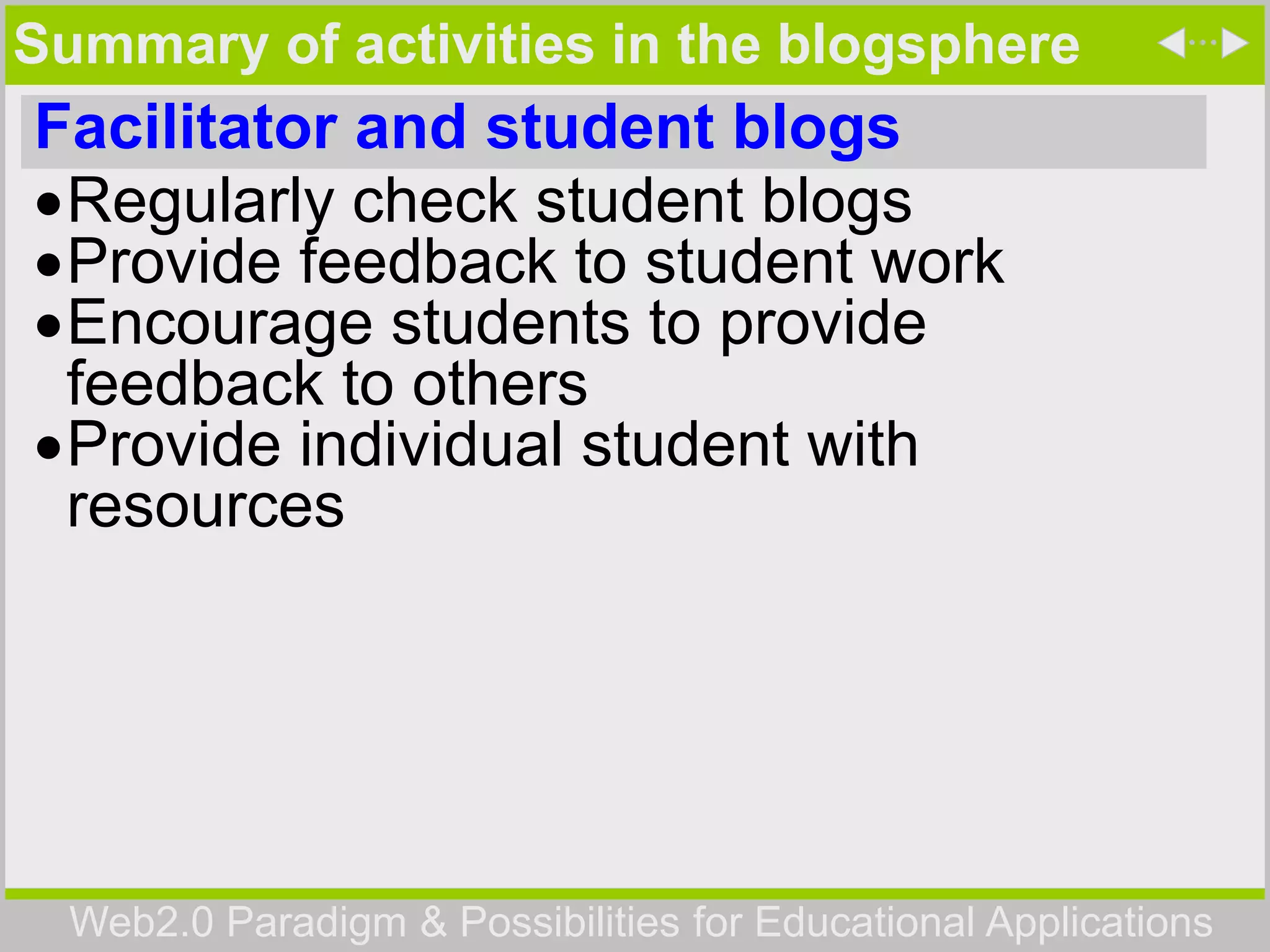
Facilitator and student blogs
Regularly check student blogs
Provide feedback to student work
Encourage students to provide
feedback to others
Provide individual student with
resources
Web2.0 Paradigm & Possibilities for Educational Applications
Summary of activities in the blogsphere
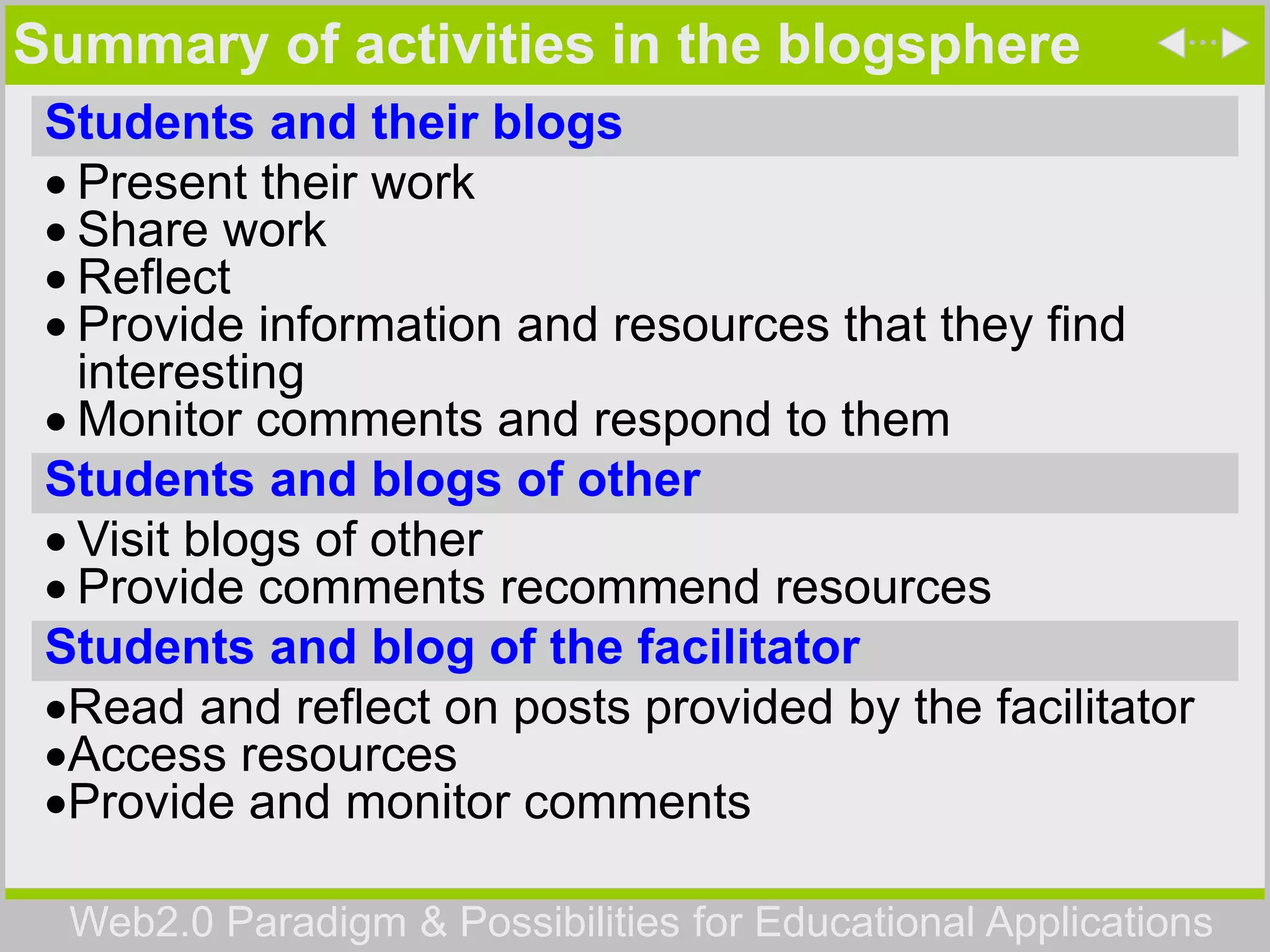
Students and their blogs
 Present their work
 Share work
 Reflect
 Provide information and resources that they find
interesting
 Monitor comments and respond to them
Students and blogs of other
 Visit blogs of other
 Provide comments recommend resources
Students and blog of the facilitator
Read and reflect on posts provided by the facilitator
Access resources
Provide and monitor comments
Web2.0 Paradigm & Possibilities for Educational Applications
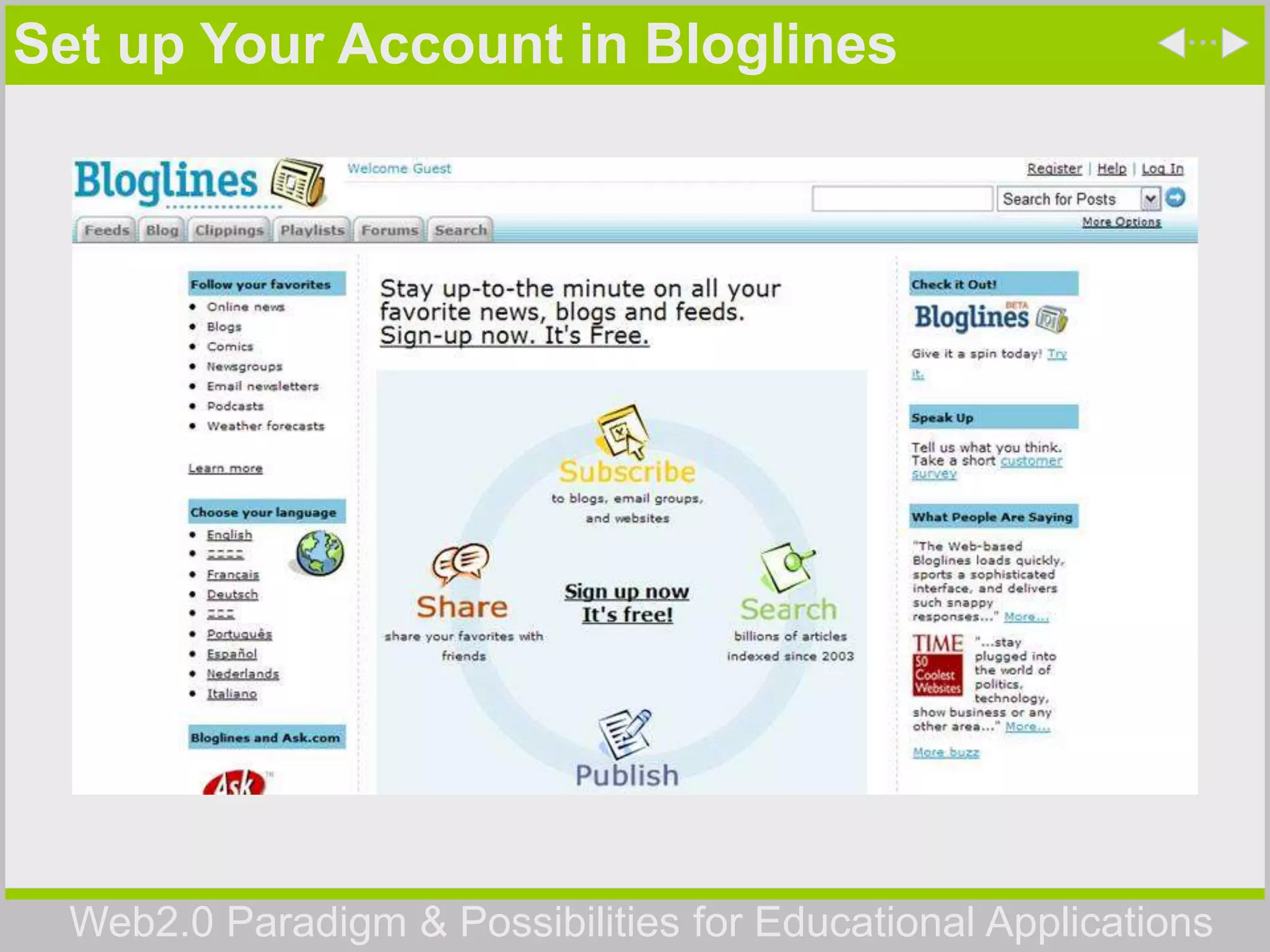
Set up Your Account in Bloglines
Web2.0 Paradigm & Possibilities for Educational Applications
Wiki
 Wiki is social software that allows collaborative
development on an article of common interest
to its authors
Web2.0 Paradigm & Possibilities for Educational Applications
Wikipedia
 13,000 active contributors
 3,800,000 articles in more than 100 languages
 1,152,885 articles in English
 Hundreds of thousands of visitors daily, tens of
thousands of edits and new articles
Source: http://en.wikipedia.org/wiki/Wikipedia:About)
 Wikipedia has become the 37th most visited
website, according to Alexa
 Wikipedia comes close to Britannica –
Expert led investigation by Nature identifies that in
average science entry in Wikipedia contained around
four inaccuracies; Britannica, about three
(Source: http://www.nature.com/news/2005/051212/full/438900a.html)
Web2.0 Paradigm & Possibilities for Educational Applications
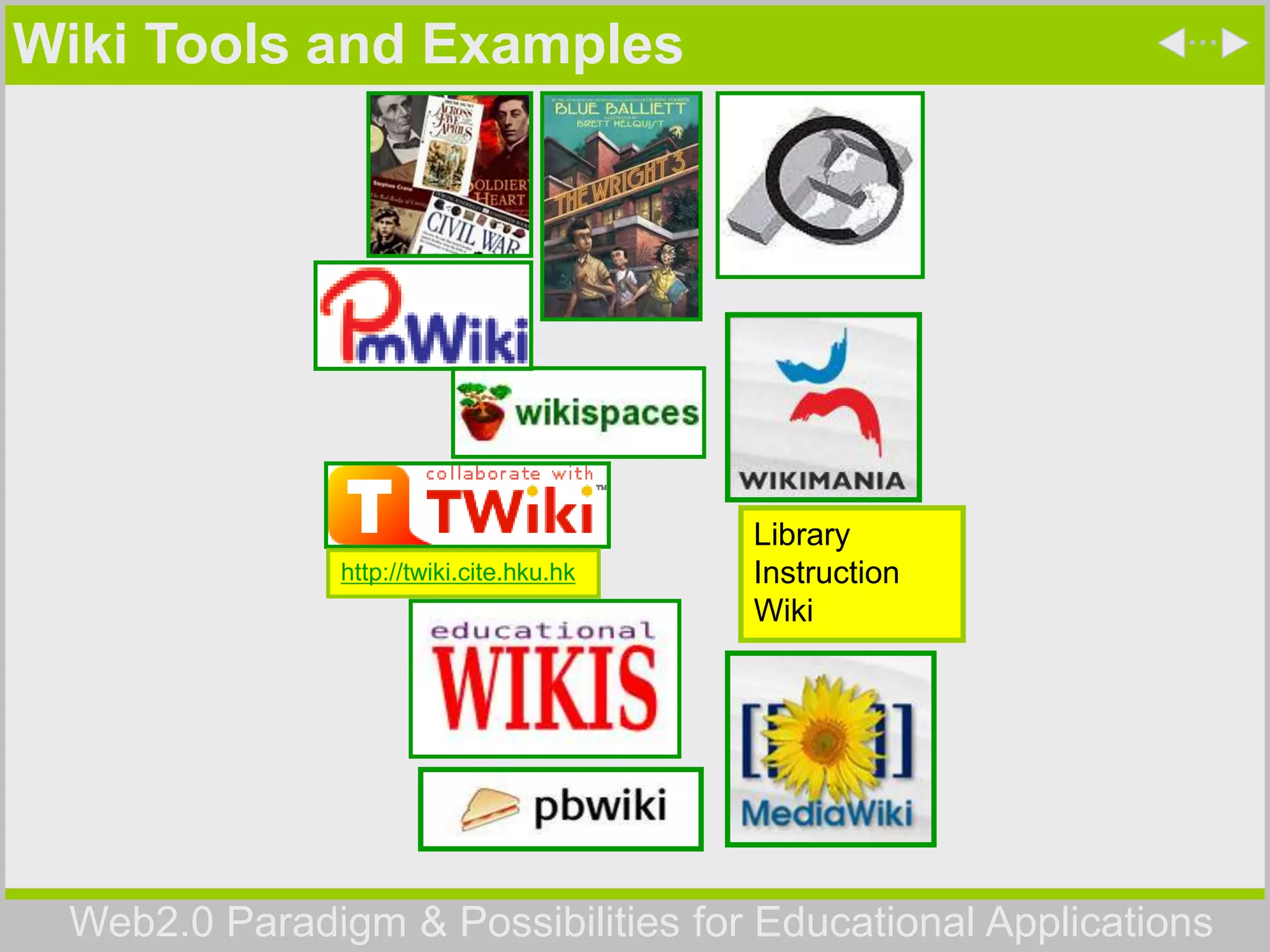
Wiki Tools and Examples
http://twiki.cite.hku.hk
Library
Instruction
Wiki
Web2.0 Paradigm & Possibilities for Educational Applications
Activities for Today
 Work with your group to start a new article in
Wikipedia. You need to create account for your
group. You can select any topic, however, I
suggest that you write an article about one of
your schools (check that there is no article
about one of your schools available). If article is
available, then edit that article. Provide link to
your article from your blog before next class
Web2.0 Paradigm & Possibilities for Educational Applications
References
 Read article about blogging in classroom from:
http://writer.zoho.com/public/zvezdan/Web2_Paper
_2_v81
 Read articles from:
http://connect.educause.edu/Library/EDUCAUSE+
Review/Web20ANewWaveofInnovation/40615
http://www.ariadne.ac.uk/issue42/tonkin/
http://www.infotoday.com/searcher/apr03/mattison
.shtml
http://www.scienceofspectroscopy.info/edit/index.
php?title=Using_wiki_in_education

CD200615 Session 2

  • 1.
    THE UNIVERSITY OFHONG KONG WEB BY DANIEL CHURCHILL 2.0
  • 2.
    Web2.0 Paradigm &Possibilities for Educational Applications What is Web 2.0? Web2.0 as Metaphor a Paradigm Shift  Web as a platform  User control of information  Web as a point of presence  Internet-mediated social environments  Rich user experiences  New forms of expressions Some speak of media revolution – “we the media” (Dan Gillmor), “voice of crowds”, increased democratization and new citizenship, etc.
  • 3.
    Web2.0 Paradigm &Possibilities for Educational Applications
  • 4.
    Web2.0 Paradigm &Possibilities for Educational Applications Collection of Web 2.0 sites
  • 5.
    Web2.0 Paradigm &Possibilities for Educational Applications Major Web 2.0 Conference
  • 6.
    Web2.0 Paradigm &Possibilities for Educational Applications Blog, blogging, blogger, blogsphere Blog is web-based publication No technical skills to create your own blog Blog can contain text, media, links There are blogs, moblogs, vlogs, audilog Blogsphere is a community of bloggers "A blog is a personal diary. A daily pulpit. A collaborative space. A political soapbox. A breaking-news outlet. A collection of links. Your own private thoughts. Memos to the world.“  www.blogger.com
  • 7.
    Web2.0 Paradigm &Possibilities for Educational Applications Blogs – Some Statistics  27% of online Americans have read a blog  Eight million Americans have created a blog  12% of online Americans have posted comments on blogs (Source: http://news.bbc.co.uk/2/hi/technology/4145191.stm )  “China to have 60 million bloggers by end of 2006” (Reuters http://news.yahoo.com/s/nm/20060506/wr_nm/china_blogs_dc_1 )
  • 8.
    Web2.0 Paradigm &Possibilities for Educational Applications Total Sites Across all Domains Source: http://news.netcraft.com/archives/web_server_survey.html Bloggers: an army of irregulars (BBC) -- “The web has grown more in 2005 than it did at the height of the dotcom boom”
  • 9.
    Web2.0 Paradigm &Possibilities for Educational Applications http://news.bbc.co.uk/2/hi/entertainment/4123536.stm Digital Citizens - "the most informed and participatory citizens we ever had or are likely to have" - represent a critical emerging group for today and tomorrow. (Source: http://www.wired.com/wir ed/reprints/digicit.html)
  • 10.
    Web2.0 Paradigm &Possibilities for Educational Applications http://news.bbc.co.uk/2/hi/asia-pacific/4961768.stm
  • 11.
    Web2.0 Paradigm &Possibilities for Educational Applications http://news.bbc.co.uk/2/hi/middle_east/6164798.stm
  • 12.
    Web2.0 Paradigm &Possibilities for Educational Applications Blogs and Tools A Student Blogger WarBlog A Teacher Blogger (US) A Teacher Blogger (US) A Teacher Blogger (HK) Audio Blog edublogs.org Teacher Teaching Teachers
  • 13.
    Web2.0 Paradigm &Possibilities for Educational Applications Blogs in Education  Literature on blogs in education is emerging Some names to look for: Dyrud, Flatley, Johnson, Huffaker, Quible, Peschbach, Ramsay, Kinnie, Richardson, Selingo, Smith, and Worley.  In general, there lack of empirical evidences and formal studies investigating use of blogs in education.  Mostly of current literature is conceptual an published in non-SSCI ranked journals
  • 14.
    Web2.0 Paradigm &Possibilities for Educational Applications Recommendations from literature  Students and blog:  Publish own writings (e.g., reflections, journal, a story, comments)  Discuss group assignments, share work schedule and results of experiments  Peer review each others work  Collaborate on projects with each other, teachers, subject-specific experts in the field and pen-pals from distant places  Manage their digital portfolio or just use blog as digital filing cabinet
  • 15.
    Web2.0 Paradigm &Possibilities for Educational Applications Recommendations from literature  Teachers and blog:  Share resources with students (e.g., readings before class, handouts, and post homework and assignments)  Publish student work and otherwise archive learning  Communicate with students and parents  Monitor activates of individual students and groups
  • 16.
    Web2.0 Paradigm &Possibilities for Educational Applications Recommendations from literature  Schools and blog:  Communicate school news  Present success stories of its students and teachers  Various committees, school activity centers, clubs, sport teams and parent groups can post information  Achieve minutes of meetings and resources, and continue dialogues beyond the scheduled times  Use student blogs on schools home page to offer dynamic information about their campus life  Manage knowledge that members of school community creates  Education authorities can use blogs to share best practices, lesson plans and other resources
  • 17.
    Web2.0 Paradigm &Possibilities for Educational Applications Recommendations from literature  Benefits of Blog  Supports development of literacies for digital age  Leads to increase information management skills, and media, verbal and visual literacy  Encourages self–expression and creativity  Promotes increase students’ motivation, engagement and reflection in learning  Students who use blogs are more committed to their assignment and group work  Blog provides environment where every student gets and equal voice  Support different learning styles  Literature also suggests that blogs can be used as alternative to a learning management system
  • 18.
    Web2.0 Paradigm &Possibilities for Educational Applications How I Use Blog in my Teaching Facilitator and his blog Provide course home page Connect student blogs in the home page Post ‘after class’ reflections Post any announcement to the class Address emerging issue, learning need Invite students to provide comments Monitor comments and respond Distribute notes, slides and other material used in the class Provide any additional resources Negotiate issues, what students want to learn and assessment of their projects Set the tasks for students
  • 19.
    Web2.0 Paradigm &Possibilities for Educational Applications Summary of activities in the blogsphere Facilitator and student blogs Regularly check student blogs Provide feedback to student work Encourage students to provide feedback to others Provide individual student with resources
  • 20.
    Web2.0 Paradigm &Possibilities for Educational Applications Summary of activities in the blogsphere Students and their blogs  Present their work  Share work  Reflect  Provide information and resources that they find interesting  Monitor comments and respond to them Students and blogs of other  Visit blogs of other  Provide comments recommend resources Students and blog of the facilitator Read and reflect on posts provided by the facilitator Access resources Provide and monitor comments
  • 21.
    Web2.0 Paradigm &Possibilities for Educational Applications Set up Your Account in Bloglines
  • 22.
    Web2.0 Paradigm &Possibilities for Educational Applications Wiki  Wiki is social software that allows collaborative development on an article of common interest to its authors
  • 23.
    Web2.0 Paradigm &Possibilities for Educational Applications Wikipedia  13,000 active contributors  3,800,000 articles in more than 100 languages  1,152,885 articles in English  Hundreds of thousands of visitors daily, tens of thousands of edits and new articles Source: http://en.wikipedia.org/wiki/Wikipedia:About)  Wikipedia has become the 37th most visited website, according to Alexa  Wikipedia comes close to Britannica – Expert led investigation by Nature identifies that in average science entry in Wikipedia contained around four inaccuracies; Britannica, about three (Source: http://www.nature.com/news/2005/051212/full/438900a.html)
  • 24.
    Web2.0 Paradigm &Possibilities for Educational Applications Wiki Tools and Examples http://twiki.cite.hku.hk Library Instruction Wiki
  • 25.
    Web2.0 Paradigm &Possibilities for Educational Applications Activities for Today  Work with your group to start a new article in Wikipedia. You need to create account for your group. You can select any topic, however, I suggest that you write an article about one of your schools (check that there is no article about one of your schools available). If article is available, then edit that article. Provide link to your article from your blog before next class
  • 26.
    Web2.0 Paradigm &Possibilities for Educational Applications References  Read article about blogging in classroom from: http://writer.zoho.com/public/zvezdan/Web2_Paper _2_v81  Read articles from: http://connect.educause.edu/Library/EDUCAUSE+ Review/Web20ANewWaveofInnovation/40615 http://www.ariadne.ac.uk/issue42/tonkin/ http://www.infotoday.com/searcher/apr03/mattison .shtml http://www.scienceofspectroscopy.info/edit/index. php?title=Using_wiki_in_education