Fundamental Issues with  Research in Education by Dr. Daniel Churchill
Content Overview Defining research question Reviewing literature Referencing and APA Selecting Methodology Ethical issues  Data Collection Analysis Validity and reliability issues Writing a Reporting
Let’s Check on your Group Blogs…
Revision--Educational Research Educational Research explains, predicts and/or control educational phenomenon Educational research is conducted in the following way: Define  -- a significant problem, hypothesis or question  Plan  -- review literature to establish background to the study, identify methodology, plan procedure Execute research procedures  -- collect data e.g., interviews, surveys, questionnaires, observations Analyze data  -- qualitatively, quantitatively or a mixed way Draw  conclusions and recommendations
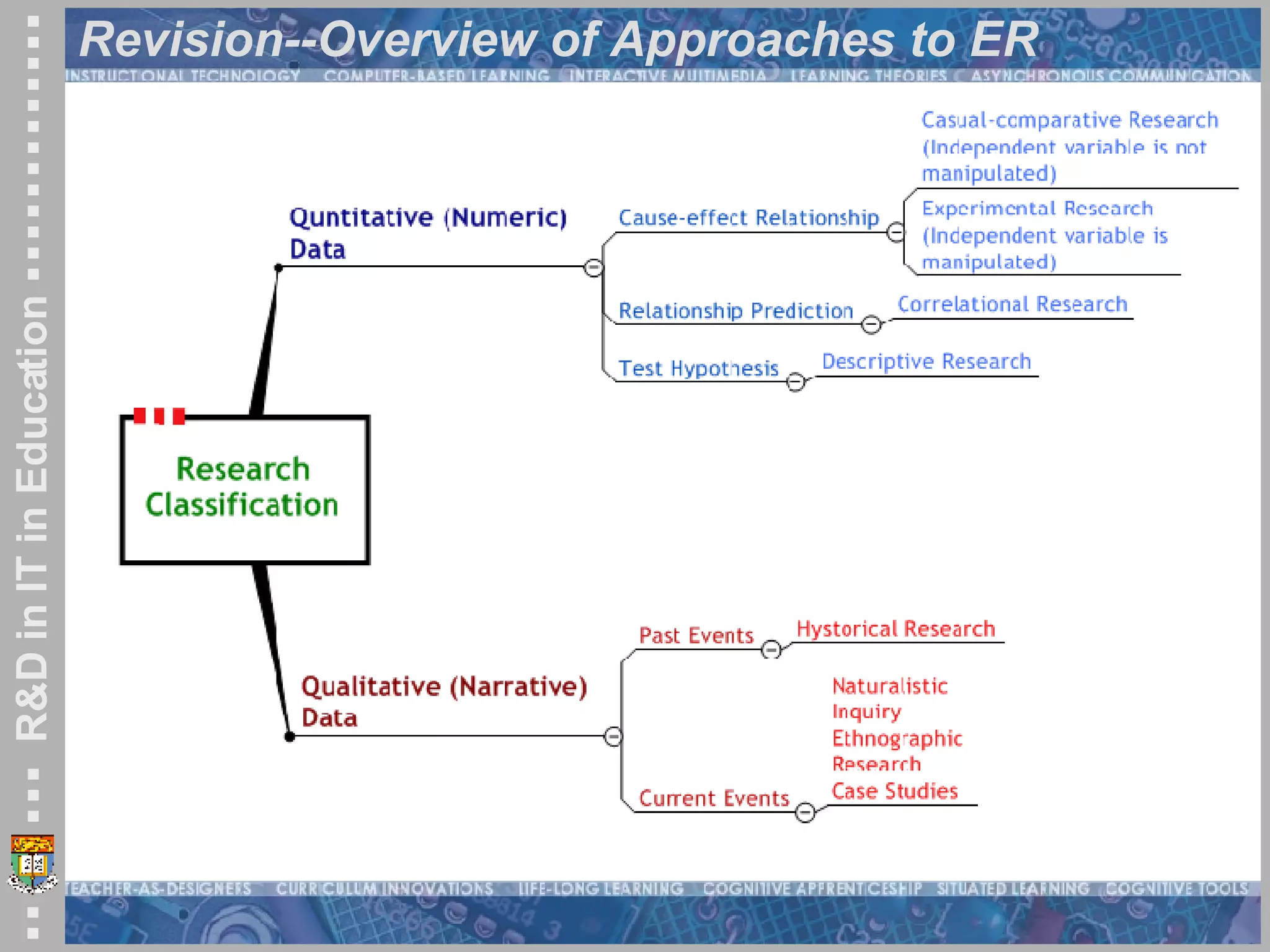
Revision--Overview of Approaches to ER
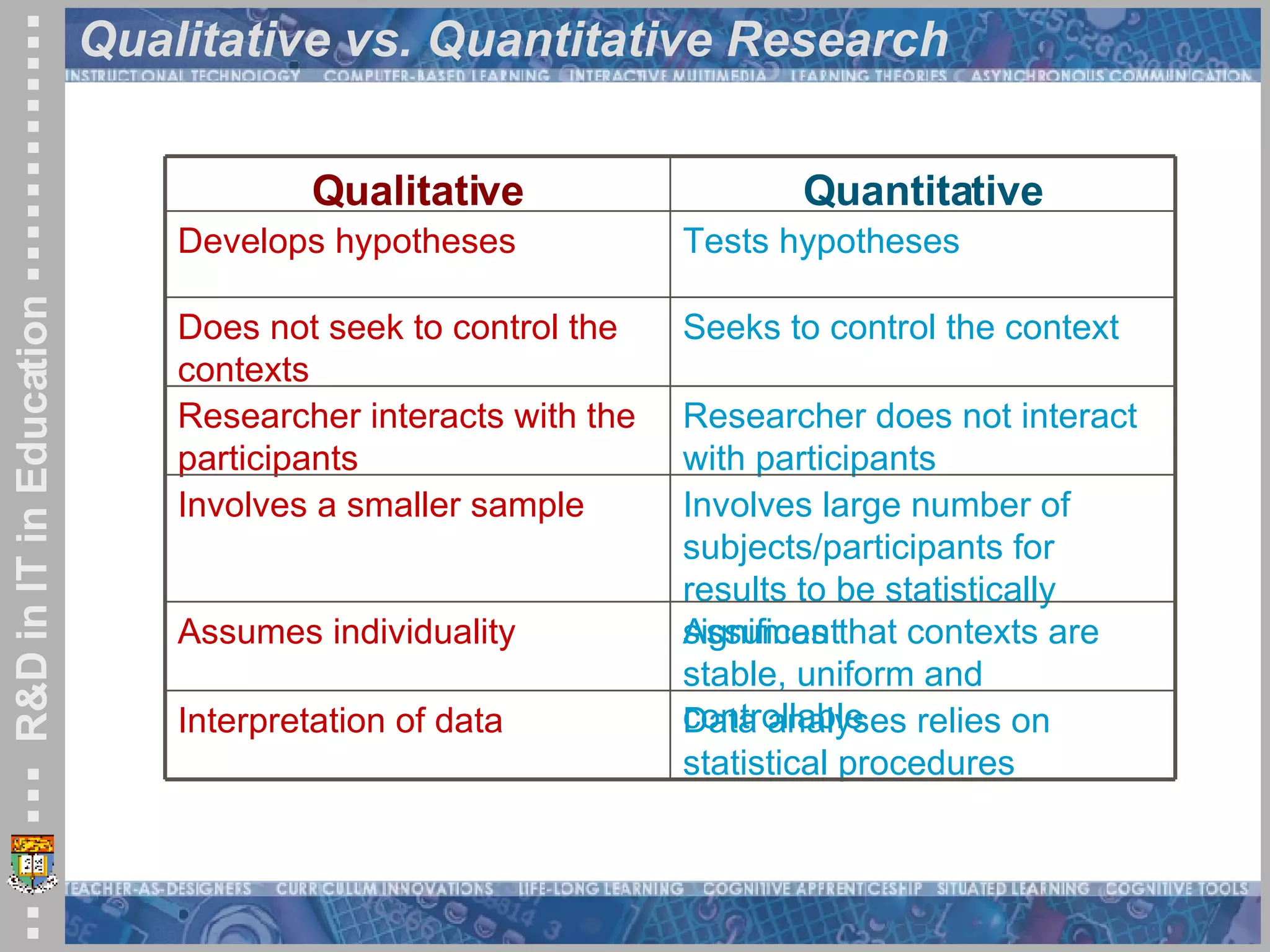
Qualitative vs. Quantitative Research Data analyses relies on statistical procedures Interpretation of data Assumes that contexts are stable, uniform and controllable Assumes individuality Involves large number of subjects/participants for results to be statistically significant Involves a smaller sample Researcher does not interact with participants Researcher interacts with the participants Seeks to control the context Does not seek to control the contexts Tests hypotheses Develops hypotheses Quantitative Qualitative
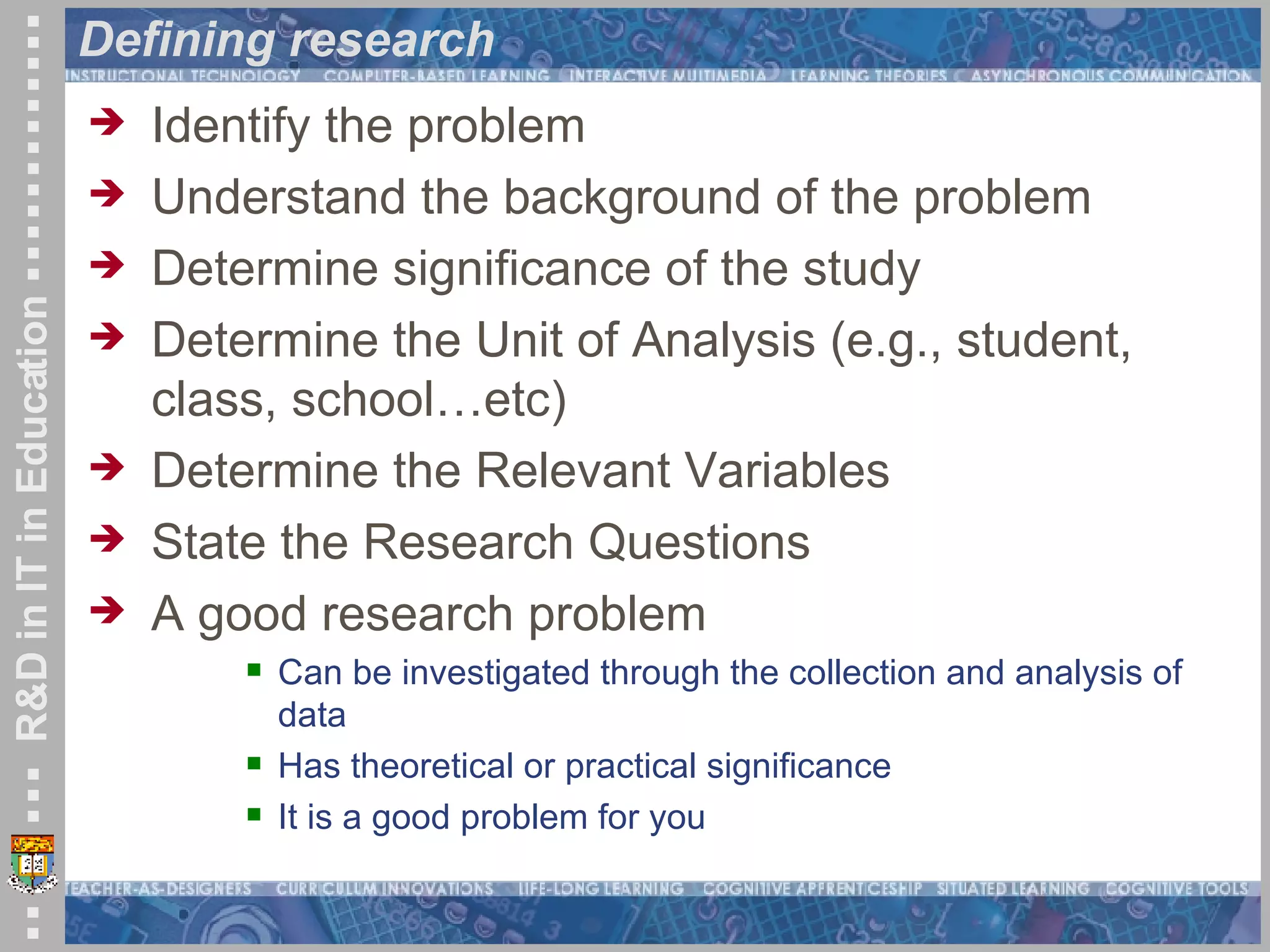
Defining research Identify the problem Understand the background of the problem Determine significance of the study Determine the Unit of Analysis (e.g., student, class, school…etc) Determine the Relevant Variables State the Research Questions A good research problem Can be investigated through the collection and analysis of data  Has theoretical or practical significance  It is a good problem for you
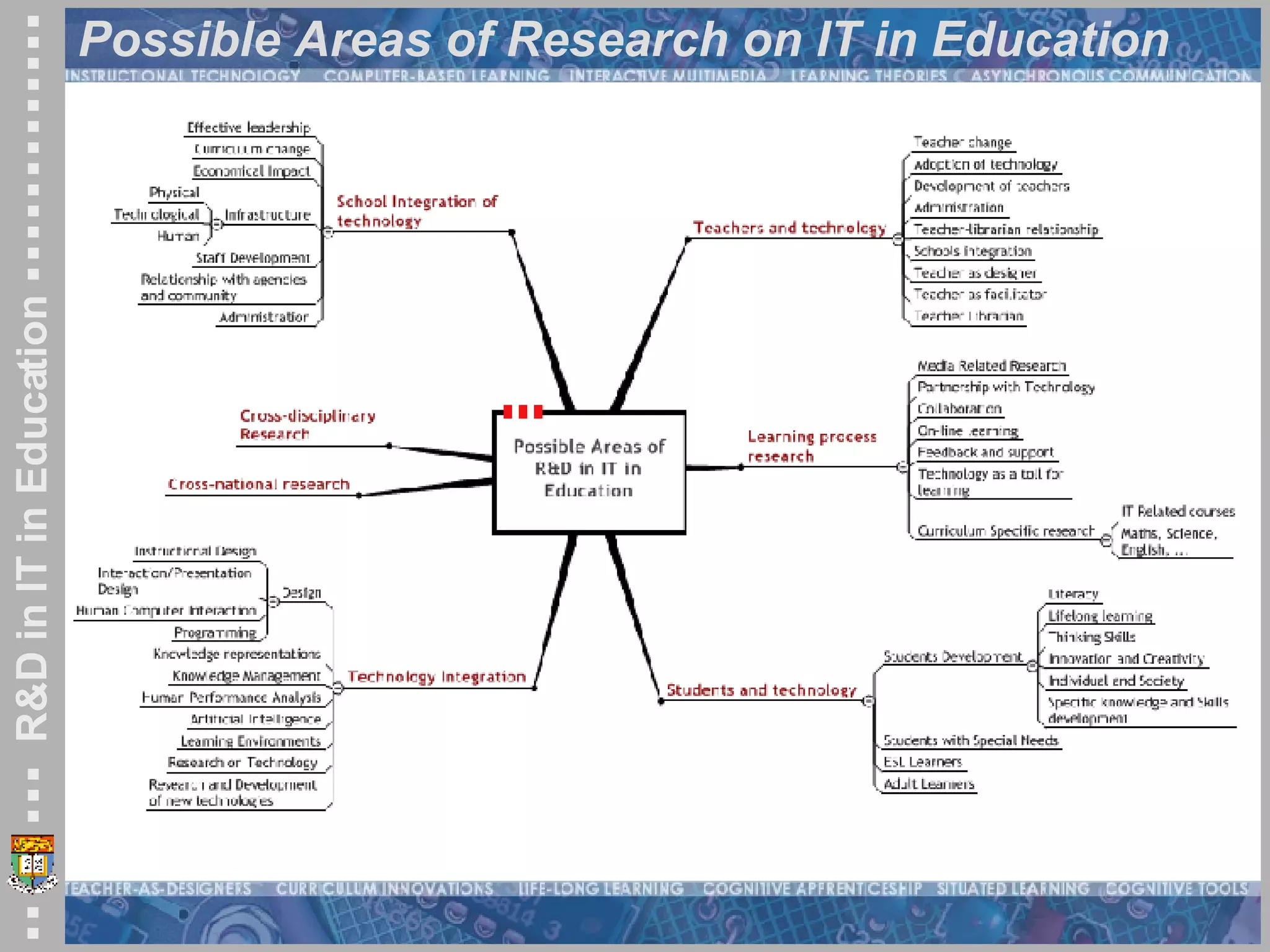
Possible Areas of Research on IT in Education
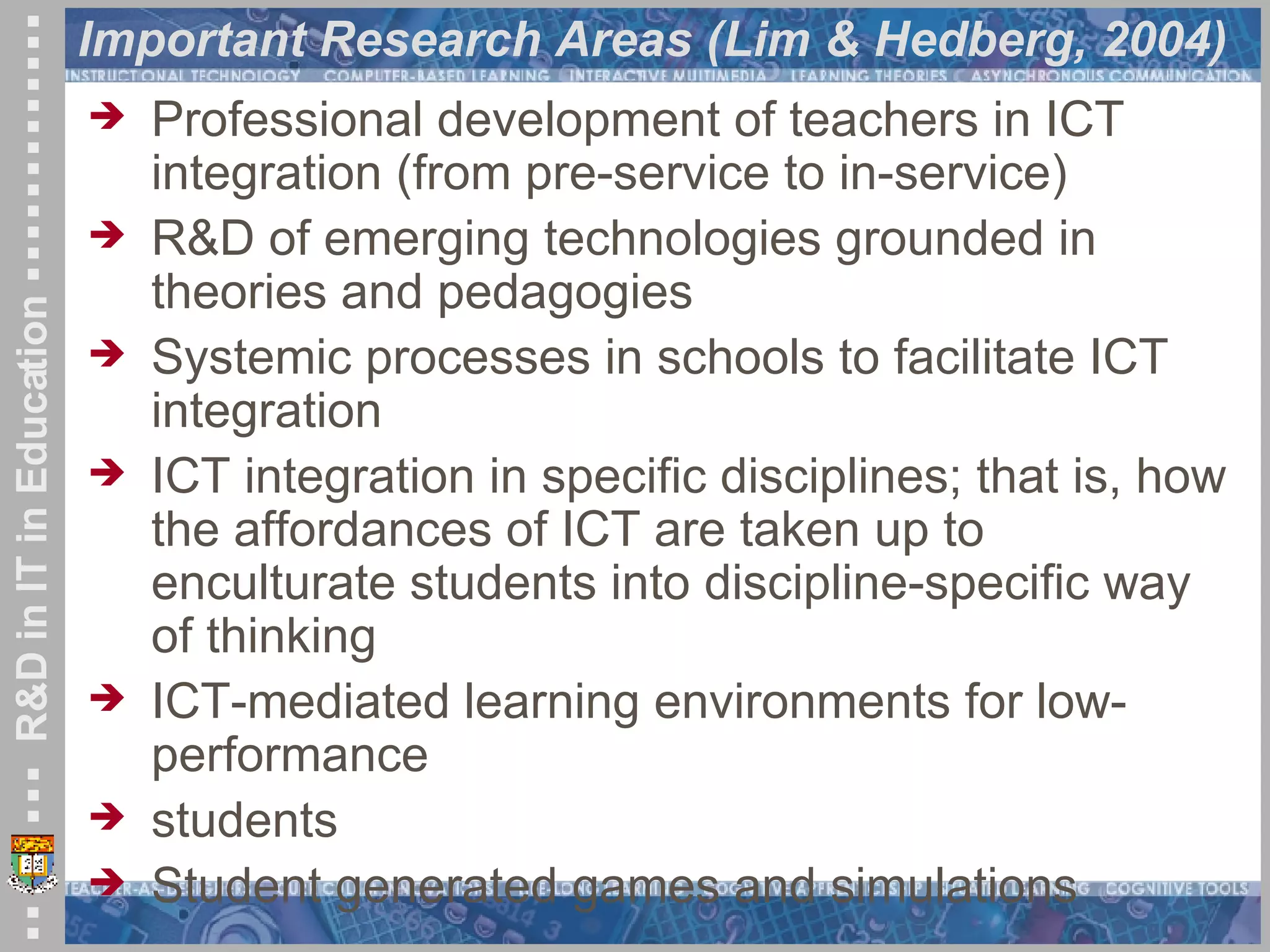
Important Research Areas (Lim & Hedberg, 2004) Professional development of teachers in ICT integration (from pre-service to in-service) R&D of emerging technologies grounded in theories and pedagogies Systemic processes in schools to facilitate ICT integration ICT integration in specific disciplines; that is, how the affordances of ICT are taken up to enculturate students into discipline-specific way of thinking ICT-mediated learning environments for low-performance students Student generated games and simulations
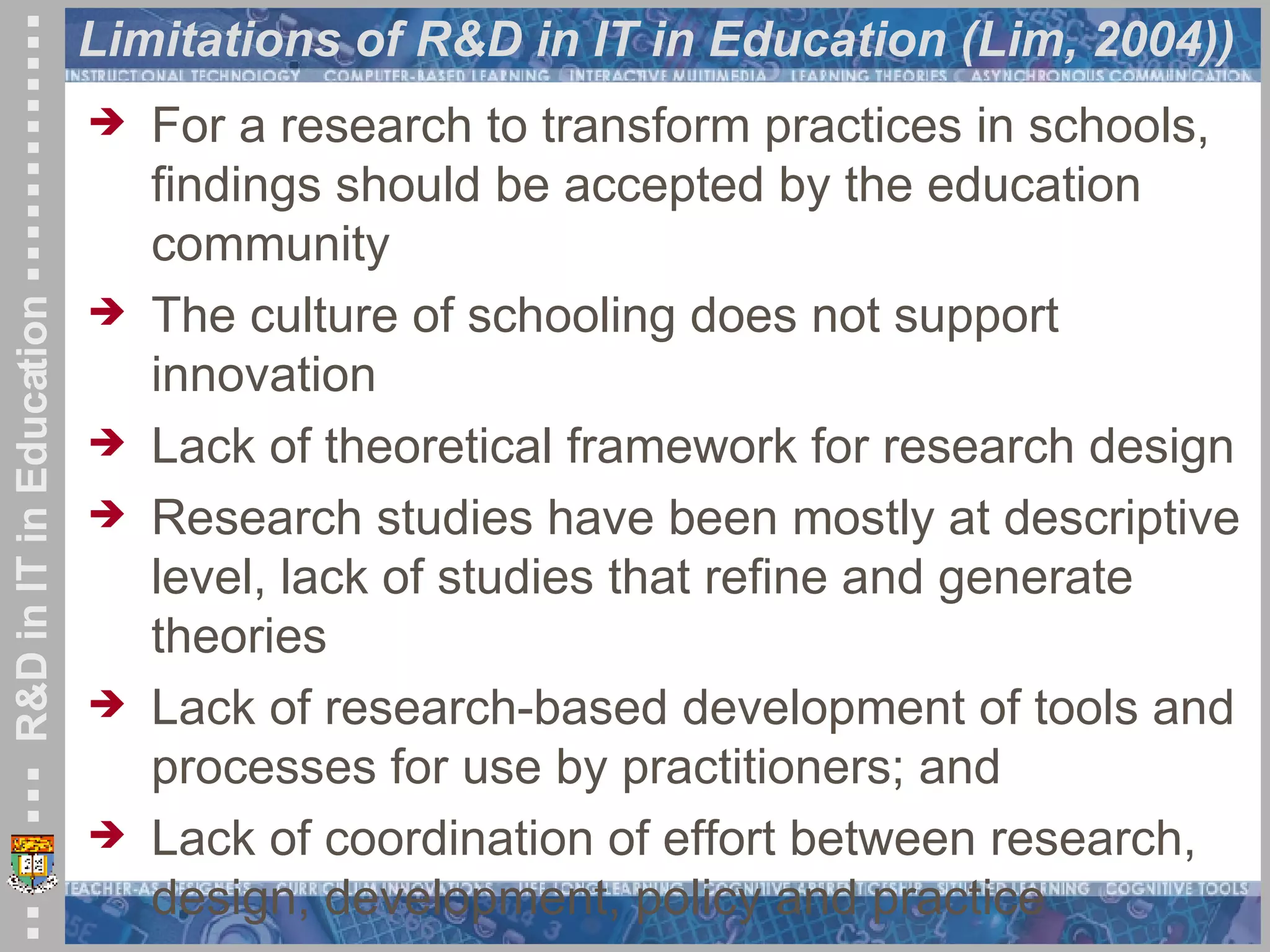
Limitations of R&D in IT in Education (Lim, 2004)) For a research to transform practices in schools, findings should be accepted by the education community The culture of schooling does not support innovation Lack of theoretical framework for research design Research studies have been mostly at descriptive level, lack of studies that refine and generate theories Lack of research-based development of tools and processes for use by practitioners; and Lack of coordination of effort between research, design, development, policy and practice
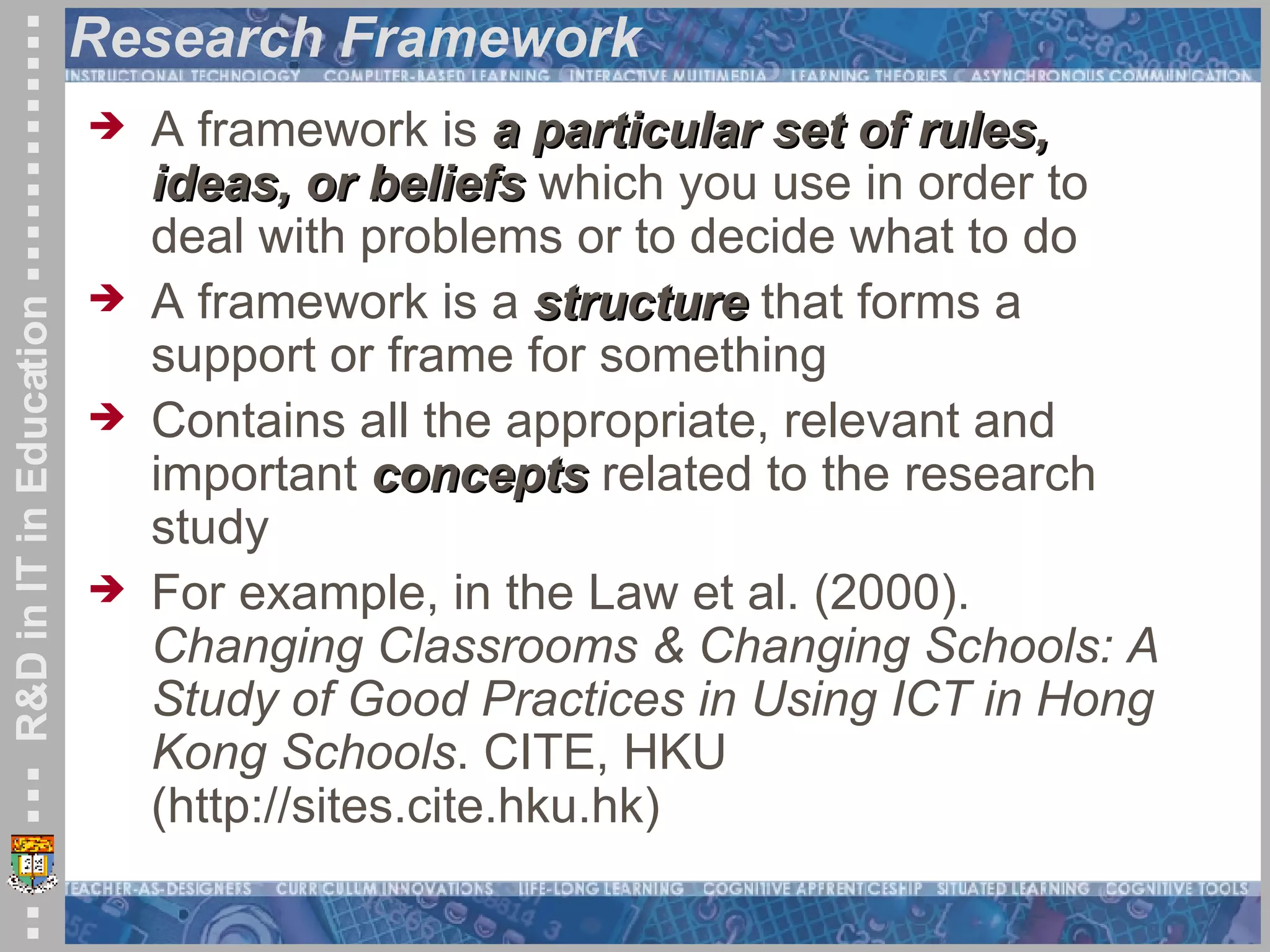
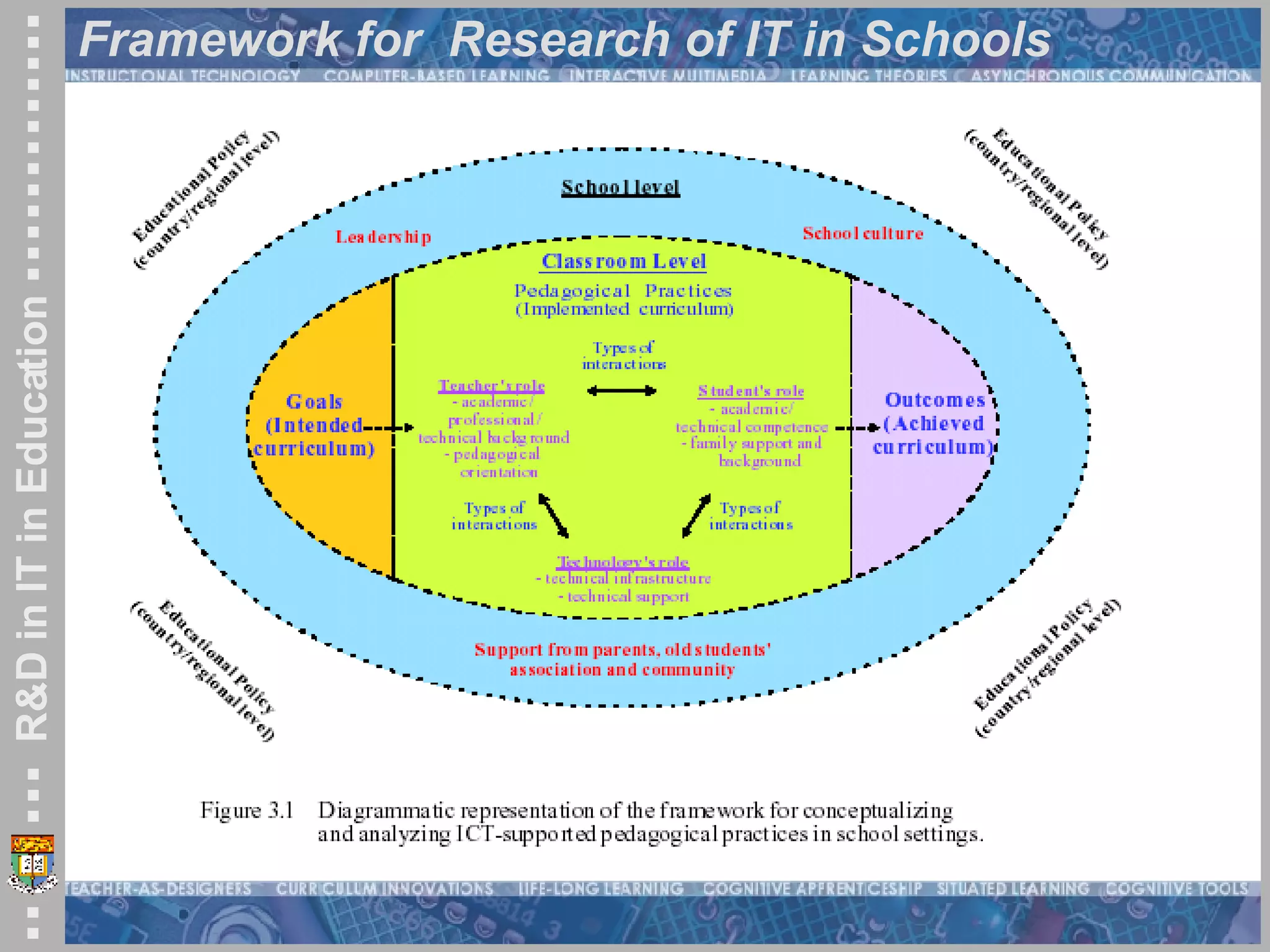
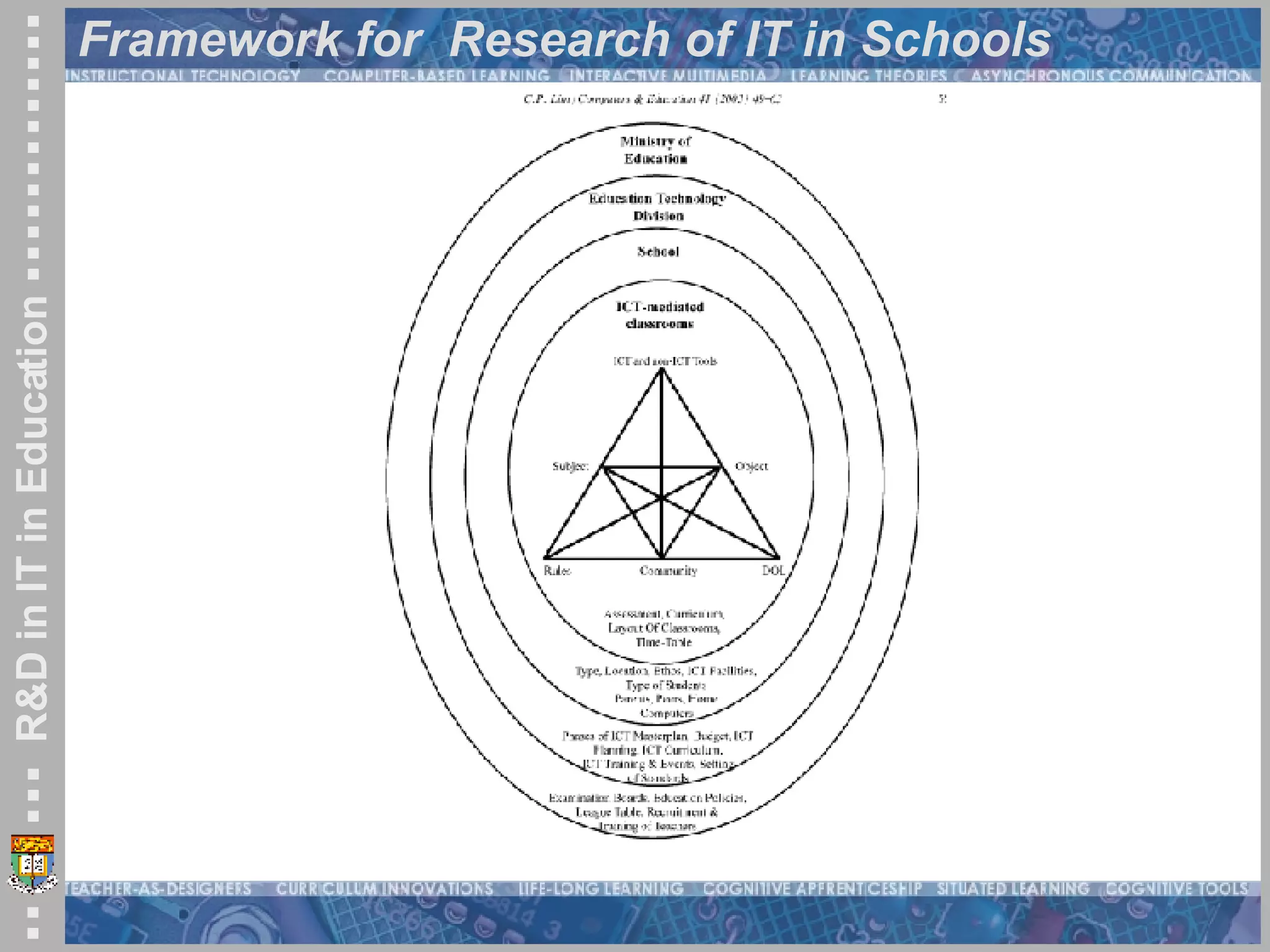
Research Framework A framework is  a particular set of rules, ideas, or beliefs  which you use in order to deal with problems or to decide what to do A framework is a  structure  that forms a support or frame for something Contains all the appropriate, relevant and important  concepts  related to the research study For example, in the Law et al. (2000).  Changing Classrooms & Changing Schools: A Study of Good Practices in Using ICT in Hong Kong Schools . CITE, HKU (http://sites.cite.hku.hk)
Framework for  Research of IT in Schools
Reviewing literature After selecting a research topic and formulating research problem and significance, identify key words for a literature search
Reviewing literature General purposes Summary and synthesis of the state of knowledge - existing studies and findings  Evaluation - strength and limitations in methods, results and conclusions  Identifying gaps in knowledge  Providing background and justification of one’s own research Justification of the research objective There is a gap in or a need of knowledge This gap can be proposed as a research question This question should and can be answered by research Your research objective is to answer the question Justification of the methods
Reviewing literature Requirements Comprehensive coverage - literature search (e.g. electronic databases - ERIC) - search for local as well as international materials  Up-to-date e.g. you may use some original sources, but your review should include a majority of papers which are from about 1990 onwards  Depth vs. breadth i.e. it is better to cover your chosen area well, than to give an overview of a number of areas Common Problems Too brief, too lengthy, out of proportion  Missing important literature  Biased, unbalanced selections or opinions  Close paraphrasing and plagiarism Linkage between parts and coherence
Library Collections Reference collections :  Materials used in the library that provide access to information often in a summarized form. Reference collections typically include encyclopedias, statistical material, dictionaries, bibliographies, literary criticism, handbooks, and biographies. Reference collections do not circulate.   Circulating collections :  Materials that can be checked out of the library. Each library sets its own policy on how many items a patron can check-out, as well has how long the item is loaned .   Reserve collections :  Course materials set aside by faculty for student use. Most library reserve collections are located behind the circulation desk and are limited to in-library use only.
Library Collections Special Collections/Archives :  Materials purchased in specialized subject areas. The library usually shelves special collection material separate from the general circulating and reference collections.  Microform collections :  Material that has been miniaturized and placed on microfilm or microfiche. Microform material must be read on special microform machines. Electronic media collection :  Collection of video and audio tapes, CD-Roms and other electronic resources
Other Sources of Literature Education Index Covers professional publications Readers Guide to Periodical Literature   covers articles from 200 widely read magazines (popular literature).  Expanded Academic Index   Covers journal articles from over 1500 periodicals.  Dissertation Abstracts International   Contains bibliographic citations and abstracts from doctoral dissertations and master's theses worldwide.  Psychological Abstracts   Presents summaries of studies completed in psychology, including developmental psychology and educational psychology. These two areas are of special interest to educational researchers.
Other Sources of Literature ERIC  - the Educational Resources Information Center collects and disseminates reports of current educational research, evaluation, developmental activity. ERIC maintains two databases searchable by computer:  RIE  - Resources in Education, this ERIC database contains bibliographic citations and summaries to information not published in journals, e.g. conference presentations, technical reports, and unpublished research results. The items in this database are identified by  ED  numbers.  CIJE  - Current index to Journals in Education, this ERIC database contains bibliographic citations and article summaries to journals. The items in this database are identified by  EJ  numbers.
Let’s Search for Something HKU Library Resources http://lib.hku.hk/   http://lib.hku.hk/general/research/index.html http:// obelix.lib.hku.hk/irms/education.html ERIC http://searcheric.org/ http://www.eric.ed.gov Proquest http://proquest.umi.com/login?ts=0   UMI ProQuest Digital Dissertations http://wwwlib.umi.com/dissertations/gateway Some other places (Try Harward) http://lib.harvard.edu/e-resources/index.html
Other Sources of Literature Internet Search   There are many searching engines   Question:   Do you knows any searching engines? Lets look at  http:// www.google.com Searching and filtering e.g. site: define: link:  Google Scholar:  http://scholar.google.com/   Google Books:  http://books.google.com/   You can ask a question at Ask Jeeves: http:// www.ask.com   Web 2.0 Resources:  http:// www.citeulike.org /   http://www.librarything.com/   http://www.connotea.org/   There is also MetaSearch Tools that use many searching engines and help you to organize search records. Lets look at the  http:// www.copernic.com
Other Sources of Information Newspaper Organizational Records Experts in the field Professional magazines
Referencing If you quote someone, spell the name correctly and make sure they appear in your reference list. Do not include references in the reference list if they have not appeared in the text. Remember your reference listing style  MUST  comply with the American Psychological Association (APA) style and must be consistent: http://www.apastyle.org/ Check out this:  http://www.citationmachine.net/
Reviewing Articles  You can use the following procedure for abstracting the contents of articles (Gay, 1996) : Read the article's abstract or summary to see if it is a useful Skim the entire article making a mental note of the main topics  Write the complete reference in APA style  Classify and code the article according to some system of your own devising. Put the code: on an index card, on the photocopied article (if you photocopied it), on the computer so you can sort the article abstracts in any way you wish to.  Summarize the reference by paraphrasing the essential points of the reference.  Add any thoughts that come to your mind about the article.  Indicate any statements that are direct quotations
Selecting Methodology Based on your research question, you can identify your methodology A qualitative research question includes phenomenon of interest and subjects e.g.,: A Study of challenges of a new environment for a group expatriate teachers in a Hong Kong School What are challenges of new working environments for expatriate teachers in Hong Kong? How perception of challenges shift through out the first teaching semester?
Selecting Methodology A quantitative research question includes variables of interest to the researcher, relationship between the variables and type of subjects involved, e.g., The relationship between intelligence and computer use in a secondary school science class.
Selecting Methodology From a question you can identify a kind of quantitative research based on the following formulas: [ variable X ], [ variable Y ], and [ variable Z ] among [ type of subjects ]    descriptive research.  The relationship between [ variable X ] and [ variable Y ] among [ type of subjects ]    correlational research.  The effect of [ independent variable not under experimenter's control ] on [ dependent variable ] for [ type of subjects ]    quasi-comparative research.  The effect of [ independent variable X under experimenter's control ] on [ dependent variable Y ] for [ type of subjects ]    experimental research.
Data Collection What is the methodology of the research (e.g.  quantitative or qualitative )? What kind of research design will be used? What are the advantages and limitations of the design?  Who will undertake the research?  What and where is a research site?  What is the target population or who are the participants? How big will sample be, how will it be selected, and will it be representative of the population?  What kinds of data are required? What instruments will be used? Do they include the researcher? How were they selected/developed? What evidence will be given about their validity and reliability (or other standards)? Are they the best instruments to use?
Ethical issues  Ask participants to acceptance to participant in the study Provide the participant with Plain Language Statement containing; Information about the objectives of the study;  Data collection methods;  Right to withdraw from the study; Access preliminary data, analysis and report ; Explanations of the participants’ role and responsibilities will be;  That the participant’s identity will not be disclosed and acronyms will be used for his/her name, and Inform the participant that data will be used for the purpose of the study and possible journal publications Inform the participant when collecting data When writing report the researcher will ensure that the audience will be able to distinguish between data and interpretations.  The researcher will remain unbiased in respect to collected data and will acknowledge if any biases cannot be controlled.
Validity and reliability issues Concept of Validity and reliability is different for Qualitative and Quantitative studies In Quantitative Research: The concept of reliability has to do with how well have you carried out your research project.  Have you carried it out in such a way that, if another researcher were to look into the same questions in the same setting, they would come up with essentially the same results (though not necessarily an identical interpretation).  If so, then your work might be judged reliable. Validity has to do with whether your methods, approaches and techniques relate to, or measure, the issues you have been exploring.
Validity and reliability issues In Qualitative Research there is a concept of Internal Validity which is strengthened through:  Prolonged involvement in the study by the researcher; Member checking -- allowing participant to scan transcripts, field notes, preliminary analysis and report; Use multiple sources of data -- interviews, observations reflection records, documents;  Involve critical advisors to help with data analysis; Test working hypotheses by confronting the participant -- frequently move between data and analysis and allow preliminary analysis to direct further data collection; Search and read literature for theoretical validation, and Auditing -- obtain auditing report from an independent researcher to confirm the authenticity of data collection and analysis.
Writing a Reporting  The research report, thesis, dissertation, the journal article, academic text and conference paper are the main forms of communication about what the research has achieved   Report usually contains the following sections: Introduction Literature Review Methodology Results Discussion
Writing Academically Academic Grammar is a HKU Web-based resource to help students with their academic assignments  http:// ec.hku.hk/acadgrammar / Nuts and Bolts of College Writing  http:// www.nutsandboltsguide.com   PhraseBook for Writing Papers and Research  http:// www.wholeworldcompany.com /phrasebooks/   Writing dissertations guide http:// www.learnerassociates.net/dissthes /
Digital Theses --  Available in full online http://adt.curtin.edu.au/theses/browse/by_author/all.html
Blog Task for next Session Complete before next session Identify the best research oriented professional journal in the field you plan to do research in. Review the table of contents for at least three recent issues of this journal and for each issue identify a research based article you would like to review . Read one of the identified articles of interest to you and answer the questions about it: What is the problem for the study?  What procedures did the experimenter use for the study?  What were the major conclusions for the study?  How would you classify the study, according to the six types of research studies we looked at in this lesson?  Present your review in your blog Critique at least two reviews done by other groups
Suggested Readings Kozma, R. (2000). Reflections on the state of educational technology research and development.  ETR&D, 41 (1), 5-15.

Foundamentals of Educational Research

  • 1.
    Fundamental Issues with Research in Education by Dr. Daniel Churchill
  • 2.
    Content Overview Definingresearch question Reviewing literature Referencing and APA Selecting Methodology Ethical issues Data Collection Analysis Validity and reliability issues Writing a Reporting
  • 3.
    Let’s Check onyour Group Blogs…
  • 4.
    Revision--Educational Research EducationalResearch explains, predicts and/or control educational phenomenon Educational research is conducted in the following way: Define -- a significant problem, hypothesis or question Plan -- review literature to establish background to the study, identify methodology, plan procedure Execute research procedures -- collect data e.g., interviews, surveys, questionnaires, observations Analyze data -- qualitatively, quantitatively or a mixed way Draw conclusions and recommendations
  • 5.
  • 6.
    Qualitative vs. QuantitativeResearch Data analyses relies on statistical procedures Interpretation of data Assumes that contexts are stable, uniform and controllable Assumes individuality Involves large number of subjects/participants for results to be statistically significant Involves a smaller sample Researcher does not interact with participants Researcher interacts with the participants Seeks to control the context Does not seek to control the contexts Tests hypotheses Develops hypotheses Quantitative Qualitative
  • 7.
    Defining research Identifythe problem Understand the background of the problem Determine significance of the study Determine the Unit of Analysis (e.g., student, class, school…etc) Determine the Relevant Variables State the Research Questions A good research problem Can be investigated through the collection and analysis of data Has theoretical or practical significance It is a good problem for you
  • 8.
    Possible Areas ofResearch on IT in Education
  • 9.
    Important Research Areas(Lim & Hedberg, 2004) Professional development of teachers in ICT integration (from pre-service to in-service) R&D of emerging technologies grounded in theories and pedagogies Systemic processes in schools to facilitate ICT integration ICT integration in specific disciplines; that is, how the affordances of ICT are taken up to enculturate students into discipline-specific way of thinking ICT-mediated learning environments for low-performance students Student generated games and simulations
  • 10.
    Limitations of R&Din IT in Education (Lim, 2004)) For a research to transform practices in schools, findings should be accepted by the education community The culture of schooling does not support innovation Lack of theoretical framework for research design Research studies have been mostly at descriptive level, lack of studies that refine and generate theories Lack of research-based development of tools and processes for use by practitioners; and Lack of coordination of effort between research, design, development, policy and practice
  • 11.
    Research Framework Aframework is a particular set of rules, ideas, or beliefs which you use in order to deal with problems or to decide what to do A framework is a structure that forms a support or frame for something Contains all the appropriate, relevant and important concepts related to the research study For example, in the Law et al. (2000). Changing Classrooms & Changing Schools: A Study of Good Practices in Using ICT in Hong Kong Schools . CITE, HKU (http://sites.cite.hku.hk)
  • 12.
    Framework for Research of IT in Schools
  • 13.
    Framework for Research of IT in Schools
  • 14.
    Reviewing literature Afterselecting a research topic and formulating research problem and significance, identify key words for a literature search
  • 15.
    Reviewing literature Generalpurposes Summary and synthesis of the state of knowledge - existing studies and findings Evaluation - strength and limitations in methods, results and conclusions Identifying gaps in knowledge Providing background and justification of one’s own research Justification of the research objective There is a gap in or a need of knowledge This gap can be proposed as a research question This question should and can be answered by research Your research objective is to answer the question Justification of the methods
  • 16.
    Reviewing literature RequirementsComprehensive coverage - literature search (e.g. electronic databases - ERIC) - search for local as well as international materials Up-to-date e.g. you may use some original sources, but your review should include a majority of papers which are from about 1990 onwards Depth vs. breadth i.e. it is better to cover your chosen area well, than to give an overview of a number of areas Common Problems Too brief, too lengthy, out of proportion Missing important literature Biased, unbalanced selections or opinions Close paraphrasing and plagiarism Linkage between parts and coherence
  • 17.
    Library Collections Referencecollections : Materials used in the library that provide access to information often in a summarized form. Reference collections typically include encyclopedias, statistical material, dictionaries, bibliographies, literary criticism, handbooks, and biographies. Reference collections do not circulate. Circulating collections : Materials that can be checked out of the library. Each library sets its own policy on how many items a patron can check-out, as well has how long the item is loaned .  Reserve collections : Course materials set aside by faculty for student use. Most library reserve collections are located behind the circulation desk and are limited to in-library use only.
  • 18.
    Library Collections SpecialCollections/Archives : Materials purchased in specialized subject areas. The library usually shelves special collection material separate from the general circulating and reference collections. Microform collections : Material that has been miniaturized and placed on microfilm or microfiche. Microform material must be read on special microform machines. Electronic media collection : Collection of video and audio tapes, CD-Roms and other electronic resources
  • 19.
    Other Sources ofLiterature Education Index Covers professional publications Readers Guide to Periodical Literature covers articles from 200 widely read magazines (popular literature). Expanded Academic Index Covers journal articles from over 1500 periodicals. Dissertation Abstracts International Contains bibliographic citations and abstracts from doctoral dissertations and master's theses worldwide. Psychological Abstracts Presents summaries of studies completed in psychology, including developmental psychology and educational psychology. These two areas are of special interest to educational researchers.
  • 20.
    Other Sources ofLiterature ERIC - the Educational Resources Information Center collects and disseminates reports of current educational research, evaluation, developmental activity. ERIC maintains two databases searchable by computer: RIE - Resources in Education, this ERIC database contains bibliographic citations and summaries to information not published in journals, e.g. conference presentations, technical reports, and unpublished research results. The items in this database are identified by ED numbers. CIJE - Current index to Journals in Education, this ERIC database contains bibliographic citations and article summaries to journals. The items in this database are identified by EJ numbers.
  • 21.
    Let’s Search forSomething HKU Library Resources http://lib.hku.hk/ http://lib.hku.hk/general/research/index.html http:// obelix.lib.hku.hk/irms/education.html ERIC http://searcheric.org/ http://www.eric.ed.gov Proquest http://proquest.umi.com/login?ts=0 UMI ProQuest Digital Dissertations http://wwwlib.umi.com/dissertations/gateway Some other places (Try Harward) http://lib.harvard.edu/e-resources/index.html
  • 22.
    Other Sources ofLiterature Internet Search There are many searching engines Question: Do you knows any searching engines? Lets look at http:// www.google.com Searching and filtering e.g. site: define: link: Google Scholar: http://scholar.google.com/ Google Books: http://books.google.com/ You can ask a question at Ask Jeeves: http:// www.ask.com Web 2.0 Resources: http:// www.citeulike.org / http://www.librarything.com/ http://www.connotea.org/ There is also MetaSearch Tools that use many searching engines and help you to organize search records. Lets look at the http:// www.copernic.com
  • 23.
    Other Sources ofInformation Newspaper Organizational Records Experts in the field Professional magazines
  • 24.
    Referencing If youquote someone, spell the name correctly and make sure they appear in your reference list. Do not include references in the reference list if they have not appeared in the text. Remember your reference listing style MUST comply with the American Psychological Association (APA) style and must be consistent: http://www.apastyle.org/ Check out this: http://www.citationmachine.net/
  • 25.
    Reviewing Articles You can use the following procedure for abstracting the contents of articles (Gay, 1996) : Read the article's abstract or summary to see if it is a useful Skim the entire article making a mental note of the main topics Write the complete reference in APA style Classify and code the article according to some system of your own devising. Put the code: on an index card, on the photocopied article (if you photocopied it), on the computer so you can sort the article abstracts in any way you wish to. Summarize the reference by paraphrasing the essential points of the reference. Add any thoughts that come to your mind about the article. Indicate any statements that are direct quotations
  • 26.
    Selecting Methodology Basedon your research question, you can identify your methodology A qualitative research question includes phenomenon of interest and subjects e.g.,: A Study of challenges of a new environment for a group expatriate teachers in a Hong Kong School What are challenges of new working environments for expatriate teachers in Hong Kong? How perception of challenges shift through out the first teaching semester?
  • 27.
    Selecting Methodology Aquantitative research question includes variables of interest to the researcher, relationship between the variables and type of subjects involved, e.g., The relationship between intelligence and computer use in a secondary school science class.
  • 28.
    Selecting Methodology Froma question you can identify a kind of quantitative research based on the following formulas: [ variable X ], [ variable Y ], and [ variable Z ] among [ type of subjects ]  descriptive research. The relationship between [ variable X ] and [ variable Y ] among [ type of subjects ]  correlational research. The effect of [ independent variable not under experimenter's control ] on [ dependent variable ] for [ type of subjects ]  quasi-comparative research. The effect of [ independent variable X under experimenter's control ] on [ dependent variable Y ] for [ type of subjects ]  experimental research.
  • 29.
    Data Collection Whatis the methodology of the research (e.g. quantitative or qualitative )? What kind of research design will be used? What are the advantages and limitations of the design? Who will undertake the research? What and where is a research site? What is the target population or who are the participants? How big will sample be, how will it be selected, and will it be representative of the population? What kinds of data are required? What instruments will be used? Do they include the researcher? How were they selected/developed? What evidence will be given about their validity and reliability (or other standards)? Are they the best instruments to use?
  • 30.
    Ethical issues Ask participants to acceptance to participant in the study Provide the participant with Plain Language Statement containing; Information about the objectives of the study; Data collection methods; Right to withdraw from the study; Access preliminary data, analysis and report ; Explanations of the participants’ role and responsibilities will be; That the participant’s identity will not be disclosed and acronyms will be used for his/her name, and Inform the participant that data will be used for the purpose of the study and possible journal publications Inform the participant when collecting data When writing report the researcher will ensure that the audience will be able to distinguish between data and interpretations. The researcher will remain unbiased in respect to collected data and will acknowledge if any biases cannot be controlled.
  • 31.
    Validity and reliabilityissues Concept of Validity and reliability is different for Qualitative and Quantitative studies In Quantitative Research: The concept of reliability has to do with how well have you carried out your research project. Have you carried it out in such a way that, if another researcher were to look into the same questions in the same setting, they would come up with essentially the same results (though not necessarily an identical interpretation). If so, then your work might be judged reliable. Validity has to do with whether your methods, approaches and techniques relate to, or measure, the issues you have been exploring.
  • 32.
    Validity and reliabilityissues In Qualitative Research there is a concept of Internal Validity which is strengthened through: Prolonged involvement in the study by the researcher; Member checking -- allowing participant to scan transcripts, field notes, preliminary analysis and report; Use multiple sources of data -- interviews, observations reflection records, documents; Involve critical advisors to help with data analysis; Test working hypotheses by confronting the participant -- frequently move between data and analysis and allow preliminary analysis to direct further data collection; Search and read literature for theoretical validation, and Auditing -- obtain auditing report from an independent researcher to confirm the authenticity of data collection and analysis.
  • 33.
    Writing a Reporting The research report, thesis, dissertation, the journal article, academic text and conference paper are the main forms of communication about what the research has achieved Report usually contains the following sections: Introduction Literature Review Methodology Results Discussion
  • 34.
    Writing Academically AcademicGrammar is a HKU Web-based resource to help students with their academic assignments http:// ec.hku.hk/acadgrammar / Nuts and Bolts of College Writing http:// www.nutsandboltsguide.com PhraseBook for Writing Papers and Research http:// www.wholeworldcompany.com /phrasebooks/ Writing dissertations guide http:// www.learnerassociates.net/dissthes /
  • 35.
    Digital Theses -- Available in full online http://adt.curtin.edu.au/theses/browse/by_author/all.html
  • 36.
    Blog Task fornext Session Complete before next session Identify the best research oriented professional journal in the field you plan to do research in. Review the table of contents for at least three recent issues of this journal and for each issue identify a research based article you would like to review . Read one of the identified articles of interest to you and answer the questions about it: What is the problem for the study? What procedures did the experimenter use for the study? What were the major conclusions for the study? How would you classify the study, according to the six types of research studies we looked at in this lesson? Present your review in your blog Critique at least two reviews done by other groups
  • 37.
    Suggested Readings Kozma,R. (2000). Reflections on the state of educational technology research and development. ETR&D, 41 (1), 5-15.