Amy Benson Evolving Web, Evolving Library
Agenda Web 2.0 Environment Technology Library 2.0 Impact Examples What’s next?
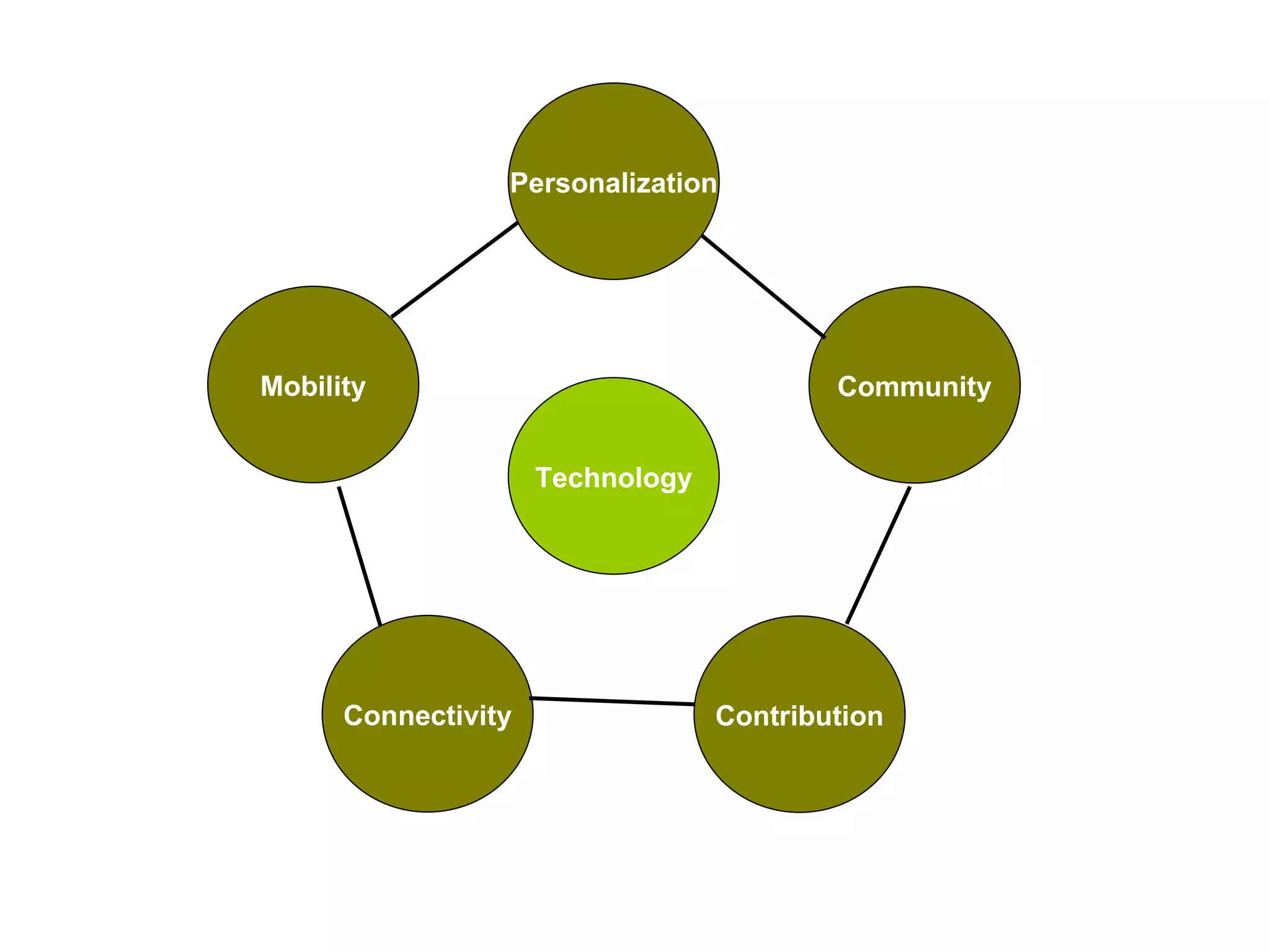
Mobility Connectivity Contribution Community Personalization Technology
Evolving Landscape Personalization Personal identity and environment accessed from anywhere Contribution Content creation and contribution Rating, reviewing, tagging, commenting, mixing and mashing Community Sharing, networking, collaborating Mobility Access anywhere, anytime with mobile devices Technology More smaller, faster, cheaper
The Web World User participation in basic Internet services such as searching and e-mail is almost universal Commonplace activities such as e-mail, maps and directions, booking flights, finding recipes, browsing health care sites, banking – tasks that used to require assistance People are not online only to accomplish specific tasks such as those mentioned above - users “hang out” online and increasingly spend time participating in social networks Five online social spaces are in the Alexa top ten global Web sites, including Facebook, Wikipedia, and YouTube  (source Alexa.com) YouTube had over 5 billion visitors in July 2008 Americans watched 558 million hours of online video during the month
 
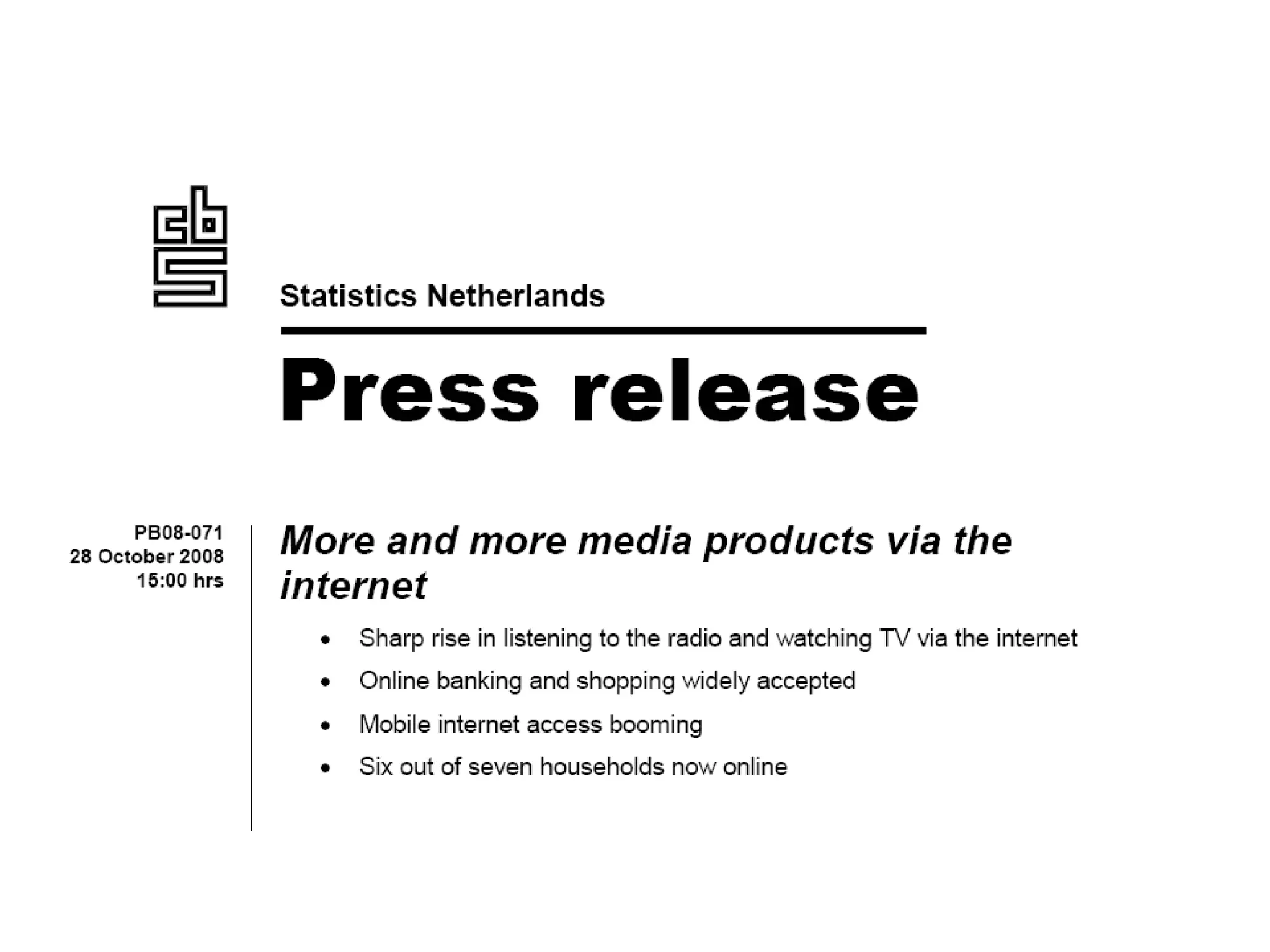
Connectivity - Broadband Broadband supports active participation in the online community, bringing together people with shared interests or problems to chat or collaborate  Broadband users spend on average 33% more time online than dial up users and report better outcomes from their Internet use (Nielsen/NetRatings) Broadband users are far more likely than dial-up internet users to create or post content to the internet - have a blog, post photos online, or contribute to chat-rooms Today in the Netherlands nearly three-quarters of households have a broadband connection
 
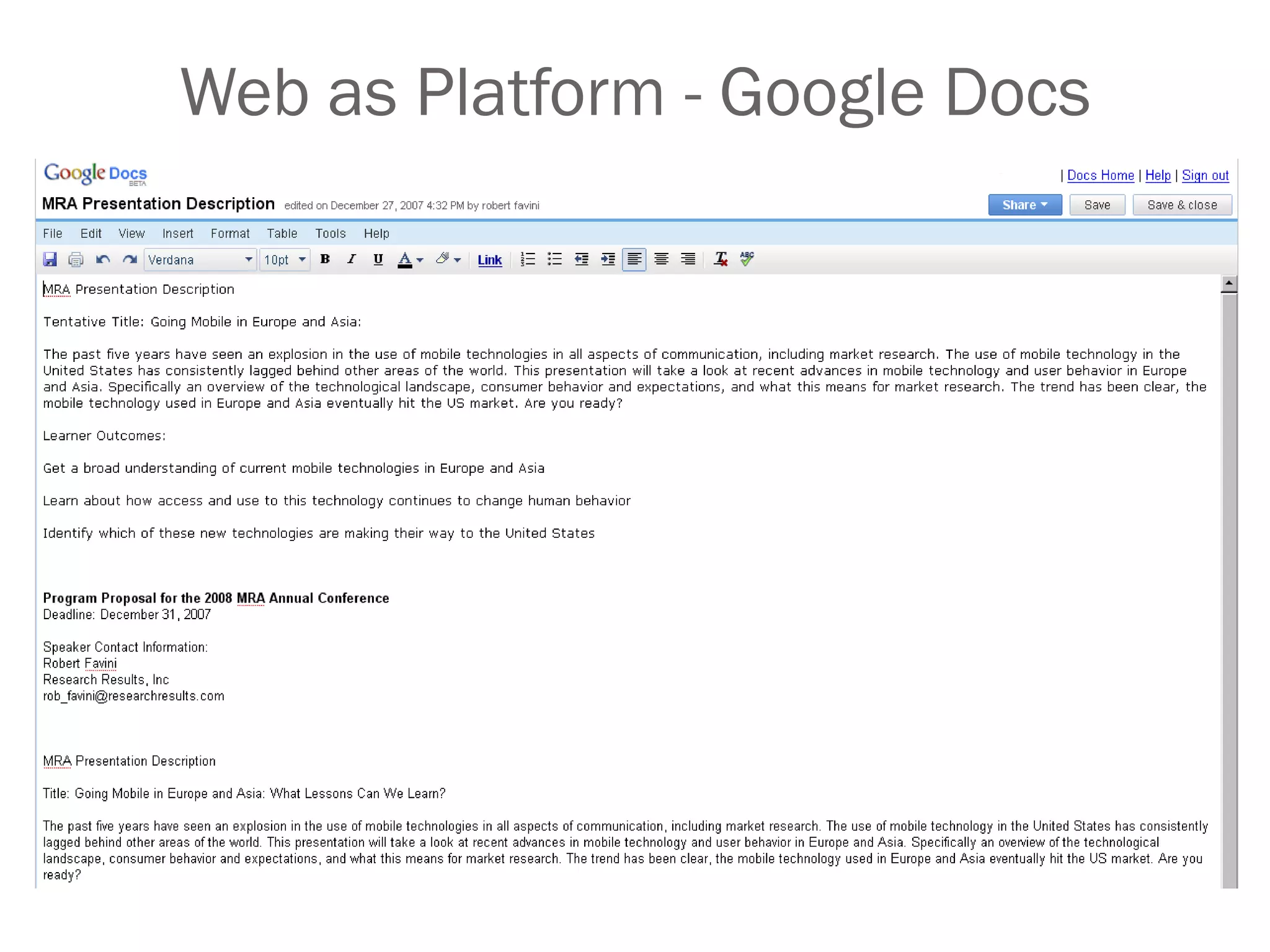
Web as Platform - Google Docs
A Richer User Experience Dynamic applications No more click and wait for screen refresh Beefed up experience thanks to Ajax and Flash Light, modular applications - don’t need to download and install programs to the desktop Interactive and responsive Customized / personal
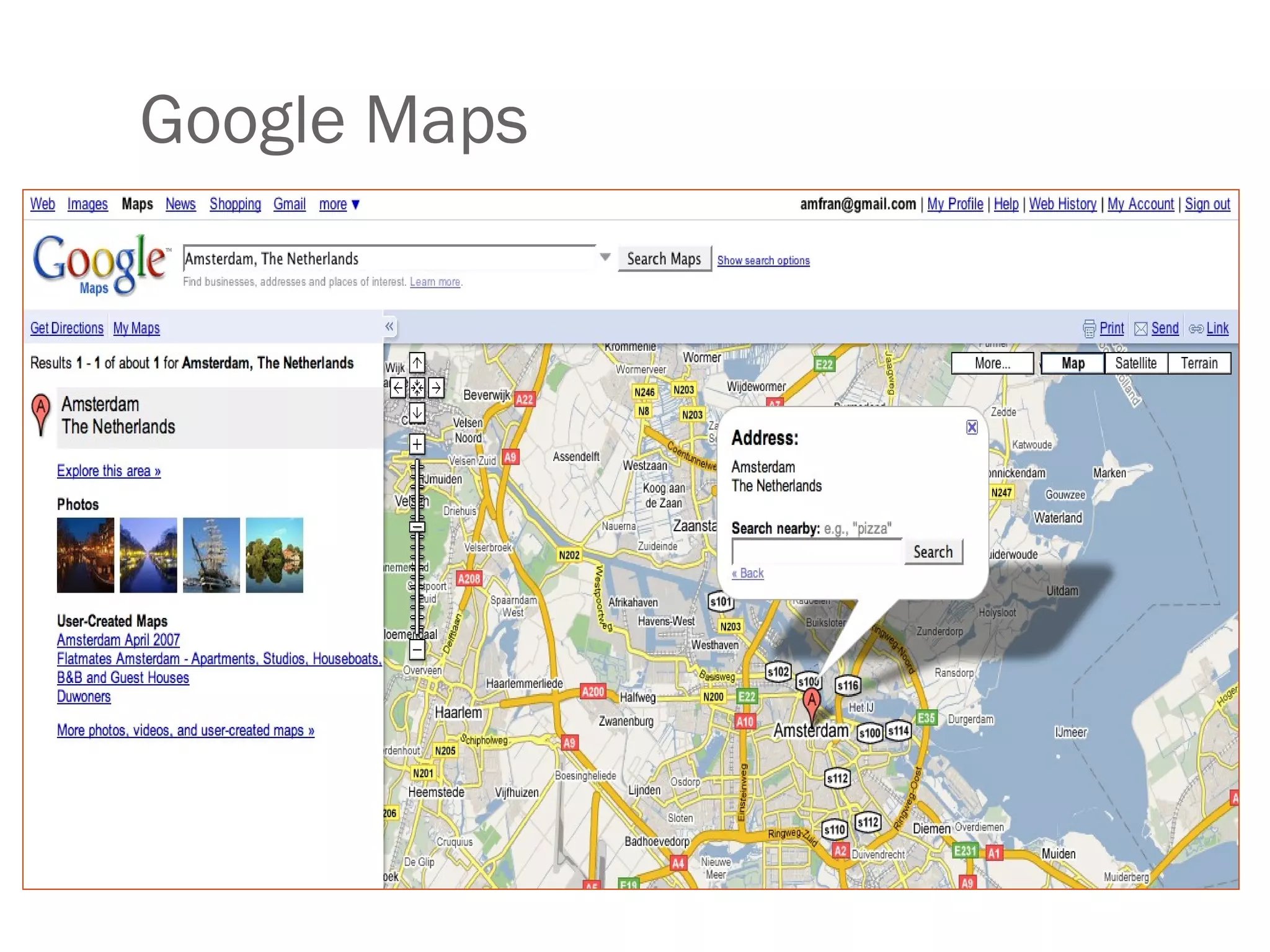
Google Maps
Connectivity - Cell Phone/Mobile 262.7 million wireless subscribers in the U.S. as of June 2008 – 84% of the population Wireless-only households: 15.8%  Minutes of use: 2.1trillion 600.5 billion SMS/text messages annually world wide as of June 2008 There are now more Wi-Fi hotspots in Europe (50,000 locations) than in the US (25,000) as of September 28, 2008 (source: muniwireless.com) Source: http://www.ctia.org/media/industry_info/index.cfm/AID/10323
Don’t Call it a Phone Within 5 years “mobiles” will replace the PC as the world’s access to the Web There are 3 times as many mobiles as PCs in the world More than 2 million people in the Netherlands accessed the Internet using mobile equipment such as a laptop or mobile phone in 2007. This is nearly 20 percent of all Internet users. Men and young people with higher education levels in particular are more likely to use a mobile connection. More than 330 million mobile users worldwide will own broadcast TV-enabled handsets by 2013
Mobility / Connectivity / Community
Self Service Web 2.0 is all about empowering individual users Eliminate barriers Reduce complexity Customize/personalize Anywhere any time User drives the process
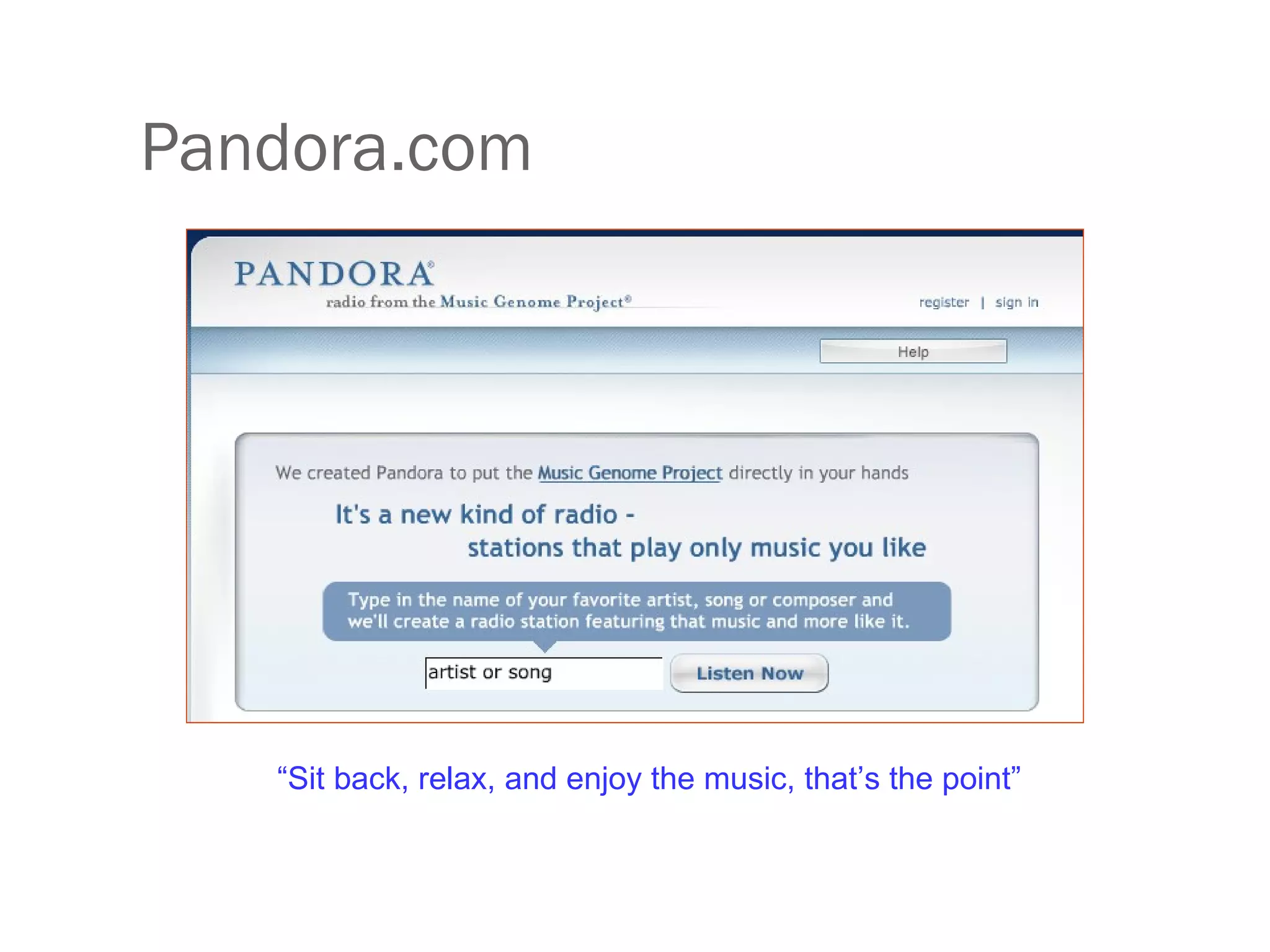
Pandora.com “ Sit back, relax, and enjoy the music, that’s the point”
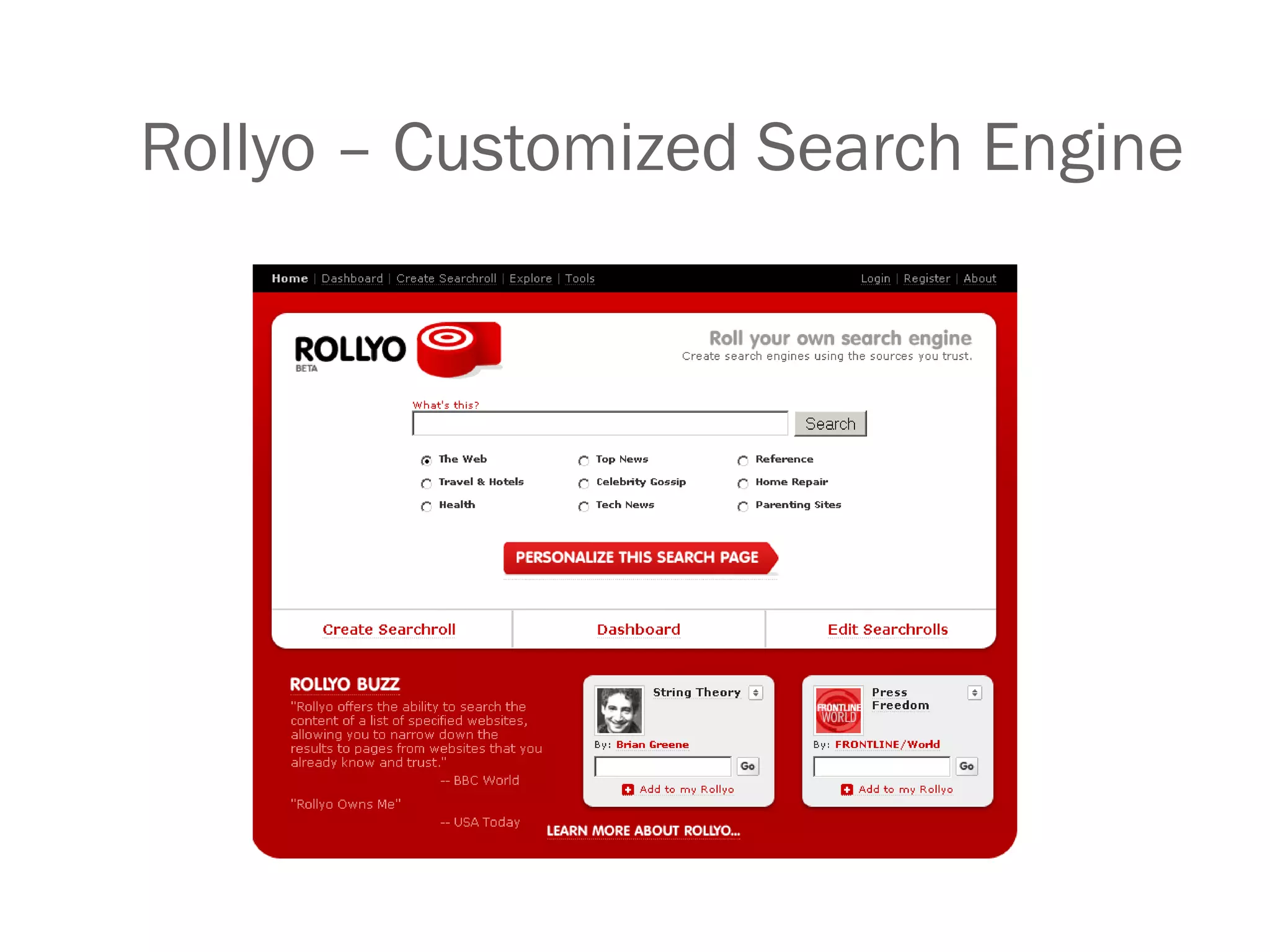
Rollyo – Customized Search Engine
Rollyo Searchrolls
Community Connecting Sharing Collaborating Participating Reputation, networking Reviews, ratings, recommendations The online community has diminished somewhat the role of traditional opinion makers such as marketers and critics in creating buzz about music, news, top stories, giving a greater voice to collective judgments of connected people
 
iTunes – Guiding Users to Content
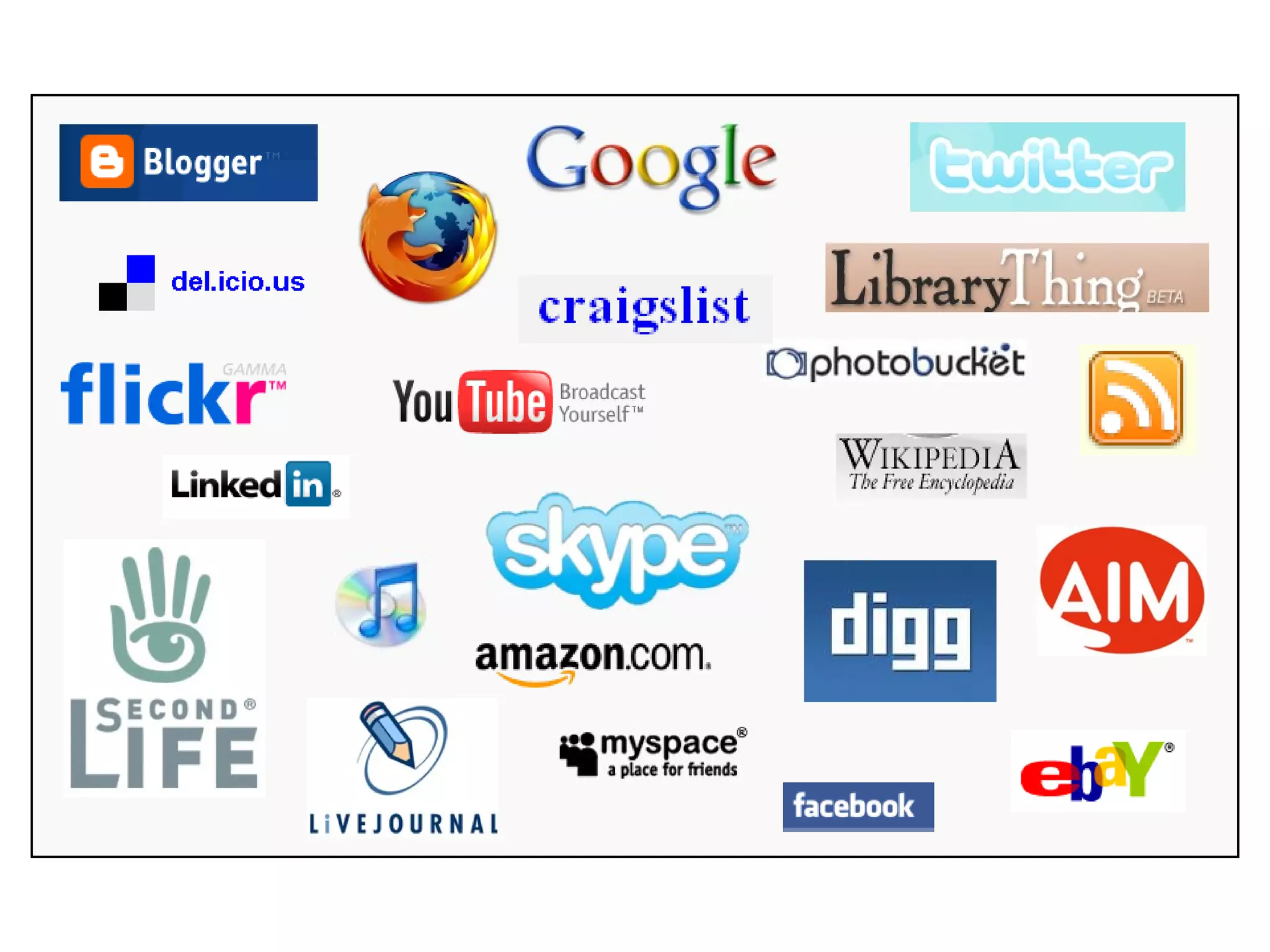
Participation Low barriers to participation Availability of free tools: Blogger, PB Wiki, Audacity, Slideshare No special skills required Web 2.0 sites make it easy for users to contribute all kinds of content Images, videos, audio, ideas, information, comments, conversations, collaborations, ratings, reviews Popular sites thrive on user contributions, ratings and shared content: YouTube, digg, craigslist, MySpace, flickr, del.icio.us, etc.
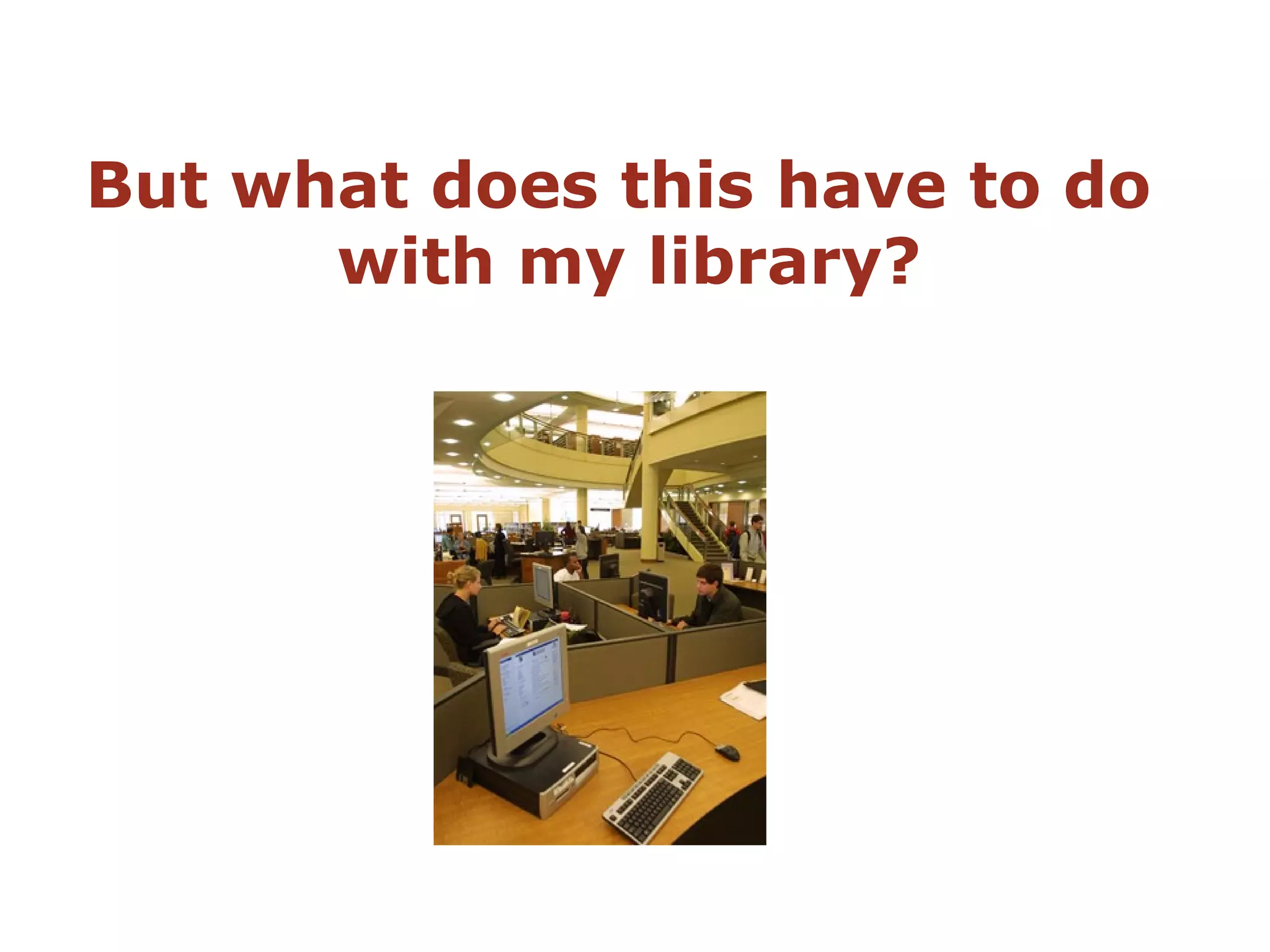
But what does this have to do  with my library?
Expectations 2.0 Library user expectations are driven by experiences and technology available on the commercial Web It’s a social phenomenon, not just technology Library 2.0 is a new model for library service It’s a chance to rethink and retool what we do and who we are
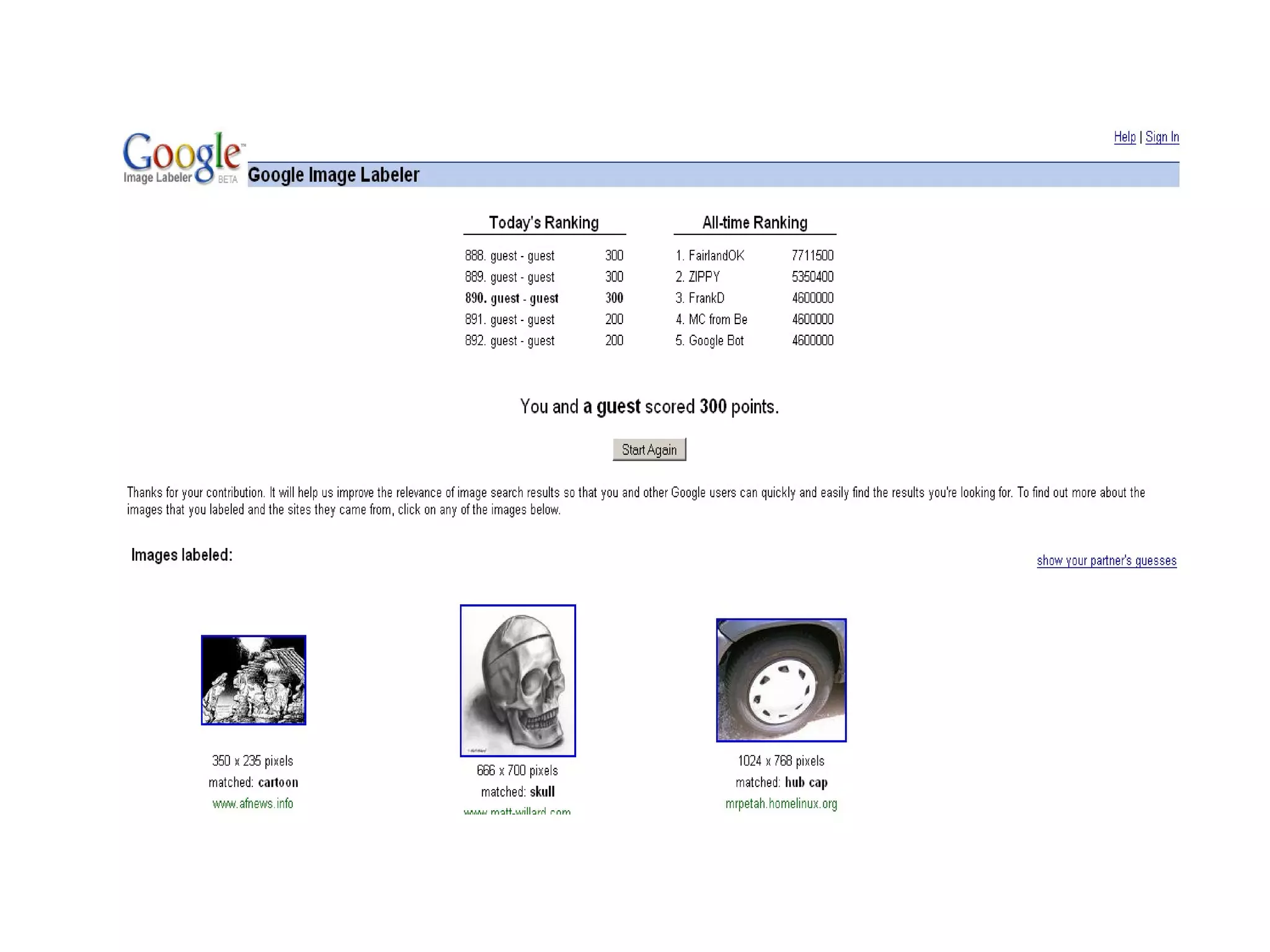
23 Things Blogs and blogging Social software Delicious LibraryThing Photos & Images Flickr Image generators RSS Feeds and readers Tagging & Folksonomies Tag clouds Google Image Labeler Online tools & Applications Word processing Spreadsheets Mashups Wikis Wikipedia PB wiki Audio & Video Podcasts &Vodcasts Audiobooks YouTube
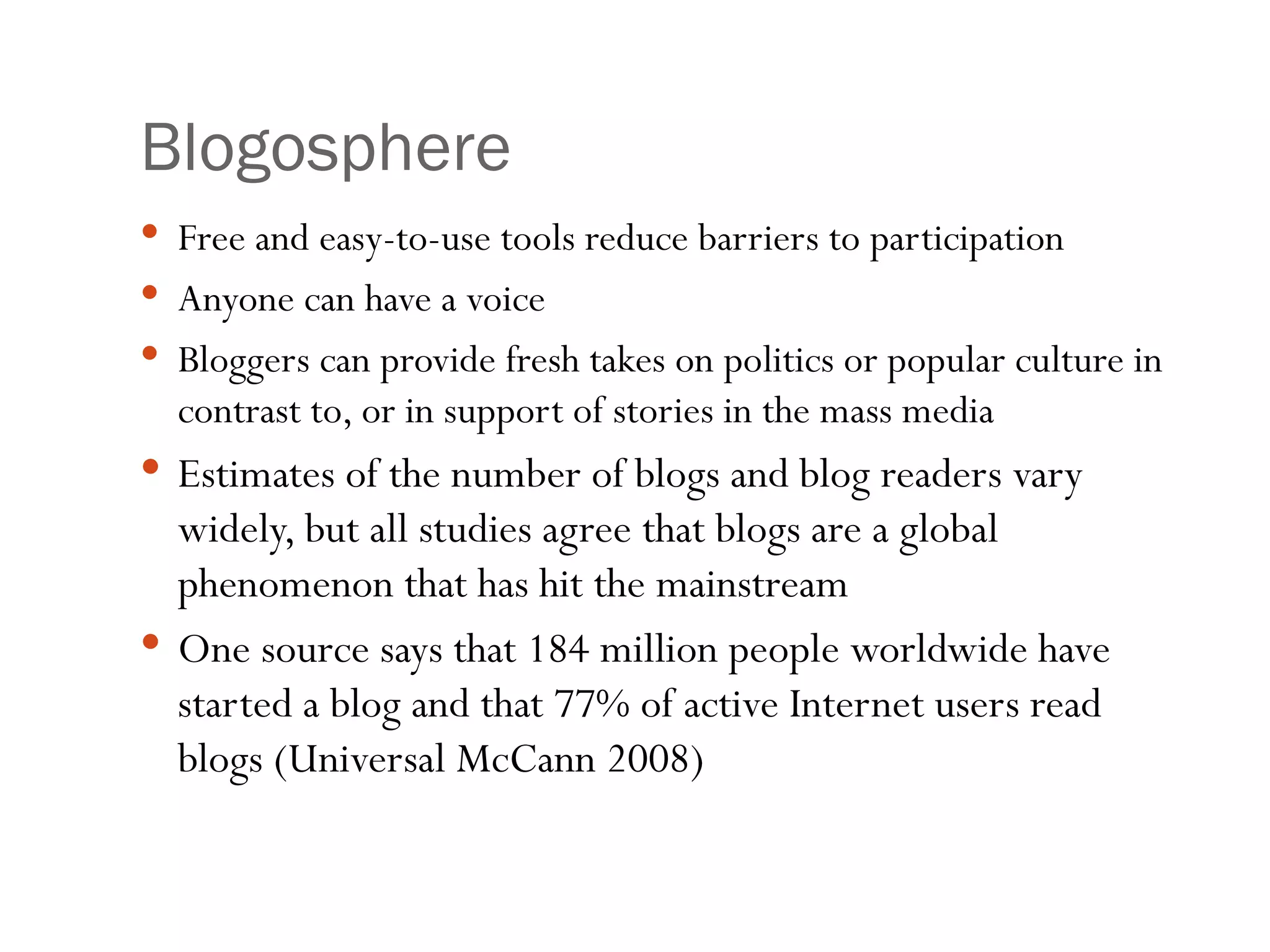
Blogosphere Free and easy-to-use tools reduce barriers to participation Anyone can have a voice Bloggers can provide fresh takes on politics or popular culture in contrast to, or in support of stories in the mass media Estimates of the number of blogs and blog readers vary widely, but all studies agree that blogs are a global phenomenon that has hit the mainstream One source says that 184 million people worldwide have started a blog and that 77% of active Internet users read blogs (Universal McCann 2008)
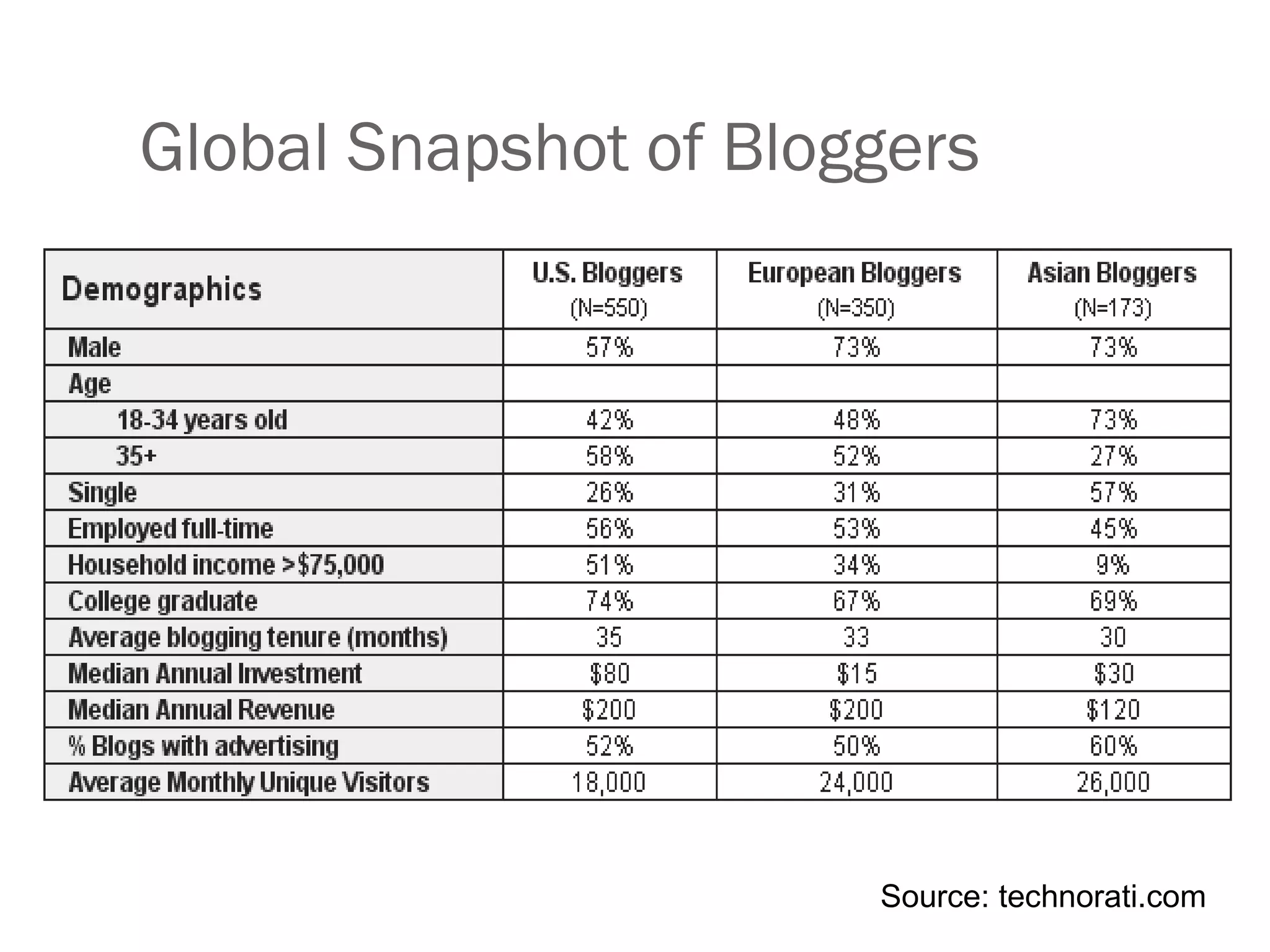
Global Snapshot of Bloggers  Source: technorati.com
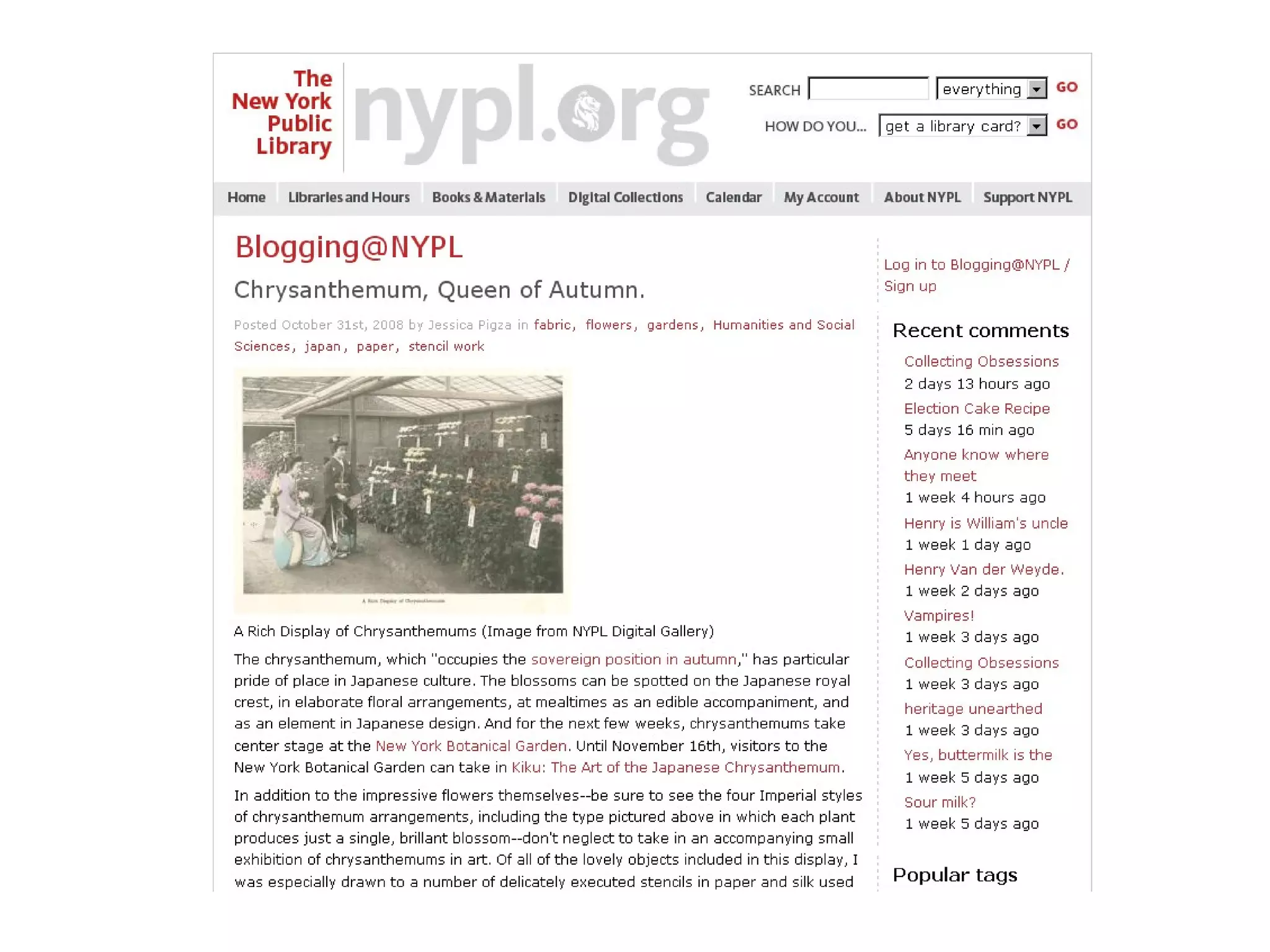
How Are Libraries Using Blogs? Blogs are, in practice, communities of interest Post up-to-date information about the library and the community Collection materials, events, projects Keep it current and local Supply links to articles, announcements, newspapers, journals, publications, reviews, Web sites, and other resources on topics of local interest Provide a forum for patrons to comment and ask questions Generate interest, conversation, community


Has the Blog Craze Peaked? Blogs, to use the words of one 19 year old contact are"so, so yesterday and all my friends are on Facebook"  It’s a lot of writing, which can be time-consuming To attract a substantial audience, you have to have something to say on an ongoing basis Researchers for the Oxford English Dictionary claimed in 2007 that "the 15 most frequently used words in the blogosphere" (presumably the Anglo part of the blogosphere) are blogger, blog, stupid, me, myself, my, oh, yeah, ok, post, stuff, lovely, update, nice, [four letter word beginning with s]
The End of a Blog
Microblogs or Tumblelogs People have noticed a movement among bloggers to Twitter, or other similar services, called microblogs, or tumblelogs Immediate, spontaneous contributions  Usually consist of short phrases about what the person is doing at that moment – limit is 140 characters “ walked straight into a hole” ; “spying a second cup of tea” Many people post from a mobile phone from wherever they are Content can be displayed online or delivered by SMS to people who subscribe to a particular microblog
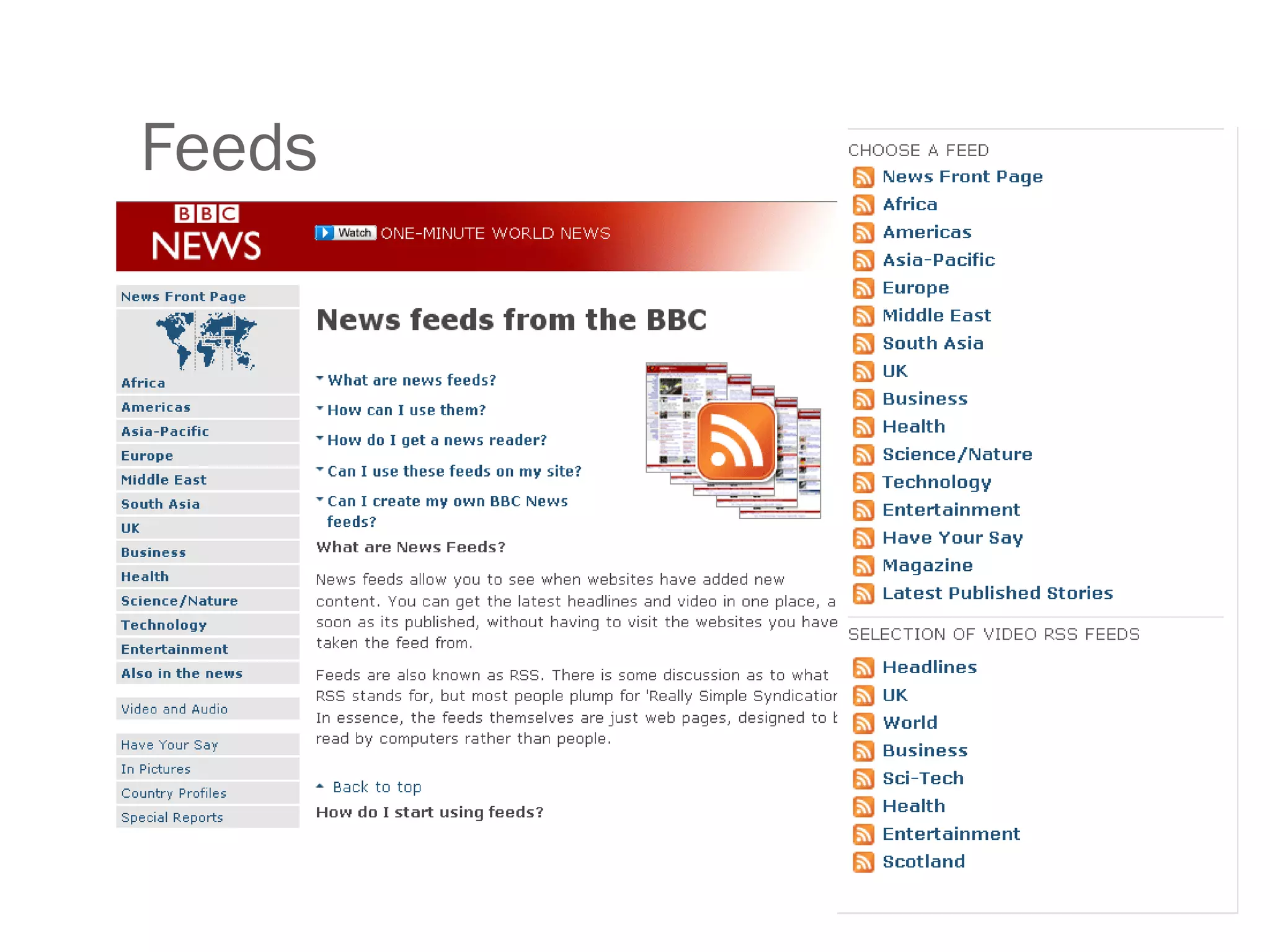
RSS Really Simple Syndication (RSS) RSS Readers A tool to help control the information juggernaut that is the WWW –monitor incoming content from selected sites Time saver/information manager RSS Feeds Publishers (of all kinds) provide content in specific format News, stock quotes, updates, blogs, wikis, etc. Users subscribe to feeds based on interests Alerts users to new content, updates, changes, or comments automatically Reduces need to visit multiple, individual Web sites to stay up to date
Feeds
Google Reader
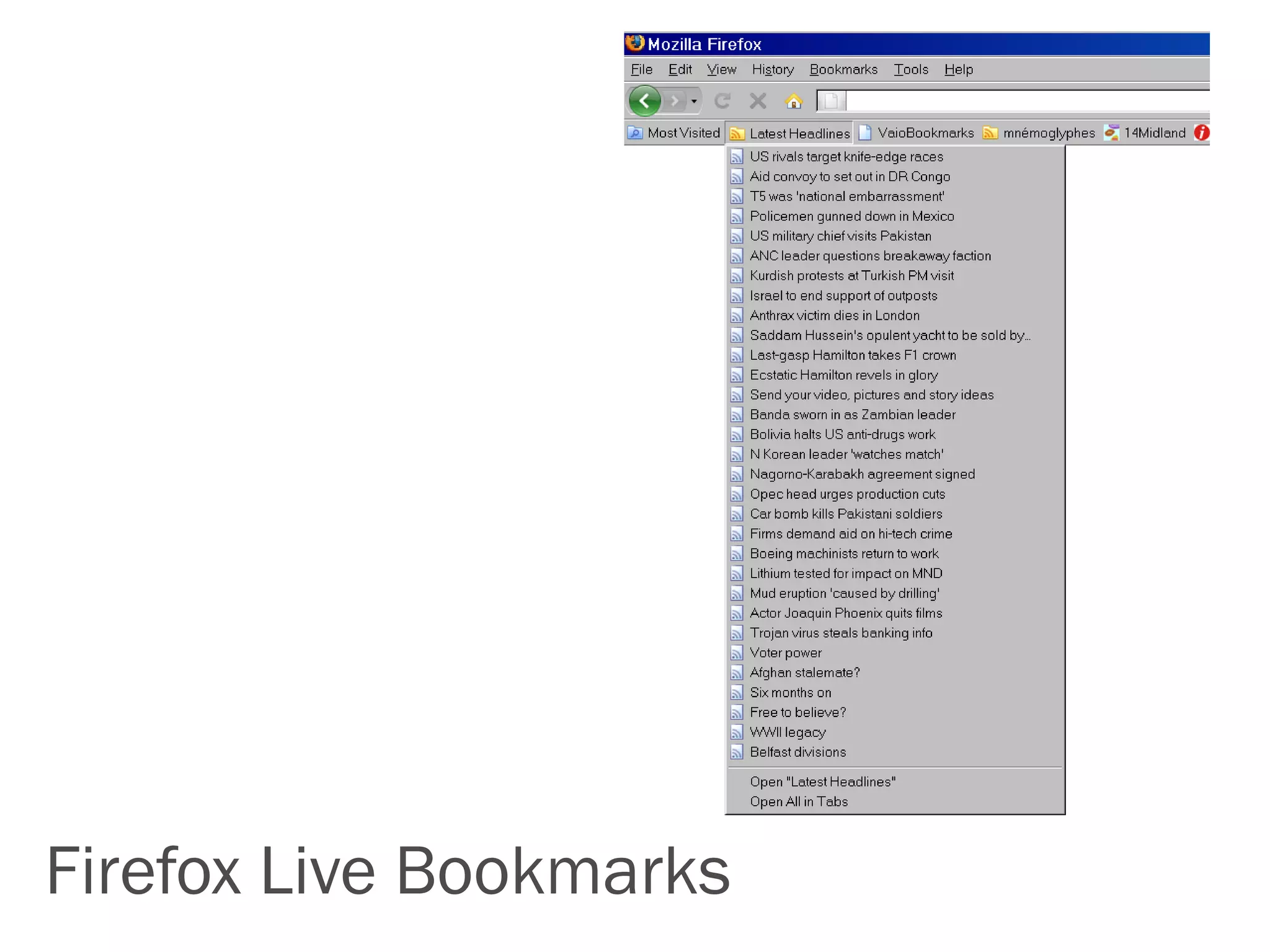
Firefox Live Bookmarks
Australian National University
 
Wikis Hawaiian word for "fast" Tool for collaborative resource creation via the Web  Share the creation, editing, and maintenance of a resource among multiple collaborators Authorized users can add/delete/modify content Maintains page histories Allows comments Offers RSS feeds for updates
Wiki versus Blog wiki is… collaborative multi-page resource always in flux infinitely editable internally linked Community-based blog is … opinionated one-sided chronological little internal linking/lots of external linking immediate
The Most Famous Wiki of All Goal: “…to put the sum of all human knowledge in the form of an encyclopedia in the hands of every single person on the planet for free.”  -Jimmy Wales, cofounder and chief executive
 
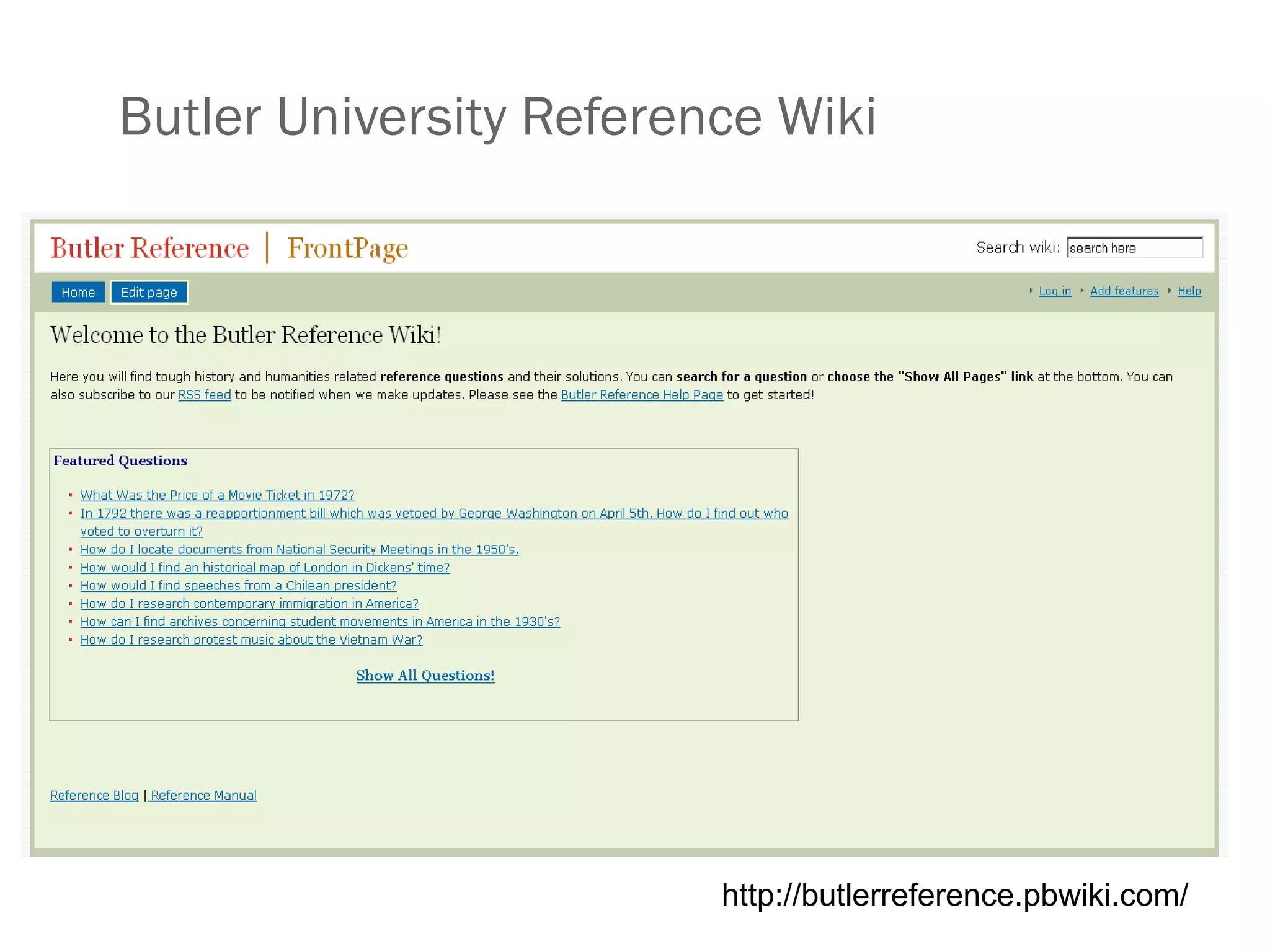
How Can a Library use Wikis? Internal policy formation/dissemination Local topic wikipedia Reference how-to guides Reference pathfinder
Butler University Reference Wiki http://butlerreference.pbwiki.com/
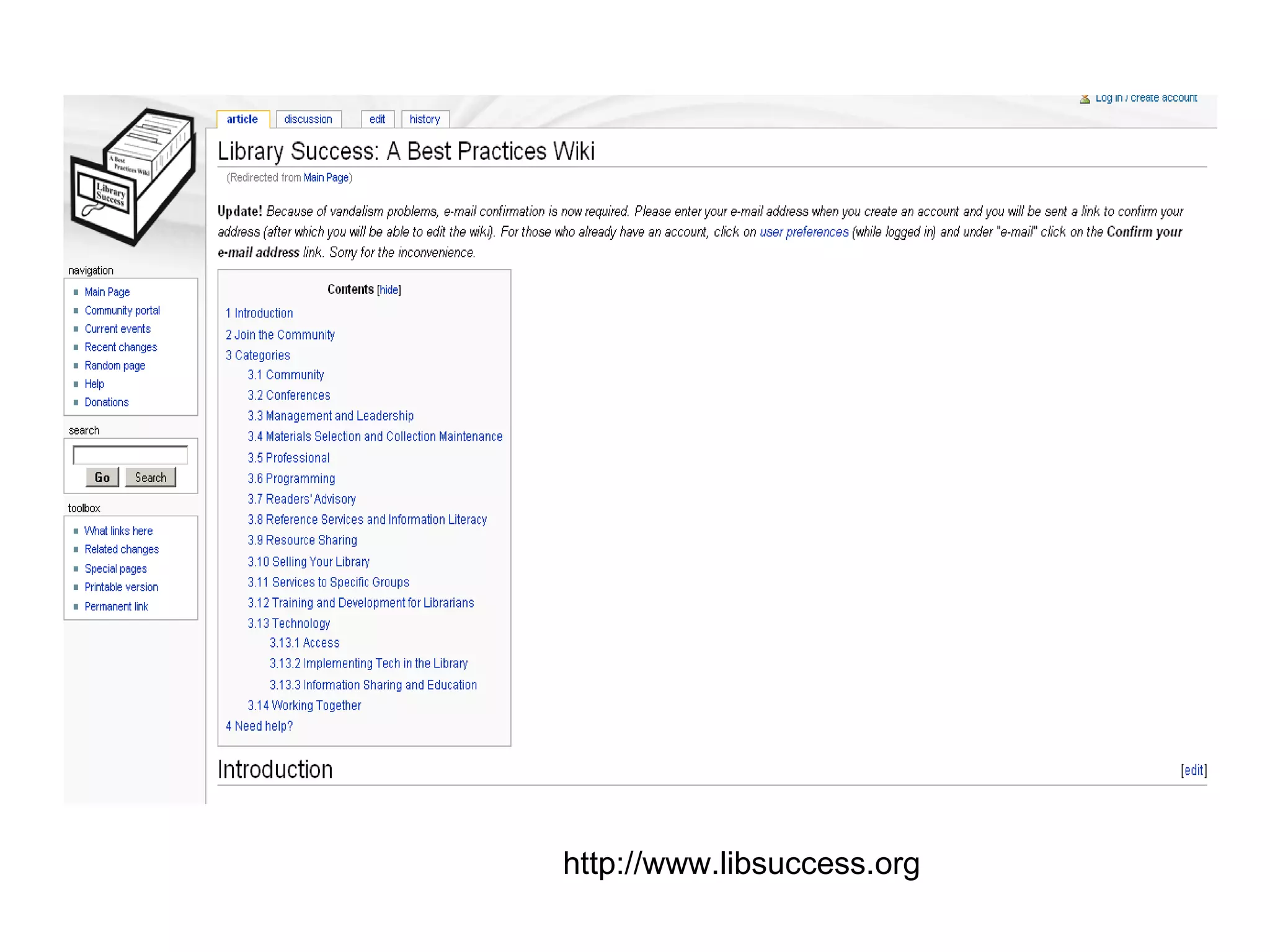
http:// www.libsuccess.org
Podcasting Audio and video content Video blogs are sometimes called vblogs or vlogs Short segments Educational programs Library tours Recorded events Author talks Book discussions Public meetings Allow people to comment, start conversations online, participate asynchronously
Glasgow University Library Fresher’s Podcast Law Podcast  Guide Podcast
University of Aberdeen
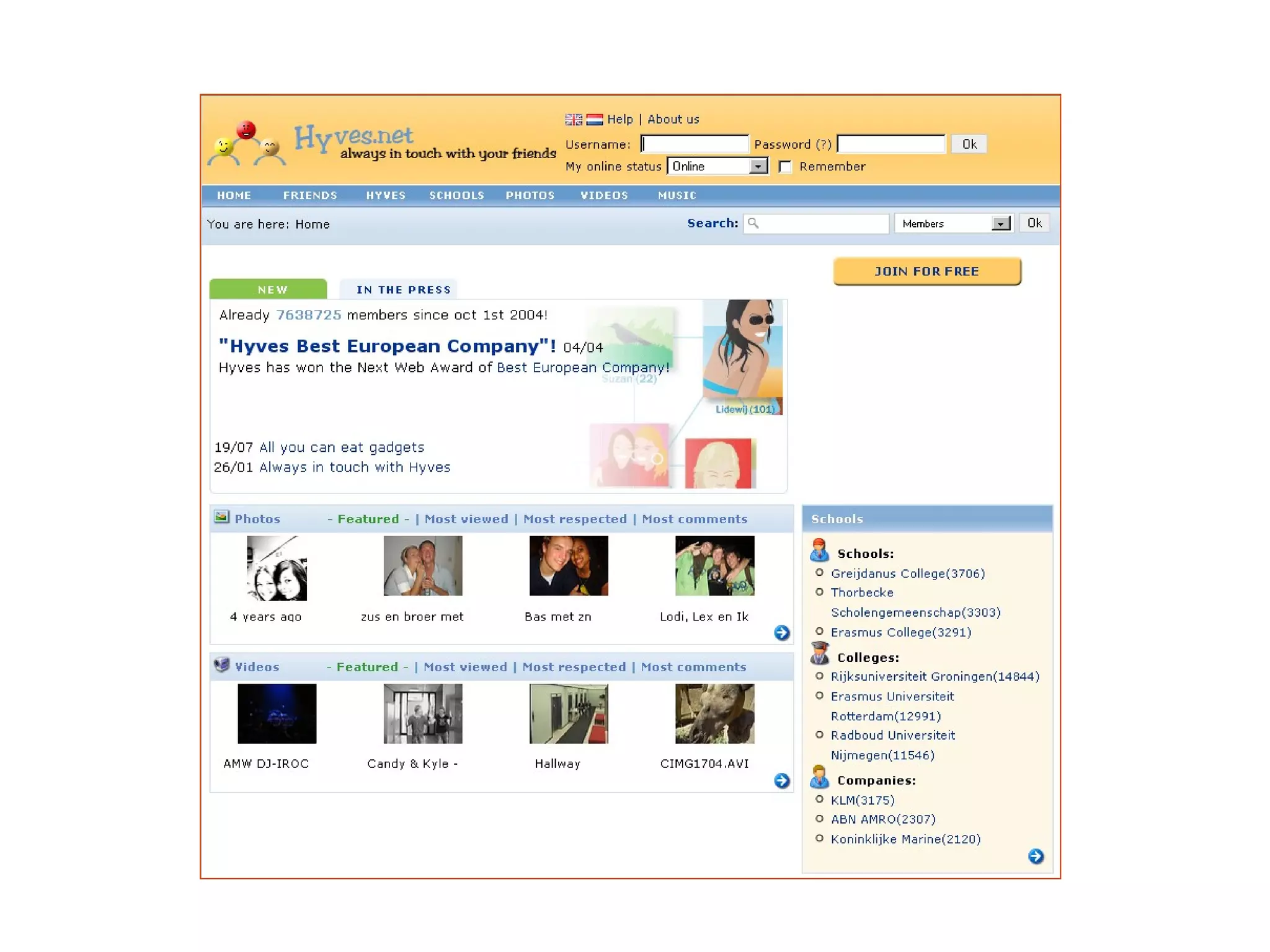
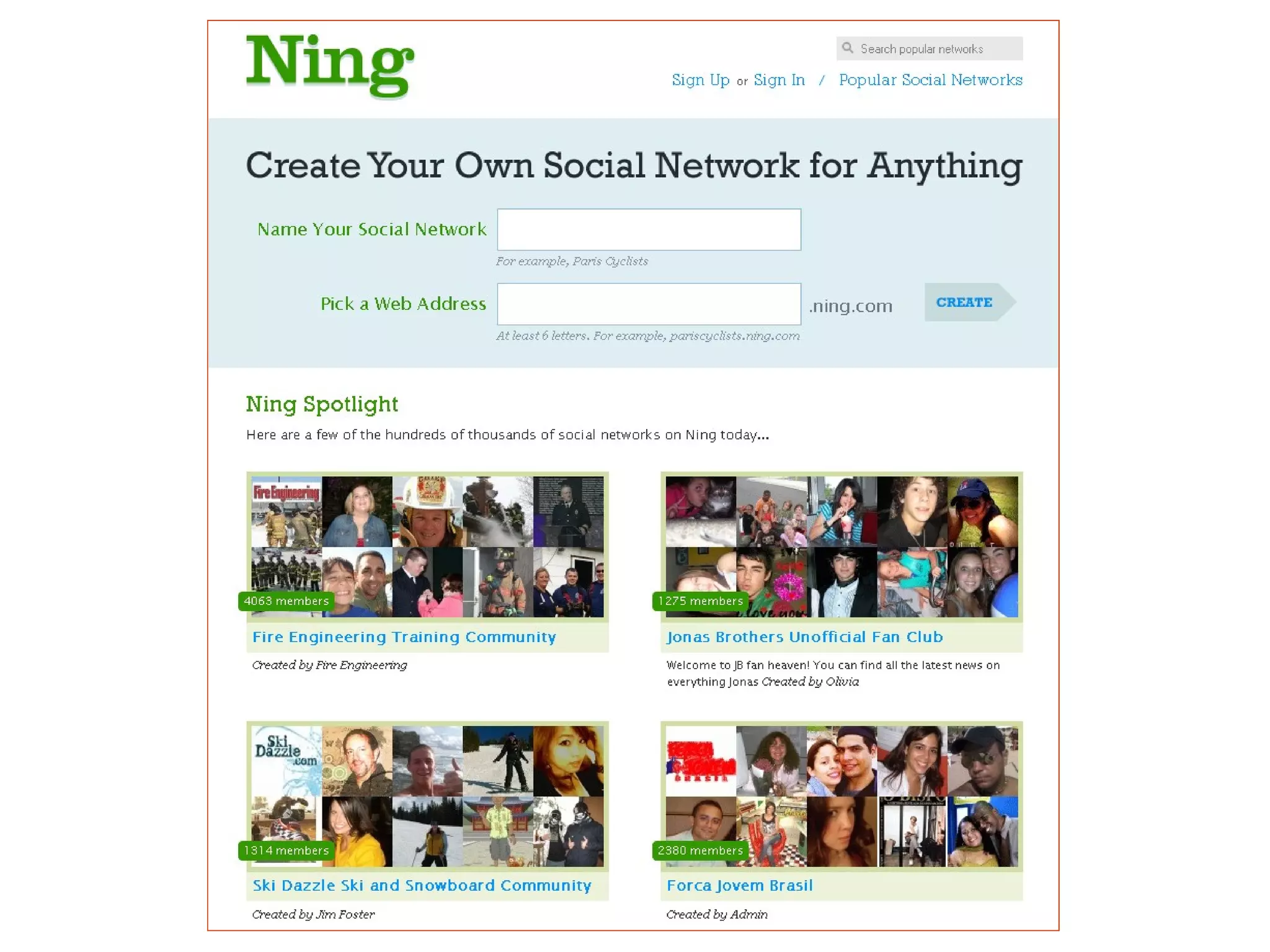
Social Networks Online communities Connecting with other people in a variety of ways for a variety of reasons Friendster LinkedIn MySpace Facebook Hyves Virtual worlds Gaming Second Life
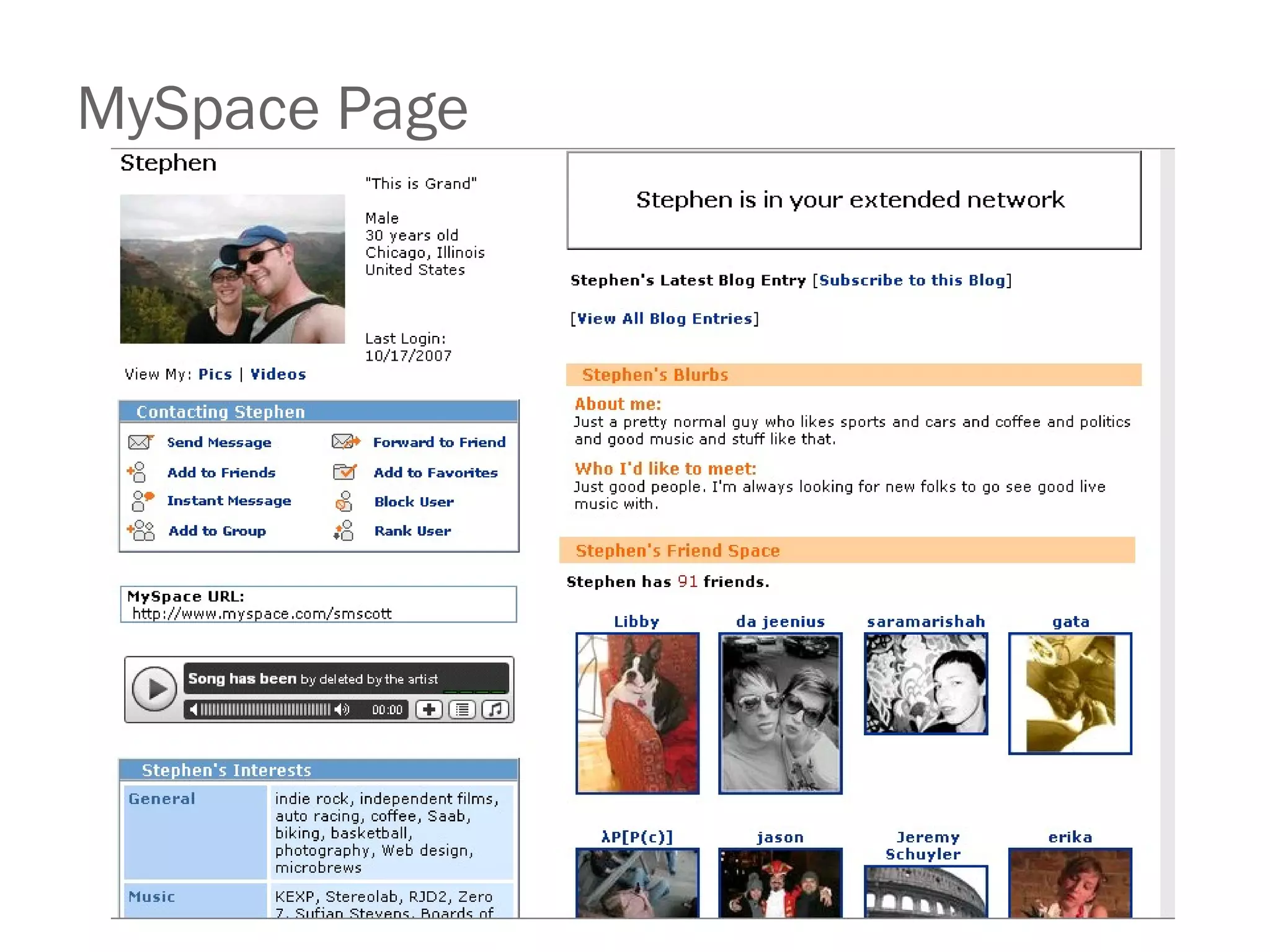
MySpace Page
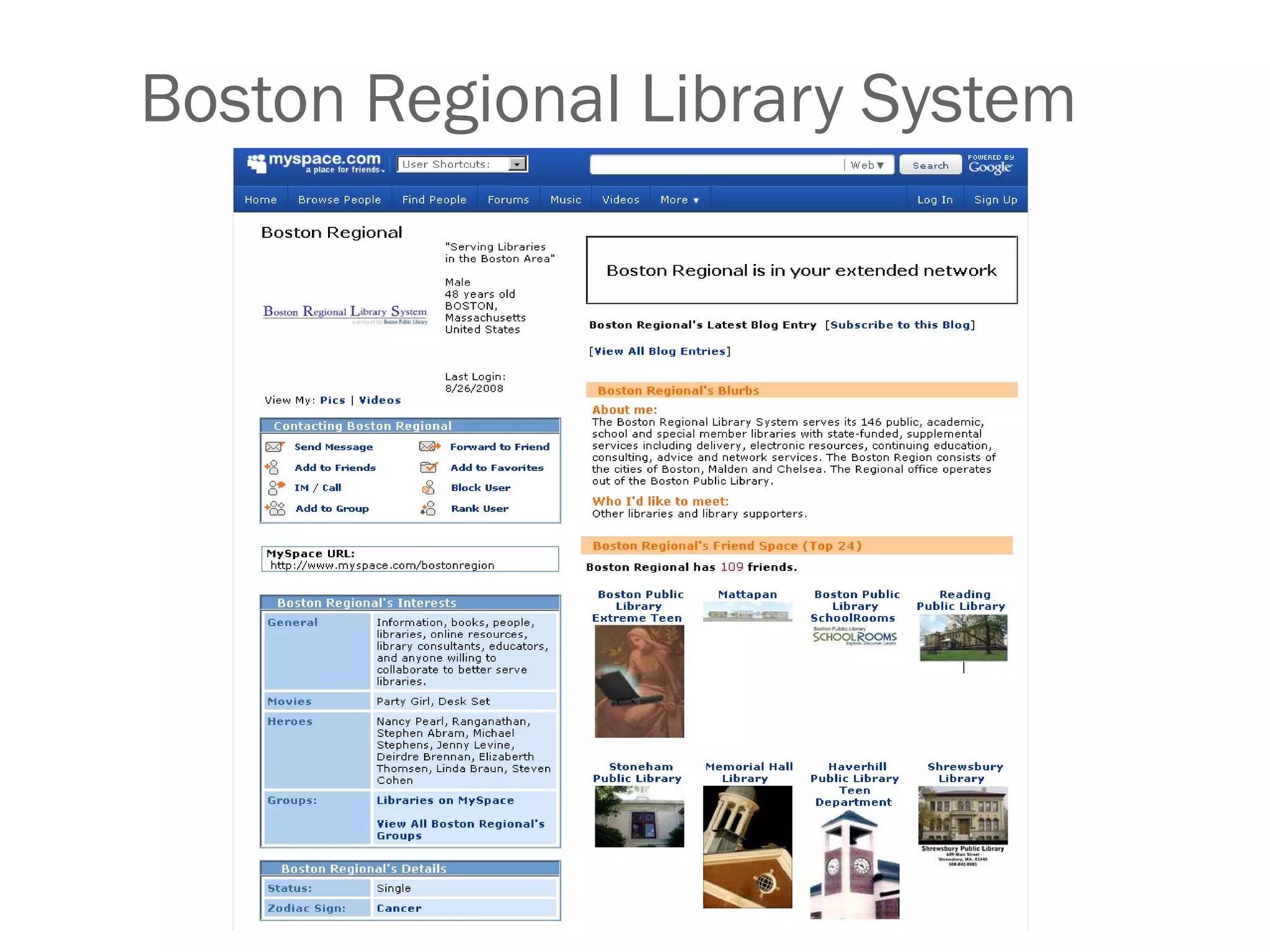
Boston Regional Library System
Facebook
 
Social Networking As of November 1, 2008


Virtual Worlds A virtual 3D Web world you can walk through Interact with others in a virtual landscape through avatars Virtually attend meetings, shop, dance, rent an apartment Explore alternate worlds 3D gaming, education Interact, collaborate, contribute in more dimensions
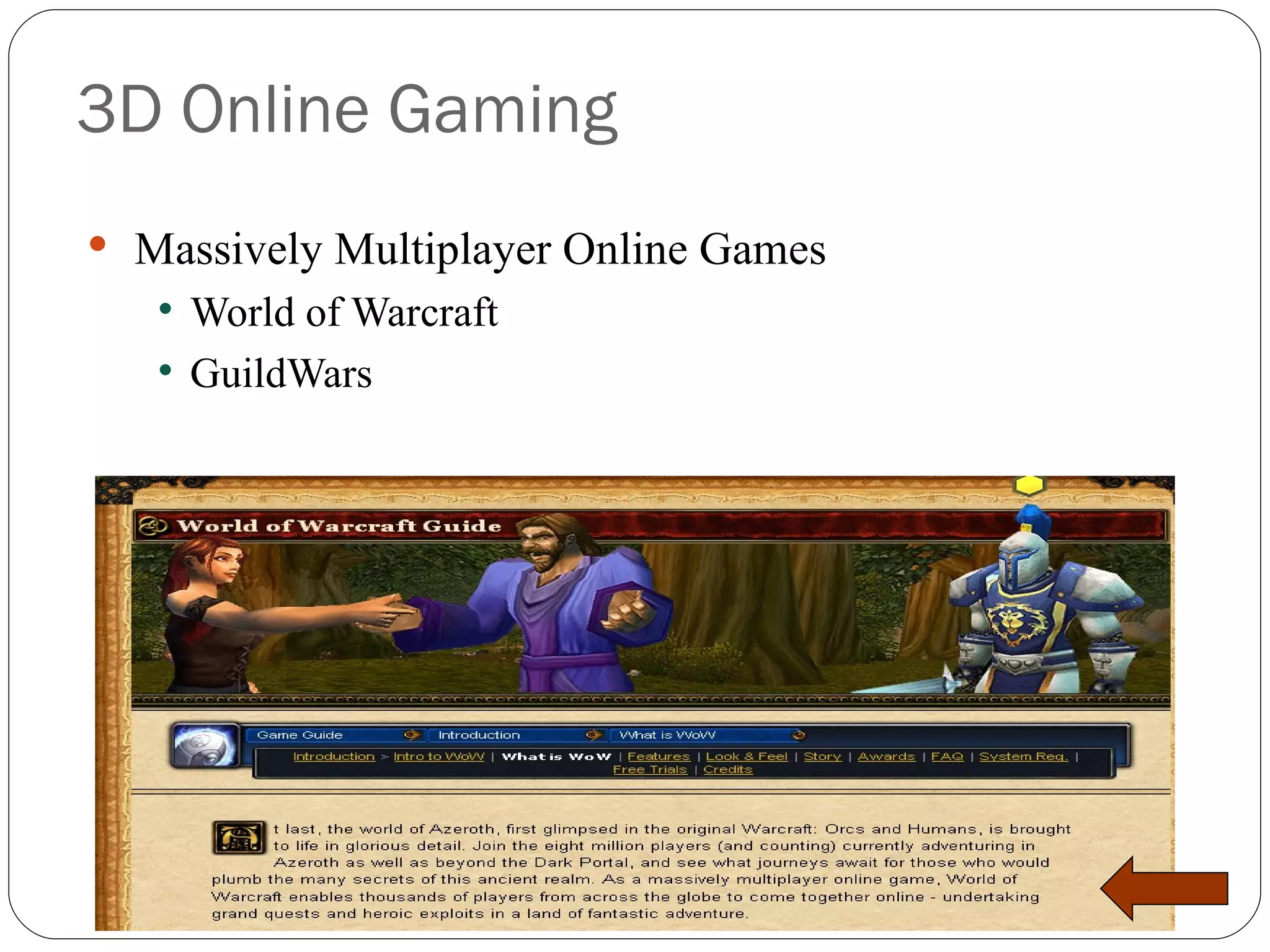
3D Online Gaming Massively Multiplayer Online Games World of Warcraft GuildWars
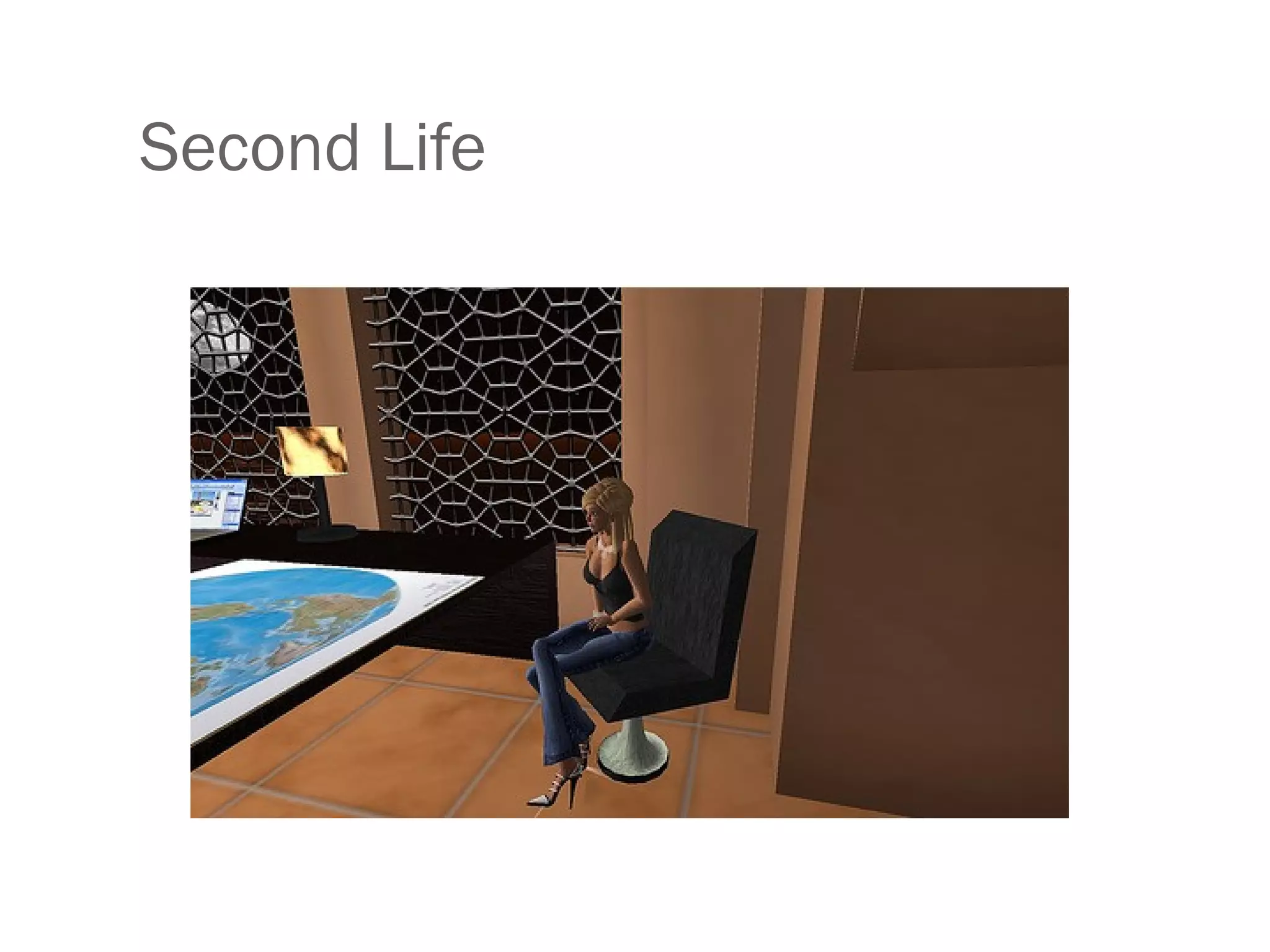
Second Life Second Life is a 3D virtual world entirely built and owned by its residents Opened to the public in 2003 Over 9 million inhabitants from around the globe Interact with other inhabitants  Build a house or business Libraries and library services have been established Virtually attend book discussions Offer reference services to in-world visitors
Second Life
Events in Second Life
You’re Invited
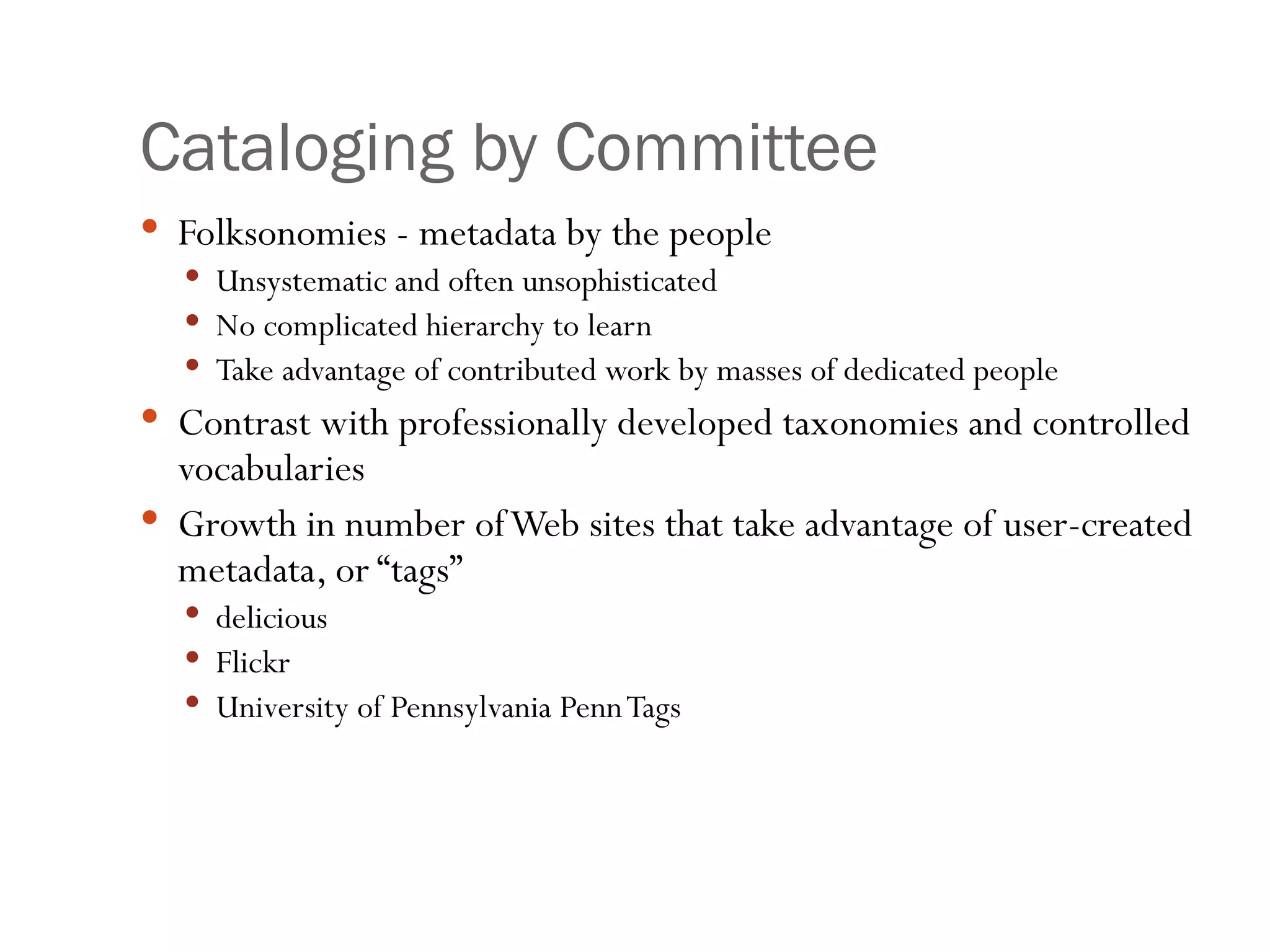
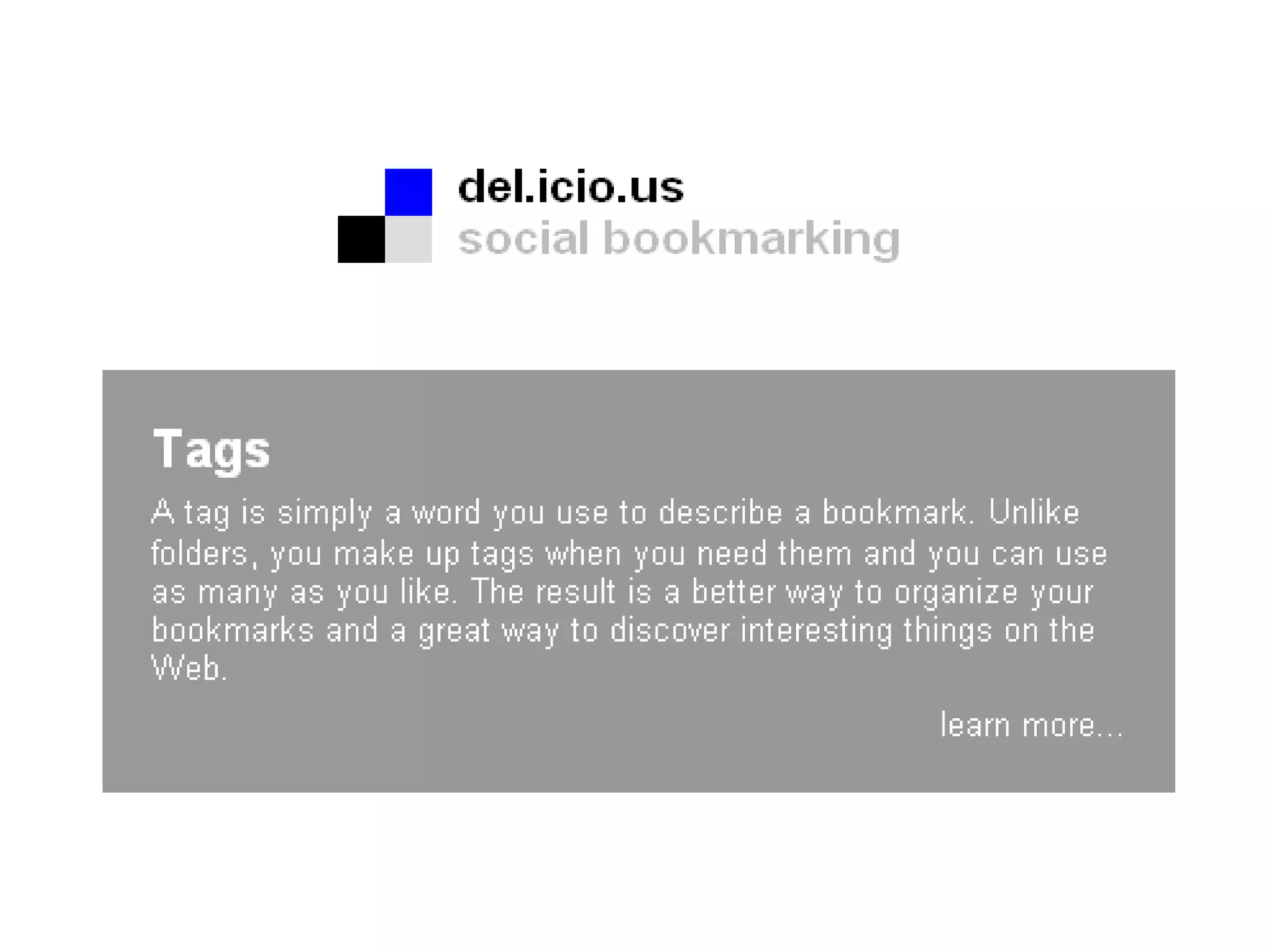
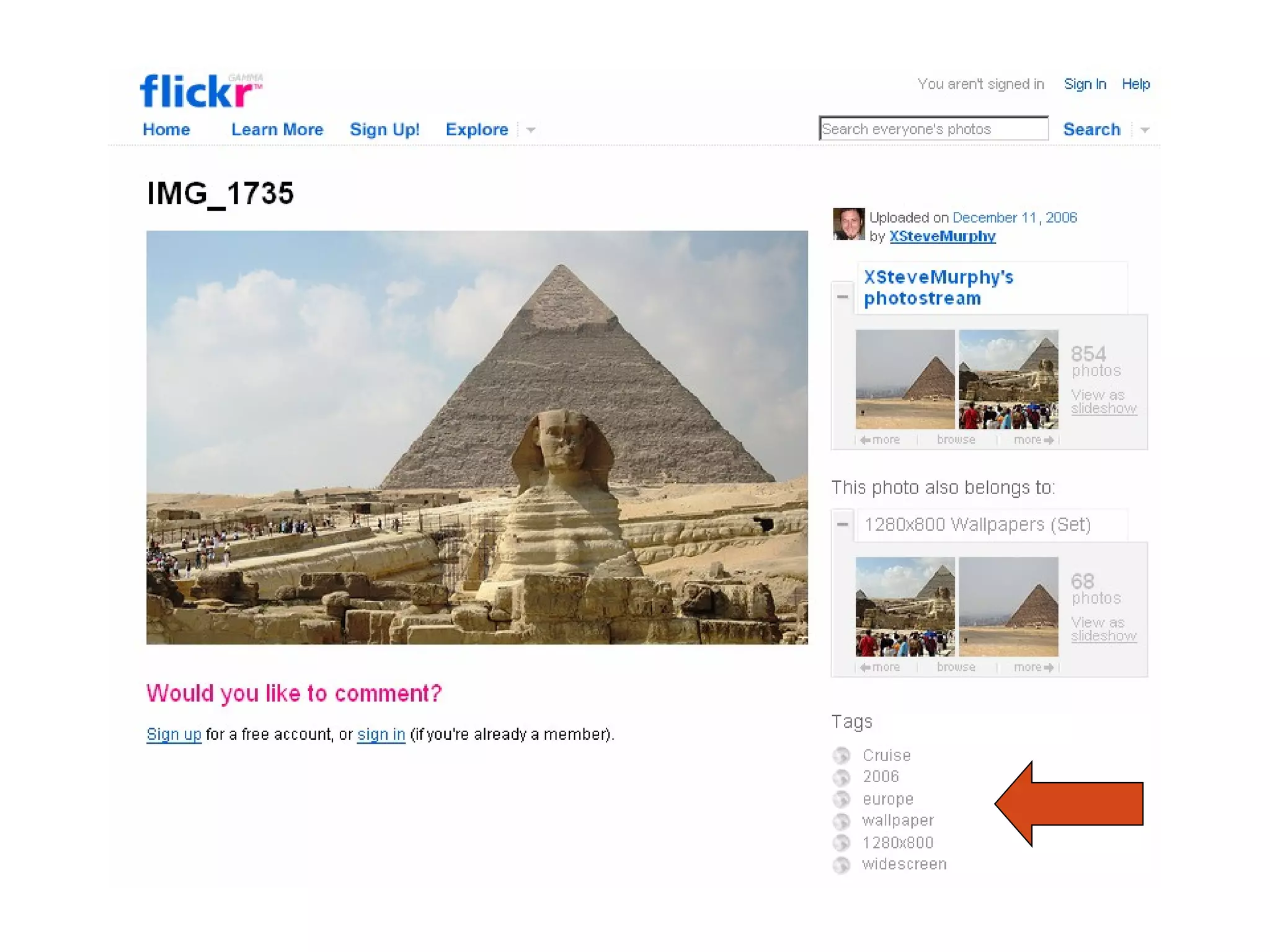
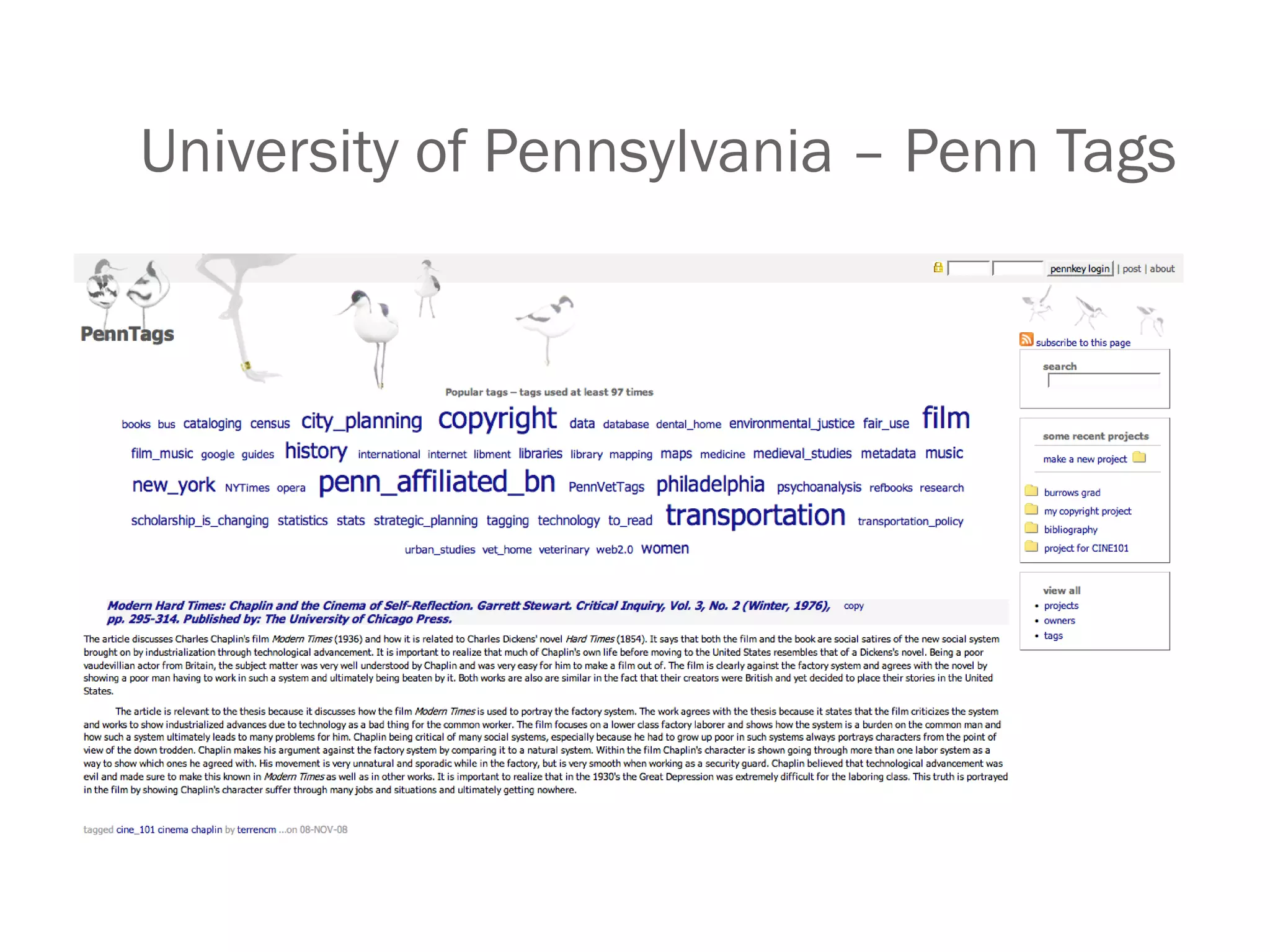
Cataloging by Committee Folksonomies - metadata by the people Unsystematic and often unsophisticated No complicated hierarchy to learn Take advantage of contributed work by masses of dedicated people Contrast with professionally developed taxonomies and controlled vocabularies Growth in number of Web sites that take advantage of user-created metadata, or “tags” delicious Flickr University of Pennsylvania Penn Tags


Aggregated Data Large quantities of data provide valuable information Data mining Recommendations, reviews, ratings One person’s opinion versus 135 people’s opinions Tagging Individual, personal tags versus collective wisdom
 
University of Pennsylvania – Penn Tags
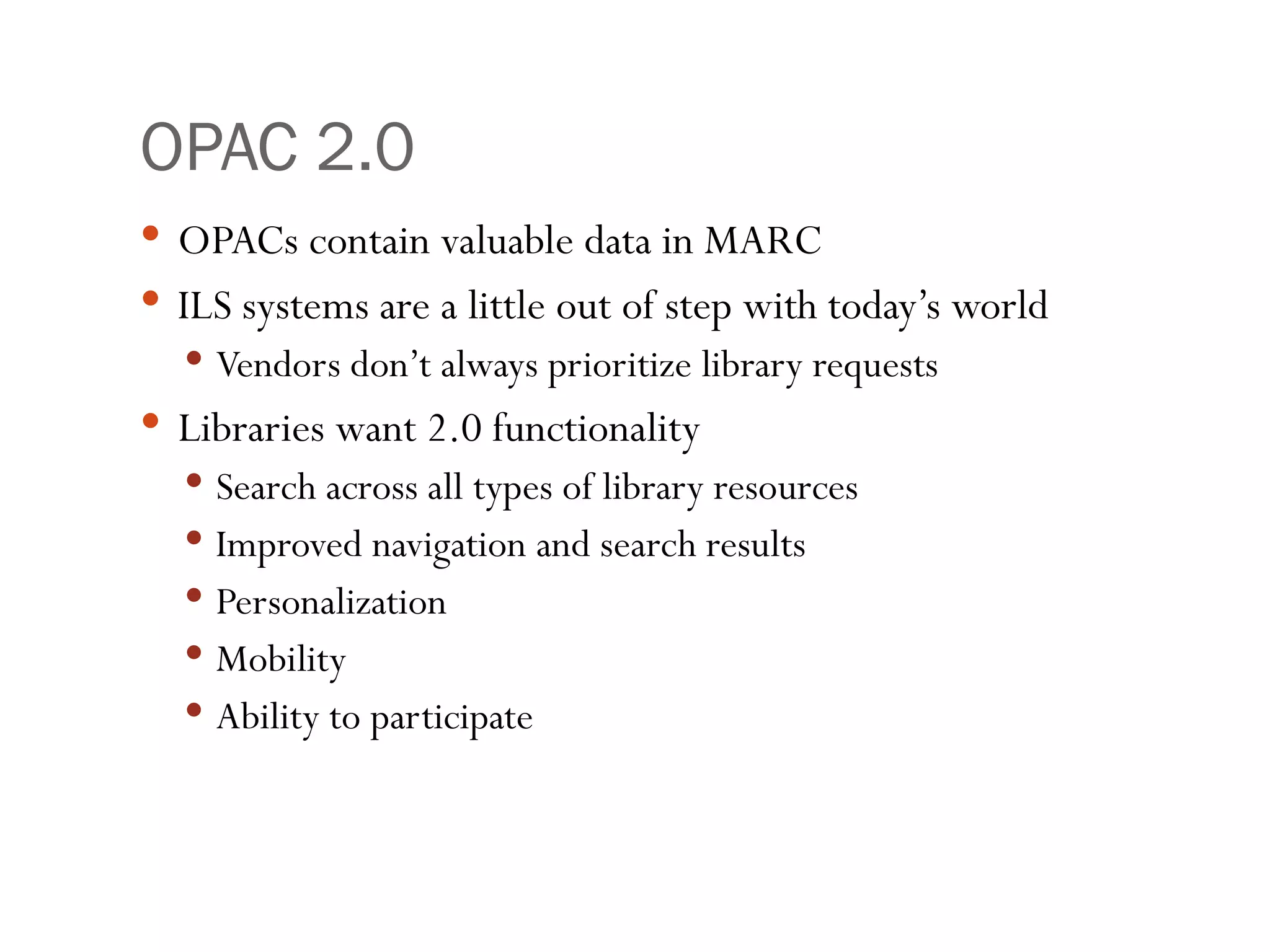
OPAC 2.0 OPACs contain valuable data in MARC ILS systems are a little out of step with today’s world Vendors don’t always prioritize library requests Libraries want 2.0 functionality Search across all types of library resources Improved navigation and search results Personalization Mobility Ability to participate
 
 
University of Chicago
Boston College – Finding Aid
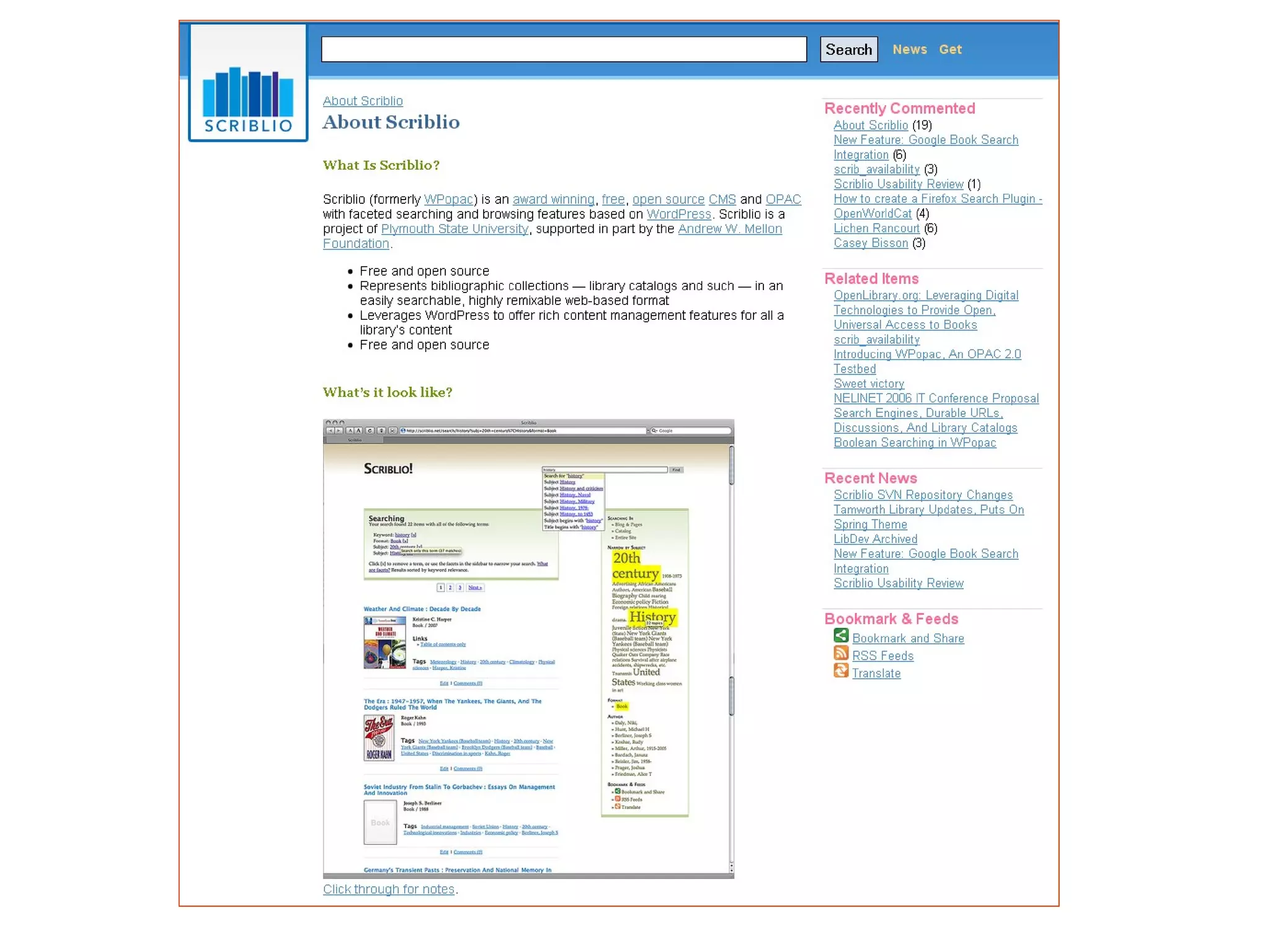
VuFind – Integrating Data Sources
 
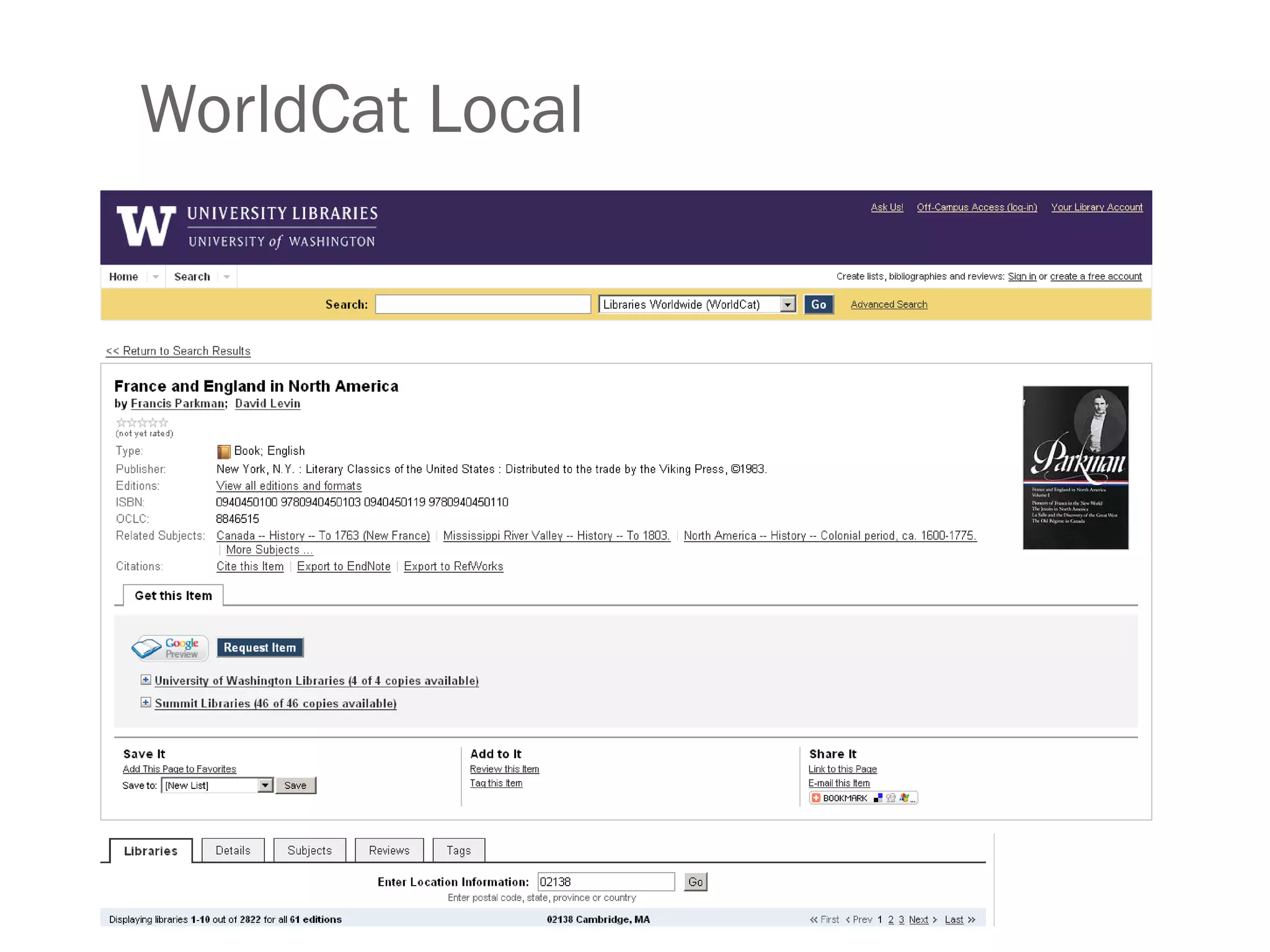
WorldCat Local
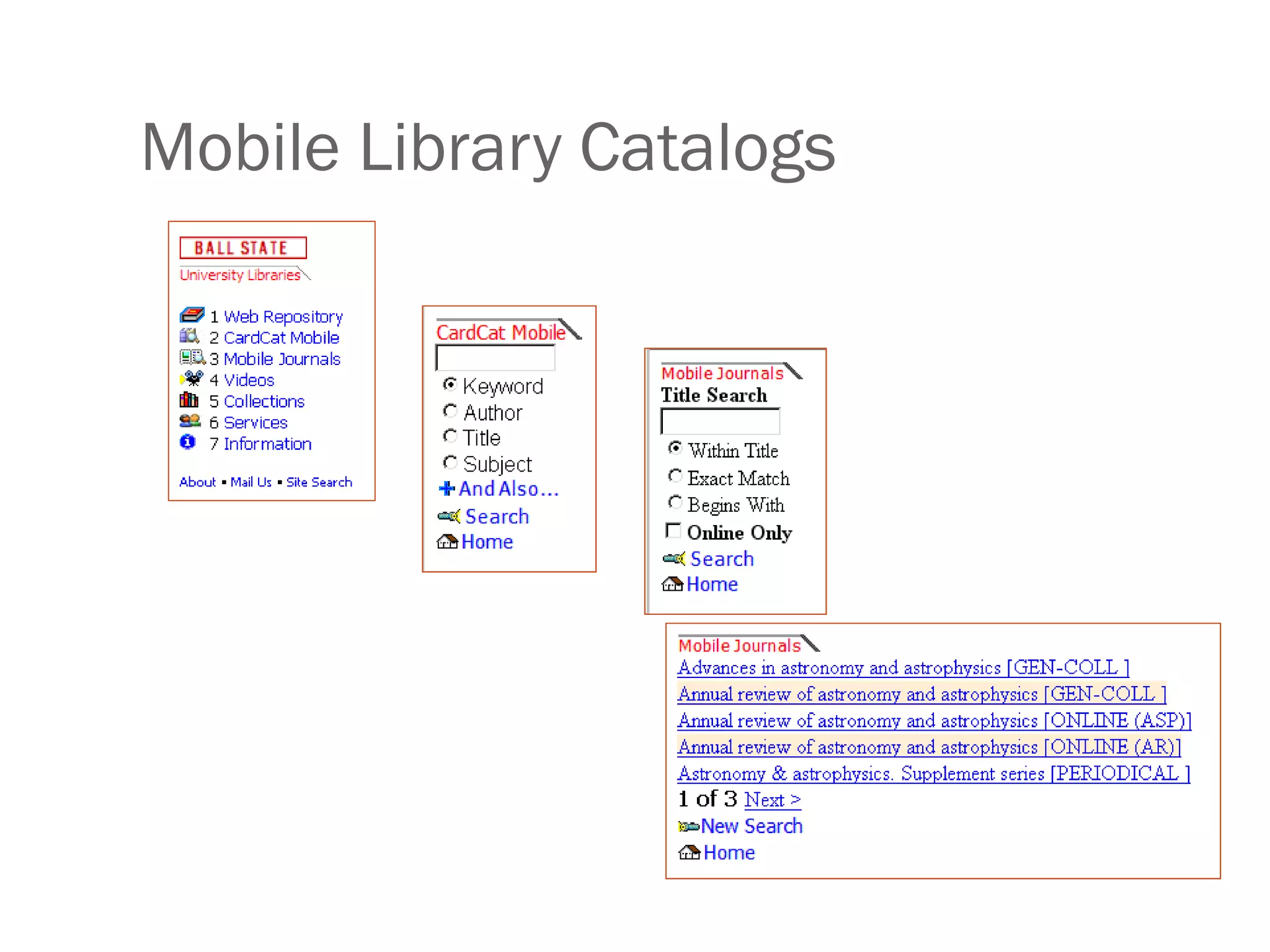
Mobile Library Catalogs
Share the Data Unlock data Create standards-based, shareable data Separate content from display Provide access to appropriate data Watch word = interoperability Mashups – “Compelling Content Combinations” A mixture of content or elements often from different Web sites or data sets that enhance each others usefulness  Bring outside information into the library and allow library data to mix with others outside its walls We need to open up our data and systems
Gmaps Pedometer
Who is Sick?
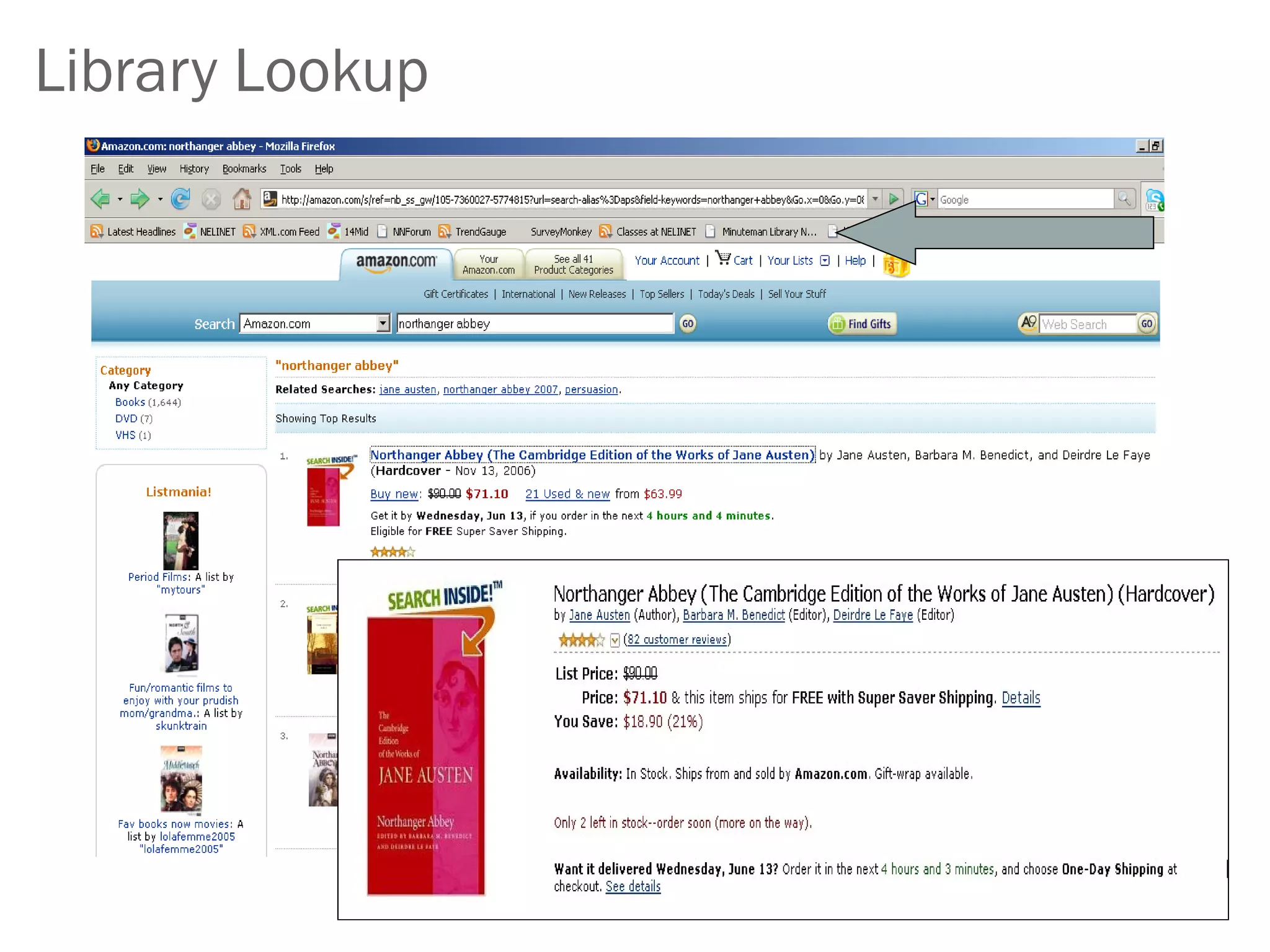
xISBN The same work is often available in a variety of editions, all with different ISBNs Search results on a specific ISBN can be misleading xISBN is a web service that takes as input one ISBN and returns a list of other ISBNs of associated intellectual works – other editions Results intended for use by computer systems to generate new searches such as in OPAC Developed by OCLC’s Office of Research
Library Lookup
 
What’s Ahead?
The Cloud Cloud computing is Internet-based development and use of computer technology IT-related capabilities are provided “as a service” via the cloud Users access technology-enabled services from the Internet without knowledge of, expertise with, or control over the technology infrastructure that supports them The cloud is already forming With Microsoft’s Zune player, a connection to the Internet, and $14.99 USD per month you can access 3 million songs OPALS, Open-source Automated Library System, provides library system functionality as a hosted service
Semantic Web Term coined by Tim Berners-Lee, inventor of Web 1.0 Markup/attach metadata to all kinds of information on the Web Using a set of standards, turns the Web into one big database by annotating, or marking up content  Describes a Web where machines can read Web pages much as we humans read them Allow computers to “understand” data and data relationships to provide additional functionality,  processing capabilities and machine interactions
Library 2.0 Consider the library and its role in the information landscape Self-service Personalization  Targeted content Emphasis on relevance Integrate data and resources of all kinds Welcome patron contributions Reduce barriers Make it easy for users to do what they want to do Hide complexity Serve as information guide and trusted source Recommend, suggest, review, rate
I’m am 1.0 going on 2.0 Library 2.0 is an means to an end It’s about service to our patrons, whoever they are and whatever their needs may be Imagine the possibilities for new products, processes, and services in your library Explore new technologies Embrace change (might as well!) Take it one step at a time Libraries as places humans and ideas come together – a perfect mashup
Thank you!
Amy Benson Librarian /Archivist for Digital Projects Schlesinger Library  Radcliffe Institute for Advanced Study  Harvard University amy_benson@radcliffe.edu

Evolving Web, Evolving Library - Maastricht - November 10, 2008

  • 1.
    Amy Benson EvolvingWeb, Evolving Library
  • 2.
    Agenda Web 2.0Environment Technology Library 2.0 Impact Examples What’s next?
  • 3.
    Mobility Connectivity ContributionCommunity Personalization Technology
  • 4.
    Evolving Landscape PersonalizationPersonal identity and environment accessed from anywhere Contribution Content creation and contribution Rating, reviewing, tagging, commenting, mixing and mashing Community Sharing, networking, collaborating Mobility Access anywhere, anytime with mobile devices Technology More smaller, faster, cheaper
  • 5.
    The Web WorldUser participation in basic Internet services such as searching and e-mail is almost universal Commonplace activities such as e-mail, maps and directions, booking flights, finding recipes, browsing health care sites, banking – tasks that used to require assistance People are not online only to accomplish specific tasks such as those mentioned above - users “hang out” online and increasingly spend time participating in social networks Five online social spaces are in the Alexa top ten global Web sites, including Facebook, Wikipedia, and YouTube (source Alexa.com) YouTube had over 5 billion visitors in July 2008 Americans watched 558 million hours of online video during the month
  • 6.
  • 7.
    Connectivity - BroadbandBroadband supports active participation in the online community, bringing together people with shared interests or problems to chat or collaborate Broadband users spend on average 33% more time online than dial up users and report better outcomes from their Internet use (Nielsen/NetRatings) Broadband users are far more likely than dial-up internet users to create or post content to the internet - have a blog, post photos online, or contribute to chat-rooms Today in the Netherlands nearly three-quarters of households have a broadband connection
  • 8.
  • 9.
    Web as Platform- Google Docs
  • 10.
    A Richer UserExperience Dynamic applications No more click and wait for screen refresh Beefed up experience thanks to Ajax and Flash Light, modular applications - don’t need to download and install programs to the desktop Interactive and responsive Customized / personal
  • 11.
  • 12.
    Connectivity - CellPhone/Mobile 262.7 million wireless subscribers in the U.S. as of June 2008 – 84% of the population Wireless-only households: 15.8% Minutes of use: 2.1trillion 600.5 billion SMS/text messages annually world wide as of June 2008 There are now more Wi-Fi hotspots in Europe (50,000 locations) than in the US (25,000) as of September 28, 2008 (source: muniwireless.com) Source: http://www.ctia.org/media/industry_info/index.cfm/AID/10323
  • 13.
    Don’t Call ita Phone Within 5 years “mobiles” will replace the PC as the world’s access to the Web There are 3 times as many mobiles as PCs in the world More than 2 million people in the Netherlands accessed the Internet using mobile equipment such as a laptop or mobile phone in 2007. This is nearly 20 percent of all Internet users. Men and young people with higher education levels in particular are more likely to use a mobile connection. More than 330 million mobile users worldwide will own broadcast TV-enabled handsets by 2013
  • 14.
  • 15.
    Self Service Web2.0 is all about empowering individual users Eliminate barriers Reduce complexity Customize/personalize Anywhere any time User drives the process
  • 16.
    Pandora.com “ Sitback, relax, and enjoy the music, that’s the point”
  • 17.
    Rollyo – CustomizedSearch Engine
  • 18.
  • 19.
    Community Connecting SharingCollaborating Participating Reputation, networking Reviews, ratings, recommendations The online community has diminished somewhat the role of traditional opinion makers such as marketers and critics in creating buzz about music, news, top stories, giving a greater voice to collective judgments of connected people
  • 20.
  • 21.
    iTunes – GuidingUsers to Content
  • 22.
    Participation Low barriersto participation Availability of free tools: Blogger, PB Wiki, Audacity, Slideshare No special skills required Web 2.0 sites make it easy for users to contribute all kinds of content Images, videos, audio, ideas, information, comments, conversations, collaborations, ratings, reviews Popular sites thrive on user contributions, ratings and shared content: YouTube, digg, craigslist, MySpace, flickr, del.icio.us, etc.
  • 23.
    But what doesthis have to do with my library?
  • 24.
    Expectations 2.0 Libraryuser expectations are driven by experiences and technology available on the commercial Web It’s a social phenomenon, not just technology Library 2.0 is a new model for library service It’s a chance to rethink and retool what we do and who we are
  • 25.
    23 Things Blogsand blogging Social software Delicious LibraryThing Photos & Images Flickr Image generators RSS Feeds and readers Tagging & Folksonomies Tag clouds Google Image Labeler Online tools & Applications Word processing Spreadsheets Mashups Wikis Wikipedia PB wiki Audio & Video Podcasts &Vodcasts Audiobooks YouTube
  • 26.
    Blogosphere Free andeasy-to-use tools reduce barriers to participation Anyone can have a voice Bloggers can provide fresh takes on politics or popular culture in contrast to, or in support of stories in the mass media Estimates of the number of blogs and blog readers vary widely, but all studies agree that blogs are a global phenomenon that has hit the mainstream One source says that 184 million people worldwide have started a blog and that 77% of active Internet users read blogs (Universal McCann 2008)
  • 27.
    Global Snapshot ofBloggers Source: technorati.com
  • 28.
    How Are LibrariesUsing Blogs? Blogs are, in practice, communities of interest Post up-to-date information about the library and the community Collection materials, events, projects Keep it current and local Supply links to articles, announcements, newspapers, journals, publications, reviews, Web sites, and other resources on topics of local interest Provide a forum for patrons to comment and ask questions Generate interest, conversation, community
  • 29.
  • 30.
  • 31.
  • 32.
    Has the BlogCraze Peaked? Blogs, to use the words of one 19 year old contact are"so, so yesterday and all my friends are on Facebook" It’s a lot of writing, which can be time-consuming To attract a substantial audience, you have to have something to say on an ongoing basis Researchers for the Oxford English Dictionary claimed in 2007 that "the 15 most frequently used words in the blogosphere" (presumably the Anglo part of the blogosphere) are blogger, blog, stupid, me, myself, my, oh, yeah, ok, post, stuff, lovely, update, nice, [four letter word beginning with s]
  • 33.
    The End ofa Blog
  • 34.
    Microblogs or TumblelogsPeople have noticed a movement among bloggers to Twitter, or other similar services, called microblogs, or tumblelogs Immediate, spontaneous contributions Usually consist of short phrases about what the person is doing at that moment – limit is 140 characters “ walked straight into a hole” ; “spying a second cup of tea” Many people post from a mobile phone from wherever they are Content can be displayed online or delivered by SMS to people who subscribe to a particular microblog
  • 35.
    RSS Really SimpleSyndication (RSS) RSS Readers A tool to help control the information juggernaut that is the WWW –monitor incoming content from selected sites Time saver/information manager RSS Feeds Publishers (of all kinds) provide content in specific format News, stock quotes, updates, blogs, wikis, etc. Users subscribe to feeds based on interests Alerts users to new content, updates, changes, or comments automatically Reduces need to visit multiple, individual Web sites to stay up to date
  • 36.
  • 37.
  • 38.
  • 39.
  • 40.
  • 41.
    Wikis Hawaiian wordfor "fast" Tool for collaborative resource creation via the Web Share the creation, editing, and maintenance of a resource among multiple collaborators Authorized users can add/delete/modify content Maintains page histories Allows comments Offers RSS feeds for updates
  • 42.
    Wiki versus Blogwiki is… collaborative multi-page resource always in flux infinitely editable internally linked Community-based blog is … opinionated one-sided chronological little internal linking/lots of external linking immediate
  • 43.
    The Most FamousWiki of All Goal: “…to put the sum of all human knowledge in the form of an encyclopedia in the hands of every single person on the planet for free.” -Jimmy Wales, cofounder and chief executive
  • 44.
  • 45.
    How Can aLibrary use Wikis? Internal policy formation/dissemination Local topic wikipedia Reference how-to guides Reference pathfinder
  • 46.
    Butler University ReferenceWiki http://butlerreference.pbwiki.com/
  • 47.
  • 48.
    Podcasting Audio andvideo content Video blogs are sometimes called vblogs or vlogs Short segments Educational programs Library tours Recorded events Author talks Book discussions Public meetings Allow people to comment, start conversations online, participate asynchronously
  • 49.
    Glasgow University LibraryFresher’s Podcast Law Podcast Guide Podcast
  • 50.
  • 51.
    Social Networks Onlinecommunities Connecting with other people in a variety of ways for a variety of reasons Friendster LinkedIn MySpace Facebook Hyves Virtual worlds Gaming Second Life
  • 52.
  • 53.
  • 54.
  • 55.
  • 56.
    Social Networking Asof November 1, 2008
  • 57.
  • 58.
  • 59.
  • 60.
    Virtual Worlds Avirtual 3D Web world you can walk through Interact with others in a virtual landscape through avatars Virtually attend meetings, shop, dance, rent an apartment Explore alternate worlds 3D gaming, education Interact, collaborate, contribute in more dimensions
  • 61.
    3D Online GamingMassively Multiplayer Online Games World of Warcraft GuildWars
  • 62.
    Second Life SecondLife is a 3D virtual world entirely built and owned by its residents Opened to the public in 2003 Over 9 million inhabitants from around the globe Interact with other inhabitants Build a house or business Libraries and library services have been established Virtually attend book discussions Offer reference services to in-world visitors
  • 63.
  • 64.
  • 65.
  • 66.
    Cataloging by CommitteeFolksonomies - metadata by the people Unsystematic and often unsophisticated No complicated hierarchy to learn Take advantage of contributed work by masses of dedicated people Contrast with professionally developed taxonomies and controlled vocabularies Growth in number of Web sites that take advantage of user-created metadata, or “tags” delicious Flickr University of Pennsylvania Penn Tags
  • 67.
  • 68.
  • 69.
  • 70.
    Aggregated Data Largequantities of data provide valuable information Data mining Recommendations, reviews, ratings One person’s opinion versus 135 people’s opinions Tagging Individual, personal tags versus collective wisdom
  • 71.
  • 72.
  • 73.
  • 74.
    OPAC 2.0 OPACscontain valuable data in MARC ILS systems are a little out of step with today’s world Vendors don’t always prioritize library requests Libraries want 2.0 functionality Search across all types of library resources Improved navigation and search results Personalization Mobility Ability to participate
  • 75.
  • 76.
  • 77.
  • 78.
    Boston College –Finding Aid
  • 79.
  • 80.
  • 81.
  • 82.
  • 83.
    Share the DataUnlock data Create standards-based, shareable data Separate content from display Provide access to appropriate data Watch word = interoperability Mashups – “Compelling Content Combinations” A mixture of content or elements often from different Web sites or data sets that enhance each others usefulness Bring outside information into the library and allow library data to mix with others outside its walls We need to open up our data and systems
  • 84.
  • 85.
  • 86.
    xISBN The samework is often available in a variety of editions, all with different ISBNs Search results on a specific ISBN can be misleading xISBN is a web service that takes as input one ISBN and returns a list of other ISBNs of associated intellectual works – other editions Results intended for use by computer systems to generate new searches such as in OPAC Developed by OCLC’s Office of Research
  • 87.
  • 88.
  • 89.
  • 90.
    The Cloud Cloudcomputing is Internet-based development and use of computer technology IT-related capabilities are provided “as a service” via the cloud Users access technology-enabled services from the Internet without knowledge of, expertise with, or control over the technology infrastructure that supports them The cloud is already forming With Microsoft’s Zune player, a connection to the Internet, and $14.99 USD per month you can access 3 million songs OPALS, Open-source Automated Library System, provides library system functionality as a hosted service
  • 91.
    Semantic Web Termcoined by Tim Berners-Lee, inventor of Web 1.0 Markup/attach metadata to all kinds of information on the Web Using a set of standards, turns the Web into one big database by annotating, or marking up content Describes a Web where machines can read Web pages much as we humans read them Allow computers to “understand” data and data relationships to provide additional functionality, processing capabilities and machine interactions
  • 92.
    Library 2.0 Considerthe library and its role in the information landscape Self-service Personalization Targeted content Emphasis on relevance Integrate data and resources of all kinds Welcome patron contributions Reduce barriers Make it easy for users to do what they want to do Hide complexity Serve as information guide and trusted source Recommend, suggest, review, rate
  • 93.
    I’m am 1.0going on 2.0 Library 2.0 is an means to an end It’s about service to our patrons, whoever they are and whatever their needs may be Imagine the possibilities for new products, processes, and services in your library Explore new technologies Embrace change (might as well!) Take it one step at a time Libraries as places humans and ideas come together – a perfect mashup
  • 94.
  • 95.
    Amy Benson Librarian/Archivist for Digital Projects Schlesinger Library Radcliffe Institute for Advanced Study Harvard University amy_benson@radcliffe.edu