Web Accessibility 3.0: Learning From The Past, Planning For The Future Brian Kelly UKOLN University of Bath Bath, UK Email: [email_address] Blog: http://ukwebfocus.wordpress.com/ UKOLN is supported by: http://www.ukoln.ac.uk/web-focus/events/conferences/addw08/ This work is licensed under a Attribution-NonCommercial-ShareAlike 2.0 licence (but note caveat) Acceptable Use Policy Recording/broadcasting of this talk, taking photographs, discussing the content using email, instant messaging, blogs, etc. is permitted providing distractions to others is minimised. Resources bookmarked using ‘ addw08 ' tag  Co-author : Liddy Nevile
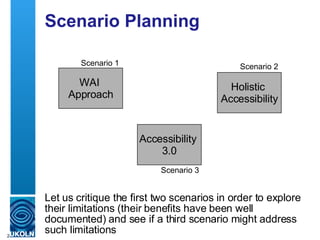
Scenario Planning Let us critique the first two scenarios in order to explore their limitations (their benefits have been well documented) and see if a third scenario might address such limitations WAI  Approach Scenario 1 Holistic  Accessibility Scenario 2 Accessibility  3.0 Scenario 3
WAI Approach WAI model relies on conformant Web sites, conformant authoring tools, conformant user agents … and conformant users! A common complaint of “standardistas” – “ the user needs to take responsibility… ” There is value in this argument – but there are practical shortcomings And user technophobia/laziness/lethargy is only one obstacle How many users know they are “disabled”? WAI’s Approach Also note importance of  evidence-based research . Various UK accessibility studies seem to find that lack of evidence of accessibility of Web sites for PWDs and conformance with WCAG guidelines!
WCAG In Context WCAG 2.0 states that Web resources must be: Perceivable   • Operable Understandable   • Robust But this should apply  after  we’ve decided what our purposes our, rather than constraining what we can or can’t do: “ Super Cally Go Ballistic, Celtic Are Atrocious ”: Not universally understandable, now universally accessible, culturally-specific … but witty Adobe Flash, MS Word, … Are these formats essential to your corporate infrastructure and workflow?  Web 2.0, Ajax, Blog, Wikis, UGC, … Do these provide useful services to your users? Legislation: “take reasonable measure ..”  Is bankrupting your company reasonable? Is failing to satisfy your user community reasonable?  Is dumbing down the English language reasonable? WAI’s Scenario
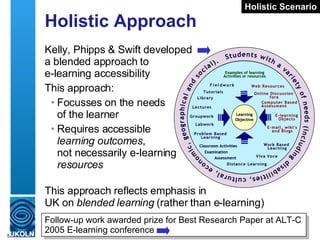
Holistic Approach Kelly, Phipps & Swift developed  a blended approach to  e-learning accessibility This approach: Focusses on the needs  of the learner Requires accessible  learning outcomes ,  not necessarily e-learning  resources Follow-up work awarded prize for Best Research Paper at ALT-C 2005 E-learning conference Holistic Scenario This approach reflects emphasis in  UK on  blended learning   (rather than e-learning)
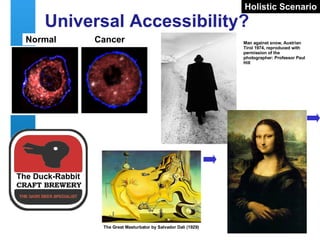
Universal Accessibility? Normal Cancer Man against snow, Austrian Tirol 1974, reproduced with permission of the photographer: Professor Paul Hill   The Great Masturbator by Salvador Dali (1929) The Duck-Rabbit CRAFT BREWERY Holistic Scenario
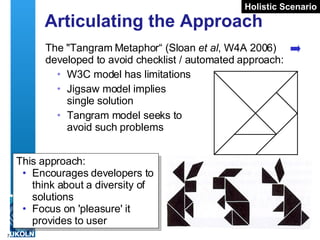
Articulating the Approach The "Tangram Metaphor“ (Sloan  et al , W4A 2006) developed to avoid checklist / automated approach: W3C model has limitations Jigsaw model implies  single solution Tangram model seeks to  avoid such problems This approach: Encourages developers to think about a diversity of solutions Focus on 'pleasure' it provides to user Holistic Scenario
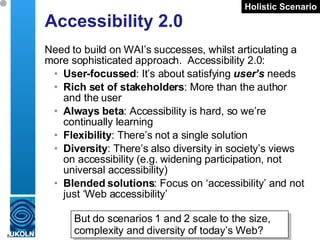
Accessibility 2.0 Need to build on WAI’s successes, whilst articulating a more sophisticated approach.  Accessibility 2.0: User-focussed : It’s about satisfying  user’s  needs Rich set of stakeholders : More than the author and the user Always beta : Accessibility is hard, so we’re continually learning Flexibility : There’s not a single solution  Diversity : There’s also diversity in society’s views on accessibility (e.g. widening participation, not universal accessibility) Blended solutions : Focus on ‘accessibility’ and not just ‘Web accessibility’ Holistic Scenario But do scenarios 1 and 2 scale to the size, complexity and diversity of today’s Web?
 
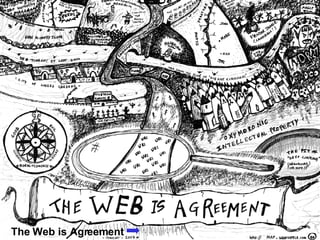
The Web is Agreement
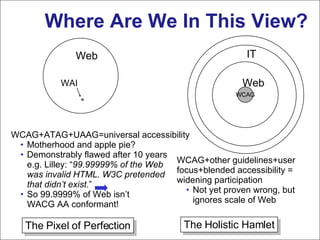
Where Are We In This View? Web WCAG Web IT WCAG+ATAG+UAAG=universal accessibility Motherhood and apple pie?  Demonstrably flawed after 10 years e.g. Lilley:  “ 99.99999% of the Web  was invalid HTML. W3C pretended  that didn’t exist. ”  So 99.9999% of Web isn’t  WACG AA conformant! WCAG+other guidelines+user focus+blended accessibility = widening participation Not yet proven wrong, but ignores scale of Web The Pixel of Perfection The Holistic Hamlet WAI
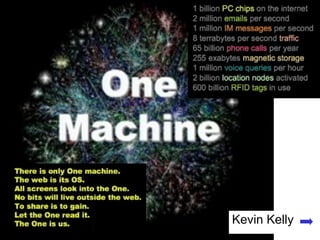
Kevin Kelly
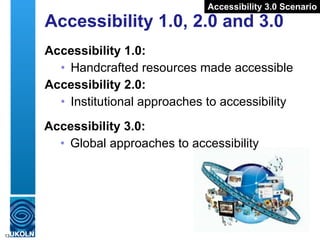
Accessibility 1.0, 2.0 and 3.0 Accessibility 1.0:  Handcrafted resources made accessible  Accessibility 2.0: Institutional approaches to accessibility Accessibility 3.0: Global approaches to accessibility Accessibility 3.0 Scenario
A Fresh Look At Accessibility We acknowledge that: Not everything on the Web will ever be accessible Accessibility may not cross cultural, linguistic, national and discipline boundaries An individual does not need a universally accessible resource; rather s/he wants a resource which is accessible to them Different communities may have different needs Same person may have different needs at different times and places Let’s not talk about the accessibility of a resource We find the term ‘ inclusive ’ more useful than ‘ accessible to people with disabilities ’ Accessibility 3.0 Scenario
Getting There Web 1.0: Focus on resources published by institutions Focus on management of resources (CMSs) Web 2.0: Focus on users and user-generated content Focus on reuse of resources (syndication, embedding, …) Focus on user comments and discussions Trust and openness Accessibility 1.0: Focus on accessibility of published resources Focus on software to support publication processes Accessibility 2.0: Focus on accessibility of  use  of content rather than content Blended accessibility cf potential of social networks to facilitate discussions Trust and openness: orgs taking reasonable measures; involvement with users in design processes cf Kelly  et al  on design for people with learning disabilities Accessibility 3.0 Scenario
Alternative Resources Public library example: Presentation at national Public Library event “ And here’s a Flash-based game we’ve developed. Easy to do, and the kids love it” “ What about accessibility?” “ Oh, er.  We’ll remove it before the new legislation becomes into force” Blended approach: “ What’s the purpose of the game?” “ To keep kids amused for 10 mins, while parents get books” “ How about building blocks or a bouncy castle as an alternative?  This is an alternative approach to problem, which doesn’t focus on disabilities” Accessibility 3.0 Scenario
Library Standards  on Alternatives Use Case: Catalogue records for books available in multiple formats Book, large print book, abridged book, cassette tape, Braille, CD, MP3, … Need for standards to facilitate retrieval of resource which satisfies end user’s needs MARC 21/RDA : Developments to established library standard  AccessForAll : ISO/IMS Standard aimed at describing alternative for learning resources DCMI : Accessibility metadata work  Accessibility 3.0 Scenario Recognition of challenges of the multiple standardisation routes described in “ Personalization and Accessibility: Integration of Library and Web Approaches ”, Chapman, Nevile, Kelly and Heath
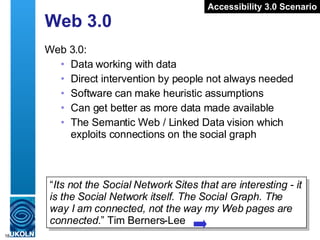
Web 3.0 Web 3.0: Data working with data Direct intervention by people not always needed Software can make heuristic assumptions Can get better as more data made available The Semantic Web / Linked Data vision which exploits connections on the social graph “ Its not the Social Network Sites that are interesting - it is the Social Network itself. The Social Graph. The way I am connected, not the way my Web pages are connected. ” Tim Berners-Lee Accessibility 3.0 Scenario
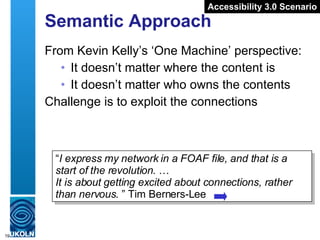
Semantic Approach From Kevin Kelly’s ‘One Machine’ perspective: It doesn’t matter where the content is It doesn’t matter who owns the contents Challenge is to exploit the connections “ I express my network in a FOAF file, and that is a start of the revolution.  …   It is about getting excited about connections, rather than nervous.  ” Tim Berners-Lee Accessibility 3.0 Scenario
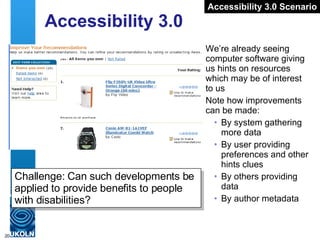
Accessibility 3.0 We’re already seeing computer software giving us hints on resources which may be of interest to us Note how improvements can be made: By system gathering more data By user providing preferences and other hints clues By others providing data By author metadata Accessibility 3.0 Scenario Challenge: Can such developments be applied to provide benefits to people with disabilities?
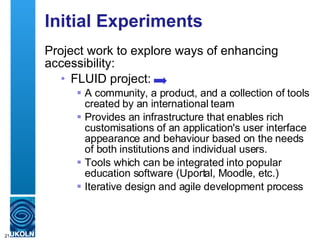
Initial Experiments Project work to explore ways of enhancing accessibility: FLUID project: A community, a product, and a collection of tools created by an international team P rovides an infrastructure that enables rich customisations of an application's user interface appearance and behaviour based on the needs of both institutions and individual users.  Tools which can be integrated into popular education software (Uportal, Moodle, etc.) Iterative design and agile development process
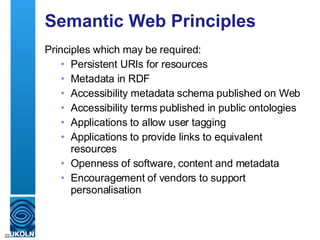
Semantic Web Principles Principles which may be required: Persistent URIs for resources Metadata in RDF Accessibility metadata schema published on Web Accessibility terms published in public ontologies Applications to allow user tagging Applications to provide links to equivalent resources Openness of software, content and metadata Encouragement of vendors to support personalisation
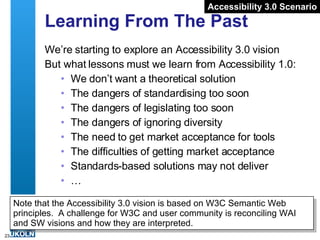
Learning From The Past We’re starting to explore an Accessibility 3.0 vision But what lessons must we learn from Accessibility 1.0: We don’t want a theoretical solution The dangers of standardising too soon The dangers of legislating too soon The dangers of ignoring diversity The need to get market acceptance for tools The difficulties of getting market acceptance Standards-based solutions may not deliver  … Accessibility 3.0 Scenario Note that the Accessibility 3.0 vision is based on W3C Semantic Web principles.  A challenge for W3C and user community is reconciling WAI and SW visions and how they are interpreted.
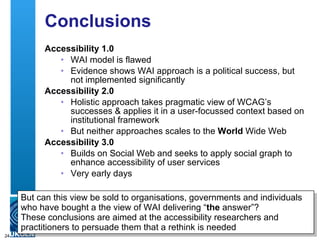
Conclusions Accessibility 1.0 WAI model is flawed  Evidence shows WAI approach is a political success, but not implemented significantly Accessibility 2.0 Holistic approach takes pragmatic view of WCAG’s successes & applies it in a user-focussed context based on institutional framework  But neither approaches scales to the  World  Wide Web Accessibility 3.0 Builds on Social Web and seeks to apply social graph to enhance accessibility of user services Very early days But can this view be sold to organisations, governments and individuals who have bought a the view of WAI delivering “ the  answer”? These conclusions are aimed at the accessibility researchers and practitioners to persuade them that a rethink is needed
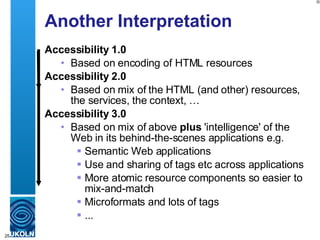
Another Interpretation Accessibility 1.0 Based on encoding of HTML resources Accessibility 2.0 Based on mix of the HTML (and other) resources, the services, the context, … Accessibility 3.0 Based on mix of above  plus  'intelligence' of the Web in its behind-the-scenes applications e.g. Semantic Web applications  Use and sharing of tags etc across applications  More atomic resource components so easier to mix-and-match  Microformats and lots of tags ...
Conclusions There’s a need: For accessibility researchers to gather evidence on proposed solutions to accessibility To explore ways in which changes in our understandings can be adopted and deployed This paper: Explores limitations of current approaches Suggests alternative approaches Future work: Need to critique the critique Need to develop better models for change control Need to learn from the past
Questions Questions are welcome

Web Accessibility 3.0: Learning From The Past, Planning For The Future

  • 1.
    Web Accessibility 3.0:Learning From The Past, Planning For The Future Brian Kelly UKOLN University of Bath Bath, UK Email: [email_address] Blog: http://ukwebfocus.wordpress.com/ UKOLN is supported by: http://www.ukoln.ac.uk/web-focus/events/conferences/addw08/ This work is licensed under a Attribution-NonCommercial-ShareAlike 2.0 licence (but note caveat) Acceptable Use Policy Recording/broadcasting of this talk, taking photographs, discussing the content using email, instant messaging, blogs, etc. is permitted providing distractions to others is minimised. Resources bookmarked using ‘ addw08 ' tag Co-author : Liddy Nevile
  • 2.
    Scenario Planning Letus critique the first two scenarios in order to explore their limitations (their benefits have been well documented) and see if a third scenario might address such limitations WAI Approach Scenario 1 Holistic Accessibility Scenario 2 Accessibility 3.0 Scenario 3
  • 3.
    WAI Approach WAImodel relies on conformant Web sites, conformant authoring tools, conformant user agents … and conformant users! A common complaint of “standardistas” – “ the user needs to take responsibility… ” There is value in this argument – but there are practical shortcomings And user technophobia/laziness/lethargy is only one obstacle How many users know they are “disabled”? WAI’s Approach Also note importance of evidence-based research . Various UK accessibility studies seem to find that lack of evidence of accessibility of Web sites for PWDs and conformance with WCAG guidelines!
  • 4.
    WCAG In ContextWCAG 2.0 states that Web resources must be: Perceivable • Operable Understandable • Robust But this should apply after we’ve decided what our purposes our, rather than constraining what we can or can’t do: “ Super Cally Go Ballistic, Celtic Are Atrocious ”: Not universally understandable, now universally accessible, culturally-specific … but witty Adobe Flash, MS Word, … Are these formats essential to your corporate infrastructure and workflow? Web 2.0, Ajax, Blog, Wikis, UGC, … Do these provide useful services to your users? Legislation: “take reasonable measure ..” Is bankrupting your company reasonable? Is failing to satisfy your user community reasonable? Is dumbing down the English language reasonable? WAI’s Scenario
  • 5.
    Holistic Approach Kelly,Phipps & Swift developed a blended approach to e-learning accessibility This approach: Focusses on the needs of the learner Requires accessible learning outcomes , not necessarily e-learning resources Follow-up work awarded prize for Best Research Paper at ALT-C 2005 E-learning conference Holistic Scenario This approach reflects emphasis in UK on blended learning (rather than e-learning)
  • 6.
    Universal Accessibility? NormalCancer Man against snow, Austrian Tirol 1974, reproduced with permission of the photographer: Professor Paul Hill The Great Masturbator by Salvador Dali (1929) The Duck-Rabbit CRAFT BREWERY Holistic Scenario
  • 7.
    Articulating the ApproachThe "Tangram Metaphor“ (Sloan et al , W4A 2006) developed to avoid checklist / automated approach: W3C model has limitations Jigsaw model implies single solution Tangram model seeks to avoid such problems This approach: Encourages developers to think about a diversity of solutions Focus on 'pleasure' it provides to user Holistic Scenario
  • 8.
    Accessibility 2.0 Needto build on WAI’s successes, whilst articulating a more sophisticated approach. Accessibility 2.0: User-focussed : It’s about satisfying user’s needs Rich set of stakeholders : More than the author and the user Always beta : Accessibility is hard, so we’re continually learning Flexibility : There’s not a single solution Diversity : There’s also diversity in society’s views on accessibility (e.g. widening participation, not universal accessibility) Blended solutions : Focus on ‘accessibility’ and not just ‘Web accessibility’ Holistic Scenario But do scenarios 1 and 2 scale to the size, complexity and diversity of today’s Web?
  • 9.
  • 10.
    The Web isAgreement
  • 11.
    Where Are WeIn This View? Web WCAG Web IT WCAG+ATAG+UAAG=universal accessibility Motherhood and apple pie? Demonstrably flawed after 10 years e.g. Lilley: “ 99.99999% of the Web was invalid HTML. W3C pretended that didn’t exist. ” So 99.9999% of Web isn’t WACG AA conformant! WCAG+other guidelines+user focus+blended accessibility = widening participation Not yet proven wrong, but ignores scale of Web The Pixel of Perfection The Holistic Hamlet WAI
  • 12.
  • 13.
    Accessibility 1.0, 2.0and 3.0 Accessibility 1.0: Handcrafted resources made accessible Accessibility 2.0: Institutional approaches to accessibility Accessibility 3.0: Global approaches to accessibility Accessibility 3.0 Scenario
  • 14.
    A Fresh LookAt Accessibility We acknowledge that: Not everything on the Web will ever be accessible Accessibility may not cross cultural, linguistic, national and discipline boundaries An individual does not need a universally accessible resource; rather s/he wants a resource which is accessible to them Different communities may have different needs Same person may have different needs at different times and places Let’s not talk about the accessibility of a resource We find the term ‘ inclusive ’ more useful than ‘ accessible to people with disabilities ’ Accessibility 3.0 Scenario
  • 15.
    Getting There Web1.0: Focus on resources published by institutions Focus on management of resources (CMSs) Web 2.0: Focus on users and user-generated content Focus on reuse of resources (syndication, embedding, …) Focus on user comments and discussions Trust and openness Accessibility 1.0: Focus on accessibility of published resources Focus on software to support publication processes Accessibility 2.0: Focus on accessibility of use of content rather than content Blended accessibility cf potential of social networks to facilitate discussions Trust and openness: orgs taking reasonable measures; involvement with users in design processes cf Kelly et al on design for people with learning disabilities Accessibility 3.0 Scenario
  • 16.
    Alternative Resources Publiclibrary example: Presentation at national Public Library event “ And here’s a Flash-based game we’ve developed. Easy to do, and the kids love it” “ What about accessibility?” “ Oh, er. We’ll remove it before the new legislation becomes into force” Blended approach: “ What’s the purpose of the game?” “ To keep kids amused for 10 mins, while parents get books” “ How about building blocks or a bouncy castle as an alternative? This is an alternative approach to problem, which doesn’t focus on disabilities” Accessibility 3.0 Scenario
  • 17.
    Library Standards on Alternatives Use Case: Catalogue records for books available in multiple formats Book, large print book, abridged book, cassette tape, Braille, CD, MP3, … Need for standards to facilitate retrieval of resource which satisfies end user’s needs MARC 21/RDA : Developments to established library standard AccessForAll : ISO/IMS Standard aimed at describing alternative for learning resources DCMI : Accessibility metadata work Accessibility 3.0 Scenario Recognition of challenges of the multiple standardisation routes described in “ Personalization and Accessibility: Integration of Library and Web Approaches ”, Chapman, Nevile, Kelly and Heath
  • 18.
    Web 3.0 Web3.0: Data working with data Direct intervention by people not always needed Software can make heuristic assumptions Can get better as more data made available The Semantic Web / Linked Data vision which exploits connections on the social graph “ Its not the Social Network Sites that are interesting - it is the Social Network itself. The Social Graph. The way I am connected, not the way my Web pages are connected. ” Tim Berners-Lee Accessibility 3.0 Scenario
  • 19.
    Semantic Approach FromKevin Kelly’s ‘One Machine’ perspective: It doesn’t matter where the content is It doesn’t matter who owns the contents Challenge is to exploit the connections “ I express my network in a FOAF file, and that is a start of the revolution. … It is about getting excited about connections, rather than nervous. ” Tim Berners-Lee Accessibility 3.0 Scenario
  • 20.
    Accessibility 3.0 We’realready seeing computer software giving us hints on resources which may be of interest to us Note how improvements can be made: By system gathering more data By user providing preferences and other hints clues By others providing data By author metadata Accessibility 3.0 Scenario Challenge: Can such developments be applied to provide benefits to people with disabilities?
  • 21.
    Initial Experiments Projectwork to explore ways of enhancing accessibility: FLUID project: A community, a product, and a collection of tools created by an international team P rovides an infrastructure that enables rich customisations of an application's user interface appearance and behaviour based on the needs of both institutions and individual users. Tools which can be integrated into popular education software (Uportal, Moodle, etc.) Iterative design and agile development process
  • 22.
    Semantic Web PrinciplesPrinciples which may be required: Persistent URIs for resources Metadata in RDF Accessibility metadata schema published on Web Accessibility terms published in public ontologies Applications to allow user tagging Applications to provide links to equivalent resources Openness of software, content and metadata Encouragement of vendors to support personalisation
  • 23.
    Learning From ThePast We’re starting to explore an Accessibility 3.0 vision But what lessons must we learn from Accessibility 1.0: We don’t want a theoretical solution The dangers of standardising too soon The dangers of legislating too soon The dangers of ignoring diversity The need to get market acceptance for tools The difficulties of getting market acceptance Standards-based solutions may not deliver … Accessibility 3.0 Scenario Note that the Accessibility 3.0 vision is based on W3C Semantic Web principles. A challenge for W3C and user community is reconciling WAI and SW visions and how they are interpreted.
  • 24.
    Conclusions Accessibility 1.0WAI model is flawed Evidence shows WAI approach is a political success, but not implemented significantly Accessibility 2.0 Holistic approach takes pragmatic view of WCAG’s successes & applies it in a user-focussed context based on institutional framework But neither approaches scales to the World Wide Web Accessibility 3.0 Builds on Social Web and seeks to apply social graph to enhance accessibility of user services Very early days But can this view be sold to organisations, governments and individuals who have bought a the view of WAI delivering “ the answer”? These conclusions are aimed at the accessibility researchers and practitioners to persuade them that a rethink is needed
  • 25.
    Another Interpretation Accessibility1.0 Based on encoding of HTML resources Accessibility 2.0 Based on mix of the HTML (and other) resources, the services, the context, … Accessibility 3.0 Based on mix of above plus 'intelligence' of the Web in its behind-the-scenes applications e.g. Semantic Web applications Use and sharing of tags etc across applications More atomic resource components so easier to mix-and-match Microformats and lots of tags ...
  • 26.
    Conclusions There’s aneed: For accessibility researchers to gather evidence on proposed solutions to accessibility To explore ways in which changes in our understandings can be adopted and deployed This paper: Explores limitations of current approaches Suggests alternative approaches Future work: Need to critique the critique Need to develop better models for change control Need to learn from the past
  • 27.