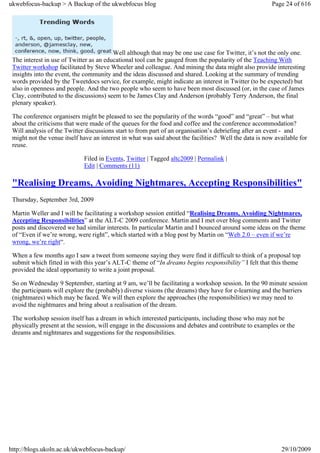
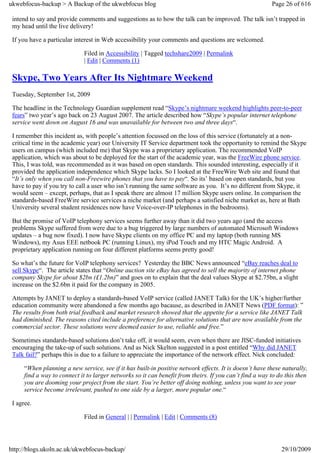
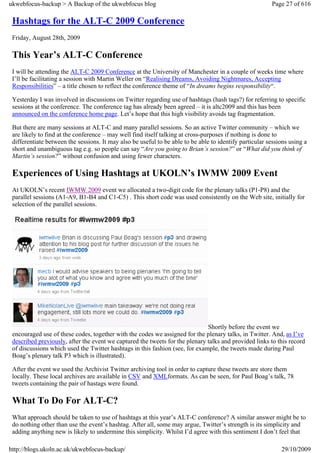
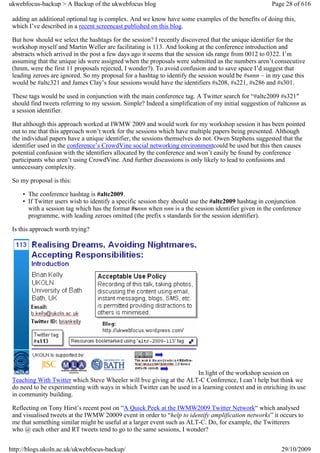
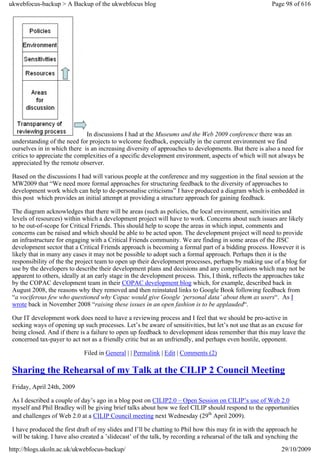
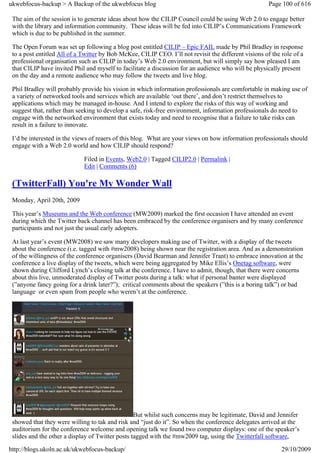
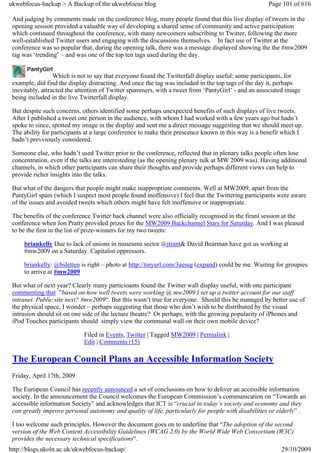
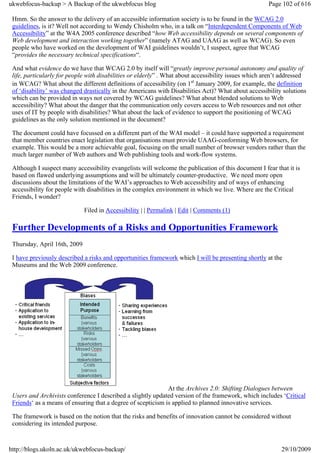
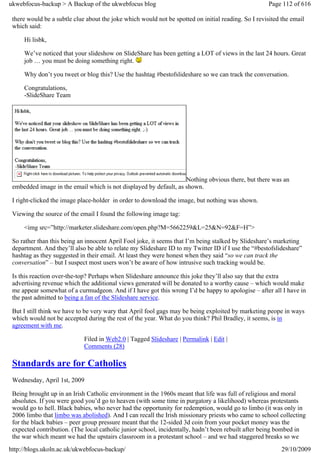
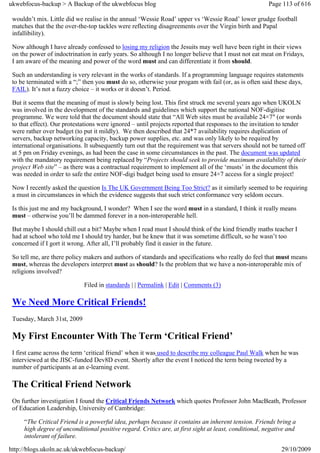
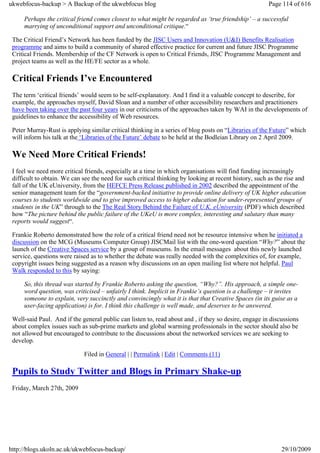
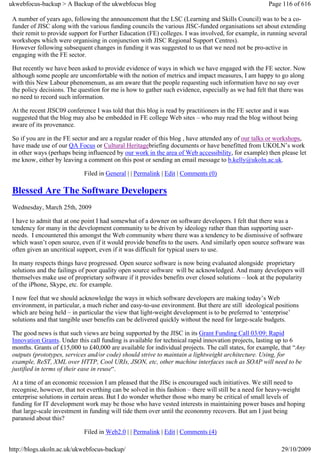
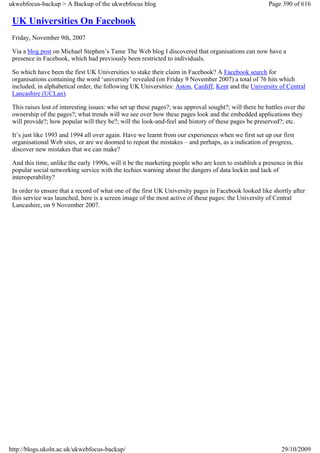
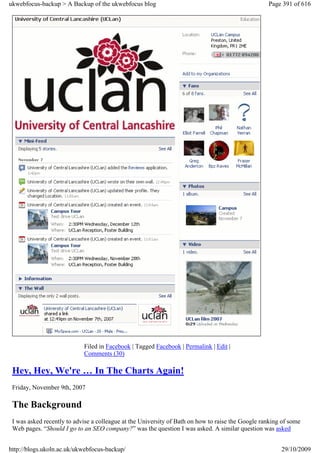
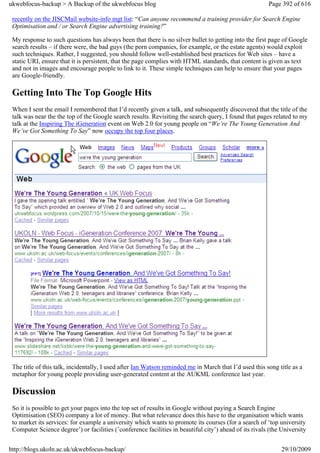
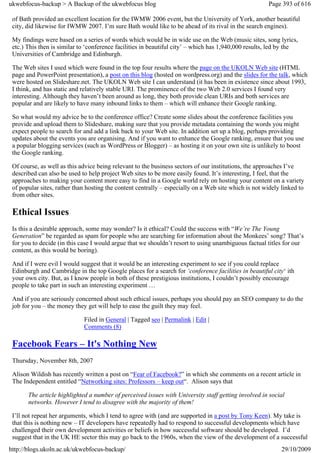
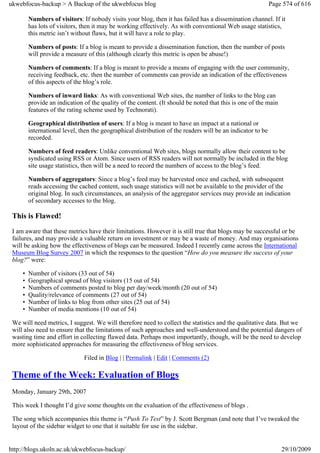
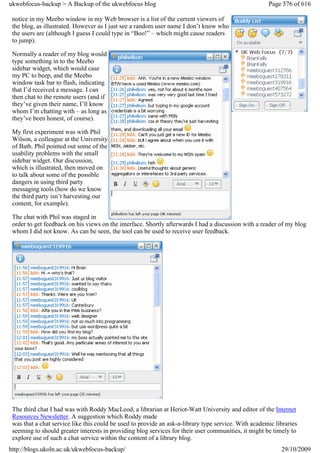
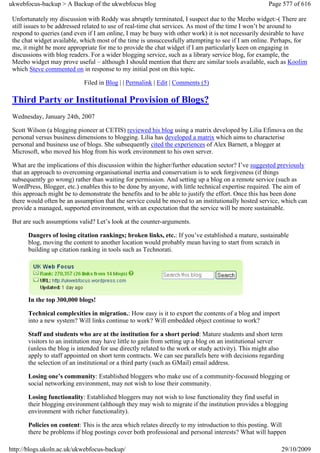
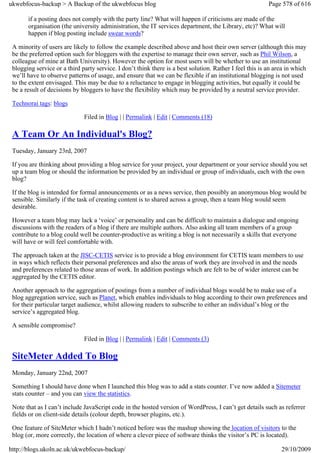
ukwebfocus-backup > A Backup of the ukwebfocus blog                                                      Page 1 of 616

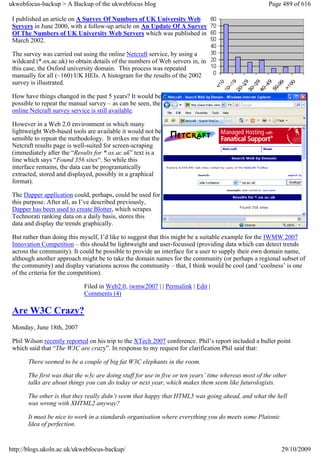
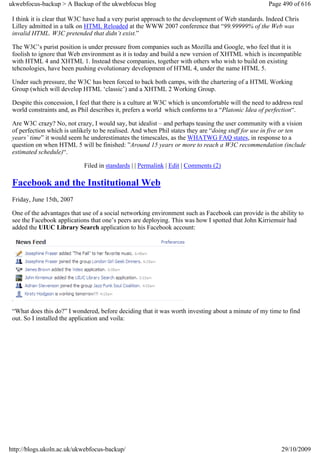
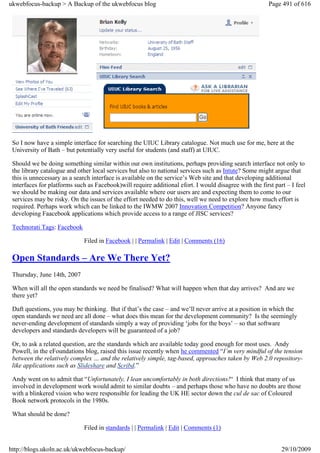
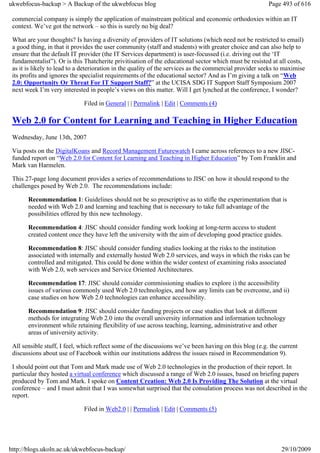
 Skip to content Skip past content


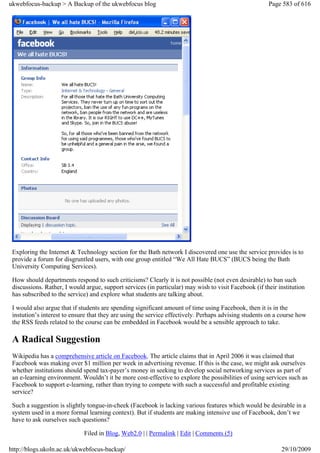
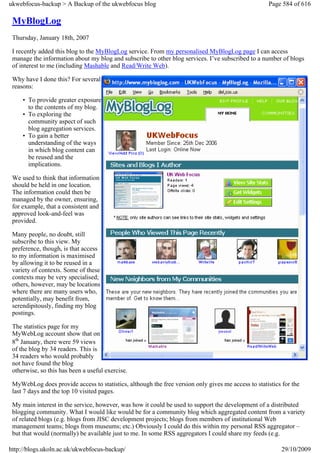
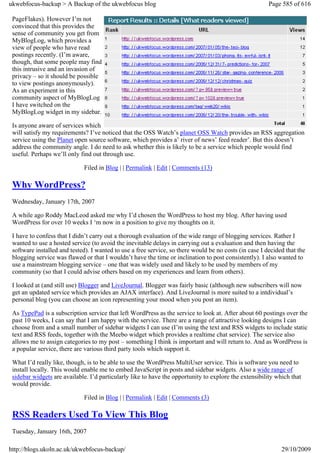
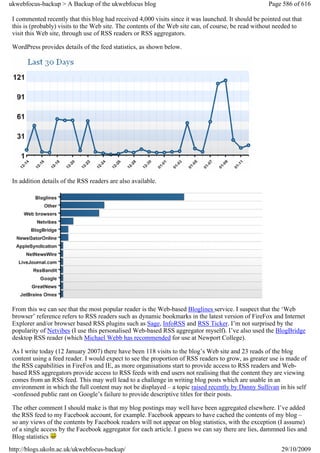
 ukwebfocus-backup
 Forecasting Trends Backwards
 Wednesday, October 28th, 2009

 “Forecasting for the Future” was the title of an article published in the recent issues of the JANET Newsletter
 (No. 9, September 2009 – PDF format). It won’t surprise people that the byline for the article was positive about
 the future: “Outlook – sunny, with a good chance of videoconferencing“.

 To be fair, the byline was a play on words of the topic of the article, which described use of the JANET Video
 Conference Service (JVCS) at the Met Office. The article concluded with a quotation from Tim Marshall, JANET
 CEO:

     “The Met Office videoconference programmes are an excellent example of how the JANET Videoconference
     Service makes sense not only in terms of delivering excellent educational content and cost savings, but also
     through its real contribution in reducing our customers’ carbon footprint“.

 Such optimistic views of the benefits which technologies promise to deliver are, however, being criticised. In a
 post entitled Postdigital: Escaping the Kingdom of the New? Dave White introduced the ‘postdigital’ concept, a
 topic he revisited after co-facilitating (with Rich Hall) a post-digital F-ALT session on the opening night of this
 year’s ALT-C conference. As Dave described in that post, in the session (which I attended) the participants were
 invited to debate a series of statements which were designed to provoke post-digital thoughts, including:

     •   Learning technologists are obsessed with technology more than learning, which is why elearning will
         never make the mainstream.
     •   We are purveyors of the worst kind of spin: ‘This new thing will solve all your problems’.

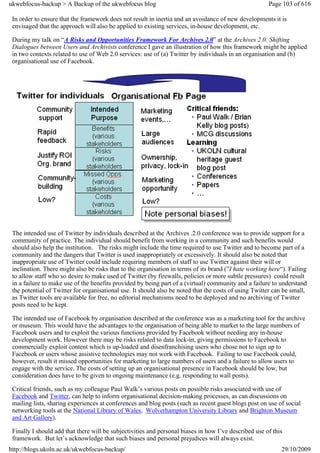
 But how might we go about challenging such ‘technological determinism’ (which, of course, goes beyond the e-
 learning community)? Inspired by the F-ALT session and further brief discussions with Dave, an approach I took
 in a panel session on “Top Technology Trends for Libraries and Information Professionals” at the recent ILI 2009
 conference was to take as the starting point the optimism felt towards various of today’s technologies and to travel
 backwards in time, and attempt to give plausible reasons why today’s exciting technologies will not be around in
 the past.

 This was an idea I got from a BBC 4 programme back in 2007 which I described in a post on “The History Of
 The Web Backwards“. And following the postdigital discussions it occurred to be that the approach might be
 worth revisiting.

 The night prior to the panel session I described the idea to a number of fellow speakers including Tony Hirst and
 Peter Murray-Rust. Tony was full of enthusiasm for the idea and, as he often does, came up with new ways in
 which we could use this approach (e.g. looking at a variety of expected future trends and how we got there from
 the present). And a few days later Tony alerted me of a YouTube video which took a similar approach:

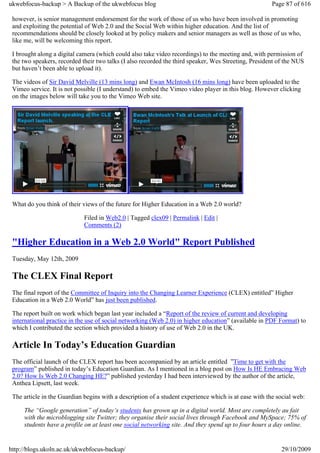
 [youtube=http://www.youtube.com/watch?v=Hds3jvjZY-Y]

 After I had given my brief presentation, which I had published shortly before the conference, Peter Murray-Rust
 did wonder whether such Radio 4 humour would be understood by an international audience. And I did notice
 that some of the tweets about my talk had failed to pick up on the humourous intent of my presentation. To
 summarise what I said (or meant to say) with respect to the demise of Twitter:

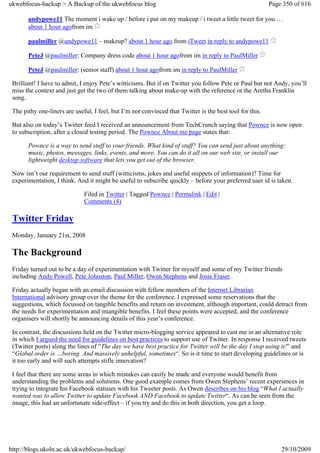
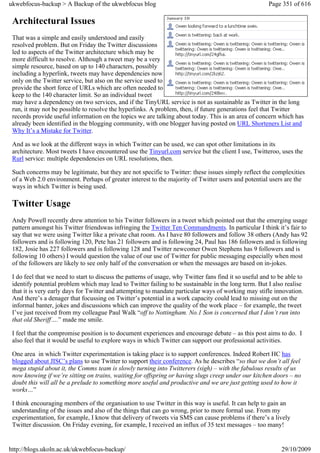
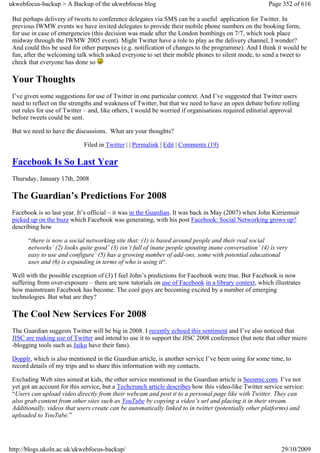
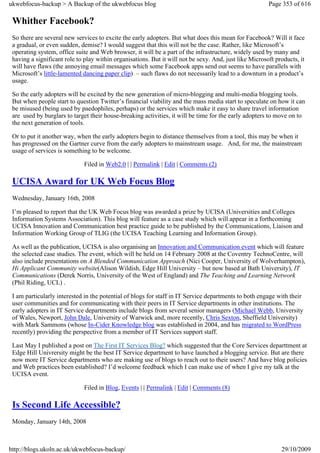
     Today many people are exploiting the potential of Twitter to help them find resources they are looking for.
     Indeed last night I tweeted that I was looking for a good pub to go to and my Twitter community helped me in
     my information searching task – and because they knew me, they knew to suggest a good real ale pub and not
     a trendy wine bar. An Ask-A-Librarian service wouldn’t be aware of my personal preferences.


http://blogs.ukoln.ac.uk/ukwebfocus-backup/                                                                29/10/2009
ukwebfocus-backup > A Backup of the ukwebfocus blog                                                    Page 2 of 616

     But, as we travel through time backwards, we need to ask “Why did twitter die off in the early part of the
     century?”

     The answer is obvious. Twitter doesn’t scale. As more and more people asked such questions, the
     Twitterverse became clogged. “It’s similar to email spam” people felt and started to cancel subscriptions to
     the service.

     And of course although I can benefit, as an early adopter, from having large numbers of followers, many
     people will have only small Twitter communities, and so won’t gain the benefits which I have. So Twitter is
     inherently undemocratic and professions such as Librarians, with their commitments to social inclusion,
     were amongst the first to move away from such undemocratic technologies.

     The demise of Twitter was eventually accepted by all. And in the new environment of the latter part of the
     twentieth century, people met in pubs with their real friends. The term ‘virtual friends’ was felt to be on par
     with ‘imaginary friends’ – something you grow out of. And to mention the ‘followers’ you had would result in
     strange looks and suggestions that you should seek psychiatric help!

 Funnily enough, although I am aware of reasons why people are sceptical about Twitter and why some Twitter
 fans feel that the service may eventually be replaced by an open source or distributed alternative service, it
 wasn’t until I gave the talk that I used the “Twitter is inherently undemocratic” argument. So using the device of
 seeking to give persuasive reasons why technologies disappeared as we travel backwards though time did give me
 some fresh insights.

 Why then, did video-conferencing, which had such a bright future in 2009 die out?

     Although popular at the high of the envirornmental concerns in the early years of the twenty-first century
     subsequent research by sociologists revealed that academic and librarians preferred face-to-face meetings.
     Further research revealed that most conference participants can’t remember the details of talks given at
     conferences, which made people question why one should use networked technologies to access talks which
     are quickly forgotten. Rather than computer networking, people networking (including plotting, politicking
     and such skull-duggery – as well as opportunities for sexual relationships) were found to be the real reason
     why people travel to conferences, although for some strange reasons, such issues were not identified in the
     user needs gathering exercise.

 Might this have an element of truth?

                            Filed in General, Twitter | Tagged ili2009 | Permalink |
                            Edit | Comments (1)

 Viewing a WordPress Blog on a Mobile Device
 Monday, October 26th, 2009

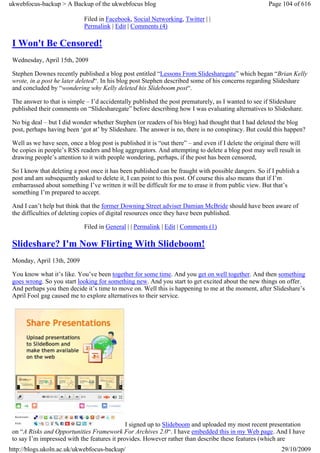
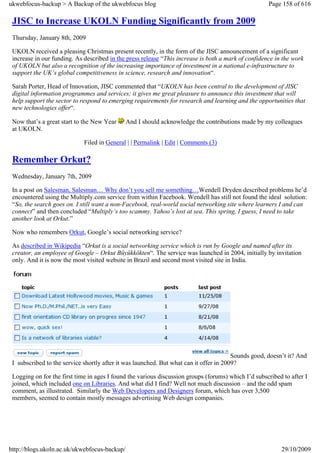
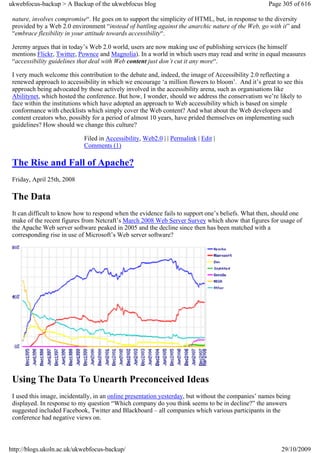
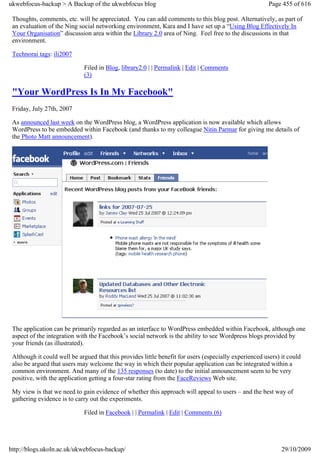
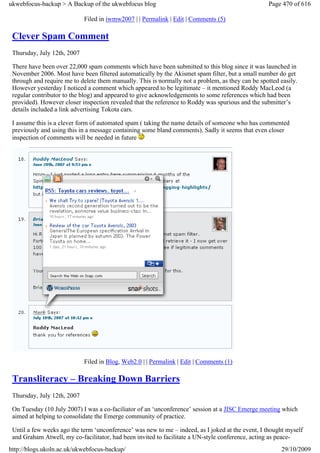
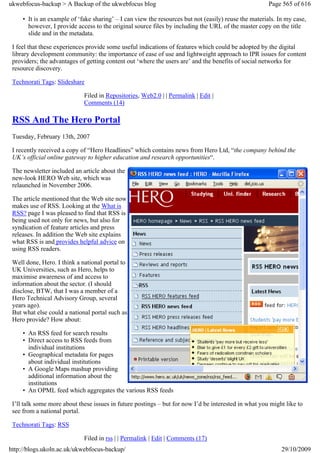
 WordPress, in a post somewhat confusing entitled “The Hero Is In Your Pocket“, have recently announced that
 they have “launch[ed] a couple of mobile themes that will automatically be displayed when your blog is accessed
 with a compatible mobile phone“.


http://blogs.ukoln.ac.uk/ukwebfocus-backup/                                                              29/10/2009
ukwebfocus-backup > A Backup of the ukwebfocus blog                                                       Page 3 of 616


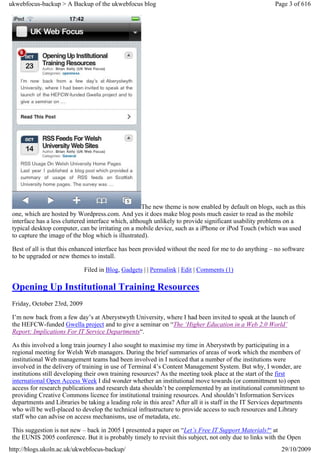
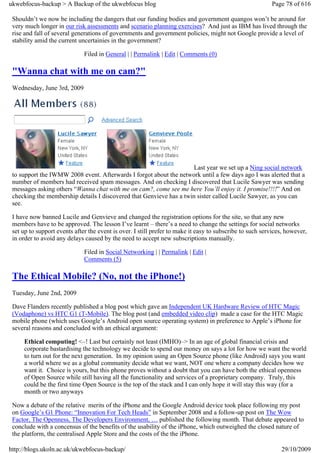
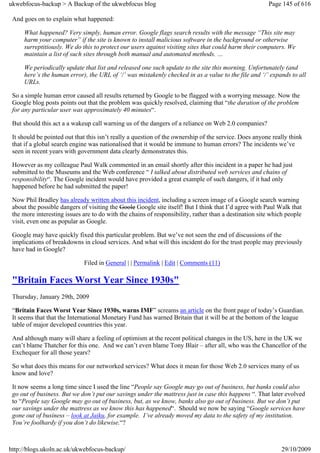
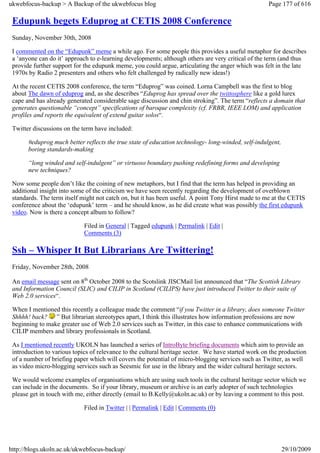
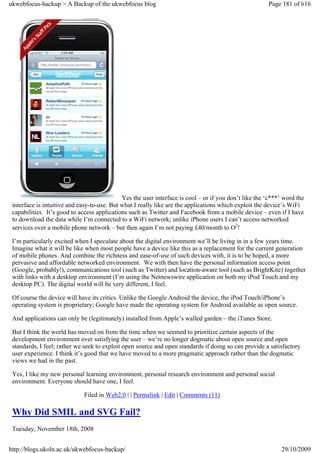
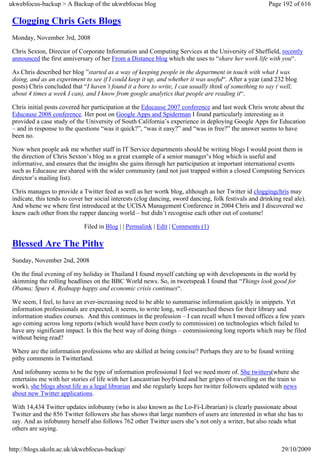
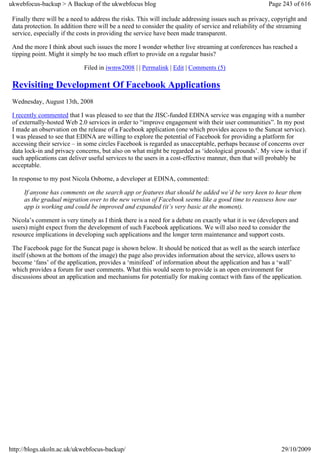
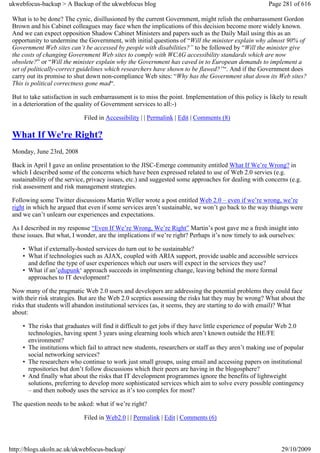
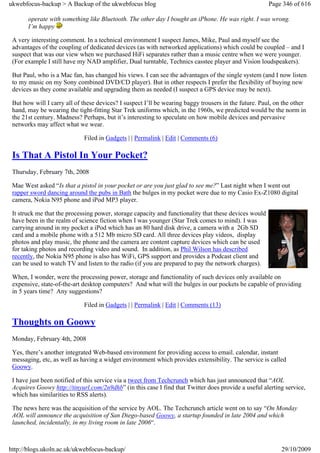
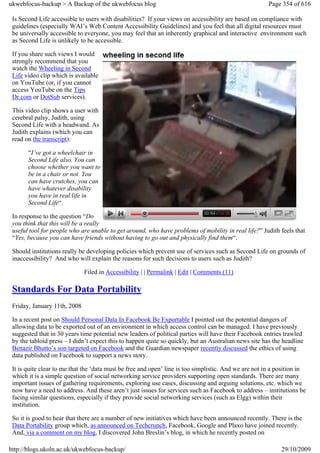
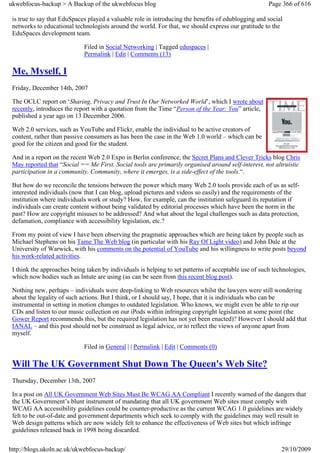
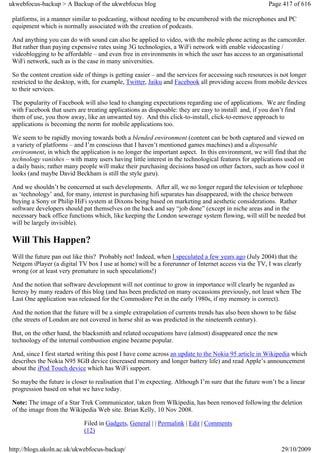
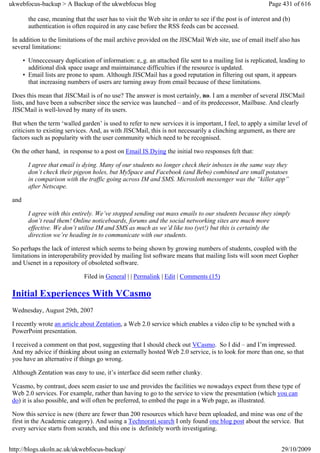
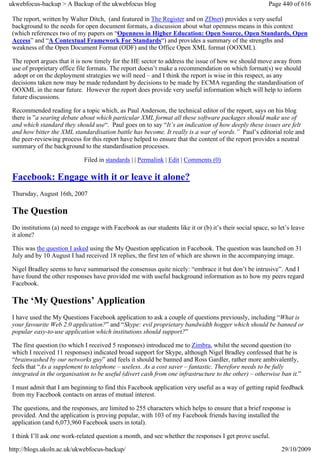
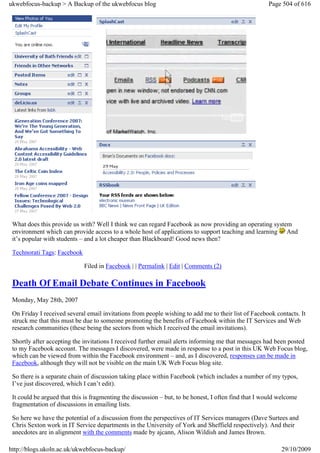
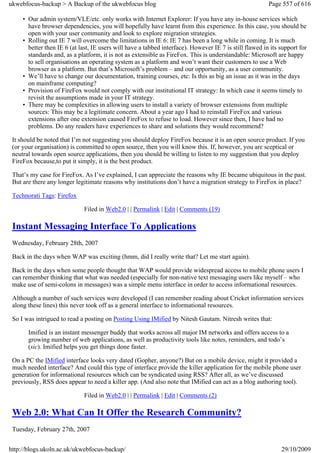
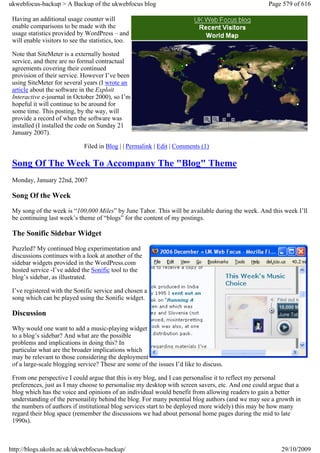
                                                      The new theme is now enabled by default on blogs, such as this
 one, which are hosted by Wordpress.com. And yes it does make blog posts much easier to read as the mobile
 interface has a less cluttered interface which, although unlikely to provide significant usability problems on a
 typical desktop computer, can be irritating on a mobile device, such as a iPhone or iPod Touch (which was used
 to capture the image of the blog which is illustrated).

 Best of all is that this enhanced interface has been provided without the need for me to do anything – no software
 to be upgraded or new themes to install.

                              Filed in Blog, Gadgets | | Permalink | Edit | Comments (1)

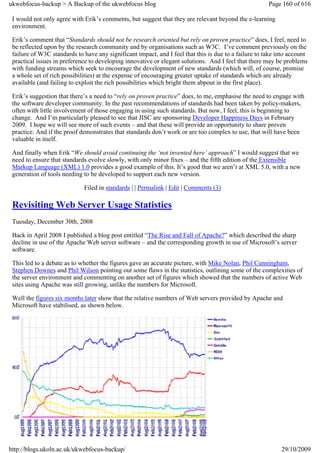
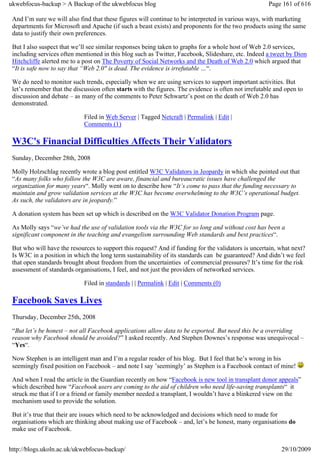
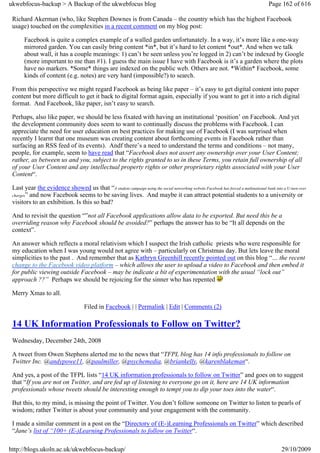
 Opening Up Institutional Training Resources
 Friday, October 23rd, 2009

 I’m now back from a few day’s at Aberystwyth University, where I had been invited to speak at the launch of
 the HEFCW-funded Gwella project and to give a seminar on “The ‘Higher Education in a Web 2.0 World’
 Report: Implications For IT Service Departments“.

 As this involved a long train journey I also sought to maximise my time in Aberystwth by participating in a
 regional meeting for Welsh Web managers. During the brief summaries of areas of work which the members of
 institutional Web management teams had been involved in I noticed that a number of the institutions were
 involved in the delivery of training in use of Terminal 4’s Content Management System. But why, I wonder, are
 institutions still developing their own training resources? As the meeting took place at the start of the first
 international Open Access Week I did wonder whether an institutional move towards (or committment to) open
 access for research publications and research data shouldn’t be complemented by an institutional committment to
 providing Creative Commons licence for institutional training resources. And shouldn’t Information Services
 departments and Libraries be taking a leading role in this area? After all it is staff in the IT Services departments
 who will be well-placed to develop the technical infrastructure to provide access to such resources and Library
 staff who can advise on access mechanisms, use of metadata, etc.

 This suggestion is not new – back in 2005 I presented a paper on “Let’s Free IT Support Materials!“ at
 the EUNIS 2005 conference. But it is probably timely to revisit this subject, not only due to links with the Open
http://blogs.ukoln.ac.uk/ukwebfocus-backup/                                                                 29/10/2009
ukwebfocus-backup > A Backup of the ukwebfocus blog                                                      Page 4 of 616

 Access Week but also the related interests in open access for learning resources, as described recently in an article
 entitled “Get it out in the open” published in The Times Higher.

 Now I’m not saying that the availability of open training resources, which might include podcasts and screencasts
 as well as more conventional training resources, will necessarily always be used – perhaps trainers and user
 support staff will continue to prefer to use resources they have developed themselves. But if that is the case, then
 what is the point of services such as JORUM and funding initiatives such as JISC’s Open Educational Resources
 programme? Wouldn’t it be beneficial to the community in general if more people were involved in such debates?

                             Filed in openness | | Permalink | Edit | Comments (8)

 RSS Feeds For Welsh University Web Sites
 Wednesday, October 14th, 2009

 RSS Usage On Welsh University Home Pages
 Last year I published a blog post which provided a summary of usage of RSS feeds on Scottish University home
 pages. The survey was carried out in July 2008, shortly before the IWMW 2008 event was held in Aberdeen. The
 aim was to collate evidence on the extent to which best practices in institutional use of RSS were being
 implemented in Scotland and to facilitate discussions on reasons why best practices may not always be being
 implemented and ways of addressing such barriers.

 As I will be visiting Wales shortly I thought it would be useful to carry out a similar survey of the 12 Welsh
 Universities.

 The Findings
 The findings, based on a manual survey carried out on 21 August 2009, are given in the following table.

                                         No. of RSS
      Institution                                         Comments
                                         Feeds
 1    Aberystwyth University             0
 2    Bangor University                  0
 3    Cardiff University                 0
 4    Glamorgan University               0
                                                          RSS feeds for news, sports news, Careers centre news
 5 Glyndŵr University                    4
                                                          and Student news.
      Royal Welsh College of Music &
 6                                       0
      Drama
 7    Swansea University                 0
 8    Swansea Metropolitan University    1                RSS feed for news.
 9    Trinity University College         0
      University of Wales Institute,
 10                                      0
      Cardiff
 11   University of Wales, Lampeter      0
 12   University of Wales, Newport       0

 It appears that only two Welsh institutions are providing RSS feeds which can be found from the home page
 (16.67%).


http://blogs.ukoln.ac.uk/ukwebfocus-backup/                                                                29/10/2009
ukwebfocus-backup > A Backup of the ukwebfocus blog                                                        Page 5 of 616

 Revisiting Community Surveys
 Last year’s blog post on RSS usage on Scottish University home pages discussed possible reasons for the low
 levels of usage, and I don’t intend to revisit that discussion as I suspect the same reasons will be valid for both
 communities. I should also add that Tony Hirst has developed a tool for dynamic discovery of auto-detectable
 RSS feeds for all UK University home pages, which currently reports a total of 48 out of 133 institutions
 (36.1%).

 So rather than discussing the specific example of RSS feeds across a sector, I’m more interested in ways in which
 a sector (or interested and motivated individuals within a sector) can provide similar (factual) surveys which can
 help to support discussions and, perhaps, inform policies.

 Liz Azyan has compiled lists of UK Universities usage of YouTube, Twitter, Flickr and MySpace. But, as can be
 seen from the list for MySpace usage, it is not always easy to provide complete coverage and there are likely to be
 difficulties in ongoing maintenance of such resources. Would it be useful, I wonder, for the Welsh Web
 management community to set up a wiki to keep a record of trends within their own sector? This is something I
 will explore at a meeting of Welsh institutional Web managers at the University of Aberystwyth on Monday.

                              Filed in General | | Permalink | Edit | Comments (0)

 Top Technology Trends – For The Twentieth Century!
 Tuesday, October 13th, 2009

 Top Technology Trends for Libraries and Information Professionals
 Later this week I’m taking part in the Internet Librarian International (ILI) Conference in London. In addition to
 running a workshop and giving a talk on standards I’ll also be taking part in the closing panel session on Top
 Technology Trends for Libraries and Information Professionals.

 What should I say, I wonder? Should I talk about the importance of social tools for resource discovery, using
 Twitter as an example of a tool whose success was unexpected. Or shall I try and quickly gain an understanding
 on Google Wave and talk about its potential relevance to information professionals.

 But doesn’t this approach simply repeat the technological determinism which the postdigital advocates point out
 has continually failed to deliver on its promises.

 Instead I’m intending to take today’s environment as the starting point and explore how technological
 developments promise to take us towards a better world – in the 1990s.

 Today’s Networked Environment
 How can we summarise today’s environment, which provides the starting point for a journey towards the past?
 Let’s mention a few examples.

     Twitter: It might be appropriate for event aimed at the Library community to begin by talking about the
     success of Twitter, not only for providing community support but as a mechanism for resource sharing and
     resource discovery – yes, Twitter now seems to be a very effective tools for sharing links with one’s friends
     and colleagues.

     Lightweight development: We now hear developers being critical of large-scale funding initiatives,
     preferring instead small amounts of funding to support rapid development work. The JISC’s recent Rapid
     Innovation Grants provided an example of a funding body recognising the benefits of such an approach.

     Barcamps, Bathcamps, Hackfests, …: Proponents of light-weight development approaches also feel that
     meeting up with like-minded people, perhaps at weekends, can be a useful way of supporting one’s
     professional activities (and in the case of the recent Bathcamp, the weekend away also involved camping!)

http://blogs.ukoln.ac.uk/ukwebfocus-backup/                                                                  29/10/2009
ukwebfocus-backup > A Backup of the ukwebfocus blog                                                        Page 6 of 616

     Crowdsourcing: Examples such as the crowdsourcing of the digitisation of MP’s expenses claims, Galaxy
     Zoo, reCaptcha and other examples provide further illustrations of today’s networked environment, in which
     enthusiasts, who need not be developers, can achieve benefits which previously may not have been felt to be
     achievable without significant expenditure.

 There is, of course, a political and social context to this technical environment – and, especially, for those
 working in the public sector, the context is the gloomy economic situation, an expectation that things will get
 even worse and a likely change of government in the near future.

 Looking Forward to the 1990s
 Let’s assume that, due to a malfunctioning (time) portal, we, like Benjamin Button, find ourselves being taken
 backwards in time, in our case towards the 1990s. How might the networked environment I have summarised
 above develop? Here ares my predictions:

     Twitter: The sceptics who argued that Twitter doesn’t have a sustainable business model will be proved
     correct. The Twitter service will die and, despite an attempt by Facebook to provide a simple type of service
     using its Status updates, the concept of ‘micro-blogging’ will disappear. The resulting productivity gains
     will be instrumental in helping the Twittering nations to move out of the global recession.

     Lightweight development: The limitations of lightweight development approaches and simple (some say
     simplistic) formats such as RSS become apparent and, despite providing interesting exemplars, fail to
     provide an infrastructure for serious significant development work. ‘Enterprise development’ becomes the
     new ‘lightweight development’ and large-scale Content Management Systems become the popular with
     organisations facing pressures from their peers to deploy such technologies.

     Barcamps, Bathcamps, Hackfests, …: The growth in large-scale enterprise development environment
     (accompanied by pressure from friends and families to achieve a more healthy work/life balance) brings to an
     end the culture of the amateur hacker and events such as barcamps, bathcamps and hackfests.

     Crowdsourcing: The importance of the professional in the development of high quality networked services
     goes beyond the developer community. The failure of amateurs to provide the required levels of quality for
     digitisation, metadata standards, etc. results in an appreciation of the merits of the professional. Librarians
     and related information professionals become critical in the development of sustainable networked services.

 Of course, as with many technological predictions, this vision of the 1990s is an optimistic one. Not only does the
 demise of social networks lead to an emphasis on real-world friends and relationships, but the political and
 economic environment will also see tremendous improvements – indeed I predict that in 10 years, or possibly 12
 years time (say 1997), we will be very pleased with our political and economic situation and positive about the
 benefits that the future will bring.

 Postscript
 This post was influenced by the post-digital session which Dave White facilitated and Rich Hall as part of the
 fringe (#falt09) activities around the ALT-C 2009 conference. In a blog post about the session Dave White felt
 that “After the fringe session I was even more convinced that the post-digital was a useful concept but that we
 hadn’t found the right way of expressing it yet.”

 John Maeda has described how “Recently I have had the sense that no matter what new digital territory may
 arise, we end up where we first began – back in an infinite loop. My instinctive response to this personal
 perception has been to proclaim a new effort to escape to the post digital . . . which I am certain lies in the past.”

 Can we gain a better appreciation of our perhaps naive expectations of the benefits of technological developments
 by, as John suggests, looking back into the past?

                              Filed in General | | Permalink | Edit | Comments (2)


http://blogs.ukoln.ac.uk/ukwebfocus-backup/                                                                  29/10/2009
ukwebfocus-backup > A Backup of the ukwebfocus blog                                                      Page 7 of 616

 Twitter Event Hashtagging Strategies
 Monday, October 5th, 2009

 Background
 In a recent post on the eFoundation’s blog Andy Powell wrote about “Flocking behaviour – why Twitter is for
 starlings, not buzzards“. Based on the statistics I had provided for use of Twitter at the recent ALT C 2009
 conference Andy picked up on the use of two tags (#altc2009 and #altc09) and pointed out that “if you don’t tweet
 using the generally agreed tag you are effectively invisible to much of the conference audience“.

 I agree – so there’s probably a need to agree on hashtagging strategies for events, which I’ll explore in this post.
 And I’ll use this as an opportunity to consider what hashtag UKOLN should be using for next year’s Institutional
 Web Management Workshop (IWMW 2010).

 Issues To Consider
 What are the issues to consider when selecting a hashtag for use at an event?

 Being brief
      The initial requirement is that as tweets are limited to 140 characters, hashtags should be brief in order to
      maximise the amount of content that can be containing in a tweet about an event.
 Avoiding problems with non-alpha-numeric characters
      It may be felt desirable to avoid use of certain non-alphanumeric characters which may cause problems in
      some Twitter clients. For example, the hashtag #clip2.0 was initially suggested for an event on the
      relevance of Web 2.0 technologies for the CILIP organisation and CILIP members. However Twitter clients
      seem to truncate hashtags containing a full stop, so the hashtag #cilip2 was used. Similar problems have
      been observed with use of a dash (-) as illustrated in the display of a tweet in the TweetDeck client. In
      addition there was a complaint that use of an underscore (_) in the #cilip_lams event caused usability
      problems, especially on mobile devices. The advice would seem to be stick with alphanumeric characters in
      hashtags.
 Avoid numbers at the start of hashtags
      Hashtags which begin with a number (e.g. #2009foo ) are believed to cause hyperlinking problems in some
      clients.
 Should you be consistent with other tagging services?
      Although those who make intensive use of Twitter may feel that the first two points are all that need to be
      considered when formulating a hashtag for an event, there may be an argument for being consistent with
      recommendations for tags using in other environments such as other Flickr, YouTube, etc. These services
      do not suffer for the length constraints imposed by Twitter and so can provide more flexibility. There may
      be an argument for using a Twitter-safe hashtag in these other services, but what if these other services are
      the more widely-used services (e.g. events with an established use of Flickr)?
 Should the year be included?
      Many of the events I’ve attended or followed on Twitter have included the year in the hashtag (e.g.
      #iwmw2009, #altc2009 and #solo09) but some have not (#alpsp and #cilip_lams). Does the year have to be
      included, especially as the tweets will be readily accessible via the Twitter search APIs for only a short
      period? But might a decision to save space by omitting the year cause problems if the Twitter API changes
      or other tools are used? And might this cause additional confusions with tags for which date encoding may
      be useful.
 One hashtag or several?
      If there are multiple events associated with a main event (e.g. pre-conference workshops or fringe events)
      you will need to consider whether to recommend use of the main event hashtag for these peripheral events
      or to suggest an alternative hashtag.
 Branding issues
      There may be pressure to ensure that an event hasthtag provides the correct branding for the organising
      bodies. The hashtag for the CILIP’s Umbrella 2009 conference, for example, was #cilipumbrella.
 Multi-lingual issues


http://blogs.ukoln.ac.uk/ukwebfocus-backup/                                                                29/10/2009
ukwebfocus-backup > A Backup of the ukwebfocus blog                                                    Page 8 of 616

      Welsh institutions may need to consider use of bilingual tashtags. Note, for example, that for the CILIP
      Wales 2009 conference the conference hashtag was cilip-cymru09. I should add, however, that I havent any
      experience of the implications of use of non Latin characters (ironically, as Im typing this sentence on a
      Croatian keyboard and cant find the single quote character!)
 Being memorable
      Perhaps because I’m getting older I am finding it difficult to remember random strings of characters – so I
      wouldn’t appreciate a a tag such as #xuj740n9 (having to re-authenticate a username and password with a
      similar pattern can also be irritating). I found the hashtags used for the recent Oxford Social Media
      Conference (#oxsmc09) and Science Online London (#solo09) events easy to remember as the conference
      names themselves were memorable.
 Being different
      Having an event hashtag which could clashes with other hashtags is likely to lead to confusion.
 Avoiding ambiguities in the characters
      Many years ago I was an information officer and I was very aware of the need to avoid confusions between
      characters such as 1 and i and o and 0 (in some fonts these many be indistinguishable). Note that this may
      be very relevant for events held next year. The (fictitious) Input Output’s annual conference hashtag #io10
      could be particularly confusing depending on the font used on your computer.
 Being timely and promoting the hashtag effectively
      As mentioned recently, it is important to finalise a hashtag in advance of the event and to ensure that
      participants and other interested parties are aware of the official hashtag for the event. In many cases
      participants are likely to tweet about an event prior to the event, perhaps when a call for paper has been
      published e.g. “Loking for partners to write a proposal for #altc2010 with“.
 Obtaining buy-in from users of the tag
      As it is not possible to mandate use of an official event hashtag you should seek to ensure that users of the
      tag will be inclined to use the hashtag. If the hashtag is too long the users may choose to use a shorter one.
 Explaining the tag
      As well as promoting the hashtag to the event participants you should also try to ensure that other interested
      parties, who perhaps might notice a stream of tweets with the tag, can easily discover more about the
      associated event. One way of doing this might be to ensure that a Web page containing details of the
      hashtag and the event is published early so that it may be indexed by Google. In addition it may be useful to
      describe the event in Twitter aggregation services such as WThashtag (e.g. see the description for the
      IWMW 2009 event).

 #iwmw2010, #iwmw10, #iwmw – or something else?
 This post has described some of the issues which should be considered when choosing an event hashtag. But to
 put such discussions into context, I’d like to consider the hashtag UKOLN should be using for next year’s
 Institutional Web Management Workshop (IWMW 2010) – the fourteenth in this series of annual events for
 members of institutional Web management teams.

 I’ve recently attended four events which had a Twitter hashtag, each of which took a different approach:
 #altc2009, #techshare09, #alpsp and #cilip_lams.

 As there aren’t pressures to brand our host institution, UKOLN, there’s no need for a ‘#ukoln_iwmw” style tag.
 The options, and arguments for and against, are therefore:

     #iwmw2010
     For: Consistency with previous years and consistency with tags used in Flickr, YouTube, etc. Also
     consistency with URL used on UKOLN Web site.
     Against: Uses 9 characters – this could be shorter.

     #iwmw10
     For: Saves two characters over #iwmw2010.
     Against: Loses consistency with previous years and with other tag services. Possible confusion over the
     characters (could it be confused with #iwmwi0?)

     #iwmw
     For: Saves four characters over #iwmw2010. No confusion with the ‘10′ characters.
     Against: Loses consistency with previous years and with other tag services. Loss of the date may cause

http://blogs.ukoln.ac.uk/ukwebfocus-backup/                                                                 29/10/2009
ukwebfocus-backup > A Backup of the ukwebfocus blog                                                      Page 9 of 616

     problems if data is to be used in content of other years (but not necessarily so as the tweets do have a
     machine-readable date)

 What do you think we should go for? And are there other issues one should consider when choosing a hashtag for
 an event which I haven’t mentioned?

                             Filed in Events, Twitter | | Permalink | Edit | Comments
                             (11)

 Guest Post: Blogs At Imperial College
 Friday, October 2nd, 2009

 After a gap of 11 months the guest blog post returns with a post by Jenny Evans, Liaison Librarian: Maths and
 Physics at Imperial College. Jenny provides a background to two blogs (to support the Physics and Maths and
 Engineering departments) which were set up by liaison librarians in 2006 and answers many of the questions
 which librarians in a similar role may be asking: how did you get agreement from the management?; who
 contributes; what is the target audience; what do you write about; how long does it take to support; is it
 sustainable and, perhaps most importantly, can the blog service be regarded as a success?


 About Imperial
 Imperial College London is a science-focussed institution with a reputation for excellence in teaching and
 research with approximately 12,000 full time students. The Library comprises the Central Library and the
 Mathematics Department Library, located on our South Kensington campus, as well as campus libraries at
 Charing Cross Hospital, St Mary’s Hospital, Chelsea and Westminster Hospital, Brompton Hospital,
 Hammersmith Hospital and Silwood Park.

 Background
 Our first two blogs were created by liaison librarians, Ruth Harrison and myself, in March 2006. There were three
 main reasons we considered using a blog.

 Firstly, we had tried sending out emails and newsletters to departments informing them of relevant developments.
 Problems with this method included academics wanting different formats, or complaining about email overload.
 From our perspective, as a newsletter tended to be produced only once a term, information we wanted to get out
 to them quickly was often out of date by the time it was sent.

 There was the option of adding pages to the library website, however this relied on us getting information to
 another library staff member, and then waiting for them to put the page up. Which if you needed to get
 information out to staff/students quickly was not the ideal solution.

 Finally, the library Web site doesn’t provide detailed subject specific information pages, which academics had
 complained about to us, so we wanted to address this issue – the blogs were a way in which we could provide
 very specific information and only to those people who wanted it.

 As such, we felt a blog would be an ideal way to be able to communicate quickly, effectively and directly with
 our respective departments about information that was relevant to them. Blogs would enable us to post content as
 we needed to, they would be easy to set up and maintain, and we could delegate responsibility to staff where
 appropriate. It also meant academics could set up an RSS feed to the pages so they could control how they
 viewed the information.

 WordPress software
 We decided to start the blogs using the free blogging software from WordPress. It was a fairly new option at the
 time, but it was getting good reviews, seemed to be flexible, offered some useful features and was free.

http://blogs.ukoln.ac.uk/ukwebfocus-backup/                                                                29/10/2009
ukwebfocus-backup > A Backup of the ukwebfocus blog                                                      Page 10 of 616

 Getting agreement from management
 Working on the assumption that it is much easier to sell an idea that you can demonstrate we created a working
 prototype and began posting content to the blogs before presenting them to our respective managers. They then
 took them to the relevant management meetings. Although there was some unease about the lack of branding,
 and the idea that at the time not all liaison librarians would have a blog, it was agreed that as this was a form of
 communication, specific to a liaison librarian and their department (not unlike email) that we could continue.

 Over the past 3 1/2 years, other liaison librarians have seen the success of our blogs and have created their own.
 We now have thirteen blogs covering a variety of subject areas. There is currently no specific ‘library style’ for
 the blogs, although some look more ‘Imperial-like’ than others.

 Blog authors
 Our blog authors are a mix of library staff – though all work in Library’s Faculty Support Services for Teaching
 and Research Directorate – as the blogs are aimed staff and students in specific departments/subject areas. As
 such, the relevant library liaison team are responsible for the blog. This could be a single person or more than one
 member of the same team. Our medicine blog is aimed at all medical staff and students and as such members of
 staff from all of the medical campuses contribute to this blog.

 Target audience
 Each of our blogs has a different target audience, depending on what is thought appropriate for that subject area.
 This can include:

     •   Academic/research staff
     •   Postgraduate research students
     •   Postgraduate taught course students
     •   Undergraduate students

 For example the maths and physics blog that I am responsible for (as I’m no longer responsible for chemistry) is
 aimed at academic and research staff, and research post-graduate students, although some content is relevant to
 post-graduate taught course students and I do make them aware of its existence. It is not so relevant to the
 undergraduate students, however I do have a maths projects blog I have created to support the projects they work
 on in the first and second year of their course.

 Content
 This is also something that relies on the particular person or group of people responsible for each blog.

 Examples of what people include in their blogs:

     •   New resources including new book purchases and journal subscriptions
     •   News
     •   Custom search engines
     •   Journal citation reports/bibliometrics information
     •   Help/advice pages
     •   Support for teaching sessions
     •   Identifying key resources such as e-books
     •   Highlighting relevant parts of the library website
     •   Highlighting the physical location of relevant collections
     •   Overview of relevant key database and referencing information

 Generally, we would try not to duplicate information found on the library Web site, but do highlight relevant
 content.


http://blogs.ukoln.ac.uk/ukwebfocus-backup/                                                                  29/10/2009
ukwebfocus-backup > A Backup of the ukwebfocus blog                                                    Page 11 of 616

 How long we spend maintaining our blogs
 As you can imagine, this differs depending on who is working on the blog. I did a quick survey of fellow
 bloggers as to how often they post on their blogs and this ranges from a couple of times a week to once a month.
 Personally, I must confess I don’t spend as much time on mine as I used to, though my team member Katie does
 most of the posting these days.

 Publicity/Marketing
 You can find a link to our blogs on our library homepage and there is also a link from the College blogs page.
 I’ve also got links on the Physics department website and the Maths Library web page.

 For my blog, I email department staff, PhD students and MSc students at least once a term, reminding them the
 blog is there and highlighting any current news. Some bloggers use Feedburner which enables them to give
 people the option to receive updates by email.

 Our Life Sciences team introduce their blogs to students in induction sessions and point out useful features.

 This is possibly something we could market better than we do so at the moment. Suggestions from fellow
 bloggers include giving them a higher profile, making them more visually appealing, perhaps giving them a
 similar style/layout.

 Success?
 As a whole our blogs have been very successful – they are all getting used. They enable us to raise our profile as
 liaison librarians within the departments we work with, and provide our users with a resource that is specific to
 their areas of expertise.

 In the words of one of our Life Sciences bloggers:

     “Subject blogs are an ideal way to gather relevant subject specific material together in one place for your
     staff and students, they can be tailored and expanded to meet the need and are much more flexible than
     having to coordinate an official webpage update. We introduce our students to them in inductions and point
     out useful areas such as ‘Finding Books’ (which is a well-used page) and Academic Writing Skills (another
     well-used page which lists academic writing skills books in the library with links to the catalogue – this
     really picked up over the summer when Masters students were focussing on writing up).“

 The statistics available via WordPress do enable you to see details about how many people are viewing your blog,
 who is referring to your blog, what the top posts and pages are, search terms people are using to find you, and
 what people are clicking on and incoming links. However, this doesn’t include RSS feeds (unless you are using
 Feedburner). And these statistics do demonstrate that our blogs are being used.

 Personally, I didn’t expect loads of comments on my blog – I use it more as a means of getting relevant
 information out to my departments (maths and physics) – however I do encourage people to get in contact via the
 comments mechanism of the blog. I have installed a MeeboMe widget on my blog which hasn’t had a great deal
 of use (though the widget I installed on the blog I created for my maths undergraduate students has had a few
 enquiries). My humanities colleague has also tried MeeboMe with limited success.

 Our Life Sciences team has noticed that the more time they have invested in “developing, populating and
 marketing (not to mention regularly updating) the blog has seen a continued growth in usage figures”.
 Another unexpected outcome has been the interest from third parties such as Victor Hemming from Mendeley
 who had seen “posts we had put up about referencing and networking for researchers. This initial contact led to
 Mendeley coming to Imperial to give a personal introduction. It was good to know that our blog was attracting the
 attention of useful people and sending them in our direction”.


http://blogs.ukoln.ac.uk/ukwebfocus-backup/                                                               29/10/2009
ukwebfocus-backup > A Backup of the ukwebfocus blog                                                       Page 12 of 616

 Sustainability
 Our blogs have been running for 3 and half years now and show no signs of slowing down. The bloggers I have
 been in touch with all feel that it is worth the time they spend maintaining and updating them.

 Jenny Evans,
 Liaison Librarian: Maths and Physics
 Imperial College
 London
 Email: j.evans@imperial.ac.uk
 Blog: http://physmaths.wordpress.com/

                             Filed in Blog, Guest-post | | Permalink | Edit | Comments
                             (0)
 If It's Not "All About The Technology" Then What Else Is It Not
 About?
 Wednesday, September 30th, 2009

 The announcement of the availability of a video summary of the event reminded me of the opening F-ALT
 session, held on 8 September in the Lass O’Gowrie pub (a pub I always try to get to when I’m at a conference at
 Manchester University). This was my first time at F-ALT, the ALT’s Fringe event, and I was looking forward to
 meeting up with the F-ALT organisers and participants, many of whom I’ve met previously or may not have met
 but read their blogs or follow on Twitter.

 From what I’d heard of last year’s F-ALT, the Fringe event would provide an opportunity to discuss topics related
 to elearning in a informal and friendly setting. I’d heard anecdotes of last year’s debate on the “Edupunk” meme
 and was looking forward to a similar light-hearted evening of geeky fun. However the topic of the opening F-
 ALT session was “Postdigital” and the description on the F-ALT wiki read:

     “What does this mean? Why is it not two words? Is it just Dave making-up another term in an attempt to get
     keynote gigs? No, it actually has some substance to it and could be a very helpful way of framing the
     learning-tech discussion over the next few years. If you are sceptical about all this then you should definitely
     turn-up. The chances of an argument breaking out are very high.“

 Perhaps this year’s F-ALT wouldn’t turn out to be the informal evening and drink and chat that I had expected!
 The participants at the event were asked to give a two-minute response to a number of ideas we were presented
 with. Mine was, if I recall correctly:

     The speed of the change, however, has left us with the mistaken belief that social change was somehow
     ‘created’ by the digital rather than simply played out on a the canvas of the digital; that the digital itself is
     the main driver of change.

 Being presented with this serious topic in the pub on the opening evening of the conference I tried to response in a
 light-hearted fashion. I suggested that it was appropriate that this topic was raised in a traditional Manchester
 boozer, possibly a pub which Fredrick Engles drank in when he spent time in the city. And just as we call for
 ownership of our scholarly works in ours IRs (institutional repositories) so Engels called for ownership of the
 means of production in the better known IR – the industrial revolution. So the arguments we are having now
 aren’t about primarily about the technologies, but reflect arguments which date back hundreds of years (indeed
 Martin Weller has suggested that the debates go back many centuries).

 The publication of the video summary of the evening (which is embedded below) provides an opportunity to
 revisit ‘postdigital’ debate …

 [youtube=http://www.youtube.com/watch?v=LKPoWMYEvvg]


http://blogs.ukoln.ac.uk/ukwebfocus-backup/                                                                   29/10/2009
ukwebfocus-backup > A Backup of the ukwebfocus blog                                                     Page 13 of 616

 If, as Dave White suggests in a post on “Postdigital: Escaping the Kingdom of the New?“, we tend to overhype
 the new and exciting, and fail to appreciate the aspects which are actually useful, what are the implications?
 Perhaps this is a topic which is worthy of more considered thinking.

 Now maybe it is correct to suggest that we in the development community, who consider ourselves to be agents of
 a transformational change to a better environment, fail to appreciate that our users often ignore our developments
 and our vision. After all, if the initial evidence reflects a more general trend, we seem to be living in a world in
 which most users use an MS Windows platform to access institutional resources – they’re not interested in Linux,
 for example, despite many years of evangelism from the open source community. A computer’s a computer, just
 like a fax machine is a fax machine – only nerds care about what goes on underneath the bonnet.

 But if this is true, what are the implications for accepting that we are in a postdigital age? Don’t we then accept
 that our IT environment will be owned by the mega-corporations – Google and Microsoft. And let’s forget
 debates about device independence and interoperability – unless the mega-corporations feel such issues may
 provide a competitive edge.

 It strikes me that the postdigital agenda is a conservative one, in which we are asked to accept that we (in our
 institutions and in our working environment) cannot shape our digital environment. And for me that is a worrying
 point of view which I don’t accept.

                             Filed in Events, General | Tagged altc2009 | Permalink |
                             Edit | Comments (9)

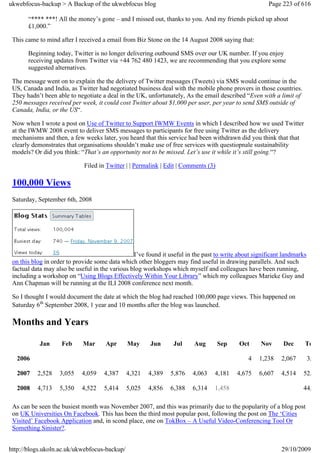
 200,000 Views
 Tuesday, September 29th, 2009

 On 6 September 2008 I published a post entitled 100,000 Views which documented the date of this blog having
 received 100,000 views according to the usage statistics provided on the Wordpress.com site. I described how:

     “I’ve found it useful in the past to write about significant landmarks on this blog in order to provide some
     data which other bloggers may find useful in drawing parallels. And such factual data may also be useful in
     the various blog workshops which myself and colleagues have been running“.


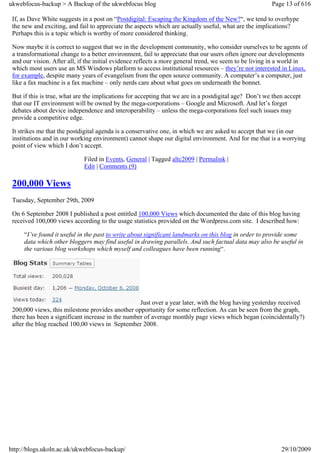
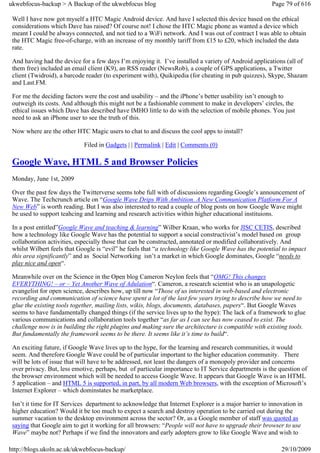
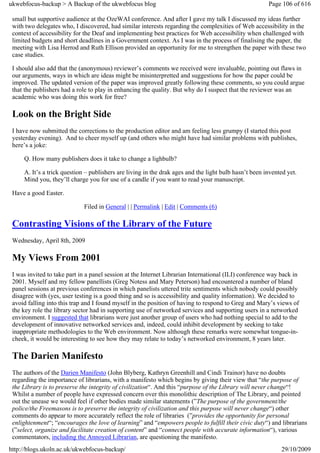
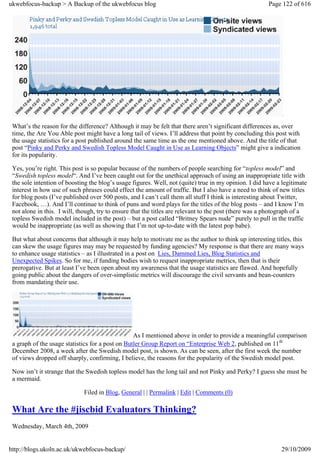
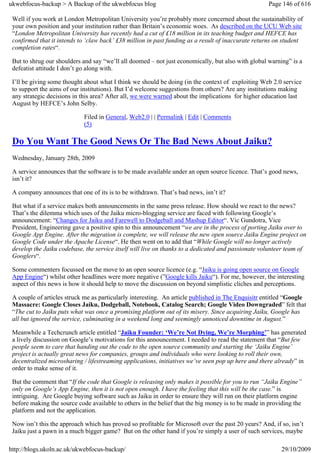
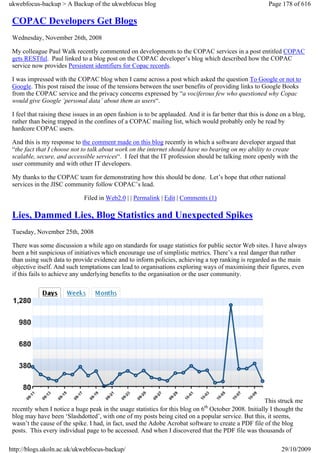
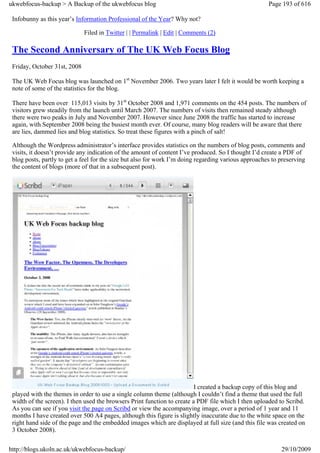
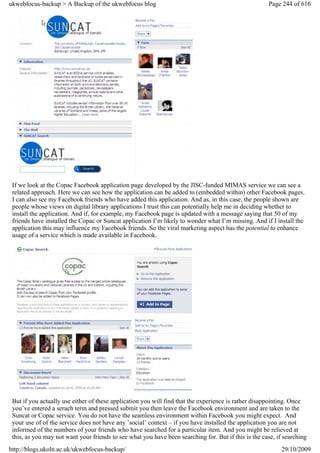
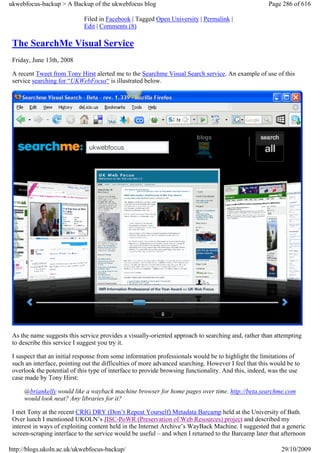
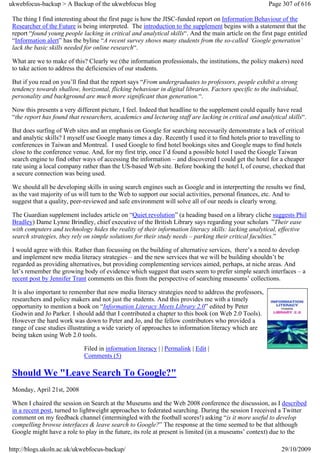
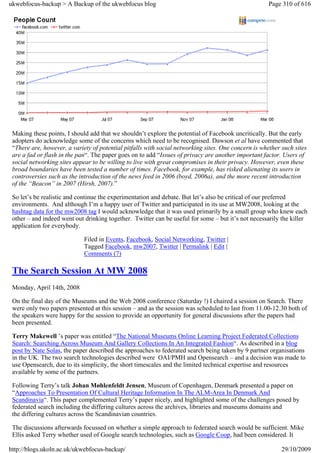
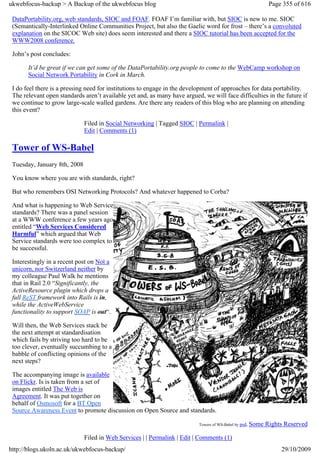
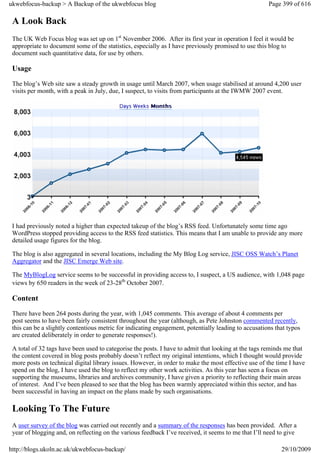
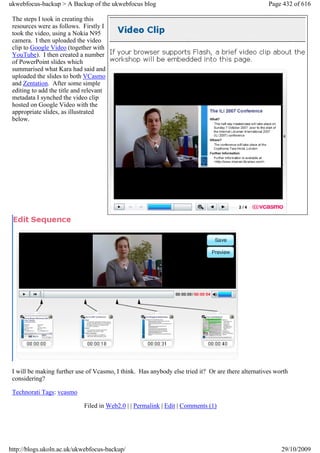
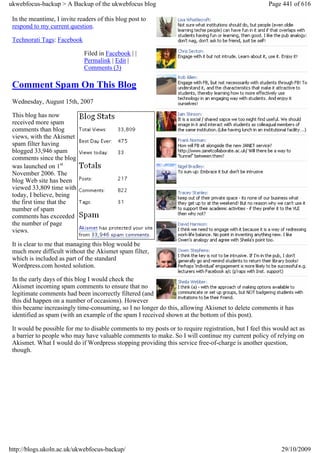
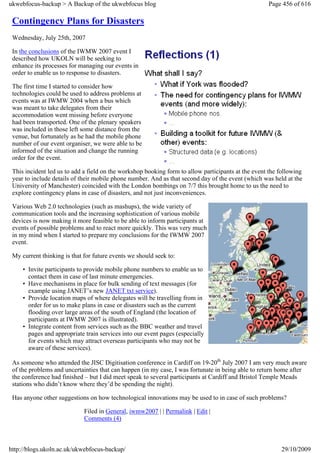
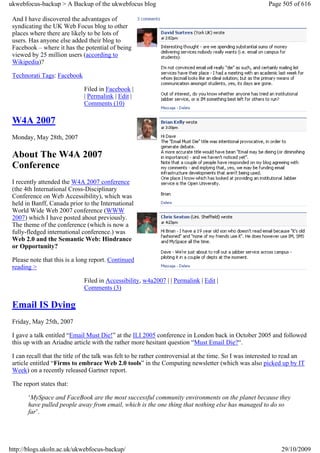
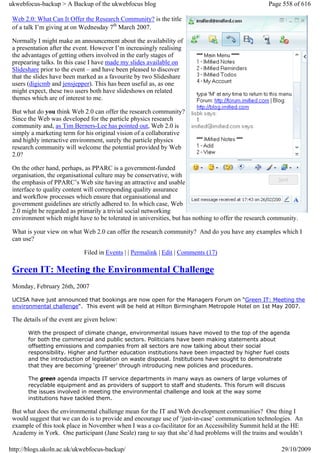
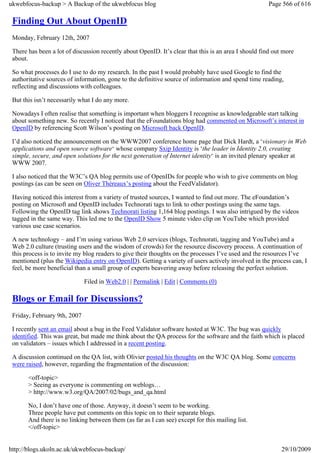
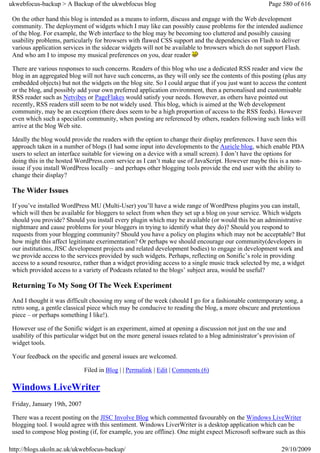
                                                   Just over a year later, with the blog having yesterday received
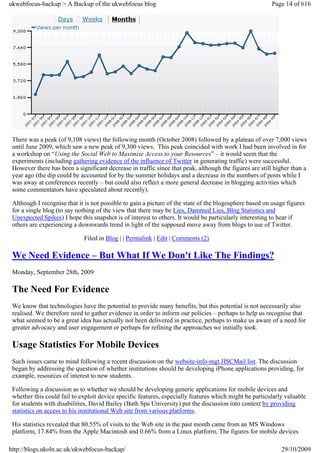
 200,000 views, this milestone provides another opportunity for some reflection. As can be seen from the graph,
 there has been a significant increase in the number of average monthly page views which began (coincidentally?)
 after the blog reached 100,00 views in September 2008.


http://blogs.ukoln.ac.uk/ukwebfocus-backup/                                                                 29/10/2009
ukwebfocus-backup > A Backup of the ukwebfocus blog                                                      Page 14 of 616


 There was a peak (of 9,108 views) the following month (October 2008) followed by a plateau of over 7,000 views
 until June 2009, which saw a new peak of 9,300 views. This peak coincided with work I had been involved in for
 a workshop on “Using the Social Web to Maximise Access to your Resources” – it would seem that the
 experiments (including gathering evidence of the influence of Twitter in generating traffic) were successful.
 However there has been a significant decrease in traffic since that peak, although the figures are still higher than a
 year ago (the dip could be accounted for by the summer holidays and a decrease in the numbers of posts while I
 was away at conferences recently – but could also reflect a more general decrease in blogging activities which
 some commentators have speculated about recently).

 Although I recognise that it is not possible to gain a picture of the state of the blogosphere based on usage figures
 for a single blog (to say nothing of the view that there may be Lies, Dammed Lies, Blog Statistics and
 Unexpected Spikes) I hope this snapshot is of interest to others. It would be particularly interesting to hear if
 others are experiencing a downwards trend in light of the supposed move away from blogs to use of Twitter.

                             Filed in Blog | | Permalink | Edit | Comments (2)

 We Need Evidence – But What If We Don't Like The Findings?
 Monday, September 28th, 2009

 The Need For Evidence
 We know that technologies have the potential to provide many benefits, but this potential is not necessarily also
 realised. We therefore need to gather evidence in order to inform our policies – perhaps to help us recognise that
 what seemed to be a great idea has actually not been delivered in practice, perhaps to make us aware of a need for
 greater advocacy and user engagement or perhaps for refining the approaches we initially took.

 Usage Statistics For Mobile Devices
 Such issues came to mind following a recent discussion on the website-info-mgt JISCMail list. The discussion
 began by addressing the question of whether institutions should be developing iPhone applications providing, for
 example, resources of interest to new students.

 Following a discussion as to whether we should be developing generic applications for mobile devices and
 whether this could fail to exploit device specific features, especially features which might be particularly valuable
 for students with disabilities, David Bailey (Bath Spa University) put the discussion into context by providing
 statistics on access to his institutional Web site from various platforms.

 His statistics revealed that 80.55% of visits to the Web site in the past month came from an MS Windows
 platform, 17.84% from the Apple Macintosh and 0.66% from a Linux platform, The figures for mobile devices

http://blogs.ukoln.ac.uk/ukwebfocus-backup/                                                                 29/10/2009
ukwebfocus-backup > A Backup of the ukwebfocus blog                                                      Page 15 of 616

 were iPhone (0.44%), iPod (0.11%) and Symbian (0.10%) with the figures for mobile devices such as the Palm,
 Blackberry and Android and gaming devices such as the Wii and Playstation being less than 0.1%.

 In response to this sharing of evidence a number of follow-up posts provided additional statistics:

     Heriot-Watt: MS Windows (93.51%), Apple Macintosh (5.05%), Linux (0.67%), iPhone (0.34%), Symbian
     (012%) and iPod (0.11%) (see email).

     Sunderland: MS Windows (92.4%), Apple Macintosh (5.7%) and Linux (0.7%). The figures for other
     devices were all less than 0.1% (see email).

     Imperial College: MS Windows (91.69%), Apple Macintosh (6.9%), Linux (0.87%), iPhone (0.3%),
     Symbian (012%). The figures for other devices were all less than 0.1% (see email).

     University of Warwick: MS Windows (89.19%), Apple Macintosh (8.4%), Linux (1.85%) and iPhone
     (0.25%). The figures for other devices were all less than 0.1% (see email).

 Before reflecting on the implications of this evidence we need to be aware of the limitations of these figures: it
 reflects the experiences of only four institutions; the data is not necessarily based on institutional data and may
 reflect usage for departmental Web servers and the data reflects usage in the summer vacation. But having
 acknowledged these caveats, what might the implications be if this evidence does prove to be indicative of the
 wider higher educational community?

 Discussion
 Ironically although the discussion on the website-info-mgt list began over access to institutional Web sites from
 mobile devices the data provides little evidence of significant usage by mobile devices. But the data does reveal
 patterns of desktop usage which are worthy of further consideration.

 I suspect many of the Web and IT developers and support staff who have been critical of Microsoft over the years
 will be disappointed at the overwhelming popularity of the MS Windows platform for accessing the institutional
 Web sites described above. Should we now accept that MS Windows has won the battle for the desktop operating
 system environment? And at a time when, if the predictions are correct, we may see a reduction in staffing levels,
 do these figures suggest that the time and effort in testing Web sites on the Linux platform may not be justified?
 This isn’t to suggest that Web sites should be designed for the MS Windows platform, rather that the effort in
 testing and tweaking for little-used platforms may not be justified.

 Of course an argument could be made that the figures suggest that there is no point in developing services for the
 mobile Web as the current levels of usage are very low. But the difference is that the desktop and laptop computer
 environment is now mature, whereas the mobile environment is new.

 I think there is a debate to be had – and there is also, perhaps, the need to ask “Where did it go wrong? What
 happened to the diversity of operating systems? Where have the Mac users and Linux users gone?” Or perhaps
 they are still around, and simply aren’t visiting institutional Web sites. What do you think?

                             Filed in Gadgets | | Permalink | Edit | Comments (14)

 Tweetboard: Adding Twitter To Web Pages
 Thursday, September 24th, 2009

 I was recently alerted to a blog post on TechCrunch entitled “Tweetboard Launches Twitter Client And URL
 Shortener“. The article described how this service “lets you create a Twitter-powered forum on any site“. In
 addition Tweetboard provides “the ability to view discussions as a thread, similar to what you’d find on
 FriendFeed or Facebook“.


http://blogs.ukoln.ac.uk/ukwebfocus-backup/                                                                  29/10/2009
ukwebfocus-backup > A Backup of the ukwebfocus blog                                                   Page 16 of 616


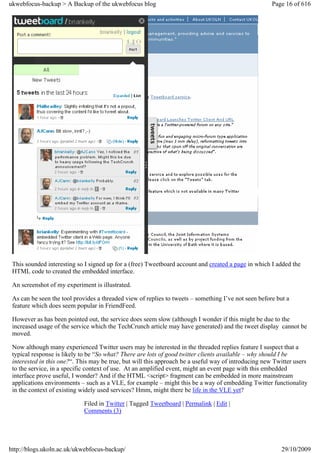
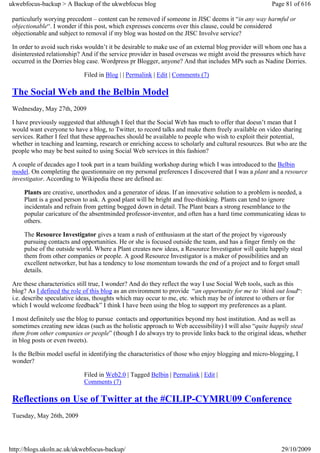
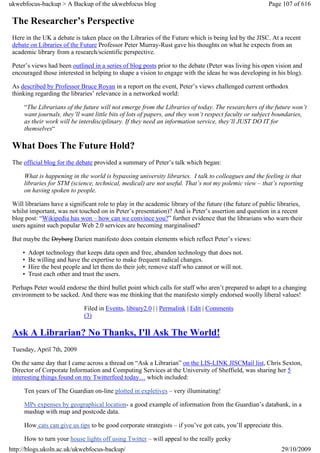
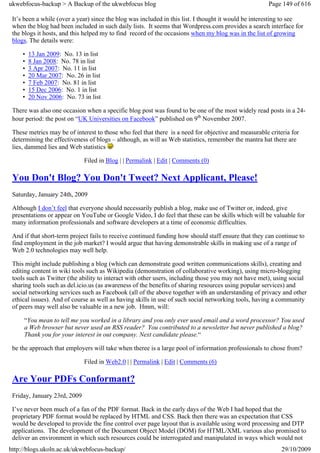
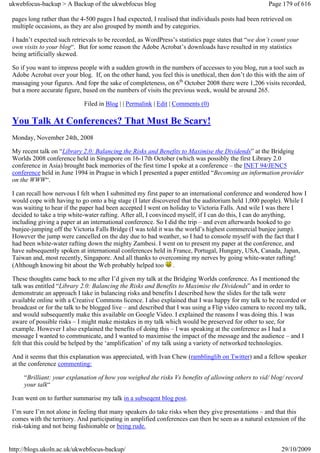
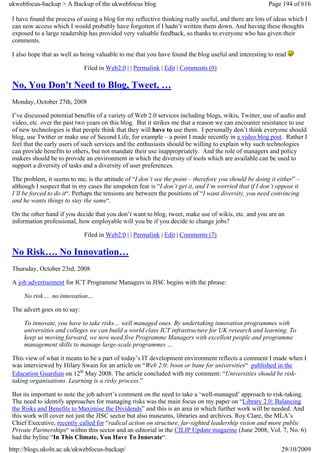
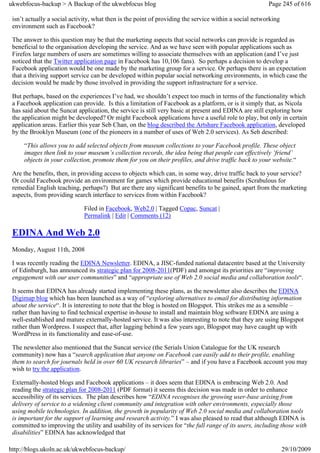
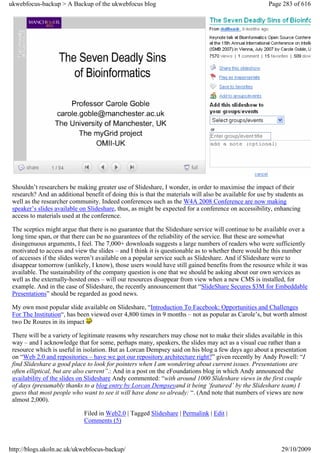
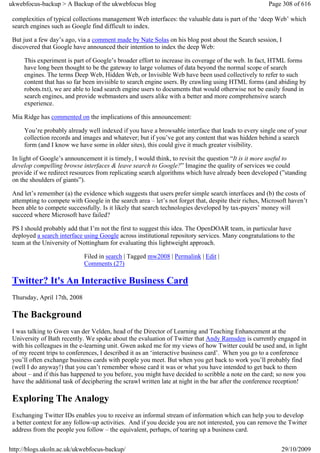
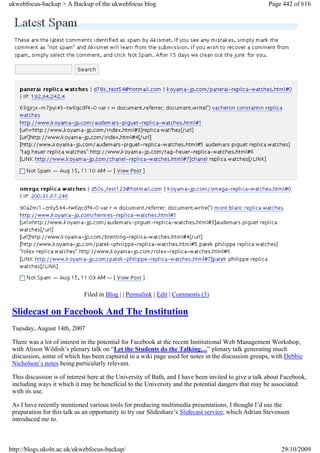
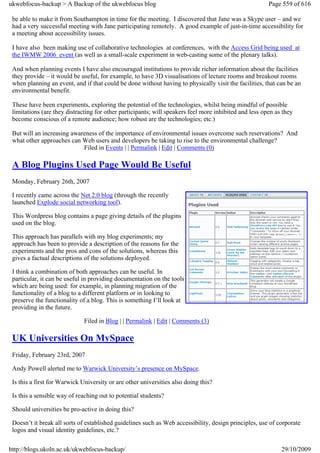
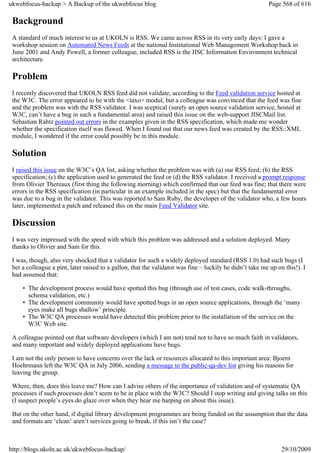
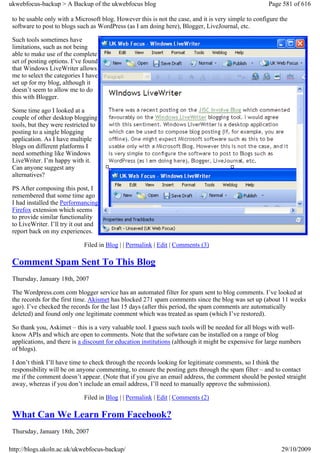
 This sounded interesting so I signed up for a (free) Tweetboard account and created a page in which I added the
 HTML code to created the embedded interface.

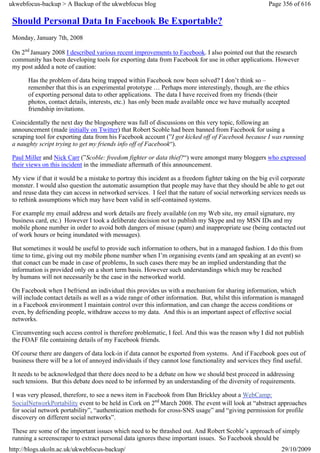
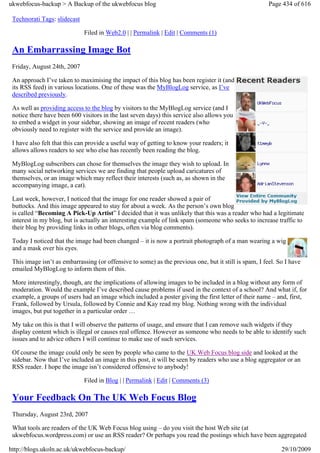
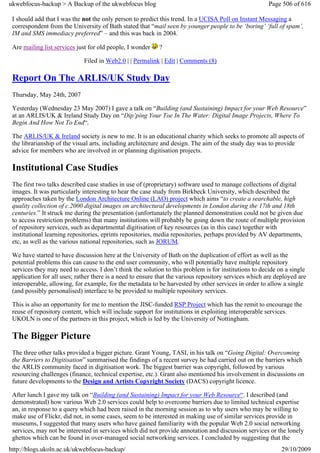
 An screenshot of my experiment is illustrated.

 As can be seen the tool provides a threaded view of replies to tweets – something I’ve not seen before but a
 feature which does seem popular in FriendFeed.

 However as has been pointed out, the service does seem slow (although I wonder if this might be due to the
 increased usage of the service which the TechCrunch article may have generated) and the tweet display cannot be
 moved.

 Now although many experienced Twitter users may be interested in the threaded replies feature I suspect that a
 typical response is likely to be “So what? There are lots of good twitter clients available – why should I be
 interested in this one?“. This may be true, but will this approach be a useful way of introducing new Twitter users
 to the service, in a specific context of use. At an amplified event, might an event page with this embedded
 interface prove useful, I wonder? And if the HTML <script> fragment can be embedded in more mainstream
 applications environments – such as a VLE, for example – might this be a way of embedding Twitter functionality
 in the context of existing widely used services? Hmm, might there be life in the VLE yet?

                             Filed in Twitter | Tagged Tweetboard | Permalink | Edit |
                             Comments (3)


http://blogs.ukoln.ac.uk/ukwebfocus-backup/                                                              29/10/2009
ukwebfocus-backup > A Backup of the ukwebfocus blog                                                       Page 17 of 616

 Reflections on Web Adaptability and Techshare 2009
 Wednesday, September 23rd, 2009

 Last week I gave a talk entitled “From Web Accessibility To Web Adaptability” at the RNIB’s Techshare 2009
 conference. I have already posted about this talk and described how I had created a slidecast of a rehearsal of the
 talk (containing an audio track synched with the slides) in order to (a) check the timings for the talk and (b) allow
 the co-authors of the paper on which thew talk is based to see how I intend to present our work. An additional
 benefit is that the talk is more accessible to people who attended one of the parallel sessions at the conference or
 who couldn’t attend the conference. In addition people who could attend the talk will be able to revisit the ideas
 and share them with colleagues.


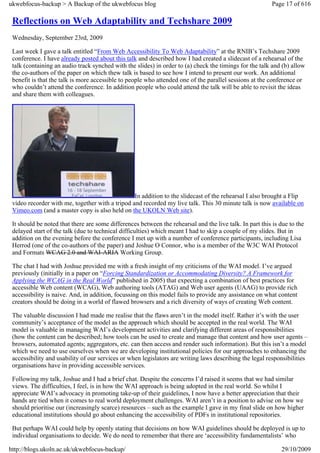
                                                 In addition to the slidecast of the rehearsal I also brought a Flip
 video recorder with me, together with a tripod and recorded my live talk. This 30 minute talk is now available on
 Vimeo.com (and a master copy is also held on the UKOLN Web site).

 It should be noted that there are some differences between the rehearsal and the live talk. In part this is due to the
 delayed start of the talk (due to technical difficulties) which meant I had to skip a couple of my slides. But in
 addition on the evening before the conference I met up with a number of conference participants, including Lisa
 Herrod (one of the co-authors of the paper) and Joshue O Connor, who is a member of the W3C WAI Protocol
 and Formats WCAG 2.0 and WAI-ARIA Working Group.

 The chat I had with Joshue provided me with a fresh insight of my criticisms of the WAI model. I’ve argued
 previously (initially in a paper on “Forcing Standardization or Accommodating Diversity? A Framework for
 Applying the WCAG in the Real World” published in 2005) that expecting a combination of best practices for
 accessible Web content (WCAG), Web authoring tools (ATAG) and Web user agents (UAAG) to provide rich
 accessibility is naive. And, in addition, focussing on this model fails to provide any assistance on what content
 creators should be doing in a world of flawed browsers and a rich diversity of ways of creating Web content.

 The valuable discussion I had made me realise that the flaws aren’t in the model itself. Rather it’s with the user
 community’s acceptance of the model as the approach which should be accepted in the real world. The WAI
 model is valuable in managing WAI’s development activities and clarifying different areas of responsibilities
 (how the content can be described; how tools can be used to create and manage that content and how user agents –
 browsers, automated agents; aggregators, etc. can then access and render such information). But this isn’t a model
 which we need to use ourselves when we are developing institutional policies for our approaches to enhancing the
 accessibility and usability of our services or when legislators are writing laws describing the legal responsibilities
 organisations have in providing accessible services.

 Following my talk, Joshue and I had a brief chat. Despite the concerns I’d raised it seems that we had similar
 views. The difficulties, I feel, is in how the WAI approach is being adopted in the real world. So whilst I
 appreciate WAI’s advocacy in promoting take-up of their guidelines, I now have a better appreciation that their
 hands are tied when it comes to real world deployment challenges. WAI aren’t in a position to advise on how we
 should prioritise our (increasingly scarce) resources – such as the example I gave in my final slide on how higher
 educational institutions should go about enhancing the accessibility of PDFs in institutional repositories.

 But perhaps WAI could help by openly stating that decisions on how WAI guidelines should be deployed is up to
 individual organisations to decide. We do need to remember that there are ‘accessibility fundamentalists’ who

http://blogs.ukoln.ac.uk/ukwebfocus-backup/                                                                  29/10/2009
ukwebfocus-backup > A Backup of the ukwebfocus blog                                                   Page 18 of 616

 bought wholesale into the WCAG 1.0 vision and who may now be finding it difficult to come to terms with a
 more flexible approach. Let’s use the release of WCAG 2.0 to promote a more flexible approach to accessibility
 in the real world. And let’s also not forget that the UK Government’s blunt approach of “The minimum standard
 of accessibility for all public sector websites is Level Double-A … Websites owned by central government
 departments must be Double-A conformant by December 2009” . This policy fails to recognise the low
 penetration of UAAG-conformant browsers in the Government sector, the resources needed to implement this
 policy, the reduced level of funding which government departments will be faced with and the likelihood that risk
 -averse decisions-makers in government departments will use the policy as an excuse to deploy innovative Web-
 based services.

 The slidecast and video of my talk at Techshare 2009 gives another illustration of how providing a diversity of
 resources might enhance the accessibility of a resource (my talk and the related ideas) which is, to my mind,
 preferable to not making these resources available as they aren’t universally accessible. And this view appeared to
 be shared by a number of people at the conference who couldn’t attend my talk but werre interested in listening to
 what I had said.

                             Filed in Accessibility | Tagged techshare09 | Permalink |
                             Edit | Comments (2)

 A Lack of 'Social' and 'Media' at the Oxford Social Media Conference
 Monday, September 21st, 2009

 The Oxford Social Media Conference
 The Oxford Social Media Conference, held on Friday 18 September 2009 at Said Business Centre, University of
 Oxford, was one of the few events I’ve attended this year in which I haven’t spoken at. And it came at the end of
 a very busy two weeks, having facilitated workshops and given talks at the ALT-C, ALPSP and Techshare
 conferences and the Silos of the LAMs briefing event.

 But despite not being on the programme, these days attendance at many conferences can provide opportunities for
 more active participation than was the case in the past, through use of Twitter and other ways in which Social
 Media can be used to engage with the audience (both local and remote) and facilitate informal discussions
 amongst the participants.

 I have already described how the failure to announce a conference hashtag in advance led to participants being
 unable to meet up in advance (I’m sure I wasn’t the only participant to arrive the night before – and I was
 fortunate in spotting a colleague in my Twitter network who was also travelling to the conference). But what of
 use of Social Media at the conference itself?

 Use of Social Media at the Event
 The summary for the event began “With corporations, governments, newspapers and universities embracing
 blogs and Twitter feeds as key elements in their communication strategies, social media have finally come of age”
 and promised to “look back at the evolution of blogs and other social media to give a more nuanced
 understanding of the ways in which such tools have or have not made a difference at the social, political or
 economic level“.

 Although the event did not have a technical focus, I expected it to embrace use of various aspects of Social Media
 as the opening statement suggested universities are doing. I was pleased, therefore, when it became clear that the
 panelists in the opening session were using Twitter to observe what the participants were discussing. And,
 following a Twitter response from Bill Thompson to a my tweet in which I linked to a screenshot of an
 Augmented Reality view of twitterers in the nearby locality, I took the opportunity ask (slightly tongue in cheek)
 whether such engagement by the panel with the audience’s ‘backchannel’ wasn’t a somewhat worrying
 appropriation by those in a position of power (the speakers) of what may be regarded as a democratising tool. I
 went on to ask whether the expected spamming of the event’s hashtag (which happened) provided an example of
 the inevitable commercialisation of the Social Web. We were naive in 1993 and 1994, I suggested to Bill (whom I
 first met at the first WWW conference in Geneva in 1994) when we described that conference as the “Woodstock
http://blogs.ukoln.ac.uk/ukwebfocus-backup/                                                               29/10/2009
ukwebfocus-backup > A Backup of the ukwebfocus blog                                                     Page 19 of 616

 of the 1990s” and predicted that what we might now refer to as ‘Web 1.0″ would bring about a radical
 democratisation of society. Aren’t we being equally naive to suggest that the Social Web will bring about this
 change?

 The response was, not unexpectedly, uncertain, with the panelists pointing out that it is difficult to predict the
 future and that the Social Web is likely to develop in unexpected ways, and what may be regarded by some as
 spam (I gave an example of advertising from a taxi firm at the end of the Techshare conference) could equally be
 felt to be useful information by others.

 For me this opening session established a lack of experts in Social Media and would be followed by more open
 discussions – and would avoid the lengthy responses to questions made by each member of the panel. But what
 happened throughout the rest of the day was a repetition of the opening panel session: talks from each of the
 panelists, with the occasional question or comment being made by the chairperson. I felt like I was a member of
 the audience at a Radio 4 programme.

 So for a conference on Social Media the event was missing on the ’social’ aspect, with little opportunity for
 participants to engage with the discussions. There was also little ‘media’ at the conference, with none of the
 speakers using any visual aids. For me meant the day was very repetitious, with little visual stimulation. It was
 also at odds with a comment made in the final session that “it’s all about video, video, video. There will be
 screens EVERYWHERE very soon“.

 Now perhaps I’m being unfair. I have to admit my recent intensive spate of travelling meant that I was probably
 suffering from an overdose of conferences – and the enjoyable lunch provided did mean that I wasn’t paying full
 attention to the sessions after lunch. And an early departure meant that I missed the panel session on corporate
 blogging which was described as “by far the most entertaining and informative of the day, mostly dealing with the
 politics of setting corporate blog tone and complaint/query response rate“.

 Final Thoughts
 I’ve described how the description for the conference suggested that “With corporations, governments,
 newspapers and universities embracing blogs and Twitter feeds as key elements in their communication
 strategies, social media have finally come of age“.

 For me many of the events I now attend make use of technologies such as Twitter, blogs and video streaming as a
 key part of the ‘amplification’ of the event – and this amplification takes place before, during and after the event.
 For an event about Social Media such expectations do not seem unreasonable. It is pleasing, therefore, to note that
 a number of blog posts about the conference have already been published including:

     •   What we learned at the Oxford Social Media Convention, Digital Content Blog, The Guardian
     •   How social networking is changing journalism, Digital Content Blog, The Guardian
     •   A social media proposal (you’re not going to like it) #oxsmc09, jennifr.net
     •   Kara Visits the Oxford Social Media Convention: I Say Twitt-er, You Say Twitt-ah, BoomTown
     •   Oxford Social Media Convention 2009, MarkAttwood.com

 The first of these links, from The Guardian, concludes: “PS: To find more detailed bits about the conference, look
 up the hashtag #oxsmc09 on twitter“. However as I have described previously, content posted to twitter becomes
 unavailable via Twitter’s search interface after about 10 days. Since media organisations such as The Guardian
 are likely to ensure that such evidence does not disappear, I have created a copy of the #oxsmc09 tweets which
 should make subsequent analysis of the discussions easier to carry out. And looking at the HTML version of the
 archive there is a noticeable lack of tweets by the conference organisers – unlike, say, the recent ALT C and
 Techshare conferences, both of which used Twitter during and after the event.

                             Filed in Events, Twitter | | Permalink | Edit | Comments
                             (6)

 What! No Event Hashtag?
 Sunday, September 20th, 2009

http://blogs.ukoln.ac.uk/ukwebfocus-backup/                                                                29/10/2009
ukwebfocus-backup > A Backup of the ukwebfocus blog                                                      Page 20 of 616

 Tim Berners-Lee at the Science Museum
 Last Monday I attended a talk on “The Web Revealed” given by Sir Tim Berners-Lee at the Science Museum as
 part of the centenary celebrations for 100 years of the Science Museum. This was a last minute decision – I was
 about to head off to London as I was taking part in a session at the CILIP Executive Briefing on “Beyond the
 Silos of the LAMS” the following day and spotted a tweet about a spare ticket for the event which was available.

 When I joined the queue for the event I tweeted my location – to indicate to any Twitter followers where I was,
 with the possibility of meeting up and perhaps going for a drink afterwards. As I commented at the time it felt
 slightly strange to be at an event about the Web which did not have an event hashtag, thus making it difficult to
 make links with other Twitterers at the event and share thoughts on the content. However one of my Twitter
 followers, @brian@condon, who was following the event from a distance, spotted my tweet and suggested “How
 about #bernerslee?” as a tag for the event. A few minutes later he tweeted:

     RT @martingoode: Am following the #Berners-Lee talk via twitter thanks to @joannabutler             @briankelly-
     seems to be a hashtag!

 So now it seems we have two people (@martinegoode and @brian_condon) following the talk on Twitter, via
 tweets from myself and @joannabutler, with two hashtags (#Berners-Lee and #bernerslee) having being
 suggested. I also spotted some tweet from @filce who concluded:

     Sir Tim Burners-lee was amazing. Very interesting and brilliant. It was recorded so hopefully it will be
     available the web!

 And thanks to @filce I’ve spotted a recording of the opening of Sir Tim’s talk. as well as a link to his slides (the
 URL was displayed very quickly at the end of his talk, and I had no time to make a note of the URI). Without
 following up on @filce’s tweets, I would probably have missed out on this information.

 But how could have it been made easier for the event Twitterers to be found and for them to be aware of each
 other’s presence? Perhaps the Science Museum should be suggesting hashtags for its anniversary talks (especially
 with another distinguished Web luminary – Dame Wendy Hall scheduled to talk in November). And what
 approach should be taken to coining the hashtag? Should it be related to the venue (”I’m at the @sciencemuseum
 to listen to Sir Tim Berners-Lee”), the anniversary series (”I’m at the @sciencemuseum-100 talk”) or, as
 mentioned above, should the tag be based on the individual speaker’s name? If the latter, there will probably be a
 need to avoid possible organisers – @timberners-lee (note the hyphen can cause hyperlinking problems in some
 Twitter clients) or @timbl, for example. Or in the case of Sir Tim Berners-Lee and Dame Wendy Hall and other
 members of The Knightage, will an updated version of Debretts guide to forms of address require the title to be
 included, so we’ll have to use #sirtim and #damewendy?

 The Oxford Social Media Conference (#oxsmc09)
 On Friday I attended the Oxford Social Media Convention 2009 held at Said Business School, University of
 Oxford. As might be expected for an event which promised to “look back at the evolution of blogs and other
 social media to give a more nuanced understanding of the ways in which such tools have or have not made a
 difference at the social, political or economic level” the event did have a hashtag (#oxsmc09) which was widely
 used by the Twitterers in the audience. Indeed, following a suggestion I made at the event a colleague set up a
 wthashtag page for the tag, so that we can see that there were almost 1,000 tweets during the day, from 200
 contributors (note there would probably have been more, but the conference WiFi network went down during the
 conference).


http://blogs.ukoln.ac.uk/ukwebfocus-backup/                                                                 29/10/2009
ukwebfocus-backup > A Backup of the ukwebfocus blog                                                     Page 21 of 616


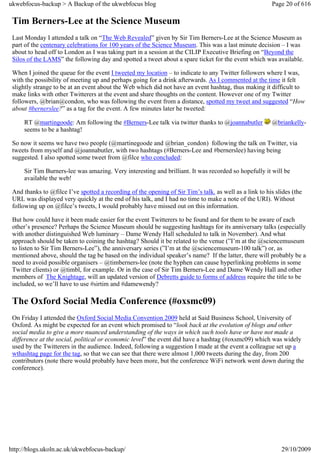
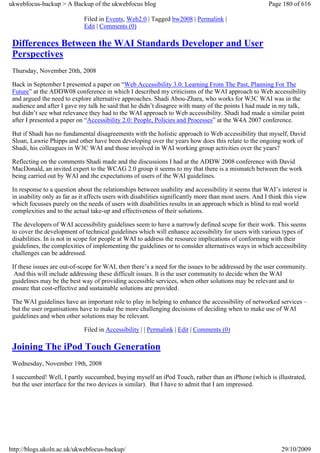
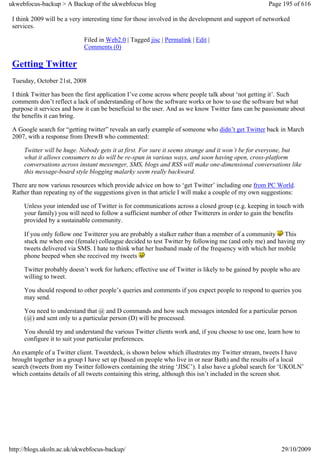
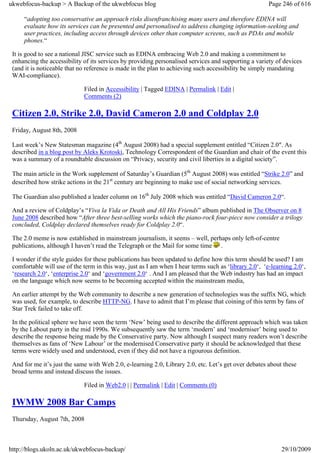
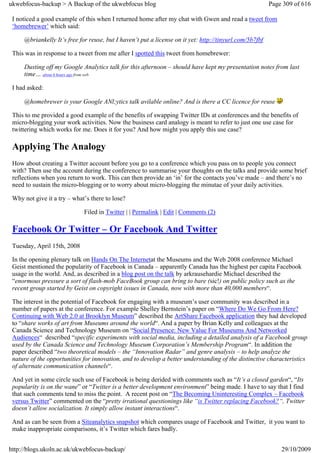
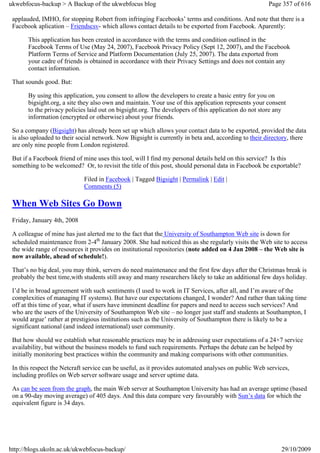
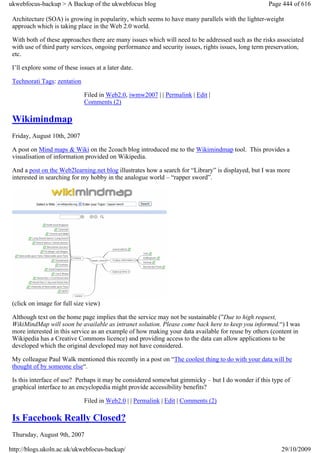
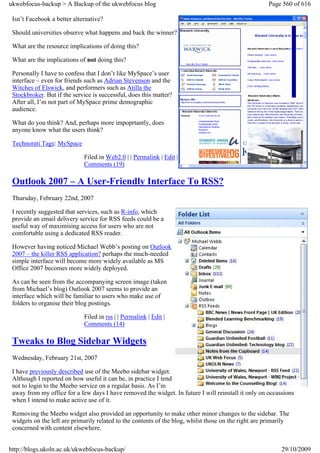
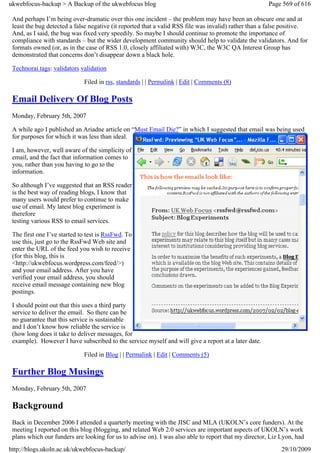
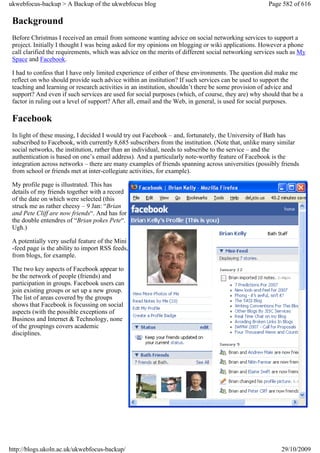
                                                                                                 But as can be seen
 from the histogram of the event tweets, nothing was said prior to the event. This was due to the hashtag only
 being announced in the conference pack when the delegates registered at the event.

 This resulted in a missed opportunity for participants at this conference on Social Media to, for example, meet up
 prior to the event and, err, be social. Indeed it was rather fortuitous that while travelling from London to Oxford I
 spotted a number of tweet from EDINA’s Nicola Osborne who was travelling from Edinburgh to London
 Heathrow and then, I noticed, to Oxford. In response to my tweet:

     @suchprettyeyesI’m on way to Oxford for Social Media conf. Fancy drink tonight? Am sure someone can
     suggest decent real ale pub.

 I discovered that Nicola was going to the same event and we met up at the Eagle and Child (thanks to
 @sboneham for the suggestion). But despite asking:

     Is there a tag for Social Media conf at Said College? Would be good to meet up with others.

 it wasn’t until the next morning that we found out the event’s hashtag (with the first event tweet coming from
 Nicola ). A missed opportunity, I feel, which was echoed by Bill Thompson, one of the conference speakers:

     @deejacksonI’m looking forward to Oxford Social Media Convention tomorrow – no idea of hashtag but
     will be tweeting…

 The need to find the information containing the hashtag also caused confusion for people who had arrived and, in
 the absence of advance notification, had started to make us of their own hashtag. As rohanjay commented:

     foxed by random hashtagging, calls for order at the Oxford social media bunfight -is it #oii or #oxsoc or
     #oxsmc09?

 There are lessons which can be learnt from such confusions, especially for anyone organising events about Social
 Media.

 Augmented Reality and Geo-Location
 But need an event’s Twitter discussions necessarily require agreement on a hashtag? Following problem’s with
 the conference WiFi network I started to use my HTC Magic Android mobile phone to follow the conference
 tweets. Due to the phone’s poor user interface, I didn’t contribute significantly to the discussions. However it did
 occur to me that the event might provide an opportunity to make use of the LayarAugmented Reality application
 which I’d installed the previous week, after hearing about it from Joss Winn, a fan of the HTC Android phone (he
 has the newer model which has, I understand, an improved user interface).


http://blogs.ukoln.ac.uk/ukwebfocus-backup/                                                                 29/10/2009
ukwebfocus-backup > A Backup of the ukwebfocus blog                                                       Page 22 of 616


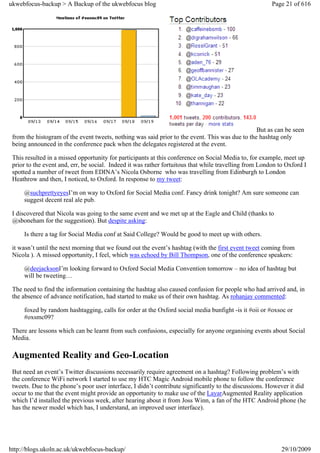
                 I had first started to use the application the previous night in the pub, using it to find information
 on nearby pubs and historic building which could be viewed on a map and relevant Wikipedia pages or geo-
 located photos displayed.

 The Layar environment also has two Twitter applications which enable me to view nearby Twitter users and
 Twitter posts. I used this at the conference and posted a link to a screenshot of my mobile phone display, which is
 illustrated.

 It would be nice if the display showed that a prolific Twitter user was located in from of my and slightly to the
 left, with another prolific user being near the front of the lecture theatre. However that wasn’t the case – the image
 shows tweets within about a mile of my location, some of which had been posted the previous day. So this isn’t a
 way of finding tweets from others at the same conference – yet!

 Conclusions
 To conclude, events such as Tim Berner’s Lee’s talk at the Science Museum and the Oxford Social Media
 Conference need an event hashtag. There’s also a need for the tag to be announced in a timely fashion and not just
 on the day itself. There’s also a need for process for selecting a tag (which I’ll discuss in more detail in a future
 post). But perhaps the importance of hashtagging at events may be complemented by developments such as geo-
 location application. But as we will still need to talk about the events we are planning to attend as well as the
 event we are at, we’ll still need the event hashtag,

                              Filed in Events, Twitter | | Permalink | Edit | Comments
                              (1)

 Use of Twitter at the ALTC 2009 Conference
 Monday, September 14th, 2009

 Back After A Week Away
 Last week was unusual – not a single blog post published in the week. Although there were suggestions at last
 week’s ALT-C 2009 conference that blogging is in decline with established bloggers making greater use of
 Twitter, my failure to blog last week was due to being away all week at the ALT-C conference followed by the
 ALPSP 2009 conference. And although I’d brought along my ASUS EEE PC, I couldn’t get it connected to the
 network in my bedroom at either of the conferences. So my connectivity was restricted to use of my iPod Touch
 and HTC Magic mobile phone – which I used for reading email messages, tweets and RSS feeds and writing the
 occasional Twitter post.

 ALT-C 2009 Summaries
 A number of valuable summaries of the conference have already been published. I don’t intend to repeat what has
 already been said, apart from mentioning that the two plenary talks I saw (from Michael Wesch and Martin Bean )
 were both excellent (I had to leave on the final morning and so unfortunately missed Terry Anderson’s closing
 plenary talk); the VLE is Dead debate was entertaining, with witty contributions made from the four speakers and
 was useful in raising issues and providing insights which I hadn’t previously considered.


http://blogs.ukoln.ac.uk/ukwebfocus-backup/                                                                  29/10/2009
ukwebfocus-backup > A Backup of the ukwebfocus blog                                                   Page 23 of 616

 Twitter at ALT-C 2009
 But what of the use of Twitter at ALT-C 2009? Philip Paasuke, an e-learning enthusiast based in Adelaide,
 Australia, has described how he followed the conference from home using a variety of technologies: watching the
 keynote plenary talks on Elluminate and using Tweetdeck to follow the back channel discussions. As Philip
 describes: “The Twitter postings gave me an interesting perspective on what participants at the conference and
 those observing it remotely were thinking about the various presentations“. Philip went on to add that “Following
 ALT-C 2009 on Twitter has also led me to increase the number of people that I am following using this service
 from what might loosely be called ’the elearning community’. The Twitter posts also included a lot of useful links
 to more detailed blog postings by some of the conference participants“.


                                                                                                But how
 extensively was Twitter used at the conference? And what was the profile of its usage?

 I have previously described how I used a variety of Twitter analysis and management tools to analyse use of
 Twitter at UKOLN’s IWMW 2009 event. For that event, which had 200 participants, there were 1,530 tweets. For
 the ALTC 2009 conference, with had over 700 participants, there were over 4,300 tweets published in a week!
 This figure, which was obtained using the wthashtag service, provides a summary, illustrated above, based on
 tweets posted from Monday 6 to Sunday 13 September. We can expected further tweets this week, as other
 participants get round to writing their reports on the conference and continue the discussions. And I should add
 that Philip Paasuke’s blog post mistakenly gives #altc09 as the official Twitter hashtag – there were a further 128
 tweets using this tag from 51 contributors.

 During my analysis of #iwmw2009 event Tweets, I discovered that tweets seem to disappear after a short period
 of time. I subsequently came across a TechCrunch post which reported that tweets currently become unavailable
 from the Twitter search API after about 10 days.

 In order to carry pout more detailed analyses, it will be necessary to ensure that a copy of the relevant tweets is
 kept, ideally in a format suitable for data analysis. I have therefore once again used the wthashtag, Twapperkeeper
 and Tweetdoc services to keep a local copy of the conference tweets. Links to the data and to these servicesis
 available on the UKOLN Web site.

 Why The Interest?
 What is the point of the analysis of the Twitter posts made at the ALTC 2009 conference? Isn’t the point of
 Twitter it’s spontaneity and perhaps its subversive use?


http://blogs.ukoln.ac.uk/ukwebfocus-backup/                                                               29/10/2009
ukwebfocus-backup > A Backup of the ukwebfocus blog                                                     Page 24 of 616


                                         Well although that may be one use case for Twitter, it’s not the only one.
 The interest in use of Twitter as an educational tool can be gauged from the popularity of the Teaching With
 Twitter workshop facilitated by Steve Wheeler and colleague. And mining the data might also provide interesting
 insights into the event, the community and the ideas discussed and shared. Looking at the summary of trending
 words provided by the Tweetdocs service, for example, might indicate an interest in Twitter (to be expected) but
 also in openness and people. And the two people who seem to have been most discussed (or, in the case of James
 Clay, contributed to the discussions) seem to be James Clay and Anderson (probably Terry Anderson, the final
 plenary speaker).

 The conference organisers might be pleased to see the popularity of the words “good” and “great” – but what
 about the criticisms that were made of the queues for the food and coffee and the conference accommodation?
 Will analysis of the Twitter discussions start to from part of an organisation’s debriefing after an event - and
 might not the venue itself have an interest in what was said about the facilities? Well the data is now available for
 reuse.

                             Filed in Events, Twitter | Tagged altc2009 | Permalink |
                             Edit | Comments (11)

 "Realising Dreams, Avoiding Nightmares, Accepting Responsibilities"
 Thursday, September 3rd, 2009

 Martin Weller and I will be facilitating a workshop session entitled “Realising Dreams, Avoiding Nightmares,
 Accepting Responsibilities” at the ALT-C 2009 conference. Martin and I met over blog comments and Twitter
 posts and discovered we had similar interests. In particular Martin and I bounced around some ideas on the theme
 of “Even if we’re wrong, were right”, which started with a blog post by Martin on “Web 2.0 – even if we’re
 wrong, we’re right“.

 When a few months ago I saw a tweet from someone saying they were find it difficult to think of a proposal top
 submit which fitted in with this year’s ALT-C theme of “In dreams begins responsibility” I felt that this theme
 provided the ideal opportunity to write a joint proposal.

 So on Wednesday 9 September, starting at 9 am, we’ll be facilitating a workshop session. In the 90 minute session
 the participants will explore the (probably) diverse visions (the dreams) they have for e-learning and the barriers
 (nightmares) which may be faced. We will then explore the approaches (the responsibilities) we may need to
 avoid the nightmares and bring about a realisation of the dream.

 The workshop session itself has a dream in which interested participants, including those who may not be
 physically present at the session, will engage in the discussions and debates and contribute to examples or the
 dreams and nightmares and suggestions for the responsibilities.


http://blogs.ukoln.ac.uk/ukwebfocus-backup/                                                                29/10/2009
ukwebfocus-backup > A Backup of the ukwebfocus blog                                                      Page 25 of 616


                                                  In order to bring about this dream we hope to provide live
 streaming of the talks in the session using the Bambuser service on my HTC Magic Android mobile phone.
 Discussions will take place on Twitter and contributions to the session can be made by tagging tweets with the
 tags “#altc2009″ and “#s113″ (as described previously, the second hashtag will enable tweets to be
 differentiated from other Twitter posts at the conference).

 My nightmare is that video streaming won’t work (will there be a mobile phone signal for the venue, I wonder) or
 will be of poor quality. My responsibility, however, will be to write a summary of the session so that if you tried
 to participate remotely but failed you will at least be able to read a summary of the discussions.

                             Filed in Events | | Permalink | Edit | Comments (2)

 "From Web Accessibility To Web Adaptability" Talk at Techshare
 2009
 Wednesday, September 2nd, 2009

 A proposal for a talk I submitted to the RNIB’s Techshare 2009 conference has been accepted. The talk on “From
 Web Accessibility to Web Adaptability” will be given on 17 September 2009.

 The talk is based on the paper of the same name which was published recently in the Disability and Rehability:
 Assistive Technology journal. The talk at the Techshare conference will provide an opportunity for the ideas in
 the paper (which I have also outlined in a recent blog post and in an article published in the e-Access Bulletin) to
 be described to those in the disability community who may not read academic journals or blogs.

 There is an expectation that presentations at the conference will be accessible to those with visual
 impairments. An approach I have taken to enhancing the accessibility of the slides (and the ideas which will be
 described in the talk) has been to create a slidecast of the talk, by synching the audio of a rehearsal of the talk
 with the slides. This slidecast is available on Slideshare and is embedded below.

 [slideshare id=1881012&doc=web-adaptability-090819092258-phpapp01]

 The rehearsal also provided an opportunity for me to time the talk – and I found that at 34 minutes it was slightly
 too long, so the version I will give at the conference will be slightly shorter.

 As well as helping me with the timings and allowing me to spot where the material can be improved, creating the
 slidecast prior to the talk has some additional benefits:

     • It provides a back-up in case I lose my voice or am ill at the conference or fail to arrive at the conference
       venue due to travel difficulties.
     • Conference delegates can listen to the talk after the event.
     • The talk can be shared with others.
     • The slidecast is a richer resources than the slides on their own

 In addition there are parallels with open source software development – this early release of a talk and exposing it
 to many eyes ears can potentially allow my peers, including co-authors of the original paper, to listen to what I

http://blogs.ukoln.ac.uk/ukwebfocus-backup/                                                                  29/10/2009
ukwebfocus-backup > A Backup of the ukwebfocus blog                                                      Page 26 of 616

 intend to say and provide comments and suggestions as to how the talk can be improved. The talk isn’t trapped in
 my head until the live delivery!

 If you have a particular interest in Web accessibility your comments and questions are welcomed.

                              Filed in Accessibility | Tagged techshare2009 | Permalink
                              | Edit | Comments (1)

 Skype, Two Years After Its Nightmare Weekend
 Tuesday, September 1st, 2009

 The headline in the Technology Guardian supplement read “Skype’s nightmare weekend highlights peer-to-peer
 fears” two year’s ago back on 23 August 2007. The article described how “Skype’s popular internet telephone
 service went down on August 16 and was unavailable for between two and three days“.

 I remember this incident as, with people’s attention focussed on the loss of this service (fortunately at a non-
 critical time in the academic year) our University IT Service department took the opportunity to remind the Skype
 users on campus (which included me) that Skype was a proprietary application. The recommended VoIP
 application, which was about to be deployed for the start of the academic year, was the FreeWire phone service.
 This, I was told, was recommended as it was based on open standards. This sounded interesting, especially if it
 provided the application independence which Skype lacks. So I looked at the FreeWire Web site and found that
 “It’s only when you call non-Freewire phones that you have to pay“. So its’ based on open standards, but you
 have to pay if you try to call a user who isn’t running the same software as you. It’s no different from Skype, it
 would seem – except, perhaps, that as I speak there are almost 17 million Skype users online. In comparison the
 standards-based FreeWire service services a niche market (and perhaps a satisfied niche market as, here at Bath
 University several student residences now have Voice-over-IP telephones in the bedrooms).

 But the promise of VoIP telephony services seems further away than it did two years ago (and the access
 problems Skype suffered from were due to a bug triggered by large numbers of automated Microsoft Windows
 updates – a bug now fixed). I now have Skype clients on my office PC and my laptop (both running MS
 Windows), my Asus EEE netbook PC (running Linux), my iPod Touch and my HTC Magic Android. A
 proprietary application running on four different platforms seems pretty good!

 So what’s the future for VoIP telephony services? Yesterday the BBC News announced “eBay reaches deal to
 sell Skype“. The article states that “Online auction site eBay has agreed to sell the majority of internet phone
 company Skype for about $2bn (£1.2bn)” and goes on to explain that the deal values Skype at $2.75bn, a slight
 increase on the $2.6bn it paid for the company in 2005.

 Attempts by JANET to deploy a standards-based VoIP service (called JANET Talk) for the UK’s higher/further
 education community were abandoned a few months ago bacause, as described in JANET News (PDF format): ”
 The results from both trial feedback and market research showed that the appetite for a service like JANET Talk
 had diminished. The reasons cited include a preference for alternative solutions that are now available from the
 commercial sector. These solutions were deemed easier to use, reliable and free.”

 Sometimes standards-based solutions don’t take off, it would seem, even when there are JISC-funded initiatives
 encouraging the take-up of such solutions. And as Nick Skelton suggested in a post entitled “Why did JANET
 Talk fail?” perhaps this is due to a failure to appreciate the importance of the network effect. Nick concluded:

      “When planning a new service, see if it has built-in positive network effects. It is doesn’t have these naturally,
      find a way to connect it to larger networks so it can benefit from theirs. If you can’t find a way to do this then
      you are dooming your project from the start. You’re better off doing nothing, unless you want to see your
      service become irrelevant, pushed to one side by a larger, more popular one.“

 I agree.

                              Filed in General | | Permalink | Edit | Comments (8)


http://blogs.ukoln.ac.uk/ukwebfocus-backup/                                                                  29/10/2009
ukwebfocus-backup > A Backup of the ukwebfocus blog                                                      Page 27 of 616

 Hashtags for the ALT-C 2009 Conference
 Friday, August 28th, 2009

 This Year’s ALT-C Conference
 I will be attending the ALT-C 2009 Conference at the University of Manchester in a couple of weeks time where
 I’ll be facilitating a session with Martin Weller on “Realising Dreams, Avoiding Nightmares, Accepting
 Responsibilities” – a title chosen to reflect the conference theme of “In dreams begins responsibility“.

 Yesterday I was involved in discussions on Twitter regarding use of hashtags (hash tags?) for referring to specific
 sessions at the conference. The conference tag has already been agreed – it is altc2009 and this has been
 announced on the conference home page. Let’s hope that this high visibility avoids tag fragmentation.

 But there are many sessions at ALT-C and many parallel sessions. So an active Twitter community – which we
 are likely to find at the conference – may well find itself talking at cross-purposes if nothing is done to
 differentiate between the sessions. It may also be useful to be able to be able to identify particular sessions using a
 short and unambiguous tag e.g. so people can say “Are you going to Brian’s session?” or “What did you think of
 Martin’s session?” without confusion and using fewer characters.

 Experiences of Using Hashtags at UKOLN’s IWMW 2009 Event
 At UKOLN’s recent IWMW 2009 event we allocated a two-digit code for the plenary talks (P1-P8) and the
 parallel sessions (A1-A9, B1-B4 and C1-C5) . This short code was used consistently on the Web site, initially for
 selection of the parallel sessions.


                                                                              Shortly before the event we
 encouraged use of these codes, together with the codes we assigned for the plenary talks, in Twitter. And, as I’ve
 described previously, after the event we captured the tweets for the plenary talks and provided links to this record
 of discussions which used the Twitter hashtags in this fashion (see, for example, the tweets made during Paul
 Boag’s plenary talk P3 which is illustrated).

 After the event we used the Archivist Twitter archiving tool in order to capture these tweets are store them
 locally. These local archives are available in CSV and XMLformats. As can be seen, for Paul Boag’s talk, 78
 tweets containing the pair of hastags were found.

 What To Do For ALT-C?
 What approach should be taken to use of hashtags at this year’s ALT-C conference? A similar answer might be to
 do nothing other than use the event’s hashtag. After all, some may argue, Twitter’s strength is its simplicity and
 adding anything new is likely to undermine this simplicity. Whilst I’d agree with this sentiment I don’t feel that

http://blogs.ukoln.ac.uk/ukwebfocus-backup/                                                                  29/10/2009
ukwebfocus-backup > A Backup of the ukwebfocus blog                                                   Page 28 of 616

 adding an additional optional tag is complex. And we know have some examples of the benefits of doing this,
 which I’ve described in a recent screencast published on this blog.

 But how should we select the hashtags for the session? I recently discovered that the unique identifier for the
 workshop myself and Martin Weller are facilitating is 113. And looking at the conference introduction and
 abstracts which arrived in the post a few days ago it seems that the session ids range from 0012 to 0322. I’m
 assuming that the unique ids were assigned when the proposals were submitted as the numbers aren’t consecutive
 (hmm, were the first 11 proposals rejected, I wonder?). To avoid confusion and to save space I’d suggest that
 leading zeroes are ignored. So my proposal for a hashtag to identify the session would be #snnn – in my case this
 would be #altc321 and James Clay’s four sessions would have the identifiers #s208, #s221, #s286 and #s301.

 These tags would be used in conjunction with the main conference tag. A Twitter search for “#altc2009 #s321″
 should find tweets referring to my session. Simple? Indeed a simplification of my initial suggestion of #altcnnn as
 a session identifier.

 But although this approach worked at IWMW 2009 and would work for my workshop session it has been pointed
 out to me that this approach won’t work for the sessions which have multiple papers being presented. Although
 the individual papers have a unique identifier, the sessions themselves do not. Owen Stephens suggested that the
 identifier used in the conference’s CrowdVine social networking environmentcould be used but this then causes
 potential confusion with the identifiers allocated by the conference and won’t easily be found by conference
 participants who aren’t using CrowdVine. And further discussions is only likely to lead to confusions and
 unnecessary complexity.

 So my proposal is this:

     • The conference hashtag is #altc2009.
     • If Twitter users wish to identify a specific session they should use the #altc2009 hashtag in conjunction
       with a session tag which has the format #snnn when nnn is a the session identifier given in the conference
       programme, with leading zeroes omitted (the prefix s standards for the session identifier).

 Is this approach worth trying?


                                                                       In light of the workshop session on
 Teaching With Twitter which Steve Wheeler will bve giving at the ALT-C Conference, I can’t help but think we
 do need to be experimenting with ways in which Twitter can be used in a learning context and in enriching its use
 in community building.

 Reflecting on Tony Hirst’s recent post on “A Quick Peek at the IWMW2009 Twitter Network“ which analysed
 and visualised tweets at the IWMW 20009 event in order to “help to identify amplification networks” it occurs to
 me that something similar might be useful at a larger event such as ALT-C. Do, for example, the Twitterers
 who @ each other and RT tweets tend to go to the same sessions, I wonder?


http://blogs.ukoln.ac.uk/ukwebfocus-backup/                                                               29/10/2009
ukwebfocus-backup > A Backup of the ukwebfocus blog                                                       Page 29 of 616

 And if you still think this may be too complicated I intend to include details of the session hashtag on the opening
 slide for the session Martin Weller and I will be facilitating, as illustrated.

                              Filed in Events, Twitter | Tagged altc2009 | Permalink |
                              Edit | Comments (10)

 The Science Online 2009 Unconference Video
 Thursday, August 27th, 2009

 As described on the On The Roof blog a video clip of the Fringe Frivolous Unconference is now available. The
 Fringe Frivolous Unconference took place on the evening of Friday 21 August 2009 on the roof terrace of the
 Mendeley offices. About 40-50 people attended this event, which provided an opportunity for science bloggers
 and other interested parties to talk about and discuss science blogging.

 The video clip (which lasts for 7 minutes 47 seconds) is available on YouTube and is embedded below.

 [youtube=http://www.youtube.com/watch?v=7T2wIpCq0RE]

 As you can see the video contains brief interviews with many of the participants who attended the unconference
 in which they explain why the blog or mention other topics of interest to them.

 In a blog post about the event Richard Grant described how he “stalk[ed] the rooftops with a Flip camera (kindly
 loaned by Alom Shaha)” and subsequently “edited the clips into a short film that I think captures the essence of
 the evening perfectly“. And I think Richard is to be applauded for so quickly taking so many video clips and
 editing thenm to produce the short film.

 But is this YouTube video accessible? Where are the captions which are needed to ensure that the resource
 complies with the Web Acessiility Initiative’s (WAI’s) Web Content Accessibility Guidelines (WCAG)? After all
 the WCAG 2.0 guidelines state that:

     1.2.2 Captions (Prerecorded): Captions are provided for all prerecorded audio content in synchronized media,
     except when the media is a media alternative for text and is clearly labeled as such. (Level A)

 But do the unconference organisers (unorganisers?) have to follow these guidelines? Legislation requires
 organisations to take reasonable measures to ensure that people with disabilities are not discriminated against
 unfairly. And is it reasonable to expect a light-weight approach to recording a video of an event to require
 captioning? I think not – and recall a suggestion that ‘reasonable measures’ meant an addition 10-15% of effort. I
 suspect the time it would take to caption this video would probably be significantly greater than this.

 In addition perhaps as this event wasn’t ‘official’ and the video wasn’t a deliverable of a public sector
 organisation, conformance with WCAG guidelines is not needed. But might there not be a moral responsibility to
 enhance the accessibility of this resources – after all, discussions of the ethical as well as legal aspects of blogging
 cropped up during the unconference as well in the opening talk at the Science Online 2009 conference the
 following day?

 But how might one go about enhancing the accessibility of the video, in light of the limited effort to do this – and
 the difficulties of doing this on a sustainable basis?

 One approach might be to crowd-source the captioning to share the effort. If, for example, everyone who was
 interviewed in the video provided a textual summary of what tey said, could that be used to caption the video? I’m
 not sure – but I am willing to provide a summary of my contribution:

     4 minutes 45 seconds: Brian Kelly introduces himself. Brian is based at UKOLN, a national centre of
     expertise in digital information management, lcoated at the University of Bath. He blogs about Web and Web
     2.0 issueson the UK Web Focus blog, which is available at ukwebfocus.wordpress.com

     5 minutes 7 seconds: end of Brian Kelly’s clip.


http://blogs.ukoln.ac.uk/ukwebfocus-backup/                                                                   29/10/2009
ukwebfocus-backup > A Backup of the ukwebfocus blog                                                     Page 30 of 616

                             Filed in Accessibility | Tagged solo09 | Permalink | Edit |
                             Comments (3)

 The Back Channels for the Science Online 2009 Conference
 Wednesday, August 26th, 2009

 The Science Online 2009 Conference
 On Saturday 22nd August 2009 I attended the Science Online 2009 Conference which was held at the Royal
 Institution of Great Britain, London. The conference followed on from last year’s event, which had the title
 Science Blogging 2008, but had a broader remit addressing issues such as “What is a scientific paper?”, “Author
 identity – Creating a new kind of reputation online”, “Real-time statistics in science” and “Google Wave: Just
 another ripple or science communication tsunami?” as well as blog-related talks such as “Blogging for impact”
 and “Legal and Ethical Aspects of Science Blogging “.

 With an audience of experienced scientific bloggers present it is only to be expected that, just a few days after the
 conference, blog posts about the conference has already been published. So rather than repeat what has already
 been said, I will link to one blog post which provides links to a number of posts already published: Thoughts on
 the Science Online London Conference.

 The Event Back Channels
 This post mentions the Twitter hashtag for the event (#solo09) and provides links to the FriendFeed Science
 Online London group (which used the tag solondon for the Friendfeed room) and also the Flick group for the
 event (which used the tag solo09).

 For an event aimed at scientists which focussed on innovative online technologies (as well as a talk on Google
 Wave several of the talks were also available in Second Life) and which discussed the implications of the online
 environment on traditional views on scientific papers and mechanisms for measuring the impact of scientific
 research in this environment it was perhaps surprising that there wasn’t more discussions of ways of preserving
 the online discussions associated with the conference itself which took place on Twitter, FriendFeed and Second
 Life, in addition to blog posts, some of which were published during the conference itself.

 Preserving the Back Channel Discussion
 Now although links have been provided to Twitter searches for “solo09″ I suspect the short lifespan of Twitter
 searches may not be well-known. Following my recent blog post containing links to the Twitter channel for
 UKOLN’s IWMW 2009 event I subsequently discovered that tweets disappear from Twitter’s search index in a
 short period of time: as reported in a recent TechCrunch article “According to Twitter’s search documentation, the
 current date limit on the search index is “around 1.5 weeks but is dynamic and subject to shrink as the number of
 tweets per day continues to grow.“”

 Further information on these experiences has been published. As I have described many (but not all) of the tweets
 associated with the event were stored locally using the Backupmytweets, Twapperkeeper, and WTHashtag
 services in order to avoid the dependencies on the Twitter service.


http://blogs.ukoln.ac.uk/ukwebfocus-backup/                                                                29/10/2009
ukwebfocus-backup > A Backup of the ukwebfocus blog                                                    Page 31 of 616


                                                                                                 Testing one of
 these services with the #solo09 hashtag I find that currently Twapperkeeper finds 1,1472 tweets for the “#solo09″
 tag. This service also provides a graph of the numbers of tweets which is illustrated. To summarise in the last 7
 days there have been:

     •   1,435 tweets
     •   193 contributors
     •   205.0 tweets per day
     •   29.8% come from “The Top 10″
     •   16.0% are retweets
     •   43.0% are mentions
     •   5.7% have multiple hashtags

 In addition the top contributors were:

   1.    @kejames – 65
   2.    @rpg7twit – 55
   3.    @kjhaxton – 51
   4.    @Allochthonous – 50
   5.    @skyponderer – 41
   6.    @brian_condon – 38
   7.    @morphosaurus – 36
   8.    @PaoloViscardi – 34
   9.    @phnk – 29
  10.    @allysonlister – 29

 Discussion
 We might expect the science community to have a particular interest in citations and the online science
 community and the early adopters to have a particular interest in citations related to new collaborative and
 communications techn0logies such as Twitter, FriendFeed and Second Life.

 In previous discussions on this topics there has been a view expressed by some that Twitter should be regarded as
 a transient form of communication and the loss of data should be regarded as one of Twitter’s strengths. And this
 might be particularly relevant when the communications relates to trivial issues or issues which time out quickly.
 Examples of both instances took place at Science Online 2009: the unaswered iPhone caused lots of people to
 complain on the various channels and the updates on the Ashes test scores are no longer relevant.

 The experiences of Science Online 2009 do, however, underscore an additional challenge: the diversity of the
 back channels. In addition to the Twitter channel, the science community has been an adopted of FriendFeed and
 this was popular at the event. Discussions were also taking place on Second Life. As well as the different


http://blogs.ukoln.ac.uk/ukwebfocus-backup/                                                                29/10/2009
ukwebfocus-backup > A Backup of the ukwebfocus blog                                                    Page 32 of 616

 applications being used there were multiple variants of the event tags: ‘#solo09′ on Twitter, ’solo09′ on Flickr and
 ’solondon’ for the name of the FriendFeed room.

 The conference was also faced with the question of how to display the back channel. At one point a Twitter
 Search screen was displayed alongside the FriendFeed display. However since the Twitter display required
 manual refreshing to display new tweets this was replaced by the Twitterfall software during one of the
 presentations. Unfortunately this last minute adjustments meant that the text on the screen display wasn’t large
 enough to be read comfortably by many in the audience.

 Where does this leave us? I would hope that the experiences of Science Online 2009, IWMW 2009, etc. and the
 subsequent sharing and discussions of experiences will help to inform approaches and best practices for future
 amplified events. And as suggested in a recent blog post on Feral Event Data: Twitter at IWMW 2009 aren’t the
 benefits of preserving the (reusable) data associated with live blogging at events particularly relevant for the
 research community? Tony Hirst has recently given his Preliminary Thoughts on Visualising the OpenEd09
 Twitter Network. And he has started “thinking about how we might start to analyse the structure of the network
 around the hashtag, in part so we can understand information flow through that part of the open education
 network better“.


                                                                                Tony has written a follow-up post
 giving “A Quick Peek at the IWMW2009 Twitter Network” which shows who cited who on Twitter during the
 IWMW 2009 event. This might give rise to some interesting questions. But might the interesting observations
 which can be made about the IWMW 2009 event (an event aimed at Web practitioners) be of more relevance in a
 research context? Perhaps not -but you can only ask the questions and carry out this type of analysis if you have
 the data. So if there is anyone who wishes to mine the ‘#solo09′ Twitter data I hope the data I have captured is
 useful.

                             Filed in Twitter | Tagged solo09 | Permalink | Edit |
                             Comments (6)

 Feral Event Data: Twitter at IWMW 2009
 Tuesday, August 25th, 2009

 I have been asked to give a talk at a workshop session to be held at the Dublin Core DC-2009 conference on
 “Semantic Interoperability of Linked Data”. The invitation arose after my recent posts on the use of Twitter at
 UKOLN’s IWMW 2009 event. The talk is intended for a session on “feral data”. This, I assume, is meant to cover
 data which may be uncontrolled and unmanaged but which may be useful in ways which are not originally
 envisaged.

 The DC-09 event is being held in Seoul, South Korea in October 2009. I won’t be attending the conference, but
 have agreed to produce a brief pre-recorded presentation. My first rehearsal of the talk was too long (20 minutes
 rather than 10) and the sound quality wasn’t great (interference caused my the close proximity of my mobile
 phone to the microphone). However I thought it might be useful to make this draft presentation available for those
 who may have an interest in this subject. The draft abstract for the talk is give below:

     Increasingly research conferences, such as DC 2009, will have a WiFi network which conference attendees
     will use to enhance their learning and engagement with ideas, as well as for supporting administrative and
     social needs.

     Tools such as Twitter enable conference attendees to engage in discussions during talks in ways which would
     have been frowned upon before hand-held devices and laptop computers became an essential item for many
     researchers.

     The pre-recorded presentation will describe the approaches which were taken at UKOLN’s recent IWMW
     2009 (Institutional Web Management Workshop) in which Twitter (together with technologies such as
     Twitter, an event blog, Flickr and live video streaming) was used to enrich the quality of the event and
     maximise its outreach.

http://blogs.ukoln.ac.uk/ukwebfocus-backup/                                                                29/10/2009
ukwebfocus-backup > A Backup of the ukwebfocus blog                                                    Page 33 of 616

     The presentation covers:

        •   The reasons for the ‘event amplification’.
        •   Tools used to aggregate information provided on a diversity of services.
        •   Tools used to ‘preserve’ the event ‘tweets’.
        •   Challenges in curating the event ‘tweets’.
        •   The dangers in attempting to manage an event’s back-channel”

 This talk is available as a slidecast (slides plus audio) on Slideshare and is also embedded below.

 [slideshare id=1861131&doc=twitter-at-events-090814085552-phpapp02]

 Your comments are invited.

                              Filed in Twitter | Tagged dc09 | Permalink | Edit |
                              Comments (2)

 25 years of PowerPoint. But What Next?
 Thursday, August 20th, 2009

 Happy Birthday
 PowerPoint was born 25 years ago, on 14 August 1984. An article on the BBC News Magazine, entitled “The
 problem with PowerPoint” points out that “They’re often boring” and goes on to point out the problems with
 PowerPoint presentations which are too wordy, make excessive use of bullet points, etc.

 The Need For Good Design and Visual Impact


 Nothing surprising, you may think. And I too have been bored with such presentations and have been impressed
 with more visually oriented presentations, in which the design creativity is apparent.


http://blogs.ukoln.ac.uk/ukwebfocus-backup/                                                               29/10/2009
ukwebfocus-backup > A Backup of the ukwebfocus blog                                                    Page 34 of 616


                                               In particular I remember how impressed I was with Alison
 Wildish’s plenary talk at IWMW 2007 – a talk which was radical, at the time, in the summary of how a relatively
 new institution (Edge Hill University) was embracing Social Web services to engage with students and potential
 students.

 The accompanying slides were also visually impressive, with each slide having its own visual identity and some
 of the slides challenging the assumptions that a speaker from a marketing background would invariably promote
 their own institution.

 As someone who gives a lot of talks my slides should be more like Alison’s, I can remember thinking at the time.
 I should ditch the UKOLN template and make the individual slides distinctive, as Alison did. And I should reduce
 the amount of text on the slides, leaving it to my memory, or the accompanying speaker notes, to provide the
 details of what I will say in my talks.

 An Alternative View
 But whilst I’ll acknowledge the impact that good design and visual diversity can have on an audience I do wonder
 whether the points made in the BBC article start to become slightly less relevant in the environment I increasingly
 work in, in which ‘amplified conferences’ will be built around the speakers and their slides but the audience may
 not be physically present in the lecture theatre but viewing the talks on a video streaming service or accessing the
 slides after the event is over.

 UKOLN’s recent IWMW 2009 event was one such amplified event. And for this event we sought to treat the
 remote audience watching the video stream as first class participants, providing access to the plenary speaker’s
 slides using Slideshare, as well as using various social media services, such as Twitter to encourage discussions,
 etc. Liz Azyan, in a blog post entitled “Iwmw2009: The Good, The Bad And The Ugly…“, picked up on the
 importance of this approach:

     “Let’s talk a bit about some of the stuff I liked about the conference…

     There were alot of things that this conference did get right in terms of using social media to fully aggregate
     the workshops content effectively online. Check out how #iwmw2009 came alive online and created real-time
     conversations and feedback …

       1. Slideshare of all presentation slides (Excellent!) – I always find myself needing to ask for these at
          events and often take a long time to become available. So, well done!“

 In a follow-up post Liz, in a report on the opening session at the event, embedded the slides from the two opening
 talks, thus illustrating how such slides can now be decoupled from their use in the live presentation.

 I personally am finding larger numbers of people seem to access to my slides on Slideshare than are present when
 I give the live presentation. Looking at the statistics I notice that a the slides for a talk on “Introduction To
 Facebook: Opportunities and Challenges For The Institution“, which was given to a small number (less than 20)
 of staff at Bath University has been viewed 10,900 times.


http://blogs.ukoln.ac.uk/ukwebfocus-backup/                                                                29/10/2009
ukwebfocus-backup > A Backup of the ukwebfocus blog                                                    Page 35 of 616

 Who, then, is my main audience? Should I seek to treat the remote audience on par with the live audience? And if
 I do wish to do this, will it (should it) have any relevance to the design of the slides? Perhaps for the remote
 audience, there should be a greater emphasis placed on the informational content, whereas for the live audience
 the emphasis may be on engaging with the audience?

 And does a personal visual appearance for slides possibly make it difficult for the slides to be reused? For a
 number of years I have provided a Creative Commons licence for my slides, and have welcomed their reuse. But
 if they were less neutral in the appearance and contained less content, would this detract from their potential for
 reuse?

 Or are these just excuses for my lack of design skills!?

                             Filed in General | Tagged Slideshare | Permalink | Edit |
                             Comments (7)

 If Not Too Large, Are University Web Teams Poor Communicators?
 Wednesday, August 19th, 2009

 I recently posed the question “Are University Web Teams Too Large?“. The context to this question was a
 suspicion that the UK HE sector is lagging behind smaller US colleges in exploiting the potential of various Web
 2.0 services. And maybe organisations with well-established IT Service departments try to develop services in-
 house because of the relatively large Web team and Web developers.

 A response to this assertion would be to argue the diversity of services which University Web teams are engaged
 in. But do Web teams take the time to communicate within their institutions and inform their user communities of
 the work they are engaged in? And do they work effectively by sharing their approaches with their peers in other
 institutions, and learn from approaches taken in other higher educational institutions?

 This was an issue raised last year by Mike Nolan on the Edge Hill University Web team blog on a post on
 “Blogging web teams” in which he pointed out that “Blogging web teams are rare. I suspect you could count
 them on one hand“.

 In the blog post Mike provided a whole series of reasons why Web teams should be making use of blogs
 including:

     •   Communicating what you’re doing.
     •   Personal Development.
     •   Community Engagement.
     •   Practice what you preach.
     •   Networking with peers.

 Those suggestions, which I’d endorse, were made before the economic crisis began to seriously affect the higher
 educational sector. But in a recent issues of the Times Higher Education (6 August 209) I read a news item which
 states that “The University of Wolverhampton is to cut about 250 jobs – about 11% of its total staff“.

 So to Mike’s list of reasons why Web teams should be blogging I’d add:

     • To ensure that University policy makers are aware of the importance of the activities of the Web
       team to the institution.

 And if you still argue that you haven’t got time to blog, be warned – you may find yourself with more time on
 your hands than you bargained for! At least the Web Team for the Electronics and Computer Science department
 at the University of Southampton seem to have got the message – they set up a Web team blog at the start of
 August with a simple and clear remit: “This blog is aimed at people doing similar jobs to ours, and to members of
 our school so they can see a bit of what we do“.

                             Filed in Blog, General | | Permalink | Edit | Comments (0)


http://blogs.ukoln.ac.uk/ukwebfocus-backup/                                                                29/10/2009
ukwebfocus-backup > A Backup of the ukwebfocus blog                                                    Page 36 of 616

 The Use of Blogs and Wikis in Scholarly Communication
 Tuesday, August 18th, 2009

 I have been invited to give a talk on “The Use of Blogs and Wikis in Scholarly Communication” ALPSP 2009
 conference to be held at the at the The Oxford Belfry, Milton Common, Thame on 9-11th September. The talk will
 will take place on the final day in the closing session on “The Transformation of Scholarly Practice”. The abstract
 for this session is given below:

     The way that researchers work is changing and so is the way they interact with the scholarly literature.
     Publishers and academics are experimenting with different types of scholarly content ranging from
     ‘informal’ scholarly communication on wikis and blogs through different ways of writing books and journal
     articles, linking data to the primary literature and on to new technologies that render information in ways
     that transform online content beyond a mere digital facsimile of print. This session will provide food for
     thought for publishers by exploring this transformation and examining the new ways in which scholars and
     practitioners are generating and interacting with the literature.

 But what should my take be, I wonder? I suspect that a simple promotion of the potential benefits of blogs and
 wikis in the research community could easily be too bland for a final session at the conference. Some ideas which
 reflect my areas of interest which I could cover in the 25 minute talk include how micro-blogging fits in; the risks
 of reliance on services in the cloud and using the Social Web to help to maximise the impact of research activities.

 I’d welcome comments on ideas which I could explore in this session? And if any readers are using blogs and
 wikis in innovative ways to support the “Transformation of Scholarly Practice” I’d love to hear about such
 approaches.

                             Filed in Events | | Permalink | Edit | Comments (0)

 The Live Video Streaming Of IWMW 2009
 Monday, August 17th, 2009

 This year, once again, we provided a live video stream of the plenary talks at IWMW 2009, something we have
 been doing since IWMW 2006.

 But how many people watched the live stream? Last year 160 remote viewers watched the final plenary talk given
 by Ewan McIntosh. The statistics provided by the University of Essex are not directly comparable, but indicate
 that there were about 50 viewers for Derek Law’s opening plenary talk with slightly larger numbers for the
 opening plenary talks on the second day of the event.


http://blogs.ukoln.ac.uk/ukwebfocus-backup/                                                               29/10/2009
ukwebfocus-backup > A Backup of the ukwebfocus blog                                                    Page 37 of 616


                                                                                         As can be seen, a location
 map of the viewers has also been provided by the University of Essex. And clicking on the icons will provide
 further details on the numbers of viewers at the IP address together with the total time spent viewing the
 streaming video.

 A good example of the global impact of the event? On an initial view of the map this would seem to be the case.
 But on further examination we can see that some of the views were only for a few seconds. For example the
 information for the viewer in Africa tells us that:

     Kinshasa, Kinshasa, Congo, The Democratic Republic of the
     1 hits (1 unique IPs), 0d0h0m12s total.

 The 8 hits from Finland, which lasted for over 4 hours, appear to indicate a commitment to watching several of
 the talks (assuming the video wasn’t simply left on over lunch). But is there a viable business model for providing
 live video-streaming for such events? As the event was fully subscribed (as it has been for a number of years) we
 can argue that the live stream helps to maximise access and the impact of the talks, especially to the core target
 audience in the UK. And the (apparent) popularity of the video stream in North America help to enhance the
 UK’s activities to a wider audience.

 But perhaps the most important aspect of the video streaming have been the experiences we have gained in the
 delivery of ‘amplified events’. The four year’s of video streaming of IWMW events have helped us to gain a
 better understanding of the best practices. And we have tried to summarise our experiences in a briefing paper on
 “Using Video at Events“.

                             Filed in Events, iwmw2009 | | Permalink | Edit |
                             Comments (2)

 Social Networks, Open Source and Risk Assessment
 Thursday, August 13th, 2009


http://blogs.ukoln.ac.uk/ukwebfocus-backup/                                                                29/10/2009
ukwebfocus-backup > A Backup of the ukwebfocus blog                                                    Page 38 of 616

 Does The Ownership Of Social Networks Really Matter?
 In my most recent post entitled “Facebook Buys FriendFeed; Identica is Open Source; Does It Matter?” I asked
 “But how relevant is this dogma?” in response to the apparent suggestion on a mailing list for an international
 standards body that since “above all laconi.ca is Open source“ the standards body (DCMI) should make use of
 the laconia.ca micro-blogging service in preference to the closed source Twitter solution.

 I sought to draw parallels with the recent announcement that Facebook had bought FriendFeed, suggesting that,
 although some may feel that this announcement will force them to leave FriendFeed and use an alternative micro-
 blogging environment, for me and, I suspect, for many the ownership of the service and the underlying software
 isn’t a clinching argument. We know that this is the case generally (although many won’t like it to admit it, the
 reality is most users use Microsoft Office products rather than Open Office and Internet Explorer rather than
 FireFox). And for social networking environments there is a added complication – social networks don’t work
 unless there is a community – you might be happy to use Open Office on your own, but an open source
 community with few members is likely to be an unproductive environment for many.

 So rather than the ‘we must use an open source micro-blogging environment – full stop‘ argument, let’s explore
 the reasons ownership issues could matter and the associated challenges if it is felt there may be a need to
 consider migrating to a new environment.

 A Risk Assessment Approach
 In response to my post Cameron Neylon pointed out that “if Friendfeed goes away from what our community
 wants from it we have no way of maintaining our community because it isn’t open source“. He went on to add “If
 twitter were swallowed by google tomorow and everyone forced to use Google Talk instead (I don’t say its likely,
 just possible) then you’re in trouble“.

 That’s true, and as I have recently had a paper on “Library 2.0: Balancing the Risks and Benefits to Maximise
 the Dividends” published recently in the Program journal I would endorse Cameron’s approach of identifying
 risks. What then are the risks? I think, in the case of the Facebook purchase of FriendFeed, these might include:

     • Facebook shuts down FriendFeed. It regarded it as competition for its core business and bought the
       company in order to remove the threat.
     • Facebook continues FriendFeed, but changes its terms and conditions which are felt to be unacceptable to
       significant parts of the FriendFeed community.
     • Facebook makes changes to the FriendFeed user interface which users don’t like (e.g. provision of ads in
       the free version of the client).

 These are legitimate questions to raise. But that does not necessarily mean existing users should abandon
 FriendFeed. There is a need to ask how realistic such risks may be and also to consider the costs and the effort of
 moving to an alternative. I remember being told that organisations shouldn’t use Google as a search engine as we
 can’t guarantee that Google wouldn’t change their terms and conditions. True – but most people are prepared to
 accept that risks.

 The likelihood that such changes will happen is likely to be very subjective, so I’ll not engage in that assessment
 here. I would suggest, however, that if FriendFreed users are seriously considering a migration to an alternative
 environment (as opposed to just having a moan) then they will need to think about what the migration strategies
 would be. There is also a need to be honest about the costs and difficulties of such a migration, including the
 difficulties of migrating a community, the associated costs of doing this and the dangers of associated losses (of
 data, communities and credibility).

 And although FriendFeed users may be asking such questions in light of the purchase of the company by
 Facebook, the general issues I’ve raised are likely to be true in other context, whether a move from Flickr if
 Microsoft were to purchase Yahoo or a move from Twitter if its ownership were to change.


http://blogs.ukoln.ac.uk/ukwebfocus-backup/                                                                29/10/2009
ukwebfocus-backup > A Backup of the ukwebfocus blog                                                     Page 39 of 616

 The Risks Of Change
 As well as the risks associated with use of current well-established services such as FriendFeed or Twitter, there is
 also a need to consider the risks of alternatives, especially when the alternatives are immature or unproven. And
 simply arguing that, for example, “above all laconi.ca is Open source” is an inappropriate response. Look, for
 example, at the evidence provided by failed open source initiatives in the area of social networking environments.
 Who remembers “Marc Canter’s much anticipated PeopleAggregator“, which provided, as described in
 TechCrunch in 2006, “free downloads of the software for organizations who prefer to host it themselves” which
 meant that “it will be easy to come and go from new social networks, instead of being locked in to one just
 because you’ve put the time and energy into using your account there. Instead of being at the mercy of one
 centralized database and service, if Canter’s vision succeeds then countless social networks will proliferate with
 unique styles and function but with interoperability.”

 The People Aggregator software may not have been open source but, as it could be downloaded and installed
 locally, it avoided the single point of failure problem which has recently troubled Twitter. But let’s now consider
 Eduspaces, an open source social networking environment designed for the educational community which
 announced the closure of the service in 16 December 2007, giving the user community just a few weeks before
 the service was scheduled for closure.

 And looking at the Eduspaces Web site today I see it describes itself as “the world’s first and largest social
 networking site dedicated to education and educational technology“. But looking at the FAQ to see who owns the
 company, where it is based, what jurisdiction covers the content and terms and conditions I find a series of
 questions but no answers, other than the stark message “[available soon]“. And the terms and conditions state
 that:

     • We reserve the right to modify or terminate the EduSpaces service for any reason, without notice at any
       time.
     • We reserve the right to alter these Terms of Use at any time. If the alterations constitute a material change
       to the Terms of Use, we will notify you via an appropriate method. What is a ‘material change’ is at our
       discretion
     • We reserve the right to refuse service to anyone for any reason at any time.

 So remember, there may be flaws and concerns over the social networking services we are using today. But an
 uncritical adoption of alternatives just because they are open source could lead to a worse scenario than the
 potential risks identified above.

                             Filed in Social Networking | | Permalink | Edit |
                             Comments (2)

 Facebook Buys FriendFeed; Identica is Open Source; Does It Matter?
 Wednesday, August 12th, 2009

 As described on TechCrunch a couple of days ago, Facebook Acquires FriendFeed. The Monkey Bites blog
 advises “Let’s Be Friends in its article on how Facebook acquired FriendFeed. But the reaction in the
 Twitterverse seems to be negative, with concerns that Facebook’s walled garden mentality will be applied to
 FriendFeed and that the ownership which Facebook claims for content posted within Facebook will also apply to
 content on FriendFeed. This acquisition may be a threat to Twitter, as suggested on the ZDNet Asia blog:
 “Facebook takes aim at Twitter, buys FriendFeed“.

 Meanwhile the announcement that the Dublin Core Metadata Initiative has “started a little DC twitter activity”
 has been met with comments suggesting that identi.ca should be used on the grounds that “above all laconi.ca is
 Open source“. Dan Brickley backs this suggestion:

     While it has a smaller userbase than twitter, the project is very friendly to standards such as RDF which
     DCMI is also committed to. Identi.ca/laconi.ca is also API-compatible with Twitter, and allows you to repost
     from identi.ca to twitter accounts automatically.
     …

http://blogs.ukoln.ac.uk/ukwebfocus-backup/                                                                29/10/2009
ukwebfocus-backup > A Backup of the ukwebfocus blog                                                     Page 40 of 616

     Oh, last thing re identi.ca: there’s a groups mechanism, so we could experiment with groups for DCMI or
     sub-communities…

 But how relevant is this dogma? FriendFeed, it seems, is cool in some circle, as is identi.ca, whereas Twitter and
 FaceBook aren’t. And some FriendFeed users are talking about closing down their accounts whilst fans of
 identi.ca are seeking to encourage newcomers to joint, citing the richer functionality it provides as well as its open
 source pedigree. But to what extent will the issues of ownership of the code, rights over the data and the richness
 of the functionality affect people’s decisions?

 For me the important aspect of these social tools is the associated community – and as a well-established Twitter
 user I am not too concerned regarding the openness of the source code. And although I am willing to experiment
 with providing richer functionality with Twitter, such as recent experiment with use of multiple hashtags for
 events, I do appreciate the point which Mike Ellis has raised, suggesting that it’s Twitter’s simplicity which is a
 key aspect of its success. So is there any evidence that identi.ca open source code and richer functionality will be
 successful in migrating a community to it? And is it really true that the integration between Twitter and identi.ca
 will be seamless and transparent? Why do I feel I’ve heard these arguments before – without the supposed
 benefits actually being delivered? Facebook buys FriendFeed; Identica is open source; does it matter? To you it
 might, but to the vast majority of users I suspect it doesn’t.

                             Filed in Social Networking, openness | | Permalink | Edit |
                             Comments (9)

 Paper on "Library 2.0: Balancing the Risks and Benefits to Maximise
 the Dividends" Published in Program
 Tuesday, August 11th, 2009

 A paper on “Library 2.0: Balancing the Risks and Benefits to Maximise the Dividends” has recently been
 published in the Program journal (Program Electronic Library and Information Systems, 2009, 43 (3), pp. 311-
 327). This paper is accessible from the University of Bath Opus institutional repository service.

 This paper was originally presented at the Bridging Worlds 2008 conference held at the National Library of
 Singapore in October 2008. I am the lead author of the paper and the other contributors are Paul Bevan (National
 Library of Wales), Richard Akerman (National Research Council Canada Institute for Scientific and Technical
 Information, Ottawa, Canada), Jo Alcock (University of Wolverhampton) and Josie Fraser (consultant).

 The process of depositing the paper into the institutional repository was much easier than my previous experience
 – now that I know which option to select when a DOI for the paper is available. However since depositing my
 various papers in our institutional repository it has struck me that although my papers should now have a stable
 URI and will have associated metadata designed to make the papers easier to discover the institutional repository
 does not provide a forum for interested readers to discuss the paper openly. So, as I did with another recent paper,
 I am writing this blog post which will allow comments to be made. And after this post has been published I
 should updated the details in the repository to link to this blog post.

 Hmm – shouldn’t all papers have a mechanisms whereby readers can ask questions about the ideas which have
 been exposed to a peer-reviewing process?

                             Filed in Web2.0 | | Permalink | Edit | Comments (1)

 Are University Web Teams Too Large?
 Friday, August 7th, 2009

 Mike Richwalski was very busy at IWMW 2009 (and beyond). Mike, Assistant Director of Public Affairs at
 Allegheny College, submitted a proposal to run a workshop session on “Using Amazon Web Services (AWS)”
 which we were happy to accept. In subsequent discussions with Mike I discovered that he was not only a techie
 who knew about managing Amazon services but had recently presented a webinar on Facebook & Twitter
 Recruitment Tools to Engage Prospective Students.

http://blogs.ukoln.ac.uk/ukwebfocus-backup/                                                                 29/10/2009
ukwebfocus-backup > A Backup of the ukwebfocus blog                                                    Page 41 of 616

 This was a topic which was directly related to a series of workshops I was involved with on behalf of the SCA
 (Strategic Content Alliance). When I discovered that Mike was arriving in London on the day of the workshop in
 London (they day before the start of IWMW 2009) I tentatively asked if he’d like to give a brief talk at the SCA
 workshop (I have to admit that I was particularly interested in any cultural differences between educational
 institutions in the US and the UK in a willingness to make use of Social Web environments such as Facebook and
 Twitter). Mike not only agree to take part, he was also able to participate in the workshop in Cardiff, as he was
 returning to the US from Cardiff airport. And Mike also gave a bar camp at IWMW 2009 in which he summarised
 the ways in which Allegney College is using Social Web services.

 In the IWMW 2009 bar camp Mike described his college’s use of Facebook, Twitter (for general use, admissions,
 student orientation and sports) and YouTube. Amazon Web Services (AWS) also powers many areas of their Web
 site, such as their multimedia fund-raising activities.

 Following Mike’s overviews of these services, I asked others in the bar camp whether UK higher educational
 institutions were taking similar approaches in exploiting such Web 2.0 services. The answer, it seems, is not yet.

 But why, I wonder? What are the barriers? Is it because we are seeking perfection? Do we hide behind phrases
 such as ‘creepy tree-houses’ and ‘walled gardens’ when the evidence seems to suggest that institutions feel that
 they gain benefits from use of such services? And, secretly, are members of Web teams feeling threatened? Is
 there a view that if we don’t develop the services in-house, we’re not doing our jobs properly? And is it
 significant that members of UK institutional Web management teams are leaning from the approaches taken by a
 small US college with 1 Web team, of 1.5 FTEs?

 I recently suggested that The Recession Has Still To Hit the Public Sector! And I’ve heard rumours of layoffs and
 early retirements in University Web teams. So it strikes me that it is now very timely to make use of the global
 infrastructure which various Web 2.0 services can provide to support our institutional activities. I was therefore
 pleased that Barry Cornelius, for example, ran a workshop session at IWMW 2009 on “Time for iTunes U“.

 But will this provide an opportunity for the bean-counters in the institutions to ‘right-size’ the Web team?
 Possibly, but I also feel there is so much more that could be done to make in exploiting the potential of the Web to
 support our institutional objectives. Why waste effort in attempting to replicate in-house what is already working
 on a global scale?

                             Filed in Web2.0, iwmw2009 | | Permalink | Edit |
                             Comments (6)

 How People Access This Blog – 600 Posts On
 Thursday, August 6th, 2009

 This is the 600th post since the blog was launched in November 2006. As I have done a couple of times in the
 past, I will use this occasion to document some statistics related to this blog.


http://blogs.ukoln.ac.uk/ukwebfocus-backup/                                                               29/10/2009
ukwebfocus-backup > A Backup of the ukwebfocus blog                                                      Page 42 of 616


                                                       How do people access the blog site? Well as the
 WordPress.com service provides me with analytics on the Web site usage I can easily answer that.

 Unsurprisingly Google is the Web site which has delivered most traffic to the blog site since it was launched, as
 can be seen from the accompanying image. However unlike conventional Web sites, it is the Google RS Reader
 which delivers the traffic, rather than the Google search engine.

 In second place is another RSS reader: Netvibes.

 But perhaps of most interest is the Web site to be found in third, fifth and sixth place – which is Twitter. Yes,
 although Twitter has only became such a popular service after this blog was launched it is responsible for
 delivering a significant amount of traffic to the blog.

 I noticed recently that Twitter was frequently appearing in the list of referrers to this and to UKOLN’s Cultural
 Heritage blog. I then came across the TechCrunch articles on “For TechCrunch, Twitter = Traffic (A Statistical
 Breakdown)” and “The Value Of Twitter Is In ‘The Power Of Passed Links’“. The latter article suggests that:

     Twitter “will surpass Google for many websites in the next year.” And that just as nearly every site on the
     Web has become addicted to Google juice, they will increasingly try to find ways to get more links from
     Twitter. Because Twitter equals traffic.

 Hmm. It could be that the Twitter users who follow links to this blog would have viewed the posts anyway in
 their RSS reader. But maybe Twitter is becoming a replacement for RSS for many users.

                             Filed in Blog, Twitter | | Permalink | Edit | Comments (5)

 Evidence on Use of Twitter for Live Blogging
 Tuesday, August 4th, 2009

 When we encouraged use of Twitter at the IWMW 2009 event we ensured that tweets containing the event’s
 #iwmw2009 tag were archived using a variety of services including Backupmytweets, Twapperkeeper service,
 wthashtag and Tweetdoc.


http://blogs.ukoln.ac.uk/ukwebfocus-backup/                                                                 29/10/2009
ukwebfocus-backup > A Backup of the ukwebfocus blog                                                      Page 43 of 616

 A page on the IWMW 2009 event’s Web site provides links to the various archives of the tweets, allowing the
 different approaches taken by the services to be compared. But the most interesting feature was provided by the
 wthashtag which provides a record of tweets over a user-definable date range in HTML and RSS formats. But
 even more interestingly, it provides a range of statistics on usage of the selected hashtag.


                                                               As well as the histogram of usage of the tag which is
 illustrated, I also discover that over the past seven days the top contributors have been:

   1.    @iwmwlive – 255
   2.    @spellerlive – 60
   3.    @mecb – 58
   4.    @bensteeples – 54
   5.    @MikeNolanLive – 45
   6.    @catmachine – 41
   7.    @PlanetClaire – 36
   8.    @kammer – 35
   9.    @webpackets – 34
  10.    @m1ke_ellis – 32

 Unsurprisingly the official @iwmwlive Twitter account was in top place (this belonged to the event’s live blogger
 who had a remit to keep a record of the plenary talks). Two of the other top contributors, @spellerlive and
 @MikeNolanLive also contains the ‘live’ suffix, indicating regular Twitter users who have chosen to create a
 second account to be used for live blogging at events. The numbers of tweets from @mecb is perhaps surprising
 as the user has previously been an infrequent blogger, although, as described in a video interview, Miles Banbery
 has discovered a new found enthusiasm for Twitter

 In addition there have been:

     •   1,530 tweets
     •   170 contributors
     •   218.6 tweets per day
     •   42.5% come from “The Top 10″
     •   4.4% are retweets
     •   20.0% are mentions
     •   34.5% have multiple hashtags

 I am particularly interested in the statistics of usage of multiple hashtags. As described in a post on Use of Twitter
 at IWMW 2009 published a few days before the event began we suggested that “if you wish to refer to a specific
 plenary talk or workshop session [in your tweets], we have defined a hashtag for each of the plenary talks (#p1 to
 #p9) and workshop session (#a1-#a9, #b1-#b4 and #c1 top #c5“.

 Mike Ellis responded to this suggestion: “I’ll be interested to see what take-up is for your
 #complexhashtagsuggestion. Personally (as you know!) I think it’s an error of complexity over usability.”


http://blogs.ukoln.ac.uk/ukwebfocus-backup/                                                                 29/10/2009
ukwebfocus-backup > A Backup of the ukwebfocus blog                                                    Page 44 of 616

 I feel the evidence indicates that many of the participants were willing to use multiple hashtags when their use
 was appropriate (hashtags were not suggested for the bar camp sessions or for social events, so we wouldn’t
 expect 100% of the event tweets to have multiple hashtags.


                                                                              We can now, after the event, exploit
 the multiple hashtags to more easily find what people were saying about particular sessions. Use of #iwmw2009
 and #p3 in a Twitter search, for example, enables us to quickly discover what was being said about Paul Boag’s
 talk on Making your killer applications… killer!. Why might we want to do this? Well towards the end of the
 talks we invited participants to post a single tweet summarising what they felt they had gained from the session.
 This may be useful information to reflect on after the event.

 And it should be noted that some of the comments were made after the talk had been given – without the
 additional hashtag it would have been difficult to relate a comment to a particular session (in the example
 illustrated the reference to Paul Boag’s plenary talk #P3 was made in the final summing-up session).

 An approach to be recommended for future events?

                             Filed in Twitter, iwmw2009 | | Permalink | Edit |
                             Comments (4)

 Event Amplification at IWMW 2009
 Monday, August 3rd, 2009

 IWMW 2009
 This year’s Institutional Web Management Workshop, IWMW 2009, is now over. Despite being the 13th in the
 series on annual events aimed at members of institutional Web management teams, the event was not unlucky!
 The largest event audience for an IWMW event (200 registered delegates) arrived at the University of Essex
 campus which began on Tuesday 28 July with the opening plenary talk on “Headlights on Dark Roads” given by
 Professor Derek Law. And despite a rail dispute on Thursday (the final day of the event) there was still a large
 audience for the final talk on “How the BBC make Web sites“, an entertaining session on the importance of
 developers by the two Mikes (Ellis and Nolan) and my closing summary.

 Amplification of the IWMW 2009 Event
 I’ll not attempt to summarise everything that took place at IWMW 2009 in this blog. However there were a
 number of issues which were raised during the event which will be worth exploring in future posts. But for now I
 thought I’d summarise three aspects of the event organisation (rather than the content) which I feel are
 particularly noteworthy.

     The IWMW 2009 Blog

http://blogs.ukoln.ac.uk/ukwebfocus-backup/                                                                29/10/2009
ukwebfocus-backup > A Backup of the ukwebfocus blog                                                    Page 45 of 616

     Last year we provided a Ning social network for use by the workshop participants. This year. inspired by the
     approaches taken at the Dev8D and Mashed Library Oop North events, we decided to set up a IWMW 2009
     blog. The aim was to provide a less formal environment than the main event Web site, for both published
     information about the event and about the workshop participants, including their interests, recollections of
     previous IWMW events from those who have attended previous event and reasons why newcomers at the
     event have decided to travel to Essex in the last week of July. The blog proved very successful. We will be
     continuing to encourage some further posts to the blog before the participants disappear off for their summer
     holiday.

     Video Streaming

     For the third year running we provided a live video stream of the plenary talks. I understand that there were
     about 50 people viewing the opening plenary talk. It will be interesting to see the viewing statistics for the
     second and third days.

     In order to provide a richer experience for the remote audience we ensured that the slides for the plenary
     speakers who used PowerPoint were available on Slideshare (and note that many of the slideshows used in
     the parallel sessions are also available) .

     Live Blogging

     In addition an official live blogger used the iwmwlive Twitter account to provide a running commentary of
     the plenary talks. Kirsty McGill, who provided the live blogging service, also used these notes as the basis of
     a summary of the talks which was posted to the blog shortly afterwards.

     We made a conscious effort to treat the remote audience as ‘first class citizens’. As well as the technologies
     listed above, we also tried to ensure that everyone used a microphone so that the remote audience could hear
     not only the speakers, but also the session chair and any questions posed by the live audience.

     Twitter Channel

     As well as the official use of Twitter for recording plenary talks and an IWMW Twitter account for
     administrative use (I’m pleased the missing phone reported on Twitter was found) we also encouraged
     participants to use the #iwmw2009 tag when tweeting about the event.

     Links with the US

     Thus year, for the first time, we worked with Higher Ed Experts who provide professional development and
     social networking online opportunities to higher education professionals working in Web, marketing, PR and
     admissions offices in the USA. Two of the parallel sessions, Where’s the University? Building an
     institutional geolocation service by Janet McKnight and Sebastian Rahtz (Oxford University Computing
     Services) and Using Amazon Web Services by Mike Richwalsky (Allegheny College) had been pre-
     recorded in advance of IWMW 2009 and were provided as free Webinars on the Higher Ed Experts Web site.

 Reflections on the Event Amplification
 None of the aspects of IWMW 2009 I have described is significantly new. We have made use of wikis (at
 IWMW 2007) and social networks at previous events; the use of communication technologies to facilitate
 discussions during plenary talks dates back to IWMW 2005 when we made use of IRC (as you can see from the
 archive of the IRC discussions) and we have been video streaming the plenary talks since 2007.

 In previous years use of these technologies to ‘amplify’ the ideas and thinking beyond the physical event and
 enhance the discussions and debate at the event has been experimental. This year we have attempted to provide
 this as a service. The local participants have expectations of reasonable levels of service for the food and
 accommodation at the event. But now we can expect remote participants to have similar expectations regarding
 access to the content and the discussions and debate.

 Did we provide a satisfactory level of service? Please let us know.


http://blogs.ukoln.ac.uk/ukwebfocus-backup/                                                                29/10/2009
ukwebfocus-backup > A Backup of the ukwebfocus blog                                                    Page 46 of 616

                             Filed in Events, iwmw2009 | | Permalink | Edit |
                             Comments (6)

 A World Where No-One Visits Our Web Sites
 Friday, July 31st, 2009

 In a blog post entitled Pushing MRD out from under the geek rock Mike Ellis provides access to the slides he
 used in a session on “Digging into data: text and data mining” at the recent JISC Digital Content Conference.

 Mike’s blog post goes on to explain his views which he helpfully summarises “I think that MRD (That’s Machine
 Readable Data – I couldn’t seem to find a better term..) is probably about as important as it gets“. Mike goes on
 to ask us to:

     … be prepared for a world in which no-one visits our websites any more, instead picking, choosing and
     mixing our content from externally syndicated channels.

 This world in which people don’t visit Web sites to read content as the content appears in their preferred
 environment is one in which I live. The content I have an interest in reading appears on my iPod Touch ready for
 me to read on the bus travelling to work in the morning. I seldom visit Mike’s Electronic Museum blog site or the
 other blogs (such as the eFoundations, OUseful, The Ed Techie, and From a Distance blogs which are on my
 must-read list) – these appear automatically in my RSS reader.

 Of course I still visit Web sites – and increasingly I am finding that the new Web sites I visit are those I am
 alerted to by the people I follow on Twitter. But the more traditional marketing campaigns for new Web sites or
 redesigned Web sites tends to have little impact on my browsing habits. Unless the content can be accessed
 without having to visit the Web site I am unlike to be a regular visitor, no matter how useful the content may be.

 Now we still do need Web sites – the content needs to be held somewhere. And not everyone makes use of an
 RSS reader. But we are finding that Web sites are sucking in content held elsewhere, perhaps using RSS. And of
 course the growth in popularity of mobile devices is likely to see a renewed interest in ways in which content can
 be accessed without having to visit Web sites and navigate the Web sites on small screens.

 Mike Ellis suggests we need to rethink our approach to Web site development: “Don’t Think Websites, think
 data” he argues. His slides are available on Slideshare and are embedded below. Well worth reading.

 [slideshare id=1714963&doc=dontthinkwebsitesthinkdatafinal-090713100859-phpapp02]

                             Filed in Web2.0 | | Permalink | Edit | Comments (1)

 The Recession Has Still To Hit the Public Sector!
 Monday, July 27th, 2009

 Last week began with the gloomy headline in the Sunday Times Whitehall sharpens the knife for university cuts.
 The article began:

     WHITEHALL is drawing up plans for deep cuts in the higher education budget that in the worst case would
     slash a fifth from university finances, funding officials have disclosed.

 and went on to point out that:

     If implemented, they [the cuts] would lead to the widespread closure of university departments and could
     cause some institutions to shut altogether.

 A few days later the times then described how “Arnold Schwarzenegger [is] in last-minute deal to save broke
 California“. But this isn’t Arnold playing a heroic role as:

     “The higher education system, including the University of California, will be hit by nearly $3 billion in cuts“

http://blogs.ukoln.ac.uk/ukwebfocus-backup/                                                               29/10/2009
ukwebfocus-backup > A Backup of the ukwebfocus blog                                                      Page 47 of 616

 It seems that public sector organisations are facing the brunt of such cuts. Indeed the Time praises Arnold
 Schwarzenegger: “His greatest victory was standing firm and warding off tax increases“.

 I’ve heard financial commentators suggest that the recession hit the private sector first, whilst public sector
 organisations were initially protected by 3 year funding agreements. But as the private sector slims down and
 closes unprofitable areas of their activities they will be in a better position to respond to the economic recovery,
 whilst public sector organisations begin to experience their financial difficulties. Indeed in a blog post entitled
 “Universities and financial crisis” the elearningspace blog reports that:

     “The Bank of Canada has declared that the recession is over. While the numerical indicators (small growth
     predicted) may support this assertion, reality will tell a different story for many people and institutions.
     Universities, for example, are only now beginning to feel the impact. University of California is starting with
     deep cuts. Canadian universities are facing cuts as well. Few universities, however, face the difficulties of
     Harvard. Hard Times at Harvard provides a rather depressing glimpse into university systems that have lost
     focus and direction.“

 Whilst I appreciate that the Times may be accused of using a tabloid headline and language in its article, I do
 think we need to reflect on the implications of significant cutbacks in the education sector. Especially in light of
 the Conservative’s recent success in the by-election and the headline on the front page of Saturday’s Guardian
 “I’ll be nation’s hate figure, says top Tory Philip Hammond” in which the shadow Treasury chief secretary,
 “anticipat[ed] an era of deep short-term cuts in public spending“.

 We can’t say that JISC has failed to provide support for such a gloomy future: they did, after all, commission
 work on Scenario Planning which was was originated by the JISC’s Users and Innovation programme, and further
 developed by JISC infoNet in partnership with Netskills with the aim of “providing a sustainable online resource
 as well as a range of workshops for the sector“.

 My scenario, based on these recent reports: “The higher education sector has to deal with severe cuts in its
 funding, at a time when the weaker Web 2.0 companies have gone against the wall, leaving the stronger
 companies well-placed to deliver services on a global scale”. How should we plan to respond to this increasingly
 likely-looking scenario?

                             Filed in General | | Permalink | Edit | Comments (5)

 The IWMW 2009 Blog
 Thursday, July 23rd, 2009

 This year’s Institutional Web Management Workshop (IWMW 2009) takes place at the University of Essex on 28
 -30th July. In order to support the institutional Web management community we have made use of social
 networking environments over the past few years. Last year we made use of Ning but this year, inspired by the
 approaches taken at the Dev8D and the recent Mashed Library Oop North events, we have decided to make use of
 a blog to support the workshop.

 The blog was created on 26th June but was officially launched on 10 July. Since them the blog has published
 introductions from UKOLN’s organisers (Marieke Guy, Natasha Bishop and Michelle Smith and myself),
 provided a multimedia record of last year’s event, explained the barcamps and barpicnics, summarised the
 plenary talks from Derek Law, Paul Boag and David Harrison and Joe Nicholls and, perhaps most importantly,
 provided an opportunity for the workshop participants to introduce themselves.

 Additional posts will be published which are likely to be of interest to the participants who will be physically
 present at the event. But if you can’t attend, please note that IWMW 2009 will, once again, be an amplified event.
 You’ll be able to join in the discussions using the #iwmw2009 hashtag on Twitter and we also intend to provide a
 video stream of the plenary talks.

                             Filed in iwmw2009 | | Permalink | Edit | Comments (0)


http://blogs.ukoln.ac.uk/ukwebfocus-backup/                                                                  29/10/2009
ukwebfocus-backup > A Backup of the ukwebfocus blog                                                     Page 48 of 616

 This Year's Technology That Has Blown Me Away
 Wednesday, July 22nd, 2009

 About Bathcamp
 The history of the Bathcamp is described by Mike Ellis on the Bathcamp Ning service:

     Back on 13/14th September 2008, we ran a BarCamp in Bath called – obviously – BathCamp. It was a fun
     event and brought together a bunch of local (and some not-so-local) people who talked about a range of
     interesting stuff. Some of it was geeky, some of it wasn’t. You can read more about BathCamp over on the
     blog or see some Flickr pics.

     After the event, I had a think about what we could do to keep the momentum of BathCamp going, without
     (necessarily!) having to organise another BarCamp any day soon. I did a survey, and a large bunch of people
     seemed interested in meeting up more regularly.

 Last night’s Bathcamp, held in conjunction with the Bath-based Carsonified company, was entitled
 “BathCamponified: 3 minutes, one technology…“. The task which the Bathcamp participants were invited to take
 was to identify “the one technology that has blown you away more than any other in the last year, and [describe]
 why?“. The challenge was in three minutes or less to “tell us about your chosen technology: why it has changed
 your life, the way you work or ways in which it has improved the world“. As there was a promise of a free bar and
 a prize I decided to miss my normal Wednesday night rapper sword practice and summarise the one technology
 which has changed my life this year. For those of you who weren’t there, here is a summary of the script I’ve
 prepared.

 The Technology That Has Transformed My Life in 2009
 As there’s a prize at stake I’ve decided to go for a crowd-pleaser for the geeky Bathcamp audience. It’s a
 technology that is close to my heart. It is [takes phone from shirt pocket] my HTC Magic Android mobile phone.

 And as I’m sure you know it has an open source operating system. I decided to get the phone after reading a blog
 post about it written by Dave Flanders who works for the JISC. Dave described the features of the phone, and
 concluded by arguing that you should get the phone for ethical reasons.

 Now I have to confess – I’m not as ideologically pure as Dave – or, I suspect, many of you. I got the phone for
 free, and simply had to upgrade my voice-only contract from £15 to £20, which includes data. OK, the device
 which has transformed my life this year may be free (as in open source software) but is also cheap (as in the costs
 of the device and the monthly contract).

 And I can download applications from anywhere. I avoid the censorship of the single source for applications. Yes
 I can download music with rude words which certain other companies will block for fear of offending the
 sensitivities of the American mid-west. This is a feature which I’m sure Mike Ellis (@dmje to his followers) will
 warmly endorse (warning, adult content!).

 A camera, video camera and sound recorded were supplied with the phone. I’ve also installed GPS software,
 Shazam, an Augmented Reality browser and the Qik live-video streaming application. OK, I’ll admit, the results
 from Qik weren’t great. Well, they were pretty poor. Some might even say unusable. But its open source, so let’s
 not quibble about minor details.

 I’ve also installed a couple of Twitter clients – so if I have problems with one I can always use the other. I should
 apologise, by the way. If you follow me (briankelly) on Twitter and you sometimes see a half-composed or
 misspelled tweet I’m (probably) not drunk – it’s just the Magic’s virtual keyboard and annoying auto-correct
 feature. Oops, sorry, I’m getting a bit off-message. It’s probably my fault – I’ve got the wrong size fingers for the
 phone or I’ve got used to tweeting on my iPod Touch.


http://blogs.ukoln.ac.uk/ukwebfocus-backup/                                                                 29/10/2009
ukwebfocus-backup > A Backup of the ukwebfocus blog                                                      Page 49 of 616

 I ought to confess that I also own an iPod Touch. It’s easy to use. I can easily install new applications. It has
 WiFi, so I can connect to the Internet. I can – and indeed have – installed Skype, which I used when I was in
 Australia earlier this year.

 Now it did occur to me that if you were to take the telephony aspect of the Android device and couple it with the
 usability of the iPod Touch, you could create a market leader. But that, I fear,would be dangerous. The ease of use
 would appeal to the naive and gullible. But us geeks know about the dangers of walled gardens, single providers
 of hardware and device lock-in to single network providers. We know we don’t want to unleash a twenty-first
 century Microsoft into the mobile world.

 And although we may be geeks, we also care about non-geeks – so we know that ‘jail-breaking’ isn’t an ethical or
 scalable solution to vendor lock-in.

 So join in with me and rejoice in the technology which has blown me away this year.


                        Embrace the system error messages which pop up from time to time. These remind you
 that your phone is a computer and not a fashion accessory! Smile, as I did, when I upgraded the NewsRob RSS
 reader at the message “Version 2.5.1 Fixed an issue where Mark All Read marked too many articles read“.

 Exercise your brain: see if you can work out how to use the Augmented Reality app.

 Remember the Android device is for clever people!

 Become part of a thriving community: tell me how the application you find cool works and I’ll tell you about the
 application that I’ve eventually mastered.

 Note My slides from last night are available on Slideshare. In addition a video clip of part of my talk is available
 on YouTube part 1 and part 2 (I’m afraid I was over the time limit as I was so passionate about the technology I
 described!.

 [slideshare id=1735385&doc=kelly-bathcamp2009-090717113633-phpapp02]

 But Seriously
 I failed to win a prize last night (but congratulations to my colleague Julian Cheal who won a ticket to FOWD
 Tour Bristol) – I’d forgotten that most of the people at the event were proud owners of an iPhone!

 But seriously, doesn’t the popularity of the iPhone amongst many software developers, including those who are
 supporters of open source software, tell us something about the limitations of open source software. And it’s not
 just me who feels the Android device is flawed – Tony Hirst recently commented “A few weeks ago, I got my first
 “real” mobile phone, an HTC Magic (don’t ask; suffice to say, I wish I’d got an iPhone:-(”

 As someone said last night, open source software might be fine for server applications, but the user interfaces
 often appear clunky. Does the open source development community or open source development processes fail
 when it comes to developing applications to be used by non-techies?

                              Filed in Gadgets | | Permalink | Edit | Comments (4)

 Depositing My Paper Into the University of Bath Institutional
 Repository
 Tuesday, July 21st, 2009


http://blogs.ukoln.ac.uk/ukwebfocus-backup/                                                                  29/10/2009
ukwebfocus-backup > A Backup of the ukwebfocus blog                                                        Page 50 of 616

 I recently mentioned that my paper on “From Web accessibility to Web adaptability” had been published in a
 special issue of the Disability and Rehabilitation: Assistive Technology journal. Shortly after receiving the
 notification that the paper had been published I deposited the author’s version of the paper in Opus, the University
 of Bath Institutional Repository. As I had attended a short training course on use of Opus (which uses the ePrints
 repository software) a few hours before uploading the paper to the repository I decided to time how long it took to
 complete the process.

 I discovered it took me 16 minutes to do this. As someone responded to my tweet about this, this seemed too
 long. I subsequently discovered that I had mistakenly chosen the New Item option – as a DOI for the paper was
 available I should have selected the Import Items option (not an intuitive name, I feel). In addition I also copied
 the list of 46 references and tried to apply some simple formatting (line breaks between items) to the list and also
 to the abstract. This was a mistake, as any line breaks appear to be ignored.

 In order to understand what I should have done, I went through the deposit process a second time and this time
 recorded my actions, with an accompanying commentary as a screencast which is available on YouTube and
 embedded below.

 [youtube=http://www.youtube.com/watch?v=CSi76y3k5N0]

 The video lasts for 10 minutes and the deposit process took 7 minutes (although this includes the time taken in
 giving the commentary and showing what I did the first time).

 It does occur to me that it might be useful to make greater use of screencasting not only as a training aid for
 institutional repository staff to demonstrate the correct processes for depositing items but also to allow authors
 themselves to show and describe the approaches they take. I’m sure that some of the mistakes I made are due to
 limitations of the user interface and I won’t be alone in making such mistakes. Indeed having shown this view to
 the University of Bath’s institutional repository manager she commented:

     I’ve also noticed, from your video a few issues that should be fixed, so it was helpful to see.

 Why aren’t we making more screencasts available of user interactions with the services we develop, I wonder?
 And why aren’t we sharing them?

 Note: Just to clarify, this post was intended encourage users to described (openly) their experiences in using
 services such as repositories. and to share these experiences. The video clip is not intended as a training resource
 on how to deposit an item in a repository! [24 July 2009]

                              Filed in Repositories | | Permalink | Edit | Comments (13)

 "From Web Accessibility To Web Adaptability": A Summary
 Monday, July 20th, 2009

 I recently announced that a paper on “From Web accessibility to Web adaptability” by myself, Liddy Nevile,
 Sotiris Fanou, Ruth Ellison, Lisa Herrod and David Sloan has been published. I also said that, due to copyright
 restrictions, access to this article will not be publicly available until next year, when it will be released from the
 embargo on the University of Bath institutional repository.

 David Sloan, who also edited the special issue of the Disability and Rehabilitation: Assistive Technology journal
 which published the paper, has written a brief summary of the paper:

     A review of web accessibility from an organisational and policymaker’s perspective. This paper focuses on
     ways to strike a balance between a policy that limits the chances of unjustified accessibility barriers being
     introduced in web design while also providing enough flexibility to allow the web in a way that provides the
     best possible user experience for disabled people by acknowledging and supporting the diversity of and the
     occasional conflicts between the needs of different groups.

 In this post I will give a extended summary of the ideas and approaches outlined in our paper.


http://blogs.ukoln.ac.uk/ukwebfocus-backup/                                                                    29/10/2009
ukwebfocus-backup > A Backup of the ukwebfocus blog                                                      Page 51 of 616

 The paper begins by adopting the UN Convention’s view that “disability results from the interaction between
 persons with impairments and attitudinal and environmental barriers that hinders their full and effective
 participation in society on an equal basis with others“. Disability is therefore a social construct and not an
 attribute of an individual. In particular, resource accessibility is the matching of a resource to an individual’s
 needs an preferences – and is not an attribute of a resource.

 From this perspective we see the limitations of the WAI’s approach to accessibility, which regards accessibility
 as a characteristic of the resource (which should conform to WCAG guidelines) and the tools used to create the
 resource (which should conform to ATAG guidelines) and view the resource (which should conform to UAAG
 guidelines). In a previous paper we have described in more details the limitations of the WAI approach to
 accessibility (see Forcing Standardization or Accommodating Diversity? A Framework for Applying the WCAG
 in the Real World) and here we describe the limitations of what we call ‘Web accessibility 1.0‘ in the context of
 the UN Convention.

 The paper reviews the holistic approach to Web accessibility which we have described in several papers
 previously (see Implementing A Holistic Approach To E-Learning Accessibility, Holistic Approaches to E-
 Learning Accessibility, Accessibility 2.0: People, Policies and Processes and Reflections on the Development of a
 Holistic Approach to Web Accessibility). The approach, which we refer to as ‘Web accessibility 2.0‘, explores
 accessibility in a number of areas which are more challenging than the simple provision of information, such as
 access to e-learning and cultural resources.

 We then describe an approach which we call ‘Web accessibility 3.0‘ in which access to resources can be
 personalised to match an individual’s needs and preferences. As described in our paper Accessibility 2.0: Next
 Steps For Web Accessibility instead of seeking to ensure that all resources are accessible to all potential users (an
 approach which the evidence suggests is not a realistic goal), this approach aims to provide resources and
 information about them that enables users or automated services to construct resources from components that
 satisfy the individual user’s accessibility needs and preferences.

 The paper accepts that the labelling of these different approaches (which has parallels with the ‘Web 2.0′ and
 ‘Web 3.0′ terms) can be confusing: for many it would imply that Web accessibility 1.0 and 2.0 are now obsolete.
 This is not the case: there will still be a need for certain types of informational resources (a bus timetable, for
 example) to conform with WCAG guidelines and the Web accessibility 2.0 and 3.0 approaches describe different
 approaches which can complement each other.

 We have therefore coined the term ‘Web adaptability‘ to described an approach which attempts to support the
 “interaction between persons with impairments and attitudinal and environmental barriers that hinders their full
 and effective participation in society on an equal basis with others”.

 The paper provides four case studies which illustrate how a Web adaptability approach is being used:

     Support for users with learning disabilities: An example is provided of a project at the University of West
     of England of an e-learning system for people with learning disabilities. The approach taken is to engage the
     end users in the design and development of the system, rather than the application of WCAG guidelines. A
     decision was taken “not to try to create a system and content that are universally accessible, but rather to try
     to maximise the usefulness and usability for a specific audience of learning users with particular permanent
     disabilities“.

     Adaptability for the deaf: This example illustrates the inappropriateness of the medical model of
     disabilities which underpins the ‘Web accessibility 1.0′ approach. The deaf community itself recognises both
     the medical and cultural model of Deafness (and note that the capital D is used to distinguish them as an
     ethnic community, just as we would use a capital E for English). The case study (which is described in an
     article on Deafness and the User Experience published on A List Apart) reinforces the merits of the ‘Web
     adaptability’ approach which can apply a cultural rather than a medical definition of deafness.

     Adaptability in a government context: The challenges of applying best practices when faced with limited
     resources and timescales form the basis of the third case study. This example considers the decisions taken in
     an Australian government organisation and how the challenges of addressing several constraints: government
     policies, budgetary measures specific deadlines to meet legislative requirements and availability of staff with
     the expertise to develop the accessible solutions. The ‘Web adaptability’ framework supported a holistic and


http://blogs.ukoln.ac.uk/ukwebfocus-backup/                                                                  29/10/2009
ukwebfocus-backup > A Backup of the ukwebfocus blog                                                     Page 52 of 616

     pragmatic approach to the challenges by enabling both usability and accessibility issues to be addressed and
     appropriate solutions to be deployed on time and within the budget.

     Adaptability and institutional repositories: Increasing numbers of universities are providing institutional
     repositories in order to enhance access to research publications and to preserve such resources for future
     generations. However many of the publications will be deposited as a PDF resource, which will often fail to
     conform with accessibility guidelines (e.g. images not being tagged for use with screen readers; text not
     necessarily being ‘linearised’ correctly for use with such devices, etc.). Rather than rejecting research
     publications which fail to conform with accessibility guidelines the Web adaptability approach would support
     the continued use and growth of institutional repositories, alongside an approach based on advocacy and
     education on ways of enhancing the accessibility of research publications, together with research into
     innovative ways of enhancing the accessibility of the resources.

 The paper addresses some of the criticisms which may be made of the Web adaptability approach such as ‘doesn’t
 the Web adaptability approach allow organisations to disregard accessibility considerations?’ and ‘if WCAG
 conformance isn’t mandated in law, won’t organisation simply ignore accessibility issues?‘

 How does one specify accessibility requirements in a tender document? How does an organisation audit its
 resources for accessibility?

 We describe how we regard the WCAG 2.0 guidelines as a valuable resource for enhancing the accessibility of
 resources. The guidelines should be used in they can be used in a cost-effective way and if they do not detract
 from the core purpose of the service.

 We also point out that legislation isn’t the only driver for implementing best practices – and indeed focusing on
 legal requirement can be counter-productive as if case law subsequently rejects WCAG conformance in a test case
 (after all the RNIB home page doesn’t conform with the guidelines) this would undermine WCAG as a key
 component for enhancing the accessibility of Web resources.

 Rather than the threat of disability legislation for ensuring organisations enhance the accessibility of their Web
 services we describe a range of other drivers such as peer pressure, cultural pressure, user engagement,
 maximising business opportunities and corporate social responsibility and reputation management.

 The paper concludes by describing the areas in which standardisation is beneficial. Since we have adopted the
 UN’s perspective on disability as a social construct and not an attribute of an individual or the resource, we feel
 that standardisation work should focus on the practices which facilitate the “interaction between persons with
 impairments and attitudinal and environmental barriers that hinders their full and effective participation in
 society on an equal basis with others“. The BSI PAS 78 on “Guide to good practice in commissioning accessible
 websites” provided a good example of a code of practice which documented best practices for the commissioning
 of accessible Web sites. The draft BSI PAS 8878 on “Web accessibility. Building accessible experiences for
 disabled people” has the potential to build on this, although, as I pointed out earlier this year, the initial draft
 provided too great an emphasis on the potential of the nearly arrived WCAG 2.0 guidelines, rather than
 documenting proven best practices.

 I will conclude this summary of the paper by repeating the final paragraph of the paper:

     [This paper] argues for the adoption of a Web adaptability approach which incorporates previous
     approaches and, perhaps more importantly, embraces the future, including technical innovations, differing
     perceptions of what is meant by accessibility and real world deployment challenges.

 Your views and feedback are welcomed.

                             Filed in Accessibility | | Permalink | Edit | Comments (11)

 "From Web Accessibility to Web Adaptability" Paper Published
 Friday, July 17th, 2009

 I’m pleased to report that a paper on From Web Accessibility to Web Adaptability has been published in the
 Disability and Rehability: Assistive Technology journal. The full citation details are:
http://blogs.ukoln.ac.uk/ukwebfocus-backup/                                                                 29/10/2009
ukwebfocus-backup > A Backup of the ukwebfocus blog                                                     Page 53 of 616

     From Web Accessibility to Web Adaptability, Kelly, B., Nevile, L., Sloan, D., Fanou, S., Ellison, R. and
     Herrod, L.
     Disability and Rehability: Assistive Technology, Volume 4, Issue 4, July 2009, pages 212 – 226.
     doi:10.1080/17483100902903408
     http://www.informaworld.com/smpp/content~db=all~content=a912788469

 I’ll summarise the contents of this paper in a subsequent post. For now I thought it would be worth describing
 how this paper came to be written.

 I, along with other authors of paper published at the W4A 2009 event, was invited to submit an updated version of
 my paper, entitled “One World, One Web … But Great Diversity“, although there was a requirement that the
 requested paper would be substantially different.

 I received this invitation in early January 2009, with the deadline of early March. As I had been invited to give
 the opening plenary talk at the OzeWAI 2009 conference in January and was already thinking about further
 developments to the holistic approach to Web accessibility I had been involved in developing over the past 5
 years or so, this invitation provided an ideal opportunity to put down in writing the approaches I intended to talk
 about at the OzeWAI conference.

 As I have described previously, immediately following the talk I received tweets from two participants at the
 conference saying how valuable they found my talk and wished to have further discussions about the ideas I had
 described.

 Following those further discussions I invited Ruth Ellison and Lisa Herrod to provide case studies based on their
 involvement in Web accessibility work in Australia as examples of the ‘Web adaptability’ approach which the
 paper describes.

 Although I was a bit grumpy at having to submit the final edits to the paper over Easter, I’m pleased that our
 paper has been published. And the ideas described in the paper were strengthened by the concrete examples
 provided by Ruth and Lisa. A good example of how Twitter can help in bringing together people with shared
 interests who can then engage in publishing a paper in a peer-reviewed journal

 The other aspect of the process which I was pleased with was the two pages of comments we received from the
 anonymous reviewer of the first draft of our paper. The reviewer pointed out a number of weaknesses in our
 arguments, challenged us to justify a number of our assertions and queried whether our criticisms of the
 traditional approaches to Web accessibility could be interpretted as suggesting that institutions could ignore
 accessibility considerations. Our responses to these comments helped us to submit a much-improved final version
 to the publisher – and we were pleased when the reviewer warmly endorsed the final version.

 The paper is available on the publisher’s Web site. In addition my version of the paper is available on the
 University of Bath Institutional Repository. Unfortunately, due to copyright restriction, access to this version is
 embargoed until next year

                             Filed in Accessibility | | Permalink | Edit | Comments (3)

 The Network Effect Is Missing From The Standards Debate
 Wednesday, July 15th, 2009

 In a recent post I asked “Do We Want A Standards-based Voice/Video Service?“. The post suggested that the
 failure of the JANET Talk service to gain significant support or interest provided evidence of the failure of a
 development approach based solely or primarily on support for open standards.

 In a response to the post, Nick Skelton provided his explanation for why JANET Talk didn’t take off – the lack of
 positive network effects. Nick pointed out that as network grow “its usefulness increases in proportion to the
 number of potential connections between people in the network – the square of the number of people“. Nick felt
 that JANET Talk’s failure was inevitable as it “was only for people in UK HE to talk to others in UK HE“.


http://blogs.ukoln.ac.uk/ukwebfocus-backup/                                                                 29/10/2009
ukwebfocus-backup > A Backup of the ukwebfocus blog                                                   Page 54 of 616

 Although Nick’s point specifically addressed telephone networks I feel his arguments are also applicable to social
 networks in general – an argument I made at the JISC Digitisation Conference back in July 2007 in a talk on
 “Globalisation Of Social Networks and Networked Services.

 We are now beginning to appreciate the importance of the network effect in a range of application environments –
 saving bookmarks used to be a function of the user’s browser but now we are seeing advantages of social sharing
 services such as del.icio.us.

 But this seems to be missing from the approaches which have been taken to support IT development activities. In
 a post about the JISC e-Framework, for example, Andy Powell questions whether the e_framework is of “any
 value to anyone“. In a response Wibert Kraan felt that we can’t “forget about [the e-Framework] and pretend it
 never happened” – rather there’s a need to “look at what went well and why and what went wrong and why“. And
 this is equally true when considering the failure of open standards to live up to their expectations.

 We need a better model for the adoption of open standards in our development activities since the current
 approach, which tends to assume that an open standard from a trusted and mature standards body will inevitably
 be accepted by the marketplace, is clearly flawed. And the network effect would appear to be a significant aspect
 in solutions which do become widely deployed and used.

                             Filed in standards | | Permalink | Edit | Comments (3)

 Do We Want A Standards-based Voice/Video Service?
 Wednesday, July 8th, 2009

 Last year JANET(UK) launched a trial of a voice, video and collaboration application called JANET Talk. As
 described in JANET News No.8 June 2009 (PDF format):

     “The aims of the trial were to understand the precise requirements and service provisioning model for an ‘on
     net’, standards-based SIP service that could be used for communication between JANET users via a software
     PC client interface, mounted on the user’s PC or a SIP-based traditional phone handset“.

 A survey of potential users also “showed a requirement for a feature rich collaboration tool for exclusive
 use by JANET connected users that didn’t use peer-to-peer technology“.

 Sounds good doesn’t it? A standards-based solution should avoid the problems caused by use of proprietary
 services and access would be available on both a PC and a phone handset which supported the SIP (Session
 Initiation Protocol) standard. Who, apart possibly Macintosh and Linux users who seem to have been excluded
 from the trial, would not wish this trial well (which attracted over 100 institutions) and look forward to
 deployment of the service across the JANET community?

 However, as described in JANET News

     “The results from both trial feedback and market research showed that the appetite for a service like JANET
     Talk had diminished. The reasons cited include a preference for alternative solutions that are now available
     from the commercial sector. These solutions were deemed easier to use, reliable and free.“

 So now we know. Users don’t care about standards. Users care about solutions that work, are easy to use and,
 ideally, are free!

 I know this is true for me, as I was an early adopter of Skype. At one stage use of Skype was frowned upon here
 at Bath University due to the load it could place on the campus network as well as the concerns about its
 proprietary nature, and the licensing conditions. However over time the local network team deployed solutions to
 manage the network load and we now seem to have happy Skype users, such as myself.

 The University has also deployed a SIP solution which is available on SIP-compliant phones in various halls of
 residence. I must admit that when I heard about this offering I was interested. Was there a service based on open
 SIP standards which would enable me to talk to others without being constrained by a particular client? Sadly it
 seems that with the Freewire service used at Bath calls are free “when they’re made from one Freewire user to


http://blogs.ukoln.ac.uk/ukwebfocus-backup/                                                              29/10/2009
ukwebfocus-backup > A Backup of the ukwebfocus blog                                                      Page 55 of 616

 another” although you can “download the Freewire Telephone software for nothing“. But if you want to talk to
 someone on another service (Skype, for example) you’ll have to pay for the call

 So let’s remember, open standards don’t always succeed. And users may reject standards-based solutions in
 preference to other alternatives. There are risks in investing in open standards. And there should be lessons to be
 learnt from examples such as this. But I sometimes feel that we will ignore evidence which does not fit in with
 established dogma.

                             Filed in standards | Tagged JANET, SIP, VOIP |
                             Permalink | Edit | Comments (5)

 Thoughts About Dopplr and the Environment
 Tuesday, July 7th, 2009


                                                           I’ve been using Dopplr for a couple of years now, and
 have used it to keep a record of my substantial work trips over the last three years.

 Wikipedia describes the service as “a free social networking service, launched in 2007 that allows users to create
 itineraries of their travel plans and spot correlations with their contacts’ travel plans in order to arrange
 meetings at any point on their journey“.

 Although there is a social aspect for the service (I can share my trips with others) the aspect which is of particular
 interest to me is the way it can be used to the carbon costs of one’s trips.


 Could we envisage a future in which institutions are required to account for the carbon emissions associated with
 travel by members of staff, with targets for reducing the amounts? And possibly the contracts for JISC-funded
 projects could require projects to report on the carbon costs of the travel associated with project-funded activities.

 If this did happen I hope that rather than developing an application for aggregating such data from scratch, the
 potential of existing services, such as Dopplr, was explored. And this is something we can be doing now. Now
 although I know I can share this information with others, I wonder if I can export the carbon data (which is
 created by the AMEE service) for use by other applications? And what about the traveller’s individual
 sensitivities? We can appreciate why one might not wish information about futiure trips to be made publicly
 available (so opportunistic burglars can’t find out when your home might be empty) but what about the carbon
 costs? Is this something we should be more open about (as the general public expect MPs to be with their
 expenses claim)? And if so, who will be the first?

                             Filed in Web2.0 | Tagged Dopplr | Permalink | Edit |
                             Comments (4)


http://blogs.ukoln.ac.uk/ukwebfocus-backup/                                                                  29/10/2009
ukwebfocus-backup > A Backup of the ukwebfocus blog                                                     Page 56 of 616

 Enthusiastic Amateurs and Overcoming Institutional Inertia
 Monday, July 6th, 2009

 I was very pleased but also slightly embarrassed when Dave Pattern invited me to speak at the Mashed Library
 UK 2009 event (also known as ‘Mash Oop North‘). Pleased because this event, which is building on the success
 of the first event which took place at Birkbeck College in November 2008, reflects the interests I have in this area
 and will provide an opportunity to learn from some of the people (such as Tony Hirst, Mike Ellis and Dave
 Pattern) who are actively engaged in significant development activities. But embarrassed because I’ve been asked
 to speak to an audience who would, I suspect, prefer to listen to and talk to the gurus of mashup developments!

 Dave convinced me, however, that as there appear to be a significant number of participants at the event who
 don’t regard themselves as mainstream developers, but rather as ‘enthusiastic amateurs’ that there is a role to play
 in exploring how the learning which will take place at the event can be exploted.

 So I will be giving a talk and inviting discussion on the topic of “Enthusiastic Amateurs and Overcoming
 Institutional Inertia“. This session will take place on Tuesday 7 July 2009. My slides are embedded below (and
 are also available on Slideshare). If you have any thoughts on this subject, especially if you regard yourself as an
 ‘enthusiastic amateur’ yourself I’d welcome your comments. Of you may wish to particuipate in the Twitter back
 channel, using the hastag “#mashlib09″.

 [slideshare id=1681576&doc=enthusiastic-amateurs-090704084747-phpapp02]

                             Filed in Events, mashups | Tagged mashlib09 | Permalink |
                             Edit | Comments (4)

 Wolfram|Alpha's Terms and Conditions
 Friday, July 3rd, 2009

 Wolfram|Alpha
 Wolfram|Alpha is described in Wikipedia as “an online service that answers factual queries directly by
 computing the answer from structured data“.

 Comparing Web Sites
 When I discovered that Wolfram|Alpha could be used to compare Web sites I thought it would be interested to
 compare the Web sites for Oxford and Cambridge Universities. From this I found that the www.ox.ac.uk Web
 site has 960,000 daily pages views and 230,000 daily visitors and the site is ranked 6,289th, whereas the figures
 for www.cam.ac.uk are 760,0000,d 260,000 and 6,269 respectively.


 Table comparing three blog Web sites (from
 Wolfram|Alpha)

 Closer to home I thoughts I’d compare the figures for this blog with those for the eFoundations blog provided by
 Andy Powell and Pete Johnston and Martin Weller’s EdTechie blog – of some interest in light of recent
http://blogs.ukoln.ac.uk/ukwebfocus-backup/                                                                29/10/2009
ukwebfocus-backup > A Backup of the ukwebfocus blog                                                     Page 57 of 616

 discussions about impact metrics for Social Web services. Here I find the amazing statistics that my blog has 150
 million daily page views and 53 million daily visitors and is ranked 15th of all Web sites. The eFoundations blog
 has 16 million daily page views and 7.3 million daily visitors and is ranked 195th with the Ed Techie trailed way
 behind with 61,000 daily page views and 47,000 daily visitors and is ranked 53,872th.

 Unbelievable, isn’t it? And, of course, wrong! The figures provided by Wolfram|Alpha, which they got from the
 Alexa.com service, seem to be based on the figures for the wordpress.com and typepad.com domains, with Martin
 Weller’s blog trailing as it is hosted on the typepad.co.uk domain.

 So further analysis has given us a better understanding of how WolframAlpha uses the statistics provided by
 Alexa.com. And the comparisons for Oxford and Cambridge Universities Web sites may be skewed bv the
 number of Web services in their domains.

 And maybe other services which make use of such figures can be similarly skewed. Does this, I wonder, have any
 relevance to the metrics to measure online digital reputation described recently by Martin Weller? Perhaps my
 unexpectedly high ranking in a list of influencers in ‘distance learning’ is due to the service which hosts my blog?

 Wolfram|Alpha’s Terms and Conditions
 Interesting questions which we need to ask if we are to build up a better understanding of the digital world we’re
 living in, the tools that can help us in our tasks and the strengths and weaknesses of such tools.

 But of interest – and perhaps concern – are the terms of use for the Wolfram!Alpha service . It short it seems that,
 as my colleague Emma Tonkin recently pointed out to me there are “no guarantees, no under 18s, no organised
 repeated access, no mashups (don’t think about accessing this service in your software). Use must be personal, ad
 hoc (no organised groups of users please, so don’t think about teaching or training with it) and not for a
 professional reason unless you buy a licence for an unspecified price (curious amateurs only please). They reserve
 the right to assert IP rights over anything given as input to their site if they can think of any reason for doing so.
 Whilst they got much of their data for free by spidering sites, they will be deeply upset if you do the same.”

 In addition is the requirement that “the results you get from Wolfram|Alpha are correctly attributed to
 Wolfram|Alpha itself“. The terms of use go on to say:

     If you make results from Wolfram|Alpha available to anyone else, or incorporate those results into your own
     documents or presentations, you must include attribution indicating that the results and/or the presentation
     of the results came from Wolfram|Alpha. Some Wolfram|Alpha results include copyright statements or
     attributions linking the results to us or to third-party data providers, and you may not remove or obscure
     those attributions or copyright statements. Whenever possible, such attribution should take the form of a link
     to Wolfram|Alpha, either to the front page of the website or, better yet, to the specific query that generated
     the results you used.

 So if I ask Wolfram|Alpha what 1+1 is, if I published the result ‘2′ I must provide a link back to Wolfram|Alpha.
 And if I ask “What were the dates of the second World War?” I need to provide a similar link before using the
 answer “1 September 1939 to 2 September 1945″.

 What Should We Do?
 What should we make of this? As students are encouraged to cite their sources, perhaps educational institutions
 should welcome the support they are getting from a commercial company? And maybe we should work with the
 manufacturers of calculators and require that any numerical calculations include details of the make of the
 calculator used. There might be sponsorship possibilities in doing this, as well as allowing the teachers to spot
 flaws in the answers which might be due to errors on the chips on the calculators (after all, we don’t have open
 source calculators so, according to Peter Murray-Rust, we probably shouldn’t be using them to carry out open
 science.

 I’m joking! But what should we do? Should we block access to Wolfram|Alpha from our firewalls? Should we
 simply ignore the terms, as we know that few people will bother reading them (although this story has been
 picked up on the Grocklaw blog, Slashdot, CNet and The Register)? Or should we actively break them? After all

http://blogs.ukoln.ac.uk/ukwebfocus-backup/                                                                 29/10/2009
ukwebfocus-backup > A Backup of the ukwebfocus blog                                                     Page 58 of 616

 Peter Murray-Rust recently argued that “We must reform the practice of copyright. We may be getting close to
 civil disobedience. Because unless we do we shall not control our future but be controlled by others.“.

                             Filed in Web2.0 | Tagged WolframAlpha | Permalink |
                             Edit | Comments (2)

 Facebook Usage by US Colleges and Universities
 Wednesday, July 1st, 2009

 I’m pleased to publish a guest blog post by Mike Richwalsky, assistant director of public affairs at Allegheny
 College, a small, private liberal arts college in the United States. Mike provides a US perspective on a topic which
 often generates heated debate in the UK – the role of Facebook in higher educational institutions.


 Facebook Usage by US Colleges and Universities
 First, thank you to Brian for allowing me to use this space to talk about how we at US colleges and universities
 are using Facebook. I’ll be presenting a session at IWMW 2009 (on cloud computing, not social media), and I’m
 interested to learn more about how schools in the UK and Europe are using tools like Facebook and Twitter to
 communicate with different audiences. Here we go…

 Several years ago, in its infancy, Facebook was all the rage among students on campuses large and small across
 the United States. At that time, many schools were panicked about what services like Facebook and MySpace
 allowed students to do, often with an eye towards potential liabilities the school may face due to photos being
 posted, thoughts being shared, disagreements and much more.

 Fast forward to today, and a large majority of schools have changed their tune about Facebook. Yes, we still
 worry when students post photos of themselves drinking and the like, but now we in college administrations have
 adopted the site as an effective way to reach students, both prospective and those students already attending our
 schools.

 I’d like to examine how schools in the US are using Facebook and share some thoughts and experiences I’ve had
 from managing my school’s presence there.

 First, why are schools using Facebook? First, it’s where the students are. College students today in the US live
 and breathe Facebook all day long. For us, using it to reach them makes sense – after all it’s a medium they are
 comfortable in. Second, it’s free for our institutions to use. Finally, the tools that Facebook offers have developed
 to the point where it’s become a compelling communication platform for us to use to reach a large number of
 people very easily.

 Now that we’re in the golden age of social media, many colleges are developing strategic plans on how to use
 Facebook. At Allegheny, our adoption of this medium and the successes we’ve had have been very organic. We
 didn’t jump right in with a set plan, instead we started small, just creating an official page before someone else
 did. As we got more comfortable with the tools, we added more and more and have grown to the presence we
 have today.

 When Facebook launched its Groups tool, many schools, mine included, created a group for not only our
 institution but many offices across campus, such as career services, student life, libraries and more. The groups
 behaved much like they do today, we could post events, participate in discussions and more.

 Eventually, Facebook created its Fan page platform, and many schools transitioned their main institutional
 presence from the Groups tool to the new Fan page format, which offered many similar functionality but added
 new tools like video, wall posts and most importantly, analytics.

 At the time I write this, we have just north of 2,100 fans of our institution (http://facebook.com/alleghenycollege).
 Our largest number of fans are in the 25-34 age group, which includes graduates of the last several years, so it
 makes sense that number is high. The next largest group is the 18-24 group, with the 35-44 group a close third.


http://blogs.ukoln.ac.uk/ukwebfocus-backup/                                                                 29/10/2009
ukwebfocus-backup > A Backup of the ukwebfocus blog                                                       Page 59 of 616

 The smallest age group is 13-17, which is interesting since that’s an audience we actively market to since they are
 the college students of the near future. 2% of our college’s fans fall in that age group. It’s great that 45 or so
 people have indicated they are a fan of our institution, I wonder why that number isn’t larger. Perhaps people of
 that age don’t want to commit to a college in this way, or they are still into their college search research and
 planning.

 This past academic year, we actually had a student working in our office 10 hours a week that posted events and
 news to our Facebook fan page. The student worked under close supervision, but it worked out well for us and
 gave our presence some authenticity and a voice that even someone in their early 30’s can’t provide.

 As I mentioned, our college moved its institutional profile from a group to a fan page, but that doesn’t mean
 Facebook Groups are no longer used by offices on our campus.

 Our most active group is a yearly “Class of” group – this year its the Class of 2013 group. For several years prior
 to this one, incoming students would create an unofficial group for their class and use it to start to get to know
 each other. The challenge for us as marketers and admissions folks was that we didn’t want our new students to
 think that group was sanctioned by the college or an official voice of the college, so in 2008, we created the
 official Class of 2013 group, with several people in different offices across campus serving as administrators.
 Now, it’s become a very useful tool for communicating quickly with that group of students. Our student
 orientation program leaders use it to answer questions, be a part of the conversation and post reminders and prod
 the students to complete tasks like completing necessary paperwork or registering for fall events.

 We’ve also had great success in our career services group, who have used Facebook to promote employment fairs,
 recruiter visits and other employment-related activities on campus. They have seen program attendance increase
 over previous years, and Facebook has been a great way for them to reach an audience they otherwise may not
 have been able to be in contact with.

 Hopefully, as Facebook grows they will continue to develop new technologies and ways for us to communicate. I
 think they’ve done a good job of it thus far, but it highlights one of the perils of social media in general – things in
 this area change very quickly and without warning. It can require a bit of work to keep track of all the new
 features, rules and more.

 Four years ago we had no idea of how to use Facebook and two years ago we didn’t know how to use Twitter.
 There may be a new tool that’s being developed right now that may come along and change everything we’re
 doing and we’ll look back and say “wow, we didn’t even think about how to use X two years ago.”

 Mike Richwalsky is assistant director of public affairs at Allegheny College, a small, private liberal arts college in
 the United States. He is also a technology fellow at NITLE, the National Institute of Technology in Liberal
 Education. He has a blog at HighEdWebTech.com, is on Twitter at @mrichwalsky and Facebook at
 http://facebook.com/mrichwalsky.

                              Filed in Facebook | | Permalink | Edit | Comments (6)

 From Search Engine to Twitter Optimisation
 Monday, June 29th, 2009

 Workshops on Search Engine Optimisation (SEO)
 As described on the JISC Digitisation blog the Strategic Content Alliance (SCA) are running a series of free
 workshops entitled “Improve your online presence“. The workshop series, which will be held in June and July in
 London, Edinburgh, Cardiff and Belfast, is being coordinated by Netskills. The workshops will “introduce simple
 and inexpensive search engine optimisation techniques to improve your online presence, web visibility and
 website traffic“. I will be contributing to the workshop content by running a session on the role of the Social Web
 in enhancing access to scholarly and cultural content.


http://blogs.ukoln.ac.uk/ukwebfocus-backup/                                                                   29/10/2009
ukwebfocus-backup > A Backup of the ukwebfocus blog                                                     Page 60 of 616

 The Potential of Twitter
 The potential of Twitter was recently discussed in a post entitled How much is it worth to be one of Twitter’s
 suggested users? which was published in the Guardian’s Technology blog. As described in this post, being
 included in Twitter’s Suggested Users List can boost one’s numbers of followers, and thus traffic to links
 included in the tweets being published.

 Coincidentally on Friday 5th June 2009, whilst accessing this blog’s administrators interface in order to delete one
 or two spam comments which had failed to be detected by the Akisimet spam filter, I noticed that the top three
 referrers for the day were from the Twitter Web site (from Twitter.com, twitter.com/home and
 twitter.com/Twitter_tops). On further investigation I discovered that a page on the Twitter Web site which
 provides links to resources about use of Twitter had included the following link to a post on this blog:

     What is Twitter? It’s An Interactive Business Card: http://cli.gs/YL6R4D –Share this article:
     http://bit.ly/180g9w

 Now although this link resulted in driving the most traffic to the blog in over 3 weeks, this was disappointing to
 me. I had been after evidence that Twitter can provide successful in driving traffic to arbitrary resources, rather
 than just traffic to an article about the Twitter service.


                                             However a better example was provided by the blog statistics for
 UKOLN’s Cultural Heritage blog. As illustrated the statistics for May 2009 showed that, after Google, the second
 most popular Web site for driving traffic to the blog was Twitter.

 In this particular example the most popular post in the month was one on Explaining the Risks and Opportunities
 Framework- a blog post which was announced on Twitter at 08.55 on 21st May:

     Blog post explaining the Risks & Opportunities Framework published at http://tinyurl.com/p72kld

 Evidence, it would seem, that Twitter can enhance the visibility of one’s Web content and therefore provide an
 example I can use in the workshop. But what of the dangers of using Twitter in this way? Might not Twitter
 followers resent being used as fodder for marking materials? Isn’t there a danger of killing the goose that lays the
 golden eggs?

 Twitter Optimisation
 Although some people regard Twitter as being essentially an informal communications channel and a tool for
 community building we can now observe that it is being used for a much wider variety of purposes. But what are
 the emerging best practices which one should adopt in order to optimise Twitter’s potential to maximise access to
 ’stuff’ out there, as opposed to engaging with one’s Twitter community?

     Keep it short: Perhaps the best advice is to keep your tweets short to allow other to retweet (RT) the
     message, perhaps including their own comments.

     Acknowledge the limitations: If you do intend to use Twitter as a one -way publishing mechanism (as, for
     example, the MLA does) then you need to recognise that you should not expect to gain the benefits which
     fans of Twitter, as described in a post entitled “The person is the point” by Mike Ellis, feel they gain from its
     use as an individual.


http://blogs.ukoln.ac.uk/ukwebfocus-backup/                                                                 29/10/2009
ukwebfocus-backup > A Backup of the ukwebfocus blog                                                       Page 61 of 616

     Consider publishing a policy: You may also wish to consider having a policy covering your use of Twitter,
     as described in a recent post on “Emerging Best Practices For Institutional Use of Twitter“.

     Think about your followers: If you are using Twitter as an individual but also wish to promote areas of your
     work you will need to consider the balance between engagement (chatting with your mates), support (helping
     your mates), requests (asking your mates for held) and dissemination (telling your mates what you’ve being
     doing and what you’re proud of). This was an area I addressed in a post on “Twitter Can Pimp Up Your Stuff
     – But Should It?“.

 And if you’re still sceptical that Twitter has any significant role in delivering traffic to a Web site I’d suggest you
 read the TechCrunch article “For TechCrunch, Twitter = Traffic (A Statistical Breakdown)“.

                              Filed in Twitter | | Permalink | Edit | Comments (4)

 "Is It Really A Good Time To Be Asking For More IT Money?"
 Friday, June 26th, 2009

 Michael Cross in the Technology Guardian asked back in April “Is It Really A Good Time To Be Asking For More
 IT Money?” Michael poked fun at the notion that “as the chancellor announces the largest peacetime deficit in
 history, the IT industry is lining up to say what the government really needs to do is spend more taxpayers’ money
 on computers“. His blunt response: “Dream on“.

 He is, of course, correct to remind us that public sector funding is in decline and this is likely to impact grandiose
 plans for large-scale IT developments. Indeed, as I pointed out recently, we have already seen the recent demise
 of the Hero gateway to UK higher educational institutions.

 Michael Cross’s suggestion is to “freeze budgets at just those needed to keep existing big systems … ticking
 over“. He goes on to propose that “Any new programmes would have to be achieved with Gmail, Flickr, and
 whatever other free stuff can be found on the web. Preferably running on public employees’ own laptops and
 mobile phones” and points out that “the market research firm Gartner is peddling a similar line, under the
 heading ‘The future of government is no government‘”.

 A ridiculous notion? Maybe, but consider the alternatives which might include a lack of services and innovation
 or a move towards centralised solutions. And let’s be honest about the dangers of the centralised solutions. I’ve
 heard people talk about ideas floating in government circles that the Open University should be the provided of e-
 learning resources for the high education sector – a suggestion which Open University e-learning staff I know are
 happy to debunk.

 And what of he wider public sector service? A tweet from Joss Win pointed out that it cost:

     £168,000 to out-source the Treasury’s website last year?! (only 4 visits/minute) http://bit.ly/zndCW Surely
     this deserves full disclosure?

 which led to suggestions from other Twitters that they would be happy to deliver Web pages on a memory stick
 transported on a Rolls-Royce if funding of that scale was available And the response given in Hansard went on
 to add that “Staff costs are not included as they could only be established at disproportionate cost“.

 Now I’m not suggesting that we should necessarily or in all cases require that “new programmes would have to
 be achieved with Gmail, Flickr, and whatever other free stuff can be found on the web” (or, as Tony Hirst
 describes this “Appropriating Technology“). But these are possibilities which should be treated on par with in-
 house development work, just as open source software solutions should be evaluated along side proprietary
 solutions for public sector procurement exercises. And yes, the risks of such out-sourcing to such Web 2.0
 companies should be included in any procurement exercises.

 But let’s also ensure that development work outsourced in more conventional ways is also open to public scrutiny.
 Otherwise we may find that figures such as £168,000 of the public’s money to outsource hosting or development
 to companies which have close links with public sector bodies is being wasted. As Joss suggests, this deserves full
 disclosure! (Oh, and if you don’t think that public sector should be reliant on commerical services, remember that
 the U.S. Government Ask[ed] Twitter to Stay Up for #IranElection Crisis) .
http://blogs.ukoln.ac.uk/ukwebfocus-backup/                                                                   29/10/2009
ukwebfocus-backup > A Backup of the ukwebfocus blog                                                      Page 62 of 616

                              Filed in Web2.0 | | Permalink | Edit | Comments (1)

 Launch of 'The Edgeless University': a new Demos report
 Tuesday, June 23rd, 2009

 A report entitled “The Edgeless University: why Higher Education Must Embrace Technology” was launched
 earlier today. As described on the JISC Web site:

     The Edgeless University argues that technology in higher education is not just about virtual learning
     environments, but is increasingly central to the way institutions provide learning and facilitate research.
     Technology is making research and learning possible in new places, often outside of institutions. Far from
     undermining them, this is creating exciting opportunities for universities to demonstrate and capitalise on
     their value so will take strategic leadership from inside institutions, new connections with a growing world of
     informal learning, and a commitment to openness and collaboration. This is the radical role of The Edgeless
     University.

 I haven’t yet had a chance to fully absorb this 90 page report but there were a number of aspects to the report
 which reflect my areas of interest. I should first disclose, however, that I contributed to the report (Peter Bradwell,
 author of this DEMOS report, was aware of my work in this area and invited me to give my views).

     The need for fundamental changes in the higher educational sector: The report describes the comment
     made by one participant at a roundtable meeting who described the current predicament of the higher
     education sector: ‘This seminar feels a bit like sitting with a group of record industry executives in 1999’.
     The report went on to say “It is no use lamenting the golden age of universities (or record companies). The
     goals of the two ‘industries’ remain the same, but they must refocus on how to achieve them. Society’s
     aspirations for the sector remain the same. The challenge for institutions is to find the way to do it.“

     The need to understand changing student expectations: The report quoted an interviewee who said
     “Technology is part of people’s daily life in a university, I would say everywhere except in the classroom” in
     order to illustrate the need for institutions to “get better at understanding exactly what it is these students
     need” .

     New tools to support teaching: It was interesting to note that the report, in a section on how social media
     tools can support collaborative teaching described Michael Wesch’s work at the University of Kansas in the
     US in using using online tools for collaborative and team-based student coursework including tools such as
     sites such as Netvibes, Yahoo Pipes and Diigo. Although I’m pleased to see Web 2.0 tools being highlighted
     in the report, it was somewhat strange to see a US-based example of use of these fairly mainstream tools.
     Aren’t there similar examples to be found in UK HEIs?

     “A renewed commitment to openness“: The report includes a section with this title. The opening quotation
     for the section “Science is as much about conversations in corridors as it is about papers in journals” strikes
     me as summarising the benefits which the Social Web can provide for the research community. However this
     section seems to focus more on the ease of access provided by tools such as Scribd and iTunesU rather than
     the issues of open access and open data.

     “Experimentation and investment“: I was particularly pleased to see that JISC Developer Happy
     Days’ (Dev8D) being mentioned as an “event brought together communities of coders and users from
     educational software and beyond” with the aim of “mix[ing] people interested in civic society with those
     who have the skills to develop tools to encourage social change“. Dave Flanders (now of JISC) will be
     pleased to see that his work in bringing together a set of developers has been appreciated in this report.

 A few weeks ago the “Higher Education in a Web 2.0 World” report was published. And today we see another
 report which provides a similar top-down view on the importance of Web 2.0 in higher education. If you
 encounter resistance to change from senior managers in your institution I’d suggest you beat them over the head
 with these two report until they realise that Web 2.0 is changing the higher educational environment.

                              Filed in Web2.0 | Tagged #edge09 | Permalink | Edit |
                              Comments (5)

http://blogs.ukoln.ac.uk/ukwebfocus-backup/                                                                  29/10/2009
ukwebfocus-backup > A Backup of the ukwebfocus blog                                                      Page 63 of 616

 Openness and IWMW 2009
 Tuesday, June 23rd, 2009

 IWMW 2009 Fully Subscribed
 Bookings are now closed for this year’s Institutional Web Management Workshop (IWMW 2009), with the event
 again fully subscribed with 190 participants (the limit imposed by the numbers of bedrooms available and the size
 of the venue for the reception).

 Amplification of IWMW 2009
 If you haven’t booked a place but do have an interest in the range of plenary talks which will be given, don’t
 worry – the event will be ‘amplified’.

 This reflects our commitment to openness which I argued the higher educational community should embrace
 more fully in a recent post on Respect Copyright (and Subvert It!). In that post I also suggested that we need to
 be more open about the risks and the approaches taken to managing the risks. So here is a summary of the various
 approaches we are taken to encouraging openness for the event.

 Maximising the Impact of the Plenary Talks
 The plenary talks at IWMW 2007 and IWMW 2008 were streamed live and we will be doing the same again this
 year.

 We hope to have an official ‘live-blogger’ who will take responsibility for providing a live summary of the
 plenary talks. This will be available using the event hashtag #iwmw2009 and may also be aggregated in another
 environment (such as Coveritlive, use of which has described in a Review of Web2.0 amplification at
 CILIPS Conference) to allow people to contribute to the discussions if they don’t have a Twitter account.

 Due to logistical reasons (only one screen display in the lecture theatre) we will not be providing a live display of
 tweets during the talks (which means we aren’t addressing the issue of whether a live display would be valuable
 or distracting). However we intend to make use of a live Twitter display (a ‘Twitterwall’) during the opening of
 the event and at other times in order to allow participants to say hello to each other if they are not sat in adjacent
 seats, an approach I felt worked well at the Museums and the Web 2009 conference.

 We will also try to ensure that the speaker’s slides are available on Slideshare so that the remote audience is able
 to view the slides and the talk simultaneously. We know that speakers sometimes change the slides at the last
 moment – we’ll try and keep the versions in synch, but can’t guarantee this.

 Note we’ll need speaker’s permissions for this – and will respect their (e.g. if their organisation doesn’t allow this;
 they want the freedom to be more open; etc.).

 The Risks
 I’ve described what we are planning on doing. But what about the risks of embracing openness more fully at an
 event?

 We will be seeking permission from the speakers for the live streaming of their talks. And we do appreciate that
 there may be reasons why such permission may not be given (the speaker wishes to be able to speak freely or the
 speaker’s organisation may not allow this). We also intend to have a Creative Commons notice on the lectern (as
 we did last year) so that a rights statement will be embedded in the video. We will allow the speaker to change
 their mind about making a recording of the talk available after the event (we will clarify this immediately after the
 talk, so that we do not have to write off time which may be spend on post-processing the video).


http://blogs.ukoln.ac.uk/ukwebfocus-backup/                                                                  29/10/2009
ukwebfocus-backup > A Backup of the ukwebfocus blog                                                    Page 64 of 616

 We will be providing a ‘quiet zone’ in the lecture theatre for participants who wish to avoid possible distractions
 caused by live-blogging and who do not wish to be photographed or videoed. We will also ask other participants
 to respect the guidelines for this area.

 We will, of course, be evaluating the event, including the innovative aspects as well as the mainstream aspects.
 As we would like to share the user feedback more widely the evaluation form will state that anonymised
 comments may be published openly.

 We appreciate that amplified conferences are still in their infancy, and there may be a diverse range of
 expectations from the audience, both local and remote. We are interested in learning from related events, such as
 Dev8D, Mashed Library UK 2009 ‘Mash Oop North’, Amplifiedat Nlab 09 day and the Eduserv Symposium.

 We’d welcome feedback and suggestions. But, please no suggestions that will take too much time and effort –
 there’s not much time left!

                             Filed in Events, iwmw2009 | | Permalink | Edit |
                             Comments (1)

 I'm A Top Influencer For The Open University! (Or Am I?)
 Monday, June 22nd, 2009

 Metrics For Measuring Impact in the Social Web
 Martin Weller has published a blog post on Connections versus Outputs which discusses a report produced by the
 Open University Online Services team in collaboration with external consultants (MarketSentinel). The aim of the
 work was to examine “the broader influence of various web sites and looking at sentiment mining. The idea from
 an official communications perspective being you can see how well regarded your institution is in different
 sectors, and maybe influence that perception“.

 Their findings? Well it seems this UK Web Focus blog is:

     • In 4th 6th place in a list of the Open University’s top 100 influencers in ‘distance learning’;
     • 4th in a ‘betweenness‘ category of “Stakeholders who are “stations” where information (on the issue in
       focus) is passed via in order to reach the constituency of said stakeholder”;
     • 8th in a ‘hubness‘ table which “is a characteristic of disproportionately linking to those who are
       authoritative on a given topic”.

 Andy Powell responded to this post in a comment saying “Sorry… not meaning to pick on Brian here but the
 appearance of his blog, given this particular choice of topic [distance learning], stuck out a little“. Andy was
 correct in mentioning this strange result. I will have a better awareness of the topics I have covered in my 580
 posts and I know this isn’t a topic I write about – and a search for the term confirms this (although there may have
 been a couple of occurrences of the term in comments).

 Andy’s comment also touched on the sensitivity of discussing an individual, and this concern was shared by
 others on Twitter. Let me make it clear that I think it is appropriate to explore both the reasons for my inclusion
 in this list and the relevance of such an approach. As Martin Weller commented, this is very appropriate academic
 debate.

 Interpreting The Findings
 Let’s begin by trying to explore the reasons why I’m listed so highly (Martin Weller and Tony Hirst are also
 featured highly in the tables, but this can probably be explained by the fact that they work at the Open
 University).


http://blogs.ukoln.ac.uk/ukwebfocus-backup/                                                                29/10/2009
ukwebfocus-backup > A Backup of the ukwebfocus blog                                                     Page 65 of 616

     Collusion: Perhaps Martin Weller, Tony Hirst and myself collude in linking to each other, in order to boost
     our rankings. After all we know each other and follow each other on Twitter. That could be a possibility –
     but we don’t.

     Echoing: It may be, as was suggested on a second post on Martin Weller’s blog, that we are echoing each
     others views and the metrics simply reflect that. There may be some truth in that. As you can see from Martin
     Weller’s post on Web 2.0 – even if we’re wrong, we’re right following a talk I gave on What If We’re
     Wrong? and my follow-up posts on “Even If We’re Wrong, We’re Right” and What If We’re Right? we can
     see this in action. Now this reflecting on other’’s views and adding new insights is, for me, part of the
     learning process. And although we’ve created something new in this process (we’re thinkers and not just
     linkers, as the saying goes) I appreciate that the metrics may give (undue?) weight to this.

     Complementing: It may also be that the reason this blog is ranked so highly is that it complements the topics
     covered by Martin, Tony and others. This blog tends to reflect my background in working in IT Services and
     my interests in, say, Web accessibility – areas which tend not to be addressed in Martin or Tony’s blogs so
     much. So perhaps my ‘influence’ reflects this?

     Being an early adopter: Although I wasn’t an early adopter of blogging (I started in November 2006) it may
     be that my high profile in the Open University reports simply reflects my presence in various the Social Web
     technologies (Twitter, Friendfeed, etc.) This could mean that the survey is picking up on the technologies
     I’ve been using, rather than the content I publish on this blog.

     Blog is outside the institution: This blog, as is the case for the blogs published by others mentioned in the
     report, is hosted outside my institution. Perhaps the high ranking is a manifestation of the hosting
     arrangements? Or perhaps the fact that we have chosen an external hosting body indicates early adoption of
     blogging (before our host institution provided a blogging service) and the survey is skewed by the presence
     of the early adopters? Or perhaps a willingness to use a third party service, when this may have been
     discouraged (it’s not open source; what about sustainability of the service? …) , reflects a level of
     independence and willingness to take risks which the survey picks up on?

     Social Web presence builds on peer-reviewed publications: I don’t just publish on Social Web services,
     such as blogs, Twitter, Slideshare., etc. I also write papers for peer-reviewed journals and conferences and
     invited papers for conferences. I then reference the papers on the social Web on my blog and make slides
     (and sometimes video recording) of the accompanying presentations available on services such as Slideshare,
     Vimeo and Google Video. Perhaps the amplification of peer-reviewed ideas and approaches via the Social
     Web helps to enhance the impact I have, which is being detected in the survey?

     Writing style, linking style, etc.: I may be that my writing style, the ways I try to cite relevant posts, Web
     resources and even tweets contribute to the high ranking.

     Relevant, Useful and Interesting Content: In an attempt to document the range of possibilities for this blog
     being identified as a significant influencer and hub for ideas related to ‘distance learning’ I should include the
     possibility that the content of the blog are felt to be relevant, timely, useful and interesting!

 These are some thoughts which occur to me for my high ranking in the survey. But surely we simply need to find
 out what algorithms are being used. And, as Peter Murray-Rust has pointed out in a bog post on “Open Source
 increases the quality of science” if we have access to the source code we will be better placed to spot any flaws in
 the code itself.

 This argument reminds me of the time I attended a WWW conference and heard a research er describe how his
 team had reverse engineered the algorithms used by a number of the global search engines. In the subsequent
 questions an engineer from Google said he wished the paper hadn’t been published, as Google would have to
 change the algorithms in order to prevent spammers from exploiting this knowledge. I suspect that we’d find
 institutions looking at ways to game Social Web metrics,especially if this became competitive. And as we know
 how one’s position in the University league tables are to institutions, I suspect this would happen.


http://blogs.ukoln.ac.uk/ukwebfocus-backup/                                                                 29/10/2009
ukwebfocus-backup > A Backup of the ukwebfocus blog                                                     Page 66 of 616

 Is This A Useful Starting Point?
 If we have to accept that there are likely to be various metrics covering use of the Social Web, the question may
 be whether the approach which is being taken at the Open University provides a useful starting point.

 Andy Powell agrees with Martin that metrics on how the Social Web can impact scholarly activities are needed:
 “I think we want to get to the same place (some sensible measure of scholarly impact on the social Web)” but goes
 on to add “ I disagree with you that this is a helpful basis on which to build.”

 Is this glass, as Martin feels, half full or would you agree with Andy that it’s half empty? I’ll add a third
 alternative – I’ll finish off what’s in the glass while the rest of you are arguing! Or to put it another way, while
 the academics go off in pursuit of the perfect metric the marketing departments will make use of a variety of
 impact measurements in any case. I suspect we’ll find people in marketing departments asking “How can we use
 the Social Web to market our institutions, attract new students and new funding?” and then asking “How can we
 measure the impact – or ROI – of our presence in the Social Web?“. I’ll conclude by echoing Martin’s
 conclusions:

     We’ve got to start somewhere – my take on this is that the output may have problems, but it’s a start. We
     could potentially develop a system focused on higher education, which is more nuanced and sophisticated
     than this. By analysing existing methodologies and determing problems with them (such as the three I’ve
     listed above) we could develop a better approach. I hold out hope that we can get interesting results from
     data analysis that reveals something about online scholarly activity.

 And we should be analysing the existing methodologies in an open fashion. I hope my observations have
 contributed to this analysis.

                             Filed in Impact | | Permalink | Edit | Comments (1)

 Twitterers Subvert Daily Mail's Racist Poll
 Sunday, June 21st, 2009


                                              On Friday I was alerted by one of the people I follow on Twitter to
 a poll which asked “Should the NHS allow gipsies to jump the queue?“.

 I responded by voting Yes, and send a tweet which said

     I’ve just been to the Daily Mail Web site for the first time ever. And so should you – http://bit.ly/w4b6Q


http://blogs.ukoln.ac.uk/ukwebfocus-backup/                                                                 29/10/2009
ukwebfocus-backup > A Backup of the ukwebfocus blog                                                     Page 67 of 616


                                       My tweet was then echoed (’retweeted’) around the Twitterverse by a
 number of people including lucy3point0 and ccsnjf with others picking up on my posts and adding their own
 commentary (as shown). Other communities picked up on this for, as you can see, there were over 90% of people
 voting on the Daily Mail Web site that the NHS should allow gipsies to jump the queue!

 I was intriguing to see what the final total was (it reached 96% at one point and I grabbed the screen image
 shown above – to use in a forthcoming talk – with the total of 94%). But on Saturday I found that allow the
 question was included in a list of Daily Mail polls, clicking on the link took me to another page on the Daily Mail
 Web site, and not to the results of the poll. (Ironically another discussion which took place on Twitter on Friday
 discussed URL shorteners and the possible dangers of a lack of long-term persistency of URL shortening services
 – in this case the short URL for the Daily Mail poll is still available – http://bit.ly/w4b6Q – but the page it points
 to – http://www.dailymail.co.uk/debate/index.html?pollId=1011506 – is not the gipsies poll.

 The reason I captured the screen was to make use of this example in a forthcoming workshop session I am
 facilitating on “Using the Social Web to Maximise Access to your Resources“. I’ll make the point that Twitter can
 be used to engage a community through a viral campaign for (or against) a particular idea. I’ve an interest,
 therefore, in how this poll went viral, and also in the ethics of commenting on the poll and attempting to influence
 the votes.

 This story has been picked up on blogs.journalism.co.uk with an article on Twitterers claim victory over loaded
 Daily Mail gypsy poll. Here I find that :

     Brighton-based senior lecturer in experimental psychology Dr Sam Hutton contacted Journalism.co.uk today
     to reveal that there was also an email campaign among UK-based psychologists who, as part of their jobs,
     take questionnaire neutrality seriously.

 Was this the start of the viral campaign? Or did a number of people become aware of the poll and mention it on
 Twitter independently of each other? And why did this become viral whereas, for example, a poll on Should
 immigrants be forced to respect British culture? has failed to attract a similar level of interest, despite covering a
 similar topic which is liable to inflame liberals? Do successful viral campaigns need to attract the attention of
 ‘hubs’ to use a concept from Gladwell’s Tipping Point, which Martin Weller mentions in a post, also published on
 Friday, on “Connections-versus outputs“.

 And what of the ethical aspects from those of us who are engaged in observing, commenting on and analysing the
 way in which the Social Web is shaping our society?

 You should note that my initial tweet did not suggest how people should vote:

     I’ve just been to the Daily Mail Web site for the first time ever. And so should you – http://bit.ly/w4b6Q

 The wording I used was also intended to intrigue people; anyone who knows me or has read my tweets or blog
 posts over time will know that I am not in sympathy with the Daily Mail’s views. The tweet was also brief, and so
 allowed other to easily retweet it i.e. append “RT @briankelly” to the front and add heir own commentary, such as
 lucy3point0’s “Laugh or cry?“.

http://blogs.ukoln.ac.uk/ukwebfocus-backup/                                                                 29/10/2009
ukwebfocus-backup > A Backup of the ukwebfocus blog                                                      Page 68 of 616

 However I should disclose that I voted three times in the poll. Despite responding to a suggestion that “If you
 disable cookies you and refresh the page and vote gain to your heart’s content” by saying that we should keep the
 high moral ground over the Daily Mail I did vote on two additional occasions (using the Flock and Opera
 browsers) – as I wanted to see if I could get the error message which a couple of people had encountered. In
 retrospect I should have ensured that these two votes cancelled each other out.

 And finally I’m also linking to, citing and including a screen image of a number of people who have engaged in
 the debate. Should this be done? Am I infringing copyright (indeed, am I infringing the Daily Mail’s copyright in
 including a screen image taken from their Web site)?

 I am taking a risk management approach to this. Rather than seeking written permission (which may be time-
 consuming) I have made a judgement as to whether the people I have mentioned are likely to be concerned. I
 suspect not. And inclusion of the poll from the Daily Mail Web site? This may be a risk, although I might claim
 fair use. But won’t it be a greater risk for the Daily Mail if they ask me to remove? If I do get a letter from their
 solictors I don’t intend to fight them. But everyone will know they have done this.

                              Filed in Twitter | Tagged #dailymail | Permalink | Edit |
                              Comments (12)

 Respect Copyright (and Subvert It!)
 Thursday, June 18th, 2009

 The Digital Britain Report
 The Digital Britain report was published a few days ago and as is stretches to over 230 pages we’ve needed that
 time to digest the report or, perhaps more likely, allow others to read the report and publish their summaries! My
 specific area of interest in the report is what it says about copyright.

 The report describes how “Already today around 7.5% of total UK music album purchases are digital and a
 smaller but rapidly increasing percentage of film and television consumption is streamed online or downloaded”
 and that although “User-generated and social content will be very significant” it will not be “the main or only
 content“.

 The report goes on to argue the case for the ‘creative industries’ and repeats their claims that they “have indicated
 they suffer considerable losses from unlawful peer-to-peer file-sharing” – and fails to acknowledge the criticism
 of these figures described by Ben Goldacre’s “Illegal downloads and dodgy figures” article in the Guardian’s Bad
 Science column.

 Section 18 of the report puts the recommendations bluntly:

     This is unacceptable. The Government considers online piracy to be a serious offence. Unlawful
     downloading or uploading, whether via peer-to-peer sites or other means, is effectively a civil form of theft.
     This is not something that we can condone, or to which we can fail to respond. We are therefore setting out
     in this report a clear path to addressing this problem which we believe needs to result in a reduction of the
     order of 70-80% in the incidence of unlawful filesharing.

 My fears are that equating use of networked technologies with large scale copyright infringement will lead to
 organisations’ being conservative in their approaches and being unwilling to take any risks that they might be
 seen to condone the ’serious offence of online piracy’.

 So let’s look at other views on copyright, beyond the teenage kids who seem to stand accused of downloading
 music and videos and ruining the country’s economy (I’ve tried to avoid the temptation to say the bankers have
 done that, but have failed!)


http://blogs.ukoln.ac.uk/ukwebfocus-backup/                                                                  29/10/2009
ukwebfocus-backup > A Backup of the ukwebfocus blog                                                      Page 69 of 616

 “Copyright Warriors”
 Earlier this year Martin Weller, Professor of Educational Technology at the Open University wrote a blog post
 on “Universities as copyright warriors“, this being a follow-up post to one which asked “Should universities break
 copyright law?“. In the former post Martin described how he:

     “wasn’t arguing that universities should ignore copyright because they think they’re special, or that they
     should advocate wholesale piracy. Rather it was that universities are in a privileged position. They can fight
     on behalf of the general populace.“

 Professor Stephan Harnad, University of Southampton, has been fighting for the research community for several
 years. You just have to visit the Open Access Archivangelism blog to see evidence of the work being done by
 Stevan and many fellow open access researchers not only here in the UK but around the world. “Ensure your
 research publications are published in an open archive” is their cry “and make publicly-funded research openly
 available“. And such simple requests are supported by significant examples of technical solutions, business
 models, institutional services and growing international pressures to build on this work.

 Professor Peter Murray-Rust, Reader in Molecular Informatics at the University of Cambridge (who,
 incidentally, has his own entry in Wikipedia), has been making a similar plea to open up scientific data. Peter
 recently argued that “Copyright in Scientific Theses is holding us back; Ignore it“. Peter’s opening comments are
 worth noting:

     I feel the dread hand of copyright hanging Mordor-like over the whole area of scholarly publishing. I heard
     to my horror in PennState that one University had embargoed all its theses in case they violated copyright.
     So I tested this in my talk and asked “are there repositories that embargo all their content for fear of
     copyright?” and got a few nodding heads. So I am taking this as fact, and asking:

     Why is no-one except me angry about the way that copyright (or exaggerated fear of it) is stifling electronic
     innovation in academia?

 Pete goes on to make the plea “let’s abandon copyright in science. What does it gain us? Almost nothing, unless
 you author a successful textbook. Nowhere else is copyright the slightest use to a scientist and its stands in their
 way at every step.” And note that Peter is not arguing for the abolition of copyright; he makes it clear that “if you
 are working in creative arts you may wish to protect your work“. Peter’s views are focussed on science. And he
 repeats this message loudly “SO AS A FIRST STEP LET’S JUST PUBLISH ALL OUR **SCIENCE**
 THESES OPENLY AND ALLOW UNRESTRICTED DOWNLOADING AND RE-USE?”.

 Beyond The Professors
 If you read Martin Weller’s, Stephan’s Harnad’s and Peter Murray-Rust’s blogs you will find much more in-
 depth discussions on the benefits of openness in teaching and learning and research. But the danger is that such
 views will be dismissed as the ramblings of professors who are secure in their own position. How can others
 engage in maximising the openness of resources? How should young researchers and academics respond? And
 what approaches can the service departments – libraries and IT Services, for example – take?

 A Personal Approach
 Back in 2005 I gave a paper on “Let’s Free IT Support Materials!“ which concluded “IT Service departments are
 well-positioned to encourage a culture of sharing by encouraging an open access approach to IT support
 materials through use of Creative Commons licences“.

 In January 2006 I made a commitment that the resources used in my public presentations would be available with
 a Creative Commons licence – and since giving a talk on “Web Futures: Implications For HE” at King’s College
 London on 27th January 2006 the title slide of my presentations has contained a Creative Commons licence. That
 talk was also the first time (I think) in which I recorded my talk and made the talk available also under a Creative
 Commons licence.


http://blogs.ukoln.ac.uk/ukwebfocus-backup/                                                                  29/10/2009
ukwebfocus-backup > A Backup of the ukwebfocus blog                                                       Page 70 of 616

 But what of the risks in making one’s own resource available under a Creative Commons licence? What if the
 slides contains resources owned by others (e.g. the JISC and MLA logos on the title slide; a screen shot of the
 BBC Web site; etc.)? What if I make defamatory comments in my talk?

 Rather than ensuring that no copyrighted material are used in my presentations I take a risk assessment approach.
 I weigh the risks that if I use the JISC logo on my title slide that JISC will sue me for copyright infringement –
 pretty unlikely! I also try to ensure that a provide hypertext links to third party resources so that the original site
 can be easily found. And the Creative Commons logo has a caveat which links to a statement that points out that
 the slides may contain copyrighted resources. The onus is then on anyone who wishes to reuse my resources to
 undertaken their own risk assessment.

 Professor Charles Oppenheim helped me to understand a risk management approach at a seminar he gave at
 UKOLN on the copyright implications of institutional repositories. In response to my question as to whether the
 complex copyright questions (”Podcasting lectures? What about performance rights?” ) meant that institutional
 repositories were unlikely to take off, Charles suggested a simple formula which could be used to gauge the risks.
 The Oppenheim formula is simply:

     R=AxBxCxD

 where R is the risk factor of your decision; A is the probability that you are infringing copyright; B is likelihood
 the the copyright owner finds out; C is the likelihood that they will care enough to take any action and D is the
 compensation they are likely to seek.

 A simple formula which (when I asked permission to publish it) Charles told me is intended as rhetorical device
 rather than aiming to provide any significant deep insight. But this has been an approach I have found useful.

 What Next?
 What can we do if we are supportive of the views which Professors Weller, Harnad and Murray-Rust, but feel
 constrained by our perceptions of the risks and barriers? My suggestions:

     Free your materials: Make use of Creative Commons for the materials that you create.

     Take a risk management approach: Change does not occur without taking risks. So we prepared to take
     risks, but asses the risks and make an informed decision.

     Be open about the risks: Share the approaches your have taken with others. Help them to assess the risks
     they may face in reusing your content.

 And remember that there will be people and organisations within our sector who will have vested interests in
 maintaining the status quo. If, for example, you are involved in negotiating copyright deals, you may be
 concerned that your empire would be threatened by the widespread available of open content. Or maybe you
 simply don’t want to rock the boat. But change is needed!

                              Filed in openness | | Permalink | Edit | Comments (7)

 Who Needs Social Networks? I've Got Opera Unite
 Tuesday, June 16th, 2009

 Opera, the browser vendor, have released a new version of their browser, Opera Unite. And they launched their
 browser will the slogan “Today, we reinvent the Web“. So what’s behind this rather grandiose claim?

 Well:

     Opera Unite allows you to easily share your data: photos, music, notes and other files. You can even run
     chat rooms and host entire Web sites with Opera Unite. It puts the power of a Web server in your browser,
     giving you greater privacy and flexibility than other online services.


http://blogs.ukoln.ac.uk/ukwebfocus-backup/                                                                   29/10/2009
ukwebfocus-backup > A Backup of the ukwebfocus blog                                                   Page 71 of 616

 In addition:

     What if you use Opera at home, and a different Web browser at work? Opera Unite services can be accessed
     from any modern browser, including mobile browsers! At home, just select what you want to share, and you
     can view it later using your work Web browser without any problems.

 A post on Mashable.com sums this up nicely “Opera Unite: Web Browser Becomes the Web Server“. But do we
 need another Web server environment? Do we need the ability of every networked PC to be able to share files?
 What are the networking implications? What are the security implications? How will we find the stuff?

 I suspect this may the the reaction of members of institutional Web teams. But, on the other hand, mightn’t this
 free us from a reliance of the commercial sector and the concerns we have over companies such as Facebook?
 And might not the innovative e-learning developers welcome the opportunity to explore how the sharing of
 learning resources and the use of collaborative technologies can be provided without having to rely on the local
 Web services team whilst avoiding the need to deal with companies such as Google and Facebook. Opera, it
 might appear, are unlikely to have a desire to take over the networked world as Google, Facebook and Microsoft
 want to do.

 Have Opera really reinvented the Web? And is this announcement good news or bad? Or perhaps it is irrelevant –
 this is file sharing for home users and need not concern those of us who work in a networked environment?

                             Filed in browser | Tagged opera, unite | Permalink | Edit |
                             Comments (16)

 Which Will Last Longer: Hero.ac.uk or Facebook?
 Monday, June 15th, 2009

 A Hero For Our Sector


                                                One of the real strengths of the UK higher education sector is the
 way in which we can work together as a sector, meaning that the whole is geater than the sum of the individual
 parts. This is undoubtedly true of JISC (which is envied in the higher education and research sectors around the
 world) but also applies elsewhere. One example of this is Hero: “the official gateway to universities, colleges
 and research organisations in the UK“: a gateway funded by the various funding bodies (HEFCE, SHEFC,
 HEFCW and DENI) and supported by other higher educational agencies and by the high educational institutions
 themselves (and note that I was involved in the technical advisory group for the “HE Mall” as it was originally
 called.

 Indeed will a service such as Hero, why would higher educational institutions wish to use other channels for
 online marketing, particularly social networking service such as Facebook which, despite its popularity are, in
 some circles, regarded with suspicion in not hostility?


http://blogs.ukoln.ac.uk/ukwebfocus-backup/                                                               29/10/2009
ukwebfocus-backup > A Backup of the ukwebfocus blog                                                     Page 72 of 616

 Our Hero Is Dead …
 Alas for those who believe that the sector should own its marketing channels, the Hero.ac.uk service was closed
 on 4th June 2009 (and the image shown above was taken from Hero’s most recent entry in the Internet Archive,
 from 10th February 2008) I should disclose that last year I was interviewed by a consultant who had been
 appointed in order to identify future directions for the service, including whether the service was viable. I pointed
 out the flaws in the Hero service: it did not have the community aspects which potential new students might
 expect and it was a ‘walled garden’ – information could be uploaded to the service but there were no easy ways of
 getting the data out again. “Make ‘Hero 2.0′ a trusted service which could host structured institutional data“, I
 suggested “and provide APIs to allow developers elsewhere to add value to the service“. But this did not happen.

 … Long Live a New Hero?
 If the managed service to promote UK higher educational institutions is too costly to provide, why don’t we
 appropriate popular social networking services to fulfil this role? This is an idea inspired by a Tony Hirst’s post
 on “Appropriating technology” which he described as “appropriating technologies that might have been designed
 for other purposes in order to use them in an educational context” but I would replace ‘educational context‘ by
 ‘marketing context‘.

 And, if we’re honest, isn’t Facebook the new Hero? It can provide the popular service for hosting institutional
 marketing materials. And it can provide the community aspects which Hero failed to provide. Admittedly it may
 be a ‘walled garden’ – but then so was Hero, so nothing is being lost.

 But if we wish to use Facebook in this way, don’t we as a sector need to identify the best practices for making
 use of Facebook, including minimising the risks associated with the service? And shouldn’t we be exploring the
 benefits which might be gained by working collaboratively?

 Some initial thoughts on this:

     Institutional URL: As mentioned in my recent post on “Have You Claimed Your Personal And Institutional
     Facebook Vanity URL?” we are seeing Facebook URLs being minted as a single string (edgehilluniversity)
     and words separated by dots (aberystwyth.university). We might wish to consider whether there are
     advantages in seeking agreement on the form of the name – perhaps even using an institutional domain name
     in the URL (e.g. www.facebook.com/www.bath.ac.uk). However it is probably too late to do anything about
     this (which arguably demonstrates the failure in having not had such discussions previously).

     Trademark disputes: We’ll want to avoid the possibility of trademark disputes. Might we see one between
     Leeds Metropolitan University and say, Loyola Marymount University over www.facebook.com/lmu?

     Ownership of Facebook resource: Who has access to the institutional Facebook account in your institution?
     And what if they’ve left or you can’t find the owner? The information should be regarded as a valuable
     institutional resource and ownership should be managed appropriately.

     Workflow processes: There’s a need to establish effective workflow processes for information provide on
     the institutional Facebook page. Ideally information would be hosted elsewhere and automatically updated in
     Facebook though use of, for example, an RSS application in your Facebook page.

     Will Facebook pages enhance or diminish Google Juice: Might not institutional content which is
     replicated on Facebook pages diminish institutional ‘Google juice’ as my colleague Paul Walk has
     suggested? Or, alternatively, might content held in popular services such as Facebook and Wikipedia (and
     previously, to a lesser extent, Hero) held to increase traffic to the institutional Web site? Indeed if such
     replication of content is felt to be counter-productive, shouldn’t institutions try to prevent Web sites having
     links to their content rather than seeking to maximise such links?

     Facebook Terms and Conditions: It would be useful to gain a better understanding of the Faceboom terms
     and conditions and the implications for an organisation’s pages in order to inform appropriate risk
     management approach. If the concern is that Facebook will claim ownership of marking material provides, is
     that really of concern?

http://blogs.ukoln.ac.uk/ukwebfocus-backup/                                                                 29/10/2009
ukwebfocus-backup > A Backup of the ukwebfocus blog                                                      Page 73 of 616

     Explore Possibilities for Facebook Applications: Might there be benefits in developing Facebook
     applications to make the UK HEI pages more appealling?

 But have we, in the UK, missed the boat? Looking at the timetable for the forthcoming Eduweb 2009 conference I
 notice sessions on topics such as “Facebook — a case study of building virtual relationships“, “Cheap, Fast, &
 Out of Control: Brand management & recruitment..” and “Recruiting and Marketing in the Web 2.0 World“.
  We’ve nothing along these lines planned for IWMW 2009 – but as the bar camp sessions can be submitted at the
 workshop itself, perhaps there’s an opportunity to build on these ideas?

 Oh, and if you think it is inappro[oriate for an organisation to make use of a social network in this way, look at
 what companies such as Starbucks and McDonalds are doing on Facebook.

                              Filed in Web2.0 | | Permalink | Edit | Comments (8)

 Have You Claimed Your Personal And Institutional Facebook Vanity
 URL?
 Saturday, June 13th, 2009

 Short URLs for Personal Facebook Accounts
 The Facebook vanity URL landrush began at 9 PM PST (5 am in the UK). I woke up early and claimed my
 personal short URL for my Facebook page at about 06.30 (actually I wasn’t awake early enough as the obvious
 short form had already been claimed). Now I won’t divulge this short form of my Facebook ID as I don’t
 necessarily want you trying to befriend me just because you read this blog. But I now have a much easier way of
 sharing my Facebook details with people I may wish to befriend in Facebook – previous they had to search
 through the large numbers of ‘Brian Kellys’ or I had to give them my email address. The short form is much more
 convenient.

 Short URLs for Organisational Facebook Accounts
 You can also claim short Facebook URLs for an organisational Facebook page – provided you had more than
 1,000 fans before the cut-off date. Again if you are in this position this strikes me as a no-brainer – as described in
 a TechCrunch article you should go to facebook.com/username and log into Facebook. And then enter your
 preferred name. That’s it.

 Earlier this morning I discovered that some of my Twitter contacts had already got a short name for their
 institution. Mike Nolan announced first thing that his institution has claimed edgehilluniversity and slightly later
 Matthew Cock took the opportunity to promote a group on the britishmuseum’s Facebook account. Both Matthew
 and Mike had already made there plans for claiming a short form for their organisational Facebook account. Keele
 University had also made their plans, pre-registering their institutional name as a trademarked name – but then
 subsequently encountering difficulties in using this name.

 “Somehow Feel Dirty After Minting Fb URL”
 Despite the ease of getting such short URLs, a number of my Twitter contacts seems very discomforted with the
 notion. Now I understand why people may not approve of Facebook, but if they, or their institution, do have
 Facebook accounts then surely it’s only sensible to make access to the Facebook pages easier?

 And in the case of institutional pages which are used to market the institution, then surely we should be expected
 the marketing departments to have spend 10 seconds or so on a Saturday morning to claim the short name which
 can, if so desired, be used in marketing materials. And I would hope that rather more time would have been spend
 in selecting the short name – poppletonuniversity, poppleton-universityor university-of-poppleton, for example.
  Or perhaps there’s even a case for www.facebook.com/www.poppleton.ac.uk?


http://blogs.ukoln.ac.uk/ukwebfocus-backup/                                                                  29/10/2009
ukwebfocus-backup > A Backup of the ukwebfocus blog                                                    Page 74 of 616

 Discussion
 So tell me, what is the logic in having a personal or institutional Facebook account and keeping the long form for
 its address? Or are the tweets I’ve been seeing simply a minority view from the ideological purists (the 21st
 century equivalent of the Tooting Popular Front?)

 Of course, it may be that your institution hasn’t claimed the short name as it doesn’t know who owns the acount!
 But that’s another matter. Institutional ownership of services in the Social Web is worthy of a post in itself.

                             Filed in Facebook | | Permalink | Edit | Comments (10)

 "#firefoxcrashes or #firefoxisfine"
 Friday, June 12th, 2009

 Recently the FireFox browser has been crashing on me. But because FireFox is a Good Thing TM I’ve tending to
 gloss over the problems (we do this for our loved ones, don’t we). But when the browser started to crash
 consistently when embedded images in this blog I decided enough was enough. I’ve moaned a bit on Twitter
 about FireFox over the past few days and was interested to see that other people had had similar experiences. So I
 thought I’d try and find out how widespread this problem might be.

 In order to minimise the time and effort in analysing responses I sent the tweet:

     Firefox is crashing frequently. Is this true for others? Respond with #firefoxcrashes or #firefoxisfine. Please
     RT.

 I then used the search capabilities in Tweetdeck to search for tweets containing #firefoxcrashes or #firefoxisfine
 (bearing in mind that retweets would contain both strings. The response are illustrated in the screen shot (or you
 can see the live search results for #firefoxcrashes and #firefoxisfine).


http://blogs.ukoln.ac.uk/ukwebfocus-backup/                                                                29/10/2009
ukwebfocus-backup > A Backup of the ukwebfocus blog                                                   Page 75 of 616


 There seems to be growing evidence that FireFox is not as reliable as we might have expected. And as I know a
 number of the people who responded I am confident that these responses aren’t coming from people who think
 that open source software is some form of communism, but from people who prefer the FireFox browser to
 Internet Explorer.

 The next question might be “what is the cause of the problem?” A couple of people suggested it might be FireFox
 plugin bloat or maybe problems with specific FireFox plugins.

 The final question is “what do I do next?” Tolerating the problem was no longer acceptable, so I wondered
 whether I should use Google Chrome (which is installed on my PC) as my main browser. But I also wondered
 whether it would be timely to try out a new browser, But rather than installing Apple’s Safari browser, which a
 couple of people suggested, I decided to try out Flock.

 However during the installation of Flock I also restarted my PC, which had been put in hiberation at the end of the
 working day for a while. And as there were various plugins I was missing I decided to restart FireFox – which I’m
 now finding is working fine. So I think I’ll stick with FireFox unless the problems re-occur.

 But to me the ease of getting a rapid and semi-structured response from Twitter was the most interesting part of
 the exercise. A couple of people responded asking for details of my operating system I was running, FireFox
 version number, installed plugins, etc. Now I could have set up a SurveyMonkey form to gather such information
 – but I know that not many would have responded. I feel that the important thing was that the survey was
 available from within the recipient’s environment – they could immediately respond from whichever Twitter
 client they were using.

 What, though, of the others for whom #firefoxcrashes? What do you intend to do? Opera, Chrome, Safari, Flock –
 or even the other browser?

http://blogs.ukoln.ac.uk/ukwebfocus-backup/                                                              29/10/2009
ukwebfocus-backup > A Backup of the ukwebfocus blog                                                    Page 76 of 616

                              Filed in Twitter, browser | | Permalink | Edit | Comments
                              (6)

 The JISC SIS Landscape Study
 Wednesday, June 10th, 2009

 The JISC is funding a landscape study on the UK HE sector use of content, communication and social
 networking services developed by commercial companies (or, perhaps more accurately, outside of the JISC
 sector).

 As we know although JISC has developed a number of services specifically for use within the UK higher and
 further education sector (e.g. Jorum, JISCmail, etc.) people within the sector are increasingly using services
 developed outside the sector, either in addition to – or in some cases instead of – JISC-provided services.

 Since evidence of this usage is fragmented and often anecdotal, the JISC SIS Landscape study aims to provide a
 snapshot of the current situation in the UK.

 My colleagues Ann Chapman and Rosemary Russell are leading this work and have set up the JISC SIS
 Landscape Study blog to facilitate their work. We welcome contributions to this blog in order to collate evidence
 on how such services are being used within the sector. Please note that JISC are primarily interested in use of such
 services within the UK higher and further education sectors. If you are outside this sector, feel free to contribute
 but please make it clear in your comments the sector you work or study in.

                              Filed in General | | Permalink | Edit | Comments (1)

 There Is No Institutional Blueprint for Web 2.0 – So Let's Develop One
 Tuesday, June 9th, 2009

 Last week I gave a talk on “The ‘Higher Education in a Web 2.0 World’ Report: Implications For IT Service
 Departments” to staff in BUCS (the Bath University Computer Services Department.

 The following day, as she described in a blog post, Chris Sexton, IT Services Director at the University of
 Sheffield and UCISA chair, facilitated a similar session on “IT Service 2.0“.

 Chris concluded that “There was a general acceptance of the conclusions of the report which was that
 Universities need to change, and that change will be driven by students and what they will demand“. Such
 comments could also apply to the discussions at the BUCS seminar. And the reservations which Chris described:

     “However, there was some opinion expressed that the report was an exaggeration of the change that web
     2.0/social web will make in students. There was also a concern that we could be in the situation of using
     technology to cut costs – to deliver more with less – to the detriment of what a University education means“.

 also reflected some concerns which were aired here at Bath.

 Both of these events were based on the recent report on the recent “Higher Education in a Web 2.0 World”
 CLEX report.

 One of the points made in the report was the lack of a clear institutional blueprint for action:

     Decisions on whether or not to implement Web 2.0 technologies are, however, the responsibility of each
     institution individually having regard to its particular ethos and circumstances. Here, experience can be
     shared, but there is no blueprint for action and, indeed, it may not be possible to develop a blueprint in an
     area that is so highly context specific.

 Senior managers in IT Services at the Universities of Bath and Sheffield have started the discussions regarding
 such an institutional blueprint. I’m also aware of a forthcoming Web Community event at the University of
 Bradford which will address how the Web can be used to support the University’s mission and objectives.

http://blogs.ukoln.ac.uk/ukwebfocus-backup/                                                               29/10/2009
ukwebfocus-backup > A Backup of the ukwebfocus blog                                                      Page 77 of 616

 Is there scope, I wonder, for an event for the community on exploiting the potential of Web 2.0 which could help
 in the process of developing an institutional blueprint? In November 2006 UKOLN organised an event on
 “Exploiting the Potential of Wikis” followed a year later by a similar one-day event on “Exploiting the Potential
 of Blogs and Social Networks“.

 Both of these events, which were fully subscribed, provided an opportunity to explore some of the policy issues
 associated with provision of or access to wikis, blogs and social networks.

 I think we are now in a situation in which we need to address the institutional issues associated with use of
 services in ‘The Cloud’ (e.g. sustainability, reliability, and legal issues) , the relationships between the bottom-up
 and personal use of networked services and the institutional provision of such services and the relevance of
 ‘Social Web’ technologies to support teaching and leaning and research activities within our institutions.

 I’ll start exploring the possibilities of organising such an event. I’d welcome suggestions on the topics which
 should be addressed at such an event and possible speakers.

 I’ll conclude by sharing the resources for the talk I gave at Bath. The slides are available on Slideshare (and
 embedded below) and a video of my talk is available on Vimeo. In addition local-hosted copies of the resources
 are also available on the UKOLN Web site.

 [slideshare id=1558270&doc=social-web-090610015810-phpapp02]

 Please note that this post originally had a link to an incorrect version of the slides (a version which had been
 uploaded to a guest account). The post has been updated with a link to and an embedded versionof the managed
 resource. However the original version of the slides has not been deleted.

                              Filed in Events, Web2.0 | | Permalink | Edit | Comments
                              (3)

 Who'll Last Longer – Gordon or Google?
 Monday, June 8th, 2009

 On Friday I gave a talk on Benefits of the Social Web at the Association of Independent Museum’s (AIM)
 annual conference. In the subsequent workshop sessions the issue of the sustainability of the services provided by
 companies such as Facebook, Twitter and Flickr was raised. In response I asked “Which do you think is likely to
 be more sustainable – Gordon Brown or Google?” And that was a question I asked before I heard Friday’s
 announcement that DIUS (Department for Innovation, Universities and Skills) was no more, being replaced by
 DBIS (Department for Business, Innovation and Skills).

 Now the question of the sustainability of instiuional services is something I’ve raised previously, ever since the
 Guardian had a front page article on the Secret List of Universities Facing Collapse, which I described in a post
 entitled “Universities, Not Facebook, May Be Facing Collapse“.

 But this news item (which the Guardian subsequently admitted was inacurate) was concerned with higher
 educational institutions which were in financial difficulties. The demise of DIUS made lead us to the situation in
 which well-regarded bodies and initiatives cease to be funded due to political manouvering in Westminster, Matt
 Jukes, whilst admitting that he is “no expert on the comings and goings in Westminster” goes on to add that “I
 really don’t see how this can be anything but bad news for FE and HE“. I would agree with this – as, it would
 seem, would many people I know on Twitter who sharing similar misgivings since the announcement on Friday.
 Indeed Andy Powell created a Wordle map of the Department for Business, Innovation and Skill press release
 which formed the basis of discussion on the lack of any mention of learning and the emphasis on skills and the
 economy.

 And such concerns shoudn’t be restricted to the higher education sector. I suspect we’ll see other significant
 changes which affect public sector organisations such as libraries, museums and archives, either before or after
 the election.


http://blogs.ukoln.ac.uk/ukwebfocus-backup/                                                                  29/10/2009
ukwebfocus-backup > A Backup of the ukwebfocus blog                                                       Page 78 of 616

 Shouldn’t we now be including the dangers that our funding bodies and government quangos won’t be around for
 very much longer in our risk assessments and scenario planning exercises? And just as IBM has lived through the
 rise and fall of several generations of governments and government policies, might not Google provide a level of
 stability amid the current uncertainies in the government?

                              Filed in General | | Permalink | Edit | Comments (0)

 "Wanna chat with me on cam?"
 Wednesday, June 3rd, 2009


                                                                      Last year we set up a Ning social network
 to support the IWMW 2008 event. Afterwards I forgot about the network until a few days ago I was alerted that a
 number of members had received spam messages. And on checking I discovered that Lucile Sawyer was sending
 messages asking others “Wanna chat with me on cam?, come see me here You’ll enjoy it. I promise!!!!” And on
 checking the membership details I discovered that Genvieve has a twin sister called Lucile Sawyer, as you can
 see.

 I have now banned Lucile and Genvieve and changed the registration options for the site, so that any new
 members have to be approved. The lesson I’ve learnt – there’s a need to change the settings for social networks
 set up to support events after the event is over. I still prefer to make it easy to subscribe to such services, however,
 in order to avoid any delays caused by the need to accept new subscriptions manually.

                              Filed in Social Networking | | Permalink | Edit |
                              Comments (5)

 The Ethical Mobile? (No, not the iPhone!)
 Tuesday, June 2nd, 2009

 Dave Flanders recently published a blog post which gave an Independent UK Hardware Review of HTC Magic
 (Vodaphone) vs HTC G1 (T-Mobile). The blog post (and embedded video clip) made a case for the HTC Magic
 mobile phone (which uses Google’s Android open source operating system) in preference to Apple’s iPhone for
 several reasons and concluded with an ethical argument:

     Ethical computing! <–! Last but certainly not least (IMHO)–> In an age of global financial crisis and
     corporate bastardising the technology we decide to spend our money on says a lot for how we want the world
     to turn out for the next generation. In my opinion using an Open Source phone (like Android) says you want
     a world where we as a global community decide what we want, NOT one where a company decides how we
     want it. Choice is yours, but this phone proves without a doubt that you can have both the ethical openness
     of Open Source while still having all the functionality and services of a proprietary company. Truly, this
     could be the first time Open Source is the top of the stack and I can only hope it will stay this way (for a
     month or two anyways

 Now a debate of the relative merits of the iPhone and the Google Android device took place following my post
 on Google’s G1 Phone: “Innovation For Tech Heads” in September 2008 and a follow-up post on The Wow
 Factor, The Openness, The Developers Environment, … published the following month. That debate appeared to
 conclude with a concensus of the benefits of the usability of the iPhone, which outweighed the closed nature of
 the platform, the centralised Apple Store and the costs of the the iPhone.

http://blogs.ukoln.ac.uk/ukwebfocus-backup/                                                                   29/10/2009
ukwebfocus-backup > A Backup of the ukwebfocus blog                                                    Page 79 of 616

 Well I have now got myself a HTC Magic Android device. And have I selected this device based on the ethical
 considerations which Dave has raised? Of course not! I chose the HTC Magic phone as wanted a device which
 meant I could be always connected, and not tied to a WiFi network. And I was out of contract I was able to obtain
 the HTC Magic free-of-charge, with an increase of my monthly tariff from £15 to £20, which included the data
 rate.

 And having had the device for a few days I’m enjoying it. I’ve installed a variety of Android applications (all of
 them free) included an email client (K9), an RSS reader (NewsRob), a couple of GPS applications, a Twitter
 client (Twidroid), a barcode reader (to experiment with), Quikipedia (for cheating in pub quizzes), Skype, Shazam
 and Last.FM.

 For me the deciding factors were the cost and usability – and the iPhone’s better usability isn’t enough to
 outweigh its costs. And although this might not be a fashionable comment to make in developers’ circles, the
 ethical issues which Dave has described have IMHO little to do with the selection of mobile phones. You just
 need to ask an iPhone user to see the truth of this.

 Now where are the other HTC Magic users to chat to and discuss the cool apps to install?

                             Filed in Gadgets | | Permalink | Edit | Comments (0)

 Google Wave, HTML 5 and Browser Policies
 Monday, June 1st, 2009

 Over the past few days the Twitterverse seems tobe full with of discussions regarding Google’s announcement of
 Wave. The Techcrunch article on “Google Wave Drips With Ambition. A New Communication Platform For A
 New Web” is worth reading. But I was also interested to read a couple of blog posts on how Google Wave might
 be used to support teahcing and learning and research activities within higher educational instituions.

 In a post entitled”Google Wave and teaching & learning” Wilber Kraan, who works for JISC CETIS, described
 how a technology like Google Wave has the potential to support a social constructivist’s model based on group
 collaboration activities, especially those that can be constructed, annotated or modified collaboratively. And
 whilst Wilbert feels that Google is “evil” he feels that “a technology like Google Wave has the potential to impact
 this area significantly” and as Social Networking isn’t a market in which Google dominates, Google “needs to
 play nice and open“.

 Meanwhile over on the Science in the Open blog Cameron Neylon feels that “OMG! This changes
 EVERYTHING! – or – Yet Another Wave of Adulation“. Cameron, a research scientist who is an unapologetic
 evangelist for open science, describes how, up till now “Those of us interested in web-based and electronic
 recording and communication of science have spent a lot of the last few years trying to describe how we need to
 glue the existing tools together, mailing lists, wikis, blogs, documents, databases, papers“. But Google Waves
 seems to have fundamentally changed things (if the service lives up to the hype): The lack of a framework to glue
 various communications and collaboration tools together “as far as I can see has now ceased to exist. The
 challenge now is in building the right plugins and making sure the architecture is compatible with existing tools.
 But fundamentally the framework seems to be there. It seems like it’s time to build“.

 An exciting future, if Google Wave lives up to the hype, for the learning and research communities, it would
 seem. And therefore Google Wave could be of particular important to the higher education community. There
 will be lots of issue that will have to be addressed, not least the dangers of a monopoly provider and concerns
 over privacy. But, less emotive, perhaps, but of particular importance to IT Service departments is the question of
 the browser environment which will be needed to access Google Wave. It appears that Google Wave is an HTML
 5 application – and HTML 5 is supported, in part, by all modern Web browsers, with the exception of Microsoft’s
 Internet Explorer – which dominstates he marketplace.

 Isn’t it time for IT Services department to acknowledge that Internet Explorer is a major barrier to innovation in
 higher education? Would it be too much to expect a search and destroy operation to be carried out during the
 summer vacation to the desktop environment across the sector? Or, as a Google member of staff was quoted as
 saying that Google aim to get it working for all browsers: “People will not have to upgrade their browser to use
 Wave” maybe not? Perhaps if we find the innovators and early adopters grow to like Google Wave and wish to

http://blogs.ukoln.ac.uk/ukwebfocus-backup/                                                               29/10/2009
ukwebfocus-backup > A Backup of the ukwebfocus blog                                                      Page 80 of 616

 see it used more widely within or institutions, we’ll also find that it will eventually be made to work in the latest
 version of Internet Explorer. So maybe the summer’s search and destroy operation could be a less radical search
 and update operation.

                              Filed in Web2.0 | | Permalink | Edit | Comments (5)

 Defend this Tory MP (yes, really!)
 Friday, May 29th, 2009

 Whilst reading the Guardian’s RSS feed on my iPod Touch on the bus yesterday I came across an article entitled
 “The internet – a threat to free speech?“. The opening sentence was intriguing “It’s probably not the best time to
 be seen defending an MP, but here goes“. In the article Padraig Reidy described how “Conservative MP Nadine
 Dorries has been pilloried for likening the Daily Telegraph’s handling of the MPs’ expenses story to “torture” –
 drip-feeding information and keeping MPs waiting nervously by the phone each morning, awaiting the dreaded
 call“. And this complaint, it seems, was published on her blog, in which Nadine Dorries questioned the motives
 of the Telegraph and its owners, the Barclay brothers.

 Now although I have little sympathy for Tory MPs, I am concerned with the news that “solicitors acting for the
 Telegraph and the Barclay brothers sent [a] complaint about not just to Dorries, but to her internet service
 provider, TDMWeb” which resulted in Dorries’ blog being taken down by the ISP. And although the blog was
 later restored, it seems that the material the Telegraph and the Barclays found so offensive has been removed.

 The Blog of Nadine Dorries MP was launched in August 2006. It has a blog policy on the home page stating:

     “It’s simple. Be nice. If you try and misinterpret the position I have laid out in a blog; if you swear, are rude,
     abusive, aggressive or threatening, I will not publish. If you want to be any of the above, there are lots of
     other sites you can go to.

     This blog is civil, respectful and will try always to be caring (except when in verbally, armed, political
     combat) I will not tolerate the harsh political, aggressive tones accepted on other blogs. Anyone who breaks
     these rules will be sent to the naughty step until they learn to behave. I have a very keen nose for Trolls, so
     beware.“

 Although I’ve not read any of the posts on the blog I’m pleased that an MP has been blogging for that length of
 time. And I’m very concerned that a newspaper can insist that a critical blog post can be removed and that the ISP
 will cave in. A clear example of the dangers of flaws in the legal system which can cause an ISP to cave into such
 threats. And we should be pleased we won’t experience such problems in our sector.

 Of could we? I recently looked at the “IT ACCEPTABLE USE POLICY” at the University of Bath, which covers
 us of blogs hosted at the University. This states that “You must not use University computing services to harass,
 defame, libel, slander, intimidate, impersonate or otherwise abuse another person“. It goes on to state that a
 breach of the AUP can include “Copyright infringement“. Hmm. A search reveals I’ve written several blogs posts
 containing the words ‘George Bush’ – and they were unlikely to have been complementary! And I’ve also
 embedded various images, YouTube videos, etc. which may infringe copyright. So if this blog was hosted on the
 University of Bath blog server there could be a risk that I could face pressure to moderate my posts. A very slight
 risks, I’ll admit, and I would be prepared to justify the content I’ve published. But if the IT Services department
 was as easily intimidated as the provider of Dorries’ blog, there might be a risk.

 I’ve also recently come across consortia agreements which contained a clause that organisations would not
 publish content which critical of other signatories (this wasn’t the exact wording, please note). So if, for example,
 JISC has signed up to such an agreement and I was posting on a JISC Involve blog, I might not be able to post
 anything critical of other partner organisations. Now I don’t think such possibilities are likely. But, in light of
 the Nadine Dorries incident I think we need to be careful.

 I could imagine some academics or academic disciplines in which one could envisage tensions between the
 individual and the institution. And the clause in the JISC Involve blog terms and conditions which states that JISC
 has the “right (though not the obligation) to, in JISC’s sole discretion (i) refuse or remove any content that, in
 JISC’s reasonable opinion, violates any JISC policy or is in any way harmful or objectionable” seems to set a

http://blogs.ukoln.ac.uk/ukwebfocus-backup/                                                                  29/10/2009
ukwebfocus-backup > A Backup of the ukwebfocus blog                                                   Page 81 of 616

 particulurly worying precedent – content can be removed if someone in JISC deems it “in any way harmful or
 objectionable“. I wonder if this post, which expresses concerns over this clause, could be considered
 objectionable and subject to removal if my blog was hosted on the JISC Involve service?

 In order to avoid such risks wouldn’t it be desirable to make use of an external blog provider will whom one has a
 disinterested relationship? And if the service provider in based overseas we might avoid the pressures which have
 occurred in the Dorries blog case. Wordpress pr Blogger, anyone? And that includes MPs such as Nadine Dorries.

                             Filed in Blog | | Permalink | Edit | Comments (7)

 The Social Web and the Belbin Model
 Wednesday, May 27th, 2009

 I have previously suggested that although I feel that the Social Web has much to offer that doesn’t mean that I
 would want everyone to have a blog, to Twitter, to record talks and make them freely available on video sharing
 services. Rather I feel that these approaches should be available to people who wish to exploit their potential,
 whether in teaching and learning, research or enriching access to scholarly and cultural resources. But who are the
 people who may be best suited to using Social Web services in this fashion?

 A couple of decades ago I took part in a team building workshop during which I was introduced to the Belbin
 model. On completing the questionnaire on my personal preferences I discovered that I was a plant and a resource
 investigator. According to Wikipedia these are defined as:

     Plants are creative, unorthodox and a generator of ideas. If an innovative solution to a problem is needed, a
     Plant is a good person to ask. A good plant will be bright and free-thinking. Plants can tend to ignore
     incidentals and refrain from getting bogged down in detail. The Plant bears a strong resemblance to the
     popular caricature of the absentminded professor-inventor, and often has a hard time communicating ideas to
     others.

     The Resource Investigator gives a team a rush of enthusiasm at the start of the project by vigorously
     pursuing contacts and opportunities. He or she is focused outside the team, and has a finger firmly on the
     pulse of the outside world. Where a Plant creates new ideas, a Resource Investigator will quite happily steal
     them from other companies or people. A good Resource Investigator is a maker of possibilities and an
     excellent networker, but has a tendency to lose momentum towards the end of a project and to forget small
     details.

 Are these characteristics still true, I wonder? And do they reflect the way I use Social Web tools, such as this
 blog? As I defined the role of this blog as an environment to provide “an opportunity for me to ‘think out loud“:
 i.e. describe speculative ideas, thoughts which may occur to me, etc. which may be of interest to others or for
 which I would welcome feedback” I think I have been using the blog to support my preferences as a plant.

 I most definitely use the blog to pursue contacts and opportunities beyond my host institution. And as well as
 sometimes creating new ideas (such as the holistic approach to Web accessibility) I will also “quite happily steal
 them from other companies or people” (though I do always try to provide links back to the original ideas, whether
 in blog posts or even tweets).

 Is the Belbin model useful in identifying the characteristics of those who enjoy blogging and micro-blogging, I
 wonder?

                             Filed in Web2.0 | Tagged Belbin | Permalink | Edit |
                             Comments (7)

 Reflections on Use of Twitter at the #CILIP-CYMRU09 Conference
 Tuesday, May 26th, 2009


http://blogs.ukoln.ac.uk/ukwebfocus-backup/                                                               29/10/2009
ukwebfocus-backup > A Backup of the ukwebfocus blog                                                    Page 82 of 616


                                                                                              Last week I gave a
 talk on “Virtual Space for All: The Opportunities and Challenges Provided By The Social Web 2.0” at the
 CILIP Wales, Welsh Libraries, Archives and Museums Conference 2009. The organisers, Mandy Powell in
 particular, were keen on building on the success of the amplification of the recent CILIP2 open meeting by
 encouraging exploitation of the conference’s WiFi network though use of Twitter with the conference tag ‘#cilip
 -cymru09‘. Although the numbers of twitterers were small I thought it was interesting to observe and reflect on
 the ways in which Twitter was being used and the possible benefits it can provide as usage grows.

 Jane Stevenson of the Archives Hub, MIMAS, University of Manchester, was the main conference twitterer. As
 can be seen for the accompanying image, Jane provided a running commentary of the talks (in this case my talk)
 with, on a number of occasions, links provided to the resources being described, such as the link to the National
 Library of Wales community wiki at www.ourwales.org. What we have here is potentially an accessibility benefit,
 provided by the textual transcript of a talk.

 In contrast a tweet by BeccaDavies, who chaired my session which asked “have we ritualised our reasons for not
 allowing access to web 2.0 – can we remember why? #cilip-cymru09” provided me with a new insight into my
 talk (a talk which I have given on a number of occasions recently). Have established a number of unthinking
 reasons for not engaging with the Social Web? I’d not thought of it in those terms before.

 Bob McKee, CEO of CILIP, in his introductory comments for the panel session, suggested that as well as the
 physical space provided by libraries and the virtual space which I described, there is also an internal space, where
 the learning takes place. A tweet by MartinNHW commented on this remark: “#cilip-cymru09 Bob McKee – re
 Martyn Wade: space between our ears – echoes of JG Ballard’s inner space – as well as physical and virtual“.
 Afterwards I heard Bob remark that he hadn’t made the connection with JG Ballard’s ‘inner space’, but seemed to
 welcome this analogy. Again we are seeing how Twitter can provide differing perpectives on a talk, which can
 help enrich the learning for others.


http://blogs.ukoln.ac.uk/ukwebfocus-backup/                                                                29/10/2009
ukwebfocus-backup > A Backup of the ukwebfocus blog                                                    Page 83 of 616

 We are starting to see a number of posts describing experiments in using Twitter in lectures, such as Where for
 art thou Twitter? on the Classroom 2 blog, and The Twitter Experiment – Bringing Twitter to the Classroom at
 UT Dallas on the Kesmit-ing blog, Classroom idea: Twitter note-taking on Steve Outing’s blog, and Embracing
 the Twitter Classroom on the Huffington Post. We’ll be seeing much more of this, I suspect.

                             Filed in Twitter | Tagged #cilip-cymru09 | Permalink |
                             Edit | Comments (4)

 You Care About Innovation? Then Tell Me What You Think, Not Who
 You Work For!
 Tuesday, May 19th, 2009

 I recently commented how Twitter provides a means for not only finding out and discussing new ideas but also
 establishing and developing new professional relationships. And sometimes the contacts may take place initially
 in the blogosphere which can then be supported by discussions, or even just listening, on Twitter.

 But how easy do we make it for others to establish new contacts and engage in discussions in this way? I was
 thinking about this in the context of a comment made recently by Nicole Harris who described how “the fact that
 I am connected to JISC in my e-mail address is important…“. As I wanted to read Nicole’s blog to see what else
 she’d written on this topic I Googled “Nicole Harris JISC Blog” - and found that her staff page on the JISC Web
 site was the first hit. This page provided contact details (including her JISC email address) and a brief summary of
 her areas of work – but no link to her blog. I had to scan through the Google results more carefully before finding
 her JISC Access Management Team blog – and, interestingly the link was to a post entitled “The opinions
 expressed on this blog are only the opinions of…?” which concluded with the questions:

     - As a manager at JISC, should my blog posts reflect my personal opinions or that of the corporate body of
     JISC?

     - How can senior managers within our organisations best understand the role of web2 platforms so we don’t
     get our wrists slapped for being vocal on such platforms?

     - Should we be vocal on such plaforms?

     - Should policies be governed by communication mode (i.e. blogging), platform (JISC Involve versus general
     Wordpress) or job role (would this policy be different for me and mark, who now lives in JISC Collections
     but continues to blog with me)?

 Now a discussion about the contents of a blog is worthy of another post. In this post my interest is in how one’s
 active participation in innovation can be surfaced for the wider community. Shouldn’t it be the address of the blog
 which is included in one’s profile in various social networking services (e.g. Link-in). And shouldn’t a staff page
 on one’s organisational Web site link to the place where views and opinions are being surfaced and discussions
 take place?

 Surely if you care about innovation (which I know Nicole does) then you’ll make it easy for your user community
 and your peers to find out what you think and help then to engage in the discussions and debate? And these days
 that is increasingly likely to take place on blogs and via Twitter. And the debate never took place on instituional
 Web sites, did it?

                             Filed in Blog | | Permalink | Edit | Comments (6)

 How Do New Ideas Start? How Do New Contacts Develop?
 Monday, May 18th, 2009


http://blogs.ukoln.ac.uk/ukwebfocus-backup/                                                               29/10/2009
ukwebfocus-backup > A Backup of the ukwebfocus blog                                                       Page 84 of 616

 The Question
 How do you ideas start? How can a informal conversation lead to an exploration of new ideas? How do such
 conversations start? And how does one participate in such conversations, especially with new people?

 These were a series of questions which occurred to me a few days ago, following some early morning light-
 hearted banter on Twitter. I thought I’d share the dialogue and invite comments on the more general issues.

 The Twitter Discussions
 At 7 am on Friday 15th May 2009 I got up and downloaded the new tweets on my iPod Touch. I noticed that
 James Clay had spotted that the “Latest upgrade to TwitterFon on the iPhone now includes Ads. There will be a
 paid for Pro version which doesn’t“. As I was using Twitterfon to view the tweet I had an interest in alternative
 Twitter clients, in case the ads on the new version were to intrusive. In response to my query on alternatives Joss
 Winn responded by suggesting that “if you’re going to pay, Tweetie is worth every penny“. Now I’ve not met Joss
 (as far as I know) but, a few months ago started following him on Twitter and subscribe to his blog.

 In order to put his suggestion into context, I visited his blog and spotted his (then current) post on “The user is in
 control“. This post was written in response to Andy Powell’s post about Identity in a Web 2.0 World and
 contained some comments which reflected my view of how Web 2.0 is requiring higher education to challenge
 some of the assumptions we have previously taken for granted (in particular that higher educational institutions
 should regard themselves as automatically the main provider of a student’s digital identity). As I appreciated
 Joss’s work in this area, I tipped my hat in his direction with a tweet posted at 07:23 saying “Ta for suggesting
 Tweetie app. BTW have just looked at your blog & will cite your post on “The user is in control” l8tr today“. I’d
 made links with a new contact before 07.30 am.

 When I arrived at work forthy minutes later Joss had responded with a jocal tweet:
 responded shortly afterwards saying “excellent A citation from Brian Kelly surely counts towards the REF!“.
 And in a similar vein I made fun on the notion that citing tweets would have any relevance to REF (the Research
 Exercise Framework alternative to the RAE for identifying the merits of research publications:

     “A citation from Brian Kelly surely counts towards the REF!” True – so if I cite u, will u cite me? (hmm
     should have DMed that!)”.

 Martin Weller observed this dialogue and joined in by suggesting that “semi-seriously we should work up our own
 set of metrics of reputation etc so we can compare when REF is done“. Following a few further tweets between
 Martin, Joss and myself a few hours later Martin published a blog post on “What would ALT-REF look like?“.
 The blog post included an image (shown below) which captured the discussions:


http://blogs.ukoln.ac.uk/ukwebfocus-backup/                                                                   29/10/2009
ukwebfocus-backup > A Backup of the ukwebfocus blog                                                      Page 85 of 616

 Discussion
 Martin Weller’s suggestion was that an alternative to REF would “take in the sort of distributed identity we have
 online, so measures activity in blogging, delicious, slideshare, YouTube, twitter, etc. It would need to measure not
 just activity but influence, impact, etc in some data driven manner“. Whether this idea has any merits might be
 worth exploring on Martin’s blog. My more specific interest is how the people who may be working together
 across the “blogging, delicious, slideshare, YouTube, twitter, etc” services might find each and share ideas which,
 at some later point, might provide significant benefits.

 Martin and myself have already benefitted from the discussions we’ve had on Twitter and from reading and
 commenting on each other’s blog posts, with the shared understanding we’ve gained having led to a submission
 for a workshop session at the ALT-C conference which we’ll be faciliting at the conference in September. I have
 also received contributions to a number of peer-reviewed papers from contacts I’ve met on Twitter.

 Thinking about this in more detail, I realise that typically I might start following someone on Twitter if I feel I
 might gain something from this, such as new insights into digital library developments, use of Web 2.0, digital
 preservation, etc. If I do find myself following links embedded in tweets or enjoying contributions to a twitter
 discussion I might look at the Twitterer’s blog (if, as is often the case, they have one) and subscribe to it so I can
 read their ideas in more depth on their blog. And this might then lead to further sharing of ideas and possibly joint
 work.

 But if you don’t tweet or don’t blog then you are likely to be invisible to me. This, I’m sure, won’t be of concern
 to many people! But, more generally, won’t a failure to have a presence in the blogosphere, on Twitter and in
 other social media which are being increasingly used in certain sectors of the research community result in a
 failure to have one’s ideas being known about and opportunities to engage with others being missed? Speculation
 on my part, I’ll admit. And there will be a need to gather evidence. So I’ve provided my anecdote. Anyone had
 similar experiences?

                             Filed in Twitter, Web2.0 | | Permalink | Edit | Comments
                             (2)

 Not Your Father's IT Innovation!
 Friday, May 15th, 2009

 Yesterday a leader column in The Guardian suggested that the current global economic crisis is “Not your father’s
 recession“. Rather than being simply the latest downturn in a economic cycle which has been with us since 1945
 the leader writer feels that this recession is very different from those we (and our parents) have experienced in the
 past.

 On the same day Andy Powell on the eFoundation’s blog invites us to consider The role of universities in a Web
 2.0 world? Andy feels that the Committee of Inquiry into the Changing Learner Experience (CLEX)’s report on
 “Higher Education in a Web 2.0 World” should have sought to address the question”what is the role for
 universities in a Web 2.0 world?” rather than “how do universities best use Web 2.0 to enhance their current
 practice?”

 Similarly Andy feels the the recent CILIP2 Open Session missed an opportunity to address the fundamental issue
 of”What is the role of an organisation like CILIP in a Web 2.0 world?” instead discussing the much safer
 question of “how should CILIP use Web 2.0 to engage with its members?“.

 Andy’s post concludes by suggesting that “if Web 2.0 changes everything, [he] see[s] no reason why that doesn’t
 apply as much to professional bodies and universities as it does to high street bookshops“. Or to put it another
 way, it’s not just about sometimes slow-moving institutions eventually accepting the importance of the IT
 innovations which the early adopters have been talking about – and using – for some time now. Rather we don’t
 just have to develop the “best practices for institutional engagement (or not) with Web 2.0” which I suggest. This
 needs to be done (and I’ve very pleased that the CLEX report and the CILIP community seem to have accepted
 this) – but we also need to look closely at the roles which our institutions have traditionally played and the
 services they have provided and questions whether these are still needed.

http://blogs.ukoln.ac.uk/ukwebfocus-backup/                                                                  29/10/2009
ukwebfocus-backup > A Backup of the ukwebfocus blog                                                     Page 86 of 616

 On one level support services in our institutions need to question their traditional roles. Is there a need for IT
 Service departments, for example, to continue to provide and host mainstream services such as email. In her blog
 Chris Sexton, Director of Corporate Information and Computing Services at the University of Sheffield and
 UCISA chair has described proposals to move its email service for students to Google – and the comments from
 the users on her blog seems very positive. And how should academic libraries respond to the wide range of
 information sources of available ‘out there’ . The traditional approach has been to ensure that information literacy
 provision allows users to be able to differentiate between quality controlled sources of information, such as
 academic journals, and widely used services such as Wikipedia which don’t provide such managed approaches to
 quality. But as we have recently discovered that publishers of research journals such as Elsevier publish fake
 academic publications, it would seem that such traditional notions are already questionable.

 Put as well as the provision of services such as email we also need to question whether it is desirable for
 institutions to provide email addresses for staff and students. Since email is used to authenticate registration and
 subsequent changes for many Web 2.0 services, what will happen when people leave the institution and thus can
 no longer use their email address? Wouldn’t it be sensible for institutions to advice students on short course and
 staff on short-term contracts to use an email account which can still be used when they leave if they wish to use
 Web 2.0 services, whether for social or academic purposes? And if so, how short is a short course? A diploma,
 lasting a few months? A 1 year MSc? Or a 3 year undergraduate course?

 This is part of a wider discussion about identify in a Web 2.0 world, and the focus of another post on the
 eFoundations blog. “Identity in a Web 2.0 world is not institution-centric” argues Andy; a view strongly
 supported by Paul Miller. Joss Winn explores these issues in more depth in a blog post entitled “The user is in
 control” in which he describes a blueprint outline which recognises that “University students are at least 18 years
 old and have spent many years unconsciously accumulating or deliberately developing a digital identity” and will
 increasingly question and resist the idea that the instituion will impose a new digital identity.

 What, then, “is the role for universities in a Web 2.0 world?” to revisit Andy’s question? And will a combination
 of the continuing economic recession, possible implications of global warming and the availability of Open
 Educational Resources does the traditional higher education institution have a future? And if you point out the
 failure of the UK eUniversity (see The Real Story Behind the Failure of U.K. eUniversity – PDF) to argue for a
 continuation of the status quo I’ll suggest that that provides a valuable learning experience, illustrating some of
 the ways approachs to radical transformation of the sector which we now know to avoid.

 Web 2.0 is not just the latest in a series of IT developments (ranging from mainframes, mini-computers,
 workstations, standalone PCs, PCs on a LAN, PCs with Internet and Web access to today;s mobile devices) which
 institutions have successfully absorbed and integrated into the mainstream, I feel. It’s not your father’s IT
 innovations – it’s something much more radical. And if you deny this aren’t you behaving in a similar fashion to
 the music industry, which refused to acknowledge that developments such as the Internet, mobile music players
 and P2P networks fundamentally changed how the industry needed to operate?

 Or is this a tongue-in-cheek post, which I’ll be happy to distance myself from in a few year’s time? To be honest,
 I don’t know. What do you think?

                             Filed in Web2.0 | Tagged clex09 | Permalink | Edit |
                             Comments (7)

 The Launch of the CLEX09 Report
 Wednesday, May 13th, 2009

 Yesterday morning I wrote a blog post about the report on “Higher Education in a Web 2.0 World” published
 by the Committee of Inquiry into the Changing Learner Experience (CLEX). In the afternoon I went to the
 Barbican Centre London in order to attend the official launch of this report. It was good to meet up with Sir
 David Melville, who chaired the Committee of Inquiry, and Ewan McIntosh, both of whom spoke at the launch
 event. The two speakers had also spoken at UKOLN’s Institutional Web Management Workshops, incidentally,
 Sir David in 2003 and Ewan McIntosh at last year’s event.

 I think it is fair to say that the “Higher Education in a Web 2.0 World” report does not provide any new insights
 for those who have been actively involved in the Web 2.0 world over the past few years. What it does provide,

http://blogs.ukoln.ac.uk/ukwebfocus-backup/                                                                 29/10/2009
ukwebfocus-backup > A Backup of the ukwebfocus blog                                                    Page 87 of 616

 however, is senior management endorsement for the work of those of us who have been involved in promoting
 and exploiting the potential of Web 2.0 and the Social Web within higher education. And the list of
 recommendations should be closely looked at by policy makers and senior managers as well as those of us who,
 like me, will be welcoming this report.

 I brought along a digital camera (which could also take video recordings) to the meeting and, with permission of
 the two speakers, recorded their two talks (I also recorded the third speaker, Wes Streeting, President of the NUS
 but haven’t been able to upload it).

 The videos of Sir David Melville (13 mins long) and Ewan McIntosh (16 mins long) have been uploaded to the
 Vimeo service. It is not possible (I understand) to embed the Vimeo video player in this blog. However clicking
 on the images below will take you to the Vimeo Web site.


 What do you think of their views of the future for Higher Education in a Web 2.0 world?

                             Filed in Web2.0 | Tagged clex09 | Permalink | Edit |
                             Comments (2)

 "Higher Education in a Web 2.0 World" Report Published
 Tuesday, May 12th, 2009

 The CLEX Final Report
 The final report of the Committee of Inquiry into the Changing Learner Experience (CLEX) entitled” Higher
 Education in a Web 2.0 World” has just been published.

 The report built on work which began last year included a “Report of the review of current and developing
 international practice in the use of social networking (Web 2.0) in higher education” (available in PDF Format) to
 which I contributed the section which provided a history of use of Web 2.0 in the UK.

 Article In Today’s Education Guardian
 The official launch of the CLEX report has been accompanied by an article entitled ”Time to get with the
 program” published in today’s Education Guardian. As I mentioned in a blog post on How Is HE Embracing Web
 2.0? How Is Web 2.0 Changing HE?” published yesterday I had been interviewed by the author of the article,
 Anthea Lipsett, last week.

 The article in the Guardian begins with a description of a student experience which is at ease with the social web:

     The “Google generation” of today’s students has grown up in a digital world. Most are completely au fait
     with the microblogging site Twitter; they organise their social lives through Facebook and MySpace; 75% of
     students have a profile on at least one social networking site. And they spend up to four hours a day online.


http://blogs.ukoln.ac.uk/ukwebfocus-backup/                                                               29/10/2009
ukwebfocus-backup > A Backup of the ukwebfocus blog                                                     Page 88 of 616

 The article cites the CLEX report ’s conclusions that although UK Universities are doing “pretty well” there are
 “major issues to address if universities and colleges are to keep up with these changes in student practice and
 attitude” since “use of Web 2.0 … is far from systematic in universities” and is “driven by enthusiastic individuals
 who have embraced the opportunities it offers” .

 Discussion
 The CLEX report is very positive in its views on the potential of Web 2.0 in higher education. The report provides
 a series of recommendation including, for example, the recommendation that that “JISC continues to develop a
 research and support programme into the use of Web 2.0 for all aspects of university business“.

 Should this be regarded by higher educational institutions as encouragement to make more systematic use of the
 Wocial Social Web? After all, today’s Guardian includes, as well as the Education supplement, a University
 Guide supplement which contains on the front page an article on “Tweet and lowdown” which describes how
 “most univerities are so desperate to come across as cool that they’ve joined Facebook, YouTube and Twitter,
 and are happy to meet you online” and how “a lot of institutions offer free podcasts of lectures and tutorial
 recordings via their individual websites or Apple’s portal iTunesU“.

 Evidence that Universities are successfully embracing Web 2.0 technologies (despite the snide remark about
 ‘desparation’)? Or should we be concerned regarding the way in which social networking technologies are being
 institutionalised to support marketing purposes?

 In our contribution to the “Time to get with the program?” article myself and Professor Martin Weller both
 warned of the dangers of institutions “infiltrating Facebook”. Martin described how “If you ask students: do you
 want the university to come on Facebook, the answer is no. They don’t want their professor as a friend” and I
 questioned whether “universities [need] to get involved in … informal learning” which can be supported by social
 networking environments.

 But what if Martin and myself are wrong? After all the CLEX report concluded with a quotation from a student:

     I think it’s great to have tutors/university staff on Facebook. After all, it is supposed to be a social community
     network and I think they [deserve] the right to have their own community or form a network with students (if
     the students are willing).

 The answer to this dilemma should be addressed by another of the recommendations of the CLEX final report:
 “JISC works with the HE funding bodies and Universities UK to explore issues and practice in the development of
 new business models that exploit Web 2.0 technologies“. We haven’t yet identified the best practices for
 institutional engagement (or not) with Web 2.0. But the report makes it quite clear that we need to be asking these
 questions.

                             Filed in Web2.0 | Tagged clex | Permalink | Edit |
                             Comments (11)

 How Is HE Embracing Web 2.0? How Is Web 2.0 Changing HE?
 Monday, May 11th, 2009

 On Thursday I received a message followed by a subsequent email asking me to contact a journalist at the
 Guardian newspaper who was writing an article about institutional use of Web 2.0 in higher education. In her
 email Anthea Lipsett told me that she was writing an article for the Education Guardian about a report on ‘HE in
 a Web 2.0 World’ due to be published on Tuesday, 12 May 2009. Anthea wanted some background information
 on whether HE had embraced Web 2.0 technology, how Web 2.0 is changing HE and whether universities
 keeping pace with the changes and had been given my name as someone to talk to.

 A challenge for me, then, to give my thoughts on these questions! My initial response was to post a tweet inviting
 suggestions from my Twitter followers. I then drafted some notes which on some of the key points which I felt
 might be useful to raise in the interview. Although I didn’t have an opportunity to mentioned all of these points in
 the brief interview I felt it might be worth expanding on my notes and sharing them on the blog so that others can
 see how I feel the higher education sector is responding to and engaging with Web 2.0.
http://blogs.ukoln.ac.uk/ukwebfocus-backup/                                                                 29/10/2009
ukwebfocus-backup > A Backup of the ukwebfocus blog                                                    Page 89 of 616


 What is Web 2.0?
 If you are writing an article about how Web 2.0 is changing higher education and how higher education is
 responding to Web 2.0 you first need to clarify what you mean by the term ‘Web 2.0′.

 ‘Network as a Platform’
 Web 2.0 could refer to the concept of ‘network as a platform’. In the past I feel that institutional IT service
 providers have felt threatened by this notion which, in the UK, seems to imply Thatcherite out-sourcing and
 privatisation. This doesn’t go down well with the Guardian and Independent readers you will typically find in the
 university sector! However back in 2006 at the UCISA management Conference I gave a talk on “IT Services:
 Help Or Hindrance?” in which I argued there was a need to embrace the mixed economy of in-house and external
 providers of IT services. I was pleased (and slightly surprised) to discover a willingness to accept such changes –
 this was a very different response to my “A Controversial Proposal” talk which I gave to an audience of
 institutional Web managers back in 2000 which, in retrospect, made similar arguments but at a time in which the
 underlying technical infrastructure and business models had not been established.

 I think now, however, IT services departments are much more comfortable with embracing ’services in the
 Cloud’. As an example, see the recent blog post on “Google for students” by Chris Sexton, IT Services Director at
 the University of Sheffield and UCISA Chair in which she described how a “project group agreed to recommend
 that we outsource our service to Google and implement Google mail and calendar in the first instance – possibly
 moving to more of the apps later such as Google docs” and then went on to add “first major service we’ve
 outsourced, but I suspect that over the next few years it won’t be the last“.

 Culture of Openness
 Web 2.0 also embraces a culture of openness. And this is an area in which the higher education community has
 taken a high profile in for several years. The research community has been pro-active in promoting open access to
 research publication, with advocates such as Professor Stevan Harnard playing a prominent role in promoting
 alternative business models which can enable research publications to be freely available for use by others whilst
 maintaining editorial and peer reviewing processes which are essential for maintaining the quality of research
 outputs.

 This culture of openness is increasingly being applied in other areas of higher education, such as open educational
 resources, with the JISC funding an Open Educational Resources Programme) to expand on the amount of
 educational content which is available. Similar initiatives are being taken to open access to scientific data as can
 be seen from the blog posts of open science advocates such as Professor Peter Murray-Rust and Cameron Neylon.

 Blogs, Wikis, …
 But rather than the more philosophical aspects of Web 2.0, perhaps the issues concern the provision of Web 2.0
 technologies such as blogs and wikis. The University of Warwick was the first UK university to provide a blog
 service for its staff and students. And after some initial concerns about how an institution should go about
 managing the content I suspect we are now finding that IT Services are starting to regard blogs and wikis as fairly
 mainstream the higher education sector – that the impression I had after the UKOLN workshop on Exploiting the
 Potential of Wikis held back in November 2006 and Exploiting the Potential of Blogs and Social Networks held a
 year later.

 Social Networks
 I suspect, however, that the main area of interest may be how universities are engaging with the Social Web and
 social networking sites such as Facebook and MySpace.

 The first example of institutional engagement with such social networking services I was aware of was Edge Hill
 University, which Alison Wildish (who is now manager of the Web Services team here at the University of Bath)

http://blogs.ukoln.ac.uk/ukwebfocus-backup/                                                                29/10/2009
ukwebfocus-backup > A Backup of the ukwebfocus blog                                                      Page 90 of 616

 described in a plenary talk on “Let the Students do the Talking…” at the IWMW 2007 event (and note that a
 video of her talk is available). I suspect that nowadays institutional marketing departments and alumni offices
 will be familiar with the potential of social networking services and many will have established a presence in
 popular service such as Facebook. In addition institutions have also started to make use of Twitter as another
 channel for engaging with their communities.

 Social Networks Beyond Marketing
 Of more interest, I feel, is the question of how universities are using social networks to support their teaching and
 learning activities. And this is probably an area in which there it is more speculative as to is happening beyond the
 early adopters . I suspect there is also more diversity of opinions on the question of what institutions are seeking
 to achieve through use of social networks and how institutional policies and decisions should be developed to
 support such nebulous aims.

 If we regard social networks as supporting informal learning it may be questionable as to whether institutions
 need any formal policies beyond not banning their use. After all informal learning has always taken place in
 universities, in bars, coffee rooms, students kitchens, etc. but we haven’t sought to manage the discussions and
 interactions. Should we seek to do so in online social spaces? And if we try do, isn’t there a danger that student
 will simply move to other online spaces?

 Some Concluding Thoughts
 I feel it is important that universities should be pro-active in developing and implementing new media literacy
 strategies for members of their institutions, including members of staff (academic, senior policy makers, …) as
 well as students. This should not only cover assessment of information found on the Web but also issues related to
 creation of content and engagement with communities.

 There will be a need to gather evidence as to the effectiveness of informal learning and the effectiveness of use of
 social networks in more formal contexts. I suspect there will be a need to understand how the effectiveness of
 social networks differs across different disciplines and also across different groups of users.

 And as well as gaining a better understanding of how social networks can support student learning, there is also a
 need to understand how social networks can enhance the effectiveness of teaching and research staff within our
 institutions, through, for example, support for communities of practice. This is an area of particular interest to me,
 with my interests in engaging with and learning from a number of communities related to my professional areas
 of interest and activities, including standards development, Web accessibility and the broad area of digital library
 development activities.

 That’s my summary of how I feel the higher education sector is embracing Web 2.0. I’d welcome your thoughts,
 comments and observations.

                             Filed in Web2.0 | | Permalink | Edit | Comments (9)

 Reflections on eLib and Other National Digital Library Programmes
 Sunday, May 10th, 2009

 I have been invited to give a talk at the CILIPS Annual Conference 2009 on “Inspiring Excellence: Yourself,
 Your Service, Our Future” which will take place in Peebles on 1-3rd June 2009.

 I have been invited to give a talk in a session on “How Far Have We Come?” and the draft title of my talk is
 “From eLib to NOF-digi and Beyond“. In the talk I’ll give my thoughts on a number of national digital library
 development programmes which I have had some invovement with: namely eLib, DNER (which was
 subsequently renamed the JISC Information Environment) and the NOF-digitise programme.

 Rather than looking at the outputs of such programmes I’ll be exploring the technical guidelines which funded
 projects were expected to follow. This will include a review of the standards documents developed to support
 these programmes and some of the important architectural decisions which had an influence across a range of
http://blogs.ukoln.ac.uk/ukwebfocus-backup/                                                                  29/10/2009
ukwebfocus-backup > A Backup of the ukwebfocus blog                                                      Page 91 of 616

 projects. I’ll also explore the things I feel we got write – and also the things we missed or were late in adopting.
 The intention is to try to inform large-scale initiatives in the future by learning from our successes and failures.

 I’ll write a number of blog posts in which I’ll describe my thoughts prior to writing the presentation. And I’d
 welcome comments from people who may have been involved in these programmes or have views and opinions
 they would like to share.

                             Filed in General | | Permalink | Edit | Comments (1)

 IWMW 2009 Event Open For Bookings
 Friday, May 8th, 2009

 This year’s Institutional Web Management Workshop (IWMW 2009) is now open for bookings. This year the 3-
 day event, which is aimed at members of institutional Web management teams and others with interests in
 institutional use of Web services, will be held at the University of Essex, Colchester on 28-30th July 2009.

 Although the event is well-established, having been launched in 1997, the event continues to develop in response
 to the ever-changing Web environment and the needs and expectations of the Web management community. We
 will continue to have a number of plenary talks which will provide a shared context for all workshop participants.
 However this year, in response to feedback we’ve received from previous events, we are splitting the talks (and
 related workshop sessions) on the second afternoon into two strands: a ‘front-end’ strand which focusses on the
 services as perceived by the end user and a ‘back-end’ strand which addresses the ‘behind-the-scenes’ activities
 which are needed in order to deliver the user services.

 We will also continue to provide the parallel workshop sessions. These sessions aim to provide all participants
 with the opportunity to contribute actively to the sessions, rather than simply sit back and listen to talks!

 A significant development to the event, which was trialled for the first time last year, are the bar camp sessions.
 These sessions will be more informal than the workshops, and ideas can be submitted during the event itself.

 Another new development is the developer’s lounge. We will be encouraging active participation from the
 development community but will let developers provide a structure to how this will develop.

 The cost is £350 per person which includes two nights ensuite accommodation (or £300 with no accommodation).
 The delegate fee includes attendance at the workshop, conference materials, refreshments and lunch, workshop
 dinner and social events.

 We hope to see you in July!

                             Filed in Events | Tagged iwmw2009 | Permalink | Edit |
                             Comments (1)

 The "Good Practice for Provision of APIs" Project
 Thursday, May 7th, 2009

 For the past few months my colleague Marieke Guy has been working on the “Good Practice for Provision of
 APIs” project. As described on the project blog “the ‘Good APIs’ project aims to provide JISC and the sector
 with information and advice on the factors that encourage use of machine interfaces, based on existing practice“.
 This work involved working with a community of developers in order to collate and disseminate advice on best
 practices for the provision of and use of APIs. In addition background information about APIs (what they are and
 why they are important) was also produced which is aimed primarily at project managers, programme managers
 and policy makers.

 An initial report was produced but, following discussions with a number of the stakeholders, it was felt to be more
 appropriate to provide access to the report using a blog in order to allow discrete parts of the document to be
 referenced and commented upon. Use of the blog’s comment facility will also provide an opportunity to receive
 additional feedback from the developer community prior to submission of the final report to JISC.
http://blogs.ukoln.ac.uk/ukwebfocus-backup/                                                                  29/10/2009
ukwebfocus-backup > A Backup of the ukwebfocus blog                                                      Page 92 of 616

 The deadline for comments is 18th May 2009. Once any additional feedback has been incorporated into the report
 the document will be available as entries on the blog together with a final project report in PDF resource.

 If you would like to provide feedback, please visit the Good APIs blog site.

                              Filed in Technical | | Permalink | Edit | Comments (0)

 Lessons Learnt from the Amplification of the CILIP2 Event
 Tuesday, May 5th, 2009

 Reasons for This Post
 At last week’s CILIP2 Open Session both Phil Bradley and myself argued that there was a need for the Library
 community to actively engage with Web 2.0 tools and even be prepared to make mistakes. Without making
 mistakes, it will not be possible to innovate, we argued. We also felt that we should be open about our mistakes,
 in order to learn from them and to help others in the sector from repeating such mistakes.

 Such views echo the sentiment expressed by Mia Ridge who, in a blog post about the recent Museums and the
 Web 2009 conference entitled “Oh noes, a FAIL! Notes from the unconference session on ‘failure’ at MW2009 ”
 explained her “motivation in suggesting the ['Failure' unconference] session – intelligent, constructive failure is
 important. Finding ways to create a space for that conversation isn’t something we do well at the moment“.

 This post is my attempt at explaining aspects of the ‘amplification’ of the CILIP2 open session which failed or
 could have been improved, and to identify ways in which the next attempt at amplifying a physical event to a
 wider remote audience can be improved. (Note the term amplified conference was coined by Lorcan Demsey
 Dempsey and a summary is provided on Wikipedia).

 Things Which Worked
 Before describing areas for improvement it is worth summarising the things that worked!

 I was pleased that the pre-event publicity of use of Twitter at the event succeeded in attracting large numbers of
 participants, with some, I think, being willing to subscribe to Twitter and possibly even install a Twitter client in
 order to participate on the day itself.

 The event organisers played their in supporting the amplification of the event. Caroline Moss-Gibbon, who
 chaired the event, described the live-blogging at the event and asked the participants physically present at the
 meeting at CILIP Headquarters to regard any comments they made or questions they asked as being in the public
 domain. The evnt organisers had also arranged for two official bloggers, who would act as public note-keepers at
 the event, using both a Twitter channel and a CILIP blog post as a means of keeping the remote audience up-to-
 date with the talks and discussions.

 The Twitterfall client which was suggested as a way in which remote participant could keep up-to-date with
 Twitter posts containing the ‘cilip2′ tag also seemed to prove popular judging from subsequent comments I read
 of various blog posts. And the goodwill of software developers – in particular Dave Patten – was appreciated by
 the CILIP community for his transcript of the tweets and his Wordle visualisation of the content of the tweets.

 I was also pleased to have recorded a slidecast of a rehearsal of my talk prior to the event. A couple of people
 commented that they had listened to my talk prior to the event which enabled them to have a feel for the issues I
 would be raising in my talk.

 Areas For Improvement
 There are a number of areas in which I felt improvements could have been made. Most of these will not have been
 apparent to others and so I could feel safe in keeping them to myself. However sharing the experiences with
 others will remind me to do better next time and will allow others to make additional suggestions.

http://blogs.ukoln.ac.uk/ukwebfocus-backup/                                                                  29/10/2009
ukwebfocus-backup > A Backup of the ukwebfocus blog                                                    Page 93 of 616

     Reporting:
     After the event it was pointed out to me that the description of ‘official’ Twitterers and bloggers at the event
     could have been interpretted as a way of ensuring that an official party line was documented which censored
     any criticisms of CILIP. As Caroline Moss-Gibbons, chair of the CILIP Council, described in her brief
     report on the session the reporters ”had full editorial freedom of course, no ‘party line’ to follow“. Although
     Caroline made this point in her introduction to the session, the remote audience would not necessarily have
     picked up on this.
     Lesson: next time I feel it would be helpful to provide a Web page about the amplification of the event which
     explictly clarifies the autonomy of the reporters.

     Lack of audio/video recordings:
     I recorded a video of Phil Bradley’s talk at the event using my Nokia N95 mobile phone – but despite having
     deleted old videos from the memory card the previous day, the phone ran out of memory after only two
     minutes. I subsequently discovered that the phone was storing the video on its built-in memory rather than
     using the 2 Gb memory card.
     Lesson: check configuration options on mobile phone to ensure recordings are being made to correct storage
     device.

     I also brought along a digital camera which could take video recordings (and isn’t limited to the 10 minutes
     of video footage which my personal camera has). I also brought along a tripod to avoid camera shakes. As
     my intention was to record my own talk I needed a helper to start the recording. Unfortunately no recording
     was made, possibly because the camera had switched itself off.
     Lesson: I need to remember that people who I ask to use my digital devices are unlikely to be familiar with
     them and there will be a need to provide some training.

     Lack of streaming audio/video:
     I brought along my Asus EE PC and intended to try out Skype in order to its potential for allowing a remote
     user to listen in to the two opening talks (and also possibly record the talks). I also brought along a Polycom
     Communciator device and tested that it worked correctly as a microphone and speaker. Unfortunately
     although the devices worked correctly I couldn’t connect to the two new Skype contacts who had expressed
     interest in listening to the talks. This may have been due to user interface problems on my Linux-based Asus
     EEE.
     Lesson: I need to authenticate remote users in advance, on user interfaces which I am more familiar with.

 How Else Could the Event Amplification Have Been Improved?
 What else could have been done to enhance the amplification of the event to the remote audience and to people
 who may have wished to hear the talks and discussions but did not have networked access at the time of the
 event?

 I am aware that James Clay, e-learning resource manager at Gloucestershire College, has been using Qik at
 various conferences for some time. I did wonder whether a streaming video service such as Qik might have been
 used by members of the CILIP2 audience with a suitable mobile phoneand a contract which allowed for data to be
 transmitted within incurring significant charges. However I suspect that this service is still being used by the
 early adopters, such as James, and hasn’t yet caught the attention of the early mainstream user community.
 Perhaps there’s an opportunity for its use at a forthcoming CILIP event?

 But if members of the audience did not have a device and contarct which could be use for video streaming, I
 suspect many of them did have mobile phones which culd be used for sound recordings. SHould we have
 encouraged the audience to record the talks, I wonder? Rather than a single centralised approach, which has a
 single point of failure (as I’ve described above!) possibly we should be adopting a LORKSS approach (Lots of
 Recording Keep Safe and Secure). Should we be encouraging others to take recording in order to minimise the
 risks of failures?

                            Filed in Events, Web2.0 | Tagged cilip2 | Permalink | Edit
                            | Comments (7)


http://blogs.ukoln.ac.uk/ukwebfocus-backup/                                                               29/10/2009
ukwebfocus-backup > A Backup of the ukwebfocus blog                                                      Page 94 of 616

 CILIP: More Popular Than Swine Flu!
 Thursday, April 30th, 2009

 Background
 When Bob McKee, CEO of CILIP (Chartered Institute of Library and Information Professionals) wrote his blog
 post on “All of a Twitter” we can safely predict that he wouldn”t have expect to CILIP to be featured as one of
 the topic topics of discussion on Twitter, at one stage, according to one one the Twitter tending tools, seemingly
 being more widely discussed than swine flu.

 Bob’s post, which was published back in February, looked at the question of CILIP’s involvement with Twitter.
 Should a professional organisation such as CILIP make use of Twitter? Bob view, which went beyond discussions
 of Twitter and addressed the wider use of social networking services hosted outside the institution, was
 unequivocal: “The simple answer, of course, is no. In terms of “official” activity, cyber life is just like real like –
 if it happens in a CILIP-sanctioned space, it’s official; if it happens down the pub or in someone else’s space, it
 isn’t.”

 Phil Bradley responded with a blog post with an unequivocal title “CILIP – Epic FAIL“ although the tone of the
 post was measured

     I like Bob – he’s a nice chap and very personable, but I can’t articulate enough how wrong he is on this
     issue, though I’ll try. He says ‘There’s some twittering at present about whether CILIP has (or should have)
     any “official” presence on various lists or micro blog sites. Sorry Bob, but we were discussing this on
     Twitter two weeks ago. The boat has long since left on this one and we’ve moved onto other things related to
     CILIP now.

 and invited CILIP to engage in a wider and more open discussion about how an organisation such as CILIP
 should be engaging with a Web 2.0 world.

 CILIP2 Open Meeting
 Phil was pleased that the CILIP Council responded to his post by arranging an open session on how CILIP could
 make use of Web 2.0 which was held yesterday afternoon (29 April 2009) after the morning’s Council meeting. I
 too was invited to speak at the meeting and, like Phil, was delighted to see how the Council had embracinga
 willingness to make use of Web 2.0 by encouraging live Twittering at the event and publicising it to a wider
 community who were invited to follow the #cilip2 tag on software such as Twitterfall.

 The Twitter Channel
 It was particularly pleasing to see the extent to which the wider CILIP community and other interested parties
 who couldn’t attend the meeting engaged with use of Twitter to get a feel for the talks and discussions at the
 Council meeting and also to raise a much wider set of issues about the role of CILIP. The popularity of the #cilip2
 discussions became apparent as the Twitterfall display (which was displayed following the two presentations by
 myself and Phil) began to include posts from a number of Twitter-trending services – and the inclusion of a
 number of Twitter spam posts. Incidentally for me the spam provides an indication of how Twitter is now
 mainstream – and if you feel a service shouldn’t be used if it can attract spam, I assume you’re not using email!

 Incidentally if you wish to see examples of the popularity of the Twitter discusisons you can view the trends
 shown on the hashtags and Twitscoop services – although as the event is now over we have probably lost a record
 of the popularity of the tag.


http://blogs.ukoln.ac.uk/ukwebfocus-backup/                                                                  29/10/2009
ukwebfocus-backup > A Backup of the ukwebfocus blog                                                      Page 95 of 616

 The Discussions


                                                                                Dave Pattern, Library systems
 manager at the University of Huddersfield Library provided a good example of rapid software development when
 he wrote software to harvest tweets containing the the #cilip2 tag. And not only is a record of the discussions,
 annotated with the time of posting, now available, a Wordle cloud is also available (and shown below) which
 provides a visual summary of the topics which were discussed on Twitter.

 There have already been a couple of blog posts published about the event which I’ll briefly summarise.

 Alison Williams (a remote participant) felt that the Twitter channel was “excellent in that it was discussing how
 librarians and specifically CILIP (1) could make use of web 2.0 tools, and it was doing it by…. making use of web
 2.o tools! What a good idea!” She also joined in the discussions by “suggest[ing] that CILIP might look to the
 ALA (American Library Association) as a role model“.

 Amelia Luzzi appreciated the Twitter channel in her post “Twitter – better than a conference“. She found it useful
 to be “able to follow the talks at CILIP 2.0, without an expensive trip down to London“. I also found her
 observation that ” in case you were wondering why video/audio isn’t a better solution – I can discuss what is said
 with other participants, also in real time: if an interesting comment comes up, the discussion can start amongst us
 virtual participants in a way that it simply can’t amongst real-life ones. I’ve heard it said, often, that the best bit
 of a conference is the bit where you end up talking to other participants in the hallway. Following #cilip2 on
 Twitter has had the feel of that“. That’s an interesting point – live audio and video simply amplifies the one-
 dimensional publishing aspect of conference whereas successful conferences often provide an environment for
 two-way(or rather multiple-way) discussions. She concluded “Today, I think I’ve expanded my professional
 network by about 25%. And, granted, the ties aren’t all that binding – but I now have a way of keeping an eye on
 what they’re talking about, and engaging them when I feel I have something to add. It’s a great starting point for
 building a more solid professional relationship“.

 Neil Ford on the Random Letters blog also felt that “it was fascinating for me to attend an event like this on
 Twitter”. In answer to the question as to whether any concrete decisions were made on the day Neil felt the he
 “didn’t pick up on any hard action or proposals. I can’t see that any actual decisions were made by the CILIP top
 brass“. But rather than this being regarded as a criticism Neil realised that the event “was more about CILIP
 Council *listening* to it’s members. This is something I’ve never heard of before and I really think CILIP Council
 deserve a big hats-off for hosting the event”.

 Carl on the Sinto blog felt that CILIP ”does appear to have been slow to develop a coherent approach to some of
 the emerging technologies” but felt there was a need for “the more considered responses that will soon appear in
 blogs and printed articles“. Carl is concerned that although there are “Web 2 savvy professionals who are part of
 this debate“ we may find that “there is a larger group of web-sceptics who are excluded“.

 Revisiting The Main Themes of the Day
 Returning from the remote participants’ views on the day to some of the issues which I (who am not a CILIP
 members of librarian) picked one on.

http://blogs.ukoln.ac.uk/ukwebfocus-backup/                                                                  29/10/2009
ukwebfocus-backup > A Backup of the ukwebfocus blog                                                     Page 96 of 616

 CILIP As An Enabler
      A view was expressed at the meetingthat , rather than providing a variety of Web 2.0 services on the CILIP
      Web site, CILIP shouldact as an enabler, perhaps sharing best practices and patterns of usage, aggragating
      content provided by members (as CILIP already do with CILIP memebr blogs) and providing directories of
      CILIP member users of various services which can help members to find like-minded collagues more easily
      on the various social networking services.
 Exclusion
      The dangers that sections of the CILIP membership ould be marginalised though an ainability to access
      social networkingservices down to organisational poplicies and firewalls, which Carl referred to, was
      discussed at the meeting. In my talk I suggested that CILIP should have a role to play in gaining a better
      understanding of such barriers and to explore ways in which organisational concerns, across the various
      sectors represented within CILIP, can be addressed. I also pointed out the dangers that CILIP members
      might feel pressured into using social networking tools in areas which are not appropiate and which do not
      reflect individual styles of working.

 CILIP and Twitter
 But what of the question which led to the CILIP2 meeting – should CILIP make use of Twitter? In all of the wider
 discussions about the role of CILIP we lost sight of that question during the meeting itself. However in the pub
 afterwards myself, Phil Bradley, Caroline Moss-Gibbon (leader of the CILIP Council) and a few others revisited
 that question. In my talk I described the risks and opportunities framework which I presented at the recent
 Museums and the Web 2009 conference. The framework described the need to clarify the purpose of a tool rather
 than developingpolicies for the tool itself. I illustrated this point by speculating on whether professional
 organisations in times gone by debated whether they should use new technologies such as the telephone, with the
 early adopters pointing out the benefits to the organisations whilst others pointed out the dangers that the
 technology could be used for social purposes and that employees may use the technology to bring the organisation
 into disrepute in ways that wouldn’t be possible when the established forms of communications (business letters)
 has editorial and work flow processes in place to minise such risks.

 My suggestion? CILIP Council should welcome initiatives from CILIP, CILIP branches and CILIP
 workinggroups in making use of social networking services such as Twitter in ways in which support their
 business aims. And rather than developing a policy (it’s too soon, for that, I feel) they should observe patterns of
 usage which work and share emerging best practices – but also monitor usage patterns which aren’t feel to be
 working and learn from such experiences.

                             Filed in Web2.0 | Tagged cilip2 | Permalink | Edit |
                             Comments (12)

 What Can Web-Based Presentation Tools Offer?
 Wednesday, April 29th, 2009

 Back at IWMW 2007 Helen Sargan ran a workshop session entitled “Just say No to Powerpoint: Web Alternatives
 for Slides and Presentations“. As someone who has used PowerPoint extensively since I’ve been at UKOLN and
 also have an interest in what Web-based alternative can provide I thought I would explore such alternatives.

 And as I recently suggested an approach in which “Critical Friends, Friendly Critics and Hostile Opponents”
 could either help or hinder a development or evaluation process I’d like to start off by describing the policies,
 environment, sensitivities and resources issues which I would regard as out-of-scope for such an evaluation, as the
 main area of interest are the specific issues related to the various Web-based presentations tool. A secondary
 agenda is to explore the limits of the model I described in my previous post.

 But what of the policy issues which scope this evaluation work? I regard this exercise as looking at possible
 alternatives to PowerPoint as a desktop presentation tools to support mainstream teaching, learning and research
 activities. In my case this is for exploring ways in which over 10 year’s of PowerPointing can be made more
 interesting whereas from an institutional perspective this might be to explore possible savings which could be
 made by replacing PowerPoint. And as my area of interest lies primarily in Web-based services I won’t be
 looking at desktop alternatives to MS PowerPoint, such as Open Office.

http://blogs.ukoln.ac.uk/ukwebfocus-backup/                                                                 29/10/2009
ukwebfocus-backup > A Backup of the ukwebfocus blog                                                      Page 97 of 616

 What are the environmental, sensitivities and resourcing issues which I have suggest could be disclosed in order
 to provide a context in which discussion and debate can be fruitful? Well, this work will be neutral about issues
 such as open source versus proprietary solutions. It will also be neutral about the technologies used to provide
 access to Web-based solutions – so Flash-based solutions can be considered. And the discussions will be framed
 around a bottom-up approach for solutions which might be considered by the individual or small group or used
 within the context of an event which invites diversity in how speakers give their presentations. Similarly the issue
 of whether a presentational tool is an effective way of communicating ideas is out-of-scope.

 But what type of tools should I be looking at? I think this should include office-based solutions available in the
 cloud and Web-based repositories of presentations, such as Slideshare and Slideboom.

 Is this a useful approach? And any thoughts on what might be missing?

                             Filed in Web2.0 | | Permalink | Edit | Comments (2)

 Critical Friends, Friendly Critics and Hostile Opponents
 Tuesday, April 28th, 2009

 I recently wrote a blog post on We Need More Critical Friends! and have made this point in several of my recent
 talks on A Risks and Opportunities Framework For Archives 2.0 and Time To Stop Doing and Start Thinking: A
 Framework For Exploiting Web 2.0 Services and in a workshop I facilitated at the Museums and the Web 2009
 conference on Openness in the Cloud.

 In recently discussions with my colleague Paul Walk Paul has suggested that there is a need to differentiate
 between Critical Friends and Friendly Critics and I think this is a useful distinction. In the real world the critical
 friend is the person who would be honest about a response to a question such as “Does my bum look big in this?“
 But the friendship would mean that this response would be given in private and not in a public space. The friendly
 critic, in contrast, might be someone who is willing to be critical in public, but would not do so in a way which is
 rude or undermines confidence.

 Comments in response to my blog post by Pete Johnston and Mia Ridge made similar points arguing that “our
 choice of style and language matters – a lot” and “communication has to be both appropriately private and
 timely“.

 But Mia goes on to conclude “That said, I’m not sure what happens when you raise concerns privately and don’t
 get an acknowledgement or other response“. And this is a legitimate concern to raise. What happens in one’s
 concerns are ignored? And in the context of services provided bu public sector funding don’t we all, as citizens,
 tax-payers and, possibly users, have responsibilities to raise concerns which we have. After all, aren’t we correct
 in raising objections to a wide range of mistakes which the Government has made? Weren’t we right in our
 objections to the Iraq war, despite being told that the Government had evidence of ownership of weapons of mass
 destruction and the ability to launch an attack within 45 minutes?

 Of course there are huge differences between declaring wars and engaging in IT development work! But if we are
 in favour of openness and transparency in our development work this tension between open and closed criticisms
 is something which needs to be addressed.


http://blogs.ukoln.ac.uk/ukwebfocus-backup/                                                                 29/10/2009
ukwebfocus-backup > A Backup of the ukwebfocus blog                                                       Page 98 of 616


                               In discussions I had at the Museums and the Web 2009 conference there was an
 understanding of the need for projects to welcome feedback, especially in the current environment we find
 ourselves in in which there is an increasing diversity of approaches to developments. But there is also a need for
 critics to appreciate the complexities of a specific development environment, aspects of which will not always be
 appreciated by the remote observer.

 Based on the discussions I had will various people at the conference and my suggestion in the final session at the
 MW2009 that “We need more formal approaches for structuring feedback to the diversity of approaches to
 development work which can help to de-personalise criticisms” I have produced a diagram which is embedded in
 this post which provides an initial attempt at providing a structure approach for gaining feedback.

 The diagram acknowledges that there will be areas (such as policies, the local environment, sensitivities and
 levels of resources) within which a development project will have to work. Concerns about such issues are likely
 to be out-of-scope for Critical Friends. This should help to scope the areas in which input, comments and
 concerns can be raised and which should be able to be acted upon. The development project will need to provide
 an infrastructure for engaging with a Critical Friends community. We are finding in some areas of the JISC
 development sector that a Critical Friends approach is becoming a formal part of a bidding process. However it is
 likely that in many any cases it may not be possible to adopt such a formal approach. Perhaps then it is the
 responsibility of the the project team to open up their development processes, perhaps by making use of a blog for
 use by the developers to describe their development plans and decisions and any complications which may not be
 apparent to others, ideally at an early stage in the development process. This, I think, reflects the approaches take
 by the COPAC development team in their COPAC development blog which, for example, described back in
 August 2008, the reasons why they removed and then reinstated links to Google Book following feedback from
 “a vociferous few who questioned why Copac would give Google ‘personal data’ about them as users“. As I
 wrote back in November 2008 “raising these issues in an open fashion is to be applauded“.

 Our IT development work does need to have a reviewing process and I feel that we should be pro-active in
 seeking ways of opening up such processes. Let’s be aware of sensitivities, but let’s not use that as an excuse for
 being closed. And if there is a failure to open up feedback to development ideas remember that this may leave the
 concerned tax-payer to act not as a friendly critic but as an unfriendly, and perhaps even hostile, opponent.

                              Filed in General | | Permalink | Edit | Comments (2)

 Sharing the Rehearsal of my Talk at the CILIP 2 Council Meeting
 Friday, April 24th, 2009

 As I described a couple of day’s ago in a blog post on CILIP2.0 – Open Session on CILIP’s use of Web 2.0
 myself and Phil Bradley will be giving brief talks about how we feel CILIP should respond to the opportunities
 and challenges of Web 2.0 at a CILIP Council meeting next Wednesday (29th April 2009).

 I have produced the first draft of my slides and I’ll be chatting to Phil how this may fit in with the approach he
 will be taking. I have also created a ’slidecast’ of the talk, by recording a rehearsal of the talk and synching the
http://blogs.ukoln.ac.uk/ukwebfocus-backup/                                                                   29/10/2009
ukwebfocus-backup > A Backup of the ukwebfocus blog                                                      Page 99 of 616

 audio with a copy of the slide on Slideshare. This will help Phil to gain a better understanding of what I’ll be
 saying. But I also feel that their can be benefits to be gained by sharing this pre-release verion with a wider
 audience. In suitably-configured browsers the slidecast will be embedded below:

 [slideshare id=1336675&doc=web-2-0-risks-framework-rehearsal-090424061228-phpapp02]

 I’m well of of some risks in doing this: I feel slightly self-conscious about listening to the sound of my own voice
 and towards the end of the talk I found myself forgetting what I was intending to say and start stuttering and
 repeating myself. If I felt that as a professional all of my outputs mist be of high quality although I might write a
 script I would leave the reading of it to a trained actor. But this would undermine the key point in my presentation
 that information professionals (in particular) should be willing to make use of innovative approaches to one’s
 work, be prepared to make mistakes and learn from them and be prepared to be open with one’s user community
 in the early stages of development and not just when a service has been finalised.

 Making this particular slidecast available can also provide some specific benefits:

     • Users can comment on my talk.
     • Users can suggest other relevant resources, either by commenting on this blog post on or Slideshare page or
       by bookmarking resources on del.icio.us using the same tag.
     • Anyone who would like to attend the meeting but can’t make it will get a feel for my contribution.
     • If I fail to attend the meeting (I’m ill or First Great Western fails to get my to London on time, for example)
       my slidecast can be used as a replacement.

 But before you start listening to the slidecast (which lasts for about 20 minutes) I should say that the talk contains
 nothing that I haven’t written about in my blog previously. Indeed the talk is very similar to a talks on Time To
 Stop Doing and Start Thinking: A Framework For Exploiting Web 2.0 Services and A Risks and
 Opportunities Framework For Library 2.0 which I gave in the Indianapolis last week.

 To summarise the key points.

 The talk begins by reviewing examples of Library 2.0 approaches, add the University of Wolverhampton and the
 National Library of Wales. A description of various barriers which have been identified at various UKOLN
 workshop for the cultural heritage sector is given. It is acknowledged that there are legitimate concerns which
 need to be addressed such as sustainability, interoperability, staff development, cultural barriers, etc. The talk
 describes a variety of deployment strategies and outlines a risks and opportunities framework for the deployment
 of Library 2.0 services. The talk suggests how a ‘Critical Friends’ approach (which I will expand on next week)
 can be used in conjunction with this framework and help to identify possible problem areas. The need to balances
 such risks with the possible benefits to be gained and the risks of doing nothing – as well as the risks of doing
 something similar in-house which fails to meet user’s expectations.

 The talk concludes by looking at what a professional organisation such as CILIP should be doing for a young
 librarian (using Jo Alcock as an example) and suggests that thinking about what might be provided in a ‘CILIP
 2.0 Manifesto’ could be helpful in furthering the debate.

 Your comments are welcomed!

                             Filed in Events, Web2.0 | | Permalink | Edit | Comments
                             (6)

 CILIP2.0 – Open Session on CILIP's use of Web 2.0
 Wednesday, April 22nd, 2009

 Phil Bradley and myself have been invited to take part in an open session on CILIP’s use of Web 2.0 (CILIP, the
 Chartered Institute of Library and Information Professionals is “the leading professional body for librarians,
 information specialists and knowledge managers“). This event, which is being referred to as CILIP2.0, will take
 place at CILIP offices, Ridgmount Street, London from 14.30-16.30 on 29th April 2009.

 The information about the event describes how Phil and myself (well-known ‘gurus’) will be “kicking off the
 Open Session with presentations about what has worked elsewhere, and the types of things CILIP could try out“.
http://blogs.ukoln.ac.uk/ukwebfocus-backup/                                                                  29/10/2009
ukwebfocus-backup > A Backup of the ukwebfocus blog                                                    Page 100 of 616

 The aim of the session is to generate ideas about how the CILIP Council could be using Web 2.0 to engage better
 with the library and information community. These ideas will be fed into CILIP’s Communications Framework
 which is due to be published in the summer.

 The Open Forum was set up following a blog post entitled CILIP – Epic FAIL made by Phil Bradley in response
 to a post entitled All of a Twitter by Bob McKee, CILIP CEO. I’ll not revisit the different visions of the role of a
 professional organisation such as CILIP in today’s Web 2.0 environment, but will simply say how pleased I am
 that CILIP have invited Phil and myself to facilitate a discussion for an audience who will be physically present
 on the day and a remote audience who may follow the tweets and live blog.

 Phil Bradley will probably provide his vision in which information professionals are comfortable in making use of
 a variety of networked tools and services which are available ‘out there’, and don’t restrict themselves to
 applications which may be managed in-house. And I intend to explore the risks of this way of working and
 suggest that, rather than seeking to develop a safe, risk-free environment, information professionals do need to
 engage with the networked environment that exists today and need to recognise that a failure to take risks can
 result in a failure to innovate.

 I’d be interested in the views of reaers of this blog. What are your views on how information professionals should
 engage with a Web 2.0 world and how CILIP should respond?

                             Filed in Events, Web2.0 | Tagged CILIP2.0 | Permalink |
                             Edit | Comments (6)

 (TwitterFall) You're My Wonder Wall
 Monday, April 20th, 2009

 This year’s Museums and the Web conference (MW2009) marked the first occasion I have attended an event
 during which the Twitter back channel has been embraced by the conference organisers and by many conference
 participants and not just the usual early adopters.

 At last year’s event (MW2008) we saw many developers making use of Twitter, with a display of the tweets
 about the conference (i.e. tagged with #mw2008) being shown near the registration area. And as a demonstration
 of the willingness of the conference organisers (David Bearman and Jennifer Trant) to embrace innovation at the
 conference a live display of the tweets, which were being aggregated by Mike Ellis’s Onetag software, were
 shown during Clifford Lynch’s closing talk at the conference. I have to admit, though, that there were concerns
 about this live, unmoderated display of Twitter posts during a talk: what if personal banter were displayed
 (”anyone fancy going for a drink later?”); critical comments about the speakers (”this is a boring talk”) or bad
 language or even spam from people who weren’t at the conference.


                                                  But whilst such concerns may be legitimate, David and Jennifer
 showed that they were willing to tak and risk and “just do it”. So when the conference delegates arrived at the
 auditorium for the conference welcome and opening talk we found two computer displays: one of the speaker’s
 slides and the other a display of Twitter posts tagged with the #mw2009 tag, using the Twitterfall software,

http://blogs.ukoln.ac.uk/ukwebfocus-backup/                                                                 29/10/2009
ukwebfocus-backup > A Backup of the ukwebfocus blog                                                 Page 101 of 616

 And judging by comments made on the conference blog, many people found that this live display of tweets in the
 opening session provided a valuable way of developing a shared sense of community and active participation
 which continued throughout the conference, with many newcomers subscribing to Twitter, following the more
 well-established Twitter users and engaging with the discussions themselves. In fact use of Twitter at the
 conference was so popular that, during the opening talk, there was a message displayed showing the the #mw2009
 tag was ‘trending’ – and was one of the top ten tags used during the day.


                  Which is not to say that everyone found the Twitterfall display useful: some participants, for
 example, did find the display distracting. And once the tag was included in the top tags of the day it, perhaps
 inevitably, attracted the attention of Twitter spammers, with a tweet from ‘PantyGirl’ - and an associated image
 being included in the live Twitterfall display.

 But despite such concerns, others identified some perhaps unexpected benefits of such displays of live tweets.
 After I published a tweet one person in the audience, with whom I had worked with a few years ago but hadn’t
 spoke to since, spotted my image in the display and sent me a direct message suggesting that we should meet up.
 The ability for participants at a large conference to make their prescence known in this way is a benefit which I
 hadn’t prevviously considered.

 Someone else, who hadn’t used Twitter prior to the conference, reflected that in plenary talks people often lose
 concentration, even if the talks are interesteding (as the opening plenary talk at MW 2009 was). Having additional
 channels, in which other participants can share their thoughts and provide perhaps different views can help to
 provide richer insights into the talks.

 But what of the dangers that people might make inappropriate comments. Well at MW2009, apart from the
 PantyGirl spam (which I suspect most people found inoffensive) I feel that the Twittering participants were aware
 of the issues and avoided tweets which others might have felt inoffensive or inappropriate.

 The benefits of the conference Twitter back channel were also officially recognised in the firanl session at the
 conference when Jon Pratty provided prizes for the MW2009 Backchannel Stars for Saturday. And I was pleased
 to be the first in the list of prize-winners for my two tweets:

     briankelly Due to lack of unions in museums sector @jtrant& David Bearman have got us working at
     #mw2009 on a Saturday. Capitalist oppressors.

     briankelly: @bsletten is right – photo at http://tinyurl.com/3aessg (expand) could be me. Waiting for groupies
     to arrive at #mw2009

 But what of next year? Clearly many particioants found the Twitter wall display useful, with one participant
 commenting that ”based on how well tweets were working @ mw2009 I set up a twitter account for our staff
 intranet. Public site next? #mw2009“. But this wasn’t true for everyone. Should this be managed by better use of
 the physical space, I wonder – perhaps suggesting that those who don’t wish to be distributed by the visual
 intrusion should sit on one side of the lecture theatre? Or perhaps, with the growing popularity of iPhones and
 iPod Touches participants should simply view the communal wall on their own mobile device?

                            Filed in Events, Twitter | Tagged MW2009 | Permalink |
                            Edit | Comments (15)

 The European Council Plans an Accessible Information Society
 Friday, April 17th, 2009

 The European Council has recently announced a set of conclusions on how to deliver an accessible information
 society. In the announcement the Council welcomes the European Commission’s communication on “Towards an
 accessible information Society” and acknowledges that ICT is “crucial in today’s society and economy and they
 can greatly improve personal autonomy and quality of life, particularly for people with disabilities or elderly” .

 I too welcome such principles. However the document goes on to underline that “The adoption of the second
 version of the Web Content Accessibility Guidelines (WCAG 2.0) by the World Wide Web Consortium (W3C)
 provides the necessary technical specifications“.
http://blogs.ukoln.ac.uk/ukwebfocus-backup/                                                              29/10/2009
ukwebfocus-backup > A Backup of the ukwebfocus blog                                                   Page 102 of 616

 Hmm. So the answer to the delivery of an accessible information society is to be found in the WCAG 2.0
 guidelines, is it? Well not according to Wendy Chisholm who, in a talk on “Interdependent Components of Web
 Accessibility” at the W4A 2005 conference described “how Web accessibility depends on several components of
 Web development and interaction working together” (namely ATAG and UAAG as well as WCAG). So even
 people who have worked on the development of WAI guidelines wouldn’t, I suspect, agree that WCAG
 “provides the necessary technical specifications“.

 And what evidence do we have that WCAG 2.0 by itself will “greatly improve personal autonomy and quality of
 life, particularly for people with disabilities or elderly” . What about accessibility issues which aren’t addressed
 in WCAG? What about the different definitions of accessibility (on 1st January 2009, for example, the definition
 of ‘disability’ was changed drastically in the Americans with Disabilities Act)? What about accessibility solutions
 which can be provided in ways not covered by WCAG guidelines? What about blended solutions to Web
 accessibility? What about the danger that the communication only covers access to Web resources and not other
 uses of IT by people with disabilities? What about the lack of evidence to support the positioning of WCAG
 guidelines as the only solution mentioned in the document?

 The document could have focussed on a different part of the WAI model – it could have supported a requirement
 that member countries enact legislation that organisations must provide UAAG-conforming Web browsers, for
 example. This would be a more achievable goal, focusing on the small number of browser vendors rather than the
 much larger number of Web authors and Web publishing tools and work-flow systems.

 Although I suspect many accessibility evangelists will welcome the publication of this document I fear that it is
 based on flawed underlying assumptions and will be ultimately counter-productive. We need more open
 discussions about the limitations of the WAI’s approaches to Web accessibility and of ways of enhancing
 accessibility for people with disabilities in the complex environment in which we live. Where are the Critical
 Friends, I wonder?

                              Filed in Accessibility | | Permalink | Edit | Comments (1)

 Further Developments of a Risks and Opportunities Framework
 Thursday, April 16th, 2009

 I have previously described a risks and opportunities framework which I will be presenting shortly at the
 Museums and the Web 2009 conference.


                                                              At the Archives 2.0: Shifting Dialogues between
 Users and Archivists conference I described a slightly updated version of the framework, which includes ‘Critical
 Friends‘ as a means of ensuring that a degree of scepticism is applied to planned innovative services.

 The framework is based on the notion that the risks and benefits of innovation cannot be considered without
 considering its intended purpose.


http://blogs.ukoln.ac.uk/ukwebfocus-backup/                                                                29/10/2009
ukwebfocus-backup > A Backup of the ukwebfocus blog                                                    Page 103 of 616

 In order to ensure that the framework does not result in inertia and an avoidance of new developments it is
 envisaged that the approach will also be applied to existing services, in-house development, etc.

 During my talk on “A Risks and Opportunities Framework For Archives 2.0” at the Archives 2.0: Shifting
 Dialogues between Users and Archivists conference I gave an illustration of how this framework might be applied
 in two contexts related to use of Web 2.0 services: use of (a) Twitter by individuals in an organisation and (b)
 organisational use of Facebook.


 The intended use of Twitter by individuals described at the Archives .2.0 conference was to provide support for a
 community of practice. The individual should benefit from working in a community and such benefits would
 should also help the institution. The risks might include the time required to use Twitter and to become part of a
 community and the dangers that Twitter is used inappropriately or excessively. It should also be noted that
 inappropriate use of Twitter could include requiring members of staff to use Twitter against their will or
 inclination. There might also be risks that to the organisation in terms of its brand (”I hate working here“). Failing
 to allow staff who so desire to make used of Twitter (by firewalls, policies or more subtle pressures) could result
 in a failure to make use of the benefits provided by being part of a (virtual) community and a failure to understand
 the potential of Twitter for organisational use. It should also be noted that the costs of using Twitter can be small,
 as Twitter tools are available for free, no editorial mechanisms need to be deployed and no archiving of Twitter
 posts need to be kept.

 The intended use of Facebook by organisation described at the conference was as a marketing tool for the archive
 or museum. This would have the advantages to the organisation of being able to market to the large numbers of
 Facebook users and to exploit the various functions provided by Facebook without needing any in-house
 development work. However there may be risks related to data lock-in, giving permissions to Facebook to
 commercially exploit content which is up-loaded and disenfranchising users who chose not to sign up to
 Facebook or users whose assistive technologies may not work with Facebook. Failing to use Facebook could,
 however, result it missed opportunities for marketing to large numbers of users and a failure to allow users to
 engage with the service. The costs of setting up an organisational presence in Facebook should be low, but
 consideration does have to be given to ongoing maintenance (e.g. responding to wall posts).

 Critical friends, such as my colleague Paul Walk’s various posts on possible risks associated with use of
 Facebook and Twitter, can help to inform organisational decision-making processes, as can discussions on
 mailing lists, sharing experiences at conferences and blog posts (such as recent guest blogs post on use of social
 networking tools at the National Library of Wales, Wolverhampton University Library and Brighton Museum
 and Art Gallery).

 Finally I should add that there will be subjectivities and personal biases in how I’ve described use of this
 framework. But let’s acknowledge that such biases and personal prejudices will always exist.
http://blogs.ukoln.ac.uk/ukwebfocus-backup/                                                                 29/10/2009
ukwebfocus-backup > A Backup of the ukwebfocus blog                                                     Page 104 of 616

                             Filed in Facebook, Social Networking, Twitter | |
                             Permalink | Edit | Comments (4)

 I Won't Be Censored!
 Wednesday, April 15th, 2009

 Stephen Downes recently published a blog post entitled “Lessons From Slidesharegate” which began “Brian Kelly
 wrote, in a post he later deleted“. In his blog post Stephen described some of his concerns regarding Slideshare
 and concluded by “wondering why Kelly deleted his Slideboom post“.

 The answer to that is simple – I’d accidentally published the post prematurely, as I wanted to see if Slideshare
 published their comments on “Slidesharegate” before describing how I was evaluating alternatives to Slideshare.

 No big deal – but I did wonder whether Stephen (or readers of his blog) had thought that I had deleted the blog
 post, perhaps having been ‘got at’ by Slideshare. The answer is no, there is no conspiracy. But could this happen?

 Well as we have seen, once a blog post is published it is “out there” – and even if I delete the original there will
 be copies in people’s RSS readers and blog aggregators. And attempting to delete a blog post may well result in
 drawing people’s attention to it with people wondering, perhaps, if the post has been censored,

 So I know that deleting a post once it has been published can be fraught with possible dangers. So if I publish a
 post and am subsequently asked to delete it, I can point to this post. Of course this also means that if I’m
 embarrassed about something I’ve written it will be difficult for me to erase it from public view. But that’s
 something I’m prepared to accept.

 And I can’t help but think that the former Downing Street adviser Damian McBride should have been aware of
 the difficulties of deleting copies of digital resources once they have been published.

                             Filed in General | | Permalink | Edit | Comments (1)

 Slideshare? I'm Now Flirting With Slideboom!
 Monday, April 13th, 2009

 You know what it’s like. You’ve been together for some time. And you get on well together. And then something
 goes wrong. So you start looking for something new. And you start to get excited about the new things on offer.
 And perhaps you then decide it’s time to move on. Well this is happening to me at the moment, after Slideshare’s
 April Fool gag caused me to explore alternatives to their service.


                                              I signed up to Slideboom and uploaded my most recent presentation
 on “A Risks and Opportunities Framework For Archives 2.0“. I have embedded this in my Web page. And I have
 to say I’m impressed with the features it provides. However rather than describe these features (which are
http://blogs.ukoln.ac.uk/ukwebfocus-backup/                                                                  29/10/2009
ukwebfocus-backup > A Backup of the ukwebfocus blog                                                    Page 105 of 616

 described on the Slideboom Web site) I thought it would be more effective to capture the screen display of my use
 of the service which is available on YouTube and embedded below:

 [youtube=http://www.youtube.com/watch?v=8O_67PWfyQI]

 Now although I like the functionality provided by Slideboom it is even more important than it used to be to
 consider the sustainability of remote services. And this is where Slideboom’s track record and financial stability is
 unknown to me.

 But such considerations are also true of Slideshare. So I intend to continue to keep a master copy of my
 PowerPoint slides on the UKOLN file store, whilst using the richly functional and embeddable third party
 services to act as access points. And it will be useful to gain experiences of a competitor to the market leader in
 Web 2.0 slide repository services. After all, what would happen if Slideshare’s market lead went to their head and
 they started to treat their customers in a similar fashion to Microsoft?

                             Filed in Web2.0 | Tagged Slideboom, Slideshare |
                             Permalink | Edit | Comments (1)

 How Many Publishers Does It Take To Change a Light Bulb?
 Friday, April 10th, 2009

 “Submit Comments By Easter Monday”
 I’m feeling a bit grumpy. On Wednesday night while listening to some excellent live music at The Bell, Bath I
 checked my email in the interval. There was an email from a publisher with the final corrections for an
 accessibility paper which had been accepted for publication. The email message give the blunt instructions:

     “Please approve these proofs, or return any corrections by 13 Apr 2009. Failure to do so may result in delay
     of your publication, reallocation to a later issue, or review and approval of your article by the journal’s Editor
     -in-Chief.”

 That’s right on Wednesday 8 April at 21:50 I received an email telling me my updates had to be submitted by
 Monday – that’s Easter Monday. And today (Good Friday) I’m in a cyber cafe in London sorting out the
 corrections before heading off the the Museums and the Web 2009 conference.

 The email message (which was sent from India) also contained the stark warning:

     PLEASE NOTE: The CATS system only supports Internet Explorer versions 5.5 and up, or Firefox 1.0
     browser software. Popup blockers should be disabled. If you have any difficulty using CATS, please contact
     me.

 And there’s me using FireFox 3.0 (not supported, it would seem).

 As for the comments themselves, they were fine, asking us to supply, for example, years of publication which we
 had omitted for a couple of the references. But for one reference the Production Editor had requested the page
 numbers of one of my previous papers, and the URL of the online version of the paper had been removed. It
 would appear that the publishers are trying to help the reader of the printed journal by providing the page number,
 but hindering users who wish to access the paper online. Good business for the publishers who might expect to
 receive additional income for requests for the journal or paper but bad news for other researchers who might wish
 to access such papers which are freely avaailble online.

 Why Do I Bother?
 Why do I bother writing peer-reviewed papers, I sometimes ask myself. In this particular case myself and David
 Sloan were invited to submit a paper based on an update to a paper published at the W4A 2008 conference. As I
 received this request when I was preparing an invited keynote presentation at the OzeWAI 2009 conference I felt
 this would provide an ideal opportunity to publish my updated views on Web accessibility, which I described to a

http://blogs.ukoln.ac.uk/ukwebfocus-backup/                                                                 29/10/2009
ukwebfocus-backup > A Backup of the ukwebfocus blog                                                    Page 106 of 616

 small but supportive audience at the OzeWAI conference. And after I gave my talk I discussed my ideas further
 with two delegates who, I discovered, had similar interests regarding the complexities of Web accessibility in the
 context of accessibility for the Deaf and implementing best practices for Web accessibility when challenged with
 limited budgets and short deadlines in a Government context. As I was in the process of finalising the paper, the
 meeting with Lisa Herrod and Ruth Ellison provided an opportunity for me to strengthen the paper with these two
 case studies.

 I should also add that the (anonymous) reviewer’s comments we received were invaluable, pointing out flaws in
 our arguments, ways in which are ideas might be misinterpretted and suggestions for how the paper could be
 improved. The updated version of the paper was improved greatly following these comments, so you could argue
 that the publishers had a role to play in enhancing the quality. But why do I suspect that the reviewer was an
 academic who was doing this work for free?

 Look on the Bright Side
 I have now submitted the corrections to the production editor and am feeling less grumpy (I started this post
 yesterday evening). And to cheer myself up (and others who might have had similar problems with publishes,
 here’s a joke:

     Q. How many publishers does it take to change a lighbulb?

     A. It’s a trick question – publishers are living in the drak ages and the light bulb hasn’t been invented yet.
     Mind you, they’ll charge you for use of a candle if you want to read your manuscript.

 Have a good Easter.

                             Filed in General | | Permalink | Edit | Comments (6)

 Contrasting Visions of the Library of the Future
 Wednesday, April 8th, 2009

 My Views From 2001
 I was invited to take part in a panel session at the Internet Librarian International (ILI) conference way back in
 2001. Myself and my fellow panellists (Greg Notess and Mary Peterson) had encountered a number of bland
 panel sessions at previous conferences in which panelists uttered trite sentiments which nobody could possibly
 disagree with (yes, user testing is a good thing and so is accessibility and quality information). We decided to
 avoid falling into this trap and I found myself in the position of having to respond to Greg and Mary’s views of
 the key role the library sector had in supporting use of networked services and supporting users in a networked
 environment. I suggested that librarians were just another group of users who had nothing special to add to the
 development of innovative networked services and, indeed, could inhibit development by seeking to take
 inappropriate methodologies to the Web environment. Now although these remarks were somewhat tongue-in-
 cheek, it would be interesting to see how they may relate to today’s networked environment, 8 years later.

 The Darien Manifesto
 The authors of the Darien Manifesto (John Blyberg, Kathryn Greenhill and Cindi Trainor) have no doubts
 regarding the importance of librarians, with a manifesto which begins by giving their view that “the purpose of
 the Library is to preserve the integrity of civilization“. And this “purpose of the Library will never change“!
 Whilst a number of people have expressed concern over this monolithic description of The Library, and pointed
 out the unease we would feel if other bodies made similar statements (”The purpose of the government/the
 police/the Freemasons is to preserve the integrity of civilization and this purpose will never change“) other
 comments do appear to more accurately reflect the role of libraries (”provides the opportunity for personal
 enlightenment“; “encourages the love of learning” and “empowers people to fulfill their civic duty“) and librarians
 (”select, organize and facilitate creation of content” and “connect people with accurate information“), various
 commentators, including the Annoyed Librarian, are questioning the manifesto.
http://blogs.ukoln.ac.uk/ukwebfocus-backup/                                                                 29/10/2009
ukwebfocus-backup > A Backup of the ukwebfocus blog                                                      Page 107 of 616

 The Researcher’s Perspective
 Here in the UK a debate is taken place on the Libraries of the Future which is being led by the JISC. At a recent
 debate on Libraries of the Future Professor Peter Murray-Rust gave his thoughts on what he expects from an
 academic library from a research/scientific perspective.

 Peter’s views had been outlined in a series of blog posts prior to the debate (Peter was living his open vision and
 encouraged those interested in helping to shape a vision to engage with the ideas he was developing in his blog).

 As described by Professor Bruce Royan in a report on the event, Peter’s views challenged current orthodox
 thinking regarding the libraries’ relevance in a networked world:

     “The Librarians of the future will not emerge from the Libraries of today. The researchers of the future won’t
     want journals, they’ll want little bits of lots of papers, and they won’t respect faculty or subject boundaries,
     as their work will be interdisciplinary. If they need an information service, they’ll JUST DO IT for
     themselves“

 What Does The Future Hold?
 The official blog for the debate provided a summary of Peter’s talk which began:

     What is happening in the world is bypassing university libraries. I talk to colleagues and the feeling is that
     libraries for STM (science, technical, medical) are not useful. That’s not my polemic view – that’s reporting
     on having spoken to people.

 Will librarians have a significant role to play in the academic library of the future (the future of public libraries,
 whilst important, was not touched on in Peter’s presentation)? And is Peter’s assertion and question in a recent
 blog post: “Wikipedia has won – how can we convince you?” further evidence that the librarians who warn their
 users against such popular Web 2.0 services are becoming marginalised?

 But maybe the Dryberg Darien manifesto does contain elements which reflect Peter’s views:

     •   Adopt technology that keeps data open and free, abandon technology that does not.
     •   Be willing and have the expertise to make frequent radical changes.
     •   Hire the best people and let them do their job; remove staff who cannot or will not.
     •   Trust each other and trust the users.

 Perhaps Peter would endorse the third bullet point which calls for staff who aren’t prepared to adapt to a changing
 environment to be sacked. And there was me thinking that the manifesto simply endorsed woolly liberal values!

                              Filed in Events, library2.0 | | Permalink | Edit | Comments
                              (3)

 Ask A Librarian? No Thanks, I'll Ask The World!
 Tuesday, April 7th, 2009

 On the same day that I came across a thread on “Ask a Librarian” on the LIS-LINK JISCMail list, Chris Sexton,
 Director of Corporate Information and Computing Services at the University of Sheffield, was sharing her 5
 interesting things found on my Twitterfeed today… which included:

     Ten years of The Guardian on-line plotted in expletives – very illuminating!

     MPs expenses by geographical location- a good example of information from the Guardian’s databank, in a
     mashup with map and postcode data.

     How cats can give us tips to be good corporate strategists – if you’ve got cats, you’ll appreciate this.

     How to turn your house lights off using Twitter – will appeal to the really geeky
http://blogs.ukoln.ac.uk/ukwebfocus-backup/                                                                   29/10/2009
ukwebfocus-backup > A Backup of the ukwebfocus blog                                                   Page 108 of 616

     Bakertweet – a way for bakers to tell the world that their bread has just come out of the oven

 I had also come across the first two examples in my Twitter feed. What Twitter provides to Chris and myself, it
 seems, is not only a mechanism for asking questions to my friends, colleagues and others who have chosen to
 follow me, but also finding things out from them without needing to ask.

 Do we, I wonder, need to develop Ask-A-Librarian type services any longer when services such as Twitter are
 now available to everyone for free? And if the response is we need a trusted service, can’t we make use of the
 existing infrastructure (which need not be Twitter, of course) and wrap a trust mechanism around it? And
 although on the LIS-LINK list there was a view that “Since IM widgets rely on external systems which sometimes
 crash, the reliability of any service based on them can be adversely affected” aren’t in-house systems also likely
 to fail? And will an in-house system provide the potential for a 24×7 coverage?

 Now I should add that my speculation on whether a micro-blogging tool such as Twitter could be used as an Ask-
 A-Librarian type service is very much ‘thinking out loud’. But it does seem to me that with the large numbers of
 Twitter applications which are now available it might be worth carrying out such speculative thinking.

                             Filed in Twitter | | Permalink | Edit | Comments (9)

 Must Institutional Repository and Open Science Software be Open
 Source?
 Monday, April 6th, 2009

 “Institutional Repositories Should Be Built on Open Source Software” is one topic in “Institutional Repositories:
 The Great Debate“ which is being held in the current issue (April/May 2009 -PDF format) of “The Bulletin of
 the American Society for Information Science and Technology”.

 Meanwhile over on Glyn Moody’s Open … blog an argument is being made that “Open Science Requires Open
 Source“. Here we read that:

     “The central argument is important: that you can’t do science with closed source software, because you can’t
     examine its assumptions or logic (that “incomplete scientific record”). Open science demands open source.“

 And who could possibly disagree?

 Well I’d challenge such conclusions. I feel that we need to reflect on the over-hyping of open source software
 over the past decade: we should now, if you believed the hype, all be using open source office software on our
 desktop PCs, and those desktop machines would all be running Linux. But this doesn’t reflect the working
 environment for most people, with open source email clients now seemingly in need of saving.

 Despite its failure to live up to the expectations of the evangelists, we are now seeing more effective use of open
 source software. But for me this is because open source software is now being evaluated on par with licenced
 software, and not because open source software is felt to have any natural advantages. I would argue, in fact, that
 uncritical acceptance of open source software in the past led to disillusioned end users and the ‘counter-culture’
 approach adopted by some open source developers led to the software development which failed to have a
 community to ensure that the software was sustainable in the long-term future.

 Despite the frequently cited examples of Apache, email server software and the like, is there evidence that open
 source software has a significant role to play beyond the server environment?

 And in cases in which open source software is growing in use, such as Open Office on cheap Netbook computers
 such as the Asus EEE PC, isn’t it the case that the advantages provided by such software are in avoiding licence
 costs rather than in the other benefits which open source evangelists promote? Aren’t the benefits for most users
 to be found inthe amntra that the software is “free as in beer” rather than “free as in speech”?

 At the JISC OSS Watch’s inaugural conference Jeremy Wray, Business Development Executive for Public
 Sector, IBM argued that it would be a mistake to compete in well-established markets such as office software,
 citing IBM’s failures in competing with Microsoft. Perhaps open source software should be positioned in more

http://blogs.ukoln.ac.uk/ukwebfocus-backup/                                                                29/10/2009
ukwebfocus-backup > A Backup of the ukwebfocus blog                                                     Page 109 of 616

 niche sectors such as institutional repositories and open science? And yet even here I have my doubts. If we are
 passionate about open access to research publications and open access to scientific data, then shouldn’t we be
 focussed on such issues and be neutral on the production mechanisms used to develop the associated software?
 And the argument that you need open source software to examine the assumptions and logic is flawed – source
 code can be made available for inspection without it being licensed under an OSI-conformant open source licence.

 Yes, use open source institutional repository software and open source open science software. But do so because
 the software satisfies its intended purpose and is better than proprietary alternatives and not just because it is open
 source. And let’s not forget the associated risks of using open source solutions: many of the more widely used
 open source applications are bankrolled by large IT companies which are suffering from the economic downturn.
 And if widely used open source solutions start to suffer from a lack of ongoing inverstment, where will that leave
 the more niche solutions?

                              Filed in General | | Permalink | Edit | Comments (4)

 Lessons From 'Slidesharegate'
 Sunday, April 5th, 2009

 Blog posts from Phil Bradley and myself published at lunch time on 1 April 2009 where amongst the first to take
 Slideshare to task for the April fool’s prank. Now although a number of people felt that people should have
 expected such gags’s on April Fool’s Day, many others were very critical. And now Slideshare have admitted
 they were wrong and have just published a blog post in which they ask their users to “accept our whole-hearted
 apologies“.

 I would agree Phil Bradley’s response to the blog post:

     You’ve put this really nicely and thoughtfully. It’s going to be a harsh critic who’s still unhappy. As I said
     elsewhere, it’s not making the mistake, it’s how you deal with, and recover from the mistake. This makes you
     a bigger and better company. Thank you.

 But what lessons can others learn from what by colleague Paul Walk has described as ‘Slidesharegate‘? I would
 like to suggest three areas in which pranksters for next year’s April Fool should give some thought to:

     Don’t tamper with data: Rashmi Sinha, SlideShare’s CEO has admitted that “Statistics are sacred. (don’t
     mess with them, even in a prank!)”. Concerns were expressed by many Slideshare users over the way in
     which their usage statistics had been artificially boosted. But as well as modifications to such data can upset
     the owners of the data and other users, there are also dangers that data could be reused (by screen-scraping
     software) and displayed in other environments. Let’s not foget that that software does not have a sense of
     humour and won’t be aware of April Fool pranks.

     Time zones: Of course software could know that it is before midday on 1st April. But in the global
     environment of the Web, somewhere it will not be April Fool’s day. I have just come across the concept of
     the ‘International day’, on the CSS Naked Day Web site: this event lasts for one international day, so that
     “to ensure that everyone’s website will be publicly nude for the entire world to see at any given time during
     April 9” the day when Web site owners are encouraged to remove CSS from there Web site will technically
     speaking, will be correct somewhere in the world for 48 hours. But until a standards body agrees to
     internationalise April Fool’s day there’s a need to remember that somewhere in the world it will not be April
     Fool’s day (which isn’t to say that one shouldn’t carry out April Fools gags, however).

     Unsolicited mail: The use of email to encourage users of a service to view an April Fool’s gag is probably a
     mistake, since most users are likely to read such email when ‘April Fool is past and gone’ .

 Rashmi Sinha has asked for comments on his blog post. I welcome his her apology and hope that my suggestions
 can help the Slideshare team in deciding what to do next year. Will it be like last year’s “hoax announcement that
 SlideShare would not allow bullets in presentations anymore” I wonder?

                              Filed in General | | Permalink | Edit | Comments (5)


http://blogs.ukoln.ac.uk/ukwebfocus-backup/                                                                  29/10/2009
ukwebfocus-backup > A Backup of the ukwebfocus blog                                                    Page 110 of 616

 Have Slideshare Avoided Their Ratner Moment?
 Thursday, April 2nd, 2009

 Background
 Gerald Ratner was responsible for one of the most famous gaffes in corporate history when “he joked that one of
 his firm’s products was “total crap”, and boasted that some of its ear rings were “cheaper than a prawn
 sandwich“.

 Did Slideshare come close to a Ratner moment with yesterday’s April Fool gag, I wonder? Yesterday I described
 how Slideshare had sent out an email entitled “You’re a SlideShare RockStar” which contained spoof statistics on
 the popularity of uploaded presentations.

 The Reactions
 Phil Bradley spotted the so-called joke and gave his reasons why he felt this was a “huge mistake” by Slideshare:

    1. I don’t appreciate anyone manipulating data on my content. That Slideshare are so relaxed about this, and
       feel they can do what they like is really sending entirely the wrong message about how they view users and
       content.
    2. Using an April Fool prank to generate comment and visits is dubious at best. If they’d not used the hashtag
       suggestion I wouldn’t have worried about it, but it’s a deliberate attempt to get publicity.
    3. This has lead to a huge spike in traffic to the site. This is the most annoying aspect because the whole
       POINT of the site is to allow people to get access to slideshows directly from the site. It’s slowed down to a
       point where it’s entirely unusable. I’m just grateful that I don’t have any need to use it professionally today.
    4. There’s already a really big backlash against this prank on Twitter – people who are using the hashtag are
       looking stupid, which is making them angry. Clicking on a link privately and realising you’ve been caught
       is one thing – getting them to do it in public is another thing entirely.

 Now rather than revisit yesterday’s discussion on Slideshare’s blog on whether the joke was funny or not I’d like
 to explore the issue of reputation management. After all, those “po-faced and humourless” Slideshare users are at
 liberty to migrate to other services such as Slideboom, Authorstream, Sliderocket or 280Slides. And if they feel
 they have been made to look stupid they may respond in a similar fashion to custmomers who used to shop at
 Ratner’s.

 Reputation Monitoring and Management
 In Ratner’s case his speech was picked up by the media, wiped an estimated £500m from the value of the
 company. Could Slideshare, who Secured $3M for Embeddable Presentations in May 2008, suffer a similar
 backlash?

 In this case, however, I have to admire how quickly staff at Slideshare spotted that, in certain quarters, their joke
 had misfired and their honesty in their apologies. Rashmi, Slideshare CEO & Cofounder, SlideShare, responded
 to Phil Bradley’s blog post by saying “My sincere, personal apologies. Its just an April Fool’s prank. I
 understand why you are upset, however, we did not mean to offend our users who we love. But I can see your
 perspective“. This comment was repeated on my blog. In addition Jonathon Boutelle, Slideshare co-founder added
 “Really sorry if we offended you. The prank was my idea, and I take full responsibility. There’s a lot of pressure
 to get April fools day right (sounds bizarre but is true), and it looks like we got it way wrong.” with an additional
 lengthy apology coming from Daniel in Slideshare’s marketing department.

 In his blog post about this incident Phil Bradley commented that “I’m already seeing a lot of tweets from people
 saying that they’re annoyed and unhappy” and went on to provide a link to a list of 25 alternatives to Slideshare.
 Providing a well-read and well-respected blogger such as Phil with an opportunity to comment on rivals to
 Slideshare shows how inappropriate April Fool gags can go wrong.


http://blogs.ukoln.ac.uk/ukwebfocus-backup/                                                                 29/10/2009
ukwebfocus-backup > A Backup of the ukwebfocus blog                                                  Page 111 of 616

 Personally, though, I’m still a fan of Slideshare (although yesterday’s incident did cause me to sign up to
 Slideboom – and I’m impressed with my initial experience). And I admire the way they have responded. I’d go
 along with the comment from Steve Ellwood who said “kudos to the guys from slideshare for a clear explanation
 and what appears to be a genuine apology“.

 And to be honest, this probably wasn’t a Ratner moment. It was just a bit of April fool’s fun, which only sad
 humourless people failed to get. Although, of course, Garland Ratner was also just having a bit of fun – although
 for Gerald Ratner “It still hurts 16 years on“.

                             Filed in Web2.0 | Tagged Slideshare | Permalink | Edit |
                             Comments (2)

 "You're a Slideshare Rockstar!" – Not!
 Wednesday, April 1st, 2009

 The April 1 Joke
 Yesterday (1 st April 2009) I received a couple of email messages from Slideshare which stated that some of the
 slides which I have uploaded to the Slideshare repository have “been getting a LOT of views in the last 24 hours“.

 Now back on 25th July 2008 I received an email informing me that a slideshow of mine on Web Preservation in a
 Web 2.0 Environment had been included in the ‘Spotlight section’ on the SlideShare homepage. So I know that
 Slideshare do have mechanisms for highlighting slideshows, which can help to maximise the impact of the slides
 on behalf of the author. For me such exposure has resulted in a number of slides having up to about 10,000 views
 (and one on Introduction To Facebook: Opportunities and Challenges For The Institution, which was a featured
 Slidecast of the day shortly after Slideshare announced it slidecasting facility for synching audio with slides,
 having over 9,000 views) . I’m pleased that Slideshare has allowed me to reach a much wider audience than
 would have been possible when the slides were only available on the UKOLN Web site.


                                                                   But on this occasion on checking the numbers
 of visits I found that many of the slideshows were seemingly being viewed by 10,000, 20,000 and above
 occasions.

 As I was a bit suspicious of the statistics, I send a Twitter post warning others that these figures appeared
 incorrect. I initially suspected that Slideshare had been the victim of a harvesting attack, as I suggested in my
 tweet: “Slideshare have emailed me saying that http://bit.ly/rbKi is v. popular (200,398 views) I suspect a robot!
 #bestofslideshare (not)“.

 In response my Twitter followers suggested that this was “some kind of April Fool malarky” / “weird april fool
 thing“. Someone else who appeared to have received a similar email message pointed out that it “looks like the
 slides with 810 views are being displayed as 80010 view” – and this, I discovered, was also the case for me.

 Is It Funny?
 This seems to me some kind of April Fool joke, although not one that I find particularly funny – and although
 some appeared to have accepted the email message at face value others appeared bemused or puzzled. Normally
http://blogs.ukoln.ac.uk/ukwebfocus-backup/                                                               29/10/2009
ukwebfocus-backup > A Backup of the ukwebfocus blog                                                   Page 112 of 616

 there would be a subtle clue about the joke which would not be spotted on initial reading. So I revisited the email
 which said:

     Hi lisbk,

     We’ve noticed that your slideshow on SlideShare has been getting a LOT of views in the last 24 hours. Great
     job … you must be doing something right.

     Why don’t you tweet or blog this? Use the hashtag #bestofslideshare so we can track the conversation.

     Congratulations,
     -SlideShare Team


                                                                   Nothing obvious there, but there was an
 embedded image in the email which is not displayed by default, as shown.

 I right-clicked the image place-holder in order to download the image, but nothing was shown.

 Viewing the source of the email I found the following image tag:

     <img src=”http://marketer.slideshare.com/open.php?M=5662259&L=25&N=92&F=H”>

 So rather than this being an innocent April Fool joke, it seems that I’m being stalked by Slideshare’s marketing
 department. And they’ll also be able to relate my Slideshare ID to my Twitter ID if I use the “#bestofslideshare”
 hashtag as they suggested in their email. At least they were honest when they said “so we can track the
 conversation” – but I suspect most users won’t be aware of how intrusive such tracking would be.

 Is this reaction over-the-top? Perhaps when Slideshare announce this joke they’ll also say that the extra
 advertising revenue which the additional views generated will be donated to a worthy cause – which would make
 me appear somewhat of a curmudgeon. And if I have got this wrong I’d be happy to apologise – after all I have in
 the past admitted to being a fan of the Slideshare service.

 But I still think we have to be very wary that April fool gags may be being exploited by marketing peope in ways
 which would not be accepted during the rest of the year. What do you think? Phil Bradley, it seems, is in
 agreement with me.

                             Filed in Web2.0 | Tagged Slideshare | Permalink | Edit |
                             Comments (28)

 Standards are for Catholics
 Wednesday, April 1st, 2009

 Being brought up in an Irish Catholic environment in the 1960s meant that life was full of religious and moral
 absolutes. If you were good you’d go to heaven (with some time in purgatory a likelihood) whereas protestants
 would go to hell. Black babies, who never had the opportunity for redemption, would go to limbo (it was only in
 2006 limbo that limbo was abolished). And I can recall the Irish missionary priests who came to school collecting
 for the black babies – peer group pressure meant that the 12-sided 3d coin from your pocket money was the
 expected contribution. (The local catholic junior school, incidentally, hadn’t been rebuilt after being bombed in
 the war which meant we had the upstairs classroom in a protestant school – and we had staggered breaks so we
http://blogs.ukoln.ac.uk/ukwebfocus-backup/                                                                29/10/2009
ukwebfocus-backup > A Backup of the ukwebfocus blog                                                    Page 113 of 616

 wouldn’t mix. Little did we realise in the annual ‘Wessie Road’ upper vs ‘Wessie Road’ lower grudge football
 matches that the the over-the-top tackles were reflecting disagreements over the Virgin birth and Papal
 infallibility).

 Now although I have already confessed to losing my religion the Jesuits may well have been right in their views
 on the power of indoctrination in early years. So although I no longer believe that I must not eat meat on Fridays,
 I am aware of the meaning and power of the word must and can differentiate it from should.

 Such an understanding is very relevant in the works of standards. If a programming language requires statements
 to be terminated with a “;” then you must do so, otherwise your progam with fail (or, as is often said these days,
 FAIL). It’s not a fuzzy choice – it works or it doesn’t. Period.

 But it seems that the meaning of must is slowly being lost. This first struck me several years ago when UKOLN
 was involved in the development of the standards and guidelines which support the national NOF-digitise
 programme. We were told that the document should state that “All Web sites must be available 24×7″ (or words
 to that effect). Our protestations were ignored – until projects reported that responses to the invitation to tender
 were rather over budget (to put it mildly). We then described that 24*7 availability requires duplication of
 servers, backup networking capacity, backup power supplies, etc. and was only likely to be required by
 international organisations. It subsequently turn out that the requirement was that servers should not be turned off
 at 5 pm on Friday evenings, as had been the case in some circumstances in the past. The document was updated
 with the mandatory requirement being replaced by “Projects should seek to provide maximum availability of their
 project Web site” – as there was a contractual requirement to implement all of the ‘musts’ in the document this
 was needed in order to safe the entire NOF-digi budget being used to ensure 24×7 access for a single project!

 Now I recently asked the question Is The UK Government Being Too Strict? as it similarly seemed to be requiring
 a must in circumstances in which the evidence suggests that such strict conformance very seldom occurs.

 Is this just me and my background, I wonder? When I see the word must in a standard, I think it really means
 must – otherwise you’ll be dammed forever in a non-interoperable hell.

 But maybe I should chill out a bit? Maybe when I read must I should think of the kind friendly maths teacher I
 had at school who told me I should try harder, but he knew that it was sometime difficult, so he wasn’t too
 concerned if I gort it wrong. After all, I’ll probably find it easier in the future.

 So tell me, are there policy makers and authors of standards and specifications who really do feel that must means
 must, whereas the developers interpret must as should? Is the problem that we have a non-interoperable mix of
 religions involved?

                             Filed in standards | | Permalink | Edit | Comments (3)

 We Need More Critical Friends!
 Tuesday, March 31st, 2009

 My First Encounter With The Term ‘Critical Friend’
 I first came across the term ‘critical friend’ when it was used to describe my colleague Paul Walk when he was
 interviewed at the JISC-funded Dev8D event. Shortly after the event I noticed the term being tweeted by a
 number of participants at an e-learning event.

 The Critical Friend Network
 On further investigation I found the Critical Friends Network which quotes Professor John MacBeath, Professor
 of Education Leadership, University of Cambridge:

     “The Critical Friend is a powerful idea, perhaps because it contains an inherent tension. Friends bring a
     high degree of unconditional positive regard. Critics are, at first sight at least, conditional, negative and
     intolerant of failure.

http://blogs.ukoln.ac.uk/ukwebfocus-backup/                                                                 29/10/2009
ukwebfocus-backup > A Backup of the ukwebfocus blog                                                     Page 114 of 616

     Perhaps the critical friend comes closest to what might be regarded as ‘true friendship’ – a successful
     marrying of unconditional support and unconditional critique.“

 The Critical Friend’s Network has been funded by the JISC Users and Innovation (U&I) Benefits Realisation
 programme and aims to build a community of shared effective practice for current and future JISC Programme
 Critical Friends. Membership of the CF Network is open to Critical Friends, JISC Programme Management and
 project teams as well as the HE/FE sector as a whole.

 Critical Friends I’ve Encountered
 The term ‘critical friends’ would seem to be self-explanatory. And I find it a valuable concept to describe, for
 example, the approaches myself, David Sloan and a number of other accessibility researchers and practitioners
 have been taking over the past four years in our criticisms of the approaches taken by WAI in the developments of
 guidelines to enhance the accessibility of Web resources.

 Peter Murray-Rust is applying similar critical thinking in a series of blog posts on “Libraries of the Future” which
 will inform his talk at the ‘Libraries of the Future’ debate to be held at the Bodleian Library on 2 April 2009.

 We Need More Critical Friends!
 I feel we need more critical friends, especially at a time in which organisations will find funding increasingly
 difficult to obtain. We can see the need for such critical thinking by looking at recent history, such as the rise and
 fall of the UK eUniversity, from the HEFCE Press Release published in 2002 described the appointment of the
 senior management team for the “government-backed initiative to provide online delivery of UK higher education
 courses to students worldwide and to give improved access to higher education for under-represented groups of
 students in the UK” through to the The Real Story Behind the Failure of U.K. eUniversity (PDF) which described
 how “The picture behind the public failure of the UKeU is more complex, interesting and salutary than many
 reports would suggest“.

 Frankie Roberto demonstrated how the role of a critical friend need not be resource intensive when he initiated a
 discussion on the MCG (Museums Computer Group) JISCMail list with the one-word question “Why?” about the
 launch of the Creative Spaces service by a group of museums. In the email messages about this newly launched
 service, questions were raised as to whether the debate was really needed with the complexities of, for example,
 copyright issues being suggested as a reason why discussions on an open mailing list where not helpful. Paul
 Walk responded to this by saying:

     So, this thread was started by Frankie Roberto asking the question, “Why?”. His approach, a simple one-
     word question, was criticised – unfairly I think. Implicit in Frankie’s question is a challenge – it invites
     someone to explain, very succinctly and convincingly what it is that that Creative Spaces (in its guise as a
     user-facing application) is for. I think this challenge is well made, and deserves to be answered.

 Well-said Paul. And if the general public can listen to, read about and , if they so desire, engage in discussions
 about complex issues such as sub-prime markets and global warming professionals in the sector should also be
 not allowed but encouraged to contribute to the discussions about the networked services we are seeking to
 develop.

                             Filed in General | | Permalink | Edit | Comments (11)

 Pupils to Study Twitter and Blogs in Primary Shake-up
 Friday, March 27th, 2009


http://blogs.ukoln.ac.uk/ukwebfocus-backup/                                                                  29/10/2009
ukwebfocus-backup > A Backup of the ukwebfocus blog                                                   Page 115 of 616


                                               It was announced in the lead article in yesterday’s Guardian
 “Pupils to Study Twitter and Blogs in Primary Shake-up” (and note this was the main section of the paper, and not
 the education supplement).

 There have already been a number of blog posts about this headline, ranging from the sceptical (”It’s already bad
 enough having students checking their mobile phones for text messages every five minutes. Soon they’ll all be
 Twittering as well!“) to the neutral. But in my initial skim though the search results I couldn’t find any positive
 responses. So I’ll position myself in this space.

 John Bangs, head of education at the National Union of Teachers was quoted in the article saying “It [the report]
 seems to jump on the latest trends such as Wikipedia and Twitter“. So once again, it would seem, defenders of the
 status quo are dismissive of innovation as being merely trends (the term ‘fads’ is sometimes used in this context)
 with the implication that is detracts from traditional areas of study.

 My view is that there is a need to engage young people from a early age in understanding communications
 technologies, especially those they are likely to be using before they become adults. And understanding how
 micro-blogging tools such as Twitter and Yammer (and related technologies such as SMS messages) work, their
 subtle differences and the ways in which they can be misused is a new media literacy skill which young people
 need to develop.

 Now Andy Powell pointed out that the “twitter terms of service prevent use by primary age children“. But for me
 this is not a show-stopper: terms of conditions can change and the term “Twitter” may be being used to describes
 a range of micro-blogging applications and not just the Twitter services itself.

 I would expect many in the higher and further education sectors to particularly welcome this news, as ensuring
 that student arriving at college or university will several years of experience of such technologies should help to
 ensure that they can make use of such communications and collaborative tools more effectively when begin their
 studies.

 And I find this announcement particularly interesting coming as it does that day after Ewan McIntosh, in the
 closing plenary talk at the recent JISC09 conference, praised the Twitterers in the audience who were engaging in
 active learning and discussions during his talk, whilst others were being passive consumers – which is particularly
 ironic as JISC and many learning developers are actively seeking ways in which innovation can enrich learning
 experiences. Perhaps in a few year’s time those senior managers will be seeking help from their children – or
 possibly grand-children – on how to make effective use of such micro-blogging services.

                             Filed in Blog, Twitter | | Permalink | Edit | Comments (6)

 UKOLN and the FE Sector
 Thursday, March 26th, 2009


http://blogs.ukoln.ac.uk/ukwebfocus-backup/                                                                29/10/2009
ukwebfocus-backup > A Backup of the ukwebfocus blog                                                  Page 116 of 616

 A number of years ago, following the announcement that the LSC (Learning and Skills Council) was to be a co-
 funder of JISC along with the various funding councils the various JISC-funded organisations set about extending
 their remit to provide support for Further Education (FE) colleges. I was involved, for example, in running several
 workshops which were organising in conjunction with JISC Regional Support Centres).
 However following subsequent changes in funding it was suggested to us that we need not be pro-active in
 engaging with the FE sector.

 But recently we have been asked to provide evidence of ways in which we have engaged with the FE sector. Now
 although some people are uncomfortable with the notion of metrics and impact measures, I am happy to go along
 with this New Labour phenomenum, as am aware that the people requesting such information have no say over
 the policy decisions. The question for me is how to gather such evidence, especially as we had felt that there was
 no need to record such information.

 At the recent JISC09 conference I was told that this blog is read by practitioners in the FE sector and it was
 suggested that the blog may also be embedded in FE college Web sites – who may read the blog without being
 aware of its provenance.

 So if you are in the FE sector and are a regular reader of this blog , have attended any of our talks or workshops,
 have made use of our QA Focus or Cultural Heritagebriefing documents or have benefitted from UKOLN’s work
 in other ways (perhaps being influenced by our work in the area of Web accessibility, for example) then please let
 me know, either by leaving a comment on this post or sending an email message to b.kelly@ukoln.ac.uk.

                             Filed in General | | Permalink | Edit | Comments (0)

 Blessed Are The Software Developers
 Wednesday, March 25th, 2009

 I have to admit that at one point I had somewhat of a downer on software developers. I felt that there was a
 tendency for many in the development community to be driven by ideology rather than than supporting user-
 needs. I encountered this amongst the Web community where there was a tendency to be dismissive of software
 which wasn’t open source, even if it would provide benefits to the users. And similarly open source software was
 often given an uncritical support, even if it was difficult for typical users to use.

 In many respects things have progressed. Open source software is now being evaluated alongside proprietary
 solutions and the failings of poor quality open source software will be acknowledged. And many developers will
 themselves make use of proprietary software if it provides benefits over closed solutions – look at the popularity
 of the iPhone, Skype, etc. for example.

 I now feel that we should acknowledge the ways in which software developers are making today’s Web
 environment, in particular, a much richer and easy-to-use environment. But there are still ideological positions
 which are being held – in particular the view that light-weight development is to be preferred to ‘enterprise’
 solutions and that tangible user benefits can be delivered quickly without the need for large-scale budgets.

 The good news is that such views are being supported by the JISC in its Grant Funding Call 03/09: Rapid
 Innovation Grants. Under this call funding is available for technical rapid innovation projects, lasting up to 6
 months. Grants of £15,000 to £40,000 are available for individual projects. The call states, for example, that “Any
 outputs (prototypes, services and/or code) should strive to maintain a lightweight architecture. Using, for
 example, ReST, XML over HTTP, Cool URIs, JSON, etc, other machine interfaces such as SOAP will need to be
 justified in terms of their ease in reuse“.

 At a time of an economic recession I am pleased that the JISc is encouraged such initiatives. We still need to
 recognise, however, that not everthing can be solved in this fashion – there will still be a need for heavy-weight
 enterprise solutions in certain areas. But I do wonder whether those who many be critical of small levels of
 funding for IT development work may be those who have vested interests in maintaining power bases and hoping
 that large-scale investment in funding will tide them over until the econonmy recovers. But am I just being
 paranoid about this?

                             Filed in Web2.0 | | Permalink | Edit | Comments (4)

http://blogs.ukoln.ac.uk/ukwebfocus-backup/                                                               29/10/2009
ukwebfocus-backup > A Backup of the ukwebfocus blog                                                     Page 117 of 616

 Metrics For Measuring The Impact Of Blogs
 Wednesday, March 18th, 2009

 I have an interest in approaches to measuring the impact of Web 2.0 services such as blogs – and this is an area of
 work which is being discussed with our funders, JISC and MLA.

 The conventional approach when engaged in such activities could be to carry out a literature search (which of
 course these days tends to mean Google, especially for Web-related areas of work).

 Sometimes, however, rather than having to search for information, the information comes to you. What do I mean
 by this? On this blog’s admin page I recently noticed a referrer link from a post on the Intelligent Measurement
 blog which provided details of the Eleven Evaluation Blogs. This contained a link to a list of 11 blogs that focus
 on evaluation published by the American Evaluation Association (which included the Intelligent Measurement
 blog).

 Incoming links are normally from pages which have a author-created reference to a post on the blog. However last
 year WordPress announced a new feature on blogs hosted in WordPress.com which “show[s] posts related to
 yours a little section at the end [of the post]“.

 So resource discovery doesn’t have to mean going to a search engine – instead blog posts of interest to you can
 arrive in your blog based on the title of and content of your blog posts. So if I write a blog post entitled “Metrics
 For Measuring The Impact Of Blogs” I might discover incoming links for possibly related posts automatically
 embedded at the bottom of this post.

 It will be interesting to see how well this works. And will we be able to say that “blessed are the blog authors for
 they shall find what they seek”?

                              Filed in Blog | | Permalink | Edit | Comments (1)

 Attention – Services Unavailable!
 Monday, March 16th, 2009

 Background
 Bath University Computing Services (BUCS) is planning engineering work from 4:30 pm on Friday 27 March
 until 9:00 am on Monday 30th March 2009. This means that no UKOLN Web sites or services will be available
 for that period. Further information is available on the BUCS Web site.

 Dissemination
 As a variety of UKOLN services will be unavailable over the period (which is the weekend after next) we will
 need to ensure that our key stakeholders are informed (including our funders, JISC and MLA) and take steps to
 ensure that we alert anyone who may be making use of such services over this period – and possibly afterwards, if
 any unexpected problems are encountered.

 Before alerting the key stakeholders we needed to identify affected services. As well as the obvious Web sites on
 a .ukoln.ac.uk domain there are also the Web sites, such as Exploit Interactive (http://www.exploit-lib.org/) and
 Cultivate Interactive (http://www.cultivate-int.org/) which, although they are hosted locally, do not have an
 obvious dependency on UKOLN servers.

 There was also a need to identify other network services besides Web sites. Being unable to send email messages
 or receive incoming email may be obvious, but do we have any services which rely on automated processing of
 emails (such as various Listserv mailing lists we host?) Similarly what about other networked services besides
 Web and email – what about any LDAP services, streaming video services, Z39.50 services, etc. , etc.? And what
 about the services outside of Bath which may make use of our services? Will they degrade gracefully if our

http://blogs.ukoln.ac.uk/ukwebfocus-backup/                                                                  29/10/2009
ukwebfocus-backup > A Backup of the ukwebfocus blog                                                   Page 118 of 616

 servers are unavailable over the weekend or mwill such services (which are not only external to us, but we may
 not even know they exist) fail or timeout as they await a response from our servers?

 Having (we hope!) identified the key services we need to disseminate the news of the unavailability of our
 services and the possible implications for other service providers who have dependencies on our services and the
 end user communities we need to make use of the various dissemination challenges in order to alert the various
 affected communities.

 Clearly email has an important role to play in communication with the key stakeholders. And we have provided
 an alert on UKOLN’s news service, which is also available via RSS. These are the obvious dissemination
 channels, but what else can we use?

 In this blog post about the associated issues (which I’ll expand on in the following section) I’m also alerting
 readers of this blog (who may also be users of UKOLN – and Bath – services) of the scheduled downtime. And I
 will also use Twitter to send out an announcement about this post which will be followed by another tweet shortly
 before the services are brought down.

 I’ve also updated the RSS feed for the QA Focus Web site and will do something similar shortly for the Exploit
 Interactive and Cultivate Interactive news feeds.

 General Issues


                                 For this scheduled downtime we have had time to discuss the implications and
 make plans for informing our users. And we’ve had useful discussions with other affected parties in the
 University, including the e-learning unit. But what about the wider issues such as whether a weekend of service
 down-time should be regarded as acceptable, whether we should provide mechanisms for prov9ding backup
 services which aren’t dependent on the local network or even looking to migrate our services to external
 providers?

 We, of course, aren’t alone in having to consider such issues. Last week there were a number of Twitter posts
 about service problems with a number of MIMAS services including COPAC and the Archives Hub. And
 although a MIMAS news item was published when the service was restored I felt that the various tweets which
 were published when the services first became at risk demonstrated how Twitted can be useful in immediate
 feedback and also a mechanism for feedback.

 Back in January 2008 I wrote a post entitled When Web Sites Go Down which was concerned with the
 announcement by the University of Southampton that its Web site was down for scheduled maintenance from 2-
 4th January 2008. In light of the service unavailable of well-established services hosted by prestigious institutions
 such as the universities of Bath, Manchester and Southampton it might be timely to ask ourselves whether
 educational institutions need still to be involved in the hosting of widely used services? Wouldn’t it be better, we
 may ask, to leave hosting to the global organisations such as Google and Yahoo? But if that’s your view, reflect
 on a recent email sent out by Yahoo to users of the Yahoo Mail service:


http://blogs.ukoln.ac.uk/ukwebfocus-backup/                                                                29/10/2009
ukwebfocus-backup > A Backup of the ukwebfocus blog                                                     Page 119 of 616

     From: “Yahoo! Mail” <noreply@email.yahoo-inc.com>
     Date: 10 March 2009 23:50:43 GMT
     To: Subject: Scheduled Maintenance
     We are undertaking some essential, but extensive, maintenance to improve Yahoo! Mail this weekend. The
     maintenance is part of our ongoing efforts to give you the best Mail service we can.

     Beginning the evening of Friday March 13th (PDT) you may experience problems accessing your Yahoo!
     Mail account. If your account is affected, it should be available again by midday on Saturday March 14th
     (PDT).

     We sincerely apologize for this inconvenience.

     Best regards,

     The Yahoo! Mail team

 I think we do need to keep asking such questions. But we also need to remember that the grass isn’t always
 greener on the other side of the fence. And I hope the email send by Yahoo’s support team on the 10 March about
 the downtime on 13-14 March wasn’t the only notification which Yahoo Mail users received!

 But as well as asking ourselves the longer term question about how our services should be hosted, we still need to
 address the issues of service downtime (whether scheduled or not) and how we alert our users and other service
 providers who may be affected. Any thoughts?

                             Filed in General | | Permalink | Edit | Comments (7)

 Guerilla Accessibility Researchers
 Wednesday, March 11th, 2009

 The recent Dev8D Developer Happiness Days provided an environment for developers in the JISC development
 community (and more widely) to engage in rapid software development. As the “Dev8D produces rapid results”
 post described “Day three of Developer Happiness Days is only just beginning but two ideas have already been
 made real by the keen coders here“.

 As I attended only for parts of the first two days of the event I’ll not blog about the event – if you’d like to hear
 more about what happened I suggest you look at some of the search results for the ‘dev8d’ tag. However the
 enthusiasm I came across from developers who could see tangible outputs being produced over a period of a few
 days (although the more significant outputs will probably have been finalised over the following week) I’ve
 recently seen echoed in another context.

 David Sloan, a researcher based at the University of Dundee (and co-author of several of our joint papers on Web
 accessibility) recently announced, on Twitter, the launch of his blog. And in a post entitled “Sad Professors”
 David described his frustration with “the slow process of peer reviewing” and went on to add that “If I find
 accessing the research I need can be challenging what about the people who are making day to day decisions that
 might affect the accessibility of the resources they produce, and who could benefit from the results of research?”
 This is a heart-felt plea from someone who sees clearly the tangible benefits that his accessibility research can
 have for people with disabilities.

 Coincidentally a few days after reading David’s blog post in which he criticised slow peer-reviewing processes, I
 received an email saying that a paper on “Accessibility 2.0: Next Steps For Web Accessibility” authored by
 myself, David and several others had been published in the Journal of Access Services, Vol.6 Issues 1 & 2, 2009,
 pp. 265-294. That was the good news – the bad news was that the deadline for submissions was 30 September
 2007:-(

 However rather than simply complaining about the seemingly glacial processes of engaging in publishing
 research findings in peer-reviewed publications David has decided to engage in guerilla accessibility research.
 This is “work typically done in a short period of time, to answer a very specific question, or target a very
 particular group of web users and published online in a (usually) easy to find place, such as a blog“.


http://blogs.ukoln.ac.uk/ukwebfocus-backup/                                                                  29/10/2009
ukwebfocus-backup > A Backup of the ukwebfocus blog                                                     Page 120 of 616

 David goes on to add that:

     As a bonus … research written for the web is generally easier to read than an academic paper, and easy to
     extract the key points. It will be peer-reviewed, but after publication. If the work is good, people talk about it;
     if it’s of poor quality, reaction in the blogosphere will be swift. And more and more often, the results of this
     work are referenced in academic literature, yet I’ll bet is of more direct impact to the people it aims to
     inform – web designers and developers, assistive technologists, policy makers and anyone else who needs
     accessibility information quickly.

 In David’s first post on his blog he admitted: “I succumbed! After resisting a blog for years, joining Twitter made
 me realise that I do actually have things to say on a fairly regular basis, things that other people just might be
 interested in reading” He went on to confess that “Yep, I work in a university, where there is a culture of
 publishing information at conferences and peer-reviewed journal papers – not always the easiest (or quickest)
 way to share information. This means we sometimes neglect more direct (and to be honest, probably more
 effective) routes – such as blogs like this“.

 Perhaps we could say, to paraphrase a recent post, that in the research community “slowly, one by one, the lights
 are switching on“. David’s “The 58 Sound” blog should be a must read for anyone with interests in Web
 accessibility and usability.

                              Filed in Accessibility, Blog | | Permalink | Edit |
                              Comments (0)

 From 'Archivus Coelacanth' to 'Archivus Sapiens'
 Monday, March 9th, 2009

 I’m pleased to report that a proposal for a talk on “A Risks and Opportunities Framework For Archives 2.0” has
 been accepted for the “Archives 2.0: Shifting Dialogues between Users and Archivists” conference which will be
 held in Manchester on 19-20th March 2009.

 The risks of Web 2.0 are often mentioned but those who use this as an argument for refusing to engage may miss
 out on the risks of doing nothing and the missed opportunities.

 It struck me recently that Douglas Adams, author of the Hitchhikers Guide series, provided a wonderful historical
 perspective on the need to take risks in order to evolve. In the first series “The Book” described “an utterly
 insignificant little blue-green planet whose ape-descended life forms are so amazingly primitive that they still
 think digital watches are a pretty neat idea“.

 The book then went on to add: “Many were increasingly of the opinion that they’d all made a big mistake in
 coming down from the trees in the first place. And some said that even the trees had been a bad move, and that no
 one should ever have left the oceans.”

 In homage to Douglas Adams I’d therefore like to describe the evolutionary history of the Archives
 profession. Feel free to adapt this to other scenarios – I’ve sure we are all familiar with theAcademus Coelancanth
 and the Librarian Coelancanth (and if I’ve confused Latin and Greek terms I’d welcome more approariate
 suggestions).


                                                  Archivus Coelancanth is rarely spotted in the wild these days, still
 to be found but can still be spotted in the depths of the archives. This is the species which failed to evolve with the
 changing environment. As documented in Wikipedia “the coelacanth is almost worthless” although it is worthy
 of interest to those who have an interest in evolutionary dead ends.


http://blogs.ukoln.ac.uk/ukwebfocus-backup/                                                                  29/10/2009
ukwebfocus-backup > A Backup of the ukwebfocus blog                                                    Page 121 of 616


                                                 In contrast to Archivus Coelancanth the Archivist Raptor has failed
 to survive.

 This species was terrifying when it ruled, rapidly destroying many of its competitors. However the destruction of
 the local IT Servitus proved to be its own undoing and the species is now in grave danger of becoming extinct
 following an inability to respond to the rapidly changing (economic) climate.

 Archivus Sapiens (the wise archivist) is not as intimidating as its predecessor. However it has the agility and
 mental capacity to respond quickly to the changing environment. A distinctive feature of the Archivus Sapiens is
 the ‘elbow patches’ on its outer garments which have no practical important but, like the appendix in the related
 Homo Sapiens is a relic of a previous environment.

 Which species, I wonder, is to be found in your archive?

                             Filed in Web2.0 | | Permalink | Edit | Comments (1)

 The Long Tail of the Topless Swedish Model
 Friday, March 6th, 2009


                                                 What is the usage profile like for a typical blog post on this blog? I
 suspect the statistics for the post on “Are You Able?” is fairly typical (although, as I confessed recently I did pimp
 up this post on Twitter.

 What we can see is the post was viewed by most users on the day it was published, with a steady drop after that,
 although there was a slight increase in the numbers of viewers on the Monday after the weekend. It was also
 pleasing to note that most uses have been via the syndicated RSS feed. This is good news and provides evidence
 that much greater use is being made of RSS readers, by readers of this blog at least.

 But let’s look at another blog post to see a very different usage profile. As can be seen we again saw a peak of
 about 200 views (again mostly views of the syndicated feed) on the day the post was published. But since the
 post was published there has been a long tail of daily views of the post and with a current total of 1,946 views on
 23rd February 2009, most of the views of this post have taken place in the weeks and months after it was
 published.


http://blogs.ukoln.ac.uk/ukwebfocus-backup/                                                                 29/10/2009
ukwebfocus-backup > A Backup of the ukwebfocus blog                                                    Page 122 of 616


 What’s the reason for the difference? Although it may be felt that there aren’t significant differences as, over
 time, the Are You Able post might have a long tail of views. I’ll address that point by concluding this post with
 the usage statistics for a post published around the same time as the one mentioned above. And the title of that
 post “Pinky and Perky and Swedish Topless Model Caught in Use as Learning Objects” might give a indication
 for its popularity.

 Yes, you’re right. This post is so popular because of the numbers of people searching for “topless model” and
 “Swedish topless model“. And I’ve been caught out for the unethical approach of using an inappropriate title with
 the sole intention of boosting the blog’s usage figures. Well, not (quite) true in my opinion. I did have a legitimate
 interest in how use of such phrases could effect the amount of traffic. But I also have a need to think of new titles
 for blog posts (I’ve published over 500 posts, and I can’t call them all stuff I think is interesting about Twitter,
 Facebook, …). And I’ll continue to think of puns and word plays for the titles of the blog posts – and I know I’m
 not alone in this. I will, though, try to ensure that the titles are relevant to the post (there was a photograph of a
 topless Swedish model included in the post) – but a post called “Britney Spears nude” purely to pull in the traffic
 would be inappropriate (as well as showing that I’m not up-to-date with the latest pop babe).

 But what about concerns that although it may help to motivate me as the author to think up interesting titles, this
 can skew the usage figures may may be requested by funding agencies? My response is that there are many ways
 to enhance usage statistics – as I illustrated in a post on Lies, Dammed Lies, Blog Statistics and
 Unexpected Spikes. So for me, if funding bodies wish to request inappropriate metrics, then that is their
 prerogative. But at least I’ve been open about my awareness that the usage statistics are flawed. And hopefully
 going public about the dangers of over-simplistic metrics will discourage the civil servants and bean-counters
 from mandating their use.


                                                  As I mentioned above in order to provide a meaningful comparison
 a graph of the usage statistics for a post on Butler Group Report on “Enterprise Web 2, published on 11th
 December 2008, a week after the Swedish model post, is shown. As can be seen, after the first week the number
 of views dropped off sharply, confirming, I believe, the reasons for the popularity of the Swedish model post.

 Now isn’t it strange that the Swedish topless model has the long tail and not Pinky and Perky? I guess she must be
 a mermaid.

                             Filed in Blog, General | | Permalink | Edit | Comments (0)

 What Are the #jiscbid Evaluators Thinking?
 Wednesday, March 4th, 2009


http://blogs.ukoln.ac.uk/ukwebfocus-backup/                                                                 29/10/2009
ukwebfocus-backup > A Backup of the ukwebfocus blog                                                 Page 123 of 616

 A few weeks ago Gráinne Conole, a professor of e-learning at the Open University, used Twitter to ask for
 suggestions on how to go about writing a bid for one of the forthcoming JISC calls. And, as I recently described,
 many useful suggestions were given – despite that fact that this was a competitive process and the suggestions
 were being provided in an open space. A great example of a community working in an open fashion, I feel. And
 the benefits (better prepared submissions, clearer ideas of approaches to project management and dissemination
 described, etc.) will be beneficial to many stakeholders, including the JISC programme managers, evaluators of
 the proposals and, eventually, the users of the project deliverables.

 But did this happen? Were the bids well-written and had they followed the guidelines? Or was marking the bids a
 time-consuming and difficult process for the many evaluators who were involved in marking the bids?


                                       Well we can get an insight into the evaluators though processes by looking
 at the Twitter stream for tweets tagged with “jiscbids”. I think this tag was originally developed by an informal
 process, although at one point Amber Thomas (JISC Programme Manager) did suggest that this should be the tag
 adopted for sharing thoughts on the evaluation process:

     #jiscbids dons [corporate hat] i am assuming all other markers are using this hashtag to offer constructive
     comments on anonymised bids too

 Subsequently Sam Easterby-Smith (CETIS) commented that he was:


http://blogs.ukoln.ac.uk/ukwebfocus-backup/                                                              29/10/2009
ukwebfocus-backup > A Backup of the ukwebfocus blog                                                        Page 124 of 616

      Finding the #jiscbids tweet feed rather too fascinating… @briankelly MUST do follow up to his blog post
      from feb 5th – woo

 I’ll not, however, discuss the details of the tweets, other than to say that having the opportunity to observe
 evaluators’ thoughts on the marking process should provide immensely valuable feedback to those at JISC who
 are responsible for managing the evaluation process. There have been discussions, for example, on whether bids
 which were over the maximum number of pages allowed should be automatically discarded (possibly before
 reaching the markers) or whether such bids should be marked down, but could still be funded it the bid is strong
 enough.

 Having been involved in bid marking in the past it has only just struck me that in my experience there has been
 very little discussions on the evaluation process itself, perhaps because once the marks are returned to JISC the
 programme managers will be busy comparing the responses, making final decisions, suggesting changes to
 proposals, etc. By the time this is all over, I suspect there will be little energy left for reflecting on the evaluation
 process.

 So I hope that someone will find the time and energy to go through the various tweets made by the evaluators
 (including those which did not have a #jiscbids tag). But as well as identifying aspects of the reviewing process
 which can be improved, there will also be a need to consider whether the openness and informality which Twitter
 has provided could be in conflict with a closed reviewing process. I disagree with Mike Ellis’s view that Twitter
 “needs an edge, a voice, a riskiness” – in some cases this may be true, but in discussing a bidding process or, as
 my colleague Marieke Guy has recently commented, in the context of discussing talks at conferences, we need to
 establish best practices. But I hope the best practices which emerge acknowledge the benefits which can be gained
 from using services such as Twitter.

                              Filed in General, Twitter | | Permalink | Edit | Comments
                              (3)

 Rethinking Web Accessibility for E-Learning
 Monday, March 2nd, 2009


                            Why would we want to rethink Web accessibility in an elearning context? Surely
 application of WAI’s WCAG guidelines will provide universal accessibility? And the recently released WCAG
 2.0 guidelines should improve things further.

 As described in a paper on “Developing A Holistic Approach For E-Learning Accessibility” the WAI approach
 is flawed when applied in an elearning context. The WCAG guidelines seek to ensure that information can be
 processed by people with disabilities using a variety of assistive technologies. But learning isn’t about the simple
 processing of information (effective learning isn’t provided by encylopedia!).


                              This was the core of our initial work. Further research described flaws in WAI
 guidelines and provided evidence that, although a political success, WCAG guidelines aren’t being implemented
 to any significant extent. The reason for this isn’t that educational institutions aren’t aware of the guidelines or
 don’t care about enhancing the quality of learning for students with disabilities. And although there are instances
 in which accessibility could be enhanced relatively simply, there is a need for an alternative approach which

http://blogs.ukoln.ac.uk/ukwebfocus-backup/                                                                      29/10/2009
ukwebfocus-backup > A Backup of the ukwebfocus blog                                                  Page 125 of 616

 recognises the complexities of user needs and requirements, the rapidly changing technical environment, our
 understandings of what is meant by ‘accessibility’ and ‘disability’ and our ability to implement desirable solutions
 (and not just policies) within our institutions.


                                               Our proposed approach (solution would be too bold a term)
 describes a Web Adaptability framework which builds on our holistic framework and focusses on the accessibility
 of learning outcomes rather than e-learning resources and the involvement of a broad spectrum of stakeholders.

 And rather than a simplistic legal framework, institutions should deploy such approaches due to peer pressure,
 involvement of learners with disabilities in the design process, corporate reputation management, peer group
 pressure and sharing of solutions and failures.

 Please join in the debate on how this goal can be realised!

 Please note that this post was submitted to the Edu Blogger Scholarship contest and has been shortlisted in the 20
 finalists. For details on why I am entering this contest see my previous post.

                             Filed in Accessibility | Tagged WAI, WCAG | Permalink |
                             Edit | Comments (0)

 Entering the Edu Blogger 2009 Awards
 Sunday, March 1st, 2009


                                I know from recent discussions that some people don’t like awards being given to
 bloggers for various reasons (blogging is a personal activity; awards can be divisive; etc.). But although there may
 be an element of truth in such comments I also feel that there can be benefits providing in entering such
 competitions. For me entering a blog post in an international Edu Bloggers scholarship contest allows me to
 reach a much wider audience and to have the potential that this wider audience can provide feedback on my ideas
 and also, perhaps, be influenced by the topic of my post. And, to be honest, much of my work is about seeking to
 influence the educational sector in making effective use of networked technologies. I may be getting on a bit, but
 I still feel passionate about such things!


http://blogs.ukoln.ac.uk/ukwebfocus-backup/                                                               29/10/2009
ukwebfocus-backup > A Backup of the ukwebfocus blog                                                    Page 126 of 616

 Tomorrow’s post will provide me with the challenge of saying something important and influential in 200-300
 words. And that in itself will provide me with a valuable learning opportunity – Twitter has helped me develop
 skills in writing pithy comments in 140 characters and my peer-reviewed papers are often about 5,00 words long.
 But how will I do in a middle distance event?

                             Filed in Blog | | Permalink | Edit | Comments (2)

 Revisiting Web Accessibility Metadata
 Friday, February 27th, 2009

 At the OzeWAI 2009 conference Liddy Nevile gave a talk on “AccessForAll Metadata for all Australian
 Resources”. I’ve known Liddy for over 10 years (I think we first met at a W3C working group meeting on PICS).
 Liddy has interests in both metadata and accessibility and has been working on the development of standards for
 accessibility metadata for some time. Liddy prefers the term ‘adaptability’ to ‘accessibility’ for reasons she
 explains in her paper on “Adaptability and Accessibility: a New Framework” – and I’m in broad agreement with
 her.

 Liddy gave several reasons why the vision of making every digital resource universally accessible to all was
 flawed (but unfortunately her talk was not recorded, so you’ll have to take my word for that .

 Her talk reminded me of the ideas concerning accessibility and metadata which I had about 10 years go and
 presented in a talk in May 1999 on “Accessibility, Automation and Metadata” at a WAI meeting held in Toronto
 after the WWW 8 conference.

 [slideshare id=966277&doc=metadata-1233241139293685-3&w=425]

 It’s funny looking back at a presentation like this after a period of almost 10 years. Sentiments such as those
 expressed by Julie Howell (who then worked at the RNIB):

     “Rather than encouraging ’simplicity’ in Web design … we try to encourage ‘flexibility’, so that Web sites
     can be tailored to individual need ’simply’. Flexibility affords the personalisation which people with sight
     problems require.”

 still do not seem to be accepted in some quarters (such as policy makers in the Government) where there still
 seems to be a culture of mandating a single approach rather than responding to a diversity of requirements.

 I suspect that the (rather vague) ideas suggested in my talk haven’t yet really surfaced in widespread use not
 because of the lack of tools to implement such approaches, but because ideas based around personalisation
 weren’t popular back then. But now that PLEs and PREs are in vogue, we need to be revisiting these issues – and
 not just at the application level, but also the metadata standards needed to implement this. But as Liddy and I
 admitted in a paper on “Web Accessibility 3.0: Learning From The Past, Planning For The Future” we also need
 to acknowledge that good ideas are not necessarily implemented. There a need to learn from failures of the past
 and take into account the following when seeking to develop alternative approaches:

     • The need for acceptance in the market place for tools which support the a personalisation vision for
       accessibility;
     • The dangers of seeking to standardise too soon;
     • The dangers of embedding technological decisions within legislation too soon;
     • The need to ensure that solutions can scale to vast numbers of resources and users.

 Are we, I wonder, now in a position in which such concerns can be addressed?

                             Filed in Accessibility | | Permalink | Edit | Comments (0)

 Impact Of This Blog On My Publication Record
 Thursday, February 26th, 2009


http://blogs.ukoln.ac.uk/ukwebfocus-backup/                                                                 29/10/2009
ukwebfocus-backup > A Backup of the ukwebfocus blog                                                   Page 127 of 616

 Does The “Blogging Bug” Affect Academic Publishing?
 Martin Weller, Professor of Educational Technology at the Open University, recently wrote a blog post on
 Blogging impacts on formal academic output in which he describes how the numbers of his published articles had
 declined since being “bitten by the blog bug“. He didn’t regard this as necessarily a bad thing, though, as Martin
 feels that “Blogging meets these needs [to share ideas and fulfill a creative urge to write] better than formal
 publications” and the benefits of networking, which was an important factor in submitting papers to conferences
 can now be achieved using online communications technologies such as blogs and micro-blogs.

 My Publishing History


                                                  Martin asked if anyone else noticed a similar trend. So I checked
 my publication record – the figures are illustrated in the accompanying diagram.

 I started to write papers for peer-reviewed journals and conferences seriously in 2004 with four papers being
 published: two based on a JISC-founded QA Focus which I was the project manager of, one on standards and the
 fourth a short paper I co-authored with Andy Powell and Pete Johnston, then colleagues at UKOLN. Interestingly,
 although one of the QA Focus papers was co-authored by fellow team members the second was written jointly
 with staff from the University of Strathclyde, following a discussion in the pub after I gave a seminar in Glasgow.

 The following year another four papers were published which cover three of my main areas of interest: Web
 accessibility, social networks and interoperability. Again three of the papers were written with contacts I had
 made professionally but another one arose from discussions in a pub in Bath, at a Semantic Web Southwest
 meeting.

 My most productive year for publications was 2005 with nine papers published, covering accessibility, social
 networking and standards. In retrospect this was the year in which I had gained the confidence that I had
 something worthy of publishing, the necessary writing skills, a good appreciation of the effort needed and
 contacts who I knew could contribute to a joint papers.

 By 2006 I was able to further develop ideas on Web accessibility and standards and contribute to a short paper in
 a new area which I suspected would be of increasing relevance to myself and UKOLN, preservation of Web
 resources. A total of six paper were published that year.

 The UK Web Focus blog was launch in November 2006, so during 2007 I was developing my skills in writing
 blog posts and responding to comments. But I still managed to publish four papers in the year, on accessibility,
 open standards and the first on Web 2.0 – the lead author of this latter paper, incidentally, was Mike Ellis whom I
 first got talking to in a pub in Leicester after the UK Museums on the Web conference. “Let’s write a paper” was
 my parting shot to Mike as he left the pub – which we went on to do (and subsequently much more).

 Six further papers were published in 2008, together with two contributions to books. The papers included one on
 Web site preservation with fellow members of the JISC PoWR project (I was correct in 2007 when I felt this
 would be an important area). The final paper of the year was an invited paper which was presented at the Bridging
 Worlds Conference in Singapore. The co-authors for that paper included people I had met once at a workshop in

http://blogs.ukoln.ac.uk/ukwebfocus-backup/                                                                29/10/2009
ukwebfocus-backup > A Backup of the ukwebfocus blog                                                    Page 128 of 616

 Wales, had met at a conference several year’s ago but re-established informal contact through Twitter and one
 person who I have met primarily via blog posts, blog comments and on Twitter.

 Discussion
 Preamble
 The first comment I should make is that I’m not attempting to suggest that there is any equivalence in quality
 between my papers and Martin Weller’s. My papers, for example, include those which have been accepted by a
 formal peer-reviewing processes, but also include short papers, papers for which only the abstract has been
 reviewed and, in the final example, an invited paper for presentation at an international conference. But at least I
 am aware of a level of consistency across my publications.

 Finding Co-Authors
 Writing this post has given my an insight into the ways I have gone about the task of discovering people to
 collaborate with in writing such papers (I’ve realised that, apart from the two books, there have been only two
 papers which I have written on my own). The approaches I have taken can be summarised as:

     Initially the papers were a dissemination activity of a funded project (initially the QA Focus project) and
     this has continued with, for example the recent JISC PoWR project).

     I had also supported the staff development of colleagues in my team at UKOLN and regarded joint
     authorship of papers as a way of developing writing skills and adding valuable content to their CVs.

     Several of the papers were written with staff from our strategic partners – other JISC services with whom
     we have good links with and a desire to work with (and be seen to work with) including JISC TechDis,
     CETIS and OSS Watch.

     But I was surprised when I did this analysis and found that significant numbers of my papers had been
     written with people with whom I had developed good social links. And this is even more important than I’d
     realised as the papers with strategic partners and project partners also reflected good social contacts with
     individuals within those organisations.

 For me it seems that the social contacts can be important in the writing process. On a number of occasions a paper
 has arisen from discussions and a shared understanding which have taken place over several pints which has led
 to papers been written and accepted for publication. More recently it seems that discussions based abound blog
 posts and on Twitter have served to support the social lubrication when a pint (or two) of real ale was not
 available.

 Quality Issues
 Discussions based on the content of blog posts supported by getting to know people on Twitter may have helped
 to build links with authors and potential authors, but has blogging affected the quality of the papers themselves? I
 feel my papers have improved in quality, although clearly this would be expected as one gains experience and
 gets a better understanding of the topics of the papers.

 But I also feel that blogging has been beneficial to the process of writing papers. I’ve used my blog as an open
 notebook, recording ideas which previously I may have forgotten when it came around to writing a paper. And as
 the ideas have been exposed to a wide audience I have benefitted from comments I have received (and perhaps
 even a lack of comments which may possibly that the idea isn’t too outrageous).

 And as a number of my papers have been about observing how the world is approaching particular uses of
 technologies (such as Web accessibility) I’ve made use of blogs and microblogs (both as an author and reader) in
 order to gain a better understanding of patterns of usage.


http://blogs.ukoln.ac.uk/ukwebfocus-backup/                                                                 29/10/2009
ukwebfocus-backup > A Backup of the ukwebfocus blog                                                  Page 129 of 616

 Dissemination
 The dissemination aspect of the blog for my papers is self-evident. For papers presented at conferences I normally
 publish something on this blog. Over the past six months of so I have also recorded my talk on video, providing
 an additional dimension for those who prefer the more chatty explanation of the ideas to the more formal prose of
 the scholarly publication.

 Conclusions
 Returning to the question posed by Marin Weller “Does the ‘Blogging Bug’ Affect Academic Publishing?” I
 would say it does. But for me, unlike Martin, I feel it has enhanced the quality of my publications, enhanced
 awareness of the papers and the ideas they have explored and widened my circle of peers with whom I collaborate
 with.

 And although I recognise that thing may be different in other disciplines and for people with different working
 styles and organisational priorities (e.g. the RAE) for me blogging and engaging with blogs (reading other blogs
 and commenting on them) is now an essential part of my paper-writing process.

                             Filed in Blog, General | | Permalink | Edit | Comments (2)

 Crowd-sourcing Ideas for IWMW 2009
 Wednesday, February 25th, 2009

 In a trip report on the Institutional Web Managers Workshop 2008 Andy Stewart was full of praise for the event:
 “it was absolutely fantastic“. Andy went on to say that although “The plenaries, parallel sessions, discussion
 groups and social events are all extremely useful in their own right” for him “it’s the inspiration and sense of
 belonging that one feels during and after the conference I think makes the difference“.

 We’re currently inviting proposals for this year’s event, IWMW 2009, which will be held at the University of
 Essex on 28-30th July 2009. Last year we providing an innovation competition and encouraged developers to
 make use of the data provided by the university of Aberdeen, Bath and Edge Hill University. This encouragement
 for openness within the community was welcomed by Andy:

     “One theme which stuck out above all, to me, was that of transparency through initiatives to open up our
     information allowing others to do what they feel with it“.

 We are looking to build on this culture of openness. So this year rather than simply inviting submissions for talks
 and workshop sessions to be sent to the chair of the event (my colleague Marieke Guy) we are using the Ideascale
 service in order to crowd-source suggestions for content at the workshop.
 We’re doing this to allow potential participants and other interested parties to provide suggestions on topics
 they’ve like to see covered at the address (as well as provide other more general suggests for the event – such as
 what type of social event we should provide). Doing this in this open fashion, as illustrated below, enables
 participants to become more active participants in the processes of putting together the programme for the event.


http://blogs.ukoln.ac.uk/ukwebfocus-backup/                                                               29/10/2009
ukwebfocus-backup > A Backup of the ukwebfocus blog                                                    Page 130 of 616


 Now we have to be honest and admit that we can’t guarantee that the most popular options will necessarily be
 provided or that seemingly unpopular topics won’t be covered. But at least everybody will have had the
 opportunity to participate in this process. And this is also a learning process for ourselves – in retrospect we
 realise that the suggested titles should have been neutral in tone, rather than the provocative title which could be
 suited for a session itself (we don’t know if people are voting on the sentiment expressed in the title or on whether
 the topic should be addressed at the workshop).


                                        And I’m not sure what the usage statistics are meant to be saying. It doesn’t
 seem likely that 16 users have cast 1018 votes!

 But if you have views on topics which members of institutional Web management teams should be discussing feel
 free to provude your suggestion. Now this won’t be regarded as a submission to the event, but if you would like to
 give a talk or run a session at this year’s event details of how to submit proposals are available on the IWMW
 2009 Web site.

                             Filed in iwmw2008, iwmw2009 | | Permalink | Edit |
                             Comments (1)

 Twitter Can Pimp Up Your Stuff – But Should It?
 Monday, February 23rd, 2009

 I recently published a blog post entitled “Are You Able?“. Shortly after it was published I wrote a tweet which
 linked to the post. Although at one stage I had registered with a service which would automatically send a tweet
 when I published a new post I no longer do this. Rather I’ll send a tweet if I think the post might be of particular
 interest or is relevant to discussions which have taken place in my Twitter community.

 Shortly after I sent out my tweet I received a response from George Brett who had retweeted my post (forwarded
 my tweet to his group of followers):

     RT @briankelly: Are your resources available, reusable, usable, accessible, exploitable and preservable? Is
     it feasible? http://is.gd/jOWg
     6:57 AM Feb 17th from TweetDeck
http://blogs.ukoln.ac.uk/ukwebfocus-backup/                                                                 29/10/2009
ukwebfocus-backup > A Backup of the ukwebfocus blog                                                   Page 131 of 616

 This was followed by another retweet by digicmb (Guus van den Brekel) tweeted:

     RT @briankelly: R ur resources available, reusable, usable, accessible, exploitable & preservable? = ur
     approach feasible? http://is.gd/jOWg
     6:32 AM Feb 17th from TweetDeck

 Now at recent Web 2.0 and blogging workshops I’ve facilitated for staff working in museums, libraries and
 archives I have been asked how one can demonstrate that time spent in using various Web 2.0 technologies
 provides an positive return on investment. The impression I get is that people in these sectors do need to
 demonstrate tangible and measurable benefits in order to justify their usage (and perhaps even have firewalls
 configured so that the services can be accessed).

 How, then, might you provide evidence that Twitter can be used to support organisational aims? Well I currently
 have 777 followers on Twitter, so I might argue that Twitter can provide a cost-effective dissemination
 mechanism. And as George Brett has 1,109 followers and Guus van den Brekel has 332, there could be over 2,000
 users who have received the notification of my latest blog post.

 Job done, you may feel, I’ve provided an example of the how Twitter has the potential to maximise access to
 one’s digital resources, whether this is a blog post, as in this example, an event, a new service or whatever
 (although I should add that I haven’t said anything about whether those followers still use Twitter or that they
 may not be people, but spam harvesters).

 But yesterday (Sunday 22 February 2009) Mia Ridge sent a tweet saying:

     You are not you, you are a brand. ‘no one enjoys someone who posts spontaneously’ http://bit.ly/qGRdk I
     don’t get the obsession w followers

 Mia was linking to a blog post on Being a Useful Twitter User [and receiving followers in the process] which
 provided advice (”Be consistent and organized”; “Pace yourself!”; etc.) aimed at helping you to maximise the
 number of your followers.

 I think Mia was quite right to highlight the dangers of such depersonalisation of Twitter. And as the individual
 and quirk, aspect of Twitter has played a role in its success following a set of guidelines which aim to provide a
 sterile environment could well lead to a killing of the golden goose.

 Which isn’t to say that one shouldn’t ‘pimp up’ one’s blog posts, however. Mia herself tweeted a few hours after
 her previous post that she “blogged my dev8D talk (http://bit.ly/d9z5y) on happy museums, developers and
 punters (right URL this time), open to suggestions, comments“.

 But rather than Twitter users using the service to post factual information about themselves, their work and their
 organisation I’d suggest that the emphasis should be on those aspects that you care about and, as Martin Weller
 suggested recently, the things you love: your iPhone, your musical taste, your football team and the like.

 And as Mike Ellis recently suggested that Twitter “needs an edge, a voice, a riskiness” I think I’ll announce this
 post with the tweet “Pimping up my blog post on the attractions & dangers of pimping up blog posts:
 http://is.gd/kt2t“.

                             Filed in Twitter | | Permalink | Edit | Comments (10)

 "Slowly, One By One, The Stars Were Going Out"
 Friday, February 20th, 2009

 I recently asked on Twitter “Who remembers the SciFi short story ‘Slowly, one by one, the stars were going
 out’?” I went on to add “It’s happening with Twitter profile pictures“.

 It turned out that this came from Arthur C Clark’s short story “The Nine Billion Names of God, although I’d
 misremembered the final sentence which, according to the entry in Wikipedia, actually read “overhead, without
 any fuss, the stars were going out“.


http://blogs.ukoln.ac.uk/ukwebfocus-backup/                                                                29/10/2009
ukwebfocus-backup > A Backup of the ukwebfocus blog                                                      Page 132 of 616


                                         The reason many people are blacking out their profile image is to
 express support for the New Zealand Internet Blackout campaign. This campaign, which has successfully made
 use of a number of social networking services (and not just Twitter) in a viral fashion to protest against a new law
 in New Zealand – the Guilt Upon Accusation law ‘Section 92A’. As described in a post on the Read Write
 Webblog “this law may have major implications for Internet users in NZ, because it calls for internet
 disconnection “based on accusations of copyright infringement without a trial and without any evidence held up
 to court scrutiny.”

 The use of social networking services as a way of exploiting the network effects in protests against political
 decisions which seek to impose restrictions on Internet services is not restricted to just New Zealand. I was
 surprised to learn recently that in Australia, as described on the No Clean Feed Web site: “The Australian Federal
 Government is pushing forward with a plan to force Internet Service Providers [ISPs] to censor the Internet for
 all Australians. This plan will waste tens of millions of taxpayer dollars and slow down Internet access“.
 Regional protests, such as the No Clean Feed Canberra rally held in December 2008 made use of Facebook event
 page. to provide details of the rally (with an alternate page provided for those who could not/would not access
 Facebook).

 Now I haven’t blacked out my Twitter (or Facebook) profile, although I would agree that the proposed
 developments (in Australia as well as New Zealand) are to be regretted. I’ve chosen not to do this as I prefer to
 reserve any protests I may wish to make to something I feel more strongly about – and rationing such protests
 should enhance the impact of any campaigns which I may chose to support. I also find that blacked out profile
 pictures is reducing the usefulness of Twitter, as it is more difficult to see who is writing the tweets.

 However that is not to say that I do not want to contribute to the protests, so I am writing this post in order to alert
 readers of this blog who may not be aware of the New Zealand Internet Blackout campaign (and I know that not
 everyone is a regular Twitter user and so may not have seen these blacked out images). I also thought it would be
 worth embedded this YouTube video:

 [youtube=http://www.youtube.com/watch?v=WpbadsgW4Qg]

http://blogs.ukoln.ac.uk/ukwebfocus-backup/                                                                   29/10/2009
ukwebfocus-backup > A Backup of the ukwebfocus blog                                                   Page 133 of 616

 Note that if you wish to join in with this campaign you’ll have to hurry as the dates of the campaign are 16-23
 February 2009

                             Filed in General, Twitter | | Permalink | Edit | Comments
                             (2)

 My Thoughts On The Facebook Debate
 Wednesday, February 18th, 2009

 The blogosphere and the Twitterverse have been full of angry posts and tweets on the recent changes to
 Facebook’s terms and conditions and the subsequent reversal in the light of the negative publicity. My, perhaps
 somewhat controversial, view is that there has been a failure to recognise the complexities related to ownership of
 data in a social networked environment and instead we have been seeing simplistic solutions being proposed
 which, if applied generally, would undermine the development of the more open social networks which,
 ironically, many of those engaged in the discussions would actually prefer to see.

 Consider the view that “it’s my data and if I wish it to be deleted then this must be permitted“. There’s no
 ambiguity in such a view which, on the surface, appears reasonable. But how might this be applied in other
 contexts such as, for example, the UK’s JISC-funded JISCMail service. This service has a policy document which
 is publicly available. This states that “When you leave JISCmail, your name, email address and, if relevant,
 Shibboleth Targeted_ID will be removed from our database“. That sounds good, and is in keeping with the
 expectations which have been raised in the context of Facebook’s changes to its terms and conditions. However
 the JISCMail policy goes on to state that “However, any message you have posted to a list will remain in the
 archives“. What? JISCMail are going to keep my data (forever, I assume) even though, in the policy on copyright,
 JISCMail have admitted that “When you send a message to a JISCmail list, you retain your copyright in that
 message“. JISCMail, it would seem, are behaving even worse than Facebook; at least Facebook have been honest
 and openly stated that they won’t delete users’ data, with (new) users having to acept these terms and conditions.
 JISCMail, on the other hand, states that it’s the user’s data but keeps the data if the user leaves the service. What
 about all of those embarrassing messages I posted when I was young and naive, I may wonder?

 Now I should hasten to add that I’m not saying there is anything wrong in JISCMail terms and conditions; I am
 simply pointing out one example of the complexities. And yes, I am aware that an email message will be
 replicated in many places, so deleting one instance in the JISCMail archive wouldn’t be of much use. And I am
 also aware that deleting individual messages would undermine records of discussions.

 And these are arguments which Mark Zuckerberg has been making in his defence of the changes to the terms and
 conditions. But many of the initial responses have failed to acknowledge such complexities. The first post I read
 which did have a more considered view was the Dataportability blog which, in a post on “Redefining and
 Standardizing ‘Ownership“, acknowledged that “Facebook, by virtue of its sheer size and scope, is often the first
 to run into issues that the rest of the social web will need to address sooner rather than later“.

 The other post which gave carefully considered thoughts was published by my colleague Paul Walk in his post
 which argued “Facebook wants your attention, not your photos“. Now Paul has admitted “I’m certainly not a fan
 of Facebook. I have yet to find a use for it in my professional life and have criticised before the assumption that,
 for example, Higher Education should be embracing it as a service because it is widely popular“. But rather than
 taking an opportunity to join in the general condemnation, Paul describes how he “think[s] the furore about
 Facebook’s ‘ownership’ of user-generated-content has, by and large, slightly missed the point“.

 As someone who has posted a number of posts which have had a more positive view towards Facebook than Paul
 it would be appropriate for me to agree that Facebook have made mistakes in the way it has handled the changes
 to its terms and conditions. And yet, ironically, Facebook can manage (and delete) content held in its ‘walled
 garden’ than would be the case in more open and distributed social networked environments.

 But let’s join in with the Data Portability blog and Paul Walk in having a more mature and considered discussion
 of the complexities of ownership and controlled within social networks.

                             Filed in Facebook | | Permalink | Edit | Comments (3)


http://blogs.ukoln.ac.uk/ukwebfocus-backup/                                                                29/10/2009
ukwebfocus-backup > A Backup of the ukwebfocus blog                                                    Page 134 of 616

 Are You Able?
 Tuesday, February 17th, 2009

 There were two invited keynote speakers who travelled from Europe to speak at the OzeWAI 2009 conference.
 As well as my talk (which I described recently ) Dr. Eva M. Méndez (an Associate Professor in the Library and
 Information Science Department at the Universidad Carlos III de Madrid and not the American actor!) gave a talk
 entitled “I say accessibility when I want to say availability: misunderstandings of the accessibility in the other
 part of the world (EU and Spain)“.

 Eva’s research focuses on metadata and web standards, digital information systems and services, accessibility and
 Semantic Web. She has also served as an independent expert in the evaluation and review of European projects
 since 2006, both for the eContentPlus program and the ICT (Information and Communication Technologies)
 program and her talk was informed by her knowledge of the inner working of such development programmes
 funded by the EU.

 Her talk explored the ways in which well-meaning policies may be agreed with the EU, although such policies
 may be misinterpreted or misunderstand and fail to be implemented, even by the EU itself.

 I don’t have access to Eva’s slides, so I will give my own interpretation of Eva’s talk.

 We might expect the EU to support the development of a networked environment across EU countries across a
 range of areas. These areas might include:

     Available: Have resources been digitised? Are they available via the Web?

     Reusable: Are the resources available for use by others? Or they it trapped within a Web environment which
     makes reuse by others difficult?

     Findable: Can the resources be easily found? Have SEO techniques been applied to allow the resource to be
     indexed by search engines such Google?

     Exploitable: Are the resources available for others to reuse through, for example, use of Creative Commons
     licences?

     Usable: Are the resources available in a usable environment?

     Accessible: Are the resources accessible to people with disabilities?

     Preservable: Can the resources be preserved for use by future generations?

 Since the acronym ARFEUAP isn’t particularly memorable (and ARE-U-API would be too contrived) we might
 describe this as the Able approach to digitisation. But there is 0ne additional concept which I feel also needs to be
 included:

     Feasible: Are the policies which are proposed (or perhaps mandated) feasible (or achievable)? We might ask
     are they actually possible (can we make all resources universally accessible to all?) and can they be achieved
     with available budgets and with the standards and technologies which are currently available?

 There is, of course, a question which tends to be forgotten question: is the proposed service of interest to people
 and will it be used?

 The worrying aspect of Eva’s talk was that the EU don’t appear to be asking such questions – or even used the
 same vocabulary. We need to have the bigger picture in order to address tensions between these different areas
 and the question (and power struggles) of how we prioritise achieving best practices – for example, should we be
 digitizing resources, even if we can’t make them accessible; should we regard access by people with disabilities
 as being of importance than ensuring the resources can be preserved? And let’s not fudge the issue by suggested
 that each is equally important and all can be achieved by use of open standards. That simply isn’t the case – and if
 you doubt this, ask managers of institutional repositories. They will probably say that they are addressing the


http://blogs.ukoln.ac.uk/ukwebfocus-backup/                                                                 29/10/2009
ukwebfocus-backup > A Backup of the ukwebfocus blog                                                     Page 135 of 616

 available, reusable, findable, preservable and, perhaps, exploitable issues, but I suspect that the repository
 managers would probably admit that many of the PDFs in the repositories will not be accessible.

                              Filed in Accessibility, preservation, standards | Tagged
                              ozewai2009 | Permalink | Edit | Comments (3)

 Should Projects Be Required To Have Blogs?
 Monday, February 16th, 2009

 The Context
 Last week CETIS’s Mark Power started off a brief Twitter debate when he asked “Is the use of project blogs
 becoming too formalised by JISC? Still strikes me that many set one up simply because they feel they *should*“.

 Amber Thomas, a JISC Programme manager, responded by informing the Twitter community that she was
 “interested in what you all think about project blogs. for lightweight projects we like the idea of enforced
 transparency” concluding this request with “… thats easier said than done. we don’t expect every project blog
 frequently but it does provide the chance to aggregate easily“.

 The Tweet Debate
 The responses received over the next few hours included:

     Brian Kelly: @MarkPower I disagree. Project blogs mean words get written, content is public and content is
     syndicable. let’s encourage such openness!

     Sheila McNeil: @briankelly but how much really gets written in project blogs? I think still an onerous task
     for many

     Owen Stephens: @ambrouk don’t necessarily think you shouldn’t mandate, but keep in mind you are
     mandating a tech/platform not attitude. What to achieve?

     Andy Powell: @MarkPower blogging is an attitude not a technology, so simply “setting one up” doesn’t
     necessarily lead to results anyway

     Amber Thomas: project blogging: so … noone says make it mandatory, some say strongly encourage, some
     say don’t. good blogging good, bad blogging bad. ok

     Brian Kelly: @ambrouk bad blogging ok as part of learning proces. Allow mistakes please

     Amber Thomas: @markpower scoping a Call as we speak where we want to make it mandatory to use a blog
     or wiki

     Paul Walk: @MarkPower not sure that JISC is culpable – but there are definitely examples of project blogs
     where you wish they hadn’t felt the need

     Amber Thomas: @sheilmcn i guess community engagement and collaboration are one thing, reflection is
     another, transparency of progress is another again???

     Andy Powell: @MarkPower blogging is an attitude not a technology, so simply “setting one up” doesn’t
     necessarily lead to results anyway

     Mark Power: @andypowe11 Exactly right…that’s why they won’t always work for a project and why the use
     of them shouldn’t be mandatory…not that they

     Paul Walk: @ambrouk the attitude of ‘publish early, publish often’ is worth cultivating. But team blogs are
     often terrible. Encourage – don’t mandate

http://blogs.ukoln.ac.uk/ukwebfocus-backup/                                                                  29/10/2009
ukwebfocus-backup > A Backup of the ukwebfocus blog                                                   Page 136 of 616

     Amber Thomas: ..but is the issue that they create extra “noise” that makes it hard to spot the real voices
     amongst the dutiful posts?

     Brian Kelly: @ambrouk Project managers should encourage ‘noise’ and use good filtering tools . Noise is
     better than silence!

     Paul Walk: @ambrouk @briankelly ‘noise is better than silence’ just doesn’t work for lots of ppl –
     especially researchers. It’s not appropriate for all

 Now as Paul Walk’s last tweet was preceded by “@andyramsden nah – that one wasn’t James’s fault surely. The
 Calamity will come in the second half. The dropped ball came close though” we can see that this discussion was
 taking place at around 10pm, while people were also watching the Spain vs England match live on the TV. I think
 from this dialogue we can see that a useful discussion can take place using Twitter, and that JISC are getting their
 money’s worth from their investment in UKOLN and CETIS, with us (together with a number of others) being on
 call on Wednesday evenings, even when we are in the pub watching England, once again being beaten!

 My Thoughts
 But what of the discussion itself? Should projects be required to have blogs? I think the Twitter debate brought
 out many of the important issues, but as Mark Power commented “twitter [is] not the best for such an in-depth
 discussion really“. However I do think it is worth exploring these issues in more depth.

 I would very much agree with Amber’s comment on the need for transparency for JISC-funded project work and,
 as a couple of people commented, blogs can provide a simple lightweight way in which projects can make visible
 what they are doing, what they are thinking and what they are planning – and feedback can be easily obtained
 using blog comments.

 However concerns were raised regarding the time and effort in may take to write blog posts, the associated
 (writing) skills needed and the dangers of too much information being published. There are also the dangers that
 blog posts will be written for their own sake, so that contractual requirements or expectations will be achieved to
 little concrete benefit.

 But surely skills in writing useful blog posts will only be gained through experience? And we should remember
 that blog posts can be useful for a variety of purposes: not only should project managers find blog posts useful in
 seeing how project work is progressing and seeing how the project is engaging with its user community but
 benefits can be gained by other project partners (through open sharing) and by the intended user community.
 There can also be a public record which might prove useful if project staff leave.

 The benefits of syndication of blog posts, which allow the content to be easily viewed on various devices as well
 as on a range of RSS readers should also be considered. And this is where filtering capabilities and other
 visualisation tools (e.g. Wordle) may help programme managers and other interested parties to have access in
 ways which are appropriate to their specific interests.

 Having said that, I’d still avoid a formal contractual requirement for project blogging, preferring, instead, an
 expectation that the benefits of open engagement with the key stakeholders and ease of use and reuse of the
 content would be provided. I would hope then that the bidding process would see projects which fulfilled such
 requirements would be funded. This approach, it should be noted, should also be future-proofed, allowing new
 technologies (Podcasting, micro-blogging or whatever) to be included in the range of options.

 So for me, project blogging would be a strong should rather than a must. But how do we ensure that blogs are
 useful? We all have come across the good, informative and perhaps opinionated blog with a clear voice and a
 passion which engages our interests – and this is no doubt something we would like to see more of. But how do
 we get there? And what about the dangers that we’ll end up with bland team blogs? Are such blogs an inevitable
 part of a learning process and better than no blog at all? Or are counter-productive?

 What’s are your view of blogs to support project work?

                             Filed in Blog, Twitter | | Permalink | Edit | Comments (16)


http://blogs.ukoln.ac.uk/ukwebfocus-backup/                                                                29/10/2009
ukwebfocus-backup > A Backup of the ukwebfocus blog                                                  Page 137 of 616

 "Standards Are Like Sausages"
 Friday, February 13th, 2009

 “Standards are like sausages” suggested Charles McCathieNevile at the OzeWAI 2009 conference. “I like
 sausages” he went on to say “but I’m not keen on exploring too closely how they’re made“.

 This was a wonderful metaphor which appealed to several Twitterers at the conference, including scenariogirl and
 RuthEllison.

 A quick Google suggests the origin of this saying is “Laws are like sausages, it is better not to see them being
 made” by Otto von Bismarck (although this origin is disputed) with the Healthcare Standards blog applying it to
 standards-making in a post on The Making of Standards and Sausages published in August 2008.

 Paul Downey, an advocate of Web Architecture at BT and formerly BT’s Chief Web Services Architect, chair
 of the W3C XML Schema Patterns for Databinding Working Group and BT representative at various
 organisations including OASIS and the WS-I, may has some sympathy with this view judging by the title of his
 talk at the QCon conference ”Standards are Great, but Standardisation is a Really Bad Idea“. The abstract for this
 talk is worth quoiting in full:

     Standards arise from consensus between competitors signaling maturity in a marketplace. A good standard
     can ensure interoperability and assist portability, allowing the switching of suppliers. A widely adopted
     standard can create new markets, and impose useful constraints which in turn foster good design and
     innovation. Standards are great, and as the old joke goes, that’s why we have so many of them!

     If standards represent peace, then formal standardisation can be war! Dark, political, expensive and
     exclusive games played out between large vendors often behind closed doors. There are better ways to forge
     consensus and build agreements and the notion of a committee taking often a number of years to writing a
     specification, especially in the absence of implementation experience appears archaic in today’s world of
     Agile methods, test driven development, open source, Wikis and other Web base collaborations.

     This talk will draw upon Paul’s personal experiences forged in the wonderful world of XML and Web service
     standardisation, examine the risks of premature standardisation, unnatural constraints, partial
     implementations and open extensions, puzzle how to avoid cloud computing lock-in, and contrast formal
     activities with lightweight open processes as exemplified by open source, Microformats, OpenID, OAuth and
     other Web conventions being ratified through open, lightweight, continuous agreement.

 Now I’ve heard it suggested that in order to avoid choosing the wrong standard, you simply need to look at the
 worthiness of the organisation which produced the standard, perhaps on the assumption that a reputable standards-
 making organisation is like an approve sausage-making company. But as Paul Downey suggests, and Keith Boone
 seems to confirm in his post on the Healthcare blog, the unsavoury standardisation processes take place in an
 organisation responsible for delivering globally-accepted standards such as HTML, CSS and XML.

 Selecting the standards that will not only work as specified but will be widely accepted and supported in the
 marketplace is not an easy task. And it is good to see that evidence of such concerns is now becoming more
 widely available.

                             Filed in standards | | Permalink | Edit | Comments (2)

 What Can We Learn From The eduWeb Conference?
 Thursday, February 12th, 2009

 Background to IWMW
 The Institutional Web Management Workshop (IWMW) series was launched in July 1997 and has been held
 every year since, with the 3 day format being used since 1998. This event is aimed at members of institutional
 Web management teams and has been attracting an audience of 150-200 for some time now.

http://blogs.ukoln.ac.uk/ukwebfocus-backup/                                                               29/10/2009
ukwebfocus-backup > A Backup of the ukwebfocus blog                                                  Page 138 of 616

 The eduWeb Conference
 But what, I’ve wondered, is the equivalent in the US? I recently came across the eduWeb conference Web site,
 which appears to be similar to IWMW. Reading the history of the eduWeb conference page I find that the original
 conference started in 2000 although it previously had a different name and location. The event, which is privately
 owned, was relaunched in 2005. I found it interesting to read about how it perceives its target audiences:

     “The conference continues to focus on “both sides f the fence” (front end and back end) regarding a
     website’s development.

        • The “front end” includes marketing, communications, advancement, admissions – it includes any non-IT
          office that now has a website and knows that part of its strategy is to communicate to internal and
          external audiences.

        • The “back end” includes information technology, database development, applications, instructional
          design, mobile technology, RSS and more.

     The core to having a conference like this was to bring these sides together…to learn from the other side, to
     learn to talk each other’s language and hopefully bring a better working relationship among the personnel
     that now create the Web.“

 It was also interesting to view the call for papers, which has three strands: (1) Marketing Communications; (2)
 Design & Development and (3) a Guest Track on Getting It Done!. An accompanying page provides suggestions
 for possible topics. A draft timetable is also available which, although it doesn’t yet provide details of the
 individual sessions, does show how the conference is themed into the three strands.

 Comparisons
 The IWMW event, like eduWeb, has sought to engage with the marketing, design and management communities
 as well as those involvement in development work. And I have to admit that I find eduWeb’s terms ‘front end’
 and ‘back end’ quite useful – although I’m unsure how those involved in RSS, XML and other TLA and XTLA
 work will take to the ‘back end’ term. I wonder if developers in the UK, with the pantomime tradition which is
 probably not significant in the US (”oh no it’s not”), would resent being relegated to the back end of the
 pantomime horse?

 Unlike eduWeb, plenary talks at IWMW are intended for all participants. We have wondered whether we should
 provide streamed plenary talks, but feel that having a small number of plenary talks (ideally by charismatic
 speakers, such as Ewan Mcinosh’s closing talk at IWMW 2008) can provide a unifying theme which we can all
 talk about during the conference and afterwards. But is it time for a change?

 As all twelve IWMW events have been organised by UKOLN with myself, initially and my colleague Marieke
 Guy having responsibility for the events, we have been able to ensure continuity of access to the event Web sites.
 This enables myself and Marieke to be able to review the content over the years and to spot trends and themes –
 and as this Web site are publicly available, others can do the same. In the past few years we have also provided
 RSS feeds for various data sources, which enables us to, for example, provide a Google Map of the locationof the
 events and locations of the plenary speakers.

 Trying to find out what had happened at previous eduWeb conferences has proved somewhat difficult. The best I
 could find were the Google results for searches for “eduWeb 2008“, “eduWeb 2007“, etc. which typically take me
 to individual blog posts about the event. I could find an official Web site or even a page which aggregates content
 from blogs of the event.

 In the bar at the recent dev8D event I did, however, learn that a number of developers from the UK repository
 community had attended the eduWeb 2008 event. The developers, who attended several events in the US thanks
 to funding from the JISC CRIG project, have provided a video in which Dave Flanders (who, despite his
 American accent is based at Bloomsbury Colleges consortium and will shortly be starting work at the JISC)
 describes how the University of Chicago winning web site could be made even more effective. As described in
 the accompanying description of the video:


http://blogs.ukoln.ac.uk/ukwebfocus-backup/                                                               29/10/2009
ukwebfocus-backup > A Backup of the ukwebfocus blog                                                   Page 139 of 616

     The EduWeb Awards had the University of Chicago as the winning web site (CMS). It was acclaimed for its
     minamalistic design, but we thought it could even take it a step further by utilising the Google minamalist
     search approach. We also thought it might be worth looking into Google SiteMaps to provide a common way
     of presenting University web sites to the user which could be optimised via the kinds of searches that took
     place on the local search engine.Point being that better search facilities (analytics) should be put into the
     institutional search engine so as to guarantee that the user is getting back what they want

 It seems that valuable links have already been established with eduWeb. What other links could be made, I
 wonder? And has anyone attended both the eduWeb and IWMW events? If so, it would be useful to hear about
 the similarities, differences and things we can learn from each other.

 Note that eduWeb 2009 will be held in Chicago on 20-23 July and IWMW 2009 in the University of Essex on the
 following week (28-30 July). An enthusiastic University Web developer could therefore attend both!

                             Filed in Events | | Permalink | Edit | Comments (2)

 Is The UK Government Being Too Strict?
 Monday, February 9th, 2009

 I recently noticed a blog post published on the home page of the WASP (Web Standards Project) Web site. The
 blog post, UK government browser guidelines: good sense prevails by Bruce Lawson, Opera applauded the UK
 Government for responding to pressure from the Web standards and Web development communities on its
 guidelines aimed at providers of UK Government Web services. The document initially stated that

     … webmasters need not test in less popular browsers (those with less than 2% in that site’s usage statistics)
     and that there should be a page on the site listing the popular browsers which had been tested with the
     message “We advise you to upgrade your browser version as far as your computer allows and if possible to
     one of those listed above”.

 Following over 400 emails made in response to a plea from Bruce, Adam Batenin, author of the document,
 published a revised browser testing guidelines, and, according to Bruce “he’s done a great job of including best-
 practice development.” I too welcome that change.

 However the guidelines also state (paragraphs 21-23) that:

     All (X)HTML content must validate with respect to your chosen DTD.

 Now although I’d agree with Bruce in his comments on the ”importance of valid code” I feel that a formal
 requirement that all (X)HTML content must validate with the appropriate DTD will be counter-productive.

 We should recognise that the vast majority of HTML content does not comply with HTML standards – and it will
 be difficult for one sector to deviate substantially from the norm. This situation is likely to be made worse as use
 of embedded Web 2.0 technologies grows (e.g. YouTube videos of the Prime Minister embedded in UK
 Government pages) as embedding these services typical causes HTML validation problems.

 Now such problems are (primarily) the responsibility of the third party Web 2.0 providers. And here we should be
 lobbying them to ensure that code to embed their content does not break HTML standards. But they might argue
 that, as global services, they need to be very conservative in making changes to services which work, even if they
 don’t necessarily comply to published HTML DTDs. The companies could argue that they are being user-
 focussed in such considerations, as isn’t there some truth in this? I can recall one hard-line ’standardista’ who, on
 being told that a (University-developed) service didn’t render correctly in Internet Explorer, was told that the user
 should upgrade to a standards-compliant browser. And of course the university’s provided browser, was Internet
 Explorer! Such indulgences may occur in the public sector, but a commercial company which behaved likewise
 would soon find itself out of business.

 As well as concerns that a formal requirement that UK Government Web pages must be fully HTML compliant
 may mean that pages aren’t rendered by the (flawed) browsers which people use, there is also a danger that this
 requirement will stifle developments and innovation in Government.

http://blogs.ukoln.ac.uk/ukwebfocus-backup/                                                                29/10/2009
ukwebfocus-backup > A Backup of the ukwebfocus blog                                                     Page 140 of 616

 HTML itself has, sadly, proven a difficult language to evolve over time. We are now in a position in which the
 usability and accessibility benefits which sensible use of AJAX technologies can provide and being made
 accessible to, for example, screen-reading software and assistive technologies through a standard known as ARIA.
 However use of WAI-ARIA (to use its official name) will normally mean that strict HTML compliance will not
 be possible. And when I’ve raised this issue with people involved in development of the standards and assistive
 technologies the response I have consistently received is that accessibility benefits which can be provided shown
 be prioritised over strict HTML. And this view has been endorsed in WCAG 2.0, which has dropped WCAG 1.0’s
 formal requirement for HTML compliance, requiring, instead, that markup elemnts are currectly opened and
 closed.

 I would therefore suggest that the guidelines document should state that:

     (X)HTML content should validate with respect to your chosen DTD.

 After all, if the Web Standards Project Web site isn’t able to fully comply with the standards, should we expect
 every government Web site to?

 And let’s also remember that these requirements only apply to (X)HTML content. If these requirements are too
 difficult to achive, won’t we see content being trapped in PDFs? You might, for example, like to think that the
 Digital Britain – Interim Report would be available as a HTML resource, but no, it’s only available in PDF and
 MS Word formats. But at least the such PDF documents won’t fail the government guidelines I’ve described.
 Let’s not pretend that mandating conformance with HTMLK guideines will result in better HTML documents.
 I’m convinced that it won’t – it will result in documents being provided in formats such as PDFs. And who
 bothers checking that PDFs conform with PDF standards?

                              Filed in standards | | Permalink | Edit | Comments (5)

 Web Accessibility Framework in 3 Words
 Friday, February 6th, 2009

 Since 2005 I, in conjunction with a number of other accessibility researchers and practitioners in the UK and
 Australia, have sought to develop a framework for Web accessibility which addresses the shortcomings of the
 WAI model (which suggests that universal accessibility will be provided by a combination of guidelines for Web
 content, authoring tools and user agents).

 This work began with a paper on “A Holistic Approach to E-Learning Accessibility” by myself, Lawrie Phipps
 and Elaine Swift published in the Canadian Journal of Learning and Research in 2005. Ten further papers weres
 subsequently published which furter developed these ideas.

 A fair amount of thinking and discussions have taken place in the past 5 years. However at the recent OzeWAI
 2009 conference Lisa Harrod summarised our work in a Twitter post:

     massive thanks and kudos to @briankelly for adding context & purpose to my accessibility methodology i.e.
     Accessibility isn’t binary.

 Yes, that’s a great summary: “Accessibility isn’t binary“. It’s not about following a set of rules to achieve
 universal accessibility. It’s about shades of grey, differing interpretations, differing user requirements, differing
 scenarios, etc. And the advocacy, the policies and the appropriate areas for standardisation all arise from those
 three words.

 Thanks to Lisa for spotting the key aspect – and for perhaps coming up with an appropriate title for my next talk
 on this topic.

                              Filed in Accessibility | Tagged ozewai | Permalink | Edit |
                              Comments (3)


http://blogs.ukoln.ac.uk/ukwebfocus-backup/                                                                  29/10/2009
ukwebfocus-backup > A Backup of the ukwebfocus blog                                                 Page 141 of 616

 Twitter For JISC Bid Writers And Web Developers
 Thursday, February 5th, 2009

 Twitter and Bid Writers
 On Tuesday (3rd February 2009) Grainne Conole send off a Twitter post:

     just about to do presentation at OU on how t get JISC dosh – any tweet suggestions to throw into the pot???
     use #JISCBIDS

 In response she received a fluffy of useful suggestions, which Lorna Campbell has helpfully summarised:

     “Advice ranged from the obvious:

           Make sure you read the call. sounds obvious, but you would be amazed at how many bidders
           don’t!

           We’ve all done it – it’s simply not fun, and risky, sending proposal on deadline day. Get into
           mindset of deadline is week before.

           Provide *all* info asked for – such a shame to mark down a bid because it didn’t include risk
           assessment for example

           10 page limit means 10 page limit. Do not put your budget on page 11.

           Read the circular. Then read it again. Then do what it asks.

     To the astute:

           Don’t underbid to be competitive if this means your project will run out of money before the end.

           Your background/intro section is too long. Ditch half of it and write a really good use case
           scenario instead.

           Make it clear what funding your proposal would do for the wider community.

     To the obscure:

           A project with an acronym that alludes to bodily functions or sexual practises will (almost)
           always remain an unfunded project.“

 What a wonderful example of how people involved in writing JISC proposals, those who have been involved in
 bid-writing previously, potential markers and JISC programme managers themselves are willing to share their
 thoughts and suggestions. And, of course, such sharing is good for everyone – better submissions should be
 prepared which makes it easier for the markers and JISC and the wider community should benefit from the project
 deliverables.

 Twitter and Web Developers
 I recently received an email from the manager of an institutional Web development team who asked

     “Do you know of any universities which have implemented some kind of iGoogle like home page for their
     students and staff? Something which lets users customise the data sources and layout and presentation of
     their start page, and which supports both internal gadgets – my courses, my marks, my timetable, etc. – and
     external ones; my Twitter, my Facebook, my news feed, etc. It seems like something someone must have
     done already somewhere, but who? Any pointers very welcome.“


http://blogs.ukoln.ac.uk/ukwebfocus-backup/                                                                 29/10/2009
ukwebfocus-backup > A Backup of the ukwebfocus blog                                                   Page 142 of 616

 The University of Southampton’s iSoton service (which I wrote about a while ago) came to mind initially, but
 that wasn’t quite what was wanted. Not being able to come up with any other suggestions (and not wanting to
 give a negative reply and look stupid!) I turned to my Twitter community and asked:

     Any universities provide an iGoogle-style page for staff / students with personalised links to remote (e.g.
     delicious) & internal stuff ?

 Responses appeared immediately:

     Response 1:
     my old university did. https://my.mq.edu.au/ both for staff and students. various boxes showing your inbox,
     exam timetable etc.

     Response 2:
     do you have an example? Would this be as a personalised or general portal? Interesting idea.

     Response 3:
     OU has a couple of iGoogle widgets….?

     Response 4:
     Is iSotton (http://www.soton.ac.uk/isoton/) the kind of thing you mean?

     Response 5:
     check out http://www.uspace.org.uk. – jisc funded igoogle project. (must record I’ve used twitter as a
     dissemination tool now)

     Response 6:
     we have some delicious links in our toolbox and looking are a few other things … what about you guys

     Response 7:
     is it still the case that iGoogle pages don’t have unique urls? (So publishing them to the world is
     problematic.)

     Response 8:
     Sussex do. it’s called SPLASH http://splash.sussex.ac.uk/

     Response 9:
     See also the PADDLE project http://www.chester.ac.uk/ple/ both SPLASH and PADDLE are part of
     http://tinyurl.com/75khnw

     Response 10:
     iGoogle/NetVibes/etc examples http://tinyurl.com/5jgucc

 And it seems that these responses where of use to the person with the initial query as he commented “Brian, that’s
 fantastic; thanks for your help”

 Discussion
 The UK HE’s development community has a well-established tradition of sharing, as can be seen by the
 popularity of (initially) the Mailbase mailing list service, which was replaced by the JISCMail. But as
 technologies develop well-established tools get replaced by new, and often more flexible alternatives. I think we
 are now seeing this with Twitter. But what of the Twitter sceptics, the one’s who invite us to:

     Imagine a world in which Twitter did not exist (give it a couple of years…) would you really invent a
     constantly-updated trivia machine as the best way of communicating with [your] audiences?

 Is Twitter a trivia machine? Yes, it can be. But then again, so can email. And did you stop using email when those
 first Viagra posts appeared in your inbox?

                             Filed in Twitter | | Permalink | Edit | Comments (10)

http://blogs.ukoln.ac.uk/ukwebfocus-backup/                                                                29/10/2009
ukwebfocus-backup > A Backup of the ukwebfocus blog                                                    Page 143 of 616

 The Launch of OPuS
 Wednesday, February 4th, 2009

 The University of Bath’s OPuS service, the online archive for University of Bath research publications, was
 launched yesterday (3rd February 2009) by Professor Jane Millar, the University’s Pro-Vice Chancellor
 (Research).

 OPuS (which, incidentally, stands for ‘Online Publications Store’) currently holds over 12,000 references
 including journal articles, books and book sections, conference items, patents, reports and working papers, and
 research degree theses. Some of these items, including the theses are available in full-text. The aim of the service
 is to help strengthen the promotion and preservation of research outputs.

 I recorded (with permission) Professor Jane Millar’s official launch of the service and this clip (which is also
 available on YouTube) is embedded below:

 [youtube=http://uk.youtube.com/watch?v=yrCYNlPDm30]

 I should also add that the introduction to the launch was given by University Librarian, Howard Nicholson
 (YouTube video clip available) and Kara Jones, the university’s Research Publications Librarian, concluded the
 event by providing some facts and figures about the service and the role that she can play in supporting
 departmental use of the service (YouTube video clip available).

 Many thanks to Kara Jones for organising this launch event and ensuring that a large number of the University’s
 research publications were uploaded to the service prior to the launch. Readers with particular interests in
 repositories may wish to add Kara’s My:self Archive blog to their RSS reader.

                             Filed in Repositories | | Permalink | Edit | Comments (0)

 #uksnow and the Mainstreaming of Twitter
 Tuesday, February 3rd, 2009

 In Sunday’s post about the problems with Google search in passing I commented that I have learnt of this problem
 from Twitter. I went on to add that:

     Now I could use this as an example of showing the benefits of Twitter when something significant happens in
     the world. And I suspect that when the next major incident (bombings, severe weather problems, major
     accidents, etc.) occurs we’ll hear stories of how Twitter was used and we’ll have another of influx of
     subscribers.

 Little did I realise that the severe weather problems occurred the following day. And yes, Twitter did have a major
 role to play. I noticed this first thing in the morning after I switched on my iPod Touch and downloaded my latest
 Tweets. There were several updates on the state of the weather around the country. When I got to work I gave an
 update on the weather at the University and in town (Bath University, being located at the top of a steep hill, has
 its own microclimate). And I tagged my tweet with the #uksnow hashtag as I’d noticed many others doing.

 And later that evening I discovered that people were adopted the convention of using this tag in conjunction with
 the post code together with a scale of the intensity of the snow. So I should have tweeted “No snow in Bath BA1
 0/10 #uksnow” but a few hours later given the update “Snow started at Bath University BA2 4/10 #uksnow“.

 This use of Twitter to exploit the wisdom of the crowds at the advent of the snow was driven by Ben March, using
 an approach which seems to have been inspired by Ben Smith, who built UK Trains Wiki which Tweets
 disruption alerts for 25 UK train operators.

 You can view the snow map which is built from an aggregation of tweets with the #uksnow tag on Ben Marshs’s
 blog. And a follow-up post on the blog provides links to people who have commented on this approach which
 includes The Guardian, The Telegraph and UK Techcrunch.


http://blogs.ukoln.ac.uk/ukwebfocus-backup/                                                                 29/10/2009
ukwebfocus-backup > A Backup of the ukwebfocus blog                                                    Page 144 of 616

 Some people might regard this as trivia – and many of the photos uploaded to Flickr with the #uksnow tag show
 kids making snowmen, sldeging, etc. But for me this is a great example of community benefits of Twitter. And if
 I was travelling London today I would be reading the tweets from my Twitter contacts in London.

 A recent high-profile BBC news item on Twitter suggested it was becoming popular because of the number of
 celebrities, such as Jonathon Ross and Stephen Fry, who are on Twitter. Not for me. The reason it’s becoming
 embraced beyond the early adopters and becoming mainstream is because of the benefits which early adopters
 have been talking about for the past year or so. It provides a sense of community; it can be used for sharing and
 for alerting. And I’m pleased that this has happened. Now where have the Twitter sceptics gone?

                              Filed in Twitter | Tagged uksnow | Permalink | Edit |
                              Comments (6)

 Google Breaks!
 Sunday, February 1st, 2009

 There was much lively discussion from my Twitter community yesterday – and not on from the football fans
 whose teams were involved in a flurry of goals in the second half. Josie Fraser was one of the first to report the
 incident:

     Google’s gone a bit mental. Every site it returns for any search comes with a ‘this site may harm your
     computer’ warning 2:52 PM yesterday

 Phil Bradley commented seconds later:

     Google malware error running wild http://tinyurl.com/akuar3 Everyone is seeing this from what I can tell.
     2:54 PM yesterday


                                                                                      And then there was a flurry of
 comments from people confirming that the problem was widespread.

 Now I could use this as an example of showing the benefits of Twitter when something significant happens in the
 world. And I suspect that when the next major incident (bombings, severe weather problems, major accidents,
 etc.) occurs we’ll hear stories of how Twitter was used and we’ll have another of influx of subscribers.

 But as I suspect that many readers of this blog will be aware of the benefits which Twitter can provide I’ll instead
 comment on the incident itself.

 The official Google blog has described this incident in a post entitled “‘This site may harm your computer’ on
 every search result !?!?“. The post summarised the incident:

     If you did a Google search between 6:30 a.m. PST and 7:25 a.m. PST this morning, you likely saw that the
     message “This site may harm your computer” accompanied each and every search result. This was clearly
     an error, and we are very sorry for the inconvenience caused to our users.
http://blogs.ukoln.ac.uk/ukwebfocus-backup/                                                                 29/10/2009
ukwebfocus-backup > A Backup of the ukwebfocus blog                                                    Page 145 of 616

 And goes on to explain what happened:

     What happened? Very simply, human error. Google flags search results with the message “This site may
     harm your computer” if the site is known to install malicious software in the background or otherwise
     surreptitiously. We do this to protect our users against visiting sites that could harm their computers. We
     maintain a list of such sites through both manual and automated methods. …

     We periodically update that list and released one such update to the site this morning. Unfortunately (and
     here’s the human error), the URL of ‘/’ was mistakenly checked in as a value to the file and ‘/’ expands to all
     URLs.

 So a simple human error caused all results returned by Google to be flagged with a worrying message. Now the
 Google blog posts points out that the problem was quickly resolved, claiming that “the duration of the problem
 for any particular user was approximately 40 minutes“.

 But should this act a a wakeup call warning us of the dangers of a reliance on Web 2.0 companies?

 It should be pointed out that this isn’t really a question of the ownership of the service. Does anyone really think
 that if a global search engine was nationalised that it would be immune to human errors? The incidents we’ve
 seen in recent years with government data clearly demonstrates this.

 However as my colleague Paul Walk commented in an email shortly after this incident in a paper he had just
 submitted to the Museums and the Web conference “ I talked about distributed web services and chains of
 responsibility“. The Google incident would have provided a great example of such dangers, if it had only
 happened before he had submitted the paper!

 Now Phil Bradley has already written about this incident, including a screen image of a Google search warning
 about the possible dangers of visiting the Goole Google site itself! But I think that I’d agree with Paul Walk that
 the more interesting issues are to do with the chains of responsibility, rather than a destination site which people
 visit, even one as popular as Google.

 Google may have quickly fixed this particular problem. But we’ve not seen the end of discussions of the
 implications of breakdowns in cloud services. And what will this incident do for the trust people may previously
 have had in Google?

                             Filed in General | | Permalink | Edit | Comments (11)

 "Britain Faces Worst Year Since 1930s"
 Thursday, January 29th, 2009

 “Britain Faces Worst Year Since 1930s, warns IMF” screams an article on the front page of today’s Guardian.
 It seems that that the International Monetary Fund has warned Britain that it will be at the bottom of the league
 table of major developed countries this year.

 And although many will share a feeling of optimism at the recent political changes in the US, here in the UK we
 can’t blame Thatcher for this one. And we can’t even blame Tony Blair – after all, who was the Chancellor of the
 Exchequer for all those years?

 So what does this means for our networked services? What does it mean for those Web 2.0 services many of us
 know and love?

 It now seems a long time since I used the line “People say Google may go out of business, but banks could also
 go out of business. But we don’t put our savings under the mattress just in case this happens “. That later evolved
 to “People say Google may go out of business, but, as we know, banks also go out of business. But we don’t put
 our savings under the mattress as we know this has happened“. Should we now be saying “Google services have
 gone out of business – look at Jaiku, for example. I’ve already moved my data to the safety of my institution.
 You’re foolhardy if you don’t do likewise.“?


http://blogs.ukoln.ac.uk/ukwebfocus-backup/                                                                 29/10/2009
ukwebfocus-backup > A Backup of the ukwebfocus blog                                                  Page 146 of 616

 Well if you work at London Metropolitan University you’re probably more concerned about the sustainability of
 your own position and your institution rather than Britain’s economic woes. As described on the UCU Web site
 “London Metropolitan University has recently had a cut of £18 million in its teaching budget and HEFCE has
 confirmed that it intends to ‘claw back’ £38 million in past funding as a result of inaccurate returns on student
 completion rates“.

 But to shrug our shoulders and say “we’ll all doomed – not just economically, but also with global warning” is a
 defeatist attitude I don’t go along with.

 I’ll be giving some thought about what I think we should be doing (in the context of exploiting Web 2.0 service
 to support the aims of our institutions). But I’d welcome suggestions from others? Are any institutions making
 any strategic decisions in this area? After all, we were warned about the implications for higher education last
 August by HEFCE’s John Selby.

                             Filed in General, Web2.0 | | Permalink | Edit | Comments
                             (5)

 Do You Want The Good News Or The Bad News About Jaiku?
 Wednesday, January 28th, 2009

 A service announces that the software is to be made available under an open source licence. That’s good news,
 isn’t it?

 A company announces that one of its is to be withdrawn. That’s bad news, isn’t it?

 But what if a service makes both announcements in the same press release. How should we react to the news?
 That’s the dilemma which uses of the Jaiku micro-blogging service are faced with following Google’s
 announcement: “Changes for Jaiku and Farewell to Dodgeball and Mashup Editor“. Vic Gundotra, Vice
 President, Engineering gave a positive spin to this announcement “we are in the process of porting Jaiku over to
 Google App Engine. After the migration is complete, we will release the new open source Jaiku Engine project on
 Google Code under the Apache License“. He then went on to add that “While Google will no longer actively
 develop the Jaiku codebase, the service itself will live on thanks to a dedicated and passionate volunteer team of
 Googlers“.

 Some commenters focussed on the move to an open source licence (e.g. “Jaiku is going open source on Google
 App Engine“) whilst other headlines were more negative (”Google kills Jaiku“). For me, however, the interesting
 aspect of this news is how it should help to move the discussion on beyond simplistic cliches and perceptions.

 A couple of articles struck me as particularly interesting. An article published in The Enquisitr entitled “Google
 Massacre: Google Closes Jaiku, Dodgeball, Notebook, Catalog Search; Google Video Downgraded” felt that
 “The cut to Jaiku puts what was once a promising platform out of its misery. Since acquiring Jaiku, Google has
 all but ignored the service, culminating in a weekend long and seemingly unnoticed downtime in August.”

 Meanwhile a Techcrunch article entitled “Jaiku Founder: ‘We’re Not Dying, We’re Morphing’” has generated
 a lively discussion on Google’s motivations for this announcement. I needed to read the statement that “But few
 people seem to care that handing out the code to the open source community and starting the ‘Jaiku Engine’
 project is actually great news for companies, groups and individuals who were looking to roll their own,
 decentralized microsharing / lifestreaming applications, initiatives we’ve seen pop up here and there already” in
 order to make sense of it.

 But the comment that “If the code that Google is releasing only makes it possible for you to run “Jaiku Engine”
 only on Google’s App Engine, then it is not open enough. I have the feeling that this will be the case.” is
 intriguing. Are Google buying software such as Jaiku in order to ensure they will run on their platform engine
 before making the source code available to others in the belief that the big money is to be made in providing the
 platform and not the application.

 Now isn’t this the approach which has proved so profitable for Microsoft over the past 20 years? And, if so, isn’t
 Jaiku just a pawn in a much bigger game? But on the other hand if you’re simply a user of such services, maybe

http://blogs.ukoln.ac.uk/ukwebfocus-backup/                                                               29/10/2009
ukwebfocus-backup > A Backup of the ukwebfocus blog                                                   Page 147 of 616

 you don’t care about issues such as ownership and open source. And, after all, it’s the users who ultimately
 determine whether a service will be used or note, not the developers.

                             Filed in Web2.0 | Tagged Jaiku | Permalink | Edit |
                             Comments (7)

 From Web Accessibility 2.0 to Web Adaptability
 Tuesday, January 27th, 2009

 OzeWAI 2009
 The opportunity to escape the depths of a cold January in the UK to give the opening talk at the OzeWAI 2009
 conference was too good to miss. So last week’s trip to La Trobe University, Melbourne, Australia provided me
 with the opportunity to go into the mountains for a barbecue, go to the beach, take a ride along the Great Ocean
 Road, see the koalas and kangaroos and try the local Cooper’s IPA (which needs to be rolled before drinking, I
 discovered).

 From Web Accessibility 2.0 to Web Adaptability (1.0)
 But I had to earn my supper (the goat at the barbie) and so as well as giving the presentation on “From Web
 Accessibility 2.0 to Web Adaptability (1.0)” I took part actively in the conferences discussions (and drinking). I
 have also made the slides available on Slideshare (which is embedded below).

 [slideshare id=880257&doc=from-web-accessibility-20-to-web-adaptability-101632&w=425]

 The talk seemed to go down well – and I was particularly pleased that when I sat down after my talk and
 refreshed the Twitterfon application on my iPod Touch it provided me with instant feedback on the talk from two
 of the participants at the conference. RuthEllison told me that she “@briankelly enjoyed your presentation this
 morning about a holistic approach to accessibility #ozewai” and scenariogirl also showed some Australian
 warmth: “@briankelly Fantastic talk this morning, I will come up and say hi at lunch “.

 The talk was an update on recent papers and presentations and contains much of the material I used in a talk on
 “Holistic Approaches To Web Accessibility” which I blogged about recently. I therefore won’t expand on the
 ideas and approaches which I explained in my talk. Rather I want to discuss the accessibility of the talk itself.

 Accessibility of Talks at Conferences
 As I’ve been doing for a couple of years now, the slides are made available under a Creative Commons licence.
 In addition, as I’ve also been doing for some time the slides are available on Slideshare. These approaches
 provide a number of benefits:

 Creative Commons Licence:

     • The content can be reused by others by minimising legal barriers to their reuse.
     • The content can be preserved by others by minimising legal barriers to their preservation.
     • The content can be integrated with other content (e.g. ‘mashed up’) by minimising legal barriers to their
       preservation.

 Use of Slideshare:

     • The content can be reused by others by using a service which allows the content to be embedded in third
       party services.
     • The content can be commented on and annotated.
     • The content can be tagged to facilitate discovery.


http://blogs.ukoln.ac.uk/ukwebfocus-backup/                                                                29/10/2009
ukwebfocus-backup > A Backup of the ukwebfocus blog                                                    Page 148 of 616

 Over the past few months I have also been making use of a Flip video camera to record the talks I give at
 conferences. A video of the talk is now available on Blip.TV and embedded below. The video can also be
 accessed from the UKOLN Web site, which also provides links to a variety of resources associated with the talk,
 including the PowerPoint slide, a HTML version of the slides, the AVI master of the video and links related to the
 presentation.

 [blip.tv ?posts_id=1712779&dest=-1]

 Discussion
 But what benefits can the provision of videos of such talks provide? Using Web 2.0 video sharing services such as
 Blip.TV (or Google Video, Vimeo, etc.) can clearly provide similar benefits to those provided by Slideshare – and
 sharing a talk is often even more beneficial than simply sharing slides, I would argue. And if I reflect on the
 underlying purposes behind my talk I think I would suggest:

     • To describe an approach (to Web accessibility) which I think addresses some of the limitations in current
       approaches.
     • To seek to gain feedback on the ideas.
     • To encourage others to make use of this approach.

 The video helps with all of these purposes: the video can help to provide a better understanding than would be
 provided by simply viewing the slides. And despite the hard work which has gone into the various peer-reviewed
 papers which underpins the presentation, I’d be the first to admit that papers written for scholarly publications
 aren’t necessarily easy to understand.

 And Web 2.0 video sharing services can also facilitate feedback and reuse of the content. So if anyone would like
 to embed the video in their own Web resources (to share with others; to comment on; to critique; etc.) then I
 would encourage this.

 But, and there is a but, is the video itself accessible? In the final panel session at OzeWAI 2009 I argued that the
 OzeWAI 2010 conference should be an’ amplified conference’, with the talks being recorded and made freely
 available for use (and reuse) by others. And in response to a question as to whether it would be affordable to
 provide captioning for such videos, I argued that this may not also be needed. In UK legislation, for example, we
 are required to take reasonable measures to ensure that people with disabilities aren’t differentiated against
 unfairly. I feel that providing slides, audio and videos at conferences can now be done reasonably easily, but
 captioning is an expensive process. And providing a variety of alternatives (slides, videos, links to papers, links to
 resources) can enrich the impact of and access to the underling ideas of talks given at conferences, including
 access for people with a range of disabilities.

 Lisa Herod (scenariogirl) summarised the discussions on the Twitter back-channel thus:

     Is it better to have some content or no content at all if some content == partial accessibility? Discuss.
     #ozewai09 4:43 AM Jan 23rd

 What’s your view? Should I remove the embedded Slideshare and Blip.TV resources from this post as they don’t
 conform with accessibility guidelines? Or should my organisation request that I remove them as they could be
 liable?

                             Filed in Accessibility | Tagged ozewai, ozewai2009 |
                             Permalink | Edit | Comments (14)

 Growing Blog
 Monday, January 26th, 2009

 I’ve just noticed that on 13th January 2009 the UK Web Focus was included in Wordpress.com’s list of the top
 growing blogs.


http://blogs.ukoln.ac.uk/ukwebfocus-backup/                                                                 29/10/2009
ukwebfocus-backup > A Backup of the ukwebfocus blog                                                   Page 149 of 616

 It’s been a while (over a year) since the blog was included in this list. I thought it would be interesting to see
 when the blog had been included in such daily lists. It seems that Wordpress.com provides a search interface for
 the blogs it hosts, and this helped my to find record of the occasions when my blog was in the list of growing
 blogs. The details were:

     •   13 Jan 2009: No. 13 in list
     •   8 Jan 2008: No. 78 in list
     •   3 Apr 2007: No. 11 in list
     •   20 Mar 2007: No. 26 in list
     •   7 Feb 2007: No. 81 in list
     •   15 Dec 2006: No. 1 in list
     •   20 Nov 2006: No. 73 in list

 There was also one occasion when a specific blog post was found to be one of the most widely read posts in a 24-
 hour period: the post on “UK Universities on Facebook” published on 9th November 2007.

 These metrics may be of interest to those who feel that there is a need for objective and measurable criteria for
 determining the effectiveness of blogs – although, as will as Web statistics, remember the mantra hat there are
 lies, dammed lies and Web statistics

                              Filed in Blog | | Permalink | Edit | Comments (0)

 You Don't Blog? You Don't Tweet? Next Applicant, Please!
 Saturday, January 24th, 2009

 Although I don’t feel that everyone should necessarily publish a blog, make use of Twitter or, indeed, give
 presentations or appear on YouTube or Google Video, I do feel that these can be skills which will be valuable for
 many information professionals and software developers at a time of economic difficulties.

 And if that short-term project fails to receive continued funding how should staff ensure that they can continue to
 find employment in the job market? I would argue that having demonstrable skills in making use of a range of
 Web 2.0 technologies may well help.

 This might include publishing a blog (which can demonstrate good written communications skills), creating and
 editing content in wiki tools such as Wikipedia (demonstration of collaborative working), using micro-blogging
 tools such as Twitter (the ability to interact with other users, including those you may not have met), using social
 sharing tools such as del.icio.us (as awareness of the benefits of sharing resources using popular services) and
 social networking services such as Facebook (all of the above together with an understanding of privacy and other
 ethical issues). And of course as well as having skills in use of such social networking tools, having a community
 of peers may well also be valuable in a new job. Hmm, will:

     “You mean to tell me you worked in a library and you only ever used email and a word processor? You used
     a Web browser but never used an RSS reader? You contributed to a newsletter but never published a blog?
     Thank you for your interest in out company. Next candidate please.“

 be the approach that employers will take when theree is a large pool of information professionals to chose from?

                              Filed in Web2.0 | | Permalink | Edit | Comments (6)

 Are Your PDFs Conformant?
 Friday, January 23rd, 2009

 I’ve never been much of a fan of the PDF format. Back in the early days of the Web I had hoped that the
 proprietary PDF format would be replaced by HTML and CSS. Back then there was an expectation that CSS
 would be developed to provide the fine control over page layout that is available using word processing and DTP
 applications. The development of the Document Object Model (DOM) for HTML/XML various also promised to
 deliver an environment in which such resources could be interrogated and manipulated in ways which would not
http://blogs.ukoln.ac.uk/ukwebfocus-backup/                                                                29/10/2009
ukwebfocus-backup > A Backup of the ukwebfocus blog                                                     Page 150 of 616

 be possible with more monolithic resources such as PDFs. And finally HTML and CSS provided accessibility
 benefits not available in PDF.

 However over the years it became apparent that HTML/CSS wouldn’t provide such fine layout control. And we
 found that HTML as used in the real world tended to be a structural mess, sometimes referred to as ‘tag soup’.

 We also discovered that in many cases users preferred PDFs, especially for resources which designed as printed
 documents.

 And last year PDF became an ISO standard, following on from the standardisation of PDF/A as an archival
 format.

 So PDF is now an open standard, is suitable for archival purposes, has widespread support, accessible PDFs can
 now be created – and there is also an Adobe SDK which supports the development of applications to create and
 process PDF files.

 Sounds good, doesn’t it? But in practice, do PDF files actually conform to the PDF standard? And although PDF
 files can be accessible, in practice do the PDF files which are produced in normal work flow processes actually
 comply with accessible PDF guidelines?

 I recently searched for PDF validation tools. I found that a number of tools were available, many of which were
 expensive to purchase. I made use of one free email-based tools (Validatepdfa) and used it to report on the
 conformance of a couple of PDF files for recent peer-reviewed papers which I had submitted to journal /
 conference organisers. Although these files may have conformed with the publisher’s layout and house style
 requirements, I found the tool found quite a number of error As you can see the error messages aren’t particualrly
 helpful and it is difficult to see how such errors can be remedied:

     Issues addressed (1) File structure Incorrect delimiter used for indirect object 340 0
     Issues addressed (2) File structure Incorrect delimiter used for indirect object 370 0
     Issues addressed (3) File structure Missing ID in trailer dictionary
     …
     Issues addressed (118) Fonts Font ‘TrebuchetMS-Bold’ was successfully substituted and embedded
     Issues addressed (119) Fonts CID font subset without CIDSet
     Issues addressed (120) Fonts CIDToGIDMap has been successfully embedded in Type2 font
     LHCKAJ+SymbolMT.
     Issues addressed (121) Fonts CID font subset without CIDSet

 I then used the Adobe Acrobat software to report on any accessibility problems with the papers. I used this tool to
 analyse all of my peer-reviewed papers which I have written in the past 10 years – and found that none of the
 papers actually conformed with Adobe’s accessibility guidelines.

 The error messages provided in Adobe Acrobat were mostly helpful and it seemed that one consistent problem
 was the lack of a language to describe the contents of the document. Fortunately Adobe Acrobat does allow some
 of the accessibility problems to be fixed with the software – so I assigned the language English to all of the
 documents. Some of my papers now do conform with PDF accessibility guidelines (at least as far as automated
 checking tools can detect) – but the documents which had been uploaded to the University of Bath’s institutional
 repository a few months ago will be the non-accessible versions. There are issue about the workflow processes for
 uploading papers to institutional repositories: who should have a responsibility for ensuring compliance with
 guidelines; at what stage should appropriate metadata be added; who should ensure that the metadata is correct;
 what tools can be used to create and maintain such metadata; what level of detail should be provided; how do we
 ensure that the metadata isn’t corrupted during workflow processes; etc. Did you really think that using PDF was
 easy?

 I suspect that most people aren’t particularly interested in conformance of such resources with PDF standards and
 accessibility guidelines – although it was reassuring to see the post on”Survey on malformed PDFs?” on the DCC
 blog.

 But if we are serious about the importance of standards, particularly in the context of digital preservation, and if
 we are serious about the accessibility of digital resources, we will need to ensure that our workflow practices
 result in resources on our Web sites and institutional repositories which are conformant.

http://blogs.ukoln.ac.uk/ukwebfocus-backup/                                                                  29/10/2009
ukwebfocus-backup > A Backup of the ukwebfocus blog                                                      Page 151 of 616

 Or perhaps strict conformance with standards and accessibility guidelines is over-rated. Should we simply
 acknowledge that the ease of creation of PDF resources is key to the creation of such resources and adding
 additional steps into the workflow processes will add unnecessary complexities and barriers?

                              Filed in Addressing, standards | | Permalink | Edit |
                              Comments (6)

 Risk Management – the JISC infoNET Perspective
 Tuesday, January 20th, 2009

 I’ve previously written about the need to adopt a risk management approach to the use of Web 2.0 services. This
 was something I started doing back in 2006, when I wrote a risk assessment page which covered use of a variety
 of Web 2.0 services which were used to support the IWMW 2006 event.

 I’ve an interest in further developing a framework for the effective exploitation of Web 2.0 service and clearly the
 risks management approach should form an important part of such a framework. So I found it very useful to read
 the JISC infoNET Risk Management infoKit.

 As pointed out in the introduction to this document “In education, as in any other environment, you can’t decide
 not to take risks: that simply isn’t an option in today’s world. All of us take risks and it’s a question of which risks
 we take“.

 So we can’t avoid risk-taking. And yet the document suggests that public-sector organisations – which will
 include the educational sector – tend to be very risk averse, as shown in the spectrum of attitudes to risk-taking:


 There is therefore a challenge which we need to face, especially if we are seeking to be innovative. And an
 important aspect of this challenge will be cultural change. Now many of the early adopters of Web innovations
 might feel that this view of being risk adverse isn’t applicable to them. But my interest is in mainstream adoption
 of innovative services and this requires a willingness to take risks associated with changes. And the document
 provides examples of people who are likely to be adverse stakeholders:

     •   People who fear loss of their jobs
     •   People who will require re-training
     •   People who may be moved to a different department/team
     •   People who may be required to commit resources to the project
     •   People who fear loss of control over a function or resources
     •   People who will have to do their job in a different way
     •   People who will have to carry out new or additional functions
     •   People who will have to use a new technology

 So what should the early adopters and developers do if they wish to see innovations which they feel will benefit
 the organisation be adopted more widely? As the document points out “At the risk of labouring a very obvious
 point you don’t create risks by identifying them. You are simply revealing them so that you can do something
 about them”. So one thing we should be doing is being open about risks and failures (as I have done recently in
 describing the failure of Squirl and Pownce). But we should also be open about the failures of in-house
 developments and project work, too.

 The JISC infoNET infoKit goes on to list five stages in its approach to risk management: risk identification;
 qualitative risk analysis; quantative risk analysis; risk response planning and risk monitoring and control. In
 further blog posts I intend to further explore approaches to risk management in a Web 2.0 context. I’d be
 interested to hear if anyone else is taking a similar approach within their institution.
http://blogs.ukoln.ac.uk/ukwebfocus-backup/                                                                   29/10/2009
ukwebfocus-backup > A Backup of the ukwebfocus blog                                                      Page 152 of 616

                              Filed in General | | Permalink | Edit | Comments (1)

 What Makes a Good API?
 Monday, January 19th, 2009

 I previously mentioned “What Makes A Good API?” work which my colleague Marieke Guy is working on.
 Marieke set up a very brief research survey asking developers about use of APIs (both providing and consuming).
 The survey (which was first announced on Marieke’s Good APIs blog and subsequently picked up by Tony Hirst
 and Mia Ridge) is due to be close tomorrow (21 January). So if you have an interest in having input into a
 document which will provide advice and examples of best practices we’d encourage you to complete the survey.
 If, however, you’ve missed the deadline, feel free to add comments and suggestions to this post.

 Marieke and myself will also be attending the second day (10 February 2009) of the JISC Developer Happiness
 Days event. Owen Stephens has already mentioned this event on his blog, and he picked up on the booking form’s
 categories of participants: “developer / hacker / scriptkitty / user / uber-user / usability expert”. Now I’m not a
 developer or hacker (although some of my best friends are). But no matter which ctaegoigy you are in, we’d
 welcome your thoughts on good APIs. And if you are planning on attending the event, it would be good to meet
 up with you.

                              Filed in Development | | Permalink | Edit | Comments (0)

 500 Posts and Counting
 Sunday, January 18th, 2009

 This is the 500th post which has been published on the UK Web Focus blog since it was launched on 1st
 November 2006. That comes to an average of over 4 posts per week since the launch just over 2 years ago.

 I’m pleased that I’ve maintained a consistent level of productivity. I made a decision shortly after the blog was
 launched to use it for sharing my thoughts and ideas, including those which were at an early stage of
 development, rather than using the blog purely for dissemination of well thought-out ideas or completed actions
 and work activities. And I’m pleased at the level of and quality of responses I’ve received, even to ideas which
 have been at a very early stage of development.

 I’m also pleased to see that the numbers of visits to the blog continues to grow, with a particular rise in the last six
 months of 2008 (although, as I’ve commented previously, these figures don’t always reflect reality).


 Blog usage up to January 2009

 But what of the future? In order to try and provide slightly more focus for this blog I will be using UKOLN’s
 recently-launched Cultural Heritage blog to write about topics which are more directly related to use of the Web
 by (public) libraries, museums and archives and will be using the JISC PoWR blog to write about issues related to
 the preservation of Web resources. I intend to continue to write regular posts on this blog on topics such as Web
 2.0, standards and accessibility – and I’ll continue to invite your feedback and comments.

                              Filed in Blog | | Permalink | Edit | Comments (0)

http://blogs.ukoln.ac.uk/ukwebfocus-backup/                                                                   29/10/2009
ukwebfocus-backup > A Backup of the ukwebfocus blog                                                  Page 153 of 616

 "SOA Is Dead"
 Friday, January 16th, 2009

 “SOA is dead; long live services” announced Anne Thomas Manes recently. In her obituary for SOA she wrote:

     SOA met its demise on January 1, 2009, when it was wiped out by the catastrophic impact of the economic
     recession. SOA is survived by its offspring: mashups, BPM, SaaS, Cloud Computing, and all other
     architectural approaches that depend on “services”.

 Her post has attracted a lot of comments, mostly but not all in agreement with her view.

 Now I can recall a few years ago there was a lot of excitement about SOA. In retrospect, however, much of this
 excitement seemed to come from funding bodies rather than developers or users – perhaps the benefits of SOA
 (reduced costs and greater flexibility) appealed particularly to those responsible for funding IT development
 rather than those involved in the development work itself.

 But is SOA dead, I wonder? Or has it just been over-hyped and applied in inappropriate areas – I’ve heard it
 suggested, for example, that SOA makes sense in the context of enterprise applications, but not for networked
 applications.

 What do you think?

                              Filed in Development | | Permalink | Edit | Comments (2)

 What I Would Like From The BS8878 Accessibility Code of Practice
 Wednesday, January 14th, 2009

 I recently expressed reservations about the approaches being taken in the BS 8878 draft code of practice on
 Building Accessible Experiences for Disabled People. But I do feel that such a Code of Practice is desirable.
 However rather than the current approach which places the main emphasis on conformance with WCAG, together
 with an inappropriate reliance on UAAG tools (which organisations providing Web sites have no control over)
 and a reliance on use of ATAG-conformant tools (which ignores the complexity of workflows, the increasing
 diversity of file formats and the growth in importance of user-generate content) I feel the Code of Practice should
 provide a framework for a user-focussed approach to accessibility, which provides a content for use of good
 practices for developing widely accessible Web sites, such as WCAG guidelines, usability guidelines, etc.

 The BS 8878 draft code of practice already includes much valuable advice, especially on the need to engage users
 with disabilities in both the design and testing phases of Web site development and on the need for organisations
 to provide accessibility policies. These sections should be provided at the start of the document and not relegated
 towards the end, as they currently are.

 Once the need to include people with disabilities in the planning and development stages and the need for
 organisations to explicitly state their accessibility policies, only then should the code of practice include
 implementation details. And rather than repeat the advice included in WCAG, I feel the document should require
 that such recommendations should only be used if they are proven to work in their intended context of use and
 they can be implemented and maintained with reasonable levels of expenditure of resources.

 And finally I feel that the code of practice should seek to be future-proofed, and recognise that technical
 innovations are likely to take place which may enhance accessibility of services although infringing guidelines
 developed in the past.

                              Filed in Accessibility | Tagged BS8878 | Permalink | Edit |
                              Comments (1)


http://blogs.ukoln.ac.uk/ukwebfocus-backup/                                                               29/10/2009
ukwebfocus-backup > A Backup of the ukwebfocus blog                                                  Page 154 of 616

 A Framework For Making Use of Facebook
 Tuesday, January 13th, 2009

 Many organisations are looking at ways in which they can make use of the Facebook social network. The Open
 University, for example, provides details about its Facebook page (which, as I described last year seems to be one
 of the most popular University pages available in Facebook). Jo Alcock wrote a guest blog post in which she
 described how the University of Wolverhampton is using Facebook – and she’s written a post on her blog in
 which she describes feedback she’s received from “students who feel it is a good way to be kept up-to-date with
 Learning Centre services and resources as they use Facebook regularly“. And I could go on to describe other
 ways in which Facebook is being used – as Jo commented in her blog post “It certainly seems that the use of
 Facebook in libraries is becoming more mainstream“.

 And yet others seem to argue that institutions shouldn’t be making use of Facebook. Stephen Downes, for
 example, responded to my post entitled Facebook Saves Lives by arguing that “You don’t need Facebook to send
 out appeals; it is merely one more channel in a universe full of channels ” before going on to conclude that
 “There is only one context in which Facebook should not be avoided: the current one, in which there is no decent
 alternative.” And Paul Walk in a post entitled Why I suppose I ought to become a Daily Mail reader was
 dismissive of Facebook’s popularity although admitting that he “wouldn’t stand in the way of people wanting to
 access Facebook“. Mike Ellis responded to Paul’s blog post and argued that the scale of Facebook’s user base
 cannot be ignored: “100 million people is an enormous chunk to ignore for the sake of some niche argument about
 content ownership and portability which *those same users* couldn’t give a crap about“. In response Paul stated
 that he is not “arguing that we should ignore FaceBook – it has its uses for millions of people. I’m arguing that it
 does not follow that we should necessarily advocate it’s use to support teaching and learning in HE for example.
 There are reasons why it might not be appropriate.”

 Paul is quite right – there will be times when Facebook will not be appropriate. But I am more interested in
 exploring ways in which Facebook can be used to provide useful services whilst minimising the associated costs
 and dangers.

 I have previously suggested that one approach to minimising the time and effort needed to provide content within
 Facebook for use by others is to simply provide access to content which is already available elsewhere on the
 Web. This is an approach I use with RSS readers, Twitter, Slideshare, del.icio.us and other Facebook applications
 automatically surfacing content within Facebook which is created elsewhere. I must admit that I had thought that
 this approach was obvious, but when I ran a workshop up in Edinburgh last year I found at least one organisation
 which was re-keying event details into Facebook. No! Let’s use RSS to syndicate such content, please!

 But over on Wendell Dryden’s qualities – communities – literacies blog Wendell recently pointed out that not
 all Facebook applications behave in a benign manner. Wendell mentioned how I had “suggested a work-around
 which would allow users to harness Fb’s tremendous networking capabilities while still providing maximum
 access to content: host the content elsewhere, and then provide a link or feed into Fb” but described his
 experiences in using this approach with the Multiply photographic sharing service. However due to “Multiply’s
 somewhat complicated services structure” Wendell found that Multiply’s “smarmy behaviour” forced him into
 advertising “a beautiful photo calendar” to friends and colleague with whom he wished to share resources.

 Now for Wendell “the search goes on. I still want a non-Facebook, real-world social networking site where
 learners I and can connect“. He feels that “Multiply’s too scammy. Yahoo’s lost at sea. This spring, I guess, I
 need to take another look at Orkut“.

 But I suspect he may be on a time-consuming quest – and as I pointed out recently, Orkut currently doesn’t appear
 to have much to offer. And as I don’t use Multiple, Wendell’s specific concerns aren’t an issue for me. So for me
 the issue is how we can exploit the potential of today’s market leader whilst mimising various dangers.


http://blogs.ukoln.ac.uk/ukwebfocus-backup/                                                               29/10/2009
ukwebfocus-backup > A Backup of the ukwebfocus blog                                                     Page 155 of 616


 Framework for Making Use of Facebook

 I’d like to suggest that we might like to build a framework by considering the advantages and disadvantages of the
 two (?) main stakeholders: the institution and the individual.

 The first draft of this framework is illustrated. As can be seen use of the framework requires decision makers to
 document the benefits to the organisation and the user, the associated risks, the costs and resource implications for
 using the service and the missed opportunity costs of not using the service.

 The framework requires that these issues are addressed within the context of the particular usage which is
 envisaged. So rather than resorting to generic slogans about the service itself ( “it’s a walled garden”, “it’s
 proprietary”, …) the discussion should focus on specific aims of the service and the way it is being used.

 And finally there is a recognition that there will be prejudices and biases when using the framework, and
 suggested that it is better if such biases are openly acknowledged.

 Is this approach useful? Is it worth developing further?

                              Filed in Facebook | | Permalink | Edit | Comments (6)

 What Is A Web Site?
 Monday, January 12th, 2009

 What is a Web site? Strange question, you many feel – surely everyone knows what a Web site is. Why would we
 want to try and define what a Web site is?

 And yet if you consider last year’s announcement that all Government Web sites must comply with WCAG AA
 guidelines by December 2009, I think it becomes clear that a clear unambiguous and agreed definition is needed.
 Otherwise how will the Government know which Web sites – the ones which don’t comply with accessibility
 guidelines – should be closed down (as they have threatened to do).

 Here are some thoughts as to may be meant by an organisation’s Web site:

     The domain name: an organisation’s Web sites refers to Web sites for which the domain name is owned by
     the organisation. So www.bath.ac.uk and foo.bath.ac.uk are the University of Bath’s Web sites.

     The Web server: Or perhaps an organisation’s Web sites should refer to Web sites which are hosted on
     Web server hardware which are owned by the University.
http://blogs.ukoln.ac.uk/ukwebfocus-backup/                                                                   29/10/2009
ukwebfocus-backup > A Backup of the ukwebfocus blog                                                      Page 156 of 616

 But perhaps a organisation’s Web site may also need to be defined at a more detailed level.

     The HTTP protocol: Perhaps an organisation’s Web site refers to resources which are served by the http:
     (and https:) protocol schemes. If a resource is accessed via the ftp: protocol from an organisation’s FTP
     server, isn’t this on the FTP site rather than the Web site? And clearly http protocol schemes such as
     mailto: don’t really related to Web resources. This was an argument made recently by “Roland the
     Headless Thompson Gunner” in a comment on this blog who felt that “Regarding the web as being
     “anything addressable with a URI” is not a reasonable definition. A URI might be used to address a file on
     an FTP server; do FTP servers now have to provide HTML versions of all their content? The FTP server in
     question may even have existed before Web!“.

     The file formats: Or perhaps policies on a Web site should relate only to native Web formats, such as
     HTML. This was another argument made by “Roland the Headless Thompson Gunner” in a comment on this
     blog when he argued “sticking content in a powerpoint file isn’t ‘putting it on the web’, it’s deciding not to
     put it on the web”.

 Some further complications arise when we consider the different ways on which Web sites are now being used.
 Agreements on the meaning of the term ‘Web site’ might make sense if we are thinking about a Web site as an
 informational resource, but may break in the context of a Web site as an application (Web-based email services,
 for example). And what if a Web page contains resources which are embedded from third party Web sites (e.g. an
 embedded YouTube video or embedded RSS content). Should the resources embedded from elsewhere be
 regarded as part of the organisational Web site or not?

 Now I intend to avoid falling into the trap of seeking to create another definition. Rather I’d point out that when
 standards bodies and institutions develop policies which apply to Web sites, they need to appreciate that this term
 can mean different things to different people.

 DO you haved a clear understanding of what you mean by a ‘Web site’?

                              Filed in Accessibility | | Permalink | Edit | Comments (15)

 BS 8878: Building Accessible Experiences for Disabled People
 Friday, January 9th, 2009

 The BS 8878 Draft Code of Practice on Building Accessible
 Experiences for Disabled People
 The draft BS 8878 code of practice on “Building Accessible Experiences for Disabled People” is currently open
 for review, with the deadline for comments being 31 January 2009.

 That’s great, you may think, we do need to have an agreed set of national guidelines which can help organisations
 commissioning and developing accessible Web sites. And the tight deadline seems to indicate that the code of
 practice will be out quickly.

 Limitations of The Reviewing Process
 Sadly, I feel, this isn’t the case. If you register to access the draft document (that’s right, you need to register not
 only to give comments but also to view the document) you’ll see that the first set of comments (29 at the time of
 writing) are very critical of the usability of the processes for accessing, reading and commenting on the document:

     “Given that this is a draft code of practice for web accessibility, it’s astounding the lengths to which BSI has
     gone to make this document inaccessible and difficult to follow.“

     “it is appaling that the BSI should even think of publishing this information in a non-accessible format.
     Clearly the BSI has no moral authority to recommend accessibility standards to anyone else“


http://blogs.ukoln.ac.uk/ukwebfocus-backup/                                                                   29/10/2009
ukwebfocus-backup > A Backup of the ukwebfocus blog                                                    Page 157 of 616

     “Accessing this document was the hardest web related task i had to do today. Comical when the goal was
     reaching a web accessibility document.“

     “Is this supposed to be a demonstration of how NOT to make web documents accessible?“

 I had similar difficulties accessing the draft document – and I am an experienced Web user . But eventually I
 discovered that there were MS Word and PDF versions of the document available which I printed out for reading
 at home.

 Flaws in the Content
 Despite this draft Code of Practice supposedly being intended, I understand, to document agreed industry
 achievable best practices the document simply requires use of the WAI model (WCAG, ATAG and UAAG)
 despite the fact that, for example, the document itself acknowledging that “At the time of publication, no single
 authoring tool that supports all ATAG priority 1 checkpoints is known“.

 The document also seems to have a view of the Web as it was in the late 1990s – there is no recognition of the
 diversity ways in which the Web is being used, the complex workflows, the importance of user generated content,
 etc. There is also a failure to take into account the work of the research community in gathering evidence and
 using such evidence to develop more achievable approaches to Web accessibility.

 The latter part of the document is better, requiring organisations to develop and publicise accessibility policies
 and involve people with disabilities in the planning and testing processes.

 Dangers in its Implementation
 There’s a danger, I feel, that this document will end up being published with the expectations that public sector
 organisations, in particular, will be forced to implement such recommendations. And I am concerned that this will
 be counter-productive – if there’s one thing that is worse that a lack of standards or codes of practice it’s severly
 flawed standards and codes or practice, in my opinion.

 The document states that “Organizations wishing to claim conformance with BS 8878 should do so in hard copy,
 electronic media or any other medium“. Now although I don’t understand the structure of this sentence
 (organisations must claim conformance in any medium – how could they not do so?) it is clear that there is an
 expectation that organisations will state that they conform with the code of practice. Indeed the document goes on
 to mandate that “In making such a claim, a business or organization should address all of the provisions of BS
 8878“. OK, so organisations can’t simply choose parts of the specification which they conform to (such as the
 reasonable and achievable parts of the document!)

 What Next?
 Now you may disagree with me. And whilst I would welcome further discussion on this topic, I would encourage
 you to read the document first, and give your feedback to the BSI. You should bear in mind that the code of
 practice will be updated before publication to refer to the newly published WCAG 2.0 guidelines. And as that
 document makes it clear that the guidelines are format-independent, the principles will apply to, for example, MS
 Word and PDF documents on Web sites as well as HTML resources. If you don’t feel it is likely that you’ll be
 providing accessible PDF and MS Word resources on your institutional Web sites (including institutional
 repositories) surely you should ask the BSI to revisit this document in order to describe more achievable goals.

 Or to put it another way, is this code of practice intended to describe best practices which are achievable in the
 complex Web environment in which we now live or a set of well-meaning aspirations which are unlikely to be
 achievable in practice? And remember, if the code of practice is accepted in its current form the danger is that
 institutional conformance with the code of practice (in its entirety, remember) will be required. And what will
 then happen if existing services fail to conform? Will we see institutional repositories containing inaccessible
 PDF documents being removed from service in other that institutions can claim conformance?

                             Filed in Accessibility | | Permalink | Edit | Comments (3)

http://blogs.ukoln.ac.uk/ukwebfocus-backup/                                                                 29/10/2009
ukwebfocus-backup > A Backup of the ukwebfocus blog                                                  Page 158 of 616

 JISC to Increase UKOLN Funding Significantly from 2009
 Thursday, January 8th, 2009

 UKOLN received a pleasing Christmas present recently, in the form of the JISC announcement of a significant
 increase in our funding. As described in the press release “This increase is both a mark of confidence in the work
 of UKOLN but also a recognition of the increasing importance of investment in a national e-infrastructure to
 support the UK’s global competitiveness in science, research and innovation“.

 Sarah Porter, Head of Innovation, JISC commented that “UKOLN has been central to the development of JISC
 digital information programmes and services; it gives me great pleasure to announce this investment that will
 help support the sector to respond to emerging requirements for research and learning and the opportunities that
 new technologies offer“.

 Now that’s a great start to the New Year     And I should acknowledge the contributions made by my colleagues
 at UKOLN.

                             Filed in General | | Permalink | Edit | Comments (3)

 Remember Orkut?
 Wednesday, January 7th, 2009

 In a post on Salesman, Salesman… Why don’t you sell me something…Wendell Dryden described problems he’d
 encountered using the Multiply.com service from within Facebook. Wendell has still not found the ideal solution:
 “So, the search goes on. I still want a non-Facebook, real-world social networking site where learners I and can
 connect” and then concluded “Multiply’s too scammy. Yahoo’s lost at sea. This spring, I guess, I need to take
 another look at Orkut.”

 Now who remembers Orkut, Google’s social networking service?

 As described in Wikipedia “Orkut is a social networking service which is run by Google and named after its
 creator, an employee of Google – Orkut Büyükkökten“. The service was launched in 2004, initially by invitation
 only. And it is now the most visited website in Brazil and second most visited site in India.


                                                                                        Sounds good, doesn’t it? And
 I subscribed to the service shortly after it was launched. But what can it offer in 2009?

 Logging on for the first time in ages I found the various discussion groups (forums) which I’d subscribed to after I
 joined, which included one on Libraries. And what did I find? Well not much discussion – and the odd spam
 comment, as illustrated. Similarly the Web Developers and Designers forum, which has over 3,500
 members, seemed to contain mostly messages advertising Web design companies.


http://blogs.ukoln.ac.uk/ukwebfocus-backup/                                                               29/10/2009
ukwebfocus-backup > A Backup of the ukwebfocus blog                                                 Page 159 of 616


                                                                        But Orkut now provides more than just
 discussion groups – it also provides access to Open Social applications. And looking at the list of applications
 which I can add to my Orkut page I discovered, on the first page of applications, that I can add Photobuzz to
 “Make [my] friends smile! Animate their photos with Hugs, kisses, hearts and much more“, Superscrap to “Send
 christmas scraps and wish merry christmas to your friends. Dozens of new templates created to each occasion.
 Handwrite your personal message and superscrap [my] friends. True friends deserve a super-scrap everyday!” or
 use an ‘educational’ applications such as IQ Test to “Take a free 15 minute intelligence test to find out your IQ
 and compare it with [my] friends to see who is the most intelligent“. You can even install Slapster which
 promotes itself with the summary: “Don’t just poke your friends, slap’em around with Slapster! Select your
 friend’s orkut profile picture and slap it around as hard as you can with this fun application!“. This will be an
 undoubted favourite for Facebook users. Not!

 Does Orkut have anything to offer me? I don’t think so. It seems to have been abandoned by the 35 colleagues I
 had befriended. And what’s the point of a social network if nobody is using it? It looks like Facebook will
 continue to provide the environment for me to keep in touch with friends and colleagues – despite the criticisms
 which this service seems to attract.

                             Filed in Social Networking | Tagged Orkut | Permalink |
                             Edit | Comments (5)

 Thoughts On Erik Duval's Post On Standards
 Monday, January 5th, 2009

 In a post entitled “Standards for Technology Enhanced Learning” Erik Duval gives his thoughts on the issues
 related to the standards which have a role to play in providing technology enhanced learning.

 Erik feels that:

    1. The main issue is no longer that we do not have sufficient standards. Rather, we have maybe too many and,
       more importantly, we don’t make use of them in very advanced ways… Tools are lacking or too much let
       the standard shine through, rather than focusing on the user experience.
    2. We should avoid continuing the ‘not invented here’ approach that has made us develop learning specific
       standards when there may be quite appropriate standards already out there or being developed.
    3. Standards should not be research oriented but rely on proven practice. Of course, standards enable
       deployment at large scale, and therefor make it possible to do research on global infrastructures.
    4. Standards enable openness, and that enables innovation – that is another way for standards to be relevant to
       research.

http://blogs.ukoln.ac.uk/ukwebfocus-backup/                                                              29/10/2009
ukwebfocus-backup > A Backup of the ukwebfocus blog                                                    Page 160 of 616

 I would not only agree with Erik’s comments, but suggest that they are relevant beyond the e-learning
 environment.

 Erik’s comment that “Standards should not be research oriented but rely on proven practice” does, I feel, need to
 be reflected upon by the research community and by organisations such as W3C. I’ve comment previously on the
 failure of W3C standards to have any significant impact, and I feel that this is due to a failure to take into account
 practical issues in preference to developing innovative or elegant solutions. And I feel that there may be problems
 with funding streams which seek to encourage the development of new standards (which will, of course, promise
 a whole set of rich possibilities) at the expense of encouraging greater uptake of standards which are already
 available (and failing to exploit the rich possibilities which bright them abpout in the first place).

 Erik’s suggestion that there’s a need to “rely on proven practice” does, to me, emphasise the need to engage with
 the software developer community. In the past recommendations of standards had been taken by policy-makers,
 often with little involvement of those engaging in using such standards. But now, I feel, this is beginning to
 change. And I’m particularly pleased to see that JISC are sponsoring Developer Happiness Days in February
 2009. I hope we will see more of such events – and that these will provide an opportunity to share proven
 practice. And if the proof demonstrates that standards don’t work or are too complex to use, that will have been
 valuable in itself.

 And finally when Erik “We should avoid continuing the ‘not invented here’ approach” I would suggest that we
 need to ensure that standards evolve slowly, with only minor fixes – and the fifth edition of the Extensible
 Markup Language (XML) 1.0 provides a good example of this. It’s good that we aren’t at XML 5.0, with a new
 generation of tools needing to be developed to support each new version.

                             Filed in standards | | Permalink | Edit | Comments (3)

 Revisiting Web Server Usage Statistics
 Tuesday, December 30th, 2008

 Back in April 2008 I published a blog post entitled “The Rise and Fall of Apache?” which described the sharp
 decline in use of the Apache Web server software – and the corresponding growth in use of Microsoft’s server
 software.

 This led to a debate as to whether the figures gave an accurate picture, with Mike Nolan, Phil Cunningham,
 Stephen Downes and Phil Wilson pointing out some flaws in the statistics, outlining some of the complexities of
 the server environment and commenting on another set of figures which showed that the numbers of active Web
 sites using Apache was still growing, unlike the numbers for Microsoft.

 Well the figures six months later show that the relative numbers of Web servers provided by Apache and
 Microsoft have stabilised, as shown below.


http://blogs.ukoln.ac.uk/ukwebfocus-backup/                                                                 29/10/2009
ukwebfocus-backup > A Backup of the ukwebfocus blog                                                   Page 161 of 616

 And I’m sure we will also find that these figures will continue to be interpreted in various ways, with marketing
 departments for Microsoft and Apache (if such a beast exists) and proponents for the two products using the same
 data to justify their own preferences.

 But I also suspect that we’ll see similar responses being taken to graphs for a whole host of Web 2.0 services,
 including services often mentioned in this blog such as Twitter, Facebook, Slideshare, etc. Indeed a tweet by Dion
 Hitchcliffe alerted me to a post on The Poverty of Social Networks and the Death of Web 2.0 which argued that
 “It is safe now to say that “Web 2.0″ is dead. The evidence is irrefutable …“.

 We do need to monitor such trends, especially when we are using services to support important activities. But
 let’s remember that the discussion often starts with the figures. The evidence is often not irrefutable and open to
 discussion and debate – as many of the comments to Peter Schwartz’s post on the death of Web 2.0 has
 demonstrated.

                             Filed in Web Server | Tagged Netcraft | Permalink | Edit |
                             Comments (1)

 W3C's Financial Difficulties Affects Their Validators
 Sunday, December 28th, 2008

 Molly Holzschlag recently wrote a blog post entitled W3C Validators in Jeopardy in which she pointed out that
 “As many folks who follow the W3C are aware, financial and bureaucratic issues have challenged the
 organization for many years“. Molly went on to describe how “It’s come to pass that the funding necessary to
 maintain and grow validation services at the W3C has become overwhelming to the W3C’s operational budget.
 As such, the validators are in jeopardy.”

 A donation system has been set up which is described on the W3C Validator Donation Program page.

 As Molly says “we’ve had the use of validation tools via the W3C for so long and without cost has been a
 significant component in the teaching and evangelism surrounding Web standards and best practices“.

 But who will have the resources to support this request? And if funding for the validators is uncertain, what next?
 Is W3C in a position in which the long term sustainability of its standards can be guaranteed? And didn’t we feel
 that open standards brought about freedom from the uncertainties of commercial pressures? It’s time for the risk
 assessment of standards organisations, I feel, and not just the providers of networked services.

                             Filed in standards | | Permalink | Edit | Comments (0)

 Facebook Saves Lives
 Thursday, December 25th, 2008

 “But let’s be honest – not all Facebook applications allow data to be exported. But need this be a overriding
 reason why Facebook should be avoided?” I asked recently. And Stephen Downes’s response was unequivocal –
 “Yes“.

 Now Stephen is an intelligent man and I’m a regular reader of his blog. But I feel that he’s wrong in his
 seemingly fixed position on Facebook – and note I say ’seemingly’ as Stephen is a Facebook contact of mine!

 And when I read the article in the Guardian recently on how “Facebook is new tool in transplant donor appeals”
 which described how “Facebook users are coming to the aid of children who need life-saving transplants“ it
 struck me that if I or a friend or family member needed a transplant, I wouldn’t have a blinkered view on the
 mechanism used to provide the solution.

 But it’s true that their are issues which need to be acknowledged and decisions which need to made for
 organisations which are thinking about making use of Facebook – and, let’s be honest, many organisations do
 make use of Facebook.


http://blogs.ukoln.ac.uk/ukwebfocus-backup/                                                                29/10/2009
ukwebfocus-backup > A Backup of the ukwebfocus blog                                                                                   Page 162 of 616

 Richard Akerman (who, like Stephen Downes is from Canada – the country which has the highest Facebook
 usage) touched on the complexities in a recent comment on my blog post:

       Facebook is quite a complex example of a walled garden unfortunately. In a way, it’s more like a one-way
       mirrored garden. You can easily bring content *in*, but it’s hard to let content *out*. And when we talk
       about wall, it has a couple meanings: 1) can’t be seen unless you’re logged in 2) can’t be indexed by Google
       (more important to me than #1). I guess the main issue I have with Facebook is it’s a garden where the plots
       have no markers. *Some* things are indexed on the public web. Others are not. *Within* Facebook, some
       kinds of content (e.g. notes) are very hard (impossible?) to search.

 From this perspective we might regard Facebook as being like paper – it’s easy to get digital content into paper
 content but more difficult to get it back to digital format again, especially if you want to get it into a rich digital
 format. And Facebook, like paper, isn’t easy to search.

 Perhaps, also like paper, we should be less fixated with having an institutional ‘position’ on Facebook. And yet
 the development community does seem to want to continually discuss the problems with Facebook. I can
 appreciate the need for user education on best practices for making use of Facebook (I was surprised when
 recently I learnt that one museum was creating content about forthcoming events in Facebook rather than
 surfacing an RSS feed of its events). Andf there’s a need to understand the terms and conditions – not many,
 people, for example, seem to have read that “Facebook does not assert any ownership over your User Content;
 rather, as between us and you, subject to the rights granted to us in these Terms, you retain full ownership of all
 of your User Content and any intellectual property rights or other proprietary rights associated with your User
 Content“.

 Last year the evidence showed us that “A student campaign using the social networking website Facebook has forced a multinational bank into a U-turn over
 charges” and now Facebook seems to be saving lives. And maybe it can attract potential students to a university or
 visitors to an exhibition. Is this so bad?

 And to revisit the question “”not all Facebook applications allow data to be exported. But need this be a
 overriding reason why Facebook should be avoided?” perhaps the answer has to be “It all depends on the
 context”.

 An answer which reflects a moral relativism which I suspect the Irish catholic priests who were responsible for
 my education when I was young would not agree with – particularly on Christmas day. But lets leave the moral
 simplicities to the past . And remember that as Kathryn Greenhill recently pointed out on this blog “… the recent
 change to the Facebook video platform – which allows the user to upload a video to Facebook and then embed it
 for public viewing outside Facebook – may be indicate a bit of experimentation with the usual “lock out”
 approach ??” Perhaps we should be rejoicing for the sinner who has repented

 Merry Xmas to all.

                                      Filed in Facebook | | Permalink | Edit | Comments (2)

 14 UK Information Professionals to Follow on Twitter?
 Wednesday, December 24th, 2008

 A tweet from Owen Stephens alerted me to the news that “TFPL blog has 14 info professionals to follow on
 Twitter Inc. @andypowe11, @paulmiller, @psychemedia, @briankelly, @karenblakeman“.

 And yes, a post of the TFPL lists “14 UK information professionals to follow on Twitter” and goes on to suggest
 that “If you are not on Twitter, and are fed up of listening to everyone go on it, here are 14 UK information
 professionals whose tweets should be interesting enough to tempt you to dip your toes into the water“.

 But this, to my mind, is missing the point of Twitter. You don’t follow someone on Twitter to listen to pearls of
 wisdom; rather Twitter is about your community and your engagement with the community.

 I made a similar comment in a post on the “Directory of (E-)Learning Professionals on Twitter” which described
 “Jane’s list of “100+ (E-)Learning Professionals to follow on Twitter“.

http://blogs.ukoln.ac.uk/ukwebfocus-backup/                                                                                                  29/10/2009
ukwebfocus-backup > A Backup of the ukwebfocus blog                                                   Page 163 of 616

 Now if the blog post had mentioned the briefing documents we have recently published on micro blogs or the
 various posts about Twitter on this blog then the post might have been more useful to the readers. But when, I
 wonder, will blogs published by information professionals start to get Twitter?

                             Filed in Twitter | | Permalink | Edit | Comments (2)

 Just What Is A "Walled Garden"?
 Monday, December 22nd, 2008

 You read comments, from time to time, dismissing a service because it’s a ‘walled garden’. And no further
 discussion seems to be needed. It’s a walled garden. Period.

 Except the research community is expected to challenge received wisdom and to be prepared to challenge
 conventional thinking. So let me ask the question. What is a walled garden?

 The entry in Wikipedia states that the expression “refers to a closed set or exclusive set of information services
 provided for users (a method of creating a monopoly or securing an information system)“. The entry goes on to
 state that the term “is in contrast to providing consumers access to the open Internet for content and e-
 commerce“.

 The examples of walled garden’s provided include the original AOL Service (”AOL started its business with
 revenue-sharing agreements with certain information providers in their subscriber-only space“), many of the
 initial set of services provided on WAP and Apple’s iPhone service.

 But the definition is related primarily to phone and mobile devices – there is no suggestion that a Web-based
 service can be a walled garden.

 The Whatis.com service’s definition does however address a broader notion of a walled garden: “On the Internet,
 a walled garden is an environment that controls the user’s access to Web content and services”.

 It is interesting that this definition is not judgmental. The entry explains that “AOL UK’s Kid Channel established
 a walled garden to prevent access to inappropriate Web sites” although the entry does goe on to describe how a
 more common use of a walled garden is to protect business revenue: “a common reason for the construction of
 walled gardens is for the profits they generate: vendors collaborate to direct consumer’s Internet navigation to
 each others’ Web sites and to try to keep them from accessing the Web sites of competitors“.

 A walled garden then, may be established to protect members of a community. So if an educational institution
 installs software “to prevent access to inappropriate Web sites” it then will be providing a walled garden.

 Similarly as the UK’s JISCMail has been established to support the UK’s higher and further education
 communities an has policies which restrict use by people outside this community, we might also regard JISCMail
 as being part of a walled garden.

 But the term walled garden seems to be more commonly used in a derogatory fashion, especially when used in the
 context of social networking services. But is Facebook, for example, really a walled garden? And if it is, then how
 significant is this fact?

 I’m assuming that the criticism of Facebook is based on the belief that you can add data to Facebook but you can’t
 get it out again. Such criticisms could also be applied to Apple with its iPhone service: applications can only be
 installed using Apple’s iStore service, unless you are willing to take the (possibly criminal) risk of ‘jailbreaking’
 the device. And recently I’ve read an article published in the Register which argues that Apple [is] more closed
 than Microsoft.

 The good news for Facebook users, though, is that there are ways in which you can use the service without facing
 such barriers, Unlike, say, the situation with mobile phones there don’t seem to be significant barriers to getting
 your stuff into Facebook. There are, for example, a variety of ways in which blog posts can be incorporated into
 Facebook. And many other Web 2.0 services (such as Twitter, Slideshare, ) also provide Facebook applications
 which provide the convenience of allow their services to be used within the Facebook environment. And the data


http://blogs.ukoln.ac.uk/ukwebfocus-backup/                                                                29/10/2009
ukwebfocus-backup > A Backup of the ukwebfocus blog                                                   Page 164 of 616

 held in such services can still be managed by the host service – this, for example, is the approach I take with the
 UK Web Focus blog, which is managed in the Wordpress.com environment, but is also surfaced within Facebook.

 But let’s be honest – not all Facebook applications allow data to be exported. but need this be a overriding reason
 why Facebook should be avoided? After all when, in August 2007, students made use of Facebook which was
 successful in forcing the HSBC to make a U-turn on its plans to introduce student charges (a story which was
 picked up by the BBC and by many newspapers and bloggers) the important aspect was the exploitation of a
 popular communications medium. Job successfully done, many of the students who were involved would
 probably argue. And to suggest that they should wait until a social networking service which the twittering classes
 would prefer is to miss the point.

 What do you think a walled garden is? And how should we respond (as individuals and, perhaps, as educators and
 policy makers) to the popularity of services which may (or may not) be classed as walled gardens?

                             Filed in Web2.0 | | Permalink | Edit | Comments (10)

 An Alternative to Europeana?
 Friday, December 19th, 2008

 A tweet from Owen Stephens alerted me to a blog post from Lorcan Dempsey entitled “Das Bundesarchiv and
 Wikimedia Commons“.

 Lorcan’s blog post described the announcement from Das Bundesarchiv (German National Archive) and
 Wikimedia Commons:

       Starting on Thursday Dec 4, 2008, Wikimedia Commons will witness a massive upload of new
       images. We are anticipating about 100,000 files from a donation from the German Federal Archive.
       These images are mostly related to the history of Germany (including the German Democratic
       Republic) and are part of a cooperation between Wikimedia Germany and the Federal Archive.
       [Commons:Bundesarchiv - Wikimedia Commons]

 Lorcan went on to add that “This is another interesting example of a major cultural organization putting
 materials in an important web destination. Presumably there is some background context which explains why they
 are going here rather than in the Flickr Commons which has been providing a venue for image collections from
 several cultural institutions (most recently The National Library of New Zealand and the Imperial War
 Museum).”

 Indeed. Where should we provide access to such valuable cultural resources – Flickr Commons, Wikimedia
 Commons or elsewhere?

 In his tweet Owen concluded with the question “An alternative to Europeana?“. Could services such Flickr
 Commons and Wikimedia Commons provide alternative access points to cultural resources? Or could depositing
 such resources in these services as well as in centrally-funded services maximise the impact and use of such
 resources – whilst also sharing the bandwidth demands which caused Europeana to crash on the day of its launch
 (a topic, incidentally, which was addressed in some depth my my colleague Paul Walk)?

 What do you think? Is the future centralised and managed by public institutions, open to the commercial
 providers or a hybrid of the above? And if the hybrid approach appears to provide a safe compromise how do we
 establish where the boundaries should be?

                             Filed in Web2.0 | | Permalink | Edit | Comments (1)

 Dipity Breaks – And Is Then Fixed
 Wednesday, December 17th, 2008

 Back in August 2008 I wrote about problems with the Squirl.info service – and despite the “It works!” message
 I’m currently receiving it seems that the service is now no more, it’s an ex-service, it’s gone to meet its maker.

http://blogs.ukoln.ac.uk/ukwebfocus-backup/                                                                29/10/2009
ukwebfocus-backup > A Backup of the ukwebfocus blog                                                    Page 165 of 616

 In light of the credit crunch we might expect to hear of more Web 2.0 failures (although, of course, it may be that
 it’s the more heavyweight traditional IT companies which fail to respond to changing market conditions). And
 when I went to my Dipity timeline for my involvement in Web accessibility work and discovered that no data was
 being displayed I wondered if the Dipity service was starting to break.

 But rather than curse technology for failing to work I filled in the Feedback form on the Dipity Web site. And
 within a couple of hours I received the following response from Zack Steinkamp:

     Hi Brian –

     There seemed to be a small glitch in our rendering system. I’ve cleared it out, and your timeline is whole
     again.

     Regards,
     Zack Steinkamp
     dipity.com

 Now I’ve encountered many small glitches in services provided locally. And I have to admit that they aren’t all
 resolved so quickly (these days the speedy response will tend to come from an automated fault reporting system).
 So my thanks to Zack for responding so quickly. And not only that – I now have more faith in Dipity as I know
 that they’re not only providing the service but also have an effective fault reporting and fixing service.

 But this, of course, doesn’t guarantee that the service will survive the economic crunch. So what should I do
 about the data hosted by the service?

 It may be that I don’t need to worry about the long term sustainability of the data. The reason I created the
 timeline was to support a paper myself and David Sloan were writing on “Reflections on the Development of a
 Holistic Approach to Web Accessibility”. The visualisation of our work, which I described in a blog post on ”
 Over Ten Years Of Accessibility Work“, helped me to identify a number of distinct phases in my activities related
 to Web accessibility work, from a period of naivety (when I felt that the WAI model would provide universal
 accessibility), to a period of doubt (when I was doing littler work in this area), followed by a meeting of minds
 when I discovered others with timilar reservation which then led to our first paper on “Developing A Holistic
 Approach For E-Learning Accessibility“. This then led to a period in which the holistic approach was further
 developed and extended to other areas, followed by a period of promoting this approach to various user
 communities, the most recent event having been described in a post on “Designing for Disability Seminar“.

 So for that example the timeline was used as part of the process of reflecting on my work and the paper (and
 accompanying blog post) were the main outcomes of my use of the timeline. And just as I have thrown away the
 various scraps of paper I used when I was working on the paper and have forgotten the various discussions I had
 with my co-author, so I could regard the timeline as having fulfilled its main purpose. But I’ve left it (and have
 recently updated it) because I feel it may have some additional worth. And if I wish to manage the underlying
 data I can simply export the data as an RSS feed and host this elsewhere.

 I’m pleased that the rich functionality provided by the Dipity service is based on the simplicity of this data:
     <item>
     <title><![CDATA[Holistic Approaches To Web Accessibility]]></title>
     <description><![CDATA[Brian Kelly gave a talk on
     "Holistic Approaches To Web Accessibility" at the "Designing for Disability"
     seminar held at the British Museum, London on 5th December 2008.]]></description>
     <link>http://www.dipity.com/briankelly/Web_Accessibility_Timeline_For_
     Brian_Kelly?eid=a5b0837020c5cef0</link>
     <guid isPermaLink="false" >a5b0837020c5cef0</guid>
     <pubDate>Fri, 5 Dec 2008 12:00:00 GMT</pubDate>
     </item>

 But if I do wish to (or am forced to) move to another service, having the data isn’t sufficient. What alternative
 service can I use? And how easy would it me to import the data and have an equivalent service up and running?

                             Filed in Web2.0 | Tagged Dipity | Permalink | Edit |
                             Comments (3)


http://blogs.ukoln.ac.uk/ukwebfocus-backup/                                                                  29/10/2009
ukwebfocus-backup > A Backup of the ukwebfocus blog                                                     Page 166 of 616

 Disappearing Resources On Institutional Web Sites
 Tuesday, December 16th, 2008

 I recently received the publisher’s proofs of an accessibility paper which will be published in the new year. The
 reviewers spotted a number of broken links in the references. Some of them were links to previous papers I had
 published, and the errors were introduced by the publisher (which I confirmed by checking the details of the paper
 which I submitted). But for a couple of other references the pages did seem to have disappeared. I contact Stuart
 Smith, one of the co-authors, and asked him if he knew anything about the references he had supplied which
 seemed to have disappeared.

 Stuart told me that a new e-learning team in his institution has rebuilt the e-learning Web site, resulting, it seems,
 in the loss of existing resources. Stuart wrote a blog post about this incident entitled “Mummy I lost my MP3!“.
 Stuart felt that “My MP3 problem shows to me that the argument that the ‘cloud’ is too unstable doesn’t hold
 water … because institutional systems are open to the same criticisms“. Stuart concluded that “My solution to my
 MP3 problem will probably lie in the ‘cloud’ I’ll find a suitable archiving host that I like and also keep a backup
 offline (like I should have done in the first place) and if that host disappears at least I will know about it“.

 I’m sure Stuart isn’t alone. How many resources do you think will have disappeared following the establishment
 of new Web teams or the release of new software? Maybe institutional repositories will have a role to play, as
 they try to address the persistent identifier problem by at least decoupling the address of the resource form the
 technology used to access the resource. But repositories won’t be used to manage all resources on an institutional
 Web site, will they?

 Since our institutions don’t seem to have yet cracked the problem of management of resources across changes in
 policies, staff and technologies, is Stuart right, I wonder, in regarding ‘the cloud’ (e.g. services such as the
 Internet Archive, perhaps) as the place (or one of the places) to deposit resources for safe-keeping? Or perhaps
 the question is whether such services may be more reliable than the institutional Web site. After all, if your own
 institution misplaces your resources, you can;’t sue them, can you?

                              Filed in Web2.0, preservation | | Permalink | Edit |
                              Comments (2)

 Why I'm A Fan Of The Edublog Awards
 Monday, December 15th, 2008


                                    I mentioned recently that the UK Web Focus blog had been shortlisted for the
 Best Educational Tech Support blog in this year’s Edublog Awards. As I commented in the post there have been
 criticisms of the idea of awards for blogging and Paul Walk has recently joined in the discussion.

 I disagree and am pleased to have been nominated by Martin Weller andAJ Cann. And I’d like to give my
 reasons.

 In some quarters there is a view that because of the differences between blogs it would be unfair to have an annual
 awards ceremony. But equally you could argue that you can’t judge the merits of different works of fiction – and
 yet this is done, with the Booker awards being the best known. And as to the flaws in making worthwhile
 comparisons of merit, you might also argue that the Premiership isn’t about the merits of 11 footballers over a
 season, but the purchasing powers of American, Russian, Thai or Saudi billionaires. This may be true, but it’s also
 irrelevant.

 I don’t feel we should be living in an ideologically-pure IT environment, independent of the complexities,
 challenges and flaws of the real world. Martin Weller put such differing perspectives in an historical context in his

http://blogs.ukoln.ac.uk/ukwebfocus-backup/                                                                  29/10/2009
ukwebfocus-backup > A Backup of the ukwebfocus blog                                                    Page 167 of 616

 post on Cato and Cicero – and, as I said in a post based on Martin’s observation, I am on the side of realism and
 pragmatism. I suspect that Stephen Downes’ comment that “… the internet is already awash with really vile and
 intrusive commercial activity“ (which I mentioned in that post will be regarded by the purists as applicable to
 blog awards) is a view that will be shared by some. Indeed I’m aware of a certain antipathy towards those
 involved in commercial and marketing activities from many involved in IT development. But as I say in my talks
 about Web 2.0, “Web 2.0 is a marketing term” before going on to add that “there’s nothing wrong with that“.
 Although I should add that despite acknowledging that I live in (and benefit from) a capitalist society I haven’t
 benefitted financially from the 483 blog posts published in just over 2 years – and there’s no personal financial
 reward for the winner of the Eddies.

 Being shortlisted for awards such as the Edublogs will, however, be helpful in promoting the work I am involved
 in. In brief this, and the main topics covered in this blog are standards, accessibility and Web 2.0. But rather than
 having a one-dimensional view of these areas I also try to ensure that readers are aware of associated
 complexities. For example:

     Web accessibility: I have pointed out the limitations of WAI’s approaches to Web accessibility and
     described approaches which show how WCAG can be used in context.

     Standards: I have discussed the limitations of a one-dimensional view of open standards and have tried to
     explore reasons why open standards have failed to live up to their expectations.

     Web 2.0: I have described the potential benefits of Web 2.0, but have also described failures (such as
     Pownce and Squirl) in a number of Web 2.0 services.

 The approaches I have taken in exploring these issues has reflected the approach I take when I give presentations
 – I give a personal view which I hope engages with the audience. And this is an approach I feel others should take
 when they set up a blog. As I have said on a number of occasions recently, for workshops aimed at staff from
 museums, libraries and archives, you should encourage the passions, interests and professionalism of your staff,
 and avoid having a blog which is clearly the product of a committee, with any hint of controversy being
 suppressed by the editorial processes. Avoid the temptations of the corporate blog, for users will tend to be
 sceptical, as a recent blog post argued.

 “But how can you give clear evidence to justify the ROI for a blog?” was a question I was asked when I ran a
 blogging workshop recently. Now I don’t believe that responses such as “Blogs are all about the individual”
 would be appropriate. So I spoke about the purposes of a blog (e.g. engaging with new audience) and
 corresponding metrics which could be used . But in addition to figures which may indicate successful user
 engagement (although, of course, I do blog about the limitations of such metrics) awards ceremonies can also
 demonstrate the support of one’s peers – and can help in more effective promotion of one’s views.

 So if you support such views and agree that this blog “manages to push at the comfort boundaries of IT services,
 but does so with intelligence and insight into the practical issues“ and would like to see such views being
 endorsed at an international awards ceremony I’d encourage you to vote for the blog. But if you disagree with
 such views, you can always vote for one of the other shortlisted nominations (I also read the eFoundations blog
 which I feel would be a worthy winner – although I should add that I know Andy Powell & Pete Johnston). And if
 you fancy being contrary, you can always vote for Paul Walk’s blog in the Best Library/Librarian blog category.
 Indeed as we’ve been nominated in different categories there’s nothing to stop you from voting from both our
 blogs. And if we both won, we’d be in the position of myself graciously accepting the award and Paul turning it
 down. Now that would make a wonderful publicity stunt! And as to whether we have engineered this, on the
 advice of our agents, my response is “No comment”

                             Filed in Blog | | Permalink | Edit | Comments (8)

 Pownce? It's About The Community, Stupid!
 Sunday, December 14th, 2008

 I was an early adopter of the Pownce micro-blogging service, sending my first Pownce post on 22nd January
 2008. As you can see from the accompanying image I was interested in how Pownce differed from Twitter. After


http://blogs.ukoln.ac.uk/ukwebfocus-backup/                                                                 29/10/2009
ukwebfocus-backup > A Backup of the ukwebfocus blog                                                  Page 168 of 616

 discovering that Pownce provided richer functionality than Twitter I then realised that in order for Pownce to
 provide a useful tool for me I needed to build a community of Pownce users.


 But that’s where Pownce failed. Despite the functionality it provided it never caught on, whereas Twitter went
 from strength to strength. And tomorrow (15th December 2008) Pownce will close. What, then, are the lessons to
 be learnt? I’d suggest there is a simple lesson which the development community should reflect on – the most
 important aspect of a social networking service is the community of users. And it doesn’t matter how great the
 development methodologies are, how interoperable the standards may be, how widely accessible the interface is -
 if you aren’t successful in attracting a sustainable user community the servicew will fail. Just as Pownce failed.

                             Filed in Web2.0 | Tagged Pownce | Permalink | Edit |
                             Comments (4)

 WCAG 2.0 is Now An Official W3C Recommendation
 Friday, December 12th, 2008

 The WCAG 2.0 guidelines for Web content accessibility were officially launched yesterday (11 December 2009).
 Hurrah – the very dated and flawed WCAG 1.0 guidelines are no more! And organisations which require Web
 resources to conform to WCAG 1.0 should be quickly updating their policies, their training course, their
 workflow process, etc. Although as the WCAG 2.0 guidelines have been under development for several years
 (the first draft was published in January 2001!) with a number of iterations of towards the published version
 having been released over the past couple of years this should have given organisations plenty of time to plan
 their migration strategy.

http://blogs.ukoln.ac.uk/ukwebfocus-backup/                                                               29/10/2009
ukwebfocus-backup > A Backup of the ukwebfocus blog                                                    Page 169 of 616

 The guidelines are much improved, with an emphasis on conformance with four key POUR principles (resources
 should be Perceivable, Operable, Understandable and Robust). And although it should be remembered that the
 guidelines have not yet been proven to demonstrably enhance accessibility and there is little experience in how
 the guidelines will be implemented in a real world context it should also be pointed out that the WCAG 1.0
 guidelines have been shown to be flawed. So there is no excuse not to move on.

 The challenge will be knowing how to apply WCAG 2.0, based on the experiences we’ve had in the past. And as
 I learnt from the Designing For Disability event I spoke at last week, the Deaf together with those with learning
 disabilities do seem to find visually rich content more accessible – although I should hasten to add that these
 findings were described as feedback from particular case studies and should not be regarded as universal truths.
 Indeed I would suggest that it is a truth which should be universally acknowledged that universal accessibility is a
 pipe dream, and that we should be seeking to enhance access and widening participation.

                             Filed in Accessibility | Tagged WCAG, wcag 2.0 |
                             Permalink | Edit | Comments (0)

 Butler Group Report on "Enterprise Web 2.0: Building the next
 generation Workplace"
 Thursday, December 11th, 2008

 I recently was sent an evaluation copy of the Butler Group Report on “Enterprise Web 2.0: Building the next
 generation Workplace” for me to read. Some brief thoughts on the report are given below.

 The Butler Group reports are aimed at senior managers who need to understand how emerging technological
 developments may affect organisational business processes and strategic decision-making. Often such reports fail
 to engage me, but this report acknowledges that “it would be a mistake to dismiss technology altogether” and goes
 on to describe how various technological and cultural aspects of Web 2.0 can have significant impact at a strategic
 level. So I did find the report of interest – and do feel that senior managers who have responsibilities for strategic
 policy-making which will be affected by use of Web 2.0 in an enterprise content need to be aware of the issues
 raised in the report.

 The technical Web 2.0 description provided is likely to be familiar to many readers of this blog, the four main
 bullet points being:

    1. The principle tenets of Web 2.0 are that the Web is the platform, software and content are delivered as
       services, and that people participate.
    2. The technologies in Web 2.0 are generally disruptive.
    3. The technologies of Web 2.0 are still maturing and security and management are to be resolved.
    4. Organisations must investigate the opportunities afforded by Web 2.0 technologies.

 Now I would agree with the second point: yes, Web 2.0 is disruptive using the definition in Wikipedia that “A
 disruptive technology or disruptive innovation is a technological innovation that improves a product or service in
 ways that the market does not expect“. But I would also agree that organisations need to investigate the
 opportunities afforded by Web 2.0 technologies.

 The report went on to gives reasons why such evaluations are needed, ranging from the new business
 opportunities which are being provided, the need for corporate managers to acknowledge the importance of the
 user (something that was in many cases not regarded as a priority), together with a need for “Corporate IT
 departments [to] reduce, reuse, recycle, re-engineer and re-think if they are to deliver a sustainable IT service to
 the organisation“.

 I think this is right – but I’m also worried that we’ll see large-scale public sector initiatives which fail to
 acknowledge the disruptive aspects of the Enterprise Web 2.0 environment and simply seek to replicate existing
 services using Web 2.0 technologies and fail to engage the users in the processes. The UK e-University (the
 government-backed initiative to provide online delivery of UK higher education courses to students worldwide
 and to give improved access to higher education for under-represented groups of students in the UK) provided a
 good example of a top-down approach to a national service which was launched with great expectations but
 “failed largely because it took a supply-driven rather than a demand-led approach to a very ambitious venture in

http://blogs.ukoln.ac.uk/ukwebfocus-backup/                                                                 29/10/2009
ukwebfocus-backup > A Backup of the ukwebfocus blog                                                 Page 170 of 616

 an emerging market. Sufficient market research into the level or nature of consumer demand was not undertaken,
 and the project failed to form effective partnerships with private sector investors.” according to a report on
 “Lessons to be learned from the failure of the UK e-University” (PDF) by Paul Bacsich.

 Am I wrong in being concerned that similar top-down approaches to national networked services will be taken
 without learning from the lessons of the past? So can I suggest that policy makers read this report to discover
 why “Enterprise 2.0 is about business agility and IT flexibility” – and remember that this isn’t me (coming from a
 technical perspective) speaking: it’s the considered reflections of a group of business analysts.

                            Filed in Web2.0 | | Permalink | Edit | Comments (8)

 What Makes A Good API? Doing The Research Using Twitter
 Wednesday, December 10th, 2008


http://blogs.ukoln.ac.uk/ukwebfocus-backup/                                                              29/10/2009
ukwebfocus-backup > A Backup of the ukwebfocus blog                                                     Page 171 of 616


                                                    My colleague Marieke Guy is involved in work investigating
 best practice on “What Makes A Good API?“. The work began with a half-day workshop at the CETIS 2008
 conference – we were fortunate that the topic we had been invitd to facilitate coincided with Marieke’s current
 area of work (although, of course, this wasn’t really coincidental, but reflects a growing awareness of the
 importance of APIs).

 The CETIS workshop was entitled “Technological Innovation in a World of Web APIs“. This provided a valuable
 start for the work, with useful input from a number of important communities: developers who are already making
 use of APIs (either consuming APIs provided by other services or providing APIs to the services they are
 developing); project managers who may be considering the potential benefits – and correcpsonding costs – or
 providing APIs for their project deliverables and and IT support staff who may have responsibilities of
 supporting such services once they are deployed into service.

 But there’s still a need for further research and for listening into to the discussions which are taking place
 regarding use of APIs. How should one go about this, was a question Marieke and I discussed recently.


http://blogs.ukoln.ac.uk/ukwebfocus-backup/                                                                  29/10/2009
ukwebfocus-backup > A Backup of the ukwebfocus blog                                                    Page 172 of 616

 One suggestion I made was to explore the potential of Twitter. As shown, you can set up a search query in
 Twitter clients such as Tweetdeck. Will searching for a term such as “API” provide useful information, I
 wonder? Well I’ve found one person who is very critical of Skype’s closed APIs, another will has made great
 progress with iPhone APIs and someone who has responded to a query by stating that Tokbox APIs go out (are
 deployed, I think) very quickly.

 Is the useful? Clearly the approach is not scaleable to all areas of research. But you might expect software
 developers to be early adopters of Twitter and to use Twitter to discuss their work. Indeed the final example I
 gave above was from dbillian, a Toxbox employee. And as I have previously written about Tokbox I potentially
 have a contact with someone who may be responsive to queries about, in this case, the APIs provided by the
 Toxbox video chat service.

 Now in a previous version of the Tweetdeck client I could select whether to search across the tweets from the
 Twitter users I follow or across all tweets globally. I personally found the former more useful as, in some but not
 all cases, I would know about them and their interests. However that feature seems to have disppeared following a
 recent upgrade of the Tweetdeck software.

 Will Twitter help in the research, I wonder? Let’s try it and see.

                             Filed in Twitter | | Permalink | Edit | Comments (3)

 Designing for Disability Seminar
 Monday, December 8th, 2008

 The Designing for Disability
 A recent blog post by Neil Witt on The VC’s New VLE inspired me to provide a new introduction to a talk I gave
 at the “Designing for Disability” seminar held on Friday 5th December 2008 at the British Museum.

 I was an invited speaker at this event was organised by the Museums Association and the Jodi Awards. The title
 of my talk, the final talk of the day, was “Holistic Approaches To Web Accessibility“.

 The Emperor’s New Clothes
 Let me tell you the tale, I began, of the benevolent emperor. He was kind and wished to do his best for his
 subjects. So when he was told of a secret formulae produced by a wizard from a far-off land which would ensure
 that all of the subjects of his empire would be able to access all of his edicts, he wanted to know more. He was
 told that the secret formulae would ensure that the blind, the handicapped and the crippled of his land (this story, I
 should add, took place long ago, when,sadly, such politically incorrect words were the norm) were would all be
 able to read his edicts. “This sounds truly wonderful” the emperor announced (thinking that it would also be good
 if they could also read about the new taxes he intended to implement – for even in fairy tales, there is a need for
 financial prudence and long term sustainability).

 And so the emperor announced that henceforth all official pronouncements, all new laws, all new taxes must
 comply with the WAI way (as the magic new approach became known. And so the lord chief justice issued the
 proclamation and the Knights of the Accessible Table rode through the kingdom to ensure that the magic was
 being used everywhere. “Anyone for fails to comply with the magic will be banished“, it was announced.

 Life was good, in the land. And when one of the knights who was made blind in a battle complained that he could
 read the edicts but couldn’t understand them, he was ignored. And when rumours appeared that there were places
 in the far-flung regions of the empire where the magic wasn’t being used, but people could still read the
 emperor’s edicts, this was dismissed.

 “But it’s true!” said a little boy. “There’s a new magic, that’s even better. It’s not the WAI way magic, it’s called
 ‘Inclusive design“.

 And in my talk I described the story which the little boy told.
http://blogs.ukoln.ac.uk/ukwebfocus-backup/                                                                 29/10/2009
ukwebfocus-backup > A Backup of the ukwebfocus blog                                                   Page 173 of 616

 And this story is true, dear friends. For I was that little boy – and so, too, were David Sloan, Liddy Nevile, Jane
 Seale, EA Draffan, Helen Petrie, Caro Howell, Lawrie Phipps, Andy Heath, Hamilton Fraser, Elaine Swift and
 many others. For that little boy was a member of the Knights Who Gathered Evidence. And here is the tale I told,
 which is available on Google Video and Zentation and is also embedded below (note video was added on 9th
 December 2008, after the post was originally published).


                                         Holistic Approaches To Web
                                         Accessibility
                                         52:16
                                         Talk on ‘Holistic Approaches To Web
                                         Accessibility’


 The Evidence From The Day
 This tale introduced the talk I gave, in which I summarised the various peer0reviewed papers I’ve contributed to
 since 2004. I described the limitation of the WAI model and the WCAG guidelines, the evidence from a number
 of Web accessibility surveys which demonstrates that conforming with the guidelines does not necessarily
 provide accessible Web services and Web services which do not conform to the guidelines have been found to be
 very accessible. I went on to describe some of the challenges to be faced in understanding what accessibility
 means in the context of learning and cultural appreciation.

 I was particularly pleased that the holistic approach to Web accessibility which I described seemed to apply so
 closely to the various case studies which were described during the day.This included:

     • Andy Minnion’s talk on “New Media for Access and Participation by People with Learning Disabilities“.
       He concluded that universal access with a single interface and minor changes of style and appearance do
       not meet the needs of this group. Content itself needs to be adapted and technical compliance, while
       important for other groups, is not in itserlf and accessibility solution.
     • Linda Ellis’s talk on the use of British Sign Language video guides to improve access for deaf visitors to
       Bantock House and Park. She argued that content aimed specifically for Deaf visitors was needed and that,
       as BSL is a language in its own right, information provided in BSL is needed, since Deaf visitors may find
       it difficult to understand information provided in English.
     • Andrew Payne, The National Archives, on a project to maximise access to the Prisoner 4099 archives.
       Andrew mentioned how “Flash can be accessible, but you need to be careful”. Based on experiences such
       as this Andrew concluded by suggest that we “Don’t believe the box tickers”.

 I very much agree with Andrew – don’t believe the box tickers. And don’t believe anyone who suggests there’s a
 simple solution to difficult and complex challenges – whether they be wicked elves or government policy makers!

                             Filed in Accessibility, Events | | Permalink | Edit |
                             Comments (2)

 UK Web Focus Blog Nominated For Edublog Award
 Friday, December 5th, 2008

 I’m pleased to report that the UK Web Focus blog has been nominated for the Best educational tech support blog
 category of the 2008 Edublog Awards. In addition my colleague Paul Walk’s blog has also been nominated in the
 Best librarian / library blog category.

 The other blogs nominated for the Best Educational Tech Support award are The Edublogger, The Clever Sheep,
 The Wired Campus, Geeked, Tech Tutors, Teach42, Teacher in a Strange Land, Off on a Tangent, efoundations,
 JoeWoodOnline, Teachers love Smartboards and Langwitches blogs.

 Now I am aware of Stephen Downes criticisms of this year’s awards (although he does ask readers of his blog to
 “be sure to vote“). And Stephen has cited Doug Johnson’s post “on ranking, awards and other nonsense“. But if
 you feel that the Edublogs awards do have a role to play I’d invite you to look at the other blogs nominated in this
http://blogs.ukoln.ac.uk/ukwebfocus-backup/                                                                29/10/2009
ukwebfocus-backup > A Backup of the ukwebfocus blog                                                    Page 174 of 616

 (and the other) categories – which might help you find new blogs which you find valuable – and, if you are so
 included, to vote for your preferred blog.

 Martin Weller nominated my blog, stating that “rather obviously I’m opting for Brian Kelly’s blog. Brian
 manages to push at the comfort boundaries of IT services, but does so with intelligence and insight into the
 practical issues“. AJ Cann also nominated my blog and James Clay was torn, nominating Steve Wheeler’s
 Learning with ‘e’ blog for the Best individual blog, although he went on to add that “Other blogs that were in
 the running include Josie Fraser’s SocialTech blog and Brian Kelly’s UK Web Focus. The key here was which
 blog did I read on a regular basis and which inspired me the most“. James went on to state that in choosing his
 selection for the Best educational tech support blog he “was torn between Andy Powell and Pete Johnston’s
 eFoundations blog and Brian Kelly’s UK Web Focus” before choosing eFoundations for this category.

 But the final choice is up to you!

                             Filed in Blog | | Permalink | Edit | Comments (2)

 Pinky and Perky and Swedish Topless Model Caught in Use as
 Learning Objects
 Thursday, December 4th, 2008

 I introduced Pinky and Perky in a recent blog post and I used them when I presented my paper on “Library 2.0:
 Balancing the Risks and Benefits to Maximise the Dividends” at the Bridging Worlds 2008 conference. And
 recently I used the dancing and singing pigs from the days of my youth when I gave the final invited plenary talk
 on “Realising The Potential of Web 2.0” at the “Nordlib 2.0 – Get Inspired by Web 2.0 for Libraries” conference
 held in Stockholm.

 In Stockholm I used the video clip to illustrate how the dangers of an over-managed approach to popular culture
 wasn’t introduced in the Web era – Pinky and Perky were banned from the BBC in 1996: there was a general
 election about to be held and I assume the BBC were concerned about “pinko lefty” sentiments which they might
 try to influence young and impressionable minds (after all, where do you think the term pinko came from .
 This reference is available 47 minutes into the presentation (see Google Video or the Zentation link- where its
 synched to the slide on “Inappropriate Content“).


                  On the day before the conference I visited the Nordiska Museum where I saw a cigarette case (I
 think it was - I couldn’t read the Swedish description) which featured a topless model – from the 17th or 18th
 century. Again I felt that this provided a useful example I could use at the conference to illustrate my point that
 use of new technologies for ‘pornography’ is nothing new.

 Now these two examples meant something to me and where likely to be new to the audience, thus avoiding reuse
 of cliched presentational devices. In the talk in Stockholm I also updated my slides a hour or so before delivering
 the talk, using a tweet and subsequent blog post from Karen Blakeman in which she commented that PageFlakes
 had added advertisments on its Web site overnight, without prior notice. “How would you respond if that
 happened to a Web 2.0 service you used in your organisation?” I asked the audience.

 Non of these example made use of learning resources from a learning object repository. And for the objects I used
 (a YouTube video of Pinky and Perky, a photograph I had taken in a local museum and an interesting discussion
 point I’d came across a few hours previously) it would make little sense for me to deposit for reuse by others.
 Their value, I feel, comes from their relevance to me and my style of presentation, their (regional) links with the
 place I’m talking at and their timeliness. In fact I also made use of a Barack Obama image and the “Yes we can”
 slogan which again will time out very quickly.

 Do we need repositories for learning objects, I might ask. Or are such repositories for the chore presentations (yet
 another talk on the same old subject to a large group of undergraduates), which won’t be used by speakers who

http://blogs.ukoln.ac.uk/ukwebfocus-backup/                                                                 29/10/2009
ukwebfocus-backup > A Backup of the ukwebfocus blog                                                     Page 175 of 616

 want to provide fresh and relevant talks? On the other hand, perhaps this is mere indulgencies on the part of the
 speaker. After all, will a group of Nordic librarians ‘get’ Pinky and Perky? Mm, maybe I should have used the
 Swedish chef from the Muppets? or Abba, perhaps, if I want to go for the more popular British stereotypes of
 Swedish culture?

                              Filed in Events, Web2.0 | Tagged nordlib2008 | Permalink
                              | Edit | Comments (4)

 Realising The Potential of Web 2.0
 Tuesday, December 2nd, 2008

 Earlier this year the JISC launched a debate of Libraries of the Future. UKOLN recently contributed to this debate
 by sponsoring the Mashed Library event which was facilitated by Owen Stephens, Imperial College. My
 contribution has been in exploring best practices for exploiting the potential of Library 2.0. I presented a paper on
 “Library 2.0: Balancing the Risks and Benefits to Maximise the Dividends” at the Bridging Worlds 2008
 conference on “Libraries in the 2.0 Age and Beyond” held at the National Library of Singapore and gave an
 updated version of the talk at the Nordlib 2.0 conference on “Nordlib 2.0 – Get Inspired by Web 2.0 for Libraries”
 held at Aula Magna, Stockholm University, Stockholm, Sweden on 21st November 2008.

 It was a privilege to be asked to give the final talk at the conference, and to have a full hour to describe my
 thoughts on how libraries should go about “Realising The Potential of Web 2.0“.

 The conference blog provides more information about the conference and the talks which were given. The talks
 were streamed live and the videos are currently being edited and will be uploaded shortly. In addition I used a Flip
 camera to record my own talk and this is available on Google Video (and Blip.tv) and embedded below.

 [googlevideo=http://video.google.com/videoplay?docid=-1320324411554029351&hl=en]

 In addition I have used Zentation to synch the video with the PowerPoint slides, as illustrated below. The slides
 are also available on Slideshare.


                                          Realising The Potential of Web 2.0
                                          59:32
                                          Talk on Realising The Potential of Web 2.0


 I hope these different versions of the talk are useful. But if I was to provide only one version of the talk what, I
 wonder, should it be. The PowerPoint file on the UKOLN Web site, the HTML equivalent, the Slideshare
 manifestation (with the ability to be embedded elsewhere), the original .AVI file (warning, large file), the Google
 Video or Blip.TV video of the talk or the synched version of the talk and the slides on Zentation? And is the
 provision of a variety of versions a sensible precaution at a time when the sustainability of Web 2.0 may be
 questionable or confusing to the end user?

                              Filed in Events, Web2.0 | Tagged nordlib2008 | Permalink
                              | Edit | Comments (2)

 A Year In The Life of IWR's Information Professional Of The Year
 Monday, December 1st, 2008

 It was last year on 5th December 2007 when I reported that I had been awarded the Information World Review’s
 Information Professional of the Year. With this year’s winner due to be announced at the Online Information
 2008 conference in the next few days I thought it would be timely to summarise what I’ve been up to during my
 year as holder of the award (and also to update the portrait on the blog).

http://blogs.ukoln.ac.uk/ukwebfocus-backup/                                                                  29/10/2009
ukwebfocus-backup > A Backup of the ukwebfocus blog                                                     Page 176 of 616

 It’s been a very busy year for engaging with my user communities: I’ve given 32 presentations to date (with one
 more presentation to come) together with 2 online presentations. As can be seen from the accompanying map,
 talks have been given in Montreal (a half day blog workshop and a professional forum on openness at the
 Museums and the Web 2008 conference), Taiwan (an invited presentation on “Library 2.0: Opportunities and
 Challenges” at the NDAP 2008 conference), Singapore (an invited paper on “Library 2.0: Balancing the Risks
 and Benefits to Maximise the Dividends” at the Bridging Worlds 2008 conference) and Stockholm (an invited
 presentation on “Realising The Potential of Web 2.0” at the Nordlib 2.0 conference), as well as many talks
 throughout the UK.


 This year has also seen an increased amount of direct engagement with the cultural heritage sector. I’ve run a
 number of day-long workshops for MLA regional agencies, as well as additional events in Scotland and Wales.
 These have all gone done very well – one of the Sharing Made Simple workshops for example, was rated (on 1
 score of 1 to 6) 5.91 for the facilitator’s knowledge of the subject, 5.82 for engagement with the participants and
 had an overall rating of 5.82.

 The workshops have also provided an opportunity to gain a much better insight into the ways in which Web 2.0
 can be used within the cultural heritage sector and also the barriers to its effective use. This information has being
 stored in a wiki (as opposed to the traditional approach of licking such potentially valuable information into the
 walled garden of flip charts!). A task on the new year will be to synthesise this information and to make the
 findings more widely available.

 Reflections of my work activities have also been included in two books which I contributed to this year: “Web
 Accessibility: Practical Advice for the Library and Information Professional” by Jenny Craven (ed.) and
 “Information Literacy meets Library 2.0” by Peter Godwin and Jo Parker (eds).

 This year has also seen me gaining more experiences in the support of Amplified Conferences and use of
 networked technologies to provide distance support, with a couple of examples of participation in online
 conferences.

 In the past 12 months I have also published 190 blog posts on the UK Web Focus blog, with additional
 contributions made to the JISC PoWR blog.

 It has been an enjoyable 12 months in my role as Information Professional of the Year, made particularly
 rewarding for seeing how the benefits of Web 2.0 are now becoming more widely accepted. As one person
 commented on one of the workshop I facilitated earlier this year “Brian in particular displayed a real knowledge
 and enthusiasm for the topic, which was infectious“. I’m looking forward to continue to inflect others with my
 experise and enthusiams for many year’s to come

                             Filed in General | | Permalink | Edit | Comments (0)

http://blogs.ukoln.ac.uk/ukwebfocus-backup/                                                                  29/10/2009
ukwebfocus-backup > A Backup of the ukwebfocus blog                                                  Page 177 of 616

 Edupunk begets Eduprog at CETIS 2008 Conference
 Sunday, November 30th, 2008

 I commented on the “Edupunk” meme a while ago. For some people this provides a useful metaphor for describes
 a ‘anyone can do it’ approach to e-learning developments; although others are very critical of the term (and thus
 provide further support for the edupunk meme, you could argue, articulating the anger which was felt in the late
 1970s by Radio 2 presenters and others who felt challenged by radically new ideas!)

 At the recent CETIS 2008 conference, the term “Eduprog” was coined. Lorna Campbell was the first to blog
 about The dawn of eduprog and, as she describes “Eduprog has spread over the twittosphere like a gold lurex
 cape and has already generated considerable sage discussion and chin stroking”. The term “reflects a domain that
 generates questionable “concept” specifications of baroque complexity (cf. FRBR, IEEE LOM) and application
 profiles and reports the equivalent of extend guitar solos“.

 Twitter discussions on the term have included:

       #eduprog much better reflects the true state of education technology- long-winded, self-indulgent,
       boring standards-making

       “long winded and self-indulgent” or virtuoso boundary pushing redefining forms and developing
       new techniques?

 Now some people don’t like the coining of new metaphors, but I find that the term has helped in providing an
 additional insight into some of the criticism we have seen recently regarding the development of overblown
 standards. The term itself might not catch on, but it has been useful. A point Tony Hirst made to me at the CETIS
 conference about the ‘edupunk’ term – and he should know, as he did create what was possibly the first edupunk
 video. Now is there a concept album to follow?

                             Filed in General | Tagged edupunk | Permalink | Edit |
                             Comments (3)

 Ssh – Whisper It But Librarians Are Twittering!
 Friday, November 28th, 2008

 An email message sent on 8th October 2008 to the Scotslink JISCMail list announced that “The Scottish Library
 and Information Council (SLIC) and CILIP in Scotland (CILIPS) have just introduced Twitter to their suite of
 Web 2.0 services“.

 When I mentioned this recently a colleague made the comment “if you Twitter in a library, does someone Twitter
 Shhhh! back? ” But librarian stereotypes apart, I think this illustrates how information professions are now
 beginning to make greater use of Web 2.0 services such as Twitter, in this case to enhance communications with
 CILIP members and library professionals in Scotland.

 As I mentioned recently UKOLN has launched a series of IntroByte briefing documents which aim to provide an
 introduction to various topics of relevance to the cultural heritage sector. We have started work on the production
 of a number of briefing paper which will covers the potential of micro-blogging services such as Twitter, as well
 as video micro-blogging services such as Seesmic for use in the library and the wider cultural heritage sectors.

 We would welcome examples of organisations which are using such tools in the cultural heritage sector which we
 can include in the documents. So if your library, museum or archive is an early adopter of such technologies
 please get in touch with me, either directly (email to B.Kelly@ukoln.ac.uk) or by leaving a comment to this post.

                             Filed in Twitter | | Permalink | Edit | Comments (0)


http://blogs.ukoln.ac.uk/ukwebfocus-backup/                                                                 29/10/2009
ukwebfocus-backup > A Backup of the ukwebfocus blog                                                       Page 178 of 616

 COPAC Developers Get Blogs
 Wednesday, November 26th, 2008

 My colleague Paul Walk recently commented on developments to the COPAC services in a post entitled COPAC
 gets RESTful. Paul linked to a blog post on the COPAC developer’s blog which described how the COPAC
 service now provides Persistent identifiers for Copac records.

 I was impressed with the COPAC blog when I came across a post which asked the question To Google or not to
 Google. This post raised the issue of the tensions between the user benefits of providing links to Google Books
 from the COPAC service and the privacy concerns expressed by “a vociferous few who questioned why Copac
 would give Google ‘personal data’ about them as users“.

 I feel that raising these issues in an open fashion is to be applauded. And it is far better that this is done on a blog,
 rather than being trapped in the confines of a COPAC mailing list, which would probably only be read by
 hardcore COPAC users.

 And this is my response to the comment made on this blog recently in which a software developer argued that
 “the fact that I choose not to talk about work on the internet should have no bearing on my ability to create
 scalable, secure, and accessible services“. I feel that the IT profession should be talking more openly with the
 user community and with other IT developers.

 My thanks to the COPAC team for demonstrating how this should be done. Let’s hope that other national
 services in the JISC community follow COPAC’s lead.

                              Filed in Web2.0 | | Permalink | Edit | Comments (1)

 Lies, Dammed Lies, Blog Statistics and Unexpected Spikes
 Tuesday, November 25th, 2008

 There was some discussion a while ago on standards for usage statistics for public sector Web sites. I have always
 been a bit suspicious of initiatives which encourage use of simplistic metrics. There’s a real danger that rather
 than using such data to provide evidence and to inform policies, achieving a top ranking is regarded as the main
 objective itself. And such temptations can lead to organisations exploring ways of maximising their figures, even
 if this fails to achieve any underlying benefits to the organisation or the user community.


                                                                                                     This struck me
                                                                                th
 recently when I notice a huge peak in the usage statistics for this blog on 6 October 2008. Initially I thought the
 blog may have been ‘Slashdotted’, with one of my posts being cited on a popular service. But this, it seems,
 wasn’t the cause of the spike. I had, in fact, used the Adobe Acrobat software to create a PDF file of the blog
 posts. This every individual page to be accessed. And when I discovered that the PDF file was thousands of

http://blogs.ukoln.ac.uk/ukwebfocus-backup/                                                                     29/10/2009
ukwebfocus-backup > A Backup of the ukwebfocus blog                                                   Page 179 of 616

 pages long rather than the 4-500 pages I had expected, I realised that individuals posts had been retrieved on
 multiple occasions, as they are also grouped by month and by categories.

 I hadn’t expected such retrievals to be recorded, as WordPress’s statistics page states that “we don’t count your
 own visits to your blog“. But for some reason the Adobe Acrobat’s downloads have resulted in my statistics
 being artificially skewed.

 So if you want to impress people with a sudden growth in the numbers of accesses to you blog, run a tool such as
 Adobe Acrobat over your blog. If, on the other hand, you feel this is unethical, then don’t do this with the aim of
 massaging your figures. And fopr the sake of completeness, on 6th October 2008 there were 1,206 visits recorded,
 but a more accurate figure, based on the numbers of visits the previous week, would be around 265.

                             Filed in Blog | | Permalink | Edit | Comments (0)

 You Talk At Conferences? That Must Be Scary!
 Monday, November 24th, 2008

 My recent talk on “Library 2.0: Balancing the Risks and Benefits to Maximise the Dividends” at the Bridging
 Worlds 2008 conference held in Singapore on 16-17th October (which was possibly the first Library 2.0
 conference in Asia) brought back memories of the first time I spoke at a conference – the INET 94/JENC5
 conference held in June 1994 in Prague in which I presented a paper entitled “Becoming an information provider
 on the WWW“.

 I can recall how nervous I felt when I submitted my first paper to an international conference and wondered how I
 would cope with having to go onto a big stage (I later discovered that the auditorium held 1,000 people). While I
 was waiting to hear if the paper had been accepted I went on holiday to Victoria Falls. And wile I was there I
 decided to take a trip white-water rafting. After all, I convinced myself, if I can do this, I can do anything,
 including giving a paper at an international conference. So I did the trip – and even afterwards booked to go
 bunjee-jumping off the Victoria Falls Bridge (I was told it was the world’s highest commercial bunjee jump).
 However the jump were cancelled on the day due to bad weather, so I had to console myself with the fact that I
 had been white-water rafting down the mighty Zambesi. I went on to present my paper at the conference, and
 have subsequently spoken at international conferences held in France, Portugal, Hungary, USA, Canada, Japan,
 Taiwan and, most recently, Singapore. And all thanks to overcoming my nerves by going white-water rafting!
 (Although knowing bit about the Web probably helped too .

 These thoughts came back to me after I’d given my talk at the Bridging Worlds conference. As I mentioned the
 talk was entitled “Library 2.0: Balancing the Risks and Benefits to Maximise the Dividends” and in order to
 demonstrate an approach I take in balancing risks and benefits I described how the slides for the talk were
 available online with a Creative Commons licence. I also explained that I was happy for my talk to be recorded or
 broadcast or for the talk to be blogged live – and described that I was using a Flip video camera to record my talk,
 and would subsequently make this available on Google Video. I explained the reasons I was doing this. I was
 aware of possible risks – I might make mistakes in my talk which would be preserved for other to see, for
 example. However I also explained the benefits of doing this – I was speaking at the conference as I had a
 message I wanted to communicate, and I wanted to maximise the impact of the message and the audience – and I
 felt that this could be helped by the ‘amplification’ of my talk using a variety of networked technologies.

 And it seems that this explanation was appreciated, with Ivan Chew (ramblinglib on Twitter) and a fellow speaker
 at the conference commenting:

     “Brilliant: your explanation of how you weighed the risks Vs benefits of allowing others to vid/ blog/ record
     your talk“

 Ivan went on to further summarise my talk in a subseqent blog post.

 I’m sure I’m not alone in feeling that many speakers do take risks when they give presentations – and that this
 comes with the territory. And participating in amplified conferences can then be seen as a natural extension of the
 risk-taking and not being fashionable or being rude.


http://blogs.ukoln.ac.uk/ukwebfocus-backup/                                                                29/10/2009
ukwebfocus-backup > A Backup of the ukwebfocus blog                                                      Page 180 of 616

                              Filed in Events, Web2.0 | Tagged bw2008 | Permalink |
                              Edit | Comments (0)

 Differences Between the WAI Standards Developer and User
 Perspectives
 Thursday, November 20th, 2008

 Back in September I presented a paper on “Web Accessibility 3.0: Learning From The Past, Planning For The
 Future” at the ADDW08 conference in which I described my criticisms of the WAI approach to Web accessibility
 and argued the need to explore alternative approaches. Shadi Abou-Zhara, who works for W3C WAI was in the
 audience and after I gave my talk he said that he didn’t disagree with many of the points I had made in my talk,
 but didn’t see what relevance they had to the WAI approach to Web accessibility. Shadi had made a similar point
 after I presented a paper on “Accessibility 2.0: People, Policies and Processes” at the W4A 2007 conference.

 But if Shadi has no fundamental disagreements with the holistic approach to Web accessibility that myself, David
 Sloan, Lawrie Phipps and other have been developing over the years how does this relate to the ongoing work of
 Shadi, his colleagues in W3C WAI and those involved in WAI working group activities over the years?

 Reflecting on the comments Shadi made and the discussions I had at the ADDW 2008 conference with David
 MacDonald, an invited expert to the WCAG 2.0 group it seems to my that there is a mismatch between the work
 being carried out by WAI and the expectations of users of the WAI guidelines.

 In response to a question about the relationships between usability and accessibility it seems that WAI’s interest is
 in usability only as far as it affects users with disabilities significantly more than most users. And I think this view
 which focusses purely on the needs of users with disabilities results in an approach which is blind to real world
 complexities and to the actual take-up and effectiveness of their solutions.

 The developers of WAI accessibility guidelines seem to have a narrowly defined scope for their work. This seems
 to cover the development of technical guidelines which will enhance accessibility for users with various types of
 disabilities. In is not in scope for people at WAI to address the resource implications of conforming with their
 guidelines, the complexities of implementing the guidelines or to consider alternatives ways in which accessibility
 challenges can be addressed.

 If these issues are out-of-scope for WAI, then there’s a need for the issues to be addressed by the user community.
  And this will include addressing these difficult issues. It is the user community to decide when the WAI
 guidelines may be the best way of providing accessible services, when other solutions may be relevant and to
 ensure that cost-effective and sustainable solutions are provided.

 The WAI guidelines have an important role to play in helping to enhance the accessibility of networked services –
 but the user organisations have to make the more challenging decisions of deciding when to make use of WAI
 guidelines and when other solutions may be relevant.

                              Filed in Accessibility | | Permalink | Edit | Comments (0)

 Joining The iPod Touch Generation
 Wednesday, November 19th, 2008

 I succumbed! Well, I partly succumbed, buying myself an iPod Touch, rather than an iPhone (which is illustrated,
 but the user interface for the two devices is similar). But I have to admit that I am impressed.


http://blogs.ukoln.ac.uk/ukwebfocus-backup/                                                                   29/10/2009
ukwebfocus-backup > A Backup of the ukwebfocus blog                                                    Page 181 of 616


                                             Yes the user interface is cool – or if you don’t like the ‘c***’ word the
 interface is intuitive and easy-to-use. But what I really like are the applications which exploit the device’s WiFi
 capabilities. It’s good to access applications such as Twitter and Facebook from a mobile device – even if I have
 to download the data while I’m connected to a WiFi network; unlike iPhone users I can’t access networked
 services over a mobile phone network – but then again I’m not paying £40/month to O2!

 I’m particularly excited when I speculate about the digital environment we’ll be living in in a few years time.
 Imagine what it will be like when most people have a device like this as a replacement for the current generation
 of mobile phones. And combine the richness and ease-of-use of such devices with, it is to be hoped, a more
 pervasive and affordable networked environment. We with then have the personal information access point
 (Google, probably!), communications tool (such as Twitter) and location-aware tool (such as BrightKite) together
 with links with a desktop environment (I’m using the Netnewswire application on both my iPod Touch and my
 desktop PC). The digital world will be very different, I feel.

 Of course the device will have its critics. Unlike the Google Android the device, the iPod Touch/iPhone’s
 operating system is proprietary; Google have made the operating system for Android available as open source.

 And applications can only be (legitimately) installed from Apple’s walled garden – the iTunes Store.

 But I think the world has moved on from the time when we seemed to prioritize certain aspects of the
 development environment over satisfying the user – we’re no longer dogmatic about open source and open
 standards, I feel; rather we seek to exploit open source and open standards if doing so can provide a satisfactory
 user experience. I think it’s good that we have moved to a more pragmatic approach rather than the dogmatic
 views we had in the past.

 Yes, I like my new personal learning environment, personal research environment and personal social
 environment. Everyone should have one, I feel.

                             Filed in Web2.0 | | Permalink | Edit | Comments (11)

 Why Did SMIL and SVG Fail?
 Tuesday, November 18th, 2008


http://blogs.ukoln.ac.uk/ukwebfocus-backup/                                                                 29/10/2009
ukwebfocus-backup > A Backup of the ukwebfocus blog                                                  Page 182 of 616

 Following my blog post on Open Standards and the JISC IE which I wrote back in September Stephen Downes
 responded with some comments which I include below:

     “In retrospect many of the W3C standards which I had felt should form the basis of the JISC IE have clearly
     failed to have any significant impact in the market place – compare, for example, the success of
     Macromedia’s Flash (SWF) format with the niche role that W3C’s SMIL format has.” Just so. But these
     standards didn’t fail because they were open. They failed because, for various reasons, they didn’t do what
     people wanted. Open standards are still better – but the lesson here is that standards are not necessarily
     better just because they’re open.

 Absolutely, the standards didn’t fail because they were open. The point I was making in my post was that the
 openness of a standard is no guarantee that it will be successful. And it is important to remember this to avoid
 policy makers mandating open standards which in reality may fail to have any significant impact.

 But why do open standards, such as SMIL and SVG, fail? Stephen suggests they failed “because, for various
 reasons, they didn’t do what people wanted“. There may be something in this, but I feel there are other potential
 reasons why standards may fail, which I’ve listed below.

     Failure to promote the standards: A standards body may fail to promote the benefits of its standards to the
     user community or to potential vendors. I don’t think this is the case for SMIL and SVG as W3C is very
     good at promoting its technical developments.

     Standards are not accessible: In an environment in which the accessibility of digital resources is becoming
     important in the selection of formats by user organisations, especially in the public sector, there may be
     reluctance to make use of standards which are not felt to be accessible. This is definitely not the case for
     SMIL and SVG, which have been developed with the needs of users with disabilities being addressed right
     from the start.

     Failure to get vendor buy-in: Potential software vendors, such as Microsoft, Macromedia, Adobe, etc. are
     W3C members and have been actively involved in the development of these standards.

     Failure by vendors to promote: Tim Berners-Lee, in a post entitled “MS IE “slow in supporting SVG”
     pointed out that “If you look around at browsers, you’ll find that most of them support scalable vector
     graphics,” Berners-Lee said. “I’ll let you figure out which one has been slow in supporting SVG.“ The lack
     of SVG is all Microsoft’s fault, you may feel. However an article on “SMIL Standards and Microsoft
     Internet Explorer 6, 7, and 8” touches on some of the complexities of vendor support for rapidly developing
     standards. As described in this article other vendors have their doubts regarding the the effectiveness of W3C
     standards such as SMIL, with the Macromedia Product Manager stating that Macromedia “[doesn't] feel that
     SMIL integrates well with HTML and the current evolution of the DOM, SMIL is a decent standard for
     synchronizing audio and video, but isn’t really a multimedia standard. And it does not enable an author to
     create a rich, interactive multimedia presentation with any kind of sophistication.”“

     Lack of interest by the users: And perhaps Stephen Downes is correct when he says that such standards
     don’t do what people want. Do we have real evidence that there is sufficient interest in these standards for
     the market place to support the standards?

     Insufficient motivation to change existing working practices: Even if there is evidence that there is a
     marketplace for SMIL and SVG are the benefits sufficient for users to be willing to change their existing
     approaches, purchase new tools, training staff, etc.

 I think it is clear that W3C have failed to deliver a solution which is being widely deployed. Now this may not be
 of concern to W3C – they may regard their role as simply developing standards and are happy to leave it to the
 marketplace to adopt or reject the standards. However as user organisations we can’t take this stance. So we will
 need to ensure that we have learnt form the failures of well-promoted standards to have any significant impact. Or
 perhaps we should simply be prepared to wait for a longer period for new standards to gain impact. Perhaps we
 may find greater take-up of SMIL and SVG, with the mobile market providing the arena for the standards to
 demonstrate their worth.

 Or have I got this wrong and will I find a horde of happy SMIL and SVG users commenting on this post with
 examples of how they are successfully using the standards?

http://blogs.ukoln.ac.uk/ukwebfocus-backup/                                                               29/10/2009
ukwebfocus-backup > A Backup of the ukwebfocus blog                                                  Page 183 of 616

                             Filed in standards | Tagged SMIL, SVG | Permalink | Edit
                             | Comments (8)

 Twitter For Finding Out What They're Saying About You
 Monday, November 17th, 2008

 The recent UKOLN workshop on “Introduction To Blogs And Social Networks For Heritage Organisations” was
 based on a half-day blog workshop which has been run for the library sector (on two occassions) and the
 museums sector at the Museums and the Web 2008 conference. The workshop has recently been updated to
 include a session on the potential of social networks, micro blogs and video blogs.

 I described the potential of Twitter – and, indeed, made use of Twitter during the workshop in order to “ask a
 friend” for suggestions on how to respond to a question I’d received at the workshop: “Do you have any evidence
 that blogs provide a ROI for museums e.g increased visitor nos.?“. I’m pleased to say that I received a number of
 speedy responses on Twitter (with more in-depth responses from Mike Ellis on Skype). Phil Bradley suggested
 that I “smile at them and just say ‘yes, I was asked the same thing about the internet itself 10 years ago“ and Mike
 Ellis told me to “remember that one (actually, two, I believe) of the DCMS measures are virtual, i.e. not just
 physical that “counts“.

 This example proved a useful way of demonstrating to the workshop participants how Skype can be used to
 support a community of peopkewith shared interests, and is less intrusive than email. I also mentioned how
 Twitter can be a useful tool for listening to what people may be saying about you and your organisation – and this
 use seemed to be of particular interest to the marketing managers at the workshop. So I was particularly pleased
 when I noticed that my TweetDeck client’s search window for recent tweets containing “UKOLN” listed a tweet
 from Steve Ellwood which said:

     admiring UKOLN briefing docs on Web2.0/blogging etc. http://is.gd/7kcY – as usual worth a look for
     explaining “What’s it all for?”

 Case proven?

                             Filed in Twitter | | Permalink | Edit | Comments (1)

 What Should Be Out There, In The Cloud Perhaps ?
 Friday, November 14th, 2008

 One Sunday afternoon a few weeks ago I observed a brief Twitter discussion between Paul Miller and Paul Walk
 which I found interesting. Paul Miller began by tweeted his thoughts:

     Pondering… ’semantic web’ as ‘data cloud’? Cf COMPUTING Cloud metaphor

 Paul Walk responded:

     @PaulMiller not sure…. cloud works for processing cos we want it to be invisible commodity… want data to
     be more visible?

 Paul Miller replied:

     @paulwalk – but shouldn’t data be commoditized too? Or at least AVAILABLE for ad hoc use

 and Paul Walk concluded:

     @PaulMiller not commoditized – we *care* about data, it’s provenance, accuracy. I don’t want to have to
     care much where my cycles come from

 Paul Miller then expended on his views in a blog post on “Welcome to the Data Cloud ?” and the following day
 Paul Walk responded with his post on “Any any any old data“.

http://blogs.ukoln.ac.uk/ukwebfocus-backup/                                                               29/10/2009
ukwebfocus-backup > A Backup of the ukwebfocus blog                                                      Page 184 of 616

 This discussion got me thinking what should be in the cloud or, more generally, what aspects of IT can be
 provided outside the organisation? Some thoughts on the benefits of using a variety of outsourced services are
 given below:

     CPU cycles: As Paul suggested, nobody cares whether the CPU cycles are provided by the computer in front
     of you, a server hosted within the organisation, a national service or a global service. And if those CPUs
     cycles are provided by an organisation which can minimise the heat losses to the environment and provide
     cost-effective and energy-effective delivery of the CPU cycles then this will ensure that the organisation
     exploiting the service is addressing its own green agenda.

     Applications: It’s not just the CPU cycles which can be delivered across the network, application software
     need no longer by tied to the desktop PC or institutional server. We are seeing examples of this ranging from
     bookmark management tools such as del.icio.us through to word processing and other office applications
     such as Google Docs, Google Spreadsheets, Adobe Buzzword, Zoho, etc.

     Data hosting: As Paul Miller has suggested the Semantic Web can perhaps be regarded as a data cloud. But
     if this is a vision for the future, remote storage of data is very much a part of today’s IT environment, ranging
     form the personal data management services provided by companies such as BT through to institutional use
     of services such as Amazon’s S3.

     Software development: Moving on from the IT infrastructure itself, we can also outsource IT development
     work. We are familiar with this from JISC’s development activities in which software development is funded
     by project money to develop software which is intended for deployment across the community.

     Data creation, input and management: I recently read a press release entitled “Amazon Mechanical Turk
     Launches New Web-Based Tools That Bring the Power of an On-Demand Workforce to Businesses
     Worldwide” which announced the launch of “a new set of web-based tools for Amazon Mechanical Turk that
     make it easy for businesses to use Mechanical Turk to outsource work to an on-demand, scalable workforce
     via a simple graphical interface – in just a few minutes and without writing any code“. So yes, data input,
     metadata creation and management, etc can now be more easily out-sourced. There’s now need to have large
     teams of data preparation staff in your organisation – although, of course, this has been the case for some
     time now.

     Policies: If institutional or sectoral policies are too onerous to comply with, you could choose to outsource
     your services which are more flexible. Consider, for example, the terms and conditions which cover
     registration for the UK Government communities forum which I blogged about recently. If you feel these
     terms and conditions are too stringent you can also make use of an alternative environment for hosting
     discussions.

 Now there will be many issues which need to be addressed if organisations wish to make greater use of the out-
 sourcing options which are now available (sustainability, reliability, security, legal and ethical issues, etc.). But is
 the future, I wonder, a world in which organisations focus on their own strengths and the services which only they
 can provide, with the chore activities being provided by others? After all, as Andy Powell reported in his live blog
 summary of a talk by Sam Peters, Google, “does anyone get a competetive advantage by running their own email
 system?” (posted at 09.57). But if this future does appear to have much to offer we will need to develop a
 framework to support institutions in making such policy decisions. Out-sourcing metadata management to an
 environment which is more flexible, responsive and provides benefits of scale sounds great – but not if the work
 is out-sourced to children working in IT sweatshops. We will need, I feel, an equivalent of Fair Trade which
 ensures that the benefits are provided by more effective use of technologies and better management and not by
 exploitation.

                              Filed in Web2.0 | | Permalink | Edit | Comments (1)

 Materials For Blogging and Web 2.0 Workshops For Heritage
 Organisations
 Wednesday, November 12th, 2008


http://blogs.ukoln.ac.uk/ukwebfocus-backup/                                                                   29/10/2009
ukwebfocus-backup > A Backup of the ukwebfocus blog                                                 Page 185 of 616

 Earlier today I ran a half-day workshop entitled “Introduction To Blogs And Social Networks For Heritage
 Organisations“. This workshop was commissioned by ASVA (Association of Scottish Visitor Attractions,
 following a seminar I gave on “Exploiting The Potential Of Blogs And Social Networks” at the Museums and
 Heritage Show.

 The workshop made use of a series of briefing documents which have been developed to support the cultural
 heritage sector. As well as the documents which have been published the workshop also provided an opportunity
 to receive feedback on a number of additional documents we have produced, including An Introduction to Twitter
 and An Introduction to Seesmic (the video micro-blogging tool).

 A number of other briefing document were used in two day-long workshops which were commissioned by
 CyMAL to support staff working in museums, libraries and archives in Wales. These events, entitled Sharing
 Made Simple: A Practical Approach To Social Software, provided a broader overview of the potential of Web 2.0
 in cultural heritage organisations, and also addressed barriers to the take-up of Web 2.0 and strategies for
 addressing such barriers.

 The feedback we receive on the documents (and on the need for additional documents) is an important part of the
 quality assurance processes for the resources. It should also be noted that we are making these documents
 available under a Creative Commons licence and encourage their reuse.

 This approach to use of Creative Commons for resources I’ve created over the past few years has been taken
 primarily in order to maximise the impact of the content of the resources. And I would encourage others to do
 likewise. However, as Scott Leslie has recently described in a blog post on “Planning to Share versus Just
 Sharing” there is a real danger of encountering “frustration with ineffective institutional collaborations“. The
 summary of Scott’s post exhorts readers to “grow your network by sharing, not planning to share or deciding who
 to share with“.

 This approach reflects the views expressed by Mike Ellis and myself in a paper entitled “Web 2.0: How to Stop
 Thinking and Start Doing: Addressing Organisational Barriers” presented at the Museums and the Web 2007
 conference. As I described in blog post back in July 2007 back then the cry was “Just do it!“. A year on, despite
 the economic problems we’re facing, the recent US election result seems to have resulted in a more positive
 approach to the world and a willingness to makes changes. So perhaps our cry should now be “Set up a blog?
 Use Creative Commons for our resources? Yes, we can!“

                             Filed in Blog, openness | | Permalink | Edit | Comments
                             (3)

 Let Blog Readers Respond
 Tuesday, November 11th, 2008

 In my post on Openness in HE but not Elsewhere I suggested that requiring users to agree to complex terms and
 conditions in order to respond to (and, even worse, view) discussions on government policies was counter-
 productive. A post entitled It’s not a blog if…… on the JISC Access Management Team blog is in agreement with
 these sentiments.

 Mark Williams describes another barrier to the use of blogs for effective dialogue. In his post he complains about
 his “wasted effort on writing replies on a couple of blogs this week only to find that after a suitable period for
 much needed moderation (after all IT forums are hardly the place to endorse male vitality products) the sites are
 clearly not putting any replies / comments up“. Marks feels that “If a an opinion piece doesn’t have scope for
 comments then that’s what it is – a magazine style opinion piece not a blog“.

 I would agree with that. Yes, there may be a cost in deleting inappropriate comments, but this need not be
 onerous, and I think it is worth spending some effort in allowing users to give their thoughts and comments.

                             Filed in Blog | | Permalink | Edit | Comments (1)


http://blogs.ukoln.ac.uk/ukwebfocus-backup/                                                              29/10/2009
ukwebfocus-backup > A Backup of the ukwebfocus blog                                                  Page 186 of 616

 Twitter Analogy Tweets Missing
 Monday, November 10th, 2008

 Published back in September, Martin Weller’s post on Twitter, microblogging and living in the stream included
 an embedded presentation from Slideshare which contained a number of analogies for Twitter including
 suggestions that Twitter is:

     •   A digital watercooler
     •   A stream you dip into
     •   A cocktail party
     •   A virtual office
     •   What knowledgement always wanted to be
     •   Networking for Agoraphobics

 Some of these examples had been floating around the ‘Twitterverse’ for some time. Indeed several months ago I
 coined a number of analogies for Twitter and when Martin (and others) recently asked for such examples I tried to
 find my tweets on the subject. I thought this would be easy – I’d just have to either browse through my old tweets
 or search for a tweet from me containing the string ‘analogy’.


                                                                                 However I found that my old
 tweets seemed not be be available. And using Google to search for ‘search old tweets‘ I found various discussions
 including this one on the lack of a search and browse interface for old tweets.

 However with some further searching I discovered I discovered that I could use the search interface on my
 Friendfeed account to find a number of my missing tweets, as illustrated.

 So I can now create links to the copy of my tweets which can be found in Friendfeed including Twitter is:

     • Spouting off to strangers about the state of the government, trains, repositories, … [link]
     • The family conversation [link]

http://blogs.ukoln.ac.uk/ukwebfocus-backup/                                                              29/10/2009
ukwebfocus-backup > A Backup of the ukwebfocus blog                                                  Page 187 of 616

     • The digital watercooler for teetotallers who don’t talk to strangers in pubs [link]
     • The bar where everyone knows your name; you’re greeted by the coffee drinkers’ footie fans share
       moments of joy [link]

 What have I learnt from this? I now realise that the tweets which summarise ideas I might wish to expand on or
 the tweets from others which I may want to follow up will not necessarily be easily found again, and not because
 of problems with the Twitter service itself but because it may not provide access to the data.

 Does this mean I shouldn’t be using Twitter, because of these limitations? I would say no – in many cases I don’t
 care about the old tweets. Indeed I regard Twitter, like an increasing number of Web services, not as a well-
 defined and reproducible IT service but as a blended service, which has more parallels with real life. And as I
 don’t lose any sleep over the pearls of wisdom which I may have shared with others in the pub which I then find I
 can’t remember, so this is how I regard Twitter. And if I do want to keep a record of useful tweets I’ll do what I
 did for the list of tweets on useful Web 2.0 music sites and document the resources somewhere.

                             Filed in Web2.0 | | Permalink | Edit | Comments (4)

 Guest Post: Web 2.0 At The National Library of Wales
 Friday, November 7th, 2008

 In the guest blog post published on 1th October 2008 Jo Alcock Hannah Hiles described how the library at the
 University of Wolverhampton is engaging with use of Web 2.0. Details of this work were included in the paper
 on Library 2.0: Balancing the Risks and Benefits to Maximise the Dividends which I recently presented at the
 Bridging Worlds 2008 conference in Singapore.

 This month’s guest blog post has been written by another co-author of the paper. Below Paul Bevan, National
 Library of Wales describes how a national library is engaging with the opportunities provided by Web 2.0. Paul
 has recently been appointed to the post of Senior Research Officer (Web 2.0) and, as he describes is “very keen to
 work with libraries and librarians to explore all areas of emerging Web approaches“. If you have an interest in
 the issues described in this post, feel free to respond to Paul, either on this blog or directly with Paul.


 The National Library of Wales is one of the great libraries of the world and has a remit to:

       “collect, preserve and give access to all kinds and forms of recorded knowledge, especially relating
       to Wales and the other Celtic countries, for the benefit of the public, including those engaged in
       research and learning“

 As a result our readers represent a extremely varied demographic, reflecting the diversity of our published
 material, archival and other collections.

 The Web and the online delivery of resources has been integral to the Library’s service portfolio for many years,
 providing a access to its resources in a way which helps to overcome distance and availability issues. To this end,
 the Library has an extensive digitization programme which has provided virtual access to some of the greatest
 treasures in the collections through a ‘Digital Mirror‘ using innovative access methods to deliver an enhanced
 user experience for remote readers.

 Looking to the Future: Web 2.0
 We’re constantly building on this solid foundation by seeking new ways of providing access to our resources and
 ‘Web 2.0′ and the Social Web are key to realising the goal of enhancing our remote provision. The use of Web 2.0
 approaches to achieve Library 2.0 delivery is ingrained in the new Library strategy ‘Shaping the Future’ [pdf]
 which outlines the Library’s desire to explore collaborative and diverse models using external resources. This will
 allow the Library to leverage Web platforms which are heavily focused on user engagement in order to deliver
 future services. Leading up to this shift in emphasis for Web developments the Library conducted a review of how
 a National Library might understand the concept of ‘Web 2.0′ and how we might best make use of our existing
 digital resources in a Web 2.0 environment.

http://blogs.ukoln.ac.uk/ukwebfocus-backup/                                                               29/10/2009
ukwebfocus-backup > A Backup of the ukwebfocus blog                                                  Page 188 of 616

 Of course, the we’re not just looking at the way in which we can enhance our collections through new
 technologies and platforms – the current Web content represents a proportion of the information produced by the
 Library and there is a ‘hidden’ silo of professional, training and development information (some of which is
 exposed through the Digital Asset Management Development Wiki, as well as a range of “lost
 opportunities” (such as guest talks which could in the future be streamed via the Web). Beyond this there are clear
 examples from other organisations of best practice in using the Web to communicate internally and to share
 procedures and information through wikis and other technologies.

 The Library has begun to increase the level of Web 2.0 services available by creating presences in online
 environments (including presences on Facebook and YouTube) as well as by beginning to allow reuse of its data
 – initially through a pilot Wikipedia project. The Library is also developing an XML feed of its events (including
 exhibitions and talks) through the Typo3-based content management system underlying the Library’s main
 website.

 Third-party Web environments will be key to the future delivery of library services and we’re also actively
 looking to explore how the exposure of data in open formats can allow the use of leading edge user interfaces and
 Web front-ends. One concern for the Library is that the ’spreading out’ of services onto commercial and external
 sites might conflict with existing policies around accessibility, sustainability, and the commitment to bilingual
 access.

 The Library is also host to a Welsh Assembly Government funded project to provide an innovative and flexible
 service delivery platform for all types of libraries in Wales. The library.wales.org Web site employs Web 2.0
 technologies including social bookmarking and RSS to provide an alternative environment engaging with the
 public. This project explicitly includes the development of new services and the support of those services,
 allowing libraries to explore Web 2.0 technologies in a ’safe’ environment where best practice can be easily
 shared.

 The Library is also home to the not-for-profit company Culturent Cymru, which has taken great steps in bringing
 new levels of interaction to objects from cultural repositories from all accross Wales. Culturenet Cymru projects
 include Community Archives Wales – where users can upload their images via Flickr – and Gathering the Jewels-
 which has recently launched an enhanced GIS interface.

 What Next for the National Library of Wales?
 The Web’s ever-changing nature provides an exciting and challenging environment for any library service and the
 National Library of Wales has sought to directly engage with the opportunities that Web 2.0 will offer. In order to
 best do this the library has recently committed to a six-month review of the possibilities of Web 2.0 and emerging
 Web Technologies.

 In my role as Senior Research Officer (Web 2.0) I will be exploring best practice from knowledge organisations
 around the world as well as possible technological approaches and content partnerships. The resulting Web 2.0
 Strategy will provide the Library with a chance to build upon and mainstream the work detailed above and to
 explore new ways of working with Library users in a networked environment. I’m very keen to work with
 libraries and librarians to explore all areas of emerging Web approaches, so feel free to get in touch with me at
 paul.bevan@llgc.org.uk.

                             Filed in Guest-post, Web2.0 | | Permalink | Edit |
                             Comments (12)

 Openness In HE, But Not Elsewhere
 Thursday, November 6th, 2008

 Approaches To Openness in UK Higher Education
 I commented recently on Andy Powell’s decision to live blog at the conferences he attends, so that his thoughts,
 opinions and comments can be shared with a wider community and his views discussed openly. This approach to
 openness reflects a culture which we can see increasingly in the high education sector, which is now will to make
http://blogs.ukoln.ac.uk/ukwebfocus-backup/                                                               29/10/2009
ukwebfocus-backup > A Backup of the ukwebfocus blog                                                   Page 189 of 616

 its research publications available though open access repositories, its data available under Science Commons
 licences and documentation and other resources available under Creative Commons licences.

 Such approaches to openness in general aren’t being taken on ideological stances, but rather a belief that the
 benefits of education and research are best served by providing open access to the resources for use by others.

 Approaches To Openness in the Wider Public Sector


                                                                                              It seems, though, that
 such approaches are not necessarily being taken in other public sector organisations, This struck be recently
 following one of posts on “Government Web Sites MUST Be WCAG AA Compliant!“. In response to my
 concerns Adam Bailin of the Central Office of Information suggested that I give my comments on the Digital
 People – Accessibility forum.

 In order to contribute to this forum it seems you need to fill in a cumbersome registration form, with a string of
 attached conditions. And, much worse, you even need to register in order to read the discussions on the forum. It’s
 therefore hardly surprising that there is hardly any discussion taking place on the forum.


http://blogs.ukoln.ac.uk/ukwebfocus-backup/                                                                29/10/2009
ukwebfocus-backup > A Backup of the ukwebfocus blog                                                   Page 190 of 616


                                                                         Now the terms and conditions are much
 worse than I realised when I signed up. As can be seen to read the terms and conditions you need to scroll
 horizontally and vertically, although no scroll bars are displayed (so much for accessibility!). Of course when I
 registered I never read the terms and conditions, but I though it would be interesting to see the terms and
 conditions which the UK Government requires people to agree to in order to discuss UK government policies. So
 the full details follow – but please mote they are very long.

 Feel free to give your thoughts on these terms and conditions. One particular condition which struck me was:

     “You acknowledge that www.communities.idea.gov.uk reserves the right to charge for the Community of
     Practice and to change its fees from time to time in its discretion.“

 Now why do I feel that such terms and conditions provided on services such as Facebook would be used to
 condemn the service, but the Government seems to be able to get away with it?

 Note that as the terms and conditions are so long, I have included a More tag in this blog post, so that you will
 have to follow the link in order to view the full list of terms and conditions. Continued reading >

                             Filed in openness | | Permalink | Edit | Comments (5)

 A Shared Digital Water Cooler Moment
 Wednesday, November 5th, 2008


http://blogs.ukoln.ac.uk/ukwebfocus-backup/                                                                 29/10/2009
ukwebfocus-backup > A Backup of the ukwebfocus blog                                                   Page 191 of 616


                                                                                 They say that in a era of
 multiple media channels we no longer have the shared water cooler moment’ the time after a momentous event
 when we get together with our friends and colleagues and discuss the event.

 It does, of course, still happen – the momentous sports result (which has to be national in order to get group buy-
 in – perhaps England’s Johny Wilkinson moment in the Rugby World Cup final is the most recent one for English
 fans); John Archer’s death in the Archers (for the liberal Guardian readers) or the first series of Big Brother
 (admit it – you remember Nasty Nick). And, of course, the general election result in 1997.

 But unless we are in a pub with friends, we normally have to wait until the next day in order to share the
 memories of the occasion with our colleagues.

 But less than an hour ago I had one of the jubilant water cooler moments as I watched the US election result being
 declared. And although I was at home I could share the joy with many of my Twitter followers.

 Maybe that’s the reason to get into Twitter – to be able to say, as I did “I was up for Obama” – and to get an
 immediate response from someone who gets the reference to Labour’s victory in 1997, and the delight we shared
 that night.

 But let’s hope that in the long run it turns about better for Obama than it did for New Labour.

                             Filed in Web2.0 | | Permalink | Edit | Comments (3)


http://blogs.ukoln.ac.uk/ukwebfocus-backup/                                                                   29/10/2009
ukwebfocus-backup > A Backup of the ukwebfocus blog                                                     Page 192 of 616

 Clogging Chris Gets Blogs
 Monday, November 3rd, 2008

 Chris Sexton, Director of Corporate Information and Computing Services at the University of Sheffield, recently
 announced the first anniversary of her From a Distance blog which she uses to “share her work life with you“.

 As Chris described her blog ”started as a way of keeping people in the department in touch with what I was
 doing, and as an experiment to see if I could keep it up, and whether it was useful“. After a year (and 232 blog
 posts) Chris concluded that “I haven’t found it a bore to write, I can usually think of something to say ( well,
 about 4 times a week I can), and I know from google analytics that people are reading it“.

 Chris initial posts covered her participation at the Educause 2007 conference and last week Chris wrote about the
 Educause 2008 conference. Her post on Google Apps and Spiderman I found particularly interesting as it
 provided a case study of the University of South California’s experience in deploying Google Apps for Education
 – and in response to the questions “was it quick?”, “was it easy?” and “was in free?” the answer seems to have
 been no.

 Now when people ask me whether staff in IT Service departments should be writing blogs I would point them in
 the direction of Chris Sexton’s blog as a great example of a senior manager’s blog which is useful and
 informative, and ensures that the insights she gains through her participation at important international events
 such as Educause are shared with the wider community (and not just trapped within a closed Computing Services
 director’s mailing list).

 Chris manages to provide a Twitter feed as well as her wortk blog, although as her Twitter id cloggingchris may
 indicate, this tends to cover her social interests (clog dancing, sword dancing, folk festivals and drinking real ale).
 And whene we where first introduced at the UCISA Management Conference in 2004 Chris and I discovered we
 knew each other from the rapper dancing world – but didn’t recognise each other out of costume!

                              Filed in Blog | | Permalink | Edit | Comments (1)

 Blessed Are The Pithy
 Sunday, November 2nd, 2008

 On the final evening of my holiday in Thailand I found myself catching up with developments in the world by
 skimming the rolling headlines on the BBC World news. So, in tweetspeak I found that “Things look good for
 Obama; Spurs 4, Rednapp happy and economic crisis continues“.

 We seem, I feel, to have an ever-increasing need to be able to summarise information quickly in snippets. Yet
 information professionals are expected, it seems, to write long, well-researched theses for their library and
 information studies courses. And this continues in the profession – I can recall when I moved offices a few years
 ago coming across long reports (which would have been costly to commission) on technologies which failed to
 have any significant impact. Is this the best way of doing things – commissioning long reports which may be filed
 without being read?

 Where are the information professions who are skilled at being concise? Perhaps they are to be found writing
 pithy comments in Twitterland.

 And infobunny seems to be the type of information professional I feel we need more of. She twitters(where she
 entertains me with her stories of life with her Lancastrian boyfriend and her gripes of travelling on the train to
 work), she blogs about life as a legal librarian and she regularly keeps her twitter followers updated with news
 about new Twitter applications.

 With 14,434 Twitter updates infobunny (who is also known as the Lo-Fi-Librarian) is clearly passionate about
 Twitter and the 856 Twitter followers she has shows that large numbers of users are interested in what she has to
 say. And as infobunny herself also follows 762 other Twitter users she’s not only a writer, but also reads what
 others are saying.


http://blogs.ukoln.ac.uk/ukwebfocus-backup/                                                                   29/10/2009
ukwebfocus-backup > A Backup of the ukwebfocus blog                                                   Page 193 of 616

 Infobunny as this year’s Information Professional of the Year? Why not?

                              Filed in Twitter | | Permalink | Edit | Comments (2)

 The Second Anniversary of The UK Web Focus Blog
 Friday, October 31st, 2008

 The UK Web Focus blog was launched on 1st November 2006. Two years later I felt it would be worth keeping a
 note of some of the statistics for the blog.

 There have been over 115,013 visits by 31st October 2008 and 1,971 comments on the 454 posts. The numbers of
 visitors grew steadily from the launch until March 2007. The numbers of visits then remained steady although
 there were two peaks in July and November 2007. However since June 2008 the traffic has started to increase
 again, with September 2008 being the busiest month ever. Of course, many blog readers will be aware that there
 are lies, dammed lies and blog statistics. So treat these figures with a pinch of salt!

 Although the Wordpress administrator’s interface provides statistics on the numbers of blog posts, comments and
 visits, it doesn’t provide any indication of the amount of content I’ve produced. So I thought I’d create a PDF of
 blog posts, partly to get a feel for the size but also for work I’m doing regarding various approaches to preserving
 the content of blogs (more of that in a subsequent post).


                                                                          I created a backup copy of this blog and
 played with the themes in order to use a single column theme (although I couldn’t find a theme that used the full
 width of the screen). I then used the browsers Print function to create a PDF file which I then uploaded to Scribd.
 As you can see if you visit the page on Scribd or view the accompanying image, over a period of 1 year and 11
 months I have created over 500 A4 pages, although this figure is slightly inaccurate due to the white space on the
 right hand side of the page and the embedded images which are displayed at full size (and this file was created on
 3 October 2008).


http://blogs.ukoln.ac.uk/ukwebfocus-backup/                                                                29/10/2009
ukwebfocus-backup > A Backup of the ukwebfocus blog                                                    Page 194 of 616

 I have found the process of using a blog for my reflective thinking really useful, and there are lots of ideas which I
 can now access which I would probably have forgotten if I hadn’t written them down. And having these thoughts
 exposed to a large readership has provided very valuable feedback, so thanks to everyone who has given their
 comments.

 I also hope that as well as being valuable to me that you have found the blog useful and interesting to read

                              Filed in Web2.0 | | Permalink | Edit | Comments (0)

 No, You Don't Need to Blog, Tweet, …
 Monday, October 27th, 2008

 I’ve discussed potential benefits of a variety of Web 2.0 services including blogs, wikis, Twitter, use of audio and
 video, etc. over the past two years on this blog. But it strikes me that a reason we can encounter resistance to use
 of new technologies is that people think that they will have to use them. I personally don’t think everyone should
 blog, use Twitter or make use of Second Life, for example – a point I made recently in a video blog post. Rather I
 feel that the early users of such services and the enthusiasts should be willing to explain why such technologies
 can provide benefits to others, but not mandate their use inappropriately. And the role of managers and policy
 makers should be to provide an environment in which the diversity of tools which are available can be used to
 support a diversity of tasks and a diversity of user preferences.

 The problem, it seems to me, is the attitude of “I don’t see the point – therefore you should be doing it either” –
 although I suspect that in my cases the unspoken fear is “I don’t get it, and I’m worried that if I don’t oppose it
 I’ll be forced to do it“. Perhaps the tensions are between the positions of “I want diversity, you need convincing
 and he wants things to stay the same“.

 On the other hand if you decide that you don’t want to blog, tweet, make use of wikis, etc. and you are an
 information professional, how employable will you be if you decide to change jobs?

                              Filed in Web2.0 | | Permalink | Edit | Comments (7)

 No Risk…. No Innovation…
 Thursday, October 23rd, 2008

 A job advertisement for ICT Programme Managers in JISC begins with the phrase:

     No risk…. no innovation…

 The advert goes on to say:

     To innovate, you have to take risks… well managed ones. By undertaking innovation programmes with
     universities and colleges we can build a world class ICT infrastructure for UK research and learning. To
     keep us moving forward, we now need five Programme Managers with excellent people and programme
     management skills to manage large-scale programmes …

 This view of what it means to be a part of today’s IT development environment reflects a comment I made when I
 was interviewed by Hilary Swain for an article on “Web 2.0: boon or bane for universities“ published in the
 Education Guardian on 12th May 2008. The article concluded with my comment: “Universities should be risk-
 taking organisations. Learning is a risky process.”

 But its important to note the job advert’s comment on the need to take a ‘well-managed’ approach to risk-taking.
 The need to identify approaches for managing risks was the main focus on my paper on “Library 2.0: Balancing
 the Risks and Benefits to Maximise the Dividends” and this is an area in which further work will be needed. And
 this work will cover not just the JISC sector but also museums, libraries and archives. Roy Clare, the MLA’s
 Chief Executive, recently called for “radical action on structure, far-sighted leadership vision and more public
 Private Partnerships“ within this sector and an editorial in the CILIP Update magazine (June 2008, Vol. 7, No. 6)
 had the byline “In This Climate, You Have To Innovate“.
http://blogs.ukoln.ac.uk/ukwebfocus-backup/                                                                 29/10/2009
ukwebfocus-backup > A Backup of the ukwebfocus blog                                                 Page 195 of 616

 I think 2009 will be a very interesting time for those involved in the development and support of networked
 services.

                            Filed in Web2.0 | Tagged jisc | Permalink | Edit |
                            Comments (0)

 Getting Twitter
 Tuesday, October 21st, 2008

 I think Twitter has been the first application I’ve come across where people talk about ‘not getting it’. Such
 comments don’t reflect a lack of understanding of how the software works or how to use the software but what
 purpose it services and how it can be beneficial to the user. And as we know Twitter fans can be passionate about
 the benefits it can bring.

 A Google search for “getting twitter” reveals an early example of someone who didn’t get Twitter back in March
 2007, with a response from DrewB who commented:

     Twitter will be huge. Nobody gets it at first. For sure it seems strange and it won’t be for everyone, but
     what it allows consumers to do will be re-spun in various ways, and soon having open, cross-platform
     conversations across instant messenger, SMS, blogs and RSS will make one-dimensional conversations like
     this message-board style blogging malarky seem really backward.

 There are now various resources which provide advice on how to ‘get Twitter’ including one from PC World.
 Rather than repeating ny of the suggestions given in that article I will make a couple of my own suggestions:

     Unless your intended use of Twitter is for communications across a closed group (e.g. keeping in touch with
     your family) you will need to follow a sufficient number of other Twitterers in order to gain the benefits
     provided by a sustainable community.

     If you only follow one Twitterer you are probably a stalker rather than a member of a community This
     stuck me when one (female) colleague decided to test Twitter by following me (and only me) and having my
     tweets delivered via SMS. I hate to think what her husband made of the frequency with which her mobile
     phone beeped when she received my tweets

     Twitter probably doesn’t work for lurkers; effective use of Twitter is likely to be gained by people who are
     willing to tweet.

     You should respond to other people’s queries and comments if you expect people to respond to queries you
     may send.

     You need to understand that @ and D commands and how such messages intended for a particular person
     (@) and sent only to a particular person (D) will be processed.

     You should try and understand the various Twitter clients work and, if you choose to use one, learn how to
     configure it to suit your particular preferences.

 An example of a Twitter client. Tweetdeck, is shown below which illustrates my Twitter stream, tweets I have
 brought together in a group I have set up (based on people who live in or near Bath) and the results of a local
 search (tweets from my Twitter followers containing the string ‘JISC’). I also have a global search for ‘UKOLN’
 which contains details of all tweets containing this string, although this isn’t included in the screen shot.


http://blogs.ukoln.ac.uk/ukwebfocus-backup/                                                              29/10/2009
ukwebfocus-backup > A Backup of the ukwebfocus blog                                                   Page 196 of 616


 From this I can see some figures on the popularity of social networks at the University of Leicester (Facebook is
 very popular, it seems), sympathise with Martin Weller who seems to be somewhat reluctantly reading EU reports
 and, see Talat request for access to a Fedora test application. Over in the Bath group, I can see t1mmyb providing
 a suggestion to pip, see discussions relating to repositories between Talat and PeteJ and eavesdrop of music
 discussions. Finally looked at tweets from my followers containing ‘JISC’ I can see further sharing of resources
 between Talat and PeteJ, an announcement of a repository deposit in Facebook using SWORD (this was news to
 me), my response to a query from AlisonWildish and, finally, ostephens sharing his frustrations at the lack of
 RSS feeds on a Web site discussing the future of libraries.

 Does this help you get it? If you still don’t get it, perhaps Dave Flanders post on What is Twitter? might help,
 with its explanation of the role Twitter can play in the development of an online community:

     Twitter is small talk: a way of interfacing with other humans in a way that gives out information that may be
     meaningless in terms of content (“what the weather is like”, “how the sports teams are playing”, “what the
     hotel is like” etc) but is valuable in terms of establishing set patterns of trusting and communicating further
     information with one another.

 For Dave, it’s the building of trust relationships which are an important aspect of Twitter – something I’d not
 really thought about until I read Dave’s post.

                             Filed in Twitter | | Permalink | Edit | Comments (7)


http://blogs.ukoln.ac.uk/ukwebfocus-backup/                                                                29/10/2009
ukwebfocus-backup > A Backup of the ukwebfocus blog                                                   Page 197 of 616

 Who Is Suffering In The Economic Downturn?
 Monday, October 20th, 2008

 At the end of the first day of the Bridging Worlds 2008 conference the speakers took part in a panel session
 during which the audience could ask questions related to the day’s series of talks. The question I asked was
 whether the upbeat nature of all of the talks I listened to was appropriate in light of the economic downturn. The
 speakers felt that the library sector should be feeling confident as there would be a continued demand for the
 expertise of information professionals in a rapidly changing world. It was also felt that the skills gained by those
 who were making use of Web 2.0 technologies would be particularly valuable. After all, suggested one of the
 speakers, there’ll be no going back to an old way of working.

 I would agree with this – but who will be the providers of the Web 2.0 infrastructure? Well a news item I could
 on the BBC World described how “Google, owner of the most popular Internet search engine, [has seen its] third
 -quarter profit climb[ing] more than 25% as more customers used Web search ads to spur sales in a slowing
 economy” (as also reported in The Telegraph, amongst others).

 And as government funding is being used to bail out banks (no I didn’t expect George Bush and Gordon Brown to
 nationalise banks, either) on top of the costs associated with the “war against terrorism” and, in the UK, the
 draining of public sector funds to pay for the costs of the 2012 London Olympics, wouldn’t it be ‘prudent’ to seek
 to make use of commercial services where they can be used to support digital activities in the educational and
 cultural heritage sectors? After all as I described back in August in a post on the JISC Innovation Forum John
 Selby of HEFCE (Higher Education Funding Council of England) “praised the work of the JISC and the JISC
 Services, but went on to warn of troubled financial times ahead for the educational sector. The glory days of the
 past 10 years are over, he predicted“. And this was before the current financial turmoil. Isn’t a reliance on public
 sector funding the risky alternative which we need to assess and manage carefully?

                             Filed in Web2.0 | Tagged bw2008 | Permalink | Edit |
                             Comments (2)

 The Long Tail of Pinky and Perky
 Thursday, October 16th, 2008

 The Guardian in a recent article In Praise of … preserving digital memories felt that “It ought to be reassuring
 that while governments are living a day-to-day existence trying to prevent a global financial implosion, some
 people are thinking centuries ahead“. The article went on to add that “If all goes well, we will have the capacity to
 preserve as many of our memories, personal and national, as we want“.

 But what memories is it that we may wish to preserve? I was thinking about this during a recent trip back home to
 Liverpool for my Mum’s 80th birthday. After a trip on the ferry across the Mersey with a friend we became
 nostalic about the music of our past, the 60s and 70s, which included the tacky music of that period. I found that
 my feeble attempts (Chirpy Chirpy Cheep Cheep) were trumped by Pinky and Perky singing Yellow Submarine –
 a cheesy TV programme of my youth; the link with The Beatles while we were in Liverpool resulted in me
 conceding. And if you don’t believe me listen to this double A side taken from YouTube featuring Those
 Magnificent Men In Their Flying Machine (sadly it seems that their version of Yellow Submarine is not available
 – for copyright reasons, perhaps?).

 But if you’d prefer to see what Pinky and Perky looked like then I’ve embedded a video clip from YouTube of
 their version of Let’s Twist Again, which is taken from their TV show.

 [youtube=http://uk.youtube.com/watch?v=wA1nTaSrfB4]

 But what does this have to do with preservation you may ask? Surely preservation is concerned with preserving
 the quality memories? I would argue differently. The poor and the tacky, as well as the good and the worthy, are
 significant parts of our personal memories and shared culture.

 And such memories can help us in the discussions we have today. I was convinced that Pinky and Perky pre-dated
 The Beatles but the evidence from YouTube, together with the entry in Wikipedia and the various Pinky and

http://blogs.ukoln.ac.uk/ukwebfocus-backup/                                                                29/10/2009
ukwebfocus-backup > A Backup of the ukwebfocus blog                                                   Page 198 of 616

 Perky Web sites provides further information which I was unaware of – including the fact, from the H2G2 Web
 site, that the show was banned in 1966 for being too political!.

 Who, I wonder, can provide help and support for people who may be interested in gathering such information and
 sharing it with others who have similar interests? In the case of Pinky and Perky this is likely to be small
 numbers, but let’s not forget the long tail which can apply to Pinky and Perky as well as niche books available in
 Amazon (and as the show originated in Czechoslovakia and had a long TV run in the US, there may be a global
 interest in the history of the show.

 My view is that the cultural heritage sector can have a role to play in supporting individuals or small groups who
 wish to engage in such activities. I think it’s important to remember that the cultural heritage organisations need
 not be restricted to managing and curating objects in their own organisations, but provide support to others who
 may be interested in preserving our shared memories.

 And this is one of the many reasons why I feel it is important to support staff within these organisations so that
 they can support their own communities. And this might include providing advice and supporting in making use
 of services such as Wikipedia and YouTube. I’d like to explore this idea at the next Web 2.0 workshop I will run,
 on behalf of CyMAL in Bangor in November. Are any readers of this blog involved in making use of Web 2.0 to
 support groups who have interests in topics which may be classed as part of the long tail?

 And finally, for this, the 450th post on my blog, my friend has childhood memories of watching an automated
 puppet show of Pinky and Perky near the beach at Christchurch, Dorset when they sang Yellow Submarine. Now
 I can’t remember a Pinky and Perky automaton ever visiting Liverpool. Was their tour restricted to the south
 coast? Or were they concerned over copyright infringment if they visited the home of the Beatles? Or perhaps
 more seriously (but only slightly) was there a single Pinky and Perky automaton or were they mass produced?
 Who made them? And are any left? Sadly it seems I’m developing an obsession         But perhaps the long tail of
 others who have an interest in automatons can help? And I notice that the Wikipedia entry doesn’t have much on
 twentieth century example – an opportunity for someone, perhaps.

                             Filed in Web2.0 | | Permalink | Edit | Comments (2)

 What is the Evidence Suggesting About Facebook?
 Wednesday, October 15th, 2008

 In a recent comment Mike Elllis reflected on the meaning of technology, where the complexity comes from, and
 what the bits under the hood bring to the party. Mike concluded “My take is: users aren’t just quite important,
 really important or reasonably vital: they are everything, bar none.”


http://blogs.ukoln.ac.uk/ukwebfocus-backup/                                                                29/10/2009
ukwebfocus-backup > A Backup of the ukwebfocus blog                                                   Page 199 of 616


                                                     If you accept this proposition how should you respond to
 what appears to be the continuing popularity of Facebook? A quick snapshot of my friend’s status indicates that
 my Facebook friends are regularly updating their status, using a variety of mechanisms, with Twitter users
 automatically updating their Facebook status via Twitter.

 Meanwhile Ruth Page on her Digital Narratives blog has written a post entitled “Facebook Fresher’s group:
 Success story“. In a review of the induction week at Birmingham City University (BCU) Ruth states that:

     One of the great things has definitely been the take up and use of the Facebook group for the Freshers. At the
     beginning of the week we had 62 students joined up, and at the last look, 84 students out of an intake of
     around 120. But the numbers aren’t everything – it’s how the students evaluated it.

 She goes on to add that the students:

     “loved the fact they could make friends with their fellow students before they even got here. That made a
     huge difference on the first day when it was so much easier to strike up conversations. But they also really
     appreciated the fact that they could ask questions and get the clarification they needed before arriving. Some
     of this came from me, but some of it also came from the students too, especially our student mentors who
     played a brilliant part in offering advice and encouragement from a student perspective.

 Ruth concluded by saying:

     The strength of using Facebook is that many of the students are already using it. I wasn’t asking them to take
     on yet another new form information, but tapping into a forum they are already familiar with. And, as a
     social networking site, that is what it is best at: encouraging friendships and connections that build the social
     cohesion so important for good progression and retention.

 Now many IT developers and policy makers don’t like Facebook. I’ve heard comments along the lines of it’s a
 fad; it’s a walled garden; it’s commercial; it’s partly owned by Microsoft; the terms and conditions are
 unacceptable; …


http://blogs.ukoln.ac.uk/ukwebfocus-backup/                                                                29/10/2009
ukwebfocus-backup > A Backup of the ukwebfocus blog                                                  Page 200 of 616

 These comments do have an element of truth to them. But if the users are willing to use the service, then maybe,
 as Mike suggests, these issues about the ‘behind the scenes’ factors simply aren’t as important as they are made
 out to be.

 On the other hand, as Stuart Smith has commented, perhaps “variety is good” and although from “a user
 perspective the system doesn’t matter … from an educational grand plan perspective then lack of choice in
 education is limiting“. Stuart then goes on to argue that “We need to be careful that we don’t become populist for
 the sake of it, simply adopting systems because they are in mass use. Ideally we should consider why they are
 popular and then ask if they have educational value.”


                                                   Now Stuart is right to acknowledge that popularity can be a
 factor. Back in April 2008 in a post entitled Facebook Or Twitter – Or Facebook And Twitter I responded to those
 who were arguing that Facebook’s popularity was on the wane by showing a graph comparing Facebook usage
 with that of Twitter which demonstrated that that Facebook usage wasn’t in decline. And the latest figures
 demonstrate that Facebook’s popularity is continuing to grow at a much greater rate than Twitter’s as illustrated
 (with a graph available on compete.com).

 But in avoiding being ‘populist for the sake of it, simply adopting systems because they are in mass use‘ don’t we
 face the danger of being elitist, and prioritising our view and our prejudices over the preferences of the users?
 And let’s remember that organisations can change – indeed as Andy Powell has just commented in a post on
 Thoughts on FOWA:

     “And finally… to that Mark Zuckerberg interview at the end of day 2. I really enjoyed it actually. Despite
     being well rehearsed and choreographed I thought he came across very well. He certainly made all the right
     kinds of noises about making Facebook more open though whether it is believable or not remains to be
     seen!“.

 What’s your take on this debate?

                             Filed in Facebook | | Permalink | Edit | Comments (7)

 The Social Aspect Of Resource Discovery
 Tuesday, October 14th, 2008

 How do I discover new things, new places and new ideas? An approach I take is the approach I’ve used ever since
 I was a child – I ask people and I eaves-drop on conversations. And on the Social Web this approach can be even
 more useful as there are more people I can ask and more conversations I can listen to.

 I’ve produced a slideshow with a 9 minute 25 second accompanying audio track which is available on Slideshare
 and is embedded below explaining why I feel that the social aspect of resource discovery is under-rated.

 [slideshare id=631787&doc=socialresourcediscovery-1222958311001678-8&w=425]

 I should probably have added in the talk that when I publish peer-reviewed presentations the literature search and
 use of more formal resource discovery services does take place – however this tends to be done by one of the co-
 authors (David Sloan in the case of my accessibility papers). Which I think illustrates another example of the
 social aspect of resource discovery – you have a co-author who is happy using traditional library-based resource
 discovery tools, while you another co-author focus on the social aspects to discovery. Just as social Web tools
 need not be to every researcher’s taste, so the more formal approaches do not have to be used by every researcher.

http://blogs.ukoln.ac.uk/ukwebfocus-backup/                                                               29/10/2009
ukwebfocus-backup > A Backup of the ukwebfocus blog                                                  Page 201 of 616

                             Filed in Web2.0 | | Permalink | Edit | Comments (3)

 Library 2.0: Balancing the Risks and Benefits to Maximise the
 Dividends
 Monday, October 13th, 2008

 I’m attending the Bridging Worlds 2008 conference this week which will be held in Singapore on 16-17 October.
 I’ve been invited to present a paper on “Library 2.0: Balancing the Risks and Benefits to Maximise the
 Dividends“.

 There are a number of interesting speakers at the conference. I’m particularly looking forward to meeting up with
 Jenny Levine again and hearing her talk on “Librarian 2.0 – New Breed or Just Another Day at the Office?“,
 meeting my former colleague Bernadette Daly Swanson and hearing what she has to say on “I am Library:
 Exploring the Library Experience in Second Life” and chatting to Peter Godwin, co-editor of a book on
 “Information Literacy meets Library 2.0” which I contributed a chapter to earlier this year.

 As a blog post on the conference Web site describe, the conference will “try to give .. an insight into what for
 many is the unfamiliar world of Library 2.0 … [including] Second Life, Folksonomies and new approaches
 libraries, sharing and community“. The blog post goes on to suggest that the Library 2.0 Meme Map available on
 Flickr with a Creative Commons licence, provides a useful insight into the topics which will be covered at the
 conference.


 My paper will provide examples of ways in which Library 2.0 services are being deployed, with brief case studies
 provided by co-authors Paul Bevan, Jo Alcock and Richard Akerman on uses at the National Library of Wales,
 University of Wolverhampton and NRC-CISTI, Canada. The main focus of the paper, however focusses on ways
 of addressing the risks associated with use of externally-hosted services and user-generated content, with a section
 on the Childnet International and Digizen work being provided by Josie Fraser.


http://blogs.ukoln.ac.uk/ukwebfocus-backup/                                                               29/10/2009
ukwebfocus-backup > A Backup of the ukwebfocus blog                                                  Page 202 of 616

 And after the conference finishes I’m looking forward to taking a well-deserved holiday!

                              Filed in Events, Web2.0 | | Permalink | Edit | Comments
                              (2)

 Experiments With Video Blogging To Support Presentations
 Friday, October 10th, 2008

 Use of Videos To Support Presentations
 This year I’ve started to make use of video and audio technologies to support my work activities. This has
 included giving a numbers of talks to remote audiences using the Elluminate software as part of the JISC Emerge
 project. There have also two occasions when I have been invited to give a talk at a conference but was unable to
 attend in person. The first on these was the UCISA 2008 Management Conference, where I had been invited to
 give a talk on “Digital Natives Run by Digital Immigrants“. Unfortunately by the time the invitation had been
 confirmed (i.e. the speaker the organisers really wanted had let them know he couldn’t attend!) I had found that I
 was committed to attending another meeting. Not a problem, I thought, as video technologies are now fairly
 mature. But as I was aware of (a) the risks of giving a live video presentation and (b) the dullness of a ‘talking
 head’ on a screen I decided to pre-record my presentation. And I agreed with the conference audiences that the
 talk would be a double act, with Andy Powell of the Eduserv Foundation, physically attending the conference and
 contributing to the talk. And as neither Andy nor myself with keen on the proposed title, we jointly came up with
 the entitled “IT Services are Dead, Long Live IT Services 2.0!“.

 The video of my talk is still available on Zentation which have been synchronised with the PowerPoint slides –
 unlike, of course, the talks given by Andy and the other speakers at the conference. Conference participants will
 now only have faded memories of their talks, with (possibly) their PowerPoint slides being available on the
 UCISA Web sites, together with any conference reports which may have been published.

 More recently I have purchased a Flip camera and used it to record presentations I have given, including
 presenting papers at the iPres2008 and ADDW08 conferences – and as I have suggested, this approach can
 potentially enhance the impact of such papers and the accessibility of the resources.

 Should We Leave It To The Professionals?
 However in a blog post published back in August entitled What Web 2.0 teaches us… Andy Powell suggested
 that “Web 2.0 technology democratises production but creative talent and presentation skills remain rare
 commodities” (although to be fair to Andy, his post was prefixed with the remark that the post is “intended to be
 somewhat tongue-in-cheek and humorous but like most such things, from my perspective at least, I think it
 contains at least a grain or two of truth“).

 Andy’s point was that “our desktop use of audio and video in particular tends to highlight an amateurish
 approach to production“. And as well as his doubts regarding the production values he also felt that “Some
 people’s voices simply become wooden when faced with a microphone and the ‘record’ light, to the point that
 listening to them is painful.”

 And more recently in response to a post on “Videoing Talks As A Means Of Providing Equivalent Experiences”
 Andy suggested that for my video of a talk I gave at ADDW08 conference “Video is a nice gimmick (in this case)
 but no more.

 Is Andy right? Should we leave the production of audio and video resources to the AV experts? Should we leave
 video presentation to those who have been received appropriate training in presentational skills? And is the use of
 video a nice gimmick?


http://blogs.ukoln.ac.uk/ukwebfocus-backup/                                                               29/10/2009
ukwebfocus-backup > A Backup of the ukwebfocus blog                                                     Page 203 of 616

 Experiments At IWMW 2008
 In addition to recording videos of talks at conferences, either in advance or at the event itself, I have been
 experimenting with the potential of video micro-blogging tools such as Seesmic.

 Seesmic has been described as “the “Twitter of video” – you record a brief video giving your thoughts on a topic
 and people can respond, also using video.

 Now people who don’t get Twitter are unlikely to what Seesmic could offer. But it seems that people who are
 happy to use Twitter and appreciate the benefits it can provide do not necessarily feel that Seesmic has much to
 offer. And I myself was rather sceptical until I met with AJ Cann in Leicester a few months ago and he convinced
 me that it was a tool worthy of some experimentation.

 My first Seesmic posts were made prior to the IWMW 2008 events, and I published video blog posts giving an
 Introduction to the IWMW 2008 Event, a summary of the Plenary Talks, the Social Aspect of the event and the
 Barcamp. And I was pleased that Mike McConnell and Mike Whymet also demonstrated their willingness to try
 out the service with their Welcome to Aberdeen. These experiments provided me with an opportunity to see how
 the service worked, how the content could be re-used – and to worry out the visual impression I may be giving. I
 was particularly pleased at the ease with which the video posts can be embedded in Web pages.

 Further Experiments
 I will be unable to facilitate a blogging workshop at ILI this year, but my colleague Marieke Guy and Ann
 Chapman are able to take my place. They will be reusing materials I developed for previous blog workshops, but
 it did occur to me that this workshop might provide an opportunity to experiment with Seesmic as a means of
 providing additional multimedia materials for use during a workshop.


                                                                I have created a number of Seesmic video posts on
 several topics related to blogging including:

    1.   Why do I blog? [link]
    2.   How do I find ideas to blog about? [link]
    3.   How do I find the time to blog? [link]
    4.   Is blogging rewarding? [link]
http://blogs.ukoln.ac.uk/ukwebfocus-backup/                                                                  29/10/2009
ukwebfocus-backup > A Backup of the ukwebfocus blog                                                    Page 204 of 616

    5.   Do I comment on other people’s blogs?
    6.   Is blogging for everyone? [link]
    7.   How should you get started blogging? [link]
    8.   What’s best – a team blog or an individual’s blog? [link]
    9.   What are the pros and cons of externally-hosted blogs versus in-house blogs? [link]

 These video blogs posts can be accessed on the Seesmic Web site, embedded in other Web pages or viewed using
 desktop client tools such as the Twhirl Twitter client, illustrated.

 For me an advantage which Seesmic may provide is the ability to receive video responses. This has already
 happened with the author of the TechTicker blog, in particular, having provided a number of useful responses,
 including one in which he describes why he feels that users who are happy to publish their reflections in a public
 space are likely to be more willing to engage in public blogging activities.

 Now at an event, such as the blogging workshop, this might be particularly useful in providing access to a
 diversity of multimedia content. And I think this type of use addresses Andy’s concern that “the linear nature of
 audio and video tends to defy attempts at scanning the content“. I would suggest that most participants at events
 are familiar with the linear nature of presentations and are willing to accept that they can’t fast forward past the
 boring parts

 So if any readers of this blog post would be willing to give their thoughts on any of the topics I’ve mentioned feel
 free to leave a video response. Who knows, there might be an opportunity for your thoughts – and your service –
 to be featured at the event.

 But should we leave video production to the experts? I don’t think so, but your view may differ. But if you do
 feel that Seesmic may have something to offer, then there will be a need to identify best practices (e.g. stick to a
 single topic in a blog post and in subsequent responses) and to be aware of potential pitfalls, including the dangers
 of video content being locked within the service – this is a reason I create the video posts in a separate application
 and have explored uploading the video to Seesmic via YouTube, as can be seen from the image above.

                              Filed in Web2.0 | | Permalink | Edit | Comments (6)

 Videoing Talks As A Means Of Providing Equivalent Experiences
 Wednesday, October 8th, 2008

 As I recently posted, a paper by myself and Liddy Nevile was accepted by the ADDW08 conference. In the paper
 we argued that the conventional wisdom regarding Web accessibility (just follow the WCAG guidelines and the
 Web environment will be universally accessible to all) has been shown to be flawed. We argued that in a world
 of mass creation of digital objects, the hand-crafted approach which underpins the WCAG model doesn’t scale.
 We argued the need to embrace a diversity of approaches, including an exploration of the potential for exploiting
 the links between related resources in order to find equivalent resources.

 Our paper is available (in MS Word, PDF and HTML formats) and our slides are also available (in MS
 PowerPoint and in (dodgy) HTML formats). But in addition a video of the talk (which I took using a Flip video
 camera) is available on Google Video (and is embedded below).

 [googlevideo=http://video.google.com/videoplay?docid=6225623885632534881&hl=en]

 And I’ve synched the video with the PowerPoint slides to provide an even richer experience. This is available on
 Zentation and a screen image is illustrated below.


http://blogs.ukoln.ac.uk/ukwebfocus-backup/                                                                 29/10/2009
ukwebfocus-backup > A Backup of the ukwebfocus blog                                                   Page 205 of 616


 Now although the HTML version of the paper should comply with WCAG guidelines (although as a peer-
 reviewed paper the language and writing style may mean that is is not necessarily understandable by all), the MS
 Word, PDF, MS PowerPoint, HTML version of the slides and the .AVI video files will not. Now I could make
 the resources conform to WCAG guidelines if I removed all but the HTML version of the paper. But I would
 argue that this would diminish the impact of and accessibility of the underlying ideas I wish to communicate.
 And seeking to make the various versions of the resources conform to the various checklists would be very time-
 consuming and would not, I would argue, provide an effective return on the tax-payers money. And such
 consideration are, I suspect, informing policy decisions related to the provision of institutional repositories –
 although perhaps without the provision of links to related resources.

 Now as devices such as a Flip can be purchased for less than £100 pounds, and uploading videos on Google
 Video can be done for free a question I would ask is “if conference organisers fail to make such alternatives for
 papers presented at conferences, could this be regarded as a failure to take reasonable measures to provide access
 to services for people with disabilities?” Isn’t it unreasonable to fail to invest £100 to enhance the effectiveness
 of conferences along the lines I’ve suggested and demonstrated? And, indeed, doesn’t the informality used in
 talks provide a valuable alternative to people who may be put off by the nature of the language which is found in
 research publications.

                              Filed in Accessibility | Tagged addw08 | Permalink | Edit |
                              Comments (15)

 "Directory of (E-)Learning Professionals on Twitter"
 Tuesday, October 7th, 2008

 Tony Hirst’s post on eduTwitterin’ alerted me to “Jane’s list of “100+ (E-)Learning Professionals to follow on
 Twitter” which has subsequently been renamed “Directory of (E-)Learning Professionals on Twitter”. Tony
 mentioned the staff at the Open University of the list (Tony himself, Martin Weller and Grainne Conole). These
 are all people I know and follow on Twitter, so I thought I would see who else was on the list. I was surprised but
 pleased (I think) to see myself on the list.

 I had wondered if something was going on with Twitter after receiving an recent influx of email messages
 announcing new people who were following me on Twitter. My first tweet after finding myself on this list was to
 acknowledge that people were probably following people (and others on the list) in the expectation of reading
 something special. So my first tweet was:

     Pressure now on for insightful edu-tweet. Hmm. Thinking of going to Raven to see Joley
     Rowan http://bit.ly/yFyR7 Will that do?

 It’s my space after all And it was about 8pm on Monday night, when I was torn between going to watch music
 in The Bell and The Raven, two of the music venues in Bath I live to frequent.


http://blogs.ukoln.ac.uk/ukwebfocus-backup/                                                                29/10/2009
ukwebfocus-backup > A Backup of the ukwebfocus blog                                                   Page 206 of 616

 I have added a couple of the people who have started to follow me recently to the people I follow, but these were
 people I either knew or people whose blog seemed of interest to me. And I may stop following people if I feel I
 don;t gain any benefits from their tweets. I guess the point being that there will be a limit to the size of one’s
 personal twitterverse. But as well as the size of the network and the number of posts, I think the effectiveness of
 Twitter is based on the nature of the communications within the community. Whether having a list of 100+ e-
 learning professionals to follow is a good way of building a community I’m unsure about. Buit on the other hand,
 there is a need to start somewhere. I’ll give some thought on how I feel one should start to engage with Twitter in
 a subsequent post.

                             Filed in Web2.0 | | Permalink | Edit | Comments (5)

 On-The-Fly Professional Development And Learning
 Monday, October 6th, 2008


                                                                          Last week I received a tweet from Andy
 Powell announcing that he would be live-blogging at the Future of Technology in Education (FOTE) conference.
 On Friday, on the morning of the event, Andy sent another tweet saying that the live-blog was available on
 Eduserver’s new Livewire service. And so I went along (to the Web site, not to London for the event!) and read
 Andy’s comments on one or two of the presentations and the comments made by others.

 We’re seeing increasing examples of ‘amplified conferences’ in which commentary on the talks is being made
 available to people who aren’t physically present. This is even more effective if the event provides streaming
 video of the talks (which can, of course, be expensive) and if the slides used by the speakers are made available to
 the remote audience on services such as Slideshare.

 I’m really pleased to see this happening and it’s good to see the approaches which are being taken by Eduserv. I
 think this is a good example of on-the-fly professional development. And it is particularly pleasing to see this
 example of openness – a participant at a conference who is happy to make notes on the talks and to share them
http://blogs.ukoln.ac.uk/ukwebfocus-backup/                                                                29/10/2009
ukwebfocus-backup > A Backup of the ukwebfocus blog                                                    Page 207 of 616

 with others. As Andy subsequently told me he has “have taken a decision to live blog most of the events that I
 attend“.

 I’d like to make some suggestions for those who are involved in providing live blogging services at events:

     • Provide a clear statement of the rights issues, such as “Please note that this live blog is open to everyone.
       Any comments you make on this service will have a Creative Commons licence“.
     • Provide occasional statistics on the numbers of participants, if this isn’t provided by the software.
     • Clarification of the status of the live-blog and ensure that any possible conflicts with other live-blogs are
       addressed (i.e. avoiding having multiple live blogs which fragment discussions).
     • Clarification of whether the reporter is providing a neutral commentary on what the speakers are saying, or
       is giving personal comments on the talks.

 I should add that Andy’s comments on the FOTE event did include his personal opinions including his final
 conclusions: “i think there have been some very good talks today and some very bad talks. on balance, i think it
 has been a good and useful day. as i mentioned, i think that suppliers (with the exception of huddle guy) have a
 tendency to talk down to the audience – we know the world is changing – what we want is help in thinking about
 how to respond“. In addition Andy’s also provided his opinions on the talks. This was fine for me and, I suspect,
 those who know Andy, and helped to generate discussion and debate. But in other contexts I could envisage that
 this might cause problems. And

 Are there other suggestions which others would like to make?

 One final question. Do we have a clear understanding of what we mean by live-blogging? This to me seems more
 like a messaging environment. How should we refer to a blog which is taken during a talk and published
 immediately afterwards, such as Chris Rusbridge’s report on sessions at the IPRES 2008 conference?

                             Filed in Web2.0 | | Permalink | Edit | Comments (11)

 The Wow Factor, The Openness, The Developers Environment, …
 Friday, October 3rd, 2008

 It strikes me that the recent set of comments made to my post on “Google’s G1 Phone: “Innovation For
 Tech Heads” have wider applicability to the networked development environment.

 To summarise some of the issues which were highlighted in the original Guardian review which I cited and have
 been expanded on in John Naughton’s Google’s Android could smash iPhone’s locked gateway” article published
 in Sunday’s Observer (28 September 2008):

     The Wow factor: Yes, the iPhone clearly wins with its ‘wow’ factor, As the Guardian review admitted the
     Android phone lacks the “wow factor of the Apple device“.

     The usability: The iPhone, like many Apple devices, also has its strengths in its ease-of-use. As Paul Walk
     has commented “I want a device which ‘just works’“.

     The openness of the application environment: As John Naugton describes in his Google’s Android could
     smash iPhone’s locked gateway article, a strength of the Android device there’s “a row brewing inside
     Apple’s cosily walled garden“. It seems that “developers are beginning to resent what they see as the
     company’s dictatorial attitude”. As one commentator puts it: ‘Trying to discern ahead of time [and of
     development expenditures] what Apple will or won’t accept has become close to impossible, not only because
     Apple isn’t talking about it, but also because it won’t let anyone else talk about it. All apps store dealings
     with developers are covered by a non-disclosure agreement“‘.

     The potential for power users: Now the geeks will argue that the iPhone’s walled-garden is a non-issue as
     it’s possible to ‘jail-break’ the device to allow the installation of applications which may not be available via
     the Apple store. However this approach is clearly not one which the majority of users would be happy with,
     and conflicts with the need for a device which ‘just works’.


http://blogs.ukoln.ac.uk/ukwebfocus-backup/                                                                 29/10/2009
ukwebfocus-backup > A Backup of the ukwebfocus blog                                                  Page 208 of 616

     The hardware environment: The iPhone, like Macintosh hardware, is only manufactured by Apple. The
     Andoid phone, in comparison, can be made by any manufacturer. This competition should help to bring
     down prices, which will be beneficial to the consumer (as Stuart Smith pointed out to make use of a ‘free’
     iPhone “you are still looking about £810 over 18 months“). So much for social inclusion and widening
     participation!

 Now as Mike Ellis argues “most users couldn’t give a stuff about the closed nature of their devices, applications
 OR data. Facebook, iPods, iPhone, any gaming console – the list goes on. These all seem to be pretty popular,
 however much us IT types continue to shout about the dangers of closedness.” And I think he’s right – the IT
 development community tends to focus on the backend development processes and policies which are not
 necessarily of great concern to the majority of users. But even if we accept John Naughton’s premise that
 ‘Google’s Android could smash iPhone’s locked gateway’ we need to emphasise the importance of word ‘could‘.
 It was not so long ago when people argued that Google’s Open Social widget environment would blow away the
 closed development environment provided by Facebook. But that, I would argue, hasn’t happened (and, indeed,
 Scott Wilson wrote a blog post back in November 2007 in which he described why he was singularly unimpressed
 by Open Social). Let’s be honest and recognise that both the iPhone and Facebook are very popular with large
 numbers of users – and let’s acknowledge that the development community can learn from the popularity of these
 closed environments.

 And let’s remember the point Mike Ellis made when he said “I find it sad when developers seem to think that any
 real users actually *care* about what’s under the hood “. But why do I think that Mike isn’t just referring to
 the mobile phone debate when he makes this point?

                             Filed in Gadgets | | Permalink | Edit | Comments (7)

 iPres2008 Preservation Conference Gets Featured In The Guardian
 Thursday, October 2nd, 2008

 It was good to read the article in The Guardian Editorial page yesterday (1 October 2008) on the iPRES 2008
 Conference on digital preservation which was held at The British Library on 29-30th September. As the article
 states “If all goes well, we will have the capacity to preserve as many of our memories, personal and national, as
 we want“.

 The issues of how and what we should be preserving on our Web sites happened to be the content of the paper I
 presented at the conference on Monday. The paper on “Preservation of Web Resources: The JISC PoWR Project”
 is available online and the slides of the talk (in which I focus primarily on preservation within a Web 2.0
 environment) are also available and are embedded below.

 [slideshare id=626376&doc=jiscpowripres2008-1222762941459270-9&w=425]

 There is also a video recording of the talk available (I haven’t yet been able to upload the video to Google Video,
 I’m afraid).

 As well as this paper, which described the work of the JISC-funded PoWR project, I’m pleased to add that two of
 my colleagues (Alex Ball and Manjula Patel) also wrote papers which were presented at this conference.

 I should also add that Chris Rusbridge provided a comprehensive report on the conference. I was pleased to read
 Chris’s comments on my talk which he described as “a very entertaining talk, and well worth looking up“. He
 went on to describe me as ”not a preservationist, but is a full-blown technogeek discussing the roles of the latest
 Web 2.0 technologies on his blog, in his role as UK Web Focus“. And this technogeek was particularly pleased to
 read that the JISC PoWR “project achieved a strong level of interaction through its several workshops“.

                             Filed in Web2.0 | | Permalink | Edit | Comments (0)

 Library 2.0 at the University of Wolverhampton
 Wednesday, October 1st, 2008

http://blogs.ukoln.ac.uk/ukwebfocus-backup/                                                               29/10/2009
ukwebfocus-backup > A Backup of the ukwebfocus blog                                                 Page 209 of 616

 Guest Blog Post
 The guest blog slot provides an opportunity to include some different voices and views on the UK Web Focus,
 which can provide a fresh insight in the various topics covered in this blog.

 I’m therefore pleased to welcome this guest blog post from Jo Alcock, Academic Information Assistant for the
 Harrison Learning Centre at the University of Wolverhampton – although perhaps better known in some circles as
 Joeyanne Libraryanne for her Joeyanne Libraryanne blog. In her post Jo describes a variety of ways in which Web
 2.0 services are being used and goes on to highlight some of the challenges which this approach entails. I should
 also add that Jo is a contributor to the paper on Library 2.0: Balancing the Risks and Benefits to Maximise the
 Dividends which I’ll be presenting at the Bridging Worlds 2008 Conference.


 Setting the Scene
 I work at the University of Wolverhampton which has a large proportion of part-time students (some schools are
 up to 70% part-time). The University is also geographically spread across the region with five campuses in total.
 This means students do not always come into Learning Centres and often use the closest geographical centre
 rather than their subject specific centre. We have recently adopted a University-wide Blended Learning strategy to
 support the changing nature of our students, and the Learning and Information Services department are
 developing ways to support students from wherever they choose to study. This includes obvious things like e-
 journals and e-books, as well as virtual reference support and Web 2.0/Library 2.0 initiatives to support students
 online.

 Current Initiatives
 Blogs
 We currently have five subject blogs (the School of Computing and IT Blog, School of Applied Sciences Blog,
 School of Engineering and the Built Environment Blog, School of Humanities, Social Sciences and Languages
 Blog and the Wolverhampton Business School Blog to support students and staff of particular academic schools,
 along with an University of Wolverhampton Electronic Resources Blog for updates to services. We also have a
 number of project related blogs and internal communication blogs.

 Social Networking
 The Learning Centres have a Facebook Page which was established at the end of last year. The page includes
 links to relevant parts of our Web site, our aggregated RSS feeds (from our blogs) and search applications. One of
 the most useful features of the page are sending updates to “fans” – another way of letting users know about our
 services and reaching them where they already are (a quick scan of any communal PCs show numerous Facebook
 users!).

 Wikis
 We have started exploring wikis and although we do not currently have a departmental wiki we have a number of
 small scale wikis for sharing information.

 Online calendars
 I’ve included this as although it’s not usually included in general “Library 2.0″ initiatives, it’s something that
 we’ve found really useful. We have been using Google Calendar (see the University of Wolverhampton InfoBites
 Calendar) to manage our events for a few months now and it’s so much easier than updating numerous places
 when the timetable changes or a new event is added. Now we just update the calendar on Google and the changes
 are reflected wherever the calendar is embedded. Users can also subscribe to the calendar or add single events to
 their own calendar. We’ve also recently used it as a shared calendar for scheduling purposes for our busy
 induction weeks.

http://blogs.ukoln.ac.uk/ukwebfocus-backup/                                                              29/10/2009
ukwebfocus-backup > A Backup of the ukwebfocus blog                                                     Page 210 of 616

 Barriers
 There have been a number of barriers to the Library 2.0 developments, some which may have been exclusive to us
 but many that I imagine are shared with other libraries.

 External Hosting and Software
 Many of the Web 2.0 products we use are external products, often hosted externally. This has immediate issues
 when it comes to reliability and stability. Services change over time, which is often a positive thing but may mean
 that your service no longer functions in the same way you wanted it to. You may find that it suffers “downtime”
 whilst the software is being upgraded or simply because the servers are not reliable. You may even find that the
 service ends completely without warning.

 This can be a big issue for institutions, and understandably so. An alternative option whilst still utilising the
 technologies is to use open source software but host it internally therefore passing control back to the institution.
 Examples of this are using the WordPress.org blogging software (rather than their hosted service at
 WordPress.com) and the MediaWiki software for wikis. This way, the institution can update when it wants to
 (and also therefore not when it doesn’t want to!) and also has greater flexibility with the functionality and style of
 the software.

 Staff Awareness
 Another issue has been lack of awareness and uncertainty about the technologies utilised. Quite often, I have
 found that people are pleasantly surprised when they realise how easy it actually is to use. I understand that some
 of the software is bewildering at first experience though, and getting over that stage if you are uncertain about the
 fundamentals of the technology (for example, what on earth is a wiki or a blog?!) can be a big hurdle. Something
 that I think is now being recognised by the profession is that more time needs to be allocated for keeping staff up-
 to-date and providing training or even just time during work to explore the technologies.

 Culture Change
 This is something I am particularly aware of, probably because I am part of the so-called “net generation”. I like
 to share experiences and work collaboratively, but I know this can be quite a culture change to many who are used
 to working in isolation and keeping their work to themselves. When you have a shared calendar for example, or a
 shared blog, it can take some getting used to. Clear definition of roles and expectations from the beginning can
 help alleviate this.

 User Needs and Experience
 This is one of the main issues for me – although I am a keen user of many new technologies and use a lot in my
 own life, I only want to adopt them at work if they make sense from a user point of view – whether this is other
 staff when we are thinking about a shared resource like a wiki, or our community when it is a development for
 users.

 Over the summer we have thought a lot about the future of the blogs; whether to merge the subject blogs or keep
 them separate, and what the actual purpose of each blog is. There are many issues around merging the blogs –
 such as whether to include all subjects (not all currently have a blog) and the logistics of subscribing to your
 subject only. The main issue for me was to look at it from a user point of view. With many subjects all on one
 blog, you can use categories to create separate RSS feeds for each subject. This initially seemed like a feasible
 way of merging the blogs whilst still allowing users to subscribe to only their subject. However, from examining
 our blog stats, most of our users subscribe by e-mail, suggesting that many of them do not currently use RSS
 feeds. I considered having a guide on the blog and holding training sessions, but in the end decided it was too
 much to expect of our users and would likely put them off subscribing if it was too confusing.

 Ultimately, we are here for our users and if something doesn’t make sense or isn’t of use to them, there is little
 point us investing time in it. For example, if Facebook fell dramatically in popularity, it would make no sense to
 continue to develop our Facebook page and we should instead concentrate our efforts on whatever else our users
 are familiar with.
http://blogs.ukoln.ac.uk/ukwebfocus-backup/                                                                  29/10/2009
ukwebfocus-backup > A Backup of the ukwebfocus blog                                                     Page 211 of 616

 This is a fundamental part of the Web 2.0 philosophy for me; have a go – if it works, great, if it doesn’t, there’s no
 big loss. I like to invest a small amount of time trying something and assess whether or not it is worth pursuing
 after you’ve given it a chance. If it isn’t or the barriers are too great, just scrap it or try something else.

 How about you? What barriers have you experienced with Library 2.0 Initiatives and how do you overcome
 them? Please share your thoughts in the comments.

 Jo Alcock, University of Wolverhampton

                              Filed in Blog, Guest-post | Tagged Guest-post | Permalink
                              | Edit | Comments (6)

 Institutional Repositories and the Costs Of Doing It Right
 Monday, September 29th, 2008

 There’s an interesting discussion taking place on the JISC-Repositories JISCMail list, following a post from
 Jenny Delasalle who asked:

     Do any of you know how long it takes you to process a single item, before it is available as a live record in
     your repository? Please can you share that information with the list?

 Jenny provided details of her experiences:

     Here at Warwick it takes at least 2 hours to process a single item. We are adding to our repository at a rate
     of about 15 items per week. I’m desperate to try to speed this up as we are receiving items faster than we can
     process them.

 My colleague Pete Cliff somewhat tentatively suggested “why not put the items in the repository with minimal
 metadata“.

 Pete and others seemed to feel that such compromises may be needed “in the current climate where quantity
 seems to have more impact than quality“. But this is where I would disagree. This argument seems to be simply a
 cry for more resources in an area of interest to those making such a plea. But people will always be asking for
 more resources for their areas of interest – and, as there will always be limited resources, others will argue that
 their areas are more worthy of being allocated more resources. And it strikes me as being somewhat disingenuous
 to have developed an approach which is known to be resource-intensive and then to make a plea for additional
 resources in order for the particular approach to be effective. A more honest approach would have been to develop
 a solution which was better suited for the available resources.

 This was an argument I made last week in my talk on “Web Accessibility 3.0: Learning From The Past, Planning
 For The Future“. As I described in my talk (and note a 30 minute video of the talk is available). I pointed out that
 evidence suggests that Web accessibility policies based on conformance with WCAG AA have clearly failed,
 except in a small number of cases. And rather than calling for additional resources to be allocated to changing this
 we need to acknowledge that this won’t happen, and to explore alternative approaches.

 And it is interesting to note that apprarent lack of interest on the JISC-Repositiories list in discussing the
 accessibility of resources in the repositories rather than the metadata requirements for aiding resource discover.
 Indeed when this topic was discussed a couple of year’s ago Les Carr, with a openness which I appreciated,
 argued that:

     If accessibility is currently out of reach for journal articles, then it is another potential hindrance for OA. I
     think that if you go for OA first (get the literature online, change researchers’ working practices and
     expectations so that maximum dissemination is the normal state of affairs) THEN people will find they have a
     good reason to start to adapt their information dissemination behaviours towards better accessibility.

 Here Les is arguing that the costs of providing accessibility resources in Institutional Repositories is too great, and
 can act as a barrier to maximising open access to institutional research activities. I would very much agree with
 Les that we need to argue priorities – as opposed to simply asking that someone (our institutions, the government


http://blogs.ukoln.ac.uk/ukwebfocus-backup/                                                                  29/10/2009
ukwebfocus-backup > A Backup of the ukwebfocus blog                                                      Page 212 of 616

 – it’s never clear who) should give us more money to do the many good things we would like to do in our
 institutions.

 In the case of Institutional Repositories we then have competing pressures for resources for metadata creation and
 management and for enhancing the accessibility of the resources. In this context It should be noted that the
 WCAG 2.0 guidelines have reached the status of Candidate Recommendation, and that WAI Web site states quite
 clearly “We encourage you to start using WCAG 2.0 now“. And note that, unlike the WCAG 1.0 guidelines,
 WCAG 2.0 is format neutral. So you can provide resources on your Web site in a variety of formats, but such
 resources need to conform with the guidelines if it is your institutional policy to do so.

 So shouldn’t institutions who have made public commitment to comply with WCAG guidelines ensure that this
 applies to content in their institutional repositories, even if this will require a redeployment of effort from other
 activities, such as metadata creation?

 Or, alternatively, you may feel that complying with a set of rules, such as WCAG, without doing the cost-benefit
 analysis or exploring other approaches to achieving the intended goals is mis-guided. In which case perhaps
 Pete’s suggestion that you might wish to consider “put[ting] the items in the repository with minimal metadata”
 might actually be a sensible approach rather than an unfortunate compromise? And in response to Philip Hunter’s
 comment that “achieving interoperability through dumbing-down the metadata has a strange attractiveness in a
 world not overly crazy for quality” perhaps we should be arguing that “achieving interoperability and
 accessibility through labour-intensive manual efforts is a perverse solution in a public sector environment in
 which should be demonstrating that we can provide cost effective solutions“?

                              Filed in Accessibility, Repositories | | Permalink | Edit |
                              Comments (1)

 Launch of UKOLN's Resources for the Culture Heritage Sector
 Friday, September 26th, 2008

 Resources For The Cultural Heritage Sector
 I’m pleased to report that an area of the UKOLN Web site dedicated to the cultural heritage sector has now been
 launched.

 Historical Context
 UKOLN has had close links with the cultural heritage sector for many years – when I joined UKOLN back in
 1996 UKOLN was funded by BLRIC (British Library Research and Innovation Centre) together with the JISC.
 Over time this funding body changed, initially to the LIC (Library and Information Commission) and then, as the
 library, museums and archives sectors moved more closely linked, by Resource which was subsequently renamed
 MLA (Museums, Libraries and Archives Council).

 Engagement With The Sector
 UKOLN is perhaps uniquely placed to exploit its close links with the higher and further education communities,
 libraries (both academic and public) and museums and archives. Over the past couple of years I have become very
 actively involved in supporting the museums sector, having been a program committee member, speaker,
 workshop facilitator and chair at the Museums and the Web conferences in 2007 and 2008 and a speaker at UK
 Museums on the Web conferences in 2004, 2005, 2006 and 2007.

 But perhaps more significant to the broader cultural heritage sector are the workshops we have been running
 which have attracted participants from across a range of museums, libraries and archives. This has included
 workshops held on behalf of MLA London and MLA Yorkshire and CyMAL (the Welsh equivalent of MLA). We
 have also run workshops for the Society of Archives in 2007 and 2008, with a workshop for the Association of
 Scottish Visitor Attractions to be held in November.


http://blogs.ukoln.ac.uk/ukwebfocus-backup/                                                                   29/10/2009
ukwebfocus-backup > A Backup of the ukwebfocus blog                                                     Page 213 of 616

 Many of these workshops focus on ways in which Web 2.0 can provide benefits to the cultural heritage sector,
 although a rather wider perspective on the digital landscape is often provided, covering additional areas such as
 the preservation of digital resources.

 Changing Political Context
 The importance for UKOLN (which is a JISC Innovation Centre) to engage in this way with the cultural heritage
 sector was highlighted in Elspeth Hyams’ editorial in the CILIP Update magazine (June 2008, Vol. 7, No. 6) has
 the byline ”In This Climate, You Have To Innovate“. As Elspeth described (and I commented upon recently)
 “The age of the quiescent library or information manager or service is dead“.

 The editorial went on to describe the MLA’s action plan for public libraries and reports on the MLA’s Chief
 Executive, Roy Clare, calls for “radical action on structure, far-sighted leadership vision and more public Private
 Partnerships“. The editorial concludes with the warning that “It’s not just a challenge for the academic schools,
 but for all of us” but also suggests that “we should use tough times as a golden opportunity to focus on the
 strategy – and upgrade and refresh our skills“.

 I think it is clear from these comments that significant changes will be needed within the cultural heritage sector.
 And indeed Roy Clare has commented on the failures of previous national initiatives to deliver compelling user-
 focussed services. As reported in a post on the MCG JISCmail list: “Roy Clare highlighted the NOF Digitise
 project as an example of where we went wrong in assuming that mass digitisation and online publishing of
 collections would be engaging“.

 The political and funding changes (it seems public sector money is now being used to fund the 2012 Olympics)
 are taking place at a time in which Web 2.0 approaches are steadily gaining momentum, with smaller
 organisations (and indeed organisations) now being able provide services which previously would have required
 significant amounts of funding.

 The need to ensure that “engaging” digital services are provided by cultural heritage organisations underpins the
 workshops we have been providing. It also reflects the strategic thinking of various national bodies, including the
 National Library of Wales which in its Shaping the future: The Library’s strategy 2008-2009 to 2010-201
 document (PDF format) states that:

     We propose … Taking advantage of new online technology, including the construction of Web 2.0 services,
     to develop progressive ways of interacting with users. It is expected that the Library itself will provide only
     some specific services on its website. Instead, the intention is to promote and facilitate the use of the
     collections by external users, in accordance with specific guidelines.

 A review of the uses of Web 2.0 services by the National Library of Wales was given in a talk by Paul Bevan at
 the first Sharing Made Simple: An Introduction to the Social Web workshop – and I’m pleased to say that Paul
 describes this work as a co-author of an invited paper on “Library 2.0: Balancing the Risks and Benefits to
 Maximise the Dividends” which I’ll be presenting at the Bridging Worlds 2008 conference in Singapore in a few
 weeks time.

 UKOLN is well-positioned to identify such examples of best practices, make the examples available to wider
 audiences, encourage debate and use such case studies in the development of more general models for the sector.
 In this respect our links with the higher education sector is particularly valuable, as higher eductaional institutions
 seem to be better positioned to make early use of innoovative new technologies and has a healthy tradition of
 encouraging open debate on the merits of such innovation.

 Resources For The Sector
 The new area of the UKOLN Web site provides access to a variety of resources on a range of issues of particular
 relevance to the cultural heritage sector, and brings together information previously distributed across the
 UKOLN Web site.

 As well as providing access to the events we’ll be running another important area of the Web site is the IntroBytes
 area, which provides access to a range of briefing document we have produced, sometimes in conjunction with
 practitioners from the cultural heritage sector. These documents are used at many of the event we run, which
http://blogs.ukoln.ac.uk/ukwebfocus-backup/                                                                   29/10/2009
ukwebfocus-backup > A Backup of the ukwebfocus blog                                                   Page 214 of 616

 helps to ensure that we receive feedbackon the content of the documents. It should also be noted that the
 documents are available under a Creative Commons licence, which permits their reuse for non-commercial
 purposes. This licence was chosen in order to ensure that the resources can be embedded for use within
 organisation in the cultureal heritage sector (and beyond).

 Sustainability
 We have received positive feedback on our results, as can be seen from comments provided at the recent
 workshops for CyMAL (which was given a rating of 5.35 out of a maximum score of 6) and MLA Yorkshire.

 In order to ensure the ongoing sustainability of our work for the cultural heritage sector we are now running
 workshops on a cost-recovery basis for the wider sector. This has included workshops for the voluntary sector and
 CyMAL with additional workshops already scheduled for CyMAL and ASVA.

 If anyone would be interested in organising a workshop along the lines described, feel free to get in touch.

                             Filed in General | | Permalink | Edit | Comments (1)

 Google's G1 Phone: "Innovation For Tech Heads"
 Thursday, September 25th, 2008

 Yesterday’s Guardian (24 September 2008) contains an article on the release of the Google G1 phone. An
 accompanying review, entitled “Innovation For Tech Heads” describes how the technology is “as good if not in
 some cases better” than the iPhone, and mentions G1’s strengths in its camera and download speed. Most
 importantly, though, the article describes how “The real difference between the two devices … is likely to come
 from the openness of Google’s operating system, Android, which allows tech-heads to design ‘widgets’ for the
 phone.” The article does concede that the phone lacks the “wow factor of the Apple device“.

 Now I’m sure that most readers of this blog will understand the benefits provided by openness and the dangers of
 being locked into a proprietary system – whether this is Facebook, Microsoft or Apple’s iPhone. Some readers
 with a pragmatic view of the world may have bought an iPhone as at the time there wasn’t an equivalent open
 system. But now that the G1 device is available, which provides, unlike the iPhone, an open environment for
 accessing widgets, that argument is no longer valid. So we’ll soon be seeing those iPhone users who have strong
 beliefs in open systems and have criticised the closed nature of various Web 2.0 services seeking to move their
 contract, won’t we? And this should include many of the people I follow on Twitter who became very excited
 when they purchsed their iPhone.

 Is this a likely scenario? Isn’t it the case that IT professionals and policies makers can be impressed by the ‘wow’
 factor – this isn’t restricted young people who we sometimes accuse of being impressed by the latest ‘fad’. And
 don’t we all have to make judgements about openness, cost, functionality and, indeed, personal preferences. So if
 the iPhone, G1 or whatever other new device comes along and provides a valuable personal learning environment,
 personal research environment, personal work environment and personal social environment for the owner of the
 device, then shouldn’t we accept that?

 And if we accept that argument for the device that we have in our hand, then doesn’t it also apply to the
 equivalent service which we have accept via our fingertips- whether this is our preferred social networking
 environment or aggregation tool? Or to put it another way, when should openness trump personal preferences?

 (Disclaimer I’m the owner of a Nokia N95 with a short battery life!)

                             Filed in Gadgets | Tagged G1, iPhone | Permalink | Edit |
                             Comments (12)

 Web 2.0 In Troubled Economic Times
 Wednesday, September 24th, 2008


http://blogs.ukoln.ac.uk/ukwebfocus-backup/                                                                29/10/2009
ukwebfocus-backup > A Backup of the ukwebfocus blog                                                  Page 215 of 616

 How should institutions response in their uses of Web 2.0 services at a time of a global recession? In response to
 a recent post CodeGorilla pointed out that at a number of participants at the Repository Fringe event had felt that
 use of services such as Flickr and Google should be avoided because such companies were not as well-established
 as many Universities.

 I feel the views that were reported were rather disingenuous, not so much because not all Universities have been
 in existence for several centuries (BCU is very new University) but because the services Universities provide will
 change and evolve over time (when I worked at the University of technology, Loughborough – as it was known at
 the time – the Computer Centre provided a data preparation service which was shut down many years ago). And
 as I pointed out last year, “Universities, Not Facebook, May Be Facing Collapse” – indeed when I attended a JISC
 CETIS conference a couple of years ago doubts were expressed by senior academics as to whether high
 educational institutions in their current form will exist in 20 years time.

 This is, of course, just speculation, as was my post in which I pointed out that standards-making organisations,
 such as W3C, which are funded by memberships fees, with significant contributions being paid by commercial IT
 vendors and user organisations, may similarly be affected by the recession.

 But what scenarios might we envisage happening? And what plans should our institutions be developing in case
 the worst case scenarios occur? Let me give my thoughts:

     Externally-hosted Web 2.0 providers: What if the services provided by Google, Yahoo, etc. prove
     uneconomic and the services are shut down or the terms and conditions changed, with perhaps free-to-use
     services becoming subscription services?

     Our institutions: What if the economic downturn affects the sustainability of the IT services provided within
     our institutions?

     Our national services: What if the national services provided for our communities are similarly adversely
     affected, with users preferring the services provided by the global services?

     Our information providers: What if the services provided by individuals within our institution, who use
     Slideshare, Flickr, del.icio.us, etc. aren’t sustainable because the individuals may face redundancy, early
     retirement, etc.?

     Our funding organisations: What if our funding bodies have less funds available, and are forced to stop or
     reduce the level of funding provided to national or institutional services?

     Our user communities: What if our users expectations or interests change?

 How should we respond to such dangers, given that we can’t predict which dangers, if any, will materialise? My
 suggestion is that we should be embracing diversity, rather than searching for a single solution which we hope
 will be resilient to an economic downturn. So we should avoid any exclusive deals (some time ago I heard that
 one institution had signed an exclusive deal with a VoIP provider which seems to mean that the institution had to
 ban use of Skye). And we should ensure that our data can be easily reused by other services. And we should
 ensure that we have data migration strategies – and that we test the data migration to ensure that it works in the
 way we might expect. And finally we should ensure that we have new media literacy strategy in place so that
 members of our organisation, including senior managers and not just the users of our services, have an
 understanding of the risks associated with the services we may be using – with an understanding that the risks will
 also apply to the in-house and licensed services and applications and not just the services provided on the ‘cloud’.

                             Filed in Web2.0 | | Permalink | Edit | Comments (3)

 What Can Web 2.0 Offer To The IAMIC Community?
 Monday, September 22nd, 2008

 Last week I gave an invited presentation on “What Can Web 2.0 Offer To The IAMIC Community?” at the
 annual IAMIC (International Association of Music Information Centres) conference.


http://blogs.ukoln.ac.uk/ukwebfocus-backup/                                                               29/10/2009
ukwebfocus-backup > A Backup of the ukwebfocus blog                                                  Page 216 of 616

 I gave my talk on Thursday 11th September, immediately after Nick Poole, CEO of the Collections Trust gave the
 opening talk of the day on “Technology and the Future: the Crystal Ball“. In his talk Nick described how the Web
 of the future will be a world in which organisational Web sites are likely to be little used and will have a low
 profile – rather organisations will make their information available in the places users visit. This may be a tool
 used by the individual (similar to the PLEs – Personal Learning Environments – or PREs – Personal Research
 Environment – which are of such interest in the educational sector) or the popular services users visit (perhaps
 Flickr for photographs, YouTube for videos or the popular social networks).

 Following Nick’s presentation my talk described how national Music Information Centres could make use of Web
 2.0 and the Social Web to support their organisational aims and to support the IAMIC member organisations,
 located at over 40 countries worldwide.


 When I prepared my talk I had come across a number of examples of use of Web 2.0 by the national centres. The
 CMC (Contemporary Music Centre, Ireland) were making use of YouTube to provide easy access to video clips
 of interviews with contemporary composers (as illustrated) and were also making use of iTunes in a similar
 fashion. It was interesting to note that CMC managed the resources on their own organisational Web site in
 addition to providing access via popular video and music sharing sites. It was pleasing to see this approach to the
 management of resources complemented by use of a diversity of access mechanisms. It seems that the vision of
 the future which Nick described has already arrived, in some places at least.

 There were, however, some instances of failures within the IAMIC community; I was told over coffee of the
 problems with the international IAMIC Web site (which had been unavailable for quite some time) and of
 attempts to provide cross-searching across the European sites which seems to have been closed down after live up
 to its promises.


http://blogs.ukoln.ac.uk/ukwebfocus-backup/                                                               29/10/2009
ukwebfocus-backup > A Backup of the ukwebfocus blog                                                  Page 217 of 616


                                                                But the conference participants did seem to be
 prepared to learn from such mistakes and there did appear to be a willingness to engage with new developments
 including the social Web. I provided an example of the potential of Twitter by posting a tweet asking for
 “examples of Web 2.0 music services for talk I’m about to give to IAMIC members“. Responses I received a few
 minutes after my post included several from Pete Johnston on “Last.fm, rateyourmusic.com“, “For sharing own
 works, MySpace (obv), GarageBand.com, jamendo.com, kompoz.com + prob loads more“, “Internet Archive also
 has lots of “2.0″-ness” and “Plus zillions of music weblogs, many sharing mp3s, aggregators like Hype Machine”
 together with a note that we “Mustn’t forget MusicBrainz“.

 I also received several other responses within a few minutes of my initial post from several other of my Twitter
 followers including suggestions from marydeeo, t1mmyb, MintyVanilla, MrJ1197, georgeroberts, ianibbo,
 gavinmitchel and egrommet, as illustrated.

 Perhaps in response to my question “what can Web 2.0 offer to the IAMIC community?” one answer might be
 Twitter. Rather than the perhaps time-consuming process of evaluating social networking tools, maybe a simple
 approach would be for a group of professionals with a similar set of interests to simple write the occasional 140
 character summary about what they’re doing and ask the occassional question. This works for me, I’m pleased to
 say.

                             Filed in Web2.0 | | Permalink | Edit | Comments (1)

 Web Accessibility 3.0
 Friday, September 19th, 2008

http://blogs.ukoln.ac.uk/ukwebfocus-backup/                                                               29/10/2009
ukwebfocus-backup > A Backup of the ukwebfocus blog                                                   Page 218 of 616

 I previously mentioned a joint paper on “Redefining Accessibility for a Web 2.0 World” which has been accepted
 for the ADDW08 conference to be held at the University of York on 22-24th September 2008. David Sloan, the
 lead author for the paper, will present this paper.

 In addition to this paper Liddy Nevile and myself have had a paper on “Web Accessibility 3.0: Learning From The
 Past, Planning For The Future” also accepted at the ADDW08 conference. This paper describes three scenarios:
 it explores the limitations of a vision for Web accessibility based on use of the WAI approach to provide
 “universal accessibility” and then describes the limitations of the “holistic approach to Web accessibility”
 developed initially by myself, Lawrie Phipps and David Sloan. The paper describes how these approaches
 focus on, in the first scenario, on the accessibility of individual resources and, in the second scenario, on
 institutional approaches to enhancing the accessibility of the purposes of the Web services. However neither of
 these approaches seems to have much relevance to the accessibility of the globally popular Web 2.0 services. And
 if we are serious about Web accessibility we should be looking at the accessibility of the global World Wide Web,
 and not just individual resources or the resources managed within our institutions.

 But how should be go about addressing such large-scale challenges? In the paper we suggest that we should be
 exploring how the relationships between resources might help to provide users with access to related resources
 and how personalisation approaches might provide users with access to resources which are accessible to the
 individual user, rather than being universally accessible. The vision, Liddy and I feel, can be regarded as an
 implementation of the W3C’s vision for the Semantic Web. But we also argue the need to have the scepticism
 which failed to be applied to WAI’s model for Web accessibility.

 The slides which will be presented at the conference are available on Slideshare and are embedded below.

 [slideshare id=601697&doc=accessibility30-1221595508160698-9&w=425]

 And as we argued the need for a critical approach to proposals for Web accessibility (which we have taken in the
 past to the limitations of the WAI model and the WCAG guidelines) we invite your comments on our paper and
 this presentation.

                             Filed in Accessibility | Tagged addw08 | Permalink | Edit |
                             Comments (5)

 Killed By Complexity
 Tuesday, September 16th, 2008

 “If this is the death of Wall Street as we know it, the tombstone will read: killed by complexity” it was suggested
 on the front page of the Guardian today (Tuesday 16 September 2008). A similar question might be asked about
 the roadmap for a number of Web developments. Is Tim Berners-Lee’s vision for the Semantic Web over-
 complex? Are the metadata standards which are being developed too complex to be used by many software
 developers? The abstract for a panel session at WWW 2005 suggested that “It has been estimated that all of the
 Web Services specifications and proposals (“WS-*”) weigh in at several thousand pages by now”. And one of the
 many objections to ISO’s decision to standardise the OOXML file format was that, at 6,000 pages, it was too
 complex for developers in small organisations to implement.

 So now’s the time for more lightweight approaches, it could be argued.

 Not so, comes the counter-argument. We will need to have comprehensive, well-grounded and unambiguous
 standards and specifications in order to build robust services.

 The current uncertainties in the financial markets of course provide more than just a analogy - they are also
 giving rise to uncertainties in the IT sector. This is often used as an argument to point out dangers of the
 dependencies on externally-hosted Web 2.0 services, as my colleague Paul Walk pointed out recently. But as I
 mentioned last year in a post entitled “Universities, Not Facebook, May Be Facing Collapse“, universities
 themselves are not immune to the financial difficulties which the banks and airline sectors are currently facing.

 But into such discussions we should also add the financial stability of the standards-making organisations.
 Organisations which have government backing may be able to weather the storm, but what about those member

http://blogs.ukoln.ac.uk/ukwebfocus-backup/                                                                29/10/2009
ukwebfocus-backup > A Backup of the ukwebfocus blog                                                   Page 219 of 616

 consortiums whose sustainability is dependent on the financial backing of the commercial sector. And as the W3C
 is one such organisation, can we be confident that the development and maintenance of complex standards will be
 sustainable in the long run. In light of suggestion in a recent interview with Ian Hickson, editor of the HTML 5
 standard, that the standard is unlikely to be a “Proposed Recommendation in 2022″, should we not now be asking
 the difficult questions regarding the sustainability of such standards which seem to have a long gestation period
 before they can be regarded as stable.

 Or am I being unduly pessimistic? Might not any current financial uncertainties be a mere blip, and perhaps will
 not affect standardisation development processes along the lines I’ve hinted at? Or will a legacy of George W
 Bush’s economic mis-management (or Tony Blair’s if you are of a different political hue) be the failure of the
 HTML 5 standard to achieve its proposed recommendation status by 2022?

                             Filed in standards | | Permalink | Edit | Comments (7)

 Serious Thinking at Bathcamp08
 Sunday, September 14th, 2008

 On Saturday (13 September 2008) I attended my first Barcamp – the Bathcamp08 event held at Invention Studios
 in Bath. I was present at the conception of this event, in a cafe in Montreal where Mike Ellis floated the idea and
 explored possible themes with myself, Mia Ridge and Frankie Roberto on the day after the end of the Museums
 and the Web 2008 conference. It was initially suggested that the Barcamp should have a focus on the role of IT
 and the Web in cultural heritage organisations. However during the planning for the event is seems that this
 suggestion was dropped and the event didn’t have a particular single theme to it. What it did have, though, was a
 lot of enthusiasm and friendly vibes across a more diverse set of participants than I normally encounter, with free-
 lance software developers, people working in small Web development companies and from Web design and
 marketing agencies, developers from large companies as well as a handful from the academic and cultural
 heritage sectors.

 As the attendees were mostly very active users of various Web 2.0 technologies and services much of the
 discussions, comments and reflections of the event took place on Twitter using the ‘bathcamp08′ tag, with photos
 being uploaded to Flickr and slides to Slideshare using this tag and other resources, including blog posts about the
 event, should be available using this tag. There is also a Bathcamp08 Pageflakes page which aggregates the
 various RSS feeds associated with the event. And finally I should mention that there are a number of video
 recordings of the event available, including MIke Ellis’s introduction to Bathcamp08.

 With so many other comments about the event likely to be published soon I’ll not attempt to summarise the event,
 except to thank Mike Ellis (in particular) and the other organisers of the event (including Tim Beadle, Frankie
 Roberto, Matt Jukes and Mike’s Eduserv colleagues) for ensuring the event was such a success.

 The Barcamp rules expect first-timers to participate actively at the event, and not just be passive lurkers. I had
 floated the idea of a double-act with Dave Briggs (whom I’ve not met but have had a couple of Twitter
 conversations with) on the use of Web 2.0 in public sector organisations, with a focus on the barriers rather than
 the potential barriers. However Dave couldn’t make the event, which meant some last minute updating of my
 slides for my 40 minute session, which I decided to call “Web 2.0: Time For Serious Thinking!” – a reference
 to a talk Mike Ellis and myself gave at the Museums and the Web 2007 conference on “Web 2.0: How to Stop
 Thinking and Start Doing”.

 My slides are available on Slideshare and are also embedded below.

 [slideshare id=589646&doc=bathcampkellyblack-1220963592477499-9&w=425]

 As the Bathcamp was an informal and friendly event I had the opportunity to be sceptical about our previous
 paper, using the example of the enthusiastic Web 2.0 developer (which I called an ‘Ellis‘) who has a valuable role
 to play in the early stages of a new technology in getting the involvement of other developers and early adopters.
 However once the initial period of excitement has died down, there’s a need for the more serious thinking to take
 place. This will include the need to address the various barriers to the use of Web 2.0 which I have encountered
 in recent workshop, including, most recently, the Sharing Made Simple: An Introduction to the Social Web


http://blogs.ukoln.ac.uk/ukwebfocus-backup/                                                                29/10/2009
ukwebfocus-backup > A Backup of the ukwebfocus blog                                                  Page 220 of 616

 workshop I facilitated for organisations in the cultural heritage sector in Wales. As documented on the event
 wikithe barriers for museums, libraries and archives include:

     Corporate Depts (eg IT, Corporate Image etc)- need to get political partners on board to apply pressure
     via SMT

     Need for Higher Level Education- fear of impacts of negative return from Web 2.0 – “it’s chaos”.
     Especially at SnrManager level. Need for realistic risk management.

     Computer Literacy (public) – would we be excluding a generation who don’t use this tech but visual
     content can be more appealing to those with poor literacy.

     Training/ Staff Knowledge – How do we get people’s knowledge and skills up to scratch?

     Time – How do we resource this work? Who has the time?

     Evaluation- how do you evaluate this work as being worthwhile? How do we get our paymasters to say that
     these are OK in terms of our KPIs?

     Legislation & Procedures - DDA, DPA etc

     Sustainability – of Software and activity. How do you work with services with which you have no SLA?
     How do you make sure this continues in the long term? Who might support us?

     Choosing Software – how do we select the right product?

     Duplication of Effort (eg. with Corporate Website) – is this a waste of time? Will it be contradictory?

     Getting People to Use It - If we build it, will they come? What’s a ‘good’ level to judge ourselves against?

     Abuse & Bad Publicity – How do we deal with this? What if it all goes wrong and gets in the papers? Could
     I lose my job?

     Cost – Who pays? How?

 Anyone have any suggestions as to how these barriers can be addressed? Or even comments as to whether these
 barriers are real?

                             Filed in Events | Tagged bathcamp08 | Permalink | Edit |
                             Comments (1)

 On the Videos from the Repository Fringe 2008
 Wednesday, September 10th, 2008

 On the The thoughts of a Code Gorilla blog a post on Videos from Repository Fringe 2008 provides a link to a
 number of videos of talks given at the Repository Fringe held recently in Edinburgh. The blog is written by a
 software developed who has been “identified as “a free thinker” by JISC“.

 The post states that the videos “will be made available via a Streaming Server at some point, however this is a
 microsoft-specific platform, so non-windows/non-Internet Explorer users struggle to access the data“. In order to
 maximise the access to the videos Code Gorilla has “uploaded them to google video“.

 As I mentioned in post on the Open Standards and the JISC IErecently at one stage there was a fairly hard line
 view that open standards must be adopted in order to provide device independence – in the case of multimedia,
 W3C’s SMIL standard wold seem to be particularly relevant for synching audio, video and other resources such
 as presentation files. However as we see in this example, the vision that we had several years ago has failed to
 have any significant impact, as instead it is the popular services such as Google Video and YouTube which are
 being used to deliver such resources, as well as providing additional functionality, such as user comments and the
 ability to embedded the resources in other pages, as illustrated below.

http://blogs.ukoln.ac.uk/ukwebfocus-backup/                                                              29/10/2009
ukwebfocus-backup > A Backup of the ukwebfocus blog                                                         Page 221 of 616

 It is also interesting to note that this also provides a good example of a pragmatic approach to the accessibility of
 such resources. At one stage, when the SENDA legislation was being deployed, there was a feeling in some
 circles that institutions would need to remove videos from their services unless they could provide full captioning.
 We now, however, widely accept the view that we need to take ‘reasonable measures’ to provide accessible
 alternatives – and that removing resources does not improve their accessibility.

 So my congratulations to the ‘free thinker’ who has so clearly demonstrated that the naive views that we used to
 have can, in circumstances such as this, be ignored in order to maximise benefits to the user and provide cost-
 effective solutions.

 It is appropriate to embed this video of Dorothea Salo’s keynote talk at the Repository Fringe 2008, with her
 comments that “idealism isn’t enough” and “programmers are moving towards flexibility”.

 And finally I should add that at the end of this video clip (45 minutes in) Dorothea mentions the impacts that both
 Paul Walk and Andy Powell are having in questioning some of the assumptions which have been made in the past
 regarding the technical approaches taken to institutional repositories.

 We do need more ‘free thinkers’, I feel.

 [googlevideo=http://video.google.com/videoplay?docid=8823043830385196768]

                             Filed in Accessibility, standards | | Permalink | Edit |
                             Comments (0)

 Are Institutional Portals and VLEs Really "Creepy Treehouses"?
 Tuesday, September 9th, 2008

 I first came across the term “creepy treehouse” during Ewan McIntosh’s plenary talk on “Unleashing the Tribe”
 at the IWMW 2008 event. Alan Cann mentioned it again in a recent comment on one of my blog posts,
 suggesting, I think, that the University of Bristol’s MyBristol portal is an example of a ‘creep treehouse” which
 we should avoid building.

 The term, according to a post on the Technagogy blog, was coined by Chris Lott. The Flexknowlogy blog has
 sought to provide a definition. It seems that ’creepy treehouse’ can have the following meanings:

     n. A place, physical or virtual (e.g. online), built by adults with the intention of luring in kids.

     n. Any institutionally-created, operated, or controlled environment in which participants are lured in either by
     mimicking pre-existing open or naturally formed environments, or by force, through a system of punishments
     or rewards.

     n. Any system or environment that repulses a target user due to it’s closeness to or representation of an
     oppressive or overbearing institution.

     n. A situation in which an authority figure or an institutional power forces those below him/her into social or
     quasi-social situations.

 Alan Cann commented that he felt that the University of Bristol’s MyBristol portal “Feels more like a creepy
 treehouse to me. Why not just facilitate users using public tools so that they’re not tied to UBris?” Following the
 doubts I expressed Alan responded:

     http://flexknowlogy.learningfield.org/2008/04/09/defining-creepy-tree-house/
     n. Any institutionally-created, operated, or controlled environment in which participants are lured in either by
     mimicking pre-existing open or naturally formed environments, or by force, through a system of punishments
     or rewards.

     I rest my case.


http://blogs.ukoln.ac.uk/ukwebfocus-backup/                                                                     29/10/2009
ukwebfocus-backup > A Backup of the ukwebfocus blog                                                    Page 222 of 616

 It would seem, from this definition, that institutions which are developing services to support their students are
 building creepy treehouses. After all whether it’s a locally developed portal, an open source VLE or a licensed
 product, these institutional services are created or operating in a managed (controlled, if you will) environment in
 which participants (the students) are encouraged to use through the incentives of having a quality service to use,
 with the support of staff and one’s peers in order to enrich the student’s learning and maximise their potential (otr
 help them get a good degree, if you’d prefer the reward to be described more bluntly).

 And I don’t think there’s anything wrong in institutions doing this.

 I do object to use of the term ‘lured’ in this metaphor, though.

 And I do think that it is ironic that the institution’s are regarded as creating the creepy environment by
 “mimicking pre-existing open or naturally formed environments”. And those pre-existing open or naturally
 formed environments would appear to be those social network and social sharing services owned by those
 bastions of open and democratic educational values – Google, Yahoo, Facebook, Microsoft, …

 Now as readers of this blog will know I’m a regular user myself of many of these Social Web services. And I
 have found that such services can provide better services than those hosted by my institution. But if my institution
 does start to provide services which can compete with the externally-hosted services then I would have no
 problem in using them – especially if this means I no longer have to concern myself over changes in conditions or
 the sustainability of the service provider, which is something I need to be aware of in my use of the externally
 hosted services, as I recently commented on in my experiences of the Sqirl service.

 And I’m also aware of the complex issues relating to use of social services to support learning. But these
 complexities aren’t restricted to engagement with students – they are also relevant in other business and
 professional contexts.

 It seems to me that the creepy treehouse metaphor related to the ownership and provision of the services is flawed
 for a variety of reasons. And it’s also a metaphor which doesn’t really work in a UK context, I feel – I never had
 a treehouse when I was young and nobody I knew did either. And thinking about it, the only treehouse which
 means anything to me is Bart’s in The Simpsons. Let’s chop down the creepy treehouse metaphor and address the
 real issues.

                             Filed in Web2.0 | Tagged creepy treehouse | Permalink |
                             Edit | Comments (6)

 On the Demise of the Free Twitter SMS Service
 Monday, September 8th, 2008

 Imagine the following conversation:

       “Where are you going?”
       “Down to the High Street. I’ve just received a message saying that there’s a guy giving away free £20
       notes. Are you coming?”
       “No. And you shouldn’t.”
       “Why ever not?”
       “It’s clearly not sustainable in the long run”
       “What!”
       “Look, he’s clearly not got a sustainable business model.”
       “!?”
       “And don’t try and tell me that he might be bought out by Google or Microsoft. You know that’s
       unlikely to happen. You can’t base your decisions on such speculative thinking.”
       “Oh no.” Shuffles back to office.
       “Where are you going?”
       “Back to work”
       “I’m pleased that I managed to persuade you not to be tempted by someone with such clearly flawed
       and ill conceived idea.”


http://blogs.ukoln.ac.uk/ukwebfocus-backup/                                                                 29/10/2009
ukwebfocus-backup > A Backup of the ukwebfocus blog                                                    Page 223 of 616

       “**** ***! All the money’s gone – and I missed out, thanks to you. And my friends picked up about
       £1,000.”

 This came to mind after I received a email from Biz Stone on the 14 August 2008 saying that:

       Beginning today, Twitter is no longer delivering outbound SMS over our UK number. If you enjoy
       receiving updates from Twitter via +44 762 480 1423, we are recommending that you explore some
       suggested alternatives.

 The message went on to explain the the delivery of Twitter messages (Tweets) via SMS would continue in the
 US, Canada and India, as Twitter had negotiated business deal with the mobile phone provers in those countries.
 They hadn’t been able to negotiate a deal in the UK, unfortunately, As the email described “Even with a limit of
 250 messages received per week, it could cost Twitter about $1,000 per user, per year to send SMS outside of
 Canada, India, or the US“.

 Now when I wrote a post on Use of Twitter to Support IWMW Events in which I described how we used Twitter
 at the IWMW 2008 event to deliver SMS messages to participants for free using Twitter as the delivery
 mechanisms and then, a few weeks later, you heard that this service had been withdrawn did you think that that
 clearly demonstrates that organisations shouldn’t make use of free services with questiopnale sustainability
 models? Or did you think: “That’s an opportunity not to be missed. Let’s use it while it’s still going.“?

                             Filed in Twitter | | Permalink | Edit | Comments (3)

 100,000 Views
 Saturday, September 6th, 2008


                                                 I’ve found it useful in the past to write about significant landmarks
 on this blog in order to provide some data which other bloggers may find useful in drawing parallels. And such
 factual data may also be useful in the various blog workshops which myself and colleagues have been running,
 including a workshop on “Using Blogs Effectively Within Your Library” which my colleagues Marieke Guy and
 Ann Chapman will be running at the ILI 2008 conference next month.

 So I thought I would document the date at which the blog had reached 100,000 page views. This happened on
 Saturday 6th September 2008, 1 year and 10 months after the blog was launched.

 Months and Years

           Jan      Feb      Mar      Apr     May      Jun       Jul     Aug        Sep    Oct     Nov      Dec      To

  2006                                                                                        4    1,238    2,067        3,

  2007     2,528   3,055    4,059    4,387    4,321    4,389   5,876    4,063    4,181    4,675    6,607    4,514   52,

  2008     4,713   5,350    4,522    5,414    5,025    4,856   6,388    6,314    1,458                              44,

 As can be seen the busiest month was November 2007, and this was primarily due to the popularity of a blog post
 on UK Universities On Facebook. This has been the third most popular post, following the post on The ‘Cities
 Visited’ Facebook Application and, in scond place, one on TokBox – A Useful Video-Conferencing Tool Or
 Something Sinister?.


http://blogs.ukoln.ac.uk/ukwebfocus-backup/                                                                 29/10/2009
ukwebfocus-backup > A Backup of the ukwebfocus blog                                                       Page 224 of 616

 It’s also pleasing to note that after an extended period of stability the numbers of visits to the blog has started to
 increase again over the past two months, as is shown in the following graph.


 Of course, we still need to remember that there are lies, dammed lies and blog statistics.

                              Filed in Blog | | Permalink | Edit | Comments (1)

 The George Bush and Microsoft Parallels
 Friday, September 5th, 2008

 Back in May 2008 I published a blog post entitled George Bush IS President And Microsoft’s Office Open XML
 Format IS An ISO Standard which described how Microsoft’s Open Office XML (OOXML) had been approved
 as an ISO standard. However in the period between first writing the post and then publishing it South Africa,
 Brazil, India and Venezuela lodged appeals against this decision claiming that the voting process was marred by
 irregularities. So until ISO had addressed these appeals we could say that OOXML was not an ISO standard.
 However as described in an article on OOXML Gets Final Nod After Standards Body Rejects Appeals ISO has
 now has formally rejected these appeal.

 The analogy I drew with George W Bush was even more appropriate than I had anticipated – just as there were
 doubts over the legitimacy of Bush’s first election victory which were eventually rejected, so the appeals against
 the legitimacy over the standardisation of OOXML have been rejected, with OOXML now becoming an official
 ISO standard. I suspect many readers of this blog would have preferred it if neither of these decisions had
 happened, but they have.

 Whether this is the end of the matter is not yet clear: a article on CONSEGI 2008 Declaration — Open Letter to
 ISO Reveals More OOXML Issues published on the Grocklaw site describes how South Africa, Brazil,
 Venezuela, Ecuador, Paraguay and Cuba have signed and sent an open letter to ISO condemning this decision.
 Further information about the standardisation process is available in a Wikipedia article on Standardization of
 Office Open XML.

 But although the standardisation process may have been flawed with, no doubt, political skullduggery going on,
 the technical merits of the standards questionable and the likelihood that the standard will actually be
 implemented by vendors questioned by some, we now, I would say, have to accept that it is an ISO standard. But
 as I’ve argued for other reasons recently, we should in any case be questioning the significance and merits of open
 standards much more questioningly than we have done in the past, when slogans such as ‘interoperability though
 open standards’ seem to have been used to stifle discussions and debates on the extent to which open standards
 actually deliver their stated goals.

 It was also pleasing to read Ross Gardler, manager of the JISC OSS Watch service’s comment on my recent post
 in which suggests that “it is possible to diverge from [open] standards without enforcing locking. This is a huge
 advantage when it takes so long for standards to be specified and agreed by committees and standards bodies” –
 he could, of course, have added caveats regarding the political nature of standardisation processes.

http://blogs.ukoln.ac.uk/ukwebfocus-backup/                                                                    29/10/2009
ukwebfocus-backup > A Backup of the ukwebfocus blog                                                  Page 225 of 616

 I therefore welcome Ross’s statement that “OSS Watch would be happy to explore these ideas further. Just what
 are the advantages and disadvantages of formalised standards against open implementations of data formats?”
 And over the next few weeks I will publish a number of posts in which I’ll invite discussions on standards issues.

 For this post, however, I’d welcome comments specifically on the OOXML standardisation process and the
 implications of ISO’s decision. My view is that it’s a good thing when proprietary formats become standardised
 (as has also happened recently with the standardisation of Adobe’s PDF format which was announced on 2 July
 2008) as this can be beneficial for, for example, long term preservation. However this doesn’t necessarily mean
 that the format will be appropriate in many circumstances – we do need to decouple the view that because an open
 standard is available in a particular area that it should necessarily be deployed, I feel.

                             Filed in standards | Tagged OOXML | Permalink | Edit |
                             Comments (5)

 Open Standards and the JISC IE
 Thursday, September 4th, 2008

 The Ariadne article on Lost in the JISC Information Environment has generated some interesting discussions,
 including my colleague Paul Walk’s post in which he suggests that all models are wrong, but some are useful and
 Andy’ Powell’s post entitled Lost in the JISC Information Environment?.

 I’ll leave the discussions on the technical architecture to others, but thought I’d pick up on Andy’s comment that:

     .. the technical standards certainly were intended to be prescriptive. I can remember discussions in UKOLN
     about the relative merits of such an approach vs. a more ad hoc, open-ended and experimental one but I
     argued at the time that we wouldn’t build a coherent environment if we just let people do whatever the hell
     they wanted. Maybe I was wrong?

 Myself, Andy, Pete Johnston and Paul Miller were the ones who had those long discussions about the role of open
 standards and the JISC Information Environment (IE). I was the person, who had been introduced to standards
 through my involvement with the Web from its early days, who was the most adamant on the need to use open
 standards, where open meant the standard had been ratified by a trusted neutral standards organisation, such as the
 W3C. I was therefore never in favour of standards and protocols which weren’t open in this sense, including
 Adobe’s PDF or Sun’s Java. On the other hand, I was always fairly relaxed about the technologies used to
 implement the services, not being too concerned if licensed software was felt to provide advantages over open
 source alternatives, for example.

 It was Paul Miller who suggested than my stance on open standards was too inflexible, suggesting that there was a
 spectrum to openness, rather than a fixed binary divide. As a result of Paul’s comments and subsequent
 discussions in UKOLN I wrote a briefing document which suggested that rather than seeking a formal definition
 of open standards, we needed a more flexible approach based on an understanding of the characteristics of open
 standards. And the need for such flexibility became even more apparent when the success of RSS had to be
 balanced against the lack of formal standardisation of RSS (both 1.0 and 2.0).

 And in retrospect many of the W3C standards which I had felt should form the basis of the JISC IE have clearly
 failed to have any significant impact in the market place – compare, for example, the success of Macromedia’s
 Flash (SWF) format with the niche role that W3C’s SMIL format has.

 Just as the open source debate seems to have matured (and I think that the JISC OSS Watch service has helped to
 move that debate from the polarised opinions we were seeing several years ago) we still need, I feel, to have a
 much more sophisticated understanding of the role open standards have to play in development activities. And, as
 with the decisions institutions (and individuals) have to make regarding their use of externally-hosted Web 2.0
 services, so funders, developers and project managers will need to give more thought to the risks as well as the
 promised benefits of use of open standards.

 I’ve written, in conjunction with staff from CETIS, OSS Watch and the AHDS, a number of peer-reviewed papers
 on this topics ( Openness in Higher Education: Open Source, Open Standards, Open Access, Addressing The
 Limitations Of Open Standards, A Contextual Framework For Standards, A Standards Framework For Digital

http://blogs.ukoln.ac.uk/ukwebfocus-backup/                                                               29/10/2009
ukwebfocus-backup > A Backup of the ukwebfocus blog                                                     Page 226 of 616

 Library Programmes and Ideology Or Pragmatism? Open Standards And Cultural Heritage Web Sites). I suspect
 it is time to revisit this topic.

                              Filed in standards | | Permalink | Edit | Comments (4)

 Over Ten Years Of Accessibility Work
 Tuesday, September 2nd, 2008

 David Sloan and myself have had a paper on “Reflections on the Development of a Holistic Approach to Web
 Accessibility” (initially entitled “Redefining Accessibility for a Web 2.0 World“) accepted for the ADDW08
 (Accessible Design in the Digital World) conference which will be held at the University of York on 23-24th
 September 2008. The paper reviews our work in Web accessibility from the early days of promoting the WAI
 model and use of WCAG guidelines through to our realisation of the limitations of this approach, initially in the
 content of e-learning accessibility and then more wider concerns. This work led to the development of
 alternative approaches to enhancing the accessibility of Web resources which were published in eight peer-
 reviewed papers (not included the two papers which have been accepted for the ADDW08 conference).

 I order to collate the historical data for the paper I created a Dipity time line of my involvement in accessibility
 work since attending the WAI launch meeting in July 1997. This is illustrated below.


 I found the timeline very useful in giving me a bigger picture of my work in this area and provides me with fresh
 insights which I was unaware of from just looking at my lists of papers and presentations. In particular I can spot
 several different phases in my work which are summarised in the table below.

 Date Phase               Comments
                          The first few year were based on learning more about the WAI approach to Web
 1997
                          accessibility, including the WCAG, ATAG and UAAG guidelines. Advice was provided
 -    Naivity
                          based of this approach. During this time I was also a member of the DISinHE Steering
 1999
                          Group.

http://blogs.ukoln.ac.uk/ukwebfocus-backup/                                                                  29/10/2009
ukwebfocus-backup > A Backup of the ukwebfocus blog                                                   Page 227 of 616

                     The timeline indicates little activity in this period. Perhaps there was little new to say, as
 2000                the view then was that WCAG conformance was all that Web developers need concern
 -    Silence        themselves with. In this case, best practices would primarily be a training issue to be
 2001                carried out by bodies such as Netskills, rather than a development/innovative activity
                     which is a key aspect of UKOLN’s work.
                     During 2002 a number of automated accessibility surveys were carried out in order to
                     gather evidence of institutional adoption of WCAG guidelines. The findings showed low
      Evidence-      levels of conformance, and as further manual testing would be needed in order to provide
 2002
      gathering      proof of conformance with the WCAG guidelines, it was starting to become clear that the
                     WCAG approach was failing to have impact amongst practitioners, despite its clear
                     political success.
                     Panel sessions on “Web Site Accessibility: Too Difficult To Implement?” at the ILI 2003
      Debating       conference and ”Web Accessibility: Will WCAG 2.0 Better Meet Today’s Challenges?”
 2003 alternative    at the WWW 2003 conference and a debate on “Web accessibility is difficult to
      approaches     implement” provide opportunities to raise doubts over the effectiveness of the WAI
                     approach.
                     Lawrie Phipps (then at TechDis) and I discuss alternative approaches for e-learning
                     accessibility and, together with Elaine Swift (then an e-learning developer at the
      Alternative
                     University of Bath) have a paper on Developing A Holistic Approach For E-Learning
      approaches for
 2004                Accessibility published in the Canadian Journal of Learning and Technology. These ideas
      e-learning
 -                   are further developed for a prize-winning paper on “Implementing A Holistic Approach
      accesibility
                     To E-Learning Accessibility” presented at the ALT-C 2005 conference and a paper on
      published
                     “Holistic Approaches to E-Learning Accessibility” published in the ALT-J journal in
                     2006.
                     A paper on “Forcing Standardization or AccommodatingDiversity? A Framework for
                     Applying the WCAG in the Real World” was presented at the W4A 2005 conference. This
      Alternative
                     paper was co-authored by myself, Lawrie Phipps and David Sloan, who have been the
      approaches to
                     main driving force behind this work. Further papers which further developed our holistic
 2006 Web
                     framework for accessibility and applied the approach beyond e-learning accessibility
 -    accessibility
                     were published at the W4A 2006 (”Contextual Web Accessibility – Maximizing the
      framework
                     Benefit of Accessibility Guidelines“), W4A 2007 (”Accessibility 2.0: People, Policies and
      published
                     Processes“) and W4A 2008 (”One World, One Web … But Great Diversity“)
                     conferences.
                     From 2006 to date the alternative approaches to Web accessibility have been
                     disseminated to UKOLN’s core communities, including the UK’s higher and further
                     education communities, the library, museum and the public sector organisations. This
                     work has included taking part in a panel session on “Web and Access” at the “e-
                     Access’06 Conference“, chairing a Public Sector Conference on Accessibility, helping to
      Alternative
                     organise the Accessibility Summit II, giving a talk on “The Accessible Web” at the “Web
      approaches to
 2006                Adept: Museums and the Web 2007 conference”, facilitating a session on “What Does
      Web
 -                   Accessibility Mean To The Blogging Community?” at the blogs.ac.uk conference,
      accessibility
                     facilitating a professional forum on “Accessibility 2.0: A Holistic And User-Centred
      disseminated
                     Approach To Web Accessibility” at the Museums and the Web 2007 conference, giving
                     an online interview on “Web Accessibility” in an Access to Experts interview organised
                     by CHIN, contributing a chapter on “Accessibility in the Future for book on “Web
                     Accessibility: Practical Advice for the Library and Information Professional” as well as
                     writing a series of posts on accessibility on this blog.

 The timeline has helped me to gain a better understanding of my work in Web accessibility over the past decade
 and how this work, led initially by myself and Lawrie Phipps and later supported by David Sloan) has been
 furthered developed and refined by ever-growing numbers of accessibility practitioners and researchers in the UK
 and Australia. So I would like to take this opportunity to thank the co-authors of my peer-reviewed papers for
 their contribution to this work: in order of date of publication these are: Lawrie Phipps, Elaine Swift, David Sloan,
 Helen Petrie, Fraser Hamilton, Caro Howell, Liddy Nevile, Ann Chapman, Andy Heath, Stephen Brown, Jane
 Seale, Patrick Lauke, Simon Ball, EA Draffan and Sotiris Fanou, not forgetting Stuart Smith, although the
 publication of that paper has been delayed.


http://blogs.ukoln.ac.uk/ukwebfocus-backup/                                                                29/10/2009
ukwebfocus-backup > A Backup of the ukwebfocus blog                                                Page 228 of 616

 What lies ahead, I wonder? The release of the WCAG 2.0 guidelines should provide an opportunity for
 institutions to rethink their approaches to Web accessibility as these guidelines remove some of the more flawed
 of the WCAG1.0 checkpoints and are, I’m pleased to say, format-agnostic. But what of the implications of the
 popularity of many Social Web and Web 2.0 services? And can the Semantic Web finally start to provide useful
 benefits to the user community, including accessibility benefits? These are some of the questions which Liddy
 Nevile and myself will be raising in our paper on “Web Accessibility 3.0: Learning From The Past, Planning For
 The Future” which will also be presented at the ADDW08 conference. More of that work in a later post.

                            Filed in Accessibility | | Permalink | Edit | Comments (1)

 Guest Post: You’ve Got A Friend
 Monday, September 1st, 2008

 It has been a while since I have a guest post published on the UK Web Focus blog. But as I am very keen
 on encouraging a debate on the role of Web 2.0 within our institutions I would like to welcome Hannah Hiles as a
 guest blogger.

 Hannah Hiles has been Media & PR Officer for Keele University in Staffordshire since August 2006. Previously
 she was Keele’s Alumni Officer and before joining the University she was a journalist at The Sentinel newspaper
 in Stoke-on-Trent. Her views are her own and not necessarily those of Keele University.

 Keele University has been exploring the potential for communications and connections that can be found in Web
 2.0 technologies.

 In just 16 months of using Facebook as a corporate tool we have developed a thriving community with links
 spanning the globe; it has revolutionised the way we run some events, reconnected us with dozens of “lost”
 alumni and provided a platform where we can interact with prospective students in their own domain.

 The Keele University alumni LinkedIn group in particular provides networking opportunities for our professional
 graduates while at the same time allowing us to learn more about their careers and tailor our services to their
 needs.

 And all this for just the cost of my time – we have no fancy paid-for online community platforms here.

 We first started using Facebook in January 2007. One of our graduates had created a group called Keele Alumni
 and we thought we should get in there with our own official group, so Keele Society
 (http://www.facebook.com/group.php?gid=2224498996) was born. We didn’t go through any committees or get
 approval from anyone; we just recognised the potential and seized the opportunity, little knowing how quickly
 Facebook would grow within just a few months.

 We soon added our official Keele University Page (http://www.facebook.com/pages/Keele-United-
 Kingdom/Keele-University/19097243336), as well as the Keele-network only Love:Keele group
 (http://www.facebook.com/group.php?gid=9189098385&ref=ts to help me find student case studies.

 One of the most exciting uses of Facebook for me has been the creation of groups aimed at prospective students.
 Keele 2008 (http://www.facebook.com/group.php?gid=7459213335) and Keele University 2009
 (http://www.facebook.com/group.php?gid=17727959813&ref=ts) have proved a lifeline for applicants wanting to
 get the lowdown on Keele from the people who know and love it best – the current students.

 A team of volunteers from among our Student Academic Representatives (StARs) check the group regularly and
 answer any questions. Other keen students, including Students’ Union sabbatical officers, also participate. I
 monitor what is being said and give an official University response when necessary but usually allow the students
 to take the lead.

 A major part of Keele University’s appeal is its friendly atmosphere, so I try to reflect that through my
 communication style. Our Twitter updates (http://twitter.com/KeeleUniversity are a mixture of news stories with
 web-links and general observations about what is happening on campus spoken in the “voice” of the University.


http://blogs.ukoln.ac.uk/ukwebfocus-backup/                                                               29/10/2009
ukwebfocus-backup > A Backup of the ukwebfocus blog                                                    Page 229 of 616

 I’m still very new to Twitter and I don’t think I have fully grasped the possibilities of its use, but it’s another
 opportunity for communication with prospective students, current staff and students and alumni to be explored.

 The University recognises Web 2.0 as an important area for growth, so much so that developing Keele’s e-
 communications strategy has now been formally built into my job description.

                              Filed in Guest-post | Tagged Guest-post | Permalink | Edit
                              | Comments (4)

 Blog Day 2008
 Sunday, August 31st, 2008


                                                  A tweet from joeyanne alerted me that today is Blog Day 2008.
 As I only found out about this at 6.30 pm today I will have to be brief in my list of blogs that I find interesting.

 The instructions for contributing to Blog Day are:

    1.   Find 5 new Blogs that you find interesting
    2.   Notify the 5 bloggers that you are recommending them as part of BlogDay 2008
    3.   Write a short description of the Blogs and place a link to the recommended Blogs
    4.   Post the BlogDay Post (on August 31st)

 My blogs, which may not necessarily be new to many readers of this blog, I’m afraid are:

    1. The Ed Techie blog by Martin Weller, Professor of Educational Technology at the Open University – and
       someone I have had valuable Twitter discussions with.
    2. The unspun Electronic Museum blog, in which Mike Ellis argues passionately for the adoption of light
       weight Web 2.0 approaches within the museum community.
    3. The Digital Curation blog in which Chris Rusbridge, in particular, provides a remarkably refreshing
       insights into preservation issues, even going as far to ask whether the “‘Digital Preservation’ term [should
       be] considered harmful?“.
    4. The JISC Access Management Team blog, probably the liveliest of the blogs published by JISC programme
       managers.
    5. I mentioned Tony Hirst’s Ouseful blog in a previous list of my favourite blogs, but as that referred to an old
       version of the blog I feel I’m allowed to mention this blog again, which Tony uses to write copious
       summaries of his prolific development activities.

 And as today is Blog Day I thought this would provide an opportunity to launch the first of a series of brief video
 blog posts entitled Video blog 1: Why I Blog which I am publishing in order to support a workshop on “Using
 Blogs Effectively Within Your Library” which my colleagues Marieke Guy and Ann Chapman will be facilitating
 at the ILI 2008 conference.

 If you are a blogger and want to give the reasons why you blog why not sign up to Seesmic and respond to my
 post, explaining why you blog. You never know, you might get mentioned when Marieke and Ann run the
 workshop. There’s a marketing opportunity for you, especially if you are a blogging librarian.

 Technorati tag: BlogDay2008

                              Filed in Blog | | Permalink | Edit | Comments (2)


http://blogs.ukoln.ac.uk/ukwebfocus-backup/                                                                 29/10/2009
ukwebfocus-backup > A Backup of the ukwebfocus blog                                                  Page 230 of 616

 The Final JISC PoWR Workshop
 Friday, August 29th, 2008

 The final workshop organised by the JISC-funded Preservation of Web Resources (PoWR) will take place at the
 University of Manchester on Friday 12th September 2008.

 Now you may think that preservation is a pretty dull topic, compared with the exciting developments that are
 taking place in a Web 2.0 environment. And if that’s what you think, then you’re not alone. As Alison Wildish,
 head of Web Services at the University of Bath described on the Web Services team blog:

     We were asked by our colleagues at UKOLN (who organised the event) to deliver a brief talk detailing our
     approach to preserving web resources at the University. Our initial reaction was that we had little to say.
     Lizzie’s remit lies with the paper records and I am responsible for managing our website – ensuring it meets
     the needs of our users. Neither of us felt web preservation was something we had expertise in nor the time
     (and for me the inclination) to fully explore this.

 And you can even listen to Alison and Lizzie Richmond (University of Bath records manager, archivist and FOI
 coordinator) expand on this by viewing the Slidecast of the talk they gave at the first JISC PoWR workshop:

 [slideshare id=547261&doc=jiscpowrwildish-1218212254993921-9&w=425]

 If you listen to the end of the Slidecast you’ll hear Alison and Lizzie describing how they discovered in the course
 of the discussions reasons why Web preservation is a topic which needs to be treated seriously.

 But how should one go about Web preservation? What should you preserve? What should one discard? What are
 the implications of use of Web 2.0 on preservation policies? Whose responsibility is this? What are the costs
 associated with preservation? And what are the costs and associated risks of not developing and implementing a
 preservation policy for your Web resources? And how does one ensure that an institutional preservation policy is
 sustainable and embedded withn the institution?

 These are some of the topics which have been raised on the JISC PoWR blog and will be discussed at the
 workshop. But hurry up and book you place, as the deadline for bookings is Friday 5th September. And note that
 the workshop is free to attend for members of the higher and further education community.

 And finally I should point out that the case study given by Alison Wildish and Lizzie Richard has been saved
 from being trapped in the non-interoperable world of the past, accessible only to Doctor Who (and even then only
 on a good day) by recording the talk and synching the recording with the slides and hosting this on Slideshare.
 You see, preservation can be enhanced through use of Web 2.0 services. Digital preservation can be cool – even
 though, arguably, it may kill the odd polar bear

                             Filed in Web2.0, preservation | | Permalink | Edit |
                             Comments (0)

 Defining An "Amplified Conference"
 Thursday, August 28th, 2008

 The term ‘amplified conference’ was, I believe coined in a blog post by Lorcan Dempsey in which he observed
 that ” It is interesting to watch how more conferences are amplifying their effect through a variety of network
 tools and collateral communication“.

 It will be noted that Lorcan didn’t seek to define what he meant by the term, but was merely observing a pattern
 of uses of networked technologies at events being made, in Lorcan’s example, at a number of JISC events,
 although such uses predate this as I described in a paper on “Using Networked Technologies To Support
 Conferences” published in June 2005.

 But we don’t seem to have an agreed definition of the term. And this can be problematic, especially if we decide
 that we want to host an ‘amplified conference’.

http://blogs.ukoln.ac.uk/ukwebfocus-backup/                                                               29/10/2009
ukwebfocus-backup > A Backup of the ukwebfocus blog                                                    Page 231 of 616

 So I thought I’d set the ball rolling by describing what I mean by an amplified conference.

 The term amplified conference describes a conference or similar event in which the talks and discussions at the
 conference are ‘amplified’ through use of networked technologies in order to extend the reach of the conference
 deliberations.

 The term is not a prescriptive one, but rather describes a pattern of behaviors which initially took place at IT and
 Web-oriented conferences once WiFi networks started to become available at conference venues and delegates
 started to bring with them networked devices such as laptops and, more recently, PDAs and mobile phones.

 We can observe a number of ways in which conferences can be amplified through use of networked technologies:

     Amplification of the audiences’ voice: Prior to the availability of real time chat technologies at events
     (whether use of IRC, Twitter, instant messaging clients, etc.) it was only feasible to discuss talks with
     immediate neighbours, and even then this may be considered rude.

     Amplification of the speaker’s talk: The availability of video and audio-conferencing technologies make it
     possible for a speaker to be heard by an audience which isn’t physically present at the conference. Although
     use of video technologies has been available to support conferences for some time, this has normally been
     expensive and require use of dedicated video-conferencing tecnologies. However the availability of of
     lightweight desktop tools make it much easier to deploy such technologies, without even, requiring the
     involvement of conference organisers.

     Amplification across time: Video and audio technologies can also be used to allow a speaker’s talk to be
     made available after the event, with use of podcasting or videocasting technologies allowing the talks to be
     easily syndicated to mobile devices as well as accessed on desktop computers.

     Amplification of the speaker’s slides: The popularity of global repository services for slides, such as
     Slideshare, enable the slies used by a speaker to be more easily found, embedded on other Web sites and
     commented upon, in ways that were not possible when the slides, if made available at all, were only available
     on a conference Web site.

     Amplification of feedback to the speaker: Micro-blogging technologies, such as Twitter, are being used not
     only as a discussion channel for conference participants but also as a way of providing real-time feedback to
     a speaker during a talk. We are also now seeing dedicated microblogging technologies, such as Coveritlive
     and Scribblelive, being developed which aim to provide more sophisticated ‘back channels’ for use at
     conferences.

     Amplification of a conference’s collective memory: The popularity of digital cameras and the photographic
     capabilities of many mobile phones is leading to many photographs being taken at conferences. With such
     photographs often being uploaded to popular photographic sharing services, such as Flickr, and such
     collections being made more easy to discovered through agreed use of tags, we are seeing amplification of
     the memories of an event though the sharing of such resources. The ability of such photographic resources to
     be ‘mashed up’ with, say, accompanying music, can similarly help to enrich such collective experiences
     (such as the Animoto clips of IWMW 2007 and UKOLN’s Exploiting The Potential Of Blogs and Social
     Networks Workshop).

     Amplification of the learning: The ability to be able to follow links to resources and discuss the points
     made by a speaker during a talk can enrich the learning which takes place at an event, as described by
     Shabajee’s article on “‘Hot’ or Not? Welcome to real-time peer review” published in the Times Higher
     Educational Supplement in May 2003.

     Long term amplification of conference outputs: The availability in a digital format of conference
     resources, including ‘official’ resources such as slides, video and audio recordings, etc. which have been
     made by the conference organisers with the approval of speakers, together with more nebulous resources
     such as archives of conference back channels, and photographs and unofficial recordings taken at the event
     may help to provide a more authentic record of an event, which could potentially provide a valuable
     historical record.


http://blogs.ukoln.ac.uk/ukwebfocus-backup/                                                                 29/10/2009
ukwebfocus-backup > A Backup of the ukwebfocus blog                                                     Page 232 of 616

 Well that’s my initial attempt at trying to define what I understand by the term ‘amplified conference’. I should
 add that in this post I’m not discussing any of the limitations of amplified conferences (which I’ve commented on
 previously). My final comment is to point out that I actually organise ‘amplified workshops’ and ‘amplified
 seminars’ but neither of these terms seem to have the resonance of ‘amplified conference’. So I suspect we
 should probably stick with this term to refer to a range of events.

 Does this definition work for you?

                             Filed in Events, Web2.0 | | Permalink | Edit | Comments
                             (2)

 MyBristol Toolbar
 Wednesday, August 27th, 2008

 I was alerted to the MyBristol portal via a tweet from Mike Ellis who commented on the URIs it uses:


     woa – check out the beautiful friendly url’s on UPortal… http://tinyurl.com/5uwr8k

 Now I’d agree that

     https://portal.bris.ac.uk/mybristol/tag.7ef20678c7572c37.render.userLayoutRootNode.uP?
     uP_root=root&uP_sparam=activeTab&activeTab=1

 is a rather ‘uncool URI’. But I was more interested in the MyBristol portal service itself and, in particular, the
 portal toolbar which is available for the FireFox browser:


 The Add Newsfeed option “allows you to maintain a personalised set of newsfeeds“. Wouldn’t it be great if
 every institutions provided a service like this, which allowed your news feeds and your bookmarks to be stored in
 a managed environment – if it would also allow such data to be seamlessly stored on your preferred external
 service as well (perhaps del.icio.us or Diigo for your bookmarks and Google Reader or Netvibes for your news
 feeds).

 I feel that the ability to store such resources on a remote service is needed in order to gain the ‘network effect’
 that popular remote services can provide. But I’d also like to have a managed local copy, so I wouldn’t have to
 worry if the remote service went down, its performance was unreliable or if I was concerned about the privacy
 implications of storing sensitive information remotely. And I’d like such services to work transparently so I
 wouldn;t have to worry about managing plugins myself.

 Are such approaches being developed?

                             Filed in Web2.0 | | Permalink | Edit | Comments (5)

 Squirl: When Web 2.0 Services Break
 Monday, August 25th, 2008


http://blogs.ukoln.ac.uk/ukwebfocus-backup/                                                                  29/10/2009
ukwebfocus-backup > A Backup of the ukwebfocus blog                                                      Page 233 of 616


                                  I have previously described that when you make use of third party Web 2.0
 services you need to acknowledge the possible risks: yes, if you use Google Docs there are risks if Google goes
 out of business or the Google service is down. I have been willing to take such risks, especially with well-
 established and well-used services such as Google portfolio of services and other services such as del.icio.us and
 Slideshare.

 But what about less well-known services? What happens if such services do break? After all, as my colleague
 Paul Walk has recently pointed out and “there is a growing, commonly-held belief that we are about to enter a
 global recession” and as “venture capital can become harder to find in a period of economic down-turn” Paul
 asks “is this a good moment for HEIs to begin a brave experiment with outsourcing services to remote
 companies?” .

 An example of a Web 2.0 service which has become broken happened to me recently. In January 2007 I came
 across the Squirl service. I wanted to explore a number of Web 2.0 services, so I used Squirl to keep a record of
 the books I was reading. The service has links to Amazon, so I simply need to type in the title of the book, select
 the appropriate version and it will store a description of the book, including an image of the cover.

 That was fine until and by February 2008 Squirl was keeping a record of 42 books.

 But when I finished reading the next book, I found that the link to Amazon had stopped working. I thought no
 more of it (it wasn’t a mission critical service, after all) but went back to several times afterwards, after reading
 more books.

 Eventually I went to the Squirl groups and discovered a series of messages complaining about the service, as
 illustrated. And unfortunately there has been no response to any of the messages from anyone working for Squirl.
 It was also unfortunate, I felt, that Squirl didn’t provide a blog about their service, which I could add to my RSS
 reader and use various RSS filtering tools to help spot any worrying announcements or concerns raised by the
 users.

 I can still create entries manually (although this does not pull in the images from Amazon). But as the service was
 still working apart from retrieval of the metadata from Amazon I wasn’t too concerned, especially as I had
 checked that there was a data export function when I signed up for the service. But when I tried to export my data
 as a CSV file I got the following error message:

     Sorry, we screwed up.

http://blogs.ukoln.ac.uk/ukwebfocus-backup/                                                                   29/10/2009
ukwebfocus-backup > A Backup of the ukwebfocus blog                                                    Page 234 of 616

     An email has been sent to somebody at squirl, and we’ll try and fix the problem as soon as possible. You
     might be able to find what you were looking for with the search engine above.

     If the problem persists, please contact broken@squirl.info.

     And rest assured, somebody is going to get a permanent letter in their file for this. I mean, heads will roll.

 I first saw this error message back in February, I think, and I’m still getting the same message in August  Even
 worse, when I send an email message to the address given above I find that the email address no longer exists.

 Fortunately as the service provides an RSS feed of my data I have been able to retrieve my data. But this
 experience has helped to identify a number of approaches which one should take to help minimise such risks in
 the future. I think ideally the steps would be:

     • Find out details about who is providing the service. Is it well-funded? Is it likely to, for example, be
       sustainable through the current troubled economic times?
     • Does the service allow the data to be exported? Can the data be exported in a rich format, allowing the
       service to be recreated without too much difficulties?
     • Check the data export functionality and import into a new service.
     • Possibly replicate the data in a complementary service (note this is something I do with this blog).

 In addition to these points related to the service and the data I would also look to see if the service provides
 announcements and discussions using blogs rather than, as in this case, forum software as I add feeds from the
 third party services I use to my blog reader which allows me to periodically check for any untoward discussions in
 a single place.

 It might be felt that having to implement such processes for any Web 2.0 service could be very time-consuming.
 But, of course, across a community we are likely to find uses of such services being made by others. So perhaps
 what we need is to make use of social networks to share our experiences, and have mechanisms in place to alert
 others to any possible problems (and I’m alerting other Squirl users of problems with the service 6 months after I
 first spotted them).

 Of course, in order to ensure that we have our risk assessment processes in place we will also need an audit of the
 services we use. That’s a topic I’ll discuss in a future post.

                             Filed in Web2.0 | Tagged Squirl | Permalink | Edit |
                             Comments (6)

 What Is JISC?
 Friday, August 22nd, 2008

 I recently noticed a referrer link to this blog coming from the Answers.com Web site. I’ve not visited this site
 before so I thought I’d visit and use the service to find an answer to a question. The question I thought I’d ask was
 “What is JISC?” And, as shown below, I found that “The Joint Information Systems Committee (JISC) supports
 United Kingdom post-16 and higher education and research by providing leadership in the use of ICT
 (Information and Communications Technology) in support of learning, teaching, research and administration.
 JISC is funded by all the UK post-16 and higher education funding councils.“.


http://blogs.ukoln.ac.uk/ukwebfocus-backup/                                                                 29/10/2009
ukwebfocus-backup > A Backup of the ukwebfocus blog                                                    Page 235 of 616


 This answer is taken from the JISC entry in Wikipedia. Similar results are found by asking questions such as
 “What is UKOLN?” and “What is Bath University?” as well as for more general questions such as “What is
 research” although for questions such as “What is education?” the answers are drawn from a variety of sources,
 with the Wikipedia definition to be found after results from sources such as The American Heritage Dictionary,
 Roget’s II: The New Thesaurus, Third Edition and the Britannica Concise Encyclopedia.

 What are the implications of this? The first, unsurprisingly, is that if information about your organisation or your
 areas of interest are available in Wikipedia, then the Creative Commons licence which is assigned to the material
 will help to ensure that this information is surfaced in multiple locations.

 And perhaps more subtly, if you don’t use Wikiepdia, or you require that your students don’t use Wikipedia, you
 may find that you are inadvertently using information held by Wikipedia and made available via others services
 such as Wikipedia. In the search for JISC the top entry was clearly labelled as coming from Wikipedia, but in the
 example of “What is education?” the first set of references came from more traditional sources of information,
 and if you scroll down you may miss the citation details for the entry from Wikipedia.

 My view is that providing information about your organisation of the topics you care about in Wikipedia will help
 to maximise awareness of and an interest such information. And failing to provide such information on the
 grounds that people shouldn’t use Wikipedia is mistaken. But if you do make use of Wikipedia you should be
 careful to provide an objective and encylopedia-like definition and avoid the trap of the entry sounding like an
 advertisement:


http://blogs.ukoln.ac.uk/ukwebfocus-backup/                                                                 29/10/2009
ukwebfocus-backup > A Backup of the ukwebfocus blog                                                    Page 236 of 616


                             Filed in Web2.0 | Tagged jisc, wikipedia | Permalink | Edit
                             | Comments (6)

 The ILI Tenth Anniversary
 Thursday, August 21st, 2008

 The Internet Librarian International Conference Is Ten
 This year sees the 10th anniversary of the Internet Librarian International (ILI) conference. This year’s event, ILI
 2008, will be held at Novotel London West, London, UK on 16-17th October 2008. And, unfortunately, it will be
 the first ILI conference I won’t be able to attend. I have spoken at all of the ILI conferences and have also been a
 member of the programme committee and chaired sessions for a number of years.

 My Involvement In ILI Conferences
 Details of all of my talks at ILI are available on the UKOLN Web site. In light of the forthcoming anniversary I
 thought it would be interesting to produce a timeline of my involvement with the conference. I used the Dipity
 software to produce the timeline of my involvement in the ILI conference series, as illustrated below (and I should
 add that an embedded version of this is available on the UKOLN Web site, which also provides access to a locally
 managed copy of the data, so that potentially the service can be recreated if the Dipity service is not sustainable).


http://blogs.ukoln.ac.uk/ukwebfocus-backup/                                                                 29/10/2009
ukwebfocus-backup > A Backup of the ukwebfocus blog                                                  Page 237 of 616


 The conference has been of particular relevance to UKOLN, as it has provided an opportunity to actively engage
 with the communities served by both of our core funders: the academic libraries and the JISC development
 community together with those working in public libraries. Producing this timeline has provided a useful
 opportunity to observe and reflect the topics which have been of interest to these communities over this time.

 Talks On Web Standards
 My first talk was entitled “New Standards on the Web” and I described emerging new Web standards, including a
 range of XML standards (XLink and XPointer) and RDF. Looking back at the presentation (and the references to
 related work such as Eric Miller slide’s on support for RDF in Netscape) I can see how naive I as in my
 expectation that the emerging new W3C standards would be quickly deployed in a mainstream service
 environment. I gave another talk on standards at ILI 2003 entitled “HTML Is Dead! A Web Standards Update” in
 which I avoided the complexities of Semantic Web standards and focussed on data formats including SVG and
 SMIL. Again I was soon able to appreciate that the market place had little interest in these standards, although my
 comments on the importance of and XML and CSS, for example, were appropriate and timely. The final talk I
 gave related to Web standards was given at ILI 2005 and was entitled “Facing The Challenges Of A Standards-
 Based Approach To Web Development“. Here I reflected on the failure of various Web standards to gain
 acceptance in the marketplace and described the ‘contextual approach to use of open standards’ which I had been
 involved in developed for the JISC to help avoid repeating the costly mistakes made in the past when open
 standards (e.g. Coloured Book software) had continued to be advocated even after their failures had been widely
 acknowledged.

 Web Accessibility
 A talk on “Benchmarking Of Library Web Sites” given at ILI 2002 included a description of use of automated
 Web accessibility testing tools. The following year, at ILI 2003, I took part in a Web accessibility panel session
 entitled “Web Site Accessibility: Too Difficult To Implement?” and this time I gave one of my first presentations
 in which I argued that the traditional approaches to providing accessible Web resources, based on implementation
 of WCAG guidelines, was flawed. Two years later the joint UKOLN/Techdis holistic approach to Web
 accessibility had been developed and at ILI 2005 I was able to run a half day workshop with Lawrie Phipps on “A
 Holistic Approach To Web Usability, Accessibility And Interoperability“.

http://blogs.ukoln.ac.uk/ukwebfocus-backup/                                                               29/10/2009
ukwebfocus-backup > A Backup of the ukwebfocus blog                                                   Page 238 of 616

 Best Practices For Publishing E-Journals
 ILI conferences have provided a dissemination opportunity for various projects I have been involved in. I gave a
 talk on “Electronic Magazines: Issues in Implementation” at ILI 2000 which described the EU-funded Exploit
 Interactive e-journal. The following year, at ILI 2001, Marieke Guy and myself ran a half-day workshop session
 on “Publishing Web Magazines, e-Journals & Webzines“, the first of four workshop sessions I have facilitated at
 ILI conferences.

 Other Areas
 Other topics which I’ve covered at ILI conferences have included advertising on Web sites (at ILI 2001), new
 devices on the Web (ILI 2002) and quality assurance for Web sites (a half day workshop at ILI 2004).

 Web 2.0
 Since ILI 2004 the main focus of my involvement at ILI has been related to Web 2.0. The first talk was entitled
 “Beyond E-mail! Wikis, Blogs and Social Networking Software“, with a talk on “The Sceptics View Of New
 Technologies” being given in a panel session at the ILI 2004 event.

 A talk on “Email Must Die!” at ILI 2005 described the benefits of various Web-based collaborative and
 communications tools, and, at the same event I continued to argue the need to adopt a critical approach to the new
 technologies with a talk on “Folksonomies – The Sceptics View“.

 I was invited to chair a session on Wikis at ILI 2006 and, due to the late unavailability of one of the invited
 speakers, also gave a brief talk on “Reflections On Personal Experiences In Using Wikis“. My main talk that year
 was on “Web 2.0 and Library 2.0: Addressing Institutional Barriers“.

 Finally at ILI 2007 Kara Jones and myself ran a masterclass on “Using Blogs Effectively Within Your Library”
 and I gave a talk on “The Blogging Librarian: Avoiding Institutional Inertia“.

 Returning To ILI 2008
 I had intended to participate at the ILI 2008 conference, but as I have been invited to present a paper at the
 Bridging Worlds 2008 conference, I will unfortunately not be able to attend. I will be there in spirit, though with
 my colleagues Marieke Guy and Ann Chapman this year facilitating the half-day blogging workshop.

 I would like to take this opportunity to give my thanks to everyone who has helped to make the ILI conference
 series such a great success, especially the conference organisers (including Marydee Ojala, Jane Dysart, Nancy
 Garman, David Raitt, Bill Spence, Jean Mulligan) and the people I’ve met at ILI (too numerous to mention, but I
 should include Michael Stephens, Mary Peterson, Frank Cervone, Karen Blakeman, Phil Bradley, Darlene Fichter
 and Peter Scott). All my best wish to everyone at ILI 2008 – and all the best for the next 10 years.

                             Filed in Events | Tagged ili, ili2008 | Permalink | Edit |
                             Comments (3)

 The Markmail Service
 Monday, August 18th, 2008

 In a recent tweet Matt Jukes alerted me to the MarkMail service. As Matt forms part of my trusted “interesting
 Web applications alerting services” I went to the Web site. What I found was a search interface across over 4,300
 mailing lists. A search for ‘ukoln’ provided me with not only various posts containing this string, but also details
 of the person who made the post, the lists posted to and also, as shown, a graph of the numbers of posts over time.


http://blogs.ukoln.ac.uk/ukwebfocus-backup/                                                                29/10/2009
ukwebfocus-backup > A Backup of the ukwebfocus blog                                                   Page 239 of 616


 Initially I felt that the graph supported my view that email is dying, but a search for a more general term, “web”,
 showed me that this was clearly an inappropriate conclusion to make based on this evidence.

 But perhaps of more relevance is the main point that Matt made in his tweet:

     just discovered http://markmail.org/would be cool if jiscmail lists were searchable here as well..

 Yes it would be great if JISCMail exposed its mail archives to third party indexing services such as
 MarkMail. But to do that (or rather to do that effectively) would require the JISCMail mail archives to provide
 ‘cool’ application-independent and persistent URIs (which they don’t currently do) and allow robot software to
 access the resources. Doing this will, of course, require the service to commit resources to develop work and
 make changes in policies. A popular and large scale service, such as JISCMail, would only be in a position to do
 this if they could see tangible benefits to their user communities. I hope the example of the MarkMail service
 illustrates the potential benefits of opening up one’s data to third party services. I have to admit that I find the
 JISCMail search interface so poor that I seldom use it. Exposing the data to other services (whether MarkMail,
 Google or whatever) would enhance access to data available in the JISCMail Web archives, without JISCMail
 having to wait for the underlying Listserv software to conform with fundamental Web architectural principles.

                             Filed in General | Tagged Markmail | Permalink | Edit |
                             Comments (5)

 Fahrenheit 451
 Friday, August 15th, 2008
http://blogs.ukoln.ac.uk/ukwebfocus-backup/                                                                29/10/2009
ukwebfocus-backup > A Backup of the ukwebfocus blog                                                    Page 240 of 616

 I recently attended the JISC’s Innovation Forum. One of the most interesting of the plenary talks was given by
 HEFCE’s John Selby. In his talk John praised the work of the JISC and the JISC Services, but went on to warn of
 troubled financial times ahead for the educational sector. The glory days of the past 10 years are over, he
 predicted.

 This was probably not unexpected. What did surprise me, however, was the figures John quoted which put the
 carbon cost to the environment on par with the cost of flying – both at 2%.

 This generated much debate at the forum, and, later on at the conference meal and in the bar. Although people
 questioned the accuracy of these figures, and wanted to know how these figures were obtained, there was an
 awareness that the carbon cost of IT is an issue which the IT secure needs to address. I should add that I
 subsequently came across details of a forthcoming Government Goes Green conference in which Malcolm Wicks,
 Energy Minister, BERR was quoted as saying that

     ”ICT is now responsible for around 2% of global CO2 emissions. The public sector, with annual IT spending
     of £14bn, has an important role to play in reducing this two percent. An increased focus on sustainable
     procurement and efficient use of IT products are two key areas that it needs to work on and I am very pleased
     to see a conference dedicated on this.“

 At the JISC Innovation Forum dinner I found myself sitting next to colleagues from the Digital Curation Centre
 (DCC). I suggested, partly in jest, that although there was a clear need for continued development of networked
 services which are popular with the users, we had to ask ourselves where the costs of preserving digital resources
 could be justified. If, as we learnt from Alison Wildish’s recent presentation at the first JISC PoWR workshop,
 those involved in Web development activities tend to focus on the pressing needs of their user communities and
 find it difficult to justify diverting scarce resources to preserving resources which are no longer of significant
 interest to the institution, why don’t we stop pushing the notion of digital preservation. And not only will this
 allow the development community to focus their efforts on responding to pressing user needs – but removing
 archived files from hard disk drives could result in significant savings in energy.

 This approach would then both help the users and help save the planet

 As I’ve said this was intended as a joke, over our conference meal. But we realised that their may be benefits for
 the digital preservation community in making such suggestions. After all, preservation is widely considered as
 worthy but dull. If digital preservation was regarded as something radical, might it have a greater appeal to
 developers? Could those involved in digital preservation work – harvesting old Web sites and even implementing
 OAIS models – find themselves repositioned as members of an underground radical movement, secretly
 preserving digital artefacts for a society which regards such activities as unacceptable. Fahrenheit 451 for the 21st
 century, perhaps.


http://blogs.ukoln.ac.uk/ukwebfocus-backup/                                                                 29/10/2009
ukwebfocus-backup > A Backup of the ukwebfocus blog                                                   Page 241 of 616


                                                                     The following day when I suggested this, I was
 told that there have been discussions about strategies for digital preservation which acknowledge that there are
 environmental factors which need to be addressed. It seems that there have been proposals that such preservation
 activities should be based in places such as Greenland and Alaska where the low temperatures may reduce the
 need for consuming energy to keep the disk drives running at acceptable temperatures.

 Now scientists may point out that running large scale server farms in locations near glaciers and the ice cap may
 increase the rate at which they melt. But the ideas which were bounced around at the event did make me wonder
 whether centralisation of networked services (e.g. running applications hosted by Google or Yahoo or running our
 applications on Amazon’s S3 and EC2 servers) would be more beneficial to the environment than all of our
 institutions running our own local servers.

 And perhaps such discussion might be useful in a teaching context. Does data curation, for example, conflict with
 environmental protection? If so, should we forget it? Or could this approach result in deletion of the very data that
 could save the planet

 What do you think?

 And if you’d like to take part in a viral marketing campaign which seeks to make digital preservation interesting
 by suggesting that it might be responsible for global warming, feel free to make use of the post which has been
 produced. And note that a Creative Commons zero licence (currently in beta) has been assigned to this resource,
 so you don’t need to cite the original source. Let’s be part of an underground movement

 [slideshare id=530831&doc=preservationcampaign-1217237243578239-8&w=425]

                             Filed in preservation | | Permalink | Edit | Comments (14)

 Usage Statistics for the IWMW 2008 Live Video Stream
 Thursday, August 14th, 2008

 The first live streaming of talks at a IWMW event took place at IWMW 2006, when we experimented with an in-
 house streaming service and use of the Access Grid. The following year live streaming of the plenary talks was

http://blogs.ukoln.ac.uk/ukwebfocus-backup/                                                                29/10/2009
ukwebfocus-backup > A Backup of the ukwebfocus blog                                                    Page 242 of 616

 provided by staff at the University of York, and recordings of most of the talks were subsequently made available
 on Google Video.

 On both occasions the numbers of people watching the live streaming video was low, with the maximum numbers
 of viewers being less than 20 at each of the events. Despite the low numbers we felt the service was valuable as it
 provided us with an opportunity to gain experience of not only various streaming technologies but also, and more
 importantly, the non-technical aspects of live streaming at events such as privacy, copyright, accessibility, etc.

 This year’s IWMW 2008 event was held in the King’s Conference Centre at the University of Aberdeen. I was
 not the only delegate who was impressed by the King’s Auditorium – as one person commented on the event
 evaluation form “Conference hall had great facilities and microphones meant that you could hear delegates
 questions“.

 The venue also had an excellent AV facilities, and we were pleased that, once again, we were able to stream the
 plenary talks. The quality of the video was excellent, as you can see if you watch any of the videos of the talks.


                                             But perhaps the most noteworthy aspect of the live streaming was the
 numbers of people who watching the talks. As can be seen from the accompanying diagram there were 160 people
 watching the videos on the final day of the event. As IWMW 2008 attracted 180 participants, with a number of
 them having to leave before the event finished I suspect we can say that there were more remote people watching
 Ewan McIntosh’s closing plenary talk on “Unleashing the Tribe” that there were in the King’s Auditorium. When
 I mentioned this to my director, Liz Lyon, she wondered whether we will soon reach a ‘tipping point’ in which
 live streaming of talks at large conferences in the digital library environment will be expected as a mainstream
 offering.

 For that to happen, though, there will be a need to establish the business case for providing the streaming service,
 ensure that it is easy to use and ensure that the risks are being addressed.

 The business case is interesting. Who should pay for the costs of providing a video streaming service for an
 event? Should the costs be taken from the participants who attend the event? Or should remote viewers who wish
 to access the video stream have to pay? Or perhaps event organisers should be looking for commercial
 sponsorship to cover the costs (although in light of the current economic turbulence, now is probably not a good
 time to suggest this). I wonder, though, whether the costs be covered by the host institution. Once the AV
 equipment has been installed, can the support costs be included i the rental of the facilities – just as we are now
 starting to expect access to WiFi network being provided as standard.

 Once the business case has been sorted, there will be a need to ensure that the service is easy to use (back at
 IWMW 2006 people wishing to view the streaming video service needed to install “Real Player and the Xiph
 Player Plugin or Windows Media Player with the illiminable Ogg Directshow Filters for Speex, Vorbis, Theora
 and FLAC, with Linux users needing MPlayer with Ogg Theora“). Nowadays users shouldn’t need to concern
 themselves with details of the technologies, as use of Flash seems to provide the interface to streaming services
 (although there may be issues about versions of Flash). However I suspect there will be a need to provide a back
 channel, to enable the remote participants to discuss the talks. There will also be a need for the remote participants
 to join in discussions with the local audience, especially if a WiFi network is available. There will be a need,
 therefore, to ensure that the back channel is not tightly coupled to the video streaming service.


http://blogs.ukoln.ac.uk/ukwebfocus-backup/                                                                 29/10/2009
ukwebfocus-backup > A Backup of the ukwebfocus blog                                                   Page 243 of 616

 Finally there will be a need to address the risks. This will include addressing issues such as privacy, copyright and
 data protection. In addition there will be a need to consider the quality of service and reliability of the streaming
 service, especially if the costs in providing the service have been made transparent.

 And the more I think about such issues the more I wonder whether live streaming at conferences has reached a
 tipping point. Might it simply be too much effort to provide on a regular basis?

                             Filed in iwmw2008 | | Permalink | Edit | Comments (5)

 Revisiting Development Of Facebook Applications
 Wednesday, August 13th, 2008

 I recently commented that I was pleased to see that the JISC-funded EDINA service was engaging with a number
 of externally-hosted Web 2.0 services in order to “improve engagement with their user communities”. In my post
 I made an observation on the release of a Facebook application (one which provides access to the Suncat service).
 I was pleased to see that EDINA are willing to explore the potential of Facebook for providing a platform for
 accessing their service – in some circles Facebook is regarded as unacceptable, perhaps because of concerns over
 data lock-in and privacy concerns, but also on what might be regarded as ‘ideological grounds’. My view is that if
 such applications can deliver useful services to the users in a cost-effective manner, then that will probably be
 acceptable.

 In response to my post Nicola Osborne, a developer at EDINA, commented:

     If anyone has comments on the search app or features that should be added we’d be very keen to hear them
     as the gradual migration over to the new version of Facebook seems like a good time to reassess how our
     app is working and could be improved and expanded (it’s very basic at the moment).

 Nicola’s comment is very timely as I think there is a need for a debate on exactly what it is we (developers and
 users) might expect from the development of such Facebook applications. We will also need to consider the
 resource implications in developing such applications and the longer term maintenance and support costs.

 The Facebook page for the Suncat page is shown below. It should be noticed that as well as the search interface
 itself (shown at the bottom of the image) the page also provides information about the service, allows users to
 become ‘fans’ of the application, provides a ‘minifeed’ of information about the application and has a ‘wall’
 which provides a forum for user comments. What this would seem to provide is an open environment for
 discussions about an application and mechanisms for potentially for making contact with fans of the application.


http://blogs.ukoln.ac.uk/ukwebfocus-backup/                                                                29/10/2009
ukwebfocus-backup > A Backup of the ukwebfocus blog                                                   Page 244 of 616


 If we look at the Copac Facebook application page developed by the JISC-funded MIMAS service we can see a
 related approach. Here we can see how the application can be added to (embedded within) other Facebook pages.
 I can also see my Facebook friends who have added this application. And as, in this case, the people shown are
 people whose views on digital library applications I trust this can potentially help me in deciding whether to
 install the application. And if, for example, my Facebook page is updated with a message saying that 50 of my
 friends have installed the Copac or Suncat application I’m likely to wonder what I’m missing. And if I install the
 application this may influence my Facebook friends. So the viral marketing aspect has the potential to enhance
 usage of a service which is made available in Facebook.


 But if you actually use either of these application you will find that the experience is rather disappointing. Once
 you’ve entered a serach term and pressed submit you then leave the Facebook environment and are taken to the
 Suncat or Copac service. You do not have the seamless environment within Facebook you might expect. And
 your use of of the service does not have any ’social’ context – if you have installed the application you are not
 informed of the numbers of your friends who have searched for a particular item. And you might be relieved at
 this, as you may not want your friends to see what you have been searching for. But if this is the case, if searching
http://blogs.ukoln.ac.uk/ukwebfocus-backup/                                                                29/10/2009
ukwebfocus-backup > A Backup of the ukwebfocus blog                                                     Page 245 of 616

 isn’t actually a social activity, what then is the point of providing the service within a social networking
 environment such as Facebook?

 The answer to this question may be that the marketing aspects that social networks can provide is regarded as
 beneficial to the organisation developing the service. And as we have seen with popular applications such as
 Firefox large numbers of users are sometimes willing to associate themselves with an application (and I’ve just
 noticed that the Twitter application page in Facebook has 10,106 fans). So perhaps a decision to develop a
 Facebook application would be one made by the marketing group for a service. Or perhaps there is an expectation
 that a thriving support service can be developed within popular social networking environments, in which case the
 decision would be made by those involved in providing the support infrastructure for a service.

 But perhaps, based on the experiences I’ve had, we shouldn’t expect too much in terms of the functionality which
 a Facebook application can provide. Is this a limitation of Facebook as a platform, or is it simply that, as Nicola
 has said about the Suncat application, the service is still very basic at present and EDINA are still exploring how
 the application might be developed? Or might Facebook applications have a useful role to play, but only in certain
 application areas. Earlier this year Seb Chan, on the blog described the Artshare Facebook application, developed
 by the Brooklyn Museum (one of the pioneers in a number of uses of Web 2.0 services). As Seb described:

     “This allows you to add selected objects from museum collections to your Facebook profile. These object
     images then link to your museum’s collection records, the idea being that people can effectively ‘friend’
     objects in your collection, promote them for you on their profiles, and drive traffic back to your website.“

 Are the benefits, then, in providing access to objects which can, in some way, drive traffic back to your service?
 Or could Facebook provide an environment for games which provide educational benefits (Scrabulous for
 remedial English teaching, perhaps?) But are there any significant benefits to be gained, apart from the marketing
 aspects, from providing search interface to services from within Facebook?

                              Filed in Facebook, Web2.0 | Tagged Copac, Suncat |
                              Permalink | Edit | Comments (12)

 EDINA And Web 2.0
 Monday, August 11th, 2008

 I was recently reading the EDINA Newsletter. EDINA, a JISC-funded national datacentre based at the University
 of Edinburgh, has announced its strategic plan for 2008-2011(PDF) and amongst its priorities are “improving
 engagement with our user communities” and “appropriate use of Web 2.0 social media and collaboration tools“.

 It seems that EDINA has already started implementing these plans, as the newsletter also describes the EDINA
 Digimap blog which has been launched as a way of “exploring alternatives to email for distributing information
 about the service“. It is interesting to note that the blog is hosted on Blogspot. This strikes me as a sensible –
 rather than having to find technical expertise in-house to install and maintain blog software EDINA are using a
 well-established and mature externally-hosted service. It was also interesting to note that they are using Blogspot
 rather than Wordpress. I suspect that, after lagging behind a few years ago, Blogspot may have caught up with
 WordPress in its functionality and ease-of-use.

 The newsletter also mentioned that the Suncat service (the Serials Union Catalogue for the UK research
 community) now has a “search application that anyone on Facebook can easily add to their profile, enabling
 them to search for journals held in over 60 UK research libraries” – and if you have a Facebook account you may
 wish to try the application.

 Externally-hosted blogs and Facebook applications – it does seem that EDINA is embracing Web 2.0. And
 reading the strategic plan for 2008-2011 (PDF format) it seems this decision was made in order to enhance
 accessibility of its services. The plan describes how “EDINA recognises the growing user-base arising from
 delivery of service to a widening client community and integration with other environments, especially those
 using mobile technologies. In addition, the growth in popularity of Web 2.0 social media and collaboration tools
 is important for the support of learning and research activity.” I was also pleased to read that although EDINA is
 committed to improving the utility and usability of its services for “the full range of its users, including those with
 disabilities” EDINA has acknowledged that

http://blogs.ukoln.ac.uk/ukwebfocus-backup/                                                                     29/10/2009
ukwebfocus-backup > A Backup of the ukwebfocus blog                                                    Page 246 of 616

     “adopting too conservative an approach risks disenfranchising many users and therefore EDINA will
     evaluate how its services can be presented and personalised to address changing information-seeking and
     user practices, including access through devices other than computer screens, such as PDAs and mobile
     phones.“

 It is good to see a national JISC service such as EDINA embracing Web 2.0 and making a commitment to
 enhancing the accessibility of its services by providing personalised services and supporting a variety of devices
 (and it is noticeable that no reference is made in the plan to achieving such accessibility be simply mandating
 WAI-compliance).

                             Filed in Accessibility | Tagged EDINA | Permalink | Edit |
                             Comments (2)

 Citizen 2.0, Strike 2.0, David Cameron 2.0 and Coldplay 2.0
 Friday, August 8th, 2008

 Last week’s New Statesman magazine (4th August 2008) had a special supplement entitled “Citizen 2.0″. As
 described in a blog post by Aleks Krotoski, Technology Correspondent of the Guardian and chair of the event this
 was a summary of a roundtable discussion on “Privacy, security and civil liberties in a digital society”.

 The main article in the Work supplement of Saturday’s Guardian (5th August 2008) was entitled “Strike 2.0” and
 described how strike actions in the 21st century are beginning to make use of social networking services.

 The Guardian also published a leader column on 16th July 2008 which was entitled “David Cameron 2.0“.

 And a review of Coldplay’s “Viva la Vida or Death and All His Friends” album published in The Observer on 8
 June 2008 described how “After three best-selling works which the piano-rock four-piece now consider a trilogy
 concluded, Coldplay declared themselves ready for Coldplay 2.0“.

 The 2.0 meme is now established in mainstream journalism, it seems – well, perhaps only left-of-centre
 publications, although I haven’t read the Telegraph or the Mail for some time .

 I wonder if the style guides for these publications has been updated to define how this term should be used? I am
 comfortable will use of the term in this way, just as I am when I hear terms such as ‘library 2.0‘, ‘e-learning 2.0‘,
 ‘research 2.0‘, ‘enterprise 2.0‘ and ‘government 2.0‘ . And I am pleased that the Web industry has had an impact
 on the language which now seems to be becoming accepted within the mainstream media,

 An earlier attempt by the Web community to describe a new generation of technologies was the suffix NG, which
 was used, for example, to describe HTTP-NG. I have to admit that I’m please that coining of this term by fans of
 Star Trek failed to take off.

 In the political sphere we have seen the term ‘New’ being used to describe the different approach which was taken
 by the Labout party in the mid 1990s. We subsequently saw the term ‘modern’ and ‘moderniser’ being used to
 describe the response being made by the Conservative party. Now although I suspect many readers won’t describe
 themselves as fans of ‘New Labour’ or the modernised Conservative party it should be acknowledged that these
 terms were widely used and understood, even if they did not have a rigourous definition.

 And for me it’s just the same with Web 2.0, e-learning 2.0, Library 2.0, etc. Let’s get over debates about these
 broad terms and instead discuss the issues.

                             Filed in Web2.0 | | Permalink | Edit | Comments (0)

 IWMW 2008 Bar Camps
 Thursday, August 7th, 2008


http://blogs.ukoln.ac.uk/ukwebfocus-backup/                                                                 29/10/2009
ukwebfocus-backup > A Backup of the ukwebfocus blog                                                  Page 247 of 616

 The main change to the IWMW 2008 timetable this year was the introduction of a barcamp session. As described
 on the IWMW 2008 Web site:

     Wikipedia defines BarCamp as an international network of user generated conferences, open, participatory
     workshop events, whose content is provided by participants. A BarCamp is typically one or two full days
     held at a weekend attended by people with an interest in technology. The day is split into a number of
     sessions typically of around 30 minutes each. Depending on the number of participants, size of venue, etc.
     there may be several sessions running simultaneously.

 For the IWMW 2008 event we still had the conventional plenary talks and parallel sessions which had been
 planned in advance. But in addition:

     A board [was] provided at IWMW 2008 for people to post up ideas for slots, rooms will then be allocated.
     Screen projectors will be available in rooms for people to use. During the 45 minute allocated slot there will
     be time for up to 18 sessions and each session will be 20 minutes long.

 This innovation was introduced by my colleague and IWMW 2008 co-chair Marieke Guy, with suggestions from
 Michael Nolan, Edge Hill University, who shared his experiences of barcamps: “One of the best presentations
 I’ve seen was titled “stuff I know” and was a guy drawing shapes, arrows and random words on a flip chart while
 telling us what we should know…“.

 And having just had my first glance at the IWMW 2008 feedback forms it seems that the Barcamp idea was a
 great success.

 The Overall views for the event included the comments “Bar camp was an excellent idea that should be utilised
 more in the future” and “Bit disappointed by the main session but the parallel/barcamp sessions were much
 better“.

 Comments on the Most Valuable Aspects of the Event included
 “Barcamp and discussion with others and seeing how successfully people have implemented successful change
 over the last year“, “Barcamp sessions“, “Barcamp” and “Barcamp”

 We were also keen to get feedback on Aspects Which Could Be Improved. Even the responses to this question
 were all positive about the barcamps: “Bar camps a bit rushed. The session were not too long but changeover
 times took too much out of 20 mins, More barcamp stuff please-lets build stuff!“, “Barcamps not long enough”
 and “Not enough time left between barcamp sessions to get from one room to the next“.

 The Barcamp Topics
 The barcamps were clearly a success. But what topics were covered? A list of the topics is provided on the
 IWMW 2008 Web site and is also given below. And note that a page has been created on the IWMW 2008 Ning
 social network which will enable the barcamp facilitators (and, indeed, the participants) to provide a summary of
 the session, notes on the discussions and links to relevant resources.

 Session1: Wednesday 23rd July 2008 from 14.15-14.35
    1.   Sex, Lies and Microsites [see Ning page]
    2.   So What Is A Good Open Source CMS? [see Ning page]
    3.   Stuff You Need To Know About iTunesU [see Ning page]
    4.   How Can A WCMS Save £3.4 Million In 12 Months? [see Ning page]
    5.   Tenish 5-Minute Ways To Improve Your Website [see Ning page]
    6.   Web Analytics Guiding Web Development [see Ning page]
    7.   Web 2.0 In Student Activism: What We Can Learn From Anonymous [see Ning page]
    8.   How Qualified Do You Have To Be To Manage A Website? [see Ning page]

 Session 2: Wednesday 23rd July 2008 from 14.40-15.00
    1. Canadian View On Life, Dearth and Social Software [see Ning page]
    2. DIY CMS – Building A Low Budget System, Getting People To ‘Buy-In’ [see Ning page]
http://blogs.ukoln.ac.uk/ukwebfocus-backup/                                                               29/10/2009
ukwebfocus-backup > A Backup of the ukwebfocus blog                                                    Page 248 of 616

    3.   Immediacy WCMS In Action [see Ning page]
    4.   T4 CMS / Sitestat / Redesign / Rambling Q&A / Discussion [see Ning page]
    5.   Barriers To Making Things Work On Second Life [see Ning page]
    6.   Simple Scriptaculuous [see Ning page]
    7.   Forum: Feedback on Nedstat [see Ning page]
    8.   Migrating Into A CMS – What Is Your Experience? [see Ning page]
    9.   Live@EDU [see Ning page]

 Of course, as the barcamps were fairly informal and may have been provided on an ad hoc basis, there is no
 requirement for the facilitators to provide such resources, but I think it is useful to have a record of the sessions
 which were held and to provide an opportunity for those who may wish to have a summary of the session to do so,
 without myself or Marieke acting as a bottleneck to the creation of such resources.

                             Filed in iwmw2008 | Tagged barcamp | Permalink | Edit |
                             Comments (3)

 The 'Chat' Infrastructure At IWMW 2008
 Tuesday, August 5th, 2008

 The First Use Of Realtime Chat An IWMW Event
 The IWMW 2005 event held at the University of Manchester on 6-8th July 2005 was the first time that a WiFi
 network was used at UKOLN’s IWMW annual event. I had attended the EUNIS 2005 conference a few week’s
 prior to this and presented a paper on Using Networked Technologies To Support Conferences. This paper
 described the potential benefits which networked applications could provide to what Lorcan Dempsey
 subsequently described as Amplified Conferences. As described in that paper we ensured that we described the
 technologies which would be available at the IWMW 2005 event and provided an AUP (Acceptable Use Policy)
 covering use of the technologies.

 I think there were less than 20 participants who made use of the event ‘chat’ infrastructure, which was provided
 by IRC (Internet Relay Chat) and those taking part were mainly Web managers ho had a very technical focus, as
 can be seen from the IRC archives. The nature of the discussions changed, however, on the second day of the
 event, the 7th July 2005 or, as it became known 7/7 – a date that (fortunately) is not as globally significant as 9/11
 but, especially for those with London connections, a date which will be associated with the London Bombings.

 It was a very surreal experience following a message on the IRC channel about was was initially reported as a
 train crash on the London Underground, and the subsequent discussion.

     Jul 07 10:08:02 <Tim>explosion on london underground. entire network closed!!
     Jul 07 10:09:04 <–DavidBailey has quit (Quit: CGI:IRC (EOF))
     Jul 07 10:10:06 <JeremySpellerUCL>explosion where?
     Jul 07 10:10:15 <Tim>liverpool street
     Jul 07 10:10:35 <JeremySpellerUCL>Grief
     Jul 07 10:10:40 <Tim>metropolitan line, two trains collided, several wounded
     Jul 07 10:10:58 <Stuart_Steele_Aston>Tthe bbc site is grinding?
     Jul 07 10:11:02 <JMHarmer>bbc news site not responding – u saw the news report? prrsumably everyone
     else is trying to now.

 The launch of a WiFi-enabled IWMW event will be one that will be remembered for a long time by those who
 took part in the discussions on that day.

 The ‘Back Channel’ At IWMW 2008
 Moving forward to IWMW 2008 we knew that many of the participants would expect a real time communications
 infrastructure to be provided, as this has been the norm at IWMW and many other UKOLN events since 2005.


http://blogs.ukoln.ac.uk/ukwebfocus-backup/                                                                 29/10/2009
ukwebfocus-backup > A Backup of the ukwebfocus blog                                                    Page 249 of 616

 And as we were video streaming the plenary talks we expected to have remote participants joining in the
 discussions, too.

 Over time the terms used to refer this technology has developed. Use of the term ‘chat’ has decreased, in part due
 to its derogatory connotations but also due to a move away from IRC to move native Web-based communications
 technologies. I have heard the term ‘back channel’ being used, and this term works when it is used if (as was the
 case with Ewan McIntosh, the final plenary speaker at IWMW 2008) it is used to provide realtime feedback to a
 speaker. But more commonly the realtime communications technology is used by the audience (both those
 physically present, those watching a video stream and also, in some cases, those who may only have access to an
 audio stream or are viewing the PowerPoint slides). The term ‘micro blog’ has also been used (indeed this is how
 I described the service on the IWMW 2008 Web site) but that suggests a official commentary on an event, rather
 than the discussion forum which was how the service was actually used). I don’t think there is yet a widely agreed
 term to describe this, so for now I’ll use the term ‘back channel’.

 Since IWMW 2007 Twitter has become very popular in certain circles, and most IWMW 2008 participants will
 have heard of it, even if they weren’t Twitter users. However we decided not to suggest use of Twitter as the
 event back channel, as, when I’ve tried this previously, I’ve found it is too intrusive those who follow me on
 Twitter who aren’t at the event or aren’t interested in the event.

 There was a need for a tool, I felt, similar to Twitter, but which was less intrusive. I had some experience of
 Coveritlive (at events such as the eFoundations Symposia – although I haven’t been able to find the archive of the
 discussions). However I found a number of niggles with that software, including the need to (normally) approve
 comments. In response to a tweet for alternative suggestions I decided to make use of Scribbeitlive.

 This did have some advantage, but also some weaknesses. As Andy Powell commented on the eFoundations blog:

     My feeling is that ScribbleLive makes better use of screen real-estate. On the other hand, Coveritlive has
     better bells and whistles and more facilities around moderation (which can be good or bad depending on
     what you want to do). In particular (and somewhat surprisingly), Coveritlive handles embedded URLs much
     better than ScribbleLive. Overall, my preference is slightly twoards Coveritlive – though I could be swayed
     either way.

 In response to Andy’s post Matt Jukes and Phil Wilson suggested that neither tool was ideal for the job. I would
 agree with this – I think we will see much development in this area, not only in enhancing the usability of the
 tools but also in allowing the data to be more easily integrated with other tools. I would like, for example, to be
 able to have tools to allow me to export the data to other environments (I have migrated the content to the IWMW
 2008 Web site, but I had to do that manually). It would also be useful to be able to link comments with particular
 presneter’s slides or the video – without having the disucssion having to be tightly-coupled with the multimedia
 experience (as seems to be the case with, for example, the Elluminate service).

 Another comment Andy made was “the importance of having someone in the venue dedicated to supporting
 remote participants “. Again I would agree with this. This was an area I had responsibility for – but found that I
 was not able to do this at the start of the second afternoon due to difficulties in connecting to the WiFi network. I
 also found myself failing to support the remote participants during Ewan McInitosh’s talk because I found it so
 interesting! But if we do need dedicated support for remote participants there will clearly be a cost in providing
 this support. Does this mean we should start to charge remote participants, I wonder?

                             Filed in iwmw2008 | | Permalink | Edit | Comments (3)

 Why Don't Members of Institutional Web Teams Blog More?
 Monday, August 4th, 2008

 On the second day of the IWMW 2008 event Michael Nolan made the comment “If people are saying we need to
 communicate what we’re doing better, why do so few Web Services depts have a blog?” on the event’s live blog.

 Shortly after getting back from the event Michael, a Web developer at Edge Hill University sent a message to the
 website-info-mgt JISCMail list in which he raised this issue with a wider audience:


http://blogs.ukoln.ac.uk/ukwebfocus-backup/                                                                  29/10/2009
ukwebfocus-backup > A Backup of the ukwebfocus blog                                                    Page 250 of 616

     At the risk of opening myself up to (probably deserved) flaming and accusations of blatant self promotion,
     I’ve posted to the Edge Hill Web Services blog questioning why so few other university web teams have a
     blog:

     http://blogs.edgehill.ac.uk/webservices/2008/07/28/blogging-web-teams/

     Comments and feedback welcome!

 This led to a discussion on the list – and also responses to Michael’s blog post on the Edge Hill University Web
 Service’s team blog.

 On the mailing list various reasons were suggested for the lack of blogs by members of Web teams :

     • I find it hard keeping up with blogging – reading and writing, [because] I’m too damn busy with other
       projects.
     • … our workload is so great that this sort of activity tends to sink to the bottom of the list.
       Does anyone think that such blogs would add any value over and above resources such as this list? … So,
       to turn the question on its head, who thinks that they could benefit from reading another web team’s blog?
     • If every one of us blogged about our work, it would be very hard to sort out the chaff.

 Other replied arguing the benefits of blogging suggesting the benefits of the ‘long tail’ (an obscure blog post on
 the intricacies of XSLT coding is likely to be of interest to perhaps small numbers of others) and how use of
 filtering tools should help such nuggets to be found by interested parties. Janet McNight at the University of
 Oxford also suggested that:

     I think there’s a feeling that a ‘blog’ has to involve sustained pieces of writing, well-crafted prose, etc; when
     really all it needs to be is “I was wrestling with [some problem] and found [some neat
     solution]: [lines of code, config, whatever]” — or “we’ve been looking into [some new technology] and
     these are a few of the thoughts we’ve had so far”.

 I would very much agree with Janet’s comment. I feel there is a need to regard a blog as a communication rather
 than a publication medium. After all, many members of Web team who may be reluctant to blog are willing to
 make use of email lists for advice on often obscure problems – and, ironically, mailing lists tend not to have the
 richer structure content and software tools which can help people to filter out content which is of no interest and
 find the material which is.

 The comments on Michael Nolan’s blog were, perhaps unsurprisingly, somewhat critical of the failures of
 institutional Web teams to embrace blogging (Michael has found only 4-5 examples of such blogs). Matt Machell,
 for example, commented that:

     it often surprises me how insular the HE web development world is. It seems to talk to itself, but not to the
     wider web professional community

 Alison Wildish responded on both the Edge Hill blog and the website-info-mgt mailing list with some considered
 views on the matter. She identified some of the barriers to blogging (and note that I will link to her comments on
 the blog as this is both easier to read, more navigable and has more easily cited URIs than the JISCMail archive)
 but she still felt that “there aren’t enough of us [blogging] for people to see the real value – yet! If more of us
 used blogs then we’d be able to gain a real picture of the work going on across all Universities“. Alison went on
 to list the benefits University of Bath Web Services blog are providing.

 But although I would agree with Alison’s views I think there are dangers in forcing people or teams to blog (I
 should hasten to add that I’m not suggesting that Alison is saying this). I still feel there is a need to discuss the
 benefits and to gain a better understanding of best practices – and the associated dangers. And I did wonder
 whether, as many members of institutional Web teams are happy to contribute to mailing lists whether an email
 blog service, such as Posterous, might provide a lightweight approach to blogging – with this service you simplky
 send an email to create a blog post, which, of course, has the ‘cool uris’ and usable RSS feeds which JISCMailo
 lists fail to provide.


http://blogs.ukoln.ac.uk/ukwebfocus-backup/                                                                 29/10/2009
ukwebfocus-backup > A Backup of the ukwebfocus blog                                                   Page 251 of 616


 But if an email blog tool is still to heavyweight, perhaps another approach might be microblogging. We are, after
 all, seeing such conversational use of Twitter being used to discuss the pros and cons of team blogging, with the
 advantage that posts have to be kept to the limit of 140 characters – in this case, as partly illustrated, Michael
 Nolan raised the issue on Twitter initially, Paul Walk suggested some of the possible difficulties, Mike Ellis, with
 tongue in cheek, questioned whether Web managers had anything to say and Michael Nolan delivered the punch
 line

 In the screen shot shown above there are six tweets, ~ 6*140 bytes and three twitterers discussing the issue (there
 are only 5 active blogs, reasons why this may be, a challenge to the reasons and a witty riposte). Short and sweet


 But more seriously I think there are roles for a diversity of communications tools including email lists, blogs and
 micro-blogging tools: each will have its own strengths and weaknesses, but we need to experiment and gain
 experiences in order to find out what the strengths may be. And to revisit Michael’s original reflection on the need
 for members of Web teams “to communicate what we’re doing better” can it be really suggested that email lists
 are sufficient?

                             Filed in Blog | | Permalink | Edit | Comments (4)

 Popular IWMW 2008 Presentations
 Thursday, July 31st, 2008

 We encouraged presenters and workshop facilitators at IWMW 2008 to make their slides available on Slideshare
 using the IWMW2008 tag. And I’m pleased to say that not only have a number of the slides have been uploaded,
 but that they getting large numbers of views.

 The most watched slide is Ewan McIntosh’s Unleasing The Tribe closing keynote talk. However the figures are
 somewhat misleading, as the slides were uploaded a month ago, after Ewan gave a similar talk at a conference in
 Ireland. Discounting this the most popular slides and from the workshop session on “Mind Mapping for Effective
 Content Management” given by Gareth Saunders and Stephen Evans (University of St Andrews) following by
 Michael Nolan’s slides on “Stuff What we’re doing at Edge Hill University“.


http://blogs.ukoln.ac.uk/ukwebfocus-backup/                                                                29/10/2009
ukwebfocus-backup > A Backup of the ukwebfocus blog                                                   Page 252 of 616


 I am pleased that the resources which were delivered to about 20-30 people at each of the two sessions I’ve
 mentioned have been shared with, and used by, a much larger community. Let’s do more of this, I say.

 And if you are wondering why Gareth and Stephen’s slides are so popular, why now view them for yourself, or
 read Gareth’s blog post about his session.

 [slideshare id=525218&doc=iwmw2008-presentation-upload-1216806805079197-9&w=425]

                             Filed in iwmw2008 | Tagged Slideshare | Permalink | Edit
                             | Comments (2)

 Use of Twitter to Support IWMW Events
 Wednesday, July 30th, 2008

 Twitter has been used at a number of events recently, often as a discussion channel for participants and, on
 occasions when a live video stream is available, as a channel to facilitate discussions and questions with remote
 participants.

 However there are potential problems with use of Twitter in this way. If, for example, only a small number of
 one’s Twitter followers are at the event (or interested in the event) the tweets can be annoying – as I found when I
 used Twitter to comment on a conference I was attending in Taiwan back in April.

 There are other micro-blogging tools which may be better suited for use at events, which I’ll comment on in a
 forthcoming post. In this post I’d like to comment on the approach taken to use of Twitter to support the recent
 IWMW 2008 event.

 For this event an ‘official’ IWMW Twitter account was set up. This was intended to provide a channel for the
 event organisers to deliver messages to participants who chose to follow the IWMW Twitter account. A

http://blogs.ukoln.ac.uk/ukwebfocus-backup/                                                                29/10/2009
ukwebfocus-backup > A Backup of the ukwebfocus blog                                                    Page 253 of 616

 particular benefit of use of Twitter is that you can configure your Twitter account so that posted from selected
 Twitter accounts can be delivered as SMS text messages to your mobile phone free-of-charge.

 The need for a communications channel for event organisers first occurred to me several years ago, when travel
 was being disrupted by floods. I asked participants at an event I was attended if they would be willing to give
 details of their mobile phone number to an organiser of an event, for use in emergencies. The majority indicated
 that they would be happy with this and we became aware of the need to have the mobile phone numbers of
 speakers at our events when a bus failed to turn up to take delegates (including one of the speakers) to the lecture
 theatre at IWMW 2004.

 So we updated our IWMW booking form back in 2005 in order to record mobile phone numbers. The event
 organisers had this data available on a spreadsheet, but this could only be used to contact individuals – we didn’t
 have the backend processes to send bulk text messages to the delegates, and we were not keen on spending
 additional time and effort on evaluating and deploying software to allow us to do this. But as the middle day of
 the IWMW 2006 event took place on the 7/7 (the day of the London bombings) we felt this was something we
 would need to explore at some point.

 After gaining experience in use of Twitter over the past year it struck me that this might provide a
 communications channel between the IWMW event organisers and the participants. And as the participants
 simply need to sign up for a free Twitter account and can then choose to have posts delivered to their mobile
 phone it avoids the need for us to store and manage the mobile phone numbers and to establish a service for
 sending text messages. Perhaps best of all, the users are in control of whether or not they wish to receive text
 messages.


                                                                            Twitter was used to send a small number
 of posts. One of these was sent (automatically, using the Easy Tweets service which can be used to schedule
 posts) at 12.30, at the start of the event, reminding people to send their mobile phones to silent mode.

 And we did have one example which demonstrated the potential benefits of this service – I was handed a set of
 keys belonging to one of the delegates. I sent a message out on Twitter and within a few minutes someone came
 up to me telling me that he had misplaced his keys. A great example of the benefits of Twitter? Well, not quite, as
 he wasn’t using Twitter and he came to see me as I was one of the conference organisers

http://blogs.ukoln.ac.uk/ukwebfocus-backup/                                                                 29/10/2009
ukwebfocus-backup > A Backup of the ukwebfocus blog                                                    Page 254 of 616

 It should also be noted that if Twitter followers sent a message to the IWMW account this could also be delivered
 to a mobile phone, thus providing a 2-way SMS communications link, without the need to divulge a mobile phone
 number to conference delegates or organisers – the trusted party, in this case, is Twitter.

 Twitter, it seems to me, has great potential in the support of events. Prior to encouraging its use we created a page
 describing Twitter and how it could be used. I guess one issue we will need to address is what would happen if
 Twitter was unavailable during an event? This has been happening a lot recently, and some may argue that you
 shouldn’t rely on third party services which have proven reliability problems. I don’t agree with this – I regard
 this use of Twitter as a value-added service and if Twitter is not available we will use the communication
 channels we used previously. But what do you think?

                             Filed in Twitter, Web2.0, iwmw2008 | | Permalink | Edit |
                             Comments (7)

 Social Networks Can Be Just For Christmas
 Tuesday, July 29th, 2008

 Due to one of the speaker’s not being able to attend, we had to find, at the last moment, a couple of speakers to
 take part in the opening session at IWMW 2008. I was pleased that Claire Gibbons, University of Bradford and
 Mike Ellis, Eduserv, were able to provide brief presentations which helped to engage with the IWMW 2008
 theme of The Great Debate.

 I videoed Claire’s talk, in which she described why the University of Bradford had set up a social network using
 Ning. I have previously commented on institutional use of Ning, including Bradford’s service, but it was good to
 hear why this social network was established (to support newly arrived students) and how it is envisaged that the
 social network is expected to have an impact only during the first term of the new academic year. Such social
 networks, according to Claire, don’t always have to have long term sustainability – and maybe a social network
 can be for just until Christmas.

 [youtube=http://youtube.com/watch?v=xVt0_4_FN24]

 Please note that this video is available on YouTube (and further details of Claire’s talk are available on the
 IWMW 2008 Web site).

                             Filed in Social Networking, iwmw2008 | | Permalink |
                             Edit | Comments (3)

 IWMW 2008 Innovation Competition
 Monday, July 28th, 2008

 The Innovation Competition held at this year’s IWMW 2008 event probably differentiates itself from other
 mashup events, hackfests, etc. in welcoming not only examples of technical innovations, but also submissions
 which do not require technical expertise. So it was pleasing that the most popular submission was the IWMW
 theme song, performed by Debbie Nicholson (University of Essex), Claire Gibbons (University of Bradford),
 Miles Banbery (University of Kent) and David White (Sheffield Hallam University), which received 117 votes on
 the electronic voting system (and is available on YouTube).

 [youtube=http://youtube.com/watch?v=GviYvBxxIZc]

 However although this submission (entitled A collaborative cross-institutional user-generated interactive mashup
 thing) may have been a clear crowd-pleaser a number of the more technical submissions could have more
 significant impact on the sector.


http://blogs.ukoln.ac.uk/ukwebfocus-backup/                                                                 29/10/2009
ukwebfocus-backup > A Backup of the ukwebfocus blog                                                    Page 255 of 616


                                                                           The Live Train Departures info
 submission by Dawn Petherick, University of Birmingham gathered 92 votes for, I think, two main reasons: it is
 user-focussed (we all have an interest in knowing when the trains we are planning to catch will arrive) and Debbie
 stated that the code used to develop this service can be freely used by others. I am sure, incidentally, that Debbie’s
 comment that it was her birthday did not influence the voting An image of the interface within the University
 of Birmingham portal is shown. You can also view the full portal page, a more complete view of train
 information, and a diagram of the technical architecture of the service.

 The first submission to the contest, Mashing Points of Interest for your Institutionreceived 87 votes. This
 submission, by David Mackland, University of Abertay display points of interest on a Google map without the
 need for any HTML or coding knowledge and allows the management of multiple maps for various audiences
 from a single source. This submission was popular with Mike McConnell, one of the local organisers for IWMW
 2008, as he had used the service to support the IWMW 2008 event – a clear example of a mashup service
 developed for the use of one institution which provided a valuable service to another.

 Tony Hirst’s submission: Steps towards a media release tracking/effectiveness dashboard widget received 84
 votes. As Tony has described in his blog post, this application uses Yahoo Pipes and the Yahoo Search term
 extractor to explore the impact of institutional press releases, with a visualisation of the output being provided
 using a Dipty timeline. And in response to a question from Paul Walk, this demonstrator only took about a couple
 of hours to produce (the additional time taken in cleaning the data and learning the tools traditional doesn’t count
 in a developer’s man month

 Finally I should mention Mike Ellis’s StudentViews submission which received 72 votes. The Studentviews
 application is based on the premise that students (in fact most users) aren’t likely to be particularly interested in
 “the corporate, preened and sanitised view of an HE institution. Instead, peer viewpoints, reviews, alumni
 pictures, video and Facebook comments are likely to be the first port of call for most freshers when considering
 which HE institution to apply for.” The StudentViews application aimed to mash HE data with Flickr pictures of
 the institution and surrounding area within a quick, intuitive interface. Because the build involves the gathering of
 institution data which should be freely and easily available to all, this data will also be exposed via a simple Web
 API. However Mike’s plans were thwarted by the University of Aberdeen firewall which restricted access to
 devices on the WiFi network. But Mike did successfully build a very simple “API” which lets you query
 institution name (see example) with queryable RSS output. In addition Mike also produced a KML file of
 locations of UK HEIs (for use with the Google Earth application), a simple IM (Instant messaging) application for
 accessing institutional information and finally a Google Custom Search Engine which spiders all 190 UK HE
 sites.

                             Filed in iwmw2008 | Tagged iwmw2008 | Permalink | Edit
                             | Comments (1)

 Would You Like To Contribute To A Paper On Library 2.0?
 Sunday, July 27th, 2008


http://blogs.ukoln.ac.uk/ukwebfocus-backup/                                                                 29/10/2009
ukwebfocus-backup > A Backup of the ukwebfocus blog                                                   Page 256 of 616

 I’m pleased to say that I’ve been invited to present a paper at the “Bridging Worlds 2008” conference, to be held
 in Singapore on 16-17th October 2008. I’ll be writing the paper over the next 6 weeks and have started thinking
 about the structure and things I want to say. But having recently heard Cameron Neylon give a talk on “Science in
 the You Tube Age” at IWMW 2008 I am reflecting on his summary of various open approaches which are being
 taken by scientific researches, which included a description of an open process for pulling together and submitting
 a bid to a funding body.

 Could this approach be used for my paper, I wonder? The title of the paper, which is a slight rewording of the
 topic I was invited to talk about, is “Library 2.0: Reaping the Scholarly and Cultural Heritage Dividends“. The
 paper will cover the benefits of Web 2.0 in a Library context, but will also address the possible risks and outline
 approaches for addressing such risks and ensuring that organisations maximise the potential benefits of Web 2.0
 technologies and approaches.

 Would you be interested in contributing ideas to the paper, or perhaps being a co-author? I appreciate there will
 be issues to clarify, such as IPR, but I would like to further explore the approaches to openness which Cemeron
 described. If you are interested either add your name, interests and contact details on the Google docs page, send
 me an email or add a comment to this blog post.

                             Filed in Web2.0 | | Permalink | Edit | Comments (1)

 Ewan Mcintosh's Talk At IWMW 2008
 Friday, July 25th, 2008

 I’ve now back at work after a very tiring (not helped by train delays from Birmingham airport last night) but also
 very enjoyable IWMW 2008 event at the University of Aberdeen.

 Myself and my fellow co-chair of IWMW 2008 read though the evaluation forms for the event on the plane last
 night. We agree with the overwhelming positive comments which were made for Ewan Mcintosh’s plenary talk
 which closed this year’s event. For those who weren’t at the event or had to leave early, a version of the talk
 Ewan gave at a conference in May 2008 is available on Slideshare, and is embedded (with audio commentary)
 below.

 [slideshare id=454356&doc=0h20-unleasing-the-tribe-screen-grabs-1212925858510972-9&w=425]

 We will see if we can get a video of Ewan’s (longer) talk given at IWMW 2008, which will be embedded in the
 IWMW 2008 Web site. [Note a streaming version of the talk is now available - added on 26 July 2008.]

 I will be writing further posts about the IWMW 2008 event, but I felt it would be worth giving a speedy
 comments on Ewan’s talk as those who were stimulated by his talk may wish to sow their appreciating by voting
 for his blog in the Computer Weekly IT Blog Awards 2008 . And note that as Ewan’s blog has been shortlisted in
 the Public sector IT blogs category, the UK Web Focus blog, which has been shortlisted for the Web 2.0 and
 business blogs category, is (fortunately) not a competitor to me    But hurry – as the deadline for votes in 31
 July 2008.

                             Filed in Web2.0 | Tagged iwmw2008 | Permalink | Edit |
                             Comments (2)

 Slideshare? Why Don't We Video Our Talks?
 Thursday, July 24th, 2008

 My RSS reader (Feedreader) recently delivered to me a post on the eFoundations blog in which Pete Johnston
 mentioned that a “nice overview of RDFa and its potential applications, mostly here looking at Javascript client-
 side stuff” was available as an hour-long video clip on YouTube.


http://blogs.ukoln.ac.uk/ukwebfocus-backup/                                                                29/10/2009
ukwebfocus-backup > A Backup of the ukwebfocus blog                                                  Page 257 of 616


 The video was, I believe, of a researcher who was giving a talk at a conference. He had a message he wished to
 communicate (of the value of RDFa) and, as he wished to maximise the impact of his message, was apparently
 willing for a video of his talk to be taken and subsequently made freely available.

 In a recent post I described how Slideshare can help to maximise the impact of a researcher’s ideas, and Andy
 Powell has described how Slideshare was helping him to reach a large audience for one of his recent talks on Web
 2.0 and repositories. Andy suggested that recording an audio commentary to accompany the slides would be even
 better, but acknowledged that he probably didn’t have the time to do this.

 But seeing the above video clip, makes me wonder whether we should be encouraging videoing of talks, rather
 than the audio. And rather than attempting to do this for oneself or expecting the organiser of an event to provide
 a videoing service, perhaps all that’s needed is a colleague in the audience with a lightweight video device. And a
 blog post from Matt Jukes alerted me recently to the Flip F260N-UK Video Ultra Series Digital Camcorder,
 available from Amazon for about £100.

 The approach I’d like to take the next time I give a talk (or if I find a speaker who’d be willing to be recorded)
 would be for the friendly face in the audience to video the talk, and also to have a laptop with the slides with a
 screen recording application (such as Camtasia or Jing) running. The video can record the speaker (which would
 be advanced by the helper) and the audio, which would then be in sync with the slides.

 Of course the speaker would need to agree to this (and I feel should have the option to veto subsequent reuse of
 the recording if things go wrong). But as we found at last year’s IWMW 2007 event, many plenary speakers are
 happy for their talks to be recorded. And providing access to both an audio commentary of he slides and a video


http://blogs.ukoln.ac.uk/ukwebfocus-backup/                                                               29/10/2009
ukwebfocus-backup > A Backup of the ukwebfocus blog                                                    Page 258 of 616

 of the speaker might provide a richer experience for the audience. Or is this just using the technologies for their
 own sake?

                             Filed in Web2.0 | | Permalink | Edit | Comments (6)

 International study of the use of Web 2.0 technologies
 Monday, July 21st, 2008

 I’m involved in a short-term international study of the use of Web 2.0 technologies in teaching, learning, support
 and administration. This study is collecting evidence, in the form of case studies, of the use of Web 2.0 in higher
 education in the UK, Australia, USA, South Africa and the Netherlands. This study, which is being coordinated
 by Tom Franklin, will be informed by an online questionnaire which is now available.

 If you have been using Web 2.0 in these areas I would be very grateful if you would complete the survey. It
 should take around 20 – 30 minutes to complete the survey. If you leave your email address you will be sent the
 draft report for comment and final report.

                             Filed in Web2.0 | | Permalink | Edit | Comments (3)

 Innovate, Innovate, Innovate
 Sunday, July 20th, 2008

 JISC and Innovation
 I recently attended the JISC Innovation Forum 2008, held at the University of Keele on 15-16thJuly 2008. Several
 blog posts about the event have already been published includes one’s by Paul Walk, Owen Stephens and Chris
 Rusbridge. Rather than repeating such reports, I feel it is appropriate to mention Sarah Porter’s introduction to
 the event. Sarah, Head of Innovation Group at the JISC, described what JISC meant by ‘innovation’. She provided
 a description of the term which she obtained from Wikipedia (dated 17 July 2008):

     Innovation is typically understood as the successful introduction of something new and useful, for example
     introducing new methods, techniques, or practices or new or altered products and services.

 The emphasis which JISC is placing on innovation clearly reflects developments to the UK Government’s policy
 initiatives in this area, in particular the establishment of the Department for Innovation, Universities and Skills,
 DIUS.

 MLA and Innovation
 Elspeth Hyams’ editorial in the CILIP Update magazine (June 2008, Vol. 7, No. 6) has the byline ”In This
 Climate, You Have To Innovate“. As Elspeth describes, the need to innovate applies equally to the information
 sector: “The age of the quiescent library or information manager or service is dead“. The editorial goes on to
 describe the MLA’s action plan for public libraries and reports on the MLA’s Chief Executive, Roy Clare, calls
 for “radical action on structure, far-sighted leadership vision and more public Private Partnerships“. The
 editorial concludes with the warning that “It’s not just a challenge for the academic schools, but for all of us” but
 also suggests that “we should use tough times as a golden opportunity to focus on the strategy – and upgrade and
 refresh our skills“.

 UKOLN and Innovation
 As UKOLN is funded by both the JISC (we are a JISC Innovation Centre) and the MLA, there is a need for us to
 respond to these clearly-stated policy directions. So I’m pleased to report that we helped to provide staff in
 museums, libraries and archives in the London region with an opportunity to “upgrade and refresh [their] skills”
 with the most recent Web 2.0 and Social Networks workshop aimed at the cultural heritage sector. And next

http://blogs.ukoln.ac.uk/ukwebfocus-backup/                                                                 29/10/2009
ukwebfocus-backup > A Backup of the ukwebfocus blog                                                     Page 259 of 616

 week we’ll be running the twelfth of the annual Institutional Web Management Workshops (IWMW 2008), in
 which we will be providing further examples of innovation which we hope will be both new and useful for
 members of the higher and further education communities including our explorations of use of Twitter by event
 organisers, use of video blogging, a live video stream of the plenary talks, the establishment of a Ning social
 network for the event and the innovation competition.

 Regular readers will be aware that such technologies have been discussed for some time now. But their use at
 events and within institutions is still, I feel, fairly unusual and so can be regarded as new. Whether they will be
 regarded as useful can only be judged by trying things out and receiving feedback.

                             Filed in Web2.0 | Tagged iwmw2008 | Permalink | Edit |
                             Comments (2)

 Institutional Use of Ning
 Friday, July 18th, 2008

 A post by Lorcan Dempsey cited Tony’s Hirst’s comments on use of the Ning social network at the University of
 Wales, Newport and the University of Bradford.

 Michael Webb, Head of IT and Media Services at the University of Wales, Newport was responsible for helping
 to establish one of the first institutional strategy embracing use of Web 2.0 in the UK, as he described in a talk on
 “Developing a Web 2.0 Strategy” which he gave at the IWMW 2006 event (a video of his talk is also available).

 AJ Cann responded to Tony Hist’s post by saying:

     AARRRGHHH! Bad idea! These sites are just ghettos waiting to happen. Do they think that students joining
     the institution don’t already use social networks? Do they think they can compete with MySpace/Facebook?

 He could be right – but we won’t know unless we start to gather evidence on the ways in which social networks
 may be in higher education.

 And I have to say that I’m impressed with the approaches which are being taken at Newport. As Michael
 describes on his blog they first identified the purposes for the service (”The brief was to create a social place for
 students coming to the University to meet online before they join the University, and to be able to contact the
 student mentors“), they considered the legal implications of Ning’s terms and conditions (”we retain ownership of
 content. Hosting locating is ambiguous, but is the data isn’t that precious.“) and were willing to ‘address the
 constraints’ provided by the service (the use of adverts, the costs for additional storage space, the lack of single
 sign-on and the loss of institutional branding in the site’s URL).

 In return Newport have gained an opportunity to evaluate the potential of a social networking environment for
 new students at little cost to the institution:

     If we had created the site ourselves it would have taken months. If we had bought in software it would have
     still taken weeks. This took days. And no worrying about upgrades, downtime etc. What have we lost? We
     can’t control the development of the service – our users probably don’t understand this, and have already
     started suggesting functionality improvements.

 I welcome this development – and I am particularly pleased that Michael is being so open in describing the
 reasons for this decision, the possible risks and how the institution has responded to the risks.

                             Filed in Social Networking | Tagged Ning | Permalink |
                             Edit | Comments (9)

 Using Searchcube
 Tuesday, July 15th, 2008


http://blogs.ukoln.ac.uk/ukwebfocus-backup/                                                                  29/10/2009
ukwebfocus-backup > A Backup of the ukwebfocus blog                                                        Page 260 of 616

 One of the unexpected benefits of having a blog was to find that, via the incoming links to my blog posts, I would
 be alerted to developments likely to be of interest to me – after all, if a blogger has linked to one of my blog posts,
 I’m likely to find what they are writing about of interest.

 It was via a referrer link from the Dougmuse blog that I spotted a post entitled “Bored with your search engine?
 Try searchcube“. I’ve previously described the SearchMe Visual Service which provides a 3D gallery style
 display of search results, so I was likely to be interested in how search results can be displayed on a 3D cube. This
 service is provided by Searchcube which “is a graphical search engine that presents search results in a compact,
 visual format“. It “uses the Google AJAX Search API. It displays the first thirty-two (32) results for each of
 websites, videos and images“. It requires support for JavaScript and Flash version 9 or above.

 I’ve experimented with the service for a search for ‘iwmw’. The interface is illustrated below (although to get a
 better idea of how this service works you need to try it – it’s fun, for example, to see how the images on the cube
 are assembled).


 But is this ‘presentational fluff’? After an initial exploration of the interface, is this likely to be the type of search
 interface that people who be likely to use? And even if it does have a role to play, what are the limitations of this
 service?

 As I suggest in my post on the SearchMe service, although I personally would be unlikely to use a 3D style
 interface for general search queries, I could see a role for this type of interface in other contexts. If, for example, I
 wished to get a feel for the first page of Google results for a particular search term, this might be useful (and
 remember that most users are likely to only look at the first page of search results). And perhaps this type of 3D
 interface may provide accessibility benefits to users who find it difficult to make use of textual interfaces to
 search.

 But even as a possible interface for niche applications there are some limitations to this tool. The service requires
 use of Flash and even though Flash support is available for many browsers SearchCube does not provide a URI
 for the searches – and even the help page doesn’t have a URI associated with it. But are these insurmountable
 barriers?

                              Filed in Web2.0 | Tagged searchcube | Permalink | Edit |
                              Comments (2)


http://blogs.ukoln.ac.uk/ukwebfocus-backup/                                                                     29/10/2009
ukwebfocus-backup > A Backup of the ukwebfocus blog                                                   Page 261 of 616

 Nudge: Improving Decisions About RSS Usage
 Sunday, July 13th, 2008

 The ‘Nudge’ Phenomenum
 Saturday’s Guardian has an article on ‘Nudge’, an idea developed by US economist Richard Thaler and other
 behavioural economists who “want to highlight the best option, while still leaving all the bad ones open“. This
 approach can be applied to social and economic areas such as healthy eating and pension schemes, but rather than
 the state mandating solutions which aim to bring about positive benefits to society or to individuals, people are
 made aware of the benefits of the preferred option, but are left free to make their own decisions. An example of
 this approach which David Cameron is exploring in the Conservative party return to power is a proposal that
 electricity bills should contain details of whether you are using more or less energy than other households in the
 area. This subtle use of peer pressure is felt to encourage households to use energy more efficiently.

 WebWatch Surveys
 This has similarities with approach I’ve taken over the past ten years or so. A project called “WebWatch” ran a
 number of automated benchmarking surveys across a number of Web communities in 1998-9. After the funding
 had ceased the approach continued for a number of years, providing, for example, documented evidence of
 conformance with WCAG guidelines for institutional home pages based on use of an automated checking tool.
 The approach was not intended to act as a league table, but to observe patterns across the community, identify and
 learn from best practices and also to discuss the limitations of the survey methodology (in this case it led me to a
 much better understanding of the flaws in the WAI model for addressing accessibility issues).

 Survey of RSS Usage on Scottish University Home Pages
 With the forthcoming IWMW 2008 taking place in the University of Aberdeen on 22-24thJuly 2008 it is timely to
 revisit the WebWatch approach across the Scottish higher educational sector, this time to monitor takeup of
 RSS which are embedded on institutional home pages.

 The approach taken has been to visit Scottish institutes of higher education (based on the table provided on the
 Scottish Web Folk blog) using the FireFox browser. The RSS Panel extension will detect any embedded links to
 RSS files and the numbers of RSS links recorded.

 The Findings
 The findings are given in the following table.

                       No. of
     Institution       RSS    Thumbnail              Comments                                    RSS Feed
                       Feeds


     University of                                   No autodetect, but manual link to RSS
 1                     0                                                                         Events feed
     Aberdeen                                        news feed on home page


     University of                                   No autodetect, but manual link to RSS
 2                     0                                                                         News feed
     Abertay                                         news feed on home page


http://blogs.ukoln.ac.uk/ukwebfocus-backup/                                                                29/10/2009
ukwebfocus-backup > A Backup of the ukwebfocus blog                                          Page 262 of 616


 3 Bell College       0


     University of
 4                    0
     Dundee


     University of
 5                    0
     Edinburgh


     Edinburgh
 6                    0
     College of Art


                                               Two comprehensive news feeds, one of      News -
     University of
 7                    2                        current news and one of an archive of     University in the
     Glasgow
                                               news items dating back to October 2007    news


   Glasgow
 8 Caledonian         0
   University


                                               Manual link to RSS page, containing
     Heriot-Watt                                                                          News -
 8                    0                        links to two RSS feeds, together with help
     University                                                                           Events
                                               information


     Napier
 9                    0
     University
                              (Thumbnail not
                              available)

    University of
 10 the West of       0
    Scotland


    Queen Margaret
 11 University     0
    College


http://blogs.ukoln.ac.uk/ukwebfocus-backup/                                                        29/10/2009
ukwebfocus-backup > A Backup of the ukwebfocus blog                                         Page 263 of 616


      Robert Gordon                            Two RSS feeds, one of current news and News -
 12                    2
      University                               one of events                          Events


    Royal Scottish
    Academy of
 13                    0
    Music and
    Drama

                                                                                         News and events -
                                                                                         Crop issues this
                                                                                         week -
                                                                                         Farm
                                                                                         diversification -
                                               Seven RSS feeds on news and events,
                                                                                         Research funding
                                               farm diversification, crop issues this
    Scottish                                                                             bids (internal
                                               week, research funding bids (internal use
 14 Agricultural       6                                                                 only) -
                                               only), student recruitment news,
    College                                                                              Student
                                               undergraduate and postgraduate courses
                                                                                         recruitment news
                                               and training courses
                                                                                         -
                                                                                         Undergraduate
                                                                                         and postgraduate
                                                                                         courses -
                                                                                         Training courses


      University of St.                        Two RSS feeds, one of current news and News -
 15                     2
      Andrews                                  one of events                          Events


      University of
 16                    0
      Stirling


      University of
 17                    1                       RSS feed of press releases               Press releases
      Strathclyde


      UHI Millennium
 18                  0
      Institute


    University of
 19 the West of        0
    Scotland


http://blogs.ukoln.ac.uk/ukwebfocus-backup/                                                      29/10/2009
ukwebfocus-backup > A Backup of the ukwebfocus blog                                                   Page 264 of 616

 Discussion
 It is perhaps disappointing to find that several Scottish institutions do not appear to be providing RSS feeds which
 can be found from the home page. A number of them do provide a feed, which is displayed using one of the
 conventional orange RSS icons to indicate its role, but do not provide an autodetect mechanism, which can enable
 software to process the RSS file in some way. An example of how the Intenrnet Explorer browser provides
 access to RSS feeds which have been autodetected is shown below.


 The mechanism for providing such auto-detection is use of a single <meta> tag for each RSS feed. In the case of
 Robert Gordon University they used the following:

     <link rel=”alternate” type=”application/rss+xml” href=”http://www.rgu.ac.uk/common/xml/rssfeed.cfm”
     title=”RGU News RSS Feed”>
     <link rel=”alternate” type=”application/rss+xml”
     href=”http://www.rgu.ac.uk/common/xml/rsseventfeed.cfm” title=”RGU Events RSS Feed”>

 Why, I wonder, aren’t all the institutions which have an RSS feed doing likewise? After all this approach can not
 only benefit end users, it also allows other automated tools, such as indexing robots, to find the feeds – and I
 suspect most institutions will want their news feeds and details of their events to be found.

 Perhaps the reason for not doing this is a lack of awareness – in which case I hope that this post has addressed that
 issue. But it may be that changes to the content of the home page have to be approved by a committee – and
 suggestions for “inclusion of an autodetect link for RSS feeds” might be regarded as technobabble. In which case
 show them the business benefits and show how other institutions are using this.

 My final comment on the findings of this survey is to note how the Scottish Agricultural College (SAC) have
 included links to seven RSS feeds, including not only the conventional lists of news and events but also various
 other feeds for content which is directly related to their agricultural interests. Here SAC is making use of RSS as
 a syndication service in addition to an alerting service.

 An image showing how these feeds can be displ;ayed using the RSS Panel tool in FireFox. I should hasten to add
 that on arriving at a page which has autodetectable RSS feeds the panel is displayed as a small transparent floating
 window – you need to open up the window in order to display the feeds as shown.


http://blogs.ukoln.ac.uk/ukwebfocus-backup/                                                                29/10/2009
ukwebfocus-backup > A Backup of the ukwebfocus blog                                                Page 265 of 616


 How usable this particular tool may be for processing more than one or two feeds may be open to question – I
 tend to just have one or two RSS feeds on my various Web sites, and have a dedicated RSS page which provides
 access to a full range of feeds. But I do think that the approach taken by the Scottish Agricultural College, of
 providing a number of structured resources (using RSS) is one to be welcomed. And I wonder why the Scottish
 Agricultural College seems to be ahead of the game. The talk I gave on Web 2.0: The Potential Of RSS and
 Location Based Services in Edinburgh in September 2006 didn’t have anything to do with this, did it?

 Acknowledgement
 The thumbnails of the institutional home pages were created by the Thumbshots thumbnails service.

                            Filed in rss | | Permalink | Edit | Comments (6)

 Web Accessibility and Information Literacy Books
 Friday, July 11th, 2008


http://blogs.ukoln.ac.uk/ukwebfocus-backup/                                                             29/10/2009
ukwebfocus-backup > A Backup of the ukwebfocus blog                                                    Page 266 of 616


                                      I’m pleased to report that two books which I’ve contributed to have been
 published this year. I’ve previously mentioned Information Literacy Meets Library 2.0, by Peter Godwin and
 Jo Parker (published by Facet Publishing and also available from Amazon). In addition Web Accessibility:
 Practical Advice for the Library and Information Professional by Jenny Craven, which is also published by
 Facet Publishing and available from Amazon, also contains a chapter by me.

 My contributions to these two publications reflect various posts I’m published in this blog – a chapter which
 introduces Web 2.0 technologies is given in the Information Literacy book (this book, incidentally has been
 reviewed on the Joeyanne Libraryanne blog) and a description of the limitations of WAI’s approach to Web
 accessibility with a description of the holistic approach to Web accessibility concludes the Web Accessibility
 book. So rather than revisiting these topics, let me give some thoughts on the statistics on the sales of these book
 available on the Amazon Web site.

 The ranking for Information Literacy Meets Library 2.0 on 10 July 2008 is:

     Amazon.co.uk Sales Rank: 405,869 in Books

 and for Web Accessibility: Practical Advice for the Library and Information Professional on the same date:

     Amazon.co.uk Sales Rank: 370,249 in Books

 My colleague Emma Tonkin brought to my attention an article on Inside the Amazon Sales Rank. This in turn
 links to another article on page on Amazon Sales Rank For Books which contains a couple of embedded YouTube
 videos which expand on the discussions. It seems that the Amazon sales ranks reflect the following numbers of
 sales:

 Ranking Sales per day
 1       3,000
 10      650
 100     100
 1,000 13
 10,000 2.2 (11 copies every 5 days)
 100,000 0.2 (1 copy every 5 days)

 This table has been produced by publishers who correlated their sales figures with the Amazon ranking figures.
 But it occurs to me that with Amazon publishing these figures in a consistent fashion on their Web site it should
 be possible to automate the harvesting of such data, and perhaps carry out trend analyses. And for scholarly
 publications available from Amazon might an institution find it valuable to aggregate data for books published by
 staff from the institution? Or maybe it will just be the individual authors who would like to receive an alert when
 their publication rises up the Amazon ranking table?

                             Filed in Web2.0 | Tagged Amazon | Permalink | Edit |
                             Comments (0)

 Fragmentation, Ghettoisation and Polarisation or Diversification?
 Thursday, July 10th, 2008

 In response to my recent post on “The Open University’s Portfolio Of Web 2.0 Services” Stuart Smith described
 how “It’s really interesting how polarising the lowcost, easy development web 2.0 stuff is becoming“.


http://blogs.ukoln.ac.uk/ukwebfocus-backup/                                                                 29/10/2009
ukwebfocus-backup > A Backup of the ukwebfocus blog                                                    Page 267 of 616

 Stuart went on to comment that “Another problem I can forsee is ghettoisation. I am thinking about those who
 don’t have access to the technology, or don’t want to communicate this way, or can’t e.g. because of disability.”
 in response to a more recent post on “Experiments With Seesmic”.

 Is this really the case? Are the Web 2.0 services I’ve been posting about responsible for fragmenting discussions
 within small ghettoised communities, resulting in polarised opinions across the community?

 Is the answer to this ‘yes’? And, if so, is this answer to be welcomed?

 Rather than regarding the developments as ghettoising communities, I would argue that we are seeing a
 diversification which allows communities to make use of technologies at their own rate. And this is to be
 welcomed over the McDonaldisation of the digital environment in which we all use the same software, either at
 an institutional, regional or international level.

 But we shouldn’t gloss over the issues which Stuart rightly raises.

 Fragmentation of discussions and content is happening. But this is nothing new – fragmentation happened back in
 the early 1990s, when there were tensions between those who were continuing to provide, use and promote their
 in-house Campus Wide Information Systems (remember CWISs?), Gopher services and Web services. It was only
 over time that the market leader was identified and became accepted. And even then the institutional Web service
 was regarded initially as a tool for the marketing department – it took another couple of years before the Web
 became accepted as a legitimate mechanism for the support of teaching and learning.

 The thing that is new within the Web 2.0 context is that the fragmentation of discussions and content across the
 diverse range of Web 2.0 services can be aggregated. In part this is happening by the marketplace responding to
 the need for aggregation services, with tools such as Friendfeed allowing content to be aggregated from RSS
 feeds of blog posts, del.icio.us bookmarks, Flickr photo, Twitter tweets, etc.

 And as well as the technical developments social services, such as Twitter, are allowing communities to share
 expertise, knowledge and links. For me Twitter is becoming my personalised agent, by which useful information
 can be quickly gathered by a group of context-aware agents (my Twitter followers) respond to my requests – and I
 respond by doing likewise.

 In his response to my blog post Stuart went on to point out that “I can think of a number of people who don’t want
 to be on Facebook, for example, but are feeling increasingly left out“. Here, I feel, is where we need to ensure that
 when use of made of social networking tools for work or formal study purposes, the social networks are used as
 one of several ways of accessing the resources. A blog post I wrote back in July 2007 on MyNewport –
 MyLearning Essentials for Facebook provided an example of this approach. As described by Mchael Webb:

     MyLearning Essentials is the VLE/portal used by our staff and student, including course material, news,
     blogs, forums, library access etc. MyNewport is a Facebook application that allows students to access to
     MyLearning Essentials resources from Facebook.

 In this example staff and student can choose whether to use the managed in-house MyLearning Essentials or the
 MyNewport Facebook application to access the same resources. What is needed are institutional policies which
 ensure that students aren’t required to use social networking services such as Facebook in order to access required
 resources, coupled with new media literacy strategies which will ensure that users of such services are aware of
 the potential downsides (the privacy issues, for example) and are aware of how such issues can be managed (i.e.
 knowledge of how to change privacy settings).

 I also feel that supporting a diversity of services which the end user may prefer to use can also address the
 accessibility challenges. If a user is uncomfortable with a text-based interface to communication tools, perhaps a
 video interface might provide a alternative which the user will prefer. So rather than forcing everyone to use the
 same interface (”we will only deal with email”) the organisation may wish to provide a range of channels. This
 approach can also enhance accessibility by regarding the user not as a disabled user but as a user with a particular
 set of preferences. The challenge, then, is to ensure that an appropriate level of response is provided to the various
 channels. Let’s say yes to the diversification – but let’s also ensure that we address the management and support
 challenges, as well, of course, the sustainability of the services (which has been discussed in a number of other
 posts on this blog).


http://blogs.ukoln.ac.uk/ukwebfocus-backup/                                                                 29/10/2009
ukwebfocus-backup > A Backup of the ukwebfocus blog                                                   Page 268 of 616

                             Filed in Web2.0 | | Permalink | Edit | Comments (2)

 "How the Google generation thinks differently"
 Wednesday, July 9th, 2008

 I was pleased to receive an email message this morning from Gill Smith, the Communications Officer here at the
 University of Bath. Gill’s ‘finely-tuned antenna‘ (a daily Google alert for news articles on “University of Bath”
 OR “Bath University” had alerted her to an article published on today’s Times (as an aside I should say how
 pleased I am that staff in our Corporate Communications department seem to be routinely making use of RSS).

 Although I disagree with the title of the article – “How the Google generation thinks differently” – I am pleased
 with the second part of the byline: “Digital-age kids process information differently from parents. Our writer
 admits misjudging how her son was learning“.

 The article describes the background to the story, which was published in the Women’s section (I mention this to
 make clarify that the article aims to give the perspective of a concerned parent rather than a scholarly article). In
 brief, Catherine O’Brien, the mother of a 15 year old boy is concerned that her son is spending a lot of time on the
 Internet, partly listening to music and chatting to friends and also doing his homework. As a journalist she spotted
 the opportunity for an article, which was based on reading the literature and talking to a number of experts in the
 field.

 In our telephone interview I argued that (a) teenagers doing new things that parents didn’t really understand is
 nothing new and (b) the way teenagers use Google is not very different from how the parents do – whether we’re
 professional in academia or in the press. And, indeed, Catherine admits in her article:

     Google has been my godsend as a writer. Research that once required hours of trawling through reports and
     cuttings, and days of fielding calls to source experts, can be done in a few clicks of a mouse.

 It seems that my advice that she should encourage her son to make use of the Internet, but to ensure that she
 advises him on best practices has been taken:

     I recovered quickly enough from my hissy fit and returned my son’s laptop the next evening. The proof of the
     pudding would be in his results, I decided, and now that they have come in, I have to concede that the social
     networking/internet surfing/revision combo threw up no surprises. From the pleasing to the mediocre, his
     grades were predictable.

 I’m pleased that the 15 minute phone interview had such a positive impact in the O’Brien household. And it’s
 even more pleasing that this may be read by the hundreds of thousands of readers of The Times

 Footnote
 After I published this post I bought a hard copy of The Times and found that the article (page 10 in the Times2
 section) had the title “Why I confiscated my son’s computer (then gave it back)“: a much more appropriate
 title, in my view, although the same byline is used.

                             Filed in Web2.0 | | Permalink | Edit | Comments (12)

 Dipity Timeline Of IWMW Events
 Tuesday, July 8th, 2008

 For the Innovation Competition at the IWMW 2007 event I created a timeline of IWMW events using MIT’s
 SImile software. This software is being used to drive a number of timeline displays, such as the example created
 by Frankie Roberto at the recent Mashed Museum 08 event.

 The Simile software is not, however, all that easy for a non-developer to use. So I was pleased to recently come
 across the Web-based Dipity service for creating and visualising timelines. I used this to create a timeline of

http://blogs.ukoln.ac.uk/ukwebfocus-backup/                                                                29/10/2009
ukwebfocus-backup > A Backup of the ukwebfocus blog                                                    Page 269 of 616

 IWMW events, which can be accessed on the Dipity Web site. It has also been embedded on the UKOLN Web
 site. An image of the interface is shown below.


 In addition to providing a timeline of the annual event from 1997-2008 I also included photos from Flickr which
 had been tagged with ‘iwmw2008′. And as the service allows not only uploads from various popular Web 2.0
 services (Flickr, YouTube, etc.) but also from any RSS feed I realised that I could also add the news feed for
 IWMW 2008 and details of the plenary talks, which is also available as an RSS file.

 The timeline of the IWMW 2008 News provides a visual display of the public announcements such as when the
 Web site was set up, the call for speakers announced, the event opened for bookings, etc. The display of the
 timetable for the plenary talks can provide a similar overview – but in this case the times are not necessarily
 accurate, due to the complexities of time zones (I haven’t yet established whether this is a limitation of the Dipity
 service or the data I use).

 More importantly, though, is the danger of data lock-in when using a service such as this, together with the
 question of the sustainability of the Dipity company -especially as a Crunchbase article on Dipity fails to provide
 any evidence of investment in the company.

 The approach I have taken is to steer clear of making significant use of the data entry form for the service – and
 initially I thought that it wasn’t possible to export data added to the system, although I subsequently discovered an
 RSS feed for my timeline – although this does not appear to be documented. As a general principle, however, I
 would be concerned if my data is locked into an application,and lost if the service failed to be sustainable or if I
 wanted to migrate my data to an alternative service.

 However as Dipity allows data to be imported from RSS feeds I am able to have my managed RSS feeds as the
 master source for my data, thus reducing the risks of data loss to any minor tweaks I may make to the data within
 the Dipity service.

http://blogs.ukoln.ac.uk/ukwebfocus-backup/                                                                 29/10/2009
ukwebfocus-backup > A Backup of the ukwebfocus blog                                                    Page 270 of 616

 So if you regard Dipity as a visualisation tool for data which is managed elsewhere, I would suggest that the
 service can provide a very useful way of displaying data.

                             Filed in Web2.0 | Tagged Dipity | Permalink | Edit |
                             Comments (1)

 Experiments With Seesmic
 Monday, July 7th, 2008

 I recently met Alan Cann and he mentioned to me how he has been exploring the potential of the Seesmic video
 micro-blogging service in a learning context. This renewed my interest in the Seesmic service – so I have started
 to evaluable its potential to support the forthcoming IWMW 2008 event.

 My intention is to post a number of short video clips prior to the event which will describe some of the things that
 will be taking place at the event. I will also be inviting video responses from the IWMW 2008 delegates and
 others who have an interest in the event. I’ve created a page on the IWMW 2008 Web site in which the Seesmic
 video posts are embedded. The first video post (illustrated below) provides an introduction to the event, and
 further posts are planned which will describe the IWMW 2008 bar camp, the innovation competition, the IWMW
 2008 social network, the plenary talks, workshop sessions and the social activities planned for our time in
 Aberdeen.


 But what about the limitations of the services and the risks which use of the tool may entail? After all, I’ve
 previously suggested that when making use of new tools we need to be honest about potential risks.

 The first point to make is that, although Seesmic video clips can be embedded in other Web sites, it does not seem
 to be possible to export the video clips. And from a user’s perspective we have no evidence that there will be an

http://blogs.ukoln.ac.uk/ukwebfocus-backup/                                                                 29/10/2009
ukwebfocus-backup > A Backup of the ukwebfocus blog                                                     Page 271 of 616

 interest in this type of service by the intended target audience. Creating the video posts might possibly be a waste
 of time.


                                                But despite such concerns, I will be continuing to create the video
 posts. Even if the video clips are not currently exportable, this could change (after all the Slideshare service did
 not intially allow uploaded PowerPoint files to be downloaded from the service, but a download option was
 subsequently added to the service). And even though it cannot be guaranteed that an export function will be
 provided in the future I still feel it is worth evaluating a service such as this in order to gain experiences which
 could be transferred to other services.

 And it is very interesting to read on Rafe Needleham’s blog that Twirl will be providing support for Seesmic
 video posts. As can be seen from the accompanying screenshot, the textual display of ‘tweets’ can be
 complemented by an accompanying video. And with many laptops having cameras bundled in with them and
 many mobile phones now also providing video facilities, perhaps this is the next stage in the development of the
 communications infrastructure of what is often refererd to as Web 2.0.

 I should conclude by saying that following my first few Seesmic blog posts I have received a number of
 interesting replies. In particular it was suggested that there is a need to ensure that any responses to an inital
 video post are kept on topic – unlike text it is not easy to quickly skim a video post. I have therefore created a
 general Seesmic video post which I’m happy to be used for general responses – I’ll keep any responses to the
 IWMW 2008 video posts to their stated purpose.

                              Filed in Web2.0 | Tagged Seesmic, twhirl | Permalink |
                              Edit | Comments (5)

 The Open University's Portfolio Of Web 2.0 Services
 Thursday, July 3rd, 2008

 I’ve commented recently on the Open University’s use of Facebook (they have more ‘fans’ than any other
 university).

 And it seems the Open University is proactive in making corporate use of several other Web 2.0 services.

 As can be seen from the accompanying screen shot the Open University are making use of iTunes University,
 YouTube and Twitter

 Their use page describes how they are using these services – and encourages interested parties to make use of this
 content.


http://blogs.ukoln.ac.uk/ukwebfocus-backup/                                                                  29/10/2009
ukwebfocus-backup > A Backup of the ukwebfocus blog   Page 272 of 616

 The Open University describes
 how it is the first UK university
 to have a dedicated page on
 YouTube, and they have stated
 that they’ll be making available a
 much greater range of their video
 materials available on the service.

 And I wonder if they’re also the
 first UK university to have an
 official Twitter account?

 I don’t think, though, that they’re
 the first to make use their
 institutional podcasts available on
 iTunes – indeed, as I posted about
 recently, the University of Bath
 won a European award for the
 quality of its podcasts, which are
 available for downloading from
 iTunes as well as from the
 University’ of Bath’s podcast
 page.

 And finally, as well as their
 commitment to use of third party
 Web 2.0 services the Open
 University is also taking a high
 profile with its OpenLearn service
 which provides access to free
 learning resources.

 I recently commented on how
 ‘Edupunks’ are challenging
 institutional inertia and
 conservatism by engaging with
 light-weight development. Is the
 Open University embracing an
 ‘edupunk’ approach in its use
 service, I wonder? And if so, does
 this mean that Tony Hirst, whose
 OUseful blog has often
 challenged conservatism in the
 Open University, is now being
 embraced by the establishment?

                             Filed
                             in


http://blogs.ukoln.ac.uk/ukwebfocus-backup/               29/10/2009
ukwebfocus-backup > A Backup of the ukwebfocus blog                                                   Page 273 of 616


                             Web2.0 | Tagged Open University | Permalink | Edit |
                             Comments (11)

 WordPress has Gears (and my Glass is Half Full)
 Wednesday, July 2nd, 2008

 WordPress have just announced the availability of WordPress Gears:

     Gears? It is a browser extension like Flash or QuickTime/Media Player. However Gears works with the
     browser to enhance web based applications. It can create local database and file storage, and run
     JavaScript in the background to update them without slowing down the browser.

     Gears has been in the making for over a year and is well known among the web developers. Currently it
     supports Firefox versions 2 & 3 and Internet Explorer versions 6 & 7. Safari 3 support is coming soon.

     On WordPress.com it is used to store all images and other web page components from the admin area to the
     user’s PC, speeding up access and reducing unnecessary web traffic.

     The speed increase is most noticeable when Internet is slow or on high latency and makes everybody’s
     blogging experience more enjoyable.

 We’re now starting to see the development of a numbers of tools which will reduce the bandwidth requirements
 for using a networked application and/or allow Web-based applications to be usable offline (e.g. Google Gears).

 I’m pleased with the variety of developments which are taking place behind the scenes on the Wordpress.com
 Web site which hosts this blog. In January 2008, for example, there was an announcement on the WordPress
 blog that an interface which provides access statistics for syndicated accesses to blog posts had been relaunched
 and a week later there was an announcement of enhancements to the interface to the Akismet spam filter. Indeed
 if you look at the WordPress.com blog archive for 2008 you will see a whole host of developments which have
 been made, many to the hosted blog environment.

 This is an example of the ‘always beta’ nature of many Web 2.0 services. But not everybody likes this. Stuart
 Smith, for example, has commented recently on my blog that:

     Part of the problem is the eternal beta syndrome that dominates the world of web apps. It means nothing is
     ever finished or entirely taken responsibility for.

 It’s true that an ‘eternal beta’ approach could be used to deploy new developments which have not been
 adequately tested, to the detriment of the end user. But to me the response to this criticism is to say that ongoing
 enhancements to services need to be carefully managed and mechanisms are needed to allow users to quickly and
 easily provide their feedback. In the case of the WordPress.com blog, the announcement are made on their
 developments blog, are brought to the attention of blog authors in their administrators interface and they
 encourage feedback – which they do receive.

http://blogs.ukoln.ac.uk/ukwebfocus-backup/                                                                29/10/2009
ukwebfocus-backup > A Backup of the ukwebfocus blog                                                     Page 274 of 616

 When the WordPress open source software is installed locally to provide a blog service, such ongoing
 developments do not happen. And this, I find, somewhat irritating when I use the JISC PoWR blogwhich is hosted
 by the JISC on their JISC Involve blog hosting service- the blog software is somewhat dated, and hasn’t
 benefitted from the developments I’m used to on the UK Web Focus blog.

 Perhaps the differences between my perspectives and Stuart’s are based on particular experiences we may have
 had. On the other hand perhaps this reflects an individual mindset – do you see software development as
 bringing about improvements, or are developments more likely to be to disrupt well-established working
 practices? Or to put it another way, is the glass half full or half empty? I’m pleased to say that WordPress.com
 blog is half full   (But WordPress shouldn’t get too complacent – if the quality deteriorates, I can always take
 my custom elsewhere).

                              Filed in Blog | Tagged Wordpress | Permalink | Edit |
                              Comments (3)

 UK Web Focus Blog Shortlisted for Web 2.0 and Business Blogs Award
 Wednesday, July 2nd, 2008


                     I’m pleased to report that the UK Web Focus blog has been shorlisted in the Web 2.0 and
 Business category of the Computer Weekly IT Blog Awards 08 competition.

 The full list of the nominated blogs in this category are:

     •   Brian Kelly’s UK Web Focus: Reflections on the Web and Web 2.0
     •   Roo Reynolds – What’s Next?, “UK-based Metaverse Evangelist, blogger and geek”
     •   Eightbar from Hursley Park
     •   DRM blog by CapGemini’s Jude Umeh, from BCS
     •   Middledigit.net, by Jonathan Hopkins and covers Web 2.0, technology and marketing
     •   Broadstuff.com from Broadsight
     •   TechCrunch UK
     •   Blending the Mix: A look at the new world and new marketing and all it means…
     •   Paul Downey: Whatfettle, marras?
     •   User Pathways by James Kelway

 I’d like to invite readers of this blog to have a look at the shortlisted nomintations – and vote for the blog you
 think is best.

 I should add that Mia Ridge’s Open Objects blog is also shortlisted, in the Programming and Technical category.
 And seeing as how Mia wrote a post on Sunday on Responsibility to users? I think her blog would be a worthy
 winner (in interest of transparency I should add that I know Mia and we went out drinking at the Museums and
 and Web 2008 conference!)

 And finally I’ll mention that a Seesmic video post about the blog nomination is also available. Free to watch thde
 video (it only lasts for 52 seconds) – and I’d invite comments and feedback.

                              Filed in Web2.0 | Tagged computer-weekly, cw08 |
                              Permalink | Edit | Comments (4)


http://blogs.ukoln.ac.uk/ukwebfocus-backup/                                                                  29/10/2009
ukwebfocus-backup > A Backup of the ukwebfocus blog                                                  Page 275 of 616

 We Can Be Right And Wrong!
 Tuesday, July 1st, 2008

 There has recently been a series of blog posts which have reflected on the differing views on and approaches
 to use of Web 2.0 within our institutions.

 Initially I gave a talk on What If We’re Wrong? in which I described the legitimate concerns that have been
 raised related to Web 2.0 (privacy concerns, dangers that services may not be sustainable; etc.). I argued the need
 to listen to such concerns, refine the ways in which Web 2.0 services may be deployed and developed risk
 assessment and risk managements strategies.

 Martin Weller responded with a post on Web 2.0 - Even If We’re Wrong, We’re Right. Martin argued that even
 if, for example, some Web 2.0 services aren’t sustainable or if services suffer from performance problems (as is
 currently the case with Twitter) we can’t expect that we can go back to the previous environment of brochure-
 ware Web sites and disenfranchising users from the creation of content..

 I then asked What If We’re Right? and asked what would be the implications of adopting an over-cautious
 approach to Web 2.0 in which we found that others (our competitors, perhaps) were successfully exploiting Web
 2.0, while we were wasting time and resources in developing small-scale conservative alternatives – which we
 can’t even guarantee will be used by out user communities. (And I should add that I was pleased that this post was
 picked up by Michael Stephens on the Tame The Web blog).

 Owen Stephens joined in the debate with his post on Even If We’re Right We’re Wrong in which he cited
 evidence from a number of JISC-funded reports on the use of the Social Web by students – and in particular the
 negative reactions from students if use of social networking services was imposed on them.

 The final scenario, it seems to me, is to suggest that We Can Be Right And Wrong! This approach would build
 on evidence such as that described by Owen but rather than responding with a blunt approach to concerns
 (”students don’t like use of social networks being imposed on them – so we’ll have nothing to do with social
 networks“) a more sophisticated approach would be adopted (”as the students do seem to find social networks
 useful and appear to welcome the availability of advice and support, but on their terms, we’ll (a) not ban the
 tools; (b) provide mechanisms – such as RSS feeds – whereby support can be provided and (c) we’ll ensure our
 institution provides a new media literacy policy“). And, of course, there still remains the opportunity to make use
 of social networks in other areas, such as by the research community and engagement with one’s peers (this latter
 use case is the one I found most useful).

 The approach of taking a number of different scenarios and exploring the implications of those scenarios was
 something I came across at a JISC workshop some time ago (JISC had funded consultants to develop and deliver
 a series of scenario planning workshops). And I think that many of those involved in Web 2.0 development are
 willing to explore a broad range of issues. The danger is, I feel, those who may be sceptical of a Web 2.0
 approach who aren’t willing to explore the implications if they are wrong. And I have come across people and
 organisations who seem to have been ignoring the developments we have seen over the past few years.


                             Filed in Web2.0 | | Permalink | Edit | Comments (2)

 The Mashed Museum Event
 Monday, June 30th, 2008

 I recently attended the Mashed Museum event, organised by Mike Ellis (Eduserv) which was held on the day
 prior to the UK Museums and the Web 2008 conference. Further information on the event is available on the
 MashedMuseum wiki. Frankie Roberto has already written a blog post on his use of Freebase (for providing
 structured access to collections data from the Science Museum) and the Simile timeline service for visualising the
 data. However the most comprehensive summary of the day I’ve found is available on the Findus.org.uk blog
 which gives an excellent overview of several of the developments, together with a more in depth summary of a
 development which made use of Twitter, Google Maps, Google earth.

http://blogs.ukoln.ac.uk/ukwebfocus-backup/                                                               29/10/2009
ukwebfocus-backup > A Backup of the ukwebfocus blog                                                  Page 276 of 616

 My effort was much simpler – it involved use of the PicLens tool to produce a 3D visualisation of museum
 objects along similar lines to the 3D visualisation of the history of the University of Bath home page. However
 rather than focussing on technical development (not a strength of mine) my main interest was in ways in which
 development activities which take place at mashup events can be shared with a wider community and become
 embedded within the organisation. And so my visualisation included details of why such a service would be
 valuable to an organisation (a 3D visualisation may be more engaging than a static 2D Web page and could help
 to engage new audiences), business models to help to ensure the sustainability of such services (you could have
 occasional advertisements including in the 3D gallery) and concluded by summarising possible barriers (e.g.
 accessibility issues) and how those barriers may be addressed. In addition brief technical details were provided for
 those who might want to know how to implement this type of interface for their own service.

 [youtube=http://www.youtube.com/watch?v=QwvdCn1jYHw]

 I did wonder, though, whether such supporting materials would be needed – aren’t software developers typically
 self-reliant and capable of working out for themselves how to make use of the lightweight development
 environments which were used during the event? I was therefore reassured when Michael Twidale raised the issue
 of the difficulties which can be encountered when using tools such as Yahoo Pipes, which aren’t well-documented
 and fail to provide much assistance if the software fails to work. And several other people at the event agreed with
 Michael’s thoughts, which I recorded as a video clip.

 [youtube=http://www.youtube.com/watch?v=BArFuUzQUj4]

 Shouldn’t we encourage software developers to record screencasts of their development work, I wonder,
 explaining why they make decisions which may not be obvious to others, and perhaps even swearing when things
 go wrong – after all, learning from the mistakes made by other can be a particular valuable way of avoiding
 making similar mistakes ourselves.

 And haven written the above post, I’ve just received an email from Mike Ellis announcing a 12 minute video clip
 which summarises the day’s event including snippets from many of the developers at the event. Not only has he
 edited the various clips he took during the day, he’s also added music which he’d composed – very impressive
 stuff!

                             Filed in mashups | Tagged ukmw08 | Permalink | Edit |
                             Comments (4)

 Come Into My Twitterverse
 Friday, June 27th, 2008

 Some time ago I published a post entitled “Come Into My World” in which I described a Facebook application
 which could be used to visualise the links between your Facebook contacts. Recently, via a post on the Twitter
 Apps blog, I discovered a similar application, TweetWheel, which can be used to visualise the relationships
 between one’s Twitter followers – on, indeed, any Twitter user.

 As can be seen in the accompanying image (or by viewing the live data) Matt Jukes is connected to many others
 of my Twitter followers, whereas the JISC Twitter ID is linked to only one of my followers and the


http://blogs.ukoln.ac.uk/ukwebfocus-backup/                                                               29/10/2009
ukwebfocus-backup > A Backup of the ukwebfocus blog                                                 Page 277 of 616

 Dulwichonline and RareEdge IDs are not being followed by any of my contacts.


 Unlike Facebook, relationships in Twitter are, by default, open for everyone to view meaning anyone can make
 use of this tool, even if they don’t have a Twitter ID. I think that this is another tool which can be useful in
 helping to provide users with a visualisation of how they, or others, are using Twitter.

                             Filed in Twitter | | Permalink | Edit | Comments (2)

 When W3C Web Pages Break
 Thursday, June 26th, 2008

 I was looking at a page on the W3C Web site recently to update my knowledge of the SVG specification and SVG
 tools. I noticed a link at the bottom of the Scalable Vector Graphics (SVG) page to an RSS feed for the page, and,
 as a fan of RSS syndication, thought it might be worth adding this feed to my RSS viewer. However when I
 clicked on the link, rather than seeing the RSS feed and having the option to add this to my preferred RSS reader,
 an error message was displayed:


http://blogs.ukoln.ac.uk/ukwebfocus-backup/                                                              29/10/2009
ukwebfocus-backup > A Backup of the ukwebfocus blog                                                   Page 278 of 616


 Now validating this RSS feed with the RSS validator on the W3C Web site informs me of an error with the feed:

     Sorry
     This feed does not validate.

   • line 227, column 87: Undefined named entity: reg (5 occurrences) [help]
            ... ability as well as the Internet Explorer® Plugin and the Windows® ...

     This feed does not validate.

 It seems that either W3C’s workflow process has failed to removed the registered trademark character for the term
 “Internet Explorer®” or the RSS schema has failed to included a declaration for this character entity.

 No big deal, you may think – and, as the page isdisplayed in the FireFox browser, this is surely another failure of
 Internet Explorer to follow Web standards.

 But if you view the page in Opera you get an XML parser error message:


http://blogs.ukoln.ac.uk/ukwebfocus-backup/                                                                29/10/2009
ukwebfocus-backup > A Backup of the ukwebfocus blog                                                   Page 279 of 616


 And here, I think, both Internet Explorer and Opera seem to be obeying the requirement that user agents aren’t
 expected to render non-compliant pages.

 And this hard line approach has been promoted as a vision of the future of the Web by the W3C. It has been
 argued that mandating rigourous compliance with specs would help to maximise interoperabilty.

 This may be true – but at what cost. As someone who studied engineering at University I am aware of the
 benefits of a fail-safe approach to design, so that if one small component fails it doesn’t mean that the building
 will collapse. But in this case one small component (the trademark character entity) which hasn’t been properly
 defined, has led to a total failure for the page to be rendered in two browsers.

 Don’t we need Web resources to be designed so they’ll fail gracefully and will be tolerant if humans make
 mistakes or, as it seems is the case here, there are failures in the workflow?

                             Filed in standards | Tagged SVG | Permalink | Edit |
                             Comments (5)

 Government Web Sites MUST Be WCAG AA Compliant!
 Wednesday, June 25th, 2008

 I commented previously on the Public consultation on Delivering Inclusive Websites (TG102) which proposed
 that “all government websites must meet Level Double-A of the W3C guidelines by December 20082009“. It
 seems that this proposal has now been implemented. Some may feel that this is to be welcomed, but as I have
 argued previously, mandating use of a dated set of Web accessibility guidelines which have been shown to be
 flawed will, I believe, be counter-productive. And judging by an article by Julie Howell (formerly of the RNIB
 and currently Director of Accessibility at Fortune Cookie and chair of the British Standards Institution’s
 committee on web accessibility) entitled Web Accessibility. Life In the Post-Guideline Age I don’t think I’m
 alone in my views.

 The updated Chapter 2.4 to the Guidelines for UK Government Websites document is now available as a
 document on Delivering inclusive websites (MS Word format; a PDF version but no HTML and HTML versions
 are also available) states that:

 The Delivering inclusive websites document (issued on 12 June 2008) states that:

http://blogs.ukoln.ac.uk/ukwebfocus-backup/                                                                29/10/2009
ukwebfocus-backup > A Backup of the ukwebfocus blog                                                   Page 280 of 616

    1. The minimum level of accessibility for all Government websites is Level Double-A of the W3C guidelines.
       Any new site approved by the Cabinet Sub-Committee on Public Engagement and the Delivery of Service
       (DA(PED)) must conform to these guidelines from the point of publication. All new websites must conform
       to these guidelines from the point of publication.
    2. Continuing standalone sites must achieve this level of accessibility by December 2008. Websites which fail
       to meet the mandated level of conformance shall be subject to the withdrawal process for .gov.uk domain
       names, as set out in Naming and Registering Websites (TG101).


    3. Websites owned by central government departments must be Double-A conformant by December 2009. This
       includes websites due to converge on Directgov or BusinessLink, unless convergence is scheduled before
       this date.


 That’s right – if Government Web sites don’t achieve WCAG AA compliance by December 2009, their domain
 name may be withdrawn. That’s bound to enhance the accessibility of the service, isn’t it?

 I wondered about the accessibility of the 10 Downing Street Web site. Putting this through a HTML validator I
 find mutiple validation errors. And as HTML compliance is mandatory (in WCAG 1.0), this means that the Web
 site fails to pass the Government minimum standards for accessibility. And if this is still the case in December,
 the No 10 Downing Street Web site will be forced to shut down – with processes for shutting down Government
 Web sites have already been documented (in MS Word and PDF formats).

 Coincidentally (or perhaps not) the accessibility auditing
 company SiteMorse have just published a Website Survey
 June 2008 – UK Central Government report. This survey
 (based on SiteMorse’s automated accessibility checking
 tool) reports that only 11.3% of the government Web sites
 surveyed pass the WCAG AA tests which their automated
 software can detect! A table showing the rankings of
 Government Web sites for a range of criteria including
 accessibility is available on the SiteMorse Web site and the
 Top 11 Web sites, which comply with WCAG AA
 according to the automated test are shown (there is one
 other Web site , labelled as ‘London Councils’ which
 passes the automated accessibility compliance test).

 Will we see a drastic pruning of the Central Government
 Web sites which aren’t included in the table at the start of
 the 2009? Or will we see vast amounts of tax-payer’s
 money being spend on ensuring that the Web sites manage
 to pass the automated tests? Or perhaps we’ll simply see a
 withdrawal of the services.

 What we can’t say is that the Web sites which fail the automated tests are necessarily inaccessible to people with
 disabilities. And we also can’t say that the Web sites which pass the automated tests are necessarily accessible to
 people with disabilities. This approach is all about passing artificial benchmarks, not addressing the needs of
 citizens with disabilities.

 An unfortunate aspect of this new policy is that when the JISC TechDis Service together with UKOLN organised
 the Accessibility Summit II event on A User-Focussed Approach to Web Accessibility we ensured that as well as
 inviting accessibility researchers and representatives form the disability community (including Kevin Carey
 founder of HumanITy and Robin Christoperson, head of Accessibility Services, AbilityNet) we also invited a
 representative form the central Government. The participants at the meeting agreed on the need “to call on the
 public sector to rethink policy and guidelines on accessibility of the web to people with a disability“. As David
 Sloan, Research Assistant at the School of Computing at the University of Dundee and co-founder of the summit
 reported in a article published in the E-Government Bulletin “the meeting unanimously agreed the WCAG were
 inadequate“.

http://blogs.ukoln.ac.uk/ukwebfocus-backup/                                                                29/10/2009
ukwebfocus-backup > A Backup of the ukwebfocus blog                                                    Page 281 of 616

 What is to be done? The cynic, disillusioned by the current Government, might relish the embarrassment Gordon
 Brown and his Cabinet colleagues may face when the implications of this decision become more widely known.
 And we can expect opposition Shadow Cabinet Ministers and papers such as the Daily Mail using this as an
 opportunity to undermine the Government, with initial questions of “Will the minister explain why almost 90% of
 Government Web sites can’t be accessed by people with disabilities?” to be followed by “Will the minister give
 the costs of changing Government Web sites to comply with WCAG accessibility standards which are now
 obsolete?” or “Will the minister explain why the Government has caved in to European demands to implement a
 set of politically-correct guidelines which researchers have shown to be flawed?”“. And if the Government does
 carry out its promise to shut down non-compliance Web sites: “Why has the Government shut down its Web sites?
 This is political correctness gone mad“.

 But to take satisfaction in such embarrassment is to miss the point. Implementation of this policy is likely to result
 in a deterioration of the quality of Government services to all:-)

                             Filed in Accessibility | | Permalink | Edit | Comments (8)

 What If We're Right?
 Monday, June 23rd, 2008

 Back in April I gave an online presentation to the JISC-Emerge community entitled What If We’re Wrong? in
 which I described some of the concerns which have been expressed related to use of Web 2.0 servies (e.g.
 sustainability of the service, privacy issues, etc.) and suggested some approaches for dealing with concerns (e.g.
 risk assessment and risk management strategies.

 Following some Twitter discussions Martin Weller wrote a post entitled Web 2.0 – even if we’re wrong, we’re
 right in which he argued that even if some services aren’t sustainable, we won’t go back to the way thiungs were
 and we can’t unlearn our experiences and expectations.

 As I described in my response “Even If We’re Wrong, We’re Right” Martin’s post gave me a fresh insight into
 these issues. But what, I wonder, are the implications if we’re right? Perhaps it’s now timely to ask ourselves:

     • What if externally-hosted services do turn out to be sustainable?
     • What if technologies such as AJAX, coupled with ARIA support, provide usable and accessible services
       and define the type of user experiences which our users will expect in the services they use?
     • What if an’edupunk‘ approach succeeds in implmenting change, leaving behind the more formal
       approaches to IT development?

 Now many of the pragmatic Web 2.0 users and developers are addressing the potential problems they could face
 with their risk strategies. But are the Web 2.0 sceptics assessing the risks hat they may be wrong? What about the
 risks that students will abandon institutional services (as, it seems, they are starting to do with email)? What
 about:

     • The risks that graduates will find it difficult to get jobs if they have little experience of popular Web 2.0
       technologies, having spent 3 years using elearning tools which aren’t known outside the HE/FE
       environment?
     • The institutions which fail to attract new students, researchers or staff as they aren’t making use of popular
       social networking services?
     • The researchers who continue to work just small groups, using email and accessing papers on institutional
       repositories but don’t follow discussions which their peers are having in the blogosphere?
     • And finally what about the risks that IT development programmes ignore the benefits of lightweight
       solutions, preferring to develop more sophisticated services which aim to solve every possible contingency
       – and then nobody uses the service as it’s too complex for most?

 The question needs to be asked: what if we’re right?

                             Filed in Web2.0 | | Permalink | Edit | Comments (6)


http://blogs.ukoln.ac.uk/ukwebfocus-backup/                                                                 29/10/2009
ukwebfocus-backup > A Backup of the ukwebfocus blog                                                   Page 282 of 616

 RSS Training For Remote Workers (And Remote Users)
 Friday, June 20th, 2008

 We have a number of remote workers at UKOLN, with staff based in the south west, south east and north of
 England and Scotland. We are making increasing use of networked technologies to support the remote workers –
 with a workshop session on “Embracing Web 2.0 Technologies to Grease the Wheels of Team Cohesion”
 being given by my colleague Marieke Guy together with Andy Ramsden, head of the e-learning unit at the
 University of Bath at this year’s IWMW 2008 event.

 When preparing for a recent training course on “An Introduction To RSS Readers: Google Reader and
 Netvibes” I thought this would provide a useful opportunity to explore the potential of screencasting, which is
 described in Wikipedia as “digital recording of computer screen output“. In my case I used the Camtasia software
 to record the screen display together with my accompanying audio description of what I was doing. I had also
 created an accompanying PowerPoint presentation which acted as my script. I had intended to also sync the sound
 with the PowerPoint slides to create a Slidecast on the Slideshare service, but didn’t get round to doing this, this
 time.

 Initially I had intended to make this available just for colleagues at UKOLN (the remote workers and office-based
 workers who couldn’t attend the session). But it strikes me that the screencast may be useful to others – and,
 indeed, a colleague of mine commented that “I found it useful to have the seminar available in this version (I was
 on holiday on the day of the seminar). As a remote worker, I would welcome similar initiatives for future
 seminars.” So although it isn’t as polished as a professionally made video I thought I would share it with readers
 of this blog.

 [googlevideo=http://video.google.com/videoplay?docid=-321801341627869255]

 A question I would have is should we encourage the production and sharing of such screencasts more widely?
 Would you be willing to do this for training sessions you may give? And, if you’ve watched it, how useful have
 you found this screencast?

 Note: via Phil Bradley’s blog I came across a post on Common Craft and Google Reader which provides “a new
 short video just over a minute long demonstrating Google Reader“. [This note added on 1 Sep 2008].

                             Filed in Web2.0, rss | | Permalink | Edit | Comments (2)

 How Plenary Speakers Are Maximising Their Impact
 Wednesday, June 18th, 2008

 Last year I happened to notice that David De Roure’s has updated his Facebook status to say that he’d achieved a
 ‘deci-goble rating‘ on Slideshare. I managed to correctly interpret this to mean that one of David’s slides which
 he had uploaded to Slideshare was a tenth as popular as Professor Carole Goble’s. The particular presentation
 which had proved so popular for Carole was her keynote talk on The Seven Deadly Sins of Bioinformaticswhich
 she presented at the 15th Annual International Conference on Intelligent Systems for Molecular Biology (ISMB
 2007) in Vienna, July 2007.

 Carole’s slides are publicly available on Slideshare and are embedded below. By 7 JulyJuly 2008 the slides had
 been viewed 8,617 times and downloaded over 500 times. David De Roure’s most popular slides, a keynote talk
 given at the IEEE e-Science Conference, Bangalore in December 2007, have been viewed 2,613 times with 140
 downloads.


http://blogs.ukoln.ac.uk/ukwebfocus-backup/                                                                29/10/2009
ukwebfocus-backup > A Backup of the ukwebfocus blog                                                     Page 283 of 616


 Shouldn’t researchers be making greater use of Slideshare, I wonder, in order to maximise the impact of their
 research? And an additional benefit of doing this is that the materials will also be available for use by students as
 well as the researcher community. Indeed conferences such as the W4A 2008 Conference are now making
 speaker’s slides available on Slideshare, thus, as might be expected for a conference on accessibility, enhancing
 access to materials used at the conference.

 The sceptics might argue that there is no guarantee that the Slideshare service will continue to be available over a
 long time span, or that there can be no guarantees of the reliability of the service. But these are somewhat
 disingenuous arguments, I feel. The 7,000+ downloads suggests a large numbers of readers who were sufficiently
 motivated to access and view the slides – and I think it is questionable as to whether there would be this number
 of accesses if the slides weren’t available on a popular service such as Slideshare. And if Slideshare were to
 disappear tomorrow (unlikely, I know), those users would have still gained benefits from the resource while it was
 available. The sustainability of the company question is one that we should be asking about our own services as
 well as the externally-hosted ones – will our resources disappear from view when a new CMS is installed, for
 example. And in the case of Slideshare, the recently announcement that “SlideShare Secures $3M for Embeddable
 Presentations” should be regarded as good news.

 My own most popular slide available on Slideshare, “Introduction To Facebook: Opportunities and Challenges
 For The Institution“, has been viewed over 4,800 times in 9 months – not as popular as Carole’s, but worth almost
 two De Roures in its impact

 There will be a variety of legitimate reasons why researchers may chose not to make their slides available in this
 way – and I acknowledge that for some, perhaps many, speakers, the slides may act as a visual cue rather than a
 resource which is useful in isolation. But as Lorcan Dempsey said on his blog a few days ago about a presentation
 on “Web 2.0 and repositories – have we got our repository architecture right?” given recently by Andy Powell: “I
 find Slideshare a good place to look for pointers when I am wondering about current issues. Presentations are
 often elliptical, but are also current”.: And in a post on the eFoundations blog in which Andy announced the
 availability of the slides on Slideshare Andy commented: “with around 1000 Slideshare views in the first couple
 of days (presumably thanks to a blog entry by Lorcan Dempseyand it being ‘featured’ by the Slideshare team) I
 guess that most people who want to see it will have done so already: “. (And note that numbers of views are now
 almost 2,000).

                             Filed in Web2.0 | Tagged Slideshare | Permalink | Edit |
                             Comments (5)


http://blogs.ukoln.ac.uk/ukwebfocus-backup/                                                                  29/10/2009
ukwebfocus-backup > A Backup of the ukwebfocus blog                                                   Page 284 of 616

 Places Still Available on "Preservation of Web Resources" Workshop
 Tuesday, June 17th, 2008

 I’ve previously mentioned the JISC Preservation of Web Resources (JISC-PoWR) project which is being
 provided by UKOLN and ULCC. The project has established a blog and will be running its first workshop,
 entitled Preservation of Web Resources: Making a Start, on Friday 27th June 2008 at Senate House, London.

 The workshop is aimed staff in the higher and further education sector with responsibilities for the preservation of
 institutional Web resources. The workshop will introduce the concept of Web preservation, and discuss the
 technological, institutional and legal challenges the preservation of Web resources presents. One aspect of Web
 site preservation might be keeping a history of changes to your institution’s home page. Do you have a digital
 record of the changes? And do you have a record of why significant changes were made and when? I have been
 working with colleagues in the University of Bath on ways in which we might address this particular issue. The
 following video clip, which is available on YouTube, illustrates some of the issues (although if the display is too
 small you might prefer to view the original resource):

 [youtube=http://www.youtube.com/v/jyLV-o0eDfU]

 There are still a number of places available on the workshop – which is free to attend for those in the higher and
 further education sector. But please sign up promptly if you are interested. The timetable is given below:

 10:00 – 10:30 Registration and coffee

 10:30 – 12:45 Morning Sessions:

     •   Presentation: Preservation of Web Resources Part I
     •   Breakout session: What are the Barriers to Web Resource Preservation?
     •   Presentation: Challenges for Web Resource Preservation
     •   Presentation: Legal issues

 12:45 – 13:45 Lunch
 13:45 – 16:00 Afternoon Sessions:

     • Presentation: Bath University Case Study
     • Breakout session: Preservation Scenarios
     • Presentation: Preservation of Web Resources Part II

 16:00 End

                             Filed in preservation | | Permalink | Edit | Comments (0)

 Revisiting UK University Pages On Facebook
 Monday, June 16th, 2008

 Back in November 2007 I wrote a post on UK Universities On Facebook, shortly after Facebook had announced
 that organisations could have a presence on their social networking service. I commented that a search for
 organisations containing the word ‘university’ revealed a total of 76 hits which included, in alphabetical order, the
 following UK Universities: Aston, Cardiff, Kent and the University of Central Lancashire (UCLan).

 Now, over 6 months later, what is the position of UK University pages on Facebook? Well on 15th June 2008
 there were over 500 hits for a search for organisations containing the word ‘university’ (the exact numbers aren’t
 provided). This will include details of University departments and student clubs and societies, so the exact
 numbers will probably be confusing. What is interesting to observe is the numbers of fans of each University,
 which is used to order the search results. The Open University Facebook page is the top of all University pages,
 with 7,539 fans (with the University of Michigan way behind in second place with 5,313 fans (up from a count of
 2,874 a month ago). The other most popular UK Universities are Aston University (2,976 fans), Royal Holloway


http://blogs.ukoln.ac.uk/ukwebfocus-backup/                                                                29/10/2009
ukwebfocus-backup > A Backup of the ukwebfocus blog                                                    Page 285 of 616

 (1,765), Aberystwyth University (1,655 fans), University of Central Lancashire (1,475 fans), Keele University
 (1,420 fans), Cardiff University (1,357 fans) and the University of Surrey (1,166 fans).

 There seems to be a fairly consistent pattern of usage being taken to these pages. As can be seen form the
 accompanying image, institutions seem to be providing a series of useful links to the main areas of the
 institutional Web site on the right hand menu. The main body of the content is typically addresses and contacts
 details, together with news feeds which are automatically embedded using an Facebook RSS reader application.

 In addition to this information which is either very brief or is dynamically embedded from other sources, there are
 wall posts and other messages which may need to be monitored and responded to. So there are resource
 implications in having a presence in Facebook. But there are also benefits as well, and the Open University and
 Aston University, for example, seem to be doing well from the stake they have claimed.

 In addition to possible concerns over the costs of managing the resources and dialogue, people have expressed
 concerns over data lock-in and the licence conditions associated with use of Facebook. I would argue that if you
 manage your data in an open environment which is external to Facebook (e.g. your own institutional RSS feed or
 use of Flickr or YouTube for access to photographs and videos) then the data lock-in issue should not be of
 concern. And, as I’ve suggested previously, surely we should be encouraging third parties to make use of our
 marketing materials. And if they can make money out of the materials, then this can help to ensure the viability of
 their service.

 Finally we should remember that our institutions have a well-established tradition
 of making use of delivery channels which are not interoperable – the physical
 world of magazines, newsletters and bill-board advertisements.

 Indeed when I was in Taiwan recently I came across a poster advertising
 Northumbria University. My reaction was to applaud Northumbria for getting its
 message across to where potential students were, rather than to criticise them for
 their use of a non-interoperable dead tree delivery mechanism. We need to
 remember that interoperability isn’t always everything. Ask the marketing people
 – I suspect they’ll confirm this.

 And some news just in. On 12thJune 2008 the Techcrunch blog reported that
 Facebook [Is] No Longer The Second Largest Social Network- but rather than
 declining in popularity as some predicted (or perhaps hoped), Facebook has now
 overtaken MySpace in popularity, as the accompanying image shows.


 Perhaps the popularity of the Open University page in Facebook isn’t so surprising considering the large numbers
 of Facebook users there are. Now that we have evidence of the large numbers of users and have seen patterns of
 usage from the early adopters, what reasons can there be for institutions not to engage with Facebook- whether
 this is simply creating a page containing RSS feeds and a set of links back to the institutional Web site or creating
 a Facebook application such as the Open University’s Course Profile app (initially described by Tony Hirst as a
 ’skunkwork’ project, but now, it seems, becoming mainstream)? And remember the need to factor in not only the
 resource implications of doing this, but also the missed opportunity costs of not doing so.
http://blogs.ukoln.ac.uk/ukwebfocus-backup/                                                                 29/10/2009
ukwebfocus-backup > A Backup of the ukwebfocus blog                                                  Page 286 of 616

                             Filed in Facebook | Tagged Open University | Permalink |
                             Edit | Comments (8)

 The SearchMe Visual Service
 Friday, June 13th, 2008

 A recent Tweet from Tony Hirst alerted me to the Searchme Visual Search service. An example of use of this
 service searching for “UKWebFocus“ is illustrated below.


 As the name suggests this service provides a visually-oriented approach to searching and, rather than attempting
 to describe this service I suggest you try it.

 I suspect that an initial response from some information professionals would be to highlight the limitations of
 such an interface, pointing out the difficulties of more advanced searching. However I feel that this would be to
 overlook the potential of this type of interface to provide browsing functionality. And this, indeed, was the use
 case made by Tony Hirst:

     @briankelly would like a wayback machine browser for home pages over time. http://beta.searchme.com
     would look neat? Any libraries for it?

 I met Tony at the recent CRIG DRY (Don’t Repeat Yourself) Metadata Barcamp held at the University of Bath.
 Over lunch I mentioned UKOLN’s JISC-PoWR (Preservation of Web Resources) project and described my
 interest in ways of exploiting content held in the Internet Archive’s WayBack Machine. I suggested that a generic
 screen-scraping interface to the service would be useful – and when I returned to the Barcamp later that afternoon

http://blogs.ukoln.ac.uk/ukwebfocus-backup/                                                               29/10/2009
ukwebfocus-backup > A Backup of the ukwebfocus blog                                                   Page 287 of 616

 Tony demonstrated the first version of the software And the following day Tony had started to explore ways of
 providing a richer user interface to such data. A browse interface such as that used by Search Me Visual could
 potentially provide a very engaging way of visualising the changes to an organisation’s home page, I would think.
 And wouldn’t it be great if this could be demonstrated at the JISC-PoWR’s opening workshop on 25 June 2008.
 Has anyone come across any tools which could do this?

                             Filed in Web2.0, preservation | Tagged searchme,
                             searchmevisual | Permalink | Edit | Comments (4)

 RSS For Events
 Thursday, June 12th, 2008

 Over the past few years UKOLN has made use of RSS to support its annual Institutional Web Management
 Workshop (IWMW) series. Initially RSS was used to provide access to news about the event, allowing delegates
 to be alerted to updates about the event without needing to visit the Web site, thus allowing users the choice of
 avoiding the intrusiveness of email.

 But as more applications and Web-based services became available which exploited RSS, we started to appreciate
 the wider ranges of potential uses for RSS. Since 2006 we have used RSS to syndicate structured data for the
 event, including, as can be seen for this year’s event, lists of the plenary talks, workshops sessions, speakers and
 workshop facilitators. This frees the data from the constraints of the event’s Web site allowing the data to be
 accessed by users in more varied ways including the user’s preferred RSS reader, PDAs, mobile phones and even,
 using an RSS iPod Reader, having this data conveniently available on a iPod.

 More recently we have made use of geo-located
 RSS data to enable the locations of the IWMW
 events to be displayed on a map. This then led to
 a geo-located RSS feed of the host institution for
 plenary speakers at all twelve of the IWMW
 events (including this year’s event, to be held at
 the University of Aberdeen on 22-24 July 2008).
 This provides the event organisers with a
 management tool which can help to visualise the
 participation at the event on a geographical basis
 – have we, for example, provided opportunities
 for plenary speakers from throughout the UK?
 I’m pleased to say that we do seem to have a
 broad representation throughout the UK, will
 speakers from as far north as Aberdeen, as far
 south as Southampton, as far east as Norwich
 and as far west as Belfast. In addition, if you
 zoom out from the UK you will discover that
 there have been a number of speakers from
 overseas including the Republic of Ireland and
 Australia.

 In a recent post on RSS For Your Project Web
 Site I cited Stephen Downdes’ comment that
 failing to provide RSS is unsocial. But a couple
 of people posted comments and argued that RSS
 only has a role to play in specific cases. I
 disagree, as I feel that providing RSS feeds for
 structured data can allow the data to be used in
 interesting, and perhaps unexpected ways. Let’s make much more use of RSS generally, I would say. But how
 else can it be used to enhance events, I wonder? And are there any developers reading this post who might be in a
 position to submit an entry to the IWMW 2008 Innovation Competition which makes use of this data?

                             Filed in rss | | Permalink | Edit | Comments (3)

http://blogs.ukoln.ac.uk/ukwebfocus-backup/                                                                29/10/2009
ukwebfocus-backup > A Backup of the ukwebfocus blog                                                     Page 288 of 616

 whois++ and IAFA templates
 Tuesday, June 10th, 2008

 SCA Home Nations Forum
 I recently facilitated a series of breakout sessions on Standards at the SCA Home Nations Forums, held in
 Edinburgh, Belfast and Cardiff. The aim of the sessions was to discuss the approaches which are being taken to
 the use of standards by SCA partners in Scotland, Northern Ireland and Wales.

 The first event included a plenary talk on “The Standards Dilemma” given by Alastair Dunning, JISC, and I’ve
 embedded his slides in my blog post.

 [slideshare id=444052&doc=digitallibrarystandards2008-1212491918502072-9&w=425]

 Alistair’s blog post about the first event, entitled “Digital Standards: Going beyond Stalin“, summarised some of
 the difficulties which have been experienced in seeking to deploy open standards in digital library development
 work.

 eLib Standards Document
 These concerns were reflected in the breakout sessions at the three events. And when I was preparing the breakout
 session I though it would be useful to review my involvement in standards work, which date back to my
 contribution to the eLib Standards document, published in February 1996.

 In that document I was fascinated to discover some of the open standards which we thought would lead to
 interoperability for eLib projects. The document mentioned the Open Document Architecture (ODA) standard but
 went on to (correctly) predict that “It is unclear what future there is for the ODA standard” and stated that “It is
 not recommended for use in the eLib programme“.

 Rather than using ODA, the standards document “anticipated that SGML will be a key standard for eLib“. The
 document “encouraged [projects] to work together to agree or, where necessary, develop document type
 definitions“. Although SGML was used by a number of projects (such as, I think, project which used the TEI
 DTD) SGML did not have a significant role to play for many of the eLib projects until a simplified version of
 SGML, XML, became available. The exception to that generalisation was HTML. My contribution to the eLib
 standards document was to write: “Hypertext Mark-up Language (HTML) is simply a DTD which prescribes
 formats for presentation and display. Hypertext documents in the World Wide Web are written in HTML. eLib
 projects will make heavy use of HTML and should use HTML 2 and HTML 3 when it is stable. Netscape and other
 vendor-specific extensions are deprecated.”

 It was in the area of standards identifiers, metadata and searching in which the recommendations are most
 interesting. The document (correctly) stated that “eLib projects should be able to supply a URL for public
 services” – although in retrospect we should have said “a static and stable URL”. But the above sentence then
 went on to say the “… and be prepared to adopt URNs when they are stabilised“. The URN (Uniform Resource
 Name) was envisaged as “a persistent object identifier, assigned by a ‘publisher’ or some authorising agent“.
 Now today, 12 years later, project Web sites still have a URL for their resources, with other approaches to
 identifiers (such as DOIs) only being used in specialised areas, such as providing identifiers for journal articles or,
 in projects such as E-Bank, molecules.

 Regarding metadata standards, the document stated:

     Relevant standards for resource description:US-MARC, IAFA, TEI headers

 although it immediately added the caveat that “This is an area in which there is still much research and
 development and where it is premature to suggest one preferred approach“.

 The document also suggested that the WHOIS++ cross-search protocol could have an important role to play for
 searching metadata held in the IAFA templates. Indeed the e-Lib-funded ROADS open source software, which

http://blogs.ukoln.ac.uk/ukwebfocus-backup/                                                                  29/10/2009
ukwebfocus-backup > A Backup of the ukwebfocus blog                                                     Page 289 of 616

 underpinned several of the eLib Subject-Based Information Gateways (such as SOSIG and OMNI), was based on
 this approach.

 Discussion
 I feel there is much which can be learnt by reviewing the experiences of digital library programmes such as eLib –
 indeed eLib projects were themselves expected to be open in reviewing their experiences, both positive and
 negative. Looking at the standards document with the benefit of 12 years of hindsight we can smile at its naivety.
 But we should also ask why certain standards, which failed to gain acceptance, were encouraged in the first place?
 An answer, perhaps, is to be found in the interests of the contributors to the standards document. Anne Mumford
 (a former colleague of my when I worked at Loughborough University) was actively involved in the development
 of the CGM (Computer Graphics Metafile) standard, so it’s perhaps not surprising that this standard was included
 in the standards document.

 What have we learnt since 1996? Do we ensure that we have more disinterested processes for recommendations?
 A recent Tweet from Owen Stephens, related to a TechWatch report on “Metadata for digital libraries: state of
 the art and future directions” suggested that this is not the case: “[I] was surprised how pro-METS [the report]
 was until I noted “Richard Gartner is [...] is a member of the editorial board for the METS“. Which current
 exciting new standard will turn out to be tomorrow’s whois++ I wonder?

                              Filed in standards | | Permalink | Edit | Comments (3)

 Anarchy In The UK
 Monday, June 9th, 2008

 I was never into punk when I was at University (I went to see Queen when I was at Leeds University) but I can
 appreciate how it changed the music scene. So I was interested to see the recent buzz on Twitter and in the
 blogosphere over the term ‘edupunk’. Mike Caulfield likes the term because “it captures the cultural revulsion
 many of us feel with the appropriation of the Learning 2.0 movement by corporations such as Blackboard“. And I
 feel that Tony Hirst encapsulates the edupunk approach which “favors technical accessibility over grand design”
 from his comments on the CRIG DRY (Don’t Repeat Yourself) Metadata Barcamp :

     A couple of things to note: JISC apparently likes to fund SOAP powered webservices. Whilst these might
     conceivably make sense for complicated web service transcations, they’re probably overkill in our sector
     most of the time (a sigh went up from the developers whenever a SOAP interface was mentioned).

 REST, it seems, is the punk response to the pompous stadium rock of SOAP and the Web Services stack. And in a
 post on Changing Expectations: Educational Publishing Tony published a video clip giving his contribution to the
 EDupunk movement:

 [youtube=http://youtube.com/watch?v=fNTlescIvW0]

 Now David Harrison recently comented in response to my post on From Disruptive To Innovative Technologies:

     I think it was me that raised the question at the event in the context of “Can you imagine going to your Vice-
     Chancellor and saying … I want to introduce and support some disruptive technologies into our
     organisation”.

 It’s clearly even less likely that institutional policy makers will find the term ‘edupunk’ appealing. But just as
 punk transformed the music scene, and the wider cultural environment perhaps edupunk will have a similar
 impact on the educational system.

                              Filed in Web2.0 | Tagged edupunk | Permalink | Edit |
                              Comments (7)


http://blogs.ukoln.ac.uk/ukwebfocus-backup/                                                                  29/10/2009
ukwebfocus-backup > A Backup of the ukwebfocus blog                                                 Page 290 of 616

 A Quarter of a Million and Counting
 Sunday, June 8th, 2008

 This blog has now attracted over a quarter of a million
 spam comments. Fortunately the vast majority are
 stopped by the Akismet spam filter, which is provided
 on the Wordpress.com blog service.

 But it’s quite clear that without the spam filter it would
 be a very time-consuming task for me to manually
 delete spam comments. And if I didn’t do this the
 effectiveness of the blog as a forum for discussions
 would be severely reduced.

 I could change the blog settings and require comments
 to require approval before they are published – but this
 would also be time-consuming for me.

 Or comments could be restricted to registered users –
 but this would add a barrier to those who wished to
 comment, especially those who aren’t regular visits to
 the blog.

 I could also disable comments on posts after a certain period of time, which should reduce the amount of spam
 comment – but just because a post was made some time ago doesn’t mean that comments would not be useful.

 I’m happy with the policy of allowing comments , complemented by use of Akismet to automatically capture
 spam (although, I should add, sometimes Akismet traps legitimate comments). But if you’re setting up a blog and
 are thinking about your policy on comments you’ll need to bear in mind the need to manage spam comments. And
 remember that Akismet is licensed software – although Akismet state that “We love non-profits. We have half-off
 and free pricing for registered non-profits, please see the link above.”.

                              Filed in Blog | Tagged Akimset | Permalink | Edit |
                              Comments (1)

 Revisiting iSoton
 Friday, June 6th, 2008

 In February 2008 I asked the question “Is Southampton Setting A New Standard For Institutional Web Sites?“.
 There was subsequently a lively discussion about the iSoton service, with Helen Aspell, Head of Digital
 Marketing at the University of Southampton and the person who led this collaborative project, describing the
 background to this work.

 But in addition to the main iSoton page, which provides access to information about the University of
 Southampton held on Web 2.0 services including Youtube, Flickr and Wikipedia, it is also work noting the
 approach taken to the provision of a search interface for resources at the University of Southampton. The search
 page is illustrated below.


http://blogs.ukoln.ac.uk/ukwebfocus-backup/                                                              29/10/2009
ukwebfocus-backup > A Backup of the ukwebfocus blog                                                   Page 291 of 616


 It is interesting to observe the single search box used for searching (on the top row) publications, people and
 experts and (on the bottom row) the main University of Southampton Web site and all Web sites at the University
 of Southampton.

 And although the Search publications option allows you to refine a search or start an advanced search, this isn’t
 the case with the other searches.

 Does this, I wonder, reflect the evidence that very few users ever make use of the advanced search capabilities?
 Or is this a worrying trend, a dumbing down of search for what should be typically an intelligent group of users?

 I have to say that I’m looking forward to hearing Helen give a talk about the iSoton service at this year’s
 Institutional Web Management Workshop (IWMW 2008). Alison Widish, head of Web Services at the University
 of Bath recently commented on a presentation by Helen at the CASE 2008 conference: “I eagerly awaited Helen’s
 talk and I wasn’t disappointed“. Alison went on to say:

     Overall I was really impressed with Southampton not just with the website (which I find visually appealing
     and easy to use) but with the way the University LIVE their brand. It’s incredibly important to know who you
     are as an Institution and to provide an experience which reflects that… and it’s great to see this being
     carried across to the web.

     Lots of food for thought!

 And as this year’s theme for IWMW 2008 is “The Great Debate” I’m sure Helen’s talk on the first day of the
 event will help to contribute to the discussions on future directions for both the institutional Web site and
 institutional approaches to search. But if you can’t make it to Aberdeen, feel free to engage in the debate here.

                             Filed in Events | Tagged iwmw2008 | Permalink | Edit |
                             Comments (8)


http://blogs.ukoln.ac.uk/ukwebfocus-backup/                                                                29/10/2009
ukwebfocus-backup > A Backup of the ukwebfocus blog                                                  Page 292 of 616

 Preservation of Web Resources: Making a Start
 Wednesday, June 4th, 2008

 My colleague Marieke Guy together with the JISC-PoWR project partners at ULCC have announced details of a
 workshop on “Preservation of Web Resources: Making a Start” – this one-day workshop will take place on Friday
 27th June 2008 at the Senate House Library, University of London.

 The JISC-PoWR project runs until the end of September 2008 and will run three workshops which will aim to
 identify best practices for preserving Web sites. The key deliverable of the project will be a handbook which will
 document the challenges to be addressed in Web site preservation in a number of areas which will include key
 institutional Web services (e.g. the prospectus), project Web sites (which have clear termination dates) and, a
 particular challenge for the project, the preservation issues associated with use of Web 2.0 services.

 The first workshop will be free to attend (although there will be a penalty for non-shows), with the second
 workshop being held as part of the IWMW 2008 event at the University of Aberdeen on 23rd July.

 Please sign up now if you would like to attend. And I’d you can’t make it but have an interest in the preservation
 of Web resource, why not subscribe to the JISC-PoWR blog – and, rather than being a passive reader, join in the
 discussions. Topics we’d be interested in hearing about include (a) how institutions are currently addressing the
 preservation of key institutional Web-based services (such as the prospectus); (b) the approaches you may be
 taken to short-term project Web sites (whether JISC-funded or institutionally-funded and (c) your views on the
 preservation of data and services provided by externally-hosted Web 2.0 services.

                              Filed in Events, preservation | | Permalink | Edit |
                              Comments (0)

 Innovation Competition at IWMW 2008
 Tuesday, June 3rd, 2008

 The Innovation Competition was introduced at the Institutional Web Management Workshop 2007, held at the
 University of York. This provided an opportunity for developers (and, it should be added, non-developers) to
 submit examples of lightweight examples of innovation which provided valuable services to a user community
 and/or were, in some way, ‘cool’, provoking a reaction of “Wow, we should be doing that” to IWMW 2007
 participants.

 The competition, which was sponsored by Amazon, was a great success, with four prize-winners receiving
 Amazon vouchers:

     •   Sebastian Rahtz’s Alternative Course Discovery using Calendars and Maps (first place)
     •   Michael Nolan’s How To Find Us and Hi From Edge Hill (second place)
     •   Paul Walk’s Community Focus Mashup (equal third)
     •   Mike Ellis Mashed Museums Directory (equal third)

 This year we will be repeating the Innovation Competition. This time, rather than relying on a commercial
 sponsor, the Universities of Aberdeen and Bath and Edge Hill University are the sponsors. These three institutions
 have recognised the potential benefits of opening up their data and APIs to the community, and invite members of
 the community to demonstrate what can be done with their RSS and Atom feeds, their XCRI data, their
 microformats, their OpenSearch APIs and other data on their Web site.

 And although we welcome submissions based on data from the sponsoring institutions, we also invite other
 submissions as well (perhaps use of multimedia or Second Life). One change we have made from last year’s
 competition, however, is that we would not expect submissions to be based on mainstream institutional
 development work. You may choose, however, to submit a proposal which brings together content from a number
 of institutions, perhaps on a regional basis or using data provided by organisations outside the HE/FE sector.


http://blogs.ukoln.ac.uk/ukwebfocus-backup/                                                               29/10/2009
ukwebfocus-backup > A Backup of the ukwebfocus blog                                                        Page 293 of 616

 Further details are provided on the IWMW 2008 Web site. There will be prizes for the winning submissions and,
 depending on the numbers of submissions, we may even, as we did last year, also provide prizes to runner’s-up or
 for special categories (the funniest submissions and perhaps even submissions created during the event).

 We look forward to receiving your submissions.

                              Filed in iwmw2008 | | Permalink | Edit | Comments (6)

 Can You Be Sued For Not Upgrading Your Browsers?
 Monday, June 2nd, 2008

 A blog post on the Justin Thorp’s Oatmeal blog informs me that “all the major browsers are now doing something
 to support [WAI-ARIA]“. And I quickly find that the Paciello Group confirms IE 8’s support for ARIA: their blog
 posts describes the Microsoft’s announcement that “Internet Explorer 8 uses ARIA role, state, and property
 information to communicate with assistive technologies” as “amazing news in terms of WAI ARIA
 implementation!“.

 And, as might be expected, the Firefox browser also supports ARIA (Accessibility Rich Internet Applications) –
 W3C WAI’s guideline for ensuring that richly interactive Web services which make use of technologies such as
 JavaScript to enhance their accessibility, usability and functionality can be used by a variety of client devices,
 including assistive technologies.

 The support for ARIA by mainstream browsers is clearly good news and, with the WCAG 2.0 guidelines now
 available as a Candidate Recommendation, it is now timely for institutions to begin planning how they will
 respond to these pleasing developments – especially for those in the educational sector who should be in the
 process of planning upgrades to their technlcal environment and corresponding policies, training, etc. during the
 summer vacation.

 The simple response would be to suggest that institutions should migrate to the latest version of Firefox during the
 summer vacation (and note that the Firefox 3 Candidate Release was announced a few days ago). However when I
 suggested last year that Firefox was the researchers’ favourite application both Mark Sammons and Phil Wilson
 pointed out the difficulties of managing Firefox across the enterprise. And Mark has recently posted that the
 situation does not appear to have progressed significantly since then – indeed Mark, creator of the Firefox ADM
 enterprise administration tool in a post on The Firefox Enterprise Issue Hits the Media has argued that “the real problem
 with Firefox in the enterprise: Mozilla“.


 But if Mark is correct and organisations are likely to find it difficult to manage the deployment and maintenance
 of Firefox across the enterprise at least IE 8 (and, also, I should add, Opera) are available which have support for
 the ARIA guidelines.

 We also know that institutions have regarded support for WAI WCAG guidelines as important with many
 institutions making policy statements regarding their support for the guidelines. But as WAI have also regarded
 the WCAG guidelines as just one of a set of guidelines which need to be implemented in order to ensure that
 resources are widely accessible, surely it is clear that institutions should also be supporting the UAAG guidelines
 and ensure that the browsers deployed across the organisation support these guidelines. And surely that means
 upgrading to the latest version of IE, Firefox or, possibly, Opera.

 Or to put it another way, if you fail to do this is your institution likely to be in breach of accessibility legislation
 which requires organisations to take reasonable measures to ensure that people with disabilities aren’t
 discriminated against unfairly?

                              Filed in Accessibility | Tagged ARIA | Permalink | Edit |
                              Comments (4)

 From Disruptive To Innovative Technologies
 Friday, May 30th, 2008

http://blogs.ukoln.ac.uk/ukwebfocus-backup/                                                                      29/10/2009
ukwebfocus-backup > A Backup of the ukwebfocus blog                                                   Page 294 of 616

 In a report on the recent eFoundations Symposium Ale Fernandez has given his thoughts on the discussions which
 took place on the symposium back channel in which there seemed to be agreement that the term ‘disruptive
 technologies’ was increasingly counter-productive and proposed use of the term ‘innovative technologies’: “it
 surfaced that I wasn’t the only one who thought a more positive terminology (like “Emerging Technologies”)
 would be more conducive to positive adoption on campus or even just to an understanding of the real strengths
 and limitations of these tools“.

 This sounds sensible to me as we are now finding that the disruptive aspects of Web 2.0 are now becoming better
 understood and institutions are now developing ways of makes use of the technologies and cultural changes in
 their planning. The disruptive aspects of Web 2.0 are I feel, the Social Web and the ‘network as the platform‘,
 with technologies such as AJAX being accepted as simply an welcome development which can provide more
 usable services and application areas such as blogs and wikis are now being deployed to support the teaching,
 learning and research functions within the institution.

 In his talk at the Symposium Chris Adie outlined the need to take a risk management approach – and went on to
 point our the risks of doing nothing. Guidelines on the risks of using externally-hosted services are being written,
 and I’m aware of the Guidelines for Using External Services produced by the University of Edinburgh and the
 Checklist for assessing third-party IT services, produced by the University of Oxford. These documents are to be
 welcomed – and it is particularly pleasing that the documents are publicly available and not hidden on the
 institutional Intranet.

 And despite grumbles from some quarters about the ‘noise’ on the back channel, useful additional resources were
 shared by people who may not have been physically present at the event. Ale Fernandez reminded us of the BBC
 guidelines on Personal use of Social Networking and other third party websites. And via Twitter (another very
 useful channel which brings to my attention resources relevant to my interests) David Harrison alerted me (and
 his other Twitter followers) of Roo Reynolds’ post on Policing vs Guidelines which described the approaches to
 use of social networks taken at IBM. In response to the question “How do you police use of social software in the
 workplace?” Roo responded:

     The answer, which might surprise you, is that you don’t, You can’t. You physically can’t monitor, review and
     approve everything all your employees are doing. Instead, you need to use trust.

 Our sector can learn from the approaches which are being taken by the BBC and IBM. And, as we have a well-
 established tradition of sharing, I feel we are well-placed to collaborate on the development of such guidelines
 and shares experiences in the deployment of such guidelines. Would anyone like to start? Has any institutions
 published similar guidelines? Or does anyone have any suggestions on what the guidelines should cover?


                             Filed in Web2.0 | Tagged efsym2008 | Permalink | Edit |
                             Comments (5)

 IWMW and Innovation
 Wednesday, May 28th, 2008

 UKOLN is now one of JISC’s Innovations Centres. But how does UKOLN participate in innovation? An
 approach we have taken during my time at UKOLN has been to make use of our annual Institutional Web
 Management Workshops (the IWMW series of events which have been running since 1997) to deploy a variety of
 innovative approaches. Doing this at a popular annual event (which is often fully-subscribed, attracting from 150-
 200 participants from throughout the HE sector) can help to maximise awareness of and, potentially, the impact of
 such innovation.

 A number of examples of innovations were made available for the IWMW 2005 event, held at the University of
 Manchester:

     • Use of RSS for news alerts related to the event.
     • Exploitation of WiFi networks at events.
     • Official workshop bloggers.

http://blogs.ukoln.ac.uk/ukwebfocus-backup/                                                                29/10/2009
ukwebfocus-backup > A Backup of the ukwebfocus blog                                                 Page 295 of 616

     • Use of SMIL to provide a synchronised multimedia version of one of the plenary talks.
     • A series of podcasts, published in advance of the workshop.

 The use of RSS for news alerts has become embedded at subsequent IWMW events, as has pro-active use of the
 venue’s WiFi network. At IWMW 2006 we introduced use of wikis to support note-taking and sharing at the
 discussion group sessions – again an approach which has become standard at IWMW events. IWMW 2006 was
 also the year in which tagging (using the IWMW2006) tag became popular, allowing bookmarks and photographs
 to be easily pulled together. And our initial experiments with the use of social networking services to support an
 event began that year, with the establishment of a Frappr community.

 As might be expected innovation does not always necessarily lead to the deployment of a sustainable service. At
 IWMW 2006 we also tested use of a chatbot and provided access to a remote audience for a number of the
 plenary talks using the Access Grid. And as well as the ACcess Grid we also had a live Web stream of the plenary
 talks, with Michael Webb’s talk on Developing a Web 2.0 Strategy subsequently being made available on Google
 Video. We also experimented with another approach to use of a chat facility at the event – this year using the
 Gabbly service, instead of an IRC service we had used at IWMW 2005.

 At last year’s event, IWMW 2007, we continued to provide an RSS feed (not only of news, but also syndication
 of the key content areas of the Web site – details of the sessions and the speakers) and a wiki service. And in
 addition we launched IWMW’s first innovation competition- which provided the participants with an opportunity
 to demonstrate to their peers examples of their approaches to innovation. Again the plenary talks were streamed
 on the Web and this time all of the talks were subsequently made available on Google Video.

 We have evaluated the innovations – and we’re pleased to see that other services, such as JISC with its use of
 Crowdvine at this year’s JISC 2008 conference on Enabling Innovation, are now beginning to implement similar
 ideas.

 But what do you feel we should do next? Should we seek to consolidate on these experiments? Or, alternatively,
 are there other areas in which the community would encourage UKOLN to continue innovation – so that if we
 encounter problems, institutions will benefit from knowing what not to do

                            Filed in Web2.0, iwmw2008 | Tagged iwmw, iwmw2008 |
                            Permalink | Edit | Comments (10)

 George Bush IS President And Microsoft's Office Open XML Format
 IS An ISO Standard
 Tuesday, May 27th, 2008

 On 2nd April 2008 the IT Week magazine described how “Microsoft’s Office Open XML document format
 standard has been approved as an ISO standard” in an article entitled “OOXML gets the nod as an ISO
 standard“.

 Everyone who has been critical of Microsoft for continuing to promote its proprietary Office format should be
 pleased with this news, one might think. And indeed an editorial comment in the same issue of IT Week a piece
 entitled “Microsoft wins format standards” suggested that the “ISO vote endorsing OOXML ends vicious
 committee wrangling“. But the article admitted that the “decision means that there are now two ISO document
 standards“. And further “Supporters of the rival Open Document Format claimed OOXML is not truly open
 because it was not designed by an open process“. In addition they also suspect “Microsoft will find ways to retain
 control“.

 Rowan WIlson on the JISC OSS Watch blog elaborated on these concerns: “the perception that OOXML is in
 itself an inadequate standard which has triumphed through Microsoft’s expertise at lobbying ISO member bodies
 for their votes“; “the standard is itself is incredibly long and complex – over six thousand pages” and
 “Microsoft’s patent non-enforcement promise that accompanies [the standard]“. Similar concerns are described
 in a Wikipedia entry on OOXML.

 But do such criticisms mean that we should not make use of OOXML? I would say not. If you believe in open
 standards, then you should be prepared to accept standards which have been ratified by a formal standards body.
http://blogs.ukoln.ac.uk/ukwebfocus-backup/                                                              29/10/2009
ukwebfocus-backup > A Backup of the ukwebfocus blog                                                   Page 296 of 616

 Just as when George W Bush first became president, despite the concerns regarding the voting process and
 allegations of corruption in certain states, the Democratic party was prepared at accept this decision.

 The criticism that “there are now two ISO document standards” misses the point that duplicated standards are not
 unusual, as the joke “the great thing about standards is that there are so many to choose” illustrates. Indeed,
 readers of this blog will probably be familiar with the RSS 1.0 and RSS 2.0 – not two versions of the same
 standard, but two different standards – RDF Site Summary and Really Simple Syndication Standard (to say
 nothing of its original name Rich Site Summary). The battles which have taken place over this popular
 syndication format seem to be typical of the standardisation process in the IT sector. So we should not be
 surprised to read of dissent in the document format area.

 I suspect that a lot of criticism of the standard is really aimed at seeking to persuade organisations that they
 shouldn’t be using Microsoft Office products. But that, I feel, is a different argument. Rather I’ll leave the final
 comment to Richard Boulderstone, the chief technology officer at the British Library who has welcomed
 OOXML’s approval as an ISO standard, as the establishment of an open well-defined OOXML standards will
 ensure documents can be viewed through future applications: “We think hundreds of years in the future, by which
 point this standard won’t be supported anymore. But we’ll be able to create an application to views these
 documents as they’re based on an open format. Under the closed proprietary format previously used by Microsoft
 we couldn’t do that.“. Amen to that.

                             Filed in standards | | Permalink | Edit | Comments (13)

 RSS For Your Project Web Site
 Friday, May 23rd, 2008

 Stephen Downes has recently suggestedthat use of RSS and blogs “should be basic and fundamental information,
 and in my view, projects without this sort of informational support are just being anti-social.” I think Stephen’s
 right – although, as a Brit, I’d probably be more circumspect (perhaps along the lines of a Sir Humphrey Appleby
 “Is really it wise not to have a RSS feed“). Stephen’s direct North American approach is to be applauded, I feel.

 And Stephen linked to a blog post on RSS injects edu with accuracy, freshness, and cool stuffwhich gives an
 example of how RSS can be used.

 My own use of RSS to enhance access to project deliverables was for the JISC-funbded QA Focus project. In this
 case RSS filesprovided for the project’s key deliverables including briefing documents, case studies, papers and
 presentations. In addition OPML fileswere also created which enabled the RSS files to be integrated in a variety
 of ways.

 Stephen’s right – if you’re not doing this you are “just being anti-social“.

                             Filed in rss | | Permalink | Edit | Comments (6)

 Preserving The Past Can Help The Future
 Wednesday, May 21st, 2008

 Many of the posts featured in this blog describe innovative tools and applications which aim to provide a more
 effective work or study environment for users. However there can be a danger that an emphasis on new and
 innovative services can mean a failure to manage legacy services which can result in a loss of our experiences,
 history and culture.

 This can be particularly true in the Web environment. I first became aware of the scale of the problem when I
 monitored the Web sites which had been set up for projects funded by the EU’s Telematics For Libraries
 programme. As I described in an article on WebWatching Telematics For Libraries Project Web Sites published
 in the Exploit Interactive e-journal in October 2000 of the 65 projects which had Web sites, a total of 23 of the
 Web sites has disappeared when I carried out the survey. And a recent check shows that at least 39 of the Web
 sites have gone. Our digital history, the associated learning and the investment (from EU taxpayers) is being lost!

http://blogs.ukoln.ac.uk/ukwebfocus-backup/                                                                29/10/2009
ukwebfocus-backup > A Backup of the ukwebfocus blog                                                     Page 297 of 616

 Or is it? Is this assertion just being alarmist? Might not the information have been migrated to a more manageable
 environment? And perhaps some of the projects are now available, possibly under new names, as sustainable
 services?

 There’s a clear need for these issues to be addressed and for advice to be provided – both to organisation as
 responsible for managing their own Web services and to funding bodies which commission development work
 which will involve the development of Web sites.

 JISC have recognised the need to provide such advice. They issued a recent call for an ITT on “The Preservation
 of Web Resources Workshops and Handbook” and I’m pleased to report that a joint bid by UKOLN and ULCC
 was successful. The project, which had its launch meeting on 1 May 2008, will run three workshops which will
 aim to gain a better understanding of the challenges to be faced in Web site preservation, identify examples of
 best practices and provide a set of recommendations to policy makers, content providers and developers. This will
 be documented in a handbook which should be available after September 2008.

 Although the project is only funded for 5 months it will seek to provide advice not only on conventional
 institutional Web sites, but also on use of third party Web 2.0 services – the potential benefits of such services are
 well-understood, but there needs to be a better understanding of the risks associated with their use and how
 institutions should assess such risks and use such assessments to inform policy.

 The project team members themselves are using a
 variety of Web 2.0 tools to support their work. As
 well as communications technologies (beyond email)
 to support the work of the distributed team members a
 blog is also being used to disseminate information
 about the project and to solicit feedback and
 encourage discussion and debate. The JISC-PoWR
 (Preservation of Web Resources) blog (illustrated) is
 hosted on the JISC Involve blog service.

 The team would like to welcome those with an
 interest in Web site preservation to join the blog and
 contribute to the discussions.

                             Filed in preservation | Tagged jisc-powr | Permalink | Edit
                             | Comments (1)

 Data Portability Battles Go Beyond The Individual And The Large
 Corporations
 Monday, May 19th, 2008

 Josie Fraser has given her views on the recent squabbles over data portability standards for social networks. She
 has observed that the language of ‘the data wars’ and ‘guns blazing’ can be characterised as “boys clubs and bun
 fights”. As Josie describes:

     “The last couple of weeks has seen MySpace, Facebook and Google make announcements about their
     variously not-that-portable data portability initiatives. MySpace announced the Data Availability Project,
     Facebook announced Facebook Connect, Google announced FriendConnect, and Facebook then announced
     FriendConnectwouldn’t be welcome in the Facebook valley.“

 I would agree with Josie’s comments on the “general agreement that the new initiatives have more to do with
 Empire building than with empowering users“. Josie goes on to suggest that, rather than the current focus on
 applications and widgets to facilitate sharing “users should be the ones controlling and determining their data“.

 While I would be in broad agreement with that sentiment, I think the individual’s perspective is only a part (albeit
 an important part) of the role that social networking software (SNS) can provide. Many of us make use of social
 networking tools to support our professional activities. This gives rise to interesting issues over ownership (I try
 to make use of a Creative Commons licence when I use SNS to ensure that others – including my organisation –

http://blogs.ukoln.ac.uk/ukwebfocus-backup/                                                                  29/10/2009
ukwebfocus-backup > A Backup of the ukwebfocus blog                                                     Page 298 of 616

 can reuse my content). But what happens to the content which I may have hosted on a social networking services
 if I’m knocked down by a bus, leave my organisation or fall out with by boss? Do I have the right to ‘control’ and
 ‘determine’ what happens to this data?

 An approach I have taken when I make use of SNS to provide access to my data is to keep a master copy in a
 managed environment (the UKOLN Web site) – with Slideshare, for example, the title slide and the metadata give
 a link back to the managed copy of the slides. But in other cases (such as my use of del.icio.us) I’ve not done this.

 One answer to such concerns would be to avoid use of social networking services, and make use of managed
 services hosted within the organisation. But this, I feel, has many disadvantages and is not an approach I would
 recommend. But what approaches, then, should the professional academic or researcher take to manage data or
 behalf not only of the individual but also the organisation?

 In 2006 UKOLN made use of a range of externally hosted services to support its IWMW 2006 event. The use of a
 variety of third party services was complemented with a risk assessment statement which summarised the services
 which were being used, justified their use and outlined potential risks and how such risks would be addressed.

 I feel that it is now timely to build on this approach to risk assessement and to begin to address the risks
 associated with use of social networking tools in a work capacity. As I suggested in a recent JISC Emerge online
 conference, perhaps we should start by providing a personal audit of the social networking tools we use at work
 and document the risks that our organisations and our colleagues could face if we chose to exercise our individual
 rights to delete such data! And once we’ve got a better picture of the risks we can start to address the risk
 management issues.

 What do you think?


                             Filed in Web2.0 | | Permalink | Edit | Comments (0)

 Sites Which 'Rip Off' Marketing Videos
 Friday, May 16th, 2008

 A few months ago there was an email message sent to a national list from a member of a UK University
 institutional Web management team who complained that “We’ve come across an outfit calling themselves
 Unitour who have ripped one of our marketing videos“. The message went on to add that the institution had
 requested that the video was removed from the site – and it seems that this has been done. The Web site in
 question is Unitour and they do indeed have a video tour guide of UK Universities – from which it does seem
 possible to opt out of.

 But how should an institution go about ensuring that its marketing videos aren’t ripped off’? Well my suggestion
 may be regarded as rather radical in some circles – I’d suggest that you provide a Creative Commons licence for
 such videos and encourage people to reuse it. After all, we are talking about marketing materials. And if you are
 concerned that organisations may be ‘ripping off’ your bandwidth, why not make the video available from
 YouTube or Google Video – so that your institution doesn’t even have to provide additional bandwidth when
 potential students view the video.

 Is this really a radical proposal, I wonder? Shouldn’t this be an approach which all universities use as part of their
 institutional marketing?

                             Filed in Web2.0 | | Permalink | Edit | Comments (11)

 IWMW 2008 Now Open For Bookings
 Thursday, May 15th, 2008


http://blogs.ukoln.ac.uk/ukwebfocus-backup/                                                                  29/10/2009
ukwebfocus-backup > A Backup of the ukwebfocus blog                                                   Page 299 of 616

 This year’s Institutional Web Management Workshop (IWMW 2008 ) will be held at the University of Aberdeen
 on 22-24th July. The theme of this year’s event is “The Great Debate” and during the 3 days participants will have
 the opportunity to listen to a number of plenary talks which describe various examples of innovation and best
 practices which are taking place across the community. But more importantly the participants will be encouraged
 to contribute to a debate on the future of the institutional Web services – active participation in the parallel
 workshop sessions, discussion groups and during the social activities will be encouraged!

 The event opens with a session on A Vision For The Future which features a talk by Cameron Neylon on “Science
 in the You Tube Age: How Web Based Tools are Enabling Open Research Practice” followed by one on “Web 2.0
 and Brand: Theory and Practice” by Helen Aspell. And this year, for the first time, as well as opening with two
 high profile talks, the event will conclude with a talk on “Unleashing the Tribe” by Ewan McIntosh, a speaker of
 international renown who will be known to many through his edu.blogs blog.

 The timetable for the event is available, together with details of the plenary talk and the 16 parallel sessions. The
 Web site is now open for bookings – and we encourage early bookings as the places on the parallel sessions will
 be allocated on a first come first served basis. Regular updates on the event will be provided on an RSS feed. This
 information will also be available on the IWMW 2008 news page.

                             Filed in iwmw2008 | | Permalink | Edit | Comments (0)

 How Rude! Use Of WiFi Networks At Conferences
 Monday, May 12th, 2008

 The Debate
 A blog post on “Making Connections 2.0” by Martin Weller alerted me to the discussions which have been taken
 place following a recent conference at the annual internal Open University conference. As Martin describes on his
 Ed Techie blog one of his colleagues, Doug Clow, who was live-blogging the conference “was told by three
 different people in separate sessions to stop as his typing was offputting“. The pros and cons of use of a WIFi
 network during a conference have been further discussed by Doug Clow himself and by Niall Sclater.

 A Framework For Use Of Networked Technologies
 I have to say that I don’t find such debates surprising – indeed I wrote about this in a paper on “Using Networked
 Technologies To Support Conferences” (I wish I had Lorcan Dempsey’s skills in coining snappy names –
 nowadays we would refer to ‘amplified events’) which I gave at the EUNIS 2005 conference way back in June
 2005. The paper described some early experiments in exploitation of iFi networks, including my first experiment
 at a one-day joint UKOLN/UCISA event on “Beyond Email – Strategies For Collaborative Working In The 21st
 Century” in November 2004. But as the paper describes, rather than just providing access to the WiFi network
 and leaving the delegates to make use of it as they see fit, an Acceptable Use Policy was produced which was
 based on the general principle that “Use of mobile device and networked technologies to support the aims of the
 workshop with be encouraged” but which alerted the participants to their responsibilities: “The use of mobile
 device and networked technologies should not be disruptive to other delegates, infringe rights of privacy or
 breach copyright or cause degradation to the network which would aversely affect others“.

 The paper went on to suggest that, rather than imposing a single-minded approach to policies regarding use of
 WiFi networks at events, there was a need for a framework for the development of an Acceptable Use Policy
 which would reflect the expectations of the users and take into account the potential diversity of views. The paper
 suggested the need for such a framework to address policy, technical, legal, social and organisational issues.

 Implementing This Approach
 This approach was implemented the following year at the Institutional Web Management Workshop 2005(IWMW
 2005) held at the University of Manchester on 6-8thJuly 2005. An AUPwas produced, together with details of
 networked applications which users might find useful during the event and an optional talk was held shortly

http://blogs.ukoln.ac.uk/ukwebfocus-backup/                                                                 29/10/2009
ukwebfocus-backup > A Backup of the ukwebfocus blog                                                 Page 300 of 616

 before the opening of the event which provided details of how to connect to the WiFi network and use the
 applications.

 But perhaps the most important approach taken was the evaluation of the technologies by the event participants.
 The evaluation form asked three questions: “I found use of the networked applications enriched the event“, “I
 found use of the networked applications distracting or disruptive to the event” and “I would encourage use of
 networked applications at future events“. A summary of the responses is given below.

 Q1: I found use of the networked applications enriched the event

 Strongly Agree Agree Neutral Disagree Strongly Disagree
 6              14    11      3        1

 Q2: I found use of the networked applications distracting or disruptive to the event

 Strongly Agree Agree Neutral Disagree Strongly Disagree
 2              8     16      5        4

 Q3: I would encourage use of networked applications at future events

 Strongly Agree Agree Neutral Disagree Strongly Disagree
 10             16    5       2        1

 In addition the following comments were made:

 Use of the technologies:

     • People need to follow the guidelines and TURN OFF laptop sounds
     • Need to be more inclusive – can you find a sponsor next year who will give us/lend us a wireless PDA or
       laptop?
     • Firewalls made it difficult
     • Tables for laptops and be better equipped rooms with more powerpoints
     • It seemed a little ‘gimmicky’ and I am not sure their use added
       real value/benefit to the workshop. Also the noise of people tapping
       their keyboard can be irritating!

 General issues:

     • Please give bigger headlines about this in joining instructions
     • There’s a risk of it becoming too distracting
     • Some people may have been distracted by the availability of WiFi, but it’s up to each person to discipline
       themselves
     • IRC fun & thought provoking – allowing comment without disruption – could even reduce whispering!
     • I was sitting in ‘geek’ corner so it was disruptive, the clicking & beeping was a but much at times – but a
       very useful evil .. .and I could have moved so it can’t have been that bad!
     • Made it too easy to ignore presentations but makes it even more important for presenters to be interesting!
     • Non-users may feel under-privileged
     • Useful for sharing info but can be used negatively for ‘bitching’ about speakers
     • Very distracting in seminars
     • A negative effect if people abuse it e.g. surf the Web. Beneficial if people take notes.
     • Lots of people spent the session surfing the Web or checking their email – I found this distractive.
       Facilitators did not often refer to the Wiki.

 Discussion
 It is interesting to note that although some of the problems and potential problems of use of networked
 technologies had been commented on by the participants, a majority (of 26 to 3) felt that use of networked

http://blogs.ukoln.ac.uk/ukwebfocus-backup/                                                              29/10/2009
ukwebfocus-backup > A Backup of the ukwebfocus blog                                                    Page 301 of 616

 technologies should be encouraged at future events. This indicates, I feel, that there is an awareness that potential
 problems can be addressed.

 Subsequent IWMW events have made further use of networked technologies, and the numbers of participants
 with laptops has been growing steadily, will, I think, now over 50% of the audience bringing along and using their
 laptops.

 We’ve explored (and will continue to explore) various ways of addressing the dangers. When I run workshop
 sessions, for example, I make it clear that laptops should only be used for purposes relevant to the session (e.g.
 keeping notes, discussions with others, checking relevant resources, etc.) and I try and joke about other uses (”I
 must be boring if your email is more interesting than this session“).

 I’d also like to explore ways of making use of space at events – perhaps the geeks could go to other side of the
 lecture theatre (when the power sockets are to be found) leaving the other side to those who prefer pen and paper.

 Simply suggesting that it’s rude to make use of laptops at conferences – with the implied suggestion that such use
 should be banned – is, I feel, inappropriate. Why, after all, are WiFinetworks being installed in lecture theatres?
 But to raise concerns is appropriate – and we do need to explore ways in which we can seek to satisfy both the
 twitterers, live bloggers and Web surfers and those who don’t partake. In part this is being helped by the posts
 from Martin Weller, Doug Clow and others who are explaining why they do this and the benefits this can provide.
 But in addition event organisers, event chairs, facilitators, etc. need to explore ways of developing best practices
 for maximising the benefits of the technologies nut just for the early adopters and enthusiasts but for, if not all,
 then for many.

                             Filed in Web2.0 | | Permalink | Edit | Comments (13)

 Twitter Saves Lives! The Backlash Must be Due
 Friday, May 9th, 2008

 The front page of yesterday’s Technology Guardian (which I still normally refer to as the Online Guardian) had a
 very positive article on Making The Most Of Twitter which opened with:

     An American student is arrested in Egypt, and manages to send a brief text with a single word –
     “ARRESTED” – which is picked up around the world, and leads quickly to his release, helped by a lawyer
     hired by his university back in the US. In Britain, the prime minister’s office decides people should be able to
     find out what their premier is doing; as of today, more than 2,000 people do. …People fleeing from fires in
     California say where they are’ that proves more useful and timely than official government information.

     The common factor? Twitter, the free (at present) service which lets you send a 140-character message, or
     “tweet”, to a site where anyone can read it

 Such views reflect those of Martin Weller who, in a post on Turning to Twitter in a crisis related a story on Jim
 Groom’s blog which described:

     how a group of people at a presentation at the University of Richmond were suddenly told to turn off the
     lights and be quiet as a suspicious character with a gun had been spotted on campus. After the initial moment
     of fright, he relates how a number of them turned to Twitter, and how this turned out to be both soothing and
     useful

 And I’ve remembered that last week a tweet from Josie Fraser pointed to a CNN article which was featured in the
 opening sentence of the Guardian article (where Josie leads, the Guardian follows!).

 A great time for those early adopters of Twitter, with our commitment to initially puzzled colleagues now being
 vindicated in the mass media one might thing. It’s perhaps reminiscent of the excitement we felt in May 1997,
 perhaps the last time we felt the people were, at last, being empowered. But why do I feel that the dreaded Boris
 moment is lurking around the corner?

 But what can we expect in the backlash. I suspect journalist have already been asked to dig for a story on the
 negative side of Twitter. I think we can expect the CEO of a large company (other head of the CBI would be even
http://blogs.ukoln.ac.uk/ukwebfocus-backup/                                                                 29/10/2009
ukwebfocus-backup > A Backup of the ukwebfocus blog                                                    Page 302 of 616

 better) to provide figures on the amount of productivty lost due to Twitter. And, on a personal level, expect the
 tabloids to cover stories of the teenager who tweeted that their parents were away, and found a large horde
 descending on the place and vandalising the home (and I know that story was first used with MySpace as the
 guilty service – but we should expect such stories to be endlessly recycled).

 Has anyone spotted the backlash in the press yet? And what other stories can we expect?

                             Filed in Twitter | | Permalink | Edit | Comments (3)

 "Even If We're Wrong, We're Right"
 Thursday, May 8th, 2008

 It can be a real thrill when you see someone give a fresh insight into your thinking, and that happened to me
 recently. The background was a talk on “What If We’re Wrong? Developing A Sustainable Approach to the Use of
 Web 2.0” which I gave at an online JISC Emerge event recently. I tweeted that I was giving the talk and Martin
 Weller, Professor of Educational Technology at the Open University, responded expressing an interest in my talk.
 As it wasn’t possible for Martin to attend that online event, a few days later I pointed Martin in the direction of a
 Slidecast of a talk on “Exploiting The Social Aspects Of Web 2.0 In HE Institutions” which I gave the following
 day, and subsequently synched the slides with the audio of the talk.

 The gist of my talk was the need for fans of Web 2.0 approaches to listen to concerns which may be raised and to
 seek ways of addressing such concerns. And in the talk I explored some of the legitimate concerns and suggested
 some possible solutions. But when Martin sent me a Twitter message saying that “even if we’re wrong we’ll still
 be better placed to understand what comes next than non-engagers” I felt he’d got the wrong end of the stick.

 However in a post on Web 2.0 – even if we’re wrong, we’re right Martin explained his thinking:

     Which brings me on to my even if we’re wrong, we’re right argument. Sure things won’t be the utopian vision
     of free services, open education and democratisation that some talk of, but whatever comes after the current
     trends will build on top of them. Just as web 2.0 built on what had happened in the first wave of web
     development. And the people who got it, the founders and the visionaries weren’t people who had dismissed
     the web and insisted it would go away. They were people who engaged with it, and could see how to take it
     forward. So, whatever comes after web 2.0 (don’t say web 3.0), the people best placed to understand it and
     adapt to it will be those who have immersed themselves in the current technological climate, and not those
     who have sat waiting for it to fail so they can say ‘told you so.’

 These views were reiterated on the Scott O’Raw blog in a post entitled Will It Never End? who made the point
 that:

     It doesn’t really matter that individual technologies will live, die, evolve, or be stunning success stories. I
     wholly expect that the version of Wordpress I am using to write this post (or even Wordpress itself) will be
     considered an anathema in the years to come. The key is to embrace not only the technology itself but the
     process of changing technology with a view to how it can help us all learn more and share in that learning.

 My approach had been to seek to minimise risks and perhaps to be rather cautious. Martin and Scott are
 suggesting that we are now in a position to acknowledge that although there may be risks, in many cases we have
 already gained positive benefits over those who aren’t willing to engage. And I think there is a lot of truth in this.
 If, for example, Twitter were to fold (and I can’t see how it has a sustainable business model) or the recent
 performance problems which have affected Slideshare were to make the service unusable, I would still feel that I
 have gained tangible benefits during the time I’ve been used the services. After all, that IBM mainframe
 technology wasn’t sustainable in the long term, and neither was MS Windows 3.0 – but we did use them when
 they were around, and in using them we gained a better understanding of how IT could be used in our
 organisations. Does anyone seriously think that if one or two current Web 2.0 services fail that we will go back to
 a world of CMSs systems managing static information content for reading by a passive user community? Now
 who’s not being realistic?

                             Filed in Web2.0 | | Permalink | Edit | Comments (3)


http://blogs.ukoln.ac.uk/ukwebfocus-backup/                                                                 29/10/2009
ukwebfocus-backup > A Backup of the ukwebfocus blog                                                    Page 303 of 616

 How Blogs Can Help Museums To Engage With Their Users
 Monday, May 5th, 2008

 In a recent blog post on the Cultural Interpretation & Creative Education blog Bridget McKenzie summarised the
 MLA and HLF views on 21st C Curation which were presented at a seminar given at UCL on 30th April 2008.

 Carole Souter, CEO of the HLF informed the audience that “‘We’re getting tough with people” and went on to say
 that “If you tell us that 200,000 more people are going to look at your website because of it, well, so what? How
 do you know they have really been engaged?“. The importance of user engagement was echoed by Roy Clare,
 CEO of MLA. In a comment on a project funded by the NOF-digitise programme he asked: “How they [the users]
 would engage with it?“.

 I am really pleased that such views are being expressed so clearly by senior managers of public sector bodies. In
 the past I’ve been concerned an an emphasis on blunt usage statistics. But now the emphasis in the museums
 sector is on the quality of the user experience and user engagement. And, as Bridget observed, Carole Souter’s
 “suggestion was that if you are going to include digitisation into an HLF bid, it would have to involve people in
 specific thematic projects of local interest“.

 If funding will only be available for digitisation projects which enable users to actively engage with the digitised
 content, then this, to me, seems to be sending strong signals that a Web 2.0 approach should be taken.

 And one approach to enable users to be able to engage with the content is through the provision of blogs as, in a
 UK context, Ingrid Beazley demonstrated at the Museums and the Web 2008 conference with a session entitled
 “Reach new audiences, increase numbers of visitors, and become a major part of the local community by using
 online social networking sites and blogs“. As described in her abstract Dulwich Picture Gallery has “experienced
 marked successes with our user driven, dialogue friendly Facebook and Flickr sites” and “there is considerable
 buzz around our plans for 2008, including the launch of our online magazine blog with which we are building a
 Gallery associated community“.

 But how should museums go about establishing and sustaining their blogs – and also exploiting the potential of
 social networking services? Well I’m pleased to say that this is a topic I will be talking about at the Museum
 Heritage 2008 show at London Olympia on Wednesday 7th May 2008. If any readers of this blog from the
 museum’s sector are planning to attend this event, I’d love to chat with you. But if you can’t attend, then my
 slides are available on Slideshare – and are also embedded in this blog post.

 [slideshare id=385108&doc=blogssocialnetworks-1209711737961649-9&w=425]

 Your feedback is welcome.

                             Filed in Blog, Events | | Permalink | Edit | Comments (3)

 A Wonderful Discovery
 Friday, May 2nd, 2008

 I’ve come across a great idea for improving the efficiency of businesses. The idea is based on the notion of what
 in the UK has been called ‘tea breaks’ – and it seems that businesses in the US are using a similar idea but call it a
 ‘coffee break’.

 The idea is that the workplace pays people to have informal chats. ‘That’s crazy’ I hear the sceptics say. ‘There’s
 no sustainable business model’. But the research suggests that during the ‘tea breaks’ employees not only discuss
 the television programmes they watched the previous night and their plans for the weekend, but also work-related
 topics. And the informal nature of tea breaks allows people from different parts of the workplace to engage in the
 discussions. This provides the justification to managers who wish to ensure that any new ideas provide a return on
 investment. And the latest research (which is still being evaluated) suggests that staff who are particularly active
 keen in tea breaks have also started to participate in social activities outside office hours. Typically a social
 networking environment is used, which are sometimes referred to as ‘pubs’, although ‘wine bars’ are sometimes
 used in metropolitan areas. And managers will be pleased to learn that the discussions which take place in these
http://blogs.ukoln.ac.uk/ukwebfocus-backup/                                                                 29/10/2009
ukwebfocus-backup > A Backup of the ukwebfocus blog                                                    Page 304 of 616

 social environments sometimes relates to work activities – in these cases the organisation gains benefits for zero
 investment! What a brilliant idea!!

 OK, so we don’t quite see tea breaks and out-of-hours meetings quite in these terms. But people do ask what
 benefits social networks tools such as Twitter can provide. In my case, Twitter provides a similar function to the
 coffee break – but rather than providing a forum for a mixture of informal and work-related chats with work
 colleagues, it enables me to have such discussions with a wider group. This typically starts off with people I work
 closely with, but then extends to people I’ve met at conferences and sometimes people I may not have met but
 have some connection with.

 A good example of this is Bryan Kennedy. I met Brian at the Museums and the Web 2007 conference a year ago.
 We discovered a shared interest in Twitter and have been following each other since then. This has enabled me to
 have a low-key insight into what Brian was doing at the Science Museum of Minnesota. And when Brian started
 twittering about this year’s Museums and the Web conference our informal connections through Twitter enabled
 us to reestablish contact at the conference more easily than people I’d met a year ago and hadn’t had the
 opportunity to follow what they were doing,

 What’s the business case for Twitter? Look at your organisation’s business case for tea breaks, and that may help
 you to understand. Now I wonder if, in ther future, staff will have a legal entitlement to a social network break?

                             Filed in Twitter | | Permalink | Edit | Comments (3)

 Is Accessibility 2.0 Becoming Mainstream?
 Thursday, May 1st, 2008

 In May 2007 I presented a paper entitled “Accessibility 2.0: People, Policies and Processes” at the W4A 2007
 conference. This paper reflected discussions which took place at a professional forum on “Accessibility 2.0: A
 Holistic And User-Centred Approach To Web Accessibility” which took place at the Museums and the Web 2007
 conference.

 Yesterday Frankie Roberto, a Web developer at the Science Museum, emailed me with details of a recent
 conference entitled “Accessibility 2.0: a million flowers bloom“. Now the use of the 2.0 meme to refer to a
 renewed and user-focussed approach is nothing new, so we shouldn’t be surprised at seeing the ‘Accessibility 2.0′
 term being coined by independent bodies. But what was pleased was to see that the ideas and approaches which
 Lawrie Phipps and myself first described in a paper on “Developing A Holistic Approach For E-Learning
 Accessibility” back in 2004 being reflected by those more directly involved in accessibility support and advocacy.

 The Accessibility 2.0 conference was described as “the first ever conference focussing on web accessibility in a
 Web 2.0 world. By Web 2.0 we mean rich web applications which allow users to create content by writing blogs,
 uploading videos or commenting on other user’ content and creating networks.“. The conference Web site went
 on to say that “The title of the conference was inspired by T.V. Raman, a Google Research Scientist, to describe
 the current wave of creativity and innovation brought about by the development of web applications“.

 The introduction to the conference was given by Robin Christopherson of AbilityNet. I’ve met Robin on a
 number of occasions and Robin participated at the Accessibility Summit II hosted by the JISC TechDis service for
 which I was one of the event co-facilitators and speakers. A report on the meeting was published in the E-
 Government Bulletin. The participants at the meeting “call[ed] for change in the way web accessibility is
 advocated particularly in local and central government, education and the museum and cultural
 sectors.“ Although we have not managed to organise a follow-up meeting, I feel the “Accessibility 2.0: a million
 flowers bloom” conference has reflected the views and approaches expressed at the summit and brought those
 ideas out to a wider community.

 The blog post about the conference which Frankie referred me to was entitled “Open Data“. In the blog post,
 written by Jeremy Keith, a Web developer living and working in Brighton, England, Jeremy expands on the talk
 he gave at the conference. Jeremy drew parallels with approaches which can address long term access to
 resources. He commented “Open formats are better than closed formats” whilst acknowledging that the ”terms
 “open” and “closed” are fairly nebulous“. Jeremy went even further by admitting that “Standardization doesn’t
 necessarily lead to qualitatively better formats. Quite the opposite in fact. The standardization process, by its very

http://blogs.ukoln.ac.uk/ukwebfocus-backup/                                                                 29/10/2009
ukwebfocus-backup > A Backup of the ukwebfocus blog                                                 Page 305 of 616

 nature, involves compromise“. He goes on to support the simplicity of HTML, but, in response to the diversity
 provided by a Web 2.0 environment “instead of battling against the anarchic nature of the Web, go with it” and
 “embrace flexibility in your attitude towards accessibility“.

 Jeremy argues that in today’s Web 2.0 world, users are now making use of publishing services (he himself
 mentions Flickr, Twitter, Pownce and Magnolia). In a world in which users may read and write in equal measures
 “accessibility guidelines that deal with Web content just don’t cut it any more“.

 I very much welcome this contribution to the debate and, indeed, the image of Accessibility 2.0 reflecting a
 renewed approach to accessibility in which we encourage ‘a million flowers to bloom’. And it’s great to see this
 approach being advocated by those actively involved in the accessibility arena, such as organisations like
 Abilitynet, which hosted the conference. But how, I wonder, should we address the conservatism we’re likely to
 face within the institutions which have adopted an approach to Web accessibility which is based on simple
 conformance with checklists which simply cover the Web content? And what about the Web developers and
 content creators who, possibly for a period of almost 10 years, have prided themselves on implementing such
 guidelines? How should we change this culture?

                            Filed in Accessibility, Web2.0 | | Permalink | Edit |
                            Comments (1)

 The Rise and Fall of Apache?
 Friday, April 25th, 2008

 The Data
 It can difficult to know how to respond when the evidence fails to support one’s beliefs. What then, should one
 make of the recent figures from Netcraft’s March 2008 Web Server Survey which show that figures for usage of
 the Apache Web server software peaked in 2005 and the decline since then has been matched with a
 corresponding rise in use of Microsoft’s Web server software?


 Using The Data To Unearth Preconceived Ideas
 I used this image, incidentally, in an online presentation yesterday, but without the companies’ names being
 displayed. In response to my question “Which company do you think seems to be in decline?” the answers
 suggested included Facebook, Twitter and Blackboard – all companies which various participants in the
 conference had negative views on.


http://blogs.ukoln.ac.uk/ukwebfocus-backup/                                                              29/10/2009
ukwebfocus-backup > A Backup of the ukwebfocus blog                                                     Page 306 of 616

 Discussion
 In professions such as politics or in the commercial sector we might expect inconvenient data to be conveniently
 ignored (says me cynically!). In higher education, however, we pride ourselves on developing theories to fit the
 facts and not finding facts to fit our beliefs (says me in a rather arrogant fashion!). Or do we? I can’t help but feel
 that in IT we have a whole series of beliefs and find it difficult to know how to respond when the evidence
 challenges such beliefs. Indeed I’ve commented on this previously: we haven’t embraced the open source FireFox
 browser to the extent which had been expected when the browser was released; conformance with the WAI
 accessibility guidelines doesn’t necessarily bring about universal accessibility and open standards sometimes
 don’t work. The IT profession needs, in my opinion, to be more sceptical about its beliefs and to gather evidence
 to demonstrate, or refute, such beliefs.

 Returning To The Data
 But what, I wonder, can we make of the growth in Microsoft’s Web server software? And, perhaps more
 intriguingly, what should we make of Google’s entry into the chart in July 2007?

                              Filed in Web Server | Tagged Netcraft | Permalink | Edit |
                              Comments (7)

 One World, One Web … But Great Diversity
 Wednesday, April 23rd, 2008

 Yesterday I presented a paper on “One World, One Web … But Great Diversity” at the W4A 2008 conference
 which was being held in Beijing. After the presentation and responding to the questions I received I went to the
 Claverton rooms at the University of Bath for coffee with my colleagues.

 For the first time I presented a peer-reviewed paper which I had previously recorded and made available on my
 Web site and also via Google Video. The 22 minute long video was played at the conference and I was available
 to respond to questions via a Skype connection with the conference chair, David Sloan.

 This was a very valuable learning experience. My previous use of video to give a presentation was at the UCISA
 2008 Management Conference, where Andy Powell was available to complement my introduction with his live
 participation at the conference. On both occasions I’ve found that my talk has sounded ‘flat’ without the feedback
 one gets from presenting to a live audience. Perhaps the next time I do this I should record a talk I give to a live
 local audience. But at least I saved an estimated 2.9 tonnes of carbon emissions and was able to get back to
 pressing items of work after the presentation.

 The paper build on previous papers on accessibility, and explored how the holistic approach to Web accessibility
 we have developed previously can be applied in a Web 2.0 context. The paper arguing the need for a user-centred
 approach to Web accessibility, rather the the resource-centred approach which is the underlying basis for the
 accessibility guidelines developed by WAI.

 [googlevideo=http://video.google.com/googleplayer.swf?docid=1530101235396673020]

 Your comments are welcomed.

                              Filed in Accessibility | | Permalink | Edit | Comments (14)

 The Guardian's "Libraries of the Future" Supplement
 Tuesday, April 22nd, 2008

 Lorcan Dempsey has picked on on a post in the eFoundation’s blog about the “Libraries of the Future”
 Supplement in today’s Guardian. And it’s good to have the article in the supplement available online.


http://blogs.ukoln.ac.uk/ukwebfocus-backup/                                                                  29/10/2009
ukwebfocus-backup > A Backup of the ukwebfocus blog                                                    Page 307 of 616

 The thing I find interesting about the first page is how the JISC-funded report on Information Behaviour of the
 Researcher of the Future is being interpreted. The introduction to the supplement begins with a statement that the
 report “found young people lacking in critical and analytical skills“. And the main article on the first page entitled
 “Information alert” has the byline “A recent survey shows many students from the so-called ‘Google generation’
 lack the basic skills needed for online research“.

 What are we to make of this? Clearly we (the information professionals, the institutions, the policy makers) need
 to take action to address the deficiencies of our students.

 But if you read on you’ll find that the report says “From undergraduates to professors, people exhibit a strong
 tendency towards shallow, horizontal, flicking behaviour in digital libraries. Factors specific to the individual,
 personality and background are much more significant than generation.“.

 Now this presents a very different picture, I feel. Indeed that headline to the supplement could equally have read
 “the report has found that researchers, academics and lecturing staff are lacking in critical and analytical skills“.

 But does surfing of Web sites and an emphasis on Google for searching necessarily demonstrate a lack of critical
 and analytic skills? I myself use Google many times a day. Recently I used it to find hotels prior to travelling to
 conferences in Taiwan and Montreal. I used Google to find hotel bookings sites and Google maps to find hotels
 close to the conference venue. And, for my first trip, once I’d found a possible hotel I used the Google Taiwan
 search engine to find other ways of accessing the information – and discovered I could get the hotel for a cheaper
 rate using a local company rather than the US-based Web site. Before booking the hotel I, of course, checked that
 a secure connection was being used.

 We should all be developing skills in using search engines such as Google and in interpretting the results we find,
 as the vast majority of us will turn to the Web to support our social activities, personal finances, etc. And to
 suggest that a quality, peer-reviewed and safe environment will solve all of our needs is clearly wrong.

 The Guardian supplement includes article on “Quiet revolution” (a heading based on a library cliche suggests Phil
 Bradley) Dame Lynne Brindley, chief executive of the British Library says regarding your scholars ”Their ease
 with computers and technology hides the reality of their information literacy skills: lacking analytical, effective
 search strategies, they rely on simple solutions for their study needs – parking their critical faculties.”

 I would agree with this. Rather than focussing on the building of alternative services, there’s a need to develop
 and implement new media literacy strategies – and the new services that we will be building shouldn’t be
 regarded as providing alternatives, but providing complementing services aimed, perhaps, at niche areas. And
 let’s remember the growing body of evidence which suggest that users seem to prefer simple search interfaces – a
 recent post by Jennifer Trant comments on this from the perspective of searching museums’ collections.

 It is also important to remember that new media literacy strategies need to address the professors,
 researchers and policy makers and not just the students. And this provides me with a timely
 opportunity to mention a book on “Information Literacy Meets Library 2.0” edited by Peter
 Godwin and Jo Parker. I should add that I contributed a chapter to this book (on Web 2.0 Tools).
 However the hard work was down to Peter and Jo, and the fellow contributors who provided a
 range of case studies illustrating a wide variety of approaches to information literacy which are
 being taken using Web 2.0 tools.

                             Filed in information literacy | | Permalink | Edit |
                             Comments (5)

 Should We "Leave Search To Google?"
 Monday, April 21st, 2008

 When I chaired the session on Search at the Museums and the Web 2008 conference the discussion, as I described
 in a recent post, turned to lightweight approaches to federated searching. During the session I received a Twitter
 comment on my feedback channel (intermingled with the football scores!) asking “is it more useful to develop
 compelling browse interfaces & leave search to Google?” The response at the time seemed to be that although
 Google might have a role to play in the future, its role at present is limited (in a museums’ context) due to the

http://blogs.ukoln.ac.uk/ukwebfocus-backup/                                                                 29/10/2009
ukwebfocus-backup > A Backup of the ukwebfocus blog                                                   Page 308 of 616

 complexities of typical collections management Web interfaces: the valuable data is part of the ‘deep Web’ which
 search engines such as Google find difficult to index.

 But just a few day’s ago, via a comment made by Nate Solas on his blog post about the Search session, I
 discovered that Google have announced their intention to index the deep Web:

     This experiment is part of Google’s broader effort to increase its coverage of the web. In fact, HTML forms
     have long been thought to be the gateway to large volumes of data beyond the normal scope of search
     engines. The terms Deep Web, Hidden Web, or Invisible Web have been used collectively to refer to such
     content that has so far been invisible to search engine users. By crawling using HTML forms (and abiding by
     robots.txt), we are able to lead search engine users to documents that would otherwise not be easily found in
     search engines, and provide webmasters and users alike with a better and more comprehensive search
     experience.

 Mia Ridge has commented on the implications of this announcement:

     You’re probably already well indexed if you have a browsable interface that leads to every single one of your
     collection records and images and whatever; but if you’ve got any content that was hidden behind a search
     form (and I know we have some in older sites), this could give it much greater visibility.

 In light of Google’s announcement it is timely, I would think, to revisit the question “It is it more useful to
 develop compelling browse interfaces & leave search to Google?” Imagine the quality of services we could
 provide if we redirect resources from replicating search algorithms which have already been developed (”standing
 on the shoulders of giants”).

 And let’s remember (a) the evidence which suggests that users prefer simple search interfaces and (b) the costs of
 attempting to compete with Google in the search area – let’s not forget that, despite their riches, Microsoft haven’t
 been able to compete successfully. Is it likely that search technologies developed by tax-payers’ money will
 succeed where Microsoft have failed?

 PS I should probably add that I’m not the first to suggest this idea. The OpenDOAR team, in particular have
 deployed a search interface using Google across institutional repository services. Many congratulations to the
 team at the University of Nottingham for evaluating this lightweight approach.

                              Filed in search | Tagged mw2008 | Permalink | Edit |
                              Comments (27)

 Twitter? It's An Interactive Business Card
 Thursday, April 17th, 2008

 The Background
 I was talking to Gwen van der Velden, head of the Director of Learning and Teaching Enhancement at the
 University of Bath recently. We spoke about the evaluation of Twitter that Andy Ramsden is currently engaged in
 with his colleagues in the e-learning unit. Gwen asked me for my views of how Twitter could be used and, in light
 of my recent trips to conferences, I described it as an ‘interactive business card’. When you go to a conference
 you’ll often exchange business cards with people you meet. But when you get back to work you’ll probably find
 (well I do anyway!) that you can’t remember whose card it was or what you have intended to get back to them
 about – and if this has happened to you before, you might have decided to scribble a note on the card; so now you
 have the additional task of deciphering the scrawl written late at night in the bar after the conference reception!

 Exploring The Analogy
 Exchanging Twitter IDs enables you to receive an informal stream of information which can help you to develop
 a better context for any follow-up activities. And if you decide you are not interested, you can remove the Twitter
 address from the people you follow – the equivalent, perhaps, of tearing up a business card.


http://blogs.ukoln.ac.uk/ukwebfocus-backup/                                                                29/10/2009
ukwebfocus-backup > A Backup of the ukwebfocus blog                                                      Page 309 of 616

 I noticed a good example of this when I returned home after my chat with Gwen and read a tweet from
 ‘homebrewer’ which said:

     @briankelly It’s free for reuse, but I haven’t put a license on it yet: http://tinyurl.com/5b7fbf

 This was in response to a tweet from me after I spotted this tweet from homebrewer:

     Dusting off my Google Analytics talk for this afternoon – should have kept my presentation notes from last
     time… about 6 hours ago from web

 I had asked:

     @homebrewer is your Google ANl;ytics talk avilable online? And is there a CC licence for reuse

 This to me provided a good example of the benefits of swapping Twitter IDs at conferences and the benefits of
 micro-blogging your work activities. Now the business card analogy is meant to refer to just one use case for
 twittering which works for me. Does it for you? And how might you apply this use case?

 Applying The Analogy
 How about creating a Twitter account before you go to a conference which you pass on to people you connect
 with? Then use the account during the conference to summarise your thoughts on the talks and provide some brief
 reflections when you return to work. This can then provide an ‘in’ for the contacts you’ve made – and there’s no
 need to sustain the micro-blogging or to worry about micro-blogging the minutae of your daily activities.

 Why not give it a try – what’s there to lose?

                             Filed in Twitter | | Permalink | Edit | Comments (2)

 Facebook Or Twitter – Or Facebook And Twitter
 Tuesday, April 15th, 2008

 In the opening plenary talk on Hands On The Internetat the Museums and the Web 2008 conference Michael
 Geist mentioned the popularity of Facebook in Canada – apparently Canada has the highest per capita Facebook
 usage in the world. And, as described in a blog post on the talk by arkrausehardie Michael described the
 “enormous pressure a sort of flash-mob FaceBook group can bring to bare (sic!) on public policy such as the
 recent group started by Geist on copyright issues in Canada, now with more than 40,000 members“.

 The interest in the potential of Facebook for engaging with a museum’s user community was described in a
 number of papers at the conference. For example Shelley Bernstein’s paper on “Where Do We Go From Here?
 Continuing with Web 2.0 at Brooklyn Museum” described the ArtShare Facebook application they had developed
 to “share works of art from Museums around the world“. And a paper by Brian Kelly and colleagues at the
 Canada Science and Technology Museum on “Social Presence: New Value For Museums And Networked
 Audiences“ described “specific experiments with social media, including a detailed analysis of a Facebook group
 used by the Canada Science and Technology Museum Corporation’s Membership Program“. In addition the
 paper described “two theoretical models – the “Innovation Radar” and genre analysis – to help analyze the
 nature of the opportunities for innovation, and to develop a better understanding of the distinctive characteristics
 of alternate communication channels“.

 And yet in some circle such use of Facebook is being derided with comments such as “It’s a closed garden“, “Its
 popularity is on the wane” or “Twitter is a better development environment” being made. I have to say that I find
 that such comments tend to miss the point. A recent post on “The Becoming Uninteresting Complex – Facebook
 versus Twitter” commented on the “pretty irrational questionings like “is Twitter replacing Facebook?“, Twitter
 doesn’t allow socialization. It simply allow instant interactions“.

 And as can be seen from a Siteanalytics snapshot which compares usage of Facebook and Twitter, it you want to
 make inappropriate comparisons, it’s Twitter which fares badly.


http://blogs.ukoln.ac.uk/ukwebfocus-backup/                                                                  29/10/2009
ukwebfocus-backup > A Backup of the ukwebfocus blog                                                   Page 310 of 616


 Making these points, I should add that we shouldn’t explore the potential of Facebook uncritically. But the early
 adopters do acknowledge some of the concerns which need to be recognised. Dawson et al have commented that
 “There are, however, a variety of potential pitfalls with social networking sites. One concern is whether such sites
 are a fad or flash in the pan“. The paper goes on to add “Issues of privacy are another important factor. Users of
 social networking sites appear to be willing to live with great compromises in their privacy. However, even these
 broad boundaries have been tested a number of times. Facebook, for example, has risked alienating its users in
 controversies such as the introduction of the news feed in 2006 (boyd, 2006a), and the more recent introduction
 of the “Beacon” in 2007 (Hirsh, 2007).”

 So let’s be realistic and continue the experimentation and debate. But let’s also be critical of our preferred
 environments. And although I’m a happy user of Twitter and participated in its use at MW2008, looking at the
 hashtag data for the mw2008 tag I would acknowledge that it was used primarily by a small group who knew each
 other – and indeed went out drinking together. Twitter can be useful for some – but it’s not necessarily the killer
 application for everybody.

                             Filed in Events, Facebook, Social Networking, Twitter |
                             Tagged Facebook, mw2007, Twitter | Permalink | Edit |
                             Comments (7)

 The Search Session At MW 2008
 Monday, April 14th, 2008

 On the final day of the Museums and the Web 2008 conference (Saturday !) I chaired a session on Search. There
 were only two papers presented at this session – and as the session was scheduled to last from 11.00-12.30 both of
 the speakers were happy for the session to provide an opportunity for general discussions after the papers had
 been presented.

 Terry Makewell ’s paper was entitled “The National Museums Online Learning Project Federated Collections
 Search: Searching Across Museum And Gallery Collections In An Integrated Fashion“. As described in a blog
 post by Nate Solas, the paper described the approaches to federated search being taken by 9 partner organisations
 in the UK. The two search technologies described were OAI/PMH and Opensearch – and a decision was made to
 use Opensearch, due to its simplicity, the short timescales and the limited technical expertise and resources
 available by some of the partners.

 Following Terry’s talk Johan Møhlenfeldt Jensen, Museum of Copenhagen, Denmark presented a paper on
 “Approaches To Presentation Of Cultural Heritage Information In The ALM-Area In Denmark And
 Scandinavia“. This paper complemented Terry’s paper nicely, and highlighted some of the challenges posed by
 federated search including the differing cultures across the archives, libraries and museums domains and
 the differing cultures across the Scandinavian countries.

 The discussions afterwards focussed on whether a simple approach to federated search would be sufficient. Mike
 Ellis asked Terry whether used of Google search technologies, such as Google Coop, had been considered. It

http://blogs.ukoln.ac.uk/ukwebfocus-backup/                                                                29/10/2009
ukwebfocus-backup > A Backup of the ukwebfocus blog                                                   Page 311 of 616

 seems it had, but ruled out due to the complexities posed by use of session IDs on some of the collections. In a
 subsequent tweeton the Twitter back-channel Mike pointed out his experimentation with Google Coop across a
 number of museums – and this was briefly tested by the two speakers after the session had concluded (as an aside
 I should note that this was the only relevant Tweet received during the session – however Terry and I were also
 interested in the football scores which I receive on my Twitter account, including the flurry of goals conceded by
 Derby County!) .

 The discussion on simplicity versus sophistication led to discussions on the user experience. Following a question
 on evidence of use of advanced search capabilities, data from an Australian example showed that a very low
 percentage of users (1%, I think) accessed an advance search capability – and, indeed, most users submitted only
 a single search term! I pointed out that the importance of simple interfaces was likely to grow as use of mobile
 devices became more popular – a comment that was particularly pertinent to the MW 2008 conference, as the
 WiFi access problems conference delegates had experienced the previous day were apparently due to the large
 numbers of network users who were using an iPhone or Nokia N95.

 There was a feeling, I think, that federated search may, in the future, be provided by mainstream commodity
 products – and, indeed, as collections management tools evolve and start to provide static URIs, the benefits of
 solutions such as Google Coop may become even more apparent.

 Will there, I wonder, be a session on federated search at future MW conferences or will this area be, like
 institutional search, be addressed by mainstream solutions?

                              Filed in Events | Tagged mw2008 | Permalink | Edit |
                              Comments (3)

 Reflecting On Openness and the Semantic Web
 Saturday, April 12th, 2008

 The printed copy of the proceedings of the Museums and the Web 2008 conference divides the papers into four
 sections: Institutions, User Participation, Web Space and Reflecting. The concluding section, on Reflecting,
 contains only two papers: one on Semantic Dissonance: Do We Need (And Do We Understand) The Semantics
 Web? by Ross Parry (University of Leicester), Nick Poole (The Collections Trust) and Jon Pratty (Culture 24) and
 my paper on What Does Openness Mean To The Museum Community?, co-authored by Mike Ellis (Eduserv) and
 Ross Gardler (JISC OSS Watch), which I’ve posted about recently.

 It is pleasing that the two papers which reflect on the challenges and opportunities posed by recent Web
 developments have been written by a combination of researchers and practitioners based in the UK.

 Ross Parry’s paper is based on a series of workshops funded by the AHRC which were held at various locations
 in the UK during 2006 and 2007. The paper describes discussions which have taken place recently in the UK in
 which it has been suggested that “museum data with good URIs, consistent metadata and simple tagging are seen
 to provide a vitally stable infrastructure on which to build“.

 To this list I would add the importance of providing data which is free from restrictive licence conditions and
 which is exposed for reuse by other applications which can exploit the rich semantic data.

 But stable URIs, consistent metadata, simple tagging, open data and machine interfaces – isn’t this what Web 2.0
 is about? From one perspective, people may regard Web 2.0 as shorthand for referring to blog, wiki and RSS
 applications. But Tim O’Reilly’s original Web 2.0 diagram makes it clear that Web 2.0 is broader than this.

 In a chapter entitled ‘‘If it quacks like a duck…’ – developments in search technologies‘ in a recent Becta
 Research Report on Emerging Technologies for Learning Volume 3 (2008) (PDF version of chapter) my
 colleague Emma Tonkin argues that:

     By “semantic”, Berners-Lee means nothing more than “machine processable”. The choice of nomenclature
     is a primary cause of confusion on both sides of the debate. It is unfortunate that the effort was not named
     “the machine processable web” instead.


http://blogs.ukoln.ac.uk/ukwebfocus-backup/                                                                 29/10/2009
ukwebfocus-backup > A Backup of the ukwebfocus blog                                                 Page 312 of 616

 I think Emma is right: the term Semantic Web has caused much confusion. But if the Semantic Web is really a
 machine processable Web in which clean URIs can help to provide programatic access to structured data, then
 isn’t this very close to what Web 2.0 may be considered to be about?

 And can you claim to be in favour of the Semantic Web if you are critical of the architectural aspects of Web 2.0?
 Or, to put it another way, isn’t engagement with Web 2.0 a needed stepping stone towards the Semantic Web?
 And won’t we find that those who come out with reasons for not engaging with Web 2.0, will come out with a
 similar set of reasons for not engaging with the Semantic Web?

                            Filed in Semantic Web, Web2.0, openness | Tagged
                            mw2008 | Permalink | Edit | Comments (6)

 What Does Openness Mean To Your Community?
 Wednesday, April 9th, 2008

 Myself, Mike Ellis (Eduserv) and Ross Gardler (JISC OSS Watch) are the co-authors of a paper on “What Does
 Openness Mean To The Museum Community?” which has been accepted for the Museums and the Web 2008
 conference. And I’m pleased that David Bearman (conference co-chair) response when he read the paper was that
 it should be discussed in a Professional Forum at the conference. Indeed David’s comment on the paper was “it
 sounds like it could be the most amazing session at MW this year”

 The paper suggests that openness can include open standards, open source, open APIs, open access and an open
 culture (i.e. a willingess to encourage user-generated content). But the paper also acknowledges that there is a
 downside to each of these aspects. Some of these concerns were raised by Nick Poole, Chief Executive of the
 MDA in a thread on “The speculative aspect of using Web 2″ on the MCG JISCMail list. Nick commented:

       … ‘how can you be so naïve’? Low cost of entry? We were promised that with Open Source Software
       and it turned out to be no cheaper. Reaching audiences while we sleep? They told us Z39.50 and
       interoperability would solve that and we’re still not there. Content Management will make everyone a
       publisher? You just try and get a username and password out of the Council IT Admin.

 I’m pleased that Nick raised such concerns. He’s right when he suggests that the potential benefits of both open
 source and open standards have been over-hyped. And, similarly, the benefits of Web 2.0 can also be exaggerated.
 But my response to the concerns raised by Nick are to argue that we need to develop more sophisticated ways of
 engaging with these aspects of openness – and just because policy makers appear to feel that simply mandating
 use of open standards and open source software will be sufficient to deliver their benefits, doesn’t mean we are
 faced with the binary choice of accepting or rejecting such views. Rather we need to engage in discussions and
 debate on ways in which real benefits can be realised.

 I’ve been involved in working collaboratively with others in developing models for exploiting the potential of
 open standards and open source software. At the Museums and the Web 2.007 conference I presented a paper on
 Addressing The Limitations Of Open Standards, co-authored with my colleague Marieke Guy and Alastair
 Dunning (then of AHDS). These ideas were further developed and extended to include open source and an open
 access in a paper on Openness in Higher Education: Open Source, Open Standards, Open Access co-
 authored by Scott Wilson (JISC CETIS) and Randy Metcalfe (then of JISC OSS Watch).

 But there’s a need to build on these approaches and to develop approaches for exploiting other aspects of
 openness. And such approaches need to recognise the dangers and difficulties. But just because there are
 difficulties, doesn’t mean we should reject openness – rather it means we need to continue having the debate,
 whether it’s on mailing list such as the MCG list, on this blog or at the professional forum at the Museums and
 The Web 2008 conference. So I’ll ask here the questions w’ll be discussing in a few day’s time: what does
 openness mean to your community, what are the benefits it can provide, what are difficulties which are likely to
 be faced and, most importantly, how do you feel such difficulties should be overcome.

 Your feedback is warmly welcomed.

                            Filed in openness, standards | Tagged mw2008 |
                            Permalink | Edit | Comments (3)

http://blogs.ukoln.ac.uk/ukwebfocus-backup/                                                              29/10/2009
ukwebfocus-backup > A Backup of the ukwebfocus blog                                                    Page 313 of 616

 Micro-blogging At Events
 Tuesday, April 8th, 2008

 Background
 I can recall attending the UCISA 2004 conference and listening to a speaker describing the problems caused by
 providing free laser printing services to student. It seems students made heavy use of the service and this caused
 particular problems at the end of term: the print queues would be full, so students would resubmit jobs,
 compounding the problems.

 But this is nothing new, I felt. I wanted to chat with my former manager at Loughborough University and ask him
 if we hadn’t addressed this problem back in the late 1980s. But he was near the front of the lecture theatre and I
 was near the back. Wouldn’t it be great, I thought, if we could exploit the WiFi networks which were starting to
 appear, and have such discussions during a talk – this could help to improve the quality of the questions I felt.

 Since then I have explored various ways of providing chat channels at events. At the Institutional Web
 Management Workshop 2005 held at the University of Manchester we made use of an IRC channel – on which
 the small numbers of IRC users heard about the 7/7 London bombings prior to the rest of the audience: the logs of
 the IRC chat makes interesting reading from a historical perspective:
       Jul 07 11:09:30      <SebastianRahtz>scary stuff with bombs. not impossible mchester
       next? ...
       Jul 07 11:19:54      <AndrewSavory>Sebastian: Swindon and Brighton rail stations shut
       Jul 07 11:19:59      <EmTonkin>oh
       Jul 07 11:20:00      <AndrewSavory>all central london bus services stopped

 Various chat tools were used at subsequent events, including Jabber and the Gabbly service. But since last year
 the term ‘micro-blogging’ has come into vogue and I’ve an interest in exploring the potential of Twitter in a
 conference setting, especially as I’ve been making regular use of Twitter for some time now.

 Recent Experiments
 My initial experiments took place when I attended the NDAP 2008 conference in Taiwan. However my use of
 Twitter (sometimes summarising individual slides) caused problems for my Twitter ‘followers’, some of whom
 commented that their Twitter client was full of my photos of my portrait when they logged on in the morning and
 others found that having my Tweets being delivered on their mobile phone resulted in a continual stream of SMS
 alerts.

 Following a suggestion from James Clay, I then tried the Jaiku service. I’d tried this before, but this time I
 installed a dedicated Jaiku client and, with some help from James, set up the #ndap2008 channel which was
 dedicated to the conference. However, despite its richness as a micro-blogging and aggregation tool, Jaiku hasn’t
 really taken off – and as the most important aspect of a social networking tool is the social network, I reluctantly
 decided that Jaiku wouldn’t be the tool to use.

 The Social Dimension Of Micro-Blogging At Events
 The fact that the numbers of posts (tweets) I sent on the first day of he NDAP 2008 conference irritated a couple
 of my Twitter followers is a good indicator of the social aspect of micro-blogging. And although I’ve concluded
 that it’s not the best tool for summarising individual points for a series of talks I have found that it can provide
 social benefits. After the conference had finished and on my last night in Taipei I tweeted that I was about to head
 off for a meal. A few minutes later I received a phone call from Casey Bisson, a fellow speaker at the conference.
 He’d spotted my tweet and suggested we go out for a meal. Which we did, and found a German restaurant where
 we found sausages and dark German beer made a refreshing change from the Chinese meals we’d been eating.

 And then arriving at Montreal I tweeted a few minutes after arriving at the hotel that I was about to go out for a
 meal. A few minutes later I received a series of suggestions for how I should spend my time in Montreal:

http://blogs.ukoln.ac.uk/ukwebfocus-backup/                                                                 29/10/2009
ukwebfocus-backup > A Backup of the ukwebfocus blog                                                    Page 314 of 616


 And a few minutes later another Twitterer pointed out a post on the conference forum aimed at “Beer Geeks in
 Montreal“:


 From this I’ve learnt about the serendipitous benefits Twitter can provide. If I say where I am and what I’d like to
 do, people are willing to help And this, of course, fits in nicely with the social aspect of conferences – it’s not
 all about listening to talks.

 Micro-Blogs At The Museums and The Web Conference
 These reflections are very relevant to the Museums and the Web 2008 conference I am currently attending. Mike
 Ellis (with whom I am running two sessions at the conference) is providing the technical infrastructure for
 aggregating blog posts, Flickr feeds, etc. related to the conference. Mike is currently finalising these technologies,
 which includes an aggregation of posts on the conference.archimuse.com home page and, something I’ve not seen
 before, a timeline of Twitter posts with the #mw2008 tag.


 It is really interesting to see how the use of networked technologies at events is evolving. Initially we were using
 self-containing instant messaging tools, but we’re now using tools, such as Twitter, which, when used in
 conjunction with RSS feeds and agreed tags (#mw2008 in this case) allows the content to be reused in a variety of
 different ways. I’m looking forward to seeing how this experiment works.

                             Filed in Events | Tagged mw2008 | Permalink | Edit |
                             Comments (8)

 UKOLN 30th Anniversary Celebrations
 Monday, April 7th, 2008

 I’ve just written a post about my participation at the Museums and the Web 2008 conference. Although I’m
 pleased to be so actively involved in this conference, I do regret the fact that the conference coincides with the
 UKOLN 30th Anniversary celebrations which will be taking place at the British Library Conference Centre on
 Thursday 10th April 2008.

http://blogs.ukoln.ac.uk/ukwebfocus-backup/                                                                 29/10/2009
ukwebfocus-backup > A Backup of the ukwebfocus blog                                                    Page 315 of 616

 As my colleague Paul Walk has written, the event features talks from senior figures in the Library, Higher
 Education and Cultural Heritage sectors. I will be sorry to miss the opportunity to meet up with the speakers and
 participants at the event. I would particularly have liked to chat to Lorcan Dempsey, who appointed me to the
 post of UK Web Focus back in 1996. And I should acknowledge Cliff Lynch’s dedication – Cliff will be giving a
 talk on Reflections on Museums and the Web 2008 here in Montreal on Saturday 12 April, just two days after
 speaking at the UKOLN event. Unfortunately as I am running sessions on Wednesday, Friday and Saturday it
 hasn’t been possible for me to participate at both events – although I hope that a short video clip giving my
 reflections of my time at UKOLN will be played at the event.

 My best wishes to everyone at the anniversary event, and all those others I’ve met during my eleven years at
 UKOLN who have helped to make my role at UKOLN so stimulating and enjoyable.


                             Filed in Events | Tagged ukoln30 | Permalink | Edit |
                             Comments (1)

 Museums and the Web 2008 Conference
 Monday, April 7th, 2008

 It was over 19 months ago when Jennifer Trant invited me to join the programme committee for the Museums and
 the Web 2007 Conference. As myself and colleagues at UKOLN were looking to engage more with the museums
 sector, I welcomed this opportunity. And as I like to engage fully with such activities, I found myself at last year’s
 conference presenting one paper (on Addressing The Limitations Of Open Standards), running a professional
 forum with Professor Stephen Brown on Accessibility 2.0: A holistic and user-centred approach to Web
 accessibility) and contributing to a paper by Mike Ellis on Web 2.0: How to stop thinking and start doing:
 Addressing organisational barriers. In addition I chaired a session at the conference. And while I was at the event
 I blogged about the conference.

 Jennifer, together with David Bearman, have succeeded in getting their money’s worth out of me again this year
    I’m in Montreal this week for the this year’s Museums and the Web 2008 Conference. And this year I’ll be
 running a half-day Blogging workshop, with Mike Ellis (the workshop, I’ve just noticed, is fully subscribed),
 running a professional forum, again with Mike Ellis, on What Does Openness Mean To The Museum
 Community? and again chairing a session, this year on Search – which is being held on Saturday morning!

 It’s going to be a busy week, I can tell. And as I seem to have left the snow behind in England, and am enjoying
 the sunshine here in Montreal

                             Filed in Events | Tagged mw2008 | Permalink | Edit |
                             Comments (1)

 Have I Got News For You
 Friday, April 4th, 2008

 I’m sure many readers of this blog will be familiar with the Have I Got News For You TV programme. So I’d like
 to make my contribution. Which is the odd one out for the following: UMIST, AHDS, Lotus and Yahoo!?

 For those unfamilar with this BBC programme, the convention is that the first responses are expected to be
 humourus, before attempting an answer. And note that there isn’t a single answer to the question.

                             Filed in General | | Permalink | Edit | Comments (7)

http://blogs.ukoln.ac.uk/ukwebfocus-backup/                                                                 29/10/2009
ukwebfocus-backup > A Backup of the ukwebfocus blog                                                    Page 316 of 616

 IWR Information Professional of The Year 2007 Article in Panlibus
 Thursday, April 3rd, 2008

 I’m pleased to report that a two-page feature article which describes my work
 activities on best practices for exploiting Web 2.0 has been published in Talis’s
 Panlibus Newsletter (Issue 8, Spring 2008). Many thanks to the editorial team, Ceri
 McCall and Harpeet Kaur Dhillon, for their support – and I’m particularly pleased
 with the layout of the article, which includes a photograph of myself receiving the
 IWR award and the cartoon which was drawn the following day.

 I must admit that I am a fan of the Talis newsletter (I should probably disclose that I
 know both of Talis’s Technology Evangelists: Paul Miller, who used to work at
 UKOLN, and Ian Davis). Although it is perhaps surprising that there doesn’t appear to
 be an online version of the newsletter available. Correction a PDF version is available.
 The article is on pages 6-7.

 The current issue (which runs to 26 pages) includes feature articles from Chris Banks,
 the Librarian at the University of Aberdeen (on the future of the library) and Christopher West, Director of
 Library and Information Services at Swansea. As always, Paul Miller has written an excellent article entitled
 “Unlock the power of shared data” – and for those with an interest in open data I’d recommend subscribing to his
 Panlibus and Nodalities blog.

 But the article I found of most interest was written by Dame Lynne Brindley. In her article in developments in
 The British Library Lynne reporting that her organisation is “adapting to the ‘wiki’ view and the ‘beta’ mindset of
 the digital world and engaging more with the needs of the ‘Millenials’. … We are encouraging a more
 participative approach through co-created experiences, user-created content, remixing services and social
 networking spaces. We have established Facebook groups, posted relevant videos on YouTube and are
 experimenting with he possibilities offered by Second Life and MySpace“.

 UKOLN is hosting its 30th anniversary event at the British Library next week, with Dame Lynne Brindley as one
 of the guest speakers. I’m very pleased that the work of myself and my colleagues at UKOLN is so closely
 aligned with the thinking at The British Library. My only regret is that I won’t be able to attend the event as I’ll
 be participating at the Museums and the Web 2008 conference next week.

                             Filed in Web2.0 | | Permalink | Edit | Comments (5)

 Are Social Networks Accessible?
 Wednesday, April 2nd, 2008

 Are social networking services such as Facebook accessible to people with disabilities? As suggested by the title
 the ZDNet article on Social networking: Not as inclusive as you might think would indicate that they’re not.

 The article initially suggests that “social networks have created a level playing field for internet users —
 regardless of their physical disabilities” with a description of a user, Simon Stevens, with cerebral palsy who ” is a
 highly successful entrepreneur and consultant, and finds time to run a successful nightclub”. The article goes on to
 say:

       Stevens is highly active in Second Life, and also uses Facebook, YouTube and LinkedIn. Social
       networks are a vital business and social tool, he says. “Sometimes, it’s difficult for people with
       impairments to physically meet or get to places, and the internet makes that much easier,” he says.
       Added to which, social networks present entrepreneurs with a golden business opportunity. “There
       are 10 million users on Second Life and Facebook — that’s a big potential market and it’s ideally
       suited to campaigning,” he says.

 Good news for users with disabilities, it would seem. But the article then goes on to suggest that social networks
 have barriers to users with disabilities: “Most mainstream social networks don’t offer a simplified audio or “text
 only” version of their pages” and “… the biggest challenge for users is something that might at first seem very
http://blogs.ukoln.ac.uk/ukwebfocus-backup/                                                                 29/10/2009
ukwebfocus-backup > A Backup of the ukwebfocus blog                                                      Page 317 of 616

 small: Captcha. … many disabled users have to rely on friends and family to complete Captcha forms on their
 behalf, and those without anyone to help them are often locked out of the networks altogether“.

 The article goes on to suggest that “A lack of accessibility is driving many disabled web users to create their own,
 alternative social-networking platforms” and argues that “Sites need to tighten up the privacy and control settings
 and make them easier for people to understand“.

 So social networking services fail to be accessible, then? And we should therefore stop using them, it might
 appear? I would disagree. The comment that “Most mainstream social networks don’t offer a simplified audio or
 “text only” version of their pages” clearly fails to appreciate that o comply with the WCAG accessibility
 guidelines you shouldn’t be providing text only version of pages!

 And when the article suggests that “A lack of accessibility is driving many disabled web users to create their own,
 alternative social-networking platforms” is this really the case – or are disability organisations simply following
 the crowds in setting up social networking services just like so many other organisations? And Disaboom, which
 provides “disabled people with a secure, accessible online community” ironically fails to comply with WCAG 1.0
 guidelines!

 What evidence is there that disabled users are failing to use the mainstream social networks? Facebook has a
 number of groups for users with disabilities including “Blind Students on Facebook” and “Deaf all around the
 world” and a blog post on “The Gift Shop is Now Open .. for Everybody” by a Facebook developer states that:

       Most Facebook pages adhere to the guidelines which make the site accessible to the blind
       community. Recently, however, we received reports from a few devoted users that not all of our
       features were up to snuff. So, this week we launched a screen-reader accessible version of the Gift
       Shop . It’s currently linked off the help page, though later this week we’ll be incorporating it more
       tightly with the original Gift Shop.

 Well they would say that, you might suggest. But a blog post entitled Myspace and facebook, Comparative
 published in August 2007 the author concluded that “I have found myspace to be completely inapproachable and
 seemingly uncaring of their visually impaired users. Facebook were prompt and their content is completely
 accessible“. OK, the methodology may be flawed and this is only one report – but at least it is based on user
 testing rather than compliance with guidelines.

 The one area I haven’t covered is the barriers impose by CAPTCHA when registering to signup with social
 networks. The RNIB has reported on the accessibility issues associated with CAPCHA and concluded:

       It really seems to me that there is no catch all accessible alternative to CAPTCHA that can be
       secured from spammers. As we’ve seen some sites make efforts to incorporate an audio CAPTCHA
       but this isn’t sufficient, even if a logic question were thrown into the mix, (putting aside the fact that
       this places a lot of development work on the website owner to provide all three options).

 The article goes on to say that “it certainly seems that website owners are choosing security over accessibility“.
 Possibly true, but lets not forget that the ZDNet article argued that “Sites need to tighten up the privacy and
 control settings“. And if automated bots succeed in signing up to social networking services due to the lack of
 CAPTCHA barriers, users with disabilities will be particularly inconvenienced by the spam which is bound to
 follow.

 A post entitled “Thanks, Facebook!” on the American Foundation for the Blind’s blog indicated that Facebook
 does seem to be addressing the CAPTCH problem and concluded:

       For now, we want to thank Jeff and Facebook for making accessibility a priority. As Michelle said
       after the meeting, “I really liked what he said about Facebook really being accessible for everyone
       who wants to use it, because, of course he’s right, but I don’t think other people are always as
       considerate.”

 Clearly much more research on the accessibility of social networking services is needed – but let’s remember that
 disabled students are students too, and will be likely to want to make use the same social networking services as
 their friends. Let’s not assume that new services are bound to be inaccessible! And let’s apply the same level of
 criticisms to the other services we make use of too – it would be ironic if systems procured or developed for use

http://blogs.ukoln.ac.uk/ukwebfocus-backup/                                                                   29/10/2009
ukwebfocus-backup > A Backup of the ukwebfocus blog                                                  Page 318 of 616

 within institutions were even more inaccessible than social networking services. And sadly I have heard stories of
 enterprise systems within universities which only worked with Internet Explorer

                             Filed in Accessibility | | Permalink | Edit | Comments (7)

 Disappearing Public Sector Web Sites
 Monday, March 31st, 2008

 I recently used the Intute service to see what records it held about UKOLN’s activities. I found a record about the
 ‘Crossroads West Midlands service which UKOLN provided technical advice on the design of the collection
 description database:

       This is the website of ‘Crossroads West Midlands’, a Resource funded project that is working to
       develop online access to the collections of libraries, museums and archives in the West Midlands
       (including universities and local authorities as well as private institutions). The Crossroads website
       is currently a prototype, testing a database built upon the RSLP collection level description database,
       covering the collections relating to the potteries industry of North Staffordshire.

 The record provides additional information about the service which reminded me about the meetings I attended
 several years ago about this project. I was interested to see what the Crossroads West Midlands service now looks
 like, so I followed the link to the http://www.crossroads-wm.org.uk/ address – and, rather than a service providing
 access to a database of cultural heritage resources in the West Midlands, I found a page full of links to services
 such as golf, gambling, estate agents, motor insurance, etc.

 Clearly at some point the domain
 name for the original service had
 lapsed and was purchased by a
 company which used it to host
 advertisments and links to companies
 which would be willing to advertise
 in this way (or possibly companies
 wishing to enhance their search
 engine ranking may have procured
 the services of a Search Engine
 Optimisation service and might not
 be aware of the approaches taken.)

 I was interested in the history of the
 Web site. Using the Internet Archive
 I discovered that the Web site was
 first archived on 26 September 2002.
 At this point the information in the
 archive contained details about the
 project. The service itself was first
 launched around February 2003. And
 the service disappeared to be
 replaced by an advertsiment site at
 some point between December 2005
 and April 2006.

 What happened? Did project funding run out? Did key staff leave? Or was there a blunder, with nobody receiving
 the email requesting renewal of the domain name?

 Whatever the reason, this West Midlands Crossroads service has disappeared for sight. Is this inevitable? Well
 back in 1999 I was the project manager for the Exploit Interactive e-journal- an EU-funded project which ran until
 2000. Once the funding had finished we had to decide what would happen with the domain name. We agreed to
 continue paying for the domain for at least 3 years after the project funding had ceased and would try to keep the
 domain for a period of 10 years. This policy was informed by a survey I carried out of project Web site funded by

http://blogs.ukoln.ac.uk/ukwebfocus-backup/                                                               29/10/2009
ukwebfocus-backup > A Backup of the ukwebfocus blog                                                    Page 319 of 616

 the EU-funded Telematics for Libraries programme. As I described in an article published in Exploit Interactive
 in October 2000 23 Web site had disappeared of the 103 projects funded.

 We are seeing a disappearance of cultural resource and EU-funded projects from the digital environment. And this
 may well get worse, if the UK Government’s policy of centralising its Web sites, which will result in 551 Web
 sites being closed down, is not managed properly. Will we, for example, find that the Drugdrive Web site at
 http://www.drugdrive.com/ suddenly becomes a site used for selling drugs?

 What is to be done? The good news is that the Government does seem to be handling its redirects properly – the
 Drugdrive Web site, for example, is redirected to http://www.drugdrive.com/

 Well done, the UK Government. But what about the rest of us? Are we managing the closure of Web sites? And
 are we assessing the risks of failing to do this? After all, if a government Web site on protection of children from
 dangers on the Internet became available and was bought by a pornography site, we could well see a government
 minister being forced to resign

                             Filed in preservation | | Permalink | Edit | Comments (3)

 Come Into My World
 Friday, March 28th, 2008

 Back in December 2007 Lorcan Dempsey wrote a blog post about the Nexus Facebook application, which
 provides a visualisation of your friends in Facebook. The highest density of his friends were his professional
 colleagues followed by “mostly UK friends (and the most highly connected nodes are people who work or worked
 at UKOLN“.

 This seemed interesting so I installed the Nexus application and captured a screenshot of the representation of
 collections of my friends and contacts. As with Lorcan, the highest density represents professional colleagues
 across the UK Web management community. The second largest cluster, shown on the bottom right of the image,
 are mt rapper sword dancing and folkie friends.


http://blogs.ukoln.ac.uk/ukwebfocus-backup/                                                                 29/10/2009
ukwebfocus-backup > A Backup of the ukwebfocus blog                                                    Page 320 of 616


 It’s possible to interactive with the data, exploring who knows who and explore what the links are.

 The concluding remark Lorcan made on his blog post was “Not sure it means much, but it was interesting to play
 with for a while ….“.

 I agree with Lorcan that it’s fun to play with. But can it be used in any meaningful fashion? I’m inclined to think
 that it may have some potential in the support of information literacy.

 Could this tool be used by students to explore the relationships across their groups of friends. Perhaps one could
 suggest that the students write a Daily Mail style expose´ based on the premise that “It’s 2028 and Carl Marks is
 the new leader of the Labour Party. Our Social Networking History Correspondent has managed to unearth the
 shocking details of what Carl got up to as a student. Read pages 1-5 for the shocking truth“. Or, in the interests of
 balance, write a article for the New Marxism Today on “On the day Prince William ascends to the throne we
 describe his student lifestyle“.

                             Filed in Facebook | | Permalink | Edit | Comments (4)

 It's Not New Labour vs Old Labour, It's Cato And Cicero (typos fixed)
 Tuesday, March 25th, 2008

 I’ve previously suggested that there’s a need for political realism in the debates over ownership of social networks
 and the general direction of Web 2.0. And I’ve suggested that Old Labour is dead, and any expectations that the
 government will start nationalising services is being naive.

 Well, I got that wrong didn’t I! However lefties in the US and Canada will probably be disappointed that the
 Government’s nationalisation of Northern Rock doesn’t herald a return to socialist principles – indeed even the
 Daily Mail acknowledges that nationalisation “is extremely rare and embarrassing for Labour“.

http://blogs.ukoln.ac.uk/ukwebfocus-backup/                                                                 29/10/2009
ukwebfocus-backup > A Backup of the ukwebfocus blog                                                   Page 321 of 616

 I think my mistake was in attempting to use political analogies which are still too relevant to many and capable of
 being reinterpretted in different ways.

 So I was really pleased to read Martin Weller’s post on Downes vs Wiley – Cato and Cicero revisited on his
 Edtechie blog. As Martin describes:

       Cato and Cicero both believed passionately in the same higher level goal, ie the establishment of the
       Roman Republic. Yet they frequently clashed about what was the best way to achieve it. In the same
       way I think Stephen (Downes) and David (Wiley both believe passionately in the overall aim of open
       education, but have differing views as to how it should be realised.

       Cato was the purist, unbending and uncompromising. Cicero was the pragmatist, willing to
       compromise and work with a range of people to advance the republic. Cato often thought Cicero
       compromised too much, thus rendering his beliefs invalid. Cicero was often infuriated that Cato
       wouldn’t compromise and through this played in to the hands of the anti-republicans.

 In his post Martin was suggesting that Stephen Downes’ objections to the Cape Town Declaration were based on
 the declaration’s inclusion of commercial entities, with Stephen arguing that “… the internet is already awash
 with really vile and intrusive commercial activity, do we have to export it too? We have the opportunity to do
 something really special in the world; why do we have to carve into every declaration of principle a paean to
 Things As They Are (and Those Who Profit From Them)?“.

 Now I have to admit that, although my knowledge of Cicero and Cato is limited to having read Imperium, I have
 (mostly) taken a pragmatic approach to life generally and IT development in particular.

 This struck me today when I read an article in CILIP Update about the inclusion of advertising leaflet in books
 borrowed from libraries and then returned home to find that my new passport had arrived – and a leaflet from a
 local estate agent was included in the letter (together with one from the NHS inviting me to join the NHS Organ
 Donor Register).

 Now I personally don’t have any great concerns about the inclusion of adverts in library books or with my
 passport. Indeed if the income this generates can improve the quality of their services, then I would suggest that
 this is a good thing.

 These particular issues, of course, aren’t about technologies. And neither, fundamentally, are the issues about
 ownership of social networks and use of commercially-provided services in the provision of educational and
 cultural heritage services (although I do acknowledge that the nature of IT can add extra complexities to the
 debate).

 We need to recognise that the debates on the specifics of Facebook’s ownership, Bill Gates plans for Microsoft’s
 future role in Internet services and Rupert Murdoch’s plans for his media empire will only go so far. The Catos
 (Catoers, Catoists?) followers of Cato will need to convince the followers of Cicero that there vision have a
 realistic chance of being implemented, otherwise the debates are doomed to be endlessly repeated.

                             Filed in General | | Permalink | Edit | Comments (3)

 How I (Inadvertently) Helped A Microsoft Patent Claim
 Sunday, March 23rd, 2008

 I was recently using Google Scholar to try and find out more about the impact of my peer-reviewed publications.
 Initially I was looking at papers published since 2004, but I then thought it would be interesting to see how far
 back the citation data might go.

 So I used Google Scholar to find out about links to my paper on The Evolution of Web Protocols which was
 published in the Journal of Documentation in 1999 (Vol. 55, No. 1 January 1999, pp. 71-81).

 I discovered two citations to this paper: one in course material for a course on Organization of Information written
 by the School of Library and Information Studies at The University of Alabama and, much more interestingly,
 one in a US Patent claim! The title of the patent is “System and method for discovering information about web
http://blogs.ukoln.ac.uk/ukwebfocus-backup/                                                                29/10/2009
ukwebfocus-backup > A Backup of the ukwebfocus blog                                                Page 322 of 616

 resources ”. And, as can be seen from the Google Patent Search, the patent was filed in February 2002 and issued
 in August 2007, with the assignee being Microsoft Corporation!

 The first part of the patent states that the claim is based on:

       A computer-implemented method for identifying metadata about a first resource identified by a first
       Uniform Resource Identifier (“URI”), the method comprising:

          issuing a request for the first resource identified by the first URI;

          receiving a response document from the first URI;

          parsing the response document received in response to the issued request, wherein the response
          document includes a second URI for accessing a second resource, wherein the response document
          includes an indication that metadata about the first resource exists on the second resource,
          wherein the indication indicates a metadata format;

          generating a request to retrieve the metadata from the second resource, wherein the generated
          request is formatted to support the metadata format identified by the indication; and

          retrieving the metadata from the second resource.

 The patent goes on to describe how this will be implemented:

       The computer-implemented method of claim 1, wherein the response document comprises an HTML
       document and the indication comprises a LINK tag.

 Yes, the patent is based on use of the HTML LINK tag to link to a metadata description.

 As my colleague Pete Cliff has pointed out to me;

       OAI-ORE says you can include a resource map (which describes the agreggation of resources that
       make up (for example) a document – an article in the form of a Web page that includes images say)
       <link rel="resourcemap" href="http://www.ukoln.ac.uk/importantdoc/map.xml"
       mce_href="http://www.ukoln.ac.uk/importantdoc/map.xml" />

       The resource map is metadata. Does this mean that doing this now will require paying a fee to
       Microsoft?

 How can this patent claim have been granted? And why was my paper cited in the patent?

 Looking back at my paper I find that I stated that:

       Metadata can be described as the missing architectural component of the web.

 I went on to say that:

       Work in this area included Netscape’s proposal on “Meta Content Framework Using XML” [32]
       which provides a specification for describing information structures (metadata) for collections of
       networked information using XML and Microsoft’s “Web Collections using XML” [33] proposal for
       providing a metadata framework which can be used for a variety of applications, such as sitemaps,
       distributed authoring and content labelling.

       Both of these proposals recognised the importance of XML for representing the syntax of the
       metadata. The proposals, together with other related work, led to the development of RDF, the
       Resource Description Framework, which provides a framework for metadata giving interoperability
       between applications that exchange machine-readable information on the Web [34].

       At the time of writing (July 1998) work in developing RDF is still at an early stage. However RDF
       does seem to provide a mechanism for pulling together the various related metadata components and
       adding a new architectural component to the Web.
http://blogs.ukoln.ac.uk/ukwebfocus-backup/                                                               29/10/2009
ukwebfocus-backup > A Backup of the ukwebfocus blog                                                     Page 323 of 616

 It seems the patent claim cites my work as evidence that use of the <LINK> tag to embed metadata was not
 envisaged back in 1998. However my paper was never intended to do provide a complete description of the
 architecture of Web. And I am sure that there will be examples of use of the <LINK> tag for this purpose prior to
 the submission of this patent in 2002.

 My paper clearly has had an impact which I hadn’t expected! However rather than flaming me for helping
 Microsoft to patent use of metadata in Web pages I’d much rather the readers of this blog provided examples
 of prior art and suggested ways in which nthis patent can be overturned.

                              Filed in General | Tagged patent | Permalink | Edit |
                              Comments (1)

 PLE 1.0 and PLE 2.0
 Friday, March 21st, 2008

 The Debates
 Martin Weller has recently commented on his Ed Techie blog that there has been a lot of discussion about PLEs
 (Personal Learning Environments) recently, and the relationships between PLEs, VLEs, TLEs (Teacher Learner
 Environment) and DPLEs (Default PLEs). Andy Powell has also discussed PLEs and PREs (Personal Research
 Environment) is a recent post on P vs. P in a user-centric world: the first of three posts he has written prior to our
 joint UCISA presentation.

 PLE 1.0
 This made me think about what I understand by the term PLE. And I realised that my first experience of a PLE
 was in primary school in the 1960s – back then a PLE was a Pen Learning Environment! And I was around at the
 time of several technological innovations as well as different ways in which the Pen Learning Environment
 (which in this post I’ll refer to as PLE 1.0) was used to support my learning. When I started at school I have
 vague recollections of using a ’scratch pen’ which we dipped in the ink well on our desk. However this was soon
 made obsolescent by the ‘biro’ technology. But when I passed my 11-plus and went to grammar school I
 remember one teacher who didn’t approve of ‘biro; technology and insisted that all of his homework had to be
 submitted using a fountain pen. But such technological luddism wasn’t sustainable, and I think that only
 happened in my first year. By the time I was a teenager I was free to use a biro.

 The initial focus of control was clearly on the technology itself. But I have only recently realised the different
 pedagogical approaches which accompanying PLE 1.0. In some classes the PLE was used to write down what the
 teacher had written on the blackboard. However other teachers (or did this reflect other disciplines) the
 inefficiencies of the teacher having to write on the blackboard were removed, and we had to copy directly from
 our text books.

 It was only later on the the teachers seemed to lose interest in controlling the technologies used and allowed me,
 the learner, the flexibility to make notes as I preferred.

 PLE 2.0
 What can PLE 2.0, the Personal Learning Environment, learn from my experiences in the 1960s and 70s? I think
 our institutions are still focusing too much on the technologies themselves and ways in which the technologies
 should be used – scratch pens, biros and fountain pen debates revisited. And there seems to be a tendency to be
 seek the best solution and make that the norm for all students – a Parker pen for all! But what we learnt from our
 writing instruments was the advantages to be gained when the technology became invisible, and we were free to
 make our own choices. (but when, I wonder, did personalised pens become prevalent?)

 The ideal PLE (to drop the versioning I introduced in this post) should surely follow the pen in becoming
 technologically invisible, and just something that the learner uses to support their tasks? And, perhaps more
 importantly, the institution’s response should be to provide the flexibility needed to support this approach.
http://blogs.ukoln.ac.uk/ukwebfocus-backup/                                                                  29/10/2009
ukwebfocus-backup > A Backup of the ukwebfocus blog                                                    Page 324 of 616

                             Filed in General, Web2.0 | | Permalink | Edit | Comments
                             (2)

 NDAP 2008 Conference
 Tuesday, March 18th, 2008

 I’m pleased to report that this week I am participating in the NDAP 2008 conference which is being held in
 Taipei, Taiwan.

 NDAP (National Digital Archives Program) was launched in 2002 with the objective of promoting and
 coordinating content digitization and preservation at leading museums, archives, universities, research institutes,
 and other content holders in Taiwan. The NDAP International Conference aims t0 provide a forum to encourage
 and facilitate interaction, collaboration, and dialogue among specialists in digital archives from different
 countries.

 There’s a good programme which starts today with an opening talk on “Digital Preservation: Where are we now?
 Where are we going?” by Deanna B. Marcum, Library of Congress, USA. I’m also looking forward to this
 afternoon’s Creative Commons/IPR Session. Tomorrow sees sessions on Digital Preservation, Biodiversity and
 Archives. The Museum 2.0 session on Thursday morning will give me an opportunity to catch up with Jennifer
 Trant and Sebastian Chan and in the afternoon I’ll be speaking in the Library 2.0 session.

 I’m not sure what the network access will be like at the conference but I’ll try and publish reports on the sessions.

                             Filed in Events | Tagged ndap2008 | Permalink | Edit |
                             Comments (0)

 Revisiting Web Usage Metrics
 Monday, March 17th, 2008

 I recently wrote a post on The UK Government and Web Metrics in which I described potential ambiguities in
 reporting on the usage of Government Web sites. In a comment on the post Phil Wilson oberved that

       This extract from Hansard only really tells me one thing: there isn’t a government-wide standardised
       hit-tracking/visitor analysis scheme.

 That’s true – and the temptation would be to recommend the adoption of an industry standard, such as that
 provided by ABCE. As this page says:

       The ABC international standards working party (IFABC, International Federation of Audit Bureaux,
       http://www.ifabc.org/) has developed a set of rules and definitions that are the effective world-wide
       standard for Web audits. Definitions and rules specific to the internet industry in the UK and Ireland
       are controlled and developed by JICWEBS, the Joint Industry Committee for Web Standards. ALL
       current Industry agreed metrics are listed below (in alphabetical order):

 Great, we have a standard which can be used for measuring Web usage.

 The problem is, what if the content of a Web site is syndicated? What if users don’t visit the Web site to read the
 information, but expect the information to come to them, via their preferred RSS reader?

 This struck me when I viewed the usage statistics for my initial post on The UK Government and Web Metrics.
 At one stage all I could view via the administrators interface on the Wordpress.com service was the overall hits on
 pages on my blog. But some time ago Wordpress provided a display of syndicated accesses to blog posts, as can
 be seen in the image.


http://blogs.ukoln.ac.uk/ukwebfocus-backup/                                                                 29/10/2009
ukwebfocus-backup > A Backup of the ukwebfocus blog                                                   Page 325 of 616


 Now what would I report on the day the post was published if I was making use of the ABCE’s standard for Web
 site usage? Less than 40 page views on the day the post was published, and a drop in views after that. The
 statistics showing the much higher syndicated views of the post would fail to be reported.

 OK, so the usage data is flawed – but everyone knows that. The danger, of course, if usage data becomes
 competitive, with services failing to be funded if the usage levels as recorded by Web site visits doesn’t reach
 acceptable levels. And what will providing RSS feeds to services do – it may provide a richer and more
 personalised ervice for the end user, but the Web usage figures as reported by tools which comply with the ABCE
 standard will drop.

 Here’s an example of how use of an agreed international can potentially result in a failure to develop richer
 service for the user community. Now I’m not saying that we shouldn’t have an agreed baseline for usage
 statistics. Rather the Web site usage needs to be analysed in conjunction with an understanding of alternative
 ways in which users may access the data. And I don’t know if there’s a standard available for this.

                             Filed in rss | | Permalink | Edit | Comments (3)

 Final Score: 250 to 3 Victory for IT Services 2.0!
 Friday, March 14th, 2008

 On Wednesday night Martin Weller and I were simultanaously sharing (via Twitter) the joy of a fightback, the
 tensions of extra time and the final failure of both our teams in the penalty shoot-out.

 On Thursday morning, however, whil I travelled to London for a meeting Andy Powell spoke at the UCISA 2008
 Management Conference, Following my video presentation Andy gave his contribution to the talk on “Digital
 Natives Run by Digital Immigrants: IT Services are Dead, Long Live IT Services 2.0!“. How slides are available
 on Slidshare:

 [slideshare id=302486&doc=digital-natives-run-by-digital-immigrants-it-services-are-dead-long-live-it-services-
 20-1205273894975974-4&w=425]

 And as Andy described to a live Twitter audience (which I only caught up with later that day) there was a debate
 at the conference on “this house belives (sic) that University IT services should block access to social networking
 sites“.

 Andy reflected on the debate:

       odd debate here… some people taking the motion very seriously… others treating it as a joke – hard
       to judge if people are seriously … …

       it’s a serious motion – though obviously positioned intentionally to stir up debate – but yes, basically
       it is daft


http://blogs.ukoln.ac.uk/ukwebfocus-backup/                                                                29/10/2009
ukwebfocus-backup > A Backup of the ukwebfocus blog                                                    Page 326 of 616

       sanity prevails… only 3 out of about 250 IT Services directors voted in favour of blocking student use
       of social networks

 Good news then It seems IT Service managers overwhelmingly recognise that they can’t stop users accessing
 social networking services. But how was our talke received? Michael Webb has been blogging from the
 conference. He gave his views on my video presentation:

       Anyway, morning themes were about Web 2.0/Social networking, starting with Brian Kelly from
       UKOLN and Andy Powell from EduServ – talking about IT Services 2.0. Brian wasn’t actually their
       though, and instead had pre-recorded his presentation. I find this pretty fascinating – I’ve had loads
       of discussions with people about why we don’t do this more often (we do actually do this for our IT
       induction), but it’s the first time I’ve experienced it as an audience member. So did it work?
       Somewhat against my expectations (Brian is a very engaging presenter in person) it worked fine
       (even with the low production values and a phone ringing half way through!).

 And then went on to briefly summarise the content of my talk:

       What about the content? Essentially the premise was that IT Services have evolved before, and can
       do so again, into IT Services 2.0 where we embrace, support, and educate users about the
       possibilities of externally hosted Web 20 services.

 Michael’s thoughts on the views expressed by myself and Andy:

       So where does that leave us? The common theme between Brian and Andrew’s talks were they were
       both saying we need to understand risks. Some of the risks, in my opinion (and, I think, Brian’s)
       aren’t that great – service reliability for example – how often is Google or Facebook down? Privacy
       of data across national borders though is a really challenging issue, and perhaps one of the most
       obvious stumbling blocks to wholeheartedly embracing some externally hosted technologies on an
       institutional level.

       There’s another significant issue though – we don’t really have any control of this do we? Our work
       and home life and identities are becoming increasingly blurred – we can’t ban people from using
       Facebook to support learning. So how much user education are we actually responsible for, both
       from a moral and legal perspective? It’s something we all need to give more thought to.

 Later on at the conference there were “two supplier presentations – one from Google, and one from Microsoft,
 both promoting their free, web based email/productivity/web 2.0 suites.” Michael made an interesting comment
 on the tensions between the views of Myself and Andy that IT Services should move towards playing an enabling
 role rather than the provider of IT Services and encouraging Microsoft or Google to provide core IT services:

       Second issue, and I need to reflect on this a little more, is that doesn’t this go against the IT Services
       2.0 philosophy? We’d still be imposing a single tool set on our students (albeit an outsourced one)
       rather than educating our users to pick the best tools for any given activity. Maybe that’s an
       impractical aim – remember back to Sir Alan Langlands plea to keep things simple for academics?
       Don’t know – my instinct is that this sort of approach is still a very IT Services 1.0 things. Sure,
       Google Apps (say) may be a great tool set for a certain group of users for a given activity, but maybe
       another group or activity would work better with Elgg or WetPaint? I think this gets right to the heart
       of the IT Services 2.0 dilemma – how much technical diversity can our user base sustain? Or am I
       missing the point?

 Now I don’t feel that making use of Google Apps should prevent ue of Elgg or WetPaint – unless your institution
 has foolishly agreed to a contract which requires the institution to only allow a single provider of a service on
 campus (and I’ve heard this has happened with VoIP, which means institutions are contractually obliged to ban
 Skype from the campus )

 But how use of Google and Microsoft externally-provided services relate to a vision of small pieces loosely
 connected vision is an interesting question!

                             Filed in Web2.0 | | Permalink | Edit | Comments (12)


http://blogs.ukoln.ac.uk/ukwebfocus-backup/                                                                  29/10/2009
ukwebfocus-backup > A Backup of the ukwebfocus blog                                                      Page 327 of 616

 The UK Government and Web Metrics
 Wednesday, March 12th, 2008

 Spotted recently on Hansard (25 Feb 2008):

                                                Departmental ICT
       Norman Baker: To ask the Secretary of State for Innovation, Universities and Skills how many hits
       the (a) most popular website and (b) least popular website run by his Department has received since 1
       January. [162286]

       Mr. Lammy:The Department for Innovation, Universities and Skills corporate website was launched
       on 28 June 2007, following the machinery of Government changes and creation of the new
       Department. The numbers of hits for the most and least popular websites that come under the DIUS
       remit are as follows:

        Website                                                                           Number of hits( 1)
                                                                                          from 1 January 2007
                                                                                          to 25 October 2007
        The Intellectual Property Office (www.ipo.gov.uk)                                 236,301,690
        Technology Strategy Board                                                         (2)
                                                                                                82,370
        (www.berr.gov.uk/innovation/technologystrategyboard/index.html
        (1)
           Please note that a ‘hit’ is simply a successful request to the web server from a visitor’s browser
        for any type of file, whether an image, HTML page, or any other type. A single web page can cause
        many hits, one for each image included on the page. (2) Figures are form page views from 1 July
        2007 to 25 October 2007 as hits are not measured for this site.

 Now what is worse, I wonder? The fact that Norman Baker, Lib Dem MP for Lewis is asking about the popularity
 of UK Government Web sites based on such simplistic criteria or the Government’s response which compares
 ‘hits’ with ‘page views’? Even worse is that the official response is so defensive about having to provide figures
 on ‘page views’ (which is a legitimate measure on Web site usage) as data on hits (which reflects the Web site
 design and not the popularity of the Web site) are not measured.

 Even worse is that the response compares a Web site domain (www.ipo.gov.uk) with a Web site area
 (www.berr.gov.uk/innovation/technologystrategyboard/index.html).

 And the latter Web page is not longer available – although I suspect that it refers to
 http://www.berr.gov.uk/dius/innovation/technologystrategyboard/page40217.html

 Perhaps we shouldn’t be surprised that a Government Web page which no longer exists isn’t particularly popular!

 But what worries me most about such absurdities are the implications of the Government’s increasing
 preoccupation with such (flawed) measures of impact and the responses which might be expected from the
 Government critics. I could easily envisage a Daily Mail leader article being critical of a drop in the numbers of
 ‘hits’ to Government Web sites, ignoring the realities of technological enhancements which may mean that
 although the numbers of hits or page views go down, the user may actually be getting a much more valuable and
 useful experience (e.g. the data being surfaced in other areas).

                             Filed in General | | Permalink | Edit | Comments (8)

 My Talk At The UCISA 2008 Conference
 Monday, March 10th, 2008

 I mentioned previously my talk on “Digital Natives Run by Digital Immigrants: IT Services Are Dead – Long Live
 IT Services 2.0!” which I’ve been invited to present at the UCISA 2008 Management Conference. In my post I
http://blogs.ukoln.ac.uk/ukwebfocus-backup/                                                                  29/10/2009
ukwebfocus-backup > A Backup of the ukwebfocus blog                                                     Page 328 of 616

 described the background to this talk and invited feedback on the slides which, together with an audio track, is
 available on Slideshare.

 I was particularly struck by the comments made by Martin Weller:

       Hi Brian – I have finally shed all institutional services - it’s marvellously liberating. And this is just
       the basic stuff – I have also evolved a PLE/PWE (for want of a better term). IT services simply can’t
       compete – just look at the email – my mailbox was full at the OU. With GMail I am using 1%. That’s
       an order of magnitude difference. And the same applies with every tool you care to mention in lots of
       different ways – design, usability, robustness (the idea that IT services hosted tools are less robust
       doesn’t stand up).

 Martin provide further information on how he sold his soul to Google on his own blog. The suggestion that I’ve
 made previously that IT Services need to transform themselves to take into account the Web 2.0 environment is
 clearly demonstrated by Martin’s actions.

 As I have another meeting which clashes with the UCISA conference I won’t be able to give my talk in person.
 However a video presentation of the talk is available in various formats, including this one which is hosted on the
 Zentation service.


                                         IT Services Are Dead – Long
                                         Live IT Services 2.0!
                                         19:43
                                         Talk on IT Services Are Dead –
                                         Long Live IT Services 2.0!


 Andy Powell will be co-presenting at the UCISA Conference – and Andy will be physically present             Andy has
 already posted some of his thoughts on what he’ll be saying. In his post, entitled P vs. P in a user-centric world,
 Andy focusses on the “move towards user-centricity … and in particular the use of the word ‘personal’ in both
 Personal Learning Environment (PLE) and Personal Research Environment (PRE)“.

 Martin Weller provides a good example on how individuals are beginning to select their own preferred set of IT
 tools, and no longer feel constrained by the tools provided by the institution. But is this the start of an inevitable
 trend or will it be limited to small numbers who are highly skilled in use of IT? What about the pitfalls? And how
 should IT Services respond?

 Time permitting, Andy Powell with address comments made on this blog and on his eFoundations blog at the
 UCISA conference. Here’s an opportunity to make your voice heard.

                             Filed in Events | Tagged ucisa-2008 | Permalink | Edit |
                             Comments (8)

 Top of the Pods, Podpickers
 Friday, March 7th, 2008

 Which UK University has the most popular podcast? This question occurred to me recently after visiting a page
 on the JISC Web site in order to subscribe to JISC podcasts. Following the link launched iTunes and allowed me
 to subscribe to the podcast, so that new podcasts are downloaded automatically.

 I noticed the search option in iTunes and thought I’d search for University podcasts. The most popular podcasts
 came from Vanderbilt University but in third place was Oxford University. And listening to the start of the current
 podcast I discovered the title was “Podcasts from Medieval English lectures”. So much for the dumbing down of
 the iTunes generation! Who’d have thought that all of those young students with their white ear pieces were
 catching up on Chaucer – perhaps “The Wife of Bath’s Tale”!”


http://blogs.ukoln.ac.uk/ukwebfocus-backup/                                                                  29/10/2009
ukwebfocus-backup > A Backup of the ukwebfocus blog                                                  Page 329 of 616


 In second and third places for UK universities were the universities of Edinburgh and, I’m pleased to say, Bath.
 The University of Bath not only has the kudos of a top three place in iTunes popularity, the public lecture
 podcasts at my host institution recently won a European award for its podcast series. As the press release
 announced “its podcasts had from November 2006 to September 2007 been seen (sic) 188,000 times“. The press
 release went on to say that “Our podcasts are popular enough to get us featured in the top 50 podcast originator
 on i-Tunes in the “Science and Medicine” section, ahead of any other university in the world.”

 I think this is a great example of an institution successfully engaging with a popular Web 2.0 services (ITunes) in
 order to maximise its impact. My congratulations to the Audio Visual and Web Services teams at the University
 of Bath.

 But apart from Oxford, Edinburgh and Bath, where are the other UK universities? There don’t appear to be any in
 the top 50 places in iTunes, although I did spot Aberdeen in about the 68th position followed by a cluster of the
 universities of Swansea, Westminster and Cambridge. Are UK Universities missing out, I wonder?

                             Filed in Web2.0 | Tagged podcast | Permalink | Edit |
                             Comments (9)

 Workshop On Risk Management
 Wednesday, March 5th, 2008

 The JISC OSS Watch service are running a workshop on “Risk Management in Open Source Procurement” which
 Ross Gardler describes in a blog post on the OSS Watch Team blog.

 The background to this event, which will be held in Oxford on 18 March 2008, is described in an article on open
 source in HE and FE published in the October 2007 edition of JISC Inform in which Ross suggested that:


http://blogs.ukoln.ac.uk/ukwebfocus-backup/                                                               29/10/2009
ukwebfocus-backup > A Backup of the ukwebfocus blog                                                   Page 330 of 616

       There is often a lack of understanding about how best to consider OSS as part of institutional IT
       procurement and development activities. Ross Gardler, manager of the HE and FE advisory service
       for open source software, believes such issues can be explained by difficulties surrounding evaluation
       techniques.

       ‘There often isn’t an established marketing department that will take you out for lunch and smooth
       talk you about the potential benefits, like there is with a commercial provider,’ he says.

 I can recall that about 10 years ago there seemed to be a feeling that having source code available under an open
 source software licence was sufficient to guarantee sustainability of software. But you just have to look at
 example such as the ROADS software which drove a number of what are now know as the Intute hubs. Looking
 at the graveyard of many open source software projects which fail to be sustainable in the long term, you’ll find
 an area for ROADS. We do need to do the risk analysis and risk management.

 So I’m pleased to see that OSS Watch are running a workshop which will cover the risks associated with
 procurement of open source software. In his blog post Ross goes on to describe how the OSS Watch service
 “provide[s] one-to-one consultancy services to help people understand how to evaluate open source and open
 source providers using frameworks such as the Business Readiness Rating and the Open Source Maturity
 Model.” The workshop will provide an opportunity for OSS Watch to share their expertise with a wider
 community.

 Of course, there’s not risks risks aren’t only associated with open source software – there are risks associated with
 use of proprietary software. And also, it needs to be said, use of externally-hosted Web 2.0 services – as we saw
 recently with the recent downtime of the Amazon S3 service which affected other services including Twitter.

 This doesn’t mean, however, that we shouldn’t use externally hosted Web 2.0 service – or, indeed, open source
 software. Similarly the recent crash of the Northern Rock Bank doesn’t mean that we should withdraw our
 savings and stuff the cash under our mattresses!

 I suspect that a workshop on “Risk Management and Web 2.0″ would be popular. I’ve posted previously on Your
 Views On Externally-Hosted Web 2.0 Services back in September 2007. But, apart from the risk assessment
 document which have been produced at the universities of Oxford and Edinburgh, have any other institutions
 published anything in this area?

                             Filed in Web2.0 | | Permalink | Edit | Comments (2)

 IT Services Are Dead – Long Live IT Services 2.0!
 Monday, March 3rd, 2008

 Back in March 2004 I was pleased to be invited to give a talk at the UCISA Mangament Conference on “What
 Can Internet Technologies Offer?“ in which I introduced a raft of collaborative and communications technologies
 which are now referred to as Web 2.0 to about 350 senior managers in IT Service departments. Two years later I
 was invited back and I gave a talk on “IT Services: Help Or Hindrance? ” in which I argued that IT Services
 needed to actively engage in providing access to services such as blogs and wikis, otherwise there would be a
 danger that central services would be marginalised.

 I’m pleased to say that IT Service directors seem to like my talks as I’ve been invited back again this year to
 speak at the UCISA 2008 Management Conference. The title of this year’s talk is Digital Natives Run by Digital
 Immigrants: IT Services are Dead, Long Live IT Services 2.0!” and the talk will be given on 13 March 2008.
 Unfortunately I have another meeting already arranged for that date – but rather than this being a problem I
 regard it as a useful opportunity to make use of another set of technologies and approaches to presenting. So I
 have prepared the initial draft of my slides, and have made it available as a Slidecast (i.e. with an accompanying
 audio track) on Slideshare.

 [slideshare id=280787&doc=digital-natives-run-by-digital-immigrants-it-services-are-dead-long-live-it-services-
 20-1203941802615067-3&w=425]

 This 15 minute presentation only provides a high-level view of my thoughts on why IT Service departments need
 to engage with use of third party services. But I’m pleased to say that Andy Powell will be a co-presenter and
http://blogs.ukoln.ac.uk/ukwebfocus-backup/                                                                29/10/2009
ukwebfocus-backup > A Backup of the ukwebfocus blog                                                   Page 331 of 616

 will be attending in person. Andy will be giving his views on the implications of Web 2.0 on IT Service
 departments, and will be able to respond to questions form the audience.

 But rather than my talk simply being presented on the day, in the spirit of openness which I write about recently
 in the context of open science, I would like to invite comments on my talk in advance of the conference, which
 Andy may be able to integrate in his presentation. And, as an article on Technology Populism: Risks & Rewards
 points out, there can be risks to the organisation when users circumvent IT Service departments.


                             Filed in Events, Web2.0 | | Permalink | Edit | Comments
                             (2)

 The Demise of Netscape Navigator
 Saturday, March 1st, 2008

 An article entitled In praise of … Netscape Navigator announced that today (Saturday, 1 March 2008)
 sees the official end of support for the Netscape Navigator Web browser.

 The “In praise of” column does indeed praise Netscape for “opening the web, [and] pav[ing] the way for
 everything from Google to Wikipedia“.

 What the column doesn’t say is the that the browser went from strength to strength after it was launched by
 ignoring standards bodies and introducing several new proprietary HTML extensions which infuriated HTML
 standards groups when they were released. As an article in Wikipedia describes:

       Through the late 1990s, Netscape made sure that Navigator remained the technical leader among
       web browsers. Important new features included cookies, frames, and JavaScript (in version 2.0).
       Although those and other innovations eventually became open standards of the W3C and ECMA and
       were emulated by other browsers, they were often viewed as controversial. Netscape, according to
       critics, was more interested in bending the web to its own de facto “standards” (bypassing standards
       committees and thus marginalizing the commercial competition) than it was in fixing bugs in its
       products. Consumer rights advocates were particularly critical of cookies and of commercial web
       sites using them to invade individual privacy.

 But why is the Guardian praising Netscape, if the company behaved in this fashion? Well I think the Guardian
 was right when it says that “Everyone from secretaries to salesmen started logging on” thanks to the initial
 success an popularity of the browser. But let’s not rewrite history and suggest that this was due to the software
 vendor supporting old standards – rather, and ironically, its success was due to flouting the standisation processes
 and forcing innovations (which, in some cases, subsequently became standardised) through seeking to position
 itself as the dominant vendor in the marketplace.

 Of course, although they were the dominant player for a short period, this did
 not last, with Microsoft’s Internet Explorer browser eventually finding itself as
 the world’s most widely-used browser, despite the appeal which FireFox has to
 its admirers.

 Strange how things turn out.

                             Filed in browser | | Permalink | Edit | Comments (2)

 PLEs Please Me
 Friday, February 29th, 2008

 AJ Cann recently described his experiences of “teaching” PLEs (his quotes). In his post he described how his
 discussions with his peers in the elearning community began with a ‘tweet’.


http://blogs.ukoln.ac.uk/ukwebfocus-backup/                                                                29/10/2009
ukwebfocus-backup > A Backup of the ukwebfocus blog                                                       Page 332 of 616


 And his colleagues (or should that, in the context of Twitter, be his ‘followers’) asked him to share his
 experiences. Alan then went on to explain that he felt that:

       I should start by saying that I don’t believe you can “teach” someone how to build a personal
       learning environment, any more than you can teach them “wisdom” – it’s an experiential, contextual
       thing.

 From previous discussions I’ve had with AJ I know that he is a fan on use of PLEs to support learning, as opposed
 to the more monolithic VLE approach – and, in a way, the question of whether the VLE is open source or not is a
 bit of a red herring. But although PLEs may please AJ, how confident can we be that it is the PLEs which helped
 with the “clear winners with the students, notably the Google suite.” Might not the enthusiasms shown by the
 students simply reflect his own enthusiasms.

 AJ will, of course, be aware of such factors (and I should declare that I am a member of an advisory group for AJ
 Cann’s Leicester PLE project which is “Using Web 2.0 to Cultivate Information Literacy via Construction of
 Personal Learning Environments“). But if we are honest we (the blog readers and those engaged with Web 2.0)
 will be aware that there with be large scale chunky proprietary and unfashionable enterprise systems which are
 crying out “Love me do” – and the supporters of such systems will, indeed, be happy to use the systems – and
 there are also likely to be happy users of such systems, too. Indeed I can remember the first time I attended the
 ALT-C conference -I attended the technical standards where I heard about developments using an SOA
 approaches, the e-Framework and Web 2.0 developments, but in the other strands other academics and e-learning
 support staff were presenting about the quality of the learning and user satisfaction for services delivered by
 Blackboard and Web CT.

 I guess we do need to be honest about how our enthusiasms, whether it’s for Web 2.0, open source, social
 networks, Twitter or whatever, may help to enthuse others but the indifference shown by the majority may be
 invisible to us.

                              Filed in General | | Permalink | Edit | Comments (2)

 Open Science, Open Seminars
 Thursday, February 28th, 2008

 Open Science
 One of the ways in which myself and my colleagues in UKOLN keep up-to-date with new developments across
 our communities is through the UKOLN seminar programme. The speakers tend to be those who are working in
 areas related to our interests and have something new to say.

 The most recent seminar was given by Cameron Neylon, of STFC Rutherford Appleton Laboratory and School of
 Chemistry, University of Southampton. The title of Cameron’s talk was “A Beginner’s Guide to Open Science:
 Not for beginners but by beginners“. Cameron described his involvement in various aspects of ‘openness’ within
 the context of scientific research. Further information on his work is available from his Science In the Open blog -
 and he also contributes to the Openwetware blog, as you can see from his thoughts on his visit at UKOLN. He
 described how Web 2.0 technologies such as blogs and wikis are being used by the scientific research community,
 not only for making notes and sharing ideas, etc. using blogs and wikis in ways which will be familiar with
 readers of this blog, but also what I would describe as ’semantic blogging’ – use of templates to allow structured
 information (e.g. names of objects, processes, etc) to be used in ways which allowed for rich use with the
 blog/wiki environment and reuse in other contexts. For example in the Sortase Cloning example, the data in the
 table in not created using a table editor (which can lead to errors being introduced) – rather a template will ensure
 that the data is valid. In addition the data is integrated with other relevant areas of the blog. Effectively the blog is
 being used as a structured scientific content management system.


http://blogs.ukoln.ac.uk/ukwebfocus-backup/                                                                    29/10/2009
ukwebfocus-backup > A Backup of the ukwebfocus blog                                                  Page 333 of 616

 Cameron also described OpenWetWare – “an effort to promote the sharing of information, know-how, and
 wisdom among researchers and groups who are working in biology & biological engineering” which runs on the
 MediaWiki software. Another example Cameron provided of use a a wiki within this community was
 UsefulChem, which this in this case uses the externally-hosted Wikispaces service.

 As well as illustrated how blogs and wikis are being used by the scientific research community, Cameron also
 described how he is embracing the Web 2.0 philosophy of openness. In a post on “The OPEN Research Network
 Proposal – update and reflections” Cameron described an open process for submitting a proposal for a research
 grant. The proposal was written using Google Docs and the final version, prior to its migration to an in-house
 application for producing the PDF in a format required by the research council, is freely available for viewing. –
 and, if you are interesting, you can compare this with the version which was submitted(PDF file) to the funding
 council.

 Use of blogs, wikis and open development – some great example of how Web 2.0 is being used by the research
 community. And, as I discovered when Googling for further information on Cameron Neylon’s work, it doesn’t
 stop there. A number of given by Cameron and others involved in open Science activities have been videoed,
 screencasted or recorded. For example a talk by Jean-Claude Bradley on “Open Notebook Science: Putting the
 Information User in Control through Transparency” is available as a screencast using the Google Video
 playerand several talks are available as podcasts through iTunes, as illustrated below.


 Open Seminars
 This latter example reflects some of my current activities. Cameron kindly gave me permission to video his talk
 and, as an experiment, I have uploaded the first 10 minutes of the talk (which is all I took) to YouTube.

 [youtube=http://youtube.com/w/?v=TKBtOO-VTj0]


http://blogs.ukoln.ac.uk/ukwebfocus-backup/                                                               29/10/2009
ukwebfocus-backup > A Backup of the ukwebfocus blog                                                     Page 334 of 616

 I’m aware of the limitations of this particular video: I didn’t have my tripod to hand, for example and there is
 visual clutter – bottles of mineral water – in front of the speaker (although perhaps this could provide an for a
 sponsorship deal . And there are clearly resource implications in recording seminars on a systematic basis
 (provided, of course, that speakers would be willing for their talks to be made publicly available). In this case,
 however, (using my Casio Exlim EX-Z1080 camera) I simply needed to take the recording and plug the camera
 into my PC. I was then asked which application I wished to use. selecting the YouTube uploader, I simply needed
 to fill in a few fields and press the upload button. Simplicity itself – and it was pleasing to receive an unsolicited
 email from a colleague saying “Thanks Brian, that was useful to get a feel for the seminar since I missed it
 yesterday“.

 I think it was particularly appropriate that a seminar on Open Science provided an opportunity for this initial
 experiment in opening up access to the talk to a wider audience. But what do you feel about this? Is the light
 weight approach adequate? Is the 10 minute clip sufficient or does the lack of the full talk frustrate you? From the
 point of view of the speaker and the main audience (colleagues at UKOLN and other participants from the
 University) would such openness tend to stifle open discussion and debate? And, finally, can we, if we are
 thinking about making greater use of video recordings, really justify the additional time and effort this make take?

                             Filed in openness | | Permalink | Edit | Comments (5)

 Doodle Is Simplicity Itself
 Wednesday, February 27th, 2008

 Paul Walk’s blog post on Get off of my cloud acknowledged that even clever techies sometimes value simplicity
 over the complexity often found in richly functional and distributed systems., In Paul’s case he was praising the
 ease of use and convenience of an iPhone over, say, the additional functions provided by a Nokia N95 or the
 inconvenience of carrying multiple devices.

 I feel that this is a valid position in many cases. And, coincidentally I have just discovered a very simple Web-
 based tool for organising meetings.

 With Doodle (address
 www.doodle.ch, incidentally) you
 simply select dates and times and
 email the people you wish to invite.
 The service will then send an email
 with the URI of a page containing the
 available dates. And, as can be seen in
 the image, once the data has been
 entered you can see the preferred
 slots.

 OK, there’s no authentication,
 updating dates can’t be done and
 security is through obscurity. In
 addition the data can’t be output in
 formats such as RSS or iCal. But
 sometimes we need to remember that
 we don’t always need such richness.
 And yes, who knows whether this
 service is sustainable. And, perhaps, like Facebook (according to some), is is a front for an extreme right wing
 organisation. But, for arranging a date for a practice and a rapper dancing crawl prior to the national rapper sword
 dancing competition, I am willing to take a risk and avoid the confusions of arranging such events on email or,
 even worse, via text messages. Why not give it a try?

                             Filed in Web2.0 | Tagged doodle | Permalink | Edit |
                             Comments (0)


http://blogs.ukoln.ac.uk/ukwebfocus-backup/                                                                  29/10/2009
ukwebfocus-backup > A Backup of the ukwebfocus blog                                                 Page 335 of 616

 Firefox Use In UK Is Near The Bottom Of The League
 Tuesday, February 26th, 2008

 Via a post on Seb Schmoller’s blog I came across an XiTi Monitor article which gives statistical data on usage of
 FireFox across Europe.

 The news isn’t good for use supporters of the open source Web browser, with usage in the UK in December 2007
 at 17.2%, with only Ukraine and the Netherlands below. The top three countries which make use of FireFox are
 Finland (45.4%), Slovenia (44.6%) and Poland (42.4%).


 I must admit I find these figures disappointing and also somewhat surprising. Last year I wrote a post entitled
 FireFox – The Researchers Favourite Application? in which I was confident the the clear superiority of FireFox
 over its competitors would lead to much greater use of FireFox as a platform, with increased use of FireFox
 plugins. Mark Sammons, however, responded by arguing that “Firefox is not Enterprise-ready enough to be
 considered for migration from IE” and Phil Wilson agreed with Mark’s comment: “I’m glad Mark wrote that
 comment because it’s exactly what I was going to write when I read your post Brian“.

 The evidence, it seems, backs up Mark and Phil’s views – for whatever reasons, FireFox isn’t the success many of
 us would have hoped for within the UK. Sad, but true.

                            Filed in browser | | Permalink | Edit | Comments (6)


http://blogs.ukoln.ac.uk/ukwebfocus-backup/                                                              29/10/2009
ukwebfocus-backup > A Backup of the ukwebfocus blog                                                 Page 336 of 616

 Is Southampton Setting A New Standard For Institutional Web Sites?
 Friday, February 22nd, 2008

 Is the University of Southampton setting a new challenge for other institutions with their new iSoton service, I
 wonder? Or is this merely an attempt to be stylish by bolting on a variety of Web 2.0 features? What will the users
 make of it, I wonder? And what about accessibility, interoperability, compliance with standards and the
 other issues which the providers of Web services tend to emphasise?


 I came across iSoton via an RSS alert from Lorcan Dempsey blog. In his post Lorcan expressed a particular
 interest in the four (out of six) panels which provided content from Web 2.0 services:

       The other four are more interesting. One displays the University’s wikipedia entry. One displays
       photos from Flickr (I am not sure how they are being selected: is it more than the ‘university of
       southampton’ tag?). One displays videos from Youtube (again, I am not sure if these are any videos
       which show up on a ‘university of southampton’ search or if some other selection criteria apply).

 I would agree with Lorcan’s comment that “this seems like a sketch for what one might do, rather than the fully
 worked through presence. For example, why not display the full del.icio.us tag cloud which gives richer access to
 the Southampton pages?“.

http://blogs.ukoln.ac.uk/ukwebfocus-backup/                                                              29/10/2009
ukwebfocus-backup > A Backup of the ukwebfocus blog                                                    Page 337 of 616

 However I suspect that “The site is designed by Precedent, ’specialists in strategic thinking, digital
 communications and brand communications’” will be regarded with concern be some of the more traditional Web
 developers who have been sceptical of Web 2.0 style interfaces. And it’s true that the page does contain HTML
 errors – but these seem to be minor problems, such as unescaped ampersands, which could easily be fixed. And,
 shock, horror, passing the page through the WAVE automated accessibility testing tool reveals that “WAVE has
 detected no accessibility errors“.

 I’ve criticised reliance on automated accessibility tools previously – and here’s a good example which
 demonstrates the need for user testing on the accessibility and usability of the page.

 Is this, then, setting new directions for University Web sites? I don’t know, and I’m sure that further examination
 of the site is likely to reveal some problems - but it is good to see something new happening in the design and
 functionality of University Web sites. And it would be good to get some feedback from those involved in
 commissioning and developing this Web site, and, even more importantly, feedback from users of the Web site. A
 potentially interesting talk at this year’s Institutional Web Management Workshop, perhaps?

                             Filed in Web2.0 | | Permalink | Edit | Comments (29)

 GCSEs Revisited
 Thursday, February 21st, 2008

 It always pleasing when a blog post achieves its aim, and even more so when this happens so quickly. So it was
 good to read AJ Cann’s post in which he describes how he spent 3 minutes using the Google Custom Search
 Engine (GCSE) to provide an alternative to his institutional search engine. As he titled his post “It was all Brian
 Kelly’s fault“!

 Revisiting my original post it would seem that there are a number of ways in which GCSE is being used:

     • For personal uses (e.g. searching one’s favourite music sites).
     • For professional purposes e.g. searching across Web 2.0 sites or edublogs.
     • On institutional Web sites, such as the JISC example which searches across the JISC and JISC Service Web
       sites.
     • Across consortia sites (thanks to Dave Flanders for this).
     • And, in AJ’s case, as an alternative to an institutional search facility.

 In this latter case, AJ is clearly unhappy with the local search engine service (ht://Dig): “I can’t stand the
 inadequate institutional search tools I’ve been forced to use for a decade” – and decided it was worth spending
 “less than 30 seconds” to set up an alternative! And this approach reflects AJ’s interests in Personal Learning
 Environments (PLEs). He now has a Personal Search Engine.

 Now if setting up GSCE across a range of Web sites is so easy and can be done by individuals without the need
 for institutional commitment. in what other ways could the software be used?

 As we’ve recently discussed institutional repositories and various people have aired their concerns on the
 approaches being taken, it seems to me that the GCSE could have a role to play in providing an alternative way of
 searching repositories.

 And this approach has already been taken on the OpenDOAR Search Repository Contents service and the Search
 ROAR Content With Google service.

 This approach fits in nicely with Rachel Heery’s comment that “I don’t really see that there is conflict between
 encouraging more content going into institutional repositories and ambitions to provide more Web 2.0 type
 services on top of aggregated IR content. Surely these things go together?“. We have the managed content in the
 repository and are providing users with a choice in the selection of a search interface.

 It’s good to see that happening. But can’t we do even more. We could, for example, use the two ways of searching
 for gaining evidence of the preferences users may have for searching. And perhaps rather than exposing new users
 of repositories to the rich functionality of the repository’s search interface, shouldn’t we acknowledge that many
 users will prefer the simplicity of a Google search, and provide the GCSE interface as better focussed alternative
http://blogs.ukoln.ac.uk/ukwebfocus-backup/                                                                 29/10/2009
ukwebfocus-backup > A Backup of the ukwebfocus blog                                                     Page 338 of 616

 to the global Google search tool, with the option of pointing the users in the direction of the richer service if they
 find that this search interface is not good enough.

 This approach would have the added advantage of not requiring the expenses associated with in-house software
 development. Indeed could it not be argued public-sector organisations should have a responsibility to make use
 of relevant freely-available services, at least in prototyping or providing a service for making comparisons even if
 it isn’t envisaged that the service will be used in a final production role?

 Of course the danger may be that the users decide that they are happy with Google. And we wouldn’t want that to
 happen, would we?

                              Filed in Repositories | Tagged GCSE | Permalink | Edit |
                              Comments (5)

 IT Services – Set Your Documentation Free!
 Wednesday, February 20th, 2008

 Back in 2005 I presented a paper entitled “Let’s Free IT Support Materials!” at the EUNIS 2005 conference, an
 annual conference aimed at IT support departments throughout Europe. In the paper I argued that IT Service
 departments should be making their documentation and other support materials available under a Creative
 Commons licence for reuse by the wider community. I pointed out that the UK had a well-established tradition of
 collaboration, through organisations such as UCISA, and, in the area of document sharing, had already set up a
 national archive of Computing Service documentation.

 This was initially established in the late 1980s/early 1990s based on a centralised repository of documentation on
 the HENSA/Micros service at the University of Lancaster. However floundered due to the complexities of
 network access in pre-Web days and the effort it took to transfer resources to a centralised location. A renewed
 effort in the mid 1990s provided a Web-based interface to a distributed archive known as the UCISA TLIG
 Document Sharing Archive. Although this required little effort from participating institutions, the service failed to
 be sustainable due to the technical expertise require to provide and maintain the indexing across the distributed
 archives. And since the search interface points to a script on Mailbase, despite the message saying “Unfortunately
 the search facility is currently unavailable. We hope to rectify this shortly” I suspect this hasn’t worked since
 Mailbase was replaced by JISCMail in November 2000.

 But now the indexing capabilities can be provided easily, using third party services such as the Google Custom
 Search Engine (GCSE). Is it really easy, you may wonder? Well the interface is shown below. and, as can be seen,
 setting up the search engine requires little more than entering the URLs to be indexing and then copying the code
 to be embedded on a Web page. Easy           And the search engine is easy to use from a user perspective. Why not
 give it a try. You might even wish to embed the search interface into your own page.


http://blogs.ukoln.ac.uk/ukwebfocus-backup/                                                                   29/10/2009
ukwebfocus-backup > A Backup of the ukwebfocus blog                                                  Page 339 of 616


 Now you might be suspicious: it’s too easy; there’s no metadata; it’s not open source; etc. My response – am I
 bovvered? Computing should be easy – I remember the excitement I felt when I discovered the Apple Macintosh
 in the 1980s and Paul Walk has been making similar comments about his iPhone. Ease-of-use and simplicity are
 to be applauded, I would argue.

 And, as I discovered from my Twitter friends recently, a number of colleagues have been using the Google
 Custom Search Engine for some time: Pete Johnston for searching music sites he frequents, Mile Ellis for his
 search across museum collections and Phil Bradley for searching across 35 Web 2.0 sites. And thanks to Matt
 Jukes for pointing out the use of this approach on the JISC Web site and the How Do I? example from the Open
 University, which is described in a blog post by Tony Hirst. And edubloggers may find Stephen Downes
 Edublogs search of interest: this searches across no fewer than 456 blog sites!

 But how might my experiment be scaled up to a service, in order to deliver the original aims of this service, only
 about 15 years late

 Perhaps the UCISA TLIG group could take responsibility for developing this prototype and seeing if there are are
 barriers to it being deployed into service. But there might also be an interest from a institution which could see
 benefits of such a search facility across a region (Scotland, perhaps?).

 Or maybe individuals would be motivated to do this. And as it is possible for me to open up the management
 interface to pothers, I would be happy to respond with anyone who may be interested.

 And as I’ll be giving a talk at the UCISA Management Conference on 13th March 2008, that would be an
 opportunity for me to name-check anyone who would be willing to investigate further

                             Filed in General | Tagged UCISA | Permalink | Edit |
                             Comments (4)

 Distributed Discussions On Repositories
 Tuesday, February 19th, 2008

 The Repositories Debate
 Andy Powell recently wrote a post on the eFoundations blog about his opening plenary talk at the VALA 2008
 conference.

http://blogs.ukoln.ac.uk/ukwebfocus-backup/                                                               29/10/2009
ukwebfocus-backup > A Backup of the ukwebfocus blog                                                    Page 340 of 616

 His post generated interesting discussions and debate amongst those involved in repository activities in the UK
 and the wider community. Paul Miller was in agreement with Andy’s comments in his post on the Panlibus blog
 entitled “Andy Powell is Spot On” with Paul feeling that “Our current approach, fundamentally, is totally,
 completely, utterly wrong, isn’t it?”.

 Over on his blog my colleague Paul Walk has given his thoughts on Andy’s post expressing agreement in several
 areas but disagreeing with Andy’s view that “we need to focus on building and/or using global scholarly social
 networks based on global repository services“. Paul (W) responds by asking “Why can’t we “focus on building
 and/or using global scholarly social networks” (which I support) based on institutional repository services? We
 don’t have a problem with institutional web sites do we? Or institutional library OPACs?”. My former colleague
 Rachel Heery has responded in a similar vein to Paul in a response to Andy’s post: “I don’t really see that there is
 conflict between encouraging more content going into institutional repositories and ambitions to provide more
 Web 2.0 type services on top of aggregated IR content. Surely these things go together?“.

 Meanwhile over on his Overdue Ideas blog Owen Stephens gives his thoughts from the perspective of a
 practitioner involved in setting up the Spir@l institutional repository at Imperial College with a wittily-titled post
 “R.I.Positories“. Owen concludes “we need is a system that helps us administer the workflow around the delivery
 of digital objects in a corporate environment, but that is invisible to those not involved in the administration – and
 that’s what I want out of a ‘repository’ – so, for me, the Repository is dead, long live the repository“.

 And a few minutes ago I noticed a pop-up alert informing me of a blog post entitled “RESTful Repositories?“.
 An intriguing title, I thought, so I viewed the post and came across Stu Weibel’s contribution which suggested
 that “One way to think about repositories is as the bookshelves of the digital library“. Stu went on to point out
 that “We don’t ask scholars, having just published an article or book, to ‘go to the library to find the most
 appropriate place for it… and don’t come back until you do!’“ This sounds reasonable to me – there’s a need for
 the physical library and the infrastructure that is associated with it, but the researchers don’t need to know how it
 works. This might be an approach to be taken with institutional repositories – so let’s not scare them off with the
 ins and outs of the metadata schemas.

 Engaging With A Distributed Debate
 There’s clearly an interesting debate taking place around the approaches which should be taken to maximising
 access to the UK’s research papers. But if you have an interest in institutional repositories how do you find out
 where the debate is taking place and how do you participate?

 I have had discussions with colleagues who feel that such debates should be centralised and should use a
 ubiquitous communications channel – namely email. From this perspective the debate about institutional
 repositories within the UK higher education community should take place on the JISC-Repositories JISCMail list.
 However I feel that this will result in the debate being marginalised to those with a particularly strong interest in
 repositories, will tend to focus on the nitty-gritty details which email tends to encourage and, in the case of
 JISCMail, the debate will be trapped within the JISCMail Web site, not only because the JISCMail archives are
 not exposed to search engines such as Google, but also because of the ‘uncool’ URIs for messages in the archive.

 And, of course, email discussions fragment, in any case, and I suspect the Australian participants at the VALA
 2008 conference will be having their own discussions about repositories on their own mailing lists.

 An alternative view is that the debate with take place via scholarly articles published in peer-reviewed journals.
 This may be the case in many areas of research, but man in the digital library community would be frustrated by
 the lengthy timescales that process would entail.

 Like it or not, the debate is taking place using a variety of communications tools, including the blogosphere.

 So, if you wish to engage with such discussions, how do you find out what is happening? In my case my RSS
 reader (Feedreader) will automatically inform me of new posts for the blogs I’ve subscribed to. This includes the
 eFoundations blog, although in the case of Andy’s post I was alerted to its publication a couple of hours after it
 had been published via a tweet on Twitter.

 The distributed nature of such debates has benefit, such as allowing the discussions to be brought to the attention
 of different communities. When doing this, there is an expectation that bloggers will link to the original post. And

http://blogs.ukoln.ac.uk/ukwebfocus-backup/                                                                 29/10/2009
ukwebfocus-backup > A Backup of the ukwebfocus blog                                                  Page 341 of 616

 if blogs allow trackbacks, it will be possible to follow links from an original post to blogs which have commented
 on it.

 Returning to Andy’s original post, Paul Walk noticed that the eFoundation’s blog hadn’t included a trackback to
 Paul’s post. This is probably a technical glitch – but this incident made me think about the importance of
 trackbacks in the integration of distributed discussions. Owen Stephen’s R.I.P.ositories post included a link to a
 post on The importance of being open the eFoundation blog dating back to October 2006. But comments to such
 old posts are disabled – I assume to minimise the effort in deleting spam comments. But this is breaking the
 linkages to related discussions. How, then, should we balance the benefits of allowing such tracebacks versus the
 maintenance costs of managing misuse? Or do you disagree with blogs being used for this type of discussion and
 debate?

                             Filed in Blog, Repositories | | Permalink | Edit | Comments
                             (7)

 TwitPic, Twitterwhere, Twitterfoo
 Monday, February 18th, 2008

 On Sunday 10th February 2008 infobunny twittered “TwitPic: TwitPic lets you easily add photos to your Tweets.
 Upload to TwitPic, add you.. http://tinyurl.com/2wrbr8“.

 Twitpic was new to me so I Googled it and discovered that the killerstartups blog gave a somewhat politically
 incorrect description of how a photographic microblogging extension to Twitter might be used:

       Yes, Twitter is unstoppable. And it’s currently amassing an army of Twitter related apps that’ll
       ensure its reign for a good amount of time. The latest recruit is TwitPic, an application that allows
       you to post photos and images to your Twitter stream. Now daily ramblings can have an added visual
       element instead of just the usual plain stream of text. Say you’ve just had the worst blind date ever,
       but you managed snap a pic of the twit. Now you can go home and post your grievances along with a
       visual aid to demonstrate your dating woes. TwitPic works from your PC. All you have to do is log in
       to your Twitter and upload the image or photo you want, then post it. TwitPic is absolutely free.

 Via Techcrunch I found that the service was launched in November 2007 but the service seems to only now
 becoming discussed on the blogosphere and in Twitterland. Worth further investigation, I felt, so I created my fist
 twitpic. And I quickly received a response from Noah Everett, the TwitPic developer who directed me to a page
 which described why he had developed the service: “TwitPic was born out of my need to be able to share &
 comment on photos easily with twitter. I developed it over a weekend, from concept to working site. As always I’m
 open to feature suggestions“.

 Blogowogo, however, points out that:

       An obvious disadvantage to Twitpic is that you have to be in front of your computer to post your
       images. Contrast this with other services such as VisualTwitter and MobyPicture, which allow you to
       upload an image from your mobile device. Seeing as Twitter really shines as an on-the-go social
       network, this limitation might be devastating.

 Hmm – so there are other services available which build on Twitter which I wasn’t aware of. Indeed the day
 before discovering Twitpic Brian Suda mentioned the Twitterwhere service which is described on
 readwriteweb.com as “a service that makes tracking Tweets from any location“.

 Rather than discussing how such services might be used (a topic I raised recently) I would make the observation
 that the development of these services is based on lightweight services and open APIs. The approach isn’t one of
 developing a richly sophisticated service or use of data standards which will cover every contingency. Is this
 approach one we should be adopting more generally, I wonder? And I’ll leave it to others to suggest how Twitpic,
 Twitterwhere, Twitterfoo and Twitterbar (too late, that’s already gone) might be used to deliver real benefits.

                             Filed in Web2.0 | Tagged twitpic | Permalink | Edit |
                             Comments (7)

http://blogs.ukoln.ac.uk/ukwebfocus-backup/                                                               29/10/2009
ukwebfocus-backup > A Backup of the ukwebfocus blog                                                    Page 342 of 616

 Losing My Religion
 Friday, February 15th, 2008

 I discovered the Web in December 1992 and, after Christmas, helped to set up the institutional Web site at the
 University of Leeds. Later that month I met Robert Cailliau, a colleague of Sir Tim Berners-Lee, when Robert
 was in Leeds visit relatives. Robert gave me the background to the developments of the Web and it was around
 that time I subscribed to the www-talk mailing list. This was the start of my belief in a Web based on standards
 developed by an open community. And I can remember the controversy caused when NCSA, in their
 development of the Mosaic browser, broke with the consensus in the format of the IMG tag. Marc Andreessen
 made a proposal which generated debate. However Marc chose to ignore Tim’s suggestions:

       Tim Berners-Lee writes:
       > Let the IMG tag be INCLUDE and let it refer to an arbitrary document
       > type. Or EMBED if INCLUDE sounds like a cpp include which people
       > will expect to provide SGML source code to be parsed inline — not
       > what was intended.
       We’re not prepared to support INCLUDE/EMBED at this point; it raises a
       number of nasty issues that are quite separate from the idea of
       inlined images.

 What happened was that Mosaic was released to universal acclaim. But later, when the lack of extensibility of the
 IMG tag became apparent, the Netscape browser was released and introduced a more effective way of embedding
 content other than images, using the EMBED tag. And Marc promoted supported support for this proprietary tag
 over the limited IMG tag as a killer feature of Netscape. Similar tactics which Microsoft have been guilty of over
 the years.

 It’s not just Microsoft, you have to be wary of software vendors in general as they all have vested interests in
 proprietary lock-in, has been my belief over the years. Stick with the W3C, I’ve felt. They are independent of
 vendors and will be best positioned to provide open standards which everyone can use, I’ve argued over the years.

 But over time I’ve begun to question the wisdom of this view. I raised this issue last June in a post entitled “Are
 W3C Crazy?” in which I picked up on a comment made by Phil Wilson, a Web developer based at the University
 of Bath. Phil told me, based on his attendance at the XTech 2007 conference that:

       There seemed to be a couple of big fat W3C elephants in the room.

       The first was that the w3c are doing stuff for use in five or ten years’ time whereas most of the other
       talks are about things you can do today or next year, which makes them seem like futurologists.

       The other is that they really didn’t seem that happy that HTML5 was going ahead, and what the hell
       was wrong with XHTML2 anyway?

       It must be nice to work in a standards organisation where everything you do meets some Platonic
       Idea of perfection.

 Are W3C working in a purist world in which everything needs to meet a Platonic idea of perfection? Others,
 including long standing Web standards evangelists, seem to be raising similar concerns. Molly (of Molly.com, a
 well-known author of dozens of books on Web standards) is the latest to raise her concerns. In a post on “From
 Web Standards Diva to Web Standards Devo“ she makes a startling suggestion:

       I’m going to design my new site with frames, tables, spacer gifs, lots of flash embedded into framed
       pages via iframes. I’m going to use non-semantic, presentational HTML, table based layouts, and
       lots of inline CSS.

       The frightening issue is that I can build such a site so it will validate, pass at least WCAG priority 1
       accessibility and have effective SEO.

 However she goes on to say:


http://blogs.ukoln.ac.uk/ukwebfocus-backup/                                                                  29/10/2009
ukwebfocus-backup > A Backup of the ukwebfocus blog                                                    Page 343 of 616

       The mere fact that I can actually do all that and be in compliance with specs should help clarify my
       point, I hope. It’s not the specs that define Web Standards. We are talking about best practices. We
       use the term “standards” fast and loose, and for an industry that is so interested in semantics, I find
       it endlessly ironic that we have chosen such a piss poor description to define a certain level of
       professional practices.

 This post is a follow-up from one on “Web Standards Aren’t” which, as with many of Molly’s posts, succeeds in
 generating much debate, including contributions from some of the leading lights in Web standards development
 work.

 I met Molly at the W4A 2005 conference when I gave a paper on “Forcing Standardization or Accommodating
 Diversity? A Framework for Applying the WCAG in the Real World“. This was my radical paper in which I
 suggested, to a room full of Web accessibility experts, that Web accessibility wasn’t about conforming with a
 technical set of universal standards, but in identifying best practices which would support users in the particular
 tasks they were engaged in. Molly, who I didn’t know at the time, supported various comments I made at the
 conference, which led to various late night drinking sessions at the conference (but I won’t go into that!)

 And now Molly is taking the debate even further. and other leading standards-based developers are raising similar
 concerns, such as Andy Clark’s post dated 11 February 2008 on “transcending the web of today” in which he
 suggests:

       Transcending is about moving away from outdated notions, for example that a design should look the
       same in all browsers. It is about designing the best possible visual experience for people using the
       best browsers (and then considering what happens for people using outdated technologies). This is
       the opposite of progressive enhancement where a designer would design for the most common, lowest
       common denominator browser (even it is the least capable), and then add extra visual decoration to
       reward people who use more modern software. Transcending about designing the best for the best.

 If leading lights such as Molly and Andy (who have both published books on Web standards, given many
 prresentations on this topic and beern active in W3C working groups) are questioning the W3C vision, we should
 pay heed. Have W3C lost the authority they once had? Have the dangers posed by software vendors leading the
 development of standards simply been replaced by the dangers of a group of researchers and purists who are
 happy to develop sophisticated solutions which may fail to gain acceptance in the marketplace?

 It’s not longer just a question of passively accepting the vision of the standards developers, I’m afraid. And if you
 don’t believe me, tell me -do you think the future lies in W3C’s XHTML 2 standard (July 2006 draft) or W3C’s
 HTML 5 standard (hmm, latest draft came out on 11 February 2008)? If there’s a schism within W3C and W3C
 Consortium Members such as Microsoft, Sun, Opera and Google, which sect will you follow? Or do you feel the
 need to avoid the religious wars and join the agnostics?

                             Filed in standards | | Permalink | Edit | Comments (4)

 The Oxford vs Cambridge Race
 Wednesday, February 13th, 2008

 No, not the boat race – which has the most popular Web site, Oxford or Cambridge University? We don’t know,
 has been the traditional view. The data is only available on the institution’s Web server and there’s no point in
 making such data publicly available.

 But this isn’t quite true. If you go to the Alexa traffic ranking service you can view traffic data for public Web
 sites – and you can compare the traffic data across a range of Web sites.

 So who has the most popular Web site? Well if you visit the comparison page you’ll find the answer is …


http://blogs.ukoln.ac.uk/ukwebfocus-backup/                                                                 29/10/2009
ukwebfocus-backup > A Backup of the ukwebfocus blog                                                    Page 344 of 616


 too close to call

 Now the obvious response when discussing Web site statistics and making comparisons with one’s peers is to
 point out the limitations of the methodology – unless, of course, your Web site is on top In this case we might
 discuss the limitations of Web traffic metrics (caching, etc.) and point out that an organisation’s Web site isn’t the
 organisation and need not reflect the quality of the institution’s teaching and research. But we need to remember
 that the people who have an interest in such figures are typically civil servants and policy makers – they’re like
 the so-called ‘Google generation’ – they don’t explore issues deeply and will dismissive of explanations of the
 limitations of such figures

 The rest of us will be aware of such limitations. And we’ll also know when such league tables are inappropriate in
 many contexts and not just within the Web environment. or example the New Stateman magazine on the 21
 January 2007 has an article entitled “It’s wrong to publish league tables” in which Peter Wilby argues that “News
 scores tell parents nothing about schools“. The next thing we’ll hear will be suggestions that football should be
 judged on a single metric such as the number of points obtained during the season – we know that this is more of
 a indication of the bank balance of your team’s Russian, American or Thai billionaire and factors such as the
 number of African players your team may have who may disappear in January and the quality of the players and
 their countries (an inverse relation as, if they’re too good, they’ve stay away for longer period) .

 Even so, it can be fun using the Alexa service to make comparisons with your peers. And, of most interest to me,
 when did usage traffic stop growing? And what has been happening since 2006? Have all the users of university
 Web sites moved to Facebook or even Second Life? Joking apart, there are some interesting questions to ask.
 Why has Web usage traffic been in decline since February 2006?

                             Filed in General | | Permalink | Edit | Comments (3)

 Boycott of the Premier League
 Monday, February 11th, 2008

 “Supporters threaten boycott of Permier League spnsors over foreign fixture plans” read a headline on the front
 page of the Guardian’s Sport section on Monday 11th Febuary 2008.

http://blogs.ukoln.ac.uk/ukwebfocus-backup/                                                                  29/10/2009
ukwebfocus-backup > A Backup of the ukwebfocus blog                                                       Page 345 of 616

 I can sympathise with those views, but if I wanted to support such a boycott where would I go? Well a search for
 “boycott premier league” in Facebook found the group on ”SAVE THE PREMIER LEAGUE – PETITION AND
 BOYCOTT” which was set up on 9th February and already has 242 members.

 Last August the BBC described how Facebook had been used to force the HSBC to make a U-turn on its plans to
 introduce student charges, a story which was picked up my many newspapers and bloggers.

 Is, then, Facebook turning out to be the channel for mass protests, with only the hardline marxists arguing for a
 more politically correct channel? OK, a tongue-in-cheek suggestion – but where else would you go to set up a
 mass campaign? I have discovered the Football Supporter’s Federation petition, but only through the Facebook
 group.

                              Filed in Facebook | | Permalink | Edit | Comments (7)

 IT Service Blogs
 Sunday, February 10th, 2008

 In a post last month entitled UCISA Award for UK Web Focus Blog I mentioned that I’ll be giving a talk on
 blogging at a UCISA workshop an Innovation and Communication which will take place on Thursday 14th
 February 2008.

 I’m currently finalising my slides – which, incidentally, are available on the event’s Wetpaint wiki. On a
 discussion on the wiki Sue Cunningham asked: “One of the reasons people in our dept don’t want to start
 blogging is that they don’t think they would keep it up. Do you find it takes a lot of your time – is it difficult to post
 on a regular basis?”

 I would suggest that (a) blogs can be used to replace or complement existing communications channels and
 provide greater functionality (b) IT Services need to give greater priority to engaging with their users, otherwise
 the users will stop using their services and (c) we don’t have to work in isolation and sharing experiences and
 resources, such as blog policies, scripts, etc. and discussing best practices will benefit the wider community and is
 something that UCISA is good at.

 My questions then:

     • What IT Services blogs are available (I’m aware of the Tech Services blog at Edge Hill University, Michael
       Webb’s at Newport and John Dale’s at Warwick) ?
     • What experiences and best practices can be shared. Have any IT Service departments produced guidelines
       on the scope of their blogs, avoiding problems, dealing with spam comments, etc.?

 The current version of my slides is available below (although this may be updated).

 [slideshare id=259705&doc=uk-web-focus-blog-1202643096617993-2&w=425]

                              Filed in Blog, Events | | Permalink | Edit | Comments (3)

 Baggy Trousers
 Friday, February 8th, 2008

 Yesterday in a post on Is That A Pistol In Your Pocket? I wondered what type of mobile devices we would be
 carrying on our person in 5 years time. James Clay “wonder[ed] if the devices will get bigger rather than
 smaller?” as the screen size is a factor for viewing images and watching movies and Mike Ellis suggested that
 “we’ll probably laugh at the number of devices we carry now“.

 Paul Walk has admitted to a change in his views over the years:

       I had a long running argument with a previous boss where he argued that we just needed all our
       gadgets integrated into one device, while I argued for smaller, focussed gadgets which could inter-
http://blogs.ukoln.ac.uk/ukwebfocus-backup/                                                                     29/10/2009
ukwebfocus-backup > A Backup of the ukwebfocus blog                                                    Page 346 of 616

       operate with something like Bluetooth. The other day I bought an iPhone. He was right. I was wrong.
       I’m happy

 A very interesting comment. In a technical environment I suspect James, Mike, Paul and myself see the
 advantages of the coupling of dedicated devices (as with networked applications) which could be coupled – and I
 suspect that was our view when we purchased HiFi separates rather than a music centre when we were younger.
 (For example I still have my NAD amplifier, Dual turntable, Technics casstee player and Vision loudspeakers).

 But Paul, who is a Mac fan, has changed his views. I can see the advantages of the single system (and I now listen
 to my music on my Sony combined DVD/CD player). But in other respects I prefer the flexibility of buying new
 devices as they come available and upgrading them as needed (I suspect a GPS device may be next).

 But how will I carry all of these devices? I suspect I’ll be wearing baggy trousers in the future. Paul, on the other
 hand, may be wearing the tight-fitting Star Trek uniforms which, in the 1960s, we predicted would be the norm in
 the 21st century. Madness? Perhaps, but it’s interesting to speculate on how mobile devices and pervasive
 networks may affect what we wear.

                             Filed in Gadgets | | Permalink | Edit | Comments (6)

 Is That A Pistol In Your Pocket?
 Thursday, February 7th, 2008

 Mae West asked “Is that a pistol in your pocket or are you just glad to see me?” Last night when I went out
 rapper sword dancing around the pubs in Bath the bulges in my pocket were due to my Casio Ex-Z1080 digital
 camera, Nokia N95 phone and iPod MP3 player.

 It struck me that the processing power, storage capacity and functionality that these devices would
 have been in the realm of science fiction when I was younger (Star Trek comes to mind). I was
 carrying around in my pocket a iPod which has an 80 hard disk drive, a camera with a 2Gb SD
 card and a mobile phone with a 512 Mb micro SD card. All three devices play videos, display
 photos and play music, the phone and the camera are content capture devices which can be used
 for taking photos and recording video and sound. In addition, as Phil Wilson has described
 recently, the Nokia N95 phone is also has WiFi, GPS support and provides a Podcast client and
 can be used to watch TV and listen to the radio (if you are prepared to pay the network charges).

 When, I wonder, were the processing power, storage and functionality of such devices only available on
 expensive, state-of-the-art desktop computers? And what will the bulges in our pockets be capable of providing
 in 5 years time? Any suggestions?

                             Filed in Gadgets | | Permalink | Edit | Comments (13)

 Thoughts on Goowy
 Monday, February 4th, 2008

 Yes, there’s another integrated Web-based environment for providing access to email. calendar, instant
 messaging, etc, as well as having a widget environment which provides extensibility. The service is called
 Goowy.

 I have just been notified of this service via a tweet from Techcrunch which has just announced that “AOL
 Acquires Goowy http://tinyurl.com/2n9dhb” (in this case I find that Twitter does provide a useful alerting service,
 which has similarities to RSS alerts).

 The news here was the acquisition of the service by AOL. The Techcrunch article went on to say “On Monday
 AOL will announce the acquisition of San Diego-based Goowy, a startup founded in late 2004 and which
 launched, incidentally, in my living room in late 2006“.


http://blogs.ukoln.ac.uk/ukwebfocus-backup/                                                                 29/10/2009
ukwebfocus-backup > A Backup of the ukwebfocus blog                                                     Page 347 of 616

 I’d not heard of Goowy, but via a quick look at the online demonstration and reading a Techcrunch article from
 2005 I find that Goowy provides a Flash-based interface to popular communication technologies (email and
 instant mesaging), file store management (1 Gb filestore available for free), games and, well that’s about it. I had
 to stifle a yawn – and not just because it’s 5 am and, following a recent long-haul flight I am both wide awake and
 feeling tired.

 But is there anything which can be learnt from Goowy? From my point of view I found it interesting that
 Goowy’s instant messaging capabilities are based on providing an interface to MS Messenger and AOL
 Messenger. It’s good, I feel, that they haven’t released yet another instant messaging service. But about 4 years
 ago I must admit that I felt that by now an open solution to instant messaging, based on the Jabber open
 environment, would be widely deployed. But no, it seems that Jabber is still finding it difficult to break out of its
 niche ghetto and interoperability is based on companies supporting the major players rather than interoperability
 through open standards.

 And from Googling for information about Goowy I found a Techcrunch company profile which reviewed the
 company in 2005 and a more recent Crunchbase profile of the company. But the most intriguing company profile
 was provided by the Web2.0list service. This provides a mashup of user statistics data provided by Alexa.com and
 compete.com with both graphs showing a decline in numbers from the start of the recording period.

 Goowy is not for me, I’ve decided. But the information provided by Crunchbase and Web2.0list can, I feel, be
 useful in helping to inform decisions on making use of Web 2.0 services.

                             Filed in Web2.0 | Tagged goowy | Permalink | Edit |
                             Comments (1)

 IWMW 2007 – Call For Proposals
 Monday, January 28th, 2008

 This year’s Institutional Web Management Workshop (IWMW 2008) will be held at the University of Aberdeen
 on 22-24th July 2008.

 The theme of this year’s event is “The Great Debate“. The event will provide an opportunity for members of the
 institutional Web management community to engage in discussions regarding the future of institutional Web
 services, particularly in a Web 2.0 environment. Can externally hosted services, as some suggest, replace some of
 the services currently provided in-house or is such out-sourcing dangerous for institutions, placing a reliance on
 unproven technologies and unsustainable business models?

 As well as the lively debates on the role of Web 2.0, the IWMW 2008 event will also provide an opportunity to
 reflect on the formative years of the institutional Web management community and to discuss how the community
 sees itself developing during its teenage years.

 The call for speakers and workshop facilitators for IWMW 2008 is now open. We encourage submissions which
 will contribute to the debates of the future of our Web services, including plenary talks (perhaps providing
 institutional case studies which describe changing approaches to the provision of Web services) and workshop
 sessions which provide an opportunity for more interactive and participative activities. And, as always, we also
 welcome proposals on other topics which may be of interest to or relevant to members of institutional Web
 management teams and facilitate sharing of best practices.

 Details of the call are available on the IWMW 2008 Web site. Note that the deadline for submissions is 29th
 February 2008.

                             Filed in Events, iwmw2008 | | Permalink | Edit |
                             Comments (1)

 Who Should Own The Social Networks?
 Wednesday, January 23rd, 2008

http://blogs.ukoln.ac.uk/ukwebfocus-backup/                                                                  29/10/2009
ukwebfocus-backup > A Backup of the ukwebfocus blog                                                     Page 348 of 616

 “With friends like these …”
 The Guardian recently featured an article entitled With friends like these … which Josie Fraser described as “a
 blistering critique of Facebook“. The article not only laid into Facebook but also social networks and
 communications technologies more generally. And, as can be seen from the concluding paragraph: “I want to
 reconnect with it. Damn air-conditioning! And if I want to connect with the people around me, I will revert to an
 old piece of technology. It’s free, it’s easy and it delivers a uniquely individual experience in sharing information:
 it’s called talking.” the author also seems to want to reject a whole raft of technologies including the telephone
 and letter-writing!

 Josie has written a critique of the article entitled Facebook: Neo-con social experiment? in which she responds to
 each of the points Tom Hodgkinson made in his article. I would very much agree with Joan Vinall-Cox’s
 comment: “Thanks so much for your rebuttal of Hodgkinson’s points“.

 Rather than revisiting this particular debate, however, I would like to pick up on a point made by Frances Bell in
 her post on Tom Hodgkinson’s rant on (or should I say about?) Facebook. Frances commented that she “found
 Tom’s article to be quite informative in parts but tiresomely Luddite in other part“. Frances main point was that
 the issue that needs to be debated was the ownership of social networks and the related privacy issues. She picked
 up on the comment that “By using Facebook, you are consenting to have your personal data transferred to and
 processed in the United States .. [which may be shared] with other companies, lawyers, agents or government
 agencies“.

 I feel that, along with Josie and Frances, social networks can be beneficial to our social, work and learning
 activities. And I would agree that there is a need to address these issues of ownership. Indeed I feel that this topics
 should be included as one of the topics in my recent call for a Web 2.0 debate.

 Who should own the social networks?
 So who should own the social networks which large numbers of our society are now using? Currently the popular
 social networks, such as Facebook and MySpace are commercial services with, put simply, a remit to make
 money for the owners. And it is this commercial aspect which is causing concerns for many in the educational and
 wider public sector – and not just those who have doubts concerning the benefits of social networks, but also
 those who feel social networks can be beneficial to society in a variety of ways.

 But if we have concerns that such services may be owned by large companies (such as, in MySpace’s case, Rupert
 Murdoch’s News Corp or, with Facebook, part ownership by Microsoft) or the uncertainties or private ownership
 (with Tom Hodgkinson’s article pointing out the links the venture capitalists have with the Republican party and
 the CIA), who should own the social networks? And as a follow-up, how realistic may such hopes be and how
 would a transition from private ownership actually occur?

 The initial response may be that the government should own social networks. But (a) is this really desirable and
 (b) is it realistic? I would suggest that if social networks were provided by a government agency that the concerns
 over links with security forces would be of greater concern than they are at present. And can we really envisage,
 in the UK, a Gordon Brown government nationalising social networks? It’s not going to happen, is it?

 Perhaps our organisations should run social networks for the employees? But surely an important aspect of social
 networks are the communications with people outside one’s host institution? And the notion that JISC could
 provide a social network for the higher and further education community could be difficult in working with
 groups outside that community and would probably fail to address the informal aspects of social networks which,
 it has to be admitted, have proved popular (although I’ve not played Scrabulous on Facebook, I know many
 people who have).

 And we also have to ask ourselves whether the user community would actually be willing to use social networks
 which are provided by our organisations. How easy, for example, might it be to be critical of the organisation if
 the organisation owns the communications channels and is responsible for the rules and policing such rules?

 The OCLC report on Sharing, Privacy and Trust in our Networked World, which I posted about recently,
 provided some interesting data which suggested that end users aren’t as concerned about privacy as we
 professionals think they should be (no surprise there) but, more surprisingly, they seem to be more willing to
http://blogs.ukoln.ac.uk/ukwebfocus-backup/                                                                  29/10/2009
ukwebfocus-backup > A Backup of the ukwebfocus blog                                                   Page 349 of 616

 make their personal data available on commercial services (they understand that such data is needed to provide
 the services they find useful and, perhaps, younger people are more accepting of capitalist motivations than those
 of us who remember when the word ’socialism’ was used at Labour Party conferences and can complete the
 phrase “Maggie, Maggie, Maggie, …”).

 The need for realism
 It’s nice to be in opposition – all you need to do is to complain about things and suggested uncosted solutions,
 with no need to develop deployment strategies. But I think we need away from our comfort zone.

 In particular we need to ask how social networks will be funded – such issues are raised in the context of
 commercial services, with some people suggesting that Facebook isn’t economically sustainable in the long term.
 But, if they’re not provided by the commercial sector, how would they be funded? And this question has
 particular relevance in light of the announcement made shortly before Christmas that Curverider were closing the
 Eduspace social networking service as ”Running a community takes a lot of time and hard work, which we have
 no longer been able to give EduSpaces, and in that light, it seems both unfair and unwise to keep the site
 going” (although subsequently a Canadian not for profit company has announced that it will now host the
 service).

 Calling for the government funding (which really means calling for extra taxes) is unlikely not only for political
 reasons, but also in light of the recent shocks in the global financial markets, as described on the BBC News site:

       … huge declines in shares across Asia and Europe on Monday, with London’s benchmark FTSE 100
       suffering its biggest one day fall since the terrorist attacks of 11 September 2001, gripped by fears of
       a US recession.

 To revisit the questions which I feel need to be answered:

     • Who should own the social networks?
     • Should ownership of social networks be any different from other software services we use in our
       institutions (including VLEs such as Blackboard, Web 2.0 services such as Flickr or blogging services such
       as Edublogs Campus)
     • How should a transition to a change of ownership take place?
     • How realistic is the transition strategy?
     • How do you know what this is what the users actually want?
     • How will social networking services be funded under alternative ownership resources? And if the answer is
       increased taxes, how will you get that past the Daily Mail readership which seem to be influential in
       informing policy discussions for both the Labour and Conservative parties?

 And if you manage to solve this issue, perhaps you could suggest how we could reclaim our football teams from
 ownership of billionaires from the US, Russia and Thailand whilst, of course, still ensuring that you team gets into
 the Champions League (local self-made billionaires are probably acceptable).

                             Filed in Social Networking | | Permalink | Edit |
                             Comments (13)

 Is Pownce The Answer?
 Tuesday, January 22nd, 2008

 In the recent discussion about Twitter there was a feeling, from some, that it wasn’t well-suited for discussions.
 Indeed Andy Powell commented:

       i think you are right to question whether using Twitter for one-to-one or few-to-few conversations is
       the right approach. i (eventually) stopped Twittering on Friday cos it felt like we were mis-using it.

 And yet a few minutes ago I smiled at the following comments from Andy, Paul Miller and Pete Johnston:


http://blogs.ukoln.ac.uk/ukwebfocus-backup/                                                                 29/10/2009
ukwebfocus-backup > A Backup of the ukwebfocus blog                                                       Page 350 of 616

       andypowe11 The moment i wake up / before i put on my makeup / i tweet a little tweet for you …
       about 1 hour agofrom im

       paulmiller @andypowe11 – makeup? about 1 hour ago from iTweet in reply to andypowe11

       PeteJ @paulmiller: Company dress code about 1 hour agofrom im in reply to PaulMiller

       PeteJ @paulmiller: (senior staff) about 1 hour agofrom im in reply to PaulMiller

 Brilliant! I have to admit, I enjoy Pete’s witticisms. But if on Twitter you follow Pete or Paul but not Andy, you’ll
 miss the context and just get the two of them talking about make-up with the reference ot the Aretha Franklin
 song.

 The pithy one-liners are useful, I feel, but I’m not convinced that Twitter is the best tool for this.

 But also on today’s Twitter feed I received an announcement from TechCrunch saying that Pownce is now open
 to subscription, after a closed testing period. The Pownce About me page states that:

       Pownce is a way to send stuff to your friends. What kind of stuff? You can send just about anything:
       music, photos, messages, links, events, and more. You can do it all on our web site, or install our
       lightweight desktop software that lets you get out of the browser.

 Now isn’t our requirement to send stuff (witticisms, jokes and useful snippets of information)? Time for
 experimentation, I think. And it might be useful to subscribe quickly – before your preferred user id is taken.

                              Filed in Twitter | Tagged Pownce | Permalink | Edit |
                              Comments (4)

 Twitter Friday
 Monday, January 21st, 2008

 The Background
 Friday turned out to be a day of experimentation with Twitter for myself and some of my Twitter friends
 including Andy Powell, Pete Johnston, Paul Miller, Owen Stephens and Josie Fraser.

 Friday actually began with an email discussion with fellow members of the Internet Librarian
 International advisory group over the theme for the conference. I expressed some reservations that the
 suggestions, which focussed on tangible benefits and return on investment, although important, could detract from
 the needs for experimentation and intangible benefits. I feel these points were accepted, and the conference
 organisers will shortly be announcing details of this year’s conference.

 In contrast, the discussions held on the Twitter micro-blogging service appeared to cast me in an alternative role
 in which I argued the need for guidelines on best practices to support use of Twitter. In response I received tweets
 (Twitter posts) along the lines of “The day we have best practice for Twitter will be the day I stop using it!” and
 “Global order is …boring. And massively unhelpful, sometimes“. So is it time to start developing guidelines or is
 it too early and will such attempts stifle innovation?

 I feel that there are some areas in which mistakes can easily be made and everyone would benefit from
 understanding the problems and solutions. One good example comes from Owen Stephens’ recent experiences in
 trying to integrate his Facebook statuses with his Tweeter posts. As Owen describes on his blog “What I actually
 wanted was to allow Twitter to update Facebook AND Facebook to update Twitter“. As can be seen from the
 image, this had an unfortunate side-effect – if you try and do this in both direction, you get a loop.


http://blogs.ukoln.ac.uk/ukwebfocus-backup/                                                                   29/10/2009
ukwebfocus-backup > A Backup of the ukwebfocus blog                                                      Page 351 of 616

 Architectural Issues
 That was a simple and easily understood and easily
 resolved problem. But on Friday the Twitter discussions
 led to aspects of the Twitter architecture which may be
 more difficult to resolve. Although a tweet may be a very
 simple resource, based on up to 140 characters, possibly
 including a hyperlink, tweets may have dependencies now
 only on the Twitter service, but also on the service used to
 provide the short force of URLs which are often needed to
 keep to the 140 character limit. So an individual tweet
 may have a dependency on two services, and if the TinyURL service is not as sustainable as Twitter in the long
 run, it may not be possible to resolve the hyperlinks. A problem, then, if future generations feel that Twitter
 records provide useful information on the topics we are talking about today. This is an area of concern which has
 already been identified in the blogging community, with one blogger having posted on URL Shorteners List and
 Why It’s a Mistake for Twitter.

 And as we look at the different ways in which Twitter can be used, we can spot other limitations in its
 architecture. Most tweets I have encountered use the Tinyurl.com service but the client I use, Twitteroo, uses the
 Rurl service: multiple dependencies on URL resolutions, then.

 Such concerns may be legitimate, but they are not specific to Twitter: these issues simply reflect the complexities
 of a Web 2.0 environment. Perhaps of greater interest to the majority of Twitter users and potential users are the
 ways in which Twitter is being used.

 Twitter Usage
 Andy Powell recently drew attention to his Twitter followers in a tweet which pointed out that the emerging usage
 pattern amongst his Twitter friendswas infringing the Twitter Ten Commandments. In particular I think it’s fair to
 say that we were using Twitter like a private chat room. As I have 80 followers and follow 38 others (Andy has 92
 followers and is following 120, Pete has 21 followers and is following 24, Paul has 186 followers and is following
 182, Josie has 227 followers and is following 128 and Twitter newcomer Owen Stephens has 9 followers and is
 following 10 others) I would question the value of our use of Twitter for public messaging especially when most
 of the followers are likely to see only half of the conversation or when the messages are based on in-jokes.

 I do feel that we need to start to discuss the patterns of usage, why Twitter fans find it so useful and to be able to
 identify potential problem which may lead to Twitter failing to be sustainable in the long term. But I also realise
 that it is very early days for Twitter and attempting to mandate particular ways of working may stifle innovation.
 And there’s a denager that focussing on Twitter’s potential in a work capacity could lead to missing out on the
 informal banter, jokes and discussions which can improve the quality of the work place – for example, the tweet
 I’ve just received from my colleague Paul Walk “off to Nottingham. No.1 Son is concerned that I don’t run into
 that old Sheriff….” made me smile.

 I feel that the compromise position is to document experiences and encourage debate – as this post aims to do. I
 also feel that it would be useful to explore ways in which Twitter can support our professional activities.

 One area in which Twitter experimentation is taking place is to support conferences. Indeed Robert HC has
 blogged about JISC’s plans to use Twitter to support their conference. As he describes “so that we don’t all feel
 mega stupid about it, the Comms team is slowly turning into Twitterers (sigh) – with the fabulous results of us
 now knowing if we’re sitting on trains, waiting for offspring or having slugs creep under our kitchen doors – no
 doubt this will all be a prelude to something more useful and productive and we are just getting used to how it
 works…”

 I think encouraging members of the organisation to use Twitter in this way is useful. It can help to gain an
 understanding of the issues and also of the things that can go wrong, prior to more formal use. From my
 experimentation, for example, I know that delivery of tweets via SMS can cause problems if there’s a lively
 Twitter discussion. On Friday evening, for example, I received an influx of 35 text messages – too many!


http://blogs.ukoln.ac.uk/ukwebfocus-backup/                                                                   29/10/2009
ukwebfocus-backup > A Backup of the ukwebfocus blog                                                   Page 352 of 616

 But perhaps delivery of tweets to conference delegates via SMS can be a useful application for Twitter. In
 previous IWMW events we have invited delegates to provide their mobile phone numbers on the booking form,
 for use in case of emergencies (this decision was made after the London bombings on 7/7, which took place
 midway through the IWMW 2005 event). Might Twitter have a role to play as the delivery channel, I wonder?
 And could this be used for other purposes (e.g. notification of changes to the programme). And I think it would be
 fun, after the welcoming talk which asked everyone to set their mobile phones to silent mode, to send a tweet to
 check that everyone has done so

 Your Thoughts
 I’ve given some suggestions for use of Twitter in one particular context. And I’ve suggested that Twitter users
 need to reflect on the strengths and weakness of Twitter, but that we need to have an open debate before rolling
 out rules for use of Twitter – and, like others, I would be worried if organisations required editorial approval
 before tweets could be sent.

 But we need to have the discussions. What are your thoughts?

                             Filed in Twitter | | Permalink | Edit | Comments (19)

 Facebook Is So Last Year
 Thursday, January 17th, 2008

 The Guardian’s Predictions For 2008
 Facebook is so last year. It’s official – it was in the Guardian. It was back in May (2007) when John Kirriemuir
 picked up on the buzz which Facebook was generating, with his post Facebook: Social Networking grows up?
 describing how

       “there is now a social networking site that: (1) is based around people and their real social
       networks’ (2) looks quite good’ (3) isn’t full of inane people spouting inane conversation’ (4) is very
       easy to use and configure’ (5) has a growing number of add-ons, some with potential educational
       uses and (6) is expanding in terms of who is using it“.

 Well with the possible exception of (3) I feel John’s predictions for Facebook were true. But Facebook is now
 suffering from over-exposure – there are now tutorials on use of Facebook in a library context, which illustrates
 how mainstream Facebook has become. The cool guys are becoming excited by a number of emerging
 technologies. But what are they?

 The Cool New Services For 2008
 The Guardian suggests Twitter will be big in 2008. I recently echoed this sentiment and I’ve also noticed that
 JISC are making use of Twitter and intend to use it to support the JISC 2008 conference (but note that other micro
 -blogging tools such as Jaiku have their fans).

 Dopplr, which is also mentioned in the Guardian article, is another service I’ve been using for some time, to
 record details of my trips and to share this information with my contacts.

 Excluding Web sites aimed at kids, the other service mentioned in the Guardian article is Seesmic.com. I’ve not
 yet got an account for this service, but a Techcrunch article describes how this video-like Twitter service service:
 “Users can upload video directly from their webcam and post it to a personal page like with Twitter. They can
 also grab content from other sites such as YouTube by copying a video’s url and placing it in their stream.
 Additionally, videos that users create can be automatically linked to in twitter (potentially other platforms) and
 uploaded to YouTube.”


http://blogs.ukoln.ac.uk/ukwebfocus-backup/                                                                29/10/2009
ukwebfocus-backup > A Backup of the ukwebfocus blog                                                     Page 353 of 616

 Whither Facebook?
 So there are several new services to excite the early adopters. But what does this mean for Facebook? Will it face
 a gradual, or even sudden, demise? I would suggest that this will not be the case. Rather, like Microsoft’s
 operating system, office suite and Web browser, it will be a part of the infrastructure, widely used by many and
 having a significant role to play within organisations. But it will not be sexy. And, just like Microsoft products, it
 will have flaws (the annoying email messages which some Facebook apps send out seems to have parallels with
 Microsoft’s little-lamented dancing paper clip) – such flaws do not necessarily lead to a downturn in a product’s
 usage.

 So the early adopters will be excited by the new generation of micro-blogging and multi-media blogging tools.
 But when people start to question Twitter’s financial viability and the mass media start to speculate on how it can
 be misused (being used by paedophiles, perhaps) or the services which make it easy to share travel information
 are used by burglars to target their house-breaking activities, it will be time for the early adopters to move on to
 the next generation of tools.

 Or to put it another way, when the early adopters begin to distance themselves from a tool, this may be when it
 has progressed on the Gartner curve from the early adopters to mainstream usage. And, for me, the mainstream
 usage of services is something to be welcome.

                              Filed in Web2.0 | | Permalink | Edit | Comments (2)

 UCISA Award for UK Web Focus Blog
 Wednesday, January 16th, 2008

 I’m pleased to report that the UK Web Focus blog was awarded a prize by UCISA (Universities and Colleges
 Information Systems Association). This blog will feature as a case study which will appear in a forthcoming
 UCISA Innovation and Communication best practice guide to be published by the Communications, Liaison and
 Information Working Group of TLIG (the UCISA Teaching Learning and Information Group).

 As well as the publication, UCISA is also organising an Innovation and Communication event which will feature
 the selected case studies. The event, which will be held on 14 February 2008 at the Coventry TechnoCentre, will
 also include presentations on A Blended Communication Approach (Nici Cooper, University of Wolverhampton),
 Hi Applicant Community website(Alison Wildish, Edge Hill University – but now based at Bath University), IT
 Communications (Derek Norris, University of the West of England) and The Teaching and Learning Network
 (Phil Riding, UCL) .

 I am particularly interested in the potential of blogs for staff in IT Service departments to both engage with their
 user communities and for communicating with their peers in IT Service departments in other institutions. The
 early adopters in IT Service departments include blogs from several senior managers (Michael Webb, University
 of Wales, Newport, John Dale, University of Warwick and, more recently, Chris Sexton, Sheffield University)
 with Mark Sammons (whose In-Cider Knowledge blog was established in 2004, and has migrated to WordPress
 recently) providing the perspective from a member of IT Services support staff.

 Last May I published a post on The First IT Services Blog? which suggested that the Core Services departtment at
 Edge Hill Univrersity might be the best IT Service department to have launched a blogging service. But are there
 now more IT Service departments who are making use of blogs to reach out to their users? And have blog policies
 and Web practices been established? I’d welcome feedback which I can make use of when I give my talk at the
 UCISA event.

                              Filed in Blog, Events | | Permalink | Edit | Comments (8)

 Is Second Life Accessible?
 Monday, January 14th, 2008


http://blogs.ukoln.ac.uk/ukwebfocus-backup/                                                                  29/10/2009
ukwebfocus-backup > A Backup of the ukwebfocus blog                                                    Page 354 of 616

 Is Second Life accessible to users with disabilities? If your views on accessibility are based on compliance with
 guidelines (especially WAI’s Web Content Accessibility Guidelines) and you feel that all digital resources must
 be universally accessible to everyone, you may feel that an inherently graphical and interactive environment such
 as Second Life is unlikely to be accessible.

 If you share such views I would
 strongly recommend that you
 watch the Wheeling in Second
 Life video clip which is available
 on YouTube (or, if you cannot
 access YouTube on the Tips
 Dr.com or DotSub services).

 This video clip shows a user with
 cerebral palsy, Judith, using
 Second Life with a headwand. As
 Judith explains (which you can
 read on the transcript):

       “I’ve got a wheelchair in
       Second Life also. You can
       choose whether you want to
       be in a chair or not. You
       can have crutches, you can
       have whatever disability
       you have in real life in
       Second Life“.

 In response to the question “Do
 you think that this will be a really
 useful tool for people who are unable to get around, who have problems of mobility in real life?” Judith feels that
 “Yes, because you can have friends without having to go out and physically find them“.

 Should institutions really be developing policies which prevent use of services such as Second Life on grounds of
 inaccessibility? And who will explain the reasons for such decisions to users such as Judith?

                              Filed in Accessibility | | Permalink | Edit | Comments (11)

 Standards For Data Portability
 Friday, January 11th, 2008

 In a recent post on Should Personal Data In Facebook Be Exportable I pointed out the potential dangers of
 allowing data to be exported out of an environment in which access control can be managed. I have previously
 suggested that in 30 years time potential new leaders of political parties will have their Facebook entries trawled
 by the tabloid press – I didn’t expect this to happen quite so quickly, but an Australian news site has the headline
 Benazir Bhutto’s son targeted on Facebook and the Guardian newspaper recently discussed the ethics of using
 data published on Facebook to support a news story.

 It is quite clear to me that the ‘data must be free and open’ line is too simplistic. And we are not in a position in
 which it is a simple question of social networking service providers supporting open standards. There are many
 important issues of gathering requirements, exploring use cases, discussing and arguing solutions, etc. which we
 now have a need to address. And these aren’t just issues for services such as Facebook to address – institutions be
 facing similar questions, especially if they provide social networking services (such as Elgg) within their
 institution.

 So it is good to hear that there are a number of new initiatives which have been announced recently. There is the
 Data Portability group which, as announced on Techcrunch, Facebook, Google and Plaxo have joined recently.
 And, via a comment on my blog, I discovered John Breslin’s blog, in which he recently posted on

http://blogs.ukoln.ac.uk/ukwebfocus-backup/                                                                 29/10/2009
ukwebfocus-backup > A Backup of the ukwebfocus blog                                                           Page 355 of 616

 DataPortability.org, web standards, SIOC and FOAF. FOAF I’m familiar with, but SIOC is new to me. SIOC
 (Semantically-Interlinked Online Communities Project, but also the Gaelic word for frost – there’s a convoluted
 explanation on the SICOC Web site) does seem interested and there a SIOC tutorial has been accepted for the
 WWW2008 conference.

 John’s post concludes:

       It’d be great if we can get some of the DataPortability.org people to come to the WebCamp workshop on
       Social Network Portability in Cork in March.

 I do feel there is a pressing need for institutions to engage in the development of approaches for data portability.
 The relevant open standards aren’t available yet and, as many have argued, we will face difficulties in the future if
 we continue to grow large-scale walled gardens. Are there any readers of this blog who are planning on attending
 this event?

                              Filed in Social Networking | Tagged SIOC | Permalink |
                              Edit | Comments (1)

 Tower of WS-Babel
 Tuesday, January 8th, 2008

 You know where you are with standards, right?

 But who remembers OSI Networking Protocols? And whatever happened to Corba?

 And what is happening to Web Service
 standards? There was a panel session
 at a WWW conference a few years ago
 entitled “Web Services Considered
 Harmful” which argued that Web
 Service standards were too complex to
 be successful.

 Interestingly in a recent post on Not a
 unicorn, nor Switzerland neither by
 my colleague Paul Walk he mentions
 that in Rail 2.0 “Significantly, the
 ActiveResource plugin which drops a
 full ReST framework into Rails is in,
 while the ActiveWebService
 functionality to support SOAP is out“.

 Will then, the Web Services stack be
 the next attempt at standardisation
 which fails by striving too hard to be
 too clever, eventually succumbing to a
 babble of conflicting opinions of the
 next steps?

 The accompanying image is available
 on Flickr. Is is taken from a set of
 images entitled The Web is
 Agreement. It was put together on
 behalf of Osmosoft for a BT Open
 Source Awareness Event to promote discussion on Open Source and standards.

                                                                           Towers of WS-Babel by psd, Some   Rights Reserved

                              Filed in Web Services | | Permalink | Edit | Comments (1)
http://blogs.ukoln.ac.uk/ukwebfocus-backup/                                                                       29/10/2009
ukwebfocus-backup > A Backup of the ukwebfocus blog                                                   Page 356 of 616

 Should Personal Data In Facebook Be Exportable?
 Monday, January 7th, 2008

 On 2nd January 2008 I described various recent improvements to Facebook. I also pointed out that the research
 community has been developing tools for exporting data from Facebook for use in other applications. However
 my post added a note of caution:

       Has the problem of data being trapped within Facebook now been solved? I don’t think so –
       remember that this is an experimental prototype … Perhaps more interestingly, though, are the ethics
       of exporting personal data to other applications. The data I have received from my friends (their
       photos, contact details, interests, etc.) has only been made available once we have mutually accepted
       friendship invitations.

 Coincidentally the next day the blogosphere was full of discussions on this very topic, following an
 announcement (made initially on Twitter) that Robert Scoble had been banned from Facebook for using a
 scraping tool for exporting data from his Facebook account (”I got kicked off of Facebook because I was running
 a naughty script trying to get my friends info off of Facebook“).

 Paul Miller and Nick Carr (”Scoble: freedom fighter or data thief?“) were amongst many bloggers who expressed
 their views on this incident in the immediate aftermath of this announcement.

 My view if that it would be a mistake to portray this incident as a freedom fighter taking on the big evil corporate
 monster. I would also question the automatic assumption that people may have that they should be able to get out
 and reuse data they can access in networked services. I feel that the nature of social networking services needs us
 to rethink assumptions which may have been valid in self-contained systems.

 For example my email address and work details are freely available (on my Web site, my email signature, my
 business card, etc.) However I took a deliberate decision not to publish my Skype and my MSN IDs and my
 mobile phone number in order to avoid both dangers of misuse (spam) and inappropriate use (being contacted out
 of work hours or being inundated with messages).

 But sometimes it would be useful to provide such information to others, but in a managed fashion. I do this from
 time to time, giving out my mobile phone number when I’m organising events (and am speaking at an event) so
 that conact can be made in case of problems, In such cases there may be an implied understanding that the
 information is provided only on a short term basis. However such understandings which may be reached
 by humans will not necessarily be the case in the networked world.

 On Facebook when I befriend an individual this provides us with a mechanism for sharing information, which
 will include contact details as well as a wide range of other information. But, whilst this information is managed
 in a Facebook environment I maintain control over this information, and can change the access conditions or
 even, by defriending people, withdraw access to my data. And this is an important aspect of effective social
 networks.

 Circumventing such access control is therefore problematic, I feel. And this was the reason why I did not publish
 the FOAF file containing details of my Facebook friends.

 Of course there are dangers of data lock-in if data cannot be exported from systems. And if Facebook goes out of
 business there will be a lot of annoyed individuals if they cannot lose functionality and services they find useful.

 It needs to be acknowledged that there does need to be a debate on how we should best proceed in addressing
 such tensions. But this debate does need to be informed by an understanding of the diversity of requirements.

 I was very pleased, therefore, to see a news item in Facebook from Dan Brickley about a WebCamp:
 SocialNetworkPortability event to be held in Cork on 2nd March 2008. The event will look at “abstract approaches
 for social network portability”, “authentication methods for cross-SNS usage” and “giving permission for profile
 discovery on different social networks”.

 These are some of the important issues which need to be thrashed out. And Robert Scoble’s approach of simply
 running a screenscraper to extract personal data ignores these important issues. So Facebook should be
http://blogs.ukoln.ac.uk/ukwebfocus-backup/                                                                29/10/2009
ukwebfocus-backup > A Backup of the ukwebfocus blog                                                   Page 357 of 616

 applauded, IMHO, for stopping Robert from infringing Facebooks’ terms and conditions. And note that there is a
 Facebook aplication – Friendscsv- which allows contact details to be exported from Facebook. Aparently:

       This application has been created in accordance with the terms and condition outlined in the
       Facebook Terms of Use (May 24, 2007), Facebook Privacy Policy (Sept 12, 2007), and the Facebook
       Platform Terms of Service and Platform Documentation (July 25, 2007). The data exported from
       your cadre of friends is obtained in accordance with their Privacy Settings and does not contain any
       contact information.

 That sounds good. But:

       By using this application, you consent to allow the developers to create a basic entry for you on
       bigsight.org, a site they also own and maintain. Your use of this application represents your consent
       to the privacy policies laid out on bigsight.org. The developers of this application do not store any
       information (encrypted or otherwise) about your friends.

 So a company (Bigsight) has already been set up which allows your contact data to be exported, provided the data
 is also uploaded to their social network. Now Bigsight is currently in beta and, according to their directory, there
 are only nine people from London registered.

 But if a Facebook friend of mine uses this tool, will I find my personal details held on this service? Is this
 something to be welcomed? Or, to revisit the title of this post, should personal data in Facebook be exportable?

                             Filed in Facebook | Tagged Bigsight | Permalink | Edit |
                             Comments (5)

 When Web Sites Go Down
 Friday, January 4th, 2008

 A colleague of mine has just alerted me to the fact that the University of Southampton Web site is down for
 scheduled maintenance from 2-4th January 2008. She had noticed this as she regularly visits the Web site to access
 the wide range of resources it provides on institutional repositories (note added on 4 Jan 2008 – the Web site is
 now available, ahead of schedule!).

 That’s no big deal, you may think, servers do need maintenance and the first few days after the Christmas break is
 probably the best time,with students still away and many researchers likely to take an additional few days holiday.

 I’d be in broad agreement with such sentiments (I used to work in IT Services, after all, and I’m aware of the
 complexities of managing IT systems). But have our expectations changed, I wonder? And rather than taking time
 off at this time of year, what if users have imminent deadline for papers and need to access such services? And
 who are the users of the University of Southampton Web site – no longer just staff and students at Southampton, I
 would argue’ rather at prestigious institutions such as the University of Southampton there is likely to be a
 significant national (and indeed international) user community.

 But how should we establish what reasonable practices may be in addressing user expectations of a 24×7 service
 availability, but without the business models to fund such requirements. Perhaps the debate can be helped by
 initially monitoring best practices within the community and making comparisons with other communities.

 In this respect the Netcraft service can be useful, as it provides automated analyses on public Web services,
 including profiles on Web server software usage and server uptime data.

 As can be seen from the graph, the main Web server at Southampton University has had an average uptime (based
 on a 90-day moving average) of 405 days. And this data compare very favourably with Sun’s data for which the
 equivalent figure is 34 days.


http://blogs.ukoln.ac.uk/ukwebfocus-backup/                                                                29/10/2009
ukwebfocus-backup > A Backup of the ukwebfocus blog   Page 358 of 616


http://blogs.ukoln.ac.uk/ukwebfocus-backup/               29/10/2009
ukwebfocus-backup > A Backup of the ukwebfocus blog                                                  Page 359 of 616

 I suspect the University of Southampton will have a high rating with the UK HE sector for its server uptime. But,
 of course, that will probably not be appreciated by the user who tries to access the site on day 406 to gather data
 for a paper which needs to be submitted by day 407!

 Is it possible (or, rather, realistic) to improve the server availability for institutional services? Should we be
 replicating our servers (or our data)? Should we outsource the management of our services to companies such as
 Amazon, as an international company such as Amazon (with their data hosting S3 service) may be better
 positioned to provide 24×7x365 availability?

 But before responding to such questions I feel that institutions may need to ask themselves to whom they should
 be accountable. If institutional Web sites are now providing significant services to a global audience, how can we
 ensure that that global community is being provided with acceptable levels of service? After all, we ask these
 questions of externally-hosted Web services. But don’t we all act as externally hosted Web services to others
 outside our institution?

 Wouldn’t it be interesting to have server uptime data across all our institutions? And if the data for sector
 compares favourably with the commercial sector, then we will have something to be pleased with. And if the
 comparison is unfavourable, then this should help to inform our planning – and provide objective data to inform
 discussions on the relevance to our sector on services such as Amazon S3.

                             Filed in General | | Permalink | Edit | Comments (3)

 Will Twitter Be Big In 2008?
 Thursday, January 3rd, 2008

 Something IS Going On With Facebook! I said back in May 2007, in response to a comment made by John
 Kirriemuir, after he received a sudden influx of Facebook befriending messages. That was my first inkling that
 what had previously been a rather dull academic network might become the major talking point of 2007.

 The post came back to me yesterday after I received a similar influx of people who have have chosen to follow
 me on the Twitter microblogging tool. And a Techcrunch article published on 2nd January 2007 suggested that
 “Twitter has the potential of breaking into the mainstream this year“.

 The Techcrunch article described the Twitter Stats service which provides graphs showing an individual’s use of
 Twitter. This is likely to be only of interest to regular Twitter users. Of more interest are the range of other
 Twitter applications which have been developed over the past year and the excitement which Twitter seems to be
 generating.

 I normally use the Twitter Web site, but I have also used the Twitteroo client (illustrated) and have configured
 Facebook so that my Facebook status is updated by Twitter posts.


http://blogs.ukoln.ac.uk/ukwebfocus-backup/                                                               29/10/2009
ukwebfocus-backup > A Backup of the ukwebfocus blog                                                   Page 360 of 616


 But what’s new with Twitter? Looking at Techcrunch articles about Twitter it seems that the review of 2008: Web
 2.0 Companies I Couldn’t Live Without includes Twitter as one of the new indispensable tools released in 2007.
 Another review of the year suggests that “Omnipresence was another big theme in 2007 with Twitter brining (sic)
 always on, always available communication to the masses … perhaps overall we’re all the richer for the
 networking Twitter delivers“.

 The uncertainties regarding the benefits of Twitter were acknowledged in a post on Can You Spare The Odd Pea
 For A Good Cause? “The benefits of Twitter may still be subject to heated debate amongst TechCrunch
 commenter’s, but very few would doubt that Twitter has created new relationships and taken social networking to
 new (and perhaps different) levels.” The post refers to a cause that’s hot on Twitter (Frozen Pea Friday): a Breast
 Cancer Awareness and fundraising day in support of well regarded blogger Susan Reynolds. Although in this case
 Twitter is being used by someone with a clear interest in use of Web 2.0, the way in which microblogging can be
 used hints at its potential for a wider audience.

 A Wikipedia article provides further background information about Twitter but the Twitter-fan wiki provides a
 more comprehensive list of Twitter applications and ideas for how Twitter could be used. I have started to think
 about the potential for Hashtags to aggregate microblog posts at an (amplified) event. I was also interested to see
 how Brooklyn Museum is making its blog available via Twitter. And software developers might be interested in
 use of Twitter by non-humans.

 Now what other interesting applications for Twitter might there be? And do you feel that it will take off in 2008?

                             Filed in Twitter | Tagged Twitter | Permalink | Edit |
                             Comments (8)

 Facebook Is Getting Better
 Wednesday, January 2nd, 2008

 Whisper it, but has anybody noticed the various developments to Facebook which seems to be making it a better
 environment to work in?

 There have been developments to the user interface, such as the Facebook status no longer has to start with “Brian
 is …” and messages delivered via email now contain the contents of the message, and not just the URI you have
 to go to in order to read the message. Simple developments, but much welcomed by many Facebook users, I
 suspect.

 It is also pleasing to see serious service providers providing access to their services through Facebook - just
 before Christmas, for example, Lorcan Dempsey commented on the availability of the Worldcat application for
 Facebook, which is illustrated below.

http://blogs.ukoln.ac.uk/ukwebfocus-backup/                                                                29/10/2009
ukwebfocus-backup > A Backup of the ukwebfocus blog                                                 Page 361 of 616


 The research community is also engaging with Facebook. I have recently joined the Facebook: Academic
 Research group which describes itself as “A group for anyone conducting (or interested in) academic research
 into Facebook. This includes sociologists, computer scientists, psychologists, information scientists, computer
 scientists, educators, philosophers, etc.”

 I also noticed recently that several of my friends had joined The Semantic Web – Benefits, Education &
 Outreachgroup. I must admit that I was very pleased to see the pragmatic approach which is being taken by many
 of the Semantic Web evangelists in this group. One message addressed the question “Why create a facebook
 group to discuss the semantic web?“ by suggesting ”for the same reason tv shows are advertised on radio and tv
 schedules are listed in newspapers and magazines. You have to reach out to people where they are if you want to
 bring them somewhere new.”

 In this group a thread on Getting FaceBook to open up provided a link to the Facebook Foaf Generator software
 which has been written by Mathew Rowe, a PhD student at Sheffield University. The Foaf Generator is “a tool
 that generates a Foaf file from your Facebook profile, compiled from the information that Facebook has stored
 about you. It also includes details about your friends, along with geographical placement of your current location
 or hometown“.

 As someone who has written a paper which explored the potential of FOAF back in 2004 I was intrigued by the
 possibility of making my Facebook data available as a FOAF file and then using a FOAF application to view the
 data. So I installed the application and created a FOAF file of my Facebook contacts. I explored several FOAF
 viewers before deciding that the Tabulator widget for the Opera Web browser seemed to provide the richest
 interface, and a screen shot of this is shown.

 What, then, does this show? Well it does seem to be possible to extract data from Facebook and make it available
 for use by other applications.

 Has the problem of data being trapped within Facebook now been solved? I don’t think so – remember that this is
 an experimental prototype developed by a PhD student, so there can be no guarantee of the quality of the service
 or that it will be available on a long term basis. And one simple experiment isn’t enough to explore how
 sophisticated (or not) the data export capabilities are. Perhaps more interestingly, though, are the ethics of
 exporting personal data to other applications. The data I have received from my friends (their photos, contact
 details, interests, etc.) has only been made available once we have mutually accepted friendship invitations.
 Wouldn’t making a FOAF file of such data openly available infringe the implied privacy settings? Or to put it
 another way, although Facebook may be improving, could it become too open?


http://blogs.ukoln.ac.uk/ukwebfocus-backup/                                                              29/10/2009
ukwebfocus-backup > A Backup of the ukwebfocus blog                                                   Page 362 of 616

                             Filed in
                             Facebook |
                             Tagged
                             Facebook |
                             Permalink | Edit
                             | Comments (8)

 A Call for a Web 2.0 Policy
 Debate
 Saturday, December 22nd, 2007

 A brief interview with me has just been
 published on the JISC Web site with the
 title ‘Information Professional of the Year’
 calls for Web 2.0 policy debate. The article
 reflects many of the discussions which have
 taken place on this blog during the year:

       There are divergences in opinion
       within the sector over the most
       appropriate development and
       deployment strategies for Web 2.0,’
       he claims. ‘Some argue that higher
       educational institutions should be
       installing Web 2.0 services locally
       whilst others would argue that
       externally-hosted services can be
       used to support institutional
       requirements, with this providing
       benefits of scale and acknowledges
       that such services will, in any case,
       be used by people in their social
       activities.’

 My call for a policy debate on these issues is clearly very timely in light of the demise of the Eduspaces social
 networking environment, its subsequent rebirth and the lively discussions taking place about the migration of the
 Eduspaces environment and the sustainability of the community.

 I will be revisiting these issues in the new year. But until then I’d like to wish everyone a Happy Christmas –
 with the exception of readers in the US, to whom I pass on my seasonal greetings

                             Filed in Web2.0 | | Permalink | Edit | Comments (9)

 Breaking Up Is Hard To Do
 Friday, December 21st, 2007

 For many of us it’s easy to find ‘friends’ on Facebook. Once you’ve got started and added a few friends it can
 often be easy to find other people you know. And the more links you have the easier it is to grow your network.

 But how many of us have actively ‘defriended’ someone on Facebook? (And, incidentally, is this a word? The
 answer, it seems, is yes – see below). In real life we may lose touch with our friends, or chose not to have contact
 with them. But we probably haven’t publicly said ‘I’m not friends with you anymore ’since we were at school.

 What is the etiquette, then, of pruning one’s list of Facebook friends? If we defriend someone, is this displayed on
 our respective News Feeds pages? And will this cause intrigue? And what happens if others then start to defriend
 the same person? Will they lose face?

http://blogs.ukoln.ac.uk/ukwebfocus-backup/                                                                29/10/2009
ukwebfocus-backup > A Backup of the ukwebfocus blog                                                    Page 363 of 616

 Well I took the plunge recently, when I defriended someone for the first time. This was someone I had messaged,
 asking if she was the person I’d know when in Newcastle. It turns out that she wasn’t – but, as her message was
 ambiguous, I needed to befriended her to verify this. As we didn’t know each other, I defriended her – and felt
 slightly guilty as she only had one other Facebook friend. But at least this action wasn’t displayed on my page.

 I do think we will need to start to defriend our Facebook friends. It would be helpful if there was a Facebook
 application which could help manage one’s friends, perhaps in some automated way. But we will still need to
 grasp the nettle and let go at some stage.

 Perhaps we need a Letting Go Of Your Facebook Friends day?

 PS A Google search for defriend revealed several definitions, including this one from the Enclopedia Dramatica:

       To “defriend” is to remove someone from your LiveJournal’s Friends list; it is tantamount to
       “throwing down the gauntlet” and declaring one’s friendship at an end. Unsurprisingly, many people
       consider defriending a severe blow to their pride and reputation, and thus the act of defriending
       tends to stir up a lot of Internet drama.

 and this one from the Urban Dictionary (which demonstrates that the term pre-dates the popularity of Facebook):

    1. To remove someone from your livejournal friends list.
    2. the act of removing a friend on your Myspace friend’s list.
    3. defriend smbd v , transitive de + friend; cf. befriend – to break off friendly relations (with smbd)

 I should add that, as Andy Powell has observed recently, the Urban Dictionary has also defined the term
 Facebook limbo to refer to “the electronic space between accepting and rejecting a facebook friendship“. Is it
 worse to be rejected or to be ignored, I wonder?

                             Filed in Facebook, Social Networking | | Permalink | Edit |
                             Comments (0)

 New Open Data Licence – a Milestone for Sharing Data on the Internet
 Monday, December 17th, 2007

 Myself, Scott Wilson and Randy Metcalfe co-authored a paper on “Openness in Higher Education: Open Source,
 Open Standards, Open Access” which Scott presented at the ELPUB 2007 conference. The paper described the
 potential benefits of use of open standards and open source software and an open approach which characterises
 much of the Web 2.0 environment.

 We were aware when writing the paper, though, that there was a gap related to open data. I’m pleased to report
 that this gap is now being addressed with the launch by Talis and Creative Commons of a new open data licence,
 which the press release describes as “a milestone for sharing data on the Internet”.

 I was aware of Talis’s work in this area when I attended a session on Open Data at the WWW 2007 conference,
 which I wrote about some time ago. One of the questions I asked at the conference related to the governance of
 Talis’s Community Licence. I was assured that Talis aimed to get it established as an open licence governed by a
 trusted neutral provider and this was confirmed in a post by Paul Miller in September 2007. And now the results
 of that work is openly available.

 Talis’s press release is given below.

       Talis and Creative Commons are delighted to announce the release of the Open Data Commons
       Public Domain Dedication and Licence, the first output of a successful partnership with the Science
       Commons project of Creative Commons. Creative Commons is well known for its advocacy and
       licensing work in the arena of ‘creative works’ such as songs, images, and copyrightable text.

       In developing the Public Domain Dedication and Licence, Talis secured the efforts of Jordan Hatcher
       and Dr. Charlotte Waelde, asking them to build upon the principles of the earlier Talis Community


http://blogs.ukoln.ac.uk/ukwebfocus-backup/                                                                   29/10/2009
ukwebfocus-backup > A Backup of the ukwebfocus blog                                                    Page 364 of 616

       Licence in ways that ensured its fitness for international purpose whilst aligning it more closely to the
       phrasing of Creative Commons’ overarching protocol.

       Talis Technology Evangelist Dr. Paul Miller commented, “At Talis we’ve been arguing for a more
       permissive culture around use and reuse of data for a very long time. Working with our partners at
       Creative Commons and elsewhere we now have a clear framework upon which to build, and in our
       Public Domain Dedication and Licence we have the very first licence to conform to that new Science
       Commons Open Access Data Protocol. With this announcement we provide a tool to those who
       already understand the value of unlocking their data. We can also use discussion of this first tool to
       carry a wider set of messages to those who remain unaware of the importance of data licensing to
       their own activities.”

       The legal environment within which data exist is radically different to that for creative works, and
       although there have been attempts to apply existing Creative Commons licenses to data, the legal
       validity of those efforts is questionable. In Europe we have Directive 96/9/EC of the European
       Parliament, and its various expressions in the laws of member states to define the so-called Database
       Right. These protections do not apply in jurisdictions such as the United States. A different approach
       is therefore required if we are to facilitate the widespread availability of data upon which the
       emerging Semantic Web will depend.

       John Wilbanks, Creative Commons’ Vice President responsible for the Science Commons project,
       commented “For a commercial organisation such as Talis, with a heritage in the business of creating
       and managing data, to recognise the importance of the ‘freedom to integrate’ says much about
       changing attitudes to the ownership and use of data. That they went beyond this recognition and did
       something about it with their licensing and advocacy work says much about them and the team with
       which they collaborated. The Open Data Commons Licence is the fruit of that collaboration. Both
       CC0 and the ODCL offer a sound legal basis upon which creators can follow Talis’ example and
       recognise that there is far more to be gained by enabling access to data than by continuing to lock it
       away. Uniquely built for data, the Open Data Commons Licence approach furthermore implements
       the norms of data sharing for scientific data, providing the guidance for scientists to act as good
       citizens without exposing them to lawsuits and lawyers.”

       Jordan Hatcher, who completed the redrafting effort, commented, “Building an open data licence for
       the community is very much a collaborative process and we need everyone’s input to make the
       licence be the best it can be — including meeting everyone’s needs for open data. The project’s goal
       is to produce an easy to understand licence and that means having it user tested just like software. In
       the end, the Open Data Commons licence will provide a workable and easy to use solution for data
       integration that will take care of the relevant rights over data and databases.”

       The Open Data Commons Public Domain Dedication and Licence is available for use from today.
       We are working with the Cambridge-based Open Knowledge Foundation in the expectation that they
       can take on the support and development of this and related licenses in the future, ensuring true
       community ownership of the licensing cornerstone upon which so much data will come to rely.

       The Open Data Commons Public Domain Dedication and Licence is available for download from
       www.opendatacommons.org, along with the first set of documented Community Norms.

 Many congratulations to Talis for this work. Now that the licence is available, let’s start making use of it and
 share our data as well as our text, images and software.

                             Filed in openness | | Permalink | Edit | Comments (2)

 The Demise of Eduspaces
 Sunday, December 16th, 2007

 I have just received the following email:

       Subject: Important EduSpaces news

http://blogs.ukoln.ac.uk/ukwebfocus-backup/                                                                 29/10/2009
ukwebfocus-backup > A Backup of the ukwebfocus blog                                                   Page 365 of 616

       Hi All,

       We would like to inform all users of EduSpaces that we will be shutting down the service on Jan
       10th, 2008.

       We have provided a mechanism for you to export all your blog posts in either an RSS format or
       HTML. To do this, go to your blog and select the submenu option you require. For those of you with
       files, you might want to download those as well.

       Thank you to everyone who has supported EduSpaces over the last three years.

 So on 16th December I received notification that any content hosted on EduSpaces will be unavailable early in the
 New Year. Not much time to do anything, is it? And most unfortunate for anyone who is taken an extended break
 over Christmas.

 But at least they aren’t in breach of their terms and conditions:

     • We reserve the right to modify or terminate the EduSpaces service for any reason, without notice at any
       time.
     • We reserve the right to alter these Terms of Use at any time. If the alterations constitute a material change
       to the Terms of Use, we will notify you via an appropriate method. What is a ‘material change’ is at our
       discretion
     • We reserve the right to refuse service to anyone for any reason at any time.

 And Frances Bell (”Anyway thanks to elgg bunch, Eduspaces was nice while it lasted“) and Josie Fraser (”huge
 thanks to the whole Eduspaces team for the massive contribution and commitment they’ve made to demonstrating
 what’s possible, and to moving the discussion forward so much in terms of technology, and web 2.0/social
 technologies for education“) have both expressed their gratitude to the EduSpaces team.

 But what does this tell us about the sustainability of such services? And what lessons can be learnt?

 Was their policy on openness (”We claim no intellectual property rights over any material you provide to the
 EduSpaces service“) a contributory factor to the difficulties Eduspaces seem to have in finding funding to provide
 a sustainable service? In a recent post on The open source misconception Ben Werdmuner commented on the
 unrealistic expectations that people may have about services driven by open source software such as Eduspaces:
 “... software is not developed by magical elves. It doesn’t appear like water, for free. People have to put time and
 hard work into creating it.” He went on to add that “Elgg in particular has no funding beyond Curverider, despite
 a common misconception that it’s the recipient of public grants or affiliations.”

 So did those of us who signed up to the service (including myself) fail in our responsibilities to our communities
 by not expressing concerns over the bluntness of the statement that “We reserve the right to modify or terminate
 the EduSpaces service for any reason, without notice at any time“? And as the service was relaunched on 8
 October 2007 as “the world’s largest social network for education and educational technology” users of the
 service might be surprised at the sudden demise of the service.

 And what will happen after the service is shut down on 10th January? Will the domain name become available,
 and likely to be taken over by a domain squatting agency or a porn company? This would be rather embarrassing
 for people, such as Salvor at Brighton) who has links to what is currently legitimate posts about their elearning
 activities. (Of course, a clever porn company would ensure that blog RSS feeds continue to be served, but
 delivering information about Russians teenagers seeking western husbands rather than reflections of elearning
 strategies!).

 I’ve just discovered that I am not along in having such concerns. Mandy Honeyman has commented that “I used
 eduspaces as my portfolio for my teacher training and so it is quite extensive if not necessarily public. I have
 downloaded via the html option, but what a mess! I guess I could install my own elgg just for me, but I’m about to
 move hosting so that’s not really an option. I guess I could install elgg on the server at school, but that’s
 windows, so that’s not an option either. This is a pain.“

 Or are such criticisms unfair – maybe we just have to accept that such services, which we do not pay for, will
 come and go and we need to spend more time and effort in planning for the demise of such services. And I think it

http://blogs.ukoln.ac.uk/ukwebfocus-backup/                                                                29/10/2009
ukwebfocus-backup > A Backup of the ukwebfocus blog                                                   Page 366 of 616

 is true to say that EduSpaces played a valuable role in introducing the benefits of edublogging and social
 networks to educational technologists around the world. For that, we should express our gratitude to the
 EduSpaces development team.

                             Filed in Social Networking | Tagged eduspaces |
                             Permalink | Edit | Comments (13)

 Me, Myself, I
 Friday, December 14th, 2007

 The OCLC report on ‘Sharing, Privacy and Trust In Our Networked World’, which I wrote about
 recently, introduces the report with a quotation from the Time “Person of the Year: You” article,
 published a year ago on 13 December 2006.

 Web 2.0 services, such as YouTube and Flickr, enable the individual to be active creators of
 content, rather than passive consumers as has been the case in the Web 1.0 world – which can be
 good for the citizen and good for the student.

 And in a report on the recent Web 2.0 Expo in Berlin conference, the Secret Plans and Clever Tricks blog Chris
 May reported that “Social == Me First. Social tools are primarily organised around self-interest, not altruistic
 participation in a community. Community, where it emerges, is a side-effect of the tools.“.

 But how do we reconcile the tensions between the power which many Web 2.0 tools provide each of us as self-
 interested individuals (now that I can blog, upload pictures and videos so easily) and the requirements of the
 institution where individuals work or study? How, for example, can the institution safeguard its reputation if
 individuals can create content without being validated by editorial processes which have been the norm in the
 past? How are copyright misuses to be addressed? And what about the legal challenges such as data protection,
 defamation, compliance with accessibility legislation, etc.?

 From my point of view I have been observing the pragmatic approaches which are being taken by people such as
 Michael Stephens on his Tame The Web blog (in particular with his Ray Of Light video) and John Dale at the
 University of Warwick, with his comments on the potential of YouTube and his willingness to write posts beyond
 his work-related activities.

 I think the approaches being taken by individuals is helping to set patterns of acceptable use of such technologies,
 which now bodies such as Intute are using (as can be seen from this recent blog post).

 Nothing new, perhaps – individuals were deep-linking to Web resources whilst the lawyers were still wondering
 about the legality of such actions. But I think, or I should say, I hope, that it is individuals who can be
 instrumental in setting in motion changes to outdated legislation. Who knows, we might even be able to rip our
 CDs and listen to our music collection on our iPods within infringing copyright legislation at some point (the
 Gower Report recommends this, but the required legislation has not yet been enacted)? However I should add that
 IANAL – and this post should not be construed as legal advice, or to reflect the views of anyone apart from
 myself.

                             Filed in General | | Permalink | Edit | Comments (0)

 Will The UK Government Shut Down The Queen's Web Site?
 Thursday, December 13th, 2007

 In a post on All UK Government Web Sites Must Be WCAG AA Compliant I recently warned of the dangers that
 the UK Government’s blunt instrument of mandating that all UK government Web sites must comply with
 WCAG AA accessibility guidelines could be counter-productive as the current WCAG 1.0 guidelines are widely
 felt to be out-of-date and government departments which seek to comply with the guidelines may well result in
 Web design patterns which are now widely felt to enhance the effectiveness of Web sites but which infringe
 guidelines released back in 1998 being discarded.

http://blogs.ukoln.ac.uk/ukwebfocus-backup/                                                                29/10/2009
ukwebfocus-backup > A Backup of the ukwebfocus blog                                                   Page 367 of 616

 I recently viewed the Official Web Site of the British Monarchy (don’t ask) and spotted a visible <FONT> tag
 preceding a news item about the Queen’s speeches in Uganda.


 Surely the Queen’s Web site isn’t using <FONT> tags, I thought? The Queen can’t possibly have employed a self-
 taught Web coder who hasn’t updated their skills in over five years? But looking at the source code and validating
 the page my worst fears came true: 36 HTML errors, no DOCTYPE, spacer GIFs, unclosed <FONT> tags (as I had
 spotted), <IMG> tags with no ALT attributes, a mixture of XHTML and HTML elements, …

 Now this page clearly fails to comply with the UK Government proposed accessibility requirements. What,
 then, will happen if these proposals are accepted and the Queen fails to correct the errors by next year’s deadline?
 Will the Government attempt to shut down Her Majesty’s Web site? Will the Government take the Queen to
 court? But won’t “Regina vs Regina ” lead to a constitutional crisis? Will this lead to the demise of the monarchy
 and the establishment of a republic? Or will such a vindictive move by pedantic civil servants lead to a backlash,
 with the possibility of the Tower for the more extreme of the ‘accessibility standardistas‘?

 More seriously the British Monarchy Web site probably does provide a good example of a service (perhaps not
 quite a public-sector service, though) which would be improved by simply following the WCAG guidelines. So
 maybe my concerns would only apply to those Web sites which are seeking to be more interactive and user-
 focussed than the brochureware approach which the British Monarchy site provides.

                             Filed in Accessibility, HTML | | Permalink | Edit |
                             Comments (4)

 Remember PeopleAggregator?
 Thursday, December 13th, 2007

 The flurry of posts about OpenSocial (from Michael Nolan, Andy Powell, Tony Hirst, Scott Wilson and George
 Roberts amongst those whose blogs I regularly read) reminded me about PeopleAggregator, the open social
 networking service I subscribed to a few months ago.


http://blogs.ukoln.ac.uk/ukwebfocus-backup/                                                                29/10/2009
ukwebfocus-backup > A Backup of the ukwebfocus blog                                                      Page 368 of 616

 PeopleAggregator was developed by Marc Cantor, who set up the company which developed Macromedia Flash –
 and “says he’s paying penance today for the role he played in locking users into Macromedia Flash“. As
 described in a TechCrunch article “PeopleAggregator is all about using open standards to prevent lock-in in one
 of the most important sectors of the new web – online social networking” and it will “share information with other
 services through common identity standards for our profiles and through APIs (application programming
 interfaces) for our writing, multimedia and contacts.“.

 PeopleAggregator would seem, therefore, to fit in with Ross Gardler’s beliefs that Communities can’t flourish in
 walled gardens. I would agree that the ability to get data out of services is important – although I also feel there’s
 a need to explore successful services in order to see what can be learnt from their success.

 So in the summer I joined PeopleAggregator – expecting to find this service being widely blogged about as an
 alternative to Facebook. But there has seemed to be little interest in the service – and revisiting it I find that a
 search for groups containing “web” shows 5 groups, the most popular, web3ers (on what’s beyond Web 2.0)
 having just 8 members.

 Why the lack of interest in PeopleAggregator (software which is available for downloading, enabling institutions
 to set up their own social networking environment)? And why, in contrast, is their such interest with Google’s
 announcement about their OpenSocial APIs and the companies, including Myspace and LinkedIn, who are
 supporting this initiative? Is this because we love Google and MySpace’s commitment to openness – or perhaps
 because, on this occasion, they are the underdogs (but underdogs with a chance of success)?

                              Filed in Social Networking | Tagged PeopleAggregator |
                              Permalink | Edit | Comments (1)

 OCLC Symposium At Online Information 2007
 Tuesday, December 11th, 2007

 On the second day of the Online Information 2007 conference I attended the OCLC Symposium on Who’s
 Watching Your Space? The symposium provided OCLC an opportunity for OCLC to unveil their report on
 Sharing, Privacy and Trust in Our Networked World which I’ve commented upon recently.

 The session began with a talk by John Naughton, journalist and academic at the Open University. I enjoy reading
 John’s regular column in the Observer and many years ago I read his book on A Brief History of The Future. So I
 was looking forward to hearing him speak for the first time, but was very disappointed by what I felt were his
 cynical views on social networks. It’s over-hyped and journalists always love to joy in with the over-hyping of
 popular trends, John argued, and there are no sustainable business model. His comments reminded me of the
 various comments people were making about the Web in 1993 and 1994, and the scepticism people such as Jon
 Maber (original software developer of the Bodington VLE at Leeds University) faced when the idea of delivering
 teaching and learning services on the Web. It struck me that if journalists are guilty of over-hyping trends they
 also enjoy following this up with the doubts (”you build ‘em up, you known ‘em down”). I did raise this in the
 questions, but, as Tom Roper reported, John didn’t really answer me questions. But possibly, as Tony Hirst
 suggested to me during the drinks reception, I read too much into John’s critical remarks and as Tom described in
 his report on the symposium “He (John) thought there might be possibilities for harnessing social networking in
 education, in corporate organisations and in libraries“. (I suspect I was slightly annoyed that the explorations of
 the potential and best practices for making use of social networks in education context, which is being carried out
 by pioneers such as Tony Hirst and David White, and addressed in the recent UKOLN workshop on Exploiting
 The Potential Of Blogs and Social Networks seem to be invisible to John).

 The second speaker was given by Matt Brown of Nature Network. Matt described the various services which
 Nature have developed, such as Connotea. Now I’d be the first to congratulate Nature on the pioneering work on
 such tools and their early commitment to RSS – but this talk provided nothing new for me, and I was beginning to
 wonder whether I should have stayed at the Online Information Conference, possibly attending the session on
 Folksonomies vs Ontologies or Service Innovation – Tools and Resources for Library Users.

 However Cathy de Rosa’s highlights from the Sharing, Privacy and Trust in our online world report did make the
 session worth while, by providing much-needed evidence on the changing online environment, together with
 some surprises. The statistics that use of a wide range of online services (e.g. Web sites, social networks, instant

http://blogs.ukoln.ac.uk/ukwebfocus-backup/                                                                   29/10/2009
ukwebfocus-backup > A Backup of the ukwebfocus blog                                                    Page 369 of 616

 messaging) has gown since their last survey was expected, but the decline in visits to library Web sites will,
 perhaps, have surprised people in the audience who might have expected a report commissioned by a library
 organisation to describe successes in the library domain. However if that statistic may have surprise some, the
 discrepancy between the (US) librarians’ views of their strengths and the users’ perceptions was probably
 shocking – librarians, it seems, place a high regard on their approaches to protecting the privacy of library users;
 the users, however, don’t feel that this is the case and also don’t feel that privacy is such an important issue.

 As Tom Roper commented “There’s lots in the report” for people to digest. And there will be a need to explore
 the validity of the findings (Tom pointed out that “the samples used seem a little small“) and the relevance in a
 UK context (I suggested to Rosa that she should make use of the SCONUL organisation next time to try to get a
 representative sample from the UK academic library sector). But at least we now have data and interpretations of
 the data to forward the debate.

                             Filed in Events, Social Networking | Tagged
                             OnlineInfo2007 | Permalink | Edit | Comments (0)

 Online Information 2007 Gets Web 2.0
 Monday, December 10th, 2007

 Last week I attended the Online Information 2007 conference. I’ve participated in the conference previously – in
 1998 when I participated in a panel on Enabling The User In the Quest For Quality and in 2002 when I gave a
 talk on Approaches to the Preservation of Web Sites. However I always felt that, as the conference had such a
 strong emphasis on areas such as knowledge management, Intranets and commercial solutions, the event did not
 reflect my main areas of interests and so wasn’t the most effective dissemination channel for me.

 This year, however, I was invited to moderate a session on Library 2.0: Fact or Fiction. And as the conference
 theme this year was Applying Web 2.0: Innovation, Impact and Implementation. I thought it would provide a
 useful opportunity to see how this particular conference and its target audience, which includes many from the
 commercial sector as well as librarians and information professionals in the higher education community, were
 responding to the opportunities and challenges posed by Web 2.0.

 What I discovered was a conference which is now embracing Web 2.0. I should have been alerted to this change
 when I was information that an Online Information 2007 Facebook group had been set up in advance of the
 conference and significant numbers joined this group (474 at present). The Facebook group seemed to provide the
 main forum for discussion prior to the event, in particular people who couldn’t attend the event asking for details
 of the conference bloggers (the tag OnlineInfo2007 was used as the official tag and a number of bloggers gave
 details of their blog on the Facebook discussion forum during the conference.)

 Opening Plenary Talk By Jimmy Wales
 Jimmy Wales, chairman of Wikipedia, opened the conference with a talk on Web 2.0 in action:free culture and
 community on the move. I’d not heard Jimmy speak before, but I have to admit that I found his talk inspiring
 and very closely aligned with my views on openness and user engagement. And it seems I was not the only one,
 with a number of delegates raising their hands when asked if they had edited content in Wikipedia. Jimmy began
 his talk with a quotation from the Britannica editor Charles van Doren, who argued that the ‘encyclopaedia
 should be radical‘. This vision, Jimmy Wales suggested, has until recently, been lost. The success of Wikipedia
 has been due to a return to the radicalism, with Wikipedia being based on the notion of openness in the GNU
 sense: it is free to copy, modify and distribute.

 Jimmy’s new passion is Wikia, a free Wiki hosting service which aims to support the development of
 communities with shared interests. The example he gave was for communities built about shared interested in The
 Muppets! A trivial example, perhaps, but the Muppets Wikia site is found in Google’s first page of results and
 currently has 15,749 articles. How should we respond to such apparent indications of success, I wonder? I did
 look for information on Rapper Sword dancing in Wikia – no significant results, but I did discover the Morris
 Dancing Wiki, which was created in April 2007. Should the morris dancing community in the UK, where the
 morris dancing tradition originated, engage with this open community or leave it to morris dancers in the new
 world to appropriate our cultural traditions? Or, on the other hand, is Wikia just a fad which is unlikely to gain the

http://blogs.ukoln.ac.uk/ukwebfocus-backup/                                                                 29/10/2009
ukwebfocus-backup > A Backup of the ukwebfocus blog                                                      Page 370 of 616

 sustainability that online services provided in a more traditional way (e.g. through funding from cultural heritage
 funding bodies)? We don’t know the answer to that question – but Wiki is definitely a service I’ll be paying closer
 attention to in the future.

 Jimmy’s final comment, as described in the IWR blog, related to the notion of trust and wikis, with a comparison
 with a real world example: when building a restaurant you don’t worry that the steak knives customers will be
 using are potentially dangerous, and such customers need to be in a walled garden to minimise potential risks to
 others.

 Library 2.0: Fact or Fiction?
 Library 2.0: Fact or Fiction? was the title of the session I chaired, immediately following the opening plenary
 talk. Stephen Abram gave the opening plenary talk in this slot on Web 2.0, Library 2.0 and Librarian 2.0:
 Preparing for the 2.0 World. This talk was pretty much a repeat of his opening plenary talk at the ILI 2007
 conference, although, unfortunately, he only had 30 minutes for this talk, rather than the 45 minutes he had at ILI
 2007 (and even then he had to race through his presentation at a rate of knots). Stephen argued that the world has
 changed and the library community needs to embrace such changes (or get out, and stop trying to prevent the
 inevitable). Although the content of his talk was very familiar to me I was pleased that he mentioned the human
 aspect: “Librarian 2.0 is the guru of the information age” Stephen wrote in the accompanying paper. He
 concluded “It is essential that we start preparing to become Librarian 2.0 now. The Web 2.0 movement is laying
 the groundwork for exponential business growth and another major shift in the way our users live, work and play.
 We have the ability, insight and knowledge to influence the creation of this new dynamic – and to guarantee the
 future of our profession – Librarian 2.0 – now.”

 The two other talks in this session (Lars Eriksson on Mina bibliotek.se – a library web site of the future and
 Philippa Levy on Web 2.0 and the Information Commons: a learning and teaching perspective) then provided
 examples of how the library and education professions is engaging with Stephen Abram’s vision: Lars’s talk
 described a Library 2.0 service which is being developed in Sweden and Philippa stepped outside the online world
 to describe the Information Commons, a “brand new, innovative building that combines IT resources, library
 facilities and a variety of study spaces to support a wide range of independent and collaborative learning
 experiences in a 24/7 environment.” This focus on the physical environment complemented Lars’s talk nicely, I
 felt.

 Library 2.0: Fact or Fiction? The feeling from this session was most definitely that it was a fact.

 Other Sessions
 I was pleased to discover a similar positive approach to Web 2.0 in several of the other sessions I attended. After
 lunch I attended a session on Tools, Technologies and Costs of Web 2.0, with talks by Karen Blakeman and and
 Andre Bonvanie. Karen’s talk was familiar to me, as we have both spoken at a number of events recently. If you
 are interested in the contents of her talk I suggest you read the post on How Do You Start Your Day? on the
 InfoToday blog. Andre’s talk on RSS: The Glue for Enterprise 2.0 gave a more business-oriented presentation in
 which he described how RSS was the key technical component for Enterprise 2.0.

 The 2.0 meme continued in the final session of the first day on Web 2.0 In Action. I was particularly interested to
 hear that the promised benefits of Knowledge Management (KM) had failed to deliver, and that the Knowledge
 Management community is now exploring the potential of Web 2.0 within the organisation – and we heard that
 KM 1.0 is dead; long live KM 2.0!

 These ideas were discussed further in the first two talk on Calling all social media doubters:wiki@Vodafone
 keeps employees on the same page (use of Web 2.0 technologies by Vodafone) and It’s more than technology:
 how ERM (Environmental Resources Management) has embraced Web 2.0 to address environmental issues
 (whose content is described in the title). Jane Dysart has described these talks, together with the final talk in the
 session which provided top 5 tips for finding time for Web 2.0.


http://blogs.ukoln.ac.uk/ukwebfocus-backup/                                                                   29/10/2009
ukwebfocus-backup > A Backup of the ukwebfocus blog                                                  Page 371 of 616

 Conclusions
 Big business seems to be finally getting Web 2.0 – and this is a couple of years after the higher education
 community started to discuss these issues. There were a number of interesting talks on the human side of Web 2.0
 and much discussion on these issues during the conference. The most interesting comment I heard was that well-
 qualified final year students and recent graduates are now expecting to make use of Web 2.0 technologies such as
 social networks in their first job, arguing that these technologies have helped them in their degrees and they would
 expect to be able to exploit these technologies and the social networks they have developed, in their professional
 lives.

 Now does this mean that graduates who have not had the opportunity to develop their social networks and to
 develop their skills in using such technologies will be at a disadvantage?

                             Filed in Events | Tagged OnlineInfo2007 | Permalink |
                             Edit | Comments (0)

 The Way We Were
 Friday, December 7th, 2007

 Can you remember what your institution’s home page looked like when the service was first launched? And how
 did it evolve over time? Did you take advantage of frames when they were first released? Did you then exploit
 client-side technologies such as Java, JavaScript and Flash (and perhaps even ActiveX control)? And how long
 did they last before you realised the downside of such technologies?

 And did changes to the home page not only reflect changes in technologies, but also the department which had
 responsibility for the home page? Did the home page have a visual makeover when the marketing department
 took responsibility?

 More importantly, though, do you have a record of how the home page looked, and documented descriptions of
 the reasons for the changes? This could be a valuable part of your organisation’s digital history and it would be
 unfortunate if such information were lost.

 If strikes me that one of the lessons we should have learnt from our experiences with organisational Web sites is
 the need for such record-keeping. And these lessons should be applied to the approaches we are taking in a Web
 2.0 environment, as we (as seems to be the case) set up institutional presences in Facebook, MySpace, Bebo, etc.

 How should we go about doing this? Should we take screen shots of the interface when substantive changes are
 made? Or perhaps at fixed intervals (monthly, perhaps)? And can we automated the process? Or should such data
 be a standard item in Web team reports?

 Or rather than capturing the screen interface, should we not be harvesting the HTML pages? And how easy will
 this be if the pages are dependent on the installation of particular applications?

 Has anybody started to address such issues?

                             Filed in General | | Permalink | Edit | Comments (6)

 CRIG Teleconference Chats On 'Repositories And Other Services'
 Thursday, December 6th, 2007

 I recently took part in one of a series of teleconference chats organised by the JISC-funded CRIG (Common
 Repository Interfaces Working Group) project.

 The project organised a day of tele-conferences on 8th November 2007. The aim of the day was to facilitate a
 “discussion between members on how repositories might be improved (bluesky thinking)“. A recording of the


http://blogs.ukoln.ac.uk/ukwebfocus-backup/                                                               29/10/2009
ukwebfocus-backup > A Backup of the ukwebfocus blog                                                   Page 372 of 616

 discussions is available from the DigRep wiki. In addition, the project team created a series of mindmaps which
 helped to visualise the topics covered in the seven areas covered during the day.

 I took part on the final discussion of the day which looked at other services which may interface with repositories,
 with a particular focus on the role of externally-hosted Web 2.0 services. The mindmap for this session is shown
 below.


 (Click for larger display).

 The discussions revolved around the in-house development vs. use of Web 2.0 services which are a recurring
 topic of discussion. I did, however, find that the visualisation of the discussions provided me with the opportunity
 to revisit these issues from a different perspective. I’ll have to have another look at mindmapping tools, I think.
 And reading Mike Ellis’s post on Good web apps: Back of postage stamp… it would seem that MindMeister
 should be the first tool for me to look at.

                               Filed in Repositories | Tagged CRIG, Repositories |
                               Permalink | Edit | Comments (0)

 IWR Information Professional of the Year Award
 Wednesday, December 5th, 2007

 I am pleased to report that yesterday, at the end of the first day of the
 Online Information 2007 conference, I received an award for the
 Information World Review (IWR) Information Professional of the Year


 Prior to presenting the award Timothy Rinda, American Psychological
 Association said:

       “When I judge the IWR American Psychological Association
       Awards I look for someone who is, to my mind, the model IWR
       reader.

       That is someone who is really pushing the boundaries of information, of technology and developing
       the role of an information professional into something really exciting.

       For the 2007 award, I can see that my fellow judges on the panel did the same thing and it is with
       great pleasure to announce a winner who in his working life , lives to push the boundaries of
       information and has been involved in researching WiFi, Skype, podcasts and video streaming as
       information delivery methods. He is also author of one of the most popular blogs in the sector. His is
       of course Brian Kelly, UK Web Focus of UKOLN.“

 Many thanks to Timothy for his kind words and the judges for selecting me as the winner of this prestigious
 award. But more importantly I would like to thank all of the people I have met over this past year at the many
 events I have spoken at and, of course, the online contacts I have made via this blog, on discussions lists and
 social networks such as Facebook, for sharing my enthuisiasm in building a richer and better online environment.
http://blogs.ukoln.ac.uk/ukwebfocus-backup/                                                                29/10/2009
ukwebfocus-backup > A Backup of the ukwebfocus blog                                                    Page 373 of 616

 And now the pub awaits …

                             Filed in General | | Permalink | Edit | Comments (11)

 The Opening Up Of Facebook
 Monday, December 3rd, 2007

 Opening Up The Data
 Via the Are there 100,000 people for open data in Facebook? group on Facebook I found the statement that “We
 already know that Mark Zuckerberg has committed Facebook to opening up its data“. The group description links
 to an article in Macworld entitled “Web 2.0: Facebook wants to make members’ data portable” which begins with
 the announcement that “Facebook wants to make the data its members enter into the social network’s profiles
 portable, so that they can move that data to other online services if they want, the company’s CEO said
 Wednesday“.

 Opening Up Development
 Back in March 2007 I wrote a post on Dapper – Web Mashup Development For All? which described how the
 Dapper Web-based can open up the development of Web-based applications. I recently discovered a FireFox
 extension called DapperFox which makes Dapper even easier to use.

 More importantly I have just been alerted to a Dapper post which announces that the Dapper Facebook AppMaker
 Now Open to Public: “What this will allow you to do is take ANY Dapp and turn it into a fully independent
 Facebook app. Use your own header, footer, background styling — really make it yours — and with absolutely no
 programming“.

 So now, it would appear, development of Facebook applications is opening up to, perhaps not the masses, but
 those with lightweight development skills or interests. And by taking data from public Web sites and making it
 available within a Facebook environment, you are not locking the data within Facebook, as the original data
 source is still available on the Web.

 Enhancing Its Services
 Facebook started off as a social networking environment. But as I wrote on 9 November Facebook now allows
 entries for organisations to be created within Facebook. And now, less than a month later, the Open University’s
 Facebook page shows that the oprganisation now has over 2,000 fans and what appears to be the start of a thriving
 discussion forum.

 Phil Bradley recently provided a series of posts on a JIBS conference on Is library 2.0 a trivial pursuit?. One of his
 post described a talk on The British Library in Facebook. The British Library (BL) “sees the use of social
 networking sites as a way of getting out there, providing information in situations and places where people are”.
 They have set up a number of Facebook groups, including groups which support the exhibitions they are running
 and the BL’s business and SME support services, as well as a BL organisational pages and groups for internal use.

 Conclusions
 It’s here; it’s popular; it’s still developing; authoring tools are being developed; it’s getting more open. Can any
 organisation seriously argue that they shouldn’t be considering how Facebook can be used to support
 organisational aims? And shouldn’t those involved in IT development also be looking at what can be learnt from
 Facebook’s successes? And shouldn’t the Semantic Web purists acknowledge the views which Paul Miller sums
 up with his comment on the Nodalities blog:

       “The noble vision of the Semantic Web is just that; a noble – and long term – vision. The years of
       seeking perfect answers to perfectly formed questions – a practice of which too many in the Semantic

http://blogs.ukoln.ac.uk/ukwebfocus-backup/                                                                 29/10/2009
ukwebfocus-backup > A Backup of the ukwebfocus blog                                                     Page 374 of 616

       Web community are guilty – have not helped to move us nearly as far forward as we should have
       come. The over-reliance upon complex and impractically all-encompassing ontologies have bogged
       us down, and invited ridicule.”

                              Filed in Facebook | | Permalink | Edit | Comments (4)

 The Long And Winding Road
 Friday, November 30th, 2007

 I was recently an invited speaker at Intute’s first Staff Conference, which was described in a blog post on Intute’s
 newly launched blog service. The title of my talk was “What If Web 2.0 Really Does Change Everything?“.
 Before exploring the challenges which the range of externally hosted Web 2.0 service would pose to a JISC-
 funded service such as Intute I took the opportunity to revisit the early days of Intute, when, in the days of the
 eLib programe the services were known as Subject Based Information Gateways (SBIGs), before becoming
 known as the RDN (Resource Discovery Network) prior to their current name.

 What, I asked, was the key to Intute’s success? Was it, I wondered:

     • ROADS: the open source software which formed the basis of services such as SOSIG in the early days?
     • The lightweight whois++ distributed searching protocol supported by ROADS, which would allow users to
       cross-search across the various SBIG services?
     • The MySQL database, which formed the core data management tool for ssome of the services?
     • The PostGres database, another open source relational database management system, which provided richer
       functionality than MySQL?
     • The distributed approach to development and hosting, which enabled a diversity of technical approaches to
       take place?

 From today’s perspective, we can see that the only technical component of the Intute service from the list given
 above which is still critical is the MySQL database. ROADS is now festering on SourceForge and the whois++
 protocol seems to have dropped off the radar screen, having been superceded by the SRU/SRW cross-searching
 protocols which were designed for a Web environment. And the distributed development and hosting approach
 has been replaced by a centralised service, hosted at MIMAS.

 At the conference I argued that the success of Intute wasn’t due to the initial technical choices. Rather it was due
 to the effectiveness of their outreach activities, with staff from SOSIG, EEVL, OMNI and the other hubs regularly
 appearing at conferences, giving seminars, running training sessions and writing articles for many publications.

 There was, however, one piece of technical innovation which has shown itself to be sustainable, which was
 described in a short paper on “RDN-Include: Re-branding Remote Resources” by myself, Pete Cliff and Andy
 Powell published in May 2001 in the WWW 10 Conference Poster Proceedings. RDN-include allowed the RDN
 service to be embedded in third party Web pages. The initial development made use of a CGI script which needed
 to be installed on the institution’s server. However we realised that there was always likely to be a SysAdmin
 barrier (”no third party script to be allowed on my server”) so a lightweight JavaScript alternative was also
 developed, RDNi-lite. And, as described in a post on Integrate Intute content on the Intute blog, this service is still
 being provided, although under a new name and using, I believe, rewritten software.

 A focus on users? A lightweight approach to embedding content? This sounds pretty much like Web 2.0 to me. As
 I said in my talk, I think the success of Intute was due to the Web 2.0-style approach they took, before the term
 was coined.

 But in the light of what we now know, how might Intute have developed? We can see that the distributed
 approach taken initially wasn’t sustainable, and the emphasis on cross-searching would have been misplaced in a
 more centralised model. Looking at The History of Yahoo! it strikes me that, in an alternative universe Intute
 could have been the Yahoo! of the planet.

 We thought we were at the start of a long and straight Roman road in the days of eLib. Looking back, we can see
 that it was a long and winding road, and occasionally we’ll realise that we’ve been heading in the wrong direction
 and retrace our tracks. If we were starting all over again, which way would we go?

http://blogs.ukoln.ac.uk/ukwebfocus-backup/                                                                  29/10/2009
ukwebfocus-backup > A Backup of the ukwebfocus blog                                                    Page 375 of 616

                              Filed in jisc | Tagged eLib, Intute, RDN, ROADS |
                              Permalink | Edit | Comments (2)

 Transliteracy And Amplified Events
 Thursday, November 29th, 2007

 In Matt Matchel’s report on the Eclectic Dreams blog entitled “Liveblogging : Exploiting the Potential of Blogs
 and Social Networks” he described the event as providing:

       A day of talks on the use of blogging in education, with live Second Life feed, web-cam and blog
       chatter… How very trans-literate!

 “Very transliterate!” What does Matt mean?

 Wikipedia cites the PART research group in its definition of transliteracy as

       The ability to read, write and interact across a range of platforms, tools and media from signing and
       orality through handwriting, print, TV, radio and film, to digital social networks.

 At the event the plenary speakers were happy for their talks to be streamed live on the Internet and for the talks to
 also be made available in Second Life; several of the participants used the event wiki to keep notes during the
 session; a number of people took photographs and video clips during the event, which were uploaded to various
 photographic sharing services and there were a number of live bloggers at the event, some of whom also updated
 their Facebook status to inform their Facebook contacts that they were blogging.

 And as well as being comfortable in making use of the digital technologies, the participants took part in the
 discussions and socialising.

 It’s good to see that the ‘transliterates’ can include the digital migrants

                              Filed in Events | Tagged blogs-social-networks-workshop-
                              2007, transliteracy | Permalink | Edit | Comments (2)

 Exploiting The Potential Of Blogs and Social Networks
 Tuesday, November 27th, 2007

 The Event
 The UKOLN workshop on “Exploiting The Potential Of Blogs and Social Networks” took place yesterday at
 Austin Court, Birmingham.

 This event was initially meant to be held in March 2007, with the title “Exploiting The Potential Of Blogs“.
 However as we discovered a clash with the UCISA annual conference, we decided to postpone the event until
 November. And by the time we got around to selecting the talks it had become clear that it was the area of social
 networks which was exciting (and terrifying) many people. Providing a wider focus for the event proved popular
 with the event being fully-subscribed with 100 participants, rather than the 60-70 we had originally planned for.

 The Talks
 The talks at the event provided a narrative which outlined the variety of approaches which institutions are taking
 in provision of and/or use of blogs and social network services. After my initial introduction to the workshop
 Stephen Clarke (University of Birmingham) gave the opening plenary talk on Blogging In A Managed
 Environment in which he described the benefits which can be gained by supporting student learning though use of
 a managed application environment (which, at the University of Birmingham, is Web CT). Melissa Highton


http://blogs.ukoln.ac.uk/ukwebfocus-backup/                                                                 29/10/2009
ukwebfocus-backup > A Backup of the ukwebfocus blog                                                   Page 376 of 616

 (University of Leeds) focussed on supporting the teachers in her talk on Leedsfeed: a Blogging Service based on
 the Open Source Elgg Application, again through use of an in-house application.

 In contrast Alison Wildish (Edge Hill University) suggested that institutions need to Put Yourself Out There- and
 at her institution this means recognising that students (and potential students) will use services such as Facebook,
 and so the institution needs to respond to this by making its information available in such places.

 It was appropriate that Alison’s talk was followed by Tom Milburn,
 Vice-President, Education at the University of Bath Students Union.
 In his talk on The Student Perspective. Tom gave a valuable insight
 into ways in which students at the University of Bath are setting up
 Facebook groups which can “provide students with the support of
 their cohort in a structured environment, … provide constant support
 that is not bound by office hours and … ease pressure on staff with
 older students helping to ‘teach’ younger students.” Tom also
 described the pro-active approach being taken by the students Union
 in advising students of the potential dangers which may be posed by
 social networks. In particular he described the Facebook flyers
 (adverts displayed in Facebook) which were made available to
 students in the University of Bath Facebook network. Interestingly
 Tom concluded that effective use of social networks “will depend on
 how much effort staff put in and the culture of students on various
 courses“. At the University of Bath it would seem that students may
 welcome staff supporting their use of Facebook.

 After lunch there were two talks given the institutional IT Services
 perspective. Stuart Lee (University of Oxford) described The Hidden
 Dangers of Social Networks: You can log-on but you cannot hide.
 Interestingly the slides (which I had uploaded to Slideshare prior to
 the event) had been commented upon by Grainne Conole and AJCann, with the suggestion that IT services were
 scared of these dangers – although Stuart’s intentions (which he described in his responses to these comments)
 was to discharge the responsibility of a service department “to point out hidden pitfalls in some systems that users
 need to be aware of“.

 In the final talk David Harrison (University of Cardiff) described how the University of Cardiff is seeking to
 respond to Disruptive Technology and its Implications for University Information Services. David described
 how his work in this area began as “a response to a presentation from Brian Kelly and John Heaps at an earlier
 UKOLN Workshop” (Initiatives & Innovation: Managing Disruptive Technologies, a joint
 UKOLN/CETIS/UCISA workshop held in February 2006). An initial draft of a briefing paper was written in early
 2007 for comment within UCISA Executive, and part 1 of the briefing paper is now available. David’s concluding
 remarks included:

     • Users need protecting against their own foolishness – thus EDUCATION is the most important thing
     • Institutions should begin to trust their staff and students more but be also prepared to use existing
       disciplinary codes where the trust is betrayed
     • Must embrace and engage – to do otherwise would be counter-productive and make us look foolish –
       consider the concept of enablement
     • Should consider a partnership rather than service provider role and be customer-centric

 The Participants’ Perspectives
 As with many of UKOLN’s recent events we encouraged participants to make use of the WiFi network to
 enhance their learning at the event, to make use of a wiki for keeping notes of the discussion groups and to share
 their blog posts, photographs, etc. related to the event.

 Chris Sexton, who kindly helped out in in the final summing up session, was very productive during the day, with
 posts of the morning session (part 1) , morning session (part 2) and afternoon session. Matt Machell, on his
 Eclectic Dreams Blog also provided useful summaries of the morning and afternoon sessions. If there are any
 further blog posts about the event which I’ve missed, please let me know and I’ll include details here (note I came

http://blogs.ukoln.ac.uk/ukwebfocus-backup/                                                                29/10/2009
ukwebfocus-backup > A Backup of the ukwebfocus blog                                                   Page 377 of 616

 across reports on the Digital Narratives blog, the DMU PatherFinder blog and Helen Newham’s blog after
 publishing this report).

 I should also add that a Wetpaint wiki site was used to support the event. The notes from the discussion groups
 may be of particular interest, both to the workshop participants and to those who could attend.

 The Remote Participants
 UKOLN has been evaluating a variety of tools recently which can be use to ‘amplify’ the discussions and outputs
 of the events we run. Plenary talks at the IWMW 2007 event were streamed. At this event we went one step
 further, providing not only a video stream but also streaming the video into Second Life. I would like to thank
 Andy Powell, Eduserv Foundation for managing these video streams, and Veodia for making their streaming
 service available for us to evaluate during the event. We did have some hiccups with the service – due, we think,
 to the limited bandwidth for streaming out of the venue. However this was a valuable experiment, I feel. Andy has
 also provided some slides which review his experiences (and, after this post was initially published, gave his
 Reflections on a DIY streaming experience).

 What Next?
 In a recent post on When Two Tribes Go To War I described the tensions between two communities of
 developers: those who believe that The VLE/LMS is dead and those who are engaged in providing a secure
 managed VLE environment. At this event we came across two communities in a slightly different guise: the IT
 service providers who feel that their institution should be managing its IT provision and those who feel that
 institutions cannot compete with the popularity of many commercially provided solutions. The good news, is
 there was very much a willingness to discuss the pros and cons of both positions, and an awareness that each side
 has its own weaknesses. There’s still a lot of mileage in this debate, I feel.

                             Filed in Blog, Events, Social Networking | Tagged blogs-
                             social-networks-workshop-2007 | Permalink | Edit |
                             Comments (1)

 When Two Tribes Go To War
 Thursday, November 22nd, 2007

 Hostilities Commence
 Niall Sclater, Director of the OU VLE Programme at the Open University recently pointed out that the Slideshare
 service was down, using this as an “attempt to inject some reality into the VLEs v Small Pieces debate“. His
 colleague at the Open University, Tony Hirst responded with a post entitled “An error has occurred whilst
 accessing this site” in which Tony, with “beautifully sweet irony“, alerted Niall to the fact that the OU’s Intranet
 was also down.

 Similar differences of opinion are taking place at the University of Leeds. My former colleague Nigel Bruce send
 me a wall-to-wall post on Facebook some time ago in which he expressed the view that “Personally I don’t see
 the point in ISS (the IT Services department) running blogging servers unless we want to automatically create and
 populate groups based on modules. Why not just encourage people to sign up for an account with Wordpress? It’s
 better than anything we could offer. Much better than Elgg. This area is moving so fast no Uni computing services
 can hope to compete or keep up.”

 But Melissa Highton, a colleague of Nigel’s will give a talk on Monday at UKOLN’s “Exploiting The Potential
 Of Blogs And Social Networks” workshop on Leedsfeeds: a Blogging Service based on the Open Source Elgg
 Application in which she will describe the benefits of running a local open source blogging service (Elgg) to
 support the aims of the institution and members of the institution.

 Two tribes with, it would appear, fundamentally differing perspectives – but not, I hope, about to go to war.


http://blogs.ukoln.ac.uk/ukwebfocus-backup/                                                                29/10/2009
ukwebfocus-backup > A Backup of the ukwebfocus blog                                                  Page 378 of 616

 Two Tribes Meet At The CETIS Conference
 Myself and my colleague Paul Walk had been invited by CETIS to facilitate a half-day session on Responding to
 Change and Institutional Challenges at the conference on Beyond Standards – Holistic Approaches to Educational
 Technology and Interoperability. In our planning for the session it struck me that the tensions between the views
 held by Tony Hirst and those of Niall Sclater would provide a useful way of exploring the institutional challenges
 of the Web 2.0 characteristics such as ‘the network as the platform and commercial providers of services.

 I must admit, though, that I hadn’t expected both Tony and Niall to attend the session! This was an opportunity
 not to be missed, and so the session provided an opportunity to explore the tensions openly articulated by two of
 the participants.

 Peace In Our Time?
 Niall Sclater has already written about the session in a post entitled VLEs v Web 2.0: is consensus breaking out?
 As Niall summarises in his post:

       I suspect Brian Kelly took great pleasure in attempting to pitch Tony
       Hirst against me in a session at the JISC CETIS Conference
       yesterday (photo: Mark Power). Brian had spotted that I had been
       promoting the benefits of institutional VLEs while Tony is pushing
       the boundaries in the use of Web 2.0 software for learning… After
       the session I caught up with Tony over a pint and we looked at
       whether there is any common ground in our thinking and, not
       surprisingly, there’s plenty (though Tony may now deny it!).

 It was pleasing to see such mutual understanding being reaching – and Paul
 and myself can congratulate ourselves on the counselling work we carried
 out

 More seriously, though, participants at the session did actively engage in exploring the ‘gaps’ between the
 commercial and institutional provision of services (which I wrote about recently). And I have to admit that my
 previous thoughts that the gap needed to me addressing my policies, risk assessment, managing expectations, etc.
 have been modified as a result of the discussions at the session, and I now wonder whether it might be better to
 sometimes leave such gaps unfilled. For as ‘Webdunc’ recently commented “To oversimplify; I don’t think I’ve
 ever heard of a policy for what to do when you pass a peer/colleague/superior/lecturer/student in the street – why
 do we need one for online social behaviour?“.

 Conclusions From The Session
 Facilitators of the workshop session had been asked to summarise the conclusions in a single sentence. I must
 admit that I’m not convinced how useful this is – although I would acknowledge that it can provide a useful
 exercise for the participants in seeking consensus.

 However when articulating the sentence it tends to appear bland. I feel this is the case with ours: “We need to
 think beyond the institution, beyond the sector, beyond the UK and beyond the short period spent in the
 institution – but we need to think carefully, widely and deeply.”

 But although the conclusions may appear bland, I think they reflect the sentiments expressed by Oleg Liber,
 Director of JISC CETIS, and Sarah Porter, Head of Development, JISC, in the opening presentations at the
 conference.

 And, finally it is possible, I feel, to enhance the impact of this sentence.

                              Filed in Web2.0 | Tagged cetis-2007-conference, cetis-
                              2007-conference-institutional-challenges | Permalink |
                              Edit | Comments (6)


http://blogs.ukoln.ac.uk/ukwebfocus-backup/                                                              29/10/2009
ukwebfocus-backup > A Backup of the ukwebfocus blog                                                   Page 379 of 616

 The Gaps Between The Owned And The Externally-Hosted Services
 Wednesday, November 21st, 2007

 Scott Wilson (JISC CETIS) and Andy Powell (Eduserv Foundation) has recently published a couple of interesting
 posts on their blogs. which reflects my areas of interest.

 Scott’s post on PLEs and the institution contains an image which depicts his thoughts on “the set of connections
 between what an institution offers and what individuals manage“.


 I tend to agree with this vision which acknowledges that MySpace, Facebook, Slideshare, etc. will have a role to
 play in the services which are used to support institutional activities, but there will be a for the institution to
 “provide a coordination space“.

 It’s the gaps in Scott’s diagram which particularly interest me. As well as the technical aspects of the coordination
 space (which could include automated dumps of data held elsewhere, bulk uploads of metadata, etc.) there are
 also the implied questions associated with this space: Do we trust the services? Can we compete with them? Do
 we compete on all fronts or select the appropriate areas? What are our institutional liabilities if things go wrong?
 What are the risks to the individuals and what responsibilities do we have to safeguard the interests of the
 individuals in our institutions?

http://blogs.ukoln.ac.uk/ukwebfocus-backup/                                                                29/10/2009
ukwebfocus-backup > A Backup of the ukwebfocus blog                                                    Page 380 of 616

 Some of these issues were touched on by Andy Powell in his recent report on Eduserv’s OpenID event entitled
 OpenID – every student should have one. Andy argued that

       “the management of our online identities is increasingly a user-centric and lifelong activity – it
       doesn’t start and stop at the system-induced transition points of our lives (going to school – leaving
       school, going to uni – leaving uni, getting a job – leaving a job, etc.). In consequence, there is a
       danger of us offering a poor fit to our user’s requirements if the approaches to identity management
       that we adopt are too rooted within particular sectors or phases of sectors.“

 Andy identifies that there is a time dimension to the issue of the services institutions should be providing. Those
 of us who have been working in IT support or development within educational institution for some time with have
 been brought up with the view that it is an institutional responsibility to provide a quality, safe managed IT
 environment for members of the institution. But now we are starting to find that individuals will have their own
 digital identities when arriving at the institution, together with their own preferred applications (email, photo
 repositories, social networks, etc.) And this will not only apply to students arriving at our institutions, but also
 visitors, part time staff, staff on short term contracts, etc.

 The spaces in Scott’s diagram is starting to look very interesting, I think.

                              Filed in Web2.0 | | Permalink | Edit | Comments (3)

 Thoughts On Animoto
 Tuesday, November 20th, 2007

 The Tool – Animoto
 Andy Powell introduced me to Animoto, after he produced a video clip for UKOLN’s “Exploiting the Potential of
 Blogs and Social Networks” workshop. Shortly afterwards he wrote a blog post about the Web-based tool for
 easily creating multimedia video clips by simply uploading photographs and letting the software do the donkey
 work.

 Andy had previously commented (in the context of providing a live video streaming for the workshop) that his
 aim was “to demonstrate the possibilities for video-streaming live meetings using cheap or free equipment and
 services.”

 The Experiment
 Andy’s interest reflects mine which, in brief, are to explore:

     • Free or low-costs solutions for organisations with limited budgets or technical expertise (this is particularly
       relevant to many public libraries, museums and archives, which are an important part of the communities
       UKOLN serves).
     • The appeal of successful Web 2.0 services.
     • How the successes of such services can be applied to in-house development work.
     • Whether such services can be used in a service environment.

 Animoto, “a web application that automatically generates professionally produced videos using patent-pending
 Cinematic Artificial Intelligence technology and high-end motion design“, was therefore worthy of investigation,
 as 30-second video clips can be created for free and just $30 per year for an “All access unlimited pass”.

 My initial experiment was to produce a video clip entitled “Memories Of IWMW 2007“, making use of
 photographs of UKOLN’s IWMW 2007 event (on Flickr with the ‘iwmw2007′ tag) held at the University of York
 in July 2007. Upload the photographs, select the backing music and publish. Simple!

 My next experiment, based on Andy’s idea for the video preview of the Blogs workshop, was to make use of
 images contained in the speakers slides. Slightly more time-consuming, but nothing too difficult.


http://blogs.ukoln.ac.uk/ukwebfocus-backup/                                                                 29/10/2009
ukwebfocus-backup > A Backup of the ukwebfocus blog                                                    Page 381 of 616

 The third experiment was to create a video
 clip using some of the key slides prepared
 by the plenary speakers. The JPEG images
 were created by saving the slides as images
 from within PowerPoint.

 And my final experiment was to take the
 key slides from my Introduction talk, and
 turn them into a 30 sector video clip.

 As one might expect, the Animoto video
 clips can be embedded in Web pages, as
 illustrated.


 What’s The Point?
 The more cynical reader – or perhaps the reader who has actually viewed the video clips and listened to the
 cheesy background music – might be asking what the fuss is about! After all, ever since Microsoft released
 PowerPoint 1.0 it has been possible to easily create visual presentations, and the accompanying clip arts, clip
 music and wizards have often led to cliched presentations.

 This is very true and, if Animoto takes off, I would expect such cheesy presentations to me the norm in the early
 days. However good presentations can be created using tools such as PowerPoint, Open Presents, etc, if you have
 the appropriate expertise and knowledge. And this takes experimentation.

 So I’d encourage experimentation and the sharing of failures and successes. Two ideas which spring to mind:

     • Video clips summarising the highlights of an event such as IWMW 2007, using photos from Flickr, the
       presentations and perhaps music created by the participants.
     • Using the 30 second video clip to reduce a presentation to its bare essentials, for the ‘elevator pitch’. After
       all Michael Nolan on the Echge Hill University blog recently mentioned Pecha Kucha: “20 slides; 20
       seconds per slide. You don’t have time to bore the audience.” Rather than wasting 6 minutes 40 seconds of
       your life, why not save over 6 minutes?

 If such experimentation reveals that there’s nothing to be gained from such approaches, at least we’ve saved time
 being wasted in software development. Although it may be that limitations we encounter may be addressed in the


http://blogs.ukoln.ac.uk/ukwebfocus-backup/                                                                 29/10/2009
ukwebfocus-backup > A Backup of the ukwebfocus blog                                                  Page 382 of 616

 commercial version of the service (perahps $30 per year might be worth the investment) or in new services which
 may be released in the future (the interface implies that a number of new features are due to be released).

                             Filed in Web2.0 | Tagged animoto | Permalink | Edit |
                             Comments (1)

 The History Of The Web Backwards
 Monday, November 19th, 2007

 The “History of the World Backwards” comedy was launched on BBC 4 on 30 October 2007. The joke is based
 on time being reversed: “Today’s opener sees Nelson Mandela enter prison as a sweet-natured Spice Girls fan,
 but emerge from a long incarceration as a terrorist bent on the armed overthrow of the state.”

 How might this apply to the history of the World Wide Web, from its global success in 2007, through to its sad
 demise in the early 1990s? And what are the lomger term implications for its demise? Here are my thoughts.
 What are your views? And if anyone fancies writing their own blog post in this style, I’d suggest using the tag
 “history-of-web-backwards” (or, indeed, history-of-foo-backwards, if your main passion is in ‘foo’).

 The global pervasiveness of the World Wide Web in 2007 appeared to guarantee its long term success. Sadly the
 sceptics who argued that the Web was just a mere fad proved to be correct, with a steady demise over a period of
 ten years, leading to its complete disappearance by 1990.The WCAG 2.0 guidelines, which were due to be
 released in 2008, were expected to bring about the much-promised dream of universal success to Web resources,
 exploiting the potential of much richer (and usable and accessible) user interfaces based on Ajax, Flash and
 related technologies, whose popularity had been successfully demonstrated in a series of global experiments
 provided though the benevolence of companies such as Google and Yahoo!

  Sadly political changes in the UK led to the release of a government mandate which banned such technologies, in
 an effort by a socialist government to prevent the decline in use of public services. The lead taken by the UK
 government was followed throughout the rest of Europe with European legislation being enacted which
 suppressed any technological innovations which had not been approved by the the sinister-sounding WAI
 organisation. The EU also funded the development of an automated robot which would report on deviations from
 approved practices (the naming and shaming robot).

 Although these moves were initiated by the goverment, the side effects destabilised the commercial sector.
 Facebook, an incredibly successful social networking service in 2007, lost users from this peak and, despite the
 mass demonstration, coordinated on the THEY ARE TRYING TO SHUT DOWN FACEBOOK – PETITION TO
 KEEP IT! INVITE ALL! group (which had over 1.6 million users in November 2007) the uncertainty ultimately
 led to Facebook’s demise. The writing was on the wall when Microsoft’s withdrew its investment in the company
 in 2007. Facebook’s response was to return to its roots in the US, but failed to sustain its momentum across US
 universities, eventually choosing to provide a niche service at Harvard University. Even this proved not to be
 sustainable and, in despair, Mark Zuckerberg, Facebook’s founders, chose to go to university in order to try and
 find an alternative career.

 What nobody had expected, though, was the growth of the anti-globalist movement supported by left and right
 wing militant organisations. Google, Yahoo! and Microsoft were found to be funded (using a possibly illegal
 manoeuvre known as ‘tax breaks’ ) by the US government, and where suspected of passing on secret data on an
 organisation known as Al Quaida (a terrorist organisation in the twenty first century who, to the astonishment of
 many, eventually received significant investment from the US government to help expand the US’s plans to open
 up a marketplace in Afghanistan). In contrast the right wing groups campaigned that social networks were leading
 to a breakdown of the family as a social unit.

 Despite Rupert Murdoch’s investment in MySpace (which proved to be a financial disaster) these combined
 pressures led to the demise of all of the social networking services. A mass campaign of disobedience by young
 people (who called themselves the ‘Hoodies’) resulted, with the protesters taking to the streets. This failed,
 however, and, in a remarkable consumer revolt, household throughout the country cancelled their broadband
 subscriptions. The demise of the broadband industry had predicted side-effects, bringing to an end plans to invest
 in high definition TV and digital TV. On a personal level, although critical of his invention many felt that the UK
 government was being rather unfair in ceremonially stripping Tim Berners-Lee of his knighthood.
http://blogs.ukoln.ac.uk/ukwebfocus-backup/                                                               29/10/2009
ukwebfocus-backup > A Backup of the ukwebfocus blog                                                    Page 383 of 616

 By 2000 the majority of users had abandoned their interest not only in social networks but other networked
 services. The Web eventually retreated to the walled ivory towers of academia. There was a renewed spirit of
 camaraderie within this group, who felt they were keeping alive the original vision of the Web, based on notions
 of user generated content and trusting the user. However the conservatives were in the ascendancy, and
 institutions responded by investing large sums of money in Content Management Systems (a phrase which caused
 so much consternation that the term ‘CMS’ had to be used as a euphemism). Organisations then mandated use of
 CMSs – which so disillusioned those involved who were working on the Web (”they’re forcing every page to look
 the same; it’s a Stalinist nightmare world we’re now living in“) that, by 1995 only a handful of stalwarts were still
 employed in the profession.

 By 1994 the writing was on the wall, and everyone knew the the Web would soon cease to exist. The W3C was
 formally wound up as a company and had vacated its US offices at MIT. The decision to delete all W3C
 documents did take many by surprise – although AltaVista did make a valiant attempt to index the few documents
 which remained on the Web.

 Not all was gloom, though. CERN made a discussion in 1994 to host the final international WWW conference –
 an event so significant that it became known as the ‘Woodstock of the 1990s’.

 By 1990 there was little interest in the Web. A small group did try to revive some aspects of the Web by
 developing Gopher. But this was simply a strictly hierarchical distributed menu system and – without even having
 any social networking capabilities – its short life span was inevitable.

 Life in the 1980s is certainly much simpler. But is this a better life? Or would people in the 1980s wish to return
 the the more vibrant and connected environment which was the norm in 2007? Possibly – but someone called
 Douglas Adams has just released a trilogy of five books (although the last two are no longer in print) which is
 shortly to be made into a radio series. And Douglas argues for a return to the simplicity of our live as apes – and is
 wondering whether the move from the ocean, 20 million years ago was, in retrospect, a mistake

 Please note that this parody of the BBC programme is meant to provide mild amusement. I do not wish to imply
 that the current UK government is socialist. The WWW conference in 2004 was, however, described as the
 Woodstock of the 1990s. I will leave it to the readers to determine for themselves examples based on fact and
 those provided for comic effect.

                             Filed in General | Tagged satire history-of-web-backwards
                             | Permalink | Edit | Comments (2)

 Don't Look Back In Anger
 Friday, November 16th, 2007

 In a post on Putting an official stamp on things Grainne Conole, professor of e-learning at the Open University
 responses to my post on UK Universities On Facebook, and reminisces about the problems she’d encountered in
 the early days of the Web:

       The powers that be in the institution began to get wind of this ‘Internet’ thing; suddenly it began to
       appear on senior management’s agenda. One of the deans apparently was particularly concerned
       that ‘some academics even had pictures of their cats on their web sites!’ – guess who?

 And once the powers that be had set up their working groups and established institutional policies, their decisions
 didn’t meet with Grainne’s approval:

       what followed was a period of stagnation and the creation of over centralized, bureaucratic,
       institutional web presences, with policies and procedures and dos and don’ts as long as your arm.

 But rather than getting despondent that we’ll be sharing a ‘groundhog day’ moment, I feel that we can learn from
 the past.

 My thoughts on this:


http://blogs.ukoln.ac.uk/ukwebfocus-backup/                                                                 29/10/2009
ukwebfocus-backup > A Backup of the ukwebfocus blog                                                     Page 384 of 616

     • The institutional Web team should have a remit which covers the institution’s presence ‘out there’ in the
       wild west of the Web, and not just manage its own Web service.
     • The policies should be focussed on the needs of the user communities, which will include the needs of the
       institution.
     • The policies should not be driven by technical issues.
     • It should be acknowledged that there may be risks in managing presences ‘out there’ – the service may not
       be sustainable, for example.
     • The risk assessment should include the risks of not doing anything and the risks of being left behind.
     • There will be times when a light-weight ‘just do it’ approach will be appropriate.

 This would probably then lead to an institution initially claiming an organisational page on Facebook (possibly
 two, covering the ‘University of x’and ‘X University’ variants) but not necessarily publishing it immediately. This
 can then be followed by discussions over the purpose of the service. There should then be experimentation to
 identify Facebook applications which will enable content to be embedded from a managed source (note at present
 it seems only a small number of Facebook applications can be embedded on an organisational page). Finally
 mechanisms and responsibilities for monitoring user-generated content will need to be established.

 Does this make sense? Or would this approach simply repeat the ‘over centralized, bureaucratic’ procedures
 which upset Grainne and others in the past? My approach has been to set up a Facebook page for the social group
 I am involved with (Northgate Rapper) in order to gain experience. The aims of this service (besides gained
 experiences for professional purposes)?

     • To provide a prescence on Facebook for people who may be interested in Northgate Rapper and rapper
       sword dancing.
     • To allow people who see us to have an easily found location up upload photos and videos (”go to Facebook
       and search for ‘Northgate Rapper’. Then upload the video, and any comments you may have).
     • To keep a record of where we’ve danced.
     • To make it easy for other dancers to edit the page.

 The template I’ve used for the page (Clubs) isn’t ideal, as it is aimed at clubs as a venue rather than a social
 group. But at least I’ve created a page with little effort:


http://blogs.ukoln.ac.uk/ukwebfocus-backup/                                                                  29/10/2009
ukwebfocus-backup > A Backup of the ukwebfocus blog                                                  Page 385 of 616


                             Filed in Facebook | | Permalink | Edit | Comments (1)

 Open Development And Amplified Events
 Thursday, November 15th, 2007

 Open Development
 Ross Gardler, Manager of the JISC OSS Watch service, visited UKOLN yesterday to give a seminar on open
 development. Although OSS Watch’s main interest is in the application of this methodology within open source
 software development, as Ross made clear open development can also be applied in other contexts, including the
 development of content and in learning contexts. Ross has recently commented on the application of an open
 development approach by the JISC-funed WepPA project.

 I am very much in favour of the approaches which Ross described, and personally have been making much of the
 materials I have developed available with a Creative Commons licence for a couple of years. I have also
 participated in Wikipedia, creating a number of entries and helping to improve the quality of content created by
 others. This very much fits in with Ross’s views on open development, I think.

 Open Development and Amplified Events
 UKOLN has been taking a similar approach to the exploitation of networked technologies at events over the past
 few years. Lorcan Dempsey coined the term “Amplified Conference” to describe events in which the content and
 the discussions aren’t restricted to the closed community of participants who are physically present at the event,
 but can be freely accessed by all. A paper on “Using Networked Technologies To Support
http://blogs.ukoln.ac.uk/ukwebfocus-backup/                                                               29/10/2009
ukwebfocus-backup > A Backup of the ukwebfocus blog                                                  Page 386 of 616

 Conferences“ presented at the EUNIS 2005 conference described our initial work in this area, which was
 subsequently followed up by a series of briefing papers which provide advice on best practices for doing this.

 Open Development and UKOLN’s “Exploiting The Potential Of Blogs
 and Social Networks” Workshop
 The UKOLN workshop on “Exploiting The Potential Of Blogs and Social Networks” will take place in
 Birmingham on Monday 26th November 2007. Although the workshop is fully subscribed, with about 100
 participants, we intend to allow remote participants to access the workshop materials and, we hope, either view a
 live video stream of the plenary talks or event view the video stream within Second Life.

 The live video stream and use of Second Life service will be provided by Andy Powell, Eduserv Foundation
 (sponsors of the workshop). Andy has described the plans for the technological infrastructure which will be used
 to make the talks available to a remote audience, so I won’t repeat this here. What is worth commenting upon
 from Andy’s post is the openness about the potential problems we may experience: “Sounds complex? Probably.
 Do-able? I think/hope so. It’ll be interesting to see how things work out.” But rather than having a low profile
 experiment with a closed group of friends, the approach Andy and myself are taking is to be open about this
 experiment (on both our blogs and on a number of mailing lists), which we hope will maximise the learning of the
 potential benefits of this approach, but perhaps also more useful, the problems we may encounter and the things
 we might do differently things next time.

 As well as the technical challenges which Andy will be addressing, there are also various non-technical issues
 which I have been focussing on. I have been in contact with all of the speakers informing them of our plans and
 getting their agreement to be streamed to a live audience (additional pressure on them, but I’m pleased to say that
 they are all willing). We have produced an Acceptable Use Policy document for the event, intended for
 participants who plan to make use of their laptop (or other networked device) during the workshop. And Andy
 and myself and currently discussing the best ways of providing real time chat during the talks. This can be used to
 support the remote audience, for example to inform them of the slide which is being displayed. But should we
 have separate channels for the various media – would the video streaming audience be interested in the Second
 Life discussions “nice avatar“)?

 And, of course, as well as the work which Andy and I (and my colleagues in UKOLN’s events team) are involved
 in, this open approach encourages input from potential participants and others who may have taken part in similar
 amplified events. Such open development also involves shared responsibilities (for example, we would expect
 remote participants to try out the various tools in advance of the event and to take responsibility for fixing any
 local configuration problems) and sharing the risks (being supportive if not everything works as planned). But the
 open source development approach of ‘release early, release often’ in order to maximise the feedback can also be
 provide benefits in many other areas.

 We welcome your thoughts.

                             Filed in Events, openness | | Permalink | Edit | Comments
                             (2)

 Managers Are Invading The Workers' Social Spaces
 Wednesday, November 14th, 2007

 Which of the following reports is true:

       A recent report has shown that workers at many organisations are concerned about being ‘befriended’
       by their mangers – who then have access to their Facebook details. “I was sacked“, said one
       anonymous ex-worker at a large organisation “for arriving late at work. It was due to transport
       problems. But my manager spotted that I’d been out drinking the previous night, and had updated my
       Facebook status when I got back from the night club. He used this as the reason for sacking me. I had
       been out with my mates – what’s wrong with that? But I would have arrived at work on time if the bus
       wasn’t late.“


http://blogs.ukoln.ac.uk/ukwebfocus-backup/                                                               29/10/2009
ukwebfocus-backup > A Backup of the ukwebfocus blog                                                  Page 387 of 616

       The director of the CBI expressed concerns that workers had been ‘befriending’ their managers on
       the Facebook social network. “It would be churlish to refuse a request to be a friend of someone who
       works for me” said one manager. “But I hadn’t realised that he would see my status which said I had
       been out of the office playing golf one afternoon. He doesn’t seem to realise that business deals with
       our clients is often done on the golf course. This has undermined my credibility.“

       “Teacher attacks students in online satanic ritual” reports our
       education correspondent. “I introduced the children to Facebook as
       part of their Information Literacy course” Ms X. told us, close to tears.
       “We started off poking each other, and then moving on to tickling and
       hugging. Then someone installed the Vampire application and bit me. I,
       of course, responded in the same way. And now I’ve been suspended“.
       The head teacher informed us that, following complaints from the parents of one of the children
       affected by the incident, he had no alternative but to suspend the teacher (34), who cannot be named
       for legal reasons “We have zero-tolerance to cyber-bullying at this school.” (Note that we have
       published a photograph of Ms X’s vampire, but have removed the name of the victim).

       Get out of MySpace screams a headline in the Guardian, an extreme liberal British newspaper (which
       had been the focus of vehement attacks during the last US election for its misguided attempts to
       undermine a democratically held election by a seditious media organisation based in a foreign
       country). The article goes on to say “a research exercise carried out by the Joint Information Systems
       Committee (JISC), called the Learner Experience Project, has just revealed, amazingly, that students
       want to be left alone. Their message to the trendy academics is: ‘Get out of MySpace!’“

 The Get out of MySpace! post on the Kinda Learning Stuff blog cited the last example and commented that “there
 needs to be an increasing degree of contextual sensitivity by users and a subtlety in their development / use before
 they become really effective“.

 Tony Hirst’s post on Helping Students Make More of Facebook Without Stealing Control describes the software
 development activities he has been involved in which attempts to exploit the benefits of Facebook, whilst
 avoiding ’stealing control’.

 As the Kinda Learning Stuff blog suggests, Tony’s approaches to software development needs to be
 complemented by addressing issues such as information literacy, user education, negotiations and discussions and
 the development of acceptable patterns of behaviour in our online social spaces. And we need to realise that the
 potential tensions between students and staff and not peculiar to the educational community, but will be reflected
 in any social grouping in which there are hierarchical and power relationships.

 We need to have a much more sophisticated response to the cry to “Get out of MySpace” – whether this comes
 from the workers, the bosses, the students or, indeed, the academics – than abandoning these social spaces or
 setting up alternative social spaces without any guarantee that these will be successful.

                             Filed in Facebook, Social Networking | | Permalink | Edit |
                             Comments (5)

 The Power Of Information Report Also Wants To Avoid Duplication
 Of Services
 Tuesday, November 13th, 2007

 A response on his blog by Matt Jukes (of JISC, but currently on secondment to HEFCE) reminded me that, in my
 post on The Power Of Information report, I should have mentioned that, as well as encouraging reuse of
 government data, the report also recommends:

     • Working with existing user-generated sites rather than creating anything new ones.
     • Researching what user-generated sites exist in the space and where there is duplication terminating or
       modifying the government versions.
     • Encourage civil servants to become active in these communities.


http://blogs.ukoln.ac.uk/ukwebfocus-backup/                                                               29/10/2009
ukwebfocus-backup > A Backup of the ukwebfocus blog                                                    Page 388 of 616

 These recommendations, which have been endorsed by the government, would appear to reflect the conclusions
 of the OCLC report on Sharing, Privacy and Trust In Our Networked World, which I blogged about recently.

 So one part of UK government doesn’t want to compete with existing social networking services and the OCLC
 report suggests that libraries should seek to engage with existing services, rather than developing their own. And a
 post by Matt Jukes blog entitled More eGov ramblings cites a report from Richard MacManus at the
 Read/WriteWeb blog which is “pretty damning of the ‘one-stop portal’ concept (i.e. Directgov!) and supportive of
 the idea of reusable information supporting ‘mash-ups’ and the like through the use of web services (very similar
 to the Power of Information report)“.

 Is anyone listening, I wonder?

                             Filed in General | | Permalink | Edit | Comments (0)

 Briefing Document on Facebook: Opportunities and Challenges
 Monday, November 12th, 2007

 UKOLN is running a one-day workshop on “Exploiting The Potential Of Blogs And Social Networks” which will
 be held in Birmingham on 26th November 2007. The event is now fully subscribed. However we will be making
 the various materials for the event freely available to those who could not attend.

 A series of briefing documents will be provided in the delegate pack. This will include a document on “Facebook:
 Opportunities and Challenges” (written, incidentally, before it was possible to create organisational pages in
 Facebook).

 The contents of this document are included below. Comments are welcomed – but please note that the
 documented is formatted as an A5 briefing document and it is not possible to add any additional content unless
 stuff is removed.

 I’d alway invite people who have already produced documents, course materials, etc. related to use of Facebook
 to share it. Note that a Slidecast (slides plus audio) I produced some time ago is available on Slideshare, and there
 is a Facebook group on Slideshare which provides access to other slides on this topic. Feel free to add URLs to
 comments to this post.


 About This Document
 This document was produced for the UKOLN workshop on “Exploiting The Potential Of Blogs And Social
 Networks” held in Birmingham on 26th November 2007.

 The document summarises the opportunities which Facebook can provide, together with the challenges to be
 addressed in order for such opportunities to be realised.

 Why The Interest In Facebook?
 Facebook has generated much interest over recent months. Much of the interest has arisen since Facebook
 announced the Facebook Platform [1] which enabled third party developers to build applications which could be
 used within the Facebook environment.

 Since Facebook was developed initially to support students it is not surprising that student usage has proved so
 popular. This interest has also spread to other sectors within institutions, with researchers and members of staff
 beginning to explore Facebook possibilities.

 What Can Be Done Within Facebook?
 Social networks can provide a range of benefits to members of an organisation:
http://blogs.ukoln.ac.uk/ukwebfocus-backup/                                                                 29/10/2009
ukwebfocus-backup > A Backup of the ukwebfocus blog                                                Page 389 of 616

 Connections with Peers:
      The main function of Facebook is to provide connections between people with similar interests. (The term
      ‘friends’ is used to describe such relationships, but it should be noted that this does not have to imply a
      relationship based on friendship – a more appropriate term might be ‘contacts’.) Friends can then send
      messages to each other (either closed messages or open for others to read).
 Groups:
      Facebook users can set up discussion group areas, which can be used by people with interests in the topic of
      the group. Creation of details of events, which allows users to sign up to, is another popular use of
      Facebook.
 Sharing Resources:
      Many of the popular Facebook applications are used for sharing resources. Some of these replicate (or
      provide an interface to) popular social sharing services (such as Flickr and YouTube) while other
      applications provide services such as sharing interests in films, books, etc.
 An environment for other applications:
      The opening of the Facebook Platform has allowed developers to provide access to a range of applications.
      Newport University, for example, provide access to their MyNewport portal [2] from within Facebook.

 Many reservations about use of Facebook within an institutional context have been expressed. These include:

     • Privacy: There are real concerns related to users’ privacy. This will include both short term issues
       (embarrassing photos being uploaded) and longer term issues (reuse of content in many years time).
     • Ownership: The Facebook terms and conditions allow Facebook to exploit content for commercial
       purposes.
     • Misuse of social space: Users may not wish to share their social space with other colleagues, especially
       when there may be hierarchical relationships.
     • Liability: Who will be liable if illegal content or copyrighted materials are uploaded to Facebook? Who is
       liable if the service is not accessible to users with disabilities?
     • Sustainability and Interoperability: How sustainable is the service? Can it provide mission-critical
       services? Can data be exported for reuse in other systems?

 Institutional Responses To Such Challenges
 How should institutions respond to the potential opportunities provided by Facebook and the challenges which its
 use may entail? The two extreme positions would be to either embrace Facebook, encouraging its use by members
 of the institution and porting services to the environment or to ban its use, possibly by blocking access by the
 institutions firewall. A middle group might be to develop policies based on:

 Risk assessment and risk management:
       analysing potential dangers and making plans for such contingencies. Note that the risk assessment should
       also include the risks of doing nothing.
 User education:
       developing information literacy / staff development plans to ensure users are aware of the implications of
       use of Facebook, and the techniques for managing the environment (e.g. privacy settings).
 Data management:
       Developing mechanisms for managing data associated with Facebook. This might include use of Facebook
       applications which provide alternative interfaces for data import/export, exploring harvesting tools or
       engaging in negotiations with the Facebook owners.

 References
    1. Major Facebook Announcement Thursday: Facebook Platform, Mashable, 21 May 2007,
       <http://mashable.com/2007/05/21/facebook-f8/>
    2. MyLearning Essentials for Facebook, Michael Webb’s Blog, 11 July 2007,
       <http://mycommunity.newport.ac.uk/blogs/michael/archive/2007/07/11/6204.aspx>

                            Filed in Facebook | | Permalink | Edit | Comments (0)


http://blogs.ukoln.ac.uk/ukwebfocus-backup/                                                             29/10/2009
ukwebfocus-backup > A Backup of the ukwebfocus blog                                                    Page 390 of 616

 UK Universities On Facebook
 Friday, November 9th, 2007

 Via a blog post on Michael Stephen’s Tame The Web blog I discovered that organisations can now have a
 presence in Facebook, which had previously been restricted to individuals.

 So which have been the first UK Universities to stake their claim in Facebook? A Facebook search for
 organisations containing the word ‘university’ revealed (on Friday 9 November 2007) a total of 76 hits which
 included, in alphabetical order, the following UK Universities: Aston, Cardiff, Kent and the University of Central
 Lancashire (UCLan).

 This raises lost of interesting issues: who set up these pages?; was approval sought?; will there be battles over the
 ownership of the pages?; what trends will we see over how these pages look and the embedded applications they
 will provide?; how popular will they be?; will the look-and-feel and history of these pages be preserved?; etc.

 It’s just like 1993 and 1994 all over again. Have we learnt from our experiences when we first set up our first
 organisational Web sites, or are we doomed to repeat the mistakes – and perhaps, as a indication of progress,
 discover new mistakes that we can make?

 And this time, unlike the early 1990s, will it be the marketing people who are keen to establish a presence in this
 popular social networking service with the techies warning about the dangers of data lockin and lack of
 interoperability?

 In order to ensure that a record of what one of the first UK University pages in Facebook looked like shortly after
 this service was launched, here is a screen image of the most active of these pages: the University of Central
 Lancashire, on 9 November 2007.


http://blogs.ukoln.ac.uk/ukwebfocus-backup/                                                                 29/10/2009
ukwebfocus-backup > A Backup of the ukwebfocus blog                                                Page 391 of 616


                            Filed in Facebook | Tagged Facebook | Permalink | Edit |
                            Comments (30)

 Hey, Hey, We're … In The Charts Again!
 Friday, November 9th, 2007

 The Background
 I was asked recently to advise a colleague at the University of Bath on how to raise the Google ranking of some
 Web pages. “Should I go to an SEO company?” was the question I was asked. A similar question was asked


http://blogs.ukoln.ac.uk/ukwebfocus-backup/                                                             29/10/2009
ukwebfocus-backup > A Backup of the ukwebfocus blog                                                     Page 392 of 616

 recently on the JISCMail website-info mgt list: “Can anyone recommend a training provider for Search Engine
 Optimisation and / or Search Engine advertising training?”

 My response to such questions has always been that there is no silver bullet to getting into the first page of Google
 search results – if there were, the bad guys (the porn companies, for example, or the estate agents) would exploit
 such techniques. Rather, I suggested, you should follow well-established best practices for Web sites – have a
 static URI, ensure that it is persistent, that the page complies with HTML standards, that content is given as text
 and not in images and encourage people to link to it. These simple techniques can help to ensure that your pages
 are Google-friendly.

 Getting Into The Top Google Hits
 When I sent the email I remembered that I’d recently given a talk, and subsequently discovered that the title of the
 talk was near the the top of the Google search results. Revisiting the search query, I found that pages related to my
 talk at the Inspiring The iGeneration event on Web 2.0 for young people on “We’re The Young Generation And
 We’ve Got Something To Say” now occupy the top four places.


 The title of this talk, incidentally, I used after Ian Watson reminded me in March that I’d used this song title as a
 metaphor for young people providing user-generated content at the AUKML conference last year.

 Discussion
 So it is possible to get your pages into the top set of results in Google without paying a Search Engine
 Optimisation (SEO) company a lot of money. But what relevance does this have to the organisation which wants
 to market its services: for example a university which wants to promote its courses (for a search of ‘top university
 Computer Science degree’) or facilities (’conference facilities in beautiful city’) ahead of its rivals (the University


http://blogs.ukoln.ac.uk/ukwebfocus-backup/                                                                   29/10/2009
ukwebfocus-backup > A Backup of the ukwebfocus blog                                                   Page 393 of 616

 of Bath provided an excellent location for the IWMW 2006 event, but the University of York, another beautiful
 city, did likewise for IWMW 2007. I’m sure Bath would like to be ahead of its rival in the search engines).

 My findings were based on a series of words which would be in wide use on the Web (music sites, song lyrics,
 etc.) This then is similar to ‘conference facilities in beautiful city’ – which has 1,940,000 results, led by the
 Universities of Cambridge and Edinburgh.

 The Web sites I used which were found in the top four results where the page on the UKOLN Web site (HTML
 page and PowerPoint presentation), a post on this blog (hosted on wordpress.org) and the slides for the talk, which
 were hosted on Slideshare.net. The UKOLN Web site I can understand (it has been in existence since about 1993,
 I think, and has static and relatively stable URI. The prominence of the two Web 2.0 services I found very
 interesting. Although they haven’t been around as long, they both provide clean URIs and both services are
 popular and are likely to have many inbound links to them – which will enhance their Google ranking.

 So what would my advice be to the conference office? Create some slides about the conference facilities you
 provide and upload them to Slideshare, making sure that you provide metadata containing the words you might
 expect people to search for and add a link back to your Web site. In addition set up a blog, perhaps providing
 updates about the events you are organising. And if you want to enhance the Google ranking, ensure that you use
 a popular blogging services (such as WordPress or Blogger) – as hosting it on your own site is unlikely to boost
 the Google ranking.

 Of course, as well as this advice being relevant to the business sectors of our institutions, the approaches I’ve
 described can also be used to help project Web sites to be more easily found. It’s interesting, I feel, that the
 approaches to making your content more easy to find in a Google world rely on hosting your content on a variety
 of popular sites, rather than hosting the content centrally – especially on a Web site which is not widely linked to
 from other sites.

 Ethical Issues
 Is this a desirable approach, some may wonder? Is it ethical? Could the success with “We’re The Young
 Generation” be regarded as spam for people who are searching for information about the Monkees’ song? That’s
 for you to decide (in this case I would argue that we shouldn’t resort to using unambiguous factual titles for our
 content, as this would be boring).

 And if I were evil I would suggest that it would be an interesting experiment to see if you could replace
 Edinburgh and Cambridge in the top Google places for a search for ‘conference facilities in beautiful city‘ ith
 your own city. But, as I know people in both of these prestigious institutions, I couldn’t possibly encourage
 people to take part in such an interesting experiment …

 And if you are seriously concerned about such ethical issues, perhaps you should pay an SEO company to do the
 job for you – the money they get will help to ease the guilt they may feel.

                             Filed in General | Tagged seo | Permalink | Edit |
                             Comments (8)

 Facebook Fears – It's Nothing New
 Thursday, November 8th, 2007

 Alison Wildish has recently written a post on “Fear of Facebook?” in which she comments on a recent article in
 The Independent entitled “Networking sites: Professors – keep out“. Alison says that

       The article highlighted a number of perceived issues with University staff getting involved in social
       networks. However I tend to disagree with the majority of them!

 I’ll not repeat her arguments, which I tend to agree with (and are supported in a post by Tony Keen). My take is
 that this is nothing new – IT developers have repeatedly had to respond to successful developments which have
 challenged their own development activities or beliefs in how successful software should be developed. I’d
 suggest that in the UK HE sector this may go back to the 1960s, when the view of the development of a successful
http://blogs.ukoln.ac.uk/ukwebfocus-backup/                                                                29/10/2009
ukwebfocus-backup > A Backup of the ukwebfocus blog                                                    Page 394 of 616

 IT environment was based on a political policy of buying British – with UK Universities being required, if my
 understanding is correct, to purchase ICL mainframe systems (this was, of course, before ICL became a Japanese
 company, being bought out by Fujitsu). In the late 1970s I studied at Newcastle University, where they were
 pleased at having procured an IBM mainframe which ran the MTS (Michigan Terminal System) operating
 system.

  In the Web environment, I can recall demonstrating the Web to a number of IT development groups in 1993
 when I worked at Leeds University. Rather than the look of excitement which I normally got at that time, on two
 occasions the response was more like fear - I subsequently discovered that the developers were,
 independently, working on distributed information systems, and realised that their software couldn’t hope to
 compete with the Web.

 When I moved to Newcastle University in 1995 I came across another research group which was also involved in
 developing reliable secure distributed systems (Arjuna). Dave Ingham, who presented a couple of papers at
 WWW conferences, told me back then that his research group would never have released the Web, as it was
 fundamentally flawed: links broke when objects were moved, the user interface was very chunky, there was, back
 then, no client-side scripting, etc. However Dave and his colleagues also realised that, despite its limitations, the
 Web was a success and wouldn’t go away. They therefore adopted their research ideas to work in a Web context –
 and where so successful that the company they subsequently set up was eventually bought out by HP.

 I think we’re revisiting a similar set of fears that popular Web 2.0 services (not just Facebook) are challenging IT
 development plans. However rather than simply asserting limitations and implying that these are the overriding
 factors (with the “Web links are easily broken” argument being updated with various concerns over privacy,
 rights and interoperability) I feel that we need to engage with successful widely used services. Perhaps we might
 find that just as the Web does suffer from broken links but users are prepared to accept this, users may be willing
 to accept certain limitations which may shock the purist developer.

                             Filed in Facebook | | Permalink | Edit | Comments (3)

 Why We Should All Use Externally-Hosted Web Services
 Tuesday, November 6th, 2007

 There may be an argument that in higher education we have no need to make use of externally hosted Web
 services, such as blogs, wikis, photographic sharing sites, etc. as institutions will typically have IT services
 departments with expertise in installing and supporting enterprise systems. And we also have a wide range of
 JISC services which can provide access to applications on a national basis, including services such as JISCMail
 which are used by all institutions, as well as more niche services aimed at the research community.

 However. although this view was probably true ten years ago, I feel that it ignores a significant change to the IT
 landscape over the past few years: the use of networked services outside of a work context and use by large
 numbers of people who aren’t members of the HE community. I suspect a large number of users of in-house IT
 services will also be likely to make use of IT services for social purposes – such as storing personal photographs
 and sharing them with friends and family. In such cases it may not be possible to make use of an institutional
 service. So we, as individuals, will need to learn how to use such services and evaluate the risks of such services.
 It is not only institutions which will need to safeguard access to teaching and learning and research resources –
 individual members of the institutions, staff and students, will need to safeguard their precious digital assets.

 I also feel that we can also expect to see lecturers who use such services for personal use to explore the potential
 of such services in teaching. Indeed shouldn’t institutions be pro-active in this, in order to ensure that students
 (and staff) are experienced in such risk management issues when they leave the institution?

 Is this how institutions see things? Or do they focus on just providing a safe, managed, secure IT environment?
 And if the latter approach is taken, how can we expect staff and students to react when they leave the nest? After
 all, we no longer expect to me in the same jobs for life.

                             Filed in General | | Permalink | Edit | Comments (4)


http://blogs.ukoln.ac.uk/ukwebfocus-backup/                                                                 29/10/2009
ukwebfocus-backup > A Backup of the ukwebfocus blog                                                       Page 395 of 616

 OCLC report on 'Sharing, Privacy and Trust In Our Networked
 World'
 Monday, November 5th, 2007

 I recently received a copy of the OCLC report on “Sharing, Privacy and Trust In Our
 Networked World“. This is a report which I would recommend to everyone with an interest
 in the Web 2.0 world, in particular those who welcome evidence of the views of users of
 social networking services and discussions of the implications of such views.

 The report is available on the OCLC Web site (in PDF format). I should point out that the
 report is very large (about 250 pages, I think) with many colour graphics. I should also add
 that I received a hard copy of the report as I contributed to the report, being one of only two
 UK contributors (the other being Andy Powell from the Eduserv Foundation) who gave their
 views on issues related to sharing, privacy and trust.

 The report is based on a survey of 6,545 participants carried out between 7th December 2006 and 7th February
 2007. The participants were from the US (a total of 1,801), Canada (921), UK (970), France (821), Germany
 (846) and Japan (804). An additional survey of 4,000 US library directors was also carried out, with 382 replies
 from library directors from academic, public, community college, school and special libraries being received.
 Interviews with selected information professionals (including myself and Andy) were also carried out. All in all,
 an impressive survey which helped to shape a fascinating report.

 I will not attempt to repeat all of the issues raised in the report, you’ll be pleased to hear. Some particular issues of
 note are worth commenting upon, however. There seems to be a discrepancy between the views of library
 directors concerning privacy issues and the general user community: librarians have real concerns about privacy,
 and are less likely to make use of social networks for relationship buildings and for fun. Ironically general users
 “do not rate most library services as very private” even though “the majority do not read library privacy
 policies.” Most users do, however, “feel commercial sites keep their personal information secure” but only “about
 half think library Web sites keep their personal information secure“. The nature of trust of commercial social
 network services is also increasing with use.

 These findings do surprise me. I had expected libraries to be the trusted organisations, with users having concerns
 regarding potential misuse of data held by commercial services. It seems that my views may perhaps reflect my
 personal prejudices, and that, as someone who is an information professional and who has spent his working life
 in the public sector, my views do not reflect those of the general public. Are public libraries (especially in the US)
 regarded as being too closely aligned with the government, with concerns over government snooping reflecting on
 the attitudes users have to making their personal data available in a library context? And do the reservations over
 use of personal data by academic libraries reflect concerns by staff and students over the relationships between the
 organisation and the individual?

 Such issues informed the conclusions of the report. The section on “Open The Doors” felt that “the library brand
 must go from institutional to personal“. The authors felt that the views they held a few years ago, which
 “conceived a social library as a library of traditional services enhanced by a set of social tools – wikis, blogs,
 mashups, and podcasts” were mistaken, and their views “after living with the data, struggling with the findings,
 listening to the experts .. is [now] quite different“.
 It would be a mistake, the report concludes, “to create a checklist of social tools for librarians to learn or to
 generate a ‘top ten’ list of services to implement on the current library Web site“. They argued that “The social
 Web is not being build by augmenting traditional Web sites with new tools.”

 They now feel that institutions should “Open the library doors, invite mass participation and relax the rules“. The
 dangers were acknowledged (”It will be messy“) but the rewards where felt to be worth it: “mass participation
 and a little chaos often create exciting venues for collaboration, creativity, community building and
 transformation“.

 The authors of the report invite feedback on the OCLC Web site. I too would welcome comments. In particular,
 how relevant is this vision within a UK context? And what are the implications for current plans for library
 development activities?


http://blogs.ukoln.ac.uk/ukwebfocus-backup/                                                                    29/10/2009
ukwebfocus-backup > A Backup of the ukwebfocus blog                                                    Page 396 of 616

                             Filed in Web2.0 | Tagged oclc | Permalink | Edit |
                             Comments (2)

 Guest Blog Post: Blogging Masterclass at ILI 2007: A Perspective
 Sunday, November 4th, 2007

 In the second guest blog post of the month Eddie Byrne gives his thoughts on the Blog Masterclass facilitated
 recently by myself and Kara Jones.

 Eddie Byrne is Senior Librarian with Dublin City Public Libraries with responsibility for Web Services. A
 graduate of University College Dublin School of Library and Information Studies, he has worked for many years
 in the public library sector. From 2000-2002 he served as Metadata Project Co-ordinator for the Irish public
 service.

 Eddie’s review of the workshop, in which he describes the promotional video for the event, the structure of the
 workshop and the workshop materials, may be of particular interest to those who work in public libraries,
 museums and archives, as UKOLN is in the process of developing a series of events and briefing documents to
 support this community. It is particularly pleasing to receive this evidence of the success of the event.

 Having flown into London on the morning of Sunday, 7th October, the scene was now a familiar one for me, as I
 made my way from Heathrow to the Copthorne Tara Hotel in Kensington for the 9th Internet Librarian
 International 2007 conference. Familiar, as this was my third appearance on the trot at the conference, and
 familiar also as when I first came to London way back in the last century (!) having left school, I headed for my
 first ‘real’ job (read ’summer job’) and, where do you think it was, yes, in the Copthorne Tara Hotel in
 Kensington of course! Now the less said about that the better, let’s just say I was starting at the bottom! Three
 days there and I cracked! Peculiarly enough, my visits to the Copthorne Tara have on each occasion since also
 been of approx. three days duration. But those visits have been much more satisfying, let me add! I was attending
 the afternoon masterclass entitled ‘Using Blogs Effectively Within Your Library‘ and being given by Brian Kelly
 (UKOLN) and Kara Jones (University of Bath). Brian of course I was familiar with from last year, and from
 following his blog; Kara was new to me, but her ‘performance’ in selling the course to me on a VCasmo
 multimedia announcement was, let me add, a determining factor! This class appealed to me largely because the
 blurb in the programme included the words ‘practical’ and ’sustainable’, and was also going to talk about ‘real
 user experiences’. Kara also mentioned in the VCasmo announcement others crucial elements such as ‘good
 practices‘ and ‘things that work and things that don’t‘. I was sold!

 The first thing I must say is that the class had an agreeable format, with Kara and Brian interchanging in order to
 keep us attentive and on our toes (or rather the edge of our seats, seats were provided)! I also welcomed the
 multiple handouts distributed during the class – it saved one having to take copious notes, thereby freeing one up
 to do some ‘active’ listening and actually participate. Simple but invaluable. Kara also introduced a little
 technological gizmo that allowed her to poll participants to get their input at various points, fun and functional at
 the same time.

 We involved ourselves in a number of exercises; one to identify possible blog uses and the benefits to be accrued,
 another to identify potential barriers, those we thought could be easily addressed, and those that presented greater
 challenges. The fruits of our labour were posted to the class wiki (in real time!), so I won’t reproduce them here,
 they can be seen over on the WetPaint wiki. Also, in this context, Kara’s presentation entitled “Why Have a
 Blog?” was particularly good in covering all the angles.

 It is worth saying at this point that what I found of particular value was Kara’s and Brian’s use of the Web as a
 delivery platform and as a means of networking with potential participants prior to the conference. The social
 network platfom ‘Ning’ was used in this context in order to illicit user experiences that would contribute to the
 substance of the class. Some of the presentations were available on ‘Slideshare’ prior to the conference and others
 on ‘Google Presents’ immediately afterwards; making presentations available in this manner can be of great
 advantage to participants preparing in advance or reviewing material afterwards.

 Many other topics were of course covered in the masterclass: blog basics; the technical issues in setting up and
 maintaining a blog (hosting, software, look and feel); launching and monitoring your blog (marketing, statistics);

http://blogs.ukoln.ac.uk/ukwebfocus-backup/                                                                  29/10/2009
ukwebfocus-backup > A Backup of the ukwebfocus blog                                                      Page 397 of 616

 evaluation (role, policies, feedback); and more besides. What is of particular value in a workshop or masterclass
 such as this is that you are required to do some critical thinking, and you also get the invaluable perspective of
 others, those working in different areas, and therefore bringing a different perspective, as well as those who have
 tried something, been there, done that. I found it interesting to note that, despite the participants working in
 diverse areas and coming from different backgrounds, there was a commonality in terms of issues, concerns,
 perceived opportunities, and most of all a shared enthusiasm for using a tool that facilitates communication, user
 participation, user engagement, collaboration, and resource building.

 If I can refer to that word ‘practical’ again, this class was that. From forcing us to ask ourselves the ‘why’ of
 doing it, the ‘how’ to doing it, to the ‘watch out’ while doing it. I particularly liked Brian’s suggestion of having a
 documented blog policy – I think it becomes so much easier for you, your organisation and your users if you have
 it down on paper (remember paper?). It clarifies so much. Stating the purpose and scope of your organisation’s
 blog, the intended audience, policy on comments and third party use. I also welcomed the focus on demonstrating
 value, using evidence to justify the setting up of a blog in the first place: analysing your blog statistics and seeking
 feedback, asking the user for their views on the blog and how it may better serve them. Brian recently involved
 himself in such an exercise on his blog, and the results make interesting reading. He provided a handout with
 those too!

 The suggestion was put forward during the class that one should experiment with blogs for particular events or
 occasions. That to do so gave a taste of the strengths and opportunities of blogs. I would go further. They are
 more than just experimental, a one-off event of note, or a particular programme with a short-term lifespan, are
 ideal candidates of themselves for blogs in my estimation; they are relatively easy and quick to set up, involve
 little in the way of overheads, and are as easily de-activated should you want to when the event is over (I favour
 leaving the blog visible as a testament to the event and as a permanent record). And there is always a high profile
 event around the corner that merits its own blog. I indeed make widespread use of them in my library service.
 And whereas they do help inform and guide you in implementing other blogs in your organisation, their existence
 is no less important than that permanent presence you desire with your ‘lead’ blog. Is it contradictory to say that
 the temporary blog is here to stay?

                              Filed in Guest-post | Tagged ili2007 | Permalink | Edit |
                              Comments (2)

 Guest Blog Post: The ILI 2007 Blog Masterclass
 Friday, November 2nd, 2007

 The Month’s Guest Blog Post
 The guest blog spot for November provides an opportunity to hear from participants at an event I have
 participated at recently. We start with Pernille Helholm’s reflections on the half day Blogging Masterclass
 facilitated by myself and Kara Jones.

 About Me
 I work at a large company within the medical device industry in Copenhagen, Denmark. I am a (solo) librarian,
 information specialist and furthermore I attend The Master of Library and Information Science programme at The
 Danish School of librarianship.

 At work my tasks are providing competitor surveillance, scientific searches, patent searches, supplying our users
 with all kind of information in the form of journal, books, web pages, etc. and to guide them through the various
 systems.

 Furthermore (and very important!) I have to develop the library services all the time. I also have a blog at
 pnille.wordpress.com


http://blogs.ukoln.ac.uk/ukwebfocus-backup/                                                                   29/10/2009
ukwebfocus-backup > A Backup of the ukwebfocus blog                                                     Page 398 of 616

 The Guest Blog Post
 Last year at Internet Librarian International 2006 I discovered a new world of social software, new and easy ways
 of communicating, the concept of sharing and some great new aspects of librarianship. So this year I signed up for
 the ILI2007 conference without hesitation. It was obvious to me, that I should attend the pre-conference
 Masterclass on Using Blogs Effectively within Your Organisation facilitated by Brian Kelly and Kara Jones.

 During the past year I had explored many of the new social software tools and with the help of blogs, RSS, and
 online friends I constantly discovered new possibilities! And from all those tools I really find that blogging can be
 a very useful tool in an organisation like the one I work for.

 I can see that it would be an excellent way for people within the organisation to share ideas, look for solutions to
 old and new problems, generate and administrate new ideas that lead to innovation.

 Therefore, I decided that my goals for this masterclass were to bring home ideas and inspiration about blogging
 and share it with my organisation.

 But how, where and when do I begin? Brian and Kara’s masterclass was right on target for finding answers to my
 questions. And I am happy to say, it was an absolute highlight at the conference for me. I have made a list of
 things that I particularly liked:

     •   The practical angle and down to earth approach.
     •   Our hosts talked about their personal experiences with blogging, which made it easy to relate to.
     •   They managed to involve the attendants with “voting” and group assignments.
     •   The handouts! Very practical and condensed format. Not just copies of the slides! Useful!
     •   The laughs and the relaxed, personal attitude of the speakers.
     •   The many good points they had to convince management and co-workers.
     •   The wiki that Kara updated with our input.
     •   That sometimes, it’s better to ask for forgiveness than to beg for permission.

 I can find very few points for improvement, other than that it was much too short. I think that a full day with
 hands-on training would be very suitable. And for the next time I think it would be better to sit in an U-shape to
 improve interaction between the participants. I went back to my hotel with many thoughts in mind and I found
 that this Masterclass did give me answers to my questions of how, where and when to begin, plus a lot more!
 What I learned at the Masterclass has given me inspiration to start as soon as I get back to work

 As I already described, I believe that blogging will be great for the company. But now I can put words and action
 to my thoughts. And I think the right way to start will be to get rid of my old one-way-information-intranet-web
 page and replace it with a blog. I decided, not to wait for permission from our IT department.

 Practically, I will install a WordPress blog on an in-house server, so that I can keep the – often confidential –
 information between the walls of the company. I can use the features of a blog to share news otherwise distributed
 by mail and I can make additional pages for other content. After the initial launch of the blog, this will provide a
 great opportunity to start teaching my users about RSS in order to receive the library news on their desktop!

 In a way you could call it a pilot project for internal blogging. It is going to be a great showcase for my users, and
 I am so sure that it will make a lot of people interested in blogging as a tool for the company!

 And if anyone from the management or other sceptics will ask “What’s the big deal about blogging?” or “Why do
 we need one?” or “What’s wrong with e-mail?”, I will know what to answer!

                              Filed in Guest-post | Tagged ili2007 | Permalink | Edit |
                              Comments (1)

 The First Year Of The UK Web Focus Blog
 Thursday, November 1st, 2007


http://blogs.ukoln.ac.uk/ukwebfocus-backup/                                                                  29/10/2009
ukwebfocus-backup > A Backup of the ukwebfocus blog                                                   Page 399 of 616

 A Look Back
 The UK Web Focus blog was set up on 1st November 2006. After its first year in operation I feel it would be
 appropriate to document some of the statistics, especially as I have previously promised to use this blog to
 document such quantitative data, for use by others.

 Usage
 The blog’s Web site saw a steady growth in usage until March 2007, when usage stabilised at around 4,200 user
 visits per month, with a peak in July, due, I suspect, to visits from participants at the IWMW 2007 event.


 I had previously noted a higher than expected takeup of the blog’s RSS feed. Unfortunately some time ago
 WordPress stopped providing access to the RSS feed statistics. This means that I am unable to provide any more
 detailed usage figures for the blog.

 The blog is also aggregated in several locations, including the My Blog Log service, JISC OSS Watch’s Planet
 Aggregator and the JISC Emerge Web site.

 The MyBlogLog service seems to be successful in providing access to, I suspect, a US audience, with 1,048 page
 views by 650 readers in the week of 23-28th October 2007.

 Content
 There have been 264 posts during the year, with 1,045 comments. This average of about 4 comments per
 post seems to have been fairly consistent throughout the year (although, as Pete Johnston commented recently,
 this can be a slightly contentious metric for indicating engagement, potentially leading to accusations that typos
 are created deliberately in order to generate responses!).

 A total of 32 tags have been used to categorise the posts. I have to admit that looking at the tags reminds me that
 the content covered in blog posts probably doesn’t reflect my original intentions, which I thought would provide
 more posts on technical digital library issues. However, in order to make the most effective use of the time I have
 spend on the blog, I have used the blog to reflect my other work activities. As this year has seen a focus on
 supporting the museums, libraries and archives community, I have given a priority to reflecting their main areas
 of interest. And I’ve been pleased to see that the blog has been warmly appreciated within this sector, and has
 been successful in having an impact on the plans made by such organisations.

 Looking To The Future
 A user survey of the blog was carried out recently and a summary of the responses has been provided. After a
 year of blogging and, on reflecting on the various feedback I’ve received, it seems to me that I’ll need to give

http://blogs.ukoln.ac.uk/ukwebfocus-backup/                                                                29/10/2009
ukwebfocus-backup > A Backup of the ukwebfocus blog                                                    Page 400 of 616

 some thought to perhaps creating a new blog, in order to address the diverse user community which UKOLN
 serves. I will also need to give some thought to the implications of the implications of this blog being aggregated
 elsewhere: at one stage I removed the blog from the JISC Emerge Web site, but restored it after complaints from
 members of the JISC Emerge community. How should, for example, one reconcile the tensions between
 providing views which some members of a community may find useful and being part of a bearded group of
 middle-aged blog spammers

 The other area I plan on devoting more time to in the forthcoming year are ways of measuring the impact of Web
 2.0 services such as blogs, moving beyond the usage statistics and user evaluation.

                             Filed in Blog | | Permalink | Edit | Comments (5)

 The Power Of Information
 Tuesday, October 30th, 2007

 I attended a meeting recently at which a civil servant introduced a report which he was summarising as ‘exciting’.
 I had to stifle a yawn, thinking that what might be exciting for a civil servant would probably be very dull and
 boring. But I was wrong – the report on “The Power Of Information” is of much interest to those of us (and I
 include many readers of this blog) with an interest in promoting open access to information.

 The report (which is available as a PDF document – 280 KB, 57 pages) was commissioned by the government
 and published in June 2007, as described on the Cabinet Office Web site.

 The background to the report is an awareness of the popularity of Web 2.0, especially those which provide user
 generated content and how such technologies, coupled by a more open agenda, can enable information provided
 by government bodies to be reused in various interesting ways (Paul Walk recently commented on the phrase
 “The coolest thing to do with your data will be thought of by someone else“).

 The government’s response to the review (which is available as a PDF document – 610 KB, 20 pages) was very
 encouraging, broadly agreeing with all of the recommendations.

 Although this report is aimed at information produced by central government bodies (i.e. information covered by
 Crown Copyright) my view is that the publication of the report and its acceptance should be welcomed by those in
 the educational and cultural heritage sectors. The report can help to move the debate within these sectors on the
 reuse of data and encourage experimentation and sharing, rather than the conservatism we have seen in the past,
 with worries about loss of IPR and potential (though perhaps seldom realised) income-generation possibilities.

 A report worth reading, I feel.

                             Filed in openness | | Permalink | Edit | Comments (3)

 The UK's Newest University
 Tuesday, October 23rd, 2007

 What is the UK’s newest university? I thought that it was probably Edge Hill University. But I recently
 discovered that the University of Central England is now BCU – Birmingham City University. I’m assuming this
 is the UK’s newest university.

 What are the implications of changing the domain name for a well-established Web site (http://www.uce.ac.uk/)
 to something new (http://www.bcu.ac.uk/)? Do you lose your ‘Google juice‘ and have to start all over again in
 regaining your Google ranking? Or are there techniques you can use which will ensure that links to your old site
 will be transferred, not only to provide a seamless transition for users but also ensure that automated tools, such as
 indexing software, will migrate your site’s ranking data, and not treat this as an attempt to masquerade a porn site
 as a legitimate site.

 Anthony Colebourne has described his experiences in a post to the web-support JISCMail list, which summarised
 what happended when the Victoria University of Manchester and UMIST changed their domain names from

http://blogs.ukoln.ac.uk/ukwebfocus-backup/                                                                 29/10/2009
ukwebfocus-backup > A Backup of the ukwebfocus blog                                                      Page 401 of 616

 www.man.ac.uk and www.umist.ac.uk to www.manchester.ac.uk and The University of Manchester was
 formed. However as this JISCMail list seems to require a JISCMail username and password I will include his
 comments here:

       We begin with a new www.manchester.ac.uk site running in parallel with the old sites. The old sites
       informed visitors of the change and provided a hyper link to the new site. Very quickly our new site
       rose up the results listings (without any special effort on our part) to a point where we were
       competing with ourselves.

       Some of our sub domains had setup Aliases of old domains to new ones. However many search
       engines saw the 2 domains as separate sites. So again these site were competing with themselves for
       position in search listings and also confusing our users too.

       1) The longer domain achieved higher ranking in most cases, possibly this was due to the more
       relevant keyword in the domain ‘manchester’ as opposed to ‘man’ plus the new site was ‘better’!

       2) Our local GSA also indexed everything twice, using up paid for page limits.

       3) Our marketing people preferred that the domain in the users address bar to change (i.e. Apache
       Redirect preferred over Alias).

       We configured old addresses to issue Redirect Permanent (301). Firstly for individual sections as we
       were able, then for everything (/).

       We formally merged in Oct 2004, we took down our old sites home pages and redirected them in
       June 2005. We currently still receive around 500K hits a month to the old domains that get redirected
       to our new site. We are monitoring usage of the old domains and are not consider removing the
       redirects until usage drops significantly.

       Completely closing down our old domains is a huge task, when you begin to consider non web uses
       of DNS (email, desktop / server host names etc) and the dependences. It will be many years before
       our old domains are completely decommissioned. However to the outside world we are now
       manchester.ac.uk.

 These comments are, I feel, very valuable. But what is missing is the implications of a domain name change in a
 Web 2.0 environment. What will it mean if third party services are used to annotated page on your Web site?
 What will happen if you have embedded third party content in your Web site, and authenticated based on the URI
 of the page embedding the content is used? Similarly what will happen to data kept by Web statistics counters?

 Answers to these questions will be of interest to many readers, I think. It strikes me that the BCU change may
 provide a valuable opportunity for research on the implications of changes to a domain name and advice on best
 practices. An interesting student project, perhaps?

                              Filed in General | Tagged bcu | Permalink | Edit |
                              Comments (11)

 Another One Bites The Dust
 Sunday, October 21st, 2007

 I recently suggested that the English secretly prefer being failures, as we enjoy complaining about our failures and
 belittling the vulgarities of those who are successful, and that, while this is particularly true in the sporting field,
 in IT and Web development we find it easier to criticise successful services rather than to exploit their successes.

 And on a day in which England have once again failed to build on their previous success, having been beaten by
 South Africa in the Rugby Union World Cup final, I think it is timely to revisit successful Web services – and to
 draw some parallels with world champion sporting teams – and one loser.

       Apache is an obvious example of a successful Web application. Apache must therefore be the Brazil
       of Web software: it’s the people’s champion and the favourite of the neutrals.

http://blogs.ukoln.ac.uk/ukwebfocus-backup/                                                                   29/10/2009
ukwebfocus-backup > A Backup of the ukwebfocus blog                                                      Page 402 of 616


       Microsoft, in contrast, has to be (from an English perspective, at least) Germany: dull, methodical,
       lacking in flair, but you just know that you mustn’t write them off, as they often do well.


       As for Facebook, well this has been a real surprise over the past few years. Nobody expected it to do
       so well, but, in its own way, it has its admirers. But is its current success likely to be sustainable? Or,
       just like England’s rugby union team, will it fade away when we thought success was guaranteed?

 Please note that if this post is appropriate, please read the post on We Are The Champions! And if you have
 received this post in a blog aggregator or via email delivery and you find the master copy does not exist, that is
 because it has been deleted.

                              Filed in General | | Permalink | Edit | Comments (0)

 We Are The Champions
 Saturday, October 20th, 2007

 I recently suggested that the English secretly prefer being failures, as we enjoy complaining about our failures and
 belittling the vulgarities of those who are successful, and that, while this is particularly true in the sporting field,
 in IT and Web development we find it easier to criticise successful services rather than to exploit their successes.

 But on a day in which England have, against all the odds, succeeded in beating South Africa to become the Rugby
 Union World Cup champions, I think it is timely to revisit the successful Web services – and to draw some
 parallels with world champion sporting teams.

       Apache is an obvious example. And Apache must be the Brazil of Web software: it’s the people’s
       champion and the favourite of the neutrals.

       Microsoft, in contrast, has to be (from an English perspective, at least) Germany: dull, methodical,
       lacking in flair, but you just know that you mustn’t write them off, as they often do well.

       As for Facebook, well this has been a real surprise over the past few years. Nobody expected it to do
       so well, but, in its own way, it has its admirers. Just like England’s rugby union team, I would
       suggest. And it is appropriate the England should be the holders of the Webb Ellis trophy

 Please note that if this post is appropriate, please read the post on Another One Bites The Dust! And if you have
 received this post in a blog aggregator or via email delivery and you find the master copy does not exist, that is
 because it has been deleted.

                              Filed in General | | Permalink | Edit | Comments (4)

 Should Open Content Be Open For Commercial Exploitation
 Friday, October 19th, 2007

 I suspect many of my peers who make their content available under a Creative Commons licence have, like me,
 chosen an Attribution, Non-commercial ShareAlike licence, which permits the content to be reused for non-
 commercial purposes provided acknowledgements are given and the same rights are applied to the derived
 materials.

 But should I be taking a more liberal approach, I wonder? Should I permit commercial exploitation of
 the content? This, after all, has been the approach taken in the open source world, which provides an environment
 for commercially-viable software vendors to thrive. From a macro-economic perspective, this approach should
 stimulate the economy and from a political perspective this would reflect the current political climes, in which the
 public and private sector aim to work together for the benefit of all (no cynical comments, please).

http://blogs.ukoln.ac.uk/ukwebfocus-backup/                                                                   29/10/2009
ukwebfocus-backup > A Backup of the ukwebfocus blog                                                    Page 403 of 616

 Is it time to move to an Attribution ShareA Like licence? I’m beginning to think that this is desirable – I have
 suggested previously that allowing government-funded data (such as OS mapping data) to be made available for
 commercial exploitation by others would be beneficial to society; it strikes me that I’m being hypocritical if I fail
 to allow my resources to be reused in a similar fashion.

 What do you think?

                             Filed in General | | Permalink | Edit | Comments (9)

 My Facebook Friends Do My Work For Me
 Wednesday, October 17th, 2007

 Last week I wrote about my preparation for a talk on What Can Mashups Offer? I was preparing for the JISC
 RSC 3.0 annual conference and invited readers to provide examples. I was pleased to receive a response from
 James Clay about the use of Yahoo Pipes at the ALT-C conference and, via the JISC Emerge manifestation of the
 blog post, further comments from Paul Mayes.

 On Sunday I was finalising my slides, and updated my
 Facebook status, inviting my Facebook friends to provide
 examples which I could use.

 I received several examples later that evening, and by Monday
 lunchtime I had included examples in my slides from Jane
 Stevenson (showing how the Archives Hub uses Google Maps to show the locations of contributors to the
 Archives Hub service), Paul Hollins, CETIS (on mashups in Second Life), Mike McConnell (on outreach services
 to potential students at Aberdeen University) and several examples from Tony Hirst, Open University. In addition
 Mark Van Harmelin suggested Scott Wilson’s XCRI mashup examples, but I didn’t have a URI to hand when I
 finished producing my slides. And, for the sake of completeness, I should add that Sebastian Rahtz, University of
 Oxford, also provided – via email – a number of examples of the prize-winning mashups he developed for the
 IWMW 2007 innovation competition.

 The various examples I used in the talk are bookmarked in del.icio.usand, thanks to another tool provided by
 Tony Hirst, a slideshow of these mashups is also available (as Tony described, a mashup of the mashups).

 So thanks to my Facebook friends for providing these examples. And for me, I’ve realised what a potentially
 valuable tool the Facebook status can be – a simple request can result in useful feedback, without the intrusive
 aspect often suffered by those who complain of email overload. And unlike more open communications tools, I’m
 inviting feedback from a selected group of my friends, colleagues and contacts on Facebook. Perhaps, in some
 cases, the most effective social network isn’t the open network but the trusted network?

 And, as promised in my previous post about my mashups talk, my slides are available, with a Creative Commons
 licence.

 [slideshare id=134788&doc=what-can-mashups-offer-1192445526505155-3&w=425]

                             Filed in Facebook, mashups | | Permalink | Edit |
                             Comments (5)

 Using Facebook To Promote Events
 Tuesday, October 16th, 2007

 UKOLN organises many workshops, conferences and other types of events. We also speak at and support events
 organised by others, including our funders (JISC and MLA) and fellow services, such as CETIS, MIMAS,
 EDINA and OSS Watch.

 How should we most effectively promote our events, so that we maximise the audiences at the events and attract
 new audiences, whilst minimising the aggravation caused by event spamming. Organisers acknowledge this

http://blogs.ukoln.ac.uk/ukwebfocus-backup/                                                                 29/10/2009
ukwebfocus-backup > A Backup of the ukwebfocus blog                                                    Page 404 of 616

 problem and try to defuse criticisms with the prefix “Apologies for multiple postings” – but there is still a need to
 ensure that people don’t complain that they never knew an event of interest to them was being held.

 I seemed to have erred on the over-cautious side by failing to announce the one-day workshop on “Exploiting The
 Potential Of Blogs And Social Networks” as widely as I should have done, with at least one speaker informing me
 that he hadn’t seen the event announced anywhere. I’ve tried to remedy this by some further announcements to
 email lists, and have kept a record on the event’s news page.

 But what can be done beyond email announcements, in a Web 2.0 world? In this case, I have created an event in
 Facebook which provides details about the workshop (as illustrated below). I have send an invitation to a small
 group of my Facebook contacts (avoiding the temptation to spam my Facebook friends who will have no interest
 in the event). The intention being that my Facebook contacts who I’ve not notified will see that I’ve created this
 event and, if it’s of interest to them or their colleagues, will then register.

 Viral marketing, without the intrusiveness of email, I hope. Anyway, that’s the purpose of this experiment – and
 your comments are welcome.


 And for those of you who have read this far, the one-day workshop will be held at Austin Court, Birmingham on
 26th October 2007. The workshop will provide a number of case studies which will describe a variety of ways in
 which institutions are providing blogs and making use of social networking services, including use of WebCT,
 Elgg and Facebook. The vent will also provide an insight into the student’s perspective of such tools and then
 review the challenges institutions will face in providing such services.

 Further details, including access to the online booking form is available at

 http://www.ukoln.ac.uk/web-focus/events/workshops/blogs-social-networks-2007/

 The cost of this 1-day workshop is £85 which includes lunch, coffee, workshop materials and access to the WiFi
 network.

                             Filed in Events | Tagged Facebook | Permalink | Edit |
                             Comments (1)

 We're The Young Generation
 Monday, October 15th, 2007

 On Wednesday 10th October 2007 I attended the “Inspiring the iGeneration Web 2.0, teenagers and libraries”
 event which was held at the Wolverhampton Science Park.

http://blogs.ukoln.ac.uk/ukwebfocus-backup/                                                                 29/10/2009
ukwebfocus-backup > A Backup of the ukwebfocus blog                                                   Page 405 of 616

 My Opening Talk
 I gave the opening talk entitled ” We’re The Young Generation, And We’ve Got Something To Say” which
 provided an overview of Web 2.0 and outlined why social networking software, such as Facebook, are providing
 so popular, and the challenges which such popularity is posing. (The title of the talk referring, of course, to the
 popular hit by The Monkeys in the 1960s, which aims to provide an alternative cultural reference to social
 networks to “Dedicated Follower Of Fashion” which was picked up by Wikipedia).

 [slideshare id=117692&doc=were-the-young-generation-and-weve-got-something-to-say1644&w=425]

 It was pleasing to receive an email after the conference saying:

       “I very much enjoyed the conference yesterday. The first session from Brian Kelly was exceptionally
       good. It was thought provoking. A much better start to the day than cornflakes!!.“

 although of course the subtext could have been “better than cornflakes – but not as good as a full English
 breakfast”

 Other Talks
 The other talks at the events described a variety of approaches which are being taken by public libraries and
 related organisations in making use of Web 2.0 services to engage with young people. Interestingly, a Web 2.0
 service which was mentioned by a number of the speakers was WetPaint – a wiki service I’ve been using for a
 year of so (including using it to support the Masterclass on ‘Using Blogs Effectively Within Your Library’ at ILI
 2007).

 A common problem which was raised throughout the day was how to manage inappropriate content for young
 people. This ranged from obvious problematic content (pornography, Viagra spam, happy slappy videos, etc.) to
 more contentious areas, such as mainstream advertisements. There were clear differences in opinions expressed,
 from those who argue that happy-slapping is a problem that society needs to address, and it is a mistake to
 overprotect children to those who feel that public sector Web sites must ensure that they provide appropriate
 materials. This debate will continue …

 The final comment I would make about the event is to applaud Paul Mayes, Teesside University for being willing
 to experiment with innovative Web 2.0 services at the event. Paul could not attend the event, so he videoed his
 talk ahead of the meeting. After this was shown, Paul and I made use of the TokBox video chat service (which
 I’ve commented on recently). Although there were some technical glitches, I felt the event benefits from Paul’s
 willingness to experiment, which was clearly appropriate for this particular event, with its focus on the
 willingness to experiment which many young people will have.

 And thanks to Dave Pattern for the photographs he took of the event, including one which shows me (on stage)
 having a video chat with Paul using ToxBox. Now what is the metadata for this photo? Which is the real me and
 which is just fantasy?


http://blogs.ukoln.ac.uk/ukwebfocus-backup/                                                                29/10/2009
ukwebfocus-backup > A Backup of the ukwebfocus blog                                                  Page 406 of 616


 And if only I had produced a video of my talk at the ILI 2007 conference I would have avoided passing on my
 cold to Dave Pattern, Kara Jones and others – which Dave not only blogged about but also informed the world via
 his Facebook status:


                             Filed in Events, Web2.0 | Tagged tokbox | Permalink |
                             Edit | Comments (1)

 All UK Government Web Sites Must Be WCAG AA Compliant
 Sunday, October 14th, 2007

 The UK Government has published a Public consultation on Delivering Inclusive Websites document (TG102).
 This document (available in MS Word and PDF formats) states that all government Web sites must comply with
 the WCAG AA guidelines by December 2008. And failure to comply will result in the withdrawal of the .gov.uk
 domain.

 Great, you may think. At last the Government is doing something positive for people with disabilities.

 I would disagree – I think this is a flawed approach for several reasons:

     • The WCAG 1.0 guidelines are widely acknowledged to be out-of-date and inappropriate for the technical
       environment and ways in which the Web is used today. And this is not just what I think. Michael Cooper,
       who works for WAI (who produce the WCAG guidelines) admitted this is a paper he presented at the W4A
       2007 conference. As I described in my report on the conference Michael write:

             However, we recognize that standards are slow, and technology evolves quickly in the
             commercial marketplace. Innovation brings new customers and solidifies relationships
             with existing customers; Web 2.0 innovations also bring new types of professionals to
             the field, ones who care about the new dynamic medium. As technologies prove
             themselves, standardizing brings in the universality of the benefit, but necessarily
             follows this innovation. Therefore, this paper acknowledges and respects Web 2.0,
             discussing the issues and real world solutions.


http://blogs.ukoln.ac.uk/ukwebfocus-backup/                                                               29/10/2009
ukwebfocus-backup > A Backup of the ukwebfocus blog                                                  Page 407 of 616

     • The WCAG 1.0 guidelines are flawed and ambiguous, as described in a paper on “Forcing Standardization
       or Accommodating Diversity? A Framework for Applying the WCAG in the Real World“. For example a
       strict interpretation of the priority 2 guideline which states “… use the latest versions [of W3C
       technologies] when supported” would mean that a WCAG AA conformant HTML 4 Web site would be
       degraded to WCAG A conformance overnight when XHTML 1.0 was officially released! There are similar
       flaws when one considers use of GIF (a widely used, but proprietary graphical format) and PNG (an open
       and rich, but comparatively rarely-used W3C graphical format). Use of a closed graphical format such as
       GIF would appear to break the WCAG priority 2 guideline which requires Web developers to “Use W3C
       technologies when they are available and appropriate for a task“. But is there any evidence that use of GIF
       rather than PNG is a significant accessibility barrier?
     • It is unclear whether proprietary file formats such as MS Word and PowerPoint and Adobe PDF can be
       hosted on a government Web site. The document implies they can, provided the file formats are used in an
       accessible way. But doesn’t this conflict with the WCAG guideline given above? And if Word, PowerPoint
       and PDF formats can be used, what other proprietary formats can be used? Would a Flash-only Web site be
       permitted, prpvided accessible Flash was used?
     • Although the document supports use of both automated testing tools and manual testing, I fear that time
       pressures will result in priority being given to automated testing, perhaps based on the EU-funded
       automated accessibility checking tool, the limitations of which I wrote about recently.
     • The conservatism often found in the public sector will stifle initiative and innovation, even when this could
       provide more accessible services to people with disabilities.
     • The difficulties of ensuring that user-generated content complies with WCAG AA guidelines (e.g. ensuring
       the abbreviations and acronyms are marked up when first used in a page) will discourage government
       bodies from providing services which seek to actively engage UK citizens.
     • The requirement seems to ignore the benefits that can be provided within a particular context. A Web site
       featuring an anti-drugs campaign aimed at youths in the inner city may be more effective if it uses language
       likely to be understood by the target audience. But the danger is that such an approach would not be
       allowed, as the language would not be universally accessible.
     • The failure to address change control in the policy. When, for example, the WCAG 2.0 guidelines are
       released which, based on the current draft, are more tolerant of proprietary formats, JavaScript and invalid
       HTML pages, how are Web site owners supposed to respond?

 I fear the underlying rationale to this approach is based on the checklist approach which the government seems
 over-enamoured with. Sadly the requirements to comply with benchmark targets seems inevitably to lead to a
 fixation with addressing the targets themselves, and a failure to address the underlying issues. As I write the
 broadsheets are arguing that failures in hygiene standards are due to the NHS’s requirements to satisfy (and
 monitor) benchmark figures rather tackling the hygiene issues.

 After a series of useful government services are withdrawn because of the concerns that they may break dated
 guidelines, I predict a government minister will face the wrath of Jeremy Paxman – and Jeremy will be able to
 make use of an anti-EU argument, as the consultation document does admit that “In 2002, the European
 Parliament set the minimum level of accessibility for all public sector websites at Level Double-A“. A good
 question for Jeremy will be “Do you have any evidence that compliance with these dated guidleines brinks any
 benefits to people with disabilities? ”

 It seems that political expediency (a Brown government seeking to make a statement, perhaps) has failed to
 acknowledge the limitations of the checklist approach. And this despite participation from the COI at the
 “Accessibility Summit II: A User-Focussed Approach to Web Accessibility” in November 2007. As described in a
 report on the event Kevin Carey, Vice-Chair of the Royal National Institute of the Blind and director of digital
 inclusion charity HumanITy argued that “At the moment the government is following highly specific [WCAG]
 points. Some work, some don’t“.

 Sadly it seems that the recommendations of this group have been ignored. At least we’re not the only ones
 concerned about this new. In a comment on a post on New UK government web accessibility consultation on the
 Blether blo, Karls states that:

       I’ve been reading this document today and I agree with Jack – it needs to lose the checklist mentality,
       extend the deadline (I understand that the author probably had to put some date there) and get every
       website tested by our friends at RNIB / AbilityNet / Shaw Trust / Nomensa using some kind of joined
       -up (consistent) testing scheme. I might have missed a few other big players out there but the point I
       really want to make is I don’t want to see .gov.uk sites get sucked in by snakeoil salesmen.
http://blogs.ukoln.ac.uk/ukwebfocus-backup/                                                               29/10/2009
ukwebfocus-backup > A Backup of the ukwebfocus blog                                                   Page 408 of 616

 Your thoughts?

                              Filed in Accessibility | Tagged Accessibility, WCAG |
                              Permalink | Edit | Comments (11)

 On Thunderbird
 Friday, October 12th, 2007

 “Thunderbirds aren’t go” was the initial ungrammatical idea for the title of this post, based on an article in
 Thursday’s Online Guardian which asked “What future has the Thunderbird email program got?” in light of the
 departure of the two paid programmers who were working on the project (and discussed on the Guardian
 technology blog).

 I installed Thunderbird a couple of year’s ago with high hopes, as it comes from the same stable as Firefox. I
 quickly became disillusioned, though, partly because I didn’t like the interface and partly because of various bugs
 or limitations I encountered, but primarily because of its lack of support for a calendering tool. I soon went back
 to Outlook, which I use to synch with my PDA and mobile phone.

 I had been told that a calendering tool which would complement Thunderbird was on its way – but the Guardian
 article also mentioned that this product (Sunbird) has been discontinued. This feature has, sadly, been shown to be
 vapourware.

 Has Thunderbird shown itself to be a fad, without even being fashionable (in mainstream circles)? I think this
 would be an inappropriate response. As Ross Gardler pointed out recently, it can be counter productive to dismiss
 applications using phrases such as ‘it’s merely fashionable’ or ‘it’s just a passing fad’. Rather, some deeper
 thinking is needed – and maybe software which fails to become fashionable but works for particular groups in
 niche areas can have a role to play.

 Or perhaps, as Ryan Paul suggests, Thunderbird still has potential to fly despite developers leaving the nest. And
 interestingly the article suggested that Thunderbird’s focus simple on email might be a barrier and pointed out that
 the developers “had the team for developing … a stand-alone desktop e-mail application. But we didn’t have the
 complete set of people to address both that and the larger issues. Without some new impetus, Thunderbird would
 continue in a status quo pattern.” Thunderbird with a means of integrating with Facebook – now that would be an
 application I’d like to try out – and could leave Outlook in the dust.

 Speculation, open to discussion, I feel. What is less open to dispute is that the success of the FireFox browser has
 not been replicated in the email environment. And we do need to have decision making and selection criteria
 which recognises that success in one area does not necessarily guarantee success in another. Time to update the
 QA Focus document on “Top Tips For Selecting Open Source Software“.

                              Filed in General | Tagged Sunbird, Thunderbird |
                              Permalink | Edit | Comments (9)

 The Techshare 2007 Conference (2)
 Wednesday, October 10th, 2007

 I mentioned previously my talk on “Beyond Compliance – A Holistic Approach to Web Accessibility” which I
 gave at the Techshare 2007 conference.

 My talk was in complete contrast to the preceding talk on “EuraCERT“. This talk described the development of a
 European certification scheme for Web accessibility, which is based on the development of automated software
 which checks the compliance of a Web site with WCAG 1.0 guidelines.

 This approach seems to be based on the “Unified Web Evaluation Methodology”. This is available in HTML and
 as a PDF document (152 pages). The document contains hundreds of descriptions of tests of HTML pages;
 passing such tests, it would seem, will ensure the Web site can be certified as complying with the accessibility
 guidelines. An example is:
http://blogs.ukoln.ac.uk/ukwebfocus-backup/                                                                29/10/2009
ukwebfocus-backup > A Backup of the ukwebfocus blog                                                     Page 409 of 616

       5.11.3.2.15 Test 12.3_HTML_15

       This test is targeted to check whether the table rows need grouping.


           • Applicability criteria: Select the following combination of elements/attributes:

                    table[not(thead) or not(tfoot) or not(tbody)]

           • Test procedure: Do the table rows need grouping?
           • Confidence level: Medium.
           • User testing procedures: Not Available.

 The speaker described the WCAG 1.0 guidelines as “the bible”. During the questions I said that if this is the case,
 I must be a heretic It seems that a European certificate is being developed based on a set of guidelines which
 are known to be flawed and are being replaced. And this is to say nothing of the issue of the purpose of the Web
 site which I described previously.

 I have to say that I feel that accessibility is primarily about people, and that the emphasis being placed by techies
 on just the resource is counter-productive.

 What do others things?

                              Filed in Accessibility, Events | Tagged Techshare-2007 |
                              Permalink | Edit | Comments (3)

 The Techshare 2007 Conference (1)
 Tuesday, October 9th, 2007

 Last week I attended the first day of the Techshare 2007 conference.

 I gave a talk on Beyond Compliance – A Holistic Approach to Web Accessibility, which reviewed the work on
 Web accessibility policies which has been published at the W4A 2005, W4A 2006 and W4A 2007 conferences.
 This work has described the limitations of the WAI approach to Web accessibility, with the flaws in the WCAG
 1.0 guidelines becoming increasingly apparent over the years. In addition we (my co-authors have included
 Professors Helen Petrie and Stephen Brown, Lawrie Phipps, David Sloan, Patrick Lauke and Simon Ball) have
 argued that there’s a need to address the context of use – and that the approaches taken to ensure accessibility of
 informational resources are not necessarily relevant in cases in which the Web is used to deliver learning, provide
 access to a cultural experience, enable a user to assert their identity or simply, to have fun. Examples I’ve used to
 illustrate this include include surrealist paintings (how do you make a Salvador Dali painting understandable, for
 example) and my favourite sports headline “Super Cali Go Ballistic, Celtic were Atrocious’ – which brings a
 smile to many people’s faces, but not if Mary Poppins hasn’t been part of your cultural upbringing – in short, it’s
 not universally accessible.

 At the conference I described such ‘edge cases’ and explained why these needed to be considered (to avoid, as
 I’ve heard has happened, resources being removed from Web sites as they can’t be made accessible to everyone).
 I described the approaches we’ve developed, based on a holistic approach to accessibility, a stakeholder model
 and a tangram metaphor for describing the approaches.

 I was pleased at the response I received to the talk: despite it being the final talk of the day, several people came
 up to me afterwards and thanked me for the talk and described how useful they felt this user-focussed (as opposed
 to a checklist) approach was. I was especially pleased that a couple of people from the RNIB felt that this
 approach echoes their thinking.

 [slideshare id=119465&doc=beyond-compliance-a-holistic-approach-to-web-accessibility1524&w=425]

                              Filed in Accessibility, Events | Tagged Techshare,
                              Techshare-2007 | Permalink | Edit | Comments (0)

http://blogs.ukoln.ac.uk/ukwebfocus-backup/                                                                  29/10/2009
ukwebfocus-backup > A Backup of the ukwebfocus blog                                                  Page 410 of 616

 Results of the Evaluation of the UK Web Focus blog
 Sunday, October 7th, 2007

 On 23 August 2007 I announced the launch of an evaluation of the UK Web Focus blog. The results of the
 evaluation, which was open for a period of four weeks, are now available. The evaluation, which made use of the
 SurveyMonkey software, have two main purposes: 1) to gain a better understanding of the tools used to read the
 blog (the platform and applications and 2) to gain feedback on the content of the blog, the publishing frequency
 and the length of postings. And in order to maximise the numbers of responses a follow-up request for feedback
 was posted on 11 September, in case readers may have missed the initial post, which was sent during the holiday
 season.

 O f the 30 completed responses, I was pleased to read that 38.% used aUK Web Focus › Create New Post —
 WordPress Web-based RSS reader and 20.5% using a desktop RSS reader, with a similar percentage (20.5%)
 visiting the main blog Web site and 10.5% reading the blog posts via an aggregator, such as the JISC Emerge
 Elgg community Web site or JISC OSS Watch’s Planet aggregation service.

 The most popular operating system environment was, unsurprisingly, MS Windows (64.1%), followed by Apple
 Macintosh (25.6%) and Unix (10.3%). Nobody admitted to reading the blog using a mobile device (whether
 wearing pyjamas or not )

 Just over half (53.8%) of the respondents have given comments on the blog – it was pleasing that those who
 hadn’t were willing to give reasons why (”Worried about looking like I’m stating the obvious, I always feel I
 should have something new and original to offer“, “As of writing this, I’m not part of the blogosphere myself yet.
 Anonymous or dummy commenting doesn’t feel right” and “I haven’t commented (yet) because I haven’t felt I had
 anything sufficiently new/original to contribute“). Interestingly one person felt that blogs are not an appropriate
 medium for discussion: “I try not to make comments in blogs that require a response. For me blogs are for
 dissemination, they do not work well for discussion. I comment if I feel I can add something to the observation
 being made. If I want a discussion I will bring it up on a more appropriate location.“.

 The comments on the content of the blog were very pleasing for me:

     • Invariably relevant and thought provoking. Informed opinion that is not opinionated.
     • Entries and variety very interesting.
     • Excellent, I can’t remember reading anything that I thought was a waste of my time.
     • Informative and thought-provoking — it’s good to read a blog about ‘web 2.0′ that manages to raise
       interesting questions rather than being dogmatic about the ‘right’ way to do things.
     • marvellous – timely, detailed, open, and invitingly humble!

 Many thanks for those comments (he says, humbly

 The question on the frequency of publication of the posts, again, seemed to indicate that readers were happy:

     • beats expectations – at least daily, sometimes twice – always somehow useful
     • As I understand Brian’s workload and the diverse calls on his time, I am amazed he has time to produce as
       much as he does. I am happy with frequency at present, much more would be too much.
     • Amazing: don’t know how you do it. Short ones are easy, but a considered article I find a lot of work to
       make relevant and to avoid complete pratfalls (small pratfalls are acceptable in blogging, I think!)
     • Ideal. Frequent enough to keep interested but not so frequent that it becomes a chore to keep up

 although there were some divergences of opinion:

     • I wish postings were somewhat more frequent. Perhaps it should be a more central feature of Web Focus
       dissemination?
     • I think there are too many postings-I often ignore them because I simply don’t have time to read through
       such lengthy and frequent posts.
     • Sometimes difficult to keep up with all articles! But I would prefer too many rather than not enough.

 The comments on the length of the posts also seemed to show that the current approach is working:

http://blogs.ukoln.ac.uk/ukwebfocus-backup/                                                               29/10/2009
ukwebfocus-backup > A Backup of the ukwebfocus blog                                                   Page 411 of 616

     • Almost perfect. It is quite easy to get the gist of a post and decide whether to read in full.
     • Good – enough detail usually to make it worthwhile. The writing style is good – waffle free.
     • as long as they need to be in order to give appropriate detail – so just right – and effort made to embed
       examples very helpful
     • Works well for your blog – other blogs work better with shorter news snippets but yours requires longer
       discussion to get point across
     • I find the postings quite detailed – longer than several of the blogs I read, but the use of diagrams and
       screenshots etc breaks this up and prevents it from being an arduous read
     • Shorter would be less useful (I think.)

 I also invited readers to give other comments and suggestions. These included:

     • This blog is well written and presents ideas and technologies in a very clear way. It makes good use of links
       for finding our more. But it does not overwhelm either. A nice balancing act!
     • keep up the great service – perhaps even take on a network of distributed apprentices to propagate
       subtleties of ethos which may otherwise be overlooked as a legitimate set of “higher” skills – professional
       or otherwise
     • In general, I appreciate the blog and find it useful when I have time to read it! Thank you also for taking the
       time to survey your readers.
     • Currently, your blog is one of the Top 5 that I follow regularly Two of them are in English – the other
       one is Lorcan Dempsey’s
     • I think it’s great to have the range of info you have and to report back on events you have attended.

 This feedback has been very useful to me, so thanks to eveyone who responded.

 The main issues and suggestions which a number of respondents raised which I should respond were the technical
 level and intended audence for the posts and problems in reading some of the posts, due, for example, to problems
 in rendering images. It seems that some readers welcome the advice given to those new to blogging and Web 2.0,
 but other, more experienced readers, would prefer more technically-focussed posts. I am wondering, in light of
 the feedback we are receiving from our funders and our discussions with the museums, libraries and archives
 community, whether to set up a blog, perhaps focussing on blogging and mainstream use of Web 2.0 services,
 aimed at mainstream members of that community, who may be making the first steps with Web 2.0. I will float
 this idea at the Blogging Masterclass and with others in the Library sector I’ll be seeing on Monday and Tuesday
 at the ILI 2007 conference.

 But I’d most particularly welcome feedback on this from readers of this blog.

                             Filed in Web2.0 | | Permalink | Edit | Comments (2)

 Fashions In Internet Technologies
 Friday, October 5th, 2007

 The Apache server software saw steady growth in its use from its launch. But I never heard anyone criticise Web
 server administrators for being fashionable, or doom merchants predicting that the growth would come to an end
 and, therefore, there is little point in using the software.

 And yet such arguments are being made when other software, such as Facebook, becomes popular. Why is this, I
 wonder? In part, I think this is because services such as Facebook don’t fit in with the ideology of the ‘chattering
 classes’ – it’s not, open source, for example. And, unlike Apache, there is a lot of money associated with
 Facebook, with large companies (such as Microsoft and Google) looking to invest in the company. Such rampant
 capitalism again doesn’t fit in with certain ideological perspectives. In contrast, plucky underdogs, like Twitter
 and Jaiku are to be admired, even thought (or perhaps because) they seem not to have gone beyond the
 boundaries of the geeks and early adopters.

 I also feel that some people like to distance themselves from the vulgarities of profit and success. We’re British,
 after all; let’s leave the Americans and the Australians to boast about their successes, while we pride ourselves on
 heroic (or less than heroic) failures!


http://blogs.ukoln.ac.uk/ukwebfocus-backup/                                                                29/10/2009
ukwebfocus-backup > A Backup of the ukwebfocus blog                                                    Page 412 of 616

 My view is that, whilst we may wish to reflect our national characteristics in the sporting arena (and I’m writing
 this in advance of this weekend’s Rugby World Cup games) as professionals we should base our judgments on
 evidence, rather than beliefs and, if the evidence shows that our beliefs aren’t working, then we may need to
 modify our beliefs, rather than ignore the evidence.

 On the other hand, maybe Apache is starting to become unfashionable; after all as a recent Netcraft survey
 reported “its market share [is] declining closer to the 50% mark, as Microsoft … gained over 3 million
 hostnames“.

                             Filed in Web2.0 | | Permalink | Edit | Comments (11)

 Using Your WiFi Network Whilst In Your Pyjamas
 Thursday, October 4th, 2007

 You have a WiFi network at home. You also have a mobile device which supports WIFi – perhaps a PDA or a
 mobile phone? How can you exploit these two technologies before you’ve set off to work?

 I have started to get into the habit of, after getting up, switching on my mobile phone and refreshing the RSS
 feeds I’ve subscribed to. As I don’t intend to use my mobile for serious blog reading activities, I have subscribed
 to the RSS feeds for the comments for this blog. This enables me to spot if there any comments I need to respond
 to while I’m on this bus into work.

 Am I unusual in using my network while I’m still in my pyjamas?

                             Filed in Gadgets | | Permalink | Edit | Comments (15)

 What Can Mashups Offer?
 Wednesday, October 3rd, 2007

 I have been invited to give a talk on mashups at the annual conference for JISC Regional Support Centres
 (RSCs). To support my talk I have written a briefing document giving An Introduction To Mashups. I would
 welcome feedback on this document (the master copy of which is an A5 printed document, which provides a
 mechanism for keeping the content brief and to the point). Also note that a Creative Commons licence is
 available for this document, so feel free to reuse the content (and I hope anyone who may wish to use this
 document will be motivated to provide feedback).

 In addition to the document I am also interested in examples of mashups, primarily in educational contexts to help
 RSCs to succeed in their mission: to stimulate and support innovation in learning.

 I will, of course, make the materials I produce available under a Creative Commons licence.

                             Filed in mashups | | Permalink | Edit | Comments (3)

 The Blogging Librarian: Pragmatic, Connected and Visible
 Monday, October 1st, 2007

 In a guest blog post for November Michael Stephens gives his thoughts on the Blogging Librarian. Michael is
 well-known to many in the library 2.0 world through his Tame The Web blog and his participation at the Internet
 Librarian International (ILI) conferences.

 As the fall conference season gets into high gear, groups of librarians and information professionals will gather in
 conference centres and hotels all over the world to discuss issues and trends that offer challenges and
 opportunities for library services. Sadly, this year I can’t attend one of my favorite conferences: Internet Librarian
 International in London, England. Librarians from all over the world journey to London to exchange ideas,
 insights and, simply, talk.
http://blogs.ukoln.ac.uk/ukwebfocus-backup/                                                                  29/10/2009
ukwebfocus-backup > A Backup of the ukwebfocus blog                                                     Page 413 of 616

 I’ve attended ILI the past few years, serving on the advisory committee as well as presenting and teaching
 workshops, including on dedicated to blogging in 2005. I was happy to see Brian Kelly and Kara Jones are
 carrying that discussion forward with two sessions:

     • Using Blogs Effectively Within Your Library and
     • The Blogging Librarian: Avoiding Institutional Inertia

 I look forward to reading blog coverage of their presentations.

 Thinking about these presentations causes me to reflect on the history of the tool. In 2004, Merriam Webster
 online announced the most-searched word of the year was blog and noted that one of the most talked about online
 innovations of Web 2.0 was the use of blog software to create easily updated, content-rich Web sites.

 The early definition the site provided offers insight into blogs’ genesis as a personal journaling tool:

       Blog noun [short for Weblog] (1999) : a Web site that contains an online personal journal with
       reflections, comments and often hyperlinks provided by the writer.

 From personal journaling onward, we can trace the evolution of blogging from “what I had for lunch” blogs to the
 adoption of the tool for businesses, organizations, and of course, librarians and libraries. In 2007, the thriving
 biblioblogosphere includes multiple library blogs as well as hundreds of individuals sharing their voices via
 personal, professionally focused blogs.

 This summer, I completed my doctoral dissertation looking at those personal, professionally focused blogs. The
 research question centered around the motivations for librarians to write blogs. Based on the works of some
 library philosophers, I created and sought to prove my “Pragmatic Biblioblogger Model.” The model describes
 librarians who author a professionally focused blog beyond the scope of their job to find, share, and offer advice
 to others in the LIS profession. Constantly scanning via the tools of continuous computing, the pragmatic
 biblioblogger seeks to redesign library services in an era of enhanced technology. These librarians open
 comments and engage with other librarian bloggers to discuss and examine events, new technologies, and the LIS
 profession within a community they have created with a common goal: improving libraries.

 I was pleased that my study yielded support for the model. As a participant, observer and examiner of the
 bibliobogosphere, I’ve seen a lot of changes, discourse and dissension – all of which add to the evolving nature of
 the medium within our profession.

 When librarians blog for their institutions, it may seem that the mission is different, but it many ways it is most
 similar. Library weblogs, in all shapes and sizes from Ann Arbor District Library’s multiple blog presence to the
 smallest of the small “one person library” blog hosted at Blogger.com, sharing news and information is usually
 the number one goal. Pair this with what blogs do so well – enable conversation via commenting, librarians can
 now connect with their users online the way we have done across the desk for years.

 These connections are playing out in some interesting ways in 2007: I’ve noticed the advent of administrator’s
 blogs, the extension of the blogging platform in some new and innovative ways, and the use of the tool as an
 educational vehicle for library staff to experience social software.

 What was once the realm of the techie librarian in the basement of the library has moved to cadres of blogging
 librarians for individual libraries (such as my former library, the St. Joseph County Public Library in South Bend,
 Indiana, USA) on up to the actual involvement of administrators and directors. Look no further than Darien
 Library in Darien, Connecticut, USA for an example of a director’s blog.

 There are definitely benefits to administrative blogging. It might be the library is about to launch a new initiative
 or fund raising campaign. The use of a blog as a communication mechanism to deliver transparent news and plans
 seems like a good fit. Properly marketed and utilized – key for an such project – the blog can be a visible means
 to connect users to library policy-makers. It would also set a good example for others in the library who may not
 want to participate. Top-down buy-in is so important for technology projects and organizational shifts to occur –
 and the voice of the director, shared openly and honestly, is a step in a good direction. Human discourse from the
 top might be very welcome in many libraries, internally and externally. Open comments would allow discussion.
 This also makes the library and staff visible on the Web.


http://blogs.ukoln.ac.uk/ukwebfocus-backup/                                                                 29/10/2009
ukwebfocus-backup > A Backup of the ukwebfocus blog                                                   Page 414 of 616

 Other library use blogs and more blog-like social tools as a clearinghouse of all manner of online content and
 links to multimedia offerings as well. Check out Allen County Public Library’s 2.0 clearinghouse to see this in
 action or take a look at Pierce County’s round up of their 2.0 tools with this post at Flickr.

 Finally, no project has added more blogs to the Biblioblogosphere than Helene Blower’s Learning 2.0 course,
 used by libraries all over the world. As a means to acclimate staff to what blogs and other tools can do, there’s
 nothing better than actually doing it. Librarians and staff explore, play and report on their experiences via their
 blogs. Who knows how many may continue after the course is done – and how many may become vibrant voices
 within the Biblioblogosphere.

 Are you curious? If you’re attending ILI be sure to check out the blog presentations – there’s still so much to
 discuss about this transformative tool. And please have a cup of tea for me as you enjoy the sessions, networking
 breaks and evening meals. ! If you’re reading from afar, explore on your own what’s happening online with blogs
 and other social tools. we truly are in the middle of an ongoing shift in libraries, where anyone can participate.

 I am also very interested to hear what UK and other countries are doing with administrative blogs, 2.0 portals and
 Learning 2.0. Please share your comments here or email me.

 Michael Stephens

                             Filed in Guest-post | Tagged blog library | Permalink |
                             Edit | Comments (2)

 Speculation on Microsoft Investment in Facebook
 Saturday, September 29th, 2007

 A Techcrunch article on Microsoft May Invest in Facebook At $10 Billion Valuation was published on 24
 September 2007.

 James Brown on the RIN Team blog has provided some interesting thoughtson the reasons why Microsoft are
 willing to invest $300-$500 million for a 5% stake in the company – which would place a valuation on the
 company of $10 billion.

 I was interested in one of the statistics James provided: Facebook has 42 million active users and, in comparison,
 Spain has a population of 45 million. Is Facebook really, as some have suggested, really a passing fad. Perhaps
 Spain is, as well And I wonder if, on 4 April 1975, anyone would have predicted the growth in Microsoft and
 when it stopped being dismissed as a fad?

                             Filed in Facebook | Tagged Facebook | Permalink | Edit |
                             Comments (11)

 The RSCs In Scotland NewsFeed Blog
 Friday, September 28th, 2007

 Via a Technorati search for JISC I came across the RSC NewsFeed Blog provided by the JISC RSC Scotland
 North & East and RSC Scotland South & West services. This was launched on 28 August 2007 and since then
 then have been many postings, providing useful snippets of information, many of which describe various Web 2.0
 services relevant to the teaching applications.

 I noticed that all of the posts were published on just three dates: 29 August, 11 September and 25 September. I
 then realised that the blog is published as a newsletter, with issue 3 having been released recently.

 I think this can be a useful approach to providing a blogging service, although I do wonder whether the sudden
 publication of multiple posts might act as a barrier to engaging readers in discussion via the blog comments (and
 the service does allow comments to be published). But on the other hand, it does strike me as a more
 environmentally friendly solution that the printed newsletter and much more easier to use and repurposable than
 simply published a PDF version of a paper newsletter.

http://blogs.ukoln.ac.uk/ukwebfocus-backup/                                                                29/10/2009
ukwebfocus-backup > A Backup of the ukwebfocus blog                                                 Page 415 of 616

 I’ve added this to my del.icio.us bookmarks of resources I’ll be using in the half day masterclass on “Using Blogs
 Effectively Within Your Library” which Kara Jones and myself will be running on 7th October 2007.

 Does anyone else have example of blogs being used to provide access to newsletters?

                            Filed in Blog | | Permalink | Edit | Comments (4)

 A New Search Interface for HERO
 Wednesday, September 26th, 2007

 I have been reading the September issue of the HERO Headlines magazine, which provides “the latest news from
 HERO Ltd, the company behind the UK’s official online gateway to higher education and research
 opportunities“.

 An article in the magazine describes the release of a search tool which can be added to Internet Explorer and
 Firefox browser to enable the HERO.ac.uk Web site to be searched directly from the browser, without first having
 to go to the HERO Web site. Use of this search facility to search for articles about UKOLN is shown in the
 diagram.


 At one stage there was a tendency in various Web development circles that browser-specific enhancements should
 be avoided, as they don’t necessarily provide universal solutions (in this case, users of the Opera browser may
 feel disenfranchised). I don’t go along with this argument – I feel that this provides a richer and easier-to-use

http://blogs.ukoln.ac.uk/ukwebfocus-backup/                                                             29/10/2009
ukwebfocus-backup > A Backup of the ukwebfocus blog                                                    Page 416 of 616

 solution for many users, whilst still allowing users of more specialist browsers (or old versions of Internet
 Explorer or Firefox) to search the Web site in the traditional way.

 Congratulations to HERO for this development. Now how many institutions are configuring their browsers with
 similar search interfaces for their institutional Web site, I wonder?

                             Filed in browser, search | | Permalink | Edit | Comments
                             (6)

 The Future As Today, But More So
 Thursday, September 20th, 2007

 My Background
 When I was young we didn’t have a TV and it wasn’t until I was 7 or so that my family caught up, and I
 discovered why my school friends were so excited about Doctor Who. And at that time we didn’t have a
 telephone, so when my parents wanted to ring their friends, it involved a trip to the public telephone kiosk
 opposite our house, until we got a phone installed (which, of course, was initially was on a shared party line). But
 we never had a family car.

 In more recent years I can recall being dismissive of yuppies and business men and their very large mobile
 phones.

 Nowadays, of course, the TV, the landline, the car and the mobile phone are mainstream consumer products, and
 households without them are in a minority.

 And I find myself in a position in which I’m no longer behind the times, but am an early adopter of various
 examples of the current generation of technological innovations. I was an early adopter of digital TV (when
 Freeview was known as OnDigital) and I now have an iPod and a Nokia N95 mobile phone, which can be use as a
 digital camera, a video camera, a sound recorder, a music player, a GPS device, a radio, a TV, and, last but not
 least, a telephone. Truly, it seems, Star Trek technology has arrived as a consumer product (well, the Star Trek
 communicator at least).

 So just as, as a child, I eventually caught up with my peers with their 405 line black and white TV, I think we’ll
 see the devices I am currently using becoming ubiquitous in a few years time, as the prices come down, features
 become even richer, interfaces simpler and, hopefully, battery life improved.

 Envisaging the Future
 Envisaging the future as the same as today, with the general population catching up with the early adopters, what
 might we predict? Let’s look at some of the things that I can do today and extrapolate their use (and the
 implication of such usage patterns) in a wider context: perhaps at school, at college and by the general public.

 The first point to make is that capturing content is easy, at least for sound and video. I’ve heard that
 recording/videoing lectures in Universities in the US is common (or at least in prestigious Universities in
 California). So rather than “can I borrow your notes for this morning’s lecture; I slept in” the updated version
 may be “beam me this morning’s lecture“.

 But we should remember that the old slogan that “content is king” is no longer necessarily true. Rather it could be
 argued that “communications, not content, is king“. Many of us, myself included, were surprised by the takeup of
 SMS text messaging, which, despite the poor user interface, has become incredibly popular, in the UK at least,
 and this takeup is reflected in the popularity of instant messenger applications such as MSN Messenger.

 Applying this approach within the content of more sophisticated mobile devices, we might see a growth in micro-
 blogging (as exemplified by Twitter) and podcasting / videocasting from one’s mobile phone. Indeed we can
 envisage how a voice message left while using a phone could easily be syndicated and accessed via a variety of


http://blogs.ukoln.ac.uk/ukwebfocus-backup/                                                                 29/10/2009
ukwebfocus-backup > A Backup of the ukwebfocus blog                                                    Page 417 of 616

 platforms, in a manner similar to podcasting, without needing to be encumbered with the microphones and PC
 equipment which is normally associated with the creation of podcasts.

 And anything you can do with sound can also be applied to video, with the mobile phone acting as the camcorder.
 But rather than paying expensive rates using 3G technologies, a WiFi network with enable videocasting /
 videoblogging to be affordable – and even free in environments in which the user has access to an organisational
 WiFi network, such as is the case in many universities.

 So the content creation side of things is getting easier – and the services for accessing such resources is not longer
 restricted to the desktop, with, for example, Twitter, Jaiku and Facebook all providing access from mobile devices
 to their services.

 The popularity of Facebook will also lead to changing expectations regarding use of applications. We are finding
 with Facebook that users are treating applications as disposable: they are easy to install and, if you don’t find
 them of use, you thow away, like an unwanted toy. And this click-to-install, click-to-remove approach to
 applications is becoming the norm for mobile applications too.

 We seem to be rapidly moving towards both a blended environment (content can be both captured and viewed on
 a variety of platforms – and I’m conscious that I haven’t mentioned games machines) and a disposable
 environment, in which the application is no longer the important aspect. In this environment, we will find that the
 technology vanishes – with many users having little interest in the technological features for applications used on
 a daily basis; rather many people will make their purchasing decisions based on other factors, such as how cool it
 looks (and maybe David Beckham is still the style guru).

 And we shouldn’t be concerned at such developments. After all, we no longer regard the television or telephone
 as ‘technology’ and, for many, interest in purchasing hifi separates has disappeared, with the choice between
 buying a Sony or Philip HiFi system at Dixons being based on marketing and aesthetic considerations. Rather
 software developers should pat themselves on the back and say “job done” (except in niche areas and in the
 necessary back office functions which, like keeping the London sewerage system flowing, will still be needed but
 will be largely invisible).

 Will This Happen?
 Will the future pan out like this? Probably not! Indeed, when I speculated a few years ago (July 2004) that the
 Netgem iPlayer (a digital TV box I use at home) will be a forerunner of Internet access via the TV, I was clearly
 wrong (or at least very premature in such speculations!)

 And the notion that software development will not continue to grow in importance will clearly be regarded as
 heresy by many readers of this blog (and has been predicted on many occassions previously, not least when The
 Last One application was released for the Commodore Pet in the early 1980s, if my memory is correct).

 And the notion that the future will be a simple extrapolation of currents trends has also been shown to be false
 (the streets of London are not covered in horse shit as was predicted in the nineteenth century).

 But, on the other hand, the blacksmith and related occupations have (almost) disappeared once the new
 technology of the internal combustion engine became popular.

 And, since I first started writing this post I have come across an update to the Nokia 95 article in Wikipedia which
 describes the Nokia N95 8GB device (increased memory and longer battery life) and read Apple’s announcement
 about the iPod Touch device which has WiFi support.

 So maybe the future is closer to realisation that I’m expecting. Although I’m sure that the future won’t be a linear
 progression based on what we have today.

 Note: The image of a Star Trek Communicator, taken from WIkipedia, has been removed following the deletion
 of the image from the Wikipedia Web site. Brian Kelly, 10 Nov 2008.

                             Filed in Gadgets, General | | Permalink | Edit | Comments
                             (12)

http://blogs.ukoln.ac.uk/ukwebfocus-backup/                                                                 29/10/2009
ukwebfocus-backup > A Backup of the ukwebfocus blog                                                    Page 418 of 616

 Exploiting The Potential Of Blogs and Social Networks
 Thursday, September 20th, 2007

 In November 2006 UKOLN ran a day’s workshop on Exploiting The Potential Of Wikis which was held at
 Austin Court, Birmingham. The feedback for the event was very positive, with positive comments made not just
 about the content of the workshop but also the venue.

 This year, on 26th November 2007, we will be running a similar workshop on Exploiting The Potential Of Blogs
 And Social Networks. The event will have a similar format to last year’s workshop, with four institutional case
 studies in the morning, following by two talks which address the challenges which institutions will need to
 address after lunch. The talks will inform the group discussion sessions which will aim to identify the various
 issues which will need to be addressed (technical, legal, social, etc.) and ways in which institutions can exploit the
 potential of blogs and social networks whilst minimising associated risks.

 I’m pleased to say that the institutional cases studies will illustrate the diversity of approaches which are being
 taken across the higher education sector, ranging from use of blogging services in a managed VLE (WebCT), use
 of an open source solution (Elgg) and use of social networking services such as Facebook. In addition to the talks
 giving the views of the institution, I’m pleased to say that we’ll also be hearing about the students’ perspective,
 with a talk by Tom Milburn, Vice President Education at Bath University Students’ Union.

 The online booking form for the event is now available. The workshop fee, which includes workshop materials,
 lunch and coffee and access to the WiFi network, is £85. The closing date for bookings is Friday 26th October
 2007 – but note that at last year’s event the workshop was fully subscribed two weeks before the closing date, so
 we would advise early booking.

 Technorati Tags: blogs-social-networks-workshop-2007

                             Filed in Events, Social Networking | | Permalink | Edit |
                             Comments (3)

 TokBox – A Useful Video-Conferencing Tool Or Something Sinister?
 Wednesday, September 19th, 2007

 The TokBox Video Chat Tool
 The TokBox instant video chat tool was reviewed by TechCrunch in August 2007. As with several of the Web 2.0
 services I’ve mentioned on this blog, Tokbox is very easy to set up and use: simply register for a (free) account
 and, assuming you have a Webcam and microphone available, that’s about it. You can simply invite your friends
 to visit your area on the ToxBox Web site and they can then have a video chat with you, as illustrated below (in
 which I’m chatting to my colleague Paul Walk).

 As is the norm for many Web 2.0 services, TokBox can be embedded in other Web pages or blogs. And ToxBox
 makes use of tagging for identification of users (I’ve used the ‘ukoln’ tag to identify myself).

 It also seems that ToxBox can support more than two users (the icon in the top right window shows the number of
 users).

 The Hidden Dangers
 Last week when I started to evaluate TokBox I used it with a number of colleagues in. On one Later on Paul came
 into my office, telling me that he had been watching me and it was obvious that I was unaware that Paul had
 connected to my ToxBox account and was viewing the video and listening to me talking to myself!

 I had expected to approve anyone who wished to view my video feed, so I was surprised when this happened –
 although I realised that I would have missed a sound alert as I had turned down the sound on my loudspeaker.

http://blogs.ukoln.ac.uk/ukwebfocus-backup/                                                                 29/10/2009
ukwebfocus-backup > A Backup of the ukwebfocus blog                                                   Page 419 of 616

 Conclusions
 Should we be worried
 about the privacy
 implications of TokBox?
 My view is that this is an
 educational issue and,
 once we understand how
 the application works, we
 will use it in ways which
 reflect our particular
 requirements (indeed, one
 person commented on the
 TechCrunch article that
 TokBox is “going to
 force me to blog in
 something other than my
 pajamas.”).

 Although many video
 chat tools are available (including Skype) TokBox is interesting as it requires no software to be installed locally.
 Rather the integration with the Web browser is carried out using Flash. For me I think it could be a useful ‘just-in-
 case’ or ‘just-in-time’ communications tool, rather than something that I’ll use on a regular basis.I was also
 interested to read that a TokBox application for Facebook is now available.

 I was also interested to read a post on the Advercation blog which is “aggregating as many people’s TokBoxes as
 possible on one page” – an experiment which has some interesting possibilities. I have to admit that it reminds me
 of University Challenge, but I’m worried that, as a number of people have already commented, its killer use may
 be for the porn market .


 Technorati Tags: TokBox

                              Filed in Web2.0 | | Permalink | Edit | Comments (16)


http://blogs.ukoln.ac.uk/ukwebfocus-backup/                                                                29/10/2009
ukwebfocus-backup > A Backup of the ukwebfocus blog                                                  Page 420 of 616

 The 'Me Too' Web 2.0 Applications
 Monday, September 17th, 2007

 A few day’s ago I notice that Phil Bradley had updated his Twitter status with the comment “playing around with
 Trooker.com It’s really good… music videos galore!“.

 As I trust Phil’s views on Web 2.0 applications I had a look at Trooker. Sure enough, it’s another easy-to-use Web
 2.0 service which provides access to video clips from services such as YouTube, allows comments to be provided,
 the video clips to be embedded in blogs and Web pages, etc.

 I know think that we are in now an era of plenty, with many Web 2.0 services providing similar approaches in the
 provision of access to multimedia resources, sharing resources, blogging, etc. (as an example compare Jaiku and
 Yappd). And I think this richness is to be appreciated – it is helping to demonstrate that there is a need for such
 services, and the variety of services available provides the user with choice, with features which are providing
 popular helping to open up the marketplace (who, for example, predicted the popularity of micro-blogging).

 Of course in a time when the harvest is bountiful, we need to make plans for the winter. For me, this involves
 ensuring that the data associated which such applications can be managed – and the approaches to the
 management can include hosting it locally or depositing it with a third-party service, having a just-in-time
 approach to data management (migrating the data if the licence conditions change) or even having a ‘am I
 bovvered?’ approach, which regards the data as playing a peripheral role to the needs of the service. This might
 be regarded as heretical in some circles but, to be honest, I’ve never bothered recording my phone calls, and just
 because I could record my Skype calls doesn’t mean I will.

                             Filed in Web2.0 | | Permalink | Edit | Comments (4)

 Your Views On Externally-Hosted Web 2.0 Services
 Friday, September 14th, 2007

 I have found the My Questions Facebook application useful in getting focussed responses to questions I’ve raised.
 In the past few months I’ve asked for comments on Skype (most find it useful with only one person feeling it
 should be banned) and how institutions should respond to Facebook (almost everybody feels we should engage
 with it in some fashion, whilst being aware of possible dangers, and only one dissenting view from someone who
 feels it’s a fad).

 My question for this month is:

       Externally-hosted blogs, wikis, etc: (a) valuable solution for institutions which can save effort and
       resources; (b) to be avoided, as institutions need to be able to manage and tweak their own services
       or (c) an alternative view (please describe)?

 I’ve already found that asking this question has proved valuable, as Chris Adie has included a link to a document
 on Guidelines for Using External Services produced by the University of Edinburgh. Barry Cornelius, incidentally
 used the JISCMail mailing list to inform me of a document on Checklist for assessing third-party IT services
 which addresses similar issues and some time ago I wrote a QA Focus briefing document on Risk Assessment For
 Use Of Third Party Web 2.0 Services.

 What are your thoughts? If you can keep your responses down to 255 characters, you might wish to respond in
 Facebook; those who prefer to waffle on for longer than this may wish to respond to this blog post

                             Filed in Facebook, Web2.0 | | Permalink | Edit |
                             Comments (8)

 Amplified Conferences
 Thursday, September 13th, 2007

http://blogs.ukoln.ac.uk/ukwebfocus-backup/                                                               29/10/2009
ukwebfocus-backup > A Backup of the ukwebfocus blog                                                    Page 421 of 616

 Matt Jukes, in a post about the JISC Services Skills Day, used the term “Amplified Conference” to describe the
 approach to be taken to the event. This term, which was coined by Lorcan Dempsey, describes a conference
 which exploits networked technologies to enable the topics addressed at a conference to be heard and influence a
 larger audience than would normally be the case.

 As I mentioned in a trip report, the JISC Services Day exploited the (excellent) network facilities at Said Business
 Business School by having a dedicated blogger, who produced a blog post in realtime for all of the plenary talks,
 and a tag for the event (’skillsday2007‘) which would enable the data created by users of other Web 2.0 tools –
 other bloggers, Flickr users (Stuart Yeates used this tag for the photographs he took on the day), people, like
 myself, who used del.icio.us to bookmark relevant resources, etc. – to be found and reused. And, incidentally, a
 photograph Stuart took of me managed to attract the attention of one person, with the comment “what a great
 portrait! full of life and twinkle. He looks like a good regaler.” (I’ll treat that as a complement!)

 In retrospect, however, it struck me that the approach taken merely amplified the voice of the speakers, by
 providing a transcipt of their talks. What we didn’t get was an amplification of the views of the participants at the
 event, or, indeed, the views of people who were unable to attend the event.

 At UKOLN we have been organising Amplified Events for some time. The technologies we have used include:

     • Blogs: As with the JISC Services Skills day we have been lucky to have had a skilled writer (Owen
       Stephens) who has been comfortable enough with blogging technologies to provide real time blog reports
       which, as can been seen from the examples at UKOLN’s IWMW 2005 and IWMW 2006 events (and the
       UCISA 2004 and UCISA 2007 conferences) are readable and comprehesive, providing an excellent
       example of how to amplfiy talks at conferences.
     • Skype: On a couple of occassions we have had remote participanmts who have listened in to an event using
       Skype (with Skype’s chat facility being used as a back channel, which allowed a local mentor to support the
       remote particpant).
     • Wikis: At IWMW 2006 and IWMW 2007 we made use of MediaWiki followed by WetPaint to support the
       brreakout groups. As can be seen from an example from IWMW 2007, this amplified the report of the
       discussion sessions which took place (moving away from the tyranny of the closed and non-interoperable
       world of flip charts!)
     • Chat facilities: I feel that a chat facility provide the most democrat tool for amplifying an event, as it can
       be decoupled from plenary talks and discussion groups, allowing all participants an equal voice. The
       Gabbly service was used to provide a chat service at IWMW 2007, although other tools, such as IRC, have
       been used at other events.
     • Podcasting and VideoCasting: Recording a talk
       or videoing a presentation can allow the content
       to be amplified in a time dimension, to
       complement the geo-spatial ammplification
       provided by the other tools I’ve mentioned. I
       should add that the benefits of this approach were
       brought home to me at the JISC CETIS
       Conference 2006, when, in the closing plenary
       talk on Blended Learning: Pragmatic Innovation,
       Jim Farmer (from the Center for Scholarly
       Systems Architecture, Georgetown University,
       USA) mentioned me in his list of people in the
       UK who had influenced his thinking. It turned
       out that Jim was referring to the recordings of the
       plenary talks for a joint UCISA/UKOLN/CETIS
       workshop on Initiatives & Innovation: Managing
       Disruptive Technologies event on I organised in February 2006. It seems that Jim listened to the recordings
       of the talks by Oleg Liber, Robert Sherrat and John Dale (but not my talk as I was unable to record my talk
       while simultaneously speaking!) during on long journey and cited the work described by these three
       speakers at various events and meetings over in the US.

 I think it is important to acknowledge that use of such technologires is not for everyone (as Matt Jukes recently
 mentioned, although he has several gadgets he enjoys using, at events he prefers to use a pen and paper for his
 notetaking. And not all events would be supportive of participants typing away at their keyboards while speakers
 are talking. We recognised this at IWMW 2005 (when we initially encouraged exploitation of the WiFi network at
http://blogs.ukoln.ac.uk/ukwebfocus-backup/                                                                 29/10/2009
ukwebfocus-backup > A Backup of the ukwebfocus blog                                                   Page 422 of 616

 a UKOLN event) and ensured that we asked the participants for their feedback on this experiment. For this
 community the feedback was very supportive and we have built on this approach since then, although we still
 encourage feedback and seek to address the concerns of those who do find it distracting to be sat next toi people
 who are typing away during a presentation (perhaps we should have a quiet corner at such events, or perhaps a
 training course on how to type quietly! )

 And note that UKOLN has published various briefing papers on the exploitation of WiFi networks at events,
 including ones on Exploiting Networked Applications At Events (briefing 106), Guidelines For Exploiting
 WiFi Networks At Events (briefing 107), Guide To The Use Of Wikis At Events (briefing 104) and Use Of
 Social Tagging Services At Events (briefing 105). These all have Creative Commons licences, so feel free to
 reuse the contents of the documents provided acknowledgements are given to UKOLN.

 Technorati Tags: skillsday2007

                             Filed in Events | | Permalink | Edit | Comments (0)

 Blogs, Wikis, Podcasting and All That
 Wednesday, September 12th, 2007

 The Event
 On Wednesday 5 September 2007 I attended a JISC Skills Update day on Exploiting Communication Channels
 which was held at Said Business School, Oxford. The event was very successful, as was clearly shown form the
 evaluation form for the event: the venue was particularly well-appreciated (over 75% of those who completed the
 online evaluation form thought that Said College was an excellent venue) and over 95% felt that the similar
 events should be held in the future.

 Other comments which were made included “This event was excellent and has provided us with lots of ideas for
 the future“, “I found the day excellent – especially from the pov of networking face to face so another event like
 this would be useful! Really interesting to find the different models of use of web2.0 tools emerging” and “I found
 the day very informative and came back with many practical ideas for further investigation and discussion for
 implementation within our service“.

 The main focus of the event was on the potential role of Web 2.0 technologies (and Second Life) to support the
 communications infrastructure provided by JISC Service organisations – although the role of more well-
 established approaches (including email and both print and online newsletters) were also covered.

 It was pleasing that there seemed to be such a high level of interest in making greater use of technologies such as
 blogs and wikis within this particular community. Indeed several Web 2.0 technologies were used on the day
 itself, with live blogging of the talks and a scalable tag provided for the event (skillsday2007) which enabled
 resources related to the event to be easily found via Technorati.

 The issues that were raised during the questions seemed to be on “how?” (the best practices) rather than “why?”
 and there were some interesting questions raised about the different approaches to blogging taken by CETIS
 (blogs provided by individual CETIS SIG coordinators) and OSS Watch (individuals posting on a team blog).

 These are areas of interest to be (i.e. the broad question of deployment strategies for Web 2.0 technologies for
 national services) and will be something I will revisit in the near future.

 My Talk
 I was pleased that my talk on “Blogs, Wikis, Podcasting and All That” was highlighted in the comments (”I
 thought Brian’s presentation was excellent!“) and appeared to be the most highly rated of the plenary talks with
 over 80% either agreeing or strongly agreeing. Note that, unfortunately the survey form was poorly designed and
 it wasn’t stated what they were agreeing with! But as one person commented “I hope that choosing “Strongly
 Agree” is interpreted as meaning I found the presentation strongly relevant and interesting (as I’m not sure from
 the wording of the questionnaire)” This is the interpretation I’ve taken too!
http://blogs.ukoln.ac.uk/ukwebfocus-backup/                                                                29/10/2009
ukwebfocus-backup > A Backup of the ukwebfocus blog                                                  Page 423 of 616

 In my talk I described my personal experiences in using blogs, wikis, multimedia and social networks. The slides
 are available on Slideshare and are embedded in this post (in suitably configured browsers and if you are viewing
 the original post).

 [slideshare id=101002&doc=blogs-wikis-podcasting-and-all-that372&w=425]

 In addition I created a brief (2 minute) video clip which is available on YouTube explaining why I use blogs,
 wikis and social networks. Again the video clip is embedded in this post.

 [youtube=http://www.youtube.com/watch?v=axoRFdINQRc]

 The video clip represents the initial experiment in use of my mobile phone for taking videos. I’m aware of some
 technical limitations (e.g. the lighting) – but I thought it would be useful to document the initial attempt.

 Technorati Tags: Technorati Tags: skillsday2007

                             Filed in Events, Web2.0 | | Permalink | Edit | Comments
                             (2)

 Reminder of the UK Web Focus Evaluation
 Tuesday, September 11th, 2007

 As announced on 23rd August 2007, an evaluation of the UK Web Focus blog is currently being carried out, using
 the SurveyMonkey software.

 The comments received so far have been very useful in helping me to gain a better understanding of the reader
 community and the infrastructure which is being used for reading this blog. I have also received useful feedback
 on the aspects of the blog which readers find useful – and areas in which improvements can be made.

 The UK Web Focus has its first birthday on 1 November 2007. I am currently thinking about changes I could
 make which can enhance the service, so I would very much welcome feedback from readers who have not yet
 completed the (brief) evaluation.

 The evaluation form will be live until 22nd September.

                             Filed in Blog | | Permalink | Edit | Comments (0)

 Butler Group Report: Rich Web Applications
 Monday, September 10th, 2007

 Summary of the Report
 I was recently invited to evaluate a Butler Group Report on “Rich Web Applications”. I was impressed by the
 quality of this report, which is very timely for those organisations which may be considering the development or
 Rich Web Applications (RWA) or Rich Internet Applications (RIA). And higher educational organisations which
 are involved in software development should, I feel, have a strong interest in this area, whether this is in
 applications which run within a Web browser (Google Maps providing a good example of a RWA) and Internet
 applications which do not require a Web browser (Google Earth is a good example of a RIA).

 This 267 page report suggests that RIA will provide the default approach to application development in the near
 future, with this approach currently in the transition from being used by the early adopters through to mainstream
 acceptance.

 Of particular interesting to those actively involved in JISC development strategies, including the JISC E-
 Framework, is the view that RWA and Web 2.0 ideas are being transferred to Enterprise Web 2.0. Similarly the
 report’s suggestion that importance of Software as a Service (SaaS) will be boosted by RWA is very closely

http://blogs.ukoln.ac.uk/ukwebfocus-backup/                                                               29/10/2009
ukwebfocus-backup > A Backup of the ukwebfocus blog                                                    Page 424 of 616

 aligned with the JISC’s Information Environment, and the well-established tradition of providing networked-
 based services for the academic sector.

 The report provides a useful overview of the different approaches to the development of RWA, ranging from Ajax
 toolkits and widget libraries and use of browser plugins (such as Adobe’s Flash player, Java applets and Microsoft
 Silverlight) and RIA development environments including Java or .NET.

 The report then provides an overview of the main development environments, suggesting that the Adobe Flex and
 Nexaweb platform are early leaders in the field, with Microsoft’s Rich User Experience (which seems to be a
 generic name which refers to Microsoft’s .NET Framework and Silverlight run-time browser plugin) and Sun’s
 Visual Web Pack and Netbeans IDE also worthy of consideration.

 Implications for the Sector
 If the report is correct in its views on the importance of Rich Web Applications (and I suspect it is) then IT
 Service departments and other groups within our institutions which are involved in serious software development
 activities will need to make some significant decisions about the technical routes they should adopt. This report
 should help technical managers who will be involved in such decision-making processes.

 But I also feel that others involved in the provision and support of Web services need to have a better
 understanding of the implications in a growth in use of Rich Web Applications. At present I suspect many well-
 established institutional Web teams will have a development culture which is based on the notion of the Web as
 an informational resource, with policies based on the notion of a page-based service. But Rich Web Applications
 aren’t based a page metaphor. I suspect that we will find that existing policies and guidelines are likely to be
 irrelevant – but there may be battles to be fought before an appreciation of the richer Web environment is widely
 accepted. And one likely battlefield is likely to be the widely-held belief that JavaScript and/or browser plugins
 (which are required in order to deploy RWAs) cannot be deployed on Web sites which seek to be accessible.

                             Filed in Web2.0 | | Permalink | Edit | Comments (0)

 Guest Blog Post: The Eternal Beta
 Thursday, September 6th, 2007

 Today’s guest blog post was written by Phil Wilson, who works in the Web Services Team at the University of
 Bath. Phil ran a workshop session at the IWMW 2007 event on “The Eternal Beta – Can it Work in an
 Institution?” in which he addressed the question of whether the Web 2.0 development phhilisophy of ‘always
 beta’ was applicable with the educational sector:

       Google’s famous for it, Flickr’s moved to Gamma, Moo are on an eternal 1.0 – yet still in institutions
       we plod on with a tired, slow-moving and opaque process for developing and enhancing applications.
       From our closed support lines to official notices on unread websites and applications mysteriously
       changing in front of a user’s very eyes we look staid and tedious. But it doesn’t have to be like that,
       we could be fast faced and interactive – but at what cost? Continuity? Uptime?

 I could ramble on about this for thousands of words, but I’ll try and keep it brief (for me):

     • you take too long rolling out software
     • you don’t do enough unit testing or user testing

 One of the leading ideas of eternal beta is small improvements all the time. It’s the preferred model for
 developing Web 2.0 applications (just look at Google, Yahoo, Microsoft and about a billion Silicon Valley
 startups). The essence is that if you’ve changed something small and you’re waiting for the next milestone before
 you release, you’re crazy – just deliver it. If it turns out to be wrong or broken in some way, you can just change it
 again.

 There are a couple of things people typically reply with:


http://blogs.ukoln.ac.uk/ukwebfocus-backup/                                                                 29/10/2009
ukwebfocus-backup > A Backup of the ukwebfocus blog                                                     Page 425 of 616

 One of the big fears that it hasn’t been user-tested enough. Well, in institutions we’ve got thousands of technically
 -minded members – staff and students alike; what do you think the odds are on being able to make, say, twenty of
 them beta testers? (It’s critical to get testers from outside your team; your team are effectively the alpha testers) I
 mean, you’ve probably got bloggers, Facebook group founders and tech contacts everywhere. See who you can
 find to test your apps – it doesn’t have to be the same people for all of them, and make it worth their while either
 by delivering a better application to them than everyone else, or maybe some mark of kudos inside the application
 that everyone else can see.

 This does rely on being able to get good feedback from your testers – hey, you’d hope that if your software is
 good enough they’ll be telling you anyway, but you can use incentives or whatever floats their feedback-giving
 boat. The important part is exposing the feedback communication channel; maybe it’s a forum, maybe it’s blog
 where you post the new features and they add comments, maybe it’s a weekly meetup in the bar. Whatever you
 do, talking to those people and making sure that they can see that there are other active testers, whom you’re
 listening to and actually replying to is A1 critical. No trust == no good feedback.

 The other big fear is that this basically throws traditional software development and delivery out of the window
 (farewell, cruel Gantt chart). When a team suddenly has deliverable dates measured in the days rather than the
 months you suddenly discover that the priorities change and you start getting people-focussed software rather than
 something focussed on year-old requirements. This is where agile techniques start kicking in. Things like pair-
 programming, continuous integration, automated deployment are all your friends. Techniques like PRINCE2 and
 Scrum are there to pick up the rest of the slack.

 In the real world, although my team isn’t quite there yet (notably with the feedback), we’re trying hard and it’s
 paying dividends in terms of delivered software and happier users.

 Phil Wilson
 Web Services
 University of Bath

 Phil’s blog: http://philwilson.org/blog/

                              Filed in Guest-post, iwmw2007 | | Permalink | Edit |
                              Comments (3)

 Guest Blog Post: Web 2.0 and Sustainability
 Wednesday, September 5th, 2007

 Today’s guest blog post comes from Ross Gardler, manager of JISC’s OSS Watch service and a co-faciliator of a
 workshop session at IWMW 2007 on “Sustainable Services: Solidity based on Openness?”.

 At OSS Watch we spend a considerable amount of time highlighting sustainability as one of the key benefits of
 open source. There is no central organisation that can simply “pull the plug” on the product and its maintenance.
 Open source licences ensure that the software will always be available and, while there are active users of that
 software, it will always be maintained.This perpetual availability of open sourced software is only one of the key
 benefits provided by open source licences. Another is the ability to take that software and customise it for your
 own needs. To add new features and to disable features not important to your situation. In other words to take a
 “close fit” solution and mould it into a “better fit” solution.Web services that provide open Application
 Programming Interfaces (APIs) present similar mix-and-match benefits, at least on the surface, that open source
 provides, but does it provide the same level sustainability in your solutions?This was the topic of a workshop
 session I hosted with Andrew Savory at the Institutional Web Management Workshop 2007 entitled “Sustainable
 Services: Solidity based on Openness?“. In this session we asked how participants measured the sustainability of
 their chosen software solutions. The list of criteria produced included items such as:

     •   reliability
     •   reputation
     •   scale of the provider
     •   significance of us as a customer
     •   data ownership and openness
http://blogs.ukoln.ac.uk/ukwebfocus-backup/                                                                  29/10/2009
ukwebfocus-backup > A Backup of the ukwebfocus blog                                                       Page 426 of 616

     • fashion
     • community
     • flexibility

 The full list was far too long to detail in this post, but a few were clearly more important than others. This became
 particularly evident when we proceeded to evaluate a number of well known Web services against the defined
 criteria.

 For example, data access was critical in most Web services. Was the data available in an open standard that made
 it interoperable with other services? Having put data into the service, could you get it out again? Flexibility was
 another major concern for the API approach. Did the API allow us to achieve what we want to achieve?

 I would argue, like Mark Pilgrim, that this should not be an issue, we should have access to our data, and all
 derived data, as a matter of course – it’s our data after all. Mark observes that “praising companies for providing
 APIs to get your own data out is like praising auto companies for not filling your airbags with gravel.”

 Workshop participants also noted that there is no guarantee that a service will be provided in the future. A topic
 that Brian Kelly discussed here in this blog when Splashblog closed its doors. Brian suggested that such closures
 could be considered by some to be a clear justification for not making use of such external Web 2.0 services – a
 point made by a number of our session participants. Indeed, many services were marked down quite heavily since
 they are largely unproven beta services with no clear business model. Despite this healthy concern over the
 longevity of service offerings, workshop attendees felt that some services, such as Shibboleth, are more
 sustainable because they have public money behind them. However, as Brian goes on to observe, even public
 sector services are not guaranteed to be there forever. To support his point Brian cites a BBC news article
 describing the closure of 551 government Web sites and wonders what happens to data held by the AHDS when
 funding ceases.

 The overall conclusion of our workshop attendees was that Web services should only be relied upon for non-
 critical functions in your institution. Over time we may become more comfortable with relying on third party
 services, but for now we need to be careful. I liken it to the development of voice communications technologies.
 We don’t worry about having a dial tone the next time we pick up the phone, but the recent Skype outage shows
 we can’t rely on the newer voice communications services. The result is that Skype is not suitable for emergency
 calls.

 Reaching Sustainability Through Openness
 In my opinion one way of moving towards more sustainable services at a sensible pace is through openness in the
 development of those services. That is, if a service uses open data standards, provides fully open access to all its
 data and its APIs and encourages users to participate in the ongoing development of the service, I, as a user, am
 more likely to stick with it past my initial, experimental, use. For example, I love the idea of Dopplr, but I haven’t
 gone past exploration because it fails to provide the data in format that is useful to my objectives (Editor’s Note:
 Phil Wilson pointed out that a Doppler API has recently been annouded at http://dopplr.pbwiki.com/. This
 comment was added at the request of Ross Gardler on 6 Septmeber 2007). Conversely, just 10 hours after the
 announcement of a beta API for OhLoh I had integrated OhLoh data into Simal, the OSS Watch project
 cataloguing tool. As soon as OhLoh produces an API for submitting data I’ll ensure the flow is two way, making
 both projects more likely to survive.

 However, openness should not stop at the data and the APIs. I need to ensure that the service remains aligned with
 my strategic objectives. I want to be able to contribute directly to the flexibility and sustainability of the service in
 ways that suit my needs. This is where Oh Loh falls down, it is not open source and so my contribution options
 are limited.

 Open source enables us, as users, to choose how to invest our resources in sustainable solutions. We can purchase
 related products such as support and hosting, or we can fund strategic development, or we can ensure our own
 staff help support and sustain the product through direct contribution of use cases, documentation, feature
 requests, bug fixes and even new feature implementations. All of these actions help ensure the product survives
 and continues to be available to our own organisation.


http://blogs.ukoln.ac.uk/ukwebfocus-backup/                                                                    29/10/2009
ukwebfocus-backup > A Backup of the ukwebfocus blog                                                 Page 427 of 616

 Web service companies will gladly accept similar contributions from us. The big difference between the two
 approaches is that with open source we have the freedom to decide where our resources are invested. We can
 maximise the impact our investment has on our individual utilisation of the service, thus making the service more
 useful. We are even free to take the software and create our own version should our objectives diverge
 considerably from the originating service provider (although this can usually be avoided if the project is well
 managed and cultivates a healthy community).

 Most of us want the convenience of a service provider, but such convenience comes with the risk of potential lock
 -in and, even worse, the loss of a critical service. Having access to the source code means that we increase
 competition and consequently increase innovation in the code base. It does not prevent companies from
 differentiating themselves through the provision a more reliable and usable service within their chosen market
 niche.

 Given the choice, I will always use a Web service that makes its source code available under an open source
 licence, even if that service is less developed than closed competitors. In most cases I will still purchase the
 service from a provider, but I want to keep my options open in order to ensure my own offerings are sustainable.

 Our workshop participants largely agreed with this view, they too were more concerned about having control over
 their own organisations future in the long term than they were about the short term gains of adopting closed
 service models.

 Ross Gardler
 OSS Watch
 OUCS
 13 Banbury Road
 University of Oxford
 Oxford
 OX2 6NN

 OSS Watch Web site: http://www.oss-watch.ac.uk/
 OSS Watch blog: http://involve.jisc.ac.uk/wpmu/oss-watch/

                             Filed in Guest-post, iwmw2007 | | Permalink | Edit |
                             Comments (14)

 Guest Blog Post: The Web Community Discussion Group Session at
 IWMW 2007
 Tuesday, September 4th, 2007

 Today’s guest blog post was written by Debbie Nicholson, of the Web Support Unit at the
 University of Essex.

 Debbie writes about the Institutional Web Management Workshop and the discussion group
 session she attended on “The Web Community” and the implications for the Web community.

 I didn’t sign up for this discussion group … I signed up for one of the Greener Web discussion groups. I got a bit
 seduced by the idea of the whole Web community though. Having written my workshop session extolling the
 virtues of social networking and facilitating community of practice, it seemed wrong to suddenly change sides and
 start rooting for the environment … Also, Mike McConnell was chairing the session and he offered me beer if I
 would take notes for him … fair exchange, or so I thought!

 From past experience, the discussion groups can be either really good or really bad. This year was no exception. I
 know of a few people who didn’t go back to their second discussion group session as they just didn’t think it was
 worth it. I know of one group where the chair turned up, said he wasn’t sure what they were supposed to be
 talking about, but that he wouldn’t be there the second day anyway… I think we actually had more people at our
 second session than the first. Word had obviously travelled that we were having a good discussion and really
 trying to come up with some answers … either that or someone had heard Mike mention beer.

http://blogs.ukoln.ac.uk/ukwebfocus-backup/                                                              29/10/2009
ukwebfocus-backup > A Backup of the ukwebfocus blog                                                    Page 428 of 616

 We went into our session and did the usual … little eye contact, talk to no one. I suggested moving the chairs
 from classroom style rows, into a more discussion friendly circle-ish shape … and all of a sudden people started
 smiling and talking, and making eye contact! Mike soon put a stop to that with the regulation and totally hateful
 ‘5 minutes to introduce yourselves to someone you don’t know’. Now this one is a little tricky… I’ve been going
 to IWMW for 6 years now. There are lots of people I don’t *really* know, but so many people I’ve seen around.
 So many names I’ve seen on documents and mailing lists, but like I say, I don’t really know them … but I almost
 feel as though I do.

 Once we started the discussion it quickly transpired that we had quite a bit to say on the subject … 11 pages of
 notes in fact. And that only included the stuff that I was quick enough to write down. I also discovered that it’s
 actually quite difficult to be part of the discussion and write the notes. I wanted to jump in so many times,
 however, by the time I’d written up what was being said, someone else had got in first – and I had to write up
 their comments (repeat as necessary)!

 After the conference I got the train back to London with Mike, his parting words were “thanks for writing the
 notes babe, just erm, type hem up and post them to me”. I sat at my desk about a week later looking at 11 pages of
 scrawl … Note to self: this just has to be easier if you do it straight away. Meaningless lines joining up one half a
 sentence with a whole load of words I couldn’t read, and some I clearly couldn’t spell… Only one thing for it…
 put the coffee on! I’m such a bugger for vacuuming the cat when there’s a rubbish job to be done.

 Some time later, the notes started to emerge. What was really lovely about doing this job, apart from finishing it
 obviously, was the enthusiasm of the session really came back to me. The fact that we actually came up with
 action points. Things that we wanted to achieve … nothing that could be classed as rocket science, just practical
 things hat we want to put in place to take the ‘Web Management Community’ from being an idea, to a reality.
 Maintain the Facebook for IWMW, either year by year or a general IWMW group that we can all subscribe to.
 Try to encourage as many people as possible to sign up and become a part of it, and to think how we can make it
 bigger (can we incorporate any of the ideas from the Innovation competition…?). Like I said, not rocket science,
 but at least doable, something we can put our hands on … unlike the beer I was promised!!!

 The mailing lists serve a purpose, they’ve worked well for many years to provide information, solutions, a point
 of contact … can we really call that a community though? When we go to the conference, we are only ever one
 drink in the bar away from making a fab new contact or a bloody good friend. With Facebook (or something
 similar) we can put a face to all the names we’ve seen around, or indeed a name to the face (how many people do
 we see year in year out and just can’t remember what they are called…?), we can post a comment, or make
 contact with someone we’ve wanted to speak to but don’t feel we know them well enough, we can invite people
 to gigs that are half way across the country … they might not be able to go – but god it’s nice to be asked (thanks
 Claire) … In short, we can create a community.

 IWMW was the reason I joined Facebook. I wanted to know who else was going to the conference, all the details
 and any gossip … It’s turned into so much more than that for me though, and clearly that is the case for others
 too. People are using it, posting work related questions, joining groups that will provide us with more information
 and more contacts. I’ve managed to get back in touch with people I haven’t spoken to in years, made some really
 useful contacts, and made some lovely new friends too.

 It’s scary to contact someone you don’t know for advice – how much easier is it to just get in touch and say
 “Thanks for turning me into a vampire, by the way, do you know anything about…?”

 Discussion notes are available on the IWMW 2007 wiki at http://iwmw2007.wetpaint.com/page/Discussion_F

 Debbie Nicholson
 Web Support Unit
 University of Essex

 Debbie’s contact details are also available on Facebook.

                             Filed in Guest-post, iwmw2007 | | Permalink | Edit |
                             Comments (0)


http://blogs.ukoln.ac.uk/ukwebfocus-backup/                                                                 29/10/2009
ukwebfocus-backup > A Backup of the ukwebfocus blog                                                   Page 429 of 616

 Guest Post: Post Your Favourite IWMW 2007 Video Moments
 Monday, September 3rd, 2007

 The regular guest blog post this month features a number of articles about the Institutional Web
 Management Workshop 2007 (IWMW 2007) held at the University of York on 16-18th July 2007.

 In this month’s opening guest blog post Anthony Leonard, who coordinated the live streaming of
 the plenary talks at IWMW 2007, shares his favourite moments and invites readers of the blog to
 suggest their preferences.

 Brian has kindly asked me to write about our experiences in streaming the recent IWMW 2007 plenary talks.
 What I’d like to do is to ask readers of this blog what they considered their favourite moments from what was, as
 usual, a great event. Anyone can create a link to a specific point in the streams simply by clicking the “Link To
 Now” button during playback. Once clicked, a new browser window opens a special URL which starts playing the
 stream at the point you specified. Simply cut and paste this URL into a comment on this post, or anywhere else
 you feel like for that matter. (Neat huh? Now there’s something you can’t do on Google Video, yet!). For the
 record, here are my top three favourites:

    1. Satisficing
    2. PLEs digested
    3. Caught on camera

 I’ve focused on the lighter side to get things going, but you might want to highlight something that made you
 think, learn, worry or recoil as much as smile or laugh – anything really that stuck in your mind and is worth a
 second look.

 So go on, if you’d like to, why not find your favourite moments from the IWMW 2007 videos, click on the “Link
 to Now” button and post the URLs back as comments to this blog post.

 Technorati Tags: IWMW2007

                              Filed in Guest-post, iwmw2007 | | Permalink | Edit |
                              Comments (3)

 It's A Walled Garden
 Friday, August 31st, 2007

 What would you say about a service which:

     •   Replicated resources meant for sharing
     •   Had very little structure to be used for resources
     •   Had long, application-specific URIs
     •   Required the user to change the URIs of a resource if the appearance of the resource was to be modified
     •   Made repurposing of resources difficult
     •   Often hides resources behind an authentication barrier
     •   Uses proprietary software to host the service

 I have heard the expression “walled garden” used to describe services which, although they may be popular with
 their users, makes it difficult for the content to be reused.

 So what service and I describing here? The answer is the JISCMail service, which is based on L-Soft’s Listserv
 software, which is illustrated below.


http://blogs.ukoln.ac.uk/ukwebfocus-backup/                                                                29/10/2009
ukwebfocus-backup > A Backup of the ukwebfocus blog                                                      Page 430 of 616


 In more detail, the ways in which the service acts as a walled garden, making interoperability with other services
 difficult include:

     • The main entry point for list archives on the JISCMail Web site does not necessarily provide a citeable
       URI. For example if you go to JISCMail’s home page and search for the website-info-mgt list you are taken
       to the address http://www.jiscmail.ac.uk/cgi-bin/quicktype.cgi?m – which does not provide the address of
       the list’s archive.
     • The URI for individual messages changes if the structure of the list archive is reorganised. For example, as
       can be seen in the accompanying image access to archives in by year for 2006 and earlier. Unfortunately
       this change in the user interface resulted in links to messages before the interface was reorganised are now
       broken – thus resulting in loss of citation links to potentially valuable posts which may have been
       references in peer-reviewed publications.
     • The lack of structure provided for list archives mean that off-line browsers, which enable related areas of a
       Web site to be downloaded to an off-line browser cannot be used.
     • Links to individual posts break well-established guidelines which require URIs to provide resource locators
       which are independent of the technology used to access the resource. A typical URI for a post in a
       JISCMail Web archive is of the form http://www.jiscmail.ac.uk/cgi-bin/webadmin?
       A2=ind0706&L=website-info-mgt&T=0&F=&S=&X=40A26C40166C54F05D&Y=b.kelly%
       40ukoln.ac.uk&P=155
     • Messages in JISCMail Web archives aren’t been indexed by indexing robots, resulting in potentially useful
       information being hidden from popular search engines such as Google.
     • The content of the JISCMail mail archives is not being archived by the Internet Archive, thus resulting in
       the potential loss to a service which provides a global Web archiving service.
     • Although RSS feeds are available for mailing lists, in practice their functionality is very limited, as (a) only
       the subject line of individual posts is provided, and not the full content or start of the content, as is normally

http://blogs.ukoln.ac.uk/ukwebfocus-backup/                                                                   29/10/2009
ukwebfocus-backup > A Backup of the ukwebfocus blog                                                         Page 431 of 616

         the case, meaning that the user has to visit the Web site in order to see if the post is of interest and (b)
         authentication is often required in any case before the RSS feeds can be accessed.

 In addition to the limitations of the mail archive provided on the JISCMail Web site, use of email itself also has
 several limitations:

       • Unneccessary duplication of information: e,.g. an attached file sent to a mailing list is replicated, leading to
         additional disk space usage and maintainance difficulties if the resource is updated.
       • Email lists are prone to spam. Although JISCMail has a good reputation in filtering out spam, it appears
         that increasing numbers of users are turning away from email because of these limitations.

 Does this mean that JISCMail is of no use? The answer is most certainly, no. I am a member of several JISCMail
 lists, and have been a subscriber since the service was launched – and of its predecessor, Mailbase. And clearly
 JISCMail is well-loved by many of its users.

 But when the term ‘walled garden’ is used to refer to new services it is important, I feel, to apply a similar level of
 criticism to existing services. And, as with JISCMail, this is not necessarily a clinching argument, as there are
 factors such as popularity with the user community which need to be recognised.

 On the other hand, in response to a post on Email IS Dying the initial two responses felt that:

         I agree that email is dying. Many of our students no longer check their inboxes in the same way they
         don’t check their pigeon holes, but MySpace and Facebook (and Bebo) combined are small potatoes
         in comparison with the traffic going across IM and SMS. Microsloth messenger was the “killer app”
         after Netscape.

 and

         I agree with this entirely. We’ve stopped sending out mass emails to our students because they simply
         don’t read them! Online noticeboards, forums and the social networking sites are much more
         effective. We don’t utilise IM and SMS as much as we’d like too (yet!) but this is certainly the
         direction we’re heading in to communicate with our students.

 So perhaps the lack of interest which seems to being shown by growing numbers of students, coupled with the
 limitations in interoperability provided by mailing list software means that mailing lists will soon meet Gopher
 and Usenet in a repository of obsoleted software.

                                Filed in General | | Permalink | Edit | Comments (15)

 Initial Experiences With VCasmo
 Wednesday, August 29th, 2007

 I recently wrote an article about Zentation, a Web 2.0 service which enables a video clip to be synched with a
 PowerPoint presentation.

 I received a comment on that post, suggesting that I should check out VCasmo. So I did – and I’m impressed.
 And my advice if thinking about using an externally hosted Web 2.0 service, is to look for more than one, so that
 you have an alternative if things go wrong.

 Although Zentation was easy to use, it’s interface did seem rather clunky.

 Vcasmo, by contrast, does seem easier to use and provides the facilities we nowadays expect from these type of
 Web 2.0 services. For example, rather than having to go to the service to view the presentation (which you can
 do) it is also possible, and will often be preferred, to embed the page in a Web page, as illustrated.

 Now this service is new (there are fewer than 200 resources which have been uploaded, and mine was one of the
 first in the Academic category). And using a Technorati search I only found one blog post about the service. But
 every service starts from scratch, and this one is definitely worth investigating.


http://blogs.ukoln.ac.uk/ukwebfocus-backup/                                                                      29/10/2009
ukwebfocus-backup > A Backup of the ukwebfocus blog                                                 Page 432 of 616

 The steps I took in creating this
 resources were as follows. Firstly I
 took the video, using a Nokia N95
 camera. I then uploaded the video
 clip to Google Video (together with
 YouTube). I then created a number
 of PowerPoint slides which
 summarised what Kara had said and
 uploaded the slides to both VCasmo
 and Zentation. After some simple
 editing to add the title and relevant
 metadata I synched the video clip
 hosted on Google Video with the
 appropriate slides, as illustrated
 below.


 I will be making further use of Vcasmo, I think. Has anybody else tried it? Or are there alternatives worth
 considering?

 Technorati Tags: vcasmo

                             Filed in Web2.0 | | Permalink | Edit | Comments (1)


http://blogs.ukoln.ac.uk/ukwebfocus-backup/                                                              29/10/2009
ukwebfocus-backup > A Backup of the ukwebfocus blog                                                    Page 433 of 616

 Blogging Masterclass at ILI 2007
 Tuesday, August 28th, 2007

 Last month I mentioned that Kara Jones and myself will be running a blogging masterclass, the day before the
 start of the ILI 2007 conference.

 We are about to finalise the materials for the workshop. We would like to include various examples of uses of
 blogs within the library sector, including academic libraries, public libraries and national libraries. We would
 particularly welcome examples of the various ways in which blogs are being used, descriptions of any barriers
 you might have experienced (or may be experiencing) in setting up blogs and ways in which you may have
 addressed such barriers and approaches you have taken to ensuring your blog is sustainable.

 Many thanks to Tom
 Roper for giving his
 thoughts when I initially
 mentioned this
 masterclass.

 And thanks to my co-
 facilitator, Kara Jones, for
 agreeing to provide a
 video clip about the
 workshop session. This
 video is is available as a
 sidebar widget on this
 blog’s home page, using
 the Vod:Pod service and
 the Vod:Pod widget.

 Technorati Tags: ILI2007

                                Filed in Blog | | Permalink | Edit | Comments (2)

 Further Experiments With Slidecasts
 Monday, August 27th, 2007

 I have been carrying out some further experiments with Slideshare’s Slidecast facility, which allows uploaded
 presentations to be synched with audio.

 In a previous post on the Slidecast service I was self-conscious of my ums and errs, perhaps because I was giving
 the talk along in my office and was thinking about both what I was talking about and the technology itself.

 For a more recent Slidecast on Blogs, Wikis, Podcasting and All That I prepared a script of what I was intending
 to say and used that as the basis of the talk (although I did not necessarily read the script faithfully). I am more
 pleased with the audio, this time, although whether this is because I am more comfortable with the application,
 and not necessarily due to me preparing the script is not yet clear. And I still need to work on the best ways for
 managing Audacity, the open source application I use for recording and editing the audio. I also discovered that
 the text included in screen dumps couldn’t be read in the Slidecast, so I’ll have to address that issue as well.

 [slideshare id=91572&doc=blogs-wikis-podcasting-and-all-that4710&w=425]

 I recently discussed these issues with Andy Powell and Bernadette Swanson (nee Daly), both former colleagues of
 mine at UKOLN. A suggestion Bernadette made was to had a few drinks before recording the sound track, as this
 would put you more at ease. I haven’t (yet) tried this approach, but it might be something to bear in mind.

 How have others addressed the concerns that many of us probably have about how they sound on a recording?


http://blogs.ukoln.ac.uk/ukwebfocus-backup/                                                                 29/10/2009
ukwebfocus-backup > A Backup of the ukwebfocus blog                                                     Page 434 of 616

 Technorati Tags: slidecast

                              Filed in Web2.0 | | Permalink | Edit | Comments (1)

 An Embarrassing Image Bot
 Friday, August 24th, 2007

 An approach I’ve taken to maximising the impact of this blog has been register it (and
 its RSS feed) in various locations. One of these was the MyBlogLog service, as I’ve
 described previously.

 As well as providing access to the blog by visitors to the MyBlogLog service (and I
 notice there have been 600 visitors in the last seven days) this service also allows you
 to embed a widget in your sidebar, showing an image of recent readers (who
 obviously need to register with the service and provide an image).

 I have also felt that this can provide a useful way of getting to know your readers; it
 allows allows readers to see who else has recently been reading the blog.

 MyBlogLog subscribers can chose for themselves the image they wish to upload. In
 many social networking services we are finding that people upload caricatures of
 themselves, or an image which may reflect their interests (such as, as shown in the
 accompanying image, a cat).

 Last week, however, I noticed that the image for one reader showed a pair of
 buttocks. And this image appeared to stay for about a week. As the person’s own blog
 is called “Becoming A Pick-Up Artist” I decided that it was unlikely that this was a reader who had a legitimate
 interest in my blog, but is actually an interesting example of link spam (someone who seeks to increase traffic to
 their blog by providing links in other blogs, often via blog comments).

 Today I noticed that the image had been changed – it is now a portrait photograph of a man wearing a wig
 and a mask over his eyes.

 This image isn’t as embarrassing (or offensive to some) as the previous one, but it still is spam, I feel. So I have
 emailed MyBlogLog to inform them of this.

 More interestingly, though, are the implications of allowing images to be included in a blog without any form of
 moderation. Would the example I’ve described cause problems if used in the context of a school? And what if, for
 example, a groups of users had an image which included a poster giving the first letter of their name – and, first,
 Frank, followed by Ursula, followed by Connie and Kay read my blog. Nothing wrong with the individual
 images, but put together in a particular order …

 My take on this is that I will observe the patterns of usage, and ensure that I can remove such widgets if they
 display content which is illegal or causes real offence. However as someone who needs to be able to identify such
 issues and to advice others I will continue to make use of such services.

 Of course the image could only be seen by people who came to the UK Web Focus blog side and looked at the
 sidebar. Now that I’ve included an image in this post, it will be seen by readers who use a blog aggregator or an
 RSS reader. I hope the image isn’t considered offensive to anybody!

                              Filed in Blog | | Permalink | Edit | Comments (3)

 Your Feedback On The UK Web Focus Blog
 Thursday, August 23rd, 2007

 What tools are readers of the UK Web Focus blog using – do you visit the host Web site (at
 ukwebfocus.wordpress.com) or use an RSS reader? Or perhaps you read the postings which have been aggregated

http://blogs.ukoln.ac.uk/ukwebfocus-backup/                                                                  29/10/2009
ukwebfocus-backup > A Backup of the ukwebfocus blog                                                     Page 435 of 616

 elsewhere (such as on the JISC Emerge or Planet OSS Watch Web sites or within the Facebook environment). If
 the latter is the case, I may not be aware of any comments you may have given to my postings – and I won’t have
 access to any statistics about your visits.

 In order to try and get some information about
 the diversity of environments which may be
 used by readers of my posts, I have created a
 feedback survey. And, as well as you providing
 me with information about your environment,
 the survey also allows you to provide general
 feedback on your view of the blog, such as the
 content, the publication frequency or any other
 comments you may have.

 In order to ensure that the survey can be
 completed in a diversity of environments, it has
 been decoupled from the UK Web Focus blog
 environment. Instead a SurveyMonkey form has
 been set up which contains just seven questions:
 three about the tools you use for reading the
 blog whilst the remainder allow you to give
 your comments and suggestions.

 The survey is provided by SurveyMonkey (and
 is illustrated in the image). I look forward to
 reading your responses.

                             Filed in Web2.0 | |
                             Permalink | Edit |
                             Comments (4)

 Use of Facebook in Primary
 Schools
 Thursday, August 23rd, 2007

 Back in November 2006 Andy Powell wrote a post on Building a Web 2.0 school Web site in which he described
 the approaches to had taken to support the development of the Newbridge Primary school in Bath, of which he is
 a school govener.

 As Andy described “the site is a mash-up of content pulled from Google Calendar (calendar entries), Flickr
 (images), Blogger (blogs), Del.icio.us (links) and Google Maps (maps)“. He went on to “The server-side and
 client code needed to make all this hang together is surprisingly light. A Javascript object here or there to pull in
 the Google and Flickr stuff. A simple ASP script and XSL transformation to process RSS feeds from Blogger and
 Del.icio.us into XHTML. Not a lot else.”

 I thought at the time that the architecture for the Web site (which is illustrated below) was very appropriate for a
 school, which is likely to have very limited technical expertise. I also felt that this approach could equally be used
 in many other contexts.


http://blogs.ukoln.ac.uk/ukwebfocus-backup/                                                                  29/10/2009
ukwebfocus-backup > A Backup of the ukwebfocus blog                                                     Page 436 of 616


 The provision of a Web site for a school, of course, raises many ethical issues, As can be seen if you visit the
 school’s Web site there is no information about the children, and photographs on the Web site, which are hosted
 on the Newbridge Primary school’s Flickr account, are of the children’s art works and not of their appearances in,
 for example, the school’s Chritmas concert.

 A very sensible approach which ensures that the school has a simple to use and maintained Web presence, whilst
 avoiding the pitfalls associated with hosting personal information related to young children.

 I was therefore intrigued when I noticed that Andy had joined a Newbridge Primary School, Bath Facebook
 group. So I subscribed to the group to see how it it is being used.

 What I discovered was that the group contains access to photographs and discussions from current and former
 pupils, on topics such as who the school’s finest teacher was (and the discussion on the best hymn in “Songs of
 Praise” is not quite what one might expect.

 What we seem to have is a Web site based on an appropriate Web 2.0 technical architecture, with thought clearly
 given to appropriate content and the potential risks, and an environment provided in Facebook where the school
 children themselves create the content and discuss topics of interest to them.

 But if the children are uploading their photos (with video clips surely to come), what are the implications for the
 policies which apply to the school Web site? The parents will find the Web site useful (it has the prospectus for
 the schools, dates of school holidays and other information which the parents will need to know). But there seems
 to be little of interest to the pupils themselves. Will we find ourselves in a position in which the official Web site
 for a school takes a very conservative approach to access to personal information and provision of user-generated
 content, whilst such information and discussions can take place freely elsewhere?

 Technorati Tags: Facebook

                             Filed in Facebook | | Permalink | Edit | Comments (1)

 Predicting The Twitter Backlash
 Wednesday, August 22nd, 2007

http://blogs.ukoln.ac.uk/ukwebfocus-backup/                                                                  29/10/2009
ukwebfocus-backup > A Backup of the ukwebfocus blog                                                   Page 437 of 616

 I recently described Twitter and my initial
 experiments with it. I then, via a Technorati
 Twitter tag, I came across a post about Twitku,
 which integrates the Twitter and Jaiku micro-
 blogging tools. And I also discovered a mobile
 version of Twitter which can run on smartphones.

 All very interesting, and an example of the
 benefits of providing data in open formats which
 can be reused and providing open APIs, many
 would point out.

 But why do I feel that there will be a backlash
 against Twitter and other micro-blogging
 applications? We seem to find that after the early
 adopters and enthusiasts of a technology start to
 spread the word across a wider community that
 doubts are expressed. Some will be perfectly
 legitimate, but others may be based on personal
 preferences and concerns (”I don’t have time to
 learn something new”, “Why should I describe
 every detail of what I’m doing?”, etc.) , beliefs
 (”It’s not open source”) or perhaps organisational
 concerns (”But this undermines the software
 we’ve been developing”) . And other doubts may
 reflect one’s cultural background – we Brits, after
 all, tend to be sceptical of over-enthusiasm,
 perhaps restricting ourselves to grudging praise if
 something is demonstrably successful, but secretly
 preferring to grumble about our failures (in the
 sporting arena, many people, who have no
 memories of England’s World Cup success in
 1966, expect a regular 4-yearly cycle of over-
 hyped expectations followed by the despondency).

 So what attacks might we expect to see on
 Twitter? We may have stories in the tabloid press
 about homes being burgled after the owner had
 twittered about going on holiday or how a house
 was wrecked when children organised a party when their parents were away (and this later example did hit the
 national press after an announcement was made on MySpace).

 And in response, if the take-up of micro-blogging has demonstrated that there is a significant demand for such
 services, we might see the development of managed micro-blogging environments (the KidsTwit or JISC-Twit
 services, perhaps).

 But isn’t this what the Facebook status field has sought to provide (although, as Paul Walk described recently,
 access to an RSS feed for the status field is freely available, so perhaps Facebook isn’t quite as closed as people
 have suggested). We do need, I feel, to be very careful and precise when we talk about open and closed services.

 And, returning to the specifics of Twitter, there’s a need to make it clear that just because some may find benefits
 (both professional and personal) in its use, this doesn’t imply an expectation that everybody should be using it –
 there may be need to inform others about its potential but this should not imply that it must be used.

 Now has anybody spotted any Twitter backlash?

 Technorati Tags: twitter,
 twitku

                             Filed in Twitter | | Permalink | Edit | Comments (6)

http://blogs.ukoln.ac.uk/ukwebfocus-backup/                                                                29/10/2009
ukwebfocus-backup > A Backup of the ukwebfocus blog                                                    Page 438 of 616

 Doomed Web Sites
 Monday, August 20th, 2007

 On 12th August I received an email which informed me that:

       .. the Splashblog service will be terminated on SEPTEMBER 10th, 2007. The Splashblog website,
       any uploaded pictures or content, and customer support will no longer be accessible after this time.

 I subscribed to Splashblog’s free service (which provides a mobile photo blogging service) in January, as the
 Splashblog application was bundled with a Palm PDA which I’d purchased. I never actually used the service, so
 the withdrawal of the service does not affect me. However having only a month’s notice to export one’s data did
 strike me as rather worrying. One could easily envisage a scenario in which a service like this is intended for use
 in a teaching course, but the lecturer is away on sabbatical during the summer and fails to stop this message and
 act on it, resulting in loss of the service and data.

 Clear justification for not making use of such external Web 2.0 services, you might argue. We should either be
 hosting our own services, or at least using services which are managed by trusted public sector organisations and
 aren’t subject to commercial decisions, takeovers, etc.

 But this isn’t necessarily the case, as struck me when I was reminded of the article published on the BBC News
 Web site in January 2007 on The doomed government websites which listed 551 government Web sites which are
 to be axed.

 What is the future of the data and services provided on these Web sites? What should be done to support not only
 the direct users of the services, but indirect use; perhaps, for example, these services could be used in an
 educational context.

 And if you work in one of the affected government agencies, what steps should you be taking now to (a) inform
 your user communities; (b) ensure that access to data and services which will still be required can be found and
 accessed by the users and (c) ensure that resources which may have some historical relevance are preserved?

 These issues have been brought to my attention by the headlines in the BBC News article. But the issues are also
 very relevant in other sectors: what will happen to the data and services provided by the AHDS when their
 funding ceases; what happened to the data and services provided by universities which have merged in recent
 years (for example, University of North London and London Guildhall University)?

 If we don’t have answers to these questions, we mustn’t use the demise of the Splashblog service as an excuse to
 ban use of externally hosted services provided by the commercial sector. After all, Google has a lifespan which is
 longer than, for example, the Department for Children, Schools and Families, which was only established in June
 2007.

                             Filed in Web2.0 | | Permalink | Edit | Comments (9)

 Tweet Twerp
 Saturday, August 18th, 2007

 Some time ago I heard that there were two types of Twitter users: those who had used it, didn’t get it and had
 given up and those who used it, didn’t get it, but were still trying.

 I’m now beginning to get it, I think, as I’ll describe. For those who haven’t come across Twitter, it is described in
 Wikipedia as “a free social networking and micro-blogging service that allows users to send “updates” (text-
 based posts, up to 140 characters long) via SMS, instant messaging, email, the Twitter website, or an application
 such as Twitterrific“.

 Unlike conventional blogs (which can be used in isolation), I feel the important aspect aspect of Twitter is its
 social aspect: you write a short summary (which is beginning to be referred to as a tweet) of what you’re doing or


http://blogs.ukoln.ac.uk/ukwebfocus-backup/                                                                 29/10/2009
ukwebfocus-backup > A Backup of the ukwebfocus blog                                                  Page 439 of 616

 thinking, and that is integrated in a Web page with the tweets from the twitterers (the term which is being used to
 refer to Twitter users) you have chosen to follow.

 I met some fellow twitters at the IWMW 2007 event (Paul Boag and Phil Wilson) and in the pub on a rainy night
 before the event started Paul and Phil described some of the advantages they have found in twittering what they
 are doing. Paul described how useful it was when working in a distributed organisation: it provides a virtual water
 -cooler, which enables people to say what they’re doing, their plans for the weekend, etc. Phil then described how
 it has enabled him to receive help and support from his fellow twitters: his tweet might say how frustrated he is
 getting an application installed, and a fellow twitters might read this and provide advice.

 This discussion convinced me that I should make greater use of twitter myself, to see if I found any benefits. So
 after returning from IWMW 2007, then going to a conference at Cardiff I was about to head off to Newcastle, on
 the day after the floods had arrived. And a minute after writing this, Pete Johnston responded, warning me that it
 was not possible [added this in response to Pete's comment which pointed out I'd omitted this] to go by train to
 Birmingham. Fortunately I was flying, but this demonstrated to me the potentially usefulness of Twitter.


 One advantage, I feel, is that it is not as intrusive as email or instant messaging.

 These thoughts came back to me as last night I was reading a post by Andy Powell
 on the eFoundations blog and I think respond to Andy’s post (and Pete Johnston’s
 confession) by paraphrasing Middle of the Road’s lyrics:

       Last night I heard Andy Powell singing this song
       Ooh wee chirpy chirpy tweep tweep
       Chirpy chirpy tweet tweet
       Tweet twerp

 Are there any fellow twitterers reading this blog? Have you found any useful
 benefit?

 Technorati Tags: twitter

                              Filed in Twitter | | Permalink | Edit | Comments (6)

 TechWatch Report on XML-based Office Document Standards
 Friday, August 17th, 2007

 A JISC TechWatch report on XML-based Office Document Standards (TSW0702) has just been published. As
 described on the TechWatch Web site:

       This TechWatch report explains these issues and some of the standards involved. It proposes that
       although the UK higher and further education sector has, for a long time, understood the
       interoperability benefits of open standards, it has been slow to translate this into easily
       understandable guidelines for implementation at the level of everyday applications such as office
       document formats. As far as education is concerned, the use of modifiable office document formats
       has now reached a crucial stage. There is an urgent need for co-ordinated, strategically informed
       action over the next five years, if the higher education community is to facilitate a cost effective
       approach to the switch to XML-based office document formats.

http://blogs.ukoln.ac.uk/ukwebfocus-backup/                                                               29/10/2009
ukwebfocus-backup > A Backup of the ukwebfocus blog                                                      Page 440 of 616

 The report, written by Walter Ditch, (and featured in The Register and on ZDnet) provides a very useful
 background to the needs for open document formats, a discussion about what openness means in this context
 (which references two of my papers on “Openness in Higher Education: Open Source, Open Standards, Open
 Access” and “A Contextual Framework For Standards“) and provides a summary of the strengths and
 weakness of the Open Document Format (ODF) and the Office Open XML format (OOXML).

 The report argues that it is now timely for the HE sector to address the issue of how we should move away from
 use of proprietary office file formats. The report doesn’t make a recommendation on which format(s) we should
  adopt or on the deployment strategies we will need – and I think the report is wise in this respect, as any
 decisions taken now may be made redundant by decisions to be made by ECMA regarding the standardisation of
 OOXML in the near future. However the report does provide very useful information which will help to inform
 future discussions.

 Recommended reading for a topic which, as Paul Anderson, the technical editor of the report, says on his blog
 there is ”a searing debate about which particular XML format all these software packages should make use of
 and which standard they should use“. Paul goes on to say “It’s an indication of how deeply these issues are felt
 and how bitter the XML standardisation battle has become. It really is a war of words.” Paul’s editorial role and
 the peer-reviewing process for this report have helped to ensure that the content of the report provides a neutral
 summary of the background to the standardisation processes.

                              Filed in standards | | Permalink | Edit | Comments (0)

 Facebook: Engage with it or leave it alone?
 Thursday, August 16th, 2007

 The Question
 Do institutions (a) need to engage with Facebook as our students like it or (b) it’s their social space, so let’s leave
 it alone?

 This was the question I asked using the My Question application in Facebook. The question was launched on 31
 July and by 10 August I had received 18 replies, the first ten of which are shown in the accompanying image.

 Nigel Bradley seems to have summarised the consensus quite nicely: “embrace it but don’t be intrusive”. And I
 have found the other responses have provided me with useful background information as to how my peers regard
 Facebook.

 The ‘My Questions’ Application
 I have used the My Questions Facebook application to ask a couple of questions previously, including “What is
 your favourite Web 2.0 application?” and “Skype: evil proprietary bandwidth hogger which should be banned or
 popular easy-to-use application which institutions should support?”

 The first question (to which I received 5 responses) introduced me to Zimbra, whilst the second question (to
 which I received 11 responses) indicated broad support for Skype, although Nigel Bradley confessed that he is
 “brainwashed by our networks guy” and feels it should be banned and Ross Gardler, rather more ambivalently,
 feels that “As a supplement to telephone – useless. As a cost saver – fantastic. Therefore needs to be fully
 integrated in the organisation to be useful (divert cash from one infrastructure to the other) – otherwise ban it.”

 I must admit that I am beginning to find this Facebook application very useful as a way of getting rapid feedback
 from my Facebook contacts on areas of mutual interest.

 The questions, and the responses, are limited to 255 characters which helps to ensure that a brief response is
 provided. And the application is proving popular, with 103 of my Facebook friends having installed the
 application (and 6,073,960 Facebook users in total).

 I think I’ll ask one work-related question a month, and see whether the responses I get prove useful.

http://blogs.ukoln.ac.uk/ukwebfocus-backup/                                                                   29/10/2009
ukwebfocus-backup > A Backup of the ukwebfocus blog                                                   Page 441 of 616

 In the meantime, I invite readers of this blog post to
 respond to my current question.

 Technorati Tags: Facebook

                              Filed in Facebook | |
                              Permalink | Edit |
                              Comments (3)

 Comment Spam On This Blog
 Wednesday, August 15th, 2007

 This blog has now
 received more spam
 comments than blog
 views, with the Akismet
 spam filter having
 blogged 33,946 spam
 comments since the blog
 was launched on 1st
 November 2006. The
 blog Web site has been
 viewed 33,809 time with
 today, I believe, being
 the first time that the
 number of spam
 comments has exceeded
 the number of page
 views.

 It is clear to me that managing this blog would be
 much more difficult without the Akismet spam filter,
 which is included as part of the standard
 Wordpress.com hosted solution.

 In the early days of this blog I would check the
 Akismet incoming spam comments to ensure that no
 legitimate comments had been incorrectly filtered (and
 this did happen on a number of occasions). However
 this became increasingly time-consuming, so I no longer do this, allowing Akismet to delete comments it has
 identified as spam (with an example of the spam I received shown at the bottom of this post).

 It would be possible for me to disable comments to my posts or to require registration, but I feel this would act as
 a barrier to people who may have valuable comments to make. So I will continue my current policy of relying on
 Akismet. What I would do if Wordpress stopping providing this service free-of-charge is another question,
 though.


http://blogs.ukoln.ac.uk/ukwebfocus-backup/                                                                29/10/2009
ukwebfocus-backup > A Backup of the ukwebfocus blog                                                   Page 442 of 616


                             Filed in Blog | | Permalink | Edit | Comments (3)

 Slidecast on Facebook And The Institution
 Tuesday, August 14th, 2007

 There was a lot of interest in the potential for Facebook at the recent Institutional Web Management Workshop,
 with Alison Wildish’s plenary talk on “Let the Students do the Talking…” plenary talk generating much
 discussion, some of which has been captured in a wiki page used for notes in the discussion groups, with Debbie
 Nicholson’s notes being particularly relevant.

 This discussion is of interest here at the University of Bath, and I have been invited to give a talk about Facebook,
 including ways it which it may be beneficial to the University and the potential dangers that may be associated
 with its use.

 As I have recently mentioned various tools for producing multimedia presentations, I thought I’d use the
 preparation for this talk as an opportunity to try our Slideshare’s Slidecast service, which Adrian Stevenson
 introduced me to.


http://blogs.ukoln.ac.uk/ukwebfocus-backup/                                                                 29/10/2009
ukwebfocus-backup > A Backup of the ukwebfocus blog                                                    Page 443 of 616

 I have written the first draft of my slides, which I have uploaded to Slideshare. I then recorded a rehearsal of the
 talk, and ‘mashed-up’ the MP3 file with the Slideshare presentation.

 [slideshare id=85833&doc=introduction-to-facebook-opportunities-and-challenges-for-the-
 institution2986&w=425]

 The technology was very simple to use – but I have to admit that I hate having to give such rehearsals and listen
 to my own voice.

 Feedback on the content of this talk (or on the Slidecast service) is welcome – but not, please, on the hesitations,
 deviations or repetitions! At least if I’m reluctant to listen to myself, seven Slideshare users, so far, have added
 this slidecast to their list of favourites and over 580 users have viewed it

 Technorati Tags: Slidecast, Facebook

                             Filed in Facebook | | Permalink | Edit | Comments (2)

 Integration Of Community-Led Activities And A Diversity of Web 2.0
 Services
 Monday, August 13th, 2007

 I’ve recently mentioned the videos of the plenary talks at UKOLN’s annual IWMW 2007 event. I’ve also
 mentioned my experimentation with the Zentation service which integrates videos (served by Google Videos) and
 accompanying uploaded PowerPoint slides.

 Adrian Stevenson, a participant at IWMW 2007, videoed the opening plenary talk at IWMW 2007 (”From
 individuals to networks and sustainable communities?” by Steven Warburton) and uploaded this video to the
 Google Video service. I was then able to integrate this video with Steven’s slides and make it freely available on
 Zentation. I have also embedded this on the relevant page on the IWMW 2007 Web site:


 It strikes me that Adrian’s involvement in this is a good example of a community-led activity – an approach to
 development which the JISC Emerge project is seeking to support within the JISC development community (as
 can be seen from a recent presentation I gave on this topic).

 It also occurs to me that as well as the creation of data from within the community, this example also illustrates
 use of a number of external services for providing access to the data: Google Video and Zentation have been
 mentioned previously, and, in addition, the slides are available from Slideshare.

 This example illustrates the move that we are seeing from use of monolithic services to use of a variety of
 distributed applications. Within the large-scale enterprise environment an approach based on Service Orientated


http://blogs.ukoln.ac.uk/ukwebfocus-backup/                                                                 29/10/2009
ukwebfocus-backup > A Backup of the ukwebfocus blog                                                 Page 444 of 616

 Architecture (SOA) is growing in popularity, which seems to have many parallels with the lighter-weight
 approach which is taking place in the Web 2.0 world.

 With both of these approaches there are many issues which will need to be addressed such as the risks associated
 with use of third party services, ongoing performance and security issues, rights issues, long term preservation,
 etc.

 I’ll explore some of these issues at a later date.

 Technorati Tags: zentation

                              Filed in Web2.0, iwmw2007 | | Permalink | Edit |
                              Comments (2)

 Wikimindmap
 Friday, August 10th, 2007

 A post on Mind maps & Wiki on the 2coach blog introduced me to the Wikimindmap tool. This provides a
 visualisation of information provided on Wikipedia.

 And a post on the Web2learning.net blog illustrates how a search for “Library” is displayed, but I was more
 interested in searching for my hobby in the analogue world – “rapper sword”.


 (click on image for full size view)

 Although text on the home page implies that the service may not be sustainable (”Due to high request,
 WikiMindMap will soon be available as intranet solution. Please come back here to keep you informed.“) I was
 more interested in this service as an example of how making your data available for reuse by others (content in
 Wikipedia has a Creative Commons licence) and providing access to the data can allow applications to be
 developed which the original developed may not have considered.

 My colleague Paul Walk mentioned this recently in a post on “The coolest thing to do with your data will be
 thought of by someone else“.

 Is this interface of use? Perhaps it may be considered somewhat gimmicky – but I do wonder if this type of
 graphical interface to an encyclopedia might provide accessibility benefits?

                              Filed in Web2.0 | | Permalink | Edit | Comments (2)

 Is Facebook Really Closed?
 Thursday, August 9th, 2007

http://blogs.ukoln.ac.uk/ukwebfocus-backup/                                                              29/10/2009
ukwebfocus-backup > A Backup of the ukwebfocus blog                                                    Page 445 of 616

 It recent posts Andy Powell and Graham Attwell have seemed to argue against use of Facebook as Facebook is a
 closed platform. These are all people I know, whose blogs I read and whose opinions I respect. But in this case I
 feel the situation is not as simple as they make out.

 Andy argues that “Facebook appears to be pretty much useless if you want to expose any content you upload into
 it (photo albums, wall writings, notes, etc.) for aggregation by other services” whilst Graham asks “How can
 learners get their data from Facebook into their Portfolio. As far as I can see they can’t”.

 I feel, though, that the situation is rather more complex than such comments might indicate. I have, for example,
 added the Facebook Docs application which is described as “the world’s largest library of schoolwork and other
 documents“. As can be seen from the image, it is possible to download documents from Facebook Docs (which is
 an interface to the Scribd service which I’ve discussed previously).


 It is possible to download the document in various formats, including PDF, MS Word, plain text and as an MP3
 file.

 Other Facebook applications, such as del.icio.us and Twitter, similarly provide an interface to applications which
 allow the data to be accessed in various formats.

 It is possible to regard Facebook as a closed interface to data which is openly available in other places. From this
 respect Facebook may be regarded as a useful aggregation of services, which has some parallels with adding
 various tools as FireFox extensions or plugins.

 So rather than having a binary view of the openness of services such as Facebook I would suggest that there is a
 spectrum to openness. And we (as developers, advisers or whatever) need to have an open approach to how we
 respond to both the nature of the openness of such services and the values which users might attach to such issues
 (it would be inappropriate, for example, for an institution to ban use of Facebook because some of the
 applications may not allow data to be easily exported).

 What approaches might be appropriate for addressing possible limitations in exporting data from Facebook
 applications? I would suggest the following:

     • Education: Informing your user community about the dangers oif using applications which don’t allow the
       data to be reused elsewhere.
     • Tools: Searching for or developing tools which will enable data to be exported.
     • Metadata: As illustrated in the screen shot, it is possible to include details of alternative locations of the
       data associated with Facebook applications. I have been using this approach for some time with Powerpoint
       files I have created: the URL of the master copy is included on the title slide and the notes page which
http://blogs.ukoln.ac.uk/ukwebfocus-backup/                                                                 29/10/2009
ukwebfocus-backup > A Backup of the ukwebfocus blog                                                   Page 446 of 616

       enables the digital master to be accessed if only a paper copy of the slides is available. I have built on this
       approach when I upload my slides to Slideshare, including the address in the description metadata field.
     • Acceptance: Being willing to acknowledge that there may be cases in which users may be prepared to
       accept data lock-in e.g. cases in which the applications and data may be regarded as ‘disposable’.
     • Recontexualisation: Regard Facebook as the equivalent an Adobe PDF file or a Firefox plugin: providing a
       useful service to end users without needing to be fully open and reusable in themselves, as they form a
       small part of a bigger and more open picture.

 I should also add that Michael Webb has also recently given his thoughts on Facebook and openness in a post on
 More about MyNewport and Facebook in which he suggests that, if users find the services provided from within
 the Facebook environment useful then “It seems to me utterly irrelevant to be ideologically concerned about
 whether Facebook is open or not“.

                             Filed in Facebook | | Permalink | Edit | Comments (16)

 Video Recordings Of Plenary Talks At IWMW 2007
 Wednesday, August 8th, 2007

 As an experiment which built on last year’s use of Access Grid technologies, the plenary talks at the IWMW 2007
 events were streamed live and a recording of the talks made which were made available shortly afterwards.

 The display of Alison Wildish’s talk on “Let The Students do the Talking …” is illustrated and the video
 recording can be played (note Flash support is needed) .


http://blogs.ukoln.ac.uk/ukwebfocus-backup/                                                                29/10/2009
ukwebfocus-backup > A Backup of the ukwebfocus blog                                                    Page 447 of 616


 The IWMW 2007 WetPaint Wiki was used to obtain feedback on the video service. The feedback indicated that
 the service was appreciated, with various suggestions provided on how this service could be improved:

       Really good service but would have liked the time displayed somewhere so I could point people to
       things that were said at a particular time – it’s basically impossible right now (a killer for those 90
       minute sessions!).

       One of the people asking questions explicitly turned down use of a microphone – I think because the
       acoustics in the room are good and everyone physically present could hear. More awareness is
       needed and probably briefing the chairs to be strict, if that’s what helps online viewers follow the
       discussion

       Some thoughts on how to make this even better:

          1. Better camera work – the camera being pointed at the podium means that I have lost the the
             speaker from time time
http://blogs.ukoln.ac.uk/ukwebfocus-backup/                                                                 29/10/2009
ukwebfocus-backup > A Backup of the ukwebfocus blog                                                     Page 448 of 616

          2. Audio – generally really good – but the panel discussions and audiene questions were not so
             easy to hear at times – where are the microphones, BTW?
          3. Lighting – Good lighting on the speaker at the podium – but again the panel discussions were
             poorly lit.

       But all in all, a very welcome add on to the conference

 Many thanks to Anthony Leonard for providing this service.

                              Filed in iwmw2007 | | Permalink | Edit | Comments (3)

 What To Do When Workshop Facilitators Go Missing
 Monday, August 6th, 2007

 I previously posted about Contingency plans for disasters when organising an event. On a less drastic scale, what
 approaches can event organisers take when a facilitator becomes unavailable at the last minute?

 I tried to cater for this at the IWMW 2007 event by preparing an “unconference” session (although the term
 “unworkshop” is probably more appropriate) based on various ideas developed my myself, Graham Atwell and
 Steven Warburton for an unconference session at a recent JISC Emerge event.

 The details of the session are available. In brief they suggest the following possibilities:

     • The ten minute slot: Ten minute presentations of work and ideas in progress – possibility followed by
       discussions
     • Critical enquiry: Present an idea for a project, a software tool, etc. and be prepared for a critique from an
       expert panel (made up of other participants)
     • Poster time: Another ten minute slot for you to explain ideas provided on a poster
     • Ask an expert: Request that someone else introduces on a topic you wish to learn something about.
     • The rant: A controversial view expressed, leading to discussions which might not normally take place.
     • ‘Gong show’: Participants may introduce and discuss own ideas for a short, specified period of time. A
       gong is rung when the time is over.

 I think for future events I organise I’ll have something along these lines prepared in case of difficulties (such as
 workshop facilitators being unable to travel due to floods) .

 Do any readers have any suggestions on other approaches which could be used?

                              Filed in Events | | Permalink | Edit | Comments (3)

 Use Of Open Standards In JISC Development Programmes
 Friday, August 3rd, 2007

 A recent update sent to the E-Framework JISCMail list contains the following summary of a paper written by
 myself, Scott Wilson (CETIS) and Randy Metcalfe (formerly of JISC OSS Watch) :

       Openness in Higher Education: Open Source, Open Standards, Open Access
       June 2007. Anyone wishing to make achieve a better understanding of the “open” agenda in higher
       education should read this recent paper by Brian Kelly, Scott Wilson, and Randy Metcalfe presented
       at the ELPUB2007 Conference on Electronic Publishing in Vienna. The “open” word is of course
       used by all of us in incredibly different contexts and as the authors note: “For national advisory
       services in the UK (UKOLN, CETIS, and OSS Watch), varieties of openness (open source software,
       open standards, and open access to research publications and data) present an interesting challenge.”

       More information at: http://elpub.scix.net/data/works/att/140_elpub2007.content.pdf

http://blogs.ukoln.ac.uk/ukwebfocus-backup/                                                                  29/10/2009
ukwebfocus-backup > A Backup of the ukwebfocus blog                                                    Page 449 of 616

 This paper, which was presented by Scott Wilson at the ELPub 2007 conference, builds on previous work which
 has sought to address the tensions between the potential benefits which open standards can provide and the
 dangers of using standards which fail to gain acceptance in the marketplace, are too complex, are superceded by
 alternative approaches or are used too soon. The paper argues that there is a need to be flexible (in order, for
 example, to avoid repeating the mistakes made when the UK higher education community was committed to use
 of Coloured Book networking protocols as a stepping stone to OSI network standards – a decision which was
 eventually overturned by the success of Internet networking standards).

 The paper describes the parallels with pragamatic and user-centred approaches to use of open standards with the
 selection and use of open source software and providing open access to scholarly publications and data. In all
 these cases there are clear benefits to be gained by the sector, but there are also a whole host of complications
 which would be foolish to ignore.

 These issues are very pertinent to the current JISC call for projects in its Capital Programme. The JISC Circular
 02/07 document (MS Word format) clearly states JISC’s commitment to open access:

       B21: JISC supports unrestricted access to the published output of publicly-funded research and
       wishes to encourage open access to research outputs to ensure that the fruits of UK research are made
       more widely available.

 and goes on to demonstrate a pragmatic approach to use of standards:

       B25: JISC mandates the deposit of the native version (Word, PPT, etc.), with PDF as well if wanted,
       but certainly with a format from which usable xml can in principle be derived (not PDF).

 The approach to use of open standards which JISC requires projects to take is clearly stated:

       B29. The institution and its partners must use the technical standards stipulated by JISC and where
       unstipulated open standards wherever possible, Any deviation should be justified in the proposal and
       any alternative be designed with re-use by others in mind. Easy of interoperability between systems is
       key to the provision of next generation technologies for education and research, and projects are
       expected to work with JISC to address this issue. It is the responsibility of the lead institution to
       inform its project partners accordingly. Relevant standards can be founded in the JISC Standards
       Catalogue
       http://standards.jisc.ac.uk/.

 This paragraph provides the flexibility needed to address potential problems which use of open standards may
 cause. The requirement to document any deviations is important, and reflects the approach developed by UKOLN
 in its work (with AHDS) in providing a technical advisory service to support the NOF-digitise programme. As
 described in the paper A Contextual Framework For Standards for that programme a documented report on
 deviation from mandated open standards was required as part of the reporting process, and an accompanying FAQ
 was produced.

 I hope this post will be of use to anyone who may be considered submitting a proposal to this call.

                             Filed in standards | | Permalink | Edit | Comments (0)

 Guest Post: A Sense of Community
 Wednesday, August 1st, 2007

 A regular guest blog post at the start of every month aims to provide an fresh insight into issues which are covered
 in the UK Web Focus blog.

 The month’s guest blog post comes from Kara Jones, Research Publications Librarian at the University of Bath.
 Kara explores the idea of ‘a sense of community’.

 Futurelab made the observation, in a report last year that learning is moving towards the three Cs – community,
 collaboration and communication. These are concepts that go further than just learning – particularly building

http://blogs.ukoln.ac.uk/ukwebfocus-backup/                                                                29/10/2009
ukwebfocus-backup > A Backup of the ukwebfocus blog                                                   Page 450 of 616

 communities, which has become central to our professional interactions online with blogs, wikis and social
 networks keeping us up to date and involved in conversations with peers. In light of this, I see two important
 issues: (1) how to build a community and (2) how to find and join a community. Let’s take a look at these two
 sides.

 Building a Community
 How does a community evolve? They develop for many reasons – to share research thoughts, to work
 collaboratively, or to create social networks. How each of these communities grows can depend on the intention
 of its developers. Here are a few examples:

 The Serendipitous Community
 Craig Laughton’s Gooseania is a maths blog that grew into a community sharing experiences of undertaking a
 PhD. This community developed organically as Craig used his blog as a reflective journal to chronicle his studies,
 and apparently found himself answering questions and engaging in conversations with others undergoing the
 same process.

 Communities of Interest
 Developing a community around a subject or topic, such as this blog from Brian takes a concerted effort, and
 there’s been some discussion (and will be more discussion at a session to be held at the Internet Librarian
 International (ILI) 2007 conference on the struggles building a blog community, and measuring success and
 return on investment.

 The Extension Community
 Other times a physical group of people will create an online community to broaden their communication efforts.
 Take for example, the team at SHERPA who are developing a community of institutional repository managers.
 This is a concerted effort to pull a formal group together for the purposes of sharing experiences, and to add
 weight to statements with a collective voice. They are in the process of developing a wiki for members to add
 their details in a central location to share with others.

 The Socially Networked Community
 Often like the extension community, but also including online only contacts, this type includes not just Facebook
 or Myspace, but social networking sites such as Academici (for finding researchers with similar interests), Ning
 (with the Library 2.0 network of clued-in librarians) and most recently Nature Networks for scientists.

 Finding a Community
 So developing a community using blogs, wikis and social networking sites is one half of the story. Recently I
 delivered a training session for post-graduates about keeping up-to-date, expounding the value of social
 technologies for efficient and effective information management. I had the question asked of me, ‘How do I find a
 good blog or develop a list of useful feeds in my subject area?‘, and as a librarian it presents a bit of a dilemma.
 Mechanisms for exploring and joining new communities aren’t particularly sophisticated. Where do you start to
 look for the conversations of your community of practice?

 To actively seek out web 2.0 communities in new subject areas is an exercise in learning how much you take for
 granted. I have a set of blogs, RSS feeds and social network sites that I’ve collected over the years. It’s an
 organic, evolving thing, which is quite personal with familiar voices and occasionally a new face/avatar/etc.

 To purposefully seek to join or create a new community is a time-consuming process. How to find out what’s out
 there? What do I expect to be discussed? What am I missing? And of course, how do I evaluate what I find, on
 what authority does the author write, do they have a particular bias and what are their sources?


http://blogs.ukoln.ac.uk/ukwebfocus-backup/                                                                29/10/2009
ukwebfocus-backup > A Backup of the ukwebfocus blog                                                      Page 451 of 616

 I’ve tried this both ways – the traditional structured way of literature searching, joining mailing lists, and so on.
 On the other hand I’ve just plunged in, searching Google, Technorati, following links and blogrolls.

 At the end of the day, it’s recommendation and reputation, with a heavy dose of evaluation that helps in finding a
 community, such as the following:

     • Take refereed literature and track back for authors who might blog – D-Lib and Ariadne are great examples
       of this for information topics.
     • Looking the old-fashioned way – following reference lists and citation searching.
     • Personal recommendation from other experts.
     • Sites which are valued by others – blogrolls, trackbacks.
     • Reviews, social bookmarks, favourites (Slideshare has been great as a resource discovery tool).

 I’ve thought about setting up an OPML file of useful feeds, or a collection of blogs on the subject specific
 resources pages for the departments I liaise with at the university but I’d like to get away from this idea of lists to
 constantly maintain. With folksonomies, tagging and social bookmarking we’re personalising resource discovery
 and I would suggest this is a skill to be developed using the approaches above.

 Perhaps understanding why communities are developed, how they evolve and how to use a good community to
 discover others is the key. What do you think?

 Kara Jones, Research Publications Librarian, University of Bath
 http://myselfarchive.wordpress.com/

 Technorati Tags: guest-blog

                              Filed in Guest-post, Social Networking | | Permalink | Edit
                              | Comments (3)

 The Innovation Competition At IWMW 2007
 Tuesday, July 31st, 2007

 One of the new aspects of this year’s Institutional Web Management Workshop (IWMW 2007) was, appropriately
 enough, the Innovation Competition. The aims of the innovation competition were to provide an opportunity for
 workshop participants (and the wider community) to have an opportunity to experiment with lightweight
 development activities. The key criteria on which submissions were judged were (a) being user-focussed, (b)
 being lightweight and (c) being ‘cool’. Although many of the submissions were examples of ‘mashups’ it should
 be noted that the competition did not actually require submissions to be based on software development – real
 world innovations (a song-and-dance routine, perhaps) could have been submitted.

 The best submissions were selected by Jeff Barr, Amazon, Scott Wilson, CETIS and Stephen Emmott, LSE – with
 the audience deciding who the winner was. The audience selected (by an overwhelming majority) Sebastian
 Rahtz, Oxford University Computing Service, as the winner of the competition for his Alternative course
 discovery using calendars and maps. This entry allows people who want to attend Oxford University continuing
 education and computing service courses to find what they want using Google calendar or Google Maps
 (illustrated) as well as the usual methods.


http://blogs.ukoln.ac.uk/ukwebfocus-backup/                                                                   29/10/2009
ukwebfocus-backup > A Backup of the ukwebfocus blog                                                Page 452 of 616


 In second place was Michael Nolan, Edge Hill University who submitted three entries, with the Hi from Edge
 Hill and How To Find Us submissions being particularly appreciated by the judges.

 The Community Focus Mashup submission by my colleague Paul Walk and the Mashed Museum Directory by
 Mike Ellis were also felt to have noteworthy features by the judges.

 All four of these submissions have been awarded Amazon gift vouchers (and many thanks to Jeff Barr and
 Amazon for donating the prizes for the competition).

 The evaluation forms for the IWMW 2007 event confirm the success of the Innovation Competition, as can be
 seen from the following comments:

       Innovation competition – great idea. Would be good to also showcase 1-innovative thing from
       University websites each year. Let’s take a look at what we’re all doing. Can we get speakers from
       Flickr, Facebook, Google? Inspire us!!!

       Innovation competition – good idea but wish I had more time to do stuff!

       Innovation comp great idea

       Innovation comp worked very well, a serious but firm look at technology

 And if anybody would like to watch the summary of the final session at IWMW 2007 in which a summary of the
 submissions was given, then a video recording of the session is available.

                            Filed in iwmw2007 | | Permalink | Edit | Comments (0)

 JISC Capital Circular 2/07: Call for Proposals
 Tuesday, July 31st, 2007


http://blogs.ukoln.ac.uk/ukwebfocus-backup/                                                             29/10/2009
ukwebfocus-backup > A Backup of the ukwebfocus blog                                                   Page 453 of 616

 The JISC Capital Circular 2/07: Call for Proposals was announced on Friday 27th July 2007. This circular
 invites institutions to submit funding proposals for projects in the following areas:

     • Enterprise architectures
     • e-infrastructure
     • Users and innovation

 Proposals may be submitted by HE institutions funded via HEFCE and HEFCW, and by FE institutions in
 England that teach HE to more than 400 FTEs.

 Further information is available at at:
 http://www.jisc.ac.uk/fundingopportunities/funding_calls/2007/07/circular0207

 The “Circular 02/07 appendix F: Next Generation Technologies and Practices call” MS Word document in
 particular includes a variety of issues which relate to the topics which have been addressed, including the role of
 standards in emergent technologies, accessibility, risk assessment, etc.

 I’ll discuss some of these issues in more depths in forthcoming posts over the next few weeks and months.

                             Filed in jisc | | Permalink | Edit | Comments (2)

 Experiments With Zentation
 Monday, July 30th, 2007

 I recently came across a reference to the Zentation service, which describes itself as the place “where video and
 PowerPoint meet on the Web“. This seems to be a relatively new service, which was featured in a Techcrunch
 article on 28th July 2007.

 As the Techcrunch article describes “Using Zentation is simple. Users upload their video to Google Video, log
 into Zentation and copy and paste the URL of the Google video, then upload a PowerPoint file. The final step
 involves using the “ZenSync” tool to provide precise start timings for each graphic in the presentation“.

 I’ve tried this with a recording of Michael Webb’s talk on “Developing a Web 2.0 Strategy” at the IWMW 2006
 event. We has videod this talk and my colleague Marieke Guy uploaded it recently to Google Video. It was very
 easy to upload the PowerPoint slides to Zentation and then to sync the video with the corresponding slides, as
 illustrated.


http://blogs.ukoln.ac.uk/ukwebfocus-backup/                                                                29/10/2009
ukwebfocus-backup > A Backup of the ukwebfocus blog                                                     Page 454 of 616


 What I find particularly interesting with this application is that it separates the streaming of the video (provided
 by Google Videos) from the synchronisation with the PowerPoint slides. It should also be noted that, as with
 many of these services, the interface can be embedded within Web pages.

 I’m not the only person to be impressed with initial experimentation – a post published last week entitled “More
 than one way to share your presentations” on the dalebasler.com blog summarises a talk given to a meeting of the
 National Congress on Science Education on the basics of online communication which concluded that “Zentation
 appears to be the best tool“.

 I’ll be experimenting further with Zentation for the videos of the plenary talks at the recent IWMW 2007 event.

 Technorati Tags: zentation

                              Filed in Web2.0 | | Permalink | Edit | Comments (5)

 Blogging Librarians
 Monday, July 30th, 2007

 Way back in December 2006 I asked Where Are The Blogging UK Librarians? There were a number of replies to
 the post and, since, then, I’ve touched on a number of issues related to the use of blogs within a library context.

 And I’m please to announce that myself and my colleague Kara Jones (who works in the Library here at the
 University of Bath) have had a proposal accepted to facilitate a half-day workshop (or ‘masterclass’ in the official
 parlance) at the ILI 2007 conference.

 I think the blogging UK librarians are to be found in many more places than when I first asked my question. So
 the issues Kara and I would like to address in our workshop include how are blogs being used; what strategies
 were used to get blogs deployed within the organisation (did you encounter any barriers and, if so, how did you
 overcome them?); what is the technical architecture for your blog (what software do you use and is it hosted
 externally or installed locally); how is you blog managed; do you have any metrics to demonstrate (or perhaps
 justify) the success of your blog and what advice would you give to others who are just starting on this path?

 Note that the resources we will develop for the workshop will have a Creative Commons licence to allow their
 reuse by others.
http://blogs.ukoln.ac.uk/ukwebfocus-backup/                                                                  29/10/2009
ukwebfocus-backup > A Backup of the ukwebfocus blog                                                     Page 455 of 616

 Thoughts, comments, etc. will be appreciated. You can add comments to this blog post. Alternatively, as part of
 an evaluation of the Ning social networking environment, Kara and I have set up a “Using Blog Effectively In
 Your Organisation” discussion area within the Library 2.0 area of Ning. Feel free to the discussions in that
 environment.

 Technorai tags: ili2007

                             Filed in Blog, library2.0 | | Permalink | Edit | Comments
                             (3)

 "Your WordPress Is In My Facebook"
 Friday, July 27th, 2007

 As announced last week on the WordPress blog, a WordPress application is now available which allows
 WordPress to be embedded within Facebook (and thanks to my colleague Nitin Parmar for giving me details of
 the Photo Matt announcement).


 The application can be primarily regarded as an interface to WordPress embedded within Facebook, although one
 aspect of the integration with the Facebook’s social network is the ability to see Wordpress blogs provided by
 your friends (as illustrated).

 Although it could well be argued that this provides little benefit for users (especially experienced users) it could
 also be argued that users may welcome the way in which their popular application can be integrated within a
 common environment. And many of the 135 responses (to date) to the initial announcement seem to be very
 positive, with the application getting a four-star rating from the FaceReviews Web site.

 My view is that we need to gain evidence of whether this approach will appeal to users – and the best way of
 gathering evidence is to carry out the experiments.

                             Filed in Facebook | | Permalink | Edit | Comments (6)


http://blogs.ukoln.ac.uk/ukwebfocus-backup/                                                                  29/10/2009
ukwebfocus-backup > A Backup of the ukwebfocus blog                                                 Page 456 of 616

 Contingency Plans for Disasters
 Wednesday, July 25th, 2007

 In the conclusions of the IWMW 2007 event I
 described how UKOLN will be seeking to
 enhance its processes for managing our events in
 order to enable us to response to disasters.

 The first time I started to consider how
 technologies could be used to address problems at
 events was at IWMW 2004 when a bus which
 was meant to take delegates from their
 accommodation went missing before everyone
 had been transported. One of the plenary speakers
 was included in those left some distance from the
 venue, but fortunately as he had the mobile phone
 number of our event organiser, we were able to be
 informed of the situation and change the running
 order for the event.

 This incident led us to add a field on the workshop booking form to allow participants at the event the following
 year to include details of their mobile phone number. And as that second day of the event (which was held at the
 University of Manchester) coincided with the London bombings on 7/7 this brought home to us the need to
 explore contingency plans in case of disasters, and not just inconveniences.

 Various Web 2.0 technologies (such as mashups), the wide variety of
 communication tools and the increasing sophistication of various mobile
 devices is now making it more feasible to be able to inform participants at
 events of possible problems and to react more quickly. This was very much
 in my mind when I started to prepare my conclusions for the IWMW 2007
 event.

 My current thinking is that for future events we should seek to:

     • Invite participants to provide mobile phone numbers to enable us to
       contact them in case of last minute emergencies.
     • Have mechanisms in place for bulk sending of text messages (for
       example using JANET’s new JANET txt service).
     • Provide location maps of where delegates will be travelling from in
       order for us to make plans in case or disasters such as the current
       flooding over large areas of the south of England (the location of
       participants at IWMW 2007 is illustrated).
     • Integrate content from services such as the BBC weather and travel
       pages and appropriate train services into our event pages (especially
       for events which may attract overseas participants who may not be
       aware of these services).

 As someone who attended the JISC Digitisation conference in Cardiff on 19-20th July 2007 I am very much aware
 of the problems and uncertainties that can happen (in my case, I was fortunate in being able to return home after
 the conference had finished – but I did meet speak to several participants at Cardiff and Bristol Temple Meads
 stations who didn’t know where they’d be spending the night).

 Has anyone other suggestions on how technological innovations may be used to in case of such problems?

                             Filed in General, iwmw2007 | | Permalink | Edit |
                             Comments (4)


http://blogs.ukoln.ac.uk/ukwebfocus-backup/                                                              29/10/2009
ukwebfocus-backup > A Backup of the ukwebfocus blog                                                     Page 457 of 616

 Talk on "Globalisation of Social Networks"
 Saturday, July 21st, 2007

 I attended the JISC Digitisation Conference held at St David’s Hotel and Spa, Cardiff on 19-20 July 2007.

 On Friday I was the facilitator and speaker at a session on “Transforming the Users Experiences – How Can
 Institutions Develop Innovative and Affordable Tools to Engage Increasingly Sophisticated Audiences“. I
 introduced the session by making use of a scenario planning approach (which I learnt about from a JISC Users
 and Innovation event some time ago) based on a scenario in which Web 2.0 wins, and users and institutions are
 making incresing use of externally-provided services. The title of my talk was “Globalisation 0f Social Networks”
 and the slides are available on Slideshare.

 [slideshare id=80250&doc=globalisation-of-social-networksand-networked-services4869&w=425]

 Following my talk Adrian Arthur, Head of Web Services at the British Library, described the importance of Web
 2.0 to the British Library (it is mentioned in the British Library’s strategic vision document, for example, and it
 enables them to make best use of scarce resources). Adrian then provided some example of services provided by
 the British Library which make use of Web 2.0 services such as Google Maps.

 The third speaker was Alistair Russell, developer on the MSpace project, based at the University of Southampton.
 Alistair reminded us of the popularity of easy-to-use Web 2.0 services such as YouTube, and also highlighted the
 relevance of simple Web 2.0 development tools such as Yahoo! Pipes and Popfly. Alistair suggested that the next
 development after Web 2.0 would be the integration of much richly structured resources with the popularity of the
 Web 2.0 approach. He speculated that Web 2.0 + the Semantic Web could lead to Web 3.0.

 There appeared to be little dissent from the audience from the views given by he speakers. In my conclusions I
 suggested that the next steps should be to address the issues of risk assessment and risk management and
 embracing openness which I described in a poster which is included in a recent post on Just Do It – But How?”

 I should also add that I was pleased to note that the conference made use of a Wiki prior to the event (to allow
 participants to give their contact details and summarise their interests and to sign up for the parallel sessions) and
 that a blog was used during the event to keep notes of the various sessions and to invite feedback from both
 conference delegates and others who weren’t physically present. In addition the various talks were recorded and a
 Podacst will be provided shortly. Perhaps the one thing that seemed to be missing was a tag to enable the photos
 and blog entries provided by participants to be easily integrated with the main conference blog.

 So the conference was a success – but the journey home was a nightmare, due to severe flooding in the south of
 England. I managed to get back home – but I did spot various people at Cardiff and Bristol Temple Meads
 stations wondering whether to book a hotel for the night, or try to get a taxi or rent a car back to Oxford, London
 and Birmingham. I hope the conference blog manages to capture some of the stories about the journeys home.

                             Filed in Web2.0 | | Permalink | Edit | Comments (1)

 A Backup Copy Of This Blog
 Thursday, July 19th, 2007

 Casey Leaver has raised an interesting issue on her blog on the University of Warwick blog service:

       In the middle of August I will be leaving Warwick (to be the new Corporate Communications
       Manager at the Open University). … But, given that I will have to migrate my blog, where is the best
       place to go?

 Blog migration is likely to be important not just for departing staff and students who make use of a blog service
 hosted at their institution, but also potentially users, such as myself, who use an externally hosted blog. What will
 I do if, for example, WordPress change the licence conditions for their hosted blog service?


http://blogs.ukoln.ac.uk/ukwebfocus-backup/                                                                  29/10/2009
ukwebfocus-backup > A Backup of the ukwebfocus blog                                                   Page 458 of 616

 John Dale suggested the Vox service – especially as it provides control over access to blog posts which appears to
 be a valuable aspect of the Warwick blog service. And as John is someone whose opinions I value I thought it
 would be worth trying out Vox.

 So I signed up for the (free) service, selected a look-and-feel and (after first temporarily changing the number of
 RSS feeds served from the default of 10 to 200 so that all of my postings could be accessed) used Vox’s import
 option to import all of the posts. And, within 10 minutes, I had a functioning backup copy of this blog, as
 illustrated


 As a backup of my main blog I could have restricted access to the Vox blog. However it occus to me that the copy
 could provide a testbed for various blog experiments. So the blog is available at the address
 http://ukwebfocus.vox.com/ (although I reserve the right to change the access conditions).

 An initial experiment is to revisit the
 experiments with Technorati I carried out
 shortly after I launched this blog. And, as can be
 seen when the blog was created it was ranked as
 number 3,485,803. This was interesting in itself,
 as Technorati claims that there are over 70
 million blogs. Why did my new blog appear in the top 4 million blogs, I wonder? And even mopre perplexing was
 that two days later it was rated at number 7,702,784.

 I also noticed that when I claimed the Vox blog in Technorati that I now have to be able to demonstrate that I do
 actually own the blog (either my signing in to the blog or my adding code to the blog). This addresses a limitation
 that Paul Walk mentioned to me recently when he discovered that his original blog had been claimed by someone
 else, and Paul need to track down and contact the person in order to be able to access statistics about his own
 blog.


http://blogs.ukoln.ac.uk/ukwebfocus-backup/                                                                29/10/2009
ukwebfocus-backup > A Backup of the ukwebfocus blog                                                       Page 459 of 616

 I have also registered the Vox blog with the Blotter service. This should provide a graph showing how the
 Technorati ratings for the blog change over time. As the blog is intended as a backup copy I would expect (hope)
 that links are made to the master Wordpress copy, so there should be no reasons for the Technorati rating to
 fluctuate greatly. It will be interesting to see if this is the case. (Also note that currently the Blotter service does
 not display any image; instead it gives the message “Exception: Exception Message: Technorati returned no
 results for this blog”; it is rather unfortunate that a display of a broken image is given.)


 I have noticed that comments made on the blog have not been imported to the Vox service. In addition I have also
 noticed that internal links in the blog (i.e. links I have made in my posts to other posts) link to the original
 WordPress blog. And images are also hosted on the WordPress blog.

 So the 10 minutes I spent importing the blog (less time than it took to write this post!) did not provide a service
 which will be fully functional if the WordPress blog is deleted. However the process has been useful in making
 me aware of various issues which I hadn’t considered previously. And, of course, there are lots of other issues
 which I’ll still need to explore – such as how to keep the backup Vox blog up-to-date as I continue to wrote new
 postings on the UKWebFocus.wordpress.com blog (if, indeed, I choose to do this).

 The Vox blog service also allows greater freedom in adding widegets to the sidebar than the WordPress.com
 service – so this will enable me to carry out various blog experiments that I can’t do on the master copy of my
 blog.

 And while I experiment with using Vox as a backup for my WordPress blog I notice that Casey Leaver has moved
 her blog from the Warwick service to http://caseyleaver.wordpress.com/ (and she has successfully migrated her
 blog comments too).

                              Filed in Blog | | Permalink | Edit | Comments (11)

 Video Streaming of Plenary Talks at IWMW 2007
 Monday, July 16th, 2007

 The IWMW 2007 event has now started. It seems that the live video streaming of today’s plenary talks was
 successful. If anyone would like to see the plenary talks for tomorrow (Tuesday) feel free to go to the link to
 details about the video streaming.

                              Filed in iwmw2007 | | Permalink | Edit | Comments (2)

 Three Innovation Submissions from Edge Hill University
 Monday, July 16th, 2007

 Michael Nolan, Edge Hill University has (to date!) submitted three entries to the IWMW 2007 innovation
 competition. And not only does he does this development work he also
 has a blog and contributes to the Web Services team blog at Edge Hill University.

 Michael first submission is a “How To Find Us” service which uses Google Maps to locate the various campuses
 at Edge Hill University.

 His second submission builds on the experiences gained with the first submission. The example integrates with
 the backend user system to allow users to store their own location using the Google Geocoder to help them find
 their location more easily.

 The third submission enhances the services provided to support the IWMW 2007 event by aggregating the
 various RSS feeds associated with the event.


http://blogs.ukoln.ac.uk/ukwebfocus-backup/                                                                    29/10/2009
ukwebfocus-backup > A Backup of the ukwebfocus blog                                                    Page 460 of 616

 Michael’s first two submissions illustrate, I feel, the type of service which all our institutions would benefit from
 exploring. We all need to provide location services for our institutions – and Michael is happy to share his
 development experiences and the 20 lines of code he used. And we will all be looking at ways in which we can
 engage our users more actively with our services, so the potential benefits of his second example may be
 worth exploring.

 And I very much appreciate the RSS aggregation service Michael has developed.
 This may well form the basis of a service for the IWMW 2008 event.

 (Note this post is one of a series which describes submissions to the Innovation Competition at the IWMW 2007
 event, to be held at the University of York on 16-18 July 2007. Further information about the series of posts is
 available in a post published previously.).

                             Filed in Web2.0 | | Permalink | Edit | Comments (1)

 MyNewport – MyLearning Essentials for Facebook
 Monday, July 16th, 2007

 Andy Powell commented on a blog post on Facebook and the Institutional Web I published recently which he
 followed up in a post on Facebook application growth which described some of the reservations he had
 concerning certain types of developments using the Facebook platform. Similar reservations were expressed in
 Paul Walk’s post on Playing in the sandpit, while the novelty lasts and Paul Miller explored the issues of The
 Platform and the Web – what can Facebook and Talis tell us? in Talis’s Nodalities blog, which highlighted the
 dangers of use of a closed platform.

 Whilst agreeing with many of these points, I still feel that we can’t ignore technologies which appear to be
 successful (let’s not ignore Microsoft Windows, for example). So I very much welcomed “MyNewport –
 MyLearning Essentials for Facebook” – Michael Webb’s submission to the IWMW 2007 Innovation
 Competition.

 MyNewport is the VLE/portal used by staff and students at Newport College, which includes access to course
 material, news, blogs, forums, library access etc. MyNewport is a Facebook application that allows students to
 access to MyLearning Essentials resources from Facebook. In effect this allows students to start creating their
 own personal learning environment in a platform other than the one provided by the University. Newport College
 have targeted Facebook at the moment as it’s the fastest growing community, but if the users like the idea but
 want to work in another environment then that is fine – as applications can be created applications for them as
 well.

 Apparently it took about a day and half from conception of the idea and joining the Facebook developer
 community on 10th July to launching it as a viable application for our students to use (or comment on) on the 11th
 July. It was straight forward as the college’s VLE is built from components that can easily be repurposed and uses
 open standards such as RSS to allow information to be passed to the Facebook application.

 Further information on this submission is available on the Submissions page of the IWMW 2007 Web site.

 (Note this post is one of a series which describes submissions to the Innovation Competition at the IWMW 2007
 event, to be held at the University of York on 16-18 July 2007. Further information about the series of posts is
 available in a post published previously.)


http://blogs.ukoln.ac.uk/ukwebfocus-backup/                                                                 29/10/2009
ukwebfocus-backup > A Backup of the ukwebfocus blog                                                 Page 461 of 616


 (Click image to see full size version)

                             Filed in Facebook, iwmw2007 | | Permalink | Edit |
                             Comments (4)

 Whack A Speaker!
 Sunday, July 15th, 2007

 Not all of the submissions to the IWMW 2007 Innovation Competition have a serious intent. The “Whack A
 Speaker” game developed by Dan Wiggle, University of York demonstrates how easy it may be to create Web
 applications these days (this example apparently took around 30 seconds to put together!). This example makes
 use of the Microsoft Popfly service which Dan feels is “an impressive drag-and-drop mashup builder”. And I have
 to admit that I l like this unexpected submission to
 the competition, which is wonderfully politically uncorrect. <joke>Perhaps this example can only be beaten by a Yo

 Further information on this submission is available on the Submissions page of the IWMW 2007 Web site.

 (Note this post is one of a series which describes submissions to the Innovation Competition at the IWMW 2007
 event, to be held at the University of York on 16-18 July 2007. Further information about the series of posts is
 available in a post published previously.)


http://blogs.ukoln.ac.uk/ukwebfocus-backup/                                                             29/10/2009
ukwebfocus-backup > A Backup of the ukwebfocus blog                                                 Page 462 of 616


                            Filed in iwmw2007 | | Permalink | Edit | Comments (0)

 Debate Making Use of a YouTube Mashup
 Sunday, July 15th, 2007

 Not all of the entries to the IWMW 2007 Innovation
 Competition consist of mashups of text and images from various sources. Graham Attwell, a member of the JISC
 Emerge project team, has created a mashup of two video clips (the JISC cartoon about the E-Framework and a
 talk given by Graham at the ALT-C 2006 conference) which allows users to see the argument for
 approaches to development of e-learning services from two different viewpoints – that of institutional
 management as epitomized by JISC and the learners viewpoint as explained by Graham Attwell.
  This, I feel, provides an interesting example of scholarly debate which makes use of YouTube.

 Further information on this submission is available on the Submissions page of the IWMW 2007 Web site.

 (Note this post is one of a series which describes submissions to the Innovation Competition at the IWMW 2007
 event, to be held at the University of York on 16-18 July 2007. Further information about the series of posts is


http://blogs.ukoln.ac.uk/ukwebfocus-backup/                                                             29/10/2009
ukwebfocus-backup > A Backup of the ukwebfocus blog                                                   Page 463 of 616

 available in a post published previously.)


                             Filed in iwmw2007 | | Permalink | Edit | Comments (0)

 A Searchable Repository Map
 Saturday, July 14th, 2007

 Last month Andy Powell, on the eFoundations blog, asked whether the digital library development community
 was heading in the right direction in its approaches to digital repositories. Andy suggested that the “environment
 is changing, largely because of Web 2.0“. In a response my colleague Rachel Heery suggested that “there is
 potential for institutions to push out their repository content to other services that have a more up to minute Web
 interface“.

 A submission to the IWMW 2007 Innovation Competition from Stuart Lewis, University of Wales Aberystwyth
 provides a response to this discussion, providing a Web 2.0 style interface to data gathered using the OAI-PMH
 protocol from the RAOR and OpenDOAR services, mashed up with Google Maps.

 Further information on this submission is available on the Submissions page of the IWMW 2007 Web site.

 (Note this post is one of a series which describes submissions to the Innovation Competition at the IWMW 2007
 event, to be held at the University of York on 16-18 July 2007. Further information about the series of posts is
 available in a post published previously.)


http://blogs.ukoln.ac.uk/ukwebfocus-backup/                                                                29/10/2009
ukwebfocus-backup > A Backup of the ukwebfocus blog                                                 Page 464 of 616


                             Filed in iwmw2007 | | Permalink | Edit | Comments (0)

 Mashed Museum Directory
 Saturday, July 14th, 2007

 The entry to the IWMW 2007 Innovation Competition submitted by Mike Ellis provides a great example of
 innovation that is taking place in the msueums sector. The Mashed Museum Directory entry, which mashes up
 data from several sources, is based on work which initially took place at the UK Museums on the Web mashup
 day facilitated recently by Mike. Mike has recently given a summary of this update.

 Further information on this submission is available on the Submissions page of the IWMW 2007 Web site.

 (Note this post is one of a series which describes submissions to the Innovation Competition at the IWMW 2007
 event, to be held at the University of York on 16-18 July 2007. Further information about the series of posts is
 available in a post published previously.)


http://blogs.ukoln.ac.uk/ukwebfocus-backup/                                                             29/10/2009
ukwebfocus-backup > A Backup of the ukwebfocus blog                                                 Page 465 of 616


                            Filed in iwmw2007 | | Permalink | Edit | Comments (0)

 A Data-Driven Interface To A Conference Web Site
 Friday, July 13th, 2007

 Paul Shabajee (ILRT/HP Labs) has submitted an entry to the IWMW 2007 Innovation Competition which is
 intended to demonstrate a data-driven Web site for an event (the event in question being the UK Museums and the
 Web Conferences held in 2006 and 2007) using a tool by the Simile project called Exhibit.

 Paul’s motivation in producing this was simply to play with Exhibit and see how it works and how easy it was.
 Paul chose the UK Museums on the Web conference data simply because he was attending the event later that
 week.

 Further information on this submission is available on the Submissions page of the IWMW 2007 Web site.

 (Note this post is one of a series which describes submissions to the Innovation Competition at the IWMW 2007
 event, to be held at the University of York on 16-18 July 2007. Further information about the series of posts is


http://blogs.ukoln.ac.uk/ukwebfocus-backup/                                                             29/10/2009
ukwebfocus-backup > A Backup of the ukwebfocus blog                                                 Page 466 of 616

 available in a post published previously.)


                             Filed in iwmw2007 | | Permalink | Edit | Comments (0)

 Use of Yahoo Pipes with IWMW 2007 RSS Feeds
 Friday, July 13th, 2007

 The third submission to the IWMW 2007 Innovation Competition was also from a colleague at UKOLN. As I’ve
 commented previously Julie Allison made use of the software to process various RSS feeds associated with the
 IWMW 2007 event.

 As I’ve described Julie’s submission previously, I’ll not repeat it. What I would say, though, is that the
 description of Julie’s work clearly inspired one reader, with AJCann (a frequent contributor to this blog)
 subsequently announcing that he is a Pipes Virgin No More. For me this is a good example of one of the aims of
 the competition – encouraging others that it may be worth ‘just trying it’.

 (Note this post is one of a series which describes submissions to the Innovation Competition at the IWMW 2007
 event, to be held at the University of York on 16-18 July 2007. Further information about the series of posts is
 available in a post published previously.)


http://blogs.ukoln.ac.uk/ukwebfocus-backup/                                                             29/10/2009
ukwebfocus-backup > A Backup of the ukwebfocus blog                                                    Page 467 of 616

                             Filed in iwmw2007, rss | | Permalink | Edit | Comments
                             (1)

 IWMW 2007: Delegates and their Tags
 Friday, July 13th, 2007

 My colleague Paul Walk has submitted an entry to the IWMW 2007 innovation competition. As Paul has
 described in his blog this example takes the locations of the host institutions of the participants and displays them
 in a Google Map. This is a very mainstream use of Google Maps (indeed a variety of maps of the location of
 previous IWMW events and the location of the speakers and facilitators at recent events are available on the
 UKOLN Web site). The value-added approach taken by Paul is to integrate this with a cloud map of the topics
 which the delegates are using in their blog posts, del.icio.us bookmarks, Flickr photos, etc., based on the data
 which a number of the delegates provided when they registered.

 Paul used this exercise as an opportunity to gain expertise in use of Ruby and in the various APIs provided by the
 various Web 2.0 services. The data he used was then made available so that it could be used by others. And this
 also helped us to think about the data capture and work flow processes we may wish to enhance to support future
 events.

 Further information on this submission is available on the Submissions page of the IWMW 2007 Web site.

 (Note this post is one of a series which describes submissions tothe Innovation Competition at the IWMW 2007
 event, to be held at the University of York on 16-18 July 2007. Further information about the series of posts is
 available in a post published previously.)


http://blogs.ukoln.ac.uk/ukwebfocus-backup/                                                                 29/10/2009
ukwebfocus-backup > A Backup of the ukwebfocus blog                                                   Page 468 of 616


                             Filed in iwmw2007 | | Permalink | Edit | Comments (1)

 A Timeline For All IWMW Events
 Thursday, July 12th, 2007

 In response to a post in which I announced that Data Available For IWMW 2007 Competition I received a
 comment from Tim Beadle (a Web developer in Bath) who suggested I look at Timeline from MIT. So I did and
 started to put together a timeline of IWMW events. However after the 30 minutes I allocated to this task I found
 that after I’d added my data the script wouldn’t run. I then sought help on the web-support JISCMail list and
 Owen Stevens not only quickly spotted the problem (an error in the dates) but also enhanced the interface.

 A good example of collaborative work, I feel, and an example of use of a lightweight technology. I suspect there
 will be growing interest in use of timeline interfaces. Whether the Simile Timeline software is the tool to use is
 uncertain (there are problems with intergrating the data with the JavaScript software, I feel). However at least we
 now have something which enables us to engage with our user community – and explore whether this is an
 approach which may be of interest or not.

 Further information on this submission is available on the Submissions page of the IWMW 2007 Web site.

 (Note this post is one of a series which describes submissions to the Innovation Competition at the IWMW 2007
 event, to be held at the University of York on 16-18 July 2007. Further information about the series of posts is
 available in a post published previously.)


http://blogs.ukoln.ac.uk/ukwebfocus-backup/                                                                29/10/2009
ukwebfocus-backup > A Backup of the ukwebfocus blog                                                  Page 469 of 616


                             Filed in iwmw2007 | | Permalink | Edit | Comments (0)

 Submissions to the IWMW 2007 Competition
 Thursday, July 12th, 2007

 I have commented previously that one of the innovations at this year’s Institutional Web Management Workshop
 (IWMW 2007) is the innovation competition.

 The aim of the innovation competition is to provide an environment for participants (and other interested parties)
 to provide examples of lightweight innovations which may be of interest to workshop participants. We hope this
 will provide an opportunity for those who submit examples to benefit from the staff development his may provide
 and the feedback which may be received. We also hope that the examples which are provided will provide a
 context to stimulate discussion about the relevance of such work within an institutional context. Will the examples
 be sustainable, for example, and will they scale up to large scale usage? And what about the implications of
 copyright, data protection, etc.?

 I’m pleased to say that, to date, we have received eleven submissions. In order to gain feedback from a wide
 audience and open up the discussions I will be posting a series of articles will a brief summary of the submissions
 and invite your comments.

 Note also that we are still accepted submissions, so if you have something to contribute, please view the
 submission template and provide the relevant details (I suggest as a comment to this post in the master UK Web
 Focus blog). Please, though, do not simply submit an example of work you have already completed – this is
 unlikely to pass the “cool’ criteria! You should also note that the title is “innovation competition”. You do not
 necessarily have to submit a mashup, or even an IT solution. A witty solution, a joke, etc. might work – how
 about, for example, a pastiche of last year’s social event (featuring your’s truly).
http://blogs.ukoln.ac.uk/ukwebfocus-backup/                                                               29/10/2009
ukwebfocus-backup > A Backup of the ukwebfocus blog                                                Page 470 of 616

                             Filed in iwmw2007 | | Permalink | Edit | Comments (5)

 Clever Spam Comment
 Thursday, July 12th, 2007

 There have been over 22,000 spam comments which have been submitted to this blog since it was launched in
 November 2006. Most have been filtered automatically by the Akismet spam filter, but a small number do get
 through and require me to delete them manually. This is normally not a problem, as they can be spotted easily.
 However yesterday I noticed a comment which appeared to be legitimate – it mentioned Roddy MacLeod (a
 regular contributor to the blog) and appeared to give acknowledgements to some references which had been
 provided). However closer inspection revealed that the reference to Roddy was spurious and the submitter’s
 details included a link advertising Tokota cars.

 I assume this is a clever form of automated spam ( taking the name details of someone who has commented
 previously and using this in a message containing some bland comments). Sadly it seems that even closer
 inspection of comments will be needed in future


                             Filed in Blog, Web2.0 | | Permalink | Edit | Comments (1)

 Transliteracy – Breaking Down Barriers
 Thursday, July 12th, 2007

 On Tuesday (10 July 2007) I was a co-faciliator of an ‘unconference’ session at a JISC Emerge meeting which
 aimed at helping to consolidate the Emerge community of practice.

 Until a few weeks ago the term ‘unconference’ was new to me – indeed, as I joked at the event, I thought myself
 and Graham Atwell, my co-facilitator, had been invited to facilitate a UN-style conference, acting as peace-
http://blogs.ukoln.ac.uk/ukwebfocus-backup/                                                             29/10/2009
ukwebfocus-backup > A Backup of the ukwebfocus blog                                                      Page 471 of 616

 keepers between warring projects Fortunately this turned out not to me the case. Wikipedia was my friend and
 helped to provide a definition of an unconference: “An unconference is a conference where the content of the
 sessions is driven and created by the participants, generally day-by-day during the course of the event, rather
 than by a single organizer, or small group of organizers, in advance.”

 So Graham and I had to prepare for an event driven by the participants and not by ourselves. The approach we
 took was to prepare for a number of ways of stimulating discussion, if this was needed. However on the day it
 turned out that this was not needed as two interesting discussions took place in our two sessions: one on
 transliteracy and one on the ethical aspects of use of social networks (a topic I’ll revisit in the future).

 Professor Sue Thomas of De Montford University introduced the ‘transliteracy’ topic. Again looking at Wikipedia
 I find the definition of Transliteracy given as “The ability to read, write and interact across a range of platforms,
 tools and media from signing and orality through handwriting, print, TV, radio and film, to digital social
 networks.“. (This has been taken from the PART (Production and Research in Transliteracy) Group Web site).

 Although the term was new to me, it struck a cord chord with many of my interests, such as papers I’ve written on
 blended / holistic accessibility, in which myself and my co-authors have argued that, in the context of e-learning
 accessibility, the important aspect is the accessibility of the learning outcomes, rather than the accessibility of the
 digital resources.

 I was thinking some more about transliteracy when I came across a recent blog post on “Battle lines” on the
 SINTO blog. This post suggests there’s a “battle raging for the hearts and minds of the library profession”
 between the “the Webbed [advocates] featuring General Phil Bradley and Karen Blakeman” who march under
 the slogan “Just do it” and “the web sceptics gathered around Field Marshall Tim Coates. Their battle cry is
 ‘Libraries are synonymous with books and reading. They always have been and they always will be’.”

 I would agree with the SINTO comment that “On reflection however, I feel that this image of a direct conflict is
 misleading. On the whole the webbed are not anti-book … Similarly the web sceptics are not all anti-computer“.

 It is possible to engage with both the analogue and digital worlds – and anyone who has seen my collection of
 books, LPs and CDs will know that I am comfortable in living in both of these universes

 And this holistic approach reflects many aspects of our lives, I feel. For example, when I travel I might walk, take
 the bus, car, train or fly. I do not class myself as a ‘driver’ to the exclusion of other forms of transport. Many of us
 will have a broad view of issues – although in the context of this example, Top Gear’s Jeremy Clarkson would be
 an exception. And maybe the are times or contexts in which we will take a narrowly focussed approach to issues.
 As someone who has worked in IT for many tears years I am familiar with 7-layer models and the benefits of
 clear separation of functions when developing software. But don’t we now need to take a more holistic approach
 to development work, I wonder? And what are the implications of this?

 I’m now pleased at having participated in the Unconference session and that Sue introduced me to ‘transliteracy’
 – without the unconference, I suspect I would not have had the opportunity to hear this term and discuss its
 implications.

 And returning to the tensions discussed in the SINTO blog post, perhaps the transliteracy community can give
 their thoughts on the arguments of the”Web 2.0: Just do it” and”Libraries are about books and reading (just read
 it?)” camps.

 Technorati Tags: transliteracy

                              Filed in General | | Permalink | Edit | Comments (10)

 How Large Is Your Facebook Network?
 Wednesday, July 11th, 2007

 How large is the Facebook network at your institution? The network at the University of Bath has 10,199
 members (on 7 July 2007). This sounds impressive, but the numbers aren’t as large as those for the University of
 Leeds (26,944). Manchester (25,644) , Nottingham (24,021), Sheffield (19,939), or, up in Scotland, Edinburgh
 with 21,396 members.
http://blogs.ukoln.ac.uk/ukwebfocus-backup/                                                                   29/10/2009
ukwebfocus-backup > A Backup of the ukwebfocus blog                                                    Page 472 of 616

 These figures are impresssive as members need to opt-in (unlike, say, the numbers of users who may be
 automatically registered for in-house applications such as email or Blackboard).

 On the other hand these figures don’t provide any indication of the active numbers of users. And the figures will
 be inflated as, unlike registrations for in-house services, members will not be removed once they leave the
 institution.

 So how might be go about benchmarking use of Facebook, in order to monitor trends, which can help institutions
 to identify whether Facebook might be an appropriate platform to support learning activities and communications
 with students – and also to make comparisons with the take-up of similar in-house and national services (such as
 JANET’s forthcoming national Collaborate project)?

 An initial stab might be to get the statistics available on Facebook on the size of the networks in England, Ireland,
 Scotland and Wales. A technical approach might be to write a screenscraper to gather these statistics (assuming
 they are not available via an API), but a collaborative approach might be to engage the community in finding their
 own statistics and documenting the figures in a wiki (or, more appropriately, perhaps) in a shared Google
 Spreadsheet file).

 But how do we get an indication for whether the networks are actually being used? Perhaps we could look at
 figures for the numbers of new groups which are set up, the numbers of posting to groups, the numbers of
 applications installed and the size of personal networks. But how easy if it to get such statistics? We need to find
 out if such information is available via Facebook APIs.

 An alternative approach would be to interview students. But if we do this we’ll need to remember that the
 findings may not necessarily be valid across the sector – Facebook seems to be popular in some institutions but
 not others. And it might be interesting to explore the reasons why this may be. The University for Warwick,
 which provides a blogging service for all its students, has 15,637 users on its Facebook network. Are these two
 services in competition with each other, I wonder, or do they provide complementary functionality? Or perhaps
 the popularity differs across different departments?

 Other, tangential, approaches might be to look at the size of popular cross-instituional networks, such as them The
 Great Facebook Race – British network, which currently has 52,497 members, or to look at the number of
 Facebook page impressions, which according to an article on Opening Up Facebook Registration Fuels 89% Jump
 in Traffic published on 8 July 2007:

       In terms of pages viewed, the number of pages of content viewed at Facebook.com in May 2007
       increased to 15.8 billion, up 143% versus May 2006 and 121% versus September. An average visit to
       the site lasted 186 minutes in May 2007, a 35% increase versus the same month last year.

 Some interesting research possibilities, I think. And also valuable data which is needed before institutions start to
 make significant decisions about use of Facebook or deployment of alternative services in-house.

 Technorati Tags: facebook

                             Filed in Facebook | | Permalink | Edit | Comments (8)

 Universities, Not Facebook, May Be Facing Collapse
 Monday, July 9th, 2007

 When I wrote my post on Facebook WILL Die I never expected to read a headline article on the front page of the
 Guardian which gave a Secret List of Universities Facing Collapse. But that was the headline of Saturday’s
 Guardian (7 July 2007).

 The article listed almost 50 institutions which are “at risk of financial failure” – although HEFCE responded by
 saying that the information was out-of-date and many of the institutions have taken action to address their
 financial difficulties.

 But it does make me realise that we must not take the sustainability of educational institutions for granted. And if
 a university did go under, or, in the face of severe financial difficulties, departments were closed and staff left,
http://blogs.ukoln.ac.uk/ukwebfocus-backup/                                                                 29/10/2009
ukwebfocus-backup > A Backup of the ukwebfocus blog                                                    Page 473 of 616

 how might this affect the intellectual property and networked services housed within the institution? Might not
 outsourcing the management of IT services, such as an institutional blogging service, be an appropriate strategy
 for an institution on the list?

 Technorati Tags: Guardian

                             Filed in Web2.0 | | Permalink | Edit | Comments (5)

 Facebook WILL Die!
 Sunday, July 8th, 2007

 Yes, you heard it here first – Facebook will die! This may be in a year’s time; perhaps we learn that Facebook is a
 money-laundering operation for the Mafia. Or it may be discovered that many of the Facebook groups and photo-
 sharing services are used for pornography. Or maybe the Facebook owners get bored or decide that social
 networks are unhealthy for society and so shut it down (after all Stanley Kubric chose to ban showings of
 Clockwork Orange in the 1970s after accusations that it was responsible for copycat violence).

 Or maybe Facebook dies after MySpace responds to the threat to its core business which Facebook is providing
 by opening up its APIs and succeeds in regaining lost ground.

 Or maybe Bebo will surprise everyone by trumping Facebook I’ve heard people say that it is growing in
 popularity and maybe institutions will find that the large numbers of registered Facebook users include many
 dormant accounts as users move away from a service which becomes increasingly institutionalised.
 And maybe it takes 10, 20, 50, … years for Facebook to die.

 Should this worry us? And how should we respond to such scenarios, even if some of them are pretty unlikely?

 My view is that we do need to carry out such risk assessment. But we also need to take a similar approach to the
 things we do normally including in-house developments or developments work funded by public sector bodies.

 Let’s acknowledge the risks that in-house development work could potentially not be sustainable if the project
 developer leaves. Similarly project funded work may result in software which may be left to rot on SourceForge.
 And even services provided by the government may not be sustainable, not because the government will go out of
 business, but because of government reorganisation (as we’ve seen recently following Gordon Brown’s move to
 number 10 and subsequent changes to his Cabinet).

 Yes, services will rise and fall. And we have to have mechanisms in place to cater for this. But let’s remember
 that this can also happen to the services we develop and may care about today. And we have seen this recently in
 the UK HE sector, following the AHRB’s decision to cease funding the AHDS and the JISC’s response that it
 cannot afford to fund AHDS on its own.

 Technorati Tags: facebook

                             Filed in Facebook | | Permalink | Edit | Comments (4)

 Just Do It – But How?
 Thursday, July 5th, 2007

 I recently posted about the call to “Just do it” made by Lynne Brindley in her opening plenary talk at the Umbrella
 2007 conference; a rallying cry which has been echoed by others.

 In his blog post about the conference (and echoed in his trip report) Pete Smith asks “How useful is ‘just do it’ as
 advice?” The answer to that question is simple: it’s not useful advice, because it’s not intended as advice! Rather
 this rallying cry is meant to indicate that the debate has moved on and we should now be asking how we deploy
 technologies such as blogs and wikis, how we syndicate our content, how we go about engaging with user-
 generated content and how we address the broad issues of openness – and not whether we should. And must
 definitely not “we can’t do this because Web 2.0 is just a marketing term”. I feel we are at a stage which has

http://blogs.ukoln.ac.uk/ukwebfocus-backup/                                                                 29/10/2009
ukwebfocus-backup > A Backup of the ukwebfocus blog                                                  Page 474 of 616

 many similarities to the position in 1993-4 when there was a realisation in the university sector that Gopher
 wouldn’t make it and the answer to the question of whether to use a home-grown campus wide information
 system, Gopher technologies or the Web was “It’s the Web. Just do it!”

 As Pete suggests, the question we need to address is ”how?”. And, of course, this question will need to encompass
 the intended purpose, the scope, the legal issues and questions about sustainablity and business questions.

 And these are issues UKOLN has started to address. And I’ve summarised some of the bigger questions in the
 poster shown below which I’ll be displaying at a JISC Emerge meeting on Tuesday. I’ll follow up on the issues
 hiughlighted in the poster in future posts – and look forward for comments, querstions and criticisms.


                             Filed in Web2.0 | | Permalink | Edit | Comments (9)

 The 'Just Do It' Meme
 Wednesday, July 4th, 2007

 Mike Ellis, in a recent guest blog post, urged us to ‘go forth and mash’. Mike informed us that ‘Anyone who’s
 had the misfortune to hear me speak will know that I’m a big fan of a “just do it” attitude to Web development’.
 And, indeed, Mike and I were co-authors of a paper on Web 2.0: How to Stop Thinking and Start Doing:
 Addressing Organisational Barriers which expanded on this notion of ‘doing it’.


http://blogs.ukoln.ac.uk/ukwebfocus-backup/                                                               29/10/2009
ukwebfocus-backup > A Backup of the ukwebfocus blog                                                    Page 475 of 616

 At the recent Umbrella 2007 conference, Lynne Brindley, Chief Executive of the British Library, in the opening
 plenary talk also urged us to ‘just go and do’. Or, as Pandora’s Blog described it Lynne “spoke of the need to
 engage with the Net generation using Web 2.0 technologies – If they don’t come to us, we should go to them on
 their terms, in their spaces“.

 And I’ve just noticed a post by Peter Murray-Rust who, back in May 2007, told us that the chemical semantic web
 has arrived! just do it NOW.

 The infrastructure and the standards are in place, lightweight tools are available and the early adopters have
 demonstrated the concepts – it’s now now for the rest of us to just do it.

                             Filed in Web2.0 | | Permalink | Edit | Comments (13)

 Clarifying The Openness Of Slides
 Wednesday, July 4th, 2007

 At the Institutional Web Management Workshop 2007 we’ll be encouraging the speakers and workshop
 facilitators to maximise access to their resources by providing a Creative Commons licence for their slides and
 other related resources.

 But how should the speakers go about this? The approach I have taken is to include a Creative Commons logo on
 the title slide and also on the handout page. In addition for the past few years I have included the location of the
 PowerPoint file on the title slide and also on the handout page. This is illustrated in the image.


 This approach enables anyone who wishes to reuse the content to easily find the master source. In addition it
 allows the slides to be downloaded during a presentation, if a network is available. This can provide accessibility
 benefits if a user cannot read the slides for whatever reason.

 I also use the title slide to give a summary of the Acceptable Use Policy which will apply to the talk I give (I
 normally give permission for the talk to be recorded, for example).

 The slide also contains hyperlinks to various resources, which can be followed if the slides have been
 downloaded. For the title slide this normally included a link to a del.icio.us tag which bookmarks resources
http://blogs.ukoln.ac.uk/ukwebfocus-backup/                                                                 29/10/2009
ukwebfocus-backup > A Backup of the ukwebfocus blog                                                    Page 476 of 616

 mentioned in the presentation, together with clarifications of the Creative Commons licence (which normally
 states that not all images may be covered by the Creative Commons licence).

 Feel free to make use of this approach if you think it might be helpful to you and users of your slides.

 Technorati Tags: iwmw2007

                             Filed in General, iwmw2007 | | Permalink | Edit |
                             Comments (5)

 From The DNER To Web 2.0
 Tuesday, July 3rd, 2007

 My former colleague Andy Powell was one of the key
 developers of what was originally known as the DNER
 (Distributed National Electronic Resource) and was later
 rebranded as the JISC Information Environment (IE). Andy
 produced a diagram of the IE architecture, an early version of
 which is illustrated.

 This diagram (and subsequent versions which further developed
 the initial model) illustrate how JISC’s development strategy
 recognised the importance of the network as a platform for
 providing access to services across the higher and further education communities.

 I was involved in some of the early discussion about the JISC IE. And the following diagram (taken from a talk
 on The Web In The 21st Century given at the JUSW 2001 workshop on 4-5th September 2001 at Loughborough
 University) gives my interpretation of how the JISC IE might develop.


 It should be noted that in this diagram I floated the idea that the JISC IE could be enhanced to include access to
 application services and not just middleware services such as authentication. It is interesting that my vision was
 for access to lightweight services such as spell-checks and bookmarking services. The idea came to me after
 reflecting on services such as HaL’s Web-based HTML validation service which was announced way back in
 1994 and was subsequently mirrored on the (now defunct) national HENSA mirror service. It struck me back then
 that this concept (based on simple REST interface) could be applied more widely.


http://blogs.ukoln.ac.uk/ukwebfocus-backup/                                                                 29/10/2009
ukwebfocus-backup > A Backup of the ukwebfocus blog                                                  Page 477 of 616

 Back then I didn’t envisage that it would be possible to deploy networked versions of full-scale applications such
 as a word processor. But this is now available, as the Google Docs service (and many other competitors) clearly
 illustrate.

 I also did not foresee that the service we use within the higher and further education communities could be
 provided by the commercial sector. But del.icio.us, and many other social book marking services, also clearly
 demonstrate that the model of networked access to bookmarking services, which I suggested in my diagram, can
 be deployed on a global scale.

 On reflection I think the vision for the JISC Information Environment, which was devised and developed by
 UKOLN and JISC colleagues including Andy Powell (who now works for the Eduserv Foundation) and Liz Lyon
 (UKOLN) and Rachel Bruce (JISC), can be seen as an architecture which has strong connections with Web 2.0.
 The JISC IE vision, however, probably missed out on the importance of social networking and user generated
 content and, indeed, generating interest which will encourage users to adopt new technologies (indeed, as Andy
 Powell commented recently “One of the … problems with the JISC IE diagram is that it was largely technology
 driven“). But the initial technical architecture that was devised (especially syndication using lightweight
 technologies such as RSS) seems to have been validated by the success of Web 2.0.

                             Filed in General, Web2.0, jisc | | Permalink | Edit |
                             Comments (3)

 Web Owner vs. Web User Tensions
 Monday, July 2nd, 2007

 My colleague Marieke Guy has organised a panel session entitled “Dealing with the Commercial World: Saviour
 or Satan?” at the IWMW 2007 event. The abstract for the session begins “With the introduction of variable fees
 Universities have entered what education secretary Ruth Kelly called “a new era”. Financial departments have
 had to find more creative ways to meet the sector’s growing competitive demands and those working within
 universities have had to take a more business-like, customer-focused approach to many aspects of their work as
 they compete for students.”

 The aim of the panel session is to address the tensions which often seem to occur within the higher education
 sector when dealing with commercial companies.

 Marieke has asked me to take part in the panel. My view is that the commercial vs. non-commercial software is
 no longer a major philosophical debate: we are all New Labour in our thinking, these days. And the open source
 debate is primarily about fitness for purpose, rather than open source ideology.

 More interesting, I feel, is the owner versus user
 dimension. I’ve tried to illustrate this in the
 accompanying diagram, where I suggest there may
 be four sectors of interest:

 A: An emphasis on the service owner, using non-
 commercial tools. The extremes of the sector may
 represent the view of the ‘open source
 fundamentalist‘.

 B: An emphasis on the service owner, using
 commercial tools. The extremes of the sector
 represent the view of the ‘vendor fundamentalist‘.

 C: An emphasis on the user, using non-commercial
 tools. This is where the user-focussed open source
 developer would like to be positioned

 D: An emphasis on the user, using commercial tools.
 This may be the sector in which an organisation
 which makes use of commercial products sees itself.
http://blogs.ukoln.ac.uk/ukwebfocus-backup/                                                               29/10/2009
ukwebfocus-backup > A Backup of the ukwebfocus blog                                                    Page 478 of 616

 However rather than reducing these sectors to such simple divisions, of more interest might be to explore the
 tensions between organisations will a user focus and those which take a more managerial approach.

       Quality content: Members of institutional Web management teams have always prided themselves
       on developing systems and deploying software which can ensure that the content on the Web site
       conforms with a variety of rules.

       Quality experience: However we are starting to find that some institutions are now emphasising the
       importance of providing a quality experience for its users, and, providing the content is not illegal,
       give less of an emphasis on the quality of the content.

       Compliance with accessibility rules: Institutions may have policies which state that all corporate
       pages will comply with WCAG AA guidelines for Web accessibility. They may feel that this policy
       will ensure that they will not be sued under accessibility legislation.

       User-focussed approach to accessibility: However some institutions may feel that WCAG
       guidelines are dated and, in some areas, inappropriate and will be willing to infringe the guidelines if
       this can enhance the accessibility and usability for their target audience.

       Mandation of use of open standards: Institutions may insist that Web services comply strictly with
       HTML and CSS standards.

       Pragmatic approach to use of open standards: Other institutions may prefer to use Web services
       which comply with HTML and CSS standards, but may be willing to drop this requirement if the
       service can provide a useful function for the institution.

       Bans based on ideology: In a recent discussion on the web-support JISCMail list there was a
       suggestion that HTML email should not be allowed as it is often used for marketing purposes.

       Providing flexibility: In a response to the discussion on use of HTML in email others argues that (a)
       marketing is an acceptable activity and (b) it is desirable to allow end users choice on how they wish
       their email to be delivered.

 Of course the situation is much more
 complex than pictured here, and there are
 many cases in which strict compliance
 with rules may need to be enforced. But
 the boundaries are shifting, I feel. Much
 of the talks and discussions at previous
 IWMW events, for example, have covered
 areas in which Web management teams
 would like greater managerial control
 (with Andrew Aird famously suggesting
 back in 2002 that “Web Team has ultimate
 say-so. No buts“).

 There’s a need for the Web management
 community to rethink its values and the
 approaches we have traditionally taken.
 We’re not living in the 20th century any
 more, after all!

                             Filed in Web2.0, iwmw2007 | | Permalink | Edit |
                             Comments (5)

 Guest Post: Go Forth and Mash!
 Sunday, July 1st, 2007


http://blogs.ukoln.ac.uk/ukwebfocus-backup/                                                                 29/10/2009
ukwebfocus-backup > A Backup of the ukwebfocus blog                                                     Page 479 of 616

 A regular guest blog post at the start of every month aims to provide an fresh insight into issues which are covered
 in the UK Web Focus blog.

 The month’s guest blog post comes from Mike Ellis, who posts on the Electronic Museum blog. Mike was also
 the lead author of a paper on Web 2.0: How to Stop Thinking and Start Doing: Addressing Organisational
 Barriers presented at the Museums and the Web 2007 conference, which I contributed to.

 Recently, Ross Parry from the University of Leicester Museum Studies Department asked me to help put together
 a “mashup” day as part of the Museums Computer Group conference. I was delighted to be involved. Anyone
 who’s had the misfortune to hear me speak will know that I’m a big fan of a “just do it” attitude to Web
 development. We spent a day producing some interesting stuff which made us all think in new ways. We
 purposely ignored the constraints; we didn’t think about the politics. These are debates which happen quite
 enough elsewhere across our sector. In this session, we just wanted to do, to be naive, to see what we could come
 up with, with only 6-7 hours of focussed development time. Some people will claim that we were just playing,
 and to a certain extent that’s true – but R&D time for anyone working in this field should be rigorously defended.
 Furthermore, I believe that you can only produce great Web applications with two key approaches:

    1. by providing frameworks and project structures which are wholly driven by – and tested with – your users.
    2. by challenging what you’re doing, and have done before, with left-field, iterative, Darwinist style build and
       testing.

 Often, these approaches are used in isolation to each other. The first is often seen as process-heavy; the second as
 belonging to the institution mavericks. I take the line that actually they complement each other beautifully. On the
 one hand, if you don’t listen to what your users want; if you don’t understand exactly who they are, you’ll never,
 ever achieve anything of any use. On the other, if you fail to innovate or to challenge the erstwhile status quo,
 you’ll never find better, cheaper, more innovative ways of doing things: you fail to embrace the whole point of
 technology.

 The Web itself is a huge user-centred experiment – a sprawling, evolutionary, grungy mess. It has no vision, no
 roadmap, no sustainability plan, no overall purpose, no governing body. And that’s what makes it such an
 interesting, dynamic ecosystem.

 Mashups echo this wilderness, and by that very fact, they’re immensely challenging:

     • They’re challenging for IT types because they’ve spent their entire careers building and encouraging
       systems which are stable, known, specified and tested.
     • They’re challenging for academic types because they are based on new paradigms of authority.
     • They’re challenging for people who sell stuff because they define a model of shared ownership which at
       first seems at odds with any concept of profit.

 For many others, “mashing” simply isn’t a way of thinking which is familiar. And that’s difficult, too.

 At the same time, the mashup approach give you unprecedented access to a limitless pool of data, services and
 ideas. It is liberating to work in this way. It is also (reasonably) easy, and usually free. You can read more about
 what we did, and why I think mashups are important over on Slideshare.

 I’m really excited to see that UKOLN are hosting a similar opportunity the at IWMW 2007 event (and gutted that
 I’m on holiday when it’s on..). The museum and HE sectors have many similar traits. On the plus side we have
 brains, content and ideas. On the minus, we’re famous for our “Institutional Treacle”. The more we can do to
 challenge the latter and do justice to the former by JUST DOING, the better. Go forth and mash!

 Technorati Tags: guest-blog

                             Filed in Guest-post, Web2.0 | | Permalink | Edit |
                             Comments (2)

 Strictly Forbidden
 Friday, June 29th, 2007

http://blogs.ukoln.ac.uk/ukwebfocus-backup/                                                                  29/10/2009
ukwebfocus-backup > A Backup of the ukwebfocus blog                                                    Page 480 of 616

 Whilst attending the Museums Mashup which preceded the UK Museums and the Web 2007 conference recently
 I spotted the following notice which was pinned on the wall in several of the PC cluster rooms (and thanks to Jim
 O’Donnell for taking this and other photos at the event).


 As someone who used to work in a number of IT Service departments I’m aware of potential security
 implications. But the tone of this notice strikes me as inappropriate.

 And it also seems to be out of sync with the trend towards more user-focussed IT Service departments, articulated
 in the introduction to the UCISA IT Support Staff Symposium 2007 given by David Harrison, UCISA chair who
 argued that IT Services departments need to stop saying that they are user-focussed and actually mean it.

 Michael Nowlan, Director of Information Systems Services at Trinity College Dublin made a similar point at the
 TERENA Networking the Network 2007 conference recently. As can be seen from his opening three slides in a
 session on
 The Weakest Link? – a panel discussion on campus networks Michael suggested that the IT Centre might actually
 be the weakest link within an institution, focussing on its role in protecting the infrastructure by denying access to
 services to the detriment of the user community. And Michael challenged the notion of bans on technologies such
 as Skype and prohibitting students from attaching devices to the campus network.

 In an email Michael recently summarised what being user-focussed means to the IT services department at Trinity
 College Dublin:

     •   Yes before No
     •   Allow before disallow
     •   Open rather than closed
     •   Connect to the network on a device-agnostic basis

 I think this is a great summary of what “IT Services 2.0″ should be about. And personally I think it should be
 strictly forbidden to put up notices containing the words “strictly forbidden” on campuses

 Technorati Tags: ukmw07

                              Filed in General | | Permalink | Edit | Comments (6)

 Yahoo Pipes and IWMW 2007 Innovation Competition
 Thursday, June 28th, 2007

http://blogs.ukoln.ac.uk/ukwebfocus-backup/                                                                 29/10/2009
ukwebfocus-backup > A Backup of the ukwebfocus blog                             Page 481 of 616

 In order to support the Innovation Competition which is a new feature of
 the annual Institutional Web Management Workshop we are providing
 access to a variety of RSS feeds, including feeds of the location of all
 eleven IWMW events and the location of the host institutions for plenary
 speakers at all of the events. In addition RSS feeds for the plenary talks
 and workshop sessions for recent events are also available. And as well as
 the data provided by the event organisers, there are also links to various
 related feeds, such as bloggers at the event and feeds from services such as
 del.icio.us and Flickr.

 This data can be used by delegates at the event who may wish to submit an
 entry to the Innovation Competition (and we also invite submissions from
 people who can’t attend).

 The Yahoo! Pipes application would appear to be a tool worth exploring in
 this context. And I’m pleased that my colleague Julie Allison has
 developed an application based on this tool which takes the last 10 Flickr,
 del.icio.us and Technorati tags and mixes them with the IWMW 2007
 news feed. This is illustrated below.


http://blogs.ukoln.ac.uk/ukwebfocus-backup/                                         29/10/2009
ukwebfocus-backup > A Backup of the ukwebfocus blog                                                   Page 482 of 616


 Julie informs me that this simple use of Yahoo! Pipes took her about 15 minutes to write (if ‘write’ is the correct
 term to use for a graphical development tool). And as the source of this application is available it can form the
 basis of richer applications.

 An opportunity for someone, I think.

 Technorati Tags: yahooo-pipes

                             Filed in Web2.0, iwmw2007 | | Permalink | Edit |
                             Comments (4)

 Web 2.0: Opportunity Or Threat For IT Support Staff?
 Wednesday, June 27th, 2007

 On Thursday 21st June 2007 I gave the opening plenary talk on
 Web 2.0: Opportunity Or Threat For IT Support Staff? at the UCISA SDG IT Support Staff Symposium.

 The symposium was opened by David Harrison, Assistant Director of Information Services at the University of
 Cardiff and the current UCISA chair. In his introduction David argued strongly that IT Service department needed
 to be user-focussed, and this time they need to mean it as otherwise the user community will go elsewhere.


http://blogs.ukoln.ac.uk/ukwebfocus-backup/                                                                29/10/2009
ukwebfocus-backup > A Backup of the ukwebfocus blog                                                 Page 483 of 616

 Steve Gough, Assistant Director of IT Services at the University of Reading and chair of the UCISA SDG
 Distributed IT Support Staff sub-group, welcomed delegates to the event and described how a Facebook group
 had been set up for the symposium, which would provide an opportunity for delegates to gave an understanding of
 the strengths and weakness of Facebook.

 These two brief talks provided a much welcomed context for my talk, in which I argued that Web 2.0 can be a
 valuable opportunity for IT support staff, as well as for our user community. However in order to maximise the
 benefits, we need to make use of Web 2.0 technologies to support our activities – which will also provide us with
 an opportunity to understand the limitations and to develop strategies for addressing any concerns.

 [slideshare id=67632&doc=web-20-opportunity-or-threat-for-it-support-staff2822&w=425]

 My slides are available on Slideshare and I’ve noticed that within a few days 5 Slideshare users had added the
 presentation to their list of favourites. And one user, sleslie, (who describes himself on his blog as “an
 educational technology researcher and emerging technology analyst … at the BCcampus Learning Resources
 Centre“) gave his comments on the slides.


 What should be the quick elevator pitch for why people should adopt Michael Nowlan’s (note not ‘Nolan’ as
 given above) “allow before disallow” attitude? And perhaps more importantly, how should institutions support
 such cultural change? Or, as indicated by the opening remarks at the symposium, perhaps we are already well
 advanced in the UK, and it is universities in North America which face greater problems.

                            Filed in Events | | Permalink | Edit | Comments (7)

 Slideshare Available From Facebook
 Tuesday, June 26th, 2007

 My colleague Nitin Parmar, a Learning Technologist at the University of Bath, has just alerted me to a post on the
 Slideshare blog which has just announced that SlideShare is available on FaceBook!

 I’ve just tried it and uploaded a few of my slides to my Facebook account. The interface is shown below.


http://blogs.ukoln.ac.uk/ukwebfocus-backup/                                                              29/10/2009
ukwebfocus-backup > A Backup of the ukwebfocus blog                                                   Page 484 of 616


 The Slideshare blog posts admits that “While the Facebook application is not an exact replica of SlideShare, we
 have tried to include the core features“. It goes on to say that “We plan to gradually add more functionalities to
 the SlideShare-Facebook application“.

 I welcome the fact that Slideshare are engaging their user community in early user testing and that they encourage
 users to “give us your feedback and let us know how we could enhance its appeal. ” As the open source
 community often say “release early and release often”.

 Technorati Tags: Slideshare, Facebook

                             Filed in Facebook | | Permalink | Edit | Comments (4)

 Accessibility and Innovation
 Monday, June 25th, 2007

 “I’m looking into the potential of Web 2.0 / mashups / Second Life / … for our museum’s Web site. What do others
 think about this?”

 This, in various guises, is a question which surfaces from time to time on the MCG JISCMail list – and I’m sure
 the question will be raised in other sectors.

 A common response seems to be “We believe in complying with Web accessibility guidelines and we won’t let
 ourselves be distracted by use of technologies for this own sake.”

 But what if this actually means “We can’t be bothered trying anything new“, “We don’t understand any of this
 new stuff, but we feel uncomfortable admitting this” or “We’ve just deployed an expensive new CMS which
 doesn’t provide such functionality, so I feel threatened by any suggestions that we’ve missed out on an important
 alternative service.

 It would be difficult to make such suggestions on a mailing list, especially as such a response would seem to
 avoid the accessibility issue. But what if many of the new technologies can be demonstrated to enhance
 accessibility? What if the Web Accessibility Initiative’s new draft version of their guidelines recognises this and
 removes some the outdated guidelines. And what if a holistic approach to accessibility can be taken which can
 help museums to engage with new audiences?


http://blogs.ukoln.ac.uk/ukwebfocus-backup/                                                                29/10/2009
ukwebfocus-backup > A Backup of the ukwebfocus blog                                                    Page 485 of 616

 This was the message I gave in a talk on The Accessible Web at the Web Adept: Museums and the Web 2007
 conference which was held on Friday at the University of Leicester.

 [slideshare id=69255&doc=the-accessible-web322&w=425]

 I pointed out the flaws in WAI’s model and the WCAG 1.0 guidelines and described how the WCAG 2.0 draft
 guidelines have been updated to remove some of the flaws in the original version of the guidelines and to embrace
 many new approaches provided by Web 2.0 technologies.

 I also pointed out that, as I’ve described previously, the limitations of WAI’s approach had been admitted by
 Michael Cooper in his paper at the W4A 2007 conference.

 And finally I argued that museums should take a holistic approach to accessibility, which covers the range of
 services provided by an organisation rather than focussing on individual services. Michael Twidale, who gave a
 talk on Second Life at the conference, provided a great example of this approach when he described how a
 paraplegic user, who may not be able to walk or control a computer could, with the help or a carer, be able to fly
 in an immersive environment such as Second Life. This example, taken from a book on Second Life, provided a
 great example of how Second Life may be empowering for some, and why simplistic approaches to Web
 accessibility, based on a hard-line interpretation of accessibility guidelines, can do more harm than good.

 There seemed to be general agreement at the conference that this is an approach which would appear to be of
 particular relevance to the museums’ community. And it embraces many of the ideas which were described by
 other speakers at the conference, which are summarised in blog postings about the conference written by Mike
 Ellis and Seb Chan.

 We do need to move on in our thinking about accessibility – and, I feel, we should stop using dated views on
 accessibility guidelines as an excuse for failing to engage with innovation.

 Technorati Tags: ukmw07

                             Filed in Accessibility | | Permalink | Edit | Comments (6)

 The 'Cities Visited' Facebook Application
 Friday, June 22nd, 2007

 Over the past year or so I have been geo-located the talks I’ve given. This involves using Google Maps top find
 the latitude and longitude of the venue and adding this to an RSS feed for my talks. This gives me the ability to
 display maps of my forthcoming events and talks I gave in 2006 and 2005.

 However effort is required to do this, especially locating the talks I gave prior to 2005. So although I would find it
 useful to be able to have a map showing when I’ve spoken since I started at UKOLN, I decided it would take too
 long to process the required data.

 But then I noticed the Cities I’ve Visited application in Facebook. And I realised that I could simply type in the
 names of the places I’ve been to in order to add them to a map (and as it uses a n AJAX interface I didn’t even
 need to type in the full name). And I didn’t need to repeat the process for every time I’m been to an event at
 London. So I could very quickly create a map of the 64 towns and cities I’ve spoken at.

 When I used the application I became aware of some of its limitation: its coverage of towns and cities is not
 universal (so I couldn’t include details of my talk at Gregynog in mid-Wales) but perhaps more importantly
 (without wishing to offend the Welsh!) is the inability to export the data.

 Andy Powell, in a post on Be aggregated as you would aggregate unto others published raised this issue recently
 on the eFoundations blog. But as I suggested on the eFoundations blog, this can be regarded as an example of
 “embracing constraints“. And rather than having to wait for the application to be fully-featured but it is released,
 releasing the software early and gaining feedback might actually be a more effective approach to development.

 After all, as Andy himself pointed out, Slideshare originally didn’t allow uploaded slides to be downloaded, but
 this limitation was removed shortly afterwards.

http://blogs.ukoln.ac.uk/ukwebfocus-backup/                                                                 29/10/2009
ukwebfocus-backup > A Backup of the ukwebfocus blog                                                  Page 486 of 616

 And as a user of this application, I have
 decided that even if data export
 functionality is not added to the software,
 my risk assessment of the application leads
 me to be prepared to accept this limitation,
 in order to benefit from the service it
 provides at little effort to myself.

 To summarise my views:

     • Software development is a process
     • The process may include releasing
       early and releasing often in order to
       engage users in the process
     • Users may be prepared to embrace the
       constraints of an application, provided
       they are aware of such constraints and
       the implications.
     • There can be a missed opportunity
       cost associated with not using a
       service because it doesn’t do
       everything.
     • Similar issues related to embracing
       constraints and the dangers of missed
       opportunities apply even more so to
       developers, as getting the perfect
       software out after the user community
       has embraced flawed applications
       may result in having to write off the
       investment in development costs of that perfect, but little used application.

 Technorati Tags: Facebook

                             Filed in Facebook | | Permalink | Edit | Comments (2)

 Search Engines On University Web Sites
 Thursday, June 21st, 2007

 A few years ago I carried out periodic surveys of search engine usage on University Web sites. The surveys were
 carried out at about 6-monthly intervals from 1999-2003, with an additional (partial) survey, using data provided
 by Lucy Anscombe of Thames Valley University, being published in 2005.

 The surveys provided an opportunity to monitor trends, which informed discussions within the community, on
 mailing lists such as web-support .

 The data for the initial survey, carried in summer 1999, show that the open source ht://Dig software was the most
 popular. There was a diverse range of search engine software found, but also a high proportion of instituional
 Web sites which did not have a search engine.

 Over the years ht://Dig grew in popularity, and there was a consolidation in the range of applications used. At
 some point, however, the Google externally-hosted service began to be used. This initially led to debate on the
 possible dangers of relying on a third party service for an instituional search engine, and the possible limitations
 of a proprietary application when open source serach engine tools, such as ht://Dig, were available.. By 2003,
 however, it would appear that the community felt that the benefits provided by Google outweighted possible risks,
 with a Google search engine was the most widely deployed solution, as shown in the Table (although note that the
 Table will include uses of the Google Search Appliance, and not just the externtally-hosted service).

       Search Engine         No.

http://blogs.ukoln.ac.uk/ukwebfocus-backup/                                                               29/10/2009
ukwebfocus-backup > A Backup of the ukwebfocus blog                                                 Page 487 of 616


 Google                       44
 Other                        24
 ht://Dig                     21
 Inktomi / Verity Ultraseek   10
 Not working / not found      5
 Google search appliance      5
 Thunderstone                 2
 Total                        109

 It would be interesting to explore the position today (and a community-led survey would overcome the resource
 costs of having to carry out this survey centrally). Of greater interest, though, might be exploring how search
 engines are being used. Are they being used to provide richer types of searching, browsing and other functions –
 are are they still simply a search box to be found near the top of a University’s home page?

 What’s the situtuation at your institution?

                              Filed in General | | Permalink | Edit | Comments (2)

 Embracing Constraints
 Wednesday, June 20th, 2007

 When you are involved in development work it seems that you need to ensure that every possible contingency is
 catered for, all relevant standards are used, the software is repurposable, the service complies fully with
 accessibility guidelines, can be used by every browser and on every platform, etc., etc.


http://blogs.ukoln.ac.uk/ukwebfocus-backup/                                                             29/10/2009
ukwebfocus-backup > A Backup of the ukwebfocus blog                                                  Page 488 of 616

 No wonder software seems to take so long to be developed! But is this the only approach which can be taken to
 software development?

 My colleague Paul Walk recently introduced me to the concept of “embracing constraints“. This approach was
 used by 37Signals in the development of the Basecamp Web-based project management service, and they have
 described why they chose this approach:

       Let limitations guide you to creative solutions
       There’s never enough to go around. Not enough time. Not enough money. Not enough people.

       That’s a good thing.

       Instead of freaking out about these constraints, embrace them. Let them guide you. Constraints drive
       innovation and force focus. Instead of trying to remove them, use them to your advantage.

       When 37signals was building Basecamp, we had plenty of limitations. We had:

           • A design firm to run
           • Existing client work
           • A 7-hour time difference (David was doing the programming in Denmark, the rest of us were
             in the States)
           • A small team
           • No outside funding

       We felt the “not enough” blues. So we kept our plate small. That way we could only put so much on
       it. We took big tasks and broke them up into small bits that we tackled one at a time. We moved step
       by step and prioritized as we went along.

       That forced us to come up with creative solutions. We lowered our cost of change by always building
       less software. We gave people just enough features to solve their own problems their own way — and
       then we got out of the way. The time difference and distance between us made us more efficient in
       our communication. Instead of meeting in person, we communicated almost exclusively via im and
       email which forced us to get to the point quickly.

       Constraints are often advantages in disguise. Forget about venture capital, long release cycles, and
       quick hires. Instead, work with what you have.

 This seems to be a development philosophy which is being adopted within the Web 2.0 development world. For
 example Jon Udell has commented on Dabble DB which is “a web-based workgroup database that, in the style of
 37Signals, focuses on simplicity and embraces constraints. Dabble doesn’t aim to do full-blown database
 application development, or sophisticated query, or heavy transactions. Its mission, instead, is to enable teams to
 easily manage and flexibly evolve modest (say, 30- to 50-megabyte) quantities of structured data.”

 This makes me wonder whether current approaches to development within the public sector are too heavyweight
 and we shouldn’t start to ‘embrace constraints.’

                              Filed in Web2.0 | | Permalink | Edit | Comments (7)

 Monitoring Web Server Usage Across A Community
 Tuesday, June 19th, 2007

 How many public Web servers are there at your University? And how have the numbers changed over the past 5
 years? Are you running more servers, as the range of services you provide grows, or have the numbers of servers
 decreased due to rationalisation in order to avoid duplication of efort across the institution?


http://blogs.ukoln.ac.uk/ukwebfocus-backup/                                                               29/10/2009
ukwebfocus-backup > A Backup of the ukwebfocus blog                                                   Page 489 of 616

 I published an article on A Survey Of Numbers of UK University Web
 Servers in June 2000, with a follow-up article on An Update Of A Survey
 Of The Numbers of UK University Web Servers which was published in
 March 2002.

 The survey was carried out using the online Netcraft service, by using a
 wildcard (*.ox.ac.uk) to obtain details of the numbers of Web servers in, in
 this case, the Oxford university domain. This process was repeated
 manually for all (~160) UK HEIs. A histogram for the results of the 2002
 survey is illustrated.

 How have things changed in the past 5 years? It would be
 possible to repeat the manual survey – as can be seen, the
 online Netcraft survey service is still available.

 However in a Web 2.0 environment in which many
 lightweight Web-based tools are available it would not be
 sensible to repeat the methodology. It strikes me that the
 Netcraft results page is well-suited for screen-scraping
 (immediately after the “Results for *.ox.ac.uk” text is a
 line which says “Found 356 sites“. So while this
 interface remains, the data can be programatically
 extracted, stored and displayed, possibly in a graphical
 format).

 The Dapper application could, perhaps, could be used for
 this purpose. After all, as I’ve described previously,
 Dapper has been used to create Blotter, which scrapes
 Technorati ranking data on a daily basis, stores this
 data and display the trends graphically.

 But rather than doing this myself, I’d like to suggest that this might be a suitable example for the IWMW 2007
 Innovation Competition – this should be lightweight and user-focussed (providing data which can detect trends
 across the community). It could be possible to provide an interface for a user to supply their own domain name,
 although another approach might be to take the domain names for the community (or perhaps a regional subset of
 the community) and display variations across the community – that, I think would be cool (and ‘coolness’ is one
 of the criteria for the competition).

                             Filed in Web2.0, iwmw2007 | | Permalink | Edit |
                             Comments (4)

 Are W3C Crazy?
 Monday, June 18th, 2007

 Phil Wilson recently reported on his trip to the XTech 2007 conference. Phil’s report included a bullet point
 which said that “The W3C are crazy”. In response to my request for clarification Phil said that:

       There seemed to be a couple of big fat W3C elephants in the room.

       The first was that the w3c are doing stuff for use in five or ten years’ time whereas most of the other
       talks are about things you can do today or next year, which makes them seem like futurologists.

       The other is that they really didn’t seem that happy that HTML5 was going ahead, and what the hell
       was wrong with XHTML2 anyway?

       It must be nice to work in a standards organisation where everything you do meets some Platonic
       Idea of perfection.


http://blogs.ukoln.ac.uk/ukwebfocus-backup/                                                                29/10/2009
ukwebfocus-backup > A Backup of the ukwebfocus blog                                                   Page 490 of 616

 I think it is clear that W3C have had a very purist approach to the development of Web standards. Indeed Chris
 Lilley admitted in a talk on HTML Reloaded at the WWW 2007 conference that “99.99999% of the Web was
 invalid HTML. W3C pretended that didn’t exist.”

 The W3C’s purist position is under pressure from companies such as Mozilla and Google, who feel that it is
 foolish to ignore that Web environment as it is today and build a new version of XHTML which is incompatible
 with HTML 4 and XHTML 1. Instead these companies, together with others who wish to build on existing
 tehcnologies, have been pushing evolutionary development of HTML 4, under the name HTML 5.

 Under such pressure, the W3C has been forced to back both camps, with the chartering of a HTML Working
 Group (which will develop HTML ‘classic’) and a XHTML 2 Working Group.

 Despite this concession, I feel that there is a culture at W3C which is uncomfortable will the need to address real
 world constraints and, as Phil describes it, prefers a world which conforms to a “Platonic Idea of perfection“.

 Are W3C crazy? No, not crazy, I would say, but idealist – and perhaps teasing the user community with a vision
 of perfection which is unlikely to be realised. And when Phil states they are “doing stuff for use in five or ten
 years’ time” it would seem he underestimates the timescales, as the WHATWG FAQ states, in response to a
 question on when HTML 5 will be finished: ”Around 15 years or more to reach a W3C recommendation (include
 estimated schedule)“.

                             Filed in standards | | Permalink | Edit | Comments (2)

 Facebook and the Institutional Web
 Friday, June 15th, 2007

 One of the advantages that use of a social networking environment such as Facebook can provide is the ability to
 see the Facebook applications that one’s peers are deploying. This was how I spotted that John Kirriemuir had
 added the UIUC Library Search application to his Facebook account:


 “What does this do?” I wondered, before deciding that it was worth investing about a minute of my time to find
 out. So I installed the application and voila:


http://blogs.ukoln.ac.uk/ukwebfocus-backup/                                                                29/10/2009
ukwebfocus-backup > A Backup of the ukwebfocus blog                                                     Page 491 of 616


 So I now have a simple interface for searching the UIUC Library catalogue. Not much use for me, here at the
 University of Bath – but potentially very useful for students (and staff) at UIUC.

 Should we be doing something similar within our own institutions, perhaps providing search interface not only to
 the library catalogue and other local services but also to national services such as Intute? Some might argue that
 this is unnecessary as a search interface is available on the service’s Web site and that developing additional
 interfaces for platforms such as Facebook)will require additional efort. I would disagree with the first part – I feel
 we should be making our data and services available where our users are and expecting them to come to our
 services may be risky. On the issues of the effort needed to do this, well we need to explore how much effort is
 required. Perhaps work which can be linked to the IWMW 2007 Innovation Competition? Anyone fancy
 developing Faacebook applications which provide access to a range of JISC services?

 Technorati Tags: Facebook

                             Filed in Facebook | | Permalink | Edit | Comments (16)

 Open Standards – Are We There Yet?
 Thursday, June 14th, 2007

 When will all the open standards we need be finalised? What will happen when that day arrives? And are we
 there yet?

 Daft questions, you may be thinking. But if that’s the case – and we’ll never arrive at a position in which the
 open standards we need are all done – what does this mean for the development community? Is the seemingly
 never-ending development of standards simply a way of providing ‘jobs for the boys’ – so that software
 developers and standards developers will be guaranteed of a job?

 Or, to ask a related question, are the standards which are available today good enough for most uses. Andy
 Powell, in the eFoundations blog, raised this issue recently when he commented “I’m very mindful of the tension
 between the relatively complex … and the relatively simple, tag-based, approaches taken by Web 2.0 repository-
 like applications such as Slideshare and Scribd.”

 Andy went on to admit that “Unfortunately, I lean uncomfortably in both directions!“ I think that many of us
 involved in development work would admit to similar doubts – and perhaps those who have no doubts are those
 with a blinkered vision who were responsible for leading the UK HE sector down the cul de sac of Coloured
 Book network protocols in the 1980s.

 What should be done?

                             Filed in standards | | Permalink | Edit | Comments (1)


http://blogs.ukoln.ac.uk/ukwebfocus-backup/                                                                  29/10/2009
ukwebfocus-backup > A Backup of the ukwebfocus blog                                                 Page 492 of 616

 Tim Berners-Lee, Order of Merit
 Thursday, June 14th, 2007

 An email I have just received:

       It is my pleasure to inform you that Queen Elizabeth II, Head of State of the UK, has appointed Tim
       Berners-Lee, W3C Director and inventor of the World Wide Web, to be a member of the Order of
       Merit.

       Founded in 1902 by King Edward VII, the Order of Merit [1] is conferred by the sovereign of the
       United Kingdom to “such persons, being subjects of our Crown, as may have rendered exceptionally
       meritorious service in Our Crown Services, or towards the advancement of the Arts, Learning,
       Literature and Science or such other exceptional service as We see fit to recognise.”

       [1] http://www.royal.gov.uk/output/Page1880.asp

 Some other points to note:

     • The OM is one of the few British honours that is in the personal gift of the Sovereign as opposed to her
       government.
     • As well as being the personal gift of the Queen, only 24 living people are allowed to hold the OM.
     • Previous holders of the OM include Florence Nightingale, Edward Elgar and
       Winston Churchill.

 It’s good to see this honour being awarded to the person responsible for a great British invention which changed
 the world; no, not football or cricket, but the World Wide Web:-)

 PS The joke going around the W3C (coined by TV Raman) is:

       Q. Why doesn’t the Queen use the Web?

       A. Because it’s a royalty-free Web.

                              Filed in General | | Permalink | Edit | Comments (1)

 Google Email for TCD – And It's My Fault!
 Wednesday, June 13th, 2007

 A recent BBC News headline entitled “Google’s e-mail for universities” states that “Trinity College Dublin has
 switched to Google’s e-mail – with other universities considering such a switch“. A news item on the Trinity
 College Dublin (TCD) Web site gives their perspective – and this has also been discussed by Alison Wildish on
 the Edge Hill University’s Web Service blog.

 And I have discovered that I was influential in Trinity College Dublin making that decision! Michael Nowlan,
 Director of Information Systems Services at Trinity College Dublin informed me in a Skype message last night
 that “at the Terena conference a couple of weeks ago I stated publicly that Brian Kelly’s talk at EUNIS changed
 my attitude totally.” Michael reminded me about two talks I gave at the EUNIS 2005 conference: one “IT
 Services – Help Or Hindrance To National IT Development Programmes?” and another on Using
 Networked Technologies To Support Conferences. Michael went on to say that my talks “led me to talk about
 disruptive technology at [the HEAnet Conference 2005] and here is the talk (WMV format) at least partly
 plagiarised from you!”

 Why was I making such predictions over two years ago? Well IT Service departments have been at the forefront
 of network developments, with the UK University sector having promoted the benefits of network services for
 many years (and let’s not forget that the UK has funded the provision of applications services, such as those
 hosted by MIMAS, EDINA, JISCMail and other national services). And the provision of such services by a


http://blogs.ukoln.ac.uk/ukwebfocus-backup/                                                              29/10/2009
ukwebfocus-backup > A Backup of the ukwebfocus blog                                                     Page 493 of 616

 commercial company is simply the application of mainstream political and economic orthodoxies within an IT
 context. We’ve got the network – so this is surely no big deal?

 What are your thoughts? Is having a diversity of providers of IT solutions (which need not be restricted to email)
 a good thing, in that it provides the user community (staff and students) with greater choice and can also help to
 ensure that the default IT provider (the IT Services department) is user-focussed (i.e. driving out the ‘IT
 fundamentalist”). Or is this Thatcherite privitisation of the educational sector which must be resisted at all costs,
 as it is likely to lead to a deterioration in the quality of the services as the commercial provider seeks to maximise
 its profits and ignores the specialist requirements of the educational sector? And as I’m giving a talk on “Web
 2.0: Opportunity Or Threat For IT Support Staff?” at the UCISA SDG IT Support Staff Symposium 2007
 next week I’m very interested in people’s views on this matter. Will I get lynched at the conference, I wonder?

                              Filed in General | | Permalink | Edit | Comments (4)

 Web 2.0 for Content for Learning and Teaching in Higher Education
 Wednesday, June 13th, 2007

 Via posts on the DigitalKoans and Record Management Futurewatch I came across references to a new JISC-
 funded report on “Web 2.0 for Content for Learning and Teaching in Higher Education” by Tom Franklin and
 Mark van Harmelen.

 This 27-page long document provides a series of recommendations to JISC on how it should respond to the
 challenges posed by Web 2.0. The recommendations include:

       Recommendation 1: Guidelines should not be so prescriptive as to stifle the experimentation that is
       needed with Web 2.0 and learning and teaching that is necessary to take full advantage of the
       possibilities offered by this new technology.

       Recommendation 4: JISC should consider funding work looking at long-term access to student
       created content once they have left the university with the aim of developing good practice guides.

       Recommendation 8: JISC should consider funding studies looking at the risks to the institution
       associated with internally and externally hosted Web 2.0 services, and ways in which the risks can be
       controlled and mitigated. This could be done within the wider context of examining risks associated
       with Web 2.0, web services and Service Oriented Architectures.

       Recommendation 17: JISC should consider commissioning studies to explore i) the accessibility
       issues of various commonly used Web 2.0 technologies, and how any limits can be overcome, and ii)
       case studies on how Web 2.0 technologies can enhance accessibility.

       Recommendation 9: JISC should consider funding projects or case studies that look at different
       methods for integrating Web 2.0 into the overall university information and information technology
       environment while retaining flexibility of use across teaching, learning, administrative and other
       areas of university activity.

 All sensible stuff, I feel, which reflect some of the discussions we’ve been having on this blog (e.g. the current
 discussions about use of Facebook within our institutions address the issues raised in Recommendation 9).

 I should point out that Tom and Mark made use of Web 2.0 technologies in the production of their report. In
 particular they hosted a virtual conference which discussed a range of Web 2.0 issues, based on briefing papers
 produced by Tom and Mark. I spoke on Content Creation: Web 2.0 Is Providing The Solution at the virtual
 conference – and I must admit that I was somewhat surprised that the consulation process was not described in the
 report.

                              Filed in Web2.0 | | Permalink | Edit | Comments (5)


http://blogs.ukoln.ac.uk/ukwebfocus-backup/                                                                  29/10/2009
ukwebfocus-backup > A Backup of the ukwebfocus blog                                                Page 494 of 616

 Evaluating Facebook
 Tuesday, June 12th, 2007

 How should we, in our institutions, go about evaluating the potential of Facebook? How can we gain a better
 understanding for the benefits it may provide to our students? How should we explore its limitations? And should
 we be pro-active in providing access to our data (our search facilities, our RSS feeds, our applications) from
 within Facebook?

 I’ve come across a number of posting on the potential of Facebook, including one from John Kirriemuir’s
 Silversprite blog, Mike Ellis on his Electronic Museum blog and, for those who like puns, some witticisms
 provided on Mark Sammons’ In-Cider Knowledge blog. And while the University of Keele has been banning
 Facebook, the University of Waterloo has been discussing how Facebook can be used as a tool to communicate
 with the 22,000 members of the University who are regiastered on its Facebook network. But these postings seem
 to be taking place in isolation, and missing out on the benfits of wider discussion and debate.

 Alison Wildish, a plenary speaker at IWMW
 2007, wrote a guest blog post about social
 networking environments recently, in which
 she described the approaches to social
 networks which are being taken at Edge Hill
 University. And Alison has set up an IWMW
 2007 Facebook group which aims to provide
 a forum for discussion about such issues. Feel
 free to join (if you have a Facebook account)
 and participate in the discussions.

 Note that the group has been set up to provide
 a forum for focussed discussions prior to the
 IWMW 2007 event which takes place on 16-
 18th July. One of the aims of the group during
 this period will be to explore whether the
 Facebook group should continue in its current
 form or migrate to an alternative
 environment. As you can see from the accompanying screenshot, the debate has already begun, and we are
 discussing whether Facebook should be banned or should be supported – or whether this debate is irrelevant, as
 students are likely to increasingly do their own thing anyway!

 Technorati Tags: Facebook

                             Filed in Social Networking | | Permalink | Edit |
                             Comments (2)

 Video Clips To Launch An Event
 Monday, June 11th, 2007

 This year’s Institutional Web Management Workshop, at the University of York, starts after lunch on 16th July
 2007. Back in 2004, when the event was held at the University of Birmingham, I opened the workshop by
 showing a video clip of “Steve Ballmer’s [of Microsoft] crowd pleasing repertoire of the grotesque“. It was a
 great light-hearted way of opening the event (and worth watching if you’ve not seen it before).

 Should we do something similar for this year’s event, I wonder? A few month’s ago I posted about Viral
 Marketing from Store Wars to Web 2.0. Several amusing video clips were mentioned, including, with an IT
 theme, the well-known “Web 2.0 The Machine is Us/ing Us” and the less well-known “Response to the ‘Web 2.0
 The Machine is Us/ing Us’. A favourite of mine is “Introducing the book” and recently Mike Wald told me about
 the “Apple Irack” video clip.


http://blogs.ukoln.ac.uk/ukwebfocus-backup/                                                            29/10/2009
ukwebfocus-backup > A Backup of the ukwebfocus blog                                                  Page 495 of 616

 All worth watching – but are there any others which might provide a fun start to a three day event aimed at
 members of institutional Web management teams? Or are any of the ones I’ve mentioned worth showing?

                             Filed in iwmw2007 | | Permalink | Edit | Comments (2)

 Amazon Links From Library Web Sites
 Friday, June 8th, 2007

 I noticed recently that the Perth College Library
 Webspots blog published a a post back in April
 which included links to Amazon for further
 information about books held at the library.

 I think this is a useful service – the books are
 mentioned in context, and the Amazon link
 enables further information about the book to be
 obtained. And if the user wishes to buy the
 book, they can do so – and any income which
 the institution gains from this referral link will
 be useful, although this is no likely to be
 substantial.

 But I have heard that some libraries would not
 allow such services to be deployed. Some of the
 reservations which libraries may have over
 deployment of various Web 2.0 services are
 described in the Web 2.0: Addressing the
 Barriers to Implementation in a Library Context
 QA Focus briefing document. This document
 includes the comment:

 “However, information professionals may feel
 uneasy about appearing to be promoting the use
 of Amazon as a commercial service to their
 users. This might potentially damage
 relationships with on-campus bookshops, or
 leave the Library service open to criticism from users that the Library is encouraging students to purchase
 essential materials rather than ensuring sufficient copies are provided.”

 Is this a legitimate concern? Are libraries which include Amazon referral links likely to causing such problems?
 Or is this very much horses-for-courses, with different libraries making a variety of decisions, based on various
 local factors.

                             Filed in library2.0 | | Permalink | Edit | Comments (11)

 Guest Post: Marketing Man Takes Off His Tie
 Wednesday, June 6th, 2007

 Today’s guest post is from Peter Reader, Director of Marketing and Communications at the University
 of Bath. Peter will be giving a plenary talk entitled “Marketing Man takes off his Tie: Customers,
 Communities and Communication” at this year’s Institutional Web Management Workshop (which,
 incidentally, is now fully subscribed). And, as you’ll see from Peter’s post, he will be address a hot
 topic of the moment, which has been the focus of recent discussions on this blog – the role of social
 networking environments such as Facebook.


http://blogs.ukoln.ac.uk/ukwebfocus-backup/                                                               29/10/2009
ukwebfocus-backup > A Backup of the ukwebfocus blog                                                    Page 496 of 616

 When Brian invited me to speak at IWMW 2007, little did I know what was to follow. I’ve very much a data
 immigrant, but I’m also an ideas person and, for example, I treat my PC as I treat my car. I plug it in and switch it
 on – and I expect someone else to be able to turn my ideas into reality, just like I expect the garage mechanic to
 know that ‘it’s got a little rattle’ means exactly what needs fixing. But I still know what I want. Where my
 approach differs is that I don’t want to pay garage bills for my ICT.

 I am absolutely convinced of the importance of e-communications and e-marketing, not just for the recruitment of
 students but in all the other markets in which universities operate. As my University’s Marketing Director, never a
 day goes by without me being offered one package or another, including advertising of course. What’s more, it is
 clear change is taking place ever faster. Take the media – remember when the Times Educational Supplement
 was, in effect, a listing of all teaching jobs in the country. Not any more; it’s now a magazine. And The Higher,
 trade paper for universities, is also seeing its advertising revenue disappear; is that, maybe, why Murdoch sold
 The Times supplements?

  PR and marketing used to be all about campaigns, controlling the message, managing the communication
 channels and promoting the product. Product, Price, Place, Promotion. All neatly defined. But these old ideas of
 ‘control’ look more and more unrealistic. Now the talk is of focusing on the idea, ‘influence’, public reactions and
 not public relations, viral marketing, students as customers, B2B, client management and CRM, with the web and
 web technologies seen increasingly as the university’s most important marketing tools.

  As for social media, when most of our students arrive at university with a Facebook account, why are universities
 bothering to think about our own sites? Most prefer to use their own email address; the vast majority have their
 own account when they arrive and the old idea of universities offering email accounts is no longer any big deal.
 And, too, the idea of there being one youth market is just rubbish. Superbrands, such as Nike, are giving way to
 technology brands, such as Google, which has just been voted one of the top 10 companies for whom students
 would like to work. And all the time there is the staggering growth in user-generated content.How can universities
 harness this opportunity to best advantage? The product is still the key, but we have to give the customers,
 including our students and potential students, something worth talking about, to differentiate themselves. And
 universities are not very good at doing this; evidence from the Open University is students cannot tell the
 difference between institutions. What about their Web sites? We need to innovate, but universities are just so
 conservative.

 I said I’m an ideas person; what about yours?

 Technorati Tags: “guest-blog”

                             Filed in Guest-post, iwmw2007 | | Permalink | Edit |
                             Comments (4)

 Guest Post: The Promise of Information Architecture
 Tuesday, June 5th, 2007

 Today’s guest post is written by Keith Doyle, who will be giving a plenary talk on The Promise of Information
 Architecture at this year’s Institutional Web Management Workshop.

 I have been asked to present a plenary session at this year’s Institutional Web Management Workshop on The
 Promise of Information Architecture. But what are promise, information and architecture? According to
 www.etymonline.com:

 promise (n.)
       c.1400, from L. promissum “a promise,” noun use of neuter pp. of promittere “send forth, foretell,
       promise,” from pro- “before” + mittere “to put, send”…
 information
       1387, “act of informing,” from O.Fr. informacion, from L. informationem (nom. informatio) “outline,
       concept, idea,” noun of action from informare … Meaning “knowledge communicated” is from c.1450…
 architect
       1563, from M.Fr. architecte, from L. architectus, from Gk. arkhitekton “master builder,” from arkhi-
       “chief” (see archon) + tekton “builder, carpenter”…
http://blogs.ukoln.ac.uk/ukwebfocus-backup/                                                                 29/10/2009
ukwebfocus-backup > A Backup of the ukwebfocus blog                                                      Page 497 of 616

 The word promise is usually positive. Otherwise the session might have been called “The Despair of Information
 Architecture”.

 For a circular definition: information is knowledge communicated, and knowledge is information with judgement.
 But information does have context which gives meaning to data. A paragraph is data; a blog post is information; a
 link to a blog post is knowledge.

 Literally, the architect is the master (sic) builder, the one who might be present at the building site, but doesn’t
 engage in bricklaying, plastering or interior design; who does make the plans and does ensure that they are
 implemented as visualised by the commissioning body.

 With extreme etymology, the plenary will offer a “declaration about the future impact that master building will
 have on contextual data.” The architect gives shape to a building so that it may serve its purpose. The information
 architect gives shape to the content framework so that the content might be findable, useful and used.

 Keith Doyle
 Web Content Architect
 University of Salford
 http://consequencing.com/

 Technorati Tags: “guest-blog”

                              Filed in Guest-post, Web2.0 | | Permalink | Edit |
                              Comments (1)

 Guest Post: Social Participation for Student Recruitment
 Monday, June 4th, 2007

 This week sees a number of guest blog posts from plenary speakers at this year’s Institutional Web
 Management Workshop, which will be held at the University of York on 16-18 July.

 Today’s guest blog post is by Paul Boag. The title of the post is “Social participation for student
 recruitment“.


 Social participation renaissance
 I am really looking forward to attending my first IWMW this year. In particular I am excited about the number of
 sessions touching on the subject of social participation.

 Not that social participation is anything new. I remember writing my dissertation on a virtual community called
 “The Well” back in 1994. In fact the Web itself is very much about social participation, the idea of sharing
 information in a peer-to-peer manner.

 However, it is certainly true that “community” is experiencing a renaissance. Sites like Flickr, Digg, Delicious,
 and MySpace are appearing all the time, each dedicated to user generated content and social interaction.


 Business is quick to capitalize
 The business community certainly recognizes the value of social participations, sinking millions of dollars of
 venture capital into these yet unprofitable businesses.

 In fact business has always been very switched on to the value of peer-to-peer recommendation. They are acutely
 aware that a recommendation from a unbiased third party (such as a friend) is worth considerably more than
 endless TV commercials or billboard advertising.


http://blogs.ukoln.ac.uk/ukwebfocus-backup/                                                                   29/10/2009
ukwebfocus-backup > A Backup of the ukwebfocus blog                                                    Page 498 of 616

 It is therefore unsurprising that we are seeing elements of social participation such as ratings, reviews and
 recommendations, appearing on ecommerce sites like Amazon.


 Student recruitment
 Even higher education websites are beginning to embrace the social participation phenomena with a growing
 number of institutions giving students blogs and encouraging participation in wikis, forums and other social
 software.

 So does the “social participation revolution” offer a new and unique way of reaching prospective students? In my
 opinion it does, but I believe there are many opportunities to move beyond the current approach being used by
 many institutions.

 As I see it there are two ways the social participation movement is currently being used by higher education
 institutions. The first is implementing social networking facilities of their own sites and the second is driving
 traffic by participating in existing social networking sites like YouTube or MySpace. In both these scenarios I
 would suggest that a slight change of approach would bring substantially improved returns.

 Encouraging internal social networks
 One of the factors that has spurred the explosion in social participation is the ease with which community
 software can be implemented on a website. Giving students a blog or implementing other similar tools is
 relatively straightforward but technology is not what drives social interaction, people do that.

 Empowering existing students to speak to prospective students is a powerful (if slightly scary) way of promoting
 your organisation. As in business, HE institutions are recognizing that peer-to-peer recommendation is worth
 considerably more than any amount of traditional marketing.

 However, simply adding some technology to your site is not going to make that interaction spontaneously happen.
 It has to be nurtured and encouraged by one or more individuals dedicated to the task.

 Although building a community and social interaction cannot be forced or controlled, it can be encouraged. In
 many ways it is like tending a garden. In the early days it needs a lot of feeding and protection. As it grows it can
 require pruning and at times it may even need dead wood removing.

 The garden metaphor aside, a good community is the result of a lot of effort behind the scenes to make it a reality.
 Currently I get the impression that many website owners (not just those in the HE sector) have the impression that
 if you build community tools, then the job is done.

 Leveraging existing social networks
 I am seeing similar first steps being made in the HE sector in leveraging existing social networks. I know of
 Universities who have posted videos to YouTube and other institutions who are exploring the use of social sites
 like del.icio.us, MySpace or third party forums.

 However simply utilizing these sites does not guarantee you will reach your audience effectively. Successful
 Guerilla marketing using social networks involves two key factors that are largely missing from the HE
 campaigns I have seen.

 Quality
 The quality of the message being conveyed is fundamental to its success. Its not about how “slick” your message
 is, rather it is about how well it engages with your potential audience.

 Let me share an example of what I mean. I recently came across a University who had submitted a promotional
 video to YouTube. It was a well-produced video, which was professionally put together. They also had the


http://blogs.ukoln.ac.uk/ukwebfocus-backup/                                                                 29/10/2009
ukwebfocus-backup > A Backup of the ukwebfocus blog                                                     Page 499 of 616

 foresight to submit it to YouTube rather than just put it on their own website. However, despite this it was
 unlikely to grab anybody’s attention.

 In order for a video like that to succeed on YouTube, people have to want to associate with it. By voting for a
 video or passing it on to a friend they are saying that they approve of, or associate with, that piece of content in
 someway. Different groups of people like to be associated with different values but it is fair to say that
 prospective undergraduate students likes to be associated with what is funny or “cool”. If your content doesn’t
 meet these criteria then people are not going to want to be associated with it. They are not going to vote for it or
 pass it on and so other more popular items will crowd out the content.

 Trust
 When it comes to other social sites like Digg, MySpace or even posting on forums the issue of trust and reputation
 comes to the fore. With so many individuals and organizations effectively spamming these sites in order to
 promote their business or product, it is important to build a reputation and relationship, which in turn earns you
 the right to post about your course or institution.

 The primary way you build this trust is by contributing content of worth over a period of time and ensure your
 promotional messages are left firmly in the background. Over time the audience you are communicating with will
 naturally start enquiring more about what it is that you offer.

 I myself am a member of several communities made up of prospective clients who maybe interested in my web
 design services. However, it is extremely rare for me to promote the services I offer in these communities. Instead
 I answer questions and help out in anyway I can and yet I regularly receive leads because of my contributions. No
 hard sell is required.


 A call for resourcing
 A little knowledge can be a dangerous thing and I believe that nowhere is that more true than in the realm of
 social participation marketing. I often encounter management who perceive marketing through things like social
 networks as a “cheap option”. After all there is no media spend and no print costs. However, although the costs in
 these areas are extremely low there is an enormous overhead in time and manpower.

 If HE institutions want to see student recruitment through social participation as a viable reality they need to
 invest properly in the human resources to achieve it. Building peer-to-peer communities, encouraging student
 ambassadors, seeding forums, and contributing to social websites all requires time. Too often this work falls to
 somebody from within the web or marketing team. This person almost always has far too much on his or her plate
 to do the job effectively. Only when adequate resources are dedicated to the task will we begin to experience a
 real return on investment.


 About The Author
 Paul Boag is a user interface designer and long time advocate for virtual communities. He runs a web design
 company in the south of England called Headscape and is a prominent blogger at boagworld.com.
 He also hosts one of the biggest web design podcast currently online, as well as writing for publications such
 as .net magazine and Think Vitamin.

 Technorati Tags: “guest-blog”

                             Filed in Guest-post, iwmw2007 | | Permalink | Edit |
                             Comments (2)

 Further Thoughts On Blog Metrics
 Sunday, June 3rd, 2007

http://blogs.ukoln.ac.uk/ukwebfocus-backup/                                                                  29/10/2009
ukwebfocus-backup > A Backup of the ukwebfocus blog                                                  Page 500 of 616

 In response to a recent post on “Blogging And Learning From One’s Peers” I received a comment from Wendell
 Dryden who asked:

       Is popularity and/or hit counting a measure of good practice? Asked another way: what’s the
       objective of the blog, and did it reach that objective?

 That’s a good question – and one which I’ll be revisiting in the future (I’m running a workshop on blogging in
 October, and that’s one issue I’ll need to address).

 If your blog is intended to have a wide appeal, then measuring popularity would appear to be sensible. And if you
 are part of a community which aims to have a wide appeal, then aggregation of visitor statistics would appear to
 be sensible. And we find this currently in the Web 1.0 world in which civil servants have an interest in the answer
 to the question “How many people visit online museums?” Of course the hidden aspect to this question may be
 “It’s costly – can we afford it?” or “It’s costly – if we reduce funding, what will the political impact be?”
 However there is still a need to collate such data – even if it may be flawed.

 The same argument may be made with many other metrics – TV viewing figures (the TV may have been on but
 nobody was watching it) and , indeed, figures on visits to the library or museum (the numbers may have been up,
 but was that because of the bad weather).

 But Wendell is quite right to suggest that we also need to complement such figures with a range of other data –
 and we shouldn’t just discard quantitative data because of flaws in the data … as this cartoon suggests:


 (Note click on the image to get a full-size view).

 And I should point out that I got the idea for this cartoon from one of Wendell’s blog postings. This informed me
 of the Make Beliefs Comix Web service for creating cartoons. So I think this is an example of a softer approach to
 measuring the impact of blogs – did it result in readers doing something in response to a post. In his case, it did.
 Thanks Wendell.

                             Filed in Blog | | Permalink | Edit | Comments (0)

 Guest Post: Let The Students Do The Talking
 Friday, June 1st, 2007

 This week I’ll be publishing a number of guest blog posts, from plenary speakers at this year’s Institutional Web
 Management Workshop, the theme of which is “Next Steps for the Web Management Community“. I should also
 add that there are still a small number of places available – but we would advise you to book a place quickly (the
 cost, incidentally, is £355 per person which includes 2 nights’ accommodation).

 The guest posts begin with Alison Wildish, who will speak on the first day of the event. And during
 a week in which there has been much interest and discussion on the role of social networking services
 such as Facebook it is clearly timely for Alison to introduce her plenary talk on “Let The Students
 Do The Talking” – and please feel free to respond to Alison’s post.

 Alison is Head of Web Services at Edge Hill University where, for the past seven years, she has led a
 team responsible for the development of the corporate Web site(s), intranet sites and Web services
 (which include the Web Services blog). Prior to joining Edge Hill, Alison was developing Web applications in the
 commercial sector. Most recently Alison has led the University portal project, the development of applicant and
 community Web sites, and has contributed to IDM and Single Sign-On implementations.


http://blogs.ukoln.ac.uk/ukwebfocus-backup/                                                               29/10/2009
ukwebfocus-backup > A Backup of the ukwebfocus blog                                                   Page 501 of 616

 In my abstract for my “Let the Students do the Talking” session at July’s IWMW I talk about social networking
 and how “we’ve re-developed our thinking and systems to take advantage of this“. Whilst I stand by my statement
 it now feels somewhat naive almost as if I imply we have the answers when in fact the opposite is true. I firmly
 believe that student support should sit right up their alongside teaching and learning at a University and I believe
 it is the ’support’ arena where social networking can have the biggest impact. During the recent shootings at
 Virginia Tech in the US students flocked to Facebook to inform friends of events – a platform that students have
 adopted as their preferred communication tool. When students have been disgruntled about staff or services,
 within a University, Facebook has been used by the students to air their views. So what can Universities learn
 from these behaviours? A lot. Whilst we “think” we’re in touch with the students needs unless we’re adapting in
 line with their behaviours we could be missing a trick. With this in mind I certainly favour the “if you can’t beat
 them join them” approach.

 The majority of our ‘traditional’ students come to University equipped with a range of online skills, preferences
 and identities. When we questioned our students at last years Freshers Fair more than 95% of them had a
 MySpace, Facebook or Bebo account and used it regularly. We took the view that as students were familiar with
 these less formal environments we should adopt some of the same principles for the University supplied services
 and we did.In September last year we launched the “Go” portal for students which embedded some social
 networking and user-owned technologies with our institutional systems. We included a discussion forum which
 has proved hugely successful in allowing students to build and develop their own “communities” and a web notice
 board which is managed by the students themselves.Following on from this we launched a website for our
 applicants (Hi) in March which again is based around the community theme. The site allows our applicants to chat
 with our students (who also blog on the site) directly giving them an informal route to find out more about
 University life.

 So have we really re-developed our thinking? Well yes and no. I’d like to say we’re getting there and listening to
 the student voice and adapting our services and systems accordingly. We’re in the process of re-developing Go to
 provide greater integration with social networking sites and allow for more customisation and integration of user
 owned technologies. From a student perspective its great and we feel it gives us additional routes to provide
 student support, maintain the engagement with the University and ensure our messages can be communicated to
 them.

 On the other hand though we’re a University, a “new” one at that, and we’re working hard to establish our brand
 and reputation, social networking sites and user owned technologies allow our students to choose the information
 they engage with and their channels of choice. They have the freedom to develop these informally, outside of
 University constraints, and whilst that’s incredibly empowering we do need to consider the impact this has in
 relation to enforcing a code of conduct, the message this gives to our prospective students (outside ‘Marketings’
 control) and how this can be utilised within (or distract from) the teaching and learning. So are we really that
 confident and prepared to “Let our students do the talking…” – that is a debate to be had!

                             Filed in Guest-post, Social Networking, iwmw2007 | |
                             Permalink | Edit | Comments (5)

 Blogging And Learning From One's Peers
 Thursday, May 31st, 2007

 One of the aims of this blog was to explore best practices for setting up and sustaining blogs within the
 educational and cultural heritage sectors and to share experiences across these sectors.

 Of course I myself learn from observing successful blogs published by others, especially my peers with whom I
 have shared interests and audiences.

 As this blog has now been live for six months I though it would be useful to compare the status of the blog, based
 on data provided by Technorati, with the eFoundations blog, provided (initially) by my former colleagues Andy
 Powell and Pete Johnson, who now work for the Eduserv Foundation; Scott Wilson, a well-established
 educational who works the JISC-CETIS service and, to make comparisons with a blog provided by a commercial
 company, the Panlibus blog, which is written by staff at the UK-based library vendor, Talis, with regular
 contributions from Paul Miller, another former colleague who used to work at UKOLN.


http://blogs.ukoln.ac.uk/ukwebfocus-backup/                                                                  29/10/2009
ukwebfocus-backup > A Backup of the ukwebfocus blog                                                   Page 502 of 616

 And, in addition to the Technorati rankings, I also thought it might be useful to summarise the data provided by
 another service – the How Much is Your Blog Worth? Web site (which I’ve mentioned in a previous post).

 At the time of writing (22nd May 2007) the Technorati rankings and estimated value to the blogs (final column)
 were as follows:

 Blog                   Authority   Rank     Date Created    Check   Estimated Value
 UK Web Focus blog      81          57,542   1 Nov 2006      Check   $46,856
 eFoundations blog      78          59,754   11 Sep 2006     Check   $44,034
 Scott Wilson’s blog    64          59,754   17 Jan 2005     Check   $44,034
 Panlibus blog          91          50,089   16 Aug 2004     Check   $56,454

 The Blotter application (described previously) is being used to display rolling graph of the current data taken from
 Technorati (although it should be noted that, (a) probably due to changes to the data provided on the Technorati
 Web site, this display is not as rich as it was originally and (b) the data for the UK Web Focus blog gives a better
 indication of the medium term trends as this blog was registered with Blotter before the others):

 UK Web Focus blog (and current Technorati statistics):


 Scott Wilson’s blog (and current Technorati statistics):


 eFoundations blog: (and current Technorati statistics):


 Panlibus blog, Talis (and current Technorati statistics):


 The initial conclusion that one can make from this data is that in order to have a high-ranking blog, you should set
 it up before your peers (your competitors?) and you should post to it regularly.

 However the factors which influence the sustainability of such ratings are not readily apparent. Should one seek to
 post frequently (daily perhaps) or will less frequent postings (which can allow more time to be spend in preparing
 the post) be a better alternative? Will the ratings drop if postings cease for a period (e.g. holidays)? And what
 factors can help in enhancing the rating of a blog?

 I hope this data will help to inform these issues – and I also hope that the blogs I’ve mentioned all succeed in
 maintaining and enhancing their current ratings and that any best practices we discover from analysing this data
 will be useful to others within the educational and cultural heritage sectors.

                             Filed in Blog | | Permalink | Edit | Comments (8)

 Data Available For IWMW 2007 Competition
 Wednesday, May 30th, 2007

 This year’s Institutional Web Management Workshop (IWMW 2007), the eleventh in the series, will be held at
 the University of York on 16-18th July. We always aim to make this event, which is aimed at members of
 institutional Web management teams, very participative in nature with an emphasis on the workshop sessions,
 discussion groups, debates, etc. with the plenary talks providing a shared context for the event.

 This year we are extending the participative aspect of the workshop by inviting workshop delegates to take part
 in an innovation competition. Submissions to the competition should be user-focussed, lightweight and ‘cool’ –


http://blogs.ukoln.ac.uk/ukwebfocus-backup/                                                                29/10/2009
ukwebfocus-backup > A Backup of the ukwebfocus blog                                                   Page 503 of 616

 we hope the competition will provide an opportunity to try out some of the lightweight Web 2.0 services in a
 friendly, informal environment.

 In order to provide some data which can be used in the competition (although there is no requirement to use this
 data) we have provided a number of RSS feeds related to the IWMW events. This includes the news feeds for
 recent events, syndicated content of the various sessions for the last three years, blog postings for last year’s
 event, the location of all eleven of the events and details of the plenary speakers at all of the events.

 In order to illustrate how this data can be used, we have a map showing the location of this year’s plenary
 speakers. A better picture of the geographical spread of the speakers at all eleven of the events can be seen from
 the map showing the location of HE institutions of the speakers since 1997.

 The RSS feed contains the speakers’ names and biographical details, the location of their host institution and the
 date on which they spoke, with the ACME GeoRSS Map Viewer service processing the data.

 Anybody fancy doing anything else with the data? A tag cloud, perhaps, or even using the date field (which I’ve
 not used) to show the distribution for different years. Or even, if you’re feeling adventurous, a timeline based on
 the data.

                             Filed in iwmw2007 | | Permalink | Edit | Comments (4)

 Something IS Going On With Facebook!
 Tuesday, May 29th, 2007

 “Something is going on with Facebook” commented John Kirriemuir yesterday in response to my “Death Of
 Email Debate Continues in Facebook” post.

 Well he was right. A post published in a Guardian blog today entitled “Why Facebook is the new Apple” links to
 the announcement of Facebook’s F8 platform – a development which lets users embed other services inside their
 pages in Facebook.

 The Facebook Developer’s site states that “The Facebook Platform is a standards-based web service with
 methods for accessing and contributing Facebook data. We’ve made the methods as easy to understand as
 possible, and included full documentation to help you learn more“.

 I suspected something was happening to Facebook when I viewed ajcann’s Facebook page yesterday and noticed
 that it contained an embedded video clip (a teaching clip about some aspect of microbiology). So I added the
 Splashcast application to my Facebook account (this has only been available since 25 May, incidentally). I also
 noticed a whole range of additional applications which are available, so I added my del.icio.us feed and the Scribd
 repository service, as illustrated below.


http://blogs.ukoln.ac.uk/ukwebfocus-backup/                                                                29/10/2009
ukwebfocus-backup > A Backup of the ukwebfocus blog                                                   Page 504 of 616


 What does this provide us with? Well I think we can regard Facebook as now providing an operating system
 environment which can provide access to a whole host of applications to support teaching and learning And
 it’s popular with students – and a lot cheaper than Blackboard! Good news then?

 Technorati Tags: Facebook

                             Filed in Facebook | | Permalink | Edit | Comments (2)

 Death Of Email Debate Continues in Facebook
 Monday, May 28th, 2007

 On Friday I received several email invitations from people wishing to add me to their list of Facebook contacts. It
 struck me that this must be due to someone promoting the benefits of Facebook within the IT Services and Web
 research communities (these being the sectors from which I received the email invitations).

 Shortly after accepting the invitations I received further email alerts informing me that messages had been posted
 to my Facebook account. The messages I discovered, were made in response to a post in this UK Web Focus blog,
 which can be viewed from within the Facebook environment – and, as I discovered, responses can be made in
 Facebook, although they will not be visible on the main UK Web Focus blog site.

 So there is a separate chain of discussion taking place within Facebook (which includes a number of my typos,
 I’ve just discovered, which I can’t edit).

 It could be argued that this is fragmenting the discussion – but, to be honest, I often find that I would welcome
 fragmentation of discussions in emailing lists.

 So here we have the potential of a discussion from the perspectives of IT Services managers (Dave Surtees and
 Chris Sexton work in IT Service departments in the University of York and Sheffield respectively). And their
 anecdotes are in alignment with the comments made by ajcann, Alison Wildish and James Brown.

http://blogs.ukoln.ac.uk/ukwebfocus-backup/                                                                29/10/2009
ukwebfocus-backup > A Backup of the ukwebfocus blog                                                      Page 505 of 616

 And I have discovered the advantages of
 syndicating the UK Web Focus blog to other
 places where there are likely to be lots of
 users. Has anyone else added their blog to
 Facebook – where it has the potential of being
 viewed by 25 million users (according to
 Wikipedia)?

 Technorati Tags: Facebook

                              Filed in Facebook |
                              | Permalink | Edit |
                              Comments (10)

 W4A 2007
 Monday, May 28th, 2007

 About The W4A 2007
 Conference
 I recently attended the W4A 2007 conference
 (the 4th International Cross-Disciplinary
 Conference on Web Accessibility), which was
 held in Banff, Canada prior to the International
 World Wide Web 2007 conference (WWW
 2007) which I have posted about previously.
 The theme of the conference (which is now a
 fully-fledged international conference.) was
 Web 2.0 and the Semantic Web: Hindrance
 or Opportunity?

 Please note that this is a long report. Continued
 reading >

                              Filed in Accessibility, w4a2007 | | Permalink | Edit |
                              Comments (3)

 Email IS Dying
 Friday, May 25th, 2007

 I gave a talk entitled “Email Must Die!” at the ILI 2005 conference in London back in October 2005 and followed
 this up with an Ariadne article with the rather more hesitant question “Must Email Die?“.

 I can recall that the title of the talk was felt to be rather controversial at the time. So I was interested to read an
 article entitled “Firms to embrace Web 2.0 tools” in the Computing newsletter (which was also picked up by IT
 Week) on a recently released Gartner report.

 The report states that:

       ‘MySpace and FaceBook are the most successful community environments on the planet because they
       have pulled people away from email, which is the one thing that nothing else has managed to do so
       far’.


http://blogs.ukoln.ac.uk/ukwebfocus-backup/                                                                   29/10/2009
ukwebfocus-backup > A Backup of the ukwebfocus blog                                                     Page 506 of 616

 I should add that I was the not the only person to predict this trend. In a UCISA Poll on Instant Messaging a
 correspondent from the University of Bath stated that “mail seen by younger people to be ‘boring’ ‘full of spam’,
 IM and SMS immediacy preferred” – and this was back in 2004.

 Are mailing list services just for old people, I wonder    ?

                             Filed in Web2.0 | | Permalink | Edit | Comments (8)

 Report On The ARLIS/UK Study Day
 Thursday, May 24th, 2007

 Yesterday (Wednesday 23 May 2007) I gave a talk on “Building (and Sustaining) Impact for your Web Resource”
 at an ARLIS/UK & Ireland Study Day on “Dip’ping Your Toe In The Water: Digital Image Projects, Where To
 Begin And How Not To End“.

 The ARLIS/UK & Ireland society is new to me. It is an educational charity which seeks to promote all aspects of
 the librarianship of the visual arts, including architecture and design. The aim of the study day was to provide
 advice for members who are involved in or planning digitisation projects.

 Institutional Case Studies
 The first two talks described case studies in use of (proprietary) software used to manage collections of digital
 images. It was particularly interesting to hear the case study from Birkbeck University, which described the
 approaches taken by the London Architecture Online (LAO) project which aims “to create a searchable, high
 quality collection of c.2000 digital images on architectural developments in London during the 17th and 18th
 centuries.” It struck me during the presentation (unfortunately the planned demonstration could not be given due
 to access restriction problems) that many institutions will probably be going down the route of multiple provision
 of repository services, such as departmental digitisation of key resources (as in this case) together with
 institutional learning repositories, eprints repositories, media repositories, perhaps provided by AV departments,
 etc, as well as the various national repositories, such as JORUM.

 We have started to have discussion here at the University of Bath on the duplication of effort as well as the
 potential problems this can cause to the end user community, who will potentially have multiple repository
 services they may need to access. I don’t think the solution to this problem is for institutions to decide on a single
 application for all uses; rather there is a need to ensure that the various repository services which are deployed are
 interoperable, allowing, for example, for the metadata to be harvested by other services in order to allow a single
 (and possibly personalised) interface to be provided to multiple repository services.

 This is also an opportunity for me to mention the JISC-funded RSP Project which has the remit to encourage the
 reuse of repository content, which will include support for institutions in exploiting interoperable services.
 UKOLN is one of the partners in this project, which is led by the University of Nottingham.

 The Bigger Picture
 The three other talks provided a bigger picture. Grant Young, TASI, in his talk on “Going Digital: Overcoming
 the Barriers to Digitisation” summarised the findings of a recent survey he had carried out on the barriers which
 the ARLIS community faced in digitisation work. The biggest barrier was copyright, followed by various
 resourcing challenges (finance, technical expertise, etc.). Grant also mentioned his involvement in discussions on
 future developments to the Design and Artists Copyright Society (DACS) copyright licence.

 After lunch I gave my talk on “Building (and Sustaining) Impact for your Web Resource“. I described (and
 demonstrated) how various Web 2.0 services could help to overcome barriers due to limited technical expertise
 an, in response to a query which had been raised in the morning session as to why users who may be willing to
 make use of Flickr, did not, in some cases, seem to be interested in making use of similar services provide in
 museums, I suggested that many users who have gained familiarity with the popular Web 2.0 social networking
 services, may not be interested in services which did not provide annotation and discussion services or the lonely
 ghettos which can be found in over-managed social networking services. I concluded by suggesting that the
http://blogs.ukoln.ac.uk/ukwebfocus-backup/                                                                  29/10/2009
ukwebfocus-backup > A Backup of the ukwebfocus blog                                                    Page 507 of 616

 emphasis on users and trust which underpins much of the thinking on Web 2.0 is close to the hearts of the cultural
 heritage and educational sectors (”You mean that I can borrow resources for free and browse an art gallery with
 often unhindered viewing of priceless paintings, but you don’t trust me to leave a comment in your online visitors
 book” – to paraphrase a recent discussion on the topic of “Radical Trust”).

 The final talk of the day was given by Mike Pringle (current) director of the AHDS Visual Arts service. Mike
 gave a talk entitled “From Analogue to Digital: the Slide into Total Immersion“. Mike’s talk complemented mine
 nicely, and, as I discovered in the panel session at the end of the day’s event, he endorsed the paper by Mike Ellis
 and myself which Mike presented at the Museums and the Web 2007 conference: “Web 2.0: How to Stop
 Thinking and Start Doing: Addressing Organisational Barriers“.

 Next Steps For ARLIS
 I found the ARLIS study day very enjoyable, not least for the willingness which I felt that the delegates and
 ARLIS committees members appeared to have for engaging with the Web 2.0 world. One of the committee
 members is already a del.ici.us user and several people expressed an interest in supporting an ARLIS blog It
 would be great to see ARLIS follow the example set by the CILIP South East’s Hampshire and Isle of Wight sub-
 branch who recently set up a blog to implement the new CILIP’s president’s call for member organisations to
 “Encourag[e] member activism“.

 Feel free to add a comment to this post when the service is available. And feedback for participants at the ARLIS
 Study Day is also welcomed.

 Technorati Tags: ARLIS

                             Filed in Events | | Permalink | Edit | Comments (0)

 Enhancements to Dapper
 Wednesday, May 23rd, 2007

 I noticed recently that Tom Roper had spotted my posting about Blotter and has announced that he’s using this
 service himself. This motivated me to revisit the Blotter Web site – where I discovered that the service seems to
 have been enhanced (or perhaps I missed these options originally). As well as a number of options to manage the
 display of the graph, it is also possible to change the time period from its default of one week to either a month or
 indefinitely.

 As can be seen below, the indefinite display gives a much better visualisation of the trends for this blog, with a
 noticeable leap in the Technorati ranking in March 2007 (which I commented upon at the time).

 UK Web Focus blog:


 As I mentioned recently Technorati statistics can also be obtained for standard RSS feeds, and not just for blog
 feeds. So I’ve included a graph showing the trends for the UKOLN feed since this was registered at Technorati.

 UKOLN Web site:


 Again we can see a big leap in the numbers of links in early May – but I’m not sure why this is. And, despite this
 leap, the overall Technorati trend is downwards. I suspect that this is because Technorati is meant primarily for
 use with blogs and its algorithms will be flawed when used with conventional Web sites (i.e. I suspect it will be
 looking for links from blogs rather than conventional Web sites).

 Technorati Tags: Dapper

                             Filed in Web2.0 | | Permalink | Edit | Comments (0)

http://blogs.ukoln.ac.uk/ukwebfocus-backup/                                                                 29/10/2009
ukwebfocus-backup > A Backup of the ukwebfocus blog                                                   Page 508 of 616

 Innovation Competition at IWMW 2007
 Tuesday, May 22nd, 2007

 I’ve mentioned previously that bookings are open for the Institutional Web Management Workshop 2007
 (IWMW 2007), the annual event organised for members of institutional Web management teams (and note that
 this year the capacity is limited to 180 participants, so early booking is recommended).

 This is the eleventh in the series. As regular attendees will know, every year we seek to introduce something new
 to the event, in order to provide an opportunity to demonstrate examples of Web and related IT developments
 which may be new to participants. Last year, for example, we hosted Brian the Brain Chatbot, a speaking avatar
 which provided information about the event. And at IWMW 2005 we exploited the WiFi network which was
 available for workshop participants by providing access to a range of networked technologies, including chat
 facilities and a wiki.

 We will be continuing to innovate this year. However, more importantly we are encouraging workshop
 participants to take part in the Innovation Competition. IWMW 2007 participants are invited to submit
 lightweight examples of innovative uses of Web technologies which may be of interest to fellow participants.

 This could include:

     •   ‘Mashups’ which integrate content from multiple sources.
     •   Informative, educational or entertaining use of multimedia (e.g. podcasts, YouTube videos, etc.)
     •   Informative, educational or entertaining use of 3-D virtual environments such as Second Life.
     •   Seamless access to content using technologies such as OpenID.

 The criteria for the competition are:

 User Benefits
      The benefits to users i.e. what users will gain from using this innovation.
 Simplicity
      How easy it was to develop and deploy the innovation.
 Coolness!
      Innovation which is cooler than other submissions. For example, submissions which get people talking over
      coffee or which they will seek to deploy once they return to work. Alternatively examples which make
      other participants laugh might be rated as cool.

 At the time of writing we haven’t finalised on any prizes for the competition – we would prefer participants to
 compete primarily for fun and to share their work with others, rather than for mercenary reasons. However we
 will be providing a prize (or prizes) as an appreciation of the work done.

 We will also be providing data which participants may like to make use of in the competition. A page containing
 access to a variety RSS feeds and structured geo-location data for previous IWMW events is available – together
 with a link to a mashup of the location of all eleven of the IWMW events, to illustrate how easy it can be to create
 a Google Maps mashup.

 We look forward to receiving your submissions

                              Filed in iwmw2007 | | Permalink | Edit | Comments (1)

 Building (and Sustaining) Impact for your Web Resource
 Monday, May 21st, 2007

 How should you go about “Building (and Sustaining) Impact for your Web Resource“, especially if you have
 limited resources and technical expertise? This is a topic I’ll be talking about on Wednesday 23rd May 2007 at an
 ARLIS study day on “Dip’ping Your Toe In The Water: Digital Image Projects, Where To Begin And How Not To
 End“. The aims of the day are described in the abstract for the event:


http://blogs.ukoln.ac.uk/ukwebfocus-backup/                                                                 29/10/2009
ukwebfocus-backup > A Backup of the ukwebfocus blog                                                  Page 509 of 616

       This study day is aimed at librarians, ‘ACADIans’, visual resources curators & other professionals
       working in HE, FE, art colleges, museums, galleries and art collections, as well as anyone involved
       in managing digital images.

       Three years ago, slide libraries and image collections were moving towards a ‘digital future’. Now it
       has arrived, are we getting any closer to achieving the transition from analogue to digital? This study
       day will give some practical guidance on how to manage and, just as importantly, sustain such a
       project.

 I will be describing some simple simple search engine optimisation techniques which can help to ensure that Web
 resources can be found using search engines such as Google. I will also describe ways of finding out who is
 linking to your service and, moving on from usage statistics to impact analysis, exploring ways of discovering
 what people may be saying about your resources and your service. I’ll conclude by suggesting that a way of
 maximising the impact of your service would be to engage your audience with your service, and that Web 2.0
 techniques such as use of blogs (to talk about the service and to encourage feedback) and syndication (to allow
 details of your service to be more easily used by others) should now be considering by organisations who may just
 be starting to provide Web services.

 I ‘ve discussed this previously, but primarily in the context of higher educational services. However the ARLIS
 organisation is new to me. Looking at their Web site I find:

       ARLIS/UK & Ireland is an independent body, founded in 1969, which became an educational charity
       in 1995.

       It aims to promote all aspects of the librarianship of the visual arts, including architecture and
       design. The Society welcomes as members all those involved in the documentation of these fields and
       represents the profession to the outside world.

 I would welcome examples of Web 2.0 approaches from anyone who may be involved in librarianship of the
 visual arts, which I could demonstrate in my talk – thus maximising the impact of your service . My current set
 of slides are available on my Web site and are also available on Slideshare.

 Technorati Tags: ARLIS

                            Filed in Events | | Permalink | Edit | Comments (0)

 Further Thoughts On WWW 2007
 Tuesday, May 15th, 2007

 I have previously described how, for me, Linked Data was the highlight of the WWW 2007 conference. But what
 else was of interest?

 Web History
 As well as looking forward, this year the conference had a Web History track which included an exhibition of
 artifacts from early days of the Web and a series of presentations and panel sessions which discussed various
 aspects of the development of the Web. If I had had more time prior to the conference I would have brought
 various items that I have in my possession from the time I became involved in Web activities starting back in
 December 19992, including the Running An Institutional WWW Server handbook I wrote, various newspaper
 clippings and memorabilia from the Web conference I have attended. However Bebo White did invite me to take
 part in a panel session which reminisced about World Wide Web conference series, together with Professor
 Wendy Hall. Following the session, Marc Weber of the Web History Centerasked if I would be willing to be
 interviewed (and recorded) about my involvement in the early days of the World Wide Web, and, in particular,
 the promotional activities I was involved in across the UK higher education community (when everyone else
 seemed to be convinced that the future lay with Gopher). Marc was a very successful, non-intrusive interviewer
 and the 30-45 minute interview I had expected actually lasted for about 90 minutes. Marc and his colleagues
 appreciate the need to preserve such key moments in the development of the Web – and there are close links with
 the work of the DCC (Digital Curation Centre) which UKOLN is a member of. So I’m looking forward to
http://blogs.ukoln.ac.uk/ukwebfocus-backup/                                                               29/10/2009
ukwebfocus-backup > A Backup of the ukwebfocus blog                                                  Page 510 of 616

 building on my initial contact with Marc – and perhaps finding others within the UK HE sector who were active
 in the early days of the Web (for example, the UK Active Map of UK Universities at Wolverhampton University).
 And, incidentally, isn’t in unfortunate that the sector has lost the archives of the web-support Mailbase list which
 was the prime discussion service used by the community back in 1994.

 The Keynote Presentation
 The keynote talk which had the biggest impression was given by Dick Hardt. Dick, CEO of SXIP Identity, gave a
 performance, which, while lacking in implementation detail, was never dull and did seem to stimulate many of the
 delegates. This talk is one Dick has given at other conferences, and a recording of the talk on Identity 2.0given at
 the O’Reilly Open Source Convention is available on YouTube.

 Other Aspects
 There was a lot of interest in the talk on Yahoo Pipes in the Developer’s Day track. A live demonstration was
 given which showed how Yahoo Pipes can be used to very quickly generate an application which processes
 structured information, such as, but not restricted to RSS. I’ve previous looked at Yahoo Pipes, but I know I
 should spent a but more time in familiarising myself with it, as I do think it has a lot of potential. Further
 information on the talk is given in a blog posting by Peter Murray-Rust.

 But the best thing about the conference was the people I met, the ideas we exchanged and the (very friendly)
 discussions and arguments that ensued. When I return to work some of the people I’l be getting in touch with in
 order to follow-up on our discussions include Marc Weber, Peter Murray-Rust, Glen Newton, Tom Heath,
 Stephen Coast, Christian Bizer Freie, Danny Ayres and Denny Vrandecic.

 And finally it was flattering – and rather embarrassing – when I met one of the conference volunteers who works
 at a UK university who, when she found out who I was, described me as the “God of the Web in the UK”. After
 having recently been described as a “well-honed athlete” I suspect there will be a lot of disappointed people who
 read these postings and then meet me in the flesh

 Technorati Tags: WWW2007

                             Filed in www2007 | | Permalink | Edit | Comments (2)

 Technorati Rankings For Web Site Feeds
 Monday, May 14th, 2007

 Technorati Ranking For RSS Feeds
 As well as finding resources in the blogosphere, Technorati can also be used to measure the number of inbound
 links to blogs. The corresponding Technorati ranking can be useful in giving feedback on the effectiveness of
 dissemination strategies for a blog.

 I was surprised, however, when I discovered that Technorati also gives a ranking for the UKOLN Web site (but
 not one of the two other Web sites I tried).


 On subsequent reflection I suspect that this will have happened as a consequence of using Technorati’s ‘ping
 service‘ on the UKOLN’s RSS feed – which can help to ensure that Technorati indexes UKOLN’s latest news.


http://blogs.ukoln.ac.uk/ukwebfocus-backup/                                                               29/10/2009
ukwebfocus-backup > A Backup of the ukwebfocus blog                                                    Page 511 of 616

 Recording Trends Using Blotter
 It struck me that it might be useful to make use of the data provided by Technorati to measure certain aspects of
 UKOLN’s Web site. And rather than having to do this manually or commission software to support this task, I
 have used the Blotter applications (which, as described previously, I use to give a rolling snapshot of the rating of
 this blog). The snapshot of the numbers of links from blogs to the UKOLN Web site, the numbers of blogs which
 have links and the Technorati rating, is shown below.


 A Suggestion
 If we want to maximise ways of findings our organisation’s news feeds, we should probably ping the RSS feed in
 Technorati. This will help ensure that Technorati knows about the existence of our feed.

 If we are interested in trends in the blogging community’s links to our organisation’s Web site it is probably
 worth visiting the Blotter Web site and getting the simple HTML element which will create the above graph:
       <a href="http://www.dapper.net/dapplications/Blotter"
       mce_href="http://www.dapper.net/dapplications/Blotter"><img
       src="http://www.dapper.net/dapplications/BlogPlot/http://YourBlogUrlHere"
       border="0"></a>

 Let me know what you think about this suggestion.

                             Filed in General | | Permalink | Edit | Comments (0)

 Report On The WWW 2007 Conference
 Monday, May 14th, 2007

 Background
 Last week I attended the WWW 2007 conference, which was held
 at the Fairmont Banff Springs Hotel, Banff, Canada. And, as can
 be seen from the accompanying photograph (or the 646 and rising
 photos tagged with ‘www2007′ at Flickr) this was a spectacular
 location for the 974 participants from 40 different countries.

 Initially I had intended to write daily trip reports from the
 conference. But a combination of (a) difficulties logging in to the
 WiFi network (on a number of occasions delegates unplugged the
 WiFi router in order to plug in their own laptop!); (b) needed to
 reflect on the new topics I was hearing about; (c) networking and
 (c) spending time admiring the view made me decide to write my
 reports after the conference had finished.

 Overall Impressions
 It wasn’t just the location of the conference (although that undoubtedly helped) but I’m sure I wasn’t the only
 delegate to feel inspired by the conference – indeed Peter Murray-Rust (whom I first met at the first WWW
 conference in 1994) commented on his blog “I am delighted that I had the chance to go to WWW2007 – at one
 stage I’d wondered whether there would be anything of interest other than the session I was in. … As it turned out
 I got so excited I found it difficult to sleep“.


http://blogs.ukoln.ac.uk/ukwebfocus-backup/                                                                 29/10/2009
ukwebfocus-backup > A Backup of the ukwebfocus blog                                                   Page 512 of 616

 Web 2.0 seems to have been accepted as the norm by many participants. There were several talks and sessions
 which covered blogs, wikis, social networks, AJAX, etc. And Tom Tim Berners-Lee, the inventor of the Web,
 demonstrated an AJAX application which he had written.

 The Semantic Web featured in many of the sessions. However in various discussions I had during the conference,
 it seems that some of the criticisms which have been raised about the Semantic Web are now being
 acknowledged. In particular it seems that the focus for Semantic Web activities is now on linking large data
 sources, with a move away from the knowledge representation issues (and, in particular, from the notion of the
 view of the Semantic Web as a global expert system).

 Linked Data
 I attended a couple of sessions on or related to Linked Data. This term, which was new to me, was coined by Tim
 Berners-Lee last year. The ideas were explored in more depth in the Developers Track (chaired by Danny Ayres
 whom I met for the first time, having frequently come across his blog postings when searching for information on
 RDF) which included a panel session on Building a Semantic Web in Which Data Can Participate(chaired by Paul
 Miller from Talis and a former colleague of mine) and a session on Linked Data, which Danny chaired.

 The focus of the panel on Building a Semantic Web in Which Data Can Participate was on openness with
 talks from Steve Coast (on his OpenStreepMap work), Peter Murray-Rust (a chemist at the University of
 Cambridge who used his blog as the basis for his presentation to describe his passion for openness of scientific
 data), Ian Davis Rob Stiles (from Talis in the UK who described the need to provide open licences for databases
 and the work Talis is engaged in in developing such licences) and Jamie Taylor from MetaWeb and a developer
 of Freebase – an open Web 2.0 database, which has been exciting many Web developers recently – as can be seen
 from Denny Vrandecic’s blog posting.

 The Linked Data session the following day featured three presentations from Tim Berners-Lee (W3C) on
 ‘Tabulator: A Semantic Web Browser‘, Christian Bizer (Freie University Berlin) on ‘Querying Wikipedia Like a
 Database‘ and Tom Heath (KMi, The Open University) on ‘How to Combine the Best of Web2.0 and a Semantic
 Web: Examples from Revyu.com‘. Tim described the Tabulator generic data browser which he had developed
 (note that this prototype works only in a suitably configured FireFox browser and its functionality can be difficult
 to understand – it brings together data from disparate sources). Tim’s talk was somewhat confusing, as he was
 clearly so excited by the topic that he lost his focus. On the other hand, Tim did succeed in providing an on-the-
 fly integration of bioinformatics data provided by one of the delegates in the audience which, for those who
 understood what was happening beneath the surface, was very impressive.

 Another live demonstration of the power of linked data was given by Christian Bizer who described DBpedia – “a
 community effort to extract structured information from Wikipedia and to make this information available on the
 Web. DBpedia allows you to ask sophisticated queries against Wikipedia and to link other datasets on the Web to
 Wikipedia data“. As an example see the query of Tennis players from Moscow. The power, though, is the
 integration of queries of the DBPedia database with other data sources – details of which are provided on the
 DBPedia Web site.

 The final talk was given by Tom Heath, a PhD student at KMi, in the Open University (and someone I have
 known for a number of years). Tom demonstrated his Revyuapplication. On the surface this looks like many of
 the other review services on the Web. The power of Tom’s application is that the data is freely available as RDF,
 again allowing the data to be integrated with other data sources.

 These two session very much excited me. At previous WWW conferences Semantic Web sessions had focussed
 on the underlying technologies (RDF, OWL, etc.). Now, it seems, Semantic Web applications are starting to be
 developed which can demonstrate the power of ‘linked data’. And, over lunch, I had discussions with Peter
 Murray-Rust, Tom Heath and others on the application of linked data in scientific applications. This led to Peter’s
 posting on the chemical semantic web has arrived! just do it NOW – May 11th, 2007.

 This excitement continued in the Balkan Restaurant later that evening. Initially intended for a small group, the
 invitation was posted on the conference wiki and over 20 people, mostly those who are active in linked data
 research and development work, attended. This is an area very much of interest to UKOLN, with our long-
 standing involvement in library applications and more recent interests in the scientific area. My own particular
 area of interest is in disseminating and embedding innovations across UKOLN’s communities. I think there is

http://blogs.ukoln.ac.uk/ukwebfocus-backup/                                                                29/10/2009
ukwebfocus-backup > A Backup of the ukwebfocus blog                                                     Page 513 of 616

 now a feeling within the Semantic Web community that the previous focus on the underlying standards,
 accompanied by the hype in the Semantic Web, had proved counter-productive, and there was a need to engage
 more effectively with user communities, including the research and education sector. So I was pleased to have
 discussions with several of the participants at the meal which explored ways of making use of the various
 applications I’ve described across a wider community. I’ll need to send lots of emails when I return to work.

 So Linked Data was the highlife of the conference for me. If you carry out a Technorati search for Linked Data
 WWW2007 you’ll find other blog postings on this subject, including one’s by Paul Miller (twice) and the
 anarchitect blog (again two postings).

 Further reflections on the WWW 2007 to follow.

 Technorati Tags: WWW2007

                             Filed in www2007 | | Permalink | Edit | Comments (8)

 The First IT Services Blog?
 Thursday, May 10th, 2007

 It was via Michael Nolan’s blog that I discovered that Edge Hill University have recently announced the launch of
 a blog for their Web Services department.

 I’m aware of blogs in various academic Library services and individuals within IT Services who have blogs –
 such as Phil Wilson, here at Bath University, Michael Webb at Newport College and John Dale at Warwick
 University – but I’ve not come across an IT Services blog (and I guess the Edge Hill University blog doesn’t
 could as this is for the Web Services department). Are there any? And are IT Services having to catch up with
 Libraries with making use of blogs to engage with their users?

                             Filed in Blog | | Permalink | Edit | Comments (3)

 IWMW 2007 Open For Bookings
 Saturday, May 5th, 2007

 Bookings are now open for this year’s Institutional Web Management Workshop (IWMW 2007) . This event,
 which is aimed primarily at members of institutional Web management teams, will be held at the University of
 York on 16-18th July 2007.

 The event, the 11th in the series is, once again, being chaired by my colleague Marieke Guy. This year’s theme is
 “Next steps for the Web management community” and will focus provide an opportunity for the community to
 explore ways in which collaboration can help support the challenges which the community face.

 It should be noted that the capacity for this year’s event is limited to 180 participants (fewer than last year) – so
 we’d advise early booking to avoid disappointment. And if you look at the list of sessions, you should find many
 topics of interest.

                             Filed in iwmw2007 | | Permalink | Edit | Comments (1)

 Blogs For The Intranet
 Friday, May 4th, 2007

 On 1st March 2007 I published a post on FireFox – The Researchers Favourite Application?. I had expected this to
 be an uncontroversial posting, so I was surprised when Mark Sammons, a Sys Admin at Edinburgh University,
 stated that “Simply put, Firefox is not Enterprise-ready enough to be considered for migration from IE“. Mark
 gave a full explanation of the difficulties on large-scale deployment of FireFox and his reservations were echoed
 by Phil Wilson.

http://blogs.ukoln.ac.uk/ukwebfocus-backup/                                                                  29/10/2009
ukwebfocus-backup > A Backup of the ukwebfocus blog                                                     Page 514 of 616

 Mark commented on these discussions on his In-Cider Knowledge blog in a posting entitled Blogging On The
 Intranet – The Real “Killer App” of Blogging? :

       I recently got into a discussion about the deployment of Firefox with Brian Kelly from the UK Web
       Focus blog. The discussion was quite interesting in that me and him were coming at the topic of
       Firefox from totally different angle – but it was interesting because we both listened to the others’
       viewpoint, understanding where and what our areas of expertise in this field were.

 I would very much agree with this sentiment; this, after all, is surely what blogs are about. So I was fascinated by
 Mark’s alternative interpretation:

       However, what interested me is that this sort of issue that is raised within the University where I work
       yet the conversation isn’t happening.

 He went on to add:

       One of the most significant barriers that I see is that blogging is very transparent, very outward-
       looking, all posts are in the public domain. This seems an ideal scope for the conversation but the
       reality is, people will temper their language if talking to people outside of the organisation, temper
       their views to more “official” viewpoints. This does not match the ideals of what blogging was
       mean’t to be. I wonder if blogging confined to people on the intranet might be its real “killer app”.

 My view of blogging is very much about openness and transparency. This, after all, reflects my role as a national
 Web adviser, with a responsibility for dissemination and engagement with my user communities. But am I guilty
 of assuming that an approach which may work for those with responsibilities for liaison with the wider
 community will also work within a organisation? I do, of course, see arguments and debates which take place
 within my institution, often on mailing lists. And I wonder whether blogs have a role to play in these debates –
 and the extent to which the culture and best practices which are being developed for public blogs will be
 applicable for blogs within an Intranet.

 Thanks, Mark, for this insight. Does anyone have any experiences in the use of closed blogs? And might this be a
 way of addressing the concerns raised by Sheila Webber in her recent posting on Webbed or Websceptic: You
 Decide. – rather than a debate on the relative merits of blogs versus more traditional publications, might not blogs
 have a more important role in encouraging internal debate and discussions?

                              Filed in Blog | | Permalink | Edit | Comments (4)

 Accessibility 2.0: People, Policies and Processes
 Thursday, May 3rd, 2007

 I’m pleased to report that a paper on “Accessibility 2.0: People, Policies and Processes” has been accepted by the
 W4A conference which will he held in Banff, Canada on 7-8th May 2007 (the conference runs in parallel with the
 International WWW 2007 conference).

 My co-authors are David Sloan, Professor Stephen Brown, Jane Seale, Professor Helen Petrie, Patrick Lauke and
 Simon Ball, all of whom are active accessibility practitioners or researchers in the UK higher education
 community.

 The paper is the latest in a series which has addressed the challenges of providing accessible services in the ‘edge
 cases’ of e-learning and cultural heritage services. Initially, back in 2004, myself, Lawrie Phipps and Elaine Swift
 had a paper published in the Canadian Journal of Learning and Technology on Developing A Holistic Approach
 For E-Learning Accessibility. Several papers followed and in 2005 myself, Lawrie, David Sloan and others had
 a paper on “Forcing Standardization or Accommodating Diversity? A Framework for Applying the WCAG in the
 Real World” accepted at the W4A 2005 conference. This paper argued that “the context of the Web resource in
 question and other factors surrounding its use are [needed] to shape an approach to accessible design“. At W4A
 2006 our paper on “Contextual Web Accessibility – Maximizing the Benefit of Accessibility Guidelines”
 followed up on this theme.

 Our latest paper is available online, as are the slides. In this post I give a brief summary of our work:
http://blogs.ukoln.ac.uk/ukwebfocus-backup/                                                                  29/10/2009
ukwebfocus-backup > A Backup of the ukwebfocus blog                                                   Page 515 of 616

     • Accessibility is foremost about people. Accessibility guidelines are useful as guidelines, but there are real
       dangers in treating them as infallible and in Web developers thinking that there job is to ensure compliance
       with the guidelines, rather than in ensuring they provide accessible services.
     • We should therefore regard Web services as ways of delivering services, but not as the final thing in itself.
       In e-learning, for example, the important aspect is the accessibility of the learning outcomes, and not
       necessarily the e-learning resources. This leads to the notion of ‘blended accessibility‘ which has parallels
       with ‘blended learning‘.
     • There is a context to accessibility, which includes the context of use (e.g. informational services, learning
       services, cultural resources, games, entertainment, etc.). The approaches developed to enhance the
       accessibility of informational resources do not necessarily apply in other contexts. In learning, for example,
       the new information (or knowledge) which a learner gains is the result of a particular pedagogical approach
       which is likely to be somewhat more sophisticated than the ‘pouring of information into empty vessels’
       than can result from a simplistic application of WCAG guidelines for e-learning resources. Similar issues
       are relevant for cultural resources: why is Mona Lisa smiling and what does that painting by Salvadore Dali
       ‘mean’?
     • There is a need for documented policies, but these policies should be developed according to the context of
       use (which will also reflect institutional contexts, such as the resources which are available).
     • There will be a need for processes which implement agreed policies. And for the policies and procedures to
       become embedded, there is a need to engage all relevant stakeholders in their development and deployment.
     • Within the UK, in particular, an approach based on ‘widening participation‘ and ‘social inclusion‘ can be
       used to describe this approach in ways which resonate with wider political developments within the public
       sector. This phrase also avoids the implications that there is a single, universal solution to accessibility,
       within corresponding imperialistic undertones.
     • Our approach would appear to work well within the UK legal system which requires organisations to take
       ‘reasonable measures’ to ensure that services are accessible.
     • The ‘Cathedral and the Bazaar’ analogy developed to contrast open source development with that taken by
       proprietary software developers can also be applied to accessibility: the authors feel we should encourage
       development of a diversity of solutions, rather than the slow-moving centralised edifice we see with WAI
       and WCAG.
     • We shouldn’t, though, throw away WAI’s successes. Rather, in our paper we promote the term Accessibility
       2.0 as a way of building on WAI’s political successes and high profile and the valuable set of guidelines
       which WAI have developed which, although not universally applicable, can be valuable in many areas.

 Your comments on our paper are welcomed.

 And, for the sake of completeness and to ensure all authors are credited, here is a full list of my peer-reviewed
 papers in this area:

     • Accessibility 2.0: People, Policies and Processes
       Kelly, B., Sloan, D., Brown, S., Seale, J, Petrie, H., Lauke, P. and Ball, S. W4A 2007, Banff, Canada, 7-11
       May 2007. <http://www.ukoln.ac.uk/web-focus/papers/w4a-2007/>
     • Using Context To Support Effective Application Of Web Content Accessibility Guidelines
       Sloan, D., Kelly, B. Phipps, L., Petrie, H. and Fraser, H. Journal of Web Engineering, Issue 4. Vol. 5, 2006.
       <http://www.ukoln.ac.uk/web-focus/papers/jwe-2006/>
     • Contextual Web Accessibility – Maximizing the Benefit of Accessibility Guidelines
       Sloan, D, Kelly, B., Heath, A., Petrie, H., Hamilton, F and Phipps, L. WWW 2006, Edinburgh, Scotland 22-
       26 May 2006. Conference Proceedings, Special Interest Tracks, Posters and Workshops (CD ROM).
       <http://www.ukoln.ac.uk/web-focus/papers/w4a-2006/>
     • Personalization and Accessibility: Integration of Library and Web Approaches
       Chapman, A., Kelly, B., Nevile, L. and Heath, A. WWW 2006 Edinburgh, Scotland 22-26 May 2006.
       Conference Proceedings, Special Interest Tracks, Posters and Workshops (CD ROM).
       <http://www.ukoln.ac.uk/interop-focus/publications/www2006/>
     • Holistic Approaches to E-Learning Accessibility
       Phipps, L. and Kelly, B. ALT-J Research in Learning Technology, Vol. 14, No. 1, March 2006, pp. 69-78.
       <http://www.ukoln.ac.uk/web-focus/papers/alt-j-2006/>
     • Implementing A Holistic Approach To E-Learning Accessibility
       Kelly, B., Phipps, L. and Howell, C. ALT-C 2005 Conference Proceedings. <http://www.ukoln.ac.uk/web-
       focus/papers/alt-c-2005/>
     • Forcing Standardization or Accommodating Diversity? A Framework for Applying the WCAG in the
       Real World
http://blogs.ukoln.ac.uk/ukwebfocus-backup/                                                                29/10/2009
ukwebfocus-backup > A Backup of the ukwebfocus blog                                                  Page 516 of 616

       Kelly, B., Sloan, D., Phipps, L., Petrie, H. and Hamilton, F. Proceedings of the 2005 International Cross-
       Disciplinary Workshop on Web Accessibility (W4A). ISBN: 1-59593-036-1. <http://www.ukoln.ac.uk/web-
       focus/papers/w4a-2005/>
     • Developing A Holistic Approach For E-Learning Accessibility
       Kelly, B., Phipps, L. and Swift, E. Canadian Journal of Learning and Technology, 2004, Vol. 30, Issue 3.
       <http://www.ukoln.ac.uk/web-focus/papers/cjtl-2004/>

 Technorati Tags: accessibility2.0

                             Filed in Accessibility, publications, w4a2007 | | Permalink
                             | Edit | Comments (2)

 Dodgy Blog Link Spam
 Wednesday, May 2nd, 2007

 The first link I spotted from the admin section of my blog to Sheila Webber’s guest blog posting was entitled
 “Blogs and RSS May 1, 2007 3:29 pm”. That sounded of interest, so I followed it, to be presented with a porn site
 which had aggregated various postings on the subject of blogs and/or RSS.

 The blog had also aggregated content on a variety of porn topics, but also the following:

       yahoo>yahoo
       photo>photo
       picture>picture
       streaming>streaming
       travel>travel
       girl>girl
       cam-girls>cam-girls
       free-rss-feeds>free-rss-feeds

 I suspect the company isn’t doing anything illegal – it’s simply taking RSS feeds (often with Creative Commons
 licences) and choosing its own preferred links, adverts and accompanying images.

 But such services will possibly adversely influence link rating schemes, such as Technorati (although, to be fair,
 Technorati does seem to be quite good at filtering link and tag spam). But be warned – those links to your blog
 may not be all that they seem!

                             Filed in Blog | | Permalink | Edit | Comments (2)

 Social Networking Article in Forthcoming Education Guardian
 Wednesday, May 2nd, 2007

 I have just had a phone call from a Guardian reporter who is writing an article for the Education Guardian which
 is due to be published next Tuesday.

 Her feature is about “academics who argue that universities should relax their constraints on students’ use of
 MSN, MySpace and Facebook. They say these sites can actually be helpful for students and even help their
 academic work.” She asked for my views on why universities are imposing constraints on use of such services –
 and was, I think, somewhat taken aback when I suggested that many universities have moved on over the past few
 years and are acknowledging the potential benefits of such services. I gave example of the survey carried out by
 Edinburgh University of IT Service department policies on use of MSN Messenger. Although the report was
 internal to the University of Edinburgh, I did receive a copy, which included some great quotations such as the
 following which I used in a talk I gave on What Can Internet Technologies Offer? at the UCISA Management
 Conference way back in March 2004:

       “IM … is ‘here to stay’ – an ‘unstoppable tide’. Seen as part of youth culture, along with … SMS” –
       Liverpool John Moores University
http://blogs.ukoln.ac.uk/ukwebfocus-backup/                                                               29/10/2009
ukwebfocus-backup > A Backup of the ukwebfocus blog                                                     Page 517 of 616

       “Students will arrive familiar with, and expecting to .. use such tools. Email seen by younger people
       to be ‘boring’, ‘full of spam’, IM and SMS immediacy preferred” – University of Bath

 From subsequent talks I’ve given to senior managers in IT Services (the most recent one on “Web 2.0: How
 Should IT Services and the Library Respond?“) I’ve got the feeling that, at a senior management level, IT
 Services are willing to embrace use of such technologies, leaving it to the academics to discuss the learning
 benefits and the challenges of assessing use of the services. And others have put it to me that it is actually other
 academics who would like to see such technologies based, and not the service departments. This was how I
 finished my contribution to yesterday’s Webinar on Web 2.0 for content sharing for learning and teaching in
 which I gave a talk on Content Creation: Web 2.0 Is Providing The Solution!.

 Have IT Services redefined themselves, or does the management rhetoric fail to be implemented by the staff who
 are responsible for implementing such policies? And am I missing out on the general trends? Perhaps we are
 better served, in this respect, by BUCS, the Bath University Computing Service than other institutions?

                              Filed in Web2.0 | | Permalink | Edit | Comments (4)

 Guest Posting: Webbed or Web Sceptic? You Decide!
 Tuesday, May 1st, 2007

 Welcome To May’s Guest Blog Post
 Following the interest generated by Roddy MacLeod’s guest blog post last month I am planning on having a
 regular slot from guest bloggers.

 This month’s guest blog post is from Sheila Webber of the Information Literacy blog.

 Webbed or Web Sceptic? You Decide!
 Hi to all Brian’s blog readers and thanks to Brian for inviting me onto his blog.

 When Brian asked me to guest here, I thought I’d write about the division that seems to be growing up between:

 a) those information professionals who mostly gather and disseminate information to their peers in a webly
 fashion (I shall call these people the Webbed), and
 b) those for whom all this faffing around on the web seems (frankly) a waste of time (I shall call these Web
 Sceptics).

 My argument is that this seems to be adding to the existing divisions in our fragmented information profession.
 And, perversely, in some ways I think it’s getting harder to get into this Webbed information existence the more
 interesting information there is out there on the web.

 In the past (generalising wildly) where you went for news and information about the information/library world
 tended to be driven by:

     • the sector you work in; plus
     • your specialist interest; plus
     • your geographic location.

 However, from what I can see, an extra element “how you prefer to consume your information & interact with
 your peers” (Webbed or Web Sceptic) has been thrown into the mix.

 This has been creeping up on us for a while, of course, but I now know people who mostly rely for their
 information (and a good deal of interaction) on blogs, online conference presentations, RSS feeds and so forth. On
 the other hand, I also know people:

     • who think blogs are vacuous ramblings,

http://blogs.ukoln.ac.uk/ukwebfocus-backup/                                                                  29/10/2009
ukwebfocus-backup > A Backup of the ukwebfocus blog                                                      Page 518 of 616

     • who regard time spent faffing round the internet as time wasted,
     • who would see print publications as their formal information channel, and
     • would be highly sceptical of the idea of making useful professional contacts via Internet engagement.

 And these Web Sceptics can be interesting, dynamic information professionals. It’s just that they don’t much like
 hunting out or consuming their information online.

 What may also be happening is that people who write about the information world are tending to one mode or the
 other. Now, here I’m biased by my own experience, since I use to write a huge amount for Inform (the Institute of
 Information Scientists newsletter), fairly often for Information World Review and now and then for Library and
 Information Update.

 Once I started blogging, though, basically I stopped doing much print stuff for professional mags. One element is
 the time factor. Another is that they are different kinds of writing (further information on this is available); getting
 back into “print article mode” becomes a bit more difficult. A further one is that when I blog I don’t have to worry
 about some Editor changing the title, or snipping out sentences: I can publish what I like. Plus it’s published
 immediately. Plus people can respond more easily. And this makes such a nice contrast with writing for peer-
 reviewed journals (which I have to do as part of my job).

 Anyway, Big Trends in the information world seem to get through to everyone who takes any interest in
 professional things (since Big Trends get picked up in all media channels, print or online). However, details on
 what people think, and who the important thought leaders are, and what the not-so-big trends are may vary
 depending on whether you are Webbed or Web Sceptic.

 Although, as more and more stuff is happening on the web, there may be more pressure on Web Sceptics to go to
 the web, on the other hand, the very fact that there is now so much stuff out there is becoming a bit of a turn off.

 Take conference blogging. Brian has just blogged Museums on the Web, and he quotes people who
 found it useful. Similarly, I’ve blogged conferences, and had people thank me for it, and I’ve enjoyed
 other people’s conference blogs.

 But …. a week or so ago I dropped in on the wiki for the then ongoing Computers in Libraries. A day or so in,
 there were already 150 posts from assorted bloggers. Now there are over 350 blog posts and 1,300 photos.

 I just wanted to get a feel of how the conference went: where on earth do I start? Unfortunately, those photos are
 just too distracting (have you seen the one in the Museums on the Web set of a delegate apparently drinking from
 a bidet?? What was that all about?). And presumably Web Sceptics would look at the 350 postings and 1,300 and
 say: told you so: what we need here is a bit of quality control and filtering, like you get in those old fashioned
 print magazines.

 To be honest, I find it a lot easier to get a feel for the conferences where there are just a few people blogging.
 Faced with 350 posts what I’m probably going to do is look for names of bloggers I know, and just follow their
 thoughts. I’m aware of the blogosphere expanding (even a year ago I think I knew about all the information
 literacy blogs, now I’m sure I don’t) with all sorts of useful stuff. There only being 24 hours in the day I’m
 carving out my own view of the information world, influenced most by the voices I hear online rather than the
 voices in print publications. I think this is also influencing who I talk to at conferences, who I correspond with
 most via email and so forth.

 So I come back to what I said at the start, I think that this is probably fragmenting still further what is lumped
 together as “the library and information profession”. Within an organisation, this can be a good thing, if getting
 different perspectives from employees is seen as a positive thing, and reward and status isn’t associated with just
 one kind of information-world-view. I think in some organisations this might be a big “If”.

 I also think it is making it even more difficult for any one national organisation to say it is the “voice” of the
 profession. There are lots of communication and news channels growing up that have no affiliation with any
 particular professional organisation. There are growing numbers of podcasts (e.g. Talking With Talis, UC
 Berkeley Webcasts, Information Literacy 2006 conference), presentations and online courses (e.g. Five Weeks to
 A Social Library), not to mention virtual shindigs in Second Life, which mean professional development via
 online is more of an option. I still feel meeting people face to face in real life is important for good relationships.
 But I wonder whether the role of associations in mediating this is getting less important?

http://blogs.ukoln.ac.uk/ukwebfocus-backup/                                                                   29/10/2009
ukwebfocus-backup > A Backup of the ukwebfocus blog                                                  Page 519 of 616

 As you might have gathered, I would see myself more in the Webbed category (with my name, I suppose I have
 to). And possibly the fact that I’m contributing to the online information universe as well as consuming it is an
 important part of being Webbed rather than Web Sceptic.

 What do people think? Is this not a potential split at all, just a phase? Am I wrong to think that the Webbed and
 Web Sceptics are developing different information-world–views – it’s more than just reading things in different
 media? Am I right in thinking that in some ways it is getting more challenging for a Web Sceptic to start to
 become Webbed? Will associations and commercial information publishers start taking back some of the Webbed
 ground?

 I’m hoping people will have some comments!

 Sheila Webber

 http://information-literacy.blogspot.com/

                             Filed in Blog, Guest-post | | Permalink | Edit | Comments
                             (8)

 I've Lost My Widgets
 Monday, April 30th, 2007

 Those of you have have visited this blog’s Web site recently may have noticed that the appearance is rather more
 minimalist than it used to be. This wasn’t my doing – it seems that it has reverted to the default for this theme.
 However this does provide me with an (unexpected) opportunity to rethink the appearance, so I’ll just retrieve on
 or two of the sidebar features before relaunching a new (or possibly old) interface – but I’ll also use this as an
 opportunity to experiment with some of the new widgets which WordPress has released recently.

                             Filed in Blog | | Permalink | Edit | Comments (9)

 All Change: Adapt and Thrive in a Digital Age
 Monday, April 30th, 2007

 As may be apparent from recent postings, UKOLN is active in working, not just with libraries, with also with the
 museums and archives community.

 Following my recent trip to the Museums and the Web 2007 conference, on Thursday 26th April I spoke at the All
 Change: Adapt and Thrive in a Digital Age conference organised by the London Museums Librarians and
 Archivists Group. The topic of my talk was How Recent Web Developments Offer Low-cost Opportunities for
 Service Development – and my slides were based on a similar talk entitled Library 2.0 on a shoestring: cutting the
 costs of your investment which my colleague Marieke Guy gave at the Library 2.0 Forum at the Library +
 Information Show in Birmingham on 18th April 2007.

 It’s always good to receive positive feedback when you give a talk; even more so when you don’t have to wait
 long for the feedback. However I must admit that I felt somewhat embarrassed when Caroline Warhurst of the
 London Transport Museum opened her talk by saying that “Brian Kelly is a well-honed athlete in comparison
 with the toddler steps I’m taking.” Believe me, I’ve never been described as a ‘well-honed athlete” before!

 Further positive comments about the conference were made in the museums i imagine… blog: “Some really
 interesting and inspiring ideas were flying around at this conference yesterday, focusing on how to “adapt and
 thrive in the digital age.” The author went on to say “Brian Kelly of UKOLN stole the show with his energetic and
 informed challenge to received wisdom, leaving me (an many others I’m sure) with no excuses about taking web
 2.0 forward in some way, shape or form. Every organisation needs to look carefully at their needs and what users
 actually want, but it’s clear that the challenges aren’t primarily technical.”

 I also enjoyed the event, and the positive views of various developments within the cultural heritage sector which
 were described by the speakers. Of particular interest to me were the talks by Frances Boyle who described (in the
http://blogs.ukoln.ac.uk/ukwebfocus-backup/                                                               29/10/2009
ukwebfocus-backup > A Backup of the ukwebfocus blog                                                      Page 520 of 616

 absence of Michael Popham) Oxford University’s involvement with Google in the digitisation of out-of-copyright
 books; the talk by James Strachan, The National Archives who outlined plans for The National Archives to
 provide wiki facilities to enable the user community to provide information on its huge backlog of records to be
 catalogued and Graham Higley who gave a captivated description of the Biodiversity Heritage Project.

 There were also a number of interesting talks on non-technological issues: Pat Christie, University of the Arts,
 described their approaches to the provision of learning spaces (which included ‘trusting your users’ in the design
 and maintenance of physical resources: it was interesting to see how relevant this Web 2.0 term is in other
 contexts) and Caroline Warhurst, London Transport Museum on similar redevelopments to her museum.

 I have to admit that I came away from the conference feeling inspired by the talks I’d heard, and the interest
 shown in my talk. My enthusiasm, itself, was inspired by the Museums and the Web conference. The museum
 sector is well-positioned, I feel, to gain real benefits from adoption of Web 2.0 technologies. And I’ll be looking
 forward to discussions with the sector on strategies for moving beyond the rhetoric and developing systems and
 services – the suggestion I gave at the end of the day’s event was to geo-locate your museum using very simply
 tags in your museum home page or RSS feed. Something I’ll return to later. And the other suggestion I made to
 the conference organisers was to suggest to speakers that their slides are uploaded to a service such as Slideshare,
 to allow people who couldn’t attend the conference to view the slides.

                              Filed in Events | | Permalink | Edit | Comments (1)

 Blogging At The MW 2007 Conference
 Friday, April 27th, 2007

 The Museums and the Web 2007 conference was the first time I’ve use a blog to record and share my thoughts on
 the sessions. I found that it did require more concentration than I’d expected – and on a couple of occasions I
 missed sessions in order to do some further reading (of the papers presented, for example) and to compose my
 postings. However I felt it would be useful to do this, partly to inform a wider sector, especially members of the
 museum’s community, of the key issues which were being discussed at the conference, and also to familiarise
 myself with the process of conference blogging, in order to do things better at future events and also to share my
 thoughts on this with others.

 I was therefore pleased with the feedback from Martin Mackain-Bremner: “thank you for such a fantastic job in
 recording the proceedings of MW2007. There is a huge quantity of ’stuff’ to be absorbed here“. Martin went on to
 add “I would really value a meeting at some time to discuss some of the issues you have raised/spoken
 on/commented on“. Making new contacts was an additional benefit of blogging – and, in Martin’s case, this will
 be a face-to-face meeting as we both live in Bath.

 And at a meeting in London a couple of days ago Paul Mayes, University of Teesside, told me that he’d used a
 posting about a paper Mike Ellis presented at the conference during a staff development event he was running for
 a group of archivists. As he described “we used the paper by Mike Ellis and yourself on organisational barriers to
 Web2.0 in museums at a recent archive staff development event. The delegates were asked to compare your very
 useful structure of barriers with possible barriers in archives. The session was very successful.”

 I’m planning on doing more of this in the future – but given the mental effort it takes, I’ll try and share this
 responsibility with others at UKOLN’s forthcoming Institutional Web Management Workshop.

 I’ll also, I think, need to document best practices for blogging at events. I didn’t, for example, describe the social
 events at the conference. Would this have helped provide a better feeling for the events, or would it have
 distracted from the content?

 Technorati Tags: mw2007

                              Filed in Blog, mw2007 | | Permalink | Edit | Comments (0)

 Accessibility and User-Generated Content
 Friday, April 27th, 2007
http://blogs.ukoln.ac.uk/ukwebfocus-backup/                                                                   29/10/2009
ukwebfocus-backup > A Backup of the ukwebfocus blog                                                    Page 521 of 616

 I met Jacco van Ossenbruggen from CWI, Netherlands at the Museums and the Web conference. I’d seen Jacco at
 previous international WWW conferences, but this was the first time we spoken – and Jacco provided valuable
 contributions to the UK Museum’s Semantic Web Thinktank meeting.

 After the conference I wanted to email Jacco about another area of mutual interest (URIschemes). A Google
 search for “Jacco CWI” quickly found a page containing Jacco’s email address – and the page I found, a Web-
 based record of an IRC chat – raised some interesting issues related to accessibility.

 The page on MMSEM XG First Face to face meeting in Amsterdam, held on 10 July 2006 contained a transcript
 of the IRC channel, which was used by remote participants at the meeting:

         <jacco> A use case from, for example, the MESH project, could be on news.
         <jacco> Giovanni: MUSCLE is working on music use cases
         <jacco> AXMEDIS is a big player in this
         <jacco> Massimo, could you say something on MUSCLE
         <jacco> ?
         <giovannit> http://www.axmedis.org/
         <jacco> within the MPEG-7 standard actually using the description schemes is really difficult

 Now I suspect that the Web accessibility hardliners would tell us that this infringes accessibility guidelines, with
 the various project acronyms and technical standards not being expanded (e.g. through use of the <abbr> or
 <acronym> elements) and possibly on the difficulty in understanding.

 Interestingly enough a similar example came up in the Accessibility 2.0 Professional Forum at the Museums and
 the Web 2007 conference which I’ve mentioned previously. How should institutions address accessibility issues
 when end users add comments to a blog posting or contribute to discussion board? As we can’t expect that they’ll
 provide the necessary semantic markup (and, in many cases, the software doesn’t allow them to do this) does this
 mean we can’t deploy systems for users to create their own content?

 The example given above, taken from the W3C Web, illustrates that W3C itself takes a pragmatic approach to this
 problem. They will take ‘reasonable measures’ to ensure resources on their Web site are accessible – but if that
 can’t be done, they don’y take the approach that they can’t provide the service at all. And the IRC channel itself
 provides a valuable aaccessibility aid, especially for participants who are ‘geographically-challenged’ and can’t
 attend the meeting.

 So if your accessibility hardliners are using accessibility issues as an argument for not providing such services,
 feel free to use this as example.

                                Filed in Accessibility | | Permalink | Edit | Comments (0)

 This Blog Is Worth ….
 Wednesday, April 25th, 2007

 The Business Opportunities blog contains a post on How much is your blog worth? The answer for this blog is
 given below:


 My blog is worth $34,436.94.
 How much is your blog worth?


http://blogs.ukoln.ac.uk/ukwebfocus-backup/                                                                 29/10/2009
ukwebfocus-backup > A Backup of the ukwebfocus blog                                                    Page 522 of 616

 Another gimmick, similar to the Are You an A-List Bloglebrity? tool described in the Metrics For Measuring The
 Effectiveness Of Blogs posting? Or a valuable service which may be able to identify whether an organisation is
 getting a satisfactory return on investment (ROI) on its commitment to providing a blogging service?

 I would suggest that this tool may be useful in thinking about metrics which may be useful in measuring ROI,
 subject to all the useful caveats. This services states that it is based on an applet which “computes and displays
 your blog’s worth using the same link to dollar ratio as the AOL-Weblogs Inc deal.”

 From this we can speculate that the worth of a blog could be indicated by how much the blogging service would
 be worth if it was taken over by another company, subject to a weighting based, perhaps, on the numbers of in-
 bound links, numbers of postings, etc.

 Another approach might be to simply host advertisements on the blog and if the income generated was in excess
 of the costs taken to deliver the service, then the service could be regarded as providing a satisfactory ROI.

 And, thinking about my recent posting about using Dapper to screen scrape Technorati in order to give a graphical
 visualisation of Technorati rating trends, it also occurs to me that Dapper could also be used to screen scrape the
 ‘How much is your blog worth?’ figure, and possibly fed into other Web 2.0 services, such as Google
 Spreadsheets, in order to deliver a spreadsheet into the inbox of one’s funder! Could this approach be applied to
 the blogs listed on the Museums Blogs.org Web site, I wonder?

 Technorati Tags: mw2007

                             Filed in Blog, mw2007 | | Permalink | Edit | Comments (4)

 Accessibility of MW 2007 Papers
 Tuesday, April 24th, 2007

 Papers from the Museums and the Web 2007 conference are available online on the MW 2007 Web site. That’s
 great – but are the papers accessible, one might ask. And are they available in a variety of formats, to suit the end
 users preferences – including, perhaps, as a MP3 file?

 The papers may comply with Web accessibility guidelines, but in general the answer to this question will be ‘no’
 – and for perfectly understandable reasons: there is a cost associated with converting documents into a variety of
 formats, and there is probably no great demand for this.

 But what if such conversion could be done easily, including conversion to MP3 format? And what if the he effort
 in doing this was devolved to the authors, rather than expecting the conference organisers to take responsibility
 for yet another task?

 I’ve been looking at this recently, and have been evaluating the Scribd document repository service. As an
 experiment I have uploaded my papers on Addressing the Limitations of Open Standards and How to Stop
 Thinking and Start Doing: Addressing Organisational Barriers to Scribd. What this provides is a nice interface to
 the document in a variety of formats including MS Word, PDF, plain text, HTML and even MP3. The service also
 provides n annotation services and various statistics for me, as the author. The paper can also be embedded in
 third party resources, thus helping to maximise the impact of the ideas in the paper by simply embedding the
 following HTML code into a page:

 <object width=”450″ height=”500″><param name=”allowScriptAccess” value=”SameDomain” /><param
 name=”movie” value=”http://static.scribd.com/FlashPaperS3.swf?
 guid=fz90upfh93ql3&document_id=35035″ /><embed width=”450″ height=”500″
 src=”http://static.scribd.com/FlashPaperS3.swf?guid=fz90upfh93ql3&document_id=35035″ type=”application/x-
 shockwave-flash”></embed> </object>

 And although some may have reservations over the use of Flash as an interface to the resource, it should be noted
 that the MS Word, PDF and MP3 files can all be accessed directly.
 All good stuff, I think.


http://blogs.ukoln.ac.uk/ukwebfocus-backup/                                                                 29/10/2009
ukwebfocus-backup > A Backup of the ukwebfocus blog                                                    Page 523 of 616

 So wouldn’t it be great if, at the MW 2008 conference, successful authors were invited to upload their paper to
 Scribd and to use the ‘MW2008′ tag to allow all papers to be easily found? It could be suggested that this process
 could be the responsibility of the conference organisers (and they might benefit from being able to include MP3
 versions of papers to enrich the accessibility of the conference). But I feel that encouraging the authors to do this
 may help to embed an understanding of Web 2.0 technologies and the ease of use of such services more widely.

 What do you think – potential authors of papers for MW 2008 conference, and perhaps the ichim07 conference?
 And, perhaps more importantly, what are the views of the conference organisers?

 Technorati Tags: mw2007

                             Filed in Accessibility, Events, mw2007 | | Permalink | Edit
                             | Comments (4)

 Blotter And Museum Blogs
 Monday, April 23rd, 2007

 As described by Nate Schroedr the session at the Museums and the Web 2007 conference on Radical Trust: The
 state of the museum blogosphere by Sebastian Chan and Jim Spadaccini, was “One of the most anticipated
 sessions of the conference for me — and more than a few others, judging by the size of the crowd!“. And you can
 include me in that sentiment.

 In the session the facilitators spent some time discussing Technorati ratings for blogs, and how to build and
 sustain one’s rating. This was based on the observations of museum blogs and manual analysis of their ratings and
 monitoring of trends.

 As I subsequently suggested to Seb, wouldn’t it be useful to make use of Web 2.0 services to support this process
 of monitoring the state of the museum blogosphere. I suggested that Blotter could have a role to play – a service
 I’ve commented on previously.

 So I thought I’d demonstrate this tool, applying to to the blogs which have impressed by at the conference: the
 New Media Initiatives blog at the Walker Art Centre, the Museums Blog.org service, the Ideum blog, the
 Brooklyn Museum Dig Diary, the Smithsonian’s Eye Level blog and the Fresh and New blog at the Powerhouse
 museum.

 I’ve included the rolling 7-day graphical representation of the Technorati ranking of these blogs with, as a
 comparison, the details for this UK Web Focus blog:

 UK Web Focus blog (Technorati ranking of 69,782 on 21 April 2007):


 Walker Art Center New Media blog (Technorati ranking of 98,648 on 21 April 2007):


 Museum Blogs.org (Technorati ranking of 74,158 on 21 April 2007):


 Ideum blog (Technorati ranking of 89,517 on 24 April 2007):


 Brooklyn Museum’s Dig Diary blog: (Technorati ranking of 474,425 on 21 April 2007)


 Smithsonian’s Eye Level blog (Technorati ranking of 51,006 on 21 April 2007):


http://blogs.ukoln.ac.uk/ukwebfocus-backup/                                                                 29/10/2009
ukwebfocus-backup > A Backup of the ukwebfocus blog                                                     Page 524 of 616

 Powerhouse Museum’s blog (Technorati ranking of 75,598 on 21 April 2007):


 Now it is trivial to do this for your own blog, as described on the Blotter Web site. And I would recommend this
 to blog authors as it can provide a useful visualisation of trends (it has helped me to spot sudden jumps in my
 Technorati ranking).

 But what, I think, would be more interesting would be to explore how Dapper, the application which drives
 Blotter, could be used across a community of blogs, such as the museum blogosphere.

 Perhaps next year’s paper on the state of the museum blogosphere could be based on use of an application such as
 Dapper. And, as Dapper seems to be a lightweight application, perhaps this is an example of work which can be
 carried out by an enthusiast working in a small museum. An opportunity for someone, I think.

 Technorati Tags: mw200, Dapper

                              Filed in Blog, Events, mw2007 | | Permalink | Edit |
                              Comments (4)

 Radical Trust? We're Doing It!
 Thursday, April 19th, 2007

 I mentioned recently that one of the sessions at the Museums and the Web 2007 conference I found very useful
 was entitled”Radical Trust: State of the Museum Blogosphere“. I have to admit that when I decided to attend the
 session, I was rather confused by the title: I realised that the speakers would be likely to review developments
 with blogs in a museums’ context, but what did ‘radical trust’ mean?

 I was told that this term had been coined to describe how the commercial sector was starting to engage more
 actively with its user community. I subsequently found the Radical Trust blog which states that:

       For years, marketers have been asking consumers for trust in making informed purchase decisions.
       The trick to conventional marketing is knowing what to say, and what not to say to create and
       influence the largest possible persuasion in purchase decisions.

       Today, however, the consumer can become a segment expert overnight and can own and control the
       key brand information independent of the manufacturer. The tide has turned and now marketers must
       radically trust the consumer to build the brand based on the information that is most relevant to them.

 It strikes we that this radical approach may be needed by the commercial sector (they advertise on broadcast
 media such as the TV and radio and expect consumers to ring premium rate numbers when the goods or services
 we’ve purchased don’t work).

 But within the educational and cultural heritage sectors, surely user engagement is what we’re about. We may
 need to think through the implications of moving from a Web 1.0 to a Web 2.0 environment, and assess the risks
 in making use of new services. But the principle of user engagement is deeply ingrained within many aspects of
 our organisational culture, I would suggest.

 And the term ‘radical trust’ could well endanger moves towards greater use of services such as blogging: we
 should be arguing that such technologies can support our core mission – s, indeed, the two speakers from the
 Brooklyn Museum did, with the Powerhouse blog describing the impact of the talk as “everyone was floored by
 the efforts of the Brooklyn Museum who have managed to build a strong user community around their online
 presence“.

 In addition, I feel that the term ‘radical trust’ could be interpretted as being somewhat elitist – “We’re cool; we’re
 into radical trust! You’re not – you must be dull and boring”.

 So I’m afraid I would disagree with Michael Casey’s LibraryCrunch article and the visually appealing but
 misleading photograph on Darlene Fischer’s Blog the Side posting.

http://blogs.ukoln.ac.uk/ukwebfocus-backup/                                                                  29/10/2009
ukwebfocus-backup > A Backup of the ukwebfocus blog                                                     Page 525 of 616

 Radical trust? Let’s encourage the commercial sector to engage more with their consumers – but let the education
 and cultural heritage sectors extend their engagement with their users beyond the real world and do even more in
 the networked environment.

 Technorati Tags: mw2007

                             Filed in Blog, Events, mw2007 | | Permalink | Edit |
                             Comments (3)

 UK Museums and the Semantic Web Thinktank
 Wednesday, April 18th, 2007

 Background
 The Arts and Humanities Research Council funded a Thinktank with the remit to engage with a variety of experts
 on the potential for making use of the Semantic Web in a museum’s context. I attended the launch meeting and
 the final meeting of the group. One suggestion I (supported by Paul Shabajee) made at the initial meeting was that
 the group should set up a blog rather than a mailing list as a mechanism for discussion and dissemination. We
 were therefore very pleased when we found the UK Museums and the Semantic Web blog. This blog provides a
 very valuable summary of the six meetings held with a variety of experts and the various discussions and shared
 resources.

 Reflections
 Initially I suspect that there was a feeling that various Semantic Web experts would describe the role of Semantic
 Web standards and technologies such as RDF and OWL. In reality discussions on the difficulties and complexities
 of Semantic Web technologies were surfaced, and there were debates on its applicability, especially for the
 smaller museums, and the timeliness of the debate, especially in light of the wider interests in Web 2.0 in a
 cultural heritage (and wider) context.

 My feeling is that museums should be experimenting with and debating the issues associated with use blogs and
 wikis, opening up access to their data and making use of popular services such as YouTube, Flickr and iTunes for
 maximising access to their resources, in parallel with discussion about legal issues, sustainability of services, etc.
 Whilst development programmes to provide services based on Semantic Web technologies should be left to the
 research community until the benefits of this approach have been proven and the technologies and standards have
 matured.

 Further Thoughts
 Ross Parry and Jon Pratty gave an update on the Semantic Web Thinktank at the Museums and The Web 2007
 conference. Jacco van Ossenbruggen (CWI, Amsterdam) provided some fresh insight into the work of the
 Thinktank – and something that emerged from the discussions was the different areas of interests of the members
 of the Thinktank. The focus of my interests is in the provision of services to the end user community; others,
 however, were more interested in developments to the internal processes within museums, including
 enhancements to systems used to manage museum documentation. It then dawned on me that a Semantic Web
 approach may be relevant in updating the systems used to manage documentation of museums collections from an
 architecture based on early database principles to a Semantic Web environment. An advantage in this context is
 the widespread usage across the sector of the SPECTRUM standard, so there is not the competition of a variety of
 different approaches that we find in services targetted directly at end users of museum services.

 The meeting at the Museums and the Web 2007 conference was therefore useful in developing my thinking in this
 area – and many thanks to Jacco for his contributions to the discussion. There will still, however, be a need to
 manage expectations and to develop the risk assessment and risk management approaches which will be needed in
 any new areas which are likely to require significant investment in resources.

 Technorati Tags: mw2007
http://blogs.ukoln.ac.uk/ukwebfocus-backup/                                                                  29/10/2009
ukwebfocus-backup > A Backup of the ukwebfocus blog                                                    Page 526 of 616

                             Filed in Events, Semantic Web, mw2007 | | Permalink |
                             Edit | Comments (0)

 Museums and the Web 2007 Conference: Day 3
 Monday, April 16th, 2007

 Saturday 14 April 2007
 The final day of the Museums and the Web 2007 Conference – and it’s a Saturday with, again sessions starting at
 08.00 (I don’t think this would happen in similar conferences held in the UK).

 Bookmarking Session
 This morning I chaired the session on “Bookmarking”. David Bearman, the conference co-chair, described this as
 the ‘Brits Session’ when he invited me to chair the session, as the main authors of the two talks, on Visitor-
 constructed Personalized Learning Trails and Bookmarking in Museums: Extending the museum experience
 beyond the visit?, were based in the UK. When I met the two speakers, however, I found that the speakers,
 although working in London, were from the US and Italy (and Jonathon Bowen, who was supposed to speak,
 unfortunately could not attend the conference).

 Despite only having two talks (most of the sessions had three) this was a content-rich session, and I had to draw
 questions to a close at the end of the 90 minutes. I have to confess that I was initially puzzled by the theme of the
 session, as bookmarking to me meant either recording my favourite Web pages in my browser or, in the context of
 social bookmarking, on a service such as del.icio.us.

 Kevin Walker’s talk described what was meant by bookmarking in a museum’s context. It seems that the term
 refers to the ability for users to record details of their visit to a museum Web site (or, indeed, the museum itself)
 for subsequent use. This is often achieved not, as I assumed from the term, by recording details on a Web browser
 within a museum, but by sending the information to the user in their home environment. The information may be
 recorded in a variety of ways (recorded as a personalised trail, on a PC, by recording the visitors physical location
 using Bluetooth, by recording their aural comments as they view exhibits, etc.) And the information may also be
 delivered to the visitor in a variety of ways, including email, SMS messages, etc. Kevin also explained why such
 bookmarking can be beneficial, particuklarly in terms of enriching the learning experiences of a visit to a
 museum.

 Following Kevin’s broad overview, Silvia Filippini-Fantoni questioned the success, or not, of bookmarking
 services in libraries. It seems that bookmarking services are not very widely used. This, in part, is due to the low
 visibility of such services and also the confusing terminology. Such issues can cleary be addressed – and there is a
 feeling that bookmarking is not necessarily for everyone (and is likely to be of particular benefit to repeat visitors
 to a museum).

 Small Museums
 In the afternoon I attended a session on Small Museums which was chaired by Ian Edelman, Hampshire County
 Council. Joy Suliman gave the opening talk on Facilitating Access: Empowering small museums in which she
 described the centrally-provided content management system and hosting service provided by the Collections
 Australia Network (CAN) which is proving very popular for many small museums in Australia.

 The second talk on A Family of Solutions for a Small Museum: The case of the Archaeological Museum in Milan
 described an open source tool which can be used for developing multimedia stories about exhibits in a museum,
 which can be accessed either using a Web browser or as a Flash application.

 The final talk by Peter Gray, East Lothian Museum has the title Who are you calling cheap?. This was a great
 talk, describing how a consortium in Scotland had been successful in developing a variety of services without
 needed significant resources to support the development environment. This approach very much reflects my views
 on the approaches I think are currently applicable in a variety of areas.
http://blogs.ukoln.ac.uk/ukwebfocus-backup/                                                                 29/10/2009
ukwebfocus-backup > A Backup of the ukwebfocus blog                                                   Page 527 of 616

 Technorati Tags: mw2007

                              Filed in Events, mw2007 | | Permalink | Edit | Comments
                              (5)

 Museums and the Web 2007 Conference: Day 2
 Saturday, April 14th, 2007

 Background
 Day 2 of the Museums and the Web 2007 Conference (Friday 13 April, I need to remind myself) began with Birds
 -of-a-feather sessions which started at 08.00. I didn’t attend any of these session, partly as I’m not staying at the
 conference hotel, but more importantly Stephen Brown and I needed to sort out the final details for our
 Professional Forum on “Accessibility 2.0: A holistic and user-centred approach to Web accessibility“. And as this
 was the most challenging day for me (facilitating workshops can be much more mentally draining that giving
 talks, I find) I even missed out on a meal with fellow delegates last night, returning to my hotel at 9 pm last night
 and in bed soon afterwards.

 Professional Forum: Accessibility 2.0
 I’m pleased to say that the Professional Forum seemed to go down very well. About 50 people attended the
 session and they participated fully in the breakout groups, in which we asked them to discuss how the approaches
 they are taking to Web accessibility, the difficulties they are experiencing and any successes they have. Stephen
 facilitated the report back, while I kept notes in a wiki. Stephen did well in pulling about the various approaches
 which are being taken, from use of automated testing tools, provision of accessible HTML and CSS fragments for
 reuse across a web site through to user testing, including involvement by people with disabilities. During the
 feedback the issues of the rich content museums hold, the interactive services they are seeking to provide, the use
 of user-generated content and the limited resources smaller museums may have were raised. This provided an
 opportunity to describe the approaches to e-learning accessibility I have been involved in, with a focus on the
 accessibility of the learning outcomes, and not necessarily the e-learning resources – an approach which we have
 described as ‘blended accessibility’. We then described how we are seeking to build on this user-centred approach
 within a broader cultural heritage context, and also within an international context. An example I gave of the
 difficulties of addressing accessibility within a cultural context was of a Salvador Dali painting. This example was
 particularly appreciated by several people in the audience, who are faced with similar challenges, within a legal
 framework which is felt to mandate compliance with WCAG guidelines. However shortly before the workshop
 started I spoke to several attendees, and found that most were from the US, Canada, UK and the Netherlands, with
 one person from China. Stephen quickly found the legal requirements across a number of these countries, and
 found that in the US, Canada, Australia and the UK the legislations requires organisations to take reasonable
 measures. This is great, as the approach we have been developing is based on use of WCAG guidelines when they
 work, but a willingness to take alternative approaches when the guidelines either don’t work or compliance would
 require unreasonable measures to be taken.

 We concluded by described the Accessibility Summit II and the manifesto we are developing. Several people
 expressed their willingness to become engaged in developing this manifesto further – and I’d extend an invitation
 to readers of this blog. Either add a comment to the blog, or send me an email.

 Also note that my friends on the New Media Initiative blog have given their thoughts on the session and Majawat
 concluded that MW2007: Accessibility ain’t so hard.

 Radical Trust: State of the Museum Blogosphere
 After the Professional Forum I attended the session on “Radical Trust: State of the Museum Blogosphere”. This
 was a very popular session, illustrating the clear interests in the provision of blogs within a museums context.
 Again I’ll point to the New Media Initiatives blog entry for their thoughts on the session (there’s a team
 contributing to their blog, and they won’t be jet-lacked, I should add!)

http://blogs.ukoln.ac.uk/ukwebfocus-backup/                                                                29/10/2009
ukwebfocus-backup > A Backup of the ukwebfocus blog                                                    Page 528 of 616

 The discussions on approaches to deploying blogs and ways of measuring, maximising and sustaining the impact
 of blogs reflect a number of the postings on this blog. And it was very interesting when one person commented
 that the museum community was way behind the library sector in making use of blogs – with one person
 responding by pointing out that the library sector is much larger than the museum sector.

 So I would hope that the issues discussed on this blog will be of interest to the museum community – and I’ll try
 and contribute to blogs such as the Walker Arts Center’s Off Center museum blog (which has the wonderful
 byline “outside ideas from inside the walker”).

 Technorati Tags: MW2007

                             Filed in Accessibility, Blog, Events, mw2007 | | Permalink
                             | Edit | Comments (2)

 Museums and the Web 2007 Conference: Day 1
 Friday, April 13th, 2007

 The opening plenary talk at the Museums and the Web 2007 Conference was given by Brewster Kahle if the
 Internet Archive. Brewster spoke on “Universal Access to Human Knowledge (Or Public Access to Digital
 Materials)“. This was a great inspirational opening to the conference, with Brewster arguing that “universal access
 to global knowledge is within our grasp”. He argued that the costs of the digitisation and storage of text, sound
 and video resources was achievable – and that society had a responsibility for rising to these challenges.

 After coffee there were three parallel sessions. I attended the session on “Web 2.0″ where Mike Ellis presented
 our joint paper on “Web 2.0: How to stop thinking and start doing: Addressing organisational barrier“. As I was
 on stage during the talks it was difficult for me to make notes of the session. Fortunately I’ve managed to find a
 post on the session on the New Media Initiatives blog. As described in this report, the first speaker in the session
 described a managed approach to the use of blogs within a museum, with a formal workflow process for
 identifying topics for blog postings with editorial processes to ensure posting complied with institutional policies
 on the scope, writing style, etc.

 The second talk, by Shelley Bernstein and Nicole Caruth (Brooklyn Museum), in contrast, described how the
 museum was encouraging use of third party services such as Flickr and MySpace in areas related to the interests
 of the museum, such as public grafitti. This approach was very much based on the museum’s mission, which
 emphasises the importance of engagement with the user community.

 Mike’s talk, which closed the session, went down very well, with Nate Schroeder commenting on the New Media
 Initiatives blog “Really good ideas, another one I want to chat with over a beer later“. The other interesting
 comment made on this blog was “[Mike] touched into a lot of the phobias many people have about technology
 and change in general. I can understand concerns people have in this regard, but Mike is right in that if many of
 us don’t adapt and move past them, we’ll be left behind and become largely irrelevant. Technology moves too fast
 for us to sit on our hands“.

 Unfortunately further comments on the day’s events were hindered by problems with the WiFi network. As the
 the New Media Initiatives blog commented “Advance apologies – this post sort of fell apart as I went. Internet
 access at the conference has been spotty at best, it seems like DNS lookups are failing or being blocked upstream.
 Very frustrating. If I get a chance I’ll clean it up in a bit, but for now I want to keep the “liveblogging” thing
 going so it’s time to hit post!“. As I spoke in the afternoon session it was not possible for me to keep a record of
 the afternoon sessions. And as I’m co-facilitating a Professional Forum tomorrow morning, I’ll be having an early
 night tonight. So I’ll give another pointer to the New Media Initiatives blog for their views on the Alternative
 Realities session which I attended. One comment I would add is that the talk on Second Life (which generated
 most of the interest) featured two examples from the UK – Andy Powell’s ArtsPlace work (including a comment
 on use of Library of Congress exhibits as their licence permitted such reuse) and Talis’s Cyberia Second Life
 presence.

 Technorati Tags: MW2007


http://blogs.ukoln.ac.uk/ukwebfocus-backup/                                                                 29/10/2009
ukwebfocus-backup > A Backup of the ukwebfocus blog                                                    Page 529 of 616

                              Filed in Events, mw2007 | | Permalink | Edit | Comments
                              (0)

 Model For Making Use Of Third Party Web Services
 Thursday, April 12th, 2007

 When I spoke recently at the AoC Nilta conference, I attended a session given by Randy Metcalfe of the JISC-
 funded OSS Watch service on “Comparison Shopping Evaluating Open Source Wikis and VLEs“. One interesting
 aspect of the session was the brief description Randy gave of the Business Readiness Rating approach to assessing
 the appropriateness of open source software for use in the enterprise. OSS Watch have published a discussion
 paper on this topic. This paper mentions the OBRR Web site which states that “Business Readiness Rating™
 (BRR) is being proposed as a new standard model for rating open source software. It is intended to enable the
 entire community (enterprise adopters and developers) to rate software in an open and standardized way.”

 It struck me that this approach might be applicable when wishing to select Web 2.0 services for use in the
 enterprise.

 On this subject I am a co-author of a paper on “Web 2.0: How to Stop Thinking and Start Doing: Addressing
 Organisational Barriers” which has been accepted at the Museums and the Web 2007 conference. Mike Ellis, the
 lead author, will be presenting the paper on 12th April 2007 (and I have uploaded a draft copy of his slides to
 Slideshare).

 The paper argues that it is now timely for museums to start deploying Web 2.0 technologies and makes a number
 of suggestions for addressing various barriers, including understanding organisational barriers, encouraging
 enthusiasts, identifying ‘low-hanging fruit’, developing a risk assessment and risk management strategies, etc.

 My work in supporting take-up of Web 2.0 has included publication of a number of briefing papers, including one
 on “Risk Assessment For Use Of Third Party Web 2.0 Services“. It does occur to me that the suggestions given in
 this document, and the ideas outlined in our paper, could be used in the development of a Web 2.0 Business
 Readiness Rating.

 To provide a context for this, imagine you are considering deploying a blog service, but don’t have the technical
 expertise to install software in-house. You have heard about the WordPress blogging service, which hosts this
 service. You’ve also heard some positive comments about the Elgg software and the (recently renamed)
 Eduspaces hosting service.

 What factors do you think need to be considered if you wish to decide which, if either, of these services is
 ‘Business Ready’ for your library, museum or educational service?

 Technorati Tags: MW2007

                              Filed in Blog, Web2.0, mw2007 | | Permalink | Edit |
                              Comments (2)

 Museums and the Web 2007: Day 0
 Wednesday, April 11th, 2007

 I am currently in San Francisco, for the Museums and Web 20007 conference. I was pleased to be invited to be a
 member of the Program Committee last year, as I am seeking greater involvement with the museums sector. It
 was therefore appropriate for me to make a number of submissions to the conference – and I was pleased that all
 four submissions were accepted, although the proposal for a half day workshop was cancelled due to only a small
 number of bookings for the workshop. I’ll describe my other contributions to the conference in other postings.

 I have just registered for the conference, on the day before the conference officially starts. Various half day and
 full day workshops are being held today – and I find it very interesting that so many are addressing Web 2.0
 issues e.g. “Beyond Blogging: Is it a Community Yet?“, “Museum Mashups“, “Planning Social Media for
 Museums“, “Power To the Pod People: Design Your Own Podcast“, “Leveraging The Internet Video Book in a
http://blogs.ukoln.ac.uk/ukwebfocus-backup/                                                                 29/10/2009
ukwebfocus-backup > A Backup of the ukwebfocus blog                                                   Page 530 of 616

 Museum Context“, “Web 2.0: Technologies and Design Strategies for Robust Online Applications“, “Real
 Science 2.0: Interacting with Scientific Imagery and Live Data“, “Remixing Museum Education through Online
 Participatory Learning“, “Exploring RSS in a Cultural Content“, “Creating Interactive Content and Community in
 Second Life” and “Vodcasting: 5 Easy Steps to Film an Interview and get it Online in a Day!“.

 It seems that eleven of the twelve half-day workshops cover Web 2.0 technologies or user-created content and
 only the three full day workshops cover traditional Web topic areas (CMSs, online learning and usability testing).
 Perhaps this might explain the lack of interest in our half-day workshop on accessibility – all of the workshop
 participants want to learn more about Web 2.0 (indeed all of the morning sessions were fully subscribed when I
 registered this morning.

 I’ll be very interested in the talks on use of Web 2.0 within a museums context over the next few days.

 I’ll try and give a daily report from the conference – although the WiFi network in my hotel is very flaky.

 Technorati Tags: MW2007

                             Filed in Events, mw2007 | | Permalink | Edit | Comments
                             (2)

 Accessibility 2.0: A Holistic and User-centred Approach to Web
 Accessibility
 Tuesday, April 10th, 2007

 Web accessibility, just like open standards may be regarded (like motherhood and apple pie) as concepts which
 one could not possibly argue against. But what if the traditional approach to Web accessibility, based on ensuring
 Web resources comply with WCAG 1.0 guidelines, doesn’t work? And perhaps one interpretation of the poor
 levels of conformance is the case with the SiteMorse automated survey of compliance with accessibility
 guidelines for various disability support bodies in the UK. SiteMorse’s news article, entitled How can everyone
 else be expected to achieve website accessibility, if the experts can’t?, focusses on the findings of an automated
 test and fails to acknowledge that accessibility may be more complex than that. As myself and colleagues at the
 JISC TechDis service pointed out in a response to SiteMorse’s news item, a more holistic approach to
 accessibility is needed which focusses on the importance of satisfying user needs rather than simply following a
 checklist.

 In November 2006 UKOLN and TechDis organised the Accessibility Summit II meeting (which followed on from
 the first Accessibility Summit held in 2005). As described in a report on the meeting the participants called for the
 development of a holistisic approach to the development of Web services which addresses the broad set of issues
 which need to be addressed in order to provide quality Web services, including factors such as usability, the
 purpose of the Web site, interoperability, cultural and resource issues, as well as accessibility. The meeting also
 called for an evidence-based approach to demonstrating viable approaches for providing accessible Web services
 and for a clear recognition of the need to take into account various contextual factors.

 Our work in this area continues and on 13th April 2007 myself and Professor Stephen Brown from De Montfort
 University will be facilitating a professional forum on “Accessibility 2.0: A Holistic and User-centred Approach
 to Web Accessibility” at the Museums and the Web 2007 conference. The abstract for this session, a briefing
 document and the slides to be used in this forum are available online.

 Technorati Tags: MW2007

                             Filed in Accessibility, mw2007 | | Permalink | Edit |
                             Comments (0)

 Addressing The Limitations Of Open Standards
 Thursday, April 5th, 2007


http://blogs.ukoln.ac.uk/ukwebfocus-backup/                                                                29/10/2009
ukwebfocus-backup > A Backup of the ukwebfocus blog                                                     Page 531 of 616

 Open standards are great – they can provide machine- and application-independence, thus avoiding vendor lock-in
 and they can help to ensure services are interoperable and are widely accessible. Unfortunately open standards
 don’t always work – they can be too ambitious, fail to gain market acceptance, may be too costly to implement or
 be superceded by alternatives. So how do development programmes ensure they make use of open standards
 which will be successful and avoid making costly mistakes when selecting standards? This is the theme of a paper
 on “Addressing The Limitations Of Open Standards” by myself, my colleague Marieke Guy and Alastair
 Dunning, AHDS which will be given at the Museums and the Web 2007 Conference on 12 April.

 The paper and accompanying slides are available. Your comments are welcome.

 Technorati Tags: MW2007

                              Filed in mw2007, standards | | Permalink | Edit |
                              Comments (3)

 Rediscovering My Past
 Wednesday, April 4th, 2007

 I will shortly be moving offices (along the corridor from where I’m currently based). The process of sorting out
 my files is providing a valuable opportunity to get rid of out-of-date papers. It is also very intriguing when I find
 various old papers, providing an opportunity to reflect on the past and the views we had back then of the future.

 Some things which have brought back memories:

     • An ALT workshop on Hypertext In The Unix Environment held at the University of Kent at Canterbury in
       September 1993. This was intended as a roadshow for the Guide hypertext systems which was developed at
       the University of Kent, I was invited to talk as the organisers were aware that the Web was generated a lot
       of interest. I remember enjoying giving that talk, as I was confident that the Web would be a winner and
       Guide would probably die off or just have a niche role. Does anybody know what happened to Guide?
     • A copy of the Newsletter published by the Computing Service, University of Leeds in November 1993. I
       was editor of the Newsletter at the time and this issue featured online information services, in particular the
       Web, with a colour front cover showing screen shots of XMosaic and example of use of the Web.
       Unfortunately, although the Newsletter was published on the Web, in appears to be no longer available (the
       online issues date back to 2004).
     • A mention in the University of Leeds’ Report newsletter of my talk on Global Publishing on the world wide
       web at Oxford University on 2 March 1994. I remember the room being overflowing and the audience
       being fascinated to discover that third parties had created Web interfaces to cultural resources hosted (on an
       FTP server) at Oxford University. I discovered a few weeks later that the talk generated much interest
       within the University, with the help desk receiving requests from users wishing to have the Mosaic browser
       installed on their PCs and others who wished to set up departmental Web servers. This caused
       consternation, as apparently a committee had decided that the University’s future lay in the provision of a
       Gopher service for the University.
     • Slides from a trip report of the first World Wide Web Conference (W3 as it was referred to in May 19994).
       This conference, which at the time was referred to as the Woodstock of the 1990s (the Gopher crowd were
       the squares, I assume), attracted 380 delegates, including 46 from the UK.
     • A photocopy of an article about the Internet published in the Yorkshire Evening Post on 6 June 1994, just
       after I got back from the first Web conference. The article’s sub-title was “Greenpeace use it, supermodel
       Claudia Schiffer hates it and Bill Clinton thinks it’s wonderful. Tim Power explores Internet – the new
       Information Superhighway“. I remember the journalist quizzing me about Internet pornography and despite
       my protestations (”there’s pornography in print and on films; why focus on Internet pornography?”) that
       was the angle taken (” Bulletin boards within the ‘Net have become ideological grounds for anti-facist and
       hard-right racists groups. Paedophile rings and pornographers are also weasling their way around the
       ‘Net …“). Also the photographer asked me to look upward and to the right; I discovered why when the
       article was published, as I was looking up Claudia Schiffer skirt! Still I managing to get the local angle in:
       “Computer wizards at Leeds where quick to spot the potential. They helped develop the World Wide Web or
       W3 a kind of universal language which lets ‘Net users find their way around tis digital labyrinth.“


http://blogs.ukoln.ac.uk/ukwebfocus-backup/                                                                  29/10/2009
ukwebfocus-backup > A Backup of the ukwebfocus blog                                                    Page 532 of 616

 This brought back memories of some of the things we were doing with the Web at Leeds University in 1993 and
 1994. But is this memory being lost? Should the University of Leeds seek to capture some of the stories of its
 early involvement with the Web? I should also point out that the Computer Science department has recently
 celebrated its half-centenary and a feature article in the Alumni newsletter using this as an opportunity to reprint
 photographs of female computer operators in miniskirts!

 And as well as the relevance for the University of Leeds, it does strike me that if we lose the early history of the
 Web we may repeat the mistakes made back then. This is of particular importance at present, with the current
 debates of the merits (or not) of Web 2.0 and of the challenges our institutions are facing in seeking to exploit
 such technologies. Let’s not forget that the Mailbase archives for the web-support list, which was set up in 1993
 or 1994, disappeared when this service migrated to JISCMail

                             Filed in General | | Permalink | Edit | Comments (2)

 Guest Post: UK Library Blogs – What Do We Think We're Doing?
 Monday, April 2nd, 2007

 Background
 Roddy MacLeod was invited to launch the guest blog spot in the UK Web Focus blog by giving his views on
 issues which have been raised on this blog. Roddy’s posting addresses the use of blogs in the UK Library
 community.

 UK Library Blogs – What Do We Think We’re Doing?
 Brian doesn’t need to twist my arm for me to say that UK Web Focus is one of my regular reads. Several UK LIS-
 related blogs, such as UK Web Focus, Karen Blakeman’s Blog (which moved on the 19th February of this year to
 this new site), Phil Bradley’s Weblog, Chris Armstrong’s info NeoGnostic and Peter Godwin’s Information
 Literacy meets Web 2.0 have emerged as very welcome sources of information, advice and opinion for the rest of
 us information professionals, as many of us are still finding our feet in the blogosphere. Brian’s Blog Experiments
 are also useful in this respect.

 In the UK, we appear to be lagging behind the USA somewhat in terms of uptake and exploitation of blogs. Brian
 recently warned about the limitations of blog statistics and so I don’t want to make too much of this, but LIS
 bloggers in the USA seem to have a much larger following than their UK equivalents. According to Technorati,
 UK Web Focus is today ranked 81,591 and according to Bloglines has 55 Bloglines subscribers. Phil Bradley’s
 Weblog is ranked 41,011 with 136 Bloglines subscribers. Compare this to The Shifted Librarian ranked 4,320
 with 44,734 Bloglines subscribers, and librarian.net ranked 6,740 with 3,734 Bloglines subscribers, and you can
 clearly see the discrepancy between the two sides of the Atlantic.

 Perhaps this is only to be expected, given the size of the respective communities, but it’s therefore very good to
 see the recent emergence of a number of UK library blogs, and the swapping of ideas between those involved in
 them. Thanks to Duncan Chappell, Glasgow School of Art, there’s now a LIS-Bloggers JISCmail list which
 already has over 250 subscribers, and there’s a British Librarian Bloggers Google Group. I’ve also been noting
 new UK library blogs in the Blogorama section of each issue of the Internet Resources Newsletter.

 There are too many to list them all here, but some of the UK university library blogs which I monitor because
 they cover the same sort of technology-related subjects that I deal with, or appear interesting for other reasons,
 include LRC Blog from the University of Glamorgan, Engineering Info @ Imperial College London Library, ILS
 Matters from the University of Worcester, Library and Learning Resources from the Glasgow School of Art
 Library, Shush! from the University of Northampton, Library News for Applied Sciences from the University of
 Huddersfield, University of Bath Library :: Science News and Library News for Maths and Computing from the
 Open University. There’s also our own collaborative blog at Heriot Watt University Library, called spineless?
 (sadly, currently ranked only 1,313,575 on Technorati ).

 Even a cursory glance at some of the blogs mentioned above, or other UK library blogs, reveals new ideas and
 considerable innovatory thinking. For example, as you might expect, GSoA’s Library and Learning Resources is
http://blogs.ukoln.ac.uk/ukwebfocus-backup/                                                                  29/10/2009
ukwebfocus-backup > A Backup of the ukwebfocus blog                                                    Page 533 of 616

 full of good images and design ideas (Duncan Chappell recently wrote an article in Information Scotland
 (February 07, Vol 5(1)) which mentioned some of the ideas behind the Glasgow School of Art Library blogs –
 this is not available on the Information Scotland Web site at the time of writing, but check back in the future).
 There’s a fitting use of an image and another nice one (ILS Matters incorporates particularly impressive photos).
 It looks as if Perth College Library sees its blog as an opportunity to do some information literacy as well as
 resource announcements. The University of Bath puts human librarians in the picture which is nice, and thought is
 being given to categories or tags for classifying posts.

 So, with respect to these and other UK library blogs, what exactly do we think we’re doing? What is the purpose
 of these library blogs? What are their aims?

 It was recently suggested by Nicholas Carr, writing in the Technology Guardian that an important function of
 blogs was simply to act as a kind of global echo chamber by commenting on comparatively few original items
 published elsewhere, or by replicating items appearing on other web sites.

 I would anticipate that most UK library bloggers are capable of much more than this. There may be good reason
 for occasional items, such as the appearance of a particularly good new resource, to be posted on numerous
 library blogs within hours of each other, and as each of these blogs has its own targeted audience, this
 ‘duplication’ causes no problems, but there are many more things we can write about as well.

 Another issue is whether, or to what extent, library blogs should be ‘linkers or thinkers’ i.e. is it the place of a
 library blog to pass comment on something, or simply report the facts? In this respect, library blogs are probably
 quite different to librarian blogs, where opinion is almost certainly both welcome and essential.

 Our blog at Heriot Watt arose out of a suggestion that the library newsletter needed updating, and after
 considerable discussion, we decided to create a blog instead of a print/online newsletter. A blog was seen as a
 potentially good way to help market the library, its resources and services as well as keep our community
 informed on other matters. Early on, therefore, we decided that it needed to contain more than simply postings
 about library opening hours or this week’s long list of new books.

 In planning spineless? we had no intention of writing an overly formal strategy, or of creating a blueprint straight-
 jacket, but we did end up with a document which sets out its general purpose and style.

 The following are some extracts from this document, and is offered here for discussion (not for instruction). I
 hope that it, and this post, will generate comments and examples from elsewhere, plus the sharing of experiences,
 so that we are all better able to answer the question “What do we think we’re doing?”

 Who is the spineless? blog for?
 All staff and students of Heriot-Watt University

 What is the purpose of spineless?

     •   To distribute information about the Library’s resources and services
     •   Market and promote resources and services
     •   User education
     •   Encourage more involvement and feedback from library users.
     •   Lend a human voice to the Library and try to create a sense of community
     •   Transparency, consult with users

 Suggested posts for spineless

     • Information about new services or resources.
     • Posts to market the Library’s services and resources, e.g. Subject Librarians can feature a particular
       resource in their subject area.
     • Refresher information, i.e. what is Athens, how to get started with e-resources.
     • Posts to inform of changes/developments in resources or the delivery of services.
     • Posts inviting feedback, e.g. on a proposed change to a Library service, resource or trial.
     • Answer frequently asked questions, e.g. a weekly: “Ever wanted to….” column where we take a common
       question from the enquiry desk and do a generic answer.


http://blogs.ukoln.ac.uk/ukwebfocus-backup/                                                                 29/10/2009
ukwebfocus-backup > A Backup of the ukwebfocus blog                                                  Page 534 of 616

     • Perhaps an occasional feature on a member of library staff, to explain what they do, and how their work
       assists the library in its purpose.
     • Responses to comments in the satisfaction survey.
     • Publicise user comments/suggestions/complaints and answer them.
     • Find a friendly student we could feature every now and then on the blog – showing how they
       find/use/discover material in the library.
     • Other items meeting the purpose of the blog which will spark interest in the library and its resources.
     • etc.

 Posting style for spineless?
 Mostly informal, friendly, jargon free, interesting, user focussed, encourage a conversation with Library users,
 informative, user focused titles/headings.

 Try to create posts from a user perspective. This is sometimes easier said than done, and in some cases may not be
 appropriate, but here are some suggestions:

 Think hard about the title. How can it be made to appear interesting and relevant to readers? E.g. “BSI release
 Interface ver 3.12″ might become “New British Standards Online interface makes it easier to find full-text
 Standards”.

 Try not to assume that readers know anything about what is under discussion. It may often be necessary to include
 reminders – e.g. “IEEE Xplore, the full text access technical literature service in electrical engineering, computer
 science, and electronics.” Rather than just “IEEE Xplore”

 If appropriate, explain who the service/item is aimed at, and what subjects it covers.

 The above is concerned with content and style. With respect to the design of library blogs, I personally prefer a
 simple approach. I recently did an infoskills session with 20 MSc students, and not one of them had heard of RSS,
 Bloglines or feedreaders. Whilst many students are obviously familiar with MySpace, Podcasting and other Web
 2.0 initiatives, there are loads who are not yet even aware of Google Scholar, and this is one reason we kept the
 design of spineless? as simple as possible. Other library blogs (e.g. Library and Learning Resources) have taken a
 different approach. There’s no right or wrong here, I would hope, and we can all learn from experience and
 sharing ideas.

 Please feel free to post comments below on this topic of “UK Library blogs – What do we think we’re doing?”

 Thanks. Now I need to go and blog on spineless?

 Roddy MacLeod
 Senior Subject Librarian
 Heriot Watt University

 Technorati Tags: blogs

                             Filed in Blog | | Permalink | Edit | Comments (21)

 Guest Bloggers
 Sunday, April 1st, 2007

 A new blog experiment which is being launched on 1st April is the Guest Blogger. The aim of this is to allow a
 fellow blogger to give their views and thoughts on a topic area covered by this blog.

 I hope that this will provide some variety to the blog. The experiment is also intended to provide exposure to a
 fellow blogger.

 The first Guest Blogger is Roddy MacLeod of Heriot-Watt University. Roddy’s posting, which goes live on 2nd
 April 2007, will address the issue of blogging within a UK librarian context.


http://blogs.ukoln.ac.uk/ukwebfocus-backup/                                                               29/10/2009
ukwebfocus-backup > A Backup of the ukwebfocus blog                                                     Page 535 of 616

 Depending on the success of this experiment I will look to have a regular Guest Blogger. So feel free to get in
 touch if you’d like to contribute.

                              Filed in Blog, Guest-post | | Permalink | Edit | Comments
                              (1)

 Snap Preview Facility
 Friday, March 30th, 2007

 A WordPress feature which is enabled by default is the preview of the destination of links, which is displayed
 when you move the mouse over hyperlink. This feature, which is illustrated in the screen shot, is provided by
 Snap.


 That’s cool, I thought when I first came across this. And I still find it useful: I get a feel for the destination of a
 link before clicking and waiting for the page to be retrieved. However a couple of people have commented on this
 blog that they don’t like Snap. And on 22 February 2007 the Guardian’s Online supplement featured an article
 entitled Is Snap Preview the most hated Web 2.0 function ever? The following week the letters page contained
 several letters in agreement with this sentiment, with just one, from the director of Snap, which sought to make a
 case for Snap.

 I’ve argued previously about the benefits of giving users options to choose their preferred settings, rather than the
 the service provider making the choice on behalf of the user community. So how should I resolve this dilemma? It
 does seem to me that the Snap facility does allow the user to select various configuration options (the time before
 the popup display occurs, its size; etc.). In addition Snap can easily be disabled by clicking on the clearly marked
 Disable option. So users do have choice. But if I were to disable this feature on the blog (as I am able to do)
 wouldn’t I be removing choice from the users?

 What should I do? Do I respond to the loudest voice? Or the largest numbers (and maybe persecute a minority)?
 Is there a fair and equitable solution?

 Technorati Tags: snap

                              Filed in Blog | | Permalink | Edit | Comments (8)


http://blogs.ukoln.ac.uk/ukwebfocus-backup/                                                                  29/10/2009
ukwebfocus-backup > A Backup of the ukwebfocus blog                                               Page 536 of 616

 Scribd – Doing For Documents What Slideshare Does For
 Presentations
 Thursday, March 29th, 2007

 As I’ve recently described, a couple of months ago I uploaded PDFs of a few of my papers to Slideshare, and
 wondered whether there was a business opportunity for Slideshare in extending its remit from providing a
 repository of slideshows to include documents in general.

 Well last week I came across Scribd – a Web 2.0 service which provides this functionality, describing itself as
 “YouTube for documents”. I registered for the service (although, strangely, you don’t need to be registered to
 upload documents) and uploaded several of my papers. And I have to admit that I’m very impressed with the
 service. I could upload my papers in several formats (including MS Word, PDF, MS PowerPoint and MS Excel)
 and, when I uploaded an MS Word document, alternative formats were created, including PDF, HTML, plain text
 and even an MP3 file which provided a computer-generated sound file for the paper! As well as the accessibility
 benefits which this may provide, being able to download various formats means that the service cannot be
 accusing of ‘fake sharing’ – a term coined on the lessig blog and discussed on the O’Reilly Radar and
 eFoundations blogs.


http://blogs.ukoln.ac.uk/ukwebfocus-backup/                                                            29/10/2009
ukwebfocus-backup > A Backup of the ukwebfocus blog                                                    Page 537 of 616


 The interface seemed very usable; as well as allowing the paper to be viewed in a variety of formats Scribd, as
 seems to be the norm for these type of services, allows resources to be bookmarked (’favourited’ seems to be the
 word used to describe this), usage statistics are provided and, as with Slideshare, the resource can be embedded in
 Web pages.

 Has Scribd raised the bar in users’ expectations for digital repositories? In some respects, I feel it has. However
 there are concerns which need to be recognised:

     • Poor quality resources which are hosted: there is no guarantee of the quality of the resources which are
       hosted on Scribd. And there are copyrighted publications (including those from O’Reilly) which have
       already been uploaded.
     • Sustainability of the service: As will all of these type of services, there is the question as to whether such
       services are sustainable. Techcrunch reported on 6 March 2007 that the service “is coming out of private
       beta this morning with a fresh Angel investment of $300K on top of their original Y Combinator nest egg of
       $12,000.“This may keep the service running for a short time, but will it be around in the medium to long
       term? And what will happen if copyright holders, such as O’Reilly, take the service to court for their misuse
       of their copyrighted resources (as Viacomm have recently done to YouTube).


http://blogs.ukoln.ac.uk/ukwebfocus-backup/                                                                 29/10/2009
ukwebfocus-backup > A Backup of the ukwebfocus blog                                                 Page 538 of 616

     • Lack of a interoperable resource discovery architecture: The approach taken by Scribd is not
       interoperable with the approach being taken by the JISC development community, which is looking to
       support the development of distributed interoperable digital repository services which make use of OAI-
       PMH.

 So perhaps Scribd might be felt to have no relevance to those involved in digital repository development work. I,
 however, feel that it would be a mistake to dismiss Scribd. We can’t guarantee that the service would have a role
 to play in the long term, but the approaches it has taken are worth exploring. Indeed, as I commented on some
 time ago in a posting about the accessibility of PDF resources in digital repositories) I feel that we should be
 exploring ways of improving the accessibility of repository services, and it is interesting that this commercial
 service, rather than one developed with the academic community, is taking a leading role in providing MP3
 versions of papers in the repository.

 And rather than just trying out Scribd to see what features might be worth implementing in our own repository
 services, is there an argument for making a deal with Scribd to host our scholarly resources in a managed fashion?

 Technorati Tags: scribd

                            Filed in Repositories, Web2.0 | | Permalink | Edit |
                            Comments (1)

 Slideshare Repository and PDFs
 Wednesday, March 28th, 2007

 I recently discovered that the Slideshare service (a repository service for slides in PowerPoint or Open Office
 formats) also allows PDF files to be uploaded. This makes sense as PDFs can be used as a presentation format for
 slide shows. I then wondered whether Slideshare could be used as a repository for papers in PDF format. So I
 uploaded a PDF version of a paper on Contextual Web Accessibility – Maximizing the Benefit of Accessibility
 Guidelines (a paper presented at the W4A workshop in Edinburgh in May 2006). As can be seen, the PDF file has
 been successfully uploaded to the service (with over 200 views since the document was uploaded).


http://blogs.ukoln.ac.uk/ukwebfocus-backup/                                                              29/10/2009
ukwebfocus-backup > A Backup of the ukwebfocus blog                                                     Page 539 of 616


 Why am I doing this? If you access the resource you will discover that the text is too small to read unless you
 zoom in, and if you do this, you will have only a small screen area to read the paper. The file may be inaccessible
 (a Flash interface to a PDF file) , an issue discussed recently, and the PDF file is not easily printed, downloaded
 or reused (as Andy Powell commented a while ago, Slideshare is an example of ‘fake sharing’).

 However such reservations are based on Slideshare in its current form. If the company felt there was a business
 case for hosting papers in PDF format, it would surely not be too difficult to provide a more appropriate user
 interface, and perhaps also providing access to printing and downloading services.

 And even if Slideshare felt this was an inappropriate use of their service (and they could, of course, ban papers in
 PDF format for being hosted by the service) there are still a number of interesting issues which evaluating the
 service in this way can help address:

     •   ease of uploading
     •   rapid prototyping
     •   architecture (URIs, APIs, …)
     •   additional functionality
     •   the pros and cons of allowing only quality publications to be uploaded

 But since I first drafted this post, there have been further developments in this area – which I’ll address shortly.

 Technorati Tags: slideshare

                               Filed in Repositories, Web2.0 | | Permalink | Edit |
                               Comments (8)


http://blogs.ukoln.ac.uk/ukwebfocus-backup/                                                                  29/10/2009
ukwebfocus-backup > A Backup of the ukwebfocus blog                                                     Page 540 of 616

 HTML Email – Views From The Grizzled Techies And Evil
 Marketeers
 Monday, March 26th, 2007

 “One of our web officers has been asking about whether there’s any good, reasonably priced training in creating
 HTML mails. If anyone has any experience with this, would you let me know?”

 That message, sent recently to the web-support JISCMail list seemed a reasonable request for information. So I
 was surprised to see responses saying “I can give you a complete course right now. Don’t do it“, “If people learn
 to write they don’t need HTML to spice their text” and “the people that want it are the very last people that should
 be allowed to have it. To me, the reception of HTML email from an organisation is a great big hint that I never
 ever want to deal with that organisation.”

 Well, there are some unequivocal positions! And look at that last comments: “the people that want it are the very
 last people that should be allowed to have it.” What happened to having a user-focussed approach to Web
 development?

 Fortunately there were other responses to the debate which took a more holistic view: “Don’t just say ‘No’, say
 ‘Let US do it’, or at least ‘Let us get involved’. Take control if possible. Otherwise they’ll just do it anyway, and
 quite possibly do it (very) badly.”

 The debate seemed to polarise the “grizzled techies” and the “evil marketing managers”. One of the latter gave his
 reasons for making use of HTML in email:

       As the resident evil marketing manager on the list I’ve tried to restrain myself but can’t hold back any
       longer…

       We always use HTML based e-mail for our marketing (we send multipart e-mails with a text version
       so that most users should see something on their screen). All our e-mail marketing is opt-in and we
       give an unsubscribe link on every message sent, partly because that’s the law, but mainly because it’s
       polite – we’re happy that our unsubscribe rate is reasonably low.e developed a set of corporate
       templates which were thoroughly tested with Outlook, Outlook express, Hotmail, Gmail, Mac mail,
       et al (if you think getting HTML to render in a variety of browsers is fun wait until you start
       developing HTML e-mail!). Every message we send is sent to test accounts using a variety of e-mail
       services before we send in bulk.

 It does strike me that there are two polarised communities. Coincidentally around the time this discussion was
 taking place I attended the Aoc Nilta conference [note Web site no longer available - 12 Jan 2009], at which, as
 described in a posting by Scott Wilson, personalisation was one of the key themes of the conference (and, as
 described recently by the BBC, is also on the Government’s agenda).

 My view? I’m on the side of providing flexibility for the user community – and if the marketing community are
 the ones who try to respond to the users’ needs, then we should be working more closely with that group, rather
 than the dated technical views of the grizzled techies!

                              Filed in HTML, Web2.0 | | Permalink | Edit | Comments
                              (12)

 Further Comments On JISC 2007 Conference
 Wednesday, March 21st, 2007

 I recently mentioned that the highlight of the JISC Conference 2007 for me (and, it would seem, many other
 participants) was the final plenary talk on BBC 2.0.

 The organisers of the conference should be pleased with the success of this talk, and also with the organisation of
 the event itself. No doubt the organisers will receive detailed comments when they analyse the conference
 evaluation forms. However at events link this, which will expect to attract participants who are IT literate and
http://blogs.ukoln.ac.uk/ukwebfocus-backup/                                                                  29/10/2009
ukwebfocus-backup > A Backup of the ukwebfocus blog                                                     Page 541 of 616

 many of whom will be users of Web 2.0 technologies such as blogs, it will often be possible to obtain more
 immediate feedback by using various search tools to see what people have been saying about the conference.

 I have recently used the following searches to find comments about the conference:

     • Technorati search for “jisc conference“
     • Technorati search for postings which link to the URL http://www.jisc.ac.uk/events/2007/03/ (and below).
     • Google Blog Search for postings which link to the URL
       http://www.jisc.ac.uk/events/2007/03/event_conf_0307.aspx

 What strikes me for the blog posts? There are examples of further confirmations of the success of the talk on BBC
 2.0:

       “Finally the inspirational talk of the day was given by Tom Loosemore from the BBC. He runs their
       whole online operation by the sound of it and mercifully sounds like he really has his head screwed
       on. ” (Sam’s Work Blog).

       “Tom’s principles [about BBC 2.0] were very much in the spirit of Web 2.0 and just the kinds of
       things that Brian Kelly and others have been banging on about for ages, but it was nice to hear the
       same messages coming from outside the community.” (E-foundations blog – thanks Andy).

 The conference organisers will be pleased with comments on the role that the conference plays in providing
 networking opportunities:

       “an excellent opportunity for networking and meeting up with old friends” (E-foundations blog)

 although the organisers may wish to reflect on comments about the lunch:

       “Lunch was the worst part of the day. As a non mushroom eating vegetarian, and a very hungry one
       by lunchtime, I was disappointed to see both veggie options contained mushrooms. I ended up with a
       plate of potato salad and wild rice, not very nourishing.” (Vashti’s Blog)

 and workshop facilitators should find it useful to get feedback on their sessions:

       “I went to an hour long session about the JISC e-Framework, SOA and Enterprise Architecture in the
       morning. I have to say that I was somewhat disappointed by the lack of any mention of Web 2.0.
       Err… hello!.” (E-foundations blog).

       “The session was supposed to be a workshop and I thought they might just do a real demo to show
       how it works… but no this is another death-by-powerpoint moment.” (Sam’s Work Blog).

 Of course, as well as reading such comments and reflecting on them, there is also the opportunity to respond to
 such comments for those blogs which allow comments to be made, and engaging in discussion and debate.

                              Filed in Events | | Permalink | Edit | Comments (2)

 Blog Policies
 Tuesday, March 20th, 2007

 I was interested to see that the Blog Policy for this blog (and the rationale behind it and how it can be applied
 elsewhere) has been picked up and adopted by the Blogging@UoD blog (”A Blog on blogging in Higher &
 Further Education from the University of Derby”).

 I would expect to see further developments in this, as universities, libraries, etc. begin to make greater use of
 blogs to support their activities. It would be interesting, therefore, to see how such policies shape up, and to
 observe patterns in their approaches.

 Feel free, therefore, to include links to policies you come across or have developed, as comments to this posting.


http://blogs.ukoln.ac.uk/ukwebfocus-backup/                                                                  29/10/2009
ukwebfocus-backup > A Backup of the ukwebfocus blog                                                    Page 542 of 616

 In addition, I’d suggest that the tag “blog-policies” is used to tag postings on this subject, to enable the
 postings to be found more easily in search engines such as Technorati (I notice, incidentally, that Technorati
 currently finds 43 postings using this tag).

 Technorati Tags: blog-policies

                             Filed in Blog | | Permalink | Edit | Comments (2)

 Being Informed Of New Comments
 Monday, March 19th, 2007

 When a new comment is made on this blog I receive an email alert. And details of the last 5 comments are
 included in the sidebar widget. But how can readers of this blog find out about new comments made to postings of
 particular interest, especially if they miss the information in the sidebar (which can happen if several comments
 are made in quick succession, if they don’t visit the blog site regularly or, indeed, if they use an RSS reader, email
 delivery of postings, etc.

 This occurred to me after receiving a comment on the FireFox – The Researchers Favourite Application? posting
 from Peter Miller, in which he mentioned that Mike Kaply, the Firefox Operator guy, is blogging on enterprise
 deployment. There has been a fair amount of interest in this topic (indeed the post is in the list of top postings in
 this blog) so it would be unfortunate if people missed this useful link on developments in this area.

 WordPress does provide an RSS feed for new comments. Perhaps I should provide a link to the feed in the
 sidebar. But, as has been discussed previously, many users don’t know what to do with RSS feeds, so should I
 provide a link to an email delivery of RSS feeds? But won’t this be confusing – what will receiving notification of
 a comment mean without the context? Or do they applications provide information about the context? And do
 RSS readers solve this in any case, so there’s no need for me to make any changes (and to add more clutter to the
 sidebar)?

 What do you think?

                             Filed in rss | | Permalink | Edit | Comments (8)

 Sudden Jump In Technorati Rating
 Monday, March 19th, 2007

 I noticed recently that this blog had jumped up in the Technorati ranking, from about 110,00 to 80,535. This was
 due to n increase in the numbers of links to the blog and blogs linking to this blog, as illustrated in the graph
 (taken from the Blotter application I posted about recently).


 What was responsible for this sudden rise? Had I posted an article which caused a flurry of interesting across the
 blogging community, I wondered? Alas no – further investigation revealled that a blog hosted by the
 LibraryThing service had picked up on a post I made about LibraryThing and that this blog was being replicated

http://blogs.ukoln.ac.uk/ukwebfocus-backup/                                                                  29/10/2009
ukwebfocus-backup > A Backup of the ukwebfocus blog                                                     Page 543 of 616

 using several domains (http://hu.librarything.com/buzz.php, http://cym.librarything.com/buzz.php,
 http://fi.librarything.com/buzz.php, etc.). These domains provide access to the LibrayThing service in different
 countries (and in appropriate languages) but their blog entry is simply replicated across the Web sites.

 I think this is further evidence of the limitations of blog statistics. But the worrying aspect is how easy it would
 appear to be to artificially inflate one’s Technorati rating by replication of links from multiple blogs. I don’t feel
 that LibraryThing have acted unethically – but, sadly, others will.

                              Filed in Blog | | Permalink | Edit | Comments (2)

 BBC 2.0
 Friday, March 16th, 2007

 On Tuesday 13 March 2007 I attended the JISC Conference 2007. As always, this is a valuable opportunity to
 meet people from the sector and catch up with gossip, developments, etc. There are also a number of plenary talks
 and workshop session to attend as well

 A great development this year was the provision of the speakers slides and a commentary on the sessions, which
 was provided shortly after the conference had closed. Many thanks to the organisers for doing this. As these
 materials are available online (from the link given above) I will avoid duplicating this work. Instead I will
 mention the highlight of the conference for me – the talk on “BBC 2.0″ by Tom Loosemore, project director of
 BBC 2.0.

 Tom described a review of the BBC’s involvement in the provision of Web sites which was initiated in 2004. As a
 result of this work, the BBC had identified 15 key principles which underpin their approach to the provision of
 Web services. And with the widespread acceptance of the “Web 2.0″ phrase, this enabled them to coin the “BBC
 2.0″ term to describe their lightweight user-focussed approach to Web development.

 The 15 key principles are summarised below:

    1. Build Web products that meet users needs, is the first principle.
    2. The best Web sites do one thing really, really well. For example, the BBC news site attracts 5.5m users per
       week and answers the question – what’s going on right now.
    3. Do not attempt to do everything yourselves… link to other high-quality sites yourselves. A good example
       of this is the John Peel Day Web site, which brings together an enormous number of concerts and festivals
       run in the late DJ’s memory. Interestingly the BBC make use of the Flickr photographic sharing Web site to
       enable photos taken by music lovers at these events to be uploaded to the Flickr website and tagged with the
       keyword ‘John Peel’. The Flickr community can then chose their favourite photographs, which can help the
       BBC to chose photographs to be uploaded to the BBC Web site from this short list.
    4. Fall forward fast… make many small bets. By this Tom means making small developments and testing
       them to identify successes. An example which was given was the Catalogue site (but it should be noted that
       the success of this site ironically causes performance problems and the site is not currently available!)
    5. Treat the entire Web as a creative canvas. The best example of this is an ABC programme which spent
       three times more on sites away from its own ‘Lost’ site than it did on the ‘Lost’ site itself, including
       ‘Lostpedia’, and the commissioning of a book which was available on Amazon. Note I use the term
       ‘blended Web sites’ to describe this approach (based on the ‘blended learning’ phrase) and I recently coined
       the phrase ‘blended blogging’ to refer to online and offline relationship between this blog and use of the
       content in my talks.
    6. The web is a conversation… join in. Adopt a relaxed conversational tone (rather than telling people). Admit
       your mistakes.
    7. Any Web site is only as good as its worst page. Rigorous processes are needed in developing and editing
       websites.
    8. Make sure all content can be linked to forever. Linking is what is key to the Web.
    9. Remember your granny won’t ever use ‘Second life’. If you focus only on early adopters then you’re
       missing many potential users; too much on everyone and you will lose the urge to develop web sites and
       cutting edge services.


http://blogs.ukoln.ac.uk/ukwebfocus-backup/                                                                   29/10/2009
ukwebfocus-backup > A Backup of the ukwebfocus blog                                                    Page 544 of 616

  10. Maximise routes to content. Develop as many aggregations as possible reflecting as many people, places
      topics, channels, networks and time as possible. Optimise your site to rank high on Google. BBC sites do
      this extremely well.
  11. Consistent design and navigation needn’t mean one size fits all… Architecture should reflect interaction.
  12. Accessibility is not an optional extra. The www.traintimes.org.uk Web site, for example, is the result of a
      passion on the part of the developer to ensure that everyone could use the Web site.
  13. Let people paste your content on the walls of their virtual homes. YouTube is an excellent example of this.
  14. Link to discussions on the web, don’t host them… Only host web-based discussions where there is a clear
      rationale.
  15. Personalisation should be unobtrusive, elegant and transparent. Respect your users’ data.

 I’ve heard many people saying how useful they thought the talk was. For me it was great to hear that an
 organisation like the BBC (with its expertise in Web site development and large budgets) makes use of third party
 services like Flickr and has moved away form developing services such as bulletin boards. This has been a theme
 of several of my recent postings – so I was pleased to hear that this view seems to be mainstream thinking within
 the BBC.

 Technorati Tags: bbc2.0

                             Filed in Events, Web2.0 | | Permalink | Edit | Comments
                             (0)

 I'm A Dedicated Follower Of Fashion
 Friday, March 16th, 2007

 Around Christmas time, I think it was, I was talking to my colleague Paul Walk (in The Star, probably Bath’s
 finest pub) about ways in which we can communicate effectively complex ideas. We discussed the JISC e-
 Framework strategy in the context of the animated cartoon which seeks to explain the Service Oriented Approach
 (Feb 2007).

 We then discussed aspects of Web 2.0 – and suddenly the Kinks’ song “Dedicated Follower Of Fashion” came to
 mind. How do you explain the concept of social networks and services which become better as the numbers of
 users grows? “Dedicated Follower Of Fashion” sums that up nicely, I thought.

 However last week I noticed that on the programme for the UCISA Management Conference that Gill Ferrell,
 JISC infoNet, is giving a talk with the title “Are you a Dedicated Follower of Fashion? (Designing technology
 rich learning spaces for the future). Damm, beaten in coining of this analogy, I initially thought. But no, on
 reflection I realised that now I really am a dedicated follower of fashion (oh yes I am!), whereas Gill is clearly the
 leader of the gang (she is).

 Now what other songs can help communicate aspects of Web 2.0? “I am the eggman they are the eggmen I am the
 walrus Goo goo g’ joob” struck me as providing an interesting biological mashup, with perhaps some character
 encoding problems at the end. But I’m sure you can do better than this!

                             Filed in General | | Permalink | Edit | Comments (7)

 IT Services Reinventing Themselves
 Thursday, March 15th, 2007

 I gave a talk on IT Services: Help Or Hindrance? at the UCISA Management Conference 2006 held in Blackpool
 on 8-10th March 2006. The UCISA Management Conference is aimed at senior managers in IT Service
 departments (and also attracts those involved in related support service departments, including the Library). I was
 very pleased to be asked to speak at such a high profile conference, which attracted over 300 participants. The
 conference was also highly successful; as Owen Stephens summarised in his Overdue Ideas blog:

       How often do you leave a conference feeling inspired, and then end up getting dragged back into the
       daily grind?
http://blogs.ukoln.ac.uk/ukwebfocus-backup/                                                                  29/10/2009
ukwebfocus-backup > A Backup of the ukwebfocus blog                                                    Page 545 of 616

       I think that this year the UCISA conference has challenged me to make some changes. So – I want to
       go back and do at least one thing that has been mentioned during the last 3 days. It could be changing
       the way I engage with students, (Stephen Heppell), having an evening meal with my colleagues (Tim
       Smit), developing partnerships with the community (Michael Ahern and Craig Hickson), or by
       working with the students rather than against them (Brian Kelly), or something else that has been
       inspired by one of the speakers.

       So – a challenge for me to go back and do something differently. And a challenge for all UCISA
       delegates (and others reading this) – change something about the way you work, or deliver a service.
       If you want, leave a comment to say what it is.

 At the JISC Conference 2007 which I attended earlier this week I had the opportunity to talk with a number of the
 UCISA staff, and was able to obtain a summary of the feedback from last year’s UCISA conference. I was very
 pleased to discover that my talk received a rating of 3.2 for the content and 3.4 for the presentation (with a rating
 of 4 for excellent). The talk received the third highest rating (and I hope I’m note infringing anyone’s privacy by
 reporting that Tim Smit received the highest rating, scoring a perfect 4 for the average for his presentation on
 Creating Dreams).

 It was particularly pleasing that my talk received such high ratings as, as indicated by the title of “IT Services:
 Help Or Hindrance?“, I was suggesting that the traditional approaches taken by IT Services to the provision and
 support of IT may no longer be applicable in a Web 2.0 environment. The feedback indicated that, rather than IT
 Service managers acting like turkeys voting for Christmas, they are, in fact, aware of the need to reinvent
 themselves. This realisation struck me after being invited to give a follow-up presentation to IT Service managers
 in universities in the East Midlands back in November. It struck me that that I didn’t really need to labour the
 point of the need for change; rather, the participants were rather more interested in how IT Services should go
 about implementing change.

 I’m not the only person thinking along these lines. Yesterday Mark Sammons, a Senior Computing Officer at the
 University of Edinburgh (and contributor to this blog) published a posting on IT Services 2.0 on his blog. Mark
 predicted that “ In 5 years time, IT Services will be almost completely unrecognisable to how they are now.”
 Rather than feeling threatened by such changes, Mark is very optimistic about the future: “I see a great
 opportunity with this new world, this “IT Services 2.0″.

 I’m pleased that Mark has coined the term “IT Services 2.0″ to refer to a modernisation of IT Services to reflect
 the changing environment. And I heartily support his vision for change:

       The real challenge therefore, will be for IT Services to adapt, to provide services to help end users
       collaborate or communicate and help each other, and to offer more value to the organisation. Of
       course, there will be casualties such as support staff who can’t learn to develop new services will be
       increasingly marginalised, will be increasingly redundant, but in many ways, it is exciting – the
       chance to move from an environment of being reactive to providing increasingly rich new services is
       much more interesting (to me, at least).

 I’m pleased to find increasing evidence that IT Services are adapting rapidly to a Web 2.0 environment. But
 where does that leave the Library? The term “Library 2.0″ has already been claimed to refer to use of Web 2.0
 technologies within a library context, so we may have to coin the more clumsy phrase “Library Services 2.0″ to
 describe the re-invention of the Library. But are Library Services 2.0 to be found or are they behind IT Services
 2.0? Or, on the other hand, is this term redundant as the Library has always emphasised the importance of the
 user, and all that is need is minor refocussing?

                             Filed in Web2.0 | | Permalink | Edit | Comments (3)

 Talk on Deployment Strategies For Web 2.0
 Wednesday, March 14th, 2007


http://blogs.ukoln.ac.uk/ukwebfocus-backup/                                                                 29/10/2009
ukwebfocus-backup > A Backup of the ukwebfocus blog                                                   Page 546 of 616

 Background
 On Monday 12 March 2007 I gave a seminar on Deployment Strategies For Web 2.0 at the University of
 Nottingham, following an invitation from Stephen Pinfield, Deputy Chief Information Officer at the University I
 received the invitation from Stephen following a similar presentation (entitled Web 2.0: How Should IT Services
 and the Library Respond?) I gave in November to senior managers in library and IT service department at East
 Midlands Universities.

 The aim of this presentation was to engage with a wider range of staff responsible for the delivery of services in
 support service departments. About 100 people signed up for the seminar, which included staff from several of the
 local universities.

 I was particularly pleased when I arrived at the University to discover that the talk was being videoed to China!
 Apparently the University of Nottingham Ningbo Web site. So a video link was set up to enable IT support staff
 at the Ningbo campus to attend the seminar.

 The Talk
 The talk gave an introduction to a variety of aspects of Web 2.0, with a particular emphasis of its applications
 within a higher education context. A new development to this talk was the addition of links to relevant postings
 published in this blog. This aims to provide access to additional reading materials, but, more importantly I would
 argue, access to comments about the posting and the ability to engage in those discussions. In particular I updated
 one of my slides which suggested that encouraging take-up of the FireFox and various FireFox plugins can
 provide a simple means of engaging with various Web 2.0 services. Following the comments made by Mark
 Sammons and Phil Wilson to my posting on FireFox – The Researchers Favourite Application I now describe the
 difficulties in managing FireFox across a large organisation and invited the participants at the seminar to engage
 with the issues made in the comments.

 Another new aspect of the talk was in extending the discussion on strategies for deployment of Web 2.0
 technologies within an organisation. A set of new slides suggest the need to develop a risk assessment and risk
 management approach to using Web 2.0, with the advice that this approach should also be applied to defending
 the status quo (there are risks associated with doing nothing) and in sticking with the traditional approach of use
 of licensed software from well-established software vendors (we have seen company takeovers which can affect
 published roadmaps and, of course, companies may also go out-of-business).

 Reflections
 In my talk I argued that some of the traditional assumptions that made have been made are no longer necessarily
 true. In particular I suggested that in a Web 2.0 context, we no longer need to own the applications which are used
 to provide services to our user communities. I sunmmarised this view by suggesting that “Ideology is dead;
 pragmatism rules“. Rob Kirkwood, a former colleague of mine at Loughborough University, responded by
 suggesting that “Ideology may not be dead, but a greater emphasis need to be placed on pragmatic approaches to
 the provision of IT services” – a less snappy conclusion, but one which is more accurate, I would feel.

 The other interesting aspect to this talk was the video-conferencing link to China. I was very pleased that this
 worked so well ()and one aspect that I introduced shortly before that talk started was use of a Gabbly chat facility
 to allow that participants in China to have a mechanism for providing comments and feedback). It helped that the
 opening slide for my presentation explicitly stated that I granted permission for my presentation to be broadcast,
 as illustrated (and can be seen from the slides which are available on Slideshare). It would have been unfortunate
 if I had not given permission for my talk to be made available to a remote audience (which I would legally be
 allowed to do) or for the talk to be recorded (which I would have been happy with, although, in this case, the talk
 was not recorded).

 We are likely to see much greater take-up of communications technologies to allow users at various locations to
 participate in meetings, seminars, etc. so there will be a need to address the technical issues and also, and more
 importantly, I feel, the non-technical issues associated with maximising the benefits to a distributed audience.
 UKOLN has published a briefing document on “Guidelines For Exploiting WiFi Networks At Events” which
 covers some of these higher-level issues. One additional area that should be added to this document, based on my
http://blogs.ukoln.ac.uk/ukwebfocus-backup/                                                                29/10/2009
ukwebfocus-backup > A Backup of the ukwebfocus blog                                                 Page 547 of 616

 experiences at Nottingham, are ways of
 engaging effectively with both the local and
 remote audiences: at the start of my talk I
 mentioned that remote audience and received
 feedback from them (using Gabbly) on who
 they were and what they hoped to get from the
 session); however at the end of the talk, I
 moved nearer to the audience for the questions
 and discussions session, forgetting (until I was
 reminded by the AV technicians) that the
 remote audience then couldn’t see anything
 and couldn’t hear the questions and my
 responses.

 Feedback
 I would welcome feedback from participants at
 the seminar on any of the issues raised during
 the talk, or more general issues related to
 deployment strategies for Web 2.0,
 engagement with remote audiences, etc.

                             Filed in Events, Web2.0 | | Permalink | Edit | Comments
                             (8)

 Benefits Of Uploading Your Image To Technorati
 Tuesday, March 13th, 2007

 How do you ensure that your blog stands out in a page of search results? A well-established way of doing this is
 to associate an image with your Web site. For a blog the image could be a photograph of the blog author or a
 relevant icon.

 This struck me whilst using Technorati. I noticed how links to my blog from bloggers who have added a
 photograph when they registered with Technorati stood out from the crowd. In the example shown the small
 image of the author of the poster on the RIN Team blog and Sam Ruby drawn attention to their comments.


http://blogs.ukoln.ac.uk/ukwebfocus-backup/                                                              29/10/2009
ukwebfocus-backup > A Backup of the ukwebfocus blog                                                Page 548 of 616


 There may be reasons why bloggers may not want to upload a photograph of themselves when they register in
 Technorati (and related services) – but uploading some form of image (a caricature or an image related to the
 purpose of the blog, perhaps) might provide dividends. This could also help the end user in remembering blog
 authors whom they have previously found helpful.

                            Filed in Blog | | Permalink | Edit | Comments (1)

 Wikipedia – Can We Provide Open Access For Training Materials?
 Monday, March 12th, 2007

 Melissa Knighton, who works on the Staff Development Unit at the University of Leeds, and I took part in a
 workshop at ITCP held in Trieste a couple of years ago. So I was interested to rediscover her Elgg blog recently.
 Her posting on Wikipedia – a resource for learning and teaching? described s staff development course on the role

http://blogs.ukoln.ac.uk/ukwebfocus-backup/                                                             29/10/2009
ukwebfocus-backup > A Backup of the ukwebfocus blog                                                     Page 549 of 616

 of Wikipedia in learning and teaching. Further exploration of the Elgg blog service at the University Of Leeds led
 me to a posting on Wikipedia: What the critics say by Angela Newton, the Information Literacy Team Leader in
 the Library at the University Of Leeds. Angela’s posting summarises Wikipedia’s strengths and weaknesses –
 issues which, I’m sure, will be addressed more fully in the staff development course.

 But how much time and effort will be spent in duplicating the development of similar materials across the library
 and information sector? The Library sector, in particular, should appreciate the benefits to be gained by providing
 open access to resource, and such benefits need not be restricted to research publications – Creative Commons
 licences can also be used with document and training materials. This is an argument I made in a paper on Let’s
 Free IT Support Materials! which I presented at the EUNIS 2005 conference.

 Which will be the first Library to provide a Creative Commons licence for its documentation and training
 materials? And have a Creative Commons logo on slides used in training courses? Or is this already happening?

                             Filed in openness | | Permalink | Edit | Comments (0)

 Does Web 2.0 Herald The End Of In-House Development And
 Provision Of IT Services?
 Thursday, March 8th, 2007

 A while ago I submitted a proposal for a talk entitled “Does Web 2.0 Herald The End Of In-House Development
 And Provision Of IT Services?” to The Shock of the Old 2007: Shock of the Social conference. The proposal was
 accepted, but by the time I had received confirmation, other commitments had cropped up. Fortunately this topic
 is of interest to my colleague Paul Walk and, as he has described in his blog, Paul is very keen to receive input
 from readers of his blog about his talk.

 This is an approach I’ve adopted recently, as I described in a posting on Web 2.0: What Can It Offer the Research
 Community. On that occasion, I received some useful examples of use of Web 2.0 technologies in a research
 context. And yesterday when I gave the presentation I encouraged the participants to visit the posting and, if they
 felt motivated, to engage in discussions and debate themselves. I coined the term ‘blended blogging‘ to describe
 the process of using a blog to inform the production of slides for a presentation and to allow the blog post to
 provide a channel for discussions afterwards.

 Returning to Paul’s presentation at the “Shock of the Old 2007: Shock of the Social” conference, the title of the
 talk is intentionally controversial, intended to challenge conventional thinking regarding software development.
 This was an issue I raised recently with my posting on Dapper – Web Mashup Development For All?

 Clearly, Web 2.0 won’t herald the end of in-house software development. But to what extent does it challenge the
 norms of software development? At one stage there might may have been a belief in some quarters (perhaps
 within further education colleges, for example) that institutions didn’t have the expertise or resources to engage in
 software development, and needed to purchase commercial off-the-shelf software. However many institutions are
 now reaping the benefits which development using open source software within an open source community
 environment can provide.

 But where do Web 2.0 services fit in with this approach? And with a model of ’software as a service’ does it
 really matter how the software was produced? Will making use of open source software be the equivalent of
 purchasing electricity from green providers – one might feel good about this, but it is just one of the factors to
 consider when seeking a solution for one’s needs?

 And what about the provision of IT services? Do institutions need to do this? And could we see the debates that
 one still encounters within IT services over whether, for example, to migrate email from an open source
 environment to a Microsoft platform (or vice versa) being made redundant by institutions simply renting email
 services from a company which gains benefits of scale (perhaps Google, for example)? Or, as Slideshare have
 done, purchase storage capacity from Amazon’s S3 (Simple Storage Service)?

 Quite clearly there are many issues which need to be addressed. But rather than getting bogged down in the
 details, what are the merits of such an approach? And what are the major concerns?


http://blogs.ukoln.ac.uk/ukwebfocus-backup/                                                                  29/10/2009
ukwebfocus-backup > A Backup of the ukwebfocus blog                                                    Page 550 of 616

                             Filed in Events, Web2.0 | | Permalink | Edit | Comments
                             (5)

 Talk On Web 2.0 At PPARC
 Wednesday, March 7th, 2007

 Earlier today I gave a talk on “Web 2.0: What Can It Offer The Research Community?” at PPARC. I mentioned
 the concept of ‘blended blogging’ – and would like to invite any of the participants at the talk to give their
 feedback. Did I convince you of the potential benefits of Web 2.0? What are the main barriers you foresee? And
 how do you think you may try to address such barriers?

 Note that details of my presentations are provided in an RSS feed, which includes location details. You can view a
 dynamic map of talks I’ve given this year and future presentations. As I mentioned during my talk today, the
 location data I have is not always sufficiently accurate. I notice that that was true for today’s talk, as you can see
 (or am I going off the rails?)


                             Filed in Events, Web2.0 | | Permalink | Edit | Comments
                             (4)

 10,000 For 100 And Counting
 Wednesday, March 7th, 2007

 Statistics For The Blog
 This blog was launched on 1st November 2006 and today, 18 weeks later, the blog has received its 10,000 visitors
 and this is the 100th posting. The Akismet spam filter has caught over 1,300 spam comments, although I’d
http://blogs.ukoln.ac.uk/ukwebfocus-backup/                                                                 29/10/2009
ukwebfocus-backup > A Backup of the ukwebfocus blog                                                  Page 551 of 616

 estimate that about 20-30 of these have been legitimate comments (if there had been about
 300 spam comments fewer there would have been a nice symmetry to these figures!)

 The Spam Issue
 The blog has also received 382 comments. I’ve very pleased with this figure, as it
 indicates that the blog is succeeded in its aim in actively engaging with the community.
 This policy has been to allow unmoderated comments for all postings. This has worked
 well, allowing people to see their comments immediately, and others to read them and
 perhaps respond even when I’m not around to manage the blog (on a handful of occasions
 legitimate comments have been held by Akismet and I’ve had to manually authorise
 them).

 It is clear from these figures that the blog would not be functioning as a forum for
 discussion without the Akismet filter – the comments area would be full of spam
 comments giving links to Web sites selling Viagra or providing pornography or,
 alternatively, I’d be spending significant time and effort in filtering the spam.

 Akismet is free for personal use and there are special rates for educational institutions and
 non-profit making organisations.

 In light of my experiences I would suggest that some mechanism will be needed in order to avoid spam. This will
 be of particular importance if a purpose of the blog is to encourage feedback.

 Something I will have to consider is what to do if the Akismet filter fails (unlikely, I hope) or Wordpress.com
 changes their licensing conditions for use of the filter (I have no reason to suspect this will happen, but it is a
 possibility). I may also need to have some contingency plans for when I am away on holiday and not in a position
 to manage the blogs (e.g. if legitimate comments are caught in the spam filter).

 RSS Statistics
 I should note that the figures given above relate only to visits to this blog Web site. A significant number of
 readers of this blog appear to use an RSS reader, I’m pleased to say (in light of previous discussions on the
 importance of RSS!) Interestingly, as can be seen from the graph, it would appear that RSS readers were
 discovered on 19 February as prior to that date there were only a handful of accesses to the RSS feed, but since
 then there appear to be over 200 accesses following every new post.


 And The Rest
 As has been described previously this blog has been registered with the MyBlogLog service.

http://blogs.ukoln.ac.uk/ukwebfocus-backup/                                                               29/10/2009
ukwebfocus-backup > A Backup of the ukwebfocus blog                                                  Page 552 of 616

 The free service is being used, which provides access to a limited set of
 statistics, which are shown (note statistics for ‘click-thrus’ are note
 available in the free version).

 The figures have shown a consistent pattern for a number of weeks.
 There seem to be about 50 readers who read new posts over the weekend
 and around 70 who read new posts during the week.

 From these figures can we conclude that MyBlogLog is successful in
 ensuring that postings are found by members of that community?

                             Filed in Blog | | Permalink | Edit | Comments
                             (5)

 JISC TechWatch Report on Web 2.0
 Tuesday, March 6th, 2007

 A JISC TechWatch report entitled “What is Web 2.0? Ideas, technologies and implications for
 education” (TSW0701) is now available on the JISC Web site. The JISC Web site contains the following
 information about the report:

       This TechWatch report was commissioned to investigate the substance behind the hyperbole
       surrounding ‘Web 2.0’. It reports on the implications this may have for the UK Higher and Further
       Education sector, with a special focus on collection and preservation activities within libraries.

       The report establishes that Web 2.0 is more than a set of ‘cool’ and new technologies and services,
       important though some of these are. It has, at its heart, a set of at least six powerful ideas that are
       changing the way some people interact. Secondly, it is also important to acknowledge that these ideas
       are not necessarily the preserve of ‘Web 2.0’, but are, in fact, direct or indirect reflections of the
       power of the network: the strange effects and topologies at the micro and macro level that a billion
       Internet users produce.

       The report argues that by separating out the discussion of Web technologies (ongoing Web
       development overseen by the W3C), from the more recent applications and services (social software),
       and attempts to understand the manifestations and adoption of these services (the ‘big ideas’),
       decision makers will find it easier to understand and act on the strategic implications of ‘Web 2.0’.
       Indeed, analysing the composition and interplay of these strands provides a useful framework for
       understanding its significance.

                             Filed in Web2.0 | | Permalink | Edit | Comments (4)

 What IS a Web Site? Who Should Manage the Web Site?
 Monday, March 5th, 2007

 What is a Web site for an organisation such as a University? And what is the remit of the body charged with
 managing the Web site?

 I used to think we knew the answers to these questions: a large organisation would have multiple Web presences
 (organisational, departmental, Intranets, etc.) with a combination of centralised and devolved approaches to
 managing such resources. And many members of the community would meet up at UKOLN’s annual Institutional
 Web Management Workshops to learn about ways in which organisations have gone about developing best
 practices and to hear about some of the latest innovations.

 However I’m now beginning to think that this consensus is breaking down. With my involvement in Web 2.0
 technologies and engagement with JISC development programmes the emphasis that I see focusses on the Web as
 a highly interactive, collaborative and distributed environment; members of institutional Web management teams


http://blogs.ukoln.ac.uk/ukwebfocus-backup/                                                               29/10/2009
ukwebfocus-backup > A Backup of the ukwebfocus blog                                                      Page 553 of 616

 may, however, continue to regard the Web as primarily a delivery mechanism for quality institutional
 informational resources.

 We do, of course, need our institutions to continue to provide such services. But I’m beginning to wonder whether
 the institutions should rethink their priorities. Back in the mid 1990s in many institutions the University Web
 server was the responsibility of the IT services department and, initially, control of the hardware and software
 enabled the department to stake a claim for responsibility for the content (back then, PR and marketing
 departments didn’t understand Web technologies, and when they became involved initially they provided graphic-
 intensive and inaccessible Web sites). However over time PR and marketing departments developed a better
 understanding for Web design principles, resulting in many attractive and accessible institutional Web sites.

 However I am concerned that a new conservatism is blighting the institutional Web. And just as the Web was
 dismissed as a technological toy for the geeks in the early 1990s, there are dangers that same dismissive approach
 may be taken to Web 2.0.

 I see this conservatism manifesting itself in the view of the Web site as a static informational resource, rather than
 the richly interactive and collaborative environment which was Tim Berners-Lee’s original vision for the Web.

 From this perspective, we might regard the Web as an operating system environment which can be used for a
 wide range of applications: blogs, wikis, messaging, discussions, e-learning, e-research, oh and information. The
 informational aspect may then be regarded as the help system for the institutions operating system (click here to
 find out about the university, the courses it runs, etc.) – all important stuff, but not the area in which the
 significant development work is likely to happen.

 Or, to put such thoughts in a bite-sized chunk “Content isn’t king; rather, communication is king“! Or, to
 generalise this point, it’s not just about the resource (and all of the processes associated with publishing quality
 resources and it’s not just about the user (user needs analysis; stakeholder analysis; usability; etc.). These are,
 clearly, important. However the overlooked aspect is the relationship between the resource and the user; and this
 relationship can cover a variety of areas (collaborate, alert, entertain, amuse, annoy, etc.) and not just inform (as is
 assumed in the conventioanl view of the instituitonal Web site).

 So after 10 years of PR and marketing departments managing our Web sites maybe it’s time for IT services, the
 research community and innovative e-learning developers to engage more actively in defining and developing a
 vision for our institutional Web services.

 Is this an approach which others share? And is this a topic which we should be discussing at this year’s
 Institutional Web Management Workshop?

                              Filed in Web2.0 | | Permalink | Edit | Comments (7)

 The Blotter Dapper Application
 Sunday, March 4th, 2007

 One example of a Dapper application (a ‘Dapplication’) which is available from the Dapper Web site is Blotter.
 This uses Dapper to scrape the Technorati Web site for statistical information on usage of a blog (and note that
 the Blotter page describes how this application was developed).

 As an example I have embedded the Blotter application in this post. Blotter scrapes the Technnorati service’s
 results for this blog on a daily basis in order to record trends, as illustrated.


 It would appear that over time the image will be updated, to show changes in the numbers of links to this blog and
 the Technorati ranking. At the time this posting was published, the legend on the graph indicated that the blog has
 632 links from 34 sites, and is ranked 115,721. The graph shows that the numbers of links and sites has remained
 static on Friday and Saturday, but the rating has dropped from around 115,300 to 115,721 over these two days.


http://blogs.ukoln.ac.uk/ukwebfocus-backup/                                                                   29/10/2009
ukwebfocus-backup > A Backup of the ukwebfocus blog                                                      Page 554 of 616

 To return to a point raised by Peter Miller: isn’t this application ’stealing’ data from Technorati? I think it’s clear
 from the image, that acknowledgments are given to the provider of the service. And if this service becomes
 popular, it could raise the profile of Technorati in new sectors. Indeed as the Yedda quotation says on the Dapper
 Web site: “Dapper has made it very easy to distribute our content in new and exciting ways. We love Dapper!“.

 Technorati Tags: Dapper

                              Filed in Blog, Web2.0 | | Permalink | Edit | Comments (4)

 Dapper – Web Mashup Development For All?
 Saturday, March 3rd, 2007

 I’ve never been a fan of the mystique that you sometime find with Web developers, who like to keep the secret art
 of development within their own closed community and sometimes belittle small scale development work. “Real
 programmers don’t use Pascal” was their war cry in the 1980s.

 I enjoy pointing out to admin staff that when they develop a spreadsheet, that they are developers. And it’s good
 when the spreadsheet applications makes it easy to do this.

 So I was very interested when I discovered Dapper recently. I’ve looked at the video introduction and played with
 some of the demo applications (”Dapplications”). Magg, the Movie Aggregator, gives good example of what
 Dapper can do – in this example video clips from a variety of services (Yahooo Video, Google Video, etc.) are
 integrated into a seamless, attractive looking interface. But hang on a moment, the seamless access to distributed
 resource was one of the aims of the JISC’s DNER (Distributed National Electronic Resource) , which was later
 rebranded as the JISC Information Environment.

 So has the solution arrived? Does Dapper provide the easy-to-use integration environment for the masses? To be
 honest, I don’t know. So here’s a challenge for blog readers: see who can create the coolest example with the least
 effort. And, before anyone asks, the prize – the plaudits of your peers. What more could you ask for

 Technorati Tags: Dapper

                              Filed in Web2.0 | | Permalink | Edit | Comments (14)

 Gabbly – A Simply Chat Facility For Blogs
 Friday, March 2nd, 2007

 I’ve previously described how the Meebo plugin can be used to provide a chat facility for blogs. However its use
 requires installation of the plugin as a sidebar widget and users need to have a browser which support Flash.
 An alternative approach would be to make use of a more native Web-based chat facility. One possibly would be
 Gabbly.

 Gabbly’s approach is interesting – it provides a chat facility which is associated with a Web page (or, to be more
 accurate, with a URI). As an experiment I’ve set up a link which provides a chat facility associated with this
 posting. Why not try it. I will try and be around this afternoon (Friday 2 March 2007). There are a couple of
 recent posts which might be worth discussing: the difficulties of managing FireFox across an organisation and a
 more informal posting which suggested that the Web is now a difficult teenager.

 So why not visit the chat facility and give your thoughts.

 And let me know if you think a link to a Gabbly chat facility from this blog’s sidebar would be useful. Perhaps
 this could be achieved with a small image, to make the purpose more obvious (perhaps along the lines illustrated).

 Please note, though, that it has been suggested that use of Gabbly (embedded within a Web page rather than the
 direct link I’ve suggested here) may have been responsible FireFox crashing on an Apple Macintosh platform –
 although this has not been confirmed.


http://blogs.ukoln.ac.uk/ukwebfocus-backup/                                                                   29/10/2009
ukwebfocus-backup > A Backup of the ukwebfocus blog                                                   Page 555 of 616


                                              Filed in Web2.0 | | Permalink | Edit |
                                              Comments (1)

                                              The Web: From Childhood to Early
                                              Adolescence
                                              Friday, March 2nd, 2007

                                              We are now seeing the Web developing from its childhood to a,
                                              sometimes troublesome, adolescent in our institutions. In its infant
                                              years IT service departments took responsibility for helped to nurture
                                              and develop the baby (they read the Apache manuals, learnt Perl
                                              programming and developed some simple rules so the Web wouldn’t
                                              get into too much mischief). And when the Web was old enough to
                                              be let out into public the PR and marketing departments took charge,
                                              and made sure it was dressed properly before being let out into
                                              public.

                                              But all of a sudden the Web has turned into a teenager. It doesn’t
                                              want to do as its told. It wants to wear whatever it wants, and not the

http://blogs.ukoln.ac.uk/ukwebfocus-backup/                                                                29/10/2009
ukwebfocus-backup > A Backup of the ukwebfocus blog                                                   Page 556 of 616

 nice suit and tie we’ve bought for it. Sometimes it swears. And it wants its own identity. “I’m not Web, any more”
 it tells us “I’m Web 2.0 – and I can do what I want!”

 And maybe we’ve been too over-protective. Perhaps we should give it more responsibility, even though this may
 be painful. And if it want to call itself “Web 2.0″, then that’s OK (even though it will always be Web 1.0 to its
 parents).

 It makes me smile, sometimes, when I remember when I was a similar age. I was into ‘punk’ and annoyed my
 parents by dressing strangely. So maybe when it says it wants to ‘mashup a YouTube video’ (I think that’s what it
 says; I don’t really understand – I just know it sounds like something I should ban) this is similar to what we tried
 to do when we were young.

 Now I wonder what it will be like when it reaches its early adulthood? And when did I suddenly become middle-
 aged? I’ll be voting Conservative next (only joking, I’m New Labour through and through, me.)

 Technorati links

                             Filed in Web2.0 | | Permalink | Edit | Comments (11)

 FireFox – The Researchers Favourite Application?
 Thursday, March 1st, 2007

 Peter Miller recently suggested that “Every academic’s current favourite [FireFox extension] has to be the
 reference management tool Zotero.” In reply I suggested that “surely every academic’s favourite application must
 be FireFox?!” Peter and I would be in agreement that a combination of FireFox and a variety of FireFox
 extensions can provide a powerful platform for the researcher.

 “Well that’s pretty uncontroversial” many readers of this blog would probably feel. But is this environment
 readily available for the researcher and those who support the research community (the librarians and IT support
 staff to name two groups)? This answer to this, I suspect, is no, not widely across the sector.

 There will be understandable reasons for this. Institutional support costs can be reduced by having a small set of
 supported applications – and this includes not just the technical support in ensuring the applications works
 correctly but the user support costs in addressing user queries, providing documentation and training, etc.

 Institutions will have been through several generations of Web browsers, starting with Mosaic (for the early Web
 adopters) followed by Netscape, after the Mosaic development team left NCSA and joined the Netscape
 Corporation. However when Netscape found themselves in a dominant position, they introduced a variety of
 proprietary extensions to the Web which, whilst being innovative, alienated some of the Web purists. This left
 Microsoft in the strange position of being able to position themselves, at one stage, as the browser with best
 support for Web standards. Around this time many institutions made a decision to ’stick with the devil you know,
 with the result that Internet Explorer became the supported browser in many institutions.

 This was probably a sensible decision at the time, with Netscape at the time being renowned for its flawed support
 for CSS (which meant that Web developers had to use tables for layout purposes for far longer than they should
 have done). Even when Netscape rematerialised as the open source Mozilla browser, its initial implementation
 was also flawed, as the developers themselves admitted. It was only when FireFox became available did we have
 a robust and reliable open source browser. And, even better, the browser was extensible, through its support for
 extensions. And even the embedded search box is extensible, allowing users to easily add new search facilities.

 So FireFox must surely be provided to support the research community in their activities. But what are the
 possible barriers to realising this vision:

     • Institutions should be browser neutral: I would agree that Web sites should be usable in well-used browsers.
       However I would also argue that institutions should provide members of the institutions will the best tools
       to enable them to achieve their tasks, subject to the resource implications in providing such tools. FireFox
       will provide the rich environment, without any expenditure on licence costs.


http://blogs.ukoln.ac.uk/ukwebfocus-backup/                                                                 29/10/2009
ukwebfocus-backup > A Backup of the ukwebfocus blog                                                      Page 557 of 616

     • Our admin system/VLE/etc. only works with Internet Explorer: If you have any in-house services which
       have browser dependencies, you will hopefully have learnt from this experience. In this case, you should be
       open with your user community and look to explore migration strategies.
     • Rolling out IE 7 will overcome the limitations in IE 6: IE 7 has been a long while in coming. It is much
       better then IE 6 (at last, IE users will have a tabbed interface). However IE 7 is still flawed in its support for
       standards and, as a platform, it is not as extensible as FireFox. This is understandable: Microsoft are happy
       to sell organisations an operating system as a platform and won’t want their customers to use a Web
       browser as a platform. But that’s Microsoft’s problem – and our opportunity, as a user community.
     • We’ll have to change our documentation, training courses, etc: Is this as big an issue as it was in the days
       on mainframe computing?
     • Provision of FireFox would not comply with our institutional IT strategy: In which case it seems timely to
       revisit the assumptions made in your IT strategy.
     • There may be complexities in allowing users to install a variety of browser extensions from multiple
       sources: This may be a legitimate concern. About a year ago I had to reinstall FireFox and various
       extensions after one extension caused FireFox to refuse to load. However since then, I have had no
       problems. Do any readers have experiences to share and solutions they would recommend?

 It should be noted that I’m not suggesting you should deploy FireFox because it is an open source product. If you
 (or your organisation) is committed to open source, then you will know this. If, however, you are sceptical or
 neutral towards open source applications, then you should be willing to listen to my suggestion that you deploy
 FireFox because,to put it simply, it is the best product.

 That’s my case for FireFox. As I’ve explained, I can appreciate the reasons why IE became ubiquitous in the past.
 But are there any longer legitimate reasons why institutions don’t have a migration strategy to FireFox in place?

 Technorati Tags: Firefox

                              Filed in Web2.0 | | Permalink | Edit | Comments (19)

 Instant Messaging Interface To Applications
 Wednesday, February 28th, 2007

 Back in the days when WAP was exciting (hmm, did I really write that? Let me start again).

 Back in the days when some people thought that WAP would provide widespread access to mobile phone users I
 can remember thinking that what was needed (especially for non-native text messaging users like myself – who
 make use of semi-colons in messages) was a simple menu interface in order to access informational resources.

 Although a number of such services were developed (I can remember reading about Cricket information services
 along these lines) this never took off as a general interface to informational resources.

 So I was intrigued to read a posting on Posting Using IMified by Nitesh Gautam. Nitresh writes that:

       Imified is an instant messenger buddy that works across all major IM networks and offers access to a
       growing number of web applications, as well as productivity tools like notes, reminders, and todo’s
       (sic). Imified helps you get things done faster.

 On a PC the IMified interface looks very dated (Gopher, anyone?) But on a mobile device, might it provided a
 much needed interface? And could this type of interface provide the killer application for the mobile phone user
 generation for informational resources which can be syndicated using RSS? After all, as we’ve discussed
 previously, RSS does appear to need a killer app. (And also note that IMified can act as a blog authoring tool).

                              Filed in Web2.0 | | Permalink | Edit | Comments (2)

 Web 2.0: What Can It Offer the Research Community?
 Tuesday, February 27th, 2007


http://blogs.ukoln.ac.uk/ukwebfocus-backup/                                                                   29/10/2009
ukwebfocus-backup > A Backup of the ukwebfocus blog                                                Page 558 of 616

 Web 2.0: What Can It Offer the Research Community? is the title
 of a talk I’m giving at on Wednesday 7th March 2007.

 Normally I might make an announcement about the availability of
 a presentation after the event. However I’m increasingly realising
 the advantages of getting others involved in the early stages of
 prepearing talks. In this case I have made my slides available on
 Slideshare prior to the event – and have been pleased to discover
 that the slides have been marked as a favourite by two Slideshare
 users (digicmb and jensjepper). This has been useful as, as one
 might expect, these two users both have slideshows on related
 themes which are of interest to me.

 But what do you think Web 2.0 can offer the research community?
 Since the Web was developed for the particle physics research
 community and, as Tim Berners-Lee has pointed out, Web 2.0 is
 simply a marketing term for his original vision of a collaborative
 and highly interactive environment, surely the particle physics
 research community will welcome the potential provided by Web
 2.0?

 On the other hand, perhaps, as PPARC is a government-funded
 organisation, the organisational culture may be conservative, with
 the emphasis of PPARC’s Web site having an attractive and usable
 interface to quality content will corresponding quality assurance
 and workflow processes which ensure that organisational and
 government guidelines are strictly adhered to. In which case, Web
 2.0 might be regarded as primarily a trivial social networking
 environment which might have to be tolerated in universities, but has nothing to offer the research community.

 What is your view on what Web 2.0 can offer the research community? And do you have any examples which I
 can use?

                             Filed in Events | | Permalink | Edit | Comments (17)

 Green IT: Meeting the Environmental Challenge
 Monday, February 26th, 2007

 UCISA have just announced that bookings are now open for the Managers Forum on “Green IT: Meeting the
 environmental challenge“. This event will be held at Hilton Birmingham Metropole Hotel on 1st May 2007.

 The details of the event are given below:

       With the prospect of climate change, environmental issues have moved to the top of the agenda
       for both the commercial and public sectors. Politicians have been making statements about
       offsetting emissions and companies from all sectors are now talking about their social
       responsibility. Higher and further education institutions have been impacted by higher fuel costs
       and the introduction of legislation on waste disposal. Institutions have sought to demonstrate
       that they are becoming ‘greener’ through introducing new policies and procedures.

       The green agenda impacts IT service departments in many ways as owners of large volumes of
       recyclable equipment and as providers of support to staff and students. This forum will discuss
       the issues involved in meeting the environmental challenge and look at the way some
       institutions have tackled them.

 But what does the environmental challenge mean for the IT and Web development communities? One thing I
 would suggest that we can do is to provide and encourage use of ‘just-in-case’ communication technologies. An
 example of this took place in November when I was a co-facilitator for an Accessibility Summit held at the HE
 Academy in York. One participant (Jane Seale) rang to say that she’d had problems will the trains and wouldn’t

http://blogs.ukoln.ac.uk/ukwebfocus-backup/                                                             29/10/2009
ukwebfocus-backup > A Backup of the ukwebfocus blog                                                     Page 559 of 616

 be able to make it from Southampton in time for the meeting. I discovered that Jane was a Skype user – and we
 had a very successful meeting with Jane participating remotely. A good example of just-in-time accessibility for
 a meeting about accessibility issues.

 I have also been making use of collaborative technologies at conferences, with the Access Grid being used at
 the IWMW 2006 event (as well as a small-scale experiment in web-casting some of the plenary talks).

 And when planning events I have also encouraged institutions to provide richer information about the facilities
 they provide – it would be useful, for example, to have 3D visualisations of lecture rooms and breakout rooms
 when planning an event, and if that could be done without having to physically visit the facilities, that can be an
 environmental benefit.

 These have been experiments, exploring the potential of the technologies, whilst being mindful of possible
 limitations (are they distracting for other participants; will speakers feel more inhibited and less open as they
 become conscious of a remote audience; how robust are the technologies; etc.)

 But will an increasing awareness of the importance of environmental issues overcome such reservations? And
 what other approaches can Web users and developers be taking to rise to the environmental challenge?
                            Filed in Events | | Permalink | Edit | Comments (0)

 A Blog Plugins Used Page Would Be Useful
 Monday, February 26th, 2007

 I recently came across the Net 2.0 blog (through the recently
 launched Explode social networking tool).

 This Wordpress blog contains a page giving details of the plugins
 used on the blog.

 This approach has parallels with my blog experiments; my
 approach has been to provide a description of the reasons for the
 experiments and the pros and cons of the solutions, whereas this
 gives a factual descriptions of the solutions deployed.

 I think a combination of both approaches can be useful. In
 particular, it can be useful in providing documentation on the tools
 which are being used: for example, in planning migration of the
 functionality of a blog to a different platform or in looking to
 preserve the functionality of a blog. This is something I’ll look at
 providing in the future.

                              Filed in Blog | | Permalink | Edit | Comments (3)

 UK Universities On MySpace
 Friday, February 23rd, 2007

 Andy Powell alerted me to Warwick University’s presence on MySpace.

 Is this a first for Warwick University or are other universities also doing this?

 Is this a sensible way of reaching out to potential students?

 Should universities be pro-active in doing this?

 Doesn’t it break all sorts of established guidelines such as Web accessibility, design principles, use of corporate
 logos and visual identity guidelines, etc.?

http://blogs.ukoln.ac.uk/ukwebfocus-backup/                                                                  29/10/2009
ukwebfocus-backup > A Backup of the ukwebfocus blog                                                   Page 560 of 616

 Isn’t Facebook a better alternative?

 Should universities observe what happens and back the winner?

 What are the resource implications of doing this?

 What are the implications of not doing this?

 Personally I have to confess that I don’t like MySpace’s user
 interface – even for friends such as Adrian Stevenson and the
 Witches of Elswick, and performers such as Atilla the
 Stockbroker. But if the service is successful, does this matter?
 After all, I’m not part of MySpace prime demographic
 audience.

 What do you think? And, perhaps more impoprtantly, does
 anyone know what the users think?

 Technorati Tags: MySpace

                             Filed in Web2.0 | | Permalink | Edit |
                             Comments (19)

 Outlook 2007 – A User-Friendly Interface To RSS?
 Thursday, February 22nd, 2007

 I recently suggested that services, such as R-info, which
 provide an email delivery service for RSS feeds could be a
 useful way of maximising access for users who are not
 comfortable using a dedicated RSS reader.

 However having noticed Michael Webb’s posting on Outlook
 2007 – the killer RSS application? perhaps the much-needed
 simple interface will become more widely available as MS
 Office 2007 becomes more widely deployed.

 As can be seen from the accompanying screen image (taken
 from Michael’s blog) Outlook 2007 seems to provide an
 interface which will be familiar to users who make use of
 folders to organise their blog postings.

                             Filed in rss | | Permalink | Edit |
                             Comments (14)

 Tweaks to Blog Sidebar Widgets
 Wednesday, February 21st, 2007

 I have previously described use of the Meebo sidebar widget.
 Although I reported on how useful it can be, in practice I tend
 not to login to the Meebo service on a regular basis. As I’m
 away from my office for a few days I have removed the widget. In future I will reinstall it only on occassions
 when I intend to make active use of it.

 Removing the Meebo widget also provided an opportunity to make other minor changes to the sidebar. The
 widgets on the left are primarily related to the contents of the blog, whilst those on the right are primarily
 concerned with content elsewhere.


http://blogs.ukoln.ac.uk/ukwebfocus-backup/                                                                29/10/2009
ukwebfocus-backup > A Backup of the ukwebfocus blog                                                    Page 561 of 616

                             Filed in Blog | | Permalink | Edit | Comments (1)

 Growing Popularity of this WordPress Theme
 Tuesday, February 20th, 2007

 Karen Blakeman has just described how she has successfully moved her blog from Blogger to WordPress. I was
 good of Karen to share her experiences with others.

 I also noticed that Karen has selected the same Andreas09 theme as I use on my blog (although with a different
 colour scheme). I myself chose this scheme over Christmas after noticing that ajcann uses it on his
 MicrobiologyBites blog.

 I find this theme useful as it provides two separate sidebar areas with a central area for the blog content. I tend to
 use the left hand sidebar for widgets related to the blog contents (recent posts, recent comments, access by date or
 tag, etc) and the right hand sidebar for access to information beyond the blog.

 But when is this useful theme going to look cliched, I wonder?

                             Filed in Blog | | Permalink | Edit | Comments (8)

 Email Subscription Service For This Blog
 Monday, February 19th, 2007

                              Roddy MacLeod recently pointed out the difficulties end users may have in
                              understanding how to add RSS feeds to RSS viewers. I think Roddy is right – and we
                              do need to make interfaces much easier to use, especially for users who make use of
                              email and Web browsers, but don’t understand RSS readers.

                              In response to this I recently subscribed to three services which deliver RSS feeds
                              using email. The services were R-Mail, RSSfwd and Feedblitz.

                           At the delivery end, the services seem similar: with all of them I received a HTML-
 formatted email, with embedded images.

 The Feedblitz subscription service seems to be the most sophisticated, allowing the delivery to be suspended
 (perhaps when going away on holiday) together with a host of other options which can be accessed from the
 dashboard, as illustrated.


http://blogs.ukoln.ac.uk/ukwebfocus-backup/                                                                 29/10/2009
ukwebfocus-backup > A Backup of the ukwebfocus blog                                                    Page 562 of 616


 However as the aim of this service is to provide an interface which is very easy to use, especially for the
 inexperienced user, I have chosen the R-Mail service, and provided an interface to this at at the top of the right-
 hand sidebar widget.

                             Filed in Blog, rss | | Permalink | Edit | Comments (5)

 Viral Marketing: From Store Wars To Web 2.0
 Thursday, February 15th, 2007

 The Store Wars Video
 I was told about the Store Wars video clip some time ago. If you’ve not seen it, do so – this spoof of Star Wars is
 very funny and very witty. Unsurprisingly it is also very popular, with YouTube reporting 112,688 views, 162
 comments and 1,139 YouTube users listed it in their favourites.

 And, on reflection, I’ve been exposed to clever propaganda: the video was produced for the Organic Trade
 Association in order to promote their views on the importance of organic food. And here am I, distributing their
 views to possibly new audiences. The Organic Trade Association has been very astute: the video is available from
 the StoreWars Web site – but who would find that? Instead they provide a Creative Commons licence which
 allows the video to be redistributed and uploaded to popular Web sites such as YouTube or embedded within Web
 pages.


http://blogs.ukoln.ac.uk/ukwebfocus-backup/                                                                 29/10/2009
ukwebfocus-backup > A Backup of the ukwebfocus blog                                                    Page 563 of 616

 The “Web 2.0 The Machine is Us/ing Us” Video
 Having recently received a couple of emails about the “Web 2.0 The Machine is Us/ing Us” video clip (and
 noticed it getting a mention on the Research Information Network blog) it struck me that the IT development
 community can learn a lot from viral marketing. Although some developers may feel that you can’t put across the
 complexities of the Web in a 5 minute video clip (with no accompanying commentary!) I think it is clear that the
 video demonstrates that this can be done. And don’t take my word for it, look at the statistics: a 4 star rating from
 over 9,000 viewers and over 1,000,000 views with over 12,000 viewers including it in their list of favourites. It
 has also received over 3,000 comments.

 There are other videos available from YouTube about Web 2.0, such as the U Tech Tips Web 2.0 video, which
 take a more traditional approach – but for me “Web 2.0 The Machine is Us/ing Us” is the real winner (and I love
 the word play). And I’m not the only one who thinks this, judging by the statistics for the U Tech Tips video.

 Discussion
 What are the implications of the popularity of the “Store Wars” and “Web 2.0 The Machine is Us/ing Us” video
 clips? What can the IT development community learn from this?

 Some thoughts for those thinking of exploiting viral marketing approaches to promote your project, service or
 idea:

     • If you’ve a great idea, a great product, a great service, give it away! Let your customers or your users
       promote the idea for you. A Creative Commons licence can be your friend.
     • Beware committee thinking: do you want your idea to be promoted using a worthy but dull approach?
     • Be subtle in your use of logos and corporate branding – users may well spot a corporate video for the first
       frame and not go any further. Why not be subtle – and leave the logo to the final frame (as happens with the
       Store Wars video)? Or perhaps even have your logo playing a minor cameo role leaving viewers to admire
       your subtlety (similar to spottting the Alfred Hitchcock in one of his films).
     • Encourage discussion: the comments feature on services such as YouTube and Slideshare can help generate
       a buzz.
     • Voting can be useful: people are attracted to what others seem to like.
     • You can subvert the “think globally, act locally” mantra: perhaps you should think locally (”my audience is
       librarians in the UK”) but act globally (”but I’ll put my video on YouTube, as it may well be of interest to a
       wider audience”).
     • A commentary in English is likely to restrict your audience to English speakers. Using music can help to
       provide exposure to a much wider audience (the “Web 2.0 The Machine is Us/ing Us” provides a good
       example of this).
     • Be flexible: copyright and other legal issues, for example, need not necessarily be insurmountable barriers.

 Obvious? Why not view the Ray Of Light video: a great example of a promotional video which shows how
 popular the St. Joseph Public Library is and how hard-working the staff are. Could you produce something like
 this in your organisation – or will conservatism inevitably scare you off? Or, on the other hand, as the Going
 down the YouTubes? posting reports, will copyright owners require such copyrighted materials to be removed?
 And, if so, would this result in the investment needed to produce such mashups to be written off?

 What do you think?

                             Filed in Web2.0 | | Permalink | Edit | Comments (11)

 Slideshare – It's Working For Me
 Wednesday, February 14th, 2007

 One of the first posts to this blogs, back in November 2006, describes my initial experiments with the Slideshare
 repository for presentations.


http://blogs.ukoln.ac.uk/ukwebfocus-backup/                                                                 29/10/2009
ukwebfocus-backup > A Backup of the ukwebfocus blog                                                  Page 564 of 616

 I described how I had uploaded
 several of my presentations,
 suggesting that this would
 provide greater exposure to the
 slides (and hence the ideas)
 than if they were only available
 on UKOLN’s Web site.

 A few day’s ago I received an
 email alert which informed me
 that a number of the
 presentations had been added
 as a Favourite by a Slideshare
 user.

 From his profile I discover that
 srains has a blog, Rolling
 Rains, which explores ‘the
 adoption of Universal Design
 (Design-for-All; Human-
 Centered Design) by the
 tourism industry’.

 From the other slide show he
 has added to his list of
 favourites, I have found
 presentations which are of
 interest to me (including one on
 Two Trainers Trade Twenty
 Technology Training Tips and
 one on standards used on
 Oxfam Australia’s Web site).

 Revisiting my uploaded slides I
 discover that the most popular
 of my presentations is Web 2.0:
 What Is It, How Can I Use It,
 How Can I Deploy It? with 666
 views in two months, with 6
 users including it in their list of favourite slideshows (jensjeppe, cezinha.com, noticiasmias2002, gerarddummer,
 erywin and MCL).

 I can then follow their list of other favourites and the slides which they may have uploaded. And guess what:
 people who are interested in my slides on Web 2.0 are also interested in other slides on the same subject. So this
 ’social network’ provides a form of resource discovery for me

 Three months after my initial posting about Slideshare what can I conclude:

     • It allows my slides (and therefore my ideas) to be accessed by people who would probably not find the
       resources otherwise.
     • It provides some form of measuring the impact/quality of the slides by observing the numbers of users who
       have added it to their list of favourites.
     • It help me (and others) to find related resources

 Is there a downside? I need to remember that:

     • I don’t know how sustainable the service is – it could, for example, go out of business or change its
       licensing conditions (perhaps charging for access to the slides)


http://blogs.ukoln.ac.uk/ukwebfocus-backup/                                                               29/10/2009
ukwebfocus-backup > A Backup of the ukwebfocus blog                                                    Page 565 of 616

     • It is an example of ‘fake sharing’ – I can view the resources but not (easily) reuse the materials. In my case,
       however, I provide access to the original source files by including the URL of the master copy on the title
       slide and in the metadata.

 I feel that these experiences provide some useful indications of features which could be adopted by the digital
 library development community: the importance of ease of use and lightweight approach to IPR issues for content
 providers; the advantages of getting content out ‘where the users are’ and the benefits of social networks for
 resource discovery.

 Technorati Tags: Slideshare

                             Filed in Repositories, Web2.0 | | Permalink | Edit |
                             Comments (14)

 RSS And The Hero Portal
 Tuesday, February 13th, 2007

 I recently received a copy of “Hero Headlines” which contains news from Hero Ltd, “the company behind the
 UK’s official online gateway to higher education and research opportunities“.

 The newsletter included an article about the
 new-look HERO Web site, which was
 relaunched in November 2006.

 The article mentioned that the Web site now
 makes use of RSS. Looking at the What is
 RSS? page I was pleased to find that RSS is
 being used not only for news, but also for
 syndication of feature articles and press
 releases. In addition the Web site explains
 what RSS is and provides helpful advice on
 using RSS readers.

 Well done, Hero. I think a national portal to
 UK Universities, such as Hero, helps to
 maximise awareness of and access to
 information about the sector. (I should
 disclose, BTW, that I was a member of a
 Hero Technical Advisory Group, several
 years ago).
 But what else could a national portal such as
 Hero provide? How about:

     • An RSS feed for search results
     • Direct access to RSS feeds from
       individual institutions
     • Geographical metadata for pages
       about individual institutions
     • A Google Maps mashup providing
       additional information about the
       institutions
     • An OPML feed which aggregates the various RSS feeds

 I’ll talk some more about these issues in future postings – but for now I’d be interested in what you might like to
 see from a national portal.

 Technorati Tags: RSS

                             Filed in rss | | Permalink | Edit | Comments (17)
http://blogs.ukoln.ac.uk/ukwebfocus-backup/                                                                 29/10/2009
ukwebfocus-backup > A Backup of the ukwebfocus blog                                                    Page 566 of 616

 Finding Out About OpenID
 Monday, February 12th, 2007

 There has been a lot of discussion recently about OpenID. It’s clear that this is an area I should find out more
 about.

 So what processes do I use to do my research. In the past I would probably have used Google to find the
 authoritative sources of information, gone to the definitive source of information and spend time reading,
 reflecting and discussions with colleagues.

 But this isn’t necessarily what I do any more.

 Nowadays I often realise that something is important when bloggers I recognise as knowledgeable start talking
 about something new. So recently I noticed that the eFoundations blog had commented on Microsoft’s interest in
 OpenID by referencing Scott Wilson’s posting on Microsoft back OpenID.

 I’d also noticed the announcement on the WWW2007 conference home page that Dick Hardt, a ‘visionary in Web
 applications and open source software‘ whose company Sxip Identity is ‘the leader in Identity 2.0, creating
 simple, secure, and open solutions for the next generation of Internet identity‘ is an invited plenary speaker at
 WWW 2007.

 I also noticed that the W3C’s QA blog permits use of OpenIDs for people who wish to give comments on blog
 postings (as can be seen on Oliver Théreaux’s posting about the FeedValidator).

 Having noticed this interest from a variety of trusted sources, I wanted to find out more. The eFoundation’s
 posting on Microsoft and OpenID includes Technorati tags to link to other postings using the same tags.
 Following the OpenID tag link shows Technorati listing 1,164 blog postings. I was also intrigued by the videos
 tagged in the same way. This led me to the OpenID Show 5 minute video clip on YouTube which provided
 various use case scenarios.

 A new technology – and I’m using various Web 2.0 services (blogs, Technorati, tagging and YouTube) and a
 Web 2.0 culture (trusting users and the wisdom of crowds) for the resource discovery process. A continuation of
 this process is to invite my blog readers to give their thoughts on the processes I’ve used and the resources I’ve
 mentioned (plus the Wikipedia entry on OpenID). Getting a variety of users actively involved in the process can, I
 feel, be more beneficial than a small group of experts beavering away before releasing the perfect solution.

                              Filed in Web2.0 | | Permalink | Edit | Comments (0)

 Blogs or Email for Discussions?
 Friday, February 9th, 2007

 I recently sent an email about a bug in the Feed Validator software hosted at W3C. The bug was quickly
 identified. This was great, but made me think about the QA process for the software and the faith which is placed
 on validators – issues which I addressed in a recent posting.

 A discussion continued on the QA list, with Olivier posted his thoughts on the W3C QA blog. Some concerns
 were raised, however, regarding the fragmentation of the discussion:

       <off-topic>
       > Seeing as everyone is commenting on weblogs…
       > http://www.w3.org/QA/2007/02/bugs_and_qa.html

       No, I don’t have one of those. Anyway, it doesn’t seem to be working.
       Three people have put comments on this topic on to their separate blogs.
       And there is no linking between them (as far as I can see) except for this mailing list.
       </off-topic>


http://blogs.ukoln.ac.uk/ukwebfocus-backup/                                                                 29/10/2009
ukwebfocus-backup > A Backup of the ukwebfocus blog                                                   Page 567 of 616

 Subsequently I’ve found that Sam Ruby has posted a response on his blog and the Crossnet blog has a posting on
 RSS Validator in the Spotlight.

 Is Barry right to be concerned about such fragmentation? I would argue that fragmentation can provide benefits:
 in this case the discussion is not locked within the minority world of the W3C WWW-QA list, but has been
 opened up to other communities who may have other perspectives (e.g. the Crossnet blog will be seen by
 members of the publishing community many of whom won’t be interested in discussion on the WWW-QA list).
 In addition this diversity also enables differing perspectives to be raised – the posting on the Crossnet blog, for
 example, has provided an opportunity to highlight the robustness of the core RSS spec and to address the issues
 concerning the importance of test cases to standards, such as PRISM, of particular interest to the publishers:

       Good point, anyway about contributing test cases. I guess we should really submit a PRISM test case.
       And yes, the Validator is somewhat buggy as some recent testing confirms. On which more later.

 I would argue that such diversity outweights the dangers of fragmenting the discussion – and that it is possible to
 pull together related discussions by, as I’ve done here, linking to them.

 Is possible splintering of discussions on email lists a legitimate reason to have a downer on blogs? What do other
 think?

                             Filed in Blog, standards | | Permalink | Edit | Comments
                             (2)

 UK Library Bloggers and ILI 2007
 Thursday, February 8th, 2007

 It has been very pleasing to see the flurry of interest in my posting on Where are the Blogging UK Librarians? It
 seems that there are growing numbers of bloggers within both academic and public libraries around the UK – and,
 as their blogs reveal, Karen Blakeman and Phil Bradley are running training course and providing advice targetted
 at the library and information community with interests in blogging.

 I noticed recently that the Internet Librarian International 2007 call for speakers is now open, with blogs and other
 Web 2.0 technologies. This might be of interest to the blogging librarians in the community who might be
 interested in describing their work at the conference. But it also occurred to me that perhaps the UK blogging
 librarian community might be interested in working together in order to develop a community-developed resource
 on blog strategies and best practices – perhaps including ways of getting blogs into the library (and avoiding
 institutional or managerial conservatism); motivating colleagues to contribute; evaluating the effectiveness of the
 blogs; training and staff development in use of the tools and in writing styles; policies on allowing users to give
 comments (and handling potential misuse); etc.

 In a recent comment to Karen Blakeman’s RSS, Blogs and Wikis posting, Sarah Washford said of this blog “I
 especially like [my] Blog experiments page”. Well I’m still carrying on with the experiments (especially the
 experiments which relate to the needs of the smaller libraries, museums and archives – such as my current
 experiment in email delivery of blog postings).
 But I’d be even more keen to carry out a community experiment – perhaps with a small group who would be
 willing to contribute their experiences using a Wiki, could be presented at ILI 2007.

 Anyone interested?

 Technorai tags: ili2007

                             Filed in Blog | | Permalink | Edit | Comments (4)

 Validators Don't Always Work
 Wednesday, February 7th, 2007


http://blogs.ukoln.ac.uk/ukwebfocus-backup/                                                                29/10/2009
ukwebfocus-backup > A Backup of the ukwebfocus blog                                                       Page 568 of 616

 Background
 A standard of much interest to us at UKOLN is RSS. We came across RSS in its very early days: I gave a
 workshop session on Automated News Feeds at the national Institutional Web Management Workshop back in
 June 2001 and Andy Powell, a former colleague, included RSS is the JISC Information Environment technical
 architecture.

 Problem
 I recently discovered that UKOLN RSS feed did not validate, according to the Feed validation service hosted at
 the W3C. The error appeared to be with the <taxo> modul, but a colleague was convinced that the feed was fine
 and the problem was with the RSS validator. I was sceptical (surely an open source validation service, hosted at
 W3C, can’t have a bug in such a fundamental area) and raised this issue on the web-support JISCMail list.
 Sebastian Rahtz pointed out errors in the examples given in the RSS specification, which made me wonder
 whether the specification itself was flawed. When I found out that our news feed was created by the RSS::XML
 module, I wondered if the error could possibly be in this module.

 Solution
 I raised this issue on the W3C’s QA list, asking whether the problem was with (a) our RSS feed; (b) the RSS
 specification; (c) the application used to generated the feed or (d) the RSS validator. I received a prompt response
 from Olivier Thereaux (first thing the following morning) which confirmed that our feed was fine; that there were
 errors in the RSS specification (in particular in an example included in the spec) but that the fundamental error
 was due to a bug in the validator. This was reported to Sam Ruby, the developer of the validator who, a few hours
 later, implemented a patch and released this on the main Feed Validator site.

 Discussion
 I was very impressed with the speed with which this problem was addressed and a solution deployed. Many
 thanks to Olivier and Sam for this.

 I was, though, also very shocked that a validator for such a widely deployed standard (RSS 1.0) had such bugs (I
 bet a colleague a pint, later raised to a gallon, that the validator was fine – luckily he didn’t take me up on this!). I
 had assumed that:

     • The development process would have spotted this bug (through use of test cases, code walk-throughs,
       schema validation, etc.)
     • The development community would have spotted bugs in an open source applications, through the ‘many
       eyes make all bugs shallow’ principle.
     • The W3C QA processes would have detected this problem prior to the installation of the service on the
       W3C Web site.

 A colleague pointed out that software developers (which I am not) tend not to have so much faith in validators,
 and many important and widely deployed applications have bugs.

 I am not the only person to have concerns over the lack or resources allocated to this important area: Bjoern
 Hoehrmann left the W3C QA in July 2006, sending a message to the public-qa-dev list giving his reasons for
 leaving the group.

 Where, then, does this leave me? How can I advise others of the importance of validation and of systematic QA
 processes if such processes don’t seem to be in place with the W3C? Should I stop writing and giving talks on this
 (I suspect people’s eyes do glaze over when they hear me harping on about this issue).

 But on the other hand, if digital library development programmes are being funded on the assumption that the data
 and formats are ‘clean’ aren’t services going to break, if this isn’t the case?


http://blogs.ukoln.ac.uk/ukwebfocus-backup/                                                                     29/10/2009
ukwebfocus-backup > A Backup of the ukwebfocus blog                                                   Page 569 of 616

 And perhaps I’m being over-dramatic over this one incident – the problem may have been an obscure one and at
 least the bug detected a false negative (it reported that a valid RSS file was invalid) rather than a false positive.
 And, as I said, the bug was fixed very speedily. So maybe I should continue to promote the importance of
 compliance with standards – but the wider development community should help to validate the validators. And for
 formats owned (or, as in the case of RSS 1.0, closely affiliated with) W3C, the W3C QA Interest Group has
 demonstrated that concerns don’t disappear down a black hole.

 Technorai tags: validators validation

                             Filed in rss, standards | | Permalink | Edit | Comments (8)

 Email Delivery Of Blog Posts
 Monday, February 5th, 2007

 A while ago I published an Ariadne article on “Must Email Die?” in which I suggested that email was being used
 for purposes for which it was less than ideal.

 I am, however, well aware of the simplicity of
 email, and the fact that information comes to
 you, rather than you having to go to the
 information.

 So although I’ve suggested that an RSS reader
 is the best way of reading blogs, I know that
 many users would prefer to continue to make
 use of email. My latest blog experiment is
 therefore
 testing various RSS to email services.

 The first one I’ve started to test is RssFwd. To
 use this, just go to the RssFwd Web site and
 enter the URL of the feed you wish to receive
 (for this blog, this is
 <http://ukwebfocus.wordpress.com/feed/>)
 and your email address. After you have
 verified your email address, you should
 receive email message containing new blog
 postings.

 I should point out that this uses a third party
 service to deliver the email. So there can be
 no guarantee that this service is sustainable
 and I don’t know how reliable the service is
 (how long does it take to deliver messages, for
 example). However I have subscribed to the service myself and will give a report at a later date.

                             Filed in Blog | | Permalink | Edit | Comments (5)

 Further Blog Musings
 Monday, February 5th, 2007

 Background
 Back in December 2006 I attended a quarterly meeting with the JISC and MLA (UKOLN’s core funders). At the
 meeting I reported on this blog (blogging, and related Web 2.0 services are important aspects of UKOLN’s work
 plans which our funders are looking for us to advise on). I was also able to report that my director, Liz Lyon, had
http://blogs.ukoln.ac.uk/ukwebfocus-backup/                                                                29/10/2009
ukwebfocus-backup > A Backup of the ukwebfocus blog                                                    Page 570 of 616

 sent an email to UKOLN’s staff list the previous day which gave details of a presentation (PDF format) by
 Herbert Van de Sompel and Carl Lagoze (leading lights in the US digital library development community in the
 US), which cited one of my early postings. It was obviously very pleasing to be able to update our funders with
 this evidence of the potential for blogs for maximizing the impact of UKOLN’s work.

 Use of a Hosted Blogging Service
 One aspect related to this blog which I haven’t covered to date is the use of a hosted blogging service rather than
 installing the blogging software locally. A deliberate decision was made to make use of the hosted
 WordPress.com service – the need to explore options which may be of particular relevance to the museums,
 libraries and archives community, who may not necessarily have the technical expertise and resources (nor indeed
 motivation) to install software within their organisation. At UKOLN we are very aware that the preferences and
 approaches taken within the development community in higher education may not e suited to the cultural heritage
 sector – so the blog experiment provides a valuable opportunity to explore best practices in using a third party
 service – and will be described in a paper on “Web 2.0: How to stop thinking and start doing: Addressing
 organisational barriers” by Mike Ellis (Science Museum) and myself which we will present at the Museums and
 the Web 2007 conference. (Note that although the emphasis has been on exploring options for the MLA sector,
 the use of third party blogging services is also relevant to the higher and further education sectors, as illustrated
 by JISC’s Digitisation Programme Blog).

 Recent Postings
 I’ve recently discussed ways of measuring the impact of blogs and suggested possible approaches to blog policies:
 issues which, although possibly alien in nature to some of the early pioneers in blogging, may need to be
 addressed in the wider public sector environment.

 I also provided some suggestions on how lightweight policies might be useful in overcoming the institutional
 conservatism which might be found in public sector organisations such as local and central government, the civil
 service, etc. An implicit assumption was of self-compliance with such policies. However there is also a need to
 have in place contingency plans in case problems occur.

 Managing Possible Problems
 One potential problem area is what happens if a blog succumbs to a spam attack while the author is away (either
 planned absence, such as holiday on unplanned absence such as illness). In the case of this blog, although the
 Askimet spam filter has been very successful in blocking automated spam attach, I have to ask myself what would
 happen if a) spam managed to evade the spam filter; b) the blog received manually-submitted spam or c)
 offensive or illegal comments were submitted? I’ve discussed this issue with a colleague and suggested that we
 extend the approach taken with use of other third party services (including Google Analytics) by me giving him
 administrator access to various services I see in case of problems.

 Trust Your Users
 Further thought led me to reflect on the perspectives of the institution. I met recently with a colleague in the
 marketing department at the University of Bath who was very interested in the possibilities of various Web 2.0
 technologies for communications with staff and students and to enable members of the institution to promote the
 institution themselves I suspect he may have an easier job that his peers at other institutions as Bath is such as
 beautiful city and the university does have a very good reputation for its teaching and learning and research. I
 therefore suggested the the University may benefit from adopting the Web 2.0 catchphrase of “trust your users”.

 There’s a need, though, for some deeper thinking than just resorting to simplistic slogans. What happens if some
 users aren’t trustworthy? We could go back to the notion of moderated blogs (which might provide additional
 quality control mechanisms) but this would result in the notion of a blog as a publication rather than a blog as a
 conversation.

 So I thought about my own personal perspective. What happens if I say something outrageous in my blog? A
 simple response to this would be to point out that on a public blog such as this, my professional integrity is at
http://blogs.ukoln.ac.uk/ukwebfocus-backup/                                                                 29/10/2009
ukwebfocus-backup > A Backup of the ukwebfocus blog                                                  Page 571 of 616

 stake and that, as the blog encourages feedback and debate, anything outrageous would be picked up by the blog
 readers – and multiple feedback channels are available, ranging from the comments facility and the Meebo chat
 too through to email, telephone, face-to-face discussions or even a chat over a pint! And, of course, as an
 employee of the University of Bath I have to comply with University policies. which outlines employees’ rights
 (Freedom: Within the law to question and test received wisdom and to put forward new ideas and controversial or
 unpopular opinions) and responsibilities (Corresponding responsibility: To support the same freedoms for those
 of differing views.)

 My suggestion to organisations who may have concerns over use of blogging services for engaging with their
 users would be to trust your users within the context of individuals having an awareness of their responsibilities,
 complemented by feedback mechanisms and backed up be contractual requirements in exceptional circumstances.

 Of course when blogs become pervasive I suspect we’ll look back at such debates with amusement – why such a
 fuss over blogs but not email, for example!?

                              Filed in Blog | | Permalink | Edit | Comments (0)

 Blog Experiments
 Friday, February 2nd, 2007

 The policy for this blog describes how the blog will be used to carry out various experiments. Such experiments
 may relate to this blog itself but in many cases may address more general issues of interest to institutions
 considering providing blog services.

 In order to maximise the benefits of such experiments, a Blog Experiments page has been set up which is
 available on the blog Web site. This contains details of the various experiments, including the purpose of the
 experiments, the experiences gained, feedback which has been received and any conclusions drawn.

 Comments on the experiments can be added to the Blog Experiments page.

                              Filed in Blog | | Permalink | Edit | Comments (0)

 A Meta-Policy For Institutional Blogs
 Thursday, February 1st, 2007

 I recently published my Policies For This Blog. The comments I received from Phil Wilson and Paul Ayres and
 the response from Scott Wilson made me reflect on the nature of policies as institutions start to provide blog
 services for members of the institution.

 Paul felt that “metrics, policies and guidelines seems to run against the whole free form of the blogging ethos,
 where expressing yourself via quick and easy web publishing is a key driver” and Phil’s view was that “other than
 being a useful set of guidelines to help yourself keep on-topic I don’t really see what the point is“.

 These comments reminded me of my experiences when I helped set up (probably) the first institutional Web
 service at the University of Leeds in January 19993 and began to encourage take-up, within Leeds and also across
 the wider community. The first set of information providers were keen and enthusiastic, who perhaps felt they
 were talking part in an information revolution. Soon afterwards, however, problems started. On one occasion I
 discovered a set of links to pornographic materials from a departmental Web server. After discussions with the
 department’s User Rep the links (created by a postgraduate students who had HTML authoring expertise) were
 grudgingly removed and I received an email saying “I still believe the Web should be free.” On another occasion I
 became involved in a flame war between the Greek and Turkish societies at neighbouring Universities over the
 contents of a Web site which gave a disputed description over the ownership of Cyprus (”how do I shut down a
 Web site which is telling lies” was the question I was asked).

 Those early problems settled down, as institutions developed Acceptable Use Policies and a more mature
 understanding of the role of the Web was gained (at once stage, Intranets were felt to run counter to the Web’s


http://blogs.ukoln.ac.uk/ukwebfocus-backup/                                                               29/10/2009
ukwebfocus-backup > A Backup of the ukwebfocus blog                                                    Page 572 of 616

 culture on free information!) – and the Web became less exciting and content management systems made it more
 difficult to create content (joke?).

 I suspect we will encounter similar problems as applications, such as blogs and wikis, make it easier for users to
 create their own content.

 I also think there’s a danger that institutions will take a very conservative approach to the provision of such
 services, in order to avoid (or, more likely, defer) a recurrence of such problems.

 My take on this is that experienced bloggers (those who have internalised blogging policies, for example) should
 seek to share their experiences in order to provide a supportive environment for the provision of institutional
 blogs.

 Paul is right, though, to warn of the dangers of too formal an approach. And I think that a top-down provision of
 blogging policies is likely to result in a conservative approach, which fails to recognise the diversity of uses for
 blogs and stifles individual (and group) creativity. I’ve been given one example in which a senior manager has
 argued that a blog could not be provided within a library as it would infringe data protection legislation.

 On revisiting my blog policy I realise that there are a small number of elements to it:

     •   The purpose of the blog
     •   The scope of the blog
     •   The target audience
     •   The procedures which can help ensure the blog fulfils its goals

 In addition I would probably add:

     • The ethics associated with the blog

 So rather than a single, top-down policy covering institutional blogs, I wonder whether a better approach would
 be for an institutions to identify the key principles which need to be addressed, and devolve the responsibilities for
 policies which encompass such principles to an appropriate level within the institution: this would enable groups
 such as the University PR and marketing team to have their own set of policies which may be different to those
 developed by different departments and by research groups and for students.

 Might this approach provide a balance between the concerns of the individualist approach of early generation of
 bloggers and the concerns of the institution? Or would the institutions and the bloggers be happier if everyone
 made use of an externally-hosted service? It’s then somebody else’s problem.

                              Filed in Blog | | Permalink | Edit | Comments (1)

 Policies For This Blog
 Wednesday, January 31st, 2007

 I suggested recently that there’s a need to define the role(s) of a blog if any meaningful measurements of the
 effectiveness of a blog are to be carried out.

 I’ve therefore published a Blog Policy page on this blog’s Web site which includes a summary of the aims of the
 blog together with descriptions of policies covering use of the blog.

 In brief:

     • The contents of the blog should address issues related to the Web, including Web standards, innovative
       Web developments and best practices in providing Web services.
     • The blog will also provide a test bed for experiments and for testing new services and provide access to
       discussions about the experiment.
     • The blog will provide an opportunity for me to ‘think out loud“: i.e. describe speculative ideas, thoughts
       which may occur to me, etc. which may be of interest to others or for which I would welcome feedback.
     • The blog will seek to both disseminate information and encourage discussion and debate.

http://blogs.ukoln.ac.uk/ukwebfocus-backup/                                                                 29/10/2009
ukwebfocus-backup > A Backup of the ukwebfocus blog                                                     Page 573 of 616

     • The target audience includes Web authors, developers, designers and policy maker and the wider digital
       library and Web research community, in particular those in the UK higher and further education
       communities and cultural heritage sectors, together with key players in the international community.
     • A set of procedures will be published which will aim to ensure that the blog implements these policies and
       that the blog is widely accessible, functional and interoperable.
     • The writing style, grammar and design of links will seek to make the blog readable.
     • Minor changes to blog postings and comments may be made to fix errors.
     • Comments which are felt to be spam or are inappropriate will be deleted.
     • In exceptional circumstances, postings and comments may be deleted.
     • The scope, policies, target audiences and procedures may be subject to change in light of experiences,
       resource implications or changes in external factors.

 Do we need such policies or is this too bureaucratic?

                              Filed in Blog | | Permalink | Edit | Comments (4)

 Metrics For Measuring The Effectiveness Of Blogs
 Monday, January 29th, 2007

 Do We Need Blog Metrics?
 The TASI blog recently described how the JISC-funded TASI service had been found to be the top performer
 among the JISC Advisory Services, based on a JISC-funded Value For Money report.

 In light of such surveys we might therefore expect cost-benefit analyses of services such as blogs to be included in
 similar surveys in the future. And such approaches might also be applied more widely, perhaps with institutions
 being expected to justify the costs of providing blog services. Indeed institutions would probably be wise in
 asking themselves such questions before committing themselves to significant expenditure.

 What is the Purpose of the Blog?
 If you wish to measure the effectiveness of a blog, you’ll need to be clear of the purpose of the blog. A blog may
 have several purposes, and in a teaching and learning context this might include self-reflection and collaborative
 working. However I will leave such issues for colleagues at CETIS to address. Instead I’ll focus on use of blogs
 by the research community and service departments (such as IT services and libraries), which are intended to
 provide dissemination to and engagement with the user community. Metrics for measuring dissemination and
 engagement are probably easier to identity than the complex range of activities associated with the learning
 process – so I’ll start off with the this.

 I’m A C-List Blogger
 Scott Wilson’s post about the C-List blogger tool was pointed out to me recently so I thought
 I’d explore this further. I discovered that, like Scott, I am a C-List blogger. So I am entitled to
 add the tasteful badge to my blog.

 OK, I know, the badge is tacky, as is the methodology they use (it’s simply based on the
 ranking in Technorati). Not only that, but entering the URL of a non-existent blog and you’ll
 find that it’s classed a a D-list celebrity blog! Proof, I concluded, of the flawed nature of this
 service – although I then wondered whether this might be a subtle post-modern reflection of a Big Brother
 celebrity culture in which even Mr 404 can be a minor celebrity!

 A Portfolio of Metrics
 If a single metric can be flawed, can there be a portfolio of quantifiable statistics which can help identify the
 effectiveness of a blog? Some possibilities include:


http://blogs.ukoln.ac.uk/ukwebfocus-backup/                                                                  29/10/2009
ukwebfocus-backup > A Backup of the ukwebfocus blog                                                          Page 574 of 616

         Numbers of visitors: If nobody visits your blog, then it has failed has a dissemination channel. If it
         has lots of visitors, then it may be working effectively. As with conventional Web usage statistics,
         this metric isn’t without flaws, but it will have a role to play.

         Numbers of posts: If a blog is meant to provide a dissemination function, then the number of posts
         will provide a measure of this (although clearly this metric is open be abuse!)

         Numbers of comments: If a blog is meant to provide a means of engaging with the user community,
         receiving feedback, etc. then the number of comments can provide an indication of the effectiveness
         of this aspects of the blog’s role.

         Numbers of inward links: As with conventional Web sites, the number of links to the blog can
         provide an indication of the quality of the content. (It should be noted that this is one of the main
         features of the rating scheme used by Technorati).

         Geographical distribution of users: If a blog is meant to have an impact at a national or
         international level, then the geographical distribution of the readers will be an indicator to be
         recorded.

         Numbers of feed readers: Unlike conventional Web sites, blogs normally allow their content to be
         syndicated using RSS or Atom. Since users of RSS readers will not normally be included in the blog
         site usage statistics, then will be a need to record the numbers of access to the blog’s feed.

         Numbers of aggregators: Since a blog’s feed may be harvested once and cached, with subsequent
         reads accessing the cached content, such usage statistics will not be available to the provider of the
         original blog. In such circumstances, an analysis of the aggregator services may provide an indication
         of secondary accesses to the blog.

 This is Flawed!
 I am aware that these metrics have their limitations. However it is still true that blogs may be successful or be
 failures, and may provide a valuable return on investment or may be a waste of money. And may organisations
 will be asking how the effectiveness of blogs can be measured. Indeed I recently came across the International
 Museum Blog Survey 2007 in which the responses to the question “How do you measure the success of your
 blog?” were:

     •   Number of visitors (33 out of 54)
     •   Geographical spread of blog visitors (15 out of 54)
     •   Numbers of comments posted to blog per day/week/month (20 out of 54)
     •   Quality/relevance of comments (27 out of 54)
     •   Number of links to blog from other sites (25 out of 54)
     •   Number of media mentions (10 out of 54)

 We will need metrics, I suggest. We will therefore need to collect the statistics and the qualitative data. But we
 will also need to ensure that the limitations of such approaches and well-understood and the potential dangers of
 wasting time and effort in collecting flawed data. Perhaps most importantly, though, will be the need to develop
 more sophisticated approaches for measuring the effectiveness of blog services.

                               Filed in Blog | | Permalink | Edit | Comments (2)

 Theme of the Week: Evaluation of Blogs
 Monday, January 29th, 2007

 This week I thought I’d give some thoughts on the evaluation of the effectiveness of blogs .

 The song which accompanies this theme is “Push To Test” by J. Scott Bergman (and note that I’ve tweaked the
 layout of the sidebar widget to one that it suitable for use in the sidebar.


http://blogs.ukoln.ac.uk/ukwebfocus-backup/                                                                      29/10/2009
ukwebfocus-backup > A Backup of the ukwebfocus blog                                                  Page 575 of 616

 Note for readers using an RSS viewer or an blog aggregator, the song is available in the sidebar on the blog web
 site.

                              Filed in Blog | | Permalink | Edit | Comments (0)

 Meebo – A Follow-Up
 Friday, January 26th, 2007

 I recently described my experiments with the Meebo chat widget. I’ve just had a chat with one of my blog readers
 (at 3 pm on Thursday, 25 January 2007).

 I’m including, with permission, an (unedited) transcript of the chat I had (with Anna Hvass e-librarian at Teesside
 University Library) and a link to Teesside University Library’s chat service.

       [15:03] anna: Hi Brian – do you have time for a quick chat?
       [15:03] lisbk: Fine.. Who’s that?
       [15:04] anna: Anna Hvass e-librarian at Teesside University Library
       [15:04] lisbk: Hi. Where you at the MLA-NE do?
       [15:05] anna: Was at your presentation on web 2.0
       [15:05] lisbk:
       [15:05] anna: lol – yep
       [15:05] lisbk: Fire away
       [15:06] anna: Was just looking at your post about meebo and wanted to share that we are using it for
       Chat Reference, and we just recently put a meebome widget on too
       [15:06] anna: http://www.tees.ac.uk/depts/lis/chat/default.cfm
       [15:07] anna: you mention using it that way so though I would share that we are – its going well slow
       at the moment but hope to advertise….
       [15:09] lisbk: Thanks for that info.
       [15:10] lisbk: Just looked at your page
       [15:10] lisbk: Roddy McLeod had a similar interest
       [15:10] lisbk: BTW do you keep a record of the chats?
       [15:11] anna: yep – so that we can have a look back and see how we are doing
       [15:11] lisbk: That’s great. Thanks for sharing that with me ….
       [15:11] lisbk: Would you mind if I published this discussion?
       [15:12] anna: your welcome – no that would be fine
       [15:12] lisbk: Ta. And would you mind it I linked to your
       http://www.tees.ac.uk/depts/lis/chat/default.cfm page
       [15:12] anna: nope thats fine too – its all advertising
       [15:13] anna: Im all for helping people find out how to use these free services to make the best
       service possible for our users

 I suspect that if I hadn’t provided the chat tool, Anna would not have got in touch to let me know about the
 developments at Teesside Something she confirmed in an email message). So for me, the Meebo experiment is
 proving useful in this respect.

                              Filed in Blog, Web2.0 | | Permalink | Edit | Comments (1)

 Experiments With Meebo
 Thursday, January 25th, 2007

 I mentioned previously that I’d installed the Meebo sidebar widget in order to experiment in providing a real-time
 chat facility on this blog. I’ve now made use of it and can report on the findings.

 In order to use Meebo I need to go to the Meebo Web site and log in. This provides me with a Web-based client
 for accessing a variety of instant messaging services, such as MSN and Yahoo Messenger, Jabber, etc. It addition
 it provides me with an environment for talking to readers of this blog’s Web site. Interestingly the first think I

http://blogs.ukoln.ac.uk/ukwebfocus-backup/                                                               29/10/2009
ukwebfocus-backup > A Backup of the ukwebfocus blog                                                   Page 576 of 616

 notice in my Meebo window in my Web browser is a list of the current viewers of
 the blog, as illustrated. However as I just see a random user name I don’t know who
 the users are (although I guess I could type in “Boo!” – which might cause readers
 to jump).

 Normally a reader of my blog would
 type something in to the Meebo
 sidebar widget, which would case
 my PC to beep, and the Meebo
 window task bar to flash, indicating
 that I’d received a message. I can
 then chat to the remote users (and if
 they’ve given their name, I’ll know
 whom I’m chatting with – as long as
 they’ve been honest, of course).

 My first experiment was with Phil
 Wilson, a colleague at the University
 of Bath. Phil pointed out some of the
 usability problems with the small
 sidebar widget. Our discussion,
 which is illustrated, then moved on
 to talk about some of the possible
 dangers in using third party
 messaging tools (how do we know
 the third party isn’t harvesting our
 content, for example).

 The chat with Phil was staged in
 order to get feedback on his views on the interface. Shortly afterwards I had a discussion with a reader of my blog
 whom I did not know. As can be seen, the tool can be used to receive user feedback.


 The third chat I had was with Roddy MacLeod, a librarian at Heriot-Watt University and editor of the Internet
 Resources Newsletter. A suggestion which Roddy made
 was that a chat service like this could be used to provide an ask-a-library type service. With academic libraries
 seeming to should greater interests in providing blog services for their user communities, it might be timely to
 explore use of such a chat service within the content of a library blog.
http://blogs.ukoln.ac.uk/ukwebfocus-backup/                                                                29/10/2009
ukwebfocus-backup > A Backup of the ukwebfocus blog                                                  Page 577 of 616

 Unfortunately my discussion with Roddy was abruptly terminated, I suspect due to the Meebo widget:-( There are
 still issues to be addressed related to use of real-time chat services. As most of the time I won’t be around to
 respond to queries (and even if I am online, I may be busy with other work) it is not necessarily desirable to have
 the chat widget available, which most of the time is unsuccessfully attempting to see if I am online. Perhaps, for
 me, it might be more appropriate for me to provide the chat widget if I am particularly keen on engaging in
 discussions with blog readers. For a wider blogging service, such as a library service blog, for example, the
 Meebo widget may prove useful – although I should mention that there are similar tools available, such as Koolim
 which Steve commented on in response to my initial post on this topic.

                             Filed in Blog | | Permalink | Edit | Comments (5)

 Third Party or Institutional Provision of Blogs?
 Wednesday, January 24th, 2007

 Scott Wilson (a blogging pioneer at CETIS) reviewed his blog using a matrix developed by Lilia Efimova on the
 personal versus business dimensions to blogging. Lilia has developed a matrix which aims to characterise
 personal and business use of blogs. She subsequently cited the experiences of Alex Barnett, a blogger at
 Microsoft, who moved his blog from his work environment to his own server.

 What are the implications of this discussion within the higher/further education sector? I’ve suggested previously
 that an approach to overcoming organisational inertia and conservatism is to seek forgiveness (if things
 subsequently go wrong) rather than waiting for permission. And setting up a blog on a remote service (such as
 WordPress, Blogger, etc.) enables this to be done by anyone, with little technical expertise required. The aim of
 this approach might be to demonstrate the benefits and to be able to justify the effort. Once this has been done
 there would often be an assumption that the service could be moved to an institutionally hosted service, which can
 provide a managed, supported environment, with an expectation that the service will be more sustainable.

 But are such assumptions valid? Let’s look at the counter-arguments.

       Dangers of losing citation rankings; broken links, etc.: If you’ve established a mature, sustainable
       blog, moving the content to another location would probably mean having to start from scratch in
       building up citation ranking in tools such as Technorati.


       In the top 300,000 blogs!

       Technical complexities in migration.: How easy is it to export the contents of a blog and import
       into a new system? Will links continue to work? Will embedded object continue to work?

       Staff and students who are at the institution for a short period: Mature students and short term
       visitors to an institution may have little to gain from setting up a blog on an institutional server
       (unless the blog is intended for use directly related to the work or study activity). This might also
       apply to staff appointed on short term contracts. We can see parallels here with decisions regarding
       the selection of an institutional or a third party (such as GMail) email address.

       Losing one’s community: Established bloggers who make use of a community-focussed blogging or
       social networking environment, may not wish to lose their community.

       Losing functionality: Established bloggers may not wish to lose functionality they find useful in
       their blogging environment (although they may wish to migrate if the institution provides a blogging
       environment with richer functionality).

       Policies on content: This is the area which relates directly to my introduction to this posting. Will
       there be problems if blog postings cover both professional and personal interests? What will happen

http://blogs.ukoln.ac.uk/ukwebfocus-backup/                                                               29/10/2009
ukwebfocus-backup > A Backup of the ukwebfocus blog                                                       Page 578 of 616

       if a posting does not comply with the party line? What will happen if criticisms are made of the
       organisation (the university administration, the IT services department, the Library, etc)? What will
       happen if blog posting include swear words?

 A minority of users are likely to follow the example described above and host their own server (although this may
 be the preferred option such for bloggers with the expertise to manage their own server, such as Phil Wilson, a
 colleague of mine at Bath University). However the option for most users will be whether to use an institutional
 blogging service or a third party service. I don’t think there is a best solution. Rather I feel this is an area in which
 we’ll have to observe patterns of usage, and ensure that we can be flexible if an institutional blogging is not used
 to the extent envisaged. This may be due to a reluctance to engage in blogging activities, but equally it could be
 be a result of decisions by bloggers to have the flexibility which may be provided by a neutral service provider.

 Technorai tags: blogs

                              Filed in Blog | | Permalink | Edit | Comments (18)

 A Team Or An Individual's Blog?
 Tuesday, January 23rd, 2007

 If you are thinking about providing a blog service for your project, your department or your service should you set
 up a team blog or should the information be provided by an individual or group of individuals, each with the own
 blog?

 If the blog is intended for formal announcements or as a news service, then possibly an anonymous blog would be
 sensible. Similarly if the task of creating content is to shared across a group, then a team blog would seem
 desirable.

 However a team blog may lack a ‘voice’ or personality and can be difficult to maintain a dialogue and ongoing
 discussions with the readers of a blog if there are multiple authors. Also asking all team members of a group
 contribute to a blog could well be counter-productive as writing a blog is not necessarily a skills that everyone
 will have or will feel comfortable with.

 The approach taken at the JISC-CETIS service is to provide a blog environment for CETIS team members to use
 in ways which reflects their personal preferences and also the areas of work they are involved in and the needs
 and preferences related to those areas of work. In addition postings which are felt to be of wider interest can be
 aggregated by the CETIS editor.

 Another approach to the aggregation of postings from a number of individual blogs would be to make use of a
 blog aggregation service, such as Planet, which enables individuals to blog according to their own preferences and
 for their particular target audience, whilst allowing readers to subscribe to either an individual’s blog or the
 service’s aggregated blog.

 A sensible compromise?

                              Filed in Blog | | Permalink | Edit | Comments (3)

 SiteMeter Added To Blog
 Monday, January 22nd, 2007

 Something I should have done when I launched this blog was to add a stats counter. I’ve now added a Sitemeter
 stats counter – and you can view the statistics.

 Note that as I can’t include JavaScript code in the hosted version of WordPress, I can’t get details such as referrer
 fields or on client-side details (colour depth, browser plugins, etc.).

 One feature of SiteMeter which I hadn’t noticed before was the mashup showing the location of visitors to the
 blog (or, more correctly, the location of where a clever piece of software thinks the visitor’s PC is located).

http://blogs.ukoln.ac.uk/ukwebfocus-backup/                                                                    29/10/2009
ukwebfocus-backup > A Backup of the ukwebfocus blog                                                Page 579 of 616

 Having an additional usage counter will
 enable comparisons to be made with the
 usage statistics provided by WordPress – and
 will enable visitors to see the statistics, too.

 Note that SiteMeter is a externally hosted
 service, and there are no formal contractual
 agreements covering their continued
 provision of their service. However I’ve been
 using SiteMeter for several years (I wrote an
 article about the software in the Exploit
 Interactive e-journal in October 2000), so I’m
 hopeful it will continue to be around for
 some time. This posting, by the way, will
 provide a record of when the software was
 installed (I installed the code on Sunday 21
 January 2007).

                              Filed in Blog | | Permalink | Edit | Comments (1)

 Song Of The Week To Accompany The "Blog" Theme
 Monday, January 22nd, 2007

 Song Of the Week
 My song of the week is “100,000 Miles” by June Tabor. This will be available during the week. And this week I’ll
 be continuing last week’s theme of “blogs” for the content of my postings.

 The Sonific Sidebar Widget
 Puzzled? My continued blog experimentation and
 discussions continues with a look at another of the
 sidebar widgets provided in the WordPress.com
 hosted service -I’ve added the Sonific tool to the
 blog’s sidebar, as illustrated.

 I’ve registered with the Sonific service and chosen a
 song which can be played using the Sonific widget.

 Discussion
 Why would one want to add a music-playing widget
 to a blog’s sidebar? And what are the possible
 problems and implications in doing this? In
 particular what are the broader implications which
 may be relevant to those considering the deployment
 of a large-scale blogging service? These are some of the issues I’d like to discuss.

 From one perspective I could argue that this is my blog, and I can personalise it to reflect my personal
 preferences, just as I may choose to personalise my desktop with screen savers, etc. And one could argue that a
 blog which has the voice and opinions of an individual would benefit from allowing readers to gain a better
 understanding of the personaility behind the blog. For many potential blog authors (and we may see a growth in
 the numbers of authors if institutional blog services start to be deployed more widely) this may be how many
 regard their blog space (remember the discussions we had about personal home pages during the mid to late
 1990s).


http://blogs.ukoln.ac.uk/ukwebfocus-backup/                                                             29/10/2009
ukwebfocus-backup > A Backup of the ukwebfocus blog                                                    Page 580 of 616

 On the other hand this blog is intended as a means to inform, discuss and engage with the Web development
 community. The deployment of widgets which I may like can possibly cause problems for the intended audience
 of the blog. For example, the Web interface to the blog may be becoming too cluttered and possibly causing
 usability problems, particularly for browsers with flawed CSS support and the dependencies on Flash to deliver
 various application services in the sidecar widgets will not be available to browsers which do not support Flash.
 And who am I to impose my musical preferences on you, dear reader

 There are various responses to such concerns. Readers of this blog who use a dedicated RSS reader and view the
 blog in an aggregated blog will not have such concerns, as they will only see the contents of this posting (plus any
 embedded objects) but not the widgets on the blog site. So I could argue that if you just want to access the content
 or the blog, and possibly add your own preferred application environment, then a personalised and customisable
 RSS reader such as Netvibes or PageFlakes would satisfy your needs. However, as others have pointed out
 recently, RSS readers still seem to be not widely used. This blog, which is aimed at the Web development
 community, may be an exception (there does seem to be a high proportion of access to the RSS feeds). However
 even which such a specialist community, when posting are referenced by others, readers following such links will
 arrive at the blog Web site.

 Ideally the blog would provide the readers with the option to change their display preferences. I have seen this
 approach taken in a number of blogs (I had some input into developments to the Auricle blog, which enable PDA
 users to select an interface suitable for viewing on a device with a small screen). I don’t have the options for
 doing this in the hosted WordPress.com service as I can’t make use of JavaScript. However maybe this is a non-
 issue if you install WordPress locally – and perhaps other blogging tools provide the end user with the ability to
 change their display?

 The Wider Issues
 If you’ve installed WordPress MU (Multi-User) you’ll have a wide range of WordPress plugins you can install,
 which will then be available for bloggers to select from when they set up a blog on your service. Which widgets
 should you provide? Should you install every plugin which may be available (or would this be an administrative
 nightmare and cause problems for your bloggers in trying to identify what they do)? Should you respond to
 requests from your blogging community? Should you have a policy on plugins which may not be acceptable? But
 how might this affect legitimate exerimentation? Or perhaps we should encourage our community(developers in
 our institutions, JISC development projects and related development bodies) to engage in development work and
 we provide access to the services provided by such widgets. Perhaps, reflecting on Sonific’s role in providing
 access to a sound resource, rather than a widget providing access to a single music track selected by me, a widget
 which provided access to a variety of Podcasts related to the blogs’ subject area, would be useful?

 Returning To My Song Of The Week Experiment
 And I thought it was difficult choosing my song of the week (should I go for a fashionable contemporary song, a
 retro song, a gentle classical piece which may be conducive to reading the blog, a more obscure and pretentious
 piece – or perhaps something I like!).

 However use of the Sonific widget is an experiment, aimed at opening a discussion not just on the use and
 usability of this particular widget but on the more general issues related to a blog administrator’s provision of
 widget tools.

 Your feedback on the specific and general issues are welcomed.

                              Filed in Blog | | Permalink | Edit | Comments (6)

 Windows LiveWriter
 Friday, January 19th, 2007

 There was a recent posting on the JISC Involve Blog which commented favourably on the Windows LiveWriter
 blogging tool. I would agree with this sentiment. Windows LiverWriter is a desktop application which can be
 used to compose blog posting (if, for example, you are offline). One might expect Microsoft software such as this

http://blogs.ukoln.ac.uk/ukwebfocus-backup/                                                                 29/10/2009
ukwebfocus-backup > A Backup of the ukwebfocus blog                                                   Page 581 of 616

 to be usable only with a Microsoft blog. However this is not the case, and it is very simple to configure the
 software to post to blogs such as WordPress (as I am doing here), Blogger, LiveJournal, etc.

 Such tools sometimes have
 limitations, such as not being
 able to make use of the complete
 set of posting options. I’ve found
 that Windows LiveWriter allows
 me to select the categories I have
 set up for my blog, although it
 doesn’t seem to allow me to do
 this with Blogger.

 Some time ago I looked at a
 couple of other desktop blogging
 tools, but they were restricted to
 posting to a single blogging
 application. As I have multiple
 blogs on different platforms I
 need something like Windows
 LiveWriter. I’m happy with it.
 Can anyone suggest any
 alternatives?

 PS After composing this post, I
 remembered that some time ago
 I had installed the Performancing
 Firefox extension which seems
 to provide similar functionality
 to LiveWriter. I’ll try it out and
 report back on my experiences.

                             Filed in Blog | | Permalink | Edit | Comments (3)

 Comment Spam Sent To This Blog
 Thursday, January 18th, 2007

 The Wordpress.com com blogger service has an automated filter for spam sent to blog comments. I’ve looked at
 the records for the first time. Akismet has blocked 271 spam comments since the blog was set up (about 11 weeks
 ago). I’ve checked the records for the last 15 days (after this period, the spam comments are automatically
 deleted) and found only one legitimate comment which was treated as spam (which I’ve restored).

 So thank you, Askimet – this is a very valuable tool. I guess such tools will be needed for all blogs with well-
 know APIs and which are open to comments. Note that the sofwtare can be installed on a range of blog
 applications, and there is a discount for education institutions (although it might be expensive for large numbers
 of blogs).

 I don’t think I’ll have time to check through the records looking for legitimate comments, so I think the
 responsibility will be on anyone commenting, to ensure the posting gets through the spam filter – and to contact
 me if the comment doesn’t appear. (Note that if you give an email address, the comment should be posted straight
 away, whereas if you don’t include an email address, I’ll need to manually approve the submission).

                             Filed in Blog | | Permalink | Edit | Comments (2)

 What Can We Learn From Facebook?
 Thursday, January 18th, 2007

http://blogs.ukoln.ac.uk/ukwebfocus-backup/                                                                29/10/2009
ukwebfocus-backup > A Backup of the ukwebfocus blog                                                 Page 582 of 616

 Background
 Before Christmas I received an email from someone wanting advice on social networking services to support a
 project. Initially I thought I was being asked for my opinions on blogging or wiki applications. However a phone
 call clarified the requirements, which was advice on the merits of different social networking services such as My
 Space and Facebook.

 I had to confess that I have only limited experience of either of these environments. The question did make me
 reflect on who should provide such advice within an institution? If such services can be used to support the
 teaching and learning or research activities in an institution, shouldn’t there be some provision of advice and
 support? And even if such services are used for social purposes (which, of course, they are) why should that be a
 factor in ruling out a level of support? After all, email and the Web, in general, is used for social purposes.

 Facebook
 In light of these musing, I decided I would try out Facebook – and, fortunately, the University of Bath has
 subscribed to Facebook, with currently 8,685 subscribers from the institution. (Note that, unlike many similar
 social networks, the institution, rather than an individual, needs to subscribe to the service – and the
 authentication is based on one’s email address). And a particularly note-worthy feature of Facebook is the
 integration across networks – there are many examples of friends spanning across universities (possibly friends
 from school or friends met at inter-collegiate activities, for example).

 My profile page is illustrated. This has
 details of my friends together with a record
 of the date on which were selected (this
 struck me as rather cheesy – 9 Jan: “Brian
 and Pete Cliff are now friends“. And has for
 the double entendres of “Brian pokes Pete“.
 Ugh.)

 A potentially very useful feature of the Mini
 -feed page is the ability to import RSS feeds,
 from blogs, for example.

 The two key aspects of Facebook appear to
 be the network of people (friends) and
 participation in groups. Facebook users can
 join existing groups or set up a new group.
 The list of areas covered by the groups
 shows that Facebook is focussing on social
 aspects (with the possible exceptions of
 Business and Internet & Technology, none
 of the groupings covers academic
 disciplines.


http://blogs.ukoln.ac.uk/ukwebfocus-backup/                                                              29/10/2009
ukwebfocus-backup > A Backup of the ukwebfocus blog                                                    Page 583 of 616


 Exploring the Internet & Technology section for the Bath network I discovered one use the service provides is to
 provide a forum for disgruntled users, with one group entitled “We All Hate BUCS” (BUCS being the Bath
 University Computing Services).

 How should departments respond to such criticisms? Clearly it is not possible (not even desirable) to ban such
 discussions. Rather, I would argue, support services (in particular) may wish to visit Facebook (if their institution
 has subscribed to the service) and explore what students are talking about.

 I would also argue that if students are spending significant amount of time using Facebook, then it is in the
 instution’s interest to ensure that they are using the service effectively. Perhaps advising students on a course how
 the RSS feeds related to the course can be embedded in Facebook would be a sensible approach to take.

 A Radical Suggestion
 Wikipedia has a comprehensive article on Facebook. The article claims that in April 2006 it was claimed that
 Facebook was making over $1 million per week in advertising revenue. If this is the case, we might ask ourselves
 whether institutions should spend tax-payer’s money in seeking to develop social networking services as part of
 an e-learning environment. Wouldn’t it be more cost-effective to explore the possibilities of using services such as
 Facebook to support e-learning, rather than trying to compete with such a successful and profitable existing
 service?

 Such a suggestion is slightly tongue-in-cheek (Facebook is lacking various features which would be desirable in a
 system used in a more formal learning context). But if students are making intensive use of Facebook, don’t we
 have to ask ourselves such questions?

                             Filed in Blog, Web2.0 | | Permalink | Edit | Comments (5)

http://blogs.ukoln.ac.uk/ukwebfocus-backup/                                                                 29/10/2009
ukwebfocus-backup > A Backup of the ukwebfocus blog                                                  Page 584 of 616

 MyBlogLog
 Thursday, January 18th, 2007

 I recently added this blog to the MyBlogLog service. From my personalised MyBlogLog page I can access
 manage the information about my blog and subscribe to other blog services. I’ve subscribed to a number of blogs
 of interest to me (including Mashable and Read/Write Web).

 Why have I done this? For several
 reasons:

     • To provide greater exposure
       to the contents of my blog.
     • To exploring the
       community aspect of such
       blog aggregation services.
     • To gain a better
       understanding of the ways
       in which blog content can
       be reused and the
       implications.

 We used to think that information
 should be held in one location.
 The information could then be
 managed by the owner, ensuring,
 for example, that a consistent and
 approved look-and-feel was
 provided.

 Many people, no doubt, still
 subscribe to this view. My
 preference, though, is that access
 to my information is maximised
 by allowing it to be reused in a
 variety of contexts. Some of these
 contexts may be very specialised;
 others, however, may be locations
 where there are many users who,
 potentially, may benefit from,
 serendipitously, finding my blog
 postings.

 The statistics page for my
 MyWebLog account show that on
 8th January, there were 59 views
 of the blog by 34 readers. This is
 34 readers who would probably
 not have found the blog
 otherwise, so this has been a useful exercise.

 MyWebLog does provide access to statistics, although the free version only gives me access to statistics for the
 last 7 days and the top 10 visited pages.

 My main interest in the service, however, was how it could be used to support the development of a distributed
 blogging community. What I would like would be for a community blog which aggregated content from a variety
 of related blogs (e.g. blogs from JISC development projects; blogs from members of institutional Web
 management teams; blogs from museums; etc.) Obviously I could do this within my personal RSS aggregator –
 but that would (normally) be available just to me. In some RSS aggregators I could share my feeds (e.g.

http://blogs.ukoln.ac.uk/ukwebfocus-backup/                                                              29/10/2009
ukwebfocus-backup > A Backup of the ukwebfocus blog                                                     Page 585 of 616

 PageFlakes). However I’m not
 convinced that this provides the
 sense of community you get from
 MyBlogLog, which provides a
 view of people who have read
 postings recently. (I’m aware,
 though, that some people may find
 this intrusive and an invasion of
 privacy – so it should be possible
 to view postings anonymously).
 As an experiment in this
 community aspect of MyBlogLog
 I have switched on the
 MyBlogLog widget in my sidebar.

 Is anyone aware of services which
 will satisfy my requirements? I’ve noticed that the OSS Watch’s planet OSS Watch provides an RSS aggregation
 service using the Planet open source software, which provides a’ river of news’ feed reader’. But this doesn’t
 address the community angle. I do need to ask whether this is likely to be a service which people would find
 useful. Perhaps we’ll only find out through use.

                             Filed in Blog | | Permalink | Edit | Comments (13)

 Why WordPress?
 Wednesday, January 17th, 2007

 A while ago Roddy MacLeod asked me why I’d chosen the WordPress to host my blog. After having used
 WordPress for over 10 weeks I ‘m now in a position to give my thoughts on it.

 I have to confess that I didn’t carry out a thorough evaluation of the wide range of blogging services. Rather I
 wanted to use a hosted service (to avoid the inevitable delays in carrying out a evaluation and then having the
 software installed and tested). I wanted to use a free service, so there would be no costs (in case I decided that the
 blogging service was flawed or that I wouldn’t have the time or inclination to post consistently). I also wanted to
 use a mainstream blogging service – one that was widely used and likely to be used by members of my
 community (so that I could advise others based on my experiences and learn from others).

 I looked at (and still use) Blogger and LiveJournal. Blogger was fairly basic (although new subscribers will now
 get an updated service which provides an AJAX interface). And LiveJournal is more suited to a intdividual’s
 personal blog (you can choose an icon representing your mood when you post an item).

 As TypePad is a subscription service that left WordPress as the service to look at. After about 60 postings over the
 past 10 weeks, I can say that I am happy with the service. There are a range of attractive looking designs I can
 choose from and a small number of sidebar widgets I can use (I’m using the text and RSS widgets to include static
 text and RSS feeds, together with the Meebo widget which provides a realtime chat service). The service also
 allows me to assign categories to my post – something I think is important and will return to. And as WordPress is
 a popular service, there are various third party tools which support it.

 What I’d really like, though, is to be able to use the WordPress MultiUser service. This is software you need to
 install locally. This would enable me to embed JavaScript in posts and sidebar widgets. Also a wide range of
 sidebar widgets are available. I’d particularly like to have the opportunity to explore the extensibility which that
 would provide.

                             Filed in Blog | | Permalink | Edit | Comments (3)

 RSS Readers Used To View This Blog
 Tuesday, January 16th, 2007

http://blogs.ukoln.ac.uk/ukwebfocus-backup/                                                                  29/10/2009
ukwebfocus-backup > A Backup of the ukwebfocus blog                                                  Page 586 of 616

 I commented recently that this blog had received 4,000 visits since it was launched. It should be pointed out that
 this is (probably) visits to the Web site. The contents of the Web site can, of course, be read without needed to
 visit this Web site, through use of RSS readers or RSS aggregators.

 WordPress provides details of the feed statistics, as shown below.


 In addition details of the RSS readers are also available.


 From this we can see that the most popular reader is the Web-based Bloglines service. I suspect that the ‘Web
 browser’ reference refers to RSS readers such as dynamic bookmarks in the latest version of FireFox and Internet
 Explorer and/or browser based RSS plugins such as Sage, InfoRSS and RSS Ticker. I’m not surprised by the
 popularity of Netvibes (I use this personalised Web-based RSS aggregator myself). I’ve also used the BlogBridge
 desktop RSS reader (which Michael Webb has recommended for use at Newport College).

 As I write today (12 January 2007) there have been 118 visits to the blog’s Web site and 23 reads of the blog
 content using a feed reader. I would expect to see the proportion of RSS readers to grow, as greater use is made of
 the RSS capabilities in FireFox and IE, as more organisations start to provide access to RSS readers and Web-
 based RSS aggregators provide access to RSS feeds with end users not realising that the content they are viewing
 comes from an RSS feed. This may well lead to a challenge in writing blog posts which are usable in an
 environment in which the full content may not be displayed – a topic raised recently by Danny Sullivan in his self
 -confessed public rant on Google’s failure to provide descriptive titles for their posts.

 The other comment I should make is that my blog postings may well have been aggregated elsewhere. I’ve added
 the RSS feed to my Facebook account, for example. Facebook appears to have cached the contents of my blog –
 so any views of the contents by Facebook readers will not appear on blog statistics, with the exception (I assume)
 of a single access by the Facebook aggregator for each article. I guess we can say there are lies, dammned lies and
 Blog statistics
http://blogs.ukoln.ac.uk/ukwebfocus-backup/                                                               29/10/2009
ukwebfocus-backup > A Backup of the ukwebfocus blog                                                     Page 587 of 616

                              Filed in Blog | | Permalink | Edit | Comments (8)

 Blogs – Theme Of The Week
 Monday, January 15th, 2007

 As an ongoing experiment on ways of approaching use of this blog, this week I’ll be publishing articles on the
 theme of ‘blogs’.

 Tomorrow (Tuesday 16 January 2006) I’ll give an update on the statistics for this blog, with a summary of the
 RSS readers which some users are using to read this blog.

 On Wednesday I’ll describe why I chose WordPress to host this blog.

 On Thursday I will ask, What Can We Learn From Facebook?

 And on Friday I’ll probably talk about offline blog authoring tools, although I might instead review any feedback
 I’ve received and outline plans for further activities in the support of best practices for blogs within the
 community.

                              Filed in Blog | | Permalink | Edit | Comments (1)

 Shared Approaches to Use of del.icio.us
 Sunday, January 14th, 2007

 I commented previously about a number of blogs which have been published by JISC services (and I should have
 included the CETIS blogs in my summary). I suggested that it would be useful to give some thought to ways in
 which JISC services (and also JISC-funded projects) could share best practices and explore ways of maximising
 the impact of their blogging services. This is a topic I’ll return to shortly.

 On a related area, looking at the referrer logs for this blog I noticed a couple of visits from a del.icio.us bookmark.
 Following the link back I found a link from CCuran’s del.icio.us bookmarks. I then noticed that Randy Metcalfe
 of OSS Watch was included on CCuran’s network. I work closely with Randy (we gave a joint talk on What Does
 Openness Mean to the Web Manager? at last year’s Institutional Web Management Workshop, and we’ve
 recently been working on a joint paper on openness) so I suspected his bookmarked resources would overlap with
 some of my areas of interest. One of his tags Randy used to bookmark resources which are also of interest to me
 is “communications_strategy“. His del.icio.us page for this tag is shown below.


http://blogs.ukoln.ac.uk/ukwebfocus-backup/                                                                  29/10/2009
ukwebfocus-backup > A Backup of the ukwebfocus blog                                               Page 588 of 616


 Myself and colleagues at UKOLN are looking at further developing our communications and marketing strategy –
 so Randy’s resources should prove useful to us.

 The more general issue of sharing of bookmarks, using services such as del.icio.us, is an area I would like to
 develop further. A few months ago I realised that it would be useful for me to bookmark details of venues I’ve
 used for events (or venues I have attended) and also good hotels I’ve stayed at. So I’ve created a tag for
 recommended hotels (to remind me of the great, privately-run hotel in Edinburgh with free WiFi in bedrooms)
 and similarly for recommended venues.

 With the JISC community many of us have an interest in finding good venues for events – and good hotels to stay
 in. So rather than keeping a private copy of such information, I think that del.icio.us would be a good, simple
 way of sharing such information. There will obviously be a need to think about some of the limitations (e.g. the
 subjectivity of such preferences and concerns that one may be sued if negative comments are given) – but I think
 the reservations are minor and out-weighed by the benefits.

 We’ll need to agree on the tags, I think. But is this an idea worth pursuing?


http://blogs.ukoln.ac.uk/ukwebfocus-backup/                                                            29/10/2009
ukwebfocus-backup > A Backup of the ukwebfocus blog                                                    Page 589 of 616

                              Filed in Social Networking, Web2.0 | | Permalink | Edit |
                              Comments (11)

 Four Thousand Views and Counting
 Friday, January 12th, 2007

 According the the WordPress statistics, today saw the 4,000th visit to this blog since it was launched at the
 beginning of November 2006, 10 weeks ago.

 On 6th November I described how I claimed my
 blog in Technorati, in order to observe how new
 blogs would be found, without any
 announcement. On 11 November I reported how
 this had helped the numbers of visitors leap to
 over 100.

 The mantra that there are lies, dammed lies and
 Web statistics can also be applied to blogs, of
 course (although as blog pages are dynamic the
 usage statistics should not be skewed by cached
 pages). However it terms of being able to
 monitor usage, identify impact and evaluate the
 effeciveness of dissemination strategies, there
 will probably be a need to collect such statistics.
 As with general Web usage statistics, however,
 there will be a need to interpret such statistics
 carefully – a blog intended for reflective
 purposes, for example, would not expect to gain
 as many hits as a blog which aims to provide a
 news and informational resource to a large
 community.

 I’ll return to the issue of maximising awareness
 of a blog in a future posting. For now, my advice
 is ‘claim your blog‘.

                              Filed in Blog | | Permalink | Edit | Comments (3)

 IWMW 2007 – Call for Proposals
 Friday, January 12th, 2007

 My colleague Marieke Guy has announced the call for proposals for talks, workshop sessions and other
 suggestions for this year’s Institutional Web Management Workshop (IWMW 2007) which will be held at the
 University of York on 16-18th July.

 I established the IWMW series of workshops back in 1997 and last year, when Marieke took over responsibility
 as the workshop chair, it celebrated its 10th anniversary. Last year workshop was successful in attracting the
 largest ever audience (with almost 200 participants) and, judging by the workshop evaluation, probably the most
 successful event.

 The theme for this year’s event is “Next steps for the Web management community”. The event will explore how
 we can build on the successes of the first ten years of the institutional Web management community. An
 innovation that has been introduced this year is the call for proposals for working group session based on
 collaborative working in areas of interest to the Web management community which may have started prior to the
 workshop or for which the event aims to provide a starting point for collaborative working which will continue
 afterwards.

http://blogs.ukoln.ac.uk/ukwebfocus-backup/                                                                 29/10/2009
ukwebfocus-backup > A Backup of the ukwebfocus blog                                                  Page 590 of 616

 Proposals for talks, workshop and working group sessions should be sent to Marieke by 26th February.

 Technorati Tags: IWMW

                             Filed in Events, IWMC | | Permalink | Edit | Comments (0)

 Avoiding Broken Links In Blogs
 Thursday, January 11th, 2007

 From time to time I come across broken links in blogs. I often find that these are due to errors when pasting URLs
 into an Insert/edit Link box (you may notice this if you come across links beginning with
 http://http://www...

 I have to admit that I was rather surprised to discover than there don’t appear to be any link checking tools which
 can be used prior to posting an article in WordPress. In order to minimise the numbers of broken links in my blog,
 I’ve therefore decided to make use of the Check Page Links FireFox extension, after published posts from now
 one (if I’m using a PC which has this software installed).

 Use of this tool is illustrated below …


 … and as can be seen, the tool did spot a broken link in one of my previous postings (which I have now fixed).
http://blogs.ukoln.ac.uk/ukwebfocus-backup/                                                               29/10/2009
ukwebfocus-backup > A Backup of the ukwebfocus blog                                                        Page 591 of 616

 And for those occasions when I’m using a computer which doesn’t have this extension, I’ve added a link to a link
 checking service to my sidebar widgets.

                              Filed in Blog | | Permalink | Edit | Comments (2)

 Real Time Chat on my Blog
 Wednesday, January 10th, 2007

 I have been experimenting with the Meebo chat widget in this blog’s sidebar. The widget, which is illustrated
 below, provides a realtime chat facility within the blog.


 I’ve not yet established a systematic process for making use of this chat facility – or, indeed, had an opportunity
 to explore its strengths and weaknesses. When I first tried it, in conjunction with the Meebo Web site and the
 Meebo FireFox plugin, I either missed people who were chatting (as I was looking at the wrong window) or failed
 to switch off the chat service when I left my office (and note that the image shown above is a simulation of a chat,
 and not a proper dialogue).

 As well as those issues of process, I also need to explore whether this can be a useful services, or will simply be
 distracting. As part of that process I will carry out a simple experiment. I’ll try to log on to the Meebo service
 after I post a blog article, if I feel I am in a position to respond to any queries or discussions. And I’ll try to ensure
 that I log off from the service if I am busy, wish to concentrate or other work or am unavailable.

 Perhaps a chat service like this isn’t ideal for a individual’s blog like this (as the individual is likely to be
 unavailable for significant periods)- but possibly could be more useful as mechanism for engaging in discussions
 when used in a multi-user blog with several contributors.

                              Filed in Blog | | Permalink | Edit | Comments (3)

 Other Blogs By JISC Services
 Tuesday, January 9th, 2007

http://blogs.ukoln.ac.uk/ukwebfocus-backup/                                                                     29/10/2009
ukwebfocus-backup > A Backup of the ukwebfocus blog                                                  Page 592 of 616

 Following my recent comments on the TASI Lightbox blog I noticed an incoming link from the JISC involve
 blog. A posting giving a number of links to resources contained an announcement of the OSS Watch team blog.
 The first posting to the blog was made just before Christmas and OSS Watch team members have begun posting
 to the blog since the start of the new year.


 I think we can expect to see greater use of blogging tools across JISC and JISC Services this year, and possibly
 blogs set up to support JISC-funded development projects.

 It might be useful, therefore, to explore some best practises across this development environment, including issues
 such as selection of software; purposes of the service; policies covering use of such services; interoperability and
 searching across related blog services; maximising impact and measuring success.

 I wonder if much work has been carried out in this area? Have there been, for example, reports and studies on use
 of blogs across IT development programmes in other countries?

 Technorati Tags: JISC

                             Filed in Blog | | Permalink | Edit | Comments (7)

 Writing Conventions For This Blog
 Monday, January 8th, 2007

 Is this a Blog or a blog? Am I Blogging or blogging? And is the question “Wiki or wiki?” rather than “Wiki or
 won’t he?”? After over two months of blogging it’s time for me to start to document policies relating to this blog.

 From now on I’ll use the lower case version of the word blog: I’m a blogger who blogs on the UK Web Focus
 blog (and I’ll avoid the Weblog word which hasn’t really caught on).

http://blogs.ukoln.ac.uk/ukwebfocus-backup/                                                               29/10/2009
ukwebfocus-backup > A Backup of the ukwebfocus blog                                                  Page 593 of 616

 The title of blog posting will normally be capitalised (for example see the recent The TASI Blog posting). As
 Wordpress converts uppers case words into lower case – such as
 http://ukwebfocus.wordpress.com/2007/01/05/the-tasi-blog/ – this avoids URIs having mixed case).

 Similarly I’ll use wiki in lower case – e.g. I use the MediaWiki wiki software. I’ll probably avoid using the word
 in other forms (so although I may be a blogger who blogs at events, I’m not a wikier who will wiki at an event!)

 On the subject of writing conventions I always try to ensure that hyperlinked phrases make it clear what is being
 linked to. For example I would write “I helped to establish the website-info-mgt JISCMail list. A recent posting
 on the list talked about the First Company Law Amendment Directive.” – the former link goes to the home page
 of the website-info-mgt JISCMail archive while the latter links directly to the relevant posting (or thread, if I
 wanted to include a group of postings).

                             Filed in Blog | | Permalink | Edit | Comments (8)

 The TASI Blog
 Friday, January 5th, 2007

 I’ve just re-discovered the TASI Lighthouse Blog. TASI (Technical Advisory Service for Images) is a JISC-
 funded advisory service which provides advice on, as its name suggests, best practices related to digital images.
 TASI is based at ILRT (the Institute for Learning and Research Technology), University of Bristol. During my 10
 years at UKOLN I have worked closely with TASI (and other groups in ILRT). TASI were the UKOLN’s initial
 partners in the JISC-funded QA Focus project.

 The TASI Lighthouse Blog has now been running for almost a year and they clearly demonstrated the
 sustainability of the service, with over 300 postings since it was launched.


http://blogs.ukoln.ac.uk/ukwebfocus-backup/                                                               29/10/2009
ukwebfocus-backup > A Backup of the ukwebfocus blog                                                  Page 594 of 616


 The Blog has a nice, friendly interface and the use of categories provides a quick way of finding useful resources.
 Wouldn’t it be great if other JISC Services followed this example.

                             Filed in Blog, Digitisation | | Permalink | Edit | Comments
                             (1)

 Phong – it's awful, isn't it?
 Wednesday, January 3rd, 2007

 Lawrie Phipps (now working at the JISC but formerly of the JISC TechDis service) have worked together for
 several years and have published several peer-reviewed papers in which we have developed a model for
 addressing Web accessibility issues, which builds on the WAI WCAG approach, but seeks to address some of its
 limitations.

 A while ago Lawrie emailed me the URL of the Phong Web site. He suggested that this would be a good
 replacement for the Flash King Web site, which we had used on a number of occasions to illustrate some of the


http://blogs.ukoln.ac.uk/ukwebfocus-backup/                                                               29/10/2009
ukwebfocus-backup > A Backup of the ukwebfocus blog                                                   Page 595 of 616

 problems with Web sites based on Flash (note the Flash King Web site is still available, but the links to the
 various projects we used in demonstrations are now disabled.)


 Confusing? Poor usability, bad for accessibility? Yes. And when you get to a page, the interface is similarly
 flawed. But, OTOH, might this not be fun as a game? Mind this not be entertaining for children? Might not an
 interface in which animated links move as you try and chase them be fun for some people?

 Or to put it another way, isn’t the goal of universal accessibility a pipe dream? In some cases (e.g. informational
 resources) this approach may be an appropriate one, but in others, it may result in pleasing solutions being
 discarded, even if, ironically, particular audiences may prefer them. The Peepo Web site provides an example of a
 very graphical user interface with interactive features – and this has been designed in this way by Jonathan
 Chetwynd, an accessibility consultant with an interest in accessibility for people with learning. At a CETIS
 Accessibility SIG meeting in 2004 he described the Web site as “a portal for people with learning difficulties,
 who were unable to read“. However commentators have reported that his interests have not been appreciated
 within WAI.

 So if such sites can be accessible, usable and pleasurable to certain groups (I’m not saying Phoing is, BTW) ,
 doesn’t this devalue an automated approach to accessibility checking. What then are the boundaries to automated
 checking? How should we go about developing or commissioning Web sites for such groups? And when is it
 legitimate to discard WAI guidelines?

                             Filed in Accessibility | | Permalink | Edit | Comments (0)

 New look-and-feel for 2007
 Sunday, December 31st, 2006


http://blogs.ukoln.ac.uk/ukwebfocus-backup/                                                                29/10/2009
ukwebfocus-backup > A Backup of the ukwebfocus blog                                                  Page 596 of 616

 I’d changed the Wordpress theme to Andreas09 – which provides a 3-column layout, with sidebar widgets on the
 left and right of the main body.

 Hope you like it – I think it gives more flexibility to exploit sidebar widgets.

 Happy New Year.

 Brian

                              Filed in Blog, General | | Permalink | Edit | Comments (3)

 7 Predictions For 2007
 Sunday, December 31st, 2006

 My predictions for the forthcoming year:

    1. Location, location, location: We will see much greater use of location-based services. Why? Google Maps
       mashups are becoming more ubiquitous, due to the ease of use, and consumers are buying hardware which
       can exploit such information, such as GPS devices, mobile phones with GPS (or alternative) support for
       locations, etc. We are seeing a number of small-scale experiments (I have been geo-locating my events this
       year, and Northumbria University has recently announced a UK University locator service). This year we’ll
       see such experiments moving to services.
    2. Web 2 services come and go, but become ubiquitous: there will be some great new Web 2.0 services –
       and we’ll start to make use of ones which the early adopters are already using (PageFlakes, anyone?). But
       others will fail to avoid the ‘chasm’ in the Gartner hype curve for new technologies. However we will
       develop better models for evaluating and deploying Web 2.0 services, and the sustainable services will
       become widely deployed. And the endless debates about the ‘Web 2.0′ term will diminish.
    3. W3C wars will continue: We’ll hear more about the battles within W3C in areas such as XHTML 2.0 and
       HTML 5, Web Services, the Semantic Web and WCAG 2.0. Stripping away the technical debate, we’ll
       realise that the arguments are between the idealists (”we’ll throw away HTML and start again and get it
       right”) and the pragmatists (”HTML won’t go away; we need to improve it incrementally”).
    4. We’ll discover that we are a Community of Practice: The term “community of practice” will become
       more widely used and after an initial period of unease with this phrase (similar to last year’s criticisms of
       ‘Web 2.0′) the UK Web development community, especially those who attend the Institutional Web
       Management Workshops or engage in debate on the mailing lists) will realise that it has been a community
       of practice for several years and will exploit a wider range of social networking tools to build on the
       strengths of the community.
    5. Use of existing services vs developing new services: There will be a split in the development community
       between those who feel there’s a need to develop new tools and services and those who argue that it is
       better to make use of existing tools and services. It may take some time before a hybrid approach is
       developed.
    6. We become more flexible about IPR: We’ll discover that copyright holders start to realise that user-
       generated content which makes use of copyrighted materials can actually be beneficial to the copyright
       holder (by exposing their materials to new audiences and by providing new business models, for example).
       We will start to deploy less rigid policies – and discover that this makes it easier to get services off the
       ground and attract audiences – with Creative Commons licences providing a valuable starting point.
    7. Management of user IDs for Web 2.0 services will be a major challenge: As staff and students leave
       their institutions they will realise that many of the Web 2.0 services for which an email address provides the
       authentication, cannot be managed after the institutional email address is withdrawn. This will be
       recognised as a major challenge which will need to be addressed.

 Any comments on these predictions?

                              Filed in General, Web2.0 | | Permalink | Edit | Comments
                              (6)


http://blogs.ukoln.ac.uk/ukwebfocus-backup/                                                               29/10/2009
ukwebfocus-backup > A Backup of the ukwebfocus blog                                                    Page 597 of 616

 Blog of the Day
 Wednesday, December 27th, 2006

 It was nice to see that this Blog was featured as the number 1 in Wordpress’s list of Blogs of The Day for growing
 blogs:


 I don’t think this with drive much traffic to the Blog, but at least one person noticed this and visited my Blog.

                             Filed in Blog, General | | Permalink | Edit | Comments (0)

 It's About Giving, Not Taking
 Friday, December 22nd, 2006

 A colleague came in to my office yesterday clutching a book (“Wiki A New Wave in Web Collaboration“) she had
 just received which, she informed me, had a contribution from me. Rather than a brief mention I was surprised to
 find that it included an 8 page article on “Experiences of Using a Wiki for Note-taking at a Workshop“. I had to
 search for this title before finding that this was an article I’d written which had been published in Ariadne (Issue
 42, January 2005). I then recalled that over a year ago we had received a request from someone in Indian working
 for ICFAI (Institute of Chartered Financial Analysis of India) for permission to include this article in a book he
 was editing. I was happy to give my permission – and was very pleased to receive a copy of the book just before
 Christmas.

 Having a article published in a book produced in India reminded me that back in January 1995 I sent out an
 announcement about a handbook on “Running A WWW Service” which I had written and which was mirrored in
 the US, Sweden,Turkey and Slovenia (not Singapore, as I mistakenly announced, misinterpretting the .si country
 code). The handbook was also, at one stage, included in the SuSE Linux distribution pack.

 I’ve always has an open attitude regarding materials I’ve written, and, for the past year, my slides have contained
 a Creative Commons logo. In June 2005 I gave a talk at the EUNIS 2005 conference on “Let’s Free IT Support
 Materials!” in which I argued for support services in our institutions should be pro-active in allowing documents
 produced for internal use available for re-use by others.

 Three days before Christmas it is timely to repeat this proposal. Remember, openness is about giving, not taking.

 Merry Christmas

http://blogs.ukoln.ac.uk/ukwebfocus-backup/                                                                 29/10/2009
ukwebfocus-backup > A Backup of the ukwebfocus blog                                                  Page 598 of 616

 Brian

                              Filed in openness, publications | | Permalink | Edit |
                              Comments (2)

 Christmas Quiz II – An Answer
 Wednesday, December 20th, 2006

 In the Christmas Quiz II posting I asked the question:

         The current version of HTML is XHTML 1.1. What is the next version likely to be:
         XHTML 1.2 XHTML 2 HTML 5

 There were two responses to this question which I will discuss in more detail:

 Continued reading >

                              Filed in HTML | | Permalink | Edit | Comments (2)

 Blog Tag: 5 Things You Didn't Know About Brian Kelly
 Wednesday, December 20th, 2006

 Phil Bradley’s Blog describes how he has joined in the Blogtagging game and has Blog tagged me: he has posted
 5 interesting facts about himself, and invited 5 people he knows to do likewise. It sounds like a pyramid chain but,
 rather than predicting ill-fortune on those who break the chain, I take a positive view that this can be useful in
 building a community by getting to know each other better (we normally have to wait for the social events at
 IWMW events to do this, so this is a useful approach in the run up to Christmas). Continued reading >

                              Filed in General | | Permalink | Edit | Comments (3)

 The Trouble With Wikis
 Wednesday, December 20th, 2006

 UKOLN hosted a workshop on “Exploring The Potential Of Wikis” in Birmingham on 3 November 2006. A
 summary of the workshop evaluation is now available; the comments on the workshop, the talks and the
 discussion groups give an indication of the interest there is in the institutional provision of Wikis.

 However as usage of Wiki software grows, some of the limitations become more apparent. Here are some of the
 issues which I have identified, which may not have been discussed at the workshop:

     • Navagibility: What does a Home button mean on a Wiki? Is it the home of the Wiki service (which could
       be a service for the entire institution)? Is it the home for an individual, who may have multiple sub-Wikis?
       Or is it the home page for a sub-Wiki area?
     • URI structure: Remember when institutions provided guidelines on URI naming conventions, such as
       UKOLN’s URI Naming Conventions For Your Project Web Site briefing document? Such guidelines
       addressed issues such as having a consistent approach to the capitalisation of words in URIs and
       conventions for separating words in URIs (with a ‘-’ often being preferred to an ‘_’ or a space). With Wikis
       you may find that the Wiki software imposes a URI structure, which may conflict with institutional
       guidelines.
     • Web site structure: A hierarchical URI structure can be useful for defining self-contained areas of a Web
       site. This structure can be exploited by tools such as off-line browsers. However the flat structure which
       many Wikis provide means that such benefits may be lost.
     • Standards: Do Wikis ensure that Web sites comply with HTML and CSS standards? A danger is that some
       may not.


http://blogs.ukoln.ac.uk/ukwebfocus-backup/                                                               29/10/2009
ukwebfocus-backup > A Backup of the ukwebfocus blog                                                   Page 599 of 616

     • Accessibility: Do Wikis allow authors to provide the structure and tagging needed to ensure that people
       with disabilities can access content held in Wikis using assistive technologies?
     • Device independence: Are Wikis which provide a rich user experience to authors and readers through use
       of AJAX technologies usable on platforms such as the Apple Macintosh? One Macintosh users at the
       workshop reported that the workshop’s WetPaint Wiki required use of a (non-existent) right mouse button
       in order to edit pages on the Wiki.

 Are these show-stoppers? Should we put on hold our plans to deploy Wiki software until such issues have been
 addressed? Are there other significant problems with Wikis? Or can such limitations be outweighed by the
 benefits which Wikis can provide?

                             Filed in Events, Wikis | | Permalink | Edit | Comments (2)

 Reflections On 2006 – Accessibility
 Tuesday, December 19th, 2006

 Whither WCAG 2.0?
 It had been expected that the WCAG 2.0 guidelines would be released by W3C WAI this year, to replace WCAG
 1.0 which came out way back in 1999. However the reviewing process for WCAG 2.0 seems to have slowed
 down (if not stopped) due, I suspect, to the huge influx of comments received after Joe Clark published his “To
 Hell With WCAG 2.0” article published in May on A List Apart. Joe’s posting generated much debate from
 commentators such as The Pickards, Stephen Downes, Joe Dolson and contributors to Accessify Forum as well as
 follow up articles and discussions on Joe’s own Blog. Continued reading >

                             Filed in Accessibility | | Permalink | Edit | Comments (1)

 Christmas Quiz – An Answer
 Tuesday, December 19th, 2006

 In my Christmas Quiz posting I asked which of the following are open standards:

 Flash PDF RSS 1.0 RSS 2.0 MS Word

 Before giving my thoughts on this, I will comment on the responses.

 Your Responses
 James Brown felt that “first, my definition of an open standard: publicly available and able to be implemented
 such that two or more different uses of the standard will be compatible and accessible.” He then went on to apply
 that rule to the examples I gave and felt that each of them had characteristics of openness but not completely so.

 Phil Wilson felt gave his “definition of an open standard: publicly available and able to be implemented such that
 two or more different uses of the standard will be compatible and accessible.”

 Ravis Reddick thinks that “Flash itself isn’t the standard, it’s the official authoring tool and general brand name
 for the technology. Other authoring tools can author ‘Flash’; the export format is various version of Shockwave
 Flash. I think this can now be authored in an open way using an intermediary format”

 Kevin Ashley’s view is that “Flash, PDF and more recent versions of MS Word are all open in the sense that the
 file format is published, and it is possible to create tools to read/render content in those formats using nothing
 except the published standards.” He went on to add that “All of them are not open in the sense that new versions
 of the formats can be created at the whim of the company that owns them.” Although he is “not so worried about
 that; if I don’t like PDF 1.7 because of some new license twist, I won’t use it. All the stuff I already have in PDF
 1.x (x“.


http://blogs.ukoln.ac.uk/ukwebfocus-backup/                                                                29/10/2009
ukwebfocus-backup > A Backup of the ukwebfocus blog                                                        Page 600 of 616

 And finally Steve Nisbett feels that “PDF, FLASH and MS may well be seen as ’standard’ – available all over the
 place, but they are certain not Open.”

 My Views
 I can recall back in 1993-4 having similar discussions about open standards. Back then I can recall arguing that a
 system such as the Web because of the:

     • Open standards.
     • Client software was available on a variety of platforms.
     • Service software was available on a variety of platforms.

 There were a number of other bullet points (which I have forgotten) but I do recall that my definition was used in
 a response to other systems which were competing with the Web (and in my opinion where inferior to the Web).
 These included such as the Guide hypertext system, developed at the University of Kent and Microcosm, an
 “Open Hypermedia Environment for Information Integration” developed by Professor Wendy Hall and colleagues
 at the University of Southampton. As these products were being pushed in 1992/3 as potential alternatives to the
 Web (and came from well-established Computer Science departments with good reputations for the quality of
 their research) I came up with my definition of openness, which I gave at a day’s workshop on Hypertext Systems
 On Unix Platforms at the University of Kent back in 1993 (it was originally intended, I think, as a promotional
 events for Guide, and I was the token person describing at alternative approach!) However my definition of
 openness was clearly not an open definition – it was intended to embrace my preferred solution, at the expense of
 the competitors. I’m aware that others take a similar approach (which all too often seems to resolve to “an open
 standard is one that Microsoft have no involvement in, no matter how proprietary it may be!”).

 The respondents to this quiz take a more honest approach, I’m pleased to find.

 So what are my thoughts?

 The examples I used were taken from a presentation of a paper on A Contextual Framework For Standards which
 I gave at the “Workshop on E-Government: Barriers and Opportunities” which was held in Edinburgh in May
 2006. The opening speaker at the workshop was Ivan Herman of the W3C (and currently the lead of the W34C’s
 Semantic Web activity). In his presentation Ivan cited an EU definition of openness:

     •   The standard is adopted and will be maintained by a not-for-profit organization
     •   The standard specification document is available either freely or at a nominal charge
     •   The intellectual property of the standard is made irrevocably available on a royalty free basis
     •   No constraints on the re-use of the standard.

 Shortly after Ivan’s talk I delivered my slides, and, as can be seen, I asked the audience (which included not only
 Ivan Herman, but also Steve Bratt, CEO of W3C) which of the following were open standards:

 XHTML        Flash   PDF     Java    RSS 1.0     RSS 2.0    MS Word

 There was universal agreement that XHTML was an open standard and Flash, PDF, Java and MS Word weren’t.
 But there was ambivalence over both versions of RSS – it may be based on XML – but there are uncertainties
 over the governance of the standards. As Phil Wilson commented:

         RSS 2.0 is published but there is a strict copyright on the usage of the term, and no-one apart from
         Dave Winer may make changes to it (“Someone has to have the last word, and when it comes to the
         RSS 2.0 roadmap, that’s me”, “I am banging the gavel”).

 Related concerns have been raised over the future development of RSS 1.0. I would argue, therefore, that RSS 1.0
 and RSS 2.0 fail the EU’s definition according to the “will be maintained by a not-for-profit organization” –
 neither seems to being adequately maintained.

 Tavis Reddick mentioned that “The question isn’t clear about what is the standard: the interface, the file format,
 the information model…? I took it to mean something like the data binding format.“


http://blogs.ukoln.ac.uk/ukwebfocus-backup/                                                                    29/10/2009
ukwebfocus-backup > A Backup of the ukwebfocus blog                                                   Page 601 of 616

 It should be noted that the EU’s definition of a open standards relates to the openness and the governance of the
 standard itself – it is silent on issues such as the openness of tools to support its usage.

 What does this mean to policy makers, developers, funders and users with digital library development
 programmes? One response is “nothing, this is just splitting hairs”. But if our mantra is “Interoperability through
 open standards” then surely we need to have an agreed understanding and definition of ‘open standards’? Oleg
 Liber, Director of CETIS touched on this issue in his talk at the recent JISC-CETIS Conference. His slides
 reviewed CETIS historical involvement with educational technology standards:

     • 1998-1999: Educational technology interoperability standards?
     • 2000-2005: Educational technology interoperability standards!
     • 2006-2011: Educational technology? Interoperability? Standards?

 From the certainties we held at the start of the new century, we are now beginning to challenge some of our basic
 assumptions.

 “Interoperability? Standards?” or “Interoperability! Standards!”? What is your view?

 Merry Christmas

 Brian

                             Filed in standards | | Permalink | Edit | Comments (0)

 Reflections On 2006 – Standards
 Tuesday, December 19th, 2006

 This year has seen UKOLN building on its work on ways in which standards can be used to support digital library
 development programmes. In the past a simplistic approach had been taken, which assumed that standards
 developed by trusted standards bodies (W3C, IETF, ISO, etc.) would become widely accepted within the market
 place. This approach, however, has failed in the past (Coloured Book software anyone?) and we currently are
 seeing a wide range of debates over standards across the Web development community (Web Services Considered
 Harmful; RSS vs RSS vs Atom debates; the Semantic Web vs the lower case semantic web and microformats and,
 more recently, a radical vision for the future based on XHTML 2.0 vs an evolutionary development towards
 HTML 5.0 – as described in Molly Holzschlag’s Blog) .

 UKOLN’s contribution to the debate has been the development of a contextual three-layered approach, based on a
 neutral standards catalogue (containing details of standards, their governance; their maturity and a risk
 assessment) together with policy layers for selecting relevant standards and for managing non-compliance with
 the policies. This approach, which has been designed to provide a level of flexibility which is needed in a rapidly
 changing technical environment is supported by an advocacy strategy (which promotes the benefits of open
 standards) and an iterative feedback and development approach (in order to learn from patterns of best practices).

 We have sought to develop our ideas and gain feedback by papers which have been submitted to a number of peer
 -reviewed conferences. In May a paper on A Contextual Framework For Standards was presented at the
 “Workshop on E-Government: Barriers and Opportunities” which was co-located with the International World
 Wide Web Conference held in Edinburgh.

 My colleague Marieke Guy has been engaged in implementing the system which is based on our contextual
 model. It was pleasing when Marieke and I met with members of the eReSS project to discover that they had
 taken a similar approach in the area of e-science standards.

 This contextual approach has been designed to be usable by the wider community. The information provided in
 the standards catalogue has a Creative Commons licence associated with the entries, so there should be no legal
 barriers to the reuse of the content. This will enable developers, policy makers, managers, etc. within institutions
 to make use of the resources to support institutional development activities. More importantly from a JISC
 perspective, the approach can be used by JISC’s partners in the Strategic E-Content Alliance (SEA). The SEA is
 an alliance of bodies such as JISC, MLA. BBC and Becta, which aims to provide seamless access for the public to
 a wide range of scholarly, cultural and educational resource. The contextual approach to the selection and use of
http://blogs.ukoln.ac.uk/ukwebfocus-backup/                                                                29/10/2009
ukwebfocus-backup > A Backup of the ukwebfocus blog                                                  Page 602 of 616

 open standards is particularly relevance in this content as, though the bodies will seek agreement where possible
 on relevant standards, there will be areas in which organisational or political considerations may outweigh
 technical factors.

 Next year will see UKOLN continuing to build on this work – and we are particularly pleased that a paper on
 Addressing the Limitations of Open Standards has been accepted at the Museums and the Web 2007 conference.

                             Filed in standards | | Permalink | Edit | Comments (1)

 Reflections On 2006 – IWMW 2006
 Monday, December 18th, 2006

 This year the tenth in the series of UKOLN’s annual Institutional Web Management Workshops was held here at
 the University of Bath. This was also the year in which I stepped down as chair of the Programme Committee and
 handed responsibility to my colleague Marieke Guy. The event, which took place on 14-16 June 2006 was also
 the largest we’ve held and, judging by the comments and scores on the evaluation forms, the best ever! Continued
 reading >

                             Filed in Events, IWMC | | Permalink | Edit | Comments (0)

 Reflections on 2006 – Events
 Monday, December 18th, 2006

 This, my tenth year at UKOLN, has been the busiest year ever for giving presentations, with a total of 42
 presentations given at conferences, seminars and workshops – I was invited to give another talk recently, but, like
 all fans of Douglas Adams, I knew when it was a good time to stop . Continued reading >

                             Filed in Events, IWMC | | Permalink | Edit | Comments (0)

 IWMC
 Friday, December 15th, 2006

 UKOLN has hosted the Institutional Web Management Workshop every year since 1997, with this year’s event
 being the tenth in the series.

 At the workshop a number of participants commented that they felt themselves to be a member of the Institutional
 Web management community, with the event providing the main focal point for the community, with the web-
 support and website-info-mgt JISCMail lists providing additional mechanisms for community sharing and
 collaboration.

 The IWMW 2006 event highlighted the importance of Web 2.0 to the community. Since the workshop a range of
 presentations and events have been held throughout the country. And on 1 November 29006 2006 (my tenth
 anniversary at UKOLN) this Blog was set up. The Blog has not been announced on mailing list in order to gain
 experience in Blogging and the time and effort needed to Blog in a sustainable fashion. However it is now timely
 for an official launch of the Blog, which has been announced on the web-support JISCMail list.

 The Blog will cover areas related to the Web, especially areas of interest to our key communities (the higher and
 further education and cultural heritage sectors, the digital library development and research communities and the
 institutional Web management community).

 In order to support the institutional Web management community, a well-established and thriving community of
 practice, posts on this Blog which are likely to be of interest to the community will be tagged with the ‘IWMC’
 tag.


http://blogs.ukoln.ac.uk/ukwebfocus-backup/                                                               29/10/2009
ukwebfocus-backup > A Backup of the ukwebfocus blog                                                    Page 603 of 616

 I would encourage members of the community who are setting up Blogs with similar roles to use the same tag, to
 help in finding and sharing posts.

 I would also invite Bloggers from the IWMC community to contact me (using email or by commenting on this
 posting) with details of their Blog.

                              Filed in IWMC | | Permalink | Edit | Comments (4)

 PING PONG
 Friday, December 15th, 2006

 I recently attended a joint JISC/UKOLN/CETIS awayday meeting. One of the issues which arose in the
 discussion group I participated in was the boundaries between personal services, institutional services and
 national services.

 Scott Wilson (CETIS) suggested the acronym PING (personal, institutional, national and global).

 In response I proposed PONG (personal, organisational, national and global).

 An alternative would be DING and DONG (distributed institutional/organisational, national and global).

 The PING PONG debate will, no doubt, be bounced between UKOLN and CETIS.

 (Note UKOLN has its Christmas lunch yesterday, and I have probably been reading too many Christmas cracker
 jokes and puns).

                              Filed in General | | Permalink | Edit | Comments (2)

 Christmas Quiz II
 Friday, December 15th, 2006

 Another quiz for Chrismas.

 The current version of HTML is XHTML 1.1. What is the next version likely to be:

 XHTML 1.2 XHTML 2 HTML 5

 Feel free to add your comments.

                              Filed in IWMC, standards | | Permalink | Edit | Comments
                              (4)

 Accessibility and Institutional Repositories
 Tuesday, December 12th, 2006

 There has been some discussion on the JISC-Repositories JISCMail list (under the confusing subject line of
 “PLoS business models, global village”) on the issue of file formats for depositing scholary papers. Some people
 (including myself) feel that open formats such as XHTML should be the preferred format; others feel that the
 effort required in creating XHTML can be a barrier to populating digital repositories, and that use of PDF can
 provide a simple low-effort solution, especially if authors are expected to take responsibility for uploading their
 papers to an institutional repository.

 An issue I raised was the accessibility of resources in digital repositories. There are well established guidelines
 developed by WAI which can help to ensure that HTML content can be accessible to people with disabilities.
 Myself and others have argued that the guidelines and the WAI model is flawed, but many of the guidelines are

http://blogs.ukoln.ac.uk/ukwebfocus-backup/                                                                 29/10/2009
ukwebfocus-backup > A Backup of the ukwebfocus blog                                                     Page 604 of 616

 helpful and institutions should seek to implement them (indeed there are legal requirements to ensure that services
 do not discriminate against people with disabilities).

 WCAG 1 has the following requirements:
 3.2 Create documents that validate to published formal grammars. [Priority 2]
 11.1 Use W3C technologies when they are available and appropriate for a task and use the latest versions when
 supported. [Priority 2]
 11.4 If, after best efforts, you cannot create an accessible page, provide a link to an alternative page that uses
 W3C technologies, is accessible, has equivalent information (or functionality), and is updated as often as the
 inaccessible (original) page. [Priority 1].

 This seems to be pretty unfriendly towards PDFs, I would argue. WCAG 2.0 (which is in draft form) is, however,
 neutral regarding file formats – a development I welcome (although the guidelines still have their limitations).
 However the guidelines still require that content is accessible; and as well as the requirement in the guidelines,
 there are also legal and ethical requirements to address such issues.

 Proprietary formats such as PDF can be made accessible. However I am uncertain as to how alternative text for
 images and providing structure to PDF documents will happen in a distributed workflow environment.

 Rather than dwelling on this (technical) issue, I would like to focus on the policy issues, which should be
 independent of particular file formats. UK legislation requirements organisations to take reasonable measures to
 ensure that people with disabilities are not discriminated against unfairly. One could argue that it would be
 unreasonable to expect hundreds in not thousands of legacy resources to have accessibility metadata and
 document structures applied to them, if this could be demonstrated to be an expensive exercise of only very
 limited potential benefit. However if we seek to explore what may be regarded as ‘unreasonable’ we then need to
 define ‘reasonable’ actions which institutions providing institutional repositories would be expected to take.

 One approach would be for the institution to ensure that it provides appropriate training and staff development for
 authors who are expected to upload documents to repositories. Linked to this may be tools which can flag
 problem areas to the authors, as documents are being prepared for uploading. There may then be auditing tools
 which can alert institutions to potential problems.

 Related to policies to support the authors, are policies which address specific problems which users with
 disabilities may have. Clearly many scientific papers (containing formulae, for example) may be difficult to be
 processed by traditional assistive technologies. Perhaps this is where there is a need for just-in-time accessibility
 (as opposed to the traditional just-in case approach) or blended accessibility (real world alternatives to digital
 accessibility barriers).

                              Filed in Accessibility, Repositories | | Permalink | Edit |
                              Comments (7)

 Christmas Quiz
 Tuesday, December 12th, 2006

 A quiz for Christmas.

 Which of the following are open standards:

 Flash   PDF     RSS 1.0     RSS 2.0     MS Word

 As a follow-up, give reasons why the opposite of what you said may be true.

 Please use the comments box for your thoughts.

                              Filed in General, IWMC, standards | | Permalink | Edit |
                              Comments (11)


http://blogs.ukoln.ac.uk/ukwebfocus-backup/                                                                  29/10/2009
ukwebfocus-backup > A Backup of the ukwebfocus blog                                                   Page 605 of 616

 LibraryThing Hits The Limit
 Sunday, December 10th, 2006

 A LibraryThing Blog posting informs me that recently their database contained 8,388,608 records – apparently
 this is half of 224, the largest number you can store in three bytes. It’s also the limit for MySQL’s “signed medium
 integer” (111111111111111111111111). They have now rebuilt the database – and won’t hit another barrier until
 they hold information on 8.4 billion books!

 This is clearly a ‘cool’ service (it was also recently featured on Slashdot) . How did they succeed in being so
 popular? What lessons can the JISC development community learn from the popularity of the service? Any
 suggestions?

                             Filed in Web2.0 | | Permalink | Edit | Comments (3)

 Cool FireFox Extensions
 Sunday, December 10th, 2006

 I recently gave a talk on “Web 2.0: Implications For The Publisher” at a meeting organised by ALPSP. A
 fellow speaker was Terry Hulbert of IOPP. During lunch Terry and I discussed how we both enjoy seeing slides
 and demonstrations from fellow speakers who are advanced users of FireFox, as this can provide an opportunity
 to learn about cool new FireFox extensions. Terry noticed two of my that he’d not come across. A few days after
 the meeting I received an email from Terry saying:

       “Downloaded the Blogger Web Comments and RSS Panel Firefox plug-ins – they rock !”

 Terry’s right – these are my favourite FireFox extensions. They are illustrated below.


http://blogs.ukoln.ac.uk/ukwebfocus-backup/                                                                29/10/2009
ukwebfocus-backup > A Backup of the ukwebfocus blog                                                       Page 606 of 616

 The RSS Panel Greasemonkey script (on the left) appears if a Web page contains an (autodiscovery) link to an
 RSS page. Initially it appears as a floating window simply containing the title of the RSS feed. On opening the
 window access to all of the RSS links is available, as illustrated.

 The Google Web Comments extension provides an interface to Google’s Blog Search service. If a Blog entry has
 links to a page you are viewing (or pages below it) an indication of this is displayed in the bottom right hand
 corner of the browser status bar. Clicking on the icon results in the title of the posting appearing, as illustrated. It
 was using the tools that I came across David Rothman’s comments about a recent talk of mine.

 The FireFox extension that Terry uses which I hadn’t come across was
 Colorful Tabs – which I must get round to installing.

 You’ve now heard about our cool FireFox extensions – what are yours?

                              Filed in Firefox, IWMC, Web2.0 | | Permalink | Edit |
                              Comments (0)

 It's Cool to be Cool!
 Sunday, December 10th, 2006

 “Have you seen LibraryThing – it’s cool!”. “I agree. And I’ve written a cool XSLT script to take data from my
 OPAC and upload it to LibraryThing – and also to del.icio.us.” “That’s cool!” (see footnote).

 A common response to hearing discussions such as this is to be dismissive – “It’s just geeks being clever. We
 need to adopt a user-focused approach to development, and we must deploy formal user needs analysis. And we
 should be dispassionate about the services we’re developing – so the ‘cool’ word is banned! ”

 Although there is a need to take a user-focused approach to development, I would argue that there’s also a need to
 encourage a ‘cool’ approach to development, especially at a time of rapid technological development that we are
 currently seeing.

 One reason for this is to build on the work of the early developers and bridge the ‘chasm’ in the Gartner hype
 curve.


 For developers to be pleased with their work and wish to share their successes with others is, I would argue, an
 approach to be encouraged. And if the vocabulary includes the word, ‘cool’ then that’s fine by me.

 There is also a need to have a better understanding of the positive aspects of the term ‘cool’ in development
 circles. At the international World Wide Web conferences which I have attended, the word cool is often used to
 refer to development work based on simple and elegant implementations of new standards and technologies
 elegant; the emphasis in this community does not normally focus on fashionable user interfaces.


http://blogs.ukoln.ac.uk/ukwebfocus-backup/                                                                    29/10/2009
ukwebfocus-backup > A Backup of the ukwebfocus blog                                                    Page 607 of 616

 However I would argue that development of ‘cool user interfaces’ should also be encouraged. Andy Powell has
 commented on the differences between Slideshare.net and JORUM – and I would argue that Slideshare’s cool
 interface has contributed to its popularity.

 There is, however, a danger to being cool. Cool can be used to refer to innovation for its own sake or fashionable
 user interface features which may result in degraded experiences for some. Let our mantra be “Let’s do cool cool
 stuff and avoid the bad cool development”. If you’re a manager and you hear your developers talking about cool
 applications, grill them to find out which meaning of cool they are using – if they are good developers, you may
 learn something; and if they’re not you will need to make use of your management skills.

 Footnote

 See Dave Pattern’s Blog entry about how he intergrated data from the Library OPAC with LibraryThing and
 del.icio.us – and the first comment .

                             Filed in General | | Permalink | Edit | Comments (0)

 Where are the Blogging UK Librarians?
 Tuesday, December 5th, 2006

 I have given a number of Web 2.0 presentations to the library and information professional communities recently.
 It has been pleasing to note that responses to hearing about technologies such as Blogs and Wikis and Web 2.0
 approaches such as trust and the importance of user-generated content has been very positive. The attitude seems
 to be “I can appreciate possible benefits, but I’m not sure what to do next”.

 In terms of Blogging, a good approach would be to observe what one’s colleagues are doing, identify types of
 usage and examples of best practice and, if this fits in with local needs, to seek to emulate the best practices.

 But where are the Blogging librarians in the UK? I recently heard about the Northampton University Library Blog
 (called Shush!), which is illustrated.


http://blogs.ukoln.ac.uk/ukwebfocus-backup/                                                                 29/10/2009
ukwebfocus-backup > A Backup of the ukwebfocus blog                                                   Page 608 of 616


 This is based on a Wordpress Blog, which seems to be hosted locally. There are several contributors to the Blog
 (including HeatherD, Miggie, Chris, Fionna and Phil). Some observations on this Blog:

     • Not many comments from the user community seem to have been posted yet, although there was clearly
       one satisfied user:

             thanks for the support in using the harvard system it was useful and helpped me well i
             am beginning to understand it now and will put it into practices as much as i can

             thanx alot

     • Only two categories for posts have been used: Current Assignments and General.
     • The Wordpress widgets used in the sidebar are Archives (which date back to December 2005, although the
       Blog seems to have been actively used since September 2006); Categories; Events; Useful Links and Meta.

 I am also aware of Univ of Bath Library Science News (which only covers the Faculty of Science). And quick
 Googling finds:

     • The ILS Matters Blog at the University of Worcester (a well-established Wordpress Blog with over 120
       postings since September 2005)
     • University of Liverpool E-Resources News and Trials
     • The RefWorks Blog at the University of Warwick
     • The Social Science Team Blog at the University of Leeds (which runs on a locally-installed copy of Elgg)
     • The University of Glamorgan LRC (Learning Resources Centre) Blog.

 At this early stage in the development of library Blogs it does seem to be that it would be very timely to survey
 the approaches which are being taken to providing Blogs and to observe patterns of usage. A useful project for a
 Library and Information Science student perhaps?

 If you provide a Library Blog within the UK community, or are aware of links to such resources, perhaps you
 could prvide details in a comment to this posting.
http://blogs.ukoln.ac.uk/ukwebfocus-backup/                                                               29/10/2009
ukwebfocus-backup > A Backup of the ukwebfocus blog                                                     Page 609 of 616

                             Filed in Blog | | Permalink | Edit | Comments (17)

 Being Blogged At An Event
 Monday, December 4th, 2006

 On Friday 1st December 2006 I gave a talk on “Web 2.0: An Introduction” at a seminar organised by the CILIP
 UCRG (Yorkshire and Humberside Region). As I’ve been doing for the past couple of years my opening slide
 gave explicit permission for attendees to exploit networked application during my talk – for example, to Blog my
 talk, to discuss the talk with others using chat software or to record or broadcast my talk.


 I was pleased when Sheila Webber, during her talk on Blogs and Blogging in Libraries, brought up her Blog page
 which showed that she had Blogged my talk. More accurately, I should probably say that I was pleased but
 slightly apprehensive! Sheila, however, said nothing in her Blog for me to be apprehensive about – but it did
 make me wonder about the etiquette of Blogging at events, and how possible conflicts should be addressed. From
 one point of view, if a WiFi network is available during an event, an attendee with a laptop or PDA would be
 inclined to make use of it to make notes, to follow up examples given during a talk, etc. To make notes on a Blog
 is, surely, not fundamentally different from making notes in MS Word. But I suspect from a legal perspective
 there may be differences. More importantly, though, is whether there will be felt to be differences from a cultural
 perspective. How will lecturers feel about students Blogging their talk? Will this become a frowned-upon activity,
 similar to using a mobile phone at an event?

 I think I will continue to explicitly encourage opennness by stating my views on the title slide of my talks. Is this
 something others seek to emulate, or am I in a minority?

                             Filed in Blog, Events | | Permalink | Edit | Comments (5)

 Exploiting Networked Applications At Events
 Monday, November 27th, 2006

 As described in a previous post, the Stargazing Conference 2006 on Social Technologies – Pioneer to Mainstream
 exploited the WiFi network available in the room and also made the talks available to remote users through use of
 video-streaming and allowed the remote participants to join in with the discussions using a chat facility.


http://blogs.ukoln.ac.uk/ukwebfocus-backup/                                                                  29/10/2009
ukwebfocus-backup > A Backup of the ukwebfocus blog                                                   Page 610 of 616

 As described in Using Networked Technologies To Support Conferences (Kelly, B., Tonkin, E. and Shabajee, P.
 EUNIS 2005 Conference Proceedings (CD ROM) UKOLN has been an early pioneer in exploiting networked
 technologies to support events.

 More recently we have published a series of documents which aim to provide practical advice on best practices
 for supporting use of networked applications at events, including briefing documents on Guidelines For
 Exploiting WiFi Networks At Events, Exploiting Networked Applications At Events, Guide To The Use Of Wikis At
 Events and Use Of Social Tagging Services At Events.

 As the advice provided in these documents does not seem to be widely known, I thought I’d include the details of
 the Exploiting Networked Applications At Events briefing document in this post. Your feedback on this would
 be appreciated.
 Continued reading >

                             Filed in Events, Web2.0 | | Permalink | Edit | Comments
                             (3)

 Let's Not Forget RSS Statistics
 Monday, November 27th, 2006

 Pete Johnston, Eduserv Foundation, emailed me about the statistics shown in a previous post.

 To clarify things, the graph showed the number of visits to the HTML pages on the Wordpress Web site. It does
 not include views of the RSS feed from people who make use of RSS viewers (and many of the initial readers of
 the Blog are likely to be those who make use of such tools).

 The statistics for the feed views is shown below.


                             Filed in Blog | | Permalink | Edit | Comments (0)

 Star Gazing Conference 2006
 Sunday, November 26th, 2006

 How should an institution seek to address deployment strategies for Web 2.0? One approach would be to hold a
 high-profile event, with talks from some of the early adopters of Web 2.0 technologies and senior managers in the
 institution, external speakers to provide insights from outsiders (who will have a disinterested view of local power
 struggles and political intrigue!) and, if you are feeling brave, perhaps including views from the student
 contingent. And as well as talking about Web 2.0 technologies, you might even seek to embed the technologies in
 the event, with remote participants, chat facilities and perhaps even a Podcast.


http://blogs.ukoln.ac.uk/ukwebfocus-backup/                                                                29/10/2009
ukwebfocus-backup > A Backup of the ukwebfocus blog                                                  Page 611 of 616

 Sounds good, but difficult to achieve in practice? This is what the University of Edinburgh did recently, with
 myself as one of the external speakers. Read on for my thoughts on an excellent event, which I would encourage
 other institutions to emulate. Continued reading >

                             Filed in Blog, Events, IWMC | | Permalink | Edit |
                             Comments (3)

 Word of Blog – 3 weeks later
 Sunday, November 26th, 2006

 In a previous posting I described how I had launched this Blog on 1 November 2006 (ten years since I had started
 work at UKOLN). As an experiment in seeing how Blogs become noticed and attract traffic I deliberately avoided
 announcing the Blog on mailing lists and, instead, just claimed my Blog on Technorati. Details of the findings to
 date are given below. Continued reading >

                             Filed in Blog | | Permalink | Edit | Comments (5)

 Web 2.0: What Is It, How Can I Use It, How Can I Deploy It?
 Thursday, November 23rd, 2006

 On Wednesday 22 November 2006 I gave a talk on “Web 2.0: What Is It, How Can I Use It, How Can I Deploy
 It?” at an ASLIB Engineering Group seminar on Engineering information: today and tomorrow. This was a
 very successful event, and provided further evidence that academic librarians are aware of a change in the Web
 environment and that this will necessitate a change in their culture.

 Continued reading >

                             Filed in Events, Web2.0 | | Permalink | Edit | Comments
                             (2)

 Web 2.0 Hip or Hype: New Ways to Engage Users with Content?
 Thursday, November 23rd, 2006

 On Tuesday 21 November 2006 I gave a talk on “Web 2.0: What Does It Mean For The Publisher?” at an ALPSP
 Technical Update Meeting on “Web 2.0 Hip or Hype: New Ways to Engage Users with Content?”. A summary
 and a response to the feedback we received follows. Continued reading >

                             Filed in Events, Web2.0 | | Permalink | Edit | Comments
                             (0)

 Reporting back from discussion groups
 Monday, November 20th, 2006

 Over the past two years at venues with WiFi networks I’ve tried to make use of Wikis to support note-taking in
 discussion groups. This means that the discussions and recommendations can be disseminated across all
 participants and with the wider community – no need for the participants to frantically scribble down notes, or for
 my to take home flip charts, knowing that I’ll never get around to freeing the notes from the non-interoperable
 real world and transferring them to a digital environment.

 However the feedback from several events shows that the final report back session seldom seems to work. The
 criticism seems to have been applied to last year’s CETIS conference, as this year the required the workshop
 session facilitators to sum up the discussion groups deliberations in one sentence or a single image, cartoon or
 equivalent.

http://blogs.ukoln.ac.uk/ukwebfocus-backup/                                                               29/10/2009
ukwebfocus-backup > A Backup of the ukwebfocus blog                                                  Page 612 of 616

 This seemed to work well – and the notes are always available for browsing on the conference Wiki. I’ve
 suggested to my colleague Marieke Guy that we take a similar approach at IWMW 2007. Anyone reading this
 posting who plans on attending next year’s institutional Web management might like to give some thoughts on
 ways of summarising discussions in an informative, amusing or innovative way (a poem, a lyric, a movie tie-in, a
 mash-up, a videoclip, …). Who knows, we may even provide a prize.

                             Filed in Events, IWMC, Wikis | | Permalink | Edit |
                             Comments (1)

 CETIS 2006 Conference – Part II
 Monday, November 20th, 2006

 As described in my previous post, I attended the CETIS 2006 Conference on 14-15 November 2006. I have
 already reviewed the plenary talks. Here I review the two workshop sessions I attended: part 1 of the Future of
 education media session and the Thinking the unthinkable session, which I co-facilitated. Continued reading >

                             Filed in Events | | Permalink | Edit | Comments (1)

 CETIS 2006 Conference – Part I
 Sunday, November 19th, 2006

 I attended the JISC CETIS Conference 2006, which was held at The Lowry, Salford Quays on 14-15 November
 2006. I found this to be a very stimulating event, which led to much discussions at the event and subsequently. A
 brief summary of the plenary talks is given below. Details of the workshop sessions are given in the following
 post.

 Continued reading >

                             Filed in Events | | Permalink | Edit | Comments (0)

 Embedding YouTube Video Clips In Blogs
 Sunday, November 19th, 2006

 I’ve noticed that John Dale, University of Warwick has published a Blog posting which contains an embedded
 video clip from YouTube. The video clip shows Billy Idol dreaming of a white christmas. I would agree with
 John when he says “is there something terribly, terribly wrong about this?”. But this posting also caused me to
 reflect on how we (professionals in the HE sector) should engage with the legal minefield of mashups (I’m
 assuming this music video is copyrighted material).

 I had similar thoughts recently when I read Michael Stephens’ TameThe Web Blog in which he posted an article
 which contains details of an excellent video clip – a staff development resources which illustrates how busy a
 public library can be, using a speeded up video of St. Joseph County Public Library (where Michael used to
 work). The video clip uses “Ray of Life” by Madonna as a sound track. Interestingly Michael’s link to his original
 posting is now broken, although the clip is still available on YouTube.

 The issues these two examples raise for me are:

     • Embedding content from third party Web sites
     • Embedding content for which copyright ownership and permission for reuse is not clear
     • The persistence (in the short term and the longer term) of such data and the integrity of the service which
       hosts the embedded content (i.e. the Blog posting with the embedded video clip, in this case).
     • The ethics of doing this, in light of the issues given above.
     • The dangers of being over-cautious.


http://blogs.ukoln.ac.uk/ukwebfocus-backup/                                                               29/10/2009
ukwebfocus-backup > A Backup of the ukwebfocus blog                                                      Page 613 of 616

 I’m inclined to applaud John and Michael in their risk-taking. It seems to me that the sector has shown in
 willingness to take similar risks in the past e.g. installing caches, despite the fact that they infringe copyright, and
 ‘deep-linking’, when the legal implications had been been clarified. To a certain extent, the risk-taking can lead to
 establishing a new concensus which can help to develop and refine mainstream orthodoxies which nay be needed
 for the information age. Such experimentation may also lead to new business models being developed with new
 sets of relationships being forged between copyright owners, service providers, content providers and end users. It
 has been argued, for example, that mashups (perhaps like the Ray Of Light video clip) can help expose content to
 new audiences or that fees for use of such content could be paid by the service provider rather than the content
 author (i.e. as the popularity of the St. Joseph County Public Library video generates traffic to the YouTubes Web
 site, a portion of the income received by YouTubes on their Web sites from the advertising revenue can be used to
 pay the royalty fee to Madonna’s record label). End result: popular video mashup produced by St. Joseph County
 Public Library and viewed by many satisfied users (as can be seen from many of the comments on the YouTubes
 Web site) and additional advertising revenue for YouTubes, a portion of which goes to the record label. Benefits
 for all of the players?

 This still leaves open the issue of the long term integrety of mash-up service. I’ll give some thoughts on this in a
 future posting.

                              Filed in Web2.0 | | Permalink | Edit | Comments (3)

 Risk Assessment For Use Of Third Party Web 2.0 Services
 Friday, November 17th, 2006

 This posting contains the content of the “Risk Assessment For Use Of Third Party Web 2.0 Services” QA Focus
 briefing document. It has been posted here in order to explore the use of a Blog to receive feedback on a
 document, as described in my previous posting on “Blogs – Suitable For Reports“.

 The briefing document was the initial attempt at providing advice for organisations considering making use of
 third party Web sites. I’d like to build on this initial work, so comments on the advice, suggestions on other
 approaches and details of any experiences people have had working in this area would be welcome. Continued
 reading >

                              Filed in IWMC, Web2.0 | | Permalink | Edit | Comments
                              (1)

 Blogs – suitable for reports?
 Friday, November 17th, 2006

 A recent Technorati search for JISC (which, incidentally, included a sponsored link suggesting that I search for
 JISC on eBay!) led me to a JISC-funded report on “the use of learning technologies in delivering art and design
 courses to HE students within an FE environment“.

 The study was available using Blogging software, rather, than as one might normally expect, in PDF and possible
 static HTML. This approach was clearly described as an experiment:

 The study is delivered as an interactive website based around a wordpress blog, the blog allows and encourages
 feedback and comments – at the end of each section feel free to leave any comments you may have, however there
 is a system of moderation of all comments that means they may not show up immediately.

 Seeing this has made me reflect on the possible benefits (and possible weaknesses) of using Blogging software in
 this way – and also on other ways in which Blogs can be used.

 Obvious benefits include:

     • The Wordpress software provides comments as a standard.
     • The software provdies ‘permalinks’ for the individual sections.
     • RSS feeds are provided as standard.
http://blogs.ukoln.ac.uk/ukwebfocus-backup/                                                                   29/10/2009
ukwebfocus-backup > A Backup of the ukwebfocus blog                                                    Page 614 of 616

 Possible limitations include:

     • Difficulties in obtaining a simple printout of the entire report
     • Printouts may not be designed for reading (i.e. Blog navigational features may be included).
     • The software may not support HTML and CSS standards (although this does not seem to be a significant
       problem in this case).
     • The URI structure may be imposed by the software and it may not be possible to manage preferred best
       practices.
     • The URI structure may impose a flat structure, which makes it difficult to exploit traditional hierarchical
       structures (e.g. select a directory for use by an off-line browser).
     • Users may chose not to make use of the annotation features, calling the use of this approach into question.

 In this particular case, the experimental approach has been clearly identified, and I hope the project gains useful
 feedback.

 In the meantime I’ll try and give some thoughts to ways in which Blogs may be used other than providing a
 personal set of opinions and thoughts, organised in a diary fashion.

                              Filed in Blog | | Permalink | Edit | Comments (4)

 Web 2.0: How Should IT Services and the Library Respond?
 Sunday, November 12th, 2006

 I’ve been invited to facilitate a meeting on Thursday16 Nov 2006 on “Web 2.0: How Should IT Services and
 the Library Respond?“which is being hosted IT Service managers in East Midlands Universities. As well as the
 IT Service contingent, a number of library and e-learning staff have been invited.

 I’ve prepared some materials, but I’m also going to suggest that there’s a need for such staff to engage with use
 of Web 2.0 services and to participate in social networks.

 I’d appreciate feedback and suggestions from readers of this postiong who have been through the process of
 embedding Web 2.0 services. It would be great to have some suggestions which I could show at the meeting.

 I’ll post a report on the meeting.

                              Filed in Events, Web2.0 | | Permalink | Edit | Comments
                              (3)

 LibraryThing
 Sunday, November 12th, 2006

 Michael Webb has recently posted an article on LibraryThing. I have also recently signed up for this service and
 catlogues about 100 of my (many!) books. The interface is very slick, and I particularly appreciate its thriving
 community, as can be seem by the statistics page.

 Initially I started to use it to catalogue my novels. However it has occured to me that this might be a useful service
 for cataloguing books in small departments (like UKOLN, perhaps). This might provide a simple way of getting
 departments started in exploring use of a Web 2.0 service. And, if you are worried about potential loss of your
 data, there is an export function.

 Technorai tags: librarything”

                              Filed in Web2.0 | | Permalink | Edit | Comments (1)


http://blogs.ukoln.ac.uk/ukwebfocus-backup/                                                                 29/10/2009
ukwebfocus-backup > A Backup of the ukwebfocus blog                                                   Page 615 of 616

 "Seek forgiveness, not permission"
 Sunday, November 12th, 2006

 As described in Tom Roper’s Blog, the main theme of the ILI 2006 conference was Web 2.0. I spoke to a number
 of people who would like to deploy services such as Blogs and Wikis to support their user community, but
 encountered inertia and resistance within their organisation. It may have been Michael Stephens who proposed an
 approach based on “seek forgiveness, not permission”, suggesting that it may be better to take a bottom-up
 approach to such services, rather than wait for approval from on-high, which may take time in slow-moving,
 conservative organisations. And it seems that this phrase was also popular at the Internet Librarian conference two
 weeks later.

 This approach is nothing new, of course: the Web became popular within the University sector in 1993-4 due, in
 part, to the innovations of researchers in academic departments, with central services within institutions often
 being committed to either proprietary CWISs (Campus Wide Information Systems) or Gopher .

 An example of this approach can be seen in the Library at the University of Bath, where Kara Jones has set up not
 only a Bath Library Science News Blog and a Wiki for discussin and planning a Podcast service for the library.

 An advantage of this approach is that the intended user community for the applications will be better informed of
 not only the technical requirements, but also issues such as usability, functional requirements and training
 implications.

 Clearly there are also limitations with this approach. If things go wrong, there may be a need to seek forgiveness!
 What is the preferred approach – leadership set by central service departments, as described in my previous post,
 or a bottom-up approach? Or is there a third way?

                             Filed in Blog | | Permalink | Edit | Comments (2)

 Blogs published by IT Service Departments
 Sunday, November 12th, 2006

 I’ve added to my Blogroll links to two Blogs published by senior managers of IT Service department in UK
 higher educational institutions. These are by:

     • John Dale, University of Warwick
     • Michael Webb, Newport College

 I have met both John and Michael. John, head of development at e-lab, University of Warwick, gave a talk on
 “Being Agile” at a UKOLN workshop on Initiatives & Innovation: Managing Disruptive Technologies. And
 Michael gave a plenary talk on “Developing a Web 2.0 Strategy” at the Institutional Web Management Workshop
 2006 (where, incidentally, Michael mentioned that Newport College was inspired to develop a Web 2.0 strategy
 following my talk on “What Can Internet Technologies Offer?” at the UCISA Management Conference in 2004).

 John and Michael have successful Blogs, covering both strategic issues and more technical ones, with the
 occasional reflections on a wider range of issues. John’s Blog is also very successful in providing an area for
 discussion and debate with his user community. As can be seen, John is willing to share examples of best
 practices and invite encourage others to provide other examples, which John might not be aware of.

 I think this example provides an illustration of a deployment strategy for Web 2.0 technologies such as Blogs
 which could usefully be adopted more widely with the community: senior managers setting a lead and
 demonstrating examples of best practices, such as engaging with the user community.

 Are there other examples of Blogs published by other senior managers in IT Service departments? Or, indeed,
 within Libraries?

                             Filed in Blog | | Permalink | Edit | Comments (2)


http://blogs.ukoln.ac.uk/ukwebfocus-backup/                                                                29/10/2009
ukwebfocus-backup > A Backup of the ukwebfocus blog                                                Page 616 of 616

 Blog statistics – 2006-11-11
 Sunday, November 12th, 2006

 In my “I’ve a Blog – What Next?” posting I described how I had created this Blog and included it in Technorati. I
 deliberately did not post details of the Blog on any email lists or inform anyone in order to investigate how the
 Technorati entry, followed by word of mouth (and, do we have an expression for this, word of Blog) would
 generate traffic.


http://blogs.ukoln.ac.uk/ukwebfocus-backup/                                                             29/10/2009

UKWebFocus blog posts

  • 1.
    ukwebfocus-backup > ABackup of the ukwebfocus blog Page 1 of 616 Skip to content Skip past content ukwebfocus-backup Forecasting Trends Backwards Wednesday, October 28th, 2009 “Forecasting for the Future” was the title of an article published in the recent issues of the JANET Newsletter (No. 9, September 2009 – PDF format). It won’t surprise people that the byline for the article was positive about the future: “Outlook – sunny, with a good chance of videoconferencing“. To be fair, the byline was a play on words of the topic of the article, which described use of the JANET Video Conference Service (JVCS) at the Met Office. The article concluded with a quotation from Tim Marshall, JANET CEO: “The Met Office videoconference programmes are an excellent example of how the JANET Videoconference Service makes sense not only in terms of delivering excellent educational content and cost savings, but also through its real contribution in reducing our customers’ carbon footprint“. Such optimistic views of the benefits which technologies promise to deliver are, however, being criticised. In a post entitled Postdigital: Escaping the Kingdom of the New? Dave White introduced the ‘postdigital’ concept, a topic he revisited after co-facilitating (with Rich Hall) a post-digital F-ALT session on the opening night of this year’s ALT-C conference. As Dave described in that post, in the session (which I attended) the participants were invited to debate a series of statements which were designed to provoke post-digital thoughts, including: • Learning technologists are obsessed with technology more than learning, which is why elearning will never make the mainstream. • We are purveyors of the worst kind of spin: ‘This new thing will solve all your problems’. But how might we go about challenging such ‘technological determinism’ (which, of course, goes beyond the e- learning community)? Inspired by the F-ALT session and further brief discussions with Dave, an approach I took in a panel session on “Top Technology Trends for Libraries and Information Professionals” at the recent ILI 2009 conference was to take as the starting point the optimism felt towards various of today’s technologies and to travel backwards in time, and attempt to give plausible reasons why today’s exciting technologies will not be around in the past. This was an idea I got from a BBC 4 programme back in 2007 which I described in a post on “The History Of The Web Backwards“. And following the postdigital discussions it occurred to be that the approach might be worth revisiting. The night prior to the panel session I described the idea to a number of fellow speakers including Tony Hirst and Peter Murray-Rust. Tony was full of enthusiasm for the idea and, as he often does, came up with new ways in which we could use this approach (e.g. looking at a variety of expected future trends and how we got there from the present). And a few days later Tony alerted me of a YouTube video which took a similar approach: [youtube=http://www.youtube.com/watch?v=Hds3jvjZY-Y] After I had given my brief presentation, which I had published shortly before the conference, Peter Murray-Rust did wonder whether such Radio 4 humour would be understood by an international audience. And I did notice that some of the tweets about my talk had failed to pick up on the humourous intent of my presentation. To summarise what I said (or meant to say) with respect to the demise of Twitter: Today many people are exploiting the potential of Twitter to help them find resources they are looking for. Indeed last night I tweeted that I was looking for a good pub to go to and my Twitter community helped me in my information searching task – and because they knew me, they knew to suggest a good real ale pub and not a trendy wine bar. An Ask-A-Librarian service wouldn’t be aware of my personal preferences. http://blogs.ukoln.ac.uk/ukwebfocus-backup/ 29/10/2009
  • 2.
    ukwebfocus-backup > ABackup of the ukwebfocus blog Page 2 of 616 But, as we travel through time backwards, we need to ask “Why did twitter die off in the early part of the century?” The answer is obvious. Twitter doesn’t scale. As more and more people asked such questions, the Twitterverse became clogged. “It’s similar to email spam” people felt and started to cancel subscriptions to the service. And of course although I can benefit, as an early adopter, from having large numbers of followers, many people will have only small Twitter communities, and so won’t gain the benefits which I have. So Twitter is inherently undemocratic and professions such as Librarians, with their commitments to social inclusion, were amongst the first to move away from such undemocratic technologies. The demise of Twitter was eventually accepted by all. And in the new environment of the latter part of the twentieth century, people met in pubs with their real friends. The term ‘virtual friends’ was felt to be on par with ‘imaginary friends’ – something you grow out of. And to mention the ‘followers’ you had would result in strange looks and suggestions that you should seek psychiatric help! Funnily enough, although I am aware of reasons why people are sceptical about Twitter and why some Twitter fans feel that the service may eventually be replaced by an open source or distributed alternative service, it wasn’t until I gave the talk that I used the “Twitter is inherently undemocratic” argument. So using the device of seeking to give persuasive reasons why technologies disappeared as we travel backwards though time did give me some fresh insights. Why then, did video-conferencing, which had such a bright future in 2009 die out? Although popular at the high of the envirornmental concerns in the early years of the twenty-first century subsequent research by sociologists revealed that academic and librarians preferred face-to-face meetings. Further research revealed that most conference participants can’t remember the details of talks given at conferences, which made people question why one should use networked technologies to access talks which are quickly forgotten. Rather than computer networking, people networking (including plotting, politicking and such skull-duggery – as well as opportunities for sexual relationships) were found to be the real reason why people travel to conferences, although for some strange reasons, such issues were not identified in the user needs gathering exercise. Might this have an element of truth? Filed in General, Twitter | Tagged ili2009 | Permalink | Edit | Comments (1) Viewing a WordPress Blog on a Mobile Device Monday, October 26th, 2009 WordPress, in a post somewhat confusing entitled “The Hero Is In Your Pocket“, have recently announced that they have “launch[ed] a couple of mobile themes that will automatically be displayed when your blog is accessed with a compatible mobile phone“. http://blogs.ukoln.ac.uk/ukwebfocus-backup/ 29/10/2009
  • 3.
    ukwebfocus-backup > ABackup of the ukwebfocus blog Page 3 of 616 The new theme is now enabled by default on blogs, such as this one, which are hosted by Wordpress.com. And yes it does make blog posts much easier to read as the mobile interface has a less cluttered interface which, although unlikely to provide significant usability problems on a typical desktop computer, can be irritating on a mobile device, such as a iPhone or iPod Touch (which was used to capture the image of the blog which is illustrated). Best of all is that this enhanced interface has been provided without the need for me to do anything – no software to be upgraded or new themes to install. Filed in Blog, Gadgets | | Permalink | Edit | Comments (1) Opening Up Institutional Training Resources Friday, October 23rd, 2009 I’m now back from a few day’s at Aberystwyth University, where I had been invited to speak at the launch of the HEFCW-funded Gwella project and to give a seminar on “The ‘Higher Education in a Web 2.0 World’ Report: Implications For IT Service Departments“. As this involved a long train journey I also sought to maximise my time in Aberystwth by participating in a regional meeting for Welsh Web managers. During the brief summaries of areas of work which the members of institutional Web management teams had been involved in I noticed that a number of the institutions were involved in the delivery of training in use of Terminal 4’s Content Management System. But why, I wonder, are institutions still developing their own training resources? As the meeting took place at the start of the first international Open Access Week I did wonder whether an institutional move towards (or committment to) open access for research publications and research data shouldn’t be complemented by an institutional committment to providing Creative Commons licence for institutional training resources. And shouldn’t Information Services departments and Libraries be taking a leading role in this area? After all it is staff in the IT Services departments who will be well-placed to develop the technical infrastructure to provide access to such resources and Library staff who can advise on access mechanisms, use of metadata, etc. This suggestion is not new – back in 2005 I presented a paper on “Let’s Free IT Support Materials!“ at the EUNIS 2005 conference. But it is probably timely to revisit this subject, not only due to links with the Open http://blogs.ukoln.ac.uk/ukwebfocus-backup/ 29/10/2009
  • 4.
    ukwebfocus-backup > ABackup of the ukwebfocus blog Page 4 of 616 Access Week but also the related interests in open access for learning resources, as described recently in an article entitled “Get it out in the open” published in The Times Higher. Now I’m not saying that the availability of open training resources, which might include podcasts and screencasts as well as more conventional training resources, will necessarily always be used – perhaps trainers and user support staff will continue to prefer to use resources they have developed themselves. But if that is the case, then what is the point of services such as JORUM and funding initiatives such as JISC’s Open Educational Resources programme? Wouldn’t it be beneficial to the community in general if more people were involved in such debates? Filed in openness | | Permalink | Edit | Comments (8) RSS Feeds For Welsh University Web Sites Wednesday, October 14th, 2009 RSS Usage On Welsh University Home Pages Last year I published a blog post which provided a summary of usage of RSS feeds on Scottish University home pages. The survey was carried out in July 2008, shortly before the IWMW 2008 event was held in Aberdeen. The aim was to collate evidence on the extent to which best practices in institutional use of RSS were being implemented in Scotland and to facilitate discussions on reasons why best practices may not always be being implemented and ways of addressing such barriers. As I will be visiting Wales shortly I thought it would be useful to carry out a similar survey of the 12 Welsh Universities. The Findings The findings, based on a manual survey carried out on 21 August 2009, are given in the following table. No. of RSS Institution Comments Feeds 1 Aberystwyth University 0 2 Bangor University 0 3 Cardiff University 0 4 Glamorgan University 0 RSS feeds for news, sports news, Careers centre news 5 Glyndŵr University 4 and Student news. Royal Welsh College of Music & 6 0 Drama 7 Swansea University 0 8 Swansea Metropolitan University 1 RSS feed for news. 9 Trinity University College 0 University of Wales Institute, 10 0 Cardiff 11 University of Wales, Lampeter 0 12 University of Wales, Newport 0 It appears that only two Welsh institutions are providing RSS feeds which can be found from the home page (16.67%). http://blogs.ukoln.ac.uk/ukwebfocus-backup/ 29/10/2009
  • 5.
    ukwebfocus-backup > ABackup of the ukwebfocus blog Page 5 of 616 Revisiting Community Surveys Last year’s blog post on RSS usage on Scottish University home pages discussed possible reasons for the low levels of usage, and I don’t intend to revisit that discussion as I suspect the same reasons will be valid for both communities. I should also add that Tony Hirst has developed a tool for dynamic discovery of auto-detectable RSS feeds for all UK University home pages, which currently reports a total of 48 out of 133 institutions (36.1%). So rather than discussing the specific example of RSS feeds across a sector, I’m more interested in ways in which a sector (or interested and motivated individuals within a sector) can provide similar (factual) surveys which can help to support discussions and, perhaps, inform policies. Liz Azyan has compiled lists of UK Universities usage of YouTube, Twitter, Flickr and MySpace. But, as can be seen from the list for MySpace usage, it is not always easy to provide complete coverage and there are likely to be difficulties in ongoing maintenance of such resources. Would it be useful, I wonder, for the Welsh Web management community to set up a wiki to keep a record of trends within their own sector? This is something I will explore at a meeting of Welsh institutional Web managers at the University of Aberystwyth on Monday. Filed in General | | Permalink | Edit | Comments (0) Top Technology Trends – For The Twentieth Century! Tuesday, October 13th, 2009 Top Technology Trends for Libraries and Information Professionals Later this week I’m taking part in the Internet Librarian International (ILI) Conference in London. In addition to running a workshop and giving a talk on standards I’ll also be taking part in the closing panel session on Top Technology Trends for Libraries and Information Professionals. What should I say, I wonder? Should I talk about the importance of social tools for resource discovery, using Twitter as an example of a tool whose success was unexpected. Or shall I try and quickly gain an understanding on Google Wave and talk about its potential relevance to information professionals. But doesn’t this approach simply repeat the technological determinism which the postdigital advocates point out has continually failed to deliver on its promises. Instead I’m intending to take today’s environment as the starting point and explore how technological developments promise to take us towards a better world – in the 1990s. Today’s Networked Environment How can we summarise today’s environment, which provides the starting point for a journey towards the past? Let’s mention a few examples. Twitter: It might be appropriate for event aimed at the Library community to begin by talking about the success of Twitter, not only for providing community support but as a mechanism for resource sharing and resource discovery – yes, Twitter now seems to be a very effective tools for sharing links with one’s friends and colleagues. Lightweight development: We now hear developers being critical of large-scale funding initiatives, preferring instead small amounts of funding to support rapid development work. The JISC’s recent Rapid Innovation Grants provided an example of a funding body recognising the benefits of such an approach. Barcamps, Bathcamps, Hackfests, …: Proponents of light-weight development approaches also feel that meeting up with like-minded people, perhaps at weekends, can be a useful way of supporting one’s professional activities (and in the case of the recent Bathcamp, the weekend away also involved camping!) http://blogs.ukoln.ac.uk/ukwebfocus-backup/ 29/10/2009
  • 6.
    ukwebfocus-backup > ABackup of the ukwebfocus blog Page 6 of 616 Crowdsourcing: Examples such as the crowdsourcing of the digitisation of MP’s expenses claims, Galaxy Zoo, reCaptcha and other examples provide further illustrations of today’s networked environment, in which enthusiasts, who need not be developers, can achieve benefits which previously may not have been felt to be achievable without significant expenditure. There is, of course, a political and social context to this technical environment – and, especially, for those working in the public sector, the context is the gloomy economic situation, an expectation that things will get even worse and a likely change of government in the near future. Looking Forward to the 1990s Let’s assume that, due to a malfunctioning (time) portal, we, like Benjamin Button, find ourselves being taken backwards in time, in our case towards the 1990s. How might the networked environment I have summarised above develop? Here ares my predictions: Twitter: The sceptics who argued that Twitter doesn’t have a sustainable business model will be proved correct. The Twitter service will die and, despite an attempt by Facebook to provide a simple type of service using its Status updates, the concept of ‘micro-blogging’ will disappear. The resulting productivity gains will be instrumental in helping the Twittering nations to move out of the global recession. Lightweight development: The limitations of lightweight development approaches and simple (some say simplistic) formats such as RSS become apparent and, despite providing interesting exemplars, fail to provide an infrastructure for serious significant development work. ‘Enterprise development’ becomes the new ‘lightweight development’ and large-scale Content Management Systems become the popular with organisations facing pressures from their peers to deploy such technologies. Barcamps, Bathcamps, Hackfests, …: The growth in large-scale enterprise development environment (accompanied by pressure from friends and families to achieve a more healthy work/life balance) brings to an end the culture of the amateur hacker and events such as barcamps, bathcamps and hackfests. Crowdsourcing: The importance of the professional in the development of high quality networked services goes beyond the developer community. The failure of amateurs to provide the required levels of quality for digitisation, metadata standards, etc. results in an appreciation of the merits of the professional. Librarians and related information professionals become critical in the development of sustainable networked services. Of course, as with many technological predictions, this vision of the 1990s is an optimistic one. Not only does the demise of social networks lead to an emphasis on real-world friends and relationships, but the political and economic environment will also see tremendous improvements – indeed I predict that in 10 years, or possibly 12 years time (say 1997), we will be very pleased with our political and economic situation and positive about the benefits that the future will bring. Postscript This post was influenced by the post-digital session which Dave White facilitated and Rich Hall as part of the fringe (#falt09) activities around the ALT-C 2009 conference. In a blog post about the session Dave White felt that “After the fringe session I was even more convinced that the post-digital was a useful concept but that we hadn’t found the right way of expressing it yet.” John Maeda has described how “Recently I have had the sense that no matter what new digital territory may arise, we end up where we first began – back in an infinite loop. My instinctive response to this personal perception has been to proclaim a new effort to escape to the post digital . . . which I am certain lies in the past.” Can we gain a better appreciation of our perhaps naive expectations of the benefits of technological developments by, as John suggests, looking back into the past? Filed in General | | Permalink | Edit | Comments (2) http://blogs.ukoln.ac.uk/ukwebfocus-backup/ 29/10/2009
  • 7.
    ukwebfocus-backup > ABackup of the ukwebfocus blog Page 7 of 616 Twitter Event Hashtagging Strategies Monday, October 5th, 2009 Background In a recent post on the eFoundation’s blog Andy Powell wrote about “Flocking behaviour – why Twitter is for starlings, not buzzards“. Based on the statistics I had provided for use of Twitter at the recent ALT C 2009 conference Andy picked up on the use of two tags (#altc2009 and #altc09) and pointed out that “if you don’t tweet using the generally agreed tag you are effectively invisible to much of the conference audience“. I agree – so there’s probably a need to agree on hashtagging strategies for events, which I’ll explore in this post. And I’ll use this as an opportunity to consider what hashtag UKOLN should be using for next year’s Institutional Web Management Workshop (IWMW 2010). Issues To Consider What are the issues to consider when selecting a hashtag for use at an event? Being brief The initial requirement is that as tweets are limited to 140 characters, hashtags should be brief in order to maximise the amount of content that can be containing in a tweet about an event. Avoiding problems with non-alpha-numeric characters It may be felt desirable to avoid use of certain non-alphanumeric characters which may cause problems in some Twitter clients. For example, the hashtag #clip2.0 was initially suggested for an event on the relevance of Web 2.0 technologies for the CILIP organisation and CILIP members. However Twitter clients seem to truncate hashtags containing a full stop, so the hashtag #cilip2 was used. Similar problems have been observed with use of a dash (-) as illustrated in the display of a tweet in the TweetDeck client. In addition there was a complaint that use of an underscore (_) in the #cilip_lams event caused usability problems, especially on mobile devices. The advice would seem to be stick with alphanumeric characters in hashtags. Avoid numbers at the start of hashtags Hashtags which begin with a number (e.g. #2009foo ) are believed to cause hyperlinking problems in some clients. Should you be consistent with other tagging services? Although those who make intensive use of Twitter may feel that the first two points are all that need to be considered when formulating a hashtag for an event, there may be an argument for being consistent with recommendations for tags using in other environments such as other Flickr, YouTube, etc. These services do not suffer for the length constraints imposed by Twitter and so can provide more flexibility. There may be an argument for using a Twitter-safe hashtag in these other services, but what if these other services are the more widely-used services (e.g. events with an established use of Flickr)? Should the year be included? Many of the events I’ve attended or followed on Twitter have included the year in the hashtag (e.g. #iwmw2009, #altc2009 and #solo09) but some have not (#alpsp and #cilip_lams). Does the year have to be included, especially as the tweets will be readily accessible via the Twitter search APIs for only a short period? But might a decision to save space by omitting the year cause problems if the Twitter API changes or other tools are used? And might this cause additional confusions with tags for which date encoding may be useful. One hashtag or several? If there are multiple events associated with a main event (e.g. pre-conference workshops or fringe events) you will need to consider whether to recommend use of the main event hashtag for these peripheral events or to suggest an alternative hashtag. Branding issues There may be pressure to ensure that an event hasthtag provides the correct branding for the organising bodies. The hashtag for the CILIP’s Umbrella 2009 conference, for example, was #cilipumbrella. Multi-lingual issues http://blogs.ukoln.ac.uk/ukwebfocus-backup/ 29/10/2009
  • 8.
    ukwebfocus-backup > ABackup of the ukwebfocus blog Page 8 of 616 Welsh institutions may need to consider use of bilingual tashtags. Note, for example, that for the CILIP Wales 2009 conference the conference hashtag was cilip-cymru09. I should add, however, that I havent any experience of the implications of use of non Latin characters (ironically, as Im typing this sentence on a Croatian keyboard and cant find the single quote character!) Being memorable Perhaps because I’m getting older I am finding it difficult to remember random strings of characters – so I wouldn’t appreciate a a tag such as #xuj740n9 (having to re-authenticate a username and password with a similar pattern can also be irritating). I found the hashtags used for the recent Oxford Social Media Conference (#oxsmc09) and Science Online London (#solo09) events easy to remember as the conference names themselves were memorable. Being different Having an event hashtag which could clashes with other hashtags is likely to lead to confusion. Avoiding ambiguities in the characters Many years ago I was an information officer and I was very aware of the need to avoid confusions between characters such as 1 and i and o and 0 (in some fonts these many be indistinguishable). Note that this may be very relevant for events held next year. The (fictitious) Input Output’s annual conference hashtag #io10 could be particularly confusing depending on the font used on your computer. Being timely and promoting the hashtag effectively As mentioned recently, it is important to finalise a hashtag in advance of the event and to ensure that participants and other interested parties are aware of the official hashtag for the event. In many cases participants are likely to tweet about an event prior to the event, perhaps when a call for paper has been published e.g. “Loking for partners to write a proposal for #altc2010 with“. Obtaining buy-in from users of the tag As it is not possible to mandate use of an official event hashtag you should seek to ensure that users of the tag will be inclined to use the hashtag. If the hashtag is too long the users may choose to use a shorter one. Explaining the tag As well as promoting the hashtag to the event participants you should also try to ensure that other interested parties, who perhaps might notice a stream of tweets with the tag, can easily discover more about the associated event. One way of doing this might be to ensure that a Web page containing details of the hashtag and the event is published early so that it may be indexed by Google. In addition it may be useful to describe the event in Twitter aggregation services such as WThashtag (e.g. see the description for the IWMW 2009 event). #iwmw2010, #iwmw10, #iwmw – or something else? This post has described some of the issues which should be considered when choosing an event hashtag. But to put such discussions into context, I’d like to consider the hashtag UKOLN should be using for next year’s Institutional Web Management Workshop (IWMW 2010) – the fourteenth in this series of annual events for members of institutional Web management teams. I’ve recently attended four events which had a Twitter hashtag, each of which took a different approach: #altc2009, #techshare09, #alpsp and #cilip_lams. As there aren’t pressures to brand our host institution, UKOLN, there’s no need for a ‘#ukoln_iwmw” style tag. The options, and arguments for and against, are therefore: #iwmw2010 For: Consistency with previous years and consistency with tags used in Flickr, YouTube, etc. Also consistency with URL used on UKOLN Web site. Against: Uses 9 characters – this could be shorter. #iwmw10 For: Saves two characters over #iwmw2010. Against: Loses consistency with previous years and with other tag services. Possible confusion over the characters (could it be confused with #iwmwi0?) #iwmw For: Saves four characters over #iwmw2010. No confusion with the ‘10′ characters. Against: Loses consistency with previous years and with other tag services. Loss of the date may cause http://blogs.ukoln.ac.uk/ukwebfocus-backup/ 29/10/2009
  • 9.
    ukwebfocus-backup > ABackup of the ukwebfocus blog Page 9 of 616 problems if data is to be used in content of other years (but not necessarily so as the tweets do have a machine-readable date) What do you think we should go for? And are there other issues one should consider when choosing a hashtag for an event which I haven’t mentioned? Filed in Events, Twitter | | Permalink | Edit | Comments (11) Guest Post: Blogs At Imperial College Friday, October 2nd, 2009 After a gap of 11 months the guest blog post returns with a post by Jenny Evans, Liaison Librarian: Maths and Physics at Imperial College. Jenny provides a background to two blogs (to support the Physics and Maths and Engineering departments) which were set up by liaison librarians in 2006 and answers many of the questions which librarians in a similar role may be asking: how did you get agreement from the management?; who contributes; what is the target audience; what do you write about; how long does it take to support; is it sustainable and, perhaps most importantly, can the blog service be regarded as a success? About Imperial Imperial College London is a science-focussed institution with a reputation for excellence in teaching and research with approximately 12,000 full time students. The Library comprises the Central Library and the Mathematics Department Library, located on our South Kensington campus, as well as campus libraries at Charing Cross Hospital, St Mary’s Hospital, Chelsea and Westminster Hospital, Brompton Hospital, Hammersmith Hospital and Silwood Park. Background Our first two blogs were created by liaison librarians, Ruth Harrison and myself, in March 2006. There were three main reasons we considered using a blog. Firstly, we had tried sending out emails and newsletters to departments informing them of relevant developments. Problems with this method included academics wanting different formats, or complaining about email overload. From our perspective, as a newsletter tended to be produced only once a term, information we wanted to get out to them quickly was often out of date by the time it was sent. There was the option of adding pages to the library website, however this relied on us getting information to another library staff member, and then waiting for them to put the page up. Which if you needed to get information out to staff/students quickly was not the ideal solution. Finally, the library Web site doesn’t provide detailed subject specific information pages, which academics had complained about to us, so we wanted to address this issue – the blogs were a way in which we could provide very specific information and only to those people who wanted it. As such, we felt a blog would be an ideal way to be able to communicate quickly, effectively and directly with our respective departments about information that was relevant to them. Blogs would enable us to post content as we needed to, they would be easy to set up and maintain, and we could delegate responsibility to staff where appropriate. It also meant academics could set up an RSS feed to the pages so they could control how they viewed the information. WordPress software We decided to start the blogs using the free blogging software from WordPress. It was a fairly new option at the time, but it was getting good reviews, seemed to be flexible, offered some useful features and was free. http://blogs.ukoln.ac.uk/ukwebfocus-backup/ 29/10/2009
  • 10.
    ukwebfocus-backup > ABackup of the ukwebfocus blog Page 10 of 616 Getting agreement from management Working on the assumption that it is much easier to sell an idea that you can demonstrate we created a working prototype and began posting content to the blogs before presenting them to our respective managers. They then took them to the relevant management meetings. Although there was some unease about the lack of branding, and the idea that at the time not all liaison librarians would have a blog, it was agreed that as this was a form of communication, specific to a liaison librarian and their department (not unlike email) that we could continue. Over the past 3 1/2 years, other liaison librarians have seen the success of our blogs and have created their own. We now have thirteen blogs covering a variety of subject areas. There is currently no specific ‘library style’ for the blogs, although some look more ‘Imperial-like’ than others. Blog authors Our blog authors are a mix of library staff – though all work in Library’s Faculty Support Services for Teaching and Research Directorate – as the blogs are aimed staff and students in specific departments/subject areas. As such, the relevant library liaison team are responsible for the blog. This could be a single person or more than one member of the same team. Our medicine blog is aimed at all medical staff and students and as such members of staff from all of the medical campuses contribute to this blog. Target audience Each of our blogs has a different target audience, depending on what is thought appropriate for that subject area. This can include: • Academic/research staff • Postgraduate research students • Postgraduate taught course students • Undergraduate students For example the maths and physics blog that I am responsible for (as I’m no longer responsible for chemistry) is aimed at academic and research staff, and research post-graduate students, although some content is relevant to post-graduate taught course students and I do make them aware of its existence. It is not so relevant to the undergraduate students, however I do have a maths projects blog I have created to support the projects they work on in the first and second year of their course. Content This is also something that relies on the particular person or group of people responsible for each blog. Examples of what people include in their blogs: • New resources including new book purchases and journal subscriptions • News • Custom search engines • Journal citation reports/bibliometrics information • Help/advice pages • Support for teaching sessions • Identifying key resources such as e-books • Highlighting relevant parts of the library website • Highlighting the physical location of relevant collections • Overview of relevant key database and referencing information Generally, we would try not to duplicate information found on the library Web site, but do highlight relevant content. http://blogs.ukoln.ac.uk/ukwebfocus-backup/ 29/10/2009
  • 11.
    ukwebfocus-backup > ABackup of the ukwebfocus blog Page 11 of 616 How long we spend maintaining our blogs As you can imagine, this differs depending on who is working on the blog. I did a quick survey of fellow bloggers as to how often they post on their blogs and this ranges from a couple of times a week to once a month. Personally, I must confess I don’t spend as much time on mine as I used to, though my team member Katie does most of the posting these days. Publicity/Marketing You can find a link to our blogs on our library homepage and there is also a link from the College blogs page. I’ve also got links on the Physics department website and the Maths Library web page. For my blog, I email department staff, PhD students and MSc students at least once a term, reminding them the blog is there and highlighting any current news. Some bloggers use Feedburner which enables them to give people the option to receive updates by email. Our Life Sciences team introduce their blogs to students in induction sessions and point out useful features. This is possibly something we could market better than we do so at the moment. Suggestions from fellow bloggers include giving them a higher profile, making them more visually appealing, perhaps giving them a similar style/layout. Success? As a whole our blogs have been very successful – they are all getting used. They enable us to raise our profile as liaison librarians within the departments we work with, and provide our users with a resource that is specific to their areas of expertise. In the words of one of our Life Sciences bloggers: “Subject blogs are an ideal way to gather relevant subject specific material together in one place for your staff and students, they can be tailored and expanded to meet the need and are much more flexible than having to coordinate an official webpage update. We introduce our students to them in inductions and point out useful areas such as ‘Finding Books’ (which is a well-used page) and Academic Writing Skills (another well-used page which lists academic writing skills books in the library with links to the catalogue – this really picked up over the summer when Masters students were focussing on writing up).“ The statistics available via WordPress do enable you to see details about how many people are viewing your blog, who is referring to your blog, what the top posts and pages are, search terms people are using to find you, and what people are clicking on and incoming links. However, this doesn’t include RSS feeds (unless you are using Feedburner). And these statistics do demonstrate that our blogs are being used. Personally, I didn’t expect loads of comments on my blog – I use it more as a means of getting relevant information out to my departments (maths and physics) – however I do encourage people to get in contact via the comments mechanism of the blog. I have installed a MeeboMe widget on my blog which hasn’t had a great deal of use (though the widget I installed on the blog I created for my maths undergraduate students has had a few enquiries). My humanities colleague has also tried MeeboMe with limited success. Our Life Sciences team has noticed that the more time they have invested in “developing, populating and marketing (not to mention regularly updating) the blog has seen a continued growth in usage figures”. Another unexpected outcome has been the interest from third parties such as Victor Hemming from Mendeley who had seen “posts we had put up about referencing and networking for researchers. This initial contact led to Mendeley coming to Imperial to give a personal introduction. It was good to know that our blog was attracting the attention of useful people and sending them in our direction”. http://blogs.ukoln.ac.uk/ukwebfocus-backup/ 29/10/2009
  • 12.
    ukwebfocus-backup > ABackup of the ukwebfocus blog Page 12 of 616 Sustainability Our blogs have been running for 3 and half years now and show no signs of slowing down. The bloggers I have been in touch with all feel that it is worth the time they spend maintaining and updating them. Jenny Evans, Liaison Librarian: Maths and Physics Imperial College London Email: j.evans@imperial.ac.uk Blog: http://physmaths.wordpress.com/ Filed in Blog, Guest-post | | Permalink | Edit | Comments (0) If It's Not "All About The Technology" Then What Else Is It Not About? Wednesday, September 30th, 2009 The announcement of the availability of a video summary of the event reminded me of the opening F-ALT session, held on 8 September in the Lass O’Gowrie pub (a pub I always try to get to when I’m at a conference at Manchester University). This was my first time at F-ALT, the ALT’s Fringe event, and I was looking forward to meeting up with the F-ALT organisers and participants, many of whom I’ve met previously or may not have met but read their blogs or follow on Twitter. From what I’d heard of last year’s F-ALT, the Fringe event would provide an opportunity to discuss topics related to elearning in a informal and friendly setting. I’d heard anecdotes of last year’s debate on the “Edupunk” meme and was looking forward to a similar light-hearted evening of geeky fun. However the topic of the opening F- ALT session was “Postdigital” and the description on the F-ALT wiki read: “What does this mean? Why is it not two words? Is it just Dave making-up another term in an attempt to get keynote gigs? No, it actually has some substance to it and could be a very helpful way of framing the learning-tech discussion over the next few years. If you are sceptical about all this then you should definitely turn-up. The chances of an argument breaking out are very high.“ Perhaps this year’s F-ALT wouldn’t turn out to be the informal evening and drink and chat that I had expected! The participants at the event were asked to give a two-minute response to a number of ideas we were presented with. Mine was, if I recall correctly: The speed of the change, however, has left us with the mistaken belief that social change was somehow ‘created’ by the digital rather than simply played out on a the canvas of the digital; that the digital itself is the main driver of change. Being presented with this serious topic in the pub on the opening evening of the conference I tried to response in a light-hearted fashion. I suggested that it was appropriate that this topic was raised in a traditional Manchester boozer, possibly a pub which Fredrick Engles drank in when he spent time in the city. And just as we call for ownership of our scholarly works in ours IRs (institutional repositories) so Engels called for ownership of the means of production in the better known IR – the industrial revolution. So the arguments we are having now aren’t about primarily about the technologies, but reflect arguments which date back hundreds of years (indeed Martin Weller has suggested that the debates go back many centuries). The publication of the video summary of the evening (which is embedded below) provides an opportunity to revisit ‘postdigital’ debate … [youtube=http://www.youtube.com/watch?v=LKPoWMYEvvg] http://blogs.ukoln.ac.uk/ukwebfocus-backup/ 29/10/2009
  • 13.
    ukwebfocus-backup > ABackup of the ukwebfocus blog Page 13 of 616 If, as Dave White suggests in a post on “Postdigital: Escaping the Kingdom of the New?“, we tend to overhype the new and exciting, and fail to appreciate the aspects which are actually useful, what are the implications? Perhaps this is a topic which is worthy of more considered thinking. Now maybe it is correct to suggest that we in the development community, who consider ourselves to be agents of a transformational change to a better environment, fail to appreciate that our users often ignore our developments and our vision. After all, if the initial evidence reflects a more general trend, we seem to be living in a world in which most users use an MS Windows platform to access institutional resources – they’re not interested in Linux, for example, despite many years of evangelism from the open source community. A computer’s a computer, just like a fax machine is a fax machine – only nerds care about what goes on underneath the bonnet. But if this is true, what are the implications for accepting that we are in a postdigital age? Don’t we then accept that our IT environment will be owned by the mega-corporations – Google and Microsoft. And let’s forget debates about device independence and interoperability – unless the mega-corporations feel such issues may provide a competitive edge. It strikes me that the postdigital agenda is a conservative one, in which we are asked to accept that we (in our institutions and in our working environment) cannot shape our digital environment. And for me that is a worrying point of view which I don’t accept. Filed in Events, General | Tagged altc2009 | Permalink | Edit | Comments (9) 200,000 Views Tuesday, September 29th, 2009 On 6 September 2008 I published a post entitled 100,000 Views which documented the date of this blog having received 100,000 views according to the usage statistics provided on the Wordpress.com site. I described how: “I’ve found it useful in the past to write about significant landmarks on this blog in order to provide some data which other bloggers may find useful in drawing parallels. And such factual data may also be useful in the various blog workshops which myself and colleagues have been running“. Just over a year later, with the blog having yesterday received 200,000 views, this milestone provides another opportunity for some reflection. As can be seen from the graph, there has been a significant increase in the number of average monthly page views which began (coincidentally?) after the blog reached 100,00 views in September 2008. http://blogs.ukoln.ac.uk/ukwebfocus-backup/ 29/10/2009
  • 14.
    ukwebfocus-backup > ABackup of the ukwebfocus blog Page 14 of 616 There was a peak (of 9,108 views) the following month (October 2008) followed by a plateau of over 7,000 views until June 2009, which saw a new peak of 9,300 views. This peak coincided with work I had been involved in for a workshop on “Using the Social Web to Maximise Access to your Resources” – it would seem that the experiments (including gathering evidence of the influence of Twitter in generating traffic) were successful. However there has been a significant decrease in traffic since that peak, although the figures are still higher than a year ago (the dip could be accounted for by the summer holidays and a decrease in the numbers of posts while I was away at conferences recently – but could also reflect a more general decrease in blogging activities which some commentators have speculated about recently). Although I recognise that it is not possible to gain a picture of the state of the blogosphere based on usage figures for a single blog (to say nothing of the view that there may be Lies, Dammed Lies, Blog Statistics and Unexpected Spikes) I hope this snapshot is of interest to others. It would be particularly interesting to hear if others are experiencing a downwards trend in light of the supposed move away from blogs to use of Twitter. Filed in Blog | | Permalink | Edit | Comments (2) We Need Evidence – But What If We Don't Like The Findings? Monday, September 28th, 2009 The Need For Evidence We know that technologies have the potential to provide many benefits, but this potential is not necessarily also realised. We therefore need to gather evidence in order to inform our policies – perhaps to help us recognise that what seemed to be a great idea has actually not been delivered in practice, perhaps to make us aware of a need for greater advocacy and user engagement or perhaps for refining the approaches we initially took. Usage Statistics For Mobile Devices Such issues came to mind following a recent discussion on the website-info-mgt JISCMail list. The discussion began by addressing the question of whether institutions should be developing iPhone applications providing, for example, resources of interest to new students. Following a discussion as to whether we should be developing generic applications for mobile devices and whether this could fail to exploit device specific features, especially features which might be particularly valuable for students with disabilities, David Bailey (Bath Spa University) put the discussion into context by providing statistics on access to his institutional Web site from various platforms. His statistics revealed that 80.55% of visits to the Web site in the past month came from an MS Windows platform, 17.84% from the Apple Macintosh and 0.66% from a Linux platform, The figures for mobile devices http://blogs.ukoln.ac.uk/ukwebfocus-backup/ 29/10/2009
  • 15.
    ukwebfocus-backup > ABackup of the ukwebfocus blog Page 15 of 616 were iPhone (0.44%), iPod (0.11%) and Symbian (0.10%) with the figures for mobile devices such as the Palm, Blackberry and Android and gaming devices such as the Wii and Playstation being less than 0.1%. In response to this sharing of evidence a number of follow-up posts provided additional statistics: Heriot-Watt: MS Windows (93.51%), Apple Macintosh (5.05%), Linux (0.67%), iPhone (0.34%), Symbian (012%) and iPod (0.11%) (see email). Sunderland: MS Windows (92.4%), Apple Macintosh (5.7%) and Linux (0.7%). The figures for other devices were all less than 0.1% (see email). Imperial College: MS Windows (91.69%), Apple Macintosh (6.9%), Linux (0.87%), iPhone (0.3%), Symbian (012%). The figures for other devices were all less than 0.1% (see email). University of Warwick: MS Windows (89.19%), Apple Macintosh (8.4%), Linux (1.85%) and iPhone (0.25%). The figures for other devices were all less than 0.1% (see email). Before reflecting on the implications of this evidence we need to be aware of the limitations of these figures: it reflects the experiences of only four institutions; the data is not necessarily based on institutional data and may reflect usage for departmental Web servers and the data reflects usage in the summer vacation. But having acknowledged these caveats, what might the implications be if this evidence does prove to be indicative of the wider higher educational community? Discussion Ironically although the discussion on the website-info-mgt list began over access to institutional Web sites from mobile devices the data provides little evidence of significant usage by mobile devices. But the data does reveal patterns of desktop usage which are worthy of further consideration. I suspect many of the Web and IT developers and support staff who have been critical of Microsoft over the years will be disappointed at the overwhelming popularity of the MS Windows platform for accessing the institutional Web sites described above. Should we now accept that MS Windows has won the battle for the desktop operating system environment? And at a time when, if the predictions are correct, we may see a reduction in staffing levels, do these figures suggest that the time and effort in testing Web sites on the Linux platform may not be justified? This isn’t to suggest that Web sites should be designed for the MS Windows platform, rather that the effort in testing and tweaking for little-used platforms may not be justified. Of course an argument could be made that the figures suggest that there is no point in developing services for the mobile Web as the current levels of usage are very low. But the difference is that the desktop and laptop computer environment is now mature, whereas the mobile environment is new. I think there is a debate to be had – and there is also, perhaps, the need to ask “Where did it go wrong? What happened to the diversity of operating systems? Where have the Mac users and Linux users gone?” Or perhaps they are still around, and simply aren’t visiting institutional Web sites. What do you think? Filed in Gadgets | | Permalink | Edit | Comments (14) Tweetboard: Adding Twitter To Web Pages Thursday, September 24th, 2009 I was recently alerted to a blog post on TechCrunch entitled “Tweetboard Launches Twitter Client And URL Shortener“. The article described how this service “lets you create a Twitter-powered forum on any site“. In addition Tweetboard provides “the ability to view discussions as a thread, similar to what you’d find on FriendFeed or Facebook“. http://blogs.ukoln.ac.uk/ukwebfocus-backup/ 29/10/2009
  • 16.
    ukwebfocus-backup > ABackup of the ukwebfocus blog Page 16 of 616 This sounded interesting so I signed up for a (free) Tweetboard account and created a page in which I added the HTML code to created the embedded interface. An screenshot of my experiment is illustrated. As can be seen the tool provides a threaded view of replies to tweets – something I’ve not seen before but a feature which does seem popular in FriendFeed. However as has been pointed out, the service does seem slow (although I wonder if this might be due to the increased usage of the service which the TechCrunch article may have generated) and the tweet display cannot be moved. Now although many experienced Twitter users may be interested in the threaded replies feature I suspect that a typical response is likely to be “So what? There are lots of good twitter clients available – why should I be interested in this one?“. This may be true, but will this approach be a useful way of introducing new Twitter users to the service, in a specific context of use. At an amplified event, might an event page with this embedded interface prove useful, I wonder? And if the HTML <script> fragment can be embedded in more mainstream applications environments – such as a VLE, for example – might this be a way of embedding Twitter functionality in the context of existing widely used services? Hmm, might there be life in the VLE yet? Filed in Twitter | Tagged Tweetboard | Permalink | Edit | Comments (3) http://blogs.ukoln.ac.uk/ukwebfocus-backup/ 29/10/2009
  • 17.
    ukwebfocus-backup > ABackup of the ukwebfocus blog Page 17 of 616 Reflections on Web Adaptability and Techshare 2009 Wednesday, September 23rd, 2009 Last week I gave a talk entitled “From Web Accessibility To Web Adaptability” at the RNIB’s Techshare 2009 conference. I have already posted about this talk and described how I had created a slidecast of a rehearsal of the talk (containing an audio track synched with the slides) in order to (a) check the timings for the talk and (b) allow the co-authors of the paper on which thew talk is based to see how I intend to present our work. An additional benefit is that the talk is more accessible to people who attended one of the parallel sessions at the conference or who couldn’t attend the conference. In addition people who could attend the talk will be able to revisit the ideas and share them with colleagues. In addition to the slidecast of the rehearsal I also brought a Flip video recorder with me, together with a tripod and recorded my live talk. This 30 minute talk is now available on Vimeo.com (and a master copy is also held on the UKOLN Web site). It should be noted that there are some differences between the rehearsal and the live talk. In part this is due to the delayed start of the talk (due to technical difficulties) which meant I had to skip a couple of my slides. But in addition on the evening before the conference I met up with a number of conference participants, including Lisa Herrod (one of the co-authors of the paper) and Joshue O Connor, who is a member of the W3C WAI Protocol and Formats WCAG 2.0 and WAI-ARIA Working Group. The chat I had with Joshue provided me with a fresh insight of my criticisms of the WAI model. I’ve argued previously (initially in a paper on “Forcing Standardization or Accommodating Diversity? A Framework for Applying the WCAG in the Real World” published in 2005) that expecting a combination of best practices for accessible Web content (WCAG), Web authoring tools (ATAG) and Web user agents (UAAG) to provide rich accessibility is naive. And, in addition, focussing on this model fails to provide any assistance on what content creators should be doing in a world of flawed browsers and a rich diversity of ways of creating Web content. The valuable discussion I had made me realise that the flaws aren’t in the model itself. Rather it’s with the user community’s acceptance of the model as the approach which should be accepted in the real world. The WAI model is valuable in managing WAI’s development activities and clarifying different areas of responsibilities (how the content can be described; how tools can be used to create and manage that content and how user agents – browsers, automated agents; aggregators, etc. can then access and render such information). But this isn’t a model which we need to use ourselves when we are developing institutional policies for our approaches to enhancing the accessibility and usability of our services or when legislators are writing laws describing the legal responsibilities organisations have in providing accessible services. Following my talk, Joshue and I had a brief chat. Despite the concerns I’d raised it seems that we had similar views. The difficulties, I feel, is in how the WAI approach is being adopted in the real world. So whilst I appreciate WAI’s advocacy in promoting take-up of their guidelines, I now have a better appreciation that their hands are tied when it comes to real world deployment challenges. WAI aren’t in a position to advise on how we should prioritise our (increasingly scarce) resources – such as the example I gave in my final slide on how higher educational institutions should go about enhancing the accessibility of PDFs in institutional repositories. But perhaps WAI could help by openly stating that decisions on how WAI guidelines should be deployed is up to individual organisations to decide. We do need to remember that there are ‘accessibility fundamentalists’ who http://blogs.ukoln.ac.uk/ukwebfocus-backup/ 29/10/2009
  • 18.
    ukwebfocus-backup > ABackup of the ukwebfocus blog Page 18 of 616 bought wholesale into the WCAG 1.0 vision and who may now be finding it difficult to come to terms with a more flexible approach. Let’s use the release of WCAG 2.0 to promote a more flexible approach to accessibility in the real world. And let’s also not forget that the UK Government’s blunt approach of “The minimum standard of accessibility for all public sector websites is Level Double-A … Websites owned by central government departments must be Double-A conformant by December 2009” . This policy fails to recognise the low penetration of UAAG-conformant browsers in the Government sector, the resources needed to implement this policy, the reduced level of funding which government departments will be faced with and the likelihood that risk -averse decisions-makers in government departments will use the policy as an excuse to deploy innovative Web- based services. The slidecast and video of my talk at Techshare 2009 gives another illustration of how providing a diversity of resources might enhance the accessibility of a resource (my talk and the related ideas) which is, to my mind, preferable to not making these resources available as they aren’t universally accessible. And this view appeared to be shared by a number of people at the conference who couldn’t attend my talk but werre interested in listening to what I had said. Filed in Accessibility | Tagged techshare09 | Permalink | Edit | Comments (2) A Lack of 'Social' and 'Media' at the Oxford Social Media Conference Monday, September 21st, 2009 The Oxford Social Media Conference The Oxford Social Media Conference, held on Friday 18 September 2009 at Said Business Centre, University of Oxford, was one of the few events I’ve attended this year in which I haven’t spoken at. And it came at the end of a very busy two weeks, having facilitated workshops and given talks at the ALT-C, ALPSP and Techshare conferences and the Silos of the LAMs briefing event. But despite not being on the programme, these days attendance at many conferences can provide opportunities for more active participation than was the case in the past, through use of Twitter and other ways in which Social Media can be used to engage with the audience (both local and remote) and facilitate informal discussions amongst the participants. I have already described how the failure to announce a conference hashtag in advance led to participants being unable to meet up in advance (I’m sure I wasn’t the only participant to arrive the night before – and I was fortunate in spotting a colleague in my Twitter network who was also travelling to the conference). But what of use of Social Media at the conference itself? Use of Social Media at the Event The summary for the event began “With corporations, governments, newspapers and universities embracing blogs and Twitter feeds as key elements in their communication strategies, social media have finally come of age” and promised to “look back at the evolution of blogs and other social media to give a more nuanced understanding of the ways in which such tools have or have not made a difference at the social, political or economic level“. Although the event did not have a technical focus, I expected it to embrace use of various aspects of Social Media as the opening statement suggested universities are doing. I was pleased, therefore, when it became clear that the panelists in the opening session were using Twitter to observe what the participants were discussing. And, following a Twitter response from Bill Thompson to a my tweet in which I linked to a screenshot of an Augmented Reality view of twitterers in the nearby locality, I took the opportunity ask (slightly tongue in cheek) whether such engagement by the panel with the audience’s ‘backchannel’ wasn’t a somewhat worrying appropriation by those in a position of power (the speakers) of what may be regarded as a democratising tool. I went on to ask whether the expected spamming of the event’s hashtag (which happened) provided an example of the inevitable commercialisation of the Social Web. We were naive in 1993 and 1994, I suggested to Bill (whom I first met at the first WWW conference in Geneva in 1994) when we described that conference as the “Woodstock http://blogs.ukoln.ac.uk/ukwebfocus-backup/ 29/10/2009
  • 19.
    ukwebfocus-backup > ABackup of the ukwebfocus blog Page 19 of 616 of the 1990s” and predicted that what we might now refer to as ‘Web 1.0″ would bring about a radical democratisation of society. Aren’t we being equally naive to suggest that the Social Web will bring about this change? The response was, not unexpectedly, uncertain, with the panelists pointing out that it is difficult to predict the future and that the Social Web is likely to develop in unexpected ways, and what may be regarded by some as spam (I gave an example of advertising from a taxi firm at the end of the Techshare conference) could equally be felt to be useful information by others. For me this opening session established a lack of experts in Social Media and would be followed by more open discussions – and would avoid the lengthy responses to questions made by each member of the panel. But what happened throughout the rest of the day was a repetition of the opening panel session: talks from each of the panelists, with the occasional question or comment being made by the chairperson. I felt like I was a member of the audience at a Radio 4 programme. So for a conference on Social Media the event was missing on the ’social’ aspect, with little opportunity for participants to engage with the discussions. There was also little ‘media’ at the conference, with none of the speakers using any visual aids. For me meant the day was very repetitious, with little visual stimulation. It was also at odds with a comment made in the final session that “it’s all about video, video, video. There will be screens EVERYWHERE very soon“. Now perhaps I’m being unfair. I have to admit my recent intensive spate of travelling meant that I was probably suffering from an overdose of conferences – and the enjoyable lunch provided did mean that I wasn’t paying full attention to the sessions after lunch. And an early departure meant that I missed the panel session on corporate blogging which was described as “by far the most entertaining and informative of the day, mostly dealing with the politics of setting corporate blog tone and complaint/query response rate“. Final Thoughts I’ve described how the description for the conference suggested that “With corporations, governments, newspapers and universities embracing blogs and Twitter feeds as key elements in their communication strategies, social media have finally come of age“. For me many of the events I now attend make use of technologies such as Twitter, blogs and video streaming as a key part of the ‘amplification’ of the event – and this amplification takes place before, during and after the event. For an event about Social Media such expectations do not seem unreasonable. It is pleasing, therefore, to note that a number of blog posts about the conference have already been published including: • What we learned at the Oxford Social Media Convention, Digital Content Blog, The Guardian • How social networking is changing journalism, Digital Content Blog, The Guardian • A social media proposal (you’re not going to like it) #oxsmc09, jennifr.net • Kara Visits the Oxford Social Media Convention: I Say Twitt-er, You Say Twitt-ah, BoomTown • Oxford Social Media Convention 2009, MarkAttwood.com The first of these links, from The Guardian, concludes: “PS: To find more detailed bits about the conference, look up the hashtag #oxsmc09 on twitter“. However as I have described previously, content posted to twitter becomes unavailable via Twitter’s search interface after about 10 days. Since media organisations such as The Guardian are likely to ensure that such evidence does not disappear, I have created a copy of the #oxsmc09 tweets which should make subsequent analysis of the discussions easier to carry out. And looking at the HTML version of the archive there is a noticeable lack of tweets by the conference organisers – unlike, say, the recent ALT C and Techshare conferences, both of which used Twitter during and after the event. Filed in Events, Twitter | | Permalink | Edit | Comments (6) What! No Event Hashtag? Sunday, September 20th, 2009 http://blogs.ukoln.ac.uk/ukwebfocus-backup/ 29/10/2009
  • 20.
    ukwebfocus-backup > ABackup of the ukwebfocus blog Page 20 of 616 Tim Berners-Lee at the Science Museum Last Monday I attended a talk on “The Web Revealed” given by Sir Tim Berners-Lee at the Science Museum as part of the centenary celebrations for 100 years of the Science Museum. This was a last minute decision – I was about to head off to London as I was taking part in a session at the CILIP Executive Briefing on “Beyond the Silos of the LAMS” the following day and spotted a tweet about a spare ticket for the event which was available. When I joined the queue for the event I tweeted my location – to indicate to any Twitter followers where I was, with the possibility of meeting up and perhaps going for a drink afterwards. As I commented at the time it felt slightly strange to be at an event about the Web which did not have an event hashtag, thus making it difficult to make links with other Twitterers at the event and share thoughts on the content. However one of my Twitter followers, @brian@condon, who was following the event from a distance, spotted my tweet and suggested “How about #bernerslee?” as a tag for the event. A few minutes later he tweeted: RT @martingoode: Am following the #Berners-Lee talk via twitter thanks to @joannabutler @briankelly- seems to be a hashtag! So now it seems we have two people (@martinegoode and @brian_condon) following the talk on Twitter, via tweets from myself and @joannabutler, with two hashtags (#Berners-Lee and #bernerslee) having being suggested. I also spotted some tweet from @filce who concluded: Sir Tim Burners-lee was amazing. Very interesting and brilliant. It was recorded so hopefully it will be available the web! And thanks to @filce I’ve spotted a recording of the opening of Sir Tim’s talk. as well as a link to his slides (the URL was displayed very quickly at the end of his talk, and I had no time to make a note of the URI). Without following up on @filce’s tweets, I would probably have missed out on this information. But how could have it been made easier for the event Twitterers to be found and for them to be aware of each other’s presence? Perhaps the Science Museum should be suggesting hashtags for its anniversary talks (especially with another distinguished Web luminary – Dame Wendy Hall scheduled to talk in November). And what approach should be taken to coining the hashtag? Should it be related to the venue (”I’m at the @sciencemuseum to listen to Sir Tim Berners-Lee”), the anniversary series (”I’m at the @sciencemuseum-100 talk”) or, as mentioned above, should the tag be based on the individual speaker’s name? If the latter, there will probably be a need to avoid possible organisers – @timberners-lee (note the hyphen can cause hyperlinking problems in some Twitter clients) or @timbl, for example. Or in the case of Sir Tim Berners-Lee and Dame Wendy Hall and other members of The Knightage, will an updated version of Debretts guide to forms of address require the title to be included, so we’ll have to use #sirtim and #damewendy? The Oxford Social Media Conference (#oxsmc09) On Friday I attended the Oxford Social Media Convention 2009 held at Said Business School, University of Oxford. As might be expected for an event which promised to “look back at the evolution of blogs and other social media to give a more nuanced understanding of the ways in which such tools have or have not made a difference at the social, political or economic level” the event did have a hashtag (#oxsmc09) which was widely used by the Twitterers in the audience. Indeed, following a suggestion I made at the event a colleague set up a wthashtag page for the tag, so that we can see that there were almost 1,000 tweets during the day, from 200 contributors (note there would probably have been more, but the conference WiFi network went down during the conference). http://blogs.ukoln.ac.uk/ukwebfocus-backup/ 29/10/2009
  • 21.
    ukwebfocus-backup > ABackup of the ukwebfocus blog Page 21 of 616 But as can be seen from the histogram of the event tweets, nothing was said prior to the event. This was due to the hashtag only being announced in the conference pack when the delegates registered at the event. This resulted in a missed opportunity for participants at this conference on Social Media to, for example, meet up prior to the event and, err, be social. Indeed it was rather fortuitous that while travelling from London to Oxford I spotted a number of tweet from EDINA’s Nicola Osborne who was travelling from Edinburgh to London Heathrow and then, I noticed, to Oxford. In response to my tweet: @suchprettyeyesI’m on way to Oxford for Social Media conf. Fancy drink tonight? Am sure someone can suggest decent real ale pub. I discovered that Nicola was going to the same event and we met up at the Eagle and Child (thanks to @sboneham for the suggestion). But despite asking: Is there a tag for Social Media conf at Said College? Would be good to meet up with others. it wasn’t until the next morning that we found out the event’s hashtag (with the first event tweet coming from Nicola ). A missed opportunity, I feel, which was echoed by Bill Thompson, one of the conference speakers: @deejacksonI’m looking forward to Oxford Social Media Convention tomorrow – no idea of hashtag but will be tweeting… The need to find the information containing the hashtag also caused confusion for people who had arrived and, in the absence of advance notification, had started to make us of their own hashtag. As rohanjay commented: foxed by random hashtagging, calls for order at the Oxford social media bunfight -is it #oii or #oxsoc or #oxsmc09? There are lessons which can be learnt from such confusions, especially for anyone organising events about Social Media. Augmented Reality and Geo-Location But need an event’s Twitter discussions necessarily require agreement on a hashtag? Following problem’s with the conference WiFi network I started to use my HTC Magic Android mobile phone to follow the conference tweets. Due to the phone’s poor user interface, I didn’t contribute significantly to the discussions. However it did occur to me that the event might provide an opportunity to make use of the LayarAugmented Reality application which I’d installed the previous week, after hearing about it from Joss Winn, a fan of the HTC Android phone (he has the newer model which has, I understand, an improved user interface). http://blogs.ukoln.ac.uk/ukwebfocus-backup/ 29/10/2009
  • 22.
    ukwebfocus-backup > ABackup of the ukwebfocus blog Page 22 of 616 I had first started to use the application the previous night in the pub, using it to find information on nearby pubs and historic building which could be viewed on a map and relevant Wikipedia pages or geo- located photos displayed. The Layar environment also has two Twitter applications which enable me to view nearby Twitter users and Twitter posts. I used this at the conference and posted a link to a screenshot of my mobile phone display, which is illustrated. It would be nice if the display showed that a prolific Twitter user was located in from of my and slightly to the left, with another prolific user being near the front of the lecture theatre. However that wasn’t the case – the image shows tweets within about a mile of my location, some of which had been posted the previous day. So this isn’t a way of finding tweets from others at the same conference – yet! Conclusions To conclude, events such as Tim Berner’s Lee’s talk at the Science Museum and the Oxford Social Media Conference need an event hashtag. There’s also a need for the tag to be announced in a timely fashion and not just on the day itself. There’s also a need for process for selecting a tag (which I’ll discuss in more detail in a future post). But perhaps the importance of hashtagging at events may be complemented by developments such as geo- location application. But as we will still need to talk about the events we are planning to attend as well as the event we are at, we’ll still need the event hashtag, Filed in Events, Twitter | | Permalink | Edit | Comments (1) Use of Twitter at the ALTC 2009 Conference Monday, September 14th, 2009 Back After A Week Away Last week was unusual – not a single blog post published in the week. Although there were suggestions at last week’s ALT-C 2009 conference that blogging is in decline with established bloggers making greater use of Twitter, my failure to blog last week was due to being away all week at the ALT-C conference followed by the ALPSP 2009 conference. And although I’d brought along my ASUS EEE PC, I couldn’t get it connected to the network in my bedroom at either of the conferences. So my connectivity was restricted to use of my iPod Touch and HTC Magic mobile phone – which I used for reading email messages, tweets and RSS feeds and writing the occasional Twitter post. ALT-C 2009 Summaries A number of valuable summaries of the conference have already been published. I don’t intend to repeat what has already been said, apart from mentioning that the two plenary talks I saw (from Michael Wesch and Martin Bean ) were both excellent (I had to leave on the final morning and so unfortunately missed Terry Anderson’s closing plenary talk); the VLE is Dead debate was entertaining, with witty contributions made from the four speakers and was useful in raising issues and providing insights which I hadn’t previously considered. http://blogs.ukoln.ac.uk/ukwebfocus-backup/ 29/10/2009
  • 23.
    ukwebfocus-backup > ABackup of the ukwebfocus blog Page 23 of 616 Twitter at ALT-C 2009 But what of the use of Twitter at ALT-C 2009? Philip Paasuke, an e-learning enthusiast based in Adelaide, Australia, has described how he followed the conference from home using a variety of technologies: watching the keynote plenary talks on Elluminate and using Tweetdeck to follow the back channel discussions. As Philip describes: “The Twitter postings gave me an interesting perspective on what participants at the conference and those observing it remotely were thinking about the various presentations“. Philip went on to add that “Following ALT-C 2009 on Twitter has also led me to increase the number of people that I am following using this service from what might loosely be called ’the elearning community’. The Twitter posts also included a lot of useful links to more detailed blog postings by some of the conference participants“. But how extensively was Twitter used at the conference? And what was the profile of its usage? I have previously described how I used a variety of Twitter analysis and management tools to analyse use of Twitter at UKOLN’s IWMW 2009 event. For that event, which had 200 participants, there were 1,530 tweets. For the ALTC 2009 conference, with had over 700 participants, there were over 4,300 tweets published in a week! This figure, which was obtained using the wthashtag service, provides a summary, illustrated above, based on tweets posted from Monday 6 to Sunday 13 September. We can expected further tweets this week, as other participants get round to writing their reports on the conference and continue the discussions. And I should add that Philip Paasuke’s blog post mistakenly gives #altc09 as the official Twitter hashtag – there were a further 128 tweets using this tag from 51 contributors. During my analysis of #iwmw2009 event Tweets, I discovered that tweets seem to disappear after a short period of time. I subsequently came across a TechCrunch post which reported that tweets currently become unavailable from the Twitter search API after about 10 days. In order to carry pout more detailed analyses, it will be necessary to ensure that a copy of the relevant tweets is kept, ideally in a format suitable for data analysis. I have therefore once again used the wthashtag, Twapperkeeper and Tweetdoc services to keep a local copy of the conference tweets. Links to the data and to these servicesis available on the UKOLN Web site. Why The Interest? What is the point of the analysis of the Twitter posts made at the ALTC 2009 conference? Isn’t the point of Twitter it’s spontaneity and perhaps its subversive use? http://blogs.ukoln.ac.uk/ukwebfocus-backup/ 29/10/2009
  • 24.
    ukwebfocus-backup > ABackup of the ukwebfocus blog Page 24 of 616 Well although that may be one use case for Twitter, it’s not the only one. The interest in use of Twitter as an educational tool can be gauged from the popularity of the Teaching With Twitter workshop facilitated by Steve Wheeler and colleague. And mining the data might also provide interesting insights into the event, the community and the ideas discussed and shared. Looking at the summary of trending words provided by the Tweetdocs service, for example, might indicate an interest in Twitter (to be expected) but also in openness and people. And the two people who seem to have been most discussed (or, in the case of James Clay, contributed to the discussions) seem to be James Clay and Anderson (probably Terry Anderson, the final plenary speaker). The conference organisers might be pleased to see the popularity of the words “good” and “great” – but what about the criticisms that were made of the queues for the food and coffee and the conference accommodation? Will analysis of the Twitter discussions start to from part of an organisation’s debriefing after an event - and might not the venue itself have an interest in what was said about the facilities? Well the data is now available for reuse. Filed in Events, Twitter | Tagged altc2009 | Permalink | Edit | Comments (11) "Realising Dreams, Avoiding Nightmares, Accepting Responsibilities" Thursday, September 3rd, 2009 Martin Weller and I will be facilitating a workshop session entitled “Realising Dreams, Avoiding Nightmares, Accepting Responsibilities” at the ALT-C 2009 conference. Martin and I met over blog comments and Twitter posts and discovered we had similar interests. In particular Martin and I bounced around some ideas on the theme of “Even if we’re wrong, were right”, which started with a blog post by Martin on “Web 2.0 – even if we’re wrong, we’re right“. When a few months ago I saw a tweet from someone saying they were find it difficult to think of a proposal top submit which fitted in with this year’s ALT-C theme of “In dreams begins responsibility” I felt that this theme provided the ideal opportunity to write a joint proposal. So on Wednesday 9 September, starting at 9 am, we’ll be facilitating a workshop session. In the 90 minute session the participants will explore the (probably) diverse visions (the dreams) they have for e-learning and the barriers (nightmares) which may be faced. We will then explore the approaches (the responsibilities) we may need to avoid the nightmares and bring about a realisation of the dream. The workshop session itself has a dream in which interested participants, including those who may not be physically present at the session, will engage in the discussions and debates and contribute to examples or the dreams and nightmares and suggestions for the responsibilities. http://blogs.ukoln.ac.uk/ukwebfocus-backup/ 29/10/2009
  • 25.
    ukwebfocus-backup > ABackup of the ukwebfocus blog Page 25 of 616 In order to bring about this dream we hope to provide live streaming of the talks in the session using the Bambuser service on my HTC Magic Android mobile phone. Discussions will take place on Twitter and contributions to the session can be made by tagging tweets with the tags “#altc2009″ and “#s113″ (as described previously, the second hashtag will enable tweets to be differentiated from other Twitter posts at the conference). My nightmare is that video streaming won’t work (will there be a mobile phone signal for the venue, I wonder) or will be of poor quality. My responsibility, however, will be to write a summary of the session so that if you tried to participate remotely but failed you will at least be able to read a summary of the discussions. Filed in Events | | Permalink | Edit | Comments (2) "From Web Accessibility To Web Adaptability" Talk at Techshare 2009 Wednesday, September 2nd, 2009 A proposal for a talk I submitted to the RNIB’s Techshare 2009 conference has been accepted. The talk on “From Web Accessibility to Web Adaptability” will be given on 17 September 2009. The talk is based on the paper of the same name which was published recently in the Disability and Rehability: Assistive Technology journal. The talk at the Techshare conference will provide an opportunity for the ideas in the paper (which I have also outlined in a recent blog post and in an article published in the e-Access Bulletin) to be described to those in the disability community who may not read academic journals or blogs. There is an expectation that presentations at the conference will be accessible to those with visual impairments. An approach I have taken to enhancing the accessibility of the slides (and the ideas which will be described in the talk) has been to create a slidecast of the talk, by synching the audio of a rehearsal of the talk with the slides. This slidecast is available on Slideshare and is embedded below. [slideshare id=1881012&doc=web-adaptability-090819092258-phpapp01] The rehearsal also provided an opportunity for me to time the talk – and I found that at 34 minutes it was slightly too long, so the version I will give at the conference will be slightly shorter. As well as helping me with the timings and allowing me to spot where the material can be improved, creating the slidecast prior to the talk has some additional benefits: • It provides a back-up in case I lose my voice or am ill at the conference or fail to arrive at the conference venue due to travel difficulties. • Conference delegates can listen to the talk after the event. • The talk can be shared with others. • The slidecast is a richer resources than the slides on their own In addition there are parallels with open source software development – this early release of a talk and exposing it to many eyes ears can potentially allow my peers, including co-authors of the original paper, to listen to what I http://blogs.ukoln.ac.uk/ukwebfocus-backup/ 29/10/2009
  • 26.
    ukwebfocus-backup > ABackup of the ukwebfocus blog Page 26 of 616 intend to say and provide comments and suggestions as to how the talk can be improved. The talk isn’t trapped in my head until the live delivery! If you have a particular interest in Web accessibility your comments and questions are welcomed. Filed in Accessibility | Tagged techshare2009 | Permalink | Edit | Comments (1) Skype, Two Years After Its Nightmare Weekend Tuesday, September 1st, 2009 The headline in the Technology Guardian supplement read “Skype’s nightmare weekend highlights peer-to-peer fears” two year’s ago back on 23 August 2007. The article described how “Skype’s popular internet telephone service went down on August 16 and was unavailable for between two and three days“. I remember this incident as, with people’s attention focussed on the loss of this service (fortunately at a non- critical time in the academic year) our University IT Service department took the opportunity to remind the Skype users on campus (which included me) that Skype was a proprietary application. The recommended VoIP application, which was about to be deployed for the start of the academic year, was the FreeWire phone service. This, I was told, was recommended as it was based on open standards. This sounded interesting, especially if it provided the application independence which Skype lacks. So I looked at the FreeWire Web site and found that “It’s only when you call non-Freewire phones that you have to pay“. So its’ based on open standards, but you have to pay if you try to call a user who isn’t running the same software as you. It’s no different from Skype, it would seem – except, perhaps, that as I speak there are almost 17 million Skype users online. In comparison the standards-based FreeWire service services a niche market (and perhaps a satisfied niche market as, here at Bath University several student residences now have Voice-over-IP telephones in the bedrooms). But the promise of VoIP telephony services seems further away than it did two years ago (and the access problems Skype suffered from were due to a bug triggered by large numbers of automated Microsoft Windows updates – a bug now fixed). I now have Skype clients on my office PC and my laptop (both running MS Windows), my Asus EEE netbook PC (running Linux), my iPod Touch and my HTC Magic Android. A proprietary application running on four different platforms seems pretty good! So what’s the future for VoIP telephony services? Yesterday the BBC News announced “eBay reaches deal to sell Skype“. The article states that “Online auction site eBay has agreed to sell the majority of internet phone company Skype for about $2bn (£1.2bn)” and goes on to explain that the deal values Skype at $2.75bn, a slight increase on the $2.6bn it paid for the company in 2005. Attempts by JANET to deploy a standards-based VoIP service (called JANET Talk) for the UK’s higher/further education community were abandoned a few months ago bacause, as described in JANET News (PDF format): ” The results from both trial feedback and market research showed that the appetite for a service like JANET Talk had diminished. The reasons cited include a preference for alternative solutions that are now available from the commercial sector. These solutions were deemed easier to use, reliable and free.” Sometimes standards-based solutions don’t take off, it would seem, even when there are JISC-funded initiatives encouraging the take-up of such solutions. And as Nick Skelton suggested in a post entitled “Why did JANET Talk fail?” perhaps this is due to a failure to appreciate the importance of the network effect. Nick concluded: “When planning a new service, see if it has built-in positive network effects. It is doesn’t have these naturally, find a way to connect it to larger networks so it can benefit from theirs. If you can’t find a way to do this then you are dooming your project from the start. You’re better off doing nothing, unless you want to see your service become irrelevant, pushed to one side by a larger, more popular one.“ I agree. Filed in General | | Permalink | Edit | Comments (8) http://blogs.ukoln.ac.uk/ukwebfocus-backup/ 29/10/2009
  • 27.
    ukwebfocus-backup > ABackup of the ukwebfocus blog Page 27 of 616 Hashtags for the ALT-C 2009 Conference Friday, August 28th, 2009 This Year’s ALT-C Conference I will be attending the ALT-C 2009 Conference at the University of Manchester in a couple of weeks time where I’ll be facilitating a session with Martin Weller on “Realising Dreams, Avoiding Nightmares, Accepting Responsibilities” – a title chosen to reflect the conference theme of “In dreams begins responsibility“. Yesterday I was involved in discussions on Twitter regarding use of hashtags (hash tags?) for referring to specific sessions at the conference. The conference tag has already been agreed – it is altc2009 and this has been announced on the conference home page. Let’s hope that this high visibility avoids tag fragmentation. But there are many sessions at ALT-C and many parallel sessions. So an active Twitter community – which we are likely to find at the conference – may well find itself talking at cross-purposes if nothing is done to differentiate between the sessions. It may also be useful to be able to be able to identify particular sessions using a short and unambiguous tag e.g. so people can say “Are you going to Brian’s session?” or “What did you think of Martin’s session?” without confusion and using fewer characters. Experiences of Using Hashtags at UKOLN’s IWMW 2009 Event At UKOLN’s recent IWMW 2009 event we allocated a two-digit code for the plenary talks (P1-P8) and the parallel sessions (A1-A9, B1-B4 and C1-C5) . This short code was used consistently on the Web site, initially for selection of the parallel sessions. Shortly before the event we encouraged use of these codes, together with the codes we assigned for the plenary talks, in Twitter. And, as I’ve described previously, after the event we captured the tweets for the plenary talks and provided links to this record of discussions which used the Twitter hashtags in this fashion (see, for example, the tweets made during Paul Boag’s plenary talk P3 which is illustrated). After the event we used the Archivist Twitter archiving tool in order to capture these tweets are store them locally. These local archives are available in CSV and XMLformats. As can be seen, for Paul Boag’s talk, 78 tweets containing the pair of hastags were found. What To Do For ALT-C? What approach should be taken to use of hashtags at this year’s ALT-C conference? A similar answer might be to do nothing other than use the event’s hashtag. After all, some may argue, Twitter’s strength is its simplicity and adding anything new is likely to undermine this simplicity. Whilst I’d agree with this sentiment I don’t feel that http://blogs.ukoln.ac.uk/ukwebfocus-backup/ 29/10/2009
  • 28.
    ukwebfocus-backup > ABackup of the ukwebfocus blog Page 28 of 616 adding an additional optional tag is complex. And we know have some examples of the benefits of doing this, which I’ve described in a recent screencast published on this blog. But how should we select the hashtags for the session? I recently discovered that the unique identifier for the workshop myself and Martin Weller are facilitating is 113. And looking at the conference introduction and abstracts which arrived in the post a few days ago it seems that the session ids range from 0012 to 0322. I’m assuming that the unique ids were assigned when the proposals were submitted as the numbers aren’t consecutive (hmm, were the first 11 proposals rejected, I wonder?). To avoid confusion and to save space I’d suggest that leading zeroes are ignored. So my proposal for a hashtag to identify the session would be #snnn – in my case this would be #altc321 and James Clay’s four sessions would have the identifiers #s208, #s221, #s286 and #s301. These tags would be used in conjunction with the main conference tag. A Twitter search for “#altc2009 #s321″ should find tweets referring to my session. Simple? Indeed a simplification of my initial suggestion of #altcnnn as a session identifier. But although this approach worked at IWMW 2009 and would work for my workshop session it has been pointed out to me that this approach won’t work for the sessions which have multiple papers being presented. Although the individual papers have a unique identifier, the sessions themselves do not. Owen Stephens suggested that the identifier used in the conference’s CrowdVine social networking environmentcould be used but this then causes potential confusion with the identifiers allocated by the conference and won’t easily be found by conference participants who aren’t using CrowdVine. And further discussions is only likely to lead to confusions and unnecessary complexity. So my proposal is this: • The conference hashtag is #altc2009. • If Twitter users wish to identify a specific session they should use the #altc2009 hashtag in conjunction with a session tag which has the format #snnn when nnn is a the session identifier given in the conference programme, with leading zeroes omitted (the prefix s standards for the session identifier). Is this approach worth trying? In light of the workshop session on Teaching With Twitter which Steve Wheeler will bve giving at the ALT-C Conference, I can’t help but think we do need to be experimenting with ways in which Twitter can be used in a learning context and in enriching its use in community building. Reflecting on Tony Hirst’s recent post on “A Quick Peek at the IWMW2009 Twitter Network“ which analysed and visualised tweets at the IWMW 20009 event in order to “help to identify amplification networks” it occurs to me that something similar might be useful at a larger event such as ALT-C. Do, for example, the Twitterers who @ each other and RT tweets tend to go to the same sessions, I wonder? http://blogs.ukoln.ac.uk/ukwebfocus-backup/ 29/10/2009
  • 29.
    ukwebfocus-backup > ABackup of the ukwebfocus blog Page 29 of 616 And if you still think this may be too complicated I intend to include details of the session hashtag on the opening slide for the session Martin Weller and I will be facilitating, as illustrated. Filed in Events, Twitter | Tagged altc2009 | Permalink | Edit | Comments (10) The Science Online 2009 Unconference Video Thursday, August 27th, 2009 As described on the On The Roof blog a video clip of the Fringe Frivolous Unconference is now available. The Fringe Frivolous Unconference took place on the evening of Friday 21 August 2009 on the roof terrace of the Mendeley offices. About 40-50 people attended this event, which provided an opportunity for science bloggers and other interested parties to talk about and discuss science blogging. The video clip (which lasts for 7 minutes 47 seconds) is available on YouTube and is embedded below. [youtube=http://www.youtube.com/watch?v=7T2wIpCq0RE] As you can see the video contains brief interviews with many of the participants who attended the unconference in which they explain why the blog or mention other topics of interest to them. In a blog post about the event Richard Grant described how he “stalk[ed] the rooftops with a Flip camera (kindly loaned by Alom Shaha)” and subsequently “edited the clips into a short film that I think captures the essence of the evening perfectly“. And I think Richard is to be applauded for so quickly taking so many video clips and editing thenm to produce the short film. But is this YouTube video accessible? Where are the captions which are needed to ensure that the resource complies with the Web Acessiility Initiative’s (WAI’s) Web Content Accessibility Guidelines (WCAG)? After all the WCAG 2.0 guidelines state that: 1.2.2 Captions (Prerecorded): Captions are provided for all prerecorded audio content in synchronized media, except when the media is a media alternative for text and is clearly labeled as such. (Level A) But do the unconference organisers (unorganisers?) have to follow these guidelines? Legislation requires organisations to take reasonable measures to ensure that people with disabilities are not discriminated against unfairly. And is it reasonable to expect a light-weight approach to recording a video of an event to require captioning? I think not – and recall a suggestion that ‘reasonable measures’ meant an addition 10-15% of effort. I suspect the time it would take to caption this video would probably be significantly greater than this. In addition perhaps as this event wasn’t ‘official’ and the video wasn’t a deliverable of a public sector organisation, conformance with WCAG guidelines is not needed. But might there not be a moral responsibility to enhance the accessibility of this resources – after all, discussions of the ethical as well as legal aspects of blogging cropped up during the unconference as well in the opening talk at the Science Online 2009 conference the following day? But how might one go about enhancing the accessibility of the video, in light of the limited effort to do this – and the difficulties of doing this on a sustainable basis? One approach might be to crowd-source the captioning to share the effort. If, for example, everyone who was interviewed in the video provided a textual summary of what tey said, could that be used to caption the video? I’m not sure – but I am willing to provide a summary of my contribution: 4 minutes 45 seconds: Brian Kelly introduces himself. Brian is based at UKOLN, a national centre of expertise in digital information management, lcoated at the University of Bath. He blogs about Web and Web 2.0 issueson the UK Web Focus blog, which is available at ukwebfocus.wordpress.com 5 minutes 7 seconds: end of Brian Kelly’s clip. http://blogs.ukoln.ac.uk/ukwebfocus-backup/ 29/10/2009
  • 30.
    ukwebfocus-backup > ABackup of the ukwebfocus blog Page 30 of 616 Filed in Accessibility | Tagged solo09 | Permalink | Edit | Comments (3) The Back Channels for the Science Online 2009 Conference Wednesday, August 26th, 2009 The Science Online 2009 Conference On Saturday 22nd August 2009 I attended the Science Online 2009 Conference which was held at the Royal Institution of Great Britain, London. The conference followed on from last year’s event, which had the title Science Blogging 2008, but had a broader remit addressing issues such as “What is a scientific paper?”, “Author identity – Creating a new kind of reputation online”, “Real-time statistics in science” and “Google Wave: Just another ripple or science communication tsunami?” as well as blog-related talks such as “Blogging for impact” and “Legal and Ethical Aspects of Science Blogging “. With an audience of experienced scientific bloggers present it is only to be expected that, just a few days after the conference, blog posts about the conference has already been published. So rather than repeat what has already been said, I will link to one blog post which provides links to a number of posts already published: Thoughts on the Science Online London Conference. The Event Back Channels This post mentions the Twitter hashtag for the event (#solo09) and provides links to the FriendFeed Science Online London group (which used the tag solondon for the Friendfeed room) and also the Flick group for the event (which used the tag solo09). For an event aimed at scientists which focussed on innovative online technologies (as well as a talk on Google Wave several of the talks were also available in Second Life) and which discussed the implications of the online environment on traditional views on scientific papers and mechanisms for measuring the impact of scientific research in this environment it was perhaps surprising that there wasn’t more discussions of ways of preserving the online discussions associated with the conference itself which took place on Twitter, FriendFeed and Second Life, in addition to blog posts, some of which were published during the conference itself. Preserving the Back Channel Discussion Now although links have been provided to Twitter searches for “solo09″ I suspect the short lifespan of Twitter searches may not be well-known. Following my recent blog post containing links to the Twitter channel for UKOLN’s IWMW 2009 event I subsequently discovered that tweets disappear from Twitter’s search index in a short period of time: as reported in a recent TechCrunch article “According to Twitter’s search documentation, the current date limit on the search index is “around 1.5 weeks but is dynamic and subject to shrink as the number of tweets per day continues to grow.“” Further information on these experiences has been published. As I have described many (but not all) of the tweets associated with the event were stored locally using the Backupmytweets, Twapperkeeper, and WTHashtag services in order to avoid the dependencies on the Twitter service. http://blogs.ukoln.ac.uk/ukwebfocus-backup/ 29/10/2009
  • 31.
    ukwebfocus-backup > ABackup of the ukwebfocus blog Page 31 of 616 Testing one of these services with the #solo09 hashtag I find that currently Twapperkeeper finds 1,1472 tweets for the “#solo09″ tag. This service also provides a graph of the numbers of tweets which is illustrated. To summarise in the last 7 days there have been: • 1,435 tweets • 193 contributors • 205.0 tweets per day • 29.8% come from “The Top 10″ • 16.0% are retweets • 43.0% are mentions • 5.7% have multiple hashtags In addition the top contributors were: 1. @kejames – 65 2. @rpg7twit – 55 3. @kjhaxton – 51 4. @Allochthonous – 50 5. @skyponderer – 41 6. @brian_condon – 38 7. @morphosaurus – 36 8. @PaoloViscardi – 34 9. @phnk – 29 10. @allysonlister – 29 Discussion We might expect the science community to have a particular interest in citations and the online science community and the early adopters to have a particular interest in citations related to new collaborative and communications techn0logies such as Twitter, FriendFeed and Second Life. In previous discussions on this topics there has been a view expressed by some that Twitter should be regarded as a transient form of communication and the loss of data should be regarded as one of Twitter’s strengths. And this might be particularly relevant when the communications relates to trivial issues or issues which time out quickly. Examples of both instances took place at Science Online 2009: the unaswered iPhone caused lots of people to complain on the various channels and the updates on the Ashes test scores are no longer relevant. The experiences of Science Online 2009 do, however, underscore an additional challenge: the diversity of the back channels. In addition to the Twitter channel, the science community has been an adopted of FriendFeed and this was popular at the event. Discussions were also taking place on Second Life. As well as the different http://blogs.ukoln.ac.uk/ukwebfocus-backup/ 29/10/2009
  • 32.
    ukwebfocus-backup > ABackup of the ukwebfocus blog Page 32 of 616 applications being used there were multiple variants of the event tags: ‘#solo09′ on Twitter, ’solo09′ on Flickr and ’solondon’ for the name of the FriendFeed room. The conference was also faced with the question of how to display the back channel. At one point a Twitter Search screen was displayed alongside the FriendFeed display. However since the Twitter display required manual refreshing to display new tweets this was replaced by the Twitterfall software during one of the presentations. Unfortunately this last minute adjustments meant that the text on the screen display wasn’t large enough to be read comfortably by many in the audience. Where does this leave us? I would hope that the experiences of Science Online 2009, IWMW 2009, etc. and the subsequent sharing and discussions of experiences will help to inform approaches and best practices for future amplified events. And as suggested in a recent blog post on Feral Event Data: Twitter at IWMW 2009 aren’t the benefits of preserving the (reusable) data associated with live blogging at events particularly relevant for the research community? Tony Hirst has recently given his Preliminary Thoughts on Visualising the OpenEd09 Twitter Network. And he has started “thinking about how we might start to analyse the structure of the network around the hashtag, in part so we can understand information flow through that part of the open education network better“. Tony has written a follow-up post giving “A Quick Peek at the IWMW2009 Twitter Network” which shows who cited who on Twitter during the IWMW 2009 event. This might give rise to some interesting questions. But might the interesting observations which can be made about the IWMW 2009 event (an event aimed at Web practitioners) be of more relevance in a research context? Perhaps not -but you can only ask the questions and carry out this type of analysis if you have the data. So if there is anyone who wishes to mine the ‘#solo09′ Twitter data I hope the data I have captured is useful. Filed in Twitter | Tagged solo09 | Permalink | Edit | Comments (6) Feral Event Data: Twitter at IWMW 2009 Tuesday, August 25th, 2009 I have been asked to give a talk at a workshop session to be held at the Dublin Core DC-2009 conference on “Semantic Interoperability of Linked Data”. The invitation arose after my recent posts on the use of Twitter at UKOLN’s IWMW 2009 event. The talk is intended for a session on “feral data”. This, I assume, is meant to cover data which may be uncontrolled and unmanaged but which may be useful in ways which are not originally envisaged. The DC-09 event is being held in Seoul, South Korea in October 2009. I won’t be attending the conference, but have agreed to produce a brief pre-recorded presentation. My first rehearsal of the talk was too long (20 minutes rather than 10) and the sound quality wasn’t great (interference caused my the close proximity of my mobile phone to the microphone). However I thought it might be useful to make this draft presentation available for those who may have an interest in this subject. The draft abstract for the talk is give below: Increasingly research conferences, such as DC 2009, will have a WiFi network which conference attendees will use to enhance their learning and engagement with ideas, as well as for supporting administrative and social needs. Tools such as Twitter enable conference attendees to engage in discussions during talks in ways which would have been frowned upon before hand-held devices and laptop computers became an essential item for many researchers. The pre-recorded presentation will describe the approaches which were taken at UKOLN’s recent IWMW 2009 (Institutional Web Management Workshop) in which Twitter (together with technologies such as Twitter, an event blog, Flickr and live video streaming) was used to enrich the quality of the event and maximise its outreach. http://blogs.ukoln.ac.uk/ukwebfocus-backup/ 29/10/2009
  • 33.
    ukwebfocus-backup > ABackup of the ukwebfocus blog Page 33 of 616 The presentation covers: • The reasons for the ‘event amplification’. • Tools used to aggregate information provided on a diversity of services. • Tools used to ‘preserve’ the event ‘tweets’. • Challenges in curating the event ‘tweets’. • The dangers in attempting to manage an event’s back-channel” This talk is available as a slidecast (slides plus audio) on Slideshare and is also embedded below. [slideshare id=1861131&doc=twitter-at-events-090814085552-phpapp02] Your comments are invited. Filed in Twitter | Tagged dc09 | Permalink | Edit | Comments (2) 25 years of PowerPoint. But What Next? Thursday, August 20th, 2009 Happy Birthday PowerPoint was born 25 years ago, on 14 August 1984. An article on the BBC News Magazine, entitled “The problem with PowerPoint” points out that “They’re often boring” and goes on to point out the problems with PowerPoint presentations which are too wordy, make excessive use of bullet points, etc. The Need For Good Design and Visual Impact Nothing surprising, you may think. And I too have been bored with such presentations and have been impressed with more visually oriented presentations, in which the design creativity is apparent. http://blogs.ukoln.ac.uk/ukwebfocus-backup/ 29/10/2009
  • 34.
    ukwebfocus-backup > ABackup of the ukwebfocus blog Page 34 of 616 In particular I remember how impressed I was with Alison Wildish’s plenary talk at IWMW 2007 – a talk which was radical, at the time, in the summary of how a relatively new institution (Edge Hill University) was embracing Social Web services to engage with students and potential students. The accompanying slides were also visually impressive, with each slide having its own visual identity and some of the slides challenging the assumptions that a speaker from a marketing background would invariably promote their own institution. As someone who gives a lot of talks my slides should be more like Alison’s, I can remember thinking at the time. I should ditch the UKOLN template and make the individual slides distinctive, as Alison did. And I should reduce the amount of text on the slides, leaving it to my memory, or the accompanying speaker notes, to provide the details of what I will say in my talks. An Alternative View But whilst I’ll acknowledge the impact that good design and visual diversity can have on an audience I do wonder whether the points made in the BBC article start to become slightly less relevant in the environment I increasingly work in, in which ‘amplified conferences’ will be built around the speakers and their slides but the audience may not be physically present in the lecture theatre but viewing the talks on a video streaming service or accessing the slides after the event is over. UKOLN’s recent IWMW 2009 event was one such amplified event. And for this event we sought to treat the remote audience watching the video stream as first class participants, providing access to the plenary speaker’s slides using Slideshare, as well as using various social media services, such as Twitter to encourage discussions, etc. Liz Azyan, in a blog post entitled “Iwmw2009: The Good, The Bad And The Ugly…“, picked up on the importance of this approach: “Let’s talk a bit about some of the stuff I liked about the conference… There were alot of things that this conference did get right in terms of using social media to fully aggregate the workshops content effectively online. Check out how #iwmw2009 came alive online and created real-time conversations and feedback … 1. Slideshare of all presentation slides (Excellent!) – I always find myself needing to ask for these at events and often take a long time to become available. So, well done!“ In a follow-up post Liz, in a report on the opening session at the event, embedded the slides from the two opening talks, thus illustrating how such slides can now be decoupled from their use in the live presentation. I personally am finding larger numbers of people seem to access to my slides on Slideshare than are present when I give the live presentation. Looking at the statistics I notice that a the slides for a talk on “Introduction To Facebook: Opportunities and Challenges For The Institution“, which was given to a small number (less than 20) of staff at Bath University has been viewed 10,900 times. http://blogs.ukoln.ac.uk/ukwebfocus-backup/ 29/10/2009
  • 35.
    ukwebfocus-backup > ABackup of the ukwebfocus blog Page 35 of 616 Who, then, is my main audience? Should I seek to treat the remote audience on par with the live audience? And if I do wish to do this, will it (should it) have any relevance to the design of the slides? Perhaps for the remote audience, there should be a greater emphasis placed on the informational content, whereas for the live audience the emphasis may be on engaging with the audience? And does a personal visual appearance for slides possibly make it difficult for the slides to be reused? For a number of years I have provided a Creative Commons licence for my slides, and have welcomed their reuse. But if they were less neutral in the appearance and contained less content, would this detract from their potential for reuse? Or are these just excuses for my lack of design skills!? Filed in General | Tagged Slideshare | Permalink | Edit | Comments (7) If Not Too Large, Are University Web Teams Poor Communicators? Wednesday, August 19th, 2009 I recently posed the question “Are University Web Teams Too Large?“. The context to this question was a suspicion that the UK HE sector is lagging behind smaller US colleges in exploiting the potential of various Web 2.0 services. And maybe organisations with well-established IT Service departments try to develop services in- house because of the relatively large Web team and Web developers. A response to this assertion would be to argue the diversity of services which University Web teams are engaged in. But do Web teams take the time to communicate within their institutions and inform their user communities of the work they are engaged in? And do they work effectively by sharing their approaches with their peers in other institutions, and learn from approaches taken in other higher educational institutions? This was an issue raised last year by Mike Nolan on the Edge Hill University Web team blog on a post on “Blogging web teams” in which he pointed out that “Blogging web teams are rare. I suspect you could count them on one hand“. In the blog post Mike provided a whole series of reasons why Web teams should be making use of blogs including: • Communicating what you’re doing. • Personal Development. • Community Engagement. • Practice what you preach. • Networking with peers. Those suggestions, which I’d endorse, were made before the economic crisis began to seriously affect the higher educational sector. But in a recent issues of the Times Higher Education (6 August 209) I read a news item which states that “The University of Wolverhampton is to cut about 250 jobs – about 11% of its total staff“. So to Mike’s list of reasons why Web teams should be blogging I’d add: • To ensure that University policy makers are aware of the importance of the activities of the Web team to the institution. And if you still argue that you haven’t got time to blog, be warned – you may find yourself with more time on your hands than you bargained for! At least the Web Team for the Electronics and Computer Science department at the University of Southampton seem to have got the message – they set up a Web team blog at the start of August with a simple and clear remit: “This blog is aimed at people doing similar jobs to ours, and to members of our school so they can see a bit of what we do“. Filed in Blog, General | | Permalink | Edit | Comments (0) http://blogs.ukoln.ac.uk/ukwebfocus-backup/ 29/10/2009
  • 36.
    ukwebfocus-backup > ABackup of the ukwebfocus blog Page 36 of 616 The Use of Blogs and Wikis in Scholarly Communication Tuesday, August 18th, 2009 I have been invited to give a talk on “The Use of Blogs and Wikis in Scholarly Communication” ALPSP 2009 conference to be held at the at the The Oxford Belfry, Milton Common, Thame on 9-11th September. The talk will will take place on the final day in the closing session on “The Transformation of Scholarly Practice”. The abstract for this session is given below: The way that researchers work is changing and so is the way they interact with the scholarly literature. Publishers and academics are experimenting with different types of scholarly content ranging from ‘informal’ scholarly communication on wikis and blogs through different ways of writing books and journal articles, linking data to the primary literature and on to new technologies that render information in ways that transform online content beyond a mere digital facsimile of print. This session will provide food for thought for publishers by exploring this transformation and examining the new ways in which scholars and practitioners are generating and interacting with the literature. But what should my take be, I wonder? I suspect that a simple promotion of the potential benefits of blogs and wikis in the research community could easily be too bland for a final session at the conference. Some ideas which reflect my areas of interest which I could cover in the 25 minute talk include how micro-blogging fits in; the risks of reliance on services in the cloud and using the Social Web to help to maximise the impact of research activities. I’d welcome comments on ideas which I could explore in this session? And if any readers are using blogs and wikis in innovative ways to support the “Transformation of Scholarly Practice” I’d love to hear about such approaches. Filed in Events | | Permalink | Edit | Comments (0) The Live Video Streaming Of IWMW 2009 Monday, August 17th, 2009 This year, once again, we provided a live video stream of the plenary talks at IWMW 2009, something we have been doing since IWMW 2006. But how many people watched the live stream? Last year 160 remote viewers watched the final plenary talk given by Ewan McIntosh. The statistics provided by the University of Essex are not directly comparable, but indicate that there were about 50 viewers for Derek Law’s opening plenary talk with slightly larger numbers for the opening plenary talks on the second day of the event. http://blogs.ukoln.ac.uk/ukwebfocus-backup/ 29/10/2009
  • 37.
    ukwebfocus-backup > ABackup of the ukwebfocus blog Page 37 of 616 As can be seen, a location map of the viewers has also been provided by the University of Essex. And clicking on the icons will provide further details on the numbers of viewers at the IP address together with the total time spent viewing the streaming video. A good example of the global impact of the event? On an initial view of the map this would seem to be the case. But on further examination we can see that some of the views were only for a few seconds. For example the information for the viewer in Africa tells us that: Kinshasa, Kinshasa, Congo, The Democratic Republic of the 1 hits (1 unique IPs), 0d0h0m12s total. The 8 hits from Finland, which lasted for over 4 hours, appear to indicate a commitment to watching several of the talks (assuming the video wasn’t simply left on over lunch). But is there a viable business model for providing live video-streaming for such events? As the event was fully subscribed (as it has been for a number of years) we can argue that the live stream helps to maximise access and the impact of the talks, especially to the core target audience in the UK. And the (apparent) popularity of the video stream in North America help to enhance the UK’s activities to a wider audience. But perhaps the most important aspect of the video streaming have been the experiences we have gained in the delivery of ‘amplified events’. The four year’s of video streaming of IWMW events have helped us to gain a better understanding of the best practices. And we have tried to summarise our experiences in a briefing paper on “Using Video at Events“. Filed in Events, iwmw2009 | | Permalink | Edit | Comments (2) Social Networks, Open Source and Risk Assessment Thursday, August 13th, 2009 http://blogs.ukoln.ac.uk/ukwebfocus-backup/ 29/10/2009
  • 38.
    ukwebfocus-backup > ABackup of the ukwebfocus blog Page 38 of 616 Does The Ownership Of Social Networks Really Matter? In my most recent post entitled “Facebook Buys FriendFeed; Identica is Open Source; Does It Matter?” I asked “But how relevant is this dogma?” in response to the apparent suggestion on a mailing list for an international standards body that since “above all laconi.ca is Open source“ the standards body (DCMI) should make use of the laconia.ca micro-blogging service in preference to the closed source Twitter solution. I sought to draw parallels with the recent announcement that Facebook had bought FriendFeed, suggesting that, although some may feel that this announcement will force them to leave FriendFeed and use an alternative micro- blogging environment, for me and, I suspect, for many the ownership of the service and the underlying software isn’t a clinching argument. We know that this is the case generally (although many won’t like it to admit it, the reality is most users use Microsoft Office products rather than Open Office and Internet Explorer rather than FireFox). And for social networking environments there is a added complication – social networks don’t work unless there is a community – you might be happy to use Open Office on your own, but an open source community with few members is likely to be an unproductive environment for many. So rather than the ‘we must use an open source micro-blogging environment – full stop‘ argument, let’s explore the reasons ownership issues could matter and the associated challenges if it is felt there may be a need to consider migrating to a new environment. A Risk Assessment Approach In response to my post Cameron Neylon pointed out that “if Friendfeed goes away from what our community wants from it we have no way of maintaining our community because it isn’t open source“. He went on to add “If twitter were swallowed by google tomorow and everyone forced to use Google Talk instead (I don’t say its likely, just possible) then you’re in trouble“. That’s true, and as I have recently had a paper on “Library 2.0: Balancing the Risks and Benefits to Maximise the Dividends” published recently in the Program journal I would endorse Cameron’s approach of identifying risks. What then are the risks? I think, in the case of the Facebook purchase of FriendFeed, these might include: • Facebook shuts down FriendFeed. It regarded it as competition for its core business and bought the company in order to remove the threat. • Facebook continues FriendFeed, but changes its terms and conditions which are felt to be unacceptable to significant parts of the FriendFeed community. • Facebook makes changes to the FriendFeed user interface which users don’t like (e.g. provision of ads in the free version of the client). These are legitimate questions to raise. But that does not necessarily mean existing users should abandon FriendFeed. There is a need to ask how realistic such risks may be and also to consider the costs and the effort of moving to an alternative. I remember being told that organisations shouldn’t use Google as a search engine as we can’t guarantee that Google wouldn’t change their terms and conditions. True – but most people are prepared to accept that risks. The likelihood that such changes will happen is likely to be very subjective, so I’ll not engage in that assessment here. I would suggest, however, that if FriendFreed users are seriously considering a migration to an alternative environment (as opposed to just having a moan) then they will need to think about what the migration strategies would be. There is also a need to be honest about the costs and difficulties of such a migration, including the difficulties of migrating a community, the associated costs of doing this and the dangers of associated losses (of data, communities and credibility). And although FriendFeed users may be asking such questions in light of the purchase of the company by Facebook, the general issues I’ve raised are likely to be true in other context, whether a move from Flickr if Microsoft were to purchase Yahoo or a move from Twitter if its ownership were to change. http://blogs.ukoln.ac.uk/ukwebfocus-backup/ 29/10/2009
  • 39.
    ukwebfocus-backup > ABackup of the ukwebfocus blog Page 39 of 616 The Risks Of Change As well as the risks associated with use of current well-established services such as FriendFeed or Twitter, there is also a need to consider the risks of alternatives, especially when the alternatives are immature or unproven. And simply arguing that, for example, “above all laconi.ca is Open source” is an inappropriate response. Look, for example, at the evidence provided by failed open source initiatives in the area of social networking environments. Who remembers “Marc Canter’s much anticipated PeopleAggregator“, which provided, as described in TechCrunch in 2006, “free downloads of the software for organizations who prefer to host it themselves” which meant that “it will be easy to come and go from new social networks, instead of being locked in to one just because you’ve put the time and energy into using your account there. Instead of being at the mercy of one centralized database and service, if Canter’s vision succeeds then countless social networks will proliferate with unique styles and function but with interoperability.” The People Aggregator software may not have been open source but, as it could be downloaded and installed locally, it avoided the single point of failure problem which has recently troubled Twitter. But let’s now consider Eduspaces, an open source social networking environment designed for the educational community which announced the closure of the service in 16 December 2007, giving the user community just a few weeks before the service was scheduled for closure. And looking at the Eduspaces Web site today I see it describes itself as “the world’s first and largest social networking site dedicated to education and educational technology“. But looking at the FAQ to see who owns the company, where it is based, what jurisdiction covers the content and terms and conditions I find a series of questions but no answers, other than the stark message “[available soon]“. And the terms and conditions state that: • We reserve the right to modify or terminate the EduSpaces service for any reason, without notice at any time. • We reserve the right to alter these Terms of Use at any time. If the alterations constitute a material change to the Terms of Use, we will notify you via an appropriate method. What is a ‘material change’ is at our discretion • We reserve the right to refuse service to anyone for any reason at any time. So remember, there may be flaws and concerns over the social networking services we are using today. But an uncritical adoption of alternatives just because they are open source could lead to a worse scenario than the potential risks identified above. Filed in Social Networking | | Permalink | Edit | Comments (2) Facebook Buys FriendFeed; Identica is Open Source; Does It Matter? Wednesday, August 12th, 2009 As described on TechCrunch a couple of days ago, Facebook Acquires FriendFeed. The Monkey Bites blog advises “Let’s Be Friends in its article on how Facebook acquired FriendFeed. But the reaction in the Twitterverse seems to be negative, with concerns that Facebook’s walled garden mentality will be applied to FriendFeed and that the ownership which Facebook claims for content posted within Facebook will also apply to content on FriendFeed. This acquisition may be a threat to Twitter, as suggested on the ZDNet Asia blog: “Facebook takes aim at Twitter, buys FriendFeed“. Meanwhile the announcement that the Dublin Core Metadata Initiative has “started a little DC twitter activity” has been met with comments suggesting that identi.ca should be used on the grounds that “above all laconi.ca is Open source“. Dan Brickley backs this suggestion: While it has a smaller userbase than twitter, the project is very friendly to standards such as RDF which DCMI is also committed to. Identi.ca/laconi.ca is also API-compatible with Twitter, and allows you to repost from identi.ca to twitter accounts automatically. … http://blogs.ukoln.ac.uk/ukwebfocus-backup/ 29/10/2009
  • 40.
    ukwebfocus-backup > ABackup of the ukwebfocus blog Page 40 of 616 Oh, last thing re identi.ca: there’s a groups mechanism, so we could experiment with groups for DCMI or sub-communities… But how relevant is this dogma? FriendFeed, it seems, is cool in some circle, as is identi.ca, whereas Twitter and FaceBook aren’t. And some FriendFeed users are talking about closing down their accounts whilst fans of identi.ca are seeking to encourage newcomers to joint, citing the richer functionality it provides as well as its open source pedigree. But to what extent will the issues of ownership of the code, rights over the data and the richness of the functionality affect people’s decisions? For me the important aspect of these social tools is the associated community – and as a well-established Twitter user I am not too concerned regarding the openness of the source code. And although I am willing to experiment with providing richer functionality with Twitter, such as recent experiment with use of multiple hashtags for events, I do appreciate the point which Mike Ellis has raised, suggesting that it’s Twitter’s simplicity which is a key aspect of its success. So is there any evidence that identi.ca open source code and richer functionality will be successful in migrating a community to it? And is it really true that the integration between Twitter and identi.ca will be seamless and transparent? Why do I feel I’ve heard these arguments before – without the supposed benefits actually being delivered? Facebook buys FriendFeed; Identica is open source; does it matter? To you it might, but to the vast majority of users I suspect it doesn’t. Filed in Social Networking, openness | | Permalink | Edit | Comments (9) Paper on "Library 2.0: Balancing the Risks and Benefits to Maximise the Dividends" Published in Program Tuesday, August 11th, 2009 A paper on “Library 2.0: Balancing the Risks and Benefits to Maximise the Dividends” has recently been published in the Program journal (Program Electronic Library and Information Systems, 2009, 43 (3), pp. 311- 327). This paper is accessible from the University of Bath Opus institutional repository service. This paper was originally presented at the Bridging Worlds 2008 conference held at the National Library of Singapore in October 2008. I am the lead author of the paper and the other contributors are Paul Bevan (National Library of Wales), Richard Akerman (National Research Council Canada Institute for Scientific and Technical Information, Ottawa, Canada), Jo Alcock (University of Wolverhampton) and Josie Fraser (consultant). The process of depositing the paper into the institutional repository was much easier than my previous experience – now that I know which option to select when a DOI for the paper is available. However since depositing my various papers in our institutional repository it has struck me that although my papers should now have a stable URI and will have associated metadata designed to make the papers easier to discover the institutional repository does not provide a forum for interested readers to discuss the paper openly. So, as I did with another recent paper, I am writing this blog post which will allow comments to be made. And after this post has been published I should updated the details in the repository to link to this blog post. Hmm – shouldn’t all papers have a mechanisms whereby readers can ask questions about the ideas which have been exposed to a peer-reviewing process? Filed in Web2.0 | | Permalink | Edit | Comments (1) Are University Web Teams Too Large? Friday, August 7th, 2009 Mike Richwalski was very busy at IWMW 2009 (and beyond). Mike, Assistant Director of Public Affairs at Allegheny College, submitted a proposal to run a workshop session on “Using Amazon Web Services (AWS)” which we were happy to accept. In subsequent discussions with Mike I discovered that he was not only a techie who knew about managing Amazon services but had recently presented a webinar on Facebook & Twitter Recruitment Tools to Engage Prospective Students. http://blogs.ukoln.ac.uk/ukwebfocus-backup/ 29/10/2009
  • 41.
    ukwebfocus-backup > ABackup of the ukwebfocus blog Page 41 of 616 This was a topic which was directly related to a series of workshops I was involved with on behalf of the SCA (Strategic Content Alliance). When I discovered that Mike was arriving in London on the day of the workshop in London (they day before the start of IWMW 2009) I tentatively asked if he’d like to give a brief talk at the SCA workshop (I have to admit that I was particularly interested in any cultural differences between educational institutions in the US and the UK in a willingness to make use of Social Web environments such as Facebook and Twitter). Mike not only agree to take part, he was also able to participate in the workshop in Cardiff, as he was returning to the US from Cardiff airport. And Mike also gave a bar camp at IWMW 2009 in which he summarised the ways in which Allegney College is using Social Web services. In the IWMW 2009 bar camp Mike described his college’s use of Facebook, Twitter (for general use, admissions, student orientation and sports) and YouTube. Amazon Web Services (AWS) also powers many areas of their Web site, such as their multimedia fund-raising activities. Following Mike’s overviews of these services, I asked others in the bar camp whether UK higher educational institutions were taking similar approaches in exploiting such Web 2.0 services. The answer, it seems, is not yet. But why, I wonder? What are the barriers? Is it because we are seeking perfection? Do we hide behind phrases such as ‘creepy tree-houses’ and ‘walled gardens’ when the evidence seems to suggest that institutions feel that they gain benefits from use of such services? And, secretly, are members of Web teams feeling threatened? Is there a view that if we don’t develop the services in-house, we’re not doing our jobs properly? And is it significant that members of UK institutional Web management teams are leaning from the approaches taken by a small US college with 1 Web team, of 1.5 FTEs? I recently suggested that The Recession Has Still To Hit the Public Sector! And I’ve heard rumours of layoffs and early retirements in University Web teams. So it strikes me that it is now very timely to make use of the global infrastructure which various Web 2.0 services can provide to support our institutional activities. I was therefore pleased that Barry Cornelius, for example, ran a workshop session at IWMW 2009 on “Time for iTunes U“. But will this provide an opportunity for the bean-counters in the institutions to ‘right-size’ the Web team? Possibly, but I also feel there is so much more that could be done to make in exploiting the potential of the Web to support our institutional objectives. Why waste effort in attempting to replicate in-house what is already working on a global scale? Filed in Web2.0, iwmw2009 | | Permalink | Edit | Comments (6) How People Access This Blog – 600 Posts On Thursday, August 6th, 2009 This is the 600th post since the blog was launched in November 2006. As I have done a couple of times in the past, I will use this occasion to document some statistics related to this blog. http://blogs.ukoln.ac.uk/ukwebfocus-backup/ 29/10/2009
  • 42.
    ukwebfocus-backup > ABackup of the ukwebfocus blog Page 42 of 616 How do people access the blog site? Well as the WordPress.com service provides me with analytics on the Web site usage I can easily answer that. Unsurprisingly Google is the Web site which has delivered most traffic to the blog site since it was launched, as can be seen from the accompanying image. However unlike conventional Web sites, it is the Google RS Reader which delivers the traffic, rather than the Google search engine. In second place is another RSS reader: Netvibes. But perhaps of most interest is the Web site to be found in third, fifth and sixth place – which is Twitter. Yes, although Twitter has only became such a popular service after this blog was launched it is responsible for delivering a significant amount of traffic to the blog. I noticed recently that Twitter was frequently appearing in the list of referrers to this and to UKOLN’s Cultural Heritage blog. I then came across the TechCrunch articles on “For TechCrunch, Twitter = Traffic (A Statistical Breakdown)” and “The Value Of Twitter Is In ‘The Power Of Passed Links’“. The latter article suggests that: Twitter “will surpass Google for many websites in the next year.” And that just as nearly every site on the Web has become addicted to Google juice, they will increasingly try to find ways to get more links from Twitter. Because Twitter equals traffic. Hmm. It could be that the Twitter users who follow links to this blog would have viewed the posts anyway in their RSS reader. But maybe Twitter is becoming a replacement for RSS for many users. Filed in Blog, Twitter | | Permalink | Edit | Comments (5) Evidence on Use of Twitter for Live Blogging Tuesday, August 4th, 2009 When we encouraged use of Twitter at the IWMW 2009 event we ensured that tweets containing the event’s #iwmw2009 tag were archived using a variety of services including Backupmytweets, Twapperkeeper service, wthashtag and Tweetdoc. http://blogs.ukoln.ac.uk/ukwebfocus-backup/ 29/10/2009
  • 43.
    ukwebfocus-backup > ABackup of the ukwebfocus blog Page 43 of 616 A page on the IWMW 2009 event’s Web site provides links to the various archives of the tweets, allowing the different approaches taken by the services to be compared. But the most interesting feature was provided by the wthashtag which provides a record of tweets over a user-definable date range in HTML and RSS formats. But even more interestingly, it provides a range of statistics on usage of the selected hashtag. As well as the histogram of usage of the tag which is illustrated, I also discover that over the past seven days the top contributors have been: 1. @iwmwlive – 255 2. @spellerlive – 60 3. @mecb – 58 4. @bensteeples – 54 5. @MikeNolanLive – 45 6. @catmachine – 41 7. @PlanetClaire – 36 8. @kammer – 35 9. @webpackets – 34 10. @m1ke_ellis – 32 Unsurprisingly the official @iwmwlive Twitter account was in top place (this belonged to the event’s live blogger who had a remit to keep a record of the plenary talks). Two of the other top contributors, @spellerlive and @MikeNolanLive also contains the ‘live’ suffix, indicating regular Twitter users who have chosen to create a second account to be used for live blogging at events. The numbers of tweets from @mecb is perhaps surprising as the user has previously been an infrequent blogger, although, as described in a video interview, Miles Banbery has discovered a new found enthusiasm for Twitter In addition there have been: • 1,530 tweets • 170 contributors • 218.6 tweets per day • 42.5% come from “The Top 10″ • 4.4% are retweets • 20.0% are mentions • 34.5% have multiple hashtags I am particularly interested in the statistics of usage of multiple hashtags. As described in a post on Use of Twitter at IWMW 2009 published a few days before the event began we suggested that “if you wish to refer to a specific plenary talk or workshop session [in your tweets], we have defined a hashtag for each of the plenary talks (#p1 to #p9) and workshop session (#a1-#a9, #b1-#b4 and #c1 top #c5“. Mike Ellis responded to this suggestion: “I’ll be interested to see what take-up is for your #complexhashtagsuggestion. Personally (as you know!) I think it’s an error of complexity over usability.” http://blogs.ukoln.ac.uk/ukwebfocus-backup/ 29/10/2009
  • 44.
    ukwebfocus-backup > ABackup of the ukwebfocus blog Page 44 of 616 I feel the evidence indicates that many of the participants were willing to use multiple hashtags when their use was appropriate (hashtags were not suggested for the bar camp sessions or for social events, so we wouldn’t expect 100% of the event tweets to have multiple hashtags. We can now, after the event, exploit the multiple hashtags to more easily find what people were saying about particular sessions. Use of #iwmw2009 and #p3 in a Twitter search, for example, enables us to quickly discover what was being said about Paul Boag’s talk on Making your killer applications… killer!. Why might we want to do this? Well towards the end of the talks we invited participants to post a single tweet summarising what they felt they had gained from the session. This may be useful information to reflect on after the event. And it should be noted that some of the comments were made after the talk had been given – without the additional hashtag it would have been difficult to relate a comment to a particular session (in the example illustrated the reference to Paul Boag’s plenary talk #P3 was made in the final summing-up session). An approach to be recommended for future events? Filed in Twitter, iwmw2009 | | Permalink | Edit | Comments (4) Event Amplification at IWMW 2009 Monday, August 3rd, 2009 IWMW 2009 This year’s Institutional Web Management Workshop, IWMW 2009, is now over. Despite being the 13th in the series on annual events aimed at members of institutional Web management teams, the event was not unlucky! The largest event audience for an IWMW event (200 registered delegates) arrived at the University of Essex campus which began on Tuesday 28 July with the opening plenary talk on “Headlights on Dark Roads” given by Professor Derek Law. And despite a rail dispute on Thursday (the final day of the event) there was still a large audience for the final talk on “How the BBC make Web sites“, an entertaining session on the importance of developers by the two Mikes (Ellis and Nolan) and my closing summary. Amplification of the IWMW 2009 Event I’ll not attempt to summarise everything that took place at IWMW 2009 in this blog. However there were a number of issues which were raised during the event which will be worth exploring in future posts. But for now I thought I’d summarise three aspects of the event organisation (rather than the content) which I feel are particularly noteworthy. The IWMW 2009 Blog http://blogs.ukoln.ac.uk/ukwebfocus-backup/ 29/10/2009
  • 45.
    ukwebfocus-backup > ABackup of the ukwebfocus blog Page 45 of 616 Last year we provided a Ning social network for use by the workshop participants. This year. inspired by the approaches taken at the Dev8D and Mashed Library Oop North events, we decided to set up a IWMW 2009 blog. The aim was to provide a less formal environment than the main event Web site, for both published information about the event and about the workshop participants, including their interests, recollections of previous IWMW events from those who have attended previous event and reasons why newcomers at the event have decided to travel to Essex in the last week of July. The blog proved very successful. We will be continuing to encourage some further posts to the blog before the participants disappear off for their summer holiday. Video Streaming For the third year running we provided a live video stream of the plenary talks. I understand that there were about 50 people viewing the opening plenary talk. It will be interesting to see the viewing statistics for the second and third days. In order to provide a richer experience for the remote audience we ensured that the slides for the plenary speakers who used PowerPoint were available on Slideshare (and note that many of the slideshows used in the parallel sessions are also available) . Live Blogging In addition an official live blogger used the iwmwlive Twitter account to provide a running commentary of the plenary talks. Kirsty McGill, who provided the live blogging service, also used these notes as the basis of a summary of the talks which was posted to the blog shortly afterwards. We made a conscious effort to treat the remote audience as ‘first class citizens’. As well as the technologies listed above, we also tried to ensure that everyone used a microphone so that the remote audience could hear not only the speakers, but also the session chair and any questions posed by the live audience. Twitter Channel As well as the official use of Twitter for recording plenary talks and an IWMW Twitter account for administrative use (I’m pleased the missing phone reported on Twitter was found) we also encouraged participants to use the #iwmw2009 tag when tweeting about the event. Links with the US Thus year, for the first time, we worked with Higher Ed Experts who provide professional development and social networking online opportunities to higher education professionals working in Web, marketing, PR and admissions offices in the USA. Two of the parallel sessions, Where’s the University? Building an institutional geolocation service by Janet McKnight and Sebastian Rahtz (Oxford University Computing Services) and Using Amazon Web Services by Mike Richwalsky (Allegheny College) had been pre- recorded in advance of IWMW 2009 and were provided as free Webinars on the Higher Ed Experts Web site. Reflections on the Event Amplification None of the aspects of IWMW 2009 I have described is significantly new. We have made use of wikis (at IWMW 2007) and social networks at previous events; the use of communication technologies to facilitate discussions during plenary talks dates back to IWMW 2005 when we made use of IRC (as you can see from the archive of the IRC discussions) and we have been video streaming the plenary talks since 2007. In previous years use of these technologies to ‘amplify’ the ideas and thinking beyond the physical event and enhance the discussions and debate at the event has been experimental. This year we have attempted to provide this as a service. The local participants have expectations of reasonable levels of service for the food and accommodation at the event. But now we can expect remote participants to have similar expectations regarding access to the content and the discussions and debate. Did we provide a satisfactory level of service? Please let us know. http://blogs.ukoln.ac.uk/ukwebfocus-backup/ 29/10/2009
  • 46.
    ukwebfocus-backup > ABackup of the ukwebfocus blog Page 46 of 616 Filed in Events, iwmw2009 | | Permalink | Edit | Comments (6) A World Where No-One Visits Our Web Sites Friday, July 31st, 2009 In a blog post entitled Pushing MRD out from under the geek rock Mike Ellis provides access to the slides he used in a session on “Digging into data: text and data mining” at the recent JISC Digital Content Conference. Mike’s blog post goes on to explain his views which he helpfully summarises “I think that MRD (That’s Machine Readable Data – I couldn’t seem to find a better term..) is probably about as important as it gets“. Mike goes on to ask us to: … be prepared for a world in which no-one visits our websites any more, instead picking, choosing and mixing our content from externally syndicated channels. This world in which people don’t visit Web sites to read content as the content appears in their preferred environment is one in which I live. The content I have an interest in reading appears on my iPod Touch ready for me to read on the bus travelling to work in the morning. I seldom visit Mike’s Electronic Museum blog site or the other blogs (such as the eFoundations, OUseful, The Ed Techie, and From a Distance blogs which are on my must-read list) – these appear automatically in my RSS reader. Of course I still visit Web sites – and increasingly I am finding that the new Web sites I visit are those I am alerted to by the people I follow on Twitter. But the more traditional marketing campaigns for new Web sites or redesigned Web sites tends to have little impact on my browsing habits. Unless the content can be accessed without having to visit the Web site I am unlike to be a regular visitor, no matter how useful the content may be. Now we still do need Web sites – the content needs to be held somewhere. And not everyone makes use of an RSS reader. But we are finding that Web sites are sucking in content held elsewhere, perhaps using RSS. And of course the growth in popularity of mobile devices is likely to see a renewed interest in ways in which content can be accessed without having to visit Web sites and navigate the Web sites on small screens. Mike Ellis suggests we need to rethink our approach to Web site development: “Don’t Think Websites, think data” he argues. His slides are available on Slideshare and are embedded below. Well worth reading. [slideshare id=1714963&doc=dontthinkwebsitesthinkdatafinal-090713100859-phpapp02] Filed in Web2.0 | | Permalink | Edit | Comments (1) The Recession Has Still To Hit the Public Sector! Monday, July 27th, 2009 Last week began with the gloomy headline in the Sunday Times Whitehall sharpens the knife for university cuts. The article began: WHITEHALL is drawing up plans for deep cuts in the higher education budget that in the worst case would slash a fifth from university finances, funding officials have disclosed. and went on to point out that: If implemented, they [the cuts] would lead to the widespread closure of university departments and could cause some institutions to shut altogether. A few days later the times then described how “Arnold Schwarzenegger [is] in last-minute deal to save broke California“. But this isn’t Arnold playing a heroic role as: “The higher education system, including the University of California, will be hit by nearly $3 billion in cuts“ http://blogs.ukoln.ac.uk/ukwebfocus-backup/ 29/10/2009
  • 47.
    ukwebfocus-backup > ABackup of the ukwebfocus blog Page 47 of 616 It seems that public sector organisations are facing the brunt of such cuts. Indeed the Time praises Arnold Schwarzenegger: “His greatest victory was standing firm and warding off tax increases“. I’ve heard financial commentators suggest that the recession hit the private sector first, whilst public sector organisations were initially protected by 3 year funding agreements. But as the private sector slims down and closes unprofitable areas of their activities they will be in a better position to respond to the economic recovery, whilst public sector organisations begin to experience their financial difficulties. Indeed in a blog post entitled “Universities and financial crisis” the elearningspace blog reports that: “The Bank of Canada has declared that the recession is over. While the numerical indicators (small growth predicted) may support this assertion, reality will tell a different story for many people and institutions. Universities, for example, are only now beginning to feel the impact. University of California is starting with deep cuts. Canadian universities are facing cuts as well. Few universities, however, face the difficulties of Harvard. Hard Times at Harvard provides a rather depressing glimpse into university systems that have lost focus and direction.“ Whilst I appreciate that the Times may be accused of using a tabloid headline and language in its article, I do think we need to reflect on the implications of significant cutbacks in the education sector. Especially in light of the Conservative’s recent success in the by-election and the headline on the front page of Saturday’s Guardian “I’ll be nation’s hate figure, says top Tory Philip Hammond” in which the shadow Treasury chief secretary, “anticipat[ed] an era of deep short-term cuts in public spending“. We can’t say that JISC has failed to provide support for such a gloomy future: they did, after all, commission work on Scenario Planning which was was originated by the JISC’s Users and Innovation programme, and further developed by JISC infoNet in partnership with Netskills with the aim of “providing a sustainable online resource as well as a range of workshops for the sector“. My scenario, based on these recent reports: “The higher education sector has to deal with severe cuts in its funding, at a time when the weaker Web 2.0 companies have gone against the wall, leaving the stronger companies well-placed to deliver services on a global scale”. How should we plan to respond to this increasingly likely-looking scenario? Filed in General | | Permalink | Edit | Comments (5) The IWMW 2009 Blog Thursday, July 23rd, 2009 This year’s Institutional Web Management Workshop (IWMW 2009) takes place at the University of Essex on 28 -30th July. In order to support the institutional Web management community we have made use of social networking environments over the past few years. Last year we made use of Ning but this year, inspired by the approaches taken at the Dev8D and the recent Mashed Library Oop North events, we have decided to make use of a blog to support the workshop. The blog was created on 26th June but was officially launched on 10 July. Since them the blog has published introductions from UKOLN’s organisers (Marieke Guy, Natasha Bishop and Michelle Smith and myself), provided a multimedia record of last year’s event, explained the barcamps and barpicnics, summarised the plenary talks from Derek Law, Paul Boag and David Harrison and Joe Nicholls and, perhaps most importantly, provided an opportunity for the workshop participants to introduce themselves. Additional posts will be published which are likely to be of interest to the participants who will be physically present at the event. But if you can’t attend, please note that IWMW 2009 will, once again, be an amplified event. You’ll be able to join in the discussions using the #iwmw2009 hashtag on Twitter and we also intend to provide a video stream of the plenary talks. Filed in iwmw2009 | | Permalink | Edit | Comments (0) http://blogs.ukoln.ac.uk/ukwebfocus-backup/ 29/10/2009
  • 48.
    ukwebfocus-backup > ABackup of the ukwebfocus blog Page 48 of 616 This Year's Technology That Has Blown Me Away Wednesday, July 22nd, 2009 About Bathcamp The history of the Bathcamp is described by Mike Ellis on the Bathcamp Ning service: Back on 13/14th September 2008, we ran a BarCamp in Bath called – obviously – BathCamp. It was a fun event and brought together a bunch of local (and some not-so-local) people who talked about a range of interesting stuff. Some of it was geeky, some of it wasn’t. You can read more about BathCamp over on the blog or see some Flickr pics. After the event, I had a think about what we could do to keep the momentum of BathCamp going, without (necessarily!) having to organise another BarCamp any day soon. I did a survey, and a large bunch of people seemed interested in meeting up more regularly. Last night’s Bathcamp, held in conjunction with the Bath-based Carsonified company, was entitled “BathCamponified: 3 minutes, one technology…“. The task which the Bathcamp participants were invited to take was to identify “the one technology that has blown you away more than any other in the last year, and [describe] why?“. The challenge was in three minutes or less to “tell us about your chosen technology: why it has changed your life, the way you work or ways in which it has improved the world“. As there was a promise of a free bar and a prize I decided to miss my normal Wednesday night rapper sword practice and summarise the one technology which has changed my life this year. For those of you who weren’t there, here is a summary of the script I’ve prepared. The Technology That Has Transformed My Life in 2009 As there’s a prize at stake I’ve decided to go for a crowd-pleaser for the geeky Bathcamp audience. It’s a technology that is close to my heart. It is [takes phone from shirt pocket] my HTC Magic Android mobile phone. And as I’m sure you know it has an open source operating system. I decided to get the phone after reading a blog post about it written by Dave Flanders who works for the JISC. Dave described the features of the phone, and concluded by arguing that you should get the phone for ethical reasons. Now I have to confess – I’m not as ideologically pure as Dave – or, I suspect, many of you. I got the phone for free, and simply had to upgrade my voice-only contract from £15 to £20, which includes data. OK, the device which has transformed my life this year may be free (as in open source software) but is also cheap (as in the costs of the device and the monthly contract). And I can download applications from anywhere. I avoid the censorship of the single source for applications. Yes I can download music with rude words which certain other companies will block for fear of offending the sensitivities of the American mid-west. This is a feature which I’m sure Mike Ellis (@dmje to his followers) will warmly endorse (warning, adult content!). A camera, video camera and sound recorded were supplied with the phone. I’ve also installed GPS software, Shazam, an Augmented Reality browser and the Qik live-video streaming application. OK, I’ll admit, the results from Qik weren’t great. Well, they were pretty poor. Some might even say unusable. But its open source, so let’s not quibble about minor details. I’ve also installed a couple of Twitter clients – so if I have problems with one I can always use the other. I should apologise, by the way. If you follow me (briankelly) on Twitter and you sometimes see a half-composed or misspelled tweet I’m (probably) not drunk – it’s just the Magic’s virtual keyboard and annoying auto-correct feature. Oops, sorry, I’m getting a bit off-message. It’s probably my fault – I’ve got the wrong size fingers for the phone or I’ve got used to tweeting on my iPod Touch. http://blogs.ukoln.ac.uk/ukwebfocus-backup/ 29/10/2009
  • 49.
    ukwebfocus-backup > ABackup of the ukwebfocus blog Page 49 of 616 I ought to confess that I also own an iPod Touch. It’s easy to use. I can easily install new applications. It has WiFi, so I can connect to the Internet. I can – and indeed have – installed Skype, which I used when I was in Australia earlier this year. Now it did occur to me that if you were to take the telephony aspect of the Android device and couple it with the usability of the iPod Touch, you could create a market leader. But that, I fear,would be dangerous. The ease of use would appeal to the naive and gullible. But us geeks know about the dangers of walled gardens, single providers of hardware and device lock-in to single network providers. We know we don’t want to unleash a twenty-first century Microsoft into the mobile world. And although we may be geeks, we also care about non-geeks – so we know that ‘jail-breaking’ isn’t an ethical or scalable solution to vendor lock-in. So join in with me and rejoice in the technology which has blown me away this year. Embrace the system error messages which pop up from time to time. These remind you that your phone is a computer and not a fashion accessory! Smile, as I did, when I upgraded the NewsRob RSS reader at the message “Version 2.5.1 Fixed an issue where Mark All Read marked too many articles read“. Exercise your brain: see if you can work out how to use the Augmented Reality app. Remember the Android device is for clever people! Become part of a thriving community: tell me how the application you find cool works and I’ll tell you about the application that I’ve eventually mastered. Note My slides from last night are available on Slideshare. In addition a video clip of part of my talk is available on YouTube part 1 and part 2 (I’m afraid I was over the time limit as I was so passionate about the technology I described!. [slideshare id=1735385&doc=kelly-bathcamp2009-090717113633-phpapp02] But Seriously I failed to win a prize last night (but congratulations to my colleague Julian Cheal who won a ticket to FOWD Tour Bristol) – I’d forgotten that most of the people at the event were proud owners of an iPhone! But seriously, doesn’t the popularity of the iPhone amongst many software developers, including those who are supporters of open source software, tell us something about the limitations of open source software. And it’s not just me who feels the Android device is flawed – Tony Hirst recently commented “A few weeks ago, I got my first “real” mobile phone, an HTC Magic (don’t ask; suffice to say, I wish I’d got an iPhone:-(” As someone said last night, open source software might be fine for server applications, but the user interfaces often appear clunky. Does the open source development community or open source development processes fail when it comes to developing applications to be used by non-techies? Filed in Gadgets | | Permalink | Edit | Comments (4) Depositing My Paper Into the University of Bath Institutional Repository Tuesday, July 21st, 2009 http://blogs.ukoln.ac.uk/ukwebfocus-backup/ 29/10/2009
  • 50.
    ukwebfocus-backup > ABackup of the ukwebfocus blog Page 50 of 616 I recently mentioned that my paper on “From Web accessibility to Web adaptability” had been published in a special issue of the Disability and Rehabilitation: Assistive Technology journal. Shortly after receiving the notification that the paper had been published I deposited the author’s version of the paper in Opus, the University of Bath Institutional Repository. As I had attended a short training course on use of Opus (which uses the ePrints repository software) a few hours before uploading the paper to the repository I decided to time how long it took to complete the process. I discovered it took me 16 minutes to do this. As someone responded to my tweet about this, this seemed too long. I subsequently discovered that I had mistakenly chosen the New Item option – as a DOI for the paper was available I should have selected the Import Items option (not an intuitive name, I feel). In addition I also copied the list of 46 references and tried to apply some simple formatting (line breaks between items) to the list and also to the abstract. This was a mistake, as any line breaks appear to be ignored. In order to understand what I should have done, I went through the deposit process a second time and this time recorded my actions, with an accompanying commentary as a screencast which is available on YouTube and embedded below. [youtube=http://www.youtube.com/watch?v=CSi76y3k5N0] The video lasts for 10 minutes and the deposit process took 7 minutes (although this includes the time taken in giving the commentary and showing what I did the first time). It does occur to me that it might be useful to make greater use of screencasting not only as a training aid for institutional repository staff to demonstrate the correct processes for depositing items but also to allow authors themselves to show and describe the approaches they take. I’m sure that some of the mistakes I made are due to limitations of the user interface and I won’t be alone in making such mistakes. Indeed having shown this view to the University of Bath’s institutional repository manager she commented: I’ve also noticed, from your video a few issues that should be fixed, so it was helpful to see. Why aren’t we making more screencasts available of user interactions with the services we develop, I wonder? And why aren’t we sharing them? Note: Just to clarify, this post was intended encourage users to described (openly) their experiences in using services such as repositories. and to share these experiences. The video clip is not intended as a training resource on how to deposit an item in a repository! [24 July 2009] Filed in Repositories | | Permalink | Edit | Comments (13) "From Web Accessibility To Web Adaptability": A Summary Monday, July 20th, 2009 I recently announced that a paper on “From Web accessibility to Web adaptability” by myself, Liddy Nevile, Sotiris Fanou, Ruth Ellison, Lisa Herrod and David Sloan has been published. I also said that, due to copyright restrictions, access to this article will not be publicly available until next year, when it will be released from the embargo on the University of Bath institutional repository. David Sloan, who also edited the special issue of the Disability and Rehabilitation: Assistive Technology journal which published the paper, has written a brief summary of the paper: A review of web accessibility from an organisational and policymaker’s perspective. This paper focuses on ways to strike a balance between a policy that limits the chances of unjustified accessibility barriers being introduced in web design while also providing enough flexibility to allow the web in a way that provides the best possible user experience for disabled people by acknowledging and supporting the diversity of and the occasional conflicts between the needs of different groups. In this post I will give a extended summary of the ideas and approaches outlined in our paper. http://blogs.ukoln.ac.uk/ukwebfocus-backup/ 29/10/2009
  • 51.
    ukwebfocus-backup > ABackup of the ukwebfocus blog Page 51 of 616 The paper begins by adopting the UN Convention’s view that “disability results from the interaction between persons with impairments and attitudinal and environmental barriers that hinders their full and effective participation in society on an equal basis with others“. Disability is therefore a social construct and not an attribute of an individual. In particular, resource accessibility is the matching of a resource to an individual’s needs an preferences – and is not an attribute of a resource. From this perspective we see the limitations of the WAI’s approach to accessibility, which regards accessibility as a characteristic of the resource (which should conform to WCAG guidelines) and the tools used to create the resource (which should conform to ATAG guidelines) and view the resource (which should conform to UAAG guidelines). In a previous paper we have described in more details the limitations of the WAI approach to accessibility (see Forcing Standardization or Accommodating Diversity? A Framework for Applying the WCAG in the Real World) and here we describe the limitations of what we call ‘Web accessibility 1.0‘ in the context of the UN Convention. The paper reviews the holistic approach to Web accessibility which we have described in several papers previously (see Implementing A Holistic Approach To E-Learning Accessibility, Holistic Approaches to E- Learning Accessibility, Accessibility 2.0: People, Policies and Processes and Reflections on the Development of a Holistic Approach to Web Accessibility). The approach, which we refer to as ‘Web accessibility 2.0‘, explores accessibility in a number of areas which are more challenging than the simple provision of information, such as access to e-learning and cultural resources. We then describe an approach which we call ‘Web accessibility 3.0‘ in which access to resources can be personalised to match an individual’s needs and preferences. As described in our paper Accessibility 2.0: Next Steps For Web Accessibility instead of seeking to ensure that all resources are accessible to all potential users (an approach which the evidence suggests is not a realistic goal), this approach aims to provide resources and information about them that enables users or automated services to construct resources from components that satisfy the individual user’s accessibility needs and preferences. The paper accepts that the labelling of these different approaches (which has parallels with the ‘Web 2.0′ and ‘Web 3.0′ terms) can be confusing: for many it would imply that Web accessibility 1.0 and 2.0 are now obsolete. This is not the case: there will still be a need for certain types of informational resources (a bus timetable, for example) to conform with WCAG guidelines and the Web accessibility 2.0 and 3.0 approaches describe different approaches which can complement each other. We have therefore coined the term ‘Web adaptability‘ to described an approach which attempts to support the “interaction between persons with impairments and attitudinal and environmental barriers that hinders their full and effective participation in society on an equal basis with others”. The paper provides four case studies which illustrate how a Web adaptability approach is being used: Support for users with learning disabilities: An example is provided of a project at the University of West of England of an e-learning system for people with learning disabilities. The approach taken is to engage the end users in the design and development of the system, rather than the application of WCAG guidelines. A decision was taken “not to try to create a system and content that are universally accessible, but rather to try to maximise the usefulness and usability for a specific audience of learning users with particular permanent disabilities“. Adaptability for the deaf: This example illustrates the inappropriateness of the medical model of disabilities which underpins the ‘Web accessibility 1.0′ approach. The deaf community itself recognises both the medical and cultural model of Deafness (and note that the capital D is used to distinguish them as an ethnic community, just as we would use a capital E for English). The case study (which is described in an article on Deafness and the User Experience published on A List Apart) reinforces the merits of the ‘Web adaptability’ approach which can apply a cultural rather than a medical definition of deafness. Adaptability in a government context: The challenges of applying best practices when faced with limited resources and timescales form the basis of the third case study. This example considers the decisions taken in an Australian government organisation and how the challenges of addressing several constraints: government policies, budgetary measures specific deadlines to meet legislative requirements and availability of staff with the expertise to develop the accessible solutions. The ‘Web adaptability’ framework supported a holistic and http://blogs.ukoln.ac.uk/ukwebfocus-backup/ 29/10/2009
  • 52.
    ukwebfocus-backup > ABackup of the ukwebfocus blog Page 52 of 616 pragmatic approach to the challenges by enabling both usability and accessibility issues to be addressed and appropriate solutions to be deployed on time and within the budget. Adaptability and institutional repositories: Increasing numbers of universities are providing institutional repositories in order to enhance access to research publications and to preserve such resources for future generations. However many of the publications will be deposited as a PDF resource, which will often fail to conform with accessibility guidelines (e.g. images not being tagged for use with screen readers; text not necessarily being ‘linearised’ correctly for use with such devices, etc.). Rather than rejecting research publications which fail to conform with accessibility guidelines the Web adaptability approach would support the continued use and growth of institutional repositories, alongside an approach based on advocacy and education on ways of enhancing the accessibility of research publications, together with research into innovative ways of enhancing the accessibility of the resources. The paper addresses some of the criticisms which may be made of the Web adaptability approach such as ‘doesn’t the Web adaptability approach allow organisations to disregard accessibility considerations?’ and ‘if WCAG conformance isn’t mandated in law, won’t organisation simply ignore accessibility issues?‘ How does one specify accessibility requirements in a tender document? How does an organisation audit its resources for accessibility? We describe how we regard the WCAG 2.0 guidelines as a valuable resource for enhancing the accessibility of resources. The guidelines should be used in they can be used in a cost-effective way and if they do not detract from the core purpose of the service. We also point out that legislation isn’t the only driver for implementing best practices – and indeed focusing on legal requirement can be counter-productive as if case law subsequently rejects WCAG conformance in a test case (after all the RNIB home page doesn’t conform with the guidelines) this would undermine WCAG as a key component for enhancing the accessibility of Web resources. Rather than the threat of disability legislation for ensuring organisations enhance the accessibility of their Web services we describe a range of other drivers such as peer pressure, cultural pressure, user engagement, maximising business opportunities and corporate social responsibility and reputation management. The paper concludes by describing the areas in which standardisation is beneficial. Since we have adopted the UN’s perspective on disability as a social construct and not an attribute of an individual or the resource, we feel that standardisation work should focus on the practices which facilitate the “interaction between persons with impairments and attitudinal and environmental barriers that hinders their full and effective participation in society on an equal basis with others“. The BSI PAS 78 on “Guide to good practice in commissioning accessible websites” provided a good example of a code of practice which documented best practices for the commissioning of accessible Web sites. The draft BSI PAS 8878 on “Web accessibility. Building accessible experiences for disabled people” has the potential to build on this, although, as I pointed out earlier this year, the initial draft provided too great an emphasis on the potential of the nearly arrived WCAG 2.0 guidelines, rather than documenting proven best practices. I will conclude this summary of the paper by repeating the final paragraph of the paper: [This paper] argues for the adoption of a Web adaptability approach which incorporates previous approaches and, perhaps more importantly, embraces the future, including technical innovations, differing perceptions of what is meant by accessibility and real world deployment challenges. Your views and feedback are welcomed. Filed in Accessibility | | Permalink | Edit | Comments (11) "From Web Accessibility to Web Adaptability" Paper Published Friday, July 17th, 2009 I’m pleased to report that a paper on From Web Accessibility to Web Adaptability has been published in the Disability and Rehability: Assistive Technology journal. The full citation details are: http://blogs.ukoln.ac.uk/ukwebfocus-backup/ 29/10/2009
  • 53.
    ukwebfocus-backup > ABackup of the ukwebfocus blog Page 53 of 616 From Web Accessibility to Web Adaptability, Kelly, B., Nevile, L., Sloan, D., Fanou, S., Ellison, R. and Herrod, L. Disability and Rehability: Assistive Technology, Volume 4, Issue 4, July 2009, pages 212 – 226. doi:10.1080/17483100902903408 http://www.informaworld.com/smpp/content~db=all~content=a912788469 I’ll summarise the contents of this paper in a subsequent post. For now I thought it would be worth describing how this paper came to be written. I, along with other authors of paper published at the W4A 2009 event, was invited to submit an updated version of my paper, entitled “One World, One Web … But Great Diversity“, although there was a requirement that the requested paper would be substantially different. I received this invitation in early January 2009, with the deadline of early March. As I had been invited to give the opening plenary talk at the OzeWAI 2009 conference in January and was already thinking about further developments to the holistic approach to Web accessibility I had been involved in developing over the past 5 years or so, this invitation provided an ideal opportunity to put down in writing the approaches I intended to talk about at the OzeWAI conference. As I have described previously, immediately following the talk I received tweets from two participants at the conference saying how valuable they found my talk and wished to have further discussions about the ideas I had described. Following those further discussions I invited Ruth Ellison and Lisa Herrod to provide case studies based on their involvement in Web accessibility work in Australia as examples of the ‘Web adaptability’ approach which the paper describes. Although I was a bit grumpy at having to submit the final edits to the paper over Easter, I’m pleased that our paper has been published. And the ideas described in the paper were strengthened by the concrete examples provided by Ruth and Lisa. A good example of how Twitter can help in bringing together people with shared interests who can then engage in publishing a paper in a peer-reviewed journal The other aspect of the process which I was pleased with was the two pages of comments we received from the anonymous reviewer of the first draft of our paper. The reviewer pointed out a number of weaknesses in our arguments, challenged us to justify a number of our assertions and queried whether our criticisms of the traditional approaches to Web accessibility could be interpretted as suggesting that institutions could ignore accessibility considerations. Our responses to these comments helped us to submit a much-improved final version to the publisher – and we were pleased when the reviewer warmly endorsed the final version. The paper is available on the publisher’s Web site. In addition my version of the paper is available on the University of Bath Institutional Repository. Unfortunately, due to copyright restriction, access to this version is embargoed until next year Filed in Accessibility | | Permalink | Edit | Comments (3) The Network Effect Is Missing From The Standards Debate Wednesday, July 15th, 2009 In a recent post I asked “Do We Want A Standards-based Voice/Video Service?“. The post suggested that the failure of the JANET Talk service to gain significant support or interest provided evidence of the failure of a development approach based solely or primarily on support for open standards. In a response to the post, Nick Skelton provided his explanation for why JANET Talk didn’t take off – the lack of positive network effects. Nick pointed out that as network grow “its usefulness increases in proportion to the number of potential connections between people in the network – the square of the number of people“. Nick felt that JANET Talk’s failure was inevitable as it “was only for people in UK HE to talk to others in UK HE“. http://blogs.ukoln.ac.uk/ukwebfocus-backup/ 29/10/2009
  • 54.
    ukwebfocus-backup > ABackup of the ukwebfocus blog Page 54 of 616 Although Nick’s point specifically addressed telephone networks I feel his arguments are also applicable to social networks in general – an argument I made at the JISC Digitisation Conference back in July 2007 in a talk on “Globalisation Of Social Networks and Networked Services. We are now beginning to appreciate the importance of the network effect in a range of application environments – saving bookmarks used to be a function of the user’s browser but now we are seeing advantages of social sharing services such as del.icio.us. But this seems to be missing from the approaches which have been taken to support IT development activities. In a post about the JISC e-Framework, for example, Andy Powell questions whether the e_framework is of “any value to anyone“. In a response Wibert Kraan felt that we can’t “forget about [the e-Framework] and pretend it never happened” – rather there’s a need to “look at what went well and why and what went wrong and why“. And this is equally true when considering the failure of open standards to live up to their expectations. We need a better model for the adoption of open standards in our development activities since the current approach, which tends to assume that an open standard from a trusted and mature standards body will inevitably be accepted by the marketplace, is clearly flawed. And the network effect would appear to be a significant aspect in solutions which do become widely deployed and used. Filed in standards | | Permalink | Edit | Comments (3) Do We Want A Standards-based Voice/Video Service? Wednesday, July 8th, 2009 Last year JANET(UK) launched a trial of a voice, video and collaboration application called JANET Talk. As described in JANET News No.8 June 2009 (PDF format): “The aims of the trial were to understand the precise requirements and service provisioning model for an ‘on net’, standards-based SIP service that could be used for communication between JANET users via a software PC client interface, mounted on the user’s PC or a SIP-based traditional phone handset“. A survey of potential users also “showed a requirement for a feature rich collaboration tool for exclusive use by JANET connected users that didn’t use peer-to-peer technology“. Sounds good doesn’t it? A standards-based solution should avoid the problems caused by use of proprietary services and access would be available on both a PC and a phone handset which supported the SIP (Session Initiation Protocol) standard. Who, apart possibly Macintosh and Linux users who seem to have been excluded from the trial, would not wish this trial well (which attracted over 100 institutions) and look forward to deployment of the service across the JANET community? However, as described in JANET News “The results from both trial feedback and market research showed that the appetite for a service like JANET Talk had diminished. The reasons cited include a preference for alternative solutions that are now available from the commercial sector. These solutions were deemed easier to use, reliable and free.“ So now we know. Users don’t care about standards. Users care about solutions that work, are easy to use and, ideally, are free! I know this is true for me, as I was an early adopter of Skype. At one stage use of Skype was frowned upon here at Bath University due to the load it could place on the campus network as well as the concerns about its proprietary nature, and the licensing conditions. However over time the local network team deployed solutions to manage the network load and we now seem to have happy Skype users, such as myself. The University has also deployed a SIP solution which is available on SIP-compliant phones in various halls of residence. I must admit that when I heard about this offering I was interested. Was there a service based on open SIP standards which would enable me to talk to others without being constrained by a particular client? Sadly it seems that with the Freewire service used at Bath calls are free “when they’re made from one Freewire user to http://blogs.ukoln.ac.uk/ukwebfocus-backup/ 29/10/2009
  • 55.
    ukwebfocus-backup > ABackup of the ukwebfocus blog Page 55 of 616 another” although you can “download the Freewire Telephone software for nothing“. But if you want to talk to someone on another service (Skype, for example) you’ll have to pay for the call So let’s remember, open standards don’t always succeed. And users may reject standards-based solutions in preference to other alternatives. There are risks in investing in open standards. And there should be lessons to be learnt from examples such as this. But I sometimes feel that we will ignore evidence which does not fit in with established dogma. Filed in standards | Tagged JANET, SIP, VOIP | Permalink | Edit | Comments (5) Thoughts About Dopplr and the Environment Tuesday, July 7th, 2009 I’ve been using Dopplr for a couple of years now, and have used it to keep a record of my substantial work trips over the last three years. Wikipedia describes the service as “a free social networking service, launched in 2007 that allows users to create itineraries of their travel plans and spot correlations with their contacts’ travel plans in order to arrange meetings at any point on their journey“. Although there is a social aspect for the service (I can share my trips with others) the aspect which is of particular interest to me is the way it can be used to the carbon costs of one’s trips. Could we envisage a future in which institutions are required to account for the carbon emissions associated with travel by members of staff, with targets for reducing the amounts? And possibly the contracts for JISC-funded projects could require projects to report on the carbon costs of the travel associated with project-funded activities. If this did happen I hope that rather than developing an application for aggregating such data from scratch, the potential of existing services, such as Dopplr, was explored. And this is something we can be doing now. Now although I know I can share this information with others, I wonder if I can export the carbon data (which is created by the AMEE service) for use by other applications? And what about the traveller’s individual sensitivities? We can appreciate why one might not wish information about futiure trips to be made publicly available (so opportunistic burglars can’t find out when your home might be empty) but what about the carbon costs? Is this something we should be more open about (as the general public expect MPs to be with their expenses claim)? And if so, who will be the first? Filed in Web2.0 | Tagged Dopplr | Permalink | Edit | Comments (4) http://blogs.ukoln.ac.uk/ukwebfocus-backup/ 29/10/2009
  • 56.
    ukwebfocus-backup > ABackup of the ukwebfocus blog Page 56 of 616 Enthusiastic Amateurs and Overcoming Institutional Inertia Monday, July 6th, 2009 I was very pleased but also slightly embarrassed when Dave Pattern invited me to speak at the Mashed Library UK 2009 event (also known as ‘Mash Oop North‘). Pleased because this event, which is building on the success of the first event which took place at Birkbeck College in November 2008, reflects the interests I have in this area and will provide an opportunity to learn from some of the people (such as Tony Hirst, Mike Ellis and Dave Pattern) who are actively engaged in significant development activities. But embarrassed because I’ve been asked to speak to an audience who would, I suspect, prefer to listen to and talk to the gurus of mashup developments! Dave convinced me, however, that as there appear to be a significant number of participants at the event who don’t regard themselves as mainstream developers, but rather as ‘enthusiastic amateurs’ that there is a role to play in exploring how the learning which will take place at the event can be exploted. So I will be giving a talk and inviting discussion on the topic of “Enthusiastic Amateurs and Overcoming Institutional Inertia“. This session will take place on Tuesday 7 July 2009. My slides are embedded below (and are also available on Slideshare). If you have any thoughts on this subject, especially if you regard yourself as an ‘enthusiastic amateur’ yourself I’d welcome your comments. Of you may wish to particuipate in the Twitter back channel, using the hastag “#mashlib09″. [slideshare id=1681576&doc=enthusiastic-amateurs-090704084747-phpapp02] Filed in Events, mashups | Tagged mashlib09 | Permalink | Edit | Comments (4) Wolfram|Alpha's Terms and Conditions Friday, July 3rd, 2009 Wolfram|Alpha Wolfram|Alpha is described in Wikipedia as “an online service that answers factual queries directly by computing the answer from structured data“. Comparing Web Sites When I discovered that Wolfram|Alpha could be used to compare Web sites I thought it would be interested to compare the Web sites for Oxford and Cambridge Universities. From this I found that the www.ox.ac.uk Web site has 960,000 daily pages views and 230,000 daily visitors and the site is ranked 6,289th, whereas the figures for www.cam.ac.uk are 760,0000,d 260,000 and 6,269 respectively. Table comparing three blog Web sites (from Wolfram|Alpha) Closer to home I thoughts I’d compare the figures for this blog with those for the eFoundations blog provided by Andy Powell and Pete Johnston and Martin Weller’s EdTechie blog – of some interest in light of recent http://blogs.ukoln.ac.uk/ukwebfocus-backup/ 29/10/2009
  • 57.
    ukwebfocus-backup > ABackup of the ukwebfocus blog Page 57 of 616 discussions about impact metrics for Social Web services. Here I find the amazing statistics that my blog has 150 million daily page views and 53 million daily visitors and is ranked 15th of all Web sites. The eFoundations blog has 16 million daily page views and 7.3 million daily visitors and is ranked 195th with the Ed Techie trailed way behind with 61,000 daily page views and 47,000 daily visitors and is ranked 53,872th. Unbelievable, isn’t it? And, of course, wrong! The figures provided by Wolfram|Alpha, which they got from the Alexa.com service, seem to be based on the figures for the wordpress.com and typepad.com domains, with Martin Weller’s blog trailing as it is hosted on the typepad.co.uk domain. So further analysis has given us a better understanding of how WolframAlpha uses the statistics provided by Alexa.com. And the comparisons for Oxford and Cambridge Universities Web sites may be skewed bv the number of Web services in their domains. And maybe other services which make use of such figures can be similarly skewed. Does this, I wonder, have any relevance to the metrics to measure online digital reputation described recently by Martin Weller? Perhaps my unexpectedly high ranking in a list of influencers in ‘distance learning’ is due to the service which hosts my blog? Wolfram|Alpha’s Terms and Conditions Interesting questions which we need to ask if we are to build up a better understanding of the digital world we’re living in, the tools that can help us in our tasks and the strengths and weaknesses of such tools. But of interest – and perhaps concern – are the terms of use for the Wolfram!Alpha service . It short it seems that, as my colleague Emma Tonkin recently pointed out to me there are “no guarantees, no under 18s, no organised repeated access, no mashups (don’t think about accessing this service in your software). Use must be personal, ad hoc (no organised groups of users please, so don’t think about teaching or training with it) and not for a professional reason unless you buy a licence for an unspecified price (curious amateurs only please). They reserve the right to assert IP rights over anything given as input to their site if they can think of any reason for doing so. Whilst they got much of their data for free by spidering sites, they will be deeply upset if you do the same.” In addition is the requirement that “the results you get from Wolfram|Alpha are correctly attributed to Wolfram|Alpha itself“. The terms of use go on to say: If you make results from Wolfram|Alpha available to anyone else, or incorporate those results into your own documents or presentations, you must include attribution indicating that the results and/or the presentation of the results came from Wolfram|Alpha. Some Wolfram|Alpha results include copyright statements or attributions linking the results to us or to third-party data providers, and you may not remove or obscure those attributions or copyright statements. Whenever possible, such attribution should take the form of a link to Wolfram|Alpha, either to the front page of the website or, better yet, to the specific query that generated the results you used. So if I ask Wolfram|Alpha what 1+1 is, if I published the result ‘2′ I must provide a link back to Wolfram|Alpha. And if I ask “What were the dates of the second World War?” I need to provide a similar link before using the answer “1 September 1939 to 2 September 1945″. What Should We Do? What should we make of this? As students are encouraged to cite their sources, perhaps educational institutions should welcome the support they are getting from a commercial company? And maybe we should work with the manufacturers of calculators and require that any numerical calculations include details of the make of the calculator used. There might be sponsorship possibilities in doing this, as well as allowing the teachers to spot flaws in the answers which might be due to errors on the chips on the calculators (after all, we don’t have open source calculators so, according to Peter Murray-Rust, we probably shouldn’t be using them to carry out open science. I’m joking! But what should we do? Should we block access to Wolfram|Alpha from our firewalls? Should we simply ignore the terms, as we know that few people will bother reading them (although this story has been picked up on the Grocklaw blog, Slashdot, CNet and The Register)? Or should we actively break them? After all http://blogs.ukoln.ac.uk/ukwebfocus-backup/ 29/10/2009
  • 58.
    ukwebfocus-backup > ABackup of the ukwebfocus blog Page 58 of 616 Peter Murray-Rust recently argued that “We must reform the practice of copyright. We may be getting close to civil disobedience. Because unless we do we shall not control our future but be controlled by others.“. Filed in Web2.0 | Tagged WolframAlpha | Permalink | Edit | Comments (2) Facebook Usage by US Colleges and Universities Wednesday, July 1st, 2009 I’m pleased to publish a guest blog post by Mike Richwalsky, assistant director of public affairs at Allegheny College, a small, private liberal arts college in the United States. Mike provides a US perspective on a topic which often generates heated debate in the UK – the role of Facebook in higher educational institutions. Facebook Usage by US Colleges and Universities First, thank you to Brian for allowing me to use this space to talk about how we at US colleges and universities are using Facebook. I’ll be presenting a session at IWMW 2009 (on cloud computing, not social media), and I’m interested to learn more about how schools in the UK and Europe are using tools like Facebook and Twitter to communicate with different audiences. Here we go… Several years ago, in its infancy, Facebook was all the rage among students on campuses large and small across the United States. At that time, many schools were panicked about what services like Facebook and MySpace allowed students to do, often with an eye towards potential liabilities the school may face due to photos being posted, thoughts being shared, disagreements and much more. Fast forward to today, and a large majority of schools have changed their tune about Facebook. Yes, we still worry when students post photos of themselves drinking and the like, but now we in college administrations have adopted the site as an effective way to reach students, both prospective and those students already attending our schools. I’d like to examine how schools in the US are using Facebook and share some thoughts and experiences I’ve had from managing my school’s presence there. First, why are schools using Facebook? First, it’s where the students are. College students today in the US live and breathe Facebook all day long. For us, using it to reach them makes sense – after all it’s a medium they are comfortable in. Second, it’s free for our institutions to use. Finally, the tools that Facebook offers have developed to the point where it’s become a compelling communication platform for us to use to reach a large number of people very easily. Now that we’re in the golden age of social media, many colleges are developing strategic plans on how to use Facebook. At Allegheny, our adoption of this medium and the successes we’ve had have been very organic. We didn’t jump right in with a set plan, instead we started small, just creating an official page before someone else did. As we got more comfortable with the tools, we added more and more and have grown to the presence we have today. When Facebook launched its Groups tool, many schools, mine included, created a group for not only our institution but many offices across campus, such as career services, student life, libraries and more. The groups behaved much like they do today, we could post events, participate in discussions and more. Eventually, Facebook created its Fan page platform, and many schools transitioned their main institutional presence from the Groups tool to the new Fan page format, which offered many similar functionality but added new tools like video, wall posts and most importantly, analytics. At the time I write this, we have just north of 2,100 fans of our institution (http://facebook.com/alleghenycollege). Our largest number of fans are in the 25-34 age group, which includes graduates of the last several years, so it makes sense that number is high. The next largest group is the 18-24 group, with the 35-44 group a close third. http://blogs.ukoln.ac.uk/ukwebfocus-backup/ 29/10/2009
  • 59.
    ukwebfocus-backup > ABackup of the ukwebfocus blog Page 59 of 616 The smallest age group is 13-17, which is interesting since that’s an audience we actively market to since they are the college students of the near future. 2% of our college’s fans fall in that age group. It’s great that 45 or so people have indicated they are a fan of our institution, I wonder why that number isn’t larger. Perhaps people of that age don’t want to commit to a college in this way, or they are still into their college search research and planning. This past academic year, we actually had a student working in our office 10 hours a week that posted events and news to our Facebook fan page. The student worked under close supervision, but it worked out well for us and gave our presence some authenticity and a voice that even someone in their early 30’s can’t provide. As I mentioned, our college moved its institutional profile from a group to a fan page, but that doesn’t mean Facebook Groups are no longer used by offices on our campus. Our most active group is a yearly “Class of” group – this year its the Class of 2013 group. For several years prior to this one, incoming students would create an unofficial group for their class and use it to start to get to know each other. The challenge for us as marketers and admissions folks was that we didn’t want our new students to think that group was sanctioned by the college or an official voice of the college, so in 2008, we created the official Class of 2013 group, with several people in different offices across campus serving as administrators. Now, it’s become a very useful tool for communicating quickly with that group of students. Our student orientation program leaders use it to answer questions, be a part of the conversation and post reminders and prod the students to complete tasks like completing necessary paperwork or registering for fall events. We’ve also had great success in our career services group, who have used Facebook to promote employment fairs, recruiter visits and other employment-related activities on campus. They have seen program attendance increase over previous years, and Facebook has been a great way for them to reach an audience they otherwise may not have been able to be in contact with. Hopefully, as Facebook grows they will continue to develop new technologies and ways for us to communicate. I think they’ve done a good job of it thus far, but it highlights one of the perils of social media in general – things in this area change very quickly and without warning. It can require a bit of work to keep track of all the new features, rules and more. Four years ago we had no idea of how to use Facebook and two years ago we didn’t know how to use Twitter. There may be a new tool that’s being developed right now that may come along and change everything we’re doing and we’ll look back and say “wow, we didn’t even think about how to use X two years ago.” Mike Richwalsky is assistant director of public affairs at Allegheny College, a small, private liberal arts college in the United States. He is also a technology fellow at NITLE, the National Institute of Technology in Liberal Education. He has a blog at HighEdWebTech.com, is on Twitter at @mrichwalsky and Facebook at http://facebook.com/mrichwalsky. Filed in Facebook | | Permalink | Edit | Comments (6) From Search Engine to Twitter Optimisation Monday, June 29th, 2009 Workshops on Search Engine Optimisation (SEO) As described on the JISC Digitisation blog the Strategic Content Alliance (SCA) are running a series of free workshops entitled “Improve your online presence“. The workshop series, which will be held in June and July in London, Edinburgh, Cardiff and Belfast, is being coordinated by Netskills. The workshops will “introduce simple and inexpensive search engine optimisation techniques to improve your online presence, web visibility and website traffic“. I will be contributing to the workshop content by running a session on the role of the Social Web in enhancing access to scholarly and cultural content. http://blogs.ukoln.ac.uk/ukwebfocus-backup/ 29/10/2009
  • 60.
    ukwebfocus-backup > ABackup of the ukwebfocus blog Page 60 of 616 The Potential of Twitter The potential of Twitter was recently discussed in a post entitled How much is it worth to be one of Twitter’s suggested users? which was published in the Guardian’s Technology blog. As described in this post, being included in Twitter’s Suggested Users List can boost one’s numbers of followers, and thus traffic to links included in the tweets being published. Coincidentally on Friday 5th June 2009, whilst accessing this blog’s administrators interface in order to delete one or two spam comments which had failed to be detected by the Akisimet spam filter, I noticed that the top three referrers for the day were from the Twitter Web site (from Twitter.com, twitter.com/home and twitter.com/Twitter_tops). On further investigation I discovered that a page on the Twitter Web site which provides links to resources about use of Twitter had included the following link to a post on this blog: What is Twitter? It’s An Interactive Business Card: http://cli.gs/YL6R4D –Share this article: http://bit.ly/180g9w Now although this link resulted in driving the most traffic to the blog in over 3 weeks, this was disappointing to me. I had been after evidence that Twitter can provide successful in driving traffic to arbitrary resources, rather than just traffic to an article about the Twitter service. However a better example was provided by the blog statistics for UKOLN’s Cultural Heritage blog. As illustrated the statistics for May 2009 showed that, after Google, the second most popular Web site for driving traffic to the blog was Twitter. In this particular example the most popular post in the month was one on Explaining the Risks and Opportunities Framework- a blog post which was announced on Twitter at 08.55 on 21st May: Blog post explaining the Risks & Opportunities Framework published at http://tinyurl.com/p72kld Evidence, it would seem, that Twitter can enhance the visibility of one’s Web content and therefore provide an example I can use in the workshop. But what of the dangers of using Twitter in this way? Might not Twitter followers resent being used as fodder for marking materials? Isn’t there a danger of killing the goose that lays the golden eggs? Twitter Optimisation Although some people regard Twitter as being essentially an informal communications channel and a tool for community building we can now observe that it is being used for a much wider variety of purposes. But what are the emerging best practices which one should adopt in order to optimise Twitter’s potential to maximise access to ’stuff’ out there, as opposed to engaging with one’s Twitter community? Keep it short: Perhaps the best advice is to keep your tweets short to allow other to retweet (RT) the message, perhaps including their own comments. Acknowledge the limitations: If you do intend to use Twitter as a one -way publishing mechanism (as, for example, the MLA does) then you need to recognise that you should not expect to gain the benefits which fans of Twitter, as described in a post entitled “The person is the point” by Mike Ellis, feel they gain from its use as an individual. http://blogs.ukoln.ac.uk/ukwebfocus-backup/ 29/10/2009
  • 61.
    ukwebfocus-backup > ABackup of the ukwebfocus blog Page 61 of 616 Consider publishing a policy: You may also wish to consider having a policy covering your use of Twitter, as described in a recent post on “Emerging Best Practices For Institutional Use of Twitter“. Think about your followers: If you are using Twitter as an individual but also wish to promote areas of your work you will need to consider the balance between engagement (chatting with your mates), support (helping your mates), requests (asking your mates for held) and dissemination (telling your mates what you’ve being doing and what you’re proud of). This was an area I addressed in a post on “Twitter Can Pimp Up Your Stuff – But Should It?“. And if you’re still sceptical that Twitter has any significant role in delivering traffic to a Web site I’d suggest you read the TechCrunch article “For TechCrunch, Twitter = Traffic (A Statistical Breakdown)“. Filed in Twitter | | Permalink | Edit | Comments (4) "Is It Really A Good Time To Be Asking For More IT Money?" Friday, June 26th, 2009 Michael Cross in the Technology Guardian asked back in April “Is It Really A Good Time To Be Asking For More IT Money?” Michael poked fun at the notion that “as the chancellor announces the largest peacetime deficit in history, the IT industry is lining up to say what the government really needs to do is spend more taxpayers’ money on computers“. His blunt response: “Dream on“. He is, of course, correct to remind us that public sector funding is in decline and this is likely to impact grandiose plans for large-scale IT developments. Indeed, as I pointed out recently, we have already seen the recent demise of the Hero gateway to UK higher educational institutions. Michael Cross’s suggestion is to “freeze budgets at just those needed to keep existing big systems … ticking over“. He goes on to propose that “Any new programmes would have to be achieved with Gmail, Flickr, and whatever other free stuff can be found on the web. Preferably running on public employees’ own laptops and mobile phones” and points out that “the market research firm Gartner is peddling a similar line, under the heading ‘The future of government is no government‘”. A ridiculous notion? Maybe, but consider the alternatives which might include a lack of services and innovation or a move towards centralised solutions. And let’s be honest about the dangers of the centralised solutions. I’ve heard people talk about ideas floating in government circles that the Open University should be the provided of e- learning resources for the high education sector – a suggestion which Open University e-learning staff I know are happy to debunk. And what of he wider public sector service? A tweet from Joss Win pointed out that it cost: £168,000 to out-source the Treasury’s website last year?! (only 4 visits/minute) http://bit.ly/zndCW Surely this deserves full disclosure? which led to suggestions from other Twitters that they would be happy to deliver Web pages on a memory stick transported on a Rolls-Royce if funding of that scale was available And the response given in Hansard went on to add that “Staff costs are not included as they could only be established at disproportionate cost“. Now I’m not suggesting that we should necessarily or in all cases require that “new programmes would have to be achieved with Gmail, Flickr, and whatever other free stuff can be found on the web” (or, as Tony Hirst describes this “Appropriating Technology“). But these are possibilities which should be treated on par with in- house development work, just as open source software solutions should be evaluated along side proprietary solutions for public sector procurement exercises. And yes, the risks of such out-sourcing to such Web 2.0 companies should be included in any procurement exercises. But let’s also ensure that development work outsourced in more conventional ways is also open to public scrutiny. Otherwise we may find that figures such as £168,000 of the public’s money to outsource hosting or development to companies which have close links with public sector bodies is being wasted. As Joss suggests, this deserves full disclosure! (Oh, and if you don’t think that public sector should be reliant on commerical services, remember that the U.S. Government Ask[ed] Twitter to Stay Up for #IranElection Crisis) . http://blogs.ukoln.ac.uk/ukwebfocus-backup/ 29/10/2009
  • 62.
    ukwebfocus-backup > ABackup of the ukwebfocus blog Page 62 of 616 Filed in Web2.0 | | Permalink | Edit | Comments (1) Launch of 'The Edgeless University': a new Demos report Tuesday, June 23rd, 2009 A report entitled “The Edgeless University: why Higher Education Must Embrace Technology” was launched earlier today. As described on the JISC Web site: The Edgeless University argues that technology in higher education is not just about virtual learning environments, but is increasingly central to the way institutions provide learning and facilitate research. Technology is making research and learning possible in new places, often outside of institutions. Far from undermining them, this is creating exciting opportunities for universities to demonstrate and capitalise on their value so will take strategic leadership from inside institutions, new connections with a growing world of informal learning, and a commitment to openness and collaboration. This is the radical role of The Edgeless University. I haven’t yet had a chance to fully absorb this 90 page report but there were a number of aspects to the report which reflect my areas of interest. I should first disclose, however, that I contributed to the report (Peter Bradwell, author of this DEMOS report, was aware of my work in this area and invited me to give my views). The need for fundamental changes in the higher educational sector: The report describes the comment made by one participant at a roundtable meeting who described the current predicament of the higher education sector: ‘This seminar feels a bit like sitting with a group of record industry executives in 1999’. The report went on to say “It is no use lamenting the golden age of universities (or record companies). The goals of the two ‘industries’ remain the same, but they must refocus on how to achieve them. Society’s aspirations for the sector remain the same. The challenge for institutions is to find the way to do it.“ The need to understand changing student expectations: The report quoted an interviewee who said “Technology is part of people’s daily life in a university, I would say everywhere except in the classroom” in order to illustrate the need for institutions to “get better at understanding exactly what it is these students need” . New tools to support teaching: It was interesting to note that the report, in a section on how social media tools can support collaborative teaching described Michael Wesch’s work at the University of Kansas in the US in using using online tools for collaborative and team-based student coursework including tools such as sites such as Netvibes, Yahoo Pipes and Diigo. Although I’m pleased to see Web 2.0 tools being highlighted in the report, it was somewhat strange to see a US-based example of use of these fairly mainstream tools. Aren’t there similar examples to be found in UK HEIs? “A renewed commitment to openness“: The report includes a section with this title. The opening quotation for the section “Science is as much about conversations in corridors as it is about papers in journals” strikes me as summarising the benefits which the Social Web can provide for the research community. However this section seems to focus more on the ease of access provided by tools such as Scribd and iTunesU rather than the issues of open access and open data. “Experimentation and investment“: I was particularly pleased to see that JISC Developer Happy Days’ (Dev8D) being mentioned as an “event brought together communities of coders and users from educational software and beyond” with the aim of “mix[ing] people interested in civic society with those who have the skills to develop tools to encourage social change“. Dave Flanders (now of JISC) will be pleased to see that his work in bringing together a set of developers has been appreciated in this report. A few weeks ago the “Higher Education in a Web 2.0 World” report was published. And today we see another report which provides a similar top-down view on the importance of Web 2.0 in higher education. If you encounter resistance to change from senior managers in your institution I’d suggest you beat them over the head with these two report until they realise that Web 2.0 is changing the higher educational environment. Filed in Web2.0 | Tagged #edge09 | Permalink | Edit | Comments (5) http://blogs.ukoln.ac.uk/ukwebfocus-backup/ 29/10/2009
  • 63.
    ukwebfocus-backup > ABackup of the ukwebfocus blog Page 63 of 616 Openness and IWMW 2009 Tuesday, June 23rd, 2009 IWMW 2009 Fully Subscribed Bookings are now closed for this year’s Institutional Web Management Workshop (IWMW 2009), with the event again fully subscribed with 190 participants (the limit imposed by the numbers of bedrooms available and the size of the venue for the reception). Amplification of IWMW 2009 If you haven’t booked a place but do have an interest in the range of plenary talks which will be given, don’t worry – the event will be ‘amplified’. This reflects our commitment to openness which I argued the higher educational community should embrace more fully in a recent post on Respect Copyright (and Subvert It!). In that post I also suggested that we need to be more open about the risks and the approaches taken to managing the risks. So here is a summary of the various approaches we are taken to encouraging openness for the event. Maximising the Impact of the Plenary Talks The plenary talks at IWMW 2007 and IWMW 2008 were streamed live and we will be doing the same again this year. We hope to have an official ‘live-blogger’ who will take responsibility for providing a live summary of the plenary talks. This will be available using the event hashtag #iwmw2009 and may also be aggregated in another environment (such as Coveritlive, use of which has described in a Review of Web2.0 amplification at CILIPS Conference) to allow people to contribute to the discussions if they don’t have a Twitter account. Due to logistical reasons (only one screen display in the lecture theatre) we will not be providing a live display of tweets during the talks (which means we aren’t addressing the issue of whether a live display would be valuable or distracting). However we intend to make use of a live Twitter display (a ‘Twitterwall’) during the opening of the event and at other times in order to allow participants to say hello to each other if they are not sat in adjacent seats, an approach I felt worked well at the Museums and the Web 2009 conference. We will also try to ensure that the speaker’s slides are available on Slideshare so that the remote audience is able to view the slides and the talk simultaneously. We know that speakers sometimes change the slides at the last moment – we’ll try and keep the versions in synch, but can’t guarantee this. Note we’ll need speaker’s permissions for this – and will respect their (e.g. if their organisation doesn’t allow this; they want the freedom to be more open; etc.). The Risks I’ve described what we are planning on doing. But what about the risks of embracing openness more fully at an event? We will be seeking permission from the speakers for the live streaming of their talks. And we do appreciate that there may be reasons why such permission may not be given (the speaker wishes to be able to speak freely or the speaker’s organisation may not allow this). We also intend to have a Creative Commons notice on the lectern (as we did last year) so that a rights statement will be embedded in the video. We will allow the speaker to change their mind about making a recording of the talk available after the event (we will clarify this immediately after the talk, so that we do not have to write off time which may be spend on post-processing the video). http://blogs.ukoln.ac.uk/ukwebfocus-backup/ 29/10/2009
  • 64.
    ukwebfocus-backup > ABackup of the ukwebfocus blog Page 64 of 616 We will be providing a ‘quiet zone’ in the lecture theatre for participants who wish to avoid possible distractions caused by live-blogging and who do not wish to be photographed or videoed. We will also ask other participants to respect the guidelines for this area. We will, of course, be evaluating the event, including the innovative aspects as well as the mainstream aspects. As we would like to share the user feedback more widely the evaluation form will state that anonymised comments may be published openly. We appreciate that amplified conferences are still in their infancy, and there may be a diverse range of expectations from the audience, both local and remote. We are interested in learning from related events, such as Dev8D, Mashed Library UK 2009 ‘Mash Oop North’, Amplifiedat Nlab 09 day and the Eduserv Symposium. We’d welcome feedback and suggestions. But, please no suggestions that will take too much time and effort – there’s not much time left! Filed in Events, iwmw2009 | | Permalink | Edit | Comments (1) I'm A Top Influencer For The Open University! (Or Am I?) Monday, June 22nd, 2009 Metrics For Measuring Impact in the Social Web Martin Weller has published a blog post on Connections versus Outputs which discusses a report produced by the Open University Online Services team in collaboration with external consultants (MarketSentinel). The aim of the work was to examine “the broader influence of various web sites and looking at sentiment mining. The idea from an official communications perspective being you can see how well regarded your institution is in different sectors, and maybe influence that perception“. Their findings? Well it seems this UK Web Focus blog is: • In 4th 6th place in a list of the Open University’s top 100 influencers in ‘distance learning’; • 4th in a ‘betweenness‘ category of “Stakeholders who are “stations” where information (on the issue in focus) is passed via in order to reach the constituency of said stakeholder”; • 8th in a ‘hubness‘ table which “is a characteristic of disproportionately linking to those who are authoritative on a given topic”. Andy Powell responded to this post in a comment saying “Sorry… not meaning to pick on Brian here but the appearance of his blog, given this particular choice of topic [distance learning], stuck out a little“. Andy was correct in mentioning this strange result. I will have a better awareness of the topics I have covered in my 580 posts and I know this isn’t a topic I write about – and a search for the term confirms this (although there may have been a couple of occurrences of the term in comments). Andy’s comment also touched on the sensitivity of discussing an individual, and this concern was shared by others on Twitter. Let me make it clear that I think it is appropriate to explore both the reasons for my inclusion in this list and the relevance of such an approach. As Martin Weller commented, this is very appropriate academic debate. Interpreting The Findings Let’s begin by trying to explore the reasons why I’m listed so highly (Martin Weller and Tony Hirst are also featured highly in the tables, but this can probably be explained by the fact that they work at the Open University). http://blogs.ukoln.ac.uk/ukwebfocus-backup/ 29/10/2009
  • 65.
    ukwebfocus-backup > ABackup of the ukwebfocus blog Page 65 of 616 Collusion: Perhaps Martin Weller, Tony Hirst and myself collude in linking to each other, in order to boost our rankings. After all we know each other and follow each other on Twitter. That could be a possibility – but we don’t. Echoing: It may be, as was suggested on a second post on Martin Weller’s blog, that we are echoing each others views and the metrics simply reflect that. There may be some truth in that. As you can see from Martin Weller’s post on Web 2.0 – even if we’re wrong, we’re right following a talk I gave on What If We’re Wrong? and my follow-up posts on “Even If We’re Wrong, We’re Right” and What If We’re Right? we can see this in action. Now this reflecting on other’’s views and adding new insights is, for me, part of the learning process. And although we’ve created something new in this process (we’re thinkers and not just linkers, as the saying goes) I appreciate that the metrics may give (undue?) weight to this. Complementing: It may also be that the reason this blog is ranked so highly is that it complements the topics covered by Martin, Tony and others. This blog tends to reflect my background in working in IT Services and my interests in, say, Web accessibility – areas which tend not to be addressed in Martin or Tony’s blogs so much. So perhaps my ‘influence’ reflects this? Being an early adopter: Although I wasn’t an early adopter of blogging (I started in November 2006) it may be that my high profile in the Open University reports simply reflects my presence in various the Social Web technologies (Twitter, Friendfeed, etc.) This could mean that the survey is picking up on the technologies I’ve been using, rather than the content I publish on this blog. Blog is outside the institution: This blog, as is the case for the blogs published by others mentioned in the report, is hosted outside my institution. Perhaps the high ranking is a manifestation of the hosting arrangements? Or perhaps the fact that we have chosen an external hosting body indicates early adoption of blogging (before our host institution provided a blogging service) and the survey is skewed by the presence of the early adopters? Or perhaps a willingness to use a third party service, when this may have been discouraged (it’s not open source; what about sustainability of the service? …) , reflects a level of independence and willingness to take risks which the survey picks up on? Social Web presence builds on peer-reviewed publications: I don’t just publish on Social Web services, such as blogs, Twitter, Slideshare., etc. I also write papers for peer-reviewed journals and conferences and invited papers for conferences. I then reference the papers on the social Web on my blog and make slides (and sometimes video recording) of the accompanying presentations available on services such as Slideshare, Vimeo and Google Video. Perhaps the amplification of peer-reviewed ideas and approaches via the Social Web helps to enhance the impact I have, which is being detected in the survey? Writing style, linking style, etc.: I may be that my writing style, the ways I try to cite relevant posts, Web resources and even tweets contribute to the high ranking. Relevant, Useful and Interesting Content: In an attempt to document the range of possibilities for this blog being identified as a significant influencer and hub for ideas related to ‘distance learning’ I should include the possibility that the content of the blog are felt to be relevant, timely, useful and interesting! These are some thoughts which occur to me for my high ranking in the survey. But surely we simply need to find out what algorithms are being used. And, as Peter Murray-Rust has pointed out in a bog post on “Open Source increases the quality of science” if we have access to the source code we will be better placed to spot any flaws in the code itself. This argument reminds me of the time I attended a WWW conference and heard a research er describe how his team had reverse engineered the algorithms used by a number of the global search engines. In the subsequent questions an engineer from Google said he wished the paper hadn’t been published, as Google would have to change the algorithms in order to prevent spammers from exploiting this knowledge. I suspect that we’d find institutions looking at ways to game Social Web metrics,especially if this became competitive. And as we know how one’s position in the University league tables are to institutions, I suspect this would happen. http://blogs.ukoln.ac.uk/ukwebfocus-backup/ 29/10/2009
  • 66.
    ukwebfocus-backup > ABackup of the ukwebfocus blog Page 66 of 616 Is This A Useful Starting Point? If we have to accept that there are likely to be various metrics covering use of the Social Web, the question may be whether the approach which is being taken at the Open University provides a useful starting point. Andy Powell agrees with Martin that metrics on how the Social Web can impact scholarly activities are needed: “I think we want to get to the same place (some sensible measure of scholarly impact on the social Web)” but goes on to add “ I disagree with you that this is a helpful basis on which to build.” Is this glass, as Martin feels, half full or would you agree with Andy that it’s half empty? I’ll add a third alternative – I’ll finish off what’s in the glass while the rest of you are arguing! Or to put it another way, while the academics go off in pursuit of the perfect metric the marketing departments will make use of a variety of impact measurements in any case. I suspect we’ll find people in marketing departments asking “How can we use the Social Web to market our institutions, attract new students and new funding?” and then asking “How can we measure the impact – or ROI – of our presence in the Social Web?“. I’ll conclude by echoing Martin’s conclusions: We’ve got to start somewhere – my take on this is that the output may have problems, but it’s a start. We could potentially develop a system focused on higher education, which is more nuanced and sophisticated than this. By analysing existing methodologies and determing problems with them (such as the three I’ve listed above) we could develop a better approach. I hold out hope that we can get interesting results from data analysis that reveals something about online scholarly activity. And we should be analysing the existing methodologies in an open fashion. I hope my observations have contributed to this analysis. Filed in Impact | | Permalink | Edit | Comments (1) Twitterers Subvert Daily Mail's Racist Poll Sunday, June 21st, 2009 On Friday I was alerted by one of the people I follow on Twitter to a poll which asked “Should the NHS allow gipsies to jump the queue?“. I responded by voting Yes, and send a tweet which said I’ve just been to the Daily Mail Web site for the first time ever. And so should you – http://bit.ly/w4b6Q http://blogs.ukoln.ac.uk/ukwebfocus-backup/ 29/10/2009
  • 67.
    ukwebfocus-backup > ABackup of the ukwebfocus blog Page 67 of 616 My tweet was then echoed (’retweeted’) around the Twitterverse by a number of people including lucy3point0 and ccsnjf with others picking up on my posts and adding their own commentary (as shown). Other communities picked up on this for, as you can see, there were over 90% of people voting on the Daily Mail Web site that the NHS should allow gipsies to jump the queue! I was intriguing to see what the final total was (it reached 96% at one point and I grabbed the screen image shown above – to use in a forthcoming talk – with the total of 94%). But on Saturday I found that allow the question was included in a list of Daily Mail polls, clicking on the link took me to another page on the Daily Mail Web site, and not to the results of the poll. (Ironically another discussion which took place on Twitter on Friday discussed URL shorteners and the possible dangers of a lack of long-term persistency of URL shortening services – in this case the short URL for the Daily Mail poll is still available – http://bit.ly/w4b6Q – but the page it points to – http://www.dailymail.co.uk/debate/index.html?pollId=1011506 – is not the gipsies poll. The reason I captured the screen was to make use of this example in a forthcoming workshop session I am facilitating on “Using the Social Web to Maximise Access to your Resources“. I’ll make the point that Twitter can be used to engage a community through a viral campaign for (or against) a particular idea. I’ve an interest, therefore, in how this poll went viral, and also in the ethics of commenting on the poll and attempting to influence the votes. This story has been picked up on blogs.journalism.co.uk with an article on Twitterers claim victory over loaded Daily Mail gypsy poll. Here I find that : Brighton-based senior lecturer in experimental psychology Dr Sam Hutton contacted Journalism.co.uk today to reveal that there was also an email campaign among UK-based psychologists who, as part of their jobs, take questionnaire neutrality seriously. Was this the start of the viral campaign? Or did a number of people become aware of the poll and mention it on Twitter independently of each other? And why did this become viral whereas, for example, a poll on Should immigrants be forced to respect British culture? has failed to attract a similar level of interest, despite covering a similar topic which is liable to inflame liberals? Do successful viral campaigns need to attract the attention of ‘hubs’ to use a concept from Gladwell’s Tipping Point, which Martin Weller mentions in a post, also published on Friday, on “Connections-versus outputs“. And what of the ethical aspects from those of us who are engaged in observing, commenting on and analysing the way in which the Social Web is shaping our society? You should note that my initial tweet did not suggest how people should vote: I’ve just been to the Daily Mail Web site for the first time ever. And so should you – http://bit.ly/w4b6Q The wording I used was also intended to intrigue people; anyone who knows me or has read my tweets or blog posts over time will know that I am not in sympathy with the Daily Mail’s views. The tweet was also brief, and so allowed other to easily retweet it i.e. append “RT @briankelly” to the front and add heir own commentary, such as lucy3point0’s “Laugh or cry?“. http://blogs.ukoln.ac.uk/ukwebfocus-backup/ 29/10/2009
  • 68.
    ukwebfocus-backup > ABackup of the ukwebfocus blog Page 68 of 616 However I should disclose that I voted three times in the poll. Despite responding to a suggestion that “If you disable cookies you and refresh the page and vote gain to your heart’s content” by saying that we should keep the high moral ground over the Daily Mail I did vote on two additional occasions (using the Flock and Opera browsers) – as I wanted to see if I could get the error message which a couple of people had encountered. In retrospect I should have ensured that these two votes cancelled each other out. And finally I’m also linking to, citing and including a screen image of a number of people who have engaged in the debate. Should this be done? Am I infringing copyright (indeed, am I infringing the Daily Mail’s copyright in including a screen image taken from their Web site)? I am taking a risk management approach to this. Rather than seeking written permission (which may be time- consuming) I have made a judgement as to whether the people I have mentioned are likely to be concerned. I suspect not. And inclusion of the poll from the Daily Mail Web site? This may be a risk, although I might claim fair use. But won’t it be a greater risk for the Daily Mail if they ask me to remove? If I do get a letter from their solictors I don’t intend to fight them. But everyone will know they have done this. Filed in Twitter | Tagged #dailymail | Permalink | Edit | Comments (12) Respect Copyright (and Subvert It!) Thursday, June 18th, 2009 The Digital Britain Report The Digital Britain report was published a few days ago and as is stretches to over 230 pages we’ve needed that time to digest the report or, perhaps more likely, allow others to read the report and publish their summaries! My specific area of interest in the report is what it says about copyright. The report describes how “Already today around 7.5% of total UK music album purchases are digital and a smaller but rapidly increasing percentage of film and television consumption is streamed online or downloaded” and that although “User-generated and social content will be very significant” it will not be “the main or only content“. The report goes on to argue the case for the ‘creative industries’ and repeats their claims that they “have indicated they suffer considerable losses from unlawful peer-to-peer file-sharing” – and fails to acknowledge the criticism of these figures described by Ben Goldacre’s “Illegal downloads and dodgy figures” article in the Guardian’s Bad Science column. Section 18 of the report puts the recommendations bluntly: This is unacceptable. The Government considers online piracy to be a serious offence. Unlawful downloading or uploading, whether via peer-to-peer sites or other means, is effectively a civil form of theft. This is not something that we can condone, or to which we can fail to respond. We are therefore setting out in this report a clear path to addressing this problem which we believe needs to result in a reduction of the order of 70-80% in the incidence of unlawful filesharing. My fears are that equating use of networked technologies with large scale copyright infringement will lead to organisations’ being conservative in their approaches and being unwilling to take any risks that they might be seen to condone the ’serious offence of online piracy’. So let’s look at other views on copyright, beyond the teenage kids who seem to stand accused of downloading music and videos and ruining the country’s economy (I’ve tried to avoid the temptation to say the bankers have done that, but have failed!) http://blogs.ukoln.ac.uk/ukwebfocus-backup/ 29/10/2009
  • 69.
    ukwebfocus-backup > ABackup of the ukwebfocus blog Page 69 of 616 “Copyright Warriors” Earlier this year Martin Weller, Professor of Educational Technology at the Open University wrote a blog post on “Universities as copyright warriors“, this being a follow-up post to one which asked “Should universities break copyright law?“. In the former post Martin described how he: “wasn’t arguing that universities should ignore copyright because they think they’re special, or that they should advocate wholesale piracy. Rather it was that universities are in a privileged position. They can fight on behalf of the general populace.“ Professor Stephan Harnad, University of Southampton, has been fighting for the research community for several years. You just have to visit the Open Access Archivangelism blog to see evidence of the work being done by Stevan and many fellow open access researchers not only here in the UK but around the world. “Ensure your research publications are published in an open archive” is their cry “and make publicly-funded research openly available“. And such simple requests are supported by significant examples of technical solutions, business models, institutional services and growing international pressures to build on this work. Professor Peter Murray-Rust, Reader in Molecular Informatics at the University of Cambridge (who, incidentally, has his own entry in Wikipedia), has been making a similar plea to open up scientific data. Peter recently argued that “Copyright in Scientific Theses is holding us back; Ignore it“. Peter’s opening comments are worth noting: I feel the dread hand of copyright hanging Mordor-like over the whole area of scholarly publishing. I heard to my horror in PennState that one University had embargoed all its theses in case they violated copyright. So I tested this in my talk and asked “are there repositories that embargo all their content for fear of copyright?” and got a few nodding heads. So I am taking this as fact, and asking: Why is no-one except me angry about the way that copyright (or exaggerated fear of it) is stifling electronic innovation in academia? Pete goes on to make the plea “let’s abandon copyright in science. What does it gain us? Almost nothing, unless you author a successful textbook. Nowhere else is copyright the slightest use to a scientist and its stands in their way at every step.” And note that Peter is not arguing for the abolition of copyright; he makes it clear that “if you are working in creative arts you may wish to protect your work“. Peter’s views are focussed on science. And he repeats this message loudly “SO AS A FIRST STEP LET’S JUST PUBLISH ALL OUR **SCIENCE** THESES OPENLY AND ALLOW UNRESTRICTED DOWNLOADING AND RE-USE?”. Beyond The Professors If you read Martin Weller’s, Stephan’s Harnad’s and Peter Murray-Rust’s blogs you will find much more in- depth discussions on the benefits of openness in teaching and learning and research. But the danger is that such views will be dismissed as the ramblings of professors who are secure in their own position. How can others engage in maximising the openness of resources? How should young researchers and academics respond? And what approaches can the service departments – libraries and IT Services, for example – take? A Personal Approach Back in 2005 I gave a paper on “Let’s Free IT Support Materials!“ which concluded “IT Service departments are well-positioned to encourage a culture of sharing by encouraging an open access approach to IT support materials through use of Creative Commons licences“. In January 2006 I made a commitment that the resources used in my public presentations would be available with a Creative Commons licence – and since giving a talk on “Web Futures: Implications For HE” at King’s College London on 27th January 2006 the title slide of my presentations has contained a Creative Commons licence. That talk was also the first time (I think) in which I recorded my talk and made the talk available also under a Creative Commons licence. http://blogs.ukoln.ac.uk/ukwebfocus-backup/ 29/10/2009
  • 70.
    ukwebfocus-backup > ABackup of the ukwebfocus blog Page 70 of 616 But what of the risks in making one’s own resource available under a Creative Commons licence? What if the slides contains resources owned by others (e.g. the JISC and MLA logos on the title slide; a screen shot of the BBC Web site; etc.)? What if I make defamatory comments in my talk? Rather than ensuring that no copyrighted material are used in my presentations I take a risk assessment approach. I weigh the risks that if I use the JISC logo on my title slide that JISC will sue me for copyright infringement – pretty unlikely! I also try to ensure that a provide hypertext links to third party resources so that the original site can be easily found. And the Creative Commons logo has a caveat which links to a statement that points out that the slides may contain copyrighted resources. The onus is then on anyone who wishes to reuse my resources to undertaken their own risk assessment. Professor Charles Oppenheim helped me to understand a risk management approach at a seminar he gave at UKOLN on the copyright implications of institutional repositories. In response to my question as to whether the complex copyright questions (”Podcasting lectures? What about performance rights?” ) meant that institutional repositories were unlikely to take off, Charles suggested a simple formula which could be used to gauge the risks. The Oppenheim formula is simply: R=AxBxCxD where R is the risk factor of your decision; A is the probability that you are infringing copyright; B is likelihood the the copyright owner finds out; C is the likelihood that they will care enough to take any action and D is the compensation they are likely to seek. A simple formula which (when I asked permission to publish it) Charles told me is intended as rhetorical device rather than aiming to provide any significant deep insight. But this has been an approach I have found useful. What Next? What can we do if we are supportive of the views which Professors Weller, Harnad and Murray-Rust, but feel constrained by our perceptions of the risks and barriers? My suggestions: Free your materials: Make use of Creative Commons for the materials that you create. Take a risk management approach: Change does not occur without taking risks. So we prepared to take risks, but asses the risks and make an informed decision. Be open about the risks: Share the approaches your have taken with others. Help them to assess the risks they may face in reusing your content. And remember that there will be people and organisations within our sector who will have vested interests in maintaining the status quo. If, for example, you are involved in negotiating copyright deals, you may be concerned that your empire would be threatened by the widespread available of open content. Or maybe you simply don’t want to rock the boat. But change is needed! Filed in openness | | Permalink | Edit | Comments (7) Who Needs Social Networks? I've Got Opera Unite Tuesday, June 16th, 2009 Opera, the browser vendor, have released a new version of their browser, Opera Unite. And they launched their browser will the slogan “Today, we reinvent the Web“. So what’s behind this rather grandiose claim? Well: Opera Unite allows you to easily share your data: photos, music, notes and other files. You can even run chat rooms and host entire Web sites with Opera Unite. It puts the power of a Web server in your browser, giving you greater privacy and flexibility than other online services. http://blogs.ukoln.ac.uk/ukwebfocus-backup/ 29/10/2009
  • 71.
    ukwebfocus-backup > ABackup of the ukwebfocus blog Page 71 of 616 In addition: What if you use Opera at home, and a different Web browser at work? Opera Unite services can be accessed from any modern browser, including mobile browsers! At home, just select what you want to share, and you can view it later using your work Web browser without any problems. A post on Mashable.com sums this up nicely “Opera Unite: Web Browser Becomes the Web Server“. But do we need another Web server environment? Do we need the ability of every networked PC to be able to share files? What are the networking implications? What are the security implications? How will we find the stuff? I suspect this may the the reaction of members of institutional Web teams. But, on the other hand, mightn’t this free us from a reliance of the commercial sector and the concerns we have over companies such as Facebook? And might not the innovative e-learning developers welcome the opportunity to explore how the sharing of learning resources and the use of collaborative technologies can be provided without having to rely on the local Web services team whilst avoiding the need to deal with companies such as Google and Facebook. Opera, it might appear, are unlikely to have a desire to take over the networked world as Google, Facebook and Microsoft want to do. Have Opera really reinvented the Web? And is this announcement good news or bad? Or perhaps it is irrelevant – this is file sharing for home users and need not concern those of us who work in a networked environment? Filed in browser | Tagged opera, unite | Permalink | Edit | Comments (16) Which Will Last Longer: Hero.ac.uk or Facebook? Monday, June 15th, 2009 A Hero For Our Sector One of the real strengths of the UK higher education sector is the way in which we can work together as a sector, meaning that the whole is geater than the sum of the individual parts. This is undoubtedly true of JISC (which is envied in the higher education and research sectors around the world) but also applies elsewhere. One example of this is Hero: “the official gateway to universities, colleges and research organisations in the UK“: a gateway funded by the various funding bodies (HEFCE, SHEFC, HEFCW and DENI) and supported by other higher educational agencies and by the high educational institutions themselves (and note that I was involved in the technical advisory group for the “HE Mall” as it was originally called. Indeed will a service such as Hero, why would higher educational institutions wish to use other channels for online marketing, particularly social networking service such as Facebook which, despite its popularity are, in some circles, regarded with suspicion in not hostility? http://blogs.ukoln.ac.uk/ukwebfocus-backup/ 29/10/2009
  • 72.
    ukwebfocus-backup > ABackup of the ukwebfocus blog Page 72 of 616 Our Hero Is Dead … Alas for those who believe that the sector should own its marketing channels, the Hero.ac.uk service was closed on 4th June 2009 (and the image shown above was taken from Hero’s most recent entry in the Internet Archive, from 10th February 2008) I should disclose that last year I was interviewed by a consultant who had been appointed in order to identify future directions for the service, including whether the service was viable. I pointed out the flaws in the Hero service: it did not have the community aspects which potential new students might expect and it was a ‘walled garden’ – information could be uploaded to the service but there were no easy ways of getting the data out again. “Make ‘Hero 2.0′ a trusted service which could host structured institutional data“, I suggested “and provide APIs to allow developers elsewhere to add value to the service“. But this did not happen. … Long Live a New Hero? If the managed service to promote UK higher educational institutions is too costly to provide, why don’t we appropriate popular social networking services to fulfil this role? This is an idea inspired by a Tony Hirst’s post on “Appropriating technology” which he described as “appropriating technologies that might have been designed for other purposes in order to use them in an educational context” but I would replace ‘educational context‘ by ‘marketing context‘. And, if we’re honest, isn’t Facebook the new Hero? It can provide the popular service for hosting institutional marketing materials. And it can provide the community aspects which Hero failed to provide. Admittedly it may be a ‘walled garden’ – but then so was Hero, so nothing is being lost. But if we wish to use Facebook in this way, don’t we as a sector need to identify the best practices for making use of Facebook, including minimising the risks associated with the service? And shouldn’t we be exploring the benefits which might be gained by working collaboratively? Some initial thoughts on this: Institutional URL: As mentioned in my recent post on “Have You Claimed Your Personal And Institutional Facebook Vanity URL?” we are seeing Facebook URLs being minted as a single string (edgehilluniversity) and words separated by dots (aberystwyth.university). We might wish to consider whether there are advantages in seeking agreement on the form of the name – perhaps even using an institutional domain name in the URL (e.g. www.facebook.com/www.bath.ac.uk). However it is probably too late to do anything about this (which arguably demonstrates the failure in having not had such discussions previously). Trademark disputes: We’ll want to avoid the possibility of trademark disputes. Might we see one between Leeds Metropolitan University and say, Loyola Marymount University over www.facebook.com/lmu? Ownership of Facebook resource: Who has access to the institutional Facebook account in your institution? And what if they’ve left or you can’t find the owner? The information should be regarded as a valuable institutional resource and ownership should be managed appropriately. Workflow processes: There’s a need to establish effective workflow processes for information provide on the institutional Facebook page. Ideally information would be hosted elsewhere and automatically updated in Facebook though use of, for example, an RSS application in your Facebook page. Will Facebook pages enhance or diminish Google Juice: Might not institutional content which is replicated on Facebook pages diminish institutional ‘Google juice’ as my colleague Paul Walk has suggested? Or, alternatively, might content held in popular services such as Facebook and Wikipedia (and previously, to a lesser extent, Hero) held to increase traffic to the institutional Web site? Indeed if such replication of content is felt to be counter-productive, shouldn’t institutions try to prevent Web sites having links to their content rather than seeking to maximise such links? Facebook Terms and Conditions: It would be useful to gain a better understanding of the Faceboom terms and conditions and the implications for an organisation’s pages in order to inform appropriate risk management approach. If the concern is that Facebook will claim ownership of marking material provides, is that really of concern? http://blogs.ukoln.ac.uk/ukwebfocus-backup/ 29/10/2009
  • 73.
    ukwebfocus-backup > ABackup of the ukwebfocus blog Page 73 of 616 Explore Possibilities for Facebook Applications: Might there be benefits in developing Facebook applications to make the UK HEI pages more appealling? But have we, in the UK, missed the boat? Looking at the timetable for the forthcoming Eduweb 2009 conference I notice sessions on topics such as “Facebook — a case study of building virtual relationships“, “Cheap, Fast, & Out of Control: Brand management & recruitment..” and “Recruiting and Marketing in the Web 2.0 World“. We’ve nothing along these lines planned for IWMW 2009 – but as the bar camp sessions can be submitted at the workshop itself, perhaps there’s an opportunity to build on these ideas? Oh, and if you think it is inappro[oriate for an organisation to make use of a social network in this way, look at what companies such as Starbucks and McDonalds are doing on Facebook. Filed in Web2.0 | | Permalink | Edit | Comments (8) Have You Claimed Your Personal And Institutional Facebook Vanity URL? Saturday, June 13th, 2009 Short URLs for Personal Facebook Accounts The Facebook vanity URL landrush began at 9 PM PST (5 am in the UK). I woke up early and claimed my personal short URL for my Facebook page at about 06.30 (actually I wasn’t awake early enough as the obvious short form had already been claimed). Now I won’t divulge this short form of my Facebook ID as I don’t necessarily want you trying to befriend me just because you read this blog. But I now have a much easier way of sharing my Facebook details with people I may wish to befriend in Facebook – previous they had to search through the large numbers of ‘Brian Kellys’ or I had to give them my email address. The short form is much more convenient. Short URLs for Organisational Facebook Accounts You can also claim short Facebook URLs for an organisational Facebook page – provided you had more than 1,000 fans before the cut-off date. Again if you are in this position this strikes me as a no-brainer – as described in a TechCrunch article you should go to facebook.com/username and log into Facebook. And then enter your preferred name. That’s it. Earlier this morning I discovered that some of my Twitter contacts had already got a short name for their institution. Mike Nolan announced first thing that his institution has claimed edgehilluniversity and slightly later Matthew Cock took the opportunity to promote a group on the britishmuseum’s Facebook account. Both Matthew and Mike had already made there plans for claiming a short form for their organisational Facebook account. Keele University had also made their plans, pre-registering their institutional name as a trademarked name – but then subsequently encountering difficulties in using this name. “Somehow Feel Dirty After Minting Fb URL” Despite the ease of getting such short URLs, a number of my Twitter contacts seems very discomforted with the notion. Now I understand why people may not approve of Facebook, but if they, or their institution, do have Facebook accounts then surely it’s only sensible to make access to the Facebook pages easier? And in the case of institutional pages which are used to market the institution, then surely we should be expected the marketing departments to have spend 10 seconds or so on a Saturday morning to claim the short name which can, if so desired, be used in marketing materials. And I would hope that rather more time would have been spend in selecting the short name – poppletonuniversity, poppleton-universityor university-of-poppleton, for example. Or perhaps there’s even a case for www.facebook.com/www.poppleton.ac.uk? http://blogs.ukoln.ac.uk/ukwebfocus-backup/ 29/10/2009
  • 74.
    ukwebfocus-backup > ABackup of the ukwebfocus blog Page 74 of 616 Discussion So tell me, what is the logic in having a personal or institutional Facebook account and keeping the long form for its address? Or are the tweets I’ve been seeing simply a minority view from the ideological purists (the 21st century equivalent of the Tooting Popular Front?) Of course, it may be that your institution hasn’t claimed the short name as it doesn’t know who owns the acount! But that’s another matter. Institutional ownership of services in the Social Web is worthy of a post in itself. Filed in Facebook | | Permalink | Edit | Comments (10) "#firefoxcrashes or #firefoxisfine" Friday, June 12th, 2009 Recently the FireFox browser has been crashing on me. But because FireFox is a Good Thing TM I’ve tending to gloss over the problems (we do this for our loved ones, don’t we). But when the browser started to crash consistently when embedded images in this blog I decided enough was enough. I’ve moaned a bit on Twitter about FireFox over the past few days and was interested to see that other people had had similar experiences. So I thought I’d try and find out how widespread this problem might be. In order to minimise the time and effort in analysing responses I sent the tweet: Firefox is crashing frequently. Is this true for others? Respond with #firefoxcrashes or #firefoxisfine. Please RT. I then used the search capabilities in Tweetdeck to search for tweets containing #firefoxcrashes or #firefoxisfine (bearing in mind that retweets would contain both strings. The response are illustrated in the screen shot (or you can see the live search results for #firefoxcrashes and #firefoxisfine). http://blogs.ukoln.ac.uk/ukwebfocus-backup/ 29/10/2009
  • 75.
    ukwebfocus-backup > ABackup of the ukwebfocus blog Page 75 of 616 There seems to be growing evidence that FireFox is not as reliable as we might have expected. And as I know a number of the people who responded I am confident that these responses aren’t coming from people who think that open source software is some form of communism, but from people who prefer the FireFox browser to Internet Explorer. The next question might be “what is the cause of the problem?” A couple of people suggested it might be FireFox plugin bloat or maybe problems with specific FireFox plugins. The final question is “what do I do next?” Tolerating the problem was no longer acceptable, so I wondered whether I should use Google Chrome (which is installed on my PC) as my main browser. But I also wondered whether it would be timely to try out a new browser, But rather than installing Apple’s Safari browser, which a couple of people suggested, I decided to try out Flock. However during the installation of Flock I also restarted my PC, which had been put in hiberation at the end of the working day for a while. And as there were various plugins I was missing I decided to restart FireFox – which I’m now finding is working fine. So I think I’ll stick with FireFox unless the problems re-occur. But to me the ease of getting a rapid and semi-structured response from Twitter was the most interesting part of the exercise. A couple of people responded asking for details of my operating system I was running, FireFox version number, installed plugins, etc. Now I could have set up a SurveyMonkey form to gather such information – but I know that not many would have responded. I feel that the important thing was that the survey was available from within the recipient’s environment – they could immediately respond from whichever Twitter client they were using. What, though, of the others for whom #firefoxcrashes? What do you intend to do? Opera, Chrome, Safari, Flock – or even the other browser? http://blogs.ukoln.ac.uk/ukwebfocus-backup/ 29/10/2009
  • 76.
    ukwebfocus-backup > ABackup of the ukwebfocus blog Page 76 of 616 Filed in Twitter, browser | | Permalink | Edit | Comments (6) The JISC SIS Landscape Study Wednesday, June 10th, 2009 The JISC is funding a landscape study on the UK HE sector use of content, communication and social networking services developed by commercial companies (or, perhaps more accurately, outside of the JISC sector). As we know although JISC has developed a number of services specifically for use within the UK higher and further education sector (e.g. Jorum, JISCmail, etc.) people within the sector are increasingly using services developed outside the sector, either in addition to – or in some cases instead of – JISC-provided services. Since evidence of this usage is fragmented and often anecdotal, the JISC SIS Landscape study aims to provide a snapshot of the current situation in the UK. My colleagues Ann Chapman and Rosemary Russell are leading this work and have set up the JISC SIS Landscape Study blog to facilitate their work. We welcome contributions to this blog in order to collate evidence on how such services are being used within the sector. Please note that JISC are primarily interested in use of such services within the UK higher and further education sectors. If you are outside this sector, feel free to contribute but please make it clear in your comments the sector you work or study in. Filed in General | | Permalink | Edit | Comments (1) There Is No Institutional Blueprint for Web 2.0 – So Let's Develop One Tuesday, June 9th, 2009 Last week I gave a talk on “The ‘Higher Education in a Web 2.0 World’ Report: Implications For IT Service Departments” to staff in BUCS (the Bath University Computer Services Department. The following day, as she described in a blog post, Chris Sexton, IT Services Director at the University of Sheffield and UCISA chair, facilitated a similar session on “IT Service 2.0“. Chris concluded that “There was a general acceptance of the conclusions of the report which was that Universities need to change, and that change will be driven by students and what they will demand“. Such comments could also apply to the discussions at the BUCS seminar. And the reservations which Chris described: “However, there was some opinion expressed that the report was an exaggeration of the change that web 2.0/social web will make in students. There was also a concern that we could be in the situation of using technology to cut costs – to deliver more with less – to the detriment of what a University education means“. also reflected some concerns which were aired here at Bath. Both of these events were based on the recent report on the recent “Higher Education in a Web 2.0 World” CLEX report. One of the points made in the report was the lack of a clear institutional blueprint for action: Decisions on whether or not to implement Web 2.0 technologies are, however, the responsibility of each institution individually having regard to its particular ethos and circumstances. Here, experience can be shared, but there is no blueprint for action and, indeed, it may not be possible to develop a blueprint in an area that is so highly context specific. Senior managers in IT Services at the Universities of Bath and Sheffield have started the discussions regarding such an institutional blueprint. I’m also aware of a forthcoming Web Community event at the University of Bradford which will address how the Web can be used to support the University’s mission and objectives. http://blogs.ukoln.ac.uk/ukwebfocus-backup/ 29/10/2009
  • 77.
    ukwebfocus-backup > ABackup of the ukwebfocus blog Page 77 of 616 Is there scope, I wonder, for an event for the community on exploiting the potential of Web 2.0 which could help in the process of developing an institutional blueprint? In November 2006 UKOLN organised an event on “Exploiting the Potential of Wikis” followed a year later by a similar one-day event on “Exploiting the Potential of Blogs and Social Networks“. Both of these events, which were fully subscribed, provided an opportunity to explore some of the policy issues associated with provision of or access to wikis, blogs and social networks. I think we are now in a situation in which we need to address the institutional issues associated with use of services in ‘The Cloud’ (e.g. sustainability, reliability, and legal issues) , the relationships between the bottom-up and personal use of networked services and the institutional provision of such services and the relevance of ‘Social Web’ technologies to support teaching and leaning and research activities within our institutions. I’ll start exploring the possibilities of organising such an event. I’d welcome suggestions on the topics which should be addressed at such an event and possible speakers. I’ll conclude by sharing the resources for the talk I gave at Bath. The slides are available on Slideshare (and embedded below) and a video of my talk is available on Vimeo. In addition local-hosted copies of the resources are also available on the UKOLN Web site. [slideshare id=1558270&doc=social-web-090610015810-phpapp02] Please note that this post originally had a link to an incorrect version of the slides (a version which had been uploaded to a guest account). The post has been updated with a link to and an embedded versionof the managed resource. However the original version of the slides has not been deleted. Filed in Events, Web2.0 | | Permalink | Edit | Comments (3) Who'll Last Longer – Gordon or Google? Monday, June 8th, 2009 On Friday I gave a talk on Benefits of the Social Web at the Association of Independent Museum’s (AIM) annual conference. In the subsequent workshop sessions the issue of the sustainability of the services provided by companies such as Facebook, Twitter and Flickr was raised. In response I asked “Which do you think is likely to be more sustainable – Gordon Brown or Google?” And that was a question I asked before I heard Friday’s announcement that DIUS (Department for Innovation, Universities and Skills) was no more, being replaced by DBIS (Department for Business, Innovation and Skills). Now the question of the sustainability of instiuional services is something I’ve raised previously, ever since the Guardian had a front page article on the Secret List of Universities Facing Collapse, which I described in a post entitled “Universities, Not Facebook, May Be Facing Collapse“. But this news item (which the Guardian subsequently admitted was inacurate) was concerned with higher educational institutions which were in financial difficulties. The demise of DIUS made lead us to the situation in which well-regarded bodies and initiatives cease to be funded due to political manouvering in Westminster, Matt Jukes, whilst admitting that he is “no expert on the comings and goings in Westminster” goes on to add that “I really don’t see how this can be anything but bad news for FE and HE“. I would agree with this – as, it would seem, would many people I know on Twitter who sharing similar misgivings since the announcement on Friday. Indeed Andy Powell created a Wordle map of the Department for Business, Innovation and Skill press release which formed the basis of discussion on the lack of any mention of learning and the emphasis on skills and the economy. And such concerns shoudn’t be restricted to the higher education sector. I suspect we’ll see other significant changes which affect public sector organisations such as libraries, museums and archives, either before or after the election. http://blogs.ukoln.ac.uk/ukwebfocus-backup/ 29/10/2009
  • 78.
    ukwebfocus-backup > ABackup of the ukwebfocus blog Page 78 of 616 Shouldn’t we now be including the dangers that our funding bodies and government quangos won’t be around for very much longer in our risk assessments and scenario planning exercises? And just as IBM has lived through the rise and fall of several generations of governments and government policies, might not Google provide a level of stability amid the current uncertainies in the government? Filed in General | | Permalink | Edit | Comments (0) "Wanna chat with me on cam?" Wednesday, June 3rd, 2009 Last year we set up a Ning social network to support the IWMW 2008 event. Afterwards I forgot about the network until a few days ago I was alerted that a number of members had received spam messages. And on checking I discovered that Lucile Sawyer was sending messages asking others “Wanna chat with me on cam?, come see me here You’ll enjoy it. I promise!!!!” And on checking the membership details I discovered that Genvieve has a twin sister called Lucile Sawyer, as you can see. I have now banned Lucile and Genvieve and changed the registration options for the site, so that any new members have to be approved. The lesson I’ve learnt – there’s a need to change the settings for social networks set up to support events after the event is over. I still prefer to make it easy to subscribe to such services, however, in order to avoid any delays caused by the need to accept new subscriptions manually. Filed in Social Networking | | Permalink | Edit | Comments (5) The Ethical Mobile? (No, not the iPhone!) Tuesday, June 2nd, 2009 Dave Flanders recently published a blog post which gave an Independent UK Hardware Review of HTC Magic (Vodaphone) vs HTC G1 (T-Mobile). The blog post (and embedded video clip) made a case for the HTC Magic mobile phone (which uses Google’s Android open source operating system) in preference to Apple’s iPhone for several reasons and concluded with an ethical argument: Ethical computing! <–! Last but certainly not least (IMHO)–> In an age of global financial crisis and corporate bastardising the technology we decide to spend our money on says a lot for how we want the world to turn out for the next generation. In my opinion using an Open Source phone (like Android) says you want a world where we as a global community decide what we want, NOT one where a company decides how we want it. Choice is yours, but this phone proves without a doubt that you can have both the ethical openness of Open Source while still having all the functionality and services of a proprietary company. Truly, this could be the first time Open Source is the top of the stack and I can only hope it will stay this way (for a month or two anyways Now a debate of the relative merits of the iPhone and the Google Android device took place following my post on Google’s G1 Phone: “Innovation For Tech Heads” in September 2008 and a follow-up post on The Wow Factor, The Openness, The Developers Environment, … published the following month. That debate appeared to conclude with a concensus of the benefits of the usability of the iPhone, which outweighed the closed nature of the platform, the centralised Apple Store and the costs of the the iPhone. http://blogs.ukoln.ac.uk/ukwebfocus-backup/ 29/10/2009
  • 79.
    ukwebfocus-backup > ABackup of the ukwebfocus blog Page 79 of 616 Well I have now got myself a HTC Magic Android device. And have I selected this device based on the ethical considerations which Dave has raised? Of course not! I chose the HTC Magic phone as wanted a device which meant I could be always connected, and not tied to a WiFi network. And I was out of contract I was able to obtain the HTC Magic free-of-charge, with an increase of my monthly tariff from £15 to £20, which included the data rate. And having had the device for a few days I’m enjoying it. I’ve installed a variety of Android applications (all of them free) included an email client (K9), an RSS reader (NewsRob), a couple of GPS applications, a Twitter client (Twidroid), a barcode reader (to experiment with), Quikipedia (for cheating in pub quizzes), Skype, Shazam and Last.FM. For me the deciding factors were the cost and usability – and the iPhone’s better usability isn’t enough to outweigh its costs. And although this might not be a fashionable comment to make in developers’ circles, the ethical issues which Dave has described have IMHO little to do with the selection of mobile phones. You just need to ask an iPhone user to see the truth of this. Now where are the other HTC Magic users to chat to and discuss the cool apps to install? Filed in Gadgets | | Permalink | Edit | Comments (0) Google Wave, HTML 5 and Browser Policies Monday, June 1st, 2009 Over the past few days the Twitterverse seems tobe full with of discussions regarding Google’s announcement of Wave. The Techcrunch article on “Google Wave Drips With Ambition. A New Communication Platform For A New Web” is worth reading. But I was also interested to read a couple of blog posts on how Google Wave might be used to support teahcing and learning and research activities within higher educational instituions. In a post entitled”Google Wave and teaching & learning” Wilber Kraan, who works for JISC CETIS, described how a technology like Google Wave has the potential to support a social constructivist’s model based on group collaboration activities, especially those that can be constructed, annotated or modified collaboratively. And whilst Wilbert feels that Google is “evil” he feels that “a technology like Google Wave has the potential to impact this area significantly” and as Social Networking isn’t a market in which Google dominates, Google “needs to play nice and open“. Meanwhile over on the Science in the Open blog Cameron Neylon feels that “OMG! This changes EVERYTHING! – or – Yet Another Wave of Adulation“. Cameron, a research scientist who is an unapologetic evangelist for open science, describes how, up till now “Those of us interested in web-based and electronic recording and communication of science have spent a lot of the last few years trying to describe how we need to glue the existing tools together, mailing lists, wikis, blogs, documents, databases, papers“. But Google Waves seems to have fundamentally changed things (if the service lives up to the hype): The lack of a framework to glue various communications and collaboration tools together “as far as I can see has now ceased to exist. The challenge now is in building the right plugins and making sure the architecture is compatible with existing tools. But fundamentally the framework seems to be there. It seems like it’s time to build“. An exciting future, if Google Wave lives up to the hype, for the learning and research communities, it would seem. And therefore Google Wave could be of particular important to the higher education community. There will be lots of issue that will have to be addressed, not least the dangers of a monopoly provider and concerns over privacy. But, less emotive, perhaps, but of particular importance to IT Service departments is the question of the browser environment which will be needed to access Google Wave. It appears that Google Wave is an HTML 5 application – and HTML 5 is supported, in part, by all modern Web browsers, with the exception of Microsoft’s Internet Explorer – which dominstates he marketplace. Isn’t it time for IT Services department to acknowledge that Internet Explorer is a major barrier to innovation in higher education? Would it be too much to expect a search and destroy operation to be carried out during the summer vacation to the desktop environment across the sector? Or, as a Google member of staff was quoted as saying that Google aim to get it working for all browsers: “People will not have to upgrade their browser to use Wave” maybe not? Perhaps if we find the innovators and early adopters grow to like Google Wave and wish to http://blogs.ukoln.ac.uk/ukwebfocus-backup/ 29/10/2009
  • 80.
    ukwebfocus-backup > ABackup of the ukwebfocus blog Page 80 of 616 see it used more widely within or institutions, we’ll also find that it will eventually be made to work in the latest version of Internet Explorer. So maybe the summer’s search and destroy operation could be a less radical search and update operation. Filed in Web2.0 | | Permalink | Edit | Comments (5) Defend this Tory MP (yes, really!) Friday, May 29th, 2009 Whilst reading the Guardian’s RSS feed on my iPod Touch on the bus yesterday I came across an article entitled “The internet – a threat to free speech?“. The opening sentence was intriguing “It’s probably not the best time to be seen defending an MP, but here goes“. In the article Padraig Reidy described how “Conservative MP Nadine Dorries has been pilloried for likening the Daily Telegraph’s handling of the MPs’ expenses story to “torture” – drip-feeding information and keeping MPs waiting nervously by the phone each morning, awaiting the dreaded call“. And this complaint, it seems, was published on her blog, in which Nadine Dorries questioned the motives of the Telegraph and its owners, the Barclay brothers. Now although I have little sympathy for Tory MPs, I am concerned with the news that “solicitors acting for the Telegraph and the Barclay brothers sent [a] complaint about not just to Dorries, but to her internet service provider, TDMWeb” which resulted in Dorries’ blog being taken down by the ISP. And although the blog was later restored, it seems that the material the Telegraph and the Barclays found so offensive has been removed. The Blog of Nadine Dorries MP was launched in August 2006. It has a blog policy on the home page stating: “It’s simple. Be nice. If you try and misinterpret the position I have laid out in a blog; if you swear, are rude, abusive, aggressive or threatening, I will not publish. If you want to be any of the above, there are lots of other sites you can go to. This blog is civil, respectful and will try always to be caring (except when in verbally, armed, political combat) I will not tolerate the harsh political, aggressive tones accepted on other blogs. Anyone who breaks these rules will be sent to the naughty step until they learn to behave. I have a very keen nose for Trolls, so beware.“ Although I’ve not read any of the posts on the blog I’m pleased that an MP has been blogging for that length of time. And I’m very concerned that a newspaper can insist that a critical blog post can be removed and that the ISP will cave in. A clear example of the dangers of flaws in the legal system which can cause an ISP to cave into such threats. And we should be pleased we won’t experience such problems in our sector. Of could we? I recently looked at the “IT ACCEPTABLE USE POLICY” at the University of Bath, which covers us of blogs hosted at the University. This states that “You must not use University computing services to harass, defame, libel, slander, intimidate, impersonate or otherwise abuse another person“. It goes on to state that a breach of the AUP can include “Copyright infringement“. Hmm. A search reveals I’ve written several blogs posts containing the words ‘George Bush’ – and they were unlikely to have been complementary! And I’ve also embedded various images, YouTube videos, etc. which may infringe copyright. So if this blog was hosted on the University of Bath blog server there could be a risk that I could face pressure to moderate my posts. A very slight risks, I’ll admit, and I would be prepared to justify the content I’ve published. But if the IT Services department was as easily intimidated as the provider of Dorries’ blog, there might be a risk. I’ve also recently come across consortia agreements which contained a clause that organisations would not publish content which critical of other signatories (this wasn’t the exact wording, please note). So if, for example, JISC has signed up to such an agreement and I was posting on a JISC Involve blog, I might not be able to post anything critical of other partner organisations. Now I don’t think such possibilities are likely. But, in light of the Nadine Dorries incident I think we need to be careful. I could imagine some academics or academic disciplines in which one could envisage tensions between the individual and the institution. And the clause in the JISC Involve blog terms and conditions which states that JISC has the “right (though not the obligation) to, in JISC’s sole discretion (i) refuse or remove any content that, in JISC’s reasonable opinion, violates any JISC policy or is in any way harmful or objectionable” seems to set a http://blogs.ukoln.ac.uk/ukwebfocus-backup/ 29/10/2009
  • 81.
    ukwebfocus-backup > ABackup of the ukwebfocus blog Page 81 of 616 particulurly worying precedent – content can be removed if someone in JISC deems it “in any way harmful or objectionable“. I wonder if this post, which expresses concerns over this clause, could be considered objectionable and subject to removal if my blog was hosted on the JISC Involve service? In order to avoid such risks wouldn’t it be desirable to make use of an external blog provider will whom one has a disinterested relationship? And if the service provider in based overseas we might avoid the pressures which have occurred in the Dorries blog case. Wordpress pr Blogger, anyone? And that includes MPs such as Nadine Dorries. Filed in Blog | | Permalink | Edit | Comments (7) The Social Web and the Belbin Model Wednesday, May 27th, 2009 I have previously suggested that although I feel that the Social Web has much to offer that doesn’t mean that I would want everyone to have a blog, to Twitter, to record talks and make them freely available on video sharing services. Rather I feel that these approaches should be available to people who wish to exploit their potential, whether in teaching and learning, research or enriching access to scholarly and cultural resources. But who are the people who may be best suited to using Social Web services in this fashion? A couple of decades ago I took part in a team building workshop during which I was introduced to the Belbin model. On completing the questionnaire on my personal preferences I discovered that I was a plant and a resource investigator. According to Wikipedia these are defined as: Plants are creative, unorthodox and a generator of ideas. If an innovative solution to a problem is needed, a Plant is a good person to ask. A good plant will be bright and free-thinking. Plants can tend to ignore incidentals and refrain from getting bogged down in detail. The Plant bears a strong resemblance to the popular caricature of the absentminded professor-inventor, and often has a hard time communicating ideas to others. The Resource Investigator gives a team a rush of enthusiasm at the start of the project by vigorously pursuing contacts and opportunities. He or she is focused outside the team, and has a finger firmly on the pulse of the outside world. Where a Plant creates new ideas, a Resource Investigator will quite happily steal them from other companies or people. A good Resource Investigator is a maker of possibilities and an excellent networker, but has a tendency to lose momentum towards the end of a project and to forget small details. Are these characteristics still true, I wonder? And do they reflect the way I use Social Web tools, such as this blog? As I defined the role of this blog as an environment to provide “an opportunity for me to ‘think out loud“: i.e. describe speculative ideas, thoughts which may occur to me, etc. which may be of interest to others or for which I would welcome feedback” I think I have been using the blog to support my preferences as a plant. I most definitely use the blog to pursue contacts and opportunities beyond my host institution. And as well as sometimes creating new ideas (such as the holistic approach to Web accessibility) I will also “quite happily steal them from other companies or people” (though I do always try to provide links back to the original ideas, whether in blog posts or even tweets). Is the Belbin model useful in identifying the characteristics of those who enjoy blogging and micro-blogging, I wonder? Filed in Web2.0 | Tagged Belbin | Permalink | Edit | Comments (7) Reflections on Use of Twitter at the #CILIP-CYMRU09 Conference Tuesday, May 26th, 2009 http://blogs.ukoln.ac.uk/ukwebfocus-backup/ 29/10/2009
  • 82.
    ukwebfocus-backup > ABackup of the ukwebfocus blog Page 82 of 616 Last week I gave a talk on “Virtual Space for All: The Opportunities and Challenges Provided By The Social Web 2.0” at the CILIP Wales, Welsh Libraries, Archives and Museums Conference 2009. The organisers, Mandy Powell in particular, were keen on building on the success of the amplification of the recent CILIP2 open meeting by encouraging exploitation of the conference’s WiFi network though use of Twitter with the conference tag ‘#cilip -cymru09‘. Although the numbers of twitterers were small I thought it was interesting to observe and reflect on the ways in which Twitter was being used and the possible benefits it can provide as usage grows. Jane Stevenson of the Archives Hub, MIMAS, University of Manchester, was the main conference twitterer. As can be seen for the accompanying image, Jane provided a running commentary of the talks (in this case my talk) with, on a number of occasions, links provided to the resources being described, such as the link to the National Library of Wales community wiki at www.ourwales.org. What we have here is potentially an accessibility benefit, provided by the textual transcript of a talk. In contrast a tweet by BeccaDavies, who chaired my session which asked “have we ritualised our reasons for not allowing access to web 2.0 – can we remember why? #cilip-cymru09” provided me with a new insight into my talk (a talk which I have given on a number of occasions recently). Have established a number of unthinking reasons for not engaging with the Social Web? I’d not thought of it in those terms before. Bob McKee, CEO of CILIP, in his introductory comments for the panel session, suggested that as well as the physical space provided by libraries and the virtual space which I described, there is also an internal space, where the learning takes place. A tweet by MartinNHW commented on this remark: “#cilip-cymru09 Bob McKee – re Martyn Wade: space between our ears – echoes of JG Ballard’s inner space – as well as physical and virtual“. Afterwards I heard Bob remark that he hadn’t made the connection with JG Ballard’s ‘inner space’, but seemed to welcome this analogy. Again we are seeing how Twitter can provide differing perpectives on a talk, which can help enrich the learning for others. http://blogs.ukoln.ac.uk/ukwebfocus-backup/ 29/10/2009
  • 83.
    ukwebfocus-backup > ABackup of the ukwebfocus blog Page 83 of 616 We are starting to see a number of posts describing experiments in using Twitter in lectures, such as Where for art thou Twitter? on the Classroom 2 blog, and The Twitter Experiment – Bringing Twitter to the Classroom at UT Dallas on the Kesmit-ing blog, Classroom idea: Twitter note-taking on Steve Outing’s blog, and Embracing the Twitter Classroom on the Huffington Post. We’ll be seeing much more of this, I suspect. Filed in Twitter | Tagged #cilip-cymru09 | Permalink | Edit | Comments (4) You Care About Innovation? Then Tell Me What You Think, Not Who You Work For! Tuesday, May 19th, 2009 I recently commented how Twitter provides a means for not only finding out and discussing new ideas but also establishing and developing new professional relationships. And sometimes the contacts may take place initially in the blogosphere which can then be supported by discussions, or even just listening, on Twitter. But how easy do we make it for others to establish new contacts and engage in discussions in this way? I was thinking about this in the context of a comment made recently by Nicole Harris who described how “the fact that I am connected to JISC in my e-mail address is important…“. As I wanted to read Nicole’s blog to see what else she’d written on this topic I Googled “Nicole Harris JISC Blog” - and found that her staff page on the JISC Web site was the first hit. This page provided contact details (including her JISC email address) and a brief summary of her areas of work – but no link to her blog. I had to scan through the Google results more carefully before finding her JISC Access Management Team blog – and, interestingly the link was to a post entitled “The opinions expressed on this blog are only the opinions of…?” which concluded with the questions: - As a manager at JISC, should my blog posts reflect my personal opinions or that of the corporate body of JISC? - How can senior managers within our organisations best understand the role of web2 platforms so we don’t get our wrists slapped for being vocal on such platforms? - Should we be vocal on such plaforms? - Should policies be governed by communication mode (i.e. blogging), platform (JISC Involve versus general Wordpress) or job role (would this policy be different for me and mark, who now lives in JISC Collections but continues to blog with me)? Now a discussion about the contents of a blog is worthy of another post. In this post my interest is in how one’s active participation in innovation can be surfaced for the wider community. Shouldn’t it be the address of the blog which is included in one’s profile in various social networking services (e.g. Link-in). And shouldn’t a staff page on one’s organisational Web site link to the place where views and opinions are being surfaced and discussions take place? Surely if you care about innovation (which I know Nicole does) then you’ll make it easy for your user community and your peers to find out what you think and help then to engage in the discussions and debate? And these days that is increasingly likely to take place on blogs and via Twitter. And the debate never took place on instituional Web sites, did it? Filed in Blog | | Permalink | Edit | Comments (6) How Do New Ideas Start? How Do New Contacts Develop? Monday, May 18th, 2009 http://blogs.ukoln.ac.uk/ukwebfocus-backup/ 29/10/2009
  • 84.
    ukwebfocus-backup > ABackup of the ukwebfocus blog Page 84 of 616 The Question How do you ideas start? How can a informal conversation lead to an exploration of new ideas? How do such conversations start? And how does one participate in such conversations, especially with new people? These were a series of questions which occurred to me a few days ago, following some early morning light- hearted banter on Twitter. I thought I’d share the dialogue and invite comments on the more general issues. The Twitter Discussions At 7 am on Friday 15th May 2009 I got up and downloaded the new tweets on my iPod Touch. I noticed that James Clay had spotted that the “Latest upgrade to TwitterFon on the iPhone now includes Ads. There will be a paid for Pro version which doesn’t“. As I was using Twitterfon to view the tweet I had an interest in alternative Twitter clients, in case the ads on the new version were to intrusive. In response to my query on alternatives Joss Winn responded by suggesting that “if you’re going to pay, Tweetie is worth every penny“. Now I’ve not met Joss (as far as I know) but, a few months ago started following him on Twitter and subscribe to his blog. In order to put his suggestion into context, I visited his blog and spotted his (then current) post on “The user is in control“. This post was written in response to Andy Powell’s post about Identity in a Web 2.0 World and contained some comments which reflected my view of how Web 2.0 is requiring higher education to challenge some of the assumptions we have previously taken for granted (in particular that higher educational institutions should regard themselves as automatically the main provider of a student’s digital identity). As I appreciated Joss’s work in this area, I tipped my hat in his direction with a tweet posted at 07:23 saying “Ta for suggesting Tweetie app. BTW have just looked at your blog & will cite your post on “The user is in control” l8tr today“. I’d made links with a new contact before 07.30 am. When I arrived at work forthy minutes later Joss had responded with a jocal tweet: responded shortly afterwards saying “excellent A citation from Brian Kelly surely counts towards the REF!“. And in a similar vein I made fun on the notion that citing tweets would have any relevance to REF (the Research Exercise Framework alternative to the RAE for identifying the merits of research publications: “A citation from Brian Kelly surely counts towards the REF!” True – so if I cite u, will u cite me? (hmm should have DMed that!)”. Martin Weller observed this dialogue and joined in by suggesting that “semi-seriously we should work up our own set of metrics of reputation etc so we can compare when REF is done“. Following a few further tweets between Martin, Joss and myself a few hours later Martin published a blog post on “What would ALT-REF look like?“. The blog post included an image (shown below) which captured the discussions: http://blogs.ukoln.ac.uk/ukwebfocus-backup/ 29/10/2009
  • 85.
    ukwebfocus-backup > ABackup of the ukwebfocus blog Page 85 of 616 Discussion Martin Weller’s suggestion was that an alternative to REF would “take in the sort of distributed identity we have online, so measures activity in blogging, delicious, slideshare, YouTube, twitter, etc. It would need to measure not just activity but influence, impact, etc in some data driven manner“. Whether this idea has any merits might be worth exploring on Martin’s blog. My more specific interest is how the people who may be working together across the “blogging, delicious, slideshare, YouTube, twitter, etc” services might find each and share ideas which, at some later point, might provide significant benefits. Martin and myself have already benefitted from the discussions we’ve had on Twitter and from reading and commenting on each other’s blog posts, with the shared understanding we’ve gained having led to a submission for a workshop session at the ALT-C conference which we’ll be faciliting at the conference in September. I have also received contributions to a number of peer-reviewed papers from contacts I’ve met on Twitter. Thinking about this in more detail, I realise that typically I might start following someone on Twitter if I feel I might gain something from this, such as new insights into digital library developments, use of Web 2.0, digital preservation, etc. If I do find myself following links embedded in tweets or enjoying contributions to a twitter discussion I might look at the Twitterer’s blog (if, as is often the case, they have one) and subscribe to it so I can read their ideas in more depth on their blog. And this might then lead to further sharing of ideas and possibly joint work. But if you don’t tweet or don’t blog then you are likely to be invisible to me. This, I’m sure, won’t be of concern to many people! But, more generally, won’t a failure to have a presence in the blogosphere, on Twitter and in other social media which are being increasingly used in certain sectors of the research community result in a failure to have one’s ideas being known about and opportunities to engage with others being missed? Speculation on my part, I’ll admit. And there will be a need to gather evidence. So I’ve provided my anecdote. Anyone had similar experiences? Filed in Twitter, Web2.0 | | Permalink | Edit | Comments (2) Not Your Father's IT Innovation! Friday, May 15th, 2009 Yesterday a leader column in The Guardian suggested that the current global economic crisis is “Not your father’s recession“. Rather than being simply the latest downturn in a economic cycle which has been with us since 1945 the leader writer feels that this recession is very different from those we (and our parents) have experienced in the past. On the same day Andy Powell on the eFoundation’s blog invites us to consider The role of universities in a Web 2.0 world? Andy feels that the Committee of Inquiry into the Changing Learner Experience (CLEX)’s report on “Higher Education in a Web 2.0 World” should have sought to address the question”what is the role for universities in a Web 2.0 world?” rather than “how do universities best use Web 2.0 to enhance their current practice?” Similarly Andy feels the the recent CILIP2 Open Session missed an opportunity to address the fundamental issue of”What is the role of an organisation like CILIP in a Web 2.0 world?” instead discussing the much safer question of “how should CILIP use Web 2.0 to engage with its members?“. Andy’s post concludes by suggesting that “if Web 2.0 changes everything, [he] see[s] no reason why that doesn’t apply as much to professional bodies and universities as it does to high street bookshops“. Or to put it another way, it’s not just about sometimes slow-moving institutions eventually accepting the importance of the IT innovations which the early adopters have been talking about – and using – for some time now. Rather we don’t just have to develop the “best practices for institutional engagement (or not) with Web 2.0” which I suggest. This needs to be done (and I’ve very pleased that the CLEX report and the CILIP community seem to have accepted this) – but we also need to look closely at the roles which our institutions have traditionally played and the services they have provided and questions whether these are still needed. http://blogs.ukoln.ac.uk/ukwebfocus-backup/ 29/10/2009
  • 86.
    ukwebfocus-backup > ABackup of the ukwebfocus blog Page 86 of 616 On one level support services in our institutions need to question their traditional roles. Is there a need for IT Service departments, for example, to continue to provide and host mainstream services such as email. In her blog Chris Sexton, Director of Corporate Information and Computing Services at the University of Sheffield and UCISA chair has described proposals to move its email service for students to Google – and the comments from the users on her blog seems very positive. And how should academic libraries respond to the wide range of information sources of available ‘out there’ . The traditional approach has been to ensure that information literacy provision allows users to be able to differentiate between quality controlled sources of information, such as academic journals, and widely used services such as Wikipedia which don’t provide such managed approaches to quality. But as we have recently discovered that publishers of research journals such as Elsevier publish fake academic publications, it would seem that such traditional notions are already questionable. Put as well as the provision of services such as email we also need to question whether it is desirable for institutions to provide email addresses for staff and students. Since email is used to authenticate registration and subsequent changes for many Web 2.0 services, what will happen when people leave the institution and thus can no longer use their email address? Wouldn’t it be sensible for institutions to advice students on short course and staff on short-term contracts to use an email account which can still be used when they leave if they wish to use Web 2.0 services, whether for social or academic purposes? And if so, how short is a short course? A diploma, lasting a few months? A 1 year MSc? Or a 3 year undergraduate course? This is part of a wider discussion about identify in a Web 2.0 world, and the focus of another post on the eFoundations blog. “Identity in a Web 2.0 world is not institution-centric” argues Andy; a view strongly supported by Paul Miller. Joss Winn explores these issues in more depth in a blog post entitled “The user is in control” in which he describes a blueprint outline which recognises that “University students are at least 18 years old and have spent many years unconsciously accumulating or deliberately developing a digital identity” and will increasingly question and resist the idea that the instituion will impose a new digital identity. What, then, “is the role for universities in a Web 2.0 world?” to revisit Andy’s question? And will a combination of the continuing economic recession, possible implications of global warming and the availability of Open Educational Resources does the traditional higher education institution have a future? And if you point out the failure of the UK eUniversity (see The Real Story Behind the Failure of U.K. eUniversity – PDF) to argue for a continuation of the status quo I’ll suggest that that provides a valuable learning experience, illustrating some of the ways approachs to radical transformation of the sector which we now know to avoid. Web 2.0 is not just the latest in a series of IT developments (ranging from mainframes, mini-computers, workstations, standalone PCs, PCs on a LAN, PCs with Internet and Web access to today;s mobile devices) which institutions have successfully absorbed and integrated into the mainstream, I feel. It’s not your father’s IT innovations – it’s something much more radical. And if you deny this aren’t you behaving in a similar fashion to the music industry, which refused to acknowledge that developments such as the Internet, mobile music players and P2P networks fundamentally changed how the industry needed to operate? Or is this a tongue-in-cheek post, which I’ll be happy to distance myself from in a few year’s time? To be honest, I don’t know. What do you think? Filed in Web2.0 | Tagged clex09 | Permalink | Edit | Comments (7) The Launch of the CLEX09 Report Wednesday, May 13th, 2009 Yesterday morning I wrote a blog post about the report on “Higher Education in a Web 2.0 World” published by the Committee of Inquiry into the Changing Learner Experience (CLEX). In the afternoon I went to the Barbican Centre London in order to attend the official launch of this report. It was good to meet up with Sir David Melville, who chaired the Committee of Inquiry, and Ewan McIntosh, both of whom spoke at the launch event. The two speakers had also spoken at UKOLN’s Institutional Web Management Workshops, incidentally, Sir David in 2003 and Ewan McIntosh at last year’s event. I think it is fair to say that the “Higher Education in a Web 2.0 World” report does not provide any new insights for those who have been actively involved in the Web 2.0 world over the past few years. What it does provide, http://blogs.ukoln.ac.uk/ukwebfocus-backup/ 29/10/2009
  • 87.
    ukwebfocus-backup > ABackup of the ukwebfocus blog Page 87 of 616 however, is senior management endorsement for the work of those of us who have been involved in promoting and exploiting the potential of Web 2.0 and the Social Web within higher education. And the list of recommendations should be closely looked at by policy makers and senior managers as well as those of us who, like me, will be welcoming this report. I brought along a digital camera (which could also take video recordings) to the meeting and, with permission of the two speakers, recorded their two talks (I also recorded the third speaker, Wes Streeting, President of the NUS but haven’t been able to upload it). The videos of Sir David Melville (13 mins long) and Ewan McIntosh (16 mins long) have been uploaded to the Vimeo service. It is not possible (I understand) to embed the Vimeo video player in this blog. However clicking on the images below will take you to the Vimeo Web site. What do you think of their views of the future for Higher Education in a Web 2.0 world? Filed in Web2.0 | Tagged clex09 | Permalink | Edit | Comments (2) "Higher Education in a Web 2.0 World" Report Published Tuesday, May 12th, 2009 The CLEX Final Report The final report of the Committee of Inquiry into the Changing Learner Experience (CLEX) entitled” Higher Education in a Web 2.0 World” has just been published. The report built on work which began last year included a “Report of the review of current and developing international practice in the use of social networking (Web 2.0) in higher education” (available in PDF Format) to which I contributed the section which provided a history of use of Web 2.0 in the UK. Article In Today’s Education Guardian The official launch of the CLEX report has been accompanied by an article entitled ”Time to get with the program” published in today’s Education Guardian. As I mentioned in a blog post on How Is HE Embracing Web 2.0? How Is Web 2.0 Changing HE?” published yesterday I had been interviewed by the author of the article, Anthea Lipsett, last week. The article in the Guardian begins with a description of a student experience which is at ease with the social web: The “Google generation” of today’s students has grown up in a digital world. Most are completely au fait with the microblogging site Twitter; they organise their social lives through Facebook and MySpace; 75% of students have a profile on at least one social networking site. And they spend up to four hours a day online. http://blogs.ukoln.ac.uk/ukwebfocus-backup/ 29/10/2009
  • 88.
    ukwebfocus-backup > ABackup of the ukwebfocus blog Page 88 of 616 The article cites the CLEX report ’s conclusions that although UK Universities are doing “pretty well” there are “major issues to address if universities and colleges are to keep up with these changes in student practice and attitude” since “use of Web 2.0 … is far from systematic in universities” and is “driven by enthusiastic individuals who have embraced the opportunities it offers” . Discussion The CLEX report is very positive in its views on the potential of Web 2.0 in higher education. The report provides a series of recommendation including, for example, the recommendation that that “JISC continues to develop a research and support programme into the use of Web 2.0 for all aspects of university business“. Should this be regarded by higher educational institutions as encouragement to make more systematic use of the Wocial Social Web? After all, today’s Guardian includes, as well as the Education supplement, a University Guide supplement which contains on the front page an article on “Tweet and lowdown” which describes how “most univerities are so desperate to come across as cool that they’ve joined Facebook, YouTube and Twitter, and are happy to meet you online” and how “a lot of institutions offer free podcasts of lectures and tutorial recordings via their individual websites or Apple’s portal iTunesU“. Evidence that Universities are successfully embracing Web 2.0 technologies (despite the snide remark about ‘desparation’)? Or should we be concerned regarding the way in which social networking technologies are being institutionalised to support marketing purposes? In our contribution to the “Time to get with the program?” article myself and Professor Martin Weller both warned of the dangers of institutions “infiltrating Facebook”. Martin described how “If you ask students: do you want the university to come on Facebook, the answer is no. They don’t want their professor as a friend” and I questioned whether “universities [need] to get involved in … informal learning” which can be supported by social networking environments. But what if Martin and myself are wrong? After all the CLEX report concluded with a quotation from a student: I think it’s great to have tutors/university staff on Facebook. After all, it is supposed to be a social community network and I think they [deserve] the right to have their own community or form a network with students (if the students are willing). The answer to this dilemma should be addressed by another of the recommendations of the CLEX final report: “JISC works with the HE funding bodies and Universities UK to explore issues and practice in the development of new business models that exploit Web 2.0 technologies“. We haven’t yet identified the best practices for institutional engagement (or not) with Web 2.0. But the report makes it quite clear that we need to be asking these questions. Filed in Web2.0 | Tagged clex | Permalink | Edit | Comments (11) How Is HE Embracing Web 2.0? How Is Web 2.0 Changing HE? Monday, May 11th, 2009 On Thursday I received a message followed by a subsequent email asking me to contact a journalist at the Guardian newspaper who was writing an article about institutional use of Web 2.0 in higher education. In her email Anthea Lipsett told me that she was writing an article for the Education Guardian about a report on ‘HE in a Web 2.0 World’ due to be published on Tuesday, 12 May 2009. Anthea wanted some background information on whether HE had embraced Web 2.0 technology, how Web 2.0 is changing HE and whether universities keeping pace with the changes and had been given my name as someone to talk to. A challenge for me, then, to give my thoughts on these questions! My initial response was to post a tweet inviting suggestions from my Twitter followers. I then drafted some notes which on some of the key points which I felt might be useful to raise in the interview. Although I didn’t have an opportunity to mentioned all of these points in the brief interview I felt it might be worth expanding on my notes and sharing them on the blog so that others can see how I feel the higher education sector is responding to and engaging with Web 2.0. http://blogs.ukoln.ac.uk/ukwebfocus-backup/ 29/10/2009
  • 89.
    ukwebfocus-backup > ABackup of the ukwebfocus blog Page 89 of 616 What is Web 2.0? If you are writing an article about how Web 2.0 is changing higher education and how higher education is responding to Web 2.0 you first need to clarify what you mean by the term ‘Web 2.0′. ‘Network as a Platform’ Web 2.0 could refer to the concept of ‘network as a platform’. In the past I feel that institutional IT service providers have felt threatened by this notion which, in the UK, seems to imply Thatcherite out-sourcing and privatisation. This doesn’t go down well with the Guardian and Independent readers you will typically find in the university sector! However back in 2006 at the UCISA management Conference I gave a talk on “IT Services: Help Or Hindrance?” in which I argued there was a need to embrace the mixed economy of in-house and external providers of IT services. I was pleased (and slightly surprised) to discover a willingness to accept such changes – this was a very different response to my “A Controversial Proposal” talk which I gave to an audience of institutional Web managers back in 2000 which, in retrospect, made similar arguments but at a time in which the underlying technical infrastructure and business models had not been established. I think now, however, IT services departments are much more comfortable with embracing ’services in the Cloud’. As an example, see the recent blog post on “Google for students” by Chris Sexton, IT Services Director at the University of Sheffield and UCISA Chair in which she described how a “project group agreed to recommend that we outsource our service to Google and implement Google mail and calendar in the first instance – possibly moving to more of the apps later such as Google docs” and then went on to add “first major service we’ve outsourced, but I suspect that over the next few years it won’t be the last“. Culture of Openness Web 2.0 also embraces a culture of openness. And this is an area in which the higher education community has taken a high profile in for several years. The research community has been pro-active in promoting open access to research publication, with advocates such as Professor Stevan Harnard playing a prominent role in promoting alternative business models which can enable research publications to be freely available for use by others whilst maintaining editorial and peer reviewing processes which are essential for maintaining the quality of research outputs. This culture of openness is increasingly being applied in other areas of higher education, such as open educational resources, with the JISC funding an Open Educational Resources Programme) to expand on the amount of educational content which is available. Similar initiatives are being taken to open access to scientific data as can be seen from the blog posts of open science advocates such as Professor Peter Murray-Rust and Cameron Neylon. Blogs, Wikis, … But rather than the more philosophical aspects of Web 2.0, perhaps the issues concern the provision of Web 2.0 technologies such as blogs and wikis. The University of Warwick was the first UK university to provide a blog service for its staff and students. And after some initial concerns about how an institution should go about managing the content I suspect we are now finding that IT Services are starting to regard blogs and wikis as fairly mainstream the higher education sector – that the impression I had after the UKOLN workshop on Exploiting the Potential of Wikis held back in November 2006 and Exploiting the Potential of Blogs and Social Networks held a year later. Social Networks I suspect, however, that the main area of interest may be how universities are engaging with the Social Web and social networking sites such as Facebook and MySpace. The first example of institutional engagement with such social networking services I was aware of was Edge Hill University, which Alison Wildish (who is now manager of the Web Services team here at the University of Bath) http://blogs.ukoln.ac.uk/ukwebfocus-backup/ 29/10/2009
  • 90.
    ukwebfocus-backup > ABackup of the ukwebfocus blog Page 90 of 616 described in a plenary talk on “Let the Students do the Talking…” at the IWMW 2007 event (and note that a video of her talk is available). I suspect that nowadays institutional marketing departments and alumni offices will be familiar with the potential of social networking services and many will have established a presence in popular service such as Facebook. In addition institutions have also started to make use of Twitter as another channel for engaging with their communities. Social Networks Beyond Marketing Of more interest, I feel, is the question of how universities are using social networks to support their teaching and learning activities. And this is probably an area in which there it is more speculative as to is happening beyond the early adopters . I suspect there is also more diversity of opinions on the question of what institutions are seeking to achieve through use of social networks and how institutional policies and decisions should be developed to support such nebulous aims. If we regard social networks as supporting informal learning it may be questionable as to whether institutions need any formal policies beyond not banning their use. After all informal learning has always taken place in universities, in bars, coffee rooms, students kitchens, etc. but we haven’t sought to manage the discussions and interactions. Should we seek to do so in online social spaces? And if we try do, isn’t there a danger that student will simply move to other online spaces? Some Concluding Thoughts I feel it is important that universities should be pro-active in developing and implementing new media literacy strategies for members of their institutions, including members of staff (academic, senior policy makers, …) as well as students. This should not only cover assessment of information found on the Web but also issues related to creation of content and engagement with communities. There will be a need to gather evidence as to the effectiveness of informal learning and the effectiveness of use of social networks in more formal contexts. I suspect there will be a need to understand how the effectiveness of social networks differs across different disciplines and also across different groups of users. And as well as gaining a better understanding of how social networks can support student learning, there is also a need to understand how social networks can enhance the effectiveness of teaching and research staff within our institutions, through, for example, support for communities of practice. This is an area of particular interest to me, with my interests in engaging with and learning from a number of communities related to my professional areas of interest and activities, including standards development, Web accessibility and the broad area of digital library development activities. That’s my summary of how I feel the higher education sector is embracing Web 2.0. I’d welcome your thoughts, comments and observations. Filed in Web2.0 | | Permalink | Edit | Comments (9) Reflections on eLib and Other National Digital Library Programmes Sunday, May 10th, 2009 I have been invited to give a talk at the CILIPS Annual Conference 2009 on “Inspiring Excellence: Yourself, Your Service, Our Future” which will take place in Peebles on 1-3rd June 2009. I have been invited to give a talk in a session on “How Far Have We Come?” and the draft title of my talk is “From eLib to NOF-digi and Beyond“. In the talk I’ll give my thoughts on a number of national digital library development programmes which I have had some invovement with: namely eLib, DNER (which was subsequently renamed the JISC Information Environment) and the NOF-digitise programme. Rather than looking at the outputs of such programmes I’ll be exploring the technical guidelines which funded projects were expected to follow. This will include a review of the standards documents developed to support these programmes and some of the important architectural decisions which had an influence across a range of http://blogs.ukoln.ac.uk/ukwebfocus-backup/ 29/10/2009
  • 91.
    ukwebfocus-backup > ABackup of the ukwebfocus blog Page 91 of 616 projects. I’ll also explore the things I feel we got write – and also the things we missed or were late in adopting. The intention is to try to inform large-scale initiatives in the future by learning from our successes and failures. I’ll write a number of blog posts in which I’ll describe my thoughts prior to writing the presentation. And I’d welcome comments from people who may have been involved in these programmes or have views and opinions they would like to share. Filed in General | | Permalink | Edit | Comments (1) IWMW 2009 Event Open For Bookings Friday, May 8th, 2009 This year’s Institutional Web Management Workshop (IWMW 2009) is now open for bookings. This year the 3- day event, which is aimed at members of institutional Web management teams and others with interests in institutional use of Web services, will be held at the University of Essex, Colchester on 28-30th July 2009. Although the event is well-established, having been launched in 1997, the event continues to develop in response to the ever-changing Web environment and the needs and expectations of the Web management community. We will continue to have a number of plenary talks which will provide a shared context for all workshop participants. However this year, in response to feedback we’ve received from previous events, we are splitting the talks (and related workshop sessions) on the second afternoon into two strands: a ‘front-end’ strand which focusses on the services as perceived by the end user and a ‘back-end’ strand which addresses the ‘behind-the-scenes’ activities which are needed in order to deliver the user services. We will also continue to provide the parallel workshop sessions. These sessions aim to provide all participants with the opportunity to contribute actively to the sessions, rather than simply sit back and listen to talks! A significant development to the event, which was trialled for the first time last year, are the bar camp sessions. These sessions will be more informal than the workshops, and ideas can be submitted during the event itself. Another new development is the developer’s lounge. We will be encouraging active participation from the development community but will let developers provide a structure to how this will develop. The cost is £350 per person which includes two nights ensuite accommodation (or £300 with no accommodation). The delegate fee includes attendance at the workshop, conference materials, refreshments and lunch, workshop dinner and social events. We hope to see you in July! Filed in Events | Tagged iwmw2009 | Permalink | Edit | Comments (1) The "Good Practice for Provision of APIs" Project Thursday, May 7th, 2009 For the past few months my colleague Marieke Guy has been working on the “Good Practice for Provision of APIs” project. As described on the project blog “the ‘Good APIs’ project aims to provide JISC and the sector with information and advice on the factors that encourage use of machine interfaces, based on existing practice“. This work involved working with a community of developers in order to collate and disseminate advice on best practices for the provision of and use of APIs. In addition background information about APIs (what they are and why they are important) was also produced which is aimed primarily at project managers, programme managers and policy makers. An initial report was produced but, following discussions with a number of the stakeholders, it was felt to be more appropriate to provide access to the report using a blog in order to allow discrete parts of the document to be referenced and commented upon. Use of the blog’s comment facility will also provide an opportunity to receive additional feedback from the developer community prior to submission of the final report to JISC. http://blogs.ukoln.ac.uk/ukwebfocus-backup/ 29/10/2009
  • 92.
    ukwebfocus-backup > ABackup of the ukwebfocus blog Page 92 of 616 The deadline for comments is 18th May 2009. Once any additional feedback has been incorporated into the report the document will be available as entries on the blog together with a final project report in PDF resource. If you would like to provide feedback, please visit the Good APIs blog site. Filed in Technical | | Permalink | Edit | Comments (0) Lessons Learnt from the Amplification of the CILIP2 Event Tuesday, May 5th, 2009 Reasons for This Post At last week’s CILIP2 Open Session both Phil Bradley and myself argued that there was a need for the Library community to actively engage with Web 2.0 tools and even be prepared to make mistakes. Without making mistakes, it will not be possible to innovate, we argued. We also felt that we should be open about our mistakes, in order to learn from them and to help others in the sector from repeating such mistakes. Such views echo the sentiment expressed by Mia Ridge who, in a blog post about the recent Museums and the Web 2009 conference entitled “Oh noes, a FAIL! Notes from the unconference session on ‘failure’ at MW2009 ” explained her “motivation in suggesting the ['Failure' unconference] session – intelligent, constructive failure is important. Finding ways to create a space for that conversation isn’t something we do well at the moment“. This post is my attempt at explaining aspects of the ‘amplification’ of the CILIP2 open session which failed or could have been improved, and to identify ways in which the next attempt at amplifying a physical event to a wider remote audience can be improved. (Note the term amplified conference was coined by Lorcan Demsey Dempsey and a summary is provided on Wikipedia). Things Which Worked Before describing areas for improvement it is worth summarising the things that worked! I was pleased that the pre-event publicity of use of Twitter at the event succeeded in attracting large numbers of participants, with some, I think, being willing to subscribe to Twitter and possibly even install a Twitter client in order to participate on the day itself. The event organisers played their in supporting the amplification of the event. Caroline Moss-Gibbon, who chaired the event, described the live-blogging at the event and asked the participants physically present at the meeting at CILIP Headquarters to regard any comments they made or questions they asked as being in the public domain. The evnt organisers had also arranged for two official bloggers, who would act as public note-keepers at the event, using both a Twitter channel and a CILIP blog post as a means of keeping the remote audience up-to- date with the talks and discussions. The Twitterfall client which was suggested as a way in which remote participant could keep up-to-date with Twitter posts containing the ‘cilip2′ tag also seemed to prove popular judging from subsequent comments I read of various blog posts. And the goodwill of software developers – in particular Dave Patten – was appreciated by the CILIP community for his transcript of the tweets and his Wordle visualisation of the content of the tweets. I was also pleased to have recorded a slidecast of a rehearsal of my talk prior to the event. A couple of people commented that they had listened to my talk prior to the event which enabled them to have a feel for the issues I would be raising in my talk. Areas For Improvement There are a number of areas in which I felt improvements could have been made. Most of these will not have been apparent to others and so I could feel safe in keeping them to myself. However sharing the experiences with others will remind me to do better next time and will allow others to make additional suggestions. http://blogs.ukoln.ac.uk/ukwebfocus-backup/ 29/10/2009
  • 93.
    ukwebfocus-backup > ABackup of the ukwebfocus blog Page 93 of 616 Reporting: After the event it was pointed out to me that the description of ‘official’ Twitterers and bloggers at the event could have been interpretted as a way of ensuring that an official party line was documented which censored any criticisms of CILIP. As Caroline Moss-Gibbons, chair of the CILIP Council, described in her brief report on the session the reporters ”had full editorial freedom of course, no ‘party line’ to follow“. Although Caroline made this point in her introduction to the session, the remote audience would not necessarily have picked up on this. Lesson: next time I feel it would be helpful to provide a Web page about the amplification of the event which explictly clarifies the autonomy of the reporters. Lack of audio/video recordings: I recorded a video of Phil Bradley’s talk at the event using my Nokia N95 mobile phone – but despite having deleted old videos from the memory card the previous day, the phone ran out of memory after only two minutes. I subsequently discovered that the phone was storing the video on its built-in memory rather than using the 2 Gb memory card. Lesson: check configuration options on mobile phone to ensure recordings are being made to correct storage device. I also brought along a digital camera which could take video recordings (and isn’t limited to the 10 minutes of video footage which my personal camera has). I also brought along a tripod to avoid camera shakes. As my intention was to record my own talk I needed a helper to start the recording. Unfortunately no recording was made, possibly because the camera had switched itself off. Lesson: I need to remember that people who I ask to use my digital devices are unlikely to be familiar with them and there will be a need to provide some training. Lack of streaming audio/video: I brought along my Asus EE PC and intended to try out Skype in order to its potential for allowing a remote user to listen in to the two opening talks (and also possibly record the talks). I also brought along a Polycom Communciator device and tested that it worked correctly as a microphone and speaker. Unfortunately although the devices worked correctly I couldn’t connect to the two new Skype contacts who had expressed interest in listening to the talks. This may have been due to user interface problems on my Linux-based Asus EEE. Lesson: I need to authenticate remote users in advance, on user interfaces which I am more familiar with. How Else Could the Event Amplification Have Been Improved? What else could have been done to enhance the amplification of the event to the remote audience and to people who may have wished to hear the talks and discussions but did not have networked access at the time of the event? I am aware that James Clay, e-learning resource manager at Gloucestershire College, has been using Qik at various conferences for some time. I did wonder whether a streaming video service such as Qik might have been used by members of the CILIP2 audience with a suitable mobile phoneand a contract which allowed for data to be transmitted within incurring significant charges. However I suspect that this service is still being used by the early adopters, such as James, and hasn’t yet caught the attention of the early mainstream user community. Perhaps there’s an opportunity for its use at a forthcoming CILIP event? But if members of the audience did not have a device and contarct which could be use for video streaming, I suspect many of them did have mobile phones which culd be used for sound recordings. SHould we have encouraged the audience to record the talks, I wonder? Rather than a single centralised approach, which has a single point of failure (as I’ve described above!) possibly we should be adopting a LORKSS approach (Lots of Recording Keep Safe and Secure). Should we be encouraging others to take recording in order to minimise the risks of failures? Filed in Events, Web2.0 | Tagged cilip2 | Permalink | Edit | Comments (7) http://blogs.ukoln.ac.uk/ukwebfocus-backup/ 29/10/2009
  • 94.
    ukwebfocus-backup > ABackup of the ukwebfocus blog Page 94 of 616 CILIP: More Popular Than Swine Flu! Thursday, April 30th, 2009 Background When Bob McKee, CEO of CILIP (Chartered Institute of Library and Information Professionals) wrote his blog post on “All of a Twitter” we can safely predict that he wouldn”t have expect to CILIP to be featured as one of the topic topics of discussion on Twitter, at one stage, according to one one the Twitter tending tools, seemingly being more widely discussed than swine flu. Bob’s post, which was published back in February, looked at the question of CILIP’s involvement with Twitter. Should a professional organisation such as CILIP make use of Twitter? Bob view, which went beyond discussions of Twitter and addressed the wider use of social networking services hosted outside the institution, was unequivocal: “The simple answer, of course, is no. In terms of “official” activity, cyber life is just like real like – if it happens in a CILIP-sanctioned space, it’s official; if it happens down the pub or in someone else’s space, it isn’t.” Phil Bradley responded with a blog post with an unequivocal title “CILIP – Epic FAIL“ although the tone of the post was measured I like Bob – he’s a nice chap and very personable, but I can’t articulate enough how wrong he is on this issue, though I’ll try. He says ‘There’s some twittering at present about whether CILIP has (or should have) any “official” presence on various lists or micro blog sites. Sorry Bob, but we were discussing this on Twitter two weeks ago. The boat has long since left on this one and we’ve moved onto other things related to CILIP now. and invited CILIP to engage in a wider and more open discussion about how an organisation such as CILIP should be engaging with a Web 2.0 world. CILIP2 Open Meeting Phil was pleased that the CILIP Council responded to his post by arranging an open session on how CILIP could make use of Web 2.0 which was held yesterday afternoon (29 April 2009) after the morning’s Council meeting. I too was invited to speak at the meeting and, like Phil, was delighted to see how the Council had embracinga willingness to make use of Web 2.0 by encouraging live Twittering at the event and publicising it to a wider community who were invited to follow the #cilip2 tag on software such as Twitterfall. The Twitter Channel It was particularly pleasing to see the extent to which the wider CILIP community and other interested parties who couldn’t attend the meeting engaged with use of Twitter to get a feel for the talks and discussions at the Council meeting and also to raise a much wider set of issues about the role of CILIP. The popularity of the #cilip2 discussions became apparent as the Twitterfall display (which was displayed following the two presentations by myself and Phil) began to include posts from a number of Twitter-trending services – and the inclusion of a number of Twitter spam posts. Incidentally for me the spam provides an indication of how Twitter is now mainstream – and if you feel a service shouldn’t be used if it can attract spam, I assume you’re not using email! Incidentally if you wish to see examples of the popularity of the Twitter discusisons you can view the trends shown on the hashtags and Twitscoop services – although as the event is now over we have probably lost a record of the popularity of the tag. http://blogs.ukoln.ac.uk/ukwebfocus-backup/ 29/10/2009
  • 95.
    ukwebfocus-backup > ABackup of the ukwebfocus blog Page 95 of 616 The Discussions Dave Pattern, Library systems manager at the University of Huddersfield Library provided a good example of rapid software development when he wrote software to harvest tweets containing the the #cilip2 tag. And not only is a record of the discussions, annotated with the time of posting, now available, a Wordle cloud is also available (and shown below) which provides a visual summary of the topics which were discussed on Twitter. There have already been a couple of blog posts published about the event which I’ll briefly summarise. Alison Williams (a remote participant) felt that the Twitter channel was “excellent in that it was discussing how librarians and specifically CILIP (1) could make use of web 2.0 tools, and it was doing it by…. making use of web 2.o tools! What a good idea!” She also joined in the discussions by “suggest[ing] that CILIP might look to the ALA (American Library Association) as a role model“. Amelia Luzzi appreciated the Twitter channel in her post “Twitter – better than a conference“. She found it useful to be “able to follow the talks at CILIP 2.0, without an expensive trip down to London“. I also found her observation that ” in case you were wondering why video/audio isn’t a better solution – I can discuss what is said with other participants, also in real time: if an interesting comment comes up, the discussion can start amongst us virtual participants in a way that it simply can’t amongst real-life ones. I’ve heard it said, often, that the best bit of a conference is the bit where you end up talking to other participants in the hallway. Following #cilip2 on Twitter has had the feel of that“. That’s an interesting point – live audio and video simply amplifies the one- dimensional publishing aspect of conference whereas successful conferences often provide an environment for two-way(or rather multiple-way) discussions. She concluded “Today, I think I’ve expanded my professional network by about 25%. And, granted, the ties aren’t all that binding – but I now have a way of keeping an eye on what they’re talking about, and engaging them when I feel I have something to add. It’s a great starting point for building a more solid professional relationship“. Neil Ford on the Random Letters blog also felt that “it was fascinating for me to attend an event like this on Twitter”. In answer to the question as to whether any concrete decisions were made on the day Neil felt the he “didn’t pick up on any hard action or proposals. I can’t see that any actual decisions were made by the CILIP top brass“. But rather than this being regarded as a criticism Neil realised that the event “was more about CILIP Council *listening* to it’s members. This is something I’ve never heard of before and I really think CILIP Council deserve a big hats-off for hosting the event”. Carl on the Sinto blog felt that CILIP ”does appear to have been slow to develop a coherent approach to some of the emerging technologies” but felt there was a need for “the more considered responses that will soon appear in blogs and printed articles“. Carl is concerned that although there are “Web 2 savvy professionals who are part of this debate“ we may find that “there is a larger group of web-sceptics who are excluded“. Revisiting The Main Themes of the Day Returning from the remote participants’ views on the day to some of the issues which I (who am not a CILIP members of librarian) picked one on. http://blogs.ukoln.ac.uk/ukwebfocus-backup/ 29/10/2009
  • 96.
    ukwebfocus-backup > ABackup of the ukwebfocus blog Page 96 of 616 CILIP As An Enabler A view was expressed at the meetingthat , rather than providing a variety of Web 2.0 services on the CILIP Web site, CILIP shouldact as an enabler, perhaps sharing best practices and patterns of usage, aggragating content provided by members (as CILIP already do with CILIP memebr blogs) and providing directories of CILIP member users of various services which can help members to find like-minded collagues more easily on the various social networking services. Exclusion The dangers that sections of the CILIP membership ould be marginalised though an ainability to access social networkingservices down to organisational poplicies and firewalls, which Carl referred to, was discussed at the meeting. In my talk I suggested that CILIP should have a role to play in gaining a better understanding of such barriers and to explore ways in which organisational concerns, across the various sectors represented within CILIP, can be addressed. I also pointed out the dangers that CILIP members might feel pressured into using social networking tools in areas which are not appropiate and which do not reflect individual styles of working. CILIP and Twitter But what of the question which led to the CILIP2 meeting – should CILIP make use of Twitter? In all of the wider discussions about the role of CILIP we lost sight of that question during the meeting itself. However in the pub afterwards myself, Phil Bradley, Caroline Moss-Gibbon (leader of the CILIP Council) and a few others revisited that question. In my talk I described the risks and opportunities framework which I presented at the recent Museums and the Web 2009 conference. The framework described the need to clarify the purpose of a tool rather than developingpolicies for the tool itself. I illustrated this point by speculating on whether professional organisations in times gone by debated whether they should use new technologies such as the telephone, with the early adopters pointing out the benefits to the organisations whilst others pointed out the dangers that the technology could be used for social purposes and that employees may use the technology to bring the organisation into disrepute in ways that wouldn’t be possible when the established forms of communications (business letters) has editorial and work flow processes in place to minise such risks. My suggestion? CILIP Council should welcome initiatives from CILIP, CILIP branches and CILIP workinggroups in making use of social networking services such as Twitter in ways in which support their business aims. And rather than developing a policy (it’s too soon, for that, I feel) they should observe patterns of usage which work and share emerging best practices – but also monitor usage patterns which aren’t feel to be working and learn from such experiences. Filed in Web2.0 | Tagged cilip2 | Permalink | Edit | Comments (12) What Can Web-Based Presentation Tools Offer? Wednesday, April 29th, 2009 Back at IWMW 2007 Helen Sargan ran a workshop session entitled “Just say No to Powerpoint: Web Alternatives for Slides and Presentations“. As someone who has used PowerPoint extensively since I’ve been at UKOLN and also have an interest in what Web-based alternative can provide I thought I would explore such alternatives. And as I recently suggested an approach in which “Critical Friends, Friendly Critics and Hostile Opponents” could either help or hinder a development or evaluation process I’d like to start off by describing the policies, environment, sensitivities and resources issues which I would regard as out-of-scope for such an evaluation, as the main area of interest are the specific issues related to the various Web-based presentations tool. A secondary agenda is to explore the limits of the model I described in my previous post. But what of the policy issues which scope this evaluation work? I regard this exercise as looking at possible alternatives to PowerPoint as a desktop presentation tools to support mainstream teaching, learning and research activities. In my case this is for exploring ways in which over 10 year’s of PowerPointing can be made more interesting whereas from an institutional perspective this might be to explore possible savings which could be made by replacing PowerPoint. And as my area of interest lies primarily in Web-based services I won’t be looking at desktop alternatives to MS PowerPoint, such as Open Office. http://blogs.ukoln.ac.uk/ukwebfocus-backup/ 29/10/2009
  • 97.
    ukwebfocus-backup > ABackup of the ukwebfocus blog Page 97 of 616 What are the environmental, sensitivities and resourcing issues which I have suggest could be disclosed in order to provide a context in which discussion and debate can be fruitful? Well, this work will be neutral about issues such as open source versus proprietary solutions. It will also be neutral about the technologies used to provide access to Web-based solutions – so Flash-based solutions can be considered. And the discussions will be framed around a bottom-up approach for solutions which might be considered by the individual or small group or used within the context of an event which invites diversity in how speakers give their presentations. Similarly the issue of whether a presentational tool is an effective way of communicating ideas is out-of-scope. But what type of tools should I be looking at? I think this should include office-based solutions available in the cloud and Web-based repositories of presentations, such as Slideshare and Slideboom. Is this a useful approach? And any thoughts on what might be missing? Filed in Web2.0 | | Permalink | Edit | Comments (2) Critical Friends, Friendly Critics and Hostile Opponents Tuesday, April 28th, 2009 I recently wrote a blog post on We Need More Critical Friends! and have made this point in several of my recent talks on A Risks and Opportunities Framework For Archives 2.0 and Time To Stop Doing and Start Thinking: A Framework For Exploiting Web 2.0 Services and in a workshop I facilitated at the Museums and the Web 2009 conference on Openness in the Cloud. In recently discussions with my colleague Paul Walk Paul has suggested that there is a need to differentiate between Critical Friends and Friendly Critics and I think this is a useful distinction. In the real world the critical friend is the person who would be honest about a response to a question such as “Does my bum look big in this?“ But the friendship would mean that this response would be given in private and not in a public space. The friendly critic, in contrast, might be someone who is willing to be critical in public, but would not do so in a way which is rude or undermines confidence. Comments in response to my blog post by Pete Johnston and Mia Ridge made similar points arguing that “our choice of style and language matters – a lot” and “communication has to be both appropriately private and timely“. But Mia goes on to conclude “That said, I’m not sure what happens when you raise concerns privately and don’t get an acknowledgement or other response“. And this is a legitimate concern to raise. What happens in one’s concerns are ignored? And in the context of services provided bu public sector funding don’t we all, as citizens, tax-payers and, possibly users, have responsibilities to raise concerns which we have. After all, aren’t we correct in raising objections to a wide range of mistakes which the Government has made? Weren’t we right in our objections to the Iraq war, despite being told that the Government had evidence of ownership of weapons of mass destruction and the ability to launch an attack within 45 minutes? Of course there are huge differences between declaring wars and engaging in IT development work! But if we are in favour of openness and transparency in our development work this tension between open and closed criticisms is something which needs to be addressed. http://blogs.ukoln.ac.uk/ukwebfocus-backup/ 29/10/2009
  • 98.
    ukwebfocus-backup > ABackup of the ukwebfocus blog Page 98 of 616 In discussions I had at the Museums and the Web 2009 conference there was an understanding of the need for projects to welcome feedback, especially in the current environment we find ourselves in in which there is an increasing diversity of approaches to developments. But there is also a need for critics to appreciate the complexities of a specific development environment, aspects of which will not always be appreciated by the remote observer. Based on the discussions I had will various people at the conference and my suggestion in the final session at the MW2009 that “We need more formal approaches for structuring feedback to the diversity of approaches to development work which can help to de-personalise criticisms” I have produced a diagram which is embedded in this post which provides an initial attempt at providing a structure approach for gaining feedback. The diagram acknowledges that there will be areas (such as policies, the local environment, sensitivities and levels of resources) within which a development project will have to work. Concerns about such issues are likely to be out-of-scope for Critical Friends. This should help to scope the areas in which input, comments and concerns can be raised and which should be able to be acted upon. The development project will need to provide an infrastructure for engaging with a Critical Friends community. We are finding in some areas of the JISC development sector that a Critical Friends approach is becoming a formal part of a bidding process. However it is likely that in many any cases it may not be possible to adopt such a formal approach. Perhaps then it is the responsibility of the the project team to open up their development processes, perhaps by making use of a blog for use by the developers to describe their development plans and decisions and any complications which may not be apparent to others, ideally at an early stage in the development process. This, I think, reflects the approaches take by the COPAC development team in their COPAC development blog which, for example, described back in August 2008, the reasons why they removed and then reinstated links to Google Book following feedback from “a vociferous few who questioned why Copac would give Google ‘personal data’ about them as users“. As I wrote back in November 2008 “raising these issues in an open fashion is to be applauded“. Our IT development work does need to have a reviewing process and I feel that we should be pro-active in seeking ways of opening up such processes. Let’s be aware of sensitivities, but let’s not use that as an excuse for being closed. And if there is a failure to open up feedback to development ideas remember that this may leave the concerned tax-payer to act not as a friendly critic but as an unfriendly, and perhaps even hostile, opponent. Filed in General | | Permalink | Edit | Comments (2) Sharing the Rehearsal of my Talk at the CILIP 2 Council Meeting Friday, April 24th, 2009 As I described a couple of day’s ago in a blog post on CILIP2.0 – Open Session on CILIP’s use of Web 2.0 myself and Phil Bradley will be giving brief talks about how we feel CILIP should respond to the opportunities and challenges of Web 2.0 at a CILIP Council meeting next Wednesday (29th April 2009). I have produced the first draft of my slides and I’ll be chatting to Phil how this may fit in with the approach he will be taking. I have also created a ’slidecast’ of the talk, by recording a rehearsal of the talk and synching the http://blogs.ukoln.ac.uk/ukwebfocus-backup/ 29/10/2009
  • 99.
    ukwebfocus-backup > ABackup of the ukwebfocus blog Page 99 of 616 audio with a copy of the slide on Slideshare. This will help Phil to gain a better understanding of what I’ll be saying. But I also feel that their can be benefits to be gained by sharing this pre-release verion with a wider audience. In suitably-configured browsers the slidecast will be embedded below: [slideshare id=1336675&doc=web-2-0-risks-framework-rehearsal-090424061228-phpapp02] I’m well of of some risks in doing this: I feel slightly self-conscious about listening to the sound of my own voice and towards the end of the talk I found myself forgetting what I was intending to say and start stuttering and repeating myself. If I felt that as a professional all of my outputs mist be of high quality although I might write a script I would leave the reading of it to a trained actor. But this would undermine the key point in my presentation that information professionals (in particular) should be willing to make use of innovative approaches to one’s work, be prepared to make mistakes and learn from them and be prepared to be open with one’s user community in the early stages of development and not just when a service has been finalised. Making this particular slidecast available can also provide some specific benefits: • Users can comment on my talk. • Users can suggest other relevant resources, either by commenting on this blog post on or Slideshare page or by bookmarking resources on del.icio.us using the same tag. • Anyone who would like to attend the meeting but can’t make it will get a feel for my contribution. • If I fail to attend the meeting (I’m ill or First Great Western fails to get my to London on time, for example) my slidecast can be used as a replacement. But before you start listening to the slidecast (which lasts for about 20 minutes) I should say that the talk contains nothing that I haven’t written about in my blog previously. Indeed the talk is very similar to a talks on Time To Stop Doing and Start Thinking: A Framework For Exploiting Web 2.0 Services and A Risks and Opportunities Framework For Library 2.0 which I gave in the Indianapolis last week. To summarise the key points. The talk begins by reviewing examples of Library 2.0 approaches, add the University of Wolverhampton and the National Library of Wales. A description of various barriers which have been identified at various UKOLN workshop for the cultural heritage sector is given. It is acknowledged that there are legitimate concerns which need to be addressed such as sustainability, interoperability, staff development, cultural barriers, etc. The talk describes a variety of deployment strategies and outlines a risks and opportunities framework for the deployment of Library 2.0 services. The talk suggests how a ‘Critical Friends’ approach (which I will expand on next week) can be used in conjunction with this framework and help to identify possible problem areas. The need to balances such risks with the possible benefits to be gained and the risks of doing nothing – as well as the risks of doing something similar in-house which fails to meet user’s expectations. The talk concludes by looking at what a professional organisation such as CILIP should be doing for a young librarian (using Jo Alcock as an example) and suggests that thinking about what might be provided in a ‘CILIP 2.0 Manifesto’ could be helpful in furthering the debate. Your comments are welcomed! Filed in Events, Web2.0 | | Permalink | Edit | Comments (6) CILIP2.0 – Open Session on CILIP's use of Web 2.0 Wednesday, April 22nd, 2009 Phil Bradley and myself have been invited to take part in an open session on CILIP’s use of Web 2.0 (CILIP, the Chartered Institute of Library and Information Professionals is “the leading professional body for librarians, information specialists and knowledge managers“). This event, which is being referred to as CILIP2.0, will take place at CILIP offices, Ridgmount Street, London from 14.30-16.30 on 29th April 2009. The information about the event describes how Phil and myself (well-known ‘gurus’) will be “kicking off the Open Session with presentations about what has worked elsewhere, and the types of things CILIP could try out“. http://blogs.ukoln.ac.uk/ukwebfocus-backup/ 29/10/2009
  • 100.
    ukwebfocus-backup > ABackup of the ukwebfocus blog Page 100 of 616 The aim of the session is to generate ideas about how the CILIP Council could be using Web 2.0 to engage better with the library and information community. These ideas will be fed into CILIP’s Communications Framework which is due to be published in the summer. The Open Forum was set up following a blog post entitled CILIP – Epic FAIL made by Phil Bradley in response to a post entitled All of a Twitter by Bob McKee, CILIP CEO. I’ll not revisit the different visions of the role of a professional organisation such as CILIP in today’s Web 2.0 environment, but will simply say how pleased I am that CILIP have invited Phil and myself to facilitate a discussion for an audience who will be physically present on the day and a remote audience who may follow the tweets and live blog. Phil Bradley will probably provide his vision in which information professionals are comfortable in making use of a variety of networked tools and services which are available ‘out there’, and don’t restrict themselves to applications which may be managed in-house. And I intend to explore the risks of this way of working and suggest that, rather than seeking to develop a safe, risk-free environment, information professionals do need to engage with the networked environment that exists today and need to recognise that a failure to take risks can result in a failure to innovate. I’d be interested in the views of reaers of this blog. What are your views on how information professionals should engage with a Web 2.0 world and how CILIP should respond? Filed in Events, Web2.0 | Tagged CILIP2.0 | Permalink | Edit | Comments (6) (TwitterFall) You're My Wonder Wall Monday, April 20th, 2009 This year’s Museums and the Web conference (MW2009) marked the first occasion I have attended an event during which the Twitter back channel has been embraced by the conference organisers and by many conference participants and not just the usual early adopters. At last year’s event (MW2008) we saw many developers making use of Twitter, with a display of the tweets about the conference (i.e. tagged with #mw2008) being shown near the registration area. And as a demonstration of the willingness of the conference organisers (David Bearman and Jennifer Trant) to embrace innovation at the conference a live display of the tweets, which were being aggregated by Mike Ellis’s Onetag software, were shown during Clifford Lynch’s closing talk at the conference. I have to admit, though, that there were concerns about this live, unmoderated display of Twitter posts during a talk: what if personal banter were displayed (”anyone fancy going for a drink later?”); critical comments about the speakers (”this is a boring talk”) or bad language or even spam from people who weren’t at the conference. But whilst such concerns may be legitimate, David and Jennifer showed that they were willing to tak and risk and “just do it”. So when the conference delegates arrived at the auditorium for the conference welcome and opening talk we found two computer displays: one of the speaker’s slides and the other a display of Twitter posts tagged with the #mw2009 tag, using the Twitterfall software, http://blogs.ukoln.ac.uk/ukwebfocus-backup/ 29/10/2009
  • 101.
    ukwebfocus-backup > ABackup of the ukwebfocus blog Page 101 of 616 And judging by comments made on the conference blog, many people found that this live display of tweets in the opening session provided a valuable way of developing a shared sense of community and active participation which continued throughout the conference, with many newcomers subscribing to Twitter, following the more well-established Twitter users and engaging with the discussions themselves. In fact use of Twitter at the conference was so popular that, during the opening talk, there was a message displayed showing the the #mw2009 tag was ‘trending’ – and was one of the top ten tags used during the day. Which is not to say that everyone found the Twitterfall display useful: some participants, for example, did find the display distracting. And once the tag was included in the top tags of the day it, perhaps inevitably, attracted the attention of Twitter spammers, with a tweet from ‘PantyGirl’ - and an associated image being included in the live Twitterfall display. But despite such concerns, others identified some perhaps unexpected benefits of such displays of live tweets. After I published a tweet one person in the audience, with whom I had worked with a few years ago but hadn’t spoke to since, spotted my image in the display and sent me a direct message suggesting that we should meet up. The ability for participants at a large conference to make their prescence known in this way is a benefit which I hadn’t prevviously considered. Someone else, who hadn’t used Twitter prior to the conference, reflected that in plenary talks people often lose concentration, even if the talks are interesteding (as the opening plenary talk at MW 2009 was). Having additional channels, in which other participants can share their thoughts and provide perhaps different views can help to provide richer insights into the talks. But what of the dangers that people might make inappropriate comments. Well at MW2009, apart from the PantyGirl spam (which I suspect most people found inoffensive) I feel that the Twittering participants were aware of the issues and avoided tweets which others might have felt inoffensive or inappropriate. The benefits of the conference Twitter back channel were also officially recognised in the firanl session at the conference when Jon Pratty provided prizes for the MW2009 Backchannel Stars for Saturday. And I was pleased to be the first in the list of prize-winners for my two tweets: briankelly Due to lack of unions in museums sector @jtrant& David Bearman have got us working at #mw2009 on a Saturday. Capitalist oppressors. briankelly: @bsletten is right – photo at http://tinyurl.com/3aessg (expand) could be me. Waiting for groupies to arrive at #mw2009 But what of next year? Clearly many particioants found the Twitter wall display useful, with one participant commenting that ”based on how well tweets were working @ mw2009 I set up a twitter account for our staff intranet. Public site next? #mw2009“. But this wasn’t true for everyone. Should this be managed by better use of the physical space, I wonder – perhaps suggesting that those who don’t wish to be distributed by the visual intrusion should sit on one side of the lecture theatre? Or perhaps, with the growing popularity of iPhones and iPod Touches participants should simply view the communal wall on their own mobile device? Filed in Events, Twitter | Tagged MW2009 | Permalink | Edit | Comments (15) The European Council Plans an Accessible Information Society Friday, April 17th, 2009 The European Council has recently announced a set of conclusions on how to deliver an accessible information society. In the announcement the Council welcomes the European Commission’s communication on “Towards an accessible information Society” and acknowledges that ICT is “crucial in today’s society and economy and they can greatly improve personal autonomy and quality of life, particularly for people with disabilities or elderly” . I too welcome such principles. However the document goes on to underline that “The adoption of the second version of the Web Content Accessibility Guidelines (WCAG 2.0) by the World Wide Web Consortium (W3C) provides the necessary technical specifications“. http://blogs.ukoln.ac.uk/ukwebfocus-backup/ 29/10/2009
  • 102.
    ukwebfocus-backup > ABackup of the ukwebfocus blog Page 102 of 616 Hmm. So the answer to the delivery of an accessible information society is to be found in the WCAG 2.0 guidelines, is it? Well not according to Wendy Chisholm who, in a talk on “Interdependent Components of Web Accessibility” at the W4A 2005 conference described “how Web accessibility depends on several components of Web development and interaction working together” (namely ATAG and UAAG as well as WCAG). So even people who have worked on the development of WAI guidelines wouldn’t, I suspect, agree that WCAG “provides the necessary technical specifications“. And what evidence do we have that WCAG 2.0 by itself will “greatly improve personal autonomy and quality of life, particularly for people with disabilities or elderly” . What about accessibility issues which aren’t addressed in WCAG? What about the different definitions of accessibility (on 1st January 2009, for example, the definition of ‘disability’ was changed drastically in the Americans with Disabilities Act)? What about accessibility solutions which can be provided in ways not covered by WCAG guidelines? What about blended solutions to Web accessibility? What about the danger that the communication only covers access to Web resources and not other uses of IT by people with disabilities? What about the lack of evidence to support the positioning of WCAG guidelines as the only solution mentioned in the document? The document could have focussed on a different part of the WAI model – it could have supported a requirement that member countries enact legislation that organisations must provide UAAG-conforming Web browsers, for example. This would be a more achievable goal, focusing on the small number of browser vendors rather than the much larger number of Web authors and Web publishing tools and work-flow systems. Although I suspect many accessibility evangelists will welcome the publication of this document I fear that it is based on flawed underlying assumptions and will be ultimately counter-productive. We need more open discussions about the limitations of the WAI’s approaches to Web accessibility and of ways of enhancing accessibility for people with disabilities in the complex environment in which we live. Where are the Critical Friends, I wonder? Filed in Accessibility | | Permalink | Edit | Comments (1) Further Developments of a Risks and Opportunities Framework Thursday, April 16th, 2009 I have previously described a risks and opportunities framework which I will be presenting shortly at the Museums and the Web 2009 conference. At the Archives 2.0: Shifting Dialogues between Users and Archivists conference I described a slightly updated version of the framework, which includes ‘Critical Friends‘ as a means of ensuring that a degree of scepticism is applied to planned innovative services. The framework is based on the notion that the risks and benefits of innovation cannot be considered without considering its intended purpose. http://blogs.ukoln.ac.uk/ukwebfocus-backup/ 29/10/2009
  • 103.
    ukwebfocus-backup > ABackup of the ukwebfocus blog Page 103 of 616 In order to ensure that the framework does not result in inertia and an avoidance of new developments it is envisaged that the approach will also be applied to existing services, in-house development, etc. During my talk on “A Risks and Opportunities Framework For Archives 2.0” at the Archives 2.0: Shifting Dialogues between Users and Archivists conference I gave an illustration of how this framework might be applied in two contexts related to use of Web 2.0 services: use of (a) Twitter by individuals in an organisation and (b) organisational use of Facebook. The intended use of Twitter by individuals described at the Archives .2.0 conference was to provide support for a community of practice. The individual should benefit from working in a community and such benefits would should also help the institution. The risks might include the time required to use Twitter and to become part of a community and the dangers that Twitter is used inappropriately or excessively. It should also be noted that inappropriate use of Twitter could include requiring members of staff to use Twitter against their will or inclination. There might also be risks that to the organisation in terms of its brand (”I hate working here“). Failing to allow staff who so desire to make used of Twitter (by firewalls, policies or more subtle pressures) could result in a failure to make use of the benefits provided by being part of a (virtual) community and a failure to understand the potential of Twitter for organisational use. It should also be noted that the costs of using Twitter can be small, as Twitter tools are available for free, no editorial mechanisms need to be deployed and no archiving of Twitter posts need to be kept. The intended use of Facebook by organisation described at the conference was as a marketing tool for the archive or museum. This would have the advantages to the organisation of being able to market to the large numbers of Facebook users and to exploit the various functions provided by Facebook without needing any in-house development work. However there may be risks related to data lock-in, giving permissions to Facebook to commercially exploit content which is up-loaded and disenfranchising users who chose not to sign up to Facebook or users whose assistive technologies may not work with Facebook. Failing to use Facebook could, however, result it missed opportunities for marketing to large numbers of users and a failure to allow users to engage with the service. The costs of setting up an organisational presence in Facebook should be low, but consideration does have to be given to ongoing maintenance (e.g. responding to wall posts). Critical friends, such as my colleague Paul Walk’s various posts on possible risks associated with use of Facebook and Twitter, can help to inform organisational decision-making processes, as can discussions on mailing lists, sharing experiences at conferences and blog posts (such as recent guest blogs post on use of social networking tools at the National Library of Wales, Wolverhampton University Library and Brighton Museum and Art Gallery). Finally I should add that there will be subjectivities and personal biases in how I’ve described use of this framework. But let’s acknowledge that such biases and personal prejudices will always exist. http://blogs.ukoln.ac.uk/ukwebfocus-backup/ 29/10/2009
  • 104.
    ukwebfocus-backup > ABackup of the ukwebfocus blog Page 104 of 616 Filed in Facebook, Social Networking, Twitter | | Permalink | Edit | Comments (4) I Won't Be Censored! Wednesday, April 15th, 2009 Stephen Downes recently published a blog post entitled “Lessons From Slidesharegate” which began “Brian Kelly wrote, in a post he later deleted“. In his blog post Stephen described some of his concerns regarding Slideshare and concluded by “wondering why Kelly deleted his Slideboom post“. The answer to that is simple – I’d accidentally published the post prematurely, as I wanted to see if Slideshare published their comments on “Slidesharegate” before describing how I was evaluating alternatives to Slideshare. No big deal – but I did wonder whether Stephen (or readers of his blog) had thought that I had deleted the blog post, perhaps having been ‘got at’ by Slideshare. The answer is no, there is no conspiracy. But could this happen? Well as we have seen, once a blog post is published it is “out there” – and even if I delete the original there will be copies in people’s RSS readers and blog aggregators. And attempting to delete a blog post may well result in drawing people’s attention to it with people wondering, perhaps, if the post has been censored, So I know that deleting a post once it has been published can be fraught with possible dangers. So if I publish a post and am subsequently asked to delete it, I can point to this post. Of course this also means that if I’m embarrassed about something I’ve written it will be difficult for me to erase it from public view. But that’s something I’m prepared to accept. And I can’t help but think that the former Downing Street adviser Damian McBride should have been aware of the difficulties of deleting copies of digital resources once they have been published. Filed in General | | Permalink | Edit | Comments (1) Slideshare? I'm Now Flirting With Slideboom! Monday, April 13th, 2009 You know what it’s like. You’ve been together for some time. And you get on well together. And then something goes wrong. So you start looking for something new. And you start to get excited about the new things on offer. And perhaps you then decide it’s time to move on. Well this is happening to me at the moment, after Slideshare’s April Fool gag caused me to explore alternatives to their service. I signed up to Slideboom and uploaded my most recent presentation on “A Risks and Opportunities Framework For Archives 2.0“. I have embedded this in my Web page. And I have to say I’m impressed with the features it provides. However rather than describe these features (which are http://blogs.ukoln.ac.uk/ukwebfocus-backup/ 29/10/2009
  • 105.
    ukwebfocus-backup > ABackup of the ukwebfocus blog Page 105 of 616 described on the Slideboom Web site) I thought it would be more effective to capture the screen display of my use of the service which is available on YouTube and embedded below: [youtube=http://www.youtube.com/watch?v=8O_67PWfyQI] Now although I like the functionality provided by Slideboom it is even more important than it used to be to consider the sustainability of remote services. And this is where Slideboom’s track record and financial stability is unknown to me. But such considerations are also true of Slideshare. So I intend to continue to keep a master copy of my PowerPoint slides on the UKOLN file store, whilst using the richly functional and embeddable third party services to act as access points. And it will be useful to gain experiences of a competitor to the market leader in Web 2.0 slide repository services. After all, what would happen if Slideshare’s market lead went to their head and they started to treat their customers in a similar fashion to Microsoft? Filed in Web2.0 | Tagged Slideboom, Slideshare | Permalink | Edit | Comments (1) How Many Publishers Does It Take To Change a Light Bulb? Friday, April 10th, 2009 “Submit Comments By Easter Monday” I’m feeling a bit grumpy. On Wednesday night while listening to some excellent live music at The Bell, Bath I checked my email in the interval. There was an email from a publisher with the final corrections for an accessibility paper which had been accepted for publication. The email message give the blunt instructions: “Please approve these proofs, or return any corrections by 13 Apr 2009. Failure to do so may result in delay of your publication, reallocation to a later issue, or review and approval of your article by the journal’s Editor -in-Chief.” That’s right on Wednesday 8 April at 21:50 I received an email telling me my updates had to be submitted by Monday – that’s Easter Monday. And today (Good Friday) I’m in a cyber cafe in London sorting out the corrections before heading off the the Museums and the Web 2009 conference. The email message (which was sent from India) also contained the stark warning: PLEASE NOTE: The CATS system only supports Internet Explorer versions 5.5 and up, or Firefox 1.0 browser software. Popup blockers should be disabled. If you have any difficulty using CATS, please contact me. And there’s me using FireFox 3.0 (not supported, it would seem). As for the comments themselves, they were fine, asking us to supply, for example, years of publication which we had omitted for a couple of the references. But for one reference the Production Editor had requested the page numbers of one of my previous papers, and the URL of the online version of the paper had been removed. It would appear that the publishers are trying to help the reader of the printed journal by providing the page number, but hindering users who wish to access the paper online. Good business for the publishers who might expect to receive additional income for requests for the journal or paper but bad news for other researchers who might wish to access such papers which are freely avaailble online. Why Do I Bother? Why do I bother writing peer-reviewed papers, I sometimes ask myself. In this particular case myself and David Sloan were invited to submit a paper based on an update to a paper published at the W4A 2008 conference. As I received this request when I was preparing an invited keynote presentation at the OzeWAI 2009 conference I felt this would provide an ideal opportunity to publish my updated views on Web accessibility, which I described to a http://blogs.ukoln.ac.uk/ukwebfocus-backup/ 29/10/2009
  • 106.
    ukwebfocus-backup > ABackup of the ukwebfocus blog Page 106 of 616 small but supportive audience at the OzeWAI conference. And after I gave my talk I discussed my ideas further with two delegates who, I discovered, had similar interests regarding the complexities of Web accessibility in the context of accessibility for the Deaf and implementing best practices for Web accessibility when challenged with limited budgets and short deadlines in a Government context. As I was in the process of finalising the paper, the meeting with Lisa Herrod and Ruth Ellison provided an opportunity for me to strengthen the paper with these two case studies. I should also add that the (anonymous) reviewer’s comments we received were invaluable, pointing out flaws in our arguments, ways in which are ideas might be misinterpretted and suggestions for how the paper could be improved. The updated version of the paper was improved greatly following these comments, so you could argue that the publishers had a role to play in enhancing the quality. But why do I suspect that the reviewer was an academic who was doing this work for free? Look on the Bright Side I have now submitted the corrections to the production editor and am feeling less grumpy (I started this post yesterday evening). And to cheer myself up (and others who might have had similar problems with publishes, here’s a joke: Q. How many publishers does it take to change a lighbulb? A. It’s a trick question – publishers are living in the drak ages and the light bulb hasn’t been invented yet. Mind you, they’ll charge you for use of a candle if you want to read your manuscript. Have a good Easter. Filed in General | | Permalink | Edit | Comments (6) Contrasting Visions of the Library of the Future Wednesday, April 8th, 2009 My Views From 2001 I was invited to take part in a panel session at the Internet Librarian International (ILI) conference way back in 2001. Myself and my fellow panellists (Greg Notess and Mary Peterson) had encountered a number of bland panel sessions at previous conferences in which panelists uttered trite sentiments which nobody could possibly disagree with (yes, user testing is a good thing and so is accessibility and quality information). We decided to avoid falling into this trap and I found myself in the position of having to respond to Greg and Mary’s views of the key role the library sector had in supporting use of networked services and supporting users in a networked environment. I suggested that librarians were just another group of users who had nothing special to add to the development of innovative networked services and, indeed, could inhibit development by seeking to take inappropriate methodologies to the Web environment. Now although these remarks were somewhat tongue-in- cheek, it would be interesting to see how they may relate to today’s networked environment, 8 years later. The Darien Manifesto The authors of the Darien Manifesto (John Blyberg, Kathryn Greenhill and Cindi Trainor) have no doubts regarding the importance of librarians, with a manifesto which begins by giving their view that “the purpose of the Library is to preserve the integrity of civilization“. And this “purpose of the Library will never change“! Whilst a number of people have expressed concern over this monolithic description of The Library, and pointed out the unease we would feel if other bodies made similar statements (”The purpose of the government/the police/the Freemasons is to preserve the integrity of civilization and this purpose will never change“) other comments do appear to more accurately reflect the role of libraries (”provides the opportunity for personal enlightenment“; “encourages the love of learning” and “empowers people to fulfill their civic duty“) and librarians (”select, organize and facilitate creation of content” and “connect people with accurate information“), various commentators, including the Annoyed Librarian, are questioning the manifesto. http://blogs.ukoln.ac.uk/ukwebfocus-backup/ 29/10/2009
  • 107.
    ukwebfocus-backup > ABackup of the ukwebfocus blog Page 107 of 616 The Researcher’s Perspective Here in the UK a debate is taken place on the Libraries of the Future which is being led by the JISC. At a recent debate on Libraries of the Future Professor Peter Murray-Rust gave his thoughts on what he expects from an academic library from a research/scientific perspective. Peter’s views had been outlined in a series of blog posts prior to the debate (Peter was living his open vision and encouraged those interested in helping to shape a vision to engage with the ideas he was developing in his blog). As described by Professor Bruce Royan in a report on the event, Peter’s views challenged current orthodox thinking regarding the libraries’ relevance in a networked world: “The Librarians of the future will not emerge from the Libraries of today. The researchers of the future won’t want journals, they’ll want little bits of lots of papers, and they won’t respect faculty or subject boundaries, as their work will be interdisciplinary. If they need an information service, they’ll JUST DO IT for themselves“ What Does The Future Hold? The official blog for the debate provided a summary of Peter’s talk which began: What is happening in the world is bypassing university libraries. I talk to colleagues and the feeling is that libraries for STM (science, technical, medical) are not useful. That’s not my polemic view – that’s reporting on having spoken to people. Will librarians have a significant role to play in the academic library of the future (the future of public libraries, whilst important, was not touched on in Peter’s presentation)? And is Peter’s assertion and question in a recent blog post: “Wikipedia has won – how can we convince you?” further evidence that the librarians who warn their users against such popular Web 2.0 services are becoming marginalised? But maybe the Dryberg Darien manifesto does contain elements which reflect Peter’s views: • Adopt technology that keeps data open and free, abandon technology that does not. • Be willing and have the expertise to make frequent radical changes. • Hire the best people and let them do their job; remove staff who cannot or will not. • Trust each other and trust the users. Perhaps Peter would endorse the third bullet point which calls for staff who aren’t prepared to adapt to a changing environment to be sacked. And there was me thinking that the manifesto simply endorsed woolly liberal values! Filed in Events, library2.0 | | Permalink | Edit | Comments (3) Ask A Librarian? No Thanks, I'll Ask The World! Tuesday, April 7th, 2009 On the same day that I came across a thread on “Ask a Librarian” on the LIS-LINK JISCMail list, Chris Sexton, Director of Corporate Information and Computing Services at the University of Sheffield, was sharing her 5 interesting things found on my Twitterfeed today… which included: Ten years of The Guardian on-line plotted in expletives – very illuminating! MPs expenses by geographical location- a good example of information from the Guardian’s databank, in a mashup with map and postcode data. How cats can give us tips to be good corporate strategists – if you’ve got cats, you’ll appreciate this. How to turn your house lights off using Twitter – will appeal to the really geeky http://blogs.ukoln.ac.uk/ukwebfocus-backup/ 29/10/2009
  • 108.
    ukwebfocus-backup > ABackup of the ukwebfocus blog Page 108 of 616 Bakertweet – a way for bakers to tell the world that their bread has just come out of the oven I had also come across the first two examples in my Twitter feed. What Twitter provides to Chris and myself, it seems, is not only a mechanism for asking questions to my friends, colleagues and others who have chosen to follow me, but also finding things out from them without needing to ask. Do we, I wonder, need to develop Ask-A-Librarian type services any longer when services such as Twitter are now available to everyone for free? And if the response is we need a trusted service, can’t we make use of the existing infrastructure (which need not be Twitter, of course) and wrap a trust mechanism around it? And although on the LIS-LINK list there was a view that “Since IM widgets rely on external systems which sometimes crash, the reliability of any service based on them can be adversely affected” aren’t in-house systems also likely to fail? And will an in-house system provide the potential for a 24×7 coverage? Now I should add that my speculation on whether a micro-blogging tool such as Twitter could be used as an Ask- A-Librarian type service is very much ‘thinking out loud’. But it does seem to me that with the large numbers of Twitter applications which are now available it might be worth carrying out such speculative thinking. Filed in Twitter | | Permalink | Edit | Comments (9) Must Institutional Repository and Open Science Software be Open Source? Monday, April 6th, 2009 “Institutional Repositories Should Be Built on Open Source Software” is one topic in “Institutional Repositories: The Great Debate“ which is being held in the current issue (April/May 2009 -PDF format) of “The Bulletin of the American Society for Information Science and Technology”. Meanwhile over on Glyn Moody’s Open … blog an argument is being made that “Open Science Requires Open Source“. Here we read that: “The central argument is important: that you can’t do science with closed source software, because you can’t examine its assumptions or logic (that “incomplete scientific record”). Open science demands open source.“ And who could possibly disagree? Well I’d challenge such conclusions. I feel that we need to reflect on the over-hyping of open source software over the past decade: we should now, if you believed the hype, all be using open source office software on our desktop PCs, and those desktop machines would all be running Linux. But this doesn’t reflect the working environment for most people, with open source email clients now seemingly in need of saving. Despite its failure to live up to the expectations of the evangelists, we are now seeing more effective use of open source software. But for me this is because open source software is now being evaluated on par with licenced software, and not because open source software is felt to have any natural advantages. I would argue, in fact, that uncritical acceptance of open source software in the past led to disillusioned end users and the ‘counter-culture’ approach adopted by some open source developers led to the software development which failed to have a community to ensure that the software was sustainable in the long-term future. Despite the frequently cited examples of Apache, email server software and the like, is there evidence that open source software has a significant role to play beyond the server environment? And in cases in which open source software is growing in use, such as Open Office on cheap Netbook computers such as the Asus EEE PC, isn’t it the case that the advantages provided by such software are in avoiding licence costs rather than in the other benefits which open source evangelists promote? Aren’t the benefits for most users to be found inthe amntra that the software is “free as in beer” rather than “free as in speech”? At the JISC OSS Watch’s inaugural conference Jeremy Wray, Business Development Executive for Public Sector, IBM argued that it would be a mistake to compete in well-established markets such as office software, citing IBM’s failures in competing with Microsoft. Perhaps open source software should be positioned in more http://blogs.ukoln.ac.uk/ukwebfocus-backup/ 29/10/2009
  • 109.
    ukwebfocus-backup > ABackup of the ukwebfocus blog Page 109 of 616 niche sectors such as institutional repositories and open science? And yet even here I have my doubts. If we are passionate about open access to research publications and open access to scientific data, then shouldn’t we be focussed on such issues and be neutral on the production mechanisms used to develop the associated software? And the argument that you need open source software to examine the assumptions and logic is flawed – source code can be made available for inspection without it being licensed under an OSI-conformant open source licence. Yes, use open source institutional repository software and open source open science software. But do so because the software satisfies its intended purpose and is better than proprietary alternatives and not just because it is open source. And let’s not forget the associated risks of using open source solutions: many of the more widely used open source applications are bankrolled by large IT companies which are suffering from the economic downturn. And if widely used open source solutions start to suffer from a lack of ongoing inverstment, where will that leave the more niche solutions? Filed in General | | Permalink | Edit | Comments (4) Lessons From 'Slidesharegate' Sunday, April 5th, 2009 Blog posts from Phil Bradley and myself published at lunch time on 1 April 2009 where amongst the first to take Slideshare to task for the April fool’s prank. Now although a number of people felt that people should have expected such gags’s on April Fool’s Day, many others were very critical. And now Slideshare have admitted they were wrong and have just published a blog post in which they ask their users to “accept our whole-hearted apologies“. I would agree Phil Bradley’s response to the blog post: You’ve put this really nicely and thoughtfully. It’s going to be a harsh critic who’s still unhappy. As I said elsewhere, it’s not making the mistake, it’s how you deal with, and recover from the mistake. This makes you a bigger and better company. Thank you. But what lessons can others learn from what by colleague Paul Walk has described as ‘Slidesharegate‘? I would like to suggest three areas in which pranksters for next year’s April Fool should give some thought to: Don’t tamper with data: Rashmi Sinha, SlideShare’s CEO has admitted that “Statistics are sacred. (don’t mess with them, even in a prank!)”. Concerns were expressed by many Slideshare users over the way in which their usage statistics had been artificially boosted. But as well as modifications to such data can upset the owners of the data and other users, there are also dangers that data could be reused (by screen-scraping software) and displayed in other environments. Let’s not foget that that software does not have a sense of humour and won’t be aware of April Fool pranks. Time zones: Of course software could know that it is before midday on 1st April. But in the global environment of the Web, somewhere it will not be April Fool’s day. I have just come across the concept of the ‘International day’, on the CSS Naked Day Web site: this event lasts for one international day, so that “to ensure that everyone’s website will be publicly nude for the entire world to see at any given time during April 9” the day when Web site owners are encouraged to remove CSS from there Web site will technically speaking, will be correct somewhere in the world for 48 hours. But until a standards body agrees to internationalise April Fool’s day there’s a need to remember that somewhere in the world it will not be April Fool’s day (which isn’t to say that one shouldn’t carry out April Fools gags, however). Unsolicited mail: The use of email to encourage users of a service to view an April Fool’s gag is probably a mistake, since most users are likely to read such email when ‘April Fool is past and gone’ . Rashmi Sinha has asked for comments on his blog post. I welcome his her apology and hope that my suggestions can help the Slideshare team in deciding what to do next year. Will it be like last year’s “hoax announcement that SlideShare would not allow bullets in presentations anymore” I wonder? Filed in General | | Permalink | Edit | Comments (5) http://blogs.ukoln.ac.uk/ukwebfocus-backup/ 29/10/2009
  • 110.
    ukwebfocus-backup > ABackup of the ukwebfocus blog Page 110 of 616 Have Slideshare Avoided Their Ratner Moment? Thursday, April 2nd, 2009 Background Gerald Ratner was responsible for one of the most famous gaffes in corporate history when “he joked that one of his firm’s products was “total crap”, and boasted that some of its ear rings were “cheaper than a prawn sandwich“. Did Slideshare come close to a Ratner moment with yesterday’s April Fool gag, I wonder? Yesterday I described how Slideshare had sent out an email entitled “You’re a SlideShare RockStar” which contained spoof statistics on the popularity of uploaded presentations. The Reactions Phil Bradley spotted the so-called joke and gave his reasons why he felt this was a “huge mistake” by Slideshare: 1. I don’t appreciate anyone manipulating data on my content. That Slideshare are so relaxed about this, and feel they can do what they like is really sending entirely the wrong message about how they view users and content. 2. Using an April Fool prank to generate comment and visits is dubious at best. If they’d not used the hashtag suggestion I wouldn’t have worried about it, but it’s a deliberate attempt to get publicity. 3. This has lead to a huge spike in traffic to the site. This is the most annoying aspect because the whole POINT of the site is to allow people to get access to slideshows directly from the site. It’s slowed down to a point where it’s entirely unusable. I’m just grateful that I don’t have any need to use it professionally today. 4. There’s already a really big backlash against this prank on Twitter – people who are using the hashtag are looking stupid, which is making them angry. Clicking on a link privately and realising you’ve been caught is one thing – getting them to do it in public is another thing entirely. Now rather than revisit yesterday’s discussion on Slideshare’s blog on whether the joke was funny or not I’d like to explore the issue of reputation management. After all, those “po-faced and humourless” Slideshare users are at liberty to migrate to other services such as Slideboom, Authorstream, Sliderocket or 280Slides. And if they feel they have been made to look stupid they may respond in a similar fashion to custmomers who used to shop at Ratner’s. Reputation Monitoring and Management In Ratner’s case his speech was picked up by the media, wiped an estimated £500m from the value of the company. Could Slideshare, who Secured $3M for Embeddable Presentations in May 2008, suffer a similar backlash? In this case, however, I have to admire how quickly staff at Slideshare spotted that, in certain quarters, their joke had misfired and their honesty in their apologies. Rashmi, Slideshare CEO & Cofounder, SlideShare, responded to Phil Bradley’s blog post by saying “My sincere, personal apologies. Its just an April Fool’s prank. I understand why you are upset, however, we did not mean to offend our users who we love. But I can see your perspective“. This comment was repeated on my blog. In addition Jonathon Boutelle, Slideshare co-founder added “Really sorry if we offended you. The prank was my idea, and I take full responsibility. There’s a lot of pressure to get April fools day right (sounds bizarre but is true), and it looks like we got it way wrong.” with an additional lengthy apology coming from Daniel in Slideshare’s marketing department. In his blog post about this incident Phil Bradley commented that “I’m already seeing a lot of tweets from people saying that they’re annoyed and unhappy” and went on to provide a link to a list of 25 alternatives to Slideshare. Providing a well-read and well-respected blogger such as Phil with an opportunity to comment on rivals to Slideshare shows how inappropriate April Fool gags can go wrong. http://blogs.ukoln.ac.uk/ukwebfocus-backup/ 29/10/2009
  • 111.
    ukwebfocus-backup > ABackup of the ukwebfocus blog Page 111 of 616 Personally, though, I’m still a fan of Slideshare (although yesterday’s incident did cause me to sign up to Slideboom – and I’m impressed with my initial experience). And I admire the way they have responded. I’d go along with the comment from Steve Ellwood who said “kudos to the guys from slideshare for a clear explanation and what appears to be a genuine apology“. And to be honest, this probably wasn’t a Ratner moment. It was just a bit of April fool’s fun, which only sad humourless people failed to get. Although, of course, Garland Ratner was also just having a bit of fun – although for Gerald Ratner “It still hurts 16 years on“. Filed in Web2.0 | Tagged Slideshare | Permalink | Edit | Comments (2) "You're a Slideshare Rockstar!" – Not! Wednesday, April 1st, 2009 The April 1 Joke Yesterday (1 st April 2009) I received a couple of email messages from Slideshare which stated that some of the slides which I have uploaded to the Slideshare repository have “been getting a LOT of views in the last 24 hours“. Now back on 25th July 2008 I received an email informing me that a slideshow of mine on Web Preservation in a Web 2.0 Environment had been included in the ‘Spotlight section’ on the SlideShare homepage. So I know that Slideshare do have mechanisms for highlighting slideshows, which can help to maximise the impact of the slides on behalf of the author. For me such exposure has resulted in a number of slides having up to about 10,000 views (and one on Introduction To Facebook: Opportunities and Challenges For The Institution, which was a featured Slidecast of the day shortly after Slideshare announced it slidecasting facility for synching audio with slides, having over 9,000 views) . I’m pleased that Slideshare has allowed me to reach a much wider audience than would have been possible when the slides were only available on the UKOLN Web site. But on this occasion on checking the numbers of visits I found that many of the slideshows were seemingly being viewed by 10,000, 20,000 and above occasions. As I was a bit suspicious of the statistics, I send a Twitter post warning others that these figures appeared incorrect. I initially suspected that Slideshare had been the victim of a harvesting attack, as I suggested in my tweet: “Slideshare have emailed me saying that http://bit.ly/rbKi is v. popular (200,398 views) I suspect a robot! #bestofslideshare (not)“. In response my Twitter followers suggested that this was “some kind of April Fool malarky” / “weird april fool thing“. Someone else who appeared to have received a similar email message pointed out that it “looks like the slides with 810 views are being displayed as 80010 view” – and this, I discovered, was also the case for me. Is It Funny? This seems to me some kind of April Fool joke, although not one that I find particularly funny – and although some appeared to have accepted the email message at face value others appeared bemused or puzzled. Normally http://blogs.ukoln.ac.uk/ukwebfocus-backup/ 29/10/2009
  • 112.
    ukwebfocus-backup > ABackup of the ukwebfocus blog Page 112 of 616 there would be a subtle clue about the joke which would not be spotted on initial reading. So I revisited the email which said: Hi lisbk, We’ve noticed that your slideshow on SlideShare has been getting a LOT of views in the last 24 hours. Great job … you must be doing something right. Why don’t you tweet or blog this? Use the hashtag #bestofslideshare so we can track the conversation. Congratulations, -SlideShare Team Nothing obvious there, but there was an embedded image in the email which is not displayed by default, as shown. I right-clicked the image place-holder in order to download the image, but nothing was shown. Viewing the source of the email I found the following image tag: <img src=”http://marketer.slideshare.com/open.php?M=5662259&L=25&N=92&F=H”> So rather than this being an innocent April Fool joke, it seems that I’m being stalked by Slideshare’s marketing department. And they’ll also be able to relate my Slideshare ID to my Twitter ID if I use the “#bestofslideshare” hashtag as they suggested in their email. At least they were honest when they said “so we can track the conversation” – but I suspect most users won’t be aware of how intrusive such tracking would be. Is this reaction over-the-top? Perhaps when Slideshare announce this joke they’ll also say that the extra advertising revenue which the additional views generated will be donated to a worthy cause – which would make me appear somewhat of a curmudgeon. And if I have got this wrong I’d be happy to apologise – after all I have in the past admitted to being a fan of the Slideshare service. But I still think we have to be very wary that April fool gags may be being exploited by marketing peope in ways which would not be accepted during the rest of the year. What do you think? Phil Bradley, it seems, is in agreement with me. Filed in Web2.0 | Tagged Slideshare | Permalink | Edit | Comments (28) Standards are for Catholics Wednesday, April 1st, 2009 Being brought up in an Irish Catholic environment in the 1960s meant that life was full of religious and moral absolutes. If you were good you’d go to heaven (with some time in purgatory a likelihood) whereas protestants would go to hell. Black babies, who never had the opportunity for redemption, would go to limbo (it was only in 2006 limbo that limbo was abolished). And I can recall the Irish missionary priests who came to school collecting for the black babies – peer group pressure meant that the 12-sided 3d coin from your pocket money was the expected contribution. (The local catholic junior school, incidentally, hadn’t been rebuilt after being bombed in the war which meant we had the upstairs classroom in a protestant school – and we had staggered breaks so we http://blogs.ukoln.ac.uk/ukwebfocus-backup/ 29/10/2009
  • 113.
    ukwebfocus-backup > ABackup of the ukwebfocus blog Page 113 of 616 wouldn’t mix. Little did we realise in the annual ‘Wessie Road’ upper vs ‘Wessie Road’ lower grudge football matches that the the over-the-top tackles were reflecting disagreements over the Virgin birth and Papal infallibility). Now although I have already confessed to losing my religion the Jesuits may well have been right in their views on the power of indoctrination in early years. So although I no longer believe that I must not eat meat on Fridays, I am aware of the meaning and power of the word must and can differentiate it from should. Such an understanding is very relevant in the works of standards. If a programming language requires statements to be terminated with a “;” then you must do so, otherwise your progam with fail (or, as is often said these days, FAIL). It’s not a fuzzy choice – it works or it doesn’t. Period. But it seems that the meaning of must is slowly being lost. This first struck me several years ago when UKOLN was involved in the development of the standards and guidelines which support the national NOF-digitise programme. We were told that the document should state that “All Web sites must be available 24×7″ (or words to that effect). Our protestations were ignored – until projects reported that responses to the invitation to tender were rather over budget (to put it mildly). We then described that 24*7 availability requires duplication of servers, backup networking capacity, backup power supplies, etc. and was only likely to be required by international organisations. It subsequently turn out that the requirement was that servers should not be turned off at 5 pm on Friday evenings, as had been the case in some circumstances in the past. The document was updated with the mandatory requirement being replaced by “Projects should seek to provide maximum availability of their project Web site” – as there was a contractual requirement to implement all of the ‘musts’ in the document this was needed in order to safe the entire NOF-digi budget being used to ensure 24×7 access for a single project! Now I recently asked the question Is The UK Government Being Too Strict? as it similarly seemed to be requiring a must in circumstances in which the evidence suggests that such strict conformance very seldom occurs. Is this just me and my background, I wonder? When I see the word must in a standard, I think it really means must – otherwise you’ll be dammed forever in a non-interoperable hell. But maybe I should chill out a bit? Maybe when I read must I should think of the kind friendly maths teacher I had at school who told me I should try harder, but he knew that it was sometime difficult, so he wasn’t too concerned if I gort it wrong. After all, I’ll probably find it easier in the future. So tell me, are there policy makers and authors of standards and specifications who really do feel that must means must, whereas the developers interpret must as should? Is the problem that we have a non-interoperable mix of religions involved? Filed in standards | | Permalink | Edit | Comments (3) We Need More Critical Friends! Tuesday, March 31st, 2009 My First Encounter With The Term ‘Critical Friend’ I first came across the term ‘critical friend’ when it was used to describe my colleague Paul Walk when he was interviewed at the JISC-funded Dev8D event. Shortly after the event I noticed the term being tweeted by a number of participants at an e-learning event. The Critical Friend Network On further investigation I found the Critical Friends Network which quotes Professor John MacBeath, Professor of Education Leadership, University of Cambridge: “The Critical Friend is a powerful idea, perhaps because it contains an inherent tension. Friends bring a high degree of unconditional positive regard. Critics are, at first sight at least, conditional, negative and intolerant of failure. http://blogs.ukoln.ac.uk/ukwebfocus-backup/ 29/10/2009
  • 114.
    ukwebfocus-backup > ABackup of the ukwebfocus blog Page 114 of 616 Perhaps the critical friend comes closest to what might be regarded as ‘true friendship’ – a successful marrying of unconditional support and unconditional critique.“ The Critical Friend’s Network has been funded by the JISC Users and Innovation (U&I) Benefits Realisation programme and aims to build a community of shared effective practice for current and future JISC Programme Critical Friends. Membership of the CF Network is open to Critical Friends, JISC Programme Management and project teams as well as the HE/FE sector as a whole. Critical Friends I’ve Encountered The term ‘critical friends’ would seem to be self-explanatory. And I find it a valuable concept to describe, for example, the approaches myself, David Sloan and a number of other accessibility researchers and practitioners have been taking over the past four years in our criticisms of the approaches taken by WAI in the developments of guidelines to enhance the accessibility of Web resources. Peter Murray-Rust is applying similar critical thinking in a series of blog posts on “Libraries of the Future” which will inform his talk at the ‘Libraries of the Future’ debate to be held at the Bodleian Library on 2 April 2009. We Need More Critical Friends! I feel we need more critical friends, especially at a time in which organisations will find funding increasingly difficult to obtain. We can see the need for such critical thinking by looking at recent history, such as the rise and fall of the UK eUniversity, from the HEFCE Press Release published in 2002 described the appointment of the senior management team for the “government-backed initiative to provide online delivery of UK higher education courses to students worldwide and to give improved access to higher education for under-represented groups of students in the UK” through to the The Real Story Behind the Failure of U.K. eUniversity (PDF) which described how “The picture behind the public failure of the UKeU is more complex, interesting and salutary than many reports would suggest“. Frankie Roberto demonstrated how the role of a critical friend need not be resource intensive when he initiated a discussion on the MCG (Museums Computer Group) JISCMail list with the one-word question “Why?” about the launch of the Creative Spaces service by a group of museums. In the email messages about this newly launched service, questions were raised as to whether the debate was really needed with the complexities of, for example, copyright issues being suggested as a reason why discussions on an open mailing list where not helpful. Paul Walk responded to this by saying: So, this thread was started by Frankie Roberto asking the question, “Why?”. His approach, a simple one- word question, was criticised – unfairly I think. Implicit in Frankie’s question is a challenge – it invites someone to explain, very succinctly and convincingly what it is that that Creative Spaces (in its guise as a user-facing application) is for. I think this challenge is well made, and deserves to be answered. Well-said Paul. And if the general public can listen to, read about and , if they so desire, engage in discussions about complex issues such as sub-prime markets and global warming professionals in the sector should also be not allowed but encouraged to contribute to the discussions about the networked services we are seeking to develop. Filed in General | | Permalink | Edit | Comments (11) Pupils to Study Twitter and Blogs in Primary Shake-up Friday, March 27th, 2009 http://blogs.ukoln.ac.uk/ukwebfocus-backup/ 29/10/2009
  • 115.
    ukwebfocus-backup > ABackup of the ukwebfocus blog Page 115 of 616 It was announced in the lead article in yesterday’s Guardian “Pupils to Study Twitter and Blogs in Primary Shake-up” (and note this was the main section of the paper, and not the education supplement). There have already been a number of blog posts about this headline, ranging from the sceptical (”It’s already bad enough having students checking their mobile phones for text messages every five minutes. Soon they’ll all be Twittering as well!“) to the neutral. But in my initial skim though the search results I couldn’t find any positive responses. So I’ll position myself in this space. John Bangs, head of education at the National Union of Teachers was quoted in the article saying “It [the report] seems to jump on the latest trends such as Wikipedia and Twitter“. So once again, it would seem, defenders of the status quo are dismissive of innovation as being merely trends (the term ‘fads’ is sometimes used in this context) with the implication that is detracts from traditional areas of study. My view is that there is a need to engage young people from a early age in understanding communications technologies, especially those they are likely to be using before they become adults. And understanding how micro-blogging tools such as Twitter and Yammer (and related technologies such as SMS messages) work, their subtle differences and the ways in which they can be misused is a new media literacy skill which young people need to develop. Now Andy Powell pointed out that the “twitter terms of service prevent use by primary age children“. But for me this is not a show-stopper: terms of conditions can change and the term “Twitter” may be being used to describes a range of micro-blogging applications and not just the Twitter services itself. I would expect many in the higher and further education sectors to particularly welcome this news, as ensuring that student arriving at college or university will several years of experience of such technologies should help to ensure that they can make use of such communications and collaborative tools more effectively when begin their studies. And I find this announcement particularly interesting coming as it does that day after Ewan McIntosh, in the closing plenary talk at the recent JISC09 conference, praised the Twitterers in the audience who were engaging in active learning and discussions during his talk, whilst others were being passive consumers – which is particularly ironic as JISC and many learning developers are actively seeking ways in which innovation can enrich learning experiences. Perhaps in a few year’s time those senior managers will be seeking help from their children – or possibly grand-children – on how to make effective use of such micro-blogging services. Filed in Blog, Twitter | | Permalink | Edit | Comments (6) UKOLN and the FE Sector Thursday, March 26th, 2009 http://blogs.ukoln.ac.uk/ukwebfocus-backup/ 29/10/2009
  • 116.
    ukwebfocus-backup > ABackup of the ukwebfocus blog Page 116 of 616 A number of years ago, following the announcement that the LSC (Learning and Skills Council) was to be a co- funder of JISC along with the various funding councils the various JISC-funded organisations set about extending their remit to provide support for Further Education (FE) colleges. I was involved, for example, in running several workshops which were organising in conjunction with JISC Regional Support Centres). However following subsequent changes in funding it was suggested to us that we need not be pro-active in engaging with the FE sector. But recently we have been asked to provide evidence of ways in which we have engaged with the FE sector. Now although some people are uncomfortable with the notion of metrics and impact measures, I am happy to go along with this New Labour phenomenum, as am aware that the people requesting such information have no say over the policy decisions. The question for me is how to gather such evidence, especially as we had felt that there was no need to record such information. At the recent JISC09 conference I was told that this blog is read by practitioners in the FE sector and it was suggested that the blog may also be embedded in FE college Web sites – who may read the blog without being aware of its provenance. So if you are in the FE sector and are a regular reader of this blog , have attended any of our talks or workshops, have made use of our QA Focus or Cultural Heritagebriefing documents or have benefitted from UKOLN’s work in other ways (perhaps being influenced by our work in the area of Web accessibility, for example) then please let me know, either by leaving a comment on this post or sending an email message to b.kelly@ukoln.ac.uk. Filed in General | | Permalink | Edit | Comments (0) Blessed Are The Software Developers Wednesday, March 25th, 2009 I have to admit that at one point I had somewhat of a downer on software developers. I felt that there was a tendency for many in the development community to be driven by ideology rather than than supporting user- needs. I encountered this amongst the Web community where there was a tendency to be dismissive of software which wasn’t open source, even if it would provide benefits to the users. And similarly open source software was often given an uncritical support, even if it was difficult for typical users to use. In many respects things have progressed. Open source software is now being evaluated alongside proprietary solutions and the failings of poor quality open source software will be acknowledged. And many developers will themselves make use of proprietary software if it provides benefits over closed solutions – look at the popularity of the iPhone, Skype, etc. for example. I now feel that we should acknowledge the ways in which software developers are making today’s Web environment, in particular, a much richer and easy-to-use environment. But there are still ideological positions which are being held – in particular the view that light-weight development is to be preferred to ‘enterprise’ solutions and that tangible user benefits can be delivered quickly without the need for large-scale budgets. The good news is that such views are being supported by the JISC in its Grant Funding Call 03/09: Rapid Innovation Grants. Under this call funding is available for technical rapid innovation projects, lasting up to 6 months. Grants of £15,000 to £40,000 are available for individual projects. The call states, for example, that “Any outputs (prototypes, services and/or code) should strive to maintain a lightweight architecture. Using, for example, ReST, XML over HTTP, Cool URIs, JSON, etc, other machine interfaces such as SOAP will need to be justified in terms of their ease in reuse“. At a time of an economic recession I am pleased that the JISc is encouraged such initiatives. We still need to recognise, however, that not everthing can be solved in this fashion – there will still be a need for heavy-weight enterprise solutions in certain areas. But I do wonder whether those who many be critical of small levels of funding for IT development work may be those who have vested interests in maintaining power bases and hoping that large-scale investment in funding will tide them over until the econonmy recovers. But am I just being paranoid about this? Filed in Web2.0 | | Permalink | Edit | Comments (4) http://blogs.ukoln.ac.uk/ukwebfocus-backup/ 29/10/2009
  • 117.
    ukwebfocus-backup > ABackup of the ukwebfocus blog Page 117 of 616 Metrics For Measuring The Impact Of Blogs Wednesday, March 18th, 2009 I have an interest in approaches to measuring the impact of Web 2.0 services such as blogs – and this is an area of work which is being discussed with our funders, JISC and MLA. The conventional approach when engaged in such activities could be to carry out a literature search (which of course these days tends to mean Google, especially for Web-related areas of work). Sometimes, however, rather than having to search for information, the information comes to you. What do I mean by this? On this blog’s admin page I recently noticed a referrer link from a post on the Intelligent Measurement blog which provided details of the Eleven Evaluation Blogs. This contained a link to a list of 11 blogs that focus on evaluation published by the American Evaluation Association (which included the Intelligent Measurement blog). Incoming links are normally from pages which have a author-created reference to a post on the blog. However last year WordPress announced a new feature on blogs hosted in WordPress.com which “show[s] posts related to yours a little section at the end [of the post]“. So resource discovery doesn’t have to mean going to a search engine – instead blog posts of interest to you can arrive in your blog based on the title of and content of your blog posts. So if I write a blog post entitled “Metrics For Measuring The Impact Of Blogs” I might discover incoming links for possibly related posts automatically embedded at the bottom of this post. It will be interesting to see how well this works. And will we be able to say that “blessed are the blog authors for they shall find what they seek”? Filed in Blog | | Permalink | Edit | Comments (1) Attention – Services Unavailable! Monday, March 16th, 2009 Background Bath University Computing Services (BUCS) is planning engineering work from 4:30 pm on Friday 27 March until 9:00 am on Monday 30th March 2009. This means that no UKOLN Web sites or services will be available for that period. Further information is available on the BUCS Web site. Dissemination As a variety of UKOLN services will be unavailable over the period (which is the weekend after next) we will need to ensure that our key stakeholders are informed (including our funders, JISC and MLA) and take steps to ensure that we alert anyone who may be making use of such services over this period – and possibly afterwards, if any unexpected problems are encountered. Before alerting the key stakeholders we needed to identify affected services. As well as the obvious Web sites on a .ukoln.ac.uk domain there are also the Web sites, such as Exploit Interactive (http://www.exploit-lib.org/) and Cultivate Interactive (http://www.cultivate-int.org/) which, although they are hosted locally, do not have an obvious dependency on UKOLN servers. There was also a need to identify other network services besides Web sites. Being unable to send email messages or receive incoming email may be obvious, but do we have any services which rely on automated processing of emails (such as various Listserv mailing lists we host?) Similarly what about other networked services besides Web and email – what about any LDAP services, streaming video services, Z39.50 services, etc. , etc.? And what about the services outside of Bath which may make use of our services? Will they degrade gracefully if our http://blogs.ukoln.ac.uk/ukwebfocus-backup/ 29/10/2009
  • 118.
    ukwebfocus-backup > ABackup of the ukwebfocus blog Page 118 of 616 servers are unavailable over the weekend or mwill such services (which are not only external to us, but we may not even know they exist) fail or timeout as they await a response from our servers? Having (we hope!) identified the key services we need to disseminate the news of the unavailability of our services and the possible implications for other service providers who have dependencies on our services and the end user communities we need to make use of the various dissemination challenges in order to alert the various affected communities. Clearly email has an important role to play in communication with the key stakeholders. And we have provided an alert on UKOLN’s news service, which is also available via RSS. These are the obvious dissemination channels, but what else can we use? In this blog post about the associated issues (which I’ll expand on in the following section) I’m also alerting readers of this blog (who may also be users of UKOLN – and Bath – services) of the scheduled downtime. And I will also use Twitter to send out an announcement about this post which will be followed by another tweet shortly before the services are brought down. I’ve also updated the RSS feed for the QA Focus Web site and will do something similar shortly for the Exploit Interactive and Cultivate Interactive news feeds. General Issues For this scheduled downtime we have had time to discuss the implications and make plans for informing our users. And we’ve had useful discussions with other affected parties in the University, including the e-learning unit. But what about the wider issues such as whether a weekend of service down-time should be regarded as acceptable, whether we should provide mechanisms for prov9ding backup services which aren’t dependent on the local network or even looking to migrate our services to external providers? We, of course, aren’t alone in having to consider such issues. Last week there were a number of Twitter posts about service problems with a number of MIMAS services including COPAC and the Archives Hub. And although a MIMAS news item was published when the service was restored I felt that the various tweets which were published when the services first became at risk demonstrated how Twitted can be useful in immediate feedback and also a mechanism for feedback. Back in January 2008 I wrote a post entitled When Web Sites Go Down which was concerned with the announcement by the University of Southampton that its Web site was down for scheduled maintenance from 2- 4th January 2008. In light of the service unavailable of well-established services hosted by prestigious institutions such as the universities of Bath, Manchester and Southampton it might be timely to ask ourselves whether educational institutions need still to be involved in the hosting of widely used services? Wouldn’t it be better, we may ask, to leave hosting to the global organisations such as Google and Yahoo? But if that’s your view, reflect on a recent email sent out by Yahoo to users of the Yahoo Mail service: http://blogs.ukoln.ac.uk/ukwebfocus-backup/ 29/10/2009
  • 119.
    ukwebfocus-backup > ABackup of the ukwebfocus blog Page 119 of 616 From: “Yahoo! Mail” <noreply@email.yahoo-inc.com> Date: 10 March 2009 23:50:43 GMT To: Subject: Scheduled Maintenance We are undertaking some essential, but extensive, maintenance to improve Yahoo! Mail this weekend. The maintenance is part of our ongoing efforts to give you the best Mail service we can. Beginning the evening of Friday March 13th (PDT) you may experience problems accessing your Yahoo! Mail account. If your account is affected, it should be available again by midday on Saturday March 14th (PDT). We sincerely apologize for this inconvenience. Best regards, The Yahoo! Mail team I think we do need to keep asking such questions. But we also need to remember that the grass isn’t always greener on the other side of the fence. And I hope the email send by Yahoo’s support team on the 10 March about the downtime on 13-14 March wasn’t the only notification which Yahoo Mail users received! But as well as asking ourselves the longer term question about how our services should be hosted, we still need to address the issues of service downtime (whether scheduled or not) and how we alert our users and other service providers who may be affected. Any thoughts? Filed in General | | Permalink | Edit | Comments (7) Guerilla Accessibility Researchers Wednesday, March 11th, 2009 The recent Dev8D Developer Happiness Days provided an environment for developers in the JISC development community (and more widely) to engage in rapid software development. As the “Dev8D produces rapid results” post described “Day three of Developer Happiness Days is only just beginning but two ideas have already been made real by the keen coders here“. As I attended only for parts of the first two days of the event I’ll not blog about the event – if you’d like to hear more about what happened I suggest you look at some of the search results for the ‘dev8d’ tag. However the enthusiasm I came across from developers who could see tangible outputs being produced over a period of a few days (although the more significant outputs will probably have been finalised over the following week) I’ve recently seen echoed in another context. David Sloan, a researcher based at the University of Dundee (and co-author of several of our joint papers on Web accessibility) recently announced, on Twitter, the launch of his blog. And in a post entitled “Sad Professors” David described his frustration with “the slow process of peer reviewing” and went on to add that “If I find accessing the research I need can be challenging what about the people who are making day to day decisions that might affect the accessibility of the resources they produce, and who could benefit from the results of research?” This is a heart-felt plea from someone who sees clearly the tangible benefits that his accessibility research can have for people with disabilities. Coincidentally a few days after reading David’s blog post in which he criticised slow peer-reviewing processes, I received an email saying that a paper on “Accessibility 2.0: Next Steps For Web Accessibility” authored by myself, David and several others had been published in the Journal of Access Services, Vol.6 Issues 1 & 2, 2009, pp. 265-294. That was the good news – the bad news was that the deadline for submissions was 30 September 2007:-( However rather than simply complaining about the seemingly glacial processes of engaging in publishing research findings in peer-reviewed publications David has decided to engage in guerilla accessibility research. This is “work typically done in a short period of time, to answer a very specific question, or target a very particular group of web users and published online in a (usually) easy to find place, such as a blog“. http://blogs.ukoln.ac.uk/ukwebfocus-backup/ 29/10/2009
  • 120.
    ukwebfocus-backup > ABackup of the ukwebfocus blog Page 120 of 616 David goes on to add that: As a bonus … research written for the web is generally easier to read than an academic paper, and easy to extract the key points. It will be peer-reviewed, but after publication. If the work is good, people talk about it; if it’s of poor quality, reaction in the blogosphere will be swift. And more and more often, the results of this work are referenced in academic literature, yet I’ll bet is of more direct impact to the people it aims to inform – web designers and developers, assistive technologists, policy makers and anyone else who needs accessibility information quickly. In David’s first post on his blog he admitted: “I succumbed! After resisting a blog for years, joining Twitter made me realise that I do actually have things to say on a fairly regular basis, things that other people just might be interested in reading” He went on to confess that “Yep, I work in a university, where there is a culture of publishing information at conferences and peer-reviewed journal papers – not always the easiest (or quickest) way to share information. This means we sometimes neglect more direct (and to be honest, probably more effective) routes – such as blogs like this“. Perhaps we could say, to paraphrase a recent post, that in the research community “slowly, one by one, the lights are switching on“. David’s “The 58 Sound” blog should be a must read for anyone with interests in Web accessibility and usability. Filed in Accessibility, Blog | | Permalink | Edit | Comments (0) From 'Archivus Coelacanth' to 'Archivus Sapiens' Monday, March 9th, 2009 I’m pleased to report that a proposal for a talk on “A Risks and Opportunities Framework For Archives 2.0” has been accepted for the “Archives 2.0: Shifting Dialogues between Users and Archivists” conference which will be held in Manchester on 19-20th March 2009. The risks of Web 2.0 are often mentioned but those who use this as an argument for refusing to engage may miss out on the risks of doing nothing and the missed opportunities. It struck me recently that Douglas Adams, author of the Hitchhikers Guide series, provided a wonderful historical perspective on the need to take risks in order to evolve. In the first series “The Book” described “an utterly insignificant little blue-green planet whose ape-descended life forms are so amazingly primitive that they still think digital watches are a pretty neat idea“. The book then went on to add: “Many were increasingly of the opinion that they’d all made a big mistake in coming down from the trees in the first place. And some said that even the trees had been a bad move, and that no one should ever have left the oceans.” In homage to Douglas Adams I’d therefore like to describe the evolutionary history of the Archives profession. Feel free to adapt this to other scenarios – I’ve sure we are all familiar with theAcademus Coelancanth and the Librarian Coelancanth (and if I’ve confused Latin and Greek terms I’d welcome more approariate suggestions). Archivus Coelancanth is rarely spotted in the wild these days, still to be found but can still be spotted in the depths of the archives. This is the species which failed to evolve with the changing environment. As documented in Wikipedia “the coelacanth is almost worthless” although it is worthy of interest to those who have an interest in evolutionary dead ends. http://blogs.ukoln.ac.uk/ukwebfocus-backup/ 29/10/2009
  • 121.
    ukwebfocus-backup > ABackup of the ukwebfocus blog Page 121 of 616 In contrast to Archivus Coelancanth the Archivist Raptor has failed to survive. This species was terrifying when it ruled, rapidly destroying many of its competitors. However the destruction of the local IT Servitus proved to be its own undoing and the species is now in grave danger of becoming extinct following an inability to respond to the rapidly changing (economic) climate. Archivus Sapiens (the wise archivist) is not as intimidating as its predecessor. However it has the agility and mental capacity to respond quickly to the changing environment. A distinctive feature of the Archivus Sapiens is the ‘elbow patches’ on its outer garments which have no practical important but, like the appendix in the related Homo Sapiens is a relic of a previous environment. Which species, I wonder, is to be found in your archive? Filed in Web2.0 | | Permalink | Edit | Comments (1) The Long Tail of the Topless Swedish Model Friday, March 6th, 2009 What is the usage profile like for a typical blog post on this blog? I suspect the statistics for the post on “Are You Able?” is fairly typical (although, as I confessed recently I did pimp up this post on Twitter. What we can see is the post was viewed by most users on the day it was published, with a steady drop after that, although there was a slight increase in the numbers of viewers on the Monday after the weekend. It was also pleasing to note that most uses have been via the syndicated RSS feed. This is good news and provides evidence that much greater use is being made of RSS readers, by readers of this blog at least. But let’s look at another blog post to see a very different usage profile. As can be seen we again saw a peak of about 200 views (again mostly views of the syndicated feed) on the day the post was published. But since the post was published there has been a long tail of daily views of the post and with a current total of 1,946 views on 23rd February 2009, most of the views of this post have taken place in the weeks and months after it was published. http://blogs.ukoln.ac.uk/ukwebfocus-backup/ 29/10/2009
  • 122.
    ukwebfocus-backup > ABackup of the ukwebfocus blog Page 122 of 616 What’s the reason for the difference? Although it may be felt that there aren’t significant differences as, over time, the Are You Able post might have a long tail of views. I’ll address that point by concluding this post with the usage statistics for a post published around the same time as the one mentioned above. And the title of that post “Pinky and Perky and Swedish Topless Model Caught in Use as Learning Objects” might give a indication for its popularity. Yes, you’re right. This post is so popular because of the numbers of people searching for “topless model” and “Swedish topless model“. And I’ve been caught out for the unethical approach of using an inappropriate title with the sole intention of boosting the blog’s usage figures. Well, not (quite) true in my opinion. I did have a legitimate interest in how use of such phrases could effect the amount of traffic. But I also have a need to think of new titles for blog posts (I’ve published over 500 posts, and I can’t call them all stuff I think is interesting about Twitter, Facebook, …). And I’ll continue to think of puns and word plays for the titles of the blog posts – and I know I’m not alone in this. I will, though, try to ensure that the titles are relevant to the post (there was a photograph of a topless Swedish model included in the post) – but a post called “Britney Spears nude” purely to pull in the traffic would be inappropriate (as well as showing that I’m not up-to-date with the latest pop babe). But what about concerns that although it may help to motivate me as the author to think up interesting titles, this can skew the usage figures may may be requested by funding agencies? My response is that there are many ways to enhance usage statistics – as I illustrated in a post on Lies, Dammed Lies, Blog Statistics and Unexpected Spikes. So for me, if funding bodies wish to request inappropriate metrics, then that is their prerogative. But at least I’ve been open about my awareness that the usage statistics are flawed. And hopefully going public about the dangers of over-simplistic metrics will discourage the civil servants and bean-counters from mandating their use. As I mentioned above in order to provide a meaningful comparison a graph of the usage statistics for a post on Butler Group Report on “Enterprise Web 2, published on 11th December 2008, a week after the Swedish model post, is shown. As can be seen, after the first week the number of views dropped off sharply, confirming, I believe, the reasons for the popularity of the Swedish model post. Now isn’t it strange that the Swedish topless model has the long tail and not Pinky and Perky? I guess she must be a mermaid. Filed in Blog, General | | Permalink | Edit | Comments (0) What Are the #jiscbid Evaluators Thinking? Wednesday, March 4th, 2009 http://blogs.ukoln.ac.uk/ukwebfocus-backup/ 29/10/2009
  • 123.
    ukwebfocus-backup > ABackup of the ukwebfocus blog Page 123 of 616 A few weeks ago Gráinne Conole, a professor of e-learning at the Open University, used Twitter to ask for suggestions on how to go about writing a bid for one of the forthcoming JISC calls. And, as I recently described, many useful suggestions were given – despite that fact that this was a competitive process and the suggestions were being provided in an open space. A great example of a community working in an open fashion, I feel. And the benefits (better prepared submissions, clearer ideas of approaches to project management and dissemination described, etc.) will be beneficial to many stakeholders, including the JISC programme managers, evaluators of the proposals and, eventually, the users of the project deliverables. But did this happen? Were the bids well-written and had they followed the guidelines? Or was marking the bids a time-consuming and difficult process for the many evaluators who were involved in marking the bids? Well we can get an insight into the evaluators though processes by looking at the Twitter stream for tweets tagged with “jiscbids”. I think this tag was originally developed by an informal process, although at one point Amber Thomas (JISC Programme Manager) did suggest that this should be the tag adopted for sharing thoughts on the evaluation process: #jiscbids dons [corporate hat] i am assuming all other markers are using this hashtag to offer constructive comments on anonymised bids too Subsequently Sam Easterby-Smith (CETIS) commented that he was: http://blogs.ukoln.ac.uk/ukwebfocus-backup/ 29/10/2009
  • 124.
    ukwebfocus-backup > ABackup of the ukwebfocus blog Page 124 of 616 Finding the #jiscbids tweet feed rather too fascinating… @briankelly MUST do follow up to his blog post from feb 5th – woo I’ll not, however, discuss the details of the tweets, other than to say that having the opportunity to observe evaluators’ thoughts on the marking process should provide immensely valuable feedback to those at JISC who are responsible for managing the evaluation process. There have been discussions, for example, on whether bids which were over the maximum number of pages allowed should be automatically discarded (possibly before reaching the markers) or whether such bids should be marked down, but could still be funded it the bid is strong enough. Having been involved in bid marking in the past it has only just struck me that in my experience there has been very little discussions on the evaluation process itself, perhaps because once the marks are returned to JISC the programme managers will be busy comparing the responses, making final decisions, suggesting changes to proposals, etc. By the time this is all over, I suspect there will be little energy left for reflecting on the evaluation process. So I hope that someone will find the time and energy to go through the various tweets made by the evaluators (including those which did not have a #jiscbids tag). But as well as identifying aspects of the reviewing process which can be improved, there will also be a need to consider whether the openness and informality which Twitter has provided could be in conflict with a closed reviewing process. I disagree with Mike Ellis’s view that Twitter “needs an edge, a voice, a riskiness” – in some cases this may be true, but in discussing a bidding process or, as my colleague Marieke Guy has recently commented, in the context of discussing talks at conferences, we need to establish best practices. But I hope the best practices which emerge acknowledge the benefits which can be gained from using services such as Twitter. Filed in General, Twitter | | Permalink | Edit | Comments (3) Rethinking Web Accessibility for E-Learning Monday, March 2nd, 2009 Why would we want to rethink Web accessibility in an elearning context? Surely application of WAI’s WCAG guidelines will provide universal accessibility? And the recently released WCAG 2.0 guidelines should improve things further. As described in a paper on “Developing A Holistic Approach For E-Learning Accessibility” the WAI approach is flawed when applied in an elearning context. The WCAG guidelines seek to ensure that information can be processed by people with disabilities using a variety of assistive technologies. But learning isn’t about the simple processing of information (effective learning isn’t provided by encylopedia!). This was the core of our initial work. Further research described flaws in WAI guidelines and provided evidence that, although a political success, WCAG guidelines aren’t being implemented to any significant extent. The reason for this isn’t that educational institutions aren’t aware of the guidelines or don’t care about enhancing the quality of learning for students with disabilities. And although there are instances in which accessibility could be enhanced relatively simply, there is a need for an alternative approach which http://blogs.ukoln.ac.uk/ukwebfocus-backup/ 29/10/2009
  • 125.
    ukwebfocus-backup > ABackup of the ukwebfocus blog Page 125 of 616 recognises the complexities of user needs and requirements, the rapidly changing technical environment, our understandings of what is meant by ‘accessibility’ and ‘disability’ and our ability to implement desirable solutions (and not just policies) within our institutions. Our proposed approach (solution would be too bold a term) describes a Web Adaptability framework which builds on our holistic framework and focusses on the accessibility of learning outcomes rather than e-learning resources and the involvement of a broad spectrum of stakeholders. And rather than a simplistic legal framework, institutions should deploy such approaches due to peer pressure, involvement of learners with disabilities in the design process, corporate reputation management, peer group pressure and sharing of solutions and failures. Please join in the debate on how this goal can be realised! Please note that this post was submitted to the Edu Blogger Scholarship contest and has been shortlisted in the 20 finalists. For details on why I am entering this contest see my previous post. Filed in Accessibility | Tagged WAI, WCAG | Permalink | Edit | Comments (0) Entering the Edu Blogger 2009 Awards Sunday, March 1st, 2009 I know from recent discussions that some people don’t like awards being given to bloggers for various reasons (blogging is a personal activity; awards can be divisive; etc.). But although there may be an element of truth in such comments I also feel that there can be benefits providing in entering such competitions. For me entering a blog post in an international Edu Bloggers scholarship contest allows me to reach a much wider audience and to have the potential that this wider audience can provide feedback on my ideas and also, perhaps, be influenced by the topic of my post. And, to be honest, much of my work is about seeking to influence the educational sector in making effective use of networked technologies. I may be getting on a bit, but I still feel passionate about such things! http://blogs.ukoln.ac.uk/ukwebfocus-backup/ 29/10/2009
  • 126.
    ukwebfocus-backup > ABackup of the ukwebfocus blog Page 126 of 616 Tomorrow’s post will provide me with the challenge of saying something important and influential in 200-300 words. And that in itself will provide me with a valuable learning opportunity – Twitter has helped me develop skills in writing pithy comments in 140 characters and my peer-reviewed papers are often about 5,00 words long. But how will I do in a middle distance event? Filed in Blog | | Permalink | Edit | Comments (2) Revisiting Web Accessibility Metadata Friday, February 27th, 2009 At the OzeWAI 2009 conference Liddy Nevile gave a talk on “AccessForAll Metadata for all Australian Resources”. I’ve known Liddy for over 10 years (I think we first met at a W3C working group meeting on PICS). Liddy has interests in both metadata and accessibility and has been working on the development of standards for accessibility metadata for some time. Liddy prefers the term ‘adaptability’ to ‘accessibility’ for reasons she explains in her paper on “Adaptability and Accessibility: a New Framework” – and I’m in broad agreement with her. Liddy gave several reasons why the vision of making every digital resource universally accessible to all was flawed (but unfortunately her talk was not recorded, so you’ll have to take my word for that . Her talk reminded me of the ideas concerning accessibility and metadata which I had about 10 years go and presented in a talk in May 1999 on “Accessibility, Automation and Metadata” at a WAI meeting held in Toronto after the WWW 8 conference. [slideshare id=966277&doc=metadata-1233241139293685-3&w=425] It’s funny looking back at a presentation like this after a period of almost 10 years. Sentiments such as those expressed by Julie Howell (who then worked at the RNIB): “Rather than encouraging ’simplicity’ in Web design … we try to encourage ‘flexibility’, so that Web sites can be tailored to individual need ’simply’. Flexibility affords the personalisation which people with sight problems require.” still do not seem to be accepted in some quarters (such as policy makers in the Government) where there still seems to be a culture of mandating a single approach rather than responding to a diversity of requirements. I suspect that the (rather vague) ideas suggested in my talk haven’t yet really surfaced in widespread use not because of the lack of tools to implement such approaches, but because ideas based around personalisation weren’t popular back then. But now that PLEs and PREs are in vogue, we need to be revisiting these issues – and not just at the application level, but also the metadata standards needed to implement this. But as Liddy and I admitted in a paper on “Web Accessibility 3.0: Learning From The Past, Planning For The Future” we also need to acknowledge that good ideas are not necessarily implemented. There a need to learn from failures of the past and take into account the following when seeking to develop alternative approaches: • The need for acceptance in the market place for tools which support the a personalisation vision for accessibility; • The dangers of seeking to standardise too soon; • The dangers of embedding technological decisions within legislation too soon; • The need to ensure that solutions can scale to vast numbers of resources and users. Are we, I wonder, now in a position in which such concerns can be addressed? Filed in Accessibility | | Permalink | Edit | Comments (0) Impact Of This Blog On My Publication Record Thursday, February 26th, 2009 http://blogs.ukoln.ac.uk/ukwebfocus-backup/ 29/10/2009
  • 127.
    ukwebfocus-backup > ABackup of the ukwebfocus blog Page 127 of 616 Does The “Blogging Bug” Affect Academic Publishing? Martin Weller, Professor of Educational Technology at the Open University, recently wrote a blog post on Blogging impacts on formal academic output in which he describes how the numbers of his published articles had declined since being “bitten by the blog bug“. He didn’t regard this as necessarily a bad thing, though, as Martin feels that “Blogging meets these needs [to share ideas and fulfill a creative urge to write] better than formal publications” and the benefits of networking, which was an important factor in submitting papers to conferences can now be achieved using online communications technologies such as blogs and micro-blogs. My Publishing History Martin asked if anyone else noticed a similar trend. So I checked my publication record – the figures are illustrated in the accompanying diagram. I started to write papers for peer-reviewed journals and conferences seriously in 2004 with four papers being published: two based on a JISC-founded QA Focus which I was the project manager of, one on standards and the fourth a short paper I co-authored with Andy Powell and Pete Johnston, then colleagues at UKOLN. Interestingly, although one of the QA Focus papers was co-authored by fellow team members the second was written jointly with staff from the University of Strathclyde, following a discussion in the pub after I gave a seminar in Glasgow. The following year another four papers were published which cover three of my main areas of interest: Web accessibility, social networks and interoperability. Again three of the papers were written with contacts I had made professionally but another one arose from discussions in a pub in Bath, at a Semantic Web Southwest meeting. My most productive year for publications was 2005 with nine papers published, covering accessibility, social networking and standards. In retrospect this was the year in which I had gained the confidence that I had something worthy of publishing, the necessary writing skills, a good appreciation of the effort needed and contacts who I knew could contribute to a joint papers. By 2006 I was able to further develop ideas on Web accessibility and standards and contribute to a short paper in a new area which I suspected would be of increasing relevance to myself and UKOLN, preservation of Web resources. A total of six paper were published that year. The UK Web Focus blog was launch in November 2006, so during 2007 I was developing my skills in writing blog posts and responding to comments. But I still managed to publish four papers in the year, on accessibility, open standards and the first on Web 2.0 – the lead author of this latter paper, incidentally, was Mike Ellis whom I first got talking to in a pub in Leicester after the UK Museums on the Web conference. “Let’s write a paper” was my parting shot to Mike as he left the pub – which we went on to do (and subsequently much more). Six further papers were published in 2008, together with two contributions to books. The papers included one on Web site preservation with fellow members of the JISC PoWR project (I was correct in 2007 when I felt this would be an important area). The final paper of the year was an invited paper which was presented at the Bridging Worlds Conference in Singapore. The co-authors for that paper included people I had met once at a workshop in http://blogs.ukoln.ac.uk/ukwebfocus-backup/ 29/10/2009
  • 128.
    ukwebfocus-backup > ABackup of the ukwebfocus blog Page 128 of 616 Wales, had met at a conference several year’s ago but re-established informal contact through Twitter and one person who I have met primarily via blog posts, blog comments and on Twitter. Discussion Preamble The first comment I should make is that I’m not attempting to suggest that there is any equivalence in quality between my papers and Martin Weller’s. My papers, for example, include those which have been accepted by a formal peer-reviewing processes, but also include short papers, papers for which only the abstract has been reviewed and, in the final example, an invited paper for presentation at an international conference. But at least I am aware of a level of consistency across my publications. Finding Co-Authors Writing this post has given my an insight into the ways I have gone about the task of discovering people to collaborate with in writing such papers (I’ve realised that, apart from the two books, there have been only two papers which I have written on my own). The approaches I have taken can be summarised as: Initially the papers were a dissemination activity of a funded project (initially the QA Focus project) and this has continued with, for example the recent JISC PoWR project). I had also supported the staff development of colleagues in my team at UKOLN and regarded joint authorship of papers as a way of developing writing skills and adding valuable content to their CVs. Several of the papers were written with staff from our strategic partners – other JISC services with whom we have good links with and a desire to work with (and be seen to work with) including JISC TechDis, CETIS and OSS Watch. But I was surprised when I did this analysis and found that significant numbers of my papers had been written with people with whom I had developed good social links. And this is even more important than I’d realised as the papers with strategic partners and project partners also reflected good social contacts with individuals within those organisations. For me it seems that the social contacts can be important in the writing process. On a number of occasions a paper has arisen from discussions and a shared understanding which have taken place over several pints which has led to papers been written and accepted for publication. More recently it seems that discussions based abound blog posts and on Twitter have served to support the social lubrication when a pint (or two) of real ale was not available. Quality Issues Discussions based on the content of blog posts supported by getting to know people on Twitter may have helped to build links with authors and potential authors, but has blogging affected the quality of the papers themselves? I feel my papers have improved in quality, although clearly this would be expected as one gains experience and gets a better understanding of the topics of the papers. But I also feel that blogging has been beneficial to the process of writing papers. I’ve used my blog as an open notebook, recording ideas which previously I may have forgotten when it came around to writing a paper. And as the ideas have been exposed to a wide audience I have benefitted from comments I have received (and perhaps even a lack of comments which may possibly that the idea isn’t too outrageous). And as a number of my papers have been about observing how the world is approaching particular uses of technologies (such as Web accessibility) I’ve made use of blogs and microblogs (both as an author and reader) in order to gain a better understanding of patterns of usage. http://blogs.ukoln.ac.uk/ukwebfocus-backup/ 29/10/2009
  • 129.
    ukwebfocus-backup > ABackup of the ukwebfocus blog Page 129 of 616 Dissemination The dissemination aspect of the blog for my papers is self-evident. For papers presented at conferences I normally publish something on this blog. Over the past six months of so I have also recorded my talk on video, providing an additional dimension for those who prefer the more chatty explanation of the ideas to the more formal prose of the scholarly publication. Conclusions Returning to the question posed by Marin Weller “Does the ‘Blogging Bug’ Affect Academic Publishing?” I would say it does. But for me, unlike Martin, I feel it has enhanced the quality of my publications, enhanced awareness of the papers and the ideas they have explored and widened my circle of peers with whom I collaborate with. And although I recognise that thing may be different in other disciplines and for people with different working styles and organisational priorities (e.g. the RAE) for me blogging and engaging with blogs (reading other blogs and commenting on them) is now an essential part of my paper-writing process. Filed in Blog, General | | Permalink | Edit | Comments (2) Crowd-sourcing Ideas for IWMW 2009 Wednesday, February 25th, 2009 In a trip report on the Institutional Web Managers Workshop 2008 Andy Stewart was full of praise for the event: “it was absolutely fantastic“. Andy went on to say that although “The plenaries, parallel sessions, discussion groups and social events are all extremely useful in their own right” for him “it’s the inspiration and sense of belonging that one feels during and after the conference I think makes the difference“. We’re currently inviting proposals for this year’s event, IWMW 2009, which will be held at the University of Essex on 28-30th July 2009. Last year we providing an innovation competition and encouraged developers to make use of the data provided by the university of Aberdeen, Bath and Edge Hill University. This encouragement for openness within the community was welcomed by Andy: “One theme which stuck out above all, to me, was that of transparency through initiatives to open up our information allowing others to do what they feel with it“. We are looking to build on this culture of openness. So this year rather than simply inviting submissions for talks and workshop sessions to be sent to the chair of the event (my colleague Marieke Guy) we are using the Ideascale service in order to crowd-source suggestions for content at the workshop. We’re doing this to allow potential participants and other interested parties to provide suggestions on topics they’ve like to see covered at the address (as well as provide other more general suggests for the event – such as what type of social event we should provide). Doing this in this open fashion, as illustrated below, enables participants to become more active participants in the processes of putting together the programme for the event. http://blogs.ukoln.ac.uk/ukwebfocus-backup/ 29/10/2009
  • 130.
    ukwebfocus-backup > ABackup of the ukwebfocus blog Page 130 of 616 Now we have to be honest and admit that we can’t guarantee that the most popular options will necessarily be provided or that seemingly unpopular topics won’t be covered. But at least everybody will have had the opportunity to participate in this process. And this is also a learning process for ourselves – in retrospect we realise that the suggested titles should have been neutral in tone, rather than the provocative title which could be suited for a session itself (we don’t know if people are voting on the sentiment expressed in the title or on whether the topic should be addressed at the workshop). And I’m not sure what the usage statistics are meant to be saying. It doesn’t seem likely that 16 users have cast 1018 votes! But if you have views on topics which members of institutional Web management teams should be discussing feel free to provude your suggestion. Now this won’t be regarded as a submission to the event, but if you would like to give a talk or run a session at this year’s event details of how to submit proposals are available on the IWMW 2009 Web site. Filed in iwmw2008, iwmw2009 | | Permalink | Edit | Comments (1) Twitter Can Pimp Up Your Stuff – But Should It? Monday, February 23rd, 2009 I recently published a blog post entitled “Are You Able?“. Shortly after it was published I wrote a tweet which linked to the post. Although at one stage I had registered with a service which would automatically send a tweet when I published a new post I no longer do this. Rather I’ll send a tweet if I think the post might be of particular interest or is relevant to discussions which have taken place in my Twitter community. Shortly after I sent out my tweet I received a response from George Brett who had retweeted my post (forwarded my tweet to his group of followers): RT @briankelly: Are your resources available, reusable, usable, accessible, exploitable and preservable? Is it feasible? http://is.gd/jOWg 6:57 AM Feb 17th from TweetDeck http://blogs.ukoln.ac.uk/ukwebfocus-backup/ 29/10/2009
  • 131.
    ukwebfocus-backup > ABackup of the ukwebfocus blog Page 131 of 616 This was followed by another retweet by digicmb (Guus van den Brekel) tweeted: RT @briankelly: R ur resources available, reusable, usable, accessible, exploitable & preservable? = ur approach feasible? http://is.gd/jOWg 6:32 AM Feb 17th from TweetDeck Now at recent Web 2.0 and blogging workshops I’ve facilitated for staff working in museums, libraries and archives I have been asked how one can demonstrate that time spent in using various Web 2.0 technologies provides an positive return on investment. The impression I get is that people in these sectors do need to demonstrate tangible and measurable benefits in order to justify their usage (and perhaps even have firewalls configured so that the services can be accessed). How, then, might you provide evidence that Twitter can be used to support organisational aims? Well I currently have 777 followers on Twitter, so I might argue that Twitter can provide a cost-effective dissemination mechanism. And as George Brett has 1,109 followers and Guus van den Brekel has 332, there could be over 2,000 users who have received the notification of my latest blog post. Job done, you may feel, I’ve provided an example of the how Twitter has the potential to maximise access to one’s digital resources, whether this is a blog post, as in this example, an event, a new service or whatever (although I should add that I haven’t said anything about whether those followers still use Twitter or that they may not be people, but spam harvesters). But yesterday (Sunday 22 February 2009) Mia Ridge sent a tweet saying: You are not you, you are a brand. ‘no one enjoys someone who posts spontaneously’ http://bit.ly/qGRdk I don’t get the obsession w followers Mia was linking to a blog post on Being a Useful Twitter User [and receiving followers in the process] which provided advice (”Be consistent and organized”; “Pace yourself!”; etc.) aimed at helping you to maximise the number of your followers. I think Mia was quite right to highlight the dangers of such depersonalisation of Twitter. And as the individual and quirk, aspect of Twitter has played a role in its success following a set of guidelines which aim to provide a sterile environment could well lead to a killing of the golden goose. Which isn’t to say that one shouldn’t ‘pimp up’ one’s blog posts, however. Mia herself tweeted a few hours after her previous post that she “blogged my dev8D talk (http://bit.ly/d9z5y) on happy museums, developers and punters (right URL this time), open to suggestions, comments“. But rather than Twitter users using the service to post factual information about themselves, their work and their organisation I’d suggest that the emphasis should be on those aspects that you care about and, as Martin Weller suggested recently, the things you love: your iPhone, your musical taste, your football team and the like. And as Mike Ellis recently suggested that Twitter “needs an edge, a voice, a riskiness” I think I’ll announce this post with the tweet “Pimping up my blog post on the attractions & dangers of pimping up blog posts: http://is.gd/kt2t“. Filed in Twitter | | Permalink | Edit | Comments (10) "Slowly, One By One, The Stars Were Going Out" Friday, February 20th, 2009 I recently asked on Twitter “Who remembers the SciFi short story ‘Slowly, one by one, the stars were going out’?” I went on to add “It’s happening with Twitter profile pictures“. It turned out that this came from Arthur C Clark’s short story “The Nine Billion Names of God, although I’d misremembered the final sentence which, according to the entry in Wikipedia, actually read “overhead, without any fuss, the stars were going out“. http://blogs.ukoln.ac.uk/ukwebfocus-backup/ 29/10/2009
  • 132.
    ukwebfocus-backup > ABackup of the ukwebfocus blog Page 132 of 616 The reason many people are blacking out their profile image is to express support for the New Zealand Internet Blackout campaign. This campaign, which has successfully made use of a number of social networking services (and not just Twitter) in a viral fashion to protest against a new law in New Zealand – the Guilt Upon Accusation law ‘Section 92A’. As described in a post on the Read Write Webblog “this law may have major implications for Internet users in NZ, because it calls for internet disconnection “based on accusations of copyright infringement without a trial and without any evidence held up to court scrutiny.” The use of social networking services as a way of exploiting the network effects in protests against political decisions which seek to impose restrictions on Internet services is not restricted to just New Zealand. I was surprised to learn recently that in Australia, as described on the No Clean Feed Web site: “The Australian Federal Government is pushing forward with a plan to force Internet Service Providers [ISPs] to censor the Internet for all Australians. This plan will waste tens of millions of taxpayer dollars and slow down Internet access“. Regional protests, such as the No Clean Feed Canberra rally held in December 2008 made use of Facebook event page. to provide details of the rally (with an alternate page provided for those who could not/would not access Facebook). Now I haven’t blacked out my Twitter (or Facebook) profile, although I would agree that the proposed developments (in Australia as well as New Zealand) are to be regretted. I’ve chosen not to do this as I prefer to reserve any protests I may wish to make to something I feel more strongly about – and rationing such protests should enhance the impact of any campaigns which I may chose to support. I also find that blacked out profile pictures is reducing the usefulness of Twitter, as it is more difficult to see who is writing the tweets. However that is not to say that I do not want to contribute to the protests, so I am writing this post in order to alert readers of this blog who may not be aware of the New Zealand Internet Blackout campaign (and I know that not everyone is a regular Twitter user and so may not have seen these blacked out images). I also thought it would be worth embedded this YouTube video: [youtube=http://www.youtube.com/watch?v=WpbadsgW4Qg] http://blogs.ukoln.ac.uk/ukwebfocus-backup/ 29/10/2009
  • 133.
    ukwebfocus-backup > ABackup of the ukwebfocus blog Page 133 of 616 Note that if you wish to join in with this campaign you’ll have to hurry as the dates of the campaign are 16-23 February 2009 Filed in General, Twitter | | Permalink | Edit | Comments (2) My Thoughts On The Facebook Debate Wednesday, February 18th, 2009 The blogosphere and the Twitterverse have been full of angry posts and tweets on the recent changes to Facebook’s terms and conditions and the subsequent reversal in the light of the negative publicity. My, perhaps somewhat controversial, view is that there has been a failure to recognise the complexities related to ownership of data in a social networked environment and instead we have been seeing simplistic solutions being proposed which, if applied generally, would undermine the development of the more open social networks which, ironically, many of those engaged in the discussions would actually prefer to see. Consider the view that “it’s my data and if I wish it to be deleted then this must be permitted“. There’s no ambiguity in such a view which, on the surface, appears reasonable. But how might this be applied in other contexts such as, for example, the UK’s JISC-funded JISCMail service. This service has a policy document which is publicly available. This states that “When you leave JISCmail, your name, email address and, if relevant, Shibboleth Targeted_ID will be removed from our database“. That sounds good, and is in keeping with the expectations which have been raised in the context of Facebook’s changes to its terms and conditions. However the JISCMail policy goes on to state that “However, any message you have posted to a list will remain in the archives“. What? JISCMail are going to keep my data (forever, I assume) even though, in the policy on copyright, JISCMail have admitted that “When you send a message to a JISCmail list, you retain your copyright in that message“. JISCMail, it would seem, are behaving even worse than Facebook; at least Facebook have been honest and openly stated that they won’t delete users’ data, with (new) users having to acept these terms and conditions. JISCMail, on the other hand, states that it’s the user’s data but keeps the data if the user leaves the service. What about all of those embarrassing messages I posted when I was young and naive, I may wonder? Now I should hasten to add that I’m not saying there is anything wrong in JISCMail terms and conditions; I am simply pointing out one example of the complexities. And yes, I am aware that an email message will be replicated in many places, so deleting one instance in the JISCMail archive wouldn’t be of much use. And I am also aware that deleting individual messages would undermine records of discussions. And these are arguments which Mark Zuckerberg has been making in his defence of the changes to the terms and conditions. But many of the initial responses have failed to acknowledge such complexities. The first post I read which did have a more considered view was the Dataportability blog which, in a post on “Redefining and Standardizing ‘Ownership“, acknowledged that “Facebook, by virtue of its sheer size and scope, is often the first to run into issues that the rest of the social web will need to address sooner rather than later“. The other post which gave carefully considered thoughts was published by my colleague Paul Walk in his post which argued “Facebook wants your attention, not your photos“. Now Paul has admitted “I’m certainly not a fan of Facebook. I have yet to find a use for it in my professional life and have criticised before the assumption that, for example, Higher Education should be embracing it as a service because it is widely popular“. But rather than taking an opportunity to join in the general condemnation, Paul describes how he “think[s] the furore about Facebook’s ‘ownership’ of user-generated-content has, by and large, slightly missed the point“. As someone who has posted a number of posts which have had a more positive view towards Facebook than Paul it would be appropriate for me to agree that Facebook have made mistakes in the way it has handled the changes to its terms and conditions. And yet, ironically, Facebook can manage (and delete) content held in its ‘walled garden’ than would be the case in more open and distributed social networked environments. But let’s join in with the Data Portability blog and Paul Walk in having a more mature and considered discussion of the complexities of ownership and controlled within social networks. Filed in Facebook | | Permalink | Edit | Comments (3) http://blogs.ukoln.ac.uk/ukwebfocus-backup/ 29/10/2009
  • 134.
    ukwebfocus-backup > ABackup of the ukwebfocus blog Page 134 of 616 Are You Able? Tuesday, February 17th, 2009 There were two invited keynote speakers who travelled from Europe to speak at the OzeWAI 2009 conference. As well as my talk (which I described recently ) Dr. Eva M. Méndez (an Associate Professor in the Library and Information Science Department at the Universidad Carlos III de Madrid and not the American actor!) gave a talk entitled “I say accessibility when I want to say availability: misunderstandings of the accessibility in the other part of the world (EU and Spain)“. Eva’s research focuses on metadata and web standards, digital information systems and services, accessibility and Semantic Web. She has also served as an independent expert in the evaluation and review of European projects since 2006, both for the eContentPlus program and the ICT (Information and Communication Technologies) program and her talk was informed by her knowledge of the inner working of such development programmes funded by the EU. Her talk explored the ways in which well-meaning policies may be agreed with the EU, although such policies may be misinterpreted or misunderstand and fail to be implemented, even by the EU itself. I don’t have access to Eva’s slides, so I will give my own interpretation of Eva’s talk. We might expect the EU to support the development of a networked environment across EU countries across a range of areas. These areas might include: Available: Have resources been digitised? Are they available via the Web? Reusable: Are the resources available for use by others? Or they it trapped within a Web environment which makes reuse by others difficult? Findable: Can the resources be easily found? Have SEO techniques been applied to allow the resource to be indexed by search engines such Google? Exploitable: Are the resources available for others to reuse through, for example, use of Creative Commons licences? Usable: Are the resources available in a usable environment? Accessible: Are the resources accessible to people with disabilities? Preservable: Can the resources be preserved for use by future generations? Since the acronym ARFEUAP isn’t particularly memorable (and ARE-U-API would be too contrived) we might describe this as the Able approach to digitisation. But there is 0ne additional concept which I feel also needs to be included: Feasible: Are the policies which are proposed (or perhaps mandated) feasible (or achievable)? We might ask are they actually possible (can we make all resources universally accessible to all?) and can they be achieved with available budgets and with the standards and technologies which are currently available? There is, of course, a question which tends to be forgotten question: is the proposed service of interest to people and will it be used? The worrying aspect of Eva’s talk was that the EU don’t appear to be asking such questions – or even used the same vocabulary. We need to have the bigger picture in order to address tensions between these different areas and the question (and power struggles) of how we prioritise achieving best practices – for example, should we be digitizing resources, even if we can’t make them accessible; should we regard access by people with disabilities as being of importance than ensuring the resources can be preserved? And let’s not fudge the issue by suggested that each is equally important and all can be achieved by use of open standards. That simply isn’t the case – and if you doubt this, ask managers of institutional repositories. They will probably say that they are addressing the http://blogs.ukoln.ac.uk/ukwebfocus-backup/ 29/10/2009
  • 135.
    ukwebfocus-backup > ABackup of the ukwebfocus blog Page 135 of 616 available, reusable, findable, preservable and, perhaps, exploitable issues, but I suspect that the repository managers would probably admit that many of the PDFs in the repositories will not be accessible. Filed in Accessibility, preservation, standards | Tagged ozewai2009 | Permalink | Edit | Comments (3) Should Projects Be Required To Have Blogs? Monday, February 16th, 2009 The Context Last week CETIS’s Mark Power started off a brief Twitter debate when he asked “Is the use of project blogs becoming too formalised by JISC? Still strikes me that many set one up simply because they feel they *should*“. Amber Thomas, a JISC Programme manager, responded by informing the Twitter community that she was “interested in what you all think about project blogs. for lightweight projects we like the idea of enforced transparency” concluding this request with “… thats easier said than done. we don’t expect every project blog frequently but it does provide the chance to aggregate easily“. The Tweet Debate The responses received over the next few hours included: Brian Kelly: @MarkPower I disagree. Project blogs mean words get written, content is public and content is syndicable. let’s encourage such openness! Sheila McNeil: @briankelly but how much really gets written in project blogs? I think still an onerous task for many Owen Stephens: @ambrouk don’t necessarily think you shouldn’t mandate, but keep in mind you are mandating a tech/platform not attitude. What to achieve? Andy Powell: @MarkPower blogging is an attitude not a technology, so simply “setting one up” doesn’t necessarily lead to results anyway Amber Thomas: project blogging: so … noone says make it mandatory, some say strongly encourage, some say don’t. good blogging good, bad blogging bad. ok Brian Kelly: @ambrouk bad blogging ok as part of learning proces. Allow mistakes please Amber Thomas: @markpower scoping a Call as we speak where we want to make it mandatory to use a blog or wiki Paul Walk: @MarkPower not sure that JISC is culpable – but there are definitely examples of project blogs where you wish they hadn’t felt the need Amber Thomas: @sheilmcn i guess community engagement and collaboration are one thing, reflection is another, transparency of progress is another again??? Andy Powell: @MarkPower blogging is an attitude not a technology, so simply “setting one up” doesn’t necessarily lead to results anyway Mark Power: @andypowe11 Exactly right…that’s why they won’t always work for a project and why the use of them shouldn’t be mandatory…not that they Paul Walk: @ambrouk the attitude of ‘publish early, publish often’ is worth cultivating. But team blogs are often terrible. Encourage – don’t mandate http://blogs.ukoln.ac.uk/ukwebfocus-backup/ 29/10/2009
  • 136.
    ukwebfocus-backup > ABackup of the ukwebfocus blog Page 136 of 616 Amber Thomas: ..but is the issue that they create extra “noise” that makes it hard to spot the real voices amongst the dutiful posts? Brian Kelly: @ambrouk Project managers should encourage ‘noise’ and use good filtering tools . Noise is better than silence! Paul Walk: @ambrouk @briankelly ‘noise is better than silence’ just doesn’t work for lots of ppl – especially researchers. It’s not appropriate for all Now as Paul Walk’s last tweet was preceded by “@andyramsden nah – that one wasn’t James’s fault surely. The Calamity will come in the second half. The dropped ball came close though” we can see that this discussion was taking place at around 10pm, while people were also watching the Spain vs England match live on the TV. I think from this dialogue we can see that a useful discussion can take place using Twitter, and that JISC are getting their money’s worth from their investment in UKOLN and CETIS, with us (together with a number of others) being on call on Wednesday evenings, even when we are in the pub watching England, once again being beaten! My Thoughts But what of the discussion itself? Should projects be required to have blogs? I think the Twitter debate brought out many of the important issues, but as Mark Power commented “twitter [is] not the best for such an in-depth discussion really“. However I do think it is worth exploring these issues in more depth. I would very much agree with Amber’s comment on the need for transparency for JISC-funded project work and, as a couple of people commented, blogs can provide a simple lightweight way in which projects can make visible what they are doing, what they are thinking and what they are planning – and feedback can be easily obtained using blog comments. However concerns were raised regarding the time and effort in may take to write blog posts, the associated (writing) skills needed and the dangers of too much information being published. There are also the dangers that blog posts will be written for their own sake, so that contractual requirements or expectations will be achieved to little concrete benefit. But surely skills in writing useful blog posts will only be gained through experience? And we should remember that blog posts can be useful for a variety of purposes: not only should project managers find blog posts useful in seeing how project work is progressing and seeing how the project is engaging with its user community but benefits can be gained by other project partners (through open sharing) and by the intended user community. There can also be a public record which might prove useful if project staff leave. The benefits of syndication of blog posts, which allow the content to be easily viewed on various devices as well as on a range of RSS readers should also be considered. And this is where filtering capabilities and other visualisation tools (e.g. Wordle) may help programme managers and other interested parties to have access in ways which are appropriate to their specific interests. Having said that, I’d still avoid a formal contractual requirement for project blogging, preferring, instead, an expectation that the benefits of open engagement with the key stakeholders and ease of use and reuse of the content would be provided. I would hope then that the bidding process would see projects which fulfilled such requirements would be funded. This approach, it should be noted, should also be future-proofed, allowing new technologies (Podcasting, micro-blogging or whatever) to be included in the range of options. So for me, project blogging would be a strong should rather than a must. But how do we ensure that blogs are useful? We all have come across the good, informative and perhaps opinionated blog with a clear voice and a passion which engages our interests – and this is no doubt something we would like to see more of. But how do we get there? And what about the dangers that we’ll end up with bland team blogs? Are such blogs an inevitable part of a learning process and better than no blog at all? Or are counter-productive? What’s are your view of blogs to support project work? Filed in Blog, Twitter | | Permalink | Edit | Comments (16) http://blogs.ukoln.ac.uk/ukwebfocus-backup/ 29/10/2009
  • 137.
    ukwebfocus-backup > ABackup of the ukwebfocus blog Page 137 of 616 "Standards Are Like Sausages" Friday, February 13th, 2009 “Standards are like sausages” suggested Charles McCathieNevile at the OzeWAI 2009 conference. “I like sausages” he went on to say “but I’m not keen on exploring too closely how they’re made“. This was a wonderful metaphor which appealed to several Twitterers at the conference, including scenariogirl and RuthEllison. A quick Google suggests the origin of this saying is “Laws are like sausages, it is better not to see them being made” by Otto von Bismarck (although this origin is disputed) with the Healthcare Standards blog applying it to standards-making in a post on The Making of Standards and Sausages published in August 2008. Paul Downey, an advocate of Web Architecture at BT and formerly BT’s Chief Web Services Architect, chair of the W3C XML Schema Patterns for Databinding Working Group and BT representative at various organisations including OASIS and the WS-I, may has some sympathy with this view judging by the title of his talk at the QCon conference ”Standards are Great, but Standardisation is a Really Bad Idea“. The abstract for this talk is worth quoiting in full: Standards arise from consensus between competitors signaling maturity in a marketplace. A good standard can ensure interoperability and assist portability, allowing the switching of suppliers. A widely adopted standard can create new markets, and impose useful constraints which in turn foster good design and innovation. Standards are great, and as the old joke goes, that’s why we have so many of them! If standards represent peace, then formal standardisation can be war! Dark, political, expensive and exclusive games played out between large vendors often behind closed doors. There are better ways to forge consensus and build agreements and the notion of a committee taking often a number of years to writing a specification, especially in the absence of implementation experience appears archaic in today’s world of Agile methods, test driven development, open source, Wikis and other Web base collaborations. This talk will draw upon Paul’s personal experiences forged in the wonderful world of XML and Web service standardisation, examine the risks of premature standardisation, unnatural constraints, partial implementations and open extensions, puzzle how to avoid cloud computing lock-in, and contrast formal activities with lightweight open processes as exemplified by open source, Microformats, OpenID, OAuth and other Web conventions being ratified through open, lightweight, continuous agreement. Now I’ve heard it suggested that in order to avoid choosing the wrong standard, you simply need to look at the worthiness of the organisation which produced the standard, perhaps on the assumption that a reputable standards- making organisation is like an approve sausage-making company. But as Paul Downey suggests, and Keith Boone seems to confirm in his post on the Healthcare blog, the unsavoury standardisation processes take place in an organisation responsible for delivering globally-accepted standards such as HTML, CSS and XML. Selecting the standards that will not only work as specified but will be widely accepted and supported in the marketplace is not an easy task. And it is good to see that evidence of such concerns is now becoming more widely available. Filed in standards | | Permalink | Edit | Comments (2) What Can We Learn From The eduWeb Conference? Thursday, February 12th, 2009 Background to IWMW The Institutional Web Management Workshop (IWMW) series was launched in July 1997 and has been held every year since, with the 3 day format being used since 1998. This event is aimed at members of institutional Web management teams and has been attracting an audience of 150-200 for some time now. http://blogs.ukoln.ac.uk/ukwebfocus-backup/ 29/10/2009
  • 138.
    ukwebfocus-backup > ABackup of the ukwebfocus blog Page 138 of 616 The eduWeb Conference But what, I’ve wondered, is the equivalent in the US? I recently came across the eduWeb conference Web site, which appears to be similar to IWMW. Reading the history of the eduWeb conference page I find that the original conference started in 2000 although it previously had a different name and location. The event, which is privately owned, was relaunched in 2005. I found it interesting to read about how it perceives its target audiences: “The conference continues to focus on “both sides f the fence” (front end and back end) regarding a website’s development. • The “front end” includes marketing, communications, advancement, admissions – it includes any non-IT office that now has a website and knows that part of its strategy is to communicate to internal and external audiences. • The “back end” includes information technology, database development, applications, instructional design, mobile technology, RSS and more. The core to having a conference like this was to bring these sides together…to learn from the other side, to learn to talk each other’s language and hopefully bring a better working relationship among the personnel that now create the Web.“ It was also interesting to view the call for papers, which has three strands: (1) Marketing Communications; (2) Design & Development and (3) a Guest Track on Getting It Done!. An accompanying page provides suggestions for possible topics. A draft timetable is also available which, although it doesn’t yet provide details of the individual sessions, does show how the conference is themed into the three strands. Comparisons The IWMW event, like eduWeb, has sought to engage with the marketing, design and management communities as well as those involvement in development work. And I have to admit that I find eduWeb’s terms ‘front end’ and ‘back end’ quite useful – although I’m unsure how those involved in RSS, XML and other TLA and XTLA work will take to the ‘back end’ term. I wonder if developers in the UK, with the pantomime tradition which is probably not significant in the US (”oh no it’s not”), would resent being relegated to the back end of the pantomime horse? Unlike eduWeb, plenary talks at IWMW are intended for all participants. We have wondered whether we should provide streamed plenary talks, but feel that having a small number of plenary talks (ideally by charismatic speakers, such as Ewan Mcinosh’s closing talk at IWMW 2008) can provide a unifying theme which we can all talk about during the conference and afterwards. But is it time for a change? As all twelve IWMW events have been organised by UKOLN with myself, initially and my colleague Marieke Guy having responsibility for the events, we have been able to ensure continuity of access to the event Web sites. This enables myself and Marieke to be able to review the content over the years and to spot trends and themes – and as this Web site are publicly available, others can do the same. In the past few years we have also provided RSS feeds for various data sources, which enables us to, for example, provide a Google Map of the locationof the events and locations of the plenary speakers. Trying to find out what had happened at previous eduWeb conferences has proved somewhat difficult. The best I could find were the Google results for searches for “eduWeb 2008“, “eduWeb 2007“, etc. which typically take me to individual blog posts about the event. I could find an official Web site or even a page which aggregates content from blogs of the event. In the bar at the recent dev8D event I did, however, learn that a number of developers from the UK repository community had attended the eduWeb 2008 event. The developers, who attended several events in the US thanks to funding from the JISC CRIG project, have provided a video in which Dave Flanders (who, despite his American accent is based at Bloomsbury Colleges consortium and will shortly be starting work at the JISC) describes how the University of Chicago winning web site could be made even more effective. As described in the accompanying description of the video: http://blogs.ukoln.ac.uk/ukwebfocus-backup/ 29/10/2009
  • 139.
    ukwebfocus-backup > ABackup of the ukwebfocus blog Page 139 of 616 The EduWeb Awards had the University of Chicago as the winning web site (CMS). It was acclaimed for its minamalistic design, but we thought it could even take it a step further by utilising the Google minamalist search approach. We also thought it might be worth looking into Google SiteMaps to provide a common way of presenting University web sites to the user which could be optimised via the kinds of searches that took place on the local search engine.Point being that better search facilities (analytics) should be put into the institutional search engine so as to guarantee that the user is getting back what they want It seems that valuable links have already been established with eduWeb. What other links could be made, I wonder? And has anyone attended both the eduWeb and IWMW events? If so, it would be useful to hear about the similarities, differences and things we can learn from each other. Note that eduWeb 2009 will be held in Chicago on 20-23 July and IWMW 2009 in the University of Essex on the following week (28-30 July). An enthusiastic University Web developer could therefore attend both! Filed in Events | | Permalink | Edit | Comments (2) Is The UK Government Being Too Strict? Monday, February 9th, 2009 I recently noticed a blog post published on the home page of the WASP (Web Standards Project) Web site. The blog post, UK government browser guidelines: good sense prevails by Bruce Lawson, Opera applauded the UK Government for responding to pressure from the Web standards and Web development communities on its guidelines aimed at providers of UK Government Web services. The document initially stated that … webmasters need not test in less popular browsers (those with less than 2% in that site’s usage statistics) and that there should be a page on the site listing the popular browsers which had been tested with the message “We advise you to upgrade your browser version as far as your computer allows and if possible to one of those listed above”. Following over 400 emails made in response to a plea from Bruce, Adam Batenin, author of the document, published a revised browser testing guidelines, and, according to Bruce “he’s done a great job of including best- practice development.” I too welcome that change. However the guidelines also state (paragraphs 21-23) that: All (X)HTML content must validate with respect to your chosen DTD. Now although I’d agree with Bruce in his comments on the ”importance of valid code” I feel that a formal requirement that all (X)HTML content must validate with the appropriate DTD will be counter-productive. We should recognise that the vast majority of HTML content does not comply with HTML standards – and it will be difficult for one sector to deviate substantially from the norm. This situation is likely to be made worse as use of embedded Web 2.0 technologies grows (e.g. YouTube videos of the Prime Minister embedded in UK Government pages) as embedding these services typical causes HTML validation problems. Now such problems are (primarily) the responsibility of the third party Web 2.0 providers. And here we should be lobbying them to ensure that code to embed their content does not break HTML standards. But they might argue that, as global services, they need to be very conservative in making changes to services which work, even if they don’t necessarily comply to published HTML DTDs. The companies could argue that they are being user- focussed in such considerations, as isn’t there some truth in this? I can recall one hard-line ’standardista’ who, on being told that a (University-developed) service didn’t render correctly in Internet Explorer, was told that the user should upgrade to a standards-compliant browser. And of course the university’s provided browser, was Internet Explorer! Such indulgences may occur in the public sector, but a commercial company which behaved likewise would soon find itself out of business. As well as concerns that a formal requirement that UK Government Web pages must be fully HTML compliant may mean that pages aren’t rendered by the (flawed) browsers which people use, there is also a danger that this requirement will stifle developments and innovation in Government. http://blogs.ukoln.ac.uk/ukwebfocus-backup/ 29/10/2009
  • 140.
    ukwebfocus-backup > ABackup of the ukwebfocus blog Page 140 of 616 HTML itself has, sadly, proven a difficult language to evolve over time. We are now in a position in which the usability and accessibility benefits which sensible use of AJAX technologies can provide and being made accessible to, for example, screen-reading software and assistive technologies through a standard known as ARIA. However use of WAI-ARIA (to use its official name) will normally mean that strict HTML compliance will not be possible. And when I’ve raised this issue with people involved in development of the standards and assistive technologies the response I have consistently received is that accessibility benefits which can be provided shown be prioritised over strict HTML. And this view has been endorsed in WCAG 2.0, which has dropped WCAG 1.0’s formal requirement for HTML compliance, requiring, instead, that markup elemnts are currectly opened and closed. I would therefore suggest that the guidelines document should state that: (X)HTML content should validate with respect to your chosen DTD. After all, if the Web Standards Project Web site isn’t able to fully comply with the standards, should we expect every government Web site to? And let’s also remember that these requirements only apply to (X)HTML content. If these requirements are too difficult to achive, won’t we see content being trapped in PDFs? You might, for example, like to think that the Digital Britain – Interim Report would be available as a HTML resource, but no, it’s only available in PDF and MS Word formats. But at least the such PDF documents won’t fail the government guidelines I’ve described. Let’s not pretend that mandating conformance with HTMLK guideines will result in better HTML documents. I’m convinced that it won’t – it will result in documents being provided in formats such as PDFs. And who bothers checking that PDFs conform with PDF standards? Filed in standards | | Permalink | Edit | Comments (5) Web Accessibility Framework in 3 Words Friday, February 6th, 2009 Since 2005 I, in conjunction with a number of other accessibility researchers and practitioners in the UK and Australia, have sought to develop a framework for Web accessibility which addresses the shortcomings of the WAI model (which suggests that universal accessibility will be provided by a combination of guidelines for Web content, authoring tools and user agents). This work began with a paper on “A Holistic Approach to E-Learning Accessibility” by myself, Lawrie Phipps and Elaine Swift published in the Canadian Journal of Learning and Research in 2005. Ten further papers weres subsequently published which furter developed these ideas. A fair amount of thinking and discussions have taken place in the past 5 years. However at the recent OzeWAI 2009 conference Lisa Harrod summarised our work in a Twitter post: massive thanks and kudos to @briankelly for adding context & purpose to my accessibility methodology i.e. Accessibility isn’t binary. Yes, that’s a great summary: “Accessibility isn’t binary“. It’s not about following a set of rules to achieve universal accessibility. It’s about shades of grey, differing interpretations, differing user requirements, differing scenarios, etc. And the advocacy, the policies and the appropriate areas for standardisation all arise from those three words. Thanks to Lisa for spotting the key aspect – and for perhaps coming up with an appropriate title for my next talk on this topic. Filed in Accessibility | Tagged ozewai | Permalink | Edit | Comments (3) http://blogs.ukoln.ac.uk/ukwebfocus-backup/ 29/10/2009
  • 141.
    ukwebfocus-backup > ABackup of the ukwebfocus blog Page 141 of 616 Twitter For JISC Bid Writers And Web Developers Thursday, February 5th, 2009 Twitter and Bid Writers On Tuesday (3rd February 2009) Grainne Conole send off a Twitter post: just about to do presentation at OU on how t get JISC dosh – any tweet suggestions to throw into the pot??? use #JISCBIDS In response she received a fluffy of useful suggestions, which Lorna Campbell has helpfully summarised: “Advice ranged from the obvious: Make sure you read the call. sounds obvious, but you would be amazed at how many bidders don’t! We’ve all done it – it’s simply not fun, and risky, sending proposal on deadline day. Get into mindset of deadline is week before. Provide *all* info asked for – such a shame to mark down a bid because it didn’t include risk assessment for example 10 page limit means 10 page limit. Do not put your budget on page 11. Read the circular. Then read it again. Then do what it asks. To the astute: Don’t underbid to be competitive if this means your project will run out of money before the end. Your background/intro section is too long. Ditch half of it and write a really good use case scenario instead. Make it clear what funding your proposal would do for the wider community. To the obscure: A project with an acronym that alludes to bodily functions or sexual practises will (almost) always remain an unfunded project.“ What a wonderful example of how people involved in writing JISC proposals, those who have been involved in bid-writing previously, potential markers and JISC programme managers themselves are willing to share their thoughts and suggestions. And, of course, such sharing is good for everyone – better submissions should be prepared which makes it easier for the markers and JISC and the wider community should benefit from the project deliverables. Twitter and Web Developers I recently received an email from the manager of an institutional Web development team who asked “Do you know of any universities which have implemented some kind of iGoogle like home page for their students and staff? Something which lets users customise the data sources and layout and presentation of their start page, and which supports both internal gadgets – my courses, my marks, my timetable, etc. – and external ones; my Twitter, my Facebook, my news feed, etc. It seems like something someone must have done already somewhere, but who? Any pointers very welcome.“ http://blogs.ukoln.ac.uk/ukwebfocus-backup/ 29/10/2009
  • 142.
    ukwebfocus-backup > ABackup of the ukwebfocus blog Page 142 of 616 The University of Southampton’s iSoton service (which I wrote about a while ago) came to mind initially, but that wasn’t quite what was wanted. Not being able to come up with any other suggestions (and not wanting to give a negative reply and look stupid!) I turned to my Twitter community and asked: Any universities provide an iGoogle-style page for staff / students with personalised links to remote (e.g. delicious) & internal stuff ? Responses appeared immediately: Response 1: my old university did. https://my.mq.edu.au/ both for staff and students. various boxes showing your inbox, exam timetable etc. Response 2: do you have an example? Would this be as a personalised or general portal? Interesting idea. Response 3: OU has a couple of iGoogle widgets….? Response 4: Is iSotton (http://www.soton.ac.uk/isoton/) the kind of thing you mean? Response 5: check out http://www.uspace.org.uk. – jisc funded igoogle project. (must record I’ve used twitter as a dissemination tool now) Response 6: we have some delicious links in our toolbox and looking are a few other things … what about you guys Response 7: is it still the case that iGoogle pages don’t have unique urls? (So publishing them to the world is problematic.) Response 8: Sussex do. it’s called SPLASH http://splash.sussex.ac.uk/ Response 9: See also the PADDLE project http://www.chester.ac.uk/ple/ both SPLASH and PADDLE are part of http://tinyurl.com/75khnw Response 10: iGoogle/NetVibes/etc examples http://tinyurl.com/5jgucc And it seems that these responses where of use to the person with the initial query as he commented “Brian, that’s fantastic; thanks for your help” Discussion The UK HE’s development community has a well-established tradition of sharing, as can be seen by the popularity of (initially) the Mailbase mailing list service, which was replaced by the JISCMail. But as technologies develop well-established tools get replaced by new, and often more flexible alternatives. I think we are now seeing this with Twitter. But what of the Twitter sceptics, the one’s who invite us to: Imagine a world in which Twitter did not exist (give it a couple of years…) would you really invent a constantly-updated trivia machine as the best way of communicating with [your] audiences? Is Twitter a trivia machine? Yes, it can be. But then again, so can email. And did you stop using email when those first Viagra posts appeared in your inbox? Filed in Twitter | | Permalink | Edit | Comments (10) http://blogs.ukoln.ac.uk/ukwebfocus-backup/ 29/10/2009
  • 143.
    ukwebfocus-backup > ABackup of the ukwebfocus blog Page 143 of 616 The Launch of OPuS Wednesday, February 4th, 2009 The University of Bath’s OPuS service, the online archive for University of Bath research publications, was launched yesterday (3rd February 2009) by Professor Jane Millar, the University’s Pro-Vice Chancellor (Research). OPuS (which, incidentally, stands for ‘Online Publications Store’) currently holds over 12,000 references including journal articles, books and book sections, conference items, patents, reports and working papers, and research degree theses. Some of these items, including the theses are available in full-text. The aim of the service is to help strengthen the promotion and preservation of research outputs. I recorded (with permission) Professor Jane Millar’s official launch of the service and this clip (which is also available on YouTube) is embedded below: [youtube=http://uk.youtube.com/watch?v=yrCYNlPDm30] I should also add that the introduction to the launch was given by University Librarian, Howard Nicholson (YouTube video clip available) and Kara Jones, the university’s Research Publications Librarian, concluded the event by providing some facts and figures about the service and the role that she can play in supporting departmental use of the service (YouTube video clip available). Many thanks to Kara Jones for organising this launch event and ensuring that a large number of the University’s research publications were uploaded to the service prior to the launch. Readers with particular interests in repositories may wish to add Kara’s My:self Archive blog to their RSS reader. Filed in Repositories | | Permalink | Edit | Comments (0) #uksnow and the Mainstreaming of Twitter Tuesday, February 3rd, 2009 In Sunday’s post about the problems with Google search in passing I commented that I have learnt of this problem from Twitter. I went on to add that: Now I could use this as an example of showing the benefits of Twitter when something significant happens in the world. And I suspect that when the next major incident (bombings, severe weather problems, major accidents, etc.) occurs we’ll hear stories of how Twitter was used and we’ll have another of influx of subscribers. Little did I realise that the severe weather problems occurred the following day. And yes, Twitter did have a major role to play. I noticed this first thing in the morning after I switched on my iPod Touch and downloaded my latest Tweets. There were several updates on the state of the weather around the country. When I got to work I gave an update on the weather at the University and in town (Bath University, being located at the top of a steep hill, has its own microclimate). And I tagged my tweet with the #uksnow hashtag as I’d noticed many others doing. And later that evening I discovered that people were adopted the convention of using this tag in conjunction with the post code together with a scale of the intensity of the snow. So I should have tweeted “No snow in Bath BA1 0/10 #uksnow” but a few hours later given the update “Snow started at Bath University BA2 4/10 #uksnow“. This use of Twitter to exploit the wisdom of the crowds at the advent of the snow was driven by Ben March, using an approach which seems to have been inspired by Ben Smith, who built UK Trains Wiki which Tweets disruption alerts for 25 UK train operators. You can view the snow map which is built from an aggregation of tweets with the #uksnow tag on Ben Marshs’s blog. And a follow-up post on the blog provides links to people who have commented on this approach which includes The Guardian, The Telegraph and UK Techcrunch. http://blogs.ukoln.ac.uk/ukwebfocus-backup/ 29/10/2009
  • 144.
    ukwebfocus-backup > ABackup of the ukwebfocus blog Page 144 of 616 Some people might regard this as trivia – and many of the photos uploaded to Flickr with the #uksnow tag show kids making snowmen, sldeging, etc. But for me this is a great example of community benefits of Twitter. And if I was travelling London today I would be reading the tweets from my Twitter contacts in London. A recent high-profile BBC news item on Twitter suggested it was becoming popular because of the number of celebrities, such as Jonathon Ross and Stephen Fry, who are on Twitter. Not for me. The reason it’s becoming embraced beyond the early adopters and becoming mainstream is because of the benefits which early adopters have been talking about for the past year or so. It provides a sense of community; it can be used for sharing and for alerting. And I’m pleased that this has happened. Now where have the Twitter sceptics gone? Filed in Twitter | Tagged uksnow | Permalink | Edit | Comments (6) Google Breaks! Sunday, February 1st, 2009 There was much lively discussion from my Twitter community yesterday – and not on from the football fans whose teams were involved in a flurry of goals in the second half. Josie Fraser was one of the first to report the incident: Google’s gone a bit mental. Every site it returns for any search comes with a ‘this site may harm your computer’ warning 2:52 PM yesterday Phil Bradley commented seconds later: Google malware error running wild http://tinyurl.com/akuar3 Everyone is seeing this from what I can tell. 2:54 PM yesterday And then there was a flurry of comments from people confirming that the problem was widespread. Now I could use this as an example of showing the benefits of Twitter when something significant happens in the world. And I suspect that when the next major incident (bombings, severe weather problems, major accidents, etc.) occurs we’ll hear stories of how Twitter was used and we’ll have another of influx of subscribers. But as I suspect that many readers of this blog will be aware of the benefits which Twitter can provide I’ll instead comment on the incident itself. The official Google blog has described this incident in a post entitled “‘This site may harm your computer’ on every search result !?!?“. The post summarised the incident: If you did a Google search between 6:30 a.m. PST and 7:25 a.m. PST this morning, you likely saw that the message “This site may harm your computer” accompanied each and every search result. This was clearly an error, and we are very sorry for the inconvenience caused to our users. http://blogs.ukoln.ac.uk/ukwebfocus-backup/ 29/10/2009
  • 145.
    ukwebfocus-backup > ABackup of the ukwebfocus blog Page 145 of 616 And goes on to explain what happened: What happened? Very simply, human error. Google flags search results with the message “This site may harm your computer” if the site is known to install malicious software in the background or otherwise surreptitiously. We do this to protect our users against visiting sites that could harm their computers. We maintain a list of such sites through both manual and automated methods. … We periodically update that list and released one such update to the site this morning. Unfortunately (and here’s the human error), the URL of ‘/’ was mistakenly checked in as a value to the file and ‘/’ expands to all URLs. So a simple human error caused all results returned by Google to be flagged with a worrying message. Now the Google blog posts points out that the problem was quickly resolved, claiming that “the duration of the problem for any particular user was approximately 40 minutes“. But should this act a a wakeup call warning us of the dangers of a reliance on Web 2.0 companies? It should be pointed out that this isn’t really a question of the ownership of the service. Does anyone really think that if a global search engine was nationalised that it would be immune to human errors? The incidents we’ve seen in recent years with government data clearly demonstrates this. However as my colleague Paul Walk commented in an email shortly after this incident in a paper he had just submitted to the Museums and the Web conference “ I talked about distributed web services and chains of responsibility“. The Google incident would have provided a great example of such dangers, if it had only happened before he had submitted the paper! Now Phil Bradley has already written about this incident, including a screen image of a Google search warning about the possible dangers of visiting the Goole Google site itself! But I think that I’d agree with Paul Walk that the more interesting issues are to do with the chains of responsibility, rather than a destination site which people visit, even one as popular as Google. Google may have quickly fixed this particular problem. But we’ve not seen the end of discussions of the implications of breakdowns in cloud services. And what will this incident do for the trust people may previously have had in Google? Filed in General | | Permalink | Edit | Comments (11) "Britain Faces Worst Year Since 1930s" Thursday, January 29th, 2009 “Britain Faces Worst Year Since 1930s, warns IMF” screams an article on the front page of today’s Guardian. It seems that that the International Monetary Fund has warned Britain that it will be at the bottom of the league table of major developed countries this year. And although many will share a feeling of optimism at the recent political changes in the US, here in the UK we can’t blame Thatcher for this one. And we can’t even blame Tony Blair – after all, who was the Chancellor of the Exchequer for all those years? So what does this means for our networked services? What does it mean for those Web 2.0 services many of us know and love? It now seems a long time since I used the line “People say Google may go out of business, but banks could also go out of business. But we don’t put our savings under the mattress just in case this happens “. That later evolved to “People say Google may go out of business, but, as we know, banks also go out of business. But we don’t put our savings under the mattress as we know this has happened“. Should we now be saying “Google services have gone out of business – look at Jaiku, for example. I’ve already moved my data to the safety of my institution. You’re foolhardy if you don’t do likewise.“? http://blogs.ukoln.ac.uk/ukwebfocus-backup/ 29/10/2009
  • 146.
    ukwebfocus-backup > ABackup of the ukwebfocus blog Page 146 of 616 Well if you work at London Metropolitan University you’re probably more concerned about the sustainability of your own position and your institution rather than Britain’s economic woes. As described on the UCU Web site “London Metropolitan University has recently had a cut of £18 million in its teaching budget and HEFCE has confirmed that it intends to ‘claw back’ £38 million in past funding as a result of inaccurate returns on student completion rates“. But to shrug our shoulders and say “we’ll all doomed – not just economically, but also with global warning” is a defeatist attitude I don’t go along with. I’ll be giving some thought about what I think we should be doing (in the context of exploiting Web 2.0 service to support the aims of our institutions). But I’d welcome suggestions from others? Are any institutions making any strategic decisions in this area? After all, we were warned about the implications for higher education last August by HEFCE’s John Selby. Filed in General, Web2.0 | | Permalink | Edit | Comments (5) Do You Want The Good News Or The Bad News About Jaiku? Wednesday, January 28th, 2009 A service announces that the software is to be made available under an open source licence. That’s good news, isn’t it? A company announces that one of its is to be withdrawn. That’s bad news, isn’t it? But what if a service makes both announcements in the same press release. How should we react to the news? That’s the dilemma which uses of the Jaiku micro-blogging service are faced with following Google’s announcement: “Changes for Jaiku and Farewell to Dodgeball and Mashup Editor“. Vic Gundotra, Vice President, Engineering gave a positive spin to this announcement “we are in the process of porting Jaiku over to Google App Engine. After the migration is complete, we will release the new open source Jaiku Engine project on Google Code under the Apache License“. He then went on to add that “While Google will no longer actively develop the Jaiku codebase, the service itself will live on thanks to a dedicated and passionate volunteer team of Googlers“. Some commenters focussed on the move to an open source licence (e.g. “Jaiku is going open source on Google App Engine“) whilst other headlines were more negative (”Google kills Jaiku“). For me, however, the interesting aspect of this news is how it should help to move the discussion on beyond simplistic cliches and perceptions. A couple of articles struck me as particularly interesting. An article published in The Enquisitr entitled “Google Massacre: Google Closes Jaiku, Dodgeball, Notebook, Catalog Search; Google Video Downgraded” felt that “The cut to Jaiku puts what was once a promising platform out of its misery. Since acquiring Jaiku, Google has all but ignored the service, culminating in a weekend long and seemingly unnoticed downtime in August.” Meanwhile a Techcrunch article entitled “Jaiku Founder: ‘We’re Not Dying, We’re Morphing’” has generated a lively discussion on Google’s motivations for this announcement. I needed to read the statement that “But few people seem to care that handing out the code to the open source community and starting the ‘Jaiku Engine’ project is actually great news for companies, groups and individuals who were looking to roll their own, decentralized microsharing / lifestreaming applications, initiatives we’ve seen pop up here and there already” in order to make sense of it. But the comment that “If the code that Google is releasing only makes it possible for you to run “Jaiku Engine” only on Google’s App Engine, then it is not open enough. I have the feeling that this will be the case.” is intriguing. Are Google buying software such as Jaiku in order to ensure they will run on their platform engine before making the source code available to others in the belief that the big money is to be made in providing the platform and not the application. Now isn’t this the approach which has proved so profitable for Microsoft over the past 20 years? And, if so, isn’t Jaiku just a pawn in a much bigger game? But on the other hand if you’re simply a user of such services, maybe http://blogs.ukoln.ac.uk/ukwebfocus-backup/ 29/10/2009
  • 147.
    ukwebfocus-backup > ABackup of the ukwebfocus blog Page 147 of 616 you don’t care about issues such as ownership and open source. And, after all, it’s the users who ultimately determine whether a service will be used or note, not the developers. Filed in Web2.0 | Tagged Jaiku | Permalink | Edit | Comments (7) From Web Accessibility 2.0 to Web Adaptability Tuesday, January 27th, 2009 OzeWAI 2009 The opportunity to escape the depths of a cold January in the UK to give the opening talk at the OzeWAI 2009 conference was too good to miss. So last week’s trip to La Trobe University, Melbourne, Australia provided me with the opportunity to go into the mountains for a barbecue, go to the beach, take a ride along the Great Ocean Road, see the koalas and kangaroos and try the local Cooper’s IPA (which needs to be rolled before drinking, I discovered). From Web Accessibility 2.0 to Web Adaptability (1.0) But I had to earn my supper (the goat at the barbie) and so as well as giving the presentation on “From Web Accessibility 2.0 to Web Adaptability (1.0)” I took part actively in the conferences discussions (and drinking). I have also made the slides available on Slideshare (which is embedded below). [slideshare id=880257&doc=from-web-accessibility-20-to-web-adaptability-101632&w=425] The talk seemed to go down well – and I was particularly pleased that when I sat down after my talk and refreshed the Twitterfon application on my iPod Touch it provided me with instant feedback on the talk from two of the participants at the conference. RuthEllison told me that she “@briankelly enjoyed your presentation this morning about a holistic approach to accessibility #ozewai” and scenariogirl also showed some Australian warmth: “@briankelly Fantastic talk this morning, I will come up and say hi at lunch “. The talk was an update on recent papers and presentations and contains much of the material I used in a talk on “Holistic Approaches To Web Accessibility” which I blogged about recently. I therefore won’t expand on the ideas and approaches which I explained in my talk. Rather I want to discuss the accessibility of the talk itself. Accessibility of Talks at Conferences As I’ve been doing for a couple of years now, the slides are made available under a Creative Commons licence. In addition, as I’ve also been doing for some time the slides are available on Slideshare. These approaches provide a number of benefits: Creative Commons Licence: • The content can be reused by others by minimising legal barriers to their reuse. • The content can be preserved by others by minimising legal barriers to their preservation. • The content can be integrated with other content (e.g. ‘mashed up’) by minimising legal barriers to their preservation. Use of Slideshare: • The content can be reused by others by using a service which allows the content to be embedded in third party services. • The content can be commented on and annotated. • The content can be tagged to facilitate discovery. http://blogs.ukoln.ac.uk/ukwebfocus-backup/ 29/10/2009
  • 148.
    ukwebfocus-backup > ABackup of the ukwebfocus blog Page 148 of 616 Over the past few months I have also been making use of a Flip video camera to record the talks I give at conferences. A video of the talk is now available on Blip.TV and embedded below. The video can also be accessed from the UKOLN Web site, which also provides links to a variety of resources associated with the talk, including the PowerPoint slide, a HTML version of the slides, the AVI master of the video and links related to the presentation. [blip.tv ?posts_id=1712779&dest=-1] Discussion But what benefits can the provision of videos of such talks provide? Using Web 2.0 video sharing services such as Blip.TV (or Google Video, Vimeo, etc.) can clearly provide similar benefits to those provided by Slideshare – and sharing a talk is often even more beneficial than simply sharing slides, I would argue. And if I reflect on the underlying purposes behind my talk I think I would suggest: • To describe an approach (to Web accessibility) which I think addresses some of the limitations in current approaches. • To seek to gain feedback on the ideas. • To encourage others to make use of this approach. The video helps with all of these purposes: the video can help to provide a better understanding than would be provided by simply viewing the slides. And despite the hard work which has gone into the various peer-reviewed papers which underpins the presentation, I’d be the first to admit that papers written for scholarly publications aren’t necessarily easy to understand. And Web 2.0 video sharing services can also facilitate feedback and reuse of the content. So if anyone would like to embed the video in their own Web resources (to share with others; to comment on; to critique; etc.) then I would encourage this. But, and there is a but, is the video itself accessible? In the final panel session at OzeWAI 2009 I argued that the OzeWAI 2010 conference should be an’ amplified conference’, with the talks being recorded and made freely available for use (and reuse) by others. And in response to a question as to whether it would be affordable to provide captioning for such videos, I argued that this may not also be needed. In UK legislation, for example, we are required to take reasonable measures to ensure that people with disabilities aren’t differentiated against unfairly. I feel that providing slides, audio and videos at conferences can now be done reasonably easily, but captioning is an expensive process. And providing a variety of alternatives (slides, videos, links to papers, links to resources) can enrich the impact of and access to the underling ideas of talks given at conferences, including access for people with a range of disabilities. Lisa Herod (scenariogirl) summarised the discussions on the Twitter back-channel thus: Is it better to have some content or no content at all if some content == partial accessibility? Discuss. #ozewai09 4:43 AM Jan 23rd What’s your view? Should I remove the embedded Slideshare and Blip.TV resources from this post as they don’t conform with accessibility guidelines? Or should my organisation request that I remove them as they could be liable? Filed in Accessibility | Tagged ozewai, ozewai2009 | Permalink | Edit | Comments (14) Growing Blog Monday, January 26th, 2009 I’ve just noticed that on 13th January 2009 the UK Web Focus was included in Wordpress.com’s list of the top growing blogs. http://blogs.ukoln.ac.uk/ukwebfocus-backup/ 29/10/2009
  • 149.
    ukwebfocus-backup > ABackup of the ukwebfocus blog Page 149 of 616 It’s been a while (over a year) since the blog was included in this list. I thought it would be interesting to see when the blog had been included in such daily lists. It seems that Wordpress.com provides a search interface for the blogs it hosts, and this helped my to find record of the occasions when my blog was in the list of growing blogs. The details were: • 13 Jan 2009: No. 13 in list • 8 Jan 2008: No. 78 in list • 3 Apr 2007: No. 11 in list • 20 Mar 2007: No. 26 in list • 7 Feb 2007: No. 81 in list • 15 Dec 2006: No. 1 in list • 20 Nov 2006: No. 73 in list There was also one occasion when a specific blog post was found to be one of the most widely read posts in a 24- hour period: the post on “UK Universities on Facebook” published on 9th November 2007. These metrics may be of interest to those who feel that there is a need for objective and measurable criteria for determining the effectiveness of blogs – although, as will as Web statistics, remember the mantra hat there are lies, dammed lies and Web statistics Filed in Blog | | Permalink | Edit | Comments (0) You Don't Blog? You Don't Tweet? Next Applicant, Please! Saturday, January 24th, 2009 Although I don’t feel that everyone should necessarily publish a blog, make use of Twitter or, indeed, give presentations or appear on YouTube or Google Video, I do feel that these can be skills which will be valuable for many information professionals and software developers at a time of economic difficulties. And if that short-term project fails to receive continued funding how should staff ensure that they can continue to find employment in the job market? I would argue that having demonstrable skills in making use of a range of Web 2.0 technologies may well help. This might include publishing a blog (which can demonstrate good written communications skills), creating and editing content in wiki tools such as Wikipedia (demonstration of collaborative working), using micro-blogging tools such as Twitter (the ability to interact with other users, including those you may not have met), using social sharing tools such as del.icio.us (as awareness of the benefits of sharing resources using popular services) and social networking services such as Facebook (all of the above together with an understanding of privacy and other ethical issues). And of course as well as having skills in use of such social networking tools, having a community of peers may well also be valuable in a new job. Hmm, will: “You mean to tell me you worked in a library and you only ever used email and a word processor? You used a Web browser but never used an RSS reader? You contributed to a newsletter but never published a blog? Thank you for your interest in out company. Next candidate please.“ be the approach that employers will take when theree is a large pool of information professionals to chose from? Filed in Web2.0 | | Permalink | Edit | Comments (6) Are Your PDFs Conformant? Friday, January 23rd, 2009 I’ve never been much of a fan of the PDF format. Back in the early days of the Web I had hoped that the proprietary PDF format would be replaced by HTML and CSS. Back then there was an expectation that CSS would be developed to provide the fine control over page layout that is available using word processing and DTP applications. The development of the Document Object Model (DOM) for HTML/XML various also promised to deliver an environment in which such resources could be interrogated and manipulated in ways which would not http://blogs.ukoln.ac.uk/ukwebfocus-backup/ 29/10/2009
  • 150.
    ukwebfocus-backup > ABackup of the ukwebfocus blog Page 150 of 616 be possible with more monolithic resources such as PDFs. And finally HTML and CSS provided accessibility benefits not available in PDF. However over the years it became apparent that HTML/CSS wouldn’t provide such fine layout control. And we found that HTML as used in the real world tended to be a structural mess, sometimes referred to as ‘tag soup’. We also discovered that in many cases users preferred PDFs, especially for resources which designed as printed documents. And last year PDF became an ISO standard, following on from the standardisation of PDF/A as an archival format. So PDF is now an open standard, is suitable for archival purposes, has widespread support, accessible PDFs can now be created – and there is also an Adobe SDK which supports the development of applications to create and process PDF files. Sounds good, doesn’t it? But in practice, do PDF files actually conform to the PDF standard? And although PDF files can be accessible, in practice do the PDF files which are produced in normal work flow processes actually comply with accessible PDF guidelines? I recently searched for PDF validation tools. I found that a number of tools were available, many of which were expensive to purchase. I made use of one free email-based tools (Validatepdfa) and used it to report on the conformance of a couple of PDF files for recent peer-reviewed papers which I had submitted to journal / conference organisers. Although these files may have conformed with the publisher’s layout and house style requirements, I found the tool found quite a number of error As you can see the error messages aren’t particualrly helpful and it is difficult to see how such errors can be remedied: Issues addressed (1) File structure Incorrect delimiter used for indirect object 340 0 Issues addressed (2) File structure Incorrect delimiter used for indirect object 370 0 Issues addressed (3) File structure Missing ID in trailer dictionary … Issues addressed (118) Fonts Font ‘TrebuchetMS-Bold’ was successfully substituted and embedded Issues addressed (119) Fonts CID font subset without CIDSet Issues addressed (120) Fonts CIDToGIDMap has been successfully embedded in Type2 font LHCKAJ+SymbolMT. Issues addressed (121) Fonts CID font subset without CIDSet I then used the Adobe Acrobat software to report on any accessibility problems with the papers. I used this tool to analyse all of my peer-reviewed papers which I have written in the past 10 years – and found that none of the papers actually conformed with Adobe’s accessibility guidelines. The error messages provided in Adobe Acrobat were mostly helpful and it seemed that one consistent problem was the lack of a language to describe the contents of the document. Fortunately Adobe Acrobat does allow some of the accessibility problems to be fixed with the software – so I assigned the language English to all of the documents. Some of my papers now do conform with PDF accessibility guidelines (at least as far as automated checking tools can detect) – but the documents which had been uploaded to the University of Bath’s institutional repository a few months ago will be the non-accessible versions. There are issue about the workflow processes for uploading papers to institutional repositories: who should have a responsibility for ensuring compliance with guidelines; at what stage should appropriate metadata be added; who should ensure that the metadata is correct; what tools can be used to create and maintain such metadata; what level of detail should be provided; how do we ensure that the metadata isn’t corrupted during workflow processes; etc. Did you really think that using PDF was easy? I suspect that most people aren’t particularly interested in conformance of such resources with PDF standards and accessibility guidelines – although it was reassuring to see the post on”Survey on malformed PDFs?” on the DCC blog. But if we are serious about the importance of standards, particularly in the context of digital preservation, and if we are serious about the accessibility of digital resources, we will need to ensure that our workflow practices result in resources on our Web sites and institutional repositories which are conformant. http://blogs.ukoln.ac.uk/ukwebfocus-backup/ 29/10/2009
  • 151.
    ukwebfocus-backup > ABackup of the ukwebfocus blog Page 151 of 616 Or perhaps strict conformance with standards and accessibility guidelines is over-rated. Should we simply acknowledge that the ease of creation of PDF resources is key to the creation of such resources and adding additional steps into the workflow processes will add unnecessary complexities and barriers? Filed in Addressing, standards | | Permalink | Edit | Comments (6) Risk Management – the JISC infoNET Perspective Tuesday, January 20th, 2009 I’ve previously written about the need to adopt a risk management approach to the use of Web 2.0 services. This was something I started doing back in 2006, when I wrote a risk assessment page which covered use of a variety of Web 2.0 services which were used to support the IWMW 2006 event. I’ve an interest in further developing a framework for the effective exploitation of Web 2.0 service and clearly the risks management approach should form an important part of such a framework. So I found it very useful to read the JISC infoNET Risk Management infoKit. As pointed out in the introduction to this document “In education, as in any other environment, you can’t decide not to take risks: that simply isn’t an option in today’s world. All of us take risks and it’s a question of which risks we take“. So we can’t avoid risk-taking. And yet the document suggests that public-sector organisations – which will include the educational sector – tend to be very risk averse, as shown in the spectrum of attitudes to risk-taking: There is therefore a challenge which we need to face, especially if we are seeking to be innovative. And an important aspect of this challenge will be cultural change. Now many of the early adopters of Web innovations might feel that this view of being risk adverse isn’t applicable to them. But my interest is in mainstream adoption of innovative services and this requires a willingness to take risks associated with changes. And the document provides examples of people who are likely to be adverse stakeholders: • People who fear loss of their jobs • People who will require re-training • People who may be moved to a different department/team • People who may be required to commit resources to the project • People who fear loss of control over a function or resources • People who will have to do their job in a different way • People who will have to carry out new or additional functions • People who will have to use a new technology So what should the early adopters and developers do if they wish to see innovations which they feel will benefit the organisation be adopted more widely? As the document points out “At the risk of labouring a very obvious point you don’t create risks by identifying them. You are simply revealing them so that you can do something about them”. So one thing we should be doing is being open about risks and failures (as I have done recently in describing the failure of Squirl and Pownce). But we should also be open about the failures of in-house developments and project work, too. The JISC infoNET infoKit goes on to list five stages in its approach to risk management: risk identification; qualitative risk analysis; quantative risk analysis; risk response planning and risk monitoring and control. In further blog posts I intend to further explore approaches to risk management in a Web 2.0 context. I’d be interested to hear if anyone else is taking a similar approach within their institution. http://blogs.ukoln.ac.uk/ukwebfocus-backup/ 29/10/2009
  • 152.
    ukwebfocus-backup > ABackup of the ukwebfocus blog Page 152 of 616 Filed in General | | Permalink | Edit | Comments (1) What Makes a Good API? Monday, January 19th, 2009 I previously mentioned “What Makes A Good API?” work which my colleague Marieke Guy is working on. Marieke set up a very brief research survey asking developers about use of APIs (both providing and consuming). The survey (which was first announced on Marieke’s Good APIs blog and subsequently picked up by Tony Hirst and Mia Ridge) is due to be close tomorrow (21 January). So if you have an interest in having input into a document which will provide advice and examples of best practices we’d encourage you to complete the survey. If, however, you’ve missed the deadline, feel free to add comments and suggestions to this post. Marieke and myself will also be attending the second day (10 February 2009) of the JISC Developer Happiness Days event. Owen Stephens has already mentioned this event on his blog, and he picked up on the booking form’s categories of participants: “developer / hacker / scriptkitty / user / uber-user / usability expert”. Now I’m not a developer or hacker (although some of my best friends are). But no matter which ctaegoigy you are in, we’d welcome your thoughts on good APIs. And if you are planning on attending the event, it would be good to meet up with you. Filed in Development | | Permalink | Edit | Comments (0) 500 Posts and Counting Sunday, January 18th, 2009 This is the 500th post which has been published on the UK Web Focus blog since it was launched on 1st November 2006. That comes to an average of over 4 posts per week since the launch just over 2 years ago. I’m pleased that I’ve maintained a consistent level of productivity. I made a decision shortly after the blog was launched to use it for sharing my thoughts and ideas, including those which were at an early stage of development, rather than using the blog purely for dissemination of well thought-out ideas or completed actions and work activities. And I’m pleased at the level of and quality of responses I’ve received, even to ideas which have been at a very early stage of development. I’m also pleased to see that the numbers of visits to the blog continues to grow, with a particular rise in the last six months of 2008 (although, as I’ve commented previously, these figures don’t always reflect reality). Blog usage up to January 2009 But what of the future? In order to try and provide slightly more focus for this blog I will be using UKOLN’s recently-launched Cultural Heritage blog to write about topics which are more directly related to use of the Web by (public) libraries, museums and archives and will be using the JISC PoWR blog to write about issues related to the preservation of Web resources. I intend to continue to write regular posts on this blog on topics such as Web 2.0, standards and accessibility – and I’ll continue to invite your feedback and comments. Filed in Blog | | Permalink | Edit | Comments (0) http://blogs.ukoln.ac.uk/ukwebfocus-backup/ 29/10/2009
  • 153.
    ukwebfocus-backup > ABackup of the ukwebfocus blog Page 153 of 616 "SOA Is Dead" Friday, January 16th, 2009 “SOA is dead; long live services” announced Anne Thomas Manes recently. In her obituary for SOA she wrote: SOA met its demise on January 1, 2009, when it was wiped out by the catastrophic impact of the economic recession. SOA is survived by its offspring: mashups, BPM, SaaS, Cloud Computing, and all other architectural approaches that depend on “services”. Her post has attracted a lot of comments, mostly but not all in agreement with her view. Now I can recall a few years ago there was a lot of excitement about SOA. In retrospect, however, much of this excitement seemed to come from funding bodies rather than developers or users – perhaps the benefits of SOA (reduced costs and greater flexibility) appealed particularly to those responsible for funding IT development rather than those involved in the development work itself. But is SOA dead, I wonder? Or has it just been over-hyped and applied in inappropriate areas – I’ve heard it suggested, for example, that SOA makes sense in the context of enterprise applications, but not for networked applications. What do you think? Filed in Development | | Permalink | Edit | Comments (2) What I Would Like From The BS8878 Accessibility Code of Practice Wednesday, January 14th, 2009 I recently expressed reservations about the approaches being taken in the BS 8878 draft code of practice on Building Accessible Experiences for Disabled People. But I do feel that such a Code of Practice is desirable. However rather than the current approach which places the main emphasis on conformance with WCAG, together with an inappropriate reliance on UAAG tools (which organisations providing Web sites have no control over) and a reliance on use of ATAG-conformant tools (which ignores the complexity of workflows, the increasing diversity of file formats and the growth in importance of user-generate content) I feel the Code of Practice should provide a framework for a user-focussed approach to accessibility, which provides a content for use of good practices for developing widely accessible Web sites, such as WCAG guidelines, usability guidelines, etc. The BS 8878 draft code of practice already includes much valuable advice, especially on the need to engage users with disabilities in both the design and testing phases of Web site development and on the need for organisations to provide accessibility policies. These sections should be provided at the start of the document and not relegated towards the end, as they currently are. Once the need to include people with disabilities in the planning and development stages and the need for organisations to explicitly state their accessibility policies, only then should the code of practice include implementation details. And rather than repeat the advice included in WCAG, I feel the document should require that such recommendations should only be used if they are proven to work in their intended context of use and they can be implemented and maintained with reasonable levels of expenditure of resources. And finally I feel that the code of practice should seek to be future-proofed, and recognise that technical innovations are likely to take place which may enhance accessibility of services although infringing guidelines developed in the past. Filed in Accessibility | Tagged BS8878 | Permalink | Edit | Comments (1) http://blogs.ukoln.ac.uk/ukwebfocus-backup/ 29/10/2009
  • 154.
    ukwebfocus-backup > ABackup of the ukwebfocus blog Page 154 of 616 A Framework For Making Use of Facebook Tuesday, January 13th, 2009 Many organisations are looking at ways in which they can make use of the Facebook social network. The Open University, for example, provides details about its Facebook page (which, as I described last year seems to be one of the most popular University pages available in Facebook). Jo Alcock wrote a guest blog post in which she described how the University of Wolverhampton is using Facebook – and she’s written a post on her blog in which she describes feedback she’s received from “students who feel it is a good way to be kept up-to-date with Learning Centre services and resources as they use Facebook regularly“. And I could go on to describe other ways in which Facebook is being used – as Jo commented in her blog post “It certainly seems that the use of Facebook in libraries is becoming more mainstream“. And yet others seem to argue that institutions shouldn’t be making use of Facebook. Stephen Downes, for example, responded to my post entitled Facebook Saves Lives by arguing that “You don’t need Facebook to send out appeals; it is merely one more channel in a universe full of channels ” before going on to conclude that “There is only one context in which Facebook should not be avoided: the current one, in which there is no decent alternative.” And Paul Walk in a post entitled Why I suppose I ought to become a Daily Mail reader was dismissive of Facebook’s popularity although admitting that he “wouldn’t stand in the way of people wanting to access Facebook“. Mike Ellis responded to Paul’s blog post and argued that the scale of Facebook’s user base cannot be ignored: “100 million people is an enormous chunk to ignore for the sake of some niche argument about content ownership and portability which *those same users* couldn’t give a crap about“. In response Paul stated that he is not “arguing that we should ignore FaceBook – it has its uses for millions of people. I’m arguing that it does not follow that we should necessarily advocate it’s use to support teaching and learning in HE for example. There are reasons why it might not be appropriate.” Paul is quite right – there will be times when Facebook will not be appropriate. But I am more interested in exploring ways in which Facebook can be used to provide useful services whilst minimising the associated costs and dangers. I have previously suggested that one approach to minimising the time and effort needed to provide content within Facebook for use by others is to simply provide access to content which is already available elsewhere on the Web. This is an approach I use with RSS readers, Twitter, Slideshare, del.icio.us and other Facebook applications automatically surfacing content within Facebook which is created elsewhere. I must admit that I had thought that this approach was obvious, but when I ran a workshop up in Edinburgh last year I found at least one organisation which was re-keying event details into Facebook. No! Let’s use RSS to syndicate such content, please! But over on Wendell Dryden’s qualities – communities – literacies blog Wendell recently pointed out that not all Facebook applications behave in a benign manner. Wendell mentioned how I had “suggested a work-around which would allow users to harness Fb’s tremendous networking capabilities while still providing maximum access to content: host the content elsewhere, and then provide a link or feed into Fb” but described his experiences in using this approach with the Multiply photographic sharing service. However due to “Multiply’s somewhat complicated services structure” Wendell found that Multiply’s “smarmy behaviour” forced him into advertising “a beautiful photo calendar” to friends and colleague with whom he wished to share resources. Now for Wendell “the search goes on. I still want a non-Facebook, real-world social networking site where learners I and can connect“. He feels that “Multiply’s too scammy. Yahoo’s lost at sea. This spring, I guess, I need to take another look at Orkut“. But I suspect he may be on a time-consuming quest – and as I pointed out recently, Orkut currently doesn’t appear to have much to offer. And as I don’t use Multiple, Wendell’s specific concerns aren’t an issue for me. So for me the issue is how we can exploit the potential of today’s market leader whilst mimising various dangers. http://blogs.ukoln.ac.uk/ukwebfocus-backup/ 29/10/2009
  • 155.
    ukwebfocus-backup > ABackup of the ukwebfocus blog Page 155 of 616 Framework for Making Use of Facebook I’d like to suggest that we might like to build a framework by considering the advantages and disadvantages of the two (?) main stakeholders: the institution and the individual. The first draft of this framework is illustrated. As can be seen use of the framework requires decision makers to document the benefits to the organisation and the user, the associated risks, the costs and resource implications for using the service and the missed opportunity costs of not using the service. The framework requires that these issues are addressed within the context of the particular usage which is envisaged. So rather than resorting to generic slogans about the service itself ( “it’s a walled garden”, “it’s proprietary”, …) the discussion should focus on specific aims of the service and the way it is being used. And finally there is a recognition that there will be prejudices and biases when using the framework, and suggested that it is better if such biases are openly acknowledged. Is this approach useful? Is it worth developing further? Filed in Facebook | | Permalink | Edit | Comments (6) What Is A Web Site? Monday, January 12th, 2009 What is a Web site? Strange question, you many feel – surely everyone knows what a Web site is. Why would we want to try and define what a Web site is? And yet if you consider last year’s announcement that all Government Web sites must comply with WCAG AA guidelines by December 2009, I think it becomes clear that a clear unambiguous and agreed definition is needed. Otherwise how will the Government know which Web sites – the ones which don’t comply with accessibility guidelines – should be closed down (as they have threatened to do). Here are some thoughts as to may be meant by an organisation’s Web site: The domain name: an organisation’s Web sites refers to Web sites for which the domain name is owned by the organisation. So www.bath.ac.uk and foo.bath.ac.uk are the University of Bath’s Web sites. The Web server: Or perhaps an organisation’s Web sites should refer to Web sites which are hosted on Web server hardware which are owned by the University. http://blogs.ukoln.ac.uk/ukwebfocus-backup/ 29/10/2009
  • 156.
    ukwebfocus-backup > ABackup of the ukwebfocus blog Page 156 of 616 But perhaps a organisation’s Web site may also need to be defined at a more detailed level. The HTTP protocol: Perhaps an organisation’s Web site refers to resources which are served by the http: (and https:) protocol schemes. If a resource is accessed via the ftp: protocol from an organisation’s FTP server, isn’t this on the FTP site rather than the Web site? And clearly http protocol schemes such as mailto: don’t really related to Web resources. This was an argument made recently by “Roland the Headless Thompson Gunner” in a comment on this blog who felt that “Regarding the web as being “anything addressable with a URI” is not a reasonable definition. A URI might be used to address a file on an FTP server; do FTP servers now have to provide HTML versions of all their content? The FTP server in question may even have existed before Web!“. The file formats: Or perhaps policies on a Web site should relate only to native Web formats, such as HTML. This was another argument made by “Roland the Headless Thompson Gunner” in a comment on this blog when he argued “sticking content in a powerpoint file isn’t ‘putting it on the web’, it’s deciding not to put it on the web”. Some further complications arise when we consider the different ways on which Web sites are now being used. Agreements on the meaning of the term ‘Web site’ might make sense if we are thinking about a Web site as an informational resource, but may break in the context of a Web site as an application (Web-based email services, for example). And what if a Web page contains resources which are embedded from third party Web sites (e.g. an embedded YouTube video or embedded RSS content). Should the resources embedded from elsewhere be regarded as part of the organisational Web site or not? Now I intend to avoid falling into the trap of seeking to create another definition. Rather I’d point out that when standards bodies and institutions develop policies which apply to Web sites, they need to appreciate that this term can mean different things to different people. DO you haved a clear understanding of what you mean by a ‘Web site’? Filed in Accessibility | | Permalink | Edit | Comments (15) BS 8878: Building Accessible Experiences for Disabled People Friday, January 9th, 2009 The BS 8878 Draft Code of Practice on Building Accessible Experiences for Disabled People The draft BS 8878 code of practice on “Building Accessible Experiences for Disabled People” is currently open for review, with the deadline for comments being 31 January 2009. That’s great, you may think, we do need to have an agreed set of national guidelines which can help organisations commissioning and developing accessible Web sites. And the tight deadline seems to indicate that the code of practice will be out quickly. Limitations of The Reviewing Process Sadly, I feel, this isn’t the case. If you register to access the draft document (that’s right, you need to register not only to give comments but also to view the document) you’ll see that the first set of comments (29 at the time of writing) are very critical of the usability of the processes for accessing, reading and commenting on the document: “Given that this is a draft code of practice for web accessibility, it’s astounding the lengths to which BSI has gone to make this document inaccessible and difficult to follow.“ “it is appaling that the BSI should even think of publishing this information in a non-accessible format. Clearly the BSI has no moral authority to recommend accessibility standards to anyone else“ http://blogs.ukoln.ac.uk/ukwebfocus-backup/ 29/10/2009
  • 157.
    ukwebfocus-backup > ABackup of the ukwebfocus blog Page 157 of 616 “Accessing this document was the hardest web related task i had to do today. Comical when the goal was reaching a web accessibility document.“ “Is this supposed to be a demonstration of how NOT to make web documents accessible?“ I had similar difficulties accessing the draft document – and I am an experienced Web user . But eventually I discovered that there were MS Word and PDF versions of the document available which I printed out for reading at home. Flaws in the Content Despite this draft Code of Practice supposedly being intended, I understand, to document agreed industry achievable best practices the document simply requires use of the WAI model (WCAG, ATAG and UAAG) despite the fact that, for example, the document itself acknowledging that “At the time of publication, no single authoring tool that supports all ATAG priority 1 checkpoints is known“. The document also seems to have a view of the Web as it was in the late 1990s – there is no recognition of the diversity ways in which the Web is being used, the complex workflows, the importance of user generated content, etc. There is also a failure to take into account the work of the research community in gathering evidence and using such evidence to develop more achievable approaches to Web accessibility. The latter part of the document is better, requiring organisations to develop and publicise accessibility policies and involve people with disabilities in the planning and testing processes. Dangers in its Implementation There’s a danger, I feel, that this document will end up being published with the expectations that public sector organisations, in particular, will be forced to implement such recommendations. And I am concerned that this will be counter-productive – if there’s one thing that is worse that a lack of standards or codes of practice it’s severly flawed standards and codes or practice, in my opinion. The document states that “Organizations wishing to claim conformance with BS 8878 should do so in hard copy, electronic media or any other medium“. Now although I don’t understand the structure of this sentence (organisations must claim conformance in any medium – how could they not do so?) it is clear that there is an expectation that organisations will state that they conform with the code of practice. Indeed the document goes on to mandate that “In making such a claim, a business or organization should address all of the provisions of BS 8878“. OK, so organisations can’t simply choose parts of the specification which they conform to (such as the reasonable and achievable parts of the document!) What Next? Now you may disagree with me. And whilst I would welcome further discussion on this topic, I would encourage you to read the document first, and give your feedback to the BSI. You should bear in mind that the code of practice will be updated before publication to refer to the newly published WCAG 2.0 guidelines. And as that document makes it clear that the guidelines are format-independent, the principles will apply to, for example, MS Word and PDF documents on Web sites as well as HTML resources. If you don’t feel it is likely that you’ll be providing accessible PDF and MS Word resources on your institutional Web sites (including institutional repositories) surely you should ask the BSI to revisit this document in order to describe more achievable goals. Or to put it another way, is this code of practice intended to describe best practices which are achievable in the complex Web environment in which we now live or a set of well-meaning aspirations which are unlikely to be achievable in practice? And remember, if the code of practice is accepted in its current form the danger is that institutional conformance with the code of practice (in its entirety, remember) will be required. And what will then happen if existing services fail to conform? Will we see institutional repositories containing inaccessible PDF documents being removed from service in other that institutions can claim conformance? Filed in Accessibility | | Permalink | Edit | Comments (3) http://blogs.ukoln.ac.uk/ukwebfocus-backup/ 29/10/2009
  • 158.
    ukwebfocus-backup > ABackup of the ukwebfocus blog Page 158 of 616 JISC to Increase UKOLN Funding Significantly from 2009 Thursday, January 8th, 2009 UKOLN received a pleasing Christmas present recently, in the form of the JISC announcement of a significant increase in our funding. As described in the press release “This increase is both a mark of confidence in the work of UKOLN but also a recognition of the increasing importance of investment in a national e-infrastructure to support the UK’s global competitiveness in science, research and innovation“. Sarah Porter, Head of Innovation, JISC commented that “UKOLN has been central to the development of JISC digital information programmes and services; it gives me great pleasure to announce this investment that will help support the sector to respond to emerging requirements for research and learning and the opportunities that new technologies offer“. Now that’s a great start to the New Year And I should acknowledge the contributions made by my colleagues at UKOLN. Filed in General | | Permalink | Edit | Comments (3) Remember Orkut? Wednesday, January 7th, 2009 In a post on Salesman, Salesman… Why don’t you sell me something…Wendell Dryden described problems he’d encountered using the Multiply.com service from within Facebook. Wendell has still not found the ideal solution: “So, the search goes on. I still want a non-Facebook, real-world social networking site where learners I and can connect” and then concluded “Multiply’s too scammy. Yahoo’s lost at sea. This spring, I guess, I need to take another look at Orkut.” Now who remembers Orkut, Google’s social networking service? As described in Wikipedia “Orkut is a social networking service which is run by Google and named after its creator, an employee of Google – Orkut Büyükkökten“. The service was launched in 2004, initially by invitation only. And it is now the most visited website in Brazil and second most visited site in India. Sounds good, doesn’t it? And I subscribed to the service shortly after it was launched. But what can it offer in 2009? Logging on for the first time in ages I found the various discussion groups (forums) which I’d subscribed to after I joined, which included one on Libraries. And what did I find? Well not much discussion – and the odd spam comment, as illustrated. Similarly the Web Developers and Designers forum, which has over 3,500 members, seemed to contain mostly messages advertising Web design companies. http://blogs.ukoln.ac.uk/ukwebfocus-backup/ 29/10/2009
  • 159.
    ukwebfocus-backup > ABackup of the ukwebfocus blog Page 159 of 616 But Orkut now provides more than just discussion groups – it also provides access to Open Social applications. And looking at the list of applications which I can add to my Orkut page I discovered, on the first page of applications, that I can add Photobuzz to “Make [my] friends smile! Animate their photos with Hugs, kisses, hearts and much more“, Superscrap to “Send christmas scraps and wish merry christmas to your friends. Dozens of new templates created to each occasion. Handwrite your personal message and superscrap [my] friends. True friends deserve a super-scrap everyday!” or use an ‘educational’ applications such as IQ Test to “Take a free 15 minute intelligence test to find out your IQ and compare it with [my] friends to see who is the most intelligent“. You can even install Slapster which promotes itself with the summary: “Don’t just poke your friends, slap’em around with Slapster! Select your friend’s orkut profile picture and slap it around as hard as you can with this fun application!“. This will be an undoubted favourite for Facebook users. Not! Does Orkut have anything to offer me? I don’t think so. It seems to have been abandoned by the 35 colleagues I had befriended. And what’s the point of a social network if nobody is using it? It looks like Facebook will continue to provide the environment for me to keep in touch with friends and colleagues – despite the criticisms which this service seems to attract. Filed in Social Networking | Tagged Orkut | Permalink | Edit | Comments (5) Thoughts On Erik Duval's Post On Standards Monday, January 5th, 2009 In a post entitled “Standards for Technology Enhanced Learning” Erik Duval gives his thoughts on the issues related to the standards which have a role to play in providing technology enhanced learning. Erik feels that: 1. The main issue is no longer that we do not have sufficient standards. Rather, we have maybe too many and, more importantly, we don’t make use of them in very advanced ways… Tools are lacking or too much let the standard shine through, rather than focusing on the user experience. 2. We should avoid continuing the ‘not invented here’ approach that has made us develop learning specific standards when there may be quite appropriate standards already out there or being developed. 3. Standards should not be research oriented but rely on proven practice. Of course, standards enable deployment at large scale, and therefor make it possible to do research on global infrastructures. 4. Standards enable openness, and that enables innovation – that is another way for standards to be relevant to research. http://blogs.ukoln.ac.uk/ukwebfocus-backup/ 29/10/2009
  • 160.
    ukwebfocus-backup > ABackup of the ukwebfocus blog Page 160 of 616 I would not only agree with Erik’s comments, but suggest that they are relevant beyond the e-learning environment. Erik’s comment that “Standards should not be research oriented but rely on proven practice” does, I feel, need to be reflected upon by the research community and by organisations such as W3C. I’ve comment previously on the failure of W3C standards to have any significant impact, and I feel that this is due to a failure to take into account practical issues in preference to developing innovative or elegant solutions. And I feel that there may be problems with funding streams which seek to encourage the development of new standards (which will, of course, promise a whole set of rich possibilities) at the expense of encouraging greater uptake of standards which are already available (and failing to exploit the rich possibilities which bright them abpout in the first place). Erik’s suggestion that there’s a need to “rely on proven practice” does, to me, emphasise the need to engage with the software developer community. In the past recommendations of standards had been taken by policy-makers, often with little involvement of those engaging in using such standards. But now, I feel, this is beginning to change. And I’m particularly pleased to see that JISC are sponsoring Developer Happiness Days in February 2009. I hope we will see more of such events – and that these will provide an opportunity to share proven practice. And if the proof demonstrates that standards don’t work or are too complex to use, that will have been valuable in itself. And finally when Erik “We should avoid continuing the ‘not invented here’ approach” I would suggest that we need to ensure that standards evolve slowly, with only minor fixes – and the fifth edition of the Extensible Markup Language (XML) 1.0 provides a good example of this. It’s good that we aren’t at XML 5.0, with a new generation of tools needing to be developed to support each new version. Filed in standards | | Permalink | Edit | Comments (3) Revisiting Web Server Usage Statistics Tuesday, December 30th, 2008 Back in April 2008 I published a blog post entitled “The Rise and Fall of Apache?” which described the sharp decline in use of the Apache Web server software – and the corresponding growth in use of Microsoft’s server software. This led to a debate as to whether the figures gave an accurate picture, with Mike Nolan, Phil Cunningham, Stephen Downes and Phil Wilson pointing out some flaws in the statistics, outlining some of the complexities of the server environment and commenting on another set of figures which showed that the numbers of active Web sites using Apache was still growing, unlike the numbers for Microsoft. Well the figures six months later show that the relative numbers of Web servers provided by Apache and Microsoft have stabilised, as shown below. http://blogs.ukoln.ac.uk/ukwebfocus-backup/ 29/10/2009
  • 161.
    ukwebfocus-backup > ABackup of the ukwebfocus blog Page 161 of 616 And I’m sure we will also find that these figures will continue to be interpreted in various ways, with marketing departments for Microsoft and Apache (if such a beast exists) and proponents for the two products using the same data to justify their own preferences. But I also suspect that we’ll see similar responses being taken to graphs for a whole host of Web 2.0 services, including services often mentioned in this blog such as Twitter, Facebook, Slideshare, etc. Indeed a tweet by Dion Hitchcliffe alerted me to a post on The Poverty of Social Networks and the Death of Web 2.0 which argued that “It is safe now to say that “Web 2.0″ is dead. The evidence is irrefutable …“. We do need to monitor such trends, especially when we are using services to support important activities. But let’s remember that the discussion often starts with the figures. The evidence is often not irrefutable and open to discussion and debate – as many of the comments to Peter Schwartz’s post on the death of Web 2.0 has demonstrated. Filed in Web Server | Tagged Netcraft | Permalink | Edit | Comments (1) W3C's Financial Difficulties Affects Their Validators Sunday, December 28th, 2008 Molly Holzschlag recently wrote a blog post entitled W3C Validators in Jeopardy in which she pointed out that “As many folks who follow the W3C are aware, financial and bureaucratic issues have challenged the organization for many years“. Molly went on to describe how “It’s come to pass that the funding necessary to maintain and grow validation services at the W3C has become overwhelming to the W3C’s operational budget. As such, the validators are in jeopardy.” A donation system has been set up which is described on the W3C Validator Donation Program page. As Molly says “we’ve had the use of validation tools via the W3C for so long and without cost has been a significant component in the teaching and evangelism surrounding Web standards and best practices“. But who will have the resources to support this request? And if funding for the validators is uncertain, what next? Is W3C in a position in which the long term sustainability of its standards can be guaranteed? And didn’t we feel that open standards brought about freedom from the uncertainties of commercial pressures? It’s time for the risk assessment of standards organisations, I feel, and not just the providers of networked services. Filed in standards | | Permalink | Edit | Comments (0) Facebook Saves Lives Thursday, December 25th, 2008 “But let’s be honest – not all Facebook applications allow data to be exported. But need this be a overriding reason why Facebook should be avoided?” I asked recently. And Stephen Downes’s response was unequivocal – “Yes“. Now Stephen is an intelligent man and I’m a regular reader of his blog. But I feel that he’s wrong in his seemingly fixed position on Facebook – and note I say ’seemingly’ as Stephen is a Facebook contact of mine! And when I read the article in the Guardian recently on how “Facebook is new tool in transplant donor appeals” which described how “Facebook users are coming to the aid of children who need life-saving transplants“ it struck me that if I or a friend or family member needed a transplant, I wouldn’t have a blinkered view on the mechanism used to provide the solution. But it’s true that their are issues which need to be acknowledged and decisions which need to made for organisations which are thinking about making use of Facebook – and, let’s be honest, many organisations do make use of Facebook. http://blogs.ukoln.ac.uk/ukwebfocus-backup/ 29/10/2009
  • 162.
    ukwebfocus-backup > ABackup of the ukwebfocus blog Page 162 of 616 Richard Akerman (who, like Stephen Downes is from Canada – the country which has the highest Facebook usage) touched on the complexities in a recent comment on my blog post: Facebook is quite a complex example of a walled garden unfortunately. In a way, it’s more like a one-way mirrored garden. You can easily bring content *in*, but it’s hard to let content *out*. And when we talk about wall, it has a couple meanings: 1) can’t be seen unless you’re logged in 2) can’t be indexed by Google (more important to me than #1). I guess the main issue I have with Facebook is it’s a garden where the plots have no markers. *Some* things are indexed on the public web. Others are not. *Within* Facebook, some kinds of content (e.g. notes) are very hard (impossible?) to search. From this perspective we might regard Facebook as being like paper – it’s easy to get digital content into paper content but more difficult to get it back to digital format again, especially if you want to get it into a rich digital format. And Facebook, like paper, isn’t easy to search. Perhaps, also like paper, we should be less fixated with having an institutional ‘position’ on Facebook. And yet the development community does seem to want to continually discuss the problems with Facebook. I can appreciate the need for user education on best practices for making use of Facebook (I was surprised when recently I learnt that one museum was creating content about forthcoming events in Facebook rather than surfacing an RSS feed of its events). Andf there’s a need to understand the terms and conditions – not many, people, for example, seem to have read that “Facebook does not assert any ownership over your User Content; rather, as between us and you, subject to the rights granted to us in these Terms, you retain full ownership of all of your User Content and any intellectual property rights or other proprietary rights associated with your User Content“. Last year the evidence showed us that “A student campaign using the social networking website Facebook has forced a multinational bank into a U-turn over charges” and now Facebook seems to be saving lives. And maybe it can attract potential students to a university or visitors to an exhibition. Is this so bad? And to revisit the question “”not all Facebook applications allow data to be exported. But need this be a overriding reason why Facebook should be avoided?” perhaps the answer has to be “It all depends on the context”. An answer which reflects a moral relativism which I suspect the Irish catholic priests who were responsible for my education when I was young would not agree with – particularly on Christmas day. But lets leave the moral simplicities to the past . And remember that as Kathryn Greenhill recently pointed out on this blog “… the recent change to the Facebook video platform – which allows the user to upload a video to Facebook and then embed it for public viewing outside Facebook – may be indicate a bit of experimentation with the usual “lock out” approach ??” Perhaps we should be rejoicing for the sinner who has repented Merry Xmas to all. Filed in Facebook | | Permalink | Edit | Comments (2) 14 UK Information Professionals to Follow on Twitter? Wednesday, December 24th, 2008 A tweet from Owen Stephens alerted me to the news that “TFPL blog has 14 info professionals to follow on Twitter Inc. @andypowe11, @paulmiller, @psychemedia, @briankelly, @karenblakeman“. And yes, a post of the TFPL lists “14 UK information professionals to follow on Twitter” and goes on to suggest that “If you are not on Twitter, and are fed up of listening to everyone go on it, here are 14 UK information professionals whose tweets should be interesting enough to tempt you to dip your toes into the water“. But this, to my mind, is missing the point of Twitter. You don’t follow someone on Twitter to listen to pearls of wisdom; rather Twitter is about your community and your engagement with the community. I made a similar comment in a post on the “Directory of (E-)Learning Professionals on Twitter” which described “Jane’s list of “100+ (E-)Learning Professionals to follow on Twitter“. http://blogs.ukoln.ac.uk/ukwebfocus-backup/ 29/10/2009
  • 163.
    ukwebfocus-backup > ABackup of the ukwebfocus blog Page 163 of 616 Now if the blog post had mentioned the briefing documents we have recently published on micro blogs or the various posts about Twitter on this blog then the post might have been more useful to the readers. But when, I wonder, will blogs published by information professionals start to get Twitter? Filed in Twitter | | Permalink | Edit | Comments (2) Just What Is A "Walled Garden"? Monday, December 22nd, 2008 You read comments, from time to time, dismissing a service because it’s a ‘walled garden’. And no further discussion seems to be needed. It’s a walled garden. Period. Except the research community is expected to challenge received wisdom and to be prepared to challenge conventional thinking. So let me ask the question. What is a walled garden? The entry in Wikipedia states that the expression “refers to a closed set or exclusive set of information services provided for users (a method of creating a monopoly or securing an information system)“. The entry goes on to state that the term “is in contrast to providing consumers access to the open Internet for content and e- commerce“. The examples of walled garden’s provided include the original AOL Service (”AOL started its business with revenue-sharing agreements with certain information providers in their subscriber-only space“), many of the initial set of services provided on WAP and Apple’s iPhone service. But the definition is related primarily to phone and mobile devices – there is no suggestion that a Web-based service can be a walled garden. The Whatis.com service’s definition does however address a broader notion of a walled garden: “On the Internet, a walled garden is an environment that controls the user’s access to Web content and services”. It is interesting that this definition is not judgmental. The entry explains that “AOL UK’s Kid Channel established a walled garden to prevent access to inappropriate Web sites” although the entry does goe on to describe how a more common use of a walled garden is to protect business revenue: “a common reason for the construction of walled gardens is for the profits they generate: vendors collaborate to direct consumer’s Internet navigation to each others’ Web sites and to try to keep them from accessing the Web sites of competitors“. A walled garden then, may be established to protect members of a community. So if an educational institution installs software “to prevent access to inappropriate Web sites” it then will be providing a walled garden. Similarly as the UK’s JISCMail has been established to support the UK’s higher and further education communities an has policies which restrict use by people outside this community, we might also regard JISCMail as being part of a walled garden. But the term walled garden seems to be more commonly used in a derogatory fashion, especially when used in the context of social networking services. But is Facebook, for example, really a walled garden? And if it is, then how significant is this fact? I’m assuming that the criticism of Facebook is based on the belief that you can add data to Facebook but you can’t get it out again. Such criticisms could also be applied to Apple with its iPhone service: applications can only be installed using Apple’s iStore service, unless you are willing to take the (possibly criminal) risk of ‘jailbreaking’ the device. And recently I’ve read an article published in the Register which argues that Apple [is] more closed than Microsoft. The good news for Facebook users, though, is that there are ways in which you can use the service without facing such barriers, Unlike, say, the situation with mobile phones there don’t seem to be significant barriers to getting your stuff into Facebook. There are, for example, a variety of ways in which blog posts can be incorporated into Facebook. And many other Web 2.0 services (such as Twitter, Slideshare, ) also provide Facebook applications which provide the convenience of allow their services to be used within the Facebook environment. And the data http://blogs.ukoln.ac.uk/ukwebfocus-backup/ 29/10/2009
  • 164.
    ukwebfocus-backup > ABackup of the ukwebfocus blog Page 164 of 616 held in such services can still be managed by the host service – this, for example, is the approach I take with the UK Web Focus blog, which is managed in the Wordpress.com environment, but is also surfaced within Facebook. But let’s be honest – not all Facebook applications allow data to be exported. but need this be a overriding reason why Facebook should be avoided? After all when, in August 2007, students made use of Facebook which was successful in forcing the HSBC to make a U-turn on its plans to introduce student charges (a story which was picked up by the BBC and by many newspapers and bloggers) the important aspect was the exploitation of a popular communications medium. Job successfully done, many of the students who were involved would probably argue. And to suggest that they should wait until a social networking service which the twittering classes would prefer is to miss the point. What do you think a walled garden is? And how should we respond (as individuals and, perhaps, as educators and policy makers) to the popularity of services which may (or may not) be classed as walled gardens? Filed in Web2.0 | | Permalink | Edit | Comments (10) An Alternative to Europeana? Friday, December 19th, 2008 A tweet from Owen Stephens alerted me to a blog post from Lorcan Dempsey entitled “Das Bundesarchiv and Wikimedia Commons“. Lorcan’s blog post described the announcement from Das Bundesarchiv (German National Archive) and Wikimedia Commons: Starting on Thursday Dec 4, 2008, Wikimedia Commons will witness a massive upload of new images. We are anticipating about 100,000 files from a donation from the German Federal Archive. These images are mostly related to the history of Germany (including the German Democratic Republic) and are part of a cooperation between Wikimedia Germany and the Federal Archive. [Commons:Bundesarchiv - Wikimedia Commons] Lorcan went on to add that “This is another interesting example of a major cultural organization putting materials in an important web destination. Presumably there is some background context which explains why they are going here rather than in the Flickr Commons which has been providing a venue for image collections from several cultural institutions (most recently The National Library of New Zealand and the Imperial War Museum).” Indeed. Where should we provide access to such valuable cultural resources – Flickr Commons, Wikimedia Commons or elsewhere? In his tweet Owen concluded with the question “An alternative to Europeana?“. Could services such Flickr Commons and Wikimedia Commons provide alternative access points to cultural resources? Or could depositing such resources in these services as well as in centrally-funded services maximise the impact and use of such resources – whilst also sharing the bandwidth demands which caused Europeana to crash on the day of its launch (a topic, incidentally, which was addressed in some depth my my colleague Paul Walk)? What do you think? Is the future centralised and managed by public institutions, open to the commercial providers or a hybrid of the above? And if the hybrid approach appears to provide a safe compromise how do we establish where the boundaries should be? Filed in Web2.0 | | Permalink | Edit | Comments (1) Dipity Breaks – And Is Then Fixed Wednesday, December 17th, 2008 Back in August 2008 I wrote about problems with the Squirl.info service – and despite the “It works!” message I’m currently receiving it seems that the service is now no more, it’s an ex-service, it’s gone to meet its maker. http://blogs.ukoln.ac.uk/ukwebfocus-backup/ 29/10/2009
  • 165.
    ukwebfocus-backup > ABackup of the ukwebfocus blog Page 165 of 616 In light of the credit crunch we might expect to hear of more Web 2.0 failures (although, of course, it may be that it’s the more heavyweight traditional IT companies which fail to respond to changing market conditions). And when I went to my Dipity timeline for my involvement in Web accessibility work and discovered that no data was being displayed I wondered if the Dipity service was starting to break. But rather than curse technology for failing to work I filled in the Feedback form on the Dipity Web site. And within a couple of hours I received the following response from Zack Steinkamp: Hi Brian – There seemed to be a small glitch in our rendering system. I’ve cleared it out, and your timeline is whole again. Regards, Zack Steinkamp dipity.com Now I’ve encountered many small glitches in services provided locally. And I have to admit that they aren’t all resolved so quickly (these days the speedy response will tend to come from an automated fault reporting system). So my thanks to Zack for responding so quickly. And not only that – I now have more faith in Dipity as I know that they’re not only providing the service but also have an effective fault reporting and fixing service. But this, of course, doesn’t guarantee that the service will survive the economic crunch. So what should I do about the data hosted by the service? It may be that I don’t need to worry about the long term sustainability of the data. The reason I created the timeline was to support a paper myself and David Sloan were writing on “Reflections on the Development of a Holistic Approach to Web Accessibility”. The visualisation of our work, which I described in a blog post on ” Over Ten Years Of Accessibility Work“, helped me to identify a number of distinct phases in my activities related to Web accessibility work, from a period of naivety (when I felt that the WAI model would provide universal accessibility), to a period of doubt (when I was doing littler work in this area), followed by a meeting of minds when I discovered others with timilar reservation which then led to our first paper on “Developing A Holistic Approach For E-Learning Accessibility“. This then led to a period in which the holistic approach was further developed and extended to other areas, followed by a period of promoting this approach to various user communities, the most recent event having been described in a post on “Designing for Disability Seminar“. So for that example the timeline was used as part of the process of reflecting on my work and the paper (and accompanying blog post) were the main outcomes of my use of the timeline. And just as I have thrown away the various scraps of paper I used when I was working on the paper and have forgotten the various discussions I had with my co-author, so I could regard the timeline as having fulfilled its main purpose. But I’ve left it (and have recently updated it) because I feel it may have some additional worth. And if I wish to manage the underlying data I can simply export the data as an RSS feed and host this elsewhere. I’m pleased that the rich functionality provided by the Dipity service is based on the simplicity of this data: <item> <title><![CDATA[Holistic Approaches To Web Accessibility]]></title> <description><![CDATA[Brian Kelly gave a talk on "Holistic Approaches To Web Accessibility" at the "Designing for Disability" seminar held at the British Museum, London on 5th December 2008.]]></description> <link>http://www.dipity.com/briankelly/Web_Accessibility_Timeline_For_ Brian_Kelly?eid=a5b0837020c5cef0</link> <guid isPermaLink="false" >a5b0837020c5cef0</guid> <pubDate>Fri, 5 Dec 2008 12:00:00 GMT</pubDate> </item> But if I do wish to (or am forced to) move to another service, having the data isn’t sufficient. What alternative service can I use? And how easy would it me to import the data and have an equivalent service up and running? Filed in Web2.0 | Tagged Dipity | Permalink | Edit | Comments (3) http://blogs.ukoln.ac.uk/ukwebfocus-backup/ 29/10/2009
  • 166.
    ukwebfocus-backup > ABackup of the ukwebfocus blog Page 166 of 616 Disappearing Resources On Institutional Web Sites Tuesday, December 16th, 2008 I recently received the publisher’s proofs of an accessibility paper which will be published in the new year. The reviewers spotted a number of broken links in the references. Some of them were links to previous papers I had published, and the errors were introduced by the publisher (which I confirmed by checking the details of the paper which I submitted). But for a couple of other references the pages did seem to have disappeared. I contact Stuart Smith, one of the co-authors, and asked him if he knew anything about the references he had supplied which seemed to have disappeared. Stuart told me that a new e-learning team in his institution has rebuilt the e-learning Web site, resulting, it seems, in the loss of existing resources. Stuart wrote a blog post about this incident entitled “Mummy I lost my MP3!“. Stuart felt that “My MP3 problem shows to me that the argument that the ‘cloud’ is too unstable doesn’t hold water … because institutional systems are open to the same criticisms“. Stuart concluded that “My solution to my MP3 problem will probably lie in the ‘cloud’ I’ll find a suitable archiving host that I like and also keep a backup offline (like I should have done in the first place) and if that host disappears at least I will know about it“. I’m sure Stuart isn’t alone. How many resources do you think will have disappeared following the establishment of new Web teams or the release of new software? Maybe institutional repositories will have a role to play, as they try to address the persistent identifier problem by at least decoupling the address of the resource form the technology used to access the resource. But repositories won’t be used to manage all resources on an institutional Web site, will they? Since our institutions don’t seem to have yet cracked the problem of management of resources across changes in policies, staff and technologies, is Stuart right, I wonder, in regarding ‘the cloud’ (e.g. services such as the Internet Archive, perhaps) as the place (or one of the places) to deposit resources for safe-keeping? Or perhaps the question is whether such services may be more reliable than the institutional Web site. After all, if your own institution misplaces your resources, you can;’t sue them, can you? Filed in Web2.0, preservation | | Permalink | Edit | Comments (2) Why I'm A Fan Of The Edublog Awards Monday, December 15th, 2008 I mentioned recently that the UK Web Focus blog had been shortlisted for the Best Educational Tech Support blog in this year’s Edublog Awards. As I commented in the post there have been criticisms of the idea of awards for blogging and Paul Walk has recently joined in the discussion. I disagree and am pleased to have been nominated by Martin Weller andAJ Cann. And I’d like to give my reasons. In some quarters there is a view that because of the differences between blogs it would be unfair to have an annual awards ceremony. But equally you could argue that you can’t judge the merits of different works of fiction – and yet this is done, with the Booker awards being the best known. And as to the flaws in making worthwhile comparisons of merit, you might also argue that the Premiership isn’t about the merits of 11 footballers over a season, but the purchasing powers of American, Russian, Thai or Saudi billionaires. This may be true, but it’s also irrelevant. I don’t feel we should be living in an ideologically-pure IT environment, independent of the complexities, challenges and flaws of the real world. Martin Weller put such differing perspectives in an historical context in his http://blogs.ukoln.ac.uk/ukwebfocus-backup/ 29/10/2009
  • 167.
    ukwebfocus-backup > ABackup of the ukwebfocus blog Page 167 of 616 post on Cato and Cicero – and, as I said in a post based on Martin’s observation, I am on the side of realism and pragmatism. I suspect that Stephen Downes’ comment that “… the internet is already awash with really vile and intrusive commercial activity“ (which I mentioned in that post will be regarded by the purists as applicable to blog awards) is a view that will be shared by some. Indeed I’m aware of a certain antipathy towards those involved in commercial and marketing activities from many involved in IT development. But as I say in my talks about Web 2.0, “Web 2.0 is a marketing term” before going on to add that “there’s nothing wrong with that“. Although I should add that despite acknowledging that I live in (and benefit from) a capitalist society I haven’t benefitted financially from the 483 blog posts published in just over 2 years – and there’s no personal financial reward for the winner of the Eddies. Being shortlisted for awards such as the Edublogs will, however, be helpful in promoting the work I am involved in. In brief this, and the main topics covered in this blog are standards, accessibility and Web 2.0. But rather than having a one-dimensional view of these areas I also try to ensure that readers are aware of associated complexities. For example: Web accessibility: I have pointed out the limitations of WAI’s approaches to Web accessibility and described approaches which show how WCAG can be used in context. Standards: I have discussed the limitations of a one-dimensional view of open standards and have tried to explore reasons why open standards have failed to live up to their expectations. Web 2.0: I have described the potential benefits of Web 2.0, but have also described failures (such as Pownce and Squirl) in a number of Web 2.0 services. The approaches I have taken in exploring these issues has reflected the approach I take when I give presentations – I give a personal view which I hope engages with the audience. And this is an approach I feel others should take when they set up a blog. As I have said on a number of occasions recently, for workshops aimed at staff from museums, libraries and archives, you should encourage the passions, interests and professionalism of your staff, and avoid having a blog which is clearly the product of a committee, with any hint of controversy being suppressed by the editorial processes. Avoid the temptations of the corporate blog, for users will tend to be sceptical, as a recent blog post argued. “But how can you give clear evidence to justify the ROI for a blog?” was a question I was asked when I ran a blogging workshop recently. Now I don’t believe that responses such as “Blogs are all about the individual” would be appropriate. So I spoke about the purposes of a blog (e.g. engaging with new audience) and corresponding metrics which could be used . But in addition to figures which may indicate successful user engagement (although, of course, I do blog about the limitations of such metrics) awards ceremonies can also demonstrate the support of one’s peers – and can help in more effective promotion of one’s views. So if you support such views and agree that this blog “manages to push at the comfort boundaries of IT services, but does so with intelligence and insight into the practical issues“ and would like to see such views being endorsed at an international awards ceremony I’d encourage you to vote for the blog. But if you disagree with such views, you can always vote for one of the other shortlisted nominations (I also read the eFoundations blog which I feel would be a worthy winner – although I should add that I know Andy Powell & Pete Johnston). And if you fancy being contrary, you can always vote for Paul Walk’s blog in the Best Library/Librarian blog category. Indeed as we’ve been nominated in different categories there’s nothing to stop you from voting from both our blogs. And if we both won, we’d be in the position of myself graciously accepting the award and Paul turning it down. Now that would make a wonderful publicity stunt! And as to whether we have engineered this, on the advice of our agents, my response is “No comment” Filed in Blog | | Permalink | Edit | Comments (8) Pownce? It's About The Community, Stupid! Sunday, December 14th, 2008 I was an early adopter of the Pownce micro-blogging service, sending my first Pownce post on 22nd January 2008. As you can see from the accompanying image I was interested in how Pownce differed from Twitter. After http://blogs.ukoln.ac.uk/ukwebfocus-backup/ 29/10/2009
  • 168.
    ukwebfocus-backup > ABackup of the ukwebfocus blog Page 168 of 616 discovering that Pownce provided richer functionality than Twitter I then realised that in order for Pownce to provide a useful tool for me I needed to build a community of Pownce users. But that’s where Pownce failed. Despite the functionality it provided it never caught on, whereas Twitter went from strength to strength. And tomorrow (15th December 2008) Pownce will close. What, then, are the lessons to be learnt? I’d suggest there is a simple lesson which the development community should reflect on – the most important aspect of a social networking service is the community of users. And it doesn’t matter how great the development methodologies are, how interoperable the standards may be, how widely accessible the interface is - if you aren’t successful in attracting a sustainable user community the servicew will fail. Just as Pownce failed. Filed in Web2.0 | Tagged Pownce | Permalink | Edit | Comments (4) WCAG 2.0 is Now An Official W3C Recommendation Friday, December 12th, 2008 The WCAG 2.0 guidelines for Web content accessibility were officially launched yesterday (11 December 2009). Hurrah – the very dated and flawed WCAG 1.0 guidelines are no more! And organisations which require Web resources to conform to WCAG 1.0 should be quickly updating their policies, their training course, their workflow process, etc. Although as the WCAG 2.0 guidelines have been under development for several years (the first draft was published in January 2001!) with a number of iterations of towards the published version having been released over the past couple of years this should have given organisations plenty of time to plan their migration strategy. http://blogs.ukoln.ac.uk/ukwebfocus-backup/ 29/10/2009
  • 169.
    ukwebfocus-backup > ABackup of the ukwebfocus blog Page 169 of 616 The guidelines are much improved, with an emphasis on conformance with four key POUR principles (resources should be Perceivable, Operable, Understandable and Robust). And although it should be remembered that the guidelines have not yet been proven to demonstrably enhance accessibility and there is little experience in how the guidelines will be implemented in a real world context it should also be pointed out that the WCAG 1.0 guidelines have been shown to be flawed. So there is no excuse not to move on. The challenge will be knowing how to apply WCAG 2.0, based on the experiences we’ve had in the past. And as I learnt from the Designing For Disability event I spoke at last week, the Deaf together with those with learning disabilities do seem to find visually rich content more accessible – although I should hasten to add that these findings were described as feedback from particular case studies and should not be regarded as universal truths. Indeed I would suggest that it is a truth which should be universally acknowledged that universal accessibility is a pipe dream, and that we should be seeking to enhance access and widening participation. Filed in Accessibility | Tagged WCAG, wcag 2.0 | Permalink | Edit | Comments (0) Butler Group Report on "Enterprise Web 2.0: Building the next generation Workplace" Thursday, December 11th, 2008 I recently was sent an evaluation copy of the Butler Group Report on “Enterprise Web 2.0: Building the next generation Workplace” for me to read. Some brief thoughts on the report are given below. The Butler Group reports are aimed at senior managers who need to understand how emerging technological developments may affect organisational business processes and strategic decision-making. Often such reports fail to engage me, but this report acknowledges that “it would be a mistake to dismiss technology altogether” and goes on to describe how various technological and cultural aspects of Web 2.0 can have significant impact at a strategic level. So I did find the report of interest – and do feel that senior managers who have responsibilities for strategic policy-making which will be affected by use of Web 2.0 in an enterprise content need to be aware of the issues raised in the report. The technical Web 2.0 description provided is likely to be familiar to many readers of this blog, the four main bullet points being: 1. The principle tenets of Web 2.0 are that the Web is the platform, software and content are delivered as services, and that people participate. 2. The technologies in Web 2.0 are generally disruptive. 3. The technologies of Web 2.0 are still maturing and security and management are to be resolved. 4. Organisations must investigate the opportunities afforded by Web 2.0 technologies. Now I would agree with the second point: yes, Web 2.0 is disruptive using the definition in Wikipedia that “A disruptive technology or disruptive innovation is a technological innovation that improves a product or service in ways that the market does not expect“. But I would also agree that organisations need to investigate the opportunities afforded by Web 2.0 technologies. The report went on to gives reasons why such evaluations are needed, ranging from the new business opportunities which are being provided, the need for corporate managers to acknowledge the importance of the user (something that was in many cases not regarded as a priority), together with a need for “Corporate IT departments [to] reduce, reuse, recycle, re-engineer and re-think if they are to deliver a sustainable IT service to the organisation“. I think this is right – but I’m also worried that we’ll see large-scale public sector initiatives which fail to acknowledge the disruptive aspects of the Enterprise Web 2.0 environment and simply seek to replicate existing services using Web 2.0 technologies and fail to engage the users in the processes. The UK e-University (the government-backed initiative to provide online delivery of UK higher education courses to students worldwide and to give improved access to higher education for under-represented groups of students in the UK) provided a good example of a top-down approach to a national service which was launched with great expectations but “failed largely because it took a supply-driven rather than a demand-led approach to a very ambitious venture in http://blogs.ukoln.ac.uk/ukwebfocus-backup/ 29/10/2009
  • 170.
    ukwebfocus-backup > ABackup of the ukwebfocus blog Page 170 of 616 an emerging market. Sufficient market research into the level or nature of consumer demand was not undertaken, and the project failed to form effective partnerships with private sector investors.” according to a report on “Lessons to be learned from the failure of the UK e-University” (PDF) by Paul Bacsich. Am I wrong in being concerned that similar top-down approaches to national networked services will be taken without learning from the lessons of the past? So can I suggest that policy makers read this report to discover why “Enterprise 2.0 is about business agility and IT flexibility” – and remember that this isn’t me (coming from a technical perspective) speaking: it’s the considered reflections of a group of business analysts. Filed in Web2.0 | | Permalink | Edit | Comments (8) What Makes A Good API? Doing The Research Using Twitter Wednesday, December 10th, 2008 http://blogs.ukoln.ac.uk/ukwebfocus-backup/ 29/10/2009
  • 171.
    ukwebfocus-backup > ABackup of the ukwebfocus blog Page 171 of 616 My colleague Marieke Guy is involved in work investigating best practice on “What Makes A Good API?“. The work began with a half-day workshop at the CETIS 2008 conference – we were fortunate that the topic we had been invitd to facilitate coincided with Marieke’s current area of work (although, of course, this wasn’t really coincidental, but reflects a growing awareness of the importance of APIs). The CETIS workshop was entitled “Technological Innovation in a World of Web APIs“. This provided a valuable start for the work, with useful input from a number of important communities: developers who are already making use of APIs (either consuming APIs provided by other services or providing APIs to the services they are developing); project managers who may be considering the potential benefits – and correcpsonding costs – or providing APIs for their project deliverables and and IT support staff who may have responsibilities of supporting such services once they are deployed into service. But there’s still a need for further research and for listening into to the discussions which are taking place regarding use of APIs. How should one go about this, was a question Marieke and I discussed recently. http://blogs.ukoln.ac.uk/ukwebfocus-backup/ 29/10/2009
  • 172.
    ukwebfocus-backup > ABackup of the ukwebfocus blog Page 172 of 616 One suggestion I made was to explore the potential of Twitter. As shown, you can set up a search query in Twitter clients such as Tweetdeck. Will searching for a term such as “API” provide useful information, I wonder? Well I’ve found one person who is very critical of Skype’s closed APIs, another will has made great progress with iPhone APIs and someone who has responded to a query by stating that Tokbox APIs go out (are deployed, I think) very quickly. Is the useful? Clearly the approach is not scaleable to all areas of research. But you might expect software developers to be early adopters of Twitter and to use Twitter to discuss their work. Indeed the final example I gave above was from dbillian, a Toxbox employee. And as I have previously written about Tokbox I potentially have a contact with someone who may be responsive to queries about, in this case, the APIs provided by the Toxbox video chat service. Now in a previous version of the Tweetdeck client I could select whether to search across the tweets from the Twitter users I follow or across all tweets globally. I personally found the former more useful as, in some but not all cases, I would know about them and their interests. However that feature seems to have disppeared following a recent upgrade of the Tweetdeck software. Will Twitter help in the research, I wonder? Let’s try it and see. Filed in Twitter | | Permalink | Edit | Comments (3) Designing for Disability Seminar Monday, December 8th, 2008 The Designing for Disability A recent blog post by Neil Witt on The VC’s New VLE inspired me to provide a new introduction to a talk I gave at the “Designing for Disability” seminar held on Friday 5th December 2008 at the British Museum. I was an invited speaker at this event was organised by the Museums Association and the Jodi Awards. The title of my talk, the final talk of the day, was “Holistic Approaches To Web Accessibility“. The Emperor’s New Clothes Let me tell you the tale, I began, of the benevolent emperor. He was kind and wished to do his best for his subjects. So when he was told of a secret formulae produced by a wizard from a far-off land which would ensure that all of the subjects of his empire would be able to access all of his edicts, he wanted to know more. He was told that the secret formulae would ensure that the blind, the handicapped and the crippled of his land (this story, I should add, took place long ago, when,sadly, such politically incorrect words were the norm) were would all be able to read his edicts. “This sounds truly wonderful” the emperor announced (thinking that it would also be good if they could also read about the new taxes he intended to implement – for even in fairy tales, there is a need for financial prudence and long term sustainability). And so the emperor announced that henceforth all official pronouncements, all new laws, all new taxes must comply with the WAI way (as the magic new approach became known. And so the lord chief justice issued the proclamation and the Knights of the Accessible Table rode through the kingdom to ensure that the magic was being used everywhere. “Anyone for fails to comply with the magic will be banished“, it was announced. Life was good, in the land. And when one of the knights who was made blind in a battle complained that he could read the edicts but couldn’t understand them, he was ignored. And when rumours appeared that there were places in the far-flung regions of the empire where the magic wasn’t being used, but people could still read the emperor’s edicts, this was dismissed. “But it’s true!” said a little boy. “There’s a new magic, that’s even better. It’s not the WAI way magic, it’s called ‘Inclusive design“. And in my talk I described the story which the little boy told. http://blogs.ukoln.ac.uk/ukwebfocus-backup/ 29/10/2009
  • 173.
    ukwebfocus-backup > ABackup of the ukwebfocus blog Page 173 of 616 And this story is true, dear friends. For I was that little boy – and so, too, were David Sloan, Liddy Nevile, Jane Seale, EA Draffan, Helen Petrie, Caro Howell, Lawrie Phipps, Andy Heath, Hamilton Fraser, Elaine Swift and many others. For that little boy was a member of the Knights Who Gathered Evidence. And here is the tale I told, which is available on Google Video and Zentation and is also embedded below (note video was added on 9th December 2008, after the post was originally published). Holistic Approaches To Web Accessibility 52:16 Talk on ‘Holistic Approaches To Web Accessibility’ The Evidence From The Day This tale introduced the talk I gave, in which I summarised the various peer0reviewed papers I’ve contributed to since 2004. I described the limitation of the WAI model and the WCAG guidelines, the evidence from a number of Web accessibility surveys which demonstrates that conforming with the guidelines does not necessarily provide accessible Web services and Web services which do not conform to the guidelines have been found to be very accessible. I went on to describe some of the challenges to be faced in understanding what accessibility means in the context of learning and cultural appreciation. I was particularly pleased that the holistic approach to Web accessibility which I described seemed to apply so closely to the various case studies which were described during the day.This included: • Andy Minnion’s talk on “New Media for Access and Participation by People with Learning Disabilities“. He concluded that universal access with a single interface and minor changes of style and appearance do not meet the needs of this group. Content itself needs to be adapted and technical compliance, while important for other groups, is not in itserlf and accessibility solution. • Linda Ellis’s talk on the use of British Sign Language video guides to improve access for deaf visitors to Bantock House and Park. She argued that content aimed specifically for Deaf visitors was needed and that, as BSL is a language in its own right, information provided in BSL is needed, since Deaf visitors may find it difficult to understand information provided in English. • Andrew Payne, The National Archives, on a project to maximise access to the Prisoner 4099 archives. Andrew mentioned how “Flash can be accessible, but you need to be careful”. Based on experiences such as this Andrew concluded by suggest that we “Don’t believe the box tickers”. I very much agree with Andrew – don’t believe the box tickers. And don’t believe anyone who suggests there’s a simple solution to difficult and complex challenges – whether they be wicked elves or government policy makers! Filed in Accessibility, Events | | Permalink | Edit | Comments (2) UK Web Focus Blog Nominated For Edublog Award Friday, December 5th, 2008 I’m pleased to report that the UK Web Focus blog has been nominated for the Best educational tech support blog category of the 2008 Edublog Awards. In addition my colleague Paul Walk’s blog has also been nominated in the Best librarian / library blog category. The other blogs nominated for the Best Educational Tech Support award are The Edublogger, The Clever Sheep, The Wired Campus, Geeked, Tech Tutors, Teach42, Teacher in a Strange Land, Off on a Tangent, efoundations, JoeWoodOnline, Teachers love Smartboards and Langwitches blogs. Now I am aware of Stephen Downes criticisms of this year’s awards (although he does ask readers of his blog to “be sure to vote“). And Stephen has cited Doug Johnson’s post “on ranking, awards and other nonsense“. But if you feel that the Edublogs awards do have a role to play I’d invite you to look at the other blogs nominated in this http://blogs.ukoln.ac.uk/ukwebfocus-backup/ 29/10/2009
  • 174.
    ukwebfocus-backup > ABackup of the ukwebfocus blog Page 174 of 616 (and the other) categories – which might help you find new blogs which you find valuable – and, if you are so included, to vote for your preferred blog. Martin Weller nominated my blog, stating that “rather obviously I’m opting for Brian Kelly’s blog. Brian manages to push at the comfort boundaries of IT services, but does so with intelligence and insight into the practical issues“. AJ Cann also nominated my blog and James Clay was torn, nominating Steve Wheeler’s Learning with ‘e’ blog for the Best individual blog, although he went on to add that “Other blogs that were in the running include Josie Fraser’s SocialTech blog and Brian Kelly’s UK Web Focus. The key here was which blog did I read on a regular basis and which inspired me the most“. James went on to state that in choosing his selection for the Best educational tech support blog he “was torn between Andy Powell and Pete Johnston’s eFoundations blog and Brian Kelly’s UK Web Focus” before choosing eFoundations for this category. But the final choice is up to you! Filed in Blog | | Permalink | Edit | Comments (2) Pinky and Perky and Swedish Topless Model Caught in Use as Learning Objects Thursday, December 4th, 2008 I introduced Pinky and Perky in a recent blog post and I used them when I presented my paper on “Library 2.0: Balancing the Risks and Benefits to Maximise the Dividends” at the Bridging Worlds 2008 conference. And recently I used the dancing and singing pigs from the days of my youth when I gave the final invited plenary talk on “Realising The Potential of Web 2.0” at the “Nordlib 2.0 – Get Inspired by Web 2.0 for Libraries” conference held in Stockholm. In Stockholm I used the video clip to illustrate how the dangers of an over-managed approach to popular culture wasn’t introduced in the Web era – Pinky and Perky were banned from the BBC in 1996: there was a general election about to be held and I assume the BBC were concerned about “pinko lefty” sentiments which they might try to influence young and impressionable minds (after all, where do you think the term pinko came from . This reference is available 47 minutes into the presentation (see Google Video or the Zentation link- where its synched to the slide on “Inappropriate Content“). On the day before the conference I visited the Nordiska Museum where I saw a cigarette case (I think it was - I couldn’t read the Swedish description) which featured a topless model – from the 17th or 18th century. Again I felt that this provided a useful example I could use at the conference to illustrate my point that use of new technologies for ‘pornography’ is nothing new. Now these two examples meant something to me and where likely to be new to the audience, thus avoiding reuse of cliched presentational devices. In the talk in Stockholm I also updated my slides a hour or so before delivering the talk, using a tweet and subsequent blog post from Karen Blakeman in which she commented that PageFlakes had added advertisments on its Web site overnight, without prior notice. “How would you respond if that happened to a Web 2.0 service you used in your organisation?” I asked the audience. Non of these example made use of learning resources from a learning object repository. And for the objects I used (a YouTube video of Pinky and Perky, a photograph I had taken in a local museum and an interesting discussion point I’d came across a few hours previously) it would make little sense for me to deposit for reuse by others. Their value, I feel, comes from their relevance to me and my style of presentation, their (regional) links with the place I’m talking at and their timeliness. In fact I also made use of a Barack Obama image and the “Yes we can” slogan which again will time out very quickly. Do we need repositories for learning objects, I might ask. Or are such repositories for the chore presentations (yet another talk on the same old subject to a large group of undergraduates), which won’t be used by speakers who http://blogs.ukoln.ac.uk/ukwebfocus-backup/ 29/10/2009
  • 175.
    ukwebfocus-backup > ABackup of the ukwebfocus blog Page 175 of 616 want to provide fresh and relevant talks? On the other hand, perhaps this is mere indulgencies on the part of the speaker. After all, will a group of Nordic librarians ‘get’ Pinky and Perky? Mm, maybe I should have used the Swedish chef from the Muppets? or Abba, perhaps, if I want to go for the more popular British stereotypes of Swedish culture? Filed in Events, Web2.0 | Tagged nordlib2008 | Permalink | Edit | Comments (4) Realising The Potential of Web 2.0 Tuesday, December 2nd, 2008 Earlier this year the JISC launched a debate of Libraries of the Future. UKOLN recently contributed to this debate by sponsoring the Mashed Library event which was facilitated by Owen Stephens, Imperial College. My contribution has been in exploring best practices for exploiting the potential of Library 2.0. I presented a paper on “Library 2.0: Balancing the Risks and Benefits to Maximise the Dividends” at the Bridging Worlds 2008 conference on “Libraries in the 2.0 Age and Beyond” held at the National Library of Singapore and gave an updated version of the talk at the Nordlib 2.0 conference on “Nordlib 2.0 – Get Inspired by Web 2.0 for Libraries” held at Aula Magna, Stockholm University, Stockholm, Sweden on 21st November 2008. It was a privilege to be asked to give the final talk at the conference, and to have a full hour to describe my thoughts on how libraries should go about “Realising The Potential of Web 2.0“. The conference blog provides more information about the conference and the talks which were given. The talks were streamed live and the videos are currently being edited and will be uploaded shortly. In addition I used a Flip camera to record my own talk and this is available on Google Video (and Blip.tv) and embedded below. [googlevideo=http://video.google.com/videoplay?docid=-1320324411554029351&hl=en] In addition I have used Zentation to synch the video with the PowerPoint slides, as illustrated below. The slides are also available on Slideshare. Realising The Potential of Web 2.0 59:32 Talk on Realising The Potential of Web 2.0 I hope these different versions of the talk are useful. But if I was to provide only one version of the talk what, I wonder, should it be. The PowerPoint file on the UKOLN Web site, the HTML equivalent, the Slideshare manifestation (with the ability to be embedded elsewhere), the original .AVI file (warning, large file), the Google Video or Blip.TV video of the talk or the synched version of the talk and the slides on Zentation? And is the provision of a variety of versions a sensible precaution at a time when the sustainability of Web 2.0 may be questionable or confusing to the end user? Filed in Events, Web2.0 | Tagged nordlib2008 | Permalink | Edit | Comments (2) A Year In The Life of IWR's Information Professional Of The Year Monday, December 1st, 2008 It was last year on 5th December 2007 when I reported that I had been awarded the Information World Review’s Information Professional of the Year. With this year’s winner due to be announced at the Online Information 2008 conference in the next few days I thought it would be timely to summarise what I’ve been up to during my year as holder of the award (and also to update the portrait on the blog). http://blogs.ukoln.ac.uk/ukwebfocus-backup/ 29/10/2009
  • 176.
    ukwebfocus-backup > ABackup of the ukwebfocus blog Page 176 of 616 It’s been a very busy year for engaging with my user communities: I’ve given 32 presentations to date (with one more presentation to come) together with 2 online presentations. As can be seen from the accompanying map, talks have been given in Montreal (a half day blog workshop and a professional forum on openness at the Museums and the Web 2008 conference), Taiwan (an invited presentation on “Library 2.0: Opportunities and Challenges” at the NDAP 2008 conference), Singapore (an invited paper on “Library 2.0: Balancing the Risks and Benefits to Maximise the Dividends” at the Bridging Worlds 2008 conference) and Stockholm (an invited presentation on “Realising The Potential of Web 2.0” at the Nordlib 2.0 conference), as well as many talks throughout the UK. This year has also seen an increased amount of direct engagement with the cultural heritage sector. I’ve run a number of day-long workshops for MLA regional agencies, as well as additional events in Scotland and Wales. These have all gone done very well – one of the Sharing Made Simple workshops for example, was rated (on 1 score of 1 to 6) 5.91 for the facilitator’s knowledge of the subject, 5.82 for engagement with the participants and had an overall rating of 5.82. The workshops have also provided an opportunity to gain a much better insight into the ways in which Web 2.0 can be used within the cultural heritage sector and also the barriers to its effective use. This information has being stored in a wiki (as opposed to the traditional approach of licking such potentially valuable information into the walled garden of flip charts!). A task on the new year will be to synthesise this information and to make the findings more widely available. Reflections of my work activities have also been included in two books which I contributed to this year: “Web Accessibility: Practical Advice for the Library and Information Professional” by Jenny Craven (ed.) and “Information Literacy meets Library 2.0” by Peter Godwin and Jo Parker (eds). This year has also seen me gaining more experiences in the support of Amplified Conferences and use of networked technologies to provide distance support, with a couple of examples of participation in online conferences. In the past 12 months I have also published 190 blog posts on the UK Web Focus blog, with additional contributions made to the JISC PoWR blog. It has been an enjoyable 12 months in my role as Information Professional of the Year, made particularly rewarding for seeing how the benefits of Web 2.0 are now becoming more widely accepted. As one person commented on one of the workshop I facilitated earlier this year “Brian in particular displayed a real knowledge and enthusiasm for the topic, which was infectious“. I’m looking forward to continue to inflect others with my experise and enthusiams for many year’s to come Filed in General | | Permalink | Edit | Comments (0) http://blogs.ukoln.ac.uk/ukwebfocus-backup/ 29/10/2009
  • 177.
    ukwebfocus-backup > ABackup of the ukwebfocus blog Page 177 of 616 Edupunk begets Eduprog at CETIS 2008 Conference Sunday, November 30th, 2008 I commented on the “Edupunk” meme a while ago. For some people this provides a useful metaphor for describes a ‘anyone can do it’ approach to e-learning developments; although others are very critical of the term (and thus provide further support for the edupunk meme, you could argue, articulating the anger which was felt in the late 1970s by Radio 2 presenters and others who felt challenged by radically new ideas!) At the recent CETIS 2008 conference, the term “Eduprog” was coined. Lorna Campbell was the first to blog about The dawn of eduprog and, as she describes “Eduprog has spread over the twittosphere like a gold lurex cape and has already generated considerable sage discussion and chin stroking”. The term “reflects a domain that generates questionable “concept” specifications of baroque complexity (cf. FRBR, IEEE LOM) and application profiles and reports the equivalent of extend guitar solos“. Twitter discussions on the term have included: #eduprog much better reflects the true state of education technology- long-winded, self-indulgent, boring standards-making “long winded and self-indulgent” or virtuoso boundary pushing redefining forms and developing new techniques? Now some people don’t like the coining of new metaphors, but I find that the term has helped in providing an additional insight into some of the criticism we have seen recently regarding the development of overblown standards. The term itself might not catch on, but it has been useful. A point Tony Hirst made to me at the CETIS conference about the ‘edupunk’ term – and he should know, as he did create what was possibly the first edupunk video. Now is there a concept album to follow? Filed in General | Tagged edupunk | Permalink | Edit | Comments (3) Ssh – Whisper It But Librarians Are Twittering! Friday, November 28th, 2008 An email message sent on 8th October 2008 to the Scotslink JISCMail list announced that “The Scottish Library and Information Council (SLIC) and CILIP in Scotland (CILIPS) have just introduced Twitter to their suite of Web 2.0 services“. When I mentioned this recently a colleague made the comment “if you Twitter in a library, does someone Twitter Shhhh! back? ” But librarian stereotypes apart, I think this illustrates how information professions are now beginning to make greater use of Web 2.0 services such as Twitter, in this case to enhance communications with CILIP members and library professionals in Scotland. As I mentioned recently UKOLN has launched a series of IntroByte briefing documents which aim to provide an introduction to various topics of relevance to the cultural heritage sector. We have started work on the production of a number of briefing paper which will covers the potential of micro-blogging services such as Twitter, as well as video micro-blogging services such as Seesmic for use in the library and the wider cultural heritage sectors. We would welcome examples of organisations which are using such tools in the cultural heritage sector which we can include in the documents. So if your library, museum or archive is an early adopter of such technologies please get in touch with me, either directly (email to B.Kelly@ukoln.ac.uk) or by leaving a comment to this post. Filed in Twitter | | Permalink | Edit | Comments (0) http://blogs.ukoln.ac.uk/ukwebfocus-backup/ 29/10/2009
  • 178.
    ukwebfocus-backup > ABackup of the ukwebfocus blog Page 178 of 616 COPAC Developers Get Blogs Wednesday, November 26th, 2008 My colleague Paul Walk recently commented on developments to the COPAC services in a post entitled COPAC gets RESTful. Paul linked to a blog post on the COPAC developer’s blog which described how the COPAC service now provides Persistent identifiers for Copac records. I was impressed with the COPAC blog when I came across a post which asked the question To Google or not to Google. This post raised the issue of the tensions between the user benefits of providing links to Google Books from the COPAC service and the privacy concerns expressed by “a vociferous few who questioned why Copac would give Google ‘personal data’ about them as users“. I feel that raising these issues in an open fashion is to be applauded. And it is far better that this is done on a blog, rather than being trapped in the confines of a COPAC mailing list, which would probably only be read by hardcore COPAC users. And this is my response to the comment made on this blog recently in which a software developer argued that “the fact that I choose not to talk about work on the internet should have no bearing on my ability to create scalable, secure, and accessible services“. I feel that the IT profession should be talking more openly with the user community and with other IT developers. My thanks to the COPAC team for demonstrating how this should be done. Let’s hope that other national services in the JISC community follow COPAC’s lead. Filed in Web2.0 | | Permalink | Edit | Comments (1) Lies, Dammed Lies, Blog Statistics and Unexpected Spikes Tuesday, November 25th, 2008 There was some discussion a while ago on standards for usage statistics for public sector Web sites. I have always been a bit suspicious of initiatives which encourage use of simplistic metrics. There’s a real danger that rather than using such data to provide evidence and to inform policies, achieving a top ranking is regarded as the main objective itself. And such temptations can lead to organisations exploring ways of maximising their figures, even if this fails to achieve any underlying benefits to the organisation or the user community. This struck me th recently when I notice a huge peak in the usage statistics for this blog on 6 October 2008. Initially I thought the blog may have been ‘Slashdotted’, with one of my posts being cited on a popular service. But this, it seems, wasn’t the cause of the spike. I had, in fact, used the Adobe Acrobat software to create a PDF file of the blog posts. This every individual page to be accessed. And when I discovered that the PDF file was thousands of http://blogs.ukoln.ac.uk/ukwebfocus-backup/ 29/10/2009
  • 179.
    ukwebfocus-backup > ABackup of the ukwebfocus blog Page 179 of 616 pages long rather than the 4-500 pages I had expected, I realised that individuals posts had been retrieved on multiple occasions, as they are also grouped by month and by categories. I hadn’t expected such retrievals to be recorded, as WordPress’s statistics page states that “we don’t count your own visits to your blog“. But for some reason the Adobe Acrobat’s downloads have resulted in my statistics being artificially skewed. So if you want to impress people with a sudden growth in the numbers of accesses to you blog, run a tool such as Adobe Acrobat over your blog. If, on the other hand, you feel this is unethical, then don’t do this with the aim of massaging your figures. And fopr the sake of completeness, on 6th October 2008 there were 1,206 visits recorded, but a more accurate figure, based on the numbers of visits the previous week, would be around 265. Filed in Blog | | Permalink | Edit | Comments (0) You Talk At Conferences? That Must Be Scary! Monday, November 24th, 2008 My recent talk on “Library 2.0: Balancing the Risks and Benefits to Maximise the Dividends” at the Bridging Worlds 2008 conference held in Singapore on 16-17th October (which was possibly the first Library 2.0 conference in Asia) brought back memories of the first time I spoke at a conference – the INET 94/JENC5 conference held in June 1994 in Prague in which I presented a paper entitled “Becoming an information provider on the WWW“. I can recall how nervous I felt when I submitted my first paper to an international conference and wondered how I would cope with having to go onto a big stage (I later discovered that the auditorium held 1,000 people). While I was waiting to hear if the paper had been accepted I went on holiday to Victoria Falls. And wile I was there I decided to take a trip white-water rafting. After all, I convinced myself, if I can do this, I can do anything, including giving a paper at an international conference. So I did the trip – and even afterwards booked to go bunjee-jumping off the Victoria Falls Bridge (I was told it was the world’s highest commercial bunjee jump). However the jump were cancelled on the day due to bad weather, so I had to console myself with the fact that I had been white-water rafting down the mighty Zambesi. I went on to present my paper at the conference, and have subsequently spoken at international conferences held in France, Portugal, Hungary, USA, Canada, Japan, Taiwan and, most recently, Singapore. And all thanks to overcoming my nerves by going white-water rafting! (Although knowing bit about the Web probably helped too . These thoughts came back to me after I’d given my talk at the Bridging Worlds conference. As I mentioned the talk was entitled “Library 2.0: Balancing the Risks and Benefits to Maximise the Dividends” and in order to demonstrate an approach I take in balancing risks and benefits I described how the slides for the talk were available online with a Creative Commons licence. I also explained that I was happy for my talk to be recorded or broadcast or for the talk to be blogged live – and described that I was using a Flip video camera to record my talk, and would subsequently make this available on Google Video. I explained the reasons I was doing this. I was aware of possible risks – I might make mistakes in my talk which would be preserved for other to see, for example. However I also explained the benefits of doing this – I was speaking at the conference as I had a message I wanted to communicate, and I wanted to maximise the impact of the message and the audience – and I felt that this could be helped by the ‘amplification’ of my talk using a variety of networked technologies. And it seems that this explanation was appreciated, with Ivan Chew (ramblinglib on Twitter) and a fellow speaker at the conference commenting: “Brilliant: your explanation of how you weighed the risks Vs benefits of allowing others to vid/ blog/ record your talk“ Ivan went on to further summarise my talk in a subseqent blog post. I’m sure I’m not alone in feeling that many speakers do take risks when they give presentations – and that this comes with the territory. And participating in amplified conferences can then be seen as a natural extension of the risk-taking and not being fashionable or being rude. http://blogs.ukoln.ac.uk/ukwebfocus-backup/ 29/10/2009
  • 180.
    ukwebfocus-backup > ABackup of the ukwebfocus blog Page 180 of 616 Filed in Events, Web2.0 | Tagged bw2008 | Permalink | Edit | Comments (0) Differences Between the WAI Standards Developer and User Perspectives Thursday, November 20th, 2008 Back in September I presented a paper on “Web Accessibility 3.0: Learning From The Past, Planning For The Future” at the ADDW08 conference in which I described my criticisms of the WAI approach to Web accessibility and argued the need to explore alternative approaches. Shadi Abou-Zhara, who works for W3C WAI was in the audience and after I gave my talk he said that he didn’t disagree with many of the points I had made in my talk, but didn’t see what relevance they had to the WAI approach to Web accessibility. Shadi had made a similar point after I presented a paper on “Accessibility 2.0: People, Policies and Processes” at the W4A 2007 conference. But if Shadi has no fundamental disagreements with the holistic approach to Web accessibility that myself, David Sloan, Lawrie Phipps and other have been developing over the years how does this relate to the ongoing work of Shadi, his colleagues in W3C WAI and those involved in WAI working group activities over the years? Reflecting on the comments Shadi made and the discussions I had at the ADDW 2008 conference with David MacDonald, an invited expert to the WCAG 2.0 group it seems to my that there is a mismatch between the work being carried out by WAI and the expectations of users of the WAI guidelines. In response to a question about the relationships between usability and accessibility it seems that WAI’s interest is in usability only as far as it affects users with disabilities significantly more than most users. And I think this view which focusses purely on the needs of users with disabilities results in an approach which is blind to real world complexities and to the actual take-up and effectiveness of their solutions. The developers of WAI accessibility guidelines seem to have a narrowly defined scope for their work. This seems to cover the development of technical guidelines which will enhance accessibility for users with various types of disabilities. In is not in scope for people at WAI to address the resource implications of conforming with their guidelines, the complexities of implementing the guidelines or to consider alternatives ways in which accessibility challenges can be addressed. If these issues are out-of-scope for WAI, then there’s a need for the issues to be addressed by the user community. And this will include addressing these difficult issues. It is the user community to decide when the WAI guidelines may be the best way of providing accessible services, when other solutions may be relevant and to ensure that cost-effective and sustainable solutions are provided. The WAI guidelines have an important role to play in helping to enhance the accessibility of networked services – but the user organisations have to make the more challenging decisions of deciding when to make use of WAI guidelines and when other solutions may be relevant. Filed in Accessibility | | Permalink | Edit | Comments (0) Joining The iPod Touch Generation Wednesday, November 19th, 2008 I succumbed! Well, I partly succumbed, buying myself an iPod Touch, rather than an iPhone (which is illustrated, but the user interface for the two devices is similar). But I have to admit that I am impressed. http://blogs.ukoln.ac.uk/ukwebfocus-backup/ 29/10/2009
  • 181.
    ukwebfocus-backup > ABackup of the ukwebfocus blog Page 181 of 616 Yes the user interface is cool – or if you don’t like the ‘c***’ word the interface is intuitive and easy-to-use. But what I really like are the applications which exploit the device’s WiFi capabilities. It’s good to access applications such as Twitter and Facebook from a mobile device – even if I have to download the data while I’m connected to a WiFi network; unlike iPhone users I can’t access networked services over a mobile phone network – but then again I’m not paying £40/month to O2! I’m particularly excited when I speculate about the digital environment we’ll be living in in a few years time. Imagine what it will be like when most people have a device like this as a replacement for the current generation of mobile phones. And combine the richness and ease-of-use of such devices with, it is to be hoped, a more pervasive and affordable networked environment. We with then have the personal information access point (Google, probably!), communications tool (such as Twitter) and location-aware tool (such as BrightKite) together with links with a desktop environment (I’m using the Netnewswire application on both my iPod Touch and my desktop PC). The digital world will be very different, I feel. Of course the device will have its critics. Unlike the Google Android the device, the iPod Touch/iPhone’s operating system is proprietary; Google have made the operating system for Android available as open source. And applications can only be (legitimately) installed from Apple’s walled garden – the iTunes Store. But I think the world has moved on from the time when we seemed to prioritize certain aspects of the development environment over satisfying the user – we’re no longer dogmatic about open source and open standards, I feel; rather we seek to exploit open source and open standards if doing so can provide a satisfactory user experience. I think it’s good that we have moved to a more pragmatic approach rather than the dogmatic views we had in the past. Yes, I like my new personal learning environment, personal research environment and personal social environment. Everyone should have one, I feel. Filed in Web2.0 | | Permalink | Edit | Comments (11) Why Did SMIL and SVG Fail? Tuesday, November 18th, 2008 http://blogs.ukoln.ac.uk/ukwebfocus-backup/ 29/10/2009
  • 182.
    ukwebfocus-backup > ABackup of the ukwebfocus blog Page 182 of 616 Following my blog post on Open Standards and the JISC IE which I wrote back in September Stephen Downes responded with some comments which I include below: “In retrospect many of the W3C standards which I had felt should form the basis of the JISC IE have clearly failed to have any significant impact in the market place – compare, for example, the success of Macromedia’s Flash (SWF) format with the niche role that W3C’s SMIL format has.” Just so. But these standards didn’t fail because they were open. They failed because, for various reasons, they didn’t do what people wanted. Open standards are still better – but the lesson here is that standards are not necessarily better just because they’re open. Absolutely, the standards didn’t fail because they were open. The point I was making in my post was that the openness of a standard is no guarantee that it will be successful. And it is important to remember this to avoid policy makers mandating open standards which in reality may fail to have any significant impact. But why do open standards, such as SMIL and SVG, fail? Stephen suggests they failed “because, for various reasons, they didn’t do what people wanted“. There may be something in this, but I feel there are other potential reasons why standards may fail, which I’ve listed below. Failure to promote the standards: A standards body may fail to promote the benefits of its standards to the user community or to potential vendors. I don’t think this is the case for SMIL and SVG as W3C is very good at promoting its technical developments. Standards are not accessible: In an environment in which the accessibility of digital resources is becoming important in the selection of formats by user organisations, especially in the public sector, there may be reluctance to make use of standards which are not felt to be accessible. This is definitely not the case for SMIL and SVG, which have been developed with the needs of users with disabilities being addressed right from the start. Failure to get vendor buy-in: Potential software vendors, such as Microsoft, Macromedia, Adobe, etc. are W3C members and have been actively involved in the development of these standards. Failure by vendors to promote: Tim Berners-Lee, in a post entitled “MS IE “slow in supporting SVG” pointed out that “If you look around at browsers, you’ll find that most of them support scalable vector graphics,” Berners-Lee said. “I’ll let you figure out which one has been slow in supporting SVG.“ The lack of SVG is all Microsoft’s fault, you may feel. However an article on “SMIL Standards and Microsoft Internet Explorer 6, 7, and 8” touches on some of the complexities of vendor support for rapidly developing standards. As described in this article other vendors have their doubts regarding the the effectiveness of W3C standards such as SMIL, with the Macromedia Product Manager stating that Macromedia “[doesn't] feel that SMIL integrates well with HTML and the current evolution of the DOM, SMIL is a decent standard for synchronizing audio and video, but isn’t really a multimedia standard. And it does not enable an author to create a rich, interactive multimedia presentation with any kind of sophistication.”“ Lack of interest by the users: And perhaps Stephen Downes is correct when he says that such standards don’t do what people want. Do we have real evidence that there is sufficient interest in these standards for the market place to support the standards? Insufficient motivation to change existing working practices: Even if there is evidence that there is a marketplace for SMIL and SVG are the benefits sufficient for users to be willing to change their existing approaches, purchase new tools, training staff, etc. I think it is clear that W3C have failed to deliver a solution which is being widely deployed. Now this may not be of concern to W3C – they may regard their role as simply developing standards and are happy to leave it to the marketplace to adopt or reject the standards. However as user organisations we can’t take this stance. So we will need to ensure that we have learnt form the failures of well-promoted standards to have any significant impact. Or perhaps we should simply be prepared to wait for a longer period for new standards to gain impact. Perhaps we may find greater take-up of SMIL and SVG, with the mobile market providing the arena for the standards to demonstrate their worth. Or have I got this wrong and will I find a horde of happy SMIL and SVG users commenting on this post with examples of how they are successfully using the standards? http://blogs.ukoln.ac.uk/ukwebfocus-backup/ 29/10/2009
  • 183.
    ukwebfocus-backup > ABackup of the ukwebfocus blog Page 183 of 616 Filed in standards | Tagged SMIL, SVG | Permalink | Edit | Comments (8) Twitter For Finding Out What They're Saying About You Monday, November 17th, 2008 The recent UKOLN workshop on “Introduction To Blogs And Social Networks For Heritage Organisations” was based on a half-day blog workshop which has been run for the library sector (on two occassions) and the museums sector at the Museums and the Web 2008 conference. The workshop has recently been updated to include a session on the potential of social networks, micro blogs and video blogs. I described the potential of Twitter – and, indeed, made use of Twitter during the workshop in order to “ask a friend” for suggestions on how to respond to a question I’d received at the workshop: “Do you have any evidence that blogs provide a ROI for museums e.g increased visitor nos.?“. I’m pleased to say that I received a number of speedy responses on Twitter (with more in-depth responses from Mike Ellis on Skype). Phil Bradley suggested that I “smile at them and just say ‘yes, I was asked the same thing about the internet itself 10 years ago“ and Mike Ellis told me to “remember that one (actually, two, I believe) of the DCMS measures are virtual, i.e. not just physical that “counts“. This example proved a useful way of demonstrating to the workshop participants how Skype can be used to support a community of peopkewith shared interests, and is less intrusive than email. I also mentioned how Twitter can be a useful tool for listening to what people may be saying about you and your organisation – and this use seemed to be of particular interest to the marketing managers at the workshop. So I was particularly pleased when I noticed that my TweetDeck client’s search window for recent tweets containing “UKOLN” listed a tweet from Steve Ellwood which said: admiring UKOLN briefing docs on Web2.0/blogging etc. http://is.gd/7kcY – as usual worth a look for explaining “What’s it all for?” Case proven? Filed in Twitter | | Permalink | Edit | Comments (1) What Should Be Out There, In The Cloud Perhaps ? Friday, November 14th, 2008 One Sunday afternoon a few weeks ago I observed a brief Twitter discussion between Paul Miller and Paul Walk which I found interesting. Paul Miller began by tweeted his thoughts: Pondering… ’semantic web’ as ‘data cloud’? Cf COMPUTING Cloud metaphor Paul Walk responded: @PaulMiller not sure…. cloud works for processing cos we want it to be invisible commodity… want data to be more visible? Paul Miller replied: @paulwalk – but shouldn’t data be commoditized too? Or at least AVAILABLE for ad hoc use and Paul Walk concluded: @PaulMiller not commoditized – we *care* about data, it’s provenance, accuracy. I don’t want to have to care much where my cycles come from Paul Miller then expended on his views in a blog post on “Welcome to the Data Cloud ?” and the following day Paul Walk responded with his post on “Any any any old data“. http://blogs.ukoln.ac.uk/ukwebfocus-backup/ 29/10/2009
  • 184.
    ukwebfocus-backup > ABackup of the ukwebfocus blog Page 184 of 616 This discussion got me thinking what should be in the cloud or, more generally, what aspects of IT can be provided outside the organisation? Some thoughts on the benefits of using a variety of outsourced services are given below: CPU cycles: As Paul suggested, nobody cares whether the CPU cycles are provided by the computer in front of you, a server hosted within the organisation, a national service or a global service. And if those CPUs cycles are provided by an organisation which can minimise the heat losses to the environment and provide cost-effective and energy-effective delivery of the CPU cycles then this will ensure that the organisation exploiting the service is addressing its own green agenda. Applications: It’s not just the CPU cycles which can be delivered across the network, application software need no longer by tied to the desktop PC or institutional server. We are seeing examples of this ranging from bookmark management tools such as del.icio.us through to word processing and other office applications such as Google Docs, Google Spreadsheets, Adobe Buzzword, Zoho, etc. Data hosting: As Paul Miller has suggested the Semantic Web can perhaps be regarded as a data cloud. But if this is a vision for the future, remote storage of data is very much a part of today’s IT environment, ranging form the personal data management services provided by companies such as BT through to institutional use of services such as Amazon’s S3. Software development: Moving on from the IT infrastructure itself, we can also outsource IT development work. We are familiar with this from JISC’s development activities in which software development is funded by project money to develop software which is intended for deployment across the community. Data creation, input and management: I recently read a press release entitled “Amazon Mechanical Turk Launches New Web-Based Tools That Bring the Power of an On-Demand Workforce to Businesses Worldwide” which announced the launch of “a new set of web-based tools for Amazon Mechanical Turk that make it easy for businesses to use Mechanical Turk to outsource work to an on-demand, scalable workforce via a simple graphical interface – in just a few minutes and without writing any code“. So yes, data input, metadata creation and management, etc can now be more easily out-sourced. There’s now need to have large teams of data preparation staff in your organisation – although, of course, this has been the case for some time now. Policies: If institutional or sectoral policies are too onerous to comply with, you could choose to outsource your services which are more flexible. Consider, for example, the terms and conditions which cover registration for the UK Government communities forum which I blogged about recently. If you feel these terms and conditions are too stringent you can also make use of an alternative environment for hosting discussions. Now there will be many issues which need to be addressed if organisations wish to make greater use of the out- sourcing options which are now available (sustainability, reliability, security, legal and ethical issues, etc.). But is the future, I wonder, a world in which organisations focus on their own strengths and the services which only they can provide, with the chore activities being provided by others? After all, as Andy Powell reported in his live blog summary of a talk by Sam Peters, Google, “does anyone get a competetive advantage by running their own email system?” (posted at 09.57). But if this future does appear to have much to offer we will need to develop a framework to support institutions in making such policy decisions. Out-sourcing metadata management to an environment which is more flexible, responsive and provides benefits of scale sounds great – but not if the work is out-sourced to children working in IT sweatshops. We will need, I feel, an equivalent of Fair Trade which ensures that the benefits are provided by more effective use of technologies and better management and not by exploitation. Filed in Web2.0 | | Permalink | Edit | Comments (1) Materials For Blogging and Web 2.0 Workshops For Heritage Organisations Wednesday, November 12th, 2008 http://blogs.ukoln.ac.uk/ukwebfocus-backup/ 29/10/2009
  • 185.
    ukwebfocus-backup > ABackup of the ukwebfocus blog Page 185 of 616 Earlier today I ran a half-day workshop entitled “Introduction To Blogs And Social Networks For Heritage Organisations“. This workshop was commissioned by ASVA (Association of Scottish Visitor Attractions, following a seminar I gave on “Exploiting The Potential Of Blogs And Social Networks” at the Museums and Heritage Show. The workshop made use of a series of briefing documents which have been developed to support the cultural heritage sector. As well as the documents which have been published the workshop also provided an opportunity to receive feedback on a number of additional documents we have produced, including An Introduction to Twitter and An Introduction to Seesmic (the video micro-blogging tool). A number of other briefing document were used in two day-long workshops which were commissioned by CyMAL to support staff working in museums, libraries and archives in Wales. These events, entitled Sharing Made Simple: A Practical Approach To Social Software, provided a broader overview of the potential of Web 2.0 in cultural heritage organisations, and also addressed barriers to the take-up of Web 2.0 and strategies for addressing such barriers. The feedback we receive on the documents (and on the need for additional documents) is an important part of the quality assurance processes for the resources. It should also be noted that we are making these documents available under a Creative Commons licence and encourage their reuse. This approach to use of Creative Commons for resources I’ve created over the past few years has been taken primarily in order to maximise the impact of the content of the resources. And I would encourage others to do likewise. However, as Scott Leslie has recently described in a blog post on “Planning to Share versus Just Sharing” there is a real danger of encountering “frustration with ineffective institutional collaborations“. The summary of Scott’s post exhorts readers to “grow your network by sharing, not planning to share or deciding who to share with“. This approach reflects the views expressed by Mike Ellis and myself in a paper entitled “Web 2.0: How to Stop Thinking and Start Doing: Addressing Organisational Barriers” presented at the Museums and the Web 2007 conference. As I described in blog post back in July 2007 back then the cry was “Just do it!“. A year on, despite the economic problems we’re facing, the recent US election result seems to have resulted in a more positive approach to the world and a willingness to makes changes. So perhaps our cry should now be “Set up a blog? Use Creative Commons for our resources? Yes, we can!“ Filed in Blog, openness | | Permalink | Edit | Comments (3) Let Blog Readers Respond Tuesday, November 11th, 2008 In my post on Openness in HE but not Elsewhere I suggested that requiring users to agree to complex terms and conditions in order to respond to (and, even worse, view) discussions on government policies was counter- productive. A post entitled It’s not a blog if…… on the JISC Access Management Team blog is in agreement with these sentiments. Mark Williams describes another barrier to the use of blogs for effective dialogue. In his post he complains about his “wasted effort on writing replies on a couple of blogs this week only to find that after a suitable period for much needed moderation (after all IT forums are hardly the place to endorse male vitality products) the sites are clearly not putting any replies / comments up“. Marks feels that “If a an opinion piece doesn’t have scope for comments then that’s what it is – a magazine style opinion piece not a blog“. I would agree with that. Yes, there may be a cost in deleting inappropriate comments, but this need not be onerous, and I think it is worth spending some effort in allowing users to give their thoughts and comments. Filed in Blog | | Permalink | Edit | Comments (1) http://blogs.ukoln.ac.uk/ukwebfocus-backup/ 29/10/2009
  • 186.
    ukwebfocus-backup > ABackup of the ukwebfocus blog Page 186 of 616 Twitter Analogy Tweets Missing Monday, November 10th, 2008 Published back in September, Martin Weller’s post on Twitter, microblogging and living in the stream included an embedded presentation from Slideshare which contained a number of analogies for Twitter including suggestions that Twitter is: • A digital watercooler • A stream you dip into • A cocktail party • A virtual office • What knowledgement always wanted to be • Networking for Agoraphobics Some of these examples had been floating around the ‘Twitterverse’ for some time. Indeed several months ago I coined a number of analogies for Twitter and when Martin (and others) recently asked for such examples I tried to find my tweets on the subject. I thought this would be easy – I’d just have to either browse through my old tweets or search for a tweet from me containing the string ‘analogy’. However I found that my old tweets seemed not be be available. And using Google to search for ‘search old tweets‘ I found various discussions including this one on the lack of a search and browse interface for old tweets. However with some further searching I discovered I discovered that I could use the search interface on my Friendfeed account to find a number of my missing tweets, as illustrated. So I can now create links to the copy of my tweets which can be found in Friendfeed including Twitter is: • Spouting off to strangers about the state of the government, trains, repositories, … [link] • The family conversation [link] http://blogs.ukoln.ac.uk/ukwebfocus-backup/ 29/10/2009
  • 187.
    ukwebfocus-backup > ABackup of the ukwebfocus blog Page 187 of 616 • The digital watercooler for teetotallers who don’t talk to strangers in pubs [link] • The bar where everyone knows your name; you’re greeted by the coffee drinkers’ footie fans share moments of joy [link] What have I learnt from this? I now realise that the tweets which summarise ideas I might wish to expand on or the tweets from others which I may want to follow up will not necessarily be easily found again, and not because of problems with the Twitter service itself but because it may not provide access to the data. Does this mean I shouldn’t be using Twitter, because of these limitations? I would say no – in many cases I don’t care about the old tweets. Indeed I regard Twitter, like an increasing number of Web services, not as a well- defined and reproducible IT service but as a blended service, which has more parallels with real life. And as I don’t lose any sleep over the pearls of wisdom which I may have shared with others in the pub which I then find I can’t remember, so this is how I regard Twitter. And if I do want to keep a record of useful tweets I’ll do what I did for the list of tweets on useful Web 2.0 music sites and document the resources somewhere. Filed in Web2.0 | | Permalink | Edit | Comments (4) Guest Post: Web 2.0 At The National Library of Wales Friday, November 7th, 2008 In the guest blog post published on 1th October 2008 Jo Alcock Hannah Hiles described how the library at the University of Wolverhampton is engaging with use of Web 2.0. Details of this work were included in the paper on Library 2.0: Balancing the Risks and Benefits to Maximise the Dividends which I recently presented at the Bridging Worlds 2008 conference in Singapore. This month’s guest blog post has been written by another co-author of the paper. Below Paul Bevan, National Library of Wales describes how a national library is engaging with the opportunities provided by Web 2.0. Paul has recently been appointed to the post of Senior Research Officer (Web 2.0) and, as he describes is “very keen to work with libraries and librarians to explore all areas of emerging Web approaches“. If you have an interest in the issues described in this post, feel free to respond to Paul, either on this blog or directly with Paul. The National Library of Wales is one of the great libraries of the world and has a remit to: “collect, preserve and give access to all kinds and forms of recorded knowledge, especially relating to Wales and the other Celtic countries, for the benefit of the public, including those engaged in research and learning“ As a result our readers represent a extremely varied demographic, reflecting the diversity of our published material, archival and other collections. The Web and the online delivery of resources has been integral to the Library’s service portfolio for many years, providing a access to its resources in a way which helps to overcome distance and availability issues. To this end, the Library has an extensive digitization programme which has provided virtual access to some of the greatest treasures in the collections through a ‘Digital Mirror‘ using innovative access methods to deliver an enhanced user experience for remote readers. Looking to the Future: Web 2.0 We’re constantly building on this solid foundation by seeking new ways of providing access to our resources and ‘Web 2.0′ and the Social Web are key to realising the goal of enhancing our remote provision. The use of Web 2.0 approaches to achieve Library 2.0 delivery is ingrained in the new Library strategy ‘Shaping the Future’ [pdf] which outlines the Library’s desire to explore collaborative and diverse models using external resources. This will allow the Library to leverage Web platforms which are heavily focused on user engagement in order to deliver future services. Leading up to this shift in emphasis for Web developments the Library conducted a review of how a National Library might understand the concept of ‘Web 2.0′ and how we might best make use of our existing digital resources in a Web 2.0 environment. http://blogs.ukoln.ac.uk/ukwebfocus-backup/ 29/10/2009
  • 188.
    ukwebfocus-backup > ABackup of the ukwebfocus blog Page 188 of 616 Of course, the we’re not just looking at the way in which we can enhance our collections through new technologies and platforms – the current Web content represents a proportion of the information produced by the Library and there is a ‘hidden’ silo of professional, training and development information (some of which is exposed through the Digital Asset Management Development Wiki, as well as a range of “lost opportunities” (such as guest talks which could in the future be streamed via the Web). Beyond this there are clear examples from other organisations of best practice in using the Web to communicate internally and to share procedures and information through wikis and other technologies. The Library has begun to increase the level of Web 2.0 services available by creating presences in online environments (including presences on Facebook and YouTube) as well as by beginning to allow reuse of its data – initially through a pilot Wikipedia project. The Library is also developing an XML feed of its events (including exhibitions and talks) through the Typo3-based content management system underlying the Library’s main website. Third-party Web environments will be key to the future delivery of library services and we’re also actively looking to explore how the exposure of data in open formats can allow the use of leading edge user interfaces and Web front-ends. One concern for the Library is that the ’spreading out’ of services onto commercial and external sites might conflict with existing policies around accessibility, sustainability, and the commitment to bilingual access. The Library is also host to a Welsh Assembly Government funded project to provide an innovative and flexible service delivery platform for all types of libraries in Wales. The library.wales.org Web site employs Web 2.0 technologies including social bookmarking and RSS to provide an alternative environment engaging with the public. This project explicitly includes the development of new services and the support of those services, allowing libraries to explore Web 2.0 technologies in a ’safe’ environment where best practice can be easily shared. The Library is also home to the not-for-profit company Culturent Cymru, which has taken great steps in bringing new levels of interaction to objects from cultural repositories from all accross Wales. Culturenet Cymru projects include Community Archives Wales – where users can upload their images via Flickr – and Gathering the Jewels- which has recently launched an enhanced GIS interface. What Next for the National Library of Wales? The Web’s ever-changing nature provides an exciting and challenging environment for any library service and the National Library of Wales has sought to directly engage with the opportunities that Web 2.0 will offer. In order to best do this the library has recently committed to a six-month review of the possibilities of Web 2.0 and emerging Web Technologies. In my role as Senior Research Officer (Web 2.0) I will be exploring best practice from knowledge organisations around the world as well as possible technological approaches and content partnerships. The resulting Web 2.0 Strategy will provide the Library with a chance to build upon and mainstream the work detailed above and to explore new ways of working with Library users in a networked environment. I’m very keen to work with libraries and librarians to explore all areas of emerging Web approaches, so feel free to get in touch with me at paul.bevan@llgc.org.uk. Filed in Guest-post, Web2.0 | | Permalink | Edit | Comments (12) Openness In HE, But Not Elsewhere Thursday, November 6th, 2008 Approaches To Openness in UK Higher Education I commented recently on Andy Powell’s decision to live blog at the conferences he attends, so that his thoughts, opinions and comments can be shared with a wider community and his views discussed openly. This approach to openness reflects a culture which we can see increasingly in the high education sector, which is now will to make http://blogs.ukoln.ac.uk/ukwebfocus-backup/ 29/10/2009
  • 189.
    ukwebfocus-backup > ABackup of the ukwebfocus blog Page 189 of 616 its research publications available though open access repositories, its data available under Science Commons licences and documentation and other resources available under Creative Commons licences. Such approaches to openness in general aren’t being taken on ideological stances, but rather a belief that the benefits of education and research are best served by providing open access to the resources for use by others. Approaches To Openness in the Wider Public Sector It seems, though, that such approaches are not necessarily being taken in other public sector organisations, This struck be recently following one of posts on “Government Web Sites MUST Be WCAG AA Compliant!“. In response to my concerns Adam Bailin of the Central Office of Information suggested that I give my comments on the Digital People – Accessibility forum. In order to contribute to this forum it seems you need to fill in a cumbersome registration form, with a string of attached conditions. And, much worse, you even need to register in order to read the discussions on the forum. It’s therefore hardly surprising that there is hardly any discussion taking place on the forum. http://blogs.ukoln.ac.uk/ukwebfocus-backup/ 29/10/2009
  • 190.
    ukwebfocus-backup > ABackup of the ukwebfocus blog Page 190 of 616 Now the terms and conditions are much worse than I realised when I signed up. As can be seen to read the terms and conditions you need to scroll horizontally and vertically, although no scroll bars are displayed (so much for accessibility!). Of course when I registered I never read the terms and conditions, but I though it would be interesting to see the terms and conditions which the UK Government requires people to agree to in order to discuss UK government policies. So the full details follow – but please mote they are very long. Feel free to give your thoughts on these terms and conditions. One particular condition which struck me was: “You acknowledge that www.communities.idea.gov.uk reserves the right to charge for the Community of Practice and to change its fees from time to time in its discretion.“ Now why do I feel that such terms and conditions provided on services such as Facebook would be used to condemn the service, but the Government seems to be able to get away with it? Note that as the terms and conditions are so long, I have included a More tag in this blog post, so that you will have to follow the link in order to view the full list of terms and conditions. Continued reading > Filed in openness | | Permalink | Edit | Comments (5) A Shared Digital Water Cooler Moment Wednesday, November 5th, 2008 http://blogs.ukoln.ac.uk/ukwebfocus-backup/ 29/10/2009
  • 191.
    ukwebfocus-backup > ABackup of the ukwebfocus blog Page 191 of 616 They say that in a era of multiple media channels we no longer have the shared water cooler moment’ the time after a momentous event when we get together with our friends and colleagues and discuss the event. It does, of course, still happen – the momentous sports result (which has to be national in order to get group buy- in – perhaps England’s Johny Wilkinson moment in the Rugby World Cup final is the most recent one for English fans); John Archer’s death in the Archers (for the liberal Guardian readers) or the first series of Big Brother (admit it – you remember Nasty Nick). And, of course, the general election result in 1997. But unless we are in a pub with friends, we normally have to wait until the next day in order to share the memories of the occasion with our colleagues. But less than an hour ago I had one of the jubilant water cooler moments as I watched the US election result being declared. And although I was at home I could share the joy with many of my Twitter followers. Maybe that’s the reason to get into Twitter – to be able to say, as I did “I was up for Obama” – and to get an immediate response from someone who gets the reference to Labour’s victory in 1997, and the delight we shared that night. But let’s hope that in the long run it turns about better for Obama than it did for New Labour. Filed in Web2.0 | | Permalink | Edit | Comments (3) http://blogs.ukoln.ac.uk/ukwebfocus-backup/ 29/10/2009
  • 192.
    ukwebfocus-backup > ABackup of the ukwebfocus blog Page 192 of 616 Clogging Chris Gets Blogs Monday, November 3rd, 2008 Chris Sexton, Director of Corporate Information and Computing Services at the University of Sheffield, recently announced the first anniversary of her From a Distance blog which she uses to “share her work life with you“. As Chris described her blog ”started as a way of keeping people in the department in touch with what I was doing, and as an experiment to see if I could keep it up, and whether it was useful“. After a year (and 232 blog posts) Chris concluded that “I haven’t found it a bore to write, I can usually think of something to say ( well, about 4 times a week I can), and I know from google analytics that people are reading it“. Chris initial posts covered her participation at the Educause 2007 conference and last week Chris wrote about the Educause 2008 conference. Her post on Google Apps and Spiderman I found particularly interesting as it provided a case study of the University of South California’s experience in deploying Google Apps for Education – and in response to the questions “was it quick?”, “was it easy?” and “was in free?” the answer seems to have been no. Now when people ask me whether staff in IT Service departments should be writing blogs I would point them in the direction of Chris Sexton’s blog as a great example of a senior manager’s blog which is useful and informative, and ensures that the insights she gains through her participation at important international events such as Educause are shared with the wider community (and not just trapped within a closed Computing Services director’s mailing list). Chris manages to provide a Twitter feed as well as her wortk blog, although as her Twitter id cloggingchris may indicate, this tends to cover her social interests (clog dancing, sword dancing, folk festivals and drinking real ale). And whene we where first introduced at the UCISA Management Conference in 2004 Chris and I discovered we knew each other from the rapper dancing world – but didn’t recognise each other out of costume! Filed in Blog | | Permalink | Edit | Comments (1) Blessed Are The Pithy Sunday, November 2nd, 2008 On the final evening of my holiday in Thailand I found myself catching up with developments in the world by skimming the rolling headlines on the BBC World news. So, in tweetspeak I found that “Things look good for Obama; Spurs 4, Rednapp happy and economic crisis continues“. We seem, I feel, to have an ever-increasing need to be able to summarise information quickly in snippets. Yet information professionals are expected, it seems, to write long, well-researched theses for their library and information studies courses. And this continues in the profession – I can recall when I moved offices a few years ago coming across long reports (which would have been costly to commission) on technologies which failed to have any significant impact. Is this the best way of doing things – commissioning long reports which may be filed without being read? Where are the information professions who are skilled at being concise? Perhaps they are to be found writing pithy comments in Twitterland. And infobunny seems to be the type of information professional I feel we need more of. She twitters(where she entertains me with her stories of life with her Lancastrian boyfriend and her gripes of travelling on the train to work), she blogs about life as a legal librarian and she regularly keeps her twitter followers updated with news about new Twitter applications. With 14,434 Twitter updates infobunny (who is also known as the Lo-Fi-Librarian) is clearly passionate about Twitter and the 856 Twitter followers she has shows that large numbers of users are interested in what she has to say. And as infobunny herself also follows 762 other Twitter users she’s not only a writer, but also reads what others are saying. http://blogs.ukoln.ac.uk/ukwebfocus-backup/ 29/10/2009
  • 193.
    ukwebfocus-backup > ABackup of the ukwebfocus blog Page 193 of 616 Infobunny as this year’s Information Professional of the Year? Why not? Filed in Twitter | | Permalink | Edit | Comments (2) The Second Anniversary of The UK Web Focus Blog Friday, October 31st, 2008 The UK Web Focus blog was launched on 1st November 2006. Two years later I felt it would be worth keeping a note of some of the statistics for the blog. There have been over 115,013 visits by 31st October 2008 and 1,971 comments on the 454 posts. The numbers of visitors grew steadily from the launch until March 2007. The numbers of visits then remained steady although there were two peaks in July and November 2007. However since June 2008 the traffic has started to increase again, with September 2008 being the busiest month ever. Of course, many blog readers will be aware that there are lies, dammed lies and blog statistics. So treat these figures with a pinch of salt! Although the Wordpress administrator’s interface provides statistics on the numbers of blog posts, comments and visits, it doesn’t provide any indication of the amount of content I’ve produced. So I thought I’d create a PDF of blog posts, partly to get a feel for the size but also for work I’m doing regarding various approaches to preserving the content of blogs (more of that in a subsequent post). I created a backup copy of this blog and played with the themes in order to use a single column theme (although I couldn’t find a theme that used the full width of the screen). I then used the browsers Print function to create a PDF file which I then uploaded to Scribd. As you can see if you visit the page on Scribd or view the accompanying image, over a period of 1 year and 11 months I have created over 500 A4 pages, although this figure is slightly inaccurate due to the white space on the right hand side of the page and the embedded images which are displayed at full size (and this file was created on 3 October 2008). http://blogs.ukoln.ac.uk/ukwebfocus-backup/ 29/10/2009
  • 194.
    ukwebfocus-backup > ABackup of the ukwebfocus blog Page 194 of 616 I have found the process of using a blog for my reflective thinking really useful, and there are lots of ideas which I can now access which I would probably have forgotten if I hadn’t written them down. And having these thoughts exposed to a large readership has provided very valuable feedback, so thanks to everyone who has given their comments. I also hope that as well as being valuable to me that you have found the blog useful and interesting to read Filed in Web2.0 | | Permalink | Edit | Comments (0) No, You Don't Need to Blog, Tweet, … Monday, October 27th, 2008 I’ve discussed potential benefits of a variety of Web 2.0 services including blogs, wikis, Twitter, use of audio and video, etc. over the past two years on this blog. But it strikes me that a reason we can encounter resistance to use of new technologies is that people think that they will have to use them. I personally don’t think everyone should blog, use Twitter or make use of Second Life, for example – a point I made recently in a video blog post. Rather I feel that the early users of such services and the enthusiasts should be willing to explain why such technologies can provide benefits to others, but not mandate their use inappropriately. And the role of managers and policy makers should be to provide an environment in which the diversity of tools which are available can be used to support a diversity of tasks and a diversity of user preferences. The problem, it seems to me, is the attitude of “I don’t see the point – therefore you should be doing it either” – although I suspect that in my cases the unspoken fear is “I don’t get it, and I’m worried that if I don’t oppose it I’ll be forced to do it“. Perhaps the tensions are between the positions of “I want diversity, you need convincing and he wants things to stay the same“. On the other hand if you decide that you don’t want to blog, tweet, make use of wikis, etc. and you are an information professional, how employable will you be if you decide to change jobs? Filed in Web2.0 | | Permalink | Edit | Comments (7) No Risk…. No Innovation… Thursday, October 23rd, 2008 A job advertisement for ICT Programme Managers in JISC begins with the phrase: No risk…. no innovation… The advert goes on to say: To innovate, you have to take risks… well managed ones. By undertaking innovation programmes with universities and colleges we can build a world class ICT infrastructure for UK research and learning. To keep us moving forward, we now need five Programme Managers with excellent people and programme management skills to manage large-scale programmes … This view of what it means to be a part of today’s IT development environment reflects a comment I made when I was interviewed by Hilary Swain for an article on “Web 2.0: boon or bane for universities“ published in the Education Guardian on 12th May 2008. The article concluded with my comment: “Universities should be risk- taking organisations. Learning is a risky process.” But its important to note the job advert’s comment on the need to take a ‘well-managed’ approach to risk-taking. The need to identify approaches for managing risks was the main focus on my paper on “Library 2.0: Balancing the Risks and Benefits to Maximise the Dividends” and this is an area in which further work will be needed. And this work will cover not just the JISC sector but also museums, libraries and archives. Roy Clare, the MLA’s Chief Executive, recently called for “radical action on structure, far-sighted leadership vision and more public Private Partnerships“ within this sector and an editorial in the CILIP Update magazine (June 2008, Vol. 7, No. 6) had the byline “In This Climate, You Have To Innovate“. http://blogs.ukoln.ac.uk/ukwebfocus-backup/ 29/10/2009
  • 195.
    ukwebfocus-backup > ABackup of the ukwebfocus blog Page 195 of 616 I think 2009 will be a very interesting time for those involved in the development and support of networked services. Filed in Web2.0 | Tagged jisc | Permalink | Edit | Comments (0) Getting Twitter Tuesday, October 21st, 2008 I think Twitter has been the first application I’ve come across where people talk about ‘not getting it’. Such comments don’t reflect a lack of understanding of how the software works or how to use the software but what purpose it services and how it can be beneficial to the user. And as we know Twitter fans can be passionate about the benefits it can bring. A Google search for “getting twitter” reveals an early example of someone who didn’t get Twitter back in March 2007, with a response from DrewB who commented: Twitter will be huge. Nobody gets it at first. For sure it seems strange and it won’t be for everyone, but what it allows consumers to do will be re-spun in various ways, and soon having open, cross-platform conversations across instant messenger, SMS, blogs and RSS will make one-dimensional conversations like this message-board style blogging malarky seem really backward. There are now various resources which provide advice on how to ‘get Twitter’ including one from PC World. Rather than repeating ny of the suggestions given in that article I will make a couple of my own suggestions: Unless your intended use of Twitter is for communications across a closed group (e.g. keeping in touch with your family) you will need to follow a sufficient number of other Twitterers in order to gain the benefits provided by a sustainable community. If you only follow one Twitterer you are probably a stalker rather than a member of a community This stuck me when one (female) colleague decided to test Twitter by following me (and only me) and having my tweets delivered via SMS. I hate to think what her husband made of the frequency with which her mobile phone beeped when she received my tweets Twitter probably doesn’t work for lurkers; effective use of Twitter is likely to be gained by people who are willing to tweet. You should respond to other people’s queries and comments if you expect people to respond to queries you may send. You need to understand that @ and D commands and how such messages intended for a particular person (@) and sent only to a particular person (D) will be processed. You should try and understand the various Twitter clients work and, if you choose to use one, learn how to configure it to suit your particular preferences. An example of a Twitter client. Tweetdeck, is shown below which illustrates my Twitter stream, tweets I have brought together in a group I have set up (based on people who live in or near Bath) and the results of a local search (tweets from my Twitter followers containing the string ‘JISC’). I also have a global search for ‘UKOLN’ which contains details of all tweets containing this string, although this isn’t included in the screen shot. http://blogs.ukoln.ac.uk/ukwebfocus-backup/ 29/10/2009
  • 196.
    ukwebfocus-backup > ABackup of the ukwebfocus blog Page 196 of 616 From this I can see some figures on the popularity of social networks at the University of Leicester (Facebook is very popular, it seems), sympathise with Martin Weller who seems to be somewhat reluctantly reading EU reports and, see Talat request for access to a Fedora test application. Over in the Bath group, I can see t1mmyb providing a suggestion to pip, see discussions relating to repositories between Talat and PeteJ and eavesdrop of music discussions. Finally looked at tweets from my followers containing ‘JISC’ I can see further sharing of resources between Talat and PeteJ, an announcement of a repository deposit in Facebook using SWORD (this was news to me), my response to a query from AlisonWildish and, finally, ostephens sharing his frustrations at the lack of RSS feeds on a Web site discussing the future of libraries. Does this help you get it? If you still don’t get it, perhaps Dave Flanders post on What is Twitter? might help, with its explanation of the role Twitter can play in the development of an online community: Twitter is small talk: a way of interfacing with other humans in a way that gives out information that may be meaningless in terms of content (“what the weather is like”, “how the sports teams are playing”, “what the hotel is like” etc) but is valuable in terms of establishing set patterns of trusting and communicating further information with one another. For Dave, it’s the building of trust relationships which are an important aspect of Twitter – something I’d not really thought about until I read Dave’s post. Filed in Twitter | | Permalink | Edit | Comments (7) http://blogs.ukoln.ac.uk/ukwebfocus-backup/ 29/10/2009
  • 197.
    ukwebfocus-backup > ABackup of the ukwebfocus blog Page 197 of 616 Who Is Suffering In The Economic Downturn? Monday, October 20th, 2008 At the end of the first day of the Bridging Worlds 2008 conference the speakers took part in a panel session during which the audience could ask questions related to the day’s series of talks. The question I asked was whether the upbeat nature of all of the talks I listened to was appropriate in light of the economic downturn. The speakers felt that the library sector should be feeling confident as there would be a continued demand for the expertise of information professionals in a rapidly changing world. It was also felt that the skills gained by those who were making use of Web 2.0 technologies would be particularly valuable. After all, suggested one of the speakers, there’ll be no going back to an old way of working. I would agree with this – but who will be the providers of the Web 2.0 infrastructure? Well a news item I could on the BBC World described how “Google, owner of the most popular Internet search engine, [has seen its] third -quarter profit climb[ing] more than 25% as more customers used Web search ads to spur sales in a slowing economy” (as also reported in The Telegraph, amongst others). And as government funding is being used to bail out banks (no I didn’t expect George Bush and Gordon Brown to nationalise banks, either) on top of the costs associated with the “war against terrorism” and, in the UK, the draining of public sector funds to pay for the costs of the 2012 London Olympics, wouldn’t it be ‘prudent’ to seek to make use of commercial services where they can be used to support digital activities in the educational and cultural heritage sectors? After all as I described back in August in a post on the JISC Innovation Forum John Selby of HEFCE (Higher Education Funding Council of England) “praised the work of the JISC and the JISC Services, but went on to warn of troubled financial times ahead for the educational sector. The glory days of the past 10 years are over, he predicted“. And this was before the current financial turmoil. Isn’t a reliance on public sector funding the risky alternative which we need to assess and manage carefully? Filed in Web2.0 | Tagged bw2008 | Permalink | Edit | Comments (2) The Long Tail of Pinky and Perky Thursday, October 16th, 2008 The Guardian in a recent article In Praise of … preserving digital memories felt that “It ought to be reassuring that while governments are living a day-to-day existence trying to prevent a global financial implosion, some people are thinking centuries ahead“. The article went on to add that “If all goes well, we will have the capacity to preserve as many of our memories, personal and national, as we want“. But what memories is it that we may wish to preserve? I was thinking about this during a recent trip back home to Liverpool for my Mum’s 80th birthday. After a trip on the ferry across the Mersey with a friend we became nostalic about the music of our past, the 60s and 70s, which included the tacky music of that period. I found that my feeble attempts (Chirpy Chirpy Cheep Cheep) were trumped by Pinky and Perky singing Yellow Submarine – a cheesy TV programme of my youth; the link with The Beatles while we were in Liverpool resulted in me conceding. And if you don’t believe me listen to this double A side taken from YouTube featuring Those Magnificent Men In Their Flying Machine (sadly it seems that their version of Yellow Submarine is not available – for copyright reasons, perhaps?). But if you’d prefer to see what Pinky and Perky looked like then I’ve embedded a video clip from YouTube of their version of Let’s Twist Again, which is taken from their TV show. [youtube=http://uk.youtube.com/watch?v=wA1nTaSrfB4] But what does this have to do with preservation you may ask? Surely preservation is concerned with preserving the quality memories? I would argue differently. The poor and the tacky, as well as the good and the worthy, are significant parts of our personal memories and shared culture. And such memories can help us in the discussions we have today. I was convinced that Pinky and Perky pre-dated The Beatles but the evidence from YouTube, together with the entry in Wikipedia and the various Pinky and http://blogs.ukoln.ac.uk/ukwebfocus-backup/ 29/10/2009
  • 198.
    ukwebfocus-backup > ABackup of the ukwebfocus blog Page 198 of 616 Perky Web sites provides further information which I was unaware of – including the fact, from the H2G2 Web site, that the show was banned in 1966 for being too political!. Who, I wonder, can provide help and support for people who may be interested in gathering such information and sharing it with others who have similar interests? In the case of Pinky and Perky this is likely to be small numbers, but let’s not forget the long tail which can apply to Pinky and Perky as well as niche books available in Amazon (and as the show originated in Czechoslovakia and had a long TV run in the US, there may be a global interest in the history of the show. My view is that the cultural heritage sector can have a role to play in supporting individuals or small groups who wish to engage in such activities. I think it’s important to remember that the cultural heritage organisations need not be restricted to managing and curating objects in their own organisations, but provide support to others who may be interested in preserving our shared memories. And this is one of the many reasons why I feel it is important to support staff within these organisations so that they can support their own communities. And this might include providing advice and supporting in making use of services such as Wikipedia and YouTube. I’d like to explore this idea at the next Web 2.0 workshop I will run, on behalf of CyMAL in Bangor in November. Are any readers of this blog involved in making use of Web 2.0 to support groups who have interests in topics which may be classed as part of the long tail? And finally, for this, the 450th post on my blog, my friend has childhood memories of watching an automated puppet show of Pinky and Perky near the beach at Christchurch, Dorset when they sang Yellow Submarine. Now I can’t remember a Pinky and Perky automaton ever visiting Liverpool. Was their tour restricted to the south coast? Or were they concerned over copyright infringment if they visited the home of the Beatles? Or perhaps more seriously (but only slightly) was there a single Pinky and Perky automaton or were they mass produced? Who made them? And are any left? Sadly it seems I’m developing an obsession But perhaps the long tail of others who have an interest in automatons can help? And I notice that the Wikipedia entry doesn’t have much on twentieth century example – an opportunity for someone, perhaps. Filed in Web2.0 | | Permalink | Edit | Comments (2) What is the Evidence Suggesting About Facebook? Wednesday, October 15th, 2008 In a recent comment Mike Elllis reflected on the meaning of technology, where the complexity comes from, and what the bits under the hood bring to the party. Mike concluded “My take is: users aren’t just quite important, really important or reasonably vital: they are everything, bar none.” http://blogs.ukoln.ac.uk/ukwebfocus-backup/ 29/10/2009
  • 199.
    ukwebfocus-backup > ABackup of the ukwebfocus blog Page 199 of 616 If you accept this proposition how should you respond to what appears to be the continuing popularity of Facebook? A quick snapshot of my friend’s status indicates that my Facebook friends are regularly updating their status, using a variety of mechanisms, with Twitter users automatically updating their Facebook status via Twitter. Meanwhile Ruth Page on her Digital Narratives blog has written a post entitled “Facebook Fresher’s group: Success story“. In a review of the induction week at Birmingham City University (BCU) Ruth states that: One of the great things has definitely been the take up and use of the Facebook group for the Freshers. At the beginning of the week we had 62 students joined up, and at the last look, 84 students out of an intake of around 120. But the numbers aren’t everything – it’s how the students evaluated it. She goes on to add that the students: “loved the fact they could make friends with their fellow students before they even got here. That made a huge difference on the first day when it was so much easier to strike up conversations. But they also really appreciated the fact that they could ask questions and get the clarification they needed before arriving. Some of this came from me, but some of it also came from the students too, especially our student mentors who played a brilliant part in offering advice and encouragement from a student perspective. Ruth concluded by saying: The strength of using Facebook is that many of the students are already using it. I wasn’t asking them to take on yet another new form information, but tapping into a forum they are already familiar with. And, as a social networking site, that is what it is best at: encouraging friendships and connections that build the social cohesion so important for good progression and retention. Now many IT developers and policy makers don’t like Facebook. I’ve heard comments along the lines of it’s a fad; it’s a walled garden; it’s commercial; it’s partly owned by Microsoft; the terms and conditions are unacceptable; … http://blogs.ukoln.ac.uk/ukwebfocus-backup/ 29/10/2009
  • 200.
    ukwebfocus-backup > ABackup of the ukwebfocus blog Page 200 of 616 These comments do have an element of truth to them. But if the users are willing to use the service, then maybe, as Mike suggests, these issues about the ‘behind the scenes’ factors simply aren’t as important as they are made out to be. On the other hand, as Stuart Smith has commented, perhaps “variety is good” and although from “a user perspective the system doesn’t matter … from an educational grand plan perspective then lack of choice in education is limiting“. Stuart then goes on to argue that “We need to be careful that we don’t become populist for the sake of it, simply adopting systems because they are in mass use. Ideally we should consider why they are popular and then ask if they have educational value.” Now Stuart is right to acknowledge that popularity can be a factor. Back in April 2008 in a post entitled Facebook Or Twitter – Or Facebook And Twitter I responded to those who were arguing that Facebook’s popularity was on the wane by showing a graph comparing Facebook usage with that of Twitter which demonstrated that that Facebook usage wasn’t in decline. And the latest figures demonstrate that Facebook’s popularity is continuing to grow at a much greater rate than Twitter’s as illustrated (with a graph available on compete.com). But in avoiding being ‘populist for the sake of it, simply adopting systems because they are in mass use‘ don’t we face the danger of being elitist, and prioritising our view and our prejudices over the preferences of the users? And let’s remember that organisations can change – indeed as Andy Powell has just commented in a post on Thoughts on FOWA: “And finally… to that Mark Zuckerberg interview at the end of day 2. I really enjoyed it actually. Despite being well rehearsed and choreographed I thought he came across very well. He certainly made all the right kinds of noises about making Facebook more open though whether it is believable or not remains to be seen!“. What’s your take on this debate? Filed in Facebook | | Permalink | Edit | Comments (7) The Social Aspect Of Resource Discovery Tuesday, October 14th, 2008 How do I discover new things, new places and new ideas? An approach I take is the approach I’ve used ever since I was a child – I ask people and I eaves-drop on conversations. And on the Social Web this approach can be even more useful as there are more people I can ask and more conversations I can listen to. I’ve produced a slideshow with a 9 minute 25 second accompanying audio track which is available on Slideshare and is embedded below explaining why I feel that the social aspect of resource discovery is under-rated. [slideshare id=631787&doc=socialresourcediscovery-1222958311001678-8&w=425] I should probably have added in the talk that when I publish peer-reviewed presentations the literature search and use of more formal resource discovery services does take place – however this tends to be done by one of the co- authors (David Sloan in the case of my accessibility papers). Which I think illustrates another example of the social aspect of resource discovery – you have a co-author who is happy using traditional library-based resource discovery tools, while you another co-author focus on the social aspects to discovery. Just as social Web tools need not be to every researcher’s taste, so the more formal approaches do not have to be used by every researcher. http://blogs.ukoln.ac.uk/ukwebfocus-backup/ 29/10/2009
  • 201.
    ukwebfocus-backup > ABackup of the ukwebfocus blog Page 201 of 616 Filed in Web2.0 | | Permalink | Edit | Comments (3) Library 2.0: Balancing the Risks and Benefits to Maximise the Dividends Monday, October 13th, 2008 I’m attending the Bridging Worlds 2008 conference this week which will be held in Singapore on 16-17 October. I’ve been invited to present a paper on “Library 2.0: Balancing the Risks and Benefits to Maximise the Dividends“. There are a number of interesting speakers at the conference. I’m particularly looking forward to meeting up with Jenny Levine again and hearing her talk on “Librarian 2.0 – New Breed or Just Another Day at the Office?“, meeting my former colleague Bernadette Daly Swanson and hearing what she has to say on “I am Library: Exploring the Library Experience in Second Life” and chatting to Peter Godwin, co-editor of a book on “Information Literacy meets Library 2.0” which I contributed a chapter to earlier this year. As a blog post on the conference Web site describe, the conference will “try to give .. an insight into what for many is the unfamiliar world of Library 2.0 … [including] Second Life, Folksonomies and new approaches libraries, sharing and community“. The blog post goes on to suggest that the Library 2.0 Meme Map available on Flickr with a Creative Commons licence, provides a useful insight into the topics which will be covered at the conference. My paper will provide examples of ways in which Library 2.0 services are being deployed, with brief case studies provided by co-authors Paul Bevan, Jo Alcock and Richard Akerman on uses at the National Library of Wales, University of Wolverhampton and NRC-CISTI, Canada. The main focus of the paper, however focusses on ways of addressing the risks associated with use of externally-hosted services and user-generated content, with a section on the Childnet International and Digizen work being provided by Josie Fraser. http://blogs.ukoln.ac.uk/ukwebfocus-backup/ 29/10/2009
  • 202.
    ukwebfocus-backup > ABackup of the ukwebfocus blog Page 202 of 616 And after the conference finishes I’m looking forward to taking a well-deserved holiday! Filed in Events, Web2.0 | | Permalink | Edit | Comments (2) Experiments With Video Blogging To Support Presentations Friday, October 10th, 2008 Use of Videos To Support Presentations This year I’ve started to make use of video and audio technologies to support my work activities. This has included giving a numbers of talks to remote audiences using the Elluminate software as part of the JISC Emerge project. There have also two occasions when I have been invited to give a talk at a conference but was unable to attend in person. The first on these was the UCISA 2008 Management Conference, where I had been invited to give a talk on “Digital Natives Run by Digital Immigrants“. Unfortunately by the time the invitation had been confirmed (i.e. the speaker the organisers really wanted had let them know he couldn’t attend!) I had found that I was committed to attending another meeting. Not a problem, I thought, as video technologies are now fairly mature. But as I was aware of (a) the risks of giving a live video presentation and (b) the dullness of a ‘talking head’ on a screen I decided to pre-record my presentation. And I agreed with the conference audiences that the talk would be a double act, with Andy Powell of the Eduserv Foundation, physically attending the conference and contributing to the talk. And as neither Andy nor myself with keen on the proposed title, we jointly came up with the entitled “IT Services are Dead, Long Live IT Services 2.0!“. The video of my talk is still available on Zentation which have been synchronised with the PowerPoint slides – unlike, of course, the talks given by Andy and the other speakers at the conference. Conference participants will now only have faded memories of their talks, with (possibly) their PowerPoint slides being available on the UCISA Web sites, together with any conference reports which may have been published. More recently I have purchased a Flip camera and used it to record presentations I have given, including presenting papers at the iPres2008 and ADDW08 conferences – and as I have suggested, this approach can potentially enhance the impact of such papers and the accessibility of the resources. Should We Leave It To The Professionals? However in a blog post published back in August entitled What Web 2.0 teaches us… Andy Powell suggested that “Web 2.0 technology democratises production but creative talent and presentation skills remain rare commodities” (although to be fair to Andy, his post was prefixed with the remark that the post is “intended to be somewhat tongue-in-cheek and humorous but like most such things, from my perspective at least, I think it contains at least a grain or two of truth“). Andy’s point was that “our desktop use of audio and video in particular tends to highlight an amateurish approach to production“. And as well as his doubts regarding the production values he also felt that “Some people’s voices simply become wooden when faced with a microphone and the ‘record’ light, to the point that listening to them is painful.” And more recently in response to a post on “Videoing Talks As A Means Of Providing Equivalent Experiences” Andy suggested that for my video of a talk I gave at ADDW08 conference “Video is a nice gimmick (in this case) but no more. Is Andy right? Should we leave the production of audio and video resources to the AV experts? Should we leave video presentation to those who have been received appropriate training in presentational skills? And is the use of video a nice gimmick? http://blogs.ukoln.ac.uk/ukwebfocus-backup/ 29/10/2009
  • 203.
    ukwebfocus-backup > ABackup of the ukwebfocus blog Page 203 of 616 Experiments At IWMW 2008 In addition to recording videos of talks at conferences, either in advance or at the event itself, I have been experimenting with the potential of video micro-blogging tools such as Seesmic. Seesmic has been described as “the “Twitter of video” – you record a brief video giving your thoughts on a topic and people can respond, also using video. Now people who don’t get Twitter are unlikely to what Seesmic could offer. But it seems that people who are happy to use Twitter and appreciate the benefits it can provide do not necessarily feel that Seesmic has much to offer. And I myself was rather sceptical until I met with AJ Cann in Leicester a few months ago and he convinced me that it was a tool worthy of some experimentation. My first Seesmic posts were made prior to the IWMW 2008 events, and I published video blog posts giving an Introduction to the IWMW 2008 Event, a summary of the Plenary Talks, the Social Aspect of the event and the Barcamp. And I was pleased that Mike McConnell and Mike Whymet also demonstrated their willingness to try out the service with their Welcome to Aberdeen. These experiments provided me with an opportunity to see how the service worked, how the content could be re-used – and to worry out the visual impression I may be giving. I was particularly pleased at the ease with which the video posts can be embedded in Web pages. Further Experiments I will be unable to facilitate a blogging workshop at ILI this year, but my colleague Marieke Guy and Ann Chapman are able to take my place. They will be reusing materials I developed for previous blog workshops, but it did occur to me that this workshop might provide an opportunity to experiment with Seesmic as a means of providing additional multimedia materials for use during a workshop. I have created a number of Seesmic video posts on several topics related to blogging including: 1. Why do I blog? [link] 2. How do I find ideas to blog about? [link] 3. How do I find the time to blog? [link] 4. Is blogging rewarding? [link] http://blogs.ukoln.ac.uk/ukwebfocus-backup/ 29/10/2009
  • 204.
    ukwebfocus-backup > ABackup of the ukwebfocus blog Page 204 of 616 5. Do I comment on other people’s blogs? 6. Is blogging for everyone? [link] 7. How should you get started blogging? [link] 8. What’s best – a team blog or an individual’s blog? [link] 9. What are the pros and cons of externally-hosted blogs versus in-house blogs? [link] These video blogs posts can be accessed on the Seesmic Web site, embedded in other Web pages or viewed using desktop client tools such as the Twhirl Twitter client, illustrated. For me an advantage which Seesmic may provide is the ability to receive video responses. This has already happened with the author of the TechTicker blog, in particular, having provided a number of useful responses, including one in which he describes why he feels that users who are happy to publish their reflections in a public space are likely to be more willing to engage in public blogging activities. Now at an event, such as the blogging workshop, this might be particularly useful in providing access to a diversity of multimedia content. And I think this type of use addresses Andy’s concern that “the linear nature of audio and video tends to defy attempts at scanning the content“. I would suggest that most participants at events are familiar with the linear nature of presentations and are willing to accept that they can’t fast forward past the boring parts So if any readers of this blog post would be willing to give their thoughts on any of the topics I’ve mentioned feel free to leave a video response. Who knows, there might be an opportunity for your thoughts – and your service – to be featured at the event. But should we leave video production to the experts? I don’t think so, but your view may differ. But if you do feel that Seesmic may have something to offer, then there will be a need to identify best practices (e.g. stick to a single topic in a blog post and in subsequent responses) and to be aware of potential pitfalls, including the dangers of video content being locked within the service – this is a reason I create the video posts in a separate application and have explored uploading the video to Seesmic via YouTube, as can be seen from the image above. Filed in Web2.0 | | Permalink | Edit | Comments (6) Videoing Talks As A Means Of Providing Equivalent Experiences Wednesday, October 8th, 2008 As I recently posted, a paper by myself and Liddy Nevile was accepted by the ADDW08 conference. In the paper we argued that the conventional wisdom regarding Web accessibility (just follow the WCAG guidelines and the Web environment will be universally accessible to all) has been shown to be flawed. We argued that in a world of mass creation of digital objects, the hand-crafted approach which underpins the WCAG model doesn’t scale. We argued the need to embrace a diversity of approaches, including an exploration of the potential for exploiting the links between related resources in order to find equivalent resources. Our paper is available (in MS Word, PDF and HTML formats) and our slides are also available (in MS PowerPoint and in (dodgy) HTML formats). But in addition a video of the talk (which I took using a Flip video camera) is available on Google Video (and is embedded below). [googlevideo=http://video.google.com/videoplay?docid=6225623885632534881&hl=en] And I’ve synched the video with the PowerPoint slides to provide an even richer experience. This is available on Zentation and a screen image is illustrated below. http://blogs.ukoln.ac.uk/ukwebfocus-backup/ 29/10/2009
  • 205.
    ukwebfocus-backup > ABackup of the ukwebfocus blog Page 205 of 616 Now although the HTML version of the paper should comply with WCAG guidelines (although as a peer- reviewed paper the language and writing style may mean that is is not necessarily understandable by all), the MS Word, PDF, MS PowerPoint, HTML version of the slides and the .AVI video files will not. Now I could make the resources conform to WCAG guidelines if I removed all but the HTML version of the paper. But I would argue that this would diminish the impact of and accessibility of the underlying ideas I wish to communicate. And seeking to make the various versions of the resources conform to the various checklists would be very time- consuming and would not, I would argue, provide an effective return on the tax-payers money. And such consideration are, I suspect, informing policy decisions related to the provision of institutional repositories – although perhaps without the provision of links to related resources. Now as devices such as a Flip can be purchased for less than £100 pounds, and uploading videos on Google Video can be done for free a question I would ask is “if conference organisers fail to make such alternatives for papers presented at conferences, could this be regarded as a failure to take reasonable measures to provide access to services for people with disabilities?” Isn’t it unreasonable to fail to invest £100 to enhance the effectiveness of conferences along the lines I’ve suggested and demonstrated? And, indeed, doesn’t the informality used in talks provide a valuable alternative to people who may be put off by the nature of the language which is found in research publications. Filed in Accessibility | Tagged addw08 | Permalink | Edit | Comments (15) "Directory of (E-)Learning Professionals on Twitter" Tuesday, October 7th, 2008 Tony Hirst’s post on eduTwitterin’ alerted me to “Jane’s list of “100+ (E-)Learning Professionals to follow on Twitter” which has subsequently been renamed “Directory of (E-)Learning Professionals on Twitter”. Tony mentioned the staff at the Open University of the list (Tony himself, Martin Weller and Grainne Conole). These are all people I know and follow on Twitter, so I thought I would see who else was on the list. I was surprised but pleased (I think) to see myself on the list. I had wondered if something was going on with Twitter after receiving an recent influx of email messages announcing new people who were following me on Twitter. My first tweet after finding myself on this list was to acknowledge that people were probably following people (and others on the list) in the expectation of reading something special. So my first tweet was: Pressure now on for insightful edu-tweet. Hmm. Thinking of going to Raven to see Joley Rowan http://bit.ly/yFyR7 Will that do? It’s my space after all And it was about 8pm on Monday night, when I was torn between going to watch music in The Bell and The Raven, two of the music venues in Bath I live to frequent. http://blogs.ukoln.ac.uk/ukwebfocus-backup/ 29/10/2009
  • 206.
    ukwebfocus-backup > ABackup of the ukwebfocus blog Page 206 of 616 I have added a couple of the people who have started to follow me recently to the people I follow, but these were people I either knew or people whose blog seemed of interest to me. And I may stop following people if I feel I don;t gain any benefits from their tweets. I guess the point being that there will be a limit to the size of one’s personal twitterverse. But as well as the size of the network and the number of posts, I think the effectiveness of Twitter is based on the nature of the communications within the community. Whether having a list of 100+ e- learning professionals to follow is a good way of building a community I’m unsure about. Buit on the other hand, there is a need to start somewhere. I’ll give some thought on how I feel one should start to engage with Twitter in a subsequent post. Filed in Web2.0 | | Permalink | Edit | Comments (5) On-The-Fly Professional Development And Learning Monday, October 6th, 2008 Last week I received a tweet from Andy Powell announcing that he would be live-blogging at the Future of Technology in Education (FOTE) conference. On Friday, on the morning of the event, Andy sent another tweet saying that the live-blog was available on Eduserver’s new Livewire service. And so I went along (to the Web site, not to London for the event!) and read Andy’s comments on one or two of the presentations and the comments made by others. We’re seeing increasing examples of ‘amplified conferences’ in which commentary on the talks is being made available to people who aren’t physically present. This is even more effective if the event provides streaming video of the talks (which can, of course, be expensive) and if the slides used by the speakers are made available to the remote audience on services such as Slideshare. I’m really pleased to see this happening and it’s good to see the approaches which are being taken by Eduserv. I think this is a good example of on-the-fly professional development. And it is particularly pleasing to see this example of openness – a participant at a conference who is happy to make notes on the talks and to share them http://blogs.ukoln.ac.uk/ukwebfocus-backup/ 29/10/2009
  • 207.
    ukwebfocus-backup > ABackup of the ukwebfocus blog Page 207 of 616 with others. As Andy subsequently told me he has “have taken a decision to live blog most of the events that I attend“. I’d like to make some suggestions for those who are involved in providing live blogging services at events: • Provide a clear statement of the rights issues, such as “Please note that this live blog is open to everyone. Any comments you make on this service will have a Creative Commons licence“. • Provide occasional statistics on the numbers of participants, if this isn’t provided by the software. • Clarification of the status of the live-blog and ensure that any possible conflicts with other live-blogs are addressed (i.e. avoiding having multiple live blogs which fragment discussions). • Clarification of whether the reporter is providing a neutral commentary on what the speakers are saying, or is giving personal comments on the talks. I should add that Andy’s comments on the FOTE event did include his personal opinions including his final conclusions: “i think there have been some very good talks today and some very bad talks. on balance, i think it has been a good and useful day. as i mentioned, i think that suppliers (with the exception of huddle guy) have a tendency to talk down to the audience – we know the world is changing – what we want is help in thinking about how to respond“. In addition Andy’s also provided his opinions on the talks. This was fine for me and, I suspect, those who know Andy, and helped to generate discussion and debate. But in other contexts I could envisage that this might cause problems. And Are there other suggestions which others would like to make? One final question. Do we have a clear understanding of what we mean by live-blogging? This to me seems more like a messaging environment. How should we refer to a blog which is taken during a talk and published immediately afterwards, such as Chris Rusbridge’s report on sessions at the IPRES 2008 conference? Filed in Web2.0 | | Permalink | Edit | Comments (11) The Wow Factor, The Openness, The Developers Environment, … Friday, October 3rd, 2008 It strikes me that the recent set of comments made to my post on “Google’s G1 Phone: “Innovation For Tech Heads” have wider applicability to the networked development environment. To summarise some of the issues which were highlighted in the original Guardian review which I cited and have been expanded on in John Naughton’s Google’s Android could smash iPhone’s locked gateway” article published in Sunday’s Observer (28 September 2008): The Wow factor: Yes, the iPhone clearly wins with its ‘wow’ factor, As the Guardian review admitted the Android phone lacks the “wow factor of the Apple device“. The usability: The iPhone, like many Apple devices, also has its strengths in its ease-of-use. As Paul Walk has commented “I want a device which ‘just works’“. The openness of the application environment: As John Naugton describes in his Google’s Android could smash iPhone’s locked gateway article, a strength of the Android device there’s “a row brewing inside Apple’s cosily walled garden“. It seems that “developers are beginning to resent what they see as the company’s dictatorial attitude”. As one commentator puts it: ‘Trying to discern ahead of time [and of development expenditures] what Apple will or won’t accept has become close to impossible, not only because Apple isn’t talking about it, but also because it won’t let anyone else talk about it. All apps store dealings with developers are covered by a non-disclosure agreement“‘. The potential for power users: Now the geeks will argue that the iPhone’s walled-garden is a non-issue as it’s possible to ‘jail-break’ the device to allow the installation of applications which may not be available via the Apple store. However this approach is clearly not one which the majority of users would be happy with, and conflicts with the need for a device which ‘just works’. http://blogs.ukoln.ac.uk/ukwebfocus-backup/ 29/10/2009
  • 208.
    ukwebfocus-backup > ABackup of the ukwebfocus blog Page 208 of 616 The hardware environment: The iPhone, like Macintosh hardware, is only manufactured by Apple. The Andoid phone, in comparison, can be made by any manufacturer. This competition should help to bring down prices, which will be beneficial to the consumer (as Stuart Smith pointed out to make use of a ‘free’ iPhone “you are still looking about £810 over 18 months“). So much for social inclusion and widening participation! Now as Mike Ellis argues “most users couldn’t give a stuff about the closed nature of their devices, applications OR data. Facebook, iPods, iPhone, any gaming console – the list goes on. These all seem to be pretty popular, however much us IT types continue to shout about the dangers of closedness.” And I think he’s right – the IT development community tends to focus on the backend development processes and policies which are not necessarily of great concern to the majority of users. But even if we accept John Naughton’s premise that ‘Google’s Android could smash iPhone’s locked gateway’ we need to emphasise the importance of word ‘could‘. It was not so long ago when people argued that Google’s Open Social widget environment would blow away the closed development environment provided by Facebook. But that, I would argue, hasn’t happened (and, indeed, Scott Wilson wrote a blog post back in November 2007 in which he described why he was singularly unimpressed by Open Social). Let’s be honest and recognise that both the iPhone and Facebook are very popular with large numbers of users – and let’s acknowledge that the development community can learn from the popularity of these closed environments. And let’s remember the point Mike Ellis made when he said “I find it sad when developers seem to think that any real users actually *care* about what’s under the hood “. But why do I think that Mike isn’t just referring to the mobile phone debate when he makes this point? Filed in Gadgets | | Permalink | Edit | Comments (7) iPres2008 Preservation Conference Gets Featured In The Guardian Thursday, October 2nd, 2008 It was good to read the article in The Guardian Editorial page yesterday (1 October 2008) on the iPRES 2008 Conference on digital preservation which was held at The British Library on 29-30th September. As the article states “If all goes well, we will have the capacity to preserve as many of our memories, personal and national, as we want“. The issues of how and what we should be preserving on our Web sites happened to be the content of the paper I presented at the conference on Monday. The paper on “Preservation of Web Resources: The JISC PoWR Project” is available online and the slides of the talk (in which I focus primarily on preservation within a Web 2.0 environment) are also available and are embedded below. [slideshare id=626376&doc=jiscpowripres2008-1222762941459270-9&w=425] There is also a video recording of the talk available (I haven’t yet been able to upload the video to Google Video, I’m afraid). As well as this paper, which described the work of the JISC-funded PoWR project, I’m pleased to add that two of my colleagues (Alex Ball and Manjula Patel) also wrote papers which were presented at this conference. I should also add that Chris Rusbridge provided a comprehensive report on the conference. I was pleased to read Chris’s comments on my talk which he described as “a very entertaining talk, and well worth looking up“. He went on to describe me as ”not a preservationist, but is a full-blown technogeek discussing the roles of the latest Web 2.0 technologies on his blog, in his role as UK Web Focus“. And this technogeek was particularly pleased to read that the JISC PoWR “project achieved a strong level of interaction through its several workshops“. Filed in Web2.0 | | Permalink | Edit | Comments (0) Library 2.0 at the University of Wolverhampton Wednesday, October 1st, 2008 http://blogs.ukoln.ac.uk/ukwebfocus-backup/ 29/10/2009
  • 209.
    ukwebfocus-backup > ABackup of the ukwebfocus blog Page 209 of 616 Guest Blog Post The guest blog slot provides an opportunity to include some different voices and views on the UK Web Focus, which can provide a fresh insight in the various topics covered in this blog. I’m therefore pleased to welcome this guest blog post from Jo Alcock, Academic Information Assistant for the Harrison Learning Centre at the University of Wolverhampton – although perhaps better known in some circles as Joeyanne Libraryanne for her Joeyanne Libraryanne blog. In her post Jo describes a variety of ways in which Web 2.0 services are being used and goes on to highlight some of the challenges which this approach entails. I should also add that Jo is a contributor to the paper on Library 2.0: Balancing the Risks and Benefits to Maximise the Dividends which I’ll be presenting at the Bridging Worlds 2008 Conference. Setting the Scene I work at the University of Wolverhampton which has a large proportion of part-time students (some schools are up to 70% part-time). The University is also geographically spread across the region with five campuses in total. This means students do not always come into Learning Centres and often use the closest geographical centre rather than their subject specific centre. We have recently adopted a University-wide Blended Learning strategy to support the changing nature of our students, and the Learning and Information Services department are developing ways to support students from wherever they choose to study. This includes obvious things like e- journals and e-books, as well as virtual reference support and Web 2.0/Library 2.0 initiatives to support students online. Current Initiatives Blogs We currently have five subject blogs (the School of Computing and IT Blog, School of Applied Sciences Blog, School of Engineering and the Built Environment Blog, School of Humanities, Social Sciences and Languages Blog and the Wolverhampton Business School Blog to support students and staff of particular academic schools, along with an University of Wolverhampton Electronic Resources Blog for updates to services. We also have a number of project related blogs and internal communication blogs. Social Networking The Learning Centres have a Facebook Page which was established at the end of last year. The page includes links to relevant parts of our Web site, our aggregated RSS feeds (from our blogs) and search applications. One of the most useful features of the page are sending updates to “fans” – another way of letting users know about our services and reaching them where they already are (a quick scan of any communal PCs show numerous Facebook users!). Wikis We have started exploring wikis and although we do not currently have a departmental wiki we have a number of small scale wikis for sharing information. Online calendars I’ve included this as although it’s not usually included in general “Library 2.0″ initiatives, it’s something that we’ve found really useful. We have been using Google Calendar (see the University of Wolverhampton InfoBites Calendar) to manage our events for a few months now and it’s so much easier than updating numerous places when the timetable changes or a new event is added. Now we just update the calendar on Google and the changes are reflected wherever the calendar is embedded. Users can also subscribe to the calendar or add single events to their own calendar. We’ve also recently used it as a shared calendar for scheduling purposes for our busy induction weeks. http://blogs.ukoln.ac.uk/ukwebfocus-backup/ 29/10/2009
  • 210.
    ukwebfocus-backup > ABackup of the ukwebfocus blog Page 210 of 616 Barriers There have been a number of barriers to the Library 2.0 developments, some which may have been exclusive to us but many that I imagine are shared with other libraries. External Hosting and Software Many of the Web 2.0 products we use are external products, often hosted externally. This has immediate issues when it comes to reliability and stability. Services change over time, which is often a positive thing but may mean that your service no longer functions in the same way you wanted it to. You may find that it suffers “downtime” whilst the software is being upgraded or simply because the servers are not reliable. You may even find that the service ends completely without warning. This can be a big issue for institutions, and understandably so. An alternative option whilst still utilising the technologies is to use open source software but host it internally therefore passing control back to the institution. Examples of this are using the WordPress.org blogging software (rather than their hosted service at WordPress.com) and the MediaWiki software for wikis. This way, the institution can update when it wants to (and also therefore not when it doesn’t want to!) and also has greater flexibility with the functionality and style of the software. Staff Awareness Another issue has been lack of awareness and uncertainty about the technologies utilised. Quite often, I have found that people are pleasantly surprised when they realise how easy it actually is to use. I understand that some of the software is bewildering at first experience though, and getting over that stage if you are uncertain about the fundamentals of the technology (for example, what on earth is a wiki or a blog?!) can be a big hurdle. Something that I think is now being recognised by the profession is that more time needs to be allocated for keeping staff up- to-date and providing training or even just time during work to explore the technologies. Culture Change This is something I am particularly aware of, probably because I am part of the so-called “net generation”. I like to share experiences and work collaboratively, but I know this can be quite a culture change to many who are used to working in isolation and keeping their work to themselves. When you have a shared calendar for example, or a shared blog, it can take some getting used to. Clear definition of roles and expectations from the beginning can help alleviate this. User Needs and Experience This is one of the main issues for me – although I am a keen user of many new technologies and use a lot in my own life, I only want to adopt them at work if they make sense from a user point of view – whether this is other staff when we are thinking about a shared resource like a wiki, or our community when it is a development for users. Over the summer we have thought a lot about the future of the blogs; whether to merge the subject blogs or keep them separate, and what the actual purpose of each blog is. There are many issues around merging the blogs – such as whether to include all subjects (not all currently have a blog) and the logistics of subscribing to your subject only. The main issue for me was to look at it from a user point of view. With many subjects all on one blog, you can use categories to create separate RSS feeds for each subject. This initially seemed like a feasible way of merging the blogs whilst still allowing users to subscribe to only their subject. However, from examining our blog stats, most of our users subscribe by e-mail, suggesting that many of them do not currently use RSS feeds. I considered having a guide on the blog and holding training sessions, but in the end decided it was too much to expect of our users and would likely put them off subscribing if it was too confusing. Ultimately, we are here for our users and if something doesn’t make sense or isn’t of use to them, there is little point us investing time in it. For example, if Facebook fell dramatically in popularity, it would make no sense to continue to develop our Facebook page and we should instead concentrate our efforts on whatever else our users are familiar with. http://blogs.ukoln.ac.uk/ukwebfocus-backup/ 29/10/2009
  • 211.
    ukwebfocus-backup > ABackup of the ukwebfocus blog Page 211 of 616 This is a fundamental part of the Web 2.0 philosophy for me; have a go – if it works, great, if it doesn’t, there’s no big loss. I like to invest a small amount of time trying something and assess whether or not it is worth pursuing after you’ve given it a chance. If it isn’t or the barriers are too great, just scrap it or try something else. How about you? What barriers have you experienced with Library 2.0 Initiatives and how do you overcome them? Please share your thoughts in the comments. Jo Alcock, University of Wolverhampton Filed in Blog, Guest-post | Tagged Guest-post | Permalink | Edit | Comments (6) Institutional Repositories and the Costs Of Doing It Right Monday, September 29th, 2008 There’s an interesting discussion taking place on the JISC-Repositories JISCMail list, following a post from Jenny Delasalle who asked: Do any of you know how long it takes you to process a single item, before it is available as a live record in your repository? Please can you share that information with the list? Jenny provided details of her experiences: Here at Warwick it takes at least 2 hours to process a single item. We are adding to our repository at a rate of about 15 items per week. I’m desperate to try to speed this up as we are receiving items faster than we can process them. My colleague Pete Cliff somewhat tentatively suggested “why not put the items in the repository with minimal metadata“. Pete and others seemed to feel that such compromises may be needed “in the current climate where quantity seems to have more impact than quality“. But this is where I would disagree. This argument seems to be simply a cry for more resources in an area of interest to those making such a plea. But people will always be asking for more resources for their areas of interest – and, as there will always be limited resources, others will argue that their areas are more worthy of being allocated more resources. And it strikes me as being somewhat disingenuous to have developed an approach which is known to be resource-intensive and then to make a plea for additional resources in order for the particular approach to be effective. A more honest approach would have been to develop a solution which was better suited for the available resources. This was an argument I made last week in my talk on “Web Accessibility 3.0: Learning From The Past, Planning For The Future“. As I described in my talk (and note a 30 minute video of the talk is available). I pointed out that evidence suggests that Web accessibility policies based on conformance with WCAG AA have clearly failed, except in a small number of cases. And rather than calling for additional resources to be allocated to changing this we need to acknowledge that this won’t happen, and to explore alternative approaches. And it is interesting to note that apprarent lack of interest on the JISC-Repositiories list in discussing the accessibility of resources in the repositories rather than the metadata requirements for aiding resource discover. Indeed when this topic was discussed a couple of year’s ago Les Carr, with a openness which I appreciated, argued that: If accessibility is currently out of reach for journal articles, then it is another potential hindrance for OA. I think that if you go for OA first (get the literature online, change researchers’ working practices and expectations so that maximum dissemination is the normal state of affairs) THEN people will find they have a good reason to start to adapt their information dissemination behaviours towards better accessibility. Here Les is arguing that the costs of providing accessibility resources in Institutional Repositories is too great, and can act as a barrier to maximising open access to institutional research activities. I would very much agree with Les that we need to argue priorities – as opposed to simply asking that someone (our institutions, the government http://blogs.ukoln.ac.uk/ukwebfocus-backup/ 29/10/2009
  • 212.
    ukwebfocus-backup > ABackup of the ukwebfocus blog Page 212 of 616 – it’s never clear who) should give us more money to do the many good things we would like to do in our institutions. In the case of Institutional Repositories we then have competing pressures for resources for metadata creation and management and for enhancing the accessibility of the resources. In this context It should be noted that the WCAG 2.0 guidelines have reached the status of Candidate Recommendation, and that WAI Web site states quite clearly “We encourage you to start using WCAG 2.0 now“. And note that, unlike the WCAG 1.0 guidelines, WCAG 2.0 is format neutral. So you can provide resources on your Web site in a variety of formats, but such resources need to conform with the guidelines if it is your institutional policy to do so. So shouldn’t institutions who have made public commitment to comply with WCAG guidelines ensure that this applies to content in their institutional repositories, even if this will require a redeployment of effort from other activities, such as metadata creation? Or, alternatively, you may feel that complying with a set of rules, such as WCAG, without doing the cost-benefit analysis or exploring other approaches to achieving the intended goals is mis-guided. In which case perhaps Pete’s suggestion that you might wish to consider “put[ting] the items in the repository with minimal metadata” might actually be a sensible approach rather than an unfortunate compromise? And in response to Philip Hunter’s comment that “achieving interoperability through dumbing-down the metadata has a strange attractiveness in a world not overly crazy for quality” perhaps we should be arguing that “achieving interoperability and accessibility through labour-intensive manual efforts is a perverse solution in a public sector environment in which should be demonstrating that we can provide cost effective solutions“? Filed in Accessibility, Repositories | | Permalink | Edit | Comments (1) Launch of UKOLN's Resources for the Culture Heritage Sector Friday, September 26th, 2008 Resources For The Cultural Heritage Sector I’m pleased to report that an area of the UKOLN Web site dedicated to the cultural heritage sector has now been launched. Historical Context UKOLN has had close links with the cultural heritage sector for many years – when I joined UKOLN back in 1996 UKOLN was funded by BLRIC (British Library Research and Innovation Centre) together with the JISC. Over time this funding body changed, initially to the LIC (Library and Information Commission) and then, as the library, museums and archives sectors moved more closely linked, by Resource which was subsequently renamed MLA (Museums, Libraries and Archives Council). Engagement With The Sector UKOLN is perhaps uniquely placed to exploit its close links with the higher and further education communities, libraries (both academic and public) and museums and archives. Over the past couple of years I have become very actively involved in supporting the museums sector, having been a program committee member, speaker, workshop facilitator and chair at the Museums and the Web conferences in 2007 and 2008 and a speaker at UK Museums on the Web conferences in 2004, 2005, 2006 and 2007. But perhaps more significant to the broader cultural heritage sector are the workshops we have been running which have attracted participants from across a range of museums, libraries and archives. This has included workshops held on behalf of MLA London and MLA Yorkshire and CyMAL (the Welsh equivalent of MLA). We have also run workshops for the Society of Archives in 2007 and 2008, with a workshop for the Association of Scottish Visitor Attractions to be held in November. http://blogs.ukoln.ac.uk/ukwebfocus-backup/ 29/10/2009
  • 213.
    ukwebfocus-backup > ABackup of the ukwebfocus blog Page 213 of 616 Many of these workshops focus on ways in which Web 2.0 can provide benefits to the cultural heritage sector, although a rather wider perspective on the digital landscape is often provided, covering additional areas such as the preservation of digital resources. Changing Political Context The importance for UKOLN (which is a JISC Innovation Centre) to engage in this way with the cultural heritage sector was highlighted in Elspeth Hyams’ editorial in the CILIP Update magazine (June 2008, Vol. 7, No. 6) has the byline ”In This Climate, You Have To Innovate“. As Elspeth described (and I commented upon recently) “The age of the quiescent library or information manager or service is dead“. The editorial went on to describe the MLA’s action plan for public libraries and reports on the MLA’s Chief Executive, Roy Clare, calls for “radical action on structure, far-sighted leadership vision and more public Private Partnerships“. The editorial concludes with the warning that “It’s not just a challenge for the academic schools, but for all of us” but also suggests that “we should use tough times as a golden opportunity to focus on the strategy – and upgrade and refresh our skills“. I think it is clear from these comments that significant changes will be needed within the cultural heritage sector. And indeed Roy Clare has commented on the failures of previous national initiatives to deliver compelling user- focussed services. As reported in a post on the MCG JISCmail list: “Roy Clare highlighted the NOF Digitise project as an example of where we went wrong in assuming that mass digitisation and online publishing of collections would be engaging“. The political and funding changes (it seems public sector money is now being used to fund the 2012 Olympics) are taking place at a time in which Web 2.0 approaches are steadily gaining momentum, with smaller organisations (and indeed organisations) now being able provide services which previously would have required significant amounts of funding. The need to ensure that “engaging” digital services are provided by cultural heritage organisations underpins the workshops we have been providing. It also reflects the strategic thinking of various national bodies, including the National Library of Wales which in its Shaping the future: The Library’s strategy 2008-2009 to 2010-201 document (PDF format) states that: We propose … Taking advantage of new online technology, including the construction of Web 2.0 services, to develop progressive ways of interacting with users. It is expected that the Library itself will provide only some specific services on its website. Instead, the intention is to promote and facilitate the use of the collections by external users, in accordance with specific guidelines. A review of the uses of Web 2.0 services by the National Library of Wales was given in a talk by Paul Bevan at the first Sharing Made Simple: An Introduction to the Social Web workshop – and I’m pleased to say that Paul describes this work as a co-author of an invited paper on “Library 2.0: Balancing the Risks and Benefits to Maximise the Dividends” which I’ll be presenting at the Bridging Worlds 2008 conference in Singapore in a few weeks time. UKOLN is well-positioned to identify such examples of best practices, make the examples available to wider audiences, encourage debate and use such case studies in the development of more general models for the sector. In this respect our links with the higher education sector is particularly valuable, as higher eductaional institutions seem to be better positioned to make early use of innoovative new technologies and has a healthy tradition of encouraging open debate on the merits of such innovation. Resources For The Sector The new area of the UKOLN Web site provides access to a variety of resources on a range of issues of particular relevance to the cultural heritage sector, and brings together information previously distributed across the UKOLN Web site. As well as providing access to the events we’ll be running another important area of the Web site is the IntroBytes area, which provides access to a range of briefing document we have produced, sometimes in conjunction with practitioners from the cultural heritage sector. These documents are used at many of the event we run, which http://blogs.ukoln.ac.uk/ukwebfocus-backup/ 29/10/2009
  • 214.
    ukwebfocus-backup > ABackup of the ukwebfocus blog Page 214 of 616 helps to ensure that we receive feedbackon the content of the documents. It should also be noted that the documents are available under a Creative Commons licence, which permits their reuse for non-commercial purposes. This licence was chosen in order to ensure that the resources can be embedded for use within organisation in the cultureal heritage sector (and beyond). Sustainability We have received positive feedback on our results, as can be seen from comments provided at the recent workshops for CyMAL (which was given a rating of 5.35 out of a maximum score of 6) and MLA Yorkshire. In order to ensure the ongoing sustainability of our work for the cultural heritage sector we are now running workshops on a cost-recovery basis for the wider sector. This has included workshops for the voluntary sector and CyMAL with additional workshops already scheduled for CyMAL and ASVA. If anyone would be interested in organising a workshop along the lines described, feel free to get in touch. Filed in General | | Permalink | Edit | Comments (1) Google's G1 Phone: "Innovation For Tech Heads" Thursday, September 25th, 2008 Yesterday’s Guardian (24 September 2008) contains an article on the release of the Google G1 phone. An accompanying review, entitled “Innovation For Tech Heads” describes how the technology is “as good if not in some cases better” than the iPhone, and mentions G1’s strengths in its camera and download speed. Most importantly, though, the article describes how “The real difference between the two devices … is likely to come from the openness of Google’s operating system, Android, which allows tech-heads to design ‘widgets’ for the phone.” The article does concede that the phone lacks the “wow factor of the Apple device“. Now I’m sure that most readers of this blog will understand the benefits provided by openness and the dangers of being locked into a proprietary system – whether this is Facebook, Microsoft or Apple’s iPhone. Some readers with a pragmatic view of the world may have bought an iPhone as at the time there wasn’t an equivalent open system. But now that the G1 device is available, which provides, unlike the iPhone, an open environment for accessing widgets, that argument is no longer valid. So we’ll soon be seeing those iPhone users who have strong beliefs in open systems and have criticised the closed nature of various Web 2.0 services seeking to move their contract, won’t we? And this should include many of the people I follow on Twitter who became very excited when they purchsed their iPhone. Is this a likely scenario? Isn’t it the case that IT professionals and policies makers can be impressed by the ‘wow’ factor – this isn’t restricted young people who we sometimes accuse of being impressed by the latest ‘fad’. And don’t we all have to make judgements about openness, cost, functionality and, indeed, personal preferences. So if the iPhone, G1 or whatever other new device comes along and provides a valuable personal learning environment, personal research environment, personal work environment and personal social environment for the owner of the device, then shouldn’t we accept that? And if we accept that argument for the device that we have in our hand, then doesn’t it also apply to the equivalent service which we have accept via our fingertips- whether this is our preferred social networking environment or aggregation tool? Or to put it another way, when should openness trump personal preferences? (Disclaimer I’m the owner of a Nokia N95 with a short battery life!) Filed in Gadgets | Tagged G1, iPhone | Permalink | Edit | Comments (12) Web 2.0 In Troubled Economic Times Wednesday, September 24th, 2008 http://blogs.ukoln.ac.uk/ukwebfocus-backup/ 29/10/2009
  • 215.
    ukwebfocus-backup > ABackup of the ukwebfocus blog Page 215 of 616 How should institutions response in their uses of Web 2.0 services at a time of a global recession? In response to a recent post CodeGorilla pointed out that at a number of participants at the Repository Fringe event had felt that use of services such as Flickr and Google should be avoided because such companies were not as well-established as many Universities. I feel the views that were reported were rather disingenuous, not so much because not all Universities have been in existence for several centuries (BCU is very new University) but because the services Universities provide will change and evolve over time (when I worked at the University of technology, Loughborough – as it was known at the time – the Computer Centre provided a data preparation service which was shut down many years ago). And as I pointed out last year, “Universities, Not Facebook, May Be Facing Collapse” – indeed when I attended a JISC CETIS conference a couple of years ago doubts were expressed by senior academics as to whether high educational institutions in their current form will exist in 20 years time. This is, of course, just speculation, as was my post in which I pointed out that standards-making organisations, such as W3C, which are funded by memberships fees, with significant contributions being paid by commercial IT vendors and user organisations, may similarly be affected by the recession. But what scenarios might we envisage happening? And what plans should our institutions be developing in case the worst case scenarios occur? Let me give my thoughts: Externally-hosted Web 2.0 providers: What if the services provided by Google, Yahoo, etc. prove uneconomic and the services are shut down or the terms and conditions changed, with perhaps free-to-use services becoming subscription services? Our institutions: What if the economic downturn affects the sustainability of the IT services provided within our institutions? Our national services: What if the national services provided for our communities are similarly adversely affected, with users preferring the services provided by the global services? Our information providers: What if the services provided by individuals within our institution, who use Slideshare, Flickr, del.icio.us, etc. aren’t sustainable because the individuals may face redundancy, early retirement, etc.? Our funding organisations: What if our funding bodies have less funds available, and are forced to stop or reduce the level of funding provided to national or institutional services? Our user communities: What if our users expectations or interests change? How should we respond to such dangers, given that we can’t predict which dangers, if any, will materialise? My suggestion is that we should be embracing diversity, rather than searching for a single solution which we hope will be resilient to an economic downturn. So we should avoid any exclusive deals (some time ago I heard that one institution had signed an exclusive deal with a VoIP provider which seems to mean that the institution had to ban use of Skye). And we should ensure that our data can be easily reused by other services. And we should ensure that we have data migration strategies – and that we test the data migration to ensure that it works in the way we might expect. And finally we should ensure that we have new media literacy strategy in place so that members of our organisation, including senior managers and not just the users of our services, have an understanding of the risks associated with the services we may be using – with an understanding that the risks will also apply to the in-house and licensed services and applications and not just the services provided on the ‘cloud’. Filed in Web2.0 | | Permalink | Edit | Comments (3) What Can Web 2.0 Offer To The IAMIC Community? Monday, September 22nd, 2008 Last week I gave an invited presentation on “What Can Web 2.0 Offer To The IAMIC Community?” at the annual IAMIC (International Association of Music Information Centres) conference. http://blogs.ukoln.ac.uk/ukwebfocus-backup/ 29/10/2009
  • 216.
    ukwebfocus-backup > ABackup of the ukwebfocus blog Page 216 of 616 I gave my talk on Thursday 11th September, immediately after Nick Poole, CEO of the Collections Trust gave the opening talk of the day on “Technology and the Future: the Crystal Ball“. In his talk Nick described how the Web of the future will be a world in which organisational Web sites are likely to be little used and will have a low profile – rather organisations will make their information available in the places users visit. This may be a tool used by the individual (similar to the PLEs – Personal Learning Environments – or PREs – Personal Research Environment – which are of such interest in the educational sector) or the popular services users visit (perhaps Flickr for photographs, YouTube for videos or the popular social networks). Following Nick’s presentation my talk described how national Music Information Centres could make use of Web 2.0 and the Social Web to support their organisational aims and to support the IAMIC member organisations, located at over 40 countries worldwide. When I prepared my talk I had come across a number of examples of use of Web 2.0 by the national centres. The CMC (Contemporary Music Centre, Ireland) were making use of YouTube to provide easy access to video clips of interviews with contemporary composers (as illustrated) and were also making use of iTunes in a similar fashion. It was interesting to note that CMC managed the resources on their own organisational Web site in addition to providing access via popular video and music sharing sites. It was pleasing to see this approach to the management of resources complemented by use of a diversity of access mechanisms. It seems that the vision of the future which Nick described has already arrived, in some places at least. There were, however, some instances of failures within the IAMIC community; I was told over coffee of the problems with the international IAMIC Web site (which had been unavailable for quite some time) and of attempts to provide cross-searching across the European sites which seems to have been closed down after live up to its promises. http://blogs.ukoln.ac.uk/ukwebfocus-backup/ 29/10/2009
  • 217.
    ukwebfocus-backup > ABackup of the ukwebfocus blog Page 217 of 616 But the conference participants did seem to be prepared to learn from such mistakes and there did appear to be a willingness to engage with new developments including the social Web. I provided an example of the potential of Twitter by posting a tweet asking for “examples of Web 2.0 music services for talk I’m about to give to IAMIC members“. Responses I received a few minutes after my post included several from Pete Johnston on “Last.fm, rateyourmusic.com“, “For sharing own works, MySpace (obv), GarageBand.com, jamendo.com, kompoz.com + prob loads more“, “Internet Archive also has lots of “2.0″-ness” and “Plus zillions of music weblogs, many sharing mp3s, aggregators like Hype Machine” together with a note that we “Mustn’t forget MusicBrainz“. I also received several other responses within a few minutes of my initial post from several other of my Twitter followers including suggestions from marydeeo, t1mmyb, MintyVanilla, MrJ1197, georgeroberts, ianibbo, gavinmitchel and egrommet, as illustrated. Perhaps in response to my question “what can Web 2.0 offer to the IAMIC community?” one answer might be Twitter. Rather than the perhaps time-consuming process of evaluating social networking tools, maybe a simple approach would be for a group of professionals with a similar set of interests to simple write the occasional 140 character summary about what they’re doing and ask the occassional question. This works for me, I’m pleased to say. Filed in Web2.0 | | Permalink | Edit | Comments (1) Web Accessibility 3.0 Friday, September 19th, 2008 http://blogs.ukoln.ac.uk/ukwebfocus-backup/ 29/10/2009
  • 218.
    ukwebfocus-backup > ABackup of the ukwebfocus blog Page 218 of 616 I previously mentioned a joint paper on “Redefining Accessibility for a Web 2.0 World” which has been accepted for the ADDW08 conference to be held at the University of York on 22-24th September 2008. David Sloan, the lead author for the paper, will present this paper. In addition to this paper Liddy Nevile and myself have had a paper on “Web Accessibility 3.0: Learning From The Past, Planning For The Future” also accepted at the ADDW08 conference. This paper describes three scenarios: it explores the limitations of a vision for Web accessibility based on use of the WAI approach to provide “universal accessibility” and then describes the limitations of the “holistic approach to Web accessibility” developed initially by myself, Lawrie Phipps and David Sloan. The paper describes how these approaches focus on, in the first scenario, on the accessibility of individual resources and, in the second scenario, on institutional approaches to enhancing the accessibility of the purposes of the Web services. However neither of these approaches seems to have much relevance to the accessibility of the globally popular Web 2.0 services. And if we are serious about Web accessibility we should be looking at the accessibility of the global World Wide Web, and not just individual resources or the resources managed within our institutions. But how should be go about addressing such large-scale challenges? In the paper we suggest that we should be exploring how the relationships between resources might help to provide users with access to related resources and how personalisation approaches might provide users with access to resources which are accessible to the individual user, rather than being universally accessible. The vision, Liddy and I feel, can be regarded as an implementation of the W3C’s vision for the Semantic Web. But we also argue the need to have the scepticism which failed to be applied to WAI’s model for Web accessibility. The slides which will be presented at the conference are available on Slideshare and are embedded below. [slideshare id=601697&doc=accessibility30-1221595508160698-9&w=425] And as we argued the need for a critical approach to proposals for Web accessibility (which we have taken in the past to the limitations of the WAI model and the WCAG guidelines) we invite your comments on our paper and this presentation. Filed in Accessibility | Tagged addw08 | Permalink | Edit | Comments (5) Killed By Complexity Tuesday, September 16th, 2008 “If this is the death of Wall Street as we know it, the tombstone will read: killed by complexity” it was suggested on the front page of the Guardian today (Tuesday 16 September 2008). A similar question might be asked about the roadmap for a number of Web developments. Is Tim Berners-Lee’s vision for the Semantic Web over- complex? Are the metadata standards which are being developed too complex to be used by many software developers? The abstract for a panel session at WWW 2005 suggested that “It has been estimated that all of the Web Services specifications and proposals (“WS-*”) weigh in at several thousand pages by now”. And one of the many objections to ISO’s decision to standardise the OOXML file format was that, at 6,000 pages, it was too complex for developers in small organisations to implement. So now’s the time for more lightweight approaches, it could be argued. Not so, comes the counter-argument. We will need to have comprehensive, well-grounded and unambiguous standards and specifications in order to build robust services. The current uncertainties in the financial markets of course provide more than just a analogy - they are also giving rise to uncertainties in the IT sector. This is often used as an argument to point out dangers of the dependencies on externally-hosted Web 2.0 services, as my colleague Paul Walk pointed out recently. But as I mentioned last year in a post entitled “Universities, Not Facebook, May Be Facing Collapse“, universities themselves are not immune to the financial difficulties which the banks and airline sectors are currently facing. But into such discussions we should also add the financial stability of the standards-making organisations. Organisations which have government backing may be able to weather the storm, but what about those member http://blogs.ukoln.ac.uk/ukwebfocus-backup/ 29/10/2009
  • 219.
    ukwebfocus-backup > ABackup of the ukwebfocus blog Page 219 of 616 consortiums whose sustainability is dependent on the financial backing of the commercial sector. And as the W3C is one such organisation, can we be confident that the development and maintenance of complex standards will be sustainable in the long run. In light of suggestion in a recent interview with Ian Hickson, editor of the HTML 5 standard, that the standard is unlikely to be a “Proposed Recommendation in 2022″, should we not now be asking the difficult questions regarding the sustainability of such standards which seem to have a long gestation period before they can be regarded as stable. Or am I being unduly pessimistic? Might not any current financial uncertainties be a mere blip, and perhaps will not affect standardisation development processes along the lines I’ve hinted at? Or will a legacy of George W Bush’s economic mis-management (or Tony Blair’s if you are of a different political hue) be the failure of the HTML 5 standard to achieve its proposed recommendation status by 2022? Filed in standards | | Permalink | Edit | Comments (7) Serious Thinking at Bathcamp08 Sunday, September 14th, 2008 On Saturday (13 September 2008) I attended my first Barcamp – the Bathcamp08 event held at Invention Studios in Bath. I was present at the conception of this event, in a cafe in Montreal where Mike Ellis floated the idea and explored possible themes with myself, Mia Ridge and Frankie Roberto on the day after the end of the Museums and the Web 2008 conference. It was initially suggested that the Barcamp should have a focus on the role of IT and the Web in cultural heritage organisations. However during the planning for the event is seems that this suggestion was dropped and the event didn’t have a particular single theme to it. What it did have, though, was a lot of enthusiasm and friendly vibes across a more diverse set of participants than I normally encounter, with free- lance software developers, people working in small Web development companies and from Web design and marketing agencies, developers from large companies as well as a handful from the academic and cultural heritage sectors. As the attendees were mostly very active users of various Web 2.0 technologies and services much of the discussions, comments and reflections of the event took place on Twitter using the ‘bathcamp08′ tag, with photos being uploaded to Flickr and slides to Slideshare using this tag and other resources, including blog posts about the event, should be available using this tag. There is also a Bathcamp08 Pageflakes page which aggregates the various RSS feeds associated with the event. And finally I should mention that there are a number of video recordings of the event available, including MIke Ellis’s introduction to Bathcamp08. With so many other comments about the event likely to be published soon I’ll not attempt to summarise the event, except to thank Mike Ellis (in particular) and the other organisers of the event (including Tim Beadle, Frankie Roberto, Matt Jukes and Mike’s Eduserv colleagues) for ensuring the event was such a success. The Barcamp rules expect first-timers to participate actively at the event, and not just be passive lurkers. I had floated the idea of a double-act with Dave Briggs (whom I’ve not met but have had a couple of Twitter conversations with) on the use of Web 2.0 in public sector organisations, with a focus on the barriers rather than the potential barriers. However Dave couldn’t make the event, which meant some last minute updating of my slides for my 40 minute session, which I decided to call “Web 2.0: Time For Serious Thinking!” – a reference to a talk Mike Ellis and myself gave at the Museums and the Web 2007 conference on “Web 2.0: How to Stop Thinking and Start Doing”. My slides are available on Slideshare and are also embedded below. [slideshare id=589646&doc=bathcampkellyblack-1220963592477499-9&w=425] As the Bathcamp was an informal and friendly event I had the opportunity to be sceptical about our previous paper, using the example of the enthusiastic Web 2.0 developer (which I called an ‘Ellis‘) who has a valuable role to play in the early stages of a new technology in getting the involvement of other developers and early adopters. However once the initial period of excitement has died down, there’s a need for the more serious thinking to take place. This will include the need to address the various barriers to the use of Web 2.0 which I have encountered in recent workshop, including, most recently, the Sharing Made Simple: An Introduction to the Social Web http://blogs.ukoln.ac.uk/ukwebfocus-backup/ 29/10/2009
  • 220.
    ukwebfocus-backup > ABackup of the ukwebfocus blog Page 220 of 616 workshop I facilitated for organisations in the cultural heritage sector in Wales. As documented on the event wikithe barriers for museums, libraries and archives include: Corporate Depts (eg IT, Corporate Image etc)- need to get political partners on board to apply pressure via SMT Need for Higher Level Education- fear of impacts of negative return from Web 2.0 – “it’s chaos”. Especially at SnrManager level. Need for realistic risk management. Computer Literacy (public) – would we be excluding a generation who don’t use this tech but visual content can be more appealing to those with poor literacy. Training/ Staff Knowledge – How do we get people’s knowledge and skills up to scratch? Time – How do we resource this work? Who has the time? Evaluation- how do you evaluate this work as being worthwhile? How do we get our paymasters to say that these are OK in terms of our KPIs? Legislation & Procedures - DDA, DPA etc Sustainability – of Software and activity. How do you work with services with which you have no SLA? How do you make sure this continues in the long term? Who might support us? Choosing Software – how do we select the right product? Duplication of Effort (eg. with Corporate Website) – is this a waste of time? Will it be contradictory? Getting People to Use It - If we build it, will they come? What’s a ‘good’ level to judge ourselves against? Abuse & Bad Publicity – How do we deal with this? What if it all goes wrong and gets in the papers? Could I lose my job? Cost – Who pays? How? Anyone have any suggestions as to how these barriers can be addressed? Or even comments as to whether these barriers are real? Filed in Events | Tagged bathcamp08 | Permalink | Edit | Comments (1) On the Videos from the Repository Fringe 2008 Wednesday, September 10th, 2008 On the The thoughts of a Code Gorilla blog a post on Videos from Repository Fringe 2008 provides a link to a number of videos of talks given at the Repository Fringe held recently in Edinburgh. The blog is written by a software developed who has been “identified as “a free thinker” by JISC“. The post states that the videos “will be made available via a Streaming Server at some point, however this is a microsoft-specific platform, so non-windows/non-Internet Explorer users struggle to access the data“. In order to maximise the access to the videos Code Gorilla has “uploaded them to google video“. As I mentioned in post on the Open Standards and the JISC IErecently at one stage there was a fairly hard line view that open standards must be adopted in order to provide device independence – in the case of multimedia, W3C’s SMIL standard wold seem to be particularly relevant for synching audio, video and other resources such as presentation files. However as we see in this example, the vision that we had several years ago has failed to have any significant impact, as instead it is the popular services such as Google Video and YouTube which are being used to deliver such resources, as well as providing additional functionality, such as user comments and the ability to embedded the resources in other pages, as illustrated below. http://blogs.ukoln.ac.uk/ukwebfocus-backup/ 29/10/2009
  • 221.
    ukwebfocus-backup > ABackup of the ukwebfocus blog Page 221 of 616 It is also interesting to note that this also provides a good example of a pragmatic approach to the accessibility of such resources. At one stage, when the SENDA legislation was being deployed, there was a feeling in some circles that institutions would need to remove videos from their services unless they could provide full captioning. We now, however, widely accept the view that we need to take ‘reasonable measures’ to provide accessible alternatives – and that removing resources does not improve their accessibility. So my congratulations to the ‘free thinker’ who has so clearly demonstrated that the naive views that we used to have can, in circumstances such as this, be ignored in order to maximise benefits to the user and provide cost- effective solutions. It is appropriate to embed this video of Dorothea Salo’s keynote talk at the Repository Fringe 2008, with her comments that “idealism isn’t enough” and “programmers are moving towards flexibility”. And finally I should add that at the end of this video clip (45 minutes in) Dorothea mentions the impacts that both Paul Walk and Andy Powell are having in questioning some of the assumptions which have been made in the past regarding the technical approaches taken to institutional repositories. We do need more ‘free thinkers’, I feel. [googlevideo=http://video.google.com/videoplay?docid=8823043830385196768] Filed in Accessibility, standards | | Permalink | Edit | Comments (0) Are Institutional Portals and VLEs Really "Creepy Treehouses"? Tuesday, September 9th, 2008 I first came across the term “creepy treehouse” during Ewan McIntosh’s plenary talk on “Unleashing the Tribe” at the IWMW 2008 event. Alan Cann mentioned it again in a recent comment on one of my blog posts, suggesting, I think, that the University of Bristol’s MyBristol portal is an example of a ‘creep treehouse” which we should avoid building. The term, according to a post on the Technagogy blog, was coined by Chris Lott. The Flexknowlogy blog has sought to provide a definition. It seems that ’creepy treehouse’ can have the following meanings: n. A place, physical or virtual (e.g. online), built by adults with the intention of luring in kids. n. Any institutionally-created, operated, or controlled environment in which participants are lured in either by mimicking pre-existing open or naturally formed environments, or by force, through a system of punishments or rewards. n. Any system or environment that repulses a target user due to it’s closeness to or representation of an oppressive or overbearing institution. n. A situation in which an authority figure or an institutional power forces those below him/her into social or quasi-social situations. Alan Cann commented that he felt that the University of Bristol’s MyBristol portal “Feels more like a creepy treehouse to me. Why not just facilitate users using public tools so that they’re not tied to UBris?” Following the doubts I expressed Alan responded: http://flexknowlogy.learningfield.org/2008/04/09/defining-creepy-tree-house/ n. Any institutionally-created, operated, or controlled environment in which participants are lured in either by mimicking pre-existing open or naturally formed environments, or by force, through a system of punishments or rewards. I rest my case. http://blogs.ukoln.ac.uk/ukwebfocus-backup/ 29/10/2009
  • 222.
    ukwebfocus-backup > ABackup of the ukwebfocus blog Page 222 of 616 It would seem, from this definition, that institutions which are developing services to support their students are building creepy treehouses. After all whether it’s a locally developed portal, an open source VLE or a licensed product, these institutional services are created or operating in a managed (controlled, if you will) environment in which participants (the students) are encouraged to use through the incentives of having a quality service to use, with the support of staff and one’s peers in order to enrich the student’s learning and maximise their potential (otr help them get a good degree, if you’d prefer the reward to be described more bluntly). And I don’t think there’s anything wrong in institutions doing this. I do object to use of the term ‘lured’ in this metaphor, though. And I do think that it is ironic that the institution’s are regarded as creating the creepy environment by “mimicking pre-existing open or naturally formed environments”. And those pre-existing open or naturally formed environments would appear to be those social network and social sharing services owned by those bastions of open and democratic educational values – Google, Yahoo, Facebook, Microsoft, … Now as readers of this blog will know I’m a regular user myself of many of these Social Web services. And I have found that such services can provide better services than those hosted by my institution. But if my institution does start to provide services which can compete with the externally-hosted services then I would have no problem in using them – especially if this means I no longer have to concern myself over changes in conditions or the sustainability of the service provider, which is something I need to be aware of in my use of the externally hosted services, as I recently commented on in my experiences of the Sqirl service. And I’m also aware of the complex issues relating to use of social services to support learning. But these complexities aren’t restricted to engagement with students – they are also relevant in other business and professional contexts. It seems to me that the creepy treehouse metaphor related to the ownership and provision of the services is flawed for a variety of reasons. And it’s also a metaphor which doesn’t really work in a UK context, I feel – I never had a treehouse when I was young and nobody I knew did either. And thinking about it, the only treehouse which means anything to me is Bart’s in The Simpsons. Let’s chop down the creepy treehouse metaphor and address the real issues. Filed in Web2.0 | Tagged creepy treehouse | Permalink | Edit | Comments (6) On the Demise of the Free Twitter SMS Service Monday, September 8th, 2008 Imagine the following conversation: “Where are you going?” “Down to the High Street. I’ve just received a message saying that there’s a guy giving away free £20 notes. Are you coming?” “No. And you shouldn’t.” “Why ever not?” “It’s clearly not sustainable in the long run” “What!” “Look, he’s clearly not got a sustainable business model.” “!?” “And don’t try and tell me that he might be bought out by Google or Microsoft. You know that’s unlikely to happen. You can’t base your decisions on such speculative thinking.” “Oh no.” Shuffles back to office. “Where are you going?” “Back to work” “I’m pleased that I managed to persuade you not to be tempted by someone with such clearly flawed and ill conceived idea.” http://blogs.ukoln.ac.uk/ukwebfocus-backup/ 29/10/2009
  • 223.
    ukwebfocus-backup > ABackup of the ukwebfocus blog Page 223 of 616 “**** ***! All the money’s gone – and I missed out, thanks to you. And my friends picked up about £1,000.” This came to mind after I received a email from Biz Stone on the 14 August 2008 saying that: Beginning today, Twitter is no longer delivering outbound SMS over our UK number. If you enjoy receiving updates from Twitter via +44 762 480 1423, we are recommending that you explore some suggested alternatives. The message went on to explain the the delivery of Twitter messages (Tweets) via SMS would continue in the US, Canada and India, as Twitter had negotiated business deal with the mobile phone provers in those countries. They hadn’t been able to negotiate a deal in the UK, unfortunately, As the email described “Even with a limit of 250 messages received per week, it could cost Twitter about $1,000 per user, per year to send SMS outside of Canada, India, or the US“. Now when I wrote a post on Use of Twitter to Support IWMW Events in which I described how we used Twitter at the IWMW 2008 event to deliver SMS messages to participants for free using Twitter as the delivery mechanisms and then, a few weeks later, you heard that this service had been withdrawn did you think that that clearly demonstrates that organisations shouldn’t make use of free services with questiopnale sustainability models? Or did you think: “That’s an opportunity not to be missed. Let’s use it while it’s still going.“? Filed in Twitter | | Permalink | Edit | Comments (3) 100,000 Views Saturday, September 6th, 2008 I’ve found it useful in the past to write about significant landmarks on this blog in order to provide some data which other bloggers may find useful in drawing parallels. And such factual data may also be useful in the various blog workshops which myself and colleagues have been running, including a workshop on “Using Blogs Effectively Within Your Library” which my colleagues Marieke Guy and Ann Chapman will be running at the ILI 2008 conference next month. So I thought I would document the date at which the blog had reached 100,000 page views. This happened on Saturday 6th September 2008, 1 year and 10 months after the blog was launched. Months and Years Jan Feb Mar Apr May Jun Jul Aug Sep Oct Nov Dec To 2006 4 1,238 2,067 3, 2007 2,528 3,055 4,059 4,387 4,321 4,389 5,876 4,063 4,181 4,675 6,607 4,514 52, 2008 4,713 5,350 4,522 5,414 5,025 4,856 6,388 6,314 1,458 44, As can be seen the busiest month was November 2007, and this was primarily due to the popularity of a blog post on UK Universities On Facebook. This has been the third most popular post, following the post on The ‘Cities Visited’ Facebook Application and, in scond place, one on TokBox – A Useful Video-Conferencing Tool Or Something Sinister?. http://blogs.ukoln.ac.uk/ukwebfocus-backup/ 29/10/2009
  • 224.
    ukwebfocus-backup > ABackup of the ukwebfocus blog Page 224 of 616 It’s also pleasing to note that after an extended period of stability the numbers of visits to the blog has started to increase again over the past two months, as is shown in the following graph. Of course, we still need to remember that there are lies, dammed lies and blog statistics. Filed in Blog | | Permalink | Edit | Comments (1) The George Bush and Microsoft Parallels Friday, September 5th, 2008 Back in May 2008 I published a blog post entitled George Bush IS President And Microsoft’s Office Open XML Format IS An ISO Standard which described how Microsoft’s Open Office XML (OOXML) had been approved as an ISO standard. However in the period between first writing the post and then publishing it South Africa, Brazil, India and Venezuela lodged appeals against this decision claiming that the voting process was marred by irregularities. So until ISO had addressed these appeals we could say that OOXML was not an ISO standard. However as described in an article on OOXML Gets Final Nod After Standards Body Rejects Appeals ISO has now has formally rejected these appeal. The analogy I drew with George W Bush was even more appropriate than I had anticipated – just as there were doubts over the legitimacy of Bush’s first election victory which were eventually rejected, so the appeals against the legitimacy over the standardisation of OOXML have been rejected, with OOXML now becoming an official ISO standard. I suspect many readers of this blog would have preferred it if neither of these decisions had happened, but they have. Whether this is the end of the matter is not yet clear: a article on CONSEGI 2008 Declaration — Open Letter to ISO Reveals More OOXML Issues published on the Grocklaw site describes how South Africa, Brazil, Venezuela, Ecuador, Paraguay and Cuba have signed and sent an open letter to ISO condemning this decision. Further information about the standardisation process is available in a Wikipedia article on Standardization of Office Open XML. But although the standardisation process may have been flawed with, no doubt, political skullduggery going on, the technical merits of the standards questionable and the likelihood that the standard will actually be implemented by vendors questioned by some, we now, I would say, have to accept that it is an ISO standard. But as I’ve argued for other reasons recently, we should in any case be questioning the significance and merits of open standards much more questioningly than we have done in the past, when slogans such as ‘interoperability though open standards’ seem to have been used to stifle discussions and debates on the extent to which open standards actually deliver their stated goals. It was also pleasing to read Ross Gardler, manager of the JISC OSS Watch service’s comment on my recent post in which suggests that “it is possible to diverge from [open] standards without enforcing locking. This is a huge advantage when it takes so long for standards to be specified and agreed by committees and standards bodies” – he could, of course, have added caveats regarding the political nature of standardisation processes. http://blogs.ukoln.ac.uk/ukwebfocus-backup/ 29/10/2009
  • 225.
    ukwebfocus-backup > ABackup of the ukwebfocus blog Page 225 of 616 I therefore welcome Ross’s statement that “OSS Watch would be happy to explore these ideas further. Just what are the advantages and disadvantages of formalised standards against open implementations of data formats?” And over the next few weeks I will publish a number of posts in which I’ll invite discussions on standards issues. For this post, however, I’d welcome comments specifically on the OOXML standardisation process and the implications of ISO’s decision. My view is that it’s a good thing when proprietary formats become standardised (as has also happened recently with the standardisation of Adobe’s PDF format which was announced on 2 July 2008) as this can be beneficial for, for example, long term preservation. However this doesn’t necessarily mean that the format will be appropriate in many circumstances – we do need to decouple the view that because an open standard is available in a particular area that it should necessarily be deployed, I feel. Filed in standards | Tagged OOXML | Permalink | Edit | Comments (5) Open Standards and the JISC IE Thursday, September 4th, 2008 The Ariadne article on Lost in the JISC Information Environment has generated some interesting discussions, including my colleague Paul Walk’s post in which he suggests that all models are wrong, but some are useful and Andy’ Powell’s post entitled Lost in the JISC Information Environment?. I’ll leave the discussions on the technical architecture to others, but thought I’d pick up on Andy’s comment that: .. the technical standards certainly were intended to be prescriptive. I can remember discussions in UKOLN about the relative merits of such an approach vs. a more ad hoc, open-ended and experimental one but I argued at the time that we wouldn’t build a coherent environment if we just let people do whatever the hell they wanted. Maybe I was wrong? Myself, Andy, Pete Johnston and Paul Miller were the ones who had those long discussions about the role of open standards and the JISC Information Environment (IE). I was the person, who had been introduced to standards through my involvement with the Web from its early days, who was the most adamant on the need to use open standards, where open meant the standard had been ratified by a trusted neutral standards organisation, such as the W3C. I was therefore never in favour of standards and protocols which weren’t open in this sense, including Adobe’s PDF or Sun’s Java. On the other hand, I was always fairly relaxed about the technologies used to implement the services, not being too concerned if licensed software was felt to provide advantages over open source alternatives, for example. It was Paul Miller who suggested than my stance on open standards was too inflexible, suggesting that there was a spectrum to openness, rather than a fixed binary divide. As a result of Paul’s comments and subsequent discussions in UKOLN I wrote a briefing document which suggested that rather than seeking a formal definition of open standards, we needed a more flexible approach based on an understanding of the characteristics of open standards. And the need for such flexibility became even more apparent when the success of RSS had to be balanced against the lack of formal standardisation of RSS (both 1.0 and 2.0). And in retrospect many of the W3C standards which I had felt should form the basis of the JISC IE have clearly failed to have any significant impact in the market place – compare, for example, the success of Macromedia’s Flash (SWF) format with the niche role that W3C’s SMIL format has. Just as the open source debate seems to have matured (and I think that the JISC OSS Watch service has helped to move that debate from the polarised opinions we were seeing several years ago) we still need, I feel, to have a much more sophisticated understanding of the role open standards have to play in development activities. And, as with the decisions institutions (and individuals) have to make regarding their use of externally-hosted Web 2.0 services, so funders, developers and project managers will need to give more thought to the risks as well as the promised benefits of use of open standards. I’ve written, in conjunction with staff from CETIS, OSS Watch and the AHDS, a number of peer-reviewed papers on this topics ( Openness in Higher Education: Open Source, Open Standards, Open Access, Addressing The Limitations Of Open Standards, A Contextual Framework For Standards, A Standards Framework For Digital http://blogs.ukoln.ac.uk/ukwebfocus-backup/ 29/10/2009
  • 226.
    ukwebfocus-backup > ABackup of the ukwebfocus blog Page 226 of 616 Library Programmes and Ideology Or Pragmatism? Open Standards And Cultural Heritage Web Sites). I suspect it is time to revisit this topic. Filed in standards | | Permalink | Edit | Comments (4) Over Ten Years Of Accessibility Work Tuesday, September 2nd, 2008 David Sloan and myself have had a paper on “Reflections on the Development of a Holistic Approach to Web Accessibility” (initially entitled “Redefining Accessibility for a Web 2.0 World“) accepted for the ADDW08 (Accessible Design in the Digital World) conference which will be held at the University of York on 23-24th September 2008. The paper reviews our work in Web accessibility from the early days of promoting the WAI model and use of WCAG guidelines through to our realisation of the limitations of this approach, initially in the content of e-learning accessibility and then more wider concerns. This work led to the development of alternative approaches to enhancing the accessibility of Web resources which were published in eight peer- reviewed papers (not included the two papers which have been accepted for the ADDW08 conference). I order to collate the historical data for the paper I created a Dipity time line of my involvement in accessibility work since attending the WAI launch meeting in July 1997. This is illustrated below. I found the timeline very useful in giving me a bigger picture of my work in this area and provides me with fresh insights which I was unaware of from just looking at my lists of papers and presentations. In particular I can spot several different phases in my work which are summarised in the table below. Date Phase Comments The first few year were based on learning more about the WAI approach to Web 1997 accessibility, including the WCAG, ATAG and UAAG guidelines. Advice was provided - Naivity based of this approach. During this time I was also a member of the DISinHE Steering 1999 Group. http://blogs.ukoln.ac.uk/ukwebfocus-backup/ 29/10/2009
  • 227.
    ukwebfocus-backup > ABackup of the ukwebfocus blog Page 227 of 616 The timeline indicates little activity in this period. Perhaps there was little new to say, as 2000 the view then was that WCAG conformance was all that Web developers need concern - Silence themselves with. In this case, best practices would primarily be a training issue to be 2001 carried out by bodies such as Netskills, rather than a development/innovative activity which is a key aspect of UKOLN’s work. During 2002 a number of automated accessibility surveys were carried out in order to gather evidence of institutional adoption of WCAG guidelines. The findings showed low Evidence- levels of conformance, and as further manual testing would be needed in order to provide 2002 gathering proof of conformance with the WCAG guidelines, it was starting to become clear that the WCAG approach was failing to have impact amongst practitioners, despite its clear political success. Panel sessions on “Web Site Accessibility: Too Difficult To Implement?” at the ILI 2003 Debating conference and ”Web Accessibility: Will WCAG 2.0 Better Meet Today’s Challenges?” 2003 alternative at the WWW 2003 conference and a debate on “Web accessibility is difficult to approaches implement” provide opportunities to raise doubts over the effectiveness of the WAI approach. Lawrie Phipps (then at TechDis) and I discuss alternative approaches for e-learning accessibility and, together with Elaine Swift (then an e-learning developer at the Alternative University of Bath) have a paper on Developing A Holistic Approach For E-Learning approaches for 2004 Accessibility published in the Canadian Journal of Learning and Technology. These ideas e-learning - are further developed for a prize-winning paper on “Implementing A Holistic Approach accesibility To E-Learning Accessibility” presented at the ALT-C 2005 conference and a paper on published “Holistic Approaches to E-Learning Accessibility” published in the ALT-J journal in 2006. A paper on “Forcing Standardization or AccommodatingDiversity? A Framework for Applying the WCAG in the Real World” was presented at the W4A 2005 conference. This Alternative paper was co-authored by myself, Lawrie Phipps and David Sloan, who have been the approaches to main driving force behind this work. Further papers which further developed our holistic 2006 Web framework for accessibility and applied the approach beyond e-learning accessibility - accessibility were published at the W4A 2006 (”Contextual Web Accessibility – Maximizing the framework Benefit of Accessibility Guidelines“), W4A 2007 (”Accessibility 2.0: People, Policies and published Processes“) and W4A 2008 (”One World, One Web … But Great Diversity“) conferences. From 2006 to date the alternative approaches to Web accessibility have been disseminated to UKOLN’s core communities, including the UK’s higher and further education communities, the library, museum and the public sector organisations. This work has included taking part in a panel session on “Web and Access” at the “e- Access’06 Conference“, chairing a Public Sector Conference on Accessibility, helping to Alternative organise the Accessibility Summit II, giving a talk on “The Accessible Web” at the “Web approaches to 2006 Adept: Museums and the Web 2007 conference”, facilitating a session on “What Does Web - Accessibility Mean To The Blogging Community?” at the blogs.ac.uk conference, accessibility facilitating a professional forum on “Accessibility 2.0: A Holistic And User-Centred disseminated Approach To Web Accessibility” at the Museums and the Web 2007 conference, giving an online interview on “Web Accessibility” in an Access to Experts interview organised by CHIN, contributing a chapter on “Accessibility in the Future for book on “Web Accessibility: Practical Advice for the Library and Information Professional” as well as writing a series of posts on accessibility on this blog. The timeline has helped me to gain a better understanding of my work in Web accessibility over the past decade and how this work, led initially by myself and Lawrie Phipps and later supported by David Sloan) has been furthered developed and refined by ever-growing numbers of accessibility practitioners and researchers in the UK and Australia. So I would like to take this opportunity to thank the co-authors of my peer-reviewed papers for their contribution to this work: in order of date of publication these are: Lawrie Phipps, Elaine Swift, David Sloan, Helen Petrie, Fraser Hamilton, Caro Howell, Liddy Nevile, Ann Chapman, Andy Heath, Stephen Brown, Jane Seale, Patrick Lauke, Simon Ball, EA Draffan and Sotiris Fanou, not forgetting Stuart Smith, although the publication of that paper has been delayed. http://blogs.ukoln.ac.uk/ukwebfocus-backup/ 29/10/2009
  • 228.
    ukwebfocus-backup > ABackup of the ukwebfocus blog Page 228 of 616 What lies ahead, I wonder? The release of the WCAG 2.0 guidelines should provide an opportunity for institutions to rethink their approaches to Web accessibility as these guidelines remove some of the more flawed of the WCAG1.0 checkpoints and are, I’m pleased to say, format-agnostic. But what of the implications of the popularity of many Social Web and Web 2.0 services? And can the Semantic Web finally start to provide useful benefits to the user community, including accessibility benefits? These are some of the questions which Liddy Nevile and myself will be raising in our paper on “Web Accessibility 3.0: Learning From The Past, Planning For The Future” which will also be presented at the ADDW08 conference. More of that work in a later post. Filed in Accessibility | | Permalink | Edit | Comments (1) Guest Post: You’ve Got A Friend Monday, September 1st, 2008 It has been a while since I have a guest post published on the UK Web Focus blog. But as I am very keen on encouraging a debate on the role of Web 2.0 within our institutions I would like to welcome Hannah Hiles as a guest blogger. Hannah Hiles has been Media & PR Officer for Keele University in Staffordshire since August 2006. Previously she was Keele’s Alumni Officer and before joining the University she was a journalist at The Sentinel newspaper in Stoke-on-Trent. Her views are her own and not necessarily those of Keele University. Keele University has been exploring the potential for communications and connections that can be found in Web 2.0 technologies. In just 16 months of using Facebook as a corporate tool we have developed a thriving community with links spanning the globe; it has revolutionised the way we run some events, reconnected us with dozens of “lost” alumni and provided a platform where we can interact with prospective students in their own domain. The Keele University alumni LinkedIn group in particular provides networking opportunities for our professional graduates while at the same time allowing us to learn more about their careers and tailor our services to their needs. And all this for just the cost of my time – we have no fancy paid-for online community platforms here. We first started using Facebook in January 2007. One of our graduates had created a group called Keele Alumni and we thought we should get in there with our own official group, so Keele Society (http://www.facebook.com/group.php?gid=2224498996) was born. We didn’t go through any committees or get approval from anyone; we just recognised the potential and seized the opportunity, little knowing how quickly Facebook would grow within just a few months. We soon added our official Keele University Page (http://www.facebook.com/pages/Keele-United- Kingdom/Keele-University/19097243336), as well as the Keele-network only Love:Keele group (http://www.facebook.com/group.php?gid=9189098385&ref=ts to help me find student case studies. One of the most exciting uses of Facebook for me has been the creation of groups aimed at prospective students. Keele 2008 (http://www.facebook.com/group.php?gid=7459213335) and Keele University 2009 (http://www.facebook.com/group.php?gid=17727959813&ref=ts) have proved a lifeline for applicants wanting to get the lowdown on Keele from the people who know and love it best – the current students. A team of volunteers from among our Student Academic Representatives (StARs) check the group regularly and answer any questions. Other keen students, including Students’ Union sabbatical officers, also participate. I monitor what is being said and give an official University response when necessary but usually allow the students to take the lead. A major part of Keele University’s appeal is its friendly atmosphere, so I try to reflect that through my communication style. Our Twitter updates (http://twitter.com/KeeleUniversity are a mixture of news stories with web-links and general observations about what is happening on campus spoken in the “voice” of the University. http://blogs.ukoln.ac.uk/ukwebfocus-backup/ 29/10/2009
  • 229.
    ukwebfocus-backup > ABackup of the ukwebfocus blog Page 229 of 616 I’m still very new to Twitter and I don’t think I have fully grasped the possibilities of its use, but it’s another opportunity for communication with prospective students, current staff and students and alumni to be explored. The University recognises Web 2.0 as an important area for growth, so much so that developing Keele’s e- communications strategy has now been formally built into my job description. Filed in Guest-post | Tagged Guest-post | Permalink | Edit | Comments (4) Blog Day 2008 Sunday, August 31st, 2008 A tweet from joeyanne alerted me that today is Blog Day 2008. As I only found out about this at 6.30 pm today I will have to be brief in my list of blogs that I find interesting. The instructions for contributing to Blog Day are: 1. Find 5 new Blogs that you find interesting 2. Notify the 5 bloggers that you are recommending them as part of BlogDay 2008 3. Write a short description of the Blogs and place a link to the recommended Blogs 4. Post the BlogDay Post (on August 31st) My blogs, which may not necessarily be new to many readers of this blog, I’m afraid are: 1. The Ed Techie blog by Martin Weller, Professor of Educational Technology at the Open University – and someone I have had valuable Twitter discussions with. 2. The unspun Electronic Museum blog, in which Mike Ellis argues passionately for the adoption of light weight Web 2.0 approaches within the museum community. 3. The Digital Curation blog in which Chris Rusbridge, in particular, provides a remarkably refreshing insights into preservation issues, even going as far to ask whether the “‘Digital Preservation’ term [should be] considered harmful?“. 4. The JISC Access Management Team blog, probably the liveliest of the blogs published by JISC programme managers. 5. I mentioned Tony Hirst’s Ouseful blog in a previous list of my favourite blogs, but as that referred to an old version of the blog I feel I’m allowed to mention this blog again, which Tony uses to write copious summaries of his prolific development activities. And as today is Blog Day I thought this would provide an opportunity to launch the first of a series of brief video blog posts entitled Video blog 1: Why I Blog which I am publishing in order to support a workshop on “Using Blogs Effectively Within Your Library” which my colleagues Marieke Guy and Ann Chapman will be facilitating at the ILI 2008 conference. If you are a blogger and want to give the reasons why you blog why not sign up to Seesmic and respond to my post, explaining why you blog. You never know, you might get mentioned when Marieke and Ann run the workshop. There’s a marketing opportunity for you, especially if you are a blogging librarian. Technorati tag: BlogDay2008 Filed in Blog | | Permalink | Edit | Comments (2) http://blogs.ukoln.ac.uk/ukwebfocus-backup/ 29/10/2009
  • 230.
    ukwebfocus-backup > ABackup of the ukwebfocus blog Page 230 of 616 The Final JISC PoWR Workshop Friday, August 29th, 2008 The final workshop organised by the JISC-funded Preservation of Web Resources (PoWR) will take place at the University of Manchester on Friday 12th September 2008. Now you may think that preservation is a pretty dull topic, compared with the exciting developments that are taking place in a Web 2.0 environment. And if that’s what you think, then you’re not alone. As Alison Wildish, head of Web Services at the University of Bath described on the Web Services team blog: We were asked by our colleagues at UKOLN (who organised the event) to deliver a brief talk detailing our approach to preserving web resources at the University. Our initial reaction was that we had little to say. Lizzie’s remit lies with the paper records and I am responsible for managing our website – ensuring it meets the needs of our users. Neither of us felt web preservation was something we had expertise in nor the time (and for me the inclination) to fully explore this. And you can even listen to Alison and Lizzie Richmond (University of Bath records manager, archivist and FOI coordinator) expand on this by viewing the Slidecast of the talk they gave at the first JISC PoWR workshop: [slideshare id=547261&doc=jiscpowrwildish-1218212254993921-9&w=425] If you listen to the end of the Slidecast you’ll hear Alison and Lizzie describing how they discovered in the course of the discussions reasons why Web preservation is a topic which needs to be treated seriously. But how should one go about Web preservation? What should you preserve? What should one discard? What are the implications of use of Web 2.0 on preservation policies? Whose responsibility is this? What are the costs associated with preservation? And what are the costs and associated risks of not developing and implementing a preservation policy for your Web resources? And how does one ensure that an institutional preservation policy is sustainable and embedded withn the institution? These are some of the topics which have been raised on the JISC PoWR blog and will be discussed at the workshop. But hurry up and book you place, as the deadline for bookings is Friday 5th September. And note that the workshop is free to attend for members of the higher and further education community. And finally I should point out that the case study given by Alison Wildish and Lizzie Richard has been saved from being trapped in the non-interoperable world of the past, accessible only to Doctor Who (and even then only on a good day) by recording the talk and synching the recording with the slides and hosting this on Slideshare. You see, preservation can be enhanced through use of Web 2.0 services. Digital preservation can be cool – even though, arguably, it may kill the odd polar bear Filed in Web2.0, preservation | | Permalink | Edit | Comments (0) Defining An "Amplified Conference" Thursday, August 28th, 2008 The term ‘amplified conference’ was, I believe coined in a blog post by Lorcan Dempsey in which he observed that ” It is interesting to watch how more conferences are amplifying their effect through a variety of network tools and collateral communication“. It will be noted that Lorcan didn’t seek to define what he meant by the term, but was merely observing a pattern of uses of networked technologies at events being made, in Lorcan’s example, at a number of JISC events, although such uses predate this as I described in a paper on “Using Networked Technologies To Support Conferences” published in June 2005. But we don’t seem to have an agreed definition of the term. And this can be problematic, especially if we decide that we want to host an ‘amplified conference’. http://blogs.ukoln.ac.uk/ukwebfocus-backup/ 29/10/2009
  • 231.
    ukwebfocus-backup > ABackup of the ukwebfocus blog Page 231 of 616 So I thought I’d set the ball rolling by describing what I mean by an amplified conference. The term amplified conference describes a conference or similar event in which the talks and discussions at the conference are ‘amplified’ through use of networked technologies in order to extend the reach of the conference deliberations. The term is not a prescriptive one, but rather describes a pattern of behaviors which initially took place at IT and Web-oriented conferences once WiFi networks started to become available at conference venues and delegates started to bring with them networked devices such as laptops and, more recently, PDAs and mobile phones. We can observe a number of ways in which conferences can be amplified through use of networked technologies: Amplification of the audiences’ voice: Prior to the availability of real time chat technologies at events (whether use of IRC, Twitter, instant messaging clients, etc.) it was only feasible to discuss talks with immediate neighbours, and even then this may be considered rude. Amplification of the speaker’s talk: The availability of video and audio-conferencing technologies make it possible for a speaker to be heard by an audience which isn’t physically present at the conference. Although use of video technologies has been available to support conferences for some time, this has normally been expensive and require use of dedicated video-conferencing tecnologies. However the availability of of lightweight desktop tools make it much easier to deploy such technologies, without even, requiring the involvement of conference organisers. Amplification across time: Video and audio technologies can also be used to allow a speaker’s talk to be made available after the event, with use of podcasting or videocasting technologies allowing the talks to be easily syndicated to mobile devices as well as accessed on desktop computers. Amplification of the speaker’s slides: The popularity of global repository services for slides, such as Slideshare, enable the slies used by a speaker to be more easily found, embedded on other Web sites and commented upon, in ways that were not possible when the slides, if made available at all, were only available on a conference Web site. Amplification of feedback to the speaker: Micro-blogging technologies, such as Twitter, are being used not only as a discussion channel for conference participants but also as a way of providing real-time feedback to a speaker during a talk. We are also now seeing dedicated microblogging technologies, such as Coveritlive and Scribblelive, being developed which aim to provide more sophisticated ‘back channels’ for use at conferences. Amplification of a conference’s collective memory: The popularity of digital cameras and the photographic capabilities of many mobile phones is leading to many photographs being taken at conferences. With such photographs often being uploaded to popular photographic sharing services, such as Flickr, and such collections being made more easy to discovered through agreed use of tags, we are seeing amplification of the memories of an event though the sharing of such resources. The ability of such photographic resources to be ‘mashed up’ with, say, accompanying music, can similarly help to enrich such collective experiences (such as the Animoto clips of IWMW 2007 and UKOLN’s Exploiting The Potential Of Blogs and Social Networks Workshop). Amplification of the learning: The ability to be able to follow links to resources and discuss the points made by a speaker during a talk can enrich the learning which takes place at an event, as described by Shabajee’s article on “‘Hot’ or Not? Welcome to real-time peer review” published in the Times Higher Educational Supplement in May 2003. Long term amplification of conference outputs: The availability in a digital format of conference resources, including ‘official’ resources such as slides, video and audio recordings, etc. which have been made by the conference organisers with the approval of speakers, together with more nebulous resources such as archives of conference back channels, and photographs and unofficial recordings taken at the event may help to provide a more authentic record of an event, which could potentially provide a valuable historical record. http://blogs.ukoln.ac.uk/ukwebfocus-backup/ 29/10/2009
  • 232.
    ukwebfocus-backup > ABackup of the ukwebfocus blog Page 232 of 616 Well that’s my initial attempt at trying to define what I understand by the term ‘amplified conference’. I should add that in this post I’m not discussing any of the limitations of amplified conferences (which I’ve commented on previously). My final comment is to point out that I actually organise ‘amplified workshops’ and ‘amplified seminars’ but neither of these terms seem to have the resonance of ‘amplified conference’. So I suspect we should probably stick with this term to refer to a range of events. Does this definition work for you? Filed in Events, Web2.0 | | Permalink | Edit | Comments (2) MyBristol Toolbar Wednesday, August 27th, 2008 I was alerted to the MyBristol portal via a tweet from Mike Ellis who commented on the URIs it uses: woa – check out the beautiful friendly url’s on UPortal… http://tinyurl.com/5uwr8k Now I’d agree that https://portal.bris.ac.uk/mybristol/tag.7ef20678c7572c37.render.userLayoutRootNode.uP? uP_root=root&uP_sparam=activeTab&activeTab=1 is a rather ‘uncool URI’. But I was more interested in the MyBristol portal service itself and, in particular, the portal toolbar which is available for the FireFox browser: The Add Newsfeed option “allows you to maintain a personalised set of newsfeeds“. Wouldn’t it be great if every institutions provided a service like this, which allowed your news feeds and your bookmarks to be stored in a managed environment – if it would also allow such data to be seamlessly stored on your preferred external service as well (perhaps del.icio.us or Diigo for your bookmarks and Google Reader or Netvibes for your news feeds). I feel that the ability to store such resources on a remote service is needed in order to gain the ‘network effect’ that popular remote services can provide. But I’d also like to have a managed local copy, so I wouldn’t have to worry if the remote service went down, its performance was unreliable or if I was concerned about the privacy implications of storing sensitive information remotely. And I’d like such services to work transparently so I wouldn;t have to worry about managing plugins myself. Are such approaches being developed? Filed in Web2.0 | | Permalink | Edit | Comments (5) Squirl: When Web 2.0 Services Break Monday, August 25th, 2008 http://blogs.ukoln.ac.uk/ukwebfocus-backup/ 29/10/2009
  • 233.
    ukwebfocus-backup > ABackup of the ukwebfocus blog Page 233 of 616 I have previously described that when you make use of third party Web 2.0 services you need to acknowledge the possible risks: yes, if you use Google Docs there are risks if Google goes out of business or the Google service is down. I have been willing to take such risks, especially with well- established and well-used services such as Google portfolio of services and other services such as del.icio.us and Slideshare. But what about less well-known services? What happens if such services do break? After all, as my colleague Paul Walk has recently pointed out and “there is a growing, commonly-held belief that we are about to enter a global recession” and as “venture capital can become harder to find in a period of economic down-turn” Paul asks “is this a good moment for HEIs to begin a brave experiment with outsourcing services to remote companies?” . An example of a Web 2.0 service which has become broken happened to me recently. In January 2007 I came across the Squirl service. I wanted to explore a number of Web 2.0 services, so I used Squirl to keep a record of the books I was reading. The service has links to Amazon, so I simply need to type in the title of the book, select the appropriate version and it will store a description of the book, including an image of the cover. That was fine until and by February 2008 Squirl was keeping a record of 42 books. But when I finished reading the next book, I found that the link to Amazon had stopped working. I thought no more of it (it wasn’t a mission critical service, after all) but went back to several times afterwards, after reading more books. Eventually I went to the Squirl groups and discovered a series of messages complaining about the service, as illustrated. And unfortunately there has been no response to any of the messages from anyone working for Squirl. It was also unfortunate, I felt, that Squirl didn’t provide a blog about their service, which I could add to my RSS reader and use various RSS filtering tools to help spot any worrying announcements or concerns raised by the users. I can still create entries manually (although this does not pull in the images from Amazon). But as the service was still working apart from retrieval of the metadata from Amazon I wasn’t too concerned, especially as I had checked that there was a data export function when I signed up for the service. But when I tried to export my data as a CSV file I got the following error message: Sorry, we screwed up. http://blogs.ukoln.ac.uk/ukwebfocus-backup/ 29/10/2009
  • 234.
    ukwebfocus-backup > ABackup of the ukwebfocus blog Page 234 of 616 An email has been sent to somebody at squirl, and we’ll try and fix the problem as soon as possible. You might be able to find what you were looking for with the search engine above. If the problem persists, please contact broken@squirl.info. And rest assured, somebody is going to get a permanent letter in their file for this. I mean, heads will roll. I first saw this error message back in February, I think, and I’m still getting the same message in August Even worse, when I send an email message to the address given above I find that the email address no longer exists. Fortunately as the service provides an RSS feed of my data I have been able to retrieve my data. But this experience has helped to identify a number of approaches which one should take to help minimise such risks in the future. I think ideally the steps would be: • Find out details about who is providing the service. Is it well-funded? Is it likely to, for example, be sustainable through the current troubled economic times? • Does the service allow the data to be exported? Can the data be exported in a rich format, allowing the service to be recreated without too much difficulties? • Check the data export functionality and import into a new service. • Possibly replicate the data in a complementary service (note this is something I do with this blog). In addition to these points related to the service and the data I would also look to see if the service provides announcements and discussions using blogs rather than, as in this case, forum software as I add feeds from the third party services I use to my blog reader which allows me to periodically check for any untoward discussions in a single place. It might be felt that having to implement such processes for any Web 2.0 service could be very time-consuming. But, of course, across a community we are likely to find uses of such services being made by others. So perhaps what we need is to make use of social networks to share our experiences, and have mechanisms in place to alert others to any possible problems (and I’m alerting other Squirl users of problems with the service 6 months after I first spotted them). Of course, in order to ensure that we have our risk assessment processes in place we will also need an audit of the services we use. That’s a topic I’ll discuss in a future post. Filed in Web2.0 | Tagged Squirl | Permalink | Edit | Comments (6) What Is JISC? Friday, August 22nd, 2008 I recently noticed a referrer link to this blog coming from the Answers.com Web site. I’ve not visited this site before so I thought I’d visit and use the service to find an answer to a question. The question I thought I’d ask was “What is JISC?” And, as shown below, I found that “The Joint Information Systems Committee (JISC) supports United Kingdom post-16 and higher education and research by providing leadership in the use of ICT (Information and Communications Technology) in support of learning, teaching, research and administration. JISC is funded by all the UK post-16 and higher education funding councils.“. http://blogs.ukoln.ac.uk/ukwebfocus-backup/ 29/10/2009
  • 235.
    ukwebfocus-backup > ABackup of the ukwebfocus blog Page 235 of 616 This answer is taken from the JISC entry in Wikipedia. Similar results are found by asking questions such as “What is UKOLN?” and “What is Bath University?” as well as for more general questions such as “What is research” although for questions such as “What is education?” the answers are drawn from a variety of sources, with the Wikipedia definition to be found after results from sources such as The American Heritage Dictionary, Roget’s II: The New Thesaurus, Third Edition and the Britannica Concise Encyclopedia. What are the implications of this? The first, unsurprisingly, is that if information about your organisation or your areas of interest are available in Wikipedia, then the Creative Commons licence which is assigned to the material will help to ensure that this information is surfaced in multiple locations. And perhaps more subtly, if you don’t use Wikiepdia, or you require that your students don’t use Wikipedia, you may find that you are inadvertently using information held by Wikipedia and made available via others services such as Wikipedia. In the search for JISC the top entry was clearly labelled as coming from Wikipedia, but in the example of “What is education?” the first set of references came from more traditional sources of information, and if you scroll down you may miss the citation details for the entry from Wikipedia. My view is that providing information about your organisation of the topics you care about in Wikipedia will help to maximise awareness of and an interest such information. And failing to provide such information on the grounds that people shouldn’t use Wikipedia is mistaken. But if you do make use of Wikipedia you should be careful to provide an objective and encylopedia-like definition and avoid the trap of the entry sounding like an advertisement: http://blogs.ukoln.ac.uk/ukwebfocus-backup/ 29/10/2009
  • 236.
    ukwebfocus-backup > ABackup of the ukwebfocus blog Page 236 of 616 Filed in Web2.0 | Tagged jisc, wikipedia | Permalink | Edit | Comments (6) The ILI Tenth Anniversary Thursday, August 21st, 2008 The Internet Librarian International Conference Is Ten This year sees the 10th anniversary of the Internet Librarian International (ILI) conference. This year’s event, ILI 2008, will be held at Novotel London West, London, UK on 16-17th October 2008. And, unfortunately, it will be the first ILI conference I won’t be able to attend. I have spoken at all of the ILI conferences and have also been a member of the programme committee and chaired sessions for a number of years. My Involvement In ILI Conferences Details of all of my talks at ILI are available on the UKOLN Web site. In light of the forthcoming anniversary I thought it would be interesting to produce a timeline of my involvement with the conference. I used the Dipity software to produce the timeline of my involvement in the ILI conference series, as illustrated below (and I should add that an embedded version of this is available on the UKOLN Web site, which also provides access to a locally managed copy of the data, so that potentially the service can be recreated if the Dipity service is not sustainable). http://blogs.ukoln.ac.uk/ukwebfocus-backup/ 29/10/2009
  • 237.
    ukwebfocus-backup > ABackup of the ukwebfocus blog Page 237 of 616 The conference has been of particular relevance to UKOLN, as it has provided an opportunity to actively engage with the communities served by both of our core funders: the academic libraries and the JISC development community together with those working in public libraries. Producing this timeline has provided a useful opportunity to observe and reflect the topics which have been of interest to these communities over this time. Talks On Web Standards My first talk was entitled “New Standards on the Web” and I described emerging new Web standards, including a range of XML standards (XLink and XPointer) and RDF. Looking back at the presentation (and the references to related work such as Eric Miller slide’s on support for RDF in Netscape) I can see how naive I as in my expectation that the emerging new W3C standards would be quickly deployed in a mainstream service environment. I gave another talk on standards at ILI 2003 entitled “HTML Is Dead! A Web Standards Update” in which I avoided the complexities of Semantic Web standards and focussed on data formats including SVG and SMIL. Again I was soon able to appreciate that the market place had little interest in these standards, although my comments on the importance of and XML and CSS, for example, were appropriate and timely. The final talk I gave related to Web standards was given at ILI 2005 and was entitled “Facing The Challenges Of A Standards- Based Approach To Web Development“. Here I reflected on the failure of various Web standards to gain acceptance in the marketplace and described the ‘contextual approach to use of open standards’ which I had been involved in developed for the JISC to help avoid repeating the costly mistakes made in the past when open standards (e.g. Coloured Book software) had continued to be advocated even after their failures had been widely acknowledged. Web Accessibility A talk on “Benchmarking Of Library Web Sites” given at ILI 2002 included a description of use of automated Web accessibility testing tools. The following year, at ILI 2003, I took part in a Web accessibility panel session entitled “Web Site Accessibility: Too Difficult To Implement?” and this time I gave one of my first presentations in which I argued that the traditional approaches to providing accessible Web resources, based on implementation of WCAG guidelines, was flawed. Two years later the joint UKOLN/Techdis holistic approach to Web accessibility had been developed and at ILI 2005 I was able to run a half day workshop with Lawrie Phipps on “A Holistic Approach To Web Usability, Accessibility And Interoperability“. http://blogs.ukoln.ac.uk/ukwebfocus-backup/ 29/10/2009
  • 238.
    ukwebfocus-backup > ABackup of the ukwebfocus blog Page 238 of 616 Best Practices For Publishing E-Journals ILI conferences have provided a dissemination opportunity for various projects I have been involved in. I gave a talk on “Electronic Magazines: Issues in Implementation” at ILI 2000 which described the EU-funded Exploit Interactive e-journal. The following year, at ILI 2001, Marieke Guy and myself ran a half-day workshop session on “Publishing Web Magazines, e-Journals & Webzines“, the first of four workshop sessions I have facilitated at ILI conferences. Other Areas Other topics which I’ve covered at ILI conferences have included advertising on Web sites (at ILI 2001), new devices on the Web (ILI 2002) and quality assurance for Web sites (a half day workshop at ILI 2004). Web 2.0 Since ILI 2004 the main focus of my involvement at ILI has been related to Web 2.0. The first talk was entitled “Beyond E-mail! Wikis, Blogs and Social Networking Software“, with a talk on “The Sceptics View Of New Technologies” being given in a panel session at the ILI 2004 event. A talk on “Email Must Die!” at ILI 2005 described the benefits of various Web-based collaborative and communications tools, and, at the same event I continued to argue the need to adopt a critical approach to the new technologies with a talk on “Folksonomies – The Sceptics View“. I was invited to chair a session on Wikis at ILI 2006 and, due to the late unavailability of one of the invited speakers, also gave a brief talk on “Reflections On Personal Experiences In Using Wikis“. My main talk that year was on “Web 2.0 and Library 2.0: Addressing Institutional Barriers“. Finally at ILI 2007 Kara Jones and myself ran a masterclass on “Using Blogs Effectively Within Your Library” and I gave a talk on “The Blogging Librarian: Avoiding Institutional Inertia“. Returning To ILI 2008 I had intended to participate at the ILI 2008 conference, but as I have been invited to present a paper at the Bridging Worlds 2008 conference, I will unfortunately not be able to attend. I will be there in spirit, though with my colleagues Marieke Guy and Ann Chapman this year facilitating the half-day blogging workshop. I would like to take this opportunity to give my thanks to everyone who has helped to make the ILI conference series such a great success, especially the conference organisers (including Marydee Ojala, Jane Dysart, Nancy Garman, David Raitt, Bill Spence, Jean Mulligan) and the people I’ve met at ILI (too numerous to mention, but I should include Michael Stephens, Mary Peterson, Frank Cervone, Karen Blakeman, Phil Bradley, Darlene Fichter and Peter Scott). All my best wish to everyone at ILI 2008 – and all the best for the next 10 years. Filed in Events | Tagged ili, ili2008 | Permalink | Edit | Comments (3) The Markmail Service Monday, August 18th, 2008 In a recent tweet Matt Jukes alerted me to the MarkMail service. As Matt forms part of my trusted “interesting Web applications alerting services” I went to the Web site. What I found was a search interface across over 4,300 mailing lists. A search for ‘ukoln’ provided me with not only various posts containing this string, but also details of the person who made the post, the lists posted to and also, as shown, a graph of the numbers of posts over time. http://blogs.ukoln.ac.uk/ukwebfocus-backup/ 29/10/2009
  • 239.
    ukwebfocus-backup > ABackup of the ukwebfocus blog Page 239 of 616 Initially I felt that the graph supported my view that email is dying, but a search for a more general term, “web”, showed me that this was clearly an inappropriate conclusion to make based on this evidence. But perhaps of more relevance is the main point that Matt made in his tweet: just discovered http://markmail.org/would be cool if jiscmail lists were searchable here as well.. Yes it would be great if JISCMail exposed its mail archives to third party indexing services such as MarkMail. But to do that (or rather to do that effectively) would require the JISCMail mail archives to provide ‘cool’ application-independent and persistent URIs (which they don’t currently do) and allow robot software to access the resources. Doing this will, of course, require the service to commit resources to develop work and make changes in policies. A popular and large scale service, such as JISCMail, would only be in a position to do this if they could see tangible benefits to their user communities. I hope the example of the MarkMail service illustrates the potential benefits of opening up one’s data to third party services. I have to admit that I find the JISCMail search interface so poor that I seldom use it. Exposing the data to other services (whether MarkMail, Google or whatever) would enhance access to data available in the JISCMail Web archives, without JISCMail having to wait for the underlying Listserv software to conform with fundamental Web architectural principles. Filed in General | Tagged Markmail | Permalink | Edit | Comments (5) Fahrenheit 451 Friday, August 15th, 2008 http://blogs.ukoln.ac.uk/ukwebfocus-backup/ 29/10/2009
  • 240.
    ukwebfocus-backup > ABackup of the ukwebfocus blog Page 240 of 616 I recently attended the JISC’s Innovation Forum. One of the most interesting of the plenary talks was given by HEFCE’s John Selby. In his talk John praised the work of the JISC and the JISC Services, but went on to warn of troubled financial times ahead for the educational sector. The glory days of the past 10 years are over, he predicted. This was probably not unexpected. What did surprise me, however, was the figures John quoted which put the carbon cost to the environment on par with the cost of flying – both at 2%. This generated much debate at the forum, and, later on at the conference meal and in the bar. Although people questioned the accuracy of these figures, and wanted to know how these figures were obtained, there was an awareness that the carbon cost of IT is an issue which the IT secure needs to address. I should add that I subsequently came across details of a forthcoming Government Goes Green conference in which Malcolm Wicks, Energy Minister, BERR was quoted as saying that ”ICT is now responsible for around 2% of global CO2 emissions. The public sector, with annual IT spending of £14bn, has an important role to play in reducing this two percent. An increased focus on sustainable procurement and efficient use of IT products are two key areas that it needs to work on and I am very pleased to see a conference dedicated on this.“ At the JISC Innovation Forum dinner I found myself sitting next to colleagues from the Digital Curation Centre (DCC). I suggested, partly in jest, that although there was a clear need for continued development of networked services which are popular with the users, we had to ask ourselves where the costs of preserving digital resources could be justified. If, as we learnt from Alison Wildish’s recent presentation at the first JISC PoWR workshop, those involved in Web development activities tend to focus on the pressing needs of their user communities and find it difficult to justify diverting scarce resources to preserving resources which are no longer of significant interest to the institution, why don’t we stop pushing the notion of digital preservation. And not only will this allow the development community to focus their efforts on responding to pressing user needs – but removing archived files from hard disk drives could result in significant savings in energy. This approach would then both help the users and help save the planet As I’ve said this was intended as a joke, over our conference meal. But we realised that their may be benefits for the digital preservation community in making such suggestions. After all, preservation is widely considered as worthy but dull. If digital preservation was regarded as something radical, might it have a greater appeal to developers? Could those involved in digital preservation work – harvesting old Web sites and even implementing OAIS models – find themselves repositioned as members of an underground radical movement, secretly preserving digital artefacts for a society which regards such activities as unacceptable. Fahrenheit 451 for the 21st century, perhaps. http://blogs.ukoln.ac.uk/ukwebfocus-backup/ 29/10/2009
  • 241.
    ukwebfocus-backup > ABackup of the ukwebfocus blog Page 241 of 616 The following day when I suggested this, I was told that there have been discussions about strategies for digital preservation which acknowledge that there are environmental factors which need to be addressed. It seems that there have been proposals that such preservation activities should be based in places such as Greenland and Alaska where the low temperatures may reduce the need for consuming energy to keep the disk drives running at acceptable temperatures. Now scientists may point out that running large scale server farms in locations near glaciers and the ice cap may increase the rate at which they melt. But the ideas which were bounced around at the event did make me wonder whether centralisation of networked services (e.g. running applications hosted by Google or Yahoo or running our applications on Amazon’s S3 and EC2 servers) would be more beneficial to the environment than all of our institutions running our own local servers. And perhaps such discussion might be useful in a teaching context. Does data curation, for example, conflict with environmental protection? If so, should we forget it? Or could this approach result in deletion of the very data that could save the planet What do you think? And if you’d like to take part in a viral marketing campaign which seeks to make digital preservation interesting by suggesting that it might be responsible for global warming, feel free to make use of the post which has been produced. And note that a Creative Commons zero licence (currently in beta) has been assigned to this resource, so you don’t need to cite the original source. Let’s be part of an underground movement [slideshare id=530831&doc=preservationcampaign-1217237243578239-8&w=425] Filed in preservation | | Permalink | Edit | Comments (14) Usage Statistics for the IWMW 2008 Live Video Stream Thursday, August 14th, 2008 The first live streaming of talks at a IWMW event took place at IWMW 2006, when we experimented with an in- house streaming service and use of the Access Grid. The following year live streaming of the plenary talks was http://blogs.ukoln.ac.uk/ukwebfocus-backup/ 29/10/2009
  • 242.
    ukwebfocus-backup > ABackup of the ukwebfocus blog Page 242 of 616 provided by staff at the University of York, and recordings of most of the talks were subsequently made available on Google Video. On both occasions the numbers of people watching the live streaming video was low, with the maximum numbers of viewers being less than 20 at each of the events. Despite the low numbers we felt the service was valuable as it provided us with an opportunity to gain experience of not only various streaming technologies but also, and more importantly, the non-technical aspects of live streaming at events such as privacy, copyright, accessibility, etc. This year’s IWMW 2008 event was held in the King’s Conference Centre at the University of Aberdeen. I was not the only delegate who was impressed by the King’s Auditorium – as one person commented on the event evaluation form “Conference hall had great facilities and microphones meant that you could hear delegates questions“. The venue also had an excellent AV facilities, and we were pleased that, once again, we were able to stream the plenary talks. The quality of the video was excellent, as you can see if you watch any of the videos of the talks. But perhaps the most noteworthy aspect of the live streaming was the numbers of people who watching the talks. As can be seen from the accompanying diagram there were 160 people watching the videos on the final day of the event. As IWMW 2008 attracted 180 participants, with a number of them having to leave before the event finished I suspect we can say that there were more remote people watching Ewan McIntosh’s closing plenary talk on “Unleashing the Tribe” that there were in the King’s Auditorium. When I mentioned this to my director, Liz Lyon, she wondered whether we will soon reach a ‘tipping point’ in which live streaming of talks at large conferences in the digital library environment will be expected as a mainstream offering. For that to happen, though, there will be a need to establish the business case for providing the streaming service, ensure that it is easy to use and ensure that the risks are being addressed. The business case is interesting. Who should pay for the costs of providing a video streaming service for an event? Should the costs be taken from the participants who attend the event? Or should remote viewers who wish to access the video stream have to pay? Or perhaps event organisers should be looking for commercial sponsorship to cover the costs (although in light of the current economic turbulence, now is probably not a good time to suggest this). I wonder, though, whether the costs be covered by the host institution. Once the AV equipment has been installed, can the support costs be included i the rental of the facilities – just as we are now starting to expect access to WiFi network being provided as standard. Once the business case has been sorted, there will be a need to ensure that the service is easy to use (back at IWMW 2006 people wishing to view the streaming video service needed to install “Real Player and the Xiph Player Plugin or Windows Media Player with the illiminable Ogg Directshow Filters for Speex, Vorbis, Theora and FLAC, with Linux users needing MPlayer with Ogg Theora“). Nowadays users shouldn’t need to concern themselves with details of the technologies, as use of Flash seems to provide the interface to streaming services (although there may be issues about versions of Flash). However I suspect there will be a need to provide a back channel, to enable the remote participants to discuss the talks. There will also be a need for the remote participants to join in discussions with the local audience, especially if a WiFi network is available. There will be a need, therefore, to ensure that the back channel is not tightly coupled to the video streaming service. http://blogs.ukoln.ac.uk/ukwebfocus-backup/ 29/10/2009
  • 243.
    ukwebfocus-backup > ABackup of the ukwebfocus blog Page 243 of 616 Finally there will be a need to address the risks. This will include addressing issues such as privacy, copyright and data protection. In addition there will be a need to consider the quality of service and reliability of the streaming service, especially if the costs in providing the service have been made transparent. And the more I think about such issues the more I wonder whether live streaming at conferences has reached a tipping point. Might it simply be too much effort to provide on a regular basis? Filed in iwmw2008 | | Permalink | Edit | Comments (5) Revisiting Development Of Facebook Applications Wednesday, August 13th, 2008 I recently commented that I was pleased to see that the JISC-funded EDINA service was engaging with a number of externally-hosted Web 2.0 services in order to “improve engagement with their user communities”. In my post I made an observation on the release of a Facebook application (one which provides access to the Suncat service). I was pleased to see that EDINA are willing to explore the potential of Facebook for providing a platform for accessing their service – in some circles Facebook is regarded as unacceptable, perhaps because of concerns over data lock-in and privacy concerns, but also on what might be regarded as ‘ideological grounds’. My view is that if such applications can deliver useful services to the users in a cost-effective manner, then that will probably be acceptable. In response to my post Nicola Osborne, a developer at EDINA, commented: If anyone has comments on the search app or features that should be added we’d be very keen to hear them as the gradual migration over to the new version of Facebook seems like a good time to reassess how our app is working and could be improved and expanded (it’s very basic at the moment). Nicola’s comment is very timely as I think there is a need for a debate on exactly what it is we (developers and users) might expect from the development of such Facebook applications. We will also need to consider the resource implications in developing such applications and the longer term maintenance and support costs. The Facebook page for the Suncat page is shown below. It should be noticed that as well as the search interface itself (shown at the bottom of the image) the page also provides information about the service, allows users to become ‘fans’ of the application, provides a ‘minifeed’ of information about the application and has a ‘wall’ which provides a forum for user comments. What this would seem to provide is an open environment for discussions about an application and mechanisms for potentially for making contact with fans of the application. http://blogs.ukoln.ac.uk/ukwebfocus-backup/ 29/10/2009
  • 244.
    ukwebfocus-backup > ABackup of the ukwebfocus blog Page 244 of 616 If we look at the Copac Facebook application page developed by the JISC-funded MIMAS service we can see a related approach. Here we can see how the application can be added to (embedded within) other Facebook pages. I can also see my Facebook friends who have added this application. And as, in this case, the people shown are people whose views on digital library applications I trust this can potentially help me in deciding whether to install the application. And if, for example, my Facebook page is updated with a message saying that 50 of my friends have installed the Copac or Suncat application I’m likely to wonder what I’m missing. And if I install the application this may influence my Facebook friends. So the viral marketing aspect has the potential to enhance usage of a service which is made available in Facebook. But if you actually use either of these application you will find that the experience is rather disappointing. Once you’ve entered a serach term and pressed submit you then leave the Facebook environment and are taken to the Suncat or Copac service. You do not have the seamless environment within Facebook you might expect. And your use of of the service does not have any ’social’ context – if you have installed the application you are not informed of the numbers of your friends who have searched for a particular item. And you might be relieved at this, as you may not want your friends to see what you have been searching for. But if this is the case, if searching http://blogs.ukoln.ac.uk/ukwebfocus-backup/ 29/10/2009
  • 245.
    ukwebfocus-backup > ABackup of the ukwebfocus blog Page 245 of 616 isn’t actually a social activity, what then is the point of providing the service within a social networking environment such as Facebook? The answer to this question may be that the marketing aspects that social networks can provide is regarded as beneficial to the organisation developing the service. And as we have seen with popular applications such as Firefox large numbers of users are sometimes willing to associate themselves with an application (and I’ve just noticed that the Twitter application page in Facebook has 10,106 fans). So perhaps a decision to develop a Facebook application would be one made by the marketing group for a service. Or perhaps there is an expectation that a thriving support service can be developed within popular social networking environments, in which case the decision would be made by those involved in providing the support infrastructure for a service. But perhaps, based on the experiences I’ve had, we shouldn’t expect too much in terms of the functionality which a Facebook application can provide. Is this a limitation of Facebook as a platform, or is it simply that, as Nicola has said about the Suncat application, the service is still very basic at present and EDINA are still exploring how the application might be developed? Or might Facebook applications have a useful role to play, but only in certain application areas. Earlier this year Seb Chan, on the blog described the Artshare Facebook application, developed by the Brooklyn Museum (one of the pioneers in a number of uses of Web 2.0 services). As Seb described: “This allows you to add selected objects from museum collections to your Facebook profile. These object images then link to your museum’s collection records, the idea being that people can effectively ‘friend’ objects in your collection, promote them for you on their profiles, and drive traffic back to your website.“ Are the benefits, then, in providing access to objects which can, in some way, drive traffic back to your service? Or could Facebook provide an environment for games which provide educational benefits (Scrabulous for remedial English teaching, perhaps?) But are there any significant benefits to be gained, apart from the marketing aspects, from providing search interface to services from within Facebook? Filed in Facebook, Web2.0 | Tagged Copac, Suncat | Permalink | Edit | Comments (12) EDINA And Web 2.0 Monday, August 11th, 2008 I was recently reading the EDINA Newsletter. EDINA, a JISC-funded national datacentre based at the University of Edinburgh, has announced its strategic plan for 2008-2011(PDF) and amongst its priorities are “improving engagement with our user communities” and “appropriate use of Web 2.0 social media and collaboration tools“. It seems that EDINA has already started implementing these plans, as the newsletter also describes the EDINA Digimap blog which has been launched as a way of “exploring alternatives to email for distributing information about the service“. It is interesting to note that the blog is hosted on Blogspot. This strikes me as a sensible – rather than having to find technical expertise in-house to install and maintain blog software EDINA are using a well-established and mature externally-hosted service. It was also interesting to note that they are using Blogspot rather than Wordpress. I suspect that, after lagging behind a few years ago, Blogspot may have caught up with WordPress in its functionality and ease-of-use. The newsletter also mentioned that the Suncat service (the Serials Union Catalogue for the UK research community) now has a “search application that anyone on Facebook can easily add to their profile, enabling them to search for journals held in over 60 UK research libraries” – and if you have a Facebook account you may wish to try the application. Externally-hosted blogs and Facebook applications – it does seem that EDINA is embracing Web 2.0. And reading the strategic plan for 2008-2011 (PDF format) it seems this decision was made in order to enhance accessibility of its services. The plan describes how “EDINA recognises the growing user-base arising from delivery of service to a widening client community and integration with other environments, especially those using mobile technologies. In addition, the growth in popularity of Web 2.0 social media and collaboration tools is important for the support of learning and research activity.” I was also pleased to read that although EDINA is committed to improving the utility and usability of its services for “the full range of its users, including those with disabilities” EDINA has acknowledged that http://blogs.ukoln.ac.uk/ukwebfocus-backup/ 29/10/2009
  • 246.
    ukwebfocus-backup > ABackup of the ukwebfocus blog Page 246 of 616 “adopting too conservative an approach risks disenfranchising many users and therefore EDINA will evaluate how its services can be presented and personalised to address changing information-seeking and user practices, including access through devices other than computer screens, such as PDAs and mobile phones.“ It is good to see a national JISC service such as EDINA embracing Web 2.0 and making a commitment to enhancing the accessibility of its services by providing personalised services and supporting a variety of devices (and it is noticeable that no reference is made in the plan to achieving such accessibility be simply mandating WAI-compliance). Filed in Accessibility | Tagged EDINA | Permalink | Edit | Comments (2) Citizen 2.0, Strike 2.0, David Cameron 2.0 and Coldplay 2.0 Friday, August 8th, 2008 Last week’s New Statesman magazine (4th August 2008) had a special supplement entitled “Citizen 2.0″. As described in a blog post by Aleks Krotoski, Technology Correspondent of the Guardian and chair of the event this was a summary of a roundtable discussion on “Privacy, security and civil liberties in a digital society”. The main article in the Work supplement of Saturday’s Guardian (5th August 2008) was entitled “Strike 2.0” and described how strike actions in the 21st century are beginning to make use of social networking services. The Guardian also published a leader column on 16th July 2008 which was entitled “David Cameron 2.0“. And a review of Coldplay’s “Viva la Vida or Death and All His Friends” album published in The Observer on 8 June 2008 described how “After three best-selling works which the piano-rock four-piece now consider a trilogy concluded, Coldplay declared themselves ready for Coldplay 2.0“. The 2.0 meme is now established in mainstream journalism, it seems – well, perhaps only left-of-centre publications, although I haven’t read the Telegraph or the Mail for some time . I wonder if the style guides for these publications has been updated to define how this term should be used? I am comfortable will use of the term in this way, just as I am when I hear terms such as ‘library 2.0‘, ‘e-learning 2.0‘, ‘research 2.0‘, ‘enterprise 2.0‘ and ‘government 2.0‘ . And I am pleased that the Web industry has had an impact on the language which now seems to be becoming accepted within the mainstream media, An earlier attempt by the Web community to describe a new generation of technologies was the suffix NG, which was used, for example, to describe HTTP-NG. I have to admit that I’m please that coining of this term by fans of Star Trek failed to take off. In the political sphere we have seen the term ‘New’ being used to describe the different approach which was taken by the Labout party in the mid 1990s. We subsequently saw the term ‘modern’ and ‘moderniser’ being used to describe the response being made by the Conservative party. Now although I suspect many readers won’t describe themselves as fans of ‘New Labour’ or the modernised Conservative party it should be acknowledged that these terms were widely used and understood, even if they did not have a rigourous definition. And for me it’s just the same with Web 2.0, e-learning 2.0, Library 2.0, etc. Let’s get over debates about these broad terms and instead discuss the issues. Filed in Web2.0 | | Permalink | Edit | Comments (0) IWMW 2008 Bar Camps Thursday, August 7th, 2008 http://blogs.ukoln.ac.uk/ukwebfocus-backup/ 29/10/2009
  • 247.
    ukwebfocus-backup > ABackup of the ukwebfocus blog Page 247 of 616 The main change to the IWMW 2008 timetable this year was the introduction of a barcamp session. As described on the IWMW 2008 Web site: Wikipedia defines BarCamp as an international network of user generated conferences, open, participatory workshop events, whose content is provided by participants. A BarCamp is typically one or two full days held at a weekend attended by people with an interest in technology. The day is split into a number of sessions typically of around 30 minutes each. Depending on the number of participants, size of venue, etc. there may be several sessions running simultaneously. For the IWMW 2008 event we still had the conventional plenary talks and parallel sessions which had been planned in advance. But in addition: A board [was] provided at IWMW 2008 for people to post up ideas for slots, rooms will then be allocated. Screen projectors will be available in rooms for people to use. During the 45 minute allocated slot there will be time for up to 18 sessions and each session will be 20 minutes long. This innovation was introduced by my colleague and IWMW 2008 co-chair Marieke Guy, with suggestions from Michael Nolan, Edge Hill University, who shared his experiences of barcamps: “One of the best presentations I’ve seen was titled “stuff I know” and was a guy drawing shapes, arrows and random words on a flip chart while telling us what we should know…“. And having just had my first glance at the IWMW 2008 feedback forms it seems that the Barcamp idea was a great success. The Overall views for the event included the comments “Bar camp was an excellent idea that should be utilised more in the future” and “Bit disappointed by the main session but the parallel/barcamp sessions were much better“. Comments on the Most Valuable Aspects of the Event included “Barcamp and discussion with others and seeing how successfully people have implemented successful change over the last year“, “Barcamp sessions“, “Barcamp” and “Barcamp” We were also keen to get feedback on Aspects Which Could Be Improved. Even the responses to this question were all positive about the barcamps: “Bar camps a bit rushed. The session were not too long but changeover times took too much out of 20 mins, More barcamp stuff please-lets build stuff!“, “Barcamps not long enough” and “Not enough time left between barcamp sessions to get from one room to the next“. The Barcamp Topics The barcamps were clearly a success. But what topics were covered? A list of the topics is provided on the IWMW 2008 Web site and is also given below. And note that a page has been created on the IWMW 2008 Ning social network which will enable the barcamp facilitators (and, indeed, the participants) to provide a summary of the session, notes on the discussions and links to relevant resources. Session1: Wednesday 23rd July 2008 from 14.15-14.35 1. Sex, Lies and Microsites [see Ning page] 2. So What Is A Good Open Source CMS? [see Ning page] 3. Stuff You Need To Know About iTunesU [see Ning page] 4. How Can A WCMS Save £3.4 Million In 12 Months? [see Ning page] 5. Tenish 5-Minute Ways To Improve Your Website [see Ning page] 6. Web Analytics Guiding Web Development [see Ning page] 7. Web 2.0 In Student Activism: What We Can Learn From Anonymous [see Ning page] 8. How Qualified Do You Have To Be To Manage A Website? [see Ning page] Session 2: Wednesday 23rd July 2008 from 14.40-15.00 1. Canadian View On Life, Dearth and Social Software [see Ning page] 2. DIY CMS – Building A Low Budget System, Getting People To ‘Buy-In’ [see Ning page] http://blogs.ukoln.ac.uk/ukwebfocus-backup/ 29/10/2009
  • 248.
    ukwebfocus-backup > ABackup of the ukwebfocus blog Page 248 of 616 3. Immediacy WCMS In Action [see Ning page] 4. T4 CMS / Sitestat / Redesign / Rambling Q&A / Discussion [see Ning page] 5. Barriers To Making Things Work On Second Life [see Ning page] 6. Simple Scriptaculuous [see Ning page] 7. Forum: Feedback on Nedstat [see Ning page] 8. Migrating Into A CMS – What Is Your Experience? [see Ning page] 9. Live@EDU [see Ning page] Of course, as the barcamps were fairly informal and may have been provided on an ad hoc basis, there is no requirement for the facilitators to provide such resources, but I think it is useful to have a record of the sessions which were held and to provide an opportunity for those who may wish to have a summary of the session to do so, without myself or Marieke acting as a bottleneck to the creation of such resources. Filed in iwmw2008 | Tagged barcamp | Permalink | Edit | Comments (3) The 'Chat' Infrastructure At IWMW 2008 Tuesday, August 5th, 2008 The First Use Of Realtime Chat An IWMW Event The IWMW 2005 event held at the University of Manchester on 6-8th July 2005 was the first time that a WiFi network was used at UKOLN’s IWMW annual event. I had attended the EUNIS 2005 conference a few week’s prior to this and presented a paper on Using Networked Technologies To Support Conferences. This paper described the potential benefits which networked applications could provide to what Lorcan Dempsey subsequently described as Amplified Conferences. As described in that paper we ensured that we described the technologies which would be available at the IWMW 2005 event and provided an AUP (Acceptable Use Policy) covering use of the technologies. I think there were less than 20 participants who made use of the event ‘chat’ infrastructure, which was provided by IRC (Internet Relay Chat) and those taking part were mainly Web managers ho had a very technical focus, as can be seen from the IRC archives. The nature of the discussions changed, however, on the second day of the event, the 7th July 2005 or, as it became known 7/7 – a date that (fortunately) is not as globally significant as 9/11 but, especially for those with London connections, a date which will be associated with the London Bombings. It was a very surreal experience following a message on the IRC channel about was was initially reported as a train crash on the London Underground, and the subsequent discussion. Jul 07 10:08:02 <Tim>explosion on london underground. entire network closed!! Jul 07 10:09:04 <–DavidBailey has quit (Quit: CGI:IRC (EOF)) Jul 07 10:10:06 <JeremySpellerUCL>explosion where? Jul 07 10:10:15 <Tim>liverpool street Jul 07 10:10:35 <JeremySpellerUCL>Grief Jul 07 10:10:40 <Tim>metropolitan line, two trains collided, several wounded Jul 07 10:10:58 <Stuart_Steele_Aston>Tthe bbc site is grinding? Jul 07 10:11:02 <JMHarmer>bbc news site not responding – u saw the news report? prrsumably everyone else is trying to now. The launch of a WiFi-enabled IWMW event will be one that will be remembered for a long time by those who took part in the discussions on that day. The ‘Back Channel’ At IWMW 2008 Moving forward to IWMW 2008 we knew that many of the participants would expect a real time communications infrastructure to be provided, as this has been the norm at IWMW and many other UKOLN events since 2005. http://blogs.ukoln.ac.uk/ukwebfocus-backup/ 29/10/2009
  • 249.
    ukwebfocus-backup > ABackup of the ukwebfocus blog Page 249 of 616 And as we were video streaming the plenary talks we expected to have remote participants joining in the discussions, too. Over time the terms used to refer this technology has developed. Use of the term ‘chat’ has decreased, in part due to its derogatory connotations but also due to a move away from IRC to move native Web-based communications technologies. I have heard the term ‘back channel’ being used, and this term works when it is used if (as was the case with Ewan McIntosh, the final plenary speaker at IWMW 2008) it is used to provide realtime feedback to a speaker. But more commonly the realtime communications technology is used by the audience (both those physically present, those watching a video stream and also, in some cases, those who may only have access to an audio stream or are viewing the PowerPoint slides). The term ‘micro blog’ has also been used (indeed this is how I described the service on the IWMW 2008 Web site) but that suggests a official commentary on an event, rather than the discussion forum which was how the service was actually used). I don’t think there is yet a widely agreed term to describe this, so for now I’ll use the term ‘back channel’. Since IWMW 2007 Twitter has become very popular in certain circles, and most IWMW 2008 participants will have heard of it, even if they weren’t Twitter users. However we decided not to suggest use of Twitter as the event back channel, as, when I’ve tried this previously, I’ve found it is too intrusive those who follow me on Twitter who aren’t at the event or aren’t interested in the event. There was a need for a tool, I felt, similar to Twitter, but which was less intrusive. I had some experience of Coveritlive (at events such as the eFoundations Symposia – although I haven’t been able to find the archive of the discussions). However I found a number of niggles with that software, including the need to (normally) approve comments. In response to a tweet for alternative suggestions I decided to make use of Scribbeitlive. This did have some advantage, but also some weaknesses. As Andy Powell commented on the eFoundations blog: My feeling is that ScribbleLive makes better use of screen real-estate. On the other hand, Coveritlive has better bells and whistles and more facilities around moderation (which can be good or bad depending on what you want to do). In particular (and somewhat surprisingly), Coveritlive handles embedded URLs much better than ScribbleLive. Overall, my preference is slightly twoards Coveritlive – though I could be swayed either way. In response to Andy’s post Matt Jukes and Phil Wilson suggested that neither tool was ideal for the job. I would agree with this – I think we will see much development in this area, not only in enhancing the usability of the tools but also in allowing the data to be more easily integrated with other tools. I would like, for example, to be able to have tools to allow me to export the data to other environments (I have migrated the content to the IWMW 2008 Web site, but I had to do that manually). It would also be useful to be able to link comments with particular presneter’s slides or the video – without having the disucssion having to be tightly-coupled with the multimedia experience (as seems to be the case with, for example, the Elluminate service). Another comment Andy made was “the importance of having someone in the venue dedicated to supporting remote participants “. Again I would agree with this. This was an area I had responsibility for – but found that I was not able to do this at the start of the second afternoon due to difficulties in connecting to the WiFi network. I also found myself failing to support the remote participants during Ewan McInitosh’s talk because I found it so interesting! But if we do need dedicated support for remote participants there will clearly be a cost in providing this support. Does this mean we should start to charge remote participants, I wonder? Filed in iwmw2008 | | Permalink | Edit | Comments (3) Why Don't Members of Institutional Web Teams Blog More? Monday, August 4th, 2008 On the second day of the IWMW 2008 event Michael Nolan made the comment “If people are saying we need to communicate what we’re doing better, why do so few Web Services depts have a blog?” on the event’s live blog. Shortly after getting back from the event Michael, a Web developer at Edge Hill University sent a message to the website-info-mgt JISCMail list in which he raised this issue with a wider audience: http://blogs.ukoln.ac.uk/ukwebfocus-backup/ 29/10/2009
  • 250.
    ukwebfocus-backup > ABackup of the ukwebfocus blog Page 250 of 616 At the risk of opening myself up to (probably deserved) flaming and accusations of blatant self promotion, I’ve posted to the Edge Hill Web Services blog questioning why so few other university web teams have a blog: http://blogs.edgehill.ac.uk/webservices/2008/07/28/blogging-web-teams/ Comments and feedback welcome! This led to a discussion on the list – and also responses to Michael’s blog post on the Edge Hill University Web Service’s team blog. On the mailing list various reasons were suggested for the lack of blogs by members of Web teams : • I find it hard keeping up with blogging – reading and writing, [because] I’m too damn busy with other projects. • … our workload is so great that this sort of activity tends to sink to the bottom of the list. Does anyone think that such blogs would add any value over and above resources such as this list? … So, to turn the question on its head, who thinks that they could benefit from reading another web team’s blog? • If every one of us blogged about our work, it would be very hard to sort out the chaff. Other replied arguing the benefits of blogging suggesting the benefits of the ‘long tail’ (an obscure blog post on the intricacies of XSLT coding is likely to be of interest to perhaps small numbers of others) and how use of filtering tools should help such nuggets to be found by interested parties. Janet McNight at the University of Oxford also suggested that: I think there’s a feeling that a ‘blog’ has to involve sustained pieces of writing, well-crafted prose, etc; when really all it needs to be is “I was wrestling with [some problem] and found [some neat solution]: [lines of code, config, whatever]” — or “we’ve been looking into [some new technology] and these are a few of the thoughts we’ve had so far”. I would very much agree with Janet’s comment. I feel there is a need to regard a blog as a communication rather than a publication medium. After all, many members of Web team who may be reluctant to blog are willing to make use of email lists for advice on often obscure problems – and, ironically, mailing lists tend not to have the richer structure content and software tools which can help people to filter out content which is of no interest and find the material which is. The comments on Michael Nolan’s blog were, perhaps unsurprisingly, somewhat critical of the failures of institutional Web teams to embrace blogging (Michael has found only 4-5 examples of such blogs). Matt Machell, for example, commented that: it often surprises me how insular the HE web development world is. It seems to talk to itself, but not to the wider web professional community Alison Wildish responded on both the Edge Hill blog and the website-info-mgt mailing list with some considered views on the matter. She identified some of the barriers to blogging (and note that I will link to her comments on the blog as this is both easier to read, more navigable and has more easily cited URIs than the JISCMail archive) but she still felt that “there aren’t enough of us [blogging] for people to see the real value – yet! If more of us used blogs then we’d be able to gain a real picture of the work going on across all Universities“. Alison went on to list the benefits University of Bath Web Services blog are providing. But although I would agree with Alison’s views I think there are dangers in forcing people or teams to blog (I should hasten to add that I’m not suggesting that Alison is saying this). I still feel there is a need to discuss the benefits and to gain a better understanding of best practices – and the associated dangers. And I did wonder whether, as many members of institutional Web teams are happy to contribute to mailing lists whether an email blog service, such as Posterous, might provide a lightweight approach to blogging – with this service you simplky send an email to create a blog post, which, of course, has the ‘cool uris’ and usable RSS feeds which JISCMailo lists fail to provide. http://blogs.ukoln.ac.uk/ukwebfocus-backup/ 29/10/2009
  • 251.
    ukwebfocus-backup > ABackup of the ukwebfocus blog Page 251 of 616 But if an email blog tool is still to heavyweight, perhaps another approach might be microblogging. We are, after all, seeing such conversational use of Twitter being used to discuss the pros and cons of team blogging, with the advantage that posts have to be kept to the limit of 140 characters – in this case, as partly illustrated, Michael Nolan raised the issue on Twitter initially, Paul Walk suggested some of the possible difficulties, Mike Ellis, with tongue in cheek, questioned whether Web managers had anything to say and Michael Nolan delivered the punch line In the screen shot shown above there are six tweets, ~ 6*140 bytes and three twitterers discussing the issue (there are only 5 active blogs, reasons why this may be, a challenge to the reasons and a witty riposte). Short and sweet But more seriously I think there are roles for a diversity of communications tools including email lists, blogs and micro-blogging tools: each will have its own strengths and weaknesses, but we need to experiment and gain experiences in order to find out what the strengths may be. And to revisit Michael’s original reflection on the need for members of Web teams “to communicate what we’re doing better” can it be really suggested that email lists are sufficient? Filed in Blog | | Permalink | Edit | Comments (4) Popular IWMW 2008 Presentations Thursday, July 31st, 2008 We encouraged presenters and workshop facilitators at IWMW 2008 to make their slides available on Slideshare using the IWMW2008 tag. And I’m pleased to say that not only have a number of the slides have been uploaded, but that they getting large numbers of views. The most watched slide is Ewan McIntosh’s Unleasing The Tribe closing keynote talk. However the figures are somewhat misleading, as the slides were uploaded a month ago, after Ewan gave a similar talk at a conference in Ireland. Discounting this the most popular slides and from the workshop session on “Mind Mapping for Effective Content Management” given by Gareth Saunders and Stephen Evans (University of St Andrews) following by Michael Nolan’s slides on “Stuff What we’re doing at Edge Hill University“. http://blogs.ukoln.ac.uk/ukwebfocus-backup/ 29/10/2009
  • 252.
    ukwebfocus-backup > ABackup of the ukwebfocus blog Page 252 of 616 I am pleased that the resources which were delivered to about 20-30 people at each of the two sessions I’ve mentioned have been shared with, and used by, a much larger community. Let’s do more of this, I say. And if you are wondering why Gareth and Stephen’s slides are so popular, why now view them for yourself, or read Gareth’s blog post about his session. [slideshare id=525218&doc=iwmw2008-presentation-upload-1216806805079197-9&w=425] Filed in iwmw2008 | Tagged Slideshare | Permalink | Edit | Comments (2) Use of Twitter to Support IWMW Events Wednesday, July 30th, 2008 Twitter has been used at a number of events recently, often as a discussion channel for participants and, on occasions when a live video stream is available, as a channel to facilitate discussions and questions with remote participants. However there are potential problems with use of Twitter in this way. If, for example, only a small number of one’s Twitter followers are at the event (or interested in the event) the tweets can be annoying – as I found when I used Twitter to comment on a conference I was attending in Taiwan back in April. There are other micro-blogging tools which may be better suited for use at events, which I’ll comment on in a forthcoming post. In this post I’d like to comment on the approach taken to use of Twitter to support the recent IWMW 2008 event. For this event an ‘official’ IWMW Twitter account was set up. This was intended to provide a channel for the event organisers to deliver messages to participants who chose to follow the IWMW Twitter account. A http://blogs.ukoln.ac.uk/ukwebfocus-backup/ 29/10/2009
  • 253.
    ukwebfocus-backup > ABackup of the ukwebfocus blog Page 253 of 616 particular benefit of use of Twitter is that you can configure your Twitter account so that posted from selected Twitter accounts can be delivered as SMS text messages to your mobile phone free-of-charge. The need for a communications channel for event organisers first occurred to me several years ago, when travel was being disrupted by floods. I asked participants at an event I was attended if they would be willing to give details of their mobile phone number to an organiser of an event, for use in emergencies. The majority indicated that they would be happy with this and we became aware of the need to have the mobile phone numbers of speakers at our events when a bus failed to turn up to take delegates (including one of the speakers) to the lecture theatre at IWMW 2004. So we updated our IWMW booking form back in 2005 in order to record mobile phone numbers. The event organisers had this data available on a spreadsheet, but this could only be used to contact individuals – we didn’t have the backend processes to send bulk text messages to the delegates, and we were not keen on spending additional time and effort on evaluating and deploying software to allow us to do this. But as the middle day of the IWMW 2006 event took place on the 7/7 (the day of the London bombings) we felt this was something we would need to explore at some point. After gaining experience in use of Twitter over the past year it struck me that this might provide a communications channel between the IWMW event organisers and the participants. And as the participants simply need to sign up for a free Twitter account and can then choose to have posts delivered to their mobile phone it avoids the need for us to store and manage the mobile phone numbers and to establish a service for sending text messages. Perhaps best of all, the users are in control of whether or not they wish to receive text messages. Twitter was used to send a small number of posts. One of these was sent (automatically, using the Easy Tweets service which can be used to schedule posts) at 12.30, at the start of the event, reminding people to send their mobile phones to silent mode. And we did have one example which demonstrated the potential benefits of this service – I was handed a set of keys belonging to one of the delegates. I sent a message out on Twitter and within a few minutes someone came up to me telling me that he had misplaced his keys. A great example of the benefits of Twitter? Well, not quite, as he wasn’t using Twitter and he came to see me as I was one of the conference organisers http://blogs.ukoln.ac.uk/ukwebfocus-backup/ 29/10/2009
  • 254.
    ukwebfocus-backup > ABackup of the ukwebfocus blog Page 254 of 616 It should also be noted that if Twitter followers sent a message to the IWMW account this could also be delivered to a mobile phone, thus providing a 2-way SMS communications link, without the need to divulge a mobile phone number to conference delegates or organisers – the trusted party, in this case, is Twitter. Twitter, it seems to me, has great potential in the support of events. Prior to encouraging its use we created a page describing Twitter and how it could be used. I guess one issue we will need to address is what would happen if Twitter was unavailable during an event? This has been happening a lot recently, and some may argue that you shouldn’t rely on third party services which have proven reliability problems. I don’t agree with this – I regard this use of Twitter as a value-added service and if Twitter is not available we will use the communication channels we used previously. But what do you think? Filed in Twitter, Web2.0, iwmw2008 | | Permalink | Edit | Comments (7) Social Networks Can Be Just For Christmas Tuesday, July 29th, 2008 Due to one of the speaker’s not being able to attend, we had to find, at the last moment, a couple of speakers to take part in the opening session at IWMW 2008. I was pleased that Claire Gibbons, University of Bradford and Mike Ellis, Eduserv, were able to provide brief presentations which helped to engage with the IWMW 2008 theme of The Great Debate. I videoed Claire’s talk, in which she described why the University of Bradford had set up a social network using Ning. I have previously commented on institutional use of Ning, including Bradford’s service, but it was good to hear why this social network was established (to support newly arrived students) and how it is envisaged that the social network is expected to have an impact only during the first term of the new academic year. Such social networks, according to Claire, don’t always have to have long term sustainability – and maybe a social network can be for just until Christmas. [youtube=http://youtube.com/watch?v=xVt0_4_FN24] Please note that this video is available on YouTube (and further details of Claire’s talk are available on the IWMW 2008 Web site). Filed in Social Networking, iwmw2008 | | Permalink | Edit | Comments (3) IWMW 2008 Innovation Competition Monday, July 28th, 2008 The Innovation Competition held at this year’s IWMW 2008 event probably differentiates itself from other mashup events, hackfests, etc. in welcoming not only examples of technical innovations, but also submissions which do not require technical expertise. So it was pleasing that the most popular submission was the IWMW theme song, performed by Debbie Nicholson (University of Essex), Claire Gibbons (University of Bradford), Miles Banbery (University of Kent) and David White (Sheffield Hallam University), which received 117 votes on the electronic voting system (and is available on YouTube). [youtube=http://youtube.com/watch?v=GviYvBxxIZc] However although this submission (entitled A collaborative cross-institutional user-generated interactive mashup thing) may have been a clear crowd-pleaser a number of the more technical submissions could have more significant impact on the sector. http://blogs.ukoln.ac.uk/ukwebfocus-backup/ 29/10/2009
  • 255.
    ukwebfocus-backup > ABackup of the ukwebfocus blog Page 255 of 616 The Live Train Departures info submission by Dawn Petherick, University of Birmingham gathered 92 votes for, I think, two main reasons: it is user-focussed (we all have an interest in knowing when the trains we are planning to catch will arrive) and Debbie stated that the code used to develop this service can be freely used by others. I am sure, incidentally, that Debbie’s comment that it was her birthday did not influence the voting An image of the interface within the University of Birmingham portal is shown. You can also view the full portal page, a more complete view of train information, and a diagram of the technical architecture of the service. The first submission to the contest, Mashing Points of Interest for your Institutionreceived 87 votes. This submission, by David Mackland, University of Abertay display points of interest on a Google map without the need for any HTML or coding knowledge and allows the management of multiple maps for various audiences from a single source. This submission was popular with Mike McConnell, one of the local organisers for IWMW 2008, as he had used the service to support the IWMW 2008 event – a clear example of a mashup service developed for the use of one institution which provided a valuable service to another. Tony Hirst’s submission: Steps towards a media release tracking/effectiveness dashboard widget received 84 votes. As Tony has described in his blog post, this application uses Yahoo Pipes and the Yahoo Search term extractor to explore the impact of institutional press releases, with a visualisation of the output being provided using a Dipty timeline. And in response to a question from Paul Walk, this demonstrator only took about a couple of hours to produce (the additional time taken in cleaning the data and learning the tools traditional doesn’t count in a developer’s man month Finally I should mention Mike Ellis’s StudentViews submission which received 72 votes. The Studentviews application is based on the premise that students (in fact most users) aren’t likely to be particularly interested in “the corporate, preened and sanitised view of an HE institution. Instead, peer viewpoints, reviews, alumni pictures, video and Facebook comments are likely to be the first port of call for most freshers when considering which HE institution to apply for.” The StudentViews application aimed to mash HE data with Flickr pictures of the institution and surrounding area within a quick, intuitive interface. Because the build involves the gathering of institution data which should be freely and easily available to all, this data will also be exposed via a simple Web API. However Mike’s plans were thwarted by the University of Aberdeen firewall which restricted access to devices on the WiFi network. But Mike did successfully build a very simple “API” which lets you query institution name (see example) with queryable RSS output. In addition Mike also produced a KML file of locations of UK HEIs (for use with the Google Earth application), a simple IM (Instant messaging) application for accessing institutional information and finally a Google Custom Search Engine which spiders all 190 UK HE sites. Filed in iwmw2008 | Tagged iwmw2008 | Permalink | Edit | Comments (1) Would You Like To Contribute To A Paper On Library 2.0? Sunday, July 27th, 2008 http://blogs.ukoln.ac.uk/ukwebfocus-backup/ 29/10/2009
  • 256.
    ukwebfocus-backup > ABackup of the ukwebfocus blog Page 256 of 616 I’m pleased to say that I’ve been invited to present a paper at the “Bridging Worlds 2008” conference, to be held in Singapore on 16-17th October 2008. I’ll be writing the paper over the next 6 weeks and have started thinking about the structure and things I want to say. But having recently heard Cameron Neylon give a talk on “Science in the You Tube Age” at IWMW 2008 I am reflecting on his summary of various open approaches which are being taken by scientific researches, which included a description of an open process for pulling together and submitting a bid to a funding body. Could this approach be used for my paper, I wonder? The title of the paper, which is a slight rewording of the topic I was invited to talk about, is “Library 2.0: Reaping the Scholarly and Cultural Heritage Dividends“. The paper will cover the benefits of Web 2.0 in a Library context, but will also address the possible risks and outline approaches for addressing such risks and ensuring that organisations maximise the potential benefits of Web 2.0 technologies and approaches. Would you be interested in contributing ideas to the paper, or perhaps being a co-author? I appreciate there will be issues to clarify, such as IPR, but I would like to further explore the approaches to openness which Cemeron described. If you are interested either add your name, interests and contact details on the Google docs page, send me an email or add a comment to this blog post. Filed in Web2.0 | | Permalink | Edit | Comments (1) Ewan Mcintosh's Talk At IWMW 2008 Friday, July 25th, 2008 I’ve now back at work after a very tiring (not helped by train delays from Birmingham airport last night) but also very enjoyable IWMW 2008 event at the University of Aberdeen. Myself and my fellow co-chair of IWMW 2008 read though the evaluation forms for the event on the plane last night. We agree with the overwhelming positive comments which were made for Ewan Mcintosh’s plenary talk which closed this year’s event. For those who weren’t at the event or had to leave early, a version of the talk Ewan gave at a conference in May 2008 is available on Slideshare, and is embedded (with audio commentary) below. [slideshare id=454356&doc=0h20-unleasing-the-tribe-screen-grabs-1212925858510972-9&w=425] We will see if we can get a video of Ewan’s (longer) talk given at IWMW 2008, which will be embedded in the IWMW 2008 Web site. [Note a streaming version of the talk is now available - added on 26 July 2008.] I will be writing further posts about the IWMW 2008 event, but I felt it would be worth giving a speedy comments on Ewan’s talk as those who were stimulated by his talk may wish to sow their appreciating by voting for his blog in the Computer Weekly IT Blog Awards 2008 . And note that as Ewan’s blog has been shortlisted in the Public sector IT blogs category, the UK Web Focus blog, which has been shortlisted for the Web 2.0 and business blogs category, is (fortunately) not a competitor to me But hurry – as the deadline for votes in 31 July 2008. Filed in Web2.0 | Tagged iwmw2008 | Permalink | Edit | Comments (2) Slideshare? Why Don't We Video Our Talks? Thursday, July 24th, 2008 My RSS reader (Feedreader) recently delivered to me a post on the eFoundations blog in which Pete Johnston mentioned that a “nice overview of RDFa and its potential applications, mostly here looking at Javascript client- side stuff” was available as an hour-long video clip on YouTube. http://blogs.ukoln.ac.uk/ukwebfocus-backup/ 29/10/2009
  • 257.
    ukwebfocus-backup > ABackup of the ukwebfocus blog Page 257 of 616 The video was, I believe, of a researcher who was giving a talk at a conference. He had a message he wished to communicate (of the value of RDFa) and, as he wished to maximise the impact of his message, was apparently willing for a video of his talk to be taken and subsequently made freely available. In a recent post I described how Slideshare can help to maximise the impact of a researcher’s ideas, and Andy Powell has described how Slideshare was helping him to reach a large audience for one of his recent talks on Web 2.0 and repositories. Andy suggested that recording an audio commentary to accompany the slides would be even better, but acknowledged that he probably didn’t have the time to do this. But seeing the above video clip, makes me wonder whether we should be encouraging videoing of talks, rather than the audio. And rather than attempting to do this for oneself or expecting the organiser of an event to provide a videoing service, perhaps all that’s needed is a colleague in the audience with a lightweight video device. And a blog post from Matt Jukes alerted me recently to the Flip F260N-UK Video Ultra Series Digital Camcorder, available from Amazon for about £100. The approach I’d like to take the next time I give a talk (or if I find a speaker who’d be willing to be recorded) would be for the friendly face in the audience to video the talk, and also to have a laptop with the slides with a screen recording application (such as Camtasia or Jing) running. The video can record the speaker (which would be advanced by the helper) and the audio, which would then be in sync with the slides. Of course the speaker would need to agree to this (and I feel should have the option to veto subsequent reuse of the recording if things go wrong). But as we found at last year’s IWMW 2007 event, many plenary speakers are happy for their talks to be recorded. And providing access to both an audio commentary of he slides and a video http://blogs.ukoln.ac.uk/ukwebfocus-backup/ 29/10/2009
  • 258.
    ukwebfocus-backup > ABackup of the ukwebfocus blog Page 258 of 616 of the speaker might provide a richer experience for the audience. Or is this just using the technologies for their own sake? Filed in Web2.0 | | Permalink | Edit | Comments (6) International study of the use of Web 2.0 technologies Monday, July 21st, 2008 I’m involved in a short-term international study of the use of Web 2.0 technologies in teaching, learning, support and administration. This study is collecting evidence, in the form of case studies, of the use of Web 2.0 in higher education in the UK, Australia, USA, South Africa and the Netherlands. This study, which is being coordinated by Tom Franklin, will be informed by an online questionnaire which is now available. If you have been using Web 2.0 in these areas I would be very grateful if you would complete the survey. It should take around 20 – 30 minutes to complete the survey. If you leave your email address you will be sent the draft report for comment and final report. Filed in Web2.0 | | Permalink | Edit | Comments (3) Innovate, Innovate, Innovate Sunday, July 20th, 2008 JISC and Innovation I recently attended the JISC Innovation Forum 2008, held at the University of Keele on 15-16thJuly 2008. Several blog posts about the event have already been published includes one’s by Paul Walk, Owen Stephens and Chris Rusbridge. Rather than repeating such reports, I feel it is appropriate to mention Sarah Porter’s introduction to the event. Sarah, Head of Innovation Group at the JISC, described what JISC meant by ‘innovation’. She provided a description of the term which she obtained from Wikipedia (dated 17 July 2008): Innovation is typically understood as the successful introduction of something new and useful, for example introducing new methods, techniques, or practices or new or altered products and services. The emphasis which JISC is placing on innovation clearly reflects developments to the UK Government’s policy initiatives in this area, in particular the establishment of the Department for Innovation, Universities and Skills, DIUS. MLA and Innovation Elspeth Hyams’ editorial in the CILIP Update magazine (June 2008, Vol. 7, No. 6) has the byline ”In This Climate, You Have To Innovate“. As Elspeth describes, the need to innovate applies equally to the information sector: “The age of the quiescent library or information manager or service is dead“. The editorial goes on to describe the MLA’s action plan for public libraries and reports on the MLA’s Chief Executive, Roy Clare, calls for “radical action on structure, far-sighted leadership vision and more public Private Partnerships“. The editorial concludes with the warning that “It’s not just a challenge for the academic schools, but for all of us” but also suggests that “we should use tough times as a golden opportunity to focus on the strategy – and upgrade and refresh our skills“. UKOLN and Innovation As UKOLN is funded by both the JISC (we are a JISC Innovation Centre) and the MLA, there is a need for us to respond to these clearly-stated policy directions. So I’m pleased to report that we helped to provide staff in museums, libraries and archives in the London region with an opportunity to “upgrade and refresh [their] skills” with the most recent Web 2.0 and Social Networks workshop aimed at the cultural heritage sector. And next http://blogs.ukoln.ac.uk/ukwebfocus-backup/ 29/10/2009
  • 259.
    ukwebfocus-backup > ABackup of the ukwebfocus blog Page 259 of 616 week we’ll be running the twelfth of the annual Institutional Web Management Workshops (IWMW 2008), in which we will be providing further examples of innovation which we hope will be both new and useful for members of the higher and further education communities including our explorations of use of Twitter by event organisers, use of video blogging, a live video stream of the plenary talks, the establishment of a Ning social network for the event and the innovation competition. Regular readers will be aware that such technologies have been discussed for some time now. But their use at events and within institutions is still, I feel, fairly unusual and so can be regarded as new. Whether they will be regarded as useful can only be judged by trying things out and receiving feedback. Filed in Web2.0 | Tagged iwmw2008 | Permalink | Edit | Comments (2) Institutional Use of Ning Friday, July 18th, 2008 A post by Lorcan Dempsey cited Tony’s Hirst’s comments on use of the Ning social network at the University of Wales, Newport and the University of Bradford. Michael Webb, Head of IT and Media Services at the University of Wales, Newport was responsible for helping to establish one of the first institutional strategy embracing use of Web 2.0 in the UK, as he described in a talk on “Developing a Web 2.0 Strategy” which he gave at the IWMW 2006 event (a video of his talk is also available). AJ Cann responded to Tony Hist’s post by saying: AARRRGHHH! Bad idea! These sites are just ghettos waiting to happen. Do they think that students joining the institution don’t already use social networks? Do they think they can compete with MySpace/Facebook? He could be right – but we won’t know unless we start to gather evidence on the ways in which social networks may be in higher education. And I have to say that I’m impressed with the approaches which are being taken at Newport. As Michael describes on his blog they first identified the purposes for the service (”The brief was to create a social place for students coming to the University to meet online before they join the University, and to be able to contact the student mentors“), they considered the legal implications of Ning’s terms and conditions (”we retain ownership of content. Hosting locating is ambiguous, but is the data isn’t that precious.“) and were willing to ‘address the constraints’ provided by the service (the use of adverts, the costs for additional storage space, the lack of single sign-on and the loss of institutional branding in the site’s URL). In return Newport have gained an opportunity to evaluate the potential of a social networking environment for new students at little cost to the institution: If we had created the site ourselves it would have taken months. If we had bought in software it would have still taken weeks. This took days. And no worrying about upgrades, downtime etc. What have we lost? We can’t control the development of the service – our users probably don’t understand this, and have already started suggesting functionality improvements. I welcome this development – and I am particularly pleased that Michael is being so open in describing the reasons for this decision, the possible risks and how the institution has responded to the risks. Filed in Social Networking | Tagged Ning | Permalink | Edit | Comments (9) Using Searchcube Tuesday, July 15th, 2008 http://blogs.ukoln.ac.uk/ukwebfocus-backup/ 29/10/2009
  • 260.
    ukwebfocus-backup > ABackup of the ukwebfocus blog Page 260 of 616 One of the unexpected benefits of having a blog was to find that, via the incoming links to my blog posts, I would be alerted to developments likely to be of interest to me – after all, if a blogger has linked to one of my blog posts, I’m likely to find what they are writing about of interest. It was via a referrer link from the Dougmuse blog that I spotted a post entitled “Bored with your search engine? Try searchcube“. I’ve previously described the SearchMe Visual Service which provides a 3D gallery style display of search results, so I was likely to be interested in how search results can be displayed on a 3D cube. This service is provided by Searchcube which “is a graphical search engine that presents search results in a compact, visual format“. It “uses the Google AJAX Search API. It displays the first thirty-two (32) results for each of websites, videos and images“. It requires support for JavaScript and Flash version 9 or above. I’ve experimented with the service for a search for ‘iwmw’. The interface is illustrated below (although to get a better idea of how this service works you need to try it – it’s fun, for example, to see how the images on the cube are assembled). But is this ‘presentational fluff’? After an initial exploration of the interface, is this likely to be the type of search interface that people who be likely to use? And even if it does have a role to play, what are the limitations of this service? As I suggest in my post on the SearchMe service, although I personally would be unlikely to use a 3D style interface for general search queries, I could see a role for this type of interface in other contexts. If, for example, I wished to get a feel for the first page of Google results for a particular search term, this might be useful (and remember that most users are likely to only look at the first page of search results). And perhaps this type of 3D interface may provide accessibility benefits to users who find it difficult to make use of textual interfaces to search. But even as a possible interface for niche applications there are some limitations to this tool. The service requires use of Flash and even though Flash support is available for many browsers SearchCube does not provide a URI for the searches – and even the help page doesn’t have a URI associated with it. But are these insurmountable barriers? Filed in Web2.0 | Tagged searchcube | Permalink | Edit | Comments (2) http://blogs.ukoln.ac.uk/ukwebfocus-backup/ 29/10/2009
  • 261.
    ukwebfocus-backup > ABackup of the ukwebfocus blog Page 261 of 616 Nudge: Improving Decisions About RSS Usage Sunday, July 13th, 2008 The ‘Nudge’ Phenomenum Saturday’s Guardian has an article on ‘Nudge’, an idea developed by US economist Richard Thaler and other behavioural economists who “want to highlight the best option, while still leaving all the bad ones open“. This approach can be applied to social and economic areas such as healthy eating and pension schemes, but rather than the state mandating solutions which aim to bring about positive benefits to society or to individuals, people are made aware of the benefits of the preferred option, but are left free to make their own decisions. An example of this approach which David Cameron is exploring in the Conservative party return to power is a proposal that electricity bills should contain details of whether you are using more or less energy than other households in the area. This subtle use of peer pressure is felt to encourage households to use energy more efficiently. WebWatch Surveys This has similarities with approach I’ve taken over the past ten years or so. A project called “WebWatch” ran a number of automated benchmarking surveys across a number of Web communities in 1998-9. After the funding had ceased the approach continued for a number of years, providing, for example, documented evidence of conformance with WCAG guidelines for institutional home pages based on use of an automated checking tool. The approach was not intended to act as a league table, but to observe patterns across the community, identify and learn from best practices and also to discuss the limitations of the survey methodology (in this case it led me to a much better understanding of the flaws in the WAI model for addressing accessibility issues). Survey of RSS Usage on Scottish University Home Pages With the forthcoming IWMW 2008 taking place in the University of Aberdeen on 22-24thJuly 2008 it is timely to revisit the WebWatch approach across the Scottish higher educational sector, this time to monitor takeup of RSS which are embedded on institutional home pages. The approach taken has been to visit Scottish institutes of higher education (based on the table provided on the Scottish Web Folk blog) using the FireFox browser. The RSS Panel extension will detect any embedded links to RSS files and the numbers of RSS links recorded. The Findings The findings are given in the following table. No. of Institution RSS Thumbnail Comments RSS Feed Feeds University of No autodetect, but manual link to RSS 1 0 Events feed Aberdeen news feed on home page University of No autodetect, but manual link to RSS 2 0 News feed Abertay news feed on home page http://blogs.ukoln.ac.uk/ukwebfocus-backup/ 29/10/2009
  • 262.
    ukwebfocus-backup > ABackup of the ukwebfocus blog Page 262 of 616 3 Bell College 0 University of 4 0 Dundee University of 5 0 Edinburgh Edinburgh 6 0 College of Art Two comprehensive news feeds, one of News - University of 7 2 current news and one of an archive of University in the Glasgow news items dating back to October 2007 news Glasgow 8 Caledonian 0 University Manual link to RSS page, containing Heriot-Watt News - 8 0 links to two RSS feeds, together with help University Events information Napier 9 0 University (Thumbnail not available) University of 10 the West of 0 Scotland Queen Margaret 11 University 0 College http://blogs.ukoln.ac.uk/ukwebfocus-backup/ 29/10/2009
  • 263.
    ukwebfocus-backup > ABackup of the ukwebfocus blog Page 263 of 616 Robert Gordon Two RSS feeds, one of current news and News - 12 2 University one of events Events Royal Scottish Academy of 13 0 Music and Drama News and events - Crop issues this week - Farm diversification - Seven RSS feeds on news and events, Research funding farm diversification, crop issues this Scottish bids (internal week, research funding bids (internal use 14 Agricultural 6 only) - only), student recruitment news, College Student undergraduate and postgraduate courses recruitment news and training courses - Undergraduate and postgraduate courses - Training courses University of St. Two RSS feeds, one of current news and News - 15 2 Andrews one of events Events University of 16 0 Stirling University of 17 1 RSS feed of press releases Press releases Strathclyde UHI Millennium 18 0 Institute University of 19 the West of 0 Scotland http://blogs.ukoln.ac.uk/ukwebfocus-backup/ 29/10/2009
  • 264.
    ukwebfocus-backup > ABackup of the ukwebfocus blog Page 264 of 616 Discussion It is perhaps disappointing to find that several Scottish institutions do not appear to be providing RSS feeds which can be found from the home page. A number of them do provide a feed, which is displayed using one of the conventional orange RSS icons to indicate its role, but do not provide an autodetect mechanism, which can enable software to process the RSS file in some way. An example of how the Intenrnet Explorer browser provides access to RSS feeds which have been autodetected is shown below. The mechanism for providing such auto-detection is use of a single <meta> tag for each RSS feed. In the case of Robert Gordon University they used the following: <link rel=”alternate” type=”application/rss+xml” href=”http://www.rgu.ac.uk/common/xml/rssfeed.cfm” title=”RGU News RSS Feed”> <link rel=”alternate” type=”application/rss+xml” href=”http://www.rgu.ac.uk/common/xml/rsseventfeed.cfm” title=”RGU Events RSS Feed”> Why, I wonder, aren’t all the institutions which have an RSS feed doing likewise? After all this approach can not only benefit end users, it also allows other automated tools, such as indexing robots, to find the feeds – and I suspect most institutions will want their news feeds and details of their events to be found. Perhaps the reason for not doing this is a lack of awareness – in which case I hope that this post has addressed that issue. But it may be that changes to the content of the home page have to be approved by a committee – and suggestions for “inclusion of an autodetect link for RSS feeds” might be regarded as technobabble. In which case show them the business benefits and show how other institutions are using this. My final comment on the findings of this survey is to note how the Scottish Agricultural College (SAC) have included links to seven RSS feeds, including not only the conventional lists of news and events but also various other feeds for content which is directly related to their agricultural interests. Here SAC is making use of RSS as a syndication service in addition to an alerting service. An image showing how these feeds can be displ;ayed using the RSS Panel tool in FireFox. I should hasten to add that on arriving at a page which has autodetectable RSS feeds the panel is displayed as a small transparent floating window – you need to open up the window in order to display the feeds as shown. http://blogs.ukoln.ac.uk/ukwebfocus-backup/ 29/10/2009
  • 265.
    ukwebfocus-backup > ABackup of the ukwebfocus blog Page 265 of 616 How usable this particular tool may be for processing more than one or two feeds may be open to question – I tend to just have one or two RSS feeds on my various Web sites, and have a dedicated RSS page which provides access to a full range of feeds. But I do think that the approach taken by the Scottish Agricultural College, of providing a number of structured resources (using RSS) is one to be welcomed. And I wonder why the Scottish Agricultural College seems to be ahead of the game. The talk I gave on Web 2.0: The Potential Of RSS and Location Based Services in Edinburgh in September 2006 didn’t have anything to do with this, did it? Acknowledgement The thumbnails of the institutional home pages were created by the Thumbshots thumbnails service. Filed in rss | | Permalink | Edit | Comments (6) Web Accessibility and Information Literacy Books Friday, July 11th, 2008 http://blogs.ukoln.ac.uk/ukwebfocus-backup/ 29/10/2009
  • 266.
    ukwebfocus-backup > ABackup of the ukwebfocus blog Page 266 of 616 I’m pleased to report that two books which I’ve contributed to have been published this year. I’ve previously mentioned Information Literacy Meets Library 2.0, by Peter Godwin and Jo Parker (published by Facet Publishing and also available from Amazon). In addition Web Accessibility: Practical Advice for the Library and Information Professional by Jenny Craven, which is also published by Facet Publishing and available from Amazon, also contains a chapter by me. My contributions to these two publications reflect various posts I’m published in this blog – a chapter which introduces Web 2.0 technologies is given in the Information Literacy book (this book, incidentally has been reviewed on the Joeyanne Libraryanne blog) and a description of the limitations of WAI’s approach to Web accessibility with a description of the holistic approach to Web accessibility concludes the Web Accessibility book. So rather than revisiting these topics, let me give some thoughts on the statistics on the sales of these book available on the Amazon Web site. The ranking for Information Literacy Meets Library 2.0 on 10 July 2008 is: Amazon.co.uk Sales Rank: 405,869 in Books and for Web Accessibility: Practical Advice for the Library and Information Professional on the same date: Amazon.co.uk Sales Rank: 370,249 in Books My colleague Emma Tonkin brought to my attention an article on Inside the Amazon Sales Rank. This in turn links to another article on page on Amazon Sales Rank For Books which contains a couple of embedded YouTube videos which expand on the discussions. It seems that the Amazon sales ranks reflect the following numbers of sales: Ranking Sales per day 1 3,000 10 650 100 100 1,000 13 10,000 2.2 (11 copies every 5 days) 100,000 0.2 (1 copy every 5 days) This table has been produced by publishers who correlated their sales figures with the Amazon ranking figures. But it occurs to me that with Amazon publishing these figures in a consistent fashion on their Web site it should be possible to automate the harvesting of such data, and perhaps carry out trend analyses. And for scholarly publications available from Amazon might an institution find it valuable to aggregate data for books published by staff from the institution? Or maybe it will just be the individual authors who would like to receive an alert when their publication rises up the Amazon ranking table? Filed in Web2.0 | Tagged Amazon | Permalink | Edit | Comments (0) Fragmentation, Ghettoisation and Polarisation or Diversification? Thursday, July 10th, 2008 In response to my recent post on “The Open University’s Portfolio Of Web 2.0 Services” Stuart Smith described how “It’s really interesting how polarising the lowcost, easy development web 2.0 stuff is becoming“. http://blogs.ukoln.ac.uk/ukwebfocus-backup/ 29/10/2009
  • 267.
    ukwebfocus-backup > ABackup of the ukwebfocus blog Page 267 of 616 Stuart went on to comment that “Another problem I can forsee is ghettoisation. I am thinking about those who don’t have access to the technology, or don’t want to communicate this way, or can’t e.g. because of disability.” in response to a more recent post on “Experiments With Seesmic”. Is this really the case? Are the Web 2.0 services I’ve been posting about responsible for fragmenting discussions within small ghettoised communities, resulting in polarised opinions across the community? Is the answer to this ‘yes’? And, if so, is this answer to be welcomed? Rather than regarding the developments as ghettoising communities, I would argue that we are seeing a diversification which allows communities to make use of technologies at their own rate. And this is to be welcomed over the McDonaldisation of the digital environment in which we all use the same software, either at an institutional, regional or international level. But we shouldn’t gloss over the issues which Stuart rightly raises. Fragmentation of discussions and content is happening. But this is nothing new – fragmentation happened back in the early 1990s, when there were tensions between those who were continuing to provide, use and promote their in-house Campus Wide Information Systems (remember CWISs?), Gopher services and Web services. It was only over time that the market leader was identified and became accepted. And even then the institutional Web service was regarded initially as a tool for the marketing department – it took another couple of years before the Web became accepted as a legitimate mechanism for the support of teaching and learning. The thing that is new within the Web 2.0 context is that the fragmentation of discussions and content across the diverse range of Web 2.0 services can be aggregated. In part this is happening by the marketplace responding to the need for aggregation services, with tools such as Friendfeed allowing content to be aggregated from RSS feeds of blog posts, del.icio.us bookmarks, Flickr photo, Twitter tweets, etc. And as well as the technical developments social services, such as Twitter, are allowing communities to share expertise, knowledge and links. For me Twitter is becoming my personalised agent, by which useful information can be quickly gathered by a group of context-aware agents (my Twitter followers) respond to my requests – and I respond by doing likewise. In his response to my blog post Stuart went on to point out that “I can think of a number of people who don’t want to be on Facebook, for example, but are feeling increasingly left out“. Here, I feel, is where we need to ensure that when use of made of social networking tools for work or formal study purposes, the social networks are used as one of several ways of accessing the resources. A blog post I wrote back in July 2007 on MyNewport – MyLearning Essentials for Facebook provided an example of this approach. As described by Mchael Webb: MyLearning Essentials is the VLE/portal used by our staff and student, including course material, news, blogs, forums, library access etc. MyNewport is a Facebook application that allows students to access to MyLearning Essentials resources from Facebook. In this example staff and student can choose whether to use the managed in-house MyLearning Essentials or the MyNewport Facebook application to access the same resources. What is needed are institutional policies which ensure that students aren’t required to use social networking services such as Facebook in order to access required resources, coupled with new media literacy strategies which will ensure that users of such services are aware of the potential downsides (the privacy issues, for example) and are aware of how such issues can be managed (i.e. knowledge of how to change privacy settings). I also feel that supporting a diversity of services which the end user may prefer to use can also address the accessibility challenges. If a user is uncomfortable with a text-based interface to communication tools, perhaps a video interface might provide a alternative which the user will prefer. So rather than forcing everyone to use the same interface (”we will only deal with email”) the organisation may wish to provide a range of channels. This approach can also enhance accessibility by regarding the user not as a disabled user but as a user with a particular set of preferences. The challenge, then, is to ensure that an appropriate level of response is provided to the various channels. Let’s say yes to the diversification – but let’s also ensure that we address the management and support challenges, as well, of course, the sustainability of the services (which has been discussed in a number of other posts on this blog). http://blogs.ukoln.ac.uk/ukwebfocus-backup/ 29/10/2009
  • 268.
    ukwebfocus-backup > ABackup of the ukwebfocus blog Page 268 of 616 Filed in Web2.0 | | Permalink | Edit | Comments (2) "How the Google generation thinks differently" Wednesday, July 9th, 2008 I was pleased to receive an email message this morning from Gill Smith, the Communications Officer here at the University of Bath. Gill’s ‘finely-tuned antenna‘ (a daily Google alert for news articles on “University of Bath” OR “Bath University” had alerted her to an article published on today’s Times (as an aside I should say how pleased I am that staff in our Corporate Communications department seem to be routinely making use of RSS). Although I disagree with the title of the article – “How the Google generation thinks differently” – I am pleased with the second part of the byline: “Digital-age kids process information differently from parents. Our writer admits misjudging how her son was learning“. The article describes the background to the story, which was published in the Women’s section (I mention this to make clarify that the article aims to give the perspective of a concerned parent rather than a scholarly article). In brief, Catherine O’Brien, the mother of a 15 year old boy is concerned that her son is spending a lot of time on the Internet, partly listening to music and chatting to friends and also doing his homework. As a journalist she spotted the opportunity for an article, which was based on reading the literature and talking to a number of experts in the field. In our telephone interview I argued that (a) teenagers doing new things that parents didn’t really understand is nothing new and (b) the way teenagers use Google is not very different from how the parents do – whether we’re professional in academia or in the press. And, indeed, Catherine admits in her article: Google has been my godsend as a writer. Research that once required hours of trawling through reports and cuttings, and days of fielding calls to source experts, can be done in a few clicks of a mouse. It seems that my advice that she should encourage her son to make use of the Internet, but to ensure that she advises him on best practices has been taken: I recovered quickly enough from my hissy fit and returned my son’s laptop the next evening. The proof of the pudding would be in his results, I decided, and now that they have come in, I have to concede that the social networking/internet surfing/revision combo threw up no surprises. From the pleasing to the mediocre, his grades were predictable. I’m pleased that the 15 minute phone interview had such a positive impact in the O’Brien household. And it’s even more pleasing that this may be read by the hundreds of thousands of readers of The Times Footnote After I published this post I bought a hard copy of The Times and found that the article (page 10 in the Times2 section) had the title “Why I confiscated my son’s computer (then gave it back)“: a much more appropriate title, in my view, although the same byline is used. Filed in Web2.0 | | Permalink | Edit | Comments (12) Dipity Timeline Of IWMW Events Tuesday, July 8th, 2008 For the Innovation Competition at the IWMW 2007 event I created a timeline of IWMW events using MIT’s SImile software. This software is being used to drive a number of timeline displays, such as the example created by Frankie Roberto at the recent Mashed Museum 08 event. The Simile software is not, however, all that easy for a non-developer to use. So I was pleased to recently come across the Web-based Dipity service for creating and visualising timelines. I used this to create a timeline of http://blogs.ukoln.ac.uk/ukwebfocus-backup/ 29/10/2009
  • 269.
    ukwebfocus-backup > ABackup of the ukwebfocus blog Page 269 of 616 IWMW events, which can be accessed on the Dipity Web site. It has also been embedded on the UKOLN Web site. An image of the interface is shown below. In addition to providing a timeline of the annual event from 1997-2008 I also included photos from Flickr which had been tagged with ‘iwmw2008′. And as the service allows not only uploads from various popular Web 2.0 services (Flickr, YouTube, etc.) but also from any RSS feed I realised that I could also add the news feed for IWMW 2008 and details of the plenary talks, which is also available as an RSS file. The timeline of the IWMW 2008 News provides a visual display of the public announcements such as when the Web site was set up, the call for speakers announced, the event opened for bookings, etc. The display of the timetable for the plenary talks can provide a similar overview – but in this case the times are not necessarily accurate, due to the complexities of time zones (I haven’t yet established whether this is a limitation of the Dipity service or the data I use). More importantly, though, is the danger of data lock-in when using a service such as this, together with the question of the sustainability of the Dipity company -especially as a Crunchbase article on Dipity fails to provide any evidence of investment in the company. The approach I have taken is to steer clear of making significant use of the data entry form for the service – and initially I thought that it wasn’t possible to export data added to the system, although I subsequently discovered an RSS feed for my timeline – although this does not appear to be documented. As a general principle, however, I would be concerned if my data is locked into an application,and lost if the service failed to be sustainable or if I wanted to migrate my data to an alternative service. However as Dipity allows data to be imported from RSS feeds I am able to have my managed RSS feeds as the master source for my data, thus reducing the risks of data loss to any minor tweaks I may make to the data within the Dipity service. http://blogs.ukoln.ac.uk/ukwebfocus-backup/ 29/10/2009
  • 270.
    ukwebfocus-backup > ABackup of the ukwebfocus blog Page 270 of 616 So if you regard Dipity as a visualisation tool for data which is managed elsewhere, I would suggest that the service can provide a very useful way of displaying data. Filed in Web2.0 | Tagged Dipity | Permalink | Edit | Comments (1) Experiments With Seesmic Monday, July 7th, 2008 I recently met Alan Cann and he mentioned to me how he has been exploring the potential of the Seesmic video micro-blogging service in a learning context. This renewed my interest in the Seesmic service – so I have started to evaluable its potential to support the forthcoming IWMW 2008 event. My intention is to post a number of short video clips prior to the event which will describe some of the things that will be taking place at the event. I will also be inviting video responses from the IWMW 2008 delegates and others who have an interest in the event. I’ve created a page on the IWMW 2008 Web site in which the Seesmic video posts are embedded. The first video post (illustrated below) provides an introduction to the event, and further posts are planned which will describe the IWMW 2008 bar camp, the innovation competition, the IWMW 2008 social network, the plenary talks, workshop sessions and the social activities planned for our time in Aberdeen. But what about the limitations of the services and the risks which use of the tool may entail? After all, I’ve previously suggested that when making use of new tools we need to be honest about potential risks. The first point to make is that, although Seesmic video clips can be embedded in other Web sites, it does not seem to be possible to export the video clips. And from a user’s perspective we have no evidence that there will be an http://blogs.ukoln.ac.uk/ukwebfocus-backup/ 29/10/2009
  • 271.
    ukwebfocus-backup > ABackup of the ukwebfocus blog Page 271 of 616 interest in this type of service by the intended target audience. Creating the video posts might possibly be a waste of time. But despite such concerns, I will be continuing to create the video posts. Even if the video clips are not currently exportable, this could change (after all the Slideshare service did not intially allow uploaded PowerPoint files to be downloaded from the service, but a download option was subsequently added to the service). And even though it cannot be guaranteed that an export function will be provided in the future I still feel it is worth evaluating a service such as this in order to gain experiences which could be transferred to other services. And it is very interesting to read on Rafe Needleham’s blog that Twirl will be providing support for Seesmic video posts. As can be seen from the accompanying screenshot, the textual display of ‘tweets’ can be complemented by an accompanying video. And with many laptops having cameras bundled in with them and many mobile phones now also providing video facilities, perhaps this is the next stage in the development of the communications infrastructure of what is often refererd to as Web 2.0. I should conclude by saying that following my first few Seesmic blog posts I have received a number of interesting replies. In particular it was suggested that there is a need to ensure that any responses to an inital video post are kept on topic – unlike text it is not easy to quickly skim a video post. I have therefore created a general Seesmic video post which I’m happy to be used for general responses – I’ll keep any responses to the IWMW 2008 video posts to their stated purpose. Filed in Web2.0 | Tagged Seesmic, twhirl | Permalink | Edit | Comments (5) The Open University's Portfolio Of Web 2.0 Services Thursday, July 3rd, 2008 I’ve commented recently on the Open University’s use of Facebook (they have more ‘fans’ than any other university). And it seems the Open University is proactive in making corporate use of several other Web 2.0 services. As can be seen from the accompanying screen shot the Open University are making use of iTunes University, YouTube and Twitter Their use page describes how they are using these services – and encourages interested parties to make use of this content. http://blogs.ukoln.ac.uk/ukwebfocus-backup/ 29/10/2009
  • 272.
    ukwebfocus-backup > ABackup of the ukwebfocus blog Page 272 of 616 The Open University describes how it is the first UK university to have a dedicated page on YouTube, and they have stated that they’ll be making available a much greater range of their video materials available on the service. And I wonder if they’re also the first UK university to have an official Twitter account? I don’t think, though, that they’re the first to make use their institutional podcasts available on iTunes – indeed, as I posted about recently, the University of Bath won a European award for the quality of its podcasts, which are available for downloading from iTunes as well as from the University’ of Bath’s podcast page. And finally, as well as their commitment to use of third party Web 2.0 services the Open University is also taking a high profile with its OpenLearn service which provides access to free learning resources. I recently commented on how ‘Edupunks’ are challenging institutional inertia and conservatism by engaging with light-weight development. Is the Open University embracing an ‘edupunk’ approach in its use service, I wonder? And if so, does this mean that Tony Hirst, whose OUseful blog has often challenged conservatism in the Open University, is now being embraced by the establishment? Filed in http://blogs.ukoln.ac.uk/ukwebfocus-backup/ 29/10/2009
  • 273.
    ukwebfocus-backup > ABackup of the ukwebfocus blog Page 273 of 616 Web2.0 | Tagged Open University | Permalink | Edit | Comments (11) WordPress has Gears (and my Glass is Half Full) Wednesday, July 2nd, 2008 WordPress have just announced the availability of WordPress Gears: Gears? It is a browser extension like Flash or QuickTime/Media Player. However Gears works with the browser to enhance web based applications. It can create local database and file storage, and run JavaScript in the background to update them without slowing down the browser. Gears has been in the making for over a year and is well known among the web developers. Currently it supports Firefox versions 2 & 3 and Internet Explorer versions 6 & 7. Safari 3 support is coming soon. On WordPress.com it is used to store all images and other web page components from the admin area to the user’s PC, speeding up access and reducing unnecessary web traffic. The speed increase is most noticeable when Internet is slow or on high latency and makes everybody’s blogging experience more enjoyable. We’re now starting to see the development of a numbers of tools which will reduce the bandwidth requirements for using a networked application and/or allow Web-based applications to be usable offline (e.g. Google Gears). I’m pleased with the variety of developments which are taking place behind the scenes on the Wordpress.com Web site which hosts this blog. In January 2008, for example, there was an announcement on the WordPress blog that an interface which provides access statistics for syndicated accesses to blog posts had been relaunched and a week later there was an announcement of enhancements to the interface to the Akismet spam filter. Indeed if you look at the WordPress.com blog archive for 2008 you will see a whole host of developments which have been made, many to the hosted blog environment. This is an example of the ‘always beta’ nature of many Web 2.0 services. But not everybody likes this. Stuart Smith, for example, has commented recently on my blog that: Part of the problem is the eternal beta syndrome that dominates the world of web apps. It means nothing is ever finished or entirely taken responsibility for. It’s true that an ‘eternal beta’ approach could be used to deploy new developments which have not been adequately tested, to the detriment of the end user. But to me the response to this criticism is to say that ongoing enhancements to services need to be carefully managed and mechanisms are needed to allow users to quickly and easily provide their feedback. In the case of the WordPress.com blog, the announcement are made on their developments blog, are brought to the attention of blog authors in their administrators interface and they encourage feedback – which they do receive. http://blogs.ukoln.ac.uk/ukwebfocus-backup/ 29/10/2009
  • 274.
    ukwebfocus-backup > ABackup of the ukwebfocus blog Page 274 of 616 When the WordPress open source software is installed locally to provide a blog service, such ongoing developments do not happen. And this, I find, somewhat irritating when I use the JISC PoWR blogwhich is hosted by the JISC on their JISC Involve blog hosting service- the blog software is somewhat dated, and hasn’t benefitted from the developments I’m used to on the UK Web Focus blog. Perhaps the differences between my perspectives and Stuart’s are based on particular experiences we may have had. On the other hand perhaps this reflects an individual mindset – do you see software development as bringing about improvements, or are developments more likely to be to disrupt well-established working practices? Or to put it another way, is the glass half full or half empty? I’m pleased to say that WordPress.com blog is half full (But WordPress shouldn’t get too complacent – if the quality deteriorates, I can always take my custom elsewhere). Filed in Blog | Tagged Wordpress | Permalink | Edit | Comments (3) UK Web Focus Blog Shortlisted for Web 2.0 and Business Blogs Award Wednesday, July 2nd, 2008 I’m pleased to report that the UK Web Focus blog has been shorlisted in the Web 2.0 and Business category of the Computer Weekly IT Blog Awards 08 competition. The full list of the nominated blogs in this category are: • Brian Kelly’s UK Web Focus: Reflections on the Web and Web 2.0 • Roo Reynolds – What’s Next?, “UK-based Metaverse Evangelist, blogger and geek” • Eightbar from Hursley Park • DRM blog by CapGemini’s Jude Umeh, from BCS • Middledigit.net, by Jonathan Hopkins and covers Web 2.0, technology and marketing • Broadstuff.com from Broadsight • TechCrunch UK • Blending the Mix: A look at the new world and new marketing and all it means… • Paul Downey: Whatfettle, marras? • User Pathways by James Kelway I’d like to invite readers of this blog to have a look at the shortlisted nomintations – and vote for the blog you think is best. I should add that Mia Ridge’s Open Objects blog is also shortlisted, in the Programming and Technical category. And seeing as how Mia wrote a post on Sunday on Responsibility to users? I think her blog would be a worthy winner (in interest of transparency I should add that I know Mia and we went out drinking at the Museums and and Web 2008 conference!) And finally I’ll mention that a Seesmic video post about the blog nomination is also available. Free to watch thde video (it only lasts for 52 seconds) – and I’d invite comments and feedback. Filed in Web2.0 | Tagged computer-weekly, cw08 | Permalink | Edit | Comments (4) http://blogs.ukoln.ac.uk/ukwebfocus-backup/ 29/10/2009
  • 275.
    ukwebfocus-backup > ABackup of the ukwebfocus blog Page 275 of 616 We Can Be Right And Wrong! Tuesday, July 1st, 2008 There has recently been a series of blog posts which have reflected on the differing views on and approaches to use of Web 2.0 within our institutions. Initially I gave a talk on What If We’re Wrong? in which I described the legitimate concerns that have been raised related to Web 2.0 (privacy concerns, dangers that services may not be sustainable; etc.). I argued the need to listen to such concerns, refine the ways in which Web 2.0 services may be deployed and developed risk assessment and risk managements strategies. Martin Weller responded with a post on Web 2.0 - Even If We’re Wrong, We’re Right. Martin argued that even if, for example, some Web 2.0 services aren’t sustainable or if services suffer from performance problems (as is currently the case with Twitter) we can’t expect that we can go back to the previous environment of brochure- ware Web sites and disenfranchising users from the creation of content.. I then asked What If We’re Right? and asked what would be the implications of adopting an over-cautious approach to Web 2.0 in which we found that others (our competitors, perhaps) were successfully exploiting Web 2.0, while we were wasting time and resources in developing small-scale conservative alternatives – which we can’t even guarantee will be used by out user communities. (And I should add that I was pleased that this post was picked up by Michael Stephens on the Tame The Web blog). Owen Stephens joined in the debate with his post on Even If We’re Right We’re Wrong in which he cited evidence from a number of JISC-funded reports on the use of the Social Web by students – and in particular the negative reactions from students if use of social networking services was imposed on them. The final scenario, it seems to me, is to suggest that We Can Be Right And Wrong! This approach would build on evidence such as that described by Owen but rather than responding with a blunt approach to concerns (”students don’t like use of social networks being imposed on them – so we’ll have nothing to do with social networks“) a more sophisticated approach would be adopted (”as the students do seem to find social networks useful and appear to welcome the availability of advice and support, but on their terms, we’ll (a) not ban the tools; (b) provide mechanisms – such as RSS feeds – whereby support can be provided and (c) we’ll ensure our institution provides a new media literacy policy“). And, of course, there still remains the opportunity to make use of social networks in other areas, such as by the research community and engagement with one’s peers (this latter use case is the one I found most useful). The approach of taking a number of different scenarios and exploring the implications of those scenarios was something I came across at a JISC workshop some time ago (JISC had funded consultants to develop and deliver a series of scenario planning workshops). And I think that many of those involved in Web 2.0 development are willing to explore a broad range of issues. The danger is, I feel, those who may be sceptical of a Web 2.0 approach who aren’t willing to explore the implications if they are wrong. And I have come across people and organisations who seem to have been ignoring the developments we have seen over the past few years. Filed in Web2.0 | | Permalink | Edit | Comments (2) The Mashed Museum Event Monday, June 30th, 2008 I recently attended the Mashed Museum event, organised by Mike Ellis (Eduserv) which was held on the day prior to the UK Museums and the Web 2008 conference. Further information on the event is available on the MashedMuseum wiki. Frankie Roberto has already written a blog post on his use of Freebase (for providing structured access to collections data from the Science Museum) and the Simile timeline service for visualising the data. However the most comprehensive summary of the day I’ve found is available on the Findus.org.uk blog which gives an excellent overview of several of the developments, together with a more in depth summary of a development which made use of Twitter, Google Maps, Google earth. http://blogs.ukoln.ac.uk/ukwebfocus-backup/ 29/10/2009
  • 276.
    ukwebfocus-backup > ABackup of the ukwebfocus blog Page 276 of 616 My effort was much simpler – it involved use of the PicLens tool to produce a 3D visualisation of museum objects along similar lines to the 3D visualisation of the history of the University of Bath home page. However rather than focussing on technical development (not a strength of mine) my main interest was in ways in which development activities which take place at mashup events can be shared with a wider community and become embedded within the organisation. And so my visualisation included details of why such a service would be valuable to an organisation (a 3D visualisation may be more engaging than a static 2D Web page and could help to engage new audiences), business models to help to ensure the sustainability of such services (you could have occasional advertisements including in the 3D gallery) and concluded by summarising possible barriers (e.g. accessibility issues) and how those barriers may be addressed. In addition brief technical details were provided for those who might want to know how to implement this type of interface for their own service. [youtube=http://www.youtube.com/watch?v=QwvdCn1jYHw] I did wonder, though, whether such supporting materials would be needed – aren’t software developers typically self-reliant and capable of working out for themselves how to make use of the lightweight development environments which were used during the event? I was therefore reassured when Michael Twidale raised the issue of the difficulties which can be encountered when using tools such as Yahoo Pipes, which aren’t well-documented and fail to provide much assistance if the software fails to work. And several other people at the event agreed with Michael’s thoughts, which I recorded as a video clip. [youtube=http://www.youtube.com/watch?v=BArFuUzQUj4] Shouldn’t we encourage software developers to record screencasts of their development work, I wonder, explaining why they make decisions which may not be obvious to others, and perhaps even swearing when things go wrong – after all, learning from the mistakes made by other can be a particular valuable way of avoiding making similar mistakes ourselves. And haven written the above post, I’ve just received an email from Mike Ellis announcing a 12 minute video clip which summarises the day’s event including snippets from many of the developers at the event. Not only has he edited the various clips he took during the day, he’s also added music which he’d composed – very impressive stuff! Filed in mashups | Tagged ukmw08 | Permalink | Edit | Comments (4) Come Into My Twitterverse Friday, June 27th, 2008 Some time ago I published a post entitled “Come Into My World” in which I described a Facebook application which could be used to visualise the links between your Facebook contacts. Recently, via a post on the Twitter Apps blog, I discovered a similar application, TweetWheel, which can be used to visualise the relationships between one’s Twitter followers – on, indeed, any Twitter user. As can be seen in the accompanying image (or by viewing the live data) Matt Jukes is connected to many others of my Twitter followers, whereas the JISC Twitter ID is linked to only one of my followers and the http://blogs.ukoln.ac.uk/ukwebfocus-backup/ 29/10/2009
  • 277.
    ukwebfocus-backup > ABackup of the ukwebfocus blog Page 277 of 616 Dulwichonline and RareEdge IDs are not being followed by any of my contacts. Unlike Facebook, relationships in Twitter are, by default, open for everyone to view meaning anyone can make use of this tool, even if they don’t have a Twitter ID. I think that this is another tool which can be useful in helping to provide users with a visualisation of how they, or others, are using Twitter. Filed in Twitter | | Permalink | Edit | Comments (2) When W3C Web Pages Break Thursday, June 26th, 2008 I was looking at a page on the W3C Web site recently to update my knowledge of the SVG specification and SVG tools. I noticed a link at the bottom of the Scalable Vector Graphics (SVG) page to an RSS feed for the page, and, as a fan of RSS syndication, thought it might be worth adding this feed to my RSS viewer. However when I clicked on the link, rather than seeing the RSS feed and having the option to add this to my preferred RSS reader, an error message was displayed: http://blogs.ukoln.ac.uk/ukwebfocus-backup/ 29/10/2009
  • 278.
    ukwebfocus-backup > ABackup of the ukwebfocus blog Page 278 of 616 Now validating this RSS feed with the RSS validator on the W3C Web site informs me of an error with the feed: Sorry This feed does not validate. • line 227, column 87: Undefined named entity: reg (5 occurrences) [help] ... ability as well as the Internet Explorer® Plugin and the Windows® ... This feed does not validate. It seems that either W3C’s workflow process has failed to removed the registered trademark character for the term “Internet Explorer®” or the RSS schema has failed to included a declaration for this character entity. No big deal, you may think – and, as the page isdisplayed in the FireFox browser, this is surely another failure of Internet Explorer to follow Web standards. But if you view the page in Opera you get an XML parser error message: http://blogs.ukoln.ac.uk/ukwebfocus-backup/ 29/10/2009
  • 279.
    ukwebfocus-backup > ABackup of the ukwebfocus blog Page 279 of 616 And here, I think, both Internet Explorer and Opera seem to be obeying the requirement that user agents aren’t expected to render non-compliant pages. And this hard line approach has been promoted as a vision of the future of the Web by the W3C. It has been argued that mandating rigourous compliance with specs would help to maximise interoperabilty. This may be true – but at what cost. As someone who studied engineering at University I am aware of the benefits of a fail-safe approach to design, so that if one small component fails it doesn’t mean that the building will collapse. But in this case one small component (the trademark character entity) which hasn’t been properly defined, has led to a total failure for the page to be rendered in two browsers. Don’t we need Web resources to be designed so they’ll fail gracefully and will be tolerant if humans make mistakes or, as it seems is the case here, there are failures in the workflow? Filed in standards | Tagged SVG | Permalink | Edit | Comments (5) Government Web Sites MUST Be WCAG AA Compliant! Wednesday, June 25th, 2008 I commented previously on the Public consultation on Delivering Inclusive Websites (TG102) which proposed that “all government websites must meet Level Double-A of the W3C guidelines by December 20082009“. It seems that this proposal has now been implemented. Some may feel that this is to be welcomed, but as I have argued previously, mandating use of a dated set of Web accessibility guidelines which have been shown to be flawed will, I believe, be counter-productive. And judging by an article by Julie Howell (formerly of the RNIB and currently Director of Accessibility at Fortune Cookie and chair of the British Standards Institution’s committee on web accessibility) entitled Web Accessibility. Life In the Post-Guideline Age I don’t think I’m alone in my views. The updated Chapter 2.4 to the Guidelines for UK Government Websites document is now available as a document on Delivering inclusive websites (MS Word format; a PDF version but no HTML and HTML versions are also available) states that: The Delivering inclusive websites document (issued on 12 June 2008) states that: http://blogs.ukoln.ac.uk/ukwebfocus-backup/ 29/10/2009
  • 280.
    ukwebfocus-backup > ABackup of the ukwebfocus blog Page 280 of 616 1. The minimum level of accessibility for all Government websites is Level Double-A of the W3C guidelines. Any new site approved by the Cabinet Sub-Committee on Public Engagement and the Delivery of Service (DA(PED)) must conform to these guidelines from the point of publication. All new websites must conform to these guidelines from the point of publication. 2. Continuing standalone sites must achieve this level of accessibility by December 2008. Websites which fail to meet the mandated level of conformance shall be subject to the withdrawal process for .gov.uk domain names, as set out in Naming and Registering Websites (TG101). 3. Websites owned by central government departments must be Double-A conformant by December 2009. This includes websites due to converge on Directgov or BusinessLink, unless convergence is scheduled before this date. That’s right – if Government Web sites don’t achieve WCAG AA compliance by December 2009, their domain name may be withdrawn. That’s bound to enhance the accessibility of the service, isn’t it? I wondered about the accessibility of the 10 Downing Street Web site. Putting this through a HTML validator I find mutiple validation errors. And as HTML compliance is mandatory (in WCAG 1.0), this means that the Web site fails to pass the Government minimum standards for accessibility. And if this is still the case in December, the No 10 Downing Street Web site will be forced to shut down – with processes for shutting down Government Web sites have already been documented (in MS Word and PDF formats). Coincidentally (or perhaps not) the accessibility auditing company SiteMorse have just published a Website Survey June 2008 – UK Central Government report. This survey (based on SiteMorse’s automated accessibility checking tool) reports that only 11.3% of the government Web sites surveyed pass the WCAG AA tests which their automated software can detect! A table showing the rankings of Government Web sites for a range of criteria including accessibility is available on the SiteMorse Web site and the Top 11 Web sites, which comply with WCAG AA according to the automated test are shown (there is one other Web site , labelled as ‘London Councils’ which passes the automated accessibility compliance test). Will we see a drastic pruning of the Central Government Web sites which aren’t included in the table at the start of the 2009? Or will we see vast amounts of tax-payer’s money being spend on ensuring that the Web sites manage to pass the automated tests? Or perhaps we’ll simply see a withdrawal of the services. What we can’t say is that the Web sites which fail the automated tests are necessarily inaccessible to people with disabilities. And we also can’t say that the Web sites which pass the automated tests are necessarily accessible to people with disabilities. This approach is all about passing artificial benchmarks, not addressing the needs of citizens with disabilities. An unfortunate aspect of this new policy is that when the JISC TechDis Service together with UKOLN organised the Accessibility Summit II event on A User-Focussed Approach to Web Accessibility we ensured that as well as inviting accessibility researchers and representatives form the disability community (including Kevin Carey founder of HumanITy and Robin Christoperson, head of Accessibility Services, AbilityNet) we also invited a representative form the central Government. The participants at the meeting agreed on the need “to call on the public sector to rethink policy and guidelines on accessibility of the web to people with a disability“. As David Sloan, Research Assistant at the School of Computing at the University of Dundee and co-founder of the summit reported in a article published in the E-Government Bulletin “the meeting unanimously agreed the WCAG were inadequate“. http://blogs.ukoln.ac.uk/ukwebfocus-backup/ 29/10/2009
  • 281.
    ukwebfocus-backup > ABackup of the ukwebfocus blog Page 281 of 616 What is to be done? The cynic, disillusioned by the current Government, might relish the embarrassment Gordon Brown and his Cabinet colleagues may face when the implications of this decision become more widely known. And we can expect opposition Shadow Cabinet Ministers and papers such as the Daily Mail using this as an opportunity to undermine the Government, with initial questions of “Will the minister explain why almost 90% of Government Web sites can’t be accessed by people with disabilities?” to be followed by “Will the minister give the costs of changing Government Web sites to comply with WCAG accessibility standards which are now obsolete?” or “Will the minister explain why the Government has caved in to European demands to implement a set of politically-correct guidelines which researchers have shown to be flawed?”“. And if the Government does carry out its promise to shut down non-compliance Web sites: “Why has the Government shut down its Web sites? This is political correctness gone mad“. But to take satisfaction in such embarrassment is to miss the point. Implementation of this policy is likely to result in a deterioration of the quality of Government services to all:-) Filed in Accessibility | | Permalink | Edit | Comments (8) What If We're Right? Monday, June 23rd, 2008 Back in April I gave an online presentation to the JISC-Emerge community entitled What If We’re Wrong? in which I described some of the concerns which have been expressed related to use of Web 2.0 servies (e.g. sustainability of the service, privacy issues, etc.) and suggested some approaches for dealing with concerns (e.g. risk assessment and risk management strategies. Following some Twitter discussions Martin Weller wrote a post entitled Web 2.0 – even if we’re wrong, we’re right in which he argued that even if some services aren’t sustainable, we won’t go back to the way thiungs were and we can’t unlearn our experiences and expectations. As I described in my response “Even If We’re Wrong, We’re Right” Martin’s post gave me a fresh insight into these issues. But what, I wonder, are the implications if we’re right? Perhaps it’s now timely to ask ourselves: • What if externally-hosted services do turn out to be sustainable? • What if technologies such as AJAX, coupled with ARIA support, provide usable and accessible services and define the type of user experiences which our users will expect in the services they use? • What if an’edupunk‘ approach succeeds in implmenting change, leaving behind the more formal approaches to IT development? Now many of the pragmatic Web 2.0 users and developers are addressing the potential problems they could face with their risk strategies. But are the Web 2.0 sceptics assessing the risks hat they may be wrong? What about the risks that students will abandon institutional services (as, it seems, they are starting to do with email)? What about: • The risks that graduates will find it difficult to get jobs if they have little experience of popular Web 2.0 technologies, having spent 3 years using elearning tools which aren’t known outside the HE/FE environment? • The institutions which fail to attract new students, researchers or staff as they aren’t making use of popular social networking services? • The researchers who continue to work just small groups, using email and accessing papers on institutional repositories but don’t follow discussions which their peers are having in the blogosphere? • And finally what about the risks that IT development programmes ignore the benefits of lightweight solutions, preferring to develop more sophisticated services which aim to solve every possible contingency – and then nobody uses the service as it’s too complex for most? The question needs to be asked: what if we’re right? Filed in Web2.0 | | Permalink | Edit | Comments (6) http://blogs.ukoln.ac.uk/ukwebfocus-backup/ 29/10/2009
  • 282.
    ukwebfocus-backup > ABackup of the ukwebfocus blog Page 282 of 616 RSS Training For Remote Workers (And Remote Users) Friday, June 20th, 2008 We have a number of remote workers at UKOLN, with staff based in the south west, south east and north of England and Scotland. We are making increasing use of networked technologies to support the remote workers – with a workshop session on “Embracing Web 2.0 Technologies to Grease the Wheels of Team Cohesion” being given by my colleague Marieke Guy together with Andy Ramsden, head of the e-learning unit at the University of Bath at this year’s IWMW 2008 event. When preparing for a recent training course on “An Introduction To RSS Readers: Google Reader and Netvibes” I thought this would provide a useful opportunity to explore the potential of screencasting, which is described in Wikipedia as “digital recording of computer screen output“. In my case I used the Camtasia software to record the screen display together with my accompanying audio description of what I was doing. I had also created an accompanying PowerPoint presentation which acted as my script. I had intended to also sync the sound with the PowerPoint slides to create a Slidecast on the Slideshare service, but didn’t get round to doing this, this time. Initially I had intended to make this available just for colleagues at UKOLN (the remote workers and office-based workers who couldn’t attend the session). But it strikes me that the screencast may be useful to others – and, indeed, a colleague of mine commented that “I found it useful to have the seminar available in this version (I was on holiday on the day of the seminar). As a remote worker, I would welcome similar initiatives for future seminars.” So although it isn’t as polished as a professionally made video I thought I would share it with readers of this blog. [googlevideo=http://video.google.com/videoplay?docid=-321801341627869255] A question I would have is should we encourage the production and sharing of such screencasts more widely? Would you be willing to do this for training sessions you may give? And, if you’ve watched it, how useful have you found this screencast? Note: via Phil Bradley’s blog I came across a post on Common Craft and Google Reader which provides “a new short video just over a minute long demonstrating Google Reader“. [This note added on 1 Sep 2008]. Filed in Web2.0, rss | | Permalink | Edit | Comments (2) How Plenary Speakers Are Maximising Their Impact Wednesday, June 18th, 2008 Last year I happened to notice that David De Roure’s has updated his Facebook status to say that he’d achieved a ‘deci-goble rating‘ on Slideshare. I managed to correctly interpret this to mean that one of David’s slides which he had uploaded to Slideshare was a tenth as popular as Professor Carole Goble’s. The particular presentation which had proved so popular for Carole was her keynote talk on The Seven Deadly Sins of Bioinformaticswhich she presented at the 15th Annual International Conference on Intelligent Systems for Molecular Biology (ISMB 2007) in Vienna, July 2007. Carole’s slides are publicly available on Slideshare and are embedded below. By 7 JulyJuly 2008 the slides had been viewed 8,617 times and downloaded over 500 times. David De Roure’s most popular slides, a keynote talk given at the IEEE e-Science Conference, Bangalore in December 2007, have been viewed 2,613 times with 140 downloads. http://blogs.ukoln.ac.uk/ukwebfocus-backup/ 29/10/2009
  • 283.
    ukwebfocus-backup > ABackup of the ukwebfocus blog Page 283 of 616 Shouldn’t researchers be making greater use of Slideshare, I wonder, in order to maximise the impact of their research? And an additional benefit of doing this is that the materials will also be available for use by students as well as the researcher community. Indeed conferences such as the W4A 2008 Conference are now making speaker’s slides available on Slideshare, thus, as might be expected for a conference on accessibility, enhancing access to materials used at the conference. The sceptics might argue that there is no guarantee that the Slideshare service will continue to be available over a long time span, or that there can be no guarantees of the reliability of the service. But these are somewhat disingenuous arguments, I feel. The 7,000+ downloads suggests a large numbers of readers who were sufficiently motivated to access and view the slides – and I think it is questionable as to whether there would be this number of accesses if the slides weren’t available on a popular service such as Slideshare. And if Slideshare were to disappear tomorrow (unlikely, I know), those users would have still gained benefits from the resource while it was available. The sustainability of the company question is one that we should be asking about our own services as well as the externally-hosted ones – will our resources disappear from view when a new CMS is installed, for example. And in the case of Slideshare, the recently announcement that “SlideShare Secures $3M for Embeddable Presentations” should be regarded as good news. My own most popular slide available on Slideshare, “Introduction To Facebook: Opportunities and Challenges For The Institution“, has been viewed over 4,800 times in 9 months – not as popular as Carole’s, but worth almost two De Roures in its impact There will be a variety of legitimate reasons why researchers may chose not to make their slides available in this way – and I acknowledge that for some, perhaps many, speakers, the slides may act as a visual cue rather than a resource which is useful in isolation. But as Lorcan Dempsey said on his blog a few days ago about a presentation on “Web 2.0 and repositories – have we got our repository architecture right?” given recently by Andy Powell: “I find Slideshare a good place to look for pointers when I am wondering about current issues. Presentations are often elliptical, but are also current”.: And in a post on the eFoundations blog in which Andy announced the availability of the slides on Slideshare Andy commented: “with around 1000 Slideshare views in the first couple of days (presumably thanks to a blog entry by Lorcan Dempseyand it being ‘featured’ by the Slideshare team) I guess that most people who want to see it will have done so already: “. (And note that numbers of views are now almost 2,000). Filed in Web2.0 | Tagged Slideshare | Permalink | Edit | Comments (5) http://blogs.ukoln.ac.uk/ukwebfocus-backup/ 29/10/2009
  • 284.
    ukwebfocus-backup > ABackup of the ukwebfocus blog Page 284 of 616 Places Still Available on "Preservation of Web Resources" Workshop Tuesday, June 17th, 2008 I’ve previously mentioned the JISC Preservation of Web Resources (JISC-PoWR) project which is being provided by UKOLN and ULCC. The project has established a blog and will be running its first workshop, entitled Preservation of Web Resources: Making a Start, on Friday 27th June 2008 at Senate House, London. The workshop is aimed staff in the higher and further education sector with responsibilities for the preservation of institutional Web resources. The workshop will introduce the concept of Web preservation, and discuss the technological, institutional and legal challenges the preservation of Web resources presents. One aspect of Web site preservation might be keeping a history of changes to your institution’s home page. Do you have a digital record of the changes? And do you have a record of why significant changes were made and when? I have been working with colleagues in the University of Bath on ways in which we might address this particular issue. The following video clip, which is available on YouTube, illustrates some of the issues (although if the display is too small you might prefer to view the original resource): [youtube=http://www.youtube.com/v/jyLV-o0eDfU] There are still a number of places available on the workshop – which is free to attend for those in the higher and further education sector. But please sign up promptly if you are interested. The timetable is given below: 10:00 – 10:30 Registration and coffee 10:30 – 12:45 Morning Sessions: • Presentation: Preservation of Web Resources Part I • Breakout session: What are the Barriers to Web Resource Preservation? • Presentation: Challenges for Web Resource Preservation • Presentation: Legal issues 12:45 – 13:45 Lunch 13:45 – 16:00 Afternoon Sessions: • Presentation: Bath University Case Study • Breakout session: Preservation Scenarios • Presentation: Preservation of Web Resources Part II 16:00 End Filed in preservation | | Permalink | Edit | Comments (0) Revisiting UK University Pages On Facebook Monday, June 16th, 2008 Back in November 2007 I wrote a post on UK Universities On Facebook, shortly after Facebook had announced that organisations could have a presence on their social networking service. I commented that a search for organisations containing the word ‘university’ revealed a total of 76 hits which included, in alphabetical order, the following UK Universities: Aston, Cardiff, Kent and the University of Central Lancashire (UCLan). Now, over 6 months later, what is the position of UK University pages on Facebook? Well on 15th June 2008 there were over 500 hits for a search for organisations containing the word ‘university’ (the exact numbers aren’t provided). This will include details of University departments and student clubs and societies, so the exact numbers will probably be confusing. What is interesting to observe is the numbers of fans of each University, which is used to order the search results. The Open University Facebook page is the top of all University pages, with 7,539 fans (with the University of Michigan way behind in second place with 5,313 fans (up from a count of 2,874 a month ago). The other most popular UK Universities are Aston University (2,976 fans), Royal Holloway http://blogs.ukoln.ac.uk/ukwebfocus-backup/ 29/10/2009
  • 285.
    ukwebfocus-backup > ABackup of the ukwebfocus blog Page 285 of 616 (1,765), Aberystwyth University (1,655 fans), University of Central Lancashire (1,475 fans), Keele University (1,420 fans), Cardiff University (1,357 fans) and the University of Surrey (1,166 fans). There seems to be a fairly consistent pattern of usage being taken to these pages. As can be seen form the accompanying image, institutions seem to be providing a series of useful links to the main areas of the institutional Web site on the right hand menu. The main body of the content is typically addresses and contacts details, together with news feeds which are automatically embedded using an Facebook RSS reader application. In addition to this information which is either very brief or is dynamically embedded from other sources, there are wall posts and other messages which may need to be monitored and responded to. So there are resource implications in having a presence in Facebook. But there are also benefits as well, and the Open University and Aston University, for example, seem to be doing well from the stake they have claimed. In addition to possible concerns over the costs of managing the resources and dialogue, people have expressed concerns over data lock-in and the licence conditions associated with use of Facebook. I would argue that if you manage your data in an open environment which is external to Facebook (e.g. your own institutional RSS feed or use of Flickr or YouTube for access to photographs and videos) then the data lock-in issue should not be of concern. And, as I’ve suggested previously, surely we should be encouraging third parties to make use of our marketing materials. And if they can make money out of the materials, then this can help to ensure the viability of their service. Finally we should remember that our institutions have a well-established tradition of making use of delivery channels which are not interoperable – the physical world of magazines, newsletters and bill-board advertisements. Indeed when I was in Taiwan recently I came across a poster advertising Northumbria University. My reaction was to applaud Northumbria for getting its message across to where potential students were, rather than to criticise them for their use of a non-interoperable dead tree delivery mechanism. We need to remember that interoperability isn’t always everything. Ask the marketing people – I suspect they’ll confirm this. And some news just in. On 12thJune 2008 the Techcrunch blog reported that Facebook [Is] No Longer The Second Largest Social Network- but rather than declining in popularity as some predicted (or perhaps hoped), Facebook has now overtaken MySpace in popularity, as the accompanying image shows. Perhaps the popularity of the Open University page in Facebook isn’t so surprising considering the large numbers of Facebook users there are. Now that we have evidence of the large numbers of users and have seen patterns of usage from the early adopters, what reasons can there be for institutions not to engage with Facebook- whether this is simply creating a page containing RSS feeds and a set of links back to the institutional Web site or creating a Facebook application such as the Open University’s Course Profile app (initially described by Tony Hirst as a ’skunkwork’ project, but now, it seems, becoming mainstream)? And remember the need to factor in not only the resource implications of doing this, but also the missed opportunity costs of not doing so. http://blogs.ukoln.ac.uk/ukwebfocus-backup/ 29/10/2009
  • 286.
    ukwebfocus-backup > ABackup of the ukwebfocus blog Page 286 of 616 Filed in Facebook | Tagged Open University | Permalink | Edit | Comments (8) The SearchMe Visual Service Friday, June 13th, 2008 A recent Tweet from Tony Hirst alerted me to the Searchme Visual Search service. An example of use of this service searching for “UKWebFocus“ is illustrated below. As the name suggests this service provides a visually-oriented approach to searching and, rather than attempting to describe this service I suggest you try it. I suspect that an initial response from some information professionals would be to highlight the limitations of such an interface, pointing out the difficulties of more advanced searching. However I feel that this would be to overlook the potential of this type of interface to provide browsing functionality. And this, indeed, was the use case made by Tony Hirst: @briankelly would like a wayback machine browser for home pages over time. http://beta.searchme.com would look neat? Any libraries for it? I met Tony at the recent CRIG DRY (Don’t Repeat Yourself) Metadata Barcamp held at the University of Bath. Over lunch I mentioned UKOLN’s JISC-PoWR (Preservation of Web Resources) project and described my interest in ways of exploiting content held in the Internet Archive’s WayBack Machine. I suggested that a generic screen-scraping interface to the service would be useful – and when I returned to the Barcamp later that afternoon http://blogs.ukoln.ac.uk/ukwebfocus-backup/ 29/10/2009
  • 287.
    ukwebfocus-backup > ABackup of the ukwebfocus blog Page 287 of 616 Tony demonstrated the first version of the software And the following day Tony had started to explore ways of providing a richer user interface to such data. A browse interface such as that used by Search Me Visual could potentially provide a very engaging way of visualising the changes to an organisation’s home page, I would think. And wouldn’t it be great if this could be demonstrated at the JISC-PoWR’s opening workshop on 25 June 2008. Has anyone come across any tools which could do this? Filed in Web2.0, preservation | Tagged searchme, searchmevisual | Permalink | Edit | Comments (4) RSS For Events Thursday, June 12th, 2008 Over the past few years UKOLN has made use of RSS to support its annual Institutional Web Management Workshop (IWMW) series. Initially RSS was used to provide access to news about the event, allowing delegates to be alerted to updates about the event without needing to visit the Web site, thus allowing users the choice of avoiding the intrusiveness of email. But as more applications and Web-based services became available which exploited RSS, we started to appreciate the wider ranges of potential uses for RSS. Since 2006 we have used RSS to syndicate structured data for the event, including, as can be seen for this year’s event, lists of the plenary talks, workshops sessions, speakers and workshop facilitators. This frees the data from the constraints of the event’s Web site allowing the data to be accessed by users in more varied ways including the user’s preferred RSS reader, PDAs, mobile phones and even, using an RSS iPod Reader, having this data conveniently available on a iPod. More recently we have made use of geo-located RSS data to enable the locations of the IWMW events to be displayed on a map. This then led to a geo-located RSS feed of the host institution for plenary speakers at all twelve of the IWMW events (including this year’s event, to be held at the University of Aberdeen on 22-24 July 2008). This provides the event organisers with a management tool which can help to visualise the participation at the event on a geographical basis – have we, for example, provided opportunities for plenary speakers from throughout the UK? I’m pleased to say that we do seem to have a broad representation throughout the UK, will speakers from as far north as Aberdeen, as far south as Southampton, as far east as Norwich and as far west as Belfast. In addition, if you zoom out from the UK you will discover that there have been a number of speakers from overseas including the Republic of Ireland and Australia. In a recent post on RSS For Your Project Web Site I cited Stephen Downdes’ comment that failing to provide RSS is unsocial. But a couple of people posted comments and argued that RSS only has a role to play in specific cases. I disagree, as I feel that providing RSS feeds for structured data can allow the data to be used in interesting, and perhaps unexpected ways. Let’s make much more use of RSS generally, I would say. But how else can it be used to enhance events, I wonder? And are there any developers reading this post who might be in a position to submit an entry to the IWMW 2008 Innovation Competition which makes use of this data? Filed in rss | | Permalink | Edit | Comments (3) http://blogs.ukoln.ac.uk/ukwebfocus-backup/ 29/10/2009
  • 288.
    ukwebfocus-backup > ABackup of the ukwebfocus blog Page 288 of 616 whois++ and IAFA templates Tuesday, June 10th, 2008 SCA Home Nations Forum I recently facilitated a series of breakout sessions on Standards at the SCA Home Nations Forums, held in Edinburgh, Belfast and Cardiff. The aim of the sessions was to discuss the approaches which are being taken to the use of standards by SCA partners in Scotland, Northern Ireland and Wales. The first event included a plenary talk on “The Standards Dilemma” given by Alastair Dunning, JISC, and I’ve embedded his slides in my blog post. [slideshare id=444052&doc=digitallibrarystandards2008-1212491918502072-9&w=425] Alistair’s blog post about the first event, entitled “Digital Standards: Going beyond Stalin“, summarised some of the difficulties which have been experienced in seeking to deploy open standards in digital library development work. eLib Standards Document These concerns were reflected in the breakout sessions at the three events. And when I was preparing the breakout session I though it would be useful to review my involvement in standards work, which date back to my contribution to the eLib Standards document, published in February 1996. In that document I was fascinated to discover some of the open standards which we thought would lead to interoperability for eLib projects. The document mentioned the Open Document Architecture (ODA) standard but went on to (correctly) predict that “It is unclear what future there is for the ODA standard” and stated that “It is not recommended for use in the eLib programme“. Rather than using ODA, the standards document “anticipated that SGML will be a key standard for eLib“. The document “encouraged [projects] to work together to agree or, where necessary, develop document type definitions“. Although SGML was used by a number of projects (such as, I think, project which used the TEI DTD) SGML did not have a significant role to play for many of the eLib projects until a simplified version of SGML, XML, became available. The exception to that generalisation was HTML. My contribution to the eLib standards document was to write: “Hypertext Mark-up Language (HTML) is simply a DTD which prescribes formats for presentation and display. Hypertext documents in the World Wide Web are written in HTML. eLib projects will make heavy use of HTML and should use HTML 2 and HTML 3 when it is stable. Netscape and other vendor-specific extensions are deprecated.” It was in the area of standards identifiers, metadata and searching in which the recommendations are most interesting. The document (correctly) stated that “eLib projects should be able to supply a URL for public services” – although in retrospect we should have said “a static and stable URL”. But the above sentence then went on to say the “… and be prepared to adopt URNs when they are stabilised“. The URN (Uniform Resource Name) was envisaged as “a persistent object identifier, assigned by a ‘publisher’ or some authorising agent“. Now today, 12 years later, project Web sites still have a URL for their resources, with other approaches to identifiers (such as DOIs) only being used in specialised areas, such as providing identifiers for journal articles or, in projects such as E-Bank, molecules. Regarding metadata standards, the document stated: Relevant standards for resource description:US-MARC, IAFA, TEI headers although it immediately added the caveat that “This is an area in which there is still much research and development and where it is premature to suggest one preferred approach“. The document also suggested that the WHOIS++ cross-search protocol could have an important role to play for searching metadata held in the IAFA templates. Indeed the e-Lib-funded ROADS open source software, which http://blogs.ukoln.ac.uk/ukwebfocus-backup/ 29/10/2009
  • 289.
    ukwebfocus-backup > ABackup of the ukwebfocus blog Page 289 of 616 underpinned several of the eLib Subject-Based Information Gateways (such as SOSIG and OMNI), was based on this approach. Discussion I feel there is much which can be learnt by reviewing the experiences of digital library programmes such as eLib – indeed eLib projects were themselves expected to be open in reviewing their experiences, both positive and negative. Looking at the standards document with the benefit of 12 years of hindsight we can smile at its naivety. But we should also ask why certain standards, which failed to gain acceptance, were encouraged in the first place? An answer, perhaps, is to be found in the interests of the contributors to the standards document. Anne Mumford (a former colleague of my when I worked at Loughborough University) was actively involved in the development of the CGM (Computer Graphics Metafile) standard, so it’s perhaps not surprising that this standard was included in the standards document. What have we learnt since 1996? Do we ensure that we have more disinterested processes for recommendations? A recent Tweet from Owen Stephens, related to a TechWatch report on “Metadata for digital libraries: state of the art and future directions” suggested that this is not the case: “[I] was surprised how pro-METS [the report] was until I noted “Richard Gartner is [...] is a member of the editorial board for the METS“. Which current exciting new standard will turn out to be tomorrow’s whois++ I wonder? Filed in standards | | Permalink | Edit | Comments (3) Anarchy In The UK Monday, June 9th, 2008 I was never into punk when I was at University (I went to see Queen when I was at Leeds University) but I can appreciate how it changed the music scene. So I was interested to see the recent buzz on Twitter and in the blogosphere over the term ‘edupunk’. Mike Caulfield likes the term because “it captures the cultural revulsion many of us feel with the appropriation of the Learning 2.0 movement by corporations such as Blackboard“. And I feel that Tony Hirst encapsulates the edupunk approach which “favors technical accessibility over grand design” from his comments on the CRIG DRY (Don’t Repeat Yourself) Metadata Barcamp : A couple of things to note: JISC apparently likes to fund SOAP powered webservices. Whilst these might conceivably make sense for complicated web service transcations, they’re probably overkill in our sector most of the time (a sigh went up from the developers whenever a SOAP interface was mentioned). REST, it seems, is the punk response to the pompous stadium rock of SOAP and the Web Services stack. And in a post on Changing Expectations: Educational Publishing Tony published a video clip giving his contribution to the EDupunk movement: [youtube=http://youtube.com/watch?v=fNTlescIvW0] Now David Harrison recently comented in response to my post on From Disruptive To Innovative Technologies: I think it was me that raised the question at the event in the context of “Can you imagine going to your Vice- Chancellor and saying … I want to introduce and support some disruptive technologies into our organisation”. It’s clearly even less likely that institutional policy makers will find the term ‘edupunk’ appealing. But just as punk transformed the music scene, and the wider cultural environment perhaps edupunk will have a similar impact on the educational system. Filed in Web2.0 | Tagged edupunk | Permalink | Edit | Comments (7) http://blogs.ukoln.ac.uk/ukwebfocus-backup/ 29/10/2009
  • 290.
    ukwebfocus-backup > ABackup of the ukwebfocus blog Page 290 of 616 A Quarter of a Million and Counting Sunday, June 8th, 2008 This blog has now attracted over a quarter of a million spam comments. Fortunately the vast majority are stopped by the Akismet spam filter, which is provided on the Wordpress.com blog service. But it’s quite clear that without the spam filter it would be a very time-consuming task for me to manually delete spam comments. And if I didn’t do this the effectiveness of the blog as a forum for discussions would be severely reduced. I could change the blog settings and require comments to require approval before they are published – but this would also be time-consuming for me. Or comments could be restricted to registered users – but this would add a barrier to those who wished to comment, especially those who aren’t regular visits to the blog. I could also disable comments on posts after a certain period of time, which should reduce the amount of spam comment – but just because a post was made some time ago doesn’t mean that comments would not be useful. I’m happy with the policy of allowing comments , complemented by use of Akismet to automatically capture spam (although, I should add, sometimes Akismet traps legitimate comments). But if you’re setting up a blog and are thinking about your policy on comments you’ll need to bear in mind the need to manage spam comments. And remember that Akismet is licensed software – although Akismet state that “We love non-profits. We have half-off and free pricing for registered non-profits, please see the link above.”. Filed in Blog | Tagged Akimset | Permalink | Edit | Comments (1) Revisiting iSoton Friday, June 6th, 2008 In February 2008 I asked the question “Is Southampton Setting A New Standard For Institutional Web Sites?“. There was subsequently a lively discussion about the iSoton service, with Helen Aspell, Head of Digital Marketing at the University of Southampton and the person who led this collaborative project, describing the background to this work. But in addition to the main iSoton page, which provides access to information about the University of Southampton held on Web 2.0 services including Youtube, Flickr and Wikipedia, it is also work noting the approach taken to the provision of a search interface for resources at the University of Southampton. The search page is illustrated below. http://blogs.ukoln.ac.uk/ukwebfocus-backup/ 29/10/2009
  • 291.
    ukwebfocus-backup > ABackup of the ukwebfocus blog Page 291 of 616 It is interesting to observe the single search box used for searching (on the top row) publications, people and experts and (on the bottom row) the main University of Southampton Web site and all Web sites at the University of Southampton. And although the Search publications option allows you to refine a search or start an advanced search, this isn’t the case with the other searches. Does this, I wonder, reflect the evidence that very few users ever make use of the advanced search capabilities? Or is this a worrying trend, a dumbing down of search for what should be typically an intelligent group of users? I have to say that I’m looking forward to hearing Helen give a talk about the iSoton service at this year’s Institutional Web Management Workshop (IWMW 2008). Alison Widish, head of Web Services at the University of Bath recently commented on a presentation by Helen at the CASE 2008 conference: “I eagerly awaited Helen’s talk and I wasn’t disappointed“. Alison went on to say: Overall I was really impressed with Southampton not just with the website (which I find visually appealing and easy to use) but with the way the University LIVE their brand. It’s incredibly important to know who you are as an Institution and to provide an experience which reflects that… and it’s great to see this being carried across to the web. Lots of food for thought! And as this year’s theme for IWMW 2008 is “The Great Debate” I’m sure Helen’s talk on the first day of the event will help to contribute to the discussions on future directions for both the institutional Web site and institutional approaches to search. But if you can’t make it to Aberdeen, feel free to engage in the debate here. Filed in Events | Tagged iwmw2008 | Permalink | Edit | Comments (8) http://blogs.ukoln.ac.uk/ukwebfocus-backup/ 29/10/2009
  • 292.
    ukwebfocus-backup > ABackup of the ukwebfocus blog Page 292 of 616 Preservation of Web Resources: Making a Start Wednesday, June 4th, 2008 My colleague Marieke Guy together with the JISC-PoWR project partners at ULCC have announced details of a workshop on “Preservation of Web Resources: Making a Start” – this one-day workshop will take place on Friday 27th June 2008 at the Senate House Library, University of London. The JISC-PoWR project runs until the end of September 2008 and will run three workshops which will aim to identify best practices for preserving Web sites. The key deliverable of the project will be a handbook which will document the challenges to be addressed in Web site preservation in a number of areas which will include key institutional Web services (e.g. the prospectus), project Web sites (which have clear termination dates) and, a particular challenge for the project, the preservation issues associated with use of Web 2.0 services. The first workshop will be free to attend (although there will be a penalty for non-shows), with the second workshop being held as part of the IWMW 2008 event at the University of Aberdeen on 23rd July. Please sign up now if you would like to attend. And I’d you can’t make it but have an interest in the preservation of Web resource, why not subscribe to the JISC-PoWR blog – and, rather than being a passive reader, join in the discussions. Topics we’d be interested in hearing about include (a) how institutions are currently addressing the preservation of key institutional Web-based services (such as the prospectus); (b) the approaches you may be taken to short-term project Web sites (whether JISC-funded or institutionally-funded and (c) your views on the preservation of data and services provided by externally-hosted Web 2.0 services. Filed in Events, preservation | | Permalink | Edit | Comments (0) Innovation Competition at IWMW 2008 Tuesday, June 3rd, 2008 The Innovation Competition was introduced at the Institutional Web Management Workshop 2007, held at the University of York. This provided an opportunity for developers (and, it should be added, non-developers) to submit examples of lightweight examples of innovation which provided valuable services to a user community and/or were, in some way, ‘cool’, provoking a reaction of “Wow, we should be doing that” to IWMW 2007 participants. The competition, which was sponsored by Amazon, was a great success, with four prize-winners receiving Amazon vouchers: • Sebastian Rahtz’s Alternative Course Discovery using Calendars and Maps (first place) • Michael Nolan’s How To Find Us and Hi From Edge Hill (second place) • Paul Walk’s Community Focus Mashup (equal third) • Mike Ellis Mashed Museums Directory (equal third) This year we will be repeating the Innovation Competition. This time, rather than relying on a commercial sponsor, the Universities of Aberdeen and Bath and Edge Hill University are the sponsors. These three institutions have recognised the potential benefits of opening up their data and APIs to the community, and invite members of the community to demonstrate what can be done with their RSS and Atom feeds, their XCRI data, their microformats, their OpenSearch APIs and other data on their Web site. And although we welcome submissions based on data from the sponsoring institutions, we also invite other submissions as well (perhaps use of multimedia or Second Life). One change we have made from last year’s competition, however, is that we would not expect submissions to be based on mainstream institutional development work. You may choose, however, to submit a proposal which brings together content from a number of institutions, perhaps on a regional basis or using data provided by organisations outside the HE/FE sector. http://blogs.ukoln.ac.uk/ukwebfocus-backup/ 29/10/2009
  • 293.
    ukwebfocus-backup > ABackup of the ukwebfocus blog Page 293 of 616 Further details are provided on the IWMW 2008 Web site. There will be prizes for the winning submissions and, depending on the numbers of submissions, we may even, as we did last year, also provide prizes to runner’s-up or for special categories (the funniest submissions and perhaps even submissions created during the event). We look forward to receiving your submissions. Filed in iwmw2008 | | Permalink | Edit | Comments (6) Can You Be Sued For Not Upgrading Your Browsers? Monday, June 2nd, 2008 A blog post on the Justin Thorp’s Oatmeal blog informs me that “all the major browsers are now doing something to support [WAI-ARIA]“. And I quickly find that the Paciello Group confirms IE 8’s support for ARIA: their blog posts describes the Microsoft’s announcement that “Internet Explorer 8 uses ARIA role, state, and property information to communicate with assistive technologies” as “amazing news in terms of WAI ARIA implementation!“. And, as might be expected, the Firefox browser also supports ARIA (Accessibility Rich Internet Applications) – W3C WAI’s guideline for ensuring that richly interactive Web services which make use of technologies such as JavaScript to enhance their accessibility, usability and functionality can be used by a variety of client devices, including assistive technologies. The support for ARIA by mainstream browsers is clearly good news and, with the WCAG 2.0 guidelines now available as a Candidate Recommendation, it is now timely for institutions to begin planning how they will respond to these pleasing developments – especially for those in the educational sector who should be in the process of planning upgrades to their technlcal environment and corresponding policies, training, etc. during the summer vacation. The simple response would be to suggest that institutions should migrate to the latest version of Firefox during the summer vacation (and note that the Firefox 3 Candidate Release was announced a few days ago). However when I suggested last year that Firefox was the researchers’ favourite application both Mark Sammons and Phil Wilson pointed out the difficulties of managing Firefox across the enterprise. And Mark has recently posted that the situation does not appear to have progressed significantly since then – indeed Mark, creator of the Firefox ADM enterprise administration tool in a post on The Firefox Enterprise Issue Hits the Media has argued that “the real problem with Firefox in the enterprise: Mozilla“. But if Mark is correct and organisations are likely to find it difficult to manage the deployment and maintenance of Firefox across the enterprise at least IE 8 (and, also, I should add, Opera) are available which have support for the ARIA guidelines. We also know that institutions have regarded support for WAI WCAG guidelines as important with many institutions making policy statements regarding their support for the guidelines. But as WAI have also regarded the WCAG guidelines as just one of a set of guidelines which need to be implemented in order to ensure that resources are widely accessible, surely it is clear that institutions should also be supporting the UAAG guidelines and ensure that the browsers deployed across the organisation support these guidelines. And surely that means upgrading to the latest version of IE, Firefox or, possibly, Opera. Or to put it another way, if you fail to do this is your institution likely to be in breach of accessibility legislation which requires organisations to take reasonable measures to ensure that people with disabilities aren’t discriminated against unfairly? Filed in Accessibility | Tagged ARIA | Permalink | Edit | Comments (4) From Disruptive To Innovative Technologies Friday, May 30th, 2008 http://blogs.ukoln.ac.uk/ukwebfocus-backup/ 29/10/2009
  • 294.
    ukwebfocus-backup > ABackup of the ukwebfocus blog Page 294 of 616 In a report on the recent eFoundations Symposium Ale Fernandez has given his thoughts on the discussions which took place on the symposium back channel in which there seemed to be agreement that the term ‘disruptive technologies’ was increasingly counter-productive and proposed use of the term ‘innovative technologies’: “it surfaced that I wasn’t the only one who thought a more positive terminology (like “Emerging Technologies”) would be more conducive to positive adoption on campus or even just to an understanding of the real strengths and limitations of these tools“. This sounds sensible to me as we are now finding that the disruptive aspects of Web 2.0 are now becoming better understood and institutions are now developing ways of makes use of the technologies and cultural changes in their planning. The disruptive aspects of Web 2.0 are I feel, the Social Web and the ‘network as the platform‘, with technologies such as AJAX being accepted as simply an welcome development which can provide more usable services and application areas such as blogs and wikis are now being deployed to support the teaching, learning and research functions within the institution. In his talk at the Symposium Chris Adie outlined the need to take a risk management approach – and went on to point our the risks of doing nothing. Guidelines on the risks of using externally-hosted services are being written, and I’m aware of the Guidelines for Using External Services produced by the University of Edinburgh and the Checklist for assessing third-party IT services, produced by the University of Oxford. These documents are to be welcomed – and it is particularly pleasing that the documents are publicly available and not hidden on the institutional Intranet. And despite grumbles from some quarters about the ‘noise’ on the back channel, useful additional resources were shared by people who may not have been physically present at the event. Ale Fernandez reminded us of the BBC guidelines on Personal use of Social Networking and other third party websites. And via Twitter (another very useful channel which brings to my attention resources relevant to my interests) David Harrison alerted me (and his other Twitter followers) of Roo Reynolds’ post on Policing vs Guidelines which described the approaches to use of social networks taken at IBM. In response to the question “How do you police use of social software in the workplace?” Roo responded: The answer, which might surprise you, is that you don’t, You can’t. You physically can’t monitor, review and approve everything all your employees are doing. Instead, you need to use trust. Our sector can learn from the approaches which are being taken by the BBC and IBM. And, as we have a well- established tradition of sharing, I feel we are well-placed to collaborate on the development of such guidelines and shares experiences in the deployment of such guidelines. Would anyone like to start? Has any institutions published similar guidelines? Or does anyone have any suggestions on what the guidelines should cover? Filed in Web2.0 | Tagged efsym2008 | Permalink | Edit | Comments (5) IWMW and Innovation Wednesday, May 28th, 2008 UKOLN is now one of JISC’s Innovations Centres. But how does UKOLN participate in innovation? An approach we have taken during my time at UKOLN has been to make use of our annual Institutional Web Management Workshops (the IWMW series of events which have been running since 1997) to deploy a variety of innovative approaches. Doing this at a popular annual event (which is often fully-subscribed, attracting from 150- 200 participants from throughout the HE sector) can help to maximise awareness of and, potentially, the impact of such innovation. A number of examples of innovations were made available for the IWMW 2005 event, held at the University of Manchester: • Use of RSS for news alerts related to the event. • Exploitation of WiFi networks at events. • Official workshop bloggers. http://blogs.ukoln.ac.uk/ukwebfocus-backup/ 29/10/2009
  • 295.
    ukwebfocus-backup > ABackup of the ukwebfocus blog Page 295 of 616 • Use of SMIL to provide a synchronised multimedia version of one of the plenary talks. • A series of podcasts, published in advance of the workshop. The use of RSS for news alerts has become embedded at subsequent IWMW events, as has pro-active use of the venue’s WiFi network. At IWMW 2006 we introduced use of wikis to support note-taking and sharing at the discussion group sessions – again an approach which has become standard at IWMW events. IWMW 2006 was also the year in which tagging (using the IWMW2006) tag became popular, allowing bookmarks and photographs to be easily pulled together. And our initial experiments with the use of social networking services to support an event began that year, with the establishment of a Frappr community. As might be expected innovation does not always necessarily lead to the deployment of a sustainable service. At IWMW 2006 we also tested use of a chatbot and provided access to a remote audience for a number of the plenary talks using the Access Grid. And as well as the ACcess Grid we also had a live Web stream of the plenary talks, with Michael Webb’s talk on Developing a Web 2.0 Strategy subsequently being made available on Google Video. We also experimented with another approach to use of a chat facility at the event – this year using the Gabbly service, instead of an IRC service we had used at IWMW 2005. At last year’s event, IWMW 2007, we continued to provide an RSS feed (not only of news, but also syndication of the key content areas of the Web site – details of the sessions and the speakers) and a wiki service. And in addition we launched IWMW’s first innovation competition- which provided the participants with an opportunity to demonstrate to their peers examples of their approaches to innovation. Again the plenary talks were streamed on the Web and this time all of the talks were subsequently made available on Google Video. We have evaluated the innovations – and we’re pleased to see that other services, such as JISC with its use of Crowdvine at this year’s JISC 2008 conference on Enabling Innovation, are now beginning to implement similar ideas. But what do you feel we should do next? Should we seek to consolidate on these experiments? Or, alternatively, are there other areas in which the community would encourage UKOLN to continue innovation – so that if we encounter problems, institutions will benefit from knowing what not to do Filed in Web2.0, iwmw2008 | Tagged iwmw, iwmw2008 | Permalink | Edit | Comments (10) George Bush IS President And Microsoft's Office Open XML Format IS An ISO Standard Tuesday, May 27th, 2008 On 2nd April 2008 the IT Week magazine described how “Microsoft’s Office Open XML document format standard has been approved as an ISO standard” in an article entitled “OOXML gets the nod as an ISO standard“. Everyone who has been critical of Microsoft for continuing to promote its proprietary Office format should be pleased with this news, one might think. And indeed an editorial comment in the same issue of IT Week a piece entitled “Microsoft wins format standards” suggested that the “ISO vote endorsing OOXML ends vicious committee wrangling“. But the article admitted that the “decision means that there are now two ISO document standards“. And further “Supporters of the rival Open Document Format claimed OOXML is not truly open because it was not designed by an open process“. In addition they also suspect “Microsoft will find ways to retain control“. Rowan WIlson on the JISC OSS Watch blog elaborated on these concerns: “the perception that OOXML is in itself an inadequate standard which has triumphed through Microsoft’s expertise at lobbying ISO member bodies for their votes“; “the standard is itself is incredibly long and complex – over six thousand pages” and “Microsoft’s patent non-enforcement promise that accompanies [the standard]“. Similar concerns are described in a Wikipedia entry on OOXML. But do such criticisms mean that we should not make use of OOXML? I would say not. If you believe in open standards, then you should be prepared to accept standards which have been ratified by a formal standards body. http://blogs.ukoln.ac.uk/ukwebfocus-backup/ 29/10/2009
  • 296.
    ukwebfocus-backup > ABackup of the ukwebfocus blog Page 296 of 616 Just as when George W Bush first became president, despite the concerns regarding the voting process and allegations of corruption in certain states, the Democratic party was prepared at accept this decision. The criticism that “there are now two ISO document standards” misses the point that duplicated standards are not unusual, as the joke “the great thing about standards is that there are so many to choose” illustrates. Indeed, readers of this blog will probably be familiar with the RSS 1.0 and RSS 2.0 – not two versions of the same standard, but two different standards – RDF Site Summary and Really Simple Syndication Standard (to say nothing of its original name Rich Site Summary). The battles which have taken place over this popular syndication format seem to be typical of the standardisation process in the IT sector. So we should not be surprised to read of dissent in the document format area. I suspect that a lot of criticism of the standard is really aimed at seeking to persuade organisations that they shouldn’t be using Microsoft Office products. But that, I feel, is a different argument. Rather I’ll leave the final comment to Richard Boulderstone, the chief technology officer at the British Library who has welcomed OOXML’s approval as an ISO standard, as the establishment of an open well-defined OOXML standards will ensure documents can be viewed through future applications: “We think hundreds of years in the future, by which point this standard won’t be supported anymore. But we’ll be able to create an application to views these documents as they’re based on an open format. Under the closed proprietary format previously used by Microsoft we couldn’t do that.“. Amen to that. Filed in standards | | Permalink | Edit | Comments (13) RSS For Your Project Web Site Friday, May 23rd, 2008 Stephen Downes has recently suggestedthat use of RSS and blogs “should be basic and fundamental information, and in my view, projects without this sort of informational support are just being anti-social.” I think Stephen’s right – although, as a Brit, I’d probably be more circumspect (perhaps along the lines of a Sir Humphrey Appleby “Is really it wise not to have a RSS feed“). Stephen’s direct North American approach is to be applauded, I feel. And Stephen linked to a blog post on RSS injects edu with accuracy, freshness, and cool stuffwhich gives an example of how RSS can be used. My own use of RSS to enhance access to project deliverables was for the JISC-funbded QA Focus project. In this case RSS filesprovided for the project’s key deliverables including briefing documents, case studies, papers and presentations. In addition OPML fileswere also created which enabled the RSS files to be integrated in a variety of ways. Stephen’s right – if you’re not doing this you are “just being anti-social“. Filed in rss | | Permalink | Edit | Comments (6) Preserving The Past Can Help The Future Wednesday, May 21st, 2008 Many of the posts featured in this blog describe innovative tools and applications which aim to provide a more effective work or study environment for users. However there can be a danger that an emphasis on new and innovative services can mean a failure to manage legacy services which can result in a loss of our experiences, history and culture. This can be particularly true in the Web environment. I first became aware of the scale of the problem when I monitored the Web sites which had been set up for projects funded by the EU’s Telematics For Libraries programme. As I described in an article on WebWatching Telematics For Libraries Project Web Sites published in the Exploit Interactive e-journal in October 2000 of the 65 projects which had Web sites, a total of 23 of the Web sites has disappeared when I carried out the survey. And a recent check shows that at least 39 of the Web sites have gone. Our digital history, the associated learning and the investment (from EU taxpayers) is being lost! http://blogs.ukoln.ac.uk/ukwebfocus-backup/ 29/10/2009
  • 297.
    ukwebfocus-backup > ABackup of the ukwebfocus blog Page 297 of 616 Or is it? Is this assertion just being alarmist? Might not the information have been migrated to a more manageable environment? And perhaps some of the projects are now available, possibly under new names, as sustainable services? There’s a clear need for these issues to be addressed and for advice to be provided – both to organisation as responsible for managing their own Web services and to funding bodies which commission development work which will involve the development of Web sites. JISC have recognised the need to provide such advice. They issued a recent call for an ITT on “The Preservation of Web Resources Workshops and Handbook” and I’m pleased to report that a joint bid by UKOLN and ULCC was successful. The project, which had its launch meeting on 1 May 2008, will run three workshops which will aim to gain a better understanding of the challenges to be faced in Web site preservation, identify examples of best practices and provide a set of recommendations to policy makers, content providers and developers. This will be documented in a handbook which should be available after September 2008. Although the project is only funded for 5 months it will seek to provide advice not only on conventional institutional Web sites, but also on use of third party Web 2.0 services – the potential benefits of such services are well-understood, but there needs to be a better understanding of the risks associated with their use and how institutions should assess such risks and use such assessments to inform policy. The project team members themselves are using a variety of Web 2.0 tools to support their work. As well as communications technologies (beyond email) to support the work of the distributed team members a blog is also being used to disseminate information about the project and to solicit feedback and encourage discussion and debate. The JISC-PoWR (Preservation of Web Resources) blog (illustrated) is hosted on the JISC Involve blog service. The team would like to welcome those with an interest in Web site preservation to join the blog and contribute to the discussions. Filed in preservation | Tagged jisc-powr | Permalink | Edit | Comments (1) Data Portability Battles Go Beyond The Individual And The Large Corporations Monday, May 19th, 2008 Josie Fraser has given her views on the recent squabbles over data portability standards for social networks. She has observed that the language of ‘the data wars’ and ‘guns blazing’ can be characterised as “boys clubs and bun fights”. As Josie describes: “The last couple of weeks has seen MySpace, Facebook and Google make announcements about their variously not-that-portable data portability initiatives. MySpace announced the Data Availability Project, Facebook announced Facebook Connect, Google announced FriendConnect, and Facebook then announced FriendConnectwouldn’t be welcome in the Facebook valley.“ I would agree with Josie’s comments on the “general agreement that the new initiatives have more to do with Empire building than with empowering users“. Josie goes on to suggest that, rather than the current focus on applications and widgets to facilitate sharing “users should be the ones controlling and determining their data“. While I would be in broad agreement with that sentiment, I think the individual’s perspective is only a part (albeit an important part) of the role that social networking software (SNS) can provide. Many of us make use of social networking tools to support our professional activities. This gives rise to interesting issues over ownership (I try to make use of a Creative Commons licence when I use SNS to ensure that others – including my organisation – http://blogs.ukoln.ac.uk/ukwebfocus-backup/ 29/10/2009
  • 298.
    ukwebfocus-backup > ABackup of the ukwebfocus blog Page 298 of 616 can reuse my content). But what happens to the content which I may have hosted on a social networking services if I’m knocked down by a bus, leave my organisation or fall out with by boss? Do I have the right to ‘control’ and ‘determine’ what happens to this data? An approach I have taken when I make use of SNS to provide access to my data is to keep a master copy in a managed environment (the UKOLN Web site) – with Slideshare, for example, the title slide and the metadata give a link back to the managed copy of the slides. But in other cases (such as my use of del.icio.us) I’ve not done this. One answer to such concerns would be to avoid use of social networking services, and make use of managed services hosted within the organisation. But this, I feel, has many disadvantages and is not an approach I would recommend. But what approaches, then, should the professional academic or researcher take to manage data or behalf not only of the individual but also the organisation? In 2006 UKOLN made use of a range of externally hosted services to support its IWMW 2006 event. The use of a variety of third party services was complemented with a risk assessment statement which summarised the services which were being used, justified their use and outlined potential risks and how such risks would be addressed. I feel that it is now timely to build on this approach to risk assessement and to begin to address the risks associated with use of social networking tools in a work capacity. As I suggested in a recent JISC Emerge online conference, perhaps we should start by providing a personal audit of the social networking tools we use at work and document the risks that our organisations and our colleagues could face if we chose to exercise our individual rights to delete such data! And once we’ve got a better picture of the risks we can start to address the risk management issues. What do you think? Filed in Web2.0 | | Permalink | Edit | Comments (0) Sites Which 'Rip Off' Marketing Videos Friday, May 16th, 2008 A few months ago there was an email message sent to a national list from a member of a UK University institutional Web management team who complained that “We’ve come across an outfit calling themselves Unitour who have ripped one of our marketing videos“. The message went on to add that the institution had requested that the video was removed from the site – and it seems that this has been done. The Web site in question is Unitour and they do indeed have a video tour guide of UK Universities – from which it does seem possible to opt out of. But how should an institution go about ensuring that its marketing videos aren’t ripped off’? Well my suggestion may be regarded as rather radical in some circles – I’d suggest that you provide a Creative Commons licence for such videos and encourage people to reuse it. After all, we are talking about marketing materials. And if you are concerned that organisations may be ‘ripping off’ your bandwidth, why not make the video available from YouTube or Google Video – so that your institution doesn’t even have to provide additional bandwidth when potential students view the video. Is this really a radical proposal, I wonder? Shouldn’t this be an approach which all universities use as part of their institutional marketing? Filed in Web2.0 | | Permalink | Edit | Comments (11) IWMW 2008 Now Open For Bookings Thursday, May 15th, 2008 http://blogs.ukoln.ac.uk/ukwebfocus-backup/ 29/10/2009
  • 299.
    ukwebfocus-backup > ABackup of the ukwebfocus blog Page 299 of 616 This year’s Institutional Web Management Workshop (IWMW 2008 ) will be held at the University of Aberdeen on 22-24th July. The theme of this year’s event is “The Great Debate” and during the 3 days participants will have the opportunity to listen to a number of plenary talks which describe various examples of innovation and best practices which are taking place across the community. But more importantly the participants will be encouraged to contribute to a debate on the future of the institutional Web services – active participation in the parallel workshop sessions, discussion groups and during the social activities will be encouraged! The event opens with a session on A Vision For The Future which features a talk by Cameron Neylon on “Science in the You Tube Age: How Web Based Tools are Enabling Open Research Practice” followed by one on “Web 2.0 and Brand: Theory and Practice” by Helen Aspell. And this year, for the first time, as well as opening with two high profile talks, the event will conclude with a talk on “Unleashing the Tribe” by Ewan McIntosh, a speaker of international renown who will be known to many through his edu.blogs blog. The timetable for the event is available, together with details of the plenary talk and the 16 parallel sessions. The Web site is now open for bookings – and we encourage early bookings as the places on the parallel sessions will be allocated on a first come first served basis. Regular updates on the event will be provided on an RSS feed. This information will also be available on the IWMW 2008 news page. Filed in iwmw2008 | | Permalink | Edit | Comments (0) How Rude! Use Of WiFi Networks At Conferences Monday, May 12th, 2008 The Debate A blog post on “Making Connections 2.0” by Martin Weller alerted me to the discussions which have been taken place following a recent conference at the annual internal Open University conference. As Martin describes on his Ed Techie blog one of his colleagues, Doug Clow, who was live-blogging the conference “was told by three different people in separate sessions to stop as his typing was offputting“. The pros and cons of use of a WIFi network during a conference have been further discussed by Doug Clow himself and by Niall Sclater. A Framework For Use Of Networked Technologies I have to say that I don’t find such debates surprising – indeed I wrote about this in a paper on “Using Networked Technologies To Support Conferences” (I wish I had Lorcan Dempsey’s skills in coining snappy names – nowadays we would refer to ‘amplified events’) which I gave at the EUNIS 2005 conference way back in June 2005. The paper described some early experiments in exploitation of iFi networks, including my first experiment at a one-day joint UKOLN/UCISA event on “Beyond Email – Strategies For Collaborative Working In The 21st Century” in November 2004. But as the paper describes, rather than just providing access to the WiFi network and leaving the delegates to make use of it as they see fit, an Acceptable Use Policy was produced which was based on the general principle that “Use of mobile device and networked technologies to support the aims of the workshop with be encouraged” but which alerted the participants to their responsibilities: “The use of mobile device and networked technologies should not be disruptive to other delegates, infringe rights of privacy or breach copyright or cause degradation to the network which would aversely affect others“. The paper went on to suggest that, rather than imposing a single-minded approach to policies regarding use of WiFi networks at events, there was a need for a framework for the development of an Acceptable Use Policy which would reflect the expectations of the users and take into account the potential diversity of views. The paper suggested the need for such a framework to address policy, technical, legal, social and organisational issues. Implementing This Approach This approach was implemented the following year at the Institutional Web Management Workshop 2005(IWMW 2005) held at the University of Manchester on 6-8thJuly 2005. An AUPwas produced, together with details of networked applications which users might find useful during the event and an optional talk was held shortly http://blogs.ukoln.ac.uk/ukwebfocus-backup/ 29/10/2009
  • 300.
    ukwebfocus-backup > ABackup of the ukwebfocus blog Page 300 of 616 before the opening of the event which provided details of how to connect to the WiFi network and use the applications. But perhaps the most important approach taken was the evaluation of the technologies by the event participants. The evaluation form asked three questions: “I found use of the networked applications enriched the event“, “I found use of the networked applications distracting or disruptive to the event” and “I would encourage use of networked applications at future events“. A summary of the responses is given below. Q1: I found use of the networked applications enriched the event Strongly Agree Agree Neutral Disagree Strongly Disagree 6 14 11 3 1 Q2: I found use of the networked applications distracting or disruptive to the event Strongly Agree Agree Neutral Disagree Strongly Disagree 2 8 16 5 4 Q3: I would encourage use of networked applications at future events Strongly Agree Agree Neutral Disagree Strongly Disagree 10 16 5 2 1 In addition the following comments were made: Use of the technologies: • People need to follow the guidelines and TURN OFF laptop sounds • Need to be more inclusive – can you find a sponsor next year who will give us/lend us a wireless PDA or laptop? • Firewalls made it difficult • Tables for laptops and be better equipped rooms with more powerpoints • It seemed a little ‘gimmicky’ and I am not sure their use added real value/benefit to the workshop. Also the noise of people tapping their keyboard can be irritating! General issues: • Please give bigger headlines about this in joining instructions • There’s a risk of it becoming too distracting • Some people may have been distracted by the availability of WiFi, but it’s up to each person to discipline themselves • IRC fun & thought provoking – allowing comment without disruption – could even reduce whispering! • I was sitting in ‘geek’ corner so it was disruptive, the clicking & beeping was a but much at times – but a very useful evil .. .and I could have moved so it can’t have been that bad! • Made it too easy to ignore presentations but makes it even more important for presenters to be interesting! • Non-users may feel under-privileged • Useful for sharing info but can be used negatively for ‘bitching’ about speakers • Very distracting in seminars • A negative effect if people abuse it e.g. surf the Web. Beneficial if people take notes. • Lots of people spent the session surfing the Web or checking their email – I found this distractive. Facilitators did not often refer to the Wiki. Discussion It is interesting to note that although some of the problems and potential problems of use of networked technologies had been commented on by the participants, a majority (of 26 to 3) felt that use of networked http://blogs.ukoln.ac.uk/ukwebfocus-backup/ 29/10/2009
  • 301.
    ukwebfocus-backup > ABackup of the ukwebfocus blog Page 301 of 616 technologies should be encouraged at future events. This indicates, I feel, that there is an awareness that potential problems can be addressed. Subsequent IWMW events have made further use of networked technologies, and the numbers of participants with laptops has been growing steadily, will, I think, now over 50% of the audience bringing along and using their laptops. We’ve explored (and will continue to explore) various ways of addressing the dangers. When I run workshop sessions, for example, I make it clear that laptops should only be used for purposes relevant to the session (e.g. keeping notes, discussions with others, checking relevant resources, etc.) and I try and joke about other uses (”I must be boring if your email is more interesting than this session“). I’d also like to explore ways of making use of space at events – perhaps the geeks could go to other side of the lecture theatre (when the power sockets are to be found) leaving the other side to those who prefer pen and paper. Simply suggesting that it’s rude to make use of laptops at conferences – with the implied suggestion that such use should be banned – is, I feel, inappropriate. Why, after all, are WiFinetworks being installed in lecture theatres? But to raise concerns is appropriate – and we do need to explore ways in which we can seek to satisfy both the twitterers, live bloggers and Web surfers and those who don’t partake. In part this is being helped by the posts from Martin Weller, Doug Clow and others who are explaining why they do this and the benefits this can provide. But in addition event organisers, event chairs, facilitators, etc. need to explore ways of developing best practices for maximising the benefits of the technologies nut just for the early adopters and enthusiasts but for, if not all, then for many. Filed in Web2.0 | | Permalink | Edit | Comments (13) Twitter Saves Lives! The Backlash Must be Due Friday, May 9th, 2008 The front page of yesterday’s Technology Guardian (which I still normally refer to as the Online Guardian) had a very positive article on Making The Most Of Twitter which opened with: An American student is arrested in Egypt, and manages to send a brief text with a single word – “ARRESTED” – which is picked up around the world, and leads quickly to his release, helped by a lawyer hired by his university back in the US. In Britain, the prime minister’s office decides people should be able to find out what their premier is doing; as of today, more than 2,000 people do. …People fleeing from fires in California say where they are’ that proves more useful and timely than official government information. The common factor? Twitter, the free (at present) service which lets you send a 140-character message, or “tweet”, to a site where anyone can read it Such views reflect those of Martin Weller who, in a post on Turning to Twitter in a crisis related a story on Jim Groom’s blog which described: how a group of people at a presentation at the University of Richmond were suddenly told to turn off the lights and be quiet as a suspicious character with a gun had been spotted on campus. After the initial moment of fright, he relates how a number of them turned to Twitter, and how this turned out to be both soothing and useful And I’ve remembered that last week a tweet from Josie Fraser pointed to a CNN article which was featured in the opening sentence of the Guardian article (where Josie leads, the Guardian follows!). A great time for those early adopters of Twitter, with our commitment to initially puzzled colleagues now being vindicated in the mass media one might thing. It’s perhaps reminiscent of the excitement we felt in May 1997, perhaps the last time we felt the people were, at last, being empowered. But why do I feel that the dreaded Boris moment is lurking around the corner? But what can we expect in the backlash. I suspect journalist have already been asked to dig for a story on the negative side of Twitter. I think we can expect the CEO of a large company (other head of the CBI would be even http://blogs.ukoln.ac.uk/ukwebfocus-backup/ 29/10/2009
  • 302.
    ukwebfocus-backup > ABackup of the ukwebfocus blog Page 302 of 616 better) to provide figures on the amount of productivty lost due to Twitter. And, on a personal level, expect the tabloids to cover stories of the teenager who tweeted that their parents were away, and found a large horde descending on the place and vandalising the home (and I know that story was first used with MySpace as the guilty service – but we should expect such stories to be endlessly recycled). Has anyone spotted the backlash in the press yet? And what other stories can we expect? Filed in Twitter | | Permalink | Edit | Comments (3) "Even If We're Wrong, We're Right" Thursday, May 8th, 2008 It can be a real thrill when you see someone give a fresh insight into your thinking, and that happened to me recently. The background was a talk on “What If We’re Wrong? Developing A Sustainable Approach to the Use of Web 2.0” which I gave at an online JISC Emerge event recently. I tweeted that I was giving the talk and Martin Weller, Professor of Educational Technology at the Open University, responded expressing an interest in my talk. As it wasn’t possible for Martin to attend that online event, a few days later I pointed Martin in the direction of a Slidecast of a talk on “Exploiting The Social Aspects Of Web 2.0 In HE Institutions” which I gave the following day, and subsequently synched the slides with the audio of the talk. The gist of my talk was the need for fans of Web 2.0 approaches to listen to concerns which may be raised and to seek ways of addressing such concerns. And in the talk I explored some of the legitimate concerns and suggested some possible solutions. But when Martin sent me a Twitter message saying that “even if we’re wrong we’ll still be better placed to understand what comes next than non-engagers” I felt he’d got the wrong end of the stick. However in a post on Web 2.0 – even if we’re wrong, we’re right Martin explained his thinking: Which brings me on to my even if we’re wrong, we’re right argument. Sure things won’t be the utopian vision of free services, open education and democratisation that some talk of, but whatever comes after the current trends will build on top of them. Just as web 2.0 built on what had happened in the first wave of web development. And the people who got it, the founders and the visionaries weren’t people who had dismissed the web and insisted it would go away. They were people who engaged with it, and could see how to take it forward. So, whatever comes after web 2.0 (don’t say web 3.0), the people best placed to understand it and adapt to it will be those who have immersed themselves in the current technological climate, and not those who have sat waiting for it to fail so they can say ‘told you so.’ These views were reiterated on the Scott O’Raw blog in a post entitled Will It Never End? who made the point that: It doesn’t really matter that individual technologies will live, die, evolve, or be stunning success stories. I wholly expect that the version of Wordpress I am using to write this post (or even Wordpress itself) will be considered an anathema in the years to come. The key is to embrace not only the technology itself but the process of changing technology with a view to how it can help us all learn more and share in that learning. My approach had been to seek to minimise risks and perhaps to be rather cautious. Martin and Scott are suggesting that we are now in a position to acknowledge that although there may be risks, in many cases we have already gained positive benefits over those who aren’t willing to engage. And I think there is a lot of truth in this. If, for example, Twitter were to fold (and I can’t see how it has a sustainable business model) or the recent performance problems which have affected Slideshare were to make the service unusable, I would still feel that I have gained tangible benefits during the time I’ve been used the services. After all, that IBM mainframe technology wasn’t sustainable in the long term, and neither was MS Windows 3.0 – but we did use them when they were around, and in using them we gained a better understanding of how IT could be used in our organisations. Does anyone seriously think that if one or two current Web 2.0 services fail that we will go back to a world of CMSs systems managing static information content for reading by a passive user community? Now who’s not being realistic? Filed in Web2.0 | | Permalink | Edit | Comments (3) http://blogs.ukoln.ac.uk/ukwebfocus-backup/ 29/10/2009
  • 303.
    ukwebfocus-backup > ABackup of the ukwebfocus blog Page 303 of 616 How Blogs Can Help Museums To Engage With Their Users Monday, May 5th, 2008 In a recent blog post on the Cultural Interpretation & Creative Education blog Bridget McKenzie summarised the MLA and HLF views on 21st C Curation which were presented at a seminar given at UCL on 30th April 2008. Carole Souter, CEO of the HLF informed the audience that “‘We’re getting tough with people” and went on to say that “If you tell us that 200,000 more people are going to look at your website because of it, well, so what? How do you know they have really been engaged?“. The importance of user engagement was echoed by Roy Clare, CEO of MLA. In a comment on a project funded by the NOF-digitise programme he asked: “How they [the users] would engage with it?“. I am really pleased that such views are being expressed so clearly by senior managers of public sector bodies. In the past I’ve been concerned an an emphasis on blunt usage statistics. But now the emphasis in the museums sector is on the quality of the user experience and user engagement. And, as Bridget observed, Carole Souter’s “suggestion was that if you are going to include digitisation into an HLF bid, it would have to involve people in specific thematic projects of local interest“. If funding will only be available for digitisation projects which enable users to actively engage with the digitised content, then this, to me, seems to be sending strong signals that a Web 2.0 approach should be taken. And one approach to enable users to be able to engage with the content is through the provision of blogs as, in a UK context, Ingrid Beazley demonstrated at the Museums and the Web 2008 conference with a session entitled “Reach new audiences, increase numbers of visitors, and become a major part of the local community by using online social networking sites and blogs“. As described in her abstract Dulwich Picture Gallery has “experienced marked successes with our user driven, dialogue friendly Facebook and Flickr sites” and “there is considerable buzz around our plans for 2008, including the launch of our online magazine blog with which we are building a Gallery associated community“. But how should museums go about establishing and sustaining their blogs – and also exploiting the potential of social networking services? Well I’m pleased to say that this is a topic I will be talking about at the Museum Heritage 2008 show at London Olympia on Wednesday 7th May 2008. If any readers of this blog from the museum’s sector are planning to attend this event, I’d love to chat with you. But if you can’t attend, then my slides are available on Slideshare – and are also embedded in this blog post. [slideshare id=385108&doc=blogssocialnetworks-1209711737961649-9&w=425] Your feedback is welcome. Filed in Blog, Events | | Permalink | Edit | Comments (3) A Wonderful Discovery Friday, May 2nd, 2008 I’ve come across a great idea for improving the efficiency of businesses. The idea is based on the notion of what in the UK has been called ‘tea breaks’ – and it seems that businesses in the US are using a similar idea but call it a ‘coffee break’. The idea is that the workplace pays people to have informal chats. ‘That’s crazy’ I hear the sceptics say. ‘There’s no sustainable business model’. But the research suggests that during the ‘tea breaks’ employees not only discuss the television programmes they watched the previous night and their plans for the weekend, but also work-related topics. And the informal nature of tea breaks allows people from different parts of the workplace to engage in the discussions. This provides the justification to managers who wish to ensure that any new ideas provide a return on investment. And the latest research (which is still being evaluated) suggests that staff who are particularly active keen in tea breaks have also started to participate in social activities outside office hours. Typically a social networking environment is used, which are sometimes referred to as ‘pubs’, although ‘wine bars’ are sometimes used in metropolitan areas. And managers will be pleased to learn that the discussions which take place in these http://blogs.ukoln.ac.uk/ukwebfocus-backup/ 29/10/2009
  • 304.
    ukwebfocus-backup > ABackup of the ukwebfocus blog Page 304 of 616 social environments sometimes relates to work activities – in these cases the organisation gains benefits for zero investment! What a brilliant idea!! OK, so we don’t quite see tea breaks and out-of-hours meetings quite in these terms. But people do ask what benefits social networks tools such as Twitter can provide. In my case, Twitter provides a similar function to the coffee break – but rather than providing a forum for a mixture of informal and work-related chats with work colleagues, it enables me to have such discussions with a wider group. This typically starts off with people I work closely with, but then extends to people I’ve met at conferences and sometimes people I may not have met but have some connection with. A good example of this is Bryan Kennedy. I met Brian at the Museums and the Web 2007 conference a year ago. We discovered a shared interest in Twitter and have been following each other since then. This has enabled me to have a low-key insight into what Brian was doing at the Science Museum of Minnesota. And when Brian started twittering about this year’s Museums and the Web conference our informal connections through Twitter enabled us to reestablish contact at the conference more easily than people I’d met a year ago and hadn’t had the opportunity to follow what they were doing, What’s the business case for Twitter? Look at your organisation’s business case for tea breaks, and that may help you to understand. Now I wonder if, in ther future, staff will have a legal entitlement to a social network break? Filed in Twitter | | Permalink | Edit | Comments (3) Is Accessibility 2.0 Becoming Mainstream? Thursday, May 1st, 2008 In May 2007 I presented a paper entitled “Accessibility 2.0: People, Policies and Processes” at the W4A 2007 conference. This paper reflected discussions which took place at a professional forum on “Accessibility 2.0: A Holistic And User-Centred Approach To Web Accessibility” which took place at the Museums and the Web 2007 conference. Yesterday Frankie Roberto, a Web developer at the Science Museum, emailed me with details of a recent conference entitled “Accessibility 2.0: a million flowers bloom“. Now the use of the 2.0 meme to refer to a renewed and user-focussed approach is nothing new, so we shouldn’t be surprised at seeing the ‘Accessibility 2.0′ term being coined by independent bodies. But what was pleased was to see that the ideas and approaches which Lawrie Phipps and myself first described in a paper on “Developing A Holistic Approach For E-Learning Accessibility” back in 2004 being reflected by those more directly involved in accessibility support and advocacy. The Accessibility 2.0 conference was described as “the first ever conference focussing on web accessibility in a Web 2.0 world. By Web 2.0 we mean rich web applications which allow users to create content by writing blogs, uploading videos or commenting on other user’ content and creating networks.“. The conference Web site went on to say that “The title of the conference was inspired by T.V. Raman, a Google Research Scientist, to describe the current wave of creativity and innovation brought about by the development of web applications“. The introduction to the conference was given by Robin Christopherson of AbilityNet. I’ve met Robin on a number of occasions and Robin participated at the Accessibility Summit II hosted by the JISC TechDis service for which I was one of the event co-facilitators and speakers. A report on the meeting was published in the E- Government Bulletin. The participants at the meeting “call[ed] for change in the way web accessibility is advocated particularly in local and central government, education and the museum and cultural sectors.“ Although we have not managed to organise a follow-up meeting, I feel the “Accessibility 2.0: a million flowers bloom” conference has reflected the views and approaches expressed at the summit and brought those ideas out to a wider community. The blog post about the conference which Frankie referred me to was entitled “Open Data“. In the blog post, written by Jeremy Keith, a Web developer living and working in Brighton, England, Jeremy expands on the talk he gave at the conference. Jeremy drew parallels with approaches which can address long term access to resources. He commented “Open formats are better than closed formats” whilst acknowledging that the ”terms “open” and “closed” are fairly nebulous“. Jeremy went even further by admitting that “Standardization doesn’t necessarily lead to qualitatively better formats. Quite the opposite in fact. The standardization process, by its very http://blogs.ukoln.ac.uk/ukwebfocus-backup/ 29/10/2009
  • 305.
    ukwebfocus-backup > ABackup of the ukwebfocus blog Page 305 of 616 nature, involves compromise“. He goes on to support the simplicity of HTML, but, in response to the diversity provided by a Web 2.0 environment “instead of battling against the anarchic nature of the Web, go with it” and “embrace flexibility in your attitude towards accessibility“. Jeremy argues that in today’s Web 2.0 world, users are now making use of publishing services (he himself mentions Flickr, Twitter, Pownce and Magnolia). In a world in which users may read and write in equal measures “accessibility guidelines that deal with Web content just don’t cut it any more“. I very much welcome this contribution to the debate and, indeed, the image of Accessibility 2.0 reflecting a renewed approach to accessibility in which we encourage ‘a million flowers to bloom’. And it’s great to see this approach being advocated by those actively involved in the accessibility arena, such as organisations like Abilitynet, which hosted the conference. But how, I wonder, should we address the conservatism we’re likely to face within the institutions which have adopted an approach to Web accessibility which is based on simple conformance with checklists which simply cover the Web content? And what about the Web developers and content creators who, possibly for a period of almost 10 years, have prided themselves on implementing such guidelines? How should we change this culture? Filed in Accessibility, Web2.0 | | Permalink | Edit | Comments (1) The Rise and Fall of Apache? Friday, April 25th, 2008 The Data It can difficult to know how to respond when the evidence fails to support one’s beliefs. What then, should one make of the recent figures from Netcraft’s March 2008 Web Server Survey which show that figures for usage of the Apache Web server software peaked in 2005 and the decline since then has been matched with a corresponding rise in use of Microsoft’s Web server software? Using The Data To Unearth Preconceived Ideas I used this image, incidentally, in an online presentation yesterday, but without the companies’ names being displayed. In response to my question “Which company do you think seems to be in decline?” the answers suggested included Facebook, Twitter and Blackboard – all companies which various participants in the conference had negative views on. http://blogs.ukoln.ac.uk/ukwebfocus-backup/ 29/10/2009
  • 306.
    ukwebfocus-backup > ABackup of the ukwebfocus blog Page 306 of 616 Discussion In professions such as politics or in the commercial sector we might expect inconvenient data to be conveniently ignored (says me cynically!). In higher education, however, we pride ourselves on developing theories to fit the facts and not finding facts to fit our beliefs (says me in a rather arrogant fashion!). Or do we? I can’t help but feel that in IT we have a whole series of beliefs and find it difficult to know how to respond when the evidence challenges such beliefs. Indeed I’ve commented on this previously: we haven’t embraced the open source FireFox browser to the extent which had been expected when the browser was released; conformance with the WAI accessibility guidelines doesn’t necessarily bring about universal accessibility and open standards sometimes don’t work. The IT profession needs, in my opinion, to be more sceptical about its beliefs and to gather evidence to demonstrate, or refute, such beliefs. Returning To The Data But what, I wonder, can we make of the growth in Microsoft’s Web server software? And, perhaps more intriguingly, what should we make of Google’s entry into the chart in July 2007? Filed in Web Server | Tagged Netcraft | Permalink | Edit | Comments (7) One World, One Web … But Great Diversity Wednesday, April 23rd, 2008 Yesterday I presented a paper on “One World, One Web … But Great Diversity” at the W4A 2008 conference which was being held in Beijing. After the presentation and responding to the questions I received I went to the Claverton rooms at the University of Bath for coffee with my colleagues. For the first time I presented a peer-reviewed paper which I had previously recorded and made available on my Web site and also via Google Video. The 22 minute long video was played at the conference and I was available to respond to questions via a Skype connection with the conference chair, David Sloan. This was a very valuable learning experience. My previous use of video to give a presentation was at the UCISA 2008 Management Conference, where Andy Powell was available to complement my introduction with his live participation at the conference. On both occasions I’ve found that my talk has sounded ‘flat’ without the feedback one gets from presenting to a live audience. Perhaps the next time I do this I should record a talk I give to a live local audience. But at least I saved an estimated 2.9 tonnes of carbon emissions and was able to get back to pressing items of work after the presentation. The paper build on previous papers on accessibility, and explored how the holistic approach to Web accessibility we have developed previously can be applied in a Web 2.0 context. The paper arguing the need for a user-centred approach to Web accessibility, rather the the resource-centred approach which is the underlying basis for the accessibility guidelines developed by WAI. [googlevideo=http://video.google.com/googleplayer.swf?docid=1530101235396673020] Your comments are welcomed. Filed in Accessibility | | Permalink | Edit | Comments (14) The Guardian's "Libraries of the Future" Supplement Tuesday, April 22nd, 2008 Lorcan Dempsey has picked on on a post in the eFoundation’s blog about the “Libraries of the Future” Supplement in today’s Guardian. And it’s good to have the article in the supplement available online. http://blogs.ukoln.ac.uk/ukwebfocus-backup/ 29/10/2009
  • 307.
    ukwebfocus-backup > ABackup of the ukwebfocus blog Page 307 of 616 The thing I find interesting about the first page is how the JISC-funded report on Information Behaviour of the Researcher of the Future is being interpreted. The introduction to the supplement begins with a statement that the report “found young people lacking in critical and analytical skills“. And the main article on the first page entitled “Information alert” has the byline “A recent survey shows many students from the so-called ‘Google generation’ lack the basic skills needed for online research“. What are we to make of this? Clearly we (the information professionals, the institutions, the policy makers) need to take action to address the deficiencies of our students. But if you read on you’ll find that the report says “From undergraduates to professors, people exhibit a strong tendency towards shallow, horizontal, flicking behaviour in digital libraries. Factors specific to the individual, personality and background are much more significant than generation.“. Now this presents a very different picture, I feel. Indeed that headline to the supplement could equally have read “the report has found that researchers, academics and lecturing staff are lacking in critical and analytical skills“. But does surfing of Web sites and an emphasis on Google for searching necessarily demonstrate a lack of critical and analytic skills? I myself use Google many times a day. Recently I used it to find hotels prior to travelling to conferences in Taiwan and Montreal. I used Google to find hotel bookings sites and Google maps to find hotels close to the conference venue. And, for my first trip, once I’d found a possible hotel I used the Google Taiwan search engine to find other ways of accessing the information – and discovered I could get the hotel for a cheaper rate using a local company rather than the US-based Web site. Before booking the hotel I, of course, checked that a secure connection was being used. We should all be developing skills in using search engines such as Google and in interpretting the results we find, as the vast majority of us will turn to the Web to support our social activities, personal finances, etc. And to suggest that a quality, peer-reviewed and safe environment will solve all of our needs is clearly wrong. The Guardian supplement includes article on “Quiet revolution” (a heading based on a library cliche suggests Phil Bradley) Dame Lynne Brindley, chief executive of the British Library says regarding your scholars ”Their ease with computers and technology hides the reality of their information literacy skills: lacking analytical, effective search strategies, they rely on simple solutions for their study needs – parking their critical faculties.” I would agree with this. Rather than focussing on the building of alternative services, there’s a need to develop and implement new media literacy strategies – and the new services that we will be building shouldn’t be regarded as providing alternatives, but providing complementing services aimed, perhaps, at niche areas. And let’s remember the growing body of evidence which suggest that users seem to prefer simple search interfaces – a recent post by Jennifer Trant comments on this from the perspective of searching museums’ collections. It is also important to remember that new media literacy strategies need to address the professors, researchers and policy makers and not just the students. And this provides me with a timely opportunity to mention a book on “Information Literacy Meets Library 2.0” edited by Peter Godwin and Jo Parker. I should add that I contributed a chapter to this book (on Web 2.0 Tools). However the hard work was down to Peter and Jo, and the fellow contributors who provided a range of case studies illustrating a wide variety of approaches to information literacy which are being taken using Web 2.0 tools. Filed in information literacy | | Permalink | Edit | Comments (5) Should We "Leave Search To Google?" Monday, April 21st, 2008 When I chaired the session on Search at the Museums and the Web 2008 conference the discussion, as I described in a recent post, turned to lightweight approaches to federated searching. During the session I received a Twitter comment on my feedback channel (intermingled with the football scores!) asking “is it more useful to develop compelling browse interfaces & leave search to Google?” The response at the time seemed to be that although Google might have a role to play in the future, its role at present is limited (in a museums’ context) due to the http://blogs.ukoln.ac.uk/ukwebfocus-backup/ 29/10/2009
  • 308.
    ukwebfocus-backup > ABackup of the ukwebfocus blog Page 308 of 616 complexities of typical collections management Web interfaces: the valuable data is part of the ‘deep Web’ which search engines such as Google find difficult to index. But just a few day’s ago, via a comment made by Nate Solas on his blog post about the Search session, I discovered that Google have announced their intention to index the deep Web: This experiment is part of Google’s broader effort to increase its coverage of the web. In fact, HTML forms have long been thought to be the gateway to large volumes of data beyond the normal scope of search engines. The terms Deep Web, Hidden Web, or Invisible Web have been used collectively to refer to such content that has so far been invisible to search engine users. By crawling using HTML forms (and abiding by robots.txt), we are able to lead search engine users to documents that would otherwise not be easily found in search engines, and provide webmasters and users alike with a better and more comprehensive search experience. Mia Ridge has commented on the implications of this announcement: You’re probably already well indexed if you have a browsable interface that leads to every single one of your collection records and images and whatever; but if you’ve got any content that was hidden behind a search form (and I know we have some in older sites), this could give it much greater visibility. In light of Google’s announcement it is timely, I would think, to revisit the question “It is it more useful to develop compelling browse interfaces & leave search to Google?” Imagine the quality of services we could provide if we redirect resources from replicating search algorithms which have already been developed (”standing on the shoulders of giants”). And let’s remember (a) the evidence which suggests that users prefer simple search interfaces and (b) the costs of attempting to compete with Google in the search area – let’s not forget that, despite their riches, Microsoft haven’t been able to compete successfully. Is it likely that search technologies developed by tax-payers’ money will succeed where Microsoft have failed? PS I should probably add that I’m not the first to suggest this idea. The OpenDOAR team, in particular have deployed a search interface using Google across institutional repository services. Many congratulations to the team at the University of Nottingham for evaluating this lightweight approach. Filed in search | Tagged mw2008 | Permalink | Edit | Comments (27) Twitter? It's An Interactive Business Card Thursday, April 17th, 2008 The Background I was talking to Gwen van der Velden, head of the Director of Learning and Teaching Enhancement at the University of Bath recently. We spoke about the evaluation of Twitter that Andy Ramsden is currently engaged in with his colleagues in the e-learning unit. Gwen asked me for my views of how Twitter could be used and, in light of my recent trips to conferences, I described it as an ‘interactive business card’. When you go to a conference you’ll often exchange business cards with people you meet. But when you get back to work you’ll probably find (well I do anyway!) that you can’t remember whose card it was or what you have intended to get back to them about – and if this has happened to you before, you might have decided to scribble a note on the card; so now you have the additional task of deciphering the scrawl written late at night in the bar after the conference reception! Exploring The Analogy Exchanging Twitter IDs enables you to receive an informal stream of information which can help you to develop a better context for any follow-up activities. And if you decide you are not interested, you can remove the Twitter address from the people you follow – the equivalent, perhaps, of tearing up a business card. http://blogs.ukoln.ac.uk/ukwebfocus-backup/ 29/10/2009
  • 309.
    ukwebfocus-backup > ABackup of the ukwebfocus blog Page 309 of 616 I noticed a good example of this when I returned home after my chat with Gwen and read a tweet from ‘homebrewer’ which said: @briankelly It’s free for reuse, but I haven’t put a license on it yet: http://tinyurl.com/5b7fbf This was in response to a tweet from me after I spotted this tweet from homebrewer: Dusting off my Google Analytics talk for this afternoon – should have kept my presentation notes from last time… about 6 hours ago from web I had asked: @homebrewer is your Google ANl;ytics talk avilable online? And is there a CC licence for reuse This to me provided a good example of the benefits of swapping Twitter IDs at conferences and the benefits of micro-blogging your work activities. Now the business card analogy is meant to refer to just one use case for twittering which works for me. Does it for you? And how might you apply this use case? Applying The Analogy How about creating a Twitter account before you go to a conference which you pass on to people you connect with? Then use the account during the conference to summarise your thoughts on the talks and provide some brief reflections when you return to work. This can then provide an ‘in’ for the contacts you’ve made – and there’s no need to sustain the micro-blogging or to worry about micro-blogging the minutae of your daily activities. Why not give it a try – what’s there to lose? Filed in Twitter | | Permalink | Edit | Comments (2) Facebook Or Twitter – Or Facebook And Twitter Tuesday, April 15th, 2008 In the opening plenary talk on Hands On The Internetat the Museums and the Web 2008 conference Michael Geist mentioned the popularity of Facebook in Canada – apparently Canada has the highest per capita Facebook usage in the world. And, as described in a blog post on the talk by arkrausehardie Michael described the “enormous pressure a sort of flash-mob FaceBook group can bring to bare (sic!) on public policy such as the recent group started by Geist on copyright issues in Canada, now with more than 40,000 members“. The interest in the potential of Facebook for engaging with a museum’s user community was described in a number of papers at the conference. For example Shelley Bernstein’s paper on “Where Do We Go From Here? Continuing with Web 2.0 at Brooklyn Museum” described the ArtShare Facebook application they had developed to “share works of art from Museums around the world“. And a paper by Brian Kelly and colleagues at the Canada Science and Technology Museum on “Social Presence: New Value For Museums And Networked Audiences“ described “specific experiments with social media, including a detailed analysis of a Facebook group used by the Canada Science and Technology Museum Corporation’s Membership Program“. In addition the paper described “two theoretical models – the “Innovation Radar” and genre analysis – to help analyze the nature of the opportunities for innovation, and to develop a better understanding of the distinctive characteristics of alternate communication channels“. And yet in some circle such use of Facebook is being derided with comments such as “It’s a closed garden“, “Its popularity is on the wane” or “Twitter is a better development environment” being made. I have to say that I find that such comments tend to miss the point. A recent post on “The Becoming Uninteresting Complex – Facebook versus Twitter” commented on the “pretty irrational questionings like “is Twitter replacing Facebook?“, Twitter doesn’t allow socialization. It simply allow instant interactions“. And as can be seen from a Siteanalytics snapshot which compares usage of Facebook and Twitter, it you want to make inappropriate comparisons, it’s Twitter which fares badly. http://blogs.ukoln.ac.uk/ukwebfocus-backup/ 29/10/2009
  • 310.
    ukwebfocus-backup > ABackup of the ukwebfocus blog Page 310 of 616 Making these points, I should add that we shouldn’t explore the potential of Facebook uncritically. But the early adopters do acknowledge some of the concerns which need to be recognised. Dawson et al have commented that “There are, however, a variety of potential pitfalls with social networking sites. One concern is whether such sites are a fad or flash in the pan“. The paper goes on to add “Issues of privacy are another important factor. Users of social networking sites appear to be willing to live with great compromises in their privacy. However, even these broad boundaries have been tested a number of times. Facebook, for example, has risked alienating its users in controversies such as the introduction of the news feed in 2006 (boyd, 2006a), and the more recent introduction of the “Beacon” in 2007 (Hirsh, 2007).” So let’s be realistic and continue the experimentation and debate. But let’s also be critical of our preferred environments. And although I’m a happy user of Twitter and participated in its use at MW2008, looking at the hashtag data for the mw2008 tag I would acknowledge that it was used primarily by a small group who knew each other – and indeed went out drinking together. Twitter can be useful for some – but it’s not necessarily the killer application for everybody. Filed in Events, Facebook, Social Networking, Twitter | Tagged Facebook, mw2007, Twitter | Permalink | Edit | Comments (7) The Search Session At MW 2008 Monday, April 14th, 2008 On the final day of the Museums and the Web 2008 conference (Saturday !) I chaired a session on Search. There were only two papers presented at this session – and as the session was scheduled to last from 11.00-12.30 both of the speakers were happy for the session to provide an opportunity for general discussions after the papers had been presented. Terry Makewell ’s paper was entitled “The National Museums Online Learning Project Federated Collections Search: Searching Across Museum And Gallery Collections In An Integrated Fashion“. As described in a blog post by Nate Solas, the paper described the approaches to federated search being taken by 9 partner organisations in the UK. The two search technologies described were OAI/PMH and Opensearch – and a decision was made to use Opensearch, due to its simplicity, the short timescales and the limited technical expertise and resources available by some of the partners. Following Terry’s talk Johan Møhlenfeldt Jensen, Museum of Copenhagen, Denmark presented a paper on “Approaches To Presentation Of Cultural Heritage Information In The ALM-Area In Denmark And Scandinavia“. This paper complemented Terry’s paper nicely, and highlighted some of the challenges posed by federated search including the differing cultures across the archives, libraries and museums domains and the differing cultures across the Scandinavian countries. The discussions afterwards focussed on whether a simple approach to federated search would be sufficient. Mike Ellis asked Terry whether used of Google search technologies, such as Google Coop, had been considered. It http://blogs.ukoln.ac.uk/ukwebfocus-backup/ 29/10/2009
  • 311.
    ukwebfocus-backup > ABackup of the ukwebfocus blog Page 311 of 616 seems it had, but ruled out due to the complexities posed by use of session IDs on some of the collections. In a subsequent tweeton the Twitter back-channel Mike pointed out his experimentation with Google Coop across a number of museums – and this was briefly tested by the two speakers after the session had concluded (as an aside I should note that this was the only relevant Tweet received during the session – however Terry and I were also interested in the football scores which I receive on my Twitter account, including the flurry of goals conceded by Derby County!) . The discussion on simplicity versus sophistication led to discussions on the user experience. Following a question on evidence of use of advanced search capabilities, data from an Australian example showed that a very low percentage of users (1%, I think) accessed an advance search capability – and, indeed, most users submitted only a single search term! I pointed out that the importance of simple interfaces was likely to grow as use of mobile devices became more popular – a comment that was particularly pertinent to the MW 2008 conference, as the WiFi access problems conference delegates had experienced the previous day were apparently due to the large numbers of network users who were using an iPhone or Nokia N95. There was a feeling, I think, that federated search may, in the future, be provided by mainstream commodity products – and, indeed, as collections management tools evolve and start to provide static URIs, the benefits of solutions such as Google Coop may become even more apparent. Will there, I wonder, be a session on federated search at future MW conferences or will this area be, like institutional search, be addressed by mainstream solutions? Filed in Events | Tagged mw2008 | Permalink | Edit | Comments (3) Reflecting On Openness and the Semantic Web Saturday, April 12th, 2008 The printed copy of the proceedings of the Museums and the Web 2008 conference divides the papers into four sections: Institutions, User Participation, Web Space and Reflecting. The concluding section, on Reflecting, contains only two papers: one on Semantic Dissonance: Do We Need (And Do We Understand) The Semantics Web? by Ross Parry (University of Leicester), Nick Poole (The Collections Trust) and Jon Pratty (Culture 24) and my paper on What Does Openness Mean To The Museum Community?, co-authored by Mike Ellis (Eduserv) and Ross Gardler (JISC OSS Watch), which I’ve posted about recently. It is pleasing that the two papers which reflect on the challenges and opportunities posed by recent Web developments have been written by a combination of researchers and practitioners based in the UK. Ross Parry’s paper is based on a series of workshops funded by the AHRC which were held at various locations in the UK during 2006 and 2007. The paper describes discussions which have taken place recently in the UK in which it has been suggested that “museum data with good URIs, consistent metadata and simple tagging are seen to provide a vitally stable infrastructure on which to build“. To this list I would add the importance of providing data which is free from restrictive licence conditions and which is exposed for reuse by other applications which can exploit the rich semantic data. But stable URIs, consistent metadata, simple tagging, open data and machine interfaces – isn’t this what Web 2.0 is about? From one perspective, people may regard Web 2.0 as shorthand for referring to blog, wiki and RSS applications. But Tim O’Reilly’s original Web 2.0 diagram makes it clear that Web 2.0 is broader than this. In a chapter entitled ‘‘If it quacks like a duck…’ – developments in search technologies‘ in a recent Becta Research Report on Emerging Technologies for Learning Volume 3 (2008) (PDF version of chapter) my colleague Emma Tonkin argues that: By “semantic”, Berners-Lee means nothing more than “machine processable”. The choice of nomenclature is a primary cause of confusion on both sides of the debate. It is unfortunate that the effort was not named “the machine processable web” instead. http://blogs.ukoln.ac.uk/ukwebfocus-backup/ 29/10/2009
  • 312.
    ukwebfocus-backup > ABackup of the ukwebfocus blog Page 312 of 616 I think Emma is right: the term Semantic Web has caused much confusion. But if the Semantic Web is really a machine processable Web in which clean URIs can help to provide programatic access to structured data, then isn’t this very close to what Web 2.0 may be considered to be about? And can you claim to be in favour of the Semantic Web if you are critical of the architectural aspects of Web 2.0? Or, to put it another way, isn’t engagement with Web 2.0 a needed stepping stone towards the Semantic Web? And won’t we find that those who come out with reasons for not engaging with Web 2.0, will come out with a similar set of reasons for not engaging with the Semantic Web? Filed in Semantic Web, Web2.0, openness | Tagged mw2008 | Permalink | Edit | Comments (6) What Does Openness Mean To Your Community? Wednesday, April 9th, 2008 Myself, Mike Ellis (Eduserv) and Ross Gardler (JISC OSS Watch) are the co-authors of a paper on “What Does Openness Mean To The Museum Community?” which has been accepted for the Museums and the Web 2008 conference. And I’m pleased that David Bearman (conference co-chair) response when he read the paper was that it should be discussed in a Professional Forum at the conference. Indeed David’s comment on the paper was “it sounds like it could be the most amazing session at MW this year” The paper suggests that openness can include open standards, open source, open APIs, open access and an open culture (i.e. a willingess to encourage user-generated content). But the paper also acknowledges that there is a downside to each of these aspects. Some of these concerns were raised by Nick Poole, Chief Executive of the MDA in a thread on “The speculative aspect of using Web 2″ on the MCG JISCMail list. Nick commented: … ‘how can you be so naïve’? Low cost of entry? We were promised that with Open Source Software and it turned out to be no cheaper. Reaching audiences while we sleep? They told us Z39.50 and interoperability would solve that and we’re still not there. Content Management will make everyone a publisher? You just try and get a username and password out of the Council IT Admin. I’m pleased that Nick raised such concerns. He’s right when he suggests that the potential benefits of both open source and open standards have been over-hyped. And, similarly, the benefits of Web 2.0 can also be exaggerated. But my response to the concerns raised by Nick are to argue that we need to develop more sophisticated ways of engaging with these aspects of openness – and just because policy makers appear to feel that simply mandating use of open standards and open source software will be sufficient to deliver their benefits, doesn’t mean we are faced with the binary choice of accepting or rejecting such views. Rather we need to engage in discussions and debate on ways in which real benefits can be realised. I’ve been involved in working collaboratively with others in developing models for exploiting the potential of open standards and open source software. At the Museums and the Web 2.007 conference I presented a paper on Addressing The Limitations Of Open Standards, co-authored with my colleague Marieke Guy and Alastair Dunning (then of AHDS). These ideas were further developed and extended to include open source and an open access in a paper on Openness in Higher Education: Open Source, Open Standards, Open Access co- authored by Scott Wilson (JISC CETIS) and Randy Metcalfe (then of JISC OSS Watch). But there’s a need to build on these approaches and to develop approaches for exploiting other aspects of openness. And such approaches need to recognise the dangers and difficulties. But just because there are difficulties, doesn’t mean we should reject openness – rather it means we need to continue having the debate, whether it’s on mailing list such as the MCG list, on this blog or at the professional forum at the Museums and The Web 2008 conference. So I’ll ask here the questions w’ll be discussing in a few day’s time: what does openness mean to your community, what are the benefits it can provide, what are difficulties which are likely to be faced and, most importantly, how do you feel such difficulties should be overcome. Your feedback is warmly welcomed. Filed in openness, standards | Tagged mw2008 | Permalink | Edit | Comments (3) http://blogs.ukoln.ac.uk/ukwebfocus-backup/ 29/10/2009
  • 313.
    ukwebfocus-backup > ABackup of the ukwebfocus blog Page 313 of 616 Micro-blogging At Events Tuesday, April 8th, 2008 Background I can recall attending the UCISA 2004 conference and listening to a speaker describing the problems caused by providing free laser printing services to student. It seems students made heavy use of the service and this caused particular problems at the end of term: the print queues would be full, so students would resubmit jobs, compounding the problems. But this is nothing new, I felt. I wanted to chat with my former manager at Loughborough University and ask him if we hadn’t addressed this problem back in the late 1980s. But he was near the front of the lecture theatre and I was near the back. Wouldn’t it be great, I thought, if we could exploit the WiFi networks which were starting to appear, and have such discussions during a talk – this could help to improve the quality of the questions I felt. Since then I have explored various ways of providing chat channels at events. At the Institutional Web Management Workshop 2005 held at the University of Manchester we made use of an IRC channel – on which the small numbers of IRC users heard about the 7/7 London bombings prior to the rest of the audience: the logs of the IRC chat makes interesting reading from a historical perspective: Jul 07 11:09:30 <SebastianRahtz>scary stuff with bombs. not impossible mchester next? ... Jul 07 11:19:54 <AndrewSavory>Sebastian: Swindon and Brighton rail stations shut Jul 07 11:19:59 <EmTonkin>oh Jul 07 11:20:00 <AndrewSavory>all central london bus services stopped Various chat tools were used at subsequent events, including Jabber and the Gabbly service. But since last year the term ‘micro-blogging’ has come into vogue and I’ve an interest in exploring the potential of Twitter in a conference setting, especially as I’ve been making regular use of Twitter for some time now. Recent Experiments My initial experiments took place when I attended the NDAP 2008 conference in Taiwan. However my use of Twitter (sometimes summarising individual slides) caused problems for my Twitter ‘followers’, some of whom commented that their Twitter client was full of my photos of my portrait when they logged on in the morning and others found that having my Tweets being delivered on their mobile phone resulted in a continual stream of SMS alerts. Following a suggestion from James Clay, I then tried the Jaiku service. I’d tried this before, but this time I installed a dedicated Jaiku client and, with some help from James, set up the #ndap2008 channel which was dedicated to the conference. However, despite its richness as a micro-blogging and aggregation tool, Jaiku hasn’t really taken off – and as the most important aspect of a social networking tool is the social network, I reluctantly decided that Jaiku wouldn’t be the tool to use. The Social Dimension Of Micro-Blogging At Events The fact that the numbers of posts (tweets) I sent on the first day of he NDAP 2008 conference irritated a couple of my Twitter followers is a good indicator of the social aspect of micro-blogging. And although I’ve concluded that it’s not the best tool for summarising individual points for a series of talks I have found that it can provide social benefits. After the conference had finished and on my last night in Taipei I tweeted that I was about to head off for a meal. A few minutes later I received a phone call from Casey Bisson, a fellow speaker at the conference. He’d spotted my tweet and suggested we go out for a meal. Which we did, and found a German restaurant where we found sausages and dark German beer made a refreshing change from the Chinese meals we’d been eating. And then arriving at Montreal I tweeted a few minutes after arriving at the hotel that I was about to go out for a meal. A few minutes later I received a series of suggestions for how I should spend my time in Montreal: http://blogs.ukoln.ac.uk/ukwebfocus-backup/ 29/10/2009
  • 314.
    ukwebfocus-backup > ABackup of the ukwebfocus blog Page 314 of 616 And a few minutes later another Twitterer pointed out a post on the conference forum aimed at “Beer Geeks in Montreal“: From this I’ve learnt about the serendipitous benefits Twitter can provide. If I say where I am and what I’d like to do, people are willing to help And this, of course, fits in nicely with the social aspect of conferences – it’s not all about listening to talks. Micro-Blogs At The Museums and The Web Conference These reflections are very relevant to the Museums and the Web 2008 conference I am currently attending. Mike Ellis (with whom I am running two sessions at the conference) is providing the technical infrastructure for aggregating blog posts, Flickr feeds, etc. related to the conference. Mike is currently finalising these technologies, which includes an aggregation of posts on the conference.archimuse.com home page and, something I’ve not seen before, a timeline of Twitter posts with the #mw2008 tag. It is really interesting to see how the use of networked technologies at events is evolving. Initially we were using self-containing instant messaging tools, but we’re now using tools, such as Twitter, which, when used in conjunction with RSS feeds and agreed tags (#mw2008 in this case) allows the content to be reused in a variety of different ways. I’m looking forward to seeing how this experiment works. Filed in Events | Tagged mw2008 | Permalink | Edit | Comments (8) UKOLN 30th Anniversary Celebrations Monday, April 7th, 2008 I’ve just written a post about my participation at the Museums and the Web 2008 conference. Although I’m pleased to be so actively involved in this conference, I do regret the fact that the conference coincides with the UKOLN 30th Anniversary celebrations which will be taking place at the British Library Conference Centre on Thursday 10th April 2008. http://blogs.ukoln.ac.uk/ukwebfocus-backup/ 29/10/2009
  • 315.
    ukwebfocus-backup > ABackup of the ukwebfocus blog Page 315 of 616 As my colleague Paul Walk has written, the event features talks from senior figures in the Library, Higher Education and Cultural Heritage sectors. I will be sorry to miss the opportunity to meet up with the speakers and participants at the event. I would particularly have liked to chat to Lorcan Dempsey, who appointed me to the post of UK Web Focus back in 1996. And I should acknowledge Cliff Lynch’s dedication – Cliff will be giving a talk on Reflections on Museums and the Web 2008 here in Montreal on Saturday 12 April, just two days after speaking at the UKOLN event. Unfortunately as I am running sessions on Wednesday, Friday and Saturday it hasn’t been possible for me to participate at both events – although I hope that a short video clip giving my reflections of my time at UKOLN will be played at the event. My best wishes to everyone at the anniversary event, and all those others I’ve met during my eleven years at UKOLN who have helped to make my role at UKOLN so stimulating and enjoyable. Filed in Events | Tagged ukoln30 | Permalink | Edit | Comments (1) Museums and the Web 2008 Conference Monday, April 7th, 2008 It was over 19 months ago when Jennifer Trant invited me to join the programme committee for the Museums and the Web 2007 Conference. As myself and colleagues at UKOLN were looking to engage more with the museums sector, I welcomed this opportunity. And as I like to engage fully with such activities, I found myself at last year’s conference presenting one paper (on Addressing The Limitations Of Open Standards), running a professional forum with Professor Stephen Brown on Accessibility 2.0: A holistic and user-centred approach to Web accessibility) and contributing to a paper by Mike Ellis on Web 2.0: How to stop thinking and start doing: Addressing organisational barriers. In addition I chaired a session at the conference. And while I was at the event I blogged about the conference. Jennifer, together with David Bearman, have succeeded in getting their money’s worth out of me again this year I’m in Montreal this week for the this year’s Museums and the Web 2008 Conference. And this year I’ll be running a half-day Blogging workshop, with Mike Ellis (the workshop, I’ve just noticed, is fully subscribed), running a professional forum, again with Mike Ellis, on What Does Openness Mean To The Museum Community? and again chairing a session, this year on Search – which is being held on Saturday morning! It’s going to be a busy week, I can tell. And as I seem to have left the snow behind in England, and am enjoying the sunshine here in Montreal Filed in Events | Tagged mw2008 | Permalink | Edit | Comments (1) Have I Got News For You Friday, April 4th, 2008 I’m sure many readers of this blog will be familiar with the Have I Got News For You TV programme. So I’d like to make my contribution. Which is the odd one out for the following: UMIST, AHDS, Lotus and Yahoo!? For those unfamilar with this BBC programme, the convention is that the first responses are expected to be humourus, before attempting an answer. And note that there isn’t a single answer to the question. Filed in General | | Permalink | Edit | Comments (7) http://blogs.ukoln.ac.uk/ukwebfocus-backup/ 29/10/2009
  • 316.
    ukwebfocus-backup > ABackup of the ukwebfocus blog Page 316 of 616 IWR Information Professional of The Year 2007 Article in Panlibus Thursday, April 3rd, 2008 I’m pleased to report that a two-page feature article which describes my work activities on best practices for exploiting Web 2.0 has been published in Talis’s Panlibus Newsletter (Issue 8, Spring 2008). Many thanks to the editorial team, Ceri McCall and Harpeet Kaur Dhillon, for their support – and I’m particularly pleased with the layout of the article, which includes a photograph of myself receiving the IWR award and the cartoon which was drawn the following day. I must admit that I am a fan of the Talis newsletter (I should probably disclose that I know both of Talis’s Technology Evangelists: Paul Miller, who used to work at UKOLN, and Ian Davis). Although it is perhaps surprising that there doesn’t appear to be an online version of the newsletter available. Correction a PDF version is available. The article is on pages 6-7. The current issue (which runs to 26 pages) includes feature articles from Chris Banks, the Librarian at the University of Aberdeen (on the future of the library) and Christopher West, Director of Library and Information Services at Swansea. As always, Paul Miller has written an excellent article entitled “Unlock the power of shared data” – and for those with an interest in open data I’d recommend subscribing to his Panlibus and Nodalities blog. But the article I found of most interest was written by Dame Lynne Brindley. In her article in developments in The British Library Lynne reporting that her organisation is “adapting to the ‘wiki’ view and the ‘beta’ mindset of the digital world and engaging more with the needs of the ‘Millenials’. … We are encouraging a more participative approach through co-created experiences, user-created content, remixing services and social networking spaces. We have established Facebook groups, posted relevant videos on YouTube and are experimenting with he possibilities offered by Second Life and MySpace“. UKOLN is hosting its 30th anniversary event at the British Library next week, with Dame Lynne Brindley as one of the guest speakers. I’m very pleased that the work of myself and my colleagues at UKOLN is so closely aligned with the thinking at The British Library. My only regret is that I won’t be able to attend the event as I’ll be participating at the Museums and the Web 2008 conference next week. Filed in Web2.0 | | Permalink | Edit | Comments (5) Are Social Networks Accessible? Wednesday, April 2nd, 2008 Are social networking services such as Facebook accessible to people with disabilities? As suggested by the title the ZDNet article on Social networking: Not as inclusive as you might think would indicate that they’re not. The article initially suggests that “social networks have created a level playing field for internet users — regardless of their physical disabilities” with a description of a user, Simon Stevens, with cerebral palsy who ” is a highly successful entrepreneur and consultant, and finds time to run a successful nightclub”. The article goes on to say: Stevens is highly active in Second Life, and also uses Facebook, YouTube and LinkedIn. Social networks are a vital business and social tool, he says. “Sometimes, it’s difficult for people with impairments to physically meet or get to places, and the internet makes that much easier,” he says. Added to which, social networks present entrepreneurs with a golden business opportunity. “There are 10 million users on Second Life and Facebook — that’s a big potential market and it’s ideally suited to campaigning,” he says. Good news for users with disabilities, it would seem. But the article then goes on to suggest that social networks have barriers to users with disabilities: “Most mainstream social networks don’t offer a simplified audio or “text only” version of their pages” and “… the biggest challenge for users is something that might at first seem very http://blogs.ukoln.ac.uk/ukwebfocus-backup/ 29/10/2009
  • 317.
    ukwebfocus-backup > ABackup of the ukwebfocus blog Page 317 of 616 small: Captcha. … many disabled users have to rely on friends and family to complete Captcha forms on their behalf, and those without anyone to help them are often locked out of the networks altogether“. The article goes on to suggest that “A lack of accessibility is driving many disabled web users to create their own, alternative social-networking platforms” and argues that “Sites need to tighten up the privacy and control settings and make them easier for people to understand“. So social networking services fail to be accessible, then? And we should therefore stop using them, it might appear? I would disagree. The comment that “Most mainstream social networks don’t offer a simplified audio or “text only” version of their pages” clearly fails to appreciate that o comply with the WCAG accessibility guidelines you shouldn’t be providing text only version of pages! And when the article suggests that “A lack of accessibility is driving many disabled web users to create their own, alternative social-networking platforms” is this really the case – or are disability organisations simply following the crowds in setting up social networking services just like so many other organisations? And Disaboom, which provides “disabled people with a secure, accessible online community” ironically fails to comply with WCAG 1.0 guidelines! What evidence is there that disabled users are failing to use the mainstream social networks? Facebook has a number of groups for users with disabilities including “Blind Students on Facebook” and “Deaf all around the world” and a blog post on “The Gift Shop is Now Open .. for Everybody” by a Facebook developer states that: Most Facebook pages adhere to the guidelines which make the site accessible to the blind community. Recently, however, we received reports from a few devoted users that not all of our features were up to snuff. So, this week we launched a screen-reader accessible version of the Gift Shop . It’s currently linked off the help page, though later this week we’ll be incorporating it more tightly with the original Gift Shop. Well they would say that, you might suggest. But a blog post entitled Myspace and facebook, Comparative published in August 2007 the author concluded that “I have found myspace to be completely inapproachable and seemingly uncaring of their visually impaired users. Facebook were prompt and their content is completely accessible“. OK, the methodology may be flawed and this is only one report – but at least it is based on user testing rather than compliance with guidelines. The one area I haven’t covered is the barriers impose by CAPTCHA when registering to signup with social networks. The RNIB has reported on the accessibility issues associated with CAPCHA and concluded: It really seems to me that there is no catch all accessible alternative to CAPTCHA that can be secured from spammers. As we’ve seen some sites make efforts to incorporate an audio CAPTCHA but this isn’t sufficient, even if a logic question were thrown into the mix, (putting aside the fact that this places a lot of development work on the website owner to provide all three options). The article goes on to say that “it certainly seems that website owners are choosing security over accessibility“. Possibly true, but lets not forget that the ZDNet article argued that “Sites need to tighten up the privacy and control settings“. And if automated bots succeed in signing up to social networking services due to the lack of CAPTCHA barriers, users with disabilities will be particularly inconvenienced by the spam which is bound to follow. A post entitled “Thanks, Facebook!” on the American Foundation for the Blind’s blog indicated that Facebook does seem to be addressing the CAPTCH problem and concluded: For now, we want to thank Jeff and Facebook for making accessibility a priority. As Michelle said after the meeting, “I really liked what he said about Facebook really being accessible for everyone who wants to use it, because, of course he’s right, but I don’t think other people are always as considerate.” Clearly much more research on the accessibility of social networking services is needed – but let’s remember that disabled students are students too, and will be likely to want to make use the same social networking services as their friends. Let’s not assume that new services are bound to be inaccessible! And let’s apply the same level of criticisms to the other services we make use of too – it would be ironic if systems procured or developed for use http://blogs.ukoln.ac.uk/ukwebfocus-backup/ 29/10/2009
  • 318.
    ukwebfocus-backup > ABackup of the ukwebfocus blog Page 318 of 616 within institutions were even more inaccessible than social networking services. And sadly I have heard stories of enterprise systems within universities which only worked with Internet Explorer Filed in Accessibility | | Permalink | Edit | Comments (7) Disappearing Public Sector Web Sites Monday, March 31st, 2008 I recently used the Intute service to see what records it held about UKOLN’s activities. I found a record about the ‘Crossroads West Midlands service which UKOLN provided technical advice on the design of the collection description database: This is the website of ‘Crossroads West Midlands’, a Resource funded project that is working to develop online access to the collections of libraries, museums and archives in the West Midlands (including universities and local authorities as well as private institutions). The Crossroads website is currently a prototype, testing a database built upon the RSLP collection level description database, covering the collections relating to the potteries industry of North Staffordshire. The record provides additional information about the service which reminded me about the meetings I attended several years ago about this project. I was interested to see what the Crossroads West Midlands service now looks like, so I followed the link to the http://www.crossroads-wm.org.uk/ address – and, rather than a service providing access to a database of cultural heritage resources in the West Midlands, I found a page full of links to services such as golf, gambling, estate agents, motor insurance, etc. Clearly at some point the domain name for the original service had lapsed and was purchased by a company which used it to host advertisments and links to companies which would be willing to advertise in this way (or possibly companies wishing to enhance their search engine ranking may have procured the services of a Search Engine Optimisation service and might not be aware of the approaches taken.) I was interested in the history of the Web site. Using the Internet Archive I discovered that the Web site was first archived on 26 September 2002. At this point the information in the archive contained details about the project. The service itself was first launched around February 2003. And the service disappeared to be replaced by an advertsiment site at some point between December 2005 and April 2006. What happened? Did project funding run out? Did key staff leave? Or was there a blunder, with nobody receiving the email requesting renewal of the domain name? Whatever the reason, this West Midlands Crossroads service has disappeared for sight. Is this inevitable? Well back in 1999 I was the project manager for the Exploit Interactive e-journal- an EU-funded project which ran until 2000. Once the funding had finished we had to decide what would happen with the domain name. We agreed to continue paying for the domain for at least 3 years after the project funding had ceased and would try to keep the domain for a period of 10 years. This policy was informed by a survey I carried out of project Web site funded by http://blogs.ukoln.ac.uk/ukwebfocus-backup/ 29/10/2009
  • 319.
    ukwebfocus-backup > ABackup of the ukwebfocus blog Page 319 of 616 the EU-funded Telematics for Libraries programme. As I described in an article published in Exploit Interactive in October 2000 23 Web site had disappeared of the 103 projects funded. We are seeing a disappearance of cultural resource and EU-funded projects from the digital environment. And this may well get worse, if the UK Government’s policy of centralising its Web sites, which will result in 551 Web sites being closed down, is not managed properly. Will we, for example, find that the Drugdrive Web site at http://www.drugdrive.com/ suddenly becomes a site used for selling drugs? What is to be done? The good news is that the Government does seem to be handling its redirects properly – the Drugdrive Web site, for example, is redirected to http://www.drugdrive.com/ Well done, the UK Government. But what about the rest of us? Are we managing the closure of Web sites? And are we assessing the risks of failing to do this? After all, if a government Web site on protection of children from dangers on the Internet became available and was bought by a pornography site, we could well see a government minister being forced to resign Filed in preservation | | Permalink | Edit | Comments (3) Come Into My World Friday, March 28th, 2008 Back in December 2007 Lorcan Dempsey wrote a blog post about the Nexus Facebook application, which provides a visualisation of your friends in Facebook. The highest density of his friends were his professional colleagues followed by “mostly UK friends (and the most highly connected nodes are people who work or worked at UKOLN“. This seemed interesting so I installed the Nexus application and captured a screenshot of the representation of collections of my friends and contacts. As with Lorcan, the highest density represents professional colleagues across the UK Web management community. The second largest cluster, shown on the bottom right of the image, are mt rapper sword dancing and folkie friends. http://blogs.ukoln.ac.uk/ukwebfocus-backup/ 29/10/2009
  • 320.
    ukwebfocus-backup > ABackup of the ukwebfocus blog Page 320 of 616 It’s possible to interactive with the data, exploring who knows who and explore what the links are. The concluding remark Lorcan made on his blog post was “Not sure it means much, but it was interesting to play with for a while ….“. I agree with Lorcan that it’s fun to play with. But can it be used in any meaningful fashion? I’m inclined to think that it may have some potential in the support of information literacy. Could this tool be used by students to explore the relationships across their groups of friends. Perhaps one could suggest that the students write a Daily Mail style expose´ based on the premise that “It’s 2028 and Carl Marks is the new leader of the Labour Party. Our Social Networking History Correspondent has managed to unearth the shocking details of what Carl got up to as a student. Read pages 1-5 for the shocking truth“. Or, in the interests of balance, write a article for the New Marxism Today on “On the day Prince William ascends to the throne we describe his student lifestyle“. Filed in Facebook | | Permalink | Edit | Comments (4) It's Not New Labour vs Old Labour, It's Cato And Cicero (typos fixed) Tuesday, March 25th, 2008 I’ve previously suggested that there’s a need for political realism in the debates over ownership of social networks and the general direction of Web 2.0. And I’ve suggested that Old Labour is dead, and any expectations that the government will start nationalising services is being naive. Well, I got that wrong didn’t I! However lefties in the US and Canada will probably be disappointed that the Government’s nationalisation of Northern Rock doesn’t herald a return to socialist principles – indeed even the Daily Mail acknowledges that nationalisation “is extremely rare and embarrassing for Labour“. http://blogs.ukoln.ac.uk/ukwebfocus-backup/ 29/10/2009
  • 321.
    ukwebfocus-backup > ABackup of the ukwebfocus blog Page 321 of 616 I think my mistake was in attempting to use political analogies which are still too relevant to many and capable of being reinterpretted in different ways. So I was really pleased to read Martin Weller’s post on Downes vs Wiley – Cato and Cicero revisited on his Edtechie blog. As Martin describes: Cato and Cicero both believed passionately in the same higher level goal, ie the establishment of the Roman Republic. Yet they frequently clashed about what was the best way to achieve it. In the same way I think Stephen (Downes) and David (Wiley both believe passionately in the overall aim of open education, but have differing views as to how it should be realised. Cato was the purist, unbending and uncompromising. Cicero was the pragmatist, willing to compromise and work with a range of people to advance the republic. Cato often thought Cicero compromised too much, thus rendering his beliefs invalid. Cicero was often infuriated that Cato wouldn’t compromise and through this played in to the hands of the anti-republicans. In his post Martin was suggesting that Stephen Downes’ objections to the Cape Town Declaration were based on the declaration’s inclusion of commercial entities, with Stephen arguing that “… the internet is already awash with really vile and intrusive commercial activity, do we have to export it too? We have the opportunity to do something really special in the world; why do we have to carve into every declaration of principle a paean to Things As They Are (and Those Who Profit From Them)?“. Now I have to admit that, although my knowledge of Cicero and Cato is limited to having read Imperium, I have (mostly) taken a pragmatic approach to life generally and IT development in particular. This struck me today when I read an article in CILIP Update about the inclusion of advertising leaflet in books borrowed from libraries and then returned home to find that my new passport had arrived – and a leaflet from a local estate agent was included in the letter (together with one from the NHS inviting me to join the NHS Organ Donor Register). Now I personally don’t have any great concerns about the inclusion of adverts in library books or with my passport. Indeed if the income this generates can improve the quality of their services, then I would suggest that this is a good thing. These particular issues, of course, aren’t about technologies. And neither, fundamentally, are the issues about ownership of social networks and use of commercially-provided services in the provision of educational and cultural heritage services (although I do acknowledge that the nature of IT can add extra complexities to the debate). We need to recognise that the debates on the specifics of Facebook’s ownership, Bill Gates plans for Microsoft’s future role in Internet services and Rupert Murdoch’s plans for his media empire will only go so far. The Catos (Catoers, Catoists?) followers of Cato will need to convince the followers of Cicero that there vision have a realistic chance of being implemented, otherwise the debates are doomed to be endlessly repeated. Filed in General | | Permalink | Edit | Comments (3) How I (Inadvertently) Helped A Microsoft Patent Claim Sunday, March 23rd, 2008 I was recently using Google Scholar to try and find out more about the impact of my peer-reviewed publications. Initially I was looking at papers published since 2004, but I then thought it would be interesting to see how far back the citation data might go. So I used Google Scholar to find out about links to my paper on The Evolution of Web Protocols which was published in the Journal of Documentation in 1999 (Vol. 55, No. 1 January 1999, pp. 71-81). I discovered two citations to this paper: one in course material for a course on Organization of Information written by the School of Library and Information Studies at The University of Alabama and, much more interestingly, one in a US Patent claim! The title of the patent is “System and method for discovering information about web http://blogs.ukoln.ac.uk/ukwebfocus-backup/ 29/10/2009
  • 322.
    ukwebfocus-backup > ABackup of the ukwebfocus blog Page 322 of 616 resources ”. And, as can be seen from the Google Patent Search, the patent was filed in February 2002 and issued in August 2007, with the assignee being Microsoft Corporation! The first part of the patent states that the claim is based on: A computer-implemented method for identifying metadata about a first resource identified by a first Uniform Resource Identifier (“URI”), the method comprising: issuing a request for the first resource identified by the first URI; receiving a response document from the first URI; parsing the response document received in response to the issued request, wherein the response document includes a second URI for accessing a second resource, wherein the response document includes an indication that metadata about the first resource exists on the second resource, wherein the indication indicates a metadata format; generating a request to retrieve the metadata from the second resource, wherein the generated request is formatted to support the metadata format identified by the indication; and retrieving the metadata from the second resource. The patent goes on to describe how this will be implemented: The computer-implemented method of claim 1, wherein the response document comprises an HTML document and the indication comprises a LINK tag. Yes, the patent is based on use of the HTML LINK tag to link to a metadata description. As my colleague Pete Cliff has pointed out to me; OAI-ORE says you can include a resource map (which describes the agreggation of resources that make up (for example) a document – an article in the form of a Web page that includes images say) <link rel="resourcemap" href="http://www.ukoln.ac.uk/importantdoc/map.xml" mce_href="http://www.ukoln.ac.uk/importantdoc/map.xml" /> The resource map is metadata. Does this mean that doing this now will require paying a fee to Microsoft? How can this patent claim have been granted? And why was my paper cited in the patent? Looking back at my paper I find that I stated that: Metadata can be described as the missing architectural component of the web. I went on to say that: Work in this area included Netscape’s proposal on “Meta Content Framework Using XML” [32] which provides a specification for describing information structures (metadata) for collections of networked information using XML and Microsoft’s “Web Collections using XML” [33] proposal for providing a metadata framework which can be used for a variety of applications, such as sitemaps, distributed authoring and content labelling. Both of these proposals recognised the importance of XML for representing the syntax of the metadata. The proposals, together with other related work, led to the development of RDF, the Resource Description Framework, which provides a framework for metadata giving interoperability between applications that exchange machine-readable information on the Web [34]. At the time of writing (July 1998) work in developing RDF is still at an early stage. However RDF does seem to provide a mechanism for pulling together the various related metadata components and adding a new architectural component to the Web. http://blogs.ukoln.ac.uk/ukwebfocus-backup/ 29/10/2009
  • 323.
    ukwebfocus-backup > ABackup of the ukwebfocus blog Page 323 of 616 It seems the patent claim cites my work as evidence that use of the <LINK> tag to embed metadata was not envisaged back in 1998. However my paper was never intended to do provide a complete description of the architecture of Web. And I am sure that there will be examples of use of the <LINK> tag for this purpose prior to the submission of this patent in 2002. My paper clearly has had an impact which I hadn’t expected! However rather than flaming me for helping Microsoft to patent use of metadata in Web pages I’d much rather the readers of this blog provided examples of prior art and suggested ways in which nthis patent can be overturned. Filed in General | Tagged patent | Permalink | Edit | Comments (1) PLE 1.0 and PLE 2.0 Friday, March 21st, 2008 The Debates Martin Weller has recently commented on his Ed Techie blog that there has been a lot of discussion about PLEs (Personal Learning Environments) recently, and the relationships between PLEs, VLEs, TLEs (Teacher Learner Environment) and DPLEs (Default PLEs). Andy Powell has also discussed PLEs and PREs (Personal Research Environment) is a recent post on P vs. P in a user-centric world: the first of three posts he has written prior to our joint UCISA presentation. PLE 1.0 This made me think about what I understand by the term PLE. And I realised that my first experience of a PLE was in primary school in the 1960s – back then a PLE was a Pen Learning Environment! And I was around at the time of several technological innovations as well as different ways in which the Pen Learning Environment (which in this post I’ll refer to as PLE 1.0) was used to support my learning. When I started at school I have vague recollections of using a ’scratch pen’ which we dipped in the ink well on our desk. However this was soon made obsolescent by the ‘biro’ technology. But when I passed my 11-plus and went to grammar school I remember one teacher who didn’t approve of ‘biro; technology and insisted that all of his homework had to be submitted using a fountain pen. But such technological luddism wasn’t sustainable, and I think that only happened in my first year. By the time I was a teenager I was free to use a biro. The initial focus of control was clearly on the technology itself. But I have only recently realised the different pedagogical approaches which accompanying PLE 1.0. In some classes the PLE was used to write down what the teacher had written on the blackboard. However other teachers (or did this reflect other disciplines) the inefficiencies of the teacher having to write on the blackboard were removed, and we had to copy directly from our text books. It was only later on the the teachers seemed to lose interest in controlling the technologies used and allowed me, the learner, the flexibility to make notes as I preferred. PLE 2.0 What can PLE 2.0, the Personal Learning Environment, learn from my experiences in the 1960s and 70s? I think our institutions are still focusing too much on the technologies themselves and ways in which the technologies should be used – scratch pens, biros and fountain pen debates revisited. And there seems to be a tendency to be seek the best solution and make that the norm for all students – a Parker pen for all! But what we learnt from our writing instruments was the advantages to be gained when the technology became invisible, and we were free to make our own choices. (but when, I wonder, did personalised pens become prevalent?) The ideal PLE (to drop the versioning I introduced in this post) should surely follow the pen in becoming technologically invisible, and just something that the learner uses to support their tasks? And, perhaps more importantly, the institution’s response should be to provide the flexibility needed to support this approach. http://blogs.ukoln.ac.uk/ukwebfocus-backup/ 29/10/2009
  • 324.
    ukwebfocus-backup > ABackup of the ukwebfocus blog Page 324 of 616 Filed in General, Web2.0 | | Permalink | Edit | Comments (2) NDAP 2008 Conference Tuesday, March 18th, 2008 I’m pleased to report that this week I am participating in the NDAP 2008 conference which is being held in Taipei, Taiwan. NDAP (National Digital Archives Program) was launched in 2002 with the objective of promoting and coordinating content digitization and preservation at leading museums, archives, universities, research institutes, and other content holders in Taiwan. The NDAP International Conference aims t0 provide a forum to encourage and facilitate interaction, collaboration, and dialogue among specialists in digital archives from different countries. There’s a good programme which starts today with an opening talk on “Digital Preservation: Where are we now? Where are we going?” by Deanna B. Marcum, Library of Congress, USA. I’m also looking forward to this afternoon’s Creative Commons/IPR Session. Tomorrow sees sessions on Digital Preservation, Biodiversity and Archives. The Museum 2.0 session on Thursday morning will give me an opportunity to catch up with Jennifer Trant and Sebastian Chan and in the afternoon I’ll be speaking in the Library 2.0 session. I’m not sure what the network access will be like at the conference but I’ll try and publish reports on the sessions. Filed in Events | Tagged ndap2008 | Permalink | Edit | Comments (0) Revisiting Web Usage Metrics Monday, March 17th, 2008 I recently wrote a post on The UK Government and Web Metrics in which I described potential ambiguities in reporting on the usage of Government Web sites. In a comment on the post Phil Wilson oberved that This extract from Hansard only really tells me one thing: there isn’t a government-wide standardised hit-tracking/visitor analysis scheme. That’s true – and the temptation would be to recommend the adoption of an industry standard, such as that provided by ABCE. As this page says: The ABC international standards working party (IFABC, International Federation of Audit Bureaux, http://www.ifabc.org/) has developed a set of rules and definitions that are the effective world-wide standard for Web audits. Definitions and rules specific to the internet industry in the UK and Ireland are controlled and developed by JICWEBS, the Joint Industry Committee for Web Standards. ALL current Industry agreed metrics are listed below (in alphabetical order): Great, we have a standard which can be used for measuring Web usage. The problem is, what if the content of a Web site is syndicated? What if users don’t visit the Web site to read the information, but expect the information to come to them, via their preferred RSS reader? This struck me when I viewed the usage statistics for my initial post on The UK Government and Web Metrics. At one stage all I could view via the administrators interface on the Wordpress.com service was the overall hits on pages on my blog. But some time ago Wordpress provided a display of syndicated accesses to blog posts, as can be seen in the image. http://blogs.ukoln.ac.uk/ukwebfocus-backup/ 29/10/2009
  • 325.
    ukwebfocus-backup > ABackup of the ukwebfocus blog Page 325 of 616 Now what would I report on the day the post was published if I was making use of the ABCE’s standard for Web site usage? Less than 40 page views on the day the post was published, and a drop in views after that. The statistics showing the much higher syndicated views of the post would fail to be reported. OK, so the usage data is flawed – but everyone knows that. The danger, of course, if usage data becomes competitive, with services failing to be funded if the usage levels as recorded by Web site visits doesn’t reach acceptable levels. And what will providing RSS feeds to services do – it may provide a richer and more personalised ervice for the end user, but the Web usage figures as reported by tools which comply with the ABCE standard will drop. Here’s an example of how use of an agreed international can potentially result in a failure to develop richer service for the user community. Now I’m not saying that we shouldn’t have an agreed baseline for usage statistics. Rather the Web site usage needs to be analysed in conjunction with an understanding of alternative ways in which users may access the data. And I don’t know if there’s a standard available for this. Filed in rss | | Permalink | Edit | Comments (3) Final Score: 250 to 3 Victory for IT Services 2.0! Friday, March 14th, 2008 On Wednesday night Martin Weller and I were simultanaously sharing (via Twitter) the joy of a fightback, the tensions of extra time and the final failure of both our teams in the penalty shoot-out. On Thursday morning, however, whil I travelled to London for a meeting Andy Powell spoke at the UCISA 2008 Management Conference, Following my video presentation Andy gave his contribution to the talk on “Digital Natives Run by Digital Immigrants: IT Services are Dead, Long Live IT Services 2.0!“. How slides are available on Slidshare: [slideshare id=302486&doc=digital-natives-run-by-digital-immigrants-it-services-are-dead-long-live-it-services- 20-1205273894975974-4&w=425] And as Andy described to a live Twitter audience (which I only caught up with later that day) there was a debate at the conference on “this house belives (sic) that University IT services should block access to social networking sites“. Andy reflected on the debate: odd debate here… some people taking the motion very seriously… others treating it as a joke – hard to judge if people are seriously … … it’s a serious motion – though obviously positioned intentionally to stir up debate – but yes, basically it is daft http://blogs.ukoln.ac.uk/ukwebfocus-backup/ 29/10/2009
  • 326.
    ukwebfocus-backup > ABackup of the ukwebfocus blog Page 326 of 616 sanity prevails… only 3 out of about 250 IT Services directors voted in favour of blocking student use of social networks Good news then It seems IT Service managers overwhelmingly recognise that they can’t stop users accessing social networking services. But how was our talke received? Michael Webb has been blogging from the conference. He gave his views on my video presentation: Anyway, morning themes were about Web 2.0/Social networking, starting with Brian Kelly from UKOLN and Andy Powell from EduServ – talking about IT Services 2.0. Brian wasn’t actually their though, and instead had pre-recorded his presentation. I find this pretty fascinating – I’ve had loads of discussions with people about why we don’t do this more often (we do actually do this for our IT induction), but it’s the first time I’ve experienced it as an audience member. So did it work? Somewhat against my expectations (Brian is a very engaging presenter in person) it worked fine (even with the low production values and a phone ringing half way through!). And then went on to briefly summarise the content of my talk: What about the content? Essentially the premise was that IT Services have evolved before, and can do so again, into IT Services 2.0 where we embrace, support, and educate users about the possibilities of externally hosted Web 20 services. Michael’s thoughts on the views expressed by myself and Andy: So where does that leave us? The common theme between Brian and Andrew’s talks were they were both saying we need to understand risks. Some of the risks, in my opinion (and, I think, Brian’s) aren’t that great – service reliability for example – how often is Google or Facebook down? Privacy of data across national borders though is a really challenging issue, and perhaps one of the most obvious stumbling blocks to wholeheartedly embracing some externally hosted technologies on an institutional level. There’s another significant issue though – we don’t really have any control of this do we? Our work and home life and identities are becoming increasingly blurred – we can’t ban people from using Facebook to support learning. So how much user education are we actually responsible for, both from a moral and legal perspective? It’s something we all need to give more thought to. Later on at the conference there were “two supplier presentations – one from Google, and one from Microsoft, both promoting their free, web based email/productivity/web 2.0 suites.” Michael made an interesting comment on the tensions between the views of Myself and Andy that IT Services should move towards playing an enabling role rather than the provider of IT Services and encouraging Microsoft or Google to provide core IT services: Second issue, and I need to reflect on this a little more, is that doesn’t this go against the IT Services 2.0 philosophy? We’d still be imposing a single tool set on our students (albeit an outsourced one) rather than educating our users to pick the best tools for any given activity. Maybe that’s an impractical aim – remember back to Sir Alan Langlands plea to keep things simple for academics? Don’t know – my instinct is that this sort of approach is still a very IT Services 1.0 things. Sure, Google Apps (say) may be a great tool set for a certain group of users for a given activity, but maybe another group or activity would work better with Elgg or WetPaint? I think this gets right to the heart of the IT Services 2.0 dilemma – how much technical diversity can our user base sustain? Or am I missing the point? Now I don’t feel that making use of Google Apps should prevent ue of Elgg or WetPaint – unless your institution has foolishly agreed to a contract which requires the institution to only allow a single provider of a service on campus (and I’ve heard this has happened with VoIP, which means institutions are contractually obliged to ban Skype from the campus ) But how use of Google and Microsoft externally-provided services relate to a vision of small pieces loosely connected vision is an interesting question! Filed in Web2.0 | | Permalink | Edit | Comments (12) http://blogs.ukoln.ac.uk/ukwebfocus-backup/ 29/10/2009
  • 327.
    ukwebfocus-backup > ABackup of the ukwebfocus blog Page 327 of 616 The UK Government and Web Metrics Wednesday, March 12th, 2008 Spotted recently on Hansard (25 Feb 2008): Departmental ICT Norman Baker: To ask the Secretary of State for Innovation, Universities and Skills how many hits the (a) most popular website and (b) least popular website run by his Department has received since 1 January. [162286] Mr. Lammy:The Department for Innovation, Universities and Skills corporate website was launched on 28 June 2007, following the machinery of Government changes and creation of the new Department. The numbers of hits for the most and least popular websites that come under the DIUS remit are as follows: Website Number of hits( 1) from 1 January 2007 to 25 October 2007 The Intellectual Property Office (www.ipo.gov.uk) 236,301,690 Technology Strategy Board (2) 82,370 (www.berr.gov.uk/innovation/technologystrategyboard/index.html (1) Please note that a ‘hit’ is simply a successful request to the web server from a visitor’s browser for any type of file, whether an image, HTML page, or any other type. A single web page can cause many hits, one for each image included on the page. (2) Figures are form page views from 1 July 2007 to 25 October 2007 as hits are not measured for this site. Now what is worse, I wonder? The fact that Norman Baker, Lib Dem MP for Lewis is asking about the popularity of UK Government Web sites based on such simplistic criteria or the Government’s response which compares ‘hits’ with ‘page views’? Even worse is that the official response is so defensive about having to provide figures on ‘page views’ (which is a legitimate measure on Web site usage) as data on hits (which reflects the Web site design and not the popularity of the Web site) are not measured. Even worse is that the response compares a Web site domain (www.ipo.gov.uk) with a Web site area (www.berr.gov.uk/innovation/technologystrategyboard/index.html). And the latter Web page is not longer available – although I suspect that it refers to http://www.berr.gov.uk/dius/innovation/technologystrategyboard/page40217.html Perhaps we shouldn’t be surprised that a Government Web page which no longer exists isn’t particularly popular! But what worries me most about such absurdities are the implications of the Government’s increasing preoccupation with such (flawed) measures of impact and the responses which might be expected from the Government critics. I could easily envisage a Daily Mail leader article being critical of a drop in the numbers of ‘hits’ to Government Web sites, ignoring the realities of technological enhancements which may mean that although the numbers of hits or page views go down, the user may actually be getting a much more valuable and useful experience (e.g. the data being surfaced in other areas). Filed in General | | Permalink | Edit | Comments (8) My Talk At The UCISA 2008 Conference Monday, March 10th, 2008 I mentioned previously my talk on “Digital Natives Run by Digital Immigrants: IT Services Are Dead – Long Live IT Services 2.0!” which I’ve been invited to present at the UCISA 2008 Management Conference. In my post I http://blogs.ukoln.ac.uk/ukwebfocus-backup/ 29/10/2009
  • 328.
    ukwebfocus-backup > ABackup of the ukwebfocus blog Page 328 of 616 described the background to this talk and invited feedback on the slides which, together with an audio track, is available on Slideshare. I was particularly struck by the comments made by Martin Weller: Hi Brian – I have finally shed all institutional services - it’s marvellously liberating. And this is just the basic stuff – I have also evolved a PLE/PWE (for want of a better term). IT services simply can’t compete – just look at the email – my mailbox was full at the OU. With GMail I am using 1%. That’s an order of magnitude difference. And the same applies with every tool you care to mention in lots of different ways – design, usability, robustness (the idea that IT services hosted tools are less robust doesn’t stand up). Martin provide further information on how he sold his soul to Google on his own blog. The suggestion that I’ve made previously that IT Services need to transform themselves to take into account the Web 2.0 environment is clearly demonstrated by Martin’s actions. As I have another meeting which clashes with the UCISA conference I won’t be able to give my talk in person. However a video presentation of the talk is available in various formats, including this one which is hosted on the Zentation service. IT Services Are Dead – Long Live IT Services 2.0! 19:43 Talk on IT Services Are Dead – Long Live IT Services 2.0! Andy Powell will be co-presenting at the UCISA Conference – and Andy will be physically present Andy has already posted some of his thoughts on what he’ll be saying. In his post, entitled P vs. P in a user-centric world, Andy focusses on the “move towards user-centricity … and in particular the use of the word ‘personal’ in both Personal Learning Environment (PLE) and Personal Research Environment (PRE)“. Martin Weller provides a good example on how individuals are beginning to select their own preferred set of IT tools, and no longer feel constrained by the tools provided by the institution. But is this the start of an inevitable trend or will it be limited to small numbers who are highly skilled in use of IT? What about the pitfalls? And how should IT Services respond? Time permitting, Andy Powell with address comments made on this blog and on his eFoundations blog at the UCISA conference. Here’s an opportunity to make your voice heard. Filed in Events | Tagged ucisa-2008 | Permalink | Edit | Comments (8) Top of the Pods, Podpickers Friday, March 7th, 2008 Which UK University has the most popular podcast? This question occurred to me recently after visiting a page on the JISC Web site in order to subscribe to JISC podcasts. Following the link launched iTunes and allowed me to subscribe to the podcast, so that new podcasts are downloaded automatically. I noticed the search option in iTunes and thought I’d search for University podcasts. The most popular podcasts came from Vanderbilt University but in third place was Oxford University. And listening to the start of the current podcast I discovered the title was “Podcasts from Medieval English lectures”. So much for the dumbing down of the iTunes generation! Who’d have thought that all of those young students with their white ear pieces were catching up on Chaucer – perhaps “The Wife of Bath’s Tale”!” http://blogs.ukoln.ac.uk/ukwebfocus-backup/ 29/10/2009
  • 329.
    ukwebfocus-backup > ABackup of the ukwebfocus blog Page 329 of 616 In second and third places for UK universities were the universities of Edinburgh and, I’m pleased to say, Bath. The University of Bath not only has the kudos of a top three place in iTunes popularity, the public lecture podcasts at my host institution recently won a European award for its podcast series. As the press release announced “its podcasts had from November 2006 to September 2007 been seen (sic) 188,000 times“. The press release went on to say that “Our podcasts are popular enough to get us featured in the top 50 podcast originator on i-Tunes in the “Science and Medicine” section, ahead of any other university in the world.” I think this is a great example of an institution successfully engaging with a popular Web 2.0 services (ITunes) in order to maximise its impact. My congratulations to the Audio Visual and Web Services teams at the University of Bath. But apart from Oxford, Edinburgh and Bath, where are the other UK universities? There don’t appear to be any in the top 50 places in iTunes, although I did spot Aberdeen in about the 68th position followed by a cluster of the universities of Swansea, Westminster and Cambridge. Are UK Universities missing out, I wonder? Filed in Web2.0 | Tagged podcast | Permalink | Edit | Comments (9) Workshop On Risk Management Wednesday, March 5th, 2008 The JISC OSS Watch service are running a workshop on “Risk Management in Open Source Procurement” which Ross Gardler describes in a blog post on the OSS Watch Team blog. The background to this event, which will be held in Oxford on 18 March 2008, is described in an article on open source in HE and FE published in the October 2007 edition of JISC Inform in which Ross suggested that: http://blogs.ukoln.ac.uk/ukwebfocus-backup/ 29/10/2009
  • 330.
    ukwebfocus-backup > ABackup of the ukwebfocus blog Page 330 of 616 There is often a lack of understanding about how best to consider OSS as part of institutional IT procurement and development activities. Ross Gardler, manager of the HE and FE advisory service for open source software, believes such issues can be explained by difficulties surrounding evaluation techniques. ‘There often isn’t an established marketing department that will take you out for lunch and smooth talk you about the potential benefits, like there is with a commercial provider,’ he says. I can recall that about 10 years ago there seemed to be a feeling that having source code available under an open source software licence was sufficient to guarantee sustainability of software. But you just have to look at example such as the ROADS software which drove a number of what are now know as the Intute hubs. Looking at the graveyard of many open source software projects which fail to be sustainable in the long term, you’ll find an area for ROADS. We do need to do the risk analysis and risk management. So I’m pleased to see that OSS Watch are running a workshop which will cover the risks associated with procurement of open source software. In his blog post Ross goes on to describe how the OSS Watch service “provide[s] one-to-one consultancy services to help people understand how to evaluate open source and open source providers using frameworks such as the Business Readiness Rating and the Open Source Maturity Model.” The workshop will provide an opportunity for OSS Watch to share their expertise with a wider community. Of course, there’s not risks risks aren’t only associated with open source software – there are risks associated with use of proprietary software. And also, it needs to be said, use of externally-hosted Web 2.0 services – as we saw recently with the recent downtime of the Amazon S3 service which affected other services including Twitter. This doesn’t mean, however, that we shouldn’t use externally hosted Web 2.0 service – or, indeed, open source software. Similarly the recent crash of the Northern Rock Bank doesn’t mean that we should withdraw our savings and stuff the cash under our mattresses! I suspect that a workshop on “Risk Management and Web 2.0″ would be popular. I’ve posted previously on Your Views On Externally-Hosted Web 2.0 Services back in September 2007. But, apart from the risk assessment document which have been produced at the universities of Oxford and Edinburgh, have any other institutions published anything in this area? Filed in Web2.0 | | Permalink | Edit | Comments (2) IT Services Are Dead – Long Live IT Services 2.0! Monday, March 3rd, 2008 Back in March 2004 I was pleased to be invited to give a talk at the UCISA Mangament Conference on “What Can Internet Technologies Offer?“ in which I introduced a raft of collaborative and communications technologies which are now referred to as Web 2.0 to about 350 senior managers in IT Service departments. Two years later I was invited back and I gave a talk on “IT Services: Help Or Hindrance? ” in which I argued that IT Services needed to actively engage in providing access to services such as blogs and wikis, otherwise there would be a danger that central services would be marginalised. I’m pleased to say that IT Service directors seem to like my talks as I’ve been invited back again this year to speak at the UCISA 2008 Management Conference. The title of this year’s talk is Digital Natives Run by Digital Immigrants: IT Services are Dead, Long Live IT Services 2.0!” and the talk will be given on 13 March 2008. Unfortunately I have another meeting already arranged for that date – but rather than this being a problem I regard it as a useful opportunity to make use of another set of technologies and approaches to presenting. So I have prepared the initial draft of my slides, and have made it available as a Slidecast (i.e. with an accompanying audio track) on Slideshare. [slideshare id=280787&doc=digital-natives-run-by-digital-immigrants-it-services-are-dead-long-live-it-services- 20-1203941802615067-3&w=425] This 15 minute presentation only provides a high-level view of my thoughts on why IT Service departments need to engage with use of third party services. But I’m pleased to say that Andy Powell will be a co-presenter and http://blogs.ukoln.ac.uk/ukwebfocus-backup/ 29/10/2009
  • 331.
    ukwebfocus-backup > ABackup of the ukwebfocus blog Page 331 of 616 will be attending in person. Andy will be giving his views on the implications of Web 2.0 on IT Service departments, and will be able to respond to questions form the audience. But rather than my talk simply being presented on the day, in the spirit of openness which I write about recently in the context of open science, I would like to invite comments on my talk in advance of the conference, which Andy may be able to integrate in his presentation. And, as an article on Technology Populism: Risks & Rewards points out, there can be risks to the organisation when users circumvent IT Service departments. Filed in Events, Web2.0 | | Permalink | Edit | Comments (2) The Demise of Netscape Navigator Saturday, March 1st, 2008 An article entitled In praise of … Netscape Navigator announced that today (Saturday, 1 March 2008) sees the official end of support for the Netscape Navigator Web browser. The “In praise of” column does indeed praise Netscape for “opening the web, [and] pav[ing] the way for everything from Google to Wikipedia“. What the column doesn’t say is the that the browser went from strength to strength after it was launched by ignoring standards bodies and introducing several new proprietary HTML extensions which infuriated HTML standards groups when they were released. As an article in Wikipedia describes: Through the late 1990s, Netscape made sure that Navigator remained the technical leader among web browsers. Important new features included cookies, frames, and JavaScript (in version 2.0). Although those and other innovations eventually became open standards of the W3C and ECMA and were emulated by other browsers, they were often viewed as controversial. Netscape, according to critics, was more interested in bending the web to its own de facto “standards” (bypassing standards committees and thus marginalizing the commercial competition) than it was in fixing bugs in its products. Consumer rights advocates were particularly critical of cookies and of commercial web sites using them to invade individual privacy. But why is the Guardian praising Netscape, if the company behaved in this fashion? Well I think the Guardian was right when it says that “Everyone from secretaries to salesmen started logging on” thanks to the initial success an popularity of the browser. But let’s not rewrite history and suggest that this was due to the software vendor supporting old standards – rather, and ironically, its success was due to flouting the standisation processes and forcing innovations (which, in some cases, subsequently became standardised) through seeking to position itself as the dominant vendor in the marketplace. Of course, although they were the dominant player for a short period, this did not last, with Microsoft’s Internet Explorer browser eventually finding itself as the world’s most widely-used browser, despite the appeal which FireFox has to its admirers. Strange how things turn out. Filed in browser | | Permalink | Edit | Comments (2) PLEs Please Me Friday, February 29th, 2008 AJ Cann recently described his experiences of “teaching” PLEs (his quotes). In his post he described how his discussions with his peers in the elearning community began with a ‘tweet’. http://blogs.ukoln.ac.uk/ukwebfocus-backup/ 29/10/2009
  • 332.
    ukwebfocus-backup > ABackup of the ukwebfocus blog Page 332 of 616 And his colleagues (or should that, in the context of Twitter, be his ‘followers’) asked him to share his experiences. Alan then went on to explain that he felt that: I should start by saying that I don’t believe you can “teach” someone how to build a personal learning environment, any more than you can teach them “wisdom” – it’s an experiential, contextual thing. From previous discussions I’ve had with AJ I know that he is a fan on use of PLEs to support learning, as opposed to the more monolithic VLE approach – and, in a way, the question of whether the VLE is open source or not is a bit of a red herring. But although PLEs may please AJ, how confident can we be that it is the PLEs which helped with the “clear winners with the students, notably the Google suite.” Might not the enthusiasms shown by the students simply reflect his own enthusiasms. AJ will, of course, be aware of such factors (and I should declare that I am a member of an advisory group for AJ Cann’s Leicester PLE project which is “Using Web 2.0 to Cultivate Information Literacy via Construction of Personal Learning Environments“). But if we are honest we (the blog readers and those engaged with Web 2.0) will be aware that there with be large scale chunky proprietary and unfashionable enterprise systems which are crying out “Love me do” – and the supporters of such systems will, indeed, be happy to use the systems – and there are also likely to be happy users of such systems, too. Indeed I can remember the first time I attended the ALT-C conference -I attended the technical standards where I heard about developments using an SOA approaches, the e-Framework and Web 2.0 developments, but in the other strands other academics and e-learning support staff were presenting about the quality of the learning and user satisfaction for services delivered by Blackboard and Web CT. I guess we do need to be honest about how our enthusiasms, whether it’s for Web 2.0, open source, social networks, Twitter or whatever, may help to enthuse others but the indifference shown by the majority may be invisible to us. Filed in General | | Permalink | Edit | Comments (2) Open Science, Open Seminars Thursday, February 28th, 2008 Open Science One of the ways in which myself and my colleagues in UKOLN keep up-to-date with new developments across our communities is through the UKOLN seminar programme. The speakers tend to be those who are working in areas related to our interests and have something new to say. The most recent seminar was given by Cameron Neylon, of STFC Rutherford Appleton Laboratory and School of Chemistry, University of Southampton. The title of Cameron’s talk was “A Beginner’s Guide to Open Science: Not for beginners but by beginners“. Cameron described his involvement in various aspects of ‘openness’ within the context of scientific research. Further information on his work is available from his Science In the Open blog - and he also contributes to the Openwetware blog, as you can see from his thoughts on his visit at UKOLN. He described how Web 2.0 technologies such as blogs and wikis are being used by the scientific research community, not only for making notes and sharing ideas, etc. using blogs and wikis in ways which will be familiar with readers of this blog, but also what I would describe as ’semantic blogging’ – use of templates to allow structured information (e.g. names of objects, processes, etc) to be used in ways which allowed for rich use with the blog/wiki environment and reuse in other contexts. For example in the Sortase Cloning example, the data in the table in not created using a table editor (which can lead to errors being introduced) – rather a template will ensure that the data is valid. In addition the data is integrated with other relevant areas of the blog. Effectively the blog is being used as a structured scientific content management system. http://blogs.ukoln.ac.uk/ukwebfocus-backup/ 29/10/2009
  • 333.
    ukwebfocus-backup > ABackup of the ukwebfocus blog Page 333 of 616 Cameron also described OpenWetWare – “an effort to promote the sharing of information, know-how, and wisdom among researchers and groups who are working in biology & biological engineering” which runs on the MediaWiki software. Another example Cameron provided of use a a wiki within this community was UsefulChem, which this in this case uses the externally-hosted Wikispaces service. As well as illustrated how blogs and wikis are being used by the scientific research community, Cameron also described how he is embracing the Web 2.0 philosophy of openness. In a post on “The OPEN Research Network Proposal – update and reflections” Cameron described an open process for submitting a proposal for a research grant. The proposal was written using Google Docs and the final version, prior to its migration to an in-house application for producing the PDF in a format required by the research council, is freely available for viewing. – and, if you are interesting, you can compare this with the version which was submitted(PDF file) to the funding council. Use of blogs, wikis and open development – some great example of how Web 2.0 is being used by the research community. And, as I discovered when Googling for further information on Cameron Neylon’s work, it doesn’t stop there. A number of given by Cameron and others involved in open Science activities have been videoed, screencasted or recorded. For example a talk by Jean-Claude Bradley on “Open Notebook Science: Putting the Information User in Control through Transparency” is available as a screencast using the Google Video playerand several talks are available as podcasts through iTunes, as illustrated below. Open Seminars This latter example reflects some of my current activities. Cameron kindly gave me permission to video his talk and, as an experiment, I have uploaded the first 10 minutes of the talk (which is all I took) to YouTube. [youtube=http://youtube.com/w/?v=TKBtOO-VTj0] http://blogs.ukoln.ac.uk/ukwebfocus-backup/ 29/10/2009
  • 334.
    ukwebfocus-backup > ABackup of the ukwebfocus blog Page 334 of 616 I’m aware of the limitations of this particular video: I didn’t have my tripod to hand, for example and there is visual clutter – bottles of mineral water – in front of the speaker (although perhaps this could provide an for a sponsorship deal . And there are clearly resource implications in recording seminars on a systematic basis (provided, of course, that speakers would be willing for their talks to be made publicly available). In this case, however, (using my Casio Exlim EX-Z1080 camera) I simply needed to take the recording and plug the camera into my PC. I was then asked which application I wished to use. selecting the YouTube uploader, I simply needed to fill in a few fields and press the upload button. Simplicity itself – and it was pleasing to receive an unsolicited email from a colleague saying “Thanks Brian, that was useful to get a feel for the seminar since I missed it yesterday“. I think it was particularly appropriate that a seminar on Open Science provided an opportunity for this initial experiment in opening up access to the talk to a wider audience. But what do you feel about this? Is the light weight approach adequate? Is the 10 minute clip sufficient or does the lack of the full talk frustrate you? From the point of view of the speaker and the main audience (colleagues at UKOLN and other participants from the University) would such openness tend to stifle open discussion and debate? And, finally, can we, if we are thinking about making greater use of video recordings, really justify the additional time and effort this make take? Filed in openness | | Permalink | Edit | Comments (5) Doodle Is Simplicity Itself Wednesday, February 27th, 2008 Paul Walk’s blog post on Get off of my cloud acknowledged that even clever techies sometimes value simplicity over the complexity often found in richly functional and distributed systems., In Paul’s case he was praising the ease of use and convenience of an iPhone over, say, the additional functions provided by a Nokia N95 or the inconvenience of carrying multiple devices. I feel that this is a valid position in many cases. And, coincidentally I have just discovered a very simple Web- based tool for organising meetings. With Doodle (address www.doodle.ch, incidentally) you simply select dates and times and email the people you wish to invite. The service will then send an email with the URI of a page containing the available dates. And, as can be seen in the image, once the data has been entered you can see the preferred slots. OK, there’s no authentication, updating dates can’t be done and security is through obscurity. In addition the data can’t be output in formats such as RSS or iCal. But sometimes we need to remember that we don’t always need such richness. And yes, who knows whether this service is sustainable. And, perhaps, like Facebook (according to some), is is a front for an extreme right wing organisation. But, for arranging a date for a practice and a rapper dancing crawl prior to the national rapper sword dancing competition, I am willing to take a risk and avoid the confusions of arranging such events on email or, even worse, via text messages. Why not give it a try? Filed in Web2.0 | Tagged doodle | Permalink | Edit | Comments (0) http://blogs.ukoln.ac.uk/ukwebfocus-backup/ 29/10/2009
  • 335.
    ukwebfocus-backup > ABackup of the ukwebfocus blog Page 335 of 616 Firefox Use In UK Is Near The Bottom Of The League Tuesday, February 26th, 2008 Via a post on Seb Schmoller’s blog I came across an XiTi Monitor article which gives statistical data on usage of FireFox across Europe. The news isn’t good for use supporters of the open source Web browser, with usage in the UK in December 2007 at 17.2%, with only Ukraine and the Netherlands below. The top three countries which make use of FireFox are Finland (45.4%), Slovenia (44.6%) and Poland (42.4%). I must admit I find these figures disappointing and also somewhat surprising. Last year I wrote a post entitled FireFox – The Researchers Favourite Application? in which I was confident the the clear superiority of FireFox over its competitors would lead to much greater use of FireFox as a platform, with increased use of FireFox plugins. Mark Sammons, however, responded by arguing that “Firefox is not Enterprise-ready enough to be considered for migration from IE” and Phil Wilson agreed with Mark’s comment: “I’m glad Mark wrote that comment because it’s exactly what I was going to write when I read your post Brian“. The evidence, it seems, backs up Mark and Phil’s views – for whatever reasons, FireFox isn’t the success many of us would have hoped for within the UK. Sad, but true. Filed in browser | | Permalink | Edit | Comments (6) http://blogs.ukoln.ac.uk/ukwebfocus-backup/ 29/10/2009
  • 336.
    ukwebfocus-backup > ABackup of the ukwebfocus blog Page 336 of 616 Is Southampton Setting A New Standard For Institutional Web Sites? Friday, February 22nd, 2008 Is the University of Southampton setting a new challenge for other institutions with their new iSoton service, I wonder? Or is this merely an attempt to be stylish by bolting on a variety of Web 2.0 features? What will the users make of it, I wonder? And what about accessibility, interoperability, compliance with standards and the other issues which the providers of Web services tend to emphasise? I came across iSoton via an RSS alert from Lorcan Dempsey blog. In his post Lorcan expressed a particular interest in the four (out of six) panels which provided content from Web 2.0 services: The other four are more interesting. One displays the University’s wikipedia entry. One displays photos from Flickr (I am not sure how they are being selected: is it more than the ‘university of southampton’ tag?). One displays videos from Youtube (again, I am not sure if these are any videos which show up on a ‘university of southampton’ search or if some other selection criteria apply). I would agree with Lorcan’s comment that “this seems like a sketch for what one might do, rather than the fully worked through presence. For example, why not display the full del.icio.us tag cloud which gives richer access to the Southampton pages?“. http://blogs.ukoln.ac.uk/ukwebfocus-backup/ 29/10/2009
  • 337.
    ukwebfocus-backup > ABackup of the ukwebfocus blog Page 337 of 616 However I suspect that “The site is designed by Precedent, ’specialists in strategic thinking, digital communications and brand communications’” will be regarded with concern be some of the more traditional Web developers who have been sceptical of Web 2.0 style interfaces. And it’s true that the page does contain HTML errors – but these seem to be minor problems, such as unescaped ampersands, which could easily be fixed. And, shock, horror, passing the page through the WAVE automated accessibility testing tool reveals that “WAVE has detected no accessibility errors“. I’ve criticised reliance on automated accessibility tools previously – and here’s a good example which demonstrates the need for user testing on the accessibility and usability of the page. Is this, then, setting new directions for University Web sites? I don’t know, and I’m sure that further examination of the site is likely to reveal some problems - but it is good to see something new happening in the design and functionality of University Web sites. And it would be good to get some feedback from those involved in commissioning and developing this Web site, and, even more importantly, feedback from users of the Web site. A potentially interesting talk at this year’s Institutional Web Management Workshop, perhaps? Filed in Web2.0 | | Permalink | Edit | Comments (29) GCSEs Revisited Thursday, February 21st, 2008 It always pleasing when a blog post achieves its aim, and even more so when this happens so quickly. So it was good to read AJ Cann’s post in which he describes how he spent 3 minutes using the Google Custom Search Engine (GCSE) to provide an alternative to his institutional search engine. As he titled his post “It was all Brian Kelly’s fault“! Revisiting my original post it would seem that there are a number of ways in which GCSE is being used: • For personal uses (e.g. searching one’s favourite music sites). • For professional purposes e.g. searching across Web 2.0 sites or edublogs. • On institutional Web sites, such as the JISC example which searches across the JISC and JISC Service Web sites. • Across consortia sites (thanks to Dave Flanders for this). • And, in AJ’s case, as an alternative to an institutional search facility. In this latter case, AJ is clearly unhappy with the local search engine service (ht://Dig): “I can’t stand the inadequate institutional search tools I’ve been forced to use for a decade” – and decided it was worth spending “less than 30 seconds” to set up an alternative! And this approach reflects AJ’s interests in Personal Learning Environments (PLEs). He now has a Personal Search Engine. Now if setting up GSCE across a range of Web sites is so easy and can be done by individuals without the need for institutional commitment. in what other ways could the software be used? As we’ve recently discussed institutional repositories and various people have aired their concerns on the approaches being taken, it seems to me that the GCSE could have a role to play in providing an alternative way of searching repositories. And this approach has already been taken on the OpenDOAR Search Repository Contents service and the Search ROAR Content With Google service. This approach fits in nicely with Rachel Heery’s comment that “I don’t really see that there is conflict between encouraging more content going into institutional repositories and ambitions to provide more Web 2.0 type services on top of aggregated IR content. Surely these things go together?“. We have the managed content in the repository and are providing users with a choice in the selection of a search interface. It’s good to see that happening. But can’t we do even more. We could, for example, use the two ways of searching for gaining evidence of the preferences users may have for searching. And perhaps rather than exposing new users of repositories to the rich functionality of the repository’s search interface, shouldn’t we acknowledge that many users will prefer the simplicity of a Google search, and provide the GCSE interface as better focussed alternative http://blogs.ukoln.ac.uk/ukwebfocus-backup/ 29/10/2009
  • 338.
    ukwebfocus-backup > ABackup of the ukwebfocus blog Page 338 of 616 to the global Google search tool, with the option of pointing the users in the direction of the richer service if they find that this search interface is not good enough. This approach would have the added advantage of not requiring the expenses associated with in-house software development. Indeed could it not be argued public-sector organisations should have a responsibility to make use of relevant freely-available services, at least in prototyping or providing a service for making comparisons even if it isn’t envisaged that the service will be used in a final production role? Of course the danger may be that the users decide that they are happy with Google. And we wouldn’t want that to happen, would we? Filed in Repositories | Tagged GCSE | Permalink | Edit | Comments (5) IT Services – Set Your Documentation Free! Wednesday, February 20th, 2008 Back in 2005 I presented a paper entitled “Let’s Free IT Support Materials!” at the EUNIS 2005 conference, an annual conference aimed at IT support departments throughout Europe. In the paper I argued that IT Service departments should be making their documentation and other support materials available under a Creative Commons licence for reuse by the wider community. I pointed out that the UK had a well-established tradition of collaboration, through organisations such as UCISA, and, in the area of document sharing, had already set up a national archive of Computing Service documentation. This was initially established in the late 1980s/early 1990s based on a centralised repository of documentation on the HENSA/Micros service at the University of Lancaster. However floundered due to the complexities of network access in pre-Web days and the effort it took to transfer resources to a centralised location. A renewed effort in the mid 1990s provided a Web-based interface to a distributed archive known as the UCISA TLIG Document Sharing Archive. Although this required little effort from participating institutions, the service failed to be sustainable due to the technical expertise require to provide and maintain the indexing across the distributed archives. And since the search interface points to a script on Mailbase, despite the message saying “Unfortunately the search facility is currently unavailable. We hope to rectify this shortly” I suspect this hasn’t worked since Mailbase was replaced by JISCMail in November 2000. But now the indexing capabilities can be provided easily, using third party services such as the Google Custom Search Engine (GCSE). Is it really easy, you may wonder? Well the interface is shown below. and, as can be seen, setting up the search engine requires little more than entering the URLs to be indexing and then copying the code to be embedded on a Web page. Easy And the search engine is easy to use from a user perspective. Why not give it a try. You might even wish to embed the search interface into your own page. http://blogs.ukoln.ac.uk/ukwebfocus-backup/ 29/10/2009
  • 339.
    ukwebfocus-backup > ABackup of the ukwebfocus blog Page 339 of 616 Now you might be suspicious: it’s too easy; there’s no metadata; it’s not open source; etc. My response – am I bovvered? Computing should be easy – I remember the excitement I felt when I discovered the Apple Macintosh in the 1980s and Paul Walk has been making similar comments about his iPhone. Ease-of-use and simplicity are to be applauded, I would argue. And, as I discovered from my Twitter friends recently, a number of colleagues have been using the Google Custom Search Engine for some time: Pete Johnston for searching music sites he frequents, Mile Ellis for his search across museum collections and Phil Bradley for searching across 35 Web 2.0 sites. And thanks to Matt Jukes for pointing out the use of this approach on the JISC Web site and the How Do I? example from the Open University, which is described in a blog post by Tony Hirst. And edubloggers may find Stephen Downes Edublogs search of interest: this searches across no fewer than 456 blog sites! But how might my experiment be scaled up to a service, in order to deliver the original aims of this service, only about 15 years late Perhaps the UCISA TLIG group could take responsibility for developing this prototype and seeing if there are are barriers to it being deployed into service. But there might also be an interest from a institution which could see benefits of such a search facility across a region (Scotland, perhaps?). Or maybe individuals would be motivated to do this. And as it is possible for me to open up the management interface to pothers, I would be happy to respond with anyone who may be interested. And as I’ll be giving a talk at the UCISA Management Conference on 13th March 2008, that would be an opportunity for me to name-check anyone who would be willing to investigate further Filed in General | Tagged UCISA | Permalink | Edit | Comments (4) Distributed Discussions On Repositories Tuesday, February 19th, 2008 The Repositories Debate Andy Powell recently wrote a post on the eFoundations blog about his opening plenary talk at the VALA 2008 conference. http://blogs.ukoln.ac.uk/ukwebfocus-backup/ 29/10/2009
  • 340.
    ukwebfocus-backup > ABackup of the ukwebfocus blog Page 340 of 616 His post generated interesting discussions and debate amongst those involved in repository activities in the UK and the wider community. Paul Miller was in agreement with Andy’s comments in his post on the Panlibus blog entitled “Andy Powell is Spot On” with Paul feeling that “Our current approach, fundamentally, is totally, completely, utterly wrong, isn’t it?”. Over on his blog my colleague Paul Walk has given his thoughts on Andy’s post expressing agreement in several areas but disagreeing with Andy’s view that “we need to focus on building and/or using global scholarly social networks based on global repository services“. Paul (W) responds by asking “Why can’t we “focus on building and/or using global scholarly social networks” (which I support) based on institutional repository services? We don’t have a problem with institutional web sites do we? Or institutional library OPACs?”. My former colleague Rachel Heery has responded in a similar vein to Paul in a response to Andy’s post: “I don’t really see that there is conflict between encouraging more content going into institutional repositories and ambitions to provide more Web 2.0 type services on top of aggregated IR content. Surely these things go together?“. Meanwhile over on his Overdue Ideas blog Owen Stephens gives his thoughts from the perspective of a practitioner involved in setting up the Spir@l institutional repository at Imperial College with a wittily-titled post “R.I.Positories“. Owen concludes “we need is a system that helps us administer the workflow around the delivery of digital objects in a corporate environment, but that is invisible to those not involved in the administration – and that’s what I want out of a ‘repository’ – so, for me, the Repository is dead, long live the repository“. And a few minutes ago I noticed a pop-up alert informing me of a blog post entitled “RESTful Repositories?“. An intriguing title, I thought, so I viewed the post and came across Stu Weibel’s contribution which suggested that “One way to think about repositories is as the bookshelves of the digital library“. Stu went on to point out that “We don’t ask scholars, having just published an article or book, to ‘go to the library to find the most appropriate place for it… and don’t come back until you do!’“ This sounds reasonable to me – there’s a need for the physical library and the infrastructure that is associated with it, but the researchers don’t need to know how it works. This might be an approach to be taken with institutional repositories – so let’s not scare them off with the ins and outs of the metadata schemas. Engaging With A Distributed Debate There’s clearly an interesting debate taking place around the approaches which should be taken to maximising access to the UK’s research papers. But if you have an interest in institutional repositories how do you find out where the debate is taking place and how do you participate? I have had discussions with colleagues who feel that such debates should be centralised and should use a ubiquitous communications channel – namely email. From this perspective the debate about institutional repositories within the UK higher education community should take place on the JISC-Repositories JISCMail list. However I feel that this will result in the debate being marginalised to those with a particularly strong interest in repositories, will tend to focus on the nitty-gritty details which email tends to encourage and, in the case of JISCMail, the debate will be trapped within the JISCMail Web site, not only because the JISCMail archives are not exposed to search engines such as Google, but also because of the ‘uncool’ URIs for messages in the archive. And, of course, email discussions fragment, in any case, and I suspect the Australian participants at the VALA 2008 conference will be having their own discussions about repositories on their own mailing lists. An alternative view is that the debate with take place via scholarly articles published in peer-reviewed journals. This may be the case in many areas of research, but man in the digital library community would be frustrated by the lengthy timescales that process would entail. Like it or not, the debate is taking place using a variety of communications tools, including the blogosphere. So, if you wish to engage with such discussions, how do you find out what is happening? In my case my RSS reader (Feedreader) will automatically inform me of new posts for the blogs I’ve subscribed to. This includes the eFoundations blog, although in the case of Andy’s post I was alerted to its publication a couple of hours after it had been published via a tweet on Twitter. The distributed nature of such debates has benefit, such as allowing the discussions to be brought to the attention of different communities. When doing this, there is an expectation that bloggers will link to the original post. And http://blogs.ukoln.ac.uk/ukwebfocus-backup/ 29/10/2009
  • 341.
    ukwebfocus-backup > ABackup of the ukwebfocus blog Page 341 of 616 if blogs allow trackbacks, it will be possible to follow links from an original post to blogs which have commented on it. Returning to Andy’s original post, Paul Walk noticed that the eFoundation’s blog hadn’t included a trackback to Paul’s post. This is probably a technical glitch – but this incident made me think about the importance of trackbacks in the integration of distributed discussions. Owen Stephen’s R.I.P.ositories post included a link to a post on The importance of being open the eFoundation blog dating back to October 2006. But comments to such old posts are disabled – I assume to minimise the effort in deleting spam comments. But this is breaking the linkages to related discussions. How, then, should we balance the benefits of allowing such tracebacks versus the maintenance costs of managing misuse? Or do you disagree with blogs being used for this type of discussion and debate? Filed in Blog, Repositories | | Permalink | Edit | Comments (7) TwitPic, Twitterwhere, Twitterfoo Monday, February 18th, 2008 On Sunday 10th February 2008 infobunny twittered “TwitPic: TwitPic lets you easily add photos to your Tweets. Upload to TwitPic, add you.. http://tinyurl.com/2wrbr8“. Twitpic was new to me so I Googled it and discovered that the killerstartups blog gave a somewhat politically incorrect description of how a photographic microblogging extension to Twitter might be used: Yes, Twitter is unstoppable. And it’s currently amassing an army of Twitter related apps that’ll ensure its reign for a good amount of time. The latest recruit is TwitPic, an application that allows you to post photos and images to your Twitter stream. Now daily ramblings can have an added visual element instead of just the usual plain stream of text. Say you’ve just had the worst blind date ever, but you managed snap a pic of the twit. Now you can go home and post your grievances along with a visual aid to demonstrate your dating woes. TwitPic works from your PC. All you have to do is log in to your Twitter and upload the image or photo you want, then post it. TwitPic is absolutely free. Via Techcrunch I found that the service was launched in November 2007 but the service seems to only now becoming discussed on the blogosphere and in Twitterland. Worth further investigation, I felt, so I created my fist twitpic. And I quickly received a response from Noah Everett, the TwitPic developer who directed me to a page which described why he had developed the service: “TwitPic was born out of my need to be able to share & comment on photos easily with twitter. I developed it over a weekend, from concept to working site. As always I’m open to feature suggestions“. Blogowogo, however, points out that: An obvious disadvantage to Twitpic is that you have to be in front of your computer to post your images. Contrast this with other services such as VisualTwitter and MobyPicture, which allow you to upload an image from your mobile device. Seeing as Twitter really shines as an on-the-go social network, this limitation might be devastating. Hmm – so there are other services available which build on Twitter which I wasn’t aware of. Indeed the day before discovering Twitpic Brian Suda mentioned the Twitterwhere service which is described on readwriteweb.com as “a service that makes tracking Tweets from any location“. Rather than discussing how such services might be used (a topic I raised recently) I would make the observation that the development of these services is based on lightweight services and open APIs. The approach isn’t one of developing a richly sophisticated service or use of data standards which will cover every contingency. Is this approach one we should be adopting more generally, I wonder? And I’ll leave it to others to suggest how Twitpic, Twitterwhere, Twitterfoo and Twitterbar (too late, that’s already gone) might be used to deliver real benefits. Filed in Web2.0 | Tagged twitpic | Permalink | Edit | Comments (7) http://blogs.ukoln.ac.uk/ukwebfocus-backup/ 29/10/2009
  • 342.
    ukwebfocus-backup > ABackup of the ukwebfocus blog Page 342 of 616 Losing My Religion Friday, February 15th, 2008 I discovered the Web in December 1992 and, after Christmas, helped to set up the institutional Web site at the University of Leeds. Later that month I met Robert Cailliau, a colleague of Sir Tim Berners-Lee, when Robert was in Leeds visit relatives. Robert gave me the background to the developments of the Web and it was around that time I subscribed to the www-talk mailing list. This was the start of my belief in a Web based on standards developed by an open community. And I can remember the controversy caused when NCSA, in their development of the Mosaic browser, broke with the consensus in the format of the IMG tag. Marc Andreessen made a proposal which generated debate. However Marc chose to ignore Tim’s suggestions: Tim Berners-Lee writes: > Let the IMG tag be INCLUDE and let it refer to an arbitrary document > type. Or EMBED if INCLUDE sounds like a cpp include which people > will expect to provide SGML source code to be parsed inline — not > what was intended. We’re not prepared to support INCLUDE/EMBED at this point; it raises a number of nasty issues that are quite separate from the idea of inlined images. What happened was that Mosaic was released to universal acclaim. But later, when the lack of extensibility of the IMG tag became apparent, the Netscape browser was released and introduced a more effective way of embedding content other than images, using the EMBED tag. And Marc promoted supported support for this proprietary tag over the limited IMG tag as a killer feature of Netscape. Similar tactics which Microsoft have been guilty of over the years. It’s not just Microsoft, you have to be wary of software vendors in general as they all have vested interests in proprietary lock-in, has been my belief over the years. Stick with the W3C, I’ve felt. They are independent of vendors and will be best positioned to provide open standards which everyone can use, I’ve argued over the years. But over time I’ve begun to question the wisdom of this view. I raised this issue last June in a post entitled “Are W3C Crazy?” in which I picked up on a comment made by Phil Wilson, a Web developer based at the University of Bath. Phil told me, based on his attendance at the XTech 2007 conference that: There seemed to be a couple of big fat W3C elephants in the room. The first was that the w3c are doing stuff for use in five or ten years’ time whereas most of the other talks are about things you can do today or next year, which makes them seem like futurologists. The other is that they really didn’t seem that happy that HTML5 was going ahead, and what the hell was wrong with XHTML2 anyway? It must be nice to work in a standards organisation where everything you do meets some Platonic Idea of perfection. Are W3C working in a purist world in which everything needs to meet a Platonic idea of perfection? Others, including long standing Web standards evangelists, seem to be raising similar concerns. Molly (of Molly.com, a well-known author of dozens of books on Web standards) is the latest to raise her concerns. In a post on “From Web Standards Diva to Web Standards Devo“ she makes a startling suggestion: I’m going to design my new site with frames, tables, spacer gifs, lots of flash embedded into framed pages via iframes. I’m going to use non-semantic, presentational HTML, table based layouts, and lots of inline CSS. The frightening issue is that I can build such a site so it will validate, pass at least WCAG priority 1 accessibility and have effective SEO. However she goes on to say: http://blogs.ukoln.ac.uk/ukwebfocus-backup/ 29/10/2009
  • 343.
    ukwebfocus-backup > ABackup of the ukwebfocus blog Page 343 of 616 The mere fact that I can actually do all that and be in compliance with specs should help clarify my point, I hope. It’s not the specs that define Web Standards. We are talking about best practices. We use the term “standards” fast and loose, and for an industry that is so interested in semantics, I find it endlessly ironic that we have chosen such a piss poor description to define a certain level of professional practices. This post is a follow-up from one on “Web Standards Aren’t” which, as with many of Molly’s posts, succeeds in generating much debate, including contributions from some of the leading lights in Web standards development work. I met Molly at the W4A 2005 conference when I gave a paper on “Forcing Standardization or Accommodating Diversity? A Framework for Applying the WCAG in the Real World“. This was my radical paper in which I suggested, to a room full of Web accessibility experts, that Web accessibility wasn’t about conforming with a technical set of universal standards, but in identifying best practices which would support users in the particular tasks they were engaged in. Molly, who I didn’t know at the time, supported various comments I made at the conference, which led to various late night drinking sessions at the conference (but I won’t go into that!) And now Molly is taking the debate even further. and other leading standards-based developers are raising similar concerns, such as Andy Clark’s post dated 11 February 2008 on “transcending the web of today” in which he suggests: Transcending is about moving away from outdated notions, for example that a design should look the same in all browsers. It is about designing the best possible visual experience for people using the best browsers (and then considering what happens for people using outdated technologies). This is the opposite of progressive enhancement where a designer would design for the most common, lowest common denominator browser (even it is the least capable), and then add extra visual decoration to reward people who use more modern software. Transcending about designing the best for the best. If leading lights such as Molly and Andy (who have both published books on Web standards, given many prresentations on this topic and beern active in W3C working groups) are questioning the W3C vision, we should pay heed. Have W3C lost the authority they once had? Have the dangers posed by software vendors leading the development of standards simply been replaced by the dangers of a group of researchers and purists who are happy to develop sophisticated solutions which may fail to gain acceptance in the marketplace? It’s not longer just a question of passively accepting the vision of the standards developers, I’m afraid. And if you don’t believe me, tell me -do you think the future lies in W3C’s XHTML 2 standard (July 2006 draft) or W3C’s HTML 5 standard (hmm, latest draft came out on 11 February 2008)? If there’s a schism within W3C and W3C Consortium Members such as Microsoft, Sun, Opera and Google, which sect will you follow? Or do you feel the need to avoid the religious wars and join the agnostics? Filed in standards | | Permalink | Edit | Comments (4) The Oxford vs Cambridge Race Wednesday, February 13th, 2008 No, not the boat race – which has the most popular Web site, Oxford or Cambridge University? We don’t know, has been the traditional view. The data is only available on the institution’s Web server and there’s no point in making such data publicly available. But this isn’t quite true. If you go to the Alexa traffic ranking service you can view traffic data for public Web sites – and you can compare the traffic data across a range of Web sites. So who has the most popular Web site? Well if you visit the comparison page you’ll find the answer is … http://blogs.ukoln.ac.uk/ukwebfocus-backup/ 29/10/2009
  • 344.
    ukwebfocus-backup > ABackup of the ukwebfocus blog Page 344 of 616 too close to call Now the obvious response when discussing Web site statistics and making comparisons with one’s peers is to point out the limitations of the methodology – unless, of course, your Web site is on top In this case we might discuss the limitations of Web traffic metrics (caching, etc.) and point out that an organisation’s Web site isn’t the organisation and need not reflect the quality of the institution’s teaching and research. But we need to remember that the people who have an interest in such figures are typically civil servants and policy makers – they’re like the so-called ‘Google generation’ – they don’t explore issues deeply and will dismissive of explanations of the limitations of such figures The rest of us will be aware of such limitations. And we’ll also know when such league tables are inappropriate in many contexts and not just within the Web environment. or example the New Stateman magazine on the 21 January 2007 has an article entitled “It’s wrong to publish league tables” in which Peter Wilby argues that “News scores tell parents nothing about schools“. The next thing we’ll hear will be suggestions that football should be judged on a single metric such as the number of points obtained during the season – we know that this is more of a indication of the bank balance of your team’s Russian, American or Thai billionaire and factors such as the number of African players your team may have who may disappear in January and the quality of the players and their countries (an inverse relation as, if they’re too good, they’ve stay away for longer period) . Even so, it can be fun using the Alexa service to make comparisons with your peers. And, of most interest to me, when did usage traffic stop growing? And what has been happening since 2006? Have all the users of university Web sites moved to Facebook or even Second Life? Joking apart, there are some interesting questions to ask. Why has Web usage traffic been in decline since February 2006? Filed in General | | Permalink | Edit | Comments (3) Boycott of the Premier League Monday, February 11th, 2008 “Supporters threaten boycott of Permier League spnsors over foreign fixture plans” read a headline on the front page of the Guardian’s Sport section on Monday 11th Febuary 2008. http://blogs.ukoln.ac.uk/ukwebfocus-backup/ 29/10/2009
  • 345.
    ukwebfocus-backup > ABackup of the ukwebfocus blog Page 345 of 616 I can sympathise with those views, but if I wanted to support such a boycott where would I go? Well a search for “boycott premier league” in Facebook found the group on ”SAVE THE PREMIER LEAGUE – PETITION AND BOYCOTT” which was set up on 9th February and already has 242 members. Last August the BBC described how Facebook had been used to force the HSBC to make a U-turn on its plans to introduce student charges, a story which was picked up my many newspapers and bloggers. Is, then, Facebook turning out to be the channel for mass protests, with only the hardline marxists arguing for a more politically correct channel? OK, a tongue-in-cheek suggestion – but where else would you go to set up a mass campaign? I have discovered the Football Supporter’s Federation petition, but only through the Facebook group. Filed in Facebook | | Permalink | Edit | Comments (7) IT Service Blogs Sunday, February 10th, 2008 In a post last month entitled UCISA Award for UK Web Focus Blog I mentioned that I’ll be giving a talk on blogging at a UCISA workshop an Innovation and Communication which will take place on Thursday 14th February 2008. I’m currently finalising my slides – which, incidentally, are available on the event’s Wetpaint wiki. On a discussion on the wiki Sue Cunningham asked: “One of the reasons people in our dept don’t want to start blogging is that they don’t think they would keep it up. Do you find it takes a lot of your time – is it difficult to post on a regular basis?” I would suggest that (a) blogs can be used to replace or complement existing communications channels and provide greater functionality (b) IT Services need to give greater priority to engaging with their users, otherwise the users will stop using their services and (c) we don’t have to work in isolation and sharing experiences and resources, such as blog policies, scripts, etc. and discussing best practices will benefit the wider community and is something that UCISA is good at. My questions then: • What IT Services blogs are available (I’m aware of the Tech Services blog at Edge Hill University, Michael Webb’s at Newport and John Dale’s at Warwick) ? • What experiences and best practices can be shared. Have any IT Service departments produced guidelines on the scope of their blogs, avoiding problems, dealing with spam comments, etc.? The current version of my slides is available below (although this may be updated). [slideshare id=259705&doc=uk-web-focus-blog-1202643096617993-2&w=425] Filed in Blog, Events | | Permalink | Edit | Comments (3) Baggy Trousers Friday, February 8th, 2008 Yesterday in a post on Is That A Pistol In Your Pocket? I wondered what type of mobile devices we would be carrying on our person in 5 years time. James Clay “wonder[ed] if the devices will get bigger rather than smaller?” as the screen size is a factor for viewing images and watching movies and Mike Ellis suggested that “we’ll probably laugh at the number of devices we carry now“. Paul Walk has admitted to a change in his views over the years: I had a long running argument with a previous boss where he argued that we just needed all our gadgets integrated into one device, while I argued for smaller, focussed gadgets which could inter- http://blogs.ukoln.ac.uk/ukwebfocus-backup/ 29/10/2009
  • 346.
    ukwebfocus-backup > ABackup of the ukwebfocus blog Page 346 of 616 operate with something like Bluetooth. The other day I bought an iPhone. He was right. I was wrong. I’m happy A very interesting comment. In a technical environment I suspect James, Mike, Paul and myself see the advantages of the coupling of dedicated devices (as with networked applications) which could be coupled – and I suspect that was our view when we purchased HiFi separates rather than a music centre when we were younger. (For example I still have my NAD amplifier, Dual turntable, Technics casstee player and Vision loudspeakers). But Paul, who is a Mac fan, has changed his views. I can see the advantages of the single system (and I now listen to my music on my Sony combined DVD/CD player). But in other respects I prefer the flexibility of buying new devices as they come available and upgrading them as needed (I suspect a GPS device may be next). But how will I carry all of these devices? I suspect I’ll be wearing baggy trousers in the future. Paul, on the other hand, may be wearing the tight-fitting Star Trek uniforms which, in the 1960s, we predicted would be the norm in the 21st century. Madness? Perhaps, but it’s interesting to speculate on how mobile devices and pervasive networks may affect what we wear. Filed in Gadgets | | Permalink | Edit | Comments (6) Is That A Pistol In Your Pocket? Thursday, February 7th, 2008 Mae West asked “Is that a pistol in your pocket or are you just glad to see me?” Last night when I went out rapper sword dancing around the pubs in Bath the bulges in my pocket were due to my Casio Ex-Z1080 digital camera, Nokia N95 phone and iPod MP3 player. It struck me that the processing power, storage capacity and functionality that these devices would have been in the realm of science fiction when I was younger (Star Trek comes to mind). I was carrying around in my pocket a iPod which has an 80 hard disk drive, a camera with a 2Gb SD card and a mobile phone with a 512 Mb micro SD card. All three devices play videos, display photos and play music, the phone and the camera are content capture devices which can be used for taking photos and recording video and sound. In addition, as Phil Wilson has described recently, the Nokia N95 phone is also has WiFi, GPS support and provides a Podcast client and can be used to watch TV and listen to the radio (if you are prepared to pay the network charges). When, I wonder, were the processing power, storage and functionality of such devices only available on expensive, state-of-the-art desktop computers? And what will the bulges in our pockets be capable of providing in 5 years time? Any suggestions? Filed in Gadgets | | Permalink | Edit | Comments (13) Thoughts on Goowy Monday, February 4th, 2008 Yes, there’s another integrated Web-based environment for providing access to email. calendar, instant messaging, etc, as well as having a widget environment which provides extensibility. The service is called Goowy. I have just been notified of this service via a tweet from Techcrunch which has just announced that “AOL Acquires Goowy http://tinyurl.com/2n9dhb” (in this case I find that Twitter does provide a useful alerting service, which has similarities to RSS alerts). The news here was the acquisition of the service by AOL. The Techcrunch article went on to say “On Monday AOL will announce the acquisition of San Diego-based Goowy, a startup founded in late 2004 and which launched, incidentally, in my living room in late 2006“. http://blogs.ukoln.ac.uk/ukwebfocus-backup/ 29/10/2009
  • 347.
    ukwebfocus-backup > ABackup of the ukwebfocus blog Page 347 of 616 I’d not heard of Goowy, but via a quick look at the online demonstration and reading a Techcrunch article from 2005 I find that Goowy provides a Flash-based interface to popular communication technologies (email and instant mesaging), file store management (1 Gb filestore available for free), games and, well that’s about it. I had to stifle a yawn – and not just because it’s 5 am and, following a recent long-haul flight I am both wide awake and feeling tired. But is there anything which can be learnt from Goowy? From my point of view I found it interesting that Goowy’s instant messaging capabilities are based on providing an interface to MS Messenger and AOL Messenger. It’s good, I feel, that they haven’t released yet another instant messaging service. But about 4 years ago I must admit that I felt that by now an open solution to instant messaging, based on the Jabber open environment, would be widely deployed. But no, it seems that Jabber is still finding it difficult to break out of its niche ghetto and interoperability is based on companies supporting the major players rather than interoperability through open standards. And from Googling for information about Goowy I found a Techcrunch company profile which reviewed the company in 2005 and a more recent Crunchbase profile of the company. But the most intriguing company profile was provided by the Web2.0list service. This provides a mashup of user statistics data provided by Alexa.com and compete.com with both graphs showing a decline in numbers from the start of the recording period. Goowy is not for me, I’ve decided. But the information provided by Crunchbase and Web2.0list can, I feel, be useful in helping to inform decisions on making use of Web 2.0 services. Filed in Web2.0 | Tagged goowy | Permalink | Edit | Comments (1) IWMW 2007 – Call For Proposals Monday, January 28th, 2008 This year’s Institutional Web Management Workshop (IWMW 2008) will be held at the University of Aberdeen on 22-24th July 2008. The theme of this year’s event is “The Great Debate“. The event will provide an opportunity for members of the institutional Web management community to engage in discussions regarding the future of institutional Web services, particularly in a Web 2.0 environment. Can externally hosted services, as some suggest, replace some of the services currently provided in-house or is such out-sourcing dangerous for institutions, placing a reliance on unproven technologies and unsustainable business models? As well as the lively debates on the role of Web 2.0, the IWMW 2008 event will also provide an opportunity to reflect on the formative years of the institutional Web management community and to discuss how the community sees itself developing during its teenage years. The call for speakers and workshop facilitators for IWMW 2008 is now open. We encourage submissions which will contribute to the debates of the future of our Web services, including plenary talks (perhaps providing institutional case studies which describe changing approaches to the provision of Web services) and workshop sessions which provide an opportunity for more interactive and participative activities. And, as always, we also welcome proposals on other topics which may be of interest to or relevant to members of institutional Web management teams and facilitate sharing of best practices. Details of the call are available on the IWMW 2008 Web site. Note that the deadline for submissions is 29th February 2008. Filed in Events, iwmw2008 | | Permalink | Edit | Comments (1) Who Should Own The Social Networks? Wednesday, January 23rd, 2008 http://blogs.ukoln.ac.uk/ukwebfocus-backup/ 29/10/2009
  • 348.
    ukwebfocus-backup > ABackup of the ukwebfocus blog Page 348 of 616 “With friends like these …” The Guardian recently featured an article entitled With friends like these … which Josie Fraser described as “a blistering critique of Facebook“. The article not only laid into Facebook but also social networks and communications technologies more generally. And, as can be seen from the concluding paragraph: “I want to reconnect with it. Damn air-conditioning! And if I want to connect with the people around me, I will revert to an old piece of technology. It’s free, it’s easy and it delivers a uniquely individual experience in sharing information: it’s called talking.” the author also seems to want to reject a whole raft of technologies including the telephone and letter-writing! Josie has written a critique of the article entitled Facebook: Neo-con social experiment? in which she responds to each of the points Tom Hodgkinson made in his article. I would very much agree with Joan Vinall-Cox’s comment: “Thanks so much for your rebuttal of Hodgkinson’s points“. Rather than revisiting this particular debate, however, I would like to pick up on a point made by Frances Bell in her post on Tom Hodgkinson’s rant on (or should I say about?) Facebook. Frances commented that she “found Tom’s article to be quite informative in parts but tiresomely Luddite in other part“. Frances main point was that the issue that needs to be debated was the ownership of social networks and the related privacy issues. She picked up on the comment that “By using Facebook, you are consenting to have your personal data transferred to and processed in the United States .. [which may be shared] with other companies, lawyers, agents or government agencies“. I feel that, along with Josie and Frances, social networks can be beneficial to our social, work and learning activities. And I would agree that there is a need to address these issues of ownership. Indeed I feel that this topics should be included as one of the topics in my recent call for a Web 2.0 debate. Who should own the social networks? So who should own the social networks which large numbers of our society are now using? Currently the popular social networks, such as Facebook and MySpace are commercial services with, put simply, a remit to make money for the owners. And it is this commercial aspect which is causing concerns for many in the educational and wider public sector – and not just those who have doubts concerning the benefits of social networks, but also those who feel social networks can be beneficial to society in a variety of ways. But if we have concerns that such services may be owned by large companies (such as, in MySpace’s case, Rupert Murdoch’s News Corp or, with Facebook, part ownership by Microsoft) or the uncertainties or private ownership (with Tom Hodgkinson’s article pointing out the links the venture capitalists have with the Republican party and the CIA), who should own the social networks? And as a follow-up, how realistic may such hopes be and how would a transition from private ownership actually occur? The initial response may be that the government should own social networks. But (a) is this really desirable and (b) is it realistic? I would suggest that if social networks were provided by a government agency that the concerns over links with security forces would be of greater concern than they are at present. And can we really envisage, in the UK, a Gordon Brown government nationalising social networks? It’s not going to happen, is it? Perhaps our organisations should run social networks for the employees? But surely an important aspect of social networks are the communications with people outside one’s host institution? And the notion that JISC could provide a social network for the higher and further education community could be difficult in working with groups outside that community and would probably fail to address the informal aspects of social networks which, it has to be admitted, have proved popular (although I’ve not played Scrabulous on Facebook, I know many people who have). And we also have to ask ourselves whether the user community would actually be willing to use social networks which are provided by our organisations. How easy, for example, might it be to be critical of the organisation if the organisation owns the communications channels and is responsible for the rules and policing such rules? The OCLC report on Sharing, Privacy and Trust in our Networked World, which I posted about recently, provided some interesting data which suggested that end users aren’t as concerned about privacy as we professionals think they should be (no surprise there) but, more surprisingly, they seem to be more willing to http://blogs.ukoln.ac.uk/ukwebfocus-backup/ 29/10/2009
  • 349.
    ukwebfocus-backup > ABackup of the ukwebfocus blog Page 349 of 616 make their personal data available on commercial services (they understand that such data is needed to provide the services they find useful and, perhaps, younger people are more accepting of capitalist motivations than those of us who remember when the word ’socialism’ was used at Labour Party conferences and can complete the phrase “Maggie, Maggie, Maggie, …”). The need for realism It’s nice to be in opposition – all you need to do is to complain about things and suggested uncosted solutions, with no need to develop deployment strategies. But I think we need away from our comfort zone. In particular we need to ask how social networks will be funded – such issues are raised in the context of commercial services, with some people suggesting that Facebook isn’t economically sustainable in the long term. But, if they’re not provided by the commercial sector, how would they be funded? And this question has particular relevance in light of the announcement made shortly before Christmas that Curverider were closing the Eduspace social networking service as ”Running a community takes a lot of time and hard work, which we have no longer been able to give EduSpaces, and in that light, it seems both unfair and unwise to keep the site going” (although subsequently a Canadian not for profit company has announced that it will now host the service). Calling for the government funding (which really means calling for extra taxes) is unlikely not only for political reasons, but also in light of the recent shocks in the global financial markets, as described on the BBC News site: … huge declines in shares across Asia and Europe on Monday, with London’s benchmark FTSE 100 suffering its biggest one day fall since the terrorist attacks of 11 September 2001, gripped by fears of a US recession. To revisit the questions which I feel need to be answered: • Who should own the social networks? • Should ownership of social networks be any different from other software services we use in our institutions (including VLEs such as Blackboard, Web 2.0 services such as Flickr or blogging services such as Edublogs Campus) • How should a transition to a change of ownership take place? • How realistic is the transition strategy? • How do you know what this is what the users actually want? • How will social networking services be funded under alternative ownership resources? And if the answer is increased taxes, how will you get that past the Daily Mail readership which seem to be influential in informing policy discussions for both the Labour and Conservative parties? And if you manage to solve this issue, perhaps you could suggest how we could reclaim our football teams from ownership of billionaires from the US, Russia and Thailand whilst, of course, still ensuring that you team gets into the Champions League (local self-made billionaires are probably acceptable). Filed in Social Networking | | Permalink | Edit | Comments (13) Is Pownce The Answer? Tuesday, January 22nd, 2008 In the recent discussion about Twitter there was a feeling, from some, that it wasn’t well-suited for discussions. Indeed Andy Powell commented: i think you are right to question whether using Twitter for one-to-one or few-to-few conversations is the right approach. i (eventually) stopped Twittering on Friday cos it felt like we were mis-using it. And yet a few minutes ago I smiled at the following comments from Andy, Paul Miller and Pete Johnston: http://blogs.ukoln.ac.uk/ukwebfocus-backup/ 29/10/2009
  • 350.
    ukwebfocus-backup > ABackup of the ukwebfocus blog Page 350 of 616 andypowe11 The moment i wake up / before i put on my makeup / i tweet a little tweet for you … about 1 hour agofrom im paulmiller @andypowe11 – makeup? about 1 hour ago from iTweet in reply to andypowe11 PeteJ @paulmiller: Company dress code about 1 hour agofrom im in reply to PaulMiller PeteJ @paulmiller: (senior staff) about 1 hour agofrom im in reply to PaulMiller Brilliant! I have to admit, I enjoy Pete’s witticisms. But if on Twitter you follow Pete or Paul but not Andy, you’ll miss the context and just get the two of them talking about make-up with the reference ot the Aretha Franklin song. The pithy one-liners are useful, I feel, but I’m not convinced that Twitter is the best tool for this. But also on today’s Twitter feed I received an announcement from TechCrunch saying that Pownce is now open to subscription, after a closed testing period. The Pownce About me page states that: Pownce is a way to send stuff to your friends. What kind of stuff? You can send just about anything: music, photos, messages, links, events, and more. You can do it all on our web site, or install our lightweight desktop software that lets you get out of the browser. Now isn’t our requirement to send stuff (witticisms, jokes and useful snippets of information)? Time for experimentation, I think. And it might be useful to subscribe quickly – before your preferred user id is taken. Filed in Twitter | Tagged Pownce | Permalink | Edit | Comments (4) Twitter Friday Monday, January 21st, 2008 The Background Friday turned out to be a day of experimentation with Twitter for myself and some of my Twitter friends including Andy Powell, Pete Johnston, Paul Miller, Owen Stephens and Josie Fraser. Friday actually began with an email discussion with fellow members of the Internet Librarian International advisory group over the theme for the conference. I expressed some reservations that the suggestions, which focussed on tangible benefits and return on investment, although important, could detract from the needs for experimentation and intangible benefits. I feel these points were accepted, and the conference organisers will shortly be announcing details of this year’s conference. In contrast, the discussions held on the Twitter micro-blogging service appeared to cast me in an alternative role in which I argued the need for guidelines on best practices to support use of Twitter. In response I received tweets (Twitter posts) along the lines of “The day we have best practice for Twitter will be the day I stop using it!” and “Global order is …boring. And massively unhelpful, sometimes“. So is it time to start developing guidelines or is it too early and will such attempts stifle innovation? I feel that there are some areas in which mistakes can easily be made and everyone would benefit from understanding the problems and solutions. One good example comes from Owen Stephens’ recent experiences in trying to integrate his Facebook statuses with his Tweeter posts. As Owen describes on his blog “What I actually wanted was to allow Twitter to update Facebook AND Facebook to update Twitter“. As can be seen from the image, this had an unfortunate side-effect – if you try and do this in both direction, you get a loop. http://blogs.ukoln.ac.uk/ukwebfocus-backup/ 29/10/2009
  • 351.
    ukwebfocus-backup > ABackup of the ukwebfocus blog Page 351 of 616 Architectural Issues That was a simple and easily understood and easily resolved problem. But on Friday the Twitter discussions led to aspects of the Twitter architecture which may be more difficult to resolve. Although a tweet may be a very simple resource, based on up to 140 characters, possibly including a hyperlink, tweets may have dependencies now only on the Twitter service, but also on the service used to provide the short force of URLs which are often needed to keep to the 140 character limit. So an individual tweet may have a dependency on two services, and if the TinyURL service is not as sustainable as Twitter in the long run, it may not be possible to resolve the hyperlinks. A problem, then, if future generations feel that Twitter records provide useful information on the topics we are talking about today. This is an area of concern which has already been identified in the blogging community, with one blogger having posted on URL Shorteners List and Why It’s a Mistake for Twitter. And as we look at the different ways in which Twitter can be used, we can spot other limitations in its architecture. Most tweets I have encountered use the Tinyurl.com service but the client I use, Twitteroo, uses the Rurl service: multiple dependencies on URL resolutions, then. Such concerns may be legitimate, but they are not specific to Twitter: these issues simply reflect the complexities of a Web 2.0 environment. Perhaps of greater interest to the majority of Twitter users and potential users are the ways in which Twitter is being used. Twitter Usage Andy Powell recently drew attention to his Twitter followers in a tweet which pointed out that the emerging usage pattern amongst his Twitter friendswas infringing the Twitter Ten Commandments. In particular I think it’s fair to say that we were using Twitter like a private chat room. As I have 80 followers and follow 38 others (Andy has 92 followers and is following 120, Pete has 21 followers and is following 24, Paul has 186 followers and is following 182, Josie has 227 followers and is following 128 and Twitter newcomer Owen Stephens has 9 followers and is following 10 others) I would question the value of our use of Twitter for public messaging especially when most of the followers are likely to see only half of the conversation or when the messages are based on in-jokes. I do feel that we need to start to discuss the patterns of usage, why Twitter fans find it so useful and to be able to identify potential problem which may lead to Twitter failing to be sustainable in the long term. But I also realise that it is very early days for Twitter and attempting to mandate particular ways of working may stifle innovation. And there’s a denager that focussing on Twitter’s potential in a work capacity could lead to missing out on the informal banter, jokes and discussions which can improve the quality of the work place – for example, the tweet I’ve just received from my colleague Paul Walk “off to Nottingham. No.1 Son is concerned that I don’t run into that old Sheriff….” made me smile. I feel that the compromise position is to document experiences and encourage debate – as this post aims to do. I also feel that it would be useful to explore ways in which Twitter can support our professional activities. One area in which Twitter experimentation is taking place is to support conferences. Indeed Robert HC has blogged about JISC’s plans to use Twitter to support their conference. As he describes “so that we don’t all feel mega stupid about it, the Comms team is slowly turning into Twitterers (sigh) – with the fabulous results of us now knowing if we’re sitting on trains, waiting for offspring or having slugs creep under our kitchen doors – no doubt this will all be a prelude to something more useful and productive and we are just getting used to how it works…” I think encouraging members of the organisation to use Twitter in this way is useful. It can help to gain an understanding of the issues and also of the things that can go wrong, prior to more formal use. From my experimentation, for example, I know that delivery of tweets via SMS can cause problems if there’s a lively Twitter discussion. On Friday evening, for example, I received an influx of 35 text messages – too many! http://blogs.ukoln.ac.uk/ukwebfocus-backup/ 29/10/2009
  • 352.
    ukwebfocus-backup > ABackup of the ukwebfocus blog Page 352 of 616 But perhaps delivery of tweets to conference delegates via SMS can be a useful application for Twitter. In previous IWMW events we have invited delegates to provide their mobile phone numbers on the booking form, for use in case of emergencies (this decision was made after the London bombings on 7/7, which took place midway through the IWMW 2005 event). Might Twitter have a role to play as the delivery channel, I wonder? And could this be used for other purposes (e.g. notification of changes to the programme). And I think it would be fun, after the welcoming talk which asked everyone to set their mobile phones to silent mode, to send a tweet to check that everyone has done so Your Thoughts I’ve given some suggestions for use of Twitter in one particular context. And I’ve suggested that Twitter users need to reflect on the strengths and weakness of Twitter, but that we need to have an open debate before rolling out rules for use of Twitter – and, like others, I would be worried if organisations required editorial approval before tweets could be sent. But we need to have the discussions. What are your thoughts? Filed in Twitter | | Permalink | Edit | Comments (19) Facebook Is So Last Year Thursday, January 17th, 2008 The Guardian’s Predictions For 2008 Facebook is so last year. It’s official – it was in the Guardian. It was back in May (2007) when John Kirriemuir picked up on the buzz which Facebook was generating, with his post Facebook: Social Networking grows up? describing how “there is now a social networking site that: (1) is based around people and their real social networks’ (2) looks quite good’ (3) isn’t full of inane people spouting inane conversation’ (4) is very easy to use and configure’ (5) has a growing number of add-ons, some with potential educational uses and (6) is expanding in terms of who is using it“. Well with the possible exception of (3) I feel John’s predictions for Facebook were true. But Facebook is now suffering from over-exposure – there are now tutorials on use of Facebook in a library context, which illustrates how mainstream Facebook has become. The cool guys are becoming excited by a number of emerging technologies. But what are they? The Cool New Services For 2008 The Guardian suggests Twitter will be big in 2008. I recently echoed this sentiment and I’ve also noticed that JISC are making use of Twitter and intend to use it to support the JISC 2008 conference (but note that other micro -blogging tools such as Jaiku have their fans). Dopplr, which is also mentioned in the Guardian article, is another service I’ve been using for some time, to record details of my trips and to share this information with my contacts. Excluding Web sites aimed at kids, the other service mentioned in the Guardian article is Seesmic.com. I’ve not yet got an account for this service, but a Techcrunch article describes how this video-like Twitter service service: “Users can upload video directly from their webcam and post it to a personal page like with Twitter. They can also grab content from other sites such as YouTube by copying a video’s url and placing it in their stream. Additionally, videos that users create can be automatically linked to in twitter (potentially other platforms) and uploaded to YouTube.” http://blogs.ukoln.ac.uk/ukwebfocus-backup/ 29/10/2009
  • 353.
    ukwebfocus-backup > ABackup of the ukwebfocus blog Page 353 of 616 Whither Facebook? So there are several new services to excite the early adopters. But what does this mean for Facebook? Will it face a gradual, or even sudden, demise? I would suggest that this will not be the case. Rather, like Microsoft’s operating system, office suite and Web browser, it will be a part of the infrastructure, widely used by many and having a significant role to play within organisations. But it will not be sexy. And, just like Microsoft products, it will have flaws (the annoying email messages which some Facebook apps send out seems to have parallels with Microsoft’s little-lamented dancing paper clip) – such flaws do not necessarily lead to a downturn in a product’s usage. So the early adopters will be excited by the new generation of micro-blogging and multi-media blogging tools. But when people start to question Twitter’s financial viability and the mass media start to speculate on how it can be misused (being used by paedophiles, perhaps) or the services which make it easy to share travel information are used by burglars to target their house-breaking activities, it will be time for the early adopters to move on to the next generation of tools. Or to put it another way, when the early adopters begin to distance themselves from a tool, this may be when it has progressed on the Gartner curve from the early adopters to mainstream usage. And, for me, the mainstream usage of services is something to be welcome. Filed in Web2.0 | | Permalink | Edit | Comments (2) UCISA Award for UK Web Focus Blog Wednesday, January 16th, 2008 I’m pleased to report that the UK Web Focus blog was awarded a prize by UCISA (Universities and Colleges Information Systems Association). This blog will feature as a case study which will appear in a forthcoming UCISA Innovation and Communication best practice guide to be published by the Communications, Liaison and Information Working Group of TLIG (the UCISA Teaching Learning and Information Group). As well as the publication, UCISA is also organising an Innovation and Communication event which will feature the selected case studies. The event, which will be held on 14 February 2008 at the Coventry TechnoCentre, will also include presentations on A Blended Communication Approach (Nici Cooper, University of Wolverhampton), Hi Applicant Community website(Alison Wildish, Edge Hill University – but now based at Bath University), IT Communications (Derek Norris, University of the West of England) and The Teaching and Learning Network (Phil Riding, UCL) . I am particularly interested in the potential of blogs for staff in IT Service departments to both engage with their user communities and for communicating with their peers in IT Service departments in other institutions. The early adopters in IT Service departments include blogs from several senior managers (Michael Webb, University of Wales, Newport, John Dale, University of Warwick and, more recently, Chris Sexton, Sheffield University) with Mark Sammons (whose In-Cider Knowledge blog was established in 2004, and has migrated to WordPress recently) providing the perspective from a member of IT Services support staff. Last May I published a post on The First IT Services Blog? which suggested that the Core Services departtment at Edge Hill Univrersity might be the best IT Service department to have launched a blogging service. But are there now more IT Service departments who are making use of blogs to reach out to their users? And have blog policies and Web practices been established? I’d welcome feedback which I can make use of when I give my talk at the UCISA event. Filed in Blog, Events | | Permalink | Edit | Comments (8) Is Second Life Accessible? Monday, January 14th, 2008 http://blogs.ukoln.ac.uk/ukwebfocus-backup/ 29/10/2009
  • 354.
    ukwebfocus-backup > ABackup of the ukwebfocus blog Page 354 of 616 Is Second Life accessible to users with disabilities? If your views on accessibility are based on compliance with guidelines (especially WAI’s Web Content Accessibility Guidelines) and you feel that all digital resources must be universally accessible to everyone, you may feel that an inherently graphical and interactive environment such as Second Life is unlikely to be accessible. If you share such views I would strongly recommend that you watch the Wheeling in Second Life video clip which is available on YouTube (or, if you cannot access YouTube on the Tips Dr.com or DotSub services). This video clip shows a user with cerebral palsy, Judith, using Second Life with a headwand. As Judith explains (which you can read on the transcript): “I’ve got a wheelchair in Second Life also. You can choose whether you want to be in a chair or not. You can have crutches, you can have whatever disability you have in real life in Second Life“. In response to the question “Do you think that this will be a really useful tool for people who are unable to get around, who have problems of mobility in real life?” Judith feels that “Yes, because you can have friends without having to go out and physically find them“. Should institutions really be developing policies which prevent use of services such as Second Life on grounds of inaccessibility? And who will explain the reasons for such decisions to users such as Judith? Filed in Accessibility | | Permalink | Edit | Comments (11) Standards For Data Portability Friday, January 11th, 2008 In a recent post on Should Personal Data In Facebook Be Exportable I pointed out the potential dangers of allowing data to be exported out of an environment in which access control can be managed. I have previously suggested that in 30 years time potential new leaders of political parties will have their Facebook entries trawled by the tabloid press – I didn’t expect this to happen quite so quickly, but an Australian news site has the headline Benazir Bhutto’s son targeted on Facebook and the Guardian newspaper recently discussed the ethics of using data published on Facebook to support a news story. It is quite clear to me that the ‘data must be free and open’ line is too simplistic. And we are not in a position in which it is a simple question of social networking service providers supporting open standards. There are many important issues of gathering requirements, exploring use cases, discussing and arguing solutions, etc. which we now have a need to address. And these aren’t just issues for services such as Facebook to address – institutions be facing similar questions, especially if they provide social networking services (such as Elgg) within their institution. So it is good to hear that there are a number of new initiatives which have been announced recently. There is the Data Portability group which, as announced on Techcrunch, Facebook, Google and Plaxo have joined recently. And, via a comment on my blog, I discovered John Breslin’s blog, in which he recently posted on http://blogs.ukoln.ac.uk/ukwebfocus-backup/ 29/10/2009
  • 355.
    ukwebfocus-backup > ABackup of the ukwebfocus blog Page 355 of 616 DataPortability.org, web standards, SIOC and FOAF. FOAF I’m familiar with, but SIOC is new to me. SIOC (Semantically-Interlinked Online Communities Project, but also the Gaelic word for frost – there’s a convoluted explanation on the SICOC Web site) does seem interested and there a SIOC tutorial has been accepted for the WWW2008 conference. John’s post concludes: It’d be great if we can get some of the DataPortability.org people to come to the WebCamp workshop on Social Network Portability in Cork in March. I do feel there is a pressing need for institutions to engage in the development of approaches for data portability. The relevant open standards aren’t available yet and, as many have argued, we will face difficulties in the future if we continue to grow large-scale walled gardens. Are there any readers of this blog who are planning on attending this event? Filed in Social Networking | Tagged SIOC | Permalink | Edit | Comments (1) Tower of WS-Babel Tuesday, January 8th, 2008 You know where you are with standards, right? But who remembers OSI Networking Protocols? And whatever happened to Corba? And what is happening to Web Service standards? There was a panel session at a WWW conference a few years ago entitled “Web Services Considered Harmful” which argued that Web Service standards were too complex to be successful. Interestingly in a recent post on Not a unicorn, nor Switzerland neither by my colleague Paul Walk he mentions that in Rail 2.0 “Significantly, the ActiveResource plugin which drops a full ReST framework into Rails is in, while the ActiveWebService functionality to support SOAP is out“. Will then, the Web Services stack be the next attempt at standardisation which fails by striving too hard to be too clever, eventually succumbing to a babble of conflicting opinions of the next steps? The accompanying image is available on Flickr. Is is taken from a set of images entitled The Web is Agreement. It was put together on behalf of Osmosoft for a BT Open Source Awareness Event to promote discussion on Open Source and standards. Towers of WS-Babel by psd, Some Rights Reserved Filed in Web Services | | Permalink | Edit | Comments (1) http://blogs.ukoln.ac.uk/ukwebfocus-backup/ 29/10/2009
  • 356.
    ukwebfocus-backup > ABackup of the ukwebfocus blog Page 356 of 616 Should Personal Data In Facebook Be Exportable? Monday, January 7th, 2008 On 2nd January 2008 I described various recent improvements to Facebook. I also pointed out that the research community has been developing tools for exporting data from Facebook for use in other applications. However my post added a note of caution: Has the problem of data being trapped within Facebook now been solved? I don’t think so – remember that this is an experimental prototype … Perhaps more interestingly, though, are the ethics of exporting personal data to other applications. The data I have received from my friends (their photos, contact details, interests, etc.) has only been made available once we have mutually accepted friendship invitations. Coincidentally the next day the blogosphere was full of discussions on this very topic, following an announcement (made initially on Twitter) that Robert Scoble had been banned from Facebook for using a scraping tool for exporting data from his Facebook account (”I got kicked off of Facebook because I was running a naughty script trying to get my friends info off of Facebook“). Paul Miller and Nick Carr (”Scoble: freedom fighter or data thief?“) were amongst many bloggers who expressed their views on this incident in the immediate aftermath of this announcement. My view if that it would be a mistake to portray this incident as a freedom fighter taking on the big evil corporate monster. I would also question the automatic assumption that people may have that they should be able to get out and reuse data they can access in networked services. I feel that the nature of social networking services needs us to rethink assumptions which may have been valid in self-contained systems. For example my email address and work details are freely available (on my Web site, my email signature, my business card, etc.) However I took a deliberate decision not to publish my Skype and my MSN IDs and my mobile phone number in order to avoid both dangers of misuse (spam) and inappropriate use (being contacted out of work hours or being inundated with messages). But sometimes it would be useful to provide such information to others, but in a managed fashion. I do this from time to time, giving out my mobile phone number when I’m organising events (and am speaking at an event) so that conact can be made in case of problems, In such cases there may be an implied understanding that the information is provided only on a short term basis. However such understandings which may be reached by humans will not necessarily be the case in the networked world. On Facebook when I befriend an individual this provides us with a mechanism for sharing information, which will include contact details as well as a wide range of other information. But, whilst this information is managed in a Facebook environment I maintain control over this information, and can change the access conditions or even, by defriending people, withdraw access to my data. And this is an important aspect of effective social networks. Circumventing such access control is therefore problematic, I feel. And this was the reason why I did not publish the FOAF file containing details of my Facebook friends. Of course there are dangers of data lock-in if data cannot be exported from systems. And if Facebook goes out of business there will be a lot of annoyed individuals if they cannot lose functionality and services they find useful. It needs to be acknowledged that there does need to be a debate on how we should best proceed in addressing such tensions. But this debate does need to be informed by an understanding of the diversity of requirements. I was very pleased, therefore, to see a news item in Facebook from Dan Brickley about a WebCamp: SocialNetworkPortability event to be held in Cork on 2nd March 2008. The event will look at “abstract approaches for social network portability”, “authentication methods for cross-SNS usage” and “giving permission for profile discovery on different social networks”. These are some of the important issues which need to be thrashed out. And Robert Scoble’s approach of simply running a screenscraper to extract personal data ignores these important issues. So Facebook should be http://blogs.ukoln.ac.uk/ukwebfocus-backup/ 29/10/2009
  • 357.
    ukwebfocus-backup > ABackup of the ukwebfocus blog Page 357 of 616 applauded, IMHO, for stopping Robert from infringing Facebooks’ terms and conditions. And note that there is a Facebook aplication – Friendscsv- which allows contact details to be exported from Facebook. Aparently: This application has been created in accordance with the terms and condition outlined in the Facebook Terms of Use (May 24, 2007), Facebook Privacy Policy (Sept 12, 2007), and the Facebook Platform Terms of Service and Platform Documentation (July 25, 2007). The data exported from your cadre of friends is obtained in accordance with their Privacy Settings and does not contain any contact information. That sounds good. But: By using this application, you consent to allow the developers to create a basic entry for you on bigsight.org, a site they also own and maintain. Your use of this application represents your consent to the privacy policies laid out on bigsight.org. The developers of this application do not store any information (encrypted or otherwise) about your friends. So a company (Bigsight) has already been set up which allows your contact data to be exported, provided the data is also uploaded to their social network. Now Bigsight is currently in beta and, according to their directory, there are only nine people from London registered. But if a Facebook friend of mine uses this tool, will I find my personal details held on this service? Is this something to be welcomed? Or, to revisit the title of this post, should personal data in Facebook be exportable? Filed in Facebook | Tagged Bigsight | Permalink | Edit | Comments (5) When Web Sites Go Down Friday, January 4th, 2008 A colleague of mine has just alerted me to the fact that the University of Southampton Web site is down for scheduled maintenance from 2-4th January 2008. She had noticed this as she regularly visits the Web site to access the wide range of resources it provides on institutional repositories (note added on 4 Jan 2008 – the Web site is now available, ahead of schedule!). That’s no big deal, you may think, servers do need maintenance and the first few days after the Christmas break is probably the best time,with students still away and many researchers likely to take an additional few days holiday. I’d be in broad agreement with such sentiments (I used to work in IT Services, after all, and I’m aware of the complexities of managing IT systems). But have our expectations changed, I wonder? And rather than taking time off at this time of year, what if users have imminent deadline for papers and need to access such services? And who are the users of the University of Southampton Web site – no longer just staff and students at Southampton, I would argue’ rather at prestigious institutions such as the University of Southampton there is likely to be a significant national (and indeed international) user community. But how should we establish what reasonable practices may be in addressing user expectations of a 24×7 service availability, but without the business models to fund such requirements. Perhaps the debate can be helped by initially monitoring best practices within the community and making comparisons with other communities. In this respect the Netcraft service can be useful, as it provides automated analyses on public Web services, including profiles on Web server software usage and server uptime data. As can be seen from the graph, the main Web server at Southampton University has had an average uptime (based on a 90-day moving average) of 405 days. And this data compare very favourably with Sun’s data for which the equivalent figure is 34 days. http://blogs.ukoln.ac.uk/ukwebfocus-backup/ 29/10/2009
  • 358.
    ukwebfocus-backup > ABackup of the ukwebfocus blog Page 358 of 616 http://blogs.ukoln.ac.uk/ukwebfocus-backup/ 29/10/2009
  • 359.
    ukwebfocus-backup > ABackup of the ukwebfocus blog Page 359 of 616 I suspect the University of Southampton will have a high rating with the UK HE sector for its server uptime. But, of course, that will probably not be appreciated by the user who tries to access the site on day 406 to gather data for a paper which needs to be submitted by day 407! Is it possible (or, rather, realistic) to improve the server availability for institutional services? Should we be replicating our servers (or our data)? Should we outsource the management of our services to companies such as Amazon, as an international company such as Amazon (with their data hosting S3 service) may be better positioned to provide 24×7x365 availability? But before responding to such questions I feel that institutions may need to ask themselves to whom they should be accountable. If institutional Web sites are now providing significant services to a global audience, how can we ensure that that global community is being provided with acceptable levels of service? After all, we ask these questions of externally-hosted Web services. But don’t we all act as externally hosted Web services to others outside our institution? Wouldn’t it be interesting to have server uptime data across all our institutions? And if the data for sector compares favourably with the commercial sector, then we will have something to be pleased with. And if the comparison is unfavourable, then this should help to inform our planning – and provide objective data to inform discussions on the relevance to our sector on services such as Amazon S3. Filed in General | | Permalink | Edit | Comments (3) Will Twitter Be Big In 2008? Thursday, January 3rd, 2008 Something IS Going On With Facebook! I said back in May 2007, in response to a comment made by John Kirriemuir, after he received a sudden influx of Facebook befriending messages. That was my first inkling that what had previously been a rather dull academic network might become the major talking point of 2007. The post came back to me yesterday after I received a similar influx of people who have have chosen to follow me on the Twitter microblogging tool. And a Techcrunch article published on 2nd January 2007 suggested that “Twitter has the potential of breaking into the mainstream this year“. The Techcrunch article described the Twitter Stats service which provides graphs showing an individual’s use of Twitter. This is likely to be only of interest to regular Twitter users. Of more interest are the range of other Twitter applications which have been developed over the past year and the excitement which Twitter seems to be generating. I normally use the Twitter Web site, but I have also used the Twitteroo client (illustrated) and have configured Facebook so that my Facebook status is updated by Twitter posts. http://blogs.ukoln.ac.uk/ukwebfocus-backup/ 29/10/2009
  • 360.
    ukwebfocus-backup > ABackup of the ukwebfocus blog Page 360 of 616 But what’s new with Twitter? Looking at Techcrunch articles about Twitter it seems that the review of 2008: Web 2.0 Companies I Couldn’t Live Without includes Twitter as one of the new indispensable tools released in 2007. Another review of the year suggests that “Omnipresence was another big theme in 2007 with Twitter brining (sic) always on, always available communication to the masses … perhaps overall we’re all the richer for the networking Twitter delivers“. The uncertainties regarding the benefits of Twitter were acknowledged in a post on Can You Spare The Odd Pea For A Good Cause? “The benefits of Twitter may still be subject to heated debate amongst TechCrunch commenter’s, but very few would doubt that Twitter has created new relationships and taken social networking to new (and perhaps different) levels.” The post refers to a cause that’s hot on Twitter (Frozen Pea Friday): a Breast Cancer Awareness and fundraising day in support of well regarded blogger Susan Reynolds. Although in this case Twitter is being used by someone with a clear interest in use of Web 2.0, the way in which microblogging can be used hints at its potential for a wider audience. A Wikipedia article provides further background information about Twitter but the Twitter-fan wiki provides a more comprehensive list of Twitter applications and ideas for how Twitter could be used. I have started to think about the potential for Hashtags to aggregate microblog posts at an (amplified) event. I was also interested to see how Brooklyn Museum is making its blog available via Twitter. And software developers might be interested in use of Twitter by non-humans. Now what other interesting applications for Twitter might there be? And do you feel that it will take off in 2008? Filed in Twitter | Tagged Twitter | Permalink | Edit | Comments (8) Facebook Is Getting Better Wednesday, January 2nd, 2008 Whisper it, but has anybody noticed the various developments to Facebook which seems to be making it a better environment to work in? There have been developments to the user interface, such as the Facebook status no longer has to start with “Brian is …” and messages delivered via email now contain the contents of the message, and not just the URI you have to go to in order to read the message. Simple developments, but much welcomed by many Facebook users, I suspect. It is also pleasing to see serious service providers providing access to their services through Facebook - just before Christmas, for example, Lorcan Dempsey commented on the availability of the Worldcat application for Facebook, which is illustrated below. http://blogs.ukoln.ac.uk/ukwebfocus-backup/ 29/10/2009
  • 361.
    ukwebfocus-backup > ABackup of the ukwebfocus blog Page 361 of 616 The research community is also engaging with Facebook. I have recently joined the Facebook: Academic Research group which describes itself as “A group for anyone conducting (or interested in) academic research into Facebook. This includes sociologists, computer scientists, psychologists, information scientists, computer scientists, educators, philosophers, etc.” I also noticed recently that several of my friends had joined The Semantic Web – Benefits, Education & Outreachgroup. I must admit that I was very pleased to see the pragmatic approach which is being taken by many of the Semantic Web evangelists in this group. One message addressed the question “Why create a facebook group to discuss the semantic web?“ by suggesting ”for the same reason tv shows are advertised on radio and tv schedules are listed in newspapers and magazines. You have to reach out to people where they are if you want to bring them somewhere new.” In this group a thread on Getting FaceBook to open up provided a link to the Facebook Foaf Generator software which has been written by Mathew Rowe, a PhD student at Sheffield University. The Foaf Generator is “a tool that generates a Foaf file from your Facebook profile, compiled from the information that Facebook has stored about you. It also includes details about your friends, along with geographical placement of your current location or hometown“. As someone who has written a paper which explored the potential of FOAF back in 2004 I was intrigued by the possibility of making my Facebook data available as a FOAF file and then using a FOAF application to view the data. So I installed the application and created a FOAF file of my Facebook contacts. I explored several FOAF viewers before deciding that the Tabulator widget for the Opera Web browser seemed to provide the richest interface, and a screen shot of this is shown. What, then, does this show? Well it does seem to be possible to extract data from Facebook and make it available for use by other applications. Has the problem of data being trapped within Facebook now been solved? I don’t think so – remember that this is an experimental prototype developed by a PhD student, so there can be no guarantee of the quality of the service or that it will be available on a long term basis. And one simple experiment isn’t enough to explore how sophisticated (or not) the data export capabilities are. Perhaps more interestingly, though, are the ethics of exporting personal data to other applications. The data I have received from my friends (their photos, contact details, interests, etc.) has only been made available once we have mutually accepted friendship invitations. Wouldn’t making a FOAF file of such data openly available infringe the implied privacy settings? Or to put it another way, although Facebook may be improving, could it become too open? http://blogs.ukoln.ac.uk/ukwebfocus-backup/ 29/10/2009
  • 362.
    ukwebfocus-backup > ABackup of the ukwebfocus blog Page 362 of 616 Filed in Facebook | Tagged Facebook | Permalink | Edit | Comments (8) A Call for a Web 2.0 Policy Debate Saturday, December 22nd, 2007 A brief interview with me has just been published on the JISC Web site with the title ‘Information Professional of the Year’ calls for Web 2.0 policy debate. The article reflects many of the discussions which have taken place on this blog during the year: There are divergences in opinion within the sector over the most appropriate development and deployment strategies for Web 2.0,’ he claims. ‘Some argue that higher educational institutions should be installing Web 2.0 services locally whilst others would argue that externally-hosted services can be used to support institutional requirements, with this providing benefits of scale and acknowledges that such services will, in any case, be used by people in their social activities.’ My call for a policy debate on these issues is clearly very timely in light of the demise of the Eduspaces social networking environment, its subsequent rebirth and the lively discussions taking place about the migration of the Eduspaces environment and the sustainability of the community. I will be revisiting these issues in the new year. But until then I’d like to wish everyone a Happy Christmas – with the exception of readers in the US, to whom I pass on my seasonal greetings Filed in Web2.0 | | Permalink | Edit | Comments (9) Breaking Up Is Hard To Do Friday, December 21st, 2007 For many of us it’s easy to find ‘friends’ on Facebook. Once you’ve got started and added a few friends it can often be easy to find other people you know. And the more links you have the easier it is to grow your network. But how many of us have actively ‘defriended’ someone on Facebook? (And, incidentally, is this a word? The answer, it seems, is yes – see below). In real life we may lose touch with our friends, or chose not to have contact with them. But we probably haven’t publicly said ‘I’m not friends with you anymore ’since we were at school. What is the etiquette, then, of pruning one’s list of Facebook friends? If we defriend someone, is this displayed on our respective News Feeds pages? And will this cause intrigue? And what happens if others then start to defriend the same person? Will they lose face? http://blogs.ukoln.ac.uk/ukwebfocus-backup/ 29/10/2009
  • 363.
    ukwebfocus-backup > ABackup of the ukwebfocus blog Page 363 of 616 Well I took the plunge recently, when I defriended someone for the first time. This was someone I had messaged, asking if she was the person I’d know when in Newcastle. It turns out that she wasn’t – but, as her message was ambiguous, I needed to befriended her to verify this. As we didn’t know each other, I defriended her – and felt slightly guilty as she only had one other Facebook friend. But at least this action wasn’t displayed on my page. I do think we will need to start to defriend our Facebook friends. It would be helpful if there was a Facebook application which could help manage one’s friends, perhaps in some automated way. But we will still need to grasp the nettle and let go at some stage. Perhaps we need a Letting Go Of Your Facebook Friends day? PS A Google search for defriend revealed several definitions, including this one from the Enclopedia Dramatica: To “defriend” is to remove someone from your LiveJournal’s Friends list; it is tantamount to “throwing down the gauntlet” and declaring one’s friendship at an end. Unsurprisingly, many people consider defriending a severe blow to their pride and reputation, and thus the act of defriending tends to stir up a lot of Internet drama. and this one from the Urban Dictionary (which demonstrates that the term pre-dates the popularity of Facebook): 1. To remove someone from your livejournal friends list. 2. the act of removing a friend on your Myspace friend’s list. 3. defriend smbd v , transitive de + friend; cf. befriend – to break off friendly relations (with smbd) I should add that, as Andy Powell has observed recently, the Urban Dictionary has also defined the term Facebook limbo to refer to “the electronic space between accepting and rejecting a facebook friendship“. Is it worse to be rejected or to be ignored, I wonder? Filed in Facebook, Social Networking | | Permalink | Edit | Comments (0) New Open Data Licence – a Milestone for Sharing Data on the Internet Monday, December 17th, 2007 Myself, Scott Wilson and Randy Metcalfe co-authored a paper on “Openness in Higher Education: Open Source, Open Standards, Open Access” which Scott presented at the ELPUB 2007 conference. The paper described the potential benefits of use of open standards and open source software and an open approach which characterises much of the Web 2.0 environment. We were aware when writing the paper, though, that there was a gap related to open data. I’m pleased to report that this gap is now being addressed with the launch by Talis and Creative Commons of a new open data licence, which the press release describes as “a milestone for sharing data on the Internet”. I was aware of Talis’s work in this area when I attended a session on Open Data at the WWW 2007 conference, which I wrote about some time ago. One of the questions I asked at the conference related to the governance of Talis’s Community Licence. I was assured that Talis aimed to get it established as an open licence governed by a trusted neutral provider and this was confirmed in a post by Paul Miller in September 2007. And now the results of that work is openly available. Talis’s press release is given below. Talis and Creative Commons are delighted to announce the release of the Open Data Commons Public Domain Dedication and Licence, the first output of a successful partnership with the Science Commons project of Creative Commons. Creative Commons is well known for its advocacy and licensing work in the arena of ‘creative works’ such as songs, images, and copyrightable text. In developing the Public Domain Dedication and Licence, Talis secured the efforts of Jordan Hatcher and Dr. Charlotte Waelde, asking them to build upon the principles of the earlier Talis Community http://blogs.ukoln.ac.uk/ukwebfocus-backup/ 29/10/2009
  • 364.
    ukwebfocus-backup > ABackup of the ukwebfocus blog Page 364 of 616 Licence in ways that ensured its fitness for international purpose whilst aligning it more closely to the phrasing of Creative Commons’ overarching protocol. Talis Technology Evangelist Dr. Paul Miller commented, “At Talis we’ve been arguing for a more permissive culture around use and reuse of data for a very long time. Working with our partners at Creative Commons and elsewhere we now have a clear framework upon which to build, and in our Public Domain Dedication and Licence we have the very first licence to conform to that new Science Commons Open Access Data Protocol. With this announcement we provide a tool to those who already understand the value of unlocking their data. We can also use discussion of this first tool to carry a wider set of messages to those who remain unaware of the importance of data licensing to their own activities.” The legal environment within which data exist is radically different to that for creative works, and although there have been attempts to apply existing Creative Commons licenses to data, the legal validity of those efforts is questionable. In Europe we have Directive 96/9/EC of the European Parliament, and its various expressions in the laws of member states to define the so-called Database Right. These protections do not apply in jurisdictions such as the United States. A different approach is therefore required if we are to facilitate the widespread availability of data upon which the emerging Semantic Web will depend. John Wilbanks, Creative Commons’ Vice President responsible for the Science Commons project, commented “For a commercial organisation such as Talis, with a heritage in the business of creating and managing data, to recognise the importance of the ‘freedom to integrate’ says much about changing attitudes to the ownership and use of data. That they went beyond this recognition and did something about it with their licensing and advocacy work says much about them and the team with which they collaborated. The Open Data Commons Licence is the fruit of that collaboration. Both CC0 and the ODCL offer a sound legal basis upon which creators can follow Talis’ example and recognise that there is far more to be gained by enabling access to data than by continuing to lock it away. Uniquely built for data, the Open Data Commons Licence approach furthermore implements the norms of data sharing for scientific data, providing the guidance for scientists to act as good citizens without exposing them to lawsuits and lawyers.” Jordan Hatcher, who completed the redrafting effort, commented, “Building an open data licence for the community is very much a collaborative process and we need everyone’s input to make the licence be the best it can be — including meeting everyone’s needs for open data. The project’s goal is to produce an easy to understand licence and that means having it user tested just like software. In the end, the Open Data Commons licence will provide a workable and easy to use solution for data integration that will take care of the relevant rights over data and databases.” The Open Data Commons Public Domain Dedication and Licence is available for use from today. We are working with the Cambridge-based Open Knowledge Foundation in the expectation that they can take on the support and development of this and related licenses in the future, ensuring true community ownership of the licensing cornerstone upon which so much data will come to rely. The Open Data Commons Public Domain Dedication and Licence is available for download from www.opendatacommons.org, along with the first set of documented Community Norms. Many congratulations to Talis for this work. Now that the licence is available, let’s start making use of it and share our data as well as our text, images and software. Filed in openness | | Permalink | Edit | Comments (2) The Demise of Eduspaces Sunday, December 16th, 2007 I have just received the following email: Subject: Important EduSpaces news http://blogs.ukoln.ac.uk/ukwebfocus-backup/ 29/10/2009
  • 365.
    ukwebfocus-backup > ABackup of the ukwebfocus blog Page 365 of 616 Hi All, We would like to inform all users of EduSpaces that we will be shutting down the service on Jan 10th, 2008. We have provided a mechanism for you to export all your blog posts in either an RSS format or HTML. To do this, go to your blog and select the submenu option you require. For those of you with files, you might want to download those as well. Thank you to everyone who has supported EduSpaces over the last three years. So on 16th December I received notification that any content hosted on EduSpaces will be unavailable early in the New Year. Not much time to do anything, is it? And most unfortunate for anyone who is taken an extended break over Christmas. But at least they aren’t in breach of their terms and conditions: • We reserve the right to modify or terminate the EduSpaces service for any reason, without notice at any time. • We reserve the right to alter these Terms of Use at any time. If the alterations constitute a material change to the Terms of Use, we will notify you via an appropriate method. What is a ‘material change’ is at our discretion • We reserve the right to refuse service to anyone for any reason at any time. And Frances Bell (”Anyway thanks to elgg bunch, Eduspaces was nice while it lasted“) and Josie Fraser (”huge thanks to the whole Eduspaces team for the massive contribution and commitment they’ve made to demonstrating what’s possible, and to moving the discussion forward so much in terms of technology, and web 2.0/social technologies for education“) have both expressed their gratitude to the EduSpaces team. But what does this tell us about the sustainability of such services? And what lessons can be learnt? Was their policy on openness (”We claim no intellectual property rights over any material you provide to the EduSpaces service“) a contributory factor to the difficulties Eduspaces seem to have in finding funding to provide a sustainable service? In a recent post on The open source misconception Ben Werdmuner commented on the unrealistic expectations that people may have about services driven by open source software such as Eduspaces: “... software is not developed by magical elves. It doesn’t appear like water, for free. People have to put time and hard work into creating it.” He went on to add that “Elgg in particular has no funding beyond Curverider, despite a common misconception that it’s the recipient of public grants or affiliations.” So did those of us who signed up to the service (including myself) fail in our responsibilities to our communities by not expressing concerns over the bluntness of the statement that “We reserve the right to modify or terminate the EduSpaces service for any reason, without notice at any time“? And as the service was relaunched on 8 October 2007 as “the world’s largest social network for education and educational technology” users of the service might be surprised at the sudden demise of the service. And what will happen after the service is shut down on 10th January? Will the domain name become available, and likely to be taken over by a domain squatting agency or a porn company? This would be rather embarrassing for people, such as Salvor at Brighton) who has links to what is currently legitimate posts about their elearning activities. (Of course, a clever porn company would ensure that blog RSS feeds continue to be served, but delivering information about Russians teenagers seeking western husbands rather than reflections of elearning strategies!). I’ve just discovered that I am not along in having such concerns. Mandy Honeyman has commented that “I used eduspaces as my portfolio for my teacher training and so it is quite extensive if not necessarily public. I have downloaded via the html option, but what a mess! I guess I could install my own elgg just for me, but I’m about to move hosting so that’s not really an option. I guess I could install elgg on the server at school, but that’s windows, so that’s not an option either. This is a pain.“ Or are such criticisms unfair – maybe we just have to accept that such services, which we do not pay for, will come and go and we need to spend more time and effort in planning for the demise of such services. And I think it http://blogs.ukoln.ac.uk/ukwebfocus-backup/ 29/10/2009
  • 366.
    ukwebfocus-backup > ABackup of the ukwebfocus blog Page 366 of 616 is true to say that EduSpaces played a valuable role in introducing the benefits of edublogging and social networks to educational technologists around the world. For that, we should express our gratitude to the EduSpaces development team. Filed in Social Networking | Tagged eduspaces | Permalink | Edit | Comments (13) Me, Myself, I Friday, December 14th, 2007 The OCLC report on ‘Sharing, Privacy and Trust In Our Networked World’, which I wrote about recently, introduces the report with a quotation from the Time “Person of the Year: You” article, published a year ago on 13 December 2006. Web 2.0 services, such as YouTube and Flickr, enable the individual to be active creators of content, rather than passive consumers as has been the case in the Web 1.0 world – which can be good for the citizen and good for the student. And in a report on the recent Web 2.0 Expo in Berlin conference, the Secret Plans and Clever Tricks blog Chris May reported that “Social == Me First. Social tools are primarily organised around self-interest, not altruistic participation in a community. Community, where it emerges, is a side-effect of the tools.“. But how do we reconcile the tensions between the power which many Web 2.0 tools provide each of us as self- interested individuals (now that I can blog, upload pictures and videos so easily) and the requirements of the institution where individuals work or study? How, for example, can the institution safeguard its reputation if individuals can create content without being validated by editorial processes which have been the norm in the past? How are copyright misuses to be addressed? And what about the legal challenges such as data protection, defamation, compliance with accessibility legislation, etc.? From my point of view I have been observing the pragmatic approaches which are being taken by people such as Michael Stephens on his Tame The Web blog (in particular with his Ray Of Light video) and John Dale at the University of Warwick, with his comments on the potential of YouTube and his willingness to write posts beyond his work-related activities. I think the approaches being taken by individuals is helping to set patterns of acceptable use of such technologies, which now bodies such as Intute are using (as can be seen from this recent blog post). Nothing new, perhaps – individuals were deep-linking to Web resources whilst the lawyers were still wondering about the legality of such actions. But I think, or I should say, I hope, that it is individuals who can be instrumental in setting in motion changes to outdated legislation. Who knows, we might even be able to rip our CDs and listen to our music collection on our iPods within infringing copyright legislation at some point (the Gower Report recommends this, but the required legislation has not yet been enacted)? However I should add that IANAL – and this post should not be construed as legal advice, or to reflect the views of anyone apart from myself. Filed in General | | Permalink | Edit | Comments (0) Will The UK Government Shut Down The Queen's Web Site? Thursday, December 13th, 2007 In a post on All UK Government Web Sites Must Be WCAG AA Compliant I recently warned of the dangers that the UK Government’s blunt instrument of mandating that all UK government Web sites must comply with WCAG AA accessibility guidelines could be counter-productive as the current WCAG 1.0 guidelines are widely felt to be out-of-date and government departments which seek to comply with the guidelines may well result in Web design patterns which are now widely felt to enhance the effectiveness of Web sites but which infringe guidelines released back in 1998 being discarded. http://blogs.ukoln.ac.uk/ukwebfocus-backup/ 29/10/2009
  • 367.
    ukwebfocus-backup > ABackup of the ukwebfocus blog Page 367 of 616 I recently viewed the Official Web Site of the British Monarchy (don’t ask) and spotted a visible <FONT> tag preceding a news item about the Queen’s speeches in Uganda. Surely the Queen’s Web site isn’t using <FONT> tags, I thought? The Queen can’t possibly have employed a self- taught Web coder who hasn’t updated their skills in over five years? But looking at the source code and validating the page my worst fears came true: 36 HTML errors, no DOCTYPE, spacer GIFs, unclosed <FONT> tags (as I had spotted), <IMG> tags with no ALT attributes, a mixture of XHTML and HTML elements, … Now this page clearly fails to comply with the UK Government proposed accessibility requirements. What, then, will happen if these proposals are accepted and the Queen fails to correct the errors by next year’s deadline? Will the Government attempt to shut down Her Majesty’s Web site? Will the Government take the Queen to court? But won’t “Regina vs Regina ” lead to a constitutional crisis? Will this lead to the demise of the monarchy and the establishment of a republic? Or will such a vindictive move by pedantic civil servants lead to a backlash, with the possibility of the Tower for the more extreme of the ‘accessibility standardistas‘? More seriously the British Monarchy Web site probably does provide a good example of a service (perhaps not quite a public-sector service, though) which would be improved by simply following the WCAG guidelines. So maybe my concerns would only apply to those Web sites which are seeking to be more interactive and user- focussed than the brochureware approach which the British Monarchy site provides. Filed in Accessibility, HTML | | Permalink | Edit | Comments (4) Remember PeopleAggregator? Thursday, December 13th, 2007 The flurry of posts about OpenSocial (from Michael Nolan, Andy Powell, Tony Hirst, Scott Wilson and George Roberts amongst those whose blogs I regularly read) reminded me about PeopleAggregator, the open social networking service I subscribed to a few months ago. http://blogs.ukoln.ac.uk/ukwebfocus-backup/ 29/10/2009
  • 368.
    ukwebfocus-backup > ABackup of the ukwebfocus blog Page 368 of 616 PeopleAggregator was developed by Marc Cantor, who set up the company which developed Macromedia Flash – and “says he’s paying penance today for the role he played in locking users into Macromedia Flash“. As described in a TechCrunch article “PeopleAggregator is all about using open standards to prevent lock-in in one of the most important sectors of the new web – online social networking” and it will “share information with other services through common identity standards for our profiles and through APIs (application programming interfaces) for our writing, multimedia and contacts.“. PeopleAggregator would seem, therefore, to fit in with Ross Gardler’s beliefs that Communities can’t flourish in walled gardens. I would agree that the ability to get data out of services is important – although I also feel there’s a need to explore successful services in order to see what can be learnt from their success. So in the summer I joined PeopleAggregator – expecting to find this service being widely blogged about as an alternative to Facebook. But there has seemed to be little interest in the service – and revisiting it I find that a search for groups containing “web” shows 5 groups, the most popular, web3ers (on what’s beyond Web 2.0) having just 8 members. Why the lack of interest in PeopleAggregator (software which is available for downloading, enabling institutions to set up their own social networking environment)? And why, in contrast, is their such interest with Google’s announcement about their OpenSocial APIs and the companies, including Myspace and LinkedIn, who are supporting this initiative? Is this because we love Google and MySpace’s commitment to openness – or perhaps because, on this occasion, they are the underdogs (but underdogs with a chance of success)? Filed in Social Networking | Tagged PeopleAggregator | Permalink | Edit | Comments (1) OCLC Symposium At Online Information 2007 Tuesday, December 11th, 2007 On the second day of the Online Information 2007 conference I attended the OCLC Symposium on Who’s Watching Your Space? The symposium provided OCLC an opportunity for OCLC to unveil their report on Sharing, Privacy and Trust in Our Networked World which I’ve commented upon recently. The session began with a talk by John Naughton, journalist and academic at the Open University. I enjoy reading John’s regular column in the Observer and many years ago I read his book on A Brief History of The Future. So I was looking forward to hearing him speak for the first time, but was very disappointed by what I felt were his cynical views on social networks. It’s over-hyped and journalists always love to joy in with the over-hyping of popular trends, John argued, and there are no sustainable business model. His comments reminded me of the various comments people were making about the Web in 1993 and 1994, and the scepticism people such as Jon Maber (original software developer of the Bodington VLE at Leeds University) faced when the idea of delivering teaching and learning services on the Web. It struck me that if journalists are guilty of over-hyping trends they also enjoy following this up with the doubts (”you build ‘em up, you known ‘em down”). I did raise this in the questions, but, as Tom Roper reported, John didn’t really answer me questions. But possibly, as Tony Hirst suggested to me during the drinks reception, I read too much into John’s critical remarks and as Tom described in his report on the symposium “He (John) thought there might be possibilities for harnessing social networking in education, in corporate organisations and in libraries“. (I suspect I was slightly annoyed that the explorations of the potential and best practices for making use of social networks in education context, which is being carried out by pioneers such as Tony Hirst and David White, and addressed in the recent UKOLN workshop on Exploiting The Potential Of Blogs and Social Networks seem to be invisible to John). The second speaker was given by Matt Brown of Nature Network. Matt described the various services which Nature have developed, such as Connotea. Now I’d be the first to congratulate Nature on the pioneering work on such tools and their early commitment to RSS – but this talk provided nothing new for me, and I was beginning to wonder whether I should have stayed at the Online Information Conference, possibly attending the session on Folksonomies vs Ontologies or Service Innovation – Tools and Resources for Library Users. However Cathy de Rosa’s highlights from the Sharing, Privacy and Trust in our online world report did make the session worth while, by providing much-needed evidence on the changing online environment, together with some surprises. The statistics that use of a wide range of online services (e.g. Web sites, social networks, instant http://blogs.ukoln.ac.uk/ukwebfocus-backup/ 29/10/2009
  • 369.
    ukwebfocus-backup > ABackup of the ukwebfocus blog Page 369 of 616 messaging) has gown since their last survey was expected, but the decline in visits to library Web sites will, perhaps, have surprised people in the audience who might have expected a report commissioned by a library organisation to describe successes in the library domain. However if that statistic may have surprise some, the discrepancy between the (US) librarians’ views of their strengths and the users’ perceptions was probably shocking – librarians, it seems, place a high regard on their approaches to protecting the privacy of library users; the users, however, don’t feel that this is the case and also don’t feel that privacy is such an important issue. As Tom Roper commented “There’s lots in the report” for people to digest. And there will be a need to explore the validity of the findings (Tom pointed out that “the samples used seem a little small“) and the relevance in a UK context (I suggested to Rosa that she should make use of the SCONUL organisation next time to try to get a representative sample from the UK academic library sector). But at least we now have data and interpretations of the data to forward the debate. Filed in Events, Social Networking | Tagged OnlineInfo2007 | Permalink | Edit | Comments (0) Online Information 2007 Gets Web 2.0 Monday, December 10th, 2007 Last week I attended the Online Information 2007 conference. I’ve participated in the conference previously – in 1998 when I participated in a panel on Enabling The User In the Quest For Quality and in 2002 when I gave a talk on Approaches to the Preservation of Web Sites. However I always felt that, as the conference had such a strong emphasis on areas such as knowledge management, Intranets and commercial solutions, the event did not reflect my main areas of interests and so wasn’t the most effective dissemination channel for me. This year, however, I was invited to moderate a session on Library 2.0: Fact or Fiction. And as the conference theme this year was Applying Web 2.0: Innovation, Impact and Implementation. I thought it would provide a useful opportunity to see how this particular conference and its target audience, which includes many from the commercial sector as well as librarians and information professionals in the higher education community, were responding to the opportunities and challenges posed by Web 2.0. What I discovered was a conference which is now embracing Web 2.0. I should have been alerted to this change when I was information that an Online Information 2007 Facebook group had been set up in advance of the conference and significant numbers joined this group (474 at present). The Facebook group seemed to provide the main forum for discussion prior to the event, in particular people who couldn’t attend the event asking for details of the conference bloggers (the tag OnlineInfo2007 was used as the official tag and a number of bloggers gave details of their blog on the Facebook discussion forum during the conference.) Opening Plenary Talk By Jimmy Wales Jimmy Wales, chairman of Wikipedia, opened the conference with a talk on Web 2.0 in action:free culture and community on the move. I’d not heard Jimmy speak before, but I have to admit that I found his talk inspiring and very closely aligned with my views on openness and user engagement. And it seems I was not the only one, with a number of delegates raising their hands when asked if they had edited content in Wikipedia. Jimmy began his talk with a quotation from the Britannica editor Charles van Doren, who argued that the ‘encyclopaedia should be radical‘. This vision, Jimmy Wales suggested, has until recently, been lost. The success of Wikipedia has been due to a return to the radicalism, with Wikipedia being based on the notion of openness in the GNU sense: it is free to copy, modify and distribute. Jimmy’s new passion is Wikia, a free Wiki hosting service which aims to support the development of communities with shared interests. The example he gave was for communities built about shared interested in The Muppets! A trivial example, perhaps, but the Muppets Wikia site is found in Google’s first page of results and currently has 15,749 articles. How should we respond to such apparent indications of success, I wonder? I did look for information on Rapper Sword dancing in Wikia – no significant results, but I did discover the Morris Dancing Wiki, which was created in April 2007. Should the morris dancing community in the UK, where the morris dancing tradition originated, engage with this open community or leave it to morris dancers in the new world to appropriate our cultural traditions? Or, on the other hand, is Wikia just a fad which is unlikely to gain the http://blogs.ukoln.ac.uk/ukwebfocus-backup/ 29/10/2009
  • 370.
    ukwebfocus-backup > ABackup of the ukwebfocus blog Page 370 of 616 sustainability that online services provided in a more traditional way (e.g. through funding from cultural heritage funding bodies)? We don’t know the answer to that question – but Wiki is definitely a service I’ll be paying closer attention to in the future. Jimmy’s final comment, as described in the IWR blog, related to the notion of trust and wikis, with a comparison with a real world example: when building a restaurant you don’t worry that the steak knives customers will be using are potentially dangerous, and such customers need to be in a walled garden to minimise potential risks to others. Library 2.0: Fact or Fiction? Library 2.0: Fact or Fiction? was the title of the session I chaired, immediately following the opening plenary talk. Stephen Abram gave the opening plenary talk in this slot on Web 2.0, Library 2.0 and Librarian 2.0: Preparing for the 2.0 World. This talk was pretty much a repeat of his opening plenary talk at the ILI 2007 conference, although, unfortunately, he only had 30 minutes for this talk, rather than the 45 minutes he had at ILI 2007 (and even then he had to race through his presentation at a rate of knots). Stephen argued that the world has changed and the library community needs to embrace such changes (or get out, and stop trying to prevent the inevitable). Although the content of his talk was very familiar to me I was pleased that he mentioned the human aspect: “Librarian 2.0 is the guru of the information age” Stephen wrote in the accompanying paper. He concluded “It is essential that we start preparing to become Librarian 2.0 now. The Web 2.0 movement is laying the groundwork for exponential business growth and another major shift in the way our users live, work and play. We have the ability, insight and knowledge to influence the creation of this new dynamic – and to guarantee the future of our profession – Librarian 2.0 – now.” The two other talks in this session (Lars Eriksson on Mina bibliotek.se – a library web site of the future and Philippa Levy on Web 2.0 and the Information Commons: a learning and teaching perspective) then provided examples of how the library and education professions is engaging with Stephen Abram’s vision: Lars’s talk described a Library 2.0 service which is being developed in Sweden and Philippa stepped outside the online world to describe the Information Commons, a “brand new, innovative building that combines IT resources, library facilities and a variety of study spaces to support a wide range of independent and collaborative learning experiences in a 24/7 environment.” This focus on the physical environment complemented Lars’s talk nicely, I felt. Library 2.0: Fact or Fiction? The feeling from this session was most definitely that it was a fact. Other Sessions I was pleased to discover a similar positive approach to Web 2.0 in several of the other sessions I attended. After lunch I attended a session on Tools, Technologies and Costs of Web 2.0, with talks by Karen Blakeman and and Andre Bonvanie. Karen’s talk was familiar to me, as we have both spoken at a number of events recently. If you are interested in the contents of her talk I suggest you read the post on How Do You Start Your Day? on the InfoToday blog. Andre’s talk on RSS: The Glue for Enterprise 2.0 gave a more business-oriented presentation in which he described how RSS was the key technical component for Enterprise 2.0. The 2.0 meme continued in the final session of the first day on Web 2.0 In Action. I was particularly interested to hear that the promised benefits of Knowledge Management (KM) had failed to deliver, and that the Knowledge Management community is now exploring the potential of Web 2.0 within the organisation – and we heard that KM 1.0 is dead; long live KM 2.0! These ideas were discussed further in the first two talk on Calling all social media doubters:wiki@Vodafone keeps employees on the same page (use of Web 2.0 technologies by Vodafone) and It’s more than technology: how ERM (Environmental Resources Management) has embraced Web 2.0 to address environmental issues (whose content is described in the title). Jane Dysart has described these talks, together with the final talk in the session which provided top 5 tips for finding time for Web 2.0. http://blogs.ukoln.ac.uk/ukwebfocus-backup/ 29/10/2009
  • 371.
    ukwebfocus-backup > ABackup of the ukwebfocus blog Page 371 of 616 Conclusions Big business seems to be finally getting Web 2.0 – and this is a couple of years after the higher education community started to discuss these issues. There were a number of interesting talks on the human side of Web 2.0 and much discussion on these issues during the conference. The most interesting comment I heard was that well- qualified final year students and recent graduates are now expecting to make use of Web 2.0 technologies such as social networks in their first job, arguing that these technologies have helped them in their degrees and they would expect to be able to exploit these technologies and the social networks they have developed, in their professional lives. Now does this mean that graduates who have not had the opportunity to develop their social networks and to develop their skills in using such technologies will be at a disadvantage? Filed in Events | Tagged OnlineInfo2007 | Permalink | Edit | Comments (0) The Way We Were Friday, December 7th, 2007 Can you remember what your institution’s home page looked like when the service was first launched? And how did it evolve over time? Did you take advantage of frames when they were first released? Did you then exploit client-side technologies such as Java, JavaScript and Flash (and perhaps even ActiveX control)? And how long did they last before you realised the downside of such technologies? And did changes to the home page not only reflect changes in technologies, but also the department which had responsibility for the home page? Did the home page have a visual makeover when the marketing department took responsibility? More importantly, though, do you have a record of how the home page looked, and documented descriptions of the reasons for the changes? This could be a valuable part of your organisation’s digital history and it would be unfortunate if such information were lost. If strikes me that one of the lessons we should have learnt from our experiences with organisational Web sites is the need for such record-keeping. And these lessons should be applied to the approaches we are taking in a Web 2.0 environment, as we (as seems to be the case) set up institutional presences in Facebook, MySpace, Bebo, etc. How should we go about doing this? Should we take screen shots of the interface when substantive changes are made? Or perhaps at fixed intervals (monthly, perhaps)? And can we automated the process? Or should such data be a standard item in Web team reports? Or rather than capturing the screen interface, should we not be harvesting the HTML pages? And how easy will this be if the pages are dependent on the installation of particular applications? Has anybody started to address such issues? Filed in General | | Permalink | Edit | Comments (6) CRIG Teleconference Chats On 'Repositories And Other Services' Thursday, December 6th, 2007 I recently took part in one of a series of teleconference chats organised by the JISC-funded CRIG (Common Repository Interfaces Working Group) project. The project organised a day of tele-conferences on 8th November 2007. The aim of the day was to facilitate a “discussion between members on how repositories might be improved (bluesky thinking)“. A recording of the http://blogs.ukoln.ac.uk/ukwebfocus-backup/ 29/10/2009
  • 372.
    ukwebfocus-backup > ABackup of the ukwebfocus blog Page 372 of 616 discussions is available from the DigRep wiki. In addition, the project team created a series of mindmaps which helped to visualise the topics covered in the seven areas covered during the day. I took part on the final discussion of the day which looked at other services which may interface with repositories, with a particular focus on the role of externally-hosted Web 2.0 services. The mindmap for this session is shown below. (Click for larger display). The discussions revolved around the in-house development vs. use of Web 2.0 services which are a recurring topic of discussion. I did, however, find that the visualisation of the discussions provided me with the opportunity to revisit these issues from a different perspective. I’ll have to have another look at mindmapping tools, I think. And reading Mike Ellis’s post on Good web apps: Back of postage stamp… it would seem that MindMeister should be the first tool for me to look at. Filed in Repositories | Tagged CRIG, Repositories | Permalink | Edit | Comments (0) IWR Information Professional of the Year Award Wednesday, December 5th, 2007 I am pleased to report that yesterday, at the end of the first day of the Online Information 2007 conference, I received an award for the Information World Review (IWR) Information Professional of the Year Prior to presenting the award Timothy Rinda, American Psychological Association said: “When I judge the IWR American Psychological Association Awards I look for someone who is, to my mind, the model IWR reader. That is someone who is really pushing the boundaries of information, of technology and developing the role of an information professional into something really exciting. For the 2007 award, I can see that my fellow judges on the panel did the same thing and it is with great pleasure to announce a winner who in his working life , lives to push the boundaries of information and has been involved in researching WiFi, Skype, podcasts and video streaming as information delivery methods. He is also author of one of the most popular blogs in the sector. His is of course Brian Kelly, UK Web Focus of UKOLN.“ Many thanks to Timothy for his kind words and the judges for selecting me as the winner of this prestigious award. But more importantly I would like to thank all of the people I have met over this past year at the many events I have spoken at and, of course, the online contacts I have made via this blog, on discussions lists and social networks such as Facebook, for sharing my enthuisiasm in building a richer and better online environment. http://blogs.ukoln.ac.uk/ukwebfocus-backup/ 29/10/2009
  • 373.
    ukwebfocus-backup > ABackup of the ukwebfocus blog Page 373 of 616 And now the pub awaits … Filed in General | | Permalink | Edit | Comments (11) The Opening Up Of Facebook Monday, December 3rd, 2007 Opening Up The Data Via the Are there 100,000 people for open data in Facebook? group on Facebook I found the statement that “We already know that Mark Zuckerberg has committed Facebook to opening up its data“. The group description links to an article in Macworld entitled “Web 2.0: Facebook wants to make members’ data portable” which begins with the announcement that “Facebook wants to make the data its members enter into the social network’s profiles portable, so that they can move that data to other online services if they want, the company’s CEO said Wednesday“. Opening Up Development Back in March 2007 I wrote a post on Dapper – Web Mashup Development For All? which described how the Dapper Web-based can open up the development of Web-based applications. I recently discovered a FireFox extension called DapperFox which makes Dapper even easier to use. More importantly I have just been alerted to a Dapper post which announces that the Dapper Facebook AppMaker Now Open to Public: “What this will allow you to do is take ANY Dapp and turn it into a fully independent Facebook app. Use your own header, footer, background styling — really make it yours — and with absolutely no programming“. So now, it would appear, development of Facebook applications is opening up to, perhaps not the masses, but those with lightweight development skills or interests. And by taking data from public Web sites and making it available within a Facebook environment, you are not locking the data within Facebook, as the original data source is still available on the Web. Enhancing Its Services Facebook started off as a social networking environment. But as I wrote on 9 November Facebook now allows entries for organisations to be created within Facebook. And now, less than a month later, the Open University’s Facebook page shows that the oprganisation now has over 2,000 fans and what appears to be the start of a thriving discussion forum. Phil Bradley recently provided a series of posts on a JIBS conference on Is library 2.0 a trivial pursuit?. One of his post described a talk on The British Library in Facebook. The British Library (BL) “sees the use of social networking sites as a way of getting out there, providing information in situations and places where people are”. They have set up a number of Facebook groups, including groups which support the exhibitions they are running and the BL’s business and SME support services, as well as a BL organisational pages and groups for internal use. Conclusions It’s here; it’s popular; it’s still developing; authoring tools are being developed; it’s getting more open. Can any organisation seriously argue that they shouldn’t be considering how Facebook can be used to support organisational aims? And shouldn’t those involved in IT development also be looking at what can be learnt from Facebook’s successes? And shouldn’t the Semantic Web purists acknowledge the views which Paul Miller sums up with his comment on the Nodalities blog: “The noble vision of the Semantic Web is just that; a noble – and long term – vision. The years of seeking perfect answers to perfectly formed questions – a practice of which too many in the Semantic http://blogs.ukoln.ac.uk/ukwebfocus-backup/ 29/10/2009
  • 374.
    ukwebfocus-backup > ABackup of the ukwebfocus blog Page 374 of 616 Web community are guilty – have not helped to move us nearly as far forward as we should have come. The over-reliance upon complex and impractically all-encompassing ontologies have bogged us down, and invited ridicule.” Filed in Facebook | | Permalink | Edit | Comments (4) The Long And Winding Road Friday, November 30th, 2007 I was recently an invited speaker at Intute’s first Staff Conference, which was described in a blog post on Intute’s newly launched blog service. The title of my talk was “What If Web 2.0 Really Does Change Everything?“. Before exploring the challenges which the range of externally hosted Web 2.0 service would pose to a JISC- funded service such as Intute I took the opportunity to revisit the early days of Intute, when, in the days of the eLib programe the services were known as Subject Based Information Gateways (SBIGs), before becoming known as the RDN (Resource Discovery Network) prior to their current name. What, I asked, was the key to Intute’s success? Was it, I wondered: • ROADS: the open source software which formed the basis of services such as SOSIG in the early days? • The lightweight whois++ distributed searching protocol supported by ROADS, which would allow users to cross-search across the various SBIG services? • The MySQL database, which formed the core data management tool for ssome of the services? • The PostGres database, another open source relational database management system, which provided richer functionality than MySQL? • The distributed approach to development and hosting, which enabled a diversity of technical approaches to take place? From today’s perspective, we can see that the only technical component of the Intute service from the list given above which is still critical is the MySQL database. ROADS is now festering on SourceForge and the whois++ protocol seems to have dropped off the radar screen, having been superceded by the SRU/SRW cross-searching protocols which were designed for a Web environment. And the distributed development and hosting approach has been replaced by a centralised service, hosted at MIMAS. At the conference I argued that the success of Intute wasn’t due to the initial technical choices. Rather it was due to the effectiveness of their outreach activities, with staff from SOSIG, EEVL, OMNI and the other hubs regularly appearing at conferences, giving seminars, running training sessions and writing articles for many publications. There was, however, one piece of technical innovation which has shown itself to be sustainable, which was described in a short paper on “RDN-Include: Re-branding Remote Resources” by myself, Pete Cliff and Andy Powell published in May 2001 in the WWW 10 Conference Poster Proceedings. RDN-include allowed the RDN service to be embedded in third party Web pages. The initial development made use of a CGI script which needed to be installed on the institution’s server. However we realised that there was always likely to be a SysAdmin barrier (”no third party script to be allowed on my server”) so a lightweight JavaScript alternative was also developed, RDNi-lite. And, as described in a post on Integrate Intute content on the Intute blog, this service is still being provided, although under a new name and using, I believe, rewritten software. A focus on users? A lightweight approach to embedding content? This sounds pretty much like Web 2.0 to me. As I said in my talk, I think the success of Intute was due to the Web 2.0-style approach they took, before the term was coined. But in the light of what we now know, how might Intute have developed? We can see that the distributed approach taken initially wasn’t sustainable, and the emphasis on cross-searching would have been misplaced in a more centralised model. Looking at The History of Yahoo! it strikes me that, in an alternative universe Intute could have been the Yahoo! of the planet. We thought we were at the start of a long and straight Roman road in the days of eLib. Looking back, we can see that it was a long and winding road, and occasionally we’ll realise that we’ve been heading in the wrong direction and retrace our tracks. If we were starting all over again, which way would we go? http://blogs.ukoln.ac.uk/ukwebfocus-backup/ 29/10/2009
  • 375.
    ukwebfocus-backup > ABackup of the ukwebfocus blog Page 375 of 616 Filed in jisc | Tagged eLib, Intute, RDN, ROADS | Permalink | Edit | Comments (2) Transliteracy And Amplified Events Thursday, November 29th, 2007 In Matt Matchel’s report on the Eclectic Dreams blog entitled “Liveblogging : Exploiting the Potential of Blogs and Social Networks” he described the event as providing: A day of talks on the use of blogging in education, with live Second Life feed, web-cam and blog chatter… How very trans-literate! “Very transliterate!” What does Matt mean? Wikipedia cites the PART research group in its definition of transliteracy as The ability to read, write and interact across a range of platforms, tools and media from signing and orality through handwriting, print, TV, radio and film, to digital social networks. At the event the plenary speakers were happy for their talks to be streamed live on the Internet and for the talks to also be made available in Second Life; several of the participants used the event wiki to keep notes during the session; a number of people took photographs and video clips during the event, which were uploaded to various photographic sharing services and there were a number of live bloggers at the event, some of whom also updated their Facebook status to inform their Facebook contacts that they were blogging. And as well as being comfortable in making use of the digital technologies, the participants took part in the discussions and socialising. It’s good to see that the ‘transliterates’ can include the digital migrants Filed in Events | Tagged blogs-social-networks-workshop- 2007, transliteracy | Permalink | Edit | Comments (2) Exploiting The Potential Of Blogs and Social Networks Tuesday, November 27th, 2007 The Event The UKOLN workshop on “Exploiting The Potential Of Blogs and Social Networks” took place yesterday at Austin Court, Birmingham. This event was initially meant to be held in March 2007, with the title “Exploiting The Potential Of Blogs“. However as we discovered a clash with the UCISA annual conference, we decided to postpone the event until November. And by the time we got around to selecting the talks it had become clear that it was the area of social networks which was exciting (and terrifying) many people. Providing a wider focus for the event proved popular with the event being fully-subscribed with 100 participants, rather than the 60-70 we had originally planned for. The Talks The talks at the event provided a narrative which outlined the variety of approaches which institutions are taking in provision of and/or use of blogs and social network services. After my initial introduction to the workshop Stephen Clarke (University of Birmingham) gave the opening plenary talk on Blogging In A Managed Environment in which he described the benefits which can be gained by supporting student learning though use of a managed application environment (which, at the University of Birmingham, is Web CT). Melissa Highton http://blogs.ukoln.ac.uk/ukwebfocus-backup/ 29/10/2009
  • 376.
    ukwebfocus-backup > ABackup of the ukwebfocus blog Page 376 of 616 (University of Leeds) focussed on supporting the teachers in her talk on Leedsfeed: a Blogging Service based on the Open Source Elgg Application, again through use of an in-house application. In contrast Alison Wildish (Edge Hill University) suggested that institutions need to Put Yourself Out There- and at her institution this means recognising that students (and potential students) will use services such as Facebook, and so the institution needs to respond to this by making its information available in such places. It was appropriate that Alison’s talk was followed by Tom Milburn, Vice-President, Education at the University of Bath Students Union. In his talk on The Student Perspective. Tom gave a valuable insight into ways in which students at the University of Bath are setting up Facebook groups which can “provide students with the support of their cohort in a structured environment, … provide constant support that is not bound by office hours and … ease pressure on staff with older students helping to ‘teach’ younger students.” Tom also described the pro-active approach being taken by the students Union in advising students of the potential dangers which may be posed by social networks. In particular he described the Facebook flyers (adverts displayed in Facebook) which were made available to students in the University of Bath Facebook network. Interestingly Tom concluded that effective use of social networks “will depend on how much effort staff put in and the culture of students on various courses“. At the University of Bath it would seem that students may welcome staff supporting their use of Facebook. After lunch there were two talks given the institutional IT Services perspective. Stuart Lee (University of Oxford) described The Hidden Dangers of Social Networks: You can log-on but you cannot hide. Interestingly the slides (which I had uploaded to Slideshare prior to the event) had been commented upon by Grainne Conole and AJCann, with the suggestion that IT services were scared of these dangers – although Stuart’s intentions (which he described in his responses to these comments) was to discharge the responsibility of a service department “to point out hidden pitfalls in some systems that users need to be aware of“. In the final talk David Harrison (University of Cardiff) described how the University of Cardiff is seeking to respond to Disruptive Technology and its Implications for University Information Services. David described how his work in this area began as “a response to a presentation from Brian Kelly and John Heaps at an earlier UKOLN Workshop” (Initiatives & Innovation: Managing Disruptive Technologies, a joint UKOLN/CETIS/UCISA workshop held in February 2006). An initial draft of a briefing paper was written in early 2007 for comment within UCISA Executive, and part 1 of the briefing paper is now available. David’s concluding remarks included: • Users need protecting against their own foolishness – thus EDUCATION is the most important thing • Institutions should begin to trust their staff and students more but be also prepared to use existing disciplinary codes where the trust is betrayed • Must embrace and engage – to do otherwise would be counter-productive and make us look foolish – consider the concept of enablement • Should consider a partnership rather than service provider role and be customer-centric The Participants’ Perspectives As with many of UKOLN’s recent events we encouraged participants to make use of the WiFi network to enhance their learning at the event, to make use of a wiki for keeping notes of the discussion groups and to share their blog posts, photographs, etc. related to the event. Chris Sexton, who kindly helped out in in the final summing up session, was very productive during the day, with posts of the morning session (part 1) , morning session (part 2) and afternoon session. Matt Machell, on his Eclectic Dreams Blog also provided useful summaries of the morning and afternoon sessions. If there are any further blog posts about the event which I’ve missed, please let me know and I’ll include details here (note I came http://blogs.ukoln.ac.uk/ukwebfocus-backup/ 29/10/2009
  • 377.
    ukwebfocus-backup > ABackup of the ukwebfocus blog Page 377 of 616 across reports on the Digital Narratives blog, the DMU PatherFinder blog and Helen Newham’s blog after publishing this report). I should also add that a Wetpaint wiki site was used to support the event. The notes from the discussion groups may be of particular interest, both to the workshop participants and to those who could attend. The Remote Participants UKOLN has been evaluating a variety of tools recently which can be use to ‘amplify’ the discussions and outputs of the events we run. Plenary talks at the IWMW 2007 event were streamed. At this event we went one step further, providing not only a video stream but also streaming the video into Second Life. I would like to thank Andy Powell, Eduserv Foundation for managing these video streams, and Veodia for making their streaming service available for us to evaluate during the event. We did have some hiccups with the service – due, we think, to the limited bandwidth for streaming out of the venue. However this was a valuable experiment, I feel. Andy has also provided some slides which review his experiences (and, after this post was initially published, gave his Reflections on a DIY streaming experience). What Next? In a recent post on When Two Tribes Go To War I described the tensions between two communities of developers: those who believe that The VLE/LMS is dead and those who are engaged in providing a secure managed VLE environment. At this event we came across two communities in a slightly different guise: the IT service providers who feel that their institution should be managing its IT provision and those who feel that institutions cannot compete with the popularity of many commercially provided solutions. The good news, is there was very much a willingness to discuss the pros and cons of both positions, and an awareness that each side has its own weaknesses. There’s still a lot of mileage in this debate, I feel. Filed in Blog, Events, Social Networking | Tagged blogs- social-networks-workshop-2007 | Permalink | Edit | Comments (1) When Two Tribes Go To War Thursday, November 22nd, 2007 Hostilities Commence Niall Sclater, Director of the OU VLE Programme at the Open University recently pointed out that the Slideshare service was down, using this as an “attempt to inject some reality into the VLEs v Small Pieces debate“. His colleague at the Open University, Tony Hirst responded with a post entitled “An error has occurred whilst accessing this site” in which Tony, with “beautifully sweet irony“, alerted Niall to the fact that the OU’s Intranet was also down. Similar differences of opinion are taking place at the University of Leeds. My former colleague Nigel Bruce send me a wall-to-wall post on Facebook some time ago in which he expressed the view that “Personally I don’t see the point in ISS (the IT Services department) running blogging servers unless we want to automatically create and populate groups based on modules. Why not just encourage people to sign up for an account with Wordpress? It’s better than anything we could offer. Much better than Elgg. This area is moving so fast no Uni computing services can hope to compete or keep up.” But Melissa Highton, a colleague of Nigel’s will give a talk on Monday at UKOLN’s “Exploiting The Potential Of Blogs And Social Networks” workshop on Leedsfeeds: a Blogging Service based on the Open Source Elgg Application in which she will describe the benefits of running a local open source blogging service (Elgg) to support the aims of the institution and members of the institution. Two tribes with, it would appear, fundamentally differing perspectives – but not, I hope, about to go to war. http://blogs.ukoln.ac.uk/ukwebfocus-backup/ 29/10/2009
  • 378.
    ukwebfocus-backup > ABackup of the ukwebfocus blog Page 378 of 616 Two Tribes Meet At The CETIS Conference Myself and my colleague Paul Walk had been invited by CETIS to facilitate a half-day session on Responding to Change and Institutional Challenges at the conference on Beyond Standards – Holistic Approaches to Educational Technology and Interoperability. In our planning for the session it struck me that the tensions between the views held by Tony Hirst and those of Niall Sclater would provide a useful way of exploring the institutional challenges of the Web 2.0 characteristics such as ‘the network as the platform and commercial providers of services. I must admit, though, that I hadn’t expected both Tony and Niall to attend the session! This was an opportunity not to be missed, and so the session provided an opportunity to explore the tensions openly articulated by two of the participants. Peace In Our Time? Niall Sclater has already written about the session in a post entitled VLEs v Web 2.0: is consensus breaking out? As Niall summarises in his post: I suspect Brian Kelly took great pleasure in attempting to pitch Tony Hirst against me in a session at the JISC CETIS Conference yesterday (photo: Mark Power). Brian had spotted that I had been promoting the benefits of institutional VLEs while Tony is pushing the boundaries in the use of Web 2.0 software for learning… After the session I caught up with Tony over a pint and we looked at whether there is any common ground in our thinking and, not surprisingly, there’s plenty (though Tony may now deny it!). It was pleasing to see such mutual understanding being reaching – and Paul and myself can congratulate ourselves on the counselling work we carried out More seriously, though, participants at the session did actively engage in exploring the ‘gaps’ between the commercial and institutional provision of services (which I wrote about recently). And I have to admit that my previous thoughts that the gap needed to me addressing my policies, risk assessment, managing expectations, etc. have been modified as a result of the discussions at the session, and I now wonder whether it might be better to sometimes leave such gaps unfilled. For as ‘Webdunc’ recently commented “To oversimplify; I don’t think I’ve ever heard of a policy for what to do when you pass a peer/colleague/superior/lecturer/student in the street – why do we need one for online social behaviour?“. Conclusions From The Session Facilitators of the workshop session had been asked to summarise the conclusions in a single sentence. I must admit that I’m not convinced how useful this is – although I would acknowledge that it can provide a useful exercise for the participants in seeking consensus. However when articulating the sentence it tends to appear bland. I feel this is the case with ours: “We need to think beyond the institution, beyond the sector, beyond the UK and beyond the short period spent in the institution – but we need to think carefully, widely and deeply.” But although the conclusions may appear bland, I think they reflect the sentiments expressed by Oleg Liber, Director of JISC CETIS, and Sarah Porter, Head of Development, JISC, in the opening presentations at the conference. And, finally it is possible, I feel, to enhance the impact of this sentence. Filed in Web2.0 | Tagged cetis-2007-conference, cetis- 2007-conference-institutional-challenges | Permalink | Edit | Comments (6) http://blogs.ukoln.ac.uk/ukwebfocus-backup/ 29/10/2009
  • 379.
    ukwebfocus-backup > ABackup of the ukwebfocus blog Page 379 of 616 The Gaps Between The Owned And The Externally-Hosted Services Wednesday, November 21st, 2007 Scott Wilson (JISC CETIS) and Andy Powell (Eduserv Foundation) has recently published a couple of interesting posts on their blogs. which reflects my areas of interest. Scott’s post on PLEs and the institution contains an image which depicts his thoughts on “the set of connections between what an institution offers and what individuals manage“. I tend to agree with this vision which acknowledges that MySpace, Facebook, Slideshare, etc. will have a role to play in the services which are used to support institutional activities, but there will be a for the institution to “provide a coordination space“. It’s the gaps in Scott’s diagram which particularly interest me. As well as the technical aspects of the coordination space (which could include automated dumps of data held elsewhere, bulk uploads of metadata, etc.) there are also the implied questions associated with this space: Do we trust the services? Can we compete with them? Do we compete on all fronts or select the appropriate areas? What are our institutional liabilities if things go wrong? What are the risks to the individuals and what responsibilities do we have to safeguard the interests of the individuals in our institutions? http://blogs.ukoln.ac.uk/ukwebfocus-backup/ 29/10/2009
  • 380.
    ukwebfocus-backup > ABackup of the ukwebfocus blog Page 380 of 616 Some of these issues were touched on by Andy Powell in his recent report on Eduserv’s OpenID event entitled OpenID – every student should have one. Andy argued that “the management of our online identities is increasingly a user-centric and lifelong activity – it doesn’t start and stop at the system-induced transition points of our lives (going to school – leaving school, going to uni – leaving uni, getting a job – leaving a job, etc.). In consequence, there is a danger of us offering a poor fit to our user’s requirements if the approaches to identity management that we adopt are too rooted within particular sectors or phases of sectors.“ Andy identifies that there is a time dimension to the issue of the services institutions should be providing. Those of us who have been working in IT support or development within educational institution for some time with have been brought up with the view that it is an institutional responsibility to provide a quality, safe managed IT environment for members of the institution. But now we are starting to find that individuals will have their own digital identities when arriving at the institution, together with their own preferred applications (email, photo repositories, social networks, etc.) And this will not only apply to students arriving at our institutions, but also visitors, part time staff, staff on short term contracts, etc. The spaces in Scott’s diagram is starting to look very interesting, I think. Filed in Web2.0 | | Permalink | Edit | Comments (3) Thoughts On Animoto Tuesday, November 20th, 2007 The Tool – Animoto Andy Powell introduced me to Animoto, after he produced a video clip for UKOLN’s “Exploiting the Potential of Blogs and Social Networks” workshop. Shortly afterwards he wrote a blog post about the Web-based tool for easily creating multimedia video clips by simply uploading photographs and letting the software do the donkey work. Andy had previously commented (in the context of providing a live video streaming for the workshop) that his aim was “to demonstrate the possibilities for video-streaming live meetings using cheap or free equipment and services.” The Experiment Andy’s interest reflects mine which, in brief, are to explore: • Free or low-costs solutions for organisations with limited budgets or technical expertise (this is particularly relevant to many public libraries, museums and archives, which are an important part of the communities UKOLN serves). • The appeal of successful Web 2.0 services. • How the successes of such services can be applied to in-house development work. • Whether such services can be used in a service environment. Animoto, “a web application that automatically generates professionally produced videos using patent-pending Cinematic Artificial Intelligence technology and high-end motion design“, was therefore worthy of investigation, as 30-second video clips can be created for free and just $30 per year for an “All access unlimited pass”. My initial experiment was to produce a video clip entitled “Memories Of IWMW 2007“, making use of photographs of UKOLN’s IWMW 2007 event (on Flickr with the ‘iwmw2007′ tag) held at the University of York in July 2007. Upload the photographs, select the backing music and publish. Simple! My next experiment, based on Andy’s idea for the video preview of the Blogs workshop, was to make use of images contained in the speakers slides. Slightly more time-consuming, but nothing too difficult. http://blogs.ukoln.ac.uk/ukwebfocus-backup/ 29/10/2009
  • 381.
    ukwebfocus-backup > ABackup of the ukwebfocus blog Page 381 of 616 The third experiment was to create a video clip using some of the key slides prepared by the plenary speakers. The JPEG images were created by saving the slides as images from within PowerPoint. And my final experiment was to take the key slides from my Introduction talk, and turn them into a 30 sector video clip. As one might expect, the Animoto video clips can be embedded in Web pages, as illustrated. What’s The Point? The more cynical reader – or perhaps the reader who has actually viewed the video clips and listened to the cheesy background music – might be asking what the fuss is about! After all, ever since Microsoft released PowerPoint 1.0 it has been possible to easily create visual presentations, and the accompanying clip arts, clip music and wizards have often led to cliched presentations. This is very true and, if Animoto takes off, I would expect such cheesy presentations to me the norm in the early days. However good presentations can be created using tools such as PowerPoint, Open Presents, etc, if you have the appropriate expertise and knowledge. And this takes experimentation. So I’d encourage experimentation and the sharing of failures and successes. Two ideas which spring to mind: • Video clips summarising the highlights of an event such as IWMW 2007, using photos from Flickr, the presentations and perhaps music created by the participants. • Using the 30 second video clip to reduce a presentation to its bare essentials, for the ‘elevator pitch’. After all Michael Nolan on the Echge Hill University blog recently mentioned Pecha Kucha: “20 slides; 20 seconds per slide. You don’t have time to bore the audience.” Rather than wasting 6 minutes 40 seconds of your life, why not save over 6 minutes? If such experimentation reveals that there’s nothing to be gained from such approaches, at least we’ve saved time being wasted in software development. Although it may be that limitations we encounter may be addressed in the http://blogs.ukoln.ac.uk/ukwebfocus-backup/ 29/10/2009
  • 382.
    ukwebfocus-backup > ABackup of the ukwebfocus blog Page 382 of 616 commercial version of the service (perahps $30 per year might be worth the investment) or in new services which may be released in the future (the interface implies that a number of new features are due to be released). Filed in Web2.0 | Tagged animoto | Permalink | Edit | Comments (1) The History Of The Web Backwards Monday, November 19th, 2007 The “History of the World Backwards” comedy was launched on BBC 4 on 30 October 2007. The joke is based on time being reversed: “Today’s opener sees Nelson Mandela enter prison as a sweet-natured Spice Girls fan, but emerge from a long incarceration as a terrorist bent on the armed overthrow of the state.” How might this apply to the history of the World Wide Web, from its global success in 2007, through to its sad demise in the early 1990s? And what are the lomger term implications for its demise? Here are my thoughts. What are your views? And if anyone fancies writing their own blog post in this style, I’d suggest using the tag “history-of-web-backwards” (or, indeed, history-of-foo-backwards, if your main passion is in ‘foo’). The global pervasiveness of the World Wide Web in 2007 appeared to guarantee its long term success. Sadly the sceptics who argued that the Web was just a mere fad proved to be correct, with a steady demise over a period of ten years, leading to its complete disappearance by 1990.The WCAG 2.0 guidelines, which were due to be released in 2008, were expected to bring about the much-promised dream of universal success to Web resources, exploiting the potential of much richer (and usable and accessible) user interfaces based on Ajax, Flash and related technologies, whose popularity had been successfully demonstrated in a series of global experiments provided though the benevolence of companies such as Google and Yahoo! Sadly political changes in the UK led to the release of a government mandate which banned such technologies, in an effort by a socialist government to prevent the decline in use of public services. The lead taken by the UK government was followed throughout the rest of Europe with European legislation being enacted which suppressed any technological innovations which had not been approved by the the sinister-sounding WAI organisation. The EU also funded the development of an automated robot which would report on deviations from approved practices (the naming and shaming robot). Although these moves were initiated by the goverment, the side effects destabilised the commercial sector. Facebook, an incredibly successful social networking service in 2007, lost users from this peak and, despite the mass demonstration, coordinated on the THEY ARE TRYING TO SHUT DOWN FACEBOOK – PETITION TO KEEP IT! INVITE ALL! group (which had over 1.6 million users in November 2007) the uncertainty ultimately led to Facebook’s demise. The writing was on the wall when Microsoft’s withdrew its investment in the company in 2007. Facebook’s response was to return to its roots in the US, but failed to sustain its momentum across US universities, eventually choosing to provide a niche service at Harvard University. Even this proved not to be sustainable and, in despair, Mark Zuckerberg, Facebook’s founders, chose to go to university in order to try and find an alternative career. What nobody had expected, though, was the growth of the anti-globalist movement supported by left and right wing militant organisations. Google, Yahoo! and Microsoft were found to be funded (using a possibly illegal manoeuvre known as ‘tax breaks’ ) by the US government, and where suspected of passing on secret data on an organisation known as Al Quaida (a terrorist organisation in the twenty first century who, to the astonishment of many, eventually received significant investment from the US government to help expand the US’s plans to open up a marketplace in Afghanistan). In contrast the right wing groups campaigned that social networks were leading to a breakdown of the family as a social unit. Despite Rupert Murdoch’s investment in MySpace (which proved to be a financial disaster) these combined pressures led to the demise of all of the social networking services. A mass campaign of disobedience by young people (who called themselves the ‘Hoodies’) resulted, with the protesters taking to the streets. This failed, however, and, in a remarkable consumer revolt, household throughout the country cancelled their broadband subscriptions. The demise of the broadband industry had predicted side-effects, bringing to an end plans to invest in high definition TV and digital TV. On a personal level, although critical of his invention many felt that the UK government was being rather unfair in ceremonially stripping Tim Berners-Lee of his knighthood. http://blogs.ukoln.ac.uk/ukwebfocus-backup/ 29/10/2009
  • 383.
    ukwebfocus-backup > ABackup of the ukwebfocus blog Page 383 of 616 By 2000 the majority of users had abandoned their interest not only in social networks but other networked services. The Web eventually retreated to the walled ivory towers of academia. There was a renewed spirit of camaraderie within this group, who felt they were keeping alive the original vision of the Web, based on notions of user generated content and trusting the user. However the conservatives were in the ascendancy, and institutions responded by investing large sums of money in Content Management Systems (a phrase which caused so much consternation that the term ‘CMS’ had to be used as a euphemism). Organisations then mandated use of CMSs – which so disillusioned those involved who were working on the Web (”they’re forcing every page to look the same; it’s a Stalinist nightmare world we’re now living in“) that, by 1995 only a handful of stalwarts were still employed in the profession. By 1994 the writing was on the wall, and everyone knew the the Web would soon cease to exist. The W3C was formally wound up as a company and had vacated its US offices at MIT. The decision to delete all W3C documents did take many by surprise – although AltaVista did make a valiant attempt to index the few documents which remained on the Web. Not all was gloom, though. CERN made a discussion in 1994 to host the final international WWW conference – an event so significant that it became known as the ‘Woodstock of the 1990s’. By 1990 there was little interest in the Web. A small group did try to revive some aspects of the Web by developing Gopher. But this was simply a strictly hierarchical distributed menu system and – without even having any social networking capabilities – its short life span was inevitable. Life in the 1980s is certainly much simpler. But is this a better life? Or would people in the 1980s wish to return the the more vibrant and connected environment which was the norm in 2007? Possibly – but someone called Douglas Adams has just released a trilogy of five books (although the last two are no longer in print) which is shortly to be made into a radio series. And Douglas argues for a return to the simplicity of our live as apes – and is wondering whether the move from the ocean, 20 million years ago was, in retrospect, a mistake Please note that this parody of the BBC programme is meant to provide mild amusement. I do not wish to imply that the current UK government is socialist. The WWW conference in 2004 was, however, described as the Woodstock of the 1990s. I will leave it to the readers to determine for themselves examples based on fact and those provided for comic effect. Filed in General | Tagged satire history-of-web-backwards | Permalink | Edit | Comments (2) Don't Look Back In Anger Friday, November 16th, 2007 In a post on Putting an official stamp on things Grainne Conole, professor of e-learning at the Open University responses to my post on UK Universities On Facebook, and reminisces about the problems she’d encountered in the early days of the Web: The powers that be in the institution began to get wind of this ‘Internet’ thing; suddenly it began to appear on senior management’s agenda. One of the deans apparently was particularly concerned that ‘some academics even had pictures of their cats on their web sites!’ – guess who? And once the powers that be had set up their working groups and established institutional policies, their decisions didn’t meet with Grainne’s approval: what followed was a period of stagnation and the creation of over centralized, bureaucratic, institutional web presences, with policies and procedures and dos and don’ts as long as your arm. But rather than getting despondent that we’ll be sharing a ‘groundhog day’ moment, I feel that we can learn from the past. My thoughts on this: http://blogs.ukoln.ac.uk/ukwebfocus-backup/ 29/10/2009
  • 384.
    ukwebfocus-backup > ABackup of the ukwebfocus blog Page 384 of 616 • The institutional Web team should have a remit which covers the institution’s presence ‘out there’ in the wild west of the Web, and not just manage its own Web service. • The policies should be focussed on the needs of the user communities, which will include the needs of the institution. • The policies should not be driven by technical issues. • It should be acknowledged that there may be risks in managing presences ‘out there’ – the service may not be sustainable, for example. • The risk assessment should include the risks of not doing anything and the risks of being left behind. • There will be times when a light-weight ‘just do it’ approach will be appropriate. This would probably then lead to an institution initially claiming an organisational page on Facebook (possibly two, covering the ‘University of x’and ‘X University’ variants) but not necessarily publishing it immediately. This can then be followed by discussions over the purpose of the service. There should then be experimentation to identify Facebook applications which will enable content to be embedded from a managed source (note at present it seems only a small number of Facebook applications can be embedded on an organisational page). Finally mechanisms and responsibilities for monitoring user-generated content will need to be established. Does this make sense? Or would this approach simply repeat the ‘over centralized, bureaucratic’ procedures which upset Grainne and others in the past? My approach has been to set up a Facebook page for the social group I am involved with (Northgate Rapper) in order to gain experience. The aims of this service (besides gained experiences for professional purposes)? • To provide a prescence on Facebook for people who may be interested in Northgate Rapper and rapper sword dancing. • To allow people who see us to have an easily found location up upload photos and videos (”go to Facebook and search for ‘Northgate Rapper’. Then upload the video, and any comments you may have). • To keep a record of where we’ve danced. • To make it easy for other dancers to edit the page. The template I’ve used for the page (Clubs) isn’t ideal, as it is aimed at clubs as a venue rather than a social group. But at least I’ve created a page with little effort: http://blogs.ukoln.ac.uk/ukwebfocus-backup/ 29/10/2009
  • 385.
    ukwebfocus-backup > ABackup of the ukwebfocus blog Page 385 of 616 Filed in Facebook | | Permalink | Edit | Comments (1) Open Development And Amplified Events Thursday, November 15th, 2007 Open Development Ross Gardler, Manager of the JISC OSS Watch service, visited UKOLN yesterday to give a seminar on open development. Although OSS Watch’s main interest is in the application of this methodology within open source software development, as Ross made clear open development can also be applied in other contexts, including the development of content and in learning contexts. Ross has recently commented on the application of an open development approach by the JISC-funed WepPA project. I am very much in favour of the approaches which Ross described, and personally have been making much of the materials I have developed available with a Creative Commons licence for a couple of years. I have also participated in Wikipedia, creating a number of entries and helping to improve the quality of content created by others. This very much fits in with Ross’s views on open development, I think. Open Development and Amplified Events UKOLN has been taking a similar approach to the exploitation of networked technologies at events over the past few years. Lorcan Dempsey coined the term “Amplified Conference” to describe events in which the content and the discussions aren’t restricted to the closed community of participants who are physically present at the event, but can be freely accessed by all. A paper on “Using Networked Technologies To Support http://blogs.ukoln.ac.uk/ukwebfocus-backup/ 29/10/2009
  • 386.
    ukwebfocus-backup > ABackup of the ukwebfocus blog Page 386 of 616 Conferences“ presented at the EUNIS 2005 conference described our initial work in this area, which was subsequently followed up by a series of briefing papers which provide advice on best practices for doing this. Open Development and UKOLN’s “Exploiting The Potential Of Blogs and Social Networks” Workshop The UKOLN workshop on “Exploiting The Potential Of Blogs and Social Networks” will take place in Birmingham on Monday 26th November 2007. Although the workshop is fully subscribed, with about 100 participants, we intend to allow remote participants to access the workshop materials and, we hope, either view a live video stream of the plenary talks or event view the video stream within Second Life. The live video stream and use of Second Life service will be provided by Andy Powell, Eduserv Foundation (sponsors of the workshop). Andy has described the plans for the technological infrastructure which will be used to make the talks available to a remote audience, so I won’t repeat this here. What is worth commenting upon from Andy’s post is the openness about the potential problems we may experience: “Sounds complex? Probably. Do-able? I think/hope so. It’ll be interesting to see how things work out.” But rather than having a low profile experiment with a closed group of friends, the approach Andy and myself are taking is to be open about this experiment (on both our blogs and on a number of mailing lists), which we hope will maximise the learning of the potential benefits of this approach, but perhaps also more useful, the problems we may encounter and the things we might do differently things next time. As well as the technical challenges which Andy will be addressing, there are also various non-technical issues which I have been focussing on. I have been in contact with all of the speakers informing them of our plans and getting their agreement to be streamed to a live audience (additional pressure on them, but I’m pleased to say that they are all willing). We have produced an Acceptable Use Policy document for the event, intended for participants who plan to make use of their laptop (or other networked device) during the workshop. And Andy and myself and currently discussing the best ways of providing real time chat during the talks. This can be used to support the remote audience, for example to inform them of the slide which is being displayed. But should we have separate channels for the various media – would the video streaming audience be interested in the Second Life discussions “nice avatar“)? And, of course, as well as the work which Andy and I (and my colleagues in UKOLN’s events team) are involved in, this open approach encourages input from potential participants and others who may have taken part in similar amplified events. Such open development also involves shared responsibilities (for example, we would expect remote participants to try out the various tools in advance of the event and to take responsibility for fixing any local configuration problems) and sharing the risks (being supportive if not everything works as planned). But the open source development approach of ‘release early, release often’ in order to maximise the feedback can also be provide benefits in many other areas. We welcome your thoughts. Filed in Events, openness | | Permalink | Edit | Comments (2) Managers Are Invading The Workers' Social Spaces Wednesday, November 14th, 2007 Which of the following reports is true: A recent report has shown that workers at many organisations are concerned about being ‘befriended’ by their mangers – who then have access to their Facebook details. “I was sacked“, said one anonymous ex-worker at a large organisation “for arriving late at work. It was due to transport problems. But my manager spotted that I’d been out drinking the previous night, and had updated my Facebook status when I got back from the night club. He used this as the reason for sacking me. I had been out with my mates – what’s wrong with that? But I would have arrived at work on time if the bus wasn’t late.“ http://blogs.ukoln.ac.uk/ukwebfocus-backup/ 29/10/2009
  • 387.
    ukwebfocus-backup > ABackup of the ukwebfocus blog Page 387 of 616 The director of the CBI expressed concerns that workers had been ‘befriending’ their managers on the Facebook social network. “It would be churlish to refuse a request to be a friend of someone who works for me” said one manager. “But I hadn’t realised that he would see my status which said I had been out of the office playing golf one afternoon. He doesn’t seem to realise that business deals with our clients is often done on the golf course. This has undermined my credibility.“ “Teacher attacks students in online satanic ritual” reports our education correspondent. “I introduced the children to Facebook as part of their Information Literacy course” Ms X. told us, close to tears. “We started off poking each other, and then moving on to tickling and hugging. Then someone installed the Vampire application and bit me. I, of course, responded in the same way. And now I’ve been suspended“. The head teacher informed us that, following complaints from the parents of one of the children affected by the incident, he had no alternative but to suspend the teacher (34), who cannot be named for legal reasons “We have zero-tolerance to cyber-bullying at this school.” (Note that we have published a photograph of Ms X’s vampire, but have removed the name of the victim). Get out of MySpace screams a headline in the Guardian, an extreme liberal British newspaper (which had been the focus of vehement attacks during the last US election for its misguided attempts to undermine a democratically held election by a seditious media organisation based in a foreign country). The article goes on to say “a research exercise carried out by the Joint Information Systems Committee (JISC), called the Learner Experience Project, has just revealed, amazingly, that students want to be left alone. Their message to the trendy academics is: ‘Get out of MySpace!’“ The Get out of MySpace! post on the Kinda Learning Stuff blog cited the last example and commented that “there needs to be an increasing degree of contextual sensitivity by users and a subtlety in their development / use before they become really effective“. Tony Hirst’s post on Helping Students Make More of Facebook Without Stealing Control describes the software development activities he has been involved in which attempts to exploit the benefits of Facebook, whilst avoiding ’stealing control’. As the Kinda Learning Stuff blog suggests, Tony’s approaches to software development needs to be complemented by addressing issues such as information literacy, user education, negotiations and discussions and the development of acceptable patterns of behaviour in our online social spaces. And we need to realise that the potential tensions between students and staff and not peculiar to the educational community, but will be reflected in any social grouping in which there are hierarchical and power relationships. We need to have a much more sophisticated response to the cry to “Get out of MySpace” – whether this comes from the workers, the bosses, the students or, indeed, the academics – than abandoning these social spaces or setting up alternative social spaces without any guarantee that these will be successful. Filed in Facebook, Social Networking | | Permalink | Edit | Comments (5) The Power Of Information Report Also Wants To Avoid Duplication Of Services Tuesday, November 13th, 2007 A response on his blog by Matt Jukes (of JISC, but currently on secondment to HEFCE) reminded me that, in my post on The Power Of Information report, I should have mentioned that, as well as encouraging reuse of government data, the report also recommends: • Working with existing user-generated sites rather than creating anything new ones. • Researching what user-generated sites exist in the space and where there is duplication terminating or modifying the government versions. • Encourage civil servants to become active in these communities. http://blogs.ukoln.ac.uk/ukwebfocus-backup/ 29/10/2009
  • 388.
    ukwebfocus-backup > ABackup of the ukwebfocus blog Page 388 of 616 These recommendations, which have been endorsed by the government, would appear to reflect the conclusions of the OCLC report on Sharing, Privacy and Trust In Our Networked World, which I blogged about recently. So one part of UK government doesn’t want to compete with existing social networking services and the OCLC report suggests that libraries should seek to engage with existing services, rather than developing their own. And a post by Matt Jukes blog entitled More eGov ramblings cites a report from Richard MacManus at the Read/WriteWeb blog which is “pretty damning of the ‘one-stop portal’ concept (i.e. Directgov!) and supportive of the idea of reusable information supporting ‘mash-ups’ and the like through the use of web services (very similar to the Power of Information report)“. Is anyone listening, I wonder? Filed in General | | Permalink | Edit | Comments (0) Briefing Document on Facebook: Opportunities and Challenges Monday, November 12th, 2007 UKOLN is running a one-day workshop on “Exploiting The Potential Of Blogs And Social Networks” which will be held in Birmingham on 26th November 2007. The event is now fully subscribed. However we will be making the various materials for the event freely available to those who could not attend. A series of briefing documents will be provided in the delegate pack. This will include a document on “Facebook: Opportunities and Challenges” (written, incidentally, before it was possible to create organisational pages in Facebook). The contents of this document are included below. Comments are welcomed – but please note that the documented is formatted as an A5 briefing document and it is not possible to add any additional content unless stuff is removed. I’d alway invite people who have already produced documents, course materials, etc. related to use of Facebook to share it. Note that a Slidecast (slides plus audio) I produced some time ago is available on Slideshare, and there is a Facebook group on Slideshare which provides access to other slides on this topic. Feel free to add URLs to comments to this post. About This Document This document was produced for the UKOLN workshop on “Exploiting The Potential Of Blogs And Social Networks” held in Birmingham on 26th November 2007. The document summarises the opportunities which Facebook can provide, together with the challenges to be addressed in order for such opportunities to be realised. Why The Interest In Facebook? Facebook has generated much interest over recent months. Much of the interest has arisen since Facebook announced the Facebook Platform [1] which enabled third party developers to build applications which could be used within the Facebook environment. Since Facebook was developed initially to support students it is not surprising that student usage has proved so popular. This interest has also spread to other sectors within institutions, with researchers and members of staff beginning to explore Facebook possibilities. What Can Be Done Within Facebook? Social networks can provide a range of benefits to members of an organisation: http://blogs.ukoln.ac.uk/ukwebfocus-backup/ 29/10/2009
  • 389.
    ukwebfocus-backup > ABackup of the ukwebfocus blog Page 389 of 616 Connections with Peers: The main function of Facebook is to provide connections between people with similar interests. (The term ‘friends’ is used to describe such relationships, but it should be noted that this does not have to imply a relationship based on friendship – a more appropriate term might be ‘contacts’.) Friends can then send messages to each other (either closed messages or open for others to read). Groups: Facebook users can set up discussion group areas, which can be used by people with interests in the topic of the group. Creation of details of events, which allows users to sign up to, is another popular use of Facebook. Sharing Resources: Many of the popular Facebook applications are used for sharing resources. Some of these replicate (or provide an interface to) popular social sharing services (such as Flickr and YouTube) while other applications provide services such as sharing interests in films, books, etc. An environment for other applications: The opening of the Facebook Platform has allowed developers to provide access to a range of applications. Newport University, for example, provide access to their MyNewport portal [2] from within Facebook. Many reservations about use of Facebook within an institutional context have been expressed. These include: • Privacy: There are real concerns related to users’ privacy. This will include both short term issues (embarrassing photos being uploaded) and longer term issues (reuse of content in many years time). • Ownership: The Facebook terms and conditions allow Facebook to exploit content for commercial purposes. • Misuse of social space: Users may not wish to share their social space with other colleagues, especially when there may be hierarchical relationships. • Liability: Who will be liable if illegal content or copyrighted materials are uploaded to Facebook? Who is liable if the service is not accessible to users with disabilities? • Sustainability and Interoperability: How sustainable is the service? Can it provide mission-critical services? Can data be exported for reuse in other systems? Institutional Responses To Such Challenges How should institutions respond to the potential opportunities provided by Facebook and the challenges which its use may entail? The two extreme positions would be to either embrace Facebook, encouraging its use by members of the institution and porting services to the environment or to ban its use, possibly by blocking access by the institutions firewall. A middle group might be to develop policies based on: Risk assessment and risk management: analysing potential dangers and making plans for such contingencies. Note that the risk assessment should also include the risks of doing nothing. User education: developing information literacy / staff development plans to ensure users are aware of the implications of use of Facebook, and the techniques for managing the environment (e.g. privacy settings). Data management: Developing mechanisms for managing data associated with Facebook. This might include use of Facebook applications which provide alternative interfaces for data import/export, exploring harvesting tools or engaging in negotiations with the Facebook owners. References 1. Major Facebook Announcement Thursday: Facebook Platform, Mashable, 21 May 2007, <http://mashable.com/2007/05/21/facebook-f8/> 2. MyLearning Essentials for Facebook, Michael Webb’s Blog, 11 July 2007, <http://mycommunity.newport.ac.uk/blogs/michael/archive/2007/07/11/6204.aspx> Filed in Facebook | | Permalink | Edit | Comments (0) http://blogs.ukoln.ac.uk/ukwebfocus-backup/ 29/10/2009
  • 390.
    ukwebfocus-backup > ABackup of the ukwebfocus blog Page 390 of 616 UK Universities On Facebook Friday, November 9th, 2007 Via a blog post on Michael Stephen’s Tame The Web blog I discovered that organisations can now have a presence in Facebook, which had previously been restricted to individuals. So which have been the first UK Universities to stake their claim in Facebook? A Facebook search for organisations containing the word ‘university’ revealed (on Friday 9 November 2007) a total of 76 hits which included, in alphabetical order, the following UK Universities: Aston, Cardiff, Kent and the University of Central Lancashire (UCLan). This raises lost of interesting issues: who set up these pages?; was approval sought?; will there be battles over the ownership of the pages?; what trends will we see over how these pages look and the embedded applications they will provide?; how popular will they be?; will the look-and-feel and history of these pages be preserved?; etc. It’s just like 1993 and 1994 all over again. Have we learnt from our experiences when we first set up our first organisational Web sites, or are we doomed to repeat the mistakes – and perhaps, as a indication of progress, discover new mistakes that we can make? And this time, unlike the early 1990s, will it be the marketing people who are keen to establish a presence in this popular social networking service with the techies warning about the dangers of data lockin and lack of interoperability? In order to ensure that a record of what one of the first UK University pages in Facebook looked like shortly after this service was launched, here is a screen image of the most active of these pages: the University of Central Lancashire, on 9 November 2007. http://blogs.ukoln.ac.uk/ukwebfocus-backup/ 29/10/2009
  • 391.
    ukwebfocus-backup > ABackup of the ukwebfocus blog Page 391 of 616 Filed in Facebook | Tagged Facebook | Permalink | Edit | Comments (30) Hey, Hey, We're … In The Charts Again! Friday, November 9th, 2007 The Background I was asked recently to advise a colleague at the University of Bath on how to raise the Google ranking of some Web pages. “Should I go to an SEO company?” was the question I was asked. A similar question was asked http://blogs.ukoln.ac.uk/ukwebfocus-backup/ 29/10/2009
  • 392.
    ukwebfocus-backup > ABackup of the ukwebfocus blog Page 392 of 616 recently on the JISCMail website-info mgt list: “Can anyone recommend a training provider for Search Engine Optimisation and / or Search Engine advertising training?” My response to such questions has always been that there is no silver bullet to getting into the first page of Google search results – if there were, the bad guys (the porn companies, for example, or the estate agents) would exploit such techniques. Rather, I suggested, you should follow well-established best practices for Web sites – have a static URI, ensure that it is persistent, that the page complies with HTML standards, that content is given as text and not in images and encourage people to link to it. These simple techniques can help to ensure that your pages are Google-friendly. Getting Into The Top Google Hits When I sent the email I remembered that I’d recently given a talk, and subsequently discovered that the title of the talk was near the the top of the Google search results. Revisiting the search query, I found that pages related to my talk at the Inspiring The iGeneration event on Web 2.0 for young people on “We’re The Young Generation And We’ve Got Something To Say” now occupy the top four places. The title of this talk, incidentally, I used after Ian Watson reminded me in March that I’d used this song title as a metaphor for young people providing user-generated content at the AUKML conference last year. Discussion So it is possible to get your pages into the top set of results in Google without paying a Search Engine Optimisation (SEO) company a lot of money. But what relevance does this have to the organisation which wants to market its services: for example a university which wants to promote its courses (for a search of ‘top university Computer Science degree’) or facilities (’conference facilities in beautiful city’) ahead of its rivals (the University http://blogs.ukoln.ac.uk/ukwebfocus-backup/ 29/10/2009
  • 393.
    ukwebfocus-backup > ABackup of the ukwebfocus blog Page 393 of 616 of Bath provided an excellent location for the IWMW 2006 event, but the University of York, another beautiful city, did likewise for IWMW 2007. I’m sure Bath would like to be ahead of its rival in the search engines). My findings were based on a series of words which would be in wide use on the Web (music sites, song lyrics, etc.) This then is similar to ‘conference facilities in beautiful city’ – which has 1,940,000 results, led by the Universities of Cambridge and Edinburgh. The Web sites I used which were found in the top four results where the page on the UKOLN Web site (HTML page and PowerPoint presentation), a post on this blog (hosted on wordpress.org) and the slides for the talk, which were hosted on Slideshare.net. The UKOLN Web site I can understand (it has been in existence since about 1993, I think, and has static and relatively stable URI. The prominence of the two Web 2.0 services I found very interesting. Although they haven’t been around as long, they both provide clean URIs and both services are popular and are likely to have many inbound links to them – which will enhance their Google ranking. So what would my advice be to the conference office? Create some slides about the conference facilities you provide and upload them to Slideshare, making sure that you provide metadata containing the words you might expect people to search for and add a link back to your Web site. In addition set up a blog, perhaps providing updates about the events you are organising. And if you want to enhance the Google ranking, ensure that you use a popular blogging services (such as WordPress or Blogger) – as hosting it on your own site is unlikely to boost the Google ranking. Of course, as well as this advice being relevant to the business sectors of our institutions, the approaches I’ve described can also be used to help project Web sites to be more easily found. It’s interesting, I feel, that the approaches to making your content more easy to find in a Google world rely on hosting your content on a variety of popular sites, rather than hosting the content centrally – especially on a Web site which is not widely linked to from other sites. Ethical Issues Is this a desirable approach, some may wonder? Is it ethical? Could the success with “We’re The Young Generation” be regarded as spam for people who are searching for information about the Monkees’ song? That’s for you to decide (in this case I would argue that we shouldn’t resort to using unambiguous factual titles for our content, as this would be boring). And if I were evil I would suggest that it would be an interesting experiment to see if you could replace Edinburgh and Cambridge in the top Google places for a search for ‘conference facilities in beautiful city‘ ith your own city. But, as I know people in both of these prestigious institutions, I couldn’t possibly encourage people to take part in such an interesting experiment … And if you are seriously concerned about such ethical issues, perhaps you should pay an SEO company to do the job for you – the money they get will help to ease the guilt they may feel. Filed in General | Tagged seo | Permalink | Edit | Comments (8) Facebook Fears – It's Nothing New Thursday, November 8th, 2007 Alison Wildish has recently written a post on “Fear of Facebook?” in which she comments on a recent article in The Independent entitled “Networking sites: Professors – keep out“. Alison says that The article highlighted a number of perceived issues with University staff getting involved in social networks. However I tend to disagree with the majority of them! I’ll not repeat her arguments, which I tend to agree with (and are supported in a post by Tony Keen). My take is that this is nothing new – IT developers have repeatedly had to respond to successful developments which have challenged their own development activities or beliefs in how successful software should be developed. I’d suggest that in the UK HE sector this may go back to the 1960s, when the view of the development of a successful http://blogs.ukoln.ac.uk/ukwebfocus-backup/ 29/10/2009
  • 394.
    ukwebfocus-backup > ABackup of the ukwebfocus blog Page 394 of 616 IT environment was based on a political policy of buying British – with UK Universities being required, if my understanding is correct, to purchase ICL mainframe systems (this was, of course, before ICL became a Japanese company, being bought out by Fujitsu). In the late 1970s I studied at Newcastle University, where they were pleased at having procured an IBM mainframe which ran the MTS (Michigan Terminal System) operating system. In the Web environment, I can recall demonstrating the Web to a number of IT development groups in 1993 when I worked at Leeds University. Rather than the look of excitement which I normally got at that time, on two occasions the response was more like fear - I subsequently discovered that the developers were, independently, working on distributed information systems, and realised that their software couldn’t hope to compete with the Web. When I moved to Newcastle University in 1995 I came across another research group which was also involved in developing reliable secure distributed systems (Arjuna). Dave Ingham, who presented a couple of papers at WWW conferences, told me back then that his research group would never have released the Web, as it was fundamentally flawed: links broke when objects were moved, the user interface was very chunky, there was, back then, no client-side scripting, etc. However Dave and his colleagues also realised that, despite its limitations, the Web was a success and wouldn’t go away. They therefore adopted their research ideas to work in a Web context – and where so successful that the company they subsequently set up was eventually bought out by HP. I think we’re revisiting a similar set of fears that popular Web 2.0 services (not just Facebook) are challenging IT development plans. However rather than simply asserting limitations and implying that these are the overriding factors (with the “Web links are easily broken” argument being updated with various concerns over privacy, rights and interoperability) I feel that we need to engage with successful widely used services. Perhaps we might find that just as the Web does suffer from broken links but users are prepared to accept this, users may be willing to accept certain limitations which may shock the purist developer. Filed in Facebook | | Permalink | Edit | Comments (3) Why We Should All Use Externally-Hosted Web Services Tuesday, November 6th, 2007 There may be an argument that in higher education we have no need to make use of externally hosted Web services, such as blogs, wikis, photographic sharing sites, etc. as institutions will typically have IT services departments with expertise in installing and supporting enterprise systems. And we also have a wide range of JISC services which can provide access to applications on a national basis, including services such as JISCMail which are used by all institutions, as well as more niche services aimed at the research community. However. although this view was probably true ten years ago, I feel that it ignores a significant change to the IT landscape over the past few years: the use of networked services outside of a work context and use by large numbers of people who aren’t members of the HE community. I suspect a large number of users of in-house IT services will also be likely to make use of IT services for social purposes – such as storing personal photographs and sharing them with friends and family. In such cases it may not be possible to make use of an institutional service. So we, as individuals, will need to learn how to use such services and evaluate the risks of such services. It is not only institutions which will need to safeguard access to teaching and learning and research resources – individual members of the institutions, staff and students, will need to safeguard their precious digital assets. I also feel that we can also expect to see lecturers who use such services for personal use to explore the potential of such services in teaching. Indeed shouldn’t institutions be pro-active in this, in order to ensure that students (and staff) are experienced in such risk management issues when they leave the institution? Is this how institutions see things? Or do they focus on just providing a safe, managed, secure IT environment? And if the latter approach is taken, how can we expect staff and students to react when they leave the nest? After all, we no longer expect to me in the same jobs for life. Filed in General | | Permalink | Edit | Comments (4) http://blogs.ukoln.ac.uk/ukwebfocus-backup/ 29/10/2009
  • 395.
    ukwebfocus-backup > ABackup of the ukwebfocus blog Page 395 of 616 OCLC report on 'Sharing, Privacy and Trust In Our Networked World' Monday, November 5th, 2007 I recently received a copy of the OCLC report on “Sharing, Privacy and Trust In Our Networked World“. This is a report which I would recommend to everyone with an interest in the Web 2.0 world, in particular those who welcome evidence of the views of users of social networking services and discussions of the implications of such views. The report is available on the OCLC Web site (in PDF format). I should point out that the report is very large (about 250 pages, I think) with many colour graphics. I should also add that I received a hard copy of the report as I contributed to the report, being one of only two UK contributors (the other being Andy Powell from the Eduserv Foundation) who gave their views on issues related to sharing, privacy and trust. The report is based on a survey of 6,545 participants carried out between 7th December 2006 and 7th February 2007. The participants were from the US (a total of 1,801), Canada (921), UK (970), France (821), Germany (846) and Japan (804). An additional survey of 4,000 US library directors was also carried out, with 382 replies from library directors from academic, public, community college, school and special libraries being received. Interviews with selected information professionals (including myself and Andy) were also carried out. All in all, an impressive survey which helped to shape a fascinating report. I will not attempt to repeat all of the issues raised in the report, you’ll be pleased to hear. Some particular issues of note are worth commenting upon, however. There seems to be a discrepancy between the views of library directors concerning privacy issues and the general user community: librarians have real concerns about privacy, and are less likely to make use of social networks for relationship buildings and for fun. Ironically general users “do not rate most library services as very private” even though “the majority do not read library privacy policies.” Most users do, however, “feel commercial sites keep their personal information secure” but only “about half think library Web sites keep their personal information secure“. The nature of trust of commercial social network services is also increasing with use. These findings do surprise me. I had expected libraries to be the trusted organisations, with users having concerns regarding potential misuse of data held by commercial services. It seems that my views may perhaps reflect my personal prejudices, and that, as someone who is an information professional and who has spent his working life in the public sector, my views do not reflect those of the general public. Are public libraries (especially in the US) regarded as being too closely aligned with the government, with concerns over government snooping reflecting on the attitudes users have to making their personal data available in a library context? And do the reservations over use of personal data by academic libraries reflect concerns by staff and students over the relationships between the organisation and the individual? Such issues informed the conclusions of the report. The section on “Open The Doors” felt that “the library brand must go from institutional to personal“. The authors felt that the views they held a few years ago, which “conceived a social library as a library of traditional services enhanced by a set of social tools – wikis, blogs, mashups, and podcasts” were mistaken, and their views “after living with the data, struggling with the findings, listening to the experts .. is [now] quite different“. It would be a mistake, the report concludes, “to create a checklist of social tools for librarians to learn or to generate a ‘top ten’ list of services to implement on the current library Web site“. They argued that “The social Web is not being build by augmenting traditional Web sites with new tools.” They now feel that institutions should “Open the library doors, invite mass participation and relax the rules“. The dangers were acknowledged (”It will be messy“) but the rewards where felt to be worth it: “mass participation and a little chaos often create exciting venues for collaboration, creativity, community building and transformation“. The authors of the report invite feedback on the OCLC Web site. I too would welcome comments. In particular, how relevant is this vision within a UK context? And what are the implications for current plans for library development activities? http://blogs.ukoln.ac.uk/ukwebfocus-backup/ 29/10/2009
  • 396.
    ukwebfocus-backup > ABackup of the ukwebfocus blog Page 396 of 616 Filed in Web2.0 | Tagged oclc | Permalink | Edit | Comments (2) Guest Blog Post: Blogging Masterclass at ILI 2007: A Perspective Sunday, November 4th, 2007 In the second guest blog post of the month Eddie Byrne gives his thoughts on the Blog Masterclass facilitated recently by myself and Kara Jones. Eddie Byrne is Senior Librarian with Dublin City Public Libraries with responsibility for Web Services. A graduate of University College Dublin School of Library and Information Studies, he has worked for many years in the public library sector. From 2000-2002 he served as Metadata Project Co-ordinator for the Irish public service. Eddie’s review of the workshop, in which he describes the promotional video for the event, the structure of the workshop and the workshop materials, may be of particular interest to those who work in public libraries, museums and archives, as UKOLN is in the process of developing a series of events and briefing documents to support this community. It is particularly pleasing to receive this evidence of the success of the event. Having flown into London on the morning of Sunday, 7th October, the scene was now a familiar one for me, as I made my way from Heathrow to the Copthorne Tara Hotel in Kensington for the 9th Internet Librarian International 2007 conference. Familiar, as this was my third appearance on the trot at the conference, and familiar also as when I first came to London way back in the last century (!) having left school, I headed for my first ‘real’ job (read ’summer job’) and, where do you think it was, yes, in the Copthorne Tara Hotel in Kensington of course! Now the less said about that the better, let’s just say I was starting at the bottom! Three days there and I cracked! Peculiarly enough, my visits to the Copthorne Tara have on each occasion since also been of approx. three days duration. But those visits have been much more satisfying, let me add! I was attending the afternoon masterclass entitled ‘Using Blogs Effectively Within Your Library‘ and being given by Brian Kelly (UKOLN) and Kara Jones (University of Bath). Brian of course I was familiar with from last year, and from following his blog; Kara was new to me, but her ‘performance’ in selling the course to me on a VCasmo multimedia announcement was, let me add, a determining factor! This class appealed to me largely because the blurb in the programme included the words ‘practical’ and ’sustainable’, and was also going to talk about ‘real user experiences’. Kara also mentioned in the VCasmo announcement others crucial elements such as ‘good practices‘ and ‘things that work and things that don’t‘. I was sold! The first thing I must say is that the class had an agreeable format, with Kara and Brian interchanging in order to keep us attentive and on our toes (or rather the edge of our seats, seats were provided)! I also welcomed the multiple handouts distributed during the class – it saved one having to take copious notes, thereby freeing one up to do some ‘active’ listening and actually participate. Simple but invaluable. Kara also introduced a little technological gizmo that allowed her to poll participants to get their input at various points, fun and functional at the same time. We involved ourselves in a number of exercises; one to identify possible blog uses and the benefits to be accrued, another to identify potential barriers, those we thought could be easily addressed, and those that presented greater challenges. The fruits of our labour were posted to the class wiki (in real time!), so I won’t reproduce them here, they can be seen over on the WetPaint wiki. Also, in this context, Kara’s presentation entitled “Why Have a Blog?” was particularly good in covering all the angles. It is worth saying at this point that what I found of particular value was Kara’s and Brian’s use of the Web as a delivery platform and as a means of networking with potential participants prior to the conference. The social network platfom ‘Ning’ was used in this context in order to illicit user experiences that would contribute to the substance of the class. Some of the presentations were available on ‘Slideshare’ prior to the conference and others on ‘Google Presents’ immediately afterwards; making presentations available in this manner can be of great advantage to participants preparing in advance or reviewing material afterwards. Many other topics were of course covered in the masterclass: blog basics; the technical issues in setting up and maintaining a blog (hosting, software, look and feel); launching and monitoring your blog (marketing, statistics); http://blogs.ukoln.ac.uk/ukwebfocus-backup/ 29/10/2009
  • 397.
    ukwebfocus-backup > ABackup of the ukwebfocus blog Page 397 of 616 evaluation (role, policies, feedback); and more besides. What is of particular value in a workshop or masterclass such as this is that you are required to do some critical thinking, and you also get the invaluable perspective of others, those working in different areas, and therefore bringing a different perspective, as well as those who have tried something, been there, done that. I found it interesting to note that, despite the participants working in diverse areas and coming from different backgrounds, there was a commonality in terms of issues, concerns, perceived opportunities, and most of all a shared enthusiasm for using a tool that facilitates communication, user participation, user engagement, collaboration, and resource building. If I can refer to that word ‘practical’ again, this class was that. From forcing us to ask ourselves the ‘why’ of doing it, the ‘how’ to doing it, to the ‘watch out’ while doing it. I particularly liked Brian’s suggestion of having a documented blog policy – I think it becomes so much easier for you, your organisation and your users if you have it down on paper (remember paper?). It clarifies so much. Stating the purpose and scope of your organisation’s blog, the intended audience, policy on comments and third party use. I also welcomed the focus on demonstrating value, using evidence to justify the setting up of a blog in the first place: analysing your blog statistics and seeking feedback, asking the user for their views on the blog and how it may better serve them. Brian recently involved himself in such an exercise on his blog, and the results make interesting reading. He provided a handout with those too! The suggestion was put forward during the class that one should experiment with blogs for particular events or occasions. That to do so gave a taste of the strengths and opportunities of blogs. I would go further. They are more than just experimental, a one-off event of note, or a particular programme with a short-term lifespan, are ideal candidates of themselves for blogs in my estimation; they are relatively easy and quick to set up, involve little in the way of overheads, and are as easily de-activated should you want to when the event is over (I favour leaving the blog visible as a testament to the event and as a permanent record). And there is always a high profile event around the corner that merits its own blog. I indeed make widespread use of them in my library service. And whereas they do help inform and guide you in implementing other blogs in your organisation, their existence is no less important than that permanent presence you desire with your ‘lead’ blog. Is it contradictory to say that the temporary blog is here to stay? Filed in Guest-post | Tagged ili2007 | Permalink | Edit | Comments (2) Guest Blog Post: The ILI 2007 Blog Masterclass Friday, November 2nd, 2007 The Month’s Guest Blog Post The guest blog spot for November provides an opportunity to hear from participants at an event I have participated at recently. We start with Pernille Helholm’s reflections on the half day Blogging Masterclass facilitated by myself and Kara Jones. About Me I work at a large company within the medical device industry in Copenhagen, Denmark. I am a (solo) librarian, information specialist and furthermore I attend The Master of Library and Information Science programme at The Danish School of librarianship. At work my tasks are providing competitor surveillance, scientific searches, patent searches, supplying our users with all kind of information in the form of journal, books, web pages, etc. and to guide them through the various systems. Furthermore (and very important!) I have to develop the library services all the time. I also have a blog at pnille.wordpress.com http://blogs.ukoln.ac.uk/ukwebfocus-backup/ 29/10/2009
  • 398.
    ukwebfocus-backup > ABackup of the ukwebfocus blog Page 398 of 616 The Guest Blog Post Last year at Internet Librarian International 2006 I discovered a new world of social software, new and easy ways of communicating, the concept of sharing and some great new aspects of librarianship. So this year I signed up for the ILI2007 conference without hesitation. It was obvious to me, that I should attend the pre-conference Masterclass on Using Blogs Effectively within Your Organisation facilitated by Brian Kelly and Kara Jones. During the past year I had explored many of the new social software tools and with the help of blogs, RSS, and online friends I constantly discovered new possibilities! And from all those tools I really find that blogging can be a very useful tool in an organisation like the one I work for. I can see that it would be an excellent way for people within the organisation to share ideas, look for solutions to old and new problems, generate and administrate new ideas that lead to innovation. Therefore, I decided that my goals for this masterclass were to bring home ideas and inspiration about blogging and share it with my organisation. But how, where and when do I begin? Brian and Kara’s masterclass was right on target for finding answers to my questions. And I am happy to say, it was an absolute highlight at the conference for me. I have made a list of things that I particularly liked: • The practical angle and down to earth approach. • Our hosts talked about their personal experiences with blogging, which made it easy to relate to. • They managed to involve the attendants with “voting” and group assignments. • The handouts! Very practical and condensed format. Not just copies of the slides! Useful! • The laughs and the relaxed, personal attitude of the speakers. • The many good points they had to convince management and co-workers. • The wiki that Kara updated with our input. • That sometimes, it’s better to ask for forgiveness than to beg for permission. I can find very few points for improvement, other than that it was much too short. I think that a full day with hands-on training would be very suitable. And for the next time I think it would be better to sit in an U-shape to improve interaction between the participants. I went back to my hotel with many thoughts in mind and I found that this Masterclass did give me answers to my questions of how, where and when to begin, plus a lot more! What I learned at the Masterclass has given me inspiration to start as soon as I get back to work As I already described, I believe that blogging will be great for the company. But now I can put words and action to my thoughts. And I think the right way to start will be to get rid of my old one-way-information-intranet-web page and replace it with a blog. I decided, not to wait for permission from our IT department. Practically, I will install a WordPress blog on an in-house server, so that I can keep the – often confidential – information between the walls of the company. I can use the features of a blog to share news otherwise distributed by mail and I can make additional pages for other content. After the initial launch of the blog, this will provide a great opportunity to start teaching my users about RSS in order to receive the library news on their desktop! In a way you could call it a pilot project for internal blogging. It is going to be a great showcase for my users, and I am so sure that it will make a lot of people interested in blogging as a tool for the company! And if anyone from the management or other sceptics will ask “What’s the big deal about blogging?” or “Why do we need one?” or “What’s wrong with e-mail?”, I will know what to answer! Filed in Guest-post | Tagged ili2007 | Permalink | Edit | Comments (1) The First Year Of The UK Web Focus Blog Thursday, November 1st, 2007 http://blogs.ukoln.ac.uk/ukwebfocus-backup/ 29/10/2009
  • 399.
    ukwebfocus-backup > ABackup of the ukwebfocus blog Page 399 of 616 A Look Back The UK Web Focus blog was set up on 1st November 2006. After its first year in operation I feel it would be appropriate to document some of the statistics, especially as I have previously promised to use this blog to document such quantitative data, for use by others. Usage The blog’s Web site saw a steady growth in usage until March 2007, when usage stabilised at around 4,200 user visits per month, with a peak in July, due, I suspect, to visits from participants at the IWMW 2007 event. I had previously noted a higher than expected takeup of the blog’s RSS feed. Unfortunately some time ago WordPress stopped providing access to the RSS feed statistics. This means that I am unable to provide any more detailed usage figures for the blog. The blog is also aggregated in several locations, including the My Blog Log service, JISC OSS Watch’s Planet Aggregator and the JISC Emerge Web site. The MyBlogLog service seems to be successful in providing access to, I suspect, a US audience, with 1,048 page views by 650 readers in the week of 23-28th October 2007. Content There have been 264 posts during the year, with 1,045 comments. This average of about 4 comments per post seems to have been fairly consistent throughout the year (although, as Pete Johnston commented recently, this can be a slightly contentious metric for indicating engagement, potentially leading to accusations that typos are created deliberately in order to generate responses!). A total of 32 tags have been used to categorise the posts. I have to admit that looking at the tags reminds me that the content covered in blog posts probably doesn’t reflect my original intentions, which I thought would provide more posts on technical digital library issues. However, in order to make the most effective use of the time I have spend on the blog, I have used the blog to reflect my other work activities. As this year has seen a focus on supporting the museums, libraries and archives community, I have given a priority to reflecting their main areas of interest. And I’ve been pleased to see that the blog has been warmly appreciated within this sector, and has been successful in having an impact on the plans made by such organisations. Looking To The Future A user survey of the blog was carried out recently and a summary of the responses has been provided. After a year of blogging and, on reflecting on the various feedback I’ve received, it seems to me that I’ll need to give http://blogs.ukoln.ac.uk/ukwebfocus-backup/ 29/10/2009
  • 400.
    ukwebfocus-backup > ABackup of the ukwebfocus blog Page 400 of 616 some thought to perhaps creating a new blog, in order to address the diverse user community which UKOLN serves. I will also need to give some thought to the implications of the implications of this blog being aggregated elsewhere: at one stage I removed the blog from the JISC Emerge Web site, but restored it after complaints from members of the JISC Emerge community. How should, for example, one reconcile the tensions between providing views which some members of a community may find useful and being part of a bearded group of middle-aged blog spammers The other area I plan on devoting more time to in the forthcoming year are ways of measuring the impact of Web 2.0 services such as blogs, moving beyond the usage statistics and user evaluation. Filed in Blog | | Permalink | Edit | Comments (5) The Power Of Information Tuesday, October 30th, 2007 I attended a meeting recently at which a civil servant introduced a report which he was summarising as ‘exciting’. I had to stifle a yawn, thinking that what might be exciting for a civil servant would probably be very dull and boring. But I was wrong – the report on “The Power Of Information” is of much interest to those of us (and I include many readers of this blog) with an interest in promoting open access to information. The report (which is available as a PDF document – 280 KB, 57 pages) was commissioned by the government and published in June 2007, as described on the Cabinet Office Web site. The background to the report is an awareness of the popularity of Web 2.0, especially those which provide user generated content and how such technologies, coupled by a more open agenda, can enable information provided by government bodies to be reused in various interesting ways (Paul Walk recently commented on the phrase “The coolest thing to do with your data will be thought of by someone else“). The government’s response to the review (which is available as a PDF document – 610 KB, 20 pages) was very encouraging, broadly agreeing with all of the recommendations. Although this report is aimed at information produced by central government bodies (i.e. information covered by Crown Copyright) my view is that the publication of the report and its acceptance should be welcomed by those in the educational and cultural heritage sectors. The report can help to move the debate within these sectors on the reuse of data and encourage experimentation and sharing, rather than the conservatism we have seen in the past, with worries about loss of IPR and potential (though perhaps seldom realised) income-generation possibilities. A report worth reading, I feel. Filed in openness | | Permalink | Edit | Comments (3) The UK's Newest University Tuesday, October 23rd, 2007 What is the UK’s newest university? I thought that it was probably Edge Hill University. But I recently discovered that the University of Central England is now BCU – Birmingham City University. I’m assuming this is the UK’s newest university. What are the implications of changing the domain name for a well-established Web site (http://www.uce.ac.uk/) to something new (http://www.bcu.ac.uk/)? Do you lose your ‘Google juice‘ and have to start all over again in regaining your Google ranking? Or are there techniques you can use which will ensure that links to your old site will be transferred, not only to provide a seamless transition for users but also ensure that automated tools, such as indexing software, will migrate your site’s ranking data, and not treat this as an attempt to masquerade a porn site as a legitimate site. Anthony Colebourne has described his experiences in a post to the web-support JISCMail list, which summarised what happended when the Victoria University of Manchester and UMIST changed their domain names from http://blogs.ukoln.ac.uk/ukwebfocus-backup/ 29/10/2009
  • 401.
    ukwebfocus-backup > ABackup of the ukwebfocus blog Page 401 of 616 www.man.ac.uk and www.umist.ac.uk to www.manchester.ac.uk and The University of Manchester was formed. However as this JISCMail list seems to require a JISCMail username and password I will include his comments here: We begin with a new www.manchester.ac.uk site running in parallel with the old sites. The old sites informed visitors of the change and provided a hyper link to the new site. Very quickly our new site rose up the results listings (without any special effort on our part) to a point where we were competing with ourselves. Some of our sub domains had setup Aliases of old domains to new ones. However many search engines saw the 2 domains as separate sites. So again these site were competing with themselves for position in search listings and also confusing our users too. 1) The longer domain achieved higher ranking in most cases, possibly this was due to the more relevant keyword in the domain ‘manchester’ as opposed to ‘man’ plus the new site was ‘better’! 2) Our local GSA also indexed everything twice, using up paid for page limits. 3) Our marketing people preferred that the domain in the users address bar to change (i.e. Apache Redirect preferred over Alias). We configured old addresses to issue Redirect Permanent (301). Firstly for individual sections as we were able, then for everything (/). We formally merged in Oct 2004, we took down our old sites home pages and redirected them in June 2005. We currently still receive around 500K hits a month to the old domains that get redirected to our new site. We are monitoring usage of the old domains and are not consider removing the redirects until usage drops significantly. Completely closing down our old domains is a huge task, when you begin to consider non web uses of DNS (email, desktop / server host names etc) and the dependences. It will be many years before our old domains are completely decommissioned. However to the outside world we are now manchester.ac.uk. These comments are, I feel, very valuable. But what is missing is the implications of a domain name change in a Web 2.0 environment. What will it mean if third party services are used to annotated page on your Web site? What will happen if you have embedded third party content in your Web site, and authenticated based on the URI of the page embedding the content is used? Similarly what will happen to data kept by Web statistics counters? Answers to these questions will be of interest to many readers, I think. It strikes me that the BCU change may provide a valuable opportunity for research on the implications of changes to a domain name and advice on best practices. An interesting student project, perhaps? Filed in General | Tagged bcu | Permalink | Edit | Comments (11) Another One Bites The Dust Sunday, October 21st, 2007 I recently suggested that the English secretly prefer being failures, as we enjoy complaining about our failures and belittling the vulgarities of those who are successful, and that, while this is particularly true in the sporting field, in IT and Web development we find it easier to criticise successful services rather than to exploit their successes. And on a day in which England have once again failed to build on their previous success, having been beaten by South Africa in the Rugby Union World Cup final, I think it is timely to revisit successful Web services – and to draw some parallels with world champion sporting teams – and one loser. Apache is an obvious example of a successful Web application. Apache must therefore be the Brazil of Web software: it’s the people’s champion and the favourite of the neutrals. http://blogs.ukoln.ac.uk/ukwebfocus-backup/ 29/10/2009
  • 402.
    ukwebfocus-backup > ABackup of the ukwebfocus blog Page 402 of 616 Microsoft, in contrast, has to be (from an English perspective, at least) Germany: dull, methodical, lacking in flair, but you just know that you mustn’t write them off, as they often do well. As for Facebook, well this has been a real surprise over the past few years. Nobody expected it to do so well, but, in its own way, it has its admirers. But is its current success likely to be sustainable? Or, just like England’s rugby union team, will it fade away when we thought success was guaranteed? Please note that if this post is appropriate, please read the post on We Are The Champions! And if you have received this post in a blog aggregator or via email delivery and you find the master copy does not exist, that is because it has been deleted. Filed in General | | Permalink | Edit | Comments (0) We Are The Champions Saturday, October 20th, 2007 I recently suggested that the English secretly prefer being failures, as we enjoy complaining about our failures and belittling the vulgarities of those who are successful, and that, while this is particularly true in the sporting field, in IT and Web development we find it easier to criticise successful services rather than to exploit their successes. But on a day in which England have, against all the odds, succeeded in beating South Africa to become the Rugby Union World Cup champions, I think it is timely to revisit the successful Web services – and to draw some parallels with world champion sporting teams. Apache is an obvious example. And Apache must be the Brazil of Web software: it’s the people’s champion and the favourite of the neutrals. Microsoft, in contrast, has to be (from an English perspective, at least) Germany: dull, methodical, lacking in flair, but you just know that you mustn’t write them off, as they often do well. As for Facebook, well this has been a real surprise over the past few years. Nobody expected it to do so well, but, in its own way, it has its admirers. Just like England’s rugby union team, I would suggest. And it is appropriate the England should be the holders of the Webb Ellis trophy Please note that if this post is appropriate, please read the post on Another One Bites The Dust! And if you have received this post in a blog aggregator or via email delivery and you find the master copy does not exist, that is because it has been deleted. Filed in General | | Permalink | Edit | Comments (4) Should Open Content Be Open For Commercial Exploitation Friday, October 19th, 2007 I suspect many of my peers who make their content available under a Creative Commons licence have, like me, chosen an Attribution, Non-commercial ShareAlike licence, which permits the content to be reused for non- commercial purposes provided acknowledgements are given and the same rights are applied to the derived materials. But should I be taking a more liberal approach, I wonder? Should I permit commercial exploitation of the content? This, after all, has been the approach taken in the open source world, which provides an environment for commercially-viable software vendors to thrive. From a macro-economic perspective, this approach should stimulate the economy and from a political perspective this would reflect the current political climes, in which the public and private sector aim to work together for the benefit of all (no cynical comments, please). http://blogs.ukoln.ac.uk/ukwebfocus-backup/ 29/10/2009
  • 403.
    ukwebfocus-backup > ABackup of the ukwebfocus blog Page 403 of 616 Is it time to move to an Attribution ShareA Like licence? I’m beginning to think that this is desirable – I have suggested previously that allowing government-funded data (such as OS mapping data) to be made available for commercial exploitation by others would be beneficial to society; it strikes me that I’m being hypocritical if I fail to allow my resources to be reused in a similar fashion. What do you think? Filed in General | | Permalink | Edit | Comments (9) My Facebook Friends Do My Work For Me Wednesday, October 17th, 2007 Last week I wrote about my preparation for a talk on What Can Mashups Offer? I was preparing for the JISC RSC 3.0 annual conference and invited readers to provide examples. I was pleased to receive a response from James Clay about the use of Yahoo Pipes at the ALT-C conference and, via the JISC Emerge manifestation of the blog post, further comments from Paul Mayes. On Sunday I was finalising my slides, and updated my Facebook status, inviting my Facebook friends to provide examples which I could use. I received several examples later that evening, and by Monday lunchtime I had included examples in my slides from Jane Stevenson (showing how the Archives Hub uses Google Maps to show the locations of contributors to the Archives Hub service), Paul Hollins, CETIS (on mashups in Second Life), Mike McConnell (on outreach services to potential students at Aberdeen University) and several examples from Tony Hirst, Open University. In addition Mark Van Harmelin suggested Scott Wilson’s XCRI mashup examples, but I didn’t have a URI to hand when I finished producing my slides. And, for the sake of completeness, I should add that Sebastian Rahtz, University of Oxford, also provided – via email – a number of examples of the prize-winning mashups he developed for the IWMW 2007 innovation competition. The various examples I used in the talk are bookmarked in del.icio.usand, thanks to another tool provided by Tony Hirst, a slideshow of these mashups is also available (as Tony described, a mashup of the mashups). So thanks to my Facebook friends for providing these examples. And for me, I’ve realised what a potentially valuable tool the Facebook status can be – a simple request can result in useful feedback, without the intrusive aspect often suffered by those who complain of email overload. And unlike more open communications tools, I’m inviting feedback from a selected group of my friends, colleagues and contacts on Facebook. Perhaps, in some cases, the most effective social network isn’t the open network but the trusted network? And, as promised in my previous post about my mashups talk, my slides are available, with a Creative Commons licence. [slideshare id=134788&doc=what-can-mashups-offer-1192445526505155-3&w=425] Filed in Facebook, mashups | | Permalink | Edit | Comments (5) Using Facebook To Promote Events Tuesday, October 16th, 2007 UKOLN organises many workshops, conferences and other types of events. We also speak at and support events organised by others, including our funders (JISC and MLA) and fellow services, such as CETIS, MIMAS, EDINA and OSS Watch. How should we most effectively promote our events, so that we maximise the audiences at the events and attract new audiences, whilst minimising the aggravation caused by event spamming. Organisers acknowledge this http://blogs.ukoln.ac.uk/ukwebfocus-backup/ 29/10/2009
  • 404.
    ukwebfocus-backup > ABackup of the ukwebfocus blog Page 404 of 616 problem and try to defuse criticisms with the prefix “Apologies for multiple postings” – but there is still a need to ensure that people don’t complain that they never knew an event of interest to them was being held. I seemed to have erred on the over-cautious side by failing to announce the one-day workshop on “Exploiting The Potential Of Blogs And Social Networks” as widely as I should have done, with at least one speaker informing me that he hadn’t seen the event announced anywhere. I’ve tried to remedy this by some further announcements to email lists, and have kept a record on the event’s news page. But what can be done beyond email announcements, in a Web 2.0 world? In this case, I have created an event in Facebook which provides details about the workshop (as illustrated below). I have send an invitation to a small group of my Facebook contacts (avoiding the temptation to spam my Facebook friends who will have no interest in the event). The intention being that my Facebook contacts who I’ve not notified will see that I’ve created this event and, if it’s of interest to them or their colleagues, will then register. Viral marketing, without the intrusiveness of email, I hope. Anyway, that’s the purpose of this experiment – and your comments are welcome. And for those of you who have read this far, the one-day workshop will be held at Austin Court, Birmingham on 26th October 2007. The workshop will provide a number of case studies which will describe a variety of ways in which institutions are providing blogs and making use of social networking services, including use of WebCT, Elgg and Facebook. The vent will also provide an insight into the student’s perspective of such tools and then review the challenges institutions will face in providing such services. Further details, including access to the online booking form is available at http://www.ukoln.ac.uk/web-focus/events/workshops/blogs-social-networks-2007/ The cost of this 1-day workshop is £85 which includes lunch, coffee, workshop materials and access to the WiFi network. Filed in Events | Tagged Facebook | Permalink | Edit | Comments (1) We're The Young Generation Monday, October 15th, 2007 On Wednesday 10th October 2007 I attended the “Inspiring the iGeneration Web 2.0, teenagers and libraries” event which was held at the Wolverhampton Science Park. http://blogs.ukoln.ac.uk/ukwebfocus-backup/ 29/10/2009
  • 405.
    ukwebfocus-backup > ABackup of the ukwebfocus blog Page 405 of 616 My Opening Talk I gave the opening talk entitled ” We’re The Young Generation, And We’ve Got Something To Say” which provided an overview of Web 2.0 and outlined why social networking software, such as Facebook, are providing so popular, and the challenges which such popularity is posing. (The title of the talk referring, of course, to the popular hit by The Monkeys in the 1960s, which aims to provide an alternative cultural reference to social networks to “Dedicated Follower Of Fashion” which was picked up by Wikipedia). [slideshare id=117692&doc=were-the-young-generation-and-weve-got-something-to-say1644&w=425] It was pleasing to receive an email after the conference saying: “I very much enjoyed the conference yesterday. The first session from Brian Kelly was exceptionally good. It was thought provoking. A much better start to the day than cornflakes!!.“ although of course the subtext could have been “better than cornflakes – but not as good as a full English breakfast” Other Talks The other talks at the events described a variety of approaches which are being taken by public libraries and related organisations in making use of Web 2.0 services to engage with young people. Interestingly, a Web 2.0 service which was mentioned by a number of the speakers was WetPaint – a wiki service I’ve been using for a year of so (including using it to support the Masterclass on ‘Using Blogs Effectively Within Your Library’ at ILI 2007). A common problem which was raised throughout the day was how to manage inappropriate content for young people. This ranged from obvious problematic content (pornography, Viagra spam, happy slappy videos, etc.) to more contentious areas, such as mainstream advertisements. There were clear differences in opinions expressed, from those who argue that happy-slapping is a problem that society needs to address, and it is a mistake to overprotect children to those who feel that public sector Web sites must ensure that they provide appropriate materials. This debate will continue … The final comment I would make about the event is to applaud Paul Mayes, Teesside University for being willing to experiment with innovative Web 2.0 services at the event. Paul could not attend the event, so he videoed his talk ahead of the meeting. After this was shown, Paul and I made use of the TokBox video chat service (which I’ve commented on recently). Although there were some technical glitches, I felt the event benefits from Paul’s willingness to experiment, which was clearly appropriate for this particular event, with its focus on the willingness to experiment which many young people will have. And thanks to Dave Pattern for the photographs he took of the event, including one which shows me (on stage) having a video chat with Paul using ToxBox. Now what is the metadata for this photo? Which is the real me and which is just fantasy? http://blogs.ukoln.ac.uk/ukwebfocus-backup/ 29/10/2009
  • 406.
    ukwebfocus-backup > ABackup of the ukwebfocus blog Page 406 of 616 And if only I had produced a video of my talk at the ILI 2007 conference I would have avoided passing on my cold to Dave Pattern, Kara Jones and others – which Dave not only blogged about but also informed the world via his Facebook status: Filed in Events, Web2.0 | Tagged tokbox | Permalink | Edit | Comments (1) All UK Government Web Sites Must Be WCAG AA Compliant Sunday, October 14th, 2007 The UK Government has published a Public consultation on Delivering Inclusive Websites document (TG102). This document (available in MS Word and PDF formats) states that all government Web sites must comply with the WCAG AA guidelines by December 2008. And failure to comply will result in the withdrawal of the .gov.uk domain. Great, you may think. At last the Government is doing something positive for people with disabilities. I would disagree – I think this is a flawed approach for several reasons: • The WCAG 1.0 guidelines are widely acknowledged to be out-of-date and inappropriate for the technical environment and ways in which the Web is used today. And this is not just what I think. Michael Cooper, who works for WAI (who produce the WCAG guidelines) admitted this is a paper he presented at the W4A 2007 conference. As I described in my report on the conference Michael write: However, we recognize that standards are slow, and technology evolves quickly in the commercial marketplace. Innovation brings new customers and solidifies relationships with existing customers; Web 2.0 innovations also bring new types of professionals to the field, ones who care about the new dynamic medium. As technologies prove themselves, standardizing brings in the universality of the benefit, but necessarily follows this innovation. Therefore, this paper acknowledges and respects Web 2.0, discussing the issues and real world solutions. http://blogs.ukoln.ac.uk/ukwebfocus-backup/ 29/10/2009
  • 407.
    ukwebfocus-backup > ABackup of the ukwebfocus blog Page 407 of 616 • The WCAG 1.0 guidelines are flawed and ambiguous, as described in a paper on “Forcing Standardization or Accommodating Diversity? A Framework for Applying the WCAG in the Real World“. For example a strict interpretation of the priority 2 guideline which states “… use the latest versions [of W3C technologies] when supported” would mean that a WCAG AA conformant HTML 4 Web site would be degraded to WCAG A conformance overnight when XHTML 1.0 was officially released! There are similar flaws when one considers use of GIF (a widely used, but proprietary graphical format) and PNG (an open and rich, but comparatively rarely-used W3C graphical format). Use of a closed graphical format such as GIF would appear to break the WCAG priority 2 guideline which requires Web developers to “Use W3C technologies when they are available and appropriate for a task“. But is there any evidence that use of GIF rather than PNG is a significant accessibility barrier? • It is unclear whether proprietary file formats such as MS Word and PowerPoint and Adobe PDF can be hosted on a government Web site. The document implies they can, provided the file formats are used in an accessible way. But doesn’t this conflict with the WCAG guideline given above? And if Word, PowerPoint and PDF formats can be used, what other proprietary formats can be used? Would a Flash-only Web site be permitted, prpvided accessible Flash was used? • Although the document supports use of both automated testing tools and manual testing, I fear that time pressures will result in priority being given to automated testing, perhaps based on the EU-funded automated accessibility checking tool, the limitations of which I wrote about recently. • The conservatism often found in the public sector will stifle initiative and innovation, even when this could provide more accessible services to people with disabilities. • The difficulties of ensuring that user-generated content complies with WCAG AA guidelines (e.g. ensuring the abbreviations and acronyms are marked up when first used in a page) will discourage government bodies from providing services which seek to actively engage UK citizens. • The requirement seems to ignore the benefits that can be provided within a particular context. A Web site featuring an anti-drugs campaign aimed at youths in the inner city may be more effective if it uses language likely to be understood by the target audience. But the danger is that such an approach would not be allowed, as the language would not be universally accessible. • The failure to address change control in the policy. When, for example, the WCAG 2.0 guidelines are released which, based on the current draft, are more tolerant of proprietary formats, JavaScript and invalid HTML pages, how are Web site owners supposed to respond? I fear the underlying rationale to this approach is based on the checklist approach which the government seems over-enamoured with. Sadly the requirements to comply with benchmark targets seems inevitably to lead to a fixation with addressing the targets themselves, and a failure to address the underlying issues. As I write the broadsheets are arguing that failures in hygiene standards are due to the NHS’s requirements to satisfy (and monitor) benchmark figures rather tackling the hygiene issues. After a series of useful government services are withdrawn because of the concerns that they may break dated guidelines, I predict a government minister will face the wrath of Jeremy Paxman – and Jeremy will be able to make use of an anti-EU argument, as the consultation document does admit that “In 2002, the European Parliament set the minimum level of accessibility for all public sector websites at Level Double-A“. A good question for Jeremy will be “Do you have any evidence that compliance with these dated guidleines brinks any benefits to people with disabilities? ” It seems that political expediency (a Brown government seeking to make a statement, perhaps) has failed to acknowledge the limitations of the checklist approach. And this despite participation from the COI at the “Accessibility Summit II: A User-Focussed Approach to Web Accessibility” in November 2007. As described in a report on the event Kevin Carey, Vice-Chair of the Royal National Institute of the Blind and director of digital inclusion charity HumanITy argued that “At the moment the government is following highly specific [WCAG] points. Some work, some don’t“. Sadly it seems that the recommendations of this group have been ignored. At least we’re not the only ones concerned about this new. In a comment on a post on New UK government web accessibility consultation on the Blether blo, Karls states that: I’ve been reading this document today and I agree with Jack – it needs to lose the checklist mentality, extend the deadline (I understand that the author probably had to put some date there) and get every website tested by our friends at RNIB / AbilityNet / Shaw Trust / Nomensa using some kind of joined -up (consistent) testing scheme. I might have missed a few other big players out there but the point I really want to make is I don’t want to see .gov.uk sites get sucked in by snakeoil salesmen. http://blogs.ukoln.ac.uk/ukwebfocus-backup/ 29/10/2009
  • 408.
    ukwebfocus-backup > ABackup of the ukwebfocus blog Page 408 of 616 Your thoughts? Filed in Accessibility | Tagged Accessibility, WCAG | Permalink | Edit | Comments (11) On Thunderbird Friday, October 12th, 2007 “Thunderbirds aren’t go” was the initial ungrammatical idea for the title of this post, based on an article in Thursday’s Online Guardian which asked “What future has the Thunderbird email program got?” in light of the departure of the two paid programmers who were working on the project (and discussed on the Guardian technology blog). I installed Thunderbird a couple of year’s ago with high hopes, as it comes from the same stable as Firefox. I quickly became disillusioned, though, partly because I didn’t like the interface and partly because of various bugs or limitations I encountered, but primarily because of its lack of support for a calendering tool. I soon went back to Outlook, which I use to synch with my PDA and mobile phone. I had been told that a calendering tool which would complement Thunderbird was on its way – but the Guardian article also mentioned that this product (Sunbird) has been discontinued. This feature has, sadly, been shown to be vapourware. Has Thunderbird shown itself to be a fad, without even being fashionable (in mainstream circles)? I think this would be an inappropriate response. As Ross Gardler pointed out recently, it can be counter productive to dismiss applications using phrases such as ‘it’s merely fashionable’ or ‘it’s just a passing fad’. Rather, some deeper thinking is needed – and maybe software which fails to become fashionable but works for particular groups in niche areas can have a role to play. Or perhaps, as Ryan Paul suggests, Thunderbird still has potential to fly despite developers leaving the nest. And interestingly the article suggested that Thunderbird’s focus simple on email might be a barrier and pointed out that the developers “had the team for developing … a stand-alone desktop e-mail application. But we didn’t have the complete set of people to address both that and the larger issues. Without some new impetus, Thunderbird would continue in a status quo pattern.” Thunderbird with a means of integrating with Facebook – now that would be an application I’d like to try out – and could leave Outlook in the dust. Speculation, open to discussion, I feel. What is less open to dispute is that the success of the FireFox browser has not been replicated in the email environment. And we do need to have decision making and selection criteria which recognises that success in one area does not necessarily guarantee success in another. Time to update the QA Focus document on “Top Tips For Selecting Open Source Software“. Filed in General | Tagged Sunbird, Thunderbird | Permalink | Edit | Comments (9) The Techshare 2007 Conference (2) Wednesday, October 10th, 2007 I mentioned previously my talk on “Beyond Compliance – A Holistic Approach to Web Accessibility” which I gave at the Techshare 2007 conference. My talk was in complete contrast to the preceding talk on “EuraCERT“. This talk described the development of a European certification scheme for Web accessibility, which is based on the development of automated software which checks the compliance of a Web site with WCAG 1.0 guidelines. This approach seems to be based on the “Unified Web Evaluation Methodology”. This is available in HTML and as a PDF document (152 pages). The document contains hundreds of descriptions of tests of HTML pages; passing such tests, it would seem, will ensure the Web site can be certified as complying with the accessibility guidelines. An example is: http://blogs.ukoln.ac.uk/ukwebfocus-backup/ 29/10/2009
  • 409.
    ukwebfocus-backup > ABackup of the ukwebfocus blog Page 409 of 616 5.11.3.2.15 Test 12.3_HTML_15 This test is targeted to check whether the table rows need grouping. • Applicability criteria: Select the following combination of elements/attributes: table[not(thead) or not(tfoot) or not(tbody)] • Test procedure: Do the table rows need grouping? • Confidence level: Medium. • User testing procedures: Not Available. The speaker described the WCAG 1.0 guidelines as “the bible”. During the questions I said that if this is the case, I must be a heretic It seems that a European certificate is being developed based on a set of guidelines which are known to be flawed and are being replaced. And this is to say nothing of the issue of the purpose of the Web site which I described previously. I have to say that I feel that accessibility is primarily about people, and that the emphasis being placed by techies on just the resource is counter-productive. What do others things? Filed in Accessibility, Events | Tagged Techshare-2007 | Permalink | Edit | Comments (3) The Techshare 2007 Conference (1) Tuesday, October 9th, 2007 Last week I attended the first day of the Techshare 2007 conference. I gave a talk on Beyond Compliance – A Holistic Approach to Web Accessibility, which reviewed the work on Web accessibility policies which has been published at the W4A 2005, W4A 2006 and W4A 2007 conferences. This work has described the limitations of the WAI approach to Web accessibility, with the flaws in the WCAG 1.0 guidelines becoming increasingly apparent over the years. In addition we (my co-authors have included Professors Helen Petrie and Stephen Brown, Lawrie Phipps, David Sloan, Patrick Lauke and Simon Ball) have argued that there’s a need to address the context of use – and that the approaches taken to ensure accessibility of informational resources are not necessarily relevant in cases in which the Web is used to deliver learning, provide access to a cultural experience, enable a user to assert their identity or simply, to have fun. Examples I’ve used to illustrate this include include surrealist paintings (how do you make a Salvador Dali painting understandable, for example) and my favourite sports headline “Super Cali Go Ballistic, Celtic were Atrocious’ – which brings a smile to many people’s faces, but not if Mary Poppins hasn’t been part of your cultural upbringing – in short, it’s not universally accessible. At the conference I described such ‘edge cases’ and explained why these needed to be considered (to avoid, as I’ve heard has happened, resources being removed from Web sites as they can’t be made accessible to everyone). I described the approaches we’ve developed, based on a holistic approach to accessibility, a stakeholder model and a tangram metaphor for describing the approaches. I was pleased at the response I received to the talk: despite it being the final talk of the day, several people came up to me afterwards and thanked me for the talk and described how useful they felt this user-focussed (as opposed to a checklist) approach was. I was especially pleased that a couple of people from the RNIB felt that this approach echoes their thinking. [slideshare id=119465&doc=beyond-compliance-a-holistic-approach-to-web-accessibility1524&w=425] Filed in Accessibility, Events | Tagged Techshare, Techshare-2007 | Permalink | Edit | Comments (0) http://blogs.ukoln.ac.uk/ukwebfocus-backup/ 29/10/2009
  • 410.
    ukwebfocus-backup > ABackup of the ukwebfocus blog Page 410 of 616 Results of the Evaluation of the UK Web Focus blog Sunday, October 7th, 2007 On 23 August 2007 I announced the launch of an evaluation of the UK Web Focus blog. The results of the evaluation, which was open for a period of four weeks, are now available. The evaluation, which made use of the SurveyMonkey software, have two main purposes: 1) to gain a better understanding of the tools used to read the blog (the platform and applications and 2) to gain feedback on the content of the blog, the publishing frequency and the length of postings. And in order to maximise the numbers of responses a follow-up request for feedback was posted on 11 September, in case readers may have missed the initial post, which was sent during the holiday season. O f the 30 completed responses, I was pleased to read that 38.% used aUK Web Focus › Create New Post — WordPress Web-based RSS reader and 20.5% using a desktop RSS reader, with a similar percentage (20.5%) visiting the main blog Web site and 10.5% reading the blog posts via an aggregator, such as the JISC Emerge Elgg community Web site or JISC OSS Watch’s Planet aggregation service. The most popular operating system environment was, unsurprisingly, MS Windows (64.1%), followed by Apple Macintosh (25.6%) and Unix (10.3%). Nobody admitted to reading the blog using a mobile device (whether wearing pyjamas or not ) Just over half (53.8%) of the respondents have given comments on the blog – it was pleasing that those who hadn’t were willing to give reasons why (”Worried about looking like I’m stating the obvious, I always feel I should have something new and original to offer“, “As of writing this, I’m not part of the blogosphere myself yet. Anonymous or dummy commenting doesn’t feel right” and “I haven’t commented (yet) because I haven’t felt I had anything sufficiently new/original to contribute“). Interestingly one person felt that blogs are not an appropriate medium for discussion: “I try not to make comments in blogs that require a response. For me blogs are for dissemination, they do not work well for discussion. I comment if I feel I can add something to the observation being made. If I want a discussion I will bring it up on a more appropriate location.“. The comments on the content of the blog were very pleasing for me: • Invariably relevant and thought provoking. Informed opinion that is not opinionated. • Entries and variety very interesting. • Excellent, I can’t remember reading anything that I thought was a waste of my time. • Informative and thought-provoking — it’s good to read a blog about ‘web 2.0′ that manages to raise interesting questions rather than being dogmatic about the ‘right’ way to do things. • marvellous – timely, detailed, open, and invitingly humble! Many thanks for those comments (he says, humbly The question on the frequency of publication of the posts, again, seemed to indicate that readers were happy: • beats expectations – at least daily, sometimes twice – always somehow useful • As I understand Brian’s workload and the diverse calls on his time, I am amazed he has time to produce as much as he does. I am happy with frequency at present, much more would be too much. • Amazing: don’t know how you do it. Short ones are easy, but a considered article I find a lot of work to make relevant and to avoid complete pratfalls (small pratfalls are acceptable in blogging, I think!) • Ideal. Frequent enough to keep interested but not so frequent that it becomes a chore to keep up although there were some divergences of opinion: • I wish postings were somewhat more frequent. Perhaps it should be a more central feature of Web Focus dissemination? • I think there are too many postings-I often ignore them because I simply don’t have time to read through such lengthy and frequent posts. • Sometimes difficult to keep up with all articles! But I would prefer too many rather than not enough. The comments on the length of the posts also seemed to show that the current approach is working: http://blogs.ukoln.ac.uk/ukwebfocus-backup/ 29/10/2009
  • 411.
    ukwebfocus-backup > ABackup of the ukwebfocus blog Page 411 of 616 • Almost perfect. It is quite easy to get the gist of a post and decide whether to read in full. • Good – enough detail usually to make it worthwhile. The writing style is good – waffle free. • as long as they need to be in order to give appropriate detail – so just right – and effort made to embed examples very helpful • Works well for your blog – other blogs work better with shorter news snippets but yours requires longer discussion to get point across • I find the postings quite detailed – longer than several of the blogs I read, but the use of diagrams and screenshots etc breaks this up and prevents it from being an arduous read • Shorter would be less useful (I think.) I also invited readers to give other comments and suggestions. These included: • This blog is well written and presents ideas and technologies in a very clear way. It makes good use of links for finding our more. But it does not overwhelm either. A nice balancing act! • keep up the great service – perhaps even take on a network of distributed apprentices to propagate subtleties of ethos which may otherwise be overlooked as a legitimate set of “higher” skills – professional or otherwise • In general, I appreciate the blog and find it useful when I have time to read it! Thank you also for taking the time to survey your readers. • Currently, your blog is one of the Top 5 that I follow regularly Two of them are in English – the other one is Lorcan Dempsey’s • I think it’s great to have the range of info you have and to report back on events you have attended. This feedback has been very useful to me, so thanks to eveyone who responded. The main issues and suggestions which a number of respondents raised which I should respond were the technical level and intended audence for the posts and problems in reading some of the posts, due, for example, to problems in rendering images. It seems that some readers welcome the advice given to those new to blogging and Web 2.0, but other, more experienced readers, would prefer more technically-focussed posts. I am wondering, in light of the feedback we are receiving from our funders and our discussions with the museums, libraries and archives community, whether to set up a blog, perhaps focussing on blogging and mainstream use of Web 2.0 services, aimed at mainstream members of that community, who may be making the first steps with Web 2.0. I will float this idea at the Blogging Masterclass and with others in the Library sector I’ll be seeing on Monday and Tuesday at the ILI 2007 conference. But I’d most particularly welcome feedback on this from readers of this blog. Filed in Web2.0 | | Permalink | Edit | Comments (2) Fashions In Internet Technologies Friday, October 5th, 2007 The Apache server software saw steady growth in its use from its launch. But I never heard anyone criticise Web server administrators for being fashionable, or doom merchants predicting that the growth would come to an end and, therefore, there is little point in using the software. And yet such arguments are being made when other software, such as Facebook, becomes popular. Why is this, I wonder? In part, I think this is because services such as Facebook don’t fit in with the ideology of the ‘chattering classes’ – it’s not, open source, for example. And, unlike Apache, there is a lot of money associated with Facebook, with large companies (such as Microsoft and Google) looking to invest in the company. Such rampant capitalism again doesn’t fit in with certain ideological perspectives. In contrast, plucky underdogs, like Twitter and Jaiku are to be admired, even thought (or perhaps because) they seem not to have gone beyond the boundaries of the geeks and early adopters. I also feel that some people like to distance themselves from the vulgarities of profit and success. We’re British, after all; let’s leave the Americans and the Australians to boast about their successes, while we pride ourselves on heroic (or less than heroic) failures! http://blogs.ukoln.ac.uk/ukwebfocus-backup/ 29/10/2009
  • 412.
    ukwebfocus-backup > ABackup of the ukwebfocus blog Page 412 of 616 My view is that, whilst we may wish to reflect our national characteristics in the sporting arena (and I’m writing this in advance of this weekend’s Rugby World Cup games) as professionals we should base our judgments on evidence, rather than beliefs and, if the evidence shows that our beliefs aren’t working, then we may need to modify our beliefs, rather than ignore the evidence. On the other hand, maybe Apache is starting to become unfashionable; after all as a recent Netcraft survey reported “its market share [is] declining closer to the 50% mark, as Microsoft … gained over 3 million hostnames“. Filed in Web2.0 | | Permalink | Edit | Comments (11) Using Your WiFi Network Whilst In Your Pyjamas Thursday, October 4th, 2007 You have a WiFi network at home. You also have a mobile device which supports WIFi – perhaps a PDA or a mobile phone? How can you exploit these two technologies before you’ve set off to work? I have started to get into the habit of, after getting up, switching on my mobile phone and refreshing the RSS feeds I’ve subscribed to. As I don’t intend to use my mobile for serious blog reading activities, I have subscribed to the RSS feeds for the comments for this blog. This enables me to spot if there any comments I need to respond to while I’m on this bus into work. Am I unusual in using my network while I’m still in my pyjamas? Filed in Gadgets | | Permalink | Edit | Comments (15) What Can Mashups Offer? Wednesday, October 3rd, 2007 I have been invited to give a talk on mashups at the annual conference for JISC Regional Support Centres (RSCs). To support my talk I have written a briefing document giving An Introduction To Mashups. I would welcome feedback on this document (the master copy of which is an A5 printed document, which provides a mechanism for keeping the content brief and to the point). Also note that a Creative Commons licence is available for this document, so feel free to reuse the content (and I hope anyone who may wish to use this document will be motivated to provide feedback). In addition to the document I am also interested in examples of mashups, primarily in educational contexts to help RSCs to succeed in their mission: to stimulate and support innovation in learning. I will, of course, make the materials I produce available under a Creative Commons licence. Filed in mashups | | Permalink | Edit | Comments (3) The Blogging Librarian: Pragmatic, Connected and Visible Monday, October 1st, 2007 In a guest blog post for November Michael Stephens gives his thoughts on the Blogging Librarian. Michael is well-known to many in the library 2.0 world through his Tame The Web blog and his participation at the Internet Librarian International (ILI) conferences. As the fall conference season gets into high gear, groups of librarians and information professionals will gather in conference centres and hotels all over the world to discuss issues and trends that offer challenges and opportunities for library services. Sadly, this year I can’t attend one of my favorite conferences: Internet Librarian International in London, England. Librarians from all over the world journey to London to exchange ideas, insights and, simply, talk. http://blogs.ukoln.ac.uk/ukwebfocus-backup/ 29/10/2009
  • 413.
    ukwebfocus-backup > ABackup of the ukwebfocus blog Page 413 of 616 I’ve attended ILI the past few years, serving on the advisory committee as well as presenting and teaching workshops, including on dedicated to blogging in 2005. I was happy to see Brian Kelly and Kara Jones are carrying that discussion forward with two sessions: • Using Blogs Effectively Within Your Library and • The Blogging Librarian: Avoiding Institutional Inertia I look forward to reading blog coverage of their presentations. Thinking about these presentations causes me to reflect on the history of the tool. In 2004, Merriam Webster online announced the most-searched word of the year was blog and noted that one of the most talked about online innovations of Web 2.0 was the use of blog software to create easily updated, content-rich Web sites. The early definition the site provided offers insight into blogs’ genesis as a personal journaling tool: Blog noun [short for Weblog] (1999) : a Web site that contains an online personal journal with reflections, comments and often hyperlinks provided by the writer. From personal journaling onward, we can trace the evolution of blogging from “what I had for lunch” blogs to the adoption of the tool for businesses, organizations, and of course, librarians and libraries. In 2007, the thriving biblioblogosphere includes multiple library blogs as well as hundreds of individuals sharing their voices via personal, professionally focused blogs. This summer, I completed my doctoral dissertation looking at those personal, professionally focused blogs. The research question centered around the motivations for librarians to write blogs. Based on the works of some library philosophers, I created and sought to prove my “Pragmatic Biblioblogger Model.” The model describes librarians who author a professionally focused blog beyond the scope of their job to find, share, and offer advice to others in the LIS profession. Constantly scanning via the tools of continuous computing, the pragmatic biblioblogger seeks to redesign library services in an era of enhanced technology. These librarians open comments and engage with other librarian bloggers to discuss and examine events, new technologies, and the LIS profession within a community they have created with a common goal: improving libraries. I was pleased that my study yielded support for the model. As a participant, observer and examiner of the bibliobogosphere, I’ve seen a lot of changes, discourse and dissension – all of which add to the evolving nature of the medium within our profession. When librarians blog for their institutions, it may seem that the mission is different, but it many ways it is most similar. Library weblogs, in all shapes and sizes from Ann Arbor District Library’s multiple blog presence to the smallest of the small “one person library” blog hosted at Blogger.com, sharing news and information is usually the number one goal. Pair this with what blogs do so well – enable conversation via commenting, librarians can now connect with their users online the way we have done across the desk for years. These connections are playing out in some interesting ways in 2007: I’ve noticed the advent of administrator’s blogs, the extension of the blogging platform in some new and innovative ways, and the use of the tool as an educational vehicle for library staff to experience social software. What was once the realm of the techie librarian in the basement of the library has moved to cadres of blogging librarians for individual libraries (such as my former library, the St. Joseph County Public Library in South Bend, Indiana, USA) on up to the actual involvement of administrators and directors. Look no further than Darien Library in Darien, Connecticut, USA for an example of a director’s blog. There are definitely benefits to administrative blogging. It might be the library is about to launch a new initiative or fund raising campaign. The use of a blog as a communication mechanism to deliver transparent news and plans seems like a good fit. Properly marketed and utilized – key for an such project – the blog can be a visible means to connect users to library policy-makers. It would also set a good example for others in the library who may not want to participate. Top-down buy-in is so important for technology projects and organizational shifts to occur – and the voice of the director, shared openly and honestly, is a step in a good direction. Human discourse from the top might be very welcome in many libraries, internally and externally. Open comments would allow discussion. This also makes the library and staff visible on the Web. http://blogs.ukoln.ac.uk/ukwebfocus-backup/ 29/10/2009
  • 414.
    ukwebfocus-backup > ABackup of the ukwebfocus blog Page 414 of 616 Other library use blogs and more blog-like social tools as a clearinghouse of all manner of online content and links to multimedia offerings as well. Check out Allen County Public Library’s 2.0 clearinghouse to see this in action or take a look at Pierce County’s round up of their 2.0 tools with this post at Flickr. Finally, no project has added more blogs to the Biblioblogosphere than Helene Blower’s Learning 2.0 course, used by libraries all over the world. As a means to acclimate staff to what blogs and other tools can do, there’s nothing better than actually doing it. Librarians and staff explore, play and report on their experiences via their blogs. Who knows how many may continue after the course is done – and how many may become vibrant voices within the Biblioblogosphere. Are you curious? If you’re attending ILI be sure to check out the blog presentations – there’s still so much to discuss about this transformative tool. And please have a cup of tea for me as you enjoy the sessions, networking breaks and evening meals. ! If you’re reading from afar, explore on your own what’s happening online with blogs and other social tools. we truly are in the middle of an ongoing shift in libraries, where anyone can participate. I am also very interested to hear what UK and other countries are doing with administrative blogs, 2.0 portals and Learning 2.0. Please share your comments here or email me. Michael Stephens Filed in Guest-post | Tagged blog library | Permalink | Edit | Comments (2) Speculation on Microsoft Investment in Facebook Saturday, September 29th, 2007 A Techcrunch article on Microsoft May Invest in Facebook At $10 Billion Valuation was published on 24 September 2007. James Brown on the RIN Team blog has provided some interesting thoughtson the reasons why Microsoft are willing to invest $300-$500 million for a 5% stake in the company – which would place a valuation on the company of $10 billion. I was interested in one of the statistics James provided: Facebook has 42 million active users and, in comparison, Spain has a population of 45 million. Is Facebook really, as some have suggested, really a passing fad. Perhaps Spain is, as well And I wonder if, on 4 April 1975, anyone would have predicted the growth in Microsoft and when it stopped being dismissed as a fad? Filed in Facebook | Tagged Facebook | Permalink | Edit | Comments (11) The RSCs In Scotland NewsFeed Blog Friday, September 28th, 2007 Via a Technorati search for JISC I came across the RSC NewsFeed Blog provided by the JISC RSC Scotland North & East and RSC Scotland South & West services. This was launched on 28 August 2007 and since then then have been many postings, providing useful snippets of information, many of which describe various Web 2.0 services relevant to the teaching applications. I noticed that all of the posts were published on just three dates: 29 August, 11 September and 25 September. I then realised that the blog is published as a newsletter, with issue 3 having been released recently. I think this can be a useful approach to providing a blogging service, although I do wonder whether the sudden publication of multiple posts might act as a barrier to engaging readers in discussion via the blog comments (and the service does allow comments to be published). But on the other hand, it does strike me as a more environmentally friendly solution that the printed newsletter and much more easier to use and repurposable than simply published a PDF version of a paper newsletter. http://blogs.ukoln.ac.uk/ukwebfocus-backup/ 29/10/2009
  • 415.
    ukwebfocus-backup > ABackup of the ukwebfocus blog Page 415 of 616 I’ve added this to my del.icio.us bookmarks of resources I’ll be using in the half day masterclass on “Using Blogs Effectively Within Your Library” which Kara Jones and myself will be running on 7th October 2007. Does anyone else have example of blogs being used to provide access to newsletters? Filed in Blog | | Permalink | Edit | Comments (4) A New Search Interface for HERO Wednesday, September 26th, 2007 I have been reading the September issue of the HERO Headlines magazine, which provides “the latest news from HERO Ltd, the company behind the UK’s official online gateway to higher education and research opportunities“. An article in the magazine describes the release of a search tool which can be added to Internet Explorer and Firefox browser to enable the HERO.ac.uk Web site to be searched directly from the browser, without first having to go to the HERO Web site. Use of this search facility to search for articles about UKOLN is shown in the diagram. At one stage there was a tendency in various Web development circles that browser-specific enhancements should be avoided, as they don’t necessarily provide universal solutions (in this case, users of the Opera browser may feel disenfranchised). I don’t go along with this argument – I feel that this provides a richer and easier-to-use http://blogs.ukoln.ac.uk/ukwebfocus-backup/ 29/10/2009
  • 416.
    ukwebfocus-backup > ABackup of the ukwebfocus blog Page 416 of 616 solution for many users, whilst still allowing users of more specialist browsers (or old versions of Internet Explorer or Firefox) to search the Web site in the traditional way. Congratulations to HERO for this development. Now how many institutions are configuring their browsers with similar search interfaces for their institutional Web site, I wonder? Filed in browser, search | | Permalink | Edit | Comments (6) The Future As Today, But More So Thursday, September 20th, 2007 My Background When I was young we didn’t have a TV and it wasn’t until I was 7 or so that my family caught up, and I discovered why my school friends were so excited about Doctor Who. And at that time we didn’t have a telephone, so when my parents wanted to ring their friends, it involved a trip to the public telephone kiosk opposite our house, until we got a phone installed (which, of course, was initially was on a shared party line). But we never had a family car. In more recent years I can recall being dismissive of yuppies and business men and their very large mobile phones. Nowadays, of course, the TV, the landline, the car and the mobile phone are mainstream consumer products, and households without them are in a minority. And I find myself in a position in which I’m no longer behind the times, but am an early adopter of various examples of the current generation of technological innovations. I was an early adopter of digital TV (when Freeview was known as OnDigital) and I now have an iPod and a Nokia N95 mobile phone, which can be use as a digital camera, a video camera, a sound recorder, a music player, a GPS device, a radio, a TV, and, last but not least, a telephone. Truly, it seems, Star Trek technology has arrived as a consumer product (well, the Star Trek communicator at least). So just as, as a child, I eventually caught up with my peers with their 405 line black and white TV, I think we’ll see the devices I am currently using becoming ubiquitous in a few years time, as the prices come down, features become even richer, interfaces simpler and, hopefully, battery life improved. Envisaging the Future Envisaging the future as the same as today, with the general population catching up with the early adopters, what might we predict? Let’s look at some of the things that I can do today and extrapolate their use (and the implication of such usage patterns) in a wider context: perhaps at school, at college and by the general public. The first point to make is that capturing content is easy, at least for sound and video. I’ve heard that recording/videoing lectures in Universities in the US is common (or at least in prestigious Universities in California). So rather than “can I borrow your notes for this morning’s lecture; I slept in” the updated version may be “beam me this morning’s lecture“. But we should remember that the old slogan that “content is king” is no longer necessarily true. Rather it could be argued that “communications, not content, is king“. Many of us, myself included, were surprised by the takeup of SMS text messaging, which, despite the poor user interface, has become incredibly popular, in the UK at least, and this takeup is reflected in the popularity of instant messenger applications such as MSN Messenger. Applying this approach within the content of more sophisticated mobile devices, we might see a growth in micro- blogging (as exemplified by Twitter) and podcasting / videocasting from one’s mobile phone. Indeed we can envisage how a voice message left while using a phone could easily be syndicated and accessed via a variety of http://blogs.ukoln.ac.uk/ukwebfocus-backup/ 29/10/2009
  • 417.
    ukwebfocus-backup > ABackup of the ukwebfocus blog Page 417 of 616 platforms, in a manner similar to podcasting, without needing to be encumbered with the microphones and PC equipment which is normally associated with the creation of podcasts. And anything you can do with sound can also be applied to video, with the mobile phone acting as the camcorder. But rather than paying expensive rates using 3G technologies, a WiFi network with enable videocasting / videoblogging to be affordable – and even free in environments in which the user has access to an organisational WiFi network, such as is the case in many universities. So the content creation side of things is getting easier – and the services for accessing such resources is not longer restricted to the desktop, with, for example, Twitter, Jaiku and Facebook all providing access from mobile devices to their services. The popularity of Facebook will also lead to changing expectations regarding use of applications. We are finding with Facebook that users are treating applications as disposable: they are easy to install and, if you don’t find them of use, you thow away, like an unwanted toy. And this click-to-install, click-to-remove approach to applications is becoming the norm for mobile applications too. We seem to be rapidly moving towards both a blended environment (content can be both captured and viewed on a variety of platforms – and I’m conscious that I haven’t mentioned games machines) and a disposable environment, in which the application is no longer the important aspect. In this environment, we will find that the technology vanishes – with many users having little interest in the technological features for applications used on a daily basis; rather many people will make their purchasing decisions based on other factors, such as how cool it looks (and maybe David Beckham is still the style guru). And we shouldn’t be concerned at such developments. After all, we no longer regard the television or telephone as ‘technology’ and, for many, interest in purchasing hifi separates has disappeared, with the choice between buying a Sony or Philip HiFi system at Dixons being based on marketing and aesthetic considerations. Rather software developers should pat themselves on the back and say “job done” (except in niche areas and in the necessary back office functions which, like keeping the London sewerage system flowing, will still be needed but will be largely invisible). Will This Happen? Will the future pan out like this? Probably not! Indeed, when I speculated a few years ago (July 2004) that the Netgem iPlayer (a digital TV box I use at home) will be a forerunner of Internet access via the TV, I was clearly wrong (or at least very premature in such speculations!) And the notion that software development will not continue to grow in importance will clearly be regarded as heresy by many readers of this blog (and has been predicted on many occassions previously, not least when The Last One application was released for the Commodore Pet in the early 1980s, if my memory is correct). And the notion that the future will be a simple extrapolation of currents trends has also been shown to be false (the streets of London are not covered in horse shit as was predicted in the nineteenth century). But, on the other hand, the blacksmith and related occupations have (almost) disappeared once the new technology of the internal combustion engine became popular. And, since I first started writing this post I have come across an update to the Nokia 95 article in Wikipedia which describes the Nokia N95 8GB device (increased memory and longer battery life) and read Apple’s announcement about the iPod Touch device which has WiFi support. So maybe the future is closer to realisation that I’m expecting. Although I’m sure that the future won’t be a linear progression based on what we have today. Note: The image of a Star Trek Communicator, taken from WIkipedia, has been removed following the deletion of the image from the Wikipedia Web site. Brian Kelly, 10 Nov 2008. Filed in Gadgets, General | | Permalink | Edit | Comments (12) http://blogs.ukoln.ac.uk/ukwebfocus-backup/ 29/10/2009
  • 418.
    ukwebfocus-backup > ABackup of the ukwebfocus blog Page 418 of 616 Exploiting The Potential Of Blogs and Social Networks Thursday, September 20th, 2007 In November 2006 UKOLN ran a day’s workshop on Exploiting The Potential Of Wikis which was held at Austin Court, Birmingham. The feedback for the event was very positive, with positive comments made not just about the content of the workshop but also the venue. This year, on 26th November 2007, we will be running a similar workshop on Exploiting The Potential Of Blogs And Social Networks. The event will have a similar format to last year’s workshop, with four institutional case studies in the morning, following by two talks which address the challenges which institutions will need to address after lunch. The talks will inform the group discussion sessions which will aim to identify the various issues which will need to be addressed (technical, legal, social, etc.) and ways in which institutions can exploit the potential of blogs and social networks whilst minimising associated risks. I’m pleased to say that the institutional cases studies will illustrate the diversity of approaches which are being taken across the higher education sector, ranging from use of blogging services in a managed VLE (WebCT), use of an open source solution (Elgg) and use of social networking services such as Facebook. In addition to the talks giving the views of the institution, I’m pleased to say that we’ll also be hearing about the students’ perspective, with a talk by Tom Milburn, Vice President Education at Bath University Students’ Union. The online booking form for the event is now available. The workshop fee, which includes workshop materials, lunch and coffee and access to the WiFi network, is £85. The closing date for bookings is Friday 26th October 2007 – but note that at last year’s event the workshop was fully subscribed two weeks before the closing date, so we would advise early booking. Technorati Tags: blogs-social-networks-workshop-2007 Filed in Events, Social Networking | | Permalink | Edit | Comments (3) TokBox – A Useful Video-Conferencing Tool Or Something Sinister? Wednesday, September 19th, 2007 The TokBox Video Chat Tool The TokBox instant video chat tool was reviewed by TechCrunch in August 2007. As with several of the Web 2.0 services I’ve mentioned on this blog, Tokbox is very easy to set up and use: simply register for a (free) account and, assuming you have a Webcam and microphone available, that’s about it. You can simply invite your friends to visit your area on the ToxBox Web site and they can then have a video chat with you, as illustrated below (in which I’m chatting to my colleague Paul Walk). As is the norm for many Web 2.0 services, TokBox can be embedded in other Web pages or blogs. And ToxBox makes use of tagging for identification of users (I’ve used the ‘ukoln’ tag to identify myself). It also seems that ToxBox can support more than two users (the icon in the top right window shows the number of users). The Hidden Dangers Last week when I started to evaluate TokBox I used it with a number of colleagues in. On one Later on Paul came into my office, telling me that he had been watching me and it was obvious that I was unaware that Paul had connected to my ToxBox account and was viewing the video and listening to me talking to myself! I had expected to approve anyone who wished to view my video feed, so I was surprised when this happened – although I realised that I would have missed a sound alert as I had turned down the sound on my loudspeaker. http://blogs.ukoln.ac.uk/ukwebfocus-backup/ 29/10/2009
  • 419.
    ukwebfocus-backup > ABackup of the ukwebfocus blog Page 419 of 616 Conclusions Should we be worried about the privacy implications of TokBox? My view is that this is an educational issue and, once we understand how the application works, we will use it in ways which reflect our particular requirements (indeed, one person commented on the TechCrunch article that TokBox is “going to force me to blog in something other than my pajamas.”). Although many video chat tools are available (including Skype) TokBox is interesting as it requires no software to be installed locally. Rather the integration with the Web browser is carried out using Flash. For me I think it could be a useful ‘just-in- case’ or ‘just-in-time’ communications tool, rather than something that I’ll use on a regular basis.I was also interested to read that a TokBox application for Facebook is now available. I was also interested to read a post on the Advercation blog which is “aggregating as many people’s TokBoxes as possible on one page” – an experiment which has some interesting possibilities. I have to admit that it reminds me of University Challenge, but I’m worried that, as a number of people have already commented, its killer use may be for the porn market . Technorati Tags: TokBox Filed in Web2.0 | | Permalink | Edit | Comments (16) http://blogs.ukoln.ac.uk/ukwebfocus-backup/ 29/10/2009
  • 420.
    ukwebfocus-backup > ABackup of the ukwebfocus blog Page 420 of 616 The 'Me Too' Web 2.0 Applications Monday, September 17th, 2007 A few day’s ago I notice that Phil Bradley had updated his Twitter status with the comment “playing around with Trooker.com It’s really good… music videos galore!“. As I trust Phil’s views on Web 2.0 applications I had a look at Trooker. Sure enough, it’s another easy-to-use Web 2.0 service which provides access to video clips from services such as YouTube, allows comments to be provided, the video clips to be embedded in blogs and Web pages, etc. I know think that we are in now an era of plenty, with many Web 2.0 services providing similar approaches in the provision of access to multimedia resources, sharing resources, blogging, etc. (as an example compare Jaiku and Yappd). And I think this richness is to be appreciated – it is helping to demonstrate that there is a need for such services, and the variety of services available provides the user with choice, with features which are providing popular helping to open up the marketplace (who, for example, predicted the popularity of micro-blogging). Of course in a time when the harvest is bountiful, we need to make plans for the winter. For me, this involves ensuring that the data associated which such applications can be managed – and the approaches to the management can include hosting it locally or depositing it with a third-party service, having a just-in-time approach to data management (migrating the data if the licence conditions change) or even having a ‘am I bovvered?’ approach, which regards the data as playing a peripheral role to the needs of the service. This might be regarded as heretical in some circles but, to be honest, I’ve never bothered recording my phone calls, and just because I could record my Skype calls doesn’t mean I will. Filed in Web2.0 | | Permalink | Edit | Comments (4) Your Views On Externally-Hosted Web 2.0 Services Friday, September 14th, 2007 I have found the My Questions Facebook application useful in getting focussed responses to questions I’ve raised. In the past few months I’ve asked for comments on Skype (most find it useful with only one person feeling it should be banned) and how institutions should respond to Facebook (almost everybody feels we should engage with it in some fashion, whilst being aware of possible dangers, and only one dissenting view from someone who feels it’s a fad). My question for this month is: Externally-hosted blogs, wikis, etc: (a) valuable solution for institutions which can save effort and resources; (b) to be avoided, as institutions need to be able to manage and tweak their own services or (c) an alternative view (please describe)? I’ve already found that asking this question has proved valuable, as Chris Adie has included a link to a document on Guidelines for Using External Services produced by the University of Edinburgh. Barry Cornelius, incidentally used the JISCMail mailing list to inform me of a document on Checklist for assessing third-party IT services which addresses similar issues and some time ago I wrote a QA Focus briefing document on Risk Assessment For Use Of Third Party Web 2.0 Services. What are your thoughts? If you can keep your responses down to 255 characters, you might wish to respond in Facebook; those who prefer to waffle on for longer than this may wish to respond to this blog post Filed in Facebook, Web2.0 | | Permalink | Edit | Comments (8) Amplified Conferences Thursday, September 13th, 2007 http://blogs.ukoln.ac.uk/ukwebfocus-backup/ 29/10/2009
  • 421.
    ukwebfocus-backup > ABackup of the ukwebfocus blog Page 421 of 616 Matt Jukes, in a post about the JISC Services Skills Day, used the term “Amplified Conference” to describe the approach to be taken to the event. This term, which was coined by Lorcan Dempsey, describes a conference which exploits networked technologies to enable the topics addressed at a conference to be heard and influence a larger audience than would normally be the case. As I mentioned in a trip report, the JISC Services Day exploited the (excellent) network facilities at Said Business Business School by having a dedicated blogger, who produced a blog post in realtime for all of the plenary talks, and a tag for the event (’skillsday2007‘) which would enable the data created by users of other Web 2.0 tools – other bloggers, Flickr users (Stuart Yeates used this tag for the photographs he took on the day), people, like myself, who used del.icio.us to bookmark relevant resources, etc. – to be found and reused. And, incidentally, a photograph Stuart took of me managed to attract the attention of one person, with the comment “what a great portrait! full of life and twinkle. He looks like a good regaler.” (I’ll treat that as a complement!) In retrospect, however, it struck me that the approach taken merely amplified the voice of the speakers, by providing a transcipt of their talks. What we didn’t get was an amplification of the views of the participants at the event, or, indeed, the views of people who were unable to attend the event. At UKOLN we have been organising Amplified Events for some time. The technologies we have used include: • Blogs: As with the JISC Services Skills day we have been lucky to have had a skilled writer (Owen Stephens) who has been comfortable enough with blogging technologies to provide real time blog reports which, as can been seen from the examples at UKOLN’s IWMW 2005 and IWMW 2006 events (and the UCISA 2004 and UCISA 2007 conferences) are readable and comprehesive, providing an excellent example of how to amplfiy talks at conferences. • Skype: On a couple of occassions we have had remote participanmts who have listened in to an event using Skype (with Skype’s chat facility being used as a back channel, which allowed a local mentor to support the remote particpant). • Wikis: At IWMW 2006 and IWMW 2007 we made use of MediaWiki followed by WetPaint to support the brreakout groups. As can be seen from an example from IWMW 2007, this amplified the report of the discussion sessions which took place (moving away from the tyranny of the closed and non-interoperable world of flip charts!) • Chat facilities: I feel that a chat facility provide the most democrat tool for amplifying an event, as it can be decoupled from plenary talks and discussion groups, allowing all participants an equal voice. The Gabbly service was used to provide a chat service at IWMW 2007, although other tools, such as IRC, have been used at other events. • Podcasting and VideoCasting: Recording a talk or videoing a presentation can allow the content to be amplified in a time dimension, to complement the geo-spatial ammplification provided by the other tools I’ve mentioned. I should add that the benefits of this approach were brought home to me at the JISC CETIS Conference 2006, when, in the closing plenary talk on Blended Learning: Pragmatic Innovation, Jim Farmer (from the Center for Scholarly Systems Architecture, Georgetown University, USA) mentioned me in his list of people in the UK who had influenced his thinking. It turned out that Jim was referring to the recordings of the plenary talks for a joint UCISA/UKOLN/CETIS workshop on Initiatives & Innovation: Managing Disruptive Technologies event on I organised in February 2006. It seems that Jim listened to the recordings of the talks by Oleg Liber, Robert Sherrat and John Dale (but not my talk as I was unable to record my talk while simultaneously speaking!) during on long journey and cited the work described by these three speakers at various events and meetings over in the US. I think it is important to acknowledge that use of such technologires is not for everyone (as Matt Jukes recently mentioned, although he has several gadgets he enjoys using, at events he prefers to use a pen and paper for his notetaking. And not all events would be supportive of participants typing away at their keyboards while speakers are talking. We recognised this at IWMW 2005 (when we initially encouraged exploitation of the WiFi network at http://blogs.ukoln.ac.uk/ukwebfocus-backup/ 29/10/2009
  • 422.
    ukwebfocus-backup > ABackup of the ukwebfocus blog Page 422 of 616 a UKOLN event) and ensured that we asked the participants for their feedback on this experiment. For this community the feedback was very supportive and we have built on this approach since then, although we still encourage feedback and seek to address the concerns of those who do find it distracting to be sat next toi people who are typing away during a presentation (perhaps we should have a quiet corner at such events, or perhaps a training course on how to type quietly! ) And note that UKOLN has published various briefing papers on the exploitation of WiFi networks at events, including ones on Exploiting Networked Applications At Events (briefing 106), Guidelines For Exploiting WiFi Networks At Events (briefing 107), Guide To The Use Of Wikis At Events (briefing 104) and Use Of Social Tagging Services At Events (briefing 105). These all have Creative Commons licences, so feel free to reuse the contents of the documents provided acknowledgements are given to UKOLN. Technorati Tags: skillsday2007 Filed in Events | | Permalink | Edit | Comments (0) Blogs, Wikis, Podcasting and All That Wednesday, September 12th, 2007 The Event On Wednesday 5 September 2007 I attended a JISC Skills Update day on Exploiting Communication Channels which was held at Said Business School, Oxford. The event was very successful, as was clearly shown form the evaluation form for the event: the venue was particularly well-appreciated (over 75% of those who completed the online evaluation form thought that Said College was an excellent venue) and over 95% felt that the similar events should be held in the future. Other comments which were made included “This event was excellent and has provided us with lots of ideas for the future“, “I found the day excellent – especially from the pov of networking face to face so another event like this would be useful! Really interesting to find the different models of use of web2.0 tools emerging” and “I found the day very informative and came back with many practical ideas for further investigation and discussion for implementation within our service“. The main focus of the event was on the potential role of Web 2.0 technologies (and Second Life) to support the communications infrastructure provided by JISC Service organisations – although the role of more well- established approaches (including email and both print and online newsletters) were also covered. It was pleasing that there seemed to be such a high level of interest in making greater use of technologies such as blogs and wikis within this particular community. Indeed several Web 2.0 technologies were used on the day itself, with live blogging of the talks and a scalable tag provided for the event (skillsday2007) which enabled resources related to the event to be easily found via Technorati. The issues that were raised during the questions seemed to be on “how?” (the best practices) rather than “why?” and there were some interesting questions raised about the different approaches to blogging taken by CETIS (blogs provided by individual CETIS SIG coordinators) and OSS Watch (individuals posting on a team blog). These are areas of interest to be (i.e. the broad question of deployment strategies for Web 2.0 technologies for national services) and will be something I will revisit in the near future. My Talk I was pleased that my talk on “Blogs, Wikis, Podcasting and All That” was highlighted in the comments (”I thought Brian’s presentation was excellent!“) and appeared to be the most highly rated of the plenary talks with over 80% either agreeing or strongly agreeing. Note that, unfortunately the survey form was poorly designed and it wasn’t stated what they were agreeing with! But as one person commented “I hope that choosing “Strongly Agree” is interpreted as meaning I found the presentation strongly relevant and interesting (as I’m not sure from the wording of the questionnaire)” This is the interpretation I’ve taken too! http://blogs.ukoln.ac.uk/ukwebfocus-backup/ 29/10/2009
  • 423.
    ukwebfocus-backup > ABackup of the ukwebfocus blog Page 423 of 616 In my talk I described my personal experiences in using blogs, wikis, multimedia and social networks. The slides are available on Slideshare and are embedded in this post (in suitably configured browsers and if you are viewing the original post). [slideshare id=101002&doc=blogs-wikis-podcasting-and-all-that372&w=425] In addition I created a brief (2 minute) video clip which is available on YouTube explaining why I use blogs, wikis and social networks. Again the video clip is embedded in this post. [youtube=http://www.youtube.com/watch?v=axoRFdINQRc] The video clip represents the initial experiment in use of my mobile phone for taking videos. I’m aware of some technical limitations (e.g. the lighting) – but I thought it would be useful to document the initial attempt. Technorati Tags: Technorati Tags: skillsday2007 Filed in Events, Web2.0 | | Permalink | Edit | Comments (2) Reminder of the UK Web Focus Evaluation Tuesday, September 11th, 2007 As announced on 23rd August 2007, an evaluation of the UK Web Focus blog is currently being carried out, using the SurveyMonkey software. The comments received so far have been very useful in helping me to gain a better understanding of the reader community and the infrastructure which is being used for reading this blog. I have also received useful feedback on the aspects of the blog which readers find useful – and areas in which improvements can be made. The UK Web Focus has its first birthday on 1 November 2007. I am currently thinking about changes I could make which can enhance the service, so I would very much welcome feedback from readers who have not yet completed the (brief) evaluation. The evaluation form will be live until 22nd September. Filed in Blog | | Permalink | Edit | Comments (0) Butler Group Report: Rich Web Applications Monday, September 10th, 2007 Summary of the Report I was recently invited to evaluate a Butler Group Report on “Rich Web Applications”. I was impressed by the quality of this report, which is very timely for those organisations which may be considering the development or Rich Web Applications (RWA) or Rich Internet Applications (RIA). And higher educational organisations which are involved in software development should, I feel, have a strong interest in this area, whether this is in applications which run within a Web browser (Google Maps providing a good example of a RWA) and Internet applications which do not require a Web browser (Google Earth is a good example of a RIA). This 267 page report suggests that RIA will provide the default approach to application development in the near future, with this approach currently in the transition from being used by the early adopters through to mainstream acceptance. Of particular interesting to those actively involved in JISC development strategies, including the JISC E- Framework, is the view that RWA and Web 2.0 ideas are being transferred to Enterprise Web 2.0. Similarly the report’s suggestion that importance of Software as a Service (SaaS) will be boosted by RWA is very closely http://blogs.ukoln.ac.uk/ukwebfocus-backup/ 29/10/2009
  • 424.
    ukwebfocus-backup > ABackup of the ukwebfocus blog Page 424 of 616 aligned with the JISC’s Information Environment, and the well-established tradition of providing networked- based services for the academic sector. The report provides a useful overview of the different approaches to the development of RWA, ranging from Ajax toolkits and widget libraries and use of browser plugins (such as Adobe’s Flash player, Java applets and Microsoft Silverlight) and RIA development environments including Java or .NET. The report then provides an overview of the main development environments, suggesting that the Adobe Flex and Nexaweb platform are early leaders in the field, with Microsoft’s Rich User Experience (which seems to be a generic name which refers to Microsoft’s .NET Framework and Silverlight run-time browser plugin) and Sun’s Visual Web Pack and Netbeans IDE also worthy of consideration. Implications for the Sector If the report is correct in its views on the importance of Rich Web Applications (and I suspect it is) then IT Service departments and other groups within our institutions which are involved in serious software development activities will need to make some significant decisions about the technical routes they should adopt. This report should help technical managers who will be involved in such decision-making processes. But I also feel that others involved in the provision and support of Web services need to have a better understanding of the implications in a growth in use of Rich Web Applications. At present I suspect many well- established institutional Web teams will have a development culture which is based on the notion of the Web as an informational resource, with policies based on the notion of a page-based service. But Rich Web Applications aren’t based a page metaphor. I suspect that we will find that existing policies and guidelines are likely to be irrelevant – but there may be battles to be fought before an appreciation of the richer Web environment is widely accepted. And one likely battlefield is likely to be the widely-held belief that JavaScript and/or browser plugins (which are required in order to deploy RWAs) cannot be deployed on Web sites which seek to be accessible. Filed in Web2.0 | | Permalink | Edit | Comments (0) Guest Blog Post: The Eternal Beta Thursday, September 6th, 2007 Today’s guest blog post was written by Phil Wilson, who works in the Web Services Team at the University of Bath. Phil ran a workshop session at the IWMW 2007 event on “The Eternal Beta – Can it Work in an Institution?” in which he addressed the question of whether the Web 2.0 development phhilisophy of ‘always beta’ was applicable with the educational sector: Google’s famous for it, Flickr’s moved to Gamma, Moo are on an eternal 1.0 – yet still in institutions we plod on with a tired, slow-moving and opaque process for developing and enhancing applications. From our closed support lines to official notices on unread websites and applications mysteriously changing in front of a user’s very eyes we look staid and tedious. But it doesn’t have to be like that, we could be fast faced and interactive – but at what cost? Continuity? Uptime? I could ramble on about this for thousands of words, but I’ll try and keep it brief (for me): • you take too long rolling out software • you don’t do enough unit testing or user testing One of the leading ideas of eternal beta is small improvements all the time. It’s the preferred model for developing Web 2.0 applications (just look at Google, Yahoo, Microsoft and about a billion Silicon Valley startups). The essence is that if you’ve changed something small and you’re waiting for the next milestone before you release, you’re crazy – just deliver it. If it turns out to be wrong or broken in some way, you can just change it again. There are a couple of things people typically reply with: http://blogs.ukoln.ac.uk/ukwebfocus-backup/ 29/10/2009
  • 425.
    ukwebfocus-backup > ABackup of the ukwebfocus blog Page 425 of 616 One of the big fears that it hasn’t been user-tested enough. Well, in institutions we’ve got thousands of technically -minded members – staff and students alike; what do you think the odds are on being able to make, say, twenty of them beta testers? (It’s critical to get testers from outside your team; your team are effectively the alpha testers) I mean, you’ve probably got bloggers, Facebook group founders and tech contacts everywhere. See who you can find to test your apps – it doesn’t have to be the same people for all of them, and make it worth their while either by delivering a better application to them than everyone else, or maybe some mark of kudos inside the application that everyone else can see. This does rely on being able to get good feedback from your testers – hey, you’d hope that if your software is good enough they’ll be telling you anyway, but you can use incentives or whatever floats their feedback-giving boat. The important part is exposing the feedback communication channel; maybe it’s a forum, maybe it’s blog where you post the new features and they add comments, maybe it’s a weekly meetup in the bar. Whatever you do, talking to those people and making sure that they can see that there are other active testers, whom you’re listening to and actually replying to is A1 critical. No trust == no good feedback. The other big fear is that this basically throws traditional software development and delivery out of the window (farewell, cruel Gantt chart). When a team suddenly has deliverable dates measured in the days rather than the months you suddenly discover that the priorities change and you start getting people-focussed software rather than something focussed on year-old requirements. This is where agile techniques start kicking in. Things like pair- programming, continuous integration, automated deployment are all your friends. Techniques like PRINCE2 and Scrum are there to pick up the rest of the slack. In the real world, although my team isn’t quite there yet (notably with the feedback), we’re trying hard and it’s paying dividends in terms of delivered software and happier users. Phil Wilson Web Services University of Bath Phil’s blog: http://philwilson.org/blog/ Filed in Guest-post, iwmw2007 | | Permalink | Edit | Comments (3) Guest Blog Post: Web 2.0 and Sustainability Wednesday, September 5th, 2007 Today’s guest blog post comes from Ross Gardler, manager of JISC’s OSS Watch service and a co-faciliator of a workshop session at IWMW 2007 on “Sustainable Services: Solidity based on Openness?”. At OSS Watch we spend a considerable amount of time highlighting sustainability as one of the key benefits of open source. There is no central organisation that can simply “pull the plug” on the product and its maintenance. Open source licences ensure that the software will always be available and, while there are active users of that software, it will always be maintained.This perpetual availability of open sourced software is only one of the key benefits provided by open source licences. Another is the ability to take that software and customise it for your own needs. To add new features and to disable features not important to your situation. In other words to take a “close fit” solution and mould it into a “better fit” solution.Web services that provide open Application Programming Interfaces (APIs) present similar mix-and-match benefits, at least on the surface, that open source provides, but does it provide the same level sustainability in your solutions?This was the topic of a workshop session I hosted with Andrew Savory at the Institutional Web Management Workshop 2007 entitled “Sustainable Services: Solidity based on Openness?“. In this session we asked how participants measured the sustainability of their chosen software solutions. The list of criteria produced included items such as: • reliability • reputation • scale of the provider • significance of us as a customer • data ownership and openness http://blogs.ukoln.ac.uk/ukwebfocus-backup/ 29/10/2009
  • 426.
    ukwebfocus-backup > ABackup of the ukwebfocus blog Page 426 of 616 • fashion • community • flexibility The full list was far too long to detail in this post, but a few were clearly more important than others. This became particularly evident when we proceeded to evaluate a number of well known Web services against the defined criteria. For example, data access was critical in most Web services. Was the data available in an open standard that made it interoperable with other services? Having put data into the service, could you get it out again? Flexibility was another major concern for the API approach. Did the API allow us to achieve what we want to achieve? I would argue, like Mark Pilgrim, that this should not be an issue, we should have access to our data, and all derived data, as a matter of course – it’s our data after all. Mark observes that “praising companies for providing APIs to get your own data out is like praising auto companies for not filling your airbags with gravel.” Workshop participants also noted that there is no guarantee that a service will be provided in the future. A topic that Brian Kelly discussed here in this blog when Splashblog closed its doors. Brian suggested that such closures could be considered by some to be a clear justification for not making use of such external Web 2.0 services – a point made by a number of our session participants. Indeed, many services were marked down quite heavily since they are largely unproven beta services with no clear business model. Despite this healthy concern over the longevity of service offerings, workshop attendees felt that some services, such as Shibboleth, are more sustainable because they have public money behind them. However, as Brian goes on to observe, even public sector services are not guaranteed to be there forever. To support his point Brian cites a BBC news article describing the closure of 551 government Web sites and wonders what happens to data held by the AHDS when funding ceases. The overall conclusion of our workshop attendees was that Web services should only be relied upon for non- critical functions in your institution. Over time we may become more comfortable with relying on third party services, but for now we need to be careful. I liken it to the development of voice communications technologies. We don’t worry about having a dial tone the next time we pick up the phone, but the recent Skype outage shows we can’t rely on the newer voice communications services. The result is that Skype is not suitable for emergency calls. Reaching Sustainability Through Openness In my opinion one way of moving towards more sustainable services at a sensible pace is through openness in the development of those services. That is, if a service uses open data standards, provides fully open access to all its data and its APIs and encourages users to participate in the ongoing development of the service, I, as a user, am more likely to stick with it past my initial, experimental, use. For example, I love the idea of Dopplr, but I haven’t gone past exploration because it fails to provide the data in format that is useful to my objectives (Editor’s Note: Phil Wilson pointed out that a Doppler API has recently been annouded at http://dopplr.pbwiki.com/. This comment was added at the request of Ross Gardler on 6 Septmeber 2007). Conversely, just 10 hours after the announcement of a beta API for OhLoh I had integrated OhLoh data into Simal, the OSS Watch project cataloguing tool. As soon as OhLoh produces an API for submitting data I’ll ensure the flow is two way, making both projects more likely to survive. However, openness should not stop at the data and the APIs. I need to ensure that the service remains aligned with my strategic objectives. I want to be able to contribute directly to the flexibility and sustainability of the service in ways that suit my needs. This is where Oh Loh falls down, it is not open source and so my contribution options are limited. Open source enables us, as users, to choose how to invest our resources in sustainable solutions. We can purchase related products such as support and hosting, or we can fund strategic development, or we can ensure our own staff help support and sustain the product through direct contribution of use cases, documentation, feature requests, bug fixes and even new feature implementations. All of these actions help ensure the product survives and continues to be available to our own organisation. http://blogs.ukoln.ac.uk/ukwebfocus-backup/ 29/10/2009
  • 427.
    ukwebfocus-backup > ABackup of the ukwebfocus blog Page 427 of 616 Web service companies will gladly accept similar contributions from us. The big difference between the two approaches is that with open source we have the freedom to decide where our resources are invested. We can maximise the impact our investment has on our individual utilisation of the service, thus making the service more useful. We are even free to take the software and create our own version should our objectives diverge considerably from the originating service provider (although this can usually be avoided if the project is well managed and cultivates a healthy community). Most of us want the convenience of a service provider, but such convenience comes with the risk of potential lock -in and, even worse, the loss of a critical service. Having access to the source code means that we increase competition and consequently increase innovation in the code base. It does not prevent companies from differentiating themselves through the provision a more reliable and usable service within their chosen market niche. Given the choice, I will always use a Web service that makes its source code available under an open source licence, even if that service is less developed than closed competitors. In most cases I will still purchase the service from a provider, but I want to keep my options open in order to ensure my own offerings are sustainable. Our workshop participants largely agreed with this view, they too were more concerned about having control over their own organisations future in the long term than they were about the short term gains of adopting closed service models. Ross Gardler OSS Watch OUCS 13 Banbury Road University of Oxford Oxford OX2 6NN OSS Watch Web site: http://www.oss-watch.ac.uk/ OSS Watch blog: http://involve.jisc.ac.uk/wpmu/oss-watch/ Filed in Guest-post, iwmw2007 | | Permalink | Edit | Comments (14) Guest Blog Post: The Web Community Discussion Group Session at IWMW 2007 Tuesday, September 4th, 2007 Today’s guest blog post was written by Debbie Nicholson, of the Web Support Unit at the University of Essex. Debbie writes about the Institutional Web Management Workshop and the discussion group session she attended on “The Web Community” and the implications for the Web community. I didn’t sign up for this discussion group … I signed up for one of the Greener Web discussion groups. I got a bit seduced by the idea of the whole Web community though. Having written my workshop session extolling the virtues of social networking and facilitating community of practice, it seemed wrong to suddenly change sides and start rooting for the environment … Also, Mike McConnell was chairing the session and he offered me beer if I would take notes for him … fair exchange, or so I thought! From past experience, the discussion groups can be either really good or really bad. This year was no exception. I know of a few people who didn’t go back to their second discussion group session as they just didn’t think it was worth it. I know of one group where the chair turned up, said he wasn’t sure what they were supposed to be talking about, but that he wouldn’t be there the second day anyway… I think we actually had more people at our second session than the first. Word had obviously travelled that we were having a good discussion and really trying to come up with some answers … either that or someone had heard Mike mention beer. http://blogs.ukoln.ac.uk/ukwebfocus-backup/ 29/10/2009
  • 428.
    ukwebfocus-backup > ABackup of the ukwebfocus blog Page 428 of 616 We went into our session and did the usual … little eye contact, talk to no one. I suggested moving the chairs from classroom style rows, into a more discussion friendly circle-ish shape … and all of a sudden people started smiling and talking, and making eye contact! Mike soon put a stop to that with the regulation and totally hateful ‘5 minutes to introduce yourselves to someone you don’t know’. Now this one is a little tricky… I’ve been going to IWMW for 6 years now. There are lots of people I don’t *really* know, but so many people I’ve seen around. So many names I’ve seen on documents and mailing lists, but like I say, I don’t really know them … but I almost feel as though I do. Once we started the discussion it quickly transpired that we had quite a bit to say on the subject … 11 pages of notes in fact. And that only included the stuff that I was quick enough to write down. I also discovered that it’s actually quite difficult to be part of the discussion and write the notes. I wanted to jump in so many times, however, by the time I’d written up what was being said, someone else had got in first – and I had to write up their comments (repeat as necessary)! After the conference I got the train back to London with Mike, his parting words were “thanks for writing the notes babe, just erm, type hem up and post them to me”. I sat at my desk about a week later looking at 11 pages of scrawl … Note to self: this just has to be easier if you do it straight away. Meaningless lines joining up one half a sentence with a whole load of words I couldn’t read, and some I clearly couldn’t spell… Only one thing for it… put the coffee on! I’m such a bugger for vacuuming the cat when there’s a rubbish job to be done. Some time later, the notes started to emerge. What was really lovely about doing this job, apart from finishing it obviously, was the enthusiasm of the session really came back to me. The fact that we actually came up with action points. Things that we wanted to achieve … nothing that could be classed as rocket science, just practical things hat we want to put in place to take the ‘Web Management Community’ from being an idea, to a reality. Maintain the Facebook for IWMW, either year by year or a general IWMW group that we can all subscribe to. Try to encourage as many people as possible to sign up and become a part of it, and to think how we can make it bigger (can we incorporate any of the ideas from the Innovation competition…?). Like I said, not rocket science, but at least doable, something we can put our hands on … unlike the beer I was promised!!! The mailing lists serve a purpose, they’ve worked well for many years to provide information, solutions, a point of contact … can we really call that a community though? When we go to the conference, we are only ever one drink in the bar away from making a fab new contact or a bloody good friend. With Facebook (or something similar) we can put a face to all the names we’ve seen around, or indeed a name to the face (how many people do we see year in year out and just can’t remember what they are called…?), we can post a comment, or make contact with someone we’ve wanted to speak to but don’t feel we know them well enough, we can invite people to gigs that are half way across the country … they might not be able to go – but god it’s nice to be asked (thanks Claire) … In short, we can create a community. IWMW was the reason I joined Facebook. I wanted to know who else was going to the conference, all the details and any gossip … It’s turned into so much more than that for me though, and clearly that is the case for others too. People are using it, posting work related questions, joining groups that will provide us with more information and more contacts. I’ve managed to get back in touch with people I haven’t spoken to in years, made some really useful contacts, and made some lovely new friends too. It’s scary to contact someone you don’t know for advice – how much easier is it to just get in touch and say “Thanks for turning me into a vampire, by the way, do you know anything about…?” Discussion notes are available on the IWMW 2007 wiki at http://iwmw2007.wetpaint.com/page/Discussion_F Debbie Nicholson Web Support Unit University of Essex Debbie’s contact details are also available on Facebook. Filed in Guest-post, iwmw2007 | | Permalink | Edit | Comments (0) http://blogs.ukoln.ac.uk/ukwebfocus-backup/ 29/10/2009
  • 429.
    ukwebfocus-backup > ABackup of the ukwebfocus blog Page 429 of 616 Guest Post: Post Your Favourite IWMW 2007 Video Moments Monday, September 3rd, 2007 The regular guest blog post this month features a number of articles about the Institutional Web Management Workshop 2007 (IWMW 2007) held at the University of York on 16-18th July 2007. In this month’s opening guest blog post Anthony Leonard, who coordinated the live streaming of the plenary talks at IWMW 2007, shares his favourite moments and invites readers of the blog to suggest their preferences. Brian has kindly asked me to write about our experiences in streaming the recent IWMW 2007 plenary talks. What I’d like to do is to ask readers of this blog what they considered their favourite moments from what was, as usual, a great event. Anyone can create a link to a specific point in the streams simply by clicking the “Link To Now” button during playback. Once clicked, a new browser window opens a special URL which starts playing the stream at the point you specified. Simply cut and paste this URL into a comment on this post, or anywhere else you feel like for that matter. (Neat huh? Now there’s something you can’t do on Google Video, yet!). For the record, here are my top three favourites: 1. Satisficing 2. PLEs digested 3. Caught on camera I’ve focused on the lighter side to get things going, but you might want to highlight something that made you think, learn, worry or recoil as much as smile or laugh – anything really that stuck in your mind and is worth a second look. So go on, if you’d like to, why not find your favourite moments from the IWMW 2007 videos, click on the “Link to Now” button and post the URLs back as comments to this blog post. Technorati Tags: IWMW2007 Filed in Guest-post, iwmw2007 | | Permalink | Edit | Comments (3) It's A Walled Garden Friday, August 31st, 2007 What would you say about a service which: • Replicated resources meant for sharing • Had very little structure to be used for resources • Had long, application-specific URIs • Required the user to change the URIs of a resource if the appearance of the resource was to be modified • Made repurposing of resources difficult • Often hides resources behind an authentication barrier • Uses proprietary software to host the service I have heard the expression “walled garden” used to describe services which, although they may be popular with their users, makes it difficult for the content to be reused. So what service and I describing here? The answer is the JISCMail service, which is based on L-Soft’s Listserv software, which is illustrated below. http://blogs.ukoln.ac.uk/ukwebfocus-backup/ 29/10/2009
  • 430.
    ukwebfocus-backup > ABackup of the ukwebfocus blog Page 430 of 616 In more detail, the ways in which the service acts as a walled garden, making interoperability with other services difficult include: • The main entry point for list archives on the JISCMail Web site does not necessarily provide a citeable URI. For example if you go to JISCMail’s home page and search for the website-info-mgt list you are taken to the address http://www.jiscmail.ac.uk/cgi-bin/quicktype.cgi?m – which does not provide the address of the list’s archive. • The URI for individual messages changes if the structure of the list archive is reorganised. For example, as can be seen in the accompanying image access to archives in by year for 2006 and earlier. Unfortunately this change in the user interface resulted in links to messages before the interface was reorganised are now broken – thus resulting in loss of citation links to potentially valuable posts which may have been references in peer-reviewed publications. • The lack of structure provided for list archives mean that off-line browsers, which enable related areas of a Web site to be downloaded to an off-line browser cannot be used. • Links to individual posts break well-established guidelines which require URIs to provide resource locators which are independent of the technology used to access the resource. A typical URI for a post in a JISCMail Web archive is of the form http://www.jiscmail.ac.uk/cgi-bin/webadmin? A2=ind0706&L=website-info-mgt&T=0&F=&S=&X=40A26C40166C54F05D&Y=b.kelly% 40ukoln.ac.uk&P=155 • Messages in JISCMail Web archives aren’t been indexed by indexing robots, resulting in potentially useful information being hidden from popular search engines such as Google. • The content of the JISCMail mail archives is not being archived by the Internet Archive, thus resulting in the potential loss to a service which provides a global Web archiving service. • Although RSS feeds are available for mailing lists, in practice their functionality is very limited, as (a) only the subject line of individual posts is provided, and not the full content or start of the content, as is normally http://blogs.ukoln.ac.uk/ukwebfocus-backup/ 29/10/2009
  • 431.
    ukwebfocus-backup > ABackup of the ukwebfocus blog Page 431 of 616 the case, meaning that the user has to visit the Web site in order to see if the post is of interest and (b) authentication is often required in any case before the RSS feeds can be accessed. In addition to the limitations of the mail archive provided on the JISCMail Web site, use of email itself also has several limitations: • Unneccessary duplication of information: e,.g. an attached file sent to a mailing list is replicated, leading to additional disk space usage and maintainance difficulties if the resource is updated. • Email lists are prone to spam. Although JISCMail has a good reputation in filtering out spam, it appears that increasing numbers of users are turning away from email because of these limitations. Does this mean that JISCMail is of no use? The answer is most certainly, no. I am a member of several JISCMail lists, and have been a subscriber since the service was launched – and of its predecessor, Mailbase. And clearly JISCMail is well-loved by many of its users. But when the term ‘walled garden’ is used to refer to new services it is important, I feel, to apply a similar level of criticism to existing services. And, as with JISCMail, this is not necessarily a clinching argument, as there are factors such as popularity with the user community which need to be recognised. On the other hand, in response to a post on Email IS Dying the initial two responses felt that: I agree that email is dying. Many of our students no longer check their inboxes in the same way they don’t check their pigeon holes, but MySpace and Facebook (and Bebo) combined are small potatoes in comparison with the traffic going across IM and SMS. Microsloth messenger was the “killer app” after Netscape. and I agree with this entirely. We’ve stopped sending out mass emails to our students because they simply don’t read them! Online noticeboards, forums and the social networking sites are much more effective. We don’t utilise IM and SMS as much as we’d like too (yet!) but this is certainly the direction we’re heading in to communicate with our students. So perhaps the lack of interest which seems to being shown by growing numbers of students, coupled with the limitations in interoperability provided by mailing list software means that mailing lists will soon meet Gopher and Usenet in a repository of obsoleted software. Filed in General | | Permalink | Edit | Comments (15) Initial Experiences With VCasmo Wednesday, August 29th, 2007 I recently wrote an article about Zentation, a Web 2.0 service which enables a video clip to be synched with a PowerPoint presentation. I received a comment on that post, suggesting that I should check out VCasmo. So I did – and I’m impressed. And my advice if thinking about using an externally hosted Web 2.0 service, is to look for more than one, so that you have an alternative if things go wrong. Although Zentation was easy to use, it’s interface did seem rather clunky. Vcasmo, by contrast, does seem easier to use and provides the facilities we nowadays expect from these type of Web 2.0 services. For example, rather than having to go to the service to view the presentation (which you can do) it is also possible, and will often be preferred, to embed the page in a Web page, as illustrated. Now this service is new (there are fewer than 200 resources which have been uploaded, and mine was one of the first in the Academic category). And using a Technorati search I only found one blog post about the service. But every service starts from scratch, and this one is definitely worth investigating. http://blogs.ukoln.ac.uk/ukwebfocus-backup/ 29/10/2009
  • 432.
    ukwebfocus-backup > ABackup of the ukwebfocus blog Page 432 of 616 The steps I took in creating this resources were as follows. Firstly I took the video, using a Nokia N95 camera. I then uploaded the video clip to Google Video (together with YouTube). I then created a number of PowerPoint slides which summarised what Kara had said and uploaded the slides to both VCasmo and Zentation. After some simple editing to add the title and relevant metadata I synched the video clip hosted on Google Video with the appropriate slides, as illustrated below. I will be making further use of Vcasmo, I think. Has anybody else tried it? Or are there alternatives worth considering? Technorati Tags: vcasmo Filed in Web2.0 | | Permalink | Edit | Comments (1) http://blogs.ukoln.ac.uk/ukwebfocus-backup/ 29/10/2009
  • 433.
    ukwebfocus-backup > ABackup of the ukwebfocus blog Page 433 of 616 Blogging Masterclass at ILI 2007 Tuesday, August 28th, 2007 Last month I mentioned that Kara Jones and myself will be running a blogging masterclass, the day before the start of the ILI 2007 conference. We are about to finalise the materials for the workshop. We would like to include various examples of uses of blogs within the library sector, including academic libraries, public libraries and national libraries. We would particularly welcome examples of the various ways in which blogs are being used, descriptions of any barriers you might have experienced (or may be experiencing) in setting up blogs and ways in which you may have addressed such barriers and approaches you have taken to ensuring your blog is sustainable. Many thanks to Tom Roper for giving his thoughts when I initially mentioned this masterclass. And thanks to my co- facilitator, Kara Jones, for agreeing to provide a video clip about the workshop session. This video is is available as a sidebar widget on this blog’s home page, using the Vod:Pod service and the Vod:Pod widget. Technorati Tags: ILI2007 Filed in Blog | | Permalink | Edit | Comments (2) Further Experiments With Slidecasts Monday, August 27th, 2007 I have been carrying out some further experiments with Slideshare’s Slidecast facility, which allows uploaded presentations to be synched with audio. In a previous post on the Slidecast service I was self-conscious of my ums and errs, perhaps because I was giving the talk along in my office and was thinking about both what I was talking about and the technology itself. For a more recent Slidecast on Blogs, Wikis, Podcasting and All That I prepared a script of what I was intending to say and used that as the basis of the talk (although I did not necessarily read the script faithfully). I am more pleased with the audio, this time, although whether this is because I am more comfortable with the application, and not necessarily due to me preparing the script is not yet clear. And I still need to work on the best ways for managing Audacity, the open source application I use for recording and editing the audio. I also discovered that the text included in screen dumps couldn’t be read in the Slidecast, so I’ll have to address that issue as well. [slideshare id=91572&doc=blogs-wikis-podcasting-and-all-that4710&w=425] I recently discussed these issues with Andy Powell and Bernadette Swanson (nee Daly), both former colleagues of mine at UKOLN. A suggestion Bernadette made was to had a few drinks before recording the sound track, as this would put you more at ease. I haven’t (yet) tried this approach, but it might be something to bear in mind. How have others addressed the concerns that many of us probably have about how they sound on a recording? http://blogs.ukoln.ac.uk/ukwebfocus-backup/ 29/10/2009
  • 434.
    ukwebfocus-backup > ABackup of the ukwebfocus blog Page 434 of 616 Technorati Tags: slidecast Filed in Web2.0 | | Permalink | Edit | Comments (1) An Embarrassing Image Bot Friday, August 24th, 2007 An approach I’ve taken to maximising the impact of this blog has been register it (and its RSS feed) in various locations. One of these was the MyBlogLog service, as I’ve described previously. As well as providing access to the blog by visitors to the MyBlogLog service (and I notice there have been 600 visitors in the last seven days) this service also allows you to embed a widget in your sidebar, showing an image of recent readers (who obviously need to register with the service and provide an image). I have also felt that this can provide a useful way of getting to know your readers; it allows allows readers to see who else has recently been reading the blog. MyBlogLog subscribers can chose for themselves the image they wish to upload. In many social networking services we are finding that people upload caricatures of themselves, or an image which may reflect their interests (such as, as shown in the accompanying image, a cat). Last week, however, I noticed that the image for one reader showed a pair of buttocks. And this image appeared to stay for about a week. As the person’s own blog is called “Becoming A Pick-Up Artist” I decided that it was unlikely that this was a reader who had a legitimate interest in my blog, but is actually an interesting example of link spam (someone who seeks to increase traffic to their blog by providing links in other blogs, often via blog comments). Today I noticed that the image had been changed – it is now a portrait photograph of a man wearing a wig and a mask over his eyes. This image isn’t as embarrassing (or offensive to some) as the previous one, but it still is spam, I feel. So I have emailed MyBlogLog to inform them of this. More interestingly, though, are the implications of allowing images to be included in a blog without any form of moderation. Would the example I’ve described cause problems if used in the context of a school? And what if, for example, a groups of users had an image which included a poster giving the first letter of their name – and, first, Frank, followed by Ursula, followed by Connie and Kay read my blog. Nothing wrong with the individual images, but put together in a particular order … My take on this is that I will observe the patterns of usage, and ensure that I can remove such widgets if they display content which is illegal or causes real offence. However as someone who needs to be able to identify such issues and to advice others I will continue to make use of such services. Of course the image could only be seen by people who came to the UK Web Focus blog side and looked at the sidebar. Now that I’ve included an image in this post, it will be seen by readers who use a blog aggregator or an RSS reader. I hope the image isn’t considered offensive to anybody! Filed in Blog | | Permalink | Edit | Comments (3) Your Feedback On The UK Web Focus Blog Thursday, August 23rd, 2007 What tools are readers of the UK Web Focus blog using – do you visit the host Web site (at ukwebfocus.wordpress.com) or use an RSS reader? Or perhaps you read the postings which have been aggregated http://blogs.ukoln.ac.uk/ukwebfocus-backup/ 29/10/2009
  • 435.
    ukwebfocus-backup > ABackup of the ukwebfocus blog Page 435 of 616 elsewhere (such as on the JISC Emerge or Planet OSS Watch Web sites or within the Facebook environment). If the latter is the case, I may not be aware of any comments you may have given to my postings – and I won’t have access to any statistics about your visits. In order to try and get some information about the diversity of environments which may be used by readers of my posts, I have created a feedback survey. And, as well as you providing me with information about your environment, the survey also allows you to provide general feedback on your view of the blog, such as the content, the publication frequency or any other comments you may have. In order to ensure that the survey can be completed in a diversity of environments, it has been decoupled from the UK Web Focus blog environment. Instead a SurveyMonkey form has been set up which contains just seven questions: three about the tools you use for reading the blog whilst the remainder allow you to give your comments and suggestions. The survey is provided by SurveyMonkey (and is illustrated in the image). I look forward to reading your responses. Filed in Web2.0 | | Permalink | Edit | Comments (4) Use of Facebook in Primary Schools Thursday, August 23rd, 2007 Back in November 2006 Andy Powell wrote a post on Building a Web 2.0 school Web site in which he described the approaches to had taken to support the development of the Newbridge Primary school in Bath, of which he is a school govener. As Andy described “the site is a mash-up of content pulled from Google Calendar (calendar entries), Flickr (images), Blogger (blogs), Del.icio.us (links) and Google Maps (maps)“. He went on to “The server-side and client code needed to make all this hang together is surprisingly light. A Javascript object here or there to pull in the Google and Flickr stuff. A simple ASP script and XSL transformation to process RSS feeds from Blogger and Del.icio.us into XHTML. Not a lot else.” I thought at the time that the architecture for the Web site (which is illustrated below) was very appropriate for a school, which is likely to have very limited technical expertise. I also felt that this approach could equally be used in many other contexts. http://blogs.ukoln.ac.uk/ukwebfocus-backup/ 29/10/2009
  • 436.
    ukwebfocus-backup > ABackup of the ukwebfocus blog Page 436 of 616 The provision of a Web site for a school, of course, raises many ethical issues, As can be seen if you visit the school’s Web site there is no information about the children, and photographs on the Web site, which are hosted on the Newbridge Primary school’s Flickr account, are of the children’s art works and not of their appearances in, for example, the school’s Chritmas concert. A very sensible approach which ensures that the school has a simple to use and maintained Web presence, whilst avoiding the pitfalls associated with hosting personal information related to young children. I was therefore intrigued when I noticed that Andy had joined a Newbridge Primary School, Bath Facebook group. So I subscribed to the group to see how it it is being used. What I discovered was that the group contains access to photographs and discussions from current and former pupils, on topics such as who the school’s finest teacher was (and the discussion on the best hymn in “Songs of Praise” is not quite what one might expect. What we seem to have is a Web site based on an appropriate Web 2.0 technical architecture, with thought clearly given to appropriate content and the potential risks, and an environment provided in Facebook where the school children themselves create the content and discuss topics of interest to them. But if the children are uploading their photos (with video clips surely to come), what are the implications for the policies which apply to the school Web site? The parents will find the Web site useful (it has the prospectus for the schools, dates of school holidays and other information which the parents will need to know). But there seems to be little of interest to the pupils themselves. Will we find ourselves in a position in which the official Web site for a school takes a very conservative approach to access to personal information and provision of user-generated content, whilst such information and discussions can take place freely elsewhere? Technorati Tags: Facebook Filed in Facebook | | Permalink | Edit | Comments (1) Predicting The Twitter Backlash Wednesday, August 22nd, 2007 http://blogs.ukoln.ac.uk/ukwebfocus-backup/ 29/10/2009
  • 437.
    ukwebfocus-backup > ABackup of the ukwebfocus blog Page 437 of 616 I recently described Twitter and my initial experiments with it. I then, via a Technorati Twitter tag, I came across a post about Twitku, which integrates the Twitter and Jaiku micro- blogging tools. And I also discovered a mobile version of Twitter which can run on smartphones. All very interesting, and an example of the benefits of providing data in open formats which can be reused and providing open APIs, many would point out. But why do I feel that there will be a backlash against Twitter and other micro-blogging applications? We seem to find that after the early adopters and enthusiasts of a technology start to spread the word across a wider community that doubts are expressed. Some will be perfectly legitimate, but others may be based on personal preferences and concerns (”I don’t have time to learn something new”, “Why should I describe every detail of what I’m doing?”, etc.) , beliefs (”It’s not open source”) or perhaps organisational concerns (”But this undermines the software we’ve been developing”) . And other doubts may reflect one’s cultural background – we Brits, after all, tend to be sceptical of over-enthusiasm, perhaps restricting ourselves to grudging praise if something is demonstrably successful, but secretly preferring to grumble about our failures (in the sporting arena, many people, who have no memories of England’s World Cup success in 1966, expect a regular 4-yearly cycle of over- hyped expectations followed by the despondency). So what attacks might we expect to see on Twitter? We may have stories in the tabloid press about homes being burgled after the owner had twittered about going on holiday or how a house was wrecked when children organised a party when their parents were away (and this later example did hit the national press after an announcement was made on MySpace). And in response, if the take-up of micro-blogging has demonstrated that there is a significant demand for such services, we might see the development of managed micro-blogging environments (the KidsTwit or JISC-Twit services, perhaps). But isn’t this what the Facebook status field has sought to provide (although, as Paul Walk described recently, access to an RSS feed for the status field is freely available, so perhaps Facebook isn’t quite as closed as people have suggested). We do need, I feel, to be very careful and precise when we talk about open and closed services. And, returning to the specifics of Twitter, there’s a need to make it clear that just because some may find benefits (both professional and personal) in its use, this doesn’t imply an expectation that everybody should be using it – there may be need to inform others about its potential but this should not imply that it must be used. Now has anybody spotted any Twitter backlash? Technorati Tags: twitter, twitku Filed in Twitter | | Permalink | Edit | Comments (6) http://blogs.ukoln.ac.uk/ukwebfocus-backup/ 29/10/2009
  • 438.
    ukwebfocus-backup > ABackup of the ukwebfocus blog Page 438 of 616 Doomed Web Sites Monday, August 20th, 2007 On 12th August I received an email which informed me that: .. the Splashblog service will be terminated on SEPTEMBER 10th, 2007. The Splashblog website, any uploaded pictures or content, and customer support will no longer be accessible after this time. I subscribed to Splashblog’s free service (which provides a mobile photo blogging service) in January, as the Splashblog application was bundled with a Palm PDA which I’d purchased. I never actually used the service, so the withdrawal of the service does not affect me. However having only a month’s notice to export one’s data did strike me as rather worrying. One could easily envisage a scenario in which a service like this is intended for use in a teaching course, but the lecturer is away on sabbatical during the summer and fails to stop this message and act on it, resulting in loss of the service and data. Clear justification for not making use of such external Web 2.0 services, you might argue. We should either be hosting our own services, or at least using services which are managed by trusted public sector organisations and aren’t subject to commercial decisions, takeovers, etc. But this isn’t necessarily the case, as struck me when I was reminded of the article published on the BBC News Web site in January 2007 on The doomed government websites which listed 551 government Web sites which are to be axed. What is the future of the data and services provided on these Web sites? What should be done to support not only the direct users of the services, but indirect use; perhaps, for example, these services could be used in an educational context. And if you work in one of the affected government agencies, what steps should you be taking now to (a) inform your user communities; (b) ensure that access to data and services which will still be required can be found and accessed by the users and (c) ensure that resources which may have some historical relevance are preserved? These issues have been brought to my attention by the headlines in the BBC News article. But the issues are also very relevant in other sectors: what will happen to the data and services provided by the AHDS when their funding ceases; what happened to the data and services provided by universities which have merged in recent years (for example, University of North London and London Guildhall University)? If we don’t have answers to these questions, we mustn’t use the demise of the Splashblog service as an excuse to ban use of externally hosted services provided by the commercial sector. After all, Google has a lifespan which is longer than, for example, the Department for Children, Schools and Families, which was only established in June 2007. Filed in Web2.0 | | Permalink | Edit | Comments (9) Tweet Twerp Saturday, August 18th, 2007 Some time ago I heard that there were two types of Twitter users: those who had used it, didn’t get it and had given up and those who used it, didn’t get it, but were still trying. I’m now beginning to get it, I think, as I’ll describe. For those who haven’t come across Twitter, it is described in Wikipedia as “a free social networking and micro-blogging service that allows users to send “updates” (text- based posts, up to 140 characters long) via SMS, instant messaging, email, the Twitter website, or an application such as Twitterrific“. Unlike conventional blogs (which can be used in isolation), I feel the important aspect aspect of Twitter is its social aspect: you write a short summary (which is beginning to be referred to as a tweet) of what you’re doing or http://blogs.ukoln.ac.uk/ukwebfocus-backup/ 29/10/2009
  • 439.
    ukwebfocus-backup > ABackup of the ukwebfocus blog Page 439 of 616 thinking, and that is integrated in a Web page with the tweets from the twitterers (the term which is being used to refer to Twitter users) you have chosen to follow. I met some fellow twitters at the IWMW 2007 event (Paul Boag and Phil Wilson) and in the pub on a rainy night before the event started Paul and Phil described some of the advantages they have found in twittering what they are doing. Paul described how useful it was when working in a distributed organisation: it provides a virtual water -cooler, which enables people to say what they’re doing, their plans for the weekend, etc. Phil then described how it has enabled him to receive help and support from his fellow twitters: his tweet might say how frustrated he is getting an application installed, and a fellow twitters might read this and provide advice. This discussion convinced me that I should make greater use of twitter myself, to see if I found any benefits. So after returning from IWMW 2007, then going to a conference at Cardiff I was about to head off to Newcastle, on the day after the floods had arrived. And a minute after writing this, Pete Johnston responded, warning me that it was not possible [added this in response to Pete's comment which pointed out I'd omitted this] to go by train to Birmingham. Fortunately I was flying, but this demonstrated to me the potentially usefulness of Twitter. One advantage, I feel, is that it is not as intrusive as email or instant messaging. These thoughts came back to me as last night I was reading a post by Andy Powell on the eFoundations blog and I think respond to Andy’s post (and Pete Johnston’s confession) by paraphrasing Middle of the Road’s lyrics: Last night I heard Andy Powell singing this song Ooh wee chirpy chirpy tweep tweep Chirpy chirpy tweet tweet Tweet twerp Are there any fellow twitterers reading this blog? Have you found any useful benefit? Technorati Tags: twitter Filed in Twitter | | Permalink | Edit | Comments (6) TechWatch Report on XML-based Office Document Standards Friday, August 17th, 2007 A JISC TechWatch report on XML-based Office Document Standards (TSW0702) has just been published. As described on the TechWatch Web site: This TechWatch report explains these issues and some of the standards involved. It proposes that although the UK higher and further education sector has, for a long time, understood the interoperability benefits of open standards, it has been slow to translate this into easily understandable guidelines for implementation at the level of everyday applications such as office document formats. As far as education is concerned, the use of modifiable office document formats has now reached a crucial stage. There is an urgent need for co-ordinated, strategically informed action over the next five years, if the higher education community is to facilitate a cost effective approach to the switch to XML-based office document formats. http://blogs.ukoln.ac.uk/ukwebfocus-backup/ 29/10/2009
  • 440.
    ukwebfocus-backup > ABackup of the ukwebfocus blog Page 440 of 616 The report, written by Walter Ditch, (and featured in The Register and on ZDnet) provides a very useful background to the needs for open document formats, a discussion about what openness means in this context (which references two of my papers on “Openness in Higher Education: Open Source, Open Standards, Open Access” and “A Contextual Framework For Standards“) and provides a summary of the strengths and weakness of the Open Document Format (ODF) and the Office Open XML format (OOXML). The report argues that it is now timely for the HE sector to address the issue of how we should move away from use of proprietary office file formats. The report doesn’t make a recommendation on which format(s) we should adopt or on the deployment strategies we will need – and I think the report is wise in this respect, as any decisions taken now may be made redundant by decisions to be made by ECMA regarding the standardisation of OOXML in the near future. However the report does provide very useful information which will help to inform future discussions. Recommended reading for a topic which, as Paul Anderson, the technical editor of the report, says on his blog there is ”a searing debate about which particular XML format all these software packages should make use of and which standard they should use“. Paul goes on to say “It’s an indication of how deeply these issues are felt and how bitter the XML standardisation battle has become. It really is a war of words.” Paul’s editorial role and the peer-reviewing process for this report have helped to ensure that the content of the report provides a neutral summary of the background to the standardisation processes. Filed in standards | | Permalink | Edit | Comments (0) Facebook: Engage with it or leave it alone? Thursday, August 16th, 2007 The Question Do institutions (a) need to engage with Facebook as our students like it or (b) it’s their social space, so let’s leave it alone? This was the question I asked using the My Question application in Facebook. The question was launched on 31 July and by 10 August I had received 18 replies, the first ten of which are shown in the accompanying image. Nigel Bradley seems to have summarised the consensus quite nicely: “embrace it but don’t be intrusive”. And I have found the other responses have provided me with useful background information as to how my peers regard Facebook. The ‘My Questions’ Application I have used the My Questions Facebook application to ask a couple of questions previously, including “What is your favourite Web 2.0 application?” and “Skype: evil proprietary bandwidth hogger which should be banned or popular easy-to-use application which institutions should support?” The first question (to which I received 5 responses) introduced me to Zimbra, whilst the second question (to which I received 11 responses) indicated broad support for Skype, although Nigel Bradley confessed that he is “brainwashed by our networks guy” and feels it should be banned and Ross Gardler, rather more ambivalently, feels that “As a supplement to telephone – useless. As a cost saver – fantastic. Therefore needs to be fully integrated in the organisation to be useful (divert cash from one infrastructure to the other) – otherwise ban it.” I must admit that I am beginning to find this Facebook application very useful as a way of getting rapid feedback from my Facebook contacts on areas of mutual interest. The questions, and the responses, are limited to 255 characters which helps to ensure that a brief response is provided. And the application is proving popular, with 103 of my Facebook friends having installed the application (and 6,073,960 Facebook users in total). I think I’ll ask one work-related question a month, and see whether the responses I get prove useful. http://blogs.ukoln.ac.uk/ukwebfocus-backup/ 29/10/2009
  • 441.
    ukwebfocus-backup > ABackup of the ukwebfocus blog Page 441 of 616 In the meantime, I invite readers of this blog post to respond to my current question. Technorati Tags: Facebook Filed in Facebook | | Permalink | Edit | Comments (3) Comment Spam On This Blog Wednesday, August 15th, 2007 This blog has now received more spam comments than blog views, with the Akismet spam filter having blogged 33,946 spam comments since the blog was launched on 1st November 2006. The blog Web site has been viewed 33,809 time with today, I believe, being the first time that the number of spam comments has exceeded the number of page views. It is clear to me that managing this blog would be much more difficult without the Akismet spam filter, which is included as part of the standard Wordpress.com hosted solution. In the early days of this blog I would check the Akismet incoming spam comments to ensure that no legitimate comments had been incorrectly filtered (and this did happen on a number of occasions). However this became increasingly time-consuming, so I no longer do this, allowing Akismet to delete comments it has identified as spam (with an example of the spam I received shown at the bottom of this post). It would be possible for me to disable comments to my posts or to require registration, but I feel this would act as a barrier to people who may have valuable comments to make. So I will continue my current policy of relying on Akismet. What I would do if Wordpress stopping providing this service free-of-charge is another question, though. http://blogs.ukoln.ac.uk/ukwebfocus-backup/ 29/10/2009
  • 442.
    ukwebfocus-backup > ABackup of the ukwebfocus blog Page 442 of 616 Filed in Blog | | Permalink | Edit | Comments (3) Slidecast on Facebook And The Institution Tuesday, August 14th, 2007 There was a lot of interest in the potential for Facebook at the recent Institutional Web Management Workshop, with Alison Wildish’s plenary talk on “Let the Students do the Talking…” plenary talk generating much discussion, some of which has been captured in a wiki page used for notes in the discussion groups, with Debbie Nicholson’s notes being particularly relevant. This discussion is of interest here at the University of Bath, and I have been invited to give a talk about Facebook, including ways it which it may be beneficial to the University and the potential dangers that may be associated with its use. As I have recently mentioned various tools for producing multimedia presentations, I thought I’d use the preparation for this talk as an opportunity to try our Slideshare’s Slidecast service, which Adrian Stevenson introduced me to. http://blogs.ukoln.ac.uk/ukwebfocus-backup/ 29/10/2009
  • 443.
    ukwebfocus-backup > ABackup of the ukwebfocus blog Page 443 of 616 I have written the first draft of my slides, which I have uploaded to Slideshare. I then recorded a rehearsal of the talk, and ‘mashed-up’ the MP3 file with the Slideshare presentation. [slideshare id=85833&doc=introduction-to-facebook-opportunities-and-challenges-for-the- institution2986&w=425] The technology was very simple to use – but I have to admit that I hate having to give such rehearsals and listen to my own voice. Feedback on the content of this talk (or on the Slidecast service) is welcome – but not, please, on the hesitations, deviations or repetitions! At least if I’m reluctant to listen to myself, seven Slideshare users, so far, have added this slidecast to their list of favourites and over 580 users have viewed it Technorati Tags: Slidecast, Facebook Filed in Facebook | | Permalink | Edit | Comments (2) Integration Of Community-Led Activities And A Diversity of Web 2.0 Services Monday, August 13th, 2007 I’ve recently mentioned the videos of the plenary talks at UKOLN’s annual IWMW 2007 event. I’ve also mentioned my experimentation with the Zentation service which integrates videos (served by Google Videos) and accompanying uploaded PowerPoint slides. Adrian Stevenson, a participant at IWMW 2007, videoed the opening plenary talk at IWMW 2007 (”From individuals to networks and sustainable communities?” by Steven Warburton) and uploaded this video to the Google Video service. I was then able to integrate this video with Steven’s slides and make it freely available on Zentation. I have also embedded this on the relevant page on the IWMW 2007 Web site: It strikes me that Adrian’s involvement in this is a good example of a community-led activity – an approach to development which the JISC Emerge project is seeking to support within the JISC development community (as can be seen from a recent presentation I gave on this topic). It also occurs to me that as well as the creation of data from within the community, this example also illustrates use of a number of external services for providing access to the data: Google Video and Zentation have been mentioned previously, and, in addition, the slides are available from Slideshare. This example illustrates the move that we are seeing from use of monolithic services to use of a variety of distributed applications. Within the large-scale enterprise environment an approach based on Service Orientated http://blogs.ukoln.ac.uk/ukwebfocus-backup/ 29/10/2009
  • 444.
    ukwebfocus-backup > ABackup of the ukwebfocus blog Page 444 of 616 Architecture (SOA) is growing in popularity, which seems to have many parallels with the lighter-weight approach which is taking place in the Web 2.0 world. With both of these approaches there are many issues which will need to be addressed such as the risks associated with use of third party services, ongoing performance and security issues, rights issues, long term preservation, etc. I’ll explore some of these issues at a later date. Technorati Tags: zentation Filed in Web2.0, iwmw2007 | | Permalink | Edit | Comments (2) Wikimindmap Friday, August 10th, 2007 A post on Mind maps & Wiki on the 2coach blog introduced me to the Wikimindmap tool. This provides a visualisation of information provided on Wikipedia. And a post on the Web2learning.net blog illustrates how a search for “Library” is displayed, but I was more interested in searching for my hobby in the analogue world – “rapper sword”. (click on image for full size view) Although text on the home page implies that the service may not be sustainable (”Due to high request, WikiMindMap will soon be available as intranet solution. Please come back here to keep you informed.“) I was more interested in this service as an example of how making your data available for reuse by others (content in Wikipedia has a Creative Commons licence) and providing access to the data can allow applications to be developed which the original developed may not have considered. My colleague Paul Walk mentioned this recently in a post on “The coolest thing to do with your data will be thought of by someone else“. Is this interface of use? Perhaps it may be considered somewhat gimmicky – but I do wonder if this type of graphical interface to an encyclopedia might provide accessibility benefits? Filed in Web2.0 | | Permalink | Edit | Comments (2) Is Facebook Really Closed? Thursday, August 9th, 2007 http://blogs.ukoln.ac.uk/ukwebfocus-backup/ 29/10/2009
  • 445.
    ukwebfocus-backup > ABackup of the ukwebfocus blog Page 445 of 616 It recent posts Andy Powell and Graham Attwell have seemed to argue against use of Facebook as Facebook is a closed platform. These are all people I know, whose blogs I read and whose opinions I respect. But in this case I feel the situation is not as simple as they make out. Andy argues that “Facebook appears to be pretty much useless if you want to expose any content you upload into it (photo albums, wall writings, notes, etc.) for aggregation by other services” whilst Graham asks “How can learners get their data from Facebook into their Portfolio. As far as I can see they can’t”. I feel, though, that the situation is rather more complex than such comments might indicate. I have, for example, added the Facebook Docs application which is described as “the world’s largest library of schoolwork and other documents“. As can be seen from the image, it is possible to download documents from Facebook Docs (which is an interface to the Scribd service which I’ve discussed previously). It is possible to download the document in various formats, including PDF, MS Word, plain text and as an MP3 file. Other Facebook applications, such as del.icio.us and Twitter, similarly provide an interface to applications which allow the data to be accessed in various formats. It is possible to regard Facebook as a closed interface to data which is openly available in other places. From this respect Facebook may be regarded as a useful aggregation of services, which has some parallels with adding various tools as FireFox extensions or plugins. So rather than having a binary view of the openness of services such as Facebook I would suggest that there is a spectrum to openness. And we (as developers, advisers or whatever) need to have an open approach to how we respond to both the nature of the openness of such services and the values which users might attach to such issues (it would be inappropriate, for example, for an institution to ban use of Facebook because some of the applications may not allow data to be easily exported). What approaches might be appropriate for addressing possible limitations in exporting data from Facebook applications? I would suggest the following: • Education: Informing your user community about the dangers oif using applications which don’t allow the data to be reused elsewhere. • Tools: Searching for or developing tools which will enable data to be exported. • Metadata: As illustrated in the screen shot, it is possible to include details of alternative locations of the data associated with Facebook applications. I have been using this approach for some time with Powerpoint files I have created: the URL of the master copy is included on the title slide and the notes page which http://blogs.ukoln.ac.uk/ukwebfocus-backup/ 29/10/2009
  • 446.
    ukwebfocus-backup > ABackup of the ukwebfocus blog Page 446 of 616 enables the digital master to be accessed if only a paper copy of the slides is available. I have built on this approach when I upload my slides to Slideshare, including the address in the description metadata field. • Acceptance: Being willing to acknowledge that there may be cases in which users may be prepared to accept data lock-in e.g. cases in which the applications and data may be regarded as ‘disposable’. • Recontexualisation: Regard Facebook as the equivalent an Adobe PDF file or a Firefox plugin: providing a useful service to end users without needing to be fully open and reusable in themselves, as they form a small part of a bigger and more open picture. I should also add that Michael Webb has also recently given his thoughts on Facebook and openness in a post on More about MyNewport and Facebook in which he suggests that, if users find the services provided from within the Facebook environment useful then “It seems to me utterly irrelevant to be ideologically concerned about whether Facebook is open or not“. Filed in Facebook | | Permalink | Edit | Comments (16) Video Recordings Of Plenary Talks At IWMW 2007 Wednesday, August 8th, 2007 As an experiment which built on last year’s use of Access Grid technologies, the plenary talks at the IWMW 2007 events were streamed live and a recording of the talks made which were made available shortly afterwards. The display of Alison Wildish’s talk on “Let The Students do the Talking …” is illustrated and the video recording can be played (note Flash support is needed) . http://blogs.ukoln.ac.uk/ukwebfocus-backup/ 29/10/2009
  • 447.
    ukwebfocus-backup > ABackup of the ukwebfocus blog Page 447 of 616 The IWMW 2007 WetPaint Wiki was used to obtain feedback on the video service. The feedback indicated that the service was appreciated, with various suggestions provided on how this service could be improved: Really good service but would have liked the time displayed somewhere so I could point people to things that were said at a particular time – it’s basically impossible right now (a killer for those 90 minute sessions!). One of the people asking questions explicitly turned down use of a microphone – I think because the acoustics in the room are good and everyone physically present could hear. More awareness is needed and probably briefing the chairs to be strict, if that’s what helps online viewers follow the discussion Some thoughts on how to make this even better: 1. Better camera work – the camera being pointed at the podium means that I have lost the the speaker from time time http://blogs.ukoln.ac.uk/ukwebfocus-backup/ 29/10/2009
  • 448.
    ukwebfocus-backup > ABackup of the ukwebfocus blog Page 448 of 616 2. Audio – generally really good – but the panel discussions and audiene questions were not so easy to hear at times – where are the microphones, BTW? 3. Lighting – Good lighting on the speaker at the podium – but again the panel discussions were poorly lit. But all in all, a very welcome add on to the conference Many thanks to Anthony Leonard for providing this service. Filed in iwmw2007 | | Permalink | Edit | Comments (3) What To Do When Workshop Facilitators Go Missing Monday, August 6th, 2007 I previously posted about Contingency plans for disasters when organising an event. On a less drastic scale, what approaches can event organisers take when a facilitator becomes unavailable at the last minute? I tried to cater for this at the IWMW 2007 event by preparing an “unconference” session (although the term “unworkshop” is probably more appropriate) based on various ideas developed my myself, Graham Atwell and Steven Warburton for an unconference session at a recent JISC Emerge event. The details of the session are available. In brief they suggest the following possibilities: • The ten minute slot: Ten minute presentations of work and ideas in progress – possibility followed by discussions • Critical enquiry: Present an idea for a project, a software tool, etc. and be prepared for a critique from an expert panel (made up of other participants) • Poster time: Another ten minute slot for you to explain ideas provided on a poster • Ask an expert: Request that someone else introduces on a topic you wish to learn something about. • The rant: A controversial view expressed, leading to discussions which might not normally take place. • ‘Gong show’: Participants may introduce and discuss own ideas for a short, specified period of time. A gong is rung when the time is over. I think for future events I organise I’ll have something along these lines prepared in case of difficulties (such as workshop facilitators being unable to travel due to floods) . Do any readers have any suggestions on other approaches which could be used? Filed in Events | | Permalink | Edit | Comments (3) Use Of Open Standards In JISC Development Programmes Friday, August 3rd, 2007 A recent update sent to the E-Framework JISCMail list contains the following summary of a paper written by myself, Scott Wilson (CETIS) and Randy Metcalfe (formerly of JISC OSS Watch) : Openness in Higher Education: Open Source, Open Standards, Open Access June 2007. Anyone wishing to make achieve a better understanding of the “open” agenda in higher education should read this recent paper by Brian Kelly, Scott Wilson, and Randy Metcalfe presented at the ELPUB2007 Conference on Electronic Publishing in Vienna. The “open” word is of course used by all of us in incredibly different contexts and as the authors note: “For national advisory services in the UK (UKOLN, CETIS, and OSS Watch), varieties of openness (open source software, open standards, and open access to research publications and data) present an interesting challenge.” More information at: http://elpub.scix.net/data/works/att/140_elpub2007.content.pdf http://blogs.ukoln.ac.uk/ukwebfocus-backup/ 29/10/2009
  • 449.
    ukwebfocus-backup > ABackup of the ukwebfocus blog Page 449 of 616 This paper, which was presented by Scott Wilson at the ELPub 2007 conference, builds on previous work which has sought to address the tensions between the potential benefits which open standards can provide and the dangers of using standards which fail to gain acceptance in the marketplace, are too complex, are superceded by alternative approaches or are used too soon. The paper argues that there is a need to be flexible (in order, for example, to avoid repeating the mistakes made when the UK higher education community was committed to use of Coloured Book networking protocols as a stepping stone to OSI network standards – a decision which was eventually overturned by the success of Internet networking standards). The paper describes the parallels with pragamatic and user-centred approaches to use of open standards with the selection and use of open source software and providing open access to scholarly publications and data. In all these cases there are clear benefits to be gained by the sector, but there are also a whole host of complications which would be foolish to ignore. These issues are very pertinent to the current JISC call for projects in its Capital Programme. The JISC Circular 02/07 document (MS Word format) clearly states JISC’s commitment to open access: B21: JISC supports unrestricted access to the published output of publicly-funded research and wishes to encourage open access to research outputs to ensure that the fruits of UK research are made more widely available. and goes on to demonstrate a pragmatic approach to use of standards: B25: JISC mandates the deposit of the native version (Word, PPT, etc.), with PDF as well if wanted, but certainly with a format from which usable xml can in principle be derived (not PDF). The approach to use of open standards which JISC requires projects to take is clearly stated: B29. The institution and its partners must use the technical standards stipulated by JISC and where unstipulated open standards wherever possible, Any deviation should be justified in the proposal and any alternative be designed with re-use by others in mind. Easy of interoperability between systems is key to the provision of next generation technologies for education and research, and projects are expected to work with JISC to address this issue. It is the responsibility of the lead institution to inform its project partners accordingly. Relevant standards can be founded in the JISC Standards Catalogue http://standards.jisc.ac.uk/. This paragraph provides the flexibility needed to address potential problems which use of open standards may cause. The requirement to document any deviations is important, and reflects the approach developed by UKOLN in its work (with AHDS) in providing a technical advisory service to support the NOF-digitise programme. As described in the paper A Contextual Framework For Standards for that programme a documented report on deviation from mandated open standards was required as part of the reporting process, and an accompanying FAQ was produced. I hope this post will be of use to anyone who may be considered submitting a proposal to this call. Filed in standards | | Permalink | Edit | Comments (0) Guest Post: A Sense of Community Wednesday, August 1st, 2007 A regular guest blog post at the start of every month aims to provide an fresh insight into issues which are covered in the UK Web Focus blog. The month’s guest blog post comes from Kara Jones, Research Publications Librarian at the University of Bath. Kara explores the idea of ‘a sense of community’. Futurelab made the observation, in a report last year that learning is moving towards the three Cs – community, collaboration and communication. These are concepts that go further than just learning – particularly building http://blogs.ukoln.ac.uk/ukwebfocus-backup/ 29/10/2009
  • 450.
    ukwebfocus-backup > ABackup of the ukwebfocus blog Page 450 of 616 communities, which has become central to our professional interactions online with blogs, wikis and social networks keeping us up to date and involved in conversations with peers. In light of this, I see two important issues: (1) how to build a community and (2) how to find and join a community. Let’s take a look at these two sides. Building a Community How does a community evolve? They develop for many reasons – to share research thoughts, to work collaboratively, or to create social networks. How each of these communities grows can depend on the intention of its developers. Here are a few examples: The Serendipitous Community Craig Laughton’s Gooseania is a maths blog that grew into a community sharing experiences of undertaking a PhD. This community developed organically as Craig used his blog as a reflective journal to chronicle his studies, and apparently found himself answering questions and engaging in conversations with others undergoing the same process. Communities of Interest Developing a community around a subject or topic, such as this blog from Brian takes a concerted effort, and there’s been some discussion (and will be more discussion at a session to be held at the Internet Librarian International (ILI) 2007 conference on the struggles building a blog community, and measuring success and return on investment. The Extension Community Other times a physical group of people will create an online community to broaden their communication efforts. Take for example, the team at SHERPA who are developing a community of institutional repository managers. This is a concerted effort to pull a formal group together for the purposes of sharing experiences, and to add weight to statements with a collective voice. They are in the process of developing a wiki for members to add their details in a central location to share with others. The Socially Networked Community Often like the extension community, but also including online only contacts, this type includes not just Facebook or Myspace, but social networking sites such as Academici (for finding researchers with similar interests), Ning (with the Library 2.0 network of clued-in librarians) and most recently Nature Networks for scientists. Finding a Community So developing a community using blogs, wikis and social networking sites is one half of the story. Recently I delivered a training session for post-graduates about keeping up-to-date, expounding the value of social technologies for efficient and effective information management. I had the question asked of me, ‘How do I find a good blog or develop a list of useful feeds in my subject area?‘, and as a librarian it presents a bit of a dilemma. Mechanisms for exploring and joining new communities aren’t particularly sophisticated. Where do you start to look for the conversations of your community of practice? To actively seek out web 2.0 communities in new subject areas is an exercise in learning how much you take for granted. I have a set of blogs, RSS feeds and social network sites that I’ve collected over the years. It’s an organic, evolving thing, which is quite personal with familiar voices and occasionally a new face/avatar/etc. To purposefully seek to join or create a new community is a time-consuming process. How to find out what’s out there? What do I expect to be discussed? What am I missing? And of course, how do I evaluate what I find, on what authority does the author write, do they have a particular bias and what are their sources? http://blogs.ukoln.ac.uk/ukwebfocus-backup/ 29/10/2009
  • 451.
    ukwebfocus-backup > ABackup of the ukwebfocus blog Page 451 of 616 I’ve tried this both ways – the traditional structured way of literature searching, joining mailing lists, and so on. On the other hand I’ve just plunged in, searching Google, Technorati, following links and blogrolls. At the end of the day, it’s recommendation and reputation, with a heavy dose of evaluation that helps in finding a community, such as the following: • Take refereed literature and track back for authors who might blog – D-Lib and Ariadne are great examples of this for information topics. • Looking the old-fashioned way – following reference lists and citation searching. • Personal recommendation from other experts. • Sites which are valued by others – blogrolls, trackbacks. • Reviews, social bookmarks, favourites (Slideshare has been great as a resource discovery tool). I’ve thought about setting up an OPML file of useful feeds, or a collection of blogs on the subject specific resources pages for the departments I liaise with at the university but I’d like to get away from this idea of lists to constantly maintain. With folksonomies, tagging and social bookmarking we’re personalising resource discovery and I would suggest this is a skill to be developed using the approaches above. Perhaps understanding why communities are developed, how they evolve and how to use a good community to discover others is the key. What do you think? Kara Jones, Research Publications Librarian, University of Bath http://myselfarchive.wordpress.com/ Technorati Tags: guest-blog Filed in Guest-post, Social Networking | | Permalink | Edit | Comments (3) The Innovation Competition At IWMW 2007 Tuesday, July 31st, 2007 One of the new aspects of this year’s Institutional Web Management Workshop (IWMW 2007) was, appropriately enough, the Innovation Competition. The aims of the innovation competition were to provide an opportunity for workshop participants (and the wider community) to have an opportunity to experiment with lightweight development activities. The key criteria on which submissions were judged were (a) being user-focussed, (b) being lightweight and (c) being ‘cool’. Although many of the submissions were examples of ‘mashups’ it should be noted that the competition did not actually require submissions to be based on software development – real world innovations (a song-and-dance routine, perhaps) could have been submitted. The best submissions were selected by Jeff Barr, Amazon, Scott Wilson, CETIS and Stephen Emmott, LSE – with the audience deciding who the winner was. The audience selected (by an overwhelming majority) Sebastian Rahtz, Oxford University Computing Service, as the winner of the competition for his Alternative course discovery using calendars and maps. This entry allows people who want to attend Oxford University continuing education and computing service courses to find what they want using Google calendar or Google Maps (illustrated) as well as the usual methods. http://blogs.ukoln.ac.uk/ukwebfocus-backup/ 29/10/2009
  • 452.
    ukwebfocus-backup > ABackup of the ukwebfocus blog Page 452 of 616 In second place was Michael Nolan, Edge Hill University who submitted three entries, with the Hi from Edge Hill and How To Find Us submissions being particularly appreciated by the judges. The Community Focus Mashup submission by my colleague Paul Walk and the Mashed Museum Directory by Mike Ellis were also felt to have noteworthy features by the judges. All four of these submissions have been awarded Amazon gift vouchers (and many thanks to Jeff Barr and Amazon for donating the prizes for the competition). The evaluation forms for the IWMW 2007 event confirm the success of the Innovation Competition, as can be seen from the following comments: Innovation competition – great idea. Would be good to also showcase 1-innovative thing from University websites each year. Let’s take a look at what we’re all doing. Can we get speakers from Flickr, Facebook, Google? Inspire us!!! Innovation competition – good idea but wish I had more time to do stuff! Innovation comp great idea Innovation comp worked very well, a serious but firm look at technology And if anybody would like to watch the summary of the final session at IWMW 2007 in which a summary of the submissions was given, then a video recording of the session is available. Filed in iwmw2007 | | Permalink | Edit | Comments (0) JISC Capital Circular 2/07: Call for Proposals Tuesday, July 31st, 2007 http://blogs.ukoln.ac.uk/ukwebfocus-backup/ 29/10/2009
  • 453.
    ukwebfocus-backup > ABackup of the ukwebfocus blog Page 453 of 616 The JISC Capital Circular 2/07: Call for Proposals was announced on Friday 27th July 2007. This circular invites institutions to submit funding proposals for projects in the following areas: • Enterprise architectures • e-infrastructure • Users and innovation Proposals may be submitted by HE institutions funded via HEFCE and HEFCW, and by FE institutions in England that teach HE to more than 400 FTEs. Further information is available at at: http://www.jisc.ac.uk/fundingopportunities/funding_calls/2007/07/circular0207 The “Circular 02/07 appendix F: Next Generation Technologies and Practices call” MS Word document in particular includes a variety of issues which relate to the topics which have been addressed, including the role of standards in emergent technologies, accessibility, risk assessment, etc. I’ll discuss some of these issues in more depths in forthcoming posts over the next few weeks and months. Filed in jisc | | Permalink | Edit | Comments (2) Experiments With Zentation Monday, July 30th, 2007 I recently came across a reference to the Zentation service, which describes itself as the place “where video and PowerPoint meet on the Web“. This seems to be a relatively new service, which was featured in a Techcrunch article on 28th July 2007. As the Techcrunch article describes “Using Zentation is simple. Users upload their video to Google Video, log into Zentation and copy and paste the URL of the Google video, then upload a PowerPoint file. The final step involves using the “ZenSync” tool to provide precise start timings for each graphic in the presentation“. I’ve tried this with a recording of Michael Webb’s talk on “Developing a Web 2.0 Strategy” at the IWMW 2006 event. We has videod this talk and my colleague Marieke Guy uploaded it recently to Google Video. It was very easy to upload the PowerPoint slides to Zentation and then to sync the video with the corresponding slides, as illustrated. http://blogs.ukoln.ac.uk/ukwebfocus-backup/ 29/10/2009
  • 454.
    ukwebfocus-backup > ABackup of the ukwebfocus blog Page 454 of 616 What I find particularly interesting with this application is that it separates the streaming of the video (provided by Google Videos) from the synchronisation with the PowerPoint slides. It should also be noted that, as with many of these services, the interface can be embedded within Web pages. I’m not the only person to be impressed with initial experimentation – a post published last week entitled “More than one way to share your presentations” on the dalebasler.com blog summarises a talk given to a meeting of the National Congress on Science Education on the basics of online communication which concluded that “Zentation appears to be the best tool“. I’ll be experimenting further with Zentation for the videos of the plenary talks at the recent IWMW 2007 event. Technorati Tags: zentation Filed in Web2.0 | | Permalink | Edit | Comments (5) Blogging Librarians Monday, July 30th, 2007 Way back in December 2006 I asked Where Are The Blogging UK Librarians? There were a number of replies to the post and, since, then, I’ve touched on a number of issues related to the use of blogs within a library context. And I’m please to announce that myself and my colleague Kara Jones (who works in the Library here at the University of Bath) have had a proposal accepted to facilitate a half-day workshop (or ‘masterclass’ in the official parlance) at the ILI 2007 conference. I think the blogging UK librarians are to be found in many more places than when I first asked my question. So the issues Kara and I would like to address in our workshop include how are blogs being used; what strategies were used to get blogs deployed within the organisation (did you encounter any barriers and, if so, how did you overcome them?); what is the technical architecture for your blog (what software do you use and is it hosted externally or installed locally); how is you blog managed; do you have any metrics to demonstrate (or perhaps justify) the success of your blog and what advice would you give to others who are just starting on this path? Note that the resources we will develop for the workshop will have a Creative Commons licence to allow their reuse by others. http://blogs.ukoln.ac.uk/ukwebfocus-backup/ 29/10/2009
  • 455.
    ukwebfocus-backup > ABackup of the ukwebfocus blog Page 455 of 616 Thoughts, comments, etc. will be appreciated. You can add comments to this blog post. Alternatively, as part of an evaluation of the Ning social networking environment, Kara and I have set up a “Using Blog Effectively In Your Organisation” discussion area within the Library 2.0 area of Ning. Feel free to the discussions in that environment. Technorai tags: ili2007 Filed in Blog, library2.0 | | Permalink | Edit | Comments (3) "Your WordPress Is In My Facebook" Friday, July 27th, 2007 As announced last week on the WordPress blog, a WordPress application is now available which allows WordPress to be embedded within Facebook (and thanks to my colleague Nitin Parmar for giving me details of the Photo Matt announcement). The application can be primarily regarded as an interface to WordPress embedded within Facebook, although one aspect of the integration with the Facebook’s social network is the ability to see Wordpress blogs provided by your friends (as illustrated). Although it could well be argued that this provides little benefit for users (especially experienced users) it could also be argued that users may welcome the way in which their popular application can be integrated within a common environment. And many of the 135 responses (to date) to the initial announcement seem to be very positive, with the application getting a four-star rating from the FaceReviews Web site. My view is that we need to gain evidence of whether this approach will appeal to users – and the best way of gathering evidence is to carry out the experiments. Filed in Facebook | | Permalink | Edit | Comments (6) http://blogs.ukoln.ac.uk/ukwebfocus-backup/ 29/10/2009
  • 456.
    ukwebfocus-backup > ABackup of the ukwebfocus blog Page 456 of 616 Contingency Plans for Disasters Wednesday, July 25th, 2007 In the conclusions of the IWMW 2007 event I described how UKOLN will be seeking to enhance its processes for managing our events in order to enable us to response to disasters. The first time I started to consider how technologies could be used to address problems at events was at IWMW 2004 when a bus which was meant to take delegates from their accommodation went missing before everyone had been transported. One of the plenary speakers was included in those left some distance from the venue, but fortunately as he had the mobile phone number of our event organiser, we were able to be informed of the situation and change the running order for the event. This incident led us to add a field on the workshop booking form to allow participants at the event the following year to include details of their mobile phone number. And as that second day of the event (which was held at the University of Manchester) coincided with the London bombings on 7/7 this brought home to us the need to explore contingency plans in case of disasters, and not just inconveniences. Various Web 2.0 technologies (such as mashups), the wide variety of communication tools and the increasing sophistication of various mobile devices is now making it more feasible to be able to inform participants at events of possible problems and to react more quickly. This was very much in my mind when I started to prepare my conclusions for the IWMW 2007 event. My current thinking is that for future events we should seek to: • Invite participants to provide mobile phone numbers to enable us to contact them in case of last minute emergencies. • Have mechanisms in place for bulk sending of text messages (for example using JANET’s new JANET txt service). • Provide location maps of where delegates will be travelling from in order for us to make plans in case or disasters such as the current flooding over large areas of the south of England (the location of participants at IWMW 2007 is illustrated). • Integrate content from services such as the BBC weather and travel pages and appropriate train services into our event pages (especially for events which may attract overseas participants who may not be aware of these services). As someone who attended the JISC Digitisation conference in Cardiff on 19-20th July 2007 I am very much aware of the problems and uncertainties that can happen (in my case, I was fortunate in being able to return home after the conference had finished – but I did meet speak to several participants at Cardiff and Bristol Temple Meads stations who didn’t know where they’d be spending the night). Has anyone other suggestions on how technological innovations may be used to in case of such problems? Filed in General, iwmw2007 | | Permalink | Edit | Comments (4) http://blogs.ukoln.ac.uk/ukwebfocus-backup/ 29/10/2009
  • 457.
    ukwebfocus-backup > ABackup of the ukwebfocus blog Page 457 of 616 Talk on "Globalisation of Social Networks" Saturday, July 21st, 2007 I attended the JISC Digitisation Conference held at St David’s Hotel and Spa, Cardiff on 19-20 July 2007. On Friday I was the facilitator and speaker at a session on “Transforming the Users Experiences – How Can Institutions Develop Innovative and Affordable Tools to Engage Increasingly Sophisticated Audiences“. I introduced the session by making use of a scenario planning approach (which I learnt about from a JISC Users and Innovation event some time ago) based on a scenario in which Web 2.0 wins, and users and institutions are making incresing use of externally-provided services. The title of my talk was “Globalisation 0f Social Networks” and the slides are available on Slideshare. [slideshare id=80250&doc=globalisation-of-social-networksand-networked-services4869&w=425] Following my talk Adrian Arthur, Head of Web Services at the British Library, described the importance of Web 2.0 to the British Library (it is mentioned in the British Library’s strategic vision document, for example, and it enables them to make best use of scarce resources). Adrian then provided some example of services provided by the British Library which make use of Web 2.0 services such as Google Maps. The third speaker was Alistair Russell, developer on the MSpace project, based at the University of Southampton. Alistair reminded us of the popularity of easy-to-use Web 2.0 services such as YouTube, and also highlighted the relevance of simple Web 2.0 development tools such as Yahoo! Pipes and Popfly. Alistair suggested that the next development after Web 2.0 would be the integration of much richly structured resources with the popularity of the Web 2.0 approach. He speculated that Web 2.0 + the Semantic Web could lead to Web 3.0. There appeared to be little dissent from the audience from the views given by he speakers. In my conclusions I suggested that the next steps should be to address the issues of risk assessment and risk management and embracing openness which I described in a poster which is included in a recent post on Just Do It – But How?” I should also add that I was pleased to note that the conference made use of a Wiki prior to the event (to allow participants to give their contact details and summarise their interests and to sign up for the parallel sessions) and that a blog was used during the event to keep notes of the various sessions and to invite feedback from both conference delegates and others who weren’t physically present. In addition the various talks were recorded and a Podacst will be provided shortly. Perhaps the one thing that seemed to be missing was a tag to enable the photos and blog entries provided by participants to be easily integrated with the main conference blog. So the conference was a success – but the journey home was a nightmare, due to severe flooding in the south of England. I managed to get back home – but I did spot various people at Cardiff and Bristol Temple Meads stations wondering whether to book a hotel for the night, or try to get a taxi or rent a car back to Oxford, London and Birmingham. I hope the conference blog manages to capture some of the stories about the journeys home. Filed in Web2.0 | | Permalink | Edit | Comments (1) A Backup Copy Of This Blog Thursday, July 19th, 2007 Casey Leaver has raised an interesting issue on her blog on the University of Warwick blog service: In the middle of August I will be leaving Warwick (to be the new Corporate Communications Manager at the Open University). … But, given that I will have to migrate my blog, where is the best place to go? Blog migration is likely to be important not just for departing staff and students who make use of a blog service hosted at their institution, but also potentially users, such as myself, who use an externally hosted blog. What will I do if, for example, WordPress change the licence conditions for their hosted blog service? http://blogs.ukoln.ac.uk/ukwebfocus-backup/ 29/10/2009
  • 458.
    ukwebfocus-backup > ABackup of the ukwebfocus blog Page 458 of 616 John Dale suggested the Vox service – especially as it provides control over access to blog posts which appears to be a valuable aspect of the Warwick blog service. And as John is someone whose opinions I value I thought it would be worth trying out Vox. So I signed up for the (free) service, selected a look-and-feel and (after first temporarily changing the number of RSS feeds served from the default of 10 to 200 so that all of my postings could be accessed) used Vox’s import option to import all of the posts. And, within 10 minutes, I had a functioning backup copy of this blog, as illustrated As a backup of my main blog I could have restricted access to the Vox blog. However it occus to me that the copy could provide a testbed for various blog experiments. So the blog is available at the address http://ukwebfocus.vox.com/ (although I reserve the right to change the access conditions). An initial experiment is to revisit the experiments with Technorati I carried out shortly after I launched this blog. And, as can be seen when the blog was created it was ranked as number 3,485,803. This was interesting in itself, as Technorati claims that there are over 70 million blogs. Why did my new blog appear in the top 4 million blogs, I wonder? And even mopre perplexing was that two days later it was rated at number 7,702,784. I also noticed that when I claimed the Vox blog in Technorati that I now have to be able to demonstrate that I do actually own the blog (either my signing in to the blog or my adding code to the blog). This addresses a limitation that Paul Walk mentioned to me recently when he discovered that his original blog had been claimed by someone else, and Paul need to track down and contact the person in order to be able to access statistics about his own blog. http://blogs.ukoln.ac.uk/ukwebfocus-backup/ 29/10/2009
  • 459.
    ukwebfocus-backup > ABackup of the ukwebfocus blog Page 459 of 616 I have also registered the Vox blog with the Blotter service. This should provide a graph showing how the Technorati ratings for the blog change over time. As the blog is intended as a backup copy I would expect (hope) that links are made to the master Wordpress copy, so there should be no reasons for the Technorati rating to fluctuate greatly. It will be interesting to see if this is the case. (Also note that currently the Blotter service does not display any image; instead it gives the message “Exception: Exception Message: Technorati returned no results for this blog”; it is rather unfortunate that a display of a broken image is given.) I have noticed that comments made on the blog have not been imported to the Vox service. In addition I have also noticed that internal links in the blog (i.e. links I have made in my posts to other posts) link to the original WordPress blog. And images are also hosted on the WordPress blog. So the 10 minutes I spent importing the blog (less time than it took to write this post!) did not provide a service which will be fully functional if the WordPress blog is deleted. However the process has been useful in making me aware of various issues which I hadn’t considered previously. And, of course, there are lots of other issues which I’ll still need to explore – such as how to keep the backup Vox blog up-to-date as I continue to wrote new postings on the UKWebFocus.wordpress.com blog (if, indeed, I choose to do this). The Vox blog service also allows greater freedom in adding widegets to the sidebar than the WordPress.com service – so this will enable me to carry out various blog experiments that I can’t do on the master copy of my blog. And while I experiment with using Vox as a backup for my WordPress blog I notice that Casey Leaver has moved her blog from the Warwick service to http://caseyleaver.wordpress.com/ (and she has successfully migrated her blog comments too). Filed in Blog | | Permalink | Edit | Comments (11) Video Streaming of Plenary Talks at IWMW 2007 Monday, July 16th, 2007 The IWMW 2007 event has now started. It seems that the live video streaming of today’s plenary talks was successful. If anyone would like to see the plenary talks for tomorrow (Tuesday) feel free to go to the link to details about the video streaming. Filed in iwmw2007 | | Permalink | Edit | Comments (2) Three Innovation Submissions from Edge Hill University Monday, July 16th, 2007 Michael Nolan, Edge Hill University has (to date!) submitted three entries to the IWMW 2007 innovation competition. And not only does he does this development work he also has a blog and contributes to the Web Services team blog at Edge Hill University. Michael first submission is a “How To Find Us” service which uses Google Maps to locate the various campuses at Edge Hill University. His second submission builds on the experiences gained with the first submission. The example integrates with the backend user system to allow users to store their own location using the Google Geocoder to help them find their location more easily. The third submission enhances the services provided to support the IWMW 2007 event by aggregating the various RSS feeds associated with the event. http://blogs.ukoln.ac.uk/ukwebfocus-backup/ 29/10/2009
  • 460.
    ukwebfocus-backup > ABackup of the ukwebfocus blog Page 460 of 616 Michael’s first two submissions illustrate, I feel, the type of service which all our institutions would benefit from exploring. We all need to provide location services for our institutions – and Michael is happy to share his development experiences and the 20 lines of code he used. And we will all be looking at ways in which we can engage our users more actively with our services, so the potential benefits of his second example may be worth exploring. And I very much appreciate the RSS aggregation service Michael has developed. This may well form the basis of a service for the IWMW 2008 event. (Note this post is one of a series which describes submissions to the Innovation Competition at the IWMW 2007 event, to be held at the University of York on 16-18 July 2007. Further information about the series of posts is available in a post published previously.). Filed in Web2.0 | | Permalink | Edit | Comments (1) MyNewport – MyLearning Essentials for Facebook Monday, July 16th, 2007 Andy Powell commented on a blog post on Facebook and the Institutional Web I published recently which he followed up in a post on Facebook application growth which described some of the reservations he had concerning certain types of developments using the Facebook platform. Similar reservations were expressed in Paul Walk’s post on Playing in the sandpit, while the novelty lasts and Paul Miller explored the issues of The Platform and the Web – what can Facebook and Talis tell us? in Talis’s Nodalities blog, which highlighted the dangers of use of a closed platform. Whilst agreeing with many of these points, I still feel that we can’t ignore technologies which appear to be successful (let’s not ignore Microsoft Windows, for example). So I very much welcomed “MyNewport – MyLearning Essentials for Facebook” – Michael Webb’s submission to the IWMW 2007 Innovation Competition. MyNewport is the VLE/portal used by staff and students at Newport College, which includes access to course material, news, blogs, forums, library access etc. MyNewport is a Facebook application that allows students to access to MyLearning Essentials resources from Facebook. In effect this allows students to start creating their own personal learning environment in a platform other than the one provided by the University. Newport College have targeted Facebook at the moment as it’s the fastest growing community, but if the users like the idea but want to work in another environment then that is fine – as applications can be created applications for them as well. Apparently it took about a day and half from conception of the idea and joining the Facebook developer community on 10th July to launching it as a viable application for our students to use (or comment on) on the 11th July. It was straight forward as the college’s VLE is built from components that can easily be repurposed and uses open standards such as RSS to allow information to be passed to the Facebook application. Further information on this submission is available on the Submissions page of the IWMW 2007 Web site. (Note this post is one of a series which describes submissions to the Innovation Competition at the IWMW 2007 event, to be held at the University of York on 16-18 July 2007. Further information about the series of posts is available in a post published previously.) http://blogs.ukoln.ac.uk/ukwebfocus-backup/ 29/10/2009
  • 461.
    ukwebfocus-backup > ABackup of the ukwebfocus blog Page 461 of 616 (Click image to see full size version) Filed in Facebook, iwmw2007 | | Permalink | Edit | Comments (4) Whack A Speaker! Sunday, July 15th, 2007 Not all of the submissions to the IWMW 2007 Innovation Competition have a serious intent. The “Whack A Speaker” game developed by Dan Wiggle, University of York demonstrates how easy it may be to create Web applications these days (this example apparently took around 30 seconds to put together!). This example makes use of the Microsoft Popfly service which Dan feels is “an impressive drag-and-drop mashup builder”. And I have to admit that I l like this unexpected submission to the competition, which is wonderfully politically uncorrect. <joke>Perhaps this example can only be beaten by a Yo Further information on this submission is available on the Submissions page of the IWMW 2007 Web site. (Note this post is one of a series which describes submissions to the Innovation Competition at the IWMW 2007 event, to be held at the University of York on 16-18 July 2007. Further information about the series of posts is available in a post published previously.) http://blogs.ukoln.ac.uk/ukwebfocus-backup/ 29/10/2009
  • 462.
    ukwebfocus-backup > ABackup of the ukwebfocus blog Page 462 of 616 Filed in iwmw2007 | | Permalink | Edit | Comments (0) Debate Making Use of a YouTube Mashup Sunday, July 15th, 2007 Not all of the entries to the IWMW 2007 Innovation Competition consist of mashups of text and images from various sources. Graham Attwell, a member of the JISC Emerge project team, has created a mashup of two video clips (the JISC cartoon about the E-Framework and a talk given by Graham at the ALT-C 2006 conference) which allows users to see the argument for approaches to development of e-learning services from two different viewpoints – that of institutional management as epitomized by JISC and the learners viewpoint as explained by Graham Attwell. This, I feel, provides an interesting example of scholarly debate which makes use of YouTube. Further information on this submission is available on the Submissions page of the IWMW 2007 Web site. (Note this post is one of a series which describes submissions to the Innovation Competition at the IWMW 2007 event, to be held at the University of York on 16-18 July 2007. Further information about the series of posts is http://blogs.ukoln.ac.uk/ukwebfocus-backup/ 29/10/2009
  • 463.
    ukwebfocus-backup > ABackup of the ukwebfocus blog Page 463 of 616 available in a post published previously.) Filed in iwmw2007 | | Permalink | Edit | Comments (0) A Searchable Repository Map Saturday, July 14th, 2007 Last month Andy Powell, on the eFoundations blog, asked whether the digital library development community was heading in the right direction in its approaches to digital repositories. Andy suggested that the “environment is changing, largely because of Web 2.0“. In a response my colleague Rachel Heery suggested that “there is potential for institutions to push out their repository content to other services that have a more up to minute Web interface“. A submission to the IWMW 2007 Innovation Competition from Stuart Lewis, University of Wales Aberystwyth provides a response to this discussion, providing a Web 2.0 style interface to data gathered using the OAI-PMH protocol from the RAOR and OpenDOAR services, mashed up with Google Maps. Further information on this submission is available on the Submissions page of the IWMW 2007 Web site. (Note this post is one of a series which describes submissions to the Innovation Competition at the IWMW 2007 event, to be held at the University of York on 16-18 July 2007. Further information about the series of posts is available in a post published previously.) http://blogs.ukoln.ac.uk/ukwebfocus-backup/ 29/10/2009
  • 464.
    ukwebfocus-backup > ABackup of the ukwebfocus blog Page 464 of 616 Filed in iwmw2007 | | Permalink | Edit | Comments (0) Mashed Museum Directory Saturday, July 14th, 2007 The entry to the IWMW 2007 Innovation Competition submitted by Mike Ellis provides a great example of innovation that is taking place in the msueums sector. The Mashed Museum Directory entry, which mashes up data from several sources, is based on work which initially took place at the UK Museums on the Web mashup day facilitated recently by Mike. Mike has recently given a summary of this update. Further information on this submission is available on the Submissions page of the IWMW 2007 Web site. (Note this post is one of a series which describes submissions to the Innovation Competition at the IWMW 2007 event, to be held at the University of York on 16-18 July 2007. Further information about the series of posts is available in a post published previously.) http://blogs.ukoln.ac.uk/ukwebfocus-backup/ 29/10/2009
  • 465.
    ukwebfocus-backup > ABackup of the ukwebfocus blog Page 465 of 616 Filed in iwmw2007 | | Permalink | Edit | Comments (0) A Data-Driven Interface To A Conference Web Site Friday, July 13th, 2007 Paul Shabajee (ILRT/HP Labs) has submitted an entry to the IWMW 2007 Innovation Competition which is intended to demonstrate a data-driven Web site for an event (the event in question being the UK Museums and the Web Conferences held in 2006 and 2007) using a tool by the Simile project called Exhibit. Paul’s motivation in producing this was simply to play with Exhibit and see how it works and how easy it was. Paul chose the UK Museums on the Web conference data simply because he was attending the event later that week. Further information on this submission is available on the Submissions page of the IWMW 2007 Web site. (Note this post is one of a series which describes submissions to the Innovation Competition at the IWMW 2007 event, to be held at the University of York on 16-18 July 2007. Further information about the series of posts is http://blogs.ukoln.ac.uk/ukwebfocus-backup/ 29/10/2009
  • 466.
    ukwebfocus-backup > ABackup of the ukwebfocus blog Page 466 of 616 available in a post published previously.) Filed in iwmw2007 | | Permalink | Edit | Comments (0) Use of Yahoo Pipes with IWMW 2007 RSS Feeds Friday, July 13th, 2007 The third submission to the IWMW 2007 Innovation Competition was also from a colleague at UKOLN. As I’ve commented previously Julie Allison made use of the software to process various RSS feeds associated with the IWMW 2007 event. As I’ve described Julie’s submission previously, I’ll not repeat it. What I would say, though, is that the description of Julie’s work clearly inspired one reader, with AJCann (a frequent contributor to this blog) subsequently announcing that he is a Pipes Virgin No More. For me this is a good example of one of the aims of the competition – encouraging others that it may be worth ‘just trying it’. (Note this post is one of a series which describes submissions to the Innovation Competition at the IWMW 2007 event, to be held at the University of York on 16-18 July 2007. Further information about the series of posts is available in a post published previously.) http://blogs.ukoln.ac.uk/ukwebfocus-backup/ 29/10/2009
  • 467.
    ukwebfocus-backup > ABackup of the ukwebfocus blog Page 467 of 616 Filed in iwmw2007, rss | | Permalink | Edit | Comments (1) IWMW 2007: Delegates and their Tags Friday, July 13th, 2007 My colleague Paul Walk has submitted an entry to the IWMW 2007 innovation competition. As Paul has described in his blog this example takes the locations of the host institutions of the participants and displays them in a Google Map. This is a very mainstream use of Google Maps (indeed a variety of maps of the location of previous IWMW events and the location of the speakers and facilitators at recent events are available on the UKOLN Web site). The value-added approach taken by Paul is to integrate this with a cloud map of the topics which the delegates are using in their blog posts, del.icio.us bookmarks, Flickr photos, etc., based on the data which a number of the delegates provided when they registered. Paul used this exercise as an opportunity to gain expertise in use of Ruby and in the various APIs provided by the various Web 2.0 services. The data he used was then made available so that it could be used by others. And this also helped us to think about the data capture and work flow processes we may wish to enhance to support future events. Further information on this submission is available on the Submissions page of the IWMW 2007 Web site. (Note this post is one of a series which describes submissions tothe Innovation Competition at the IWMW 2007 event, to be held at the University of York on 16-18 July 2007. Further information about the series of posts is available in a post published previously.) http://blogs.ukoln.ac.uk/ukwebfocus-backup/ 29/10/2009
  • 468.
    ukwebfocus-backup > ABackup of the ukwebfocus blog Page 468 of 616 Filed in iwmw2007 | | Permalink | Edit | Comments (1) A Timeline For All IWMW Events Thursday, July 12th, 2007 In response to a post in which I announced that Data Available For IWMW 2007 Competition I received a comment from Tim Beadle (a Web developer in Bath) who suggested I look at Timeline from MIT. So I did and started to put together a timeline of IWMW events. However after the 30 minutes I allocated to this task I found that after I’d added my data the script wouldn’t run. I then sought help on the web-support JISCMail list and Owen Stevens not only quickly spotted the problem (an error in the dates) but also enhanced the interface. A good example of collaborative work, I feel, and an example of use of a lightweight technology. I suspect there will be growing interest in use of timeline interfaces. Whether the Simile Timeline software is the tool to use is uncertain (there are problems with intergrating the data with the JavaScript software, I feel). However at least we now have something which enables us to engage with our user community – and explore whether this is an approach which may be of interest or not. Further information on this submission is available on the Submissions page of the IWMW 2007 Web site. (Note this post is one of a series which describes submissions to the Innovation Competition at the IWMW 2007 event, to be held at the University of York on 16-18 July 2007. Further information about the series of posts is available in a post published previously.) http://blogs.ukoln.ac.uk/ukwebfocus-backup/ 29/10/2009
  • 469.
    ukwebfocus-backup > ABackup of the ukwebfocus blog Page 469 of 616 Filed in iwmw2007 | | Permalink | Edit | Comments (0) Submissions to the IWMW 2007 Competition Thursday, July 12th, 2007 I have commented previously that one of the innovations at this year’s Institutional Web Management Workshop (IWMW 2007) is the innovation competition. The aim of the innovation competition is to provide an environment for participants (and other interested parties) to provide examples of lightweight innovations which may be of interest to workshop participants. We hope this will provide an opportunity for those who submit examples to benefit from the staff development his may provide and the feedback which may be received. We also hope that the examples which are provided will provide a context to stimulate discussion about the relevance of such work within an institutional context. Will the examples be sustainable, for example, and will they scale up to large scale usage? And what about the implications of copyright, data protection, etc.? I’m pleased to say that, to date, we have received eleven submissions. In order to gain feedback from a wide audience and open up the discussions I will be posting a series of articles will a brief summary of the submissions and invite your comments. Note also that we are still accepted submissions, so if you have something to contribute, please view the submission template and provide the relevant details (I suggest as a comment to this post in the master UK Web Focus blog). Please, though, do not simply submit an example of work you have already completed – this is unlikely to pass the “cool’ criteria! You should also note that the title is “innovation competition”. You do not necessarily have to submit a mashup, or even an IT solution. A witty solution, a joke, etc. might work – how about, for example, a pastiche of last year’s social event (featuring your’s truly). http://blogs.ukoln.ac.uk/ukwebfocus-backup/ 29/10/2009
  • 470.
    ukwebfocus-backup > ABackup of the ukwebfocus blog Page 470 of 616 Filed in iwmw2007 | | Permalink | Edit | Comments (5) Clever Spam Comment Thursday, July 12th, 2007 There have been over 22,000 spam comments which have been submitted to this blog since it was launched in November 2006. Most have been filtered automatically by the Akismet spam filter, but a small number do get through and require me to delete them manually. This is normally not a problem, as they can be spotted easily. However yesterday I noticed a comment which appeared to be legitimate – it mentioned Roddy MacLeod (a regular contributor to the blog) and appeared to give acknowledgements to some references which had been provided). However closer inspection revealed that the reference to Roddy was spurious and the submitter’s details included a link advertising Tokota cars. I assume this is a clever form of automated spam ( taking the name details of someone who has commented previously and using this in a message containing some bland comments). Sadly it seems that even closer inspection of comments will be needed in future Filed in Blog, Web2.0 | | Permalink | Edit | Comments (1) Transliteracy – Breaking Down Barriers Thursday, July 12th, 2007 On Tuesday (10 July 2007) I was a co-faciliator of an ‘unconference’ session at a JISC Emerge meeting which aimed at helping to consolidate the Emerge community of practice. Until a few weeks ago the term ‘unconference’ was new to me – indeed, as I joked at the event, I thought myself and Graham Atwell, my co-facilitator, had been invited to facilitate a UN-style conference, acting as peace- http://blogs.ukoln.ac.uk/ukwebfocus-backup/ 29/10/2009
  • 471.
    ukwebfocus-backup > ABackup of the ukwebfocus blog Page 471 of 616 keepers between warring projects Fortunately this turned out not to me the case. Wikipedia was my friend and helped to provide a definition of an unconference: “An unconference is a conference where the content of the sessions is driven and created by the participants, generally day-by-day during the course of the event, rather than by a single organizer, or small group of organizers, in advance.” So Graham and I had to prepare for an event driven by the participants and not by ourselves. The approach we took was to prepare for a number of ways of stimulating discussion, if this was needed. However on the day it turned out that this was not needed as two interesting discussions took place in our two sessions: one on transliteracy and one on the ethical aspects of use of social networks (a topic I’ll revisit in the future). Professor Sue Thomas of De Montford University introduced the ‘transliteracy’ topic. Again looking at Wikipedia I find the definition of Transliteracy given as “The ability to read, write and interact across a range of platforms, tools and media from signing and orality through handwriting, print, TV, radio and film, to digital social networks.“. (This has been taken from the PART (Production and Research in Transliteracy) Group Web site). Although the term was new to me, it struck a cord chord with many of my interests, such as papers I’ve written on blended / holistic accessibility, in which myself and my co-authors have argued that, in the context of e-learning accessibility, the important aspect is the accessibility of the learning outcomes, rather than the accessibility of the digital resources. I was thinking some more about transliteracy when I came across a recent blog post on “Battle lines” on the SINTO blog. This post suggests there’s a “battle raging for the hearts and minds of the library profession” between the “the Webbed [advocates] featuring General Phil Bradley and Karen Blakeman” who march under the slogan “Just do it” and “the web sceptics gathered around Field Marshall Tim Coates. Their battle cry is ‘Libraries are synonymous with books and reading. They always have been and they always will be’.” I would agree with the SINTO comment that “On reflection however, I feel that this image of a direct conflict is misleading. On the whole the webbed are not anti-book … Similarly the web sceptics are not all anti-computer“. It is possible to engage with both the analogue and digital worlds – and anyone who has seen my collection of books, LPs and CDs will know that I am comfortable in living in both of these universes And this holistic approach reflects many aspects of our lives, I feel. For example, when I travel I might walk, take the bus, car, train or fly. I do not class myself as a ‘driver’ to the exclusion of other forms of transport. Many of us will have a broad view of issues – although in the context of this example, Top Gear’s Jeremy Clarkson would be an exception. And maybe the are times or contexts in which we will take a narrowly focussed approach to issues. As someone who has worked in IT for many tears years I am familiar with 7-layer models and the benefits of clear separation of functions when developing software. But don’t we now need to take a more holistic approach to development work, I wonder? And what are the implications of this? I’m now pleased at having participated in the Unconference session and that Sue introduced me to ‘transliteracy’ – without the unconference, I suspect I would not have had the opportunity to hear this term and discuss its implications. And returning to the tensions discussed in the SINTO blog post, perhaps the transliteracy community can give their thoughts on the arguments of the”Web 2.0: Just do it” and”Libraries are about books and reading (just read it?)” camps. Technorati Tags: transliteracy Filed in General | | Permalink | Edit | Comments (10) How Large Is Your Facebook Network? Wednesday, July 11th, 2007 How large is the Facebook network at your institution? The network at the University of Bath has 10,199 members (on 7 July 2007). This sounds impressive, but the numbers aren’t as large as those for the University of Leeds (26,944). Manchester (25,644) , Nottingham (24,021), Sheffield (19,939), or, up in Scotland, Edinburgh with 21,396 members. http://blogs.ukoln.ac.uk/ukwebfocus-backup/ 29/10/2009
  • 472.
    ukwebfocus-backup > ABackup of the ukwebfocus blog Page 472 of 616 These figures are impresssive as members need to opt-in (unlike, say, the numbers of users who may be automatically registered for in-house applications such as email or Blackboard). On the other hand these figures don’t provide any indication of the active numbers of users. And the figures will be inflated as, unlike registrations for in-house services, members will not be removed once they leave the institution. So how might be go about benchmarking use of Facebook, in order to monitor trends, which can help institutions to identify whether Facebook might be an appropriate platform to support learning activities and communications with students – and also to make comparisons with the take-up of similar in-house and national services (such as JANET’s forthcoming national Collaborate project)? An initial stab might be to get the statistics available on Facebook on the size of the networks in England, Ireland, Scotland and Wales. A technical approach might be to write a screenscraper to gather these statistics (assuming they are not available via an API), but a collaborative approach might be to engage the community in finding their own statistics and documenting the figures in a wiki (or, more appropriately, perhaps) in a shared Google Spreadsheet file). But how do we get an indication for whether the networks are actually being used? Perhaps we could look at figures for the numbers of new groups which are set up, the numbers of posting to groups, the numbers of applications installed and the size of personal networks. But how easy if it to get such statistics? We need to find out if such information is available via Facebook APIs. An alternative approach would be to interview students. But if we do this we’ll need to remember that the findings may not necessarily be valid across the sector – Facebook seems to be popular in some institutions but not others. And it might be interesting to explore the reasons why this may be. The University for Warwick, which provides a blogging service for all its students, has 15,637 users on its Facebook network. Are these two services in competition with each other, I wonder, or do they provide complementary functionality? Or perhaps the popularity differs across different departments? Other, tangential, approaches might be to look at the size of popular cross-instituional networks, such as them The Great Facebook Race – British network, which currently has 52,497 members, or to look at the number of Facebook page impressions, which according to an article on Opening Up Facebook Registration Fuels 89% Jump in Traffic published on 8 July 2007: In terms of pages viewed, the number of pages of content viewed at Facebook.com in May 2007 increased to 15.8 billion, up 143% versus May 2006 and 121% versus September. An average visit to the site lasted 186 minutes in May 2007, a 35% increase versus the same month last year. Some interesting research possibilities, I think. And also valuable data which is needed before institutions start to make significant decisions about use of Facebook or deployment of alternative services in-house. Technorati Tags: facebook Filed in Facebook | | Permalink | Edit | Comments (8) Universities, Not Facebook, May Be Facing Collapse Monday, July 9th, 2007 When I wrote my post on Facebook WILL Die I never expected to read a headline article on the front page of the Guardian which gave a Secret List of Universities Facing Collapse. But that was the headline of Saturday’s Guardian (7 July 2007). The article listed almost 50 institutions which are “at risk of financial failure” – although HEFCE responded by saying that the information was out-of-date and many of the institutions have taken action to address their financial difficulties. But it does make me realise that we must not take the sustainability of educational institutions for granted. And if a university did go under, or, in the face of severe financial difficulties, departments were closed and staff left, http://blogs.ukoln.ac.uk/ukwebfocus-backup/ 29/10/2009
  • 473.
    ukwebfocus-backup > ABackup of the ukwebfocus blog Page 473 of 616 how might this affect the intellectual property and networked services housed within the institution? Might not outsourcing the management of IT services, such as an institutional blogging service, be an appropriate strategy for an institution on the list? Technorati Tags: Guardian Filed in Web2.0 | | Permalink | Edit | Comments (5) Facebook WILL Die! Sunday, July 8th, 2007 Yes, you heard it here first – Facebook will die! This may be in a year’s time; perhaps we learn that Facebook is a money-laundering operation for the Mafia. Or it may be discovered that many of the Facebook groups and photo- sharing services are used for pornography. Or maybe the Facebook owners get bored or decide that social networks are unhealthy for society and so shut it down (after all Stanley Kubric chose to ban showings of Clockwork Orange in the 1970s after accusations that it was responsible for copycat violence). Or maybe Facebook dies after MySpace responds to the threat to its core business which Facebook is providing by opening up its APIs and succeeds in regaining lost ground. Or maybe Bebo will surprise everyone by trumping Facebook I’ve heard people say that it is growing in popularity and maybe institutions will find that the large numbers of registered Facebook users include many dormant accounts as users move away from a service which becomes increasingly institutionalised. And maybe it takes 10, 20, 50, … years for Facebook to die. Should this worry us? And how should we respond to such scenarios, even if some of them are pretty unlikely? My view is that we do need to carry out such risk assessment. But we also need to take a similar approach to the things we do normally including in-house developments or developments work funded by public sector bodies. Let’s acknowledge the risks that in-house development work could potentially not be sustainable if the project developer leaves. Similarly project funded work may result in software which may be left to rot on SourceForge. And even services provided by the government may not be sustainable, not because the government will go out of business, but because of government reorganisation (as we’ve seen recently following Gordon Brown’s move to number 10 and subsequent changes to his Cabinet). Yes, services will rise and fall. And we have to have mechanisms in place to cater for this. But let’s remember that this can also happen to the services we develop and may care about today. And we have seen this recently in the UK HE sector, following the AHRB’s decision to cease funding the AHDS and the JISC’s response that it cannot afford to fund AHDS on its own. Technorati Tags: facebook Filed in Facebook | | Permalink | Edit | Comments (4) Just Do It – But How? Thursday, July 5th, 2007 I recently posted about the call to “Just do it” made by Lynne Brindley in her opening plenary talk at the Umbrella 2007 conference; a rallying cry which has been echoed by others. In his blog post about the conference (and echoed in his trip report) Pete Smith asks “How useful is ‘just do it’ as advice?” The answer to that question is simple: it’s not useful advice, because it’s not intended as advice! Rather this rallying cry is meant to indicate that the debate has moved on and we should now be asking how we deploy technologies such as blogs and wikis, how we syndicate our content, how we go about engaging with user- generated content and how we address the broad issues of openness – and not whether we should. And must definitely not “we can’t do this because Web 2.0 is just a marketing term”. I feel we are at a stage which has http://blogs.ukoln.ac.uk/ukwebfocus-backup/ 29/10/2009
  • 474.
    ukwebfocus-backup > ABackup of the ukwebfocus blog Page 474 of 616 many similarities to the position in 1993-4 when there was a realisation in the university sector that Gopher wouldn’t make it and the answer to the question of whether to use a home-grown campus wide information system, Gopher technologies or the Web was “It’s the Web. Just do it!” As Pete suggests, the question we need to address is ”how?”. And, of course, this question will need to encompass the intended purpose, the scope, the legal issues and questions about sustainablity and business questions. And these are issues UKOLN has started to address. And I’ve summarised some of the bigger questions in the poster shown below which I’ll be displaying at a JISC Emerge meeting on Tuesday. I’ll follow up on the issues hiughlighted in the poster in future posts – and look forward for comments, querstions and criticisms. Filed in Web2.0 | | Permalink | Edit | Comments (9) The 'Just Do It' Meme Wednesday, July 4th, 2007 Mike Ellis, in a recent guest blog post, urged us to ‘go forth and mash’. Mike informed us that ‘Anyone who’s had the misfortune to hear me speak will know that I’m a big fan of a “just do it” attitude to Web development’. And, indeed, Mike and I were co-authors of a paper on Web 2.0: How to Stop Thinking and Start Doing: Addressing Organisational Barriers which expanded on this notion of ‘doing it’. http://blogs.ukoln.ac.uk/ukwebfocus-backup/ 29/10/2009
  • 475.
    ukwebfocus-backup > ABackup of the ukwebfocus blog Page 475 of 616 At the recent Umbrella 2007 conference, Lynne Brindley, Chief Executive of the British Library, in the opening plenary talk also urged us to ‘just go and do’. Or, as Pandora’s Blog described it Lynne “spoke of the need to engage with the Net generation using Web 2.0 technologies – If they don’t come to us, we should go to them on their terms, in their spaces“. And I’ve just noticed a post by Peter Murray-Rust who, back in May 2007, told us that the chemical semantic web has arrived! just do it NOW. The infrastructure and the standards are in place, lightweight tools are available and the early adopters have demonstrated the concepts – it’s now now for the rest of us to just do it. Filed in Web2.0 | | Permalink | Edit | Comments (13) Clarifying The Openness Of Slides Wednesday, July 4th, 2007 At the Institutional Web Management Workshop 2007 we’ll be encouraging the speakers and workshop facilitators to maximise access to their resources by providing a Creative Commons licence for their slides and other related resources. But how should the speakers go about this? The approach I have taken is to include a Creative Commons logo on the title slide and also on the handout page. In addition for the past few years I have included the location of the PowerPoint file on the title slide and also on the handout page. This is illustrated in the image. This approach enables anyone who wishes to reuse the content to easily find the master source. In addition it allows the slides to be downloaded during a presentation, if a network is available. This can provide accessibility benefits if a user cannot read the slides for whatever reason. I also use the title slide to give a summary of the Acceptable Use Policy which will apply to the talk I give (I normally give permission for the talk to be recorded, for example). The slide also contains hyperlinks to various resources, which can be followed if the slides have been downloaded. For the title slide this normally included a link to a del.icio.us tag which bookmarks resources http://blogs.ukoln.ac.uk/ukwebfocus-backup/ 29/10/2009
  • 476.
    ukwebfocus-backup > ABackup of the ukwebfocus blog Page 476 of 616 mentioned in the presentation, together with clarifications of the Creative Commons licence (which normally states that not all images may be covered by the Creative Commons licence). Feel free to make use of this approach if you think it might be helpful to you and users of your slides. Technorati Tags: iwmw2007 Filed in General, iwmw2007 | | Permalink | Edit | Comments (5) From The DNER To Web 2.0 Tuesday, July 3rd, 2007 My former colleague Andy Powell was one of the key developers of what was originally known as the DNER (Distributed National Electronic Resource) and was later rebranded as the JISC Information Environment (IE). Andy produced a diagram of the IE architecture, an early version of which is illustrated. This diagram (and subsequent versions which further developed the initial model) illustrate how JISC’s development strategy recognised the importance of the network as a platform for providing access to services across the higher and further education communities. I was involved in some of the early discussion about the JISC IE. And the following diagram (taken from a talk on The Web In The 21st Century given at the JUSW 2001 workshop on 4-5th September 2001 at Loughborough University) gives my interpretation of how the JISC IE might develop. It should be noted that in this diagram I floated the idea that the JISC IE could be enhanced to include access to application services and not just middleware services such as authentication. It is interesting that my vision was for access to lightweight services such as spell-checks and bookmarking services. The idea came to me after reflecting on services such as HaL’s Web-based HTML validation service which was announced way back in 1994 and was subsequently mirrored on the (now defunct) national HENSA mirror service. It struck me back then that this concept (based on simple REST interface) could be applied more widely. http://blogs.ukoln.ac.uk/ukwebfocus-backup/ 29/10/2009
  • 477.
    ukwebfocus-backup > ABackup of the ukwebfocus blog Page 477 of 616 Back then I didn’t envisage that it would be possible to deploy networked versions of full-scale applications such as a word processor. But this is now available, as the Google Docs service (and many other competitors) clearly illustrate. I also did not foresee that the service we use within the higher and further education communities could be provided by the commercial sector. But del.icio.us, and many other social book marking services, also clearly demonstrate that the model of networked access to bookmarking services, which I suggested in my diagram, can be deployed on a global scale. On reflection I think the vision for the JISC Information Environment, which was devised and developed by UKOLN and JISC colleagues including Andy Powell (who now works for the Eduserv Foundation) and Liz Lyon (UKOLN) and Rachel Bruce (JISC), can be seen as an architecture which has strong connections with Web 2.0. The JISC IE vision, however, probably missed out on the importance of social networking and user generated content and, indeed, generating interest which will encourage users to adopt new technologies (indeed, as Andy Powell commented recently “One of the … problems with the JISC IE diagram is that it was largely technology driven“). But the initial technical architecture that was devised (especially syndication using lightweight technologies such as RSS) seems to have been validated by the success of Web 2.0. Filed in General, Web2.0, jisc | | Permalink | Edit | Comments (3) Web Owner vs. Web User Tensions Monday, July 2nd, 2007 My colleague Marieke Guy has organised a panel session entitled “Dealing with the Commercial World: Saviour or Satan?” at the IWMW 2007 event. The abstract for the session begins “With the introduction of variable fees Universities have entered what education secretary Ruth Kelly called “a new era”. Financial departments have had to find more creative ways to meet the sector’s growing competitive demands and those working within universities have had to take a more business-like, customer-focused approach to many aspects of their work as they compete for students.” The aim of the panel session is to address the tensions which often seem to occur within the higher education sector when dealing with commercial companies. Marieke has asked me to take part in the panel. My view is that the commercial vs. non-commercial software is no longer a major philosophical debate: we are all New Labour in our thinking, these days. And the open source debate is primarily about fitness for purpose, rather than open source ideology. More interesting, I feel, is the owner versus user dimension. I’ve tried to illustrate this in the accompanying diagram, where I suggest there may be four sectors of interest: A: An emphasis on the service owner, using non- commercial tools. The extremes of the sector may represent the view of the ‘open source fundamentalist‘. B: An emphasis on the service owner, using commercial tools. The extremes of the sector represent the view of the ‘vendor fundamentalist‘. C: An emphasis on the user, using non-commercial tools. This is where the user-focussed open source developer would like to be positioned D: An emphasis on the user, using commercial tools. This may be the sector in which an organisation which makes use of commercial products sees itself. http://blogs.ukoln.ac.uk/ukwebfocus-backup/ 29/10/2009
  • 478.
    ukwebfocus-backup > ABackup of the ukwebfocus blog Page 478 of 616 However rather than reducing these sectors to such simple divisions, of more interest might be to explore the tensions between organisations will a user focus and those which take a more managerial approach. Quality content: Members of institutional Web management teams have always prided themselves on developing systems and deploying software which can ensure that the content on the Web site conforms with a variety of rules. Quality experience: However we are starting to find that some institutions are now emphasising the importance of providing a quality experience for its users, and, providing the content is not illegal, give less of an emphasis on the quality of the content. Compliance with accessibility rules: Institutions may have policies which state that all corporate pages will comply with WCAG AA guidelines for Web accessibility. They may feel that this policy will ensure that they will not be sued under accessibility legislation. User-focussed approach to accessibility: However some institutions may feel that WCAG guidelines are dated and, in some areas, inappropriate and will be willing to infringe the guidelines if this can enhance the accessibility and usability for their target audience. Mandation of use of open standards: Institutions may insist that Web services comply strictly with HTML and CSS standards. Pragmatic approach to use of open standards: Other institutions may prefer to use Web services which comply with HTML and CSS standards, but may be willing to drop this requirement if the service can provide a useful function for the institution. Bans based on ideology: In a recent discussion on the web-support JISCMail list there was a suggestion that HTML email should not be allowed as it is often used for marketing purposes. Providing flexibility: In a response to the discussion on use of HTML in email others argues that (a) marketing is an acceptable activity and (b) it is desirable to allow end users choice on how they wish their email to be delivered. Of course the situation is much more complex than pictured here, and there are many cases in which strict compliance with rules may need to be enforced. But the boundaries are shifting, I feel. Much of the talks and discussions at previous IWMW events, for example, have covered areas in which Web management teams would like greater managerial control (with Andrew Aird famously suggesting back in 2002 that “Web Team has ultimate say-so. No buts“). There’s a need for the Web management community to rethink its values and the approaches we have traditionally taken. We’re not living in the 20th century any more, after all! Filed in Web2.0, iwmw2007 | | Permalink | Edit | Comments (5) Guest Post: Go Forth and Mash! Sunday, July 1st, 2007 http://blogs.ukoln.ac.uk/ukwebfocus-backup/ 29/10/2009
  • 479.
    ukwebfocus-backup > ABackup of the ukwebfocus blog Page 479 of 616 A regular guest blog post at the start of every month aims to provide an fresh insight into issues which are covered in the UK Web Focus blog. The month’s guest blog post comes from Mike Ellis, who posts on the Electronic Museum blog. Mike was also the lead author of a paper on Web 2.0: How to Stop Thinking and Start Doing: Addressing Organisational Barriers presented at the Museums and the Web 2007 conference, which I contributed to. Recently, Ross Parry from the University of Leicester Museum Studies Department asked me to help put together a “mashup” day as part of the Museums Computer Group conference. I was delighted to be involved. Anyone who’s had the misfortune to hear me speak will know that I’m a big fan of a “just do it” attitude to Web development. We spent a day producing some interesting stuff which made us all think in new ways. We purposely ignored the constraints; we didn’t think about the politics. These are debates which happen quite enough elsewhere across our sector. In this session, we just wanted to do, to be naive, to see what we could come up with, with only 6-7 hours of focussed development time. Some people will claim that we were just playing, and to a certain extent that’s true – but R&D time for anyone working in this field should be rigorously defended. Furthermore, I believe that you can only produce great Web applications with two key approaches: 1. by providing frameworks and project structures which are wholly driven by – and tested with – your users. 2. by challenging what you’re doing, and have done before, with left-field, iterative, Darwinist style build and testing. Often, these approaches are used in isolation to each other. The first is often seen as process-heavy; the second as belonging to the institution mavericks. I take the line that actually they complement each other beautifully. On the one hand, if you don’t listen to what your users want; if you don’t understand exactly who they are, you’ll never, ever achieve anything of any use. On the other, if you fail to innovate or to challenge the erstwhile status quo, you’ll never find better, cheaper, more innovative ways of doing things: you fail to embrace the whole point of technology. The Web itself is a huge user-centred experiment – a sprawling, evolutionary, grungy mess. It has no vision, no roadmap, no sustainability plan, no overall purpose, no governing body. And that’s what makes it such an interesting, dynamic ecosystem. Mashups echo this wilderness, and by that very fact, they’re immensely challenging: • They’re challenging for IT types because they’ve spent their entire careers building and encouraging systems which are stable, known, specified and tested. • They’re challenging for academic types because they are based on new paradigms of authority. • They’re challenging for people who sell stuff because they define a model of shared ownership which at first seems at odds with any concept of profit. For many others, “mashing” simply isn’t a way of thinking which is familiar. And that’s difficult, too. At the same time, the mashup approach give you unprecedented access to a limitless pool of data, services and ideas. It is liberating to work in this way. It is also (reasonably) easy, and usually free. You can read more about what we did, and why I think mashups are important over on Slideshare. I’m really excited to see that UKOLN are hosting a similar opportunity the at IWMW 2007 event (and gutted that I’m on holiday when it’s on..). The museum and HE sectors have many similar traits. On the plus side we have brains, content and ideas. On the minus, we’re famous for our “Institutional Treacle”. The more we can do to challenge the latter and do justice to the former by JUST DOING, the better. Go forth and mash! Technorati Tags: guest-blog Filed in Guest-post, Web2.0 | | Permalink | Edit | Comments (2) Strictly Forbidden Friday, June 29th, 2007 http://blogs.ukoln.ac.uk/ukwebfocus-backup/ 29/10/2009
  • 480.
    ukwebfocus-backup > ABackup of the ukwebfocus blog Page 480 of 616 Whilst attending the Museums Mashup which preceded the UK Museums and the Web 2007 conference recently I spotted the following notice which was pinned on the wall in several of the PC cluster rooms (and thanks to Jim O’Donnell for taking this and other photos at the event). As someone who used to work in a number of IT Service departments I’m aware of potential security implications. But the tone of this notice strikes me as inappropriate. And it also seems to be out of sync with the trend towards more user-focussed IT Service departments, articulated in the introduction to the UCISA IT Support Staff Symposium 2007 given by David Harrison, UCISA chair who argued that IT Services departments need to stop saying that they are user-focussed and actually mean it. Michael Nowlan, Director of Information Systems Services at Trinity College Dublin made a similar point at the TERENA Networking the Network 2007 conference recently. As can be seen from his opening three slides in a session on The Weakest Link? – a panel discussion on campus networks Michael suggested that the IT Centre might actually be the weakest link within an institution, focussing on its role in protecting the infrastructure by denying access to services to the detriment of the user community. And Michael challenged the notion of bans on technologies such as Skype and prohibitting students from attaching devices to the campus network. In an email Michael recently summarised what being user-focussed means to the IT services department at Trinity College Dublin: • Yes before No • Allow before disallow • Open rather than closed • Connect to the network on a device-agnostic basis I think this is a great summary of what “IT Services 2.0″ should be about. And personally I think it should be strictly forbidden to put up notices containing the words “strictly forbidden” on campuses Technorati Tags: ukmw07 Filed in General | | Permalink | Edit | Comments (6) Yahoo Pipes and IWMW 2007 Innovation Competition Thursday, June 28th, 2007 http://blogs.ukoln.ac.uk/ukwebfocus-backup/ 29/10/2009
  • 481.
    ukwebfocus-backup > ABackup of the ukwebfocus blog Page 481 of 616 In order to support the Innovation Competition which is a new feature of the annual Institutional Web Management Workshop we are providing access to a variety of RSS feeds, including feeds of the location of all eleven IWMW events and the location of the host institutions for plenary speakers at all of the events. In addition RSS feeds for the plenary talks and workshop sessions for recent events are also available. And as well as the data provided by the event organisers, there are also links to various related feeds, such as bloggers at the event and feeds from services such as del.icio.us and Flickr. This data can be used by delegates at the event who may wish to submit an entry to the Innovation Competition (and we also invite submissions from people who can’t attend). The Yahoo! Pipes application would appear to be a tool worth exploring in this context. And I’m pleased that my colleague Julie Allison has developed an application based on this tool which takes the last 10 Flickr, del.icio.us and Technorati tags and mixes them with the IWMW 2007 news feed. This is illustrated below. http://blogs.ukoln.ac.uk/ukwebfocus-backup/ 29/10/2009
  • 482.
    ukwebfocus-backup > ABackup of the ukwebfocus blog Page 482 of 616 Julie informs me that this simple use of Yahoo! Pipes took her about 15 minutes to write (if ‘write’ is the correct term to use for a graphical development tool). And as the source of this application is available it can form the basis of richer applications. An opportunity for someone, I think. Technorati Tags: yahooo-pipes Filed in Web2.0, iwmw2007 | | Permalink | Edit | Comments (4) Web 2.0: Opportunity Or Threat For IT Support Staff? Wednesday, June 27th, 2007 On Thursday 21st June 2007 I gave the opening plenary talk on Web 2.0: Opportunity Or Threat For IT Support Staff? at the UCISA SDG IT Support Staff Symposium. The symposium was opened by David Harrison, Assistant Director of Information Services at the University of Cardiff and the current UCISA chair. In his introduction David argued strongly that IT Service department needed to be user-focussed, and this time they need to mean it as otherwise the user community will go elsewhere. http://blogs.ukoln.ac.uk/ukwebfocus-backup/ 29/10/2009
  • 483.
    ukwebfocus-backup > ABackup of the ukwebfocus blog Page 483 of 616 Steve Gough, Assistant Director of IT Services at the University of Reading and chair of the UCISA SDG Distributed IT Support Staff sub-group, welcomed delegates to the event and described how a Facebook group had been set up for the symposium, which would provide an opportunity for delegates to gave an understanding of the strengths and weakness of Facebook. These two brief talks provided a much welcomed context for my talk, in which I argued that Web 2.0 can be a valuable opportunity for IT support staff, as well as for our user community. However in order to maximise the benefits, we need to make use of Web 2.0 technologies to support our activities – which will also provide us with an opportunity to understand the limitations and to develop strategies for addressing any concerns. [slideshare id=67632&doc=web-20-opportunity-or-threat-for-it-support-staff2822&w=425] My slides are available on Slideshare and I’ve noticed that within a few days 5 Slideshare users had added the presentation to their list of favourites. And one user, sleslie, (who describes himself on his blog as “an educational technology researcher and emerging technology analyst … at the BCcampus Learning Resources Centre“) gave his comments on the slides. What should be the quick elevator pitch for why people should adopt Michael Nowlan’s (note not ‘Nolan’ as given above) “allow before disallow” attitude? And perhaps more importantly, how should institutions support such cultural change? Or, as indicated by the opening remarks at the symposium, perhaps we are already well advanced in the UK, and it is universities in North America which face greater problems. Filed in Events | | Permalink | Edit | Comments (7) Slideshare Available From Facebook Tuesday, June 26th, 2007 My colleague Nitin Parmar, a Learning Technologist at the University of Bath, has just alerted me to a post on the Slideshare blog which has just announced that SlideShare is available on FaceBook! I’ve just tried it and uploaded a few of my slides to my Facebook account. The interface is shown below. http://blogs.ukoln.ac.uk/ukwebfocus-backup/ 29/10/2009
  • 484.
    ukwebfocus-backup > ABackup of the ukwebfocus blog Page 484 of 616 The Slideshare blog posts admits that “While the Facebook application is not an exact replica of SlideShare, we have tried to include the core features“. It goes on to say that “We plan to gradually add more functionalities to the SlideShare-Facebook application“. I welcome the fact that Slideshare are engaging their user community in early user testing and that they encourage users to “give us your feedback and let us know how we could enhance its appeal. ” As the open source community often say “release early and release often”. Technorati Tags: Slideshare, Facebook Filed in Facebook | | Permalink | Edit | Comments (4) Accessibility and Innovation Monday, June 25th, 2007 “I’m looking into the potential of Web 2.0 / mashups / Second Life / … for our museum’s Web site. What do others think about this?” This, in various guises, is a question which surfaces from time to time on the MCG JISCMail list – and I’m sure the question will be raised in other sectors. A common response seems to be “We believe in complying with Web accessibility guidelines and we won’t let ourselves be distracted by use of technologies for this own sake.” But what if this actually means “We can’t be bothered trying anything new“, “We don’t understand any of this new stuff, but we feel uncomfortable admitting this” or “We’ve just deployed an expensive new CMS which doesn’t provide such functionality, so I feel threatened by any suggestions that we’ve missed out on an important alternative service. It would be difficult to make such suggestions on a mailing list, especially as such a response would seem to avoid the accessibility issue. But what if many of the new technologies can be demonstrated to enhance accessibility? What if the Web Accessibility Initiative’s new draft version of their guidelines recognises this and removes some the outdated guidelines. And what if a holistic approach to accessibility can be taken which can help museums to engage with new audiences? http://blogs.ukoln.ac.uk/ukwebfocus-backup/ 29/10/2009
  • 485.
    ukwebfocus-backup > ABackup of the ukwebfocus blog Page 485 of 616 This was the message I gave in a talk on The Accessible Web at the Web Adept: Museums and the Web 2007 conference which was held on Friday at the University of Leicester. [slideshare id=69255&doc=the-accessible-web322&w=425] I pointed out the flaws in WAI’s model and the WCAG 1.0 guidelines and described how the WCAG 2.0 draft guidelines have been updated to remove some of the flaws in the original version of the guidelines and to embrace many new approaches provided by Web 2.0 technologies. I also pointed out that, as I’ve described previously, the limitations of WAI’s approach had been admitted by Michael Cooper in his paper at the W4A 2007 conference. And finally I argued that museums should take a holistic approach to accessibility, which covers the range of services provided by an organisation rather than focussing on individual services. Michael Twidale, who gave a talk on Second Life at the conference, provided a great example of this approach when he described how a paraplegic user, who may not be able to walk or control a computer could, with the help or a carer, be able to fly in an immersive environment such as Second Life. This example, taken from a book on Second Life, provided a great example of how Second Life may be empowering for some, and why simplistic approaches to Web accessibility, based on a hard-line interpretation of accessibility guidelines, can do more harm than good. There seemed to be general agreement at the conference that this is an approach which would appear to be of particular relevance to the museums’ community. And it embraces many of the ideas which were described by other speakers at the conference, which are summarised in blog postings about the conference written by Mike Ellis and Seb Chan. We do need to move on in our thinking about accessibility – and, I feel, we should stop using dated views on accessibility guidelines as an excuse for failing to engage with innovation. Technorati Tags: ukmw07 Filed in Accessibility | | Permalink | Edit | Comments (6) The 'Cities Visited' Facebook Application Friday, June 22nd, 2007 Over the past year or so I have been geo-located the talks I’ve given. This involves using Google Maps top find the latitude and longitude of the venue and adding this to an RSS feed for my talks. This gives me the ability to display maps of my forthcoming events and talks I gave in 2006 and 2005. However effort is required to do this, especially locating the talks I gave prior to 2005. So although I would find it useful to be able to have a map showing when I’ve spoken since I started at UKOLN, I decided it would take too long to process the required data. But then I noticed the Cities I’ve Visited application in Facebook. And I realised that I could simply type in the names of the places I’ve been to in order to add them to a map (and as it uses a n AJAX interface I didn’t even need to type in the full name). And I didn’t need to repeat the process for every time I’m been to an event at London. So I could very quickly create a map of the 64 towns and cities I’ve spoken at. When I used the application I became aware of some of its limitation: its coverage of towns and cities is not universal (so I couldn’t include details of my talk at Gregynog in mid-Wales) but perhaps more importantly (without wishing to offend the Welsh!) is the inability to export the data. Andy Powell, in a post on Be aggregated as you would aggregate unto others published raised this issue recently on the eFoundations blog. But as I suggested on the eFoundations blog, this can be regarded as an example of “embracing constraints“. And rather than having to wait for the application to be fully-featured but it is released, releasing the software early and gaining feedback might actually be a more effective approach to development. After all, as Andy himself pointed out, Slideshare originally didn’t allow uploaded slides to be downloaded, but this limitation was removed shortly afterwards. http://blogs.ukoln.ac.uk/ukwebfocus-backup/ 29/10/2009
  • 486.
    ukwebfocus-backup > ABackup of the ukwebfocus blog Page 486 of 616 And as a user of this application, I have decided that even if data export functionality is not added to the software, my risk assessment of the application leads me to be prepared to accept this limitation, in order to benefit from the service it provides at little effort to myself. To summarise my views: • Software development is a process • The process may include releasing early and releasing often in order to engage users in the process • Users may be prepared to embrace the constraints of an application, provided they are aware of such constraints and the implications. • There can be a missed opportunity cost associated with not using a service because it doesn’t do everything. • Similar issues related to embracing constraints and the dangers of missed opportunities apply even more so to developers, as getting the perfect software out after the user community has embraced flawed applications may result in having to write off the investment in development costs of that perfect, but little used application. Technorati Tags: Facebook Filed in Facebook | | Permalink | Edit | Comments (2) Search Engines On University Web Sites Thursday, June 21st, 2007 A few years ago I carried out periodic surveys of search engine usage on University Web sites. The surveys were carried out at about 6-monthly intervals from 1999-2003, with an additional (partial) survey, using data provided by Lucy Anscombe of Thames Valley University, being published in 2005. The surveys provided an opportunity to monitor trends, which informed discussions within the community, on mailing lists such as web-support . The data for the initial survey, carried in summer 1999, show that the open source ht://Dig software was the most popular. There was a diverse range of search engine software found, but also a high proportion of instituional Web sites which did not have a search engine. Over the years ht://Dig grew in popularity, and there was a consolidation in the range of applications used. At some point, however, the Google externally-hosted service began to be used. This initially led to debate on the possible dangers of relying on a third party service for an instituional search engine, and the possible limitations of a proprietary application when open source serach engine tools, such as ht://Dig, were available.. By 2003, however, it would appear that the community felt that the benefits provided by Google outweighted possible risks, with a Google search engine was the most widely deployed solution, as shown in the Table (although note that the Table will include uses of the Google Search Appliance, and not just the externtally-hosted service). Search Engine No. http://blogs.ukoln.ac.uk/ukwebfocus-backup/ 29/10/2009
  • 487.
    ukwebfocus-backup > ABackup of the ukwebfocus blog Page 487 of 616 Google 44 Other 24 ht://Dig 21 Inktomi / Verity Ultraseek 10 Not working / not found 5 Google search appliance 5 Thunderstone 2 Total 109 It would be interesting to explore the position today (and a community-led survey would overcome the resource costs of having to carry out this survey centrally). Of greater interest, though, might be exploring how search engines are being used. Are they being used to provide richer types of searching, browsing and other functions – are are they still simply a search box to be found near the top of a University’s home page? What’s the situtuation at your institution? Filed in General | | Permalink | Edit | Comments (2) Embracing Constraints Wednesday, June 20th, 2007 When you are involved in development work it seems that you need to ensure that every possible contingency is catered for, all relevant standards are used, the software is repurposable, the service complies fully with accessibility guidelines, can be used by every browser and on every platform, etc., etc. http://blogs.ukoln.ac.uk/ukwebfocus-backup/ 29/10/2009
  • 488.
    ukwebfocus-backup > ABackup of the ukwebfocus blog Page 488 of 616 No wonder software seems to take so long to be developed! But is this the only approach which can be taken to software development? My colleague Paul Walk recently introduced me to the concept of “embracing constraints“. This approach was used by 37Signals in the development of the Basecamp Web-based project management service, and they have described why they chose this approach: Let limitations guide you to creative solutions There’s never enough to go around. Not enough time. Not enough money. Not enough people. That’s a good thing. Instead of freaking out about these constraints, embrace them. Let them guide you. Constraints drive innovation and force focus. Instead of trying to remove them, use them to your advantage. When 37signals was building Basecamp, we had plenty of limitations. We had: • A design firm to run • Existing client work • A 7-hour time difference (David was doing the programming in Denmark, the rest of us were in the States) • A small team • No outside funding We felt the “not enough” blues. So we kept our plate small. That way we could only put so much on it. We took big tasks and broke them up into small bits that we tackled one at a time. We moved step by step and prioritized as we went along. That forced us to come up with creative solutions. We lowered our cost of change by always building less software. We gave people just enough features to solve their own problems their own way — and then we got out of the way. The time difference and distance between us made us more efficient in our communication. Instead of meeting in person, we communicated almost exclusively via im and email which forced us to get to the point quickly. Constraints are often advantages in disguise. Forget about venture capital, long release cycles, and quick hires. Instead, work with what you have. This seems to be a development philosophy which is being adopted within the Web 2.0 development world. For example Jon Udell has commented on Dabble DB which is “a web-based workgroup database that, in the style of 37Signals, focuses on simplicity and embraces constraints. Dabble doesn’t aim to do full-blown database application development, or sophisticated query, or heavy transactions. Its mission, instead, is to enable teams to easily manage and flexibly evolve modest (say, 30- to 50-megabyte) quantities of structured data.” This makes me wonder whether current approaches to development within the public sector are too heavyweight and we shouldn’t start to ‘embrace constraints.’ Filed in Web2.0 | | Permalink | Edit | Comments (7) Monitoring Web Server Usage Across A Community Tuesday, June 19th, 2007 How many public Web servers are there at your University? And how have the numbers changed over the past 5 years? Are you running more servers, as the range of services you provide grows, or have the numbers of servers decreased due to rationalisation in order to avoid duplication of efort across the institution? http://blogs.ukoln.ac.uk/ukwebfocus-backup/ 29/10/2009
  • 489.
    ukwebfocus-backup > ABackup of the ukwebfocus blog Page 489 of 616 I published an article on A Survey Of Numbers of UK University Web Servers in June 2000, with a follow-up article on An Update Of A Survey Of The Numbers of UK University Web Servers which was published in March 2002. The survey was carried out using the online Netcraft service, by using a wildcard (*.ox.ac.uk) to obtain details of the numbers of Web servers in, in this case, the Oxford university domain. This process was repeated manually for all (~160) UK HEIs. A histogram for the results of the 2002 survey is illustrated. How have things changed in the past 5 years? It would be possible to repeat the manual survey – as can be seen, the online Netcraft survey service is still available. However in a Web 2.0 environment in which many lightweight Web-based tools are available it would not be sensible to repeat the methodology. It strikes me that the Netcraft results page is well-suited for screen-scraping (immediately after the “Results for *.ox.ac.uk” text is a line which says “Found 356 sites“. So while this interface remains, the data can be programatically extracted, stored and displayed, possibly in a graphical format). The Dapper application could, perhaps, could be used for this purpose. After all, as I’ve described previously, Dapper has been used to create Blotter, which scrapes Technorati ranking data on a daily basis, stores this data and display the trends graphically. But rather than doing this myself, I’d like to suggest that this might be a suitable example for the IWMW 2007 Innovation Competition – this should be lightweight and user-focussed (providing data which can detect trends across the community). It could be possible to provide an interface for a user to supply their own domain name, although another approach might be to take the domain names for the community (or perhaps a regional subset of the community) and display variations across the community – that, I think would be cool (and ‘coolness’ is one of the criteria for the competition). Filed in Web2.0, iwmw2007 | | Permalink | Edit | Comments (4) Are W3C Crazy? Monday, June 18th, 2007 Phil Wilson recently reported on his trip to the XTech 2007 conference. Phil’s report included a bullet point which said that “The W3C are crazy”. In response to my request for clarification Phil said that: There seemed to be a couple of big fat W3C elephants in the room. The first was that the w3c are doing stuff for use in five or ten years’ time whereas most of the other talks are about things you can do today or next year, which makes them seem like futurologists. The other is that they really didn’t seem that happy that HTML5 was going ahead, and what the hell was wrong with XHTML2 anyway? It must be nice to work in a standards organisation where everything you do meets some Platonic Idea of perfection. http://blogs.ukoln.ac.uk/ukwebfocus-backup/ 29/10/2009
  • 490.
    ukwebfocus-backup > ABackup of the ukwebfocus blog Page 490 of 616 I think it is clear that W3C have had a very purist approach to the development of Web standards. Indeed Chris Lilley admitted in a talk on HTML Reloaded at the WWW 2007 conference that “99.99999% of the Web was invalid HTML. W3C pretended that didn’t exist.” The W3C’s purist position is under pressure from companies such as Mozilla and Google, who feel that it is foolish to ignore that Web environment as it is today and build a new version of XHTML which is incompatible with HTML 4 and XHTML 1. Instead these companies, together with others who wish to build on existing tehcnologies, have been pushing evolutionary development of HTML 4, under the name HTML 5. Under such pressure, the W3C has been forced to back both camps, with the chartering of a HTML Working Group (which will develop HTML ‘classic’) and a XHTML 2 Working Group. Despite this concession, I feel that there is a culture at W3C which is uncomfortable will the need to address real world constraints and, as Phil describes it, prefers a world which conforms to a “Platonic Idea of perfection“. Are W3C crazy? No, not crazy, I would say, but idealist – and perhaps teasing the user community with a vision of perfection which is unlikely to be realised. And when Phil states they are “doing stuff for use in five or ten years’ time” it would seem he underestimates the timescales, as the WHATWG FAQ states, in response to a question on when HTML 5 will be finished: ”Around 15 years or more to reach a W3C recommendation (include estimated schedule)“. Filed in standards | | Permalink | Edit | Comments (2) Facebook and the Institutional Web Friday, June 15th, 2007 One of the advantages that use of a social networking environment such as Facebook can provide is the ability to see the Facebook applications that one’s peers are deploying. This was how I spotted that John Kirriemuir had added the UIUC Library Search application to his Facebook account: “What does this do?” I wondered, before deciding that it was worth investing about a minute of my time to find out. So I installed the application and voila: http://blogs.ukoln.ac.uk/ukwebfocus-backup/ 29/10/2009
  • 491.
    ukwebfocus-backup > ABackup of the ukwebfocus blog Page 491 of 616 So I now have a simple interface for searching the UIUC Library catalogue. Not much use for me, here at the University of Bath – but potentially very useful for students (and staff) at UIUC. Should we be doing something similar within our own institutions, perhaps providing search interface not only to the library catalogue and other local services but also to national services such as Intute? Some might argue that this is unnecessary as a search interface is available on the service’s Web site and that developing additional interfaces for platforms such as Facebook)will require additional efort. I would disagree with the first part – I feel we should be making our data and services available where our users are and expecting them to come to our services may be risky. On the issues of the effort needed to do this, well we need to explore how much effort is required. Perhaps work which can be linked to the IWMW 2007 Innovation Competition? Anyone fancy developing Faacebook applications which provide access to a range of JISC services? Technorati Tags: Facebook Filed in Facebook | | Permalink | Edit | Comments (16) Open Standards – Are We There Yet? Thursday, June 14th, 2007 When will all the open standards we need be finalised? What will happen when that day arrives? And are we there yet? Daft questions, you may be thinking. But if that’s the case – and we’ll never arrive at a position in which the open standards we need are all done – what does this mean for the development community? Is the seemingly never-ending development of standards simply a way of providing ‘jobs for the boys’ – so that software developers and standards developers will be guaranteed of a job? Or, to ask a related question, are the standards which are available today good enough for most uses. Andy Powell, in the eFoundations blog, raised this issue recently when he commented “I’m very mindful of the tension between the relatively complex … and the relatively simple, tag-based, approaches taken by Web 2.0 repository- like applications such as Slideshare and Scribd.” Andy went on to admit that “Unfortunately, I lean uncomfortably in both directions!“ I think that many of us involved in development work would admit to similar doubts – and perhaps those who have no doubts are those with a blinkered vision who were responsible for leading the UK HE sector down the cul de sac of Coloured Book network protocols in the 1980s. What should be done? Filed in standards | | Permalink | Edit | Comments (1) http://blogs.ukoln.ac.uk/ukwebfocus-backup/ 29/10/2009
  • 492.
    ukwebfocus-backup > ABackup of the ukwebfocus blog Page 492 of 616 Tim Berners-Lee, Order of Merit Thursday, June 14th, 2007 An email I have just received: It is my pleasure to inform you that Queen Elizabeth II, Head of State of the UK, has appointed Tim Berners-Lee, W3C Director and inventor of the World Wide Web, to be a member of the Order of Merit. Founded in 1902 by King Edward VII, the Order of Merit [1] is conferred by the sovereign of the United Kingdom to “such persons, being subjects of our Crown, as may have rendered exceptionally meritorious service in Our Crown Services, or towards the advancement of the Arts, Learning, Literature and Science or such other exceptional service as We see fit to recognise.” [1] http://www.royal.gov.uk/output/Page1880.asp Some other points to note: • The OM is one of the few British honours that is in the personal gift of the Sovereign as opposed to her government. • As well as being the personal gift of the Queen, only 24 living people are allowed to hold the OM. • Previous holders of the OM include Florence Nightingale, Edward Elgar and Winston Churchill. It’s good to see this honour being awarded to the person responsible for a great British invention which changed the world; no, not football or cricket, but the World Wide Web:-) PS The joke going around the W3C (coined by TV Raman) is: Q. Why doesn’t the Queen use the Web? A. Because it’s a royalty-free Web. Filed in General | | Permalink | Edit | Comments (1) Google Email for TCD – And It's My Fault! Wednesday, June 13th, 2007 A recent BBC News headline entitled “Google’s e-mail for universities” states that “Trinity College Dublin has switched to Google’s e-mail – with other universities considering such a switch“. A news item on the Trinity College Dublin (TCD) Web site gives their perspective – and this has also been discussed by Alison Wildish on the Edge Hill University’s Web Service blog. And I have discovered that I was influential in Trinity College Dublin making that decision! Michael Nowlan, Director of Information Systems Services at Trinity College Dublin informed me in a Skype message last night that “at the Terena conference a couple of weeks ago I stated publicly that Brian Kelly’s talk at EUNIS changed my attitude totally.” Michael reminded me about two talks I gave at the EUNIS 2005 conference: one “IT Services – Help Or Hindrance To National IT Development Programmes?” and another on Using Networked Technologies To Support Conferences. Michael went on to say that my talks “led me to talk about disruptive technology at [the HEAnet Conference 2005] and here is the talk (WMV format) at least partly plagiarised from you!” Why was I making such predictions over two years ago? Well IT Service departments have been at the forefront of network developments, with the UK University sector having promoted the benefits of network services for many years (and let’s not forget that the UK has funded the provision of applications services, such as those hosted by MIMAS, EDINA, JISCMail and other national services). And the provision of such services by a http://blogs.ukoln.ac.uk/ukwebfocus-backup/ 29/10/2009
  • 493.
    ukwebfocus-backup > ABackup of the ukwebfocus blog Page 493 of 616 commercial company is simply the application of mainstream political and economic orthodoxies within an IT context. We’ve got the network – so this is surely no big deal? What are your thoughts? Is having a diversity of providers of IT solutions (which need not be restricted to email) a good thing, in that it provides the user community (staff and students) with greater choice and can also help to ensure that the default IT provider (the IT Services department) is user-focussed (i.e. driving out the ‘IT fundamentalist”). Or is this Thatcherite privitisation of the educational sector which must be resisted at all costs, as it is likely to lead to a deterioration in the quality of the services as the commercial provider seeks to maximise its profits and ignores the specialist requirements of the educational sector? And as I’m giving a talk on “Web 2.0: Opportunity Or Threat For IT Support Staff?” at the UCISA SDG IT Support Staff Symposium 2007 next week I’m very interested in people’s views on this matter. Will I get lynched at the conference, I wonder? Filed in General | | Permalink | Edit | Comments (4) Web 2.0 for Content for Learning and Teaching in Higher Education Wednesday, June 13th, 2007 Via posts on the DigitalKoans and Record Management Futurewatch I came across references to a new JISC- funded report on “Web 2.0 for Content for Learning and Teaching in Higher Education” by Tom Franklin and Mark van Harmelen. This 27-page long document provides a series of recommendations to JISC on how it should respond to the challenges posed by Web 2.0. The recommendations include: Recommendation 1: Guidelines should not be so prescriptive as to stifle the experimentation that is needed with Web 2.0 and learning and teaching that is necessary to take full advantage of the possibilities offered by this new technology. Recommendation 4: JISC should consider funding work looking at long-term access to student created content once they have left the university with the aim of developing good practice guides. Recommendation 8: JISC should consider funding studies looking at the risks to the institution associated with internally and externally hosted Web 2.0 services, and ways in which the risks can be controlled and mitigated. This could be done within the wider context of examining risks associated with Web 2.0, web services and Service Oriented Architectures. Recommendation 17: JISC should consider commissioning studies to explore i) the accessibility issues of various commonly used Web 2.0 technologies, and how any limits can be overcome, and ii) case studies on how Web 2.0 technologies can enhance accessibility. Recommendation 9: JISC should consider funding projects or case studies that look at different methods for integrating Web 2.0 into the overall university information and information technology environment while retaining flexibility of use across teaching, learning, administrative and other areas of university activity. All sensible stuff, I feel, which reflect some of the discussions we’ve been having on this blog (e.g. the current discussions about use of Facebook within our institutions address the issues raised in Recommendation 9). I should point out that Tom and Mark made use of Web 2.0 technologies in the production of their report. In particular they hosted a virtual conference which discussed a range of Web 2.0 issues, based on briefing papers produced by Tom and Mark. I spoke on Content Creation: Web 2.0 Is Providing The Solution at the virtual conference – and I must admit that I was somewhat surprised that the consulation process was not described in the report. Filed in Web2.0 | | Permalink | Edit | Comments (5) http://blogs.ukoln.ac.uk/ukwebfocus-backup/ 29/10/2009
  • 494.
    ukwebfocus-backup > ABackup of the ukwebfocus blog Page 494 of 616 Evaluating Facebook Tuesday, June 12th, 2007 How should we, in our institutions, go about evaluating the potential of Facebook? How can we gain a better understanding for the benefits it may provide to our students? How should we explore its limitations? And should we be pro-active in providing access to our data (our search facilities, our RSS feeds, our applications) from within Facebook? I’ve come across a number of posting on the potential of Facebook, including one from John Kirriemuir’s Silversprite blog, Mike Ellis on his Electronic Museum blog and, for those who like puns, some witticisms provided on Mark Sammons’ In-Cider Knowledge blog. And while the University of Keele has been banning Facebook, the University of Waterloo has been discussing how Facebook can be used as a tool to communicate with the 22,000 members of the University who are regiastered on its Facebook network. But these postings seem to be taking place in isolation, and missing out on the benfits of wider discussion and debate. Alison Wildish, a plenary speaker at IWMW 2007, wrote a guest blog post about social networking environments recently, in which she described the approaches to social networks which are being taken at Edge Hill University. And Alison has set up an IWMW 2007 Facebook group which aims to provide a forum for discussion about such issues. Feel free to join (if you have a Facebook account) and participate in the discussions. Note that the group has been set up to provide a forum for focussed discussions prior to the IWMW 2007 event which takes place on 16- 18th July. One of the aims of the group during this period will be to explore whether the Facebook group should continue in its current form or migrate to an alternative environment. As you can see from the accompanying screenshot, the debate has already begun, and we are discussing whether Facebook should be banned or should be supported – or whether this debate is irrelevant, as students are likely to increasingly do their own thing anyway! Technorati Tags: Facebook Filed in Social Networking | | Permalink | Edit | Comments (2) Video Clips To Launch An Event Monday, June 11th, 2007 This year’s Institutional Web Management Workshop, at the University of York, starts after lunch on 16th July 2007. Back in 2004, when the event was held at the University of Birmingham, I opened the workshop by showing a video clip of “Steve Ballmer’s [of Microsoft] crowd pleasing repertoire of the grotesque“. It was a great light-hearted way of opening the event (and worth watching if you’ve not seen it before). Should we do something similar for this year’s event, I wonder? A few month’s ago I posted about Viral Marketing from Store Wars to Web 2.0. Several amusing video clips were mentioned, including, with an IT theme, the well-known “Web 2.0 The Machine is Us/ing Us” and the less well-known “Response to the ‘Web 2.0 The Machine is Us/ing Us’. A favourite of mine is “Introducing the book” and recently Mike Wald told me about the “Apple Irack” video clip. http://blogs.ukoln.ac.uk/ukwebfocus-backup/ 29/10/2009
  • 495.
    ukwebfocus-backup > ABackup of the ukwebfocus blog Page 495 of 616 All worth watching – but are there any others which might provide a fun start to a three day event aimed at members of institutional Web management teams? Or are any of the ones I’ve mentioned worth showing? Filed in iwmw2007 | | Permalink | Edit | Comments (2) Amazon Links From Library Web Sites Friday, June 8th, 2007 I noticed recently that the Perth College Library Webspots blog published a a post back in April which included links to Amazon for further information about books held at the library. I think this is a useful service – the books are mentioned in context, and the Amazon link enables further information about the book to be obtained. And if the user wishes to buy the book, they can do so – and any income which the institution gains from this referral link will be useful, although this is no likely to be substantial. But I have heard that some libraries would not allow such services to be deployed. Some of the reservations which libraries may have over deployment of various Web 2.0 services are described in the Web 2.0: Addressing the Barriers to Implementation in a Library Context QA Focus briefing document. This document includes the comment: “However, information professionals may feel uneasy about appearing to be promoting the use of Amazon as a commercial service to their users. This might potentially damage relationships with on-campus bookshops, or leave the Library service open to criticism from users that the Library is encouraging students to purchase essential materials rather than ensuring sufficient copies are provided.” Is this a legitimate concern? Are libraries which include Amazon referral links likely to causing such problems? Or is this very much horses-for-courses, with different libraries making a variety of decisions, based on various local factors. Filed in library2.0 | | Permalink | Edit | Comments (11) Guest Post: Marketing Man Takes Off His Tie Wednesday, June 6th, 2007 Today’s guest post is from Peter Reader, Director of Marketing and Communications at the University of Bath. Peter will be giving a plenary talk entitled “Marketing Man takes off his Tie: Customers, Communities and Communication” at this year’s Institutional Web Management Workshop (which, incidentally, is now fully subscribed). And, as you’ll see from Peter’s post, he will be address a hot topic of the moment, which has been the focus of recent discussions on this blog – the role of social networking environments such as Facebook. http://blogs.ukoln.ac.uk/ukwebfocus-backup/ 29/10/2009
  • 496.
    ukwebfocus-backup > ABackup of the ukwebfocus blog Page 496 of 616 When Brian invited me to speak at IWMW 2007, little did I know what was to follow. I’ve very much a data immigrant, but I’m also an ideas person and, for example, I treat my PC as I treat my car. I plug it in and switch it on – and I expect someone else to be able to turn my ideas into reality, just like I expect the garage mechanic to know that ‘it’s got a little rattle’ means exactly what needs fixing. But I still know what I want. Where my approach differs is that I don’t want to pay garage bills for my ICT. I am absolutely convinced of the importance of e-communications and e-marketing, not just for the recruitment of students but in all the other markets in which universities operate. As my University’s Marketing Director, never a day goes by without me being offered one package or another, including advertising of course. What’s more, it is clear change is taking place ever faster. Take the media – remember when the Times Educational Supplement was, in effect, a listing of all teaching jobs in the country. Not any more; it’s now a magazine. And The Higher, trade paper for universities, is also seeing its advertising revenue disappear; is that, maybe, why Murdoch sold The Times supplements? PR and marketing used to be all about campaigns, controlling the message, managing the communication channels and promoting the product. Product, Price, Place, Promotion. All neatly defined. But these old ideas of ‘control’ look more and more unrealistic. Now the talk is of focusing on the idea, ‘influence’, public reactions and not public relations, viral marketing, students as customers, B2B, client management and CRM, with the web and web technologies seen increasingly as the university’s most important marketing tools. As for social media, when most of our students arrive at university with a Facebook account, why are universities bothering to think about our own sites? Most prefer to use their own email address; the vast majority have their own account when they arrive and the old idea of universities offering email accounts is no longer any big deal. And, too, the idea of there being one youth market is just rubbish. Superbrands, such as Nike, are giving way to technology brands, such as Google, which has just been voted one of the top 10 companies for whom students would like to work. And all the time there is the staggering growth in user-generated content.How can universities harness this opportunity to best advantage? The product is still the key, but we have to give the customers, including our students and potential students, something worth talking about, to differentiate themselves. And universities are not very good at doing this; evidence from the Open University is students cannot tell the difference between institutions. What about their Web sites? We need to innovate, but universities are just so conservative. I said I’m an ideas person; what about yours? Technorati Tags: “guest-blog” Filed in Guest-post, iwmw2007 | | Permalink | Edit | Comments (4) Guest Post: The Promise of Information Architecture Tuesday, June 5th, 2007 Today’s guest post is written by Keith Doyle, who will be giving a plenary talk on The Promise of Information Architecture at this year’s Institutional Web Management Workshop. I have been asked to present a plenary session at this year’s Institutional Web Management Workshop on The Promise of Information Architecture. But what are promise, information and architecture? According to www.etymonline.com: promise (n.) c.1400, from L. promissum “a promise,” noun use of neuter pp. of promittere “send forth, foretell, promise,” from pro- “before” + mittere “to put, send”… information 1387, “act of informing,” from O.Fr. informacion, from L. informationem (nom. informatio) “outline, concept, idea,” noun of action from informare … Meaning “knowledge communicated” is from c.1450… architect 1563, from M.Fr. architecte, from L. architectus, from Gk. arkhitekton “master builder,” from arkhi- “chief” (see archon) + tekton “builder, carpenter”… http://blogs.ukoln.ac.uk/ukwebfocus-backup/ 29/10/2009
  • 497.
    ukwebfocus-backup > ABackup of the ukwebfocus blog Page 497 of 616 The word promise is usually positive. Otherwise the session might have been called “The Despair of Information Architecture”. For a circular definition: information is knowledge communicated, and knowledge is information with judgement. But information does have context which gives meaning to data. A paragraph is data; a blog post is information; a link to a blog post is knowledge. Literally, the architect is the master (sic) builder, the one who might be present at the building site, but doesn’t engage in bricklaying, plastering or interior design; who does make the plans and does ensure that they are implemented as visualised by the commissioning body. With extreme etymology, the plenary will offer a “declaration about the future impact that master building will have on contextual data.” The architect gives shape to a building so that it may serve its purpose. The information architect gives shape to the content framework so that the content might be findable, useful and used. Keith Doyle Web Content Architect University of Salford http://consequencing.com/ Technorati Tags: “guest-blog” Filed in Guest-post, Web2.0 | | Permalink | Edit | Comments (1) Guest Post: Social Participation for Student Recruitment Monday, June 4th, 2007 This week sees a number of guest blog posts from plenary speakers at this year’s Institutional Web Management Workshop, which will be held at the University of York on 16-18 July. Today’s guest blog post is by Paul Boag. The title of the post is “Social participation for student recruitment“. Social participation renaissance I am really looking forward to attending my first IWMW this year. In particular I am excited about the number of sessions touching on the subject of social participation. Not that social participation is anything new. I remember writing my dissertation on a virtual community called “The Well” back in 1994. In fact the Web itself is very much about social participation, the idea of sharing information in a peer-to-peer manner. However, it is certainly true that “community” is experiencing a renaissance. Sites like Flickr, Digg, Delicious, and MySpace are appearing all the time, each dedicated to user generated content and social interaction. Business is quick to capitalize The business community certainly recognizes the value of social participations, sinking millions of dollars of venture capital into these yet unprofitable businesses. In fact business has always been very switched on to the value of peer-to-peer recommendation. They are acutely aware that a recommendation from a unbiased third party (such as a friend) is worth considerably more than endless TV commercials or billboard advertising. http://blogs.ukoln.ac.uk/ukwebfocus-backup/ 29/10/2009
  • 498.
    ukwebfocus-backup > ABackup of the ukwebfocus blog Page 498 of 616 It is therefore unsurprising that we are seeing elements of social participation such as ratings, reviews and recommendations, appearing on ecommerce sites like Amazon. Student recruitment Even higher education websites are beginning to embrace the social participation phenomena with a growing number of institutions giving students blogs and encouraging participation in wikis, forums and other social software. So does the “social participation revolution” offer a new and unique way of reaching prospective students? In my opinion it does, but I believe there are many opportunities to move beyond the current approach being used by many institutions. As I see it there are two ways the social participation movement is currently being used by higher education institutions. The first is implementing social networking facilities of their own sites and the second is driving traffic by participating in existing social networking sites like YouTube or MySpace. In both these scenarios I would suggest that a slight change of approach would bring substantially improved returns. Encouraging internal social networks One of the factors that has spurred the explosion in social participation is the ease with which community software can be implemented on a website. Giving students a blog or implementing other similar tools is relatively straightforward but technology is not what drives social interaction, people do that. Empowering existing students to speak to prospective students is a powerful (if slightly scary) way of promoting your organisation. As in business, HE institutions are recognizing that peer-to-peer recommendation is worth considerably more than any amount of traditional marketing. However, simply adding some technology to your site is not going to make that interaction spontaneously happen. It has to be nurtured and encouraged by one or more individuals dedicated to the task. Although building a community and social interaction cannot be forced or controlled, it can be encouraged. In many ways it is like tending a garden. In the early days it needs a lot of feeding and protection. As it grows it can require pruning and at times it may even need dead wood removing. The garden metaphor aside, a good community is the result of a lot of effort behind the scenes to make it a reality. Currently I get the impression that many website owners (not just those in the HE sector) have the impression that if you build community tools, then the job is done. Leveraging existing social networks I am seeing similar first steps being made in the HE sector in leveraging existing social networks. I know of Universities who have posted videos to YouTube and other institutions who are exploring the use of social sites like del.icio.us, MySpace or third party forums. However simply utilizing these sites does not guarantee you will reach your audience effectively. Successful Guerilla marketing using social networks involves two key factors that are largely missing from the HE campaigns I have seen. Quality The quality of the message being conveyed is fundamental to its success. Its not about how “slick” your message is, rather it is about how well it engages with your potential audience. Let me share an example of what I mean. I recently came across a University who had submitted a promotional video to YouTube. It was a well-produced video, which was professionally put together. They also had the http://blogs.ukoln.ac.uk/ukwebfocus-backup/ 29/10/2009
  • 499.
    ukwebfocus-backup > ABackup of the ukwebfocus blog Page 499 of 616 foresight to submit it to YouTube rather than just put it on their own website. However, despite this it was unlikely to grab anybody’s attention. In order for a video like that to succeed on YouTube, people have to want to associate with it. By voting for a video or passing it on to a friend they are saying that they approve of, or associate with, that piece of content in someway. Different groups of people like to be associated with different values but it is fair to say that prospective undergraduate students likes to be associated with what is funny or “cool”. If your content doesn’t meet these criteria then people are not going to want to be associated with it. They are not going to vote for it or pass it on and so other more popular items will crowd out the content. Trust When it comes to other social sites like Digg, MySpace or even posting on forums the issue of trust and reputation comes to the fore. With so many individuals and organizations effectively spamming these sites in order to promote their business or product, it is important to build a reputation and relationship, which in turn earns you the right to post about your course or institution. The primary way you build this trust is by contributing content of worth over a period of time and ensure your promotional messages are left firmly in the background. Over time the audience you are communicating with will naturally start enquiring more about what it is that you offer. I myself am a member of several communities made up of prospective clients who maybe interested in my web design services. However, it is extremely rare for me to promote the services I offer in these communities. Instead I answer questions and help out in anyway I can and yet I regularly receive leads because of my contributions. No hard sell is required. A call for resourcing A little knowledge can be a dangerous thing and I believe that nowhere is that more true than in the realm of social participation marketing. I often encounter management who perceive marketing through things like social networks as a “cheap option”. After all there is no media spend and no print costs. However, although the costs in these areas are extremely low there is an enormous overhead in time and manpower. If HE institutions want to see student recruitment through social participation as a viable reality they need to invest properly in the human resources to achieve it. Building peer-to-peer communities, encouraging student ambassadors, seeding forums, and contributing to social websites all requires time. Too often this work falls to somebody from within the web or marketing team. This person almost always has far too much on his or her plate to do the job effectively. Only when adequate resources are dedicated to the task will we begin to experience a real return on investment. About The Author Paul Boag is a user interface designer and long time advocate for virtual communities. He runs a web design company in the south of England called Headscape and is a prominent blogger at boagworld.com. He also hosts one of the biggest web design podcast currently online, as well as writing for publications such as .net magazine and Think Vitamin. Technorati Tags: “guest-blog” Filed in Guest-post, iwmw2007 | | Permalink | Edit | Comments (2) Further Thoughts On Blog Metrics Sunday, June 3rd, 2007 http://blogs.ukoln.ac.uk/ukwebfocus-backup/ 29/10/2009
  • 500.
    ukwebfocus-backup > ABackup of the ukwebfocus blog Page 500 of 616 In response to a recent post on “Blogging And Learning From One’s Peers” I received a comment from Wendell Dryden who asked: Is popularity and/or hit counting a measure of good practice? Asked another way: what’s the objective of the blog, and did it reach that objective? That’s a good question – and one which I’ll be revisiting in the future (I’m running a workshop on blogging in October, and that’s one issue I’ll need to address). If your blog is intended to have a wide appeal, then measuring popularity would appear to be sensible. And if you are part of a community which aims to have a wide appeal, then aggregation of visitor statistics would appear to be sensible. And we find this currently in the Web 1.0 world in which civil servants have an interest in the answer to the question “How many people visit online museums?” Of course the hidden aspect to this question may be “It’s costly – can we afford it?” or “It’s costly – if we reduce funding, what will the political impact be?” However there is still a need to collate such data – even if it may be flawed. The same argument may be made with many other metrics – TV viewing figures (the TV may have been on but nobody was watching it) and , indeed, figures on visits to the library or museum (the numbers may have been up, but was that because of the bad weather). But Wendell is quite right to suggest that we also need to complement such figures with a range of other data – and we shouldn’t just discard quantitative data because of flaws in the data … as this cartoon suggests: (Note click on the image to get a full-size view). And I should point out that I got the idea for this cartoon from one of Wendell’s blog postings. This informed me of the Make Beliefs Comix Web service for creating cartoons. So I think this is an example of a softer approach to measuring the impact of blogs – did it result in readers doing something in response to a post. In his case, it did. Thanks Wendell. Filed in Blog | | Permalink | Edit | Comments (0) Guest Post: Let The Students Do The Talking Friday, June 1st, 2007 This week I’ll be publishing a number of guest blog posts, from plenary speakers at this year’s Institutional Web Management Workshop, the theme of which is “Next Steps for the Web Management Community“. I should also add that there are still a small number of places available – but we would advise you to book a place quickly (the cost, incidentally, is £355 per person which includes 2 nights’ accommodation). The guest posts begin with Alison Wildish, who will speak on the first day of the event. And during a week in which there has been much interest and discussion on the role of social networking services such as Facebook it is clearly timely for Alison to introduce her plenary talk on “Let The Students Do The Talking” – and please feel free to respond to Alison’s post. Alison is Head of Web Services at Edge Hill University where, for the past seven years, she has led a team responsible for the development of the corporate Web site(s), intranet sites and Web services (which include the Web Services blog). Prior to joining Edge Hill, Alison was developing Web applications in the commercial sector. Most recently Alison has led the University portal project, the development of applicant and community Web sites, and has contributed to IDM and Single Sign-On implementations. http://blogs.ukoln.ac.uk/ukwebfocus-backup/ 29/10/2009
  • 501.
    ukwebfocus-backup > ABackup of the ukwebfocus blog Page 501 of 616 In my abstract for my “Let the Students do the Talking” session at July’s IWMW I talk about social networking and how “we’ve re-developed our thinking and systems to take advantage of this“. Whilst I stand by my statement it now feels somewhat naive almost as if I imply we have the answers when in fact the opposite is true. I firmly believe that student support should sit right up their alongside teaching and learning at a University and I believe it is the ’support’ arena where social networking can have the biggest impact. During the recent shootings at Virginia Tech in the US students flocked to Facebook to inform friends of events – a platform that students have adopted as their preferred communication tool. When students have been disgruntled about staff or services, within a University, Facebook has been used by the students to air their views. So what can Universities learn from these behaviours? A lot. Whilst we “think” we’re in touch with the students needs unless we’re adapting in line with their behaviours we could be missing a trick. With this in mind I certainly favour the “if you can’t beat them join them” approach. The majority of our ‘traditional’ students come to University equipped with a range of online skills, preferences and identities. When we questioned our students at last years Freshers Fair more than 95% of them had a MySpace, Facebook or Bebo account and used it regularly. We took the view that as students were familiar with these less formal environments we should adopt some of the same principles for the University supplied services and we did.In September last year we launched the “Go” portal for students which embedded some social networking and user-owned technologies with our institutional systems. We included a discussion forum which has proved hugely successful in allowing students to build and develop their own “communities” and a web notice board which is managed by the students themselves.Following on from this we launched a website for our applicants (Hi) in March which again is based around the community theme. The site allows our applicants to chat with our students (who also blog on the site) directly giving them an informal route to find out more about University life. So have we really re-developed our thinking? Well yes and no. I’d like to say we’re getting there and listening to the student voice and adapting our services and systems accordingly. We’re in the process of re-developing Go to provide greater integration with social networking sites and allow for more customisation and integration of user owned technologies. From a student perspective its great and we feel it gives us additional routes to provide student support, maintain the engagement with the University and ensure our messages can be communicated to them. On the other hand though we’re a University, a “new” one at that, and we’re working hard to establish our brand and reputation, social networking sites and user owned technologies allow our students to choose the information they engage with and their channels of choice. They have the freedom to develop these informally, outside of University constraints, and whilst that’s incredibly empowering we do need to consider the impact this has in relation to enforcing a code of conduct, the message this gives to our prospective students (outside ‘Marketings’ control) and how this can be utilised within (or distract from) the teaching and learning. So are we really that confident and prepared to “Let our students do the talking…” – that is a debate to be had! Filed in Guest-post, Social Networking, iwmw2007 | | Permalink | Edit | Comments (5) Blogging And Learning From One's Peers Thursday, May 31st, 2007 One of the aims of this blog was to explore best practices for setting up and sustaining blogs within the educational and cultural heritage sectors and to share experiences across these sectors. Of course I myself learn from observing successful blogs published by others, especially my peers with whom I have shared interests and audiences. As this blog has now been live for six months I though it would be useful to compare the status of the blog, based on data provided by Technorati, with the eFoundations blog, provided (initially) by my former colleagues Andy Powell and Pete Johnson, who now work for the Eduserv Foundation; Scott Wilson, a well-established educational who works the JISC-CETIS service and, to make comparisons with a blog provided by a commercial company, the Panlibus blog, which is written by staff at the UK-based library vendor, Talis, with regular contributions from Paul Miller, another former colleague who used to work at UKOLN. http://blogs.ukoln.ac.uk/ukwebfocus-backup/ 29/10/2009
  • 502.
    ukwebfocus-backup > ABackup of the ukwebfocus blog Page 502 of 616 And, in addition to the Technorati rankings, I also thought it might be useful to summarise the data provided by another service – the How Much is Your Blog Worth? Web site (which I’ve mentioned in a previous post). At the time of writing (22nd May 2007) the Technorati rankings and estimated value to the blogs (final column) were as follows: Blog Authority Rank Date Created Check Estimated Value UK Web Focus blog 81 57,542 1 Nov 2006 Check $46,856 eFoundations blog 78 59,754 11 Sep 2006 Check $44,034 Scott Wilson’s blog 64 59,754 17 Jan 2005 Check $44,034 Panlibus blog 91 50,089 16 Aug 2004 Check $56,454 The Blotter application (described previously) is being used to display rolling graph of the current data taken from Technorati (although it should be noted that, (a) probably due to changes to the data provided on the Technorati Web site, this display is not as rich as it was originally and (b) the data for the UK Web Focus blog gives a better indication of the medium term trends as this blog was registered with Blotter before the others): UK Web Focus blog (and current Technorati statistics): Scott Wilson’s blog (and current Technorati statistics): eFoundations blog: (and current Technorati statistics): Panlibus blog, Talis (and current Technorati statistics): The initial conclusion that one can make from this data is that in order to have a high-ranking blog, you should set it up before your peers (your competitors?) and you should post to it regularly. However the factors which influence the sustainability of such ratings are not readily apparent. Should one seek to post frequently (daily perhaps) or will less frequent postings (which can allow more time to be spend in preparing the post) be a better alternative? Will the ratings drop if postings cease for a period (e.g. holidays)? And what factors can help in enhancing the rating of a blog? I hope this data will help to inform these issues – and I also hope that the blogs I’ve mentioned all succeed in maintaining and enhancing their current ratings and that any best practices we discover from analysing this data will be useful to others within the educational and cultural heritage sectors. Filed in Blog | | Permalink | Edit | Comments (8) Data Available For IWMW 2007 Competition Wednesday, May 30th, 2007 This year’s Institutional Web Management Workshop (IWMW 2007), the eleventh in the series, will be held at the University of York on 16-18th July. We always aim to make this event, which is aimed at members of institutional Web management teams, very participative in nature with an emphasis on the workshop sessions, discussion groups, debates, etc. with the plenary talks providing a shared context for the event. This year we are extending the participative aspect of the workshop by inviting workshop delegates to take part in an innovation competition. Submissions to the competition should be user-focussed, lightweight and ‘cool’ – http://blogs.ukoln.ac.uk/ukwebfocus-backup/ 29/10/2009
  • 503.
    ukwebfocus-backup > ABackup of the ukwebfocus blog Page 503 of 616 we hope the competition will provide an opportunity to try out some of the lightweight Web 2.0 services in a friendly, informal environment. In order to provide some data which can be used in the competition (although there is no requirement to use this data) we have provided a number of RSS feeds related to the IWMW events. This includes the news feeds for recent events, syndicated content of the various sessions for the last three years, blog postings for last year’s event, the location of all eleven of the events and details of the plenary speakers at all of the events. In order to illustrate how this data can be used, we have a map showing the location of this year’s plenary speakers. A better picture of the geographical spread of the speakers at all eleven of the events can be seen from the map showing the location of HE institutions of the speakers since 1997. The RSS feed contains the speakers’ names and biographical details, the location of their host institution and the date on which they spoke, with the ACME GeoRSS Map Viewer service processing the data. Anybody fancy doing anything else with the data? A tag cloud, perhaps, or even using the date field (which I’ve not used) to show the distribution for different years. Or even, if you’re feeling adventurous, a timeline based on the data. Filed in iwmw2007 | | Permalink | Edit | Comments (4) Something IS Going On With Facebook! Tuesday, May 29th, 2007 “Something is going on with Facebook” commented John Kirriemuir yesterday in response to my “Death Of Email Debate Continues in Facebook” post. Well he was right. A post published in a Guardian blog today entitled “Why Facebook is the new Apple” links to the announcement of Facebook’s F8 platform – a development which lets users embed other services inside their pages in Facebook. The Facebook Developer’s site states that “The Facebook Platform is a standards-based web service with methods for accessing and contributing Facebook data. We’ve made the methods as easy to understand as possible, and included full documentation to help you learn more“. I suspected something was happening to Facebook when I viewed ajcann’s Facebook page yesterday and noticed that it contained an embedded video clip (a teaching clip about some aspect of microbiology). So I added the Splashcast application to my Facebook account (this has only been available since 25 May, incidentally). I also noticed a whole range of additional applications which are available, so I added my del.icio.us feed and the Scribd repository service, as illustrated below. http://blogs.ukoln.ac.uk/ukwebfocus-backup/ 29/10/2009
  • 504.
    ukwebfocus-backup > ABackup of the ukwebfocus blog Page 504 of 616 What does this provide us with? Well I think we can regard Facebook as now providing an operating system environment which can provide access to a whole host of applications to support teaching and learning And it’s popular with students – and a lot cheaper than Blackboard! Good news then? Technorati Tags: Facebook Filed in Facebook | | Permalink | Edit | Comments (2) Death Of Email Debate Continues in Facebook Monday, May 28th, 2007 On Friday I received several email invitations from people wishing to add me to their list of Facebook contacts. It struck me that this must be due to someone promoting the benefits of Facebook within the IT Services and Web research communities (these being the sectors from which I received the email invitations). Shortly after accepting the invitations I received further email alerts informing me that messages had been posted to my Facebook account. The messages I discovered, were made in response to a post in this UK Web Focus blog, which can be viewed from within the Facebook environment – and, as I discovered, responses can be made in Facebook, although they will not be visible on the main UK Web Focus blog site. So there is a separate chain of discussion taking place within Facebook (which includes a number of my typos, I’ve just discovered, which I can’t edit). It could be argued that this is fragmenting the discussion – but, to be honest, I often find that I would welcome fragmentation of discussions in emailing lists. So here we have the potential of a discussion from the perspectives of IT Services managers (Dave Surtees and Chris Sexton work in IT Service departments in the University of York and Sheffield respectively). And their anecdotes are in alignment with the comments made by ajcann, Alison Wildish and James Brown. http://blogs.ukoln.ac.uk/ukwebfocus-backup/ 29/10/2009
  • 505.
    ukwebfocus-backup > ABackup of the ukwebfocus blog Page 505 of 616 And I have discovered the advantages of syndicating the UK Web Focus blog to other places where there are likely to be lots of users. Has anyone else added their blog to Facebook – where it has the potential of being viewed by 25 million users (according to Wikipedia)? Technorati Tags: Facebook Filed in Facebook | | Permalink | Edit | Comments (10) W4A 2007 Monday, May 28th, 2007 About The W4A 2007 Conference I recently attended the W4A 2007 conference (the 4th International Cross-Disciplinary Conference on Web Accessibility), which was held in Banff, Canada prior to the International World Wide Web 2007 conference (WWW 2007) which I have posted about previously. The theme of the conference (which is now a fully-fledged international conference.) was Web 2.0 and the Semantic Web: Hindrance or Opportunity? Please note that this is a long report. Continued reading > Filed in Accessibility, w4a2007 | | Permalink | Edit | Comments (3) Email IS Dying Friday, May 25th, 2007 I gave a talk entitled “Email Must Die!” at the ILI 2005 conference in London back in October 2005 and followed this up with an Ariadne article with the rather more hesitant question “Must Email Die?“. I can recall that the title of the talk was felt to be rather controversial at the time. So I was interested to read an article entitled “Firms to embrace Web 2.0 tools” in the Computing newsletter (which was also picked up by IT Week) on a recently released Gartner report. The report states that: ‘MySpace and FaceBook are the most successful community environments on the planet because they have pulled people away from email, which is the one thing that nothing else has managed to do so far’. http://blogs.ukoln.ac.uk/ukwebfocus-backup/ 29/10/2009
  • 506.
    ukwebfocus-backup > ABackup of the ukwebfocus blog Page 506 of 616 I should add that I was the not the only person to predict this trend. In a UCISA Poll on Instant Messaging a correspondent from the University of Bath stated that “mail seen by younger people to be ‘boring’ ‘full of spam’, IM and SMS immediacy preferred” – and this was back in 2004. Are mailing list services just for old people, I wonder ? Filed in Web2.0 | | Permalink | Edit | Comments (8) Report On The ARLIS/UK Study Day Thursday, May 24th, 2007 Yesterday (Wednesday 23 May 2007) I gave a talk on “Building (and Sustaining) Impact for your Web Resource” at an ARLIS/UK & Ireland Study Day on “Dip’ping Your Toe In The Water: Digital Image Projects, Where To Begin And How Not To End“. The ARLIS/UK & Ireland society is new to me. It is an educational charity which seeks to promote all aspects of the librarianship of the visual arts, including architecture and design. The aim of the study day was to provide advice for members who are involved in or planning digitisation projects. Institutional Case Studies The first two talks described case studies in use of (proprietary) software used to manage collections of digital images. It was particularly interesting to hear the case study from Birkbeck University, which described the approaches taken by the London Architecture Online (LAO) project which aims “to create a searchable, high quality collection of c.2000 digital images on architectural developments in London during the 17th and 18th centuries.” It struck me during the presentation (unfortunately the planned demonstration could not be given due to access restriction problems) that many institutions will probably be going down the route of multiple provision of repository services, such as departmental digitisation of key resources (as in this case) together with institutional learning repositories, eprints repositories, media repositories, perhaps provided by AV departments, etc, as well as the various national repositories, such as JORUM. We have started to have discussion here at the University of Bath on the duplication of effort as well as the potential problems this can cause to the end user community, who will potentially have multiple repository services they may need to access. I don’t think the solution to this problem is for institutions to decide on a single application for all uses; rather there is a need to ensure that the various repository services which are deployed are interoperable, allowing, for example, for the metadata to be harvested by other services in order to allow a single (and possibly personalised) interface to be provided to multiple repository services. This is also an opportunity for me to mention the JISC-funded RSP Project which has the remit to encourage the reuse of repository content, which will include support for institutions in exploiting interoperable services. UKOLN is one of the partners in this project, which is led by the University of Nottingham. The Bigger Picture The three other talks provided a bigger picture. Grant Young, TASI, in his talk on “Going Digital: Overcoming the Barriers to Digitisation” summarised the findings of a recent survey he had carried out on the barriers which the ARLIS community faced in digitisation work. The biggest barrier was copyright, followed by various resourcing challenges (finance, technical expertise, etc.). Grant also mentioned his involvement in discussions on future developments to the Design and Artists Copyright Society (DACS) copyright licence. After lunch I gave my talk on “Building (and Sustaining) Impact for your Web Resource“. I described (and demonstrated) how various Web 2.0 services could help to overcome barriers due to limited technical expertise an, in response to a query which had been raised in the morning session as to why users who may be willing to make use of Flickr, did not, in some cases, seem to be interested in making use of similar services provide in museums, I suggested that many users who have gained familiarity with the popular Web 2.0 social networking services, may not be interested in services which did not provide annotation and discussion services or the lonely ghettos which can be found in over-managed social networking services. I concluded by suggesting that the http://blogs.ukoln.ac.uk/ukwebfocus-backup/ 29/10/2009
  • 507.
    ukwebfocus-backup > ABackup of the ukwebfocus blog Page 507 of 616 emphasis on users and trust which underpins much of the thinking on Web 2.0 is close to the hearts of the cultural heritage and educational sectors (”You mean that I can borrow resources for free and browse an art gallery with often unhindered viewing of priceless paintings, but you don’t trust me to leave a comment in your online visitors book” – to paraphrase a recent discussion on the topic of “Radical Trust”). The final talk of the day was given by Mike Pringle (current) director of the AHDS Visual Arts service. Mike gave a talk entitled “From Analogue to Digital: the Slide into Total Immersion“. Mike’s talk complemented mine nicely, and, as I discovered in the panel session at the end of the day’s event, he endorsed the paper by Mike Ellis and myself which Mike presented at the Museums and the Web 2007 conference: “Web 2.0: How to Stop Thinking and Start Doing: Addressing Organisational Barriers“. Next Steps For ARLIS I found the ARLIS study day very enjoyable, not least for the willingness which I felt that the delegates and ARLIS committees members appeared to have for engaging with the Web 2.0 world. One of the committee members is already a del.ici.us user and several people expressed an interest in supporting an ARLIS blog It would be great to see ARLIS follow the example set by the CILIP South East’s Hampshire and Isle of Wight sub- branch who recently set up a blog to implement the new CILIP’s president’s call for member organisations to “Encourag[e] member activism“. Feel free to add a comment to this post when the service is available. And feedback for participants at the ARLIS Study Day is also welcomed. Technorati Tags: ARLIS Filed in Events | | Permalink | Edit | Comments (0) Enhancements to Dapper Wednesday, May 23rd, 2007 I noticed recently that Tom Roper had spotted my posting about Blotter and has announced that he’s using this service himself. This motivated me to revisit the Blotter Web site – where I discovered that the service seems to have been enhanced (or perhaps I missed these options originally). As well as a number of options to manage the display of the graph, it is also possible to change the time period from its default of one week to either a month or indefinitely. As can be seen below, the indefinite display gives a much better visualisation of the trends for this blog, with a noticeable leap in the Technorati ranking in March 2007 (which I commented upon at the time). UK Web Focus blog: As I mentioned recently Technorati statistics can also be obtained for standard RSS feeds, and not just for blog feeds. So I’ve included a graph showing the trends for the UKOLN feed since this was registered at Technorati. UKOLN Web site: Again we can see a big leap in the numbers of links in early May – but I’m not sure why this is. And, despite this leap, the overall Technorati trend is downwards. I suspect that this is because Technorati is meant primarily for use with blogs and its algorithms will be flawed when used with conventional Web sites (i.e. I suspect it will be looking for links from blogs rather than conventional Web sites). Technorati Tags: Dapper Filed in Web2.0 | | Permalink | Edit | Comments (0) http://blogs.ukoln.ac.uk/ukwebfocus-backup/ 29/10/2009
  • 508.
    ukwebfocus-backup > ABackup of the ukwebfocus blog Page 508 of 616 Innovation Competition at IWMW 2007 Tuesday, May 22nd, 2007 I’ve mentioned previously that bookings are open for the Institutional Web Management Workshop 2007 (IWMW 2007), the annual event organised for members of institutional Web management teams (and note that this year the capacity is limited to 180 participants, so early booking is recommended). This is the eleventh in the series. As regular attendees will know, every year we seek to introduce something new to the event, in order to provide an opportunity to demonstrate examples of Web and related IT developments which may be new to participants. Last year, for example, we hosted Brian the Brain Chatbot, a speaking avatar which provided information about the event. And at IWMW 2005 we exploited the WiFi network which was available for workshop participants by providing access to a range of networked technologies, including chat facilities and a wiki. We will be continuing to innovate this year. However, more importantly we are encouraging workshop participants to take part in the Innovation Competition. IWMW 2007 participants are invited to submit lightweight examples of innovative uses of Web technologies which may be of interest to fellow participants. This could include: • ‘Mashups’ which integrate content from multiple sources. • Informative, educational or entertaining use of multimedia (e.g. podcasts, YouTube videos, etc.) • Informative, educational or entertaining use of 3-D virtual environments such as Second Life. • Seamless access to content using technologies such as OpenID. The criteria for the competition are: User Benefits The benefits to users i.e. what users will gain from using this innovation. Simplicity How easy it was to develop and deploy the innovation. Coolness! Innovation which is cooler than other submissions. For example, submissions which get people talking over coffee or which they will seek to deploy once they return to work. Alternatively examples which make other participants laugh might be rated as cool. At the time of writing we haven’t finalised on any prizes for the competition – we would prefer participants to compete primarily for fun and to share their work with others, rather than for mercenary reasons. However we will be providing a prize (or prizes) as an appreciation of the work done. We will also be providing data which participants may like to make use of in the competition. A page containing access to a variety RSS feeds and structured geo-location data for previous IWMW events is available – together with a link to a mashup of the location of all eleven of the IWMW events, to illustrate how easy it can be to create a Google Maps mashup. We look forward to receiving your submissions Filed in iwmw2007 | | Permalink | Edit | Comments (1) Building (and Sustaining) Impact for your Web Resource Monday, May 21st, 2007 How should you go about “Building (and Sustaining) Impact for your Web Resource“, especially if you have limited resources and technical expertise? This is a topic I’ll be talking about on Wednesday 23rd May 2007 at an ARLIS study day on “Dip’ping Your Toe In The Water: Digital Image Projects, Where To Begin And How Not To End“. The aims of the day are described in the abstract for the event: http://blogs.ukoln.ac.uk/ukwebfocus-backup/ 29/10/2009
  • 509.
    ukwebfocus-backup > ABackup of the ukwebfocus blog Page 509 of 616 This study day is aimed at librarians, ‘ACADIans’, visual resources curators & other professionals working in HE, FE, art colleges, museums, galleries and art collections, as well as anyone involved in managing digital images. Three years ago, slide libraries and image collections were moving towards a ‘digital future’. Now it has arrived, are we getting any closer to achieving the transition from analogue to digital? This study day will give some practical guidance on how to manage and, just as importantly, sustain such a project. I will be describing some simple simple search engine optimisation techniques which can help to ensure that Web resources can be found using search engines such as Google. I will also describe ways of finding out who is linking to your service and, moving on from usage statistics to impact analysis, exploring ways of discovering what people may be saying about your resources and your service. I’ll conclude by suggesting that a way of maximising the impact of your service would be to engage your audience with your service, and that Web 2.0 techniques such as use of blogs (to talk about the service and to encourage feedback) and syndication (to allow details of your service to be more easily used by others) should now be considering by organisations who may just be starting to provide Web services. I ‘ve discussed this previously, but primarily in the context of higher educational services. However the ARLIS organisation is new to me. Looking at their Web site I find: ARLIS/UK & Ireland is an independent body, founded in 1969, which became an educational charity in 1995. It aims to promote all aspects of the librarianship of the visual arts, including architecture and design. The Society welcomes as members all those involved in the documentation of these fields and represents the profession to the outside world. I would welcome examples of Web 2.0 approaches from anyone who may be involved in librarianship of the visual arts, which I could demonstrate in my talk – thus maximising the impact of your service . My current set of slides are available on my Web site and are also available on Slideshare. Technorati Tags: ARLIS Filed in Events | | Permalink | Edit | Comments (0) Further Thoughts On WWW 2007 Tuesday, May 15th, 2007 I have previously described how, for me, Linked Data was the highlight of the WWW 2007 conference. But what else was of interest? Web History As well as looking forward, this year the conference had a Web History track which included an exhibition of artifacts from early days of the Web and a series of presentations and panel sessions which discussed various aspects of the development of the Web. If I had had more time prior to the conference I would have brought various items that I have in my possession from the time I became involved in Web activities starting back in December 19992, including the Running An Institutional WWW Server handbook I wrote, various newspaper clippings and memorabilia from the Web conference I have attended. However Bebo White did invite me to take part in a panel session which reminisced about World Wide Web conference series, together with Professor Wendy Hall. Following the session, Marc Weber of the Web History Centerasked if I would be willing to be interviewed (and recorded) about my involvement in the early days of the World Wide Web, and, in particular, the promotional activities I was involved in across the UK higher education community (when everyone else seemed to be convinced that the future lay with Gopher). Marc was a very successful, non-intrusive interviewer and the 30-45 minute interview I had expected actually lasted for about 90 minutes. Marc and his colleagues appreciate the need to preserve such key moments in the development of the Web – and there are close links with the work of the DCC (Digital Curation Centre) which UKOLN is a member of. So I’m looking forward to http://blogs.ukoln.ac.uk/ukwebfocus-backup/ 29/10/2009
  • 510.
    ukwebfocus-backup > ABackup of the ukwebfocus blog Page 510 of 616 building on my initial contact with Marc – and perhaps finding others within the UK HE sector who were active in the early days of the Web (for example, the UK Active Map of UK Universities at Wolverhampton University). And, incidentally, isn’t in unfortunate that the sector has lost the archives of the web-support Mailbase list which was the prime discussion service used by the community back in 1994. The Keynote Presentation The keynote talk which had the biggest impression was given by Dick Hardt. Dick, CEO of SXIP Identity, gave a performance, which, while lacking in implementation detail, was never dull and did seem to stimulate many of the delegates. This talk is one Dick has given at other conferences, and a recording of the talk on Identity 2.0given at the O’Reilly Open Source Convention is available on YouTube. Other Aspects There was a lot of interest in the talk on Yahoo Pipes in the Developer’s Day track. A live demonstration was given which showed how Yahoo Pipes can be used to very quickly generate an application which processes structured information, such as, but not restricted to RSS. I’ve previous looked at Yahoo Pipes, but I know I should spent a but more time in familiarising myself with it, as I do think it has a lot of potential. Further information on the talk is given in a blog posting by Peter Murray-Rust. But the best thing about the conference was the people I met, the ideas we exchanged and the (very friendly) discussions and arguments that ensued. When I return to work some of the people I’l be getting in touch with in order to follow-up on our discussions include Marc Weber, Peter Murray-Rust, Glen Newton, Tom Heath, Stephen Coast, Christian Bizer Freie, Danny Ayres and Denny Vrandecic. And finally it was flattering – and rather embarrassing – when I met one of the conference volunteers who works at a UK university who, when she found out who I was, described me as the “God of the Web in the UK”. After having recently been described as a “well-honed athlete” I suspect there will be a lot of disappointed people who read these postings and then meet me in the flesh Technorati Tags: WWW2007 Filed in www2007 | | Permalink | Edit | Comments (2) Technorati Rankings For Web Site Feeds Monday, May 14th, 2007 Technorati Ranking For RSS Feeds As well as finding resources in the blogosphere, Technorati can also be used to measure the number of inbound links to blogs. The corresponding Technorati ranking can be useful in giving feedback on the effectiveness of dissemination strategies for a blog. I was surprised, however, when I discovered that Technorati also gives a ranking for the UKOLN Web site (but not one of the two other Web sites I tried). On subsequent reflection I suspect that this will have happened as a consequence of using Technorati’s ‘ping service‘ on the UKOLN’s RSS feed – which can help to ensure that Technorati indexes UKOLN’s latest news. http://blogs.ukoln.ac.uk/ukwebfocus-backup/ 29/10/2009
  • 511.
    ukwebfocus-backup > ABackup of the ukwebfocus blog Page 511 of 616 Recording Trends Using Blotter It struck me that it might be useful to make use of the data provided by Technorati to measure certain aspects of UKOLN’s Web site. And rather than having to do this manually or commission software to support this task, I have used the Blotter applications (which, as described previously, I use to give a rolling snapshot of the rating of this blog). The snapshot of the numbers of links from blogs to the UKOLN Web site, the numbers of blogs which have links and the Technorati rating, is shown below. A Suggestion If we want to maximise ways of findings our organisation’s news feeds, we should probably ping the RSS feed in Technorati. This will help ensure that Technorati knows about the existence of our feed. If we are interested in trends in the blogging community’s links to our organisation’s Web site it is probably worth visiting the Blotter Web site and getting the simple HTML element which will create the above graph: <a href="http://www.dapper.net/dapplications/Blotter" mce_href="http://www.dapper.net/dapplications/Blotter"><img src="http://www.dapper.net/dapplications/BlogPlot/http://YourBlogUrlHere" border="0"></a> Let me know what you think about this suggestion. Filed in General | | Permalink | Edit | Comments (0) Report On The WWW 2007 Conference Monday, May 14th, 2007 Background Last week I attended the WWW 2007 conference, which was held at the Fairmont Banff Springs Hotel, Banff, Canada. And, as can be seen from the accompanying photograph (or the 646 and rising photos tagged with ‘www2007′ at Flickr) this was a spectacular location for the 974 participants from 40 different countries. Initially I had intended to write daily trip reports from the conference. But a combination of (a) difficulties logging in to the WiFi network (on a number of occasions delegates unplugged the WiFi router in order to plug in their own laptop!); (b) needed to reflect on the new topics I was hearing about; (c) networking and (c) spending time admiring the view made me decide to write my reports after the conference had finished. Overall Impressions It wasn’t just the location of the conference (although that undoubtedly helped) but I’m sure I wasn’t the only delegate to feel inspired by the conference – indeed Peter Murray-Rust (whom I first met at the first WWW conference in 1994) commented on his blog “I am delighted that I had the chance to go to WWW2007 – at one stage I’d wondered whether there would be anything of interest other than the session I was in. … As it turned out I got so excited I found it difficult to sleep“. http://blogs.ukoln.ac.uk/ukwebfocus-backup/ 29/10/2009
  • 512.
    ukwebfocus-backup > ABackup of the ukwebfocus blog Page 512 of 616 Web 2.0 seems to have been accepted as the norm by many participants. There were several talks and sessions which covered blogs, wikis, social networks, AJAX, etc. And Tom Tim Berners-Lee, the inventor of the Web, demonstrated an AJAX application which he had written. The Semantic Web featured in many of the sessions. However in various discussions I had during the conference, it seems that some of the criticisms which have been raised about the Semantic Web are now being acknowledged. In particular it seems that the focus for Semantic Web activities is now on linking large data sources, with a move away from the knowledge representation issues (and, in particular, from the notion of the view of the Semantic Web as a global expert system). Linked Data I attended a couple of sessions on or related to Linked Data. This term, which was new to me, was coined by Tim Berners-Lee last year. The ideas were explored in more depth in the Developers Track (chaired by Danny Ayres whom I met for the first time, having frequently come across his blog postings when searching for information on RDF) which included a panel session on Building a Semantic Web in Which Data Can Participate(chaired by Paul Miller from Talis and a former colleague of mine) and a session on Linked Data, which Danny chaired. The focus of the panel on Building a Semantic Web in Which Data Can Participate was on openness with talks from Steve Coast (on his OpenStreepMap work), Peter Murray-Rust (a chemist at the University of Cambridge who used his blog as the basis for his presentation to describe his passion for openness of scientific data), Ian Davis Rob Stiles (from Talis in the UK who described the need to provide open licences for databases and the work Talis is engaged in in developing such licences) and Jamie Taylor from MetaWeb and a developer of Freebase – an open Web 2.0 database, which has been exciting many Web developers recently – as can be seen from Denny Vrandecic’s blog posting. The Linked Data session the following day featured three presentations from Tim Berners-Lee (W3C) on ‘Tabulator: A Semantic Web Browser‘, Christian Bizer (Freie University Berlin) on ‘Querying Wikipedia Like a Database‘ and Tom Heath (KMi, The Open University) on ‘How to Combine the Best of Web2.0 and a Semantic Web: Examples from Revyu.com‘. Tim described the Tabulator generic data browser which he had developed (note that this prototype works only in a suitably configured FireFox browser and its functionality can be difficult to understand – it brings together data from disparate sources). Tim’s talk was somewhat confusing, as he was clearly so excited by the topic that he lost his focus. On the other hand, Tim did succeed in providing an on-the- fly integration of bioinformatics data provided by one of the delegates in the audience which, for those who understood what was happening beneath the surface, was very impressive. Another live demonstration of the power of linked data was given by Christian Bizer who described DBpedia – “a community effort to extract structured information from Wikipedia and to make this information available on the Web. DBpedia allows you to ask sophisticated queries against Wikipedia and to link other datasets on the Web to Wikipedia data“. As an example see the query of Tennis players from Moscow. The power, though, is the integration of queries of the DBPedia database with other data sources – details of which are provided on the DBPedia Web site. The final talk was given by Tom Heath, a PhD student at KMi, in the Open University (and someone I have known for a number of years). Tom demonstrated his Revyuapplication. On the surface this looks like many of the other review services on the Web. The power of Tom’s application is that the data is freely available as RDF, again allowing the data to be integrated with other data sources. These two session very much excited me. At previous WWW conferences Semantic Web sessions had focussed on the underlying technologies (RDF, OWL, etc.). Now, it seems, Semantic Web applications are starting to be developed which can demonstrate the power of ‘linked data’. And, over lunch, I had discussions with Peter Murray-Rust, Tom Heath and others on the application of linked data in scientific applications. This led to Peter’s posting on the chemical semantic web has arrived! just do it NOW – May 11th, 2007. This excitement continued in the Balkan Restaurant later that evening. Initially intended for a small group, the invitation was posted on the conference wiki and over 20 people, mostly those who are active in linked data research and development work, attended. This is an area very much of interest to UKOLN, with our long- standing involvement in library applications and more recent interests in the scientific area. My own particular area of interest is in disseminating and embedding innovations across UKOLN’s communities. I think there is http://blogs.ukoln.ac.uk/ukwebfocus-backup/ 29/10/2009
  • 513.
    ukwebfocus-backup > ABackup of the ukwebfocus blog Page 513 of 616 now a feeling within the Semantic Web community that the previous focus on the underlying standards, accompanied by the hype in the Semantic Web, had proved counter-productive, and there was a need to engage more effectively with user communities, including the research and education sector. So I was pleased to have discussions with several of the participants at the meal which explored ways of making use of the various applications I’ve described across a wider community. I’ll need to send lots of emails when I return to work. So Linked Data was the highlife of the conference for me. If you carry out a Technorati search for Linked Data WWW2007 you’ll find other blog postings on this subject, including one’s by Paul Miller (twice) and the anarchitect blog (again two postings). Further reflections on the WWW 2007 to follow. Technorati Tags: WWW2007 Filed in www2007 | | Permalink | Edit | Comments (8) The First IT Services Blog? Thursday, May 10th, 2007 It was via Michael Nolan’s blog that I discovered that Edge Hill University have recently announced the launch of a blog for their Web Services department. I’m aware of blogs in various academic Library services and individuals within IT Services who have blogs – such as Phil Wilson, here at Bath University, Michael Webb at Newport College and John Dale at Warwick University – but I’ve not come across an IT Services blog (and I guess the Edge Hill University blog doesn’t could as this is for the Web Services department). Are there any? And are IT Services having to catch up with Libraries with making use of blogs to engage with their users? Filed in Blog | | Permalink | Edit | Comments (3) IWMW 2007 Open For Bookings Saturday, May 5th, 2007 Bookings are now open for this year’s Institutional Web Management Workshop (IWMW 2007) . This event, which is aimed primarily at members of institutional Web management teams, will be held at the University of York on 16-18th July 2007. The event, the 11th in the series is, once again, being chaired by my colleague Marieke Guy. This year’s theme is “Next steps for the Web management community” and will focus provide an opportunity for the community to explore ways in which collaboration can help support the challenges which the community face. It should be noted that the capacity for this year’s event is limited to 180 participants (fewer than last year) – so we’d advise early booking to avoid disappointment. And if you look at the list of sessions, you should find many topics of interest. Filed in iwmw2007 | | Permalink | Edit | Comments (1) Blogs For The Intranet Friday, May 4th, 2007 On 1st March 2007 I published a post on FireFox – The Researchers Favourite Application?. I had expected this to be an uncontroversial posting, so I was surprised when Mark Sammons, a Sys Admin at Edinburgh University, stated that “Simply put, Firefox is not Enterprise-ready enough to be considered for migration from IE“. Mark gave a full explanation of the difficulties on large-scale deployment of FireFox and his reservations were echoed by Phil Wilson. http://blogs.ukoln.ac.uk/ukwebfocus-backup/ 29/10/2009
  • 514.
    ukwebfocus-backup > ABackup of the ukwebfocus blog Page 514 of 616 Mark commented on these discussions on his In-Cider Knowledge blog in a posting entitled Blogging On The Intranet – The Real “Killer App” of Blogging? : I recently got into a discussion about the deployment of Firefox with Brian Kelly from the UK Web Focus blog. The discussion was quite interesting in that me and him were coming at the topic of Firefox from totally different angle – but it was interesting because we both listened to the others’ viewpoint, understanding where and what our areas of expertise in this field were. I would very much agree with this sentiment; this, after all, is surely what blogs are about. So I was fascinated by Mark’s alternative interpretation: However, what interested me is that this sort of issue that is raised within the University where I work yet the conversation isn’t happening. He went on to add: One of the most significant barriers that I see is that blogging is very transparent, very outward- looking, all posts are in the public domain. This seems an ideal scope for the conversation but the reality is, people will temper their language if talking to people outside of the organisation, temper their views to more “official” viewpoints. This does not match the ideals of what blogging was mean’t to be. I wonder if blogging confined to people on the intranet might be its real “killer app”. My view of blogging is very much about openness and transparency. This, after all, reflects my role as a national Web adviser, with a responsibility for dissemination and engagement with my user communities. But am I guilty of assuming that an approach which may work for those with responsibilities for liaison with the wider community will also work within a organisation? I do, of course, see arguments and debates which take place within my institution, often on mailing lists. And I wonder whether blogs have a role to play in these debates – and the extent to which the culture and best practices which are being developed for public blogs will be applicable for blogs within an Intranet. Thanks, Mark, for this insight. Does anyone have any experiences in the use of closed blogs? And might this be a way of addressing the concerns raised by Sheila Webber in her recent posting on Webbed or Websceptic: You Decide. – rather than a debate on the relative merits of blogs versus more traditional publications, might not blogs have a more important role in encouraging internal debate and discussions? Filed in Blog | | Permalink | Edit | Comments (4) Accessibility 2.0: People, Policies and Processes Thursday, May 3rd, 2007 I’m pleased to report that a paper on “Accessibility 2.0: People, Policies and Processes” has been accepted by the W4A conference which will he held in Banff, Canada on 7-8th May 2007 (the conference runs in parallel with the International WWW 2007 conference). My co-authors are David Sloan, Professor Stephen Brown, Jane Seale, Professor Helen Petrie, Patrick Lauke and Simon Ball, all of whom are active accessibility practitioners or researchers in the UK higher education community. The paper is the latest in a series which has addressed the challenges of providing accessible services in the ‘edge cases’ of e-learning and cultural heritage services. Initially, back in 2004, myself, Lawrie Phipps and Elaine Swift had a paper published in the Canadian Journal of Learning and Technology on Developing A Holistic Approach For E-Learning Accessibility. Several papers followed and in 2005 myself, Lawrie, David Sloan and others had a paper on “Forcing Standardization or Accommodating Diversity? A Framework for Applying the WCAG in the Real World” accepted at the W4A 2005 conference. This paper argued that “the context of the Web resource in question and other factors surrounding its use are [needed] to shape an approach to accessible design“. At W4A 2006 our paper on “Contextual Web Accessibility – Maximizing the Benefit of Accessibility Guidelines” followed up on this theme. Our latest paper is available online, as are the slides. In this post I give a brief summary of our work: http://blogs.ukoln.ac.uk/ukwebfocus-backup/ 29/10/2009
  • 515.
    ukwebfocus-backup > ABackup of the ukwebfocus blog Page 515 of 616 • Accessibility is foremost about people. Accessibility guidelines are useful as guidelines, but there are real dangers in treating them as infallible and in Web developers thinking that there job is to ensure compliance with the guidelines, rather than in ensuring they provide accessible services. • We should therefore regard Web services as ways of delivering services, but not as the final thing in itself. In e-learning, for example, the important aspect is the accessibility of the learning outcomes, and not necessarily the e-learning resources. This leads to the notion of ‘blended accessibility‘ which has parallels with ‘blended learning‘. • There is a context to accessibility, which includes the context of use (e.g. informational services, learning services, cultural resources, games, entertainment, etc.). The approaches developed to enhance the accessibility of informational resources do not necessarily apply in other contexts. In learning, for example, the new information (or knowledge) which a learner gains is the result of a particular pedagogical approach which is likely to be somewhat more sophisticated than the ‘pouring of information into empty vessels’ than can result from a simplistic application of WCAG guidelines for e-learning resources. Similar issues are relevant for cultural resources: why is Mona Lisa smiling and what does that painting by Salvadore Dali ‘mean’? • There is a need for documented policies, but these policies should be developed according to the context of use (which will also reflect institutional contexts, such as the resources which are available). • There will be a need for processes which implement agreed policies. And for the policies and procedures to become embedded, there is a need to engage all relevant stakeholders in their development and deployment. • Within the UK, in particular, an approach based on ‘widening participation‘ and ‘social inclusion‘ can be used to describe this approach in ways which resonate with wider political developments within the public sector. This phrase also avoids the implications that there is a single, universal solution to accessibility, within corresponding imperialistic undertones. • Our approach would appear to work well within the UK legal system which requires organisations to take ‘reasonable measures’ to ensure that services are accessible. • The ‘Cathedral and the Bazaar’ analogy developed to contrast open source development with that taken by proprietary software developers can also be applied to accessibility: the authors feel we should encourage development of a diversity of solutions, rather than the slow-moving centralised edifice we see with WAI and WCAG. • We shouldn’t, though, throw away WAI’s successes. Rather, in our paper we promote the term Accessibility 2.0 as a way of building on WAI’s political successes and high profile and the valuable set of guidelines which WAI have developed which, although not universally applicable, can be valuable in many areas. Your comments on our paper are welcomed. And, for the sake of completeness and to ensure all authors are credited, here is a full list of my peer-reviewed papers in this area: • Accessibility 2.0: People, Policies and Processes Kelly, B., Sloan, D., Brown, S., Seale, J, Petrie, H., Lauke, P. and Ball, S. W4A 2007, Banff, Canada, 7-11 May 2007. <http://www.ukoln.ac.uk/web-focus/papers/w4a-2007/> • Using Context To Support Effective Application Of Web Content Accessibility Guidelines Sloan, D., Kelly, B. Phipps, L., Petrie, H. and Fraser, H. Journal of Web Engineering, Issue 4. Vol. 5, 2006. <http://www.ukoln.ac.uk/web-focus/papers/jwe-2006/> • Contextual Web Accessibility – Maximizing the Benefit of Accessibility Guidelines Sloan, D, Kelly, B., Heath, A., Petrie, H., Hamilton, F and Phipps, L. WWW 2006, Edinburgh, Scotland 22- 26 May 2006. Conference Proceedings, Special Interest Tracks, Posters and Workshops (CD ROM). <http://www.ukoln.ac.uk/web-focus/papers/w4a-2006/> • Personalization and Accessibility: Integration of Library and Web Approaches Chapman, A., Kelly, B., Nevile, L. and Heath, A. WWW 2006 Edinburgh, Scotland 22-26 May 2006. Conference Proceedings, Special Interest Tracks, Posters and Workshops (CD ROM). <http://www.ukoln.ac.uk/interop-focus/publications/www2006/> • Holistic Approaches to E-Learning Accessibility Phipps, L. and Kelly, B. ALT-J Research in Learning Technology, Vol. 14, No. 1, March 2006, pp. 69-78. <http://www.ukoln.ac.uk/web-focus/papers/alt-j-2006/> • Implementing A Holistic Approach To E-Learning Accessibility Kelly, B., Phipps, L. and Howell, C. ALT-C 2005 Conference Proceedings. <http://www.ukoln.ac.uk/web- focus/papers/alt-c-2005/> • Forcing Standardization or Accommodating Diversity? A Framework for Applying the WCAG in the Real World http://blogs.ukoln.ac.uk/ukwebfocus-backup/ 29/10/2009
  • 516.
    ukwebfocus-backup > ABackup of the ukwebfocus blog Page 516 of 616 Kelly, B., Sloan, D., Phipps, L., Petrie, H. and Hamilton, F. Proceedings of the 2005 International Cross- Disciplinary Workshop on Web Accessibility (W4A). ISBN: 1-59593-036-1. <http://www.ukoln.ac.uk/web- focus/papers/w4a-2005/> • Developing A Holistic Approach For E-Learning Accessibility Kelly, B., Phipps, L. and Swift, E. Canadian Journal of Learning and Technology, 2004, Vol. 30, Issue 3. <http://www.ukoln.ac.uk/web-focus/papers/cjtl-2004/> Technorati Tags: accessibility2.0 Filed in Accessibility, publications, w4a2007 | | Permalink | Edit | Comments (2) Dodgy Blog Link Spam Wednesday, May 2nd, 2007 The first link I spotted from the admin section of my blog to Sheila Webber’s guest blog posting was entitled “Blogs and RSS May 1, 2007 3:29 pm”. That sounded of interest, so I followed it, to be presented with a porn site which had aggregated various postings on the subject of blogs and/or RSS. The blog had also aggregated content on a variety of porn topics, but also the following: yahoo>yahoo photo>photo picture>picture streaming>streaming travel>travel girl>girl cam-girls>cam-girls free-rss-feeds>free-rss-feeds I suspect the company isn’t doing anything illegal – it’s simply taking RSS feeds (often with Creative Commons licences) and choosing its own preferred links, adverts and accompanying images. But such services will possibly adversely influence link rating schemes, such as Technorati (although, to be fair, Technorati does seem to be quite good at filtering link and tag spam). But be warned – those links to your blog may not be all that they seem! Filed in Blog | | Permalink | Edit | Comments (2) Social Networking Article in Forthcoming Education Guardian Wednesday, May 2nd, 2007 I have just had a phone call from a Guardian reporter who is writing an article for the Education Guardian which is due to be published next Tuesday. Her feature is about “academics who argue that universities should relax their constraints on students’ use of MSN, MySpace and Facebook. They say these sites can actually be helpful for students and even help their academic work.” She asked for my views on why universities are imposing constraints on use of such services – and was, I think, somewhat taken aback when I suggested that many universities have moved on over the past few years and are acknowledging the potential benefits of such services. I gave example of the survey carried out by Edinburgh University of IT Service department policies on use of MSN Messenger. Although the report was internal to the University of Edinburgh, I did receive a copy, which included some great quotations such as the following which I used in a talk I gave on What Can Internet Technologies Offer? at the UCISA Management Conference way back in March 2004: “IM … is ‘here to stay’ – an ‘unstoppable tide’. Seen as part of youth culture, along with … SMS” – Liverpool John Moores University http://blogs.ukoln.ac.uk/ukwebfocus-backup/ 29/10/2009
  • 517.
    ukwebfocus-backup > ABackup of the ukwebfocus blog Page 517 of 616 “Students will arrive familiar with, and expecting to .. use such tools. Email seen by younger people to be ‘boring’, ‘full of spam’, IM and SMS immediacy preferred” – University of Bath From subsequent talks I’ve given to senior managers in IT Services (the most recent one on “Web 2.0: How Should IT Services and the Library Respond?“) I’ve got the feeling that, at a senior management level, IT Services are willing to embrace use of such technologies, leaving it to the academics to discuss the learning benefits and the challenges of assessing use of the services. And others have put it to me that it is actually other academics who would like to see such technologies based, and not the service departments. This was how I finished my contribution to yesterday’s Webinar on Web 2.0 for content sharing for learning and teaching in which I gave a talk on Content Creation: Web 2.0 Is Providing The Solution!. Have IT Services redefined themselves, or does the management rhetoric fail to be implemented by the staff who are responsible for implementing such policies? And am I missing out on the general trends? Perhaps we are better served, in this respect, by BUCS, the Bath University Computing Service than other institutions? Filed in Web2.0 | | Permalink | Edit | Comments (4) Guest Posting: Webbed or Web Sceptic? You Decide! Tuesday, May 1st, 2007 Welcome To May’s Guest Blog Post Following the interest generated by Roddy MacLeod’s guest blog post last month I am planning on having a regular slot from guest bloggers. This month’s guest blog post is from Sheila Webber of the Information Literacy blog. Webbed or Web Sceptic? You Decide! Hi to all Brian’s blog readers and thanks to Brian for inviting me onto his blog. When Brian asked me to guest here, I thought I’d write about the division that seems to be growing up between: a) those information professionals who mostly gather and disseminate information to their peers in a webly fashion (I shall call these people the Webbed), and b) those for whom all this faffing around on the web seems (frankly) a waste of time (I shall call these Web Sceptics). My argument is that this seems to be adding to the existing divisions in our fragmented information profession. And, perversely, in some ways I think it’s getting harder to get into this Webbed information existence the more interesting information there is out there on the web. In the past (generalising wildly) where you went for news and information about the information/library world tended to be driven by: • the sector you work in; plus • your specialist interest; plus • your geographic location. However, from what I can see, an extra element “how you prefer to consume your information & interact with your peers” (Webbed or Web Sceptic) has been thrown into the mix. This has been creeping up on us for a while, of course, but I now know people who mostly rely for their information (and a good deal of interaction) on blogs, online conference presentations, RSS feeds and so forth. On the other hand, I also know people: • who think blogs are vacuous ramblings, http://blogs.ukoln.ac.uk/ukwebfocus-backup/ 29/10/2009
  • 518.
    ukwebfocus-backup > ABackup of the ukwebfocus blog Page 518 of 616 • who regard time spent faffing round the internet as time wasted, • who would see print publications as their formal information channel, and • would be highly sceptical of the idea of making useful professional contacts via Internet engagement. And these Web Sceptics can be interesting, dynamic information professionals. It’s just that they don’t much like hunting out or consuming their information online. What may also be happening is that people who write about the information world are tending to one mode or the other. Now, here I’m biased by my own experience, since I use to write a huge amount for Inform (the Institute of Information Scientists newsletter), fairly often for Information World Review and now and then for Library and Information Update. Once I started blogging, though, basically I stopped doing much print stuff for professional mags. One element is the time factor. Another is that they are different kinds of writing (further information on this is available); getting back into “print article mode” becomes a bit more difficult. A further one is that when I blog I don’t have to worry about some Editor changing the title, or snipping out sentences: I can publish what I like. Plus it’s published immediately. Plus people can respond more easily. And this makes such a nice contrast with writing for peer- reviewed journals (which I have to do as part of my job). Anyway, Big Trends in the information world seem to get through to everyone who takes any interest in professional things (since Big Trends get picked up in all media channels, print or online). However, details on what people think, and who the important thought leaders are, and what the not-so-big trends are may vary depending on whether you are Webbed or Web Sceptic. Although, as more and more stuff is happening on the web, there may be more pressure on Web Sceptics to go to the web, on the other hand, the very fact that there is now so much stuff out there is becoming a bit of a turn off. Take conference blogging. Brian has just blogged Museums on the Web, and he quotes people who found it useful. Similarly, I’ve blogged conferences, and had people thank me for it, and I’ve enjoyed other people’s conference blogs. But …. a week or so ago I dropped in on the wiki for the then ongoing Computers in Libraries. A day or so in, there were already 150 posts from assorted bloggers. Now there are over 350 blog posts and 1,300 photos. I just wanted to get a feel of how the conference went: where on earth do I start? Unfortunately, those photos are just too distracting (have you seen the one in the Museums on the Web set of a delegate apparently drinking from a bidet?? What was that all about?). And presumably Web Sceptics would look at the 350 postings and 1,300 and say: told you so: what we need here is a bit of quality control and filtering, like you get in those old fashioned print magazines. To be honest, I find it a lot easier to get a feel for the conferences where there are just a few people blogging. Faced with 350 posts what I’m probably going to do is look for names of bloggers I know, and just follow their thoughts. I’m aware of the blogosphere expanding (even a year ago I think I knew about all the information literacy blogs, now I’m sure I don’t) with all sorts of useful stuff. There only being 24 hours in the day I’m carving out my own view of the information world, influenced most by the voices I hear online rather than the voices in print publications. I think this is also influencing who I talk to at conferences, who I correspond with most via email and so forth. So I come back to what I said at the start, I think that this is probably fragmenting still further what is lumped together as “the library and information profession”. Within an organisation, this can be a good thing, if getting different perspectives from employees is seen as a positive thing, and reward and status isn’t associated with just one kind of information-world-view. I think in some organisations this might be a big “If”. I also think it is making it even more difficult for any one national organisation to say it is the “voice” of the profession. There are lots of communication and news channels growing up that have no affiliation with any particular professional organisation. There are growing numbers of podcasts (e.g. Talking With Talis, UC Berkeley Webcasts, Information Literacy 2006 conference), presentations and online courses (e.g. Five Weeks to A Social Library), not to mention virtual shindigs in Second Life, which mean professional development via online is more of an option. I still feel meeting people face to face in real life is important for good relationships. But I wonder whether the role of associations in mediating this is getting less important? http://blogs.ukoln.ac.uk/ukwebfocus-backup/ 29/10/2009
  • 519.
    ukwebfocus-backup > ABackup of the ukwebfocus blog Page 519 of 616 As you might have gathered, I would see myself more in the Webbed category (with my name, I suppose I have to). And possibly the fact that I’m contributing to the online information universe as well as consuming it is an important part of being Webbed rather than Web Sceptic. What do people think? Is this not a potential split at all, just a phase? Am I wrong to think that the Webbed and Web Sceptics are developing different information-world–views – it’s more than just reading things in different media? Am I right in thinking that in some ways it is getting more challenging for a Web Sceptic to start to become Webbed? Will associations and commercial information publishers start taking back some of the Webbed ground? I’m hoping people will have some comments! Sheila Webber http://information-literacy.blogspot.com/ Filed in Blog, Guest-post | | Permalink | Edit | Comments (8) I've Lost My Widgets Monday, April 30th, 2007 Those of you have have visited this blog’s Web site recently may have noticed that the appearance is rather more minimalist than it used to be. This wasn’t my doing – it seems that it has reverted to the default for this theme. However this does provide me with an (unexpected) opportunity to rethink the appearance, so I’ll just retrieve on or two of the sidebar features before relaunching a new (or possibly old) interface – but I’ll also use this as an opportunity to experiment with some of the new widgets which WordPress has released recently. Filed in Blog | | Permalink | Edit | Comments (9) All Change: Adapt and Thrive in a Digital Age Monday, April 30th, 2007 As may be apparent from recent postings, UKOLN is active in working, not just with libraries, with also with the museums and archives community. Following my recent trip to the Museums and the Web 2007 conference, on Thursday 26th April I spoke at the All Change: Adapt and Thrive in a Digital Age conference organised by the London Museums Librarians and Archivists Group. The topic of my talk was How Recent Web Developments Offer Low-cost Opportunities for Service Development – and my slides were based on a similar talk entitled Library 2.0 on a shoestring: cutting the costs of your investment which my colleague Marieke Guy gave at the Library 2.0 Forum at the Library + Information Show in Birmingham on 18th April 2007. It’s always good to receive positive feedback when you give a talk; even more so when you don’t have to wait long for the feedback. However I must admit that I felt somewhat embarrassed when Caroline Warhurst of the London Transport Museum opened her talk by saying that “Brian Kelly is a well-honed athlete in comparison with the toddler steps I’m taking.” Believe me, I’ve never been described as a ‘well-honed athlete” before! Further positive comments about the conference were made in the museums i imagine… blog: “Some really interesting and inspiring ideas were flying around at this conference yesterday, focusing on how to “adapt and thrive in the digital age.” The author went on to say “Brian Kelly of UKOLN stole the show with his energetic and informed challenge to received wisdom, leaving me (an many others I’m sure) with no excuses about taking web 2.0 forward in some way, shape or form. Every organisation needs to look carefully at their needs and what users actually want, but it’s clear that the challenges aren’t primarily technical.” I also enjoyed the event, and the positive views of various developments within the cultural heritage sector which were described by the speakers. Of particular interest to me were the talks by Frances Boyle who described (in the http://blogs.ukoln.ac.uk/ukwebfocus-backup/ 29/10/2009
  • 520.
    ukwebfocus-backup > ABackup of the ukwebfocus blog Page 520 of 616 absence of Michael Popham) Oxford University’s involvement with Google in the digitisation of out-of-copyright books; the talk by James Strachan, The National Archives who outlined plans for The National Archives to provide wiki facilities to enable the user community to provide information on its huge backlog of records to be catalogued and Graham Higley who gave a captivated description of the Biodiversity Heritage Project. There were also a number of interesting talks on non-technological issues: Pat Christie, University of the Arts, described their approaches to the provision of learning spaces (which included ‘trusting your users’ in the design and maintenance of physical resources: it was interesting to see how relevant this Web 2.0 term is in other contexts) and Caroline Warhurst, London Transport Museum on similar redevelopments to her museum. I have to admit that I came away from the conference feeling inspired by the talks I’d heard, and the interest shown in my talk. My enthusiasm, itself, was inspired by the Museums and the Web conference. The museum sector is well-positioned, I feel, to gain real benefits from adoption of Web 2.0 technologies. And I’ll be looking forward to discussions with the sector on strategies for moving beyond the rhetoric and developing systems and services – the suggestion I gave at the end of the day’s event was to geo-locate your museum using very simply tags in your museum home page or RSS feed. Something I’ll return to later. And the other suggestion I made to the conference organisers was to suggest to speakers that their slides are uploaded to a service such as Slideshare, to allow people who couldn’t attend the conference to view the slides. Filed in Events | | Permalink | Edit | Comments (1) Blogging At The MW 2007 Conference Friday, April 27th, 2007 The Museums and the Web 2007 conference was the first time I’ve use a blog to record and share my thoughts on the sessions. I found that it did require more concentration than I’d expected – and on a couple of occasions I missed sessions in order to do some further reading (of the papers presented, for example) and to compose my postings. However I felt it would be useful to do this, partly to inform a wider sector, especially members of the museum’s community, of the key issues which were being discussed at the conference, and also to familiarise myself with the process of conference blogging, in order to do things better at future events and also to share my thoughts on this with others. I was therefore pleased with the feedback from Martin Mackain-Bremner: “thank you for such a fantastic job in recording the proceedings of MW2007. There is a huge quantity of ’stuff’ to be absorbed here“. Martin went on to add “I would really value a meeting at some time to discuss some of the issues you have raised/spoken on/commented on“. Making new contacts was an additional benefit of blogging – and, in Martin’s case, this will be a face-to-face meeting as we both live in Bath. And at a meeting in London a couple of days ago Paul Mayes, University of Teesside, told me that he’d used a posting about a paper Mike Ellis presented at the conference during a staff development event he was running for a group of archivists. As he described “we used the paper by Mike Ellis and yourself on organisational barriers to Web2.0 in museums at a recent archive staff development event. The delegates were asked to compare your very useful structure of barriers with possible barriers in archives. The session was very successful.” I’m planning on doing more of this in the future – but given the mental effort it takes, I’ll try and share this responsibility with others at UKOLN’s forthcoming Institutional Web Management Workshop. I’ll also, I think, need to document best practices for blogging at events. I didn’t, for example, describe the social events at the conference. Would this have helped provide a better feeling for the events, or would it have distracted from the content? Technorati Tags: mw2007 Filed in Blog, mw2007 | | Permalink | Edit | Comments (0) Accessibility and User-Generated Content Friday, April 27th, 2007 http://blogs.ukoln.ac.uk/ukwebfocus-backup/ 29/10/2009
  • 521.
    ukwebfocus-backup > ABackup of the ukwebfocus blog Page 521 of 616 I met Jacco van Ossenbruggen from CWI, Netherlands at the Museums and the Web conference. I’d seen Jacco at previous international WWW conferences, but this was the first time we spoken – and Jacco provided valuable contributions to the UK Museum’s Semantic Web Thinktank meeting. After the conference I wanted to email Jacco about another area of mutual interest (URIschemes). A Google search for “Jacco CWI” quickly found a page containing Jacco’s email address – and the page I found, a Web- based record of an IRC chat – raised some interesting issues related to accessibility. The page on MMSEM XG First Face to face meeting in Amsterdam, held on 10 July 2006 contained a transcript of the IRC channel, which was used by remote participants at the meeting: <jacco> A use case from, for example, the MESH project, could be on news. <jacco> Giovanni: MUSCLE is working on music use cases <jacco> AXMEDIS is a big player in this <jacco> Massimo, could you say something on MUSCLE <jacco> ? <giovannit> http://www.axmedis.org/ <jacco> within the MPEG-7 standard actually using the description schemes is really difficult Now I suspect that the Web accessibility hardliners would tell us that this infringes accessibility guidelines, with the various project acronyms and technical standards not being expanded (e.g. through use of the <abbr> or <acronym> elements) and possibly on the difficulty in understanding. Interestingly enough a similar example came up in the Accessibility 2.0 Professional Forum at the Museums and the Web 2007 conference which I’ve mentioned previously. How should institutions address accessibility issues when end users add comments to a blog posting or contribute to discussion board? As we can’t expect that they’ll provide the necessary semantic markup (and, in many cases, the software doesn’t allow them to do this) does this mean we can’t deploy systems for users to create their own content? The example given above, taken from the W3C Web, illustrates that W3C itself takes a pragmatic approach to this problem. They will take ‘reasonable measures’ to ensure resources on their Web site are accessible – but if that can’t be done, they don’y take the approach that they can’t provide the service at all. And the IRC channel itself provides a valuable aaccessibility aid, especially for participants who are ‘geographically-challenged’ and can’t attend the meeting. So if your accessibility hardliners are using accessibility issues as an argument for not providing such services, feel free to use this as example. Filed in Accessibility | | Permalink | Edit | Comments (0) This Blog Is Worth …. Wednesday, April 25th, 2007 The Business Opportunities blog contains a post on How much is your blog worth? The answer for this blog is given below: My blog is worth $34,436.94. How much is your blog worth? http://blogs.ukoln.ac.uk/ukwebfocus-backup/ 29/10/2009
  • 522.
    ukwebfocus-backup > ABackup of the ukwebfocus blog Page 522 of 616 Another gimmick, similar to the Are You an A-List Bloglebrity? tool described in the Metrics For Measuring The Effectiveness Of Blogs posting? Or a valuable service which may be able to identify whether an organisation is getting a satisfactory return on investment (ROI) on its commitment to providing a blogging service? I would suggest that this tool may be useful in thinking about metrics which may be useful in measuring ROI, subject to all the useful caveats. This services states that it is based on an applet which “computes and displays your blog’s worth using the same link to dollar ratio as the AOL-Weblogs Inc deal.” From this we can speculate that the worth of a blog could be indicated by how much the blogging service would be worth if it was taken over by another company, subject to a weighting based, perhaps, on the numbers of in- bound links, numbers of postings, etc. Another approach might be to simply host advertisements on the blog and if the income generated was in excess of the costs taken to deliver the service, then the service could be regarded as providing a satisfactory ROI. And, thinking about my recent posting about using Dapper to screen scrape Technorati in order to give a graphical visualisation of Technorati rating trends, it also occurs to me that Dapper could also be used to screen scrape the ‘How much is your blog worth?’ figure, and possibly fed into other Web 2.0 services, such as Google Spreadsheets, in order to deliver a spreadsheet into the inbox of one’s funder! Could this approach be applied to the blogs listed on the Museums Blogs.org Web site, I wonder? Technorati Tags: mw2007 Filed in Blog, mw2007 | | Permalink | Edit | Comments (4) Accessibility of MW 2007 Papers Tuesday, April 24th, 2007 Papers from the Museums and the Web 2007 conference are available online on the MW 2007 Web site. That’s great – but are the papers accessible, one might ask. And are they available in a variety of formats, to suit the end users preferences – including, perhaps, as a MP3 file? The papers may comply with Web accessibility guidelines, but in general the answer to this question will be ‘no’ – and for perfectly understandable reasons: there is a cost associated with converting documents into a variety of formats, and there is probably no great demand for this. But what if such conversion could be done easily, including conversion to MP3 format? And what if the he effort in doing this was devolved to the authors, rather than expecting the conference organisers to take responsibility for yet another task? I’ve been looking at this recently, and have been evaluating the Scribd document repository service. As an experiment I have uploaded my papers on Addressing the Limitations of Open Standards and How to Stop Thinking and Start Doing: Addressing Organisational Barriers to Scribd. What this provides is a nice interface to the document in a variety of formats including MS Word, PDF, plain text, HTML and even MP3. The service also provides n annotation services and various statistics for me, as the author. The paper can also be embedded in third party resources, thus helping to maximise the impact of the ideas in the paper by simply embedding the following HTML code into a page: <object width=”450″ height=”500″><param name=”allowScriptAccess” value=”SameDomain” /><param name=”movie” value=”http://static.scribd.com/FlashPaperS3.swf? guid=fz90upfh93ql3&document_id=35035″ /><embed width=”450″ height=”500″ src=”http://static.scribd.com/FlashPaperS3.swf?guid=fz90upfh93ql3&document_id=35035″ type=”application/x- shockwave-flash”></embed> </object> And although some may have reservations over the use of Flash as an interface to the resource, it should be noted that the MS Word, PDF and MP3 files can all be accessed directly. All good stuff, I think. http://blogs.ukoln.ac.uk/ukwebfocus-backup/ 29/10/2009
  • 523.
    ukwebfocus-backup > ABackup of the ukwebfocus blog Page 523 of 616 So wouldn’t it be great if, at the MW 2008 conference, successful authors were invited to upload their paper to Scribd and to use the ‘MW2008′ tag to allow all papers to be easily found? It could be suggested that this process could be the responsibility of the conference organisers (and they might benefit from being able to include MP3 versions of papers to enrich the accessibility of the conference). But I feel that encouraging the authors to do this may help to embed an understanding of Web 2.0 technologies and the ease of use of such services more widely. What do you think – potential authors of papers for MW 2008 conference, and perhaps the ichim07 conference? And, perhaps more importantly, what are the views of the conference organisers? Technorati Tags: mw2007 Filed in Accessibility, Events, mw2007 | | Permalink | Edit | Comments (4) Blotter And Museum Blogs Monday, April 23rd, 2007 As described by Nate Schroedr the session at the Museums and the Web 2007 conference on Radical Trust: The state of the museum blogosphere by Sebastian Chan and Jim Spadaccini, was “One of the most anticipated sessions of the conference for me — and more than a few others, judging by the size of the crowd!“. And you can include me in that sentiment. In the session the facilitators spent some time discussing Technorati ratings for blogs, and how to build and sustain one’s rating. This was based on the observations of museum blogs and manual analysis of their ratings and monitoring of trends. As I subsequently suggested to Seb, wouldn’t it be useful to make use of Web 2.0 services to support this process of monitoring the state of the museum blogosphere. I suggested that Blotter could have a role to play – a service I’ve commented on previously. So I thought I’d demonstrate this tool, applying to to the blogs which have impressed by at the conference: the New Media Initiatives blog at the Walker Art Centre, the Museums Blog.org service, the Ideum blog, the Brooklyn Museum Dig Diary, the Smithsonian’s Eye Level blog and the Fresh and New blog at the Powerhouse museum. I’ve included the rolling 7-day graphical representation of the Technorati ranking of these blogs with, as a comparison, the details for this UK Web Focus blog: UK Web Focus blog (Technorati ranking of 69,782 on 21 April 2007): Walker Art Center New Media blog (Technorati ranking of 98,648 on 21 April 2007): Museum Blogs.org (Technorati ranking of 74,158 on 21 April 2007): Ideum blog (Technorati ranking of 89,517 on 24 April 2007): Brooklyn Museum’s Dig Diary blog: (Technorati ranking of 474,425 on 21 April 2007) Smithsonian’s Eye Level blog (Technorati ranking of 51,006 on 21 April 2007): http://blogs.ukoln.ac.uk/ukwebfocus-backup/ 29/10/2009
  • 524.
    ukwebfocus-backup > ABackup of the ukwebfocus blog Page 524 of 616 Powerhouse Museum’s blog (Technorati ranking of 75,598 on 21 April 2007): Now it is trivial to do this for your own blog, as described on the Blotter Web site. And I would recommend this to blog authors as it can provide a useful visualisation of trends (it has helped me to spot sudden jumps in my Technorati ranking). But what, I think, would be more interesting would be to explore how Dapper, the application which drives Blotter, could be used across a community of blogs, such as the museum blogosphere. Perhaps next year’s paper on the state of the museum blogosphere could be based on use of an application such as Dapper. And, as Dapper seems to be a lightweight application, perhaps this is an example of work which can be carried out by an enthusiast working in a small museum. An opportunity for someone, I think. Technorati Tags: mw200, Dapper Filed in Blog, Events, mw2007 | | Permalink | Edit | Comments (4) Radical Trust? We're Doing It! Thursday, April 19th, 2007 I mentioned recently that one of the sessions at the Museums and the Web 2007 conference I found very useful was entitled”Radical Trust: State of the Museum Blogosphere“. I have to admit that when I decided to attend the session, I was rather confused by the title: I realised that the speakers would be likely to review developments with blogs in a museums’ context, but what did ‘radical trust’ mean? I was told that this term had been coined to describe how the commercial sector was starting to engage more actively with its user community. I subsequently found the Radical Trust blog which states that: For years, marketers have been asking consumers for trust in making informed purchase decisions. The trick to conventional marketing is knowing what to say, and what not to say to create and influence the largest possible persuasion in purchase decisions. Today, however, the consumer can become a segment expert overnight and can own and control the key brand information independent of the manufacturer. The tide has turned and now marketers must radically trust the consumer to build the brand based on the information that is most relevant to them. It strikes we that this radical approach may be needed by the commercial sector (they advertise on broadcast media such as the TV and radio and expect consumers to ring premium rate numbers when the goods or services we’ve purchased don’t work). But within the educational and cultural heritage sectors, surely user engagement is what we’re about. We may need to think through the implications of moving from a Web 1.0 to a Web 2.0 environment, and assess the risks in making use of new services. But the principle of user engagement is deeply ingrained within many aspects of our organisational culture, I would suggest. And the term ‘radical trust’ could well endanger moves towards greater use of services such as blogging: we should be arguing that such technologies can support our core mission – s, indeed, the two speakers from the Brooklyn Museum did, with the Powerhouse blog describing the impact of the talk as “everyone was floored by the efforts of the Brooklyn Museum who have managed to build a strong user community around their online presence“. In addition, I feel that the term ‘radical trust’ could be interpretted as being somewhat elitist – “We’re cool; we’re into radical trust! You’re not – you must be dull and boring”. So I’m afraid I would disagree with Michael Casey’s LibraryCrunch article and the visually appealing but misleading photograph on Darlene Fischer’s Blog the Side posting. http://blogs.ukoln.ac.uk/ukwebfocus-backup/ 29/10/2009
  • 525.
    ukwebfocus-backup > ABackup of the ukwebfocus blog Page 525 of 616 Radical trust? Let’s encourage the commercial sector to engage more with their consumers – but let the education and cultural heritage sectors extend their engagement with their users beyond the real world and do even more in the networked environment. Technorati Tags: mw2007 Filed in Blog, Events, mw2007 | | Permalink | Edit | Comments (3) UK Museums and the Semantic Web Thinktank Wednesday, April 18th, 2007 Background The Arts and Humanities Research Council funded a Thinktank with the remit to engage with a variety of experts on the potential for making use of the Semantic Web in a museum’s context. I attended the launch meeting and the final meeting of the group. One suggestion I (supported by Paul Shabajee) made at the initial meeting was that the group should set up a blog rather than a mailing list as a mechanism for discussion and dissemination. We were therefore very pleased when we found the UK Museums and the Semantic Web blog. This blog provides a very valuable summary of the six meetings held with a variety of experts and the various discussions and shared resources. Reflections Initially I suspect that there was a feeling that various Semantic Web experts would describe the role of Semantic Web standards and technologies such as RDF and OWL. In reality discussions on the difficulties and complexities of Semantic Web technologies were surfaced, and there were debates on its applicability, especially for the smaller museums, and the timeliness of the debate, especially in light of the wider interests in Web 2.0 in a cultural heritage (and wider) context. My feeling is that museums should be experimenting with and debating the issues associated with use blogs and wikis, opening up access to their data and making use of popular services such as YouTube, Flickr and iTunes for maximising access to their resources, in parallel with discussion about legal issues, sustainability of services, etc. Whilst development programmes to provide services based on Semantic Web technologies should be left to the research community until the benefits of this approach have been proven and the technologies and standards have matured. Further Thoughts Ross Parry and Jon Pratty gave an update on the Semantic Web Thinktank at the Museums and The Web 2007 conference. Jacco van Ossenbruggen (CWI, Amsterdam) provided some fresh insight into the work of the Thinktank – and something that emerged from the discussions was the different areas of interests of the members of the Thinktank. The focus of my interests is in the provision of services to the end user community; others, however, were more interested in developments to the internal processes within museums, including enhancements to systems used to manage museum documentation. It then dawned on me that a Semantic Web approach may be relevant in updating the systems used to manage documentation of museums collections from an architecture based on early database principles to a Semantic Web environment. An advantage in this context is the widespread usage across the sector of the SPECTRUM standard, so there is not the competition of a variety of different approaches that we find in services targetted directly at end users of museum services. The meeting at the Museums and the Web 2007 conference was therefore useful in developing my thinking in this area – and many thanks to Jacco for his contributions to the discussion. There will still, however, be a need to manage expectations and to develop the risk assessment and risk management approaches which will be needed in any new areas which are likely to require significant investment in resources. Technorati Tags: mw2007 http://blogs.ukoln.ac.uk/ukwebfocus-backup/ 29/10/2009
  • 526.
    ukwebfocus-backup > ABackup of the ukwebfocus blog Page 526 of 616 Filed in Events, Semantic Web, mw2007 | | Permalink | Edit | Comments (0) Museums and the Web 2007 Conference: Day 3 Monday, April 16th, 2007 Saturday 14 April 2007 The final day of the Museums and the Web 2007 Conference – and it’s a Saturday with, again sessions starting at 08.00 (I don’t think this would happen in similar conferences held in the UK). Bookmarking Session This morning I chaired the session on “Bookmarking”. David Bearman, the conference co-chair, described this as the ‘Brits Session’ when he invited me to chair the session, as the main authors of the two talks, on Visitor- constructed Personalized Learning Trails and Bookmarking in Museums: Extending the museum experience beyond the visit?, were based in the UK. When I met the two speakers, however, I found that the speakers, although working in London, were from the US and Italy (and Jonathon Bowen, who was supposed to speak, unfortunately could not attend the conference). Despite only having two talks (most of the sessions had three) this was a content-rich session, and I had to draw questions to a close at the end of the 90 minutes. I have to confess that I was initially puzzled by the theme of the session, as bookmarking to me meant either recording my favourite Web pages in my browser or, in the context of social bookmarking, on a service such as del.icio.us. Kevin Walker’s talk described what was meant by bookmarking in a museum’s context. It seems that the term refers to the ability for users to record details of their visit to a museum Web site (or, indeed, the museum itself) for subsequent use. This is often achieved not, as I assumed from the term, by recording details on a Web browser within a museum, but by sending the information to the user in their home environment. The information may be recorded in a variety of ways (recorded as a personalised trail, on a PC, by recording the visitors physical location using Bluetooth, by recording their aural comments as they view exhibits, etc.) And the information may also be delivered to the visitor in a variety of ways, including email, SMS messages, etc. Kevin also explained why such bookmarking can be beneficial, particuklarly in terms of enriching the learning experiences of a visit to a museum. Following Kevin’s broad overview, Silvia Filippini-Fantoni questioned the success, or not, of bookmarking services in libraries. It seems that bookmarking services are not very widely used. This, in part, is due to the low visibility of such services and also the confusing terminology. Such issues can cleary be addressed – and there is a feeling that bookmarking is not necessarily for everyone (and is likely to be of particular benefit to repeat visitors to a museum). Small Museums In the afternoon I attended a session on Small Museums which was chaired by Ian Edelman, Hampshire County Council. Joy Suliman gave the opening talk on Facilitating Access: Empowering small museums in which she described the centrally-provided content management system and hosting service provided by the Collections Australia Network (CAN) which is proving very popular for many small museums in Australia. The second talk on A Family of Solutions for a Small Museum: The case of the Archaeological Museum in Milan described an open source tool which can be used for developing multimedia stories about exhibits in a museum, which can be accessed either using a Web browser or as a Flash application. The final talk by Peter Gray, East Lothian Museum has the title Who are you calling cheap?. This was a great talk, describing how a consortium in Scotland had been successful in developing a variety of services without needed significant resources to support the development environment. This approach very much reflects my views on the approaches I think are currently applicable in a variety of areas. http://blogs.ukoln.ac.uk/ukwebfocus-backup/ 29/10/2009
  • 527.
    ukwebfocus-backup > ABackup of the ukwebfocus blog Page 527 of 616 Technorati Tags: mw2007 Filed in Events, mw2007 | | Permalink | Edit | Comments (5) Museums and the Web 2007 Conference: Day 2 Saturday, April 14th, 2007 Background Day 2 of the Museums and the Web 2007 Conference (Friday 13 April, I need to remind myself) began with Birds -of-a-feather sessions which started at 08.00. I didn’t attend any of these session, partly as I’m not staying at the conference hotel, but more importantly Stephen Brown and I needed to sort out the final details for our Professional Forum on “Accessibility 2.0: A holistic and user-centred approach to Web accessibility“. And as this was the most challenging day for me (facilitating workshops can be much more mentally draining that giving talks, I find) I even missed out on a meal with fellow delegates last night, returning to my hotel at 9 pm last night and in bed soon afterwards. Professional Forum: Accessibility 2.0 I’m pleased to say that the Professional Forum seemed to go down very well. About 50 people attended the session and they participated fully in the breakout groups, in which we asked them to discuss how the approaches they are taking to Web accessibility, the difficulties they are experiencing and any successes they have. Stephen facilitated the report back, while I kept notes in a wiki. Stephen did well in pulling about the various approaches which are being taken, from use of automated testing tools, provision of accessible HTML and CSS fragments for reuse across a web site through to user testing, including involvement by people with disabilities. During the feedback the issues of the rich content museums hold, the interactive services they are seeking to provide, the use of user-generated content and the limited resources smaller museums may have were raised. This provided an opportunity to describe the approaches to e-learning accessibility I have been involved in, with a focus on the accessibility of the learning outcomes, and not necessarily the e-learning resources – an approach which we have described as ‘blended accessibility’. We then described how we are seeking to build on this user-centred approach within a broader cultural heritage context, and also within an international context. An example I gave of the difficulties of addressing accessibility within a cultural context was of a Salvador Dali painting. This example was particularly appreciated by several people in the audience, who are faced with similar challenges, within a legal framework which is felt to mandate compliance with WCAG guidelines. However shortly before the workshop started I spoke to several attendees, and found that most were from the US, Canada, UK and the Netherlands, with one person from China. Stephen quickly found the legal requirements across a number of these countries, and found that in the US, Canada, Australia and the UK the legislations requires organisations to take reasonable measures. This is great, as the approach we have been developing is based on use of WCAG guidelines when they work, but a willingness to take alternative approaches when the guidelines either don’t work or compliance would require unreasonable measures to be taken. We concluded by described the Accessibility Summit II and the manifesto we are developing. Several people expressed their willingness to become engaged in developing this manifesto further – and I’d extend an invitation to readers of this blog. Either add a comment to the blog, or send me an email. Also note that my friends on the New Media Initiative blog have given their thoughts on the session and Majawat concluded that MW2007: Accessibility ain’t so hard. Radical Trust: State of the Museum Blogosphere After the Professional Forum I attended the session on “Radical Trust: State of the Museum Blogosphere”. This was a very popular session, illustrating the clear interests in the provision of blogs within a museums context. Again I’ll point to the New Media Initiatives blog entry for their thoughts on the session (there’s a team contributing to their blog, and they won’t be jet-lacked, I should add!) http://blogs.ukoln.ac.uk/ukwebfocus-backup/ 29/10/2009
  • 528.
    ukwebfocus-backup > ABackup of the ukwebfocus blog Page 528 of 616 The discussions on approaches to deploying blogs and ways of measuring, maximising and sustaining the impact of blogs reflect a number of the postings on this blog. And it was very interesting when one person commented that the museum community was way behind the library sector in making use of blogs – with one person responding by pointing out that the library sector is much larger than the museum sector. So I would hope that the issues discussed on this blog will be of interest to the museum community – and I’ll try and contribute to blogs such as the Walker Arts Center’s Off Center museum blog (which has the wonderful byline “outside ideas from inside the walker”). Technorati Tags: MW2007 Filed in Accessibility, Blog, Events, mw2007 | | Permalink | Edit | Comments (2) Museums and the Web 2007 Conference: Day 1 Friday, April 13th, 2007 The opening plenary talk at the Museums and the Web 2007 Conference was given by Brewster Kahle if the Internet Archive. Brewster spoke on “Universal Access to Human Knowledge (Or Public Access to Digital Materials)“. This was a great inspirational opening to the conference, with Brewster arguing that “universal access to global knowledge is within our grasp”. He argued that the costs of the digitisation and storage of text, sound and video resources was achievable – and that society had a responsibility for rising to these challenges. After coffee there were three parallel sessions. I attended the session on “Web 2.0″ where Mike Ellis presented our joint paper on “Web 2.0: How to stop thinking and start doing: Addressing organisational barrier“. As I was on stage during the talks it was difficult for me to make notes of the session. Fortunately I’ve managed to find a post on the session on the New Media Initiatives blog. As described in this report, the first speaker in the session described a managed approach to the use of blogs within a museum, with a formal workflow process for identifying topics for blog postings with editorial processes to ensure posting complied with institutional policies on the scope, writing style, etc. The second talk, by Shelley Bernstein and Nicole Caruth (Brooklyn Museum), in contrast, described how the museum was encouraging use of third party services such as Flickr and MySpace in areas related to the interests of the museum, such as public grafitti. This approach was very much based on the museum’s mission, which emphasises the importance of engagement with the user community. Mike’s talk, which closed the session, went down very well, with Nate Schroeder commenting on the New Media Initiatives blog “Really good ideas, another one I want to chat with over a beer later“. The other interesting comment made on this blog was “[Mike] touched into a lot of the phobias many people have about technology and change in general. I can understand concerns people have in this regard, but Mike is right in that if many of us don’t adapt and move past them, we’ll be left behind and become largely irrelevant. Technology moves too fast for us to sit on our hands“. Unfortunately further comments on the day’s events were hindered by problems with the WiFi network. As the the New Media Initiatives blog commented “Advance apologies – this post sort of fell apart as I went. Internet access at the conference has been spotty at best, it seems like DNS lookups are failing or being blocked upstream. Very frustrating. If I get a chance I’ll clean it up in a bit, but for now I want to keep the “liveblogging” thing going so it’s time to hit post!“. As I spoke in the afternoon session it was not possible for me to keep a record of the afternoon sessions. And as I’m co-facilitating a Professional Forum tomorrow morning, I’ll be having an early night tonight. So I’ll give another pointer to the New Media Initiatives blog for their views on the Alternative Realities session which I attended. One comment I would add is that the talk on Second Life (which generated most of the interest) featured two examples from the UK – Andy Powell’s ArtsPlace work (including a comment on use of Library of Congress exhibits as their licence permitted such reuse) and Talis’s Cyberia Second Life presence. Technorati Tags: MW2007 http://blogs.ukoln.ac.uk/ukwebfocus-backup/ 29/10/2009
  • 529.
    ukwebfocus-backup > ABackup of the ukwebfocus blog Page 529 of 616 Filed in Events, mw2007 | | Permalink | Edit | Comments (0) Model For Making Use Of Third Party Web Services Thursday, April 12th, 2007 When I spoke recently at the AoC Nilta conference, I attended a session given by Randy Metcalfe of the JISC- funded OSS Watch service on “Comparison Shopping Evaluating Open Source Wikis and VLEs“. One interesting aspect of the session was the brief description Randy gave of the Business Readiness Rating approach to assessing the appropriateness of open source software for use in the enterprise. OSS Watch have published a discussion paper on this topic. This paper mentions the OBRR Web site which states that “Business Readiness Rating™ (BRR) is being proposed as a new standard model for rating open source software. It is intended to enable the entire community (enterprise adopters and developers) to rate software in an open and standardized way.” It struck me that this approach might be applicable when wishing to select Web 2.0 services for use in the enterprise. On this subject I am a co-author of a paper on “Web 2.0: How to Stop Thinking and Start Doing: Addressing Organisational Barriers” which has been accepted at the Museums and the Web 2007 conference. Mike Ellis, the lead author, will be presenting the paper on 12th April 2007 (and I have uploaded a draft copy of his slides to Slideshare). The paper argues that it is now timely for museums to start deploying Web 2.0 technologies and makes a number of suggestions for addressing various barriers, including understanding organisational barriers, encouraging enthusiasts, identifying ‘low-hanging fruit’, developing a risk assessment and risk management strategies, etc. My work in supporting take-up of Web 2.0 has included publication of a number of briefing papers, including one on “Risk Assessment For Use Of Third Party Web 2.0 Services“. It does occur to me that the suggestions given in this document, and the ideas outlined in our paper, could be used in the development of a Web 2.0 Business Readiness Rating. To provide a context for this, imagine you are considering deploying a blog service, but don’t have the technical expertise to install software in-house. You have heard about the WordPress blogging service, which hosts this service. You’ve also heard some positive comments about the Elgg software and the (recently renamed) Eduspaces hosting service. What factors do you think need to be considered if you wish to decide which, if either, of these services is ‘Business Ready’ for your library, museum or educational service? Technorati Tags: MW2007 Filed in Blog, Web2.0, mw2007 | | Permalink | Edit | Comments (2) Museums and the Web 2007: Day 0 Wednesday, April 11th, 2007 I am currently in San Francisco, for the Museums and Web 20007 conference. I was pleased to be invited to be a member of the Program Committee last year, as I am seeking greater involvement with the museums sector. It was therefore appropriate for me to make a number of submissions to the conference – and I was pleased that all four submissions were accepted, although the proposal for a half day workshop was cancelled due to only a small number of bookings for the workshop. I’ll describe my other contributions to the conference in other postings. I have just registered for the conference, on the day before the conference officially starts. Various half day and full day workshops are being held today – and I find it very interesting that so many are addressing Web 2.0 issues e.g. “Beyond Blogging: Is it a Community Yet?“, “Museum Mashups“, “Planning Social Media for Museums“, “Power To the Pod People: Design Your Own Podcast“, “Leveraging The Internet Video Book in a http://blogs.ukoln.ac.uk/ukwebfocus-backup/ 29/10/2009
  • 530.
    ukwebfocus-backup > ABackup of the ukwebfocus blog Page 530 of 616 Museum Context“, “Web 2.0: Technologies and Design Strategies for Robust Online Applications“, “Real Science 2.0: Interacting with Scientific Imagery and Live Data“, “Remixing Museum Education through Online Participatory Learning“, “Exploring RSS in a Cultural Content“, “Creating Interactive Content and Community in Second Life” and “Vodcasting: 5 Easy Steps to Film an Interview and get it Online in a Day!“. It seems that eleven of the twelve half-day workshops cover Web 2.0 technologies or user-created content and only the three full day workshops cover traditional Web topic areas (CMSs, online learning and usability testing). Perhaps this might explain the lack of interest in our half-day workshop on accessibility – all of the workshop participants want to learn more about Web 2.0 (indeed all of the morning sessions were fully subscribed when I registered this morning. I’ll be very interested in the talks on use of Web 2.0 within a museums context over the next few days. I’ll try and give a daily report from the conference – although the WiFi network in my hotel is very flaky. Technorati Tags: MW2007 Filed in Events, mw2007 | | Permalink | Edit | Comments (2) Accessibility 2.0: A Holistic and User-centred Approach to Web Accessibility Tuesday, April 10th, 2007 Web accessibility, just like open standards may be regarded (like motherhood and apple pie) as concepts which one could not possibly argue against. But what if the traditional approach to Web accessibility, based on ensuring Web resources comply with WCAG 1.0 guidelines, doesn’t work? And perhaps one interpretation of the poor levels of conformance is the case with the SiteMorse automated survey of compliance with accessibility guidelines for various disability support bodies in the UK. SiteMorse’s news article, entitled How can everyone else be expected to achieve website accessibility, if the experts can’t?, focusses on the findings of an automated test and fails to acknowledge that accessibility may be more complex than that. As myself and colleagues at the JISC TechDis service pointed out in a response to SiteMorse’s news item, a more holistic approach to accessibility is needed which focusses on the importance of satisfying user needs rather than simply following a checklist. In November 2006 UKOLN and TechDis organised the Accessibility Summit II meeting (which followed on from the first Accessibility Summit held in 2005). As described in a report on the meeting the participants called for the development of a holistisic approach to the development of Web services which addresses the broad set of issues which need to be addressed in order to provide quality Web services, including factors such as usability, the purpose of the Web site, interoperability, cultural and resource issues, as well as accessibility. The meeting also called for an evidence-based approach to demonstrating viable approaches for providing accessible Web services and for a clear recognition of the need to take into account various contextual factors. Our work in this area continues and on 13th April 2007 myself and Professor Stephen Brown from De Montfort University will be facilitating a professional forum on “Accessibility 2.0: A Holistic and User-centred Approach to Web Accessibility” at the Museums and the Web 2007 conference. The abstract for this session, a briefing document and the slides to be used in this forum are available online. Technorati Tags: MW2007 Filed in Accessibility, mw2007 | | Permalink | Edit | Comments (0) Addressing The Limitations Of Open Standards Thursday, April 5th, 2007 http://blogs.ukoln.ac.uk/ukwebfocus-backup/ 29/10/2009
  • 531.
    ukwebfocus-backup > ABackup of the ukwebfocus blog Page 531 of 616 Open standards are great – they can provide machine- and application-independence, thus avoiding vendor lock-in and they can help to ensure services are interoperable and are widely accessible. Unfortunately open standards don’t always work – they can be too ambitious, fail to gain market acceptance, may be too costly to implement or be superceded by alternatives. So how do development programmes ensure they make use of open standards which will be successful and avoid making costly mistakes when selecting standards? This is the theme of a paper on “Addressing The Limitations Of Open Standards” by myself, my colleague Marieke Guy and Alastair Dunning, AHDS which will be given at the Museums and the Web 2007 Conference on 12 April. The paper and accompanying slides are available. Your comments are welcome. Technorati Tags: MW2007 Filed in mw2007, standards | | Permalink | Edit | Comments (3) Rediscovering My Past Wednesday, April 4th, 2007 I will shortly be moving offices (along the corridor from where I’m currently based). The process of sorting out my files is providing a valuable opportunity to get rid of out-of-date papers. It is also very intriguing when I find various old papers, providing an opportunity to reflect on the past and the views we had back then of the future. Some things which have brought back memories: • An ALT workshop on Hypertext In The Unix Environment held at the University of Kent at Canterbury in September 1993. This was intended as a roadshow for the Guide hypertext systems which was developed at the University of Kent, I was invited to talk as the organisers were aware that the Web was generated a lot of interest. I remember enjoying giving that talk, as I was confident that the Web would be a winner and Guide would probably die off or just have a niche role. Does anybody know what happened to Guide? • A copy of the Newsletter published by the Computing Service, University of Leeds in November 1993. I was editor of the Newsletter at the time and this issue featured online information services, in particular the Web, with a colour front cover showing screen shots of XMosaic and example of use of the Web. Unfortunately, although the Newsletter was published on the Web, in appears to be no longer available (the online issues date back to 2004). • A mention in the University of Leeds’ Report newsletter of my talk on Global Publishing on the world wide web at Oxford University on 2 March 1994. I remember the room being overflowing and the audience being fascinated to discover that third parties had created Web interfaces to cultural resources hosted (on an FTP server) at Oxford University. I discovered a few weeks later that the talk generated much interest within the University, with the help desk receiving requests from users wishing to have the Mosaic browser installed on their PCs and others who wished to set up departmental Web servers. This caused consternation, as apparently a committee had decided that the University’s future lay in the provision of a Gopher service for the University. • Slides from a trip report of the first World Wide Web Conference (W3 as it was referred to in May 19994). This conference, which at the time was referred to as the Woodstock of the 1990s (the Gopher crowd were the squares, I assume), attracted 380 delegates, including 46 from the UK. • A photocopy of an article about the Internet published in the Yorkshire Evening Post on 6 June 1994, just after I got back from the first Web conference. The article’s sub-title was “Greenpeace use it, supermodel Claudia Schiffer hates it and Bill Clinton thinks it’s wonderful. Tim Power explores Internet – the new Information Superhighway“. I remember the journalist quizzing me about Internet pornography and despite my protestations (”there’s pornography in print and on films; why focus on Internet pornography?”) that was the angle taken (” Bulletin boards within the ‘Net have become ideological grounds for anti-facist and hard-right racists groups. Paedophile rings and pornographers are also weasling their way around the ‘Net …“). Also the photographer asked me to look upward and to the right; I discovered why when the article was published, as I was looking up Claudia Schiffer skirt! Still I managing to get the local angle in: “Computer wizards at Leeds where quick to spot the potential. They helped develop the World Wide Web or W3 a kind of universal language which lets ‘Net users find their way around tis digital labyrinth.“ http://blogs.ukoln.ac.uk/ukwebfocus-backup/ 29/10/2009
  • 532.
    ukwebfocus-backup > ABackup of the ukwebfocus blog Page 532 of 616 This brought back memories of some of the things we were doing with the Web at Leeds University in 1993 and 1994. But is this memory being lost? Should the University of Leeds seek to capture some of the stories of its early involvement with the Web? I should also point out that the Computer Science department has recently celebrated its half-centenary and a feature article in the Alumni newsletter using this as an opportunity to reprint photographs of female computer operators in miniskirts! And as well as the relevance for the University of Leeds, it does strike me that if we lose the early history of the Web we may repeat the mistakes made back then. This is of particular importance at present, with the current debates of the merits (or not) of Web 2.0 and of the challenges our institutions are facing in seeking to exploit such technologies. Let’s not forget that the Mailbase archives for the web-support list, which was set up in 1993 or 1994, disappeared when this service migrated to JISCMail Filed in General | | Permalink | Edit | Comments (2) Guest Post: UK Library Blogs – What Do We Think We're Doing? Monday, April 2nd, 2007 Background Roddy MacLeod was invited to launch the guest blog spot in the UK Web Focus blog by giving his views on issues which have been raised on this blog. Roddy’s posting addresses the use of blogs in the UK Library community. UK Library Blogs – What Do We Think We’re Doing? Brian doesn’t need to twist my arm for me to say that UK Web Focus is one of my regular reads. Several UK LIS- related blogs, such as UK Web Focus, Karen Blakeman’s Blog (which moved on the 19th February of this year to this new site), Phil Bradley’s Weblog, Chris Armstrong’s info NeoGnostic and Peter Godwin’s Information Literacy meets Web 2.0 have emerged as very welcome sources of information, advice and opinion for the rest of us information professionals, as many of us are still finding our feet in the blogosphere. Brian’s Blog Experiments are also useful in this respect. In the UK, we appear to be lagging behind the USA somewhat in terms of uptake and exploitation of blogs. Brian recently warned about the limitations of blog statistics and so I don’t want to make too much of this, but LIS bloggers in the USA seem to have a much larger following than their UK equivalents. According to Technorati, UK Web Focus is today ranked 81,591 and according to Bloglines has 55 Bloglines subscribers. Phil Bradley’s Weblog is ranked 41,011 with 136 Bloglines subscribers. Compare this to The Shifted Librarian ranked 4,320 with 44,734 Bloglines subscribers, and librarian.net ranked 6,740 with 3,734 Bloglines subscribers, and you can clearly see the discrepancy between the two sides of the Atlantic. Perhaps this is only to be expected, given the size of the respective communities, but it’s therefore very good to see the recent emergence of a number of UK library blogs, and the swapping of ideas between those involved in them. Thanks to Duncan Chappell, Glasgow School of Art, there’s now a LIS-Bloggers JISCmail list which already has over 250 subscribers, and there’s a British Librarian Bloggers Google Group. I’ve also been noting new UK library blogs in the Blogorama section of each issue of the Internet Resources Newsletter. There are too many to list them all here, but some of the UK university library blogs which I monitor because they cover the same sort of technology-related subjects that I deal with, or appear interesting for other reasons, include LRC Blog from the University of Glamorgan, Engineering Info @ Imperial College London Library, ILS Matters from the University of Worcester, Library and Learning Resources from the Glasgow School of Art Library, Shush! from the University of Northampton, Library News for Applied Sciences from the University of Huddersfield, University of Bath Library :: Science News and Library News for Maths and Computing from the Open University. There’s also our own collaborative blog at Heriot Watt University Library, called spineless? (sadly, currently ranked only 1,313,575 on Technorati ). Even a cursory glance at some of the blogs mentioned above, or other UK library blogs, reveals new ideas and considerable innovatory thinking. For example, as you might expect, GSoA’s Library and Learning Resources is http://blogs.ukoln.ac.uk/ukwebfocus-backup/ 29/10/2009
  • 533.
    ukwebfocus-backup > ABackup of the ukwebfocus blog Page 533 of 616 full of good images and design ideas (Duncan Chappell recently wrote an article in Information Scotland (February 07, Vol 5(1)) which mentioned some of the ideas behind the Glasgow School of Art Library blogs – this is not available on the Information Scotland Web site at the time of writing, but check back in the future). There’s a fitting use of an image and another nice one (ILS Matters incorporates particularly impressive photos). It looks as if Perth College Library sees its blog as an opportunity to do some information literacy as well as resource announcements. The University of Bath puts human librarians in the picture which is nice, and thought is being given to categories or tags for classifying posts. So, with respect to these and other UK library blogs, what exactly do we think we’re doing? What is the purpose of these library blogs? What are their aims? It was recently suggested by Nicholas Carr, writing in the Technology Guardian that an important function of blogs was simply to act as a kind of global echo chamber by commenting on comparatively few original items published elsewhere, or by replicating items appearing on other web sites. I would anticipate that most UK library bloggers are capable of much more than this. There may be good reason for occasional items, such as the appearance of a particularly good new resource, to be posted on numerous library blogs within hours of each other, and as each of these blogs has its own targeted audience, this ‘duplication’ causes no problems, but there are many more things we can write about as well. Another issue is whether, or to what extent, library blogs should be ‘linkers or thinkers’ i.e. is it the place of a library blog to pass comment on something, or simply report the facts? In this respect, library blogs are probably quite different to librarian blogs, where opinion is almost certainly both welcome and essential. Our blog at Heriot Watt arose out of a suggestion that the library newsletter needed updating, and after considerable discussion, we decided to create a blog instead of a print/online newsletter. A blog was seen as a potentially good way to help market the library, its resources and services as well as keep our community informed on other matters. Early on, therefore, we decided that it needed to contain more than simply postings about library opening hours or this week’s long list of new books. In planning spineless? we had no intention of writing an overly formal strategy, or of creating a blueprint straight- jacket, but we did end up with a document which sets out its general purpose and style. The following are some extracts from this document, and is offered here for discussion (not for instruction). I hope that it, and this post, will generate comments and examples from elsewhere, plus the sharing of experiences, so that we are all better able to answer the question “What do we think we’re doing?” Who is the spineless? blog for? All staff and students of Heriot-Watt University What is the purpose of spineless? • To distribute information about the Library’s resources and services • Market and promote resources and services • User education • Encourage more involvement and feedback from library users. • Lend a human voice to the Library and try to create a sense of community • Transparency, consult with users Suggested posts for spineless • Information about new services or resources. • Posts to market the Library’s services and resources, e.g. Subject Librarians can feature a particular resource in their subject area. • Refresher information, i.e. what is Athens, how to get started with e-resources. • Posts to inform of changes/developments in resources or the delivery of services. • Posts inviting feedback, e.g. on a proposed change to a Library service, resource or trial. • Answer frequently asked questions, e.g. a weekly: “Ever wanted to….” column where we take a common question from the enquiry desk and do a generic answer. http://blogs.ukoln.ac.uk/ukwebfocus-backup/ 29/10/2009
  • 534.
    ukwebfocus-backup > ABackup of the ukwebfocus blog Page 534 of 616 • Perhaps an occasional feature on a member of library staff, to explain what they do, and how their work assists the library in its purpose. • Responses to comments in the satisfaction survey. • Publicise user comments/suggestions/complaints and answer them. • Find a friendly student we could feature every now and then on the blog – showing how they find/use/discover material in the library. • Other items meeting the purpose of the blog which will spark interest in the library and its resources. • etc. Posting style for spineless? Mostly informal, friendly, jargon free, interesting, user focussed, encourage a conversation with Library users, informative, user focused titles/headings. Try to create posts from a user perspective. This is sometimes easier said than done, and in some cases may not be appropriate, but here are some suggestions: Think hard about the title. How can it be made to appear interesting and relevant to readers? E.g. “BSI release Interface ver 3.12″ might become “New British Standards Online interface makes it easier to find full-text Standards”. Try not to assume that readers know anything about what is under discussion. It may often be necessary to include reminders – e.g. “IEEE Xplore, the full text access technical literature service in electrical engineering, computer science, and electronics.” Rather than just “IEEE Xplore” If appropriate, explain who the service/item is aimed at, and what subjects it covers. The above is concerned with content and style. With respect to the design of library blogs, I personally prefer a simple approach. I recently did an infoskills session with 20 MSc students, and not one of them had heard of RSS, Bloglines or feedreaders. Whilst many students are obviously familiar with MySpace, Podcasting and other Web 2.0 initiatives, there are loads who are not yet even aware of Google Scholar, and this is one reason we kept the design of spineless? as simple as possible. Other library blogs (e.g. Library and Learning Resources) have taken a different approach. There’s no right or wrong here, I would hope, and we can all learn from experience and sharing ideas. Please feel free to post comments below on this topic of “UK Library blogs – What do we think we’re doing?” Thanks. Now I need to go and blog on spineless? Roddy MacLeod Senior Subject Librarian Heriot Watt University Technorati Tags: blogs Filed in Blog | | Permalink | Edit | Comments (21) Guest Bloggers Sunday, April 1st, 2007 A new blog experiment which is being launched on 1st April is the Guest Blogger. The aim of this is to allow a fellow blogger to give their views and thoughts on a topic area covered by this blog. I hope that this will provide some variety to the blog. The experiment is also intended to provide exposure to a fellow blogger. The first Guest Blogger is Roddy MacLeod of Heriot-Watt University. Roddy’s posting, which goes live on 2nd April 2007, will address the issue of blogging within a UK librarian context. http://blogs.ukoln.ac.uk/ukwebfocus-backup/ 29/10/2009
  • 535.
    ukwebfocus-backup > ABackup of the ukwebfocus blog Page 535 of 616 Depending on the success of this experiment I will look to have a regular Guest Blogger. So feel free to get in touch if you’d like to contribute. Filed in Blog, Guest-post | | Permalink | Edit | Comments (1) Snap Preview Facility Friday, March 30th, 2007 A WordPress feature which is enabled by default is the preview of the destination of links, which is displayed when you move the mouse over hyperlink. This feature, which is illustrated in the screen shot, is provided by Snap. That’s cool, I thought when I first came across this. And I still find it useful: I get a feel for the destination of a link before clicking and waiting for the page to be retrieved. However a couple of people have commented on this blog that they don’t like Snap. And on 22 February 2007 the Guardian’s Online supplement featured an article entitled Is Snap Preview the most hated Web 2.0 function ever? The following week the letters page contained several letters in agreement with this sentiment, with just one, from the director of Snap, which sought to make a case for Snap. I’ve argued previously about the benefits of giving users options to choose their preferred settings, rather than the the service provider making the choice on behalf of the user community. So how should I resolve this dilemma? It does seem to me that the Snap facility does allow the user to select various configuration options (the time before the popup display occurs, its size; etc.). In addition Snap can easily be disabled by clicking on the clearly marked Disable option. So users do have choice. But if I were to disable this feature on the blog (as I am able to do) wouldn’t I be removing choice from the users? What should I do? Do I respond to the loudest voice? Or the largest numbers (and maybe persecute a minority)? Is there a fair and equitable solution? Technorati Tags: snap Filed in Blog | | Permalink | Edit | Comments (8) http://blogs.ukoln.ac.uk/ukwebfocus-backup/ 29/10/2009
  • 536.
    ukwebfocus-backup > ABackup of the ukwebfocus blog Page 536 of 616 Scribd – Doing For Documents What Slideshare Does For Presentations Thursday, March 29th, 2007 As I’ve recently described, a couple of months ago I uploaded PDFs of a few of my papers to Slideshare, and wondered whether there was a business opportunity for Slideshare in extending its remit from providing a repository of slideshows to include documents in general. Well last week I came across Scribd – a Web 2.0 service which provides this functionality, describing itself as “YouTube for documents”. I registered for the service (although, strangely, you don’t need to be registered to upload documents) and uploaded several of my papers. And I have to admit that I’m very impressed with the service. I could upload my papers in several formats (including MS Word, PDF, MS PowerPoint and MS Excel) and, when I uploaded an MS Word document, alternative formats were created, including PDF, HTML, plain text and even an MP3 file which provided a computer-generated sound file for the paper! As well as the accessibility benefits which this may provide, being able to download various formats means that the service cannot be accusing of ‘fake sharing’ – a term coined on the lessig blog and discussed on the O’Reilly Radar and eFoundations blogs. http://blogs.ukoln.ac.uk/ukwebfocus-backup/ 29/10/2009
  • 537.
    ukwebfocus-backup > ABackup of the ukwebfocus blog Page 537 of 616 The interface seemed very usable; as well as allowing the paper to be viewed in a variety of formats Scribd, as seems to be the norm for these type of services, allows resources to be bookmarked (’favourited’ seems to be the word used to describe this), usage statistics are provided and, as with Slideshare, the resource can be embedded in Web pages. Has Scribd raised the bar in users’ expectations for digital repositories? In some respects, I feel it has. However there are concerns which need to be recognised: • Poor quality resources which are hosted: there is no guarantee of the quality of the resources which are hosted on Scribd. And there are copyrighted publications (including those from O’Reilly) which have already been uploaded. • Sustainability of the service: As will all of these type of services, there is the question as to whether such services are sustainable. Techcrunch reported on 6 March 2007 that the service “is coming out of private beta this morning with a fresh Angel investment of $300K on top of their original Y Combinator nest egg of $12,000.“This may keep the service running for a short time, but will it be around in the medium to long term? And what will happen if copyright holders, such as O’Reilly, take the service to court for their misuse of their copyrighted resources (as Viacomm have recently done to YouTube). http://blogs.ukoln.ac.uk/ukwebfocus-backup/ 29/10/2009
  • 538.
    ukwebfocus-backup > ABackup of the ukwebfocus blog Page 538 of 616 • Lack of a interoperable resource discovery architecture: The approach taken by Scribd is not interoperable with the approach being taken by the JISC development community, which is looking to support the development of distributed interoperable digital repository services which make use of OAI- PMH. So perhaps Scribd might be felt to have no relevance to those involved in digital repository development work. I, however, feel that it would be a mistake to dismiss Scribd. We can’t guarantee that the service would have a role to play in the long term, but the approaches it has taken are worth exploring. Indeed, as I commented on some time ago in a posting about the accessibility of PDF resources in digital repositories) I feel that we should be exploring ways of improving the accessibility of repository services, and it is interesting that this commercial service, rather than one developed with the academic community, is taking a leading role in providing MP3 versions of papers in the repository. And rather than just trying out Scribd to see what features might be worth implementing in our own repository services, is there an argument for making a deal with Scribd to host our scholarly resources in a managed fashion? Technorati Tags: scribd Filed in Repositories, Web2.0 | | Permalink | Edit | Comments (1) Slideshare Repository and PDFs Wednesday, March 28th, 2007 I recently discovered that the Slideshare service (a repository service for slides in PowerPoint or Open Office formats) also allows PDF files to be uploaded. This makes sense as PDFs can be used as a presentation format for slide shows. I then wondered whether Slideshare could be used as a repository for papers in PDF format. So I uploaded a PDF version of a paper on Contextual Web Accessibility – Maximizing the Benefit of Accessibility Guidelines (a paper presented at the W4A workshop in Edinburgh in May 2006). As can be seen, the PDF file has been successfully uploaded to the service (with over 200 views since the document was uploaded). http://blogs.ukoln.ac.uk/ukwebfocus-backup/ 29/10/2009
  • 539.
    ukwebfocus-backup > ABackup of the ukwebfocus blog Page 539 of 616 Why am I doing this? If you access the resource you will discover that the text is too small to read unless you zoom in, and if you do this, you will have only a small screen area to read the paper. The file may be inaccessible (a Flash interface to a PDF file) , an issue discussed recently, and the PDF file is not easily printed, downloaded or reused (as Andy Powell commented a while ago, Slideshare is an example of ‘fake sharing’). However such reservations are based on Slideshare in its current form. If the company felt there was a business case for hosting papers in PDF format, it would surely not be too difficult to provide a more appropriate user interface, and perhaps also providing access to printing and downloading services. And even if Slideshare felt this was an inappropriate use of their service (and they could, of course, ban papers in PDF format for being hosted by the service) there are still a number of interesting issues which evaluating the service in this way can help address: • ease of uploading • rapid prototyping • architecture (URIs, APIs, …) • additional functionality • the pros and cons of allowing only quality publications to be uploaded But since I first drafted this post, there have been further developments in this area – which I’ll address shortly. Technorati Tags: slideshare Filed in Repositories, Web2.0 | | Permalink | Edit | Comments (8) http://blogs.ukoln.ac.uk/ukwebfocus-backup/ 29/10/2009
  • 540.
    ukwebfocus-backup > ABackup of the ukwebfocus blog Page 540 of 616 HTML Email – Views From The Grizzled Techies And Evil Marketeers Monday, March 26th, 2007 “One of our web officers has been asking about whether there’s any good, reasonably priced training in creating HTML mails. If anyone has any experience with this, would you let me know?” That message, sent recently to the web-support JISCMail list seemed a reasonable request for information. So I was surprised to see responses saying “I can give you a complete course right now. Don’t do it“, “If people learn to write they don’t need HTML to spice their text” and “the people that want it are the very last people that should be allowed to have it. To me, the reception of HTML email from an organisation is a great big hint that I never ever want to deal with that organisation.” Well, there are some unequivocal positions! And look at that last comments: “the people that want it are the very last people that should be allowed to have it.” What happened to having a user-focussed approach to Web development? Fortunately there were other responses to the debate which took a more holistic view: “Don’t just say ‘No’, say ‘Let US do it’, or at least ‘Let us get involved’. Take control if possible. Otherwise they’ll just do it anyway, and quite possibly do it (very) badly.” The debate seemed to polarise the “grizzled techies” and the “evil marketing managers”. One of the latter gave his reasons for making use of HTML in email: As the resident evil marketing manager on the list I’ve tried to restrain myself but can’t hold back any longer… We always use HTML based e-mail for our marketing (we send multipart e-mails with a text version so that most users should see something on their screen). All our e-mail marketing is opt-in and we give an unsubscribe link on every message sent, partly because that’s the law, but mainly because it’s polite – we’re happy that our unsubscribe rate is reasonably low.e developed a set of corporate templates which were thoroughly tested with Outlook, Outlook express, Hotmail, Gmail, Mac mail, et al (if you think getting HTML to render in a variety of browsers is fun wait until you start developing HTML e-mail!). Every message we send is sent to test accounts using a variety of e-mail services before we send in bulk. It does strike me that there are two polarised communities. Coincidentally around the time this discussion was taking place I attended the Aoc Nilta conference [note Web site no longer available - 12 Jan 2009], at which, as described in a posting by Scott Wilson, personalisation was one of the key themes of the conference (and, as described recently by the BBC, is also on the Government’s agenda). My view? I’m on the side of providing flexibility for the user community – and if the marketing community are the ones who try to respond to the users’ needs, then we should be working more closely with that group, rather than the dated technical views of the grizzled techies! Filed in HTML, Web2.0 | | Permalink | Edit | Comments (12) Further Comments On JISC 2007 Conference Wednesday, March 21st, 2007 I recently mentioned that the highlight of the JISC Conference 2007 for me (and, it would seem, many other participants) was the final plenary talk on BBC 2.0. The organisers of the conference should be pleased with the success of this talk, and also with the organisation of the event itself. No doubt the organisers will receive detailed comments when they analyse the conference evaluation forms. However at events link this, which will expect to attract participants who are IT literate and http://blogs.ukoln.ac.uk/ukwebfocus-backup/ 29/10/2009
  • 541.
    ukwebfocus-backup > ABackup of the ukwebfocus blog Page 541 of 616 many of whom will be users of Web 2.0 technologies such as blogs, it will often be possible to obtain more immediate feedback by using various search tools to see what people have been saying about the conference. I have recently used the following searches to find comments about the conference: • Technorati search for “jisc conference“ • Technorati search for postings which link to the URL http://www.jisc.ac.uk/events/2007/03/ (and below). • Google Blog Search for postings which link to the URL http://www.jisc.ac.uk/events/2007/03/event_conf_0307.aspx What strikes me for the blog posts? There are examples of further confirmations of the success of the talk on BBC 2.0: “Finally the inspirational talk of the day was given by Tom Loosemore from the BBC. He runs their whole online operation by the sound of it and mercifully sounds like he really has his head screwed on. ” (Sam’s Work Blog). “Tom’s principles [about BBC 2.0] were very much in the spirit of Web 2.0 and just the kinds of things that Brian Kelly and others have been banging on about for ages, but it was nice to hear the same messages coming from outside the community.” (E-foundations blog – thanks Andy). The conference organisers will be pleased with comments on the role that the conference plays in providing networking opportunities: “an excellent opportunity for networking and meeting up with old friends” (E-foundations blog) although the organisers may wish to reflect on comments about the lunch: “Lunch was the worst part of the day. As a non mushroom eating vegetarian, and a very hungry one by lunchtime, I was disappointed to see both veggie options contained mushrooms. I ended up with a plate of potato salad and wild rice, not very nourishing.” (Vashti’s Blog) and workshop facilitators should find it useful to get feedback on their sessions: “I went to an hour long session about the JISC e-Framework, SOA and Enterprise Architecture in the morning. I have to say that I was somewhat disappointed by the lack of any mention of Web 2.0. Err… hello!.” (E-foundations blog). “The session was supposed to be a workshop and I thought they might just do a real demo to show how it works… but no this is another death-by-powerpoint moment.” (Sam’s Work Blog). Of course, as well as reading such comments and reflecting on them, there is also the opportunity to respond to such comments for those blogs which allow comments to be made, and engaging in discussion and debate. Filed in Events | | Permalink | Edit | Comments (2) Blog Policies Tuesday, March 20th, 2007 I was interested to see that the Blog Policy for this blog (and the rationale behind it and how it can be applied elsewhere) has been picked up and adopted by the Blogging@UoD blog (”A Blog on blogging in Higher & Further Education from the University of Derby”). I would expect to see further developments in this, as universities, libraries, etc. begin to make greater use of blogs to support their activities. It would be interesting, therefore, to see how such policies shape up, and to observe patterns in their approaches. Feel free, therefore, to include links to policies you come across or have developed, as comments to this posting. http://blogs.ukoln.ac.uk/ukwebfocus-backup/ 29/10/2009
  • 542.
    ukwebfocus-backup > ABackup of the ukwebfocus blog Page 542 of 616 In addition, I’d suggest that the tag “blog-policies” is used to tag postings on this subject, to enable the postings to be found more easily in search engines such as Technorati (I notice, incidentally, that Technorati currently finds 43 postings using this tag). Technorati Tags: blog-policies Filed in Blog | | Permalink | Edit | Comments (2) Being Informed Of New Comments Monday, March 19th, 2007 When a new comment is made on this blog I receive an email alert. And details of the last 5 comments are included in the sidebar widget. But how can readers of this blog find out about new comments made to postings of particular interest, especially if they miss the information in the sidebar (which can happen if several comments are made in quick succession, if they don’t visit the blog site regularly or, indeed, if they use an RSS reader, email delivery of postings, etc. This occurred to me after receiving a comment on the FireFox – The Researchers Favourite Application? posting from Peter Miller, in which he mentioned that Mike Kaply, the Firefox Operator guy, is blogging on enterprise deployment. There has been a fair amount of interest in this topic (indeed the post is in the list of top postings in this blog) so it would be unfortunate if people missed this useful link on developments in this area. WordPress does provide an RSS feed for new comments. Perhaps I should provide a link to the feed in the sidebar. But, as has been discussed previously, many users don’t know what to do with RSS feeds, so should I provide a link to an email delivery of RSS feeds? But won’t this be confusing – what will receiving notification of a comment mean without the context? Or do they applications provide information about the context? And do RSS readers solve this in any case, so there’s no need for me to make any changes (and to add more clutter to the sidebar)? What do you think? Filed in rss | | Permalink | Edit | Comments (8) Sudden Jump In Technorati Rating Monday, March 19th, 2007 I noticed recently that this blog had jumped up in the Technorati ranking, from about 110,00 to 80,535. This was due to n increase in the numbers of links to the blog and blogs linking to this blog, as illustrated in the graph (taken from the Blotter application I posted about recently). What was responsible for this sudden rise? Had I posted an article which caused a flurry of interesting across the blogging community, I wondered? Alas no – further investigation revealled that a blog hosted by the LibraryThing service had picked up on a post I made about LibraryThing and that this blog was being replicated http://blogs.ukoln.ac.uk/ukwebfocus-backup/ 29/10/2009
  • 543.
    ukwebfocus-backup > ABackup of the ukwebfocus blog Page 543 of 616 using several domains (http://hu.librarything.com/buzz.php, http://cym.librarything.com/buzz.php, http://fi.librarything.com/buzz.php, etc.). These domains provide access to the LibrayThing service in different countries (and in appropriate languages) but their blog entry is simply replicated across the Web sites. I think this is further evidence of the limitations of blog statistics. But the worrying aspect is how easy it would appear to be to artificially inflate one’s Technorati rating by replication of links from multiple blogs. I don’t feel that LibraryThing have acted unethically – but, sadly, others will. Filed in Blog | | Permalink | Edit | Comments (2) BBC 2.0 Friday, March 16th, 2007 On Tuesday 13 March 2007 I attended the JISC Conference 2007. As always, this is a valuable opportunity to meet people from the sector and catch up with gossip, developments, etc. There are also a number of plenary talks and workshop session to attend as well A great development this year was the provision of the speakers slides and a commentary on the sessions, which was provided shortly after the conference had closed. Many thanks to the organisers for doing this. As these materials are available online (from the link given above) I will avoid duplicating this work. Instead I will mention the highlight of the conference for me – the talk on “BBC 2.0″ by Tom Loosemore, project director of BBC 2.0. Tom described a review of the BBC’s involvement in the provision of Web sites which was initiated in 2004. As a result of this work, the BBC had identified 15 key principles which underpin their approach to the provision of Web services. And with the widespread acceptance of the “Web 2.0″ phrase, this enabled them to coin the “BBC 2.0″ term to describe their lightweight user-focussed approach to Web development. The 15 key principles are summarised below: 1. Build Web products that meet users needs, is the first principle. 2. The best Web sites do one thing really, really well. For example, the BBC news site attracts 5.5m users per week and answers the question – what’s going on right now. 3. Do not attempt to do everything yourselves… link to other high-quality sites yourselves. A good example of this is the John Peel Day Web site, which brings together an enormous number of concerts and festivals run in the late DJ’s memory. Interestingly the BBC make use of the Flickr photographic sharing Web site to enable photos taken by music lovers at these events to be uploaded to the Flickr website and tagged with the keyword ‘John Peel’. The Flickr community can then chose their favourite photographs, which can help the BBC to chose photographs to be uploaded to the BBC Web site from this short list. 4. Fall forward fast… make many small bets. By this Tom means making small developments and testing them to identify successes. An example which was given was the Catalogue site (but it should be noted that the success of this site ironically causes performance problems and the site is not currently available!) 5. Treat the entire Web as a creative canvas. The best example of this is an ABC programme which spent three times more on sites away from its own ‘Lost’ site than it did on the ‘Lost’ site itself, including ‘Lostpedia’, and the commissioning of a book which was available on Amazon. Note I use the term ‘blended Web sites’ to describe this approach (based on the ‘blended learning’ phrase) and I recently coined the phrase ‘blended blogging’ to refer to online and offline relationship between this blog and use of the content in my talks. 6. The web is a conversation… join in. Adopt a relaxed conversational tone (rather than telling people). Admit your mistakes. 7. Any Web site is only as good as its worst page. Rigorous processes are needed in developing and editing websites. 8. Make sure all content can be linked to forever. Linking is what is key to the Web. 9. Remember your granny won’t ever use ‘Second life’. If you focus only on early adopters then you’re missing many potential users; too much on everyone and you will lose the urge to develop web sites and cutting edge services. http://blogs.ukoln.ac.uk/ukwebfocus-backup/ 29/10/2009
  • 544.
    ukwebfocus-backup > ABackup of the ukwebfocus blog Page 544 of 616 10. Maximise routes to content. Develop as many aggregations as possible reflecting as many people, places topics, channels, networks and time as possible. Optimise your site to rank high on Google. BBC sites do this extremely well. 11. Consistent design and navigation needn’t mean one size fits all… Architecture should reflect interaction. 12. Accessibility is not an optional extra. The www.traintimes.org.uk Web site, for example, is the result of a passion on the part of the developer to ensure that everyone could use the Web site. 13. Let people paste your content on the walls of their virtual homes. YouTube is an excellent example of this. 14. Link to discussions on the web, don’t host them… Only host web-based discussions where there is a clear rationale. 15. Personalisation should be unobtrusive, elegant and transparent. Respect your users’ data. I’ve heard many people saying how useful they thought the talk was. For me it was great to hear that an organisation like the BBC (with its expertise in Web site development and large budgets) makes use of third party services like Flickr and has moved away form developing services such as bulletin boards. This has been a theme of several of my recent postings – so I was pleased to hear that this view seems to be mainstream thinking within the BBC. Technorati Tags: bbc2.0 Filed in Events, Web2.0 | | Permalink | Edit | Comments (0) I'm A Dedicated Follower Of Fashion Friday, March 16th, 2007 Around Christmas time, I think it was, I was talking to my colleague Paul Walk (in The Star, probably Bath’s finest pub) about ways in which we can communicate effectively complex ideas. We discussed the JISC e- Framework strategy in the context of the animated cartoon which seeks to explain the Service Oriented Approach (Feb 2007). We then discussed aspects of Web 2.0 – and suddenly the Kinks’ song “Dedicated Follower Of Fashion” came to mind. How do you explain the concept of social networks and services which become better as the numbers of users grows? “Dedicated Follower Of Fashion” sums that up nicely, I thought. However last week I noticed that on the programme for the UCISA Management Conference that Gill Ferrell, JISC infoNet, is giving a talk with the title “Are you a Dedicated Follower of Fashion? (Designing technology rich learning spaces for the future). Damm, beaten in coining of this analogy, I initially thought. But no, on reflection I realised that now I really am a dedicated follower of fashion (oh yes I am!), whereas Gill is clearly the leader of the gang (she is). Now what other songs can help communicate aspects of Web 2.0? “I am the eggman they are the eggmen I am the walrus Goo goo g’ joob” struck me as providing an interesting biological mashup, with perhaps some character encoding problems at the end. But I’m sure you can do better than this! Filed in General | | Permalink | Edit | Comments (7) IT Services Reinventing Themselves Thursday, March 15th, 2007 I gave a talk on IT Services: Help Or Hindrance? at the UCISA Management Conference 2006 held in Blackpool on 8-10th March 2006. The UCISA Management Conference is aimed at senior managers in IT Service departments (and also attracts those involved in related support service departments, including the Library). I was very pleased to be asked to speak at such a high profile conference, which attracted over 300 participants. The conference was also highly successful; as Owen Stephens summarised in his Overdue Ideas blog: How often do you leave a conference feeling inspired, and then end up getting dragged back into the daily grind? http://blogs.ukoln.ac.uk/ukwebfocus-backup/ 29/10/2009
  • 545.
    ukwebfocus-backup > ABackup of the ukwebfocus blog Page 545 of 616 I think that this year the UCISA conference has challenged me to make some changes. So – I want to go back and do at least one thing that has been mentioned during the last 3 days. It could be changing the way I engage with students, (Stephen Heppell), having an evening meal with my colleagues (Tim Smit), developing partnerships with the community (Michael Ahern and Craig Hickson), or by working with the students rather than against them (Brian Kelly), or something else that has been inspired by one of the speakers. So – a challenge for me to go back and do something differently. And a challenge for all UCISA delegates (and others reading this) – change something about the way you work, or deliver a service. If you want, leave a comment to say what it is. At the JISC Conference 2007 which I attended earlier this week I had the opportunity to talk with a number of the UCISA staff, and was able to obtain a summary of the feedback from last year’s UCISA conference. I was very pleased to discover that my talk received a rating of 3.2 for the content and 3.4 for the presentation (with a rating of 4 for excellent). The talk received the third highest rating (and I hope I’m note infringing anyone’s privacy by reporting that Tim Smit received the highest rating, scoring a perfect 4 for the average for his presentation on Creating Dreams). It was particularly pleasing that my talk received such high ratings as, as indicated by the title of “IT Services: Help Or Hindrance?“, I was suggesting that the traditional approaches taken by IT Services to the provision and support of IT may no longer be applicable in a Web 2.0 environment. The feedback indicated that, rather than IT Service managers acting like turkeys voting for Christmas, they are, in fact, aware of the need to reinvent themselves. This realisation struck me after being invited to give a follow-up presentation to IT Service managers in universities in the East Midlands back in November. It struck me that that I didn’t really need to labour the point of the need for change; rather, the participants were rather more interested in how IT Services should go about implementing change. I’m not the only person thinking along these lines. Yesterday Mark Sammons, a Senior Computing Officer at the University of Edinburgh (and contributor to this blog) published a posting on IT Services 2.0 on his blog. Mark predicted that “ In 5 years time, IT Services will be almost completely unrecognisable to how they are now.” Rather than feeling threatened by such changes, Mark is very optimistic about the future: “I see a great opportunity with this new world, this “IT Services 2.0″. I’m pleased that Mark has coined the term “IT Services 2.0″ to refer to a modernisation of IT Services to reflect the changing environment. And I heartily support his vision for change: The real challenge therefore, will be for IT Services to adapt, to provide services to help end users collaborate or communicate and help each other, and to offer more value to the organisation. Of course, there will be casualties such as support staff who can’t learn to develop new services will be increasingly marginalised, will be increasingly redundant, but in many ways, it is exciting – the chance to move from an environment of being reactive to providing increasingly rich new services is much more interesting (to me, at least). I’m pleased to find increasing evidence that IT Services are adapting rapidly to a Web 2.0 environment. But where does that leave the Library? The term “Library 2.0″ has already been claimed to refer to use of Web 2.0 technologies within a library context, so we may have to coin the more clumsy phrase “Library Services 2.0″ to describe the re-invention of the Library. But are Library Services 2.0 to be found or are they behind IT Services 2.0? Or, on the other hand, is this term redundant as the Library has always emphasised the importance of the user, and all that is need is minor refocussing? Filed in Web2.0 | | Permalink | Edit | Comments (3) Talk on Deployment Strategies For Web 2.0 Wednesday, March 14th, 2007 http://blogs.ukoln.ac.uk/ukwebfocus-backup/ 29/10/2009
  • 546.
    ukwebfocus-backup > ABackup of the ukwebfocus blog Page 546 of 616 Background On Monday 12 March 2007 I gave a seminar on Deployment Strategies For Web 2.0 at the University of Nottingham, following an invitation from Stephen Pinfield, Deputy Chief Information Officer at the University I received the invitation from Stephen following a similar presentation (entitled Web 2.0: How Should IT Services and the Library Respond?) I gave in November to senior managers in library and IT service department at East Midlands Universities. The aim of this presentation was to engage with a wider range of staff responsible for the delivery of services in support service departments. About 100 people signed up for the seminar, which included staff from several of the local universities. I was particularly pleased when I arrived at the University to discover that the talk was being videoed to China! Apparently the University of Nottingham Ningbo Web site. So a video link was set up to enable IT support staff at the Ningbo campus to attend the seminar. The Talk The talk gave an introduction to a variety of aspects of Web 2.0, with a particular emphasis of its applications within a higher education context. A new development to this talk was the addition of links to relevant postings published in this blog. This aims to provide access to additional reading materials, but, more importantly I would argue, access to comments about the posting and the ability to engage in those discussions. In particular I updated one of my slides which suggested that encouraging take-up of the FireFox and various FireFox plugins can provide a simple means of engaging with various Web 2.0 services. Following the comments made by Mark Sammons and Phil Wilson to my posting on FireFox – The Researchers Favourite Application I now describe the difficulties in managing FireFox across a large organisation and invited the participants at the seminar to engage with the issues made in the comments. Another new aspect of the talk was in extending the discussion on strategies for deployment of Web 2.0 technologies within an organisation. A set of new slides suggest the need to develop a risk assessment and risk management approach to using Web 2.0, with the advice that this approach should also be applied to defending the status quo (there are risks associated with doing nothing) and in sticking with the traditional approach of use of licensed software from well-established software vendors (we have seen company takeovers which can affect published roadmaps and, of course, companies may also go out-of-business). Reflections In my talk I argued that some of the traditional assumptions that made have been made are no longer necessarily true. In particular I suggested that in a Web 2.0 context, we no longer need to own the applications which are used to provide services to our user communities. I sunmmarised this view by suggesting that “Ideology is dead; pragmatism rules“. Rob Kirkwood, a former colleague of mine at Loughborough University, responded by suggesting that “Ideology may not be dead, but a greater emphasis need to be placed on pragmatic approaches to the provision of IT services” – a less snappy conclusion, but one which is more accurate, I would feel. The other interesting aspect to this talk was the video-conferencing link to China. I was very pleased that this worked so well ()and one aspect that I introduced shortly before that talk started was use of a Gabbly chat facility to allow that participants in China to have a mechanism for providing comments and feedback). It helped that the opening slide for my presentation explicitly stated that I granted permission for my presentation to be broadcast, as illustrated (and can be seen from the slides which are available on Slideshare). It would have been unfortunate if I had not given permission for my talk to be made available to a remote audience (which I would legally be allowed to do) or for the talk to be recorded (which I would have been happy with, although, in this case, the talk was not recorded). We are likely to see much greater take-up of communications technologies to allow users at various locations to participate in meetings, seminars, etc. so there will be a need to address the technical issues and also, and more importantly, I feel, the non-technical issues associated with maximising the benefits to a distributed audience. UKOLN has published a briefing document on “Guidelines For Exploiting WiFi Networks At Events” which covers some of these higher-level issues. One additional area that should be added to this document, based on my http://blogs.ukoln.ac.uk/ukwebfocus-backup/ 29/10/2009
  • 547.
    ukwebfocus-backup > ABackup of the ukwebfocus blog Page 547 of 616 experiences at Nottingham, are ways of engaging effectively with both the local and remote audiences: at the start of my talk I mentioned that remote audience and received feedback from them (using Gabbly) on who they were and what they hoped to get from the session); however at the end of the talk, I moved nearer to the audience for the questions and discussions session, forgetting (until I was reminded by the AV technicians) that the remote audience then couldn’t see anything and couldn’t hear the questions and my responses. Feedback I would welcome feedback from participants at the seminar on any of the issues raised during the talk, or more general issues related to deployment strategies for Web 2.0, engagement with remote audiences, etc. Filed in Events, Web2.0 | | Permalink | Edit | Comments (8) Benefits Of Uploading Your Image To Technorati Tuesday, March 13th, 2007 How do you ensure that your blog stands out in a page of search results? A well-established way of doing this is to associate an image with your Web site. For a blog the image could be a photograph of the blog author or a relevant icon. This struck me whilst using Technorati. I noticed how links to my blog from bloggers who have added a photograph when they registered with Technorati stood out from the crowd. In the example shown the small image of the author of the poster on the RIN Team blog and Sam Ruby drawn attention to their comments. http://blogs.ukoln.ac.uk/ukwebfocus-backup/ 29/10/2009
  • 548.
    ukwebfocus-backup > ABackup of the ukwebfocus blog Page 548 of 616 There may be reasons why bloggers may not want to upload a photograph of themselves when they register in Technorati (and related services) – but uploading some form of image (a caricature or an image related to the purpose of the blog, perhaps) might provide dividends. This could also help the end user in remembering blog authors whom they have previously found helpful. Filed in Blog | | Permalink | Edit | Comments (1) Wikipedia – Can We Provide Open Access For Training Materials? Monday, March 12th, 2007 Melissa Knighton, who works on the Staff Development Unit at the University of Leeds, and I took part in a workshop at ITCP held in Trieste a couple of years ago. So I was interested to rediscover her Elgg blog recently. Her posting on Wikipedia – a resource for learning and teaching? described s staff development course on the role http://blogs.ukoln.ac.uk/ukwebfocus-backup/ 29/10/2009
  • 549.
    ukwebfocus-backup > ABackup of the ukwebfocus blog Page 549 of 616 of Wikipedia in learning and teaching. Further exploration of the Elgg blog service at the University Of Leeds led me to a posting on Wikipedia: What the critics say by Angela Newton, the Information Literacy Team Leader in the Library at the University Of Leeds. Angela’s posting summarises Wikipedia’s strengths and weaknesses – issues which, I’m sure, will be addressed more fully in the staff development course. But how much time and effort will be spent in duplicating the development of similar materials across the library and information sector? The Library sector, in particular, should appreciate the benefits to be gained by providing open access to resource, and such benefits need not be restricted to research publications – Creative Commons licences can also be used with document and training materials. This is an argument I made in a paper on Let’s Free IT Support Materials! which I presented at the EUNIS 2005 conference. Which will be the first Library to provide a Creative Commons licence for its documentation and training materials? And have a Creative Commons logo on slides used in training courses? Or is this already happening? Filed in openness | | Permalink | Edit | Comments (0) Does Web 2.0 Herald The End Of In-House Development And Provision Of IT Services? Thursday, March 8th, 2007 A while ago I submitted a proposal for a talk entitled “Does Web 2.0 Herald The End Of In-House Development And Provision Of IT Services?” to The Shock of the Old 2007: Shock of the Social conference. The proposal was accepted, but by the time I had received confirmation, other commitments had cropped up. Fortunately this topic is of interest to my colleague Paul Walk and, as he has described in his blog, Paul is very keen to receive input from readers of his blog about his talk. This is an approach I’ve adopted recently, as I described in a posting on Web 2.0: What Can It Offer the Research Community. On that occasion, I received some useful examples of use of Web 2.0 technologies in a research context. And yesterday when I gave the presentation I encouraged the participants to visit the posting and, if they felt motivated, to engage in discussions and debate themselves. I coined the term ‘blended blogging‘ to describe the process of using a blog to inform the production of slides for a presentation and to allow the blog post to provide a channel for discussions afterwards. Returning to Paul’s presentation at the “Shock of the Old 2007: Shock of the Social” conference, the title of the talk is intentionally controversial, intended to challenge conventional thinking regarding software development. This was an issue I raised recently with my posting on Dapper – Web Mashup Development For All? Clearly, Web 2.0 won’t herald the end of in-house software development. But to what extent does it challenge the norms of software development? At one stage there might may have been a belief in some quarters (perhaps within further education colleges, for example) that institutions didn’t have the expertise or resources to engage in software development, and needed to purchase commercial off-the-shelf software. However many institutions are now reaping the benefits which development using open source software within an open source community environment can provide. But where do Web 2.0 services fit in with this approach? And with a model of ’software as a service’ does it really matter how the software was produced? Will making use of open source software be the equivalent of purchasing electricity from green providers – one might feel good about this, but it is just one of the factors to consider when seeking a solution for one’s needs? And what about the provision of IT services? Do institutions need to do this? And could we see the debates that one still encounters within IT services over whether, for example, to migrate email from an open source environment to a Microsoft platform (or vice versa) being made redundant by institutions simply renting email services from a company which gains benefits of scale (perhaps Google, for example)? Or, as Slideshare have done, purchase storage capacity from Amazon’s S3 (Simple Storage Service)? Quite clearly there are many issues which need to be addressed. But rather than getting bogged down in the details, what are the merits of such an approach? And what are the major concerns? http://blogs.ukoln.ac.uk/ukwebfocus-backup/ 29/10/2009
  • 550.
    ukwebfocus-backup > ABackup of the ukwebfocus blog Page 550 of 616 Filed in Events, Web2.0 | | Permalink | Edit | Comments (5) Talk On Web 2.0 At PPARC Wednesday, March 7th, 2007 Earlier today I gave a talk on “Web 2.0: What Can It Offer The Research Community?” at PPARC. I mentioned the concept of ‘blended blogging’ – and would like to invite any of the participants at the talk to give their feedback. Did I convince you of the potential benefits of Web 2.0? What are the main barriers you foresee? And how do you think you may try to address such barriers? Note that details of my presentations are provided in an RSS feed, which includes location details. You can view a dynamic map of talks I’ve given this year and future presentations. As I mentioned during my talk today, the location data I have is not always sufficiently accurate. I notice that that was true for today’s talk, as you can see (or am I going off the rails?) Filed in Events, Web2.0 | | Permalink | Edit | Comments (4) 10,000 For 100 And Counting Wednesday, March 7th, 2007 Statistics For The Blog This blog was launched on 1st November 2006 and today, 18 weeks later, the blog has received its 10,000 visitors and this is the 100th posting. The Akismet spam filter has caught over 1,300 spam comments, although I’d http://blogs.ukoln.ac.uk/ukwebfocus-backup/ 29/10/2009
  • 551.
    ukwebfocus-backup > ABackup of the ukwebfocus blog Page 551 of 616 estimate that about 20-30 of these have been legitimate comments (if there had been about 300 spam comments fewer there would have been a nice symmetry to these figures!) The Spam Issue The blog has also received 382 comments. I’ve very pleased with this figure, as it indicates that the blog is succeeded in its aim in actively engaging with the community. This policy has been to allow unmoderated comments for all postings. This has worked well, allowing people to see their comments immediately, and others to read them and perhaps respond even when I’m not around to manage the blog (on a handful of occasions legitimate comments have been held by Akismet and I’ve had to manually authorise them). It is clear from these figures that the blog would not be functioning as a forum for discussion without the Akismet filter – the comments area would be full of spam comments giving links to Web sites selling Viagra or providing pornography or, alternatively, I’d be spending significant time and effort in filtering the spam. Akismet is free for personal use and there are special rates for educational institutions and non-profit making organisations. In light of my experiences I would suggest that some mechanism will be needed in order to avoid spam. This will be of particular importance if a purpose of the blog is to encourage feedback. Something I will have to consider is what to do if the Akismet filter fails (unlikely, I hope) or Wordpress.com changes their licensing conditions for use of the filter (I have no reason to suspect this will happen, but it is a possibility). I may also need to have some contingency plans for when I am away on holiday and not in a position to manage the blogs (e.g. if legitimate comments are caught in the spam filter). RSS Statistics I should note that the figures given above relate only to visits to this blog Web site. A significant number of readers of this blog appear to use an RSS reader, I’m pleased to say (in light of previous discussions on the importance of RSS!) Interestingly, as can be seen from the graph, it would appear that RSS readers were discovered on 19 February as prior to that date there were only a handful of accesses to the RSS feed, but since then there appear to be over 200 accesses following every new post. And The Rest As has been described previously this blog has been registered with the MyBlogLog service. http://blogs.ukoln.ac.uk/ukwebfocus-backup/ 29/10/2009
  • 552.
    ukwebfocus-backup > ABackup of the ukwebfocus blog Page 552 of 616 The free service is being used, which provides access to a limited set of statistics, which are shown (note statistics for ‘click-thrus’ are note available in the free version). The figures have shown a consistent pattern for a number of weeks. There seem to be about 50 readers who read new posts over the weekend and around 70 who read new posts during the week. From these figures can we conclude that MyBlogLog is successful in ensuring that postings are found by members of that community? Filed in Blog | | Permalink | Edit | Comments (5) JISC TechWatch Report on Web 2.0 Tuesday, March 6th, 2007 A JISC TechWatch report entitled “What is Web 2.0? Ideas, technologies and implications for education” (TSW0701) is now available on the JISC Web site. The JISC Web site contains the following information about the report: This TechWatch report was commissioned to investigate the substance behind the hyperbole surrounding ‘Web 2.0’. It reports on the implications this may have for the UK Higher and Further Education sector, with a special focus on collection and preservation activities within libraries. The report establishes that Web 2.0 is more than a set of ‘cool’ and new technologies and services, important though some of these are. It has, at its heart, a set of at least six powerful ideas that are changing the way some people interact. Secondly, it is also important to acknowledge that these ideas are not necessarily the preserve of ‘Web 2.0’, but are, in fact, direct or indirect reflections of the power of the network: the strange effects and topologies at the micro and macro level that a billion Internet users produce. The report argues that by separating out the discussion of Web technologies (ongoing Web development overseen by the W3C), from the more recent applications and services (social software), and attempts to understand the manifestations and adoption of these services (the ‘big ideas’), decision makers will find it easier to understand and act on the strategic implications of ‘Web 2.0’. Indeed, analysing the composition and interplay of these strands provides a useful framework for understanding its significance. Filed in Web2.0 | | Permalink | Edit | Comments (4) What IS a Web Site? Who Should Manage the Web Site? Monday, March 5th, 2007 What is a Web site for an organisation such as a University? And what is the remit of the body charged with managing the Web site? I used to think we knew the answers to these questions: a large organisation would have multiple Web presences (organisational, departmental, Intranets, etc.) with a combination of centralised and devolved approaches to managing such resources. And many members of the community would meet up at UKOLN’s annual Institutional Web Management Workshops to learn about ways in which organisations have gone about developing best practices and to hear about some of the latest innovations. However I’m now beginning to think that this consensus is breaking down. With my involvement in Web 2.0 technologies and engagement with JISC development programmes the emphasis that I see focusses on the Web as a highly interactive, collaborative and distributed environment; members of institutional Web management teams http://blogs.ukoln.ac.uk/ukwebfocus-backup/ 29/10/2009
  • 553.
    ukwebfocus-backup > ABackup of the ukwebfocus blog Page 553 of 616 may, however, continue to regard the Web as primarily a delivery mechanism for quality institutional informational resources. We do, of course, need our institutions to continue to provide such services. But I’m beginning to wonder whether the institutions should rethink their priorities. Back in the mid 1990s in many institutions the University Web server was the responsibility of the IT services department and, initially, control of the hardware and software enabled the department to stake a claim for responsibility for the content (back then, PR and marketing departments didn’t understand Web technologies, and when they became involved initially they provided graphic- intensive and inaccessible Web sites). However over time PR and marketing departments developed a better understanding for Web design principles, resulting in many attractive and accessible institutional Web sites. However I am concerned that a new conservatism is blighting the institutional Web. And just as the Web was dismissed as a technological toy for the geeks in the early 1990s, there are dangers that same dismissive approach may be taken to Web 2.0. I see this conservatism manifesting itself in the view of the Web site as a static informational resource, rather than the richly interactive and collaborative environment which was Tim Berners-Lee’s original vision for the Web. From this perspective, we might regard the Web as an operating system environment which can be used for a wide range of applications: blogs, wikis, messaging, discussions, e-learning, e-research, oh and information. The informational aspect may then be regarded as the help system for the institutions operating system (click here to find out about the university, the courses it runs, etc.) – all important stuff, but not the area in which the significant development work is likely to happen. Or, to put such thoughts in a bite-sized chunk “Content isn’t king; rather, communication is king“! Or, to generalise this point, it’s not just about the resource (and all of the processes associated with publishing quality resources and it’s not just about the user (user needs analysis; stakeholder analysis; usability; etc.). These are, clearly, important. However the overlooked aspect is the relationship between the resource and the user; and this relationship can cover a variety of areas (collaborate, alert, entertain, amuse, annoy, etc.) and not just inform (as is assumed in the conventioanl view of the instituitonal Web site). So after 10 years of PR and marketing departments managing our Web sites maybe it’s time for IT services, the research community and innovative e-learning developers to engage more actively in defining and developing a vision for our institutional Web services. Is this an approach which others share? And is this a topic which we should be discussing at this year’s Institutional Web Management Workshop? Filed in Web2.0 | | Permalink | Edit | Comments (7) The Blotter Dapper Application Sunday, March 4th, 2007 One example of a Dapper application (a ‘Dapplication’) which is available from the Dapper Web site is Blotter. This uses Dapper to scrape the Technorati Web site for statistical information on usage of a blog (and note that the Blotter page describes how this application was developed). As an example I have embedded the Blotter application in this post. Blotter scrapes the Technnorati service’s results for this blog on a daily basis in order to record trends, as illustrated. It would appear that over time the image will be updated, to show changes in the numbers of links to this blog and the Technorati ranking. At the time this posting was published, the legend on the graph indicated that the blog has 632 links from 34 sites, and is ranked 115,721. The graph shows that the numbers of links and sites has remained static on Friday and Saturday, but the rating has dropped from around 115,300 to 115,721 over these two days. http://blogs.ukoln.ac.uk/ukwebfocus-backup/ 29/10/2009
  • 554.
    ukwebfocus-backup > ABackup of the ukwebfocus blog Page 554 of 616 To return to a point raised by Peter Miller: isn’t this application ’stealing’ data from Technorati? I think it’s clear from the image, that acknowledgments are given to the provider of the service. And if this service becomes popular, it could raise the profile of Technorati in new sectors. Indeed as the Yedda quotation says on the Dapper Web site: “Dapper has made it very easy to distribute our content in new and exciting ways. We love Dapper!“. Technorati Tags: Dapper Filed in Blog, Web2.0 | | Permalink | Edit | Comments (4) Dapper – Web Mashup Development For All? Saturday, March 3rd, 2007 I’ve never been a fan of the mystique that you sometime find with Web developers, who like to keep the secret art of development within their own closed community and sometimes belittle small scale development work. “Real programmers don’t use Pascal” was their war cry in the 1980s. I enjoy pointing out to admin staff that when they develop a spreadsheet, that they are developers. And it’s good when the spreadsheet applications makes it easy to do this. So I was very interested when I discovered Dapper recently. I’ve looked at the video introduction and played with some of the demo applications (”Dapplications”). Magg, the Movie Aggregator, gives good example of what Dapper can do – in this example video clips from a variety of services (Yahooo Video, Google Video, etc.) are integrated into a seamless, attractive looking interface. But hang on a moment, the seamless access to distributed resource was one of the aims of the JISC’s DNER (Distributed National Electronic Resource) , which was later rebranded as the JISC Information Environment. So has the solution arrived? Does Dapper provide the easy-to-use integration environment for the masses? To be honest, I don’t know. So here’s a challenge for blog readers: see who can create the coolest example with the least effort. And, before anyone asks, the prize – the plaudits of your peers. What more could you ask for Technorati Tags: Dapper Filed in Web2.0 | | Permalink | Edit | Comments (14) Gabbly – A Simply Chat Facility For Blogs Friday, March 2nd, 2007 I’ve previously described how the Meebo plugin can be used to provide a chat facility for blogs. However its use requires installation of the plugin as a sidebar widget and users need to have a browser which support Flash. An alternative approach would be to make use of a more native Web-based chat facility. One possibly would be Gabbly. Gabbly’s approach is interesting – it provides a chat facility which is associated with a Web page (or, to be more accurate, with a URI). As an experiment I’ve set up a link which provides a chat facility associated with this posting. Why not try it. I will try and be around this afternoon (Friday 2 March 2007). There are a couple of recent posts which might be worth discussing: the difficulties of managing FireFox across an organisation and a more informal posting which suggested that the Web is now a difficult teenager. So why not visit the chat facility and give your thoughts. And let me know if you think a link to a Gabbly chat facility from this blog’s sidebar would be useful. Perhaps this could be achieved with a small image, to make the purpose more obvious (perhaps along the lines illustrated). Please note, though, that it has been suggested that use of Gabbly (embedded within a Web page rather than the direct link I’ve suggested here) may have been responsible FireFox crashing on an Apple Macintosh platform – although this has not been confirmed. http://blogs.ukoln.ac.uk/ukwebfocus-backup/ 29/10/2009
  • 555.
    ukwebfocus-backup > ABackup of the ukwebfocus blog Page 555 of 616 Filed in Web2.0 | | Permalink | Edit | Comments (1) The Web: From Childhood to Early Adolescence Friday, March 2nd, 2007 We are now seeing the Web developing from its childhood to a, sometimes troublesome, adolescent in our institutions. In its infant years IT service departments took responsibility for helped to nurture and develop the baby (they read the Apache manuals, learnt Perl programming and developed some simple rules so the Web wouldn’t get into too much mischief). And when the Web was old enough to be let out into public the PR and marketing departments took charge, and made sure it was dressed properly before being let out into public. But all of a sudden the Web has turned into a teenager. It doesn’t want to do as its told. It wants to wear whatever it wants, and not the http://blogs.ukoln.ac.uk/ukwebfocus-backup/ 29/10/2009
  • 556.
    ukwebfocus-backup > ABackup of the ukwebfocus blog Page 556 of 616 nice suit and tie we’ve bought for it. Sometimes it swears. And it wants its own identity. “I’m not Web, any more” it tells us “I’m Web 2.0 – and I can do what I want!” And maybe we’ve been too over-protective. Perhaps we should give it more responsibility, even though this may be painful. And if it want to call itself “Web 2.0″, then that’s OK (even though it will always be Web 1.0 to its parents). It makes me smile, sometimes, when I remember when I was a similar age. I was into ‘punk’ and annoyed my parents by dressing strangely. So maybe when it says it wants to ‘mashup a YouTube video’ (I think that’s what it says; I don’t really understand – I just know it sounds like something I should ban) this is similar to what we tried to do when we were young. Now I wonder what it will be like when it reaches its early adulthood? And when did I suddenly become middle- aged? I’ll be voting Conservative next (only joking, I’m New Labour through and through, me.) Technorati links Filed in Web2.0 | | Permalink | Edit | Comments (11) FireFox – The Researchers Favourite Application? Thursday, March 1st, 2007 Peter Miller recently suggested that “Every academic’s current favourite [FireFox extension] has to be the reference management tool Zotero.” In reply I suggested that “surely every academic’s favourite application must be FireFox?!” Peter and I would be in agreement that a combination of FireFox and a variety of FireFox extensions can provide a powerful platform for the researcher. “Well that’s pretty uncontroversial” many readers of this blog would probably feel. But is this environment readily available for the researcher and those who support the research community (the librarians and IT support staff to name two groups)? This answer to this, I suspect, is no, not widely across the sector. There will be understandable reasons for this. Institutional support costs can be reduced by having a small set of supported applications – and this includes not just the technical support in ensuring the applications works correctly but the user support costs in addressing user queries, providing documentation and training, etc. Institutions will have been through several generations of Web browsers, starting with Mosaic (for the early Web adopters) followed by Netscape, after the Mosaic development team left NCSA and joined the Netscape Corporation. However when Netscape found themselves in a dominant position, they introduced a variety of proprietary extensions to the Web which, whilst being innovative, alienated some of the Web purists. This left Microsoft in the strange position of being able to position themselves, at one stage, as the browser with best support for Web standards. Around this time many institutions made a decision to ’stick with the devil you know, with the result that Internet Explorer became the supported browser in many institutions. This was probably a sensible decision at the time, with Netscape at the time being renowned for its flawed support for CSS (which meant that Web developers had to use tables for layout purposes for far longer than they should have done). Even when Netscape rematerialised as the open source Mozilla browser, its initial implementation was also flawed, as the developers themselves admitted. It was only when FireFox became available did we have a robust and reliable open source browser. And, even better, the browser was extensible, through its support for extensions. And even the embedded search box is extensible, allowing users to easily add new search facilities. So FireFox must surely be provided to support the research community in their activities. But what are the possible barriers to realising this vision: • Institutions should be browser neutral: I would agree that Web sites should be usable in well-used browsers. However I would also argue that institutions should provide members of the institutions will the best tools to enable them to achieve their tasks, subject to the resource implications in providing such tools. FireFox will provide the rich environment, without any expenditure on licence costs. http://blogs.ukoln.ac.uk/ukwebfocus-backup/ 29/10/2009
  • 557.
    ukwebfocus-backup > ABackup of the ukwebfocus blog Page 557 of 616 • Our admin system/VLE/etc. only works with Internet Explorer: If you have any in-house services which have browser dependencies, you will hopefully have learnt from this experience. In this case, you should be open with your user community and look to explore migration strategies. • Rolling out IE 7 will overcome the limitations in IE 6: IE 7 has been a long while in coming. It is much better then IE 6 (at last, IE users will have a tabbed interface). However IE 7 is still flawed in its support for standards and, as a platform, it is not as extensible as FireFox. This is understandable: Microsoft are happy to sell organisations an operating system as a platform and won’t want their customers to use a Web browser as a platform. But that’s Microsoft’s problem – and our opportunity, as a user community. • We’ll have to change our documentation, training courses, etc: Is this as big an issue as it was in the days on mainframe computing? • Provision of FireFox would not comply with our institutional IT strategy: In which case it seems timely to revisit the assumptions made in your IT strategy. • There may be complexities in allowing users to install a variety of browser extensions from multiple sources: This may be a legitimate concern. About a year ago I had to reinstall FireFox and various extensions after one extension caused FireFox to refuse to load. However since then, I have had no problems. Do any readers have experiences to share and solutions they would recommend? It should be noted that I’m not suggesting you should deploy FireFox because it is an open source product. If you (or your organisation) is committed to open source, then you will know this. If, however, you are sceptical or neutral towards open source applications, then you should be willing to listen to my suggestion that you deploy FireFox because,to put it simply, it is the best product. That’s my case for FireFox. As I’ve explained, I can appreciate the reasons why IE became ubiquitous in the past. But are there any longer legitimate reasons why institutions don’t have a migration strategy to FireFox in place? Technorati Tags: Firefox Filed in Web2.0 | | Permalink | Edit | Comments (19) Instant Messaging Interface To Applications Wednesday, February 28th, 2007 Back in the days when WAP was exciting (hmm, did I really write that? Let me start again). Back in the days when some people thought that WAP would provide widespread access to mobile phone users I can remember thinking that what was needed (especially for non-native text messaging users like myself – who make use of semi-colons in messages) was a simple menu interface in order to access informational resources. Although a number of such services were developed (I can remember reading about Cricket information services along these lines) this never took off as a general interface to informational resources. So I was intrigued to read a posting on Posting Using IMified by Nitesh Gautam. Nitresh writes that: Imified is an instant messenger buddy that works across all major IM networks and offers access to a growing number of web applications, as well as productivity tools like notes, reminders, and todo’s (sic). Imified helps you get things done faster. On a PC the IMified interface looks very dated (Gopher, anyone?) But on a mobile device, might it provided a much needed interface? And could this type of interface provide the killer application for the mobile phone user generation for informational resources which can be syndicated using RSS? After all, as we’ve discussed previously, RSS does appear to need a killer app. (And also note that IMified can act as a blog authoring tool). Filed in Web2.0 | | Permalink | Edit | Comments (2) Web 2.0: What Can It Offer the Research Community? Tuesday, February 27th, 2007 http://blogs.ukoln.ac.uk/ukwebfocus-backup/ 29/10/2009
  • 558.
    ukwebfocus-backup > ABackup of the ukwebfocus blog Page 558 of 616 Web 2.0: What Can It Offer the Research Community? is the title of a talk I’m giving at on Wednesday 7th March 2007. Normally I might make an announcement about the availability of a presentation after the event. However I’m increasingly realising the advantages of getting others involved in the early stages of prepearing talks. In this case I have made my slides available on Slideshare prior to the event – and have been pleased to discover that the slides have been marked as a favourite by two Slideshare users (digicmb and jensjepper). This has been useful as, as one might expect, these two users both have slideshows on related themes which are of interest to me. But what do you think Web 2.0 can offer the research community? Since the Web was developed for the particle physics research community and, as Tim Berners-Lee has pointed out, Web 2.0 is simply a marketing term for his original vision of a collaborative and highly interactive environment, surely the particle physics research community will welcome the potential provided by Web 2.0? On the other hand, perhaps, as PPARC is a government-funded organisation, the organisational culture may be conservative, with the emphasis of PPARC’s Web site having an attractive and usable interface to quality content will corresponding quality assurance and workflow processes which ensure that organisational and government guidelines are strictly adhered to. In which case, Web 2.0 might be regarded as primarily a trivial social networking environment which might have to be tolerated in universities, but has nothing to offer the research community. What is your view on what Web 2.0 can offer the research community? And do you have any examples which I can use? Filed in Events | | Permalink | Edit | Comments (17) Green IT: Meeting the Environmental Challenge Monday, February 26th, 2007 UCISA have just announced that bookings are now open for the Managers Forum on “Green IT: Meeting the environmental challenge“. This event will be held at Hilton Birmingham Metropole Hotel on 1st May 2007. The details of the event are given below: With the prospect of climate change, environmental issues have moved to the top of the agenda for both the commercial and public sectors. Politicians have been making statements about offsetting emissions and companies from all sectors are now talking about their social responsibility. Higher and further education institutions have been impacted by higher fuel costs and the introduction of legislation on waste disposal. Institutions have sought to demonstrate that they are becoming ‘greener’ through introducing new policies and procedures. The green agenda impacts IT service departments in many ways as owners of large volumes of recyclable equipment and as providers of support to staff and students. This forum will discuss the issues involved in meeting the environmental challenge and look at the way some institutions have tackled them. But what does the environmental challenge mean for the IT and Web development communities? One thing I would suggest that we can do is to provide and encourage use of ‘just-in-case’ communication technologies. An example of this took place in November when I was a co-facilitator for an Accessibility Summit held at the HE Academy in York. One participant (Jane Seale) rang to say that she’d had problems will the trains and wouldn’t http://blogs.ukoln.ac.uk/ukwebfocus-backup/ 29/10/2009
  • 559.
    ukwebfocus-backup > ABackup of the ukwebfocus blog Page 559 of 616 be able to make it from Southampton in time for the meeting. I discovered that Jane was a Skype user – and we had a very successful meeting with Jane participating remotely. A good example of just-in-time accessibility for a meeting about accessibility issues. I have also been making use of collaborative technologies at conferences, with the Access Grid being used at the IWMW 2006 event (as well as a small-scale experiment in web-casting some of the plenary talks). And when planning events I have also encouraged institutions to provide richer information about the facilities they provide – it would be useful, for example, to have 3D visualisations of lecture rooms and breakout rooms when planning an event, and if that could be done without having to physically visit the facilities, that can be an environmental benefit. These have been experiments, exploring the potential of the technologies, whilst being mindful of possible limitations (are they distracting for other participants; will speakers feel more inhibited and less open as they become conscious of a remote audience; how robust are the technologies; etc.) But will an increasing awareness of the importance of environmental issues overcome such reservations? And what other approaches can Web users and developers be taking to rise to the environmental challenge? Filed in Events | | Permalink | Edit | Comments (0) A Blog Plugins Used Page Would Be Useful Monday, February 26th, 2007 I recently came across the Net 2.0 blog (through the recently launched Explode social networking tool). This Wordpress blog contains a page giving details of the plugins used on the blog. This approach has parallels with my blog experiments; my approach has been to provide a description of the reasons for the experiments and the pros and cons of the solutions, whereas this gives a factual descriptions of the solutions deployed. I think a combination of both approaches can be useful. In particular, it can be useful in providing documentation on the tools which are being used: for example, in planning migration of the functionality of a blog to a different platform or in looking to preserve the functionality of a blog. This is something I’ll look at providing in the future. Filed in Blog | | Permalink | Edit | Comments (3) UK Universities On MySpace Friday, February 23rd, 2007 Andy Powell alerted me to Warwick University’s presence on MySpace. Is this a first for Warwick University or are other universities also doing this? Is this a sensible way of reaching out to potential students? Should universities be pro-active in doing this? Doesn’t it break all sorts of established guidelines such as Web accessibility, design principles, use of corporate logos and visual identity guidelines, etc.? http://blogs.ukoln.ac.uk/ukwebfocus-backup/ 29/10/2009
  • 560.
    ukwebfocus-backup > ABackup of the ukwebfocus blog Page 560 of 616 Isn’t Facebook a better alternative? Should universities observe what happens and back the winner? What are the resource implications of doing this? What are the implications of not doing this? Personally I have to confess that I don’t like MySpace’s user interface – even for friends such as Adrian Stevenson and the Witches of Elswick, and performers such as Atilla the Stockbroker. But if the service is successful, does this matter? After all, I’m not part of MySpace prime demographic audience. What do you think? And, perhaps more impoprtantly, does anyone know what the users think? Technorati Tags: MySpace Filed in Web2.0 | | Permalink | Edit | Comments (19) Outlook 2007 – A User-Friendly Interface To RSS? Thursday, February 22nd, 2007 I recently suggested that services, such as R-info, which provide an email delivery service for RSS feeds could be a useful way of maximising access for users who are not comfortable using a dedicated RSS reader. However having noticed Michael Webb’s posting on Outlook 2007 – the killer RSS application? perhaps the much-needed simple interface will become more widely available as MS Office 2007 becomes more widely deployed. As can be seen from the accompanying screen image (taken from Michael’s blog) Outlook 2007 seems to provide an interface which will be familiar to users who make use of folders to organise their blog postings. Filed in rss | | Permalink | Edit | Comments (14) Tweaks to Blog Sidebar Widgets Wednesday, February 21st, 2007 I have previously described use of the Meebo sidebar widget. Although I reported on how useful it can be, in practice I tend not to login to the Meebo service on a regular basis. As I’m away from my office for a few days I have removed the widget. In future I will reinstall it only on occassions when I intend to make active use of it. Removing the Meebo widget also provided an opportunity to make other minor changes to the sidebar. The widgets on the left are primarily related to the contents of the blog, whilst those on the right are primarily concerned with content elsewhere. http://blogs.ukoln.ac.uk/ukwebfocus-backup/ 29/10/2009
  • 561.
    ukwebfocus-backup > ABackup of the ukwebfocus blog Page 561 of 616 Filed in Blog | | Permalink | Edit | Comments (1) Growing Popularity of this WordPress Theme Tuesday, February 20th, 2007 Karen Blakeman has just described how she has successfully moved her blog from Blogger to WordPress. I was good of Karen to share her experiences with others. I also noticed that Karen has selected the same Andreas09 theme as I use on my blog (although with a different colour scheme). I myself chose this scheme over Christmas after noticing that ajcann uses it on his MicrobiologyBites blog. I find this theme useful as it provides two separate sidebar areas with a central area for the blog content. I tend to use the left hand sidebar for widgets related to the blog contents (recent posts, recent comments, access by date or tag, etc) and the right hand sidebar for access to information beyond the blog. But when is this useful theme going to look cliched, I wonder? Filed in Blog | | Permalink | Edit | Comments (8) Email Subscription Service For This Blog Monday, February 19th, 2007 Roddy MacLeod recently pointed out the difficulties end users may have in understanding how to add RSS feeds to RSS viewers. I think Roddy is right – and we do need to make interfaces much easier to use, especially for users who make use of email and Web browsers, but don’t understand RSS readers. In response to this I recently subscribed to three services which deliver RSS feeds using email. The services were R-Mail, RSSfwd and Feedblitz. At the delivery end, the services seem similar: with all of them I received a HTML- formatted email, with embedded images. The Feedblitz subscription service seems to be the most sophisticated, allowing the delivery to be suspended (perhaps when going away on holiday) together with a host of other options which can be accessed from the dashboard, as illustrated. http://blogs.ukoln.ac.uk/ukwebfocus-backup/ 29/10/2009
  • 562.
    ukwebfocus-backup > ABackup of the ukwebfocus blog Page 562 of 616 However as the aim of this service is to provide an interface which is very easy to use, especially for the inexperienced user, I have chosen the R-Mail service, and provided an interface to this at at the top of the right- hand sidebar widget. Filed in Blog, rss | | Permalink | Edit | Comments (5) Viral Marketing: From Store Wars To Web 2.0 Thursday, February 15th, 2007 The Store Wars Video I was told about the Store Wars video clip some time ago. If you’ve not seen it, do so – this spoof of Star Wars is very funny and very witty. Unsurprisingly it is also very popular, with YouTube reporting 112,688 views, 162 comments and 1,139 YouTube users listed it in their favourites. And, on reflection, I’ve been exposed to clever propaganda: the video was produced for the Organic Trade Association in order to promote their views on the importance of organic food. And here am I, distributing their views to possibly new audiences. The Organic Trade Association has been very astute: the video is available from the StoreWars Web site – but who would find that? Instead they provide a Creative Commons licence which allows the video to be redistributed and uploaded to popular Web sites such as YouTube or embedded within Web pages. http://blogs.ukoln.ac.uk/ukwebfocus-backup/ 29/10/2009
  • 563.
    ukwebfocus-backup > ABackup of the ukwebfocus blog Page 563 of 616 The “Web 2.0 The Machine is Us/ing Us” Video Having recently received a couple of emails about the “Web 2.0 The Machine is Us/ing Us” video clip (and noticed it getting a mention on the Research Information Network blog) it struck me that the IT development community can learn a lot from viral marketing. Although some developers may feel that you can’t put across the complexities of the Web in a 5 minute video clip (with no accompanying commentary!) I think it is clear that the video demonstrates that this can be done. And don’t take my word for it, look at the statistics: a 4 star rating from over 9,000 viewers and over 1,000,000 views with over 12,000 viewers including it in their list of favourites. It has also received over 3,000 comments. There are other videos available from YouTube about Web 2.0, such as the U Tech Tips Web 2.0 video, which take a more traditional approach – but for me “Web 2.0 The Machine is Us/ing Us” is the real winner (and I love the word play). And I’m not the only one who thinks this, judging by the statistics for the U Tech Tips video. Discussion What are the implications of the popularity of the “Store Wars” and “Web 2.0 The Machine is Us/ing Us” video clips? What can the IT development community learn from this? Some thoughts for those thinking of exploiting viral marketing approaches to promote your project, service or idea: • If you’ve a great idea, a great product, a great service, give it away! Let your customers or your users promote the idea for you. A Creative Commons licence can be your friend. • Beware committee thinking: do you want your idea to be promoted using a worthy but dull approach? • Be subtle in your use of logos and corporate branding – users may well spot a corporate video for the first frame and not go any further. Why not be subtle – and leave the logo to the final frame (as happens with the Store Wars video)? Or perhaps even have your logo playing a minor cameo role leaving viewers to admire your subtlety (similar to spottting the Alfred Hitchcock in one of his films). • Encourage discussion: the comments feature on services such as YouTube and Slideshare can help generate a buzz. • Voting can be useful: people are attracted to what others seem to like. • You can subvert the “think globally, act locally” mantra: perhaps you should think locally (”my audience is librarians in the UK”) but act globally (”but I’ll put my video on YouTube, as it may well be of interest to a wider audience”). • A commentary in English is likely to restrict your audience to English speakers. Using music can help to provide exposure to a much wider audience (the “Web 2.0 The Machine is Us/ing Us” provides a good example of this). • Be flexible: copyright and other legal issues, for example, need not necessarily be insurmountable barriers. Obvious? Why not view the Ray Of Light video: a great example of a promotional video which shows how popular the St. Joseph Public Library is and how hard-working the staff are. Could you produce something like this in your organisation – or will conservatism inevitably scare you off? Or, on the other hand, as the Going down the YouTubes? posting reports, will copyright owners require such copyrighted materials to be removed? And, if so, would this result in the investment needed to produce such mashups to be written off? What do you think? Filed in Web2.0 | | Permalink | Edit | Comments (11) Slideshare – It's Working For Me Wednesday, February 14th, 2007 One of the first posts to this blogs, back in November 2006, describes my initial experiments with the Slideshare repository for presentations. http://blogs.ukoln.ac.uk/ukwebfocus-backup/ 29/10/2009
  • 564.
    ukwebfocus-backup > ABackup of the ukwebfocus blog Page 564 of 616 I described how I had uploaded several of my presentations, suggesting that this would provide greater exposure to the slides (and hence the ideas) than if they were only available on UKOLN’s Web site. A few day’s ago I received an email alert which informed me that a number of the presentations had been added as a Favourite by a Slideshare user. From his profile I discover that srains has a blog, Rolling Rains, which explores ‘the adoption of Universal Design (Design-for-All; Human- Centered Design) by the tourism industry’. From the other slide show he has added to his list of favourites, I have found presentations which are of interest to me (including one on Two Trainers Trade Twenty Technology Training Tips and one on standards used on Oxfam Australia’s Web site). Revisiting my uploaded slides I discover that the most popular of my presentations is Web 2.0: What Is It, How Can I Use It, How Can I Deploy It? with 666 views in two months, with 6 users including it in their list of favourite slideshows (jensjeppe, cezinha.com, noticiasmias2002, gerarddummer, erywin and MCL). I can then follow their list of other favourites and the slides which they may have uploaded. And guess what: people who are interested in my slides on Web 2.0 are also interested in other slides on the same subject. So this ’social network’ provides a form of resource discovery for me Three months after my initial posting about Slideshare what can I conclude: • It allows my slides (and therefore my ideas) to be accessed by people who would probably not find the resources otherwise. • It provides some form of measuring the impact/quality of the slides by observing the numbers of users who have added it to their list of favourites. • It help me (and others) to find related resources Is there a downside? I need to remember that: • I don’t know how sustainable the service is – it could, for example, go out of business or change its licensing conditions (perhaps charging for access to the slides) http://blogs.ukoln.ac.uk/ukwebfocus-backup/ 29/10/2009
  • 565.
    ukwebfocus-backup > ABackup of the ukwebfocus blog Page 565 of 616 • It is an example of ‘fake sharing’ – I can view the resources but not (easily) reuse the materials. In my case, however, I provide access to the original source files by including the URL of the master copy on the title slide and in the metadata. I feel that these experiences provide some useful indications of features which could be adopted by the digital library development community: the importance of ease of use and lightweight approach to IPR issues for content providers; the advantages of getting content out ‘where the users are’ and the benefits of social networks for resource discovery. Technorati Tags: Slideshare Filed in Repositories, Web2.0 | | Permalink | Edit | Comments (14) RSS And The Hero Portal Tuesday, February 13th, 2007 I recently received a copy of “Hero Headlines” which contains news from Hero Ltd, “the company behind the UK’s official online gateway to higher education and research opportunities“. The newsletter included an article about the new-look HERO Web site, which was relaunched in November 2006. The article mentioned that the Web site now makes use of RSS. Looking at the What is RSS? page I was pleased to find that RSS is being used not only for news, but also for syndication of feature articles and press releases. In addition the Web site explains what RSS is and provides helpful advice on using RSS readers. Well done, Hero. I think a national portal to UK Universities, such as Hero, helps to maximise awareness of and access to information about the sector. (I should disclose, BTW, that I was a member of a Hero Technical Advisory Group, several years ago). But what else could a national portal such as Hero provide? How about: • An RSS feed for search results • Direct access to RSS feeds from individual institutions • Geographical metadata for pages about individual institutions • A Google Maps mashup providing additional information about the institutions • An OPML feed which aggregates the various RSS feeds I’ll talk some more about these issues in future postings – but for now I’d be interested in what you might like to see from a national portal. Technorati Tags: RSS Filed in rss | | Permalink | Edit | Comments (17) http://blogs.ukoln.ac.uk/ukwebfocus-backup/ 29/10/2009
  • 566.
    ukwebfocus-backup > ABackup of the ukwebfocus blog Page 566 of 616 Finding Out About OpenID Monday, February 12th, 2007 There has been a lot of discussion recently about OpenID. It’s clear that this is an area I should find out more about. So what processes do I use to do my research. In the past I would probably have used Google to find the authoritative sources of information, gone to the definitive source of information and spend time reading, reflecting and discussions with colleagues. But this isn’t necessarily what I do any more. Nowadays I often realise that something is important when bloggers I recognise as knowledgeable start talking about something new. So recently I noticed that the eFoundations blog had commented on Microsoft’s interest in OpenID by referencing Scott Wilson’s posting on Microsoft back OpenID. I’d also noticed the announcement on the WWW2007 conference home page that Dick Hardt, a ‘visionary in Web applications and open source software‘ whose company Sxip Identity is ‘the leader in Identity 2.0, creating simple, secure, and open solutions for the next generation of Internet identity‘ is an invited plenary speaker at WWW 2007. I also noticed that the W3C’s QA blog permits use of OpenIDs for people who wish to give comments on blog postings (as can be seen on Oliver Théreaux’s posting about the FeedValidator). Having noticed this interest from a variety of trusted sources, I wanted to find out more. The eFoundation’s posting on Microsoft and OpenID includes Technorati tags to link to other postings using the same tags. Following the OpenID tag link shows Technorati listing 1,164 blog postings. I was also intrigued by the videos tagged in the same way. This led me to the OpenID Show 5 minute video clip on YouTube which provided various use case scenarios. A new technology – and I’m using various Web 2.0 services (blogs, Technorati, tagging and YouTube) and a Web 2.0 culture (trusting users and the wisdom of crowds) for the resource discovery process. A continuation of this process is to invite my blog readers to give their thoughts on the processes I’ve used and the resources I’ve mentioned (plus the Wikipedia entry on OpenID). Getting a variety of users actively involved in the process can, I feel, be more beneficial than a small group of experts beavering away before releasing the perfect solution. Filed in Web2.0 | | Permalink | Edit | Comments (0) Blogs or Email for Discussions? Friday, February 9th, 2007 I recently sent an email about a bug in the Feed Validator software hosted at W3C. The bug was quickly identified. This was great, but made me think about the QA process for the software and the faith which is placed on validators – issues which I addressed in a recent posting. A discussion continued on the QA list, with Olivier posted his thoughts on the W3C QA blog. Some concerns were raised, however, regarding the fragmentation of the discussion: <off-topic> > Seeing as everyone is commenting on weblogs… > http://www.w3.org/QA/2007/02/bugs_and_qa.html No, I don’t have one of those. Anyway, it doesn’t seem to be working. Three people have put comments on this topic on to their separate blogs. And there is no linking between them (as far as I can see) except for this mailing list. </off-topic> http://blogs.ukoln.ac.uk/ukwebfocus-backup/ 29/10/2009
  • 567.
    ukwebfocus-backup > ABackup of the ukwebfocus blog Page 567 of 616 Subsequently I’ve found that Sam Ruby has posted a response on his blog and the Crossnet blog has a posting on RSS Validator in the Spotlight. Is Barry right to be concerned about such fragmentation? I would argue that fragmentation can provide benefits: in this case the discussion is not locked within the minority world of the W3C WWW-QA list, but has been opened up to other communities who may have other perspectives (e.g. the Crossnet blog will be seen by members of the publishing community many of whom won’t be interested in discussion on the WWW-QA list). In addition this diversity also enables differing perspectives to be raised – the posting on the Crossnet blog, for example, has provided an opportunity to highlight the robustness of the core RSS spec and to address the issues concerning the importance of test cases to standards, such as PRISM, of particular interest to the publishers: Good point, anyway about contributing test cases. I guess we should really submit a PRISM test case. And yes, the Validator is somewhat buggy as some recent testing confirms. On which more later. I would argue that such diversity outweights the dangers of fragmenting the discussion – and that it is possible to pull together related discussions by, as I’ve done here, linking to them. Is possible splintering of discussions on email lists a legitimate reason to have a downer on blogs? What do other think? Filed in Blog, standards | | Permalink | Edit | Comments (2) UK Library Bloggers and ILI 2007 Thursday, February 8th, 2007 It has been very pleasing to see the flurry of interest in my posting on Where are the Blogging UK Librarians? It seems that there are growing numbers of bloggers within both academic and public libraries around the UK – and, as their blogs reveal, Karen Blakeman and Phil Bradley are running training course and providing advice targetted at the library and information community with interests in blogging. I noticed recently that the Internet Librarian International 2007 call for speakers is now open, with blogs and other Web 2.0 technologies. This might be of interest to the blogging librarians in the community who might be interested in describing their work at the conference. But it also occurred to me that perhaps the UK blogging librarian community might be interested in working together in order to develop a community-developed resource on blog strategies and best practices – perhaps including ways of getting blogs into the library (and avoiding institutional or managerial conservatism); motivating colleagues to contribute; evaluating the effectiveness of the blogs; training and staff development in use of the tools and in writing styles; policies on allowing users to give comments (and handling potential misuse); etc. In a recent comment to Karen Blakeman’s RSS, Blogs and Wikis posting, Sarah Washford said of this blog “I especially like [my] Blog experiments page”. Well I’m still carrying on with the experiments (especially the experiments which relate to the needs of the smaller libraries, museums and archives – such as my current experiment in email delivery of blog postings). But I’d be even more keen to carry out a community experiment – perhaps with a small group who would be willing to contribute their experiences using a Wiki, could be presented at ILI 2007. Anyone interested? Technorai tags: ili2007 Filed in Blog | | Permalink | Edit | Comments (4) Validators Don't Always Work Wednesday, February 7th, 2007 http://blogs.ukoln.ac.uk/ukwebfocus-backup/ 29/10/2009
  • 568.
    ukwebfocus-backup > ABackup of the ukwebfocus blog Page 568 of 616 Background A standard of much interest to us at UKOLN is RSS. We came across RSS in its very early days: I gave a workshop session on Automated News Feeds at the national Institutional Web Management Workshop back in June 2001 and Andy Powell, a former colleague, included RSS is the JISC Information Environment technical architecture. Problem I recently discovered that UKOLN RSS feed did not validate, according to the Feed validation service hosted at the W3C. The error appeared to be with the <taxo> modul, but a colleague was convinced that the feed was fine and the problem was with the RSS validator. I was sceptical (surely an open source validation service, hosted at W3C, can’t have a bug in such a fundamental area) and raised this issue on the web-support JISCMail list. Sebastian Rahtz pointed out errors in the examples given in the RSS specification, which made me wonder whether the specification itself was flawed. When I found out that our news feed was created by the RSS::XML module, I wondered if the error could possibly be in this module. Solution I raised this issue on the W3C’s QA list, asking whether the problem was with (a) our RSS feed; (b) the RSS specification; (c) the application used to generated the feed or (d) the RSS validator. I received a prompt response from Olivier Thereaux (first thing the following morning) which confirmed that our feed was fine; that there were errors in the RSS specification (in particular in an example included in the spec) but that the fundamental error was due to a bug in the validator. This was reported to Sam Ruby, the developer of the validator who, a few hours later, implemented a patch and released this on the main Feed Validator site. Discussion I was very impressed with the speed with which this problem was addressed and a solution deployed. Many thanks to Olivier and Sam for this. I was, though, also very shocked that a validator for such a widely deployed standard (RSS 1.0) had such bugs (I bet a colleague a pint, later raised to a gallon, that the validator was fine – luckily he didn’t take me up on this!). I had assumed that: • The development process would have spotted this bug (through use of test cases, code walk-throughs, schema validation, etc.) • The development community would have spotted bugs in an open source applications, through the ‘many eyes make all bugs shallow’ principle. • The W3C QA processes would have detected this problem prior to the installation of the service on the W3C Web site. A colleague pointed out that software developers (which I am not) tend not to have so much faith in validators, and many important and widely deployed applications have bugs. I am not the only person to have concerns over the lack or resources allocated to this important area: Bjoern Hoehrmann left the W3C QA in July 2006, sending a message to the public-qa-dev list giving his reasons for leaving the group. Where, then, does this leave me? How can I advise others of the importance of validation and of systematic QA processes if such processes don’t seem to be in place with the W3C? Should I stop writing and giving talks on this (I suspect people’s eyes do glaze over when they hear me harping on about this issue). But on the other hand, if digital library development programmes are being funded on the assumption that the data and formats are ‘clean’ aren’t services going to break, if this isn’t the case? http://blogs.ukoln.ac.uk/ukwebfocus-backup/ 29/10/2009
  • 569.
    ukwebfocus-backup > ABackup of the ukwebfocus blog Page 569 of 616 And perhaps I’m being over-dramatic over this one incident – the problem may have been an obscure one and at least the bug detected a false negative (it reported that a valid RSS file was invalid) rather than a false positive. And, as I said, the bug was fixed very speedily. So maybe I should continue to promote the importance of compliance with standards – but the wider development community should help to validate the validators. And for formats owned (or, as in the case of RSS 1.0, closely affiliated with) W3C, the W3C QA Interest Group has demonstrated that concerns don’t disappear down a black hole. Technorai tags: validators validation Filed in rss, standards | | Permalink | Edit | Comments (8) Email Delivery Of Blog Posts Monday, February 5th, 2007 A while ago I published an Ariadne article on “Must Email Die?” in which I suggested that email was being used for purposes for which it was less than ideal. I am, however, well aware of the simplicity of email, and the fact that information comes to you, rather than you having to go to the information. So although I’ve suggested that an RSS reader is the best way of reading blogs, I know that many users would prefer to continue to make use of email. My latest blog experiment is therefore testing various RSS to email services. The first one I’ve started to test is RssFwd. To use this, just go to the RssFwd Web site and enter the URL of the feed you wish to receive (for this blog, this is <http://ukwebfocus.wordpress.com/feed/>) and your email address. After you have verified your email address, you should receive email message containing new blog postings. I should point out that this uses a third party service to deliver the email. So there can be no guarantee that this service is sustainable and I don’t know how reliable the service is (how long does it take to deliver messages, for example). However I have subscribed to the service myself and will give a report at a later date. Filed in Blog | | Permalink | Edit | Comments (5) Further Blog Musings Monday, February 5th, 2007 Background Back in December 2006 I attended a quarterly meeting with the JISC and MLA (UKOLN’s core funders). At the meeting I reported on this blog (blogging, and related Web 2.0 services are important aspects of UKOLN’s work plans which our funders are looking for us to advise on). I was also able to report that my director, Liz Lyon, had http://blogs.ukoln.ac.uk/ukwebfocus-backup/ 29/10/2009
  • 570.
    ukwebfocus-backup > ABackup of the ukwebfocus blog Page 570 of 616 sent an email to UKOLN’s staff list the previous day which gave details of a presentation (PDF format) by Herbert Van de Sompel and Carl Lagoze (leading lights in the US digital library development community in the US), which cited one of my early postings. It was obviously very pleasing to be able to update our funders with this evidence of the potential for blogs for maximizing the impact of UKOLN’s work. Use of a Hosted Blogging Service One aspect related to this blog which I haven’t covered to date is the use of a hosted blogging service rather than installing the blogging software locally. A deliberate decision was made to make use of the hosted WordPress.com service – the need to explore options which may be of particular relevance to the museums, libraries and archives community, who may not necessarily have the technical expertise and resources (nor indeed motivation) to install software within their organisation. At UKOLN we are very aware that the preferences and approaches taken within the development community in higher education may not e suited to the cultural heritage sector – so the blog experiment provides a valuable opportunity to explore best practices in using a third party service – and will be described in a paper on “Web 2.0: How to stop thinking and start doing: Addressing organisational barriers” by Mike Ellis (Science Museum) and myself which we will present at the Museums and the Web 2007 conference. (Note that although the emphasis has been on exploring options for the MLA sector, the use of third party blogging services is also relevant to the higher and further education sectors, as illustrated by JISC’s Digitisation Programme Blog). Recent Postings I’ve recently discussed ways of measuring the impact of blogs and suggested possible approaches to blog policies: issues which, although possibly alien in nature to some of the early pioneers in blogging, may need to be addressed in the wider public sector environment. I also provided some suggestions on how lightweight policies might be useful in overcoming the institutional conservatism which might be found in public sector organisations such as local and central government, the civil service, etc. An implicit assumption was of self-compliance with such policies. However there is also a need to have in place contingency plans in case problems occur. Managing Possible Problems One potential problem area is what happens if a blog succumbs to a spam attack while the author is away (either planned absence, such as holiday on unplanned absence such as illness). In the case of this blog, although the Askimet spam filter has been very successful in blocking automated spam attach, I have to ask myself what would happen if a) spam managed to evade the spam filter; b) the blog received manually-submitted spam or c) offensive or illegal comments were submitted? I’ve discussed this issue with a colleague and suggested that we extend the approach taken with use of other third party services (including Google Analytics) by me giving him administrator access to various services I see in case of problems. Trust Your Users Further thought led me to reflect on the perspectives of the institution. I met recently with a colleague in the marketing department at the University of Bath who was very interested in the possibilities of various Web 2.0 technologies for communications with staff and students and to enable members of the institution to promote the institution themselves I suspect he may have an easier job that his peers at other institutions as Bath is such as beautiful city and the university does have a very good reputation for its teaching and learning and research. I therefore suggested the the University may benefit from adopting the Web 2.0 catchphrase of “trust your users”. There’s a need, though, for some deeper thinking than just resorting to simplistic slogans. What happens if some users aren’t trustworthy? We could go back to the notion of moderated blogs (which might provide additional quality control mechanisms) but this would result in the notion of a blog as a publication rather than a blog as a conversation. So I thought about my own personal perspective. What happens if I say something outrageous in my blog? A simple response to this would be to point out that on a public blog such as this, my professional integrity is at http://blogs.ukoln.ac.uk/ukwebfocus-backup/ 29/10/2009
  • 571.
    ukwebfocus-backup > ABackup of the ukwebfocus blog Page 571 of 616 stake and that, as the blog encourages feedback and debate, anything outrageous would be picked up by the blog readers – and multiple feedback channels are available, ranging from the comments facility and the Meebo chat too through to email, telephone, face-to-face discussions or even a chat over a pint! And, of course, as an employee of the University of Bath I have to comply with University policies. which outlines employees’ rights (Freedom: Within the law to question and test received wisdom and to put forward new ideas and controversial or unpopular opinions) and responsibilities (Corresponding responsibility: To support the same freedoms for those of differing views.) My suggestion to organisations who may have concerns over use of blogging services for engaging with their users would be to trust your users within the context of individuals having an awareness of their responsibilities, complemented by feedback mechanisms and backed up be contractual requirements in exceptional circumstances. Of course when blogs become pervasive I suspect we’ll look back at such debates with amusement – why such a fuss over blogs but not email, for example!? Filed in Blog | | Permalink | Edit | Comments (0) Blog Experiments Friday, February 2nd, 2007 The policy for this blog describes how the blog will be used to carry out various experiments. Such experiments may relate to this blog itself but in many cases may address more general issues of interest to institutions considering providing blog services. In order to maximise the benefits of such experiments, a Blog Experiments page has been set up which is available on the blog Web site. This contains details of the various experiments, including the purpose of the experiments, the experiences gained, feedback which has been received and any conclusions drawn. Comments on the experiments can be added to the Blog Experiments page. Filed in Blog | | Permalink | Edit | Comments (0) A Meta-Policy For Institutional Blogs Thursday, February 1st, 2007 I recently published my Policies For This Blog. The comments I received from Phil Wilson and Paul Ayres and the response from Scott Wilson made me reflect on the nature of policies as institutions start to provide blog services for members of the institution. Paul felt that “metrics, policies and guidelines seems to run against the whole free form of the blogging ethos, where expressing yourself via quick and easy web publishing is a key driver” and Phil’s view was that “other than being a useful set of guidelines to help yourself keep on-topic I don’t really see what the point is“. These comments reminded me of my experiences when I helped set up (probably) the first institutional Web service at the University of Leeds in January 19993 and began to encourage take-up, within Leeds and also across the wider community. The first set of information providers were keen and enthusiastic, who perhaps felt they were talking part in an information revolution. Soon afterwards, however, problems started. On one occasion I discovered a set of links to pornographic materials from a departmental Web server. After discussions with the department’s User Rep the links (created by a postgraduate students who had HTML authoring expertise) were grudgingly removed and I received an email saying “I still believe the Web should be free.” On another occasion I became involved in a flame war between the Greek and Turkish societies at neighbouring Universities over the contents of a Web site which gave a disputed description over the ownership of Cyprus (”how do I shut down a Web site which is telling lies” was the question I was asked). Those early problems settled down, as institutions developed Acceptable Use Policies and a more mature understanding of the role of the Web was gained (at once stage, Intranets were felt to run counter to the Web’s http://blogs.ukoln.ac.uk/ukwebfocus-backup/ 29/10/2009
  • 572.
    ukwebfocus-backup > ABackup of the ukwebfocus blog Page 572 of 616 culture on free information!) – and the Web became less exciting and content management systems made it more difficult to create content (joke?). I suspect we will encounter similar problems as applications, such as blogs and wikis, make it easier for users to create their own content. I also think there’s a danger that institutions will take a very conservative approach to the provision of such services, in order to avoid (or, more likely, defer) a recurrence of such problems. My take on this is that experienced bloggers (those who have internalised blogging policies, for example) should seek to share their experiences in order to provide a supportive environment for the provision of institutional blogs. Paul is right, though, to warn of the dangers of too formal an approach. And I think that a top-down provision of blogging policies is likely to result in a conservative approach, which fails to recognise the diversity of uses for blogs and stifles individual (and group) creativity. I’ve been given one example in which a senior manager has argued that a blog could not be provided within a library as it would infringe data protection legislation. On revisiting my blog policy I realise that there are a small number of elements to it: • The purpose of the blog • The scope of the blog • The target audience • The procedures which can help ensure the blog fulfils its goals In addition I would probably add: • The ethics associated with the blog So rather than a single, top-down policy covering institutional blogs, I wonder whether a better approach would be for an institutions to identify the key principles which need to be addressed, and devolve the responsibilities for policies which encompass such principles to an appropriate level within the institution: this would enable groups such as the University PR and marketing team to have their own set of policies which may be different to those developed by different departments and by research groups and for students. Might this approach provide a balance between the concerns of the individualist approach of early generation of bloggers and the concerns of the institution? Or would the institutions and the bloggers be happier if everyone made use of an externally-hosted service? It’s then somebody else’s problem. Filed in Blog | | Permalink | Edit | Comments (1) Policies For This Blog Wednesday, January 31st, 2007 I suggested recently that there’s a need to define the role(s) of a blog if any meaningful measurements of the effectiveness of a blog are to be carried out. I’ve therefore published a Blog Policy page on this blog’s Web site which includes a summary of the aims of the blog together with descriptions of policies covering use of the blog. In brief: • The contents of the blog should address issues related to the Web, including Web standards, innovative Web developments and best practices in providing Web services. • The blog will also provide a test bed for experiments and for testing new services and provide access to discussions about the experiment. • The blog will provide an opportunity for me to ‘think out loud“: i.e. describe speculative ideas, thoughts which may occur to me, etc. which may be of interest to others or for which I would welcome feedback. • The blog will seek to both disseminate information and encourage discussion and debate. http://blogs.ukoln.ac.uk/ukwebfocus-backup/ 29/10/2009
  • 573.
    ukwebfocus-backup > ABackup of the ukwebfocus blog Page 573 of 616 • The target audience includes Web authors, developers, designers and policy maker and the wider digital library and Web research community, in particular those in the UK higher and further education communities and cultural heritage sectors, together with key players in the international community. • A set of procedures will be published which will aim to ensure that the blog implements these policies and that the blog is widely accessible, functional and interoperable. • The writing style, grammar and design of links will seek to make the blog readable. • Minor changes to blog postings and comments may be made to fix errors. • Comments which are felt to be spam or are inappropriate will be deleted. • In exceptional circumstances, postings and comments may be deleted. • The scope, policies, target audiences and procedures may be subject to change in light of experiences, resource implications or changes in external factors. Do we need such policies or is this too bureaucratic? Filed in Blog | | Permalink | Edit | Comments (4) Metrics For Measuring The Effectiveness Of Blogs Monday, January 29th, 2007 Do We Need Blog Metrics? The TASI blog recently described how the JISC-funded TASI service had been found to be the top performer among the JISC Advisory Services, based on a JISC-funded Value For Money report. In light of such surveys we might therefore expect cost-benefit analyses of services such as blogs to be included in similar surveys in the future. And such approaches might also be applied more widely, perhaps with institutions being expected to justify the costs of providing blog services. Indeed institutions would probably be wise in asking themselves such questions before committing themselves to significant expenditure. What is the Purpose of the Blog? If you wish to measure the effectiveness of a blog, you’ll need to be clear of the purpose of the blog. A blog may have several purposes, and in a teaching and learning context this might include self-reflection and collaborative working. However I will leave such issues for colleagues at CETIS to address. Instead I’ll focus on use of blogs by the research community and service departments (such as IT services and libraries), which are intended to provide dissemination to and engagement with the user community. Metrics for measuring dissemination and engagement are probably easier to identity than the complex range of activities associated with the learning process – so I’ll start off with the this. I’m A C-List Blogger Scott Wilson’s post about the C-List blogger tool was pointed out to me recently so I thought I’d explore this further. I discovered that, like Scott, I am a C-List blogger. So I am entitled to add the tasteful badge to my blog. OK, I know, the badge is tacky, as is the methodology they use (it’s simply based on the ranking in Technorati). Not only that, but entering the URL of a non-existent blog and you’ll find that it’s classed a a D-list celebrity blog! Proof, I concluded, of the flawed nature of this service – although I then wondered whether this might be a subtle post-modern reflection of a Big Brother celebrity culture in which even Mr 404 can be a minor celebrity! A Portfolio of Metrics If a single metric can be flawed, can there be a portfolio of quantifiable statistics which can help identify the effectiveness of a blog? Some possibilities include: http://blogs.ukoln.ac.uk/ukwebfocus-backup/ 29/10/2009
  • 574.
    ukwebfocus-backup > ABackup of the ukwebfocus blog Page 574 of 616 Numbers of visitors: If nobody visits your blog, then it has failed has a dissemination channel. If it has lots of visitors, then it may be working effectively. As with conventional Web usage statistics, this metric isn’t without flaws, but it will have a role to play. Numbers of posts: If a blog is meant to provide a dissemination function, then the number of posts will provide a measure of this (although clearly this metric is open be abuse!) Numbers of comments: If a blog is meant to provide a means of engaging with the user community, receiving feedback, etc. then the number of comments can provide an indication of the effectiveness of this aspects of the blog’s role. Numbers of inward links: As with conventional Web sites, the number of links to the blog can provide an indication of the quality of the content. (It should be noted that this is one of the main features of the rating scheme used by Technorati). Geographical distribution of users: If a blog is meant to have an impact at a national or international level, then the geographical distribution of the readers will be an indicator to be recorded. Numbers of feed readers: Unlike conventional Web sites, blogs normally allow their content to be syndicated using RSS or Atom. Since users of RSS readers will not normally be included in the blog site usage statistics, then will be a need to record the numbers of access to the blog’s feed. Numbers of aggregators: Since a blog’s feed may be harvested once and cached, with subsequent reads accessing the cached content, such usage statistics will not be available to the provider of the original blog. In such circumstances, an analysis of the aggregator services may provide an indication of secondary accesses to the blog. This is Flawed! I am aware that these metrics have their limitations. However it is still true that blogs may be successful or be failures, and may provide a valuable return on investment or may be a waste of money. And may organisations will be asking how the effectiveness of blogs can be measured. Indeed I recently came across the International Museum Blog Survey 2007 in which the responses to the question “How do you measure the success of your blog?” were: • Number of visitors (33 out of 54) • Geographical spread of blog visitors (15 out of 54) • Numbers of comments posted to blog per day/week/month (20 out of 54) • Quality/relevance of comments (27 out of 54) • Number of links to blog from other sites (25 out of 54) • Number of media mentions (10 out of 54) We will need metrics, I suggest. We will therefore need to collect the statistics and the qualitative data. But we will also need to ensure that the limitations of such approaches and well-understood and the potential dangers of wasting time and effort in collecting flawed data. Perhaps most importantly, though, will be the need to develop more sophisticated approaches for measuring the effectiveness of blog services. Filed in Blog | | Permalink | Edit | Comments (2) Theme of the Week: Evaluation of Blogs Monday, January 29th, 2007 This week I thought I’d give some thoughts on the evaluation of the effectiveness of blogs . The song which accompanies this theme is “Push To Test” by J. Scott Bergman (and note that I’ve tweaked the layout of the sidebar widget to one that it suitable for use in the sidebar. http://blogs.ukoln.ac.uk/ukwebfocus-backup/ 29/10/2009
  • 575.
    ukwebfocus-backup > ABackup of the ukwebfocus blog Page 575 of 616 Note for readers using an RSS viewer or an blog aggregator, the song is available in the sidebar on the blog web site. Filed in Blog | | Permalink | Edit | Comments (0) Meebo – A Follow-Up Friday, January 26th, 2007 I recently described my experiments with the Meebo chat widget. I’ve just had a chat with one of my blog readers (at 3 pm on Thursday, 25 January 2007). I’m including, with permission, an (unedited) transcript of the chat I had (with Anna Hvass e-librarian at Teesside University Library) and a link to Teesside University Library’s chat service. [15:03] anna: Hi Brian – do you have time for a quick chat? [15:03] lisbk: Fine.. Who’s that? [15:04] anna: Anna Hvass e-librarian at Teesside University Library [15:04] lisbk: Hi. Where you at the MLA-NE do? [15:05] anna: Was at your presentation on web 2.0 [15:05] lisbk: [15:05] anna: lol – yep [15:05] lisbk: Fire away [15:06] anna: Was just looking at your post about meebo and wanted to share that we are using it for Chat Reference, and we just recently put a meebome widget on too [15:06] anna: http://www.tees.ac.uk/depts/lis/chat/default.cfm [15:07] anna: you mention using it that way so though I would share that we are – its going well slow at the moment but hope to advertise…. [15:09] lisbk: Thanks for that info. [15:10] lisbk: Just looked at your page [15:10] lisbk: Roddy McLeod had a similar interest [15:10] lisbk: BTW do you keep a record of the chats? [15:11] anna: yep – so that we can have a look back and see how we are doing [15:11] lisbk: That’s great. Thanks for sharing that with me …. [15:11] lisbk: Would you mind if I published this discussion? [15:12] anna: your welcome – no that would be fine [15:12] lisbk: Ta. And would you mind it I linked to your http://www.tees.ac.uk/depts/lis/chat/default.cfm page [15:12] anna: nope thats fine too – its all advertising [15:13] anna: Im all for helping people find out how to use these free services to make the best service possible for our users I suspect that if I hadn’t provided the chat tool, Anna would not have got in touch to let me know about the developments at Teesside Something she confirmed in an email message). So for me, the Meebo experiment is proving useful in this respect. Filed in Blog, Web2.0 | | Permalink | Edit | Comments (1) Experiments With Meebo Thursday, January 25th, 2007 I mentioned previously that I’d installed the Meebo sidebar widget in order to experiment in providing a real-time chat facility on this blog. I’ve now made use of it and can report on the findings. In order to use Meebo I need to go to the Meebo Web site and log in. This provides me with a Web-based client for accessing a variety of instant messaging services, such as MSN and Yahoo Messenger, Jabber, etc. It addition it provides me with an environment for talking to readers of this blog’s Web site. Interestingly the first think I http://blogs.ukoln.ac.uk/ukwebfocus-backup/ 29/10/2009
  • 576.
    ukwebfocus-backup > ABackup of the ukwebfocus blog Page 576 of 616 notice in my Meebo window in my Web browser is a list of the current viewers of the blog, as illustrated. However as I just see a random user name I don’t know who the users are (although I guess I could type in “Boo!” – which might cause readers to jump). Normally a reader of my blog would type something in to the Meebo sidebar widget, which would case my PC to beep, and the Meebo window task bar to flash, indicating that I’d received a message. I can then chat to the remote users (and if they’ve given their name, I’ll know whom I’m chatting with – as long as they’ve been honest, of course). My first experiment was with Phil Wilson, a colleague at the University of Bath. Phil pointed out some of the usability problems with the small sidebar widget. Our discussion, which is illustrated, then moved on to talk about some of the possible dangers in using third party messaging tools (how do we know the third party isn’t harvesting our content, for example). The chat with Phil was staged in order to get feedback on his views on the interface. Shortly afterwards I had a discussion with a reader of my blog whom I did not know. As can be seen, the tool can be used to receive user feedback. The third chat I had was with Roddy MacLeod, a librarian at Heriot-Watt University and editor of the Internet Resources Newsletter. A suggestion which Roddy made was that a chat service like this could be used to provide an ask-a-library type service. With academic libraries seeming to should greater interests in providing blog services for their user communities, it might be timely to explore use of such a chat service within the content of a library blog. http://blogs.ukoln.ac.uk/ukwebfocus-backup/ 29/10/2009
  • 577.
    ukwebfocus-backup > ABackup of the ukwebfocus blog Page 577 of 616 Unfortunately my discussion with Roddy was abruptly terminated, I suspect due to the Meebo widget:-( There are still issues to be addressed related to use of real-time chat services. As most of the time I won’t be around to respond to queries (and even if I am online, I may be busy with other work) it is not necessarily desirable to have the chat widget available, which most of the time is unsuccessfully attempting to see if I am online. Perhaps, for me, it might be more appropriate for me to provide the chat widget if I am particularly keen on engaging in discussions with blog readers. For a wider blogging service, such as a library service blog, for example, the Meebo widget may prove useful – although I should mention that there are similar tools available, such as Koolim which Steve commented on in response to my initial post on this topic. Filed in Blog | | Permalink | Edit | Comments (5) Third Party or Institutional Provision of Blogs? Wednesday, January 24th, 2007 Scott Wilson (a blogging pioneer at CETIS) reviewed his blog using a matrix developed by Lilia Efimova on the personal versus business dimensions to blogging. Lilia has developed a matrix which aims to characterise personal and business use of blogs. She subsequently cited the experiences of Alex Barnett, a blogger at Microsoft, who moved his blog from his work environment to his own server. What are the implications of this discussion within the higher/further education sector? I’ve suggested previously that an approach to overcoming organisational inertia and conservatism is to seek forgiveness (if things subsequently go wrong) rather than waiting for permission. And setting up a blog on a remote service (such as WordPress, Blogger, etc.) enables this to be done by anyone, with little technical expertise required. The aim of this approach might be to demonstrate the benefits and to be able to justify the effort. Once this has been done there would often be an assumption that the service could be moved to an institutionally hosted service, which can provide a managed, supported environment, with an expectation that the service will be more sustainable. But are such assumptions valid? Let’s look at the counter-arguments. Dangers of losing citation rankings; broken links, etc.: If you’ve established a mature, sustainable blog, moving the content to another location would probably mean having to start from scratch in building up citation ranking in tools such as Technorati. In the top 300,000 blogs! Technical complexities in migration.: How easy is it to export the contents of a blog and import into a new system? Will links continue to work? Will embedded object continue to work? Staff and students who are at the institution for a short period: Mature students and short term visitors to an institution may have little to gain from setting up a blog on an institutional server (unless the blog is intended for use directly related to the work or study activity). This might also apply to staff appointed on short term contracts. We can see parallels here with decisions regarding the selection of an institutional or a third party (such as GMail) email address. Losing one’s community: Established bloggers who make use of a community-focussed blogging or social networking environment, may not wish to lose their community. Losing functionality: Established bloggers may not wish to lose functionality they find useful in their blogging environment (although they may wish to migrate if the institution provides a blogging environment with richer functionality). Policies on content: This is the area which relates directly to my introduction to this posting. Will there be problems if blog postings cover both professional and personal interests? What will happen http://blogs.ukoln.ac.uk/ukwebfocus-backup/ 29/10/2009
  • 578.
    ukwebfocus-backup > ABackup of the ukwebfocus blog Page 578 of 616 if a posting does not comply with the party line? What will happen if criticisms are made of the organisation (the university administration, the IT services department, the Library, etc)? What will happen if blog posting include swear words? A minority of users are likely to follow the example described above and host their own server (although this may be the preferred option such for bloggers with the expertise to manage their own server, such as Phil Wilson, a colleague of mine at Bath University). However the option for most users will be whether to use an institutional blogging service or a third party service. I don’t think there is a best solution. Rather I feel this is an area in which we’ll have to observe patterns of usage, and ensure that we can be flexible if an institutional blogging is not used to the extent envisaged. This may be due to a reluctance to engage in blogging activities, but equally it could be be a result of decisions by bloggers to have the flexibility which may be provided by a neutral service provider. Technorai tags: blogs Filed in Blog | | Permalink | Edit | Comments (18) A Team Or An Individual's Blog? Tuesday, January 23rd, 2007 If you are thinking about providing a blog service for your project, your department or your service should you set up a team blog or should the information be provided by an individual or group of individuals, each with the own blog? If the blog is intended for formal announcements or as a news service, then possibly an anonymous blog would be sensible. Similarly if the task of creating content is to shared across a group, then a team blog would seem desirable. However a team blog may lack a ‘voice’ or personality and can be difficult to maintain a dialogue and ongoing discussions with the readers of a blog if there are multiple authors. Also asking all team members of a group contribute to a blog could well be counter-productive as writing a blog is not necessarily a skills that everyone will have or will feel comfortable with. The approach taken at the JISC-CETIS service is to provide a blog environment for CETIS team members to use in ways which reflects their personal preferences and also the areas of work they are involved in and the needs and preferences related to those areas of work. In addition postings which are felt to be of wider interest can be aggregated by the CETIS editor. Another approach to the aggregation of postings from a number of individual blogs would be to make use of a blog aggregation service, such as Planet, which enables individuals to blog according to their own preferences and for their particular target audience, whilst allowing readers to subscribe to either an individual’s blog or the service’s aggregated blog. A sensible compromise? Filed in Blog | | Permalink | Edit | Comments (3) SiteMeter Added To Blog Monday, January 22nd, 2007 Something I should have done when I launched this blog was to add a stats counter. I’ve now added a Sitemeter stats counter – and you can view the statistics. Note that as I can’t include JavaScript code in the hosted version of WordPress, I can’t get details such as referrer fields or on client-side details (colour depth, browser plugins, etc.). One feature of SiteMeter which I hadn’t noticed before was the mashup showing the location of visitors to the blog (or, more correctly, the location of where a clever piece of software thinks the visitor’s PC is located). http://blogs.ukoln.ac.uk/ukwebfocus-backup/ 29/10/2009
  • 579.
    ukwebfocus-backup > ABackup of the ukwebfocus blog Page 579 of 616 Having an additional usage counter will enable comparisons to be made with the usage statistics provided by WordPress – and will enable visitors to see the statistics, too. Note that SiteMeter is a externally hosted service, and there are no formal contractual agreements covering their continued provision of their service. However I’ve been using SiteMeter for several years (I wrote an article about the software in the Exploit Interactive e-journal in October 2000), so I’m hopeful it will continue to be around for some time. This posting, by the way, will provide a record of when the software was installed (I installed the code on Sunday 21 January 2007). Filed in Blog | | Permalink | Edit | Comments (1) Song Of The Week To Accompany The "Blog" Theme Monday, January 22nd, 2007 Song Of the Week My song of the week is “100,000 Miles” by June Tabor. This will be available during the week. And this week I’ll be continuing last week’s theme of “blogs” for the content of my postings. The Sonific Sidebar Widget Puzzled? My continued blog experimentation and discussions continues with a look at another of the sidebar widgets provided in the WordPress.com hosted service -I’ve added the Sonific tool to the blog’s sidebar, as illustrated. I’ve registered with the Sonific service and chosen a song which can be played using the Sonific widget. Discussion Why would one want to add a music-playing widget to a blog’s sidebar? And what are the possible problems and implications in doing this? In particular what are the broader implications which may be relevant to those considering the deployment of a large-scale blogging service? These are some of the issues I’d like to discuss. From one perspective I could argue that this is my blog, and I can personalise it to reflect my personal preferences, just as I may choose to personalise my desktop with screen savers, etc. And one could argue that a blog which has the voice and opinions of an individual would benefit from allowing readers to gain a better understanding of the personaility behind the blog. For many potential blog authors (and we may see a growth in the numbers of authors if institutional blog services start to be deployed more widely) this may be how many regard their blog space (remember the discussions we had about personal home pages during the mid to late 1990s). http://blogs.ukoln.ac.uk/ukwebfocus-backup/ 29/10/2009
  • 580.
    ukwebfocus-backup > ABackup of the ukwebfocus blog Page 580 of 616 On the other hand this blog is intended as a means to inform, discuss and engage with the Web development community. The deployment of widgets which I may like can possibly cause problems for the intended audience of the blog. For example, the Web interface to the blog may be becoming too cluttered and possibly causing usability problems, particularly for browsers with flawed CSS support and the dependencies on Flash to deliver various application services in the sidecar widgets will not be available to browsers which do not support Flash. And who am I to impose my musical preferences on you, dear reader There are various responses to such concerns. Readers of this blog who use a dedicated RSS reader and view the blog in an aggregated blog will not have such concerns, as they will only see the contents of this posting (plus any embedded objects) but not the widgets on the blog site. So I could argue that if you just want to access the content or the blog, and possibly add your own preferred application environment, then a personalised and customisable RSS reader such as Netvibes or PageFlakes would satisfy your needs. However, as others have pointed out recently, RSS readers still seem to be not widely used. This blog, which is aimed at the Web development community, may be an exception (there does seem to be a high proportion of access to the RSS feeds). However even which such a specialist community, when posting are referenced by others, readers following such links will arrive at the blog Web site. Ideally the blog would provide the readers with the option to change their display preferences. I have seen this approach taken in a number of blogs (I had some input into developments to the Auricle blog, which enable PDA users to select an interface suitable for viewing on a device with a small screen). I don’t have the options for doing this in the hosted WordPress.com service as I can’t make use of JavaScript. However maybe this is a non- issue if you install WordPress locally – and perhaps other blogging tools provide the end user with the ability to change their display? The Wider Issues If you’ve installed WordPress MU (Multi-User) you’ll have a wide range of WordPress plugins you can install, which will then be available for bloggers to select from when they set up a blog on your service. Which widgets should you provide? Should you install every plugin which may be available (or would this be an administrative nightmare and cause problems for your bloggers in trying to identify what they do)? Should you respond to requests from your blogging community? Should you have a policy on plugins which may not be acceptable? But how might this affect legitimate exerimentation? Or perhaps we should encourage our community(developers in our institutions, JISC development projects and related development bodies) to engage in development work and we provide access to the services provided by such widgets. Perhaps, reflecting on Sonific’s role in providing access to a sound resource, rather than a widget providing access to a single music track selected by me, a widget which provided access to a variety of Podcasts related to the blogs’ subject area, would be useful? Returning To My Song Of The Week Experiment And I thought it was difficult choosing my song of the week (should I go for a fashionable contemporary song, a retro song, a gentle classical piece which may be conducive to reading the blog, a more obscure and pretentious piece – or perhaps something I like!). However use of the Sonific widget is an experiment, aimed at opening a discussion not just on the use and usability of this particular widget but on the more general issues related to a blog administrator’s provision of widget tools. Your feedback on the specific and general issues are welcomed. Filed in Blog | | Permalink | Edit | Comments (6) Windows LiveWriter Friday, January 19th, 2007 There was a recent posting on the JISC Involve Blog which commented favourably on the Windows LiveWriter blogging tool. I would agree with this sentiment. Windows LiverWriter is a desktop application which can be used to compose blog posting (if, for example, you are offline). One might expect Microsoft software such as this http://blogs.ukoln.ac.uk/ukwebfocus-backup/ 29/10/2009
  • 581.
    ukwebfocus-backup > ABackup of the ukwebfocus blog Page 581 of 616 to be usable only with a Microsoft blog. However this is not the case, and it is very simple to configure the software to post to blogs such as WordPress (as I am doing here), Blogger, LiveJournal, etc. Such tools sometimes have limitations, such as not being able to make use of the complete set of posting options. I’ve found that Windows LiveWriter allows me to select the categories I have set up for my blog, although it doesn’t seem to allow me to do this with Blogger. Some time ago I looked at a couple of other desktop blogging tools, but they were restricted to posting to a single blogging application. As I have multiple blogs on different platforms I need something like Windows LiveWriter. I’m happy with it. Can anyone suggest any alternatives? PS After composing this post, I remembered that some time ago I had installed the Performancing Firefox extension which seems to provide similar functionality to LiveWriter. I’ll try it out and report back on my experiences. Filed in Blog | | Permalink | Edit | Comments (3) Comment Spam Sent To This Blog Thursday, January 18th, 2007 The Wordpress.com com blogger service has an automated filter for spam sent to blog comments. I’ve looked at the records for the first time. Akismet has blocked 271 spam comments since the blog was set up (about 11 weeks ago). I’ve checked the records for the last 15 days (after this period, the spam comments are automatically deleted) and found only one legitimate comment which was treated as spam (which I’ve restored). So thank you, Askimet – this is a very valuable tool. I guess such tools will be needed for all blogs with well- know APIs and which are open to comments. Note that the sofwtare can be installed on a range of blog applications, and there is a discount for education institutions (although it might be expensive for large numbers of blogs). I don’t think I’ll have time to check through the records looking for legitimate comments, so I think the responsibility will be on anyone commenting, to ensure the posting gets through the spam filter – and to contact me if the comment doesn’t appear. (Note that if you give an email address, the comment should be posted straight away, whereas if you don’t include an email address, I’ll need to manually approve the submission). Filed in Blog | | Permalink | Edit | Comments (2) What Can We Learn From Facebook? Thursday, January 18th, 2007 http://blogs.ukoln.ac.uk/ukwebfocus-backup/ 29/10/2009
  • 582.
    ukwebfocus-backup > ABackup of the ukwebfocus blog Page 582 of 616 Background Before Christmas I received an email from someone wanting advice on social networking services to support a project. Initially I thought I was being asked for my opinions on blogging or wiki applications. However a phone call clarified the requirements, which was advice on the merits of different social networking services such as My Space and Facebook. I had to confess that I have only limited experience of either of these environments. The question did make me reflect on who should provide such advice within an institution? If such services can be used to support the teaching and learning or research activities in an institution, shouldn’t there be some provision of advice and support? And even if such services are used for social purposes (which, of course, they are) why should that be a factor in ruling out a level of support? After all, email and the Web, in general, is used for social purposes. Facebook In light of these musing, I decided I would try out Facebook – and, fortunately, the University of Bath has subscribed to Facebook, with currently 8,685 subscribers from the institution. (Note that, unlike many similar social networks, the institution, rather than an individual, needs to subscribe to the service – and the authentication is based on one’s email address). And a particularly note-worthy feature of Facebook is the integration across networks – there are many examples of friends spanning across universities (possibly friends from school or friends met at inter-collegiate activities, for example). My profile page is illustrated. This has details of my friends together with a record of the date on which were selected (this struck me as rather cheesy – 9 Jan: “Brian and Pete Cliff are now friends“. And has for the double entendres of “Brian pokes Pete“. Ugh.) A potentially very useful feature of the Mini -feed page is the ability to import RSS feeds, from blogs, for example. The two key aspects of Facebook appear to be the network of people (friends) and participation in groups. Facebook users can join existing groups or set up a new group. The list of areas covered by the groups shows that Facebook is focussing on social aspects (with the possible exceptions of Business and Internet & Technology, none of the groupings covers academic disciplines. http://blogs.ukoln.ac.uk/ukwebfocus-backup/ 29/10/2009
  • 583.
    ukwebfocus-backup > ABackup of the ukwebfocus blog Page 583 of 616 Exploring the Internet & Technology section for the Bath network I discovered one use the service provides is to provide a forum for disgruntled users, with one group entitled “We All Hate BUCS” (BUCS being the Bath University Computing Services). How should departments respond to such criticisms? Clearly it is not possible (not even desirable) to ban such discussions. Rather, I would argue, support services (in particular) may wish to visit Facebook (if their institution has subscribed to the service) and explore what students are talking about. I would also argue that if students are spending significant amount of time using Facebook, then it is in the instution’s interest to ensure that they are using the service effectively. Perhaps advising students on a course how the RSS feeds related to the course can be embedded in Facebook would be a sensible approach to take. A Radical Suggestion Wikipedia has a comprehensive article on Facebook. The article claims that in April 2006 it was claimed that Facebook was making over $1 million per week in advertising revenue. If this is the case, we might ask ourselves whether institutions should spend tax-payer’s money in seeking to develop social networking services as part of an e-learning environment. Wouldn’t it be more cost-effective to explore the possibilities of using services such as Facebook to support e-learning, rather than trying to compete with such a successful and profitable existing service? Such a suggestion is slightly tongue-in-cheek (Facebook is lacking various features which would be desirable in a system used in a more formal learning context). But if students are making intensive use of Facebook, don’t we have to ask ourselves such questions? Filed in Blog, Web2.0 | | Permalink | Edit | Comments (5) http://blogs.ukoln.ac.uk/ukwebfocus-backup/ 29/10/2009
  • 584.
    ukwebfocus-backup > ABackup of the ukwebfocus blog Page 584 of 616 MyBlogLog Thursday, January 18th, 2007 I recently added this blog to the MyBlogLog service. From my personalised MyBlogLog page I can access manage the information about my blog and subscribe to other blog services. I’ve subscribed to a number of blogs of interest to me (including Mashable and Read/Write Web). Why have I done this? For several reasons: • To provide greater exposure to the contents of my blog. • To exploring the community aspect of such blog aggregation services. • To gain a better understanding of the ways in which blog content can be reused and the implications. We used to think that information should be held in one location. The information could then be managed by the owner, ensuring, for example, that a consistent and approved look-and-feel was provided. Many people, no doubt, still subscribe to this view. My preference, though, is that access to my information is maximised by allowing it to be reused in a variety of contexts. Some of these contexts may be very specialised; others, however, may be locations where there are many users who, potentially, may benefit from, serendipitously, finding my blog postings. The statistics page for my MyWebLog account show that on 8th January, there were 59 views of the blog by 34 readers. This is 34 readers who would probably not have found the blog otherwise, so this has been a useful exercise. MyWebLog does provide access to statistics, although the free version only gives me access to statistics for the last 7 days and the top 10 visited pages. My main interest in the service, however, was how it could be used to support the development of a distributed blogging community. What I would like would be for a community blog which aggregated content from a variety of related blogs (e.g. blogs from JISC development projects; blogs from members of institutional Web management teams; blogs from museums; etc.) Obviously I could do this within my personal RSS aggregator – but that would (normally) be available just to me. In some RSS aggregators I could share my feeds (e.g. http://blogs.ukoln.ac.uk/ukwebfocus-backup/ 29/10/2009
  • 585.
    ukwebfocus-backup > ABackup of the ukwebfocus blog Page 585 of 616 PageFlakes). However I’m not convinced that this provides the sense of community you get from MyBlogLog, which provides a view of people who have read postings recently. (I’m aware, though, that some people may find this intrusive and an invasion of privacy – so it should be possible to view postings anonymously). As an experiment in this community aspect of MyBlogLog I have switched on the MyBlogLog widget in my sidebar. Is anyone aware of services which will satisfy my requirements? I’ve noticed that the OSS Watch’s planet OSS Watch provides an RSS aggregation service using the Planet open source software, which provides a’ river of news’ feed reader’. But this doesn’t address the community angle. I do need to ask whether this is likely to be a service which people would find useful. Perhaps we’ll only find out through use. Filed in Blog | | Permalink | Edit | Comments (13) Why WordPress? Wednesday, January 17th, 2007 A while ago Roddy MacLeod asked me why I’d chosen the WordPress to host my blog. After having used WordPress for over 10 weeks I ‘m now in a position to give my thoughts on it. I have to confess that I didn’t carry out a thorough evaluation of the wide range of blogging services. Rather I wanted to use a hosted service (to avoid the inevitable delays in carrying out a evaluation and then having the software installed and tested). I wanted to use a free service, so there would be no costs (in case I decided that the blogging service was flawed or that I wouldn’t have the time or inclination to post consistently). I also wanted to use a mainstream blogging service – one that was widely used and likely to be used by members of my community (so that I could advise others based on my experiences and learn from others). I looked at (and still use) Blogger and LiveJournal. Blogger was fairly basic (although new subscribers will now get an updated service which provides an AJAX interface). And LiveJournal is more suited to a intdividual’s personal blog (you can choose an icon representing your mood when you post an item). As TypePad is a subscription service that left WordPress as the service to look at. After about 60 postings over the past 10 weeks, I can say that I am happy with the service. There are a range of attractive looking designs I can choose from and a small number of sidebar widgets I can use (I’m using the text and RSS widgets to include static text and RSS feeds, together with the Meebo widget which provides a realtime chat service). The service also allows me to assign categories to my post – something I think is important and will return to. And as WordPress is a popular service, there are various third party tools which support it. What I’d really like, though, is to be able to use the WordPress MultiUser service. This is software you need to install locally. This would enable me to embed JavaScript in posts and sidebar widgets. Also a wide range of sidebar widgets are available. I’d particularly like to have the opportunity to explore the extensibility which that would provide. Filed in Blog | | Permalink | Edit | Comments (3) RSS Readers Used To View This Blog Tuesday, January 16th, 2007 http://blogs.ukoln.ac.uk/ukwebfocus-backup/ 29/10/2009
  • 586.
    ukwebfocus-backup > ABackup of the ukwebfocus blog Page 586 of 616 I commented recently that this blog had received 4,000 visits since it was launched. It should be pointed out that this is (probably) visits to the Web site. The contents of the Web site can, of course, be read without needed to visit this Web site, through use of RSS readers or RSS aggregators. WordPress provides details of the feed statistics, as shown below. In addition details of the RSS readers are also available. From this we can see that the most popular reader is the Web-based Bloglines service. I suspect that the ‘Web browser’ reference refers to RSS readers such as dynamic bookmarks in the latest version of FireFox and Internet Explorer and/or browser based RSS plugins such as Sage, InfoRSS and RSS Ticker. I’m not surprised by the popularity of Netvibes (I use this personalised Web-based RSS aggregator myself). I’ve also used the BlogBridge desktop RSS reader (which Michael Webb has recommended for use at Newport College). As I write today (12 January 2007) there have been 118 visits to the blog’s Web site and 23 reads of the blog content using a feed reader. I would expect to see the proportion of RSS readers to grow, as greater use is made of the RSS capabilities in FireFox and IE, as more organisations start to provide access to RSS readers and Web- based RSS aggregators provide access to RSS feeds with end users not realising that the content they are viewing comes from an RSS feed. This may well lead to a challenge in writing blog posts which are usable in an environment in which the full content may not be displayed – a topic raised recently by Danny Sullivan in his self -confessed public rant on Google’s failure to provide descriptive titles for their posts. The other comment I should make is that my blog postings may well have been aggregated elsewhere. I’ve added the RSS feed to my Facebook account, for example. Facebook appears to have cached the contents of my blog – so any views of the contents by Facebook readers will not appear on blog statistics, with the exception (I assume) of a single access by the Facebook aggregator for each article. I guess we can say there are lies, dammned lies and Blog statistics http://blogs.ukoln.ac.uk/ukwebfocus-backup/ 29/10/2009
  • 587.
    ukwebfocus-backup > ABackup of the ukwebfocus blog Page 587 of 616 Filed in Blog | | Permalink | Edit | Comments (8) Blogs – Theme Of The Week Monday, January 15th, 2007 As an ongoing experiment on ways of approaching use of this blog, this week I’ll be publishing articles on the theme of ‘blogs’. Tomorrow (Tuesday 16 January 2006) I’ll give an update on the statistics for this blog, with a summary of the RSS readers which some users are using to read this blog. On Wednesday I’ll describe why I chose WordPress to host this blog. On Thursday I will ask, What Can We Learn From Facebook? And on Friday I’ll probably talk about offline blog authoring tools, although I might instead review any feedback I’ve received and outline plans for further activities in the support of best practices for blogs within the community. Filed in Blog | | Permalink | Edit | Comments (1) Shared Approaches to Use of del.icio.us Sunday, January 14th, 2007 I commented previously about a number of blogs which have been published by JISC services (and I should have included the CETIS blogs in my summary). I suggested that it would be useful to give some thought to ways in which JISC services (and also JISC-funded projects) could share best practices and explore ways of maximising the impact of their blogging services. This is a topic I’ll return to shortly. On a related area, looking at the referrer logs for this blog I noticed a couple of visits from a del.icio.us bookmark. Following the link back I found a link from CCuran’s del.icio.us bookmarks. I then noticed that Randy Metcalfe of OSS Watch was included on CCuran’s network. I work closely with Randy (we gave a joint talk on What Does Openness Mean to the Web Manager? at last year’s Institutional Web Management Workshop, and we’ve recently been working on a joint paper on openness) so I suspected his bookmarked resources would overlap with some of my areas of interest. One of his tags Randy used to bookmark resources which are also of interest to me is “communications_strategy“. His del.icio.us page for this tag is shown below. http://blogs.ukoln.ac.uk/ukwebfocus-backup/ 29/10/2009
  • 588.
    ukwebfocus-backup > ABackup of the ukwebfocus blog Page 588 of 616 Myself and colleagues at UKOLN are looking at further developing our communications and marketing strategy – so Randy’s resources should prove useful to us. The more general issue of sharing of bookmarks, using services such as del.icio.us, is an area I would like to develop further. A few months ago I realised that it would be useful for me to bookmark details of venues I’ve used for events (or venues I have attended) and also good hotels I’ve stayed at. So I’ve created a tag for recommended hotels (to remind me of the great, privately-run hotel in Edinburgh with free WiFi in bedrooms) and similarly for recommended venues. With the JISC community many of us have an interest in finding good venues for events – and good hotels to stay in. So rather than keeping a private copy of such information, I think that del.icio.us would be a good, simple way of sharing such information. There will obviously be a need to think about some of the limitations (e.g. the subjectivity of such preferences and concerns that one may be sued if negative comments are given) – but I think the reservations are minor and out-weighed by the benefits. We’ll need to agree on the tags, I think. But is this an idea worth pursuing? http://blogs.ukoln.ac.uk/ukwebfocus-backup/ 29/10/2009
  • 589.
    ukwebfocus-backup > ABackup of the ukwebfocus blog Page 589 of 616 Filed in Social Networking, Web2.0 | | Permalink | Edit | Comments (11) Four Thousand Views and Counting Friday, January 12th, 2007 According the the WordPress statistics, today saw the 4,000th visit to this blog since it was launched at the beginning of November 2006, 10 weeks ago. On 6th November I described how I claimed my blog in Technorati, in order to observe how new blogs would be found, without any announcement. On 11 November I reported how this had helped the numbers of visitors leap to over 100. The mantra that there are lies, dammed lies and Web statistics can also be applied to blogs, of course (although as blog pages are dynamic the usage statistics should not be skewed by cached pages). However it terms of being able to monitor usage, identify impact and evaluate the effeciveness of dissemination strategies, there will probably be a need to collect such statistics. As with general Web usage statistics, however, there will be a need to interpret such statistics carefully – a blog intended for reflective purposes, for example, would not expect to gain as many hits as a blog which aims to provide a news and informational resource to a large community. I’ll return to the issue of maximising awareness of a blog in a future posting. For now, my advice is ‘claim your blog‘. Filed in Blog | | Permalink | Edit | Comments (3) IWMW 2007 – Call for Proposals Friday, January 12th, 2007 My colleague Marieke Guy has announced the call for proposals for talks, workshop sessions and other suggestions for this year’s Institutional Web Management Workshop (IWMW 2007) which will be held at the University of York on 16-18th July. I established the IWMW series of workshops back in 1997 and last year, when Marieke took over responsibility as the workshop chair, it celebrated its 10th anniversary. Last year workshop was successful in attracting the largest ever audience (with almost 200 participants) and, judging by the workshop evaluation, probably the most successful event. The theme for this year’s event is “Next steps for the Web management community”. The event will explore how we can build on the successes of the first ten years of the institutional Web management community. An innovation that has been introduced this year is the call for proposals for working group session based on collaborative working in areas of interest to the Web management community which may have started prior to the workshop or for which the event aims to provide a starting point for collaborative working which will continue afterwards. http://blogs.ukoln.ac.uk/ukwebfocus-backup/ 29/10/2009
  • 590.
    ukwebfocus-backup > ABackup of the ukwebfocus blog Page 590 of 616 Proposals for talks, workshop and working group sessions should be sent to Marieke by 26th February. Technorati Tags: IWMW Filed in Events, IWMC | | Permalink | Edit | Comments (0) Avoiding Broken Links In Blogs Thursday, January 11th, 2007 From time to time I come across broken links in blogs. I often find that these are due to errors when pasting URLs into an Insert/edit Link box (you may notice this if you come across links beginning with http://http://www... I have to admit that I was rather surprised to discover than there don’t appear to be any link checking tools which can be used prior to posting an article in WordPress. In order to minimise the numbers of broken links in my blog, I’ve therefore decided to make use of the Check Page Links FireFox extension, after published posts from now one (if I’m using a PC which has this software installed). Use of this tool is illustrated below … … and as can be seen, the tool did spot a broken link in one of my previous postings (which I have now fixed). http://blogs.ukoln.ac.uk/ukwebfocus-backup/ 29/10/2009
  • 591.
    ukwebfocus-backup > ABackup of the ukwebfocus blog Page 591 of 616 And for those occasions when I’m using a computer which doesn’t have this extension, I’ve added a link to a link checking service to my sidebar widgets. Filed in Blog | | Permalink | Edit | Comments (2) Real Time Chat on my Blog Wednesday, January 10th, 2007 I have been experimenting with the Meebo chat widget in this blog’s sidebar. The widget, which is illustrated below, provides a realtime chat facility within the blog. I’ve not yet established a systematic process for making use of this chat facility – or, indeed, had an opportunity to explore its strengths and weaknesses. When I first tried it, in conjunction with the Meebo Web site and the Meebo FireFox plugin, I either missed people who were chatting (as I was looking at the wrong window) or failed to switch off the chat service when I left my office (and note that the image shown above is a simulation of a chat, and not a proper dialogue). As well as those issues of process, I also need to explore whether this can be a useful services, or will simply be distracting. As part of that process I will carry out a simple experiment. I’ll try to log on to the Meebo service after I post a blog article, if I feel I am in a position to respond to any queries or discussions. And I’ll try to ensure that I log off from the service if I am busy, wish to concentrate or other work or am unavailable. Perhaps a chat service like this isn’t ideal for a individual’s blog like this (as the individual is likely to be unavailable for significant periods)- but possibly could be more useful as mechanism for engaging in discussions when used in a multi-user blog with several contributors. Filed in Blog | | Permalink | Edit | Comments (3) Other Blogs By JISC Services Tuesday, January 9th, 2007 http://blogs.ukoln.ac.uk/ukwebfocus-backup/ 29/10/2009
  • 592.
    ukwebfocus-backup > ABackup of the ukwebfocus blog Page 592 of 616 Following my recent comments on the TASI Lightbox blog I noticed an incoming link from the JISC involve blog. A posting giving a number of links to resources contained an announcement of the OSS Watch team blog. The first posting to the blog was made just before Christmas and OSS Watch team members have begun posting to the blog since the start of the new year. I think we can expect to see greater use of blogging tools across JISC and JISC Services this year, and possibly blogs set up to support JISC-funded development projects. It might be useful, therefore, to explore some best practises across this development environment, including issues such as selection of software; purposes of the service; policies covering use of such services; interoperability and searching across related blog services; maximising impact and measuring success. I wonder if much work has been carried out in this area? Have there been, for example, reports and studies on use of blogs across IT development programmes in other countries? Technorati Tags: JISC Filed in Blog | | Permalink | Edit | Comments (7) Writing Conventions For This Blog Monday, January 8th, 2007 Is this a Blog or a blog? Am I Blogging or blogging? And is the question “Wiki or wiki?” rather than “Wiki or won’t he?”? After over two months of blogging it’s time for me to start to document policies relating to this blog. From now on I’ll use the lower case version of the word blog: I’m a blogger who blogs on the UK Web Focus blog (and I’ll avoid the Weblog word which hasn’t really caught on). http://blogs.ukoln.ac.uk/ukwebfocus-backup/ 29/10/2009
  • 593.
    ukwebfocus-backup > ABackup of the ukwebfocus blog Page 593 of 616 The title of blog posting will normally be capitalised (for example see the recent The TASI Blog posting). As Wordpress converts uppers case words into lower case – such as http://ukwebfocus.wordpress.com/2007/01/05/the-tasi-blog/ – this avoids URIs having mixed case). Similarly I’ll use wiki in lower case – e.g. I use the MediaWiki wiki software. I’ll probably avoid using the word in other forms (so although I may be a blogger who blogs at events, I’m not a wikier who will wiki at an event!) On the subject of writing conventions I always try to ensure that hyperlinked phrases make it clear what is being linked to. For example I would write “I helped to establish the website-info-mgt JISCMail list. A recent posting on the list talked about the First Company Law Amendment Directive.” – the former link goes to the home page of the website-info-mgt JISCMail archive while the latter links directly to the relevant posting (or thread, if I wanted to include a group of postings). Filed in Blog | | Permalink | Edit | Comments (8) The TASI Blog Friday, January 5th, 2007 I’ve just re-discovered the TASI Lighthouse Blog. TASI (Technical Advisory Service for Images) is a JISC- funded advisory service which provides advice on, as its name suggests, best practices related to digital images. TASI is based at ILRT (the Institute for Learning and Research Technology), University of Bristol. During my 10 years at UKOLN I have worked closely with TASI (and other groups in ILRT). TASI were the UKOLN’s initial partners in the JISC-funded QA Focus project. The TASI Lighthouse Blog has now been running for almost a year and they clearly demonstrated the sustainability of the service, with over 300 postings since it was launched. http://blogs.ukoln.ac.uk/ukwebfocus-backup/ 29/10/2009
  • 594.
    ukwebfocus-backup > ABackup of the ukwebfocus blog Page 594 of 616 The Blog has a nice, friendly interface and the use of categories provides a quick way of finding useful resources. Wouldn’t it be great if other JISC Services followed this example. Filed in Blog, Digitisation | | Permalink | Edit | Comments (1) Phong – it's awful, isn't it? Wednesday, January 3rd, 2007 Lawrie Phipps (now working at the JISC but formerly of the JISC TechDis service) have worked together for several years and have published several peer-reviewed papers in which we have developed a model for addressing Web accessibility issues, which builds on the WAI WCAG approach, but seeks to address some of its limitations. A while ago Lawrie emailed me the URL of the Phong Web site. He suggested that this would be a good replacement for the Flash King Web site, which we had used on a number of occasions to illustrate some of the http://blogs.ukoln.ac.uk/ukwebfocus-backup/ 29/10/2009
  • 595.
    ukwebfocus-backup > ABackup of the ukwebfocus blog Page 595 of 616 problems with Web sites based on Flash (note the Flash King Web site is still available, but the links to the various projects we used in demonstrations are now disabled.) Confusing? Poor usability, bad for accessibility? Yes. And when you get to a page, the interface is similarly flawed. But, OTOH, might this not be fun as a game? Mind this not be entertaining for children? Might not an interface in which animated links move as you try and chase them be fun for some people? Or to put it another way, isn’t the goal of universal accessibility a pipe dream? In some cases (e.g. informational resources) this approach may be an appropriate one, but in others, it may result in pleasing solutions being discarded, even if, ironically, particular audiences may prefer them. The Peepo Web site provides an example of a very graphical user interface with interactive features – and this has been designed in this way by Jonathan Chetwynd, an accessibility consultant with an interest in accessibility for people with learning. At a CETIS Accessibility SIG meeting in 2004 he described the Web site as “a portal for people with learning difficulties, who were unable to read“. However commentators have reported that his interests have not been appreciated within WAI. So if such sites can be accessible, usable and pleasurable to certain groups (I’m not saying Phoing is, BTW) , doesn’t this devalue an automated approach to accessibility checking. What then are the boundaries to automated checking? How should we go about developing or commissioning Web sites for such groups? And when is it legitimate to discard WAI guidelines? Filed in Accessibility | | Permalink | Edit | Comments (0) New look-and-feel for 2007 Sunday, December 31st, 2006 http://blogs.ukoln.ac.uk/ukwebfocus-backup/ 29/10/2009
  • 596.
    ukwebfocus-backup > ABackup of the ukwebfocus blog Page 596 of 616 I’d changed the Wordpress theme to Andreas09 – which provides a 3-column layout, with sidebar widgets on the left and right of the main body. Hope you like it – I think it gives more flexibility to exploit sidebar widgets. Happy New Year. Brian Filed in Blog, General | | Permalink | Edit | Comments (3) 7 Predictions For 2007 Sunday, December 31st, 2006 My predictions for the forthcoming year: 1. Location, location, location: We will see much greater use of location-based services. Why? Google Maps mashups are becoming more ubiquitous, due to the ease of use, and consumers are buying hardware which can exploit such information, such as GPS devices, mobile phones with GPS (or alternative) support for locations, etc. We are seeing a number of small-scale experiments (I have been geo-locating my events this year, and Northumbria University has recently announced a UK University locator service). This year we’ll see such experiments moving to services. 2. Web 2 services come and go, but become ubiquitous: there will be some great new Web 2.0 services – and we’ll start to make use of ones which the early adopters are already using (PageFlakes, anyone?). But others will fail to avoid the ‘chasm’ in the Gartner hype curve for new technologies. However we will develop better models for evaluating and deploying Web 2.0 services, and the sustainable services will become widely deployed. And the endless debates about the ‘Web 2.0′ term will diminish. 3. W3C wars will continue: We’ll hear more about the battles within W3C in areas such as XHTML 2.0 and HTML 5, Web Services, the Semantic Web and WCAG 2.0. Stripping away the technical debate, we’ll realise that the arguments are between the idealists (”we’ll throw away HTML and start again and get it right”) and the pragmatists (”HTML won’t go away; we need to improve it incrementally”). 4. We’ll discover that we are a Community of Practice: The term “community of practice” will become more widely used and after an initial period of unease with this phrase (similar to last year’s criticisms of ‘Web 2.0′) the UK Web development community, especially those who attend the Institutional Web Management Workshops or engage in debate on the mailing lists) will realise that it has been a community of practice for several years and will exploit a wider range of social networking tools to build on the strengths of the community. 5. Use of existing services vs developing new services: There will be a split in the development community between those who feel there’s a need to develop new tools and services and those who argue that it is better to make use of existing tools and services. It may take some time before a hybrid approach is developed. 6. We become more flexible about IPR: We’ll discover that copyright holders start to realise that user- generated content which makes use of copyrighted materials can actually be beneficial to the copyright holder (by exposing their materials to new audiences and by providing new business models, for example). We will start to deploy less rigid policies – and discover that this makes it easier to get services off the ground and attract audiences – with Creative Commons licences providing a valuable starting point. 7. Management of user IDs for Web 2.0 services will be a major challenge: As staff and students leave their institutions they will realise that many of the Web 2.0 services for which an email address provides the authentication, cannot be managed after the institutional email address is withdrawn. This will be recognised as a major challenge which will need to be addressed. Any comments on these predictions? Filed in General, Web2.0 | | Permalink | Edit | Comments (6) http://blogs.ukoln.ac.uk/ukwebfocus-backup/ 29/10/2009
  • 597.
    ukwebfocus-backup > ABackup of the ukwebfocus blog Page 597 of 616 Blog of the Day Wednesday, December 27th, 2006 It was nice to see that this Blog was featured as the number 1 in Wordpress’s list of Blogs of The Day for growing blogs: I don’t think this with drive much traffic to the Blog, but at least one person noticed this and visited my Blog. Filed in Blog, General | | Permalink | Edit | Comments (0) It's About Giving, Not Taking Friday, December 22nd, 2006 A colleague came in to my office yesterday clutching a book (“Wiki A New Wave in Web Collaboration“) she had just received which, she informed me, had a contribution from me. Rather than a brief mention I was surprised to find that it included an 8 page article on “Experiences of Using a Wiki for Note-taking at a Workshop“. I had to search for this title before finding that this was an article I’d written which had been published in Ariadne (Issue 42, January 2005). I then recalled that over a year ago we had received a request from someone in Indian working for ICFAI (Institute of Chartered Financial Analysis of India) for permission to include this article in a book he was editing. I was happy to give my permission – and was very pleased to receive a copy of the book just before Christmas. Having a article published in a book produced in India reminded me that back in January 1995 I sent out an announcement about a handbook on “Running A WWW Service” which I had written and which was mirrored in the US, Sweden,Turkey and Slovenia (not Singapore, as I mistakenly announced, misinterpretting the .si country code). The handbook was also, at one stage, included in the SuSE Linux distribution pack. I’ve always has an open attitude regarding materials I’ve written, and, for the past year, my slides have contained a Creative Commons logo. In June 2005 I gave a talk at the EUNIS 2005 conference on “Let’s Free IT Support Materials!” in which I argued for support services in our institutions should be pro-active in allowing documents produced for internal use available for re-use by others. Three days before Christmas it is timely to repeat this proposal. Remember, openness is about giving, not taking. Merry Christmas http://blogs.ukoln.ac.uk/ukwebfocus-backup/ 29/10/2009
  • 598.
    ukwebfocus-backup > ABackup of the ukwebfocus blog Page 598 of 616 Brian Filed in openness, publications | | Permalink | Edit | Comments (2) Christmas Quiz II – An Answer Wednesday, December 20th, 2006 In the Christmas Quiz II posting I asked the question: The current version of HTML is XHTML 1.1. What is the next version likely to be: XHTML 1.2 XHTML 2 HTML 5 There were two responses to this question which I will discuss in more detail: Continued reading > Filed in HTML | | Permalink | Edit | Comments (2) Blog Tag: 5 Things You Didn't Know About Brian Kelly Wednesday, December 20th, 2006 Phil Bradley’s Blog describes how he has joined in the Blogtagging game and has Blog tagged me: he has posted 5 interesting facts about himself, and invited 5 people he knows to do likewise. It sounds like a pyramid chain but, rather than predicting ill-fortune on those who break the chain, I take a positive view that this can be useful in building a community by getting to know each other better (we normally have to wait for the social events at IWMW events to do this, so this is a useful approach in the run up to Christmas). Continued reading > Filed in General | | Permalink | Edit | Comments (3) The Trouble With Wikis Wednesday, December 20th, 2006 UKOLN hosted a workshop on “Exploring The Potential Of Wikis” in Birmingham on 3 November 2006. A summary of the workshop evaluation is now available; the comments on the workshop, the talks and the discussion groups give an indication of the interest there is in the institutional provision of Wikis. However as usage of Wiki software grows, some of the limitations become more apparent. Here are some of the issues which I have identified, which may not have been discussed at the workshop: • Navagibility: What does a Home button mean on a Wiki? Is it the home of the Wiki service (which could be a service for the entire institution)? Is it the home for an individual, who may have multiple sub-Wikis? Or is it the home page for a sub-Wiki area? • URI structure: Remember when institutions provided guidelines on URI naming conventions, such as UKOLN’s URI Naming Conventions For Your Project Web Site briefing document? Such guidelines addressed issues such as having a consistent approach to the capitalisation of words in URIs and conventions for separating words in URIs (with a ‘-’ often being preferred to an ‘_’ or a space). With Wikis you may find that the Wiki software imposes a URI structure, which may conflict with institutional guidelines. • Web site structure: A hierarchical URI structure can be useful for defining self-contained areas of a Web site. This structure can be exploited by tools such as off-line browsers. However the flat structure which many Wikis provide means that such benefits may be lost. • Standards: Do Wikis ensure that Web sites comply with HTML and CSS standards? A danger is that some may not. http://blogs.ukoln.ac.uk/ukwebfocus-backup/ 29/10/2009
  • 599.
    ukwebfocus-backup > ABackup of the ukwebfocus blog Page 599 of 616 • Accessibility: Do Wikis allow authors to provide the structure and tagging needed to ensure that people with disabilities can access content held in Wikis using assistive technologies? • Device independence: Are Wikis which provide a rich user experience to authors and readers through use of AJAX technologies usable on platforms such as the Apple Macintosh? One Macintosh users at the workshop reported that the workshop’s WetPaint Wiki required use of a (non-existent) right mouse button in order to edit pages on the Wiki. Are these show-stoppers? Should we put on hold our plans to deploy Wiki software until such issues have been addressed? Are there other significant problems with Wikis? Or can such limitations be outweighed by the benefits which Wikis can provide? Filed in Events, Wikis | | Permalink | Edit | Comments (2) Reflections On 2006 – Accessibility Tuesday, December 19th, 2006 Whither WCAG 2.0? It had been expected that the WCAG 2.0 guidelines would be released by W3C WAI this year, to replace WCAG 1.0 which came out way back in 1999. However the reviewing process for WCAG 2.0 seems to have slowed down (if not stopped) due, I suspect, to the huge influx of comments received after Joe Clark published his “To Hell With WCAG 2.0” article published in May on A List Apart. Joe’s posting generated much debate from commentators such as The Pickards, Stephen Downes, Joe Dolson and contributors to Accessify Forum as well as follow up articles and discussions on Joe’s own Blog. Continued reading > Filed in Accessibility | | Permalink | Edit | Comments (1) Christmas Quiz – An Answer Tuesday, December 19th, 2006 In my Christmas Quiz posting I asked which of the following are open standards: Flash PDF RSS 1.0 RSS 2.0 MS Word Before giving my thoughts on this, I will comment on the responses. Your Responses James Brown felt that “first, my definition of an open standard: publicly available and able to be implemented such that two or more different uses of the standard will be compatible and accessible.” He then went on to apply that rule to the examples I gave and felt that each of them had characteristics of openness but not completely so. Phil Wilson felt gave his “definition of an open standard: publicly available and able to be implemented such that two or more different uses of the standard will be compatible and accessible.” Ravis Reddick thinks that “Flash itself isn’t the standard, it’s the official authoring tool and general brand name for the technology. Other authoring tools can author ‘Flash’; the export format is various version of Shockwave Flash. I think this can now be authored in an open way using an intermediary format” Kevin Ashley’s view is that “Flash, PDF and more recent versions of MS Word are all open in the sense that the file format is published, and it is possible to create tools to read/render content in those formats using nothing except the published standards.” He went on to add that “All of them are not open in the sense that new versions of the formats can be created at the whim of the company that owns them.” Although he is “not so worried about that; if I don’t like PDF 1.7 because of some new license twist, I won’t use it. All the stuff I already have in PDF 1.x (x“. http://blogs.ukoln.ac.uk/ukwebfocus-backup/ 29/10/2009
  • 600.
    ukwebfocus-backup > ABackup of the ukwebfocus blog Page 600 of 616 And finally Steve Nisbett feels that “PDF, FLASH and MS may well be seen as ’standard’ – available all over the place, but they are certain not Open.” My Views I can recall back in 1993-4 having similar discussions about open standards. Back then I can recall arguing that a system such as the Web because of the: • Open standards. • Client software was available on a variety of platforms. • Service software was available on a variety of platforms. There were a number of other bullet points (which I have forgotten) but I do recall that my definition was used in a response to other systems which were competing with the Web (and in my opinion where inferior to the Web). These included such as the Guide hypertext system, developed at the University of Kent and Microcosm, an “Open Hypermedia Environment for Information Integration” developed by Professor Wendy Hall and colleagues at the University of Southampton. As these products were being pushed in 1992/3 as potential alternatives to the Web (and came from well-established Computer Science departments with good reputations for the quality of their research) I came up with my definition of openness, which I gave at a day’s workshop on Hypertext Systems On Unix Platforms at the University of Kent back in 1993 (it was originally intended, I think, as a promotional events for Guide, and I was the token person describing at alternative approach!) However my definition of openness was clearly not an open definition – it was intended to embrace my preferred solution, at the expense of the competitors. I’m aware that others take a similar approach (which all too often seems to resolve to “an open standard is one that Microsoft have no involvement in, no matter how proprietary it may be!”). The respondents to this quiz take a more honest approach, I’m pleased to find. So what are my thoughts? The examples I used were taken from a presentation of a paper on A Contextual Framework For Standards which I gave at the “Workshop on E-Government: Barriers and Opportunities” which was held in Edinburgh in May 2006. The opening speaker at the workshop was Ivan Herman of the W3C (and currently the lead of the W34C’s Semantic Web activity). In his presentation Ivan cited an EU definition of openness: • The standard is adopted and will be maintained by a not-for-profit organization • The standard specification document is available either freely or at a nominal charge • The intellectual property of the standard is made irrevocably available on a royalty free basis • No constraints on the re-use of the standard. Shortly after Ivan’s talk I delivered my slides, and, as can be seen, I asked the audience (which included not only Ivan Herman, but also Steve Bratt, CEO of W3C) which of the following were open standards: XHTML Flash PDF Java RSS 1.0 RSS 2.0 MS Word There was universal agreement that XHTML was an open standard and Flash, PDF, Java and MS Word weren’t. But there was ambivalence over both versions of RSS – it may be based on XML – but there are uncertainties over the governance of the standards. As Phil Wilson commented: RSS 2.0 is published but there is a strict copyright on the usage of the term, and no-one apart from Dave Winer may make changes to it (“Someone has to have the last word, and when it comes to the RSS 2.0 roadmap, that’s me”, “I am banging the gavel”). Related concerns have been raised over the future development of RSS 1.0. I would argue, therefore, that RSS 1.0 and RSS 2.0 fail the EU’s definition according to the “will be maintained by a not-for-profit organization” – neither seems to being adequately maintained. Tavis Reddick mentioned that “The question isn’t clear about what is the standard: the interface, the file format, the information model…? I took it to mean something like the data binding format.“ http://blogs.ukoln.ac.uk/ukwebfocus-backup/ 29/10/2009
  • 601.
    ukwebfocus-backup > ABackup of the ukwebfocus blog Page 601 of 616 It should be noted that the EU’s definition of a open standards relates to the openness and the governance of the standard itself – it is silent on issues such as the openness of tools to support its usage. What does this mean to policy makers, developers, funders and users with digital library development programmes? One response is “nothing, this is just splitting hairs”. But if our mantra is “Interoperability through open standards” then surely we need to have an agreed understanding and definition of ‘open standards’? Oleg Liber, Director of CETIS touched on this issue in his talk at the recent JISC-CETIS Conference. His slides reviewed CETIS historical involvement with educational technology standards: • 1998-1999: Educational technology interoperability standards? • 2000-2005: Educational technology interoperability standards! • 2006-2011: Educational technology? Interoperability? Standards? From the certainties we held at the start of the new century, we are now beginning to challenge some of our basic assumptions. “Interoperability? Standards?” or “Interoperability! Standards!”? What is your view? Merry Christmas Brian Filed in standards | | Permalink | Edit | Comments (0) Reflections On 2006 – Standards Tuesday, December 19th, 2006 This year has seen UKOLN building on its work on ways in which standards can be used to support digital library development programmes. In the past a simplistic approach had been taken, which assumed that standards developed by trusted standards bodies (W3C, IETF, ISO, etc.) would become widely accepted within the market place. This approach, however, has failed in the past (Coloured Book software anyone?) and we currently are seeing a wide range of debates over standards across the Web development community (Web Services Considered Harmful; RSS vs RSS vs Atom debates; the Semantic Web vs the lower case semantic web and microformats and, more recently, a radical vision for the future based on XHTML 2.0 vs an evolutionary development towards HTML 5.0 – as described in Molly Holzschlag’s Blog) . UKOLN’s contribution to the debate has been the development of a contextual three-layered approach, based on a neutral standards catalogue (containing details of standards, their governance; their maturity and a risk assessment) together with policy layers for selecting relevant standards and for managing non-compliance with the policies. This approach, which has been designed to provide a level of flexibility which is needed in a rapidly changing technical environment is supported by an advocacy strategy (which promotes the benefits of open standards) and an iterative feedback and development approach (in order to learn from patterns of best practices). We have sought to develop our ideas and gain feedback by papers which have been submitted to a number of peer -reviewed conferences. In May a paper on A Contextual Framework For Standards was presented at the “Workshop on E-Government: Barriers and Opportunities” which was co-located with the International World Wide Web Conference held in Edinburgh. My colleague Marieke Guy has been engaged in implementing the system which is based on our contextual model. It was pleasing when Marieke and I met with members of the eReSS project to discover that they had taken a similar approach in the area of e-science standards. This contextual approach has been designed to be usable by the wider community. The information provided in the standards catalogue has a Creative Commons licence associated with the entries, so there should be no legal barriers to the reuse of the content. This will enable developers, policy makers, managers, etc. within institutions to make use of the resources to support institutional development activities. More importantly from a JISC perspective, the approach can be used by JISC’s partners in the Strategic E-Content Alliance (SEA). The SEA is an alliance of bodies such as JISC, MLA. BBC and Becta, which aims to provide seamless access for the public to a wide range of scholarly, cultural and educational resource. The contextual approach to the selection and use of http://blogs.ukoln.ac.uk/ukwebfocus-backup/ 29/10/2009
  • 602.
    ukwebfocus-backup > ABackup of the ukwebfocus blog Page 602 of 616 open standards is particularly relevance in this content as, though the bodies will seek agreement where possible on relevant standards, there will be areas in which organisational or political considerations may outweigh technical factors. Next year will see UKOLN continuing to build on this work – and we are particularly pleased that a paper on Addressing the Limitations of Open Standards has been accepted at the Museums and the Web 2007 conference. Filed in standards | | Permalink | Edit | Comments (1) Reflections On 2006 – IWMW 2006 Monday, December 18th, 2006 This year the tenth in the series of UKOLN’s annual Institutional Web Management Workshops was held here at the University of Bath. This was also the year in which I stepped down as chair of the Programme Committee and handed responsibility to my colleague Marieke Guy. The event, which took place on 14-16 June 2006 was also the largest we’ve held and, judging by the comments and scores on the evaluation forms, the best ever! Continued reading > Filed in Events, IWMC | | Permalink | Edit | Comments (0) Reflections on 2006 – Events Monday, December 18th, 2006 This, my tenth year at UKOLN, has been the busiest year ever for giving presentations, with a total of 42 presentations given at conferences, seminars and workshops – I was invited to give another talk recently, but, like all fans of Douglas Adams, I knew when it was a good time to stop . Continued reading > Filed in Events, IWMC | | Permalink | Edit | Comments (0) IWMC Friday, December 15th, 2006 UKOLN has hosted the Institutional Web Management Workshop every year since 1997, with this year’s event being the tenth in the series. At the workshop a number of participants commented that they felt themselves to be a member of the Institutional Web management community, with the event providing the main focal point for the community, with the web- support and website-info-mgt JISCMail lists providing additional mechanisms for community sharing and collaboration. The IWMW 2006 event highlighted the importance of Web 2.0 to the community. Since the workshop a range of presentations and events have been held throughout the country. And on 1 November 29006 2006 (my tenth anniversary at UKOLN) this Blog was set up. The Blog has not been announced on mailing list in order to gain experience in Blogging and the time and effort needed to Blog in a sustainable fashion. However it is now timely for an official launch of the Blog, which has been announced on the web-support JISCMail list. The Blog will cover areas related to the Web, especially areas of interest to our key communities (the higher and further education and cultural heritage sectors, the digital library development and research communities and the institutional Web management community). In order to support the institutional Web management community, a well-established and thriving community of practice, posts on this Blog which are likely to be of interest to the community will be tagged with the ‘IWMC’ tag. http://blogs.ukoln.ac.uk/ukwebfocus-backup/ 29/10/2009
  • 603.
    ukwebfocus-backup > ABackup of the ukwebfocus blog Page 603 of 616 I would encourage members of the community who are setting up Blogs with similar roles to use the same tag, to help in finding and sharing posts. I would also invite Bloggers from the IWMC community to contact me (using email or by commenting on this posting) with details of their Blog. Filed in IWMC | | Permalink | Edit | Comments (4) PING PONG Friday, December 15th, 2006 I recently attended a joint JISC/UKOLN/CETIS awayday meeting. One of the issues which arose in the discussion group I participated in was the boundaries between personal services, institutional services and national services. Scott Wilson (CETIS) suggested the acronym PING (personal, institutional, national and global). In response I proposed PONG (personal, organisational, national and global). An alternative would be DING and DONG (distributed institutional/organisational, national and global). The PING PONG debate will, no doubt, be bounced between UKOLN and CETIS. (Note UKOLN has its Christmas lunch yesterday, and I have probably been reading too many Christmas cracker jokes and puns). Filed in General | | Permalink | Edit | Comments (2) Christmas Quiz II Friday, December 15th, 2006 Another quiz for Chrismas. The current version of HTML is XHTML 1.1. What is the next version likely to be: XHTML 1.2 XHTML 2 HTML 5 Feel free to add your comments. Filed in IWMC, standards | | Permalink | Edit | Comments (4) Accessibility and Institutional Repositories Tuesday, December 12th, 2006 There has been some discussion on the JISC-Repositories JISCMail list (under the confusing subject line of “PLoS business models, global village”) on the issue of file formats for depositing scholary papers. Some people (including myself) feel that open formats such as XHTML should be the preferred format; others feel that the effort required in creating XHTML can be a barrier to populating digital repositories, and that use of PDF can provide a simple low-effort solution, especially if authors are expected to take responsibility for uploading their papers to an institutional repository. An issue I raised was the accessibility of resources in digital repositories. There are well established guidelines developed by WAI which can help to ensure that HTML content can be accessible to people with disabilities. Myself and others have argued that the guidelines and the WAI model is flawed, but many of the guidelines are http://blogs.ukoln.ac.uk/ukwebfocus-backup/ 29/10/2009
  • 604.
    ukwebfocus-backup > ABackup of the ukwebfocus blog Page 604 of 616 helpful and institutions should seek to implement them (indeed there are legal requirements to ensure that services do not discriminate against people with disabilities). WCAG 1 has the following requirements: 3.2 Create documents that validate to published formal grammars. [Priority 2] 11.1 Use W3C technologies when they are available and appropriate for a task and use the latest versions when supported. [Priority 2] 11.4 If, after best efforts, you cannot create an accessible page, provide a link to an alternative page that uses W3C technologies, is accessible, has equivalent information (or functionality), and is updated as often as the inaccessible (original) page. [Priority 1]. This seems to be pretty unfriendly towards PDFs, I would argue. WCAG 2.0 (which is in draft form) is, however, neutral regarding file formats – a development I welcome (although the guidelines still have their limitations). However the guidelines still require that content is accessible; and as well as the requirement in the guidelines, there are also legal and ethical requirements to address such issues. Proprietary formats such as PDF can be made accessible. However I am uncertain as to how alternative text for images and providing structure to PDF documents will happen in a distributed workflow environment. Rather than dwelling on this (technical) issue, I would like to focus on the policy issues, which should be independent of particular file formats. UK legislation requirements organisations to take reasonable measures to ensure that people with disabilities are not discriminated against unfairly. One could argue that it would be unreasonable to expect hundreds in not thousands of legacy resources to have accessibility metadata and document structures applied to them, if this could be demonstrated to be an expensive exercise of only very limited potential benefit. However if we seek to explore what may be regarded as ‘unreasonable’ we then need to define ‘reasonable’ actions which institutions providing institutional repositories would be expected to take. One approach would be for the institution to ensure that it provides appropriate training and staff development for authors who are expected to upload documents to repositories. Linked to this may be tools which can flag problem areas to the authors, as documents are being prepared for uploading. There may then be auditing tools which can alert institutions to potential problems. Related to policies to support the authors, are policies which address specific problems which users with disabilities may have. Clearly many scientific papers (containing formulae, for example) may be difficult to be processed by traditional assistive technologies. Perhaps this is where there is a need for just-in-time accessibility (as opposed to the traditional just-in case approach) or blended accessibility (real world alternatives to digital accessibility barriers). Filed in Accessibility, Repositories | | Permalink | Edit | Comments (7) Christmas Quiz Tuesday, December 12th, 2006 A quiz for Christmas. Which of the following are open standards: Flash PDF RSS 1.0 RSS 2.0 MS Word As a follow-up, give reasons why the opposite of what you said may be true. Please use the comments box for your thoughts. Filed in General, IWMC, standards | | Permalink | Edit | Comments (11) http://blogs.ukoln.ac.uk/ukwebfocus-backup/ 29/10/2009
  • 605.
    ukwebfocus-backup > ABackup of the ukwebfocus blog Page 605 of 616 LibraryThing Hits The Limit Sunday, December 10th, 2006 A LibraryThing Blog posting informs me that recently their database contained 8,388,608 records – apparently this is half of 224, the largest number you can store in three bytes. It’s also the limit for MySQL’s “signed medium integer” (111111111111111111111111). They have now rebuilt the database – and won’t hit another barrier until they hold information on 8.4 billion books! This is clearly a ‘cool’ service (it was also recently featured on Slashdot) . How did they succeed in being so popular? What lessons can the JISC development community learn from the popularity of the service? Any suggestions? Filed in Web2.0 | | Permalink | Edit | Comments (3) Cool FireFox Extensions Sunday, December 10th, 2006 I recently gave a talk on “Web 2.0: Implications For The Publisher” at a meeting organised by ALPSP. A fellow speaker was Terry Hulbert of IOPP. During lunch Terry and I discussed how we both enjoy seeing slides and demonstrations from fellow speakers who are advanced users of FireFox, as this can provide an opportunity to learn about cool new FireFox extensions. Terry noticed two of my that he’d not come across. A few days after the meeting I received an email from Terry saying: “Downloaded the Blogger Web Comments and RSS Panel Firefox plug-ins – they rock !” Terry’s right – these are my favourite FireFox extensions. They are illustrated below. http://blogs.ukoln.ac.uk/ukwebfocus-backup/ 29/10/2009
  • 606.
    ukwebfocus-backup > ABackup of the ukwebfocus blog Page 606 of 616 The RSS Panel Greasemonkey script (on the left) appears if a Web page contains an (autodiscovery) link to an RSS page. Initially it appears as a floating window simply containing the title of the RSS feed. On opening the window access to all of the RSS links is available, as illustrated. The Google Web Comments extension provides an interface to Google’s Blog Search service. If a Blog entry has links to a page you are viewing (or pages below it) an indication of this is displayed in the bottom right hand corner of the browser status bar. Clicking on the icon results in the title of the posting appearing, as illustrated. It was using the tools that I came across David Rothman’s comments about a recent talk of mine. The FireFox extension that Terry uses which I hadn’t come across was Colorful Tabs – which I must get round to installing. You’ve now heard about our cool FireFox extensions – what are yours? Filed in Firefox, IWMC, Web2.0 | | Permalink | Edit | Comments (0) It's Cool to be Cool! Sunday, December 10th, 2006 “Have you seen LibraryThing – it’s cool!”. “I agree. And I’ve written a cool XSLT script to take data from my OPAC and upload it to LibraryThing – and also to del.icio.us.” “That’s cool!” (see footnote). A common response to hearing discussions such as this is to be dismissive – “It’s just geeks being clever. We need to adopt a user-focused approach to development, and we must deploy formal user needs analysis. And we should be dispassionate about the services we’re developing – so the ‘cool’ word is banned! ” Although there is a need to take a user-focused approach to development, I would argue that there’s also a need to encourage a ‘cool’ approach to development, especially at a time of rapid technological development that we are currently seeing. One reason for this is to build on the work of the early developers and bridge the ‘chasm’ in the Gartner hype curve. For developers to be pleased with their work and wish to share their successes with others is, I would argue, an approach to be encouraged. And if the vocabulary includes the word, ‘cool’ then that’s fine by me. There is also a need to have a better understanding of the positive aspects of the term ‘cool’ in development circles. At the international World Wide Web conferences which I have attended, the word cool is often used to refer to development work based on simple and elegant implementations of new standards and technologies elegant; the emphasis in this community does not normally focus on fashionable user interfaces. http://blogs.ukoln.ac.uk/ukwebfocus-backup/ 29/10/2009
  • 607.
    ukwebfocus-backup > ABackup of the ukwebfocus blog Page 607 of 616 However I would argue that development of ‘cool user interfaces’ should also be encouraged. Andy Powell has commented on the differences between Slideshare.net and JORUM – and I would argue that Slideshare’s cool interface has contributed to its popularity. There is, however, a danger to being cool. Cool can be used to refer to innovation for its own sake or fashionable user interface features which may result in degraded experiences for some. Let our mantra be “Let’s do cool cool stuff and avoid the bad cool development”. If you’re a manager and you hear your developers talking about cool applications, grill them to find out which meaning of cool they are using – if they are good developers, you may learn something; and if they’re not you will need to make use of your management skills. Footnote See Dave Pattern’s Blog entry about how he intergrated data from the Library OPAC with LibraryThing and del.icio.us – and the first comment . Filed in General | | Permalink | Edit | Comments (0) Where are the Blogging UK Librarians? Tuesday, December 5th, 2006 I have given a number of Web 2.0 presentations to the library and information professional communities recently. It has been pleasing to note that responses to hearing about technologies such as Blogs and Wikis and Web 2.0 approaches such as trust and the importance of user-generated content has been very positive. The attitude seems to be “I can appreciate possible benefits, but I’m not sure what to do next”. In terms of Blogging, a good approach would be to observe what one’s colleagues are doing, identify types of usage and examples of best practice and, if this fits in with local needs, to seek to emulate the best practices. But where are the Blogging librarians in the UK? I recently heard about the Northampton University Library Blog (called Shush!), which is illustrated. http://blogs.ukoln.ac.uk/ukwebfocus-backup/ 29/10/2009
  • 608.
    ukwebfocus-backup > ABackup of the ukwebfocus blog Page 608 of 616 This is based on a Wordpress Blog, which seems to be hosted locally. There are several contributors to the Blog (including HeatherD, Miggie, Chris, Fionna and Phil). Some observations on this Blog: • Not many comments from the user community seem to have been posted yet, although there was clearly one satisfied user: thanks for the support in using the harvard system it was useful and helpped me well i am beginning to understand it now and will put it into practices as much as i can thanx alot • Only two categories for posts have been used: Current Assignments and General. • The Wordpress widgets used in the sidebar are Archives (which date back to December 2005, although the Blog seems to have been actively used since September 2006); Categories; Events; Useful Links and Meta. I am also aware of Univ of Bath Library Science News (which only covers the Faculty of Science). And quick Googling finds: • The ILS Matters Blog at the University of Worcester (a well-established Wordpress Blog with over 120 postings since September 2005) • University of Liverpool E-Resources News and Trials • The RefWorks Blog at the University of Warwick • The Social Science Team Blog at the University of Leeds (which runs on a locally-installed copy of Elgg) • The University of Glamorgan LRC (Learning Resources Centre) Blog. At this early stage in the development of library Blogs it does seem to be that it would be very timely to survey the approaches which are being taken to providing Blogs and to observe patterns of usage. A useful project for a Library and Information Science student perhaps? If you provide a Library Blog within the UK community, or are aware of links to such resources, perhaps you could prvide details in a comment to this posting. http://blogs.ukoln.ac.uk/ukwebfocus-backup/ 29/10/2009
  • 609.
    ukwebfocus-backup > ABackup of the ukwebfocus blog Page 609 of 616 Filed in Blog | | Permalink | Edit | Comments (17) Being Blogged At An Event Monday, December 4th, 2006 On Friday 1st December 2006 I gave a talk on “Web 2.0: An Introduction” at a seminar organised by the CILIP UCRG (Yorkshire and Humberside Region). As I’ve been doing for the past couple of years my opening slide gave explicit permission for attendees to exploit networked application during my talk – for example, to Blog my talk, to discuss the talk with others using chat software or to record or broadcast my talk. I was pleased when Sheila Webber, during her talk on Blogs and Blogging in Libraries, brought up her Blog page which showed that she had Blogged my talk. More accurately, I should probably say that I was pleased but slightly apprehensive! Sheila, however, said nothing in her Blog for me to be apprehensive about – but it did make me wonder about the etiquette of Blogging at events, and how possible conflicts should be addressed. From one point of view, if a WiFi network is available during an event, an attendee with a laptop or PDA would be inclined to make use of it to make notes, to follow up examples given during a talk, etc. To make notes on a Blog is, surely, not fundamentally different from making notes in MS Word. But I suspect from a legal perspective there may be differences. More importantly, though, is whether there will be felt to be differences from a cultural perspective. How will lecturers feel about students Blogging their talk? Will this become a frowned-upon activity, similar to using a mobile phone at an event? I think I will continue to explicitly encourage opennness by stating my views on the title slide of my talks. Is this something others seek to emulate, or am I in a minority? Filed in Blog, Events | | Permalink | Edit | Comments (5) Exploiting Networked Applications At Events Monday, November 27th, 2006 As described in a previous post, the Stargazing Conference 2006 on Social Technologies – Pioneer to Mainstream exploited the WiFi network available in the room and also made the talks available to remote users through use of video-streaming and allowed the remote participants to join in with the discussions using a chat facility. http://blogs.ukoln.ac.uk/ukwebfocus-backup/ 29/10/2009
  • 610.
    ukwebfocus-backup > ABackup of the ukwebfocus blog Page 610 of 616 As described in Using Networked Technologies To Support Conferences (Kelly, B., Tonkin, E. and Shabajee, P. EUNIS 2005 Conference Proceedings (CD ROM) UKOLN has been an early pioneer in exploiting networked technologies to support events. More recently we have published a series of documents which aim to provide practical advice on best practices for supporting use of networked applications at events, including briefing documents on Guidelines For Exploiting WiFi Networks At Events, Exploiting Networked Applications At Events, Guide To The Use Of Wikis At Events and Use Of Social Tagging Services At Events. As the advice provided in these documents does not seem to be widely known, I thought I’d include the details of the Exploiting Networked Applications At Events briefing document in this post. Your feedback on this would be appreciated. Continued reading > Filed in Events, Web2.0 | | Permalink | Edit | Comments (3) Let's Not Forget RSS Statistics Monday, November 27th, 2006 Pete Johnston, Eduserv Foundation, emailed me about the statistics shown in a previous post. To clarify things, the graph showed the number of visits to the HTML pages on the Wordpress Web site. It does not include views of the RSS feed from people who make use of RSS viewers (and many of the initial readers of the Blog are likely to be those who make use of such tools). The statistics for the feed views is shown below. Filed in Blog | | Permalink | Edit | Comments (0) Star Gazing Conference 2006 Sunday, November 26th, 2006 How should an institution seek to address deployment strategies for Web 2.0? One approach would be to hold a high-profile event, with talks from some of the early adopters of Web 2.0 technologies and senior managers in the institution, external speakers to provide insights from outsiders (who will have a disinterested view of local power struggles and political intrigue!) and, if you are feeling brave, perhaps including views from the student contingent. And as well as talking about Web 2.0 technologies, you might even seek to embed the technologies in the event, with remote participants, chat facilities and perhaps even a Podcast. http://blogs.ukoln.ac.uk/ukwebfocus-backup/ 29/10/2009
  • 611.
    ukwebfocus-backup > ABackup of the ukwebfocus blog Page 611 of 616 Sounds good, but difficult to achieve in practice? This is what the University of Edinburgh did recently, with myself as one of the external speakers. Read on for my thoughts on an excellent event, which I would encourage other institutions to emulate. Continued reading > Filed in Blog, Events, IWMC | | Permalink | Edit | Comments (3) Word of Blog – 3 weeks later Sunday, November 26th, 2006 In a previous posting I described how I had launched this Blog on 1 November 2006 (ten years since I had started work at UKOLN). As an experiment in seeing how Blogs become noticed and attract traffic I deliberately avoided announcing the Blog on mailing lists and, instead, just claimed my Blog on Technorati. Details of the findings to date are given below. Continued reading > Filed in Blog | | Permalink | Edit | Comments (5) Web 2.0: What Is It, How Can I Use It, How Can I Deploy It? Thursday, November 23rd, 2006 On Wednesday 22 November 2006 I gave a talk on “Web 2.0: What Is It, How Can I Use It, How Can I Deploy It?” at an ASLIB Engineering Group seminar on Engineering information: today and tomorrow. This was a very successful event, and provided further evidence that academic librarians are aware of a change in the Web environment and that this will necessitate a change in their culture. Continued reading > Filed in Events, Web2.0 | | Permalink | Edit | Comments (2) Web 2.0 Hip or Hype: New Ways to Engage Users with Content? Thursday, November 23rd, 2006 On Tuesday 21 November 2006 I gave a talk on “Web 2.0: What Does It Mean For The Publisher?” at an ALPSP Technical Update Meeting on “Web 2.0 Hip or Hype: New Ways to Engage Users with Content?”. A summary and a response to the feedback we received follows. Continued reading > Filed in Events, Web2.0 | | Permalink | Edit | Comments (0) Reporting back from discussion groups Monday, November 20th, 2006 Over the past two years at venues with WiFi networks I’ve tried to make use of Wikis to support note-taking in discussion groups. This means that the discussions and recommendations can be disseminated across all participants and with the wider community – no need for the participants to frantically scribble down notes, or for my to take home flip charts, knowing that I’ll never get around to freeing the notes from the non-interoperable real world and transferring them to a digital environment. However the feedback from several events shows that the final report back session seldom seems to work. The criticism seems to have been applied to last year’s CETIS conference, as this year the required the workshop session facilitators to sum up the discussion groups deliberations in one sentence or a single image, cartoon or equivalent. http://blogs.ukoln.ac.uk/ukwebfocus-backup/ 29/10/2009
  • 612.
    ukwebfocus-backup > ABackup of the ukwebfocus blog Page 612 of 616 This seemed to work well – and the notes are always available for browsing on the conference Wiki. I’ve suggested to my colleague Marieke Guy that we take a similar approach at IWMW 2007. Anyone reading this posting who plans on attending next year’s institutional Web management might like to give some thoughts on ways of summarising discussions in an informative, amusing or innovative way (a poem, a lyric, a movie tie-in, a mash-up, a videoclip, …). Who knows, we may even provide a prize. Filed in Events, IWMC, Wikis | | Permalink | Edit | Comments (1) CETIS 2006 Conference – Part II Monday, November 20th, 2006 As described in my previous post, I attended the CETIS 2006 Conference on 14-15 November 2006. I have already reviewed the plenary talks. Here I review the two workshop sessions I attended: part 1 of the Future of education media session and the Thinking the unthinkable session, which I co-facilitated. Continued reading > Filed in Events | | Permalink | Edit | Comments (1) CETIS 2006 Conference – Part I Sunday, November 19th, 2006 I attended the JISC CETIS Conference 2006, which was held at The Lowry, Salford Quays on 14-15 November 2006. I found this to be a very stimulating event, which led to much discussions at the event and subsequently. A brief summary of the plenary talks is given below. Details of the workshop sessions are given in the following post. Continued reading > Filed in Events | | Permalink | Edit | Comments (0) Embedding YouTube Video Clips In Blogs Sunday, November 19th, 2006 I’ve noticed that John Dale, University of Warwick has published a Blog posting which contains an embedded video clip from YouTube. The video clip shows Billy Idol dreaming of a white christmas. I would agree with John when he says “is there something terribly, terribly wrong about this?”. But this posting also caused me to reflect on how we (professionals in the HE sector) should engage with the legal minefield of mashups (I’m assuming this music video is copyrighted material). I had similar thoughts recently when I read Michael Stephens’ TameThe Web Blog in which he posted an article which contains details of an excellent video clip – a staff development resources which illustrates how busy a public library can be, using a speeded up video of St. Joseph County Public Library (where Michael used to work). The video clip uses “Ray of Life” by Madonna as a sound track. Interestingly Michael’s link to his original posting is now broken, although the clip is still available on YouTube. The issues these two examples raise for me are: • Embedding content from third party Web sites • Embedding content for which copyright ownership and permission for reuse is not clear • The persistence (in the short term and the longer term) of such data and the integrity of the service which hosts the embedded content (i.e. the Blog posting with the embedded video clip, in this case). • The ethics of doing this, in light of the issues given above. • The dangers of being over-cautious. http://blogs.ukoln.ac.uk/ukwebfocus-backup/ 29/10/2009
  • 613.
    ukwebfocus-backup > ABackup of the ukwebfocus blog Page 613 of 616 I’m inclined to applaud John and Michael in their risk-taking. It seems to me that the sector has shown in willingness to take similar risks in the past e.g. installing caches, despite the fact that they infringe copyright, and ‘deep-linking’, when the legal implications had been been clarified. To a certain extent, the risk-taking can lead to establishing a new concensus which can help to develop and refine mainstream orthodoxies which nay be needed for the information age. Such experimentation may also lead to new business models being developed with new sets of relationships being forged between copyright owners, service providers, content providers and end users. It has been argued, for example, that mashups (perhaps like the Ray Of Light video clip) can help expose content to new audiences or that fees for use of such content could be paid by the service provider rather than the content author (i.e. as the popularity of the St. Joseph County Public Library video generates traffic to the YouTubes Web site, a portion of the income received by YouTubes on their Web sites from the advertising revenue can be used to pay the royalty fee to Madonna’s record label). End result: popular video mashup produced by St. Joseph County Public Library and viewed by many satisfied users (as can be seen from many of the comments on the YouTubes Web site) and additional advertising revenue for YouTubes, a portion of which goes to the record label. Benefits for all of the players? This still leaves open the issue of the long term integrety of mash-up service. I’ll give some thoughts on this in a future posting. Filed in Web2.0 | | Permalink | Edit | Comments (3) Risk Assessment For Use Of Third Party Web 2.0 Services Friday, November 17th, 2006 This posting contains the content of the “Risk Assessment For Use Of Third Party Web 2.0 Services” QA Focus briefing document. It has been posted here in order to explore the use of a Blog to receive feedback on a document, as described in my previous posting on “Blogs – Suitable For Reports“. The briefing document was the initial attempt at providing advice for organisations considering making use of third party Web sites. I’d like to build on this initial work, so comments on the advice, suggestions on other approaches and details of any experiences people have had working in this area would be welcome. Continued reading > Filed in IWMC, Web2.0 | | Permalink | Edit | Comments (1) Blogs – suitable for reports? Friday, November 17th, 2006 A recent Technorati search for JISC (which, incidentally, included a sponsored link suggesting that I search for JISC on eBay!) led me to a JISC-funded report on “the use of learning technologies in delivering art and design courses to HE students within an FE environment“. The study was available using Blogging software, rather, than as one might normally expect, in PDF and possible static HTML. This approach was clearly described as an experiment: The study is delivered as an interactive website based around a wordpress blog, the blog allows and encourages feedback and comments – at the end of each section feel free to leave any comments you may have, however there is a system of moderation of all comments that means they may not show up immediately. Seeing this has made me reflect on the possible benefits (and possible weaknesses) of using Blogging software in this way – and also on other ways in which Blogs can be used. Obvious benefits include: • The Wordpress software provides comments as a standard. • The software provdies ‘permalinks’ for the individual sections. • RSS feeds are provided as standard. http://blogs.ukoln.ac.uk/ukwebfocus-backup/ 29/10/2009
  • 614.
    ukwebfocus-backup > ABackup of the ukwebfocus blog Page 614 of 616 Possible limitations include: • Difficulties in obtaining a simple printout of the entire report • Printouts may not be designed for reading (i.e. Blog navigational features may be included). • The software may not support HTML and CSS standards (although this does not seem to be a significant problem in this case). • The URI structure may be imposed by the software and it may not be possible to manage preferred best practices. • The URI structure may impose a flat structure, which makes it difficult to exploit traditional hierarchical structures (e.g. select a directory for use by an off-line browser). • Users may chose not to make use of the annotation features, calling the use of this approach into question. In this particular case, the experimental approach has been clearly identified, and I hope the project gains useful feedback. In the meantime I’ll try and give some thoughts to ways in which Blogs may be used other than providing a personal set of opinions and thoughts, organised in a diary fashion. Filed in Blog | | Permalink | Edit | Comments (4) Web 2.0: How Should IT Services and the Library Respond? Sunday, November 12th, 2006 I’ve been invited to facilitate a meeting on Thursday16 Nov 2006 on “Web 2.0: How Should IT Services and the Library Respond?“which is being hosted IT Service managers in East Midlands Universities. As well as the IT Service contingent, a number of library and e-learning staff have been invited. I’ve prepared some materials, but I’m also going to suggest that there’s a need for such staff to engage with use of Web 2.0 services and to participate in social networks. I’d appreciate feedback and suggestions from readers of this postiong who have been through the process of embedding Web 2.0 services. It would be great to have some suggestions which I could show at the meeting. I’ll post a report on the meeting. Filed in Events, Web2.0 | | Permalink | Edit | Comments (3) LibraryThing Sunday, November 12th, 2006 Michael Webb has recently posted an article on LibraryThing. I have also recently signed up for this service and catlogues about 100 of my (many!) books. The interface is very slick, and I particularly appreciate its thriving community, as can be seem by the statistics page. Initially I started to use it to catalogue my novels. However it has occured to me that this might be a useful service for cataloguing books in small departments (like UKOLN, perhaps). This might provide a simple way of getting departments started in exploring use of a Web 2.0 service. And, if you are worried about potential loss of your data, there is an export function. Technorai tags: librarything” Filed in Web2.0 | | Permalink | Edit | Comments (1) http://blogs.ukoln.ac.uk/ukwebfocus-backup/ 29/10/2009
  • 615.
    ukwebfocus-backup > ABackup of the ukwebfocus blog Page 615 of 616 "Seek forgiveness, not permission" Sunday, November 12th, 2006 As described in Tom Roper’s Blog, the main theme of the ILI 2006 conference was Web 2.0. I spoke to a number of people who would like to deploy services such as Blogs and Wikis to support their user community, but encountered inertia and resistance within their organisation. It may have been Michael Stephens who proposed an approach based on “seek forgiveness, not permission”, suggesting that it may be better to take a bottom-up approach to such services, rather than wait for approval from on-high, which may take time in slow-moving, conservative organisations. And it seems that this phrase was also popular at the Internet Librarian conference two weeks later. This approach is nothing new, of course: the Web became popular within the University sector in 1993-4 due, in part, to the innovations of researchers in academic departments, with central services within institutions often being committed to either proprietary CWISs (Campus Wide Information Systems) or Gopher . An example of this approach can be seen in the Library at the University of Bath, where Kara Jones has set up not only a Bath Library Science News Blog and a Wiki for discussin and planning a Podcast service for the library. An advantage of this approach is that the intended user community for the applications will be better informed of not only the technical requirements, but also issues such as usability, functional requirements and training implications. Clearly there are also limitations with this approach. If things go wrong, there may be a need to seek forgiveness! What is the preferred approach – leadership set by central service departments, as described in my previous post, or a bottom-up approach? Or is there a third way? Filed in Blog | | Permalink | Edit | Comments (2) Blogs published by IT Service Departments Sunday, November 12th, 2006 I’ve added to my Blogroll links to two Blogs published by senior managers of IT Service department in UK higher educational institutions. These are by: • John Dale, University of Warwick • Michael Webb, Newport College I have met both John and Michael. John, head of development at e-lab, University of Warwick, gave a talk on “Being Agile” at a UKOLN workshop on Initiatives & Innovation: Managing Disruptive Technologies. And Michael gave a plenary talk on “Developing a Web 2.0 Strategy” at the Institutional Web Management Workshop 2006 (where, incidentally, Michael mentioned that Newport College was inspired to develop a Web 2.0 strategy following my talk on “What Can Internet Technologies Offer?” at the UCISA Management Conference in 2004). John and Michael have successful Blogs, covering both strategic issues and more technical ones, with the occasional reflections on a wider range of issues. John’s Blog is also very successful in providing an area for discussion and debate with his user community. As can be seen, John is willing to share examples of best practices and invite encourage others to provide other examples, which John might not be aware of. I think this example provides an illustration of a deployment strategy for Web 2.0 technologies such as Blogs which could usefully be adopted more widely with the community: senior managers setting a lead and demonstrating examples of best practices, such as engaging with the user community. Are there other examples of Blogs published by other senior managers in IT Service departments? Or, indeed, within Libraries? Filed in Blog | | Permalink | Edit | Comments (2) http://blogs.ukoln.ac.uk/ukwebfocus-backup/ 29/10/2009
  • 616.
    ukwebfocus-backup > ABackup of the ukwebfocus blog Page 616 of 616 Blog statistics – 2006-11-11 Sunday, November 12th, 2006 In my “I’ve a Blog – What Next?” posting I described how I had created this Blog and included it in Technorati. I deliberately did not post details of the Blog on any email lists or inform anyone in order to investigate how the Technorati entry, followed by word of mouth (and, do we have an expression for this, word of Blog) would generate traffic. http://blogs.ukoln.ac.uk/ukwebfocus-backup/ 29/10/2009