Practical Blog
   Preservation
          Richard M. Davis
            University of London
              Computer Centre


A Workshop for IWMW 2009
                  28th July 2009
Practical Blog Preservation
1. Introductions           • Identify issues and
                               scenarios
2. Blogging and digital
    preservation in HE:    • Identify possible
   • What have we got?         solutions ...
   • What do we want?      •   ... and which to use
                               when
3. Breakout & discussion
4. A possible approach     • An effective plan to
                               preserve blogs at your
                               institution
What is digital preservation?


“ a series of managed activities
necessary to ensure continued access
 [...]   for as   long as necessary              ”
          Digital Preservation Coalition, 2002
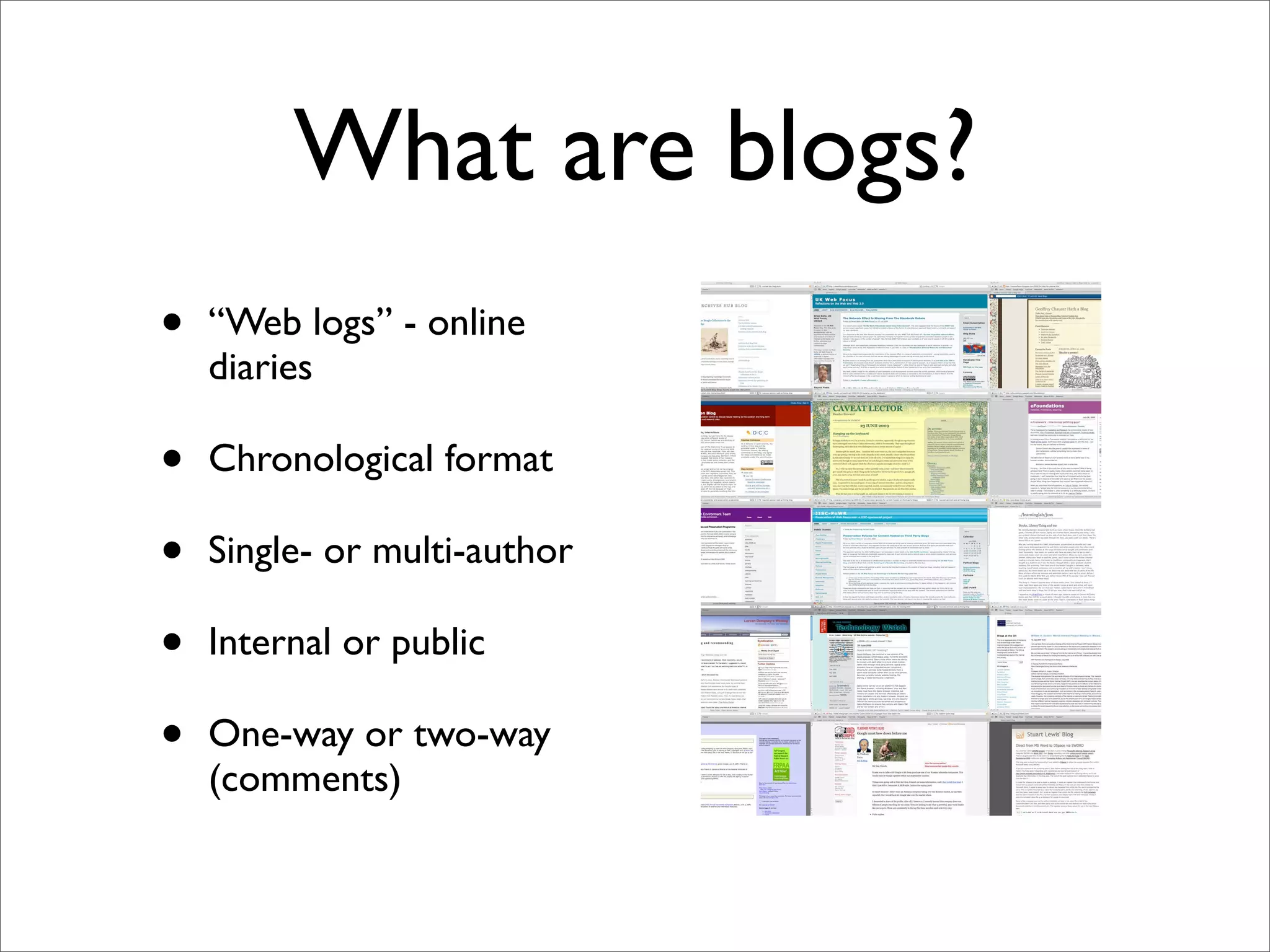
What are blogs?
•   “Web logs” - online
    diaries

•   Chronological format

•   Single- or multi-author

•   Internal or public

•   One-way or two-way
    (comments)
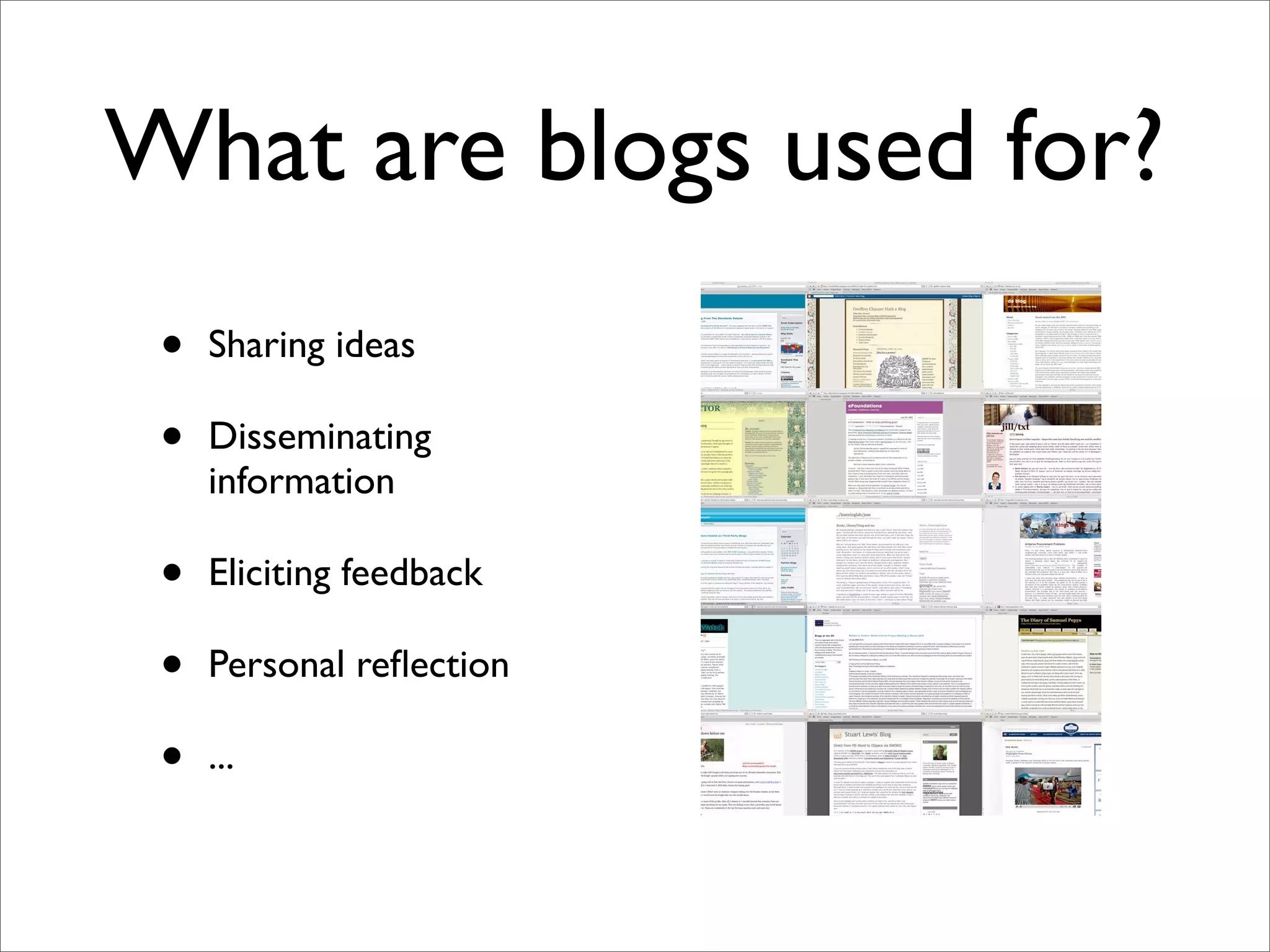
What are blogs used for?
 •   Sharing ideas

 •   Disseminating
     information

 •   Eliciting feedback

 •   Personal reflection

 •   ...
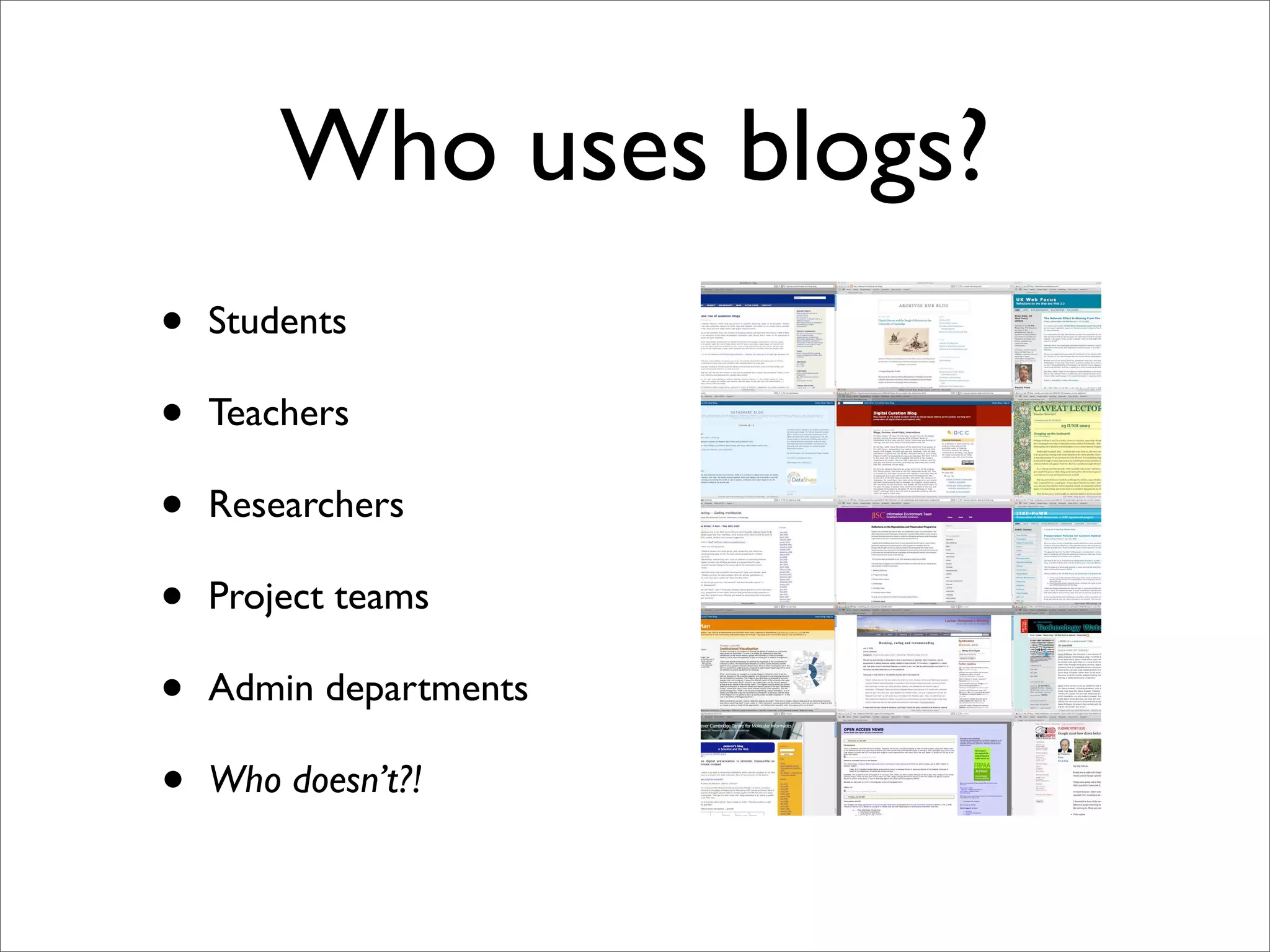
Who uses blogs?
•   Students

•   Teachers

•   Researchers

•   Project teams

•   Admin departments

•   Who doesn’t?!
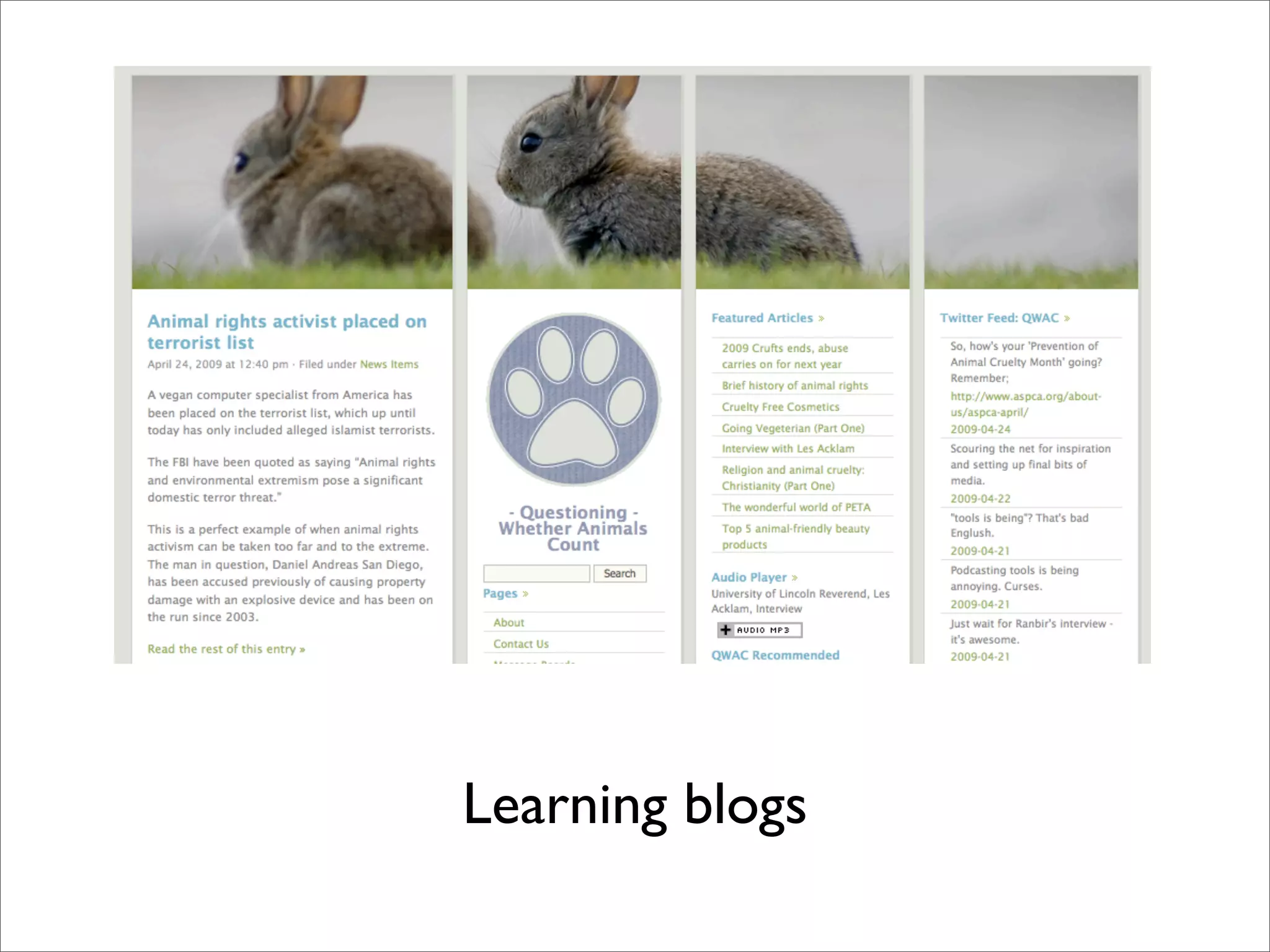
Learning blogs
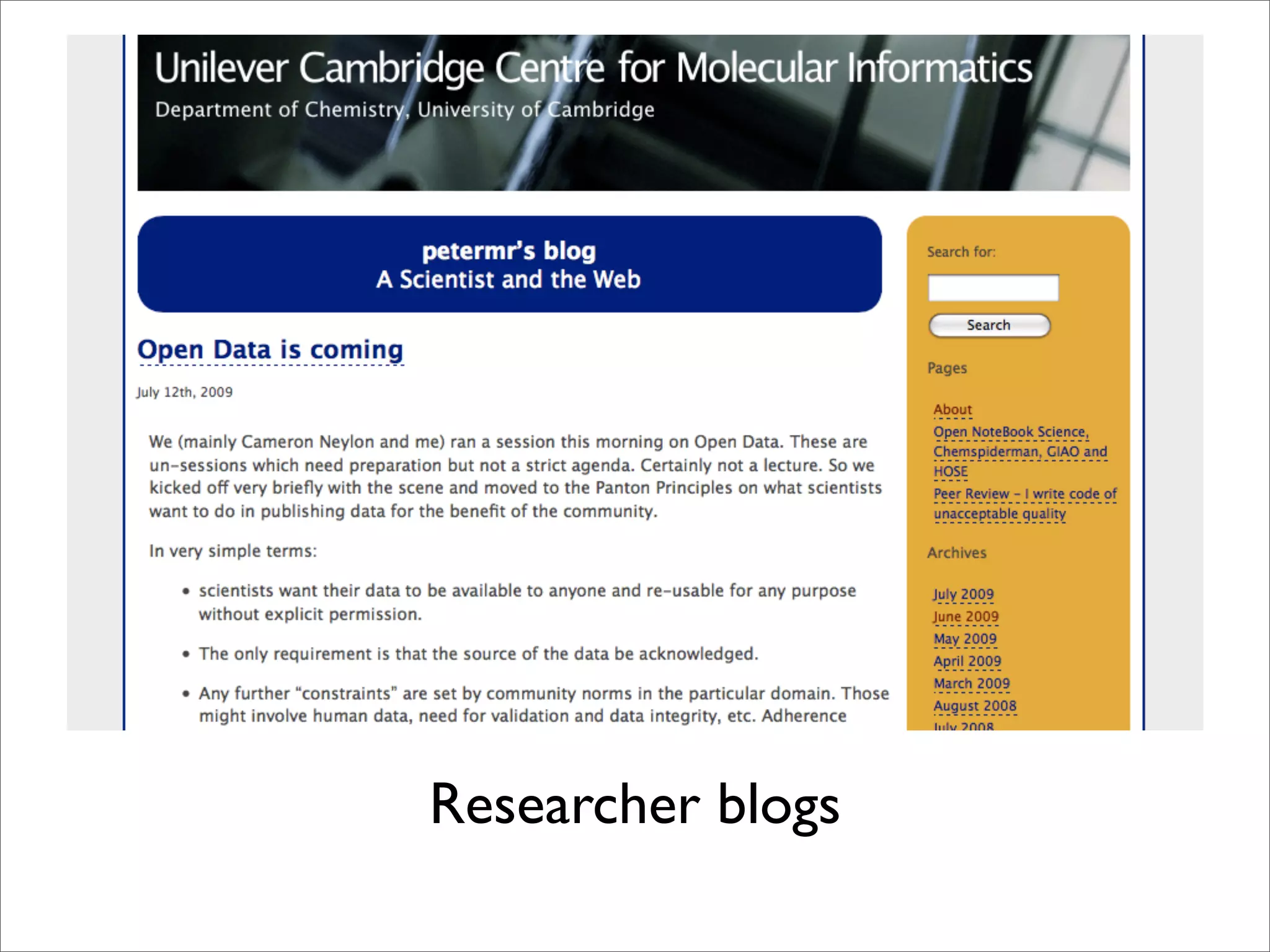
Researcher blogs
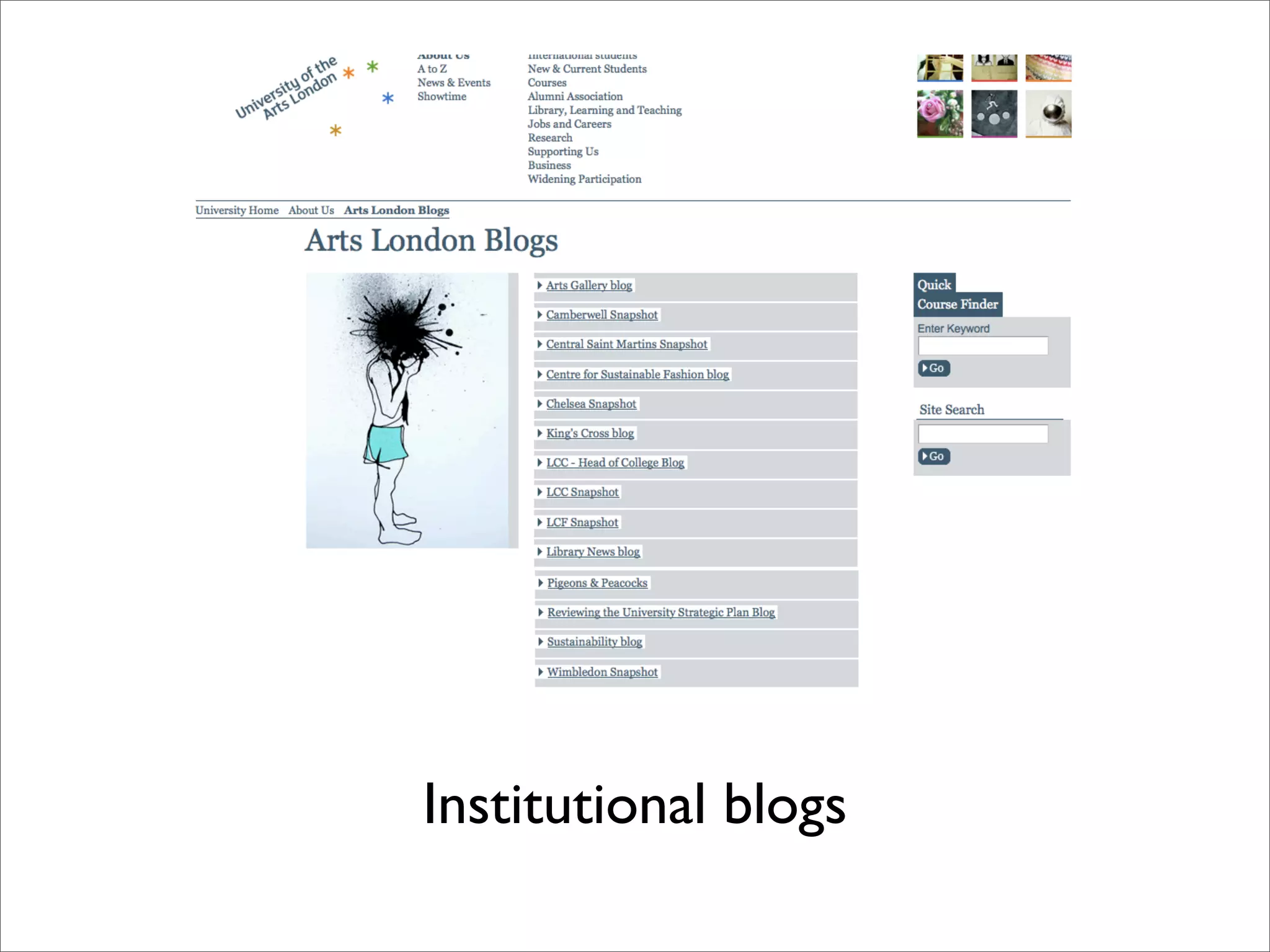
Institutional blogs
Why are blogs important?

• Communication
• Discussion
• Communities, connections, contacts
• Personal publishing platform
• Record of activities
• Different from “ordinary” websites?
Why should institutions
      preserve blogs?
• Record of institutional activities:
 • Social
 • Professional
 • Intellectual
• Study, research, re-use
• Citation, quotation, reference
• Alternative to journal articles(?)
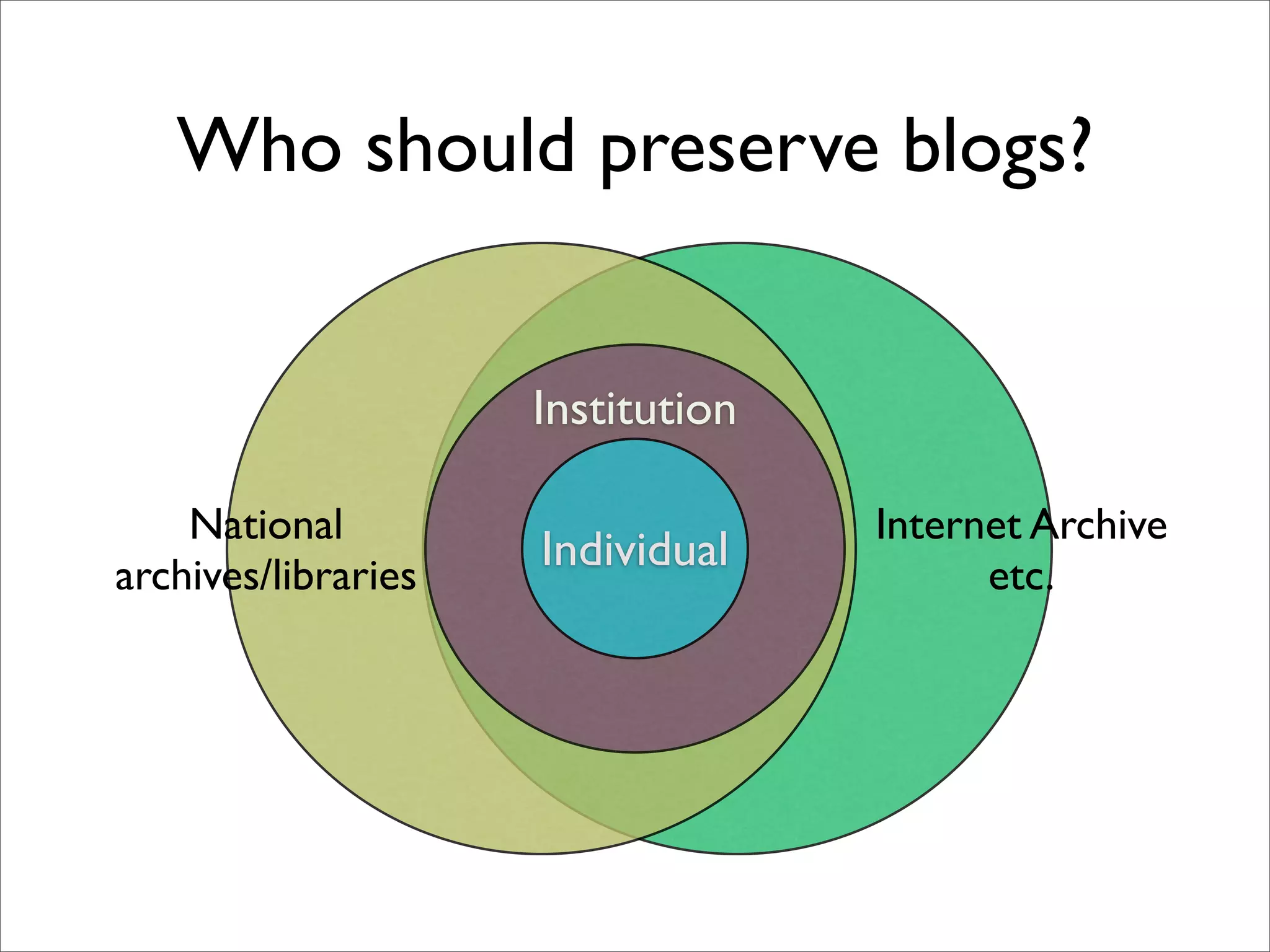
Who should preserve blogs?


                     Institution

    National                       Internet Archive
archives/libraries
                     Individual          etc.
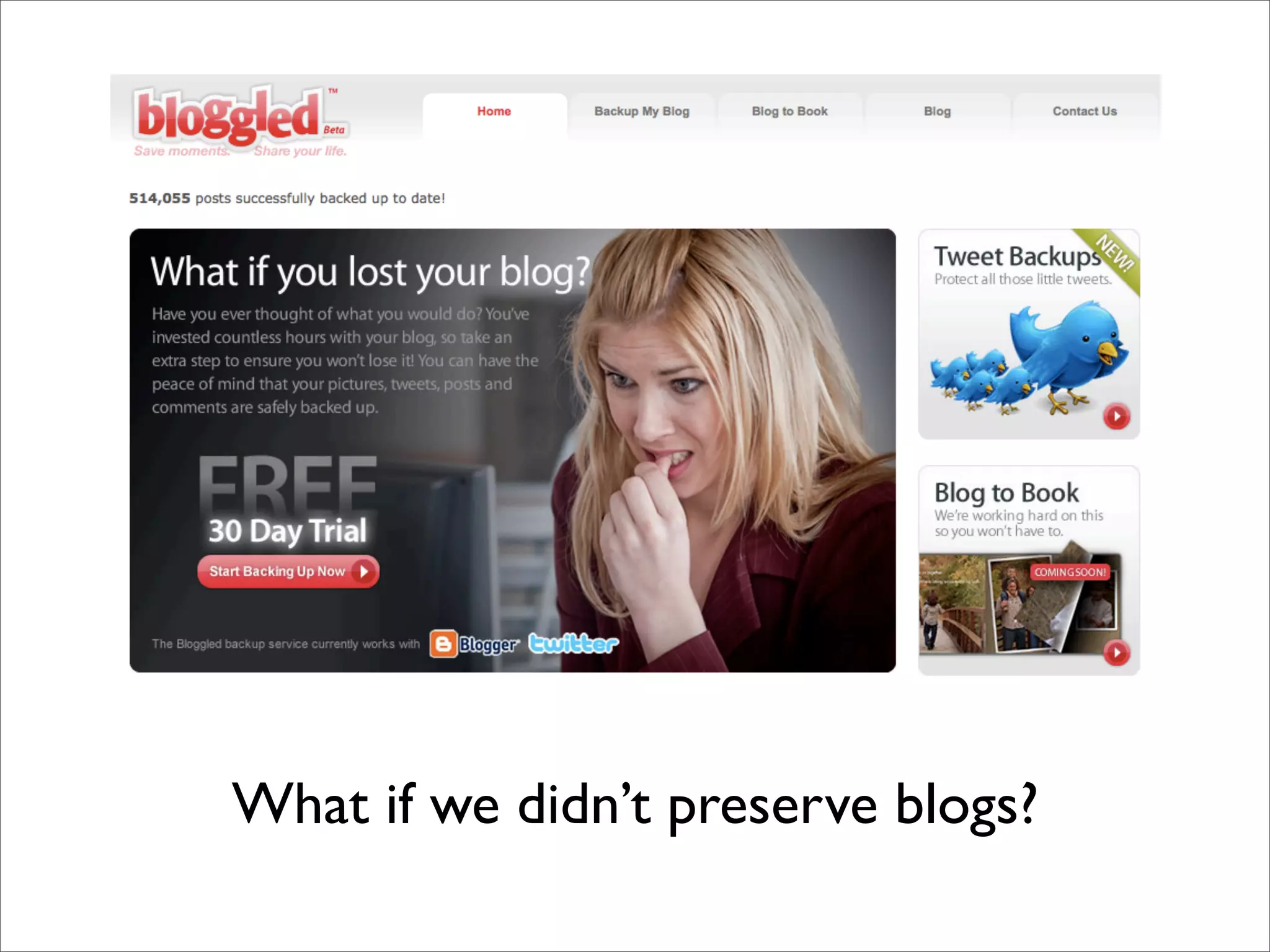
What if we didn’t preserve blogs?
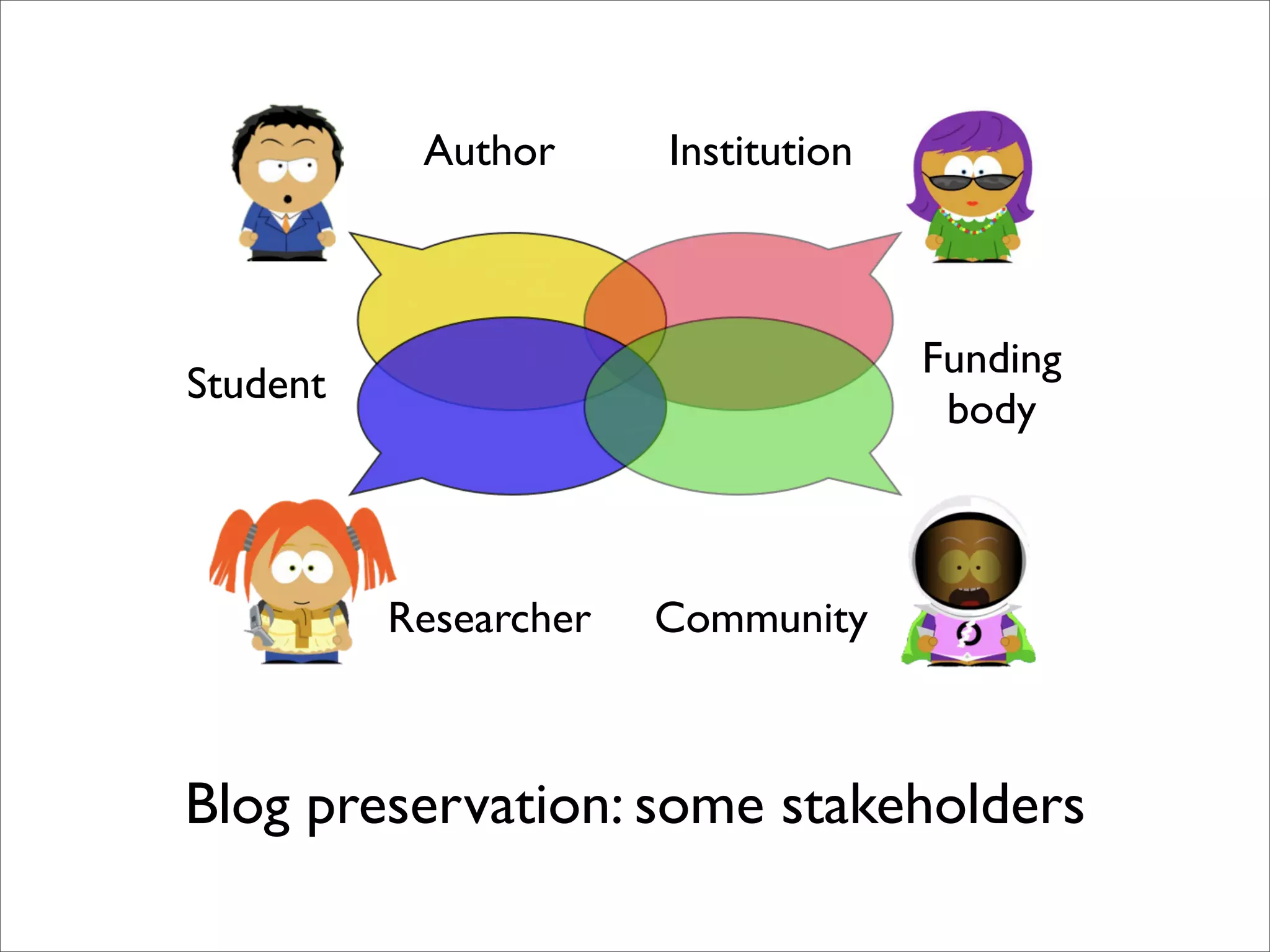
Author      Institution


                                     Funding
Student
                                      body


          Researcher   Community


Blog preservation: some stakeholders
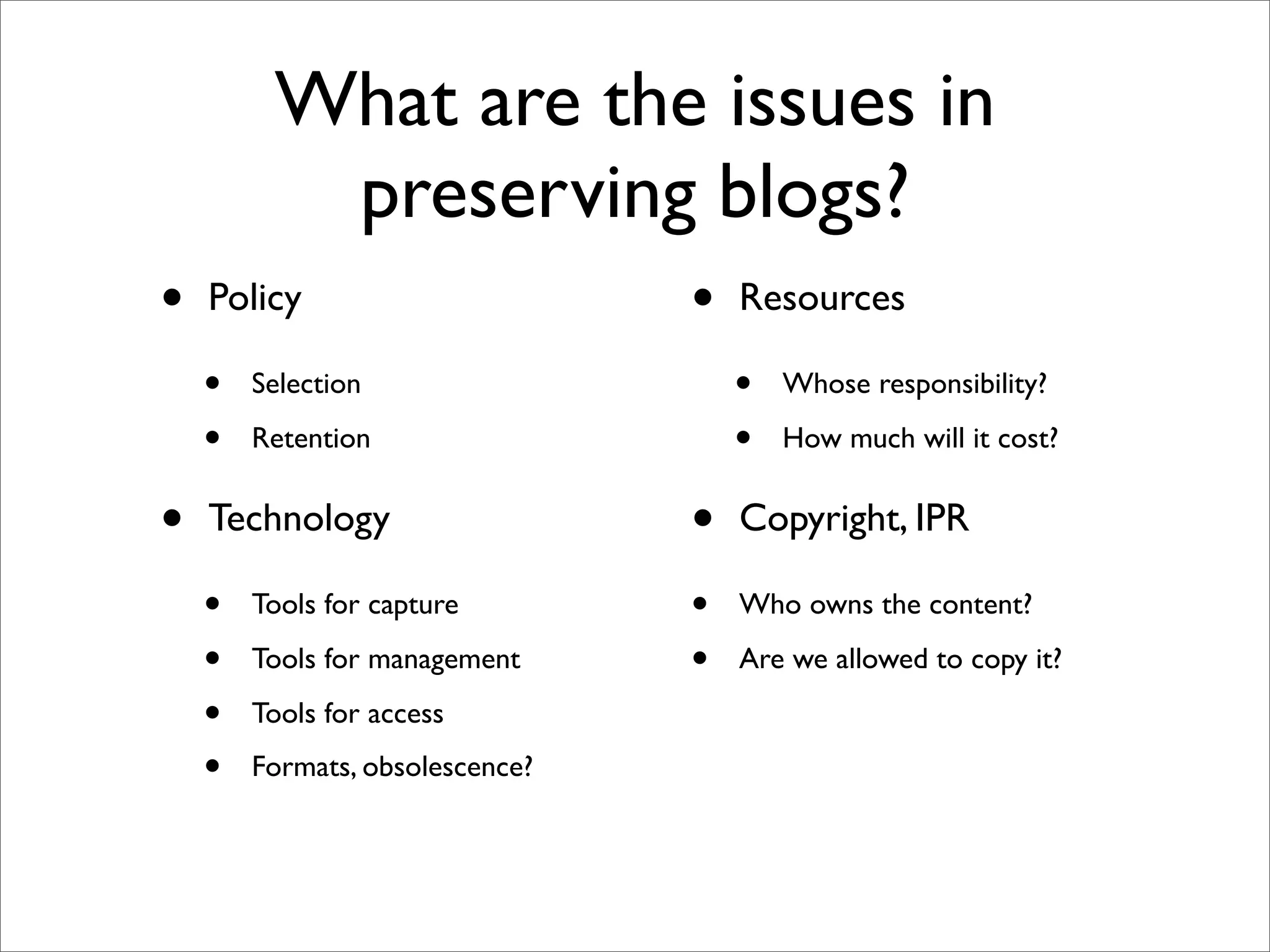
What are the issues in
          preserving blogs?
•   Policy                       •   Resources

    •   Selection                    •   Whose responsibility?

    •   Retention                    •   How much will it cost?


•   Technology                   •   Copyright, IPR

    •   Tools for capture        •   Who owns the content?

    •   Tools for management     •   Are we allowed to copy it?

    •   Tools for access

    •   Formats, obsolescence?
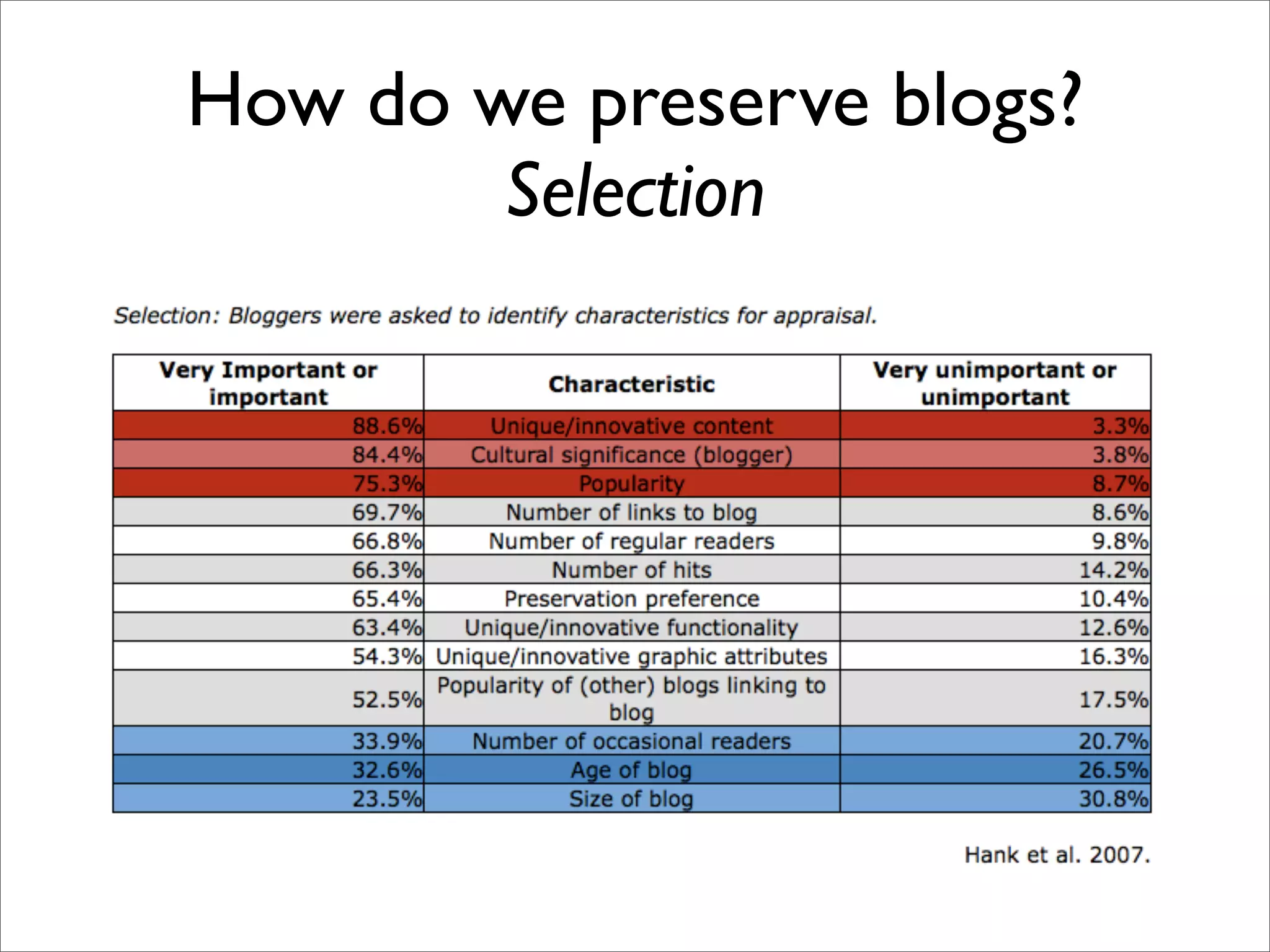
How do we preserve blogs?
        Selection
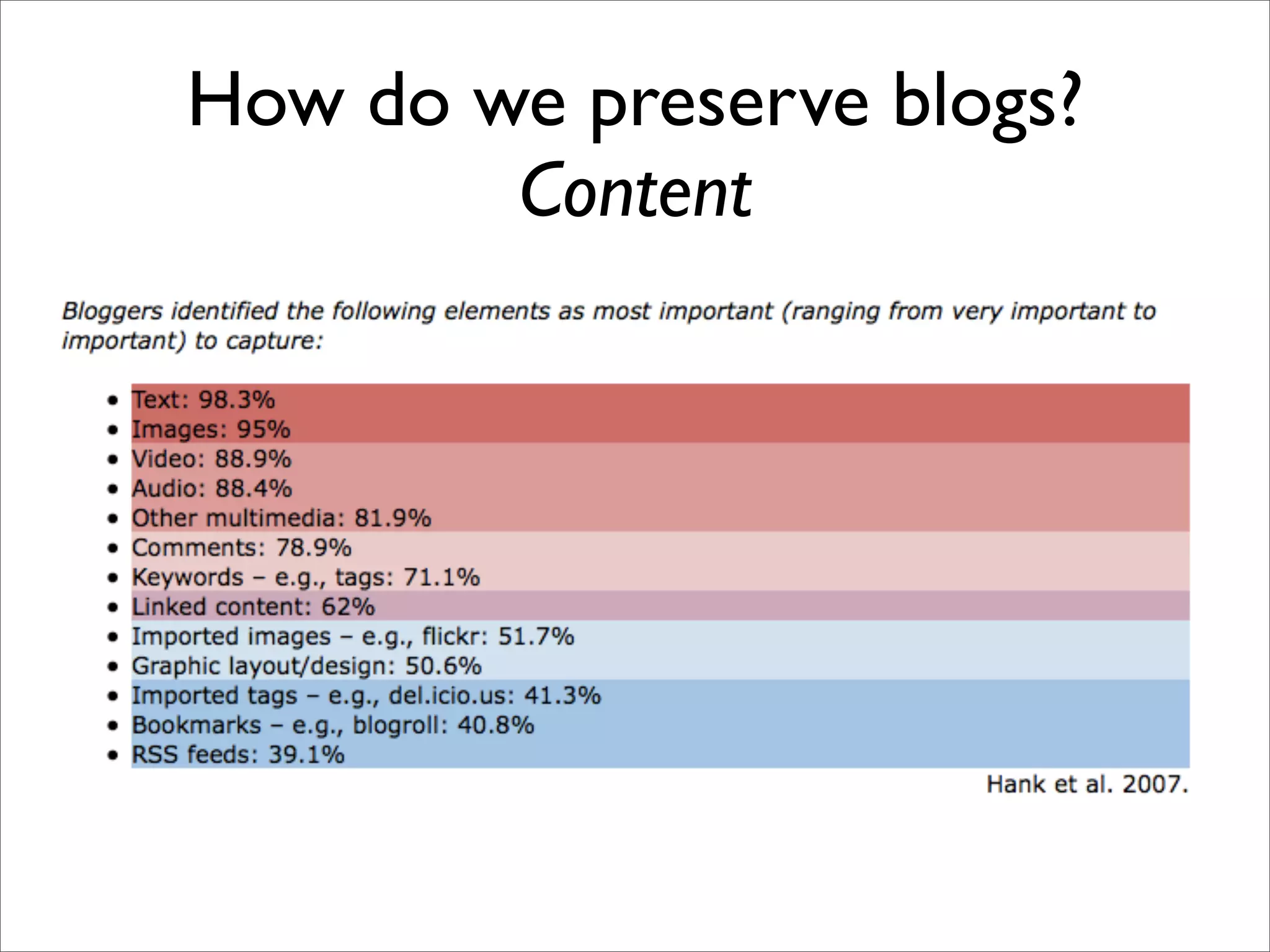
How do we preserve blogs?
        Content
Capturing blog content


• Possible approaches:
 • Web crawling and harvesting
 • Database backup
 • XML export
 • RSS feed harvesting
Providing access to archived blog
             content
 • What sort of system would we like to
   provide?
 • Access via library database portal?
 • Full-text, keyword searching and indexing?
 • Unified view, e.g. of single author
   contributions across multiple blogs?
 • Respect original access restrictions?
 • Conflict between ‘live’ and archived content?
Who owns the content?

• Copyright issues: does your institution have
  a policy on...
  •   Content created as part of employee duties? In
      which case copyright may reside with employer?

  •   Content created as part of a course by
      students? In which case copyright probably is
      with the student?
Who owns the content?


Brian Kelly talking about UK Web Focus blog:
“A rich copy of the contents of the blog will be made available to UKOLN (my
host organisation) if I leave. Note that this may not include the full content if
there are complications concerning third party content (e.g. guest blog posts,
embedded objects, etc.), technical difficulties, etc.

“Since the blog reflects personal views I reserve the rights to continue
providing the blog if I leave UKOLN. If this happens I will remove any UKOLN
branding from the blog.”

                                                                       Kelly, 2009
Who owns the content?

• Suggested approaches:
 •   Explicit statement of policy with regard to
     rights, ownership and long-term access
     (including if author leaves)

 •   Explicit Creative Commons licensing statement
     on blogs, regarding
     •   For blogger content
     •   For comments
 •   For embedded content: only use material that is
     appropriately and explicitly licensed
Breakout Exercise: Preserving
               Institutional Blog Content
Your University has established a Blog Server. All current students and staff
will be able to create private or public blogs.

You have been asked to research the policy implications and technical
requirements for mid-to-long term access to the blog content, and make
recommendations.

 1. Try to identify at least 3 key issues and suggest ways to address them.
    Describe the advantages and any disadvantages of your solutions.

 2. Suggestions you have already received include:

    • Deleting all student blogs on graduation
    • Printing staff and project blogs to PDF and storing them in the IR
    • Making all staff and students sign a copyright agreement with the
      University
    Are any of these suggestions acceptable? If not, why not?
Resources and further reading
•   Digital Preservation Europe: Considerations for the preservation of blogs.
    http://tinyurl.com/dpe-blog-preservation

•   JISC: Preservation of Web Resources Handbook. http://tinyurl.com/jisc-powr-handbook

•   JISC: ArchivePress project. http://archivepress.ulcc.ac.uk/

•   Kelly, Brian (2008).  Auricle: The Case Of The Disappearing E-learning Blog. In: JISC-
    PoWR Blog, in UK Web Archive. http://jiscpowr.jiscinvolve.org/2008/09/01/auricle-the-
    case-of-the-disappearing-e-learning-blog/

•   Morrison, Heather (2007). Rethinking collections — Libraries and librarians in an open
    age: A theoretical view. First Monday, Volume 12 Number 10 - 1 October 2007.
    http://firstmonday.org/htbin/cgiwrap/bin/ojs/index.php/fm/article/viewArticle/1965/1841

•   J. Walker (2006). Blogging From Inside the Ivory Tower. In: Bruns A. and Jacobs, J. (eds),
    Uses of blogs, Peter Lang, pp. 127-138. OA preprint at http://hdl.handle.net/1956/1846
Credits

•   Jam Pot photo by AvantGardner4 on Flickr.
    http://www.flickr.com/photos/
    avantgardener4/2110782575/ [CC:by-nc-nd]

•   Screenshots:
    •   http://learninglab.lincoln.ac.uk/blogs/oj1/
    •   http://wwmm.ch.cam.ac.uk/blogs/murrayrust/
    •   http://www.arts.ac.uk/index-blogs.htm
    •   http://www.bloggled.com/

•   SouthPark cartoons created using SP Studio.
    http://www.sp-studio.de/

Practical Blog Preservation (Workshop)

  • 1.
    Practical Blog Preservation Richard M. Davis University of London Computer Centre A Workshop for IWMW 2009 28th July 2009
  • 2.
    Practical Blog Preservation 1.Introductions • Identify issues and scenarios 2. Blogging and digital preservation in HE: • Identify possible • What have we got? solutions ... • What do we want? • ... and which to use when 3. Breakout & discussion 4. A possible approach • An effective plan to preserve blogs at your institution
  • 3.
    What is digitalpreservation? “ a series of managed activities necessary to ensure continued access [...] for as long as necessary ” Digital Preservation Coalition, 2002
  • 4.
    What are blogs? • “Web logs” - online diaries • Chronological format • Single- or multi-author • Internal or public • One-way or two-way (comments)
  • 5.
    What are blogsused for? • Sharing ideas • Disseminating information • Eliciting feedback • Personal reflection • ...
  • 6.
    Who uses blogs? • Students • Teachers • Researchers • Project teams • Admin departments • Who doesn’t?!
  • 7.
  • 8.
  • 9.
  • 10.
    Why are blogsimportant? • Communication • Discussion • Communities, connections, contacts • Personal publishing platform • Record of activities • Different from “ordinary” websites?
  • 11.
    Why should institutions preserve blogs? • Record of institutional activities: • Social • Professional • Intellectual • Study, research, re-use • Citation, quotation, reference • Alternative to journal articles(?)
  • 12.
    Who should preserveblogs? Institution National Internet Archive archives/libraries Individual etc.
  • 13.
    What if wedidn’t preserve blogs?
  • 14.
    Author Institution Funding Student body Researcher Community Blog preservation: some stakeholders
  • 15.
    What are theissues in preserving blogs? • Policy • Resources • Selection • Whose responsibility? • Retention • How much will it cost? • Technology • Copyright, IPR • Tools for capture • Who owns the content? • Tools for management • Are we allowed to copy it? • Tools for access • Formats, obsolescence?
  • 16.
    How do wepreserve blogs? Selection
  • 17.
    How do wepreserve blogs? Content
  • 18.
    Capturing blog content •Possible approaches: • Web crawling and harvesting • Database backup • XML export • RSS feed harvesting
  • 19.
    Providing access toarchived blog content • What sort of system would we like to provide? • Access via library database portal? • Full-text, keyword searching and indexing? • Unified view, e.g. of single author contributions across multiple blogs? • Respect original access restrictions? • Conflict between ‘live’ and archived content?
  • 20.
    Who owns thecontent? • Copyright issues: does your institution have a policy on... • Content created as part of employee duties? In which case copyright may reside with employer? • Content created as part of a course by students? In which case copyright probably is with the student?
  • 21.
    Who owns thecontent? Brian Kelly talking about UK Web Focus blog: “A rich copy of the contents of the blog will be made available to UKOLN (my host organisation) if I leave. Note that this may not include the full content if there are complications concerning third party content (e.g. guest blog posts, embedded objects, etc.), technical difficulties, etc. “Since the blog reflects personal views I reserve the rights to continue providing the blog if I leave UKOLN. If this happens I will remove any UKOLN branding from the blog.” Kelly, 2009
  • 22.
    Who owns thecontent? • Suggested approaches: • Explicit statement of policy with regard to rights, ownership and long-term access (including if author leaves) • Explicit Creative Commons licensing statement on blogs, regarding • For blogger content • For comments • For embedded content: only use material that is appropriately and explicitly licensed
  • 24.
    Breakout Exercise: Preserving Institutional Blog Content Your University has established a Blog Server. All current students and staff will be able to create private or public blogs. You have been asked to research the policy implications and technical requirements for mid-to-long term access to the blog content, and make recommendations. 1. Try to identify at least 3 key issues and suggest ways to address them. Describe the advantages and any disadvantages of your solutions. 2. Suggestions you have already received include: • Deleting all student blogs on graduation • Printing staff and project blogs to PDF and storing them in the IR • Making all staff and students sign a copyright agreement with the University Are any of these suggestions acceptable? If not, why not?
  • 25.
    Resources and furtherreading • Digital Preservation Europe: Considerations for the preservation of blogs. http://tinyurl.com/dpe-blog-preservation • JISC: Preservation of Web Resources Handbook. http://tinyurl.com/jisc-powr-handbook • JISC: ArchivePress project. http://archivepress.ulcc.ac.uk/ • Kelly, Brian (2008).  Auricle: The Case Of The Disappearing E-learning Blog. In: JISC- PoWR Blog, in UK Web Archive. http://jiscpowr.jiscinvolve.org/2008/09/01/auricle-the- case-of-the-disappearing-e-learning-blog/ • Morrison, Heather (2007). Rethinking collections — Libraries and librarians in an open age: A theoretical view. First Monday, Volume 12 Number 10 - 1 October 2007. http://firstmonday.org/htbin/cgiwrap/bin/ojs/index.php/fm/article/viewArticle/1965/1841 • J. Walker (2006). Blogging From Inside the Ivory Tower. In: Bruns A. and Jacobs, J. (eds), Uses of blogs, Peter Lang, pp. 127-138. OA preprint at http://hdl.handle.net/1956/1846
  • 26.
    Credits • Jam Pot photo by AvantGardner4 on Flickr. http://www.flickr.com/photos/ avantgardener4/2110782575/ [CC:by-nc-nd] • Screenshots: • http://learninglab.lincoln.ac.uk/blogs/oj1/ • http://wwmm.ch.cam.ac.uk/blogs/murrayrust/ • http://www.arts.ac.uk/index-blogs.htm • http://www.bloggled.com/ • SouthPark cartoons created using SP Studio. http://www.sp-studio.de/