… what could be  less sexy  than memorizing  4th grade multiplication facts?
Just the facts Start by knowing 4    4,  5    5,  6    6,  7    7, … Have most others and easily work out what they don’t have memorized. Goal now is to consolidate!
What helps kids memorize multiplication facts? Something memorable!
Surprise What is 6    6?
Surprise What is 6    6?   What is 5    7?
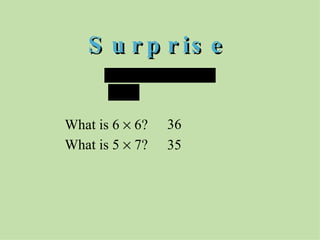
Surprise What is 6    6?   What is 5    7?   36 35
Surprise What is 7    7?
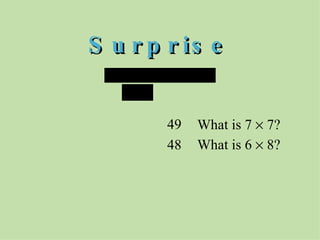
Surprise What is 7    7?   What is 6    8?   49 48
Surprise What is 8    8?
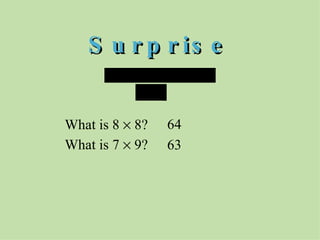
Surprise What is 8    8?   What is 7    9?   64 63
Surprise What is 9    9?
Surprise What is 9    9? What is 8 x 10?
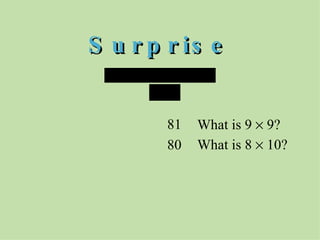
Surprise What is 9    9?   What is 8    10?   81 80
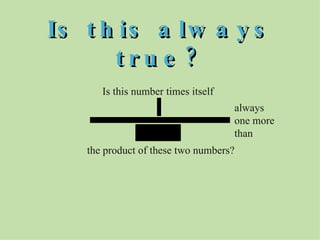
Is this always true?
Is this always true? always  one more than Is this number times itself
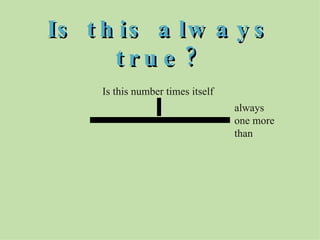
Is this always true? always  one more than Is this number times itself the product of these two numbers?
But  why  does it work?!
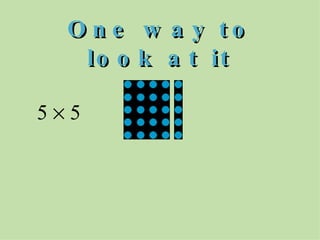
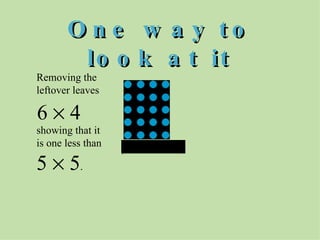
One way to look at it 5    5
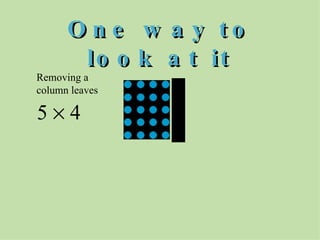
One way to look at it 5    4 Removing a column leaves
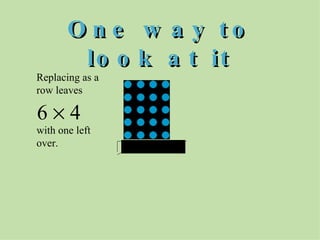
One way to look at it 6    4 Replacing as a row leaves with one left over.
One way to look at it 6    4 Removing the leftover leaves showing that it is one less than  5   5 .
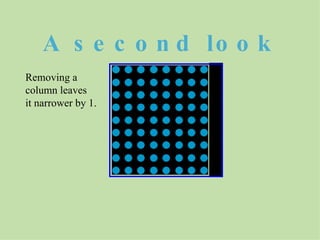
A second look Removing a column leaves it narrower by 1.
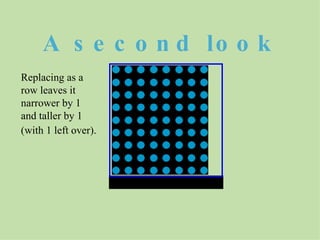
A second look Replacing as a row leaves it narrower by 1 and taller by 1 (with 1 left over).
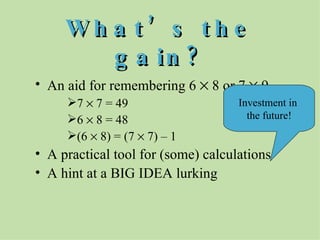
What’s the gain? An aid for remembering 6    8 or 7    9 7    7 = 49 6    8 = 48 (6    8) = (7    7) - 1 Direct benefit!
What’s the gain? An aid for remembering 6    8 or 7    9 7    7 = 49 6    8 = 48 (6    8) = (7    7) – 1 A practical tool for (some) calculations A hint at a BIG IDEA lurking Investment in  the future!
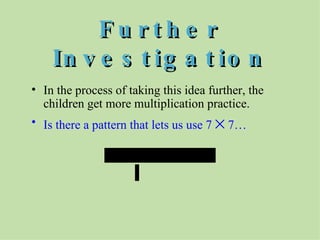
Further Investigation In the process of taking this idea further, the children get more multiplication practice. Is there a pattern that lets us use 7    7…
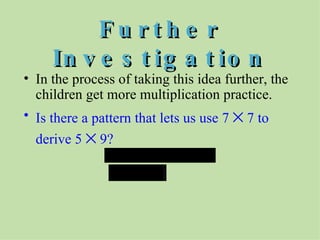
Further Investigation In the process of taking this idea further, the children get more multiplication practice. Is there a pattern that lets us use 7    7 to derive 5    9?
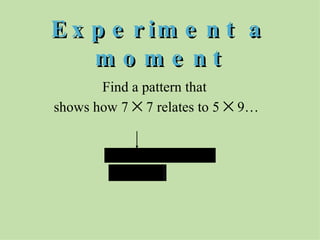
Experiment a moment Find a pattern that  shows how 7    7 relates to 5    9…
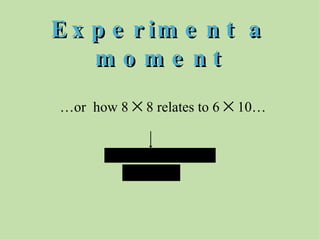
Experiment a moment  … or  how 8    8 relates to 6    10…
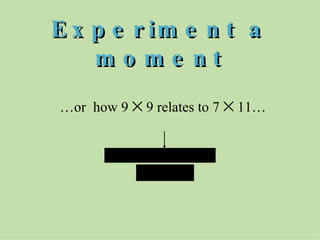
Experiment a moment  … or  how 9    9 relates to 7    11…
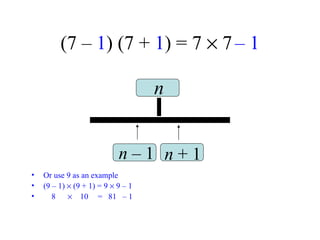
(7 –  1 ) (7 +  1 ) = 7    7   – 1 Or use 9 as an example (9 – 1)    (9 + 1) = 9    9 – 1  8     10  =  81  – 1 n n  – 1 n  + 1
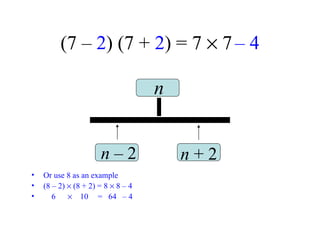
(7 –  2 ) (7 +  2 ) = 7    7   – 4 Or use 8 as an example (8 – 2)    (8 + 2) = 8    8 – 4 6     10  =  64  – 4 n n  – 2 n  + 2
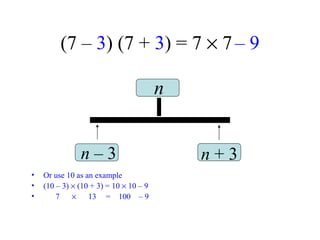
(7 –  3 ) (7 +  3 ) = 7    7   – 9 Or use 10 as an example (10 – 3)    (10 + 3) = 10    10 – 9 7     13  =  100  – 9 n n  – 3 n  + 3
Where does this lead?
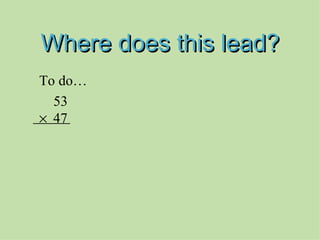
Where does this lead? To do…   53    47
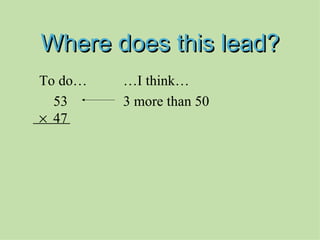
Where does this lead? To do… …I think…   53 3 more than 50     47
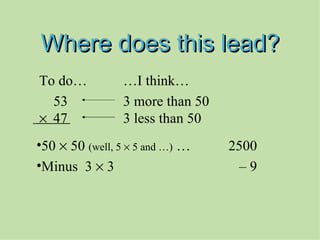
Where does this lead? To do… …I think…   53 3 more than 50     47 3 less than 50 50    50  (well, 5    5 and …)  … 2500 Minus  3    3   – 9
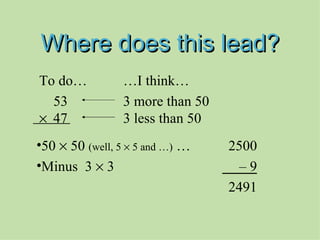
Where does this lead? To do… …I think…   53 3 more than 50     47 3 less than 50 50    50  (well, 5    5 and …)  … 2500 Minus  3    3   – 9   2491
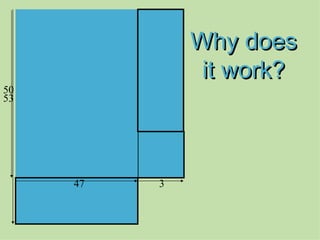
Why does it work? 47 3 50 53
www 2 .edc.org/mathworkshop Thanks! E. Paul Goldenberg [email_address] Contact Information
www 2 .edc.org/mathworkshop Bye! Thanks! E. Paul Goldenberg [email_address] Contact Information

Sexy Maths

  • 1.
    … what couldbe less sexy than memorizing 4th grade multiplication facts?
  • 2.
    Just the factsStart by knowing 4  4, 5  5, 6  6, 7  7, … Have most others and easily work out what they don’t have memorized. Goal now is to consolidate!
  • 3.
    What helps kidsmemorize multiplication facts? Something memorable!
  • 4.
  • 5.
    Surprise What is6  6? What is 5  7?
  • 6.
    Surprise What is6  6? What is 5  7? 36 35
  • 7.
  • 8.
    Surprise What is7  7? What is 6  8? 49 48
  • 9.
  • 10.
    Surprise What is8  8? What is 7  9? 64 63
  • 11.
  • 12.
    Surprise What is9  9? What is 8 x 10?
  • 13.
    Surprise What is9  9? What is 8  10? 81 80
  • 14.
  • 15.
    Is this alwaystrue? always one more than Is this number times itself
  • 16.
    Is this alwaystrue? always one more than Is this number times itself the product of these two numbers?
  • 17.
    But why does it work?!
  • 18.
    One way tolook at it 5  5
  • 19.
    One way tolook at it 5  4 Removing a column leaves
  • 20.
    One way tolook at it 6  4 Replacing as a row leaves with one left over.
  • 21.
    One way tolook at it 6  4 Removing the leftover leaves showing that it is one less than 5  5 .
  • 22.
    A second lookRemoving a column leaves it narrower by 1.
  • 23.
    A second lookReplacing as a row leaves it narrower by 1 and taller by 1 (with 1 left over).
  • 24.
    What’s the gain?An aid for remembering 6  8 or 7  9 7  7 = 49 6  8 = 48 (6  8) = (7  7) - 1 Direct benefit!
  • 25.
    What’s the gain?An aid for remembering 6  8 or 7  9 7  7 = 49 6  8 = 48 (6  8) = (7  7) – 1 A practical tool for (some) calculations A hint at a BIG IDEA lurking Investment in the future!
  • 26.
    Further Investigation Inthe process of taking this idea further, the children get more multiplication practice. Is there a pattern that lets us use 7  7…
  • 27.
    Further Investigation Inthe process of taking this idea further, the children get more multiplication practice. Is there a pattern that lets us use 7  7 to derive 5  9?
  • 28.
    Experiment a momentFind a pattern that shows how 7  7 relates to 5  9…
  • 29.
    Experiment a moment … or how 8  8 relates to 6  10…
  • 30.
    Experiment a moment … or how 9  9 relates to 7  11…
  • 31.
    (7 – 1 ) (7 + 1 ) = 7  7 – 1 Or use 9 as an example (9 – 1)  (9 + 1) = 9  9 – 1 8  10 = 81 – 1 n n – 1 n + 1
  • 32.
    (7 – 2 ) (7 + 2 ) = 7  7 – 4 Or use 8 as an example (8 – 2)  (8 + 2) = 8  8 – 4 6  10 = 64 – 4 n n – 2 n + 2
  • 33.
    (7 – 3 ) (7 + 3 ) = 7  7 – 9 Or use 10 as an example (10 – 3)  (10 + 3) = 10  10 – 9 7  13 = 100 – 9 n n – 3 n + 3
  • 34.
  • 35.
    Where does thislead? To do… 53  47
  • 36.
    Where does thislead? To do… …I think… 53 3 more than 50  47
  • 37.
    Where does thislead? To do… …I think… 53 3 more than 50  47 3 less than 50 50  50 (well, 5  5 and …) … 2500 Minus 3  3 – 9
  • 38.
    Where does thislead? To do… …I think… 53 3 more than 50  47 3 less than 50 50  50 (well, 5  5 and …) … 2500 Minus 3  3 – 9 2491
  • 39.
    Why does itwork? 47 3 50 53
  • 40.
    www 2 .edc.org/mathworkshopThanks! E. Paul Goldenberg [email_address] Contact Information
  • 41.
    www 2 .edc.org/mathworkshopBye! Thanks! E. Paul Goldenberg [email_address] Contact Information

Editor's Notes

  • #2 Back to the facts and skills.