Are intellectual property (IP) rights an asset for your company? Dr. C. May * ,  Member of the  German Patent and Trademark Office (DPMA), Department for Information Technology *The presentation reflects the personal opinion of the author.
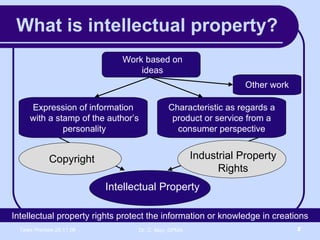
What is intellectual property? Intellectual property rights protect the information or knowledge in creations Intellectual Property Copyright Industrial Property Rights Expression of information  with a stamp of the author’s personality Characteristic as regards a product or service from a consumer perspective Work based on ideas Other work
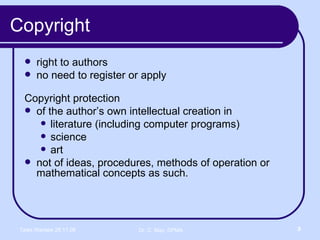
Copyright right to authors no need to register or apply Copyright protection  of the author’s own intellectual creation in  literature (including computer programs) science art not of ideas, procedures, methods of operation or mathematical concepts as such.
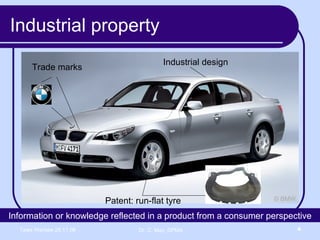
Industrial property Trade marks © BMW Industrial design Patent: run-flat tyre www.kfz-tech.de Information or knowledge reflected in a product from a consumer perspective
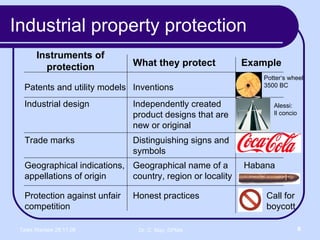
Industrial property protection What they protect Instruments of  protection Inventions Patents and utility models Independently created product designs that are new or original Industrial design Distinguishing signs and symbols Trade marks Geographical name of a country, region or locality Geographical indications, appellations of origin Honest practices Protection against unfair competition Example Habana Call for boycott Alessi: Il concio Potter‘s wheel 3500 BC
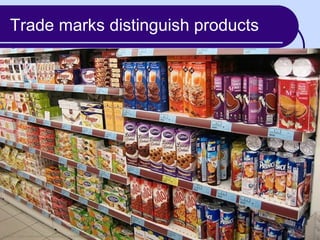
Trade marks distinguish products Source: <http://www.flickr.com/photos/54133554@N00/280543406/>
Trade marks A trade mark is a  word or sign   which can be represented  graphically  and  which  distinguishes the trade origins of  identical or related  goods and services. A trade mark is the `business card´ of your goods or services.
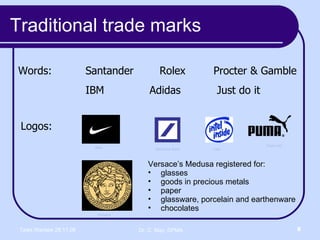
Traditional trade marks Words:  Santander    Rolex  Procter & Gamble   IBM     Adidas    Just do it Logos: Puma AG Deutsche Bank Intel Versace Versace’s Medusa registered for: glasses goods in precious metals paper glassware, porcelain and earthenware chocolates Nike
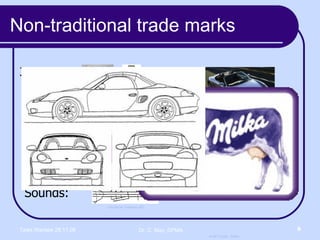
Non-traditional trade marks 3-D: Colours: Sounds: The Coca Cola Company BP Kraft Foods Toblerone Dr. Ing. h.c. F. Porsche AG: Boxter-S Kraft Foods : Chocolate Deutsche Telekom AG Nestlé Kraft Foods : Milka
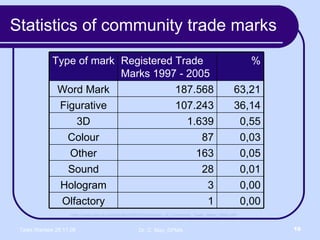
Statistics of community trade marks <http://www.ohim.eu.int/pdf/office/SSC009-Statistics_of_Community_Trade_Marks_2006.pdf> 0,00 1 Olfactory 0,00 3 Hologram 0,01 28 Sound 0,05 163 Other 0,03 87 Colour 0,55 1.639 3D 36,14 107.243 Figurative 63,21 187.568 Word Mark % Registered Trade Marks 1997 - 2005 Type of mark
Trade marks confer the exclusive right to affix the sign to goods or the presentation or packaging thereof  use the sign in domain names offer goods or services under that sign,  import or export goods under that sign,  authorize others to use it in return for payment What is protected by trade marks? Trade marks hinder unfair competitors to use similar signs for similar products
What are trade marks good for? building block for brand image marketing tool enhance  reputation customer loyalty basis for franchise agreement increase of enterprise value
How are trade marks protected? through  actual use  (only national law) through  registration: national (at a national trade mark office) European community (at OHIM, Alicante or a national trademark office)  international (Madrid Protocol, WIPO) (at national trade mark office or OHIM, Alicante) protection of a trade mark is  limited to  goods or services  applied for  unlimited renewable, if the trade mark is used enforceable by ordinary national courts
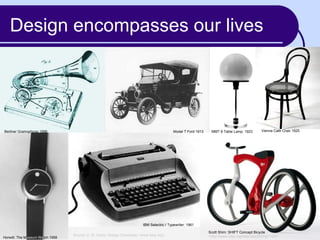
Design encompasses our lives Source: C. M. Gantz: Design Chronicles: <www.idsa.org> Scott Shim: SHIFT Concept Bicycle  <http://www.idsa.org/idea/idea2005/g7.htm> Berliner Gramophone 1896 Model T Ford 1913 MMT 8 Table Lamp: 1923 Vienna Cafe Chair 1925 Horwitt: The   M useum   Wa tch   1958 IBM Selectric I Typewriter: 1961
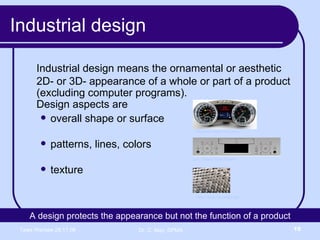
Industrial design Industrial design means the ornamental or aesthetic 2D- or 3D- appearance of a whole or part of a product (excluding computer programs).  Design aspects are overall shape or surface patterns, lines, colors texture <http://www.mccullagh.org/> Linn Classik Movie System Mercedes instrument panel A design protects the appearance but not the function of a product
Why should you protect your design? Others could it protect before you. Recognition by consumers may lead to identification with a product family Thereby design adds  commercial value to your product and  increases its marketability. A registered design hinders others from unauthorized copying and imitation
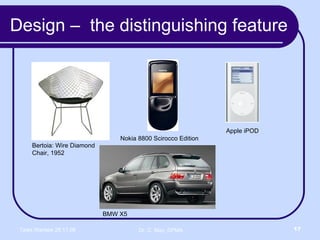
Design –  the distinguishing feature Bertoia: Wire Diamond Chair, 1952 Nokia 8800 Scirocco Edition Apple iPOD BMW X5
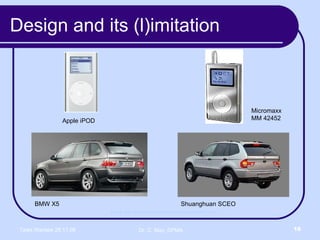
Design and its (l)imitation Apple iPOD Micromaxx MM 42452 BMW X5 Shuanghuan SCEO Source: <http://forum.wininizio.it/lofiversion/index.php/t49473.html>
Ways to protect industrial designs national design protection:  individual EU member states, Benelux.  unregistered community design:  prevents  deliberate copying  for 3 years registered community design:   exclusive right  of the commercial use up to 25 years; 1 year grace period  single international deposit  with  WIPO  or the national office of a country.
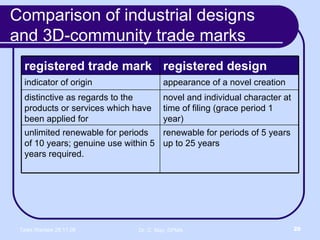
Comparison of industrial designs and 3D-community trade marks appearance of a novel creation indicator of origin renewable for periods of 5 years up to 25 years unlimited renewable for periods of 10 years; genuine use within 5 years required. novel and individual character at time of filing (grace period 1 year) distinctive as regards to the products or services which have been applied for registered design registered trade mark
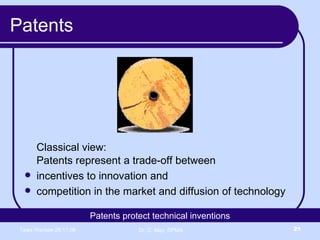
Patents Classical view:  Patents represent a trade-off between  incentives to innovation and  competition in the market and diffusion of technology Patents protect technical inventions
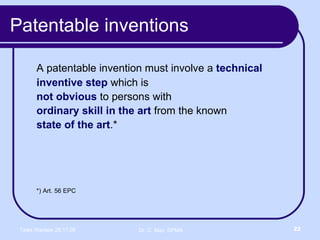
Patentable inventions A patentable invention must involve a  technical inventive step  which is  not obvious  to persons with  ordinary skill in the art  from the known state of the art .* *) Art. 56 EPC
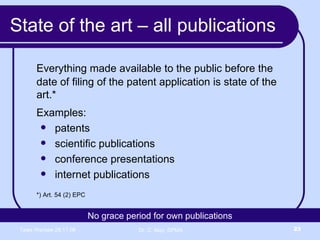
State of the art – all publications Everything made available to the public before the date of filing of the patent application is state of the art.* Examples: patents scientific publications  conference presentations internet publications *) Art. 54 (2) EPC No grace period for own publications
Inventive step - a creative act New ideas result from the association of old elements in new combinations. Previously remote elements of thought suddenly become associated in a new and useful [ non-obvious ] combination.*  *) S. A. Mednick, &quot;The Associative Basis of the Creative Process“,  Psychological Review , Vol. 69 (1962), p. 221
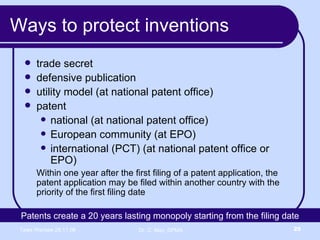
Ways to protect inventions trade secret defensive publication utility model (at national patent office) patent national (at national patent office) European community (at EPO) international (PCT) (at national patent office or EPO) Within one year after the first filing of a patent application, the patent application may be filed within another country with the priority of the first filing date Patents create a 20 years lasting monopoly starting from the filing date
Patents protect creative solutions to technical problems &quot;My attention was first directed to the mechanical removal of dust from carpets in 1901 […]. […] the air was blown down into the carpet from two opposing directions while the box was pushed over the carpet. […]  I thought over the matter for a few days and tried the experiment of sucking with my mouth against the back of a plush seat in a restaurant in Victoria Street with the result that I was almost choked. I came to the conclusion that I could construct a machine to work by suction.  (Source: Booth, C.H.: “The origin of the vacuum cleaner&quot; In: Transactions of the  Newcomen Society, 1934-35 Vol 15.  ) The solutions may be fundamental or incremental
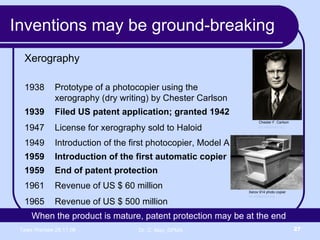
Inventions may be ground-breaking Xerography Chester F. Carlson en.wikipedia.org Xerox 914 photo copier . en.wikipedia.org When the product is mature, patent protection may be at the end  Revenue of US $ 500 million 1965 Revenue of US $ 60 million 1961 End of patent protection 1959 Introduction of the first automatic copier 1959 Introduction of the first photocopier, Model A 1949 License for xerography sold to Haloid  1947 Filed US patent application; granted 1942 1939 Prototype of a photocopier using the  xerography (dry writing) by Chester Carlson 1938
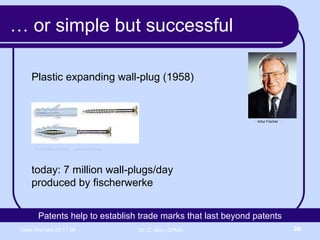
…  or simple but successful Plastic expanding wall-plug (1958) today: 7 million wall-plugs/day  produced by fischerwerke ©  Artur Fischer  Tip Kunststoffspreizdübel  www.wikipedia.de Patents help to establish trade marks that last beyond patents
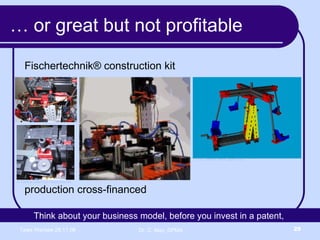
…  or great but not profitable Fischertechnik® construction kit  production cross-financed © Markus Lelie http://www.lelie.de © M. Samek. www.3dprofil.de Think about your business model, before you invest in a patent,
…  or without commercial impact Try to understand your market, before you file a patent The good is the enemy of the better… overestimation of the market value no business case no investor no licensee …  and of the worse: no market
Ways to protect your intellectual property  Trade secrets Employee loyalty Customer loyalty Technological complexity Market lead Advance in the learning curve Control of complementary assets Copyright Industrial designs  Trade marks Geographical indications and appellations of origin  Patents and Utility models Protection against unfair competition
Further reading Industrial property rights www.wipo.int http://www.wipo.int/sme/en/ Copyright en.wikipedia.org/wiki/Copyright_law_of_the_European_Union Trademarks and industrial design oami.europa.eu Patents www.european-patent-office.org Steven Weinstock, Five patent tips for start-up companies  http://wistechnology.com/article.php?id=1671
Patent portfolio strategies of  large companies - defensive Large companies  with significant financial resources procure and maintain a large quantity of patents. Usage: Defensive - mutually assured destruction E.g. Huawei Technologies Co. Ltd., founded 1988, network technologies, top 5 in 3GPP, 14000 patent applications, 2000 international patents
Patent portfolio strategies of  large companies - offensive Offensive (IBM generates ca. $ 1 billion a year from licensing its patent portfolio.) Carrot licensing: e.g. yet2.com (IP marketplace). ARM (IP production solely) Stick licensing: (Rambus, Inc.) Cross licensing: mutual sharing of patents hindering others from entering the market (electronics industry)
Patent portfolio strategies for  start-ups – business objectives Start-ups:  cost-effective patent portfolio  decisive for entrepreneurs to be funded by venture capitalists focus on few quality patents regarding key products and technologies in conformance with business objectives Guiding questions to define the scope of patents:* What is the ultimate goal? Licensing the invention Marketing a product Selling the company Growing and expanding the company
Patent portfolio strategies for  start-ups  - competition What impediments to the market entry of your technology exist? Competition: Who are your competitors? What are the competitive technologies? What impact does your invention have on the competitor and the other technologies? Will new technologies leapfrog yours? Blocking technology of competitors : Can you license or buy the necessary technology? What is your strategy in case of a law suite with a competitor who owns a blocking patent?
Patent portfolio strategies for  start-ups – patent scope What is the concrete purpose of the patent (application)? Support marketing for selling or creating interest in a product or service Warn others to provide a similar product or service Protect your product from being imitated Block competitors from providing work around solutions What are the limits of your invention? What is the big picture of your invention? What differentiates it from known competitive technology? How difficult is it to circumvent the invention?
Patent portfolio strategies for  start-ups – value proposition What are the opportunities in foreign markets? In which countries do you need to protect your technology? How can you monitor infringements? What are the monitoring costs? What is the value of your invention? Check your business model Estimate the size of the market affected by the invention Contemplate costs of the patent application and patent and compare them to the estimated revenue of product sales/licenses Consider higher initial costs in favor of a higher quality of the patent
Ways to protect your intellectual property  Trade secrets Employee loyalty Customer loyalty Technological complexity Market lead Advance in the learning curve Control of complementary assets Copyright Industrial designs  Trade marks Geographical indications and appellations of origin  Patents and Utility models Protection against unfair competition
Further reading Industrial property rights www.wipo.int http://www.wipo.int/sme/en/ Copyright en.wikipedia.org/wiki/Copyright_law_of_the_European_Union Trademarks and industrial design oami.europa.eu Patents www.european-patent-office.org Steven Weinstock, Five patent tips for start-up companies  http://wistechnology.com/article.php?id=1671
Threshold of originality Concerning the German copyright, the threshold of originality of fine arte is lower than the one for applied art. The logo of Franz Zauleck, “The Running Eye”, 1993, is ineligible for German copyright, because it does not clearly surpass average industrial logo design.  (BVerfG, 1 BvR 1571/02,  26.1.2005)
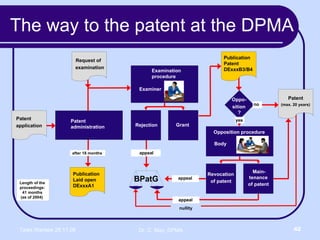
Examiner  Grant Rejection Opposition procedure Body Revocation  of patent Oppo- sition ? Patent (max. 20 years) Patent application Request of examination Publication Laid open DExxxA1 Length of the proceedings: 41 months (as of 2004)  appeal appeal no yes BPatG after 18 months nullity Publication Patent DExxxB3/B4 Examination procedure Patent  administration appeal Main- tenance  of patent The way to the patent at the DPMA
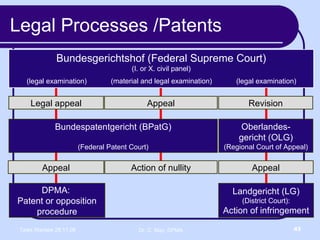
Bundesgerichtshof (Federal Supreme Court) (I. or X. civil panel) Legal appeal Revision Appeal Bundespatentgericht (BPatG) (Federal Patent Court) Oberlandes- gericht (OLG) (Regional Court of Appeal) Appeal Appeal DPMA:  Patent or opposition procedure Landgericht (LG) (District Court): Action of infringement (legal examination) (legal examination) (material and legal examination) Action of nullity Legal Processes /Patents
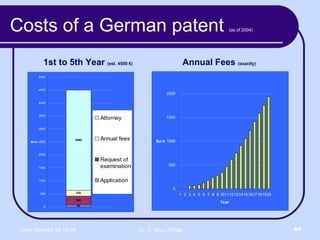
1st to 5th Year  (est. 4500 €) Annual Fees  (exactly) Costs of a German patent  (as of 2004)
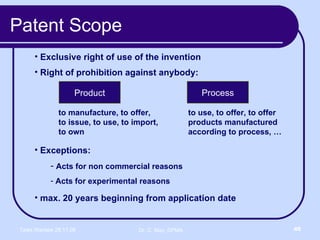
Patent Scope Exclusive right of use of the invention Right of prohibition against anybody: max. 20 years beginning from application date  Product Process to manufacture, to offer, to issue, to use, to import, to own to use, to offer, to offer products manufactured according to process, … Exceptions: Acts for non commercial reasons Acts for experimental reasons
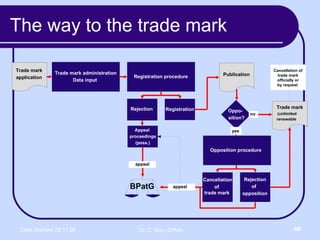
Trade mark administration Data input Registration procedure Registration Rejection  Opposition procedure Rejection of  opposition Cancellation  trade mark  Oppo- sition? Trade mark application Trade mark (unlimited  renewable Publication Appeal proceedings (poss.) Cancellation of trade mark officially or by request  appeal appeal no  yes BPatG of  The way to the trade mark

Intellectual Property and Trade Mark

  • 1.
    Are intellectual property(IP) rights an asset for your company? Dr. C. May * , Member of the German Patent and Trademark Office (DPMA), Department for Information Technology *The presentation reflects the personal opinion of the author.
  • 2.
    What is intellectualproperty? Intellectual property rights protect the information or knowledge in creations Intellectual Property Copyright Industrial Property Rights Expression of information with a stamp of the author’s personality Characteristic as regards a product or service from a consumer perspective Work based on ideas Other work
  • 3.
    Copyright right toauthors no need to register or apply Copyright protection of the author’s own intellectual creation in literature (including computer programs) science art not of ideas, procedures, methods of operation or mathematical concepts as such.
  • 4.
    Industrial property Trademarks © BMW Industrial design Patent: run-flat tyre www.kfz-tech.de Information or knowledge reflected in a product from a consumer perspective
  • 5.
    Industrial property protectionWhat they protect Instruments of protection Inventions Patents and utility models Independently created product designs that are new or original Industrial design Distinguishing signs and symbols Trade marks Geographical name of a country, region or locality Geographical indications, appellations of origin Honest practices Protection against unfair competition Example Habana Call for boycott Alessi: Il concio Potter‘s wheel 3500 BC
  • 6.
    Trade marks distinguishproducts Source: <http://www.flickr.com/photos/54133554@N00/280543406/>
  • 7.
    Trade marks Atrade mark is a word or sign which can be represented graphically and which distinguishes the trade origins of identical or related goods and services. A trade mark is the `business card´ of your goods or services.
  • 8.
    Traditional trade marksWords: Santander Rolex Procter & Gamble IBM Adidas Just do it Logos: Puma AG Deutsche Bank Intel Versace Versace’s Medusa registered for: glasses goods in precious metals paper glassware, porcelain and earthenware chocolates Nike
  • 9.
    Non-traditional trade marks3-D: Colours: Sounds: The Coca Cola Company BP Kraft Foods Toblerone Dr. Ing. h.c. F. Porsche AG: Boxter-S Kraft Foods : Chocolate Deutsche Telekom AG Nestlé Kraft Foods : Milka
  • 10.
    Statistics of communitytrade marks <http://www.ohim.eu.int/pdf/office/SSC009-Statistics_of_Community_Trade_Marks_2006.pdf> 0,00 1 Olfactory 0,00 3 Hologram 0,01 28 Sound 0,05 163 Other 0,03 87 Colour 0,55 1.639 3D 36,14 107.243 Figurative 63,21 187.568 Word Mark % Registered Trade Marks 1997 - 2005 Type of mark
  • 11.
    Trade marks conferthe exclusive right to affix the sign to goods or the presentation or packaging thereof use the sign in domain names offer goods or services under that sign, import or export goods under that sign, authorize others to use it in return for payment What is protected by trade marks? Trade marks hinder unfair competitors to use similar signs for similar products
  • 12.
    What are trademarks good for? building block for brand image marketing tool enhance reputation customer loyalty basis for franchise agreement increase of enterprise value
  • 13.
    How are trademarks protected? through actual use (only national law) through registration: national (at a national trade mark office) European community (at OHIM, Alicante or a national trademark office) international (Madrid Protocol, WIPO) (at national trade mark office or OHIM, Alicante) protection of a trade mark is limited to goods or services applied for unlimited renewable, if the trade mark is used enforceable by ordinary national courts
  • 14.
    Design encompasses ourlives Source: C. M. Gantz: Design Chronicles: <www.idsa.org> Scott Shim: SHIFT Concept Bicycle <http://www.idsa.org/idea/idea2005/g7.htm> Berliner Gramophone 1896 Model T Ford 1913 MMT 8 Table Lamp: 1923 Vienna Cafe Chair 1925 Horwitt: The M useum Wa tch 1958 IBM Selectric I Typewriter: 1961
  • 15.
    Industrial design Industrialdesign means the ornamental or aesthetic 2D- or 3D- appearance of a whole or part of a product (excluding computer programs). Design aspects are overall shape or surface patterns, lines, colors texture <http://www.mccullagh.org/> Linn Classik Movie System Mercedes instrument panel A design protects the appearance but not the function of a product
  • 16.
    Why should youprotect your design? Others could it protect before you. Recognition by consumers may lead to identification with a product family Thereby design adds commercial value to your product and increases its marketability. A registered design hinders others from unauthorized copying and imitation
  • 17.
    Design – the distinguishing feature Bertoia: Wire Diamond Chair, 1952 Nokia 8800 Scirocco Edition Apple iPOD BMW X5
  • 18.
    Design and its(l)imitation Apple iPOD Micromaxx MM 42452 BMW X5 Shuanghuan SCEO Source: <http://forum.wininizio.it/lofiversion/index.php/t49473.html>
  • 19.
    Ways to protectindustrial designs national design protection: individual EU member states, Benelux. unregistered community design: prevents deliberate copying for 3 years registered community design: exclusive right of the commercial use up to 25 years; 1 year grace period single international deposit with WIPO or the national office of a country.
  • 20.
    Comparison of industrialdesigns and 3D-community trade marks appearance of a novel creation indicator of origin renewable for periods of 5 years up to 25 years unlimited renewable for periods of 10 years; genuine use within 5 years required. novel and individual character at time of filing (grace period 1 year) distinctive as regards to the products or services which have been applied for registered design registered trade mark
  • 21.
    Patents Classical view: Patents represent a trade-off between incentives to innovation and competition in the market and diffusion of technology Patents protect technical inventions
  • 22.
    Patentable inventions Apatentable invention must involve a technical inventive step which is not obvious to persons with ordinary skill in the art from the known state of the art .* *) Art. 56 EPC
  • 23.
    State of theart – all publications Everything made available to the public before the date of filing of the patent application is state of the art.* Examples: patents scientific publications conference presentations internet publications *) Art. 54 (2) EPC No grace period for own publications
  • 24.
    Inventive step -a creative act New ideas result from the association of old elements in new combinations. Previously remote elements of thought suddenly become associated in a new and useful [ non-obvious ] combination.* *) S. A. Mednick, &quot;The Associative Basis of the Creative Process“, Psychological Review , Vol. 69 (1962), p. 221
  • 25.
    Ways to protectinventions trade secret defensive publication utility model (at national patent office) patent national (at national patent office) European community (at EPO) international (PCT) (at national patent office or EPO) Within one year after the first filing of a patent application, the patent application may be filed within another country with the priority of the first filing date Patents create a 20 years lasting monopoly starting from the filing date
  • 26.
    Patents protect creativesolutions to technical problems &quot;My attention was first directed to the mechanical removal of dust from carpets in 1901 […]. […] the air was blown down into the carpet from two opposing directions while the box was pushed over the carpet. […] I thought over the matter for a few days and tried the experiment of sucking with my mouth against the back of a plush seat in a restaurant in Victoria Street with the result that I was almost choked. I came to the conclusion that I could construct a machine to work by suction. (Source: Booth, C.H.: “The origin of the vacuum cleaner&quot; In: Transactions of the Newcomen Society, 1934-35 Vol 15. ) The solutions may be fundamental or incremental
  • 27.
    Inventions may beground-breaking Xerography Chester F. Carlson en.wikipedia.org Xerox 914 photo copier . en.wikipedia.org When the product is mature, patent protection may be at the end Revenue of US $ 500 million 1965 Revenue of US $ 60 million 1961 End of patent protection 1959 Introduction of the first automatic copier 1959 Introduction of the first photocopier, Model A 1949 License for xerography sold to Haloid 1947 Filed US patent application; granted 1942 1939 Prototype of a photocopier using the xerography (dry writing) by Chester Carlson 1938
  • 28.
    … orsimple but successful Plastic expanding wall-plug (1958) today: 7 million wall-plugs/day produced by fischerwerke © Artur Fischer Tip Kunststoffspreizdübel www.wikipedia.de Patents help to establish trade marks that last beyond patents
  • 29.
    … orgreat but not profitable Fischertechnik® construction kit production cross-financed © Markus Lelie http://www.lelie.de © M. Samek. www.3dprofil.de Think about your business model, before you invest in a patent,
  • 30.
    … orwithout commercial impact Try to understand your market, before you file a patent The good is the enemy of the better… overestimation of the market value no business case no investor no licensee … and of the worse: no market
  • 31.
    Ways to protectyour intellectual property Trade secrets Employee loyalty Customer loyalty Technological complexity Market lead Advance in the learning curve Control of complementary assets Copyright Industrial designs Trade marks Geographical indications and appellations of origin Patents and Utility models Protection against unfair competition
  • 32.
    Further reading Industrialproperty rights www.wipo.int http://www.wipo.int/sme/en/ Copyright en.wikipedia.org/wiki/Copyright_law_of_the_European_Union Trademarks and industrial design oami.europa.eu Patents www.european-patent-office.org Steven Weinstock, Five patent tips for start-up companies http://wistechnology.com/article.php?id=1671
  • 33.
    Patent portfolio strategiesof large companies - defensive Large companies with significant financial resources procure and maintain a large quantity of patents. Usage: Defensive - mutually assured destruction E.g. Huawei Technologies Co. Ltd., founded 1988, network technologies, top 5 in 3GPP, 14000 patent applications, 2000 international patents
  • 34.
    Patent portfolio strategiesof large companies - offensive Offensive (IBM generates ca. $ 1 billion a year from licensing its patent portfolio.) Carrot licensing: e.g. yet2.com (IP marketplace). ARM (IP production solely) Stick licensing: (Rambus, Inc.) Cross licensing: mutual sharing of patents hindering others from entering the market (electronics industry)
  • 35.
    Patent portfolio strategiesfor start-ups – business objectives Start-ups: cost-effective patent portfolio decisive for entrepreneurs to be funded by venture capitalists focus on few quality patents regarding key products and technologies in conformance with business objectives Guiding questions to define the scope of patents:* What is the ultimate goal? Licensing the invention Marketing a product Selling the company Growing and expanding the company
  • 36.
    Patent portfolio strategiesfor start-ups - competition What impediments to the market entry of your technology exist? Competition: Who are your competitors? What are the competitive technologies? What impact does your invention have on the competitor and the other technologies? Will new technologies leapfrog yours? Blocking technology of competitors : Can you license or buy the necessary technology? What is your strategy in case of a law suite with a competitor who owns a blocking patent?
  • 37.
    Patent portfolio strategiesfor start-ups – patent scope What is the concrete purpose of the patent (application)? Support marketing for selling or creating interest in a product or service Warn others to provide a similar product or service Protect your product from being imitated Block competitors from providing work around solutions What are the limits of your invention? What is the big picture of your invention? What differentiates it from known competitive technology? How difficult is it to circumvent the invention?
  • 38.
    Patent portfolio strategiesfor start-ups – value proposition What are the opportunities in foreign markets? In which countries do you need to protect your technology? How can you monitor infringements? What are the monitoring costs? What is the value of your invention? Check your business model Estimate the size of the market affected by the invention Contemplate costs of the patent application and patent and compare them to the estimated revenue of product sales/licenses Consider higher initial costs in favor of a higher quality of the patent
  • 39.
    Ways to protectyour intellectual property Trade secrets Employee loyalty Customer loyalty Technological complexity Market lead Advance in the learning curve Control of complementary assets Copyright Industrial designs Trade marks Geographical indications and appellations of origin Patents and Utility models Protection against unfair competition
  • 40.
    Further reading Industrialproperty rights www.wipo.int http://www.wipo.int/sme/en/ Copyright en.wikipedia.org/wiki/Copyright_law_of_the_European_Union Trademarks and industrial design oami.europa.eu Patents www.european-patent-office.org Steven Weinstock, Five patent tips for start-up companies http://wistechnology.com/article.php?id=1671
  • 41.
    Threshold of originalityConcerning the German copyright, the threshold of originality of fine arte is lower than the one for applied art. The logo of Franz Zauleck, “The Running Eye”, 1993, is ineligible for German copyright, because it does not clearly surpass average industrial logo design. (BVerfG, 1 BvR 1571/02, 26.1.2005)
  • 42.
    Examiner GrantRejection Opposition procedure Body Revocation of patent Oppo- sition ? Patent (max. 20 years) Patent application Request of examination Publication Laid open DExxxA1 Length of the proceedings: 41 months (as of 2004) appeal appeal no yes BPatG after 18 months nullity Publication Patent DExxxB3/B4 Examination procedure Patent administration appeal Main- tenance of patent The way to the patent at the DPMA
  • 43.
    Bundesgerichtshof (Federal SupremeCourt) (I. or X. civil panel) Legal appeal Revision Appeal Bundespatentgericht (BPatG) (Federal Patent Court) Oberlandes- gericht (OLG) (Regional Court of Appeal) Appeal Appeal DPMA: Patent or opposition procedure Landgericht (LG) (District Court): Action of infringement (legal examination) (legal examination) (material and legal examination) Action of nullity Legal Processes /Patents
  • 44.
    1st to 5thYear (est. 4500 €) Annual Fees (exactly) Costs of a German patent (as of 2004)
  • 45.
    Patent Scope Exclusiveright of use of the invention Right of prohibition against anybody: max. 20 years beginning from application date Product Process to manufacture, to offer, to issue, to use, to import, to own to use, to offer, to offer products manufactured according to process, … Exceptions: Acts for non commercial reasons Acts for experimental reasons
  • 46.
    Trade mark administrationData input Registration procedure Registration Rejection Opposition procedure Rejection of opposition Cancellation trade mark Oppo- sition? Trade mark application Trade mark (unlimited renewable Publication Appeal proceedings (poss.) Cancellation of trade mark officially or by request appeal appeal no yes BPatG of The way to the trade mark