Web 2.0 ...it’s okay to play! Dave Pattern, Library Systems Manager University of Huddersfield [email_address] http://library.hud.ac.uk/barcelona/
Contents Question Time Web 2.0 Library 2.0 Question Time Creative Commons Attribution-Noncommercial-Share Alike 3.0 License  http://creativecommons.org/licenses/by-nc-sa/3.0/
Question Time! Do you regularly use a mobile phone? http://www.flickr.com/photos/ari/362924278/
Question Time! do U snd txt msgz? http://www.flickr.com/photos/jessicamills/231072148/
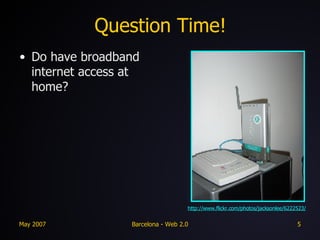
Question Time! Do have broadband internet access at home? http://www.flickr.com/photos/jacksonlee/6222523/
Question Time! Do you have wireless internet access at home? http://www.flickr.com/photos/travelinlibrarian/113353477/
Question Time! Do you regularly use your home PC or laptop for more than an hour each evening? http://www.flickr.com/photos/richardholden/340601444/
Question Time! Do you regularly use your home PC or laptop for 2 or 3 hours an evening? http://www.flickr.com/photos/aaronjacobs/64368770/
Question Time! Do have your own weblog / blog? http:// www.blogger.com
Question Time! Do you regularly read other peoples weblogs and/or contribute to other weblogs? http://orweblog.oclc.org/archives/001325.html
Question Time! Do you use Wikipedia? http://www.flickr.com/photos/jessicamills/231072148/
Question Time! Have you ever edited a page on Wikipedia? http://www.flickr.com/photos/jessicamills/231072148/
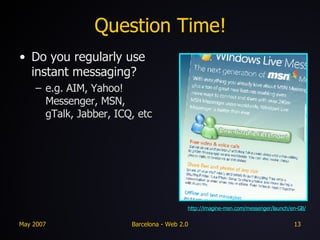
Question Time! Do you regularly use instant messaging? e.g. AIM, Yahoo! Messenger, MSN, gTalk, Jabber, ICQ, etc http://imagine-msn.com/messenger/launch/en-GB/
Question Time! Do you use VOIP? e.g. Skype http://www.skype.com
Question Time! Do you have a games console at home? http://www.flickr.com/photos/jstar/336785888/
Question Time! Do you play games online and/or visit virtual worlds? http://www.flickr.com/photos/christajoy42/354580876/
Question Time! Do you have your own MP3 player? http://www.flickr.com/photos/nez/268673268/
 
Web 2.0 “Web 2.0 is a phenomenon which is going to drive the next decade of innovations.” comment left on the O’Reilly “ What is Web 2.0 ” article “...a perceived ongoing transition of the World Wide Web from a collection of websites to a full-fledged computing platform serving web applications to end users.” Wikipedia article on  Web 2.0
Where did it come from? term coined in 2004 by Dale Dougherty (O'Reilly) http://www.oreillynet.com/pub/a/oreilly/tim/news/2005/09/30/what-is-web-20.html syndication stickiness folksonomy taxonomy participation publishing web services screen scraping Wikipedia Britannica  Napster mp3.com Google AdSense  DoubleClick Web 2.0 Web 1.0
Some Web 2.0 Concepts applications delivered via a web browser exploiting and (sometimes freely) sharing data user participation, empowerment, and collaboration social networking communities of interest tagging and folksonomies mashups and other unintended uses
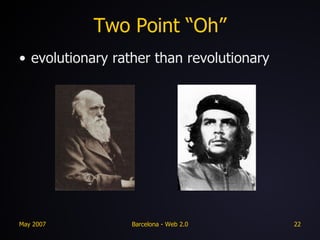
Two Point “Oh” evolutionary rather than revolutionary
Two Point “Ho-ho-ho”
Web Browser as a Platform applications delivered via a web browser e.g.  Writely  (now Google Docs),  Kiko , and  Google Mail storing your data & personal stuff online  e.g.  del.icio.us  and  Flickr the “perpetual beta” e.g.  Google Scholar
Social Networking weblogs e.g.  Blogger ,  LiveJournal ,  WordPress communities of common interest e.g.  MySpace ,  Facebook instant messaging e.g.  AIM ,  MSN ,  Yahoo! Chat ,  Skype media sharing e.g.  YouTube
Making Data Work Harder RSS feeds mining of unique data sharing (usually freely) web services APIs using available standards (e.g. XML)
Mashups & Unintended Uses “ A mashup is a website or application that combines content from more than one source into an integrated experience.” dartmaps amaztype retrievr LivePlasma
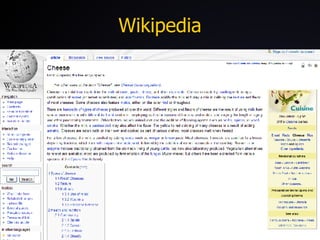
Wikis “A wiki is a website that allows visitors to add, remove, edit and change content, typically without the need for registration. This ease of interaction and operation makes a wiki an effective tool for mass collaborative authoring.” definition of “Wiki” from  Wikipedia
Wikipedia
Wikipedia
Wikipedia
Wikis widespread collaboration “radical trust” full audit trail of edits quick & easy to create/update content self-policing community
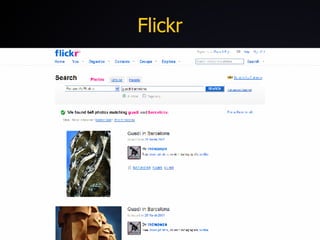
Web 2.0 Examples Flickr online storage of photographs LibraryThing online service to catalogue book collections
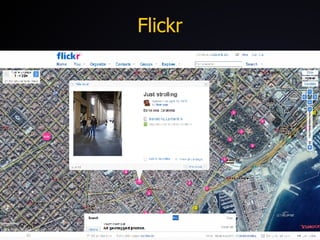
Flickr
Flickr
Flickr http://www.flickr.com/photos/noprawns/255821458/
Flickr
Flickr
Flickr
Flickr
Flickr – Moo
Flickr – Moo – Flickr
LibraryThing
LibraryThing
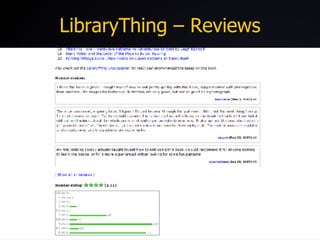
LibraryThing – Reviews
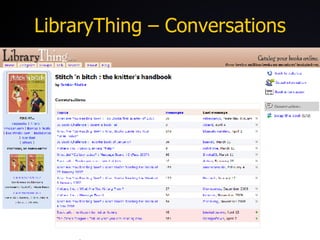
LibraryThing – Conversations
LibraryThing – Tagging
LibraryThing – Authors
So, Who’s Doing All This Stuff?
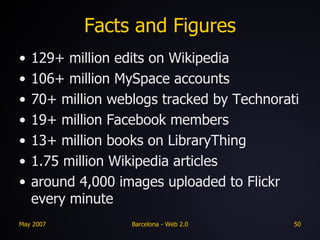
Facts and Figures 129+ million edits on Wikipedia 106+ million MySpace accounts 70+ million weblogs tracked by Technorati 19+ million Facebook members 13+ million books on LibraryThing 1.75 million Wikipedia articles around 4,000 images uploaded to Flickr every minute
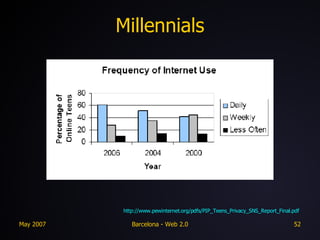
Millennials aka Generation Y,  NextGens,   Net Generation,   iGeneration,   Google Generation,   Echo Boomers,   etc… born between late 1970s and mid 1990s  good at processing information visually  good at multitasking  high usage of social software & often work collaboratively high expectations “ technology veterans” “ nomadic” technology usage and “format agnostic” (…anytime, anywhere, anyplace!)
Millennials http://www.pewinternet.org/pdfs/PIP_Teens_Privacy_SNS_Report_Final.pdf
University of Illinois Survey (2006) “ College Students' Internet Uses” 1,300 respondents 91% get information for school work online 83% access the Internet several times a day 78% use Facebook and 51% use MySpace 38% use Wikipedia 33% create content for blogs / web journals 1.7% don’t know what a search engine is 0.2% don’t know what instant messaging is http://results.webuse.org/uic06/
US Internet User Demographics survey of 2,373 US adults (Dec 2006) 70% of adults use the internet 83% of 18-29 year olds 82% of 30-40 year olds 70% of 50-64 year olds 33% of 65+ year olds http://www.pewinternet.org/trends/User_Demo_1.11.07.htm
 
Library 2.0 “...a loosely defined model for a modernized form of library service that reflects a transition within the library world in the way that services are delivered to users.  This includes online services such as the use of OPAC systems and an increased flow of information from the user back to the library.” Wikipedia article for “ Library 2.0 ”
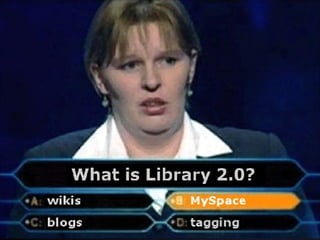
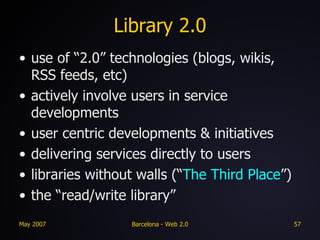
Library 2.0 use of “2.0” technologies (blogs, wikis, RSS feeds, etc) actively involve users in service developments user centric developments & initiatives delivering services directly to users libraries without walls (“ The Third Place ”) the “read/write library”
Library 2.0 we need to: be more flexible embrace change be more willing to take risks give library staff the opportunity to play and experiment go to where our users are, rather than force them to come to us give our users opportunities to contribute
Library 2.0 in the Real World 26 random-ish examples of how libraries are using “2.0”... ...although there might not be enough time to look at them all!
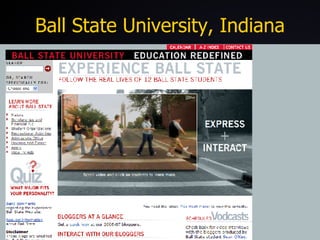
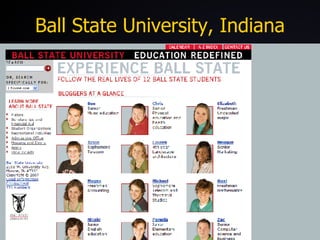
Ball State University, Indiana
La Crosse Public Library, Wisconsin
University of Alberta Libraries, Canada
Westmont Public Library, Illinois
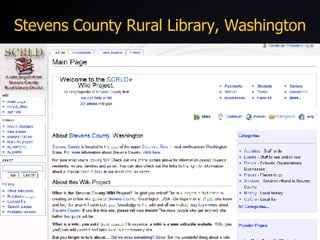
Stevens County Rural Library, Washington
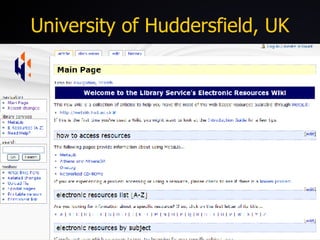
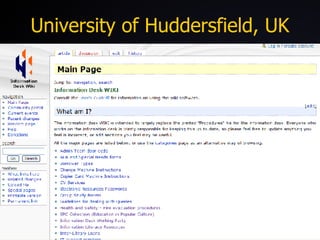
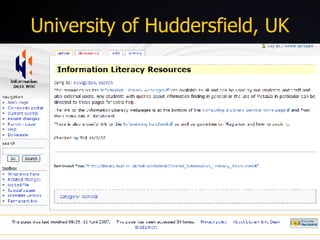
University of Huddersfield, UK
Biblioteksvar, Norway
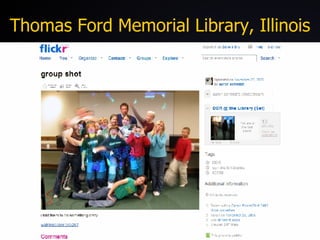
Thomas Ford Memorial Library, Illinois
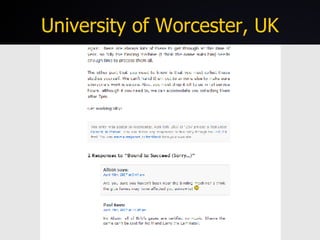
University of Worcester, UK
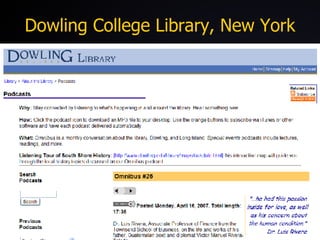
Dowling College Library, New York
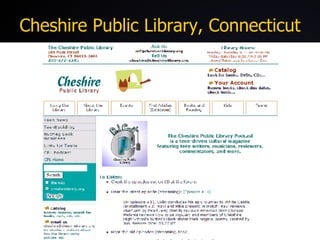
Cheshire Public Library, Connecticut
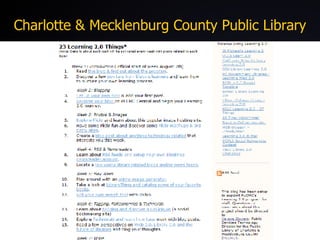
Charlotte & Mecklenburg County Public Library
Glasgow University Library
Hartlepool Borough Council Libraries
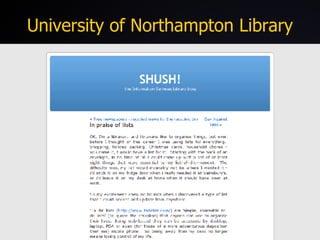
University of Northampton Library
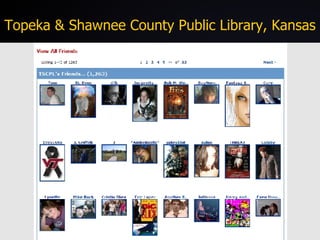
Topeka & Shawnee County Public Library, Kansas
McCracken County Public Library, Kentucky
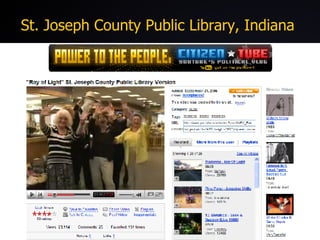
St. Joseph County Public Library, Indiana
at an unnamed US Public Library…
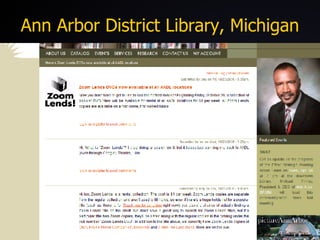
Ann Arbor District Library, Michigan
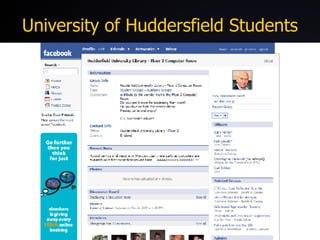
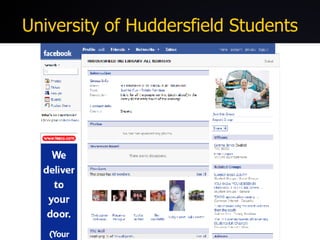
University of Huddersfield Students
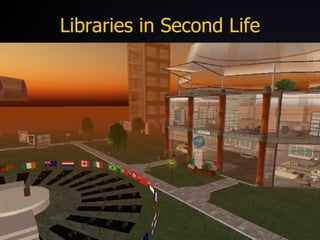
Libraries in Second Life
Useful Links Library Success Wiki http://www.libsuccess.org/ Library 2.0 Community at ning.com http://library20.ning.com/ links to sites listed in this presentation: http:// library.hud.ac.uk/barcelona / SirsiDynix Institute http:// www.sirsidynixinstitute.com /
Thank you!  Any quick questions?

Web 2.0...it’s okay to play!