Web 2.0 refers to websites that allow users to interact and collaborate to contribute content. Examples include social media sites, wikis, blogs and applications that harness user contributions to create value. Key aspects include user interaction, user-generated content and services that are continually updated rather than through scheduled releases.
Introduction to Web 2.0 emphasizes interactive information sharing, interoperability, and collaboration, allowing user contribution unlike passive viewing.
Web 2.0 encompasses web communities, hosted services, social networking, video sharing, wikis, blogs, and mashups.
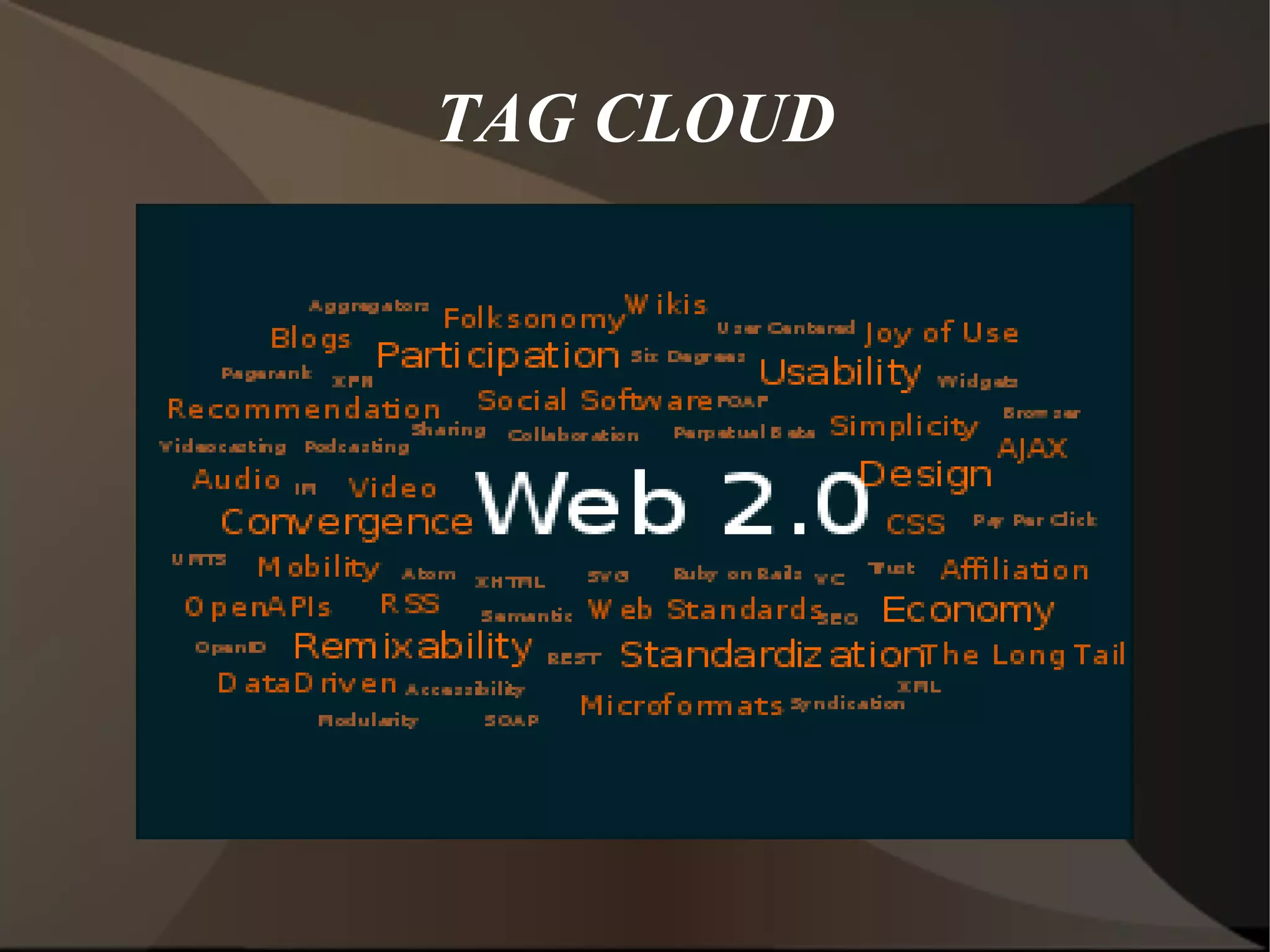
Visual representation of tags or keywords associated with Web 2.0 content.
Origin of the term Web 2.0 by Darcy DiNucci in 1999, forecasting its evolution beyond static pages.
Web 2.0 gained traction in 2004 at a conference, defining the web as a platform and highlighting user-generated content.
Contrast between Web 2.0 and Web 1.0, where Web 1.0 relied on traditional desktop applications and centralized control.
Netscape focused on software creation while Google capitalized on user-generated content for web search and dynamic updates.
Comparison of Britannica's expert-written articles with Wikipedia's community-driven content, emphasizing constant updates.
Web 2.0 facilitates user data ownership and interactive applications, encouraging user participation and value addition.
Web 2.0 technologies integrate client/server software, content syndication, and network protocols, enhancing user interaction.
Features of Web 2.0 include search capabilities, links, authoring, tags, extensions, and content signals.
Keyword searching connects information and creates a social ecosystem, enhancing information accessibility.
User-generated content fosters collaboration, as seen in wikis and blogs where contributions grow organically.
Users categorize content using tags, creating folksonomies that facilitate easier searching and discovery.
Extensions turn the web into an application platform, while syndication technologies like RSS notify content changes.
Technologies like AJAX allow seamless data interaction, improving performance and user experience on web applications.
Asynchronous requests improve site performance, utilizing XML/JSON formats for efficient data exchange.
The rise of '2.0' variations, linking Web 2.0 technologies to different fields like libraries and social work.
Legal aspects of the term 'Web 2.0', including trademark applications and cease-and-desist cases involving CMP Media.
Emergence of Web 3.0 focuses on semantic web and new innovations, with varied definitions around its implications.
Discussion on 'Web 2.0' as an evolution of existing technologies rather than a completely new version of the web.
WEB 2.0 INTRODUCTIONThe term " Web 2.0" is commonly associated with web applications that facilitate interactive information sharing , interoperability and collaboration on the World Wide Web .
2.
A Web 2.0site allows its users to interact with each other as contributors to the web site's content , in contrast to websites where users are limited to the passive viewing of information that is provided to them.
HISTORY The term"Web 2.0" was coined in 1999 by Darcy DiNucci
12.
She wrote aboutWeb 2.0 in article named "Fragmented Future"
13.
In that articleshe wrote “ The Web we know now, which loads into a browser window in essentially static screen fulls, is only an embryo of the Web to come. The first glimmerings of Web 2.0 are beginning to appear, and we are just starting to see how that embryo might develop. The Web will be understood not as screen fulls of text and graphics but as a transport mechanism, the ether through which interactivity happens. It will appear on your computer screen, on your TV set your car dashboard your cell phone hand-held game machines maybe even your microwave oven.”
14.
RISE OF WEB2.0 In 2004, the term began its rise in popularity when O'Reilly Media and MediaLive hosted the first Web 2.0 conference. In their opening remarks, John Battelle and Tim O'Reilly outlined their definition of the "Web as Platform", where software applications are built upon the Web as opposed to upon the desktop. The unique aspect of this migration, they argued, is that "customers are building your business for you".They argued that the activities of users generating content (in the form of ideas, text, videos, or pictures) could be "harnessed" to create value .
15.
CONTRAST FROM WEB1.0 O'Reilly et al. contrasted Web 2.0 with what they called "Web 1.0". They associated Web 1.0 with the business models of Netscape and the Encyclopedia Britannica Online . Netscape framed "the web as platform" in terms of the old software paradigm: their flagship product was the web browser, a desktop application, and their strategy was to use their dominance in the browser market to establish a market for high-priced server products. Control over standards for displaying content and applications in the browser would, in theory, give Netscape the kind of market power enjoyed by Microsoft in the PC market. Much like the "horseless carriage" framed the automobile as an extension of the familiar, Netscape promoted a "webtop" to replace the desktop, and planned to populate that webtop with information updates and applets pushed to the webtop by information providers who would purchase Netscape servers.
16.
In short, Netscapefocused on creating software, updating it on occasion, and distributing it to the end users.
17.
O'Reilly contrasted thiswith Google, a company which did not at the time focus on producing software, such as a browser, but instead focused on providing a service based on data. The data being the links Web page authors make between sites. Google exploits this user-generated content to offer Web search based on reputation through its "page rank" algorithm. Unlike software, which undergoes scheduled releases, such services are constantly updated, a process called "the perpetual beta".
18.
DIFFERENCE BETWEEN ENCYCLOPEDIA AND WIKIPEDIA A similar difference can be seen between the Encyclopedia Britannica On-line and Wikipedia: “ while the Britannica relies upon experts to create articles and releases them periodically in publications, Wikipedia relies on trust in anonymous users to constantly and quickly build content. Wikipedia is not based on expertise but rather an adaptation of the open source software adage "given enough eyeballs, all bugs are shallow" , and it produces and updates articles constantly.”
Not only photoswe can upload many things so that it will a useful to everyone.
21.
Web 2.0 websitesallow users to do more than just retrieve information. They can build on the interactive facilities of " Web 1.0 " to provide "Network as platform" computing, allowing users to run software-applications entirely through a browser. Users can own the data on a Web 2.0 site and exercise control over that data. These sites may have an "Architecture of participation" that encourages users to add value to the application as they use it.
TECHNOLOGY OVERVIEW Web2.0 draws together the capabilities of client - and server -side software, content syndication and the use of network protocols . Standards-oriented web browsers may use plug-ins and software extensions to handle the content and the user interactions. Web 2.0 sites provide users with information storage , creation, and dissemination capabilities that were not possible in the environment now known as "Web 1.0".
24.
FEATURES AND TECHINQUESWeb 2.0 websites typically include some of the following features and techniques. Search
FEATURES AND TECHINQUESSearch Finding information through keyword search. Links Connects information together into a meaningful information ecosystem using the model of the Web, and provides low-barrier social tools.
31.
FEATURES AND TECHINQUESAuthoring The ability to create and update content leads to the collaborative work of many rather than just a few web authors. In wikis, users may extend, undo and redo each other's work. In blogs, posts and the comments of individuals build up over time.
32.
FEATURES AND TECHINQUESTags Categorization of content by users adding "tags" - short, usually one-word descriptions - to facilitate searching, without dependence on pre-made categories. Collections of tags created by many users within a single system may be referred to as " folksonomies " (i.e., folk taxonomies ).
33.
FEATURES AND TECHINQUESExtensions Software that makes the Web an application platform as well as a document server. Signals The use of syndication technology such as RSS (most commonly expanded as R eally S imple S yndication) to notify users of content changes
34.
HOW IT WORKSThe client-side/web browser technologies typically used in Web 2.0 development are Asynchronous JavaScript and XML ( Ajax ), Adobe Flash and the Adobe Flex framework, and JavaScript /Ajax frameworks such as Yahoo! UI Library , Dojo Toolkit , MooTools , and jQuery . Ajax programming uses JavaScript to upload and download new data from the web server without undergoing a full page reload.
35.
To permit theuser to continue to interact with the page, communications such as data requests going to the server are separated from data coming back to the page (asynchronously).
36.
Otherwise, the userwould have to routinely wait for the data to come back before they can do anything else on that page, just as a user has to wait for a page to complete the reload.
37.
HOW IT WORKSThis also increases overall performance of the site, as the sending of requests can complete quicker independent of blocking and queueing required to send data back to the client.
38.
The data fetchedby an Ajax request is typically formatted in XML or JSON (JavaScript Object Notation) format, two widely used structured data formats. Since both of these formats are natively understood by JavaScript, a programmer can easily use them to transmit structured data in their web application.
39.
When this datais received via Ajax, the JavaScript program then uses the Document Object Model (DOM) to dynamically update the web page based on the new data, allowing for a rapid and interactive user experience.
40.
USAGE The popularityof the term Web 2.0, along with the increasing use of blogs, wikis, and social networking technologies, has led many in academia and business to coin a flurry of 2.0s, including Library 2.0 , Social Work 2.0, Enterprise 2.0, PR 2.0, Classroom 2.0, Publishing 2.0, Medicine 2.0, Telco 2.0, Travel 2.0 , Government 2.0 , and even Porn 2.0 .Many of these 2.0s refer to Web 2.0 technologies as the source of the new version in their respective disciplines and areas.
41.
Miller links Web2.0 technologies and the culture of participation that they engender to the field of library science, supporting his claim that there is now a "Library 2.0". Many of the other proponents of new 2.0s mentioned here use similar methods.
42.
TRADEMARK In November2004, CMP Media applied to the USPTO for a service mark on the use of the term "WEB 2.0" for live events. On the basis of this application, CMP Media sent a cease-and-desist demand to the Irish non-profit organization [email_address] on May 24, 2006, but retracted it two days later. The "WEB 2.0" service mark registration passed final PTO Examining Attorney review on May 10, 2006, and was registered on June 27, 2006. The European Union application (application number 004972212, which would confer unambiguous status in Ireland) was refused .
43.
OTHERS WEB 3.0Not much time passed before "Web 3.0" was coined. Definitions of Web 3.0 vary greatly. Amit Agarwal states that Web 3.0 is, among other things, about the Semantic Web and personalization .Andrew Keen, author of The Cult of the Amateur , considers the Semantic Web an "unrealisable abstraction" and sees Web 3.0 as the return of experts and authorities to the Web. CNN Money 's Jessi Hempel expects Web 3.0 to emerge from new and innovative Web 2.0 services with a profitable business model. Conrad Wolfram has argued that Web 3.0 is where "the computer is generating new information", rather than humans. Others still such as Manoj Sharma, an organization strategist, in the keynote "A Brave New World Of Web 3.0" proposes that Web 3.0 will be a "Totally Integrated World" - cradle-to-grave experience of being always plugged onto the net.
44.
CONCLUSION The term that "Web 2.0" does not represent a new version of the World Wide Web at all, but merely continues to use so-called "Web 1.0" technologies and concepts. First, techniques such as AJAX do not replace underlying protocols like HTTP , but add an additional layer of abstraction on top of them.
45.
Second, many ofthe ideas of Web 2.0 had already been featured in implementations on networked systems well before the term "Web 2.0" emerged.