DM110 Emerging Web Media Dr. John Breslin [email_address] http://sw.deri.org/~jbreslin/ Week 2: Blogs
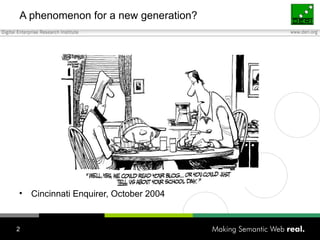
A phenomenon for a new generation? Cincinnati Enquirer, October 2004
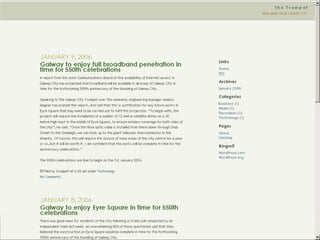
Introduction Weblog ,  web   log  or simply a  blog  is a web journal “ A web application which contains periodic time-stamped posts on a common (usually open-access) webpage” Individual diaries -> arms of political campaigns, media programs and corporations (e.g. the Google Blog) Citizen journalism… Posts are often shown in reverse chronological order Comments can be made by the public on some blogs Latest headlines, with hyperlinks and summaries, are  syndicated  using  RSS  or  Atom  formats (e.g. for reading favourite blogs with a feed reader)
 
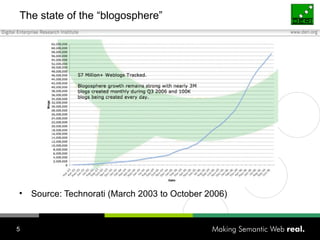
The state of the “blogosphere” Source: Technorati (March 2003 to October 2006)
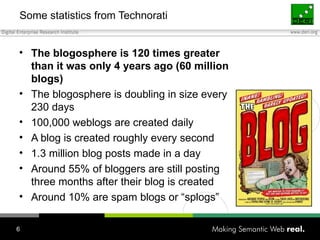
Some statistics from Technorati The blogosphere is 120 times greater than it was only 4 years ago (60 million blogs) The blogosphere is doubling in size every 230 days 100,000 weblogs are created daily A blog is created roughly every second 1.3 million blog posts made in a day Around 55% of bloggers are still posting three months after their blog is created Around 10% are spam blogs or “splogs”
Some quotes about blogs “ It'll be no more mandatory that [CEOs] have blogs than that they have a phone and an e-mail account.  If they don't, they're going to look foolish.” - Jonathan Schwartz, Sun Microsystems “ Tell the truth, the whole truth and nothing but the truth. If your competitor has a product that's better than yours, link to it.  You might as well.  We’ll find it anyway.” - Robert Scoble, Microsoft, “Corporate Weblog Manifesto” “ Famous people have enough space to talk already.  Blogging is interesting because of non-famous people.” - Lawrence Lessig, Stanford Law School
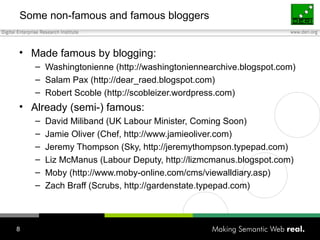
Some non-famous and famous bloggers Made famous by blogging: Washingtonienne (http://washingtoniennearchive.blogspot.com) Salam Pax (http://dear_raed.blogspot.com) Robert Scoble (http://scobleizer.wordpress.com) Already (semi-) famous: David Miliband (UK Labour Minister, Coming Soon) Jamie Oliver (Chef, http://www.jamieoliver.com) Jeremy Thompson (Sky, http://jeremythompson.typepad.com) Liz McManus (Labour Deputy, http://lizmcmanus.blogspot.com) Moby (http://www.moby-online.com/cms/viewalldiary.asp) Zach Braff (Scrubs, http://gardenstate.typepad.com)
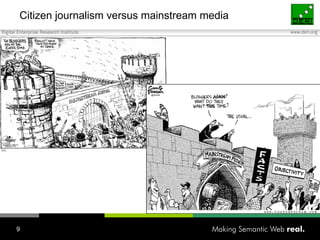
Citizen journalism versus mainstream media
Making money from blogs? “… controversy flared up in December, when a Portland, OR, company called Marqui announced that it would pay select bloggers $800 a month to publish at least four entries per month about its software…” “… Nokia, for example, recently gave away Nokia 7710 wide-screen smart phones to more than 1,000 ‘VIPs’ around the world, including many bloggers…” http://www.technologyreview.com/InfoTech/wtr_14587,258,p1.html Many bloggers use Google Adsense advertising on their blogs to get extra revenue Search engine optimisation (SEO) is important to get visitors
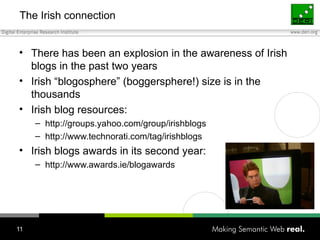
The Irish connection There has been an explosion in the awareness of Irish blogs in the past two years Irish “blogosphere” (boggersphere!) size is in the thousands Irish blog resources: http://groups.yahoo.com/group/irishblogs http://www.technorati.com/tag/irishblogs Irish blogs awards in its second year: http://www.awards.ie/blogawards
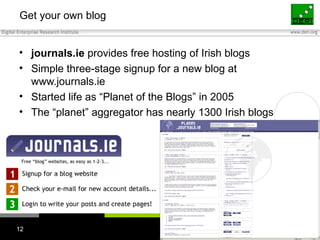
Get your own blog journals.ie  provides free hosting of Irish blogs Simple three-stage signup for a new blog at www.journals.ie Started life as “Planet of the Blogs” in 2005 The “planet” aggregator has nearly 1300 Irish blogs
From websites to blogs to semantic blogs… We will now discuss how personal websites have moved from ordinary blogs to semantic structured blogging platforms, using: Syndication formats and blog tags Structured input mechanisms Semantic Web technologies
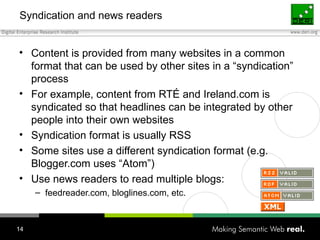
Syndication and news readers Content is provided from many websites in a common format that can be used by other sites in a “syndication” process For example, content from RTÉ and Ireland.com is syndicated so that headlines can be integrated by other people into their own websites Syndication format is usually RSS Some sites use a different syndication format (e.g. Blogger.com uses “Atom”) Use news readers to read multiple blogs: feedreader.com, bloglines.com, etc.
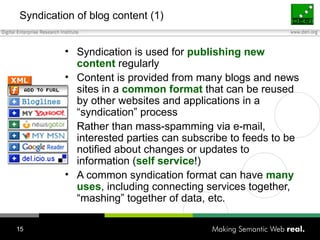
Syndication of blog content (1) Syndication is used for  publishing new content  regularly Content is provided from many blogs and news sites in a  common format  that can be reused by other websites and applications in a “syndication” process Rather than mass-spamming via e-mail, interested parties can subscribe to feeds to be notified about changes or updates to information ( self service !) A common syndication format can have  many uses , including connecting services together, “mashing” together of data, etc.
Syndication of blog content (2) More than  just blog headline syndication, since RSS can be used for: Newspaper articles  (one of the original usages) , library updates, recipes, shared calendars  (RSSCalendar.com) , podcasts, videos, job posts, weather reports, financial updates, bug reports, wiki page changes, new photo uploads, forum thread replies, etc. Syndication format for blogs is usually  RSS  (although some sites now use different syndication formats, e.g. Blogger.com uses  Atom )
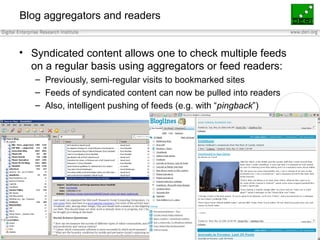
Blog aggregators and readers Syndicated content allows one to check multiple feeds on a regular basis using aggregators or feed readers: Previously, semi-regular visits to bookmarked sites Feeds of syndicated content can now be pulled into readers Also, intelligent pushing of feeds (e.g. with “ pingback ”)
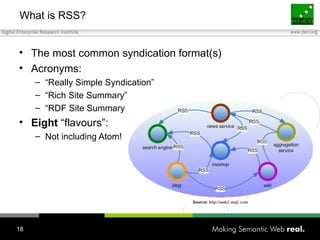
What is RSS? The most common syndication format(s) Acronyms: “ Really Simple Syndication” “ Rich Site Summary” “ RDF Site Summary Eight  “flavours”: Not including Atom!
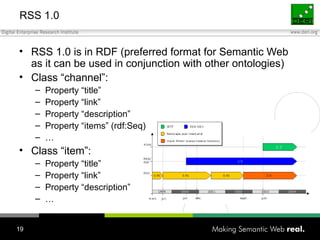
RSS 1.0 RSS 1.0 is in RDF (preferred format for Semantic Web as it can be used in conjunction with other ontologies) Class “channel”: Property “title” Property “link” Property “description” Property “items” (rdf:Seq) … Class “item”: Property “title” Property “link” Property “description” …
What is Atom? Another syndication system Based on XML (not RDF), but efforts towards AtomOWL Emphasis has shifted from the format to the API Specification: Constructs: content, people, dates and links Elements: feeds, with entries http://www.atomenabled.org/developers/syndication/atom-format-spec.php http://www.atomowl.org/
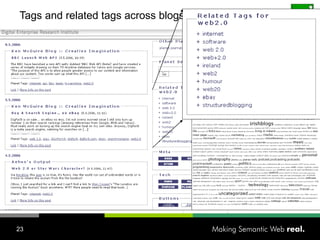
Linking blog posts by topic tags Blog posts are often categorised (e.g., “Scotland”, "Movies”) by the post creator Those on similar topics can be grouped together, using: Freetext tags or keywords Hierarchical tree categories For example, Technorati tags or keywords: Tags are category names, for people to categorise blog posts, photos, links, etc. Technorati.com wants to build a “tagged” web Utilising SW technology, can create categories using the SKOS vocabulary: http://www.wasab.dk/morten/blog/archives/2004/09/01/skos-output-from-wordpress http://www.w3.org/2004/02/skos/
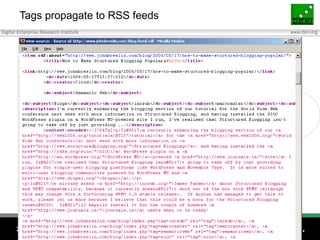
Tags propagate to RSS feeds
Tags and related tags across blogs
Towards structured blogging? In structured blogging, packages of structured data are becoming post components The virtue of blogs has been their simplicity At the moment, each blog post only needs one field for content, and maybe a title and URL Not everyone is served well by this lowest common denominator Therefore the “Structured Blogging” working group was established last year: http://www.structuredblogging.org/
Structure-enhanced blog posts Sometimes you have a burning need for more structure, at least some of the time When you know a subject deeply, and your observations or analysis recur, you may be best served by filling in a form The form will have its own metadata and its own data model Uses: People get to express themselves, and Blogs start to interoperate with enterprise applications
Soccer coach example An after-game soccer report typically includes:  which teams played where and when officials, and a list of game events: who scored (and when and how) who received penalties (when and for what), etc. Wouldn't it be handy for the coach’s blogging tool to understand this structure, present an editing form, render the form in HTML to their blog, and render the post (including the form) to their RSS feed? Great for the forthcoming World Cup!
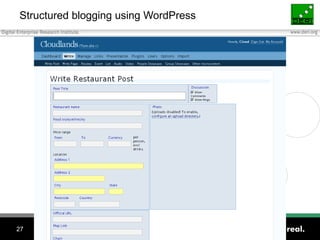
Structured blogging using WordPress
Integrating readers with structured blogging And in the future, news aggregators and news readers should be able to:  Auto-discover an unknown structure Notify the user that a new structure is available Learn the structure, including entry forms, pick list sources, rendering guidance, and default style sheet Make it available when the blogger is ready to write
Past and future structured blogging Past: Qlogger: http://www.qlogger.com/ Lafayette Project: http://www.megnut.com/weblogs/002594.asp JemBlog: http://ideagraph.net/jemblog/ Future: Use Semantic Web technologies to ontologise any available post structures for more linkage and reuse
Traditional blogging vs. semantic blogging Traditional blogging: Publishing for the  “eyeball Web” Content is text, images, video (i.e. data targeted at people) Semantic blogging: Enrich traditional blogs with semantic metadata Structural : what relates to what and how?  Content related : what is this post about (e.g. a person, an event, etc.)? Blogging targeted at machines as well as people
How is this related to structured blogging? Structured blogging is mainly based on “Microformats” (http://www.microformats.org/) Therefore restricted to specific schemata, not open Positioned inline on HTML page (and in feed) Can be directly rendered using CSS Structured and semantic blogging do not compete Metadata can be added as RDF  and  using Microformats Web-based implementations for generating structured blogging metadata e.g. for WordPress and Movable Type
Why semantic blogging? (1) Traditional blogging: Little or no  query possibilities  (except keyword and flat tags) Little or no  reuse of data  (except textual copy and paste) Little or no  linking  between posts (except simple hrefs and trackbacks) Semantic blogging: Facilitates better  querying : More precise Allows aggregation from various sources Better  reuse potential Richer  links
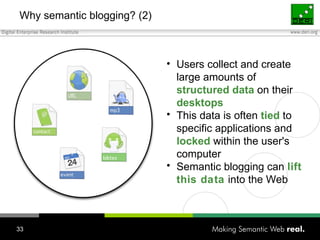
Why semantic blogging? (2) Users collect and create large amounts of  structured data  on their  desktops This data is often  tied  to specific applications and   locked  within the user's computer Semantic blogging can  lift this data  into the Web
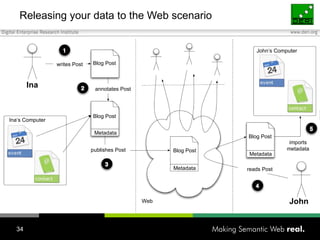
Releasing your data to the Web scenario Ina John Ina‘s Computer John‘s Computer Blog Post Blog Post Blog Post Blog Post Metadata Metadata Metadata writes Post annotates Post publishes Post reads Post imports metadata Web
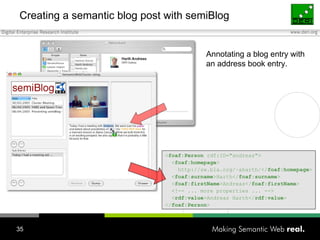
Creating a semantic blog post with semiBlog Annotating a blog entry with an address book entry. < foaf:Person  rdf:ID=&quot;andreas&quot;> < foaf:homepage > http://sw.bla.org/~aharth/</ foaf:homepage > < foaf:surname >Harth</ foaf:surname > < foaf:firstName >Andreas</ foaf:firstName > <!-- ... more properties ... --> < rdf:value >Andreas Harth</ rdf:value > </ foaf:Person >
Using the metadata Once a blog has semantic metadata, it can be... Used to  query :  “Which blog posts talk about papers by Stefan Decker?” Used to  browse  across blogs and other kinds of discussion methods: We will talk about this in more detail in section 7: “Semantics in Community Portals” Imported  into desktop applications of blog readers (AKA “The Web as a Clipboard“)
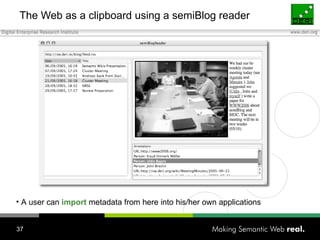
The Web as a clipboard using a semiBlog reader A user can  import  metadata from here into his/her own applications

DM110 - Week 2 - Blogs

  • 1.
    DM110 Emerging WebMedia Dr. John Breslin [email_address] http://sw.deri.org/~jbreslin/ Week 2: Blogs
  • 2.
    A phenomenon fora new generation? Cincinnati Enquirer, October 2004
  • 3.
    Introduction Weblog , web log or simply a blog is a web journal “ A web application which contains periodic time-stamped posts on a common (usually open-access) webpage” Individual diaries -> arms of political campaigns, media programs and corporations (e.g. the Google Blog) Citizen journalism… Posts are often shown in reverse chronological order Comments can be made by the public on some blogs Latest headlines, with hyperlinks and summaries, are syndicated using RSS or Atom formats (e.g. for reading favourite blogs with a feed reader)
  • 4.
  • 5.
    The state ofthe “blogosphere” Source: Technorati (March 2003 to October 2006)
  • 6.
    Some statistics fromTechnorati The blogosphere is 120 times greater than it was only 4 years ago (60 million blogs) The blogosphere is doubling in size every 230 days 100,000 weblogs are created daily A blog is created roughly every second 1.3 million blog posts made in a day Around 55% of bloggers are still posting three months after their blog is created Around 10% are spam blogs or “splogs”
  • 7.
    Some quotes aboutblogs “ It'll be no more mandatory that [CEOs] have blogs than that they have a phone and an e-mail account. If they don't, they're going to look foolish.” - Jonathan Schwartz, Sun Microsystems “ Tell the truth, the whole truth and nothing but the truth. If your competitor has a product that's better than yours, link to it. You might as well. We’ll find it anyway.” - Robert Scoble, Microsoft, “Corporate Weblog Manifesto” “ Famous people have enough space to talk already. Blogging is interesting because of non-famous people.” - Lawrence Lessig, Stanford Law School
  • 8.
    Some non-famous andfamous bloggers Made famous by blogging: Washingtonienne (http://washingtoniennearchive.blogspot.com) Salam Pax (http://dear_raed.blogspot.com) Robert Scoble (http://scobleizer.wordpress.com) Already (semi-) famous: David Miliband (UK Labour Minister, Coming Soon) Jamie Oliver (Chef, http://www.jamieoliver.com) Jeremy Thompson (Sky, http://jeremythompson.typepad.com) Liz McManus (Labour Deputy, http://lizmcmanus.blogspot.com) Moby (http://www.moby-online.com/cms/viewalldiary.asp) Zach Braff (Scrubs, http://gardenstate.typepad.com)
  • 9.
    Citizen journalism versusmainstream media
  • 10.
    Making money fromblogs? “… controversy flared up in December, when a Portland, OR, company called Marqui announced that it would pay select bloggers $800 a month to publish at least four entries per month about its software…” “… Nokia, for example, recently gave away Nokia 7710 wide-screen smart phones to more than 1,000 ‘VIPs’ around the world, including many bloggers…” http://www.technologyreview.com/InfoTech/wtr_14587,258,p1.html Many bloggers use Google Adsense advertising on their blogs to get extra revenue Search engine optimisation (SEO) is important to get visitors
  • 11.
    The Irish connectionThere has been an explosion in the awareness of Irish blogs in the past two years Irish “blogosphere” (boggersphere!) size is in the thousands Irish blog resources: http://groups.yahoo.com/group/irishblogs http://www.technorati.com/tag/irishblogs Irish blogs awards in its second year: http://www.awards.ie/blogawards
  • 12.
    Get your ownblog journals.ie provides free hosting of Irish blogs Simple three-stage signup for a new blog at www.journals.ie Started life as “Planet of the Blogs” in 2005 The “planet” aggregator has nearly 1300 Irish blogs
  • 13.
    From websites toblogs to semantic blogs… We will now discuss how personal websites have moved from ordinary blogs to semantic structured blogging platforms, using: Syndication formats and blog tags Structured input mechanisms Semantic Web technologies
  • 14.
    Syndication and newsreaders Content is provided from many websites in a common format that can be used by other sites in a “syndication” process For example, content from RTÉ and Ireland.com is syndicated so that headlines can be integrated by other people into their own websites Syndication format is usually RSS Some sites use a different syndication format (e.g. Blogger.com uses “Atom”) Use news readers to read multiple blogs: feedreader.com, bloglines.com, etc.
  • 15.
    Syndication of blogcontent (1) Syndication is used for publishing new content regularly Content is provided from many blogs and news sites in a common format that can be reused by other websites and applications in a “syndication” process Rather than mass-spamming via e-mail, interested parties can subscribe to feeds to be notified about changes or updates to information ( self service !) A common syndication format can have many uses , including connecting services together, “mashing” together of data, etc.
  • 16.
    Syndication of blogcontent (2) More than just blog headline syndication, since RSS can be used for: Newspaper articles (one of the original usages) , library updates, recipes, shared calendars (RSSCalendar.com) , podcasts, videos, job posts, weather reports, financial updates, bug reports, wiki page changes, new photo uploads, forum thread replies, etc. Syndication format for blogs is usually RSS (although some sites now use different syndication formats, e.g. Blogger.com uses Atom )
  • 17.
    Blog aggregators andreaders Syndicated content allows one to check multiple feeds on a regular basis using aggregators or feed readers: Previously, semi-regular visits to bookmarked sites Feeds of syndicated content can now be pulled into readers Also, intelligent pushing of feeds (e.g. with “ pingback ”)
  • 18.
    What is RSS?The most common syndication format(s) Acronyms: “ Really Simple Syndication” “ Rich Site Summary” “ RDF Site Summary Eight “flavours”: Not including Atom!
  • 19.
    RSS 1.0 RSS1.0 is in RDF (preferred format for Semantic Web as it can be used in conjunction with other ontologies) Class “channel”: Property “title” Property “link” Property “description” Property “items” (rdf:Seq) … Class “item”: Property “title” Property “link” Property “description” …
  • 20.
    What is Atom?Another syndication system Based on XML (not RDF), but efforts towards AtomOWL Emphasis has shifted from the format to the API Specification: Constructs: content, people, dates and links Elements: feeds, with entries http://www.atomenabled.org/developers/syndication/atom-format-spec.php http://www.atomowl.org/
  • 21.
    Linking blog postsby topic tags Blog posts are often categorised (e.g., “Scotland”, &quot;Movies”) by the post creator Those on similar topics can be grouped together, using: Freetext tags or keywords Hierarchical tree categories For example, Technorati tags or keywords: Tags are category names, for people to categorise blog posts, photos, links, etc. Technorati.com wants to build a “tagged” web Utilising SW technology, can create categories using the SKOS vocabulary: http://www.wasab.dk/morten/blog/archives/2004/09/01/skos-output-from-wordpress http://www.w3.org/2004/02/skos/
  • 22.
  • 23.
    Tags and relatedtags across blogs
  • 24.
    Towards structured blogging?In structured blogging, packages of structured data are becoming post components The virtue of blogs has been their simplicity At the moment, each blog post only needs one field for content, and maybe a title and URL Not everyone is served well by this lowest common denominator Therefore the “Structured Blogging” working group was established last year: http://www.structuredblogging.org/
  • 25.
    Structure-enhanced blog postsSometimes you have a burning need for more structure, at least some of the time When you know a subject deeply, and your observations or analysis recur, you may be best served by filling in a form The form will have its own metadata and its own data model Uses: People get to express themselves, and Blogs start to interoperate with enterprise applications
  • 26.
    Soccer coach exampleAn after-game soccer report typically includes: which teams played where and when officials, and a list of game events: who scored (and when and how) who received penalties (when and for what), etc. Wouldn't it be handy for the coach’s blogging tool to understand this structure, present an editing form, render the form in HTML to their blog, and render the post (including the form) to their RSS feed? Great for the forthcoming World Cup!
  • 27.
  • 28.
    Integrating readers withstructured blogging And in the future, news aggregators and news readers should be able to: Auto-discover an unknown structure Notify the user that a new structure is available Learn the structure, including entry forms, pick list sources, rendering guidance, and default style sheet Make it available when the blogger is ready to write
  • 29.
    Past and futurestructured blogging Past: Qlogger: http://www.qlogger.com/ Lafayette Project: http://www.megnut.com/weblogs/002594.asp JemBlog: http://ideagraph.net/jemblog/ Future: Use Semantic Web technologies to ontologise any available post structures for more linkage and reuse
  • 30.
    Traditional blogging vs.semantic blogging Traditional blogging: Publishing for the “eyeball Web” Content is text, images, video (i.e. data targeted at people) Semantic blogging: Enrich traditional blogs with semantic metadata Structural : what relates to what and how? Content related : what is this post about (e.g. a person, an event, etc.)? Blogging targeted at machines as well as people
  • 31.
    How is thisrelated to structured blogging? Structured blogging is mainly based on “Microformats” (http://www.microformats.org/) Therefore restricted to specific schemata, not open Positioned inline on HTML page (and in feed) Can be directly rendered using CSS Structured and semantic blogging do not compete Metadata can be added as RDF and using Microformats Web-based implementations for generating structured blogging metadata e.g. for WordPress and Movable Type
  • 32.
    Why semantic blogging?(1) Traditional blogging: Little or no query possibilities (except keyword and flat tags) Little or no reuse of data (except textual copy and paste) Little or no linking between posts (except simple hrefs and trackbacks) Semantic blogging: Facilitates better querying : More precise Allows aggregation from various sources Better reuse potential Richer links
  • 33.
    Why semantic blogging?(2) Users collect and create large amounts of structured data on their desktops This data is often tied to specific applications and locked within the user's computer Semantic blogging can lift this data into the Web
  • 34.
    Releasing your datato the Web scenario Ina John Ina‘s Computer John‘s Computer Blog Post Blog Post Blog Post Blog Post Metadata Metadata Metadata writes Post annotates Post publishes Post reads Post imports metadata Web
  • 35.
    Creating a semanticblog post with semiBlog Annotating a blog entry with an address book entry. < foaf:Person rdf:ID=&quot;andreas&quot;> < foaf:homepage > http://sw.bla.org/~aharth/</ foaf:homepage > < foaf:surname >Harth</ foaf:surname > < foaf:firstName >Andreas</ foaf:firstName > <!-- ... more properties ... --> < rdf:value >Andreas Harth</ rdf:value > </ foaf:Person >
  • 36.
    Using the metadataOnce a blog has semantic metadata, it can be... Used to query : “Which blog posts talk about papers by Stefan Decker?” Used to browse across blogs and other kinds of discussion methods: We will talk about this in more detail in section 7: “Semantics in Community Portals” Imported into desktop applications of blog readers (AKA “The Web as a Clipboard“)
  • 37.
    The Web asa clipboard using a semiBlog reader A user can import metadata from here into his/her own applications