Ron Shelby CEO, XMLSolutions Corporation e-Business: Real Data Issues February 12, 2001 e-Commerce Data Challenges
Ron Shelby Data Management History Established data management - Travelers Canada Data Administrator - US Dept of Interior Consultant - American Management Systems Head of information management: Connecticut Mutual USF&G Vice President of Data Warehousing - American Express Head of Data Warehousing - General Motors
History of Data Management Techniques Data and Business Modeling Canonical synthesis Business rules Object modeling Scope Storage-oriented Rationalizing data elements Application-wide Across a function Organization-wide
Why The Web?
The Business Context It’s all e-Business  Communications Revolution Shorter product lifecycles Moore’s Law Information Technology Impact Increases Productivity  Destroys Profits 3
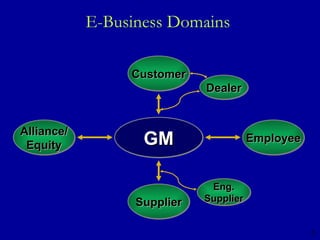
E-Business Domains  Customer Supplier GM Employee Alliance/ Equity Dealer Eng. Supplier 5
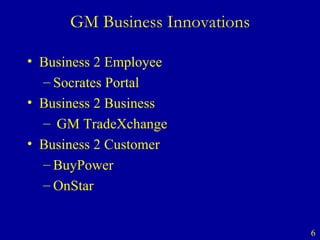
GM Business Innovations Business 2 Employee Socrates Portal Business 2 Business GM TradeXchange Business 2 Customer BuyPower OnStar 6
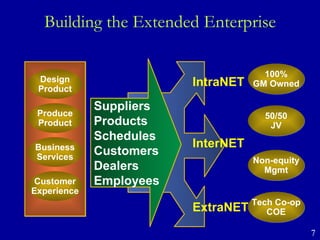
Building the Extended Enterprise IntraNET ExtraNET InterNET 100% GM Owned Non-equity Mgmt Tech Co-op COE 50/50 JV Design Product Business Services Customer Experience Produce Product 7 Suppliers Products Schedules Customers Dealers Employees
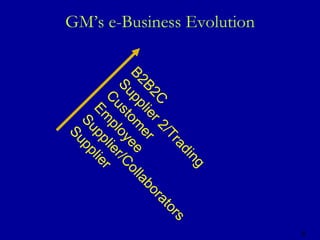
GM’s e-Business Evolution 8 B2B2C Supplier 2/Trading Customer Employee Supplier/Collaborators Supplier
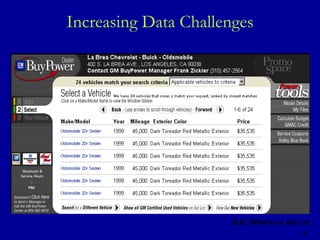
Increasing Data Challenges DU2: What’s on the Lot 9
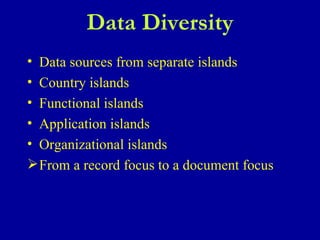
Data Diversity Data sources from separate islands Country islands Functional islands Application islands Organizational islands From a record focus to a document focus
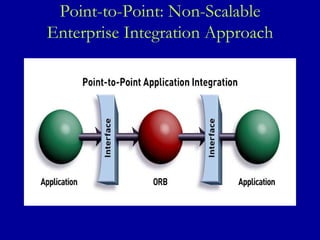
Point-to-Point: Non-Scalable Enterprise Integration Approach
Why XML ? Critical need for a universal interchange syntax that enables interchange between heterogeneous systems...  10
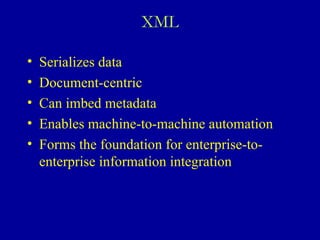
XML Serializes data Document-centric Can imbed metadata Enables machine-to-machine automation Forms the foundation for enterprise-to-enterprise information integration
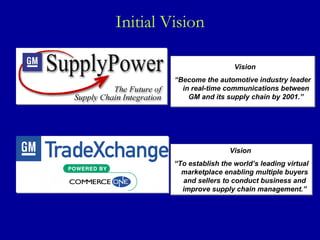
Initial Vision Vision  “ Become the automotive industry leader in real-time communications between GM and its supply chain by 2001.” Vision  “ To establish the world’s leading virtual marketplace enabling multiple buyers and sellers to conduct business and improve supply chain management.”
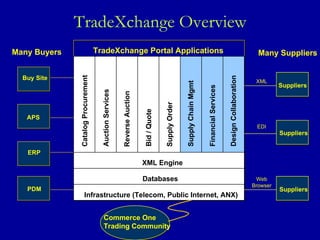
TradeXchange Overview TradeXchange Portal Applications Catalog Procurement Many Buyers Auction Services Reverse Auction Bid / Quote Supply Order Supply Chain Mgmt Financial Services Design Collaboration XML Engine Databases Commerce One Trading Community XML EDI Web Browser Many Suppliers Suppliers Suppliers Suppliers Buy Site APS ERP PDM Infrastructure (Telecom, Public Internet, ANX)
Covisint  GM, Ford, DaimlerChrysler, Renault/Nissan, Toyota, Oracle and Commerce One Creating A Global Automotive Supply Chain Network
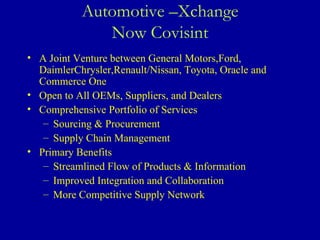
Automotive –Xchange Now Covisint A Joint Venture between General Motors,Ford, DaimlerChrysler,Renault/Nissan, Toyota, Oracle and Commerce One Open to All OEMs, Suppliers, and Dealers Comprehensive Portfolio of Services Sourcing & Procurement Supply Chain Management Primary Benefits Streamlined Flow of Products & Information Improved Integration and Collaboration More Competitive Supply Network
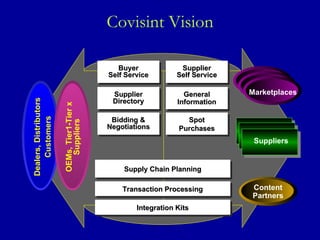
Covisint Vision Content Partners Bidding & Negotiations Spot Purchases Transaction Processing Buyer Self Service Supplier Self Service General Information Supplier Directory Integration Kits Supply Chain Planning Client A Client A Suppliers Marketplaces Dealers, Distributors Customers OEMs, Tier1-Tier x Suppliers
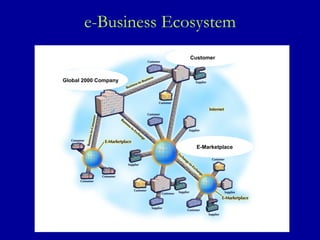
e-Business Ecosystem Global 2000 Company Customer E-Marketplace
Making B2B2C Happen
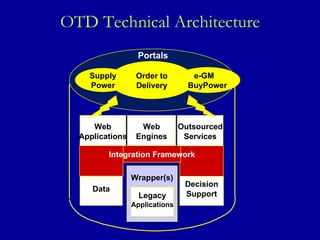
OTD Technical Architecture Wrapper(s) Web Engines Outsourced Services Legacy Applications Data Decision Support Portals Order to Delivery Supply Power e-GM  BuyPower Web Applications Integration Framework
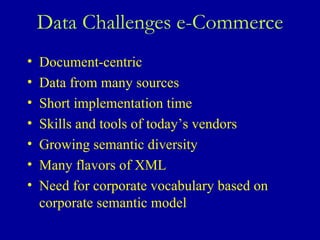
Data Challenges e-Commerce Document-centric Data from many sources Short implementation time Skills and tools of today’s vendors Growing semantic diversity Many flavors of XML Need for corporate vocabulary based on corporate semantic model
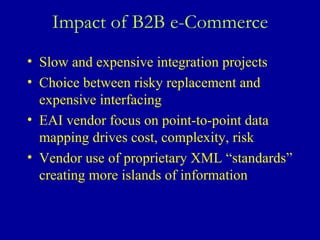
Impact of B2B e-Commerce Slow and expensive integration projects Choice between risky replacement and expensive interfacing EAI vendor focus on point-to-point data mapping drives cost, complexity, risk Vendor use of proprietary XML “standards” creating more islands of information
XML forms the foundation for enterprise-to-enterprise information integration
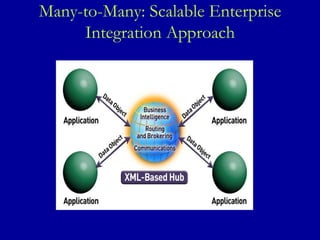
Many-to-Many: Scalable Enterprise Integration Approach
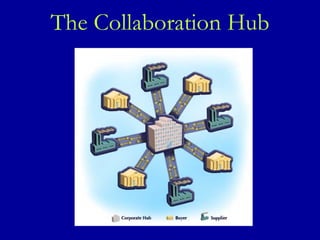
The Collaboration Hub
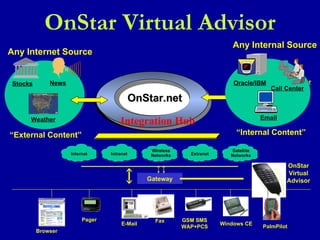
OnStar Virtual Advisor Integration Hub OnStar.net PalmPilot Windows CE GSM SMS WAP+PCS Fax E-Mail Pager OnStar Virtual Advisor Gateway Browser Internet Wireless Networks Intranet Extranet Satellite Networks Email Call Center Oracle/IBM “ Internal Content” Any Internal Source Call Center Email News Stocks Weather “ External Content” Any Internet Source News
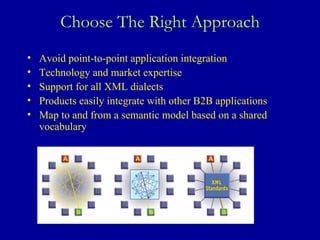
Choose The Right Approach Avoid point-to-point application integration Technology and market expertise  Support for all XML dialects Products easily integrate with other B2B applications Map to and from a semantic model based on a shared vocabulary
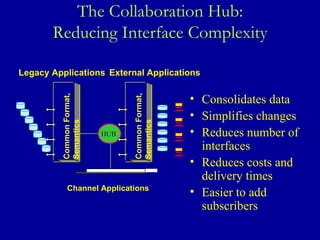
The Collaboration Hub: Reducing Interface Complexity Consolidates data Simplifies changes Reduces number of interfaces Reduces costs and delivery times Easier to add subscribers External Applications  HUB Legacy Applications Common Format, Semantics Channel Applications Common Format, Semantics
Where Companies are Starting
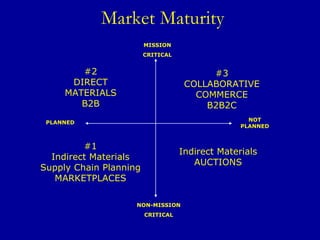
Market Maturity MISSION CRITICAL NON-MISSION CRITICAL PLANNED NOT PLANNED Indirect Materials AUCTIONS #1 Indirect Materials Supply Chain Planning MARKETPLACES #2 DIRECT MATERIALS B2B #3 COLLABORATIVE COMMERCE B2B2C
Common Semantics Lack of common semantics will greatly hinder e-commerce in the intermediate and long term.  For e-commerce to use XML to its full potential, the common semantics problem must be resolved XML does not directly solve the semantics problem Example: Purchase Order Number, P_123, PO_Num, and PN
Create a Corporate Vocabulary Pinpoint strategic business information Extend from vertical industry standards Uncover and leverage metadata and semantics from legacy systems Extract naming standards, corporate entities, attributes, elements and semantics Conduct business using the same syntax & semantics Create Document Type Definitions (DTDs & schemas)
Web-Enabled EDI Standard vocabulary for business communication Mapping of X12 and EDIFACT to XML  Multi-lingual transaction sets XSL output is human- and ANY machine-readable, allowing for complete query and analysis Ability to multipurpose output Leverage existing legacy data
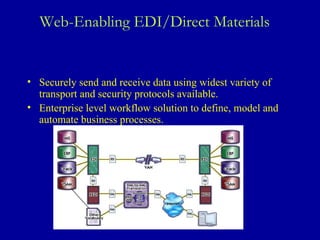
Web-Enabling EDI/Direct Materials Securely send and receive data using widest variety of transport and security protocols available. Enterprise level workflow solution to define, model and automate business processes.
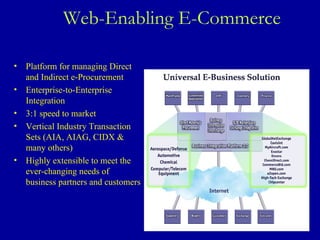
Web-Enabling E-Commerce Platform for managing Direct and Indirect e-Procurement Enterprise-to-Enterprise Integration  3:1 speed to market Vertical Industry Transaction Sets (AIA, AIAG, CIDX & many others) Highly extensible to meet the ever-changing needs of business partners and customers
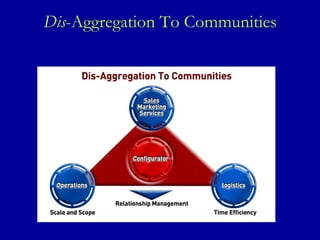
Business Issues  Yet 80% supplying partners are still unable to trade electronically Costs 10 times as much to transact manually than electronically New XML-based formats are used for data interchange (xCBL, cXML, RosettaNet, and ebXML) but need to link into existing systems Internet technologies will cause disaggregation of corporate functions
Business-to-Business-to-Customer B2B Nirvana is Collaboration B2B2C – customer drives specific product requirements and demands which require dynamic supply chain automation Mass customization – produce at scale and speed required to fulfill customized orders Examples: GM Buy Power; Dell; Gateway
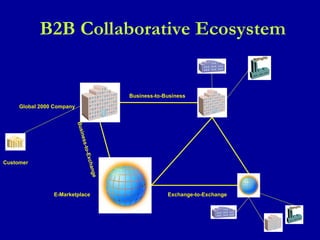
B2B Collaborative Ecosystem Customer Business-to-Business Business-to-Exchange Exchange-to-Exchange Global 2000 Company E-Marketplace
The Future of B2B e-Commerce Rapid adoption e-Business systems Many exchanges Many different XML “standards” Many exchanges “hubs” XML transformation engines at the center of every exchange hub  Opportunity to re-deploy corporate data models to neutral, common vocabulary for XML
The Future
Dis -Aggregation To Communities
Questions…

GM and IT

  • 1.
    Ron Shelby CEO,XMLSolutions Corporation e-Business: Real Data Issues February 12, 2001 e-Commerce Data Challenges
  • 2.
    Ron Shelby DataManagement History Established data management - Travelers Canada Data Administrator - US Dept of Interior Consultant - American Management Systems Head of information management: Connecticut Mutual USF&G Vice President of Data Warehousing - American Express Head of Data Warehousing - General Motors
  • 3.
    History of DataManagement Techniques Data and Business Modeling Canonical synthesis Business rules Object modeling Scope Storage-oriented Rationalizing data elements Application-wide Across a function Organization-wide
  • 4.
  • 5.
    The Business ContextIt’s all e-Business Communications Revolution Shorter product lifecycles Moore’s Law Information Technology Impact Increases Productivity Destroys Profits 3
  • 6.
    E-Business Domains Customer Supplier GM Employee Alliance/ Equity Dealer Eng. Supplier 5
  • 7.
    GM Business InnovationsBusiness 2 Employee Socrates Portal Business 2 Business GM TradeXchange Business 2 Customer BuyPower OnStar 6
  • 8.
    Building the ExtendedEnterprise IntraNET ExtraNET InterNET 100% GM Owned Non-equity Mgmt Tech Co-op COE 50/50 JV Design Product Business Services Customer Experience Produce Product 7 Suppliers Products Schedules Customers Dealers Employees
  • 9.
    GM’s e-Business Evolution8 B2B2C Supplier 2/Trading Customer Employee Supplier/Collaborators Supplier
  • 10.
    Increasing Data ChallengesDU2: What’s on the Lot 9
  • 11.
    Data Diversity Datasources from separate islands Country islands Functional islands Application islands Organizational islands From a record focus to a document focus
  • 12.
  • 13.
    Why XML ?Critical need for a universal interchange syntax that enables interchange between heterogeneous systems... 10
  • 14.
    XML Serializes dataDocument-centric Can imbed metadata Enables machine-to-machine automation Forms the foundation for enterprise-to-enterprise information integration
  • 15.
    Initial Vision Vision “ Become the automotive industry leader in real-time communications between GM and its supply chain by 2001.” Vision “ To establish the world’s leading virtual marketplace enabling multiple buyers and sellers to conduct business and improve supply chain management.”
  • 16.
    TradeXchange Overview TradeXchangePortal Applications Catalog Procurement Many Buyers Auction Services Reverse Auction Bid / Quote Supply Order Supply Chain Mgmt Financial Services Design Collaboration XML Engine Databases Commerce One Trading Community XML EDI Web Browser Many Suppliers Suppliers Suppliers Suppliers Buy Site APS ERP PDM Infrastructure (Telecom, Public Internet, ANX)
  • 17.
    Covisint GM,Ford, DaimlerChrysler, Renault/Nissan, Toyota, Oracle and Commerce One Creating A Global Automotive Supply Chain Network
  • 18.
    Automotive –Xchange NowCovisint A Joint Venture between General Motors,Ford, DaimlerChrysler,Renault/Nissan, Toyota, Oracle and Commerce One Open to All OEMs, Suppliers, and Dealers Comprehensive Portfolio of Services Sourcing & Procurement Supply Chain Management Primary Benefits Streamlined Flow of Products & Information Improved Integration and Collaboration More Competitive Supply Network
  • 19.
    Covisint Vision ContentPartners Bidding & Negotiations Spot Purchases Transaction Processing Buyer Self Service Supplier Self Service General Information Supplier Directory Integration Kits Supply Chain Planning Client A Client A Suppliers Marketplaces Dealers, Distributors Customers OEMs, Tier1-Tier x Suppliers
  • 20.
    e-Business Ecosystem Global2000 Company Customer E-Marketplace
  • 21.
  • 22.
    OTD Technical ArchitectureWrapper(s) Web Engines Outsourced Services Legacy Applications Data Decision Support Portals Order to Delivery Supply Power e-GM BuyPower Web Applications Integration Framework
  • 23.
    Data Challenges e-CommerceDocument-centric Data from many sources Short implementation time Skills and tools of today’s vendors Growing semantic diversity Many flavors of XML Need for corporate vocabulary based on corporate semantic model
  • 24.
    Impact of B2Be-Commerce Slow and expensive integration projects Choice between risky replacement and expensive interfacing EAI vendor focus on point-to-point data mapping drives cost, complexity, risk Vendor use of proprietary XML “standards” creating more islands of information
  • 25.
    XML forms thefoundation for enterprise-to-enterprise information integration
  • 26.
  • 27.
  • 28.
    OnStar Virtual AdvisorIntegration Hub OnStar.net PalmPilot Windows CE GSM SMS WAP+PCS Fax E-Mail Pager OnStar Virtual Advisor Gateway Browser Internet Wireless Networks Intranet Extranet Satellite Networks Email Call Center Oracle/IBM “ Internal Content” Any Internal Source Call Center Email News Stocks Weather “ External Content” Any Internet Source News
  • 29.
    Choose The RightApproach Avoid point-to-point application integration Technology and market expertise Support for all XML dialects Products easily integrate with other B2B applications Map to and from a semantic model based on a shared vocabulary
  • 30.
    The Collaboration Hub:Reducing Interface Complexity Consolidates data Simplifies changes Reduces number of interfaces Reduces costs and delivery times Easier to add subscribers External Applications HUB Legacy Applications Common Format, Semantics Channel Applications Common Format, Semantics
  • 31.
  • 32.
    Market Maturity MISSIONCRITICAL NON-MISSION CRITICAL PLANNED NOT PLANNED Indirect Materials AUCTIONS #1 Indirect Materials Supply Chain Planning MARKETPLACES #2 DIRECT MATERIALS B2B #3 COLLABORATIVE COMMERCE B2B2C
  • 33.
    Common Semantics Lackof common semantics will greatly hinder e-commerce in the intermediate and long term. For e-commerce to use XML to its full potential, the common semantics problem must be resolved XML does not directly solve the semantics problem Example: Purchase Order Number, P_123, PO_Num, and PN
  • 34.
    Create a CorporateVocabulary Pinpoint strategic business information Extend from vertical industry standards Uncover and leverage metadata and semantics from legacy systems Extract naming standards, corporate entities, attributes, elements and semantics Conduct business using the same syntax & semantics Create Document Type Definitions (DTDs & schemas)
  • 35.
    Web-Enabled EDI Standardvocabulary for business communication Mapping of X12 and EDIFACT to XML Multi-lingual transaction sets XSL output is human- and ANY machine-readable, allowing for complete query and analysis Ability to multipurpose output Leverage existing legacy data
  • 36.
    Web-Enabling EDI/Direct MaterialsSecurely send and receive data using widest variety of transport and security protocols available. Enterprise level workflow solution to define, model and automate business processes.
  • 37.
    Web-Enabling E-Commerce Platformfor managing Direct and Indirect e-Procurement Enterprise-to-Enterprise Integration 3:1 speed to market Vertical Industry Transaction Sets (AIA, AIAG, CIDX & many others) Highly extensible to meet the ever-changing needs of business partners and customers
  • 38.
    Business Issues Yet 80% supplying partners are still unable to trade electronically Costs 10 times as much to transact manually than electronically New XML-based formats are used for data interchange (xCBL, cXML, RosettaNet, and ebXML) but need to link into existing systems Internet technologies will cause disaggregation of corporate functions
  • 39.
    Business-to-Business-to-Customer B2B Nirvanais Collaboration B2B2C – customer drives specific product requirements and demands which require dynamic supply chain automation Mass customization – produce at scale and speed required to fulfill customized orders Examples: GM Buy Power; Dell; Gateway
  • 40.
    B2B Collaborative EcosystemCustomer Business-to-Business Business-to-Exchange Exchange-to-Exchange Global 2000 Company E-Marketplace
  • 41.
    The Future ofB2B e-Commerce Rapid adoption e-Business systems Many exchanges Many different XML “standards” Many exchanges “hubs” XML transformation engines at the center of every exchange hub Opportunity to re-deploy corporate data models to neutral, common vocabulary for XML
  • 42.
  • 43.
  • 44.