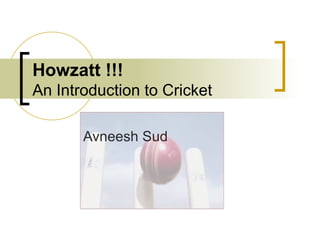
Howzatt !!! An Introduction to Cricket Avneesh Sud
Outline Brief History Rules Demo! Advanced Techniques (Gokul)
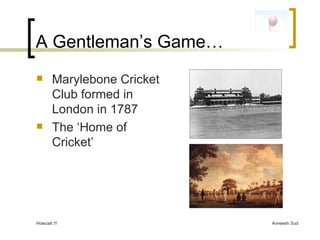
A Gentleman’s Game… Marylebone Cricket Club formed in London in 1787  The ‘Home of Cricket’
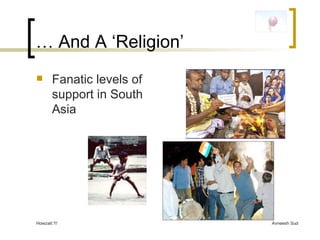
… And A ‘Religion’ Fanatic levels of support in South Asia
Outline Brief History Rules Demo! Advanced Techniques (Gokul)
Outline Brief History Rules Basics Equipment & Field Players Play: Scoring & Getting Out Winning Demo! Advanced Techniques (Gokul)
Basics Similar to baseball (  ) 2 Teams: 11 players each Batting Team  –  bats  an  innings  and scores  runs Fielding Team  –  bowls  and gets batting team  out Reverse roles after an innings Team with most runs wins
Outline Brief History Rules Basics Equipment & Field Players Play: Scoring & Getting Out Winning Demo! Advanced Techniques (Gokul)
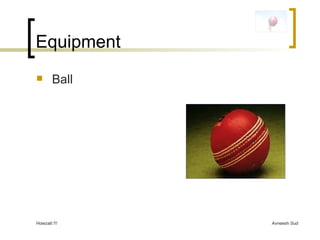
Equipment Ball
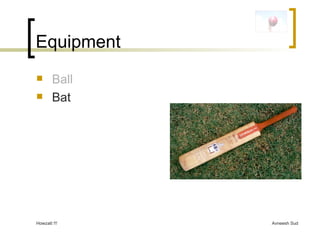
Equipment Ball Bat
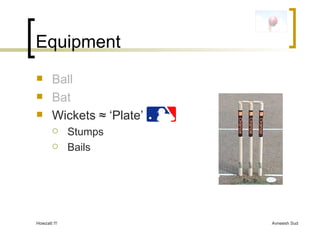
Equipment Ball Bat Wickets  ≈ ‘Plate’ Stumps Bails
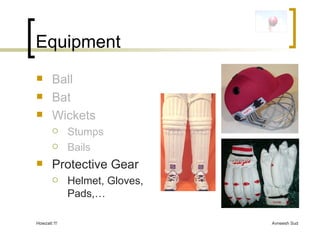
Equipment Ball Bat Wickets Stumps Bails Protective Gear Helmet, Gloves, Pads,…
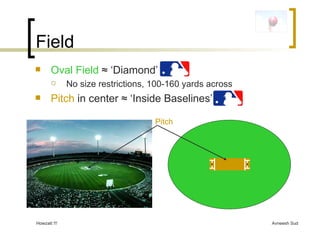
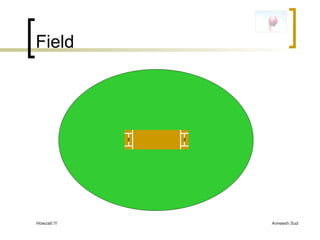
Field Oval Field  ≈ ‘Diamond’  No size restrictions, 100-160 yards across Pitch  in center  ≈ ‘Inside Baselines’  Pitch
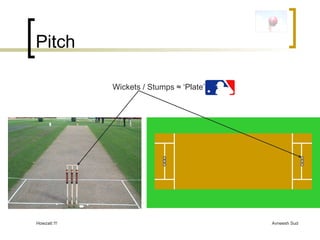
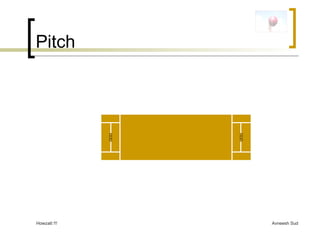
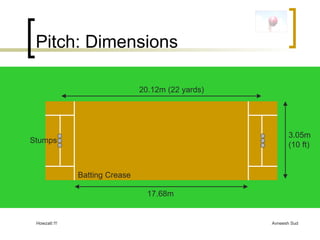
Pitch Wickets / Stumps  ≈ ‘Plate’
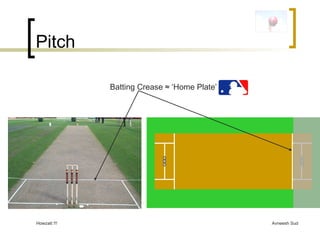
Pitch Batting Crease ≈ ‘Home Plate’
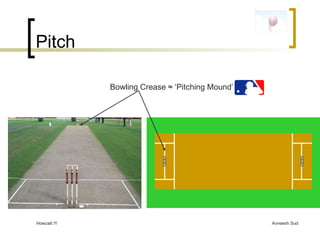
Pitch Bowling Crease ≈ ‘Pitching Mound’
Outline Brief History Rules Basics Equipment & Field Players Play: Scoring & Getting Out Winning Demo! Advanced Techniques (Gokul)
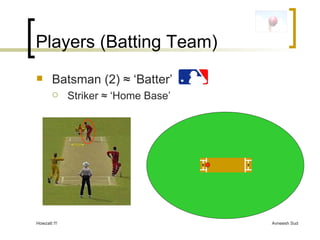
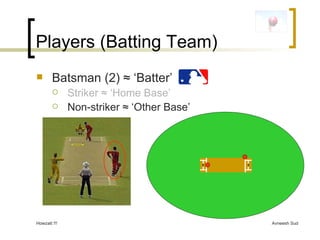
Players (Batting Team) Batsman (2)  ≈ ‘Batter’ Striker ≈ ‘Home Base’
Players (Batting Team) Batsman (2)  ≈ ‘Batter’ Striker ≈ ‘Home Base’ Non-striker ≈ ‘Other Base’
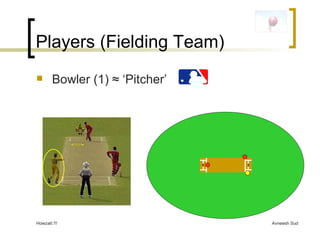
Players (Fielding Team) Bowler (1)  ≈ ‘Pitcher’
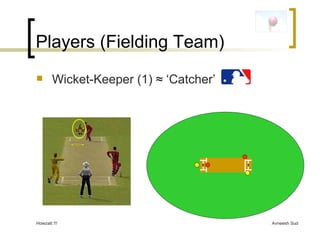
Players (Fielding Team) Wicket-Keeper (1)  ≈ ‘Catcher’
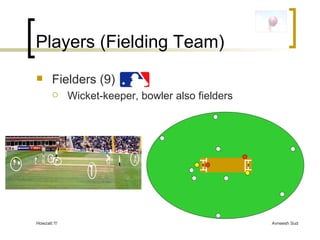
Players (Fielding Team) Fielders (9) Wicket-keeper, bowler also fielders
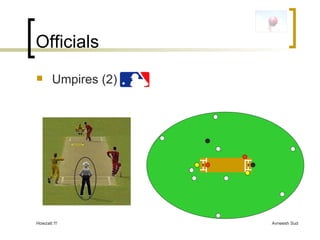
Officials Umpires (2)
Outline Brief History Rules Basics Equipment & Field Players Play: Scoring & Getting Out Winning Demo! Advanced Techniques (Gokul)
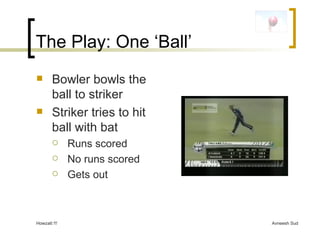
The Play: One ‘Ball’ Bowler bowls the ball to striker Striker tries to hit ball with bat Runs scored No runs scored Gets out
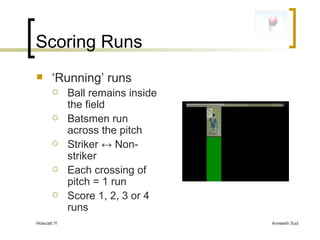
Scoring Runs ‘ Running’ runs Ball remains inside the field Batsmen run across the pitch Striker  ↔ Non-striker Each crossing of pitch = 1 run Score 1, 2, 3 or 4 runs
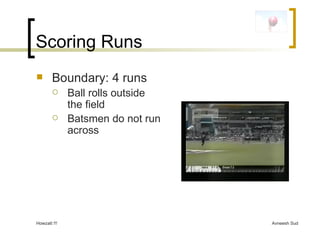
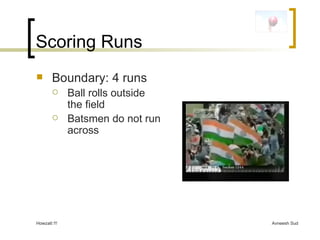
Scoring Runs Boundary: 4 runs Ball rolls outside the field Batsmen do not run across
Scoring Runs Boundary: 6 runs  ≈ ‘Home Run’ Ball flies outside the field Batsmen do not run across
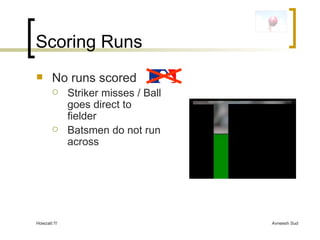
Scoring Runs No runs scored Striker misses / Ball goes direct to fielder Batsmen do not run across
Getting Out ‘ Strike Out’  ‘ Caught Out’ ‘ Thrown Out’
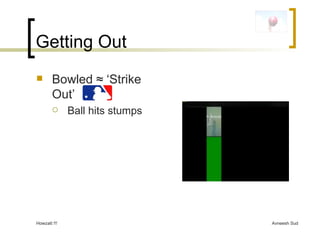
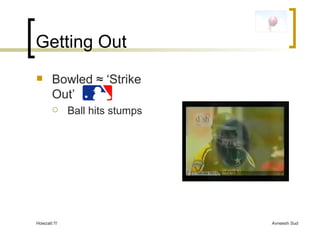
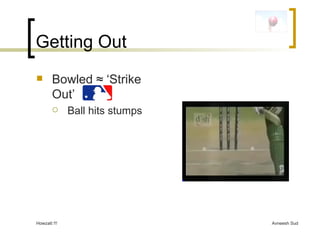
Getting Out Bowled  ≈ ‘Strike Out’  Ball hits stumps
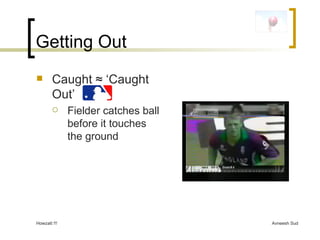
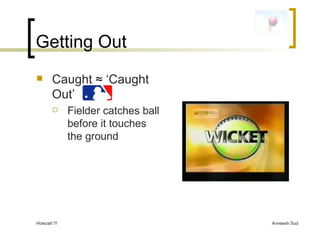
Getting Out Caught  ≈ ‘Caught Out’  Fielder catches ball before it touches the ground
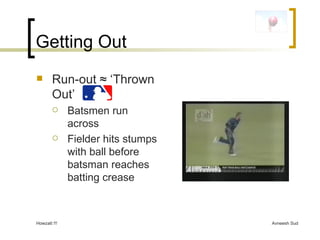
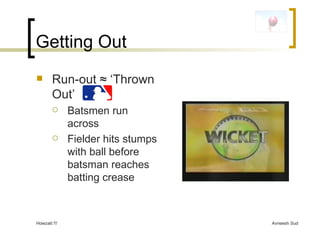
Getting Out Run-out  ≈ ‘Thrown Out’  Batsmen run across Fielder hits stumps with ball before batsman reaches batting crease
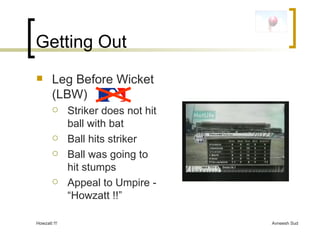
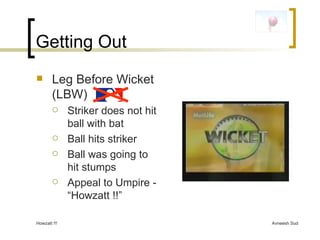
Getting Out Leg Before Wicket (LBW)  Striker does not hit ball with bat Ball hits striker Ball was going to hit stumps Appeal to Umpire - “Howzatt !!”
Getting Out Other Ways Stumped Hit-Wicket Handled Ball Double Hit Timed Out Obstructing the field Only ONE batsman can get out / ball
Outline Brief History Rules Basics Field & Equipment Players Scoring & Getting Out Winning Demo! Advanced Techniques (Gokul)
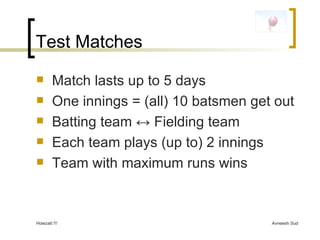
Test Matches Match lasts up to 5 days One innings = (all) 10 batsmen get out  Batting team  ↔  Fielding team Each team plays (up to) 2 innings Team with maximum runs wins
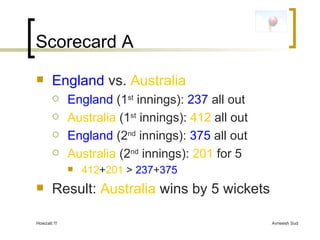
Scorecard A England   vs.  Australia England  (1 st  innings):  237  all out Australia  (1 st  innings):  412  all out England  (2 nd  innings):  375  all out Australia  (2 nd  innings):  201  for 5 412 + 201  >  237 + 375 Result:  Australia  wins by 5 wickets
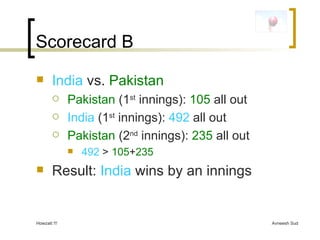
Scorecard B India  vs.  Pakistan Pakistan  (1 st  innings):  105  all out India  (1 st  innings):  492  all out Pakistan  (2 nd  innings):  235  all out 492  >  105 + 235 Result:  India  wins by an innings
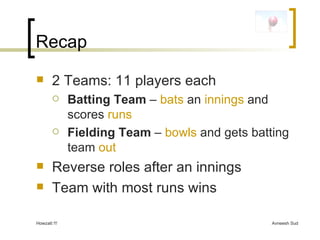
Recap 2 Teams: 11 players each Batting Team  –  bats  an  innings  and scores  runs Fielding Team  –  bowls  and gets batting team  out Reverse roles after an innings Team with most runs wins
Outline Brief History Rules Demo! Advanced Techniques (Gokul)
References MCC:  http://www.lords.org/cricket/laws.asp BBC Sports Academy:  http://news.bbc.co.uk/sportacademy/bsp/hi/cricket/rules/html/default.stm Antony Hosking:  http:// www.cs.purdue.edu/homes/hosking/cricket/explanation.htm
Field
Pitch
Pitch: Dimensions Stumps 20.12m (22 yards) 17.68m 3.05m (10 ft) Batting Crease
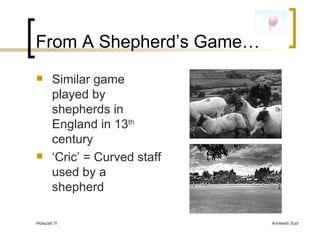
From A Shepherd’s Game… Similar game played by shepherds in England in 13 th  century ‘ Cric’ = Curved staff used by a shepherd

sports and cricket

  • 1.
    Howzatt !!! AnIntroduction to Cricket Avneesh Sud
  • 2.
    Outline Brief HistoryRules Demo! Advanced Techniques (Gokul)
  • 3.
    Outline Brief HistoryRules Demo! Advanced Techniques (Gokul)
  • 4.
    A Gentleman’s Game…Marylebone Cricket Club formed in London in 1787 The ‘Home of Cricket’
  • 5.
    … And A‘Religion’ Fanatic levels of support in South Asia
  • 6.
    Outline Brief HistoryRules Demo! Advanced Techniques (Gokul)
  • 7.
    Outline Brief HistoryRules Basics Equipment & Field Players Play: Scoring & Getting Out Winning Demo! Advanced Techniques (Gokul)
  • 8.
    Outline Brief HistoryRules Basics Equipment & Field Players Play: Scoring & Getting Out Winning Demo! Advanced Techniques (Gokul)
  • 9.
    Basics Similar tobaseball ( ) 2 Teams: 11 players each Batting Team – bats an innings and scores runs Fielding Team – bowls and gets batting team out Reverse roles after an innings Team with most runs wins
  • 10.
    Outline Brief HistoryRules Basics Equipment & Field Players Play: Scoring & Getting Out Winning Demo! Advanced Techniques (Gokul)
  • 11.
  • 12.
  • 13.
    Equipment Ball BatWickets ≈ ‘Plate’ Stumps Bails
  • 14.
    Equipment Ball BatWickets Stumps Bails Protective Gear Helmet, Gloves, Pads,…
  • 15.
    Field Oval Field ≈ ‘Diamond’ No size restrictions, 100-160 yards across Pitch in center ≈ ‘Inside Baselines’ Pitch
  • 16.
    Pitch Wickets /Stumps ≈ ‘Plate’
  • 17.
    Pitch Batting Crease≈ ‘Home Plate’
  • 18.
    Pitch Bowling Crease≈ ‘Pitching Mound’
  • 19.
    Outline Brief HistoryRules Basics Equipment & Field Players Play: Scoring & Getting Out Winning Demo! Advanced Techniques (Gokul)
  • 20.
    Players (Batting Team)Batsman (2) ≈ ‘Batter’ Striker ≈ ‘Home Base’
  • 21.
    Players (Batting Team)Batsman (2) ≈ ‘Batter’ Striker ≈ ‘Home Base’ Non-striker ≈ ‘Other Base’
  • 22.
    Players (Fielding Team)Bowler (1) ≈ ‘Pitcher’
  • 23.
    Players (Fielding Team)Wicket-Keeper (1) ≈ ‘Catcher’
  • 24.
    Players (Fielding Team)Fielders (9) Wicket-keeper, bowler also fielders
  • 25.
  • 26.
    Outline Brief HistoryRules Basics Equipment & Field Players Play: Scoring & Getting Out Winning Demo! Advanced Techniques (Gokul)
  • 27.
    The Play: One‘Ball’ Bowler bowls the ball to striker Striker tries to hit ball with bat Runs scored No runs scored Gets out
  • 28.
    Scoring Runs ‘Running’ runs Ball remains inside the field Batsmen run across the pitch Striker ↔ Non-striker Each crossing of pitch = 1 run Score 1, 2, 3 or 4 runs
  • 29.
    Scoring Runs Boundary:4 runs Ball rolls outside the field Batsmen do not run across
  • 30.
    Scoring Runs Boundary:4 runs Ball rolls outside the field Batsmen do not run across
  • 31.
    Scoring Runs Boundary:6 runs ≈ ‘Home Run’ Ball flies outside the field Batsmen do not run across
  • 32.
    Scoring Runs Boundary:6 runs ≈ ‘Home Run’ Ball flies outside the field Batsmen do not run across
  • 33.
    Scoring Runs Noruns scored Striker misses / Ball goes direct to fielder Batsmen do not run across
  • 34.
    Getting Out ‘Strike Out’ ‘ Caught Out’ ‘ Thrown Out’
  • 35.
    Getting Out Bowled ≈ ‘Strike Out’ Ball hits stumps
  • 36.
    Getting Out Bowled ≈ ‘Strike Out’ Ball hits stumps
  • 37.
    Getting Out Bowled ≈ ‘Strike Out’ Ball hits stumps
  • 38.
    Getting Out Caught ≈ ‘Caught Out’ Fielder catches ball before it touches the ground
  • 39.
    Getting Out Caught ≈ ‘Caught Out’ Fielder catches ball before it touches the ground
  • 40.
    Getting Out Run-out ≈ ‘Thrown Out’ Batsmen run across Fielder hits stumps with ball before batsman reaches batting crease
  • 41.
    Getting Out Run-out ≈ ‘Thrown Out’ Batsmen run across Fielder hits stumps with ball before batsman reaches batting crease
  • 42.
    Getting Out LegBefore Wicket (LBW) Striker does not hit ball with bat Ball hits striker Ball was going to hit stumps Appeal to Umpire - “Howzatt !!”
  • 43.
    Getting Out LegBefore Wicket (LBW) Striker does not hit ball with bat Ball hits striker Ball was going to hit stumps Appeal to Umpire - “Howzatt !!”
  • 44.
    Getting Out OtherWays Stumped Hit-Wicket Handled Ball Double Hit Timed Out Obstructing the field Only ONE batsman can get out / ball
  • 45.
    Outline Brief HistoryRules Basics Field & Equipment Players Scoring & Getting Out Winning Demo! Advanced Techniques (Gokul)
  • 46.
    Test Matches Matchlasts up to 5 days One innings = (all) 10 batsmen get out Batting team ↔ Fielding team Each team plays (up to) 2 innings Team with maximum runs wins
  • 47.
    Scorecard A England vs. Australia England (1 st innings): 237 all out Australia (1 st innings): 412 all out England (2 nd innings): 375 all out Australia (2 nd innings): 201 for 5 412 + 201 > 237 + 375 Result: Australia wins by 5 wickets
  • 48.
    Scorecard B India vs. Pakistan Pakistan (1 st innings): 105 all out India (1 st innings): 492 all out Pakistan (2 nd innings): 235 all out 492 > 105 + 235 Result: India wins by an innings
  • 49.
    Recap 2 Teams:11 players each Batting Team – bats an innings and scores runs Fielding Team – bowls and gets batting team out Reverse roles after an innings Team with most runs wins
  • 50.
    Outline Brief HistoryRules Demo! Advanced Techniques (Gokul)
  • 51.
    References MCC: http://www.lords.org/cricket/laws.asp BBC Sports Academy: http://news.bbc.co.uk/sportacademy/bsp/hi/cricket/rules/html/default.stm Antony Hosking: http:// www.cs.purdue.edu/homes/hosking/cricket/explanation.htm
  • 52.
  • 53.
  • 54.
    Pitch: Dimensions Stumps20.12m (22 yards) 17.68m 3.05m (10 ft) Batting Crease
  • 55.
    From A Shepherd’sGame… Similar game played by shepherds in England in 13 th century ‘ Cric’ = Curved staff used by a shepherd