• Antara Ghosh Samajpati
• Sujan Sannigrahi
• Pringal Sarkar
• Sharmistha Aun
• Sanjay Biswal
• Abhishek Rathour
• Sreetama Nandi
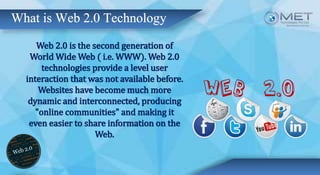
Web 2.0 is the second generation of
World Wide Web ( i.e. WWW). Web 2.0
technologies provide a level user
interaction that was not available before.
Websites have become much more
dynamic and interconnected, producing
"online communities" and making it
even easier to share information on the
Web.
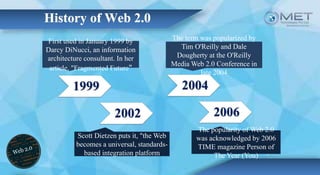
1999
2002
2004
2006
First used in January 1999 by
Darcy DiNucci, an information
architecture consultant. In her
article, "Fragmented Future"
Scott Dietzen puts it, "the Web
becomes a universal, standards-
based integration platform
The term was popularized by
Tim O'Reilly and Dale
Dougherty at the O'Reilly
Media Web 2.0 Conference in
late 2004
The popularity of Web 2.0
was acknowledged by 2006
TIME magazine Person of
The Year (You)
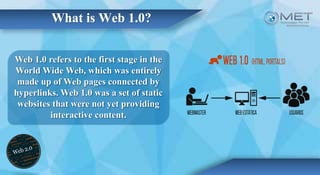
Web 1.0 refers to the first stage in the
World Wide Web, which was entirely
made up of Web pages connected by
hyperlinks. Web 1.0 was a set of static
websites that were not yet providing
interactive content.
Difference Between Web 1.0 and Web 2.0
Web 1.0 Web 2.0
1) The mostly read only web 1) The widely read-write web
2) 45 million global user(1996) 2) 1 billion+ global user(2016)
3) Focused on companies 3) Focused on communities
4) Home pages 4) Blogs
5) Owning content 5) Sharing content
6) HTML, portals 6) XML, RSS
7) Web forms 7) Web Application
8) Page views 8) Cost per click
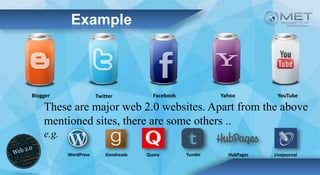
Example
Blogger Twitter Facebook Yahoo YouTube
These are major web 2.0 websites. Apart from the above
mentioned sites, there are some others ..
e.g.
WordPress Goodreads Quora Tumblr HubPages Livejournal
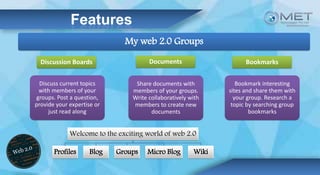
Features
My web 2.0 Groups
Discussion Boards
Discuss current topics
with members of your
groups. Post a question,
provide your expertise or
just read along
Share documents with
members of your groups.
Write collaboratively with
members to create new
documents
Documents
Bookmark interesting
sites and share them with
your group. Research a
topic by searching group
bookmarks
Bookmarks
Welcome to the exciting world of web 2.0
Profiles Blog Groups Micro Blog Wiki
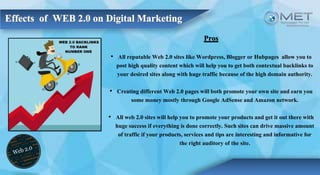
Pros
• All reputable Web 2.0 sites like Wordpress, Blogger or Hubpages allow you to
post high quality content which will help you to get both contextual backlinks to
your desired sites along with huge traffic because of the high domain authority.
• Creating different Web 2.0 pages will both promote your own site and earn you
some money mostly through Google AdSense and Amazon network.
• All web 2.0 sites will help you to promote your products and get it out there with
huge success if everything is done correctly. Such sites can drive massive amount
of traffic if your products, services and tips are interesting and informative for
the right auditory of the site.
Pros
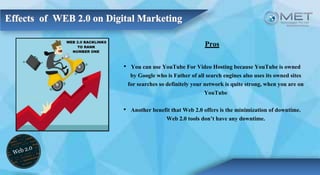
• You can use YouTube For Video Hosting because YouTube is owned
by Google who is Father of all search engines also uses its owned sites
for searches so definitely your network is quite strong, when you are on
YouTube
• Another benefit that Web 2.0 offers is the minimization of downtime.
Web 2.0 tools don’t have any downtime.
Cons
• Information overload. Too much information is daily posted
by many people with different thought. This creates confusion
for the readers and the quality of the content is not reliable.
• If you are using grey hat techniques then it can hurt your
reputation.
• Most backlinks from web 2.0 sites are “no follow” so the high
page rank of the site does not get passed onto your backlink.
• Freedom to post views and comments provides good
opportunities for competitors and rivals to post negative
comments about other companies.
• Too many fake ID’s increase the risk of spamming, fraud and
virus attack.
Controversies
• Site Users Risk Losing Control Of Personal Information
• Careful On What To Post Online
• Information On Social Networking Sites May Not Be
Verifiable.
1. Bogus Profiles
2. False Details
CONCLUSION
Let’s leave the controversies aside and pondering whether we should call Web 2.0 a
‘Dream’ or a ‘Nightmare’. Web 2.0 has made a provision for each user to be a
journalist or a film maker. We have landed in an era of participation where each user
has the power to contribute, regardless of position.
Overall, Web 2.0 has proven to be a boon for the businesses in order to establish an
effective online presence. Incorporating its effectiveness into the online marketing
campaign can help businesses to reach its zenith.
Web 2.0 and Its Effect

Web 2.0 and Its Effect

  • 2.
    • Antara GhoshSamajpati • Sujan Sannigrahi • Pringal Sarkar • Sharmistha Aun • Sanjay Biswal • Abhishek Rathour • Sreetama Nandi
  • 3.
    Web 2.0 isthe second generation of World Wide Web ( i.e. WWW). Web 2.0 technologies provide a level user interaction that was not available before. Websites have become much more dynamic and interconnected, producing "online communities" and making it even easier to share information on the Web.
  • 4.
    1999 2002 2004 2006 First used inJanuary 1999 by Darcy DiNucci, an information architecture consultant. In her article, "Fragmented Future" Scott Dietzen puts it, "the Web becomes a universal, standards- based integration platform The term was popularized by Tim O'Reilly and Dale Dougherty at the O'Reilly Media Web 2.0 Conference in late 2004 The popularity of Web 2.0 was acknowledged by 2006 TIME magazine Person of The Year (You)
  • 5.
    Web 1.0 refersto the first stage in the World Wide Web, which was entirely made up of Web pages connected by hyperlinks. Web 1.0 was a set of static websites that were not yet providing interactive content.
  • 6.
    Difference Between Web1.0 and Web 2.0 Web 1.0 Web 2.0 1) The mostly read only web 1) The widely read-write web 2) 45 million global user(1996) 2) 1 billion+ global user(2016) 3) Focused on companies 3) Focused on communities 4) Home pages 4) Blogs 5) Owning content 5) Sharing content 6) HTML, portals 6) XML, RSS 7) Web forms 7) Web Application 8) Page views 8) Cost per click
  • 7.
    Example Blogger Twitter FacebookYahoo YouTube These are major web 2.0 websites. Apart from the above mentioned sites, there are some others .. e.g. WordPress Goodreads Quora Tumblr HubPages Livejournal
  • 8.
    Features My web 2.0Groups Discussion Boards Discuss current topics with members of your groups. Post a question, provide your expertise or just read along Share documents with members of your groups. Write collaboratively with members to create new documents Documents Bookmark interesting sites and share them with your group. Research a topic by searching group bookmarks Bookmarks Welcome to the exciting world of web 2.0 Profiles Blog Groups Micro Blog Wiki
  • 9.
    Pros • All reputableWeb 2.0 sites like Wordpress, Blogger or Hubpages allow you to post high quality content which will help you to get both contextual backlinks to your desired sites along with huge traffic because of the high domain authority. • Creating different Web 2.0 pages will both promote your own site and earn you some money mostly through Google AdSense and Amazon network. • All web 2.0 sites will help you to promote your products and get it out there with huge success if everything is done correctly. Such sites can drive massive amount of traffic if your products, services and tips are interesting and informative for the right auditory of the site.
  • 10.
    Pros • You canuse YouTube For Video Hosting because YouTube is owned by Google who is Father of all search engines also uses its owned sites for searches so definitely your network is quite strong, when you are on YouTube • Another benefit that Web 2.0 offers is the minimization of downtime. Web 2.0 tools don’t have any downtime.
  • 11.
    Cons • Information overload.Too much information is daily posted by many people with different thought. This creates confusion for the readers and the quality of the content is not reliable. • If you are using grey hat techniques then it can hurt your reputation. • Most backlinks from web 2.0 sites are “no follow” so the high page rank of the site does not get passed onto your backlink. • Freedom to post views and comments provides good opportunities for competitors and rivals to post negative comments about other companies. • Too many fake ID’s increase the risk of spamming, fraud and virus attack.
  • 12.
    Controversies • Site UsersRisk Losing Control Of Personal Information • Careful On What To Post Online • Information On Social Networking Sites May Not Be Verifiable. 1. Bogus Profiles 2. False Details
  • 13.
    CONCLUSION Let’s leave thecontroversies aside and pondering whether we should call Web 2.0 a ‘Dream’ or a ‘Nightmare’. Web 2.0 has made a provision for each user to be a journalist or a film maker. We have landed in an era of participation where each user has the power to contribute, regardless of position. Overall, Web 2.0 has proven to be a boon for the businesses in order to establish an effective online presence. Incorporating its effectiveness into the online marketing campaign can help businesses to reach its zenith.