WEB 2.0 PRESENTATION BY  PRAVEENKUMAR.G
What is Web 2.0? It is Second generation of services available on the Web that lets people collaborate and share information online  O'Reilly Media and MediaLive International popularized the term Google is now seen as the torch bearer of the term by the media From a technology perspective Web 2.0 uses AJAX, Mashups and RSS predominantly
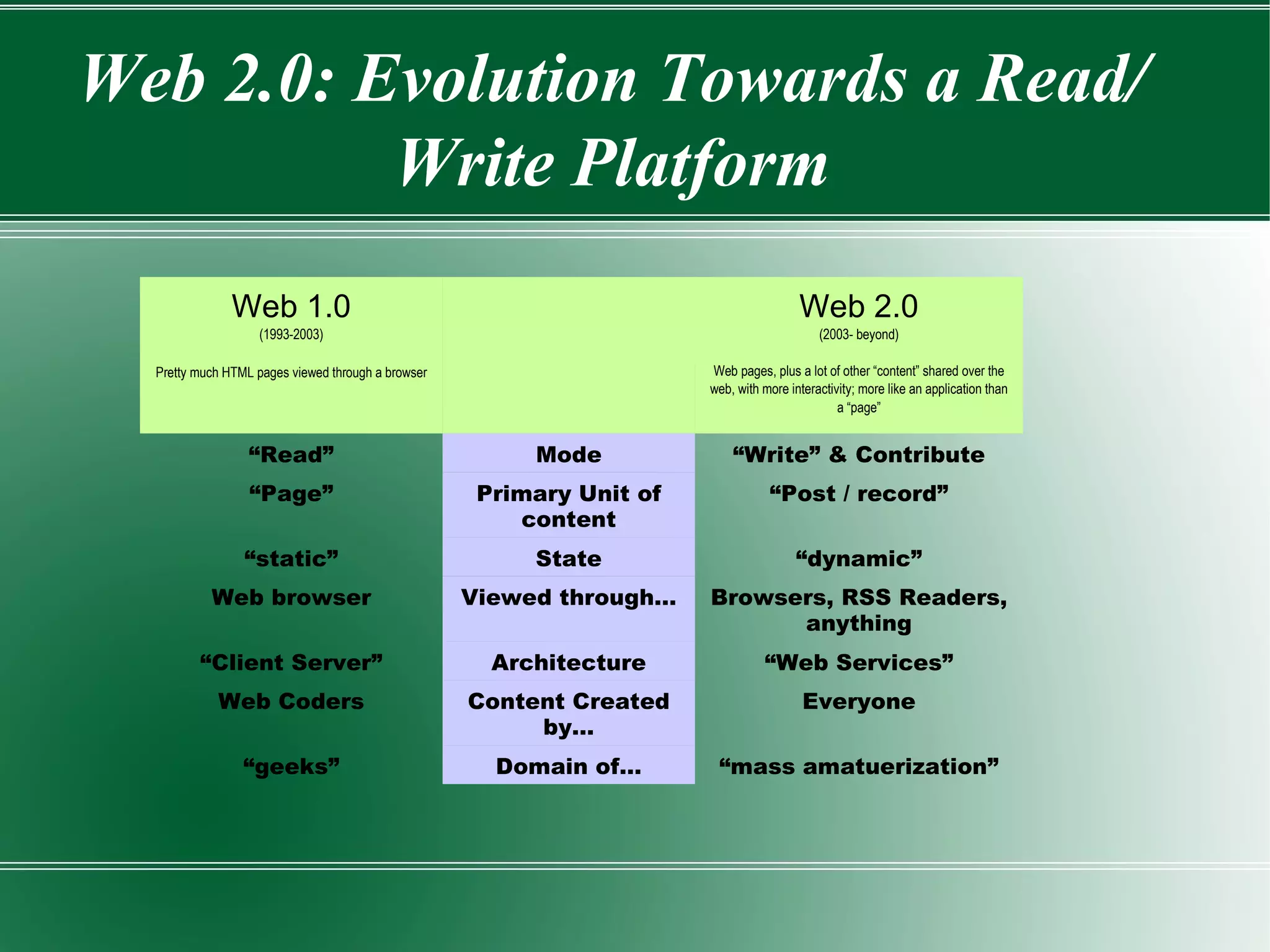
Web 2.0: Evolution Towards a Read/Write Platform Web 1.0 (1993-2003) Pretty much HTML pages viewed through a browser Web 2.0 (2003- beyond) Web pages, plus a lot of other “content” shared over the web, with more interactivity; more like an application than a “page” “ Read” Mode “ Write” & Contribute “ Page” Primary Unit of content “ Post / record” “ static” State “ dynamic” Web browser Viewed through… Browsers, RSS Readers, anything “ Client Server” Architecture “ Web Services” Web Coders Content Created by… Everyone “ geeks” Domain of… “ mass amatuerization”
Rich user experience User participation Dynamic content Metadata Web standards and scalability Openness Freedom Collective intelligence Web 2.0 Characteristics
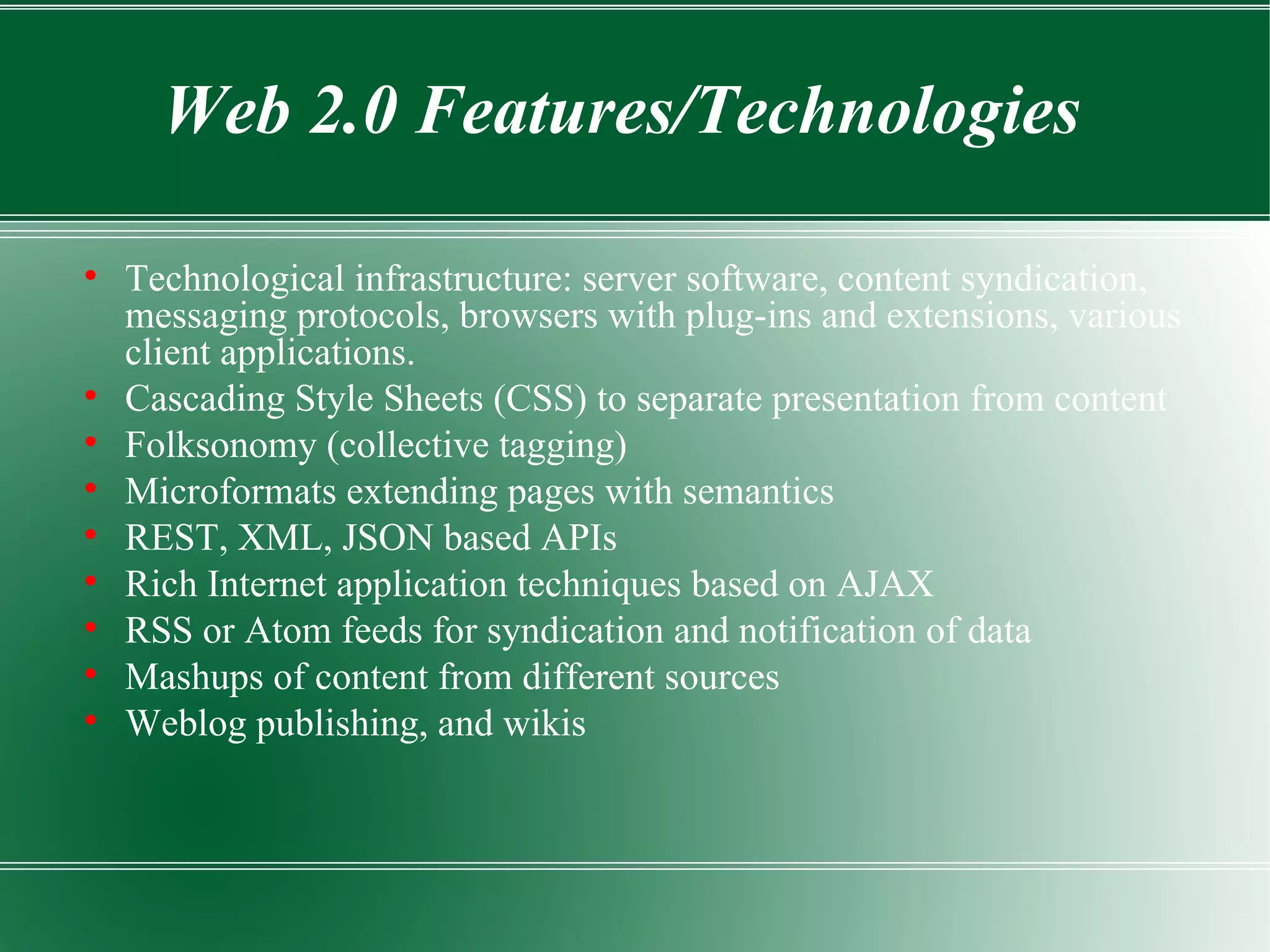
Technological infrastructure: server software, content syndication, messaging protocols, browsers with plug-ins and extensions, various client applications. Cascading Style Sheets (CSS) to separate presentation from content Folksonomy (collective tagging) Microformats extending pages with semantics REST, XML, JSON based APIs Rich Internet application techniques based on AJAX RSS or Atom feeds for syndication and notification of data Mashups of content from different sources Weblog publishing, and wikis Web 2.0 Features/Technologies
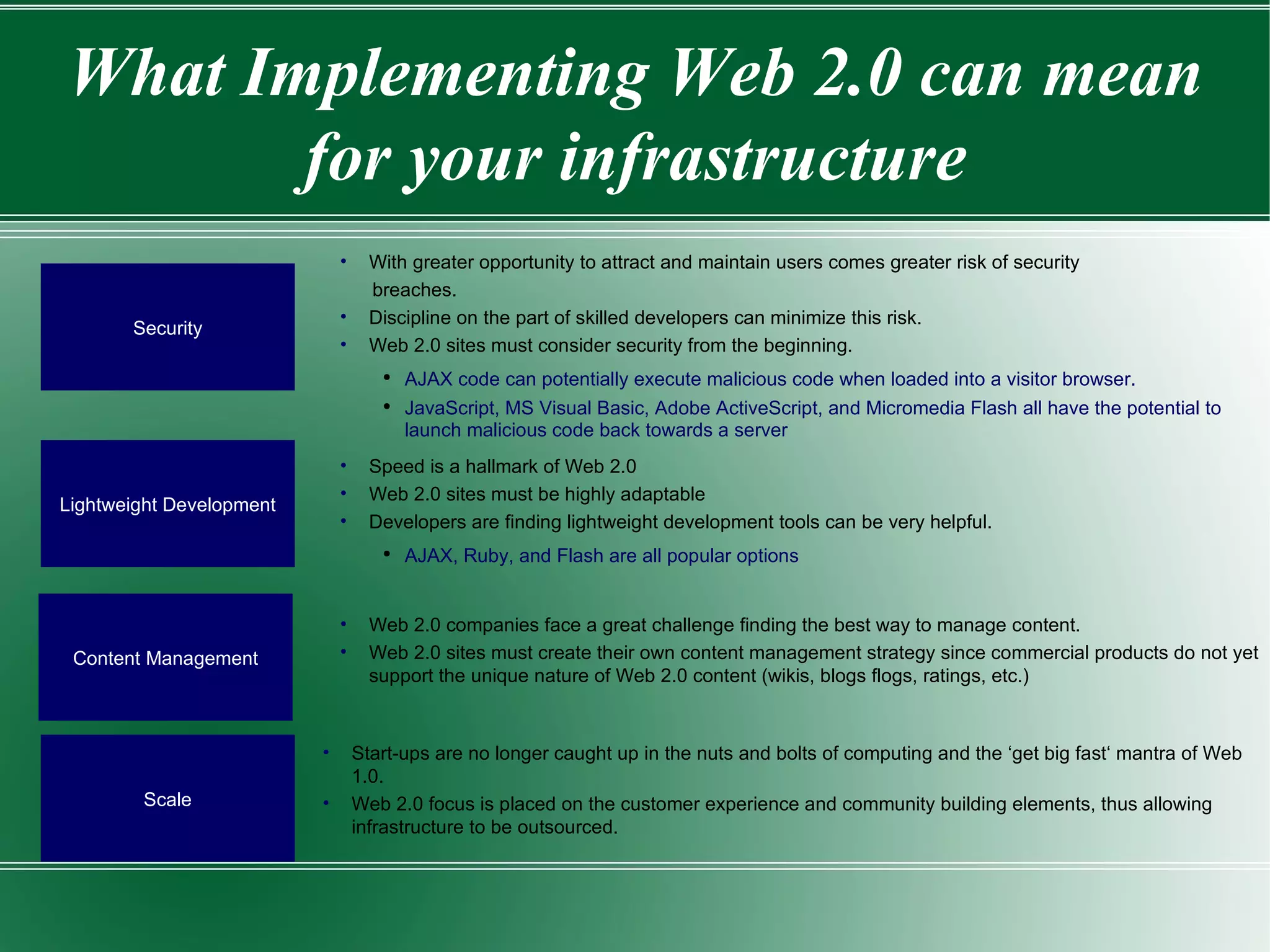
What Implementing Web 2.0 can mean for your infrastructure Security With greater opportunity to attract and maintain users comes greater risk of security breaches. Discipline on the part of skilled developers can minimize this risk.  Web 2.0 sites must consider security from the beginning.  AJAX code can potentially execute malicious code when loaded into a visitor browser.  JavaScript, MS Visual Basic, Adobe ActiveScript, and Micromedia Flash all have the potential to launch malicious code back towards a server Lightweight Development Speed is a hallmark of Web 2.0 Web 2.0 sites must be highly adaptable Developers are finding lightweight development tools can be very helpful.  AJAX, Ruby, and Flash are all popular options  Content Management Web 2.0 companies face a great challenge finding the best way to manage content.  Web 2.0 sites must create their own content management strategy since commercial products do not yet support the unique nature of Web 2.0 content (wikis, blogs flogs, ratings, etc.) Scale Start-ups are no longer caught up in the nuts and bolts of computing and the ‘get big fast‘ mantra of Web 1.0.  Web 2.0 focus is placed on the customer experience and community building elements, thus allowing infrastructure to be outsourced.
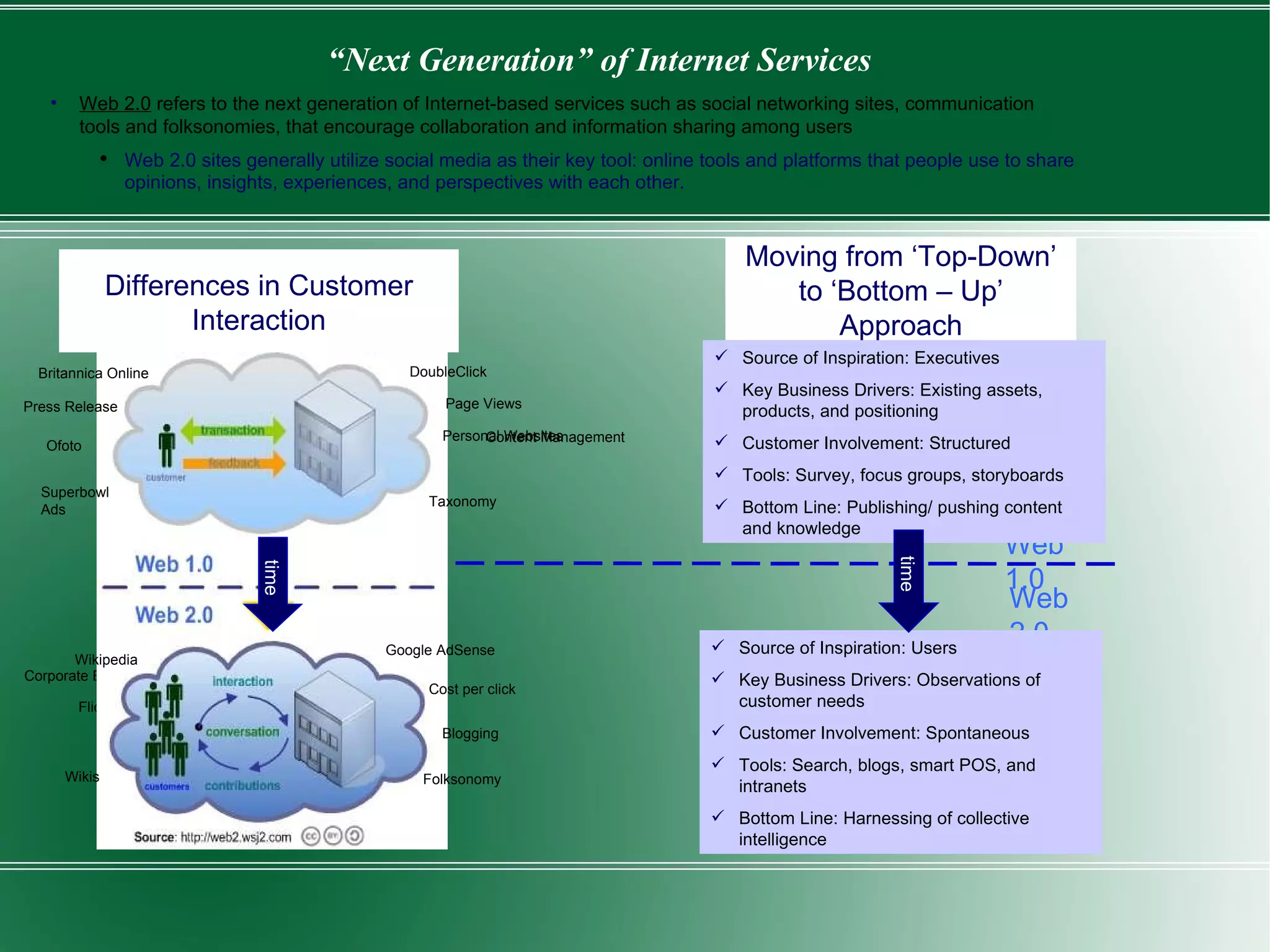
“ Next Generation” of Internet Services Flickr Corporate Blogs Content Management Web 1.0 Web 2.0 Moving from ‘Top-Down’ to ‘Bottom – Up’ Approach Source of Inspiration: Executives Key Business Drivers: Existing assets, products, and positioning Customer Involvement: Structured Tools: Survey, focus groups, storyboards Bottom Line: Publishing/ pushing content and knowledge Source of Inspiration: Users Key Business Drivers: Observations of customer needs Customer Involvement: Spontaneous Tools: Search, blogs, smart POS, and intranets Bottom Line: Harnessing of collective intelligence time Web 2.0  refers to the next generation of Internet-based services such as social networking sites, communication  tools and folksonomies, that encourage collaboration and information sharing among users Web 2.0 sites generally utilize social media as their key tool: online tools and platforms that people use to share opinions, insights, experiences, and perspectives with each other.  DoubleClick Google AdSense Ofoto Press Release Britannica Online Wikipedia Personal Websites Blogging  Superbowl Ads Page Views Cost per click Wikis Taxonomy Folksonomy Differences in Customer Interaction time
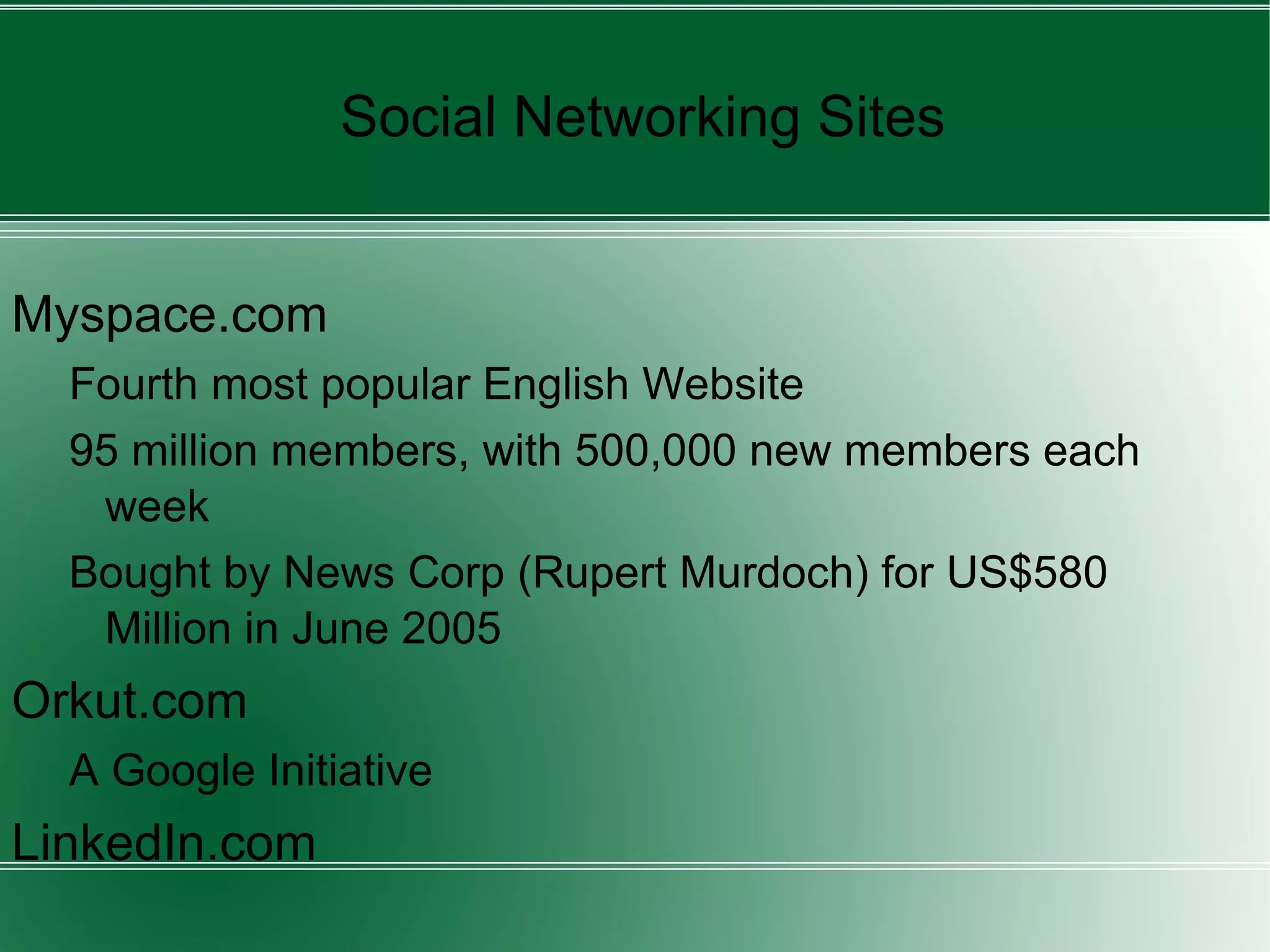
Myspace.com Fourth most popular English Website 95 million members, with 500,000 new members each week Bought by News Corp (Rupert Murdoch) for US$580 Million in June 2005 Orkut.com A Google Initiative LinkedIn.com Social Networking Sites


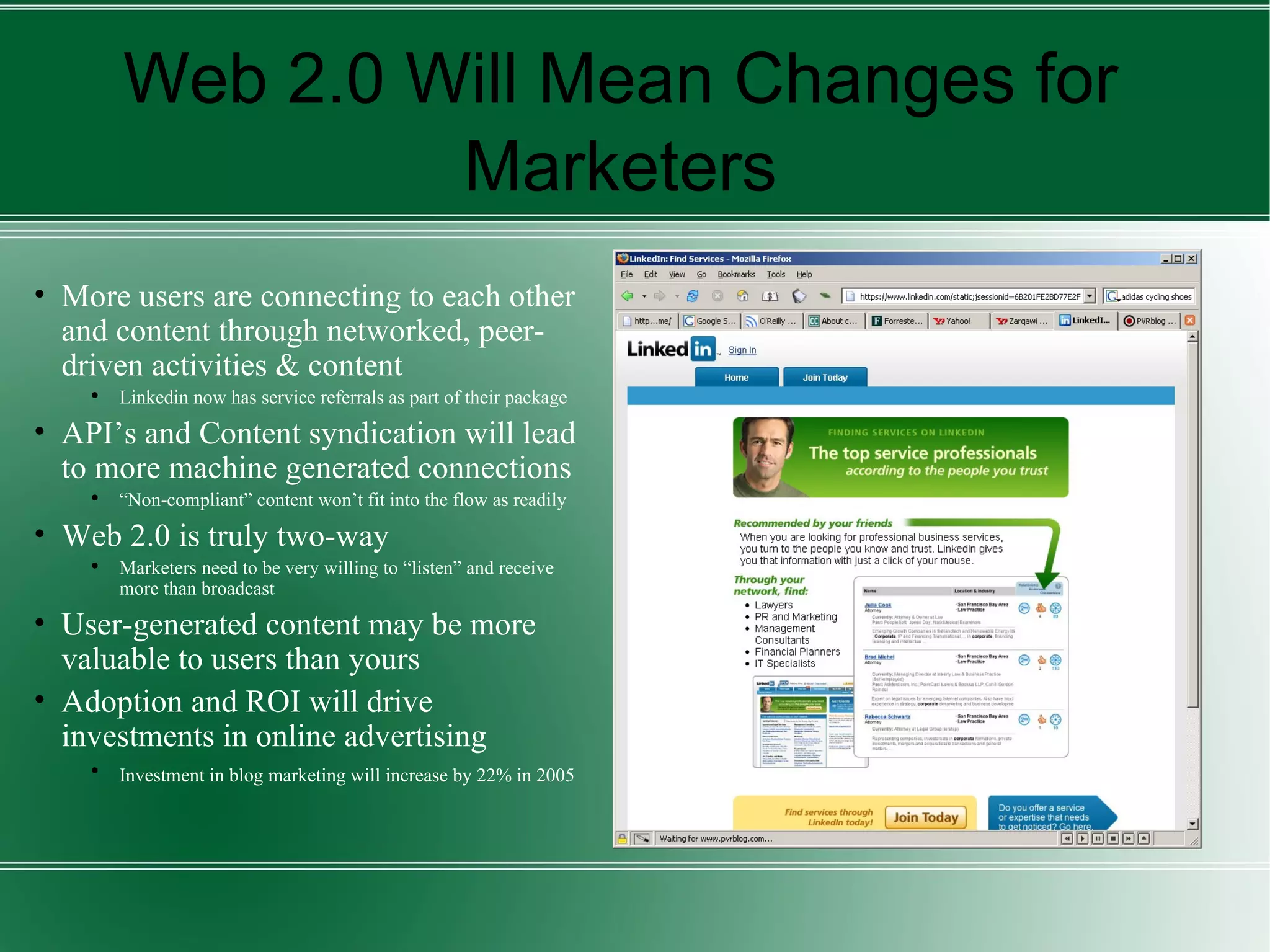
Web 2.0 Will Mean Changes for Marketers More users are connecting to each other and content through networked, peer-driven activities & content Linkedin now has service referrals as part of their package API’s and Content syndication will lead to more machine generated connections “ Non-compliant” content won’t fit into the flow as readily Web 2.0 is truly two-way Marketers need to be very willing to “listen” and receive more than broadcast User-generated content may be more valuable to users than yours Adoption and ROI will drive investments in online advertising Investment in blog marketing will increase by 22% in 2005
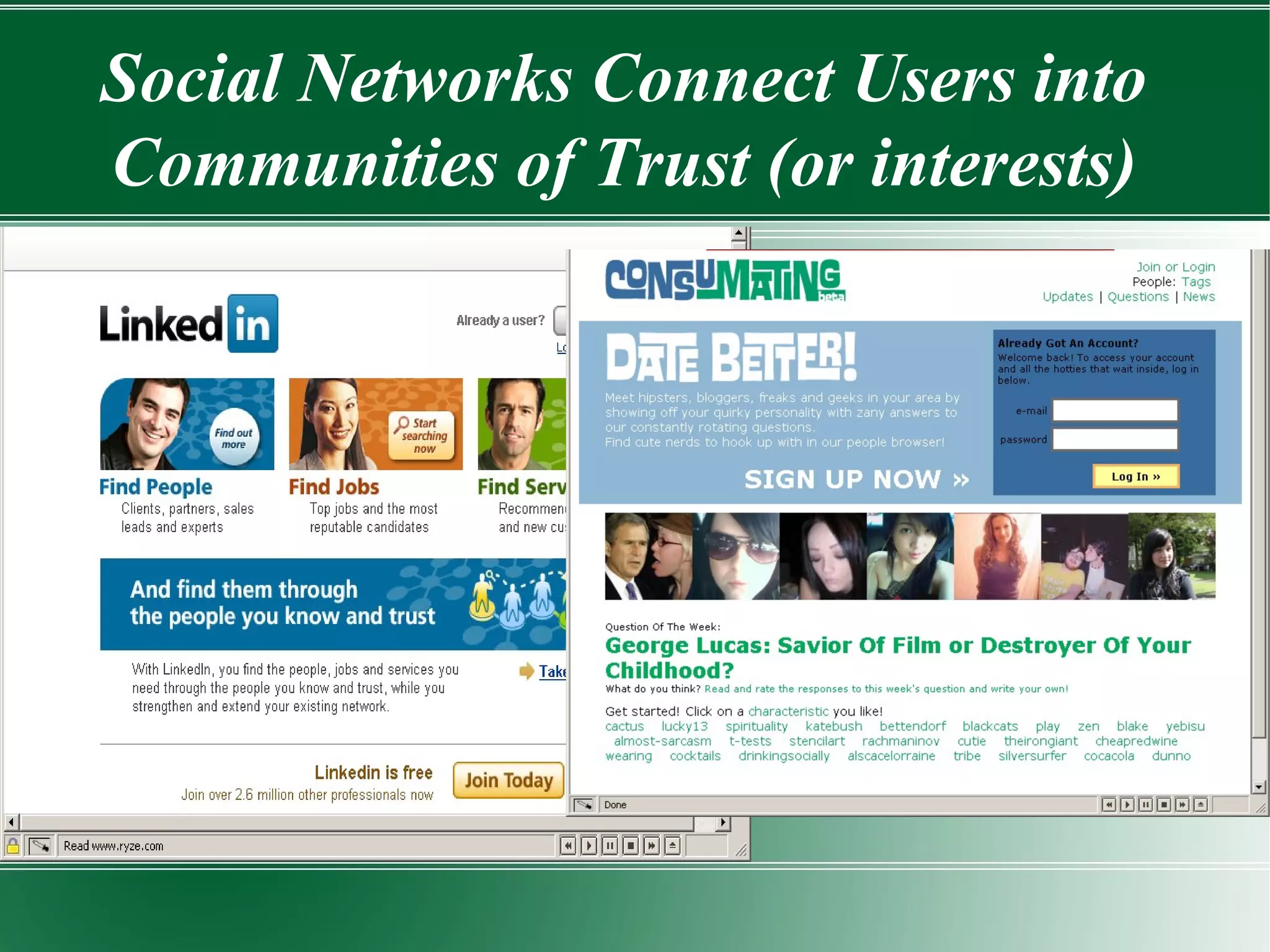
Social Networks Connect Users into Communities of Trust (or interests)
“ Web 2.0 as a piece of jargon,” by Tim Berners-Lee “ A second bubble”  “ Bubble 2.0” “ A mere augmentation of current cultural information exchanges that are bound by existing political and societal structures.” Web 2.0 Criticism
New software and services change rapidly Living in the “always beta” world Taking advantage of user-generated content Tapping into new ways of doing things Keep an open mind! Conclusions
THANK YOU

Praveenkumar

  • 1.
    WEB 2.0 PRESENTATIONBY PRAVEENKUMAR.G
  • 2.
    What is Web2.0? It is Second generation of services available on the Web that lets people collaborate and share information online O'Reilly Media and MediaLive International popularized the term Google is now seen as the torch bearer of the term by the media From a technology perspective Web 2.0 uses AJAX, Mashups and RSS predominantly
  • 3.
    Web 2.0: EvolutionTowards a Read/Write Platform Web 1.0 (1993-2003) Pretty much HTML pages viewed through a browser Web 2.0 (2003- beyond) Web pages, plus a lot of other “content” shared over the web, with more interactivity; more like an application than a “page” “ Read” Mode “ Write” & Contribute “ Page” Primary Unit of content “ Post / record” “ static” State “ dynamic” Web browser Viewed through… Browsers, RSS Readers, anything “ Client Server” Architecture “ Web Services” Web Coders Content Created by… Everyone “ geeks” Domain of… “ mass amatuerization”
  • 4.
    Rich user experienceUser participation Dynamic content Metadata Web standards and scalability Openness Freedom Collective intelligence Web 2.0 Characteristics
  • 5.
    Technological infrastructure: serversoftware, content syndication, messaging protocols, browsers with plug-ins and extensions, various client applications. Cascading Style Sheets (CSS) to separate presentation from content Folksonomy (collective tagging) Microformats extending pages with semantics REST, XML, JSON based APIs Rich Internet application techniques based on AJAX RSS or Atom feeds for syndication and notification of data Mashups of content from different sources Weblog publishing, and wikis Web 2.0 Features/Technologies
  • 6.
    What Implementing Web2.0 can mean for your infrastructure Security With greater opportunity to attract and maintain users comes greater risk of security breaches. Discipline on the part of skilled developers can minimize this risk. Web 2.0 sites must consider security from the beginning. AJAX code can potentially execute malicious code when loaded into a visitor browser. JavaScript, MS Visual Basic, Adobe ActiveScript, and Micromedia Flash all have the potential to launch malicious code back towards a server Lightweight Development Speed is a hallmark of Web 2.0 Web 2.0 sites must be highly adaptable Developers are finding lightweight development tools can be very helpful. AJAX, Ruby, and Flash are all popular options Content Management Web 2.0 companies face a great challenge finding the best way to manage content. Web 2.0 sites must create their own content management strategy since commercial products do not yet support the unique nature of Web 2.0 content (wikis, blogs flogs, ratings, etc.) Scale Start-ups are no longer caught up in the nuts and bolts of computing and the ‘get big fast‘ mantra of Web 1.0. Web 2.0 focus is placed on the customer experience and community building elements, thus allowing infrastructure to be outsourced.
  • 7.
    “ Next Generation”of Internet Services Flickr Corporate Blogs Content Management Web 1.0 Web 2.0 Moving from ‘Top-Down’ to ‘Bottom – Up’ Approach Source of Inspiration: Executives Key Business Drivers: Existing assets, products, and positioning Customer Involvement: Structured Tools: Survey, focus groups, storyboards Bottom Line: Publishing/ pushing content and knowledge Source of Inspiration: Users Key Business Drivers: Observations of customer needs Customer Involvement: Spontaneous Tools: Search, blogs, smart POS, and intranets Bottom Line: Harnessing of collective intelligence time Web 2.0 refers to the next generation of Internet-based services such as social networking sites, communication tools and folksonomies, that encourage collaboration and information sharing among users Web 2.0 sites generally utilize social media as their key tool: online tools and platforms that people use to share opinions, insights, experiences, and perspectives with each other. DoubleClick Google AdSense Ofoto Press Release Britannica Online Wikipedia Personal Websites Blogging Superbowl Ads Page Views Cost per click Wikis Taxonomy Folksonomy Differences in Customer Interaction time
  • 8.
    Myspace.com Fourth mostpopular English Website 95 million members, with 500,000 new members each week Bought by News Corp (Rupert Murdoch) for US$580 Million in June 2005 Orkut.com A Google Initiative LinkedIn.com Social Networking Sites
  • 9.
  • 10.
  • 11.
  • 12.
  • 13.
    Web 2.0 WillMean Changes for Marketers More users are connecting to each other and content through networked, peer-driven activities & content Linkedin now has service referrals as part of their package API’s and Content syndication will lead to more machine generated connections “ Non-compliant” content won’t fit into the flow as readily Web 2.0 is truly two-way Marketers need to be very willing to “listen” and receive more than broadcast User-generated content may be more valuable to users than yours Adoption and ROI will drive investments in online advertising Investment in blog marketing will increase by 22% in 2005
  • 14.
    Social Networks ConnectUsers into Communities of Trust (or interests)
  • 15.
    “ Web 2.0as a piece of jargon,” by Tim Berners-Lee “ A second bubble” “ Bubble 2.0” “ A mere augmentation of current cultural information exchanges that are bound by existing political and societal structures.” Web 2.0 Criticism
  • 16.
    New software andservices change rapidly Living in the “always beta” world Taking advantage of user-generated content Tapping into new ways of doing things Keep an open mind! Conclusions
  • 17.