2012 Annual Conference of English Education


Web 2.0과 영어교육
    연구동향


                     김혜영
                      중앙대학교
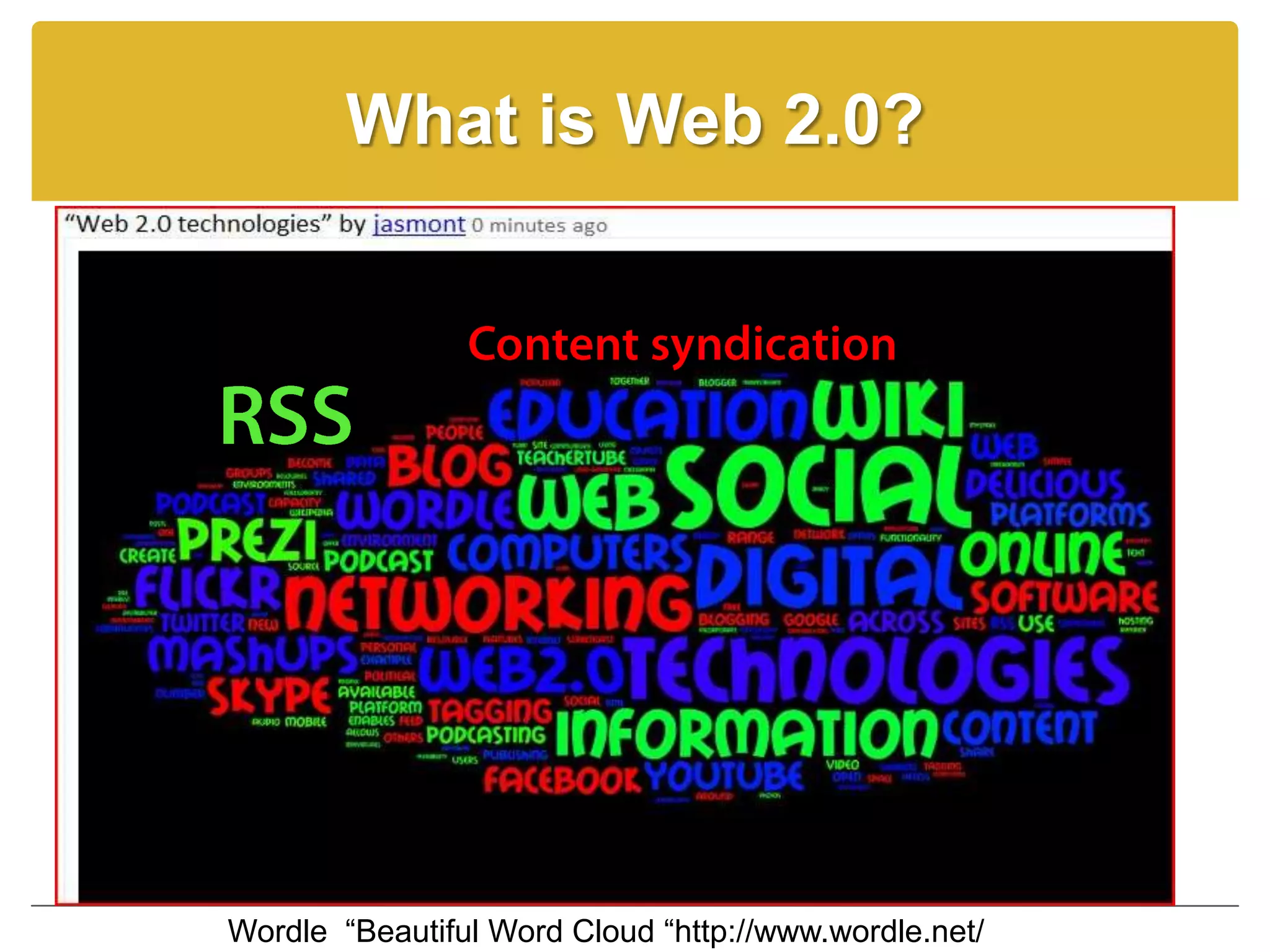
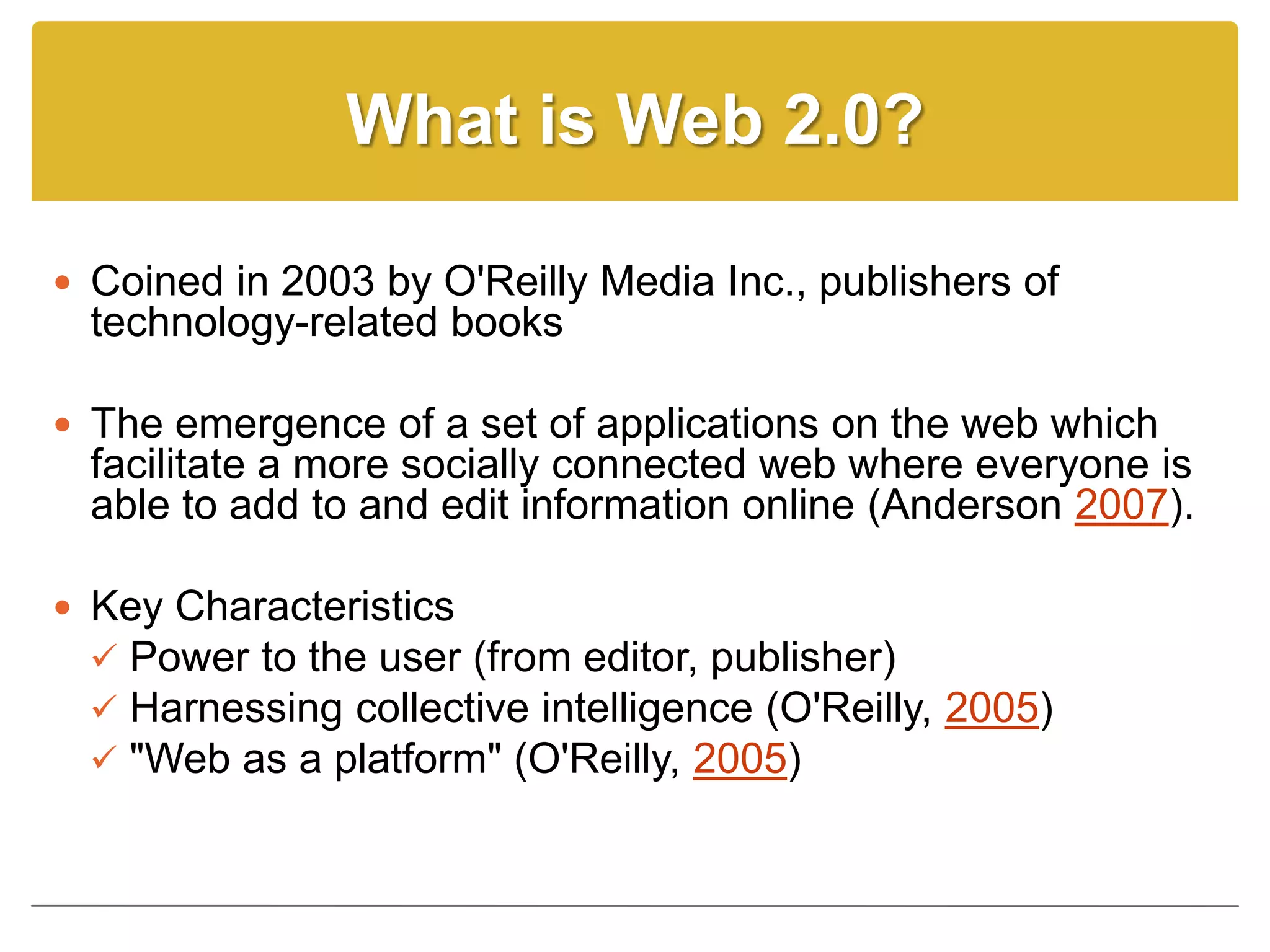
What is Web 2.0?


Wordle “Beautiful Word Cloud “http://www.wordle.net/
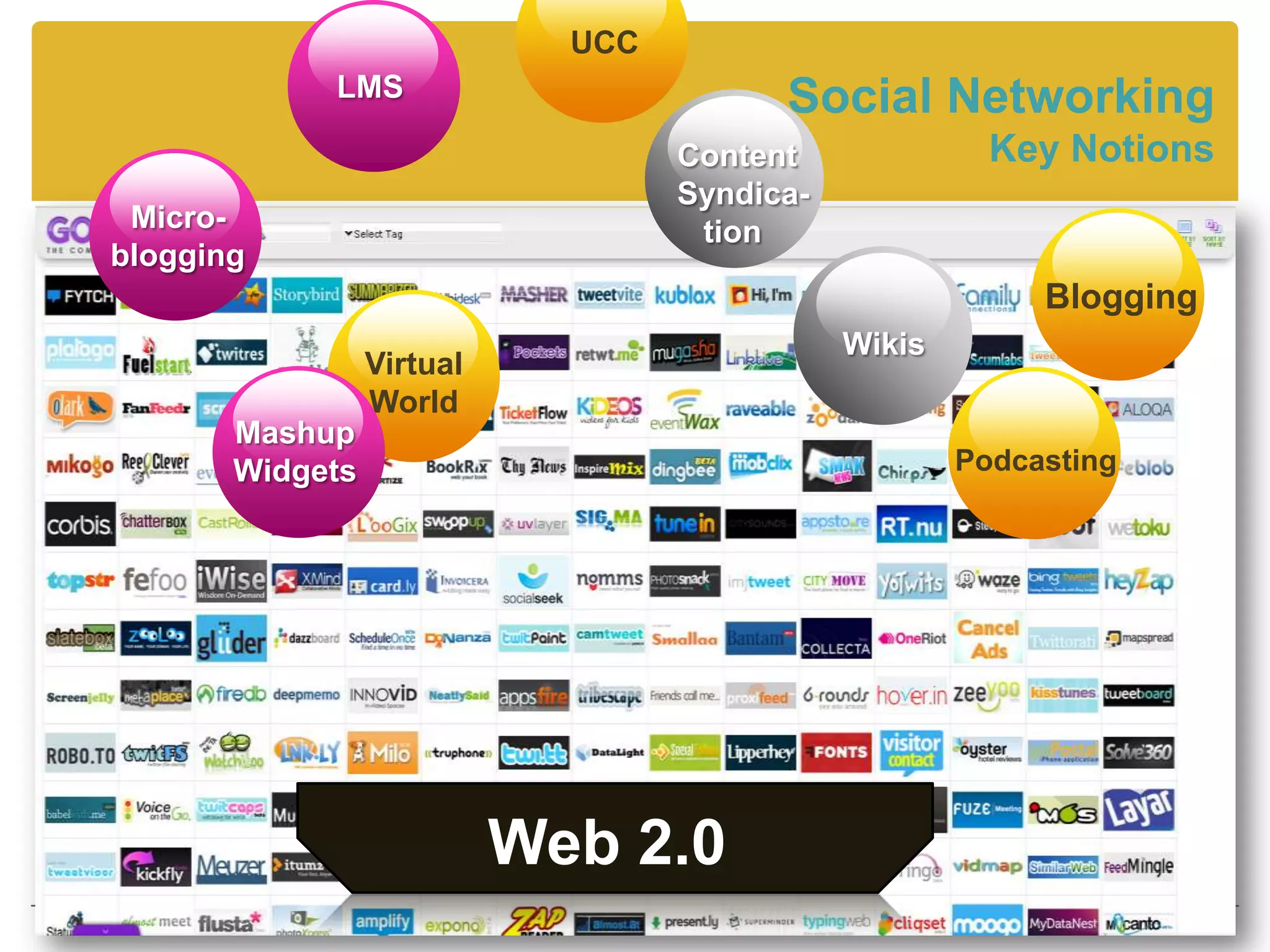
UCC
            LMS                          Social Networking
                                   Content              Key Notions
                                   Syndica-
 Micro-                             tion
blogging
                                                           Blogging
                                              Wikis
                 Virtual
                 World
       Mashup
       Widgets                                        Podcasting


                           Web 2.0
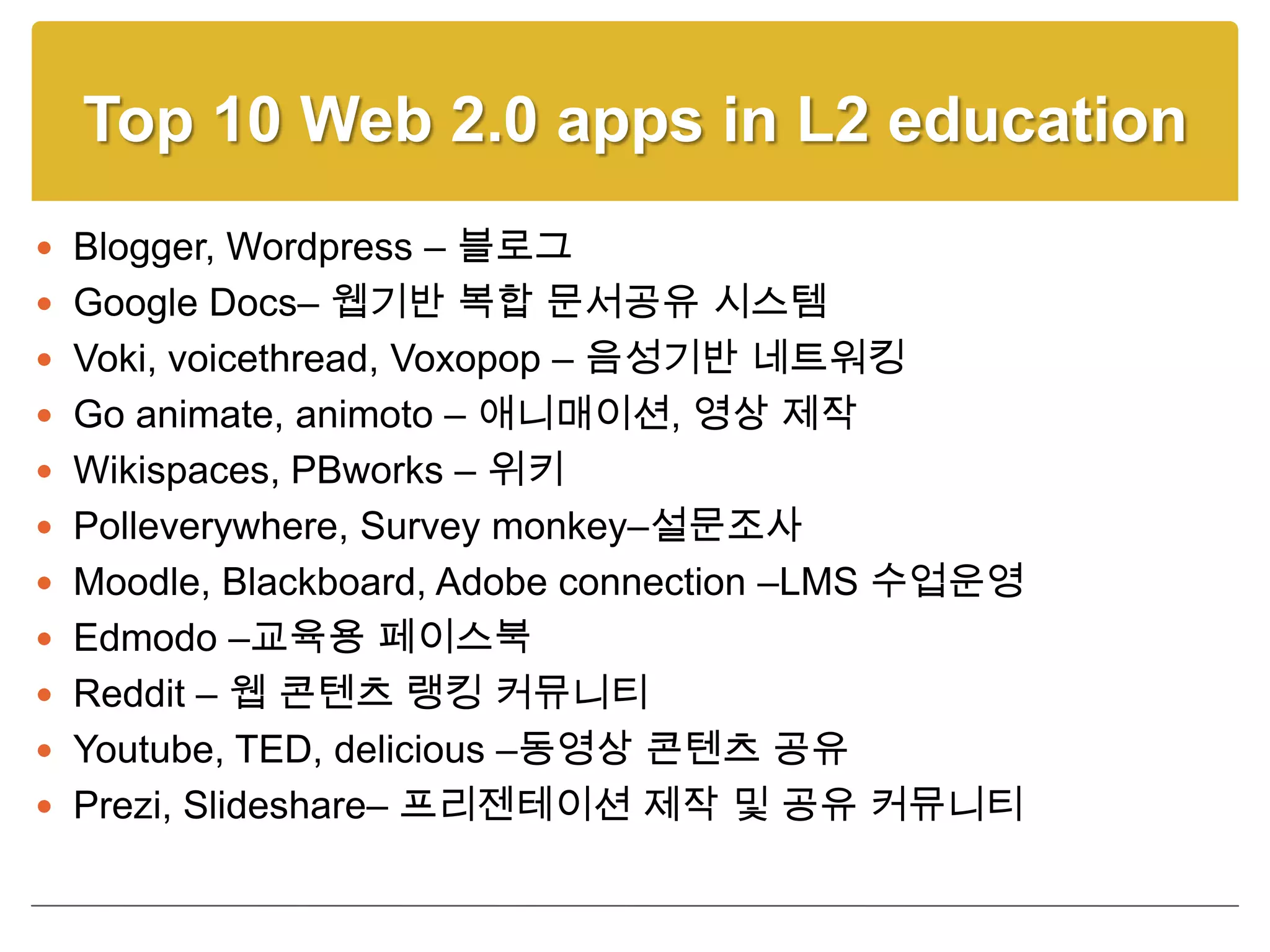
Top 10 Web 2.0 apps in L2 education
 Blogger, Wordpress – 블로그
 Google Docs– 웹기반 복합 문서공유 시스템
 Voki, voicethread, Voxopop – 음성기반 네트워킹
 Go animate, animoto – 애니매이션, 영상 제작
 Wikispaces, PBworks – 위키
 Polleverywhere, Survey monkey–설문조사
 Moodle, Blackboard, Adobe connection –LMS 수업운영
 Edmodo –교육용 페이스북
 Reddit – 웹 콘텐츠 랭킹 커뮤니티
 Youtube, TED, delicious –동영상 콘텐츠 공유
 Prezi, Slideshare– 프리젠테이션 제작 및 공유 커뮤니티
What is Web 2.0?

 Coined in 2003 by O'Reilly Media Inc., publishers of
  technology-related books

 The emergence of a set of applications on the web which
  facilitate a more socially connected web where everyone is
  able to add to and edit information online (Anderson 2007).

 Key Characteristics
   Power to the user (from editor, publisher)
   Harnessing collective intelligence (O'Reilly, 2005)
   "Web as a platform" (O'Reilly, 2005)
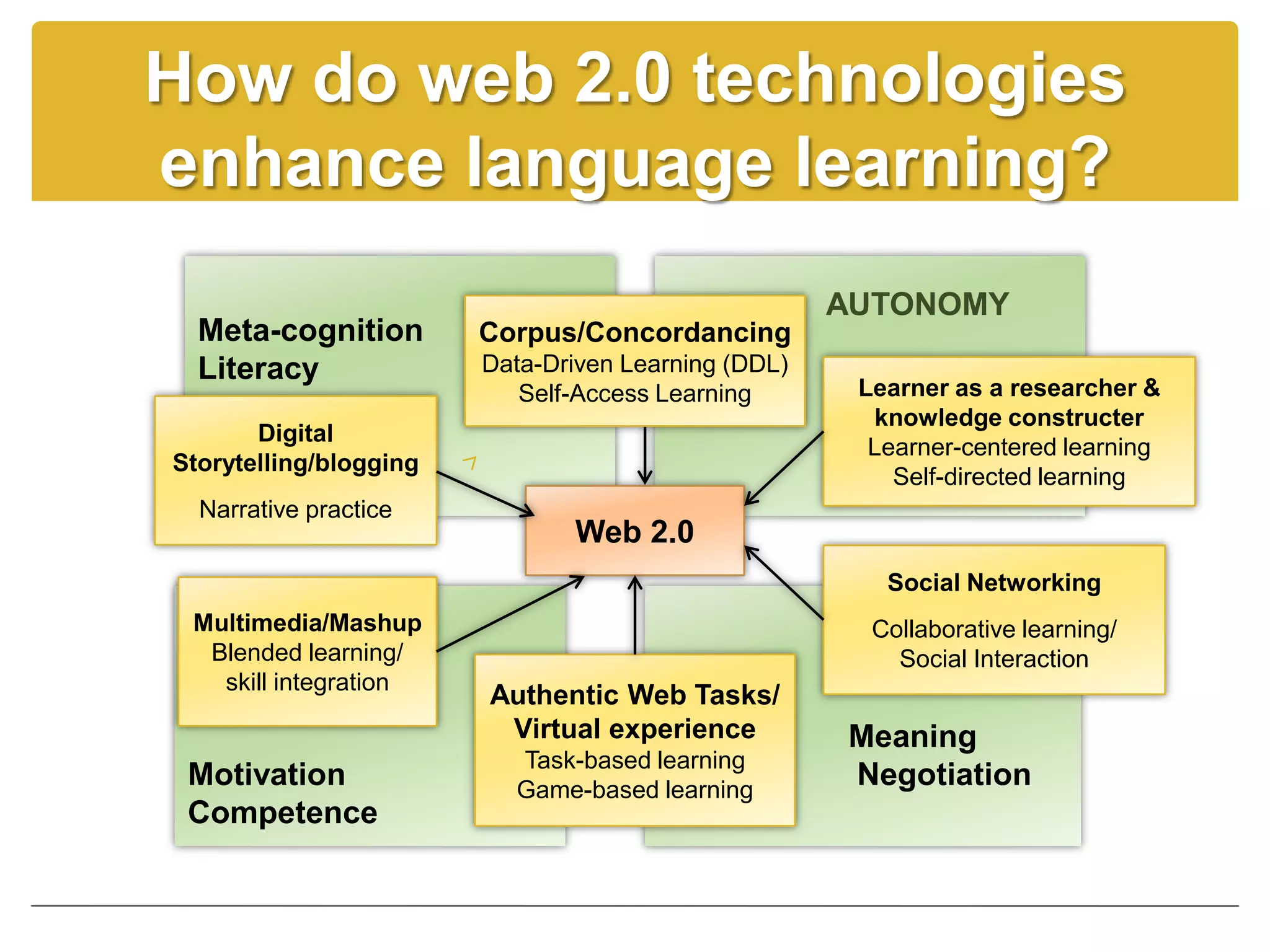
How do web 2.0 technologies
enhance language learning?
                                                     AUTONOMY
  Meta-cognition        Corpus/Concordancing
  Literacy              Data-Driven Learning (DDL)
                           Self-Access Learning       Learner as a researcher &
                                                       knowledge constructer
       Digital
                                                       Learner-centered learning
Storytelling/blogging
                                                         Self-directed learning
  Narrative practice
                               Web 2.0
                                                        Social Networking
 Multimedia/Mashup                                     Collaborative learning/
  Blended learning/                                      Social Interaction
   skill integration
                        Authentic Web Tasks/
                         Virtual experience          Meaning
                          Task-based learning
 Motivation               Game-based learning
                                                     Negotiation
 Competence
I. Data-Driven Learning
     and Autonomy
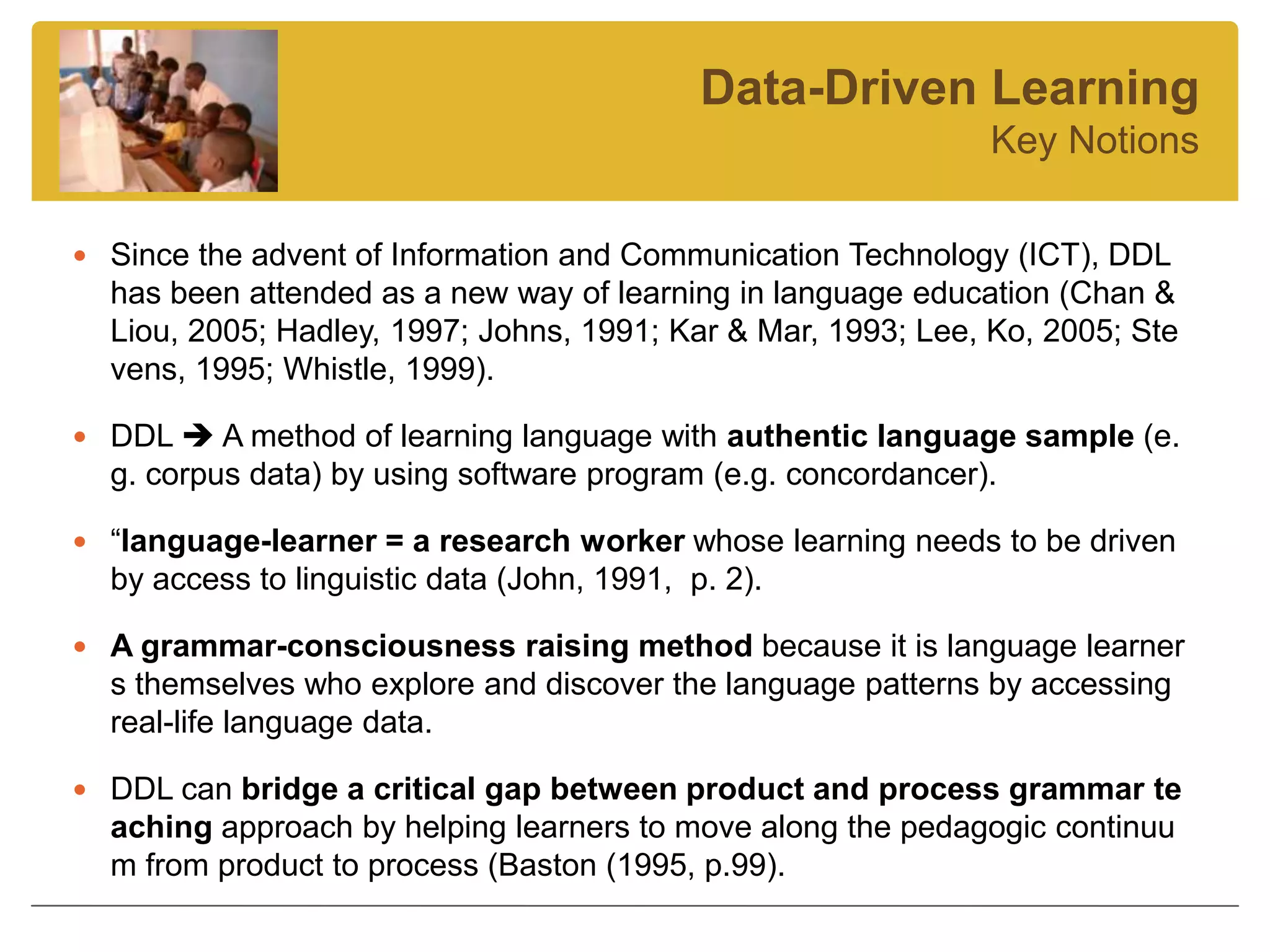
Data-Driven Learning
                                                               Key Notions

 Since the advent of Information and Communication Technology (ICT), DDL
  has been attended as a new way of learning in language education (Chan &
  Liou, 2005; Hadley, 1997; Johns, 1991; Kar & Mar, 1993; Lee, Ko, 2005; Ste
  vens, 1995; Whistle, 1999).

 DDL  A method of learning language with authentic language sample (e.
  g. corpus data) by using software program (e.g. concordancer).

 “language-learner = a research worker whose learning needs to be driven
  by access to linguistic data (John, 1991, p. 2).

 A grammar-consciousness raising method because it is language learner
  s themselves who explore and discover the language patterns by accessing
  real-life language data.

 DDL can bridge a critical gap between product and process grammar te
  aching approach by helping learners to move along the pedagogic continuu
  m from product to process (Baston (1995, p.99).
Data-Driven Learning
                                                                                   Book Reviews

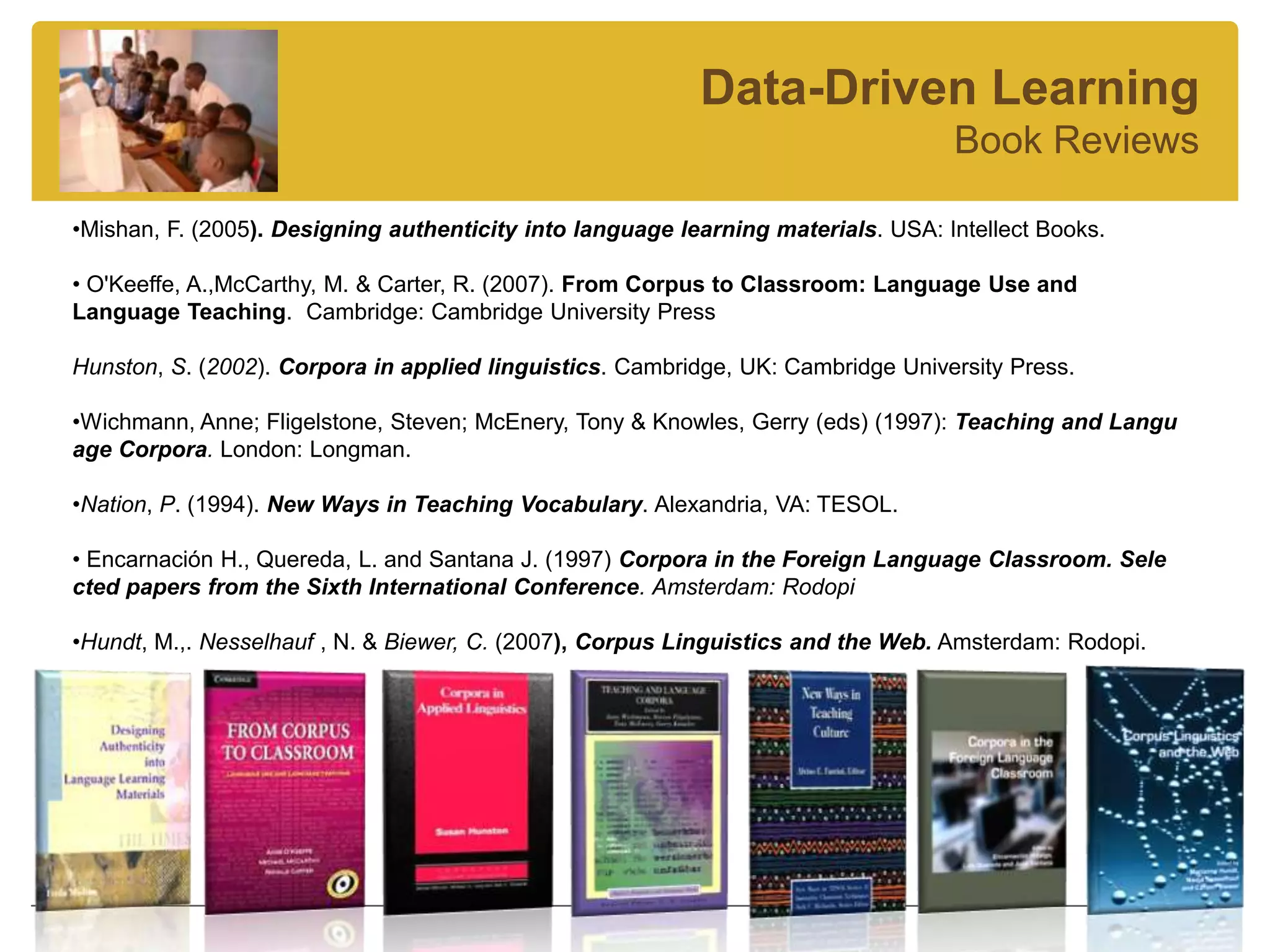
•Mishan, F. (2005). Designing authenticity into language learning materials. USA: Intellect Books.

• O'Keeffe, A.,McCarthy, M. & Carter, R. (2007). From Corpus to Classroom: Language Use and
Language Teaching. Cambridge: Cambridge University Press

Hunston, S. (2002). Corpora in applied linguistics. Cambridge, UK: Cambridge University Press.

•Wichmann, Anne; Fligelstone, Steven; McEnery, Tony & Knowles, Gerry (eds) (1997): Teaching and Langu
age Corpora. London: Longman.

•Nation, P. (1994). New Ways in Teaching Vocabulary. Alexandria, VA: TESOL.

• Encarnación H., Quereda, L. and Santana J. (1997) Corpora in the Foreign Language Classroom. Sele
cted papers from the Sixth International Conference. Amsterdam: Rodopi

•Hundt, M.,. Nesselhauf , N. & Biewer, C. (2007), Corpus Linguistics and the Web. Amsterdam: Rodopi.
Corpus-based CALL studies

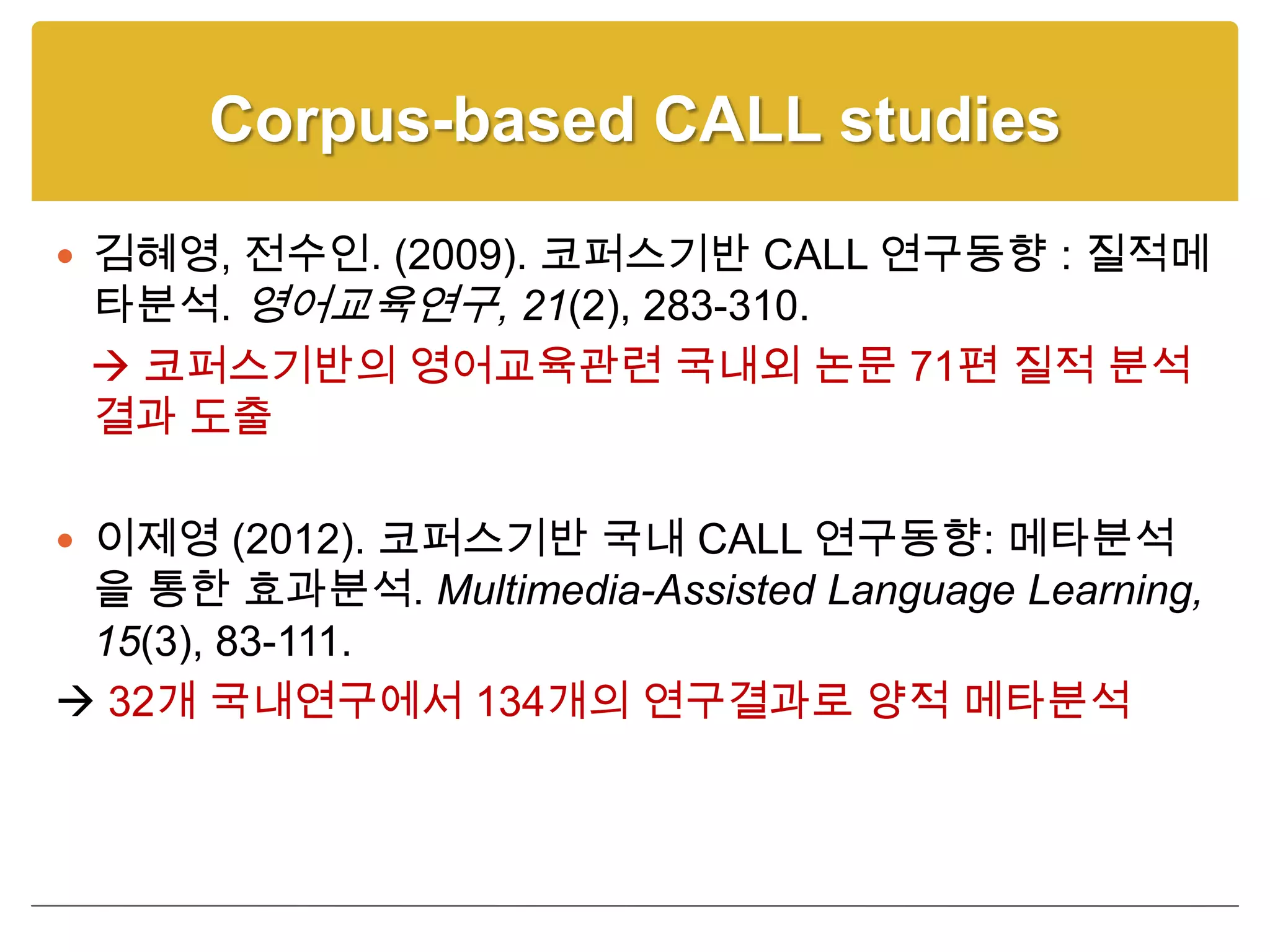
 김혜영, 전수인. (2009). 코퍼스기반 CALL 연구동향 : 질적메
 타분석. 영어교육연구, 21(2), 283-310.
  코퍼스기반의 영어교육관련 국내외 논문 71편 질적 분석
 결과 도출

 이제영 (2012). 코퍼스기반 국내 CALL 연구동향: 메타분석
 을 통한 효과분석. Multimedia-Assisted Language Learning,
 15(3), 83-111.
 32개 국내연구에서 134개의 연구결과로 양적 메타분석
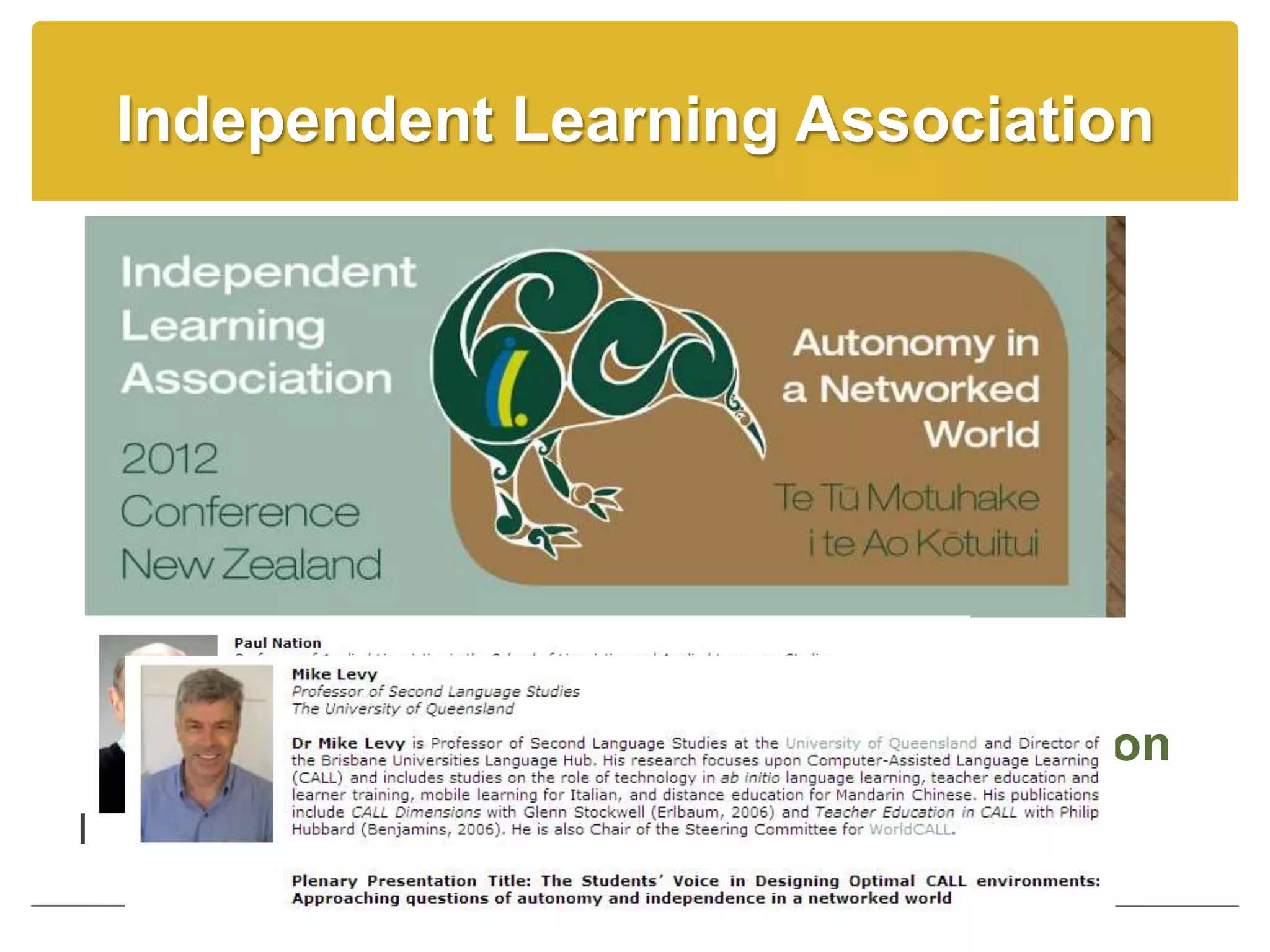
Independent Learning Association


                     Self-directed Learning
    Self-Access
          Autonomy      Reflection and Narration
Motivation and Independence
II. Social Networking
& Computer-mediated
communication(CMC)
Social Networking
                                                                             Key Notions
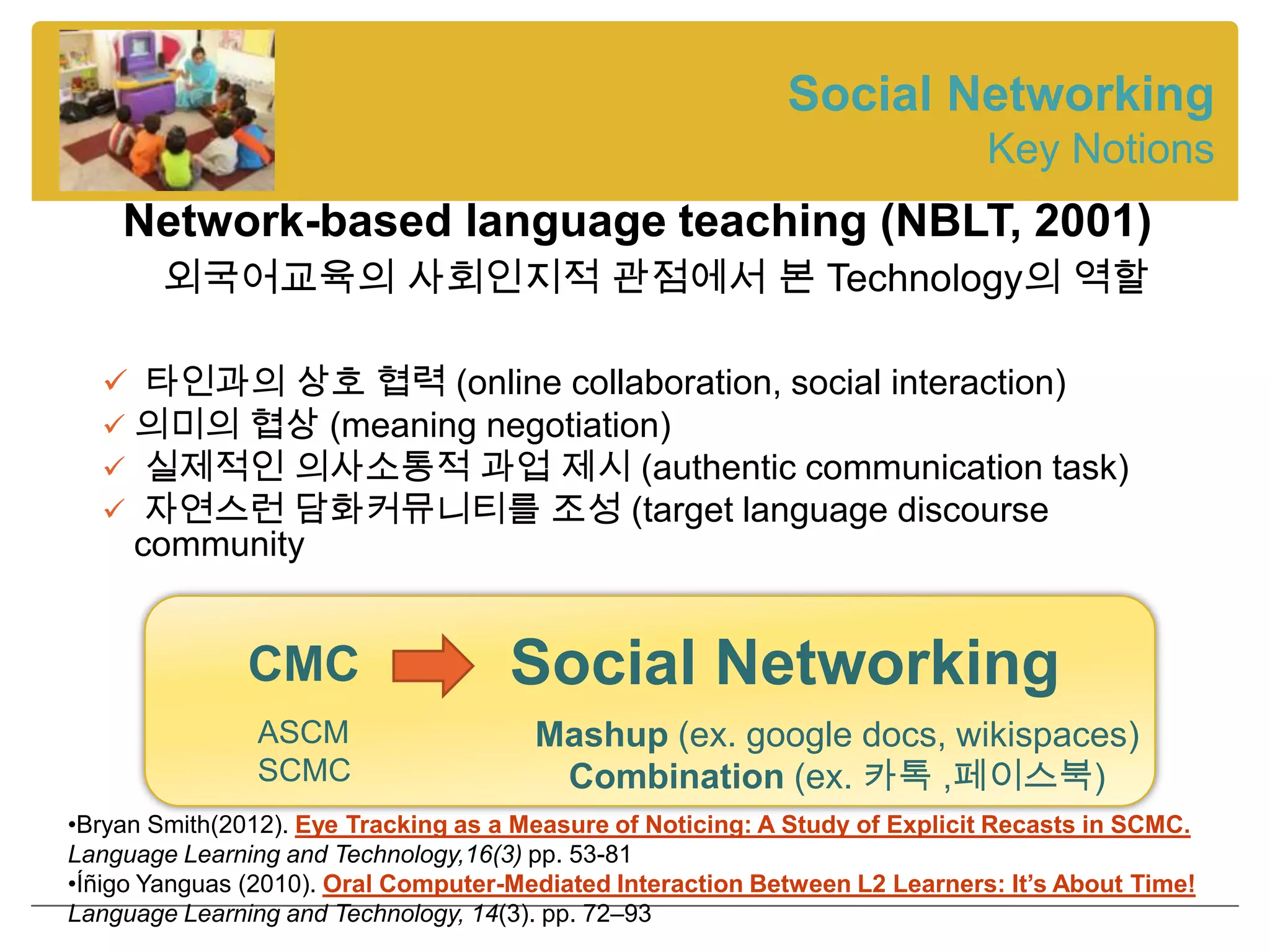
    Network-based language teaching (NBLT, 2001)
        외국어교육의 사회인지적 관점에서 본 Technology의 역할

   타인과의 상호 협력 (online collaboration, social interaction)
   의미의 협상 (meaning negotiation)
   실제적인 의사소통적 과업 제시 (authentic communication task)
   자연스런 담화커뮤니티를 조성 (target language discourse
     community


               CMC                   Social Networking
               ASCM                    Mashup (ex. google docs, wikispaces)
               SCMC                     Combination (ex. 카톡 ,페이스북)
•Bryan Smith(2012). Eye Tracking as a Measure of Noticing: A Study of Explicit Recasts in SCMC.
Language Learning and Technology,16(3) pp. 53-81
•Íñigo Yanguas (2010). Oral Computer-Mediated Interaction Between L2 Learners: It’s About Time!
Language Learning and Technology, 14(3). pp. 72–93
Social Networking
                                                                          Book Review

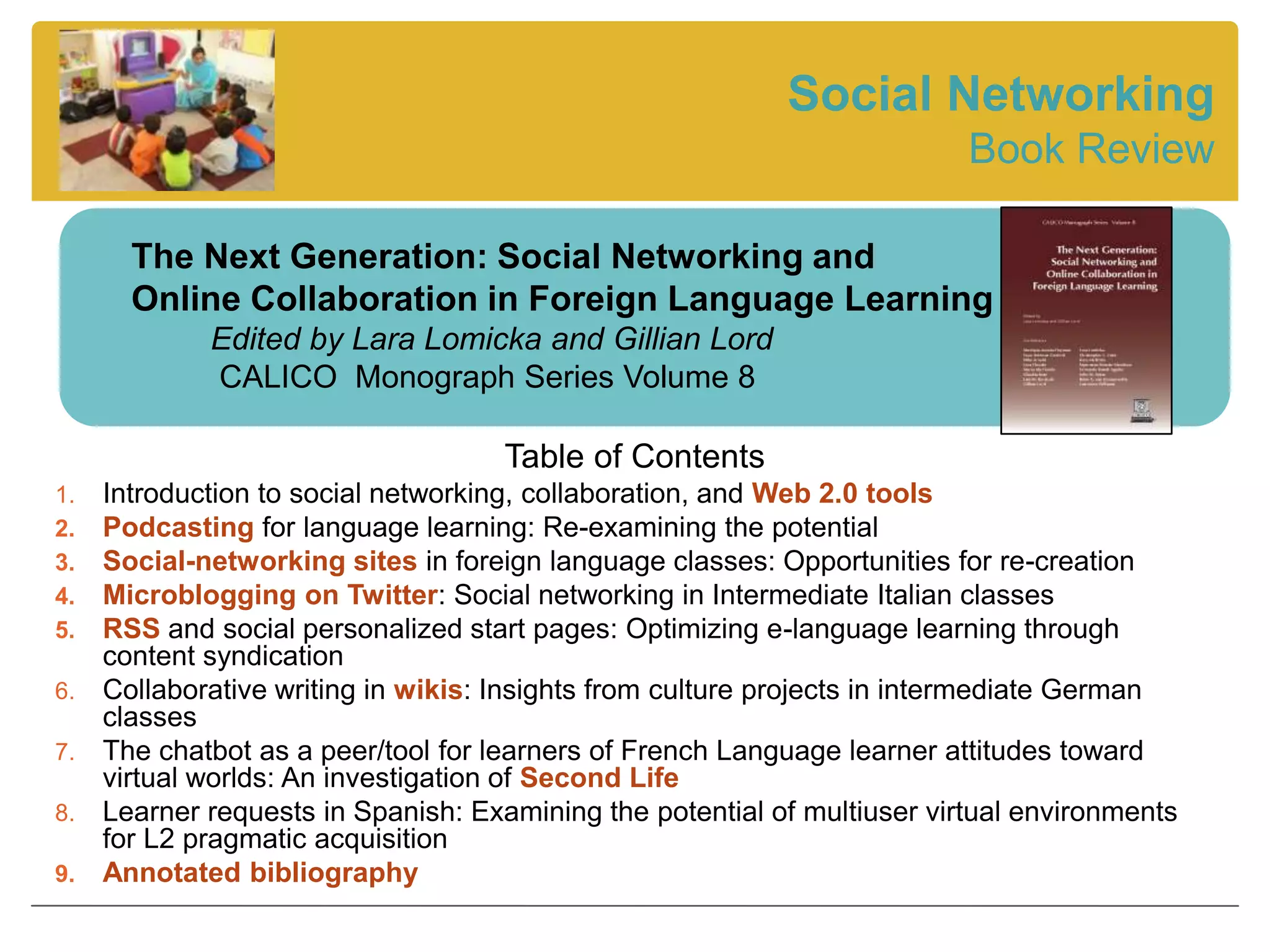
       The Next Generation: Social Networking and
       Online Collaboration in Foreign Language Learning
             Edited by Lara Lomicka and Gillian Lord
             CALICO Monograph Series Volume 8

                                     Table of Contents
1.   Introduction to social networking, collaboration, and Web 2.0 tools
2.   Podcasting for language learning: Re-examining the potential
3.   Social-networking sites in foreign language classes: Opportunities for re-creation
4.   Microblogging on Twitter: Social networking in Intermediate Italian classes
5.   RSS and social personalized start pages: Optimizing e-language learning through
     content syndication
6.   Collaborative writing in wikis: Insights from culture projects in intermediate German
     classes
7.   The chatbot as a peer/tool for learners of French Language learner attitudes toward
     virtual worlds: An investigation of Second Life
8.   Learner requests in Spanish: Examining the potential of multiuser virtual environments
     for L2 pragmatic acquisition
9.   Annotated bibliography
Social Networking
                                                                               Book Review

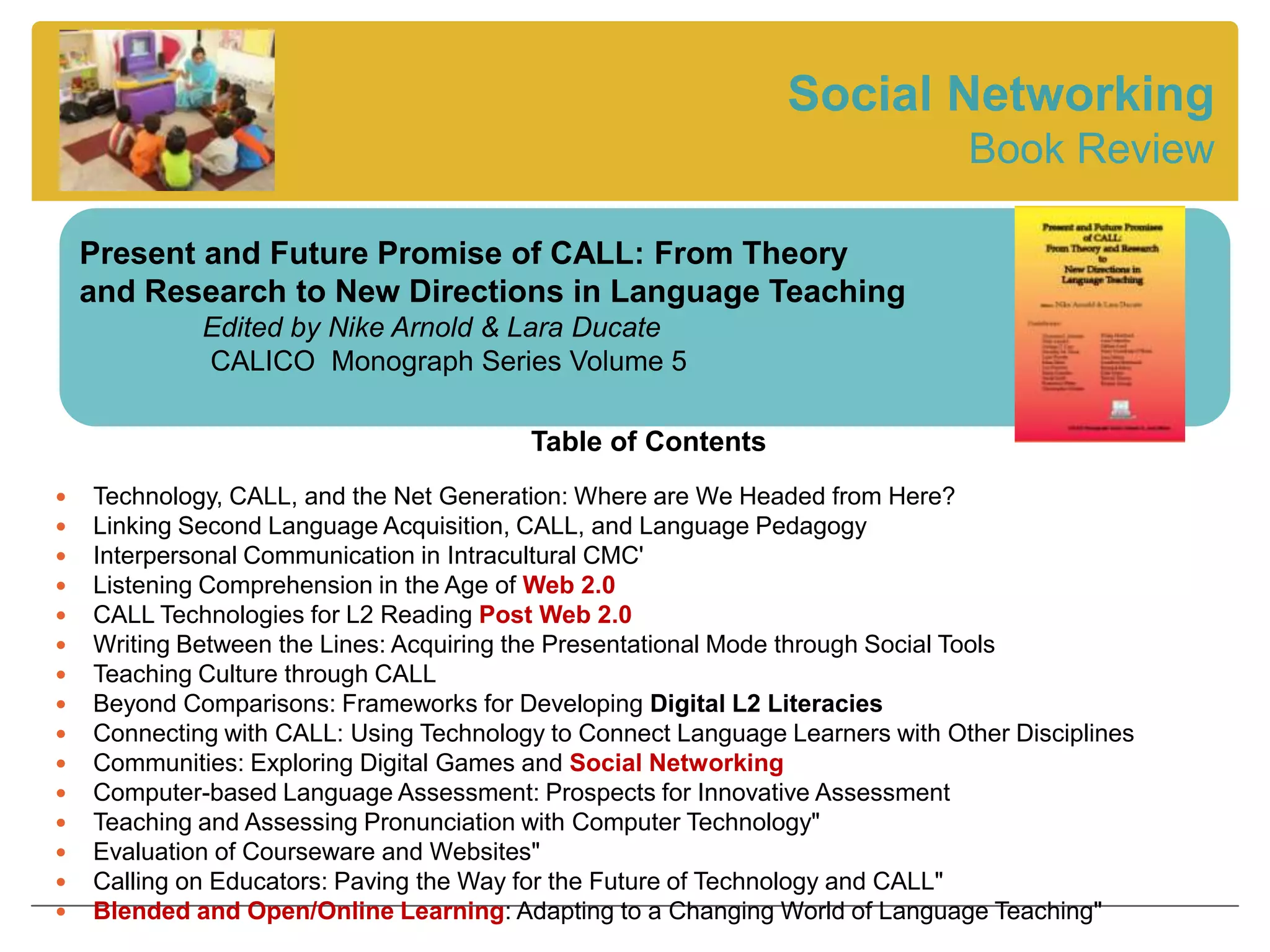
    Present and Future Promise of CALL: From Theory
    and Research to New Directions in Language Teaching
             Edited by Nike Arnold & Lara Ducate
             CALICO Monograph Series Volume 5

                                         Table of Contents
   Technology, CALL, and the Net Generation: Where are We Headed from Here?
   Linking Second Language Acquisition, CALL, and Language Pedagogy
   Interpersonal Communication in Intracultural CMC'
   Listening Comprehension in the Age of Web 2.0
   CALL Technologies for L2 Reading Post Web 2.0
   Writing Between the Lines: Acquiring the Presentational Mode through Social Tools
   Teaching Culture through CALL
   Beyond Comparisons: Frameworks for Developing Digital L2 Literacies
   Connecting with CALL: Using Technology to Connect Language Learners with Other Disciplines
   Communities: Exploring Digital Games and Social Networking
   Computer-based Language Assessment: Prospects for Innovative Assessment
   Teaching and Assessing Pronunciation with Computer Technology"
   Evaluation of Courseware and Websites"
   Calling on Educators: Paving the Way for the Future of Technology and CALL"
   Blended and Open/Online Learning: Adapting to a Changing World of Language Teaching"
Social Networking
                                                         Book Review

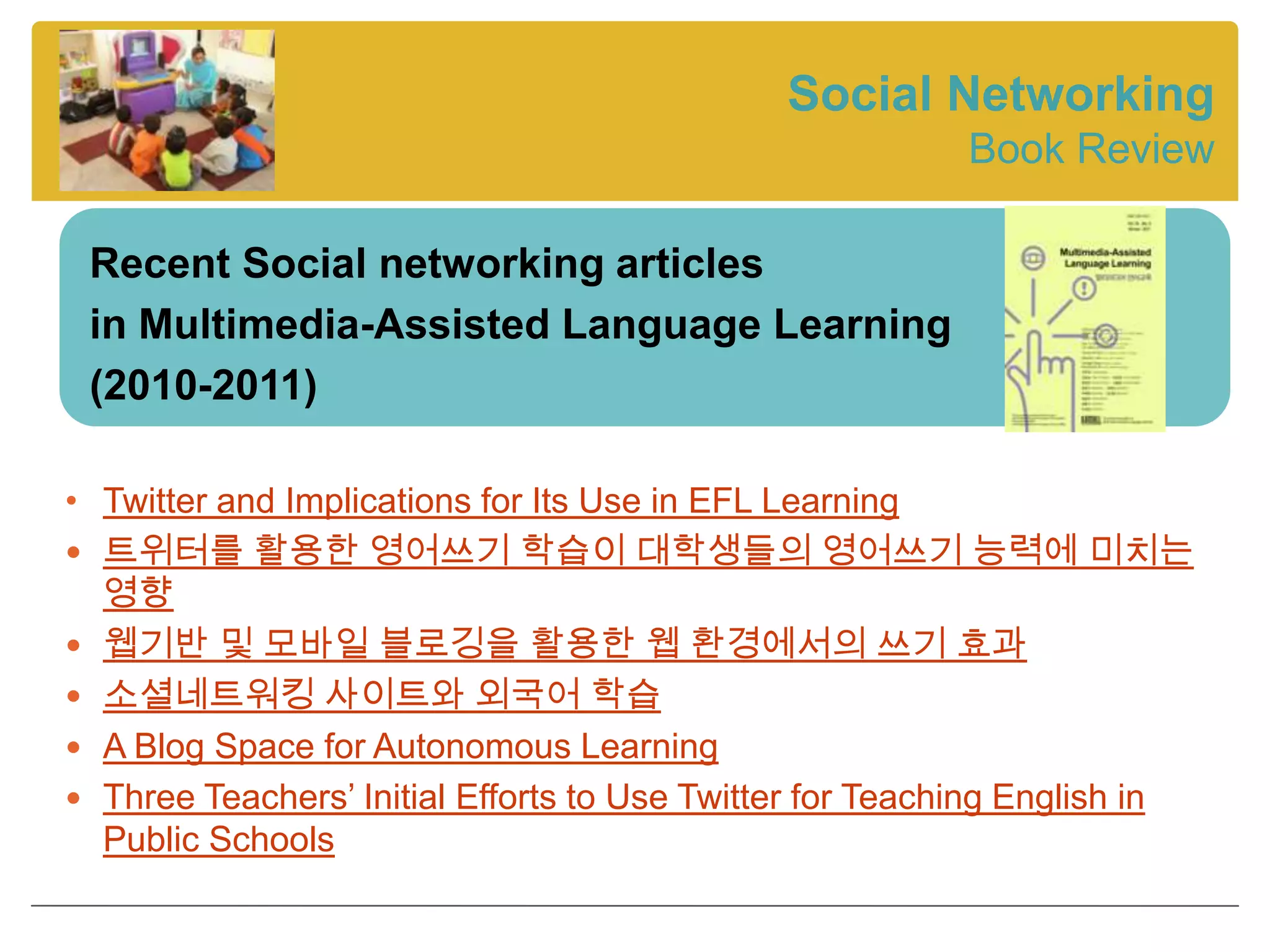
 Recent Social networking articles
 in Multimedia-Assisted Language Learning
 (2010-2011)

• Twitter and Implications for Its Use in EFL Learning
 트위터를 활용한 영어쓰기 학습이 대학생들의 영어쓰기 능력에 미치는
  영향
 웹기반 및 모바일 블로깅을 활용한 웹 환경에서의 쓰기 효과
 소셜네트워킹 사이트와 외국어 학습
 A Blog Space for Autonomous Learning
 Three Teachers’ Initial Efforts to Use Twitter for Teaching English in
  Public Schools
III. Virtual Word, Mashup,
    and Authentic Tasks
Online Tasks
                                            Key Notion

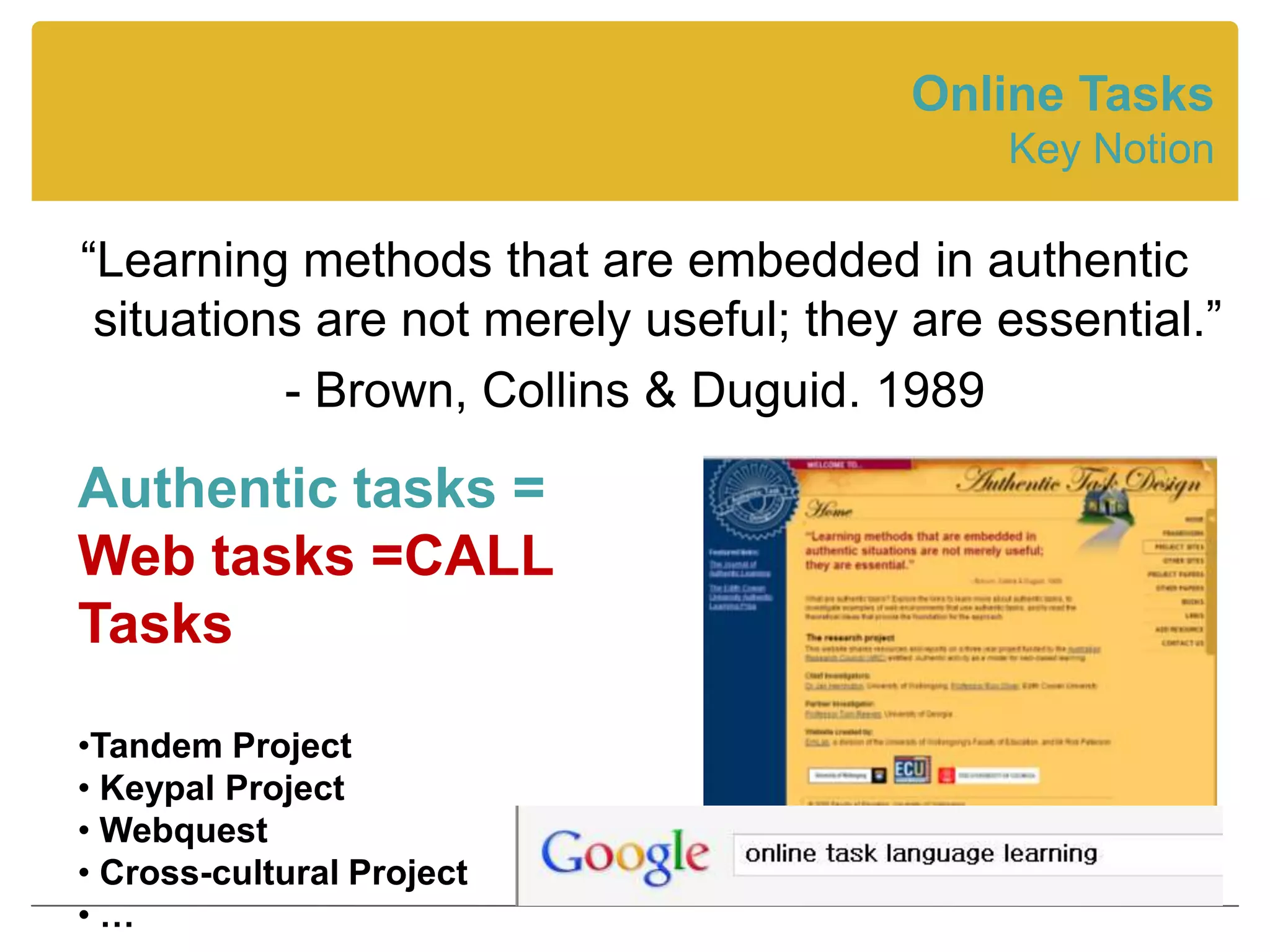
“Learning methods that are embedded in authentic
 situations are not merely useful; they are essential.”
          - Brown, Collins & Duguid. 1989

Authentic tasks =
Web tasks =CALL
Tasks

•Tandem Project
• Keypal Project
• Webquest
• Cross-cultural Project
•…
Virtual Experience, Games

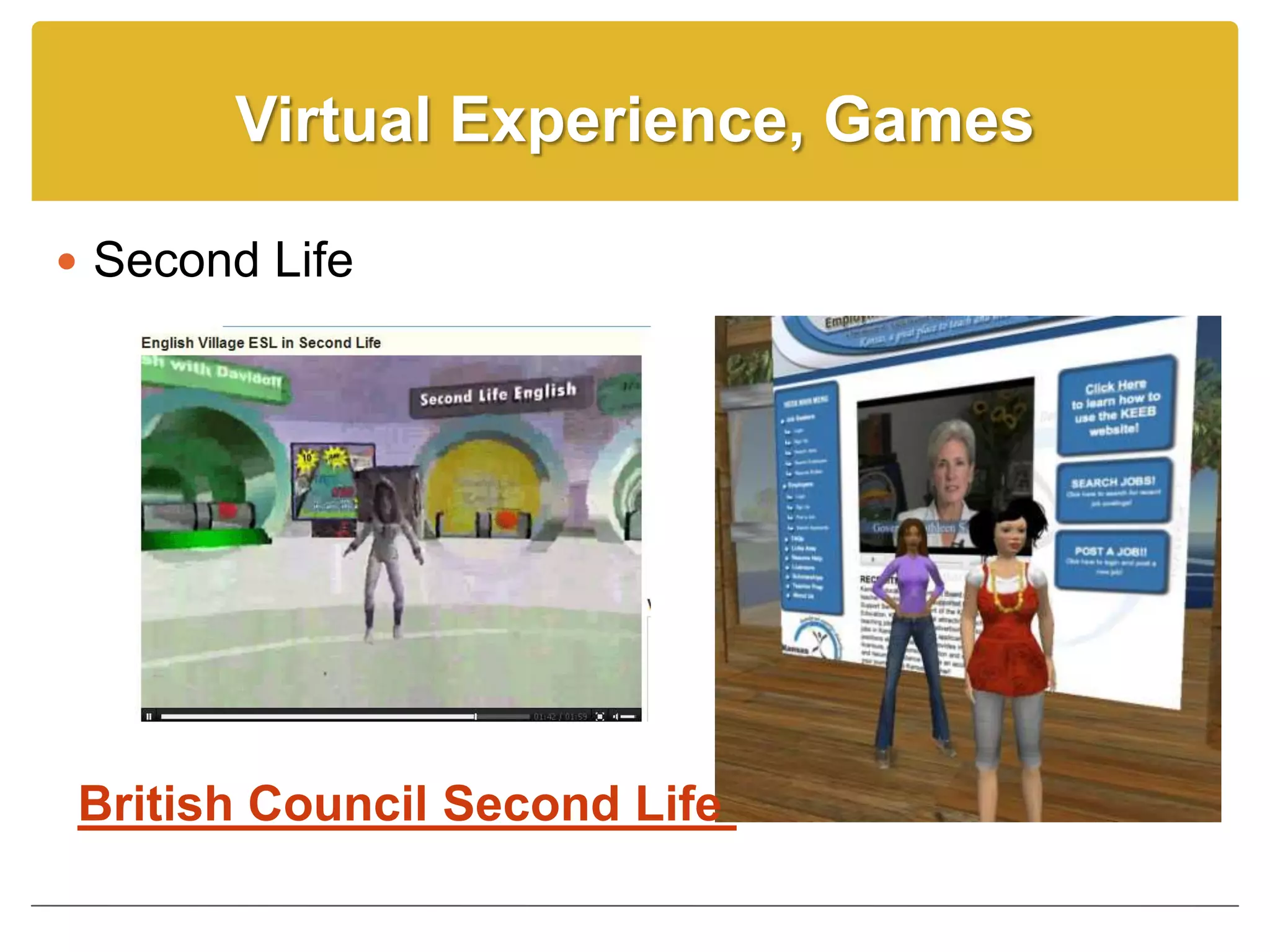
 Second Life


British Council Second Life
Virtual Experience, Games
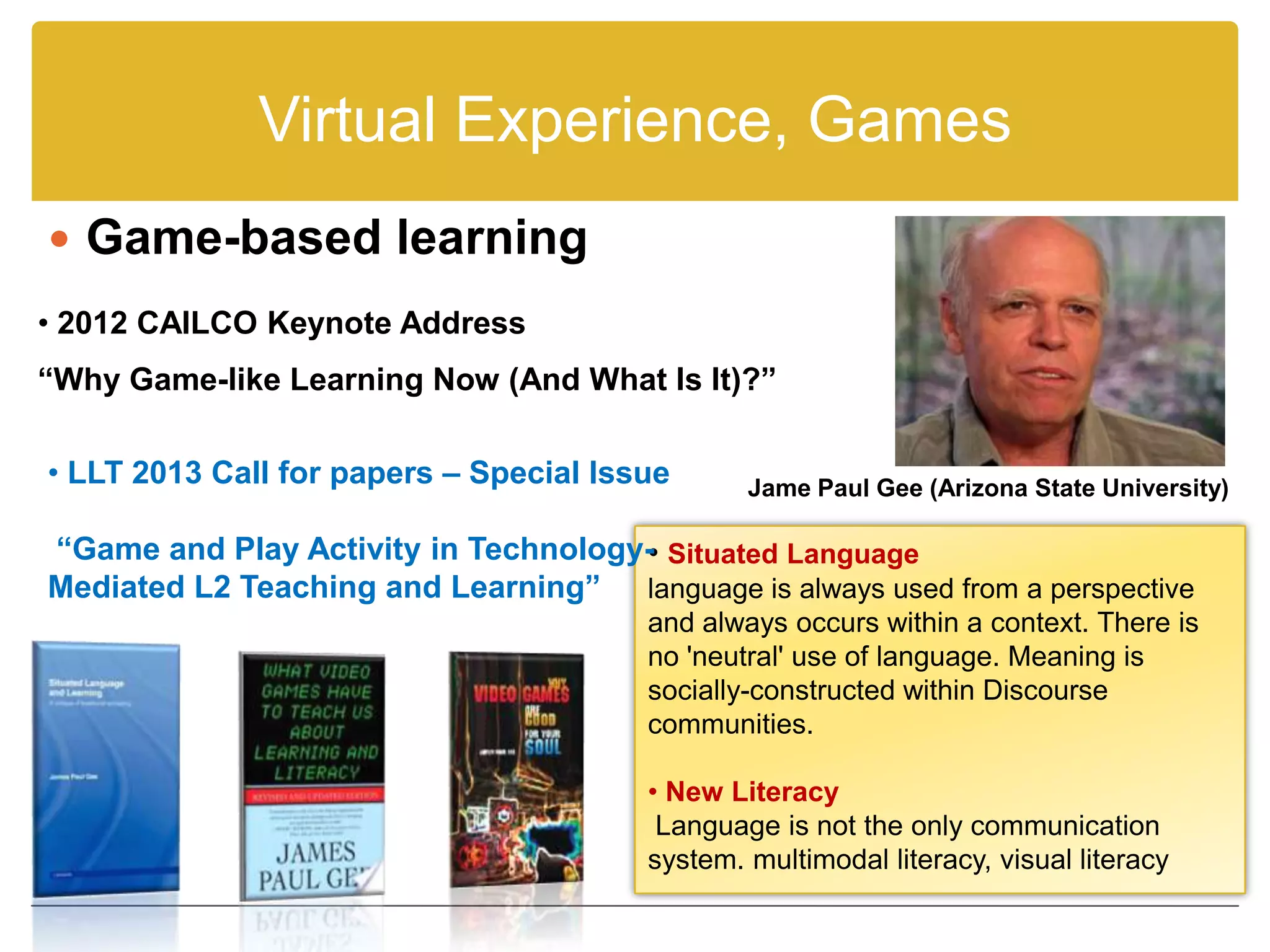
 Game-based learning
• 2012 CAILCO Keynote Address
“Why Game-like Learning Now (And What Is It)?”

• LLT 2013 Call for papers – Special Issue      Jame Paul Gee (Arizona State University)

“Game and Play Activity in Technology- Situated Language
                                     •
Mediated L2 Teaching and Learning” language is always used from a perspective
                                        and always occurs within a context. There is
                                        no 'neutral' use of language. Meaning is
                                        socially-constructed within Discourse
                                        communities.

                                        • New Literacy
                                         Language is not the only communication
                                        system. multimodal literacy, visual literacy
Mashup, Multimedia

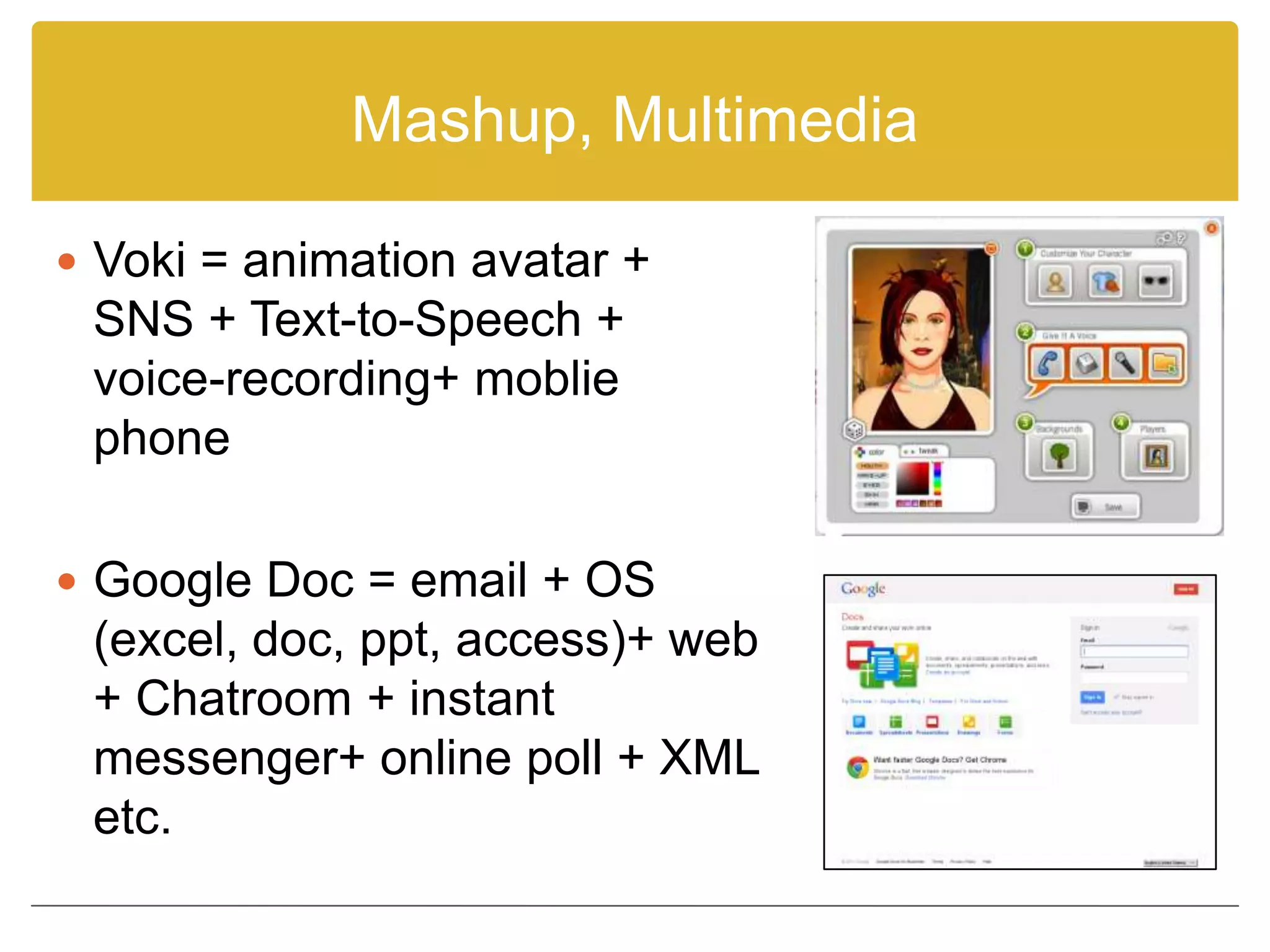
 Voki = animation avatar +
 SNS + Text-to-Speech +
 voice-recording+ moblie
 phone

 Google Doc = email + OS
 (excel, doc, ppt, access)+ web
 + Chatroom + instant
 messenger+ online poll + XML
 etc.
IV. Digital Storytelling &
    Narrative Practice
DS is evolution of narrative writing
 where multimedia tools are used to
 enhance a story, critical
 thinking, and media literacy
 (Ohler , 2005; 2006)


‘Meaning-making’ through
  visual/verbal synergy
     (Royce, 2002),
   Synaesthetic semiosis (Kress, 1998, 2003)

DS affects the author’s voice and DS reflect cultural, social, and
   intention (Nelson, 2006).     diverse values (Shin &
                                Cimasko, 2008).
Digital Storytelling References

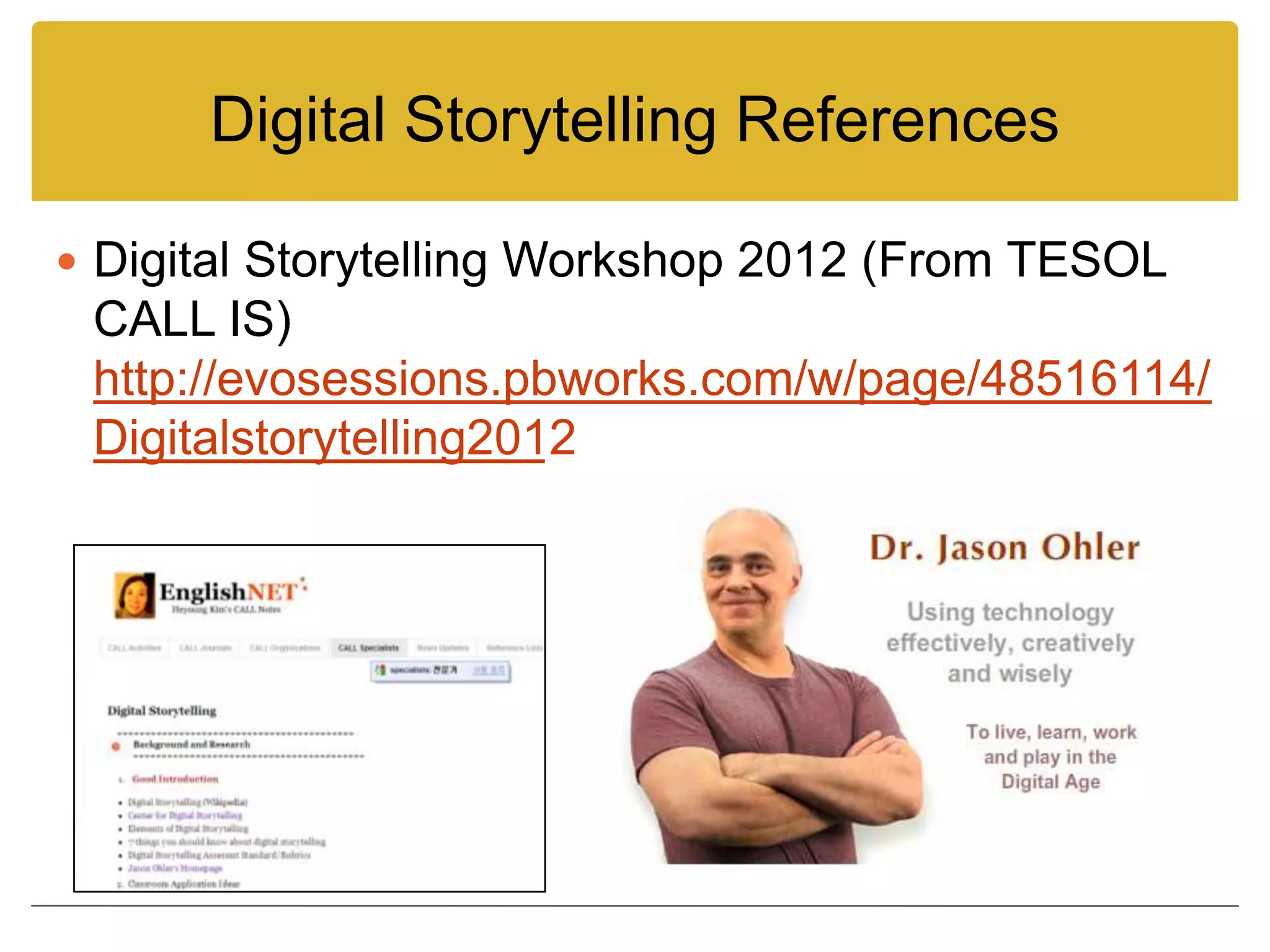
 Digital Storytelling Workshop 2012 (From TESOL
 CALL IS)
 http://evosessions.pbworks.com/w/page/48516114/
 Digitalstorytelling2012
Call Related Journals
   & Conferences
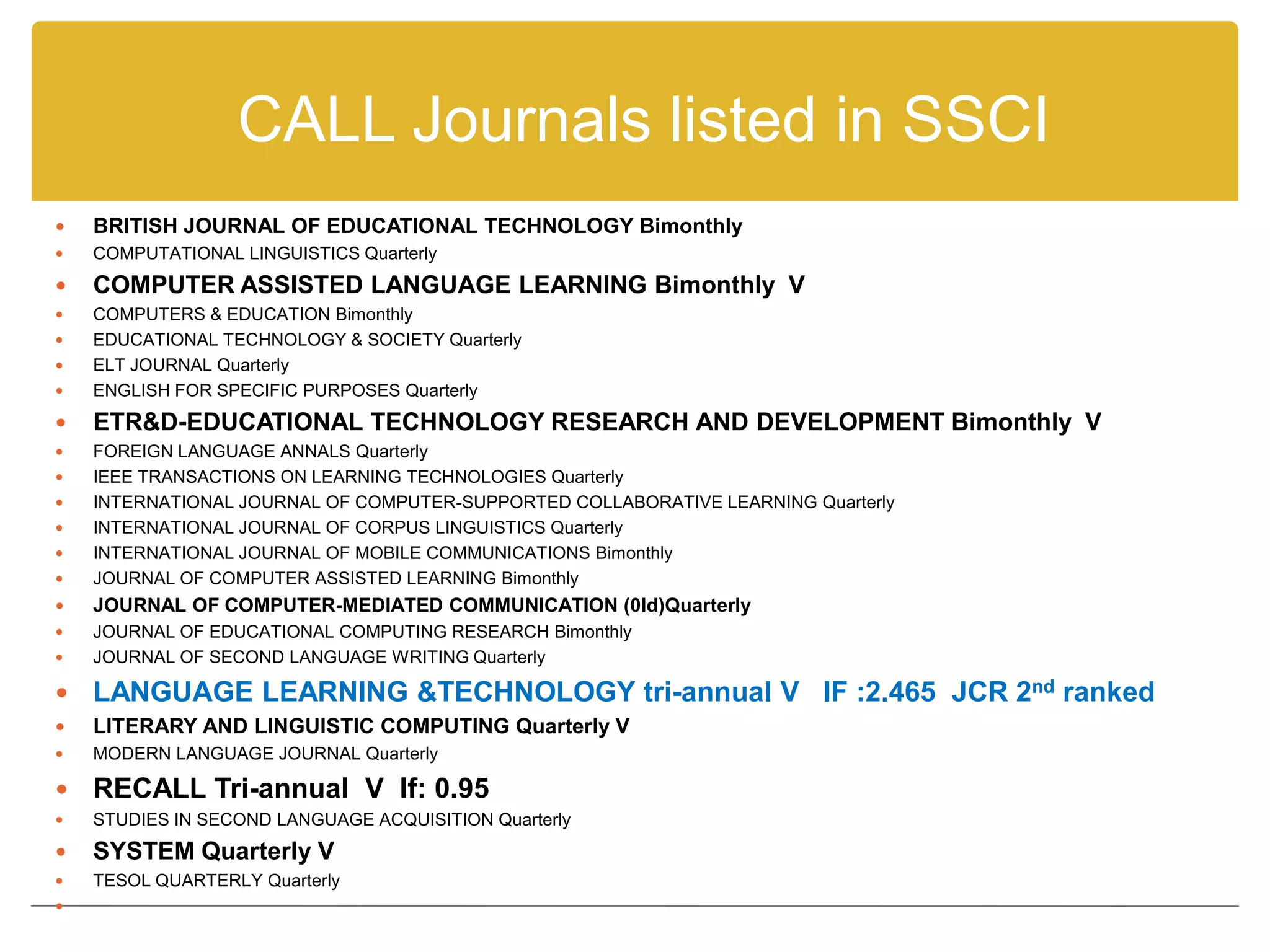
CALL Journals listed in SSCI
   BRITISH JOURNAL OF EDUCATIONAL TECHNOLOGY Bimonthly
   COMPUTATIONAL LINGUISTICS Quarterly
   COMPUTER ASSISTED LANGUAGE LEARNING Bimonthly V
   COMPUTERS & EDUCATION Bimonthly
   EDUCATIONAL TECHNOLOGY & SOCIETY Quarterly
   ELT JOURNAL Quarterly
   ENGLISH FOR SPECIFIC PURPOSES Quarterly
   ETR&D-EDUCATIONAL TECHNOLOGY RESEARCH AND DEVELOPMENT Bimonthly V
   FOREIGN LANGUAGE ANNALS Quarterly
   IEEE TRANSACTIONS ON LEARNING TECHNOLOGIES Quarterly
   INTERNATIONAL JOURNAL OF COMPUTER-SUPPORTED COLLABORATIVE LEARNING Quarterly
   INTERNATIONAL JOURNAL OF CORPUS LINGUISTICS Quarterly
   INTERNATIONAL JOURNAL OF MOBILE COMMUNICATIONS Bimonthly
   JOURNAL OF COMPUTER ASSISTED LEARNING Bimonthly
   JOURNAL OF COMPUTER-MEDIATED COMMUNICATION (0ld)Quarterly
   JOURNAL OF EDUCATIONAL COMPUTING RESEARCH Bimonthly
   JOURNAL OF SECOND LANGUAGE WRITING Quarterly

   LANGUAGE LEARNING &TECHNOLOGY tri-annual V IF :2.465 JCR 2nd ranked
   LITERARY AND LINGUISTIC COMPUTING Quarterly V
   MODERN LANGUAGE JOURNAL Quarterly

   RECALL Tri-annual V If: 0.95
   STUDIES IN SECOND LANGUAGE ACQUISITION Quarterly
   SYSTEM Quarterly V
   TESOL QUARTERLY Quarterly

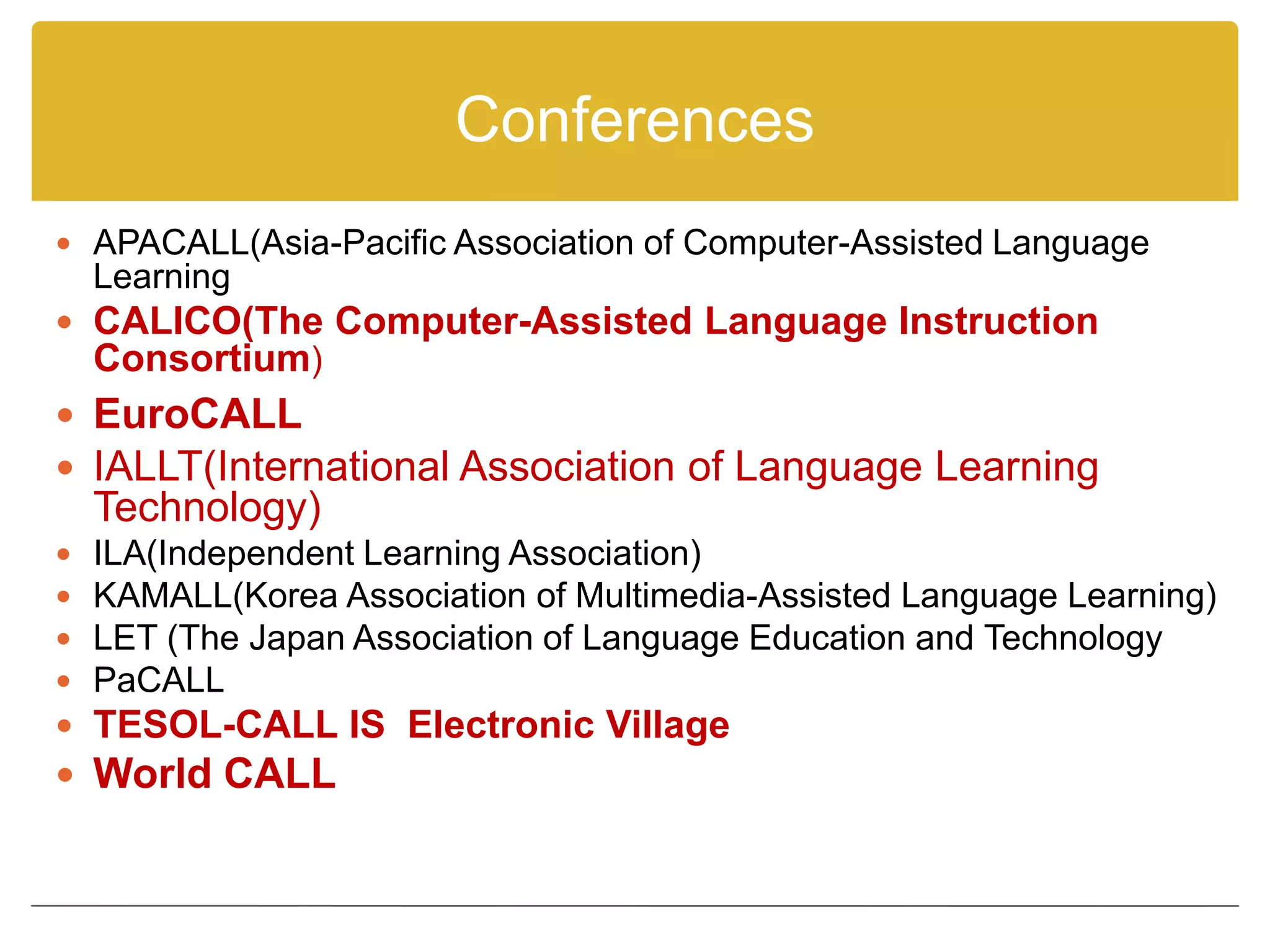
Conferences
 APACALL(Asia-Pacific Association of Computer-Assisted Language
    Learning
 CALICO(The Computer-Assisted Language Instruction
    Consortium)
 EuroCALL
 IALLT(International Association of Language Learning
    Technology)
   ILA(Independent Learning Association)
   KAMALL(Korea Association of Multimedia-Assisted Language Learning)
   LET (The Japan Association of Language Education and Technology
   PaCALL
 TESOL-CALL IS Electronic Village
 World CALL
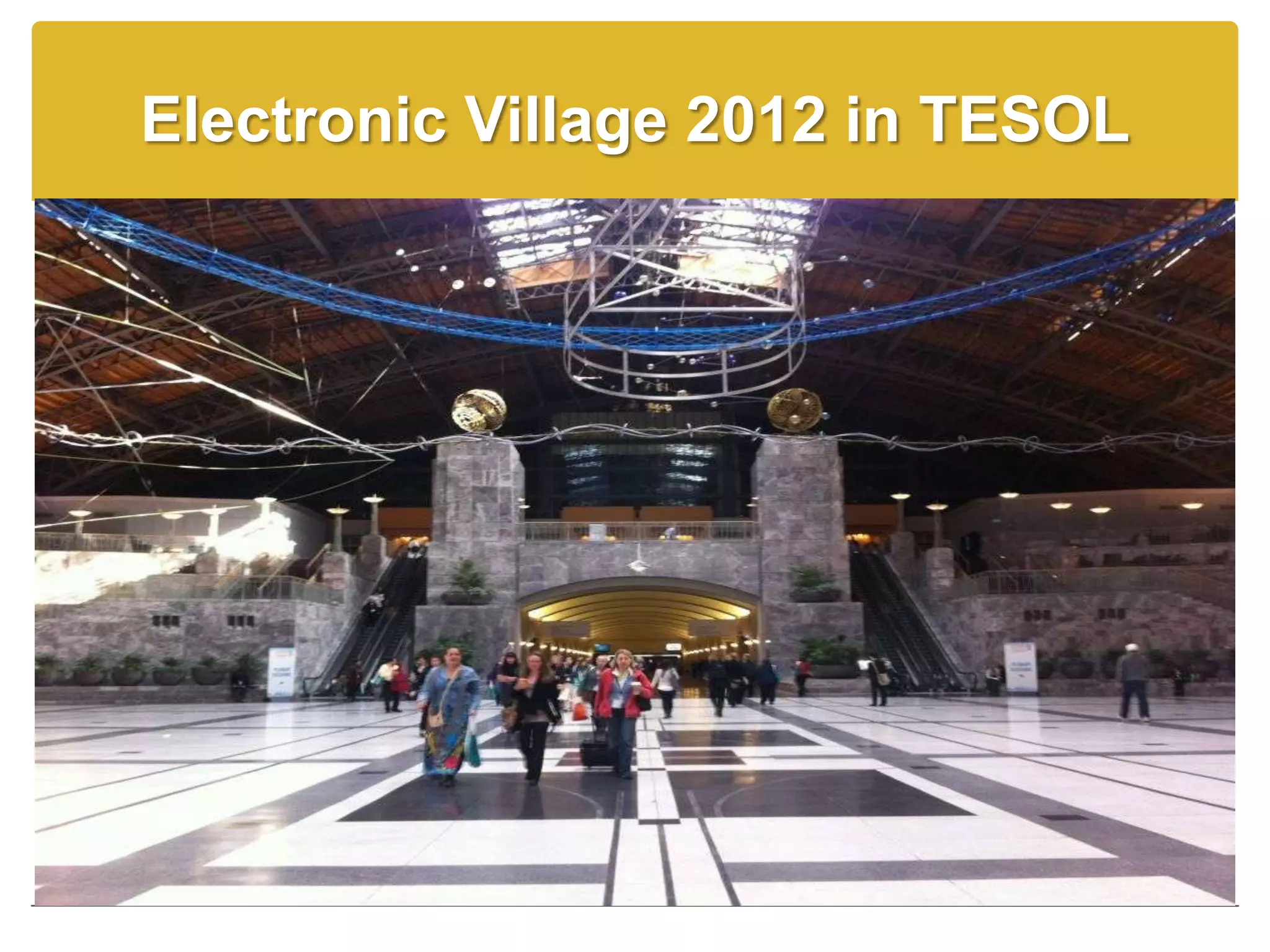
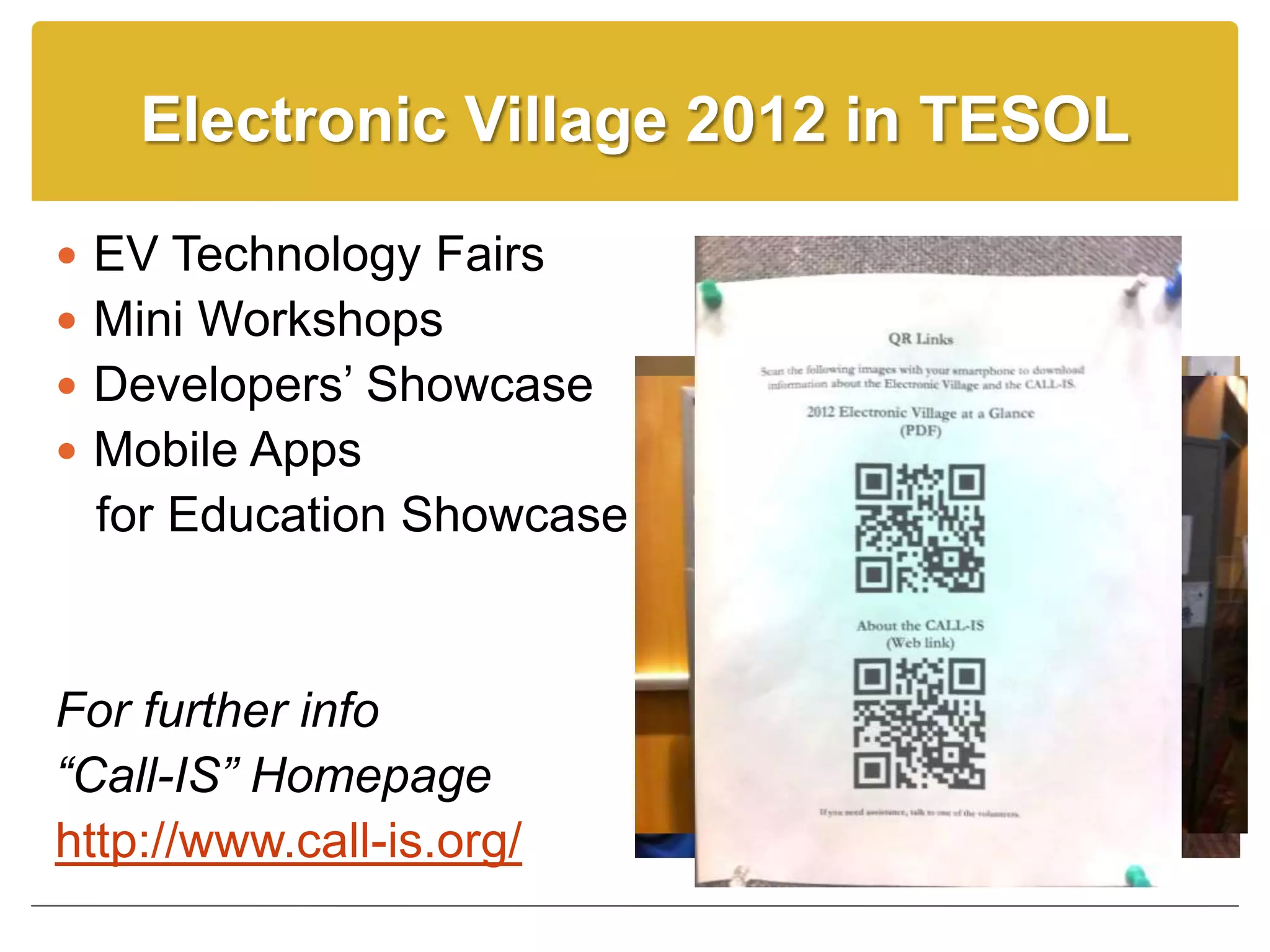
Electronic Village 2012 in TESOL

 EV Technology Fairs
 Mini Workshops
 Developers’ Showcase
 Mobile Apps
  for Education Showcase


For further info
“Call-IS” Homepage
http://www.call-is.org/
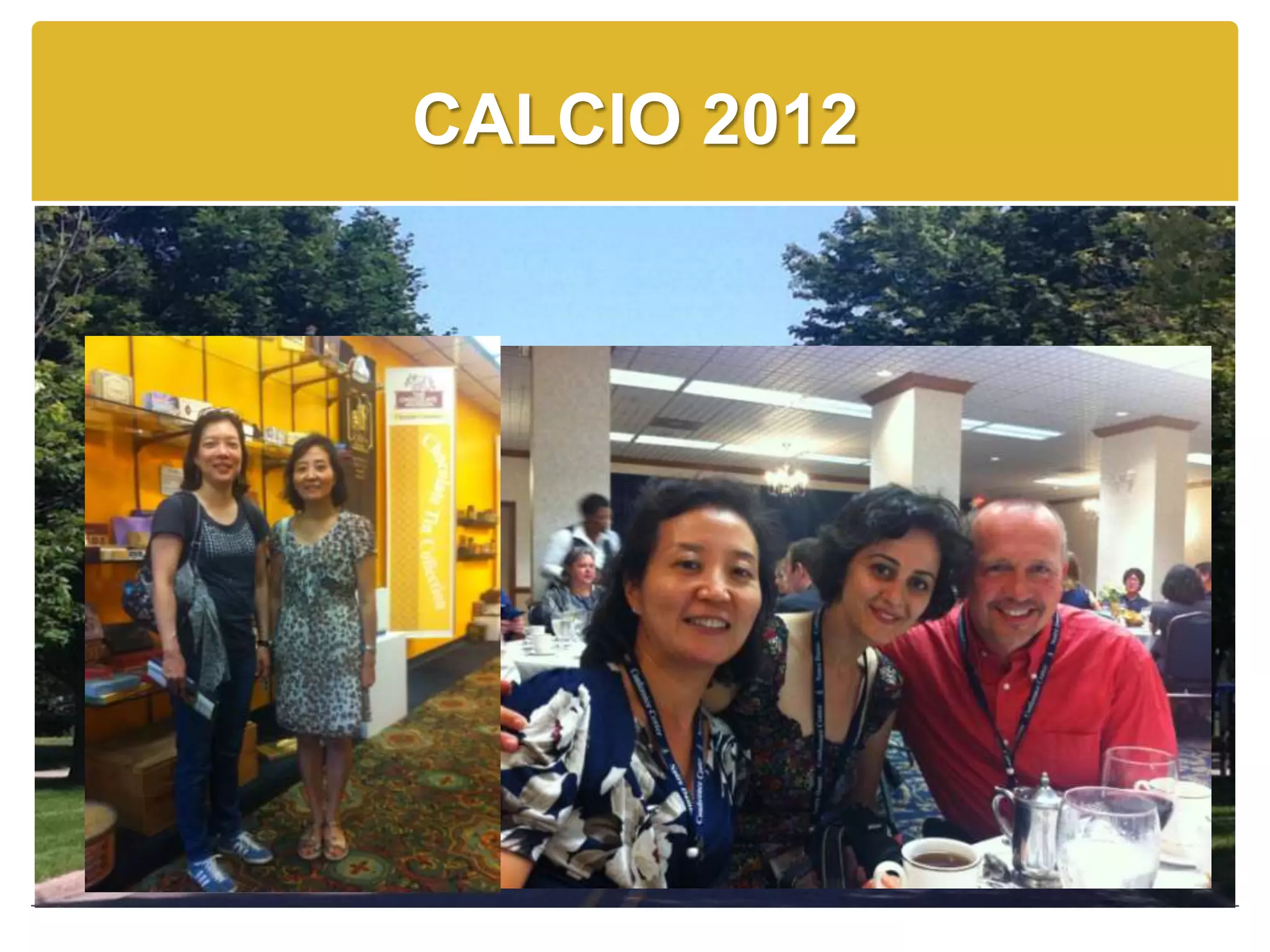
CALCIO 2012
CALCIO 2012
Open Education:
Resources and Design for Language Learning
Discussion


그러면 우리나라 영어교육자들은
Optimal CALL environment 에서
    무엇을 어떻게 가르치고
      연구해야 하는가?
2012 Annual Conference of English Education


감사합니다!
PollEverywhere.com

 스마트폰에서 아래 주소를 치고 들어가셔서
       질문에 답해주세요.

 http://www.polleverywhere.com/heyoung

Web 2.0 기술과 영어교육 연구동향

  • 1.
    2012 Annual Conferenceof English Education Web 2.0과 영어교육 연구동향 김혜영 중앙대학교
  • 2.
    What is Web2.0? Wordle “Beautiful Word Cloud “http://www.wordle.net/
  • 3.
    UCC LMS Social Networking Content Key Notions Syndica- Micro- tion blogging Blogging Wikis Virtual World Mashup Widgets Podcasting Web 2.0
  • 4.
    Top 10 Web2.0 apps in L2 education  Blogger, Wordpress – 블로그  Google Docs– 웹기반 복합 문서공유 시스템  Voki, voicethread, Voxopop – 음성기반 네트워킹  Go animate, animoto – 애니매이션, 영상 제작  Wikispaces, PBworks – 위키  Polleverywhere, Survey monkey–설문조사  Moodle, Blackboard, Adobe connection –LMS 수업운영  Edmodo –교육용 페이스북  Reddit – 웹 콘텐츠 랭킹 커뮤니티  Youtube, TED, delicious –동영상 콘텐츠 공유  Prezi, Slideshare– 프리젠테이션 제작 및 공유 커뮤니티
  • 5.
    What is Web2.0?  Coined in 2003 by O'Reilly Media Inc., publishers of technology-related books  The emergence of a set of applications on the web which facilitate a more socially connected web where everyone is able to add to and edit information online (Anderson 2007).  Key Characteristics  Power to the user (from editor, publisher)  Harnessing collective intelligence (O'Reilly, 2005)  "Web as a platform" (O'Reilly, 2005)
  • 6.
    How do web2.0 technologies enhance language learning? AUTONOMY Meta-cognition Corpus/Concordancing Literacy Data-Driven Learning (DDL) Self-Access Learning Learner as a researcher & knowledge constructer Digital Learner-centered learning Storytelling/blogging Self-directed learning Narrative practice Web 2.0 Social Networking Multimedia/Mashup Collaborative learning/ Blended learning/ Social Interaction skill integration Authentic Web Tasks/ Virtual experience Meaning Task-based learning Motivation Game-based learning Negotiation Competence
  • 7.
  • 8.
    Data-Driven Learning Key Notions  Since the advent of Information and Communication Technology (ICT), DDL has been attended as a new way of learning in language education (Chan & Liou, 2005; Hadley, 1997; Johns, 1991; Kar & Mar, 1993; Lee, Ko, 2005; Ste vens, 1995; Whistle, 1999).  DDL  A method of learning language with authentic language sample (e. g. corpus data) by using software program (e.g. concordancer).  “language-learner = a research worker whose learning needs to be driven by access to linguistic data (John, 1991, p. 2).  A grammar-consciousness raising method because it is language learner s themselves who explore and discover the language patterns by accessing real-life language data.  DDL can bridge a critical gap between product and process grammar te aching approach by helping learners to move along the pedagogic continuu m from product to process (Baston (1995, p.99).
  • 9.
    Data-Driven Learning Book Reviews •Mishan, F. (2005). Designing authenticity into language learning materials. USA: Intellect Books. • O'Keeffe, A.,McCarthy, M. & Carter, R. (2007). From Corpus to Classroom: Language Use and Language Teaching. Cambridge: Cambridge University Press Hunston, S. (2002). Corpora in applied linguistics. Cambridge, UK: Cambridge University Press. •Wichmann, Anne; Fligelstone, Steven; McEnery, Tony & Knowles, Gerry (eds) (1997): Teaching and Langu age Corpora. London: Longman. •Nation, P. (1994). New Ways in Teaching Vocabulary. Alexandria, VA: TESOL. • Encarnación H., Quereda, L. and Santana J. (1997) Corpora in the Foreign Language Classroom. Sele cted papers from the Sixth International Conference. Amsterdam: Rodopi •Hundt, M.,. Nesselhauf , N. & Biewer, C. (2007), Corpus Linguistics and the Web. Amsterdam: Rodopi.
  • 10.
    Corpus-based CALL studies 김혜영, 전수인. (2009). 코퍼스기반 CALL 연구동향 : 질적메 타분석. 영어교육연구, 21(2), 283-310.  코퍼스기반의 영어교육관련 국내외 논문 71편 질적 분석 결과 도출  이제영 (2012). 코퍼스기반 국내 CALL 연구동향: 메타분석 을 통한 효과분석. Multimedia-Assisted Language Learning, 15(3), 83-111.  32개 국내연구에서 134개의 연구결과로 양적 메타분석
  • 11.
    Independent Learning Association Self-directed Learning Self-Access Autonomy Reflection and Narration Motivation and Independence
  • 12.
    II. Social Networking &Computer-mediated communication(CMC)
  • 13.
    Social Networking Key Notions Network-based language teaching (NBLT, 2001) 외국어교육의 사회인지적 관점에서 본 Technology의 역할  타인과의 상호 협력 (online collaboration, social interaction)  의미의 협상 (meaning negotiation)  실제적인 의사소통적 과업 제시 (authentic communication task)  자연스런 담화커뮤니티를 조성 (target language discourse community CMC Social Networking ASCM Mashup (ex. google docs, wikispaces) SCMC Combination (ex. 카톡 ,페이스북) •Bryan Smith(2012). Eye Tracking as a Measure of Noticing: A Study of Explicit Recasts in SCMC. Language Learning and Technology,16(3) pp. 53-81 •Íñigo Yanguas (2010). Oral Computer-Mediated Interaction Between L2 Learners: It’s About Time! Language Learning and Technology, 14(3). pp. 72–93
  • 14.
    Social Networking Book Review The Next Generation: Social Networking and Online Collaboration in Foreign Language Learning Edited by Lara Lomicka and Gillian Lord CALICO Monograph Series Volume 8 Table of Contents 1. Introduction to social networking, collaboration, and Web 2.0 tools 2. Podcasting for language learning: Re-examining the potential 3. Social-networking sites in foreign language classes: Opportunities for re-creation 4. Microblogging on Twitter: Social networking in Intermediate Italian classes 5. RSS and social personalized start pages: Optimizing e-language learning through content syndication 6. Collaborative writing in wikis: Insights from culture projects in intermediate German classes 7. The chatbot as a peer/tool for learners of French Language learner attitudes toward virtual worlds: An investigation of Second Life 8. Learner requests in Spanish: Examining the potential of multiuser virtual environments for L2 pragmatic acquisition 9. Annotated bibliography
  • 15.
    Social Networking Book Review Present and Future Promise of CALL: From Theory and Research to New Directions in Language Teaching Edited by Nike Arnold & Lara Ducate CALICO Monograph Series Volume 5 Table of Contents  Technology, CALL, and the Net Generation: Where are We Headed from Here?  Linking Second Language Acquisition, CALL, and Language Pedagogy  Interpersonal Communication in Intracultural CMC'  Listening Comprehension in the Age of Web 2.0  CALL Technologies for L2 Reading Post Web 2.0  Writing Between the Lines: Acquiring the Presentational Mode through Social Tools  Teaching Culture through CALL  Beyond Comparisons: Frameworks for Developing Digital L2 Literacies  Connecting with CALL: Using Technology to Connect Language Learners with Other Disciplines  Communities: Exploring Digital Games and Social Networking  Computer-based Language Assessment: Prospects for Innovative Assessment  Teaching and Assessing Pronunciation with Computer Technology"  Evaluation of Courseware and Websites"  Calling on Educators: Paving the Way for the Future of Technology and CALL"  Blended and Open/Online Learning: Adapting to a Changing World of Language Teaching"
  • 16.
    Social Networking Book Review Recent Social networking articles in Multimedia-Assisted Language Learning (2010-2011) • Twitter and Implications for Its Use in EFL Learning  트위터를 활용한 영어쓰기 학습이 대학생들의 영어쓰기 능력에 미치는 영향  웹기반 및 모바일 블로깅을 활용한 웹 환경에서의 쓰기 효과  소셜네트워킹 사이트와 외국어 학습  A Blog Space for Autonomous Learning  Three Teachers’ Initial Efforts to Use Twitter for Teaching English in Public Schools
  • 17.
    III. Virtual Word,Mashup, and Authentic Tasks
  • 18.
    Online Tasks Key Notion “Learning methods that are embedded in authentic situations are not merely useful; they are essential.” - Brown, Collins & Duguid. 1989 Authentic tasks = Web tasks =CALL Tasks •Tandem Project • Keypal Project • Webquest • Cross-cultural Project •…
  • 19.
    Virtual Experience, Games Second Life British Council Second Life
  • 20.
    Virtual Experience, Games Game-based learning • 2012 CAILCO Keynote Address “Why Game-like Learning Now (And What Is It)?” • LLT 2013 Call for papers – Special Issue Jame Paul Gee (Arizona State University) “Game and Play Activity in Technology- Situated Language • Mediated L2 Teaching and Learning” language is always used from a perspective and always occurs within a context. There is no 'neutral' use of language. Meaning is socially-constructed within Discourse communities. • New Literacy Language is not the only communication system. multimodal literacy, visual literacy
  • 21.
    Mashup, Multimedia  Voki= animation avatar + SNS + Text-to-Speech + voice-recording+ moblie phone  Google Doc = email + OS (excel, doc, ppt, access)+ web + Chatroom + instant messenger+ online poll + XML etc.
  • 22.
    IV. Digital Storytelling& Narrative Practice
  • 23.
    DS is evolutionof narrative writing where multimedia tools are used to enhance a story, critical thinking, and media literacy (Ohler , 2005; 2006) ‘Meaning-making’ through visual/verbal synergy (Royce, 2002), Synaesthetic semiosis (Kress, 1998, 2003) DS affects the author’s voice and DS reflect cultural, social, and intention (Nelson, 2006). diverse values (Shin & Cimasko, 2008).
  • 24.
    Digital Storytelling References Digital Storytelling Workshop 2012 (From TESOL CALL IS) http://evosessions.pbworks.com/w/page/48516114/ Digitalstorytelling2012
  • 25.
  • 26.
    CALL Journals listedin SSCI  BRITISH JOURNAL OF EDUCATIONAL TECHNOLOGY Bimonthly  COMPUTATIONAL LINGUISTICS Quarterly  COMPUTER ASSISTED LANGUAGE LEARNING Bimonthly V  COMPUTERS & EDUCATION Bimonthly  EDUCATIONAL TECHNOLOGY & SOCIETY Quarterly  ELT JOURNAL Quarterly  ENGLISH FOR SPECIFIC PURPOSES Quarterly  ETR&D-EDUCATIONAL TECHNOLOGY RESEARCH AND DEVELOPMENT Bimonthly V  FOREIGN LANGUAGE ANNALS Quarterly  IEEE TRANSACTIONS ON LEARNING TECHNOLOGIES Quarterly  INTERNATIONAL JOURNAL OF COMPUTER-SUPPORTED COLLABORATIVE LEARNING Quarterly  INTERNATIONAL JOURNAL OF CORPUS LINGUISTICS Quarterly  INTERNATIONAL JOURNAL OF MOBILE COMMUNICATIONS Bimonthly  JOURNAL OF COMPUTER ASSISTED LEARNING Bimonthly  JOURNAL OF COMPUTER-MEDIATED COMMUNICATION (0ld)Quarterly  JOURNAL OF EDUCATIONAL COMPUTING RESEARCH Bimonthly  JOURNAL OF SECOND LANGUAGE WRITING Quarterly  LANGUAGE LEARNING &TECHNOLOGY tri-annual V IF :2.465 JCR 2nd ranked  LITERARY AND LINGUISTIC COMPUTING Quarterly V  MODERN LANGUAGE JOURNAL Quarterly  RECALL Tri-annual V If: 0.95  STUDIES IN SECOND LANGUAGE ACQUISITION Quarterly  SYSTEM Quarterly V  TESOL QUARTERLY Quarterly 
  • 27.
    Conferences  APACALL(Asia-Pacific Associationof Computer-Assisted Language Learning  CALICO(The Computer-Assisted Language Instruction Consortium)  EuroCALL  IALLT(International Association of Language Learning Technology)  ILA(Independent Learning Association)  KAMALL(Korea Association of Multimedia-Assisted Language Learning)  LET (The Japan Association of Language Education and Technology  PaCALL  TESOL-CALL IS Electronic Village  World CALL
  • 28.
  • 29.
    Electronic Village 2012in TESOL  EV Technology Fairs  Mini Workshops  Developers’ Showcase  Mobile Apps for Education Showcase For further info “Call-IS” Homepage http://www.call-is.org/
  • 30.
  • 31.
    CALCIO 2012 Open Education: Resourcesand Design for Language Learning
  • 32.
    Discussion 그러면 우리나라 영어교육자들은 OptimalCALL environment 에서 무엇을 어떻게 가르치고 연구해야 하는가?
  • 33.
    2012 Annual Conferenceof English Education 감사합니다!
  • 34.
    PollEverywhere.com 스마트폰에서 아래주소를 치고 들어가셔서 질문에 답해주세요.  http://www.polleverywhere.com/heyoung