Perspectives on Technology  in Learning and Teaching  LanguagesRichard KernKern, R. (2006). Perspectives on technology  in learning and  	teaching languages. TESOL Quarterly, 40, 1, 183-210.
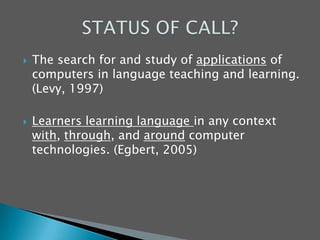
The search for and study of applications of computers in language teaching and learning. (Levy, 1997) Learners learning language in any context with, through, and around computer technologies. (Egbert, 2005)STATUS OF CALL?
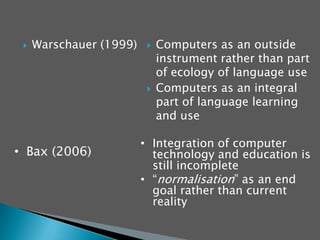
Warschauer (1999)   Computers as an outside instrument rather than part of ecology of language useComputers as an integral part of language learning and useIntegration of computer technology and education is still incomplete
“normalisation” as an end goal rather than current reality
Bax (2006)CALL equation: learners + language + context + tools + tasks +/– peers and teachers Genaralize computers to “tool” status.Egbert (2005)
Chapelle (1997)Interactionist approach to SLA  to generate hypothesisDiscourse Analysis as the research method.THEORETICAL GROUNDINGSWhat kind of language does learner engage in during a CALL activity?  How good is the language experience in CALL for L2 learning?
Egbert (2005)Multiple theoretical perspectives.Socio-cultural contexts of technology use expand.Technologies diversify.Goal, content and structure of CALL pedagogy evolve.
O’Rourke (2005)Computer-mediated environmets are not fixed ‘givens’.They are negotiated, and subverted by their users.Socio-cultural approachMohan & Luo
SFL approach
Analysis of field, tenor and mode
Register and genres in CMC environmentsDefining what counts as technologySeparating a technology from its particular uses.The effects of other mediating factors: learners, settings, tasks, type of assessment.                                                    Zhao (2003)EFFECTIVENESS  of CALL
Culturally neutral toolsUniversally adaptable mediaGlobal communication and global communitiesCULTURAL EMBEDDEDNESSNegroponte (1995) and Rheingold (1993)
An invisible culture of efficiency  in WebCT and other Internet-based communication platforms (Moodle) Notion of Western style efficiency not appropriate tools for international groups of learnersIt values speed, reach, openness, quick response, question/debate and informality in communicationReeder et al (2004)
Logic and navigational procedures of hypertext are not universally intuitiveWay of thinking that reflects cognitive constructs and connections that are particularly English. Hawisher& Selfe (2000)CMC  as ‘computer-mediated colonialization’
CMC tecnologies impose Western values and practices on peoples
Ess (2005)

Kern's technology on language teaching and learning

  • 1.
    Perspectives on Technology in Learning and Teaching LanguagesRichard KernKern, R. (2006). Perspectives on technology in learning and teaching languages. TESOL Quarterly, 40, 1, 183-210.
  • 2.
    The search forand study of applications of computers in language teaching and learning. (Levy, 1997) Learners learning language in any context with, through, and around computer technologies. (Egbert, 2005)STATUS OF CALL?
  • 3.
    Warschauer (1999) Computers as an outside instrument rather than part of ecology of language useComputers as an integral part of language learning and useIntegration of computer technology and education is still incomplete
  • 4.
    “normalisation” as anend goal rather than current reality
  • 5.
    Bax (2006)CALL equation:learners + language + context + tools + tasks +/– peers and teachers Genaralize computers to “tool” status.Egbert (2005)
  • 6.
    Chapelle (1997)Interactionist approachto SLA to generate hypothesisDiscourse Analysis as the research method.THEORETICAL GROUNDINGSWhat kind of language does learner engage in during a CALL activity? How good is the language experience in CALL for L2 learning?
  • 7.
    Egbert (2005)Multiple theoreticalperspectives.Socio-cultural contexts of technology use expand.Technologies diversify.Goal, content and structure of CALL pedagogy evolve.
  • 8.
    O’Rourke (2005)Computer-mediated environmetsare not fixed ‘givens’.They are negotiated, and subverted by their users.Socio-cultural approachMohan & Luo
  • 9.
  • 10.
    Analysis of field,tenor and mode
  • 11.
    Register and genresin CMC environmentsDefining what counts as technologySeparating a technology from its particular uses.The effects of other mediating factors: learners, settings, tasks, type of assessment. Zhao (2003)EFFECTIVENESS of CALL
  • 12.
    Culturally neutral toolsUniversallyadaptable mediaGlobal communication and global communitiesCULTURAL EMBEDDEDNESSNegroponte (1995) and Rheingold (1993)
  • 13.
    An invisible cultureof efficiency in WebCT and other Internet-based communication platforms (Moodle) Notion of Western style efficiency not appropriate tools for international groups of learnersIt values speed, reach, openness, quick response, question/debate and informality in communicationReeder et al (2004)
  • 14.
    Logic and navigationalprocedures of hypertext are not universally intuitiveWay of thinking that reflects cognitive constructs and connections that are particularly English. Hawisher& Selfe (2000)CMC as ‘computer-mediated colonialization’
  • 15.
    CMC tecnologies imposeWestern values and practices on peoples
  • 16.