Mobile-assisted Language Learning
Promising Opportunities for Foreign Language
                 Learning          Mahmoud Al Saidi
                                     Sultan Qaboos
                                      University
                                     Oman
MOBILE-ASSISTED LANGUAGE
                LEARNING
Outline of Presentation:
 What is Mobile Learning
 Why mobile language learning?
 Classroom applications of MALL
 The role of educators
 Challenges and limitations
 More reading and Resources
WHAT IS MOBILE LEARNING?
 Researchers’ perspectives of mLearning
 Defining characteristics of mLearning
 Mobile Assisted Language Learning (MALL)
WHAT IS MOBILE LEARNING?
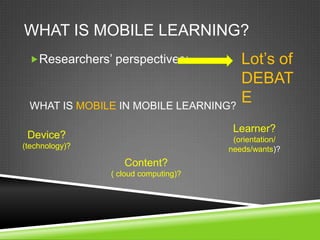
 Researchers’ perspectives:             Lot’s of
                                         DEBAT
 WHAT IS MOBILE IN MOBILE LEARNING?
                                         E
                                       Learner?
 Device?                               (orientation/
(technology)?                         needs/wants)?
                   Content?
                ( cloud computing)?
WHAT IS MOBILE LEARNING?
Kukulska-Hulme & Traxler, 2005:

   “the possibilities opened up by portable,
   lightweight devices that are … small enough to fit
   in a pocket or the palm of one’s hand. Typical
   examples are mobile phones … smartphones,
   palmtops and PDAs; Tablet PCs, laptop computers
   and personal media players”

       Cameras, data storage
       devices
WHAT IS MOBILE LEARNING?

Sharples et al. (2005)

“[it] is the learner that is mobile, rather than the
technology” (p3).
WHAT IS MOBILE LEARNING?
Defining characteristics:

      Personalized           Situated

      Authentic              Informal

      Mobile                 Continuous
                              Collaborative
      Portable
                              Spontaneous
      Ubiquitous
WHAT IS MOBILE LEARNING?

Simple definition

     A mode of learning which takes place using
     content or interaction affordances facilitated by
     mobile devices such as cellphones, mp3 players,
     notebooks, hand-held mini computers, PDAs,
     cameras, data storage devices and a number of
     other portable devices
MOBILE ASSISTED LANGUAGE
       LEARNING (MALL)

An approach to language learning that
is assisted or enhanced through the
use of handheld mobile devices

Subset of mobile learning and CALL
WHY MOBILE LANGUAGE
 LEARNING?
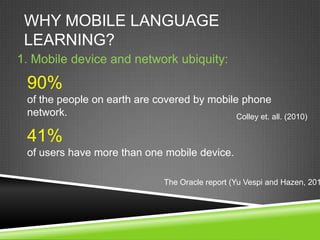
1. Mobile device and network ubiquity:

 90%
 of the people on earth are covered by mobile phone
 network.                                    Colley et. all. (2010)

 41%
 of users have more than one mobile device.

                                 The Oracle report (Yu Vespi and Hazen, 201
WHY MOBILE LANGUAGE
 LEARNING?
1. Mobile device and network ubiquity:

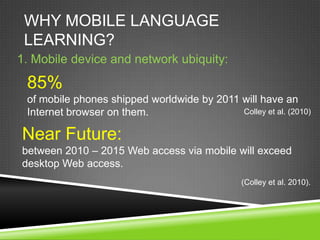
 85%
 of mobile phones shipped worldwide by 2011 will have an
 Internet browser on them.                  Colley et al. (2010)


Near Future:
between 2010 – 2015 Web access via mobile will exceed
desktop Web access.
                                                (Colley et al. 2010).
WHY MOBILE LANGUAGE
 LEARNING?
1. Mobile device and network ubiquity:
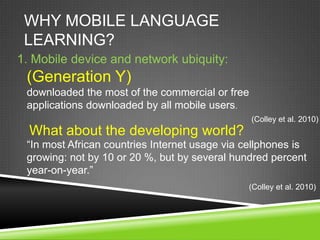
 (Generation Y)
 downloaded the most of the commercial or free
 applications downloaded by all mobile users.
                                                 (Colley et al. 2010)
  What about the developing world?
 “In most African countries Internet usage via cellphones is
 growing: not by 10 or 20 %, but by several hundred percent
 year-on-year.”
                                               (Colley et al. 2010)
WHY MOBILE LANGUAGE
LEARNING?
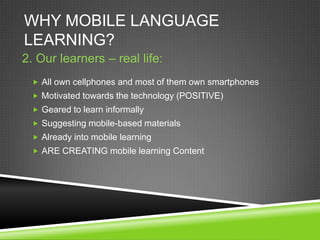
2. Our learners – real life:
  All own cellphones and most of them own smartphones
  Motivated towards the technology (POSITIVE)
  Geared to learn informally
  Suggesting mobile-based materials
  Already into mobile learning
  ARE CREATING mobile learning Content
WHY MOBILE LANGUAGE
LEARNING?
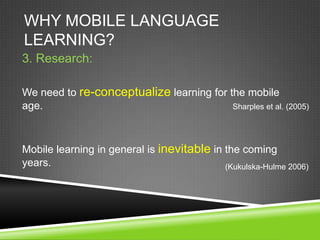
3. Research:

We need to re-conceptualize learning for the mobile
age.                                      Sharples et al. (2005)


Mobile learning in general is inevitable in the coming
years.                                      (Kukulska-Hulme 2006)
WHY MOBILE LANGUAGE
LEARNING?
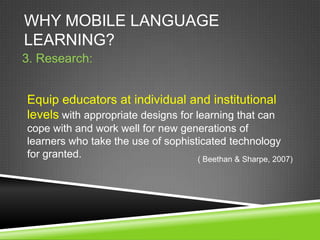
3. Research:


Equip educators at individual and institutional
levels with appropriate designs for learning that can
cope with and work well for new generations of
learners who take the use of sophisticated technology
for granted.                        ( Beethan & Sharpe, 2007)
WHY MOBILE LANGUAGE
LEARNING?
2. What if we as educators just
ignored this new mode of learning?
 Failing to do so, will only result in widening the
 gap between educators’ ideas about learning and
 those of their students
                                (Kukulska-Hulme & Jones, 2011).
WHY MOBILE LANGUAGE
  LEARNING?
  Advantages:
   Learner driven and                  Potential for learner
    centered                              autonomy
   Relatively cheap                    Encourages and facilitates
    technology                            peer interaction
   Very cheap or totally free          Integrates real life into
    content                               learning
   Portable                            Easy content creation
   Ubiquitous                          eBooks etc.
   Still new and fashionable
http://www.teachthought.com/technology/reasons-to-use-tablets-in-
the-21st-century-classroom/
CLASSROOM APPLICATIONS OF
MALL
Some Examples
    Educational Apps
    eBooks and eLibraries
    Social media
    Informal learning activities
    Course Management Systems: Moodle for mobile
    Course administration
    Audio, video , picture
    The power of QR Codes
CLASSROOM APPLICATIONS OF
MALL
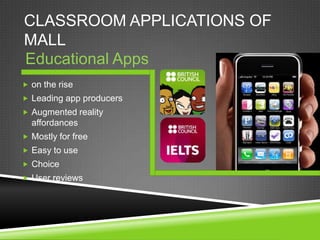
Educational Apps
 on the rise
 Leading app producers
 Augmented reality
  affordances
 Mostly for free
 Easy to use
 Choice
 User reviews
CLASSROOM APPLICATIONS OF
MALL
Educational Apps
                 Apps from Unreliable sources
What is the      Trial Apps

downside?        Data Usage
                 Low quality
                 Finding them
CLASSROOM APPLICATIONS OF
MALL
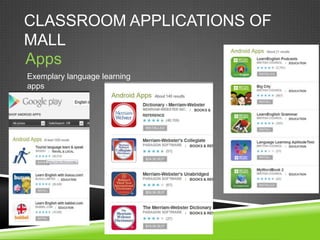
Apps
Exemplary language learning
apps
CLASSROOM APPLICATIONS OF
 MALL
   QR Codes

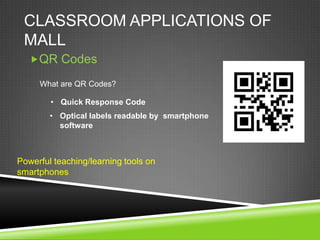
     What are QR Codes?

        • Quick Response Code
        • Optical labels readable by smartphone
          software


Powerful teaching/learning tools on
smartphones
CLASSROOM APPLICATIONS OF
  MALL
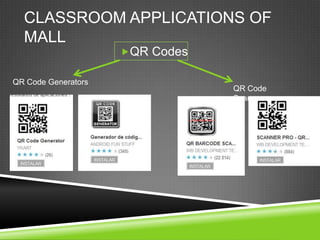
                     QR Codes

QR Code Generators
                                 QR Code
                                 Scanners
CLASSROOM APPLICATIONS OF
MALL
              QR Codes

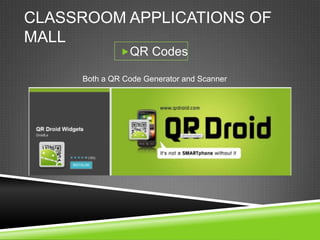
     Both a QR Code Generator and Scanner
CLASSROOM APPLICATIONS OF
MALL
 QR Codes

How can they be used for language learning?/teaching

   Apps                 Text
   Web                  Course administration
    links                Classroom activities and quizzes
   Video

  Advantage: Do not always require Internet access.
CLASSROOM APPLICATIONS OF
  MALL
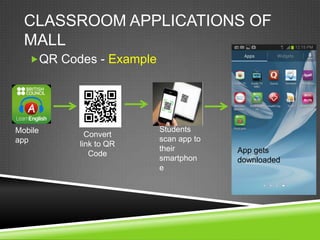
   QR Codes - Example


Mobile                   Students
            Convert
app                      scan app to
          link to QR
                         their         App gets
             Code
                         smartphon     downloaded
                         e
CLASSROOM APPLICATIONS OF
MALL
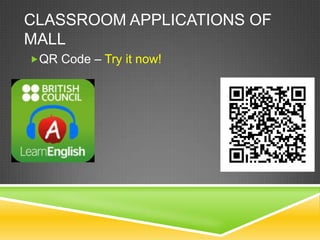
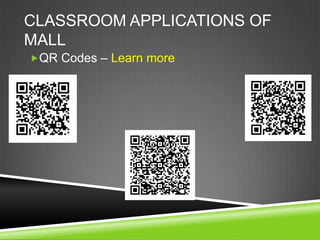
QR Code – Try it now!
CLASSROOM APPLICATIONS OF
MALL
QR Codes – Learn more
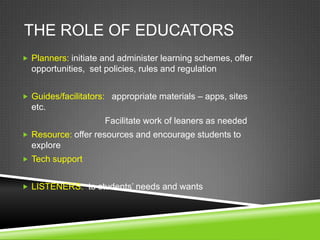
THE ROLE OF EDUCATORS
 Planners: initiate and administer learning schemes, offer
  opportunities, set policies, rules and regulation


 Guides/facilitators: appropriate materials – apps, sites
  etc.
                     Facilitate work of leaners as needed
 Resource: offer resources and encourage students to
  explore
 Tech support


 LISTENERS: to students’ needs and wants
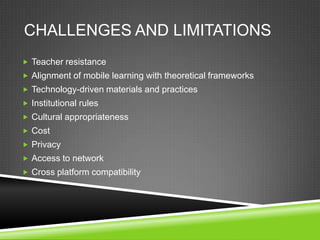
CHALLENGES AND LIMITATIONS
 Teacher resistance
 Alignment of mobile learning with theoretical frameworks
 Technology-driven materials and practices
 Institutional rules
 Cultural appropriateness
 Cost
 Privacy
 Access to network
 Cross platform compatibility
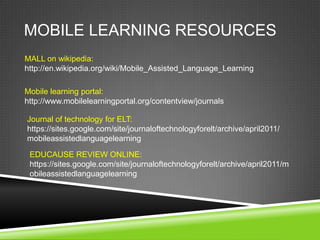
MOBILE LEARNING RESOURCES
MALL on wikipedia:
http://en.wikipedia.org/wiki/Mobile_Assisted_Language_Learning

Mobile learning portal:
http://www.mobilelearningportal.org/contentview/journals

Journal of technology for ELT:
https://sites.google.com/site/journaloftechnologyforelt/archive/april2011/
mobileassistedlanguagelearning

 EDUCAUSE REVIEW ONLINE:
 https://sites.google.com/site/journaloftechnologyforelt/archive/april2011/m
 obileassistedlanguagelearning
MLEARNING AND MALL
 RESOURCES
Apple Education:
http://www.apple.com/education/apps/

Mobile Learning: An online reflective journal on Mobile learning
practices:
http://mlearning.edublogs.org/2006/08/14/immersive-situated-
learning/
Top 50 mearning Resources:
http://www.slideshare.net/UpsideLearning/top-
50mlearningmobilelearningresources
MORE READINGS
Beethan, H., & Sharpe, R. (Eds.). (2007). Rethinking pedagogy for a digital
age: Designing and delivering e-learning. London, UK: RoutledgeFalmer.

Chinnery,G. (2006). Emerging technologies. Going to mall: mobile assisted
language learning. Language Learning and Technology, 10(1), 19-16
C
olley, J., DeGani, A., & Stead, G. (2010). What in the World are you doing
with your mobile phone? World differences in the use of mobiles. Retrieved
August 27, 2011, from http://www.mole-project.net/

Colley, J., DeGani, A., & Stead, G. (2010). Future trends in mobile use.
Retrieved Aujust 27th, 2011, from http://www.mole-
project.net/images/documents/deliverables/global_mobile_trends.pdf
MORE READINGS

Dias, A. Carvalho, L., Keegan, D. Kismihok, G., Mileva, N., Nix, J., &
Rekkedal. T (2008). An Introduction to Mobile Learning. Retrieved 25th July,
2011, from
http://www.ericsson.com/ericsson/corpinfo/programs/the_role_of_mobile_lear
ning_in_european_education/products/wp/socrates_wp1_english.pdf

Geddes, S. (2004). Mobile learning in the 21st century: Benefit for learners.
Knowledge Tree e-journal. Retrieved August 9th, 2011, from
https://olt.qut.edu.au/udf/OLTCONFERENCEPAPERS/gen/static/papers/Cob
croft_OLT2006_paper.pdf.
MORE READINGS

Hartman, G. DeGani, A., & Stead, G. (2011). Cross-platform mobile
development. Retrieved August 27th, 2011, from http://www.mole-
project.net/images/documents/deliverables/WP4_crossplatform_mobile_dev
elopment_March2011.pdf

 Ismail, I., Baharum, H., & Idrus, R.M. (2010). Simplistic is the ingredient for
mobile learning. International Journal of Interactive Mobile Technologies,
4(3), 4 – 8) retrieved July 25th, 2011, from http://online-journals.org/i-
jim/issue/view/85

Kukulska-Hulme, Agnes and Jones, Chris (2011). The next generation:
design and the infrastructure for learning in a mobile and networked world.
In: Olofsson, A. D. and Lindberg, J. Ola eds. Informed Design of Educational
Technologies in Higher Education: Enhanced Learning and Teaching.
Hershey, PA: Information Science Reference (an Imprint of IGI Global), pp.
57–78.
MORE READINGS

Kukulska-Hulme. A., and Shield, Lesley (2008). An overview of mobile
assisted language learning: From content delivery to supported collaboration
and interaction. ReCALL, 20(3), pp. 271–289.

Kukulska-Hulme, A. (2006). Mobile language learning now and in the future.
In: Svensson, Patrik ed. Fr°an vision till praktik: Spr°akutbildning och
Informationsteknik (From vision to practice: language learning and IT).
Sweden: Swedish Net University (N¨atuniversitetet), pp. 295–310.

Mirland, M. (2006). How should learning activities using mobile technologies
be designed to support innovative educational practices?. In M. Sharples (ed.)
(2006) Big issues in mobile learning. Report of a workshop by the
Kaleidoscope Network of Excellence Mobile Learning Initiative. University of
Nottingham, UK. (p.27 - 29) Retrieved July 9th, 2011, from
http://mlearning.noe-kaleidoscope.org/repository/BigIssues.pdf
MORE READINGS

Naismith, L., Lonsdale, P., Vavoula, G. and Sharples, M. (2004) Literature
Review in Mobile Technologies and Learning, Report 11 for Futurelab,
Retrieved September 10, 2011, from
http://www.futurelab.org.uk/sites/default/files/Mobile_Technologies_and_Lea
rning_review.pdf
MORE READINGS
Norbrook, H. and Scott, P. (2003) Motivation in mobile modern foreign
language learning. In: Attewell, J., Da Bormida, G., Sharples, M. and Savill-
Smith, C. (eds.) MLEARN
2003:Learning with mobile devices. London: Learning and Skills Development
Agency, 50-51. Retrieved 15 Auggust, 2011, from
http://www.lsda.org.uk/files/pdf/1421.pdf#.

Ruan, G., Wang, J.Y., & Li, A. (2009). Theoretical foundations of Mobile
learning mediated by technology. Retrieved August 31st , 2010, from
http://dl.acm.org/citation.cfm?id=1727706

Sharples, M., Taylor, J., & Vavoula, G. (2005). Towards a theory of mobile
learning. Retrieved August, 27th, 2010, from
http://www.mlearn.org.za/CD/papers/Sharples-
%20Theory%20of%20Mobile.pdf
MORE READINGS

Sharples, M. (ed.) (2006). Big issues in mobile learning. Report of a
workshop by the Kaleidoscope Network of Excellence Mobile Learning
Initiative. University of Nottingham, UK. Retrieved July 9th, 2011, from
http://mlearning.noe-kaleidoscope.org/repository/BigIssues.pdf

Thornton, P., & Houser, C. (2005). Using mobile phones in English
education in Japan. Journal of Computer Assisted Learning (21), 217-228
Yu Vespi, C., & Hazen, J (2010). Opportunity Calling: The future of Mobile
communications. Retrieved August 27th, 2011, from
http://www.oracle.com/us/industries/communications/oracle-
communications-mobile-report-170802.pdf
DOWNLOAD THIS PRESENTATION?


        QR Code

        Link it to a
        website..


       THANK YOU

Mobile assisted language learning (mall)

  • 1.
    Mobile-assisted Language Learning PromisingOpportunities for Foreign Language Learning  Mahmoud Al Saidi  Sultan Qaboos University  Oman
  • 2.
    MOBILE-ASSISTED LANGUAGE LEARNING Outline of Presentation:  What is Mobile Learning  Why mobile language learning?  Classroom applications of MALL  The role of educators  Challenges and limitations  More reading and Resources
  • 3.
    WHAT IS MOBILELEARNING?  Researchers’ perspectives of mLearning  Defining characteristics of mLearning  Mobile Assisted Language Learning (MALL)
  • 4.
    WHAT IS MOBILELEARNING?
  • 5.
    WHAT IS MOBILELEARNING? Researchers’ perspectives: Lot’s of DEBAT WHAT IS MOBILE IN MOBILE LEARNING? E Learner? Device? (orientation/ (technology)? needs/wants)? Content? ( cloud computing)?
  • 6.
    WHAT IS MOBILELEARNING? Kukulska-Hulme & Traxler, 2005: “the possibilities opened up by portable, lightweight devices that are … small enough to fit in a pocket or the palm of one’s hand. Typical examples are mobile phones … smartphones, palmtops and PDAs; Tablet PCs, laptop computers and personal media players” Cameras, data storage devices
  • 7.
    WHAT IS MOBILELEARNING? Sharples et al. (2005) “[it] is the learner that is mobile, rather than the technology” (p3).
  • 8.
    WHAT IS MOBILELEARNING? Defining characteristics:  Personalized  Situated  Authentic  Informal  Mobile  Continuous  Collaborative  Portable  Spontaneous  Ubiquitous
  • 9.
    WHAT IS MOBILELEARNING? Simple definition A mode of learning which takes place using content or interaction affordances facilitated by mobile devices such as cellphones, mp3 players, notebooks, hand-held mini computers, PDAs, cameras, data storage devices and a number of other portable devices
  • 10.
    MOBILE ASSISTED LANGUAGE LEARNING (MALL) An approach to language learning that is assisted or enhanced through the use of handheld mobile devices Subset of mobile learning and CALL
  • 11.
    WHY MOBILE LANGUAGE LEARNING? 1. Mobile device and network ubiquity: 90% of the people on earth are covered by mobile phone network. Colley et. all. (2010) 41% of users have more than one mobile device. The Oracle report (Yu Vespi and Hazen, 201
  • 12.
    WHY MOBILE LANGUAGE LEARNING? 1. Mobile device and network ubiquity: 85% of mobile phones shipped worldwide by 2011 will have an Internet browser on them. Colley et al. (2010) Near Future: between 2010 – 2015 Web access via mobile will exceed desktop Web access. (Colley et al. 2010).
  • 13.
    WHY MOBILE LANGUAGE LEARNING? 1. Mobile device and network ubiquity: (Generation Y) downloaded the most of the commercial or free applications downloaded by all mobile users. (Colley et al. 2010) What about the developing world? “In most African countries Internet usage via cellphones is growing: not by 10 or 20 %, but by several hundred percent year-on-year.” (Colley et al. 2010)
  • 14.
    WHY MOBILE LANGUAGE LEARNING? 2.Our learners – real life:  All own cellphones and most of them own smartphones  Motivated towards the technology (POSITIVE)  Geared to learn informally  Suggesting mobile-based materials  Already into mobile learning  ARE CREATING mobile learning Content
  • 15.
    WHY MOBILE LANGUAGE LEARNING? 3.Research: We need to re-conceptualize learning for the mobile age. Sharples et al. (2005) Mobile learning in general is inevitable in the coming years. (Kukulska-Hulme 2006)
  • 16.
    WHY MOBILE LANGUAGE LEARNING? 3.Research: Equip educators at individual and institutional levels with appropriate designs for learning that can cope with and work well for new generations of learners who take the use of sophisticated technology for granted. ( Beethan & Sharpe, 2007)
  • 17.
    WHY MOBILE LANGUAGE LEARNING? 2.What if we as educators just ignored this new mode of learning? Failing to do so, will only result in widening the gap between educators’ ideas about learning and those of their students (Kukulska-Hulme & Jones, 2011).
  • 18.
    WHY MOBILE LANGUAGE LEARNING? Advantages:  Learner driven and  Potential for learner centered autonomy  Relatively cheap  Encourages and facilitates technology peer interaction  Very cheap or totally free  Integrates real life into content learning  Portable  Easy content creation  Ubiquitous  eBooks etc.  Still new and fashionable http://www.teachthought.com/technology/reasons-to-use-tablets-in- the-21st-century-classroom/
  • 19.
    CLASSROOM APPLICATIONS OF MALL SomeExamples  Educational Apps  eBooks and eLibraries  Social media  Informal learning activities  Course Management Systems: Moodle for mobile  Course administration  Audio, video , picture  The power of QR Codes
  • 20.
    CLASSROOM APPLICATIONS OF MALL EducationalApps  on the rise  Leading app producers  Augmented reality affordances  Mostly for free  Easy to use  Choice  User reviews
  • 21.
    CLASSROOM APPLICATIONS OF MALL EducationalApps  Apps from Unreliable sources What is the  Trial Apps downside?  Data Usage  Low quality  Finding them
  • 22.
  • 23.
    CLASSROOM APPLICATIONS OF MALL QR Codes What are QR Codes? • Quick Response Code • Optical labels readable by smartphone software Powerful teaching/learning tools on smartphones
  • 24.
    CLASSROOM APPLICATIONS OF MALL QR Codes QR Code Generators QR Code Scanners
  • 25.
    CLASSROOM APPLICATIONS OF MALL QR Codes Both a QR Code Generator and Scanner
  • 26.
    CLASSROOM APPLICATIONS OF MALL QR Codes How can they be used for language learning?/teaching  Apps  Text  Web  Course administration links  Classroom activities and quizzes  Video Advantage: Do not always require Internet access.
  • 27.
    CLASSROOM APPLICATIONS OF MALL QR Codes - Example Mobile Students Convert app scan app to link to QR their App gets Code smartphon downloaded e
  • 28.
  • 29.
  • 30.
    THE ROLE OFEDUCATORS  Planners: initiate and administer learning schemes, offer opportunities, set policies, rules and regulation  Guides/facilitators: appropriate materials – apps, sites etc. Facilitate work of leaners as needed  Resource: offer resources and encourage students to explore  Tech support  LISTENERS: to students’ needs and wants
  • 31.
    CHALLENGES AND LIMITATIONS Teacher resistance  Alignment of mobile learning with theoretical frameworks  Technology-driven materials and practices  Institutional rules  Cultural appropriateness  Cost  Privacy  Access to network  Cross platform compatibility
  • 32.
    MOBILE LEARNING RESOURCES MALLon wikipedia: http://en.wikipedia.org/wiki/Mobile_Assisted_Language_Learning Mobile learning portal: http://www.mobilelearningportal.org/contentview/journals Journal of technology for ELT: https://sites.google.com/site/journaloftechnologyforelt/archive/april2011/ mobileassistedlanguagelearning EDUCAUSE REVIEW ONLINE: https://sites.google.com/site/journaloftechnologyforelt/archive/april2011/m obileassistedlanguagelearning
  • 33.
    MLEARNING AND MALL RESOURCES Apple Education: http://www.apple.com/education/apps/ Mobile Learning: An online reflective journal on Mobile learning practices: http://mlearning.edublogs.org/2006/08/14/immersive-situated- learning/ Top 50 mearning Resources: http://www.slideshare.net/UpsideLearning/top- 50mlearningmobilelearningresources
  • 34.
    MORE READINGS Beethan, H.,& Sharpe, R. (Eds.). (2007). Rethinking pedagogy for a digital age: Designing and delivering e-learning. London, UK: RoutledgeFalmer. Chinnery,G. (2006). Emerging technologies. Going to mall: mobile assisted language learning. Language Learning and Technology, 10(1), 19-16 C olley, J., DeGani, A., & Stead, G. (2010). What in the World are you doing with your mobile phone? World differences in the use of mobiles. Retrieved August 27, 2011, from http://www.mole-project.net/ Colley, J., DeGani, A., & Stead, G. (2010). Future trends in mobile use. Retrieved Aujust 27th, 2011, from http://www.mole- project.net/images/documents/deliverables/global_mobile_trends.pdf
  • 35.
    MORE READINGS Dias, A.Carvalho, L., Keegan, D. Kismihok, G., Mileva, N., Nix, J., & Rekkedal. T (2008). An Introduction to Mobile Learning. Retrieved 25th July, 2011, from http://www.ericsson.com/ericsson/corpinfo/programs/the_role_of_mobile_lear ning_in_european_education/products/wp/socrates_wp1_english.pdf Geddes, S. (2004). Mobile learning in the 21st century: Benefit for learners. Knowledge Tree e-journal. Retrieved August 9th, 2011, from https://olt.qut.edu.au/udf/OLTCONFERENCEPAPERS/gen/static/papers/Cob croft_OLT2006_paper.pdf.
  • 36.
    MORE READINGS Hartman, G.DeGani, A., & Stead, G. (2011). Cross-platform mobile development. Retrieved August 27th, 2011, from http://www.mole- project.net/images/documents/deliverables/WP4_crossplatform_mobile_dev elopment_March2011.pdf Ismail, I., Baharum, H., & Idrus, R.M. (2010). Simplistic is the ingredient for mobile learning. International Journal of Interactive Mobile Technologies, 4(3), 4 – 8) retrieved July 25th, 2011, from http://online-journals.org/i- jim/issue/view/85 Kukulska-Hulme, Agnes and Jones, Chris (2011). The next generation: design and the infrastructure for learning in a mobile and networked world. In: Olofsson, A. D. and Lindberg, J. Ola eds. Informed Design of Educational Technologies in Higher Education: Enhanced Learning and Teaching. Hershey, PA: Information Science Reference (an Imprint of IGI Global), pp. 57–78.
  • 37.
    MORE READINGS Kukulska-Hulme. A.,and Shield, Lesley (2008). An overview of mobile assisted language learning: From content delivery to supported collaboration and interaction. ReCALL, 20(3), pp. 271–289. Kukulska-Hulme, A. (2006). Mobile language learning now and in the future. In: Svensson, Patrik ed. Fr°an vision till praktik: Spr°akutbildning och Informationsteknik (From vision to practice: language learning and IT). Sweden: Swedish Net University (N¨atuniversitetet), pp. 295–310. Mirland, M. (2006). How should learning activities using mobile technologies be designed to support innovative educational practices?. In M. Sharples (ed.) (2006) Big issues in mobile learning. Report of a workshop by the Kaleidoscope Network of Excellence Mobile Learning Initiative. University of Nottingham, UK. (p.27 - 29) Retrieved July 9th, 2011, from http://mlearning.noe-kaleidoscope.org/repository/BigIssues.pdf
  • 38.
    MORE READINGS Naismith, L.,Lonsdale, P., Vavoula, G. and Sharples, M. (2004) Literature Review in Mobile Technologies and Learning, Report 11 for Futurelab, Retrieved September 10, 2011, from http://www.futurelab.org.uk/sites/default/files/Mobile_Technologies_and_Lea rning_review.pdf
  • 39.
    MORE READINGS Norbrook, H.and Scott, P. (2003) Motivation in mobile modern foreign language learning. In: Attewell, J., Da Bormida, G., Sharples, M. and Savill- Smith, C. (eds.) MLEARN 2003:Learning with mobile devices. London: Learning and Skills Development Agency, 50-51. Retrieved 15 Auggust, 2011, from http://www.lsda.org.uk/files/pdf/1421.pdf#. Ruan, G., Wang, J.Y., & Li, A. (2009). Theoretical foundations of Mobile learning mediated by technology. Retrieved August 31st , 2010, from http://dl.acm.org/citation.cfm?id=1727706 Sharples, M., Taylor, J., & Vavoula, G. (2005). Towards a theory of mobile learning. Retrieved August, 27th, 2010, from http://www.mlearn.org.za/CD/papers/Sharples- %20Theory%20of%20Mobile.pdf
  • 40.
    MORE READINGS Sharples, M.(ed.) (2006). Big issues in mobile learning. Report of a workshop by the Kaleidoscope Network of Excellence Mobile Learning Initiative. University of Nottingham, UK. Retrieved July 9th, 2011, from http://mlearning.noe-kaleidoscope.org/repository/BigIssues.pdf Thornton, P., & Houser, C. (2005). Using mobile phones in English education in Japan. Journal of Computer Assisted Learning (21), 217-228 Yu Vespi, C., & Hazen, J (2010). Opportunity Calling: The future of Mobile communications. Retrieved August 27th, 2011, from http://www.oracle.com/us/industries/communications/oracle- communications-mobile-report-170802.pdf
  • 41.
    DOWNLOAD THIS PRESENTATION? QR Code Link it to a website.. THANK YOU