Heyoung Kim & Jin-Hwa Lee (Chung-Ang University)
March 6, 2018,Valencia
Mobile-assisted Curriculum Model
forTeachers’ Self-directed Professional Development:
Design-based Research
2018 INTED Conference
Purpose
 This study intends to suggest a new reform model for
teacher professional development by integrating open
learning platform, SMART Teaching 3.0.
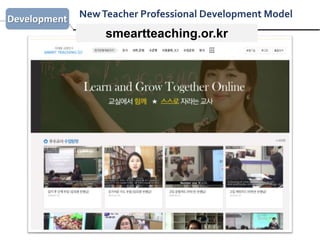
(http://smartteaching.or.kr ).
 This new teacher professional development model was
constructed and implemented for two years based on
design based research.
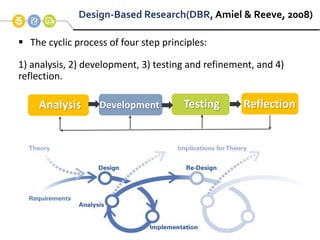
Design-Based Research(DBR, Amiel & Reeve, 2008)
 The cyclic process of four step principles:
1) analysis, 2) development, 3) testing and refinement, and 4)
reflection.
Analysis Development Testing Reflection
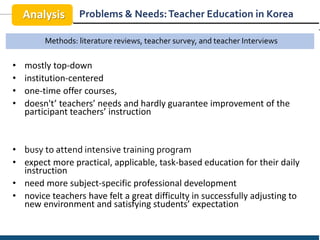
Problems & Needs:Teacher Education in KoreaAnalysis
Methods: literature reviews, teacher survey, and teacher Interviews
• mostly top-down
• institution-centered
• one-time offer courses,
• doesn't’ teachers’ needs and hardly guarantee improvement of the
participant teachers’ instruction
• busy to attend intensive training program
• expect more practical, applicable, task-based education for their daily
instruction
• need more subject-specific professional development
• novice teachers have felt a great difficulty in successfully adjusting to
new environment and satisfying students’ expectation
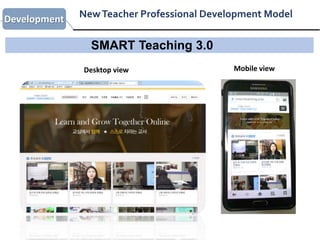
Development NewTeacher Professional Development Model
Desktop view Mobile view
SMART Teaching 3.0
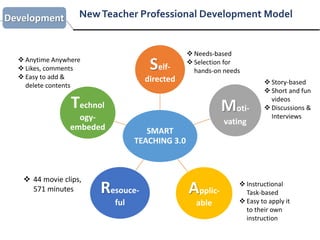
Development NewTeacher Professional Development Model
SMART
TEACHING 3.0
Self-
directed
Moti-
vating
Applic-
able
Resouce-
ful
Technol
ogy-
embeded
 Needs-based
 Selection for
hands-on needs
 Anytime Anywhere
 Likes, comments
 Easy to add &
delete contents  Story-based
 Short and fun
videos
 Discussions &
Interviews
 Instructional
Task-based
 Easy to apply it
to their own
instruction
 44 movie clips,
571 minutes
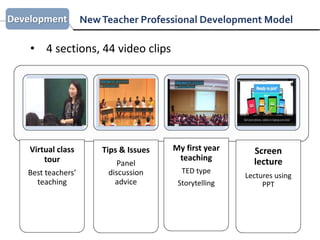
Development NewTeacher Professional Development Model
• 4 sections, 44 video clips
Virtual class
tour
Best teachers’
teaching
Tips & Issues
Panel
discussion
advice
My first year
teaching
TED type
Storytelling
Screen
lecture
Lectures using
PPT
c
smeartteaching.or.kr
Development NewTeacher Professional Development Model
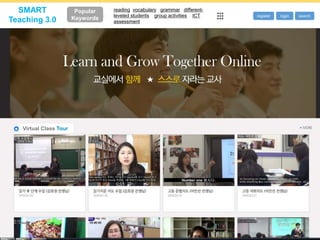
SMART
Teaching 3.0
Popular
Keywords
reading vocabulary grammar different-
leveled students group activities ICT
assessment
register login search
Virtual Class Tour
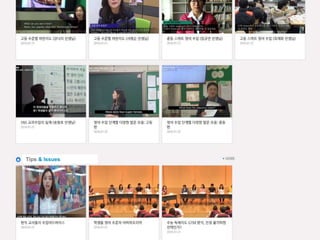
Tips & Issues
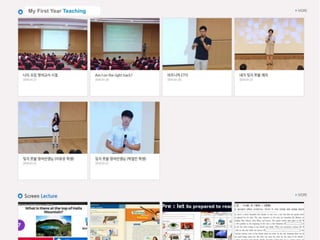
My First Year Teaching
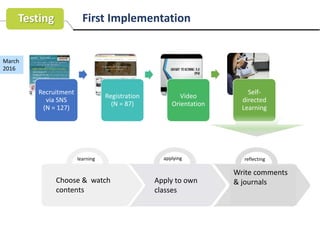
First Implementation
Recruitment
via SNS
(N = 127)
Registration
(N = 87)
Video
Orientation
Self-
directed
Learning
Choose & watch
contents
Apply to own
classes
learning applying reflecting
Write comments
& journals
March
2016
Testing
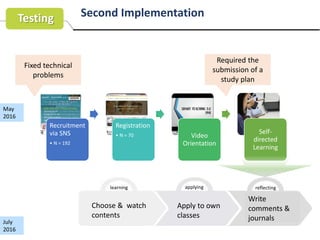
Recruitment
via SNS
• N = 192
Registration
• N = 70 Video
Orientation
Self-
directed
Learning
Choose & watch
contents
Apply to own
classes
learning applying reflecting
May
2016
Fixed technical
problems
Required the
submission of a
study plan
Write
comments &
journalsJuly
2016
Testing Second Implementation
website statistics, 85 comments on video posting,
78 weekly journals, 5 post interviews
 Contents were selected and
provided by teachers [log, replies,
WJs, & interviews].
 Ts applied what they
learned into their own
classes [replies, WJs, &
interviews].
35% on mobile; at
various places (at home
(49%), at school (40%),
during commuting (9%));
between classes (10 AM >
3 PM > 11 AM) [log, WJs &
interviews]
 inactive participation
without obligation [survey,
interviews]
 little interaction
among teachers
[replies, WJs, &
interviews]
 decreased
participation along
with time [log]
SMART
TEACHING 3.0
bottom-up
applicable
accessible
any time,
any where
autonomous
interactive
sustainable
Reflection
Suggestions
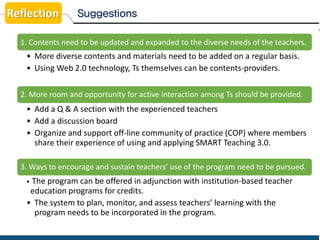
1. Contents need to be updated and expanded to the diverse needs of the teachers.
• More diverse contents and materials need to be added on a regular basis.
• Using Web 2.0 technology, Ts themselves can be contents-providers.
2. More room and opportunity for active interaction among Ts should be provided.
• Add a Q & A section with the experienced teachers
• Add a discussion board
• Organize and support off-line community of practice (COP) where members
share their experience of using and applying SMART Teaching 3.0.
3. Ways to encourage and sustain teachers’ use of the program need to be pursued.
• The program can be offered in adjunction with institution-based teacher
education programs for credits.
• The system to plan, monitor, and assess teachers’ learning with the
program needs to be incorporated in the program.
Reflection
c

A mobile-assisted curriculum model for teachers’ self-directed professional development: Design-based research.

  • 1.
    Heyoung Kim &Jin-Hwa Lee (Chung-Ang University) March 6, 2018,Valencia Mobile-assisted Curriculum Model forTeachers’ Self-directed Professional Development: Design-based Research 2018 INTED Conference
  • 2.
    Purpose  This studyintends to suggest a new reform model for teacher professional development by integrating open learning platform, SMART Teaching 3.0. (http://smartteaching.or.kr ).  This new teacher professional development model was constructed and implemented for two years based on design based research.
  • 3.
    Design-Based Research(DBR, Amiel& Reeve, 2008)  The cyclic process of four step principles: 1) analysis, 2) development, 3) testing and refinement, and 4) reflection. Analysis Development Testing Reflection
  • 4.
    Problems & Needs:TeacherEducation in KoreaAnalysis Methods: literature reviews, teacher survey, and teacher Interviews • mostly top-down • institution-centered • one-time offer courses, • doesn't’ teachers’ needs and hardly guarantee improvement of the participant teachers’ instruction • busy to attend intensive training program • expect more practical, applicable, task-based education for their daily instruction • need more subject-specific professional development • novice teachers have felt a great difficulty in successfully adjusting to new environment and satisfying students’ expectation
  • 5.
    Development NewTeacher ProfessionalDevelopment Model Desktop view Mobile view SMART Teaching 3.0
  • 6.
    Development NewTeacher ProfessionalDevelopment Model SMART TEACHING 3.0 Self- directed Moti- vating Applic- able Resouce- ful Technol ogy- embeded  Needs-based  Selection for hands-on needs  Anytime Anywhere  Likes, comments  Easy to add & delete contents  Story-based  Short and fun videos  Discussions & Interviews  Instructional Task-based  Easy to apply it to their own instruction  44 movie clips, 571 minutes
  • 7.
    Development NewTeacher ProfessionalDevelopment Model • 4 sections, 44 video clips Virtual class tour Best teachers’ teaching Tips & Issues Panel discussion advice My first year teaching TED type Storytelling Screen lecture Lectures using PPT
  • 8.
  • 9.
    SMART Teaching 3.0 Popular Keywords reading vocabularygrammar different- leveled students group activities ICT assessment register login search Virtual Class Tour
  • 10.
  • 11.
    My First YearTeaching
  • 13.
    First Implementation Recruitment via SNS (N= 127) Registration (N = 87) Video Orientation Self- directed Learning Choose & watch contents Apply to own classes learning applying reflecting Write comments & journals March 2016 Testing
  • 14.
    Recruitment via SNS • N= 192 Registration • N = 70 Video Orientation Self- directed Learning Choose & watch contents Apply to own classes learning applying reflecting May 2016 Fixed technical problems Required the submission of a study plan Write comments & journalsJuly 2016 Testing Second Implementation
  • 15.
    website statistics, 85comments on video posting, 78 weekly journals, 5 post interviews  Contents were selected and provided by teachers [log, replies, WJs, & interviews].  Ts applied what they learned into their own classes [replies, WJs, & interviews]. 35% on mobile; at various places (at home (49%), at school (40%), during commuting (9%)); between classes (10 AM > 3 PM > 11 AM) [log, WJs & interviews]  inactive participation without obligation [survey, interviews]  little interaction among teachers [replies, WJs, & interviews]  decreased participation along with time [log] SMART TEACHING 3.0 bottom-up applicable accessible any time, any where autonomous interactive sustainable Reflection
  • 16.
    Suggestions 1. Contents needto be updated and expanded to the diverse needs of the teachers. • More diverse contents and materials need to be added on a regular basis. • Using Web 2.0 technology, Ts themselves can be contents-providers. 2. More room and opportunity for active interaction among Ts should be provided. • Add a Q & A section with the experienced teachers • Add a discussion board • Organize and support off-line community of practice (COP) where members share their experience of using and applying SMART Teaching 3.0. 3. Ways to encourage and sustain teachers’ use of the program need to be pursued. • The program can be offered in adjunction with institution-based teacher education programs for credits. • The system to plan, monitor, and assess teachers’ learning with the program needs to be incorporated in the program. Reflection
  • 17.