Wind, Clouds,
and Precipitation
WINDS
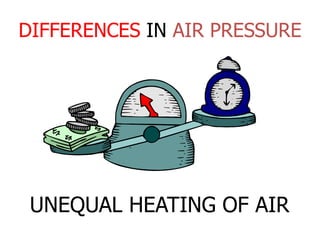
DIFFERENCES IN AIR PRESSURE


 UNEQUAL HEATING OF AIR
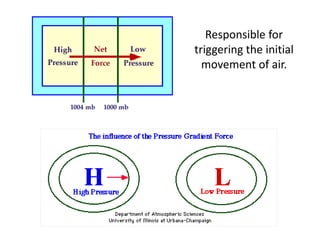
Responsible for
triggering the initial
  movement of air.
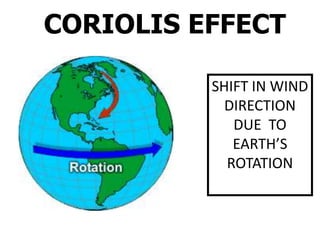
CORIOLIS EFFECT

          SHIFT IN WIND
            DIRECTION
             DUE TO
             EARTH’S
            ROTATION
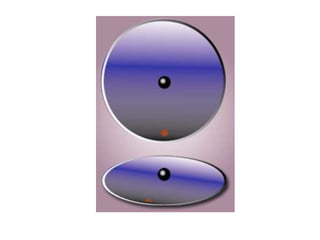
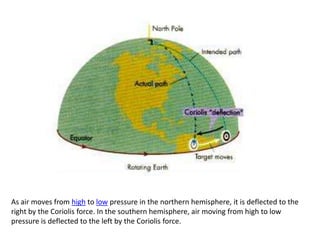
As air moves from high to low pressure in the northern hemisphere, it is deflected to the
right by the Coriolis force. In the southern hemisphere, air moving from high to low
pressure is deflected to the left by the Coriolis force.
Flushing Toilets on the Equator
Myth or Real:

Toilets flushed in the northern hemisphere
apparently spin to the right, in the southern
hemisphere the water spins left -- this is
supposedly caused by the Coriolis effect. And
on the equator? It's a straight shot down.
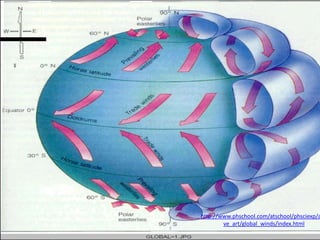
http://www.phschool.com/atschool/phsciexp/a
        ve_art/global_winds/index.html
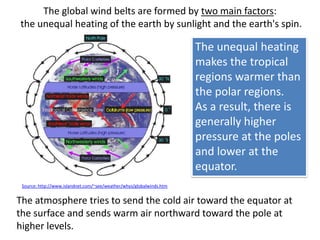
The global wind belts are formed by two main factors:
the unequal heating of the earth by sunlight and the earth's spin.

                                                                      The unequal heating
                                                                      makes the tropical
                                                                      regions warmer than
                                                                      the polar regions.
                                                                      As a result, there is
                                                                      generally higher
                                                                      pressure at the poles
                                                                      and lower at the
                                                                      equator.
 Source: http://www.islandnet.com/~see/weather/whys/globalwinds.htm


The atmosphere tries to send the cold air toward the equator at
the surface and sends warm air northward toward the pole at
higher levels.
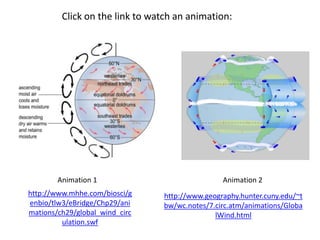
Click on the link to watch an animation:


        Animation 1                             Animation 2
http://www.mhhe.com/biosci/g    http://www.geography.hunter.cuny.edu/~t
enbio/tlw3/eBridge/Chp29/ani    bw/wc.notes/7.circ.atm/animations/Globa
mations/ch29/global_wind_circ                 lWind.html
         ulation.swf
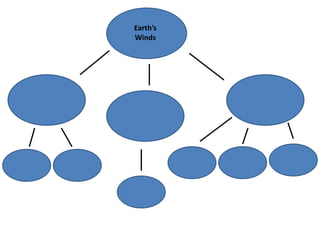
Earth’s
Winds
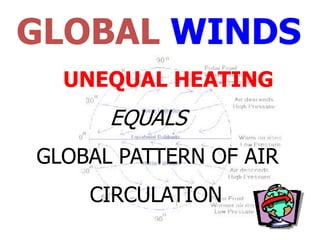
GLOBAL WINDS
  UNEQUAL HEATING
      EQUALS
GLOBAL PATTERN OF AIR
    CIRCULATION
LOCAL WINDS
      LAND BREEZE
      SEA BREEZE
      MONSOON
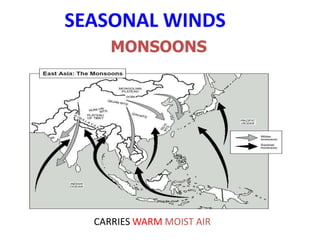
SEASONAL WINDS
     MONSOONS


  CARRIES WARM MOIST AIR
Philippines
Northeast Monsoon (cold
       and wet)

Southwest Monsoon (dry)
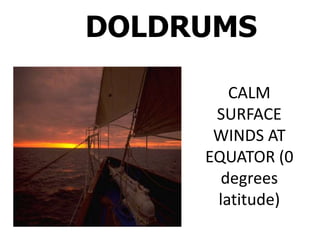
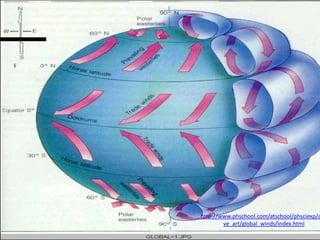
DOLDRUMS

        CALM
      SURFACE
      WINDS AT
     EQUATOR (0
       degrees
      latitude)
TRADE WINDS
         AIR MOVING
         BACK TO THE
          EQUATOR
       FORMING A BELT
          OF WARM,
        STEADY WINDS
HORSE LATITUDES

       30 degrees North
       and South of
       Equator
       Warm air cools and
       sink; clear skies;
       winds are calm
PREVAILING WESTERLIES


           40-60 degrees
           Latitude (West to
           East)

              Strong
              Winds
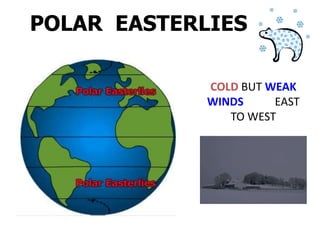
POLAR EASTERLIES

             COLD BUT WEAK
             WINDS     EAST
                TO WEST
http://www.phschool.com/atschool/phsciexp/a
        ve_art/global_winds/index.html
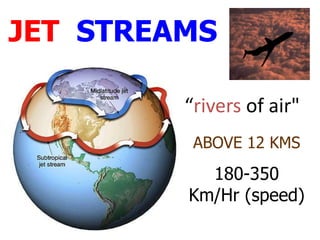
JET STREAMS

         “rivers of air"
          ABOVE 12 KMS
           180-350
         Km/Hr (speed)
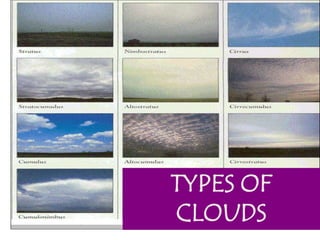
CLOUDS
http://www.youtube.com/watch?v=ODImMpGFUa4&feature=related
http://video.about.com/weather/How-Do-Clouds-Form-.htm
MOISTURE
  CONDENSES ON
 SMALL PARTICLES
OF DUST/ SOLIDS IN
     THE AIR
DEW POINT
TEMPERATURE AT WHICH AIR
      CONDENSES
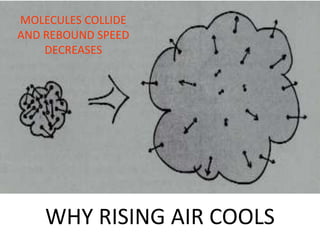
MOLECULES COLLIDE
AND REBOUND SPEED
    DECREASES


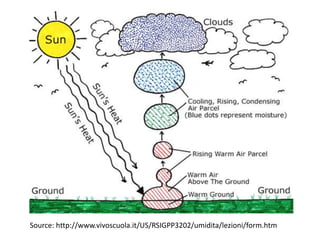
    WHY RISING AIR COOLS
CONDENSATION
WATER VAPOR
  CHANGES
 INTO LIQUID
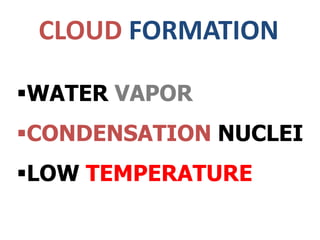
CLOUD FORMATION

WATER VAPOR
CONDENSATION NUCLEI
LOW TEMPERATURE
Source: http://www.vivoscuola.it/US/RSIGPP3202/umidita/lezioni/form.htm
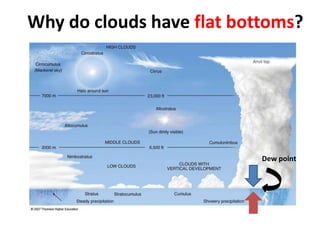
Why do clouds have flat bottoms?


                           Dew point
Cloud
droplets

                  Ice


           Snow
TYPES OF
CLOUDS
When warm air rises, other cooler air rushes in to take its place. The air that
rushes in moves parallel to the ground. It is this moving air that we call
“wind”.

Wind is caused by the uneven heating of the earth’s surface. Air that moves
up and down is important in making winds. This is called a current.

Warm air near the surface of the Earth can hold more moisture than cool air
above the Earth’s surface.

Water from the Earth’s lakes, oceans, land surfaces, and plants evaporates
into this warmer air. Eventually, the warm moisture-filled air rises and
becomes cool. Now the air can no longer hold all the moisture it had
acquired when it was near the surface of the Earth. As a result, much of the
water vapor in the air condenses.
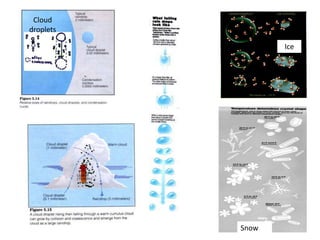
Water vapor that condenses and forms clouds can fall to the Earth as
rain, sleet, snow, or hail. Water that falls from the atmosphere to
the Earth is called precipitation.
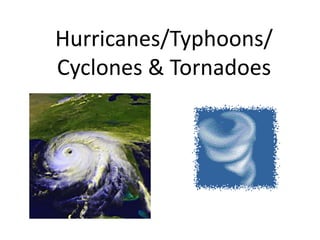
Hurricanes/Typhoons/
Cyclones & Tornadoes
http://www.youtube.com/watch?v=zP4rgvu4xDE
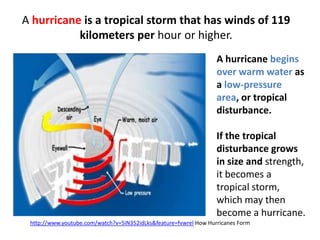
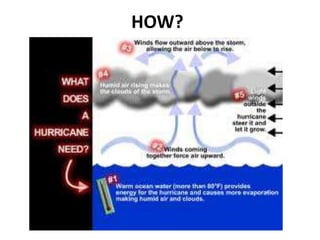
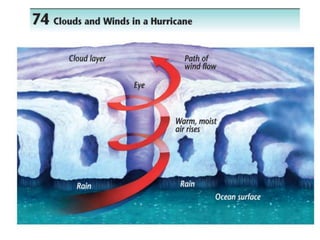
A hurricane is a tropical storm that has winds of 119
           kilometers per hour or higher.
                                                                  A hurricane begins
                                                                  over warm water as
                                                                  a low-pressure
                                                                  area, or tropical
                                                                  disturbance.

                                                                  If the tropical
                                                                  disturbance grows
                                                                  in size and strength,
                                                                  it becomes a
                                                                  tropical storm,
                                                                  which may then
                                                                  become a hurricane.
 http://www.youtube.com/watch?v=5iN352idLks&feature=fvwrel How Hurricanes Form
http://www.youtube.com/watch?v=5iN352idLks&feature=fvwrel How
                       Hurricanes Form
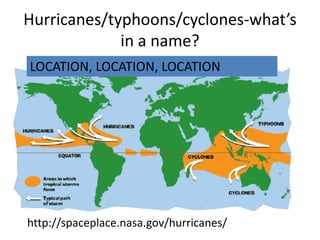
Hurricanes/typhoons/cyclones-what’s
             in a name?
LOCATION, LOCATION, LOCATION


http://spaceplace.nasa.gov/hurricanes/
HOW?
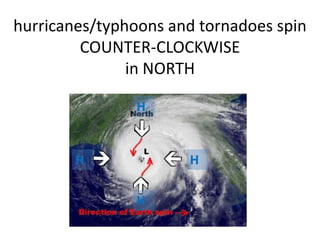
hurricanes/typhoons and tornadoes spin
         COUNTER-CLOCKWISE
               in NORTH

               H


        H             H

               H
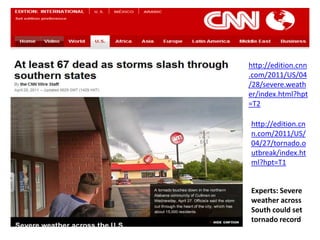
http://edition.cnn
.com/2011/US/04
/28/severe.weath
er/index.html?hpt
=T2

http://edition.cn
n.com/2011/US/
04/27/tornado.o
utbreak/index.ht
ml?hpt=T1


Experts: Severe
weather across
South could set
tornado record
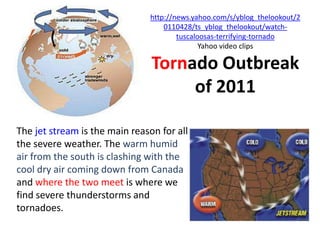
http://news.yahoo.com/s/yblog_thelookout/2
                                   0110428/ts_yblog_thelookout/watch-
                                       tuscaloosas-terrifying-tornado
                                              Yahoo video clips

                                Tornado Outbreak
                                     of 2011

The jet stream is the main reason for all
the severe weather. The warm humid
air from the south is clashing with the
cool dry air coming down from Canada
and where the two meet is where we
find severe thunderstorms and
tornadoes.
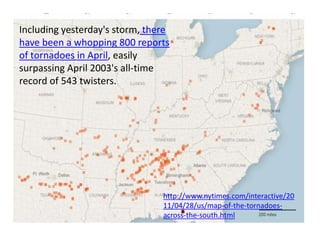
Including yesterday's storm, there
have been a whopping 800 reports
of tornadoes in April, easily
surpassing April 2003's all-time
record of 543 twisters.


                                http://www.nytimes.com/interactive/20
                                11/04/28/us/map-of-the-tornadoes-
                                across-the-south.html
Tornadoes Song:
http://www.youtube.com/watch?v=iOw6ONcKk4g
http://www.youtube.com/watch?v=cvOut9VUqKY&feature=fvwrel
http://news.yahoo.com/s/yblog_thelookout/2
                                             0110428/ts_yblog_thelookout/watch-
                                                 tuscaloosas-terrifying-tornado
                                                        Yahoo video clips


                                             Tornadoes

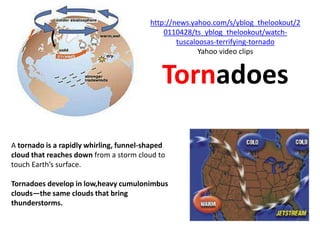
A tornado is a rapidly whirling, funnel-shaped
cloud that reaches down from a storm cloud to
touch Earth’s surface.

Tornadoes develop in low,heavy cumulonimbus
clouds—the same clouds that bring
thunderstorms.
http://www.youtube.com/watch?v=3Qu9wR03GV                       http://www.youtube.com/watch?v=VQDkmziz
             A&feature=related                                             1n8&feature=fvwrel


                                   http://www.youtube.com/watch?v=NTjR91JC850

Weather patterns