Air Masses


    http://www.weatherquestions.com/What_is_an_air_mass.htm

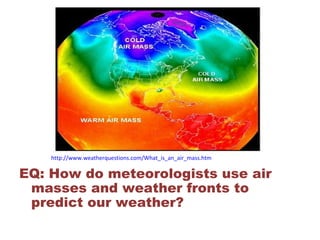
EQ: How do meteorologists use air
 masses and weather fronts to
 predict our weather?
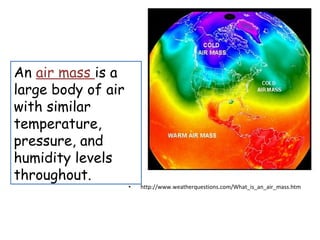
An air mass is a
large body of air
with similar
temperature,
pressure, and
humidity levels
throughout.
                    •   http://www.weatherquestions.com/What_is_an_air_mass.htm
Air Masses
• Get their properties from spending many
  days, even weeks, over the same area.

  – Example: If an air mass sits over an ocean for
    awhile, it becomes humid.
  – If an air mass sits over land, it becomes dry.
Air Masses
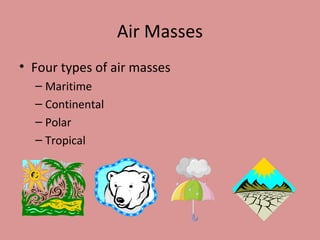
• Four types of air masses
  – Maritime
  – Continental
  – Polar
  – Tropical
Air Masses
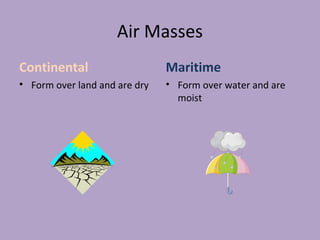
Continental                    Maritime
• Form over land and are dry   • Form over water and are
                                 moist
Air Masses
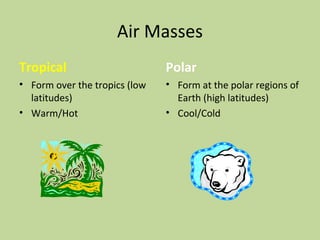
Tropical                       Polar
• Form over the tropics (low   • Form at the polar regions of
  latitudes)                     Earth (high latitudes)
• Warm/Hot                     • Cool/Cold
Air masses
Why does our weather change?

Air masses move!

How?
Global winds push air masses around the Earth!
Air Masses
                    Reflect
• M- Describe the four types of air masses.
• I- If you could become an air mass, which
  would you be and why?
• U- What type of air mass do you think is
  affecting us today and why?
• S- Create a flag for an air mass and explain
  why you chose that air mass.
Fronts
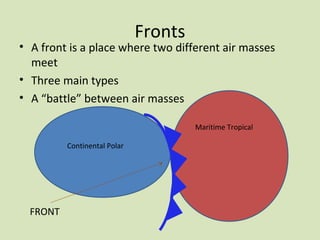
• A front is a place where two different air masses
  meet
• Three main types
• A “battle” between air masses

                                       Maritime Tropical

          Continental Polar


  FRONT
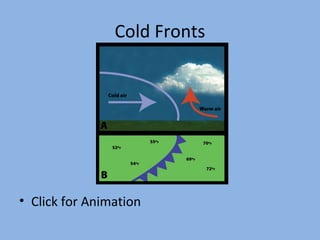
Cold Fronts


• Click for Animation
Cold Front
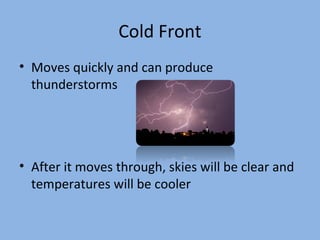
• Moves quickly and can produce
  thunderstorms


• After it moves through, skies will be clear and
  temperatures will be cooler
Cold Front
                  Reflect
• M- Explain the types of weather associated
   with a cold front.
• I- Write a skit for a cold front with two
   characters: cold air mass and warm air mass.
• U- A cold front passed through last night.
   Predict what the weather is like now?
• S- Create a metaphor: A cold front is
  like a _______________________. Explain.
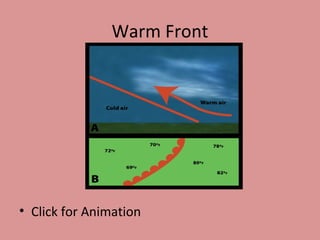
Warm Front


• Click for Animation
Warm Front
• Moves slower than cold fronts
• Brings humid weather and sometimes rains
  for days


• After it moves through, temperatures are
  warmer
Warm Front
                  Reflect
• M- Restate the cause of a warm front.
• I- Which type of front do you feel is the best
  and why?
• U- Compare and contrast warm fronts and
  cold fronts.
• S- What would it be like to be a warm front?
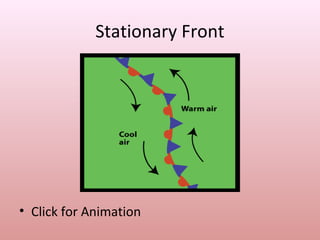
Stationary Front


• Click for Animation
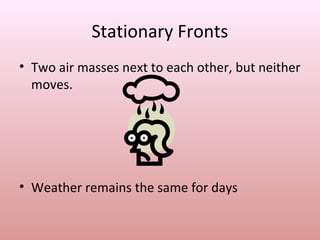
Stationary Fronts
• Two air masses next to each other, but neither
  moves.


• Weather remains the same for days
Stationary Front
                   Reflect
• M- Summarize the three types of fronts.
• I- You are charged with studying the effects of
  air masses and fronts. How would you do it?
• U-Which type of front do you think is the most
  destructive and why?
• S- Imagine you live in a world with only two
  types of air masses. How would that effect
  fronts?

Air masses and fronts 2013

  • 2.
    Air Masses http://www.weatherquestions.com/What_is_an_air_mass.htm EQ: How do meteorologists use air masses and weather fronts to predict our weather?
  • 3.
    An air massis a large body of air with similar temperature, pressure, and humidity levels throughout. • http://www.weatherquestions.com/What_is_an_air_mass.htm
  • 4.
    Air Masses • Gettheir properties from spending many days, even weeks, over the same area. – Example: If an air mass sits over an ocean for awhile, it becomes humid. – If an air mass sits over land, it becomes dry.
  • 5.
    Air Masses • Fourtypes of air masses – Maritime – Continental – Polar – Tropical
  • 6.
    Air Masses Continental Maritime • Form over land and are dry • Form over water and are moist
  • 7.
    Air Masses Tropical Polar • Form over the tropics (low • Form at the polar regions of latitudes) Earth (high latitudes) • Warm/Hot • Cool/Cold
  • 9.
    Air masses Why doesour weather change? Air masses move! How? Global winds push air masses around the Earth!
  • 10.
    Air Masses Reflect • M- Describe the four types of air masses. • I- If you could become an air mass, which would you be and why? • U- What type of air mass do you think is affecting us today and why? • S- Create a flag for an air mass and explain why you chose that air mass.
  • 11.
    Fronts • A frontis a place where two different air masses meet • Three main types • A “battle” between air masses Maritime Tropical Continental Polar FRONT
  • 12.
    Cold Fronts • Clickfor Animation
  • 13.
    Cold Front • Movesquickly and can produce thunderstorms • After it moves through, skies will be clear and temperatures will be cooler
  • 14.
    Cold Front Reflect • M- Explain the types of weather associated with a cold front. • I- Write a skit for a cold front with two characters: cold air mass and warm air mass. • U- A cold front passed through last night. Predict what the weather is like now? • S- Create a metaphor: A cold front is like a _______________________. Explain.
  • 15.
    Warm Front • Clickfor Animation
  • 16.
    Warm Front • Movesslower than cold fronts • Brings humid weather and sometimes rains for days • After it moves through, temperatures are warmer
  • 17.
    Warm Front Reflect • M- Restate the cause of a warm front. • I- Which type of front do you feel is the best and why? • U- Compare and contrast warm fronts and cold fronts. • S- What would it be like to be a warm front?
  • 18.
  • 19.
    Stationary Fronts • Twoair masses next to each other, but neither moves. • Weather remains the same for days
  • 20.
    Stationary Front Reflect • M- Summarize the three types of fronts. • I- You are charged with studying the effects of air masses and fronts. How would you do it? • U-Which type of front do you think is the most destructive and why? • S- Imagine you live in a world with only two types of air masses. How would that effect fronts?