Weather Fronts

NRHS Physical Science
Weather and Fronts
Worksheet 1


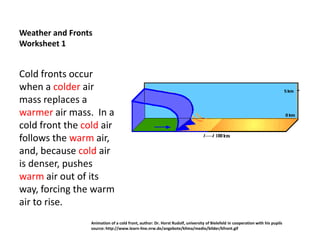
Cold fronts occur
when a colder air
mass replaces a
warmer air mass. In a
cold front the cold air
follows the warm air,
and, because cold air
is denser, pushes
warm air out of its
way, forcing the warm
air to rise.
                 Animation of a cold front, author: Dr. Horst Rudolf, university of Bielefeld in cooperation with his pupils
                 source: http://www.learn-line.nrw.de/angebote/klima/medio/bilder/kfront.gif
Weather and Fronts
Worksheet 1 (cont.)
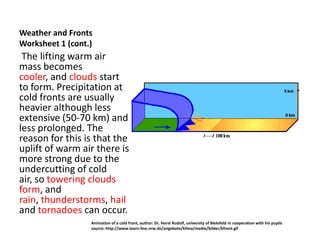
 The lifting warm air
mass becomes
cooler, and clouds start
to form. Precipitation at
cold fronts are usually
heavier although less
extensive (50-70 km) and
less prolonged. The
reason for this is that the
uplift of warm air there is
more strong due to the
undercutting of cold
air, so towering clouds
form, and
rain, thunderstorms, hail
and tornadoes can occur.
                  Animation of a cold front, author: Dr. Horst Rudolf, university of Bielefeld in cooperation with his pupils
                  source: http://www.learn-line.nrw.de/angebote/klima/medio/bilder/kfront.gif
Weather and Fronts
Worksheet 1 (cont.)
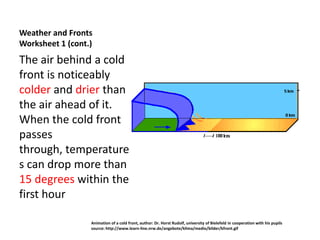
The air behind a cold
front is noticeably
colder and drier than
the air ahead of it.
When the cold front
passes
through, temperature
s can drop more than
15 degrees within the
first hour

                  Animation of a cold front, author: Dr. Horst Rudolf, university of Bielefeld in cooperation with his pupils
                  source: http://www.learn-line.nrw.de/angebote/klima/medio/bilder/kfront.gif
Worksheet 2
Satellite View: A cold front
above Middle Europe
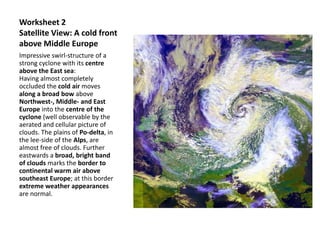
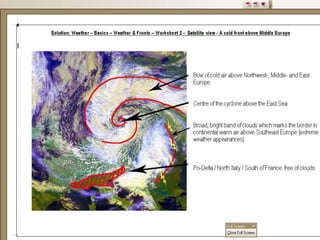
Impressive swirl-structure of a
strong cyclone with its centre
above the East sea:
Having almost completely
occluded the cold air moves
along a broad bow above
Northwest-, Middle- and East
Europe into the centre of the
cyclone (well observable by the
aerated and cellular picture of
clouds. The plains of Po-delta, in
the lee-side of the Alps, are
almost free of clouds. Further
eastwards a broad, bright band
of clouds marks the border to
continental warm air above
southeast Europe; at this border
extreme weather appearances
are normal.
Worksheet 3
Warm Fronts
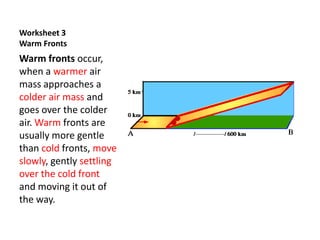
Warm fronts occur,
when a warmer air
mass approaches a
colder air mass and
goes over the colder
air. Warm fronts are
usually more gentle
than cold fronts, move
slowly, gently settling
over the cold front
and moving it out of
the way.
Worksheet 3
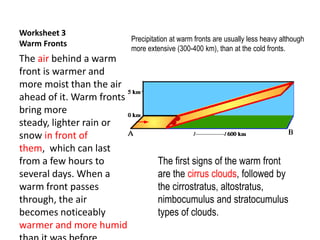
                           Precipitation at warm fronts are usually less heavy although
Warm Fronts
                           more extensive (300-400 km), than at the cold fronts.
The air behind a warm
front is warmer and
more moist than the air
ahead of it. Warm fronts
bring more
steady, lighter rain or
snow in front of
them, which can last
from a few hours to                 The first signs of the warm front
several days. When a                are the cirrus clouds, followed by
warm front passes                   the cirrostratus, altostratus,
through, the air                    nimbocumulus and stratocumulus
becomes noticeably                  types of clouds.
warmer and more humid
Weather Maps              Front Maps

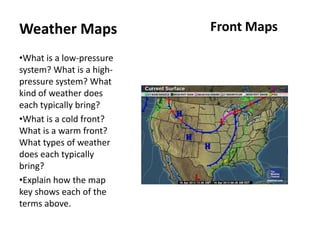
•What is a low-pressure
system? What is a high-
pressure system? What
kind of weather does
each typically bring?
•What is a cold front?
What is a warm front?
What types of weather
does each typically
bring?
•Explain how the map
key shows each of the
terms above.
Weather Maps            Satellite Maps

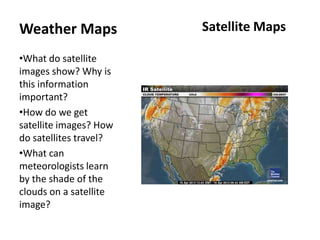
•What do satellite
images show? Why is
this information
important?
•How do we get
satellite images? How
do satellites travel?
•What can
meteorologists learn
by the shade of the
clouds on a satellite
image?
Weather Maps            Radar Image Maps

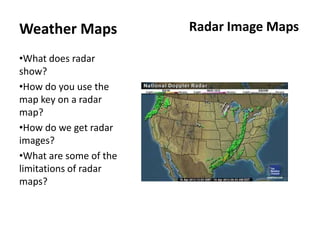
•What does radar
show?
•How do you use the
map key on a radar
map?
•How do we get radar
images?
•What are some of the
limitations of radar
maps?
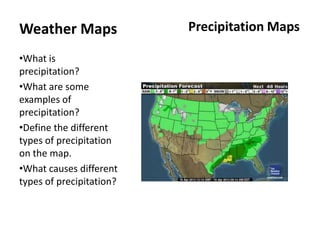
Weather Maps              Precipitation Maps

•What is
precipitation?
•What are some
examples of
precipitation?
•Define the different
types of precipitation
on the map.
•What causes different
types of precipitation?
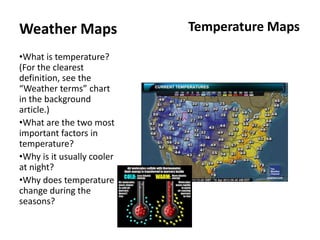
Weather Maps                Temperature Maps

•What is temperature?
(For the clearest
definition, see the
“Weather terms” chart
in the background
article.)
•What are the two most
important factors in
temperature?
•Why is it usually cooler
at night?
•Why does temperature
change during the
seasons?
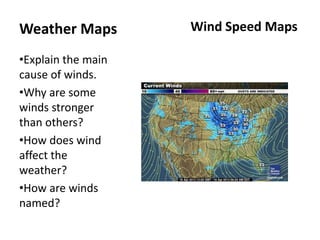
Weather Maps        Wind Speed Maps

•Explain the main
cause of winds.
•Why are some
winds stronger
than others?
•How does wind
affect the
weather?
•How are winds
named?
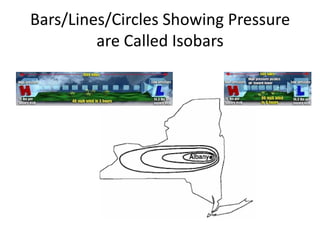
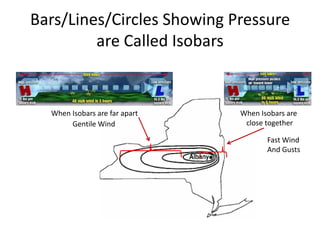
Bars/Lines/Circles Showing Pressure
         are Called Isobars
Bars/Lines/Circles Showing Pressure
         are Called Isobars


  When Isobars are far apart   When Isobars are
       Gentile Wind             close together

                                      Fast Wind
                                      And Gusts
Discussion Questions
• Using the maps from the activity, choose one
  place in the country that had different
  weather from your hometown’s.
• How do you think this weather affected kids in
  that area? How might their days have been
  different from yours? Think about what they
  wore, what they did for recess, and what they
  planned for after school.
Discussion Questions
• Why is it helpful to use different types of
  weather maps?
• When might some maps be more helpful than
  others?
• For example, why might you be more
  interested in precipitation one day and wind
  speed the next?
Discussion Questions
• Describe other maps you’ve seen in weather
  reports (examples: UV index, snowfall, pollen
  count).
• Why are these maps important?

Weather fronts

  • 1.
  • 2.
    Weather and Fronts Worksheet1 Cold fronts occur when a colder air mass replaces a warmer air mass. In a cold front the cold air follows the warm air, and, because cold air is denser, pushes warm air out of its way, forcing the warm air to rise. Animation of a cold front, author: Dr. Horst Rudolf, university of Bielefeld in cooperation with his pupils source: http://www.learn-line.nrw.de/angebote/klima/medio/bilder/kfront.gif
  • 3.
    Weather and Fronts Worksheet1 (cont.) The lifting warm air mass becomes cooler, and clouds start to form. Precipitation at cold fronts are usually heavier although less extensive (50-70 km) and less prolonged. The reason for this is that the uplift of warm air there is more strong due to the undercutting of cold air, so towering clouds form, and rain, thunderstorms, hail and tornadoes can occur. Animation of a cold front, author: Dr. Horst Rudolf, university of Bielefeld in cooperation with his pupils source: http://www.learn-line.nrw.de/angebote/klima/medio/bilder/kfront.gif
  • 4.
    Weather and Fronts Worksheet1 (cont.) The air behind a cold front is noticeably colder and drier than the air ahead of it. When the cold front passes through, temperature s can drop more than 15 degrees within the first hour Animation of a cold front, author: Dr. Horst Rudolf, university of Bielefeld in cooperation with his pupils source: http://www.learn-line.nrw.de/angebote/klima/medio/bilder/kfront.gif
  • 5.
    Worksheet 2 Satellite View:A cold front above Middle Europe Impressive swirl-structure of a strong cyclone with its centre above the East sea: Having almost completely occluded the cold air moves along a broad bow above Northwest-, Middle- and East Europe into the centre of the cyclone (well observable by the aerated and cellular picture of clouds. The plains of Po-delta, in the lee-side of the Alps, are almost free of clouds. Further eastwards a broad, bright band of clouds marks the border to continental warm air above southeast Europe; at this border extreme weather appearances are normal.
  • 7.
    Worksheet 3 Warm Fronts Warmfronts occur, when a warmer air mass approaches a colder air mass and goes over the colder air. Warm fronts are usually more gentle than cold fronts, move slowly, gently settling over the cold front and moving it out of the way.
  • 8.
    Worksheet 3 Precipitation at warm fronts are usually less heavy although Warm Fronts more extensive (300-400 km), than at the cold fronts. The air behind a warm front is warmer and more moist than the air ahead of it. Warm fronts bring more steady, lighter rain or snow in front of them, which can last from a few hours to The first signs of the warm front several days. When a are the cirrus clouds, followed by warm front passes the cirrostratus, altostratus, through, the air nimbocumulus and stratocumulus becomes noticeably types of clouds. warmer and more humid
  • 9.
    Weather Maps Front Maps •What is a low-pressure system? What is a high- pressure system? What kind of weather does each typically bring? •What is a cold front? What is a warm front? What types of weather does each typically bring? •Explain how the map key shows each of the terms above.
  • 10.
    Weather Maps Satellite Maps •What do satellite images show? Why is this information important? •How do we get satellite images? How do satellites travel? •What can meteorologists learn by the shade of the clouds on a satellite image?
  • 11.
    Weather Maps Radar Image Maps •What does radar show? •How do you use the map key on a radar map? •How do we get radar images? •What are some of the limitations of radar maps?
  • 12.
    Weather Maps Precipitation Maps •What is precipitation? •What are some examples of precipitation? •Define the different types of precipitation on the map. •What causes different types of precipitation?
  • 13.
    Weather Maps Temperature Maps •What is temperature? (For the clearest definition, see the “Weather terms” chart in the background article.) •What are the two most important factors in temperature? •Why is it usually cooler at night? •Why does temperature change during the seasons?
  • 14.
    Weather Maps Wind Speed Maps •Explain the main cause of winds. •Why are some winds stronger than others? •How does wind affect the weather? •How are winds named?
  • 15.
  • 16.
    Bars/Lines/Circles Showing Pressure are Called Isobars When Isobars are far apart When Isobars are Gentile Wind close together Fast Wind And Gusts
  • 17.
    Discussion Questions • Usingthe maps from the activity, choose one place in the country that had different weather from your hometown’s. • How do you think this weather affected kids in that area? How might their days have been different from yours? Think about what they wore, what they did for recess, and what they planned for after school.
  • 18.
    Discussion Questions • Whyis it helpful to use different types of weather maps? • When might some maps be more helpful than others? • For example, why might you be more interested in precipitation one day and wind speed the next?
  • 19.
    Discussion Questions • Describeother maps you’ve seen in weather reports (examples: UV index, snowfall, pollen count). • Why are these maps important?