Managing the Physical Environment Weather Hazards How do storms develop?
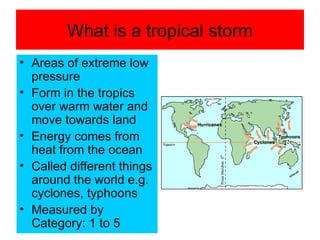
What is a tropical storm Areas of extreme low pressure Form in the tropics over warm water and move towards land Energy comes from heat from the ocean Called different things around the world e.g. cyclones, typhoons Measured by Category: 1 to 5
How do hurricanes form? Rising warm air rises fast, causing towering clouds, heavy rainfall, and intense low pressure. The cloud brings heavy rain, thunder and lightning. The low pressure sucks in air, causing very strong winds which spiral - clockwise in the northern hemisphere In the centre is the eye of the hurricane, about 45 km across (30miles) across. Often there will be no cloud in the eye. Seen from below it will seem calmer, with a circle of blue sky above. The eye is formed because this is the only part of the hurricane where air is sinking. In the northern hemisphere, the prevailing easterly tropical trade winds tend to steer hurricanes toward land - although their course is unpredictable. As they move inshore their power gradually reduces, because their energy comes from sucking up moist sea air.  Click here for Hurricane Animation Click here for an online test
Why are hurricanes a  hazard ? Strong winds   Winds reaching 200km/h are quite common. These winds can tear up vegetation and push over electricity pylons. Buildings may be damaged, and in poorer areas whole towns can be devastated. Heavy rainfall   Heavy rainfall can rapidly increase rive levels and cause flooding. On steeper slopes there is a risk of landslides. Storm surges   The low pressure means that sea-level is high. The strong winds create huge waves, which push towards coastal areas causing extensive flooding.
Case Study: Hurricane Gilbert FACTFILE 9 th -14 th  September 1988 Lowest pressure ever recorded Winds of over 200km per hour Waves reached 15m in height 328 dead 500,000 homeless Billions of dollars of damage to crops and property Click here for Hurricane Gilbert map showing its Impacts The Hurricane devastated St Lucia, Puerto Rico, the Dominican Republic, Haiti, Venezuela, Jamaica, Honduras, El Salvador and Mexico
Case Study: Hurricane Gilbert Why is emergency relief needed after a natural disaster?

Weather Hazards 1

  • 1.
    Managing the PhysicalEnvironment Weather Hazards How do storms develop?
  • 2.
    What is atropical storm Areas of extreme low pressure Form in the tropics over warm water and move towards land Energy comes from heat from the ocean Called different things around the world e.g. cyclones, typhoons Measured by Category: 1 to 5
  • 3.
    How do hurricanesform? Rising warm air rises fast, causing towering clouds, heavy rainfall, and intense low pressure. The cloud brings heavy rain, thunder and lightning. The low pressure sucks in air, causing very strong winds which spiral - clockwise in the northern hemisphere In the centre is the eye of the hurricane, about 45 km across (30miles) across. Often there will be no cloud in the eye. Seen from below it will seem calmer, with a circle of blue sky above. The eye is formed because this is the only part of the hurricane where air is sinking. In the northern hemisphere, the prevailing easterly tropical trade winds tend to steer hurricanes toward land - although their course is unpredictable. As they move inshore their power gradually reduces, because their energy comes from sucking up moist sea air. Click here for Hurricane Animation Click here for an online test
  • 4.
    Why are hurricanesa hazard ? Strong winds Winds reaching 200km/h are quite common. These winds can tear up vegetation and push over electricity pylons. Buildings may be damaged, and in poorer areas whole towns can be devastated. Heavy rainfall Heavy rainfall can rapidly increase rive levels and cause flooding. On steeper slopes there is a risk of landslides. Storm surges The low pressure means that sea-level is high. The strong winds create huge waves, which push towards coastal areas causing extensive flooding.
  • 5.
    Case Study: HurricaneGilbert FACTFILE 9 th -14 th September 1988 Lowest pressure ever recorded Winds of over 200km per hour Waves reached 15m in height 328 dead 500,000 homeless Billions of dollars of damage to crops and property Click here for Hurricane Gilbert map showing its Impacts The Hurricane devastated St Lucia, Puerto Rico, the Dominican Republic, Haiti, Venezuela, Jamaica, Honduras, El Salvador and Mexico
  • 6.
    Case Study: HurricaneGilbert Why is emergency relief needed after a natural disaster?