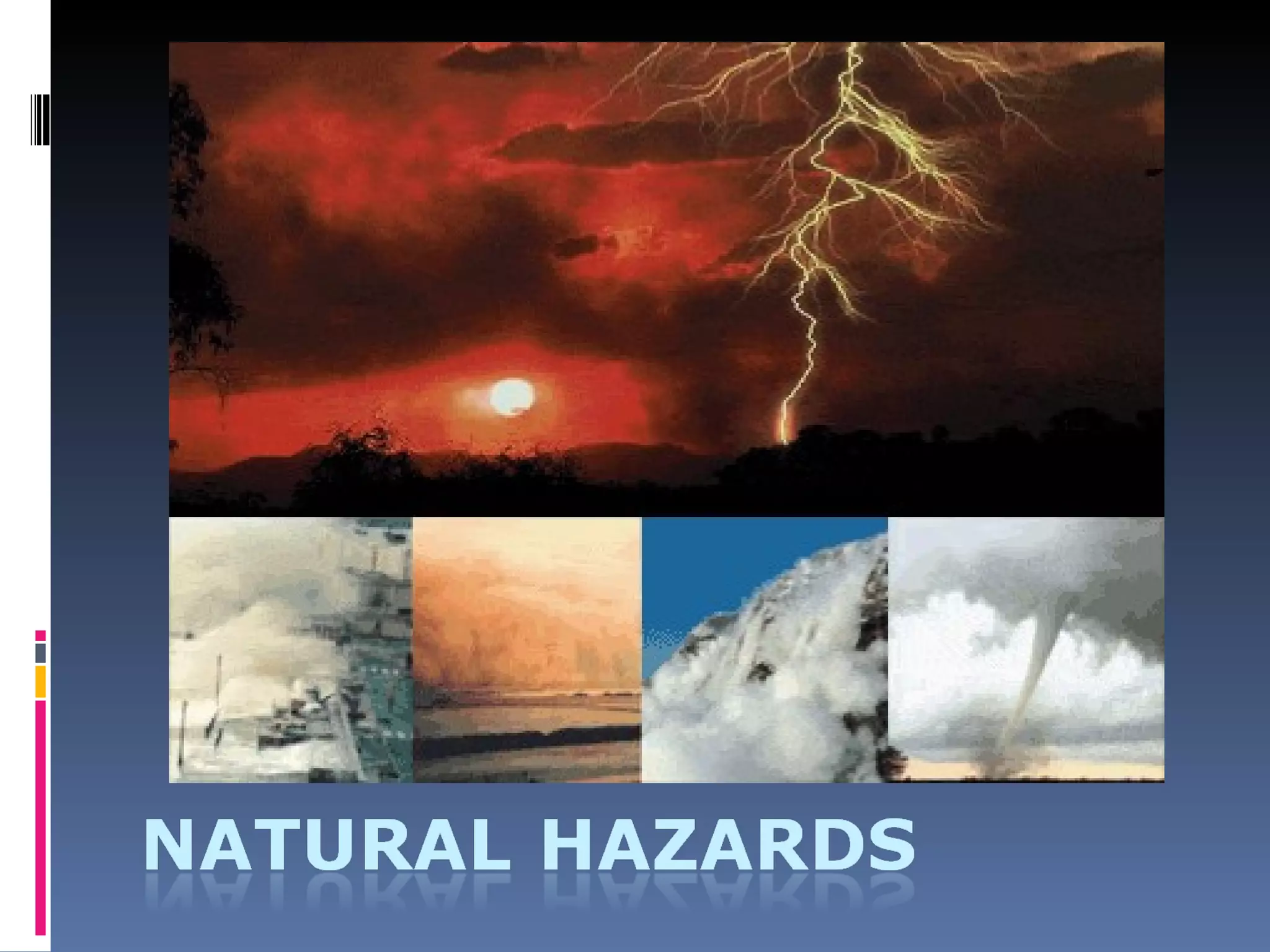
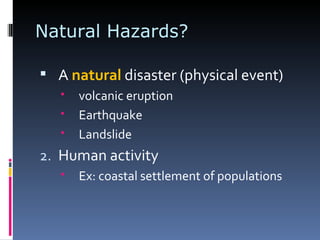
Natural Hazards? A  natural  disaster (physical event) volcanic eruption Earthquake Landslide Human activity Ex: coastal settlement of populations
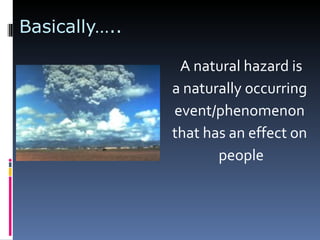
Basically….. A natural hazard is a naturally occurring  event/phenomenon  that has an effect on  people
Vulnerability Vulnerability  = susceptibility to injury or attack  Human vulnerability leads to financial, structural, and human losses.  Natural hazards only occur in inhabited areas A natural disaster in an uninhabited area has little tangible impact on people Natural hazards are increasing because of… Population growth (more people) Urbanization (lots of people in small spaces) alteration of the natural environment (manmade islands)
Hazards’ Human Costs Every year natural disasters leave… 4,000,000 homeless 46,000 injured  5520 dead These figures do not include the recent tsunami in Asia (273,000) and Hurricane Katrina (1000)  Source: The International Red Cross
Positive Effects natural disasters have beneficial ecological consequences. rejuvenation of a coniferous forest months and/or years after fires  recharging of groundwater stocks after a flood). benefits tend to become apparent months or years after an extreme event
Methods of Classification Calculating human costs Impact measured by: loss of life (total deaths) number of injuries damage to property (replacement costs)
Methods of Classification Strength/size/intensity of event Hurricane system Tropical depression, tropical storm, category 1-5 Tornado scale Force 1-5 Richter scale (seismic events) Scale of 1-9, with 9 being cataclysmic, worldwide event Epidemic, pandemic
Methods of Classification Regional occurrence Hurricane (Atlantic) Typhoon (Pacific rim) Monsoon (Asia, Africa) Frequency of occurrence Annually? Centenially?
Disaster Categories We classify natural disasters by the chief process or sphere in which it operates Ex: Atmosphere, biosphere, lithosphere This system has  three categories
Atmospheric Hazards Cyclonic Storms (hurricane, typhoon, cyclone) Tornado (twisters, dust devils) Severe Storm (White Juan, Nor’easter) Flooding (heavy rains) Drought (lack of rain, prolonged high pressure) Wildfire (wind, lightning) Severe Weather (hot/cold) ex: ice storm
Biological Hazards Infectious Disease  HIV, H1N1, Bubonic Plague) Parasitic Disease ringworm Insect Infestation malaria, West Nile virus Plant Disease Dutch Elm disease, blight
Geological Hazards Slide (mud, land, rock) Volcanic Activity Earthquake Avalanche Tsunami (tidal wave)
Comparison and Analysis Any  one disaster can be described by analyzing various factors that determine how great an impact it will have on people This system recognizes  six main factors
Comparison and Analysis Frequency how often is the event likely to happen Duration the length of time the event lasts Extent Size of area or region affected Town? Continent? Region?
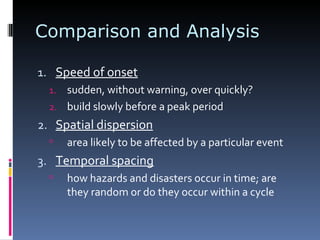
Comparison and Analysis Speed of onset sudden, without warning, over quickly? build slowly before a peak period Spatial dispersion area likely to be affected by a particular event  Temporal spacing how hazards and disasters occur in time; are they random or do they occur within a cycle

Natural Hazards, Classification and Analysis

  • 1.
  • 2.
    Natural Hazards? A natural disaster (physical event) volcanic eruption Earthquake Landslide Human activity Ex: coastal settlement of populations
  • 3.
    Basically….. A naturalhazard is a naturally occurring event/phenomenon that has an effect on people
  • 4.
    Vulnerability Vulnerability = susceptibility to injury or attack Human vulnerability leads to financial, structural, and human losses. Natural hazards only occur in inhabited areas A natural disaster in an uninhabited area has little tangible impact on people Natural hazards are increasing because of… Population growth (more people) Urbanization (lots of people in small spaces) alteration of the natural environment (manmade islands)
  • 5.
    Hazards’ Human CostsEvery year natural disasters leave… 4,000,000 homeless 46,000 injured 5520 dead These figures do not include the recent tsunami in Asia (273,000) and Hurricane Katrina (1000) Source: The International Red Cross
  • 6.
    Positive Effects naturaldisasters have beneficial ecological consequences. rejuvenation of a coniferous forest months and/or years after fires recharging of groundwater stocks after a flood). benefits tend to become apparent months or years after an extreme event
  • 7.
    Methods of ClassificationCalculating human costs Impact measured by: loss of life (total deaths) number of injuries damage to property (replacement costs)
  • 8.
    Methods of ClassificationStrength/size/intensity of event Hurricane system Tropical depression, tropical storm, category 1-5 Tornado scale Force 1-5 Richter scale (seismic events) Scale of 1-9, with 9 being cataclysmic, worldwide event Epidemic, pandemic
  • 9.
    Methods of ClassificationRegional occurrence Hurricane (Atlantic) Typhoon (Pacific rim) Monsoon (Asia, Africa) Frequency of occurrence Annually? Centenially?
  • 10.
    Disaster Categories Weclassify natural disasters by the chief process or sphere in which it operates Ex: Atmosphere, biosphere, lithosphere This system has three categories
  • 11.
    Atmospheric Hazards CyclonicStorms (hurricane, typhoon, cyclone) Tornado (twisters, dust devils) Severe Storm (White Juan, Nor’easter) Flooding (heavy rains) Drought (lack of rain, prolonged high pressure) Wildfire (wind, lightning) Severe Weather (hot/cold) ex: ice storm
  • 12.
    Biological Hazards InfectiousDisease HIV, H1N1, Bubonic Plague) Parasitic Disease ringworm Insect Infestation malaria, West Nile virus Plant Disease Dutch Elm disease, blight
  • 13.
    Geological Hazards Slide(mud, land, rock) Volcanic Activity Earthquake Avalanche Tsunami (tidal wave)
  • 14.
    Comparison and AnalysisAny one disaster can be described by analyzing various factors that determine how great an impact it will have on people This system recognizes six main factors
  • 15.
    Comparison and AnalysisFrequency how often is the event likely to happen Duration the length of time the event lasts Extent Size of area or region affected Town? Continent? Region?
  • 16.
    Comparison and AnalysisSpeed of onset sudden, without warning, over quickly? build slowly before a peak period Spatial dispersion area likely to be affected by a particular event Temporal spacing how hazards and disasters occur in time; are they random or do they occur within a cycle