Going global Roots
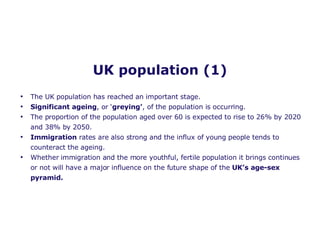
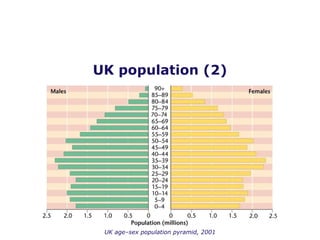
UK population (1) The UK population has reached an important stage. Significant ageing , or ‘ greying’ , of the population is occurring.  The proportion of the population aged over 60 is expected to rise to 26% by 2020 and 38% by 2050.  Immigration  rates are also strong and the influx of young people tends to counteract the ageing.  Whether immigration and the more youthful, fertile population it brings continues or not will have a major influence on the future shape of the  UK’s age-sex pyramid.
UK population (2) UK age–sex population pyramid, 2001
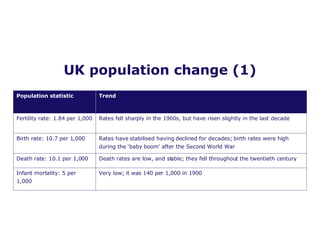
UK population change (1) Population statistic  Trend Fertility rate: 1.84 per 1,000 Rates fell sharply in the 1960s, but have risen slightly in the last decade Birth rate: 10.7 per 1,000 Rates have stabilised having declined for decades; birth rates were high during the ‘baby boom’ after the Second World War Death rate: 10.1 per 1,000 Death rates are low, and stable; they fell throughout the twentieth century Infant mortality: 5 per 1,000 Very low; it was 140 per 1,000 in 1900
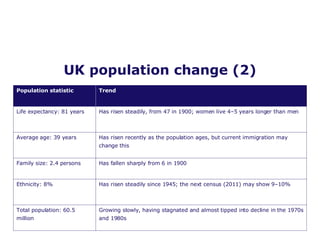
UK population change (2) Population statistic  Trend Life expectancy: 81 years  Has risen steadily, from 47 in 1900; women live 4–5 years longer than men Average age: 39 years Has risen recently as the population ages, but current immigration may change this Family size: 2.4 persons  Has fallen sharply from 6 in 1900 Ethnicity: 8% Has risen steadily since 1945; the next census (2011) may show 9–10% Total population: 60.5 million Growing slowly, having stagnated and almost tipped into decline in the 1970s and 1980s
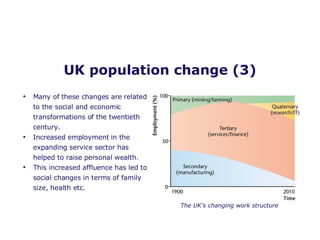
UK population change (3) Many of these changes are related to the social and economic transformations of the twentieth century. Increased employment in the expanding service sector has helped to raise personal wealth.  This increased affluence has led to social changes in terms of family size, health etc.  The UK’s changing work structure
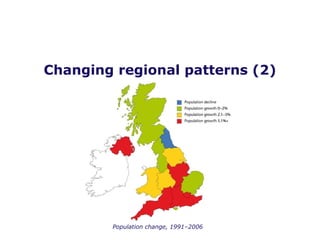
Changing regional patterns (1) The distribution of the UK’s population has changed. Major urban areas, especially inner cities, have been centres of immigration since 1945.  Younger workers have drifted towards the south and east, especially as a reaction to deindustrialisation in northern towns and cities. Older people have retired to the coast, especially in the south and southwest, and to accessible rural areas inland. Counter-urbanisation has resulted in population growth being focused on successful towns and cities in the south and on more accessible rural areas.
Changing regional patterns (2) Population change, 1991–2006
Your roots It is useful to research your own roots. Consider questions such as: How has family size and fertility changed over the last three or four generations of your family? Where did your family originally come from? Have they always lived in the present location? If not, then why did they move? Is there any history of immigration in your family?  Has your family moved up the socio-economic ladder in recent generations?
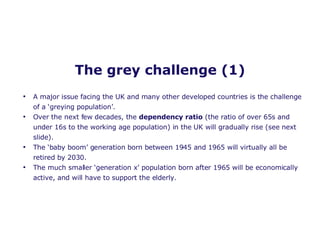
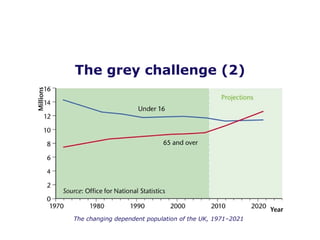
The grey challenge (1) A major issue facing the UK and many other developed countries is the challenge of a ‘greying population’. Over the next few decades, the  dependency ratio  (the ratio of over 65s and under 16s to the working age population) in the UK will gradually rise (see next slide).  The ‘baby boom’ generation born between 1945 and 1965 will virtually all be retired by 2030. The much smaller ‘generation x’ population born after 1965 will be economically active, and will have to support the elderly.
The grey challenge (2) The changing dependent population of the UK, 1971–2021
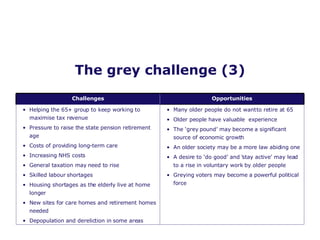
The grey challenge (3) Challenges Opportunities Helping the 65+ group to keep working to maximise tax revenue  Pressure to raise the state pension retirement age Costs of providing long-term care Increasing NHS costs General taxation may need to rise  Skilled labour shortages Housing shortages as the elderly live at home longer New sites for care homes and retirement homes needed Depopulation and dereliction in some areas   Many older people do not want to retire at 65 Older people have valuable  experience The ‘grey pound’ may become a significant source of economic growth  An older society may be a more law abiding one A desire to ‘do good’ and ‘stay active’ may lead to a rise in voluntary work by older people Greying voters may become a powerful political force
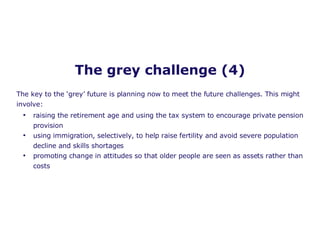
The grey challenge (4) raising the retirement age and using the tax system to encourage private pension provision using immigration, selectively, to help raise fertility and avoid severe population decline and skills shortages promoting change in attitudes so that older people are seen as assets rather than costs   The key to the ‘grey’ future is planning now to meet the future challenges. This might involve:

Roots

  • 1.
  • 2.
    UK population (1)The UK population has reached an important stage. Significant ageing , or ‘ greying’ , of the population is occurring. The proportion of the population aged over 60 is expected to rise to 26% by 2020 and 38% by 2050. Immigration rates are also strong and the influx of young people tends to counteract the ageing. Whether immigration and the more youthful, fertile population it brings continues or not will have a major influence on the future shape of the UK’s age-sex pyramid.
  • 3.
    UK population (2)UK age–sex population pyramid, 2001
  • 4.
    UK population change(1) Population statistic Trend Fertility rate: 1.84 per 1,000 Rates fell sharply in the 1960s, but have risen slightly in the last decade Birth rate: 10.7 per 1,000 Rates have stabilised having declined for decades; birth rates were high during the ‘baby boom’ after the Second World War Death rate: 10.1 per 1,000 Death rates are low, and stable; they fell throughout the twentieth century Infant mortality: 5 per 1,000 Very low; it was 140 per 1,000 in 1900
  • 5.
    UK population change(2) Population statistic Trend Life expectancy: 81 years Has risen steadily, from 47 in 1900; women live 4–5 years longer than men Average age: 39 years Has risen recently as the population ages, but current immigration may change this Family size: 2.4 persons Has fallen sharply from 6 in 1900 Ethnicity: 8% Has risen steadily since 1945; the next census (2011) may show 9–10% Total population: 60.5 million Growing slowly, having stagnated and almost tipped into decline in the 1970s and 1980s
  • 6.
    UK population change(3) Many of these changes are related to the social and economic transformations of the twentieth century. Increased employment in the expanding service sector has helped to raise personal wealth. This increased affluence has led to social changes in terms of family size, health etc. The UK’s changing work structure
  • 7.
    Changing regional patterns(1) The distribution of the UK’s population has changed. Major urban areas, especially inner cities, have been centres of immigration since 1945. Younger workers have drifted towards the south and east, especially as a reaction to deindustrialisation in northern towns and cities. Older people have retired to the coast, especially in the south and southwest, and to accessible rural areas inland. Counter-urbanisation has resulted in population growth being focused on successful towns and cities in the south and on more accessible rural areas.
  • 8.
    Changing regional patterns(2) Population change, 1991–2006
  • 9.
    Your roots Itis useful to research your own roots. Consider questions such as: How has family size and fertility changed over the last three or four generations of your family? Where did your family originally come from? Have they always lived in the present location? If not, then why did they move? Is there any history of immigration in your family? Has your family moved up the socio-economic ladder in recent generations?
  • 10.
    The grey challenge(1) A major issue facing the UK and many other developed countries is the challenge of a ‘greying population’. Over the next few decades, the dependency ratio (the ratio of over 65s and under 16s to the working age population) in the UK will gradually rise (see next slide). The ‘baby boom’ generation born between 1945 and 1965 will virtually all be retired by 2030. The much smaller ‘generation x’ population born after 1965 will be economically active, and will have to support the elderly.
  • 11.
    The grey challenge(2) The changing dependent population of the UK, 1971–2021
  • 12.
    The grey challenge(3) Challenges Opportunities Helping the 65+ group to keep working to maximise tax revenue Pressure to raise the state pension retirement age Costs of providing long-term care Increasing NHS costs General taxation may need to rise Skilled labour shortages Housing shortages as the elderly live at home longer New sites for care homes and retirement homes needed Depopulation and dereliction in some areas Many older people do not want to retire at 65 Older people have valuable experience The ‘grey pound’ may become a significant source of economic growth An older society may be a more law abiding one A desire to ‘do good’ and ‘stay active’ may lead to a rise in voluntary work by older people Greying voters may become a powerful political force
  • 13.
    The grey challenge(4) raising the retirement age and using the tax system to encourage private pension provision using immigration, selectively, to help raise fertility and avoid severe population decline and skills shortages promoting change in attitudes so that older people are seen as assets rather than costs The key to the ‘grey’ future is planning now to meet the future challenges. This might involve: