Going global Global networks
Global networks Global networks come in a variety of forms: business and trade  — physical and financial flows communication networks  — e.g. the internet transport networks  — e.g. air travel and container/bulk shipping production networks  — particularly those of transnational corporations (TNCs) political networks  — especially those that focus on economic/trade ties  demographic networks  — flows of people
Who’s connected? The  internet  provides one of the best indicators of connectivity.  It has been adopted rapidly and widely and is now part of everyday life, especially in developed countries. It requires certain key support features which are strongly related to levels of development: computer hardware and software internet service providers telephone system (or wireless system) money to pay for service education/training businesses willing to go online political freedom to use it
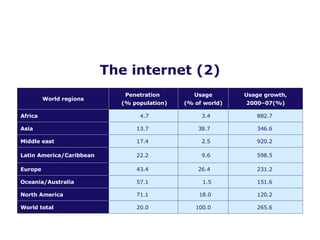
The internet (1) In 2007 1.3 billion people were using the internet.  Growth has been uneven, creating a ‘ digital divide ’ between the developed and developing worlds. The divide is related to income levels and technological infrastructure. The growth in internet usage in the developing world is becoming quite rapid, but has a long way to go before a significant percentage of the population is connected. Africa remains the big ‘loser’ in terms of internet usage. The table on the next slide shows the distribution of internet usage across the world.
The internet (2) World regions Penetration   (% population) Usage (% of world) Usage growth, 2000–07(%) Africa 4.7  3.4  882.7  Asia 13.7  38.7  346.6  Middle east 17.4  2.5  920.2  Latin America/Caribbean 22.2  9.6  598.5  Europe 43.4  26.4  231.2  Oceania/Australia 57.1  1.5 151.6  North America 71.1  18.0 120.2  World total 20.0  100.0 265.6
Global hubs Global hubs are  switched-on  places possessing qualities that make other places want to connect with them.  In some cases, these are the obvious  world cities , e.g. London and Tokyo.  In other cases, they may possess a particular attribute that others wish to connect with, rather than displaying a full range of connections, e.g. Bangalore. Many of the global hubs host the major  TNCs .  They tend to be places of increasingly diverse culture as flows of people, finance, trade and ideas converge on them.
Creating connections (1) Creating connections  is a major challenge for the world’s poorest nations.  Getting ‘ switched on ’ to globalisation requires certain key criteria to be met. Increasingly there is a need for sophisticated  communications technology .
Creating connections (2) a long-term strategy of  economic reform policies that have been found not to work have been changed —  pragmatism  rather than dogmatism investment in  infrastructure  building a  stable society investment in  human capital The global success story in terms of creating  connections  is  China , with its 15 years of 9–10% annual economic growth. China’s success has resulted from:
Creating connections (3) China has attracted a huge amount of  foreign direct investment (FDI) . This has contributed to the fact that China is now on the verge of becoming a mass-consumption economy, at least in the heavily populated coastal zone.
The $100 laptop (1) One project which aims to connect people in the developing world is the  one laptop per child (OLPC) scheme , or the ‘$100 laptop’. This began in 2005. The laptop itself is a wind-up machine, using open-source software.  A number of large TNCs donated $2 million each to launch the project, including ebay, Google, AMD and News Corporation. Haiti, Mongolia, Afghanistan, Rwanda and Mongolia were pilot countries. Mexico, Peru, Uruguay and Mongolia have ordered laptops.
The $100 laptop (2) the $100 price is too high  the costs of setting up, training and internet access are not included in the price there are more pressing problems, e.g. lack of clean water, sanitation and food Few very poor countries have expressed an interest in the project. It has been criticised on the basis that:
China in Africa Encouraging FDI is one way of kick-starting the development of the least developed countries. China is increasingly desperate for  mineral  and  fossil fuel resources  and so is investing heavily in parts of Africa. Parts of Africa have benefited from this investment, particularly as a result of the rise in commodity prices since 2001. It remains to be seen whether the benefits will spread beyond a few mining  (e.g. Zambia, Zimbabwe) and oil-rich (e.g. Nigeria, Sudan) countries.

Global Networks

  • 1.
  • 2.
    Global networks Globalnetworks come in a variety of forms: business and trade — physical and financial flows communication networks — e.g. the internet transport networks — e.g. air travel and container/bulk shipping production networks — particularly those of transnational corporations (TNCs) political networks — especially those that focus on economic/trade ties demographic networks — flows of people
  • 3.
    Who’s connected? The internet provides one of the best indicators of connectivity. It has been adopted rapidly and widely and is now part of everyday life, especially in developed countries. It requires certain key support features which are strongly related to levels of development: computer hardware and software internet service providers telephone system (or wireless system) money to pay for service education/training businesses willing to go online political freedom to use it
  • 4.
    The internet (1)In 2007 1.3 billion people were using the internet. Growth has been uneven, creating a ‘ digital divide ’ between the developed and developing worlds. The divide is related to income levels and technological infrastructure. The growth in internet usage in the developing world is becoming quite rapid, but has a long way to go before a significant percentage of the population is connected. Africa remains the big ‘loser’ in terms of internet usage. The table on the next slide shows the distribution of internet usage across the world.
  • 5.
    The internet (2)World regions Penetration (% population) Usage (% of world) Usage growth, 2000–07(%) Africa 4.7 3.4 882.7 Asia 13.7 38.7 346.6 Middle east 17.4 2.5 920.2 Latin America/Caribbean 22.2 9.6 598.5 Europe 43.4 26.4 231.2 Oceania/Australia 57.1 1.5 151.6 North America 71.1 18.0 120.2 World total 20.0 100.0 265.6
  • 6.
    Global hubs Globalhubs are switched-on places possessing qualities that make other places want to connect with them. In some cases, these are the obvious world cities , e.g. London and Tokyo. In other cases, they may possess a particular attribute that others wish to connect with, rather than displaying a full range of connections, e.g. Bangalore. Many of the global hubs host the major TNCs . They tend to be places of increasingly diverse culture as flows of people, finance, trade and ideas converge on them.
  • 7.
    Creating connections (1)Creating connections is a major challenge for the world’s poorest nations. Getting ‘ switched on ’ to globalisation requires certain key criteria to be met. Increasingly there is a need for sophisticated communications technology .
  • 8.
    Creating connections (2)a long-term strategy of economic reform policies that have been found not to work have been changed — pragmatism rather than dogmatism investment in infrastructure building a stable society investment in human capital The global success story in terms of creating connections is China , with its 15 years of 9–10% annual economic growth. China’s success has resulted from:
  • 9.
    Creating connections (3)China has attracted a huge amount of foreign direct investment (FDI) . This has contributed to the fact that China is now on the verge of becoming a mass-consumption economy, at least in the heavily populated coastal zone.
  • 10.
    The $100 laptop(1) One project which aims to connect people in the developing world is the one laptop per child (OLPC) scheme , or the ‘$100 laptop’. This began in 2005. The laptop itself is a wind-up machine, using open-source software. A number of large TNCs donated $2 million each to launch the project, including ebay, Google, AMD and News Corporation. Haiti, Mongolia, Afghanistan, Rwanda and Mongolia were pilot countries. Mexico, Peru, Uruguay and Mongolia have ordered laptops.
  • 11.
    The $100 laptop(2) the $100 price is too high the costs of setting up, training and internet access are not included in the price there are more pressing problems, e.g. lack of clean water, sanitation and food Few very poor countries have expressed an interest in the project. It has been criticised on the basis that:
  • 12.
    China in AfricaEncouraging FDI is one way of kick-starting the development of the least developed countries. China is increasingly desperate for mineral and fossil fuel resources and so is investing heavily in parts of Africa. Parts of Africa have benefited from this investment, particularly as a result of the rise in commodity prices since 2001. It remains to be seen whether the benefits will spread beyond a few mining (e.g. Zambia, Zimbabwe) and oil-rich (e.g. Nigeria, Sudan) countries.