6GEO4 Unit 4 Geographical Research
3. Skills audit for research Good organisation is the key to success in this module which assesses independent learning, highly valued by universities and employers. How would you rate your own abilities in: Time management? Meeting deadlines? Self-discipline? Working outside of class? Organisation?  Taking the initiative? Problem solving ? Effective researching from a range of sources?  Being flexible? Remember the proportion of work in this Module: EDEXCEL TEACHER STUDENT
4.  What is a report style essay? A report is a conventional method of presenting precise information.  Report style is highly structured and organised. It is tightly focused on the subject of investigation An effective report will also be compelling and stimulating to read. Report titles will require an analysis and assessment of a situation. In the Unit 4 exam you need to merge traditional essay writing style with report style to produce a discursive argument organised into structured sections.   
Producing a report style essay in exam conditions To help you to produce a report style essay, a 3 stage process has been identified to help you understand the final product required in the exam.  These stages are: I - Research and preparation:  learning about the content of the syllabus, and the start of gathering  and selecting materials, and creating an organised portfolio/file II - Practicing report writing and the final exam III - The pre release phase before the exam ,  where information is given to help you focus on specific aspects of your chosen option.
5.  Research and preparation phase    Planning  is essential.  It saves time  Ensure you have a  timeline , listing the weeks up until the pre-release and final exam.  Add interim deadlines for research, class work such as presentations, and practice report essays. Plan the information you need to collect and set aside time to organise the material. The key is to achieve a balance between ‘reading around’  a topic as well as a focussing on specific aspects.
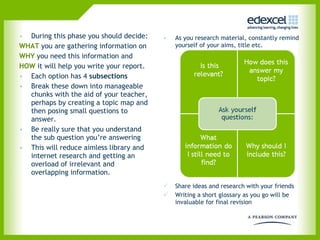
During this phase you should decide: WHAT  you are gathering information on WHY  you need this information and HOW  it will help you write your report. Each option has 4  subsections Break these down into manageable chunks with the aid of your teacher, perhaps by creating a topic map and then posing small questions to answer.  Be really sure that you understand the sub question you’re answering This will reduce aimless library and internet research and getting an overload of irrelevant and overlapping information.  As you research material, constantly remind yourself of your aims, title etc.  Share ideas and research with your friends Writing a short glossary as you go will be invaluable for final revision 
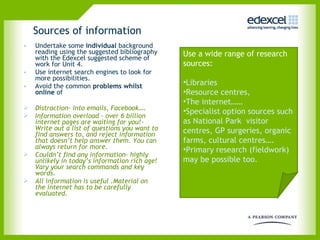
Sources of information Undertake some  individual  background reading using the suggested bibliography with the Edexcel suggested scheme of work for Unit 4. Use internet search engines to look for more possibilities. Avoid the common  problems whilst online  of Distraction- into emails, Facebook…. Information overload – over 6 billion internet pages are waiting for you!- Write out a list of questions you want to find answers to, and reject information that doesn’t help answer them. You can always return for more.  Couldn’t find any information- highly unlikely in today’s information rich age! Vary your search commands and key words. All information is useful .Material on the internet has to be carefully evaluated.  Use a wide range of research sources:  Libraries Resource centres,  The internet…… Specialist option sources such as National Park  visitor centres, GP surgeries, organic farms, cultural centres…. Primary research (fieldwork) may be possible too.
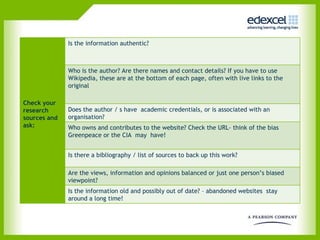
Check your research sources and ask: Is the information authentic? Who is the author? Are there names and contact details? If you have to use Wikipedia, these are at the bottom of each page, often with live links to the original Does the author / s have  academic credentials, or is associated with an organisation? Who owns and contributes to the website? Check the URL- think of the bias Greenpeace or the CIA  may  have!  Is there a bibliography / list of sources to back up this work? Are the views, information and opinions balanced or just one person’s biased viewpoint?  Is the information old and possibly out of date? – abandoned websites  stay around a long time! 
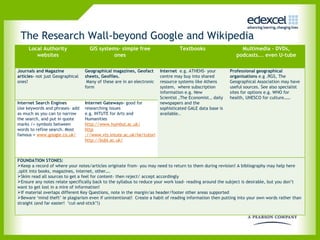
The Research Wall-beyond Google and Wikipedia  Local Authority  websites  GIS systems- simple free ones Textbooks Multimedia - DVDs, podcasts…. even U-tube Journals and Magazine articles-  not just Geographical ones!  Geographical magazines, Geofact sheets, Geofiles. Many of these are in an electronic form Internet   e.g. ATHENS- your centre may buy into shared resource systems like Athens system,  where subscription information e.g. New Scientist ,The Economist., daily newspapers and the sophisticated GALE data base is available.. Professional geographical organisations  e.g .RGS, The Geographical Association may have useful sources. See also specialist sites for options e.g. WHO for health, UNESCO for culture…… Internet Search Engines Use keywords and phrases- add as much as you can to narrow the search, and put in quote marks /+ symbols between words to refine search. Most famous =  www.google.co.uk/ Internet Gateways-  good for researching issues  e.g. INTUTE for Arts and Humanities http://www.humbul.ac.uk/ http ://www.vts.intute.ac.uk/he/tutorial/geographer http ://bubl.ac.uk/ FOUNDATION STONES: Keep a record of where your notes/articles originate from- you may need to return to them during revision! A bibliography may help here ,split into books, magazines, internet, other…. Skim read all sources to get a feel for content- then reject/ accept accordingly Ensure any notes relate specifically back to the syllabus to reduce your work load- reading around the subject is desirable, but you don’t want to get lost in a mire of information!  If material overlaps different Key Questions, note in the margin/as header/footer other areas supported  Beware ‘mind theft’ ie plagiarism even if unintentional!  Create a habit of reading information then putting into your own words rather than straight (and far easier!  ‘cut-and-stick’!)
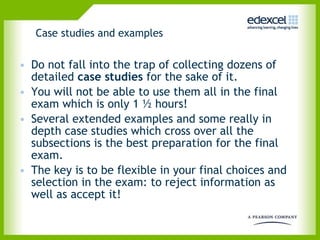
Case studies and examples Do not fall into the trap of collecting dozens of detailed  case studies  for the sake of it. You will not be able to use them all in the final exam which is only 1 ½ hours!  Several extended examples and some really in depth case studies which cross over all the subsections is the best preparation for the final exam.  The key is to be flexible in your final choices and selection in the exam: to reject information as well as accept it! 
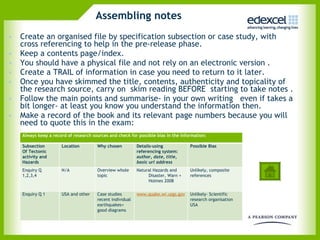
Assembling notes Create an organised file by specification subsection or case study, with cross referencing to help in the pre-release phase. Keep a contents page/index. You should have a physical file and not rely on an electronic version . Create a TRAIL of information in case you need to return to it later.  Once you have skimmed the title, contents, authenticity and topicality of the research source, carry on  skim reading BEFORE  starting to take notes . Follow the main points and summarise- in your own writing  even if takes a bit longer- at least you know you understand the information then. Make a record of the book and its relevant page numbers because you will need to quote this in the exam: Always keep a record of research sources and check for possible bias in the information: Subsection Of Tectonic activity and Hazards Location Why chosen Details-using referencing system: author, date, title, basic url address  Possible Bias Enquiry Q 1,2,3,4 N/A Overview whole topic Natural Hazards and Disaster, Warn + Holmes 2008  Unlikely, composite references Enquiry Q 1 USA and other Case studies  recent individual earthquakes+ good diagrams www.quake.wr.usgs.gov Unlikely- Scientific research organisation USA
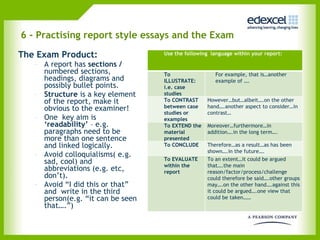
6 - Practising report style essays and the Exam  The Exam Product: A report has  sections /  numbered sections, headings, diagrams and possibly bullet points.  Structure  is a key element of the report, make it obvious to the examiner!   One  key aim is  ‘readability’  – e.g. paragraphs need to be more than one sentence and linked logically. Avoid colloquialisms( e.g. sad, cool) and abbreviations (e.g. etc, don’t).  Avoid “I did this or that” and  write in the third person(e.g. “it can be seen that….”) Use the following  language within your report: To ILLUSTRATE: i.e. case studies For example, that is…another example of …. To CONTRAST between case studies or examples However…but…albeit….on the other hand….another aspect to consider…in contrast… To EXTEND the material presented Moreover…furthermore…in addition….in the long term…. To CONCLUDE Therefore…as a result…as has been shown….in the future…. To EVALUATE within the report To an extent…it could be argued that….the main reason/factor/process/challenge could therefore be said….other groups may….on the other hand….against this it could be argued….one view that could be taken……
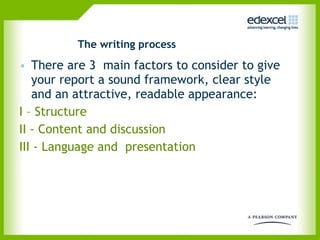
The writing process There are 3  main factors to consider to give your report a sound framework, clear style and an attractive, readable appearance: I – Structure II - Content and discussion III - Language and  presentation  
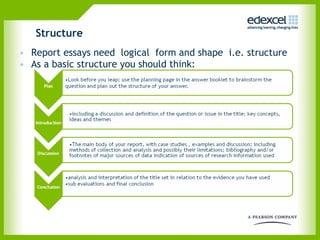
Structure Report essays need  logical  form and shape  i.e. structure As a basic structure you should think:
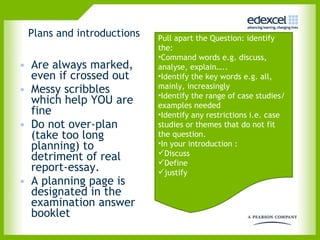
Plans and introductions Are always marked, even if crossed out Messy scribbles which help YOU are fine Do not over-plan (take too long planning) to detriment of real report-essay.  A planning page is designated in the examination answer booklet Pull apart the Question: identify the: Command words e.g. discuss, analyse, explain….. Identify the key words e.g. all, mainly, increasingly Identify the range of case studies/examples needed Identify any restrictions i.e. case studies or themes that do not fit the question.  In your introduction : Discuss Define justify
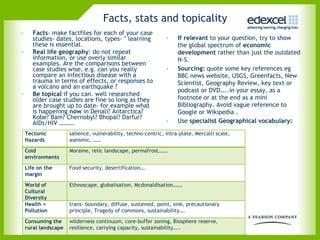
Facts, stats and topicality Facts - make factfiles for each of your case studies- dates, locations, types- ’ learning these is essential. Real life geography : do not repeat information, or use overly similar examples. Are the comparisons between case studies wise, e.g. can you really compare an infectious disease with a trauma in terms of effects, or responses to a volcano and an earthquake ?  Be topical  if you can. well researched older case studies are fine so long as they are brought up to date- for example what is happening  now  in Denali? Antarctica? Kobe? Bam? Chernobyl? Bhopal? Darfur? AIDs/HIV ………. If relevant  to your question, try to show the global spectrum of  economic development  rather than just the outdated N-S. Sourcing:  quote some key references eg BBC news website, USGS, Greenfacts, New Scientist, Geography Review, key text or podcast or DVD…..in your essay, as a footnote or at the end as a mini Bibliography. Avoid vague reference to Google or Wikipedia . Use  specialist Geographical vocabulary: Tectonic Hazards salience, vulnerability, techno-centric, intra-plate, Mercalli scale, aseismic, …… Cold environments Moraine, relic landscape, permafrost……. Life on the margin Food security, desertification…. World of Cultural Diversity  Ethnoscape, globalisation, Mcdonaldisation……. Health + Pollution trans- boundary, diffuse, sustained, point, sink, precautionary principle, Tragedy of commons, sustainability…. Consuming the rural landscape wilderness continuum, core-buffer zoning, Biosphere reserve, resilience, carrying capacity, sustainability…..
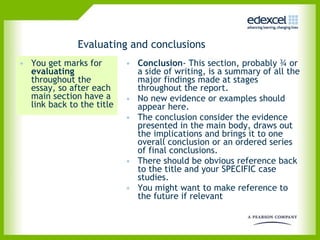
Evaluating and conclusions You get marks for  evaluating  throughout the essay, so after each main section have a link back to the title Conclusion - This section, probably ¾ or a side of writing, is a summary of all the major findings made at stages throughout the report. No new evidence or examples should appear here.  The conclusion consider the evidence presented in the main body, draws out the implications and brings it to one overall conclusion or an ordered series of final conclusions.  There should be obvious reference back to the title and your SPECIFIC case studies.  You might want to make reference to the future if relevant
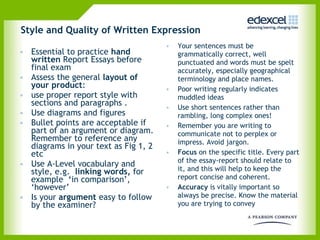
Style and Quality of Written Expression Essential to practice  hand written  Report Essays before final exam Assess the general  layout of your product :  use proper report style with sections and paragraphs . Use diagrams and figures  Bullet points are acceptable if part of an argument or diagram. Remember to reference any diagrams in your text as Fig 1, 2 etc Use A-Level vocabulary and style, e.g.  linking words,  for example   ‘ in comparison’, ‘however’ Is your  argument  easy to follow by the examiner? Your sentences must be grammatically correct, well punctuated and words must be spelt accurately, especially geographical terminology and place names.  Poor writing regularly indicates muddled ideas Use short sentences rather than rambling, long complex ones! Remember you are writing to communicate not to perplex or impress. Avoid jargon. Focus  on the specific title. Every part of the essay-report should relate to it, and this will help to keep the report concise and coherent.  Accuracy  is vitally important so always be precise. Know the material you are trying to convey   
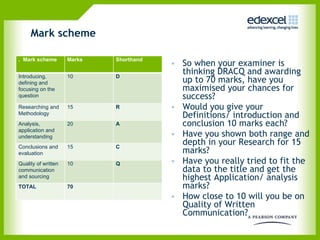
Mark scheme So when your examiner is thinking DRACQ and awarding up to 70 marks, have you maximised your chances for success? Would you give your Definitions/ introduction and conclusion 10 marks each? Have you shown both range and depth in your Research for 15 marks?  Have you really tried to fit the data to the title and get the highest Application/ analysis  marks? How close to 10 will you be on Quality of Written Communication? .  Mark scheme  Marks  Shorthand Introducing, defining and focusing on the question 10 D Researching and Methodology 15 R Analysis, application and understanding 20 A Conclusions and evaluation 15 C Quality of written communication and sourcing 10 Q TOTAL  70
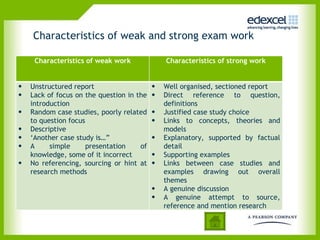
Characteristics of weak and strong exam work Characteristics of weak work Characteristics of strong work Unstructured report Lack of focus on the question in the introduction  Random case studies, poorly related to question focus Descriptive  ‘ Another case study is…” A simple presentation of knowledge, some of it incorrect  No referencing, sourcing or hint at research methods  Well organised, sectioned report  Direct reference to question, definitions  Justified case study choice  Links to concepts, theories and models Explanatory, supported by factual detail  Supporting examples  Links between case studies and examples drawing out overall themes A genuine discussion  A genuine attempt to source, reference and mention research
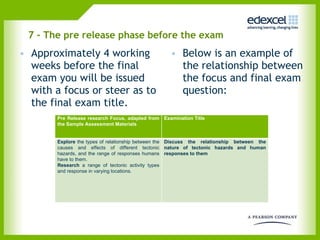
7 - The pre release phase before the exam Approximately 4 working weeks before the final exam you will be issued with a focus or steer as to the final exam title. Below is an example of the relationship between the focus and final exam question:  Pre Release research Focus, adapted from the Sample Assessment Materials Examination Title Explore  the types of relationship between the causes and effects of different tectonic hazards, and the range of responses humans have to them.  Research  a   range of tectonic activity types and response in varying locations. Discuss the relationship between the nature of tectonic hazards and human responses to them
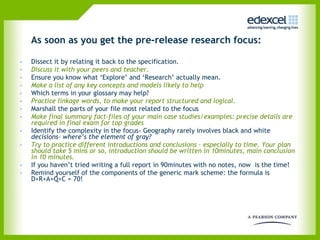
  As soon as you get the pre-release research focus: Dissect it by relating it back to the specification. Discuss it with your peers and teacher .  Ensure you know what ‘Explore’ and ‘Research’ actually mean.  Make a list of any key concepts and models likely to help Which terms in your glossary may help? Practice linkage words, to make your report structured and logical. Marshall the parts of your file most related to the focus Make final summary fact-files of your main case studies/examples: precise details are required in final exam for top grades  Identify the complexity in the focus- Geography rarely involves black and white  decisions- where’s the element of gray?  Try to practice different introductions and conclusions - especially to time. Your plan should take 5 mins or so, introduction should be written in 10minutes, main conclusion in 10 minutes. If you haven’t tried writing a full report in 90minutes with no notes, now  is the time! Remind yourself of the components of the generic mark scheme: the formula is  D+R+A+Q+C = 70!
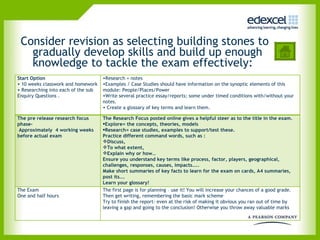
Consider revision as selecting building stones to gradually develop skills and build up enough knowledge to tackle the exam effectively: Start Option 10 weeks classwork and homework Researching into each of the sub Enquiry Questions .  Research + notes Examples / Case Studies should have information on the synoptic elements of this module: People/Places/Power Write several practice essay/reports; some under timed conditions with/without your notes. Create a glossary of key terms and learn them. The pre release research focus phase-  Approximately  4 working weeks before actual exam The Research Focus posted online gives a helpful steer as to the title in the exam. Explore= the concepts, theories, models Research= case studies, examples to support/test these. Practice different command words, such as : Discuss,  To what extent,  Explain why or how…  Ensure you understand key terms like process, factor, players, geographical, challenges, responses, causes, impacts…..  Make short summaries of key facts to learn for the exam on cards, A4 summaries, post its…. Learn your glossary! The Exam  One and half hours The first page is for planning – use it! You will increase your chances of a good grade.  Then get writing, remembering the basic mark scheme  Try to finish the report- even at the risk of making it obvious you ran out of time by leaving a gap and going to the conclusion! Otherwise you throw away valuable marks

Unit 4 Student Guide

  • 1.
    6GEO4 Unit 4Geographical Research
  • 2.
    3. Skills auditfor research Good organisation is the key to success in this module which assesses independent learning, highly valued by universities and employers. How would you rate your own abilities in: Time management? Meeting deadlines? Self-discipline? Working outside of class? Organisation? Taking the initiative? Problem solving ? Effective researching from a range of sources? Being flexible? Remember the proportion of work in this Module: EDEXCEL TEACHER STUDENT
  • 3.
    4. Whatis a report style essay? A report is a conventional method of presenting precise information. Report style is highly structured and organised. It is tightly focused on the subject of investigation An effective report will also be compelling and stimulating to read. Report titles will require an analysis and assessment of a situation. In the Unit 4 exam you need to merge traditional essay writing style with report style to produce a discursive argument organised into structured sections.  
  • 4.
    Producing a reportstyle essay in exam conditions To help you to produce a report style essay, a 3 stage process has been identified to help you understand the final product required in the exam. These stages are: I - Research and preparation: learning about the content of the syllabus, and the start of gathering and selecting materials, and creating an organised portfolio/file II - Practicing report writing and the final exam III - The pre release phase before the exam , where information is given to help you focus on specific aspects of your chosen option.
  • 5.
    5. Researchand preparation phase   Planning is essential. It saves time Ensure you have a timeline , listing the weeks up until the pre-release and final exam. Add interim deadlines for research, class work such as presentations, and practice report essays. Plan the information you need to collect and set aside time to organise the material. The key is to achieve a balance between ‘reading around’ a topic as well as a focussing on specific aspects.
  • 6.
    During this phaseyou should decide: WHAT you are gathering information on WHY you need this information and HOW it will help you write your report. Each option has 4 subsections Break these down into manageable chunks with the aid of your teacher, perhaps by creating a topic map and then posing small questions to answer. Be really sure that you understand the sub question you’re answering This will reduce aimless library and internet research and getting an overload of irrelevant and overlapping information. As you research material, constantly remind yourself of your aims, title etc. Share ideas and research with your friends Writing a short glossary as you go will be invaluable for final revision 
  • 7.
    Sources of informationUndertake some individual background reading using the suggested bibliography with the Edexcel suggested scheme of work for Unit 4. Use internet search engines to look for more possibilities. Avoid the common problems whilst online of Distraction- into emails, Facebook…. Information overload – over 6 billion internet pages are waiting for you!- Write out a list of questions you want to find answers to, and reject information that doesn’t help answer them. You can always return for more. Couldn’t find any information- highly unlikely in today’s information rich age! Vary your search commands and key words. All information is useful .Material on the internet has to be carefully evaluated. Use a wide range of research sources: Libraries Resource centres, The internet…… Specialist option sources such as National Park visitor centres, GP surgeries, organic farms, cultural centres…. Primary research (fieldwork) may be possible too.
  • 8.
    Check your researchsources and ask: Is the information authentic? Who is the author? Are there names and contact details? If you have to use Wikipedia, these are at the bottom of each page, often with live links to the original Does the author / s have academic credentials, or is associated with an organisation? Who owns and contributes to the website? Check the URL- think of the bias Greenpeace or the CIA may have! Is there a bibliography / list of sources to back up this work? Are the views, information and opinions balanced or just one person’s biased viewpoint? Is the information old and possibly out of date? – abandoned websites stay around a long time! 
  • 9.
    The Research Wall-beyondGoogle and Wikipedia Local Authority websites GIS systems- simple free ones Textbooks Multimedia - DVDs, podcasts…. even U-tube Journals and Magazine articles- not just Geographical ones! Geographical magazines, Geofact sheets, Geofiles. Many of these are in an electronic form Internet e.g. ATHENS- your centre may buy into shared resource systems like Athens system, where subscription information e.g. New Scientist ,The Economist., daily newspapers and the sophisticated GALE data base is available.. Professional geographical organisations e.g .RGS, The Geographical Association may have useful sources. See also specialist sites for options e.g. WHO for health, UNESCO for culture…… Internet Search Engines Use keywords and phrases- add as much as you can to narrow the search, and put in quote marks /+ symbols between words to refine search. Most famous = www.google.co.uk/ Internet Gateways- good for researching issues e.g. INTUTE for Arts and Humanities http://www.humbul.ac.uk/ http ://www.vts.intute.ac.uk/he/tutorial/geographer http ://bubl.ac.uk/ FOUNDATION STONES: Keep a record of where your notes/articles originate from- you may need to return to them during revision! A bibliography may help here ,split into books, magazines, internet, other…. Skim read all sources to get a feel for content- then reject/ accept accordingly Ensure any notes relate specifically back to the syllabus to reduce your work load- reading around the subject is desirable, but you don’t want to get lost in a mire of information! If material overlaps different Key Questions, note in the margin/as header/footer other areas supported Beware ‘mind theft’ ie plagiarism even if unintentional! Create a habit of reading information then putting into your own words rather than straight (and far easier! ‘cut-and-stick’!)
  • 10.
    Case studies andexamples Do not fall into the trap of collecting dozens of detailed case studies for the sake of it. You will not be able to use them all in the final exam which is only 1 ½ hours! Several extended examples and some really in depth case studies which cross over all the subsections is the best preparation for the final exam. The key is to be flexible in your final choices and selection in the exam: to reject information as well as accept it! 
  • 11.
    Assembling notes Createan organised file by specification subsection or case study, with cross referencing to help in the pre-release phase. Keep a contents page/index. You should have a physical file and not rely on an electronic version . Create a TRAIL of information in case you need to return to it later. Once you have skimmed the title, contents, authenticity and topicality of the research source, carry on skim reading BEFORE starting to take notes . Follow the main points and summarise- in your own writing even if takes a bit longer- at least you know you understand the information then. Make a record of the book and its relevant page numbers because you will need to quote this in the exam: Always keep a record of research sources and check for possible bias in the information: Subsection Of Tectonic activity and Hazards Location Why chosen Details-using referencing system: author, date, title, basic url address Possible Bias Enquiry Q 1,2,3,4 N/A Overview whole topic Natural Hazards and Disaster, Warn + Holmes 2008 Unlikely, composite references Enquiry Q 1 USA and other Case studies recent individual earthquakes+ good diagrams www.quake.wr.usgs.gov Unlikely- Scientific research organisation USA
  • 12.
    6 - Practisingreport style essays and the Exam The Exam Product: A report has sections / numbered sections, headings, diagrams and possibly bullet points. Structure is a key element of the report, make it obvious to the examiner! One key aim is ‘readability’ – e.g. paragraphs need to be more than one sentence and linked logically. Avoid colloquialisms( e.g. sad, cool) and abbreviations (e.g. etc, don’t). Avoid “I did this or that” and write in the third person(e.g. “it can be seen that….”) Use the following language within your report: To ILLUSTRATE: i.e. case studies For example, that is…another example of …. To CONTRAST between case studies or examples However…but…albeit….on the other hand….another aspect to consider…in contrast… To EXTEND the material presented Moreover…furthermore…in addition….in the long term…. To CONCLUDE Therefore…as a result…as has been shown….in the future…. To EVALUATE within the report To an extent…it could be argued that….the main reason/factor/process/challenge could therefore be said….other groups may….on the other hand….against this it could be argued….one view that could be taken……
  • 13.
    The writing processThere are 3 main factors to consider to give your report a sound framework, clear style and an attractive, readable appearance: I – Structure II - Content and discussion III - Language and presentation  
  • 14.
    Structure Report essaysneed logical form and shape i.e. structure As a basic structure you should think:
  • 15.
    Plans and introductionsAre always marked, even if crossed out Messy scribbles which help YOU are fine Do not over-plan (take too long planning) to detriment of real report-essay. A planning page is designated in the examination answer booklet Pull apart the Question: identify the: Command words e.g. discuss, analyse, explain….. Identify the key words e.g. all, mainly, increasingly Identify the range of case studies/examples needed Identify any restrictions i.e. case studies or themes that do not fit the question. In your introduction : Discuss Define justify
  • 16.
    Facts, stats andtopicality Facts - make factfiles for each of your case studies- dates, locations, types- ’ learning these is essential. Real life geography : do not repeat information, or use overly similar examples. Are the comparisons between case studies wise, e.g. can you really compare an infectious disease with a trauma in terms of effects, or responses to a volcano and an earthquake ? Be topical if you can. well researched older case studies are fine so long as they are brought up to date- for example what is happening now in Denali? Antarctica? Kobe? Bam? Chernobyl? Bhopal? Darfur? AIDs/HIV ………. If relevant to your question, try to show the global spectrum of economic development rather than just the outdated N-S. Sourcing: quote some key references eg BBC news website, USGS, Greenfacts, New Scientist, Geography Review, key text or podcast or DVD…..in your essay, as a footnote or at the end as a mini Bibliography. Avoid vague reference to Google or Wikipedia . Use specialist Geographical vocabulary: Tectonic Hazards salience, vulnerability, techno-centric, intra-plate, Mercalli scale, aseismic, …… Cold environments Moraine, relic landscape, permafrost……. Life on the margin Food security, desertification…. World of Cultural Diversity Ethnoscape, globalisation, Mcdonaldisation……. Health + Pollution trans- boundary, diffuse, sustained, point, sink, precautionary principle, Tragedy of commons, sustainability…. Consuming the rural landscape wilderness continuum, core-buffer zoning, Biosphere reserve, resilience, carrying capacity, sustainability…..
  • 17.
    Evaluating and conclusionsYou get marks for evaluating throughout the essay, so after each main section have a link back to the title Conclusion - This section, probably ¾ or a side of writing, is a summary of all the major findings made at stages throughout the report. No new evidence or examples should appear here. The conclusion consider the evidence presented in the main body, draws out the implications and brings it to one overall conclusion or an ordered series of final conclusions. There should be obvious reference back to the title and your SPECIFIC case studies. You might want to make reference to the future if relevant
  • 18.
    Style and Qualityof Written Expression Essential to practice hand written Report Essays before final exam Assess the general layout of your product : use proper report style with sections and paragraphs . Use diagrams and figures Bullet points are acceptable if part of an argument or diagram. Remember to reference any diagrams in your text as Fig 1, 2 etc Use A-Level vocabulary and style, e.g. linking words, for example ‘ in comparison’, ‘however’ Is your argument easy to follow by the examiner? Your sentences must be grammatically correct, well punctuated and words must be spelt accurately, especially geographical terminology and place names. Poor writing regularly indicates muddled ideas Use short sentences rather than rambling, long complex ones! Remember you are writing to communicate not to perplex or impress. Avoid jargon. Focus on the specific title. Every part of the essay-report should relate to it, and this will help to keep the report concise and coherent. Accuracy is vitally important so always be precise. Know the material you are trying to convey  
  • 19.
    Mark scheme Sowhen your examiner is thinking DRACQ and awarding up to 70 marks, have you maximised your chances for success? Would you give your Definitions/ introduction and conclusion 10 marks each? Have you shown both range and depth in your Research for 15 marks? Have you really tried to fit the data to the title and get the highest Application/ analysis marks? How close to 10 will you be on Quality of Written Communication? . Mark scheme Marks Shorthand Introducing, defining and focusing on the question 10 D Researching and Methodology 15 R Analysis, application and understanding 20 A Conclusions and evaluation 15 C Quality of written communication and sourcing 10 Q TOTAL 70
  • 20.
    Characteristics of weakand strong exam work Characteristics of weak work Characteristics of strong work Unstructured report Lack of focus on the question in the introduction Random case studies, poorly related to question focus Descriptive ‘ Another case study is…” A simple presentation of knowledge, some of it incorrect No referencing, sourcing or hint at research methods Well organised, sectioned report Direct reference to question, definitions Justified case study choice Links to concepts, theories and models Explanatory, supported by factual detail Supporting examples Links between case studies and examples drawing out overall themes A genuine discussion A genuine attempt to source, reference and mention research
  • 21.
    7 - Thepre release phase before the exam Approximately 4 working weeks before the final exam you will be issued with a focus or steer as to the final exam title. Below is an example of the relationship between the focus and final exam question:  Pre Release research Focus, adapted from the Sample Assessment Materials Examination Title Explore the types of relationship between the causes and effects of different tectonic hazards, and the range of responses humans have to them. Research a range of tectonic activity types and response in varying locations. Discuss the relationship between the nature of tectonic hazards and human responses to them
  • 22.
      As soonas you get the pre-release research focus: Dissect it by relating it back to the specification. Discuss it with your peers and teacher . Ensure you know what ‘Explore’ and ‘Research’ actually mean. Make a list of any key concepts and models likely to help Which terms in your glossary may help? Practice linkage words, to make your report structured and logical. Marshall the parts of your file most related to the focus Make final summary fact-files of your main case studies/examples: precise details are required in final exam for top grades Identify the complexity in the focus- Geography rarely involves black and white decisions- where’s the element of gray? Try to practice different introductions and conclusions - especially to time. Your plan should take 5 mins or so, introduction should be written in 10minutes, main conclusion in 10 minutes. If you haven’t tried writing a full report in 90minutes with no notes, now is the time! Remind yourself of the components of the generic mark scheme: the formula is D+R+A+Q+C = 70!
  • 23.
    Consider revision asselecting building stones to gradually develop skills and build up enough knowledge to tackle the exam effectively: Start Option 10 weeks classwork and homework Researching into each of the sub Enquiry Questions . Research + notes Examples / Case Studies should have information on the synoptic elements of this module: People/Places/Power Write several practice essay/reports; some under timed conditions with/without your notes. Create a glossary of key terms and learn them. The pre release research focus phase- Approximately 4 working weeks before actual exam The Research Focus posted online gives a helpful steer as to the title in the exam. Explore= the concepts, theories, models Research= case studies, examples to support/test these. Practice different command words, such as : Discuss, To what extent, Explain why or how… Ensure you understand key terms like process, factor, players, geographical, challenges, responses, causes, impacts….. Make short summaries of key facts to learn for the exam on cards, A4 summaries, post its…. Learn your glossary! The Exam One and half hours The first page is for planning – use it! You will increase your chances of a good grade. Then get writing, remembering the basic mark scheme Try to finish the report- even at the risk of making it obvious you ran out of time by leaving a gap and going to the conclusion! Otherwise you throw away valuable marks