ELECTROMAGNETIC
WAVE
PRETEST
INSTRUCTION: Rearrange the
jumbled letters.
1. It is a disturbance in space.
AVWE
WAVE
LET’S REVIEW:
2. It is the highest point in the wave.
SECRT
CREST
LET’S REVIEW:
3. It is the lowest point in the wave
TGHURO
TROUGH
LET’S REVIEW:
4. It is the distance from the midpoint to the highest
point or lowest point of the wave.
LMUPTDEAI
AMPLITUDE
LET’S REVIEW:
5. It is the distance between two successive
identical parts of a wave.
ENEVTGWLAH
WAVELENGTH
LET’S REVIEW:
6. It refers to the number of waves
produced in one second.
NEQFCEURY
FREQUENCY
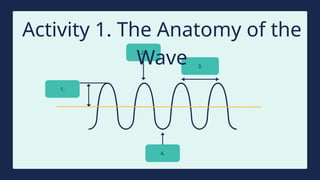
Activity 1. The Anatomy of the
Wave
2.
4.
1.
3.
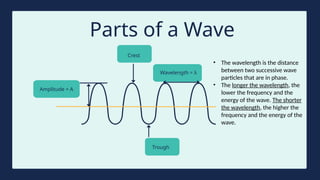
Parts of a Wave
Crest
Trough
Amplitude = A
Wavelength = λ
• The wavelength is the distance
between two successive wave
particles that are in phase.
• The longer the wavelength, the
lower the frequency and the
energy of the wave. The shorter
the wavelength, the higher the
frequency and the energy of the
wave.
What are Electromagnetic
Waves?
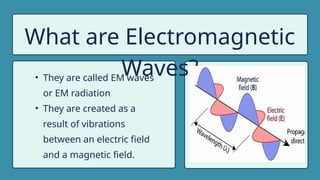
• They are called EM waves
or EM radiation
• They are created as a
result of vibrations
between an electric field
and a magnetic field.
What are Electromagnetic
Waves?
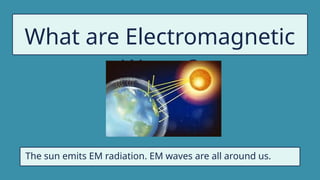
The sun emits EM radiation. EM waves are all around us.
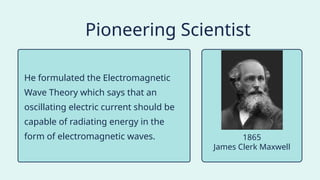
He formulated the Electromagnetic
Wave Theory which says that an
oscillating electric current should be
capable of radiating energy in the
form of electromagnetic waves.
Pioneering Scientist
James Clerk Maxwell
1865
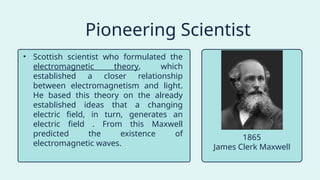
• Scottish scientist who formulated the
electromagnetic theory, which
established a closer relationship
between electromagnetism and light.
He based this theory on the already
established ideas that a changing
electric field, in turn, generates an
electric field . From this Maxwell
predicted the existence of
electromagnetic waves.
Pioneering Scientist
James Clerk Maxwell
1865
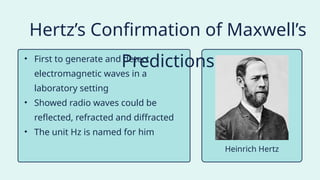
• First to generate and detect
electromagnetic waves in a
laboratory setting
• Showed radio waves could be
reflected, refracted and diffracted
• The unit Hz is named for him
Hertz’s Confirmation of Maxwell’s
Predictions
Heinrich Hertz
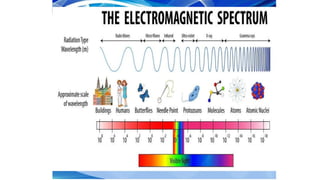
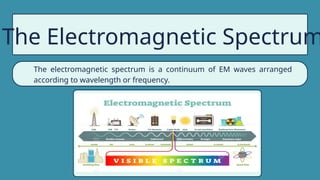
The Electromagnetic Spectrum
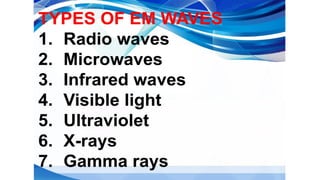
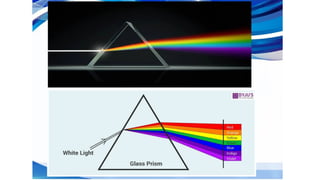
The electromagnetic spectrum is a continuum of EM waves arranged
according to wavelength or frequency.
The Electromagnetic Spectrum
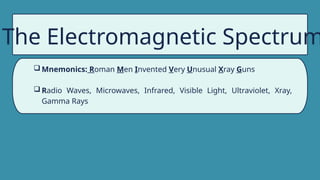
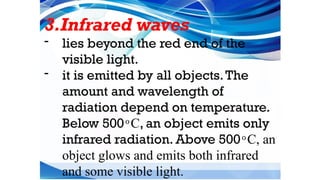
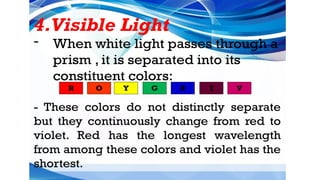
 Mnemonics: Roman Men Invented Very Unusual Xray Guns
 Radio Waves, Microwaves, Infrared, Visible Light, Ultraviolet, Xray,
Gamma Rays
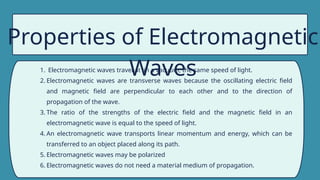
Properties of Electromagnetic
Waves
1. Electromagnetic waves travel at in a vacuum, the same speed of light.
2. Electromagnetic waves are transverse waves because the oscillating electric field
and magnetic field are perpendicular to each other and to the direction of
propagation of the wave.
3. The ratio of the strengths of the electric field and the magnetic field in an
electromagnetic wave is equal to the speed of light.
4. An electromagnetic wave transports linear momentum and energy, which can be
transferred to an object placed along its path.
5. Electromagnetic waves may be polarized
6. Electromagnetic waves do not need a material medium of propagation.
Properties of Electromagnetic
Waves
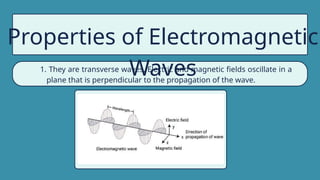
1. They are transverse waves. Electric and magnetic fields oscillate in a
plane that is perpendicular to the propagation of the wave.
Properties of Electromagnetic
Waves
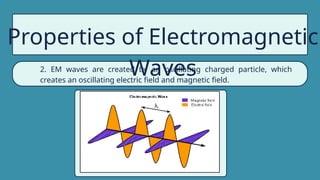
2. EM waves are created by an oscillating charged particle, which
creates an oscillating electric field and magnetic field.
Properties of Electromagnetic
Waves
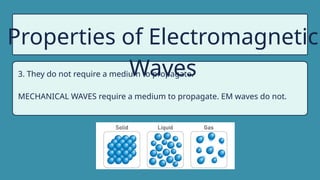
3. They do not require a medium to propagate.
MECHANICAL WAVES require a medium to propagate. EM waves do not.
Properties of Electromagnetic
Waves
3. They can travel in vacuum at a speed of
3x10*8 m/s = 300,000,000 m/s, the same as the speed of light.
Properties of Electromagnetic
Waves
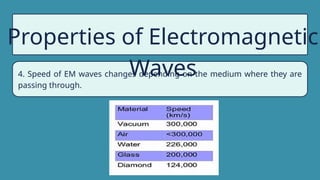
4. Speed of EM waves changes depending on the medium where they are
passing through.
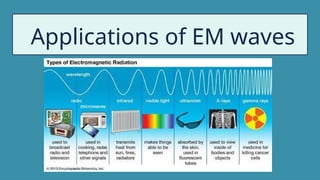
Applications of EM waves
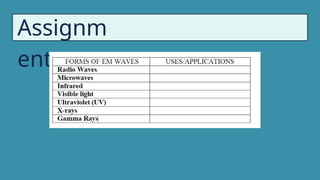
Group Activity:
Assignm
ent

SCIENCE PHYSICS 10 THE ELECTROMAGNETIC WAVES.pptx

  • 1.
  • 2.
    PRETEST INSTRUCTION: Rearrange the jumbledletters. 1. It is a disturbance in space. AVWE WAVE
  • 3.
    LET’S REVIEW: 2. Itis the highest point in the wave. SECRT CREST
  • 4.
    LET’S REVIEW: 3. Itis the lowest point in the wave TGHURO TROUGH
  • 5.
    LET’S REVIEW: 4. Itis the distance from the midpoint to the highest point or lowest point of the wave. LMUPTDEAI AMPLITUDE
  • 6.
    LET’S REVIEW: 5. Itis the distance between two successive identical parts of a wave. ENEVTGWLAH WAVELENGTH
  • 7.
    LET’S REVIEW: 6. Itrefers to the number of waves produced in one second. NEQFCEURY FREQUENCY
  • 8.
    Activity 1. TheAnatomy of the Wave 2. 4. 1. 3.
  • 9.
    Parts of aWave Crest Trough Amplitude = A Wavelength = λ • The wavelength is the distance between two successive wave particles that are in phase. • The longer the wavelength, the lower the frequency and the energy of the wave. The shorter the wavelength, the higher the frequency and the energy of the wave.
  • 11.
    What are Electromagnetic Waves? •They are called EM waves or EM radiation • They are created as a result of vibrations between an electric field and a magnetic field.
  • 12.
    What are Electromagnetic Waves? Thesun emits EM radiation. EM waves are all around us.
  • 13.
    He formulated theElectromagnetic Wave Theory which says that an oscillating electric current should be capable of radiating energy in the form of electromagnetic waves. Pioneering Scientist James Clerk Maxwell 1865
  • 14.
    • Scottish scientistwho formulated the electromagnetic theory, which established a closer relationship between electromagnetism and light. He based this theory on the already established ideas that a changing electric field, in turn, generates an electric field . From this Maxwell predicted the existence of electromagnetic waves. Pioneering Scientist James Clerk Maxwell 1865
  • 15.
    • First togenerate and detect electromagnetic waves in a laboratory setting • Showed radio waves could be reflected, refracted and diffracted • The unit Hz is named for him Hertz’s Confirmation of Maxwell’s Predictions Heinrich Hertz
  • 16.
    The Electromagnetic Spectrum Theelectromagnetic spectrum is a continuum of EM waves arranged according to wavelength or frequency.
  • 17.
    The Electromagnetic Spectrum Mnemonics: Roman Men Invented Very Unusual Xray Guns  Radio Waves, Microwaves, Infrared, Visible Light, Ultraviolet, Xray, Gamma Rays
  • 18.
    Properties of Electromagnetic Waves 1.Electromagnetic waves travel at in a vacuum, the same speed of light. 2. Electromagnetic waves are transverse waves because the oscillating electric field and magnetic field are perpendicular to each other and to the direction of propagation of the wave. 3. The ratio of the strengths of the electric field and the magnetic field in an electromagnetic wave is equal to the speed of light. 4. An electromagnetic wave transports linear momentum and energy, which can be transferred to an object placed along its path. 5. Electromagnetic waves may be polarized 6. Electromagnetic waves do not need a material medium of propagation.
  • 19.
    Properties of Electromagnetic Waves 1.They are transverse waves. Electric and magnetic fields oscillate in a plane that is perpendicular to the propagation of the wave.
  • 20.
    Properties of Electromagnetic Waves 2.EM waves are created by an oscillating charged particle, which creates an oscillating electric field and magnetic field.
  • 21.
    Properties of Electromagnetic Waves 3.They do not require a medium to propagate. MECHANICAL WAVES require a medium to propagate. EM waves do not.
  • 22.
    Properties of Electromagnetic Waves 3.They can travel in vacuum at a speed of 3x10*8 m/s = 300,000,000 m/s, the same as the speed of light.
  • 23.
    Properties of Electromagnetic Waves 4.Speed of EM waves changes depending on the medium where they are passing through.
  • 33.
  • 34.
  • 35.

Editor's Notes

  • #5 AMPLITUDE- the distance from the midpoint to the highest point or lowest point of the wave.
  • #9 AMPLITUDE- the distance from the midpoint to the highest point or lowest point of the wave. CREST- the highest point in the wave. TROUGH- the lowest point in the wave
  • #13 He discovered how electric charges and currents act as sources of electric and magnetic fields. He formulated four equations - the Maxwell’s equations- which summarize the relationship between electricity and magnetism
  • #14 He discovered how electric charges and currents act as sources of electric and magnetic fields. He formulated four equations - the Maxwell’s equations- which summarize the relationship between electricity and magnetism
  • #15 He discovered how electric charges and currents act as sources of electric and magnetic fields. He formulated four equations - the Maxwell’s equations- which summarize the relationship between electricity and magnetism
  • #16 The gradual progression of the waves of lowest frequency to highest frequency. This arrangement of EM waves is called electromagnetic spectrum.