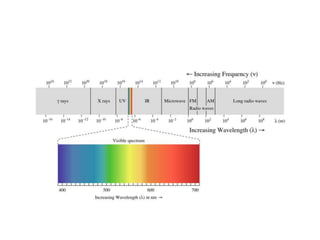
Electromagnetic Radiation
• Electromagnetic radiation is one of the many
ways that energy travels through space.
• The heat from a burning fire, the light from the
sun, the X-rays used by your doctor, as well as
the energy used to cook food in a microwave
are all forms of electromagnetic radiation.
• While these forms of energy might seem quite
different from one another, they are related in
that they all exhibit wavelike properties.
• If you’ve ever gone swimming in the ocean, you are already
familiar with waves. Waves are simply disturbances in a
particular physical medium or a field, resulting in a vibration
or oscillation.
• The swell of a wave in the ocean, and the subsequent dip that
follows, is simply a vibration or oscillation of the water at the
ocean’s surface.
• Electromagnetic waves are similar, but they are also distinct in
that they actually consist of 222 waves oscillating
perpendicular to one another.
• One of the waves is an oscillating magnetic field; the other is
an oscillating electric field.
Basic properties of waves: Amplitude,
wavelength, and frequency
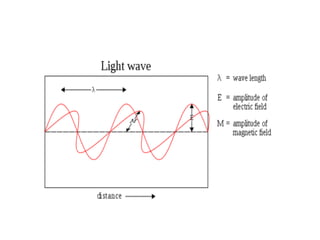
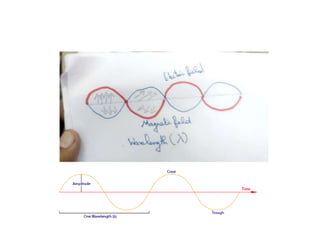
• As you might already know, a wave has
a trough (lowest point) and a crest (highest
point). The vertical distance between the tip of a
crest and the wave’s central axis is known as
its amplitude.
• This is the property associated with the
brightness, or intensity, of the wave. The
horizontal distance between two consecutive
troughs or crests is known as the wavelength of
the wave. These lengths can be visualized as
follows:
Frequency
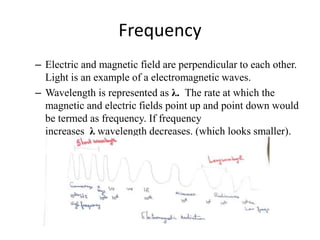
– Electric and magnetic field are perpendicular to each other.
Light is an example of a electromagnetic waves.
– Wavelength is represented as λ. The rate at which the
magnetic and electric fields point up and point down would
be termed as frequency. If frequency
increases λ wavelength decreases. (which looks smaller).
Period of the wave
The last quantity we will consider is the period
of a wave. A wave’s period is the length of time
it takes for one wavelength to pass by a given
point in space. Mathematically, the period (TTT)
is simply the reciprocal of the wave’s frequency
Electro magnetic radiation

Electro magnetic radiation

  • 1.
    Electromagnetic Radiation • Electromagneticradiation is one of the many ways that energy travels through space. • The heat from a burning fire, the light from the sun, the X-rays used by your doctor, as well as the energy used to cook food in a microwave are all forms of electromagnetic radiation. • While these forms of energy might seem quite different from one another, they are related in that they all exhibit wavelike properties.
  • 2.
    • If you’veever gone swimming in the ocean, you are already familiar with waves. Waves are simply disturbances in a particular physical medium or a field, resulting in a vibration or oscillation. • The swell of a wave in the ocean, and the subsequent dip that follows, is simply a vibration or oscillation of the water at the ocean’s surface. • Electromagnetic waves are similar, but they are also distinct in that they actually consist of 222 waves oscillating perpendicular to one another. • One of the waves is an oscillating magnetic field; the other is an oscillating electric field.
  • 4.
    Basic properties ofwaves: Amplitude, wavelength, and frequency • As you might already know, a wave has a trough (lowest point) and a crest (highest point). The vertical distance between the tip of a crest and the wave’s central axis is known as its amplitude. • This is the property associated with the brightness, or intensity, of the wave. The horizontal distance between two consecutive troughs or crests is known as the wavelength of the wave. These lengths can be visualized as follows:
  • 6.
    Frequency – Electric andmagnetic field are perpendicular to each other. Light is an example of a electromagnetic waves. – Wavelength is represented as λ. The rate at which the magnetic and electric fields point up and point down would be termed as frequency. If frequency increases λ wavelength decreases. (which looks smaller).
  • 7.
    Period of thewave The last quantity we will consider is the period of a wave. A wave’s period is the length of time it takes for one wavelength to pass by a given point in space. Mathematically, the period (TTT) is simply the reciprocal of the wave’s frequency