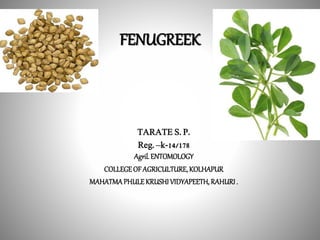
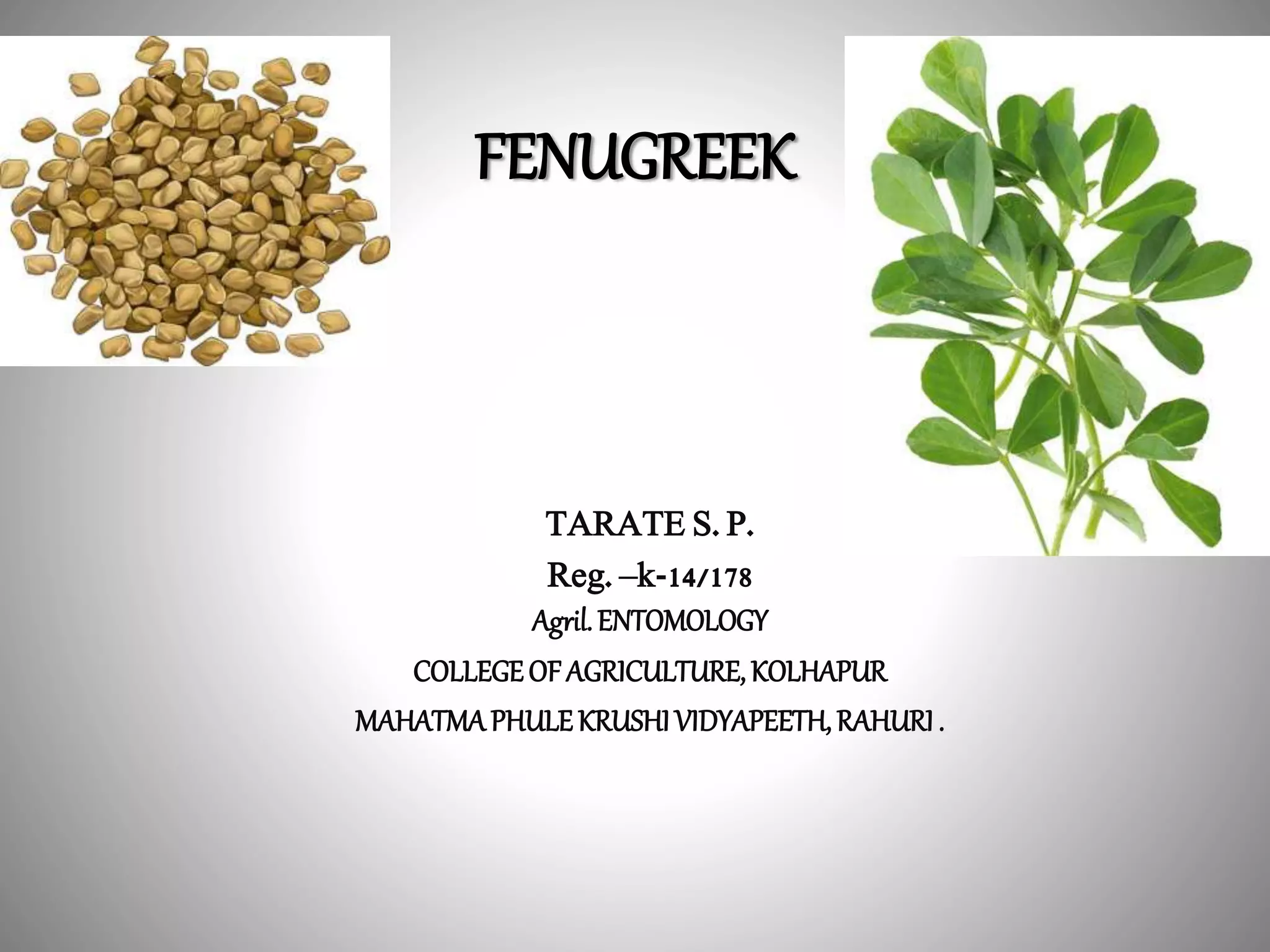
FENUGREEK
TARATE S. P.
Reg. –k-14/178
Agril.ENTOMOLOGY
COLLEGEOFAGRICULTURE,KOLHAPUR
MAHATMAPHULEKRUSHIVIDYAPEETH,RAHURI.
• BOTANICAL NAME
• FAMILY
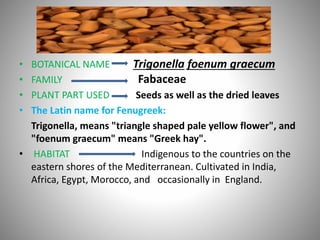
• PLANT PART USED Seeds as well as the dried leaves
• The Latin name for Fenugreek:
Trigonella, means "triangle shaped pale yellow flower", and
"foenum graecum" means "Greek hay".
• HABITAT Indigenous to the countries on the
eastern shores of the Mediterranean. Cultivated in India,
Africa, Egypt, Morocco, and occasionally in England.
Trigonella foenum graecum
Fabaceae
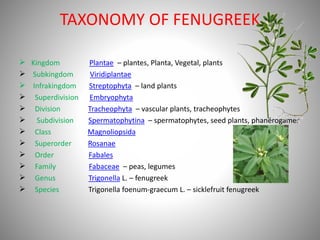
TAXONOMY OF FENUGREEK
 Kingdom Plantae – plantes, Planta, Vegetal, plants
 Subkingdom Viridiplantae
 Infrakingdom Streptophyta – land plants
 Superdivision Embryophyta
 Division Tracheophyta – vascular plants, tracheophytes
 Subdivision Spermatophytina – spermatophytes, seed plants, phanérogames
 Class Magnoliopsida
 Superorder Rosanae
 Order Fabales
 Family Fabaceae – peas, legumes
 Genus Trigonella L. – fenugreek
 Species Trigonella foenum-graecum L. – sicklefruit fenugreek
INTRODUCTION
 It is one of the most common vegetables grown throughout the Country.
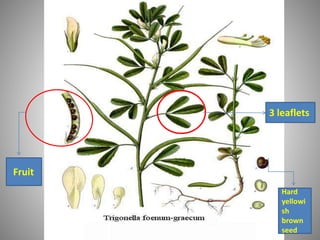
 Fenugreek is a leguminous annual plant that grows to around 60cm tall
 The leaves are similar to clover in shape.
 Flowers are pea-shaped and yellow or white and appear in the leaf axils.
 Like other legumes, the seeds are held in pods.
 Fenugreek pods are thin and crescent-shaped.
 The light brown seed harvested from the dried pods has a strong curry
flavour.
 The seeds can be lightly roasted and ground and used as flavouring,
especially in curry dishes.
 Fresh seed can be sprouted to give tasty sprouts.
 The young leaves are often used in Asian dishes and can be included in salad
mixes.
 Traditionally, fenugreek tea made from the crushed seed was used
medicinally for a range of ailments.
 The plant was fed to animals as a both a tonic and a valuable food source;
however it is now thought to have deleterious effects on animals if eaten in
excess.
 Fenugreek contains steroidal saponins, alkaloids (inc. trigonelline and
gentianine), mucilage, protein, vitamins A, B, C, minerals.
 It has more economical and medicinal benefits as well. Cytogenetical
studies are necessary to improve the economical value and hybridization
between close related species and varieties.
 In order to analyze karyotype of Trigonella foenum-graecum and
identification chromosomes type by using improved methods, plants and
seeds specimens were collected from different farmlands of West
Azerbaijan.
 Ten metaphasic plates were used to analyze karyotype parameters
AREA AND PRODUCTION
 Although many spice crops are grown in Rajasthan in India, only coriander
(Coriandrum sativum L.), cumin (Cuminum cyminum L.), fenugreek
(Trigonella foenumgraecum L.), fennel (Foeniculum vulgare Miller) are
widely grown in different agroclimatic zones of the state.
 In 2000.01 the state contributed nearly 41% of national area
 and 71% of national production of coriander.
 fenugreek accounted for nearly 84%, national area and production
Fruit
3 leaflets
Hard
yellowi
sh
brown
seed
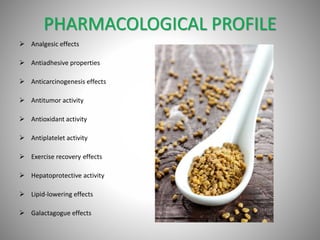
PHARMACOLOGICAL PROFILE
 Analgesic effects
 Antiadhesive properties
 Anticarcinogenesis effects
 Antitumor activity
 Antioxidant activity
 Antiplatelet activity
 Exercise recovery effects
 Hepatoprotective activity
 Lipid-lowering effects
 Galactagogue effects
CHEMICAL CONSTITUENTS
 Amino acids: 4-Hydroxyisoleucine, 4-hydroxyisoleucine lactone, arginine,
histidine, and lysine.
 Steroidal saponins: Trigoneoside IIa, Ib; graecunins H, I, J, K, L, M, N;
trigofoenosides A, D,F, G; protogracillin; protodioscin; and diosgenin
 Alkaloids: Trigonelline, gentianine, and carpaine
 Flavonoids: Apigenin, luteolin, orientin, quercetin, vitexin, and isovitexin
 Carbohydrates: Mainly mucilage
Soil and climate
 Good soil of medium texture is required.
 Tolerated pH range is 5.3 to 8.2.
- Prepare soil by adding plenty of composted organic material.
- Add a ration of lime if the soil is acid.
- A sunny, well-drained position and adequate water is required.
- Seed is sown in situ in spring.
Season and months
It can be grown in plains throughout the year .
Mostly Rabbi season good for the cultivation.
- Rainy Season - June - July
 - Winter Season –September - October
Varieties:
Fenugreek is the leguminous plant and the
improved varieties are
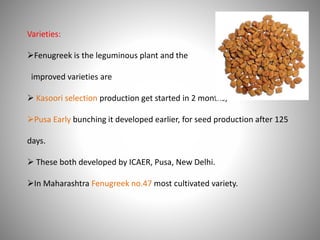
 Kasoori selection production get started in 2 months,
Pusa Early bunching it developed earlier, for seed production after 125
days.
 These both developed by ICAER, Pusa, New Delhi.
In Maharashtra Fenugreek no.47 most cultivated variety.
Methods of cultivation-
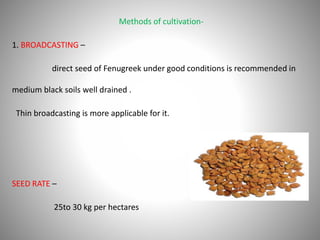
1. BROADCASTING –
direct seed of Fenugreek under good conditions is recommended in
medium black soils well drained .
Thin broadcasting is more applicable for it.
SEED RATE –
25to 30 kg per hectares
Land preparation
 Fenugreek requires well-drained soil.
 It cultivated in flat bed this should be in size 3 X 2 m.
elongated flat bed also prepared for it.
Sowing/ planting
 Fenugreek cultivated by broadcasting in flat bed at 20-25 cm
distance in line.
 Needs full sunlight, and requires watering during dry periods.
 While fenugreek is easy to grow, most available cultivars
need a growing season of 4 to 5 months
 although some cultivars mature seeds just 3 months after
sowing.
 It's a short-day plant, with flowering only beginning as the
days shorten in late summer.
Intercultural operations
Weeding ;-
 Weeding is the process of eliminating competition of unwanted plants to
the regular crop in respect to nutrition and moisture.
 So that crops can be grown profitably.
 It also facilitates other operations like irrigation and fertilizer application.
 The advantages of weeding are
 Conservation of soil moisture.
 Reduced competition for nutrients, sunlight, space and water.
Water management
 One has to irrigate Fenugreek during rabbi and summer season.
 During all season at 4-6 days interval are required
 The irrigation system must ensure uniform distribution and no wastage of
water.
 Fenugreek can be irrigated by surface-irrigation system.
 Surface-irrigation system: water is directly applied to the surface of the soil
and is spread by gravity.
 There are several methods viz. flooding from ditch, check basin, ring and
basin, border strip and furrow.
Fertilizer management
 Organic fertilizers- 20 ton/hectare well rotten FYM or compost should
incorporated at the time of land preparation
Chemical fertilizers
 Top dressing
 For good quality of fenugreek leaves nitrogen plays a vital role.
 20 kg of Nitrogen (43 kg of Urea)/ha. – At Starting
 20 kg of Nitrogen (43 kg of Urea)/ha. – After 15 days weeding OR
 After broadcasting of seeds in 3rd week spraying of Urea 150gm/10lit.water
for betterment of production.
Application Methods
 Fertilizers are applied in several ways.
 Basal dressings are those fertilizers which are incorporated in the soil just
before sowing or planting.
Crop protection
I. Pest management
 Aphids, Leaf minor are major pest infesting Fenugreek.
 Aphids are black colored and infested the tip of leaf and sucking green
 To spray Dimathoate 0.03 per cent , Cypermethrin 0.02 per cent.
Harvesting & post harvest processing
Method of harvesting
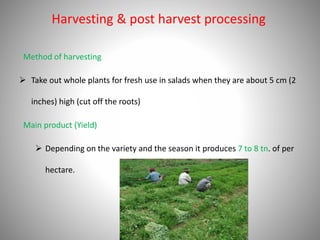
 Take out whole plants for fresh use in salads when they are about 5 cm (2
inches) high (cut off the roots)
Main product (Yield)
 Depending on the variety and the season it produces 7 to 8 tn. of per
hectare.
Post harvest processing
 After harvesting of fenugreek it bounded in ‘Judi’ and packed in cloth or
netted bags or put in bamboo baskets
 After the seeds have matured, uproot the plants and hang to dry.
 When seeds are completely dry, thresh and separate them.
 Grind seeds if required. Store whole dried seeds or ground fenugreek
powder in airtight containers.
 Fenugreek has sold for distant as well as for local markets.
THANK
YOU

Fenugreek cultivation

  • 1.
    FENUGREEK TARATE S. P. Reg.–k-14/178 Agril.ENTOMOLOGY COLLEGEOFAGRICULTURE,KOLHAPUR MAHATMAPHULEKRUSHIVIDYAPEETH,RAHURI.
  • 2.
    • BOTANICAL NAME •FAMILY • PLANT PART USED Seeds as well as the dried leaves • The Latin name for Fenugreek: Trigonella, means "triangle shaped pale yellow flower", and "foenum graecum" means "Greek hay". • HABITAT Indigenous to the countries on the eastern shores of the Mediterranean. Cultivated in India, Africa, Egypt, Morocco, and occasionally in England. Trigonella foenum graecum Fabaceae
  • 3.
    TAXONOMY OF FENUGREEK Kingdom Plantae – plantes, Planta, Vegetal, plants  Subkingdom Viridiplantae  Infrakingdom Streptophyta – land plants  Superdivision Embryophyta  Division Tracheophyta – vascular plants, tracheophytes  Subdivision Spermatophytina – spermatophytes, seed plants, phanérogames  Class Magnoliopsida  Superorder Rosanae  Order Fabales  Family Fabaceae – peas, legumes  Genus Trigonella L. – fenugreek  Species Trigonella foenum-graecum L. – sicklefruit fenugreek
  • 4.
    INTRODUCTION  It isone of the most common vegetables grown throughout the Country.  Fenugreek is a leguminous annual plant that grows to around 60cm tall  The leaves are similar to clover in shape.  Flowers are pea-shaped and yellow or white and appear in the leaf axils.  Like other legumes, the seeds are held in pods.  Fenugreek pods are thin and crescent-shaped.  The light brown seed harvested from the dried pods has a strong curry flavour.
  • 5.
     The seedscan be lightly roasted and ground and used as flavouring, especially in curry dishes.  Fresh seed can be sprouted to give tasty sprouts.  The young leaves are often used in Asian dishes and can be included in salad mixes.  Traditionally, fenugreek tea made from the crushed seed was used medicinally for a range of ailments.  The plant was fed to animals as a both a tonic and a valuable food source; however it is now thought to have deleterious effects on animals if eaten in excess.
  • 6.
     Fenugreek containssteroidal saponins, alkaloids (inc. trigonelline and gentianine), mucilage, protein, vitamins A, B, C, minerals.  It has more economical and medicinal benefits as well. Cytogenetical studies are necessary to improve the economical value and hybridization between close related species and varieties.  In order to analyze karyotype of Trigonella foenum-graecum and identification chromosomes type by using improved methods, plants and seeds specimens were collected from different farmlands of West Azerbaijan.  Ten metaphasic plates were used to analyze karyotype parameters
  • 7.
    AREA AND PRODUCTION Although many spice crops are grown in Rajasthan in India, only coriander (Coriandrum sativum L.), cumin (Cuminum cyminum L.), fenugreek (Trigonella foenumgraecum L.), fennel (Foeniculum vulgare Miller) are widely grown in different agroclimatic zones of the state.  In 2000.01 the state contributed nearly 41% of national area  and 71% of national production of coriander.  fenugreek accounted for nearly 84%, national area and production
  • 8.
  • 9.
    PHARMACOLOGICAL PROFILE  Analgesiceffects  Antiadhesive properties  Anticarcinogenesis effects  Antitumor activity  Antioxidant activity  Antiplatelet activity  Exercise recovery effects  Hepatoprotective activity  Lipid-lowering effects  Galactagogue effects
  • 10.
    CHEMICAL CONSTITUENTS  Aminoacids: 4-Hydroxyisoleucine, 4-hydroxyisoleucine lactone, arginine, histidine, and lysine.  Steroidal saponins: Trigoneoside IIa, Ib; graecunins H, I, J, K, L, M, N; trigofoenosides A, D,F, G; protogracillin; protodioscin; and diosgenin  Alkaloids: Trigonelline, gentianine, and carpaine  Flavonoids: Apigenin, luteolin, orientin, quercetin, vitexin, and isovitexin  Carbohydrates: Mainly mucilage
  • 11.
    Soil and climate Good soil of medium texture is required.  Tolerated pH range is 5.3 to 8.2. - Prepare soil by adding plenty of composted organic material. - Add a ration of lime if the soil is acid. - A sunny, well-drained position and adequate water is required. - Seed is sown in situ in spring.
  • 12.
    Season and months Itcan be grown in plains throughout the year . Mostly Rabbi season good for the cultivation. - Rainy Season - June - July  - Winter Season –September - October
  • 13.
    Varieties: Fenugreek is theleguminous plant and the improved varieties are  Kasoori selection production get started in 2 months, Pusa Early bunching it developed earlier, for seed production after 125 days.  These both developed by ICAER, Pusa, New Delhi. In Maharashtra Fenugreek no.47 most cultivated variety.
  • 14.
    Methods of cultivation- 1.BROADCASTING – direct seed of Fenugreek under good conditions is recommended in medium black soils well drained . Thin broadcasting is more applicable for it. SEED RATE – 25to 30 kg per hectares
  • 15.
    Land preparation  Fenugreekrequires well-drained soil.  It cultivated in flat bed this should be in size 3 X 2 m. elongated flat bed also prepared for it. Sowing/ planting  Fenugreek cultivated by broadcasting in flat bed at 20-25 cm distance in line.
  • 16.
     Needs fullsunlight, and requires watering during dry periods.  While fenugreek is easy to grow, most available cultivars need a growing season of 4 to 5 months  although some cultivars mature seeds just 3 months after sowing.  It's a short-day plant, with flowering only beginning as the days shorten in late summer.
  • 17.
    Intercultural operations Weeding ;- Weeding is the process of eliminating competition of unwanted plants to the regular crop in respect to nutrition and moisture.  So that crops can be grown profitably.  It also facilitates other operations like irrigation and fertilizer application.  The advantages of weeding are  Conservation of soil moisture.  Reduced competition for nutrients, sunlight, space and water.
  • 18.
    Water management  Onehas to irrigate Fenugreek during rabbi and summer season.  During all season at 4-6 days interval are required  The irrigation system must ensure uniform distribution and no wastage of water.  Fenugreek can be irrigated by surface-irrigation system.  Surface-irrigation system: water is directly applied to the surface of the soil and is spread by gravity.  There are several methods viz. flooding from ditch, check basin, ring and basin, border strip and furrow.
  • 19.
    Fertilizer management  Organicfertilizers- 20 ton/hectare well rotten FYM or compost should incorporated at the time of land preparation Chemical fertilizers  Top dressing  For good quality of fenugreek leaves nitrogen plays a vital role.  20 kg of Nitrogen (43 kg of Urea)/ha. – At Starting  20 kg of Nitrogen (43 kg of Urea)/ha. – After 15 days weeding OR  After broadcasting of seeds in 3rd week spraying of Urea 150gm/10lit.water for betterment of production.
  • 20.
    Application Methods  Fertilizersare applied in several ways.  Basal dressings are those fertilizers which are incorporated in the soil just before sowing or planting. Crop protection I. Pest management  Aphids, Leaf minor are major pest infesting Fenugreek.  Aphids are black colored and infested the tip of leaf and sucking green  To spray Dimathoate 0.03 per cent , Cypermethrin 0.02 per cent.
  • 21.
    Harvesting & postharvest processing Method of harvesting  Take out whole plants for fresh use in salads when they are about 5 cm (2 inches) high (cut off the roots) Main product (Yield)  Depending on the variety and the season it produces 7 to 8 tn. of per hectare.
  • 22.
    Post harvest processing After harvesting of fenugreek it bounded in ‘Judi’ and packed in cloth or netted bags or put in bamboo baskets  After the seeds have matured, uproot the plants and hang to dry.  When seeds are completely dry, thresh and separate them.  Grind seeds if required. Store whole dried seeds or ground fenugreek powder in airtight containers.  Fenugreek has sold for distant as well as for local markets.
  • 23.