WATER
PROOFING
IN
BUILDINGS
• Lama Jassim
• 3010
• Building Construction 2
• ARD 2222
WHAT IS MEANT BY WATERPROOFING?
Waterproofing is the process of making an object or structure waterproof or water-
resistant so that it remains relatively unaffected by water or resisting the ingress of water
under specified conditions.
Why is it important for buildings?
• Waterproofing system provides protection to the structure from water ingress.
• No waterproofing can lead to the development of cracks, paint peel off and even molds
and air contaminants.
• It is also a great risk for the structure and foundation of the building, damaging
reinforced steel.
• It can also create health problems for the inhabitants.
WATER PROOFING MATERIALS
Common types of waterproofing materials:
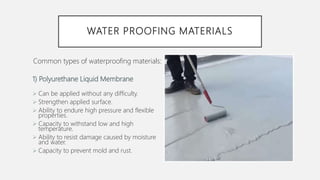
1) Polyurethane Liquid Membrane
 Can be applied without any difficulty.
 Strengthen applied surface.
 Ability to endure high pressure and flexible
properties.
 Capacity to withstand low and high
temperature.
 Ability to resist damage caused by moisture
and water.
 Capacity to prevent mold and rust.
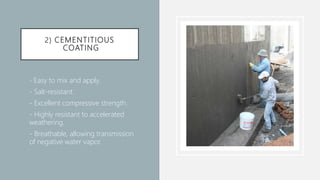
2) CEMENTITIOUS
COATING
 - Easy to mix and apply.
- Salt-resistant.
- Excellent compressive strength.
- Highly resistant to accelerated
weathering.
- Breathable, allowing transmission
of negative water vapor.
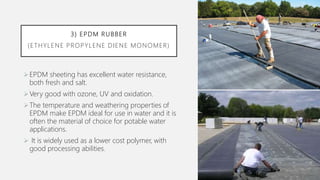
3) EPDM RUBBER
(ETHYLENE PROPYLENE DIENE MONOMER)
EPDM sheeting has excellent water resistance,
both fresh and salt.
Very good with ozone, UV and oxidation.
The temperature and weathering properties of
EPDM make EPDM ideal for use in water and it is
often the material of choice for potable water
applications.
 It is widely used as a lower cost polymer, with
good processing abilities.
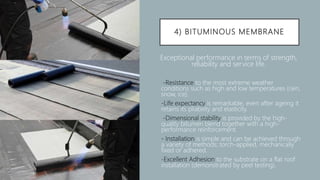
4) BITUMINOUS MEMBRANE
Exceptional performance in terms of strength,
reliability and service life.
 -Resistance to the most extreme weather
conditions such as high and low temperatures (rain,
snow, ice).
 -Life expectancy is remarkable, even after ageing it
retains its pliability and elasticity.
 -Dimensional stability is provided by the high-
quality bitumen blend together with a high-
performance reinforcement.
 - Installation is simple and can be achieved through
a variety of methods; torch-applied, mechanically
fixed or adhered.
 -Excellent Adhesion to the substrate on a flat roof
installation (demonstrated by peel testing).
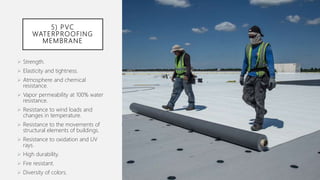
5) PVC
WATERPROOFING
MEMBRANE
 Strength.
 Elasticity and tightness.
 Atmosphere and chemical
resistance.
 Vapor permeability at 100% water
resistance.
 Resistance to wind loads and
changes in temperature.
 Resistance to the movements of
structural elements of buildings.
 Resistance to oxidation and UV
rays.
 High durability.
 Fire resistant.
 Diversity of colors.
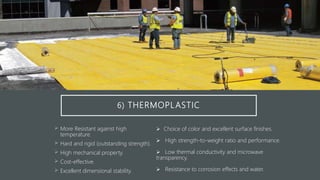
6) THERMOPLASTIC
 More Resistant against high
temperature.
 Hard and rigid (outstanding strength).
 High mechanical property.
 Cost-effective.
 Excellent dimensional stability.
 Choice of color and excellent surface finishes.
 High strength-to-weight ratio and performance.
 Low thermal conductivity and microwave
transparency.
 Resistance to corrosion effects and water.
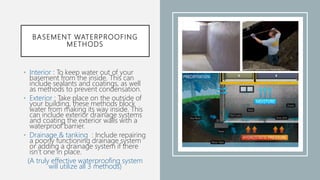
BASEMENT WATERPROOFING
METHODS
• Interior : To keep water out of your
basement from the inside. This can
include sealants and coatings, as well
as methods to prevent condensation.
• Exterior : Take place on the outside of
your building, these methods block
water from making its way inside. This
can include exterior drainage systems
and coating the exterior walls with a
waterproof barrier.
• Drainage & tanking : Include repairing
a poorly functioning drainage system
or adding a drainage system if there
isn’t one in place.
(A truly effective waterproofing system
will utilize all 3 methods)
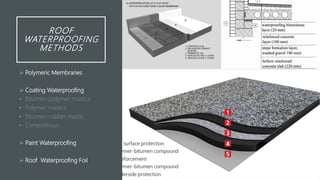
ROOF
WATERPROOFING
METHODS
 Polymeric Membranes
 Coating Waterproofing
• Bitumen-polymer mastics
• Polymer mastics
• Bitumen-rubber mastic
• Cementitious
 Paint Waterproofing
 Roof Waterproofing Foil
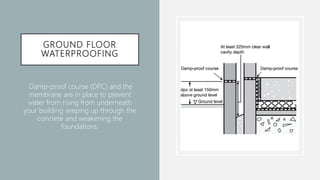
GROUND FLOOR
WATERPROOFING
Damp-proof course (DPC) and the
membrane are in place to prevent
water from rising from underneath
your building seeping up through the
concrete and weakening the
foundations.
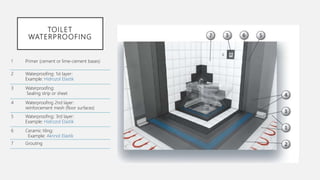
TOILET
WATERPROOFING
1 Primer (cement or lime-cement bases)
2 Waterproofing: 1st layer:
Example: Hidrozol Elastik
3 Waterproofing:
Sealing strip or sheet
4 Waterproofing 2nd layer:
reinforcement mesh (floor surfaces)
5 Waterproofing: 3rd layer:
Example: Hidrozol Elastik
6 Ceramic tiling:
Example: Akrinol Elastik
7 Grouting
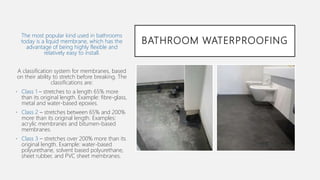
BATHROOM WATERPROOFING
The most popular kind used in bathrooms
today is a liquid membrane, which has the
advantage of being highly flexible and
relatively easy to install.
A classification system for membranes, based
on their ability to stretch before breaking. The
classifications are:
• Class 1 – stretches to a length 65% more
than its original length. Example: fibre-glass,
metal and water-based epoxies.
• Class 2 – stretches between 65% and 200%
more than its original length. Examples:
acrylic membranes and bitumen-based
membranes.
• Class 3 – stretches over 200% more than its
original length. Example: water-based
polyurethane, solvent based polyurethane,
sheet rubber, and PVC sheet membranes.
WATERPROOFING
MEMBRANES
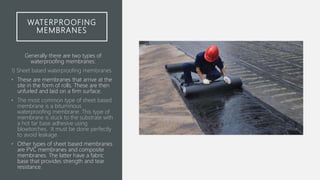
Generally there are two types of
waterproofing membranes:
1) Sheet based waterproofing membranes
• These are membranes that arrive at the
site in the form of rolls. These are then
unfurled and laid on a firm surface.
• The most common type of sheet based
membrane is a bituminous
waterproofing membrane. This type of
membrane is stuck to the substrate with
a hot tar base adhesive using
blowtorches. It must be done perfectly
to avoid leakage.
• Other types of sheet based membranes
are PVC membranes and composite
membranes. The latter have a fabric
base that provides strength and tear
resistance.
WATERPROOFING
MEMBRANES
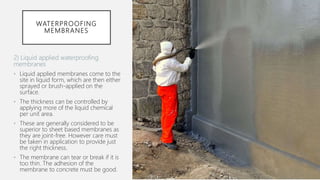
2) Liquid applied waterproofing
membranes
• Liquid applied membranes come to the
site in liquid form, which are then either
sprayed or brush-applied on the
surface.
• The thickness can be controlled by
applying more of the liquid chemical
per unit area.
• These are generally considered to be
superior to sheet based membranes as
they are joint-free. However care must
be taken in application to provide just
the right thickness.
• The membrane can tear or break if it is
too thin. The adhesion of the
membrane to concrete must be good.
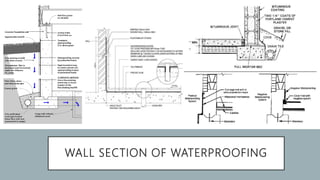
WALL SECTION OF WATERPROOFING
REFRENCES
 https://www.fairmate.com/blog/tag/importance-of-waterproofing/
 https://houseunderconstruction.com/waterproofing/pvc-
waterproofing-membrane
 https://www.martins-rubber.co.uk/blog/the-pros-and-cons-of-epdm-
sheeting/
 http://www.abuildersengineer.com/2013/06/cementitious-coatings-
properties-and.html
 https://www.soprema.co.uk/en/article/sopravoice/what-are-the-
benefits-of-sbs-modified-bitumen-waterproofing-systems
 https://wtrproof.com/types-of-waterproofing-materials/
MORE REFRENCES
 https://www.thomasnet.com/articles/plastics-rubber/thermoset-vs-
thermoplastics/
 https://www.triadbasementwaterproofing.com/blog/2017/01/understand
ing-the-top-3-basement-waterproofing-methods/
 https://www.kleinroof.com/Long-Island-Roofing/roof-waterproofing-
methods-for-repairs-and-renovations.php
 https://www.jub.eu/waterproofing-and-ceramic-tiling/system-
solutions/waterproofing-bathrooms-and-toilets
 https://theconstructor.org/building/waterproofing-of-toilets-
methods/13396/
 http://www.understandconstruction.com/waterproofing-membranes.html

Waterproofing in buildings

  • 1.
    WATER PROOFING IN BUILDINGS • Lama Jassim •3010 • Building Construction 2 • ARD 2222
  • 2.
    WHAT IS MEANTBY WATERPROOFING? Waterproofing is the process of making an object or structure waterproof or water- resistant so that it remains relatively unaffected by water or resisting the ingress of water under specified conditions. Why is it important for buildings? • Waterproofing system provides protection to the structure from water ingress. • No waterproofing can lead to the development of cracks, paint peel off and even molds and air contaminants. • It is also a great risk for the structure and foundation of the building, damaging reinforced steel. • It can also create health problems for the inhabitants.
  • 3.
    WATER PROOFING MATERIALS Commontypes of waterproofing materials: 1) Polyurethane Liquid Membrane  Can be applied without any difficulty.  Strengthen applied surface.  Ability to endure high pressure and flexible properties.  Capacity to withstand low and high temperature.  Ability to resist damage caused by moisture and water.  Capacity to prevent mold and rust.
  • 4.
    2) CEMENTITIOUS COATING  -Easy to mix and apply. - Salt-resistant. - Excellent compressive strength. - Highly resistant to accelerated weathering. - Breathable, allowing transmission of negative water vapor.
  • 5.
    3) EPDM RUBBER (ETHYLENEPROPYLENE DIENE MONOMER) EPDM sheeting has excellent water resistance, both fresh and salt. Very good with ozone, UV and oxidation. The temperature and weathering properties of EPDM make EPDM ideal for use in water and it is often the material of choice for potable water applications.  It is widely used as a lower cost polymer, with good processing abilities.
  • 6.
    4) BITUMINOUS MEMBRANE Exceptionalperformance in terms of strength, reliability and service life.  -Resistance to the most extreme weather conditions such as high and low temperatures (rain, snow, ice).  -Life expectancy is remarkable, even after ageing it retains its pliability and elasticity.  -Dimensional stability is provided by the high- quality bitumen blend together with a high- performance reinforcement.  - Installation is simple and can be achieved through a variety of methods; torch-applied, mechanically fixed or adhered.  -Excellent Adhesion to the substrate on a flat roof installation (demonstrated by peel testing).
  • 7.
    5) PVC WATERPROOFING MEMBRANE  Strength. Elasticity and tightness.  Atmosphere and chemical resistance.  Vapor permeability at 100% water resistance.  Resistance to wind loads and changes in temperature.  Resistance to the movements of structural elements of buildings.  Resistance to oxidation and UV rays.  High durability.  Fire resistant.  Diversity of colors.
  • 8.
    6) THERMOPLASTIC  MoreResistant against high temperature.  Hard and rigid (outstanding strength).  High mechanical property.  Cost-effective.  Excellent dimensional stability.  Choice of color and excellent surface finishes.  High strength-to-weight ratio and performance.  Low thermal conductivity and microwave transparency.  Resistance to corrosion effects and water.
  • 9.
    BASEMENT WATERPROOFING METHODS • Interior: To keep water out of your basement from the inside. This can include sealants and coatings, as well as methods to prevent condensation. • Exterior : Take place on the outside of your building, these methods block water from making its way inside. This can include exterior drainage systems and coating the exterior walls with a waterproof barrier. • Drainage & tanking : Include repairing a poorly functioning drainage system or adding a drainage system if there isn’t one in place. (A truly effective waterproofing system will utilize all 3 methods)
  • 10.
    ROOF WATERPROOFING METHODS  Polymeric Membranes Coating Waterproofing • Bitumen-polymer mastics • Polymer mastics • Bitumen-rubber mastic • Cementitious  Paint Waterproofing  Roof Waterproofing Foil
  • 11.
    GROUND FLOOR WATERPROOFING Damp-proof course(DPC) and the membrane are in place to prevent water from rising from underneath your building seeping up through the concrete and weakening the foundations.
  • 12.
    TOILET WATERPROOFING 1 Primer (cementor lime-cement bases) 2 Waterproofing: 1st layer: Example: Hidrozol Elastik 3 Waterproofing: Sealing strip or sheet 4 Waterproofing 2nd layer: reinforcement mesh (floor surfaces) 5 Waterproofing: 3rd layer: Example: Hidrozol Elastik 6 Ceramic tiling: Example: Akrinol Elastik 7 Grouting
  • 13.
    BATHROOM WATERPROOFING The mostpopular kind used in bathrooms today is a liquid membrane, which has the advantage of being highly flexible and relatively easy to install. A classification system for membranes, based on their ability to stretch before breaking. The classifications are: • Class 1 – stretches to a length 65% more than its original length. Example: fibre-glass, metal and water-based epoxies. • Class 2 – stretches between 65% and 200% more than its original length. Examples: acrylic membranes and bitumen-based membranes. • Class 3 – stretches over 200% more than its original length. Example: water-based polyurethane, solvent based polyurethane, sheet rubber, and PVC sheet membranes.
  • 14.
    WATERPROOFING MEMBRANES Generally there aretwo types of waterproofing membranes: 1) Sheet based waterproofing membranes • These are membranes that arrive at the site in the form of rolls. These are then unfurled and laid on a firm surface. • The most common type of sheet based membrane is a bituminous waterproofing membrane. This type of membrane is stuck to the substrate with a hot tar base adhesive using blowtorches. It must be done perfectly to avoid leakage. • Other types of sheet based membranes are PVC membranes and composite membranes. The latter have a fabric base that provides strength and tear resistance.
  • 15.
    WATERPROOFING MEMBRANES 2) Liquid appliedwaterproofing membranes • Liquid applied membranes come to the site in liquid form, which are then either sprayed or brush-applied on the surface. • The thickness can be controlled by applying more of the liquid chemical per unit area. • These are generally considered to be superior to sheet based membranes as they are joint-free. However care must be taken in application to provide just the right thickness. • The membrane can tear or break if it is too thin. The adhesion of the membrane to concrete must be good.
  • 16.
    WALL SECTION OFWATERPROOFING
  • 17.
    REFRENCES  https://www.fairmate.com/blog/tag/importance-of-waterproofing/  https://houseunderconstruction.com/waterproofing/pvc- waterproofing-membrane https://www.martins-rubber.co.uk/blog/the-pros-and-cons-of-epdm- sheeting/  http://www.abuildersengineer.com/2013/06/cementitious-coatings- properties-and.html  https://www.soprema.co.uk/en/article/sopravoice/what-are-the- benefits-of-sbs-modified-bitumen-waterproofing-systems  https://wtrproof.com/types-of-waterproofing-materials/
  • 18.
    MORE REFRENCES  https://www.thomasnet.com/articles/plastics-rubber/thermoset-vs- thermoplastics/ https://www.triadbasementwaterproofing.com/blog/2017/01/understand ing-the-top-3-basement-waterproofing-methods/  https://www.kleinroof.com/Long-Island-Roofing/roof-waterproofing- methods-for-repairs-and-renovations.php  https://www.jub.eu/waterproofing-and-ceramic-tiling/system- solutions/waterproofing-bathrooms-and-toilets  https://theconstructor.org/building/waterproofing-of-toilets- methods/13396/  http://www.understandconstruction.com/waterproofing-membranes.html