FERROCEMENT
CONTENTS
• INTRODUCTION
• HISTORY
• PROPERTIES
• MATERIAL USED
• CASTING METHODS
• ADVANTAGES
• DISADVANTAGES
• APPLICATIONS
• SUMMARY
INTRODUCTION
• Ferro cement is a special form of reinforced concrete. It is a
composite material consisting of cement sand mortar
reinforced with closely spaced layers of continuous and
relatively small diameter wire mesh. The mesh may be made
of metallic or other suitable materials.
HISTORYHISTORY
One of the first applications of ferrocement was
the model of a boat built by Lambot in france in
1856. Until 1942 there was very little activity of
ferrocement. In 1942 Dr Pier Luigi Nervi began a
series of experiment on ferrocement .He observed
reinforcing cement mortar with layers of wire
mesh produced a material capable of resisting
high impact load. In the year 1943 Pier luigi
presented in his paper.
TYPICAL CROSS-SECTION OF FERROCEMENT
PROPERTIESPROPERTIES
• It is a very durable, cheap and versatile material.
• It requires low water cement ratio.
• Less shrinkage and low weight.
• High tensile strength and stiffness.
• Better impact and punching shear resistance.
• Undergo large deformation before cracking or high deflection.
MATERIALMATERIAL
USEEDUSEED
CementCement
mortar mixmortar mix
• Cement
OPC or PPC is used
• Sand
Well graded natural river sand with particle size less than 4.75
mm having fineness modulus between 2.5 to 3.0
• Cement sand mix – 1:1.5 to 1:3
• Water cement ratio – 0.35 to 0.55
• 5% of Plasticizers and other admixtures are used
8
Skeleton Steel
This is used for making framework of structural component upon
which layers of wire mesh reinforcement are laid. The steel rods
are provided in both longitudinal and transverse directions. In
general mild steel rods or galvanised iron wires of diameters
varying from 2mm to 6mm are used. Sometimes for structural
purpose HYSD bars are also used.
9
Wire meSh
reinforCement
• It consists of steel wires ( Galvanised , woven or welded) of
diameter 0.5 to 1.5 mm, spaced at 6 to 20mm centre to centre.
• There are different types of mesh used for ferrocement
construction. They are as follows
1. Hexagonal wire mesh
2. Woven wire mesh
3. Welded wire mesh
4. Expanded metal mesh
11
12
typeS of Wire meSh
Behavior of ferro Cement in
tenSion
13
RC in tension Ferro cement in tension
CaStinG
methoDS
• HAND PLASTERING
• SEMI MECHANISED PROCESS
• CENTRIFUGING
• GUNITING
HAND
PLASTERING
• The minimum thickness of section that
can be casted works out to be 2 cm.
• The strength obtained by this system
will be lower compared to other
methods.
• However the units can be cast by this
process and used in situations where for
other improved methods do not exist.
SEMI
MECHANISED
PROCESS
• This system is termed as semi-
mechanised because the mould can be
rotated to facilitate dashing of mortar.
• This system is better than the earlier
system as better compaction.
• The uniformity of this system is also
better than the earlier system.
• The advantages of this system is that it
does not require any sophisticated
equipment or machinery.
CENTRIFUGING
• The centrifuging process is commonly
adopted for the fabrication of
cylindrical concrete units.
• Because of good compaction the
ferrocement pipe cast by centrifuging
can be used as pressure pipes.
GUNITING
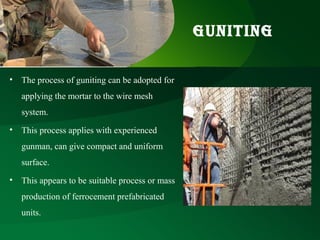
• The process of guniting can be adopted for
applying the mortar to the wire mesh
system.
• This process applies with experienced
gunman, can give compact and uniform
surface.
• This appears to be suitable process or mass
production of ferrocement prefabricated
units.
ADvANTAGES
OF FERRO
CEMENT
• It can be fabricated into any desired shape.
• The tensile strength of ferrocement is very high than
conventional concrete.
• The structure made with ferro-cement are thin and lightweight.
• High resistance to cracking width.
• Form work is not required.
• Good fire resistance, good impermeability.
19
DISADvANTAGE
S
OF
FERROCEMENT• Low shear strength
• Susceptibility to stress rupture failure.
• It can be punctured by collision with pointed objects.
• Corrosion of the reinforcing material due to the incomplete
coverage of metal by mortar.
• Tying rods and mesh together is especially tedious and time
consuming.
APPLICATIONS
Marine application
•Boats
•Fishing vessels
•Barges
•Cargo tugs
Water supply and sanitation
•Water tanks
•Sedimentation tanks
•Swimming pool linings
•Well casings
•Septic tanks
Residential purpose
•Residential buildings
•Precast housing elements
•Roof sheets
•Wall panel etc.
Rural energy
•Biogas digester
•Panels for solar energy
•Biogas collector
STRUCTURAL
APPLICATIONS
• Strengthening of RC beams using ferrocement
laminates.
• Huge water tanks in urban areas.
• Secondary roofing slabs.
• Use for sunscreens.
• Roof water proofing.
SUMMARY
• Ferrocement posses high tensile strength compared to
conventional concrete.
• It is light weight due to which dead load of structure will
reduce.
• It does not require any complicated and heavy formwork for
the construction.
• Easy reparability, non-destructive in nature .
• Any type of shape can be moulded using ferrocement.
• Less crack widths compared to conventional concrete.
• Low maintenance cost.
• Santhakumar, AR, Concrete Technology, Oxford University Press
• Gambhir, ML, Concrete Technology: Theory and Practice, McGraw Hill
• MS Shetty, Concrete Technology, S Chand Publishers
• Katsuki Takiguchi and Abdullah, EXPERIMENTAL STUDY ON
REINFORCED
• Concrete column strengthened with ferrocement jacket, IIT-K. WCEE
• P. Paramasivam, National University of Singapore, Singapore,
Ferrocement structural applications, 26th conference on OUR WORLD IN
CONCRETE AND STRUCTURES, 27 and 28 August 2001.
REFERENCE
THANK YOU

Ferrocement

  • 1.
  • 2.
    CONTENTS • INTRODUCTION • HISTORY •PROPERTIES • MATERIAL USED • CASTING METHODS • ADVANTAGES • DISADVANTAGES • APPLICATIONS • SUMMARY
  • 3.
    INTRODUCTION • Ferro cementis a special form of reinforced concrete. It is a composite material consisting of cement sand mortar reinforced with closely spaced layers of continuous and relatively small diameter wire mesh. The mesh may be made of metallic or other suitable materials.
  • 4.
    HISTORYHISTORY One of thefirst applications of ferrocement was the model of a boat built by Lambot in france in 1856. Until 1942 there was very little activity of ferrocement. In 1942 Dr Pier Luigi Nervi began a series of experiment on ferrocement .He observed reinforcing cement mortar with layers of wire mesh produced a material capable of resisting high impact load. In the year 1943 Pier luigi presented in his paper.
  • 5.
  • 6.
    PROPERTIESPROPERTIES • It isa very durable, cheap and versatile material. • It requires low water cement ratio. • Less shrinkage and low weight. • High tensile strength and stiffness. • Better impact and punching shear resistance. • Undergo large deformation before cracking or high deflection.
  • 7.
  • 8.
    CementCement mortar mixmortar mix •Cement OPC or PPC is used • Sand Well graded natural river sand with particle size less than 4.75 mm having fineness modulus between 2.5 to 3.0 • Cement sand mix – 1:1.5 to 1:3 • Water cement ratio – 0.35 to 0.55 • 5% of Plasticizers and other admixtures are used 8
  • 9.
    Skeleton Steel This isused for making framework of structural component upon which layers of wire mesh reinforcement are laid. The steel rods are provided in both longitudinal and transverse directions. In general mild steel rods or galvanised iron wires of diameters varying from 2mm to 6mm are used. Sometimes for structural purpose HYSD bars are also used. 9
  • 11.
    Wire meSh reinforCement • Itconsists of steel wires ( Galvanised , woven or welded) of diameter 0.5 to 1.5 mm, spaced at 6 to 20mm centre to centre. • There are different types of mesh used for ferrocement construction. They are as follows 1. Hexagonal wire mesh 2. Woven wire mesh 3. Welded wire mesh 4. Expanded metal mesh 11
  • 12.
  • 13.
    Behavior of ferroCement in tenSion 13 RC in tension Ferro cement in tension
  • 14.
    CaStinG methoDS • HAND PLASTERING •SEMI MECHANISED PROCESS • CENTRIFUGING • GUNITING
  • 15.
    HAND PLASTERING • The minimumthickness of section that can be casted works out to be 2 cm. • The strength obtained by this system will be lower compared to other methods. • However the units can be cast by this process and used in situations where for other improved methods do not exist.
  • 16.
    SEMI MECHANISED PROCESS • This systemis termed as semi- mechanised because the mould can be rotated to facilitate dashing of mortar. • This system is better than the earlier system as better compaction. • The uniformity of this system is also better than the earlier system. • The advantages of this system is that it does not require any sophisticated equipment or machinery.
  • 17.
    CENTRIFUGING • The centrifugingprocess is commonly adopted for the fabrication of cylindrical concrete units. • Because of good compaction the ferrocement pipe cast by centrifuging can be used as pressure pipes.
  • 18.
    GUNITING • The processof guniting can be adopted for applying the mortar to the wire mesh system. • This process applies with experienced gunman, can give compact and uniform surface. • This appears to be suitable process or mass production of ferrocement prefabricated units.
  • 19.
    ADvANTAGES OF FERRO CEMENT • Itcan be fabricated into any desired shape. • The tensile strength of ferrocement is very high than conventional concrete. • The structure made with ferro-cement are thin and lightweight. • High resistance to cracking width. • Form work is not required. • Good fire resistance, good impermeability. 19
  • 20.
    DISADvANTAGE S OF FERROCEMENT• Low shearstrength • Susceptibility to stress rupture failure. • It can be punctured by collision with pointed objects. • Corrosion of the reinforcing material due to the incomplete coverage of metal by mortar. • Tying rods and mesh together is especially tedious and time consuming.
  • 21.
  • 22.
    Water supply andsanitation •Water tanks •Sedimentation tanks •Swimming pool linings •Well casings •Septic tanks
  • 23.
    Residential purpose •Residential buildings •Precasthousing elements •Roof sheets •Wall panel etc.
  • 24.
    Rural energy •Biogas digester •Panelsfor solar energy •Biogas collector
  • 25.
    STRUCTURAL APPLICATIONS • Strengthening ofRC beams using ferrocement laminates. • Huge water tanks in urban areas. • Secondary roofing slabs. • Use for sunscreens. • Roof water proofing.
  • 26.
    SUMMARY • Ferrocement posseshigh tensile strength compared to conventional concrete. • It is light weight due to which dead load of structure will reduce. • It does not require any complicated and heavy formwork for the construction. • Easy reparability, non-destructive in nature . • Any type of shape can be moulded using ferrocement. • Less crack widths compared to conventional concrete. • Low maintenance cost.
  • 27.
    • Santhakumar, AR,Concrete Technology, Oxford University Press • Gambhir, ML, Concrete Technology: Theory and Practice, McGraw Hill • MS Shetty, Concrete Technology, S Chand Publishers • Katsuki Takiguchi and Abdullah, EXPERIMENTAL STUDY ON REINFORCED • Concrete column strengthened with ferrocement jacket, IIT-K. WCEE • P. Paramasivam, National University of Singapore, Singapore, Ferrocement structural applications, 26th conference on OUR WORLD IN CONCRETE AND STRUCTURES, 27 and 28 August 2001. REFERENCE
  • 28.