WATERMARKING TECHNIQUES AND
THEIR COMPARISON
By:
Abhijeet Misra
Jaypee Institute of InformationTechnology
Introduction:
ď‚§ In this project, the proposed method should
provide better security when transmitting or
transferring the data or messages from one
end to another.The main objective of the
project is to hide the message or a secret data
into an image which further act as a carrier of
secret data and to transmit to the destination
securely without any modification.
Summary:
ď‚§ This project presents a digital image
watermarking based on Least Significant Bits
(LSB), two dimensional discrete wavelet
transform (DWT2), two dimensional discrete
cosines transform (DCT2) and two dimensional
fast Fourier transform (FFT2). Signal to noise
ratio (SNR) and similarity ratio (SR) are
computed to measure image quality for each
transform.This work has been implemented
through MATLAB.
ď‚§
LSB Method
ď‚§ Information can be inserted directly into
every bit of image information or the more
busy areas of an image can be calculated so
as to hide such messages in less perceptible
parts of an image .
ď‚§ This section explains how this works for an 8-
bit grayscale image and the possible effects
of altering such an image.The principle of
embedding is fairly simple and effective. If we
use a grayscale bitmap image, which is 8- bit,
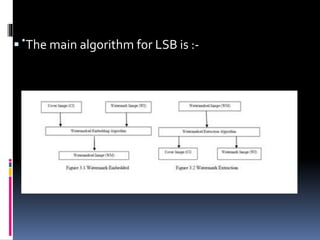
.ď‚§ The main algorithm for LSB is :-
.
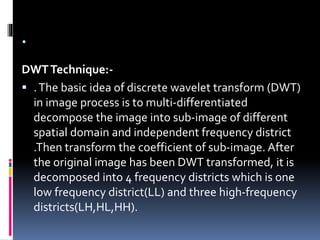
DWTTechnique:-
ď‚§ .The basic idea of discrete wavelet transform (DWT)
in image process is to multi-differentiated
decompose the image into sub-image of different
spatial domain and independent frequency district
.Then transform the coefficient of sub-image. After
the original image has been DWT transformed, it is
decomposed into 4 frequency districts which is one
low frequency district(LL) and three high-frequency
districts(LH,HL,HH).
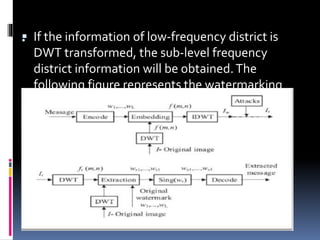
.ď‚§ If the information of low-frequency district is
DWT transformed, the sub-level frequency
district information will be obtained.The
following figure represents the watermarking
system in DWT .
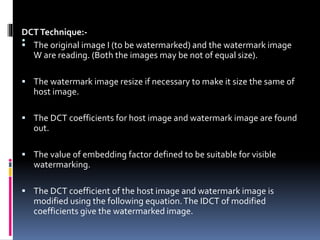
.DCTTechnique:-
ď‚§ The original image I (to be watermarked) and the watermark image
W are reading. (Both the images may be not of equal size).
ď‚§ The watermark image resize if necessary to make it size the same of
host image.
ď‚§ The DCT coefficients for host image and watermark image are found
out.
ď‚§ The value of embedding factor defined to be suitable for visible
watermarking.
ď‚§ The DCT coefficient of the host image and watermark image is
modified using the following equation.The IDCT of modified
coefficients give the watermarked image.
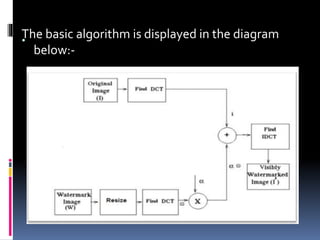
.The basic algorithm is displayed in the diagram
below:-
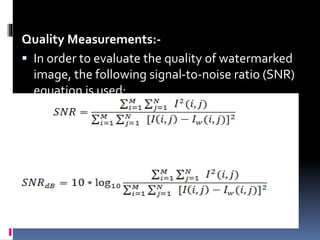
.Quality Measurements:-
ď‚§ In order to evaluate the quality of watermarked
image, the following signal-to-noise ratio (SNR)
equation is used:
.ď‚§ The number of mismatched data between the
embedded watermark and the extracted watermark
is used to represent the Similarity of watermarks.
The similarity factor of extracted watermark and
original watermark is computed by the following:
ď‚§ Where and represent the original watermark image
and the extracted watermark image, respectively, M
and N represent the image size.The magnitude
range of SF is [0, 1]
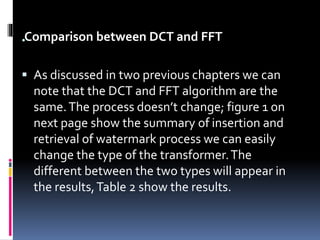
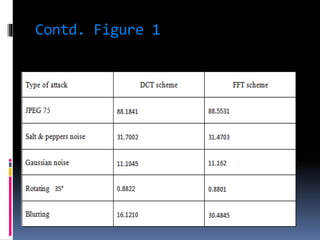
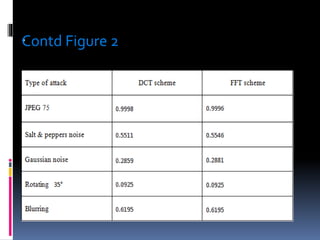
.Comparison between DCT and FFT
ď‚§ As discussed in two previous chapters we can
note that the DCT and FFT algorithm are the
same.The process doesn’t change; figure 1 on
next page show the summary of insertion and
retrieval of watermark process we can easily
change the type of the transformer.The
different between the two types will appear in
the results,Table 2 show the results.
Contd. Figure 1
.Contd Figure 2
.Conclusions :-
In chapter three and four we discuss watermarking
process in two frequency domain DCT and FFT we
notice that the process is the same but we apply
different transformation, also we can note that the
two method have the same robust for all types of
attack except blurring we can note that FFT more
robust than DCT.
References :
ď‚§ http://imageprocessingblog.com/digital-
watermarking
ď‚§ http://www.mathworks.in/matlabcentral/ans
wers/33322-digital-image-watermarking
http://www.alpvision.com/watermarking.html

Watermarking Techniques

  • 1.
    WATERMARKING TECHNIQUES AND THEIRCOMPARISON By: Abhijeet Misra Jaypee Institute of InformationTechnology
  • 2.
    Introduction: ď‚§ In thisproject, the proposed method should provide better security when transmitting or transferring the data or messages from one end to another.The main objective of the project is to hide the message or a secret data into an image which further act as a carrier of secret data and to transmit to the destination securely without any modification.
  • 3.
    Summary: ď‚§ This projectpresents a digital image watermarking based on Least Significant Bits (LSB), two dimensional discrete wavelet transform (DWT2), two dimensional discrete cosines transform (DCT2) and two dimensional fast Fourier transform (FFT2). Signal to noise ratio (SNR) and similarity ratio (SR) are computed to measure image quality for each transform.This work has been implemented through MATLAB. ď‚§
  • 4.
    LSB Method ď‚§ Informationcan be inserted directly into every bit of image information or the more busy areas of an image can be calculated so as to hide such messages in less perceptible parts of an image . ď‚§ This section explains how this works for an 8- bit grayscale image and the possible effects of altering such an image.The principle of embedding is fairly simple and effective. If we use a grayscale bitmap image, which is 8- bit,
  • 5.
    .ď‚§ The mainalgorithm for LSB is :-
  • 6.
    . DWTTechnique:- ď‚§ .The basicidea of discrete wavelet transform (DWT) in image process is to multi-differentiated decompose the image into sub-image of different spatial domain and independent frequency district .Then transform the coefficient of sub-image. After the original image has been DWT transformed, it is decomposed into 4 frequency districts which is one low frequency district(LL) and three high-frequency districts(LH,HL,HH).
  • 7.
    .ď‚§ If theinformation of low-frequency district is DWT transformed, the sub-level frequency district information will be obtained.The following figure represents the watermarking system in DWT .
  • 8.
    .DCTTechnique:- ď‚§ The originalimage I (to be watermarked) and the watermark image W are reading. (Both the images may be not of equal size). ď‚§ The watermark image resize if necessary to make it size the same of host image. ď‚§ The DCT coefficients for host image and watermark image are found out. ď‚§ The value of embedding factor defined to be suitable for visible watermarking. ď‚§ The DCT coefficient of the host image and watermark image is modified using the following equation.The IDCT of modified coefficients give the watermarked image.
  • 9.
    .The basic algorithmis displayed in the diagram below:-
  • 10.
    .Quality Measurements:- ď‚§ Inorder to evaluate the quality of watermarked image, the following signal-to-noise ratio (SNR) equation is used:
  • 11.
    .ď‚§ The numberof mismatched data between the embedded watermark and the extracted watermark is used to represent the Similarity of watermarks. The similarity factor of extracted watermark and original watermark is computed by the following: ď‚§ Where and represent the original watermark image and the extracted watermark image, respectively, M and N represent the image size.The magnitude range of SF is [0, 1]
  • 12.
    .Comparison between DCTand FFT  As discussed in two previous chapters we can note that the DCT and FFT algorithm are the same.The process doesn’t change; figure 1 on next page show the summary of insertion and retrieval of watermark process we can easily change the type of the transformer.The different between the two types will appear in the results,Table 2 show the results.
  • 13.
  • 14.
  • 15.
    .Conclusions :- In chapterthree and four we discuss watermarking process in two frequency domain DCT and FFT we notice that the process is the same but we apply different transformation, also we can note that the two method have the same robust for all types of attack except blurring we can note that FFT more robust than DCT.
  • 16.
    References : ď‚§ http://imageprocessingblog.com/digital- watermarking ď‚§http://www.mathworks.in/matlabcentral/ans wers/33322-digital-image-watermarking http://www.alpvision.com/watermarking.html