International Journal of Technical Research and Applications e-ISSN: 2320-8163,
www.ijtra.com Volume 2, Issue 3 (May-June 2014), PP. 80-83
80 | P a g e
LSB & DWT BASED DIGITAL
WATERMARKING SYSTEM FOR VIDEO
AUTHENTICATION.
Prof. R.V.Babar, Mr. Akshay. A.Jadhav
Dept of Electronics and Telecommunication Engineering
STES’s Sinhgad Institute of Technology, Lonavala,
University Of Pune, India.
Abstract— Nowadays, digital watermarking has many
applications such as broadcast monitoring, owner identification,
proof of ownership, transaction tracking. Embedding a hidden
stream of bits in a file is called Digital Watermarking. This paper
introduces a LSB information hiding algorithm which can lift the
wavelet transform image. LSB based Steganography embeds the
hiding text message in least significant bit of the pixels. The
proposed method has good invisibility, robustness for a lot of
hidden attacks. As we think about the capacity lead us to think
about improved approach which can be achieved through
hardware implementation system by using Field Programmable
Gate Array (FPGA). In this paper hardware implementation of
digital watermarking system is proposed. MATLAB is used to
convert images into pixel-format files and to observe simulation
results. To implement this paper XPS & VB are needed. In XPS,
first select hardware & software components then by adding
source and header files & converting into bit streams and
download into FPGA, to obtain Stego image.
Index Terms— Steganography, Wavelets Transform, XPS, GUI
and FPGA.
I.INTRODUCTION
In the digitized world extensive increase of use of extensive
data communication the problem of security, authentication of
the multimedia data also increases. The solution to this is
digital watermarking. Digital watermarking is the process of
the modification of original multimedia data to embed a
watermark containing key information such as authentication
or copyright codes. The embedded data must leave original
data unchanged. Steganography is an art of hiding information
in a way that apart from an intended recipient, suspects the
existence of secret message. Steganography derived from
Greek meaning is that “Covered writing.” Three types of
Steganography are there as follows
1) Physical Steganography
2) Digital Steganography
3) Printed Steganography.
Here we are using Digital Steganography means In this, secret
data can be hidden inside the image, text, sound clip which
can be represented in binary.
II. Methods Of Hiding The Data In To The Digital Image
A. Least Significant Bit (LSB)
LSB is the lowest bit in a series of numbers in binary. e.g. in
the binary number: 10110001, the least significant bit is far
right 1.The LSB based Steganography is one of the
Steganography methods, used to embed the secret data in
to the least significant bits of the pixel values in a cover
image. e.g. 240 can be hidden in the first eight bytes of three
pixels in a 24 bit image.
PIXELS: (00100111 11101001 11001000)
(00100111 11001000 11101001)
(11001000 00100111 11101001)
240 011110000
RESULT: (00100110 11101001 11001001)
(00100111 11001001 11101000)
(11001000 00100110 11101000)
Here number 240 is embedded into first eight bytes of the grid
and only 6 bits are changed.
B. Watermarking In The Frequency Domain
For better imperceptibility as well as robustness, the insertion
of the watermark is done in a frequency domain. Many
transform formats are available; mainly DCT and DWT are
widely used. In this technique –frequency domain- the
watermark actually spread throughout the image, not just
operating on an individual pixel. The schemes for embedding
the watermark in the transform domain are also called the
multiplicative embedding rule, which can be denoted by:
X’i= Xi (1 + γWi) (2)
Where: X’and X stand for the watermarked-image and the
International Journal of Technical Research and Applications e-ISSN: 2320-8163,
www.ijtra.com Volume 2, Issue 3 (May-June 2014), PP. 80-83
81 | P a g e
Base-image, respectively, W denotes the watermark I represent
the positions to be embedded, and γ is the gain factor (weight).
Wavelet-based watermarking methods exploit the frequency
information and spatial information of the transformed data in
multiple resolutions to gain robustness. The wavelet transform
is closer to the human visual system since it splits the input
image into several frequency bands that can be processed
independently. Its amulti-resolution transforms that permits to
locate image features such as smooth areas, edges or textured
areas. Here is wavelet-based watermarking algorithm to
illustrate the basic idea of embedding and extraction of a
watermark into a digital image:
1) Reorganize color and size of the base-image to be [M×M]
Gray color.
2) Compute 2D wavelet transform for the base-image.
3) Initiate the weight of the watermarking.
4) Reorganize size and color of the watermark to be [M×M]
Gray image.
5) Divide the transformed base-image into 4-blocks,namely,
LL, LH, HL and HH respectively.
6) Multiply watermark by watermarking weight and then add
The result to the blocks of the base-image.
7) The inverse wavelet transform is then taken to get the
Watermarked-image.
On the other hand the extraction algorithm can be done by
taking the forward wavelet transform of the watermarked
image and then subtracted it from the base-image to get the
watermark.
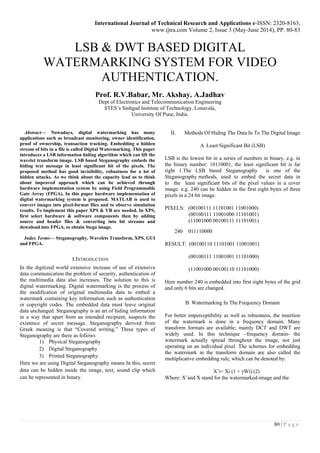
Fig 1.Wavelate Decomposition.
III. HARDWARE IMPLEMENTATION PROCESS
The implementation steps of the LSB and DWT based digital
watermarking is done as follows. MATLAB is used to convert
input images into header files using GUI feature. Xilinx
Platform Studio(XPS) is a part of an EDK system and it
includes the XPSGUI and all tools run by the GUI to process
hardware & software components within XPS. FPGA
hardware is chosen because of it has some advantages like
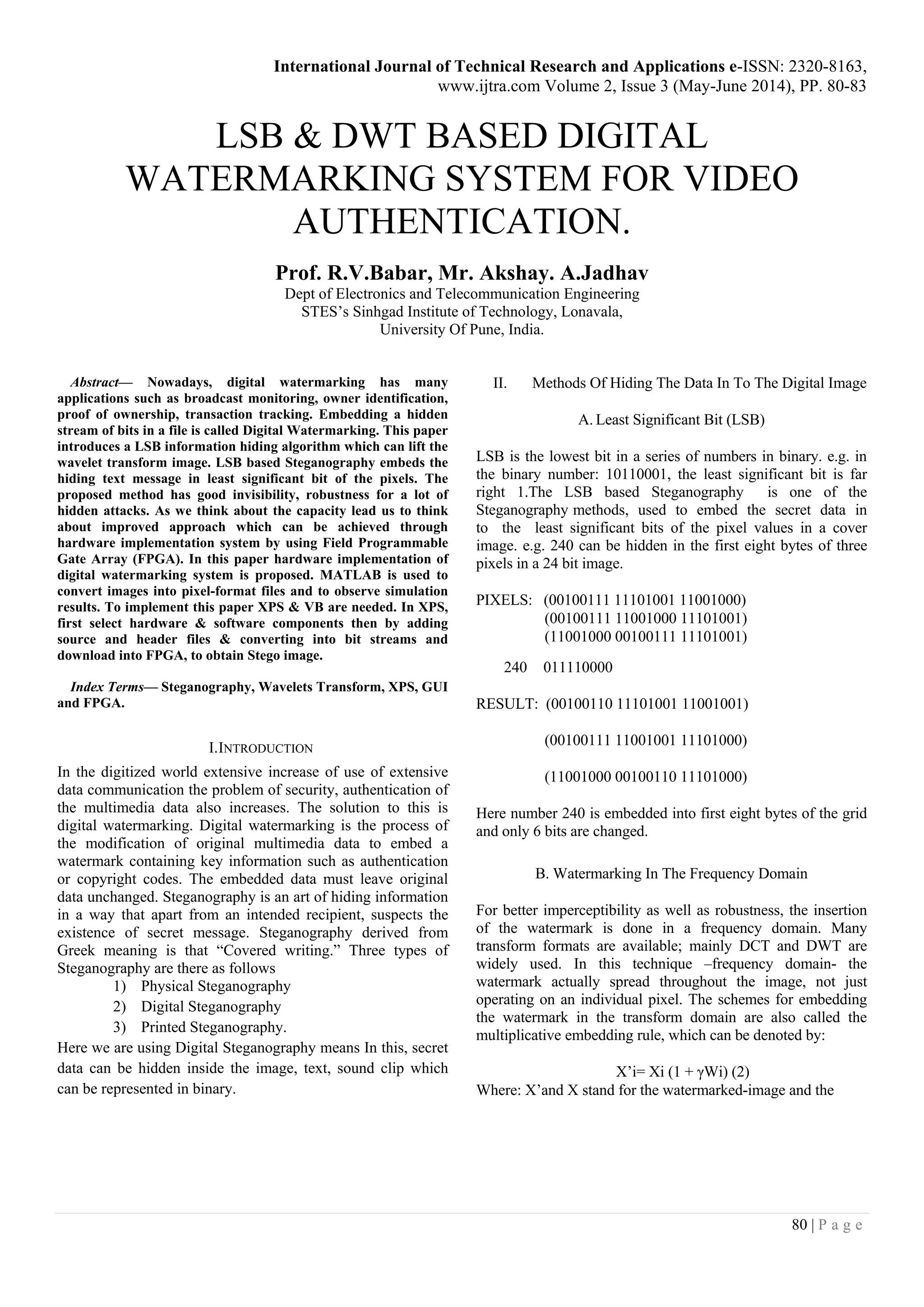
reconfigurability, low power dissipation, small size. Fig.2
shows the flowchart for the implementation of using wavelet
transform &LSB. The process is done as per below.
Step 1:First Select the Hardware configuration like
processor,IO peripherals etc. The HDL codes are generated
automatically for the each specified hardware selection and
then convert it into bit streams.
Step 2: After that the selection of software architecture is
started. It selects drivers, libraries etc. the header files of input
Images and source file (which consist of DWT, compression
and IDWT code written in the system-C language) are added
and convert it into bit stream.
Step 3: Then download hardware and software architecture
bit streams into FPGA and run it. The image output can't be
Shown in FPGA. For this purpose Visual Basic is used to
Observe the fused image output.
Fig 2 . Flow Chart of FPGA Implementation.
Register the input image.
Converting the input image into header file
using GUI tool and MATLAB.
Converting the input image into header file
using GUI tool and MATLAB.
Selection of a
hardware
configuration
(Processer, IO,
Periferals etc.)
Selection of
Software
Architecture
Automatic
Hardware
Platform
Generation
Automatic
Software
Generation
Synthesize &
Convert into Bit
streams
Compilation &
Convert into Bit
streams
FPGA
VB
International Journal of Technical Research and Applications e-ISSN: 2320-8163,
www.ijtra.com Volume 2, Issue 3 (May-June 2014), PP. 80-83
82 | P a g e
IV. SIMULATION RESULTS
The cameraman image shown in fig 3 is the input image.
[256×256] dimensional matrix is represented as input
image, which is a gray scale image. The cameraman image
converted into the header files(text file contains the pixel
values.). In multimedia applications, embedded watermarks
should be invisible, robust, and have a high capacity. In this
case MCK image shown in Fig 4 used as secret image. The
discrete wavelet transformed output of secret image shown in
Fig 6 will embed in to DWT output part of the cameraman
image shows in fig 5. The DWT filter uses high pass and low
pass filter to decompose the image into its detail and
approximate information respectively. 2D-DWT is applied on
grayscale image which is shown in figure 7 and 8.It transforms
an image into sub-bands such that the wavelet coefficients
in the lower level sub-bands typically contain more energy
than those in higher level sub bands. It can be accomplished
by applying one-dimensional DWT filter in a separable
manner. The first stage of the DWT divides an image into four
sub-bands by applying low-pass and high pass filters. The first
level of decomposition is consists of two steps. In the first step,
each row of an image is transformed using a 1D vertical
analysis filter bank. The first step is shown in figure 1. In the
second step of the first level of decomposition, each column of
the transformed image is again transformed using same filter
bank horizontally. The second step is shown in figure 1.
Each row and column of the lowest sub-band has been replaced
by 1D-DWT. The result of the second level of decomposition
has been shown in figure 5 and 6.The discrete wavelet
transformed output of secret MCK image and that DWT
output of Secret image shown in Fig 6 will embed in to DWT
output part of the cameraman image shown in Fig 5.
Fig3. Input cameramen image
Fig 4. Secret image.
Fig 5. DWT of cameramen image.
Fig 6. DWT of Secret image.
Fig 7. Watermarked Image.
International Journal of Technical Research and Applications e-ISSN: 2320-8163,
www.ijtra.com Volume 2, Issue 3 (May-June 2014), PP. 80-83
83 | P a g e
Fig 8 . Recovered Secret Image.
Fig 9. Recovered input image.
The fig 7, 8, 9 will shows the watermarked image, recovered
Secret image, recovered input image.
CONCLUSION
In this Paper, low power high speed and area efficient
DWT & LSB based Image robust watermarking technique
for color and gray scale images was performed. The RGB
image is converted to HSV and watermarked by using discrete
wavelet transform. Watermarking embedded stage and
extraction stage is designed using invisible watermarking
algorithm. Here the host signal is an image and after
embedding the secret data a watermarked image is
obtained and then extracts secret image and original image
separately. Checking the watermark insertion and quality
analysis various parameters like PSNR, Cross correlation etc.
REFERENCES
[1] P. Phanindra, J. Chinna Babu, V. Usha Shree, VLSI
implementation of Medical Image Fusion Using Haar
Transform , International Journal of Scientific & Engineering
Research, Volume 4, Issue 9, September-2013 ISSN 2229-
5518.
[2] Anumol T J, Binson V A,. Asst.Prof.AEI Dept Saintgits
college of engineering Kottayam, Soumya Rasheed
Asst.Prof.ECE Dept Ilahia college of engineering
Muvattupuzha, FPGA Implementation of Low Power, High
Speed, Area Efficient Invisible Image Watermarking
Algorithm for Images, international journal of scientific &
engineering research volume 4, issue 8, august-2013 ISSN
2229-5518.
[3] Dr. Ekta Walia , Payal Jain, Navdeep. An Analysis of
LSB & DCT based Steganography. Global Journal of
Computer Science and Technology, Vol. 10 Issue 1 (Ver 1.0),
April 2010.
[4] Sonjoy Deb Roy, Xin Li, Yonatan Shoshan, Alexander
Fish,Member, IEEE,and Orly Yadid-Pecht,Fellow, IEEE,
Hardware Implementation of a Digital Watermarking System
for Video Authentication, IEEE transactions on circuits and
systems for video technology, vol. 23, no. 2, february 2013.
[5] Mohammad Imroze Khan, Samiksha Soni, Bibhudendra
Acharya, and Shrish Verma, Department of Electronics &
Telecommunication, National Institute of Technology Raipur,
Chhattisgarh, India. IMPLEMENT ATION OF DIGITAL
WATERMARKING USING VHDL, IJCSC Vol. 3, No. 1,
January-June 2012, pp. 15-21, ISSN : 0973-7391.

LSB & DWT BASED DIGITAL WATERMARKING SYSTEM FOR VIDEO AUTHENTICATION.

  • 1.
    International Journal ofTechnical Research and Applications e-ISSN: 2320-8163, www.ijtra.com Volume 2, Issue 3 (May-June 2014), PP. 80-83 80 | P a g e LSB & DWT BASED DIGITAL WATERMARKING SYSTEM FOR VIDEO AUTHENTICATION. Prof. R.V.Babar, Mr. Akshay. A.Jadhav Dept of Electronics and Telecommunication Engineering STES’s Sinhgad Institute of Technology, Lonavala, University Of Pune, India. Abstract— Nowadays, digital watermarking has many applications such as broadcast monitoring, owner identification, proof of ownership, transaction tracking. Embedding a hidden stream of bits in a file is called Digital Watermarking. This paper introduces a LSB information hiding algorithm which can lift the wavelet transform image. LSB based Steganography embeds the hiding text message in least significant bit of the pixels. The proposed method has good invisibility, robustness for a lot of hidden attacks. As we think about the capacity lead us to think about improved approach which can be achieved through hardware implementation system by using Field Programmable Gate Array (FPGA). In this paper hardware implementation of digital watermarking system is proposed. MATLAB is used to convert images into pixel-format files and to observe simulation results. To implement this paper XPS & VB are needed. In XPS, first select hardware & software components then by adding source and header files & converting into bit streams and download into FPGA, to obtain Stego image. Index Terms— Steganography, Wavelets Transform, XPS, GUI and FPGA. I.INTRODUCTION In the digitized world extensive increase of use of extensive data communication the problem of security, authentication of the multimedia data also increases. The solution to this is digital watermarking. Digital watermarking is the process of the modification of original multimedia data to embed a watermark containing key information such as authentication or copyright codes. The embedded data must leave original data unchanged. Steganography is an art of hiding information in a way that apart from an intended recipient, suspects the existence of secret message. Steganography derived from Greek meaning is that “Covered writing.” Three types of Steganography are there as follows 1) Physical Steganography 2) Digital Steganography 3) Printed Steganography. Here we are using Digital Steganography means In this, secret data can be hidden inside the image, text, sound clip which can be represented in binary. II. Methods Of Hiding The Data In To The Digital Image A. Least Significant Bit (LSB) LSB is the lowest bit in a series of numbers in binary. e.g. in the binary number: 10110001, the least significant bit is far right 1.The LSB based Steganography is one of the Steganography methods, used to embed the secret data in to the least significant bits of the pixel values in a cover image. e.g. 240 can be hidden in the first eight bytes of three pixels in a 24 bit image. PIXELS: (00100111 11101001 11001000) (00100111 11001000 11101001) (11001000 00100111 11101001) 240 011110000 RESULT: (00100110 11101001 11001001) (00100111 11001001 11101000) (11001000 00100110 11101000) Here number 240 is embedded into first eight bytes of the grid and only 6 bits are changed. B. Watermarking In The Frequency Domain For better imperceptibility as well as robustness, the insertion of the watermark is done in a frequency domain. Many transform formats are available; mainly DCT and DWT are widely used. In this technique –frequency domain- the watermark actually spread throughout the image, not just operating on an individual pixel. The schemes for embedding the watermark in the transform domain are also called the multiplicative embedding rule, which can be denoted by: X’i= Xi (1 + γWi) (2) Where: X’and X stand for the watermarked-image and the
  • 2.
    International Journal ofTechnical Research and Applications e-ISSN: 2320-8163, www.ijtra.com Volume 2, Issue 3 (May-June 2014), PP. 80-83 81 | P a g e Base-image, respectively, W denotes the watermark I represent the positions to be embedded, and γ is the gain factor (weight). Wavelet-based watermarking methods exploit the frequency information and spatial information of the transformed data in multiple resolutions to gain robustness. The wavelet transform is closer to the human visual system since it splits the input image into several frequency bands that can be processed independently. Its amulti-resolution transforms that permits to locate image features such as smooth areas, edges or textured areas. Here is wavelet-based watermarking algorithm to illustrate the basic idea of embedding and extraction of a watermark into a digital image: 1) Reorganize color and size of the base-image to be [M×M] Gray color. 2) Compute 2D wavelet transform for the base-image. 3) Initiate the weight of the watermarking. 4) Reorganize size and color of the watermark to be [M×M] Gray image. 5) Divide the transformed base-image into 4-blocks,namely, LL, LH, HL and HH respectively. 6) Multiply watermark by watermarking weight and then add The result to the blocks of the base-image. 7) The inverse wavelet transform is then taken to get the Watermarked-image. On the other hand the extraction algorithm can be done by taking the forward wavelet transform of the watermarked image and then subtracted it from the base-image to get the watermark. Fig 1.Wavelate Decomposition. III. HARDWARE IMPLEMENTATION PROCESS The implementation steps of the LSB and DWT based digital watermarking is done as follows. MATLAB is used to convert input images into header files using GUI feature. Xilinx Platform Studio(XPS) is a part of an EDK system and it includes the XPSGUI and all tools run by the GUI to process hardware & software components within XPS. FPGA hardware is chosen because of it has some advantages like reconfigurability, low power dissipation, small size. Fig.2 shows the flowchart for the implementation of using wavelet transform &LSB. The process is done as per below. Step 1:First Select the Hardware configuration like processor,IO peripherals etc. The HDL codes are generated automatically for the each specified hardware selection and then convert it into bit streams. Step 2: After that the selection of software architecture is started. It selects drivers, libraries etc. the header files of input Images and source file (which consist of DWT, compression and IDWT code written in the system-C language) are added and convert it into bit stream. Step 3: Then download hardware and software architecture bit streams into FPGA and run it. The image output can't be Shown in FPGA. For this purpose Visual Basic is used to Observe the fused image output. Fig 2 . Flow Chart of FPGA Implementation. Register the input image. Converting the input image into header file using GUI tool and MATLAB. Converting the input image into header file using GUI tool and MATLAB. Selection of a hardware configuration (Processer, IO, Periferals etc.) Selection of Software Architecture Automatic Hardware Platform Generation Automatic Software Generation Synthesize & Convert into Bit streams Compilation & Convert into Bit streams FPGA VB
  • 3.
    International Journal ofTechnical Research and Applications e-ISSN: 2320-8163, www.ijtra.com Volume 2, Issue 3 (May-June 2014), PP. 80-83 82 | P a g e IV. SIMULATION RESULTS The cameraman image shown in fig 3 is the input image. [256×256] dimensional matrix is represented as input image, which is a gray scale image. The cameraman image converted into the header files(text file contains the pixel values.). In multimedia applications, embedded watermarks should be invisible, robust, and have a high capacity. In this case MCK image shown in Fig 4 used as secret image. The discrete wavelet transformed output of secret image shown in Fig 6 will embed in to DWT output part of the cameraman image shows in fig 5. The DWT filter uses high pass and low pass filter to decompose the image into its detail and approximate information respectively. 2D-DWT is applied on grayscale image which is shown in figure 7 and 8.It transforms an image into sub-bands such that the wavelet coefficients in the lower level sub-bands typically contain more energy than those in higher level sub bands. It can be accomplished by applying one-dimensional DWT filter in a separable manner. The first stage of the DWT divides an image into four sub-bands by applying low-pass and high pass filters. The first level of decomposition is consists of two steps. In the first step, each row of an image is transformed using a 1D vertical analysis filter bank. The first step is shown in figure 1. In the second step of the first level of decomposition, each column of the transformed image is again transformed using same filter bank horizontally. The second step is shown in figure 1. Each row and column of the lowest sub-band has been replaced by 1D-DWT. The result of the second level of decomposition has been shown in figure 5 and 6.The discrete wavelet transformed output of secret MCK image and that DWT output of Secret image shown in Fig 6 will embed in to DWT output part of the cameraman image shown in Fig 5. Fig3. Input cameramen image Fig 4. Secret image. Fig 5. DWT of cameramen image. Fig 6. DWT of Secret image. Fig 7. Watermarked Image.
  • 4.
    International Journal ofTechnical Research and Applications e-ISSN: 2320-8163, www.ijtra.com Volume 2, Issue 3 (May-June 2014), PP. 80-83 83 | P a g e Fig 8 . Recovered Secret Image. Fig 9. Recovered input image. The fig 7, 8, 9 will shows the watermarked image, recovered Secret image, recovered input image. CONCLUSION In this Paper, low power high speed and area efficient DWT & LSB based Image robust watermarking technique for color and gray scale images was performed. The RGB image is converted to HSV and watermarked by using discrete wavelet transform. Watermarking embedded stage and extraction stage is designed using invisible watermarking algorithm. Here the host signal is an image and after embedding the secret data a watermarked image is obtained and then extracts secret image and original image separately. Checking the watermark insertion and quality analysis various parameters like PSNR, Cross correlation etc. REFERENCES [1] P. Phanindra, J. Chinna Babu, V. Usha Shree, VLSI implementation of Medical Image Fusion Using Haar Transform , International Journal of Scientific & Engineering Research, Volume 4, Issue 9, September-2013 ISSN 2229- 5518. [2] Anumol T J, Binson V A,. Asst.Prof.AEI Dept Saintgits college of engineering Kottayam, Soumya Rasheed Asst.Prof.ECE Dept Ilahia college of engineering Muvattupuzha, FPGA Implementation of Low Power, High Speed, Area Efficient Invisible Image Watermarking Algorithm for Images, international journal of scientific & engineering research volume 4, issue 8, august-2013 ISSN 2229-5518. [3] Dr. Ekta Walia , Payal Jain, Navdeep. An Analysis of LSB & DCT based Steganography. Global Journal of Computer Science and Technology, Vol. 10 Issue 1 (Ver 1.0), April 2010. [4] Sonjoy Deb Roy, Xin Li, Yonatan Shoshan, Alexander Fish,Member, IEEE,and Orly Yadid-Pecht,Fellow, IEEE, Hardware Implementation of a Digital Watermarking System for Video Authentication, IEEE transactions on circuits and systems for video technology, vol. 23, no. 2, february 2013. [5] Mohammad Imroze Khan, Samiksha Soni, Bibhudendra Acharya, and Shrish Verma, Department of Electronics & Telecommunication, National Institute of Technology Raipur, Chhattisgarh, India. IMPLEMENT ATION OF DIGITAL WATERMARKING USING VHDL, IJCSC Vol. 3, No. 1, January-June 2012, pp. 15-21, ISSN : 0973-7391.