A COMPARATIVE STUDY OF
REVERSIBLE DATA HIDING TECHNIQUES
SUBMITTED BY:
Abhishek Mukherjee (12500212001)
Ashish Kumar Singh (12500212016)
Nidhi Krishna (12500212050)
Nikhil Sinha (12500212052)
Probuddha Singha (12500212064)
Guided By :
Sayan Chakraborty
[Dept. Of Information Technology]
Abstract
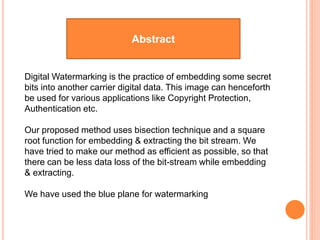
Digital Watermarking is the practice of embedding some secret
bits into another carrier digital data. This image can henceforth
be used for various applications like Copyright Protection,
Authentication etc.
Our proposed method uses bisection technique and a square
root function for embedding & extracting the bit stream. We
have tried to make our method as efficient as possible, so that
there can be less data loss of the bit-stream while embedding
& extracting.
We have used the blue plane for watermarking
Introduction
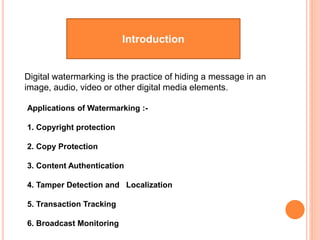
Digital watermarking is the practice of hiding a message in an
image, audio, video or other digital media elements.
Applications of Watermarking :-
1. Copyright protection
2. Copy Protection
3. Content Authentication
4. Tamper Detection and Localization
5. Transaction Tracking
6. Broadcast Monitoring
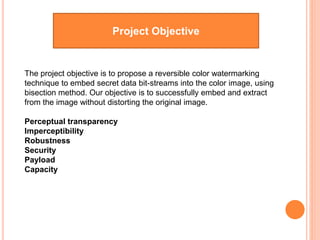
The project objective is to propose a reversible color watermarking
technique to embed secret data bit-streams into the color image, using
bisection method. Our objective is to successfully embed and extract
from the image without distorting the original image.
Perceptual transparency
Imperceptibility
Robustness
Security
Payload
Capacity
Project Objective
Watermarking Types
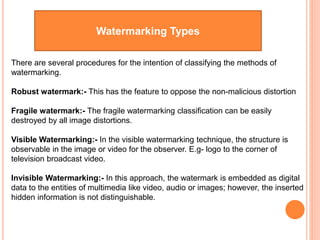
There are several procedures for the intention of classifying the methods of
watermarking.
Robust watermark:- This has the feature to oppose the non-malicious distortion
Fragile watermark:- The fragile watermarking classification can be easily
destroyed by all image distortions.
Visible Watermarking:- In the visible watermarking technique, the structure is
observable in the image or video for the observer. E.g- logo to the corner of
television broadcast video.
Invisible Watermarking:- In this approach, the watermark is embedded as digital
data to the entities of multimedia like video, audio or images; however, the inserted
hidden information is not distinguishable.
Watermarking for Various Media Types
Digital Audio Watermarking: Digital audio watermarking involves the concealing
of data within a discrete audio file. Applications for this technology are numerous.
To combat online music piracy, a digital watermark could be added to all
recording prior to release.
Digital Video Watermarking: A very simple definition of video watermarking
would be the process of watermarking the sequence of video frames.
Image Watermarking: Visible watermarks on image can be easily achieved
through image editing software. Ex. Image magic or any other, which have the
watermark functionality.
Text Watermarking: Digital watermarking texts and sensitive documents is a lot
more difficult than watermarking images and videos.
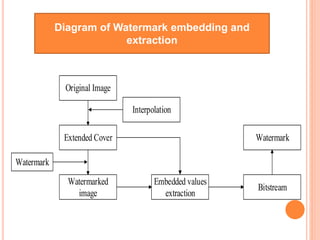
Diagram of Watermark embedding and
extraction
Original Image
Extended Cover
Watermarked
image
Embedded values
extraction
Bitstream
Watermark
Interpolation
Watermark
Project Set Up
The project was implemented with the following requirements:
Software Requirements:
1) MATLAB 2013a
2) Windows 8.1 OS
Hardware Requirements:
1) a 2.20 GHz Intel Core 2 Duo Processor
2) 3 GB of RAM
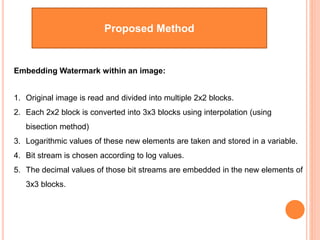
Proposed Method
Embedding Watermark within an image:
1. Original image is read and divided into multiple 2x2 blocks.
2. Each 2x2 block is converted into 3x3 blocks using interpolation (using
bisection method)
3. Logarithmic values of these new elements are taken and stored in a variable.
4. Bit stream is chosen according to log values.
5. The decimal values of those bit streams are embedded in the new elements of
3x3 blocks.
Proposed Method
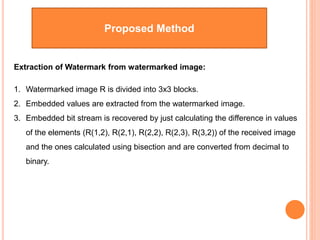
Extraction of Watermark from watermarked image:
1. Watermarked image R is divided into 3x3 blocks.
2. Embedded values are extracted from the watermarked image.
3. Embedded bit stream is recovered by just calculating the difference in values
of the elements (R(1,2), R(2,1), R(2,2), R(2,3), R(3,2)) of the received image
and the ones calculated using bisection and are converted from decimal to
binary.
Interpolation
Block_1[1,1] = Block_1[1,1]
Block_1[1,3] = Block_1[1,2]
Block_1[3,1] = Block_1[2,1]
Block_1[3,3] = Block_1[2,2]
Block_1[1,2] = (Block_1[1,1]+Block_1[1,3])/2
Block_1[2,1] = (Block_1[1,1]+Block_1[3,1])/2
Block_1[2,2] = (Block_1[1,2]+Block_1[3,2])/2
Block_1[2,3] = (Block_1[1,3]+Block_1[3,3])/2
Block_1[3,2] = (Block_1[3,1]+Block_1[3,3])/2
For using square root function we use
√(Block_x[y1,z1]2+Block_x[y2,z2]2 )/2 in
place of the bisection function.
19
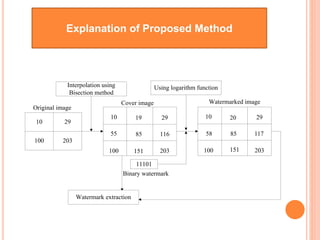
Explanation of Proposed Method
10 29
100 203
10 29
55
100 203
29
151
11685
10 29
57
100 203
30
154
11685
11101
Interpolation using
Bisection method
Cover image
Original image
Watermarked image
Using logarithm function
Watermark extraction
Binary watermark
19 20
58 117
151
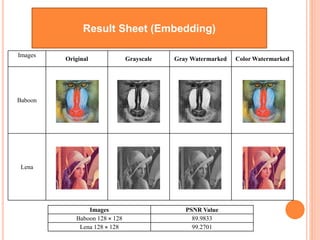
Result Sheet (Embedding)
Images
Original Grayscale Gray Watermarked Color Watermarked
Baboon
Lena
Images PSNR Value
Baboon 128 × 128 89.9833
Lena 128 × 128 99.2701
Result Sheet (Extraction)
Original Carrier
Image
[128 X 128]
Embedded Secret
Binary Image
[128 X 128]
Watermarked
Image
[192 X 192]
Extracted Secret
Binary Image
[128 X 128]
Correlation
1
1
This is the result of using bisection method. We have also used a square
root function √(a2+b2 )/2 which also gave us the Correlation value of 1.
Conclusion
In our project, we feel that our proposed method has some advantages &
disadvantages
Advantages :
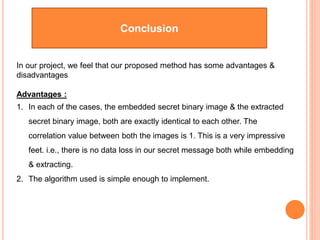
1. In each of the cases, the embedded secret binary image & the extracted
secret binary image, both are exactly identical to each other. The
correlation value between both the images is 1. This is a very impressive
feet. i.e., there is no data loss in our secret message both while embedding
& extracting.
2. The algorithm used is simple enough to implement.
Conclusion
Disadvantages
1. In our proposed method, we have only used the blue plane only. If we had
used the other 2 planes too, (i.e., Red, Green & Blue planes) our algorithm
& watermarking technique could be made more secure from attacks.
2. The PSNR values were not that impressive & were varying for the images
3. The algorithm used is very simple. More complicated algorithms lower the
risk of information being extracted from attacks.
4. There is a limit to the number of bits that can be embedded into a cover
image. For example, if we have an image of size M x M then, Max. No. of
bits that can be embedded into its watermarked image =
[(M x M) / (2 x 2)] x 10
Future Scope
This project can be improved in future in many ways and can be made more
secure to attackers:
1. In our proposed method, we have only used the blue plane only for
watermarking. The other 2 planes too, (i.e., Red, Green & Blue planes)
can be used. This will make our algorithm & watermarking technique could
be made more secure from attacks.
2. Multiple layers of interpolation can improve the security of data. This can
done by interpolating the interpolated values once again.
3. PSNR values can be improved by using more optimised algorithms.
4. In spite of using bisection, other functions can also be used to improve the
algorithm. For example, trigonometric function can be used.
5. Usage of different transformations. (Discreet Cosine Transforms, etc.)
References
[1] S. R. Chowdhury, R. Ray; N. Dey; S. Chakraborty; W. Ben Abdessalem Karaa
& S. Nath, "Effect of demons registration on biomedical content watermarking",
2014 International Conference on Control, Instrumentation, Communication and
Computational Technologies (ICCICCT), July 2014, pp.509-514.
[2] Craver,S. Memon,N. Yeo, B.L and Yeung, M.M "Resolving Rightful Ownership
with Invisible Watermarking Techniques: Limitations, Attacks and
Implications," IEEE JSAC, March 1997.
[3] Yeung, M.M and Mintzer, F. "An Invisible Watermarking Technique for Image
Verification," Proceedings of IEEE ICIP'97, Santa Barbara, CA, Oct. 1997.
[4] Hoover A., Goldbaum M. (2003) ‘Locating the optic nerve in a retinal image
using the fuzzy convergence of the blood vessels’, in IEEE Transaction on
Medical Imaging, Vol. 22, No. 8, pp. 951 -958.
[5] Jiang X., Mojon D. (2003) ‘Adaptive local thresholding by verification based
multithreshold probing with application to vessel detection in retinal images’, in
IEEE Trans. Pattern Anal. Mach. Intell., Vol. 25, No. 1, pp. 131 -137.
[6] Niemeijer M., van Ginneken B., Staal J. J., Suttorp-Schulten M. S. A., Abramoff
M. D. (2005) ‘Automatic detection of red lesions in digital color fundus
photographs’, in IEEE Transaction on Med. Imaging, Vol. 24 , No. 5, pp. 584 -592.
[7] Foracchia M., Grisan E., Ruggeri A. (2005) ‘Luminosity and contrast
normalization in retinal images’ in Med. Image Anal., Vol. 9, No. 3, pp. 179 -190.
[8] Mendon a A. M., Campilho A. (2006) ’Segmentation of retinal blood vessels by
combining the detection of centerlines and morpholo gical reconstruction’, in
IEEE Trans. Med. Imag. Vol. 25, No. 9, pp. 1200 -1213.
Watermarkingppt

Watermarkingppt

  • 1.
    A COMPARATIVE STUDYOF REVERSIBLE DATA HIDING TECHNIQUES SUBMITTED BY: Abhishek Mukherjee (12500212001) Ashish Kumar Singh (12500212016) Nidhi Krishna (12500212050) Nikhil Sinha (12500212052) Probuddha Singha (12500212064) Guided By : Sayan Chakraborty [Dept. Of Information Technology]
  • 2.
    Abstract Digital Watermarking isthe practice of embedding some secret bits into another carrier digital data. This image can henceforth be used for various applications like Copyright Protection, Authentication etc. Our proposed method uses bisection technique and a square root function for embedding & extracting the bit stream. We have tried to make our method as efficient as possible, so that there can be less data loss of the bit-stream while embedding & extracting. We have used the blue plane for watermarking
  • 3.
    Introduction Digital watermarking isthe practice of hiding a message in an image, audio, video or other digital media elements. Applications of Watermarking :- 1. Copyright protection 2. Copy Protection 3. Content Authentication 4. Tamper Detection and Localization 5. Transaction Tracking 6. Broadcast Monitoring
  • 4.
    The project objectiveis to propose a reversible color watermarking technique to embed secret data bit-streams into the color image, using bisection method. Our objective is to successfully embed and extract from the image without distorting the original image. Perceptual transparency Imperceptibility Robustness Security Payload Capacity Project Objective
  • 5.
    Watermarking Types There areseveral procedures for the intention of classifying the methods of watermarking. Robust watermark:- This has the feature to oppose the non-malicious distortion Fragile watermark:- The fragile watermarking classification can be easily destroyed by all image distortions. Visible Watermarking:- In the visible watermarking technique, the structure is observable in the image or video for the observer. E.g- logo to the corner of television broadcast video. Invisible Watermarking:- In this approach, the watermark is embedded as digital data to the entities of multimedia like video, audio or images; however, the inserted hidden information is not distinguishable.
  • 6.
    Watermarking for VariousMedia Types Digital Audio Watermarking: Digital audio watermarking involves the concealing of data within a discrete audio file. Applications for this technology are numerous. To combat online music piracy, a digital watermark could be added to all recording prior to release. Digital Video Watermarking: A very simple definition of video watermarking would be the process of watermarking the sequence of video frames. Image Watermarking: Visible watermarks on image can be easily achieved through image editing software. Ex. Image magic or any other, which have the watermark functionality. Text Watermarking: Digital watermarking texts and sensitive documents is a lot more difficult than watermarking images and videos.
  • 7.
    Diagram of Watermarkembedding and extraction Original Image Extended Cover Watermarked image Embedded values extraction Bitstream Watermark Interpolation Watermark
  • 8.
    Project Set Up Theproject was implemented with the following requirements: Software Requirements: 1) MATLAB 2013a 2) Windows 8.1 OS Hardware Requirements: 1) a 2.20 GHz Intel Core 2 Duo Processor 2) 3 GB of RAM
  • 9.
    Proposed Method Embedding Watermarkwithin an image: 1. Original image is read and divided into multiple 2x2 blocks. 2. Each 2x2 block is converted into 3x3 blocks using interpolation (using bisection method) 3. Logarithmic values of these new elements are taken and stored in a variable. 4. Bit stream is chosen according to log values. 5. The decimal values of those bit streams are embedded in the new elements of 3x3 blocks.
  • 10.
    Proposed Method Extraction ofWatermark from watermarked image: 1. Watermarked image R is divided into 3x3 blocks. 2. Embedded values are extracted from the watermarked image. 3. Embedded bit stream is recovered by just calculating the difference in values of the elements (R(1,2), R(2,1), R(2,2), R(2,3), R(3,2)) of the received image and the ones calculated using bisection and are converted from decimal to binary.
  • 11.
    Interpolation Block_1[1,1] = Block_1[1,1] Block_1[1,3]= Block_1[1,2] Block_1[3,1] = Block_1[2,1] Block_1[3,3] = Block_1[2,2] Block_1[1,2] = (Block_1[1,1]+Block_1[1,3])/2 Block_1[2,1] = (Block_1[1,1]+Block_1[3,1])/2 Block_1[2,2] = (Block_1[1,2]+Block_1[3,2])/2 Block_1[2,3] = (Block_1[1,3]+Block_1[3,3])/2 Block_1[3,2] = (Block_1[3,1]+Block_1[3,3])/2 For using square root function we use √(Block_x[y1,z1]2+Block_x[y2,z2]2 )/2 in place of the bisection function. 19
  • 12.
    Explanation of ProposedMethod 10 29 100 203 10 29 55 100 203 29 151 11685 10 29 57 100 203 30 154 11685 11101 Interpolation using Bisection method Cover image Original image Watermarked image Using logarithm function Watermark extraction Binary watermark 19 20 58 117 151
  • 13.
    Result Sheet (Embedding) Images OriginalGrayscale Gray Watermarked Color Watermarked Baboon Lena Images PSNR Value Baboon 128 × 128 89.9833 Lena 128 × 128 99.2701
  • 14.
    Result Sheet (Extraction) OriginalCarrier Image [128 X 128] Embedded Secret Binary Image [128 X 128] Watermarked Image [192 X 192] Extracted Secret Binary Image [128 X 128] Correlation 1 1 This is the result of using bisection method. We have also used a square root function √(a2+b2 )/2 which also gave us the Correlation value of 1.
  • 15.
    Conclusion In our project,we feel that our proposed method has some advantages & disadvantages Advantages : 1. In each of the cases, the embedded secret binary image & the extracted secret binary image, both are exactly identical to each other. The correlation value between both the images is 1. This is a very impressive feet. i.e., there is no data loss in our secret message both while embedding & extracting. 2. The algorithm used is simple enough to implement.
  • 16.
    Conclusion Disadvantages 1. In ourproposed method, we have only used the blue plane only. If we had used the other 2 planes too, (i.e., Red, Green & Blue planes) our algorithm & watermarking technique could be made more secure from attacks. 2. The PSNR values were not that impressive & were varying for the images 3. The algorithm used is very simple. More complicated algorithms lower the risk of information being extracted from attacks. 4. There is a limit to the number of bits that can be embedded into a cover image. For example, if we have an image of size M x M then, Max. No. of bits that can be embedded into its watermarked image = [(M x M) / (2 x 2)] x 10
  • 17.
    Future Scope This projectcan be improved in future in many ways and can be made more secure to attackers: 1. In our proposed method, we have only used the blue plane only for watermarking. The other 2 planes too, (i.e., Red, Green & Blue planes) can be used. This will make our algorithm & watermarking technique could be made more secure from attacks. 2. Multiple layers of interpolation can improve the security of data. This can done by interpolating the interpolated values once again. 3. PSNR values can be improved by using more optimised algorithms. 4. In spite of using bisection, other functions can also be used to improve the algorithm. For example, trigonometric function can be used. 5. Usage of different transformations. (Discreet Cosine Transforms, etc.)
  • 18.
    References [1] S. R.Chowdhury, R. Ray; N. Dey; S. Chakraborty; W. Ben Abdessalem Karaa & S. Nath, "Effect of demons registration on biomedical content watermarking", 2014 International Conference on Control, Instrumentation, Communication and Computational Technologies (ICCICCT), July 2014, pp.509-514. [2] Craver,S. Memon,N. Yeo, B.L and Yeung, M.M "Resolving Rightful Ownership with Invisible Watermarking Techniques: Limitations, Attacks and Implications," IEEE JSAC, March 1997. [3] Yeung, M.M and Mintzer, F. "An Invisible Watermarking Technique for Image Verification," Proceedings of IEEE ICIP'97, Santa Barbara, CA, Oct. 1997. [4] Hoover A., Goldbaum M. (2003) ‘Locating the optic nerve in a retinal image using the fuzzy convergence of the blood vessels’, in IEEE Transaction on Medical Imaging, Vol. 22, No. 8, pp. 951 -958. [5] Jiang X., Mojon D. (2003) ‘Adaptive local thresholding by verification based multithreshold probing with application to vessel detection in retinal images’, in IEEE Trans. Pattern Anal. Mach. Intell., Vol. 25, No. 1, pp. 131 -137. [6] Niemeijer M., van Ginneken B., Staal J. J., Suttorp-Schulten M. S. A., Abramoff M. D. (2005) ‘Automatic detection of red lesions in digital color fundus photographs’, in IEEE Transaction on Med. Imaging, Vol. 24 , No. 5, pp. 584 -592. [7] Foracchia M., Grisan E., Ruggeri A. (2005) ‘Luminosity and contrast normalization in retinal images’ in Med. Image Anal., Vol. 9, No. 3, pp. 179 -190. [8] Mendon a A. M., Campilho A. (2006) ’Segmentation of retinal blood vessels by combining the detection of centerlines and morpholo gical reconstruction’, in IEEE Trans. Med. Imag. Vol. 25, No. 9, pp. 1200 -1213.