Society of Petroleum Engineers
Distinguished Lecturer Program
www.spe.org/dl
1
Scot Buell, SPEC
Waterflood Design and
Operational Best Practices
Outline
• Waterflood design life and injection efficiency
• Conformance management
• Injection well design
• Waterflood surveillance
• Water quality
• Fracturing and subsurface integrity
• Interdisciplinary aspects of waterflooding
2
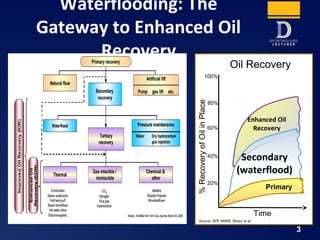
Time
%RecoveryofOilinPlace
Waterflooding: The
Gateway to Enhanced Oil
Recovery
3
100%
80%
20%
40%
60%
Oil Recovery
Enhanced Oil
Recovery
Secondary
(waterflood)
Primary
Source: SPE 84908, Stosur et al
Waterflood Mobility Ratio
4
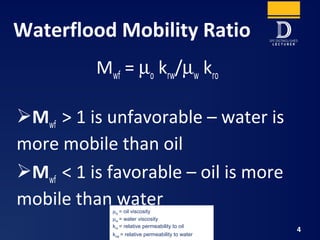
Mwf = µo krw/µw kro
Mwf > 1 is unfavorable – water is
more mobile than oil
Mwf < 1 is favorable – oil is more
mobile than waterµo = oil viscosity
µw = water viscosity
kro = relative permeability to oil
krw = relative permeability to water
What is the Design Life of Your
Waterflood?
5
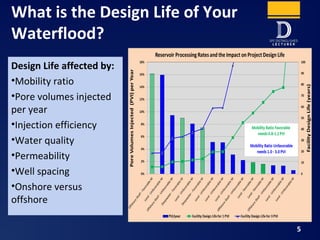
Design Life affected by:
•Mobility ratio
•Pore volumes injected
per year
•Injection efficiency
•Water quality
•Permeability
•Well spacing
•Onshore versus
offshore
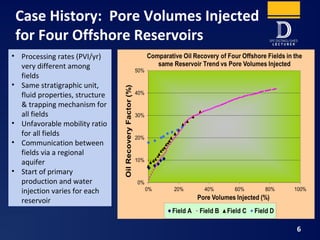
Case History: Pore Volumes Injected
for Four Offshore Reservoirs
6
• Processing rates (PVI/yr)
very different among
fields
• Same stratigraphic unit,
fluid properties, structure
& trapping mechanism for
all fields
• Unfavorable mobility ratio
for all fields
• Communication between
fields via a regional
aquifer
• Start of primary
production and water
injection varies for each
reservoir
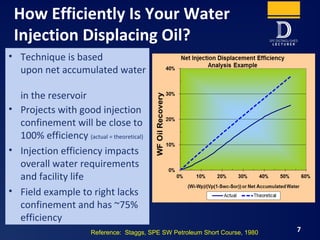
How Efficiently Is Your Water
Injection Displacing Oil?
7
• Technique is based
upon net accumulated water
in the reservoir
• Projects with good injection
confinement will be close to
100% efficiency (actual = theoretical)
• Injection efficiency impacts
overall water requirements
and facility life
• Field example to right lacks
confinement and has ~75%
efficiency
Reference: Staggs, SPE SW Petroleum Short Course, 1980
Voidage Replacement Ratio (VRR)
• Also known as FIFO (fluid-in fluid-out) or IWR
(injection-withdrawal ratio)
• Provides accounting of reservoir barrels into and
out of the reservoir
• Waterfloods should have a target, minimum, &
maximum reservoir pressures
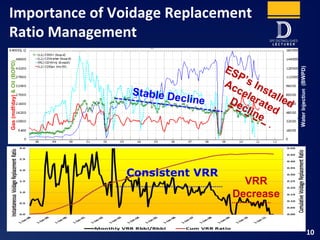
• VRR is used as a leading indicator to achieve
target reservoir pressure (particularly when wells are not equipped
with bottom hole pressure gauges)
8
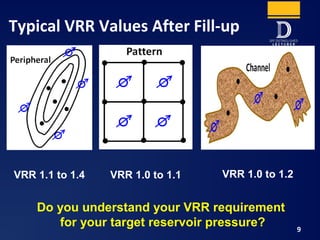
Typical VRR Values After Fill-up
9
VRR 1.1 to 1.4 VRR 1.0 to 1.1 VRR 1.0 to 1.2
Do you understand your VRR requirement
for your target reservoir pressure?
10
Consistent VRR
ESP’s Installed
Accelerated
Decline
Importance of Voidage Replacement
Ratio Management
VRR
Decrease
Gas(mdf/day)&Oil(BOPD)
WaterInjection(BWPD)
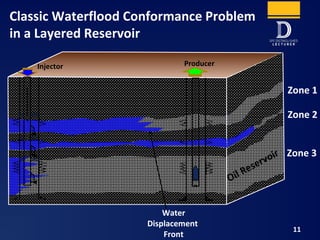
Zone 3
Zone 2
Zone 1
Water
Displacement
Front
Oil Reservoir
Classic Waterflood Conformance Problem
in a Layered Reservoir
11
Injector Producer
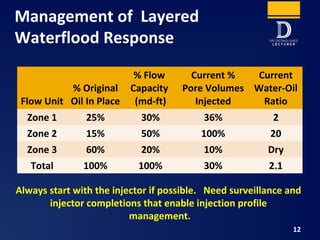
Management of Layered
Waterflood Response
12
Flow Unit
% Original
Oil In Place
% Flow
Capacity
(md-ft)
Current %
Pore Volumes
Injected
Current
Water-Oil
Ratio
Zone 1 25% 30% 36% 2
Zone 2 15% 50% 100% 20
Zone 3 60% 20% 10% Dry
Total 100% 100% 30% 2.1
Always start with the injector if possible. Need surveillance and
injector completions that enable injection profile
management.
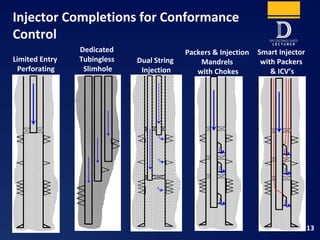
Injector Completions for Conformance
Control
13
Limited Entry
Perforating
Dedicated
Tubingless
Slimhole
Packers & Injection
Mandrels
with Chokes
Smart Injector
with Packers
& ICV’s
Dual String
Injection
Elements of a Waterflood
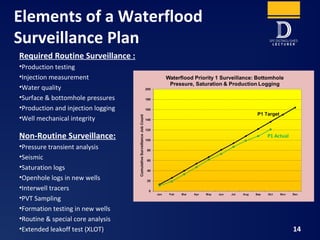
Surveillance Plan
Required Routine Surveillance :
•Production testing
•Injection measurement
•Water quality
•Surface & bottomhole pressures
•Production and injection logging
•Well mechanical integrity
Non-Routine Surveillance:
•Pressure transient analysis
•Seismic
•Saturation logs
•Openhole logs in new wells
•Interwell tracers
•PVT Sampling
•Formation testing in new wells
•Routine & special core analysis
•Extended leakoff test (XLOT) 14
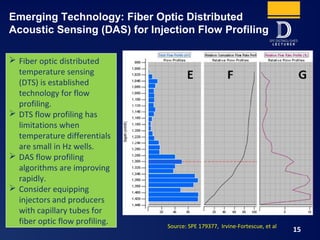
Emerging Technology: Fiber Optic Distributed
Acoustic Sensing (DAS) for Injection Flow Profiling
Source: SPE 179377, Irvine-Fortescue, et al
15
 Fiber optic distributed
temperature sensing
(DTS) is established
technology for flow
profiling.
 DTS flow profiling has
limitations when
temperature differentials
are small in Hz wells.
 DAS flow profiling
algorithms are improving
rapidly.
 Consider equipping
injectors and producers
with capillary tubes for
fiber optic flow profiling.
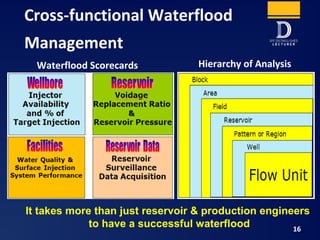
Cross-functional Waterflood
Management
Hierarchy of AnalysisWaterflood Scorecards
It takes more than just reservoir & production engineers
to have a successful waterflood 16
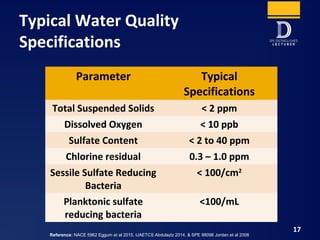
Typical Water Quality
Specifications
17
Parameter Typical
Specifications
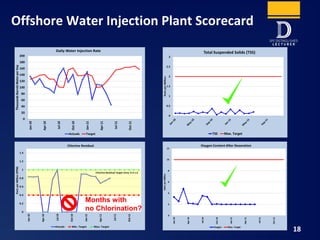
Total Suspended Solids < 2 ppm
Dissolved Oxygen < 10 ppb
Sulfate Content < 2 to 40 ppm
Chlorine residual 0.3 – 1.0 ppm
Sessile Sulfate Reducing
Bacteria
< 100/cm2
Planktonic sulfate
reducing bacteria
<100/mL
Reference: NACE 5962 Eggum et al 2015, IJAETCS Abdulaziz 2014, & SPE 98096 Jordan et al 2008
Offshore Water Injection Plant Scorecard
18
Months with
no Chlorination?
Biofouling: Consequences of Not
Meeting Water Quality Specifications?
19
What are Biofilms?
They are collections of microorganisms and
the extracellular polymers they secrete.
They attach to either inert or living
substrates. These bacteria are classified as
planktonic (free floating) or sessile
(anchored).
Microbiologically Induced
Corrosion (MIC): Bacteria produce
waste products like CO2, H2S, and organic
acids that corrode the pipes by increasing
the toxicity of the flowing fluid in the
pipeline. The microbes tend to form colonies
in a hospitable environment and accelerate
corrosion under the colony.
MIC Corrosion Example
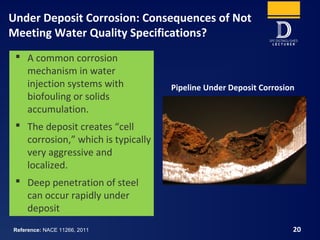
Under Deposit Corrosion: Consequences of Not
Meeting Water Quality Specifications?
20
 A common corrosion
mechanism in water
injection systems with
biofouling or solids
accumulation.
 The deposit creates “cell
corrosion,” which is typically
very aggressive and
localized.
 Deep penetration of steel
can occur rapidly under
deposit
Pipeline Under Deposit Corrosion
Reference: NACE 11266, 2011
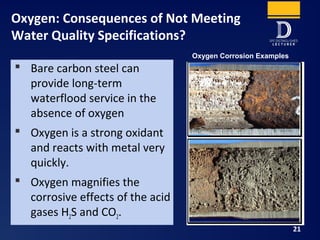
Oxygen: Consequences of Not Meeting
Water Quality Specifications?
21
Oxygen Corrosion Examples
 Bare carbon steel can
provide long-term
waterflood service in the
absence of oxygen
 Oxygen is a strong oxidant
and reacts with metal very
quickly.
 Oxygen magnifies the
corrosive effects of the acid
gases H2S and CO2.
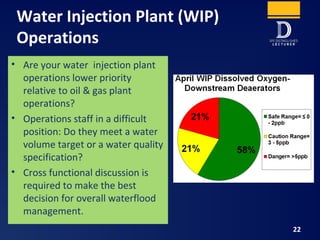
Water Injection Plant (WIP)
Operations
22
• Are your water injection plant
operations lower priority
relative to oil & gas plant
operations?
• Operations staff in a difficult
position: Do they meet a water
volume target or a water quality
specification?
• Cross functional discussion is
required to make the best
decision for overall waterflood
management.
Operational Discipline with
Water Quality
23
• Do you have a water
quality specification or a
water quality suggestion?
• Do you have quality
criteria for stopping water
injection?
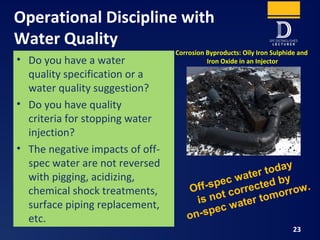
• The negative impacts of off-
spec water are not reversed
with pigging, acidizing,
chemical shock treatments,
surface piping replacement,
etc.
Corrosion Byproducts: Oily Iron Sulphide and
Iron Oxide in an Injector
Off-spec water today
is not corrected by
on-spec water tomorrow.
Matrix Injection Myth in
Waterfloods
24
• Long term matrix injection cannot
be achieved with practical water
quality levels in sandstone reservoirs.
• Some near wellbore fracturing will occur in
most injectors due to thermal stress & plugging
effects.
• Injection pressures, rates and water quality can
be used to manage fracture geometry.
• Vuggy, fractured carbonates can be an
exceptionSee SPE 28082, 28488, 39698, 59354,84289,95021, 95726, 102467, 107866,165138, et al
Subsurface Integrity
Management for Waterfloods
• Subsurface integrity management ensures injected fluids
are confined to targeted and permitted reservoirs.
• Industry events with injection water breaching seabed or
earth’s surface
• Increasing societal and governmental concerns
• Historical focus has been on understanding reservoir
fracturing and not the overburden and caprock.
• Keeping injection pressures below caprock fracture
pressures does not guarantee containment –
geomechanical modeling may be required.
25
Key Takeaways
• Understand the design life and processing rate of your reservoir
(PVI/yr)
• Understand how much of your water injection is effective
• Plan for early water breakthrough and layered reservoir
management
• Understand surveillance minimums and emerging fiber optic
technologies
• Use operational discipline with your water quality – have criteria
for stopping injection – know your water chemistry
• Plan for injector fracturing and subsurface integrity
management
• Use a crossfunctional/interdisciplinary team effort
26
Society of Petroleum
Engineers
Distinguished Lecturer
Program
www.spe.org/dl
27
Your Feedback is
Important
Enter your section in the DL Evaluation
Contest by completing the evaluation
form for this presentation
Visit SPE.org/dl

Waterflood Design and Operational Best Practices

  • 1.
    Society of PetroleumEngineers Distinguished Lecturer Program www.spe.org/dl 1 Scot Buell, SPEC Waterflood Design and Operational Best Practices
  • 2.
    Outline • Waterflood designlife and injection efficiency • Conformance management • Injection well design • Waterflood surveillance • Water quality • Fracturing and subsurface integrity • Interdisciplinary aspects of waterflooding 2
  • 3.
    Time %RecoveryofOilinPlace Waterflooding: The Gateway toEnhanced Oil Recovery 3 100% 80% 20% 40% 60% Oil Recovery Enhanced Oil Recovery Secondary (waterflood) Primary Source: SPE 84908, Stosur et al
  • 4.
    Waterflood Mobility Ratio 4 Mwf= µo krw/µw kro Mwf > 1 is unfavorable – water is more mobile than oil Mwf < 1 is favorable – oil is more mobile than waterµo = oil viscosity µw = water viscosity kro = relative permeability to oil krw = relative permeability to water
  • 5.
    What is theDesign Life of Your Waterflood? 5 Design Life affected by: •Mobility ratio •Pore volumes injected per year •Injection efficiency •Water quality •Permeability •Well spacing •Onshore versus offshore
  • 6.
    Case History: PoreVolumes Injected for Four Offshore Reservoirs 6 • Processing rates (PVI/yr) very different among fields • Same stratigraphic unit, fluid properties, structure & trapping mechanism for all fields • Unfavorable mobility ratio for all fields • Communication between fields via a regional aquifer • Start of primary production and water injection varies for each reservoir
  • 7.
    How Efficiently IsYour Water Injection Displacing Oil? 7 • Technique is based upon net accumulated water in the reservoir • Projects with good injection confinement will be close to 100% efficiency (actual = theoretical) • Injection efficiency impacts overall water requirements and facility life • Field example to right lacks confinement and has ~75% efficiency Reference: Staggs, SPE SW Petroleum Short Course, 1980
  • 8.
    Voidage Replacement Ratio(VRR) • Also known as FIFO (fluid-in fluid-out) or IWR (injection-withdrawal ratio) • Provides accounting of reservoir barrels into and out of the reservoir • Waterfloods should have a target, minimum, & maximum reservoir pressures • VRR is used as a leading indicator to achieve target reservoir pressure (particularly when wells are not equipped with bottom hole pressure gauges) 8
  • 9.
    Typical VRR ValuesAfter Fill-up 9 VRR 1.1 to 1.4 VRR 1.0 to 1.1 VRR 1.0 to 1.2 Do you understand your VRR requirement for your target reservoir pressure?
  • 10.
    10 Consistent VRR ESP’s Installed Accelerated Decline Importanceof Voidage Replacement Ratio Management VRR Decrease Gas(mdf/day)&Oil(BOPD) WaterInjection(BWPD)
  • 11.
    Zone 3 Zone 2 Zone1 Water Displacement Front Oil Reservoir Classic Waterflood Conformance Problem in a Layered Reservoir 11 Injector Producer
  • 12.
    Management of Layered WaterfloodResponse 12 Flow Unit % Original Oil In Place % Flow Capacity (md-ft) Current % Pore Volumes Injected Current Water-Oil Ratio Zone 1 25% 30% 36% 2 Zone 2 15% 50% 100% 20 Zone 3 60% 20% 10% Dry Total 100% 100% 30% 2.1 Always start with the injector if possible. Need surveillance and injector completions that enable injection profile management.
  • 13.
    Injector Completions forConformance Control 13 Limited Entry Perforating Dedicated Tubingless Slimhole Packers & Injection Mandrels with Chokes Smart Injector with Packers & ICV’s Dual String Injection
  • 14.
    Elements of aWaterflood Surveillance Plan Required Routine Surveillance : •Production testing •Injection measurement •Water quality •Surface & bottomhole pressures •Production and injection logging •Well mechanical integrity Non-Routine Surveillance: •Pressure transient analysis •Seismic •Saturation logs •Openhole logs in new wells •Interwell tracers •PVT Sampling •Formation testing in new wells •Routine & special core analysis •Extended leakoff test (XLOT) 14
  • 15.
    Emerging Technology: FiberOptic Distributed Acoustic Sensing (DAS) for Injection Flow Profiling Source: SPE 179377, Irvine-Fortescue, et al 15  Fiber optic distributed temperature sensing (DTS) is established technology for flow profiling.  DTS flow profiling has limitations when temperature differentials are small in Hz wells.  DAS flow profiling algorithms are improving rapidly.  Consider equipping injectors and producers with capillary tubes for fiber optic flow profiling.
  • 16.
    Cross-functional Waterflood Management Hierarchy ofAnalysisWaterflood Scorecards It takes more than just reservoir & production engineers to have a successful waterflood 16
  • 17.
    Typical Water Quality Specifications 17 ParameterTypical Specifications Total Suspended Solids < 2 ppm Dissolved Oxygen < 10 ppb Sulfate Content < 2 to 40 ppm Chlorine residual 0.3 – 1.0 ppm Sessile Sulfate Reducing Bacteria < 100/cm2 Planktonic sulfate reducing bacteria <100/mL Reference: NACE 5962 Eggum et al 2015, IJAETCS Abdulaziz 2014, & SPE 98096 Jordan et al 2008
  • 18.
    Offshore Water InjectionPlant Scorecard 18 Months with no Chlorination?
  • 19.
    Biofouling: Consequences ofNot Meeting Water Quality Specifications? 19 What are Biofilms? They are collections of microorganisms and the extracellular polymers they secrete. They attach to either inert or living substrates. These bacteria are classified as planktonic (free floating) or sessile (anchored). Microbiologically Induced Corrosion (MIC): Bacteria produce waste products like CO2, H2S, and organic acids that corrode the pipes by increasing the toxicity of the flowing fluid in the pipeline. The microbes tend to form colonies in a hospitable environment and accelerate corrosion under the colony. MIC Corrosion Example
  • 20.
    Under Deposit Corrosion:Consequences of Not Meeting Water Quality Specifications? 20  A common corrosion mechanism in water injection systems with biofouling or solids accumulation.  The deposit creates “cell corrosion,” which is typically very aggressive and localized.  Deep penetration of steel can occur rapidly under deposit Pipeline Under Deposit Corrosion Reference: NACE 11266, 2011
  • 21.
    Oxygen: Consequences ofNot Meeting Water Quality Specifications? 21 Oxygen Corrosion Examples  Bare carbon steel can provide long-term waterflood service in the absence of oxygen  Oxygen is a strong oxidant and reacts with metal very quickly.  Oxygen magnifies the corrosive effects of the acid gases H2S and CO2.
  • 22.
    Water Injection Plant(WIP) Operations 22 • Are your water injection plant operations lower priority relative to oil & gas plant operations? • Operations staff in a difficult position: Do they meet a water volume target or a water quality specification? • Cross functional discussion is required to make the best decision for overall waterflood management.
  • 23.
    Operational Discipline with WaterQuality 23 • Do you have a water quality specification or a water quality suggestion? • Do you have quality criteria for stopping water injection? • The negative impacts of off- spec water are not reversed with pigging, acidizing, chemical shock treatments, surface piping replacement, etc. Corrosion Byproducts: Oily Iron Sulphide and Iron Oxide in an Injector Off-spec water today is not corrected by on-spec water tomorrow.
  • 24.
    Matrix Injection Mythin Waterfloods 24 • Long term matrix injection cannot be achieved with practical water quality levels in sandstone reservoirs. • Some near wellbore fracturing will occur in most injectors due to thermal stress & plugging effects. • Injection pressures, rates and water quality can be used to manage fracture geometry. • Vuggy, fractured carbonates can be an exceptionSee SPE 28082, 28488, 39698, 59354,84289,95021, 95726, 102467, 107866,165138, et al
  • 25.
    Subsurface Integrity Management forWaterfloods • Subsurface integrity management ensures injected fluids are confined to targeted and permitted reservoirs. • Industry events with injection water breaching seabed or earth’s surface • Increasing societal and governmental concerns • Historical focus has been on understanding reservoir fracturing and not the overburden and caprock. • Keeping injection pressures below caprock fracture pressures does not guarantee containment – geomechanical modeling may be required. 25
  • 26.
    Key Takeaways • Understandthe design life and processing rate of your reservoir (PVI/yr) • Understand how much of your water injection is effective • Plan for early water breakthrough and layered reservoir management • Understand surveillance minimums and emerging fiber optic technologies • Use operational discipline with your water quality – have criteria for stopping injection – know your water chemistry • Plan for injector fracturing and subsurface integrity management • Use a crossfunctional/interdisciplinary team effort 26
  • 27.
    Society of Petroleum Engineers DistinguishedLecturer Program www.spe.org/dl 27 Your Feedback is Important Enter your section in the DL Evaluation Contest by completing the evaluation form for this presentation Visit SPE.org/dl

Editor's Notes

  • #25 Relevant References: Analytical thermal fracture/formation damage (SPE 165138, SPE 95021) – Total Coupled geomechanical reservoir simulator (SPE102467, 95726) –Shell Formation Resistant Model “FRM” (SPE 28488) –Shell Waterflood-Induced Fractures (SPE-84289-PA) - Shell Analytical thermal fracturing model (SPE 39698) – UC Berkeley Formation damage/mobility improvement (SPE 107866) – Petrobras Coupled fracture/reservoir simulation (SPE 28082 and 59354) – BP Coupled fracture/reservoir simulator with external plugging, Reveal – Petroleum Experts Fracture with plugging simulator– Meyer &amp; Associates Thermal fracture/plugging (SPE 108238, 98351) – Advantek Coupled fracture/reservoir simulator with plugging, GMRS (SPE 116470) – Chevron UTWID – UT Austin Coupled fracture/reservoir simulator with plugging, TAURUS (SPE 79695) – U of Calgary
  • #26 References: SPE 157912 State Oil and Gas Agency Groundwater Investigations And Their Role in Advancing Regulatory Reforms A Two-State Review: Ohio and Texas by Scott Kell