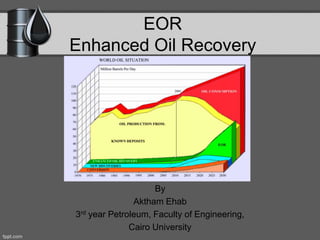
EOR
Enhanced Oil Recovery
By
Aktham Ehab
3rd year Petroleum, Faculty of Engineering,
Cairo University
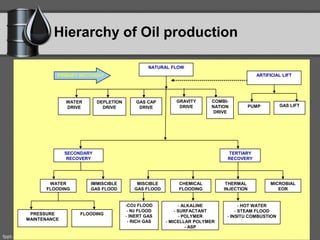
NATURAL FLOW
WATER
DRIVE
DEPLETION
DRIVE
GAS CAP
DRIVE
GRAVITY
DRIVE
COMBI-
NATION
DRIVE
ARTIFICIAL LIFT
PUMP GAS LIFT
SECONDARY
RECOVERY
TERTIARY
RECOVERY
WATER
FLOODING
IMMISCIBLE
GAS FLOOD
PRESSURE
MAINTENANCE
FLOODING
MISCIBLE
GAS FLOOD
CHEMICAL
FLOODING
THERMAL
INJECTION
MICROBIAL
EOR
PRIMARY RECOVERY
-CO2 FLOOD
- N2 FLOOD
- INERT GAS
- RICH GAS
- ALKALINE
- SURFACTANT
- POLYMER
- MICELLAR POLYMER
- ASP
- HOT WATER
- STEAM FLOOD
- INSITU COMBUSTION
Hierarchy of Oil production
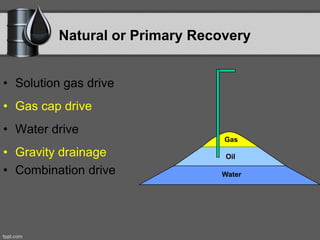
Natural or Primary Recovery
• Solution gas drive
• Gas cap drive
• Water drive
• Gravity drainage
• Combination drive
Gas
Oil
Water
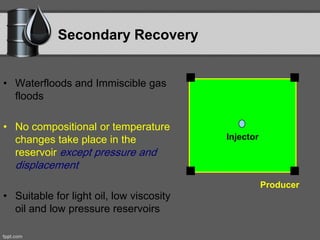
Secondary Recovery
• Waterfloods and Immiscible gas
floods
• No compositional or temperature
changes take place in the
reservoir except pressure and
displacement
• Suitable for light oil, low viscosity
oil and low pressure reservoirs
Injector
Producer
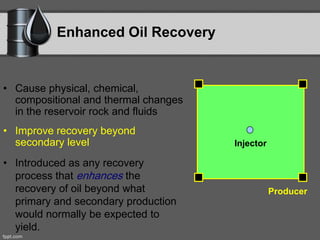
Enhanced Oil Recovery
• Cause physical, chemical,
compositional and thermal changes
in the reservoir rock and fluids
• Improve recovery beyond
secondary level
• Introduced as any recovery
process that enhances the
recovery of oil beyond what
primary and secondary production
would normally be expected to
yield.
Injector
Producer
DK - 6 -
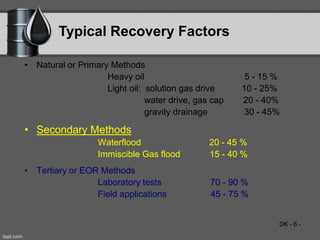
Typical Recovery Factors
• Natural or Primary Methods
Heavy oil 5 - 15 %
Light oil: solution gas drive 10 - 25%
water drive, gas cap 20 - 40%
gravity drainage 30 - 45%
• Secondary Methods
Waterflood 20 - 45 %
Immiscible Gas flood 15 - 40 %
• Tertiary or EOR Methods
Laboratory tests 70 - 90 %
Field applications 45 - 75 %
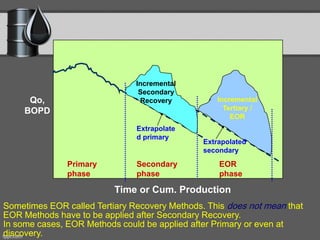
Sometimes EOR called Tertiary Recovery Methods. This does not mean that
EOR Methods have to be applied after Secondary Recovery.
In some cases, EOR Methods could be applied after Primary or even at
discovery.
Time or Cum. Production
Qo,
BOPD
Extrapolate
d primary
Primary
phase
Secondary
phase
EOR
phase
Extrapolated
secondary
Incremental
Secondary
Recovery Incremental
Tertiary /
EOR
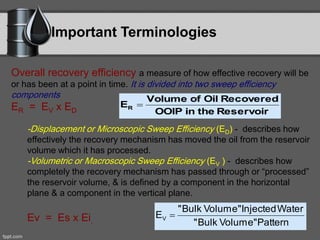
Important Terminologies
Overall recovery efficiency a measure of how effective recovery will be
or has been at a point in time. It is divided into two sweep efficiency
components
ER = EV x ED
-Displacement or Microscopic Sweep Efficiency (ED) - describes how
effectively the recovery mechanism has moved the oil from the reservoir
volume which it has processed.
-Volumetric or Macroscopic Sweep Efficiency (EV ) - describes how
completely the recovery mechanism has passed through or “processed”
the reservoir volume, & is defined by a component in the horizontal
plane & a component in the vertical plane.
Ev = Es x Ei.
ReservoirtheinOOIP
RecoveredOilofVolume
ER 
PatternVolume"Bulk"
WaterInjectedVolume"Bulk"
EV 
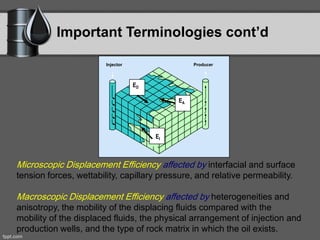
Microscopic Displacement Efficiency affected by interfacial and surface
tension forces, wettability, capillary pressure, and relative permeability.
Macroscopic Displacement Efficiency affected by heterogeneities and
anisotropy, the mobility of the displacing fluids compared with the
mobility of the displaced fluids, the physical arrangement of injection and
production wells, and the type of rock matrix in which the oil exists.
Injector Producer
ED
EA
EI
Important Terminologies cont’d
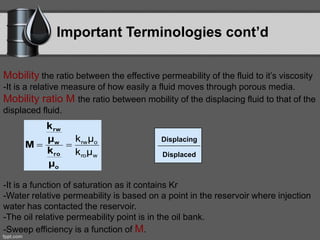
Mobility the ratio between the effective permeability of the fluid to it’s viscosity
-It is a relative measure of how easily a fluid moves through porous media.
Mobility ratio M the ratio between mobility of the displacing fluid to that of the
displaced fluid.
-It is a function of saturation as it contains Kr
-Water relative permeability is based on a point in the reservoir where injection
water has contacted the reservoir.
-The oil relative permeability point is in the oil bank.
-Sweep efficiency is a function of M.
wro
orw
μk
μk

o
ro
w
rw
μ
k
μ
k
M
Displacing
Displaced
Important Terminologies cont’d
-When M<1.0 oil flows more easily than water, & injection water does a more
effective job of displacing oil.
-When M>1.0 water flows better than oil & is less effective in displacing oil.
Viscous fingering a phenomenon takes place if the mobility of the displacing
phase is much greater than the mobility of the displaced phase.
EOR Categories
Enhanced oil recovery processes can be classified into four categories:
1. Miscible flooding processes
2. Chemical flooding processes
3. Thermal flooding processes
4. Microbial flooding processes
-The category of miscible displacement includes singlecontact and multiple-
contact miscible processes.
-Chemical processes are polymer, micellar–polymer, and alkaline flooding.
-Thermal processes include hot water, steam cycling, steam drive, and in situ
combustion.
- In general, thermal processes are applicable in reservoirs containing heavy
crude oils, whereas chemical and miscible displacement processes are used in
reservoirs containing light crude oils.

Eor 1 introduction

  • 1.
    EOR Enhanced Oil Recovery By AkthamEhab 3rd year Petroleum, Faculty of Engineering, Cairo University
  • 2.
    NATURAL FLOW WATER DRIVE DEPLETION DRIVE GAS CAP DRIVE GRAVITY DRIVE COMBI- NATION DRIVE ARTIFICIALLIFT PUMP GAS LIFT SECONDARY RECOVERY TERTIARY RECOVERY WATER FLOODING IMMISCIBLE GAS FLOOD PRESSURE MAINTENANCE FLOODING MISCIBLE GAS FLOOD CHEMICAL FLOODING THERMAL INJECTION MICROBIAL EOR PRIMARY RECOVERY -CO2 FLOOD - N2 FLOOD - INERT GAS - RICH GAS - ALKALINE - SURFACTANT - POLYMER - MICELLAR POLYMER - ASP - HOT WATER - STEAM FLOOD - INSITU COMBUSTION Hierarchy of Oil production
  • 3.
    Natural or PrimaryRecovery • Solution gas drive • Gas cap drive • Water drive • Gravity drainage • Combination drive Gas Oil Water
  • 4.
    Secondary Recovery • Waterfloodsand Immiscible gas floods • No compositional or temperature changes take place in the reservoir except pressure and displacement • Suitable for light oil, low viscosity oil and low pressure reservoirs Injector Producer
  • 5.
    Enhanced Oil Recovery •Cause physical, chemical, compositional and thermal changes in the reservoir rock and fluids • Improve recovery beyond secondary level • Introduced as any recovery process that enhances the recovery of oil beyond what primary and secondary production would normally be expected to yield. Injector Producer
  • 6.
    DK - 6- Typical Recovery Factors • Natural or Primary Methods Heavy oil 5 - 15 % Light oil: solution gas drive 10 - 25% water drive, gas cap 20 - 40% gravity drainage 30 - 45% • Secondary Methods Waterflood 20 - 45 % Immiscible Gas flood 15 - 40 % • Tertiary or EOR Methods Laboratory tests 70 - 90 % Field applications 45 - 75 %
  • 7.
    Sometimes EOR calledTertiary Recovery Methods. This does not mean that EOR Methods have to be applied after Secondary Recovery. In some cases, EOR Methods could be applied after Primary or even at discovery. Time or Cum. Production Qo, BOPD Extrapolate d primary Primary phase Secondary phase EOR phase Extrapolated secondary Incremental Secondary Recovery Incremental Tertiary / EOR
  • 8.
    Important Terminologies Overall recoveryefficiency a measure of how effective recovery will be or has been at a point in time. It is divided into two sweep efficiency components ER = EV x ED -Displacement or Microscopic Sweep Efficiency (ED) - describes how effectively the recovery mechanism has moved the oil from the reservoir volume which it has processed. -Volumetric or Macroscopic Sweep Efficiency (EV ) - describes how completely the recovery mechanism has passed through or “processed” the reservoir volume, & is defined by a component in the horizontal plane & a component in the vertical plane. Ev = Es x Ei. ReservoirtheinOOIP RecoveredOilofVolume ER  PatternVolume"Bulk" WaterInjectedVolume"Bulk" EV 
  • 9.
    Microscopic Displacement Efficiencyaffected by interfacial and surface tension forces, wettability, capillary pressure, and relative permeability. Macroscopic Displacement Efficiency affected by heterogeneities and anisotropy, the mobility of the displacing fluids compared with the mobility of the displaced fluids, the physical arrangement of injection and production wells, and the type of rock matrix in which the oil exists. Injector Producer ED EA EI Important Terminologies cont’d
  • 10.
    Important Terminologies cont’d Mobilitythe ratio between the effective permeability of the fluid to it’s viscosity -It is a relative measure of how easily a fluid moves through porous media. Mobility ratio M the ratio between mobility of the displacing fluid to that of the displaced fluid. -It is a function of saturation as it contains Kr -Water relative permeability is based on a point in the reservoir where injection water has contacted the reservoir. -The oil relative permeability point is in the oil bank. -Sweep efficiency is a function of M. wro orw μk μk  o ro w rw μ k μ k M Displacing Displaced
  • 11.
    Important Terminologies cont’d -WhenM<1.0 oil flows more easily than water, & injection water does a more effective job of displacing oil. -When M>1.0 water flows better than oil & is less effective in displacing oil. Viscous fingering a phenomenon takes place if the mobility of the displacing phase is much greater than the mobility of the displaced phase.
  • 12.
    EOR Categories Enhanced oilrecovery processes can be classified into four categories: 1. Miscible flooding processes 2. Chemical flooding processes 3. Thermal flooding processes 4. Microbial flooding processes -The category of miscible displacement includes singlecontact and multiple- contact miscible processes. -Chemical processes are polymer, micellar–polymer, and alkaline flooding. -Thermal processes include hot water, steam cycling, steam drive, and in situ combustion. - In general, thermal processes are applicable in reservoirs containing heavy crude oils, whereas chemical and miscible displacement processes are used in reservoirs containing light crude oils.