© 2016 Oges.info ALL RIGHTS RESERVED
#ogesEORwebinar
This material has been reproduced and communicated to you by or on behalf Oges G P Ltd.
pursuant to Copyright Act. Any tampering with the content or modification or copying without oges
logo may be the subject of copyright under the act.
Do Not Remove This Notice.
Welcome
Oges Webinar
Enhanced Oil Recovery: A Solution or Just Another
M Method for Current Times
#ogesEORwebinar
Quick Info
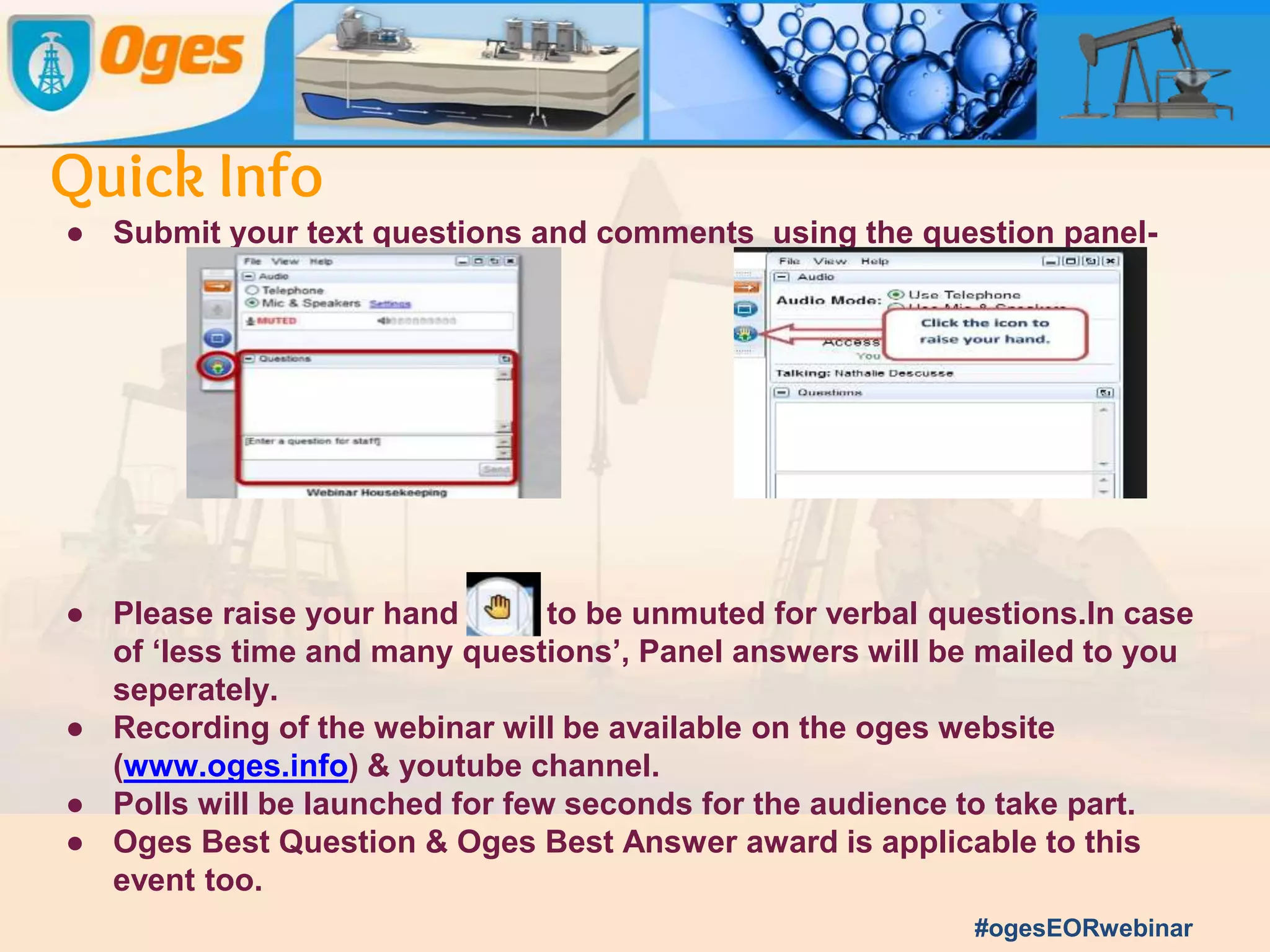
● Submit your text questions and comments using the question panel-
● Please raise your hand to be unmuted for verbal questions.In case
of ‘less time and many questions’, Panel answers will be mailed to you
seperately.
● Recording of the webinar will be available on the oges website
(www.oges.info) & youtube channel.
● Polls will be launched for few seconds for the audience to take part.
● Oges Best Question & Oges Best Answer award is applicable to this
event too.
#ogesEORwebinar
Quick Info
● Selected entries to get free trial access to our premium plan. For others:
mail to support@oges.info to request a quote. You may also request a
training to our support team on any Oil&Gas domain.
● You may reconnect any time using the confirmation mail in your
inbox, in case you loose connection. There might be some time lag
during slide or presenter change,please bear with us.
After the Webinar
Please complete our survey
before you make an exit
#ogesEORwebinar
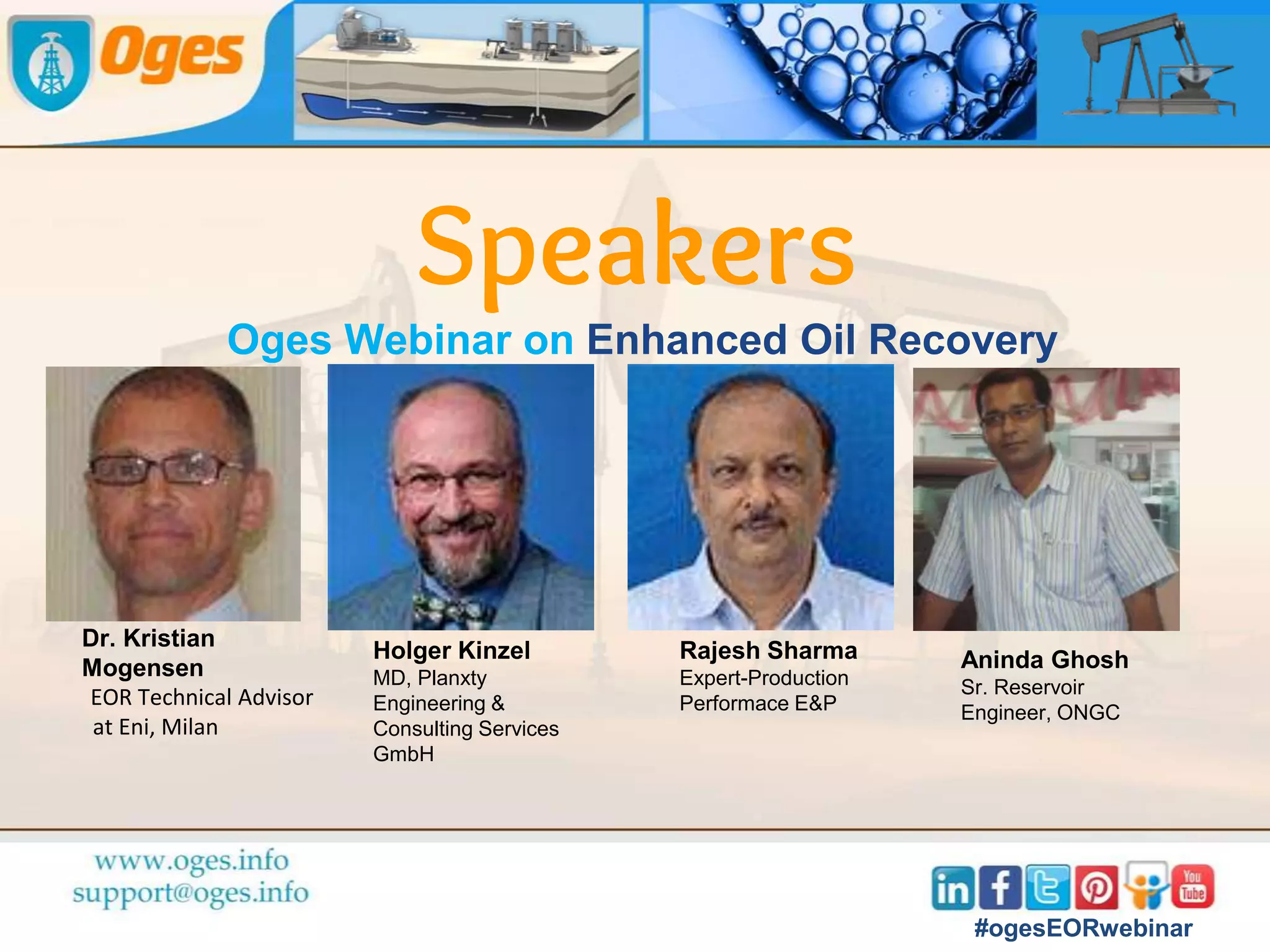
Speakers
Oges Webinar on Enhanced Oil Recovery
Dr. Kristian
Mogensen
EOR Technical Advisor
at Eni, Milan
Holger Kinzel
MD, Planxty
Engineering &
Consulting Services
GmbH
Aninda Ghosh
Sr. Reservoir
Engineer, ONGC
Rajesh Sharma
Expert-Production
Performace E&P
#ogesEORwebinar
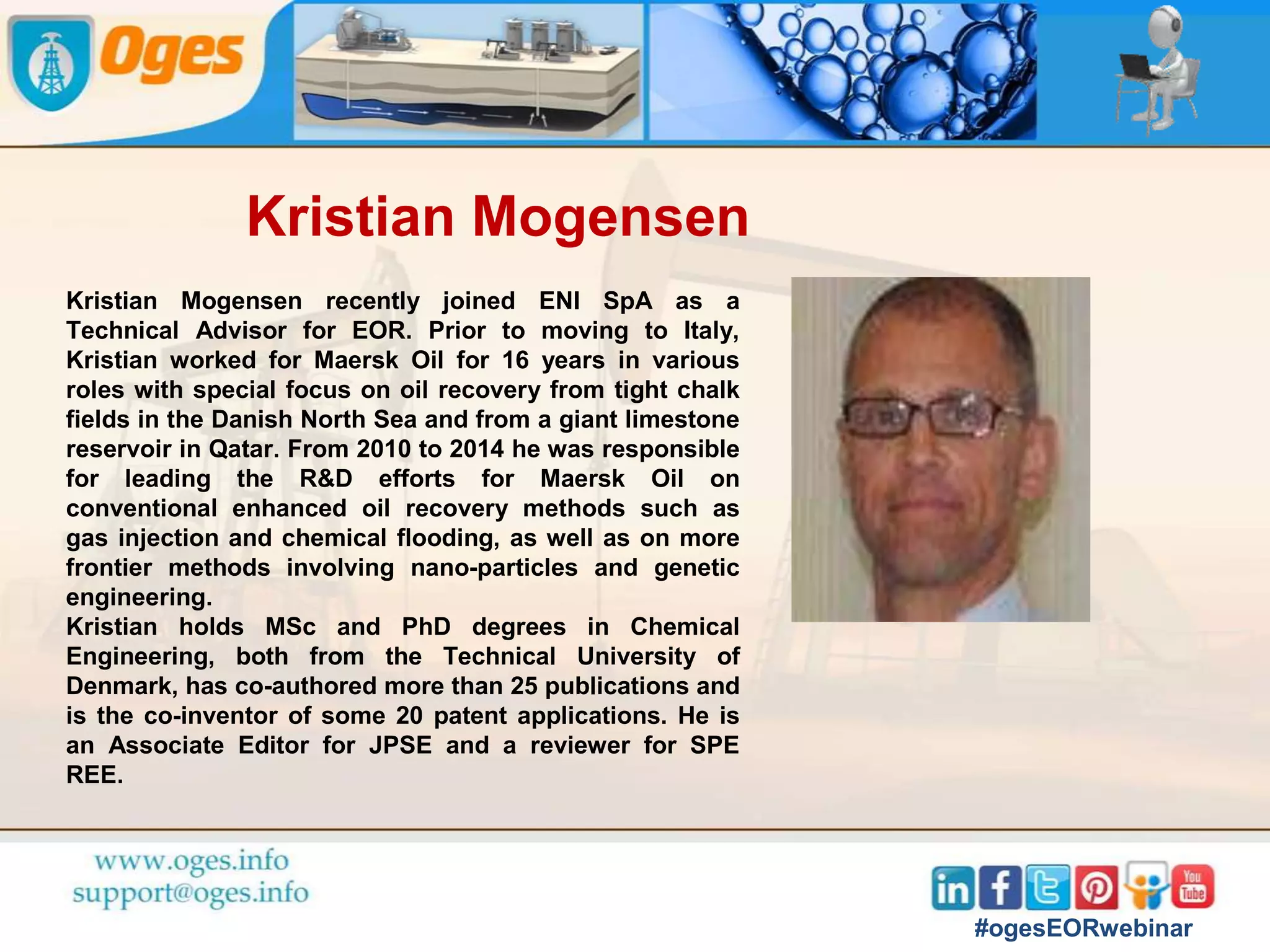
Kristian Mogensen
Kristian Mogensen recently joined ENI SpA as a
Technical Advisor for EOR. Prior to moving to Italy,
Kristian worked for Maersk Oil for 16 years in various
roles with special focus on oil recovery from tight chalk
fields in the Danish North Sea and from a giant limestone
reservoir in Qatar. From 2010 to 2014 he was responsible
for leading the R&D efforts for Maersk Oil on
conventional enhanced oil recovery methods such as
gas injection and chemical flooding, as well as on more
frontier methods involving nano-particles and genetic
engineering.
Kristian holds MSc and PhD degrees in Chemical
Engineering, both from the Technical University of
Denmark, has co-authored more than 25 publications and
is the co-inventor of some 20 patent applications. He is
an Associate Editor for JPSE and a reviewer for SPE
REE.
#ogesEORwebinar
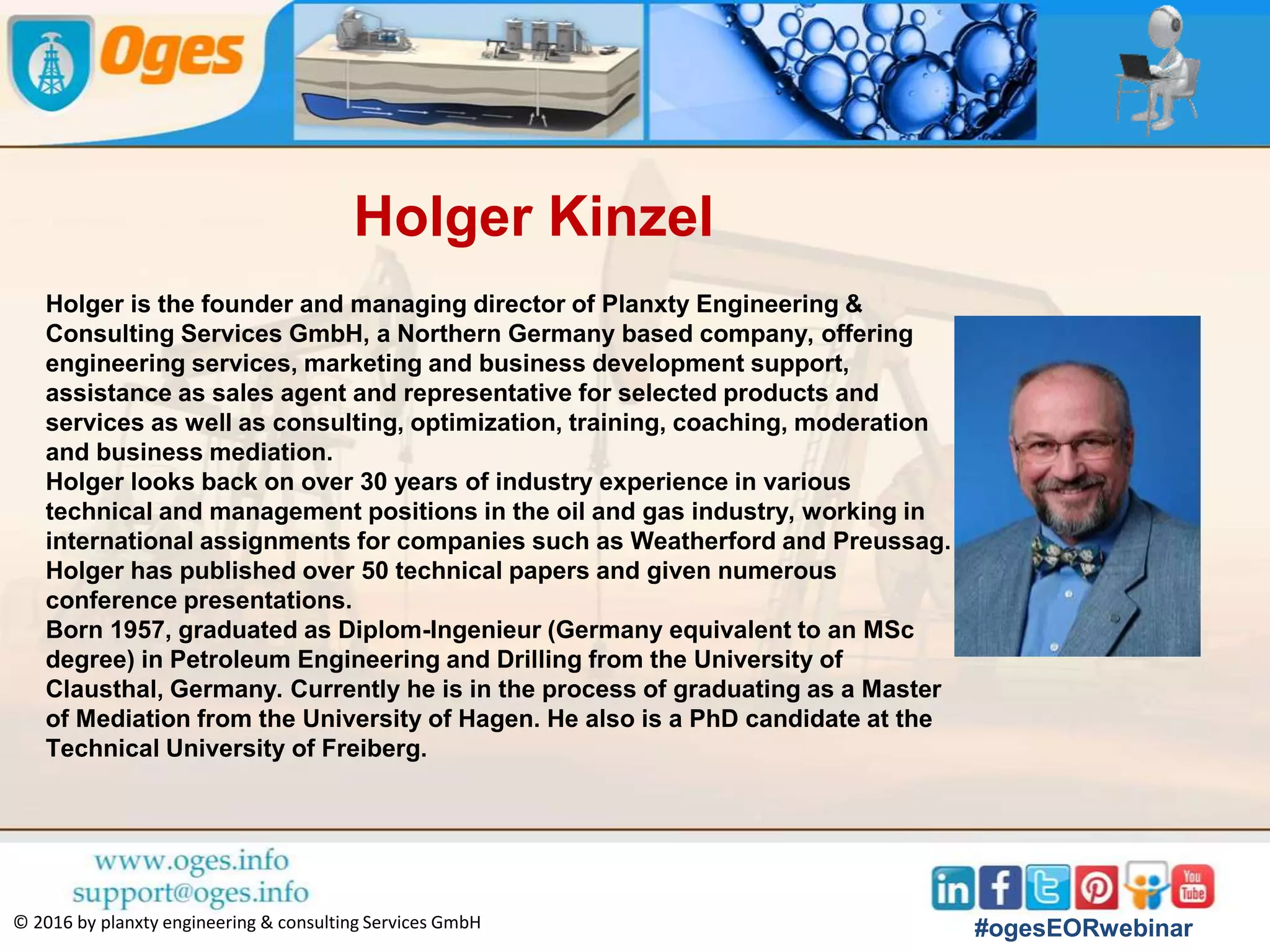
Holger Kinzel
Holger is the founder and managing director of Planxty Engineering &
Consulting Services GmbH, a Northern Germany based company, offering
engineering services, marketing and business development support,
assistance as sales agent and representative for selected products and
services as well as consulting, optimization, training, coaching, moderation
and business mediation.
Holger looks back on over 30 years of industry experience in various
technical and management positions in the oil and gas industry, working in
international assignments for companies such as Weatherford and Preussag.
Holger has published over 50 technical papers and given numerous
conference presentations.
Born 1957, graduated as Diplom-Ingenieur (Germany equivalent to an MSc
degree) in Petroleum Engineering and Drilling from the University of
Clausthal, Germany. Currently he is in the process of graduating as a Master
of Mediation from the University of Hagen. He also is a PhD candidate at the
Technical University of Freiberg.
#ogesEORwebinar© 2016 by planxty engineering & consulting Services GmbH
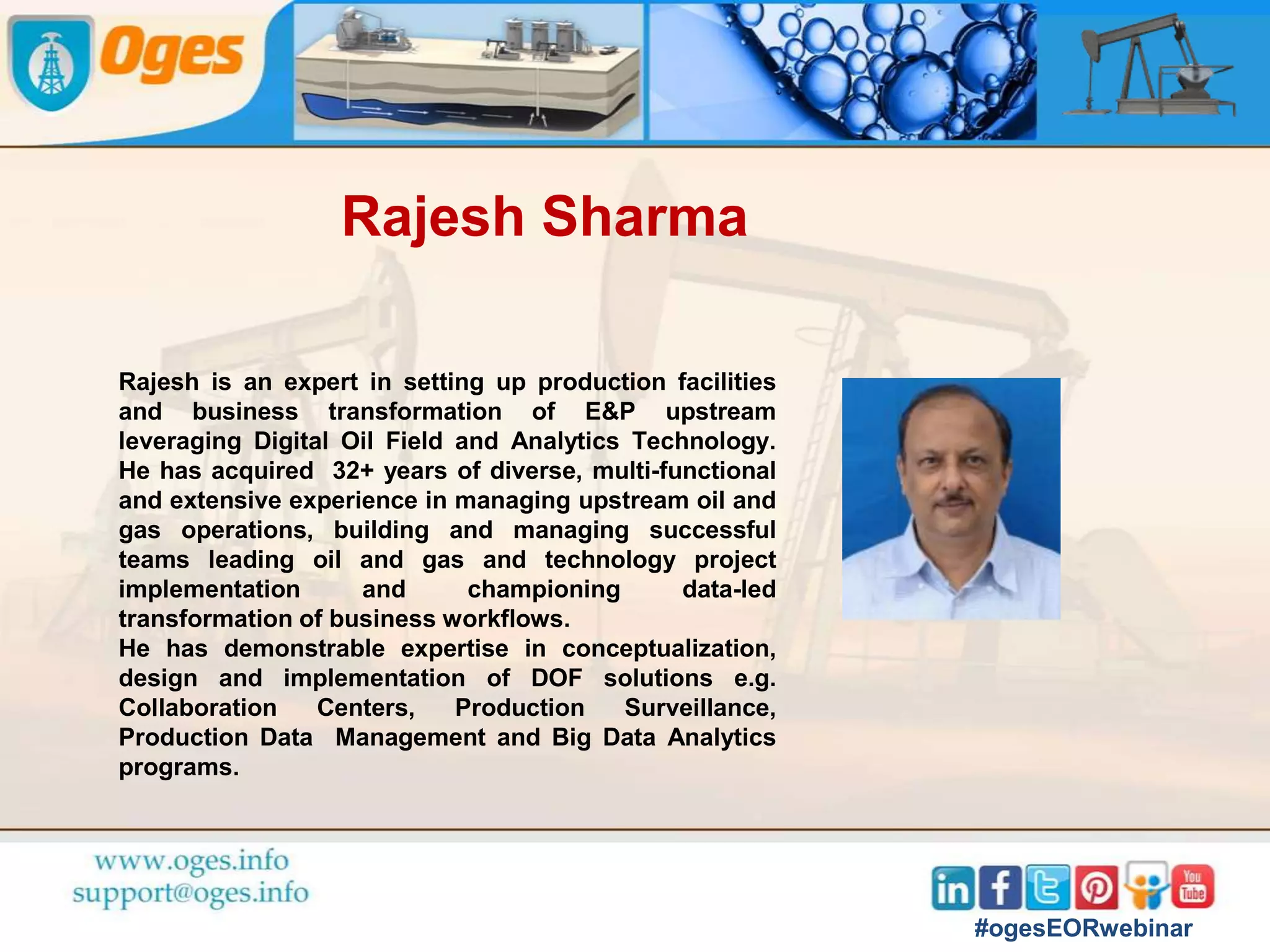
Rajesh Sharma
Rajesh is an expert in setting up production facilities
and business transformation of E&P upstream
leveraging Digital Oil Field and Analytics Technology.
He has acquired 32+ years of diverse, multi-functional
and extensive experience in managing upstream oil and
gas operations, building and managing successful
teams leading oil and gas and technology project
implementation and championing data-led
transformation of business workflows.
He has demonstrable expertise in conceptualization,
design and implementation of DOF solutions e.g.
Collaboration Centers, Production Surveillance,
Production Data Management and Big Data Analytics
programs.
#ogesEORwebinar
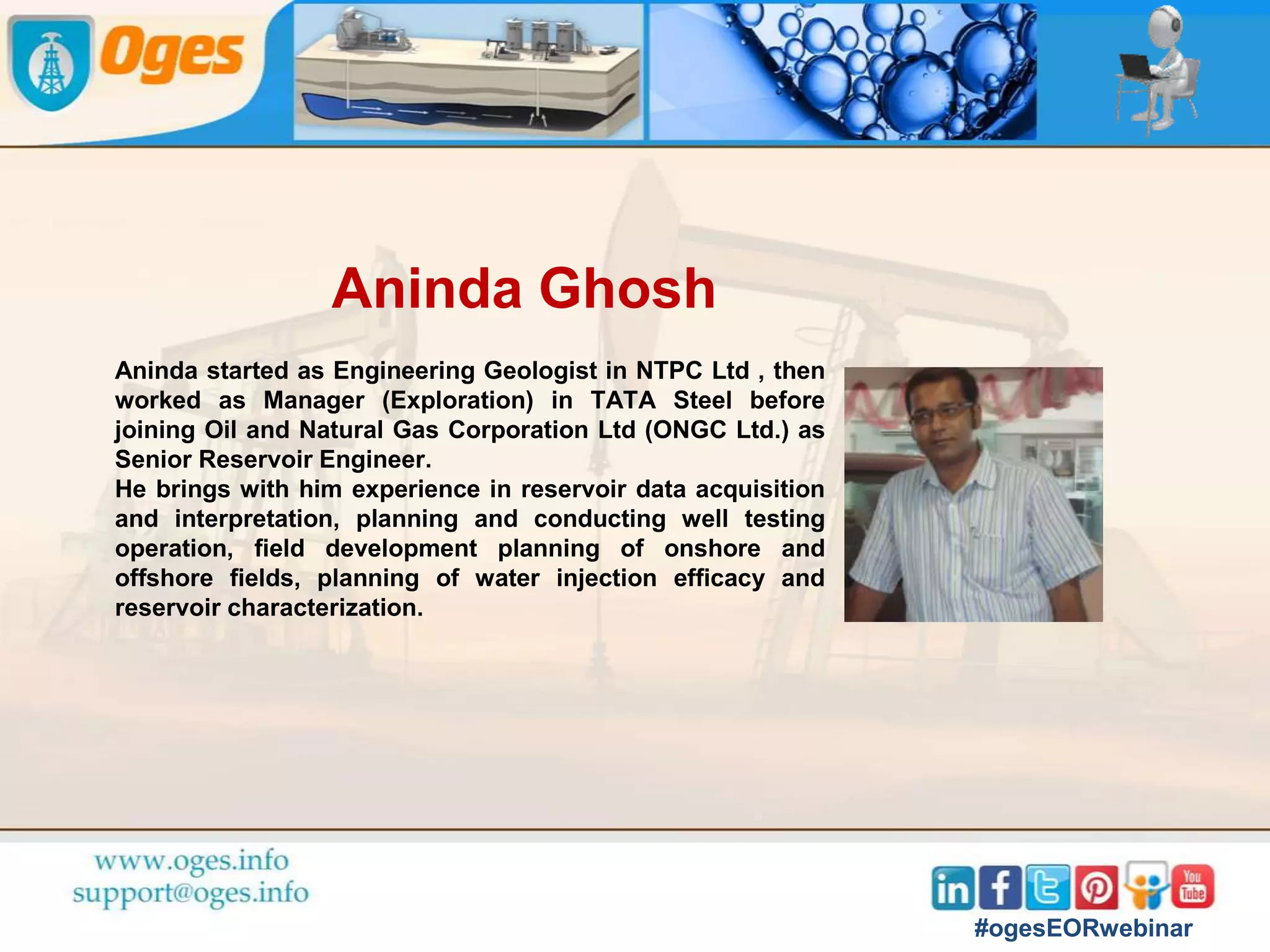
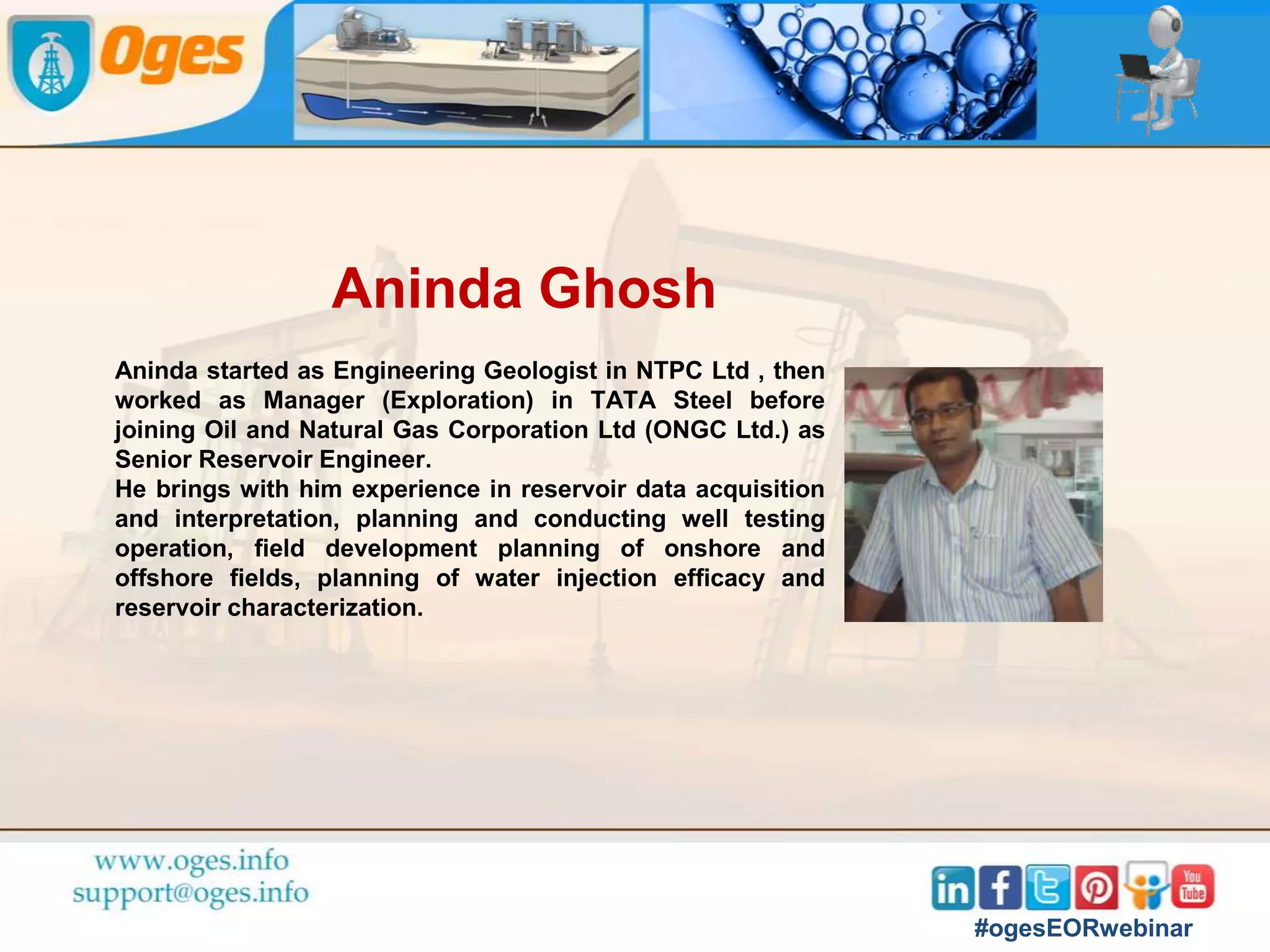
Aninda Ghosh
Aninda started as Engineering Geologist in NTPC Ltd , then
worked as Manager (Exploration) in TATA Steel before
joining Oil and Natural Gas Corporation Ltd (ONGC Ltd.) as
Senior Reservoir Engineer.
He brings with him experience in reservoir data acquisition
and interpretation, planning and conducting well testing
operation, field development planning of onshore and
offshore fields, planning of water injection efficacy and
reservoir characterization.
#ogesEORwebinar
BASICS OF EOR
#ogesEORwebinar
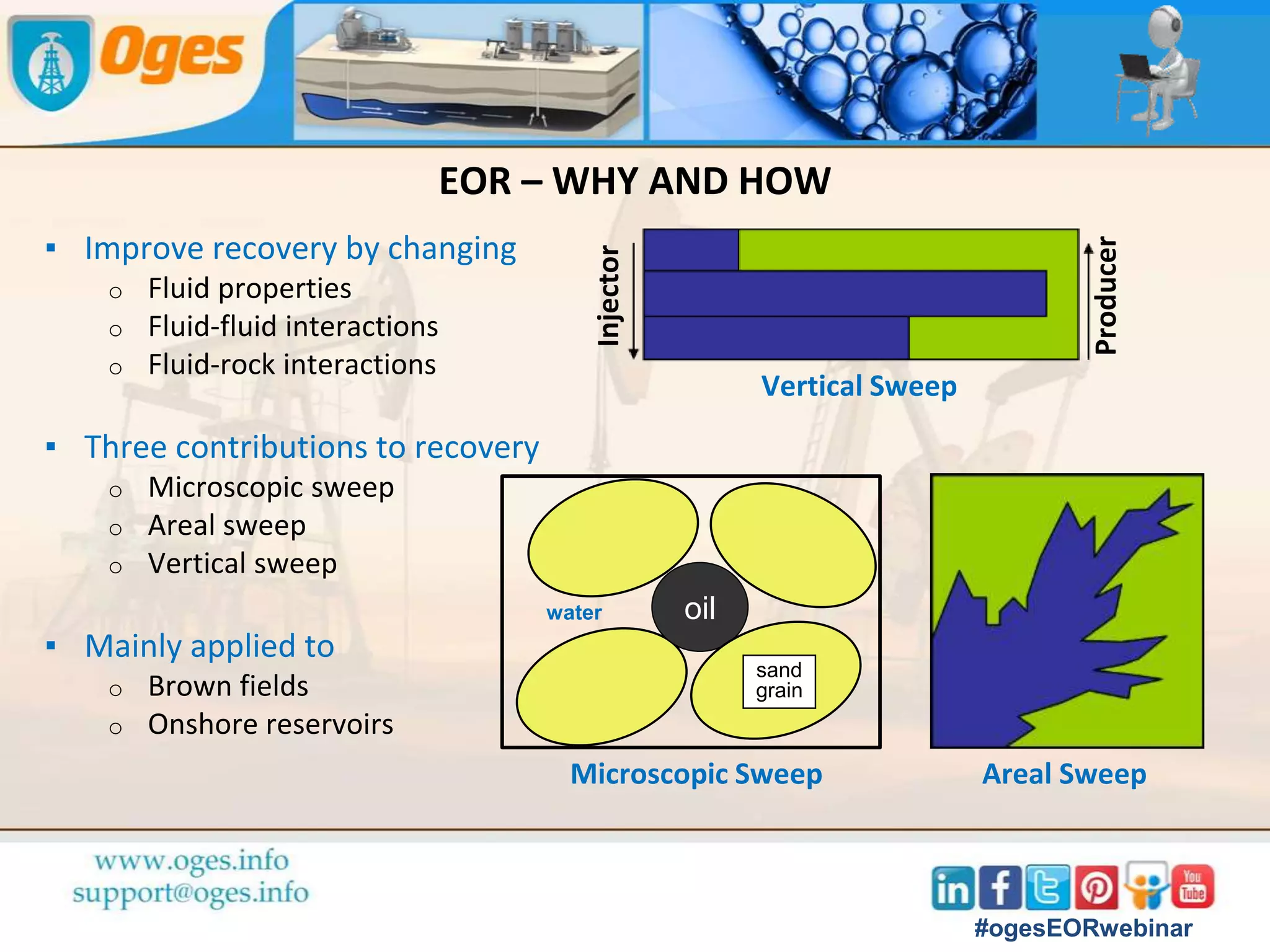
EOR – WHY AND HOW
▪ Improve recovery by changing
o Fluid properties
o Fluid-fluid interactions
o Fluid-rock interactions
▪ Three contributions to recovery
o Microscopic sweep
o Areal sweep
o Vertical sweep
▪ Mainly applied to
o Brown fields
o Onshore reservoirs
oilwater
sand
grain
Injector
Producer
Vertical Sweep
Areal SweepMicroscopic Sweep
#ogesEORwebinar
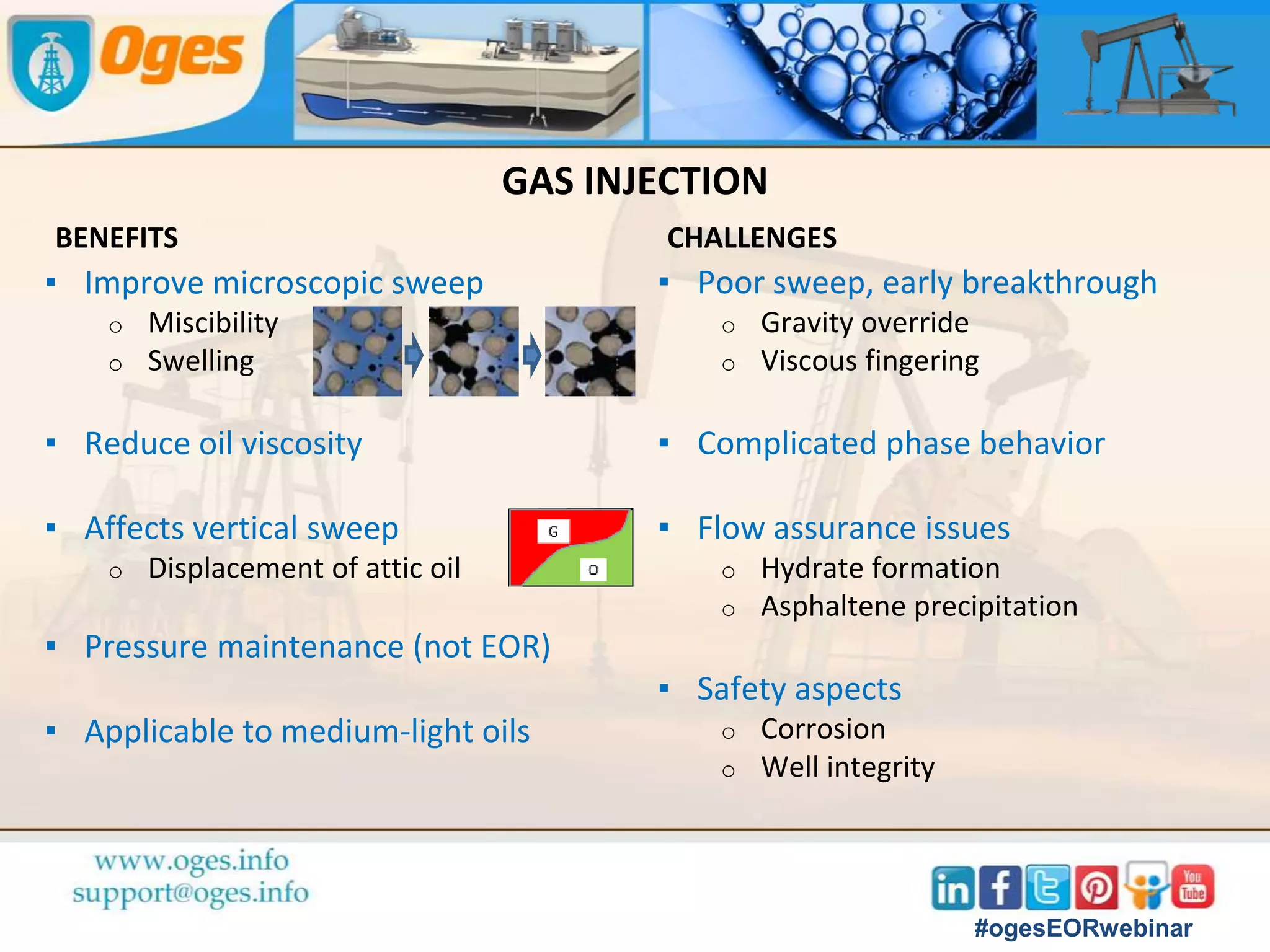
▪ Improve microscopic sweep
o Miscibility
o Swelling
▪ Reduce oil viscosity
▪ Affects vertical sweep
o Displacement of attic oil
▪ Pressure maintenance (not EOR)
▪ Applicable to medium-light oils
GAS INJECTION
▪ Poor sweep, early breakthrough
o Gravity override
o Viscous fingering
▪ Complicated phase behavior
▪ Flow assurance issues
o Hydrate formation
o Asphaltene precipitation
▪ Safety aspects
o Corrosion
o Well integrity
BENEFITS CHALLENGES
#ogesEORwebinar
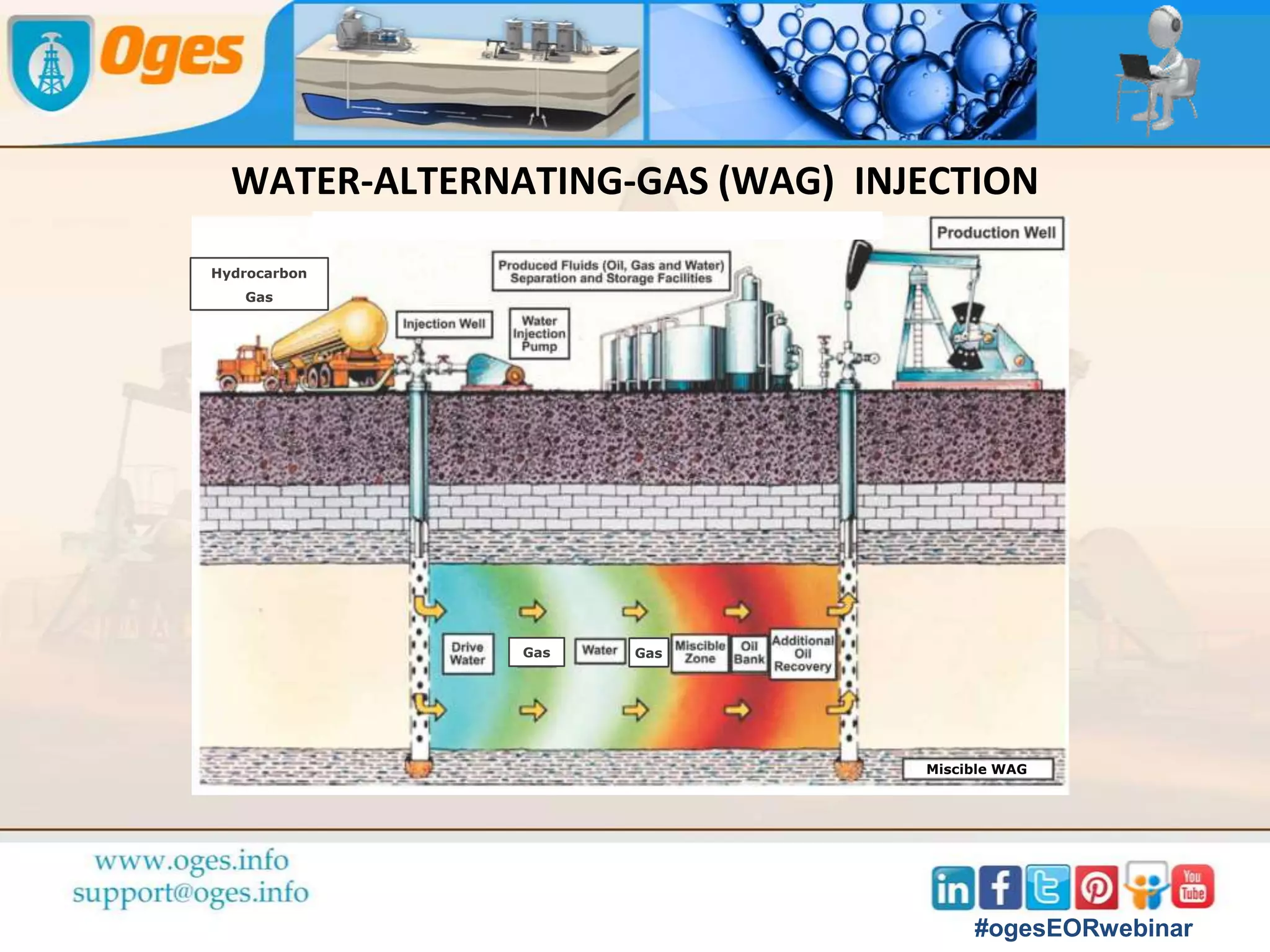
Gas Gas
Miscible WAG
Hydrocarbon
Gas
WATER-ALTERNATING-GAS (WAG) INJECTION
#ogesEORwebinar
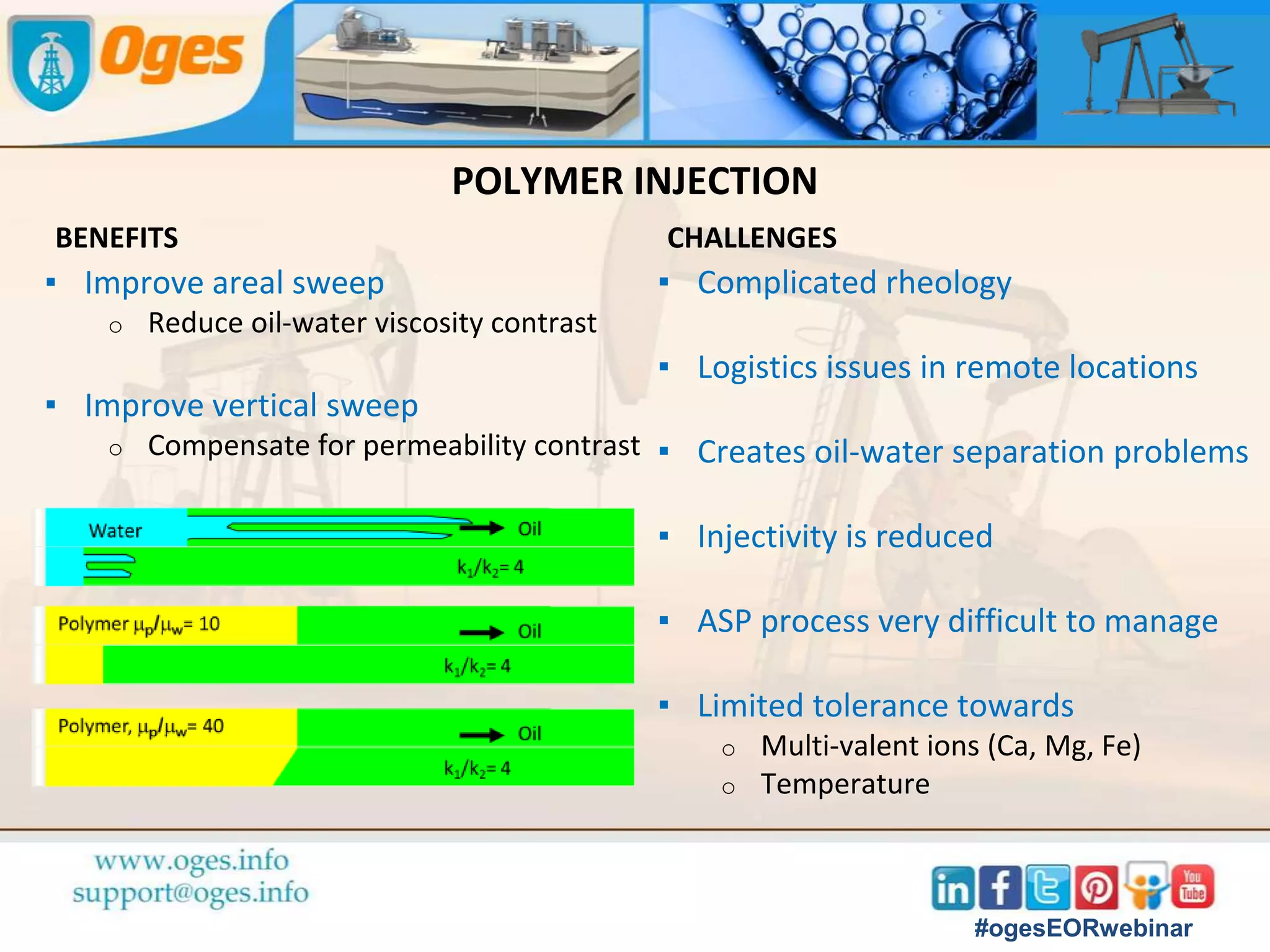
▪ Improve areal sweep
o Reduce oil-water viscosity contrast
▪ Improve vertical sweep
o Compensate for permeability contrast
POLYMER INJECTION
▪ Complicated rheology
▪ Logistics issues in remote locations
▪ Creates oil-water separation problems
▪ Injectivity is reduced
▪ ASP process very difficult to manage
▪ Limited tolerance towards
o Multi-valent ions (Ca, Mg, Fe)
o Temperature
BENEFITS CHALLENGES
#ogesEORwebinar
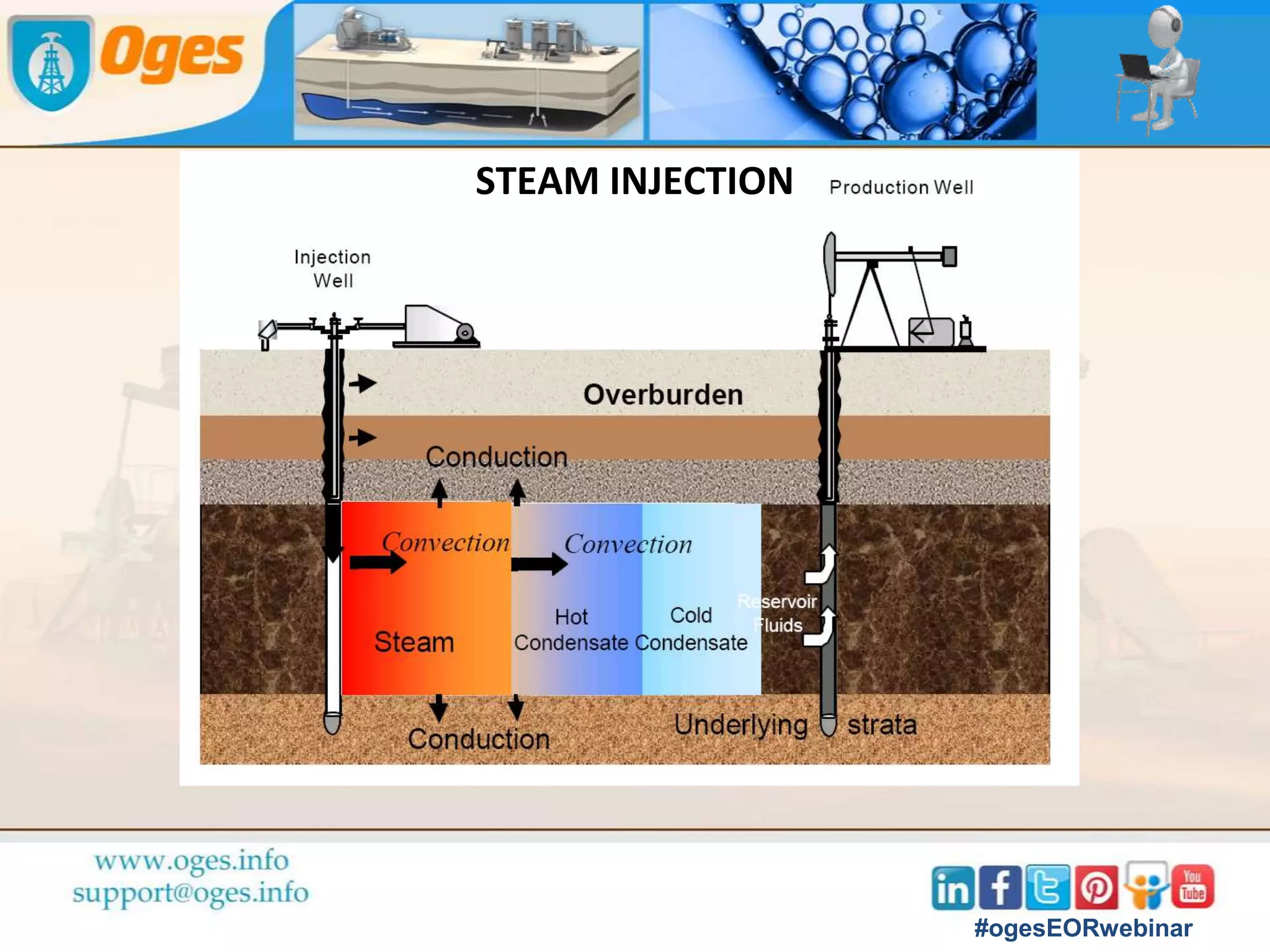
STEAM INJECTION
#ogesEORwebinar
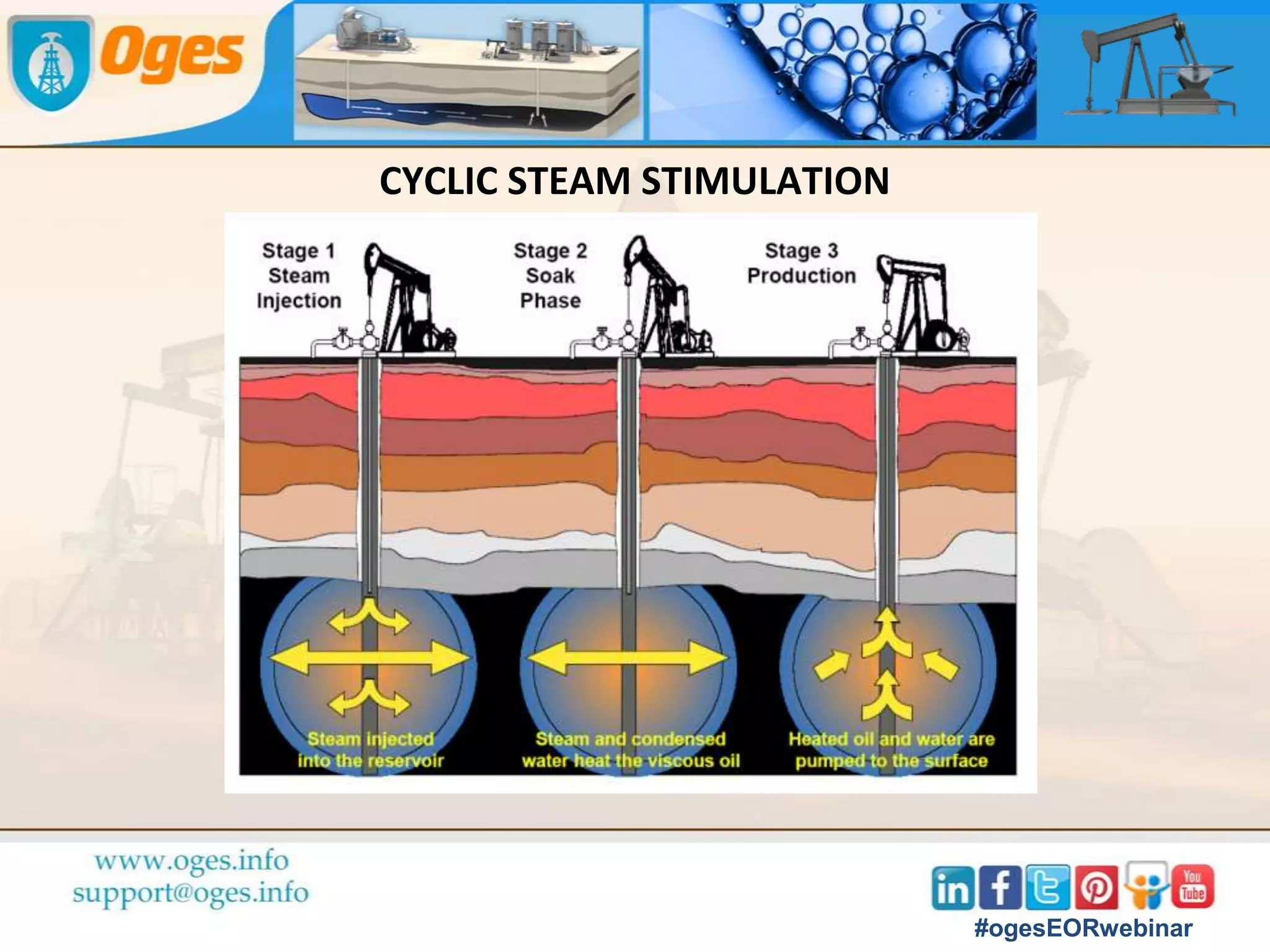
CYCLIC STEAM STIMULATION
#ogesEORwebinar
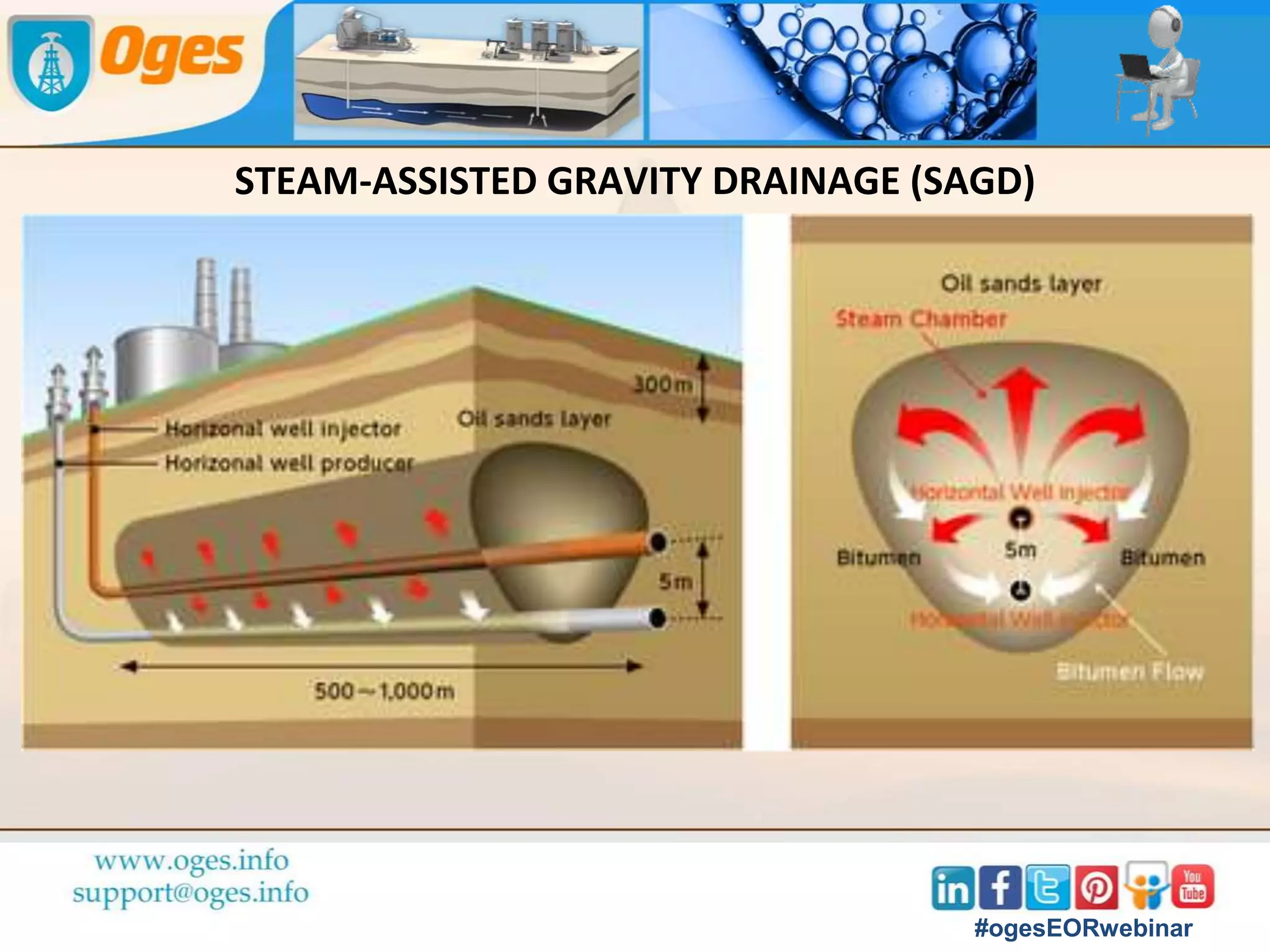
STEAM-ASSISTED GRAVITY DRAINAGE (SAGD)
#ogesEORwebinar
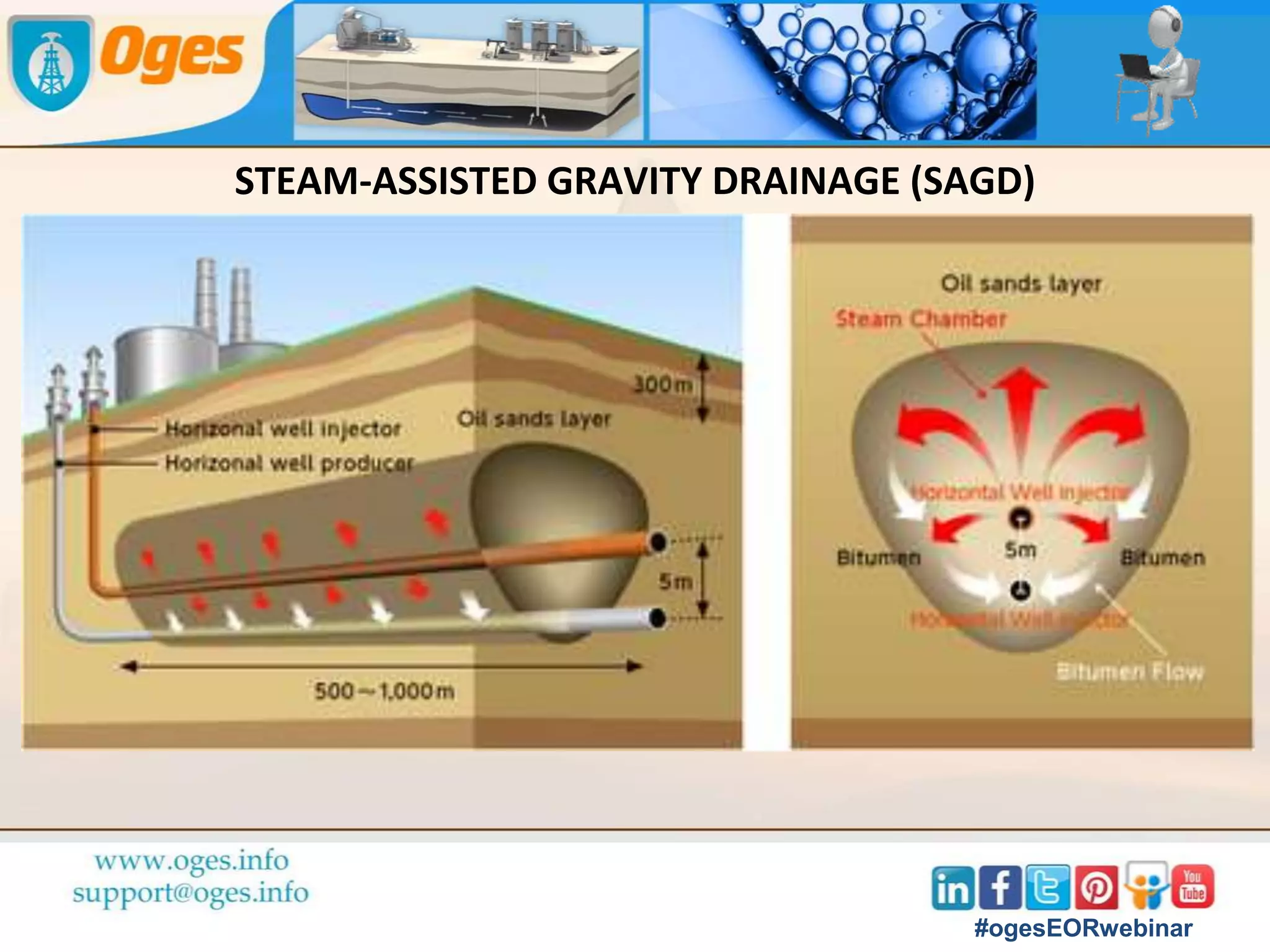
STEAM-ASSISTED GRAVITY DRAINAGE (SAGD)
#ogesEORwebinar
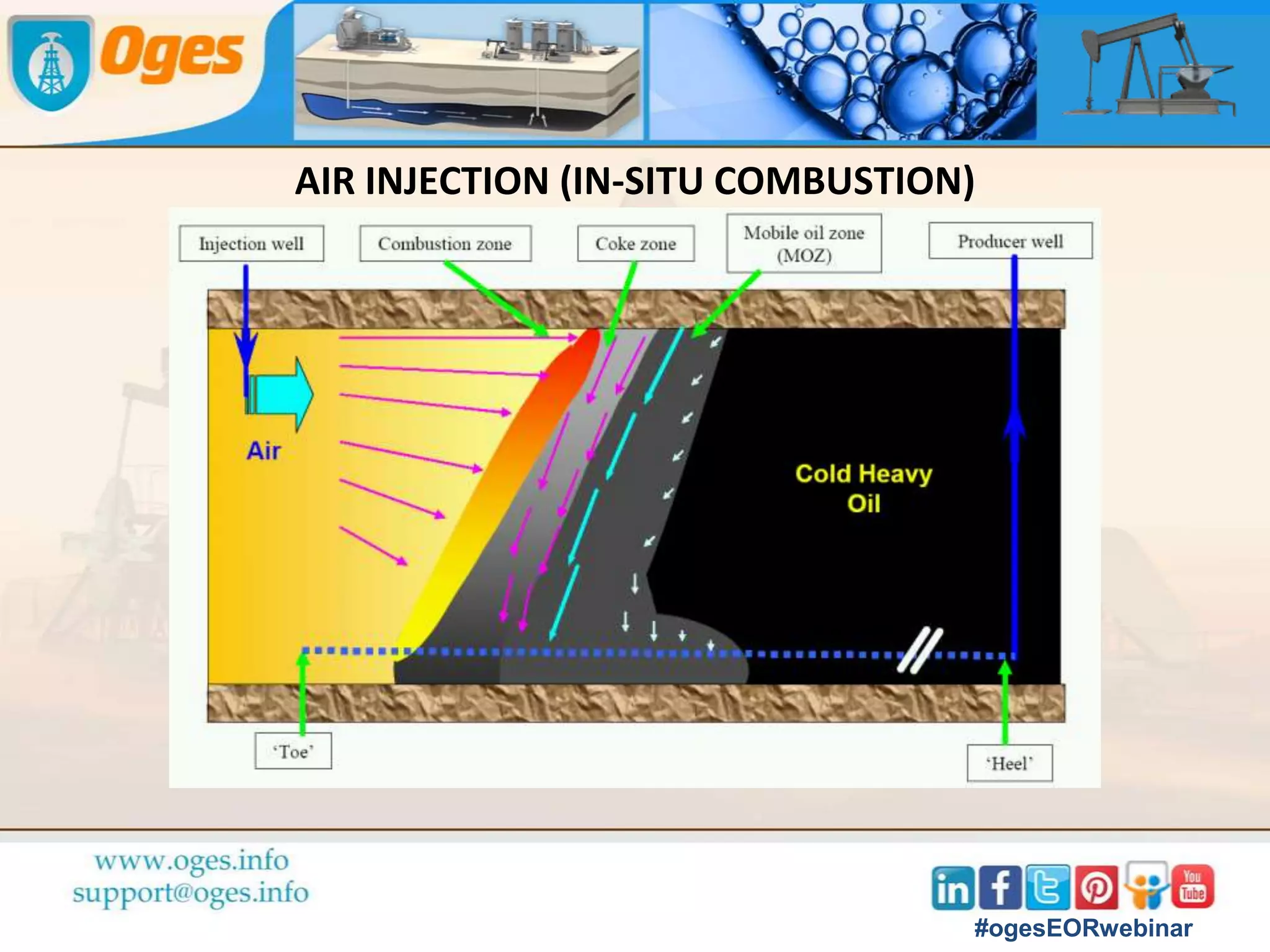
AIR INJECTION (IN-SITU COMBUSTION)
#ogesEORwebinar
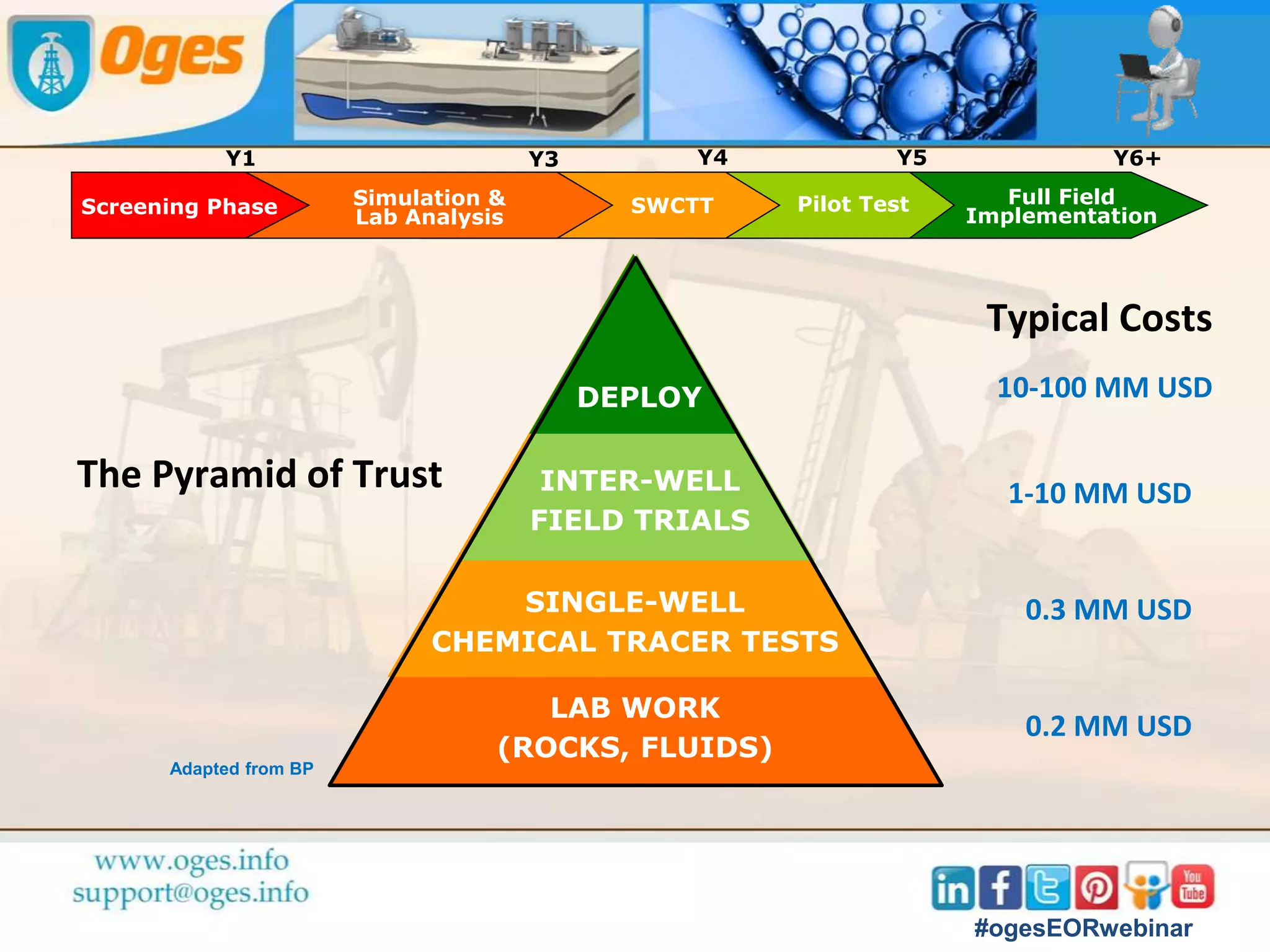
Simulation &
Lab AnalysisScreening Phase
Y1 Y3 Y4
SWCTT Pilot Test
Y5
Full Field
Implementation
Y6+
DEPLOY
INTER-WELL
FIELD TRIALS
SINGLE-WELL
CHEMICAL TRACER TESTS
LAB WORK
(ROCKS, FLUIDS)
Adapted from BP
Typical Costs
10-100 MM USD
1-10 MM USD
0.3 MM USD
0.2 MM USD
The Pyramid of Trust
#ogesEORwebinar
LATEST ADVANCES
IN EOR
#ogesEORwebinar
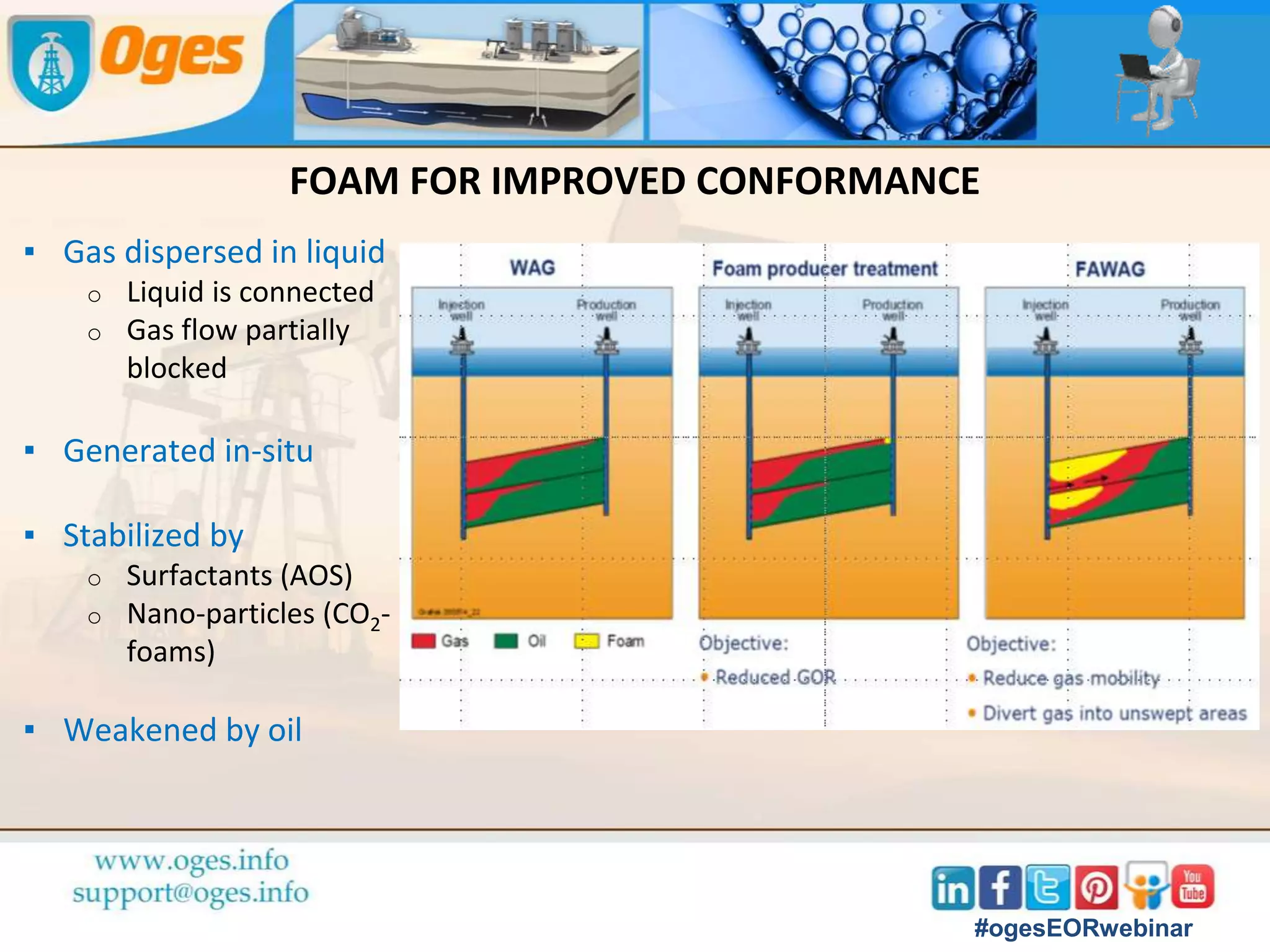
FOAM FOR IMPROVED CONFORMANCE
▪ Gas dispersed in liquid
o Liquid is connected
o Gas flow partially
blocked
▪ Generated in-situ
▪ Stabilized by
o Surfactants (AOS)
o Nano-particles (CO2-
foams)
▪ Weakened by oil
#ogesEORwebinar
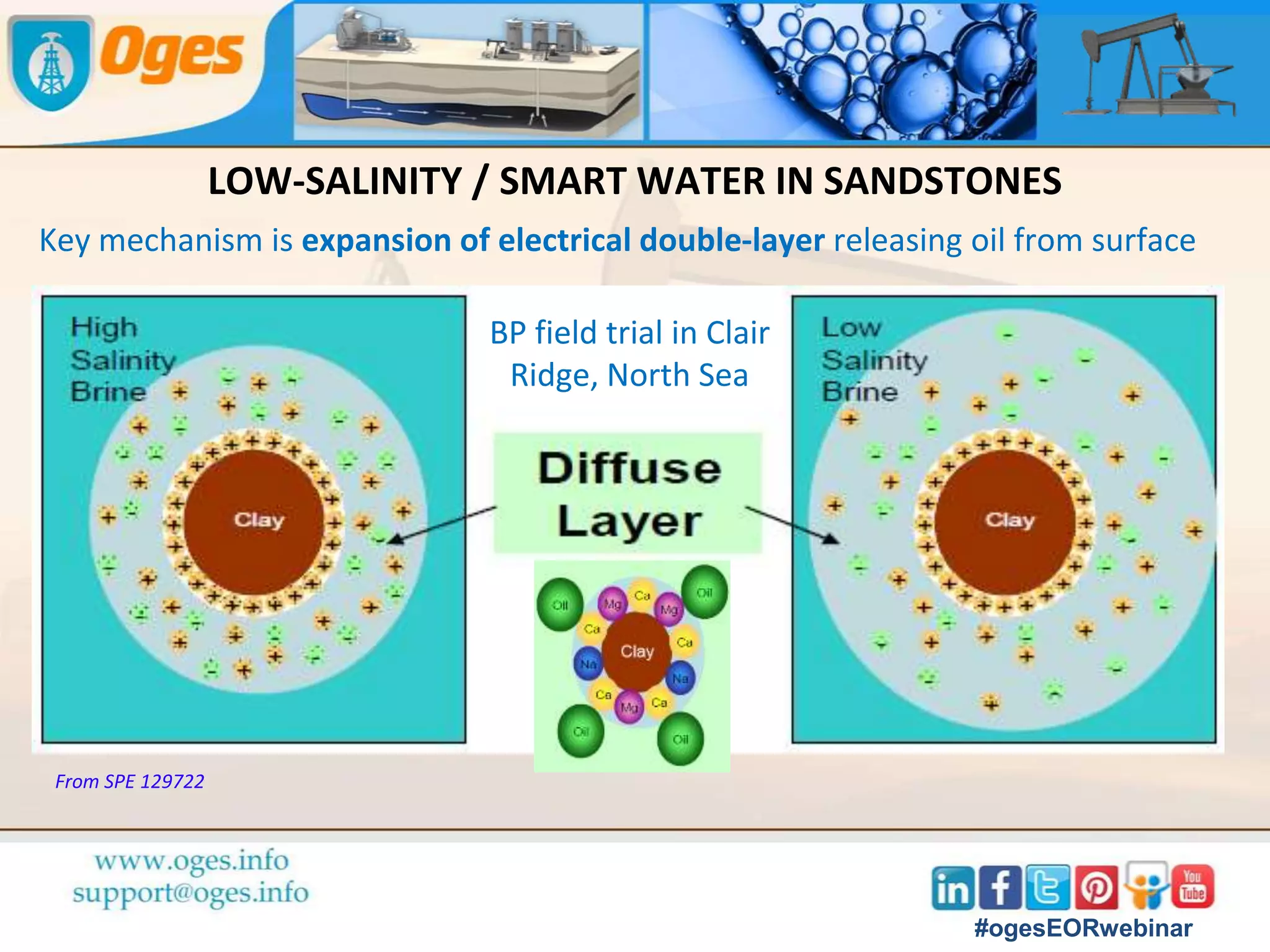
LOW-SALINITY / SMART WATER IN SANDSTONES
Key mechanism is expansion of electrical double-layer releasing oil from surface
From SPE 129722
BP field trial in Clair
Ridge, North Sea
#ogesEORwebinar
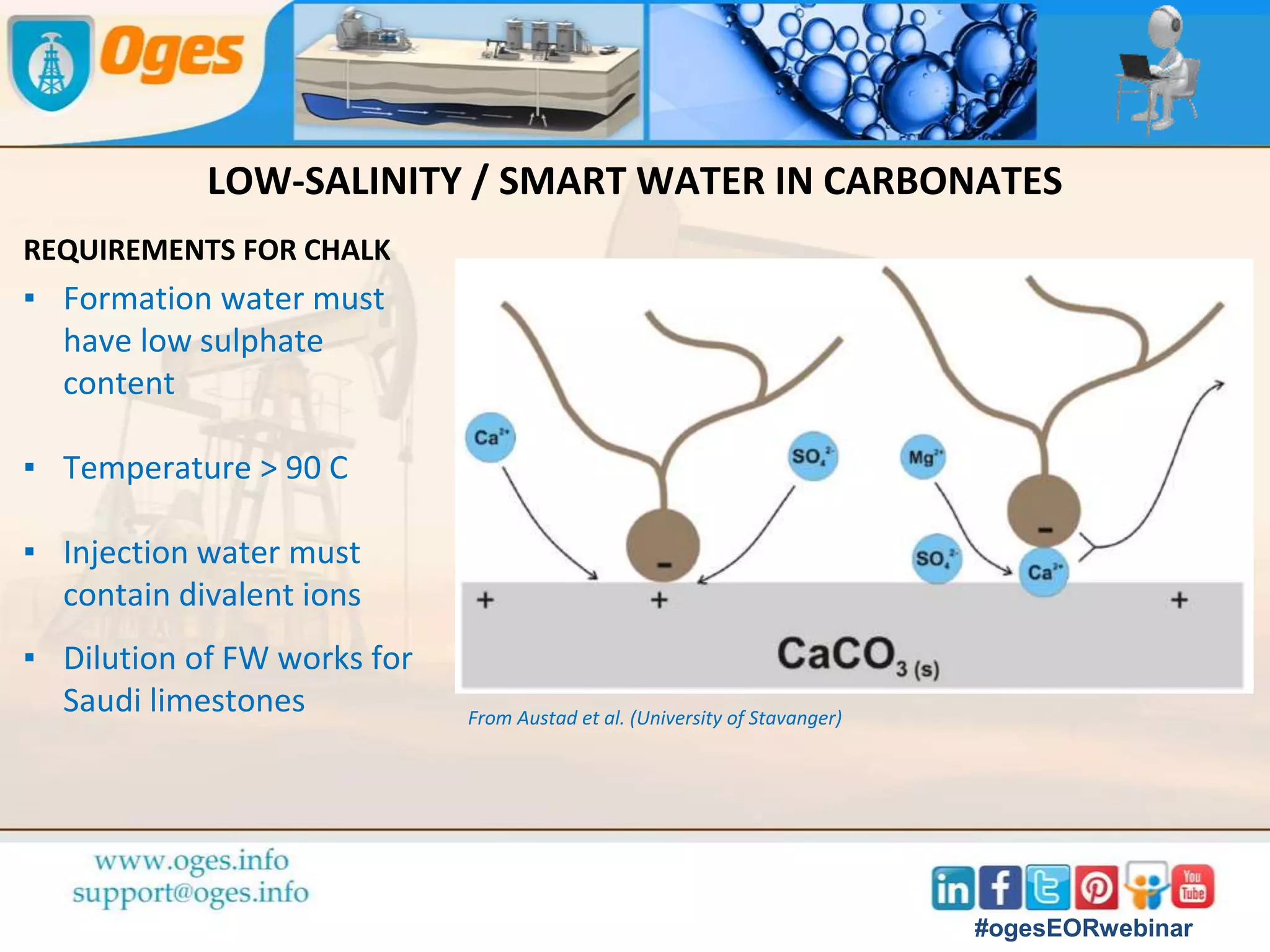
LOW-SALINITY / SMART WATER IN CARBONATES
▪ Formation water must
have low sulphate
content
▪ Temperature > 90 C
▪ Injection water must
contain divalent ions
From Austad et al. (University of Stavanger)
REQUIREMENTS FOR CHALK
▪ Dilution of FW works for
Saudi limestones
#ogesEORwebinar
EOR METHODS IN DEVELOPMENT
▪ Visco-elastic surfactants (Solvay)
▪ Wettability-altering surfactants
o Oil-wet carbonates (Dow)
▪ Salinity-tolerant bio-polymers
o Schizophyllan (Wintershall)
▪ Nano-particles
o Foam stabilization (UT Austin)
o Magnetic heating (UT Austin)
o Reservoir surveillance (Aramco)
▪ Microbial EOR
o Glori Oil, Statoil
▪ Enzymes
o Field trials in UAE and Myanmar
▪ Hybrid EOR methods
o Low-salinity and polymer (Shell)
o Low-salinity and WAG (Shell)
o Low-tension gas flooding (UT Austin)
▪ Expanding the operational envelope
o Gas injection into heavy oil
o Polymer injection in heavy oil
#ogesEORwebinar
MONITORING AND
SURVEILLANCE
#ogesEORwebinar
PURPOSE OF MONITORING AND SURVEILLANCE PLAN
▪ Evaluate whether EOR process performs as expected
o Expected behavior must be predicted with simulation model
o Derive incremental oil from production data and compare with baseline case
(typically a waterflood or «do-nothing» scenario)
▪ Reduce uncertainty on parameters with biggest impact on economics
o Measure/estimate residual oil saturation, injectivity, heterogeneity,
operational constraints
o With more accurate parameter sets, simulate optimum use of EOR injectant
over project life
▪ Intervene if process does not behave as expected
o Early breakthrough, facilities upsets, injectivity problems
o Mechanical or chemical water/gas shut-off, chemical inhibition
#ogesEORwebinar
EXAMPLES OF MONITORING TECHNIQUES
▪ Near-wellbore Monitoring
o Fiberglass observation wells
o Saturation logs
o PLT
o Coring
o Sampling and analysis of produced fluids
o Injectivity tests, pressure transient tests
o Single-well chemical tracer test
▪ Field Scale
o Interwell gas or water tracers
o 4-D seismics
o Cross-well EM
Continuous data management and
analysis is essential
Reservoir simulation plays a key role
in surveillance
#ogesEORwebinar
EXAMPLES OF ANALYTICAL MONITORING TECHNIQUES
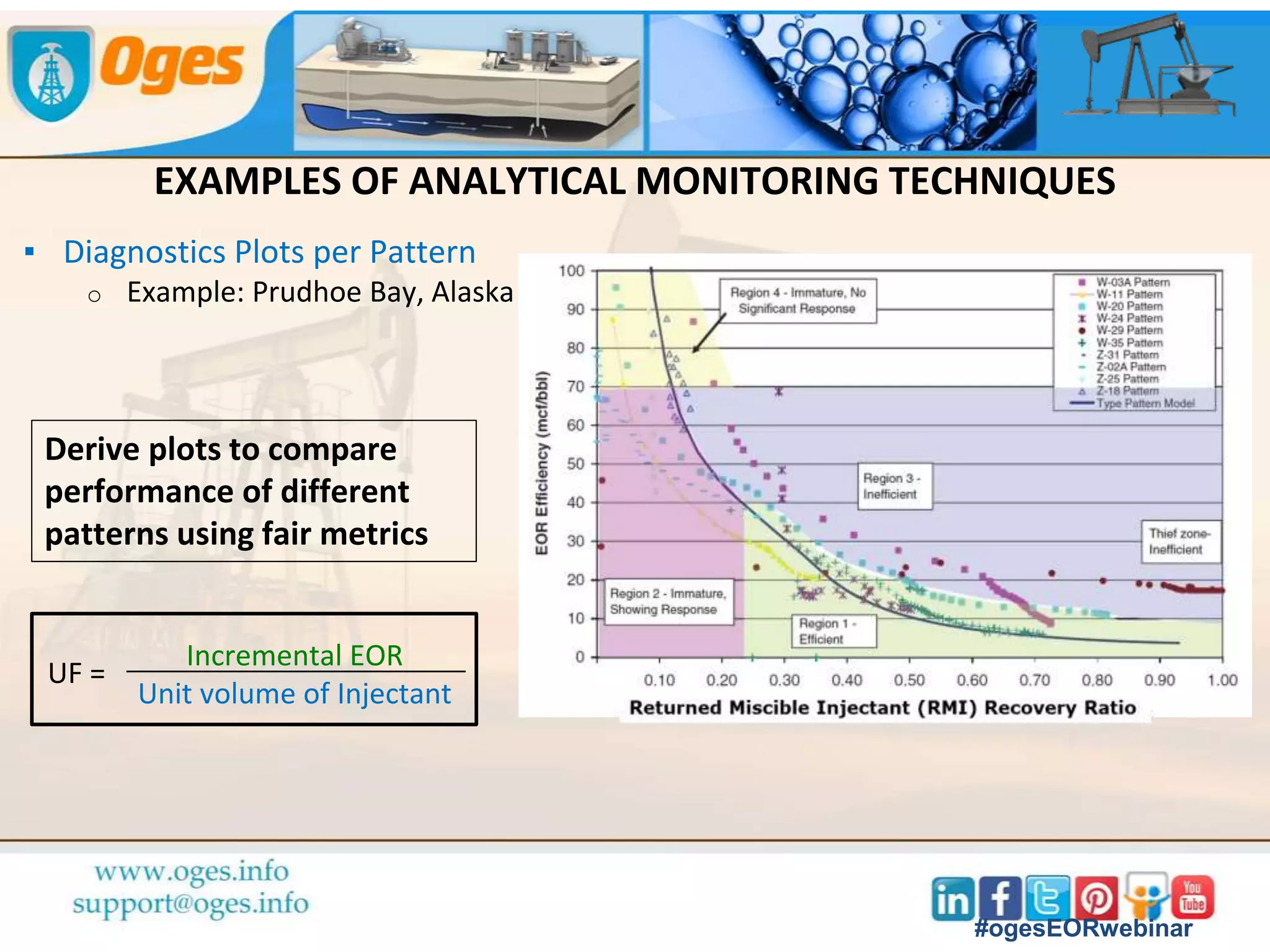
▪ Diagnostics Plots per Pattern
o Example: Prudhoe Bay, Alaska
Derive plots to compare
performance of different
patterns using fair metrics
Incremental EOR
Unit volume of Injectant
UF =
#ogesEORwebinar
EXAMPLES OF ANALYTICAL MONITORING TECHNIQUES
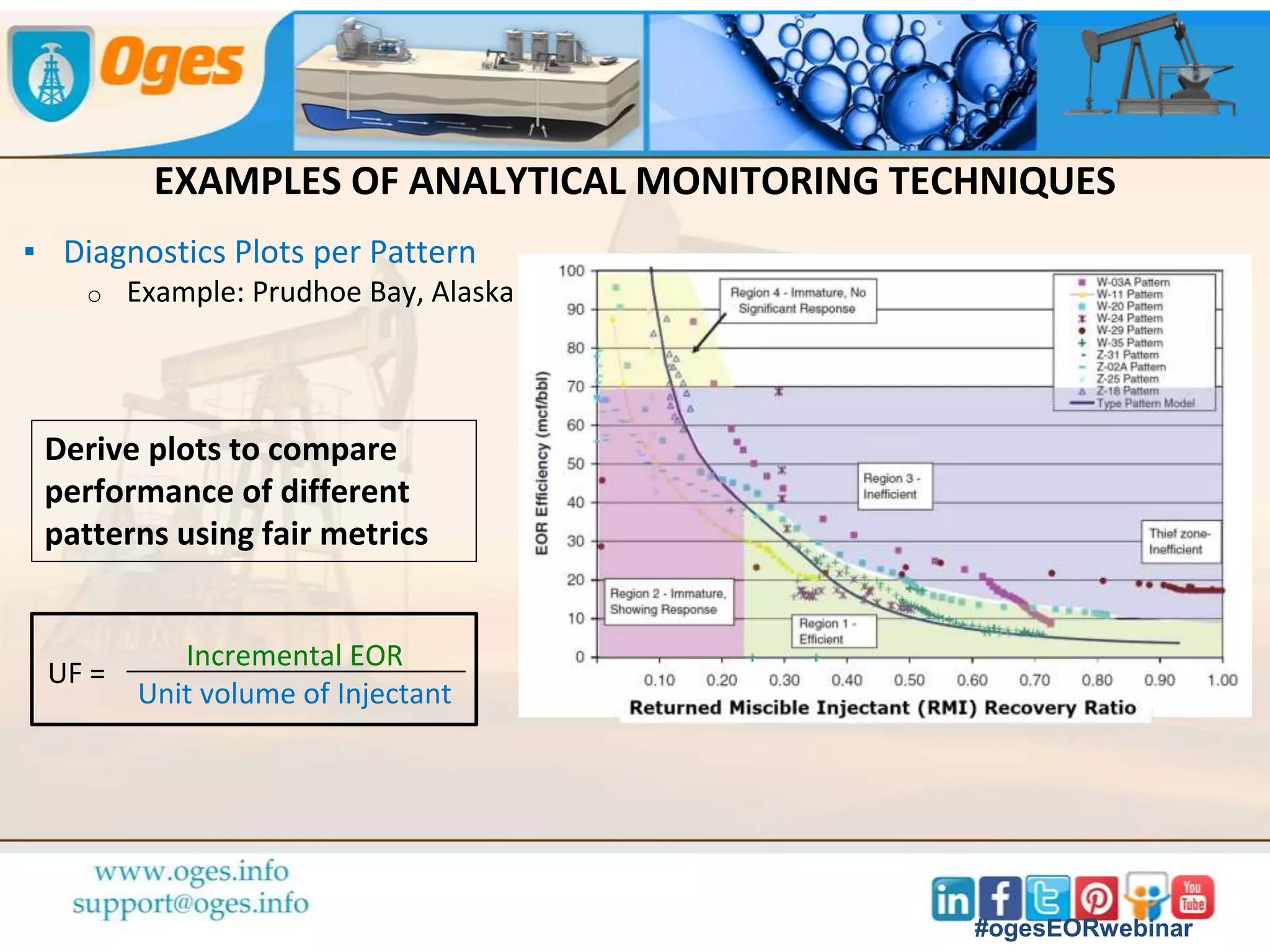
▪ Diagnostics Plots per Pattern
o Example: Prudhoe Bay, Alaska
Derive plots to compare
performance of different
patterns using fair metrics
Incremental EOR
Unit volume of Injectant
UF =
#ogesEORwebinar
COMPLETION
CHALLENGES
#ogesEORwebinar
▪ Most EOR floods Implemented in Mature Fields
o Suboptimal well location designed for depletion or waterflood
o Insufficient zonal control (open-hole completions)
o Metallurgy not designed with EOR in mind
o Corrosion (gas injection)
o Temperature (thermal EOR)
o Chemical compatibility issues (chemical EOR)
o Well-integrity issues (Casing leaks)
o Sometimes difficult to get access to the wellhead (offshore)
o Costly workovers are sometimes required
#ogesEORwebinar
#ogesEORwebinar
#ogesEORwebinar
▪ Considerations for EOR in Green Field Developments
o Well placement relative to geological features and relative to other wells
o Good zonal isolation
o Well integrity (no flow behind casing)
o Zonal control from surface (liner, SSD’s, packers)
o Metallurgy and seals designed with EOR in mind
o Corrosion-resistance
o Adequate pressure- and temperature ratings
o Ability to easily switch between injectants is crucial for WAG operations
o Special chokes required for polymers
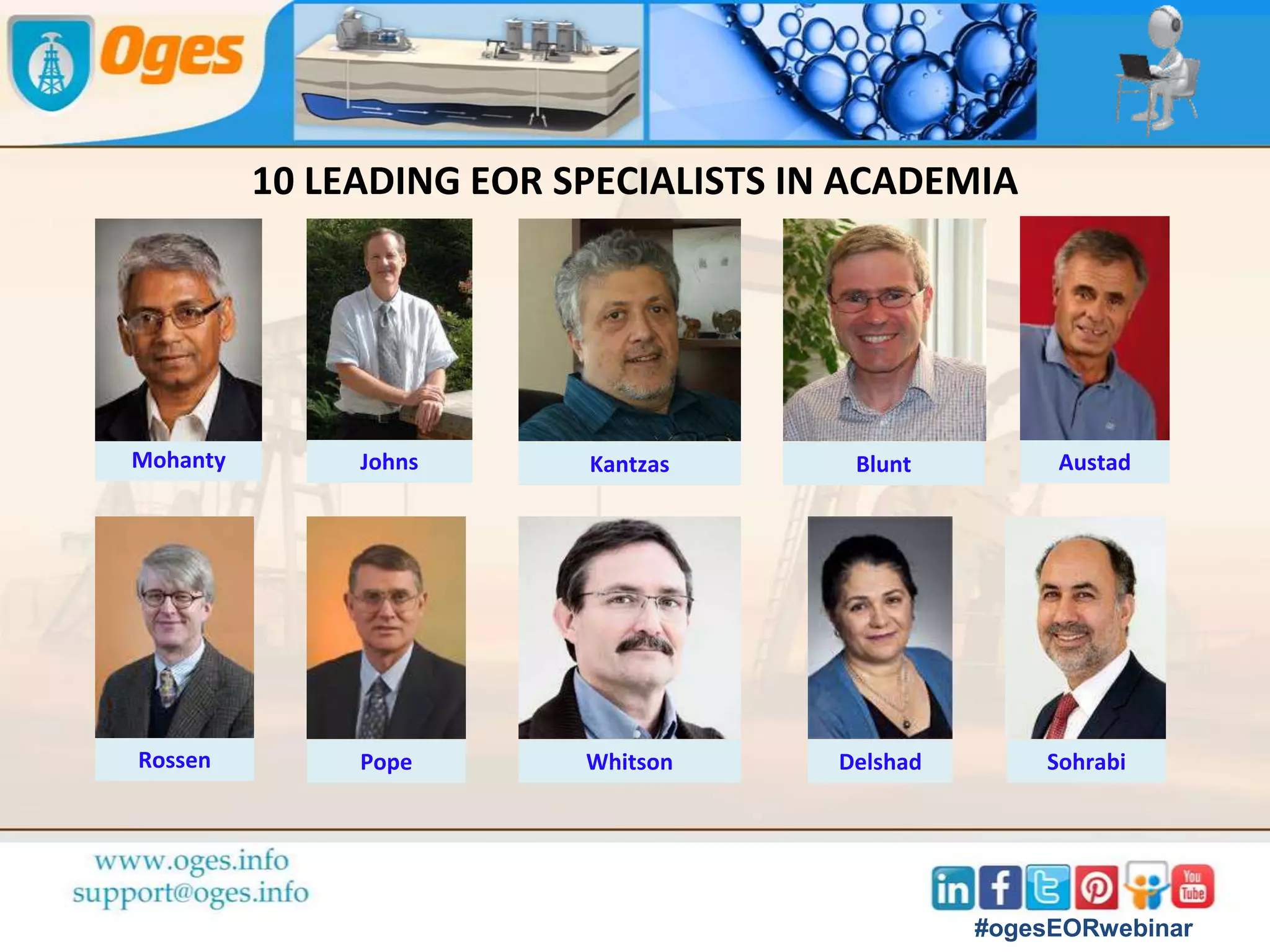
10 LEADING EOR SPECIALISTS IN ACADEMIA
Sohrabi
Mohanty Johns
Pope Delshad
Blunt
WhitsonRossen
Kantzas Austad
#ogesEORwebinar
BOOKS ON PHASE BEHAVIOR, GAS INJECTION AND GENERAL EOR
#ogesEORwebinar
Holger Kinzel
Holger is the founder and managing director of Planxty Engineering &
Consulting Services GmbH, a Northern Germany based company, offering
engineering services, marketing and business development support,
assistance as sales agent and representative for selected products and
services as well as consulting, optimization, training, coaching, moderation
and business mediation.
Holger looks back on over 30 years of industry experience in various
technical and management positions in the oil and gas industry, working in
international assignments for companies such as Weatherford and Preussag.
Holger has published over 50 technical papers and given numerous
conference presentations.
Born 1957, graduated as Diplom-Ingenieur (Germany equivalent to an MSc
degree) in Petroleum Engineering and Drilling from the University of
Clausthal, Germany. Currently he is in the process of graduating as a Master
of Mediation from the University of Hagen. He also is a PhD candidate at the
Technical University of Freiberg.
#ogesEORwebinar© 2016 by planxty engineering & consulting Services GmbH
© 2016 by planxty engineering & consulting Services GmbH
Well Integrity
• application of technical, operational
and organizational solutions to
reduce risk of uncontrolled release
of formation fluids and well fluids
throughout the life cycle of a well
Well Barrier Principle
• envelope of one or several well
barrier elements preventing
fluids from flowing
unintentionally from the
formation into the wellbore, into
another formation or to the
external environment
© 2016 by planxty engineering & consulting Services GmbH
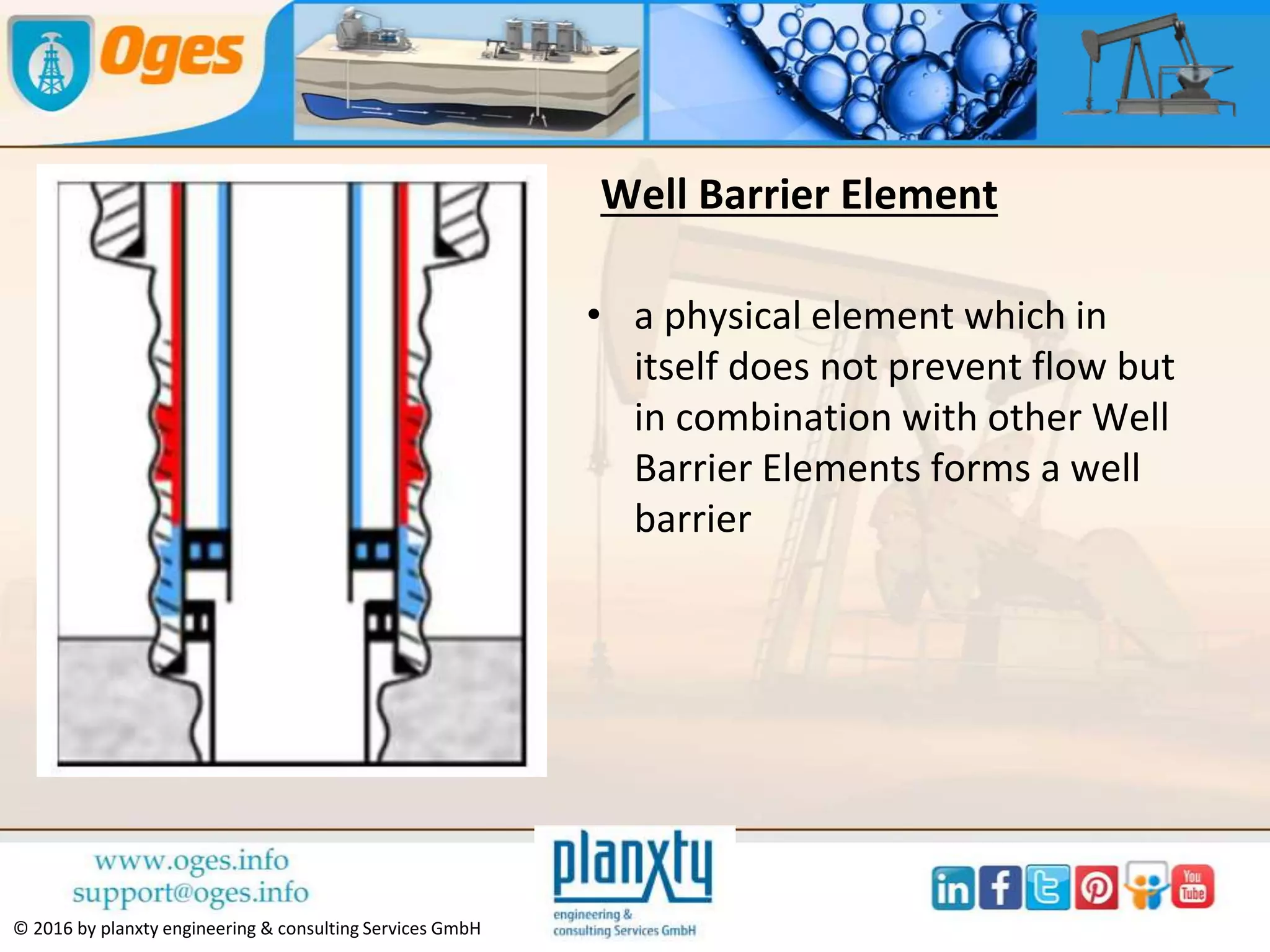
Well Barrier Element
• a physical element which in
itself does not prevent flow but
in combination with other Well
Barrier Elements forms a well
barrier
© 2016 by planxty engineering & consulting Services GmbH
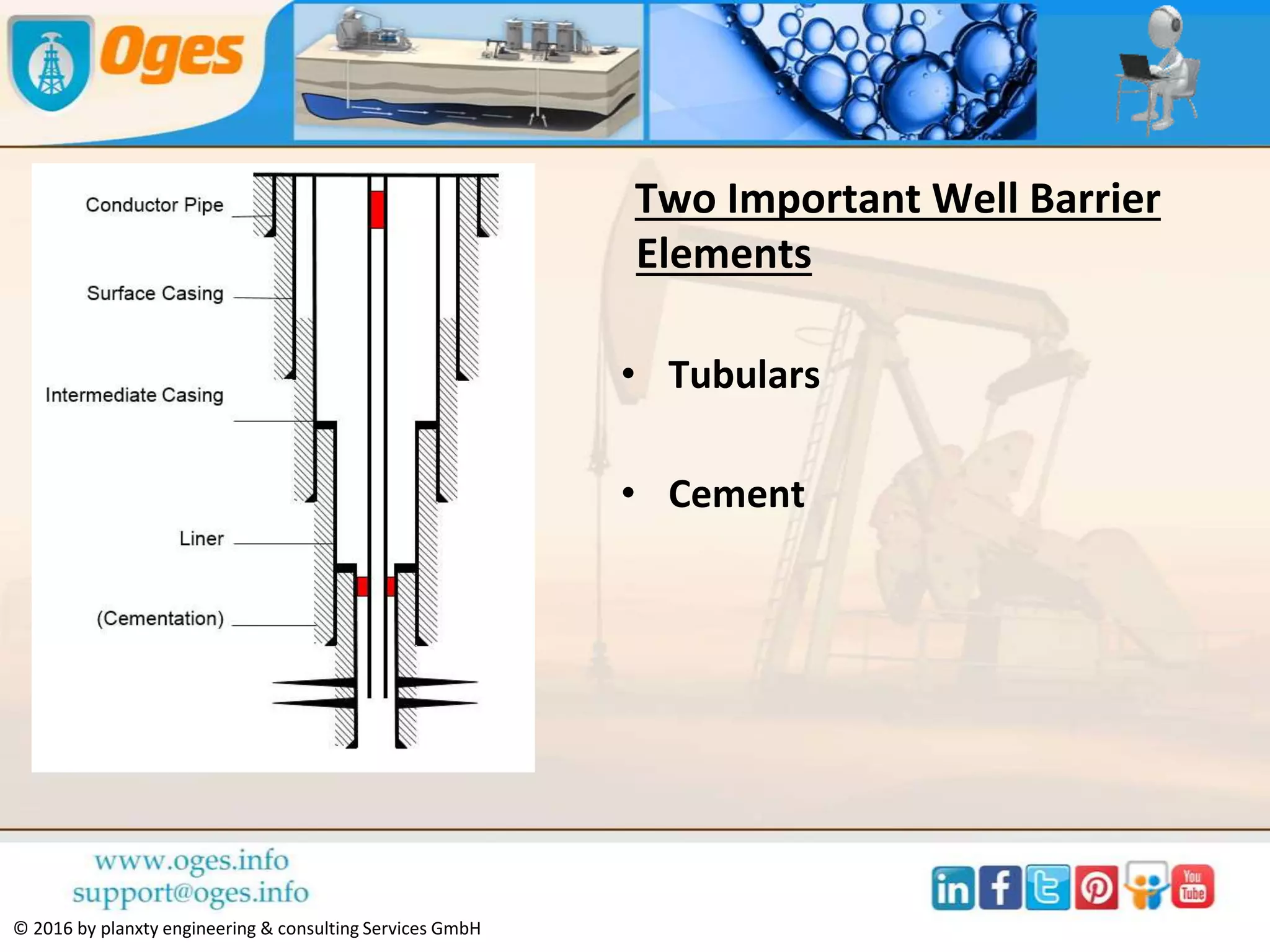
Two Important Well Barrier
Elements
• Tubulars
• Cement
© 2016 by planxty engineering & consulting Services GmbH
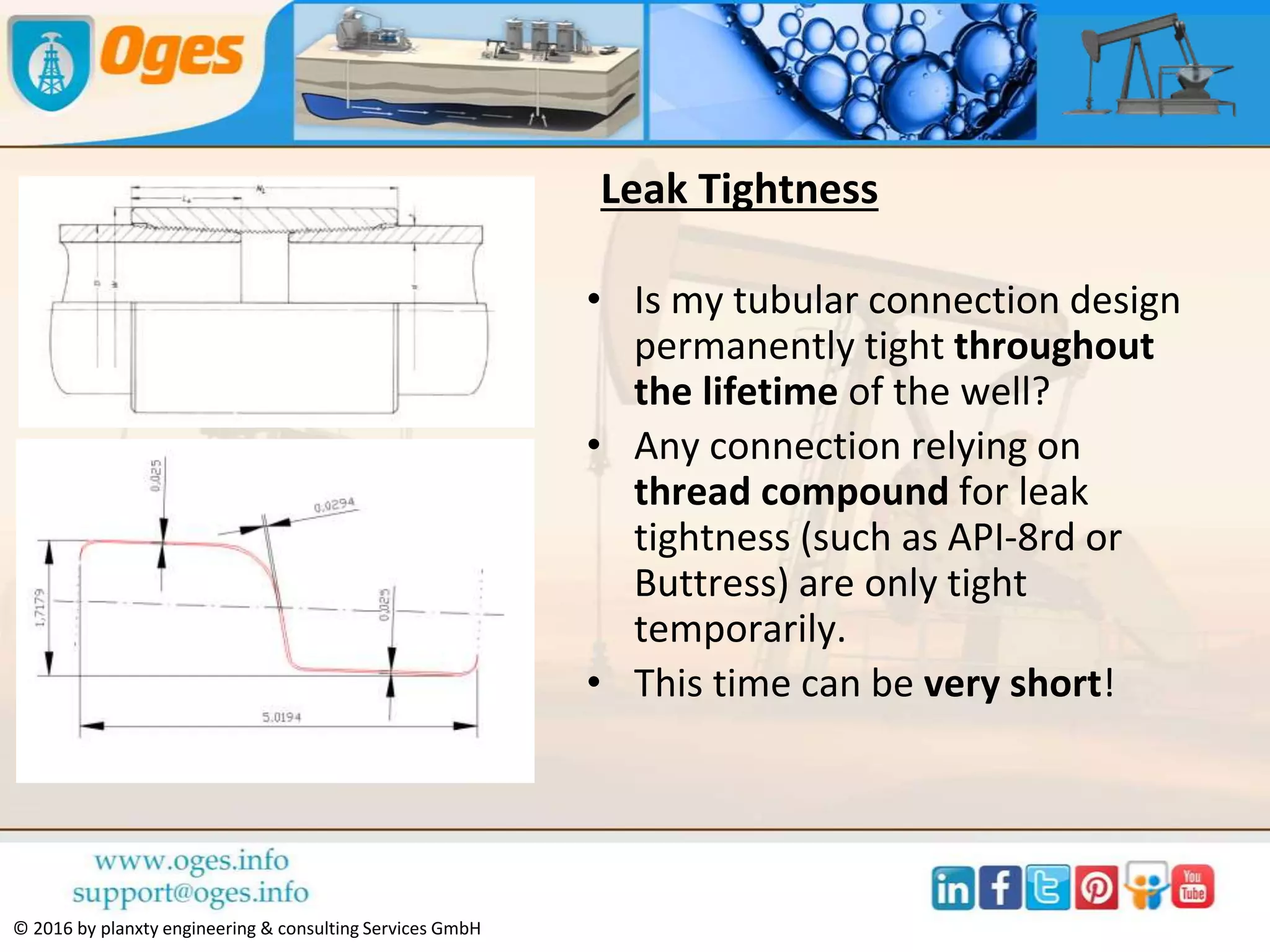
Leak Tightness
• Is my tubular connection design
permanently tight throughout
the lifetime of the well?
• Any connection relying on
thread compound for leak
tightness (such as API-8rd or
Buttress) are only tight
temporarily.
• This time can be very short!
© 2016 by planxty engineering & consulting Services GmbH
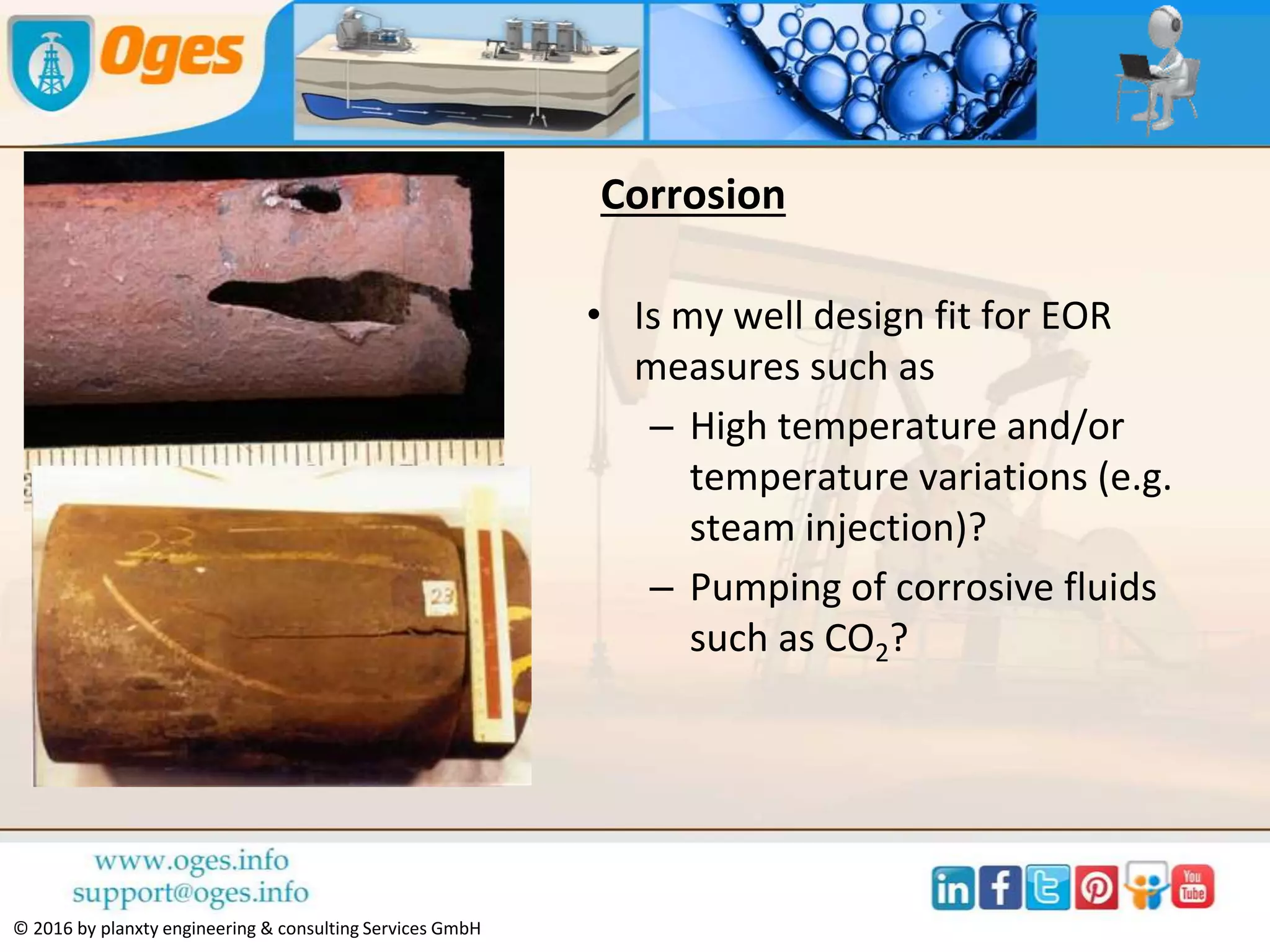
Corrosion
• Is my well design fit for EOR
measures such as
– High temperature and/or
temperature variations (e.g.
steam injection)?
– Pumping of corrosive fluids
such as CO2?
© 2016 by planxty engineering & consulting Services GmbH
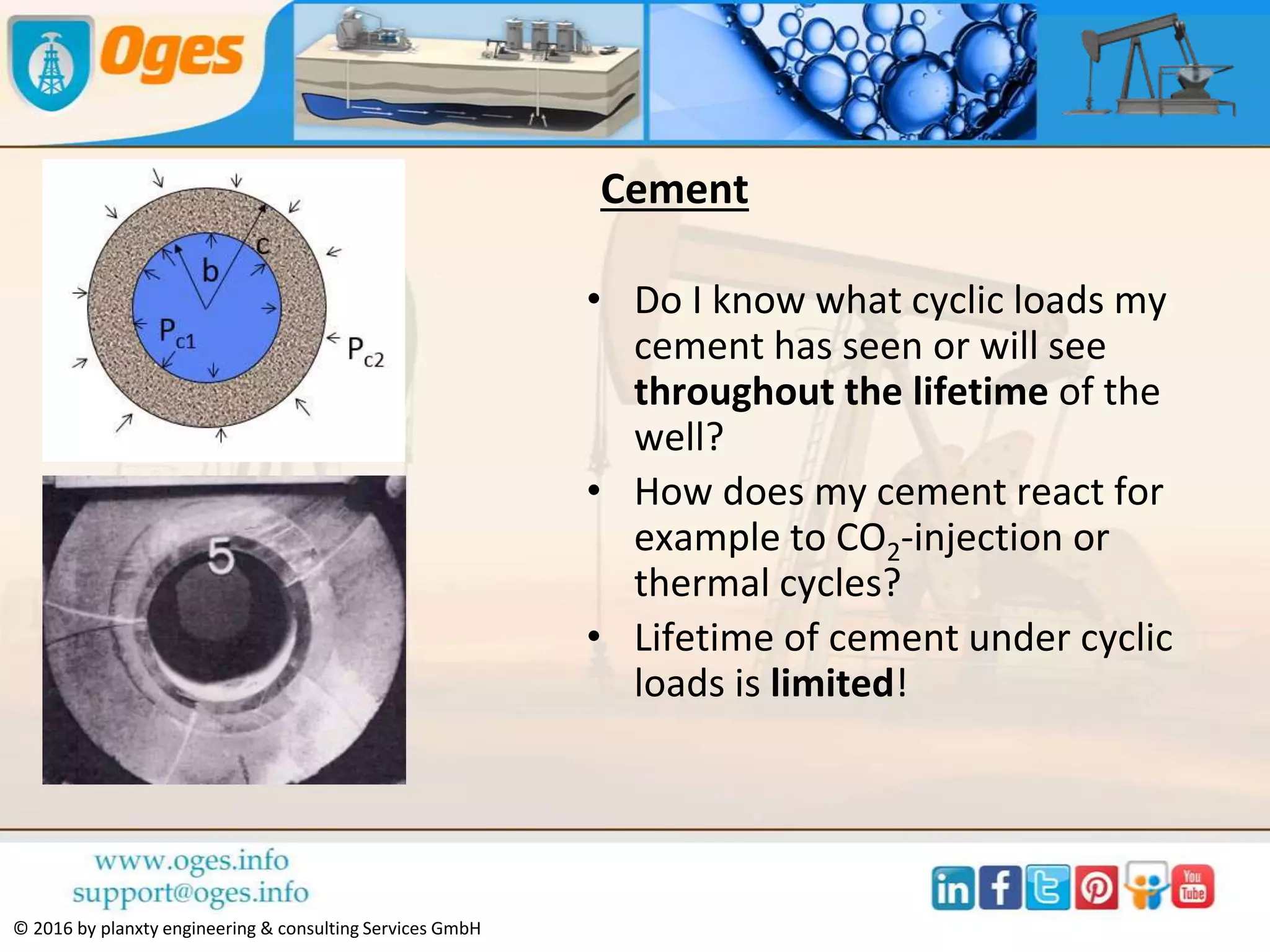
Cement
• Do I know what cyclic loads my
cement has seen or will see
throughout the lifetime of the
well?
• How does my cement react for
example to CO2-injection or
thermal cycles?
• Lifetime of cement under cyclic
loads is limited!
© 2016 by planxty engineering & consulting Services GmbH
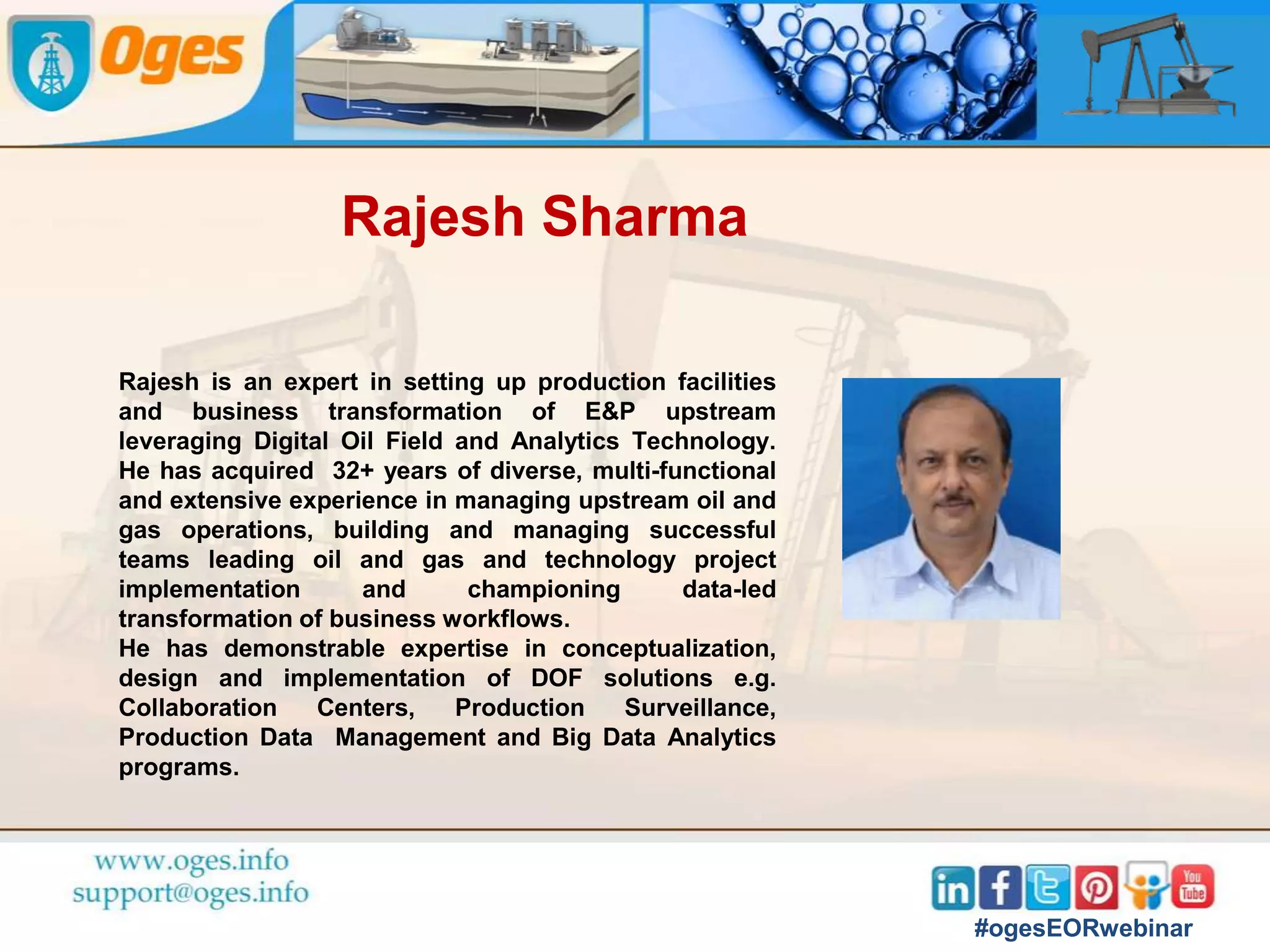
Rajesh Sharma
Rajesh is an expert in setting up production facilities
and business transformation of E&P upstream
leveraging Digital Oil Field and Analytics Technology.
He has acquired 32+ years of diverse, multi-functional
and extensive experience in managing upstream oil and
gas operations, building and managing successful
teams leading oil and gas and technology project
implementation and championing data-led
transformation of business workflows.
He has demonstrable expertise in conceptualization,
design and implementation of DOF solutions e.g.
Collaboration Centers, Production Surveillance,
Production Data Management and Big Data Analytics
programs.
#ogesEORwebinar
➢ Synergistic model between Reservoir and production required
at the outset.
➢ Project team to integrate instrumentation, tools and
surveillance systems at the concept stage itself to identify the
instrumentation needs, data flow and management system.
➢ O&M team to build and maintain database.
Deploy EOR from Early development to field abandonment
#ogesEORwebinar
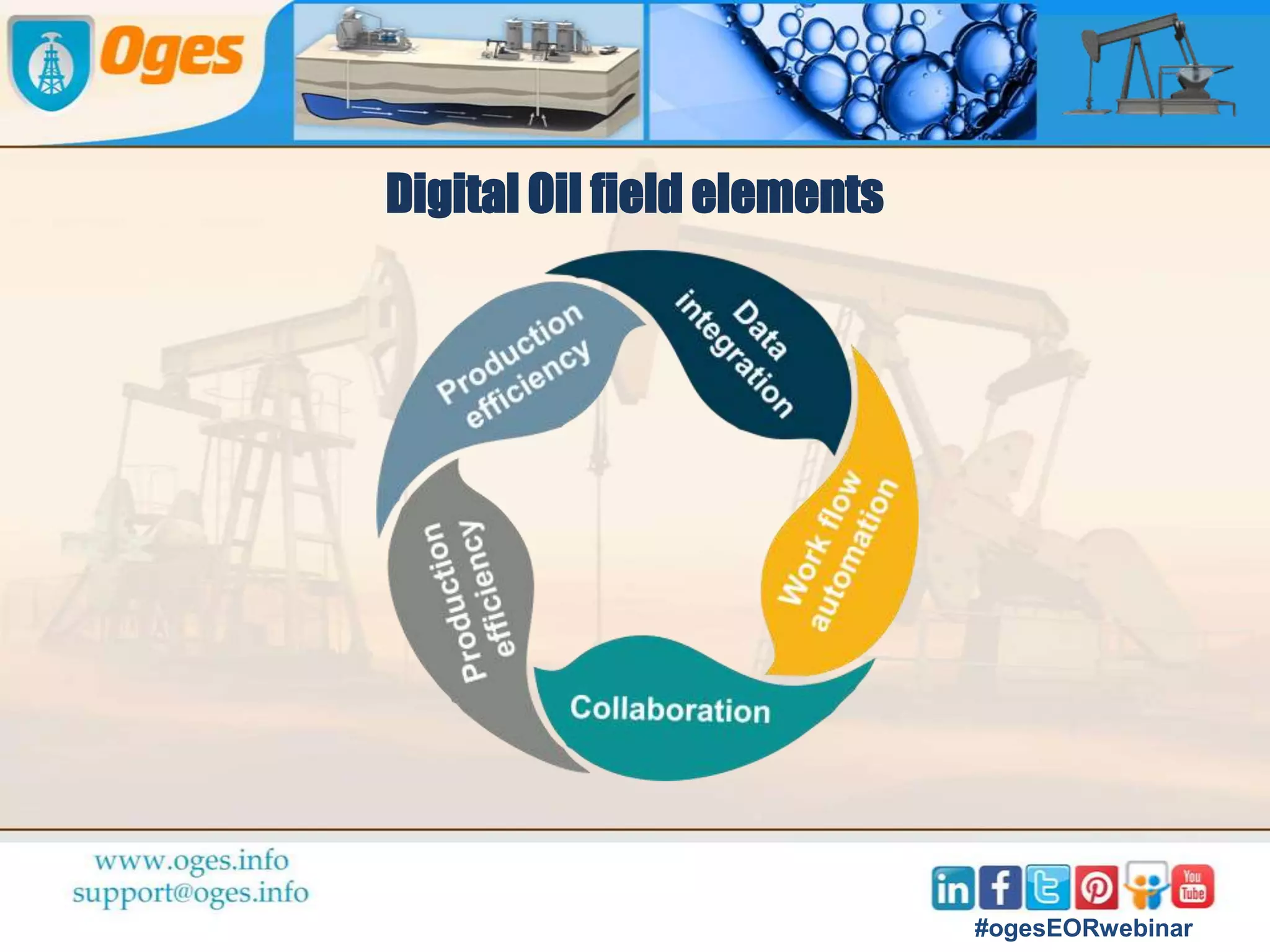
Digital Oil field elements
#ogesEORwebinar
Reservoir data screened to select optimal EOR method
➢Gather as much reservoir data as possible
➢Develop a coherent package to compare with the screening criteria for
various EOR methods.
➢ Laboratory studies to investigate rock and fluid properties, to conduct
flow studies.
➢Develop updated static and dynamic reservoir models.
➢Simulate the effects of different EOR methods
to choose the optimum one.
#ogesEORwebinar
➢Set up a team of experts
➢Build a platform with automated workflows
for providing data and information as a single source of truth covering data
acquisition ,data validation,repository of past cases of EOR applications.
Build a collaborative environment
#ogesEORwebinar
Aninda Ghosh
Aninda started as Engineering Geologist in NTPC Ltd , then
worked as Manager (Exploration) in TATA Steel before
joining Oil and Natural Gas Corporation Ltd (ONGC Ltd.) as
Senior Reservoir Engineer.
He brings with him experience in reservoir data acquisition
and interpretation, planning and conducting well testing
operation, field development planning of onshore and
offshore fields, planning of water injection efficacy and
reservoir characterization.
#ogesEORwebinar
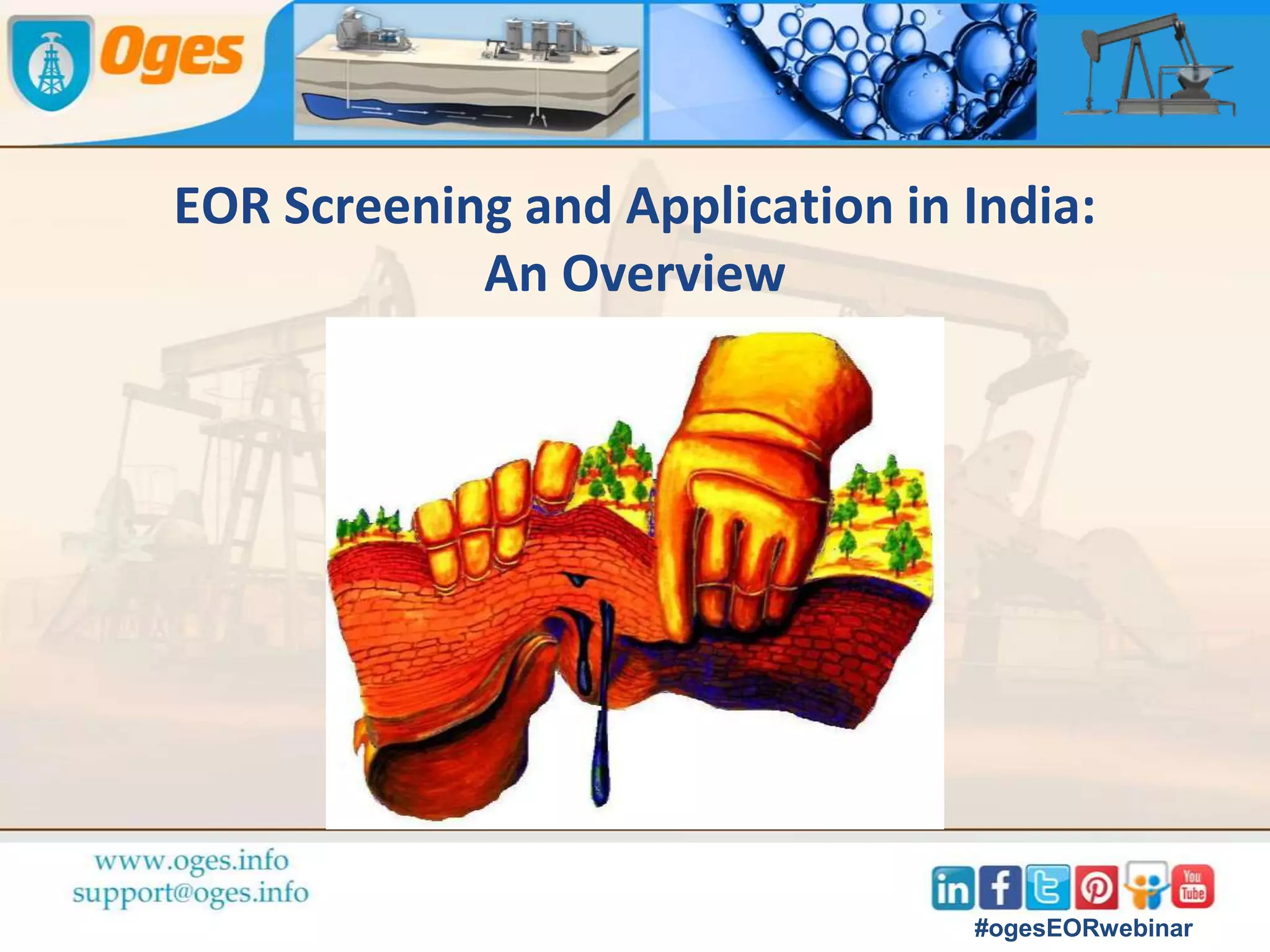
EOR Screening and Application in India:
An Overview
#ogesEORwebinar
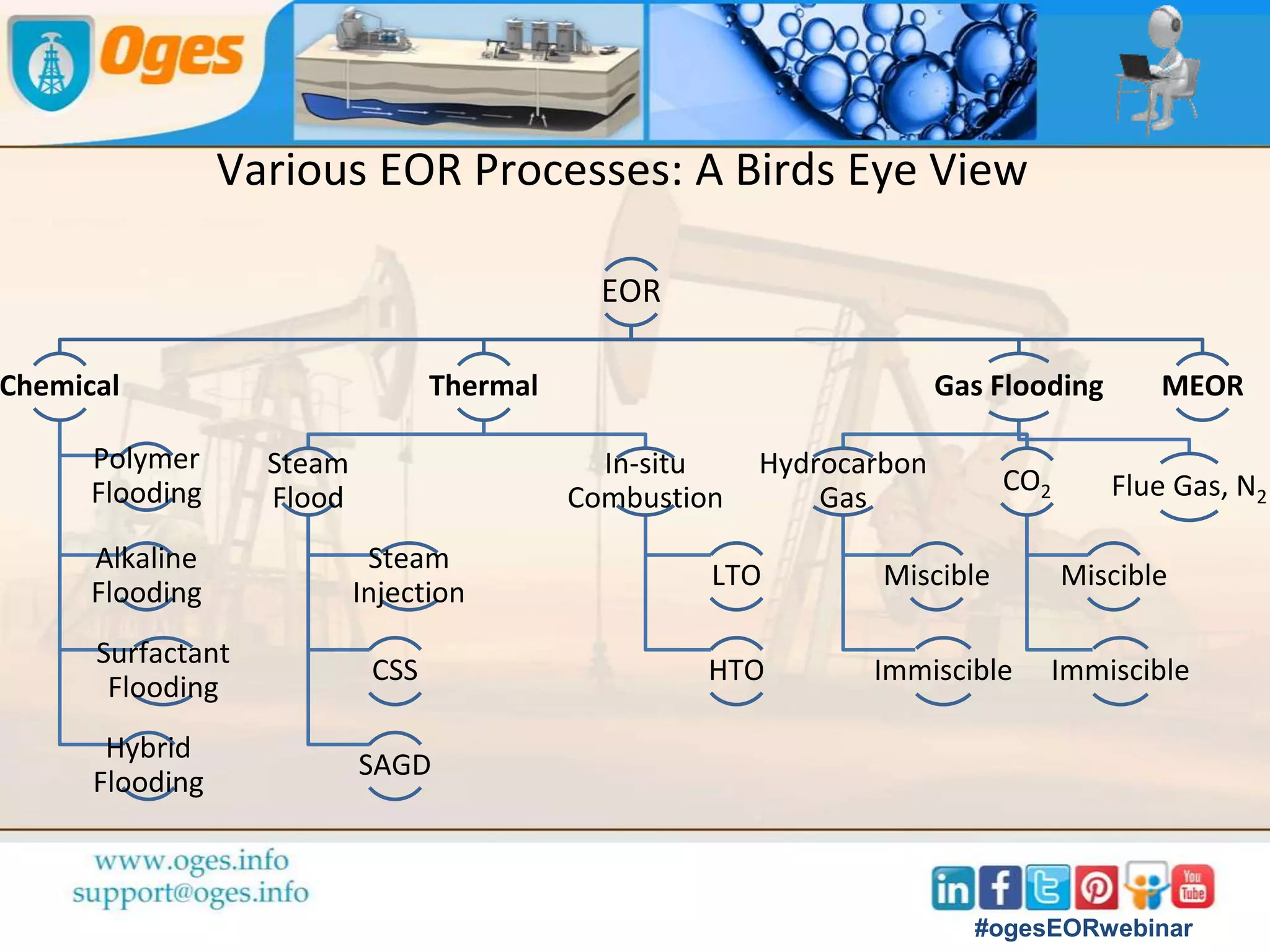
EOR
Chemical
Polymer
Flooding
Alkaline
Flooding
Surfactant
Flooding
Hybrid
Flooding
Thermal
Steam
Flood
Steam
Injection
CSS
SAGD
In-situ
Combustion
LTO
HTO
Gas Flooding
Hydrocarbon
Gas
Miscible
Immiscible
CO2
Miscible
Immiscible
Flue Gas, N2
MEOR
Various EOR Processes: A Birds Eye View
#ogesEORwebinar
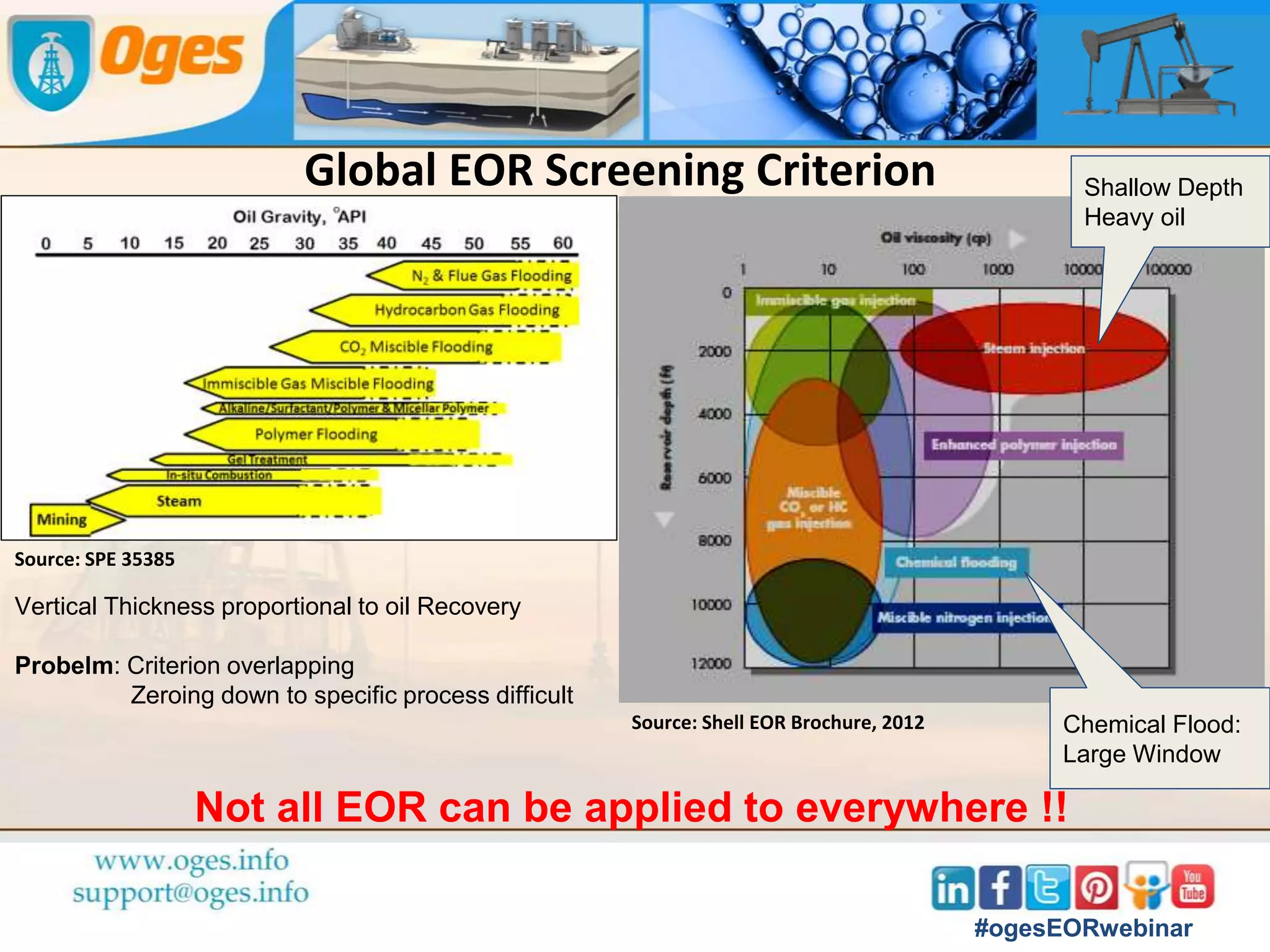
Global EOR Screening Criterion
Source: Shell EOR Brochure, 2012
Source: SPE 35385
Not all EOR can be applied to everywhere !!
#ogesEORwebinar
Vertical Thickness proportional to oil Recovery
Probelm: Criterion overlapping
Zeroing down to specific process difficult
Chemical Flood:
Large Window
Shallow Depth
Heavy oil
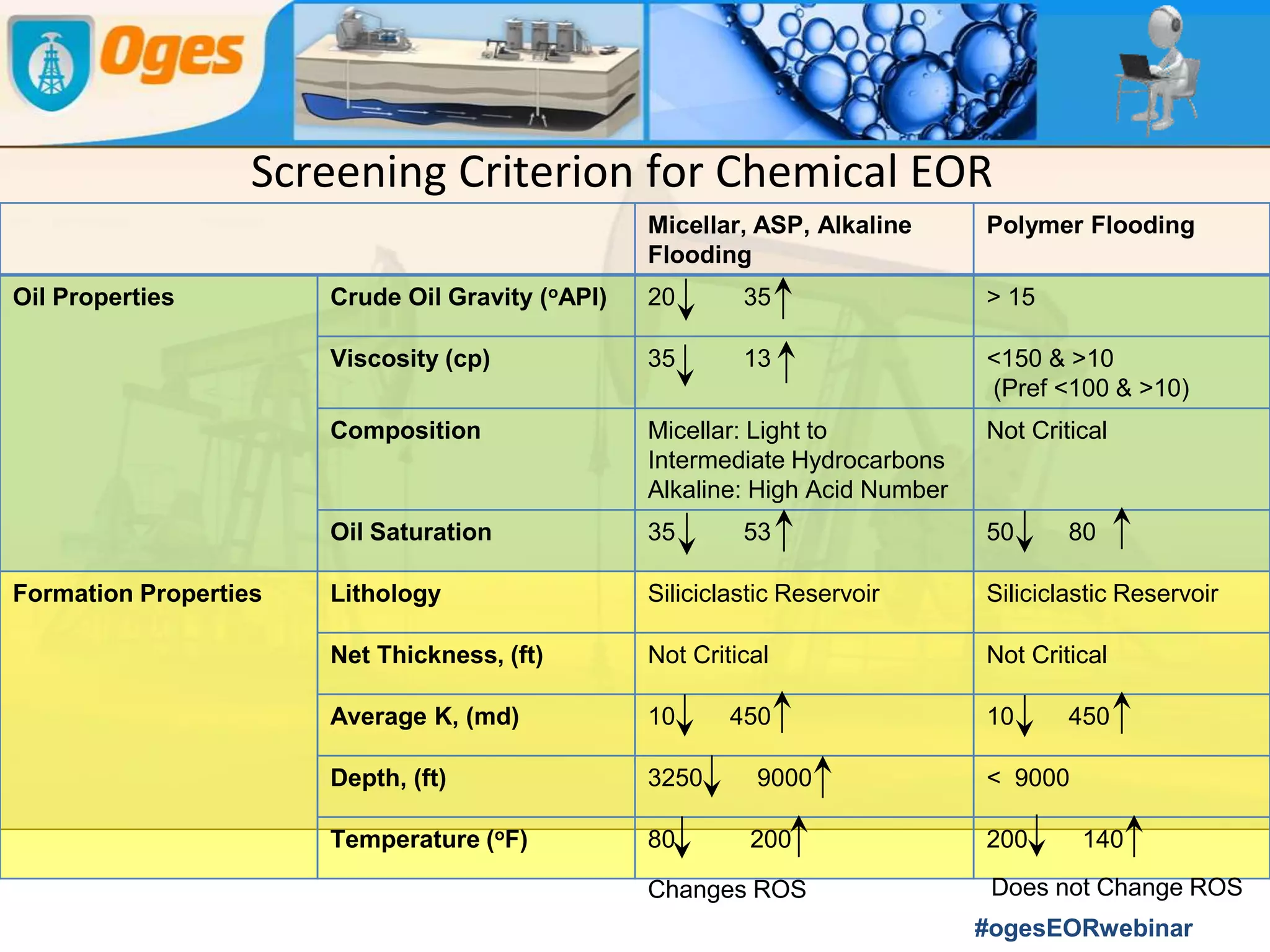
Screening Criterion for Chemical EOR
Micellar, ASP, Alkaline
Flooding
Polymer Flooding
Oil Properties Crude Oil Gravity (oAPI) 20 35 > 15
Viscosity (cp) 35 13 <150 & >10
(Pref <100 & >10)
Composition Micellar: Light to
Intermediate Hydrocarbons
Alkaline: High Acid Number
Not Critical
Oil Saturation 35 53 50 80
Formation Properties Lithology Siliciclastic Reservoir Siliciclastic Reservoir
Net Thickness, (ft) Not Critical Not Critical
Average K, (md) 10 450 10 450
Depth, (ft) 3250 9000 < 9000
Temperature (oF) 80 200 200 140
#ogesEORwebinar
Changes ROS Does not Change ROS
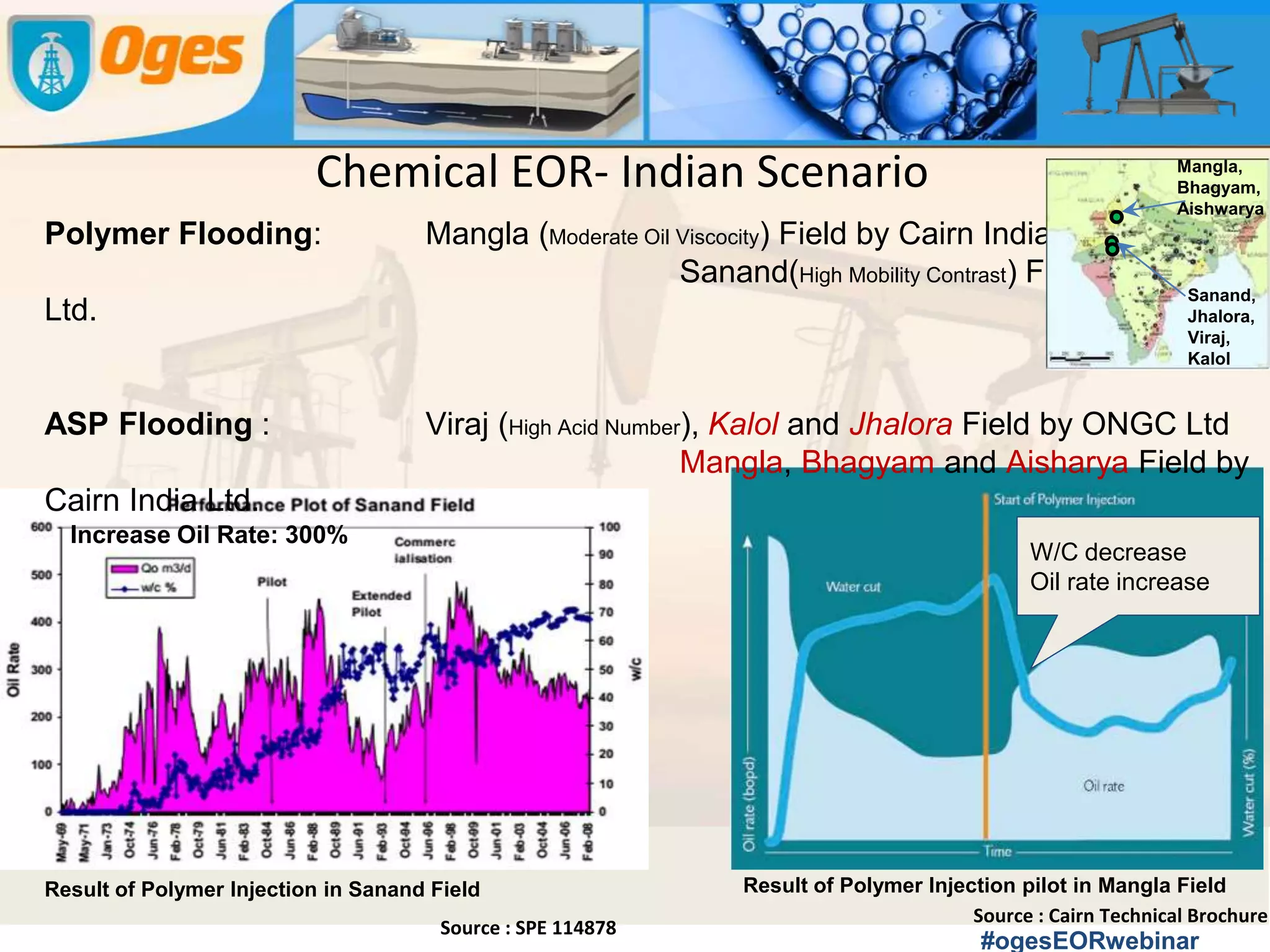
Chemical EOR- Indian Scenario
Result of Polymer Injection pilot in Mangla FieldResult of Polymer Injection in Sanand Field
Polymer Flooding: Mangla (Moderate Oil Viscocity) Field by Cairn India Ltd.
Sanand(High Mobility Contrast) Field by ONGC
Ltd.
ASP Flooding : Viraj (High Acid Number), Kalol and Jhalora Field by ONGC Ltd
Mangla, Bhagyam and Aisharya Field by
Cairn India Ltd.
Source : SPE 114878
Source : Cairn Technical Brochure
Mangla,
Bhagyam,
Aishwarya
Sanand,
Jhalora,
Viraj,
Kalol
#ogesEORwebinar
Increase Oil Rate: 300%
W/C decrease
Oil rate increase
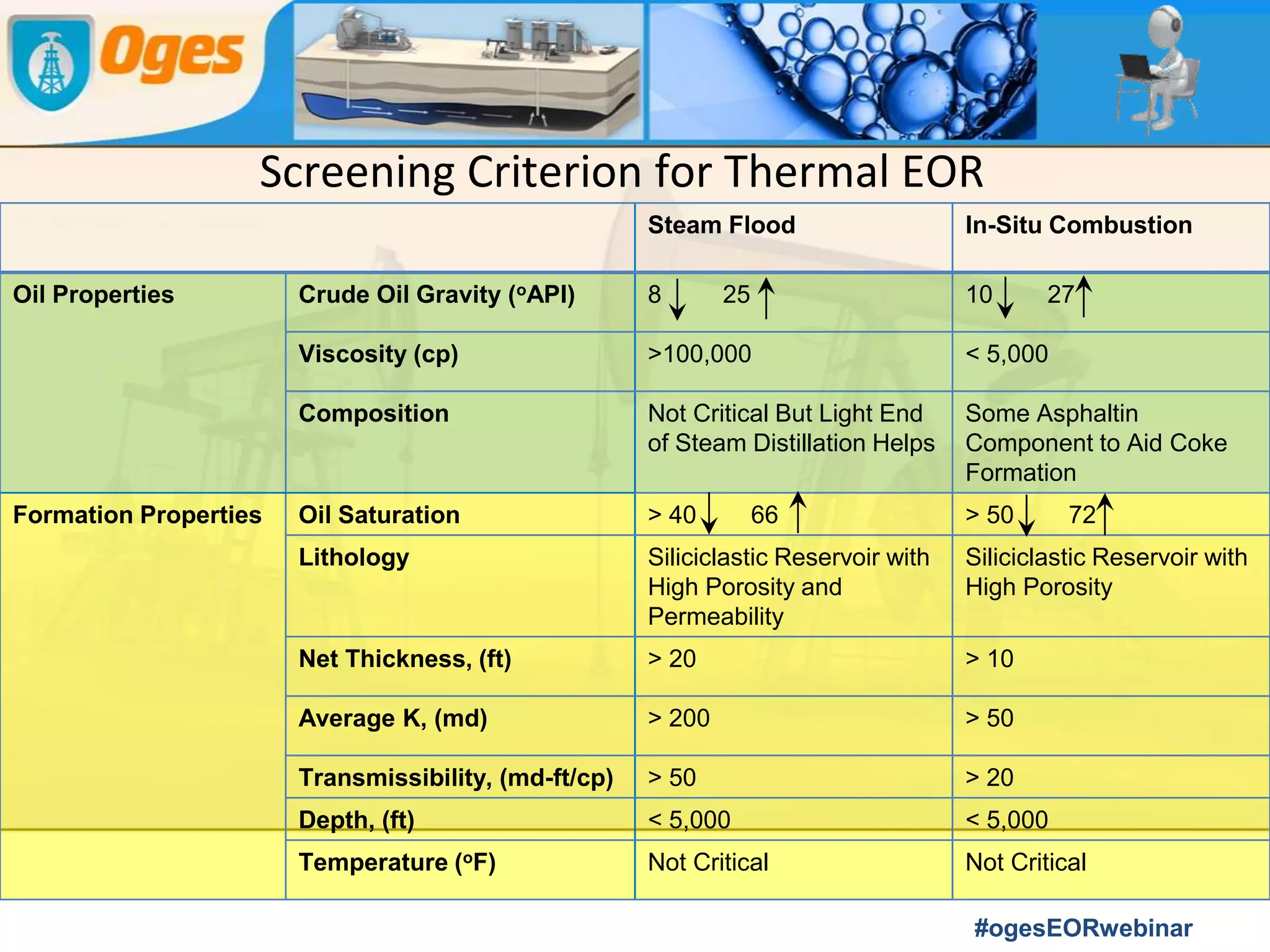
Screening Criterion for Thermal EOR
Steam Flood In-Situ Combustion
Oil Properties Crude Oil Gravity (oAPI) 8 25 10 27
Viscosity (cp) >100,000 < 5,000
Composition Not Critical But Light End
of Steam Distillation Helps
Some Asphaltin
Component to Aid Coke
Formation
Formation Properties Oil Saturation > 40 66 > 50 72
Lithology Siliciclastic Reservoir with
High Porosity and
Permeability
Siliciclastic Reservoir with
High Porosity
Net Thickness, (ft) > 20 > 10
Average K, (md) > 200 > 50
Transmissibility, (md-ft/cp) > 50 > 20
Depth, (ft) < 5,000 < 5,000
Temperature (oF) Not Critical Not Critical
#ogesEORwebinar
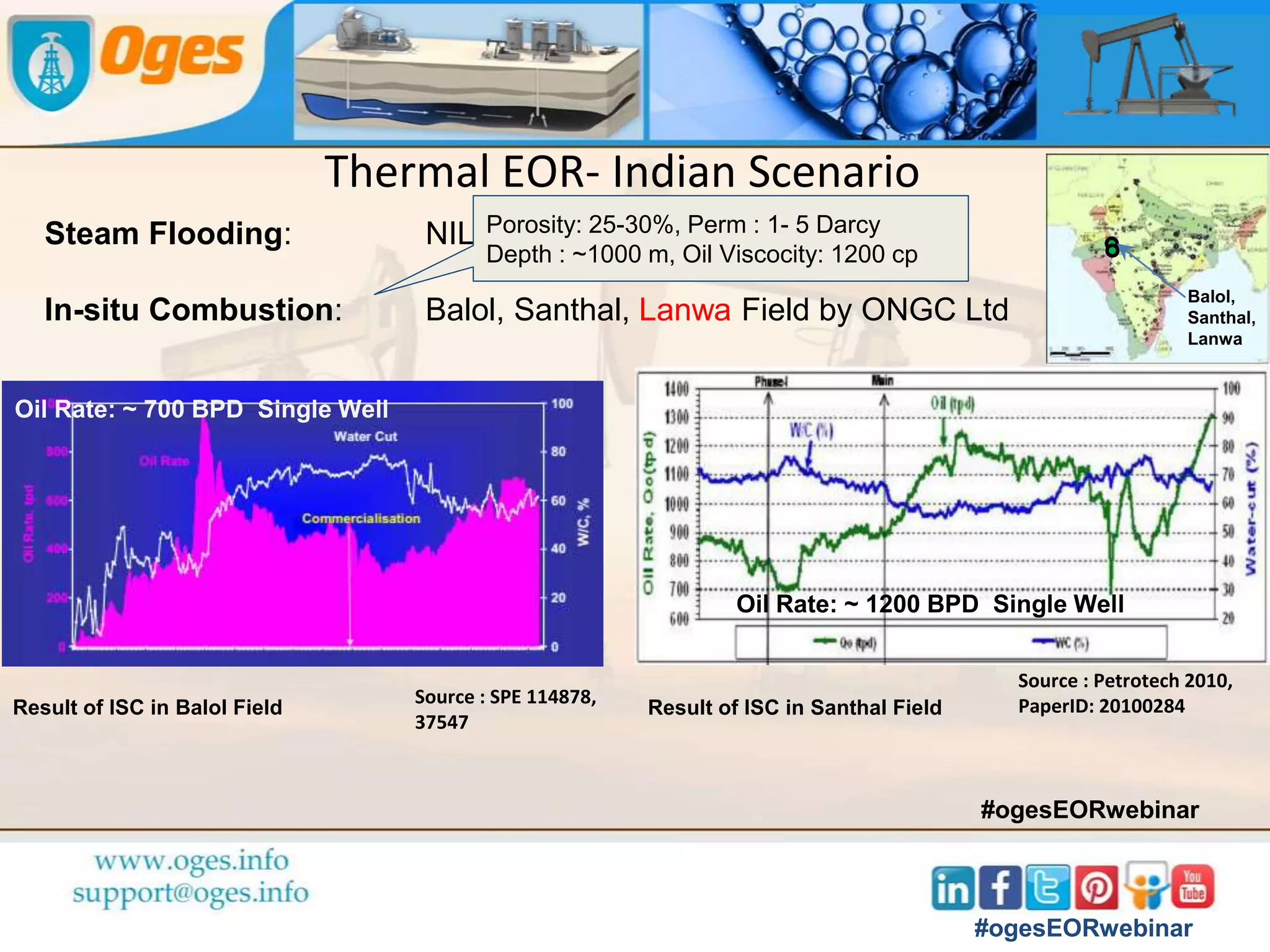
Thermal EOR- Indian Scenario
Steam Flooding: NIL
In-situ Combustion: Balol, Santhal, Lanwa Field by ONGC Ltd
Balol,
Santhal,
Lanwa
Result of ISC in Balol Field Result of ISC in Santhal Field
Source : Petrotech 2010,
PaperID: 20100284Source : SPE 114878,
37547
#ogesEORwebinar
#ogesEORwebinar
Oil Rate: ~ 700 BPD Single Well
Oil Rate: ~ 1200 BPD Single Well
Porosity: 25-30%, Perm : 1- 5 Darcy
Depth : ~1000 m, Oil Viscocity: 1200 cp
N2 and Flue
Gas Flood
Hydrocarbon Gas
Flood (Miscible)
CO2 Flood
(Miscible)
Immiscible Gas
Flood
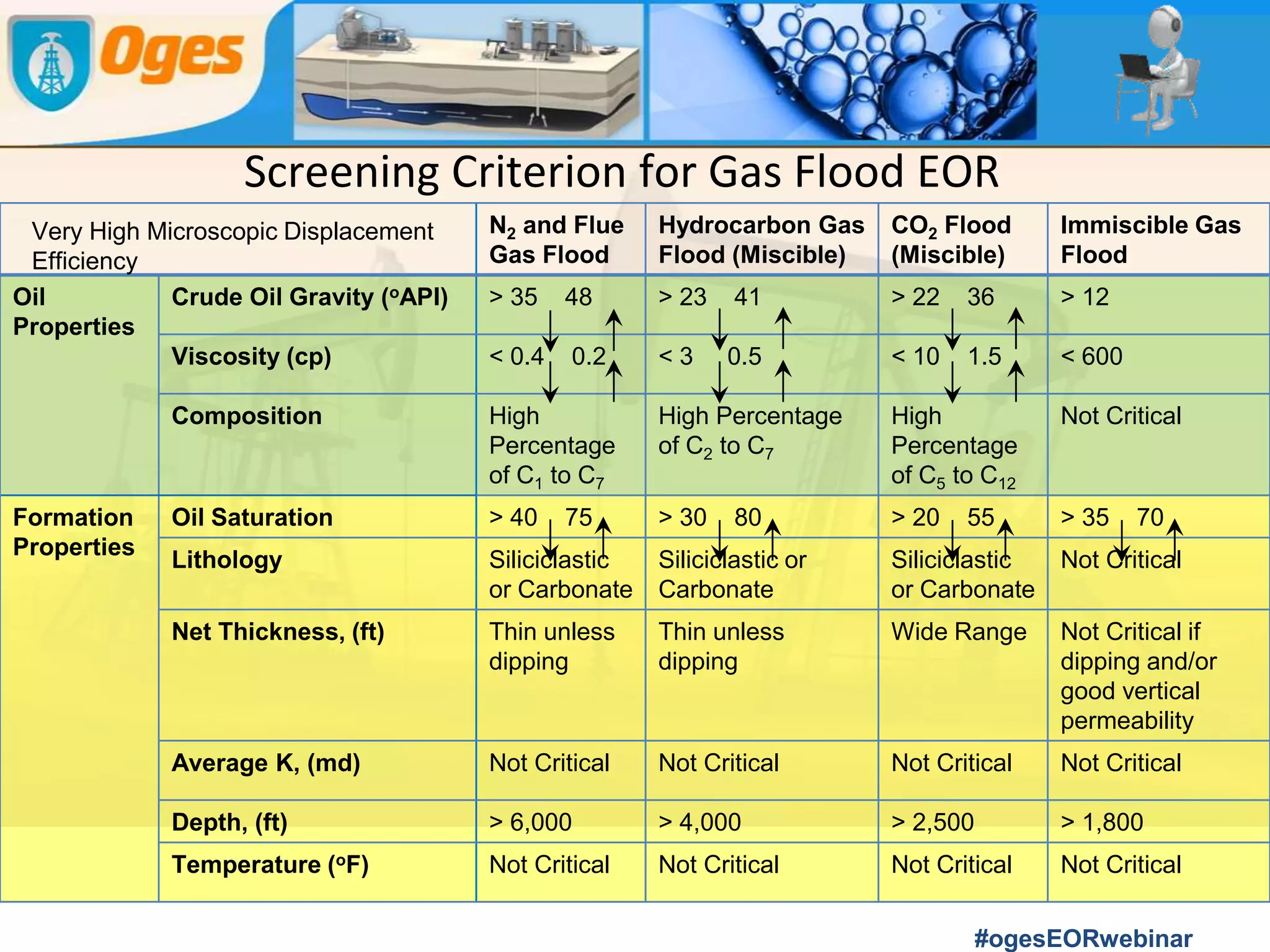
Oil
Properties
Crude Oil Gravity (oAPI) > 35 48 > 23 41 > 22 36 > 12
Viscosity (cp) < 0.4 0.2 < 3 0.5 < 10 1.5 < 600
Composition High
Percentage
of C1 to C7
High Percentage
of C2 to C7
High
Percentage
of C5 to C12
Not Critical
Formation
Properties
Oil Saturation > 40 75 > 30 80 > 20 55 > 35 70
Lithology Siliciclastic
or Carbonate
Siliciclastic or
Carbonate
Siliciclastic
or Carbonate
Not Critical
Net Thickness, (ft) Thin unless
dipping
Thin unless
dipping
Wide Range Not Critical if
dipping and/or
good vertical
permeability
Average K, (md) Not Critical Not Critical Not Critical Not Critical
Depth, (ft) > 6,000 > 4,000 > 2,500 > 1,800
Temperature (oF) Not Critical Not Critical Not Critical Not Critical
Screening Criterion for Gas Flood EOR
#ogesEORwebinar
Very High Microscopic Displacement
Efficiency
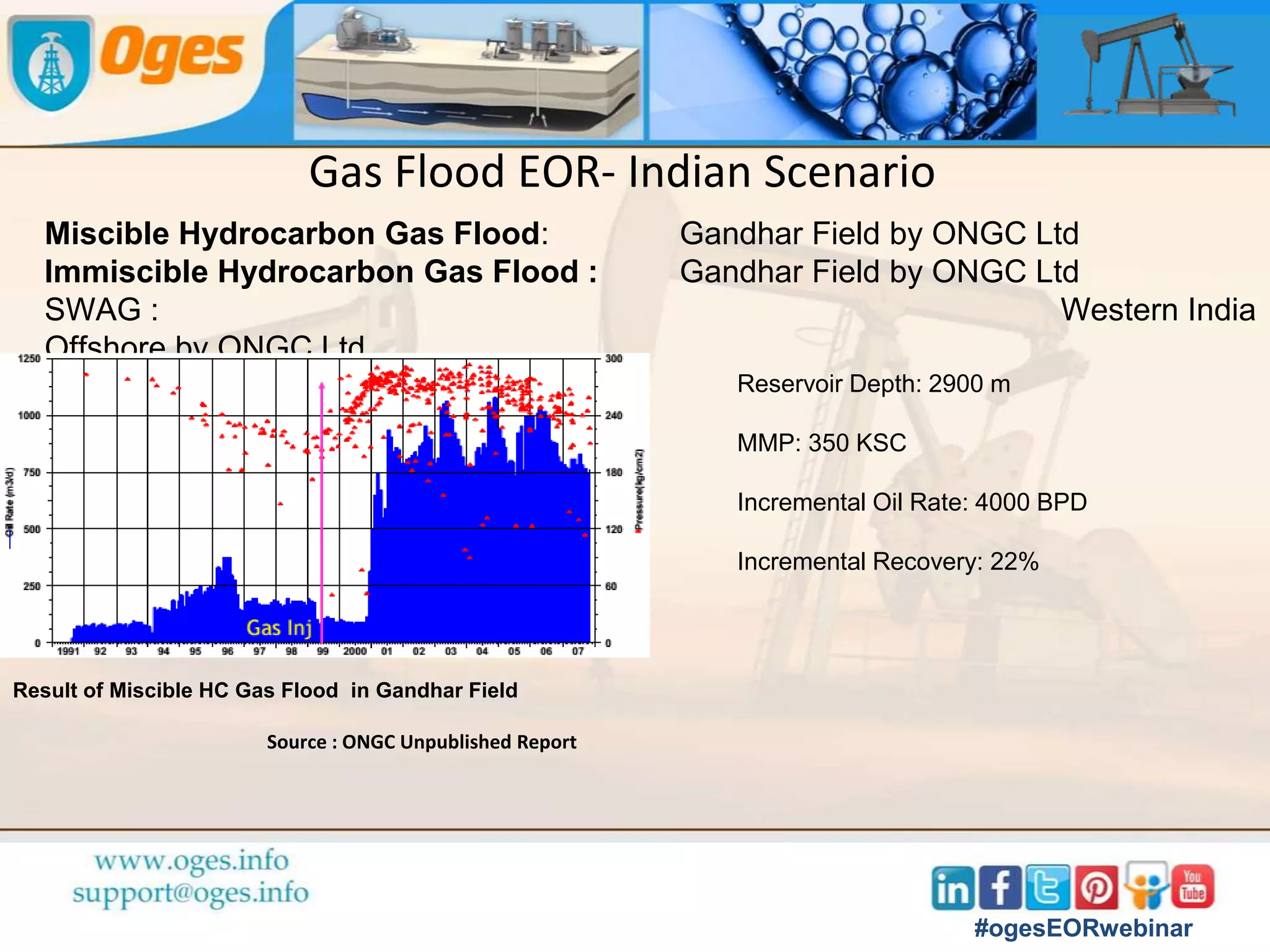
Gas Flood EOR- Indian Scenario
Miscible Hydrocarbon Gas Flood: Gandhar Field by ONGC Ltd
Immiscible Hydrocarbon Gas Flood : Gandhar Field by ONGC Ltd
SWAG : Western India
Offshore by ONGC Ltd
Result of Miscible HC Gas Flood in Gandhar Field
Source : ONGC Unpublished Report
#ogesEORwebinar
Reservoir Depth: 2900 m
MMP: 350 KSC
Incremental Oil Rate: 4000 BPD
Incremental Recovery: 22%
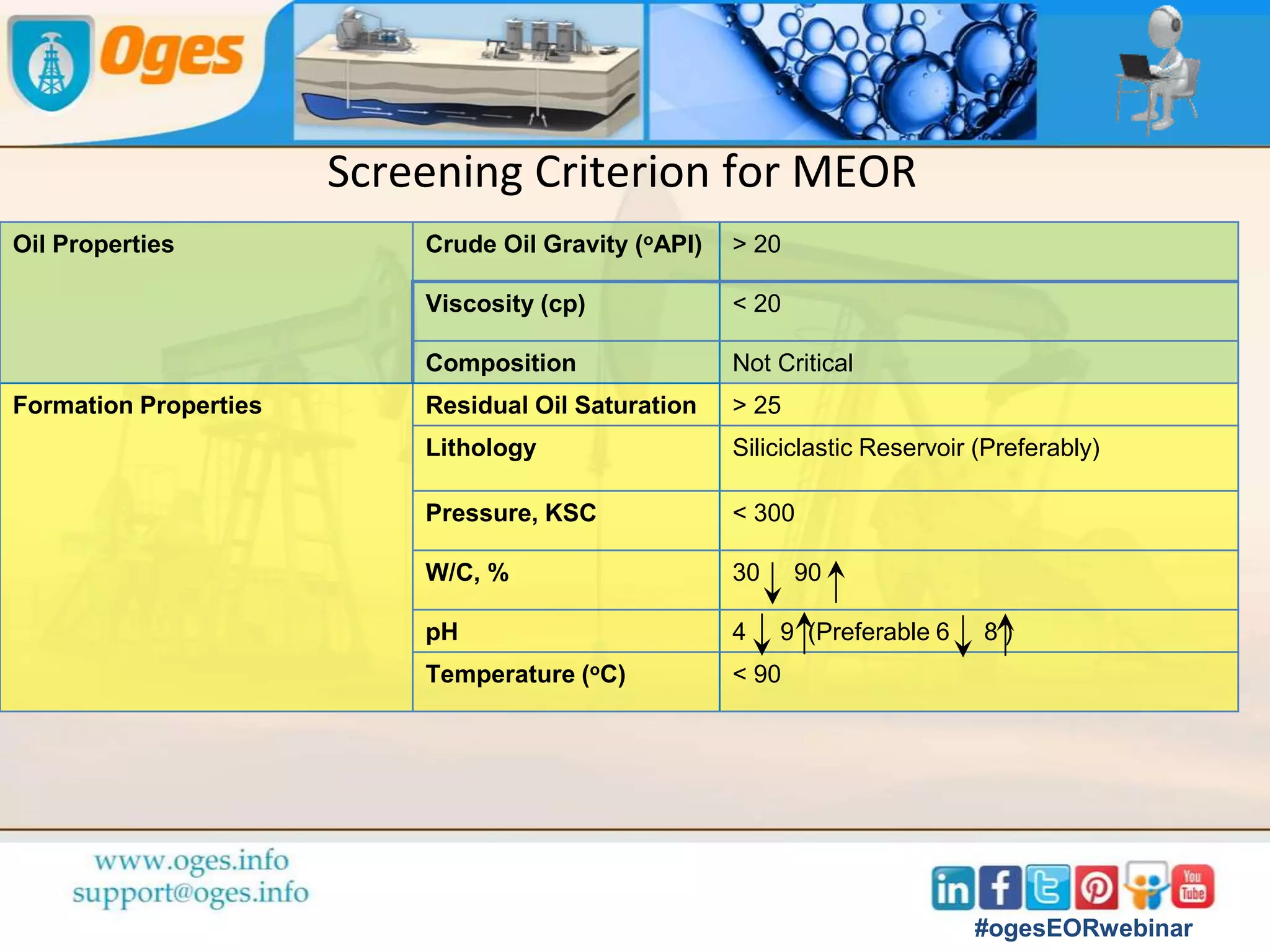
Screening Criterion for MEOR
Oil Properties Crude Oil Gravity (oAPI) > 20
Viscosity (cp) < 20
Composition Not Critical
Formation Properties Residual Oil Saturation > 25
Lithology Siliciclastic Reservoir (Preferably)
Pressure, KSC < 300
W/C, % 30 90
pH 4 9 (Preferable 6 8 )
Temperature (oC) < 90
#ogesEORwebinar
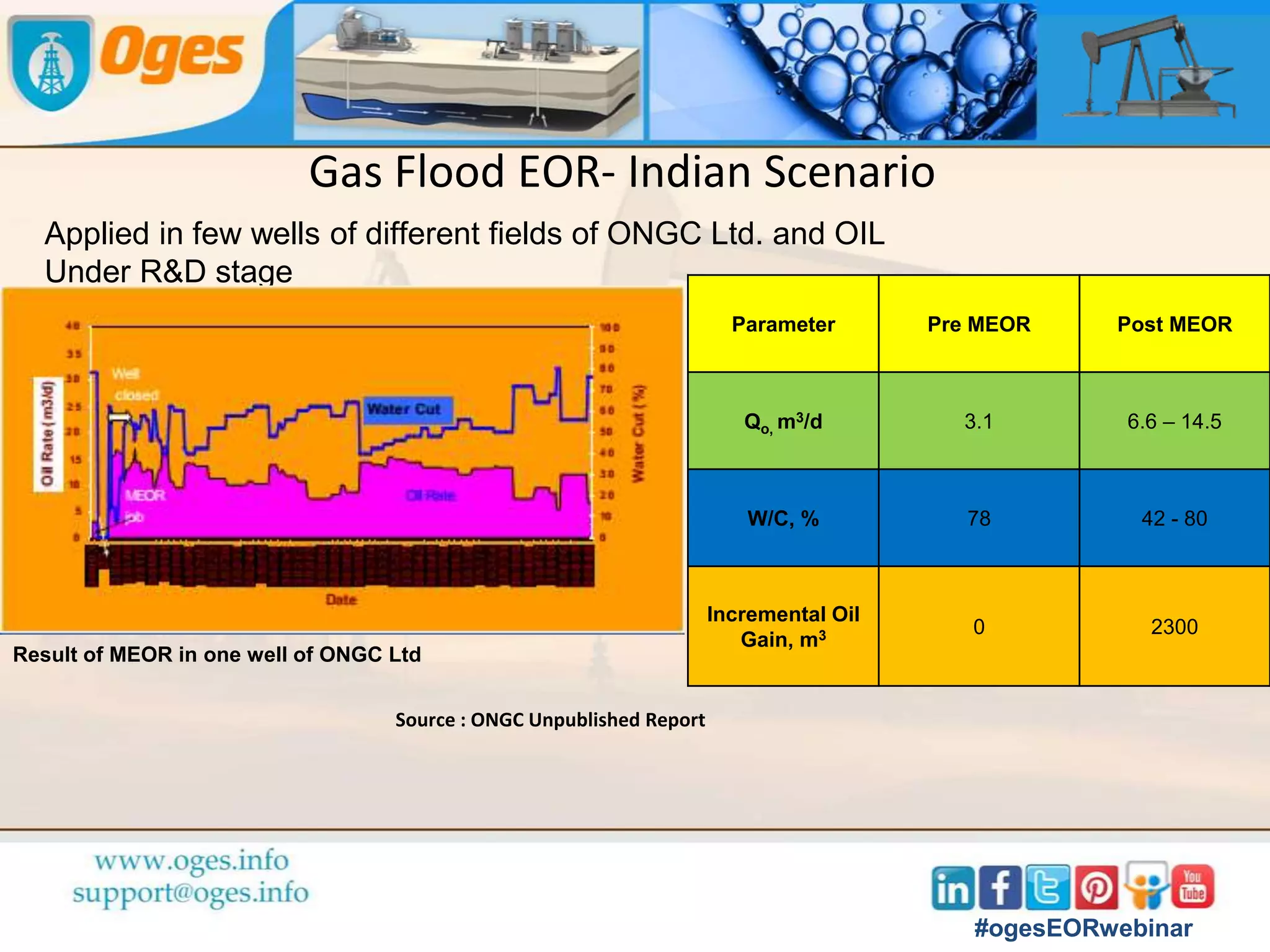
Gas Flood EOR- Indian Scenario
Applied in few wells of different fields of ONGC Ltd. and OIL
Under R&D stage
Source : ONGC Unpublished Report
Result of MEOR in one well of ONGC Ltd
Parameter Pre MEOR Post MEOR
Qo, m3/d 3.1 6.6 – 14.5
W/C, % 78 42 - 80
Incremental Oil
Gain, m3 0 2300
#ogesEORwebinar
Dr. Kristian Mogensen
EOR Technical Advisor at Eni, Milan
#ogesEORwebinar
Screening
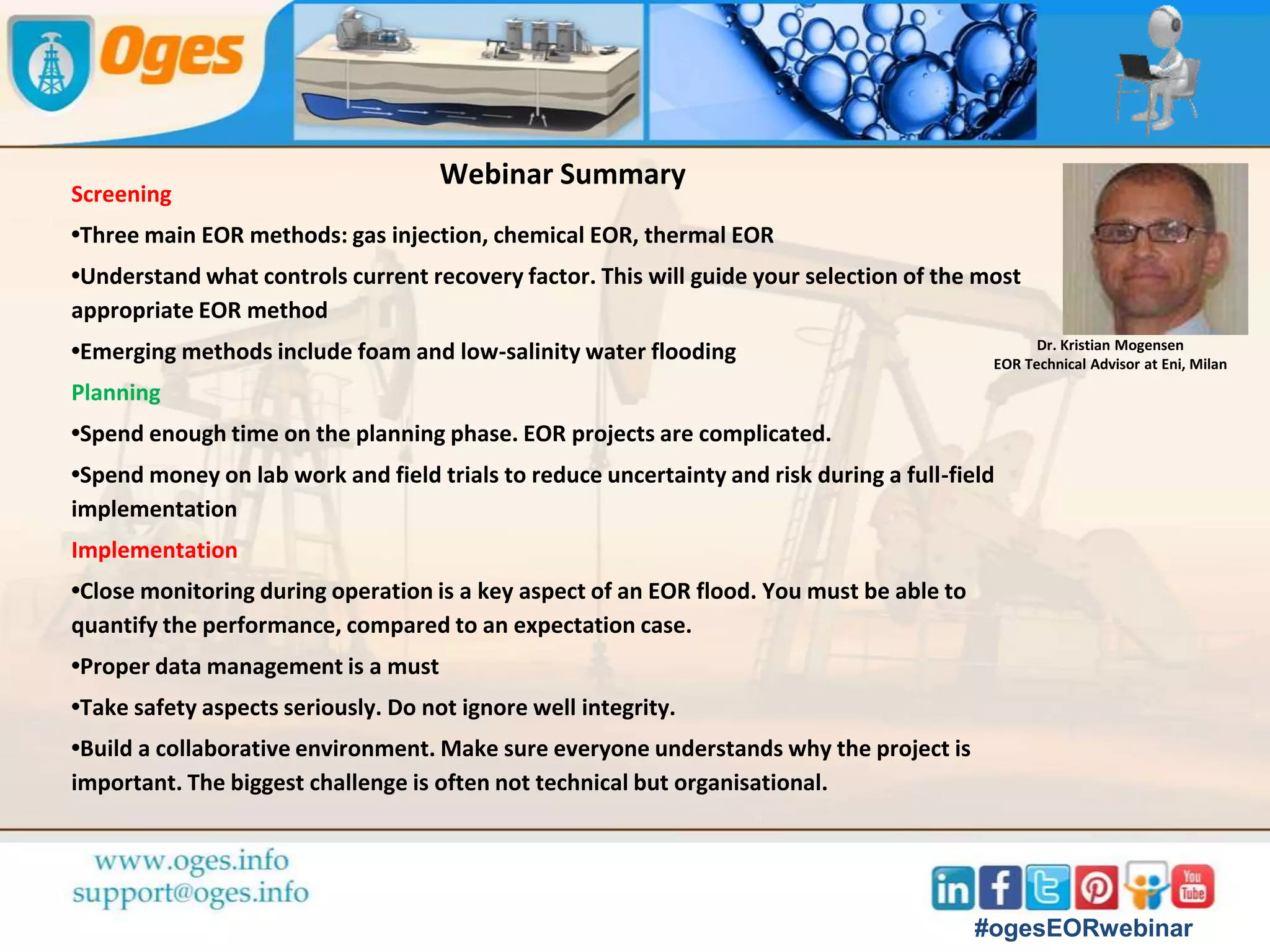
•Three main EOR methods: gas injection, chemical EOR, thermal EOR
•Understand what controls current recovery factor. This will guide your selection of the most
appropriate EOR method
•Emerging methods include foam and low-salinity water flooding
Planning
•Spend enough time on the planning phase. EOR projects are complicated.
•Spend money on lab work and field trials to reduce uncertainty and risk during a full-field
implementation
Implementation
•Close monitoring during operation is a key aspect of an EOR flood. You must be able to
quantify the performance, compared to an expectation case.
•Proper data management is a must
•Take safety aspects seriously. Do not ignore well integrity.
•Build a collaborative environment. Make sure everyone understands why the project is
important. The biggest challenge is often not technical but organisational.
Webinar Summary
Mail to support@oges.info
Tweet to @oges.info with #OgesEORwebinar
Text on GoToWebinar chat
For Questions to Panel
#ogesEORwebinar
Thank You!!
#ogesEORwebinar
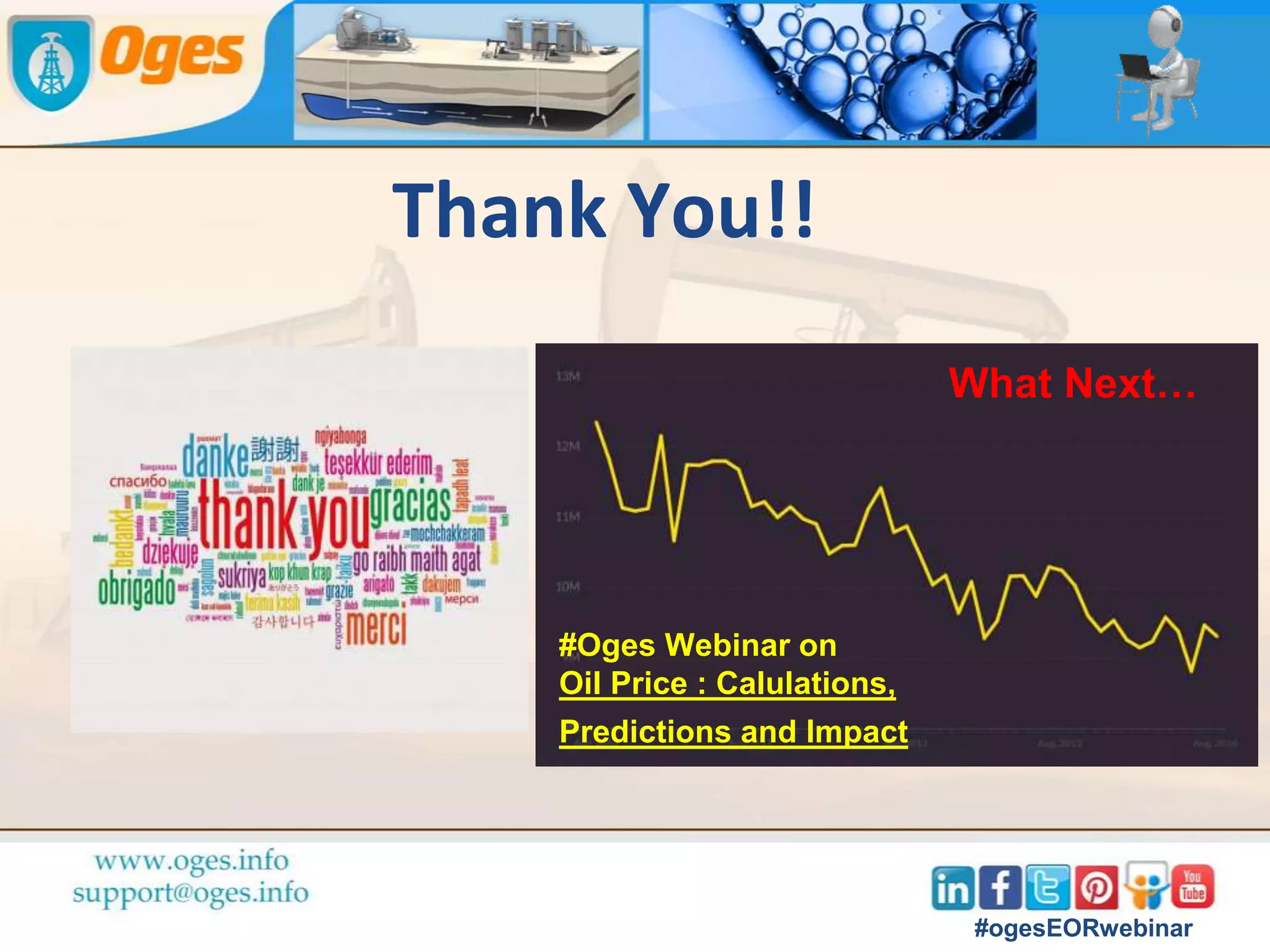
#Oges Webinar on
Oil Price : Calulations,
Predictions and Impact
What Next…
Help Us to Improve
Take our Survey after the Session!
#ogesEORwebinar

#Oges EOR Webinar #Panel Presentation

  • 2.
    © 2016 Oges.infoALL RIGHTS RESERVED #ogesEORwebinar This material has been reproduced and communicated to you by or on behalf Oges G P Ltd. pursuant to Copyright Act. Any tampering with the content or modification or copying without oges logo may be the subject of copyright under the act. Do Not Remove This Notice.
  • 3.
    Welcome Oges Webinar Enhanced OilRecovery: A Solution or Just Another M Method for Current Times #ogesEORwebinar
  • 4.
    Quick Info ● Submityour text questions and comments using the question panel- ● Please raise your hand to be unmuted for verbal questions.In case of ‘less time and many questions’, Panel answers will be mailed to you seperately. ● Recording of the webinar will be available on the oges website (www.oges.info) & youtube channel. ● Polls will be launched for few seconds for the audience to take part. ● Oges Best Question & Oges Best Answer award is applicable to this event too. #ogesEORwebinar
  • 5.
    Quick Info ● Selectedentries to get free trial access to our premium plan. For others: mail to support@oges.info to request a quote. You may also request a training to our support team on any Oil&Gas domain. ● You may reconnect any time using the confirmation mail in your inbox, in case you loose connection. There might be some time lag during slide or presenter change,please bear with us. After the Webinar Please complete our survey before you make an exit #ogesEORwebinar
  • 6.
    Speakers Oges Webinar onEnhanced Oil Recovery Dr. Kristian Mogensen EOR Technical Advisor at Eni, Milan Holger Kinzel MD, Planxty Engineering & Consulting Services GmbH Aninda Ghosh Sr. Reservoir Engineer, ONGC Rajesh Sharma Expert-Production Performace E&P #ogesEORwebinar
  • 7.
    Kristian Mogensen Kristian Mogensenrecently joined ENI SpA as a Technical Advisor for EOR. Prior to moving to Italy, Kristian worked for Maersk Oil for 16 years in various roles with special focus on oil recovery from tight chalk fields in the Danish North Sea and from a giant limestone reservoir in Qatar. From 2010 to 2014 he was responsible for leading the R&D efforts for Maersk Oil on conventional enhanced oil recovery methods such as gas injection and chemical flooding, as well as on more frontier methods involving nano-particles and genetic engineering. Kristian holds MSc and PhD degrees in Chemical Engineering, both from the Technical University of Denmark, has co-authored more than 25 publications and is the co-inventor of some 20 patent applications. He is an Associate Editor for JPSE and a reviewer for SPE REE. #ogesEORwebinar
  • 8.
    Holger Kinzel Holger isthe founder and managing director of Planxty Engineering & Consulting Services GmbH, a Northern Germany based company, offering engineering services, marketing and business development support, assistance as sales agent and representative for selected products and services as well as consulting, optimization, training, coaching, moderation and business mediation. Holger looks back on over 30 years of industry experience in various technical and management positions in the oil and gas industry, working in international assignments for companies such as Weatherford and Preussag. Holger has published over 50 technical papers and given numerous conference presentations. Born 1957, graduated as Diplom-Ingenieur (Germany equivalent to an MSc degree) in Petroleum Engineering and Drilling from the University of Clausthal, Germany. Currently he is in the process of graduating as a Master of Mediation from the University of Hagen. He also is a PhD candidate at the Technical University of Freiberg. #ogesEORwebinar© 2016 by planxty engineering & consulting Services GmbH
  • 9.
    Rajesh Sharma Rajesh isan expert in setting up production facilities and business transformation of E&P upstream leveraging Digital Oil Field and Analytics Technology. He has acquired 32+ years of diverse, multi-functional and extensive experience in managing upstream oil and gas operations, building and managing successful teams leading oil and gas and technology project implementation and championing data-led transformation of business workflows. He has demonstrable expertise in conceptualization, design and implementation of DOF solutions e.g. Collaboration Centers, Production Surveillance, Production Data Management and Big Data Analytics programs. #ogesEORwebinar
  • 10.
    Aninda Ghosh Aninda startedas Engineering Geologist in NTPC Ltd , then worked as Manager (Exploration) in TATA Steel before joining Oil and Natural Gas Corporation Ltd (ONGC Ltd.) as Senior Reservoir Engineer. He brings with him experience in reservoir data acquisition and interpretation, planning and conducting well testing operation, field development planning of onshore and offshore fields, planning of water injection efficacy and reservoir characterization. #ogesEORwebinar
  • 11.
  • 12.
    EOR – WHYAND HOW ▪ Improve recovery by changing o Fluid properties o Fluid-fluid interactions o Fluid-rock interactions ▪ Three contributions to recovery o Microscopic sweep o Areal sweep o Vertical sweep ▪ Mainly applied to o Brown fields o Onshore reservoirs oilwater sand grain Injector Producer Vertical Sweep Areal SweepMicroscopic Sweep #ogesEORwebinar
  • 13.
    ▪ Improve microscopicsweep o Miscibility o Swelling ▪ Reduce oil viscosity ▪ Affects vertical sweep o Displacement of attic oil ▪ Pressure maintenance (not EOR) ▪ Applicable to medium-light oils GAS INJECTION ▪ Poor sweep, early breakthrough o Gravity override o Viscous fingering ▪ Complicated phase behavior ▪ Flow assurance issues o Hydrate formation o Asphaltene precipitation ▪ Safety aspects o Corrosion o Well integrity BENEFITS CHALLENGES #ogesEORwebinar
  • 14.
  • 15.
    ▪ Improve arealsweep o Reduce oil-water viscosity contrast ▪ Improve vertical sweep o Compensate for permeability contrast POLYMER INJECTION ▪ Complicated rheology ▪ Logistics issues in remote locations ▪ Creates oil-water separation problems ▪ Injectivity is reduced ▪ ASP process very difficult to manage ▪ Limited tolerance towards o Multi-valent ions (Ca, Mg, Fe) o Temperature BENEFITS CHALLENGES #ogesEORwebinar
  • 16.
  • 17.
  • 18.
    STEAM-ASSISTED GRAVITY DRAINAGE(SAGD) #ogesEORwebinar
  • 19.
    STEAM-ASSISTED GRAVITY DRAINAGE(SAGD) #ogesEORwebinar
  • 20.
    AIR INJECTION (IN-SITUCOMBUSTION) #ogesEORwebinar
  • 21.
    Simulation & Lab AnalysisScreeningPhase Y1 Y3 Y4 SWCTT Pilot Test Y5 Full Field Implementation Y6+ DEPLOY INTER-WELL FIELD TRIALS SINGLE-WELL CHEMICAL TRACER TESTS LAB WORK (ROCKS, FLUIDS) Adapted from BP Typical Costs 10-100 MM USD 1-10 MM USD 0.3 MM USD 0.2 MM USD The Pyramid of Trust #ogesEORwebinar
  • 22.
  • 23.
    FOAM FOR IMPROVEDCONFORMANCE ▪ Gas dispersed in liquid o Liquid is connected o Gas flow partially blocked ▪ Generated in-situ ▪ Stabilized by o Surfactants (AOS) o Nano-particles (CO2- foams) ▪ Weakened by oil #ogesEORwebinar
  • 24.
    LOW-SALINITY / SMARTWATER IN SANDSTONES Key mechanism is expansion of electrical double-layer releasing oil from surface From SPE 129722 BP field trial in Clair Ridge, North Sea #ogesEORwebinar
  • 25.
    LOW-SALINITY / SMARTWATER IN CARBONATES ▪ Formation water must have low sulphate content ▪ Temperature > 90 C ▪ Injection water must contain divalent ions From Austad et al. (University of Stavanger) REQUIREMENTS FOR CHALK ▪ Dilution of FW works for Saudi limestones #ogesEORwebinar
  • 26.
    EOR METHODS INDEVELOPMENT ▪ Visco-elastic surfactants (Solvay) ▪ Wettability-altering surfactants o Oil-wet carbonates (Dow) ▪ Salinity-tolerant bio-polymers o Schizophyllan (Wintershall) ▪ Nano-particles o Foam stabilization (UT Austin) o Magnetic heating (UT Austin) o Reservoir surveillance (Aramco) ▪ Microbial EOR o Glori Oil, Statoil ▪ Enzymes o Field trials in UAE and Myanmar ▪ Hybrid EOR methods o Low-salinity and polymer (Shell) o Low-salinity and WAG (Shell) o Low-tension gas flooding (UT Austin) ▪ Expanding the operational envelope o Gas injection into heavy oil o Polymer injection in heavy oil #ogesEORwebinar
  • 27.
  • 28.
    PURPOSE OF MONITORINGAND SURVEILLANCE PLAN ▪ Evaluate whether EOR process performs as expected o Expected behavior must be predicted with simulation model o Derive incremental oil from production data and compare with baseline case (typically a waterflood or «do-nothing» scenario) ▪ Reduce uncertainty on parameters with biggest impact on economics o Measure/estimate residual oil saturation, injectivity, heterogeneity, operational constraints o With more accurate parameter sets, simulate optimum use of EOR injectant over project life ▪ Intervene if process does not behave as expected o Early breakthrough, facilities upsets, injectivity problems o Mechanical or chemical water/gas shut-off, chemical inhibition #ogesEORwebinar
  • 29.
    EXAMPLES OF MONITORINGTECHNIQUES ▪ Near-wellbore Monitoring o Fiberglass observation wells o Saturation logs o PLT o Coring o Sampling and analysis of produced fluids o Injectivity tests, pressure transient tests o Single-well chemical tracer test ▪ Field Scale o Interwell gas or water tracers o 4-D seismics o Cross-well EM Continuous data management and analysis is essential Reservoir simulation plays a key role in surveillance #ogesEORwebinar
  • 30.
    EXAMPLES OF ANALYTICALMONITORING TECHNIQUES ▪ Diagnostics Plots per Pattern o Example: Prudhoe Bay, Alaska Derive plots to compare performance of different patterns using fair metrics Incremental EOR Unit volume of Injectant UF = #ogesEORwebinar
  • 31.
    EXAMPLES OF ANALYTICALMONITORING TECHNIQUES ▪ Diagnostics Plots per Pattern o Example: Prudhoe Bay, Alaska Derive plots to compare performance of different patterns using fair metrics Incremental EOR Unit volume of Injectant UF = #ogesEORwebinar
  • 32.
  • 33.
    ▪ Most EORfloods Implemented in Mature Fields o Suboptimal well location designed for depletion or waterflood o Insufficient zonal control (open-hole completions) o Metallurgy not designed with EOR in mind o Corrosion (gas injection) o Temperature (thermal EOR) o Chemical compatibility issues (chemical EOR) o Well-integrity issues (Casing leaks) o Sometimes difficult to get access to the wellhead (offshore) o Costly workovers are sometimes required #ogesEORwebinar #ogesEORwebinar
  • 34.
    #ogesEORwebinar ▪ Considerations forEOR in Green Field Developments o Well placement relative to geological features and relative to other wells o Good zonal isolation o Well integrity (no flow behind casing) o Zonal control from surface (liner, SSD’s, packers) o Metallurgy and seals designed with EOR in mind o Corrosion-resistance o Adequate pressure- and temperature ratings o Ability to easily switch between injectants is crucial for WAG operations o Special chokes required for polymers
  • 35.
    10 LEADING EORSPECIALISTS IN ACADEMIA Sohrabi Mohanty Johns Pope Delshad Blunt WhitsonRossen Kantzas Austad #ogesEORwebinar
  • 36.
    BOOKS ON PHASEBEHAVIOR, GAS INJECTION AND GENERAL EOR #ogesEORwebinar
  • 37.
    Holger Kinzel Holger isthe founder and managing director of Planxty Engineering & Consulting Services GmbH, a Northern Germany based company, offering engineering services, marketing and business development support, assistance as sales agent and representative for selected products and services as well as consulting, optimization, training, coaching, moderation and business mediation. Holger looks back on over 30 years of industry experience in various technical and management positions in the oil and gas industry, working in international assignments for companies such as Weatherford and Preussag. Holger has published over 50 technical papers and given numerous conference presentations. Born 1957, graduated as Diplom-Ingenieur (Germany equivalent to an MSc degree) in Petroleum Engineering and Drilling from the University of Clausthal, Germany. Currently he is in the process of graduating as a Master of Mediation from the University of Hagen. He also is a PhD candidate at the Technical University of Freiberg. #ogesEORwebinar© 2016 by planxty engineering & consulting Services GmbH
  • 38.
    © 2016 byplanxty engineering & consulting Services GmbH Well Integrity • application of technical, operational and organizational solutions to reduce risk of uncontrolled release of formation fluids and well fluids throughout the life cycle of a well
  • 39.
    Well Barrier Principle •envelope of one or several well barrier elements preventing fluids from flowing unintentionally from the formation into the wellbore, into another formation or to the external environment © 2016 by planxty engineering & consulting Services GmbH
  • 40.
    © 2016 byplanxty engineering & consulting Services GmbH Well Barrier Element • a physical element which in itself does not prevent flow but in combination with other Well Barrier Elements forms a well barrier
  • 41.
    © 2016 byplanxty engineering & consulting Services GmbH Two Important Well Barrier Elements • Tubulars • Cement
  • 42.
    © 2016 byplanxty engineering & consulting Services GmbH Leak Tightness • Is my tubular connection design permanently tight throughout the lifetime of the well? • Any connection relying on thread compound for leak tightness (such as API-8rd or Buttress) are only tight temporarily. • This time can be very short!
  • 43.
    © 2016 byplanxty engineering & consulting Services GmbH Corrosion • Is my well design fit for EOR measures such as – High temperature and/or temperature variations (e.g. steam injection)? – Pumping of corrosive fluids such as CO2?
  • 44.
    © 2016 byplanxty engineering & consulting Services GmbH Cement • Do I know what cyclic loads my cement has seen or will see throughout the lifetime of the well? • How does my cement react for example to CO2-injection or thermal cycles? • Lifetime of cement under cyclic loads is limited!
  • 45.
    © 2016 byplanxty engineering & consulting Services GmbH
  • 46.
    Rajesh Sharma Rajesh isan expert in setting up production facilities and business transformation of E&P upstream leveraging Digital Oil Field and Analytics Technology. He has acquired 32+ years of diverse, multi-functional and extensive experience in managing upstream oil and gas operations, building and managing successful teams leading oil and gas and technology project implementation and championing data-led transformation of business workflows. He has demonstrable expertise in conceptualization, design and implementation of DOF solutions e.g. Collaboration Centers, Production Surveillance, Production Data Management and Big Data Analytics programs. #ogesEORwebinar
  • 47.
    ➢ Synergistic modelbetween Reservoir and production required at the outset. ➢ Project team to integrate instrumentation, tools and surveillance systems at the concept stage itself to identify the instrumentation needs, data flow and management system. ➢ O&M team to build and maintain database. Deploy EOR from Early development to field abandonment #ogesEORwebinar
  • 48.
    Digital Oil fieldelements #ogesEORwebinar
  • 49.
    Reservoir data screenedto select optimal EOR method ➢Gather as much reservoir data as possible ➢Develop a coherent package to compare with the screening criteria for various EOR methods. ➢ Laboratory studies to investigate rock and fluid properties, to conduct flow studies. ➢Develop updated static and dynamic reservoir models. ➢Simulate the effects of different EOR methods to choose the optimum one. #ogesEORwebinar
  • 50.
    ➢Set up ateam of experts ➢Build a platform with automated workflows for providing data and information as a single source of truth covering data acquisition ,data validation,repository of past cases of EOR applications. Build a collaborative environment #ogesEORwebinar
  • 51.
    Aninda Ghosh Aninda startedas Engineering Geologist in NTPC Ltd , then worked as Manager (Exploration) in TATA Steel before joining Oil and Natural Gas Corporation Ltd (ONGC Ltd.) as Senior Reservoir Engineer. He brings with him experience in reservoir data acquisition and interpretation, planning and conducting well testing operation, field development planning of onshore and offshore fields, planning of water injection efficacy and reservoir characterization. #ogesEORwebinar
  • 52.
    EOR Screening andApplication in India: An Overview #ogesEORwebinar
  • 53.
  • 54.
    Global EOR ScreeningCriterion Source: Shell EOR Brochure, 2012 Source: SPE 35385 Not all EOR can be applied to everywhere !! #ogesEORwebinar Vertical Thickness proportional to oil Recovery Probelm: Criterion overlapping Zeroing down to specific process difficult Chemical Flood: Large Window Shallow Depth Heavy oil
  • 55.
    Screening Criterion forChemical EOR Micellar, ASP, Alkaline Flooding Polymer Flooding Oil Properties Crude Oil Gravity (oAPI) 20 35 > 15 Viscosity (cp) 35 13 <150 & >10 (Pref <100 & >10) Composition Micellar: Light to Intermediate Hydrocarbons Alkaline: High Acid Number Not Critical Oil Saturation 35 53 50 80 Formation Properties Lithology Siliciclastic Reservoir Siliciclastic Reservoir Net Thickness, (ft) Not Critical Not Critical Average K, (md) 10 450 10 450 Depth, (ft) 3250 9000 < 9000 Temperature (oF) 80 200 200 140 #ogesEORwebinar Changes ROS Does not Change ROS
  • 56.
    Chemical EOR- IndianScenario Result of Polymer Injection pilot in Mangla FieldResult of Polymer Injection in Sanand Field Polymer Flooding: Mangla (Moderate Oil Viscocity) Field by Cairn India Ltd. Sanand(High Mobility Contrast) Field by ONGC Ltd. ASP Flooding : Viraj (High Acid Number), Kalol and Jhalora Field by ONGC Ltd Mangla, Bhagyam and Aisharya Field by Cairn India Ltd. Source : SPE 114878 Source : Cairn Technical Brochure Mangla, Bhagyam, Aishwarya Sanand, Jhalora, Viraj, Kalol #ogesEORwebinar Increase Oil Rate: 300% W/C decrease Oil rate increase
  • 57.
    Screening Criterion forThermal EOR Steam Flood In-Situ Combustion Oil Properties Crude Oil Gravity (oAPI) 8 25 10 27 Viscosity (cp) >100,000 < 5,000 Composition Not Critical But Light End of Steam Distillation Helps Some Asphaltin Component to Aid Coke Formation Formation Properties Oil Saturation > 40 66 > 50 72 Lithology Siliciclastic Reservoir with High Porosity and Permeability Siliciclastic Reservoir with High Porosity Net Thickness, (ft) > 20 > 10 Average K, (md) > 200 > 50 Transmissibility, (md-ft/cp) > 50 > 20 Depth, (ft) < 5,000 < 5,000 Temperature (oF) Not Critical Not Critical #ogesEORwebinar
  • 58.
    Thermal EOR- IndianScenario Steam Flooding: NIL In-situ Combustion: Balol, Santhal, Lanwa Field by ONGC Ltd Balol, Santhal, Lanwa Result of ISC in Balol Field Result of ISC in Santhal Field Source : Petrotech 2010, PaperID: 20100284Source : SPE 114878, 37547 #ogesEORwebinar #ogesEORwebinar Oil Rate: ~ 700 BPD Single Well Oil Rate: ~ 1200 BPD Single Well Porosity: 25-30%, Perm : 1- 5 Darcy Depth : ~1000 m, Oil Viscocity: 1200 cp
  • 59.
    N2 and Flue GasFlood Hydrocarbon Gas Flood (Miscible) CO2 Flood (Miscible) Immiscible Gas Flood Oil Properties Crude Oil Gravity (oAPI) > 35 48 > 23 41 > 22 36 > 12 Viscosity (cp) < 0.4 0.2 < 3 0.5 < 10 1.5 < 600 Composition High Percentage of C1 to C7 High Percentage of C2 to C7 High Percentage of C5 to C12 Not Critical Formation Properties Oil Saturation > 40 75 > 30 80 > 20 55 > 35 70 Lithology Siliciclastic or Carbonate Siliciclastic or Carbonate Siliciclastic or Carbonate Not Critical Net Thickness, (ft) Thin unless dipping Thin unless dipping Wide Range Not Critical if dipping and/or good vertical permeability Average K, (md) Not Critical Not Critical Not Critical Not Critical Depth, (ft) > 6,000 > 4,000 > 2,500 > 1,800 Temperature (oF) Not Critical Not Critical Not Critical Not Critical Screening Criterion for Gas Flood EOR #ogesEORwebinar Very High Microscopic Displacement Efficiency
  • 60.
    Gas Flood EOR-Indian Scenario Miscible Hydrocarbon Gas Flood: Gandhar Field by ONGC Ltd Immiscible Hydrocarbon Gas Flood : Gandhar Field by ONGC Ltd SWAG : Western India Offshore by ONGC Ltd Result of Miscible HC Gas Flood in Gandhar Field Source : ONGC Unpublished Report #ogesEORwebinar Reservoir Depth: 2900 m MMP: 350 KSC Incremental Oil Rate: 4000 BPD Incremental Recovery: 22%
  • 61.
    Screening Criterion forMEOR Oil Properties Crude Oil Gravity (oAPI) > 20 Viscosity (cp) < 20 Composition Not Critical Formation Properties Residual Oil Saturation > 25 Lithology Siliciclastic Reservoir (Preferably) Pressure, KSC < 300 W/C, % 30 90 pH 4 9 (Preferable 6 8 ) Temperature (oC) < 90 #ogesEORwebinar
  • 62.
    Gas Flood EOR-Indian Scenario Applied in few wells of different fields of ONGC Ltd. and OIL Under R&D stage Source : ONGC Unpublished Report Result of MEOR in one well of ONGC Ltd Parameter Pre MEOR Post MEOR Qo, m3/d 3.1 6.6 – 14.5 W/C, % 78 42 - 80 Incremental Oil Gain, m3 0 2300 #ogesEORwebinar
  • 63.
    Dr. Kristian Mogensen EORTechnical Advisor at Eni, Milan #ogesEORwebinar Screening •Three main EOR methods: gas injection, chemical EOR, thermal EOR •Understand what controls current recovery factor. This will guide your selection of the most appropriate EOR method •Emerging methods include foam and low-salinity water flooding Planning •Spend enough time on the planning phase. EOR projects are complicated. •Spend money on lab work and field trials to reduce uncertainty and risk during a full-field implementation Implementation •Close monitoring during operation is a key aspect of an EOR flood. You must be able to quantify the performance, compared to an expectation case. •Proper data management is a must •Take safety aspects seriously. Do not ignore well integrity. •Build a collaborative environment. Make sure everyone understands why the project is important. The biggest challenge is often not technical but organisational. Webinar Summary
  • 64.
    Mail to support@oges.info Tweetto @oges.info with #OgesEORwebinar Text on GoToWebinar chat For Questions to Panel #ogesEORwebinar
  • 65.
    Thank You!! #ogesEORwebinar #Oges Webinaron Oil Price : Calulations, Predictions and Impact What Next…
  • 66.
    Help Us toImprove Take our Survey after the Session! #ogesEORwebinar