A Presentation on
Presented by
Himanshu Rajawat
Submitted to
Dept. of Petroleum Engineering
RTU, Kota
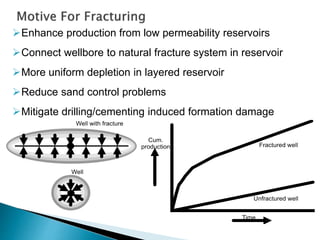
Enhance production from low permeability reservoirs
Connect wellbore to natural fracture system in reservoir
More uniform depletion in layered reservoir
Reduce sand control problems
Mitigate drilling/cementing induced formation damage
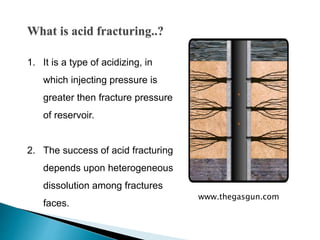
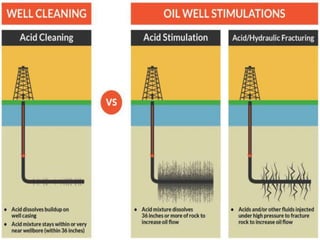
What is acid fracturing..?
1. It is a type of acidizing, in
which injecting pressure is
greater then fracture pressure
of reservoir.
2. The success of acid fracturing
depends upon heterogeneous
dissolution among fractures
faces.
www.thegasgun.com
Mostly used in carbonate reservoirs.
Fracture is initiated with fracturing fluid (gel) called pad.
Suitable acid solution is injected followed by the pad.
Generally less complicated because of no propping agent is
used.
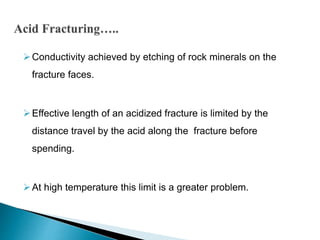
Conductivity achieved by etching of rock minerals on the
fracture faces.
Effective length of an acidized fracture is limited by the
distance travel by the acid along the fracture before
spending.
At high temperature this limit is a greater problem.
Etched fracture penetration and conductivity:
 Conductivity achieved by fracture acidizing is excessive due to
the high reaction rate.
 Conductivity increases considerably when acid forms a deep
channel.
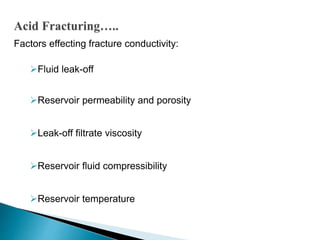
Factors effecting fracture conductivity:
Fluid leak-off
Reservoir permeability and porosity
Leak-off filtrate viscosity
Reservoir fluid compressibility
Reservoir temperature
Factors effecting etched fracture length:
 Fluid leak-off
 Reaction rate
 Reservoir temperature
 Free gas present in the formation
 Above bubble point ------ High etched fracture length
 Below bubble point ------ Low etched fracture length
Aim
To design a treatment schedule for achieving optimum etched
fracture length
A simulator predicts a fracture model based on the
◦ Surface kinetics
◦ Flow and temperature
◦ Fluid loss into fracture faces
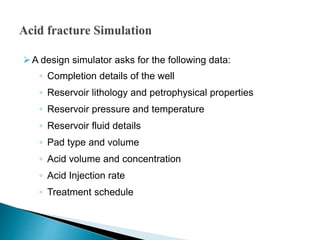
A design simulator asks for the following data:
◦ Completion details of the well
◦ Reservoir lithology and petrophysical properties
◦ Reservoir pressure and temperature
◦ Reservoir fluid details
◦ Pad type and volume
◦ Acid volume and concentration
◦ Acid Injection rate
◦ Treatment schedule
The Challenge
 Acids fractures may close
 Are they limited to closing stresses lesser than 5000 psi?
 Reservoir depletion might accelerate acid fracture collapse
 Propped fracturing stimulation is not an easy task in deep
hard carbonates.
 Undissolved fines can significantly reduce fracture flow
capacity if not remove with spent acid.
 Emulsions can block the etched fracture.
Hydrochloric acid (Hcl)
Acetic acid (HAc)
Formic acid
Hydrofluoric (HF)
 Surfactants
 Suspending Agents
 Anti-Sludge Agents
 Corrosion inhibitors
 Alcohol
 Fluid Loss Control Agents
Additives Used……
Applications
 It is widely cited that sixty percent of the world’s oil and forty
percent of the world’s gas reserves are held in carbonate
reservoirs
 Many world-class reservoirs are deep (TVD > 10000 ft)
and hard carbonates (E > 4 ×10⁶psi)
Acid Fracturing Stimulation

Acid Fracturing Stimulation

  • 1.
    A Presentation on Presentedby Himanshu Rajawat Submitted to Dept. of Petroleum Engineering RTU, Kota
  • 2.
    Enhance production fromlow permeability reservoirs Connect wellbore to natural fracture system in reservoir More uniform depletion in layered reservoir Reduce sand control problems Mitigate drilling/cementing induced formation damage
  • 3.
    What is acidfracturing..? 1. It is a type of acidizing, in which injecting pressure is greater then fracture pressure of reservoir. 2. The success of acid fracturing depends upon heterogeneous dissolution among fractures faces. www.thegasgun.com
  • 4.
    Mostly used incarbonate reservoirs. Fracture is initiated with fracturing fluid (gel) called pad. Suitable acid solution is injected followed by the pad. Generally less complicated because of no propping agent is used.
  • 6.
    Conductivity achieved byetching of rock minerals on the fracture faces. Effective length of an acidized fracture is limited by the distance travel by the acid along the fracture before spending. At high temperature this limit is a greater problem.
  • 7.
    Etched fracture penetrationand conductivity:  Conductivity achieved by fracture acidizing is excessive due to the high reaction rate.  Conductivity increases considerably when acid forms a deep channel.
  • 8.
    Factors effecting fractureconductivity: Fluid leak-off Reservoir permeability and porosity Leak-off filtrate viscosity Reservoir fluid compressibility Reservoir temperature
  • 9.
    Factors effecting etchedfracture length:  Fluid leak-off  Reaction rate  Reservoir temperature  Free gas present in the formation  Above bubble point ------ High etched fracture length  Below bubble point ------ Low etched fracture length
  • 10.
    Aim To design atreatment schedule for achieving optimum etched fracture length A simulator predicts a fracture model based on the ◦ Surface kinetics ◦ Flow and temperature ◦ Fluid loss into fracture faces
  • 11.
    A design simulatorasks for the following data: ◦ Completion details of the well ◦ Reservoir lithology and petrophysical properties ◦ Reservoir pressure and temperature ◦ Reservoir fluid details ◦ Pad type and volume ◦ Acid volume and concentration ◦ Acid Injection rate ◦ Treatment schedule
  • 12.
    The Challenge  Acidsfractures may close  Are they limited to closing stresses lesser than 5000 psi?  Reservoir depletion might accelerate acid fracture collapse  Propped fracturing stimulation is not an easy task in deep hard carbonates.  Undissolved fines can significantly reduce fracture flow capacity if not remove with spent acid.  Emulsions can block the etched fracture.
  • 13.
    Hydrochloric acid (Hcl) Aceticacid (HAc) Formic acid Hydrofluoric (HF)  Surfactants  Suspending Agents  Anti-Sludge Agents  Corrosion inhibitors  Alcohol  Fluid Loss Control Agents Additives Used……
  • 14.
    Applications  It iswidely cited that sixty percent of the world’s oil and forty percent of the world’s gas reserves are held in carbonate reservoirs  Many world-class reservoirs are deep (TVD > 10000 ft) and hard carbonates (E > 4 ×10⁶psi)