WATER RESOURCES
GRADE –X
PREPARED BY SACHIN SREEDHRAN
TGT –SOCIAL SCIENCE
THE INDIAN PUBLIC SCHOOL,ERODE
Learning outcomes
• Examine the reasons for conservation of water
resource in India.
• Analyze and infer how the Multi-purpose
projects are supporting the requirement of
water in India.
Introduction
• Three-fourth of the earth’s surface is covered
with water, but only a small proportion of it
accounts for freshwater that can be put to use.
• This freshwater is mainly obtained from surface
run off and ground water that is continually being
renewed and recharged through the hydrological
cycle.
• All water moves within the hydrological cycle
ensuring that water is a renewable resource.
Causes of water scarcity
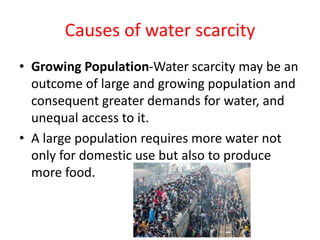
• Growing Population-Water scarcity may be an
outcome of large and growing population and
consequent greater demands for water, and
unequal access to it.
• A large population requires more water not
only for domestic use but also to produce
more food.
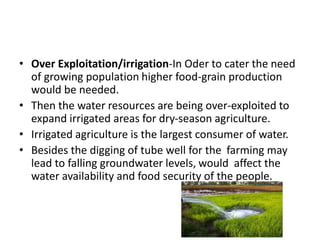
• Over Exploitation/irrigation-In Oder to cater the need
of growing population higher food-grain production
would be needed.
• Then the water resources are being over-exploited to
expand irrigated areas for dry-season agriculture.
• Irrigated agriculture is the largest consumer of water.
• Besides the digging of tube well for the farming may
lead to falling groundwater levels, would affect the
water availability and food security of the people.
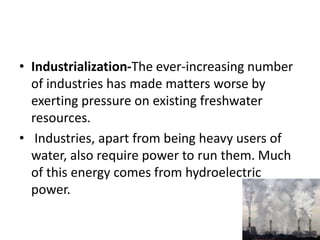
• Industrialization-The ever-increasing number
of industries has made matters worse by
exerting pressure on existing freshwater
resources.
• Industries, apart from being heavy users of
water, also require power to run them. Much
of this energy comes from hydroelectric
power.
• Urbanization-Multiplying urban centers with
large and dense populations and urban lifestyles
have added water scarcity and energy
requirement problems.
• Most of the housing societies or colonies in the
cities, have their own groundwater pumping
devices to meet their water needs.
• Fragile water resources are being over-exploited
and caused their depletion in these cities
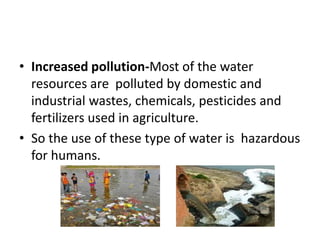
• Increased pollution-Most of the water
resources are polluted by domestic and
industrial wastes, chemicals, pesticides and
fertilizers used in agriculture.
• So the use of these type of water is hazardous
for humans.
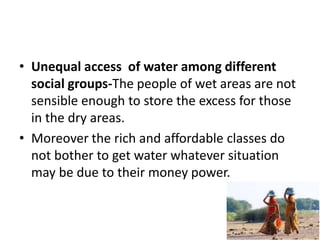
• Unequal access of water among different
social groups-The people of wet areas are not
sensible enough to store the excess for those
in the dry areas.
• Moreover the rich and affordable classes do
not bother to get water whatever situation
may be due to their money power.
The need to conserve and manage our
water resources.
• To safeguard ourselves from health hazards,
• To ensure food security, continuation of our
livelihoods and productive activities .
• To prevent degradation of our natural
ecosystems.
• Over exploitation and mismanagement of
water resources will impoverish water
resource and cause ecological crisis.
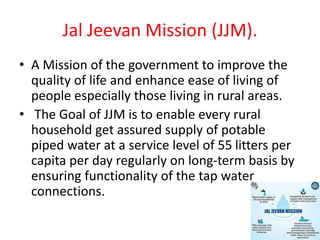
Jal Jeevan Mission (JJM).
• A Mission of the government to improve the
quality of life and enhance ease of living of
people especially those living in rural areas.
• The Goal of JJM is to enable every rural
household get assured supply of potable
piped water at a service level of 55 litters per
capita per day regularly on long-term basis by
ensuring functionality of the tap water
connections.
The pollution in Indian rivers
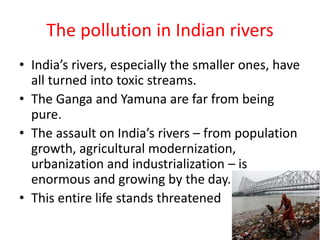
• India’s rivers, especially the smaller ones, have
all turned into toxic streams.
• The Ganga and Yamuna are far from being
pure.
• The assault on India’s rivers – from population
growth, agricultural modernization,
urbanization and industrialization – is
enormous and growing by the day.
• This entire life stands threatened
The hydraulic structures as part of
water management programmes
initiated in ancient India
• From ancient times onwards sophisticated
hydraulic structures like dams built of stone
rubble, reservoirs or lakes, embankments and
canals for irrigation.
• In the first century B.C., Sringaverapura near
Allahabad had sophisticated water harvesting
system channeling the flood water of the river
Ganga.
• During the time of Chandragupta Maurya, dams,
lakes and irrigation systems were extensively built.
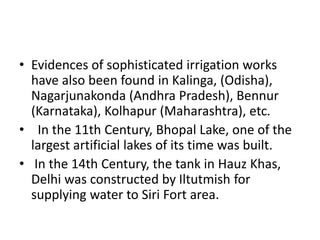
• Evidences of sophisticated irrigation works
have also been found in Kalinga, (Odisha),
Nagarjunakonda (Andhra Pradesh), Bennur
(Karnataka), Kolhapur (Maharashtra), etc.
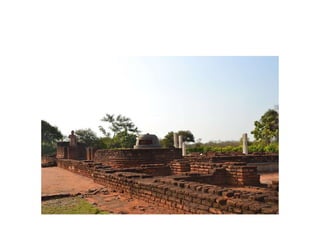
• In the 11th Century, Bhopal Lake, one of the
largest artificial lakes of its time was built.
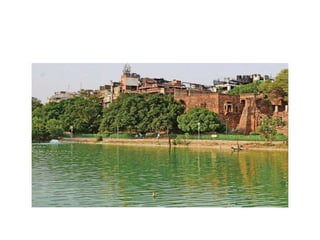
• In the 14th Century, the tank in Hauz Khas,
Delhi was constructed by Iltutmish for
supplying water to Siri Fort area.
Dam
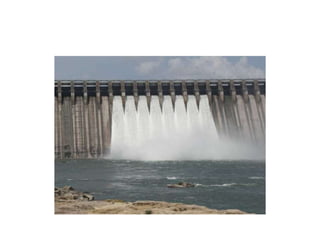
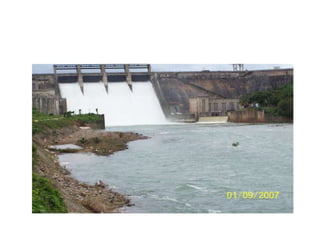
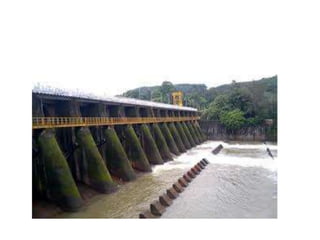
• A dam is a barrier across flowing water that
obstructs, directs or retards the flow, often
creating a reservoir, lake or impoundment.
• “Dam” refers to the reservoir rather than the
structure.
• Most dams have a section called a spillway or
weir over which or through which it is
intended that water will flow either
intermittently or continuously.
Classification of dams
• Dams are classified according to structure,
intended purpose or height.
• Based on structure and the materials -used,
dams are classified as timber dams, embankment
dams or masonry dams, with several subtypes.
• According to the height, -dams can be
categorized as large dams and major dams or
alternatively as low dams, medium height dams
and high dams.
Advantages of multi purpose
dams/Projects
• Irrigation-Dams were traditionally built to
impound rivers and rainwater that could be
used later to irrigate agricultural fields.
• Water supply for domestic and industrial
uses-The water released from the dam can be
used for domestic purposes and Industrial
purposes.
• Flood control-Dams prevent the huge amount of
water and normal water flowing into the rivers.
• Recreation-The tourists themselves by boating
and tourist resorts are developed there for the
recreation purpose.
• Inland navigation- The multi purpose river valley
projects provide us man-made lakes,reserviours
and cannals.We often use them in navigation.
• Fish breeding-The lakes,reserviours and canals
provide an ideal conditions for the breeding of
fish.
Why the dams are known as multi
purpose projects?
• Dams are now referred to as multi-purpose
projects where the many uses of the impounded
water are integrated with one another.
• The Sutluj-Beas river basin, the Bhakra – Nangal
project water is being used both for hydel power
production and irrigation.
• The Hirakud project in the Mahanadi basin
integrates conservation of water with flood
control.
Dams as the “temples of modern
India”-Jawaharlal Nehru
• Multi-purpose projects, launched after Independence
with their integrated water resources management
approach, were thought of as the vehicle that would
lead the nation to development and progress,
overcoming the backwardness in colonial past.
• Jawaharlal Nehru proudly proclaimed the dams as the
‘temples of modern India’; the reason being that it
would integrate development of agriculture and the
village economy with rapid industrialization and
growth of the urban economy.
“In recent years, multi-purpose
projects and large dams have come
under great scrutiny and opposition
for a variety of reasons. "Explain
• Regulating and damming of rivers affect their
natural flow causing poor sediment flow and
excessive sedimentation at the bottom of the
reservoir, resulting in rockier stream beds and
poorer habitats for the rivers’ aquatic life.
• Dams fragment rivers making it difficult for
aquatic fauna to migrate, especially for
breeding.
• Reservoirs that are created on the floodplains
also submerge the existing vegetation and soil
leading to its decomposition over a period of
time
• Due to the construction of dams the indigenous
people have to live their home land. It create an
lost of their livelihood.
• Sedimentation ,flood plains were deprived of silt,
a natural fertilizer, further adding on to the
problem of land degradation.
• The multi-purpose projects induced earthquakes,
caused water-borne diseases and pests and
pollution resulting from excessive use of water.
“Multi-purpose projects and large
dams have also been the cause of
many new environmental movements.
Explain”
• Multi-purpose projects and large dams have been
cause of many new environmental movements like the
‘Narmada Bachao Andolan’ and the ‘Tehri Dam
Andolan’ etc.
• Resistance to these projects has primarily due to the
large-scale displacement of local communities.
• Local people often had to give up their land, livelihood
and their meagre access and control over resources for
the greater good of the nation.
Sardar Sarovar Dam
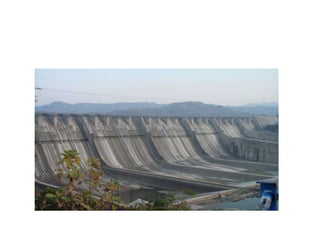
• Sardar Sarovar Dam has been built over the
Narmada River in Gujarat.
• Largest water resource projects of India
covering four states—Maharashtra, Madhya
Pradesh, Gujarat and Rajasthan.
• The Sardar Sarovar project would meet the
requirement of water in drought-prone and
desert areas of Gujarat (9,490 villages and 173
towns) and Rajasthan (124 villages).
Narmada Bachao Andolan or Save
Narmada Movement
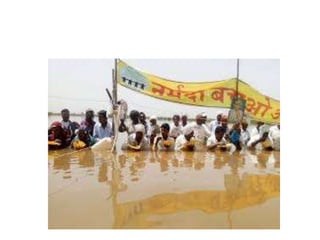
• Narmada Bachao Andolan or Save Narmada Movement
is a Non Governmental Organisation (NGO) that
mobilised tribal people, farmers, environmentalists and
human rights activists against the Sardar Sarovar Dam
being built across the Narmada river in Gujarat.
• It focused on the environmental issues related to trees
that would be submerged under the dam water.
• It has re-focused the aim to enable poor citizens,
especially the oustees (displaced people) to get full
rehabilitation facilities from the government
The problems associated with the
construction of dams
• Irrigation has also changed the cropping pattern of many regions
with farmers shifting to water intensive and commercial crops.
• It created ecological consequences like salinization of the soil.
• It has transformed the social landscape i.e. increasing the social
gap between the richer landowners and the landless poor.
• The dams did create conflicts between people wanting different
uses and benefits from the same water resources.
• In Gujarat, the Sabarmati-basin farmers were agitated and almost
caused a riot over the higher priority given to water supply in urban
areas, particularly during droughts.
• Inter-state water disputes are also becoming common with regard
to sharing the costs and benefits of the multi-purpose project.
“Most of the objections to the projects
arose due to their failure to achieve
the purposes for which they were
built”Explain
• The dams that were constructed to control floods have
triggered floods due to sedimentation in the reservoir.
• The big dams have mostly been unsuccessful in
controlling floods at the time of excessive rainfall.
• Example -The release of water from dams during heavy
rains aggravated the flood situation in Maharashtra
and Gujarat in 2006.
• The floods have devastated life and property but also
caused extensive soil erosion.
• Sedimentation ,flood plains were deprived of
silt, a natural fertilizer, further adding on to
the problem of land degradation.
• The multi-purpose projects induced
earthquakes, caused water-borne diseases
and pests and pollution resulting from
excessive use of water.
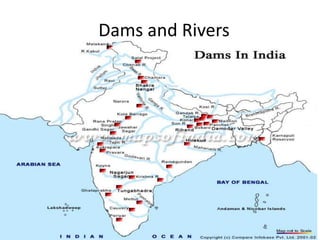
Dams and Rivers
Ironical situation
• Constructed to control floods have triggered
floods due to sedimentation in the reservoir
• Mostly been unsuccessful in controlling floods
at the time of excessive rainfall
• Extensive soil erosion
• Land degradation
• Induced Earthquakes
• Caused Water-borne diseases
Why are different water harvesting
systems considered a viable alternative
both socio-economically and
environmentally in country like India?
• In ancient India, along with the sophisticated hydraulic
structures, there existed an extraordinary tradition of
water-harvesting system.
• People had in-depth knowledge of rainfall regimes and
soil types and developed wide ranging techniques to
harvest rainwater, groundwater, river water and flood
water in keeping with the local ecological conditions
and their water needs.
• In hill and mountainous regions, people built diversion
channels like the ‘guls’ or ‘kuls’ of the Western Himalayas
for agriculture.
• ‘Rooftop rainwater harvesting’ was commonly practised to
store drinking water, particularly in Rajasthan.
• In the flood plains of Bengal, people developed inundation
channels toirrigate their fields.
• In arid and semi-arid regions, agricultural fields were
converted into rain fed storage structures that allowed the
water to stand and moisten the soil like the ‘khadins’ in
Jaisalmer and ‘Johads’ in other parts of Rajasthan.
Traditional rain water harvesting
systems in India.
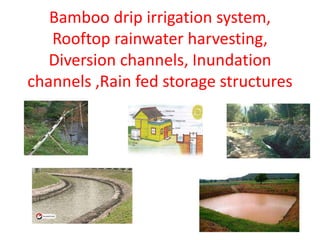
• Diversion channels-In hill and mountainous
regions, people built diversion channels like the
‘guls’ or ‘kuls’ of the Western Himalayas for
agriculture.
• Rooftop rainwater harvesting- was commonly
practiced to store drinking water, particularly in
Rajasthan.
• Inundation channels -In the flood plains of
Bengal, people developed inundation channels to
irrigate their fields.
• Rain fed storage structures - In arid and semi-arid
regions, agricultural fields were converted into
rain fed storage structures that allowed the water
to stand and moisten the soil like the ‘khadins’ in
Jaisalmer and ‘Johads’ in other parts of
Rajasthan.
• Bamboo drip irrigation system- It is a very old
system in Meghalaya. In this system water of
streams and springs is being transported to
through bamboo pipes to lower reaches by
gravity.
Bamboo drip irrigation system,
Rooftop rainwater harvesting,
Diversion channels, Inundation
channels ,Rain fed storage structures
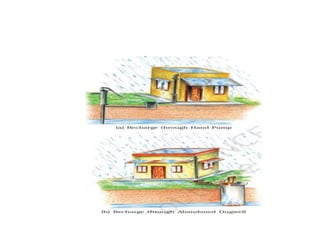
How does the rain water is harvested ?
• Rooftop rainwater is collected using a PVC pipe
• Filtered using sand and bricks
• Underground pipe takes water to sump for
immediate usage
• Excess water from the sump is taken to the
well
• Water from the well recharges the
underground
• Take water from the well (later)
The rain water harvesting in semi-arid
regions of Rajasthan
• In the semi-arid and arid regions of Rajasthan,
particularly in Bikaner, Phalodi and Barmer, almost all
the houses traditionally had underground tanks or
tankas for storing drinking water.
• The tanks could be as large as a big room; one
household in Phalodi had a tank that was 6.1 metres
deep, 4.27 metres long and 2.44 metres wide.
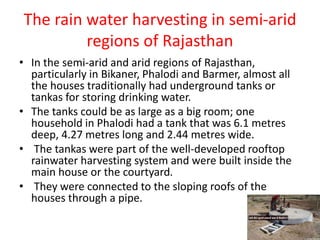
• The tankas were part of the well-developed rooftop
rainwater harvesting system and were built inside the
main house or the courtyard.
• They were connected to the sloping roofs of the
houses through a pipe.
• Rain falling on the rooftops would travel down
the pipe and was stored in these underground
‘tankas’.
• The first spell of rain was usually not collected
as this would clean the roofs and the pipes.
• The rainwater from the subsequent showers
was then collected.
• The rainwater can be stored in the tankas till
the next rainfall making it an extremely
reliable source of drinking water when all
other sources are dried up, in the summers.
• Many houses constructed underground rooms
adjoining the ‘tanka’ to beat the summer heat
as it would keep the room cool.
Rooftop rainwater harvesting at
present Rajasthan
• Today, in western Rajasthan, sadly the practice
of rooftop rainwater harvesting is on the
decline .
• Because plenty of water is available due to
the perennial Indira Gandhi Canal.
• But some houses are still maintain the tankas
since they do not like the taste of tap water.
“In many parts of rural and urban
India, rooftop rainwater harvesting is
being successfully adapted to store
and conserve water”
• In Gendathur, a remote backward village in Mysuru, Karnataka,
villagers have installed, in their household’s rooftop, rainwater
harvesting system to meet their water needs.
• Nearly 200 households have installed this system and the village
has earned the rare distinction of being rich in rainwater.
• Gendathur receives an annual precipitation of 1,000 mm, and with
80 per cent of collection efficiency and of about 10 fillings, every
house can collect and use about 50,000 litres of water annually.
• From the 200 houses, the net amount of rainwater harvested
annually amounts to 1,00,000 litres.
Rooftop rainwater harvesting in
Meghalaya
• Rooftop rainwater harvesting is the most
common practice in Shillong, Meghalaya.
• Cherapunjee and Mawsynram receive the
highest rainfall in the world, yet the state capital
Shillong faces acute shortage of water.
• Nearly every household in the city has a rooftop
rainwater harvesting structure.
• Nearly 15-25 per cent of the total water
requirement of the household comes from
rooftop water harvesting.
WATER RESOURCES -CLASS X.pptx

WATER RESOURCES -CLASS X.pptx

  • 1.
    WATER RESOURCES GRADE –X PREPAREDBY SACHIN SREEDHRAN TGT –SOCIAL SCIENCE THE INDIAN PUBLIC SCHOOL,ERODE
  • 2.
    Learning outcomes • Examinethe reasons for conservation of water resource in India. • Analyze and infer how the Multi-purpose projects are supporting the requirement of water in India.
  • 4.
    Introduction • Three-fourth ofthe earth’s surface is covered with water, but only a small proportion of it accounts for freshwater that can be put to use. • This freshwater is mainly obtained from surface run off and ground water that is continually being renewed and recharged through the hydrological cycle. • All water moves within the hydrological cycle ensuring that water is a renewable resource.
  • 5.
    Causes of waterscarcity • Growing Population-Water scarcity may be an outcome of large and growing population and consequent greater demands for water, and unequal access to it. • A large population requires more water not only for domestic use but also to produce more food.
  • 6.
    • Over Exploitation/irrigation-InOder to cater the need of growing population higher food-grain production would be needed. • Then the water resources are being over-exploited to expand irrigated areas for dry-season agriculture. • Irrigated agriculture is the largest consumer of water. • Besides the digging of tube well for the farming may lead to falling groundwater levels, would affect the water availability and food security of the people.
  • 7.
    • Industrialization-The ever-increasingnumber of industries has made matters worse by exerting pressure on existing freshwater resources. • Industries, apart from being heavy users of water, also require power to run them. Much of this energy comes from hydroelectric power.
  • 8.
    • Urbanization-Multiplying urbancenters with large and dense populations and urban lifestyles have added water scarcity and energy requirement problems. • Most of the housing societies or colonies in the cities, have their own groundwater pumping devices to meet their water needs. • Fragile water resources are being over-exploited and caused their depletion in these cities
  • 9.
    • Increased pollution-Mostof the water resources are polluted by domestic and industrial wastes, chemicals, pesticides and fertilizers used in agriculture. • So the use of these type of water is hazardous for humans.
  • 10.
    • Unequal accessof water among different social groups-The people of wet areas are not sensible enough to store the excess for those in the dry areas. • Moreover the rich and affordable classes do not bother to get water whatever situation may be due to their money power.
  • 11.
    The need toconserve and manage our water resources. • To safeguard ourselves from health hazards, • To ensure food security, continuation of our livelihoods and productive activities . • To prevent degradation of our natural ecosystems. • Over exploitation and mismanagement of water resources will impoverish water resource and cause ecological crisis.
  • 12.
    Jal Jeevan Mission(JJM). • A Mission of the government to improve the quality of life and enhance ease of living of people especially those living in rural areas. • The Goal of JJM is to enable every rural household get assured supply of potable piped water at a service level of 55 litters per capita per day regularly on long-term basis by ensuring functionality of the tap water connections.
  • 13.
    The pollution inIndian rivers • India’s rivers, especially the smaller ones, have all turned into toxic streams. • The Ganga and Yamuna are far from being pure. • The assault on India’s rivers – from population growth, agricultural modernization, urbanization and industrialization – is enormous and growing by the day. • This entire life stands threatened
  • 14.
    The hydraulic structuresas part of water management programmes initiated in ancient India • From ancient times onwards sophisticated hydraulic structures like dams built of stone rubble, reservoirs or lakes, embankments and canals for irrigation. • In the first century B.C., Sringaverapura near Allahabad had sophisticated water harvesting system channeling the flood water of the river Ganga. • During the time of Chandragupta Maurya, dams, lakes and irrigation systems were extensively built.
  • 17.
    • Evidences ofsophisticated irrigation works have also been found in Kalinga, (Odisha), Nagarjunakonda (Andhra Pradesh), Bennur (Karnataka), Kolhapur (Maharashtra), etc. • In the 11th Century, Bhopal Lake, one of the largest artificial lakes of its time was built. • In the 14th Century, the tank in Hauz Khas, Delhi was constructed by Iltutmish for supplying water to Siri Fort area.
  • 21.
    Dam • A damis a barrier across flowing water that obstructs, directs or retards the flow, often creating a reservoir, lake or impoundment. • “Dam” refers to the reservoir rather than the structure. • Most dams have a section called a spillway or weir over which or through which it is intended that water will flow either intermittently or continuously.
  • 23.
    Classification of dams •Dams are classified according to structure, intended purpose or height. • Based on structure and the materials -used, dams are classified as timber dams, embankment dams or masonry dams, with several subtypes. • According to the height, -dams can be categorized as large dams and major dams or alternatively as low dams, medium height dams and high dams.
  • 27.
    Advantages of multipurpose dams/Projects • Irrigation-Dams were traditionally built to impound rivers and rainwater that could be used later to irrigate agricultural fields. • Water supply for domestic and industrial uses-The water released from the dam can be used for domestic purposes and Industrial purposes.
  • 28.
    • Flood control-Damsprevent the huge amount of water and normal water flowing into the rivers. • Recreation-The tourists themselves by boating and tourist resorts are developed there for the recreation purpose. • Inland navigation- The multi purpose river valley projects provide us man-made lakes,reserviours and cannals.We often use them in navigation. • Fish breeding-The lakes,reserviours and canals provide an ideal conditions for the breeding of fish.
  • 29.
    Why the damsare known as multi purpose projects? • Dams are now referred to as multi-purpose projects where the many uses of the impounded water are integrated with one another. • The Sutluj-Beas river basin, the Bhakra – Nangal project water is being used both for hydel power production and irrigation. • The Hirakud project in the Mahanadi basin integrates conservation of water with flood control.
  • 30.
    Dams as the“temples of modern India”-Jawaharlal Nehru • Multi-purpose projects, launched after Independence with their integrated water resources management approach, were thought of as the vehicle that would lead the nation to development and progress, overcoming the backwardness in colonial past. • Jawaharlal Nehru proudly proclaimed the dams as the ‘temples of modern India’; the reason being that it would integrate development of agriculture and the village economy with rapid industrialization and growth of the urban economy.
  • 31.
    “In recent years,multi-purpose projects and large dams have come under great scrutiny and opposition for a variety of reasons. "Explain • Regulating and damming of rivers affect their natural flow causing poor sediment flow and excessive sedimentation at the bottom of the reservoir, resulting in rockier stream beds and poorer habitats for the rivers’ aquatic life.
  • 32.
    • Dams fragmentrivers making it difficult for aquatic fauna to migrate, especially for breeding. • Reservoirs that are created on the floodplains also submerge the existing vegetation and soil leading to its decomposition over a period of time
  • 33.
    • Due tothe construction of dams the indigenous people have to live their home land. It create an lost of their livelihood. • Sedimentation ,flood plains were deprived of silt, a natural fertilizer, further adding on to the problem of land degradation. • The multi-purpose projects induced earthquakes, caused water-borne diseases and pests and pollution resulting from excessive use of water.
  • 34.
    “Multi-purpose projects andlarge dams have also been the cause of many new environmental movements. Explain” • Multi-purpose projects and large dams have been cause of many new environmental movements like the ‘Narmada Bachao Andolan’ and the ‘Tehri Dam Andolan’ etc. • Resistance to these projects has primarily due to the large-scale displacement of local communities. • Local people often had to give up their land, livelihood and their meagre access and control over resources for the greater good of the nation.
  • 35.
    Sardar Sarovar Dam •Sardar Sarovar Dam has been built over the Narmada River in Gujarat. • Largest water resource projects of India covering four states—Maharashtra, Madhya Pradesh, Gujarat and Rajasthan. • The Sardar Sarovar project would meet the requirement of water in drought-prone and desert areas of Gujarat (9,490 villages and 173 towns) and Rajasthan (124 villages).
  • 36.
    Narmada Bachao Andolanor Save Narmada Movement • Narmada Bachao Andolan or Save Narmada Movement is a Non Governmental Organisation (NGO) that mobilised tribal people, farmers, environmentalists and human rights activists against the Sardar Sarovar Dam being built across the Narmada river in Gujarat. • It focused on the environmental issues related to trees that would be submerged under the dam water. • It has re-focused the aim to enable poor citizens, especially the oustees (displaced people) to get full rehabilitation facilities from the government
  • 38.
    The problems associatedwith the construction of dams • Irrigation has also changed the cropping pattern of many regions with farmers shifting to water intensive and commercial crops. • It created ecological consequences like salinization of the soil. • It has transformed the social landscape i.e. increasing the social gap between the richer landowners and the landless poor. • The dams did create conflicts between people wanting different uses and benefits from the same water resources. • In Gujarat, the Sabarmati-basin farmers were agitated and almost caused a riot over the higher priority given to water supply in urban areas, particularly during droughts. • Inter-state water disputes are also becoming common with regard to sharing the costs and benefits of the multi-purpose project.
  • 39.
    “Most of theobjections to the projects arose due to their failure to achieve the purposes for which they were built”Explain • The dams that were constructed to control floods have triggered floods due to sedimentation in the reservoir. • The big dams have mostly been unsuccessful in controlling floods at the time of excessive rainfall. • Example -The release of water from dams during heavy rains aggravated the flood situation in Maharashtra and Gujarat in 2006. • The floods have devastated life and property but also caused extensive soil erosion.
  • 40.
    • Sedimentation ,floodplains were deprived of silt, a natural fertilizer, further adding on to the problem of land degradation. • The multi-purpose projects induced earthquakes, caused water-borne diseases and pests and pollution resulting from excessive use of water.
  • 41.
  • 42.
    Ironical situation • Constructedto control floods have triggered floods due to sedimentation in the reservoir • Mostly been unsuccessful in controlling floods at the time of excessive rainfall • Extensive soil erosion • Land degradation • Induced Earthquakes • Caused Water-borne diseases
  • 43.
    Why are differentwater harvesting systems considered a viable alternative both socio-economically and environmentally in country like India? • In ancient India, along with the sophisticated hydraulic structures, there existed an extraordinary tradition of water-harvesting system. • People had in-depth knowledge of rainfall regimes and soil types and developed wide ranging techniques to harvest rainwater, groundwater, river water and flood water in keeping with the local ecological conditions and their water needs.
  • 44.
    • In hilland mountainous regions, people built diversion channels like the ‘guls’ or ‘kuls’ of the Western Himalayas for agriculture. • ‘Rooftop rainwater harvesting’ was commonly practised to store drinking water, particularly in Rajasthan. • In the flood plains of Bengal, people developed inundation channels toirrigate their fields. • In arid and semi-arid regions, agricultural fields were converted into rain fed storage structures that allowed the water to stand and moisten the soil like the ‘khadins’ in Jaisalmer and ‘Johads’ in other parts of Rajasthan.
  • 45.
    Traditional rain waterharvesting systems in India. • Diversion channels-In hill and mountainous regions, people built diversion channels like the ‘guls’ or ‘kuls’ of the Western Himalayas for agriculture. • Rooftop rainwater harvesting- was commonly practiced to store drinking water, particularly in Rajasthan. • Inundation channels -In the flood plains of Bengal, people developed inundation channels to irrigate their fields.
  • 46.
    • Rain fedstorage structures - In arid and semi-arid regions, agricultural fields were converted into rain fed storage structures that allowed the water to stand and moisten the soil like the ‘khadins’ in Jaisalmer and ‘Johads’ in other parts of Rajasthan. • Bamboo drip irrigation system- It is a very old system in Meghalaya. In this system water of streams and springs is being transported to through bamboo pipes to lower reaches by gravity.
  • 47.
    Bamboo drip irrigationsystem, Rooftop rainwater harvesting, Diversion channels, Inundation channels ,Rain fed storage structures
  • 48.
    How does therain water is harvested ? • Rooftop rainwater is collected using a PVC pipe • Filtered using sand and bricks • Underground pipe takes water to sump for immediate usage • Excess water from the sump is taken to the well • Water from the well recharges the underground • Take water from the well (later)
  • 50.
    The rain waterharvesting in semi-arid regions of Rajasthan • In the semi-arid and arid regions of Rajasthan, particularly in Bikaner, Phalodi and Barmer, almost all the houses traditionally had underground tanks or tankas for storing drinking water. • The tanks could be as large as a big room; one household in Phalodi had a tank that was 6.1 metres deep, 4.27 metres long and 2.44 metres wide. • The tankas were part of the well-developed rooftop rainwater harvesting system and were built inside the main house or the courtyard. • They were connected to the sloping roofs of the houses through a pipe.
  • 51.
    • Rain fallingon the rooftops would travel down the pipe and was stored in these underground ‘tankas’. • The first spell of rain was usually not collected as this would clean the roofs and the pipes. • The rainwater from the subsequent showers was then collected.
  • 52.
    • The rainwatercan be stored in the tankas till the next rainfall making it an extremely reliable source of drinking water when all other sources are dried up, in the summers. • Many houses constructed underground rooms adjoining the ‘tanka’ to beat the summer heat as it would keep the room cool.
  • 53.
    Rooftop rainwater harvestingat present Rajasthan • Today, in western Rajasthan, sadly the practice of rooftop rainwater harvesting is on the decline . • Because plenty of water is available due to the perennial Indira Gandhi Canal. • But some houses are still maintain the tankas since they do not like the taste of tap water.
  • 54.
    “In many partsof rural and urban India, rooftop rainwater harvesting is being successfully adapted to store and conserve water” • In Gendathur, a remote backward village in Mysuru, Karnataka, villagers have installed, in their household’s rooftop, rainwater harvesting system to meet their water needs. • Nearly 200 households have installed this system and the village has earned the rare distinction of being rich in rainwater. • Gendathur receives an annual precipitation of 1,000 mm, and with 80 per cent of collection efficiency and of about 10 fillings, every house can collect and use about 50,000 litres of water annually. • From the 200 houses, the net amount of rainwater harvested annually amounts to 1,00,000 litres.
  • 55.
    Rooftop rainwater harvestingin Meghalaya • Rooftop rainwater harvesting is the most common practice in Shillong, Meghalaya. • Cherapunjee and Mawsynram receive the highest rainfall in the world, yet the state capital Shillong faces acute shortage of water. • Nearly every household in the city has a rooftop rainwater harvesting structure. • Nearly 15-25 per cent of the total water requirement of the household comes from rooftop water harvesting.