Class – 10th
WaterResources
Water: Facts and Figures
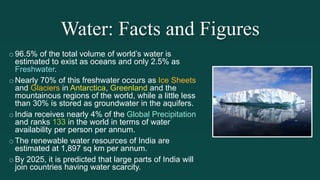
o96.5% of the total volume of world’s water is
estimated to exist as oceans and only 2.5% as
Freshwater.
oNearly 70% of this freshwater occurs as Ice Sheets
and Glaciers in Antarctica, Greenland and the
mountainous regions of the world, while a little less
than 30% is stored as groundwater in the aquifers.
oIndia receives nearly 4% of the Global Precipitation
and ranks 133 in the world in terms of water
availability per person per annum.
oThe renewable water resources of India are
estimated at 1,897 sq km per annum.
oBy 2025, it is predicted that large parts of India will
join countries having water scarcity.
Water Scarcity
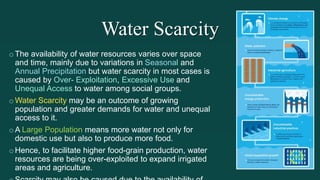
oThe availability of water resources varies over space
and time, mainly due to variations in Seasonal and
Annual Precipitation but water scarcity in most cases is
caused by Over- Exploitation, Excessive Use and
Unequal Access to water among social groups.
oWater Scarcity may be an outcome of growing
population and greater demands for water and unequal
access to it.
oA Large Population means more water not only for
domestic use but also to produce more food.
oHence, to facilitate higher food-grain production, water
resources are being over-exploited to expand irrigated
areas and agriculture.
Post Independent Developments
oPost-independent India witnessed intensive Industrialization and Urbanization,
creating vast opportunities for us.
oThe ever increasing number of industries has made matters worse by exerting
pressure on existing freshwater resources.
o Industries apart from being heavy users of water, also require power to run them.
Much of this energy comes from hydroelectric power.
oToday, in India Hydroelectric Power contributes approximately 22% of the total
electricity produced.
o Moreover, multiplying urban centers with large and dense populations and urban
lifestyles have not only added to water and energy requirements but have further
aggravated the problem.
Need For Water Management
oThe need is to conserve and manage our water
resources, to safeguard ourselves from Health
Hazards, to ensure Food Security, continuation
of our Livelihoods and Productive Activities and
also to Prevent Degradation of our natural
ecosystems.
oOver Exploitation and Mismanagement of
water resources will impoverish this resource
and cause ecological crisis that may have
profound impact on our lives.
Water Security
Water production
for sustainable life
Place for Water
Collection
Mitigate floor risk
and damage
Restoration and
Protection of Water
Dams Of Ancient India
oIn the 1st century B.C., Sringaverapura near
Allahabad had sophisticated water harvesting
system channeling the flood water of the river
Ganga.
oDuring the time of Chandragupta Maurya dams,
lakes and irrigation systems were extensively built.
oEvidences of sophisticated irrigation works have
also been found in Odisha, Nagarjuna Konda
(Andhra Pradesh), Bennur (Karnataka), Kolhapur
(Maharashtra), etc.
oIn the 11th Century, Bhopal Lake, one of the largest
artificial lakes of its time was built.
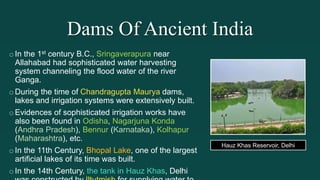
oIn the 14th Century, the tank in Hauz Khas, Delhi
Hauz Khas Reservoir, Delhi
Multi -Purpose River Projects
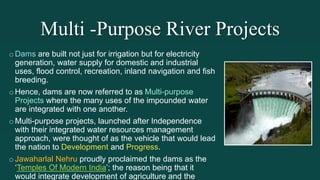
oDams are built not just for irrigation but for electricity
generation, water supply for domestic and industrial
uses, flood control, recreation, inland navigation and fish
breeding.
oHence, dams are now referred to as Multi-purpose
Projects where the many uses of the impounded water
are integrated with one another.
oMulti-purpose projects, launched after Independence
with their integrated water resources management
approach, were thought of as the vehicle that would lead
the nation to Development and Progress.
oJawaharlal Nehru proudly proclaimed the dams as the
‘Temples Of Modern India’; the reason being that it
would integrate development of agriculture and the
Disadvantages Of Dams
oIn recent years, Multi-purpose Projects and large dams have come under scrutiny
and opposition for a variety of reasons.
oRegulating and damming of rivers affect their natural flow causing Poor Sediment
Flow and Excessive Sedimentation at the bottom of the reservoir.
oDams also fragment rivers making it difficult for aquatic fauna to migrate, especially
for spawning.
oMulti-purpose projects and large dams have also been the cause of many new
social movements like the ‘Narmada Bachao Andolan’ and the ‘Tehri Dam Andolan’
etc.
oResistance to these projects has primarily been due to the large-scale
displacement of local communities.
oIrrigation has also changed the cropping pattern of many regions with farmers
shifting to water intensive and commercial crops. This has great ecological
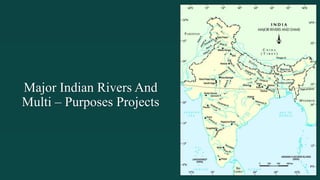
Major Indian Rivers And
Multi – Purposes Projects
Rainwater Harvesting
oPeople had in-depth knowledge of rainfall regimes and soil types and developed
wide ranging techniques to harvest rainwater, groundwater, river water and flood
water in keeping with the local ecological conditions and their water needs.
oIn hill and mountainous regions, people built diversion channels like the ‘Guls’ or
‘Kuls’ of the Western Himalayas for agriculture.
o‘Rooftop Rain Water Harvesting’ was commonly practiced to store drinking water,
particularly in Rajasthan. In the flood plains of Bengal, people developed inundation
channels to irrigate their fields.
oIn arid and semi-arid regions, agricultural fields were converted into rain fed storage
structures that allowed the water to stand and moisten the soil like the ‘Khadins’ in
Jaisalmer and ‘Johads’ in other parts of Rajasthan.
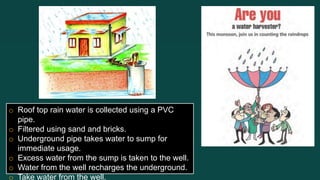
o Roof top rain water is collected using a PVC
pipe.
o Filtered using sand and bricks.
o Underground pipe takes water to sump for
immediate usage.
o Excess water from the sump is taken to the well.
o Water from the well recharges the underground.
o Take water from the well.
Thank You!

Water Resources Class 10th

  • 1.
  • 2.
    Water: Facts andFigures o96.5% of the total volume of world’s water is estimated to exist as oceans and only 2.5% as Freshwater. oNearly 70% of this freshwater occurs as Ice Sheets and Glaciers in Antarctica, Greenland and the mountainous regions of the world, while a little less than 30% is stored as groundwater in the aquifers. oIndia receives nearly 4% of the Global Precipitation and ranks 133 in the world in terms of water availability per person per annum. oThe renewable water resources of India are estimated at 1,897 sq km per annum. oBy 2025, it is predicted that large parts of India will join countries having water scarcity.
  • 3.
    Water Scarcity oThe availabilityof water resources varies over space and time, mainly due to variations in Seasonal and Annual Precipitation but water scarcity in most cases is caused by Over- Exploitation, Excessive Use and Unequal Access to water among social groups. oWater Scarcity may be an outcome of growing population and greater demands for water and unequal access to it. oA Large Population means more water not only for domestic use but also to produce more food. oHence, to facilitate higher food-grain production, water resources are being over-exploited to expand irrigated areas and agriculture.
  • 4.
    Post Independent Developments oPost-independentIndia witnessed intensive Industrialization and Urbanization, creating vast opportunities for us. oThe ever increasing number of industries has made matters worse by exerting pressure on existing freshwater resources. o Industries apart from being heavy users of water, also require power to run them. Much of this energy comes from hydroelectric power. oToday, in India Hydroelectric Power contributes approximately 22% of the total electricity produced. o Moreover, multiplying urban centers with large and dense populations and urban lifestyles have not only added to water and energy requirements but have further aggravated the problem.
  • 5.
    Need For WaterManagement oThe need is to conserve and manage our water resources, to safeguard ourselves from Health Hazards, to ensure Food Security, continuation of our Livelihoods and Productive Activities and also to Prevent Degradation of our natural ecosystems. oOver Exploitation and Mismanagement of water resources will impoverish this resource and cause ecological crisis that may have profound impact on our lives. Water Security Water production for sustainable life Place for Water Collection Mitigate floor risk and damage Restoration and Protection of Water
  • 6.
    Dams Of AncientIndia oIn the 1st century B.C., Sringaverapura near Allahabad had sophisticated water harvesting system channeling the flood water of the river Ganga. oDuring the time of Chandragupta Maurya dams, lakes and irrigation systems were extensively built. oEvidences of sophisticated irrigation works have also been found in Odisha, Nagarjuna Konda (Andhra Pradesh), Bennur (Karnataka), Kolhapur (Maharashtra), etc. oIn the 11th Century, Bhopal Lake, one of the largest artificial lakes of its time was built. oIn the 14th Century, the tank in Hauz Khas, Delhi Hauz Khas Reservoir, Delhi
  • 7.
    Multi -Purpose RiverProjects oDams are built not just for irrigation but for electricity generation, water supply for domestic and industrial uses, flood control, recreation, inland navigation and fish breeding. oHence, dams are now referred to as Multi-purpose Projects where the many uses of the impounded water are integrated with one another. oMulti-purpose projects, launched after Independence with their integrated water resources management approach, were thought of as the vehicle that would lead the nation to Development and Progress. oJawaharlal Nehru proudly proclaimed the dams as the ‘Temples Of Modern India’; the reason being that it would integrate development of agriculture and the
  • 8.
    Disadvantages Of Dams oInrecent years, Multi-purpose Projects and large dams have come under scrutiny and opposition for a variety of reasons. oRegulating and damming of rivers affect their natural flow causing Poor Sediment Flow and Excessive Sedimentation at the bottom of the reservoir. oDams also fragment rivers making it difficult for aquatic fauna to migrate, especially for spawning. oMulti-purpose projects and large dams have also been the cause of many new social movements like the ‘Narmada Bachao Andolan’ and the ‘Tehri Dam Andolan’ etc. oResistance to these projects has primarily been due to the large-scale displacement of local communities. oIrrigation has also changed the cropping pattern of many regions with farmers shifting to water intensive and commercial crops. This has great ecological
  • 9.
    Major Indian RiversAnd Multi – Purposes Projects
  • 10.
    Rainwater Harvesting oPeople hadin-depth knowledge of rainfall regimes and soil types and developed wide ranging techniques to harvest rainwater, groundwater, river water and flood water in keeping with the local ecological conditions and their water needs. oIn hill and mountainous regions, people built diversion channels like the ‘Guls’ or ‘Kuls’ of the Western Himalayas for agriculture. o‘Rooftop Rain Water Harvesting’ was commonly practiced to store drinking water, particularly in Rajasthan. In the flood plains of Bengal, people developed inundation channels to irrigate their fields. oIn arid and semi-arid regions, agricultural fields were converted into rain fed storage structures that allowed the water to stand and moisten the soil like the ‘Khadins’ in Jaisalmer and ‘Johads’ in other parts of Rajasthan.
  • 11.
    o Roof toprain water is collected using a PVC pipe. o Filtered using sand and bricks. o Underground pipe takes water to sump for immediate usage. o Excess water from the sump is taken to the well. o Water from the well recharges the underground. o Take water from the well.
  • 13.