CLASS X
WATER RESOURCES
Fresh Water
96.5 percent of the total volume of the world’s water is estimated to exist as oceans
and only 2.5 percent exists as fresh water. 70 percent of the freshwater occurs as ice
sheets and glaciers in Antarctica, Greenland, and the world's mountainous regions.
Less than 30 percent is stored as groundwater in the world’s acquirers. Fresh water is
mainly obtained from surface runoff and groundwater. This is continually being
renewed and recharged through the hydrological cycle. All the water moves within
the hydrological cycle making water a renewable resource.
Three freshwater sources are:
Precipitation—from rainfall; Surface water—in rivers, lakes, etc.;
Groundwater—water stored in underground acquirers which gets
recharged by rainfall.
Water Scarcity
Water scarcity means a shortage of water. It is usually associated with regions
having low rainfall or drought-prone areas.
There are many other reasons which lead to scarcity of water:
Large growing population; In the agricultural sector, water resources are being over-exploited to expand
irrigated areas and dry-season agriculture; More water is required for irrigation purposes to facilitate
higher food production, i. e., for doing multiple cropping and for HYV seeds; There is greater demand for
water with growing urbanization and industrialization; An unequal access to water among different social
groups; The quality of water is deteriorating, i.e., getting polluted by domestic and industrial wastes,
chemical fertilizers and pesticides used in agriculture; Excessive use of water by industries which also
require water to generate hydro-electric power to run them; and Overexploitation of water in the urban
areas.
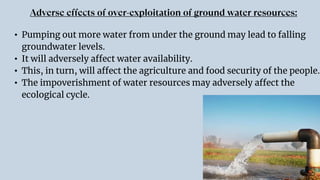
Adverse effects of over-exploitation of ground water resources:
• Pumping out more water from under the ground may lead to falling
groundwater levels.
• It will adversely affect water availability.
• This, in turn, will affect the agriculture and food security of the people.
• The impoverishment of water resources may adversely affect the
ecological cycle.
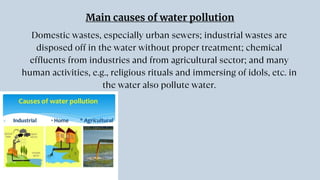
Main causes of water pollution
Domestic wastes, especially urban sewers; industrial wastes are
disposed off in the water without proper treatment; chemical
effluents from industries and from agricultural sector; and many
human activities, e.g., religious rituals and immersing of idols, etc. in
the water also pollute water.
Measures for water conservation:
• Do not overdraw the groundwater, recharge it by techniques like rainwater
harvesting; tapping rainwater in reservoirs, watershed development programs,
etc.
• Avoid wastage of water at all levels and do not pollute the water.
• Adopting water-conserving techniques of irrigation, e.g., drip irrigation and
sprinklers, etc., especially in dry areas.
A dam is a barrier across flowing water that obstructs, directs, or retards the flow,
creating a reservoir, lake, or impoundment. A dam is a reservoir and not the whole
structure.
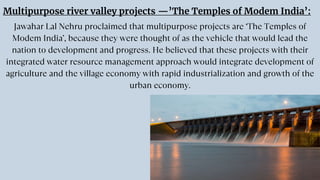
Multipurpose river valley projects —’The Temples of Modem India’:
Jawahar Lal Nehru proclaimed that multipurpose projects are ‘The Temples of
Modem India’, because they were thought of as the vehicle that would lead the
nation to development and progress. He believed that these projects with their
integrated water resource management approach would integrate development of
agriculture and the village economy with rapid industrialization and growth of the
urban economy.
Advantages:
• They bring water to those areas which suffer from water scarcity and also provide
water for irrigation;
• These projects generate electricity for industries and our homes;
They help in controlling floods;
• These projects can be used for recreation, inland navigation, and fish breeding.
Disadvantages:
• Damming of rivers affects their natural flow causing poor sediment flow;
• Excessive sedimentation at the bottom of the reservoir;
• Lack of sediments results in (a) rockier stream bed and (b) poorer habitat for the river aquatic
life;
• The reservoirs submerge the existing vegetation and soil, leading to its decomposition over
time;
• They affect the fertility levels of the soil; cause large-scale displacement of local communities.
Traditional rainwater harvesting methods practiced in different
parts of the country:
• In mountainous areas ‘Guls’ and ‘Kuls’ the diversion channels were built for
agriculture.
• ‘Rooftop rainwater harvesting’ was commonly practiced to store drinking water,
especially in Rajasthan.
• Inundation channels for irrigation were developed in the flood plains of West
Bengal.
• In arid and semi-arid regions, agricultural fields were converted into rain-fed
storage structures, e.g., ‘Khadins’ in Jaisalmer and ‘Johads’ in other parts of
Rajasthan.
• In semi-arid and arid regions of Rajasthan, particularly in Bikaner, Phalodi, and
Banner, all the houses had underground tanks or ‘tankas’ built inside the house
for storing drinking water. They were a part of the well-developed rooftop
rainwater harvesting system.
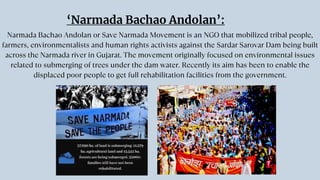
‘Narmada Bachao Andolan’:
Narmada Bachao Andolan or Save Narmada Movement is an NGO that mobilized tribal people,
farmers, environmentalists and human rights activists against the Sardar Sarovar Dam being built
across the Narmada river in Gujarat. The movement originally focused on environmental issues
related to submerging of trees under the dam water. Recently its aim has been to enable the
displaced poor people to get full rehabilitation facilities from the government.