

DEVELOPMENT
DEVELOPMENT
?
1.Ideas of development:
 The idea of development or progress has always
been with us.
 We have aspirations or desires about what we would
like to do and how we would like to live.
 In this chapter, we shall make a beginning for
understanding development.
 It is only through a democratic political process that
these hopes and possibilities can be achieved in real
2.What development promises –
Different People, different goals:
 People seek things that are most important for them,
i.e., that which can fulfill their aspirations or desires.
 In fact, at times, two persons or groups of persons
may seek things which are conflicting.
 So two things are quite clear:
(i) Different persons can have different
developmental goals.
(ii) What may be developed for one may not be
developed for the other. It may even be destructive
for the other.
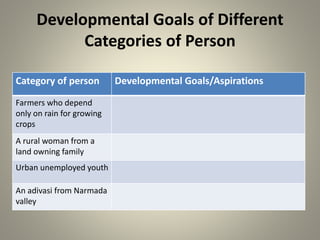
Developmental Goals of Different
Categories of Person
Category of person Developmental Goals/Aspirations
Farmers who depend
only on rain for growing
crops
A rural woman from a
land owning family
Urban unemployed youth
An adivasi from Narmada
valley
3.INCOME AND OTHER GOALS:
 People prefer to earn more income for full filling
their daily requirements of life.
 Companies provide material thing like money.
 People also want non-material thing like-
freedom,
security,
respect of others.
What is the role of
your friend in your
life?
 There are many things which can’t measure easily
but mean a lot to our lives. These are often ignored.
 For example:
love and care of friend and parents
respect from others
trust and believes
 So, it will be wrong to say that what cannot be
measured is not important.
Sense of security:
 Some companies provide less salary but offer regular
employment enhances sense of securities.
 Some provides high salary but no job securities. They
reduce sense of securities.
 Therefore, for development people look at a mix of
goals.
 The developmental goals that people have are not
only about better income but also about other
important things in life.
4.National Development
What India should do for
development?
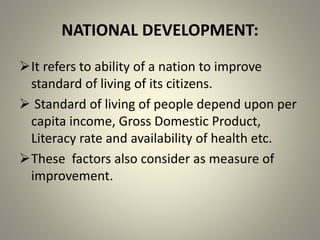
NATIONAL DEVELOPMENT:
It refers to ability of a nation to improve
standard of living of its citizens.
 Standard of living of people depend upon per
capita income, Gross Domestic Product,
Literacy rate and availability of health etc.
These factors also consider as measure of
improvement.
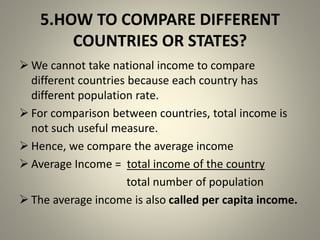
5.HOW TO COMPARE DIFFERENT
COUNTRIES OR STATES?
 We cannot take national income to compare
different countries because each country has
different population rate.
 For comparison between countries, total income is
not such useful measure.
 Hence, we compare the average income
 Average Income = total income of the country
total number of population
 The average income is also called per capita income.
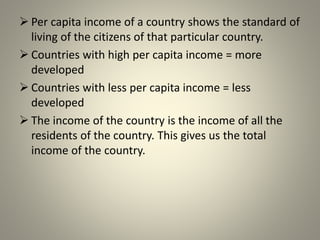
 Per capita income of a country shows the standard of
living of the citizens of that particular country.
 Countries with high per capita income = more
developed
 Countries with less per capita income = less
developed
 The income of the country is the income of all the
residents of the country. This gives us the total
income of the country.
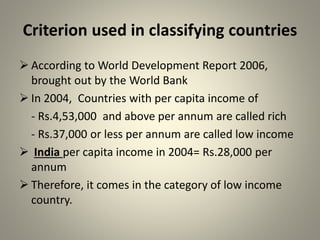
Criterion used in classifying countries
 According to World Development Report 2006,
brought out by the World Bank
 In 2004, Countries with per capita income of
- Rs.4,53,000 and above per annum are called rich
- Rs.37,000 or less per annum are called low income
 India per capita income in 2004= Rs.28,000 per
annum
 Therefore, it comes in the category of low income
country.
6.INCOME AND OTHER CRITERIA:
 Individual aspirations and goal:-
• People not only want better income
• They also want security, respect for others, equal
treatment, freedom etc
 For nation or region:-
• Average income is not enough
• Think of other equally important attributes
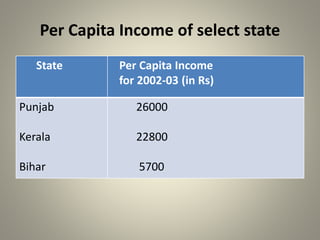
Per Capita Income of select state
State Per Capita Income
for 2002-03 (in Rs)
Punjab
Kerala
Bihar
26000
22800
5700
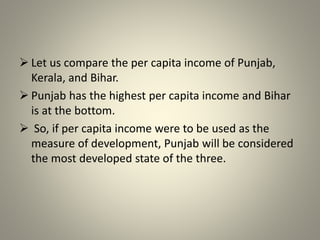
 Let us compare the per capita income of Punjab,
Kerala, and Bihar.
 Punjab has the highest per capita income and Bihar
is at the bottom.
 So, if per capita income were to be used as the
measure of development, Punjab will be considered
the most developed state of the three.
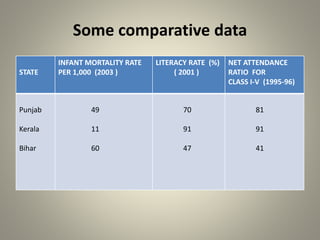
Some comparative data
STATE
INFANT MORTALITY RATE
PER 1,000 (2003 )
LITERACY RATE (%)
( 2001 )
NET ATTENDANCE
RATIO FOR
CLASS I-V (1995-96)
Punjab
Kerala
Bihar
49
11
60
70
91
47
81
91
41
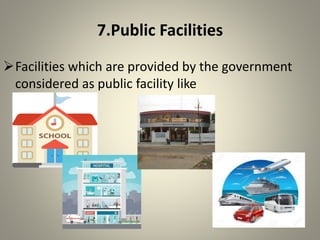
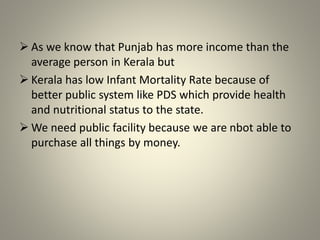
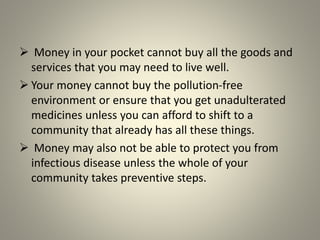
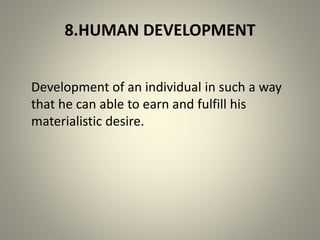
7.Public Facilities
Facilities which are provided by the government
considered as public facility like
 As we know that Punjab has more income than the
average person in Kerala but
 Kerala has low Infant Mortality Rate because of
better public system like PDS which provide health
and nutritional status to the state.
 We need public facility because we are nbot able to
purchase all things by money.
 Money in your pocket cannot buy all the goods and
services that you may need to live well.
 Your money cannot buy the pollution-free
environment or ensure that you get unadulterated
medicines unless you can afford to shift to a
community that already has all these things.
 Money may also not be able to protect you from
infectious disease unless the whole of your
community takes preventive steps.
8.HUMAN DEVELOPMENT
Development of an individual in such a way
that he can able to earn and fulfill his
materialistic desire.
9.Sustainability of Development
 Since the second half of the twentieth century, a number of
scientists have been warning that the present type, and
levels, of development are not sustainable.
 Resources are replenished by nature as in the case of crops
and plants.
 In the case of groundwater, if we use more than what is
being replenished by rain then we would be overusing this
resource
 Consequences of environmental degradation do not
respect national or state boundaries; this issue is no longer
region or nation-specific. Our future is linked together.
 Sustainability of developments comparatively a new
area of knowledge in which scientists, economists,
philosophers and other social scientists are working
together.
 The question of development or progress is
perennial.
 So, the debate on development continues.
Chapter ends but the question is still
there
DEVELOPMENT

Class10 Economics Development

  • 1.
  • 2.
  • 3.
    1.Ideas of development: The idea of development or progress has always been with us.  We have aspirations or desires about what we would like to do and how we would like to live.  In this chapter, we shall make a beginning for understanding development.  It is only through a democratic political process that these hopes and possibilities can be achieved in real
  • 4.
    2.What development promises– Different People, different goals:  People seek things that are most important for them, i.e., that which can fulfill their aspirations or desires.  In fact, at times, two persons or groups of persons may seek things which are conflicting.  So two things are quite clear: (i) Different persons can have different developmental goals. (ii) What may be developed for one may not be developed for the other. It may even be destructive for the other.
  • 5.
    Developmental Goals ofDifferent Categories of Person Category of person Developmental Goals/Aspirations Farmers who depend only on rain for growing crops A rural woman from a land owning family Urban unemployed youth An adivasi from Narmada valley
  • 6.
    3.INCOME AND OTHERGOALS:  People prefer to earn more income for full filling their daily requirements of life.  Companies provide material thing like money.  People also want non-material thing like- freedom, security, respect of others.
  • 7.
    What is therole of your friend in your life?
  • 8.
     There aremany things which can’t measure easily but mean a lot to our lives. These are often ignored.  For example: love and care of friend and parents respect from others trust and believes  So, it will be wrong to say that what cannot be measured is not important.
  • 9.
    Sense of security: Some companies provide less salary but offer regular employment enhances sense of securities.  Some provides high salary but no job securities. They reduce sense of securities.  Therefore, for development people look at a mix of goals.  The developmental goals that people have are not only about better income but also about other important things in life.
  • 10.
    4.National Development What Indiashould do for development?
  • 11.
    NATIONAL DEVELOPMENT: It refersto ability of a nation to improve standard of living of its citizens.  Standard of living of people depend upon per capita income, Gross Domestic Product, Literacy rate and availability of health etc. These factors also consider as measure of improvement.
  • 12.
    5.HOW TO COMPAREDIFFERENT COUNTRIES OR STATES?  We cannot take national income to compare different countries because each country has different population rate.  For comparison between countries, total income is not such useful measure.  Hence, we compare the average income  Average Income = total income of the country total number of population  The average income is also called per capita income.
  • 13.
     Per capitaincome of a country shows the standard of living of the citizens of that particular country.  Countries with high per capita income = more developed  Countries with less per capita income = less developed  The income of the country is the income of all the residents of the country. This gives us the total income of the country.
  • 14.
    Criterion used inclassifying countries  According to World Development Report 2006, brought out by the World Bank  In 2004, Countries with per capita income of - Rs.4,53,000 and above per annum are called rich - Rs.37,000 or less per annum are called low income  India per capita income in 2004= Rs.28,000 per annum  Therefore, it comes in the category of low income country.
  • 15.
    6.INCOME AND OTHERCRITERIA:  Individual aspirations and goal:- • People not only want better income • They also want security, respect for others, equal treatment, freedom etc  For nation or region:- • Average income is not enough • Think of other equally important attributes
  • 16.
    Per Capita Incomeof select state State Per Capita Income for 2002-03 (in Rs) Punjab Kerala Bihar 26000 22800 5700
  • 17.
     Let uscompare the per capita income of Punjab, Kerala, and Bihar.  Punjab has the highest per capita income and Bihar is at the bottom.  So, if per capita income were to be used as the measure of development, Punjab will be considered the most developed state of the three.
  • 18.
    Some comparative data STATE INFANTMORTALITY RATE PER 1,000 (2003 ) LITERACY RATE (%) ( 2001 ) NET ATTENDANCE RATIO FOR CLASS I-V (1995-96) Punjab Kerala Bihar 49 11 60 70 91 47 81 91 41
  • 19.
    7.Public Facilities Facilities whichare provided by the government considered as public facility like
  • 20.
     As weknow that Punjab has more income than the average person in Kerala but  Kerala has low Infant Mortality Rate because of better public system like PDS which provide health and nutritional status to the state.  We need public facility because we are nbot able to purchase all things by money.
  • 21.
     Money inyour pocket cannot buy all the goods and services that you may need to live well.  Your money cannot buy the pollution-free environment or ensure that you get unadulterated medicines unless you can afford to shift to a community that already has all these things.  Money may also not be able to protect you from infectious disease unless the whole of your community takes preventive steps.
  • 22.
    8.HUMAN DEVELOPMENT Development ofan individual in such a way that he can able to earn and fulfill his materialistic desire.
  • 23.
    9.Sustainability of Development Since the second half of the twentieth century, a number of scientists have been warning that the present type, and levels, of development are not sustainable.  Resources are replenished by nature as in the case of crops and plants.  In the case of groundwater, if we use more than what is being replenished by rain then we would be overusing this resource  Consequences of environmental degradation do not respect national or state boundaries; this issue is no longer region or nation-specific. Our future is linked together.
  • 24.
     Sustainability ofdevelopments comparatively a new area of knowledge in which scientists, economists, philosophers and other social scientists are working together.  The question of development or progress is perennial.  So, the debate on development continues.
  • 25.
    Chapter ends butthe question is still there DEVELOPMENT