CLASS IX NCERT CHAPTER 2
SUBJECT – S.SC. (DEMOCRATIC POLITICS)
PRESENTED BY – MAHENDRA KUMAR
महेंद्र पारीक1
CONSTITUTIONAL DESIGN
DEMOCRATIC CONSTITUTION IN SOUTH AFRICA
महेंद्र पारीक2
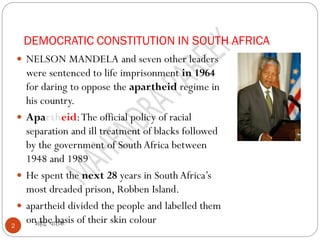
 NELSON MANDELA and seven other leaders
were sentenced to life imprisonment in 1964
for daring to oppose the apartheid regime in
his country.
 Apartheid:The official policy of racial
separation and ill treatment of blacks followed
by the government of South Africa between
1948 and 1989
 He spent the next 28 years in South Africa’s
most dreaded prison, Robben Island.
 apartheid divided the people and labelled them
on the basis of their skin colour
महेंद्र पारीक3
 Since 1950, the blacks, colored and Indians fought against the
apartheid system.
 They launched protest marches and strikes.TheAfrican
National Congress (ANC) was the umbrella organisation that
led the struggle against the policies of segregation.
 Many sensitive whites also joined the ANC to oppose
apartheid and played a leading role in this struggle.
 Several countries denounced apartheid as unjust and racist..
Towards a new constitution
महेंद्र पारीक4
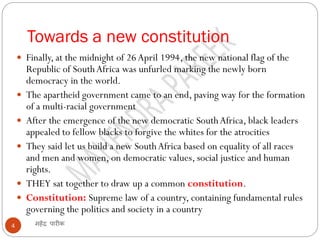
 Finally, at the midnight of 26April 1994, the new national flag of the
Republic of SouthAfrica was unfurled marking the newly born
democracy in the world.
 The apartheid government came to an end, paving way for the formation
of a multi-racial government
 After the emergence of the new democratic SouthAfrica, black leaders
appealed to fellow blacks to forgive the whites for the atrocities
 They said let us build a new SouthAfrica based on equality of all races
and men and women, on democratic values, social justice and human
rights.
 THEY sat together to draw up a common constitution.
 Constitution: Supreme law of a country, containing fundamental rules
governing the politics and society in a country
महेंद्र पारीक5
 In the search for a solution
to the problems, nobody
should be excluded, no one
should be treated as a
demon.
 Everybody should become
part of the solution,
whatever they might have
done or represented in the
past.
 The preamble to the South
African Constitution sums
up this spirit.
 A state denounced by the
entire world till 1994 as the
most undemocratic one is
now seen as a model of
democracy.
WHY DO WE NEED A CONSTITUTION?
महेंद्र पारीक6
 IN S.A.The oppressor and the oppressed in this new democracy
were planning to live together as equals.
 It was not going to be easy for them to trust each other.They had
their fears.
 They wanted to safeguard their interests.
 The whites agreed to the principle of majority rule and that of one
person one vote.They also agreed to accept some basic rights for the
poor and the workers.
 The blacks agreed that majority rule would not be absolute.They
agreed that the majority would not take away the property of the
white minority.
महेंद्र पारीक7
 The only way to build and maintain trust in such a situation is
to write down some rules of the game that everyone
would abide by.
 how the rulers are to be chosen in future.
 what the elected governments are empowered to do and what
they cannot do.
 These rules decide the rights of the citizen.
 These rules will work only if the winner cannot change them
very easily.
 This set of basic rules is called a constitution.
महेंद्र पारीक8
 Most countries in the world need to have these basic rules.
This applies not just to governments.
 Any association needs to have its constitution It could be a
club in your area, a cooperative society or a political party,
they all need a constitution
 The constitution of a country is a set of written
rules that are accepted by all people living together
in a country.
 Constitution is the supreme law that determines the
relationship among people living in a territory
(called citizens) and also the relationship between
the people and government.
WHY DO WE NEED A CONSTITUTION?
महेंद्र पारीक9
 BECAUSE -
 First, it generates a degree of trust and coordination that is
necessary for different kind of people to live together
 Second, it specifies how the government will be constituted, who
will have power to take which decisions
 Third, it lays down limits on the powers of the government and
tells us what the rights of the citizens are
 Fourth, it expresses the aspirations of the people about creating a
good society
MAKING OF THE INDIAN CONSTITUTION
महेंद्र पारीक10
 The making of the constitution for a huge and diverse country
like India was not an easy affair
 The country was born through a partition on the basis of
religious differences
 The merger of princely states was a difficult and uncertain task.
 When the constitution was being written, the future of the
country did not look as secure as it does today.
The path to Constitution
महेंद्र पारीक11
In 1928, Motilal Nehru and eight other Congress leaders drafted a
constitution for India.
 In 1931, the resolution at the Karachi session of the Indian
National Congress dwelt on how independent India’s constitution
should look like.
 Both these documents were committed to the inclusion of
universal adult franchise, right to freedom and equality
and to protecting the rights of minorities in the
constitution of independent India.
 Thus some basic values were accepted by all leaders much before
the Constituent Assembly met to deliberate on the
Constitution.
महेंद्र पारीक12
 Indian constitution adopted many institutional details and
procedures from the Government of India Act, 1935.
 INSPIRATION FOR OUR CONSTITUTION-
 by the ideals of French Revolution
 the practice of parliamentary democracy in Britain
 the Bill of Rights in the US.
 The socialist revolution in Russia had inspired many
Indians to think of shaping a system based on social and
economic equality.
 All these factors contributed to the making of our
Constitution
The Constituent Assembly
महेंद्र पारीक13
 The drafting of the document called the constitution was done by an
assembly of elected representatives called the ConstituentAssembly.
 Elections to the ConstituentAssembly were held in July 1946.
 Its first meeting was held in December 1946.
 DueTO partitionThe ConstituentAssembly was divided into the
ConstituentAssembly of India and that of Pakistan.
 The ConstituentAssembly that wrote the Indian constitution had 299
members.
 The Assembly adopted the Constitution on 26 November
1949 but it came into effect on 26 January 1950.To mark this
day we celebrate January 26 as Republic Day every year.
महेंद्र पारीक14
 Why should we accept the Constitution made by
this Assembly more than six decades ago?
 BECAUSE -
 The Constitution does not reflect the views of its members
alone. It expresses a broad consensus of its time.
 The Constituent Assembly represented the people of India.
There was no Universal Adult Franchise at that time. So, the
Constituent Assembly could not have been chosen directly by
all the people of India but it was elected mainly by the
members of Provincial Legislatures, which ensured a fair
share of all the regions of the country.
 The Constituent Assembly worked in a systematic, open and
consensual manner
महेंद्र पारीक15
 Drafting Committee chaired by Dr. B.R.Ambedkar
prepared a draft constitution for discussion.
 Discussion took place on the Draft Constitution, clause by
clause.
 Clause: A distinct section of a document
 ‘Constituent Assembly Debates’are 12 bulky volumes!
provide the rationale behind every provision of the
Constitution.
 These are used to interpret the meaning of the Constitution
1 GUIDING VALUES OF THE INDIAN CONSTITUTION
महेंद्र पारीक16
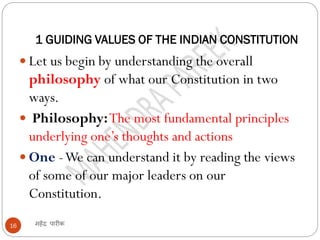
 Let us begin by understanding the overall
philosophy of what our Constitution in two
ways.
 Philosophy:The most fundamental principles
underlying one’s thoughts and actions
 One -We can understand it by reading the views
of some of our major leaders on our
Constitution.
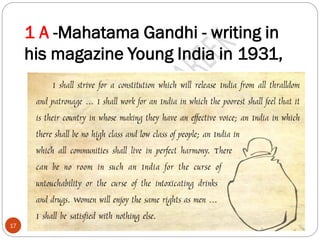
1 A -Mahatama Gandhi - writing in
his magazine Young India in 1931,
महेंद्र पारीक17
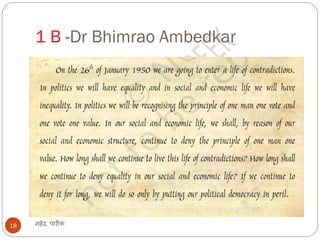
1 B -Dr Bhimrao Ambedkar
महेंद्र पारीक18
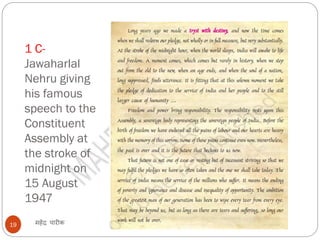
1 C-
Jawaharlal
Nehru giving
his famous
speech to the
Constituent
Assembly at
the stroke of
midnight on
15 August
1947
महेंद्र पारीक19
2 GUIDING VALUES OF THE INDIAN CONSTITUTION
महेंद्र पारीक20
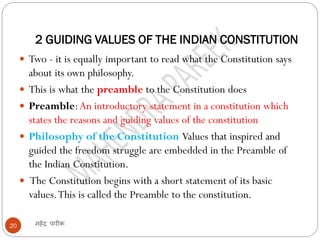
 Two - it is equally important to read what the Constitution says
about its own philosophy.
 This is what the preamble to the Constitution does
 Preamble:An introductory statement in a constitution which
states the reasons and guiding values of the constitution
 Philosophy of the Constitution Values that inspired and
guided the freedom struggle are embedded in the Preamble of
the Indian Constitution.
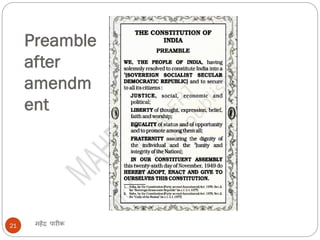
 The Constitution begins with a short statement of its basic
values.This is called the Preamble to the constitution.
Preamble
after
amendm
ent
महेंद्र पारीक21
Preamble
in
Original
महेंद्र पारीक22
महेंद्र पारीक23
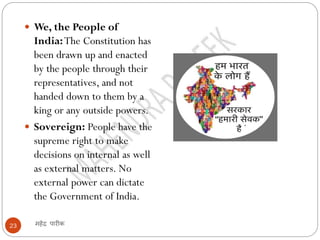
 We, the People of
India:The Constitution has
been drawn up and enacted
by the people through their
representatives, and not
handed down to them by a
king or any outside powers.
 Sovereign: People have the
supreme right to make
decisions on internal as well
as external matters. No
external power can dictate
the Government of India.
महेंद्र पारीक24
 Socialist:Wealth is generated
socially and should be shared
equally by society.The government
should regulate the ownership of
land and industry to reduce socio-
economic inequalities.
 Secular: Citizens have complete
freedom to follow any religion. But
there is no official religion.The
government treats all religious
beliefs and practices with equal
respect.
महेंद्र पारीक25
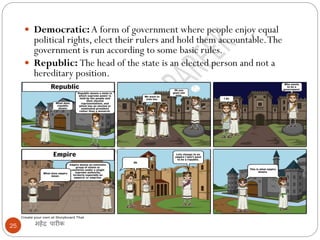
 Democratic: A form of government where people enjoy equal
political rights, elect their rulers and hold them accountable.The
government is run according to some basic rules.
 Republic: The head of the state is an elected person and not a
hereditary position.
महेंद्र पारीक26
 Justice: Citizens cannot be
discriminated against on the
grounds of caste, religion and
gender. Social inequalities have to
be reduced.The government should
work for the welfare of all,
especially of the disadvantaged
groups.
 Liberty: There are no
unreasonable restrictions on the
citizens in what they think, how
they wish to express their thoughts
and the way they wish to follow up
their thoughts in action.
महेंद्र पारीक27
 Equality:All are equal before the law.The traditional social
inequalities have to be ended.The government should ensure
equal opportunity for all.
 Fraternity: All of us should behave as if we are members of the
same family. No one should treat a fellow citizen as inferior.
Institutional design
महेंद्र पारीक28
 Those who crafted the Indian Constitution felt that it has to be in
accordance with people’s aspirations and changes in society.
 They did not see it as a sacred, static and unalterable law. So, they
made provisions to incorporate changes from time to time.These
changes are called constitutional amendment
 Constitutional amendment: A change in the constitution
made by the supreme legislative body in a country
 Our Constitution lays down a procedure for choosing persons to
govern the country.
 Our Constitution defines who will have how much power to take
which decisions.And it puts limits to what the government can do
by providing some rights to the citizen that cannot be violated
VOTE OF THANKS
महेंद्र पारीक29
ALMIGHTY GOD
NCERT
INTERNET
ENCYCLOPECIA BRITANNICA
OUR PRINCIPAL
MYVIEWERS

Constitutional design

  • 1.
    CLASS IX NCERTCHAPTER 2 SUBJECT – S.SC. (DEMOCRATIC POLITICS) PRESENTED BY – MAHENDRA KUMAR महेंद्र पारीक1 CONSTITUTIONAL DESIGN
  • 2.
    DEMOCRATIC CONSTITUTION INSOUTH AFRICA महेंद्र पारीक2  NELSON MANDELA and seven other leaders were sentenced to life imprisonment in 1964 for daring to oppose the apartheid regime in his country.  Apartheid:The official policy of racial separation and ill treatment of blacks followed by the government of South Africa between 1948 and 1989  He spent the next 28 years in South Africa’s most dreaded prison, Robben Island.  apartheid divided the people and labelled them on the basis of their skin colour
  • 3.
    महेंद्र पारीक3  Since1950, the blacks, colored and Indians fought against the apartheid system.  They launched protest marches and strikes.TheAfrican National Congress (ANC) was the umbrella organisation that led the struggle against the policies of segregation.  Many sensitive whites also joined the ANC to oppose apartheid and played a leading role in this struggle.  Several countries denounced apartheid as unjust and racist..
  • 4.
    Towards a newconstitution महेंद्र पारीक4  Finally, at the midnight of 26April 1994, the new national flag of the Republic of SouthAfrica was unfurled marking the newly born democracy in the world.  The apartheid government came to an end, paving way for the formation of a multi-racial government  After the emergence of the new democratic SouthAfrica, black leaders appealed to fellow blacks to forgive the whites for the atrocities  They said let us build a new SouthAfrica based on equality of all races and men and women, on democratic values, social justice and human rights.  THEY sat together to draw up a common constitution.  Constitution: Supreme law of a country, containing fundamental rules governing the politics and society in a country
  • 5.
    महेंद्र पारीक5  Inthe search for a solution to the problems, nobody should be excluded, no one should be treated as a demon.  Everybody should become part of the solution, whatever they might have done or represented in the past.  The preamble to the South African Constitution sums up this spirit.  A state denounced by the entire world till 1994 as the most undemocratic one is now seen as a model of democracy.
  • 6.
    WHY DO WENEED A CONSTITUTION? महेंद्र पारीक6  IN S.A.The oppressor and the oppressed in this new democracy were planning to live together as equals.  It was not going to be easy for them to trust each other.They had their fears.  They wanted to safeguard their interests.  The whites agreed to the principle of majority rule and that of one person one vote.They also agreed to accept some basic rights for the poor and the workers.  The blacks agreed that majority rule would not be absolute.They agreed that the majority would not take away the property of the white minority.
  • 7.
    महेंद्र पारीक7  Theonly way to build and maintain trust in such a situation is to write down some rules of the game that everyone would abide by.  how the rulers are to be chosen in future.  what the elected governments are empowered to do and what they cannot do.  These rules decide the rights of the citizen.  These rules will work only if the winner cannot change them very easily.  This set of basic rules is called a constitution.
  • 8.
    महेंद्र पारीक8  Mostcountries in the world need to have these basic rules. This applies not just to governments.  Any association needs to have its constitution It could be a club in your area, a cooperative society or a political party, they all need a constitution  The constitution of a country is a set of written rules that are accepted by all people living together in a country.  Constitution is the supreme law that determines the relationship among people living in a territory (called citizens) and also the relationship between the people and government.
  • 9.
    WHY DO WENEED A CONSTITUTION? महेंद्र पारीक9  BECAUSE -  First, it generates a degree of trust and coordination that is necessary for different kind of people to live together  Second, it specifies how the government will be constituted, who will have power to take which decisions  Third, it lays down limits on the powers of the government and tells us what the rights of the citizens are  Fourth, it expresses the aspirations of the people about creating a good society
  • 10.
    MAKING OF THEINDIAN CONSTITUTION महेंद्र पारीक10  The making of the constitution for a huge and diverse country like India was not an easy affair  The country was born through a partition on the basis of religious differences  The merger of princely states was a difficult and uncertain task.  When the constitution was being written, the future of the country did not look as secure as it does today.
  • 11.
    The path toConstitution महेंद्र पारीक11 In 1928, Motilal Nehru and eight other Congress leaders drafted a constitution for India.  In 1931, the resolution at the Karachi session of the Indian National Congress dwelt on how independent India’s constitution should look like.  Both these documents were committed to the inclusion of universal adult franchise, right to freedom and equality and to protecting the rights of minorities in the constitution of independent India.  Thus some basic values were accepted by all leaders much before the Constituent Assembly met to deliberate on the Constitution.
  • 12.
    महेंद्र पारीक12  Indianconstitution adopted many institutional details and procedures from the Government of India Act, 1935.  INSPIRATION FOR OUR CONSTITUTION-  by the ideals of French Revolution  the practice of parliamentary democracy in Britain  the Bill of Rights in the US.  The socialist revolution in Russia had inspired many Indians to think of shaping a system based on social and economic equality.  All these factors contributed to the making of our Constitution
  • 13.
    The Constituent Assembly महेंद्रपारीक13  The drafting of the document called the constitution was done by an assembly of elected representatives called the ConstituentAssembly.  Elections to the ConstituentAssembly were held in July 1946.  Its first meeting was held in December 1946.  DueTO partitionThe ConstituentAssembly was divided into the ConstituentAssembly of India and that of Pakistan.  The ConstituentAssembly that wrote the Indian constitution had 299 members.  The Assembly adopted the Constitution on 26 November 1949 but it came into effect on 26 January 1950.To mark this day we celebrate January 26 as Republic Day every year.
  • 14.
    महेंद्र पारीक14  Whyshould we accept the Constitution made by this Assembly more than six decades ago?  BECAUSE -  The Constitution does not reflect the views of its members alone. It expresses a broad consensus of its time.  The Constituent Assembly represented the people of India. There was no Universal Adult Franchise at that time. So, the Constituent Assembly could not have been chosen directly by all the people of India but it was elected mainly by the members of Provincial Legislatures, which ensured a fair share of all the regions of the country.  The Constituent Assembly worked in a systematic, open and consensual manner
  • 15.
    महेंद्र पारीक15  DraftingCommittee chaired by Dr. B.R.Ambedkar prepared a draft constitution for discussion.  Discussion took place on the Draft Constitution, clause by clause.  Clause: A distinct section of a document  ‘Constituent Assembly Debates’are 12 bulky volumes! provide the rationale behind every provision of the Constitution.  These are used to interpret the meaning of the Constitution
  • 16.
    1 GUIDING VALUESOF THE INDIAN CONSTITUTION महेंद्र पारीक16  Let us begin by understanding the overall philosophy of what our Constitution in two ways.  Philosophy:The most fundamental principles underlying one’s thoughts and actions  One -We can understand it by reading the views of some of our major leaders on our Constitution.
  • 17.
    1 A -MahatamaGandhi - writing in his magazine Young India in 1931, महेंद्र पारीक17
  • 18.
    1 B -DrBhimrao Ambedkar महेंद्र पारीक18
  • 19.
    1 C- Jawaharlal Nehru giving hisfamous speech to the Constituent Assembly at the stroke of midnight on 15 August 1947 महेंद्र पारीक19
  • 20.
    2 GUIDING VALUESOF THE INDIAN CONSTITUTION महेंद्र पारीक20  Two - it is equally important to read what the Constitution says about its own philosophy.  This is what the preamble to the Constitution does  Preamble:An introductory statement in a constitution which states the reasons and guiding values of the constitution  Philosophy of the Constitution Values that inspired and guided the freedom struggle are embedded in the Preamble of the Indian Constitution.  The Constitution begins with a short statement of its basic values.This is called the Preamble to the constitution.
  • 21.
  • 22.
  • 23.
    महेंद्र पारीक23  We,the People of India:The Constitution has been drawn up and enacted by the people through their representatives, and not handed down to them by a king or any outside powers.  Sovereign: People have the supreme right to make decisions on internal as well as external matters. No external power can dictate the Government of India.
  • 24.
    महेंद्र पारीक24  Socialist:Wealthis generated socially and should be shared equally by society.The government should regulate the ownership of land and industry to reduce socio- economic inequalities.  Secular: Citizens have complete freedom to follow any religion. But there is no official religion.The government treats all religious beliefs and practices with equal respect.
  • 25.
    महेंद्र पारीक25  Democratic:A form of government where people enjoy equal political rights, elect their rulers and hold them accountable.The government is run according to some basic rules.  Republic: The head of the state is an elected person and not a hereditary position.
  • 26.
    महेंद्र पारीक26  Justice:Citizens cannot be discriminated against on the grounds of caste, religion and gender. Social inequalities have to be reduced.The government should work for the welfare of all, especially of the disadvantaged groups.  Liberty: There are no unreasonable restrictions on the citizens in what they think, how they wish to express their thoughts and the way they wish to follow up their thoughts in action.
  • 27.
    महेंद्र पारीक27  Equality:Allare equal before the law.The traditional social inequalities have to be ended.The government should ensure equal opportunity for all.  Fraternity: All of us should behave as if we are members of the same family. No one should treat a fellow citizen as inferior.
  • 28.
    Institutional design महेंद्र पारीक28 Those who crafted the Indian Constitution felt that it has to be in accordance with people’s aspirations and changes in society.  They did not see it as a sacred, static and unalterable law. So, they made provisions to incorporate changes from time to time.These changes are called constitutional amendment  Constitutional amendment: A change in the constitution made by the supreme legislative body in a country  Our Constitution lays down a procedure for choosing persons to govern the country.  Our Constitution defines who will have how much power to take which decisions.And it puts limits to what the government can do by providing some rights to the citizen that cannot be violated
  • 29.
    VOTE OF THANKS महेंद्रपारीक29 ALMIGHTY GOD NCERT INTERNET ENCYCLOPECIA BRITANNICA OUR PRINCIPAL MYVIEWERS