INTRODUCTION
Three- forth of the earth’s 🌎 surface is covered
with water, but only a small proportion of it
accounts for freshwater that can be put to use.
All water moves within the hydrological cycle
ensuring that water is a renewable resources.
Waterscarcityandtheneed forwaterconservationandmanagement
The availablity of water resources varies over space and time
mainly due to the variations in seasonal and annual precipitation.
Water scarcity in most cases is caused by over-exploitation,
excessive use and unequal access to water among different
social groups.
Water scarcity may be an outcome of large and growing
population and consequently greater demands for water,and
unequal access to it.
A large population requires more water and more food.
Irrigated agriculture is the largest consumer of water.
The ever increasing number of industries has made matters worse by
exerting pressure on existing freshwater resources.
Industries, apart from being heavy users of water, also require power to
run them .
Multiplying urban centres with large and dense populations and urban
lifestyles have not only added to water and energy requirements but
have further aggravated the problem.
Water is sufficiently available to meet the needs of the people, but the
area still suffers from water scarcity.This scarcity may be due to bad
quality of water.
Over exploitation and mismanagement of water resources will
impoverish this resource and cause ecological crisis that may have
profound impact on our lives.
Dams were traditionally built to impound rivers and rainwater that
could be used later to irrigate agricultural fields.
Today dams are built not just for electricity generation, water supply
for domestic and industrial uses, flood control, recreation, inland
navigation and fish breeding.Hence, dams are now referred to as
multi-purpose projects.
Sutluj- Beas river basin, the Bhakra- Nangal project water is being
used both for hydel power production and irrigation.
Jawaharlal Nehru proudly proclaimed the dams as the ‘ temples of
modern India’ .
WHATAREDAMSANDHOWDOTHEYHELPUSIN
CONSERVING&MANAGINGWATER
DISADVANTAGES OF DAMS
Affects their natural flow causing poor sediment flow and excessive
sedimentation at the bottom of the reservoir, resulting in rockier
stream beds and poorer habitats for the rivers aquatic life.
Dams also fragment rivers making it difficult for aquatic fauna to
migrate especially for spawning.
They also submerge existing vegetation and soil leading decomposition.
Irrigation has also changed the cropping pattern of many regions with
farmers shifting to water intensive and commercial crops. This has also
affected in salinization of soil.
The dams that were constructed to control floods have
triggered due to sedimentation in the reservoir
Big dams have mostly been unsuccessful to control
floods at the time of excessive rainfall 🌧️
The floods have not only devasted life and property but
also caused extensive soil erosion.
Multi-purpose projects induced earthquakes, caused
water-borne diseases and pests and pollution resulting
from excessive use of water.
NarmadaBachao andolan
Narmada Bachao andolan or save Narmada movement is a
non governmental organization (NGO) that mobilised tribal
people, farmers, environmentalists and human rights activists
against the Sardar Sarovar Dam being built across the
Narmada river in Gujarat.
It originally focused on the environmental issues related to
trees 🌴 that would be submerged under the dam water.
Recently it has re-focused the aim to enable poor citizens,
especially the oustees (displaced people) to get full
rehabilitation facilities from the government.
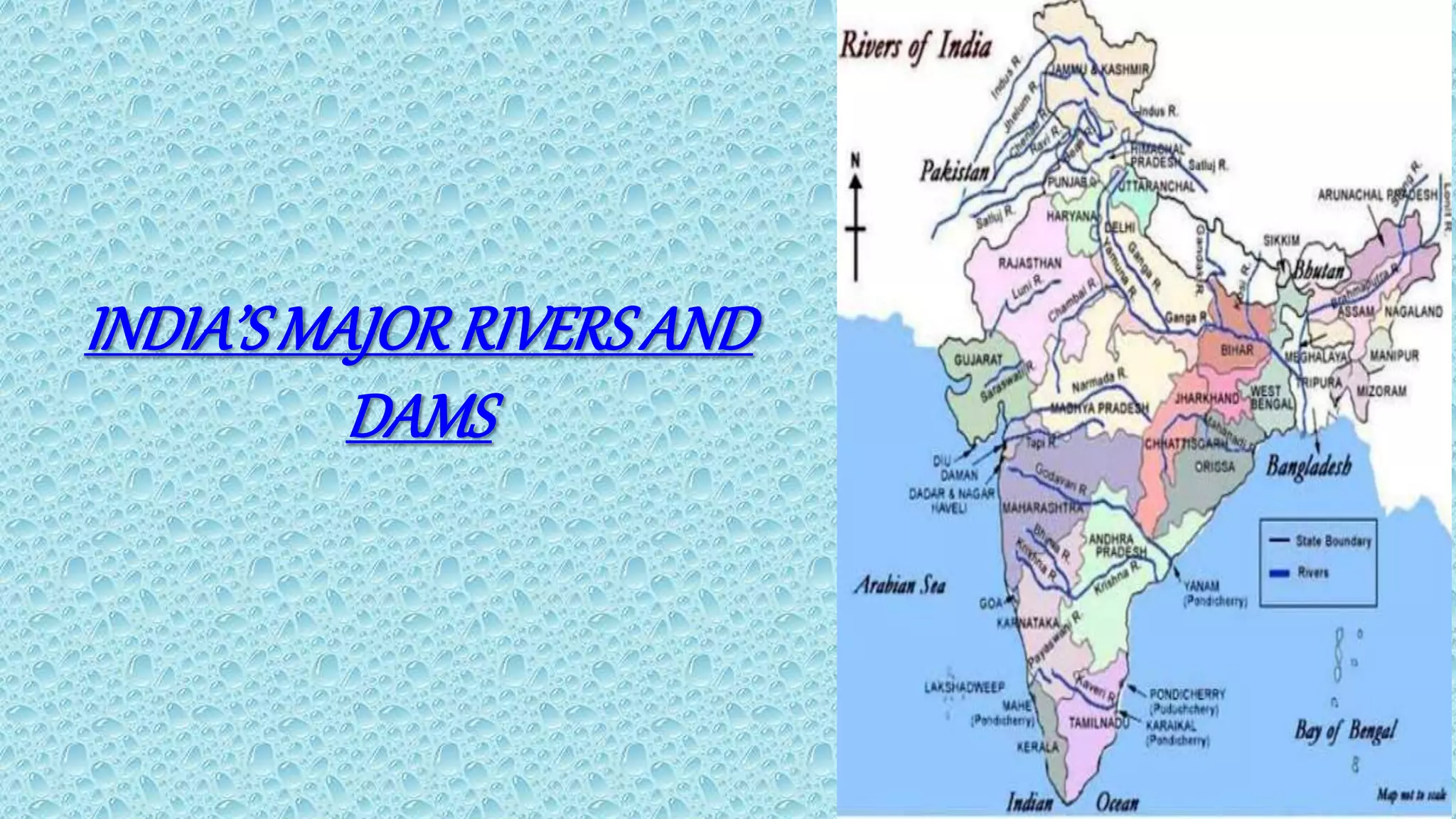
INDIA’SMAJORRIVERSAND
DAMS
DISADVANTAGES OF DAMS
Affects their natural flow causing poor sediment flow and excessive
sedimentation at the bottom of the reservoir, resulting in rockier
stream beds and poorer habitats for the rivers aquatic life.
Dams also fragment rivers making it difficult for aquatic fauna to
migrate especially for spawning.
They also submerge existing vegetation and soil leading decomposition.
Irrigation has also changed the cropping pattern of many regions with
farmers shifting to water intensive and commercial crops. This has also
affected in salinization of soil.
RAINWATERHARVESTING
Many thought that rain water harvesting system was
a viable alternative, both socio-economically and
environmentally.
In ancient India, there existed an extraordinary
tradition of water harvesting system.
In hill and mountainous regions, people built diversion
channels like the ‘guls’ or ‘kuls’ of the Western
Himalayas for agriculture.
DIFFERENTPURPOSES
‘Rooftop Rainwater Harvesting’ was commonly practiced to
store drinking water, particularly in Rajasthan.
In the flood plains of Bengal, people developed inundation
channels to irrigate their fields.
In arid and semi-arid regions, agricultural fields were
converted into rain fed storage structures that allowed the
water to stand and moisten the soil like the ‘khadins’ in
Jaisalmer and ‘Johads’ in other parts of Rajasthan.
TANKAS
In the semi-arid regions of Rajasthan, particularly in Bikaner, Phalodi and
Barmer, almost all the houses traditionally had underground tanks or Tankas for
storing drinking water.
Tankas were connected to the sloping roofs of the houses through a pipe.
Rain falling on the rooftops would travel down the pipe and was stored in these
underground tankas.
The first spell of rain was usually not collected as this would clean the roofs and
the pipes.
The rainwater can be stored in the tankas till the next rainfall, making it an
extremely reliable source of drinking water when all other sources are dried up,
particularly in summers.
In many parts of rural and urban India, Rooftop Rainwater Harvesting is being
successfully adapted to store and conserve water.
INTERESTINGFACT
Rooftop Rainwater harvesting system is the most common
practice in Shillong, Meghalaya.
It is interesting because Shillong is just 55kms away from
the world’s largest rainfall receiving area, mawsynram
and cherapunjee.
Tamil Nadu Is the first state in India which has made
rooftop rainwater harvesting structure compulsory to all
the houses across the state.
There are legal provisions to punish the defaulters.
BAMBOODRIP IRRIGATIONSYSTEM
In Meghalaya, a 200-year-old system of tapping stream and
spring water by using bamboo pipes, is prevalent.
About 18-20 liters of water enters the bamboo pipe system, gest
transported over hundreds of meters, and finally reduces to 20-
80 drops per minute at the site of the plant.
Water resources (geography chapter 3, class 10)

Water resources (geography chapter 3, class 10)

  • 2.
    INTRODUCTION Three- forth ofthe earth’s 🌎 surface is covered with water, but only a small proportion of it accounts for freshwater that can be put to use. All water moves within the hydrological cycle ensuring that water is a renewable resources.
  • 3.
    Waterscarcityandtheneed forwaterconservationandmanagement The availablityof water resources varies over space and time mainly due to the variations in seasonal and annual precipitation. Water scarcity in most cases is caused by over-exploitation, excessive use and unequal access to water among different social groups. Water scarcity may be an outcome of large and growing population and consequently greater demands for water,and unequal access to it. A large population requires more water and more food.
  • 4.
    Irrigated agriculture isthe largest consumer of water. The ever increasing number of industries has made matters worse by exerting pressure on existing freshwater resources. Industries, apart from being heavy users of water, also require power to run them . Multiplying urban centres with large and dense populations and urban lifestyles have not only added to water and energy requirements but have further aggravated the problem. Water is sufficiently available to meet the needs of the people, but the area still suffers from water scarcity.This scarcity may be due to bad quality of water. Over exploitation and mismanagement of water resources will impoverish this resource and cause ecological crisis that may have profound impact on our lives.
  • 5.
    Dams were traditionallybuilt to impound rivers and rainwater that could be used later to irrigate agricultural fields. Today dams are built not just for electricity generation, water supply for domestic and industrial uses, flood control, recreation, inland navigation and fish breeding.Hence, dams are now referred to as multi-purpose projects. Sutluj- Beas river basin, the Bhakra- Nangal project water is being used both for hydel power production and irrigation. Jawaharlal Nehru proudly proclaimed the dams as the ‘ temples of modern India’ . WHATAREDAMSANDHOWDOTHEYHELPUSIN CONSERVING&MANAGINGWATER
  • 6.
    DISADVANTAGES OF DAMS Affectstheir natural flow causing poor sediment flow and excessive sedimentation at the bottom of the reservoir, resulting in rockier stream beds and poorer habitats for the rivers aquatic life. Dams also fragment rivers making it difficult for aquatic fauna to migrate especially for spawning. They also submerge existing vegetation and soil leading decomposition. Irrigation has also changed the cropping pattern of many regions with farmers shifting to water intensive and commercial crops. This has also affected in salinization of soil.
  • 7.
    The dams thatwere constructed to control floods have triggered due to sedimentation in the reservoir Big dams have mostly been unsuccessful to control floods at the time of excessive rainfall 🌧️ The floods have not only devasted life and property but also caused extensive soil erosion. Multi-purpose projects induced earthquakes, caused water-borne diseases and pests and pollution resulting from excessive use of water.
  • 8.
    NarmadaBachao andolan Narmada Bachaoandolan or save Narmada movement is a non governmental organization (NGO) that mobilised tribal people, farmers, environmentalists and human rights activists against the Sardar Sarovar Dam being built across the Narmada river in Gujarat. It originally focused on the environmental issues related to trees 🌴 that would be submerged under the dam water. Recently it has re-focused the aim to enable poor citizens, especially the oustees (displaced people) to get full rehabilitation facilities from the government.
  • 9.
  • 10.
    DISADVANTAGES OF DAMS Affectstheir natural flow causing poor sediment flow and excessive sedimentation at the bottom of the reservoir, resulting in rockier stream beds and poorer habitats for the rivers aquatic life. Dams also fragment rivers making it difficult for aquatic fauna to migrate especially for spawning. They also submerge existing vegetation and soil leading decomposition. Irrigation has also changed the cropping pattern of many regions with farmers shifting to water intensive and commercial crops. This has also affected in salinization of soil.
  • 11.
    RAINWATERHARVESTING Many thought thatrain water harvesting system was a viable alternative, both socio-economically and environmentally. In ancient India, there existed an extraordinary tradition of water harvesting system. In hill and mountainous regions, people built diversion channels like the ‘guls’ or ‘kuls’ of the Western Himalayas for agriculture.
  • 12.
    DIFFERENTPURPOSES ‘Rooftop Rainwater Harvesting’was commonly practiced to store drinking water, particularly in Rajasthan. In the flood plains of Bengal, people developed inundation channels to irrigate their fields. In arid and semi-arid regions, agricultural fields were converted into rain fed storage structures that allowed the water to stand and moisten the soil like the ‘khadins’ in Jaisalmer and ‘Johads’ in other parts of Rajasthan.
  • 13.
    TANKAS In the semi-aridregions of Rajasthan, particularly in Bikaner, Phalodi and Barmer, almost all the houses traditionally had underground tanks or Tankas for storing drinking water. Tankas were connected to the sloping roofs of the houses through a pipe. Rain falling on the rooftops would travel down the pipe and was stored in these underground tankas. The first spell of rain was usually not collected as this would clean the roofs and the pipes. The rainwater can be stored in the tankas till the next rainfall, making it an extremely reliable source of drinking water when all other sources are dried up, particularly in summers. In many parts of rural and urban India, Rooftop Rainwater Harvesting is being successfully adapted to store and conserve water.
  • 14.
    INTERESTINGFACT Rooftop Rainwater harvestingsystem is the most common practice in Shillong, Meghalaya. It is interesting because Shillong is just 55kms away from the world’s largest rainfall receiving area, mawsynram and cherapunjee. Tamil Nadu Is the first state in India which has made rooftop rainwater harvesting structure compulsory to all the houses across the state. There are legal provisions to punish the defaulters.
  • 15.
    BAMBOODRIP IRRIGATIONSYSTEM In Meghalaya,a 200-year-old system of tapping stream and spring water by using bamboo pipes, is prevalent. About 18-20 liters of water enters the bamboo pipe system, gest transported over hundreds of meters, and finally reduces to 20- 80 drops per minute at the site of the plant.